Cambridge IGCSE English - Second Language (count-in oral) 0511 — 2014 May/June Paper 2 · Variant 3
0511/23/M/J/14 · 90 marks · ≈101 min
The question paper and its mark scheme, free to read here and free to download. This is Cambridge’s own paper, exactly as it was sat.
Question paper16 pages





Mark scheme12 pages
Answers below. Sit the paper first if you are practising.
Paper as text
Question paper, page 1
This document consists of 15 printed pages and 1 blank page. DC (SJF/CGW) 91927 © UCLES 2014 [Turn over Cambridge International Examinations Cambridge International General Certificate of Secondary Education * 8 1 2 7 9 2 8 7 1 6 * ENGLISH AS A SECOND LANGUAGE 0511/23 Paper 2 Reading and Writing (Extended) May/June 2014 2 hours Candidates answer on the Question Paper. No Additional Materials are required. READ THESE INSTRUCTIONS FIRST Write your Centre number, candidate number and name on all the work you hand in. Write in dark blue or black pen. Do not use staples, paper clips, glue or correction fluid. DO NOT WRITE IN ANY BARCODES. Answer all questions. Dictionaries are not allowed. At the end of the examination, fasten all your work securely together. The number of marks is given in brackets [ ] at the end of each question or part question. PAPA CAMBRIDGE
Question paper, page 2
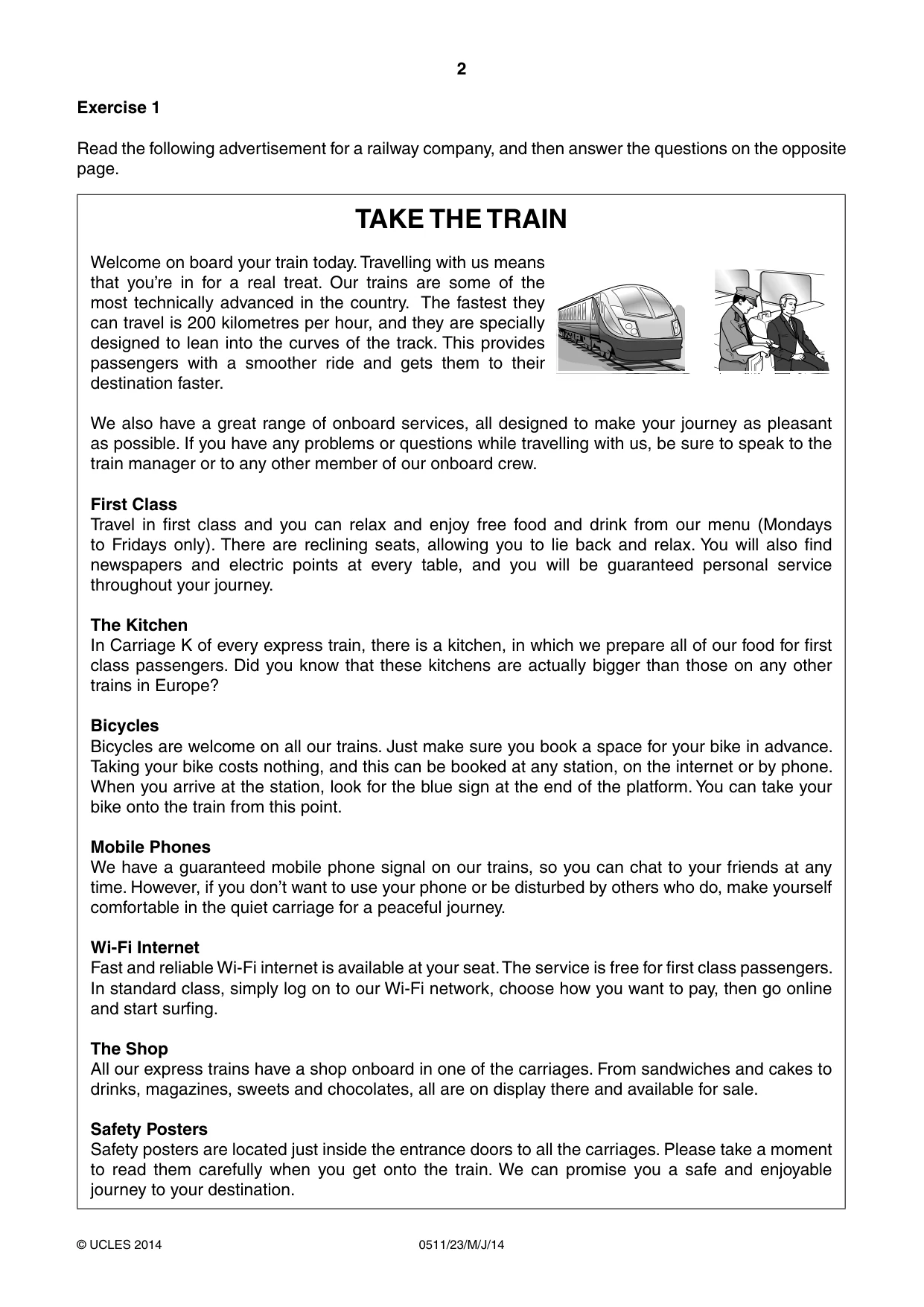
2 0511/23/M/J/14 © UCLES 2014 Exercise 1 Read the following advertisement for a railway company, and then answer the questions on the opposite page. TAKE THE TRAIN Welcome on board your train today. Travelling with us means that you’re in for a real treat. Our trains are some of the most technically advanced in the country. The fastest they can travel is 200 kilometres per hour, and they are specially designed to lean into the curves of the track. This provides passengers with a smoother ride and gets them to their destination faster. We also have a great range of onboard services, all designed to make your journey as pleasant as possible. If you have any problems or questions while travelling with us, be sure to speak to the train manager or to any other member of our onboard crew. First Class Travel in first class and you can relax and enjoy free food and drink from our menu (Mondays to Fridays only). There are reclining seats, allowing you to lie back and relax. You will also find newspapers and electric points at every table, and you will be guaranteed personal service throughout your journey. The Kitchen In Carriage K of every express train, there is a kitchen, in which we prepare all of our food for first class passengers. Did you know that these kitchens are actually bigger than those on any other trains in Europe? Bicycles Bicycles are welcome on all our trains. Just make sure you book a space for your bike in advance. Taking your bike costs nothing, and this can be booked at any station, on the internet or by phone. When you arrive at the station, look for the blue sign at the end of the platform. You can take your bike onto the train from this point. Mobile Phones We have a guaranteed mobile phone signal on our trains, so you can chat to your friends at any time. However, if you don’t want to use your phone or be disturbed by others who do, make yourself comfortable in the quiet carriage for a peaceful journey. Wi-Fi Internet Fast and reliable Wi-Fi internet is available at your seat. The service is free for first class passengers. In standard class, simply log on to our Wi-Fi network, choose how you want to pay, then go online and start surfing. The Shop All our express trains have a shop onboard in one of the carriages. From sandwiches and cakes to drinks, magazines, sweets and chocolates, all are on display there and available for sale. Safety Posters Safety posters are located just inside the entrance doors to all the carriages. Please take a moment to read them carefully when you get onto the train. We can promise you a safe and enjoyable journey to your destination.
Question paper, page 3
3 0511/23/M/J/14 © UCLES 2014 [Turn over (a) What is the maximum speed of these trains? …[1] (b) In case of difficulty, who can you ask for help or advice? Give two details. … …[1] (c) On which days would first class passengers be unable to obtain a free meal? …[1] (d) What special feature ensures that passengers can sit comfortably in first class? …[1] (e) What shows you where to get on the train with your bicycle? …[1] (f) Where should you go if you want to avoid the noise made by mobile phone users? …[1] (g) Which train passengers have to pay to use the Wi-Fi internet? …[1] (h) Apart from food and drink, what can you buy at the shop? …[1] (i) What are all passengers advised to do at the beginning of their journey? …[1] [Total: 9]
Question paper, page 4
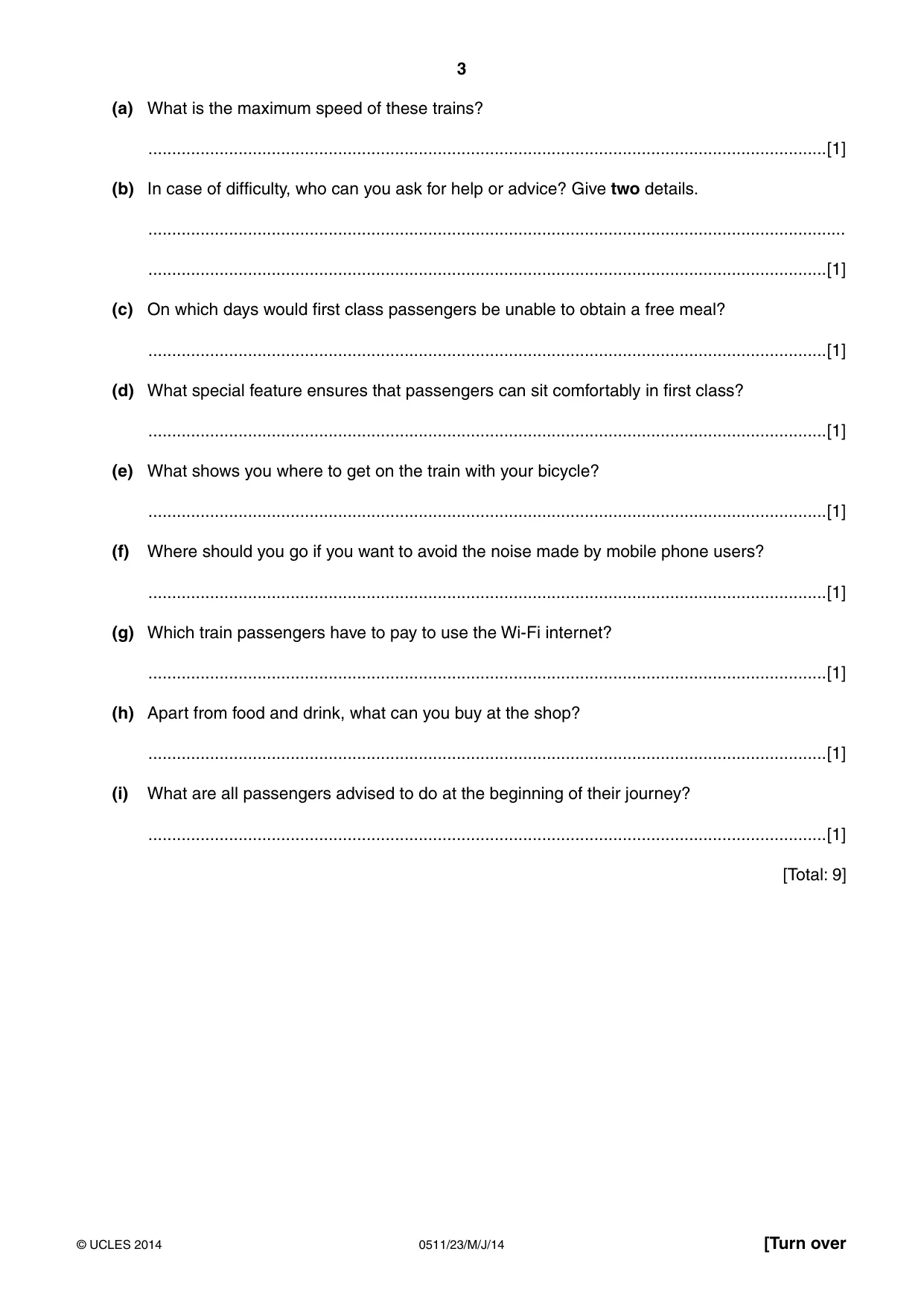
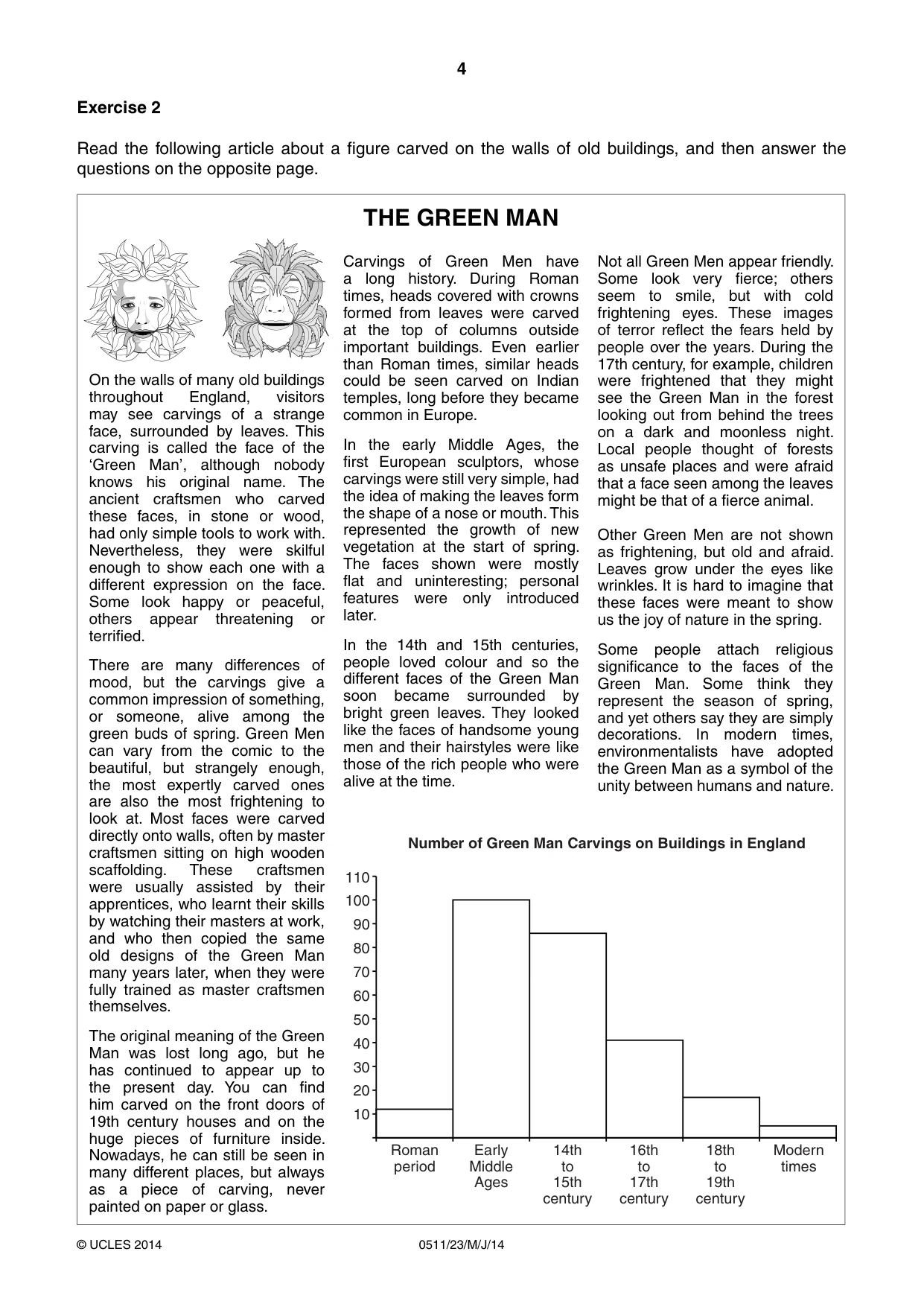
4 0511/23/M/J/14 © UCLES 2014 Exercise 2 Read the following article about a figure carved on the walls of old buildings, and then answer the questions on the opposite page. THE GREEN MAN On the walls of many old buildings throughout England, visitors may see carvings of a strange face, surrounded by leaves. This carving is called the face of the ‘Green Man’, although nobody knows his original name. The ancient craftsmen who carved these faces, in stone or wood, had only simple tools to work with. Nevertheless, they were skilful enough to show each one with a different expression on the face. Some look happy or peaceful, others appear threatening or terrified. There are many differences of mood, but the carvings give a common impression of something, or someone, alive among the green buds of spring. Green Men can vary from the comic to the beautiful, but strangely enough, the most expertly carved ones are also the most frightening to look at. Most faces were carved directly onto walls, often by master craftsmen sitting on high wooden scaffolding. These craftsmen were usually assisted by their apprentices, who learnt their skills by watching their masters at work, and who then copied the same old designs of the Green Man many years later, when they were fully trained as master craftsmen themselves. The original meaning of the Green Man was lost long ago, but he has continued to appear up to the present day. You can find him carved on the front doors of 19th century houses and on the huge pieces of furniture inside. Nowadays, he can still be seen in many different places, but always as a piece of carving, never painted on paper or glass. Carvings of Green Men have a long history. During Roman times, heads covered with crowns formed from leaves were carved at the top of columns outside important buildings. Even earlier than Roman times, similar heads could be seen carved on Indian temples, long before they became common in Europe. In the early Middle Ages, the first European sculptors, whose carvings were still very simple, had the idea of making the leaves form the shape of a nose or mouth. This represented the growth of new vegetation at the start of spring. The faces shown were mostly flat and uninteresting; personal features were only introduced later. In the 14th and 15th centuries, people loved colour and so the different faces of the Green Man soon became surrounded by bright green leaves. They looked like the faces of handsome young men and their hairstyles were like those of the rich people who were alive at the time. Not all Green Men appear friendly. Some look very fierce; others seem to smile, but with cold frightening eyes. These images of terror reflect the fears held by people over the years. During the 17th century, for example, children were frightened that they might see the Green Man in the forest looking out from behind the trees on a dark and moonless night. Local people thought of forests as unsafe places and were afraid that a face seen among the leaves might be that of a fierce animal. Other Green Men are not shown as frightening, but old and afraid. Leaves grow under the eyes like wrinkles. It is hard to imagine that these faces were meant to show us the joy of nature in the spring. Some people attach religious significance to the faces of the Green Man. Some think they represent the season of spring, and yet others say they are simply decorations. In modern times, environmentalists have adopted the Green Man as a symbol of the unity between humans and nature. 10 20 30 40 50 60 Roman period Early Middle Ages 14th to 15th century Number of Green Man Carvings on Buildings in England 16th to 17th century 18th to 19th century Modern times 90 100 110 70 80
Question paper, page 5
5 0511/23/M/J/14 © UCLES 2014 [Turn over (a) What materials were the first carvings of the Green Man made from? Give two details. …[1] (b) What is surprising about the faces that are particularly well carved? …[1] (c) What did a craftsman’s apprentice do after becoming qualified? …[1] (d) Apart from on walls, where can you find 19th century carvings of the Green Man? Give two details. … …[2] (e) What natural event did early sculptors in Europe try to express with their carvings? …[1] (f) In the 15th century, what feature made Green Men look wealthy? …[1] (g) Why were forests considered dangerous places? Give two details. … …[2] (h) According to the chart, in which period of history were the greatest number of Green Man carvings found, and how many were there at that time? …[1] (i) How do environmentalists regard the Green Man today? …[1] (j) Describe the different ways in which the head or face of the Green Man is seen to be decorated with leaves. Give four details. … … … …[4] [Total: 15]
Question paper, page 6
6 0511/23/M/J/14 © UCLES 2014 Exercise 3 Ranvir Dasgupta is a final-year school student at the Queen’s Academy in Amritsar, India. She lives with her family at 39 Hungerford Road, Amritsar 143 026, telephone number 183-630551. For the past nine months she has been using her own personal email address, ranidas@telmail.in, to correspond with her many friends and relatives. Although Ranvir is not outstanding at her studies, she does take part in many different sports and is a member of her school teams for netball, hockey and tennis. Her main interest, however, is as a girl guide. She has been a guide since she was only 10, and for the past two years she has been leader of the Queen’s Academy Girl Guide Troop. Her speciality is orienteering, a competitive sport in which runners have to find their way across the countryside with the aid of a map and compass. The latest edition of the Guiding Magazine contains an announcement for an International Girl Guide Tournament, to be held later this year in Brisbane, Australia, from 19th to 23rd November 2014. Ranvir is determined to take most of her troop to the tournament so that they can compete as a team in the orienteering race. She will have her 18th birthday before she goes, and for a birthday present her father has promised to pay her return airfare and accommodation as well as the tournament entry fee for the whole troop, consisting of herself and five other girls. While attending the tournament, the troop will live together in a hall of residence belonging to Brisbane University. Ranvir has chosen this location because it is nearer to the sites of all the competitions than any of the hotels or guest houses recommended by the organisers of the tournament, the Australian Girl Guide Association. All the other girls will travel to Australia ten days before the tournament opens in order to do some sightseeing first. Ranvir must stay behind in India to wait for her final exam results. She will arrange to fly out on 17th November 2014 on flight QA 225, which is scheduled to land in Brisbane at 6.10pm. An official tournament minibus will meet that flight and take the participants, who will be arriving from all over the world, to their individual places of accommodation. Ranvir has recently renewed her passport, number ST8224073, and she must now go to the Australian Consulate in Delhi to get an application form for a visa to stay in the country for three weeks. She has been advised to state on the form that she will be visiting the country for tourism and sport. This is because, after the tournament, she would like to visit the Great Barrier Reef off the coast of Queensland. She also intends to spend a week in Melbourne, staying with her aunt, Dr Gayatri Bhaskaram, who lives there with her family. Her aunt has kindly agreed to act as her personal sponsor. Imagine you are Ranvir. Fill in the application form on the opposite page, using the information above.
Question paper, page 7
7 0511/23/M/J/14 © UCLES 2014 [Turn over COMMONWEALTH OF AUSTRALIA VISA APPLICATION FORM SECTION A – Personal details Full name: … Address: … Telephone number: … Email address: … Age at date of entry to Australia: … Passport number: … Do you have any other person(s) travelling with you? (please delete) YES / NO SECTION B – Details of visit to Australia Date and year of entry: … Place of entry: … Flight number: … Purpose(s) of visit: … Length of stay (please tick box): up to 1 month 1 to 6 months more than six months Name and date(s) of any event(s) you plan to participate in: … … Type of organisation that you will represent at the above event (please circle): school university company Name of one personal sponsor in Australia: … SECTION C In the space below, write one sentence of between 12 and 20 words, describing any places you intend to visit in Australia. [Total: 8]
Question paper, page 8
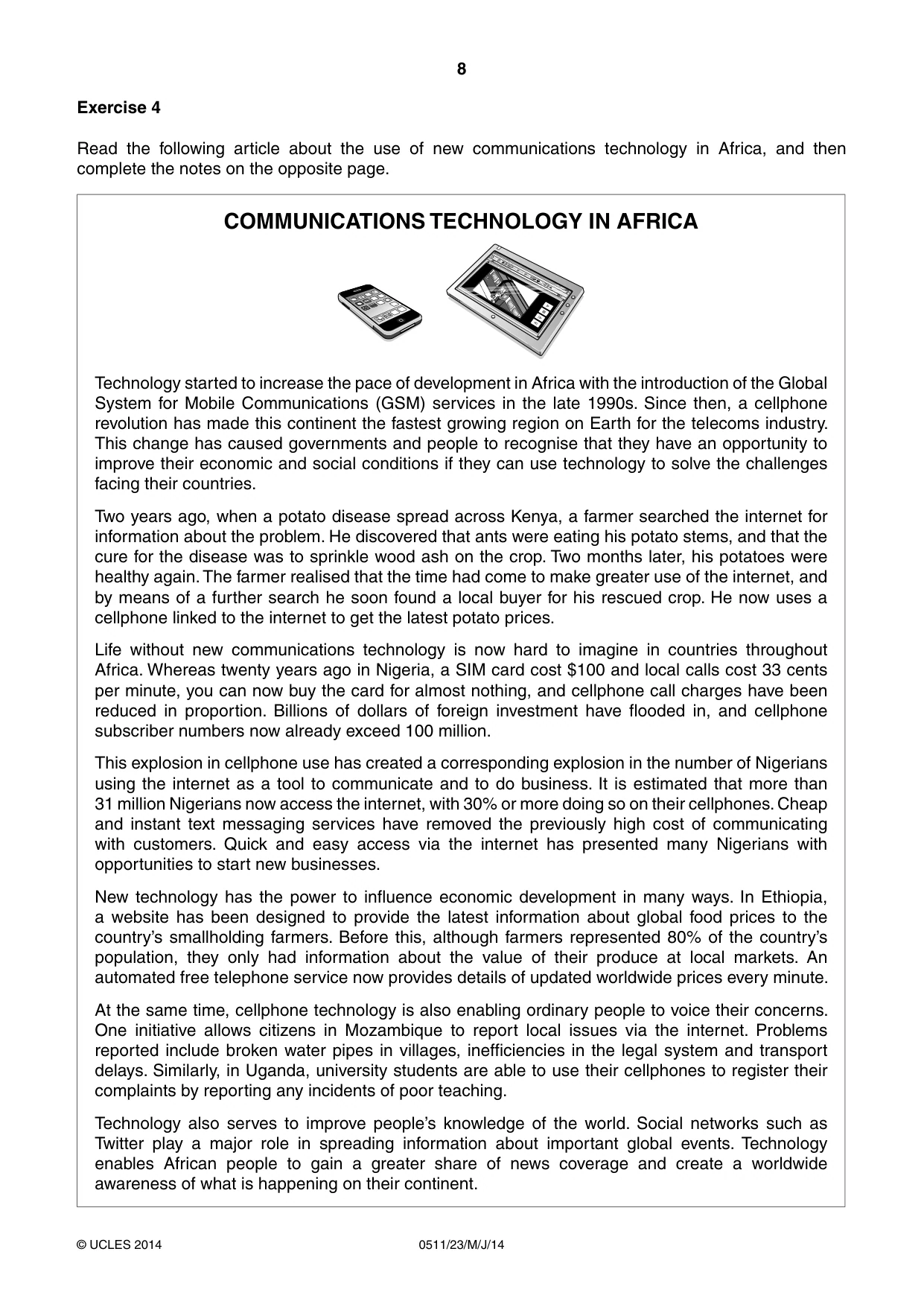
8 0511/23/M/J/14 © UCLES 2014 Exercise 4 Read the following article about the use of new communications technology in Africa, and then complete the notes on the opposite page. COMMUNICATIONS TECHNOLOGY IN AFRICA Go Address Back Search Favorites Media Web Browser101– Internet File Edit View Tools Help Favorites http://www.Web Browser101.com Web Browser101 Technology started to increase the pace of development in Africa with the introduction of the Global System for Mobile Communications (GSM) services in the late 1990s. Since then, a cellphone revolution has made this continent the fastest growing region on Earth for the telecoms industry. This change has caused governments and people to recognise that they have an opportunity to improve their economic and social conditions if they can use technology to solve the challenges facing their countries. Two years ago, when a potato disease spread across Kenya, a farmer searched the internet for information about the problem. He discovered that ants were eating his potato stems, and that the cure for the disease was to sprinkle wood ash on the crop. Two months later, his potatoes were healthy again. The farmer realised that the time had come to make greater use of the internet, and by means of a further search he soon found a local buyer for his rescued crop. He now uses a cellphone linked to the internet to get the latest potato prices. Life without new communications technology is now hard to imagine in countries throughout Africa. Whereas twenty years ago in Nigeria, a SIM card cost $100 and local calls cost 33 cents per minute, you can now buy the card for almost nothing, and cellphone call charges have been reduced in proportion. Billions of dollars of foreign investment have flooded in, and cellphone subscriber numbers now already exceed 100 million. This explosion in cellphone use has created a corresponding explosion in the number of Nigerians using the internet as a tool to communicate and to do business. It is estimated that more than 31 million Nigerians now access the internet, with 30% or more doing so on their cellphones. Cheap and instant text messaging services have removed the previously high cost of communicating with customers. Quick and easy access via the internet has presented many Nigerians with opportunities to start new businesses. New technology has the power to influence economic development in many ways. In Ethiopia, a website has been designed to provide the latest information about global food prices to the country’s smallholding farmers. Before this, although farmers represented 80% of the country’s population, they only had information about the value of their produce at local markets. An automated free telephone service now provides details of updated worldwide prices every minute. At the same time, cellphone technology is also enabling ordinary people to voice their concerns. One initiative allows citizens in Mozambique to report local issues via the internet. Problems reported include broken water pipes in villages, inefficiencies in the legal system and transport delays. Similarly, in Uganda, university students are able to use their cellphones to register their complaints by reporting any incidents of poor teaching. Technology also serves to improve people’s knowledge of the world. Social networks such as Twitter play a major role in spreading information about important global events. Technology enables African people to gain a greater share of news coverage and create a worldwide awareness of what is happening on their continent.
Question paper, page 9
9 0511/23/M/J/14 © UCLES 2014 [Turn over You have been asked to give a short talk to the International Group at your school about the use of communications technology in Africa. Prepare some notes to use as the basis for your talk. Make your notes under each heading. How technology helped a farmer in Kenya • … • … • … Financial benefits of new technology to Nigerians • … • … • … • … How technology has affected life in other named African countries • … • … [Total: 9]
Question paper, page 10
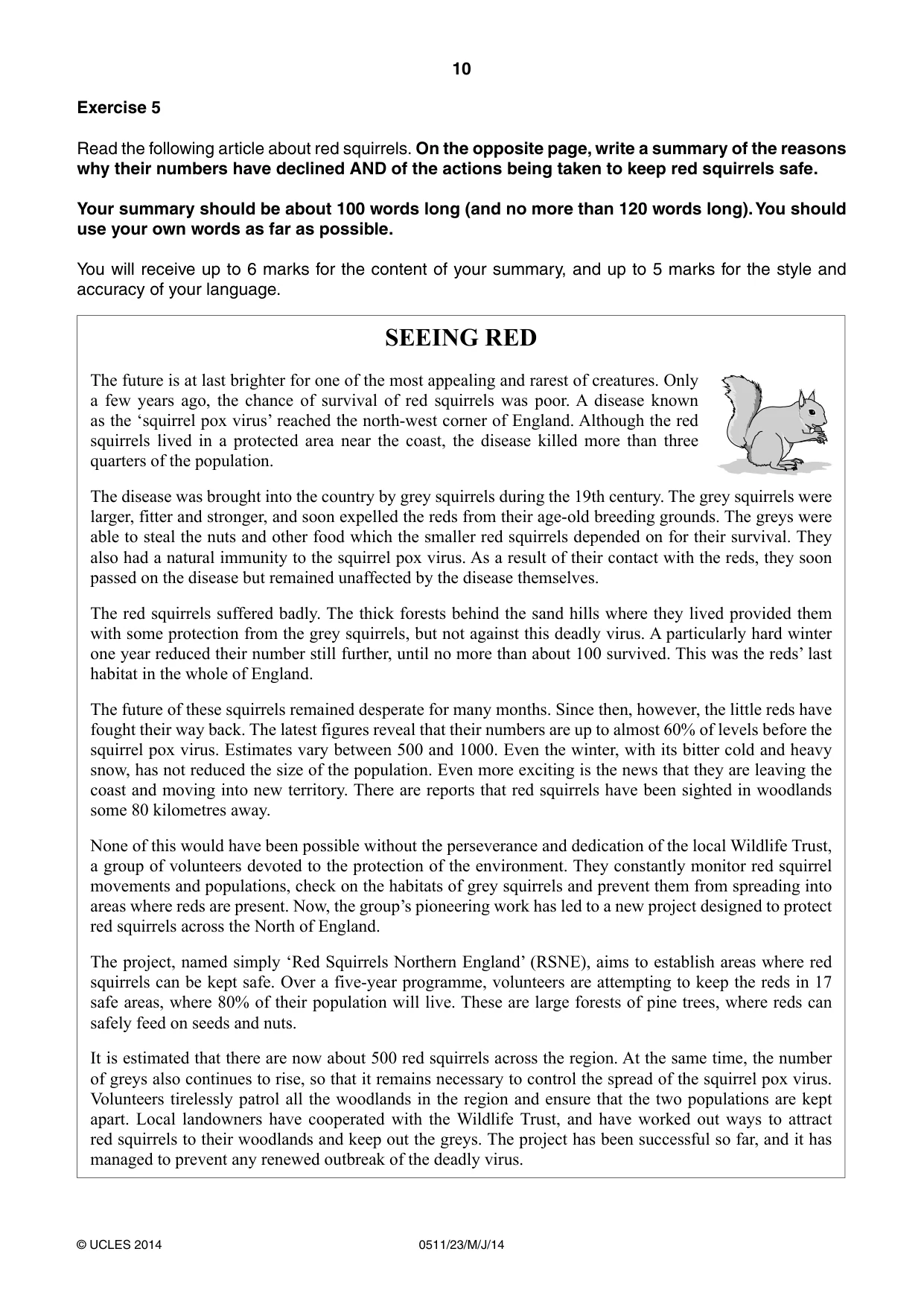
10 0511/23/M/J/14 © UCLES 2014 Exercise 5 Read the following article about red squirrels. On the opposite page, write a summary of the reasons why their numbers have declined AND of the actions being taken to keep red squirrels safe. Your summary should be about 100 words long (and no more than 120 words long). You should use your own words as far as possible. You will receive up to 6 marks for the content of your summary, and up to 5 marks for the style and accuracy of your language. SEEING RED The future is at last brighter for one of the most appealing and rarest of creatures. Only a few years ago, the chance of survival of red squirrels was poor. A disease known as the ‘squirrel pox virus’ reached the north-west corner of England. Although the red squirrels lived in a protected area near the coast, the disease killed more than three quarters of the population. The disease was brought into the country by grey squirrels during the 19th century. The grey squirrels were larger, fitter and stronger, and soon expelled the reds from their age-old breeding grounds. The greys were able to steal the nuts and other food which the smaller red squirrels depended on for their survival. They also had a natural immunity to the squirrel pox virus. As a result of their contact with the reds, they soon passed on the disease but remained unaffected by the disease themselves. The red squirrels suffered badly. The thick forests behind the sand hills where they lived provided them with some protection from the grey squirrels, but not against this deadly virus. A particularly hard winter one year reduced their number still further, until no more than about 100 survived. This was the reds’ last habitat in the whole of England. The future of these squirrels remained desperate for many months. Since then, however, the little reds have fought their way back. The latest figures reveal that their numbers are up to almost 60% of levels before the squirrel pox virus. Estimates vary between 500 and 1000. Even the winter, with its bitter cold and heavy snow, has not reduced the size of the population. Even more exciting is the news that they are leaving the coast and moving into new territory. There are reports that red squirrels have been sighted in woodlands some 80 kilometres away. None of this would have been possible without the perseverance and dedication of the local Wildlife Trust, a group of volunteers devoted to the protection of the environment. They constantly monitor red squirrel movements and populations, check on the habitats of grey squirrels and prevent them from spreading into areas where reds are present. Now, the group’s pioneering work has led to a new project designed to protect red squirrels across the North of England. The project, named simply ‘Red Squirrels Northern England’ (RSNE), aims to establish areas where red squirrels can be kept safe. Over a five-year programme, volunteers are attempting to keep the reds in 17 safe areas, where 80% of their population will live. These are large forests of pine trees, where reds can safely feed on seeds and nuts. It is estimated that there are now about 500 red squirrels across the region. At the same time, the number of greys also continues to rise, so that it remains necessary to control the spread of the squirrel pox virus. Volunteers tirelessly patrol all the woodlands in the region and ensure that the two populations are kept apart. Local landowners have cooperated with the Wildlife Trust, and have worked out ways to attract red squirrels to their woodlands and keep out the greys. The project has been successful so far, and it has managed to prevent any renewed outbreak of the deadly virus.
Question paper, page 11
11 0511/23/M/J/14 © UCLES 2014 [Turn over … … … … … … … … … … … … … … … … … … … … [Total: 11]
Question paper, page 12
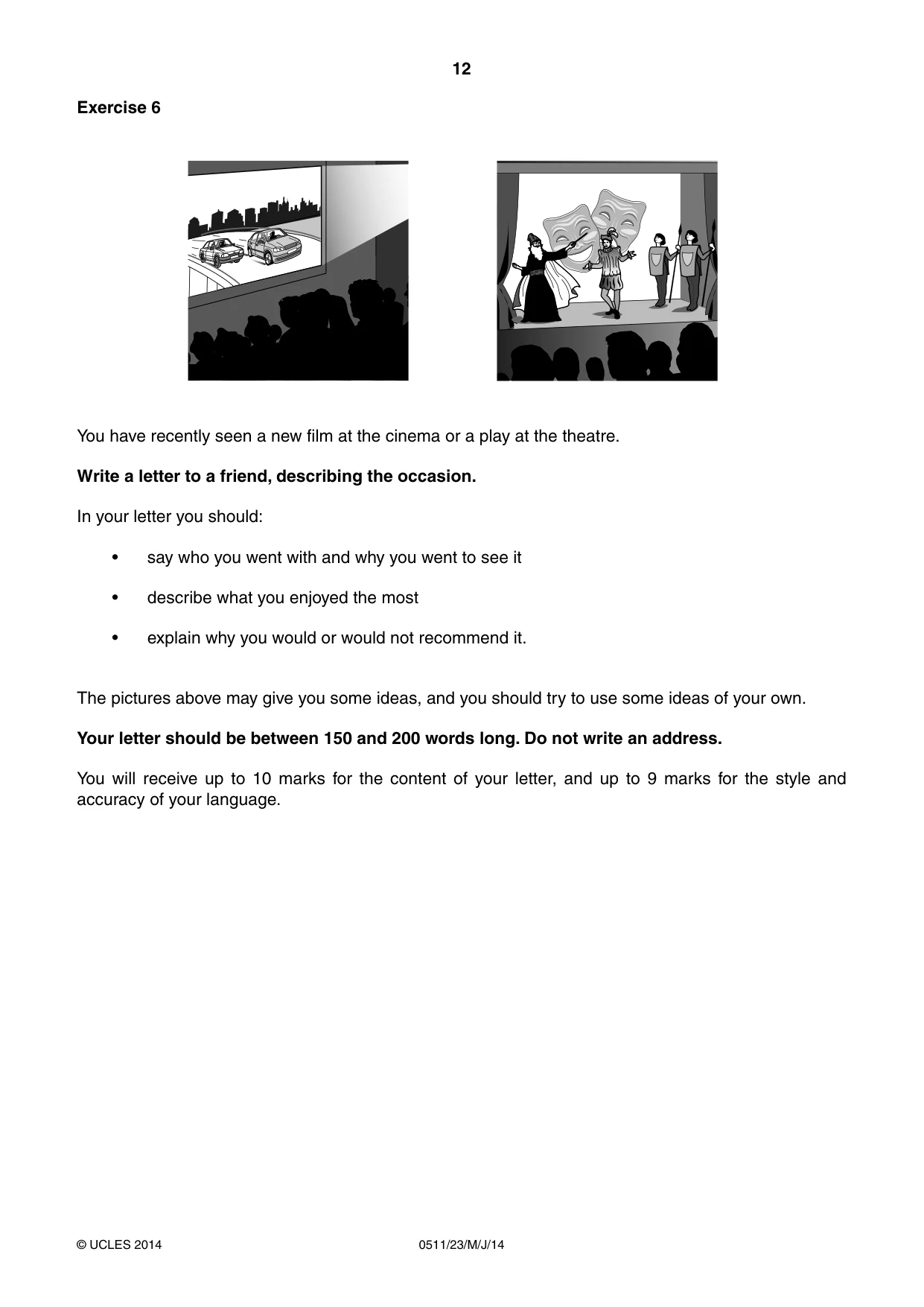
12 0511/23/M/J/14 © UCLES 2014 Exercise 6 You have recently seen a new film at the cinema or a play at the theatre. Write a letter to a friend, describing the occasion. In your letter you should: • say who you went with and why you went to see it • describe what you enjoyed the most • explain why you would or would not recommend it. The pictures above may give you some ideas, and you should try to use some ideas of your own. Your letter should be between 150 and 200 words long. Do not write an address. You will receive up to 10 marks for the content of your letter, and up to 9 marks for the style and accuracy of your language.
Question paper, page 13
13 0511/23/M/J/14 © UCLES 2014 [Turn over … … … … … … … … … … … … … … … … … … … … … … … … … [Total: 19]
Question paper, page 14
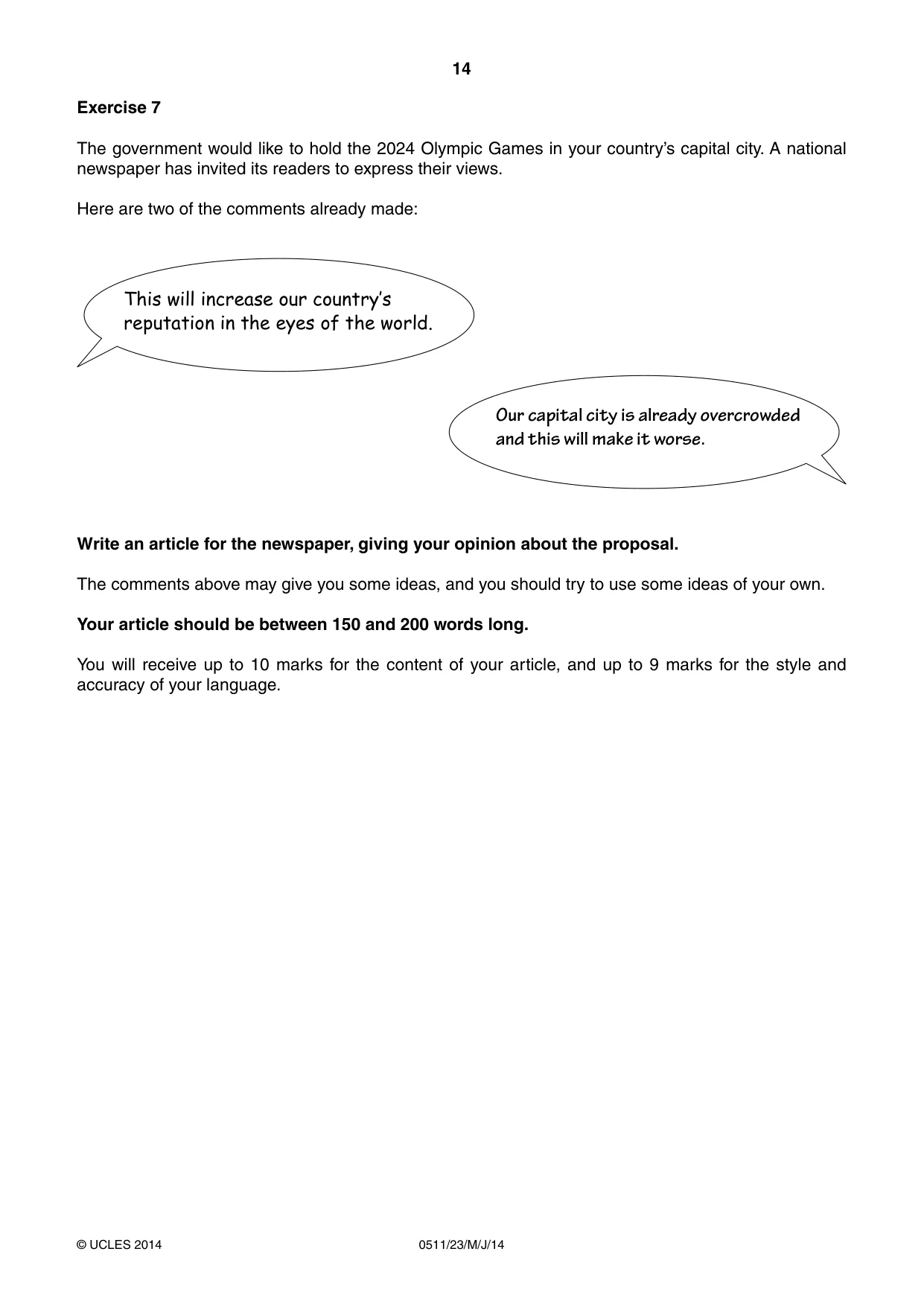
14 0511/23/M/J/14 © UCLES 2014 Exercise 7 The government would like to hold the 2024 Olympic Games in your country’s capital city. A national newspaper has invited its readers to express their views. Here are two of the comments already made: This will increase our country‛s reputation in the eyes of the world. Our capital city is already overcrowded and this will make it worse. Write an article for the newspaper, giving your opinion about the proposal. The comments above may give you some ideas, and you should try to use some ideas of your own. Your article should be between 150 and 200 words long. You will receive up to 10 marks for the content of your article, and up to 9 marks for the style and accuracy of your language.
Question paper, page 15
15 0511/23/M/J/14 © UCLES 2014 … … … … … … … … … … … … … … … … … … … … … … … … … [Total: 19]
Question paper, page 16
16 0511/23/M/J/14 © UCLES 2014 Permission to reproduce items where third-party owned material protected by copyright is included has been sought and cleared where possible. Every reasonable effort has been made by the publisher (UCLES) to trace copyright holders, but if any items requiring clearance have unwittingly been included, the publisher will be pleased to make amends at the earliest possible opportunity. Cambridge International Examinations is part of the Cambridge Assessment Group. Cambridge Assessment is the brand name of University of Cambridge Local Examinations Syndicate (UCLES), which is itself a department of the University of Cambridge. BLANK PAGE
Mark scheme, page 1
CAMBRIDGE INTERNATIONAL EXAMINATIONS International General Certificate of Secondary Education MARK SCHEME for the May/June 2014 series 0511 ENGLISH AS A SECOND LANGUAGE 0511/23 Paper 2 (Reading and Writing – Extended), maximum raw mark 90 This mark scheme is published as an aid to teachers and candidates, to indicate the requirements of the examination. It shows the basis on which Examiners were instructed to award marks. It does not indicate the details of the discussions that took place at an Examiners’ meeting before marking began, which would have considered the acceptability of alternative answers. Mark schemes should be read in conjunction with the question paper and the Principal Examiner Report for Teachers. Cambridge will not enter into discussions about these mark schemes. Cambridge is publishing the mark schemes for the May/June 2014 series for most IGCSE, GCE Advanced Level and Advanced Subsidiary Level components and some Ordinary Level components. PAPA CAMBRIDGE
Mark scheme, page 2
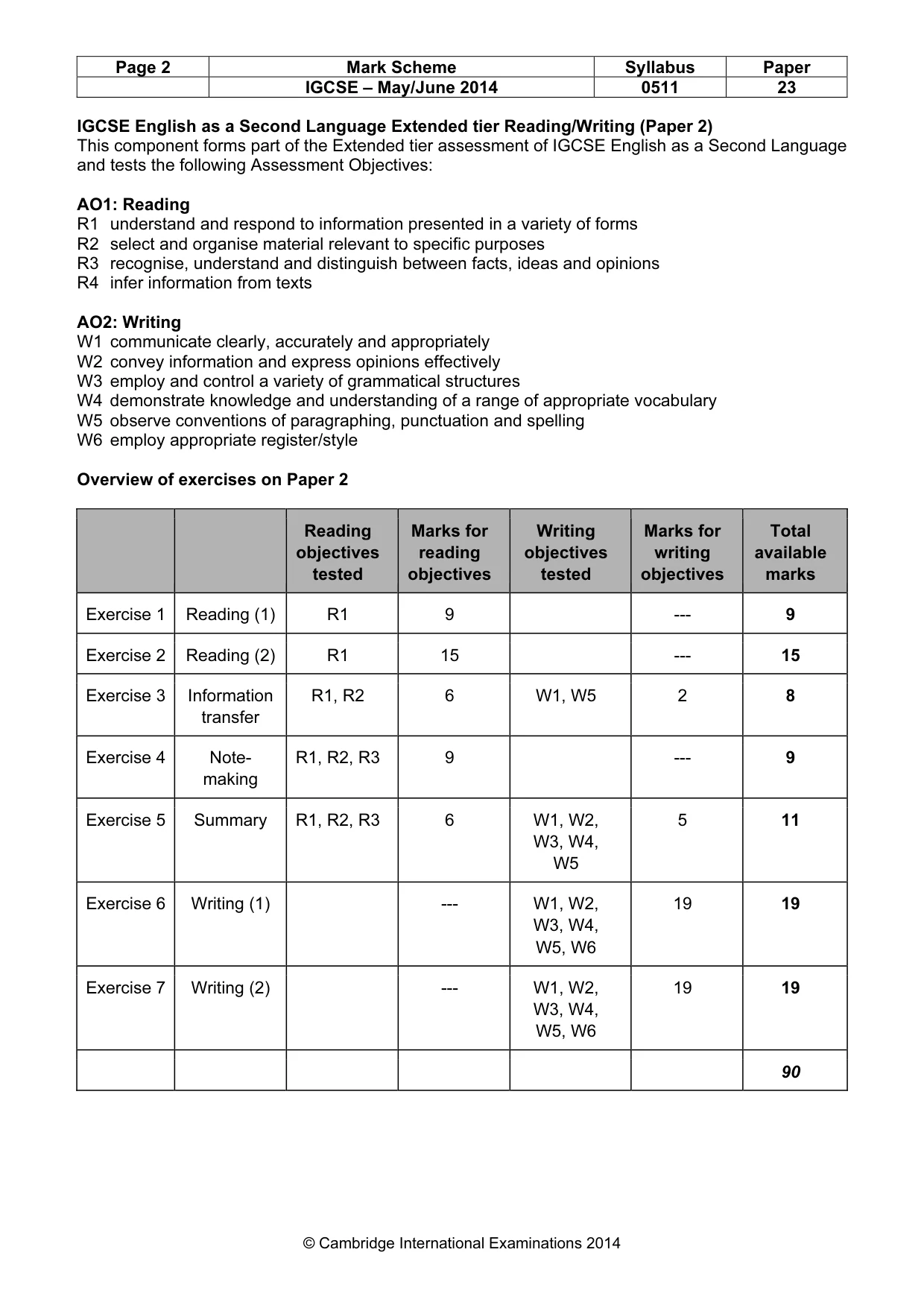
Page 2 Mark Scheme Syllabus Paper IGCSE – May/June 2014 0511 23 © Cambridge International Examinations 2014 IGCSE English as a Second Language Extended tier Reading/Writing (Paper 2) This component forms part of the Extended tier assessment of IGCSE English as a Second Language and tests the following Assessment Objectives: AO1: Reading R1 understand and respond to information presented in a variety of forms R2 select and organise material relevant to specific purposes R3 recognise, understand and distinguish between facts, ideas and opinions R4 infer information from texts AO2: Writing W1 communicate clearly, accurately and appropriately W2 convey information and express opinions effectively W3 employ and control a variety of grammatical structures W4 demonstrate knowledge and understanding of a range of appropriate vocabulary W5 observe conventions of paragraphing, punctuation and spelling W6 employ appropriate register/style Overview of exercises on Paper 2 Reading objectives tested Marks for reading objectives Writing objectives tested Marks for writing objectives Total available marks Exercise 1 Reading (1) R1 9 --- 9 Exercise 2 Reading (2) R1 15 --- 15 Exercise 3 Information transfer R1, R2 6 W1, W5 2 8 Exercise 4 Note- making R1, R2, R3 9 --- 9 Exercise 5 Summary R1, R2, R3 6 W1, W2, W3, W4, W5 5 11 Exercise 6 Writing (1) --- W1, W2, W3, W4, W5, W6 19 19 Exercise 7 Writing (2) --- W1, W2, W3, W4, W5, W6 19 19 90
Mark scheme, page 3
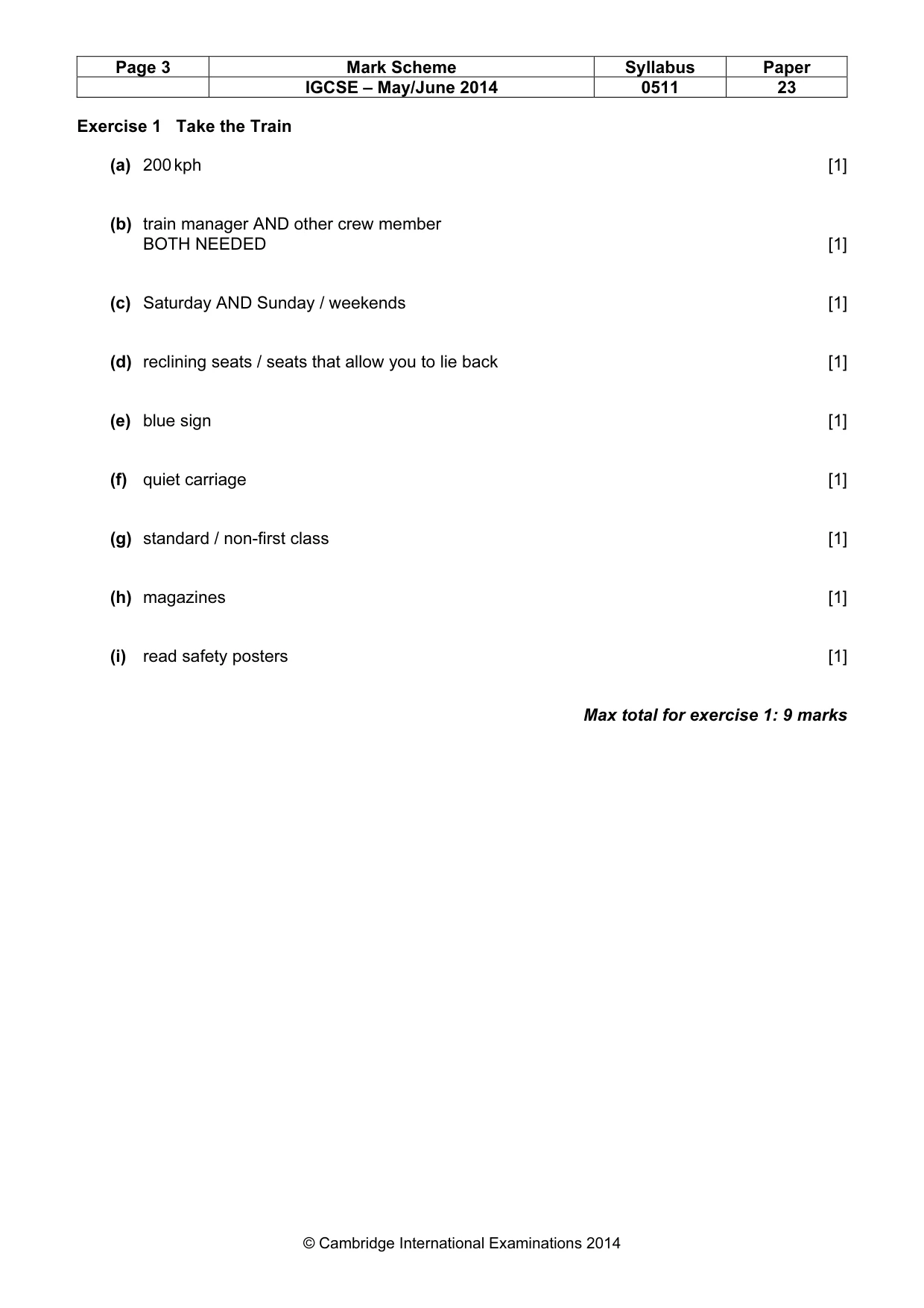
Page 3 Mark Scheme Syllabus Paper IGCSE – May/June 2014 0511 23 © Cambridge International Examinations 2014 Exercise 1 Take the Train (a) 200 kph [1] (b) train manager AND other crew member BOTH NEEDED [1] (c) Saturday AND Sunday / weekends [1] (d) reclining seats / seats that allow you to lie back [1] (e) blue sign [1] (f) quiet carriage [1] (g) standard / non-first class [1] (h) magazines [1] (i) read safety posters [1] Max total for exercise 1: 9 marks
Mark scheme, page 4
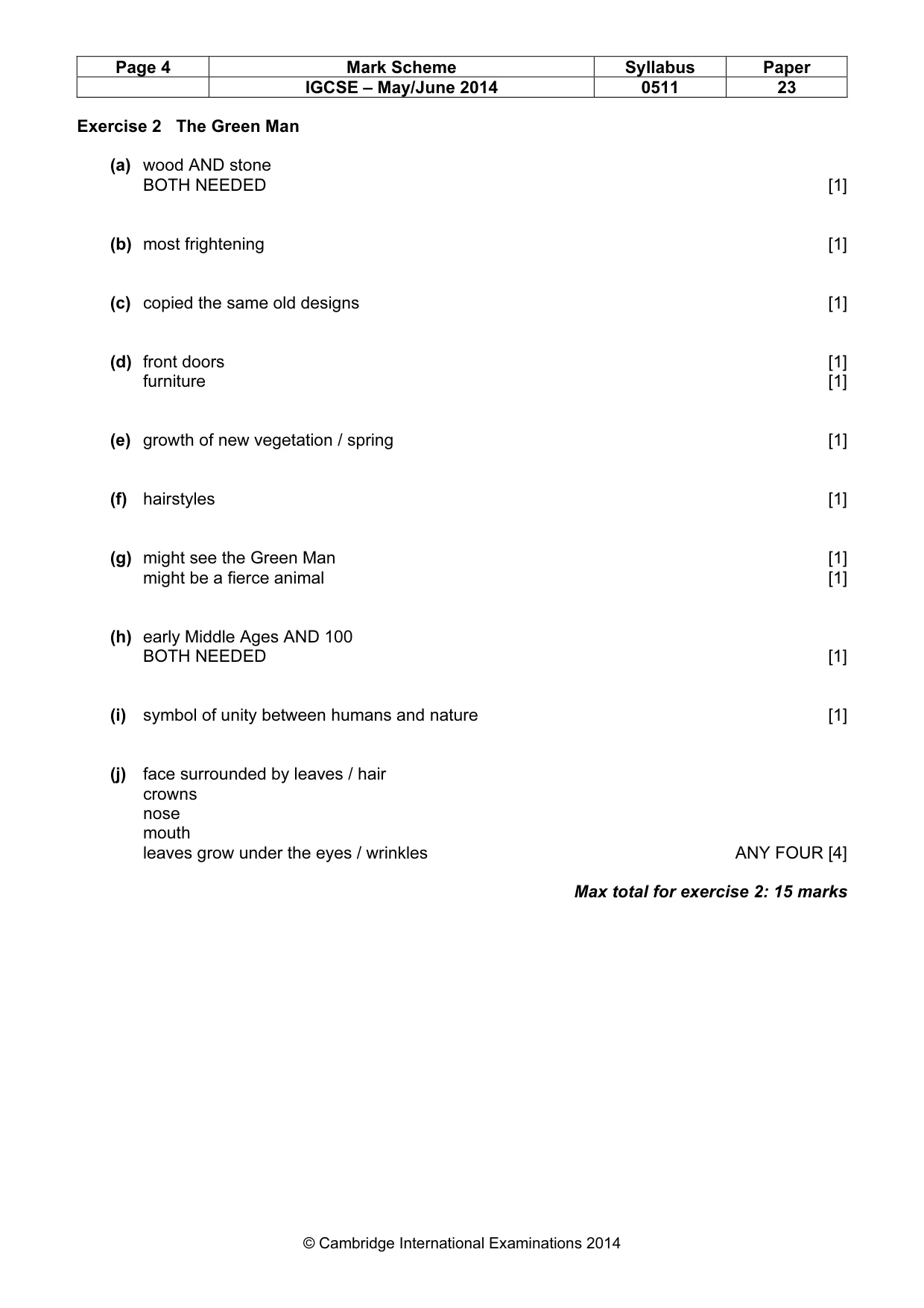
Page 4 Mark Scheme Syllabus Paper IGCSE – May/June 2014 0511 23 © Cambridge International Examinations 2014 Exercise 2 The Green Man (a) wood AND stone BOTH NEEDED [1] (b) most frightening [1] (c) copied the same old designs [1] (d) front doors [1] furniture [1] (e) growth of new vegetation / spring [1] (f) hairstyles [1] (g) might see the Green Man [1] might be a fierce animal [1] (h) early Middle Ages AND 100 BOTH NEEDED [1] (i) symbol of unity between humans and nature [1] (j) face surrounded by leaves / hair crowns nose mouth leaves grow under the eyes / wrinkles ANY FOUR [4] Max total for exercise 2: 15 marks
Mark scheme, page 5
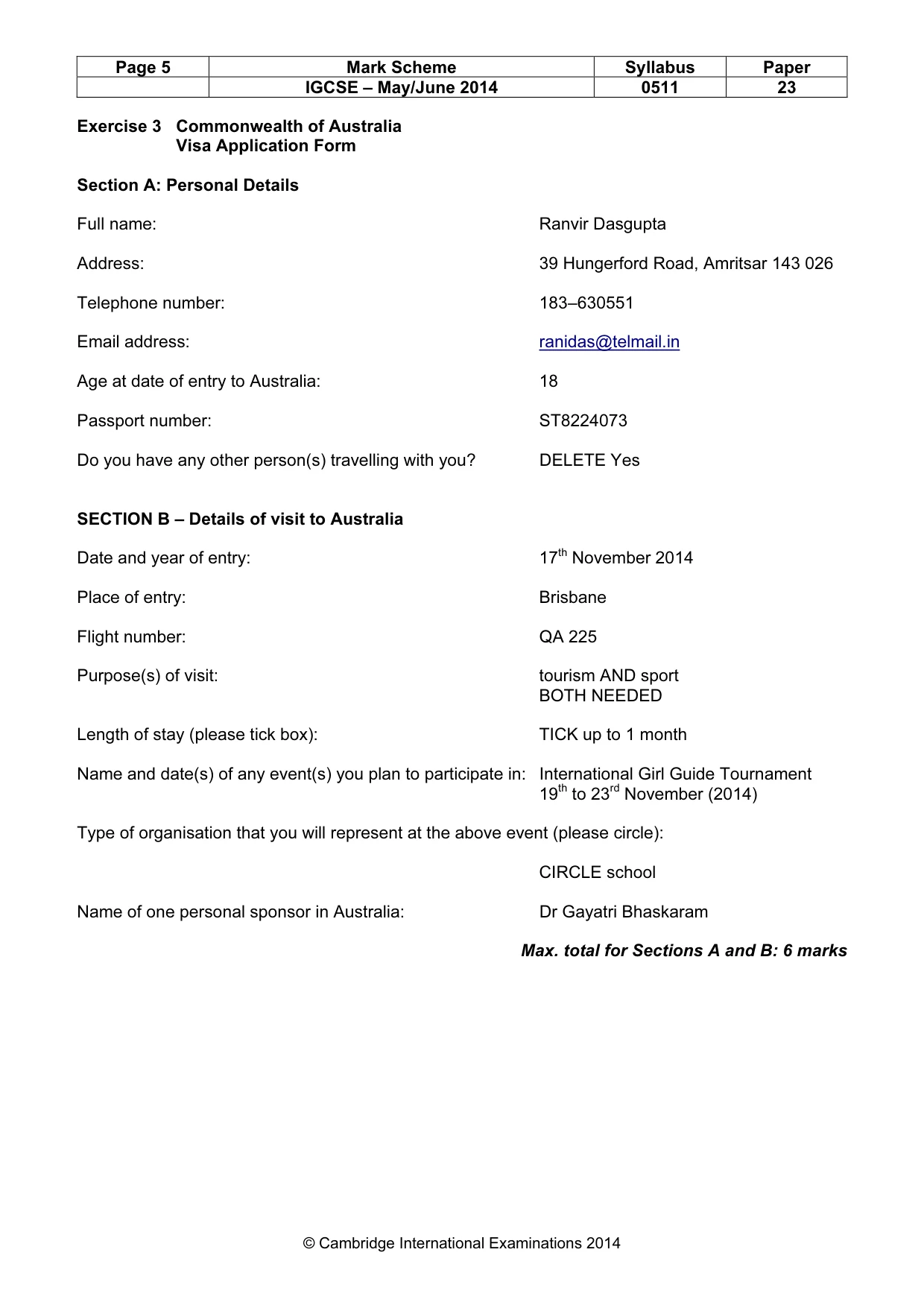
Page 5 Mark Scheme Syllabus Paper IGCSE – May/June 2014 0511 23 © Cambridge International Examinations 2014 Exercise 3 Commonwealth of Australia Visa Application Form Section A: Personal Details Full name: Ranvir Dasgupta Address: 39 Hungerford Road, Amritsar 143 026 Telephone number: 183–630551 Email address: ranidas@telmail.in Age at date of entry to Australia: 18 Passport number: ST8224073 Do you have any other person(s) travelling with you? DELETE Yes SECTION B – Details of visit to Australia Date and year of entry: 17th November 2014 Place of entry: Brisbane Flight number: QA 225 Purpose(s) of visit: tourism AND sport BOTH NEEDED Length of stay (please tick box): TICK up to 1 month Name and date(s) of any event(s) you plan to participate in: International Girl Guide Tournament 19th to 23rd November (2014) Type of organisation that you will represent at the above event (please circle): CIRCLE school Name of one personal sponsor in Australia: Dr Gayatri Bhaskaram Max. total for Sections A and B: 6 marks
Mark scheme, page 6
Page 6 Mark Scheme Syllabus Paper IGCSE – May/June 2014 0511 23 © Cambridge International Examinations 2014 SECTION C The sentence must be written in the first person. Sample sentences: I would like to visit the Great Barrier Reef and to stay for a week with my aunt in Melbourne. I plan to stay in Brisbane for the Girl Guide Tournament and then do some sightseeing. For the sentence, award up to 2 marks as follows: 2 marks: no fewer than 12 and no more than 20 words; proper sentence construction; correct spelling, punctuation and grammar; relevant to context. 1 mark: no fewer than 12 and no more than 20 words; proper sentence construction; 1–3 errors of punctuation / spelling / grammar that do not obscure meaning; relevant to context. 0 marks: more than 3 errors of punctuation / spelling / grammar; and/or irrelevant to context, and/or not a proper sentence; and/or fewer than 12 words or more than 20 words. Absence of a full stop at the end should be considered as 1 punctuation error. Absence of an upper case letter at the beginning should be considered as 1 punctuation error. Omission of a word in a sentence should be considered as 1 grammar error. Max total for exercise 3: 8 marks
Mark scheme, page 7
Page 7 Mark Scheme Syllabus Paper IGCSE – May/June 2014 0511 23 © Cambridge International Examinations 2014 Exercise 4 Communications Technology in Africa How technology helped a farmer in Kenya (max 3 marks for this section) 1 searched internet for information about potato disease/discovered ants were eating his potato stems/discovered cause of problem with potato crop 2 found cure for disease/sprinkle wood ash on crop/got healthy potatoes 3 found local buyer for his rescued crop 4 gets latest potato prices Financial benefits of new technology to Nigerians (max 4 marks for this section) 5 cost of sim cards 6 cellphone calls now cheaper 7 huge (increase) foreign investments 8 cheap text messaging service 9 new businesses started How technology has affected life in other named African countries (max 2 marks for this section) 10 farmers have free automated phone service/website to find out global food prices 11 citizens report local problems 12 students report poor performance of university staff/students can register complaints Max total for exercise 4: 9 marks
Mark scheme, page 8
Page 8 Mark Scheme Syllabus Paper IGCSE – May/June 2014 0511 23 © Cambridge International Examinations 2014 Exercise 5 Seeing Red Content (up to 6 marks) Reasons why numbers have declined 1 Squirrel Pox Virus / grey squirrels infected reds with virus 2 expelled from their breeding grounds by grey squirrels 3 their food was stolen by grey squirrels 4 many died during cold winter Actions being taken to keep them safe 5 volunteers monitor red / grey squirrel movements and habitats 6 volunteers prevent greys from spreading into areas where reds are present 7 established areas where red squirrels can be kept safe / large forests of pine trees, where reds can safely feed on the seeds and nuts 8 volunteers patrol the woodlands 9 landowners attract reds to their woodlands / landowners keep greys out of their woodlands Language (up to 5 marks) 0 marks: no understanding of the task / no relevant content/meaning completely obscure due to serious language inaccuracies 1 mark: copying without discrimination from text / multiple language inaccuracies 2 marks: heavy reliance on language from the text with no attempt to organise and sequence points cohesively / limited language expression making meaning at times unclear 3 marks: some reliance on language from the text, but with an attempt to organise and sequence points cohesively / language satisfactory, but with some inaccuracies 4 marks: good attempt to use own words and to organise and sequence points cohesively / generally good control of language 5 marks: good, concise summary style / very good attempt to use own words and to organise and sequence points cohesively Max total for exercise 5: 11 marks
Mark scheme, page 9
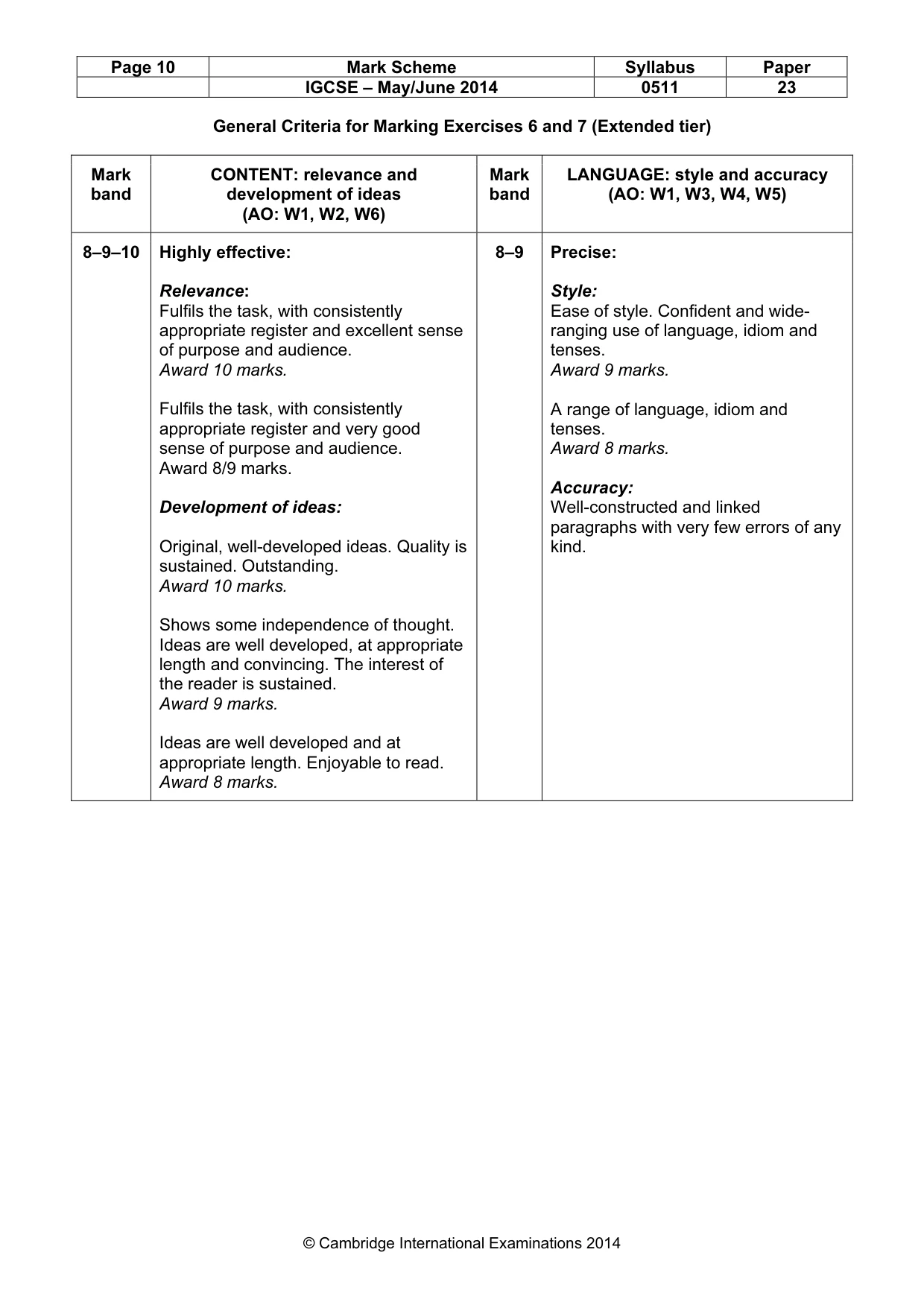
Page 9 Mark Scheme Syllabus Paper IGCSE – May/June 2014 0511 23 © Cambridge International Examinations 2014 Exercise 6 Film or Play Seen Exercise 7 Olympic Games The following general instructions, and table of marking criteria, apply to both exercises. • Award the answer a mark for content (C) [out of 10] and a mark for language (L) [out of 9] in accordance with the General Criteria table that follows. • Content covers relevance (i.e. whether the piece fulfils the task and the awareness of purpose/audience/register) and the development of ideas (i.e. the detail/explanation provided and how enjoyable it is to read). • Language covers style (i.e. complexity of vocabulary and sentence structure) and accuracy (of grammar, spelling, punctuation and use of paragraphs). • When deciding on a mark for content or language, first of all decide which mark band is most appropriate. There will not necessarily be an exact fit. Then decide between 2 marks within that mark band. Use the lower mark if it only just makes it into the band and the upper mark if it fulfils all the requirements of the band but doesn’t quite make it into the band above. • When deciding on a mark for content, look at both relevance and development of ideas. First ask yourself whether the writing fulfils the task, in terms of points to be covered and the length. If it does, it will be in at least the 4–5 mark band. • When deciding on a mark for language, look at both the style and the accuracy of the language. A useful starting point would be first to determine whether errors intrude. If they do not, it will be in at least the 4–5 mark band. • The use of paragraphs should not be the primary basis of deciding which mark band the work is in. Look first at the language used and once you have decided on the appropriate mark band, you can use the paragraphing as a factor in helping you to decide whether the work warrants the upper or lower mark in the mark band. • If the essay is considerably shorter than the stated word length, it should be put in mark band 2–3 for content or lower for not fulfilling the task. The language mark is likely to be affected and is unlikely to be more than one band higher than the content mark. • If the essay is totally irrelevant and has nothing to do with the question asked, it should be given 0 marks for Content and Language, even if it is enjoyable to read and fluent. • If the essay is partly relevant and therefore in mark band 2–3, the full range of marks for language is available. Max total exercise 6: 19 marks Max total exercise 7: 19 marks
Mark scheme, page 10
Page 10 Mark Scheme Syllabus Paper IGCSE – May/June 2014 0511 23 © Cambridge International Examinations 2014 General Criteria for Marking Exercises 6 and 7 (Extended tier) Mark band CONTENT: relevance and development of ideas (AO: W1, W2, W6) Mark band LANGUAGE: style and accuracy (AO: W1, W3, W4, W5) 8–9–10 Highly effective: Relevance: Fulfils the task, with consistently appropriate register and excellent sense of purpose and audience. Award 10 marks. Fulfils the task, with consistently appropriate register and very good sense of purpose and audience. Award 8/9 marks. Development of ideas: Original, well-developed ideas. Quality is sustained. Outstanding. Award 10 marks. Shows some independence of thought. Ideas are well developed, at appropriate length and convincing. The interest of the reader is sustained. Award 9 marks. Ideas are well developed and at appropriate length. Enjoyable to read. Award 8 marks. 8–9 Precise: Style: Ease of style. Confident and wide- ranging use of language, idiom and tenses. Award 9 marks. A range of language, idiom and tenses. Award 8 marks. Accuracy: Well-constructed and linked paragraphs with very few errors of any kind.
Mark scheme, page 11
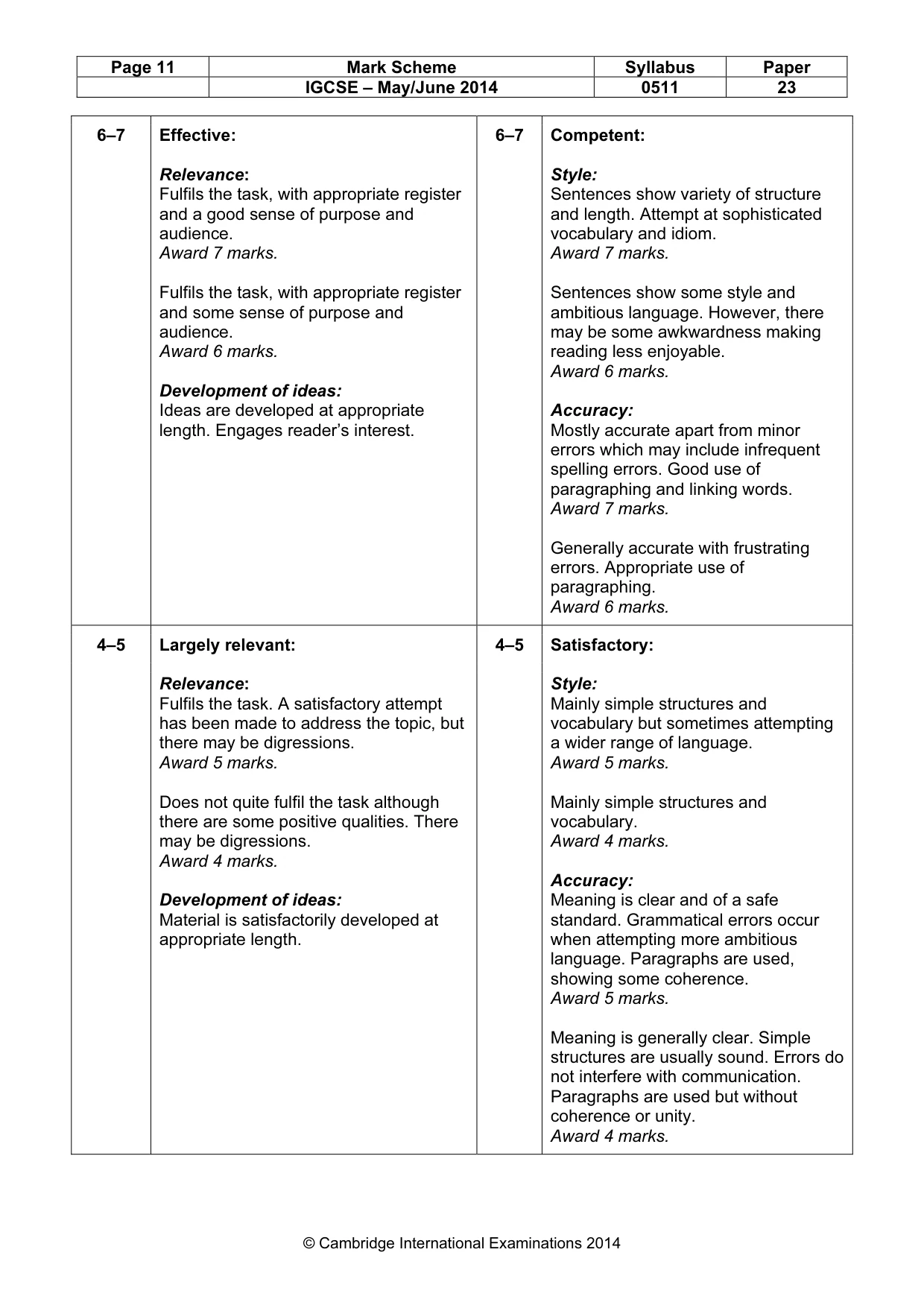
Page 11 Mark Scheme Syllabus Paper IGCSE – May/June 2014 0511 23 © Cambridge International Examinations 2014 6–7 Effective: Relevance: Fulfils the task, with appropriate register and a good sense of purpose and audience. Award 7 marks. Fulfils the task, with appropriate register and some sense of purpose and audience. Award 6 marks. Development of ideas: Ideas are developed at appropriate length. Engages reader’s interest. 6–7 Competent: Style: Sentences show variety of structure and length. Attempt at sophisticated vocabulary and idiom. Award 7 marks. Sentences show some style and ambitious language. However, there may be some awkwardness making reading less enjoyable. Award 6 marks. Accuracy: Mostly accurate apart from minor errors which may include infrequent spelling errors. Good use of paragraphing and linking words. Award 7 marks. Generally accurate with frustrating errors. Appropriate use of paragraphing. Award 6 marks. 4–5 Largely relevant: Relevance: Fulfils the task. A satisfactory attempt has been made to address the topic, but there may be digressions. Award 5 marks. Does not quite fulfil the task although there are some positive qualities. There may be digressions. Award 4 marks. Development of ideas: Material is satisfactorily developed at appropriate length. 4–5 Satisfactory: Style: Mainly simple structures and vocabulary but sometimes attempting a wider range of language. Award 5 marks. Mainly simple structures and vocabulary. Award 4 marks. Accuracy: Meaning is clear and of a safe standard. Grammatical errors occur when attempting more ambitious language. Paragraphs are used, showing some coherence. Award 5 marks. Meaning is generally clear. Simple structures are usually sound. Errors do not interfere with communication. Paragraphs are used but without coherence or unity. Award 4 marks.
Mark scheme, page 12
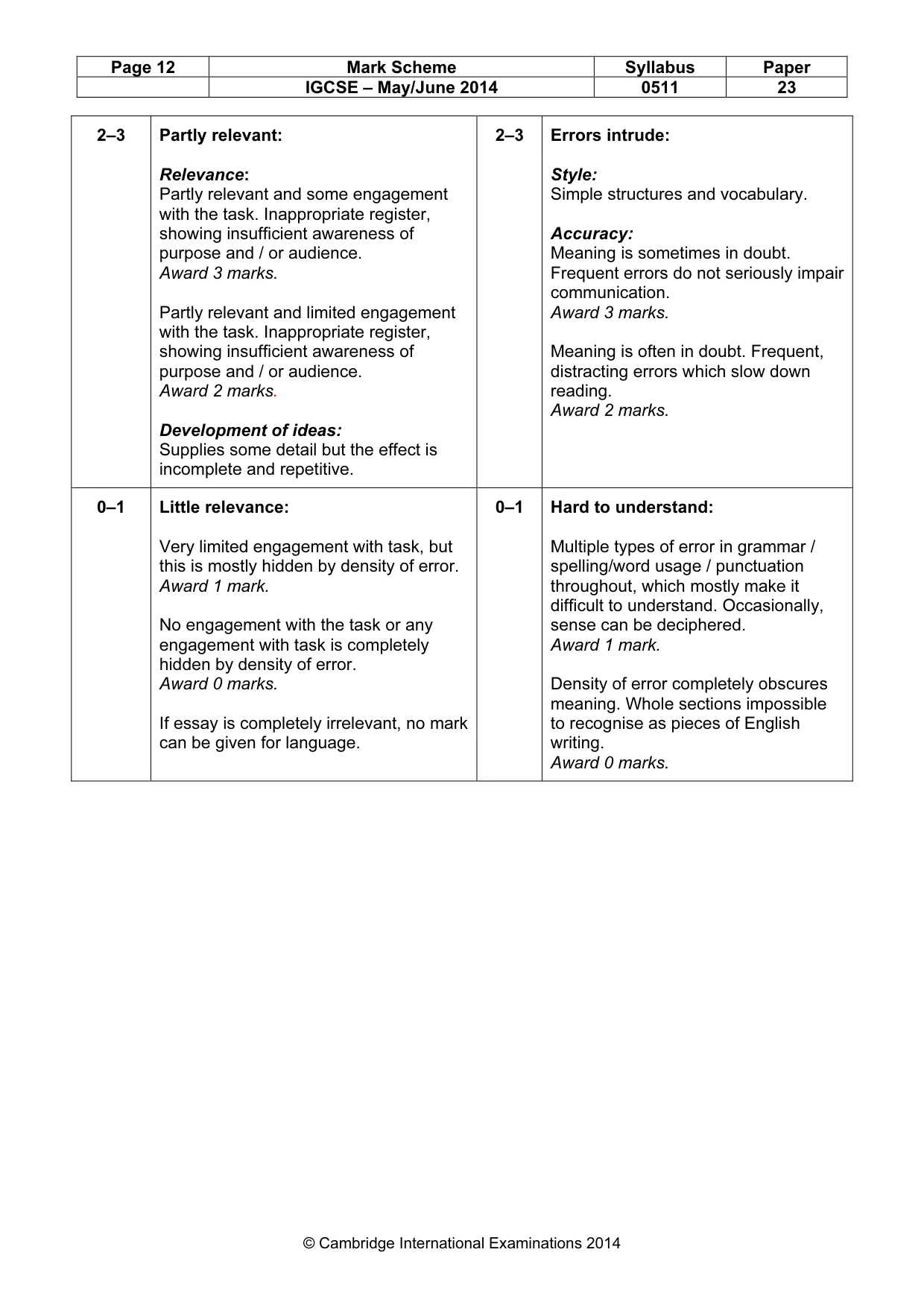
Page 12 Mark Scheme Syllabus Paper IGCSE – May/June 2014 0511 23 © Cambridge International Examinations 2014 2–3 Partly relevant: Relevance: Partly relevant and some engagement with the task. Inappropriate register, showing insufficient awareness of purpose and / or audience. Award 3 marks. Partly relevant and limited engagement with the task. Inappropriate register, showing insufficient awareness of purpose and / or audience. Award 2 marks. Development of ideas: Supplies some detail but the effect is incomplete and repetitive. 2–3 Errors intrude: Style: Simple structures and vocabulary. Accuracy: Meaning is sometimes in doubt. Frequent errors do not seriously impair communication. Award 3 marks. Meaning is often in doubt. Frequent, distracting errors which slow down reading. Award 2 marks. 0–1 Little relevance: Very limited engagement with task, but this is mostly hidden by density of error. Award 1 mark. No engagement with the task or any engagement with task is completely hidden by density of error. Award 0 marks. If essay is completely irrelevant, no mark can be given for language. 0–1 Hard to understand: Multiple types of error in grammar / spelling/word usage / punctuation throughout, which mostly make it difficult to understand. Occasionally, sense can be deciphered. Award 1 mark. Density of error completely obscures meaning. Whole sections impossible to recognise as pieces of English writing. Award 0 marks.
What you needed in this session
Cambridge’s own grade thresholds for 2014 May/June, Paper 2 · Variant 3. A higher threshold means an easier paper — the bar moves with how the cohort did.