Cambridge IGCSE English - Second Language (count-in oral) 0511 — 2013 Oct/Nov Paper 1 · Variant 2
0511/12/O/N/13
The question paper and its mark scheme, free to read here and free to download. This is Cambridge’s own paper, exactly as it was sat.
Question paper16 pages
Mark scheme11 pages
Answers below. Sit the paper first if you are practising.
Paper as text
Question paper, page 1
This document consists of 13 printed pages and 3 blank pages. DC (SJW) 82668 © UCLES 2013 [Turn over UNIVERSITY OF CAMBRIDGE INTERNATIONAL EXAMINATIONS International General Certificate of Secondary Education * 8 9 5 0 4 7 0 6 2 8 * ENGLISH AS A SECOND LANGUAGE 0511/12 Paper 1 Reading and Writing (Core) October/November 2013 1 hour 30 minutes Candidates answer on the Question Paper. No Additional Materials are required. READ THESE INSTRUCTIONS FIRST Write your Centre number, candidate number and name on all the work you hand in. Write in dark blue or black pen. Do not use staples, paper clips, highlighters, glue or correction fluid. DO NOT WRITE IN ANY BARCODES. Answer all questions. Dictionaries are not allowed. The number of marks is given in brackets [ ] at the end of each question or part question. www.XtremePapers.com
Question paper, page 2
2 0511/12/O/N/13 © UCLES 2013 Exercise 1 Read the following article about places to visit in France, and then answer the questions on the opposite page. VISITING FRANCE France offers great opportunities for visitors and a wide variety of different types of holiday. Countryside and villages There is plenty to see in the French countryside, including beautiful wooded valleys, rivers and gorges. In most areas of France you can find pretty villages, especially in central Alsace, in the countryside of Normandy and along the river in the Dordogne. Castles France is famous for its wonderful architecture, and two areas in France are particularly visited for their attractive castles. The Loire valley to the south-west of Paris is best known for its large houses or castles called ‘chateaux’, which were built by rich noblemen and kings from Paris. Towards the south of France the Dordogne is famous for its medieval castles. Mountains The impressive mountains of the French Alps are popular in both summer and winter for skiing. The area attracts skiers of all abilities, from beginners to experts. Less visited by overseas visitors, the Pyrenees offer an attractive alternative to the French Alps for people interested in skiing or a holiday in the mountains. Beaches France has thousands of beaches to meet every requirement. Some of the most popular beaches with sun-seekers are those along the French Riviera, where high temperatures are almost guaranteed during the summer months. The long sandy beaches of the Atlantic Coast north of Biarritz are also well worth visiting, as is the very picturesque coast of Brittany. Family fun Among the most popular regions for people visiting France with children are the beaches of the western coast such as those found in the Vendee department, which also has several large attractions and events for families. Another favourite destination here is Ile de Ré, well known for having lots of cycle paths which make it a pleasure for families to travel around. In addition, amusement parks such as Disneyland and Asterix in the north of France offer great fun for both children and adults. Paris Everyone loves Paris, as much for its café life and general romantic atmosphere as for the more famous sights such as the Eiffel Tower, Notre Dame Cathedral and the Louvre museum. The Metro makes it easy to travel around the city and everywhere you go there is something new and exciting to discover. Eating out Wherever you choose to visit, remember that good food is appreciated and widely known about throughout France. Eating out is generally inexpensive, outside the large cities. A decent two course lunch will cost about 12 euros. It is not necessary to leave a tip for the waiter or waitress because the service charge is now included in the bill. However, most people still leave a small tip, especially for good service.
Question paper, page 3
3 0511/12/O/N/13 © UCLES 2013 [Turn over For Examiner’s Use (a) What three natural features can you see in the countryside in France? …[1] (b) Why might tourists want to visit the Loire valley? …[1] (c) What is particularly attractive about the beaches on the French Riviera? …[1] (d) What makes Ile de Ré a good place for families to visit? …[1] (e) Apart from the famous sights, what makes Paris so popular for visitors? Give two details. … …[2] (f) Where is it especially good value for money to eat out? …[1] [Total: 7]
Question paper, page 4
4 0511/12/O/N/13 © UCLES 2013 Exercise 2 Read the following article about spices, and then answer the questions on the opposite page. SPICES By the year 1000, Arabian traders had found many wonderful treasures in India, but perhaps the most precious trading goods were spices. These traders brought rare and exotic spices such as cumin and coriander from India. They then supplied these spices to their countrymen and to Europe. Through this trade they were able to make fortunes. Today, when spices are cheaper and more widely available, it seems unbelievable that they were once a royal luxury and that men were willing to risk their lives to acquire them. In 1497, four tiny ships sailed southward from Portugal, under the guidance of Captain Vasco da Gama. He was searching for a new route to the spice lands of Asia. In a two-year journey that covered 38,624 kilometres, he took his ships around the continent of Africa to India and back to Portugal. Although only two of the four ships returned safely to their home port, they brought back a cargo of spices worth 60 times the cost of the voyage, making da Gama a wealthy man. Rich people were eager to exchange their gold for his pepper and cinnamon. Cinnamon was particularly valued for use in funeral ceremonies when a wealthy person died. Vanilla was another favourite of the rich because, when mixed with cacao, it made a previously unknown, delicious drink. Pepper was the most precious spice of all, often used as a form of money, particularly when rent had to be paid. Da Gama’s successful voyage started a European power struggle for control over the spice trade. For three centuries afterwards, the nations of western Europe fought violent battles at sea. Some people believe that the wealth made from the spice trade in the past is similar to the wealth of oil companies today. The people of those times used spices, as we do today, to improve or vary the flavours of their food. Spices were also used to disguise the taste of food that was not fresh. Without the addition of spices it would have been too unpleasant to eat. In times when there was no refrigeration, spices were also used for preserving food, such as meat, for a year or more. In the 16th century, cloves were commonly used both to preserve food and for medicinal purposes. It is fascinating to note that cloves are still used in the same way in some modern food. Later, mustard and ground mustard were also found to have preservative qualities. When spices were not available, people often went hungry because they could not prevent their food from going bad. Today, we use spices to flavour our food but do not have to spend a large amount of money to purchase them. Nevertheless, the total amount that countries spend on importing spices continues to be significant. Many people around the world work in very difficult conditions to produce spices for us. Much of the work is done by hand and very specific skills are needed. These skills have been handed down from generation to generation, but there is now some concern that younger people no longer want to do this sort of work because they prefer to go to the cities and work in office jobs. Most of us are completely unaware of the origin of the spices, and varied traditions surrounding the spices, that we keep in small packets or bottles on our kitchen shelves. For example, when we shake some cumin into a pan we are not expecting it to keep married couples together, which is what people believed in the past. Saudi Arabia Singapore UAE Malaysia United Kingdom India 0 50 100 150 Money spent on importing spices (in millions of US dollars) 200 250 Countries Importing Spices
Question paper, page 5
5 0511/12/O/N/13 © UCLES 2013 [Turn over For Examiner’s Use (a) How were Arabian traders able to make fortunes by the year 1000? …[1] (b) How does the price of spices nowadays compare with the cost in the 15th century? …[1] (c) How far in total did Vasco da Gama travel on his journey, and how long did the voyage last? …[1] (d) How do we know that Vasco da Gama’s journey was a financial success? …[1] (e) How did the relationships between European countries change after da Gama returned? Give two details. … …[2] (f) What modern industry has been as successful as the spice trade of the past? …[1] (g) Why were spices used to hide the flavour of foods? …[1] (h) What quality do cloves and mustard share that made them particularly important in the past? …[1] (i) According to the chart, which country spends the most on importing spices and how much does it spend? …[1] (j) How have people learnt the skills needed to produce spices? …[1] [Total: 11]
Question paper, page 6
6 0511/12/O/N/13 © UCLES 2013 Exercise 3 Rachael Thomas is a 17-year-old girl who lives at 28 North Lane, Hillhead, RO14 7XY, which is in England. Recently she went to Spain to visit a friend in Madrid. It was the first time that she had travelled alone, and her father was very keen to make sure that the trip went well. He bought the tickets for her and made sure that the flights were at convenient times. Rachael flew from Southampton on Blue Sky Airways flight number 235, which departed at 2:00 pm. She returned on the same airline, flight number 437, which departed from Madrid at 10:00 am and arrived back in England at midday. Rachael’s father had booked a taxi to meet her when she arrived so that she could travel quickly and safely to her friend’s home at Mimbreras 2, 28027 Madrid, Spain. He also made sure that his daughter’s friend had Rachael’s mobile phone number, 079350642. Rachael had bought a new suitcase for the trip; it was bright pink, with wheels that made it very easy to manage. Rachael particularly liked the leather luggage tag that matched the case. She had chosen a suitcase with a hard case because she wanted to be sure that everything inside it would be well protected during the journey. Her mother had given her a personalised luggage strap, which she tied around the case to make it easier to identify. The mother of Rachael’s friend had asked Rachael to bring out a special jewellery set which she had seen advertised in a magazine and which was only available in England. The necklace and earrings were of an unusual design. The set had cost £80 and Rachael thought that it was very pretty. Of course her friend’s mother would pay her back as soon as she arrived. Rachael was also taking quite a lot of clothes as she wanted to be able to dress well during her stay. Although it seemed that everything had been planned very carefully, the trip was not completely successful because when Rachael arrived in Madrid, she discovered that her suitcase had been lost. Rachael then had to complete a lost luggage form so that the authorities could start trying to find her suitcase. Imagine you are Rachael. Fill in the form on the opposite page using the information above.
Question paper, page 7
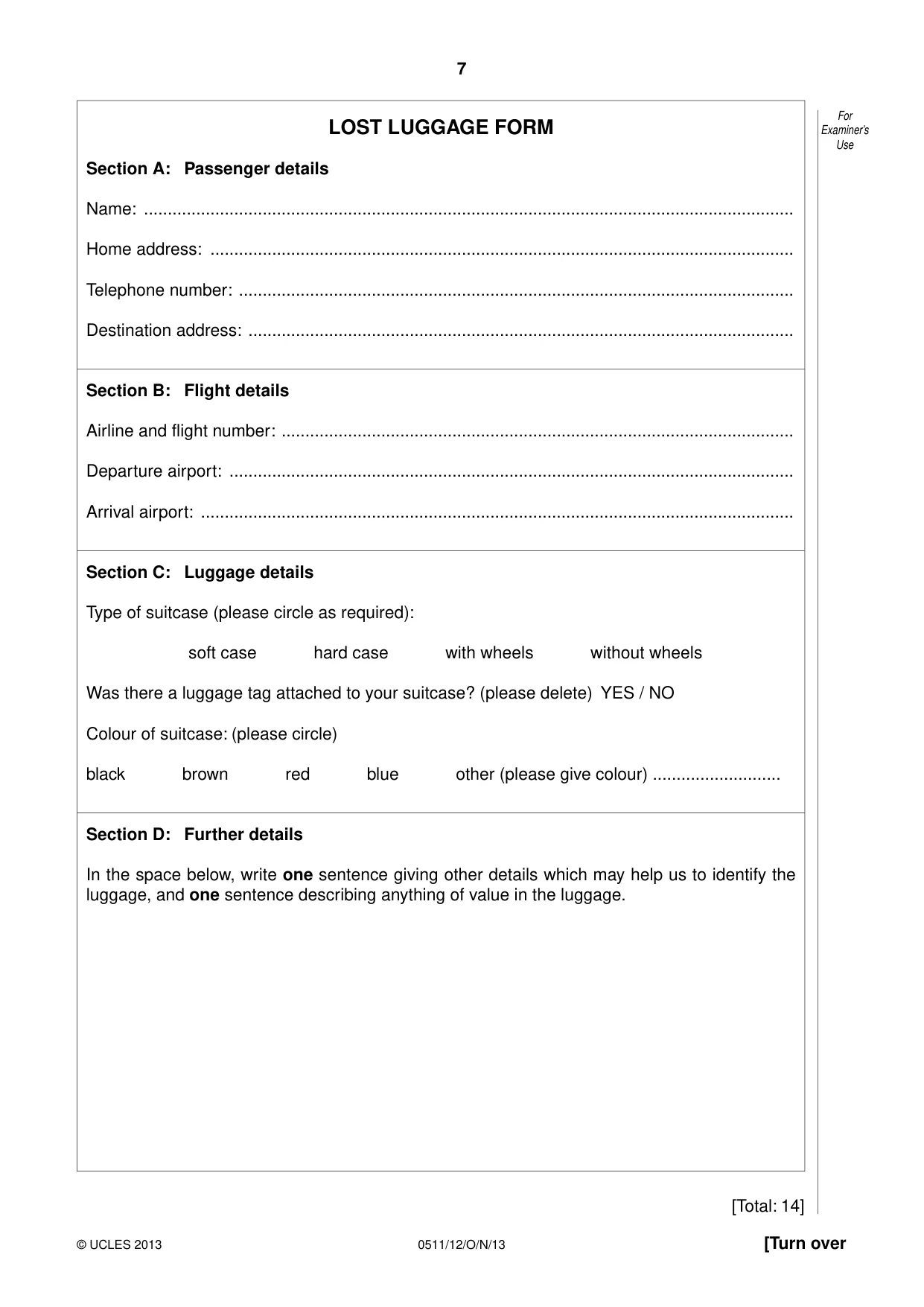
7 0511/12/O/N/13 © UCLES 2013 [Turn over For Examiner’s Use LOST LUGGAGE FORM Section A: Passenger details Name: … Home address: … Telephone number: … Destination address: … Section B: Flight details Airline and flight number: … Departure airport: … Arrival airport: … Section C: Luggage details Type of suitcase (please circle as required): soft case hard case with wheels without wheels Was there a luggage tag attached to your suitcase? (please delete) YES / NO Colour of suitcase: (please circle) black brown red blue other (please give colour) … Section D: Further details In the space below, write one sentence giving other details which may help us to identify the luggage, and one sentence describing anything of value in the luggage. [Total: 14]
Question paper, page 8
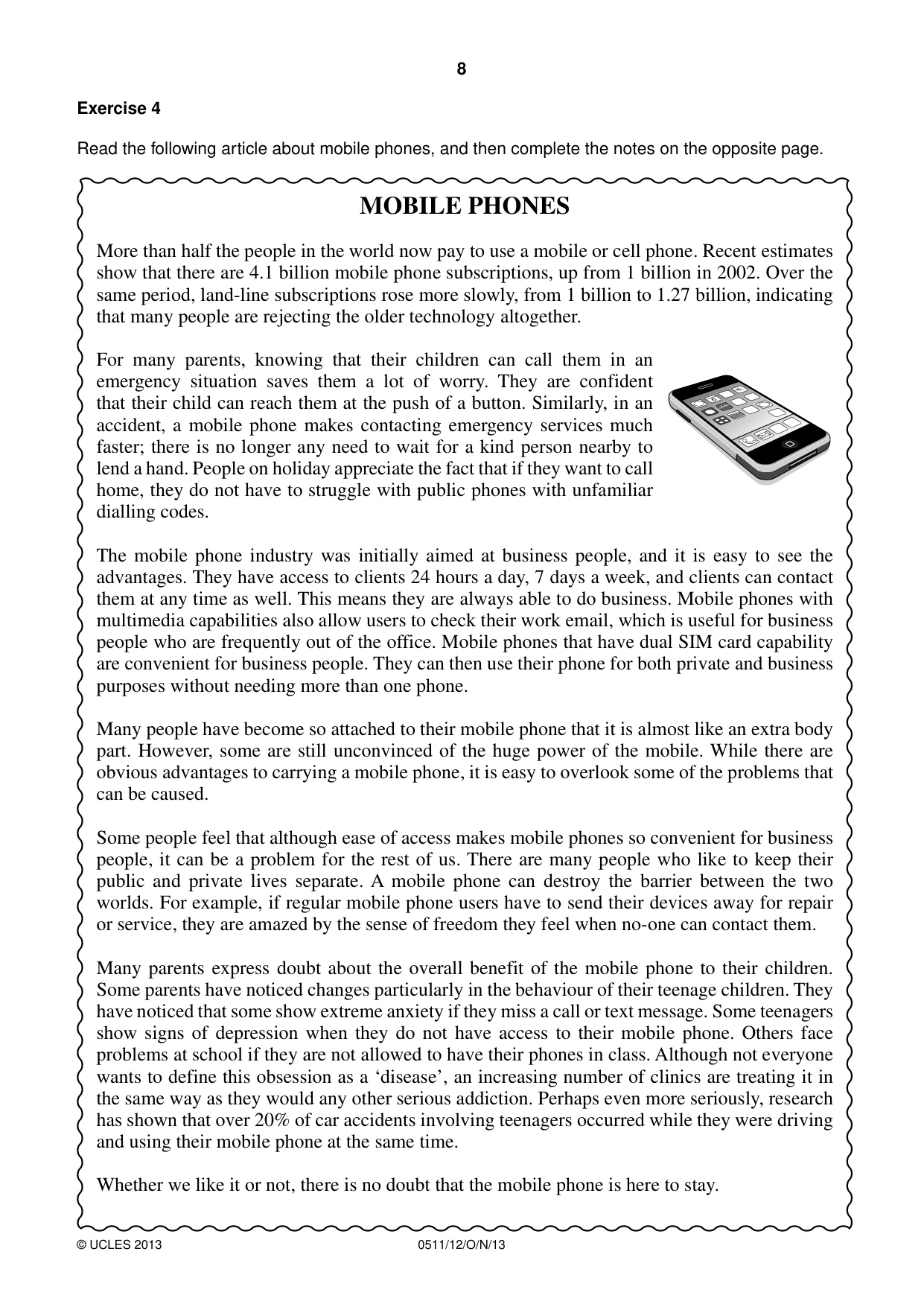
8 0511/12/O/N/13 © UCLES 2013 Exercise 4 Read the following article about mobile phones, and then complete the notes on the opposite page. MOBILE PHONES More than half the people in the world now pay to use a mobile or cell phone. Recent estimates show that there are 4.1 billion mobile phone subscriptions, up from 1 billion in 2002. Over the same period, land-line subscriptions rose more slowly, from 1 billion to 1.27 billion, indicating that many people are rejecting the older technology altogether. For many parents, knowing that their children can call them in an emergency situation saves them a lot of worry. They are confident that their child can reach them at the push of a button. Similarly, in an accident, a mobile phone makes contacting emergency services much faster; there is no longer any need to wait for a kind person nearby to lend a hand. People on holiday appreciate the fact that if they want to call home, they do not have to struggle with public phones with unfamiliar dialling codes. The mobile phone industry was initially aimed at business people, and it is easy to see the advantages. They have access to clients 24 hours a day, 7 days a week, and clients can contact them at any time as well. This means they are always able to do business. Mobile phones with multimedia capabilities also allow users to check their work email, which is useful for business people who are frequently out of the office. Mobile phones that have dual SIM card capability are convenient for business people. They can then use their phone for both private and business purposes without needing more than one phone. Many people have become so attached to their mobile phone that it is almost like an extra body part. However, some are still unconvinced of the huge power of the mobile. While there are obvious advantages to carrying a mobile phone, it is easy to overlook some of the problems that can be caused. Some people feel that although ease of access makes mobile phones so convenient for business people, it can be a problem for the rest of us. There are many people who like to keep their public and private lives separate. A mobile phone can destroy the barrier between the two worlds. For example, if regular mobile phone users have to send their devices away for repair or service, they are amazed by the sense of freedom they feel when no-one can contact them. Many parents express doubt about the overall benefit of the mobile phone to their children. Some parents have noticed changes particularly in the behaviour of their teenage children. They have noticed that some show extreme anxiety if they miss a call or text message. Some teenagers show signs of depression when they do not have access to their mobile phone. Others face problems at school if they are not allowed to have their phones in class. Although not everyone wants to define this obsession as a ‘disease’, an increasing number of clinics are treating it in the same way as they would any other serious addiction. Perhaps even more seriously, research has shown that over 20% of car accidents involving teenagers occurred while they were driving and using their mobile phone at the same time. Whether we like it or not, there is no doubt that the mobile phone is here to stay.
Question paper, page 9
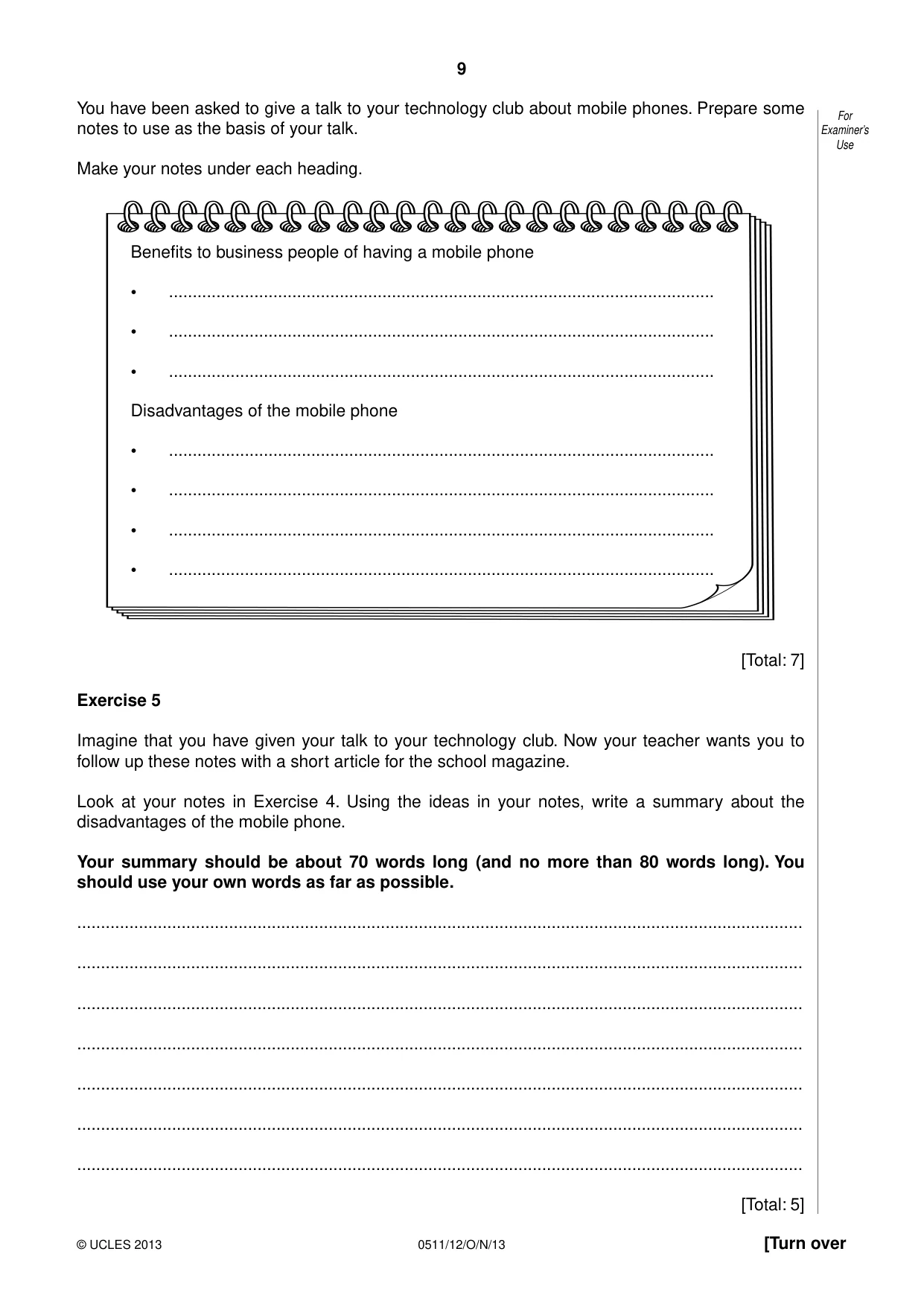
9 0511/12/O/N/13 © UCLES 2013 [Turn over For Examiner’s Use You have been asked to give a talk to your technology club about mobile phones. Prepare some notes to use as the basis of your talk. Make your notes under each heading. Benefits to business people of having a mobile phone • … • … • … Disadvantages of the mobile phone • … • … • … • … [Total: 7] Exercise 5 Imagine that you have given your talk to your technology club. Now your teacher wants you to follow up these notes with a short article for the school magazine. Look at your notes in Exercise 4. Using the ideas in your notes, write a summary about the disadvantages of the mobile phone. Your summary should be about 70 words long (and no more than 80 words long). You should use your own words as far as possible. … … … … … … … [Total: 5]
Question paper, page 10
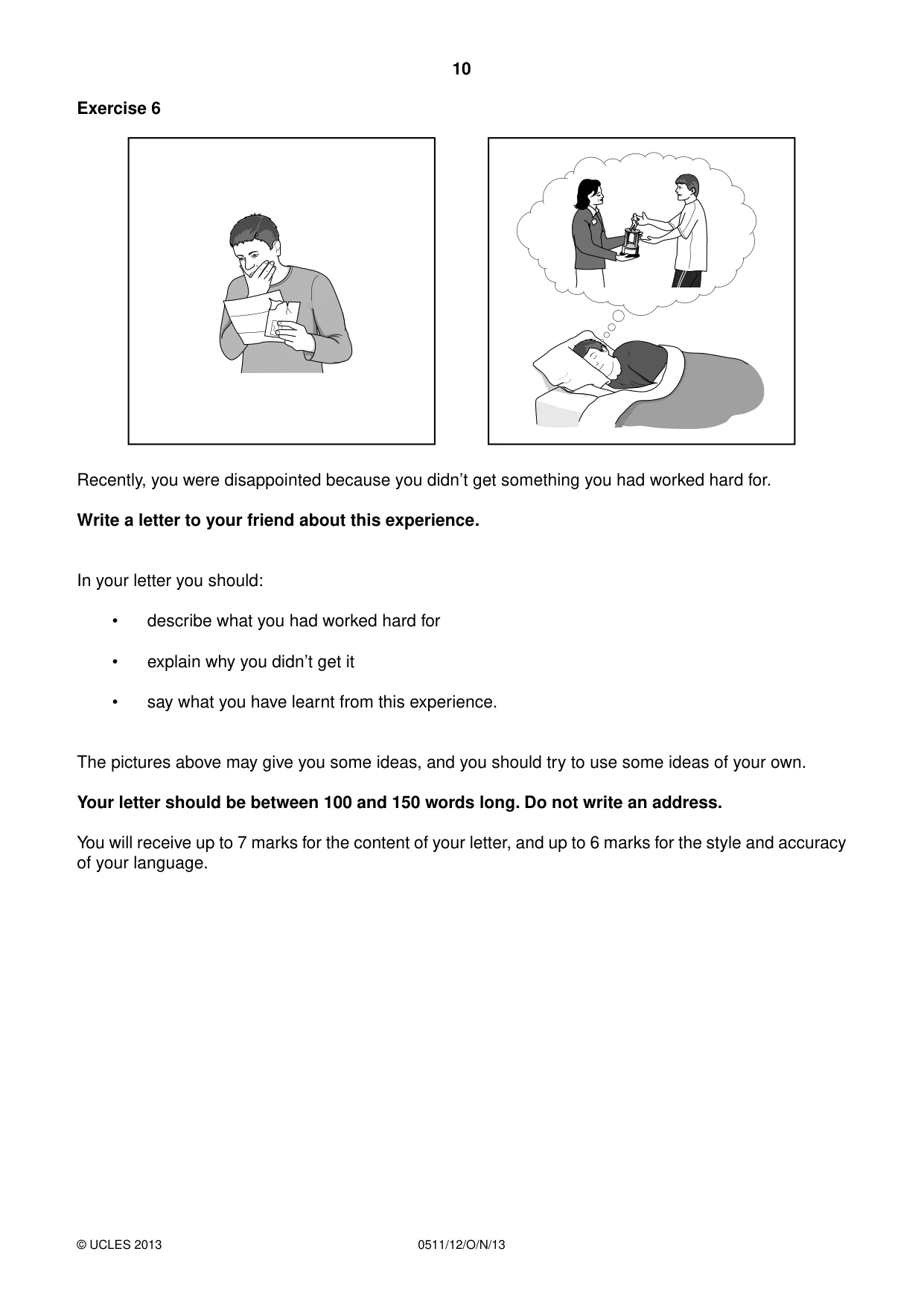
10 0511/12/O/N/13 © UCLES 2013 Exercise 6 Recently, you were disappointed because you didn’t get something you had worked hard for. Write a letter to your friend about this experience. In your letter you should: • describe what you had worked hard for • explain why you didn’t get it • say what you have learnt from this experience. The pictures above may give you some ideas, and you should try to use some ideas of your own. Your letter should be between 100 and 150 words long. Do not write an address. You will receive up to 7 marks for the content of your letter, and up to 6 marks for the style and accuracy of your language.
Question paper, page 11
11 0511/12/O/N/13 © UCLES 2013 [Turn over For Examiner’s Use … … … … … … … … … … … … … … … … … … … … [Total: 13]
Question paper, page 12
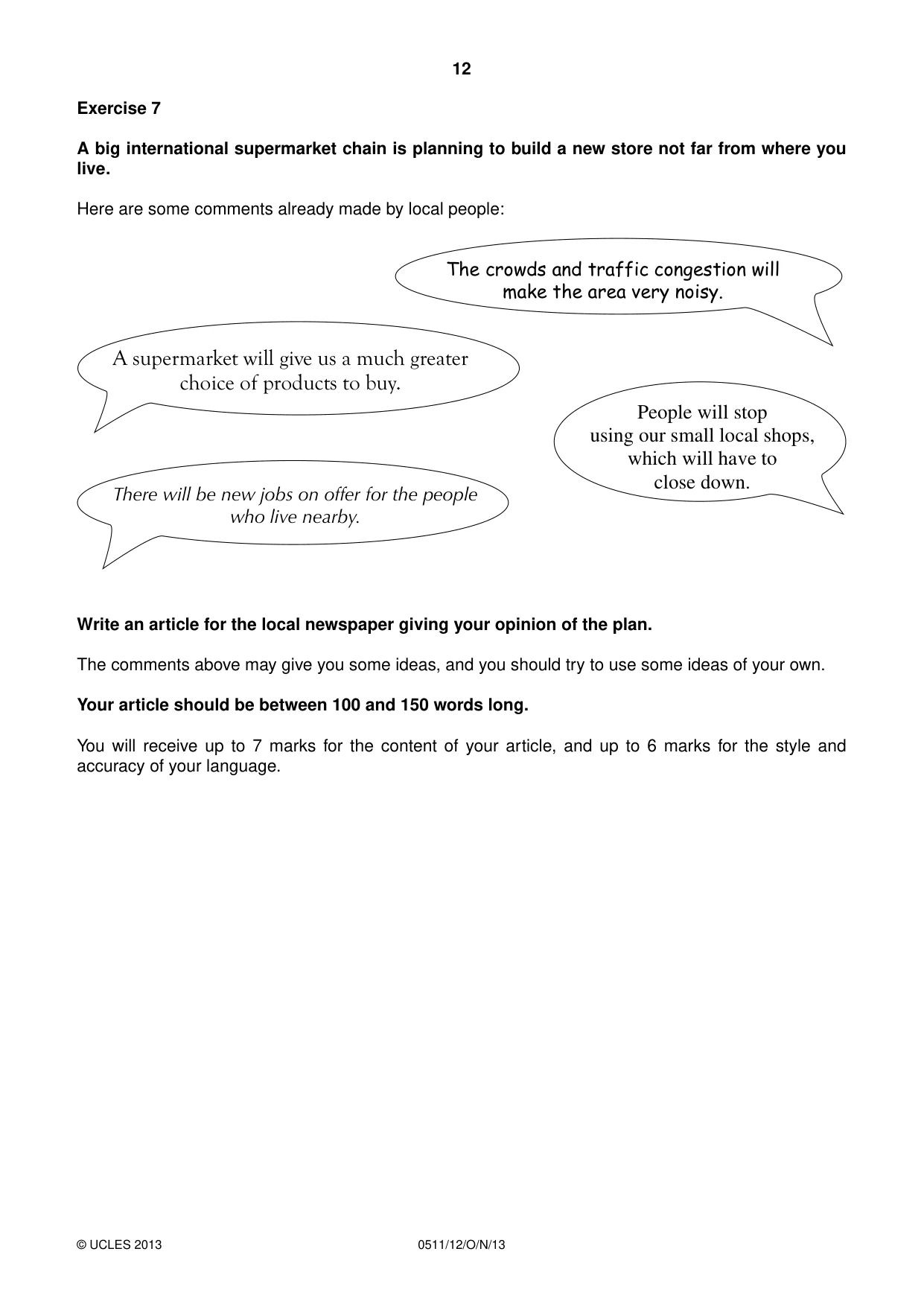
12 0511/12/O/N/13 © UCLES 2013 Exercise 7 A big international supermarket chain is planning to build a new store not far from where you live. Here are some comments already made by local people: A supermarket will give us a much greater choice of products to buy. People will stop using our small local shops, which will have to close down. There will be new jobs on offer for the people who live nearby. The crowds and traffic congestion will make the area very noisy. Write an article for the local newspaper giving your opinion of the plan. The comments above may give you some ideas, and you should try to use some ideas of your own. Your article should be between 100 and 150 words long. You will receive up to 7 marks for the content of your article, and up to 6 marks for the style and accuracy of your language.
Question paper, page 13
13 0511/12/O/N/13 © UCLES 2013 For Examiner’s Use … … … … … … … … … … … … … … … … … … … … [Total: 13]
Question paper, page 14
14 0511/12/O/N/13 © UCLES 2013 BLANK PAGE
Question paper, page 15
15 0511/12/O/N/13 © UCLES 2013 BLANK PAGE
Question paper, page 16
16 0511/12/O/N/13 © UCLES 2013 BLANK PAGE Permission to reproduce items where third-party owned material protected by copyright is included has been sought and cleared where possible. Every reasonable effort has been made by the publisher (UCLES) to trace copyright holders, but if any items requiring clearance have unwittingly been included, the publisher will be pleased to make amends at the earliest possible opportunity. University of Cambridge International Examinations is part of the Cambridge Assessment Group. Cambridge Assessment is the brand name of University of Cambridge Local Examinations Syndicate (UCLES), which is itself a department of the University of Cambridge.
Mark scheme, page 1
CAMBRIDGE INTERNATIONAL EXAMINATIONS International General Certificate of Secondary Education MARK SCHEME for the October/November 2013 series 0511 ENGLISH AS A SECOND LANGUAGE (COUNT- IN ORAL) 0511/12 Paper 1 (Reading and Writing – Core), maximum raw mark 70 This mark scheme is published as an aid to teachers and candidates, to indicate the requirements of the examination. It shows the basis on which Examiners were instructed to award marks. It does not indicate the details of the discussions that took place at an Examiners’ meeting before marking began, which would have considered the acceptability of alternative answers. Mark schemes should be read in conjunction with the question paper and the Principal Examiner Report for Teachers. Cambridge will not enter into discussions about these mark schemes. Cambridge is publishing the mark schemes for the October/November 2013 series for most IGCSE, GCE Advanced Level and Advanced Subsidiary Level components and some Ordinary Level components. www.XtremePapers.com
Mark scheme, page 2
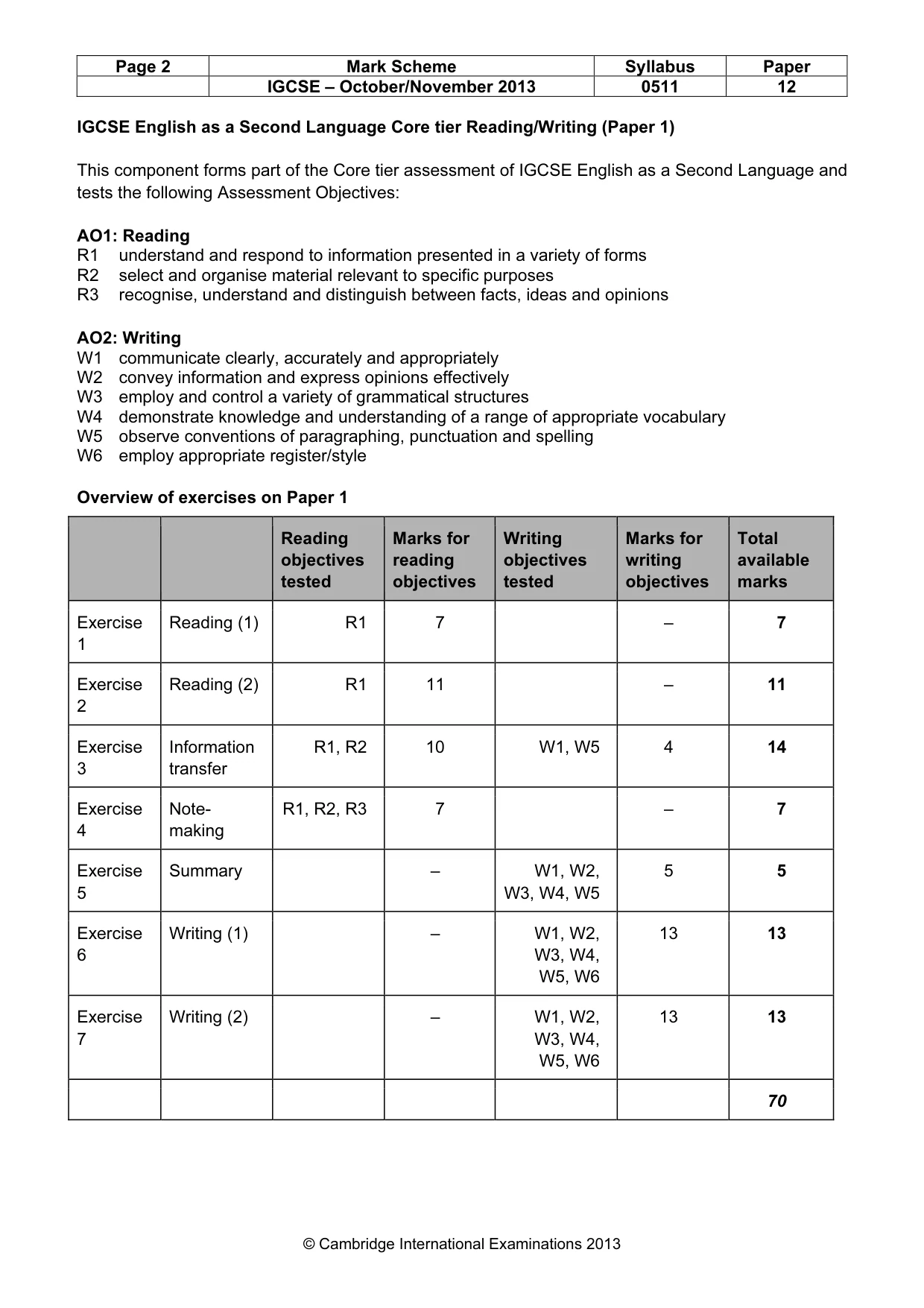
Page 2 Mark Scheme Syllabus Paper IGCSE – October/November 2013 0511 12 © Cambridge International Examinations 2013 IGCSE English as a Second Language Core tier Reading/Writing (Paper 1) This component forms part of the Core tier assessment of IGCSE English as a Second Language and tests the following Assessment Objectives: AO1: Reading R1 understand and respond to information presented in a variety of forms R2 select and organise material relevant to specific purposes R3 recognise, understand and distinguish between facts, ideas and opinions AO2: Writing W1 communicate clearly, accurately and appropriately W2 convey information and express opinions effectively W3 employ and control a variety of grammatical structures W4 demonstrate knowledge and understanding of a range of appropriate vocabulary W5 observe conventions of paragraphing, punctuation and spelling W6 employ appropriate register/style Overview of exercises on Paper 1 Reading objectives tested Marks for reading objectives Writing objectives tested Marks for writing objectives Total available marks Exercise 1 Reading (1) R1 7 – 7 Exercise 2 Reading (2) R1 11 – 11 Exercise 3 Information transfer R1, R2 10 W1, W5 4 14 Exercise 4 Note- making R1, R2, R3 7 – 7 Exercise 5 Summary – W1, W2, W3, W4, W5 5 5 Exercise 6 Writing (1) – W1, W2, W3, W4, W5, W6 13 13 Exercise 7 Writing (2) – W1, W2, W3, W4, W5, W6 13 13 70
Mark scheme, page 3
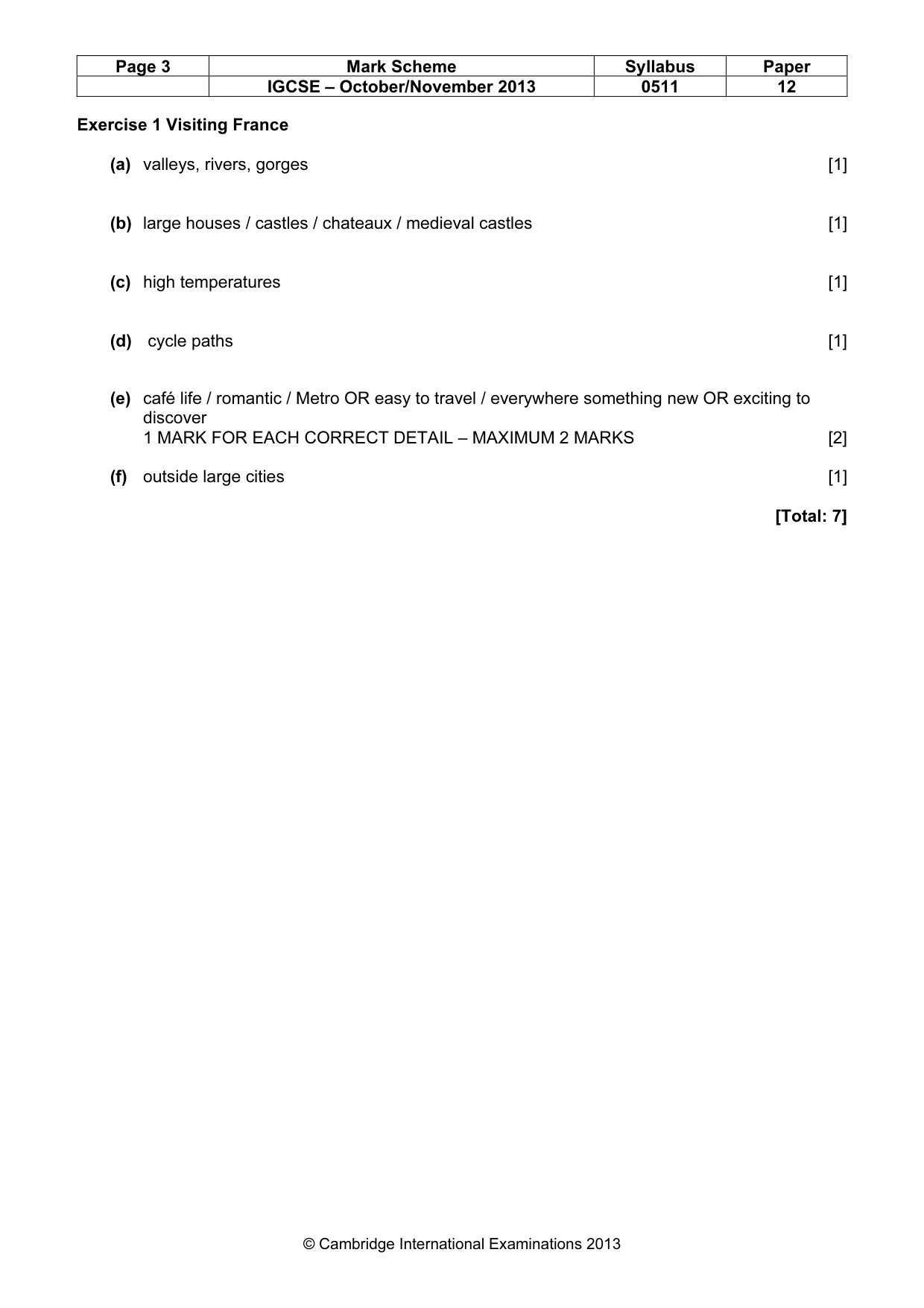
Page 3 Mark Scheme Syllabus Paper IGCSE – October/November 2013 0511 12 © Cambridge International Examinations 2013 Exercise 1 Visiting France (a) valleys, rivers, gorges [1] (b) large houses / castles / chateaux / medieval castles [1] (c) high temperatures [1] (d) cycle paths [1] (e) café life / romantic / Metro OR easy to travel / everywhere something new OR exciting to discover 1 MARK FOR EACH CORRECT DETAIL – MAXIMUM 2 MARKS [2] (f) outside large cities [1] [Total: 7]
Mark scheme, page 4
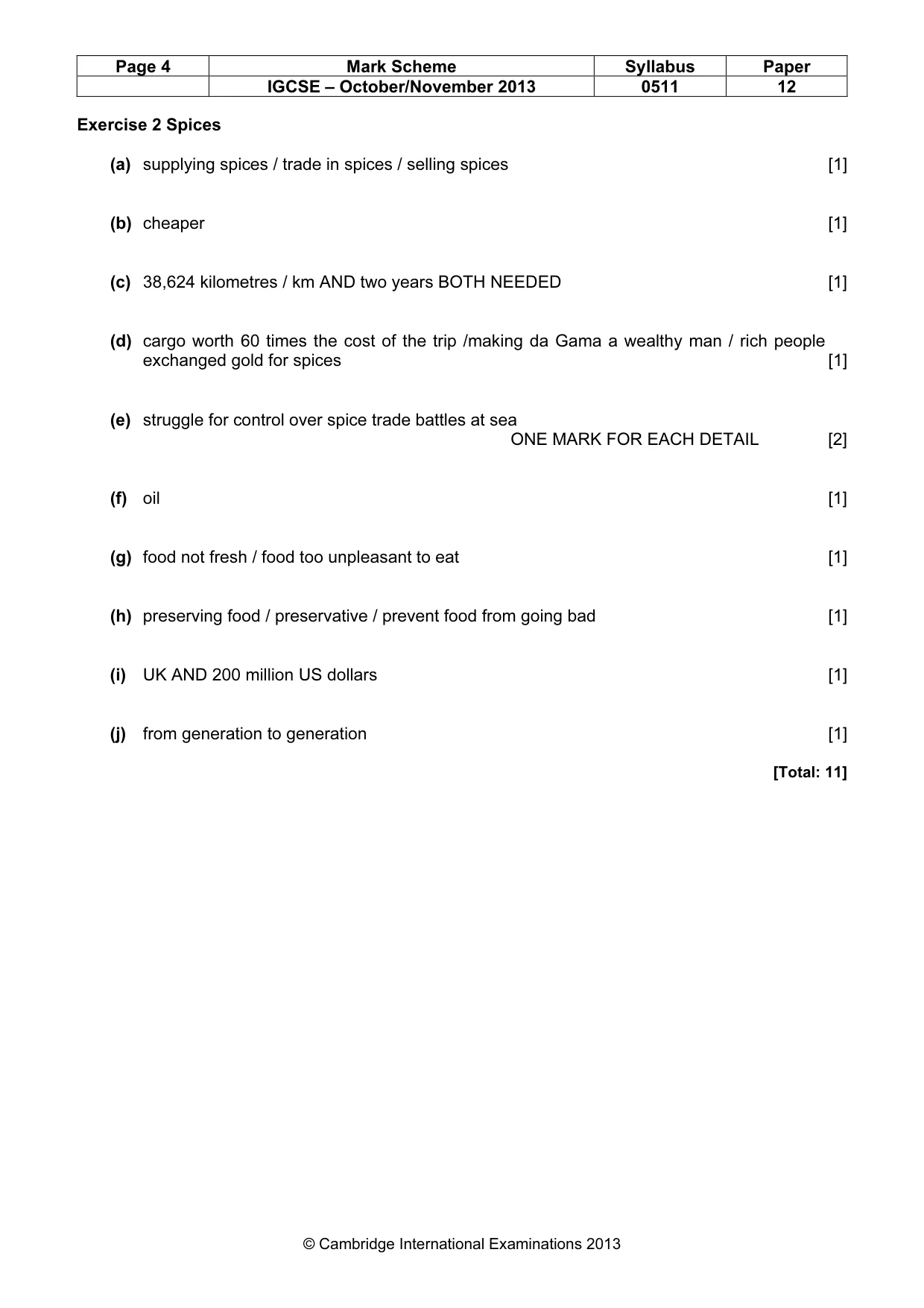
Page 4 Mark Scheme Syllabus Paper IGCSE – October/November 2013 0511 12 © Cambridge International Examinations 2013 Exercise 2 Spices (a) supplying spices / trade in spices / selling spices [1] (b) cheaper [1] (c) 38,624 kilometres / km AND two years BOTH NEEDED [1] (d) cargo worth 60 times the cost of the trip /making da Gama a wealthy man / rich people exchanged gold for spices [1] (e) struggle for control over spice trade battles at sea ONE MARK FOR EACH DETAIL [2] (f) oil [1] (g) food not fresh / food too unpleasant to eat [1] (h) preserving food / preservative / prevent food from going bad [1] (i) UK AND 200 million US dollars [1] (j) from generation to generation [1] [Total: 11]
Mark scheme, page 5
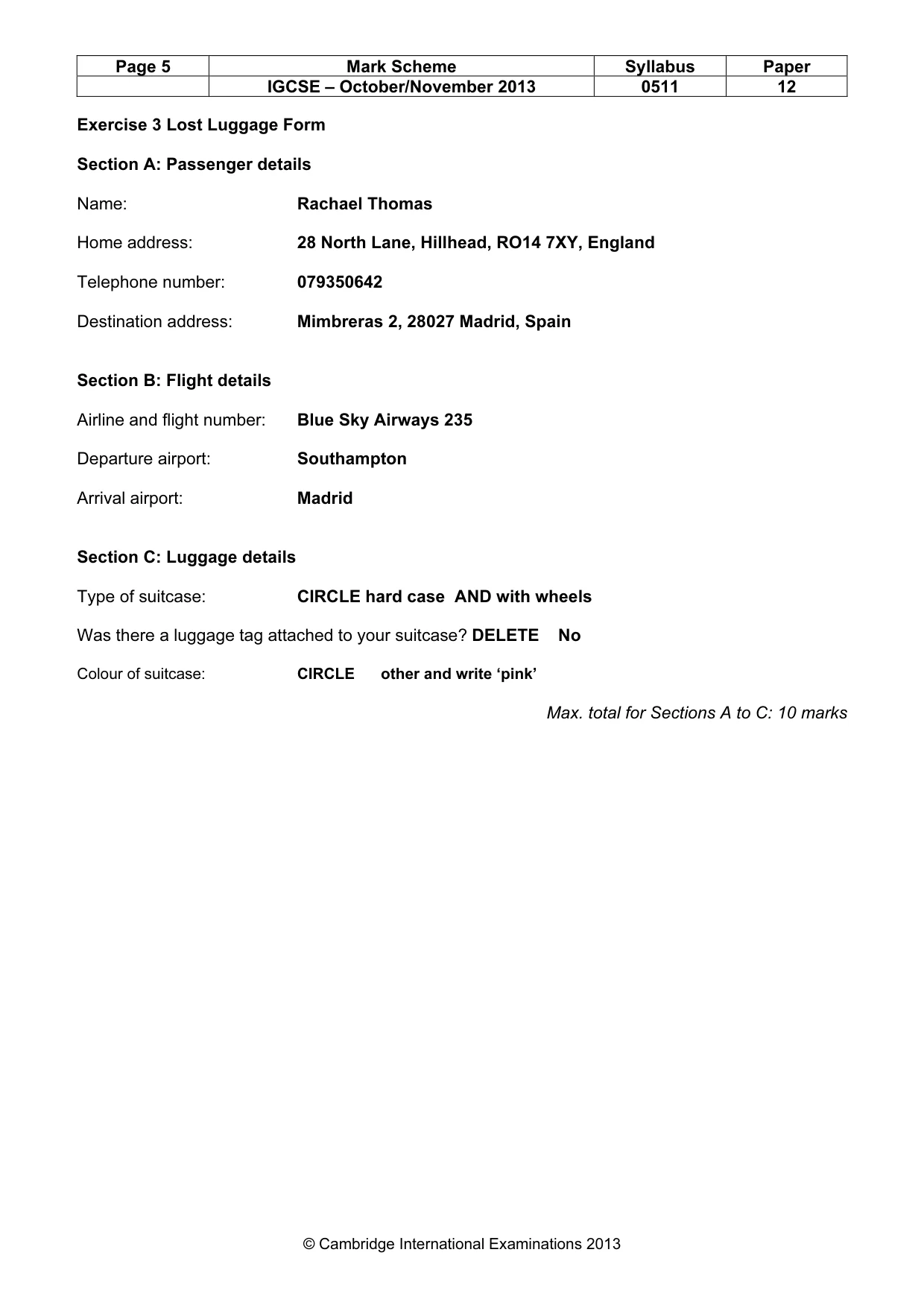
Page 5 Mark Scheme Syllabus Paper IGCSE – October/November 2013 0511 12 © Cambridge International Examinations 2013 Exercise 3 Lost Luggage Form Section A: Passenger details Name: Rachael Thomas Home address: 28 North Lane, Hillhead, RO14 7XY, England Telephone number: 079350642 Destination address: Mimbreras 2, 28027 Madrid, Spain Section B: Flight details Airline and flight number: Blue Sky Airways 235 Departure airport: Southampton Arrival airport: Madrid Section C: Luggage details Type of suitcase: CIRCLE hard case AND with wheels Was there a luggage tag attached to your suitcase? DELETE No Colour of suitcase: CIRCLE other and write ‘pink’ Max. total for Sections A to C: 10 marks
Mark scheme, page 6
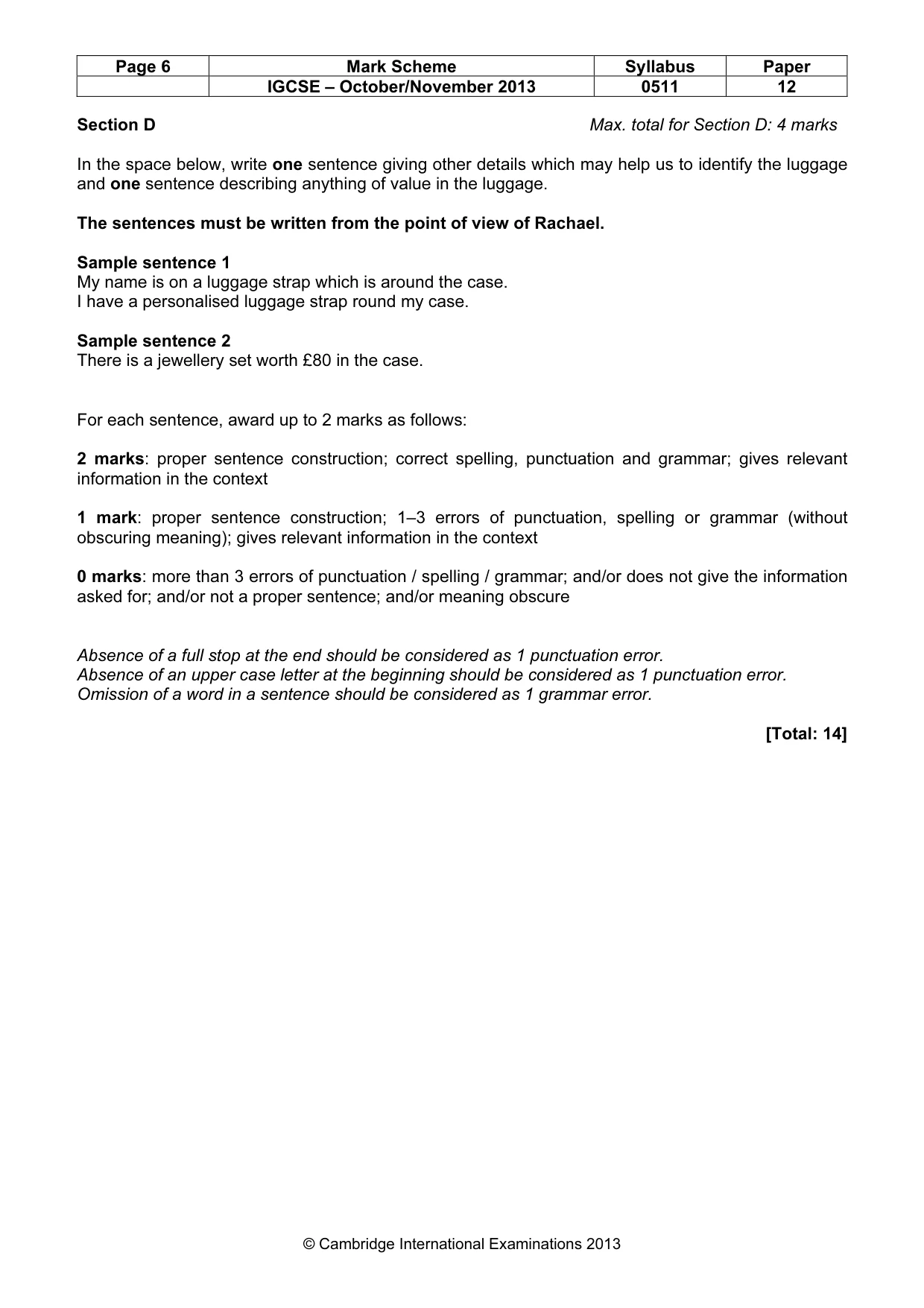
Page 6 Mark Scheme Syllabus Paper IGCSE – October/November 2013 0511 12 © Cambridge International Examinations 2013 Section D Max. total for Section D: 4 marks In the space below, write one sentence giving other details which may help us to identify the luggage and one sentence describing anything of value in the luggage. The sentences must be written from the point of view of Rachael. Sample sentence 1 My name is on a luggage strap which is around the case. I have a personalised luggage strap round my case. Sample sentence 2 There is a jewellery set worth £80 in the case. For each sentence, award up to 2 marks as follows: 2 marks: proper sentence construction; correct spelling, punctuation and grammar; gives relevant information in the context 1 mark: proper sentence construction; 1–3 errors of punctuation, spelling or grammar (without obscuring meaning); gives relevant information in the context 0 marks: more than 3 errors of punctuation / spelling / grammar; and/or does not give the information asked for; and/or not a proper sentence; and/or meaning obscure Absence of a full stop at the end should be considered as 1 punctuation error. Absence of an upper case letter at the beginning should be considered as 1 punctuation error. Omission of a word in a sentence should be considered as 1 grammar error. [Total: 14]
Mark scheme, page 7
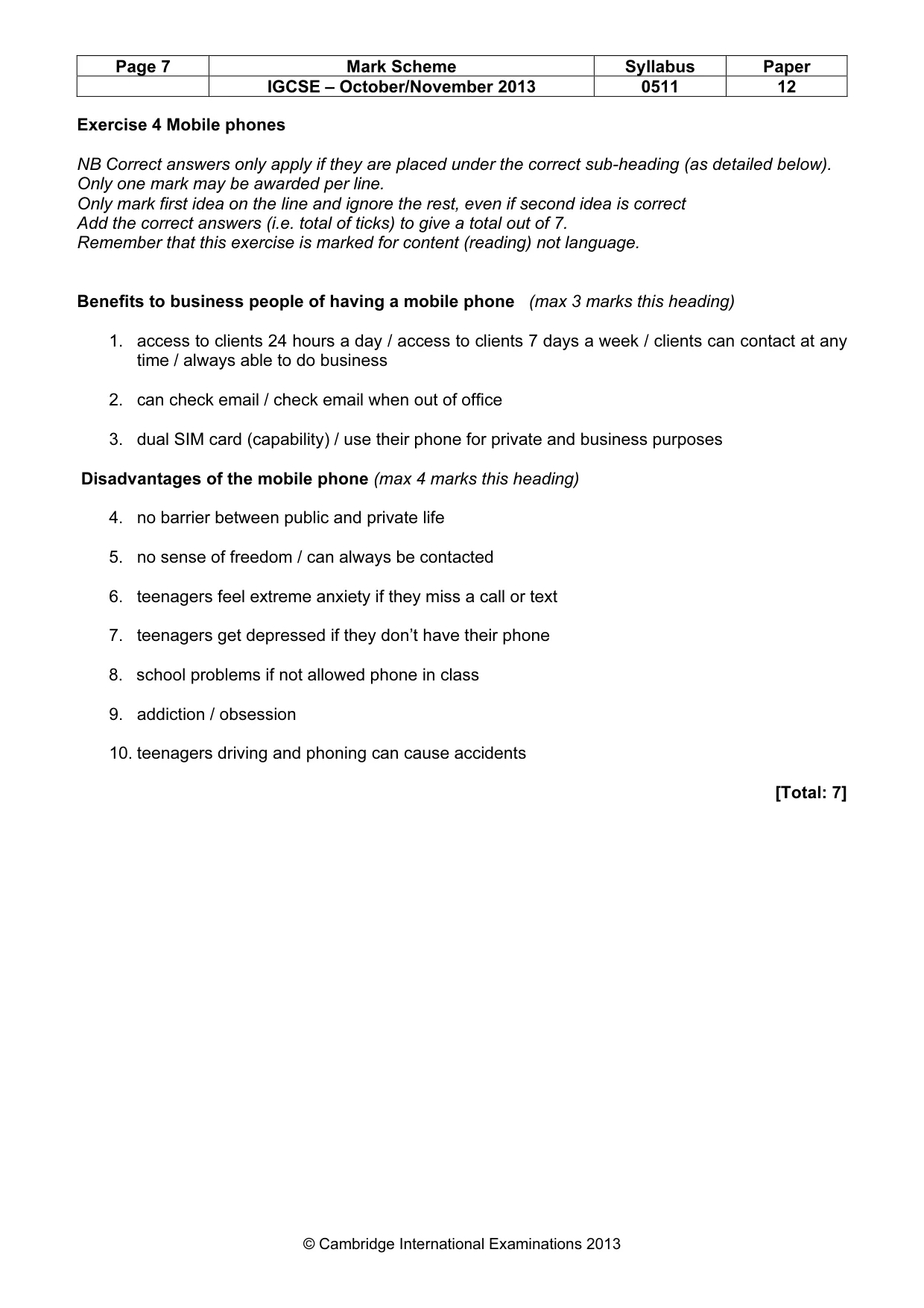
Page 7 Mark Scheme Syllabus Paper IGCSE – October/November 2013 0511 12 © Cambridge International Examinations 2013 Exercise 4 Mobile phones NB Correct answers only apply if they are placed under the correct sub-heading (as detailed below). Only one mark may be awarded per line. Only mark first idea on the line and ignore the rest, even if second idea is correct Add the correct answers (i.e. total of ticks) to give a total out of 7. Remember that this exercise is marked for content (reading) not language. Benefits to business people of having a mobile phone (max 3 marks this heading) 1. access to clients 24 hours a day / access to clients 7 days a week / clients can contact at any time / always able to do business 2. can check email / check email when out of office 3. dual SIM card (capability) / use their phone for private and business purposes Disadvantages of the mobile phone (max 4 marks this heading) 4. no barrier between public and private life 5. no sense of freedom / can always be contacted 6. teenagers feel extreme anxiety if they miss a call or text 7. teenagers get depressed if they don’t have their phone 8. school problems if not allowed phone in class 9. addiction / obsession 10. teenagers driving and phoning can cause accidents [Total: 7]
Mark scheme, page 8
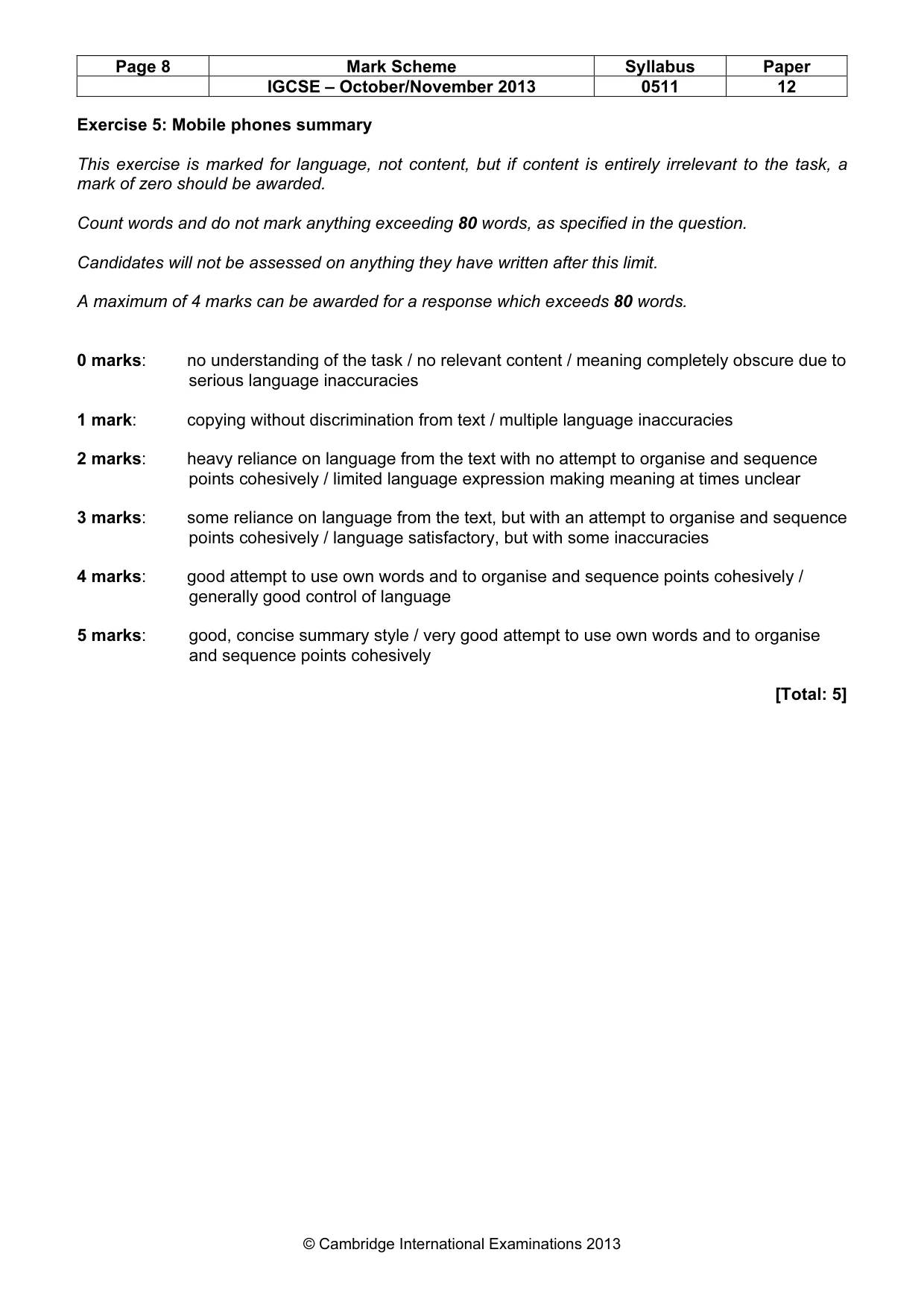
Page 8 Mark Scheme Syllabus Paper IGCSE – October/November 2013 0511 12 © Cambridge International Examinations 2013 Exercise 5: Mobile phones summary This exercise is marked for language, not content, but if content is entirely irrelevant to the task, a mark of zero should be awarded. Count words and do not mark anything exceeding 80 words, as specified in the question. Candidates will not be assessed on anything they have written after this limit. A maximum of 4 marks can be awarded for a response which exceeds 80 words. 0 marks: no understanding of the task / no relevant content / meaning completely obscure due to serious language inaccuracies 1 mark: copying without discrimination from text / multiple language inaccuracies 2 marks: heavy reliance on language from the text with no attempt to organise and sequence points cohesively / limited language expression making meaning at times unclear 3 marks: some reliance on language from the text, but with an attempt to organise and sequence points cohesively / language satisfactory, but with some inaccuracies 4 marks: good attempt to use own words and to organise and sequence points cohesively / generally good control of language 5 marks: good, concise summary style / very good attempt to use own words and to organise and sequence points cohesively [Total: 5]
Mark scheme, page 9
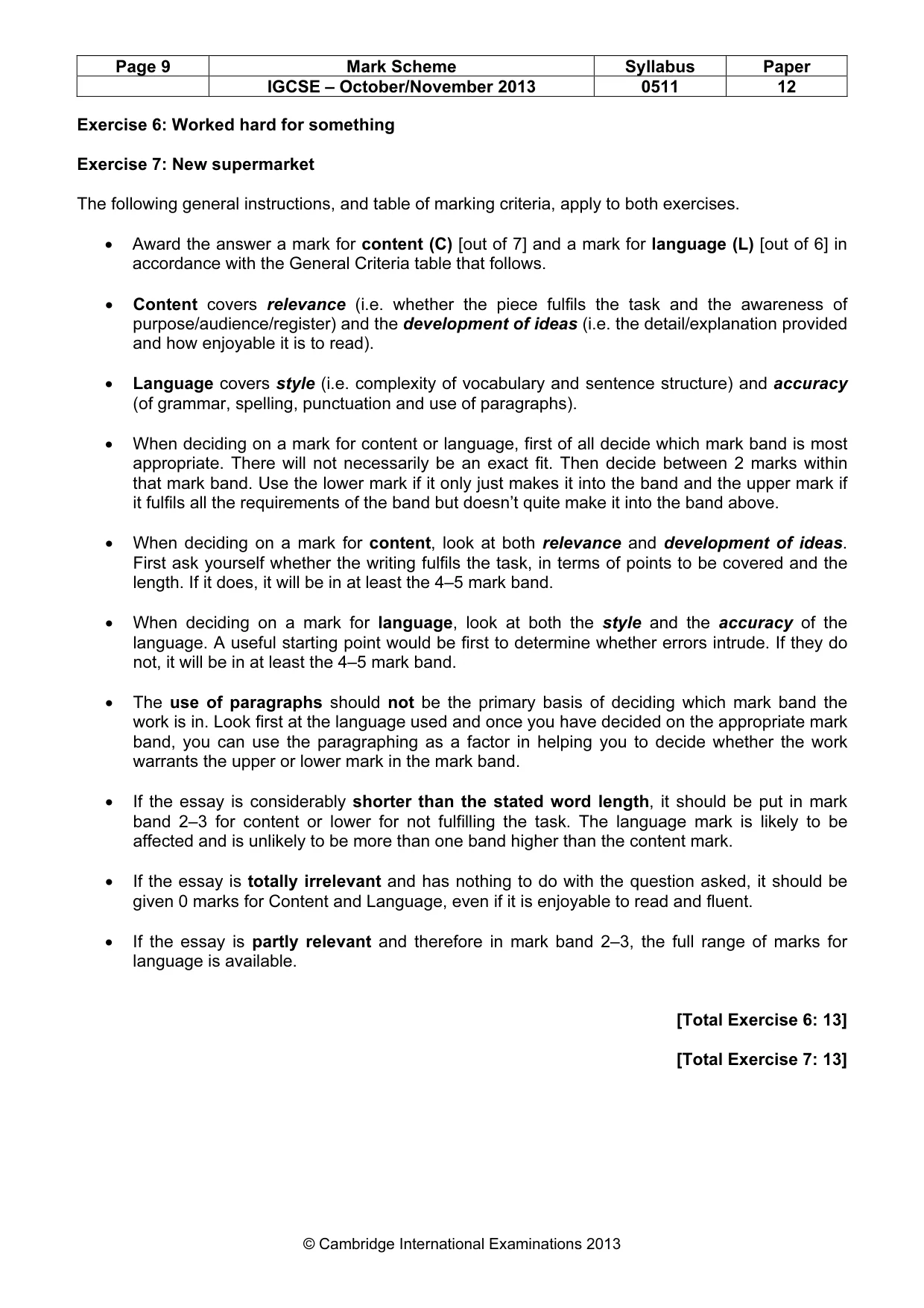
Page 9 Mark Scheme Syllabus Paper IGCSE – October/November 2013 0511 12 © Cambridge International Examinations 2013 Exercise 6: Worked hard for something Exercise 7: New supermarket The following general instructions, and table of marking criteria, apply to both exercises. • Award the answer a mark for content (C) [out of 7] and a mark for language (L) [out of 6] in accordance with the General Criteria table that follows. • Content covers relevance (i.e. whether the piece fulfils the task and the awareness of purpose/audience/register) and the development of ideas (i.e. the detail/explanation provided and how enjoyable it is to read). • Language covers style (i.e. complexity of vocabulary and sentence structure) and accuracy (of grammar, spelling, punctuation and use of paragraphs). • When deciding on a mark for content or language, first of all decide which mark band is most appropriate. There will not necessarily be an exact fit. Then decide between 2 marks within that mark band. Use the lower mark if it only just makes it into the band and the upper mark if it fulfils all the requirements of the band but doesn’t quite make it into the band above. • When deciding on a mark for content, look at both relevance and development of ideas. First ask yourself whether the writing fulfils the task, in terms of points to be covered and the length. If it does, it will be in at least the 4–5 mark band. • When deciding on a mark for language, look at both the style and the accuracy of the language. A useful starting point would be first to determine whether errors intrude. If they do not, it will be in at least the 4–5 mark band. • The use of paragraphs should not be the primary basis of deciding which mark band the work is in. Look first at the language used and once you have decided on the appropriate mark band, you can use the paragraphing as a factor in helping you to decide whether the work warrants the upper or lower mark in the mark band. • If the essay is considerably shorter than the stated word length, it should be put in mark band 2–3 for content or lower for not fulfilling the task. The language mark is likely to be affected and is unlikely to be more than one band higher than the content mark. • If the essay is totally irrelevant and has nothing to do with the question asked, it should be given 0 marks for Content and Language, even if it is enjoyable to read and fluent. • If the essay is partly relevant and therefore in mark band 2–3, the full range of marks for language is available. [Total Exercise 6: 13] [Total Exercise 7: 13]
Mark scheme, page 10
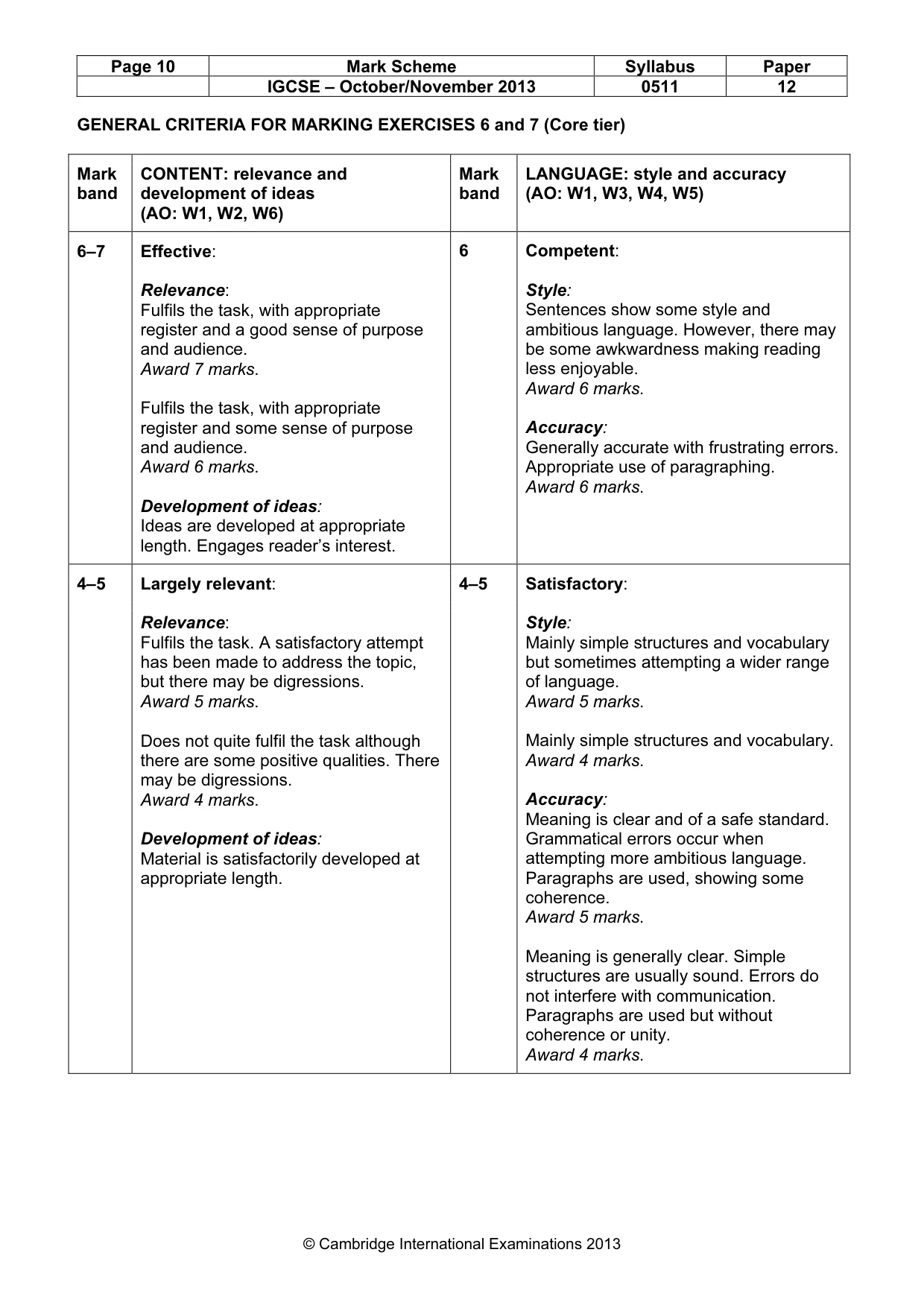
Page 10 Mark Scheme Syllabus Paper IGCSE – October/November 2013 0511 12 © Cambridge International Examinations 2013 GENERAL CRITERIA FOR MARKING EXERCISES 6 and 7 (Core tier) Mark band CONTENT: relevance and development of ideas (AO: W1, W2, W6) Mark band LANGUAGE: style and accuracy (AO: W1, W3, W4, W5) 6–7 Effective: Relevance: Fulfils the task, with appropriate register and a good sense of purpose and audience. Award 7 marks. Fulfils the task, with appropriate register and some sense of purpose and audience. Award 6 marks. Development of ideas: Ideas are developed at appropriate length. Engages reader’s interest. 6 Competent: Style: Sentences show some style and ambitious language. However, there may be some awkwardness making reading less enjoyable. Award 6 marks. Accuracy: Generally accurate with frustrating errors. Appropriate use of paragraphing. Award 6 marks. 4–5 Largely relevant: Relevance: Fulfils the task. A satisfactory attempt has been made to address the topic, but there may be digressions. Award 5 marks. Does not quite fulfil the task although there are some positive qualities. There may be digressions. Award 4 marks. Development of ideas: Material is satisfactorily developed at appropriate length. 4–5 Satisfactory: Style: Mainly simple structures and vocabulary but sometimes attempting a wider range of language. Award 5 marks. Mainly simple structures and vocabulary. Award 4 marks. Accuracy: Meaning is clear and of a safe standard. Grammatical errors occur when attempting more ambitious language. Paragraphs are used, showing some coherence. Award 5 marks. Meaning is generally clear. Simple structures are usually sound. Errors do not interfere with communication. Paragraphs are used but without coherence or unity. Award 4 marks.
Mark scheme, page 11
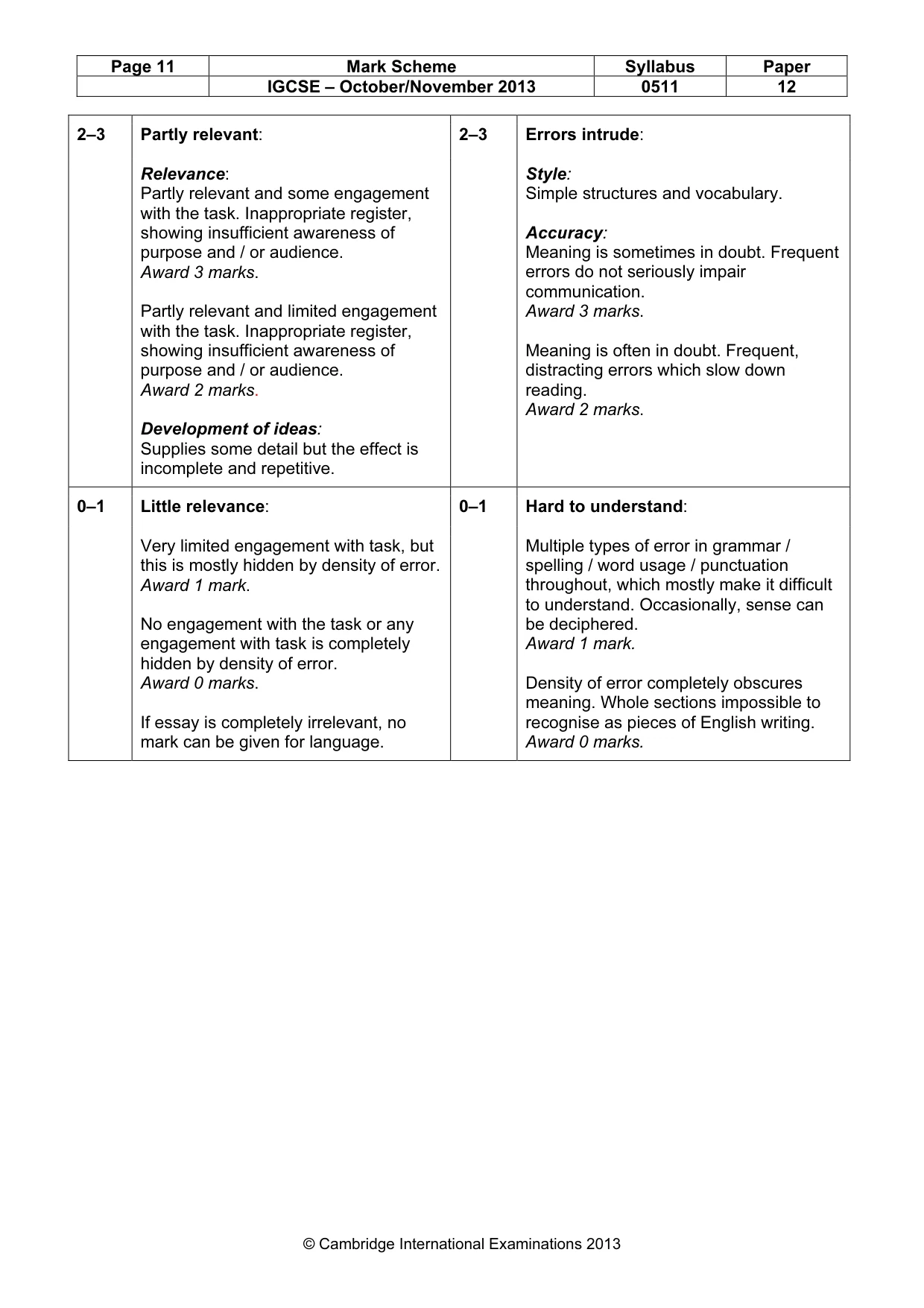
Page 11 Mark Scheme Syllabus Paper IGCSE – October/November 2013 0511 12 © Cambridge International Examinations 2013 2–3 Partly relevant: Relevance: Partly relevant and some engagement with the task. Inappropriate register, showing insufficient awareness of purpose and / or audience. Award 3 marks. Partly relevant and limited engagement with the task. Inappropriate register, showing insufficient awareness of purpose and / or audience. Award 2 marks. Development of ideas: Supplies some detail but the effect is incomplete and repetitive. 2–3 Errors intrude: Style: Simple structures and vocabulary. Accuracy: Meaning is sometimes in doubt. Frequent errors do not seriously impair communication. Award 3 marks. Meaning is often in doubt. Frequent, distracting errors which slow down reading. Award 2 marks. 0–1 Little relevance: Very limited engagement with task, but this is mostly hidden by density of error. Award 1 mark. No engagement with the task or any engagement with task is completely hidden by density of error. Award 0 marks. If essay is completely irrelevant, no mark can be given for language. 0–1 Hard to understand: Multiple types of error in grammar / spelling / word usage / punctuation throughout, which mostly make it difficult to understand. Occasionally, sense can be deciphered. Award 1 mark. Density of error completely obscures meaning. Whole sections impossible to recognise as pieces of English writing. Award 0 marks.