Cambridge IGCSE English - Second Language (count-in oral) 0511 — 2013 Oct/Nov Paper 1 · Variant 1
0511/11/O/N/13 · 70 marks · ≈79 min
The question paper and its mark scheme, free to read here and free to download. This is Cambridge’s own paper, exactly as it was sat.
Question paper16 pages



Mark scheme11 pages
Answers below. Sit the paper first if you are practising.
Paper as text
Question paper, page 1
This document consists of 13 printed pages and 3 blank pages. DC (SJW) 81845 © UCLES 2013 [Turn over UNIVERSITY OF CAMBRIDGE INTERNATIONAL EXAMINATIONS International General Certificate of Secondary Education * 9 3 5 5 6 5 1 3 6 7 * ENGLISH AS A SECOND LANGUAGE 0511/11 Paper 1 Reading and Writing (Core) October/November 2013 1 hour 30 minutes Candidates answer on the Question Paper. No Additional Materials are required. READ THESE INSTRUCTIONS FIRST Write your Centre number, candidate number and name on all the work you hand in. Write in dark blue or black pen. Do not use staples, paper clips, highlighters, glue or correction fluid. DO NOT WRITE IN ANY BARCODES. Answer all questions. Dictionaries are not allowed. At the end of the examination, fasten all your work securely together. The number of marks is given in brackets [ ] at the end of each question or part question. www.XtremePapers.com
Question paper, page 2
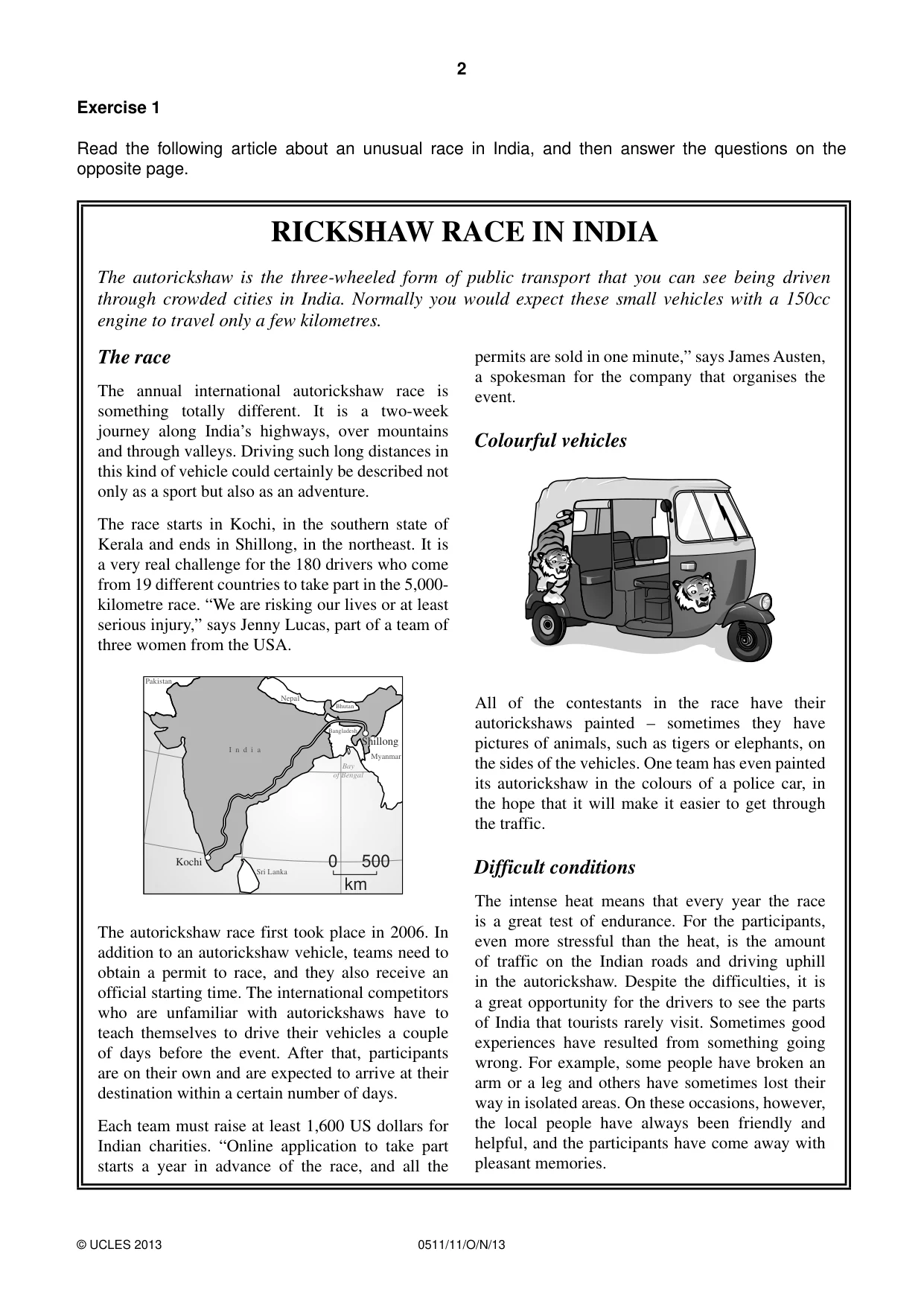
2 0511/11/O/N/13 © UCLES 2013 Exercise 1 Read the following article about an unusual race in India, and then answer the questions on the opposite page. RICKSHAW RACE IN INDIA The autorickshaw is the three-wheeled form of public transport that you can see being driven through crowded cities in India. Normally you would expect these small vehicles with a 150cc engine to travel only a few kilometres. The race The annual international autorickshaw race is something totally different. It is a two-week journey along India’s highways, over mountains and through valleys. Driving such long distances in this kind of vehicle could certainly be described not only as a sport but also as an adventure. The race starts in Kochi, in the southern state of Kerala and ends in Shillong, in the northeast. It is a very real challenge for the 180 drivers who come from 19 different countries to take part in the 5,000- kilometre race. “We are risking our lives or at least serious injury,” says Jenny Lucas, part of a team of three women from the USA. km 0 500 Sri Lanka Kochi Shillong Pakistan Nepal I n d i a Myanmar Bhutan Bangladesh Bay of Bengal The autorickshaw race first took place in 2006. In addition to an autorickshaw vehicle, teams need to obtain a permit to race, and they also receive an official starting time. The international competitors who are unfamiliar with autorickshaws have to teach themselves to drive their vehicles a couple of days before the event. After that, participants are on their own and are expected to arrive at their destination within a certain number of days. Each team must raise at least 1,600 US dollars for Indian charities. “Online application to take part starts a year in advance of the race, and all the permits are sold in one minute,” says James Austen, a spokesman for the company that organises the event. Colourful vehicles All of the contestants in the race have their autorickshaws painted – sometimes they have pictures of animals, such as tigers or elephants, on the sides of the vehicles. One team has even painted its autorickshaw in the colours of a police car, in the hope that it will make it easier to get through the traffic. Difficult conditions The intense heat means that every year the race is a great test of endurance. For the participants, even more stressful than the heat, is the amount of traffic on the Indian roads and driving uphill in the autorickshaw. Despite the difficulties, it is a great opportunity for the drivers to see the parts of India that tourists rarely visit. Sometimes good experiences have resulted from something going wrong. For example, some people have broken an arm or a leg and others have sometimes lost their way in isolated areas. On these occasions, however, the local people have always been friendly and helpful, and the participants have come away with pleasant memories.
Question paper, page 3
3 0511/11/O/N/13 © UCLES 2013 [Turn over For Examiner’s Use (a) Where in India would you be most likely to see the autorickshaws? … [1] (b) How far do autorickshaws usually travel? … [1] (c) How long does the race last? … [1] (d) What must some participants do two days before the race? … [1] (e) Who benefits from the money raised? … [1] (f) Why must participants register quickly? … [1] (g) How have some drivers decorated their autorickshaws? Give two details. … … [1] [Total: 7]
Question paper, page 4
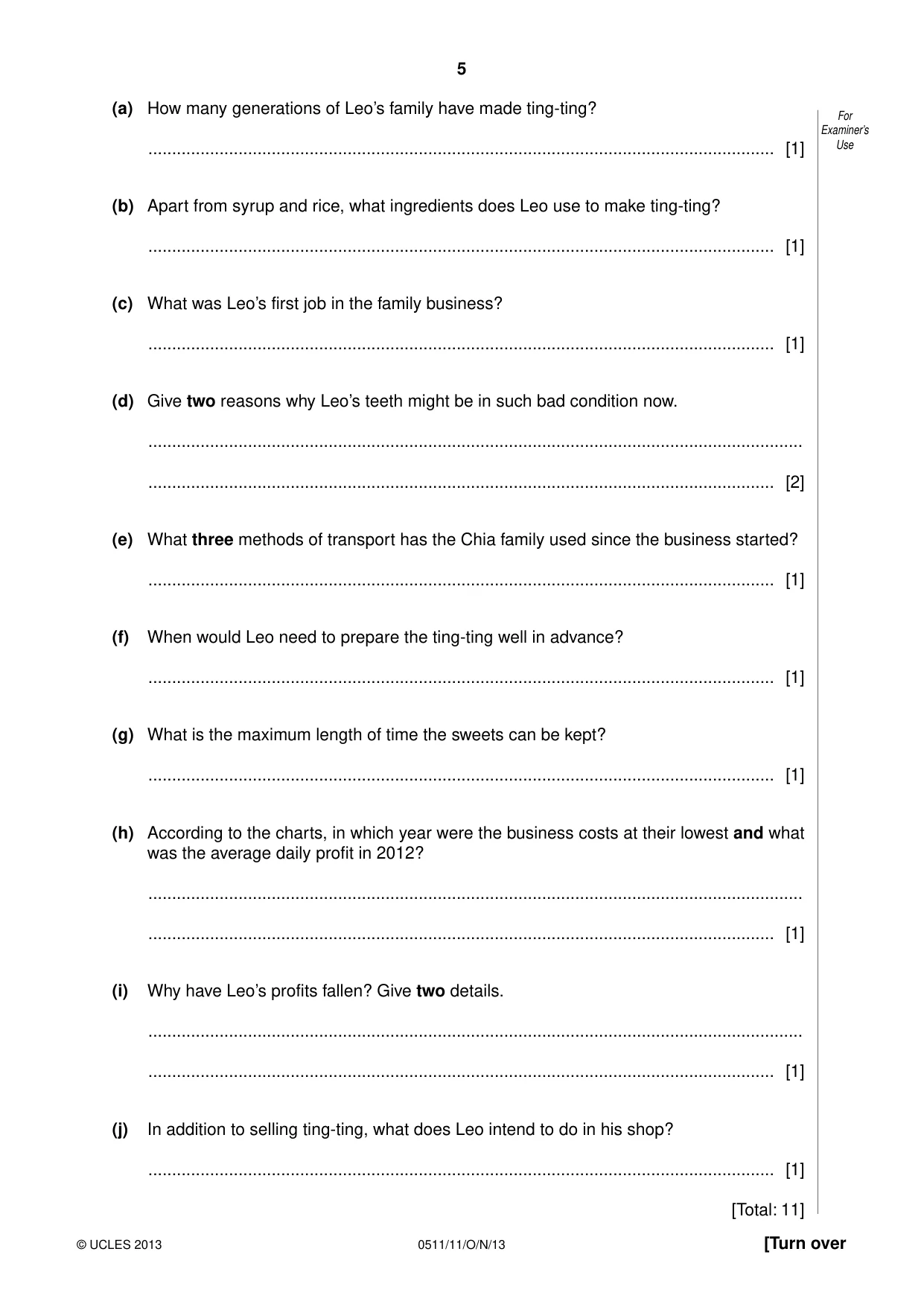
4 0511/11/O/N/13 © UCLES 2013 Exercise 2 Read the following article about a businessman who makes and sells traditional sweets in Malaysia, and then answer the questions on the opposite page. THE MALAYSIAN TING-TING MAN Leo Chia is standing behind his stall on a hot afternoon, smiling warmly as he serves his customers. Three generations of his family have been selling ting-ting sweets in Malaysia since his grandfather started the business. “It’s hot,” complains Leo, moving his stall into the shade. “But I enjoy what I do and want as many people as possible to try these traditional sweets.” Ting-ting sweets are small and hard and traditionally handmade by mixing white sugar, maple syrup and sticky rice. But Leo’s family recipe uses maltose and honey instead of white sugar. Leo learnt the trade at the age of 13 by helping his father to measure the ingredients. In those days he often used to pop a few sweets into his mouth, which explains why now that he is an adult, some of his front teeth are missing. “That’s only part of the reason,” he laughs. “Maybe I didn’t brush my teeth properly when I was younger.” Last year, Leo’s father finally gave his son permission to run the business. When making the sweets, Leo needs containers of different sizes to measure the ingredients accurately. On most days, he uses enough to make about two kilos of sweets. It is essential to make the sweets when the temperature is not too cold, so Leo makes his ting-ting between midday and 6pm. It is equally important to have the right tools when breaking the solid sweets into small pieces. Only a traditional metal chisel and a small hammer will do the task properly. The 60-year-old chisel that Leo uses has been passed down from generation to generation and is of great importance to him. Finally, he needs to have good storage space for both the ingredients and the freshly-made sweets. In the old days, his grandfather used to sell and deliver the sweets from a basket on his bicycle. His father uses his motorbike to sell ting-ting, but Leo prefers to use his car. He says, “The more places I go to, the more customers I can find. I go wherever I think I can sell the most!” Sundays are always the busiest because that is the day when most families go out together, and Leo enjoys meeting old and new customers. When there are big orders for a children’s party, for example, Leo makes the ting-ting three days before the delivery. Although the sweets do not have any preservatives, and they are best eaten within three months, they can be stored for up to half a year. Refrigeration is not necessary, but they must always be kept away from sunlight. All the sweets are sold at 2 RM a packet, and if business is good, Leo can make 100 RM a day. But on bad days, he might only sell one packet. However, he is a very determined person and always looks on the bright side. He says, “My father and grandfather supported their families by selling ting-ting and I hope to continue this tradition. We haven’t raised the price of the sweets for the past eight years even though the cost of basic ingredients has increased tremendously. So the profits are less and I don’t make much money, but it is enough to make a living.” Realising the importance of education, the enterprising Leo has also enrolled for a college course in accountancy. He continues, “Eventually, I hope to have a shop with a demonstration area to show children how ting-ting is made and then maybe they will become interested in the process. It is a long-term plan, but hopefully it will happen.” 40 35 30 25 20 15 10 5 2010 2011 2013 2012 Year Average daily costs in RM (Malaysian Ringgits) COSTS LEO’S PROFIT AND COSTS 2010-2013 80 70 60 50 40 30 20 10 2010 2011 2013 2012 Year Average daily profit in RM (Malaysian Ringgits) PROFIT
Question paper, page 5
5 0511/11/O/N/13 © UCLES 2013 [Turn over For Examiner’s Use (a) How many generations of Leo’s family have made ting-ting? … [1] (b) Apart from syrup and rice, what ingredients does Leo use to make ting-ting? … [1] (c) What was Leo’s first job in the family business? … [1] (d) Give two reasons why Leo’s teeth might be in such bad condition now. … … [2] (e) What three methods of transport has the Chia family used since the business started? … [1] (f) When would Leo need to prepare the ting-ting well in advance? … [1] (g) What is the maximum length of time the sweets can be kept? … [1] (h) According to the charts, in which year were the business costs at their lowest and what was the average daily profit in 2012? … … [1] (i) Why have Leo’s profits fallen? Give two details. … … [1] (j) In addition to selling ting-ting, what does Leo intend to do in his shop? … [1] [Total: 11]
Question paper, page 6
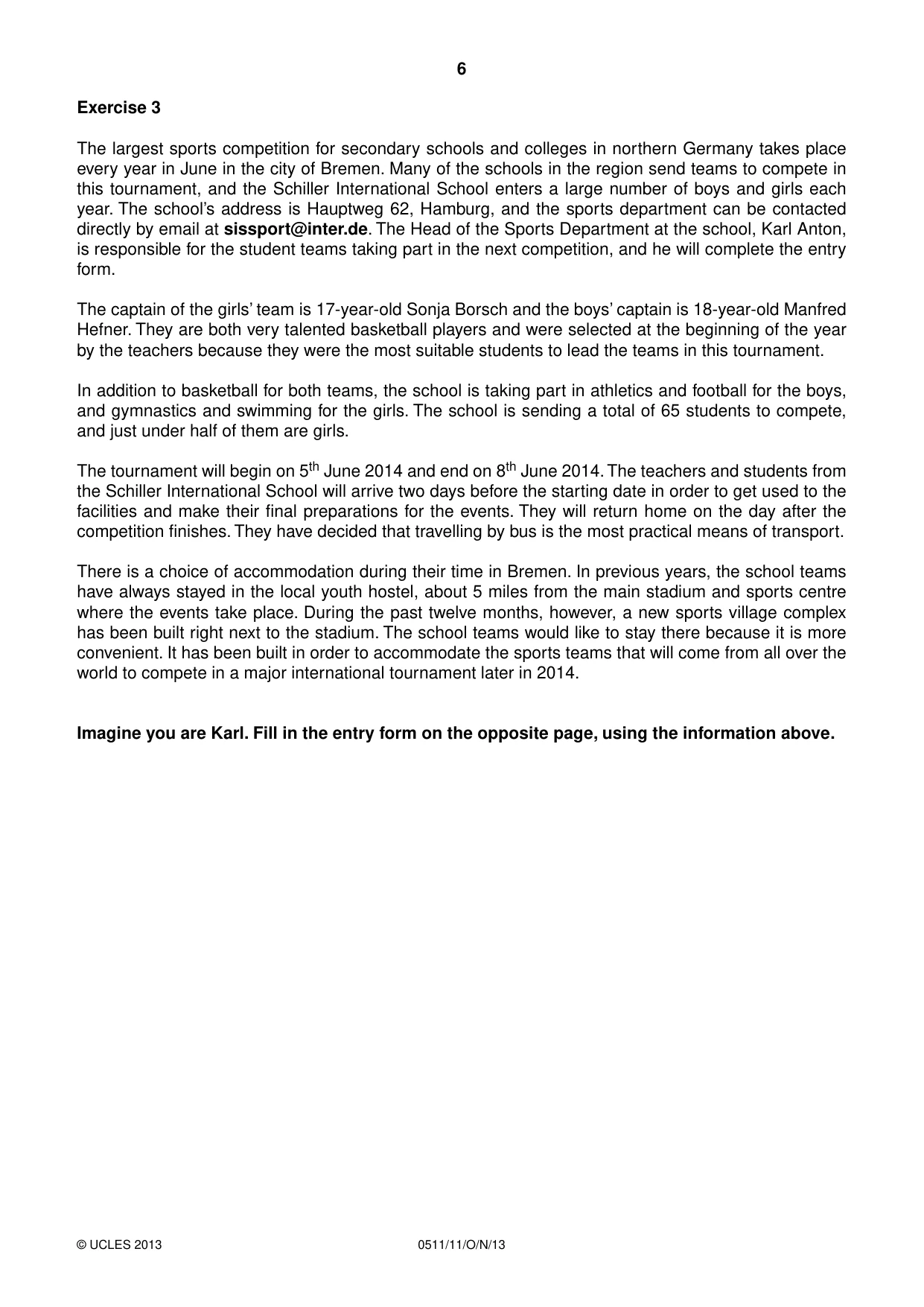
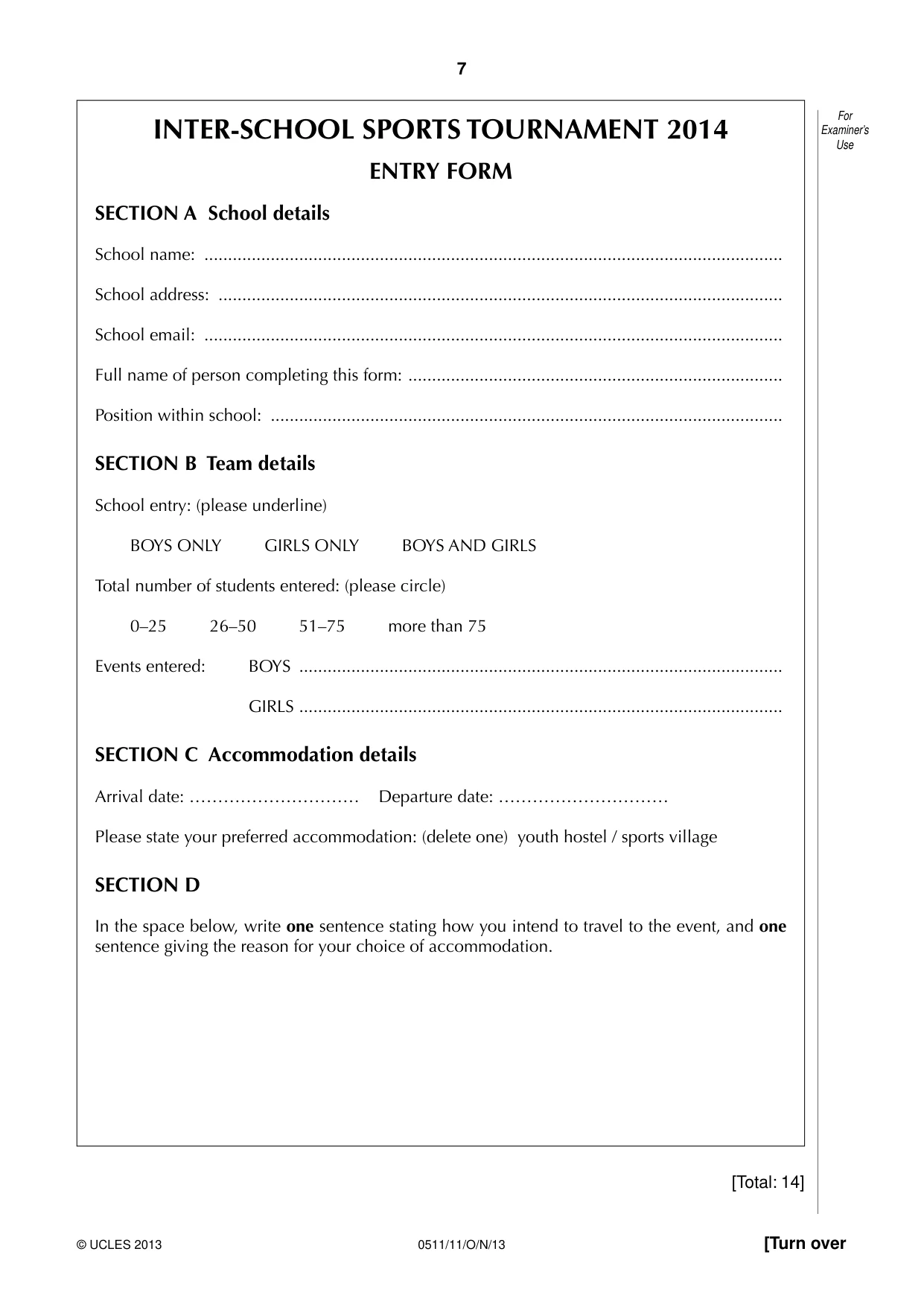
6 0511/11/O/N/13 © UCLES 2013 Exercise 3 The largest sports competition for secondary schools and colleges in northern Germany takes place every year in June in the city of Bremen. Many of the schools in the region send teams to compete in this tournament, and the Schiller International School enters a large number of boys and girls each year. The school’s address is Hauptweg 62, Hamburg, and the sports department can be contacted directly by email at sissport@inter.de. The Head of the Sports Department at the school, Karl Anton, is responsible for the student teams taking part in the next competition, and he will complete the entry form. The captain of the girls’ team is 17-year-old Sonja Borsch and the boys’ captain is 18-year-old Manfred Hefner. They are both very talented basketball players and were selected at the beginning of the year by the teachers because they were the most suitable students to lead the teams in this tournament. In addition to basketball for both teams, the school is taking part in athletics and football for the boys, and gymnastics and swimming for the girls. The school is sending a total of 65 students to compete, and just under half of them are girls. The tournament will begin on 5th June 2014 and end on 8th June 2014. The teachers and students from the Schiller International School will arrive two days before the starting date in order to get used to the facilities and make their final preparations for the events. They will return home on the day after the competition finishes. They have decided that travelling by bus is the most practical means of transport. There is a choice of accommodation during their time in Bremen. In previous years, the school teams have always stayed in the local youth hostel, about 5 miles from the main stadium and sports centre where the events take place. During the past twelve months, however, a new sports village complex has been built right next to the stadium. The school teams would like to stay there because it is more convenient. It has been built in order to accommodate the sports teams that will come from all over the world to compete in a major international tournament later in 2014. Imagine you are Karl. Fill in the entry form on the opposite page, using the information above.
Question paper, page 7
7 0511/11/O/N/13 © UCLES 2013 [Turn over For Examiner’s Use INTER-SCHOOL SPORTS TOURNAMENT 2014 ENTRY FORM SECTION A School details School name: … School address: … School email: … Full name of person completing this form: … Position within school: … SECTION B Team details School entry: (please underline) BOYS ONLY GIRLS ONLY BOYS AND GIRLS Total number of students entered: (please circle) 0–25 26–50 51–75 more than 75 Events entered: BOYS … GIRLS … SECTION C Accommodation details Arrival date: ………………………… Departure date: ………………………… Please state your preferred accommodation: (delete one) youth hostel / sports village SECTION D In the space below, write one sentence stating how you intend to travel to the event, and one sentence giving the reason for your choice of accommodation. [Total: 14]
Question paper, page 8
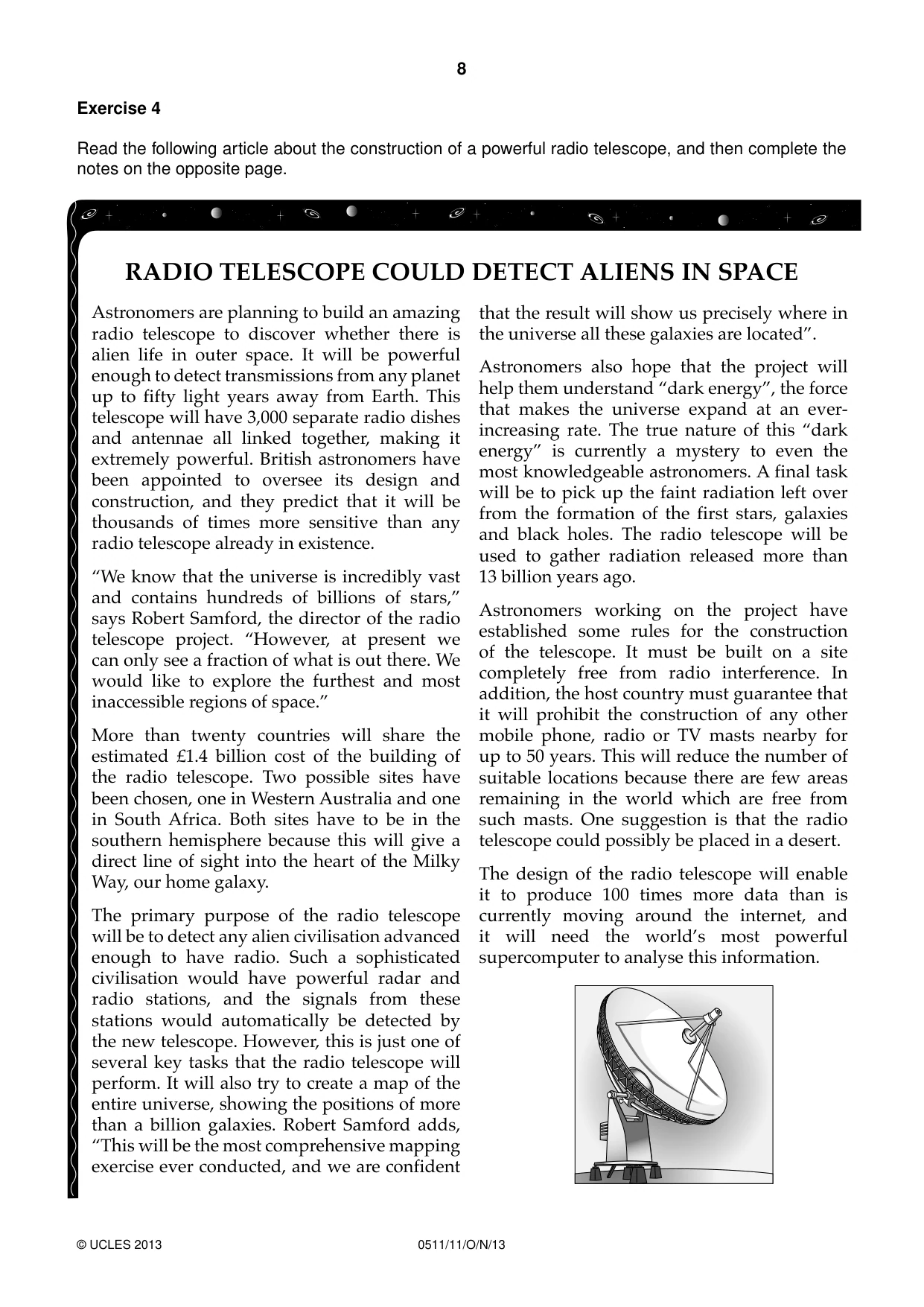
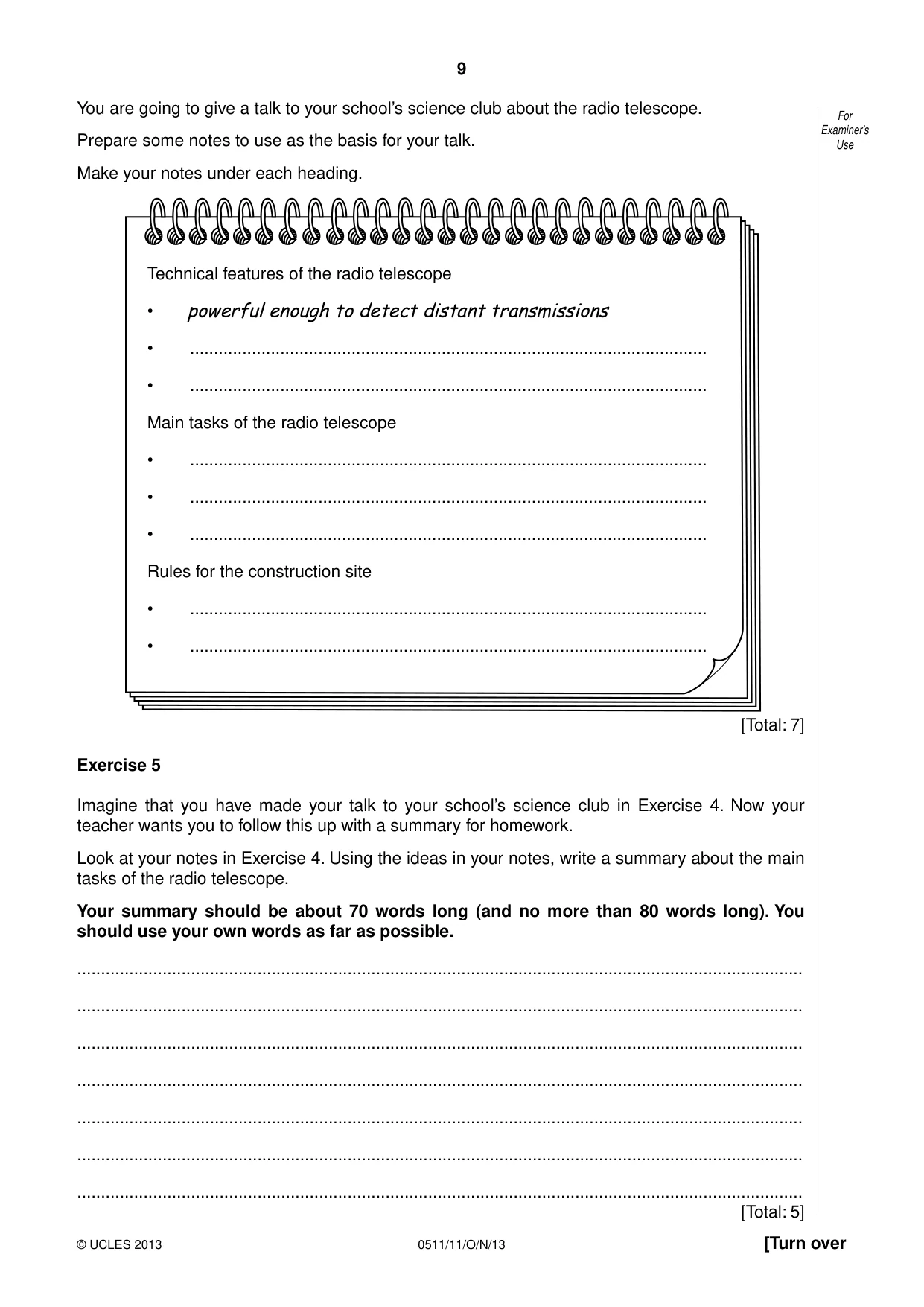
8 0511/11/O/N/13 © UCLES 2013 Exercise 4 Read the following article about the construction of a powerful radio telescope, and then complete the notes on the opposite page. RADIO TELESCOPE COULD DETECT ALIENS IN SPACE Astronomers are planning to build an amazing radio telescope to discover whether there is alien life in outer space. It will be powerful enough to detect transmissions from any planet up to fifty light years away from Earth. This telescope will have 3,000 separate radio dishes and antennae all linked together, making it extremely powerful. British astronomers have been appointed to oversee its design and construction, and they predict that it will be thousands of times more sensitive than any radio telescope already in existence. “We know that the universe is incredibly vast and contains hundreds of billions of stars,” says Robert Samford, the director of the radio telescope project. “However, at present we can only see a fraction of what is out there. We would like to explore the furthest and most inaccessible regions of space.” More than twenty countries will share the estimated £1.4 billion cost of the building of the radio telescope. Two possible sites have been chosen, one in Western Australia and one in South Africa. Both sites have to be in the southern hemisphere because this will give a direct line of sight into the heart of the Milky Way, our home galaxy. The primary purpose of the radio telescope will be to detect any alien civilisation advanced enough to have radio. Such a sophisticated civilisation would have powerful radar and radio stations, and the signals from these stations would automatically be detected by the new telescope. However, this is just one of several key tasks that the radio telescope will perform. It will also try to create a map of the entire universe, showing the positions of more than a billion galaxies. Robert Samford adds, “This will be the most comprehensive mapping exercise ever conducted, and we are confident that the result will show us precisely where in the universe all these galaxies are located”. Astronomers also hope that the project will help them understand “dark energy”, the force that makes the universe expand at an ever- increasing rate. The true nature of this “dark energy” is currently a mystery to even the most knowledgeable astronomers. A final task will be to pick up the faint radiation left over from the formation of the first stars, galaxies and black holes. The radio telescope will be used to gather radiation released more than 13 billion years ago. Astronomers working on the project have established some rules for the construction of the telescope. It must be built on a site completely free from radio interference. In addition, the host country must guarantee that it will prohibit the construction of any other mobile phone, radio or TV masts nearby for up to 50 years. This will reduce the number of suitable locations because there are few areas remaining in the world which are free from such masts. One suggestion is that the radio telescope could possibly be placed in a desert. The design of the radio telescope will enable it to produce 100 times more data than is currently moving around the internet, and it will need the world’s most powerful supercomputer to analyse this information.
Question paper, page 9
9 0511/11/O/N/13 © UCLES 2013 [Turn over For Examiner’s Use You are going to give a talk to your school’s science club about the radio telescope. Prepare some notes to use as the basis for your talk. Make your notes under each heading. [Total: 7] Exercise 5 Imagine that you have made your talk to your school’s science club in Exercise 4. Now your teacher wants you to follow this up with a summary for homework. Look at your notes in Exercise 4. Using the ideas in your notes, write a summary about the main tasks of the radio telescope. Your summary should be about 70 words long (and no more than 80 words long). You should use your own words as far as possible. … … … … … … … [Total: 5] Technical features of the radio telescope • powerful enough to detect distant transmissions • … • … Main tasks of the radio telescope • … • … • … Rules for the construction site • … • …
Question paper, page 10
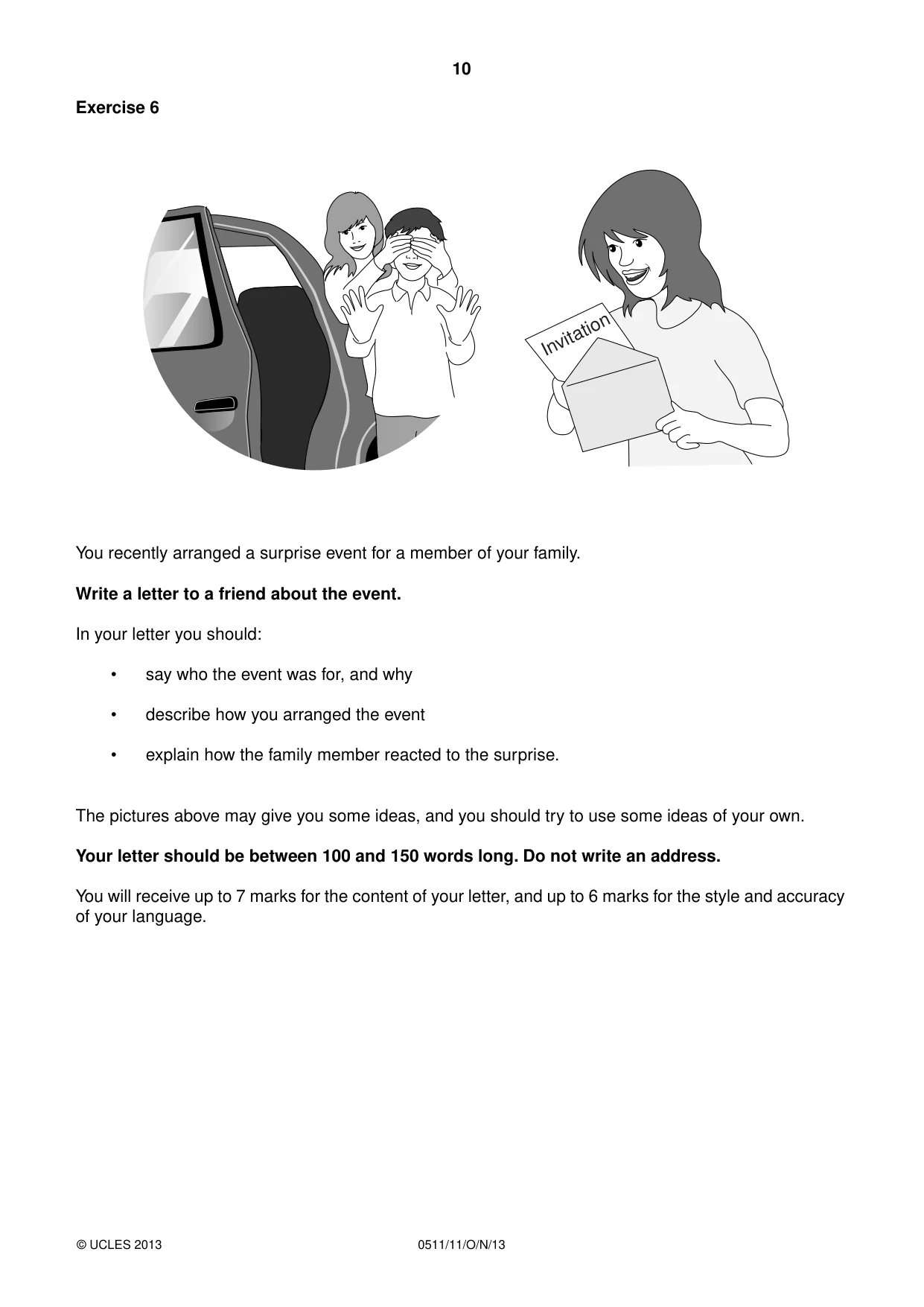
10 0511/11/O/N/13 © UCLES 2013 Exercise 6 Invitation You recently arranged a surprise event for a member of your family. Write a letter to a friend about the event. In your letter you should: • say who the event was for, and why • describe how you arranged the event • explain how the family member reacted to the surprise. The pictures above may give you some ideas, and you should try to use some ideas of your own. Your letter should be between 100 and 150 words long. Do not write an address. You will receive up to 7 marks for the content of your letter, and up to 6 marks for the style and accuracy of your language.
Question paper, page 11
11 0511/11/O/N/13 © UCLES 2013 [Turn over For Examiner’s Use … … … … … … … … … … … … … … … … … … … … [Total: 13]
Question paper, page 12
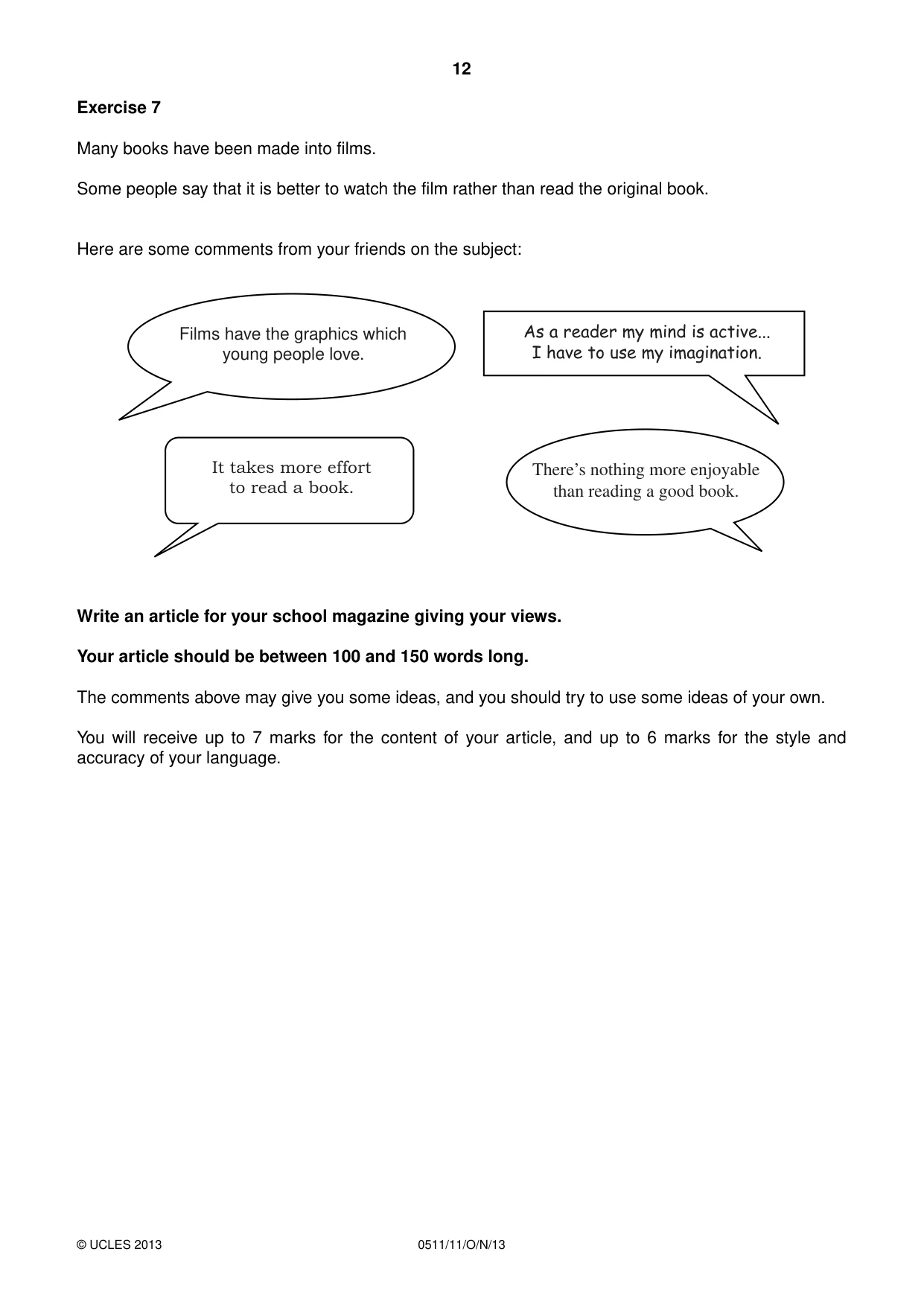
12 0511/11/O/N/13 © UCLES 2013 Exercise 7 Many books have been made into films. Some people say that it is better to watch the film rather than read the original book. Here are some comments from your friends on the subject: Films have the graphics which young people love. As a reader my mind is active... I have to use my imagination. There’s nothing more enjoyable than reading a good book. It takes more effort to read a book. Write an article for your school magazine giving your views. Your article should be between 100 and 150 words long. The comments above may give you some ideas, and you should try to use some ideas of your own. You will receive up to 7 marks for the content of your article, and up to 6 marks for the style and accuracy of your language.
Question paper, page 13
13 0511/11/O/N/13 © UCLES 2013 For Examiner’s Use … … … … … … … … … … … … … … … … … … … … [Total: 13]
Question paper, page 14
14 0511/11/O/N/13 © UCLES 2013 BLANK PAGE
Question paper, page 15
15 0511/11/O/N/13 © UCLES 2013 BLANK PAGE
Question paper, page 16
16 0511/11/O/N/13 © UCLES 2013 Permission to reproduce items where third-party owned material protected by copyright is included has been sought and cleared where possible. Every reasonable effort has been made by the publisher (UCLES) to trace copyright holders, but if any items requiring clearance have unwittingly been included, the publisher will be pleased to make amends at the earliest possible opportunity. University of Cambridge International Examinations is part of the Cambridge Assessment Group. Cambridge Assessment is the brand name of University of Cambridge Local Examinations Syndicate (UCLES), which is itself a department of the University of Cambridge. BLANK PAGE
Mark scheme, page 1
CAMBRIDGE INTERNATIONAL EXAMINATIONS International General Certificate of Secondary Education MARK SCHEME for the October/November 2013 series 0511 ENGLISH AS A SECOND LANGUAGE (ORAL ENDORSEMENT) 0511/11 Paper 1 (Reading and Writing (core)), maximum raw mark 70 This mark scheme is published as an aid to teachers and candidates, to indicate the requirements of the examination. It shows the basis on which Examiners were instructed to award marks. It does not indicate the details of the discussions that took place at an Examiners’ meeting before marking began, which would have considered the acceptability of alternative answers. Mark schemes should be read in conjunction with the question paper and the Principal Examiner Report for Teachers. Cambridge will not enter into discussions about these mark schemes. Cambridge is publishing the mark schemes for the October/November 2013 series for most IGCSE, GCE Advanced Level and Advanced Subsidiary Level components and some Ordinary Level components. www.XtremePapers.com
Mark scheme, page 2
Page 2 Mark Scheme Syllabus Paper IGCSE – October/November 2013 0511 11 © Cambridge International Examinations 2013 IGCSE English as a Second Language Core tier Reading / Writing (Paper 1) This component forms part of the Core tier assessment of IGCSE English as a Second Language and tests the following Assessment Objectives: AO1: Reading R1 understand and respond to information presented in a variety of forms R2 select and organise material relevant to specific purposes R3 recognise, understand and distinguish between facts, ideas and opinions AO2: Writing W1 communicate clearly, accurately and appropriately W2 convey information and express opinions effectively W3 employ and control a variety of grammatical structures W4 demonstrate knowledge and understanding of a range of appropriate vocabulary W5 observe conventions of paragraphing, punctuation and spelling W6 employ appropriate register / style Overview of exercises on Paper 1 Reading objectives tested Marks for reading objectives Writing objectives tested Marks for writing objectives Total available marks Exercise 1 Reading (1) R1 7 --- 7 Exercise 2 Reading (2) R1 11 --- 11 Exercise 3 Information transfer R1, R2 10 W1, W5 4 14 Exercise 4 Note- making R1, R2, R3 7 --- 7 Exercise 5 Summary --- W1, W2, W3, W4, W5 5 5 Exercise 6 Writing (1) --- W1, W2, W3, W4, W5, W6 13 13 Exercise 7 Writing (2) --- W1, W2, W3, W4, W5, W6 13 13 70
Mark scheme, page 3
Page 3 Mark Scheme Syllabus Paper IGCSE – October/November 2013 0511 11 © Cambridge International Examinations 2013 Exercise 1 Rickshaw Race in India (a) cities [1] (b) few kilometres / few km [1] (c) two weeks [1] (d) teach themselves to drive vehicles / learn to drive vehicles[1] (e) Indian charities / Indians [1] (f) all the permits sold in a minute / all permits sold quickly / permits sold out quickly [1] (g) pictures of animals / pictures of tigers / pictures of elephants AND colours of police car / as police car BOTH REQUIRED FOR ONE MARK [1] [Total: 7]
Mark scheme, page 4
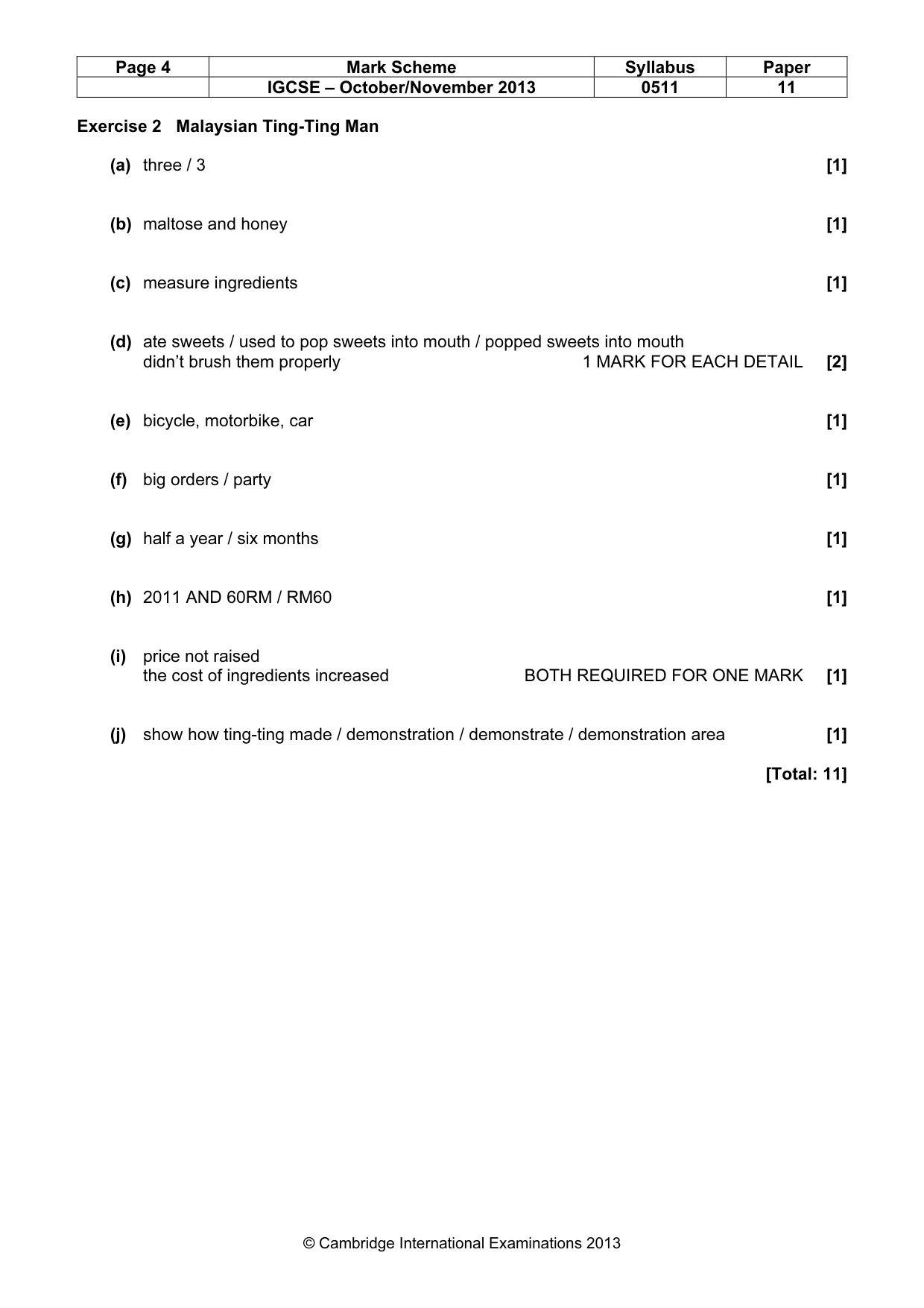
Page 4 Mark Scheme Syllabus Paper IGCSE – October/November 2013 0511 11 © Cambridge International Examinations 2013 Exercise 2 Malaysian Ting-Ting Man (a) three / 3 [1] (b) maltose and honey [1] (c) measure ingredients [1] (d) ate sweets / used to pop sweets into mouth / popped sweets into mouth didn’t brush them properly 1 MARK FOR EACH DETAIL [2] (e) bicycle, motorbike, car [1] (f) big orders / party [1] (g) half a year / six months [1] (h) 2011 AND 60RM / RM60 [1] (i) price not raised the cost of ingredients increased BOTH REQUIRED FOR ONE MARK [1] (j) show how ting-ting made / demonstration / demonstrate / demonstration area [1] [Total: 11]
Mark scheme, page 5
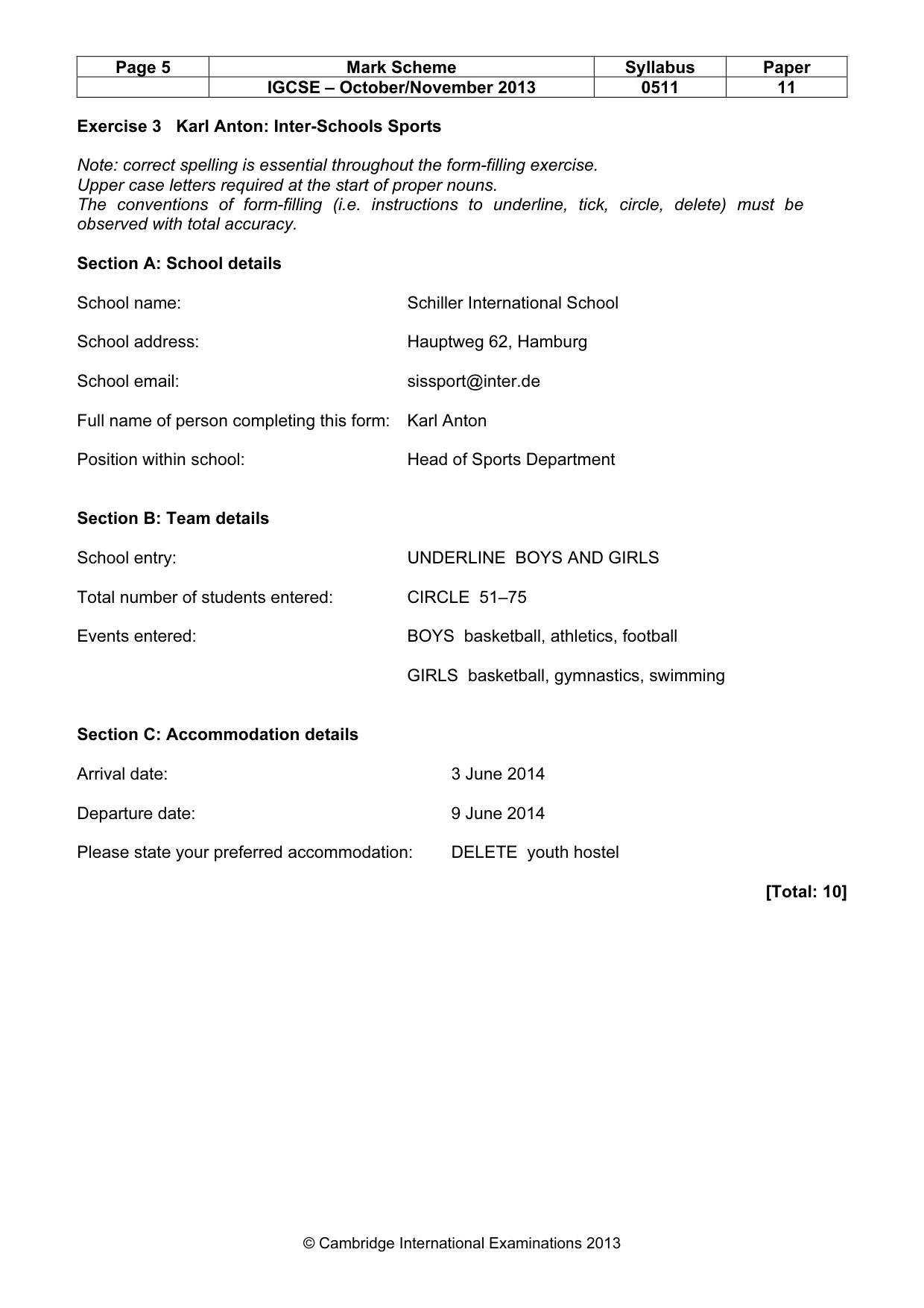
Page 5 Mark Scheme Syllabus Paper IGCSE – October/November 2013 0511 11 © Cambridge International Examinations 2013 Exercise 3 Karl Anton: Inter-Schools Sports Note: correct spelling is essential throughout the form-filling exercise. Upper case letters required at the start of proper nouns. The conventions of form-filling (i.e. instructions to underline, tick, circle, delete) must be observed with total accuracy. Section A: School details School name: Schiller International School School address: Hauptweg 62, Hamburg School email: sissport@inter.de Full name of person completing this form: Karl Anton Position within school: Head of Sports Department Section B: Team details School entry: UNDERLINE BOYS AND GIRLS Total number of students entered: CIRCLE 51–75 Events entered: BOYS basketball, athletics, football GIRLS basketball, gymnastics, swimming Section C: Accommodation details Arrival date: 3 June 2014 Departure date: 9 June 2014 Please state your preferred accommodation: DELETE youth hostel [Total: 10]
Mark scheme, page 6
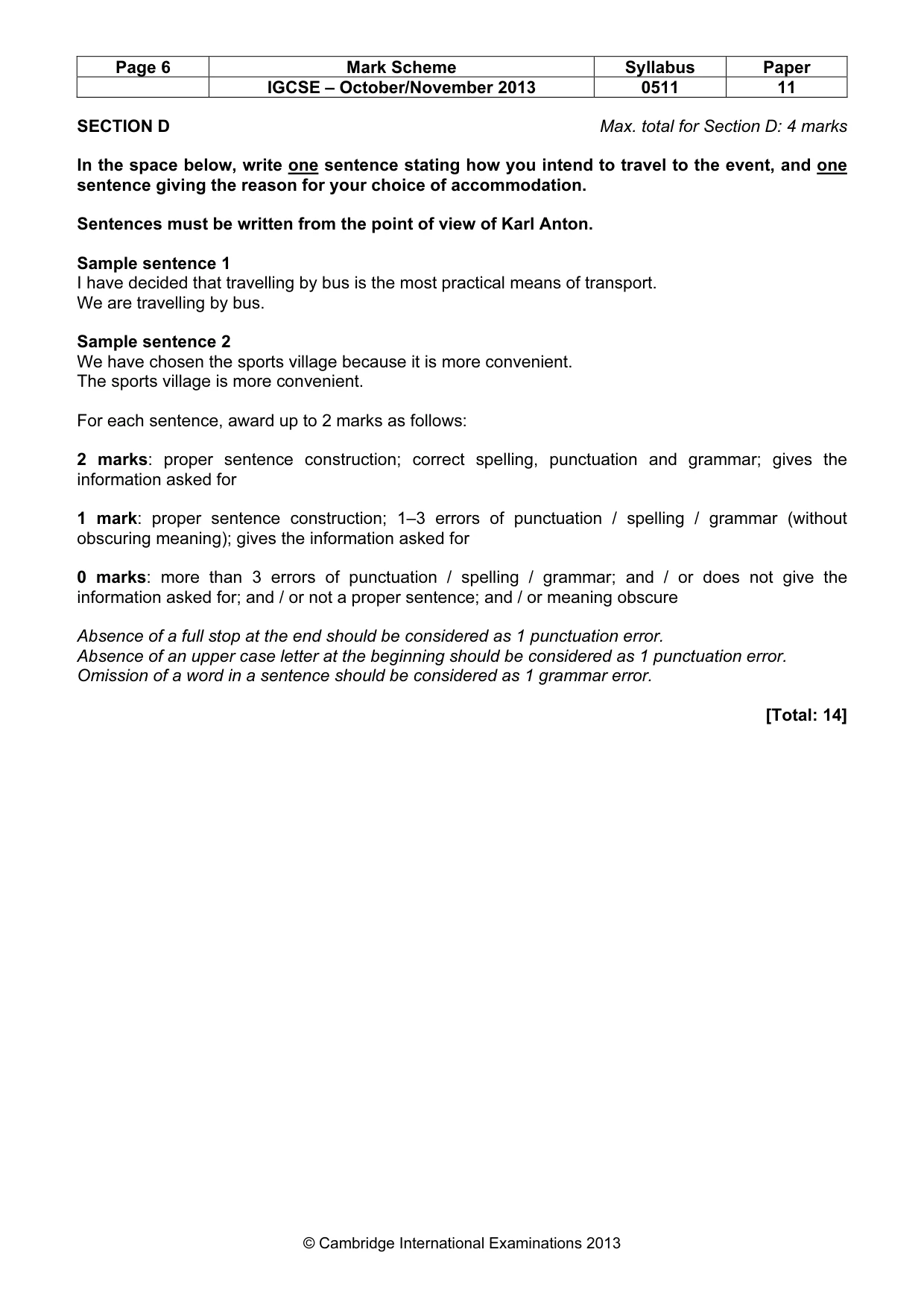
Page 6 Mark Scheme Syllabus Paper IGCSE – October/November 2013 0511 11 © Cambridge International Examinations 2013 SECTION D Max. total for Section D: 4 marks In the space below, write one sentence stating how you intend to travel to the event, and one sentence giving the reason for your choice of accommodation. Sentences must be written from the point of view of Karl Anton. Sample sentence 1 I have decided that travelling by bus is the most practical means of transport. We are travelling by bus. Sample sentence 2 We have chosen the sports village because it is more convenient. The sports village is more convenient. For each sentence, award up to 2 marks as follows: 2 marks: proper sentence construction; correct spelling, punctuation and grammar; gives the information asked for 1 mark: proper sentence construction; 1–3 errors of punctuation / spelling / grammar (without obscuring meaning); gives the information asked for 0 marks: more than 3 errors of punctuation / spelling / grammar; and / or does not give the information asked for; and / or not a proper sentence; and / or meaning obscure Absence of a full stop at the end should be considered as 1 punctuation error. Absence of an upper case letter at the beginning should be considered as 1 punctuation error. Omission of a word in a sentence should be considered as 1 grammar error. [Total: 14]
Mark scheme, page 7
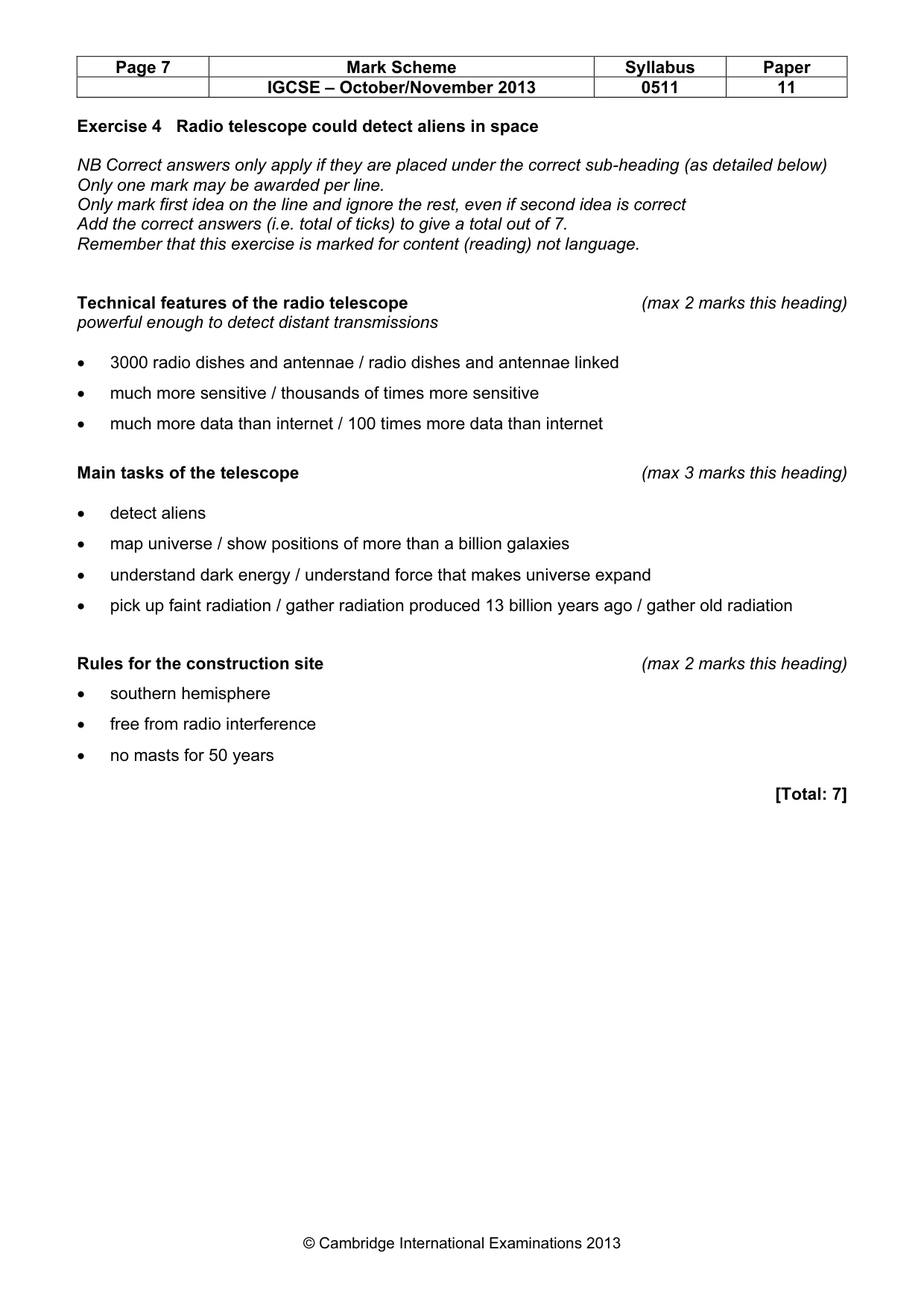
Page 7 Mark Scheme Syllabus Paper IGCSE – October/November 2013 0511 11 © Cambridge International Examinations 2013 Exercise 4 Radio telescope could detect aliens in space NB Correct answers only apply if they are placed under the correct sub-heading (as detailed below) Only one mark may be awarded per line. Only mark first idea on the line and ignore the rest, even if second idea is correct Add the correct answers (i.e. total of ticks) to give a total out of 7. Remember that this exercise is marked for content (reading) not language. Technical features of the radio telescope (max 2 marks this heading) powerful enough to detect distant transmissions • 3000 radio dishes and antennae / radio dishes and antennae linked • much more sensitive / thousands of times more sensitive • much more data than internet / 100 times more data than internet Main tasks of the telescope (max 3 marks this heading) • detect aliens • map universe / show positions of more than a billion galaxies • understand dark energy / understand force that makes universe expand • pick up faint radiation / gather radiation produced 13 billion years ago / gather old radiation Rules for the construction site (max 2 marks this heading) • southern hemisphere • free from radio interference • no masts for 50 years [Total: 7]
Mark scheme, page 8
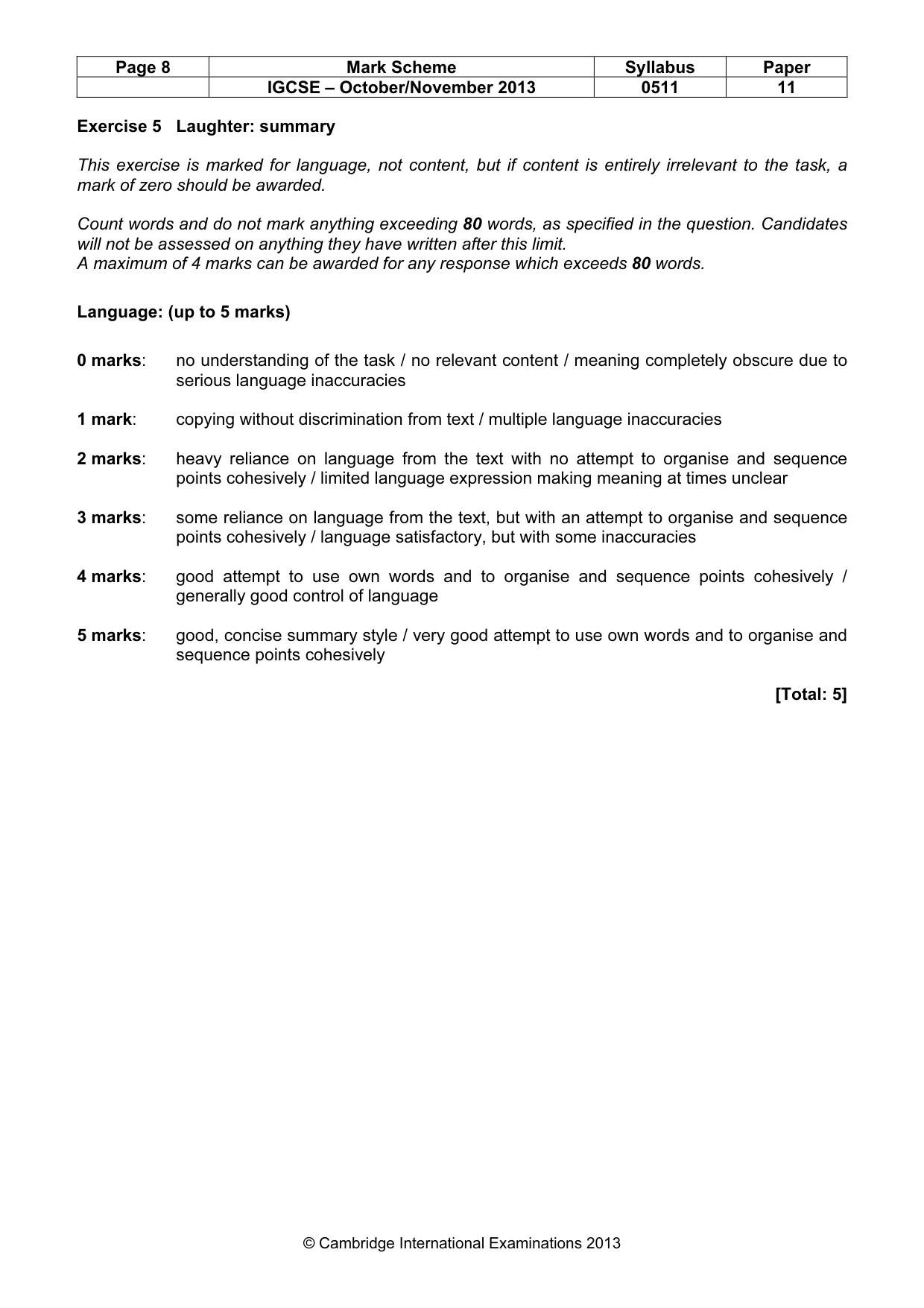
Page 8 Mark Scheme Syllabus Paper IGCSE – October/November 2013 0511 11 © Cambridge International Examinations 2013 Exercise 5 Laughter: summary This exercise is marked for language, not content, but if content is entirely irrelevant to the task, a mark of zero should be awarded. Count words and do not mark anything exceeding 80 words, as specified in the question. Candidates will not be assessed on anything they have written after this limit. A maximum of 4 marks can be awarded for any response which exceeds 80 words. Language: (up to 5 marks) 0 marks: no understanding of the task / no relevant content / meaning completely obscure due to serious language inaccuracies 1 mark: copying without discrimination from text / multiple language inaccuracies 2 marks: heavy reliance on language from the text with no attempt to organise and sequence points cohesively / limited language expression making meaning at times unclear 3 marks: some reliance on language from the text, but with an attempt to organise and sequence points cohesively / language satisfactory, but with some inaccuracies 4 marks: good attempt to use own words and to organise and sequence points cohesively / generally good control of language 5 marks: good, concise summary style / very good attempt to use own words and to organise and sequence points cohesively [Total: 5]
Mark scheme, page 9
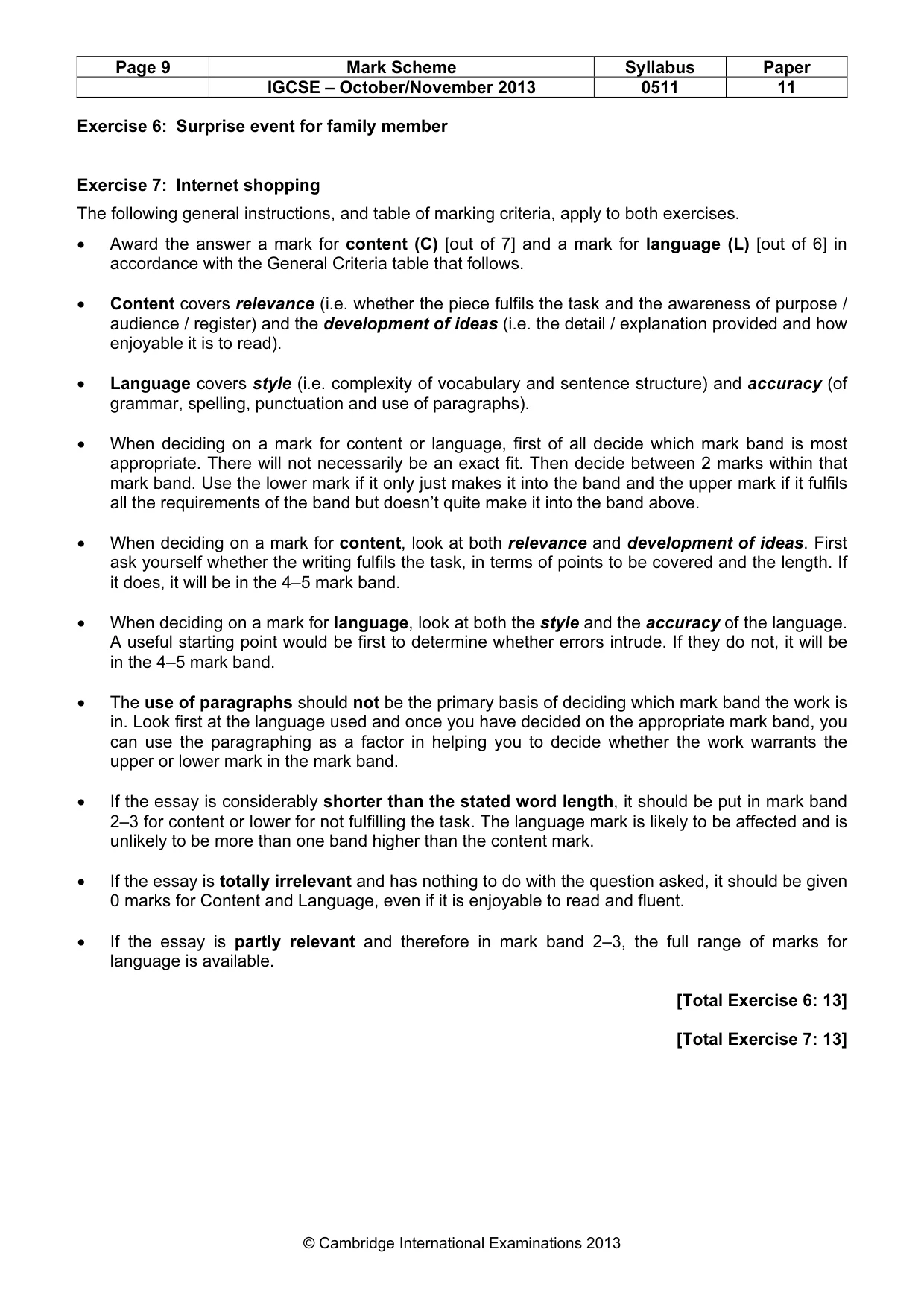
Page 9 Mark Scheme Syllabus Paper IGCSE – October/November 2013 0511 11 © Cambridge International Examinations 2013 Exercise 6: Surprise event for family member Exercise 7: Internet shopping The following general instructions, and table of marking criteria, apply to both exercises. • Award the answer a mark for content (C) [out of 7] and a mark for language (L) [out of 6] in accordance with the General Criteria table that follows. • Content covers relevance (i.e. whether the piece fulfils the task and the awareness of purpose / audience / register) and the development of ideas (i.e. the detail / explanation provided and how enjoyable it is to read). • Language covers style (i.e. complexity of vocabulary and sentence structure) and accuracy (of grammar, spelling, punctuation and use of paragraphs). • When deciding on a mark for content or language, first of all decide which mark band is most appropriate. There will not necessarily be an exact fit. Then decide between 2 marks within that mark band. Use the lower mark if it only just makes it into the band and the upper mark if it fulfils all the requirements of the band but doesn’t quite make it into the band above. • When deciding on a mark for content, look at both relevance and development of ideas. First ask yourself whether the writing fulfils the task, in terms of points to be covered and the length. If it does, it will be in the 4–5 mark band. • When deciding on a mark for language, look at both the style and the accuracy of the language. A useful starting point would be first to determine whether errors intrude. If they do not, it will be in the 4–5 mark band. • The use of paragraphs should not be the primary basis of deciding which mark band the work is in. Look first at the language used and once you have decided on the appropriate mark band, you can use the paragraphing as a factor in helping you to decide whether the work warrants the upper or lower mark in the mark band. • If the essay is considerably shorter than the stated word length, it should be put in mark band 2–3 for content or lower for not fulfilling the task. The language mark is likely to be affected and is unlikely to be more than one band higher than the content mark. • If the essay is totally irrelevant and has nothing to do with the question asked, it should be given 0 marks for Content and Language, even if it is enjoyable to read and fluent. • If the essay is partly relevant and therefore in mark band 2–3, the full range of marks for language is available. [Total Exercise 6: 13] [Total Exercise 7: 13]
Mark scheme, page 10
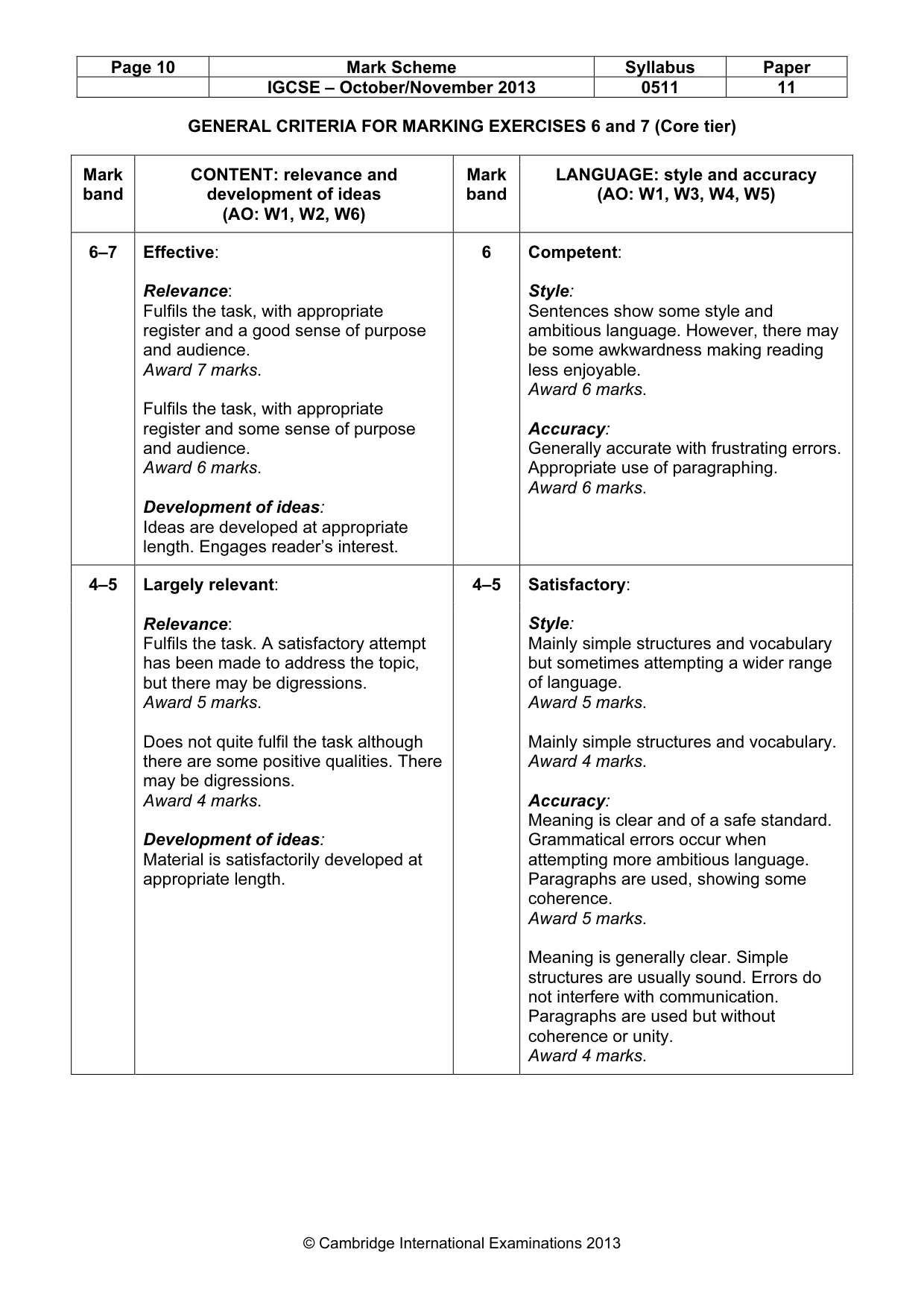
Page 10 Mark Scheme Syllabus Paper IGCSE – October/November 2013 0511 11 © Cambridge International Examinations 2013 GENERAL CRITERIA FOR MARKING EXERCISES 6 and 7 (Core tier) Mark band CONTENT: relevance and development of ideas (AO: W1, W2, W6) Mark band LANGUAGE: style and accuracy (AO: W1, W3, W4, W5) 6–7 Effective: Relevance: Fulfils the task, with appropriate register and a good sense of purpose and audience. Award 7 marks. Fulfils the task, with appropriate register and some sense of purpose and audience. Award 6 marks. Development of ideas: Ideas are developed at appropriate length. Engages reader’s interest. 6 Competent: Style: Sentences show some style and ambitious language. However, there may be some awkwardness making reading less enjoyable. Award 6 marks. Accuracy: Generally accurate with frustrating errors. Appropriate use of paragraphing. Award 6 marks. 4–5 Largely relevant: Relevance: Fulfils the task. A satisfactory attempt has been made to address the topic, but there may be digressions. Award 5 marks. Does not quite fulfil the task although there are some positive qualities. There may be digressions. Award 4 marks. Development of ideas: Material is satisfactorily developed at appropriate length. 4–5 Satisfactory: Style: Mainly simple structures and vocabulary but sometimes attempting a wider range of language. Award 5 marks. Mainly simple structures and vocabulary. Award 4 marks. Accuracy: Meaning is clear and of a safe standard. Grammatical errors occur when attempting more ambitious language. Paragraphs are used, showing some coherence. Award 5 marks. Meaning is generally clear. Simple structures are usually sound. Errors do not interfere with communication. Paragraphs are used but without coherence or unity. Award 4 marks.
Mark scheme, page 11
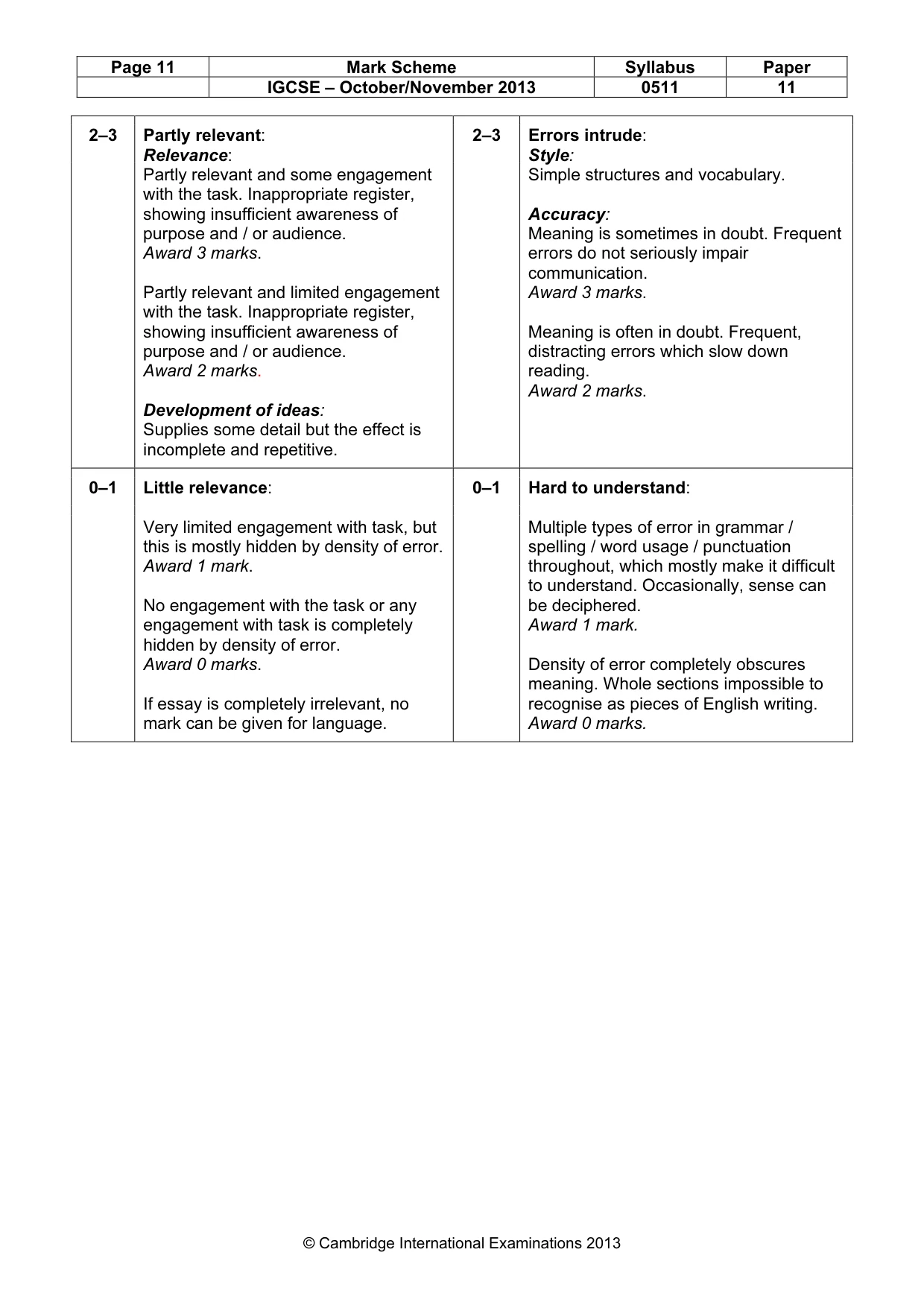
Page 11 Mark Scheme Syllabus Paper IGCSE – October/November 2013 0511 11 © Cambridge International Examinations 2013 2–3 Partly relevant: Relevance: Partly relevant and some engagement with the task. Inappropriate register, showing insufficient awareness of purpose and / or audience. Award 3 marks. Partly relevant and limited engagement with the task. Inappropriate register, showing insufficient awareness of purpose and / or audience. Award 2 marks. Development of ideas: Supplies some detail but the effect is incomplete and repetitive. 2–3 Errors intrude: Style: Simple structures and vocabulary. Accuracy: Meaning is sometimes in doubt. Frequent errors do not seriously impair communication. Award 3 marks. Meaning is often in doubt. Frequent, distracting errors which slow down reading. Award 2 marks. 0–1 Little relevance: Very limited engagement with task, but this is mostly hidden by density of error. Award 1 mark. No engagement with the task or any engagement with task is completely hidden by density of error. Award 0 marks. If essay is completely irrelevant, no mark can be given for language. 0–1 Hard to understand: Multiple types of error in grammar / spelling / word usage / punctuation throughout, which mostly make it difficult to understand. Occasionally, sense can be deciphered. Award 1 mark. Density of error completely obscures meaning. Whole sections impossible to recognise as pieces of English writing. Award 0 marks.
What you needed in this session
Cambridge’s own grade thresholds for 2013 Oct/Nov, Paper 1 · Variant 1. A higher threshold means an easier paper — the bar moves with how the cohort did.