Cambridge IGCSE English - Second Language (9-1) 0991 — 2019 Oct/Nov Paper 2 · Variant 1
0991/21/O/N/19 · 80 marks · ≈90 min
The question paper and its mark scheme, free to read here and free to download. This is Cambridge’s own paper, exactly as it was sat.
Question paper16 pages






Mark scheme9 pages
Answers below. Sit the paper first if you are practising.
Paper as text
Question paper, page 1
This document consists of 13 printed pages and 3 blank pages. DC (SLM) 189961 © UCLES 2019 [Turn over * 8 3 8 8 5 2 4 9 5 9 * ENGLISH AS A SECOND LANGUAGE 0991/21 Paper 2 Reading and Writing (Extended) October/November 2019 2 hours Candidates answer on the Question Paper. No Additional Materials are required. READ THESE INSTRUCTIONS FIRST Write your centre number, candidate number and name on all the work you hand in. Write in dark blue or black pen. Do not use staples, paper clips, glue or correction fluid. DO NOT WRITE IN ANY BARCODES. Answer all questions. Dictionaries are not allowed. At the end of the examination, fasten all your work securely together. The number of marks is given in brackets [ ] at the end of each question or part question. Cambridge Assessment International Education Cambridge International General Certificate of Secondary Education (9–1)
Question paper, page 2
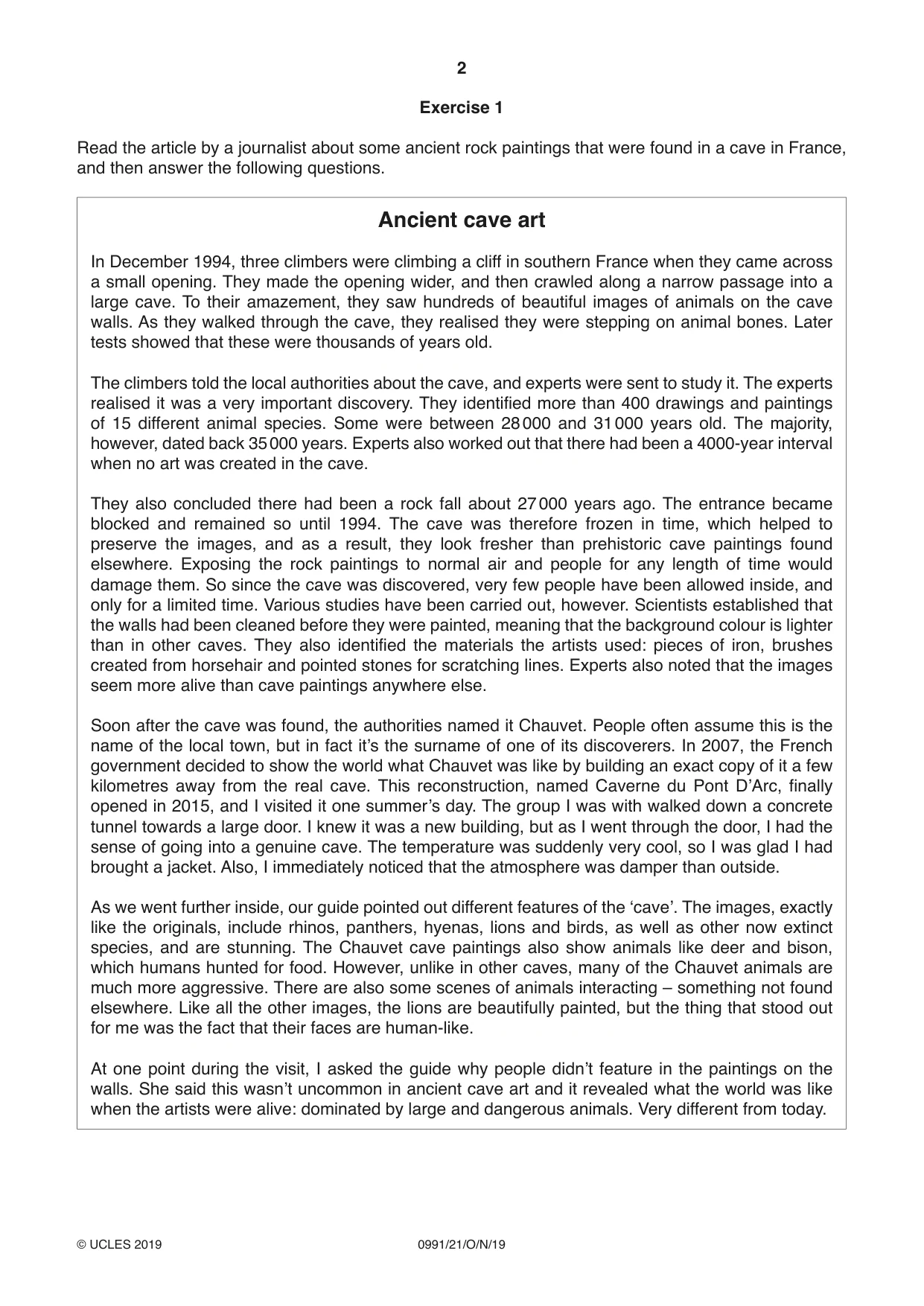
2 0991/21/O/N/19 © UCLES 2019 Exercise 1 Read the article by a journalist about some ancient rock paintings that were found in a cave in France, and then answer the following questions. Ancient cave art In December 1994, three climbers were climbing a cliff in southern France when they came across a small opening. They made the opening wider, and then crawled along a narrow passage into a large cave. To their amazement, they saw hundreds of beautiful images of animals on the cave walls. As they walked through the cave, they realised they were stepping on animal bones. Later tests showed that these were thousands of years old. The climbers told the local authorities about the cave, and experts were sent to study it. The experts realised it was a very important discovery. They identified more than 400 drawings and paintings of 15 different animal species. Some were between 28 000 and 31 000 years old. The majority, however, dated back 35 000 years. Experts also worked out that there had been a 4000-year interval when no art was created in the cave. They also concluded there had been a rock fall about 27 000 years ago. The entrance became blocked and remained so until 1994. The cave was therefore frozen in time, which helped to preserve the images, and as a result, they look fresher than prehistoric cave paintings found elsewhere. Exposing the rock paintings to normal air and people for any length of time would damage them. So since the cave was discovered, very few people have been allowed inside, and only for a limited time. Various studies have been carried out, however. Scientists established that the walls had been cleaned before they were painted, meaning that the background colour is lighter than in other caves. They also identified the materials the artists used: pieces of iron, brushes created from horsehair and pointed stones for scratching lines. Experts also noted that the images seem more alive than cave paintings anywhere else. Soon after the cave was found, the authorities named it Chauvet. People often assume this is the name of the local town, but in fact it’s the surname of one of its discoverers. In 2007, the French government decided to show the world what Chauvet was like by building an exact copy of it a few kilometres away from the real cave. This reconstruction, named Caverne du Pont D’Arc, finally opened in 2015, and I visited it one summer’s day. The group I was with walked down a concrete tunnel towards a large door. I knew it was a new building, but as I went through the door, I had the sense of going into a genuine cave. The temperature was suddenly very cool, so I was glad I had brought a jacket. Also, I immediately noticed that the atmosphere was damper than outside. As we went further inside, our guide pointed out different features of the ‘cave’. The images, exactly like the originals, include rhinos, panthers, hyenas, lions and birds, as well as other now extinct species, and are stunning. The Chauvet cave paintings also show animals like deer and bison, which humans hunted for food. However, unlike in other caves, many of the Chauvet animals are much more aggressive. There are also some scenes of animals interacting – something not found elsewhere. Like all the other images, the lions are beautifully painted, but the thing that stood out for me was the fact that their faces are human-like. At one point during the visit, I asked the guide why people didn’t feature in the paintings on the walls. She said this wasn’t uncommon in ancient cave art and it revealed what the world was like when the artists were alive: dominated by large and dangerous animals. Very different from today.
Question paper, page 3
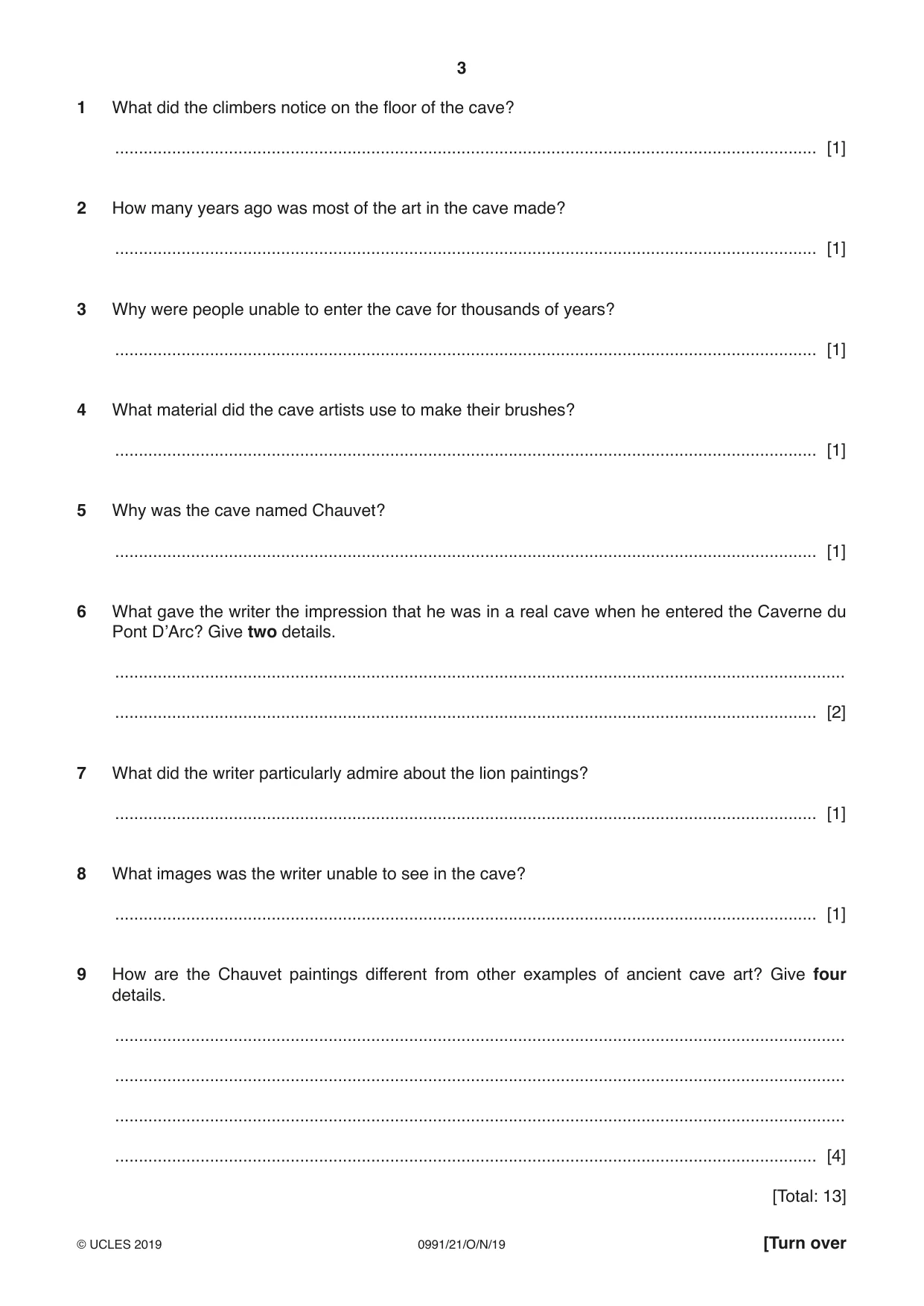
3 0991/21/O/N/19 © UCLES 2019 [Turn over 1 What did the climbers notice on the floor of the cave? … [1] 2 How many years ago was most of the art in the cave made? … [1] 3 Why were people unable to enter the cave for thousands of years? … [1] 4 What material did the cave artists use to make their brushes? … [1] 5 Why was the cave named Chauvet? … [1] 6 What gave the writer the impression that he was in a real cave when he entered the Caverne du Pont D’Arc? Give two details. … … [2] 7 What did the writer particularly admire about the lion paintings? … [1] 8 What images was the writer unable to see in the cave? … [1] 9 How are the Chauvet paintings different from other examples of ancient cave art? Give four details. … … … … [4] [Total: 13]
Question paper, page 4
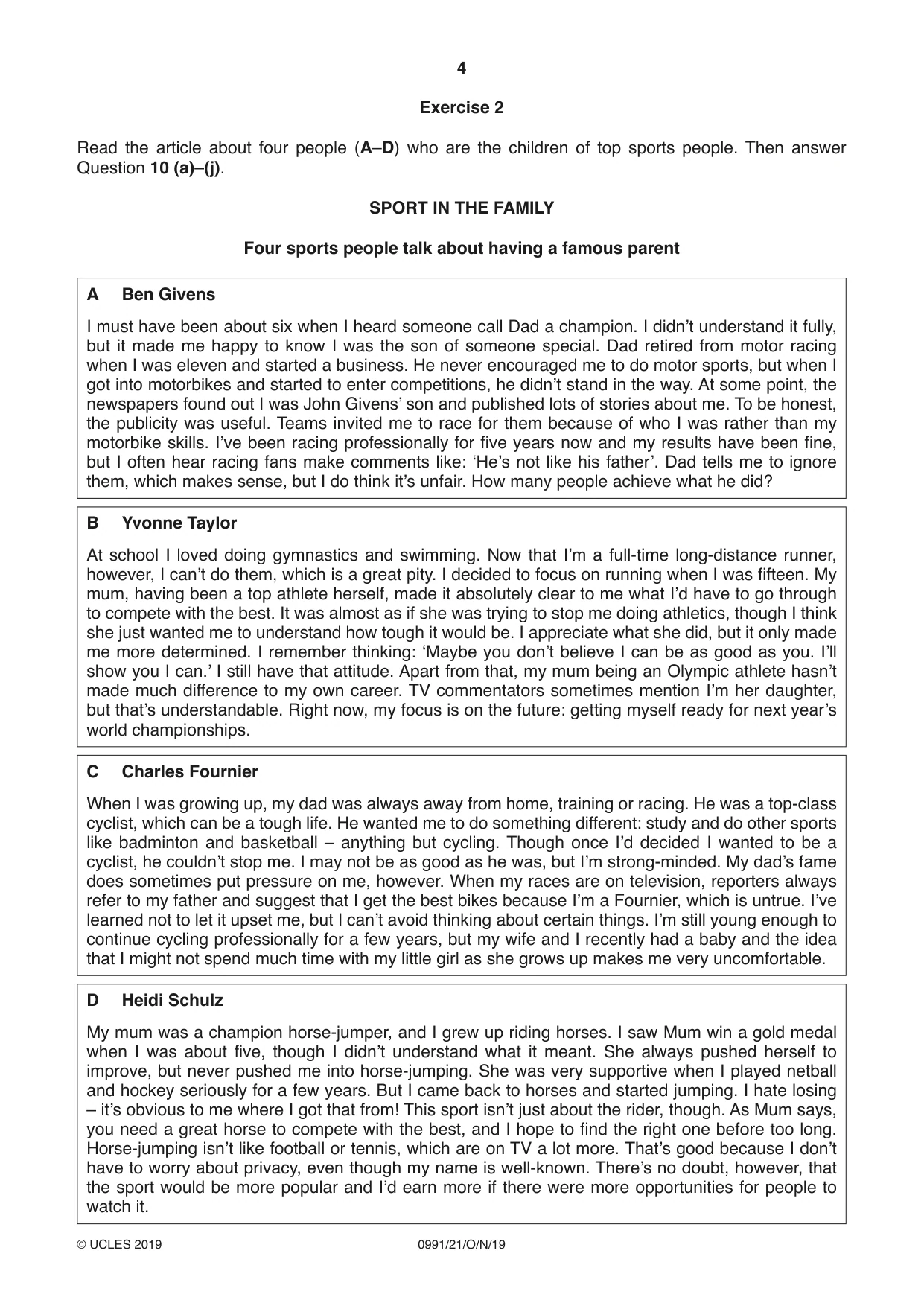
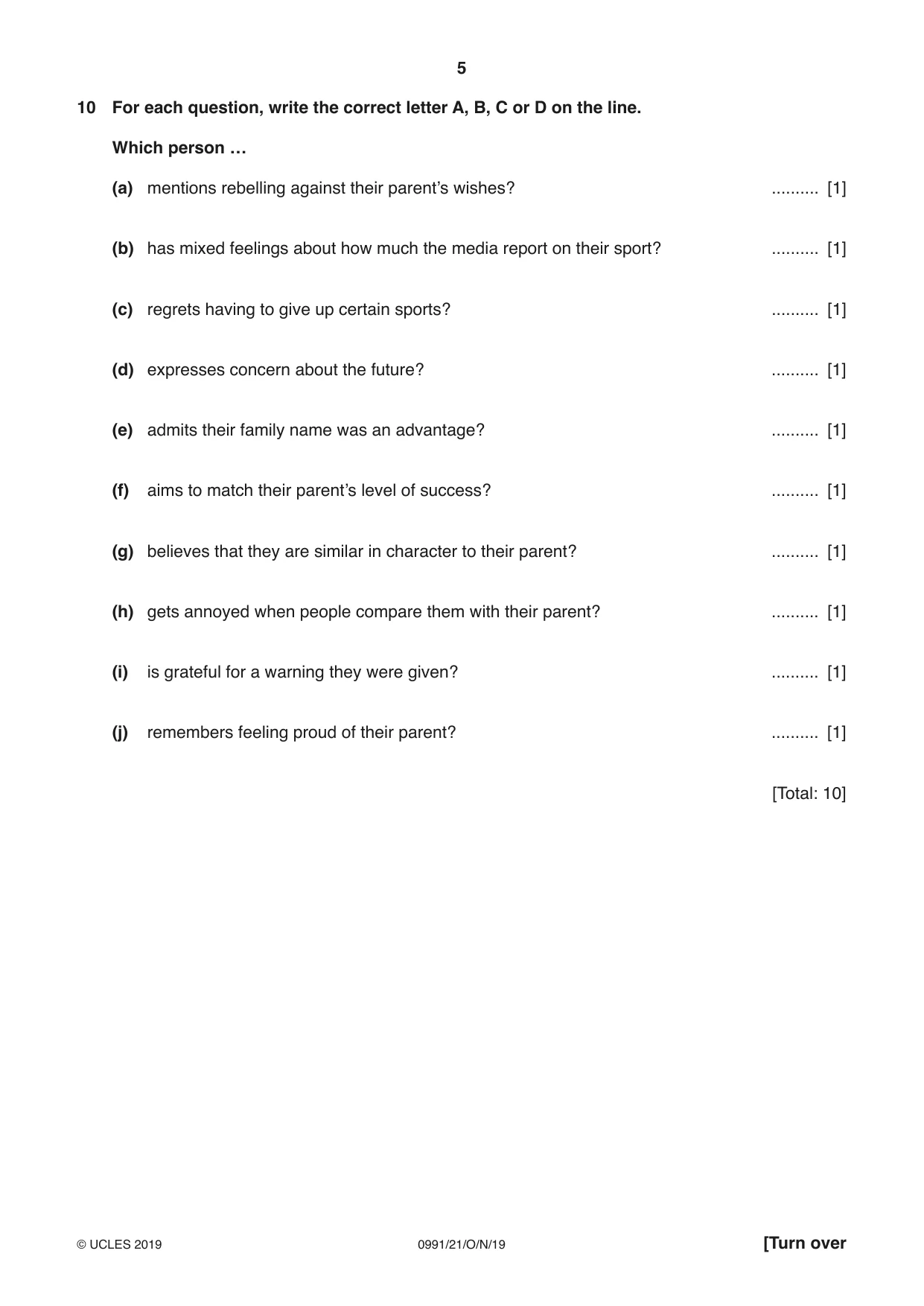
4 0991/21/O/N/19 © UCLES 2019 Exercise 2 Read the article about four people (A–D) who are the children of top sports people. Then answer Question 10 (a)–(j). SPORT IN THE FAMILY Four sports people talk about having a famous parent A Ben Givens I must have been about six when I heard someone call Dad a champion. I didn’t understand it fully, but it made me happy to know I was the son of someone special. Dad retired from motor racing when I was eleven and started a business. He never encouraged me to do motor sports, but when I got into motorbikes and started to enter competitions, he didn’t stand in the way. At some point, the newspapers found out I was John Givens’ son and published lots of stories about me. To be honest, the publicity was useful. Teams invited me to race for them because of who I was rather than my motorbike skills. I’ve been racing professionally for five years now and my results have been fine, but I often hear racing fans make comments like: ‘He’s not like his father’. Dad tells me to ignore them, which makes sense, but I do think it’s unfair. How many people achieve what he did? B Yvonne Taylor At school I loved doing gymnastics and swimming. Now that I’m a full-time long-distance runner, however, I can’t do them, which is a great pity. I decided to focus on running when I was fifteen. My mum, having been a top athlete herself, made it absolutely clear to me what I’d have to go through to compete with the best. It was almost as if she was trying to stop me doing athletics, though I think she just wanted me to understand how tough it would be. I appreciate what she did, but it only made me more determined. I remember thinking: ‘Maybe you don’t believe I can be as good as you. I’ll show you I can.’ I still have that attitude. Apart from that, my mum being an Olympic athlete hasn’t made much difference to my own career. TV commentators sometimes mention I’m her daughter, but that’s understandable. Right now, my focus is on the future: getting myself ready for next year’s world championships. C Charles Fournier When I was growing up, my dad was always away from home, training or racing. He was a top-class cyclist, which can be a tough life. He wanted me to do something different: study and do other sports like badminton and basketball – anything but cycling. Though once I’d decided I wanted to be a cyclist, he couldn’t stop me. I may not be as good as he was, but I’m strong-minded. My dad’s fame does sometimes put pressure on me, however. When my races are on television, reporters always refer to my father and suggest that I get the best bikes because I’m a Fournier, which is untrue. I’ve learned not to let it upset me, but I can’t avoid thinking about certain things. I’m still young enough to continue cycling professionally for a few years, but my wife and I recently had a baby and the idea that I might not spend much time with my little girl as she grows up makes me very uncomfortable. D Heidi Schulz My mum was a champion horse-jumper, and I grew up riding horses. I saw Mum win a gold medal when I was about five, though I didn’t understand what it meant. She always pushed herself to improve, but never pushed me into horse-jumping. She was very supportive when I played netball and hockey seriously for a few years. But I came back to horses and started jumping. I hate losing – it’s obvious to me where I got that from! This sport isn’t just about the rider, though. As Mum says, you need a great horse to compete with the best, and I hope to find the right one before too long. Horse-jumping isn’t like football or tennis, which are on TV a lot more. That’s good because I don’t have to worry about privacy, even though my name is well-known. There’s no doubt, however, that the sport would be more popular and I’d earn more if there were more opportunities for people to watch it.
Question paper, page 5
5 0991/21/O/N/19 © UCLES 2019 [Turn over 10 For each question, write the correct letter A, B, C or D on the line. Which person … (a) mentions rebelling against their parent’s wishes? … [1] (b) has mixed feelings about how much the media report on their sport? … [1] (c) regrets having to give up certain sports? … [1] (d) expresses concern about the future? … [1] (e) admits their family name was an advantage? … [1] (f) aims to match their parent’s level of success? … [1] (g) believes that they are similar in character to their parent? … [1] (h) gets annoyed when people compare them with their parent? … [1] (i) is grateful for a warning they were given? … [1] (j) remembers feeling proud of their parent? … [1] [Total: 10]
Question paper, page 6
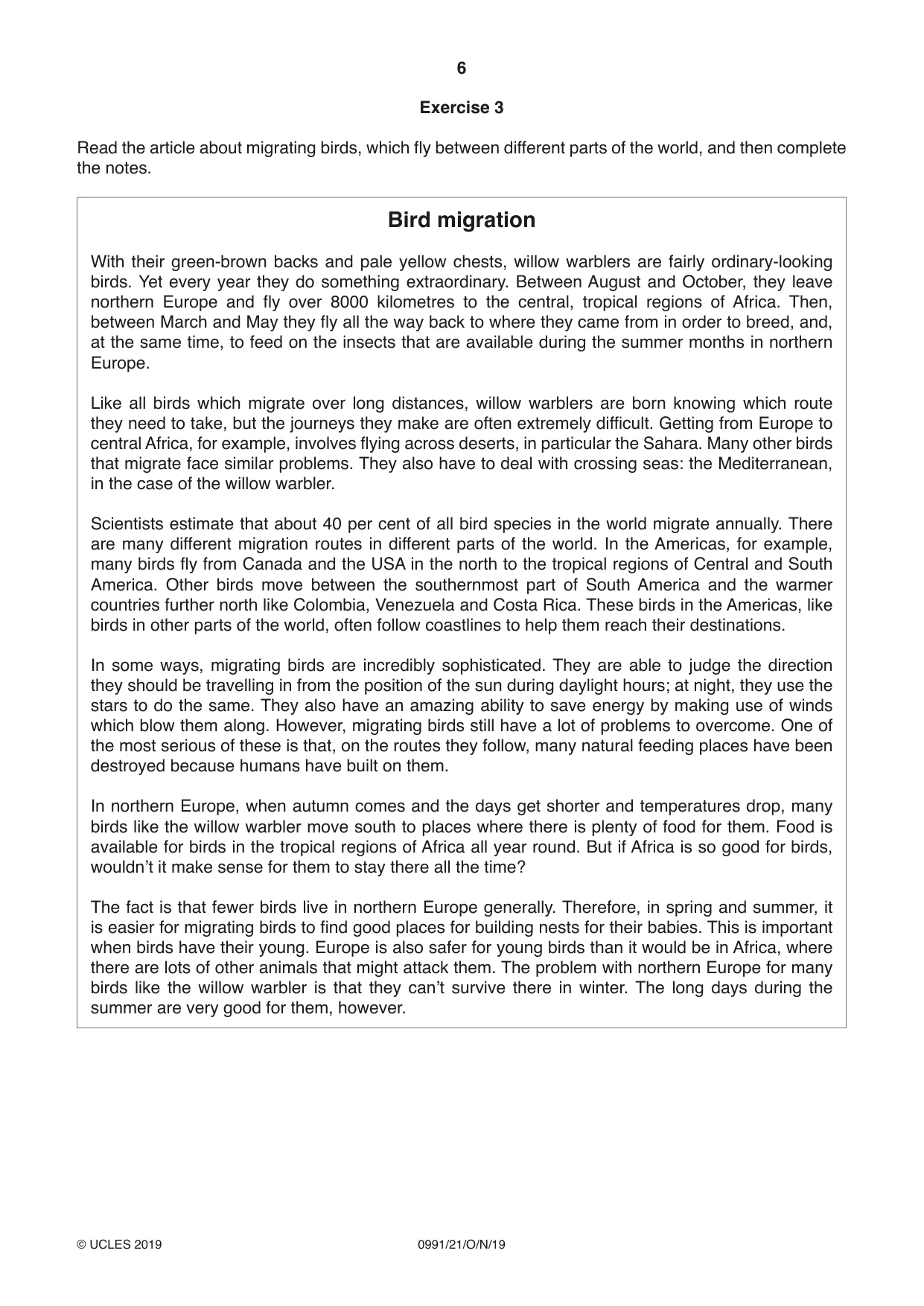
6 0991/21/O/N/19 © UCLES 2019 Exercise 3 Read the article about migrating birds, which fly between different parts of the world, and then complete the notes. Bird migration With their green-brown backs and pale yellow chests, willow warblers are fairly ordinary-looking birds. Yet every year they do something extraordinary. Between August and October, they leave northern Europe and fly over 8000 kilometres to the central, tropical regions of Africa. Then, between March and May they fly all the way back to where they came from in order to breed, and, at the same time, to feed on the insects that are available during the summer months in northern Europe. Like all birds which migrate over long distances, willow warblers are born knowing which route they need to take, but the journeys they make are often extremely difficult. Getting from Europe to central Africa, for example, involves flying across deserts, in particular the Sahara. Many other birds that migrate face similar problems. They also have to deal with crossing seas: the Mediterranean, in the case of the willow warbler. Scientists estimate that about 40 per cent of all bird species in the world migrate annually. There are many different migration routes in different parts of the world. In the Americas, for example, many birds fly from Canada and the USA in the north to the tropical regions of Central and South America. Other birds move between the southernmost part of South America and the warmer countries further north like Colombia, Venezuela and Costa Rica. These birds in the Americas, like birds in other parts of the world, often follow coastlines to help them reach their destinations. In some ways, migrating birds are incredibly sophisticated. They are able to judge the direction they should be travelling in from the position of the sun during daylight hours; at night, they use the stars to do the same. They also have an amazing ability to save energy by making use of winds which blow them along. However, migrating birds still have a lot of problems to overcome. One of the most serious of these is that, on the routes they follow, many natural feeding places have been destroyed because humans have built on them. In northern Europe, when autumn comes and the days get shorter and temperatures drop, many birds like the willow warbler move south to places where there is plenty of food for them. Food is available for birds in the tropical regions of Africa all year round. But if Africa is so good for birds, wouldn’t it make sense for them to stay there all the time? The fact is that fewer birds live in northern Europe generally. Therefore, in spring and summer, it is easier for migrating birds to find good places for building nests for their babies. This is important when birds have their young. Europe is also safer for young birds than it would be in Africa, where there are lots of other animals that might attack them. The problem with northern Europe for many birds like the willow warbler is that they can’t survive there in winter. The long days during the summer are very good for them, however.
Question paper, page 7
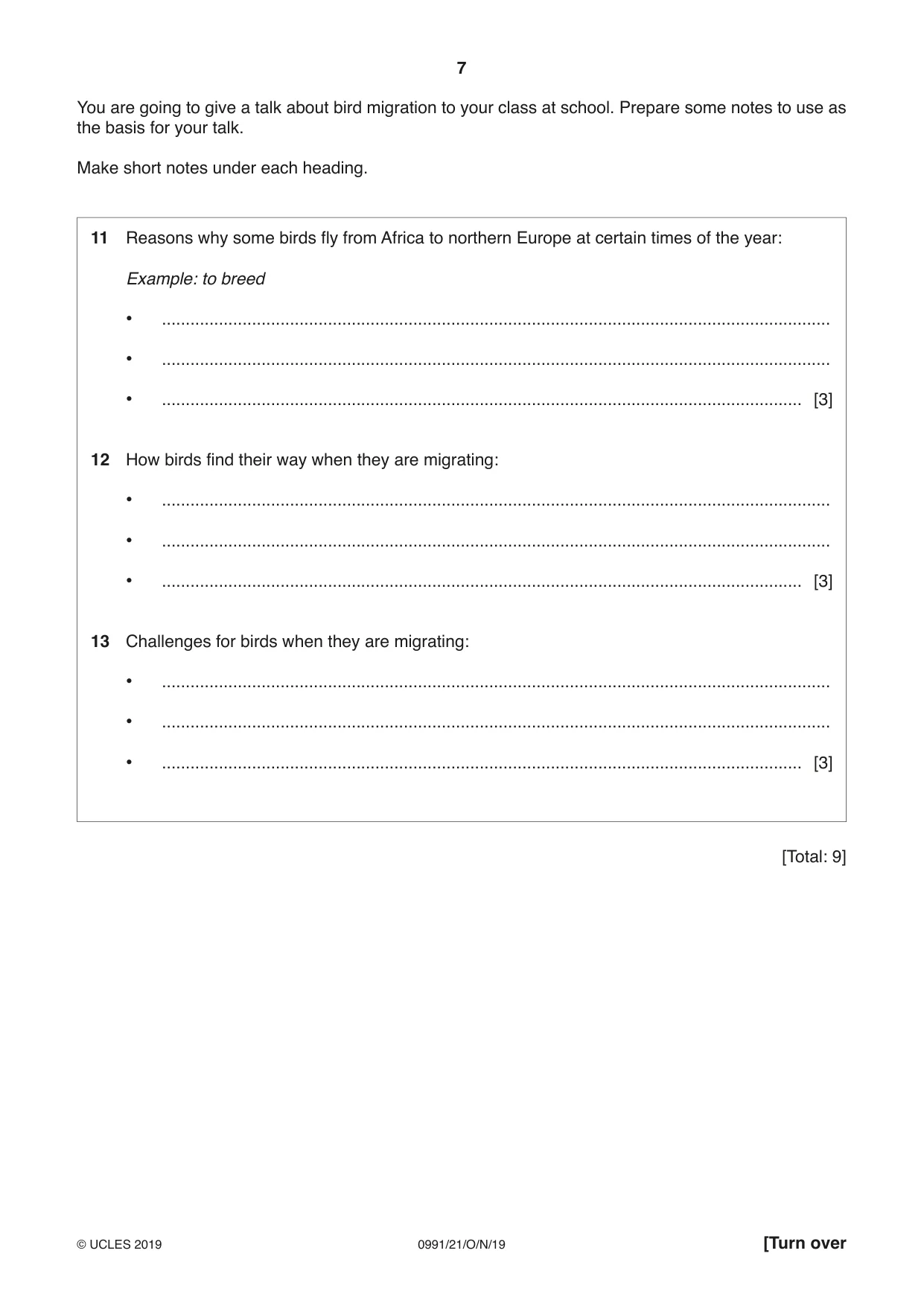
7 0991/21/O/N/19 © UCLES 2019 [Turn over You are going to give a talk about bird migration to your class at school. Prepare some notes to use as the basis for your talk. Make short notes under each heading. 11 Reasons why some birds fly from Africa to northern Europe at certain times of the year: Example: to breed • … • … • … [3] 12 How birds find their way when they are migrating: • … • … • … [3] 13 Challenges for birds when they are migrating: • … • … • … [3] [Total: 9]
Question paper, page 8
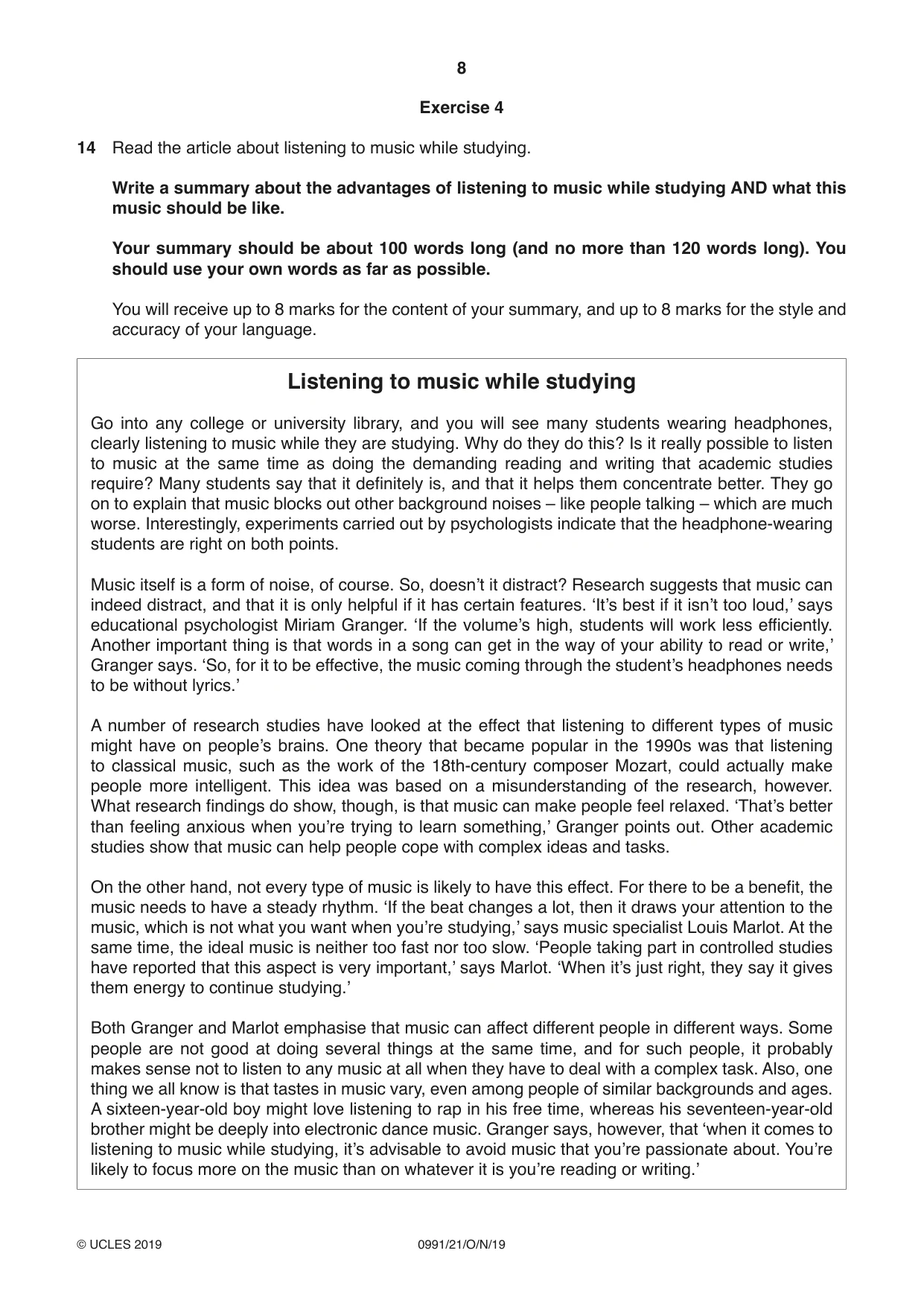
8 0991/21/O/N/19 © UCLES 2019 Exercise 4 14 Read the article about listening to music while studying. Write a summary about the advantages of listening to music while studying AND what this music should be like. Your summary should be about 100 words long (and no more than 120 words long). You should use your own words as far as possible. You will receive up to 8 marks for the content of your summary, and up to 8 marks for the style and accuracy of your language. Listening to music while studying Go into any college or university library, and you will see many students wearing headphones, clearly listening to music while they are studying. Why do they do this? Is it really possible to listen to music at the same time as doing the demanding reading and writing that academic studies require? Many students say that it definitely is, and that it helps them concentrate better. They go on to explain that music blocks out other background noises – like people talking – which are much worse. Interestingly, experiments carried out by psychologists indicate that the headphone-wearing students are right on both points. Music itself is a form of noise, of course. So, doesn’t it distract? Research suggests that music can indeed distract, and that it is only helpful if it has certain features. ‘It’s best if it isn’t too loud,’ says educational psychologist Miriam Granger. ‘If the volume’s high, students will work less efficiently. Another important thing is that words in a song can get in the way of your ability to read or write,’ Granger says. ‘So, for it to be effective, the music coming through the student’s headphones needs to be without lyrics.’ A number of research studies have looked at the effect that listening to different types of music might have on people’s brains. One theory that became popular in the 1990s was that listening to classical music, such as the work of the 18th-century composer Mozart, could actually make people more intelligent. This idea was based on a misunderstanding of the research, however. What research findings do show, though, is that music can make people feel relaxed. ‘That’s better than feeling anxious when you’re trying to learn something,’ Granger points out. Other academic studies show that music can help people cope with complex ideas and tasks. On the other hand, not every type of music is likely to have this effect. For there to be a benefit, the music needs to have a steady rhythm. ‘If the beat changes a lot, then it draws your attention to the music, which is not what you want when you’re studying,’ says music specialist Louis Marlot. At the same time, the ideal music is neither too fast nor too slow. ‘People taking part in controlled studies have reported that this aspect is very important,’ says Marlot. ‘When it’s just right, they say it gives them energy to continue studying.’ Both Granger and Marlot emphasise that music can affect different people in different ways. Some people are not good at doing several things at the same time, and for such people, it probably makes sense not to listen to any music at all when they have to deal with a complex task. Also, one thing we all know is that tastes in music vary, even among people of similar backgrounds and ages. A sixteen-year-old boy might love listening to rap in his free time, whereas his seventeen-year-old brother might be deeply into electronic dance music. Granger says, however, that ‘when it comes to listening to music while studying, it’s advisable to avoid music that you’re passionate about. You’re likely to focus more on the music than on whatever it is you’re reading or writing.’
Question paper, page 9
9 0991/21/O/N/19 © UCLES 2019 [Turn over … … … … … … … … … … … … … … … … … … … … … … … … … … … [Total: 16]
Question paper, page 10
10 0991/21/O/N/19 © UCLES 2019 Exercise 5 15 You recently went on a school trip with your class. Write an email to a friend about the school trip. In your email, you should: • describe where you went • say why you enjoyed the trip • explain what you did in your lesson to show what you learned on the trip. The pictures above may give you some ideas, and you can also use some ideas of your own. Your email should be between 150 and 200 words long. You will receive up to 8 marks for the content of your email, and up to 8 marks for the language used.
Question paper, page 11
11 0991/21/O/N/19 © UCLES 2019 [Turn over … … … … … … … … … … … … … … … … … … … … … … … … … … … [Total: 16]
Question paper, page 12
12 0991/21/O/N/19 © UCLES 2019 Exercise 6 16 A new cinema has recently opened in your town. You have decided to write a review of the cinema for your school magazine. Here are two comments from other people who have been to the new cinema: There’s a great range of films to see. The staff aren’t very friendly. Write a review for the school magazine. The comments above may give you some ideas, and you can also use some ideas of your own. Your review should be between 150 and 200 words long. You will receive up to 8 marks for the content of your review, and up to 8 marks for the language used.
Question paper, page 13
13 0991/21/O/N/19 © UCLES 2019 … … … … … … … … … … … … … … … … … … … … … … … … … … … [Total: 16]
Question paper, page 14
14 0991/21/O/N/19 © UCLES 2019 BLANK PAGE
Question paper, page 15
15 0991/21/O/N/19 © UCLES 2019 BLANK PAGE
Question paper, page 16
16 0991/21/O/N/19 © UCLES 2019 Permission to reproduce items where third-party owned material protected by copyright is included has been sought and cleared where possible. Every reasonable effort has been made by the publisher (UCLES) to trace copyright holders, but if any items requiring clearance have unwittingly been included, the publisher will be pleased to make amends at the earliest possible opportunity. To avoid the issue of disclosure of answer-related information to candidates, all copyright acknowledgements are reproduced online in the Cambridge Assessment International Education Copyright Acknowledgements Booklet. This is produced for each series of examinations and is freely available to download at www.cambridgeinternational.org after the live examination series. Cambridge Assessment International Education is part of the Cambridge Assessment Group. Cambridge Assessment is the brand name of the University of Cambridge Local Examinations Syndicate (UCLES), which itself is a department of the University of Cambridge. BLANK PAGE
Mark scheme, page 1
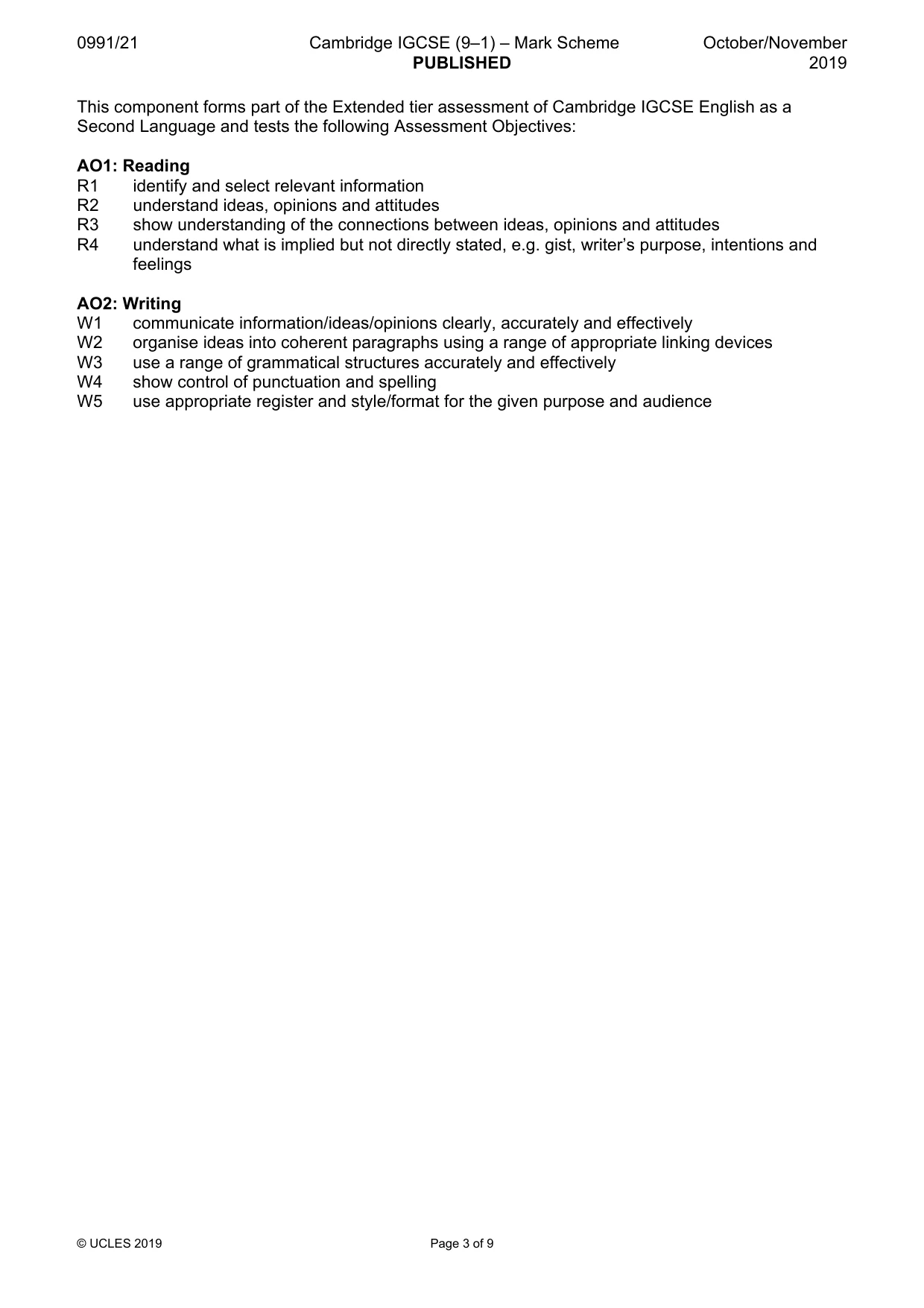
This document consists of 9 printed pages. © UCLES 2019 [Turn over Cambridge Assessment International Education Cambridge International General Certificate of Secondary Education (9–1) ENGLISH AS A SECOND LANGUAGE (COUNT-IN SPEAKING) 0991/21 Paper 2 Reading and Writing (Extended) October/November 2019 MARK SCHEME Maximum Mark: 80 Published This mark scheme is published as an aid to teachers and candidates, to indicate the requirements of the examination. It shows the basis on which Examiners were instructed to award marks. It does not indicate the details of the discussions that took place at an Examiners’ meeting before marking began, which would have considered the acceptability of alternative answers. Mark schemes should be read in conjunction with the question paper and the Principal Examiner Report for Teachers. Cambridge International will not enter into discussions about these mark schemes. Cambridge International is publishing the mark schemes for the October/November 2019 series for most Cambridge IGCSE™, Cambridge International A and AS Level components and some Cambridge O Level components.
Mark scheme, page 2
0991/21 Cambridge IGCSE (9–1) – Mark Scheme PUBLISHED October/November 2019 © UCLES 2019 Page 2 of 9 Generic Marking Principles These general marking principles must be applied by all examiners when marking candidate answers. They should be applied alongside the specific content of the mark scheme or generic level descriptors for a question. Each question paper and mark scheme will also comply with these marking principles. GENERIC MARKING PRINCIPLE 1: Marks must be awarded in line with: • the specific content of the mark scheme or the generic level descriptors for the question • the specific skills defined in the mark scheme or in the generic level descriptors for the question • the standard of response required by a candidate as exemplified by the standardisation scripts. GENERIC MARKING PRINCIPLE 2: Marks awarded are always whole marks (not half marks, or other fractions). GENERIC MARKING PRINCIPLE 3: Marks must be awarded positively: • marks are awarded for correct/valid answers, as defined in the mark scheme. However, credit is given for valid answers which go beyond the scope of the syllabus and mark scheme, referring to your Team Leader as appropriate • marks are awarded when candidates clearly demonstrate what they know and can do • marks are not deducted for errors • marks are not deducted for omissions • answers should only be judged on the quality of spelling, punctuation and grammar when these features are specifically assessed by the question as indicated by the mark scheme. The meaning, however, should be unambiguous. GENERIC MARKING PRINCIPLE 4: Rules must be applied consistently e.g. in situations where candidates have not followed instructions or in the application of generic level descriptors. GENERIC MARKING PRINCIPLE 5: Marks should be awarded using the full range of marks defined in the mark scheme for the question (however; the use of the full mark range may be limited according to the quality of the candidate responses seen). GENERIC MARKING PRINCIPLE 6: Marks awarded are based solely on the requirements as defined in the mark scheme. Marks should not be awarded with grade thresholds or grade descriptors in mind.
Mark scheme, page 3
0991/21 Cambridge IGCSE (9–1) – Mark Scheme PUBLISHED October/November 2019 © UCLES 2019 Page 3 of 9 This component forms part of the Extended tier assessment of Cambridge IGCSE English as a Second Language and tests the following Assessment Objectives: AO1: Reading R1 identify and select relevant information R2 understand ideas, opinions and attitudes R3 show understanding of the connections between ideas, opinions and attitudes R4 understand what is implied but not directly stated, e.g. gist, writer’s purpose, intentions and feelings AO2: Writing W1 communicate information/ideas/opinions clearly, accurately and effectively W2 organise ideas into coherent paragraphs using a range of appropriate linking devices W3 use a range of grammatical structures accurately and effectively W4 show control of punctuation and spelling W5 use appropriate register and style/format for the given purpose and audience
Mark scheme, page 4
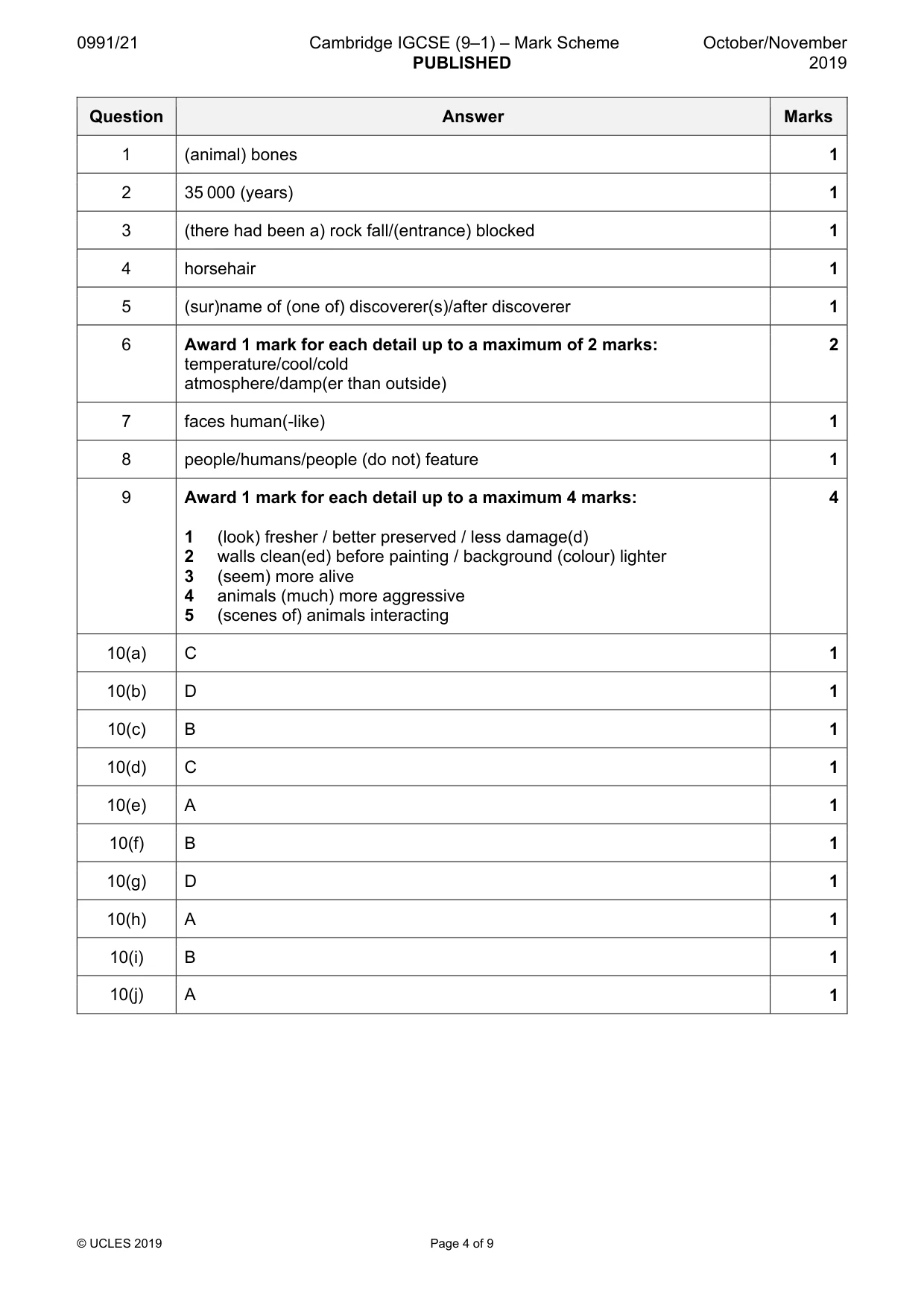
0991/21 Cambridge IGCSE (9–1) – Mark Scheme PUBLISHED October/November 2019 © UCLES 2019 Page 4 of 9 Question Answer Marks 1 (animal) bones 1 2 35 000 (years) 1 3 (there had been a) rock fall/(entrance) blocked 1 4 horsehair 1 5 (sur)name of (one of) discoverer(s)/after discoverer 1 6 Award 1 mark for each detail up to a maximum of 2 marks: temperature/cool/cold atmosphere/damp(er than outside) 2 7 faces human(-like) 1 8 people/humans/people (do not) feature 1 9 Award 1 mark for each detail up to a maximum 4 marks: 1 (look) fresher / better preserved / less damage(d) 2 walls clean(ed) before painting / background (colour) lighter 3 (seem) more alive 4 animals (much) more aggressive 5 (scenes of) animals interacting 4 10(a) C 1 10(b) D 1 10(c) B 1 10(d) C 1 10(e) A 1 10(f) B 1 10(g) D 1 10(h) A 1 10(i) B 1 10(j) A 1
Mark scheme, page 5
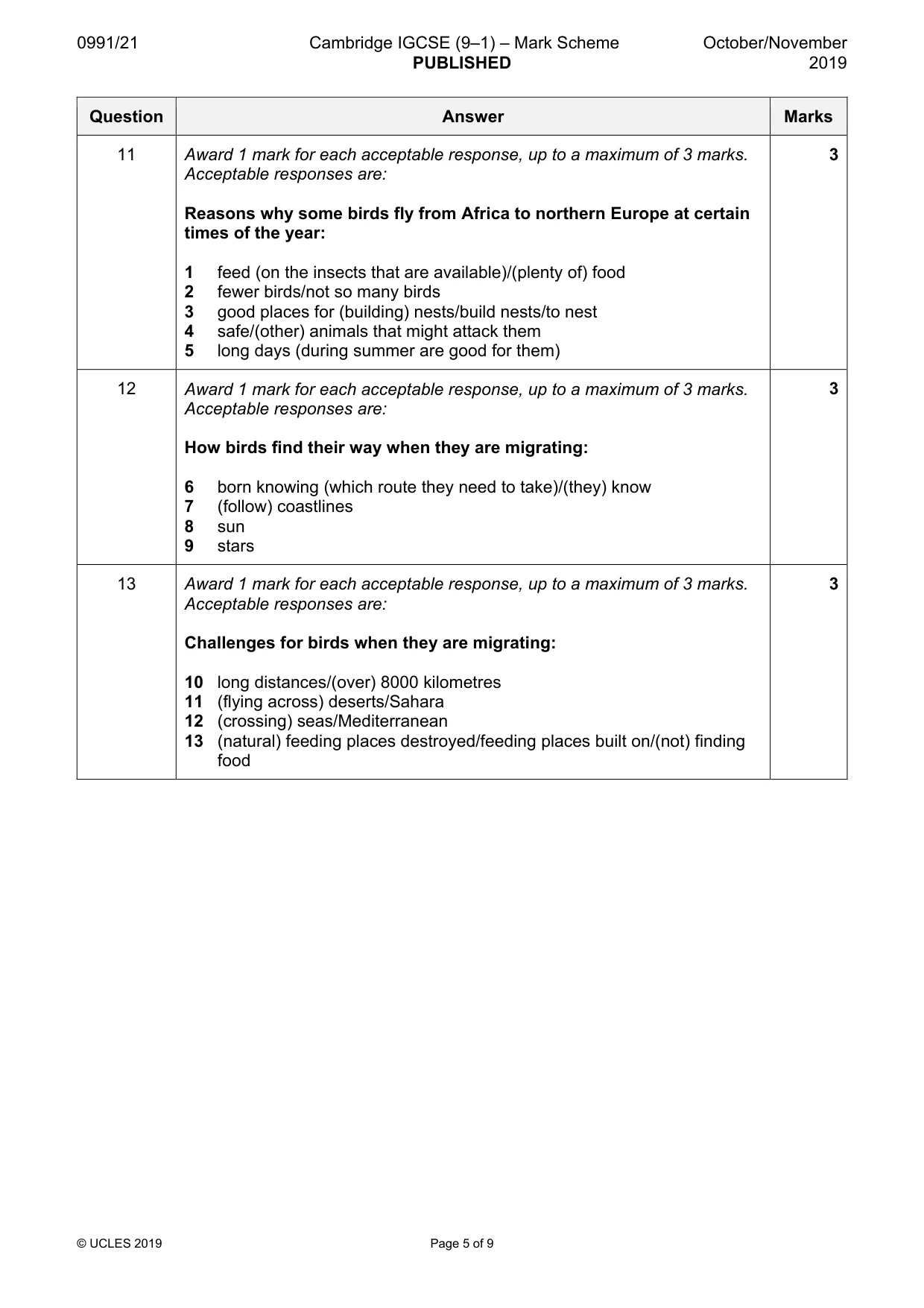
0991/21 Cambridge IGCSE (9–1) – Mark Scheme PUBLISHED October/November 2019 © UCLES 2019 Page 5 of 9 Question Answer Marks 11 Award 1 mark for each acceptable response, up to a maximum of 3 marks. Acceptable responses are: Reasons why some birds fly from Africa to northern Europe at certain times of the year: 1 feed (on the insects that are available)/(plenty of) food 2 fewer birds/not so many birds 3 good places for (building) nests/build nests/to nest 4 safe/(other) animals that might attack them 5 long days (during summer are good for them) 3 12 Award 1 mark for each acceptable response, up to a maximum of 3 marks. Acceptable responses are: How birds find their way when they are migrating: 6 born knowing (which route they need to take)/(they) know 7 (follow) coastlines 8 sun 9 stars 3 13 Award 1 mark for each acceptable response, up to a maximum of 3 marks. Acceptable responses are: Challenges for birds when they are migrating: 10 long distances/(over) 8000 kilometres 11 (flying across) deserts/Sahara 12 (crossing) seas/Mediterranean 13 (natural) feeding places destroyed/feeding places built on/(not) finding food 3
Mark scheme, page 6
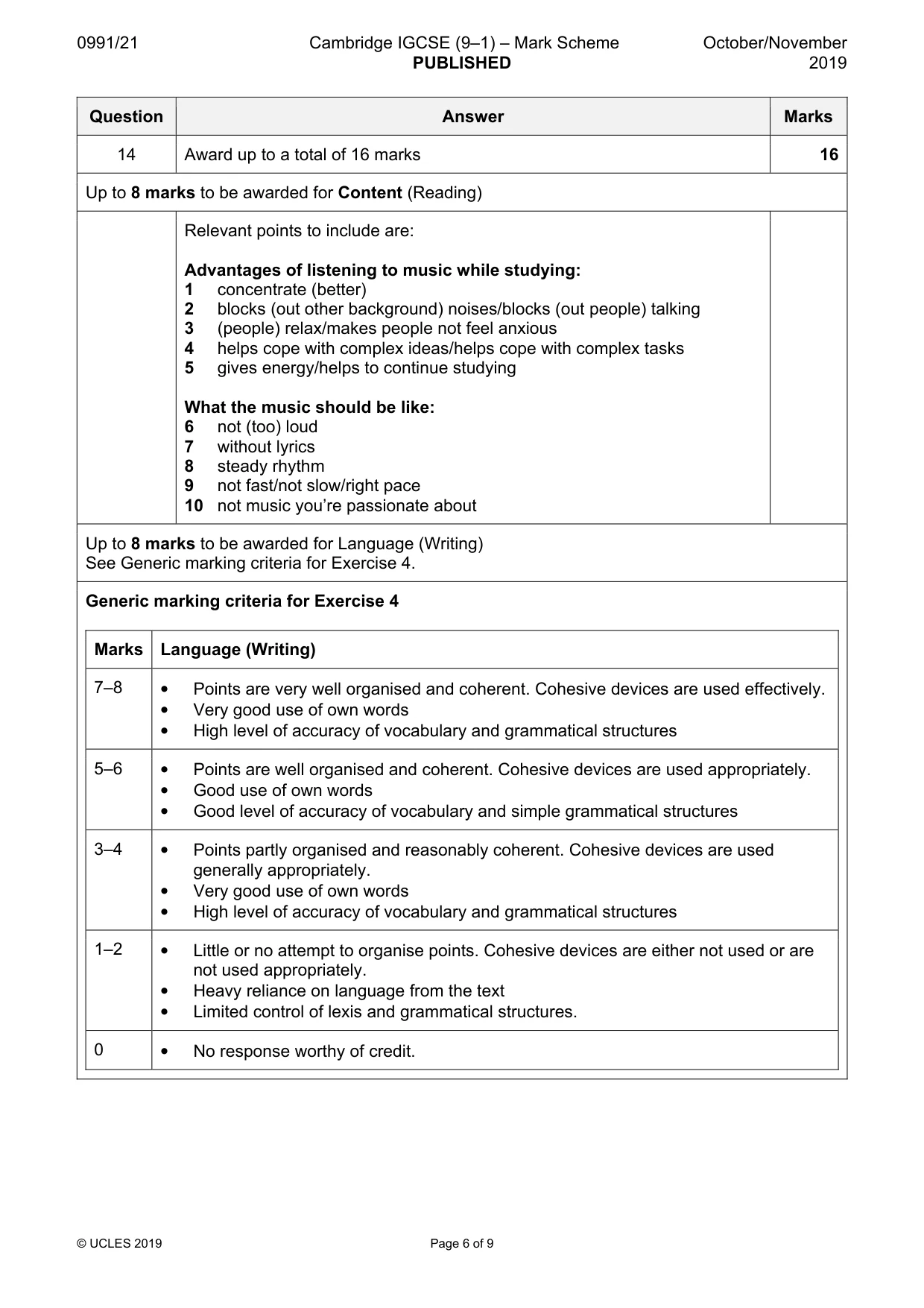
0991/21 Cambridge IGCSE (9–1) – Mark Scheme PUBLISHED October/November 2019 © UCLES 2019 Page 6 of 9 Question Answer Marks 14 Award up to a total of 16 marks 16 Up to 8 marks to be awarded for Content (Reading) Relevant points to include are: Advantages of listening to music while studying: 1 concentrate (better) 2 blocks (out other background) noises/blocks (out people) talking 3 (people) relax/makes people not feel anxious 4 helps cope with complex ideas/helps cope with complex tasks 5 gives energy/helps to continue studying What the music should be like: 6 not (too) loud 7 without lyrics 8 steady rhythm 9 not fast/not slow/right pace 10 not music you’re passionate about Up to 8 marks to be awarded for Language (Writing) See Generic marking criteria for Exercise 4. Generic marking criteria for Exercise 4 Marks Language (Writing) 7–8 • Points are very well organised and coherent. Cohesive devices are used effectively. • Very good use of own words • High level of accuracy of vocabulary and grammatical structures 5–6 • Points are well organised and coherent. Cohesive devices are used appropriately. • Good use of own words • Good level of accuracy of vocabulary and simple grammatical structures 3–4 • Points partly organised and reasonably coherent. Cohesive devices are used generally appropriately. • Very good use of own words • High level of accuracy of vocabulary and grammatical structures 1–2 • Little or no attempt to organise points. Cohesive devices are either not used or are not used appropriately. • Heavy reliance on language from the text • Limited control of lexis and grammatical structures. 0 • No response worthy of credit.
Mark scheme, page 7
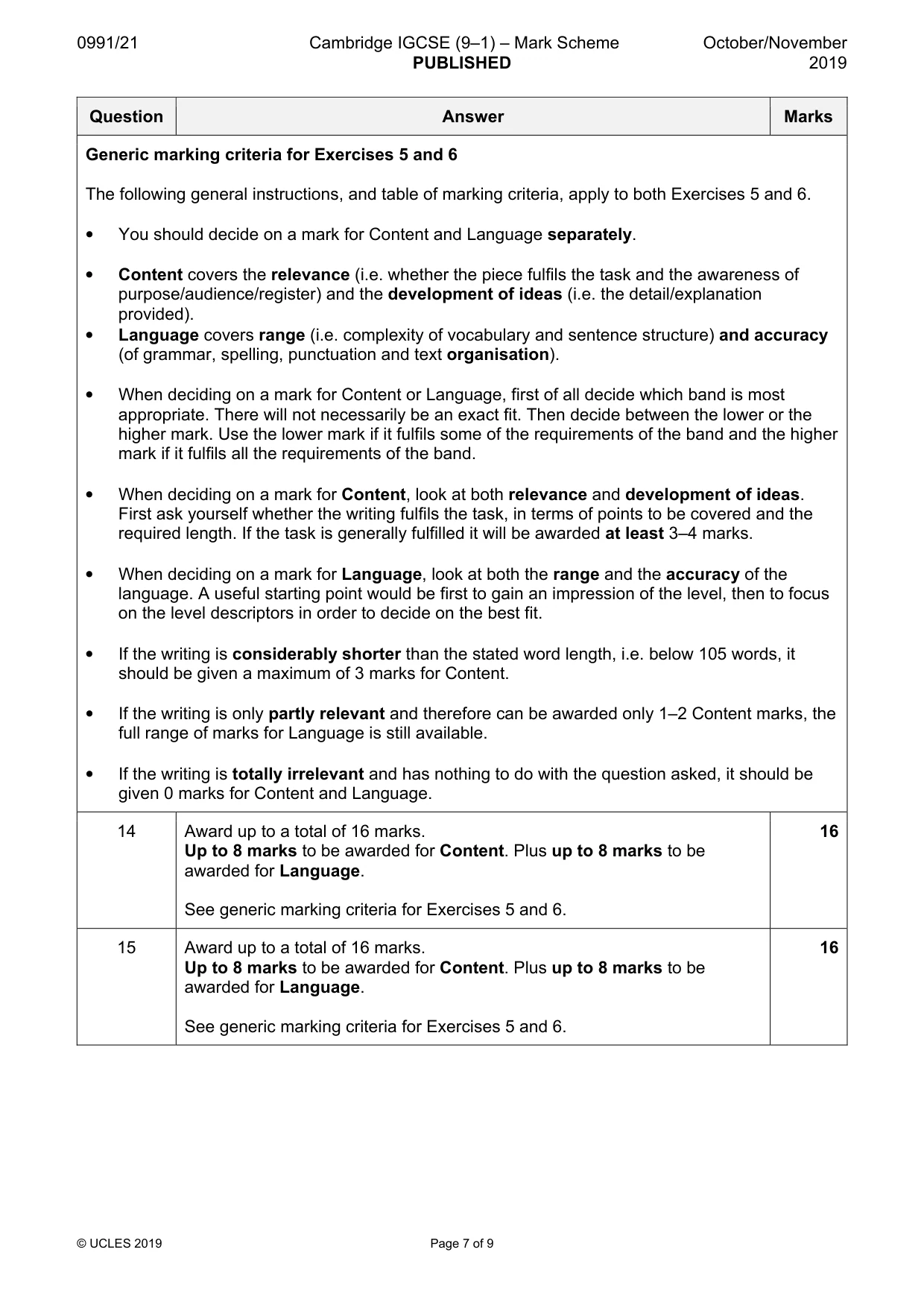
0991/21 Cambridge IGCSE (9–1) – Mark Scheme PUBLISHED October/November 2019 © UCLES 2019 Page 7 of 9 Question Answer Marks Generic marking criteria for Exercises 5 and 6 The following general instructions, and table of marking criteria, apply to both Exercises 5 and 6. • You should decide on a mark for Content and Language separately. • Content covers the relevance (i.e. whether the piece fulfils the task and the awareness of purpose/audience/register) and the development of ideas (i.e. the detail/explanation provided). • Language covers range (i.e. complexity of vocabulary and sentence structure) and accuracy (of grammar, spelling, punctuation and text organisation). • When deciding on a mark for Content or Language, first of all decide which band is most appropriate. There will not necessarily be an exact fit. Then decide between the lower or the higher mark. Use the lower mark if it fulfils some of the requirements of the band and the higher mark if it fulfils all the requirements of the band. • When deciding on a mark for Content, look at both relevance and development of ideas. First ask yourself whether the writing fulfils the task, in terms of points to be covered and the required length. If the task is generally fulfilled it will be awarded at least 3–4 marks. • When deciding on a mark for Language, look at both the range and the accuracy of the language. A useful starting point would be first to gain an impression of the level, then to focus on the level descriptors in order to decide on the best fit. • If the writing is considerably shorter than the stated word length, i.e. below 105 words, it should be given a maximum of 3 marks for Content. • If the writing is only partly relevant and therefore can be awarded only 1–2 Content marks, the full range of marks for Language is still available. • If the writing is totally irrelevant and has nothing to do with the question asked, it should be given 0 marks for Content and Language. 14 Award up to a total of 16 marks. Up to 8 marks to be awarded for Content. Plus up to 8 marks to be awarded for Language. See generic marking criteria for Exercises 5 and 6. 16 15 Award up to a total of 16 marks. Up to 8 marks to be awarded for Content. Plus up to 8 marks to be awarded for Language. See generic marking criteria for Exercises 5 and 6. 16
Mark scheme, page 8
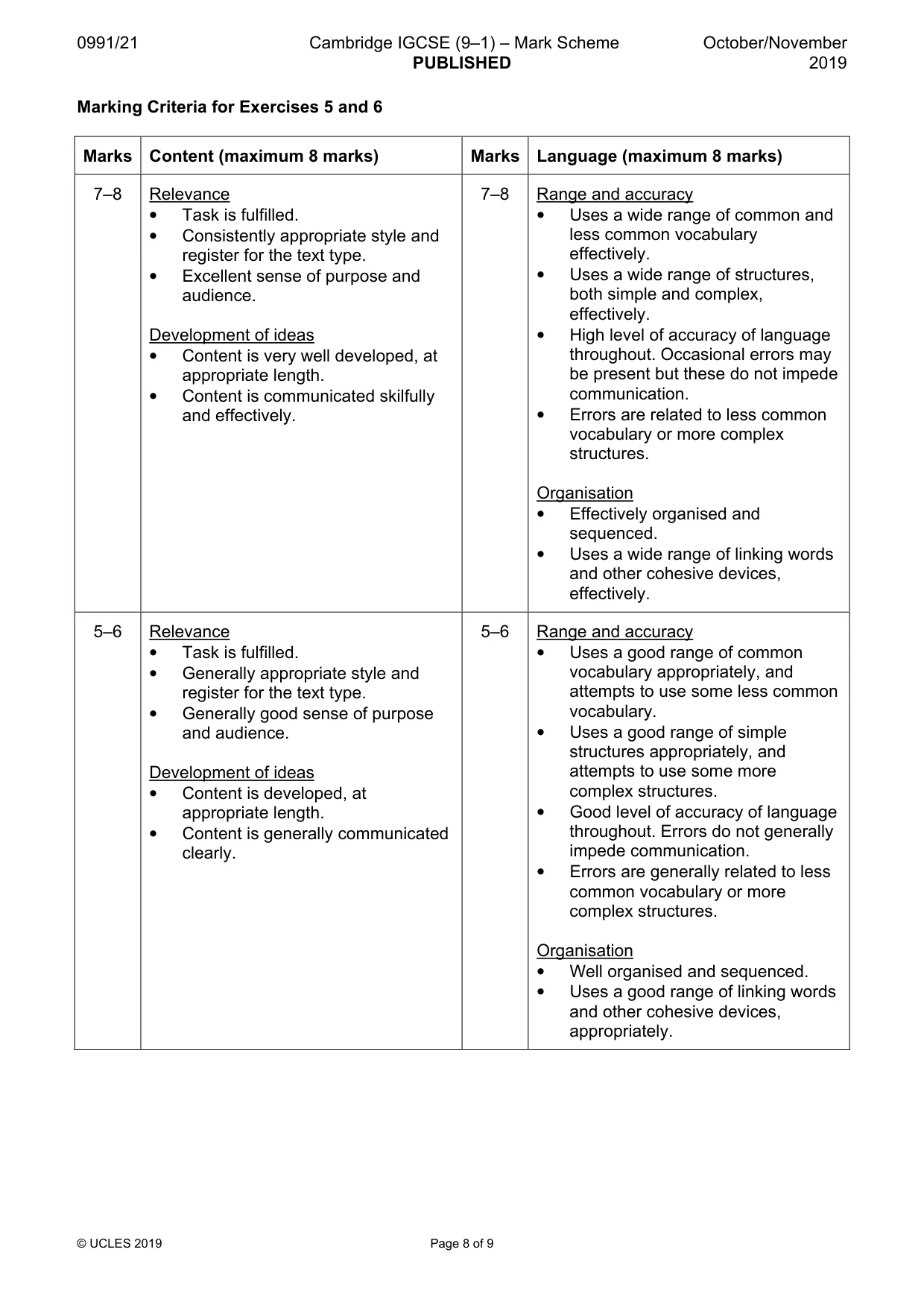
0991/21 Cambridge IGCSE (9–1) – Mark Scheme PUBLISHED October/November 2019 © UCLES 2019 Page 8 of 9 Marking Criteria for Exercises 5 and 6 Marks Content (maximum 8 marks) Marks Language (maximum 8 marks) 7–8 Relevance • Task is fulfilled. • Consistently appropriate style and register for the text type. • Excellent sense of purpose and audience. Development of ideas • Content is very well developed, at appropriate length. • Content is communicated skilfully and effectively. 7–8 Range and accuracy • Uses a wide range of common and less common vocabulary effectively. • Uses a wide range of structures, both simple and complex, effectively. • High level of accuracy of language throughout. Occasional errors may be present but these do not impede communication. • Errors are related to less common vocabulary or more complex structures. Organisation • Effectively organised and sequenced. • Uses a wide range of linking words and other cohesive devices, effectively. 5–6 Relevance • Task is fulfilled. • Generally appropriate style and register for the text type. • Generally good sense of purpose and audience. Development of ideas • Content is developed, at appropriate length. • Content is generally communicated clearly. 5–6 Range and accuracy • Uses a good range of common vocabulary appropriately, and attempts to use some less common vocabulary. • Uses a good range of simple structures appropriately, and attempts to use some more complex structures. • Good level of accuracy of language throughout. Errors do not generally impede communication. • Errors are generally related to less common vocabulary or more complex structures. Organisation • Well organised and sequenced. • Uses a good range of linking words and other cohesive devices, appropriately.
Mark scheme, page 9
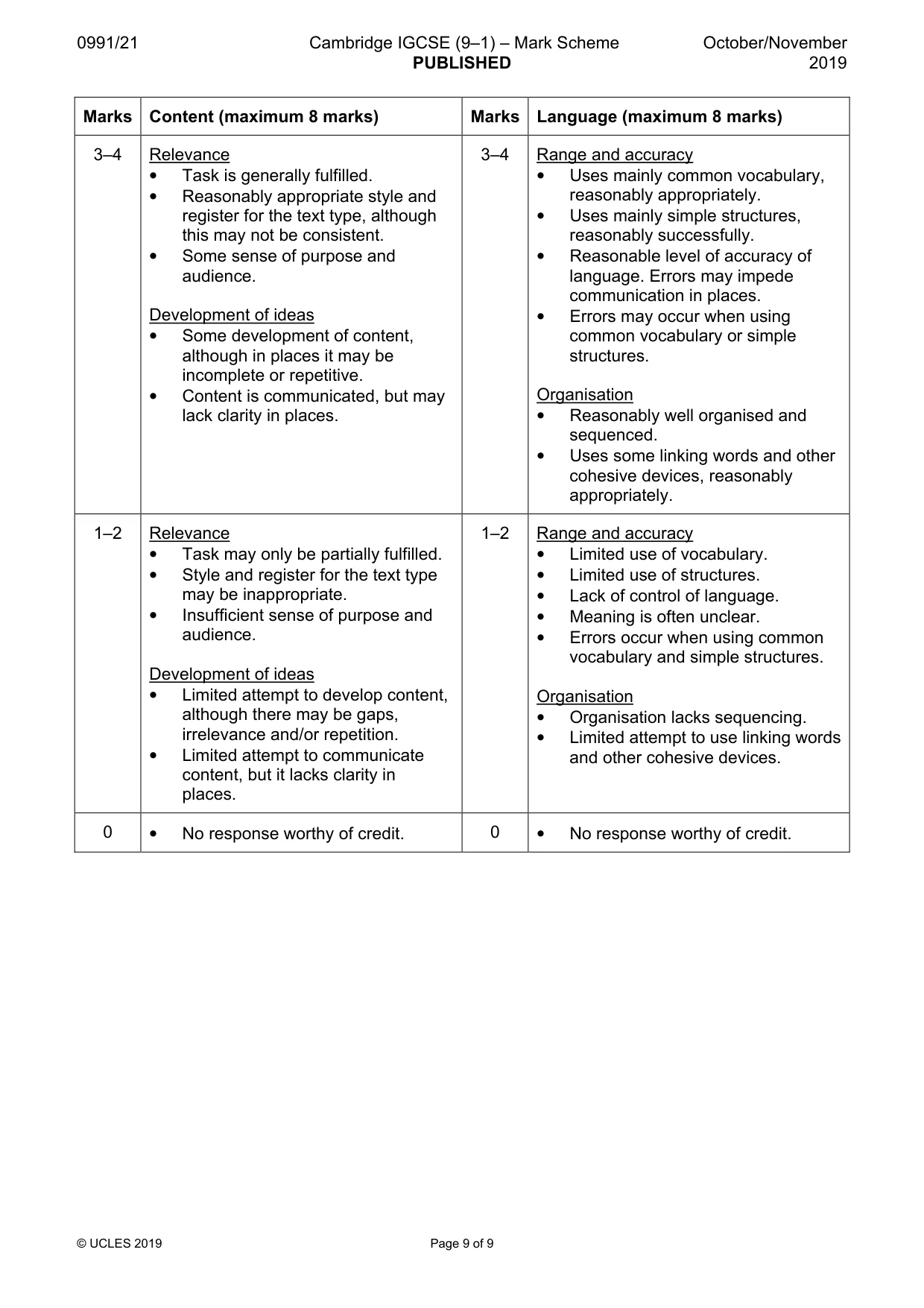
0991/21 Cambridge IGCSE (9–1) – Mark Scheme PUBLISHED October/November 2019 © UCLES 2019 Page 9 of 9 Marks Content (maximum 8 marks) Marks Language (maximum 8 marks) 3–4 Relevance • Task is generally fulfilled. • Reasonably appropriate style and register for the text type, although this may not be consistent. • Some sense of purpose and audience. Development of ideas • Some development of content, although in places it may be incomplete or repetitive. • Content is communicated, but may lack clarity in places. 3–4 Range and accuracy • Uses mainly common vocabulary, reasonably appropriately. • Uses mainly simple structures, reasonably successfully. • Reasonable level of accuracy of language. Errors may impede communication in places. • Errors may occur when using common vocabulary or simple structures. Organisation • Reasonably well organised and sequenced. • Uses some linking words and other cohesive devices, reasonably appropriately. 1–2 Relevance • Task may only be partially fulfilled. • Style and register for the text type may be inappropriate. • Insufficient sense of purpose and audience. Development of ideas • Limited attempt to develop content, although there may be gaps, irrelevance and/or repetition. • Limited attempt to communicate content, but it lacks clarity in places. 1–2 Range and accuracy • Limited use of vocabulary. • Limited use of structures. • Lack of control of language. • Meaning is often unclear. • Errors occur when using common vocabulary and simple structures. Organisation • Organisation lacks sequencing. • Limited attempt to use linking words and other cohesive devices. 0 • No response worthy of credit. 0 • No response worthy of credit.
What you needed in this session
Cambridge’s own grade thresholds for 2019 Oct/Nov, Paper 2 · Variant 1. A higher threshold means an easier paper — the bar moves with how the cohort did.