Cambridge IGCSE English - Second Language (9-1) 0991 — 2024 Oct/Nov Paper 2 · Variant 1
0991/21/O/N/24 · 40 marks · ≈45 min
The question paper and its mark scheme, free to read here and free to download. This is Cambridge’s own paper, exactly as it was sat.
Question paper16 pages


Mark scheme3 pages
Answers below. Sit the paper first if you are practising.
Paper as text
Question paper, page 1
This document has 16 pages. Any blank pages are indicated. [Turn over Cambridge IGCSE™(9–1) ENGLISH AS A SECOND LANGUAGE 0991/21 Paper 2 Listening October/November 2024 Approximately 50 minutes (including 6 minutes’ transfer time) You must transfer your answers onto the multiple choice answer sheet. You will need: Multiple choice answer sheet Soft clean eraser Soft pencil (type B or HB is recommended) INSTRUCTIONS ● There are 40 questions on this paper. Answer all questions. ● You will have 6 minutes to transfer your answers from the question paper onto the multiple choice answer sheet. ● Follow the instructions on the multiple choice answer sheet. Shade one letter only for Questions 1 to 40. ● Write in soft pencil. ● Write your name, centre number and candidate number on the multiple choice answer sheet in the spaces provided unless this has been done for you. ● Do not use correction fluid. ● Do not write on any bar codes. ● Dictionaries are not allowed. INFORMATION ● The total mark for this paper is 40. ● Each correct answer will score one mark. ● Any rough working should be done on this question paper. * 3 5 2 1 7 2 5 7 7 5 * DC (ST) 347189 © UCLES 2024
Question paper, page 2
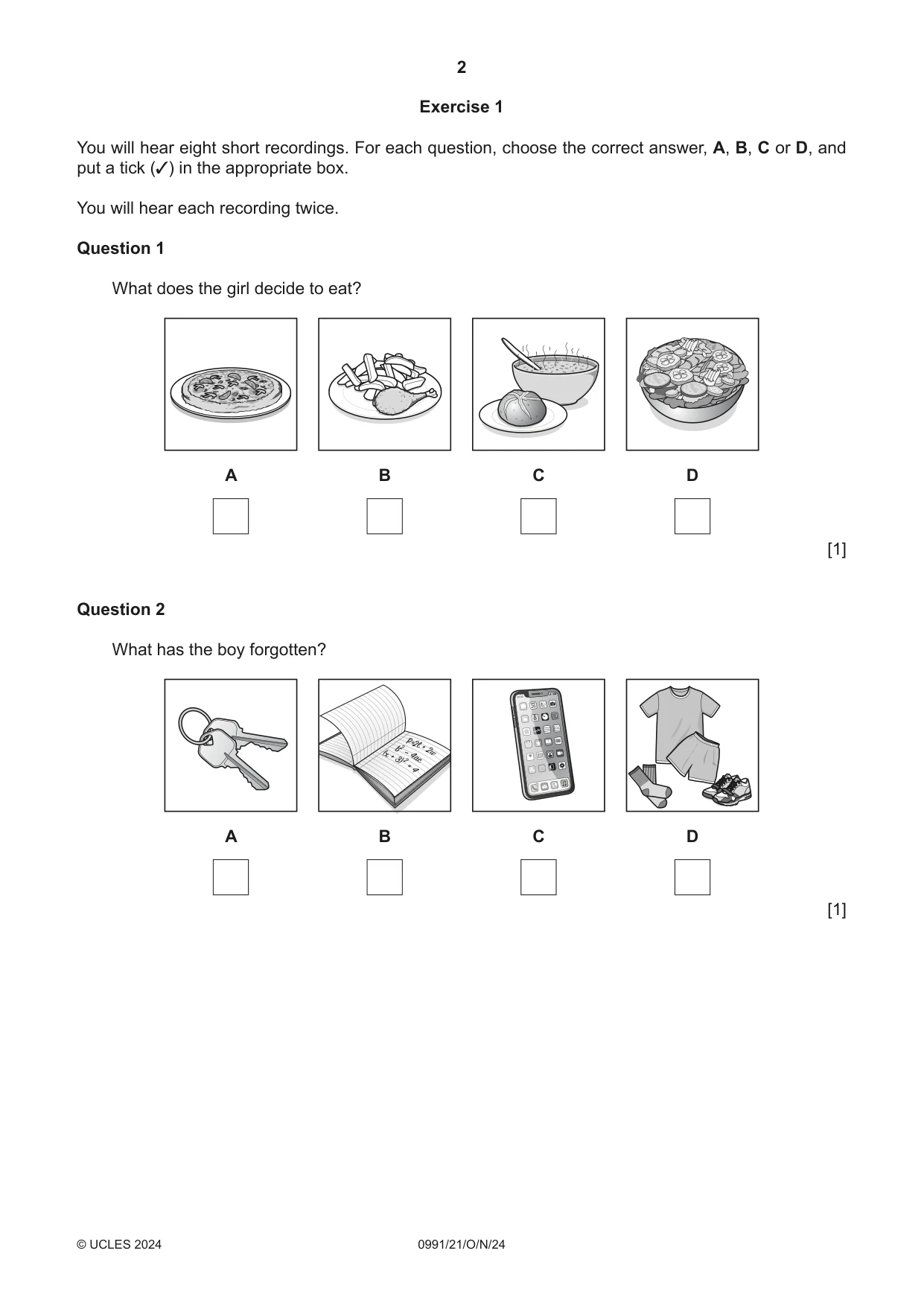
2 0991/21/ O/N/24 © UCLES 2024 Exercise 1 You will hear eight short recordings. For each question, choose the correct answer, A, B, C or D, and put a tick (3) in the appropriate box. You will hear each recording twice. Question 1 What does the girl decide to eat? A B C D [1] Question 2 What has the boy forgotten? A B C D [1]
Question paper, page 3
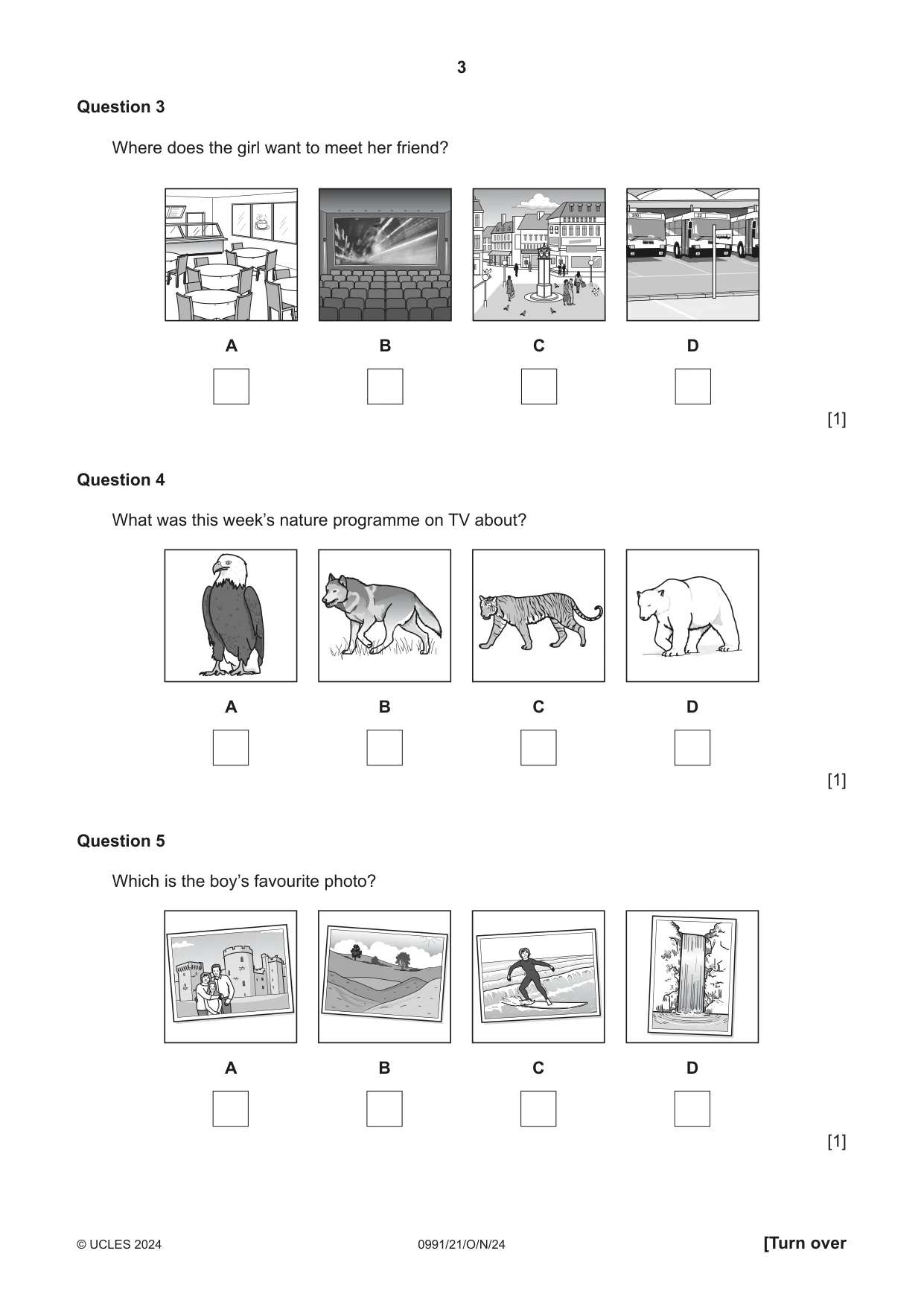
3 0991/21/ O/N/24 © UCLES 2024 [Turn over Question 3 Where does the girl want to meet her friend? A B C D [1] Question 4 What was this week’s nature programme on TV about? A B C D [1] Question 5 Which is the boy’s favourite photo? A B C D [1]
Question paper, page 4
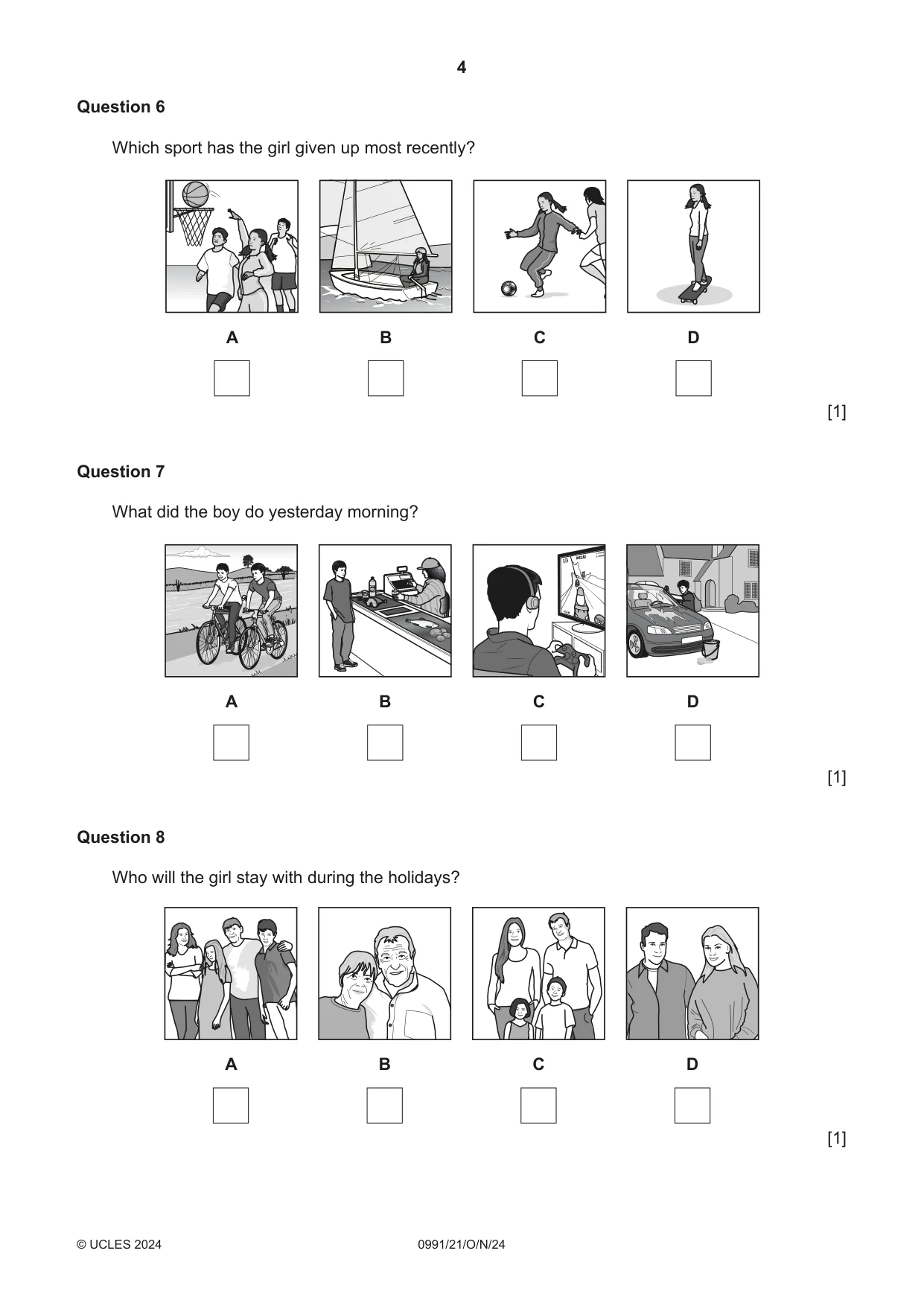
4 0991/21/ O/N/24 © UCLES 2024 Question 6 Which sport has the girl given up most recently? A B C D [1] Question 7 What did the boy do yesterday morning? A B C D [1] Question 8 Who will the girl stay with during the holidays? A B C D [1]
Question paper, page 5
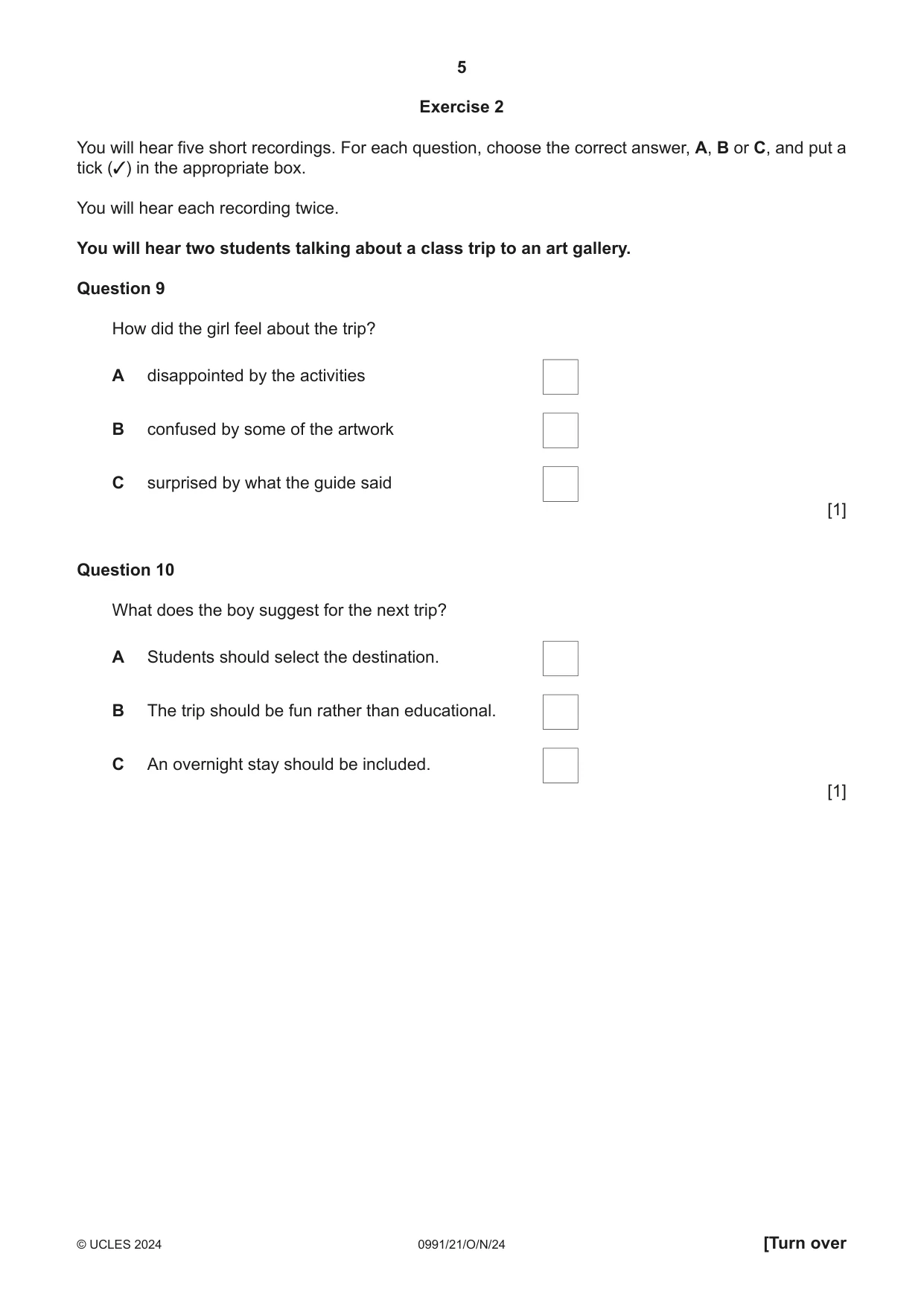
5 0991/21/O/N/24 © UCLES 2024 [Turn over Exercise 2 You will hear five short recordings. For each question, choose the correct answer, A, B or C, and put a tick (3) in the appropriate box. You will hear each recording twice. You will hear two students talking about a class trip to an art gallery. Question 9 How did the girl feel about the trip? A disappointed by the activities B confused by some of the artwork C surprised by what the guide said [1] Question 10 What does the boy suggest for the next trip? A Students should select the destination. B The trip should be fun rather than educational. C An overnight stay should be included. [1]
Question paper, page 6
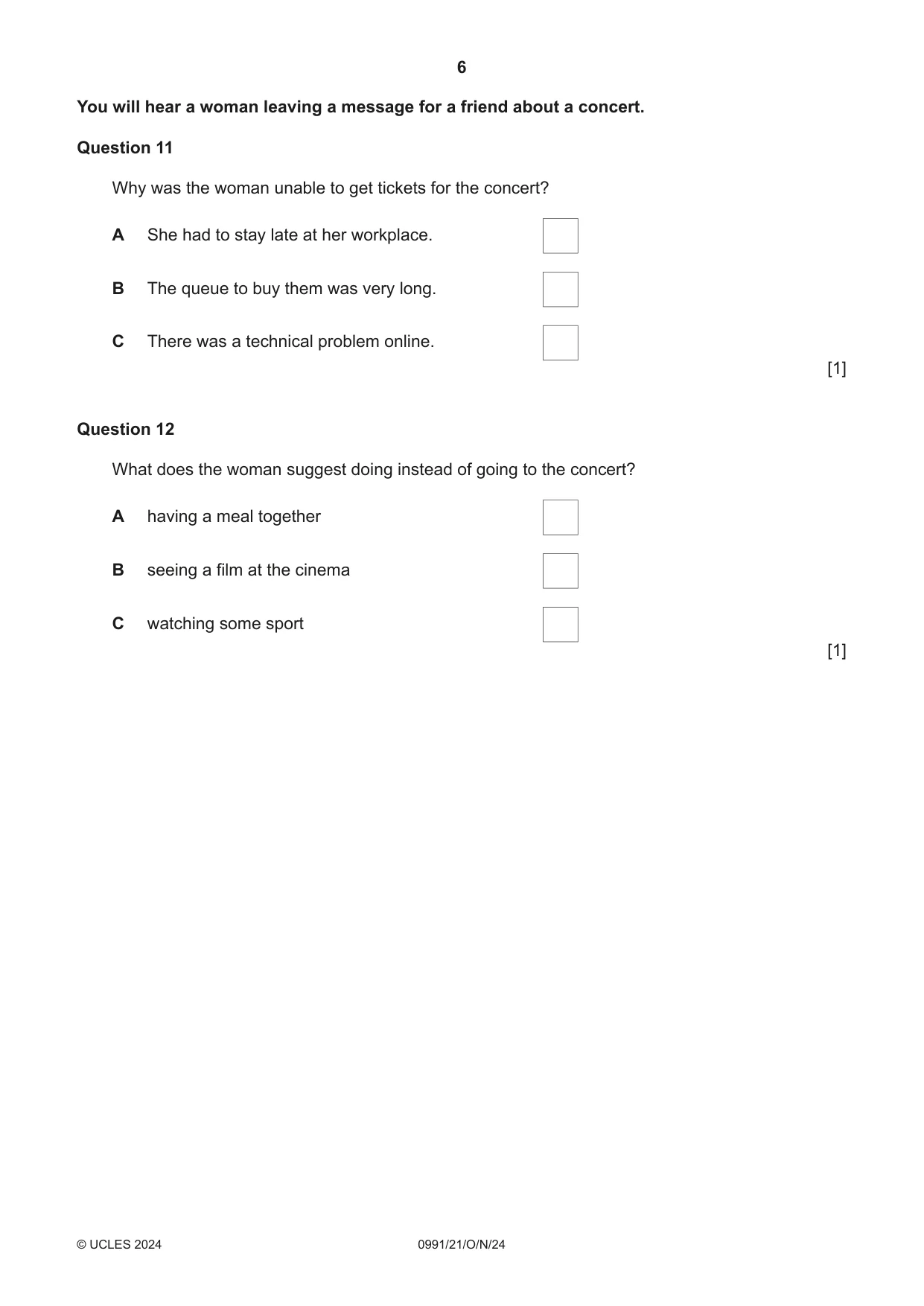
6 0991/21/O/N/24 © UCLES 2024 You will hear a woman leaving a message for a friend about a concert. Question 11 Why was the woman unable to get tickets for the concert? A She had to stay late at her workplace. B The queue to buy them was very long. C There was a technical problem online. [1] Question 12 What does the woman suggest doing instead of going to the concert? A having a meal together B seeing a film at the cinema C watching some sport [1]
Question paper, page 7
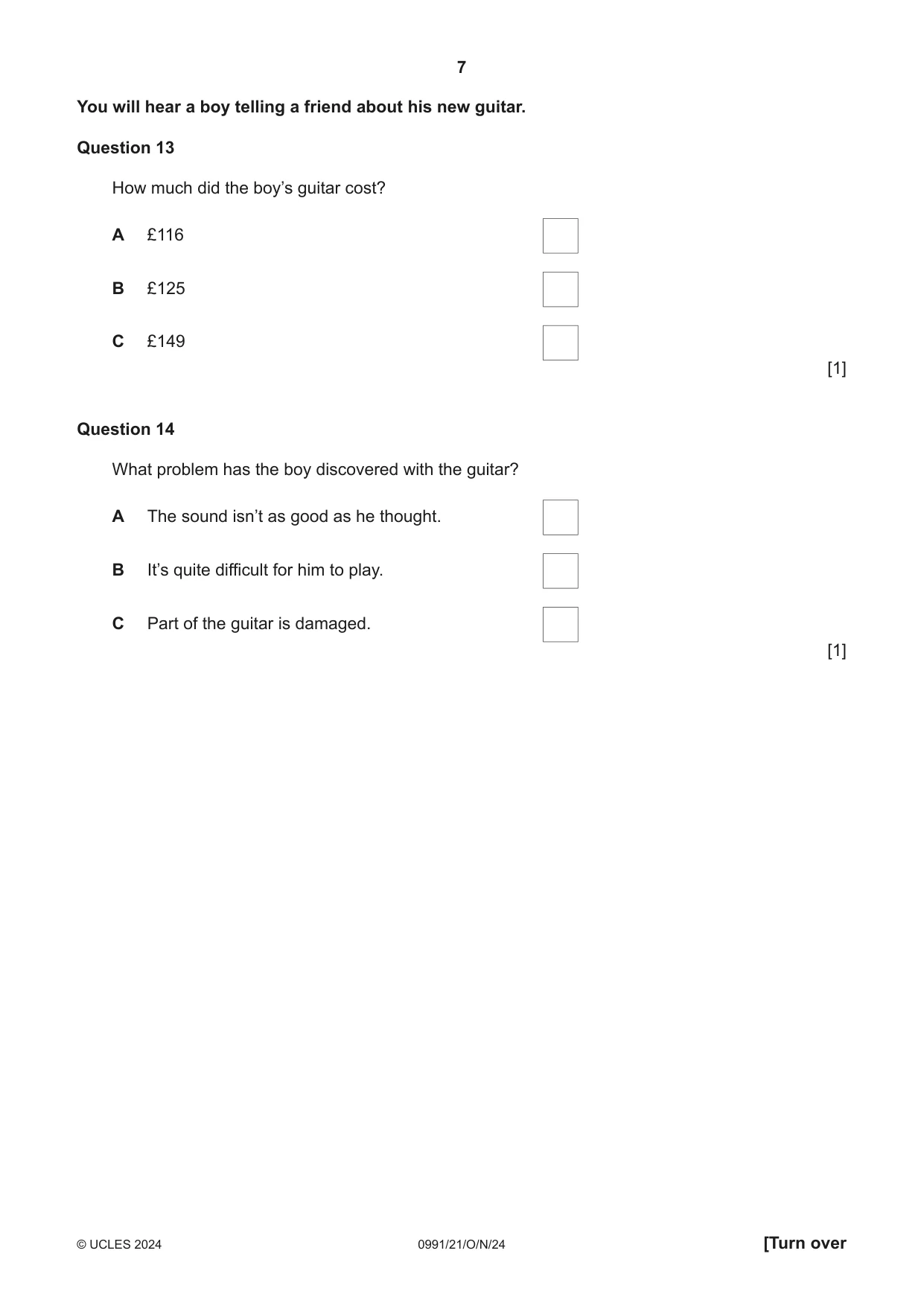
7 0991/21/O/N/24 © UCLES 2024 [Turn over You will hear a boy telling a friend about his new guitar. Question 13 How much did the boy’s guitar cost? A £116 B £125 C £149 [1] Question 14 What problem has the boy discovered with the guitar? A The sound isn’t as good as he thought. B It’s quite difficult for him to play. C Part of the guitar is damaged. [1]
Question paper, page 8
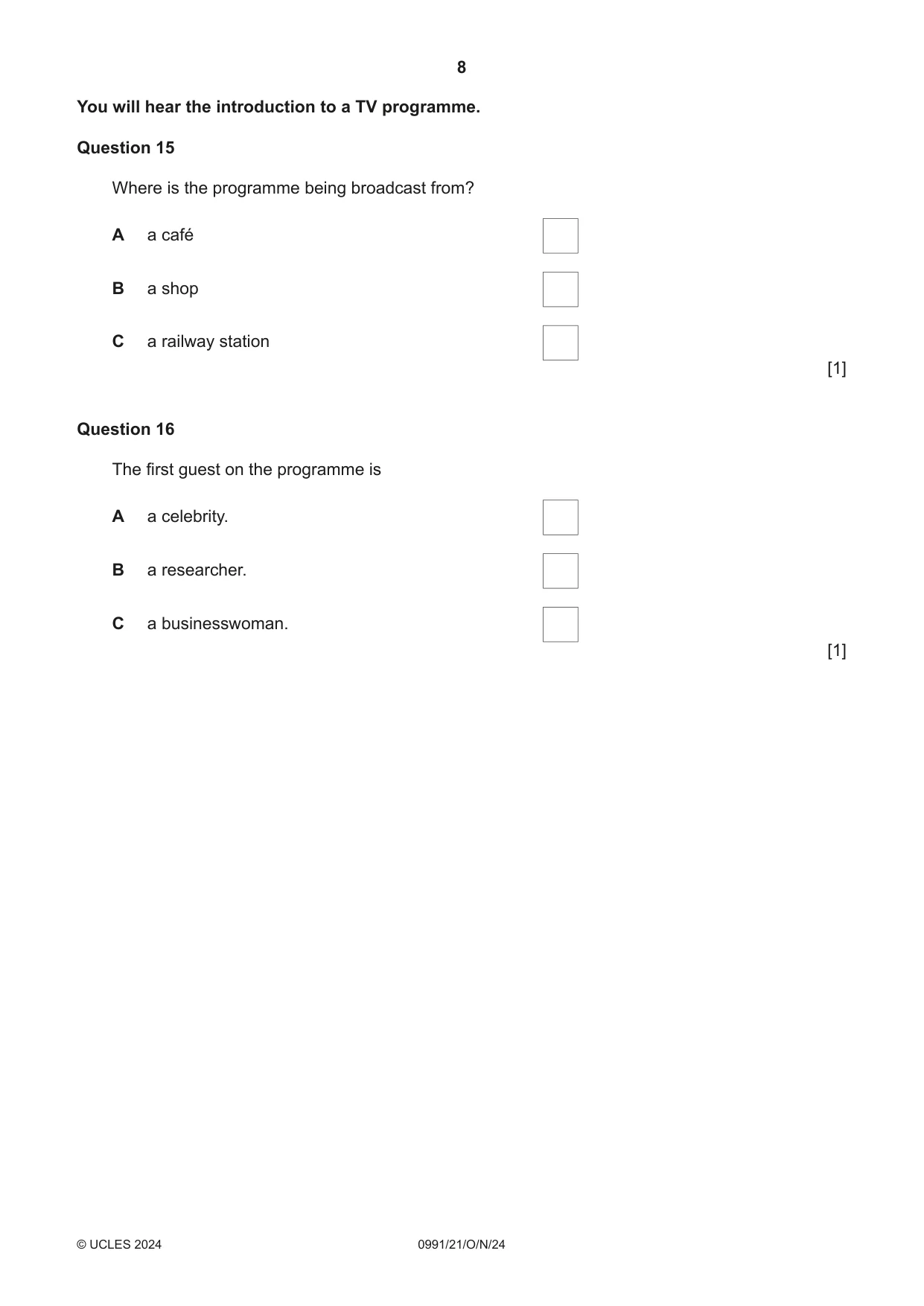
8 0991/21/O/N/24 © UCLES 2024 You will hear the introduction to a TV programme. Question 15 Where is the programme being broadcast from? A a café B a shop C a railway station [1] Question 16 The first guest on the programme is A a celebrity. B a researcher. C a businesswoman. [1]
Question paper, page 9
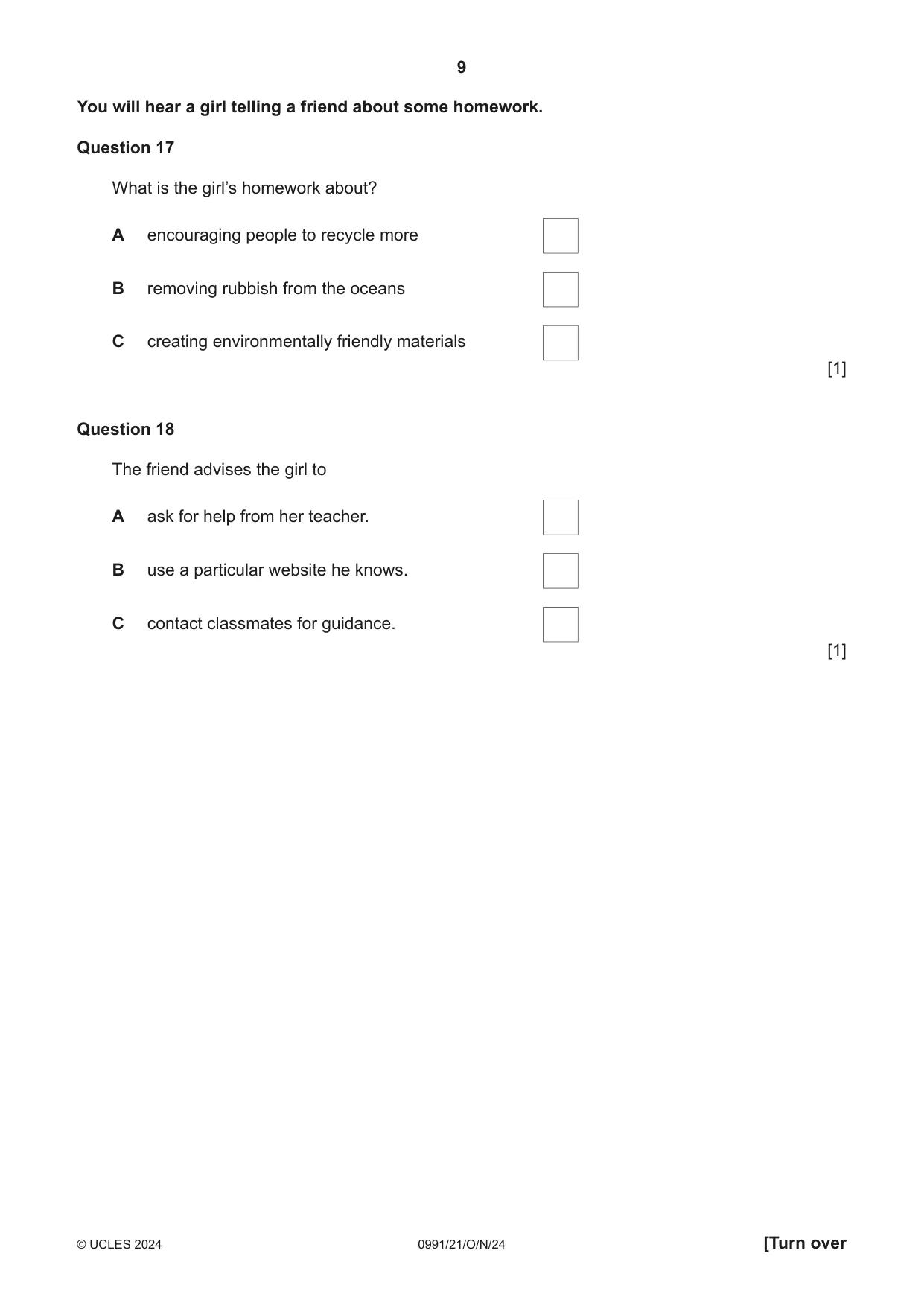
9 0991/21/O/N/24 © UCLES 2024 [Turn over You will hear a girl telling a friend about some homework. Question 17 What is the girl’s homework about? A encouraging people to recycle more B removing rubbish from the oceans C creating environmentally friendly materials [1] Question 18 The friend advises the girl to A ask for help from her teacher. B use a particular website he knows. C contact classmates for guidance. [1]
Question paper, page 10
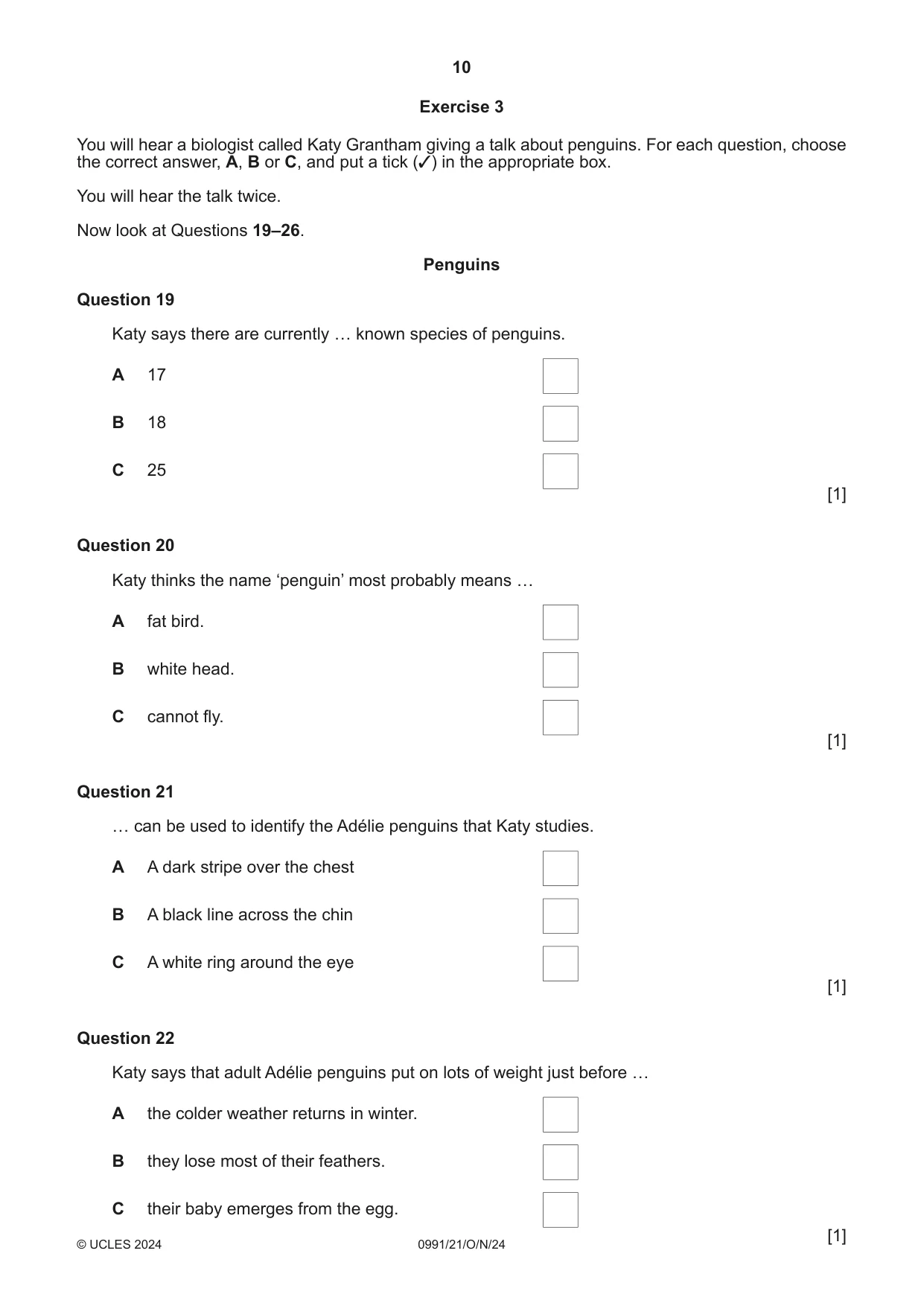
10 0991/21/O/N/24 © UCLES 2024 Exercise 3 You will hear a biologist called Katy Grantham giving a talk about penguins. For each question, choose the correct answer, A, B or C, and put a tick (3) in the appropriate box. You will hear the talk twice. Now look at Questions 19–26. Penguins Question 19 Katy says there are currently … known species of penguins. A 17 B 18 C 25 [1] Question 20 Katy thinks the name ‘penguin’ most probably means … A fat bird. B white head. C cannot fly. [1] Question 21 … can be used to identify the Adélie penguins that Katy studies. A A dark stripe over the chest B A black line across the chin C A white ring around the eye [1] Question 22 Katy says that adult Adélie penguins put on lots of weight just before … A the colder weather returns in winter. B they lose most of their feathers. C their baby emerges from the egg. [1]
Question paper, page 11
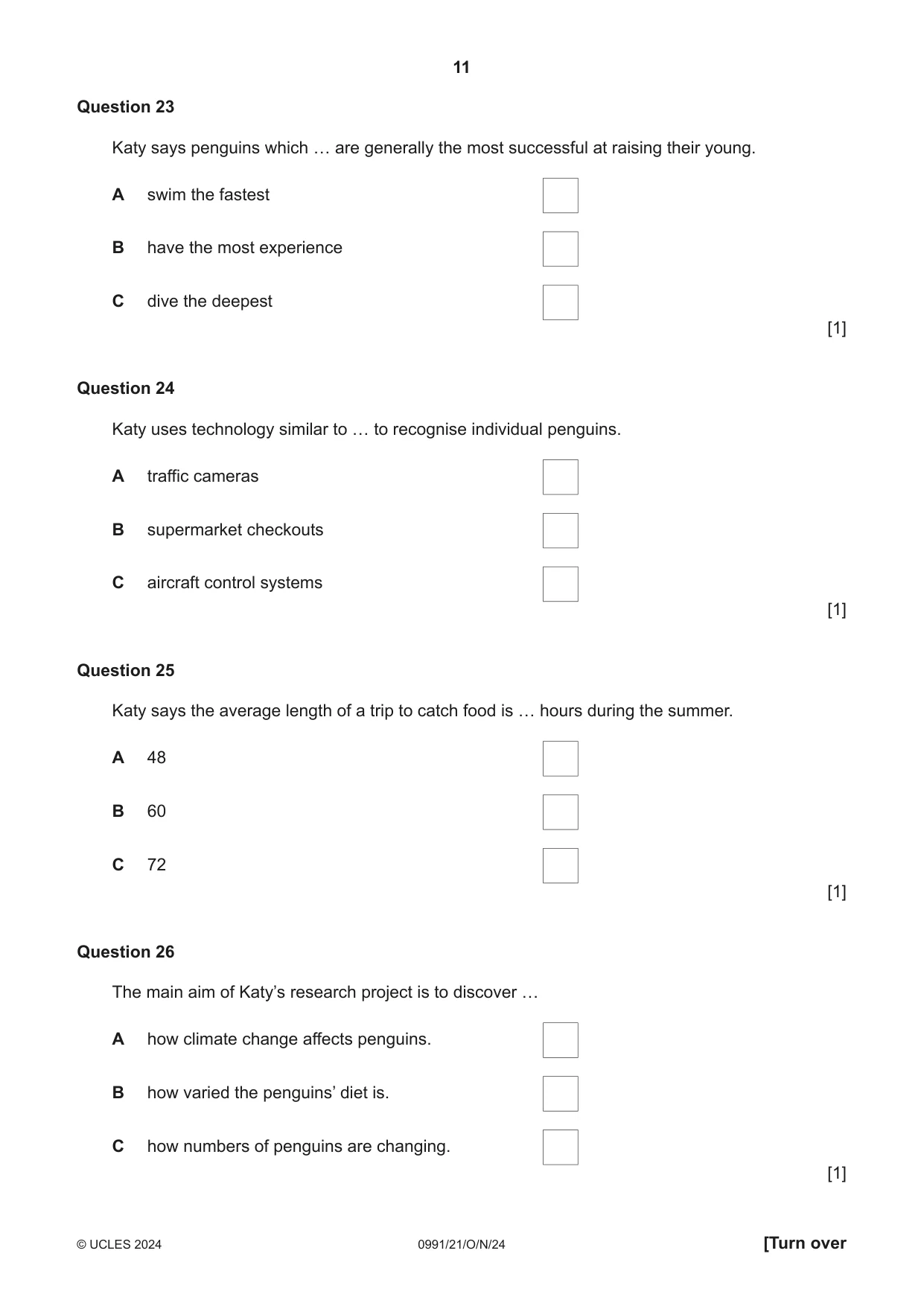
11 0991/21/O/N/24 © UCLES 2024 [Turn over Question 23 Katy says penguins which … are generally the most successful at raising their young. A swim the fastest B have the most experience C dive the deepest [1] Question 24 Katy uses technology similar to … to recognise individual penguins. A traffic cameras B supermarket checkouts C aircraft control systems [1] Question 25 Katy says the average length of a trip to catch food is … hours during the summer. A 48 B 60 C 72 [1] Question 26 The main aim of Katy’s research project is to discover … A how climate change affects penguins. B how varied the penguins’ diet is. C how numbers of penguins are changing. [1]
Question paper, page 12
12 0991/21/O/N/24 © UCLES 2024 BLANK PAGE
Question paper, page 13
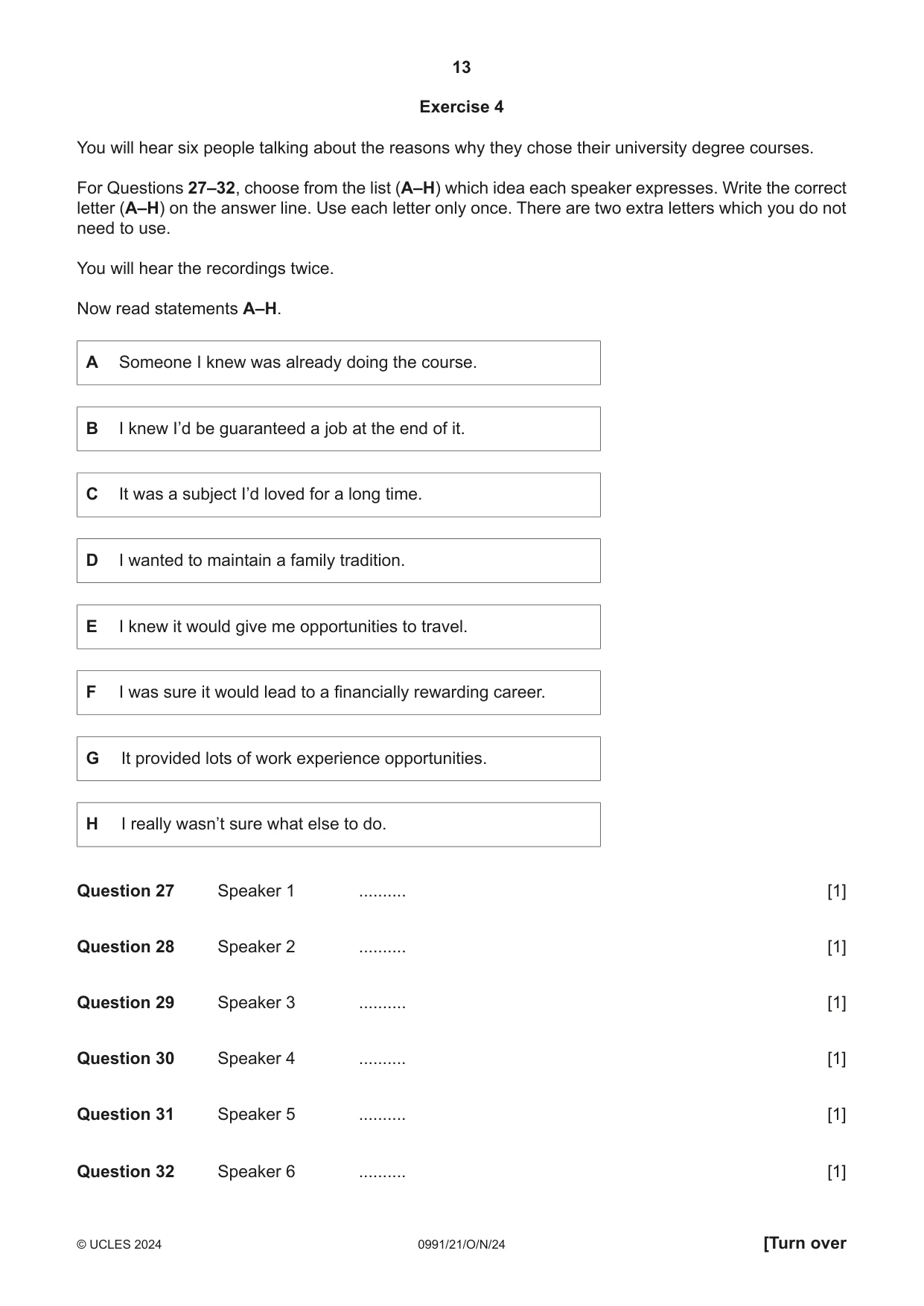
13 0991/21/O/N/24 © UCLES 2024 [Turn over Exercise 4 You will hear six people talking about the reasons why they chose their university degree courses. For Questions 27–32, choose from the list (A–H) which idea each speaker expresses. Write the correct letter (A–H) on the answer line. Use each letter only once. There are two extra letters which you do not need to use. You will hear the recordings twice. Now read statements A–H. A Someone I knew was already doing the course. B I knew I’d be guaranteed a job at the end of it. C It was a subject I’d loved for a long time. D I wanted to maintain a family tradition. E I knew it would give me opportunities to travel. F I was sure it would lead to a financially rewarding career. G It provided lots of work experience opportunities. H I really wasn’t sure what else to do. Question 27 Speaker 1 … [1] Question 28 Speaker 2 … [1] Question 29 Speaker 3 … [1] Question 30 Speaker 4 … [1] Question 31 Speaker 5 … [1] Question 32 Speaker 6 … [1]
Question paper, page 14
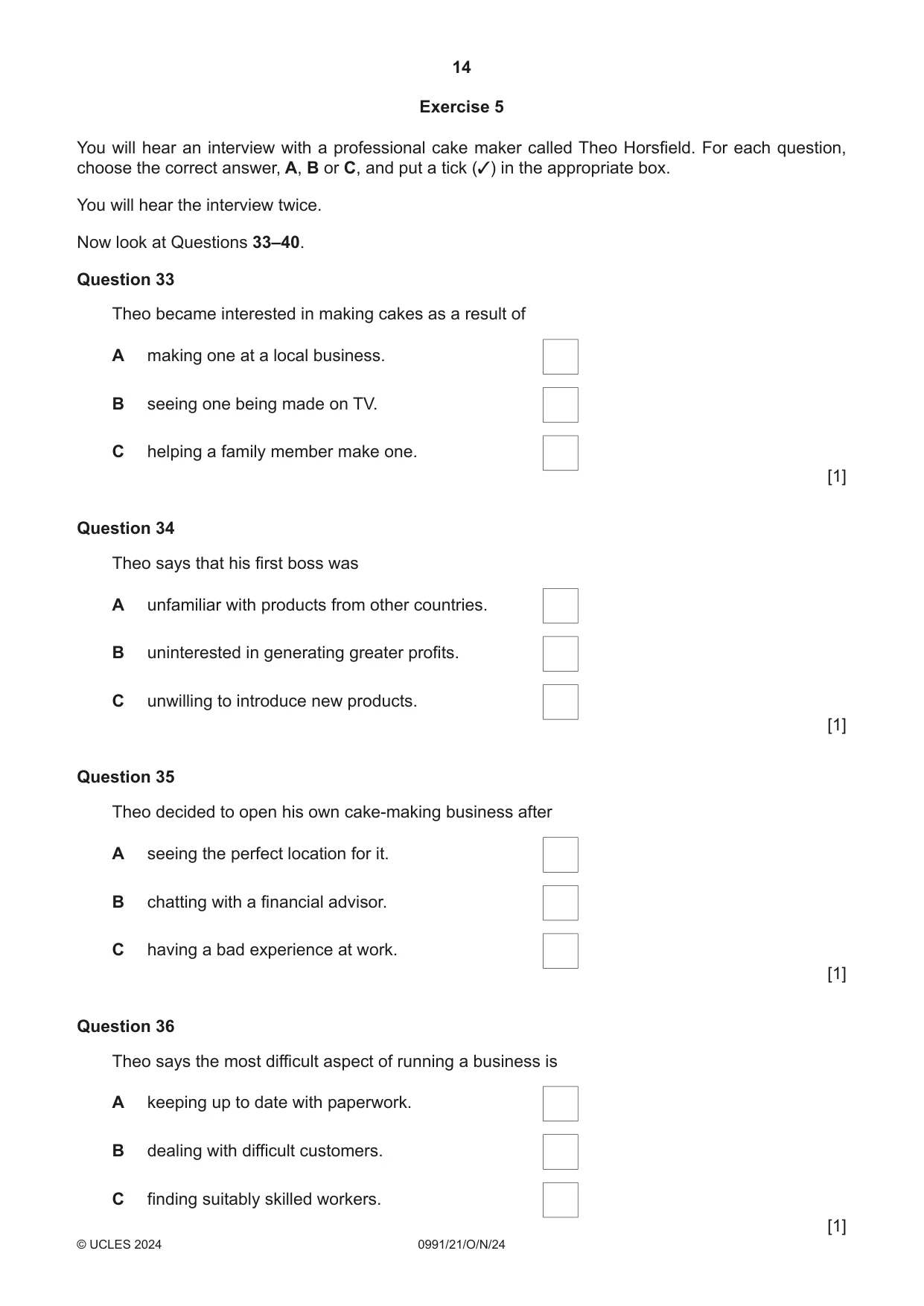
14 0991/21/O/N/24 © UCLES 2024 Exercise 5 You will hear an interview with a professional cake maker called Theo Horsfield. For each question, choose the correct answer, A, B or C, and put a tick (3) in the appropriate box. You will hear the interview twice. Now look at Questions 33–40. Question 33 Theo became interested in making cakes as a result of A making one at a local business. B seeing one being made on TV. C helping a family member make one. [1] Question 34 Theo says that his first boss was A unfamiliar with products from other countries. B uninterested in generating greater profits. C unwilling to introduce new products. [1] Question 35 Theo decided to open his own cake-making business after A seeing the perfect location for it. B chatting with a financial advisor. C having a bad experience at work. [1] Question 36 Theo says the most difficult aspect of running a business is A keeping up to date with paperwork. B dealing with difficult customers. C finding suitably skilled workers. [1]
Question paper, page 15
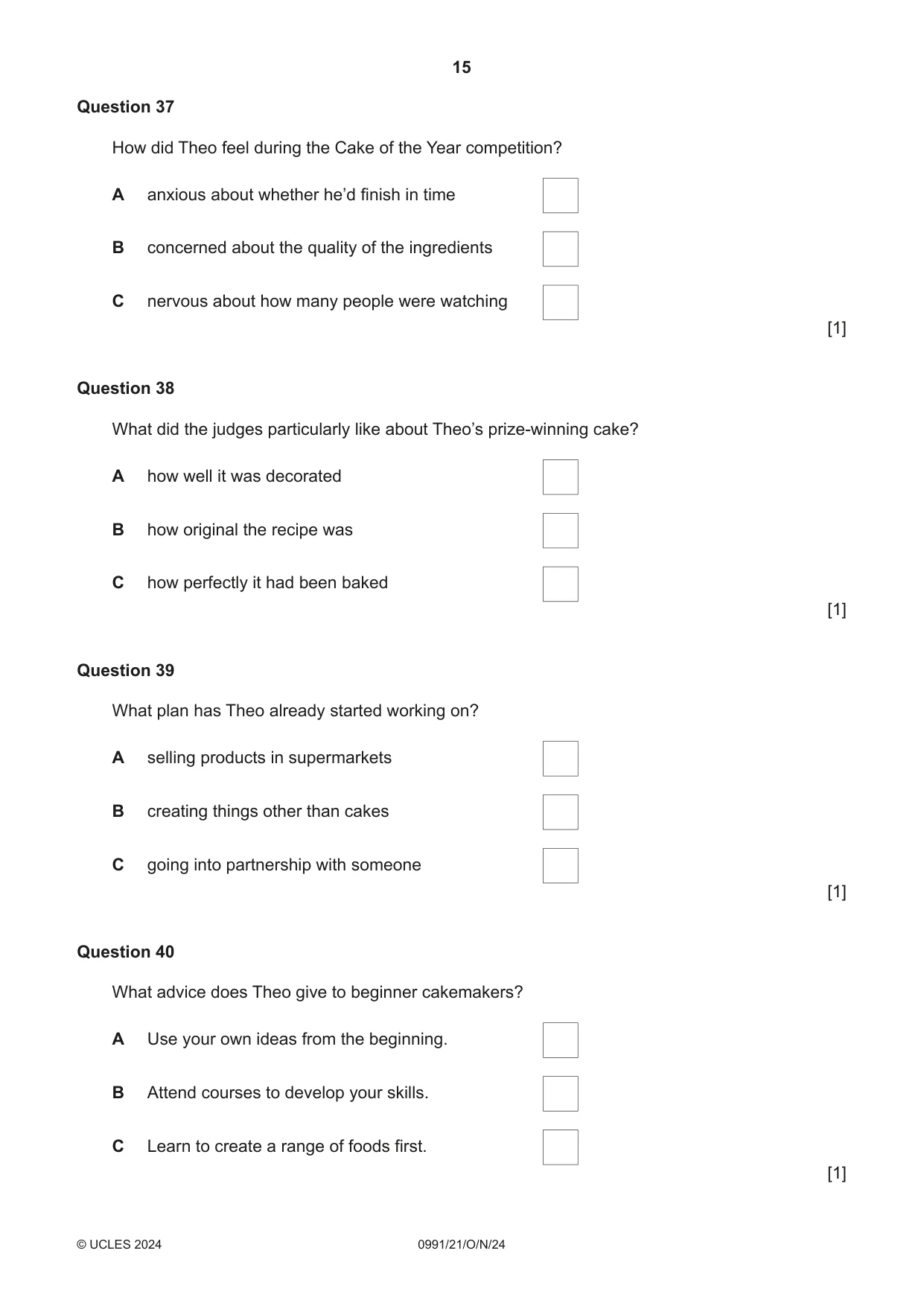
15 0991/21/O/N/24 © UCLES 2024 Question 37 How did Theo feel during the Cake of the Year competition? A anxious about whether he’d finish in time B concerned about the quality of the ingredients C nervous about how many people were watching [1] Question 38 What did the judges particularly like about Theo’s prize-winning cake? A how well it was decorated B how original the recipe was C how perfectly it had been baked [1] Question 39 What plan has Theo already started working on? A selling products in supermarkets B creating things other than cakes C going into partnership with someone [1] Question 40 What advice does Theo give to beginner cakemakers? A Use your own ideas from the beginning. B Attend courses to develop your skills. C Learn to create a range of foods first. [1]
Question paper, page 16
16 0991/21/O/N/24 © UCLES 2024 Permission to reproduce items where third-party owned material protected by copyright is included has been sought and cleared where possible. Every reasonable effort has been made by the publisher (UCLES) to trace copyright holders, but if any items requiring clearance have unwittingly been included, the publisher will be pleased to make amends at the earliest possible opportunity. To avoid the issue of disclosure of answer-related information to candidates, all copyright acknowledgements are reproduced online in the Cambridge Assessment International Education Copyright Acknowledgements Booklet. This is produced for each series of examinations and is freely available to download at www.cambridgeinternational.org after the live examination series. Cambridge Assessment International Education is part of Cambridge Assessment. Cambridge Assessment is the brand name of the University of Cambridge Local Examinations Syndicate (UCLES), which is a department of the University of Cambridge. BLANK PAGE
Mark scheme, page 1
This document consists of 3 printed pages. © Cambridge University Press & Assessment 2024 [Turn over Cambridge IGCSE™ (9–1) ENGLISH AS A SECOND LANGUAGE 0991/21 Paper 2 Reading and Writing (Extended) October/November 2024 MARK SCHEME Maximum Mark: 40 Published This mark scheme is published as an aid to teachers and candidates, to indicate the requirements of the examination. Mark schemes should be read in conjunction with the question paper and the Principal Examiner Report for Teachers. Cambridge International will not enter into discussions about these mark schemes. Cambridge International is publishing the mark schemes for the October/November 2024 series for most Cambridge IGCSE, Cambridge International A and AS Level components, and some Cambridge O Level components.
Mark scheme, page 2
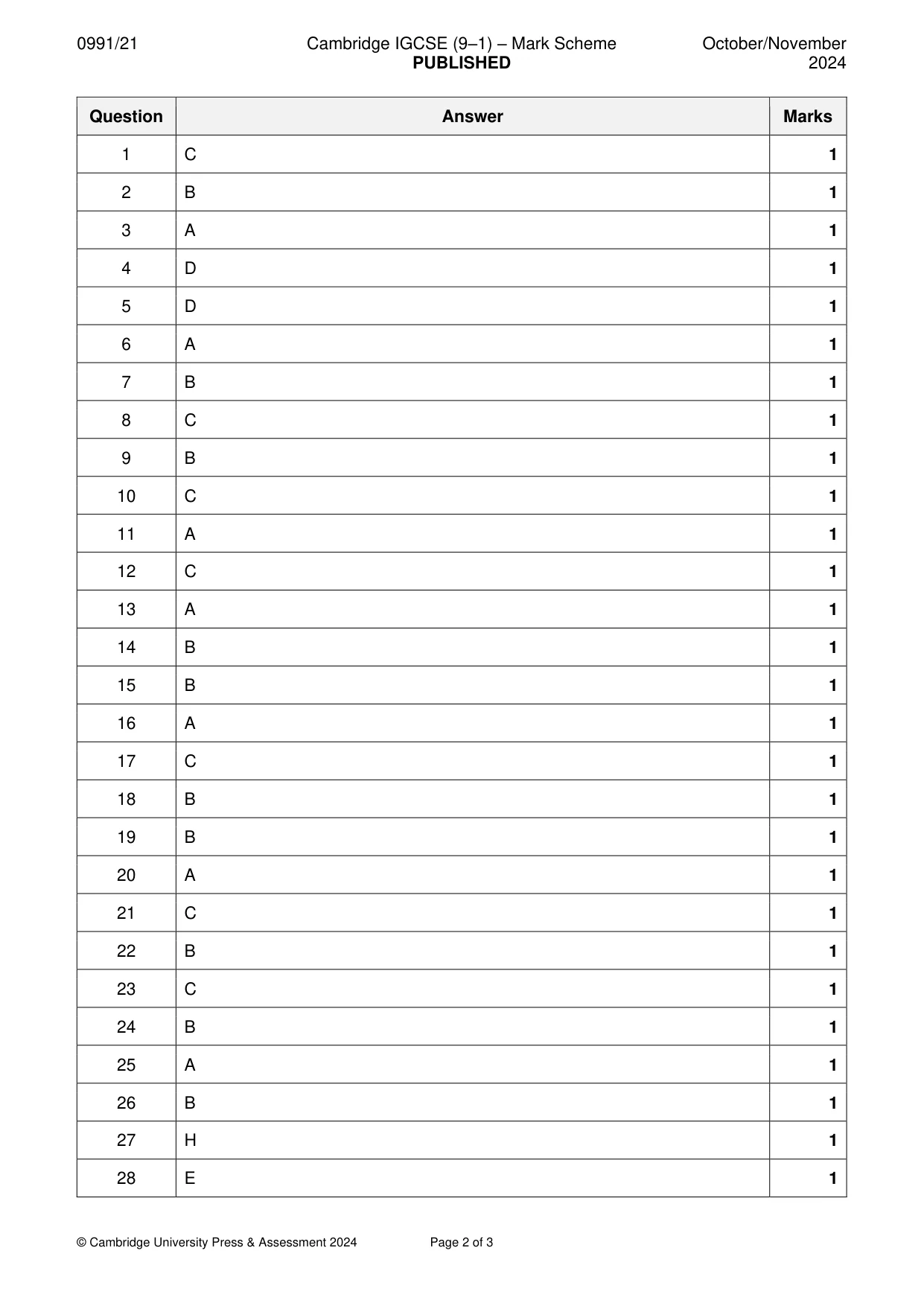
0991/21 Cambridge IGCSE (9–1) – Mark Scheme PUBLISHED October/November 2024 © Cambridge University Press & Assessment 2024 Page 2 of 3 Question Answer Marks 1 C 1 2 B 1 3 A 1 4 D 1 5 D 1 6 A 1 7 B 1 8 C 1 9 B 1 10 C 1 11 A 1 12 C 1 13 A 1 14 B 1 15 B 1 16 A 1 17 C 1 18 B 1 19 B 1 20 A 1 21 C 1 22 B 1 23 C 1 24 B 1 25 A 1 26 B 1 27 H 1 28 E 1
Mark scheme, page 3
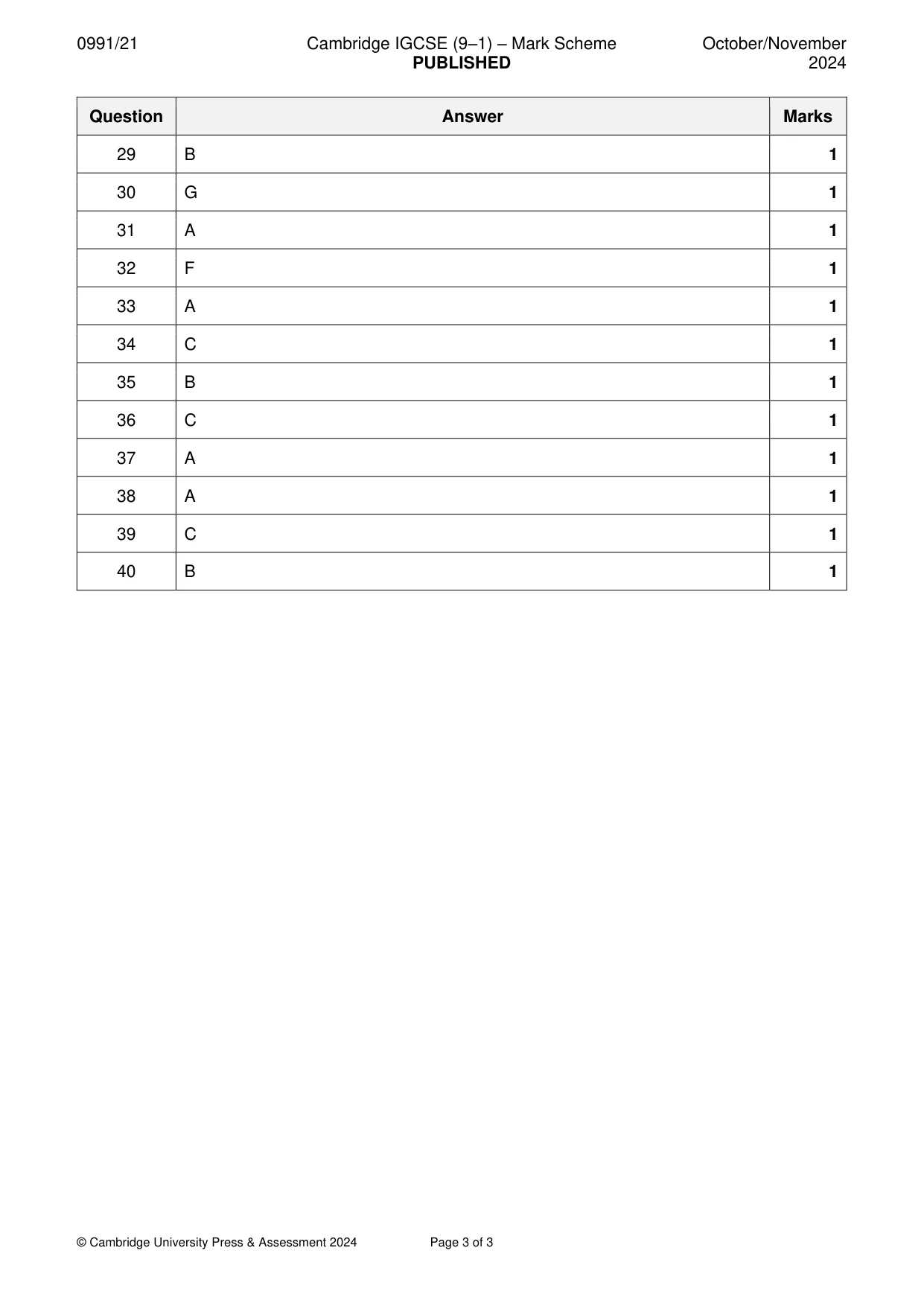
0991/21 Cambridge IGCSE (9–1) – Mark Scheme PUBLISHED October/November 2024 © Cambridge University Press & Assessment 2024 Page 3 of 3 Question Answer Marks 29 B 1 30 G 1 31 A 1 32 F 1 33 A 1 34 C 1 35 B 1 36 C 1 37 A 1 38 A 1 39 C 1 40 B 1
What you needed in this session
Cambridge’s own grade thresholds for 2024 Oct/Nov, Paper 2 · Variant 1. A higher threshold means an easier paper — the bar moves with how the cohort did.