Cambridge IGCSE English - Literature in English 0475 — 2025 May/June Paper 2 · Variant 2
0475/22/M/J/25 · 50 marks · ≈56 min
The question paper and its mark scheme, free to read here and free to download. This is Cambridge’s own paper, exactly as it was sat.
Question paper12 pages
Mark scheme6 pages
Answers below. Sit the paper first if you are practising.
Paper as text
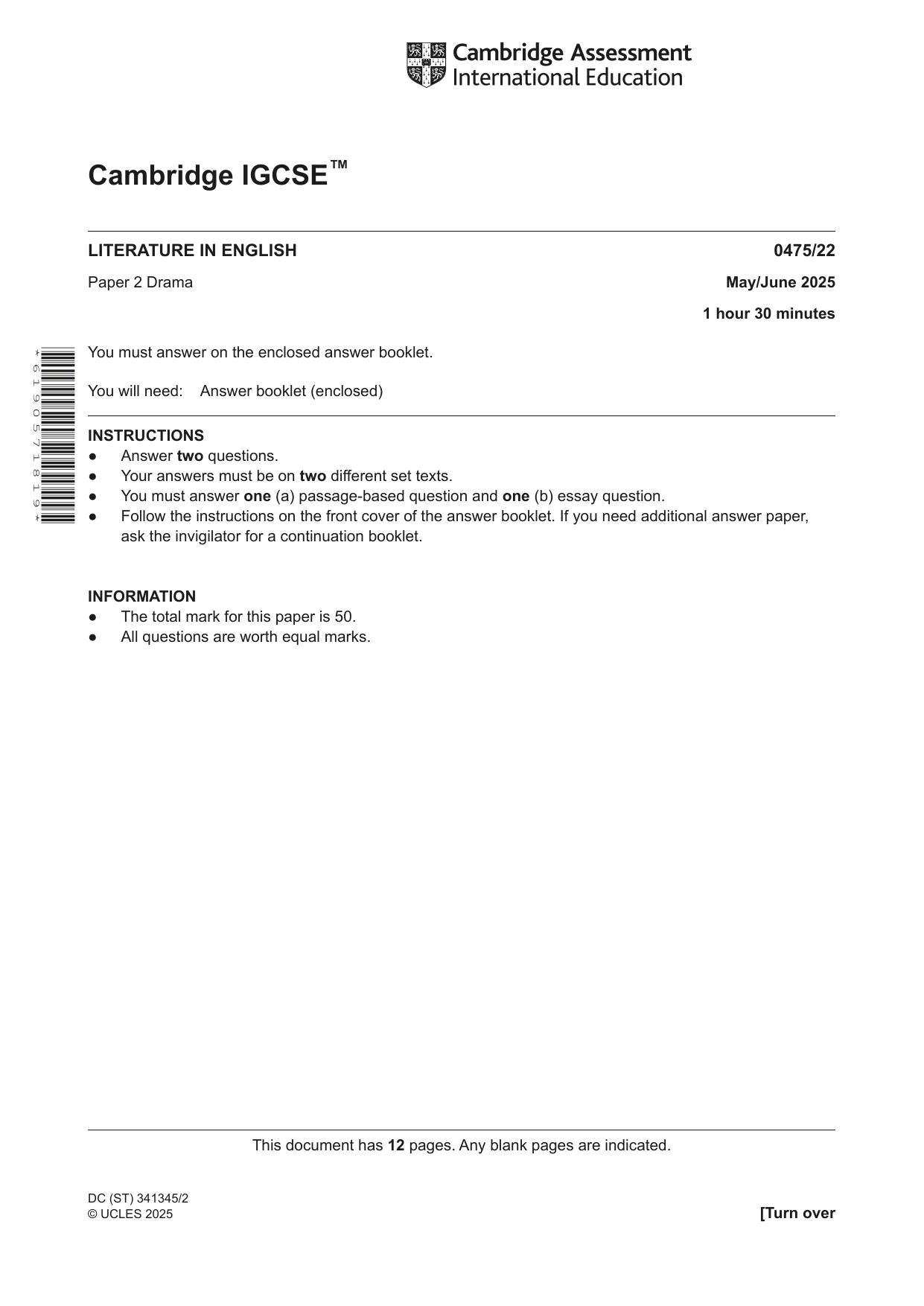
Question paper, page 1
This document has 12 pages. Any blank pages are indicated. [Turn over Cambridge IGCSE™ LITERATURE IN ENGLISH 0475/22 Paper 2 Drama May/June 2025 1 hour 30 minutes You must answer on the enclosed answer booklet. You will need: Answer booklet (enclosed) INSTRUCTIONS ● Answer two questions. ● Your answers must be on two different set texts. ● You must answer one (a) passage-based question and one (b) essay question. ● Follow the instructions on the front cover of the answer booklet. If you need additional answer paper, ask the invigilator for a continuation booklet. INFORMATION ● The total mark for this paper is 50. ● All questions are worth equal marks. * 6 1 9 0 5 7 1 8 1 9 * DC (ST) 341345/2 © UCLES 2025
Question paper, page 2
2 0475/22/M/J/25 © UCLES 2025 SHELAGH DELANEY: A Taste of Honey Remember to support your ideas with details from the writing. Either 1(a) Read this passage, and then answer the question that follows it: [PETER appears.] Content removed due to copyright restrictions.
Question paper, page 3
3 0475/22/M/J/25 © UCLES 2025 [Turn over PETER: Thank you. (from Act 2, Scene 1) In what ways does Delaney make this such a dramatic moment in the play? Or 1(b) How does Delaney’s portrayal of Geof contribute to the dramatic impact of the play? Content removed due to copyright restrictions.
Question paper, page 4
4 0475/22/M/J/25 © UCLES 2025 WOLE SOYINKA: Death and the King’s Horseman Remember to support your ideas with details from the writing. Either 2(a) Read this passage, and then answer the question that follows it: PILKINGS: Jane. Content removed due to copyright restrictions.
Question paper, page 5
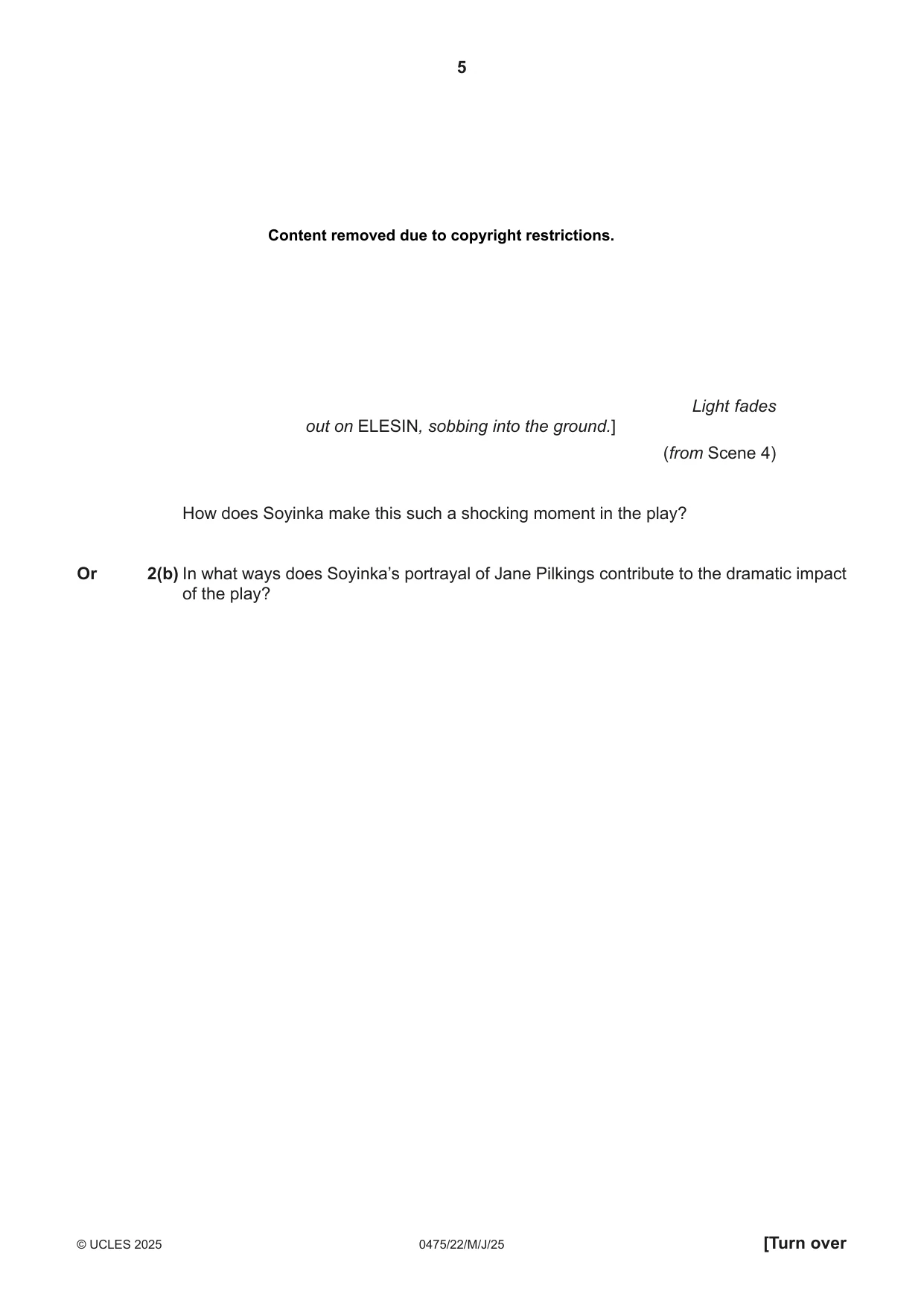
5 0475/22/M/J/25 © UCLES 2025 [Turn over Light fades out on ELESIN, sobbing into the ground.] (from Scene 4) How does Soyinka make this such a shocking moment in the play? Or 2(b) In what ways does Soyinka’s portrayal of Jane Pilkings contribute to the dramatic impact of the play? Content removed due to copyright restrictions.
Question paper, page 6
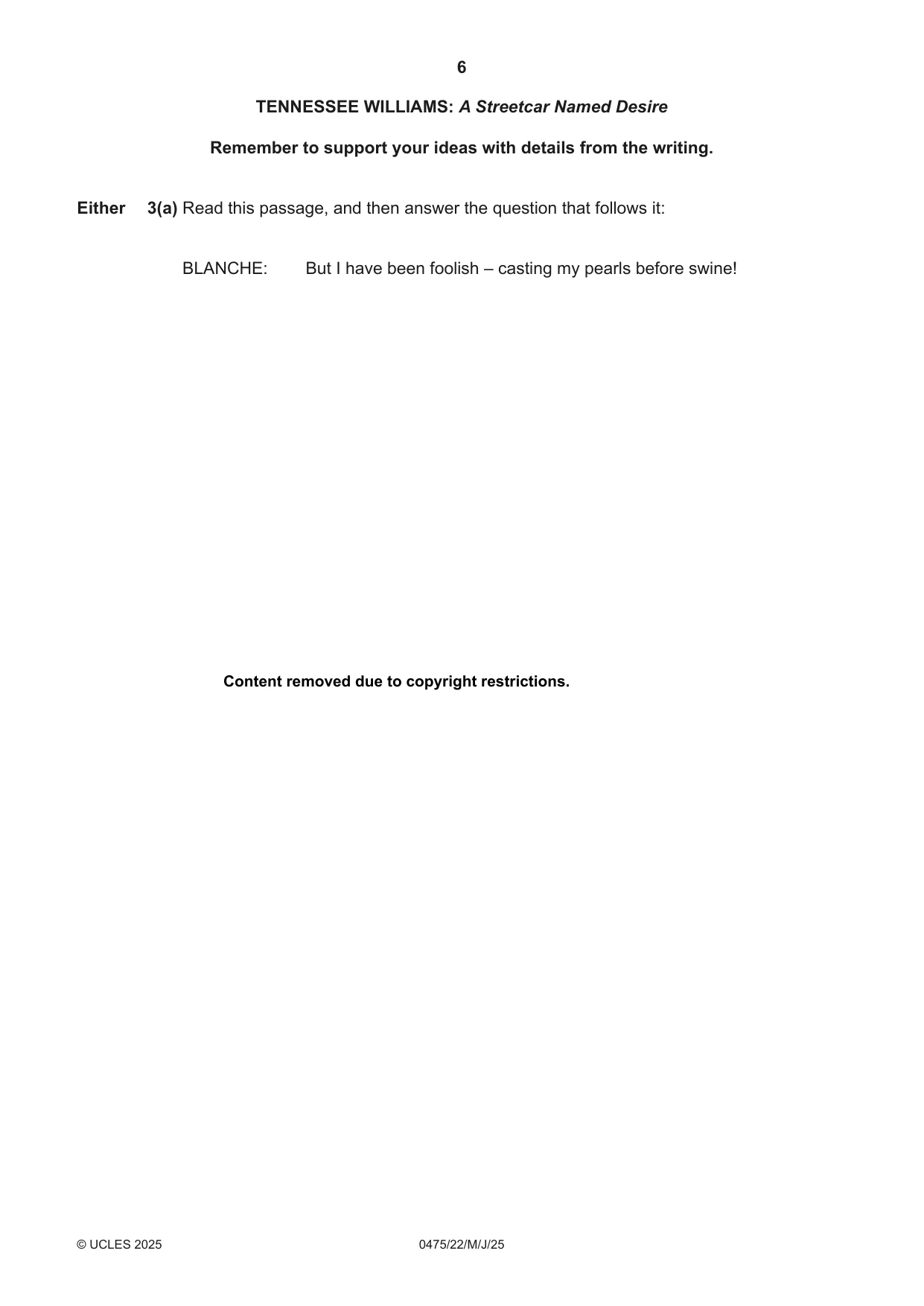
6 0475/22/M/J/25 © UCLES 2025 TENNESSEE WILLIAMS: A Streetcar Named Desire Remember to support your ideas with details from the writing. Either 3(a) Read this passage, and then answer the question that follows it: BLANCHE: But I have been foolish – casting my pearls before swine! Content removed due to copyright restrictions.
Question paper, page 7
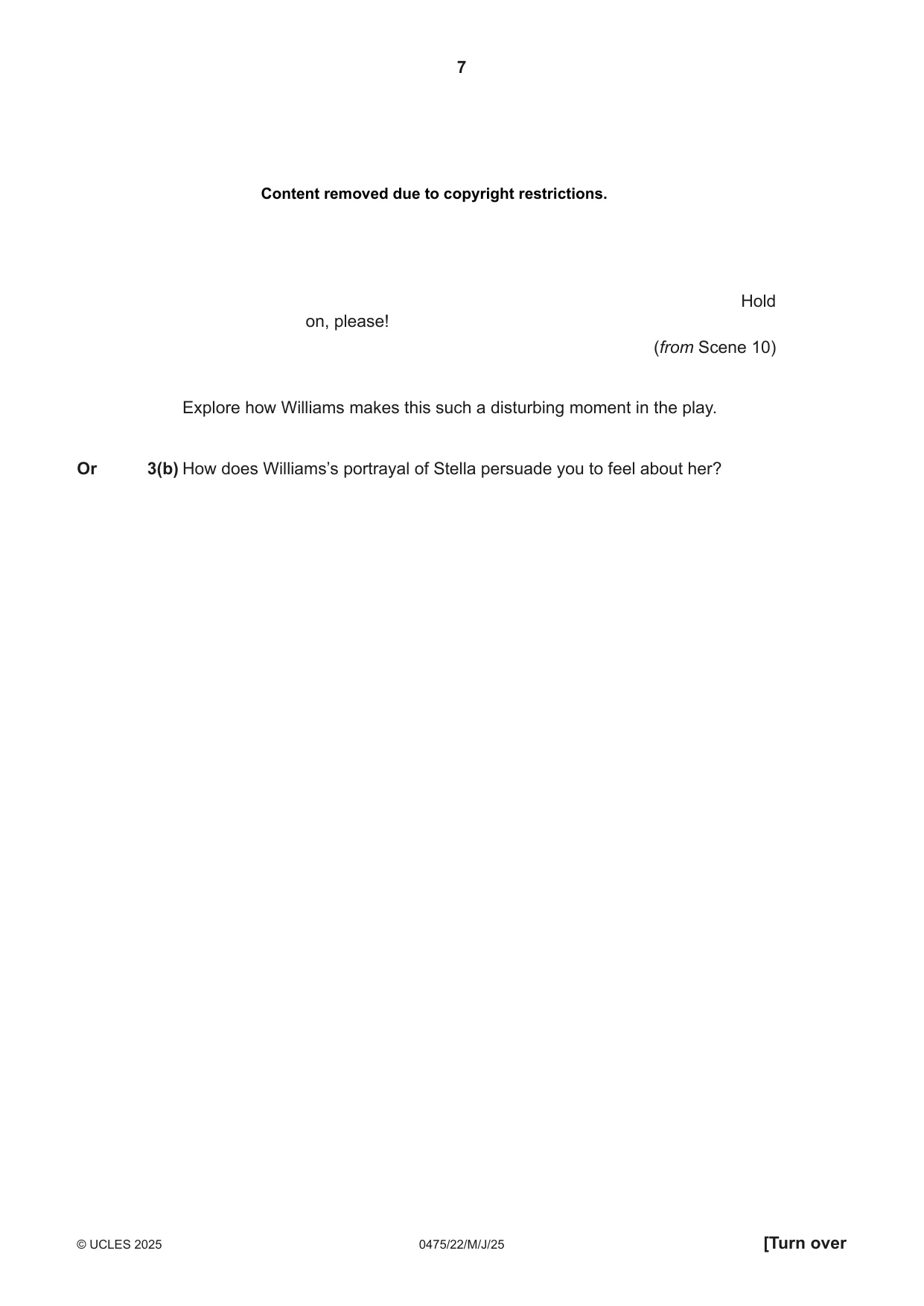
7 0475/22/M/J/25 © UCLES 2025 [Turn over Hold on, please! (from Scene 10) Explore how Williams makes this such a disturbing moment in the play. Or 3(b) How does Williams’s portrayal of Stella persuade you to feel about her? Content removed due to copyright restrictions.
Question paper, page 8
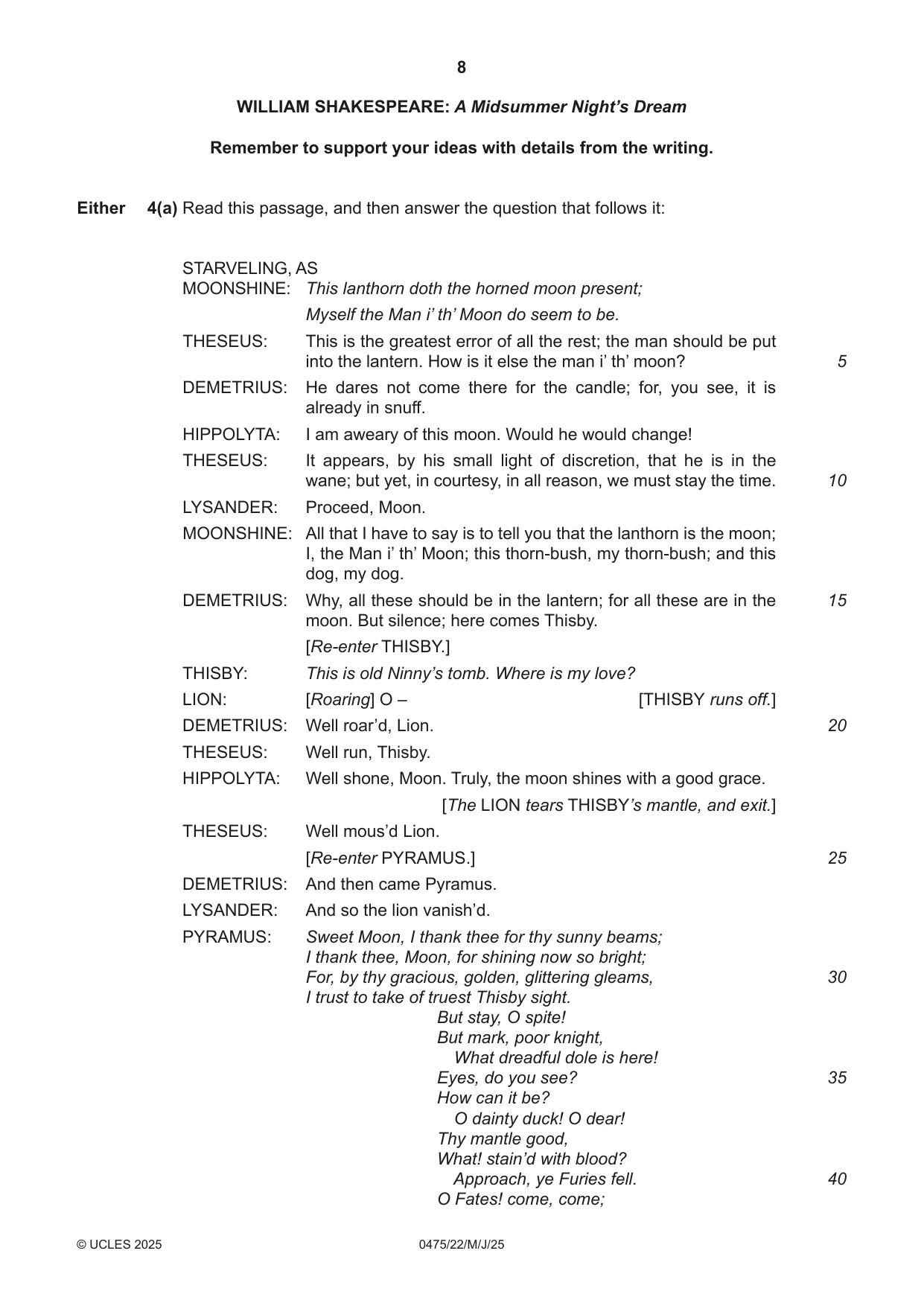
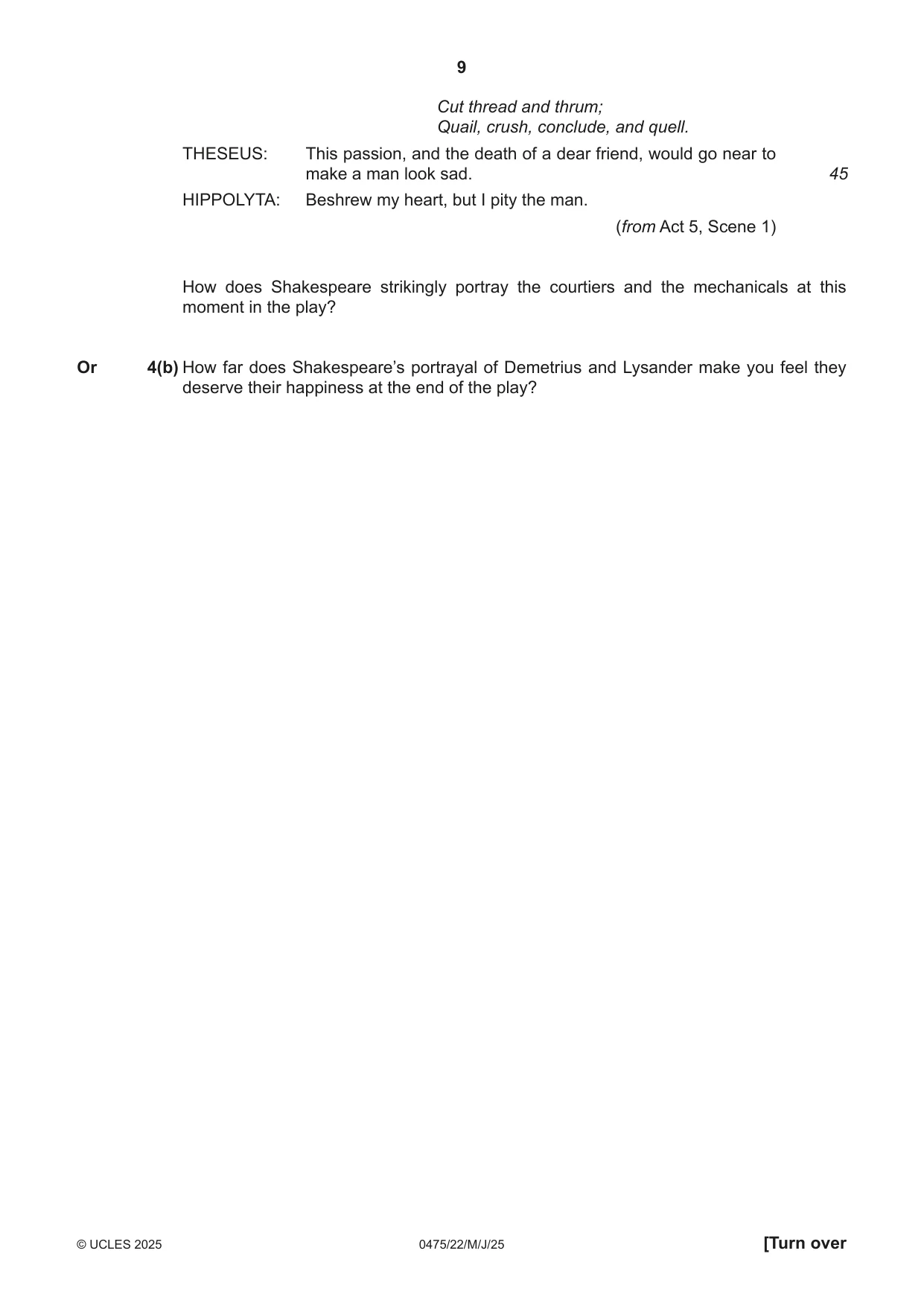
8 0475/22/M/J/25 © UCLES 2025 WILLIAM SHAKESPEARE: A Midsummer Night’s Dream Remember to support your ideas with details from the writing. Either 4(a) Read this passage, and then answer the question that follows it: STARVELING, AS MOONSHINE: This lanthorn doth the horned moon present; Myself the Man i’ th’ Moon do seem to be. THESEUS: This is the greatest error of all the rest; the man should be put into the lantern. How is it else the man i’ th’ moon? DEMETRIUS: He dares not come there for the candle; for, you see, it is already in snuff. HIPPOLYTA: I am aweary of this moon. Would he would change! THESEUS: It appears, by his small light of discretion, that he is in the wane; but yet, in courtesy, in all reason, we must stay the time. LYSANDER: Proceed, Moon. MOONSHINE: All that I have to say is to tell you that the lanthorn is the moon; I, the Man i’ th’ Moon; this thorn-bush, my thorn-bush; and this dog, my dog. DEMETRIUS: Why, all these should be in the lantern; for all these are in the moon. But silence; here comes Thisby. [Re-enter THISBY.] THISBY: This is old Ninny’s tomb. Where is my love? LION: [Roaring] O – [THISBY runs off.] DEMETRIUS: Well roar’d, Lion. THESEUS: Well run, Thisby. HIPPOLYTA: Well shone, Moon. Truly, the moon shines with a good grace. [The LION tears THISBY’s mantle, and exit.] THESEUS: Well mous’d Lion. [Re-enter PYRAMUS.] DEMETRIUS: And then came Pyramus. LYSANDER: And so the lion vanish’d. PYRAMUS: Sweet Moon, I thank thee for thy sunny beams; I thank thee, Moon, for shining now so bright; For, by thy gracious, golden, glittering gleams, I trust to take of truest Thisby sight. But stay, O spite! But mark, poor knight, What dreadful dole is here! Eyes, do you see? How can it be? O dainty duck! O dear! Thy mantle good, What! stain’d with blood? Approach, ye Furies fell. O Fates! come, come; 5 10 15 20 25 30 35 40
Question paper, page 9
9 0475/22/M/J/25 © UCLES 2025 [Turn over Cut thread and thrum; Quail, crush, conclude, and quell. THESEUS: This passion, and the death of a dear friend, would go near to make a man look sad. HIPPOLYTA: Beshrew my heart, but I pity the man. (from Act 5, Scene 1) How does Shakespeare strikingly portray the courtiers and the mechanicals at this moment in the play? Or 4(b) How far does Shakespeare’s portrayal of Demetrius and Lysander make you feel they deserve their happiness at the end of the play? 45
Question paper, page 10
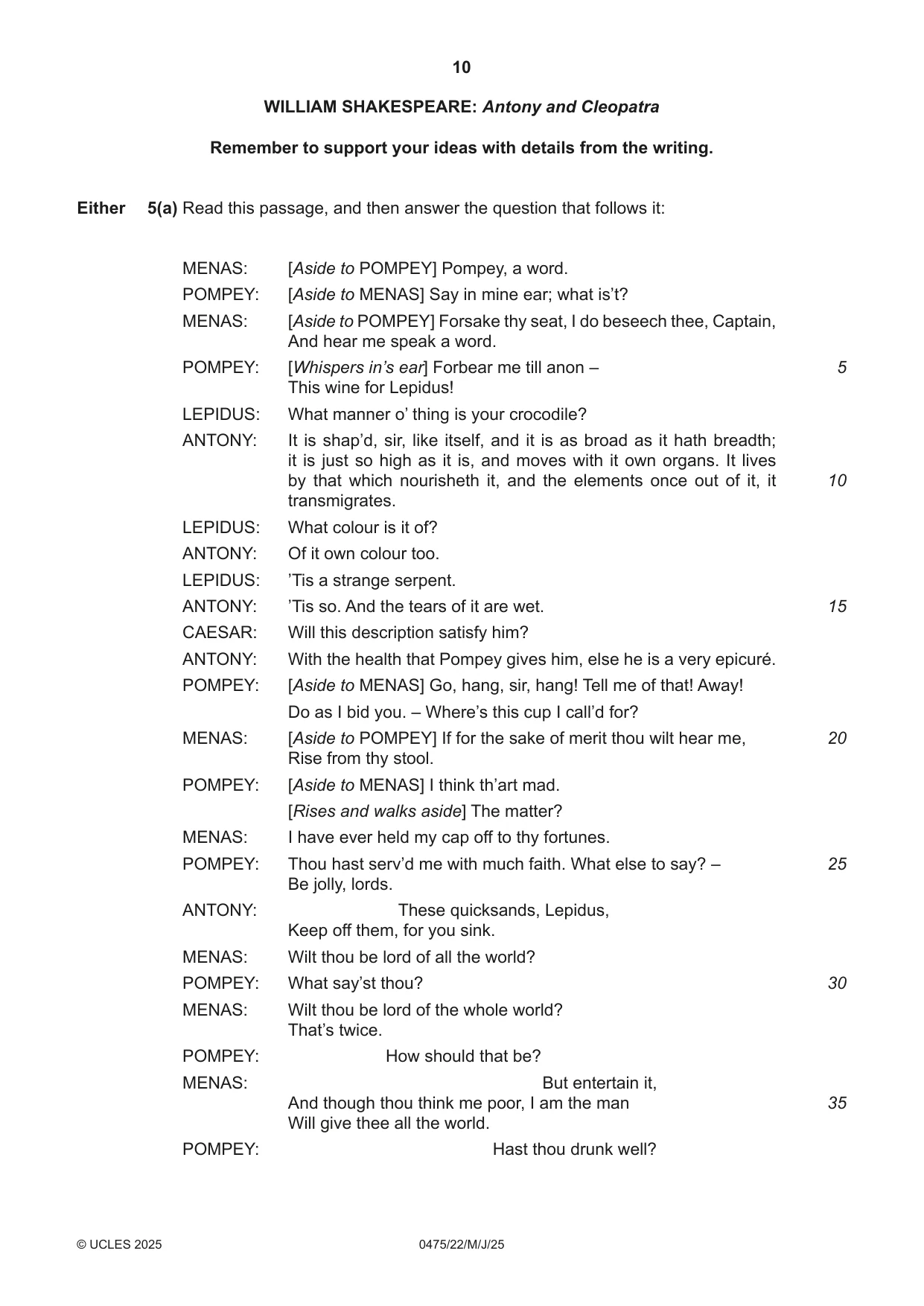
10 0475/22/M/J/25 © UCLES 2025 WILLIAM SHAKESPEARE: Antony and Cleopatra Remember to support your ideas with details from the writing. Either 5(a) Read this passage, and then answer the question that follows it: MENAS: [Aside to POMPEY] Pompey, a word. POMPEY: [Aside to MENAS] Say in mine ear; what is’t? MENAS: [Aside to POMPEY] Forsake thy seat, I do beseech thee, Captain, And hear me speak a word. POMPEY: [Whispers in’s ear] Forbear me till anon – This wine for Lepidus! LEPIDUS: What manner o’ thing is your crocodile? ANTONY: It is shap’d, sir, like itself, and it is as broad as it hath breadth; it is just so high as it is, and moves with it own organs. It lives by that which nourisheth it, and the elements once out of it, it transmigrates. LEPIDUS: What colour is it of? ANTONY: Of it own colour too. LEPIDUS: ’Tis a strange serpent. ANTONY: ’Tis so. And the tears of it are wet. CAESAR: Will this description satisfy him? ANTONY: With the health that Pompey gives him, else he is a very epicuré. POMPEY: [Aside to MENAS] Go, hang, sir, hang! Tell me of that! Away! Do as I bid you. – Where’s this cup I call’d for? MENAS: [Aside to POMPEY] If for the sake of merit thou wilt hear me, Rise from thy stool. POMPEY: [Aside to MENAS] I think th’art mad. [Rises and walks aside] The matter? MENAS: I have ever held my cap off to thy fortunes. POMPEY: Thou hast serv’d me with much faith. What else to say? – Be jolly, lords. ANTONY: These quicksands, Lepidus, Keep off them, for you sink. MENAS: Wilt thou be lord of all the world? POMPEY: What say’st thou? MENAS: Wilt thou be lord of the whole world? That’s twice. POMPEY: How should that be? MENAS: But entertain it, And though thou think me poor, I am the man Will give thee all the world. POMPEY: Hast thou drunk well? 5 10 15 20 25 30 35
Question paper, page 11
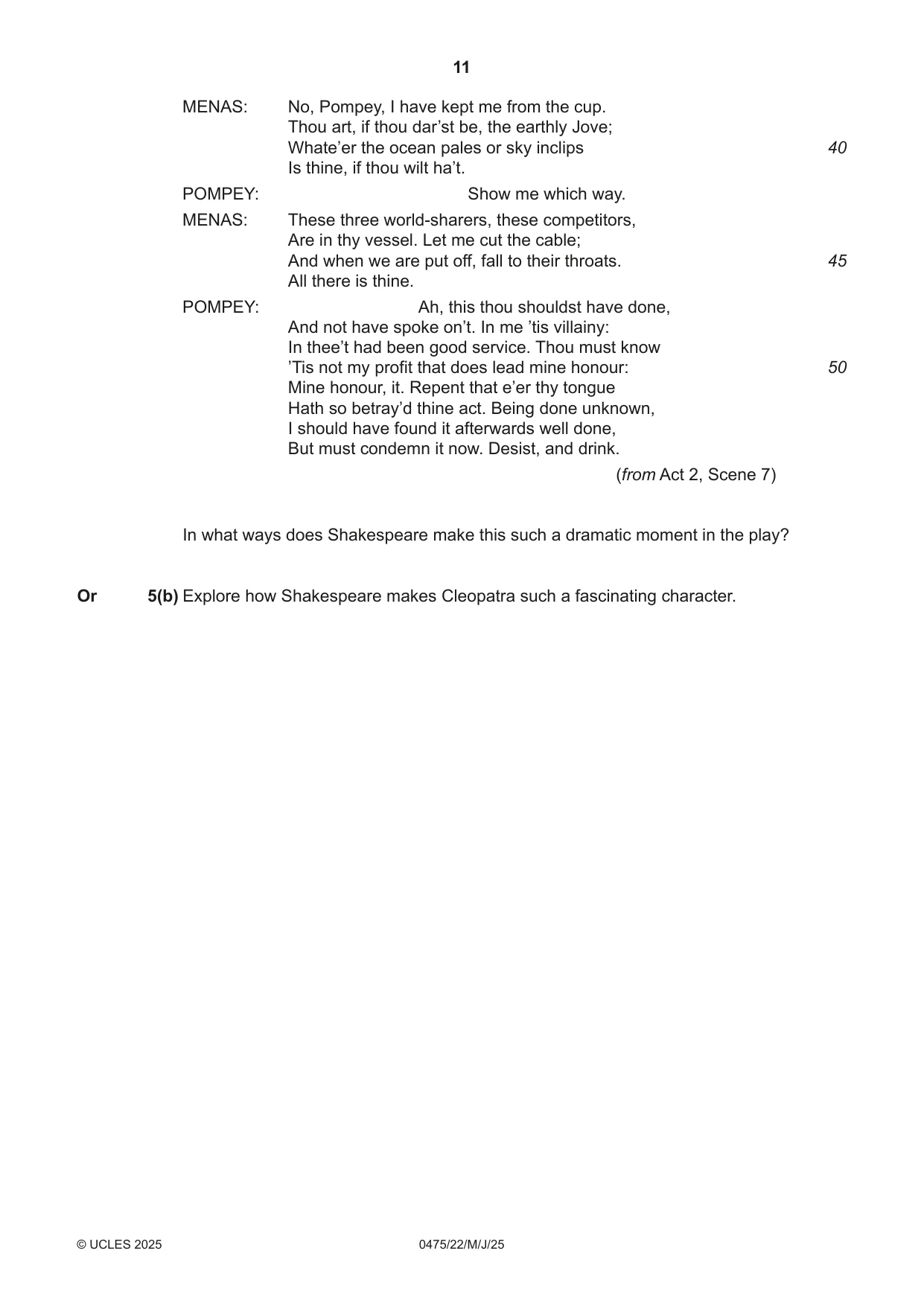
11 0475/22/M/J/25 © UCLES 2025 MENAS: No, Pompey, I have kept me from the cup. Thou art, if thou dar’st be, the earthly Jove; Whate’er the ocean pales or sky inclips Is thine, if thou wilt ha’t. POMPEY: Show me which way. MENAS: These three world-sharers, these competitors, Are in thy vessel. Let me cut the cable; And when we are put off, fall to their throats. All there is thine. POMPEY: Ah, this thou shouldst have done, And not have spoke on’t. In me ’tis villainy: In thee’t had been good service. Thou must know ’Tis not my profit that does lead mine honour: Mine honour, it. Repent that e’er thy tongue Hath so betray’d thine act. Being done unknown, I should have found it afterwards well done, But must condemn it now. Desist, and drink. (from Act 2, Scene 7) In what ways does Shakespeare make this such a dramatic moment in the play? Or 5(b) Explore how Shakespeare makes Cleopatra such a fascinating character. 40 45 50
Question paper, page 12
12 0475/22/M/J/25 © UCLES 2025 Permission to reproduce items where third-party owned material protected by copyright is included has been sought and cleared where possible. Every reasonable effort has been made by the publisher (UCLES) to trace copyright holders, but if any items requiring clearance have unwittingly been included, the publisher will be pleased to make amends at the earliest possible opportunity. To avoid the issue of disclosure of answer-related information to candidates, all copyright acknowledgements are reproduced online in the Cambridge Assessment International Education Copyright Acknowledgements Booklet. This is produced for each series of examinations and is freely available to download at www.cambridgeinternational.org after the live examination series. Cambridge Assessment International Education is part of Cambridge Assessment. Cambridge Assessment is the brand name of the University of Cambridge Local Examinations Syndicate (UCLES), which is a department of the University of Cambridge. BLANK PAGE
Mark scheme, page 1
This document consists of 6 printed pages. © Cambridge University Press & Assessment 2025 [Turn over Cambridge IGCSE™ LITERATURE IN ENGLISH 0475/22 Paper 2 Drama May/June 2025 MARK SCHEME Maximum Mark: 50 Published This mark scheme is published as an aid to teachers and candidates, to indicate the requirements of the examination. It shows the basis on which Examiners were instructed to award marks. It does not indicate the details of the discussions that took place at an Examiners’ meeting before marking began, which would have considered the acceptability of alternative answers. Mark schemes should be read in conjunction with the question paper and the Principal Examiner Report for Teachers. Cambridge International will not enter into discussions about these mark schemes. Cambridge International is publishing the mark schemes for the May/June 2025 series for most Cambridge IGCSE, Cambridge International A and AS Level components, and some Cambridge O Level components.
Mark scheme, page 2
0475/22 Cambridge IGCSE – Mark Scheme PUBLISHED May/June 2025 © Cambridge University Press & Assessment 2025 Page 2 of 6 Generic Marking Principles These general marking principles must be applied by all examiners when marking candidate answers. They should be applied alongside the specific content of the mark scheme or generic level descriptions for a question. Each question paper and mark scheme will also comply with these marking principles. GENERIC MARKING PRINCIPLE 1: Marks must be awarded in line with: • the specific content of the mark scheme or the generic level descriptors for the question • the specific skills defined in the mark scheme or in the generic level descriptors for the question • the standard of response required by a candidate as exemplified by the standardisation scripts. GENERIC MARKING PRINCIPLE 2: Marks awarded are always whole marks (not half marks, or other fractions). GENERIC MARKING PRINCIPLE 3: Marks must be awarded positively: • marks are awarded for correct/valid answers, as defined in the mark scheme. However, credit is given for valid answers which go beyond the scope of the syllabus and mark scheme, referring to your Team Leader as appropriate • marks are awarded when candidates clearly demonstrate what they know and can do • marks are not deducted for errors • marks are not deducted for omissions • answers should only be judged on the quality of spelling, punctuation and grammar when these features are specifically assessed by the question as indicated by the mark scheme. The meaning, however, should be unambiguous. GENERIC MARKING PRINCIPLE 4: Rules must be applied consistently, e.g. in situations where candidates have not followed instructions or in the application of generic level descriptors. GENERIC MARKING PRINCIPLE 5: Marks should be awarded using the full range of marks defined in the mark scheme for the question (however; the use of the full mark range may be limited according to the quality of the candidate responses seen). GENERIC MARKING PRINCIPLE 6: Marks awarded are based solely on the requirements as defined in the mark scheme. Marks should not be awarded with grade thresholds or grade descriptors in mind.
Mark scheme, page 3
0475/22 Cambridge IGCSE – Mark Scheme PUBLISHED May/June 2025 © Cambridge University Press & Assessment 2025 Page 3 of 6 English & Media subject specific general marking principles (To be read in conjunction with the Generic Marking Principles (and requiring further guidance on how to place marks within levels)) Components using level descriptors: • We use level descriptors as a guide to broad understanding of the qualities normally expected of, or typical of, work in a level. • Level descriptors are a means of general guidance and should not be interpreted as hurdle statements. • Where indicative content notes are supplied for a question, these are not a prescription of required content, and must not be treated as such. Alternative correct points and unexpected answers in candidates’ scripts must be given marks that fairly reflect the knowledge and skills demonstrated. • While we may have legitimate expectations as to the ground most answers may occupy, we must at all times be prepared to meet candidates on their chosen ground, provided it is relevant ground (e.g. clearly related to and derived from a relevant passage/text and meeting the mark scheme requirements for the question). Components using point-based marking: Point marking is often used to reward knowledge, understanding and application of skills. We give credit where the candidate’s answer shows relevant knowledge, understanding and application of skills in answering the question. We do not give credit where the answer shows confusion. From this it follows that we: a DO credit answers which are worded differently from the mark scheme if they clearly convey the same meaning (unless the mark scheme requires a specific term). b DO credit alternative answers/examples which are not written in the mark scheme if they are correct. c DO credit answers where candidates give more than one correct answer in one prompt/numbered/scaffolded space where extended writing is required rather than list-type answers. For example, questions that require n reasons (e.g. State two reasons…). d DO NOT credit answers simply for using a ‘key term’ unless that is all that is required. (Check for evidence it is understood and not used incorrectly.) e DO NOT credit answers which are obviously self-contradicting or trying to cover all possibilities. f DO NOT give further credit for what is effectively repetition of a correct point already credited unless the language itself is being tested. This applies equally to ‘mirror statements’ (i.e. polluted/not polluted). g DO NOT require spellings to be correct, unless this is part of the test. However, spellings of syllabus terms must allow for clear and unambiguous separation from other syllabus terms with which they may be confused (e.g. Corrasion/Corrosion).
Mark scheme, page 4
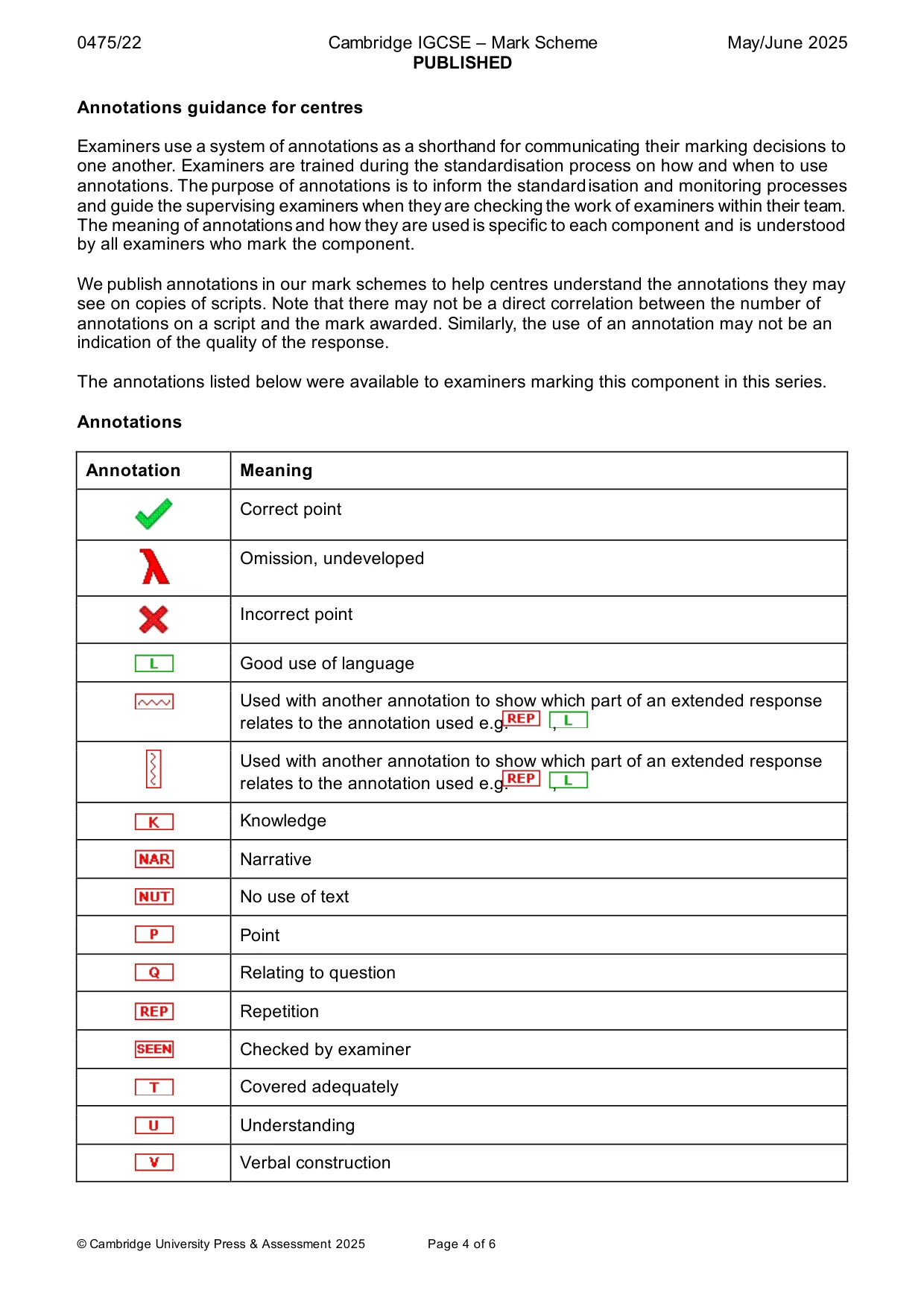
0475/22 Cambridge IGCSE – Mark Scheme PUBLISHED May/June 2025 © Cambridge University Press & Assessment 2025 Page 4 of 6 Annotations guidance for centres Examiners use a system of annotations as a shorthand for communicating their marking decisions to one another. Examiners are trained during the standardisation process on how and when to use annotations. The purpose of annotations is to inform the standardisation and monitoring processes and guide the supervising examiners when they are checking the work of examiners within their team. The meaning of annotations and how they are used is specific to each component and is understood by all examiners who mark the component. We publish annotations in our mark schemes to help centres understand the annotations they may see on copies of scripts. Note that there may not be a direct correlation between the number of annotations on a script and the mark awarded. Similarly, the use of an annotation may not be an indication of the quality of the response. The annotations listed below were available to examiners marking this component in this series. Annotations Annotation Meaning Correct point Omission, undeveloped Incorrect point Good use of language Used with another annotation to show which part of an extended response relates to the annotation used e.g. , Used with another annotation to show which part of an extended response relates to the annotation used e.g. , Knowledge Narrative No use of text Point Relating to question Repetition Checked by examiner Covered adequately Understanding Verbal construction
Mark scheme, page 5
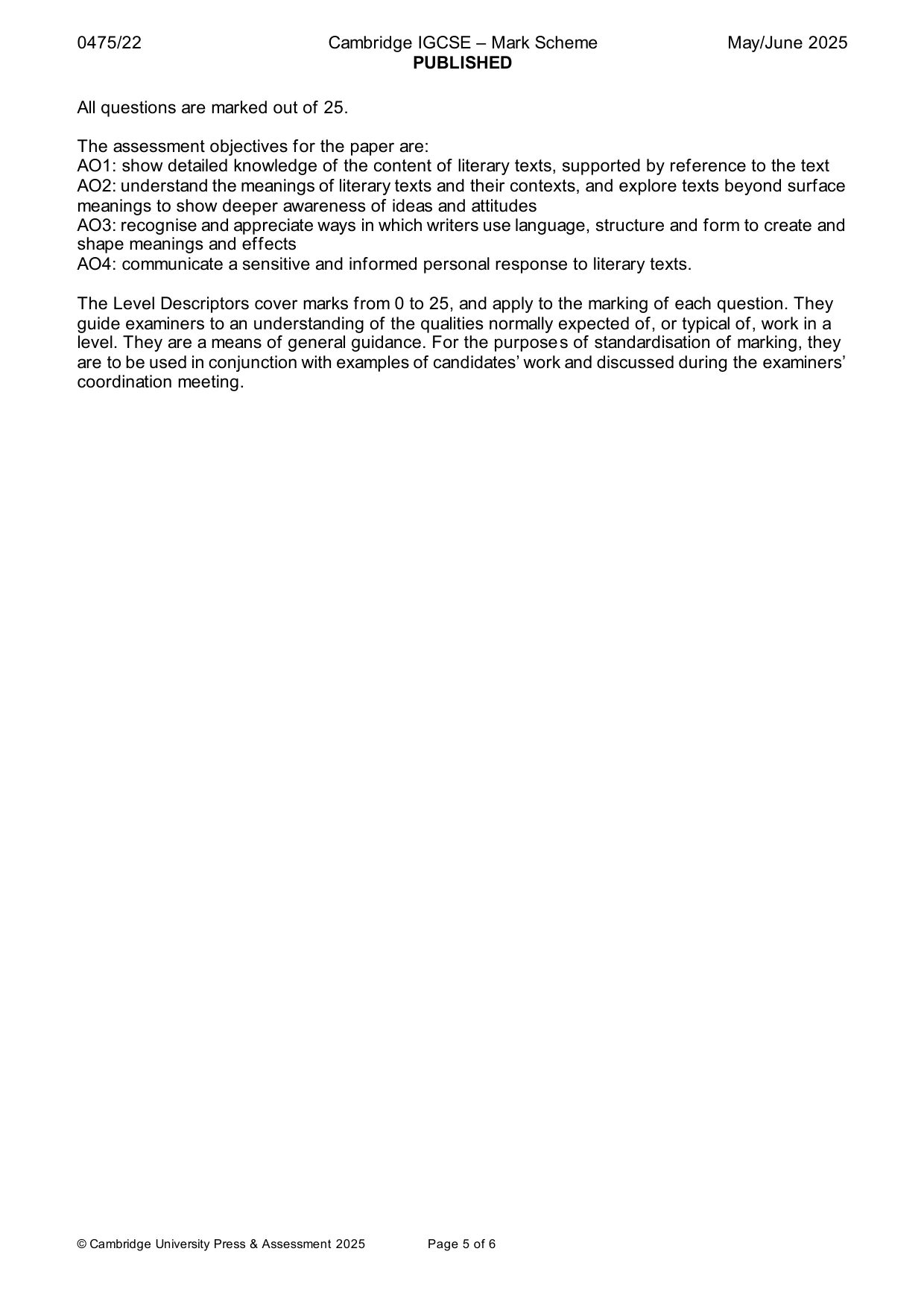
0475/22 Cambridge IGCSE – Mark Scheme PUBLISHED May/June 2025 © Cambridge University Press & Assessment 2025 Page 5 of 6 All questions are marked out of 25. The assessment objectives for the paper are: AO1: show detailed knowledge of the content of literary texts, supported by reference to the text AO2: understand the meanings of literary texts and their contexts, and explore texts beyond surface meanings to show deeper awareness of ideas and attitudes AO3: recognise and appreciate ways in which writers use language, structure and form to create and shape meanings and effects AO4: communicate a sensitive and informed personal response to literary texts. The Level Descriptors cover marks from 0 to 25, and apply to the marking of each question. They guide examiners to an understanding of the qualities normally expected of, or typical of, work in a level. They are a means of general guidance. For the purposes of standardisation of marking, they are to be used in conjunction with examples of candidates’ work and discussed during the examiners’ coordination meeting.
Mark scheme, page 6
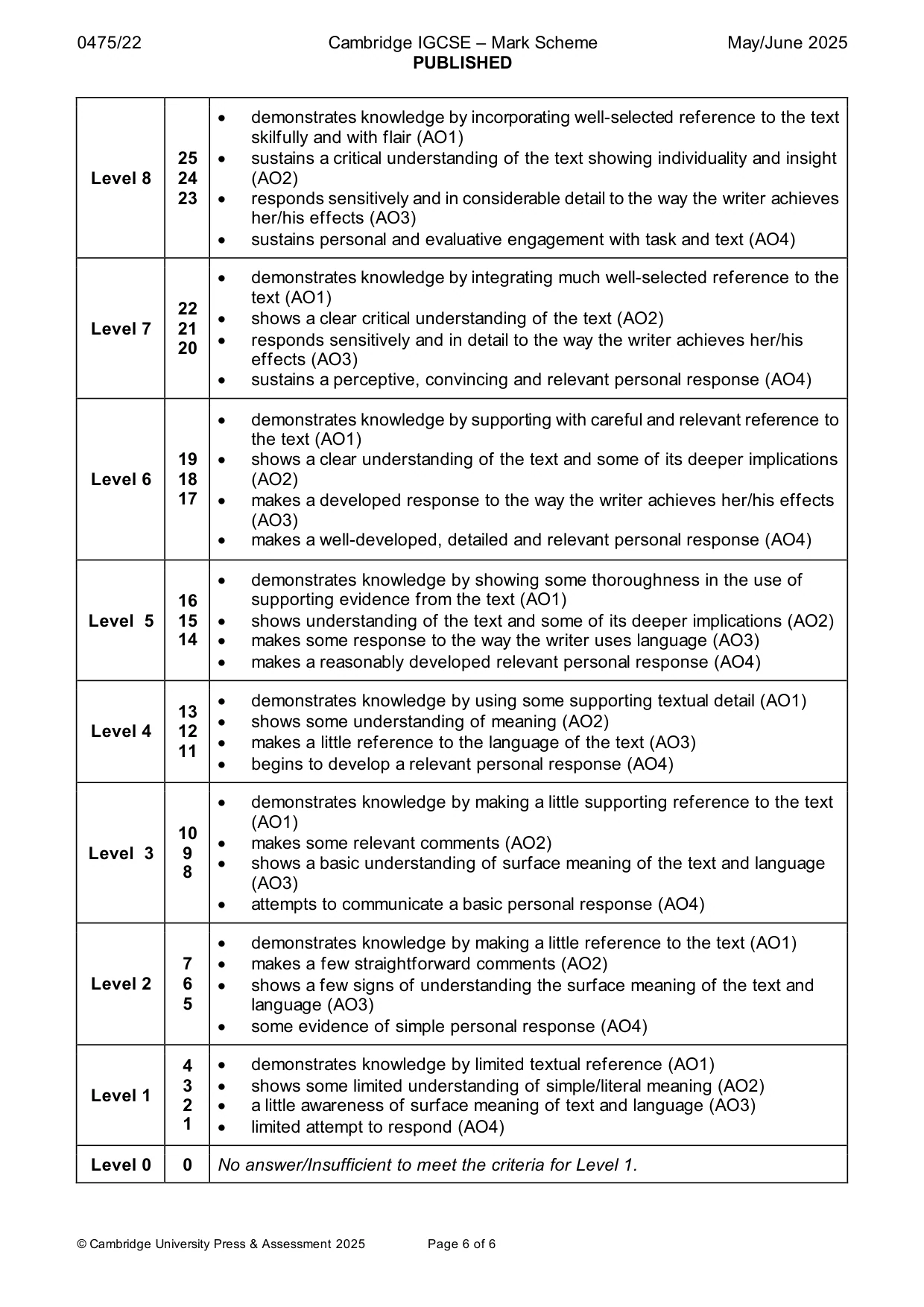
0475/22 Cambridge IGCSE – Mark Scheme PUBLISHED May/June 2025 © Cambridge University Press & Assessment 2025 Page 6 of 6 Level 8 25 24 23 • demonstrates knowledge by incorporating well-selected reference to the text skilfully and with flair (AO1) • sustains a critical understanding of the text showing individuality and insight (AO2) • responds sensitively and in considerable detail to the way the writer achieves her/his effects (AO3) • sustains personal and evaluative engagement with task and text (AO4) Level 7 22 21 20 • demonstrates knowledge by integrating much well-selected reference to the text (AO1) • shows a clear critical understanding of the text (AO2) • responds sensitively and in detail to the way the writer achieves her/his effects (AO3) • sustains a perceptive, convincing and relevant personal response (AO4) Level 6 19 18 17 • demonstrates knowledge by supporting with careful and relevant reference to the text (AO1) • shows a clear understanding of the text and some of its deeper implications (AO2) • makes a developed response to the way the writer achieves her/his effects (AO3) • makes a well-developed, detailed and relevant personal response (AO4) Level 5 16 15 14 • demonstrates knowledge by showing some thoroughness in the use of supporting evidence from the text (AO1) • shows understanding of the text and some of its deeper implications (AO2) • makes some response to the way the writer uses language (AO3) • makes a reasonably developed relevant personal response (AO4) Level 4 13 12 11 • demonstrates knowledge by using some supporting textual detail (AO1) • shows some understanding of meaning (AO2) • makes a little reference to the language of the text (AO3) • begins to develop a relevant personal response (AO4) Level 3 10 9 8 • demonstrates knowledge by making a little supporting reference to the text (AO1) • makes some relevant comments (AO2) • shows a basic understanding of surface meaning of the text and language (AO3) • attempts to communicate a basic personal response (AO4) Level 2 7 6 5 • demonstrates knowledge by making a little reference to the text (AO1) • makes a few straightforward comments (AO2) • shows a few signs of understanding the surface meaning of the text and language (AO3) • some evidence of simple personal response (AO4) Level 1 4 3 2 1 • demonstrates knowledge by limited textual reference (AO1) • shows some limited understanding of simple/literal meaning (AO2) • a little awareness of surface meaning of text and language (AO3) • limited attempt to respond (AO4) Level 0 0 No answer/Insufficient to meet the criteria for Level 1.
What you needed in this session
Cambridge’s own grade thresholds for 2025 May/June, Paper 2 · Variant 2. A higher threshold means an easier paper — the bar moves with how the cohort did.