Cambridge IGCSE English - Literature in English 0475 — 2023 Feb/March Paper 2 · Variant 2
0475/22/F/M/23 · 50 marks · ≈56 min
The question paper and its mark scheme, free to read here and free to download. This is Cambridge’s own paper, exactly as it was sat.
Question paper12 pages

Mark scheme4 pages
Answers below. Sit the paper first if you are practising.
Paper as text
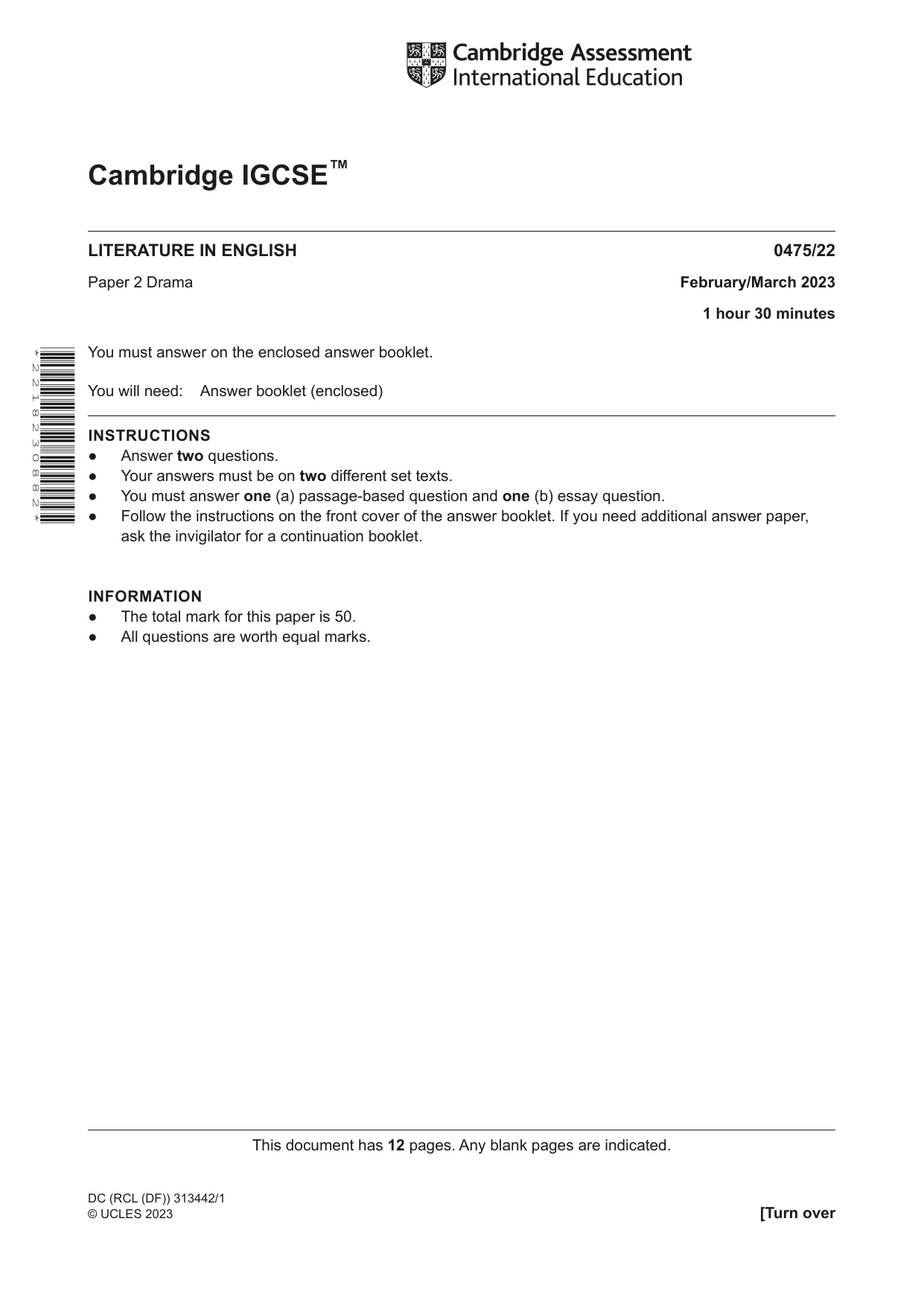
Question paper, page 1
This document has 12 pages. Any blank pages are indicated. [Turn over Cambridge IGCSE™ * 2 2 1 8 2 3 0 8 8 2 * DC (RCL (DF)) 313442/1 © UCLES 2023 LITERATURE IN ENGLISH 0475/22 Paper 2 Drama February/March 2023 1 hour 30 minutes You must answer on the enclosed answer booklet. You will need: Answer booklet (enclosed) INSTRUCTIONS ● Answer two questions. ● Your answers must be on two different set texts. ● You must answer one (a) passage-based question and one (b) essay question. ● Follow the instructions on the front cover of the answer booklet. If you need additional answer paper, ask the invigilator for a continuation booklet. INFORMATION ● The total mark for this paper is 50. ● All questions are worth equal marks.
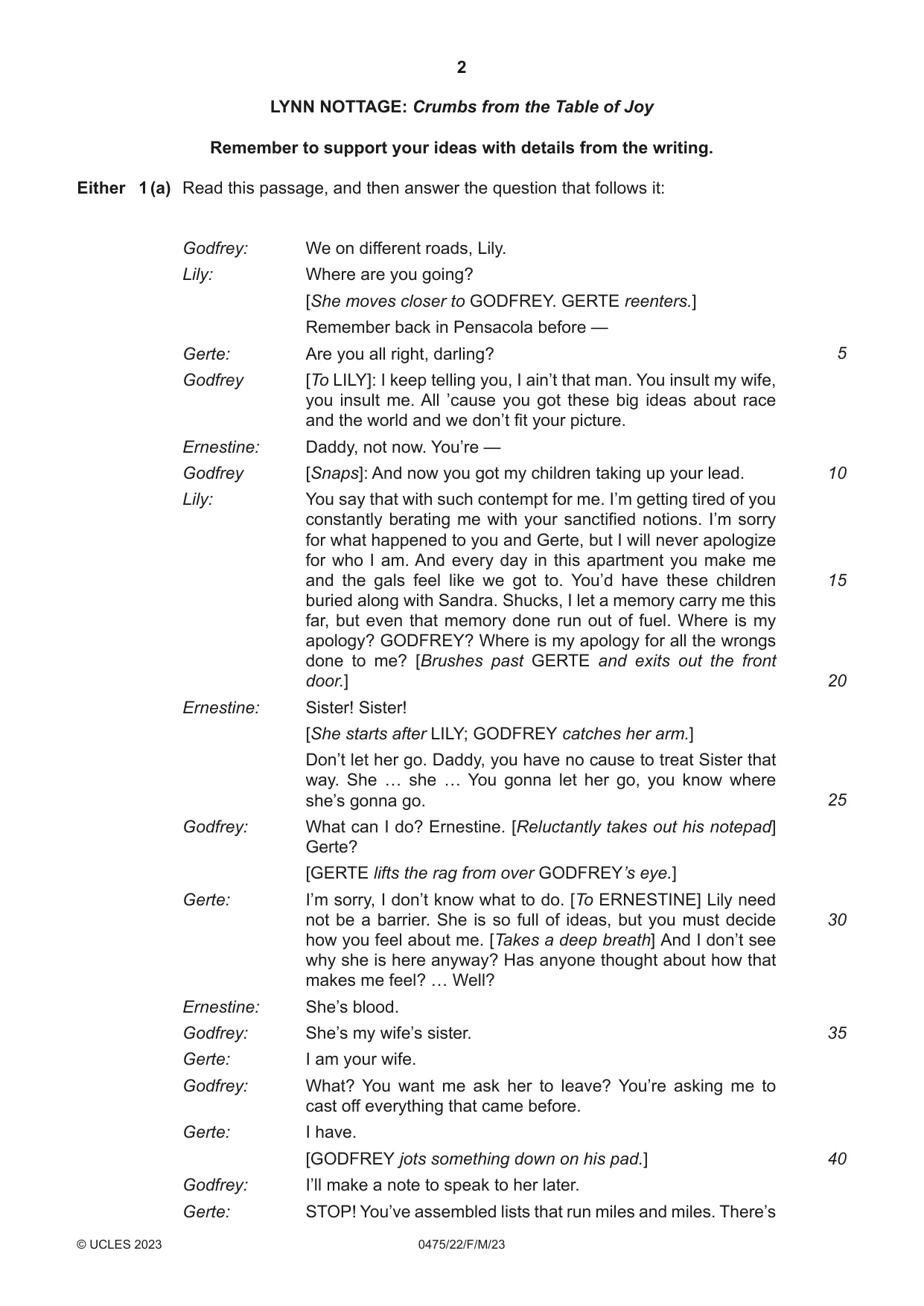
Question paper, page 2
2 0475/22/F/M/23 © UCLES 2023 LYNN NOTTAGE: Crumbs from the Table of Joy Remember to support your ideas with details from the writing. Either 1 (a) Read this passage, and then answer the question that follows it: Godfrey: We on different roads, Lily. Lily: Where are you going? [She moves closer to GODFREY. GERTE reenters.] Remember back in Pensacola before — Gerte: Are you all right, darling? Godfrey [To LILY]: I keep telling you, I ain’t that man. You insult my wife, you insult me. All ’cause you got these big ideas about race and the world and we don’t fit your picture. Ernestine: Daddy, not now. You’re — Godfrey [Snaps]: And now you got my children taking up your lead. Lily: You say that with such contempt for me. I’m getting tired of you constantly berating me with your sanctified notions. I’m sorry for what happened to you and Gerte, but I will never apologize for who I am. And every day in this apartment you make me and the gals feel like we got to. You’d have these children buried along with Sandra. Shucks, I let a memory carry me this far, but even that memory done run out of fuel. Where is my apology? GODFREY? Where is my apology for all the wrongs done to me? [Brushes past GERTE and exits out the front door.] Ernestine: Sister! Sister! [She starts after LILY; GODFREY catches her arm.] Don’t let her go. Daddy, you have no cause to treat Sister that way. She … she … You gonna let her go, you know where she’s gonna go. Godfrey: What can I do? Ernestine. [Reluctantly takes out his notepad] Gerte? [GERTE lifts the rag from over GODFREY’s eye.] Gerte: I’m sorry, I don’t know what to do. [To ERNESTINE] Lily need not be a barrier. She is so full of ideas, but you must decide how you feel about me. [Takes a deep breath] And I don’t see why she is here anyway? Has anyone thought about how that makes me feel? … Well? Ernestine: She’s blood. Godfrey: She’s my wife’s sister. Gerte: I am your wife. Godfrey: What? You want me ask her to leave? You’re asking me to cast off everything that came before. Gerte: I have. [GODFREY jots something down on his pad.] Godfrey: I’ll make a note to speak to her later. Gerte: STOP! You’ve assembled lists that run miles and miles. There’s 5 10 15 20 25 30 35 40
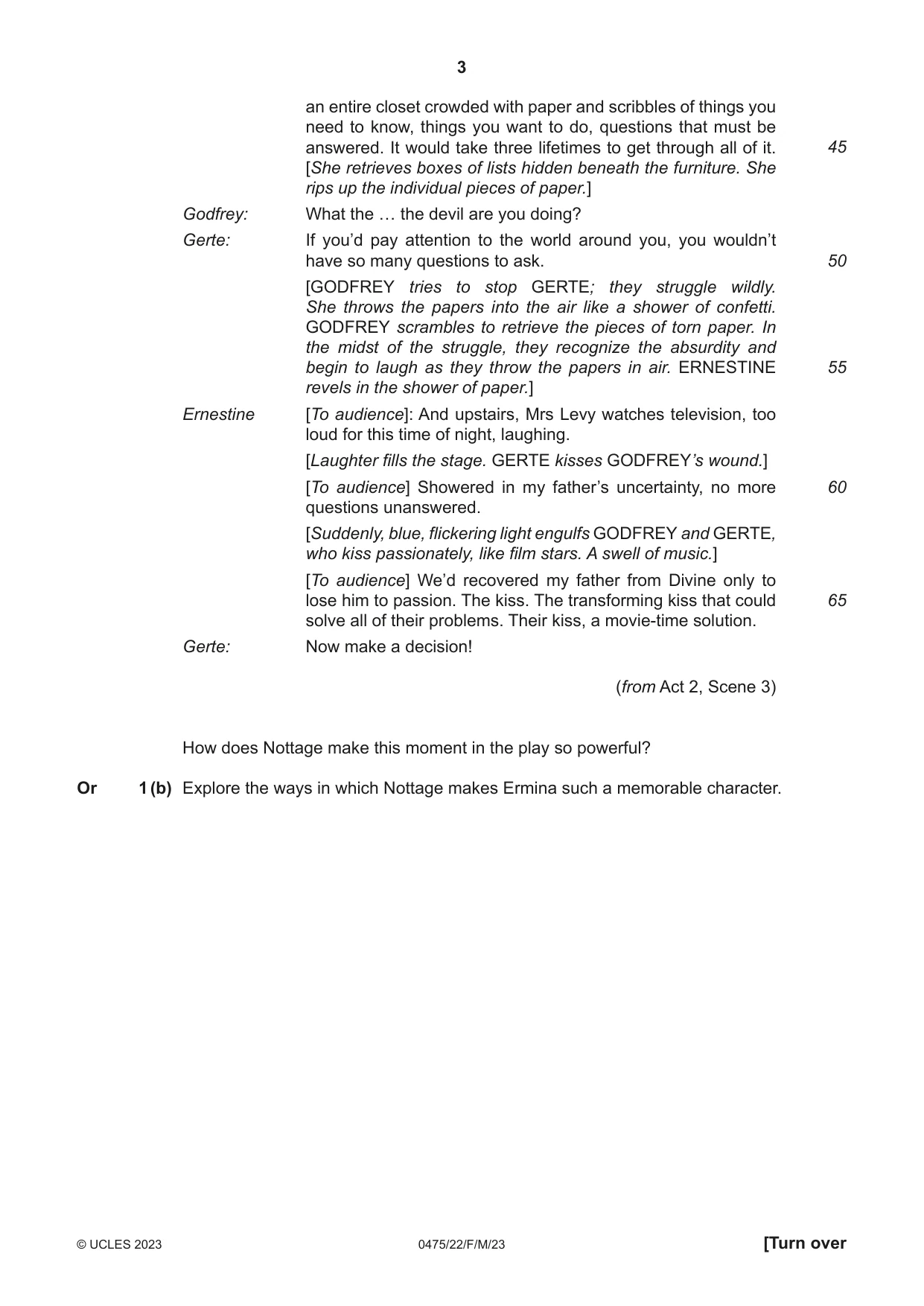
Question paper, page 3
3 0475/22/F/M/23 © UCLES 2023 [Turn over an entire closet crowded with paper and scribbles of things you need to know, things you want to do, questions that must be answered. It would take three lifetimes to get through all of it. [She retrieves boxes of lists hidden beneath the furniture. She rips up the individual pieces of paper.] Godfrey: What the … the devil are you doing? Gerte: If you’d pay attention to the world around you, you wouldn’t have so many questions to ask. [GODFREY tries to stop GERTE; they struggle wildly. She throws the papers into the air like a shower of confetti. GODFREY scrambles to retrieve the pieces of torn paper. In the midst of the struggle, they recognize the absurdity and begin to laugh as they throw the papers in air. ERNESTINE revels in the shower of paper.] Ernestine [To audience]: And upstairs, Mrs Levy watches television, too loud for this time of night, laughing. [Laughter fills the stage. GERTE kisses GODFREY’s wound.] [To audience] Showered in my father’s uncertainty, no more questions unanswered. [Suddenly, blue, flickering light engulfs GODFREY and GERTE, who kiss passionately, like film stars. A swell of music.] [To audience] We’d recovered my father from Divine only to lose him to passion. The kiss. The transforming kiss that could solve all of their problems. Their kiss, a movie-time solution. Gerte: Now make a decision! (from Act 2, Scene 3) How does Nottage make this moment in the play so powerful? Or 1 (b) Explore the ways in which Nottage makes Ermina such a memorable character. 45 50 55 60 65
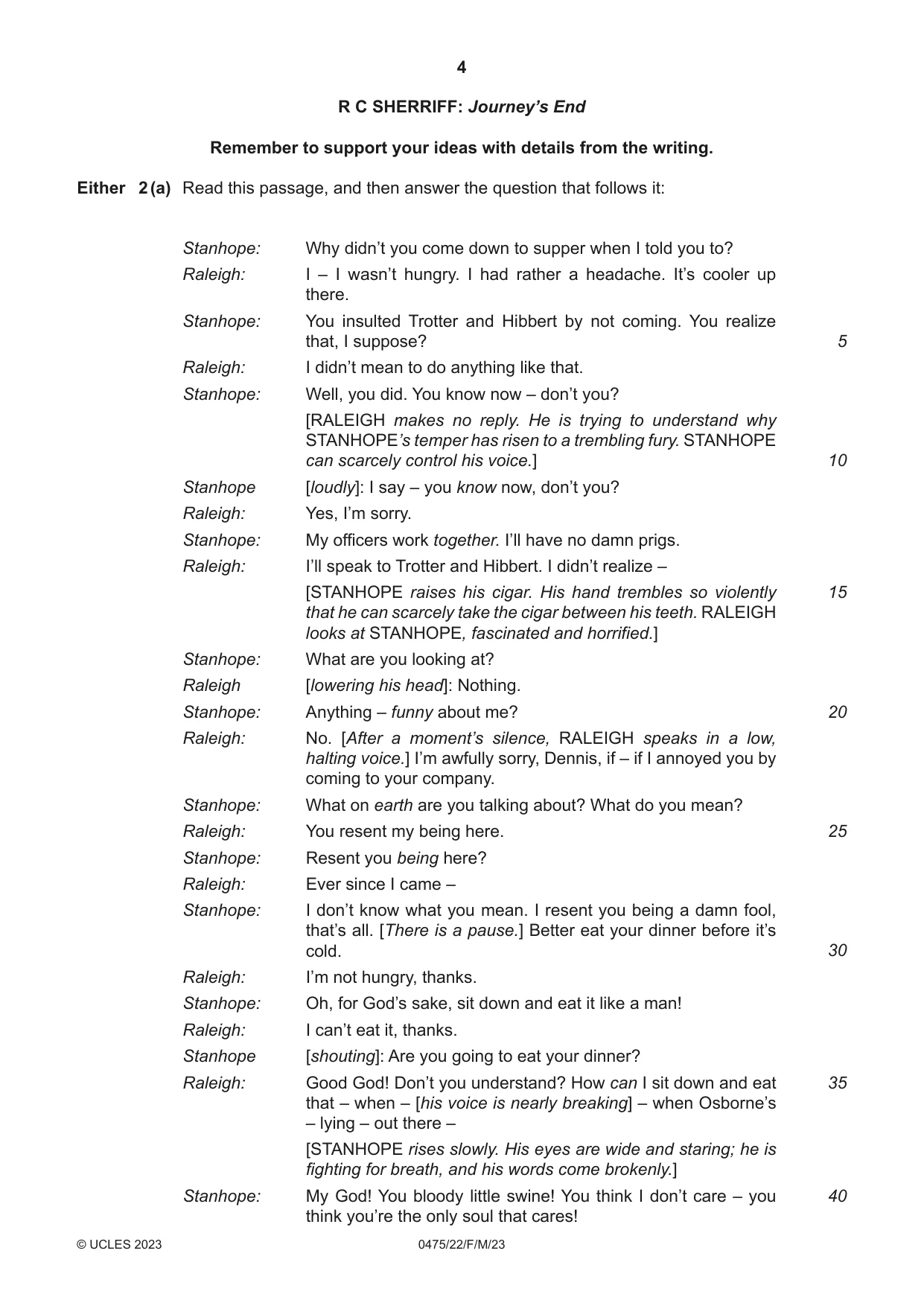
Question paper, page 4
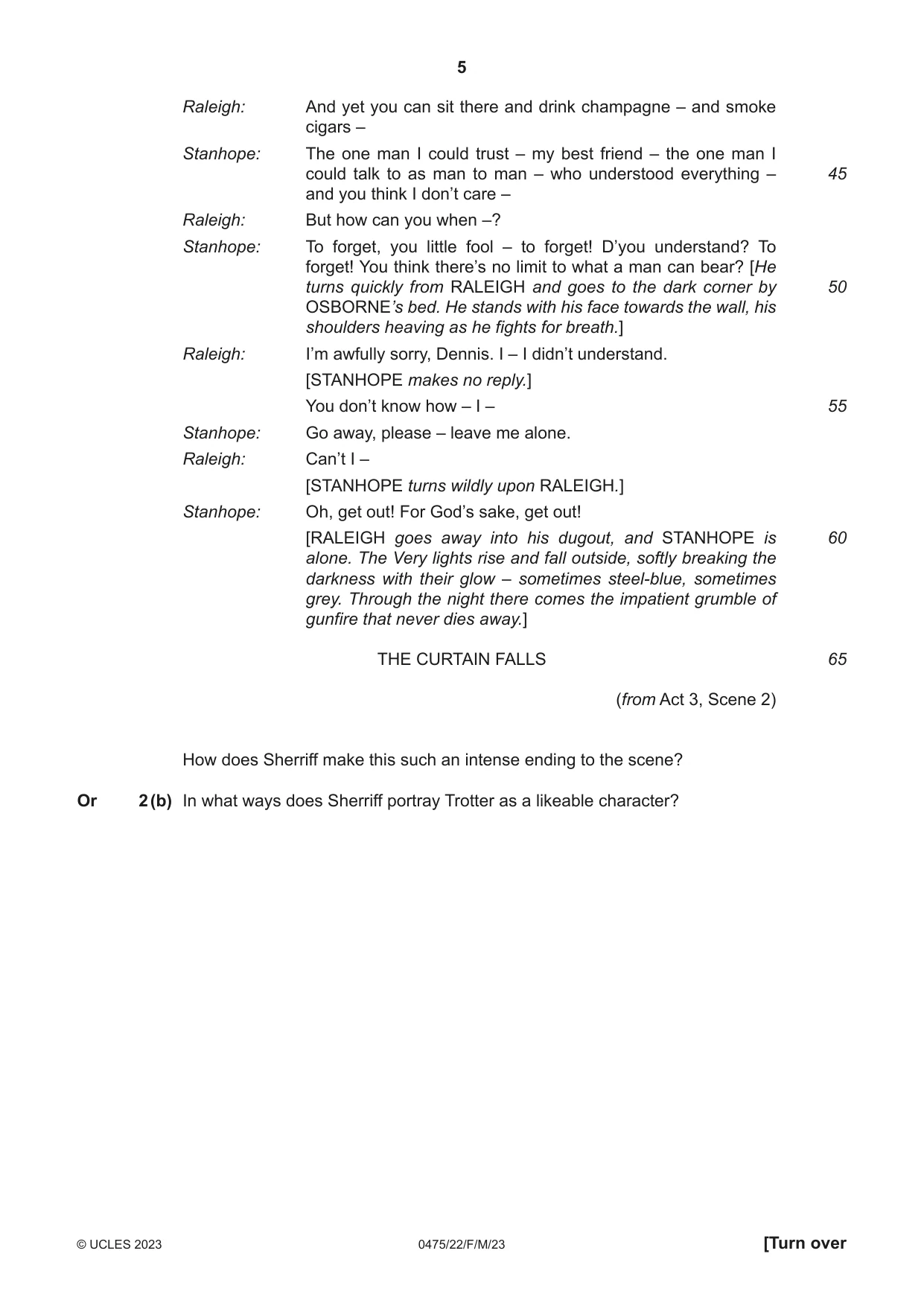
4 0475/22/F/M/23 © UCLES 2023 R C SHERRIFF: Journey’s End Remember to support your ideas with details from the writing. Either 2 (a) Read this passage, and then answer the question that follows it: Stanhope: Why didn’t you come down to supper when I told you to? Raleigh: I – I wasn’t hungry. I had rather a headache. It’s cooler up there. Stanhope: You insulted Trotter and Hibbert by not coming. You realize that, I suppose? Raleigh: I didn’t mean to do anything like that. Stanhope: Well, you did. You know now – don’t you? [RALEIGH makes no reply. He is trying to understand why STANHOPE’s temper has risen to a trembling fury. STANHOPE can scarcely control his voice.] Stanhope [loudly]: I say – you know now, don’t you? Raleigh: Yes, I’m sorry. Stanhope: My officers work together. I’ll have no damn prigs. Raleigh: I’ll speak to Trotter and Hibbert. I didn’t realize – [STANHOPE raises his cigar. His hand trembles so violently that he can scarcely take the cigar between his teeth. RALEIGH looks at STANHOPE, fascinated and horrified.] Stanhope: What are you looking at? Raleigh [lowering his head]: Nothing. Stanhope: Anything – funny about me? Raleigh: No. [After a moment’s silence, RALEIGH speaks in a low, halting voice.] I’m awfully sorry, Dennis, if – if I annoyed you by coming to your company. Stanhope: What on earth are you talking about? What do you mean? Raleigh: You resent my being here. Stanhope: Resent you being here? Raleigh: Ever since I came – Stanhope: I don’t know what you mean. I resent you being a damn fool, that’s all. [There is a pause.] Better eat your dinner before it’s cold. Raleigh: I’m not hungry, thanks. Stanhope: Oh, for God’s sake, sit down and eat it like a man! Raleigh: I can’t eat it, thanks. Stanhope [shouting]: Are you going to eat your dinner? Raleigh: Good God! Don’t you understand? How can I sit down and eat that – when – [his voice is nearly breaking] – when Osborne’s – lying – out there – [STANHOPE rises slowly. His eyes are wide and staring; he is fighting for breath, and his words come brokenly.] Stanhope: My God! You bloody little swine! You think I don’t care – you think you’re the only soul that cares! 5 10 15 20 25 30 35 40
Question paper, page 5
5 0475/22/F/M/23 © UCLES 2023 [Turn over Raleigh: And yet you can sit there and drink champagne – and smoke cigars – Stanhope: The one man I could trust – my best friend – the one man I could talk to as man to man – who understood everything – and you think I don’t care – Raleigh: But how can you when –? Stanhope: To forget, you little fool – to forget! D’you understand? To forget! You think there’s no limit to what a man can bear? [He turns quickly from RALEIGH and goes to the dark corner by OSBORNE’s bed. He stands with his face towards the wall, his shoulders heaving as he fights for breath.] Raleigh: I’m awfully sorry, Dennis. I – I didn’t understand. [STANHOPE makes no reply.] You don’t know how – I – Stanhope: Go away, please – leave me alone. Raleigh: Can’t I – [STANHOPE turns wildly upon RALEIGH.] Stanhope: Oh, get out! For God’s sake, get out! [RALEIGH goes away into his dugout, and STANHOPE is alone. The Very lights rise and fall outside, softly breaking the darkness with their glow – sometimes steel-blue, sometimes grey. Through the night there comes the impatient grumble of gunfire that never dies away.] THE CURTAIN FALLS (from Act 3, Scene 2) How does Sherriff make this such an intense ending to the scene? Or 2 (b) In what ways does Sherriff portray Trotter as a likeable character? 45 50 55 60 65
Question paper, page 6
6 0475/22/F/M/23 © UCLES 2023 WOLE SOYINKA: Death and the King’s Horseman Remember to support your ideas with details from the writing. Either 3 (a) Read this passage, and then answer the question that follows it: Resident: Make your report man. Content removed due to copyright restrictions.
Question paper, page 7
0475/22/F/M/23 © UCLES 2023 [Turn over Poor Simon … (from Scene 4) How does Soyinka make this such a revealing moment in the play? Or 3 (b) In what ways does Soyinka make Elesin’s enjoyment of life so dramatically compelling? Content removed due to copyright restrictions.
Question paper, page 8
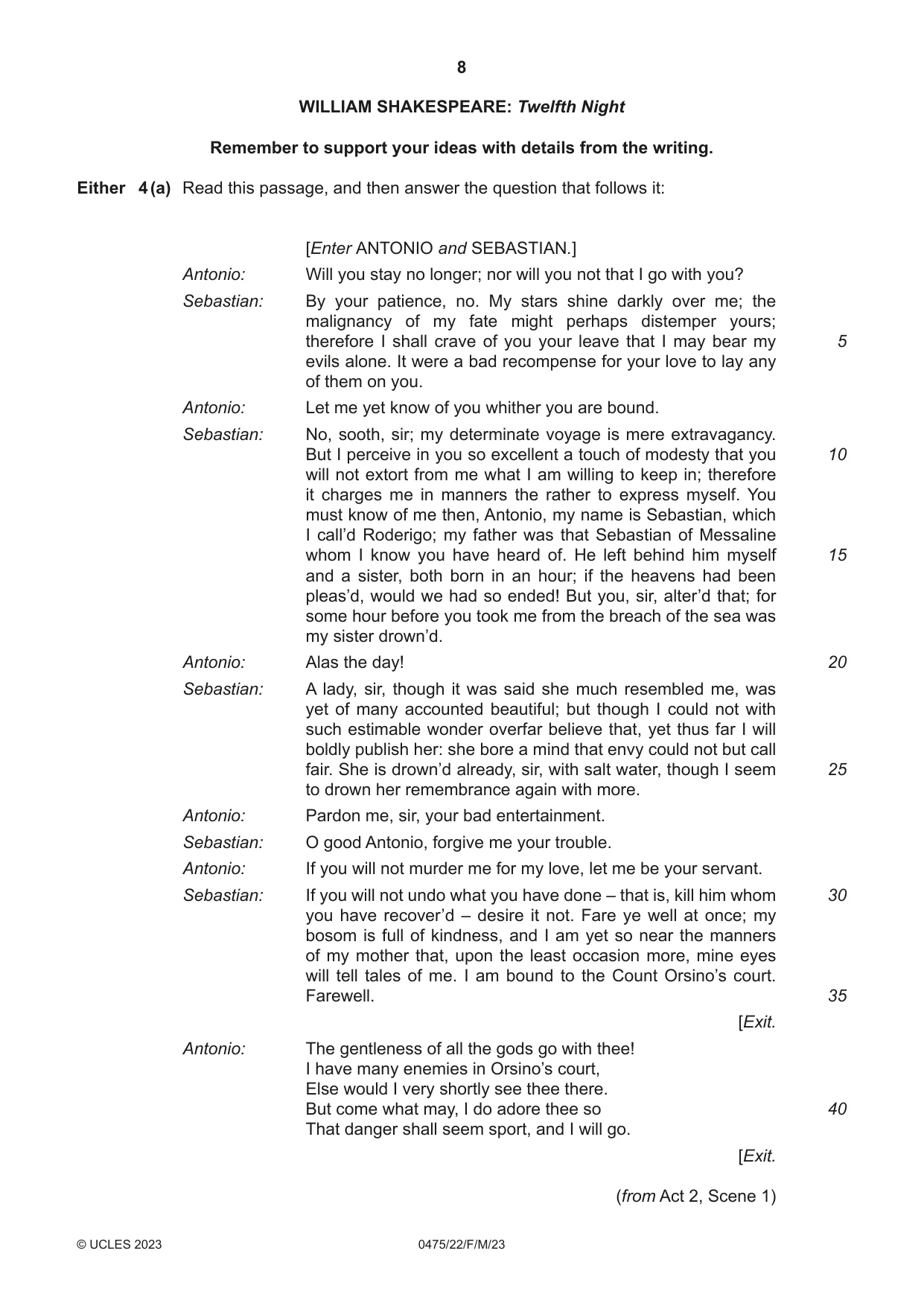
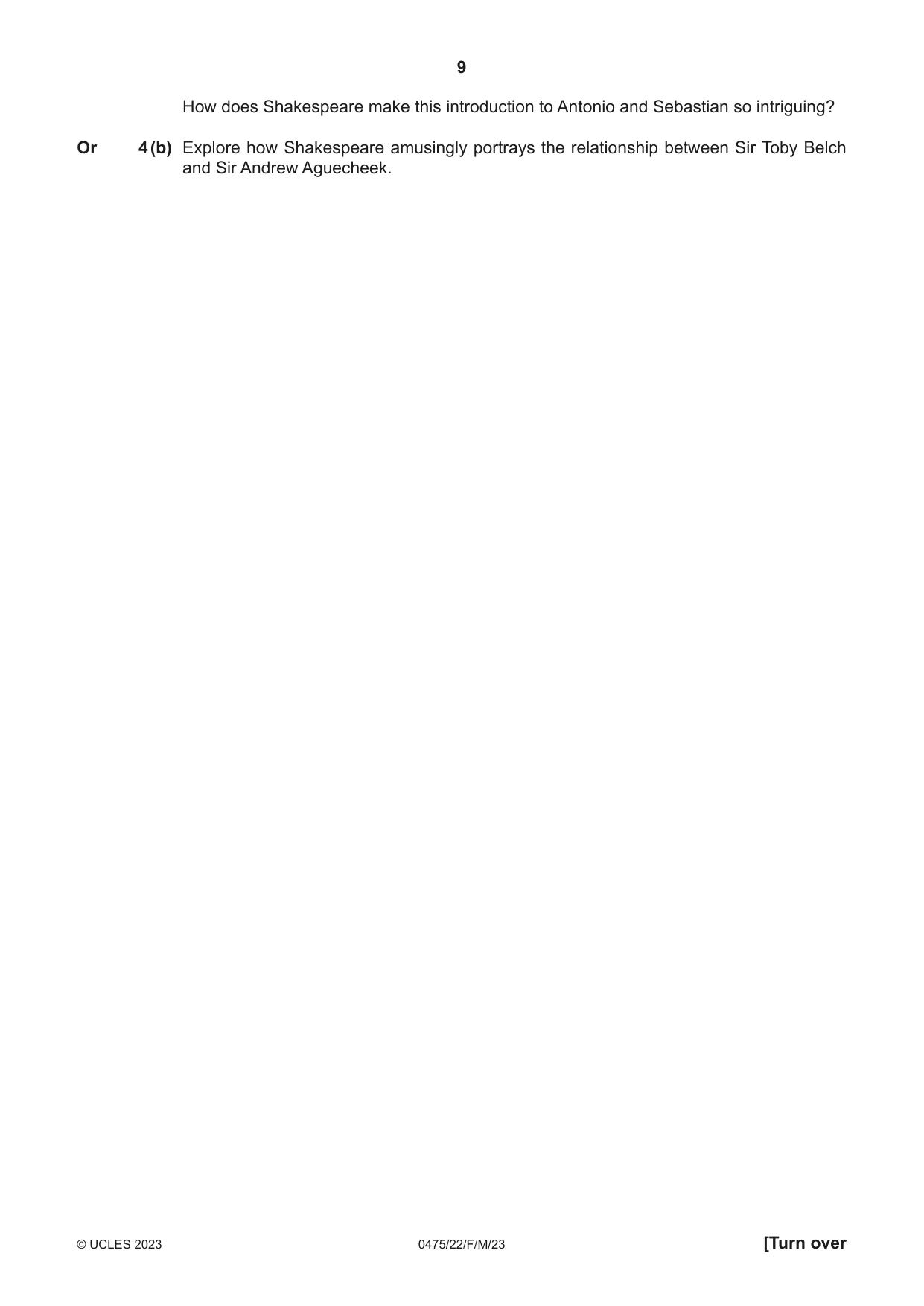
8 0475/22/F/M/23 © UCLES 2023 WILLIAM SHAKESPEARE: Twelfth Night Remember to support your ideas with details from the writing. Either 4 (a) Read this passage, and then answer the question that follows it: [Enter ANTONIO and SEBASTIAN.] Antonio: Will you stay no longer; nor will you not that I go with you? Sebastian: By your patience, no. My stars shine darkly over me; the malignancy of my fate might perhaps distemper yours; therefore I shall crave of you your leave that I may bear my evils alone. It were a bad recompense for your love to lay any of them on you. Antonio: Let me yet know of you whither you are bound. Sebastian: No, sooth, sir; my determinate voyage is mere extravagancy. But I perceive in you so excellent a touch of modesty that you will not extort from me what I am willing to keep in; therefore it charges me in manners the rather to express myself. You must know of me then, Antonio, my name is Sebastian, which I call’d Roderigo; my father was that Sebastian of Messaline whom I know you have heard of. He left behind him myself and a sister, both born in an hour; if the heavens had been pleas’d, would we had so ended! But you, sir, alter’d that; for some hour before you took me from the breach of the sea was my sister drown’d. Antonio: Alas the day! Sebastian: A lady, sir, though it was said she much resembled me, was yet of many accounted beautiful; but though I could not with such estimable wonder overfar believe that, yet thus far I will boldly publish her: she bore a mind that envy could not but call fair. She is drown’d already, sir, with salt water, though I seem to drown her remembrance again with more. Antonio: Pardon me, sir, your bad entertainment. Sebastian: O good Antonio, forgive me your trouble. Antonio: If you will not murder me for my love, let me be your servant. Sebastian: If you will not undo what you have done – that is, kill him whom you have recover’d – desire it not. Fare ye well at once; my bosom is full of kindness, and I am yet so near the manners of my mother that, upon the least occasion more, mine eyes will tell tales of me. I am bound to the Count Orsino’s court. Farewell. [Exit. Antonio: The gentleness of all the gods go with thee! I have many enemies in Orsino’s court, Else would I very shortly see thee there. But come what may, I do adore thee so That danger shall seem sport, and I will go. [Exit. (from Act 2, Scene 1) 5 10 15 20 25 30 35 40
Question paper, page 9
9 0475/22/F/M/23 © UCLES 2023 [Turn over How does Shakespeare make this introduction to Antonio and Sebastian so intriguing? Or 4 (b) Explore how Shakespeare amusingly portrays the relationship between Sir Toby Belch and Sir Andrew Aguecheek.
Question paper, page 10
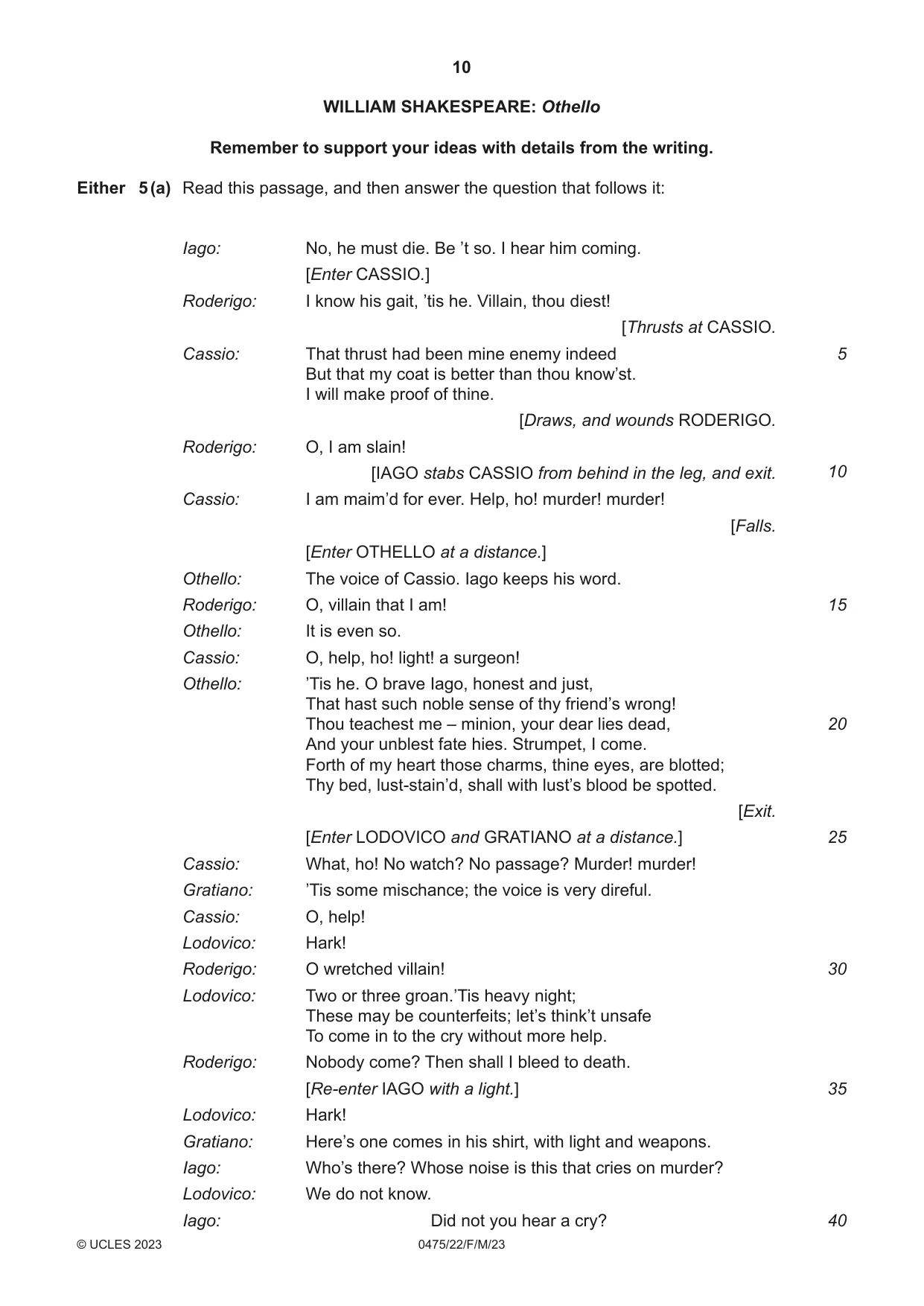
10 0475/22/F/M/23 © UCLES 2023 WILLIAM SHAKESPEARE: Othello Remember to support your ideas with details from the writing. Either 5 (a) Read this passage, and then answer the question that follows it: Iago: No, he must die. Be ’t so. I hear him coming. [Enter CASSIO.] Roderigo: I know his gait, ’tis he. Villain, thou diest! [Thrusts at CASSIO. Cassio: That thrust had been mine enemy indeed But that my coat is better than thou know’st. I will make proof of thine. [Draws, and wounds RODERIGO. Roderigo: O, I am slain! [IAGO stabs CASSIO from behind in the leg, and exit. Cassio: I am maim’d for ever. Help, ho! murder! murder! [Falls. [Enter OTHELLO at a distance.] Othello: The voice of Cassio. Iago keeps his word. Roderigo: O, villain that I am! Othello: It is even so. Cassio: O, help, ho! light! a surgeon! Othello: ’Tis he. O brave Iago, honest and just, That hast such noble sense of thy friend’s wrong! Thou teachest me – minion, your dear lies dead, And your unblest fate hies. Strumpet, I come. Forth of my heart those charms, thine eyes, are blotted; Thy bed, lust-stain’d, shall with lust’s blood be spotted. [Exit. [Enter LODOVICO and GRATIANO at a distance.] Cassio: What, ho! No watch? No passage? Murder! murder! Gratiano: ’Tis some mischance; the voice is very direful. Cassio: O, help! Lodovico: Hark! Roderigo: O wretched villain! Lodovico: Two or three groan.’Tis heavy night; These may be counterfeits; let’s think’t unsafe To come in to the cry without more help. Roderigo: Nobody come? Then shall I bleed to death. [Re-enter IAGO with a light.] Lodovico: Hark! Gratiano: Here’s one comes in his shirt, with light and weapons. Iago: Who’s there? Whose noise is this that cries on murder? Lodovico: We do not know. Iago: Did not you hear a cry? 5 10 15 20 25 30 35 40
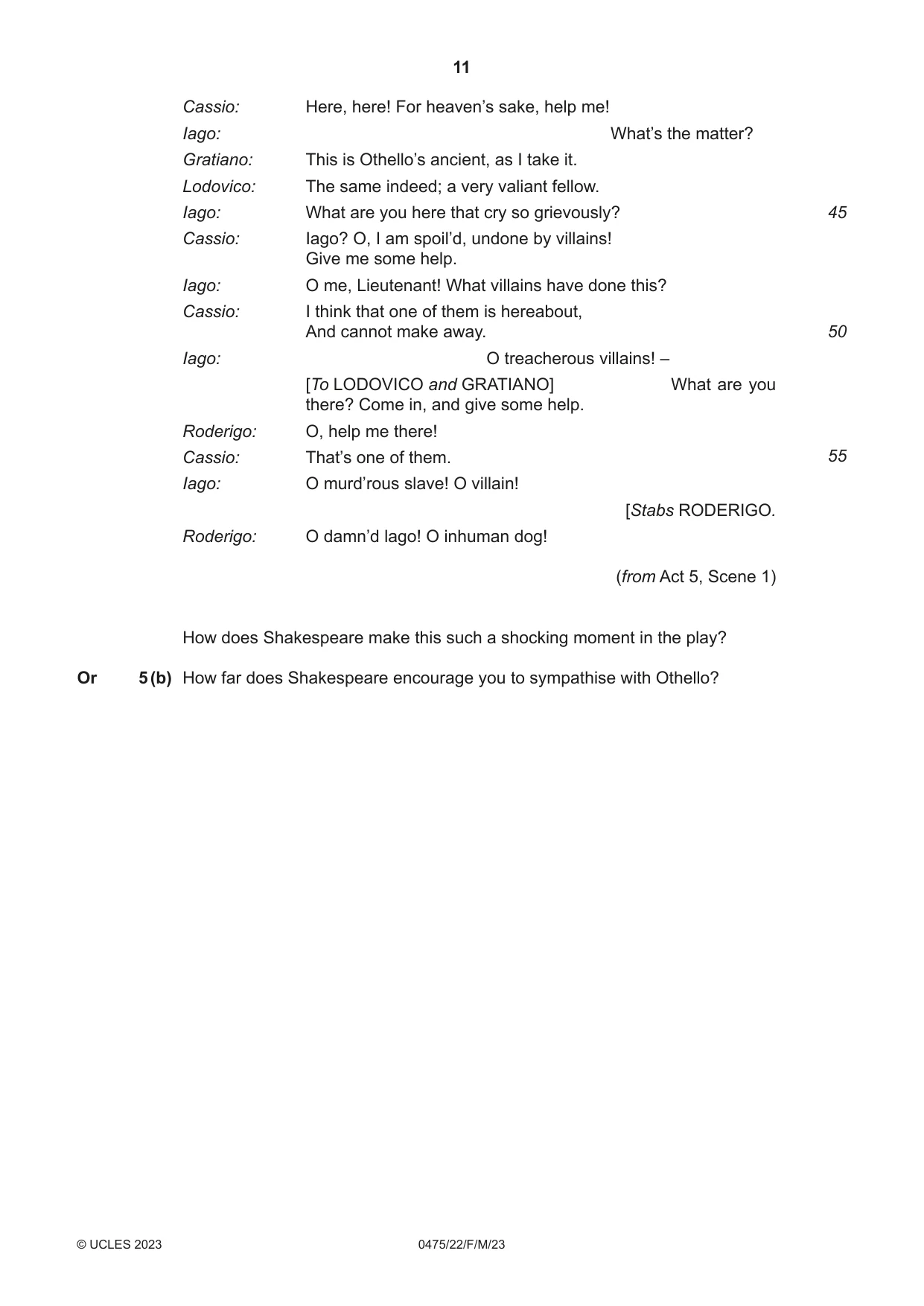
Question paper, page 11
11 0475/22/F/M/23 © UCLES 2023 Cassio: Here, here! For heaven’s sake, help me! Iago: What’s the matter? Gratiano: This is Othello’s ancient, as I take it. Lodovico: The same indeed; a very valiant fellow. Iago: What are you here that cry so grievously? Cassio: Iago? O, I am spoil’d, undone by villains! Give me some help. Iago: O me, Lieutenant! What villains have done this? Cassio: I think that one of them is hereabout, And cannot make away. Iago: O treacherous villains! – [To LODOVICO and GRATIANO] What are you there? Come in, and give some help. Roderigo: O, help me there! Cassio: That’s one of them. Iago: O murd’rous slave! O villain! [Stabs RODERIGO. Roderigo: O damn’d lago! O inhuman dog! (from Act 5, Scene 1) How does Shakespeare make this such a shocking moment in the play? Or 5 (b) How far does Shakespeare encourage you to sympathise with Othello? 45 50 55
Question paper, page 12
12 0475/22/F/M/23 © UCLES 2023 Permission to reproduce items where third-party owned material protected by copyright is included has been sought and cleared where possible. Every reasonable effort has been made by the publisher (UCLES) to trace copyright holders, but if any items requiring clearance have unwittingly been included, the publisher will be pleased to make amends at the earliest possible opportunity. To avoid the issue of disclosure of answer-related information to candidates, all copyright acknowledgements are reproduced online in the Cambridge Assessment International Education Copyright Acknowledgements Booklet. This is produced for each series of examinations and is freely available to download at www.cambridgeinternational.org after the live examination series. Cambridge Assessment International Education is part of Cambridge Assessment. Cambridge Assessment is the brand name of the University of Cambridge Local Examinations Syndicate (UCLES), which is a department of the University of Cambridge. BLANK PAGE
Mark scheme, page 1
This document consists of 4 printed pages. © UCLES 2023 [Turn over Cambridge IGCSE™ LITERATURE IN ENGLISH 0475/22 Paper 2 Drama February/March 2023 MARK SCHEME Maximum Mark: 50 Published This mark scheme is published as an aid to teachers and candidates, to indicate the requirements of the examination. It shows the basis on which Examiners were instructed to award marks. It does not indicate the details of the discussions that took place at an Examiners’ meeting before marking began, which would have considered the acceptability of alternative answers. Mark schemes should be read in conjunction with the question paper and the Principal Examiner Report for Teachers. Cambridge International will not enter into discussions about these mark schemes. Cambridge International is publishing the mark schemes for the February/March 2023 series for most Cambridge IGCSE™, Cambridge International A and AS Level components and some Cambridge O Level components.
Mark scheme, page 2
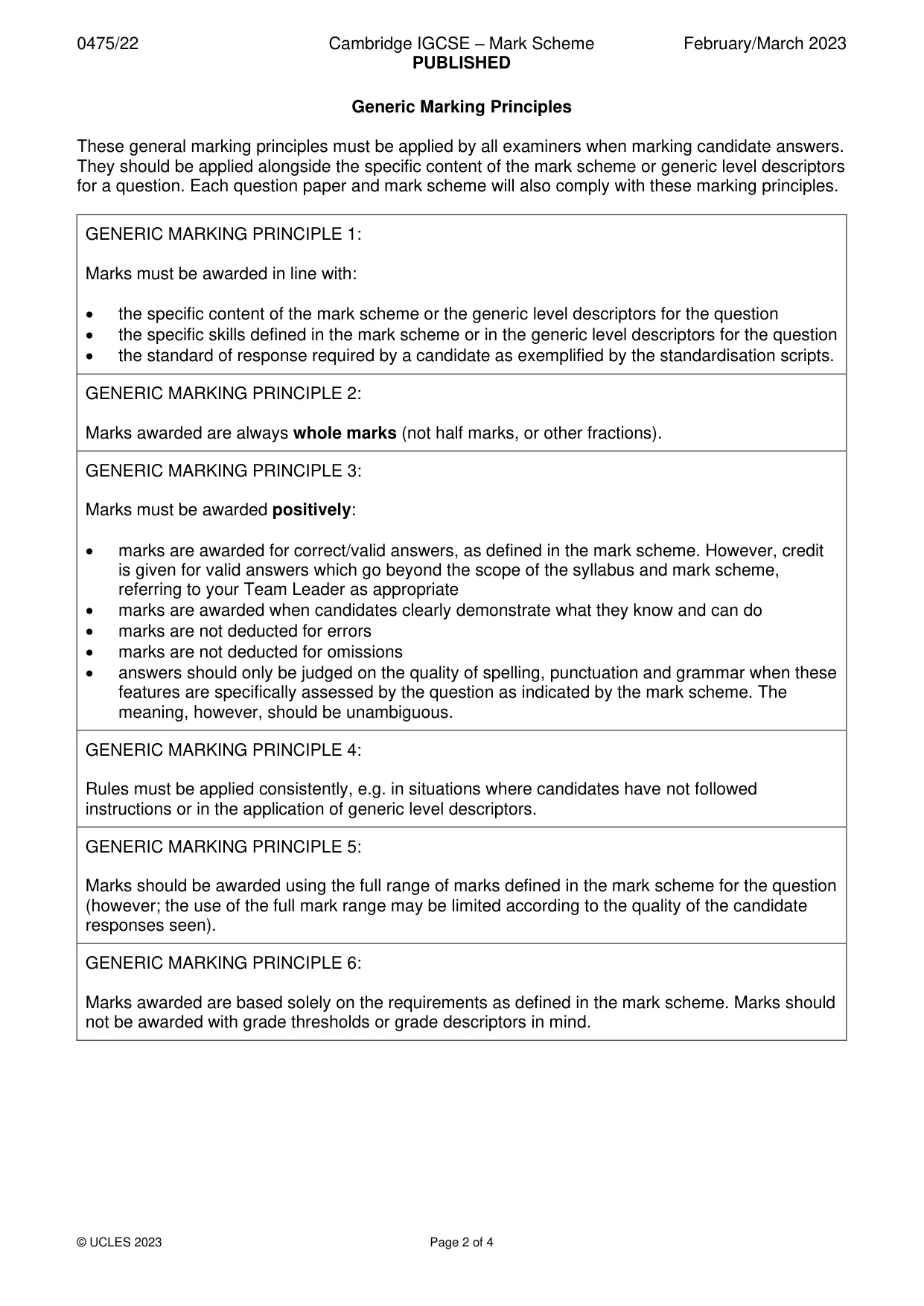
0475/22 Cambridge IGCSE – Mark Scheme PUBLISHED February/March 2023 © UCLES 2023 Page 2 of 4 Generic Marking Principles These general marking principles must be applied by all examiners when marking candidate answers. They should be applied alongside the specific content of the mark scheme or generic level descriptors for a question. Each question paper and mark scheme will also comply with these marking principles. GENERIC MARKING PRINCIPLE 1: Marks must be awarded in line with: • the specific content of the mark scheme or the generic level descriptors for the question • the specific skills defined in the mark scheme or in the generic level descriptors for the question • the standard of response required by a candidate as exemplified by the standardisation scripts. GENERIC MARKING PRINCIPLE 2: Marks awarded are always whole marks (not half marks, or other fractions). GENERIC MARKING PRINCIPLE 3: Marks must be awarded positively: • marks are awarded for correct/valid answers, as defined in the mark scheme. However, credit is given for valid answers which go beyond the scope of the syllabus and mark scheme, referring to your Team Leader as appropriate • marks are awarded when candidates clearly demonstrate what they know and can do • marks are not deducted for errors • marks are not deducted for omissions • answers should only be judged on the quality of spelling, punctuation and grammar when these features are specifically assessed by the question as indicated by the mark scheme. The meaning, however, should be unambiguous. GENERIC MARKING PRINCIPLE 4: Rules must be applied consistently, e.g. in situations where candidates have not followed instructions or in the application of generic level descriptors. GENERIC MARKING PRINCIPLE 5: Marks should be awarded using the full range of marks defined in the mark scheme for the question (however; the use of the full mark range may be limited according to the quality of the candidate responses seen). GENERIC MARKING PRINCIPLE 6: Marks awarded are based solely on the requirements as defined in the mark scheme. Marks should not be awarded with grade thresholds or grade descriptors in mind.
Mark scheme, page 3
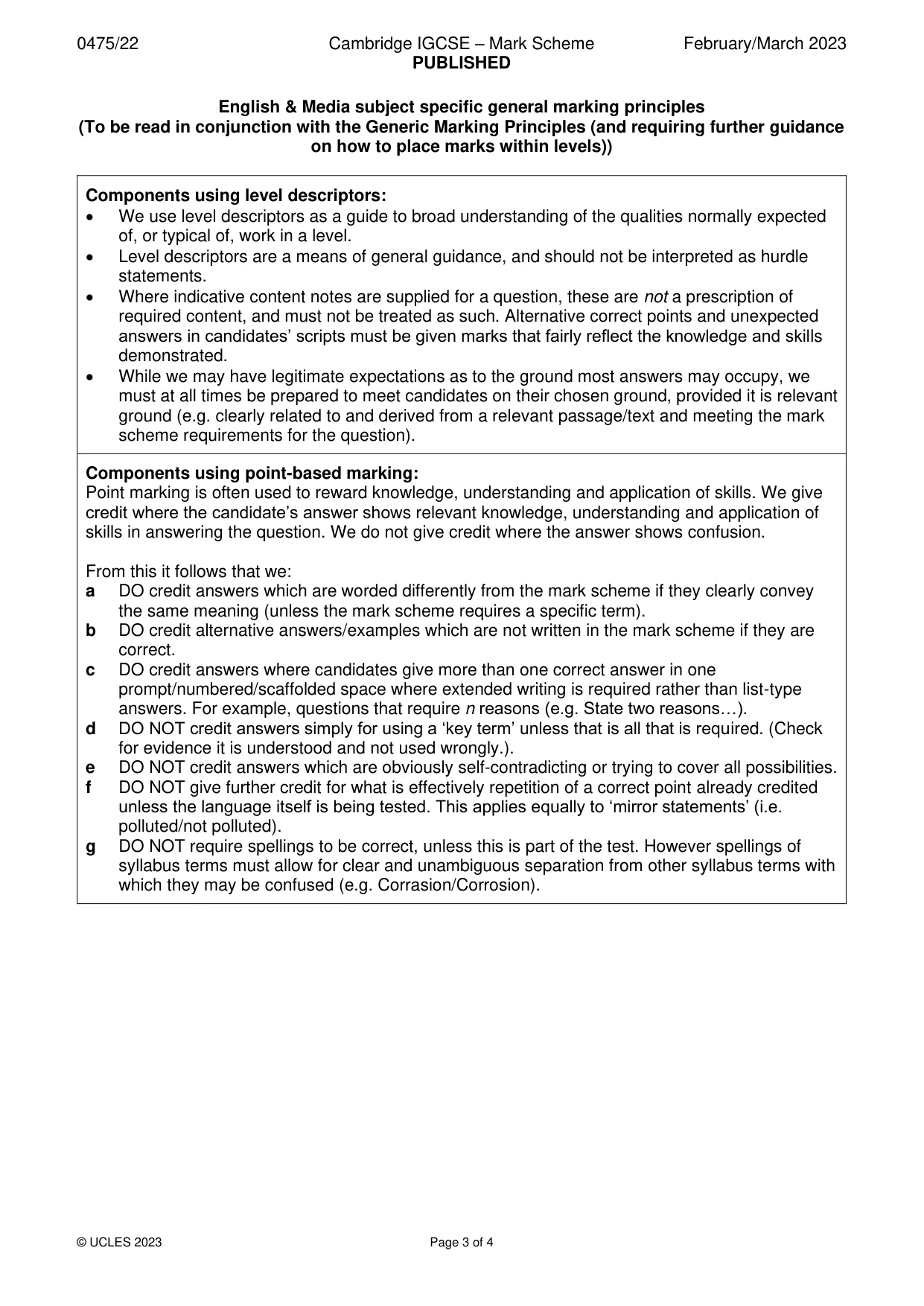
0475/22 Cambridge IGCSE – Mark Scheme PUBLISHED February/March 2023 © UCLES 2023 Page 3 of 4 English & Media subject specific general marking principles (To be read in conjunction with the Generic Marking Principles (and requiring further guidance on how to place marks within levels)) Components using level descriptors: • We use level descriptors as a guide to broad understanding of the qualities normally expected of, or typical of, work in a level. • Level descriptors are a means of general guidance, and should not be interpreted as hurdle statements. • Where indicative content notes are supplied for a question, these are not a prescription of required content, and must not be treated as such. Alternative correct points and unexpected answers in candidates’ scripts must be given marks that fairly reflect the knowledge and skills demonstrated. • While we may have legitimate expectations as to the ground most answers may occupy, we must at all times be prepared to meet candidates on their chosen ground, provided it is relevant ground (e.g. clearly related to and derived from a relevant passage/text and meeting the mark scheme requirements for the question). Components using point-based marking: Point marking is often used to reward knowledge, understanding and application of skills. We give credit where the candidate’s answer shows relevant knowledge, understanding and application of skills in answering the question. We do not give credit where the answer shows confusion. From this it follows that we: a DO credit answers which are worded differently from the mark scheme if they clearly convey the same meaning (unless the mark scheme requires a specific term). b DO credit alternative answers/examples which are not written in the mark scheme if they are correct. c DO credit answers where candidates give more than one correct answer in one prompt/numbered/scaffolded space where extended writing is required rather than list-type answers. For example, questions that require n reasons (e.g. State two reasons…). d DO NOT credit answers simply for using a ‘key term’ unless that is all that is required. (Check for evidence it is understood and not used wrongly.). e DO NOT credit answers which are obviously self-contradicting or trying to cover all possibilities. f DO NOT give further credit for what is effectively repetition of a correct point already credited unless the language itself is being tested. This applies equally to ‘mirror statements’ (i.e. polluted/not polluted). g DO NOT require spellings to be correct, unless this is part of the test. However spellings of syllabus terms must allow for clear and unambiguous separation from other syllabus terms with which they may be confused (e.g. Corrasion/Corrosion).
Mark scheme, page 4
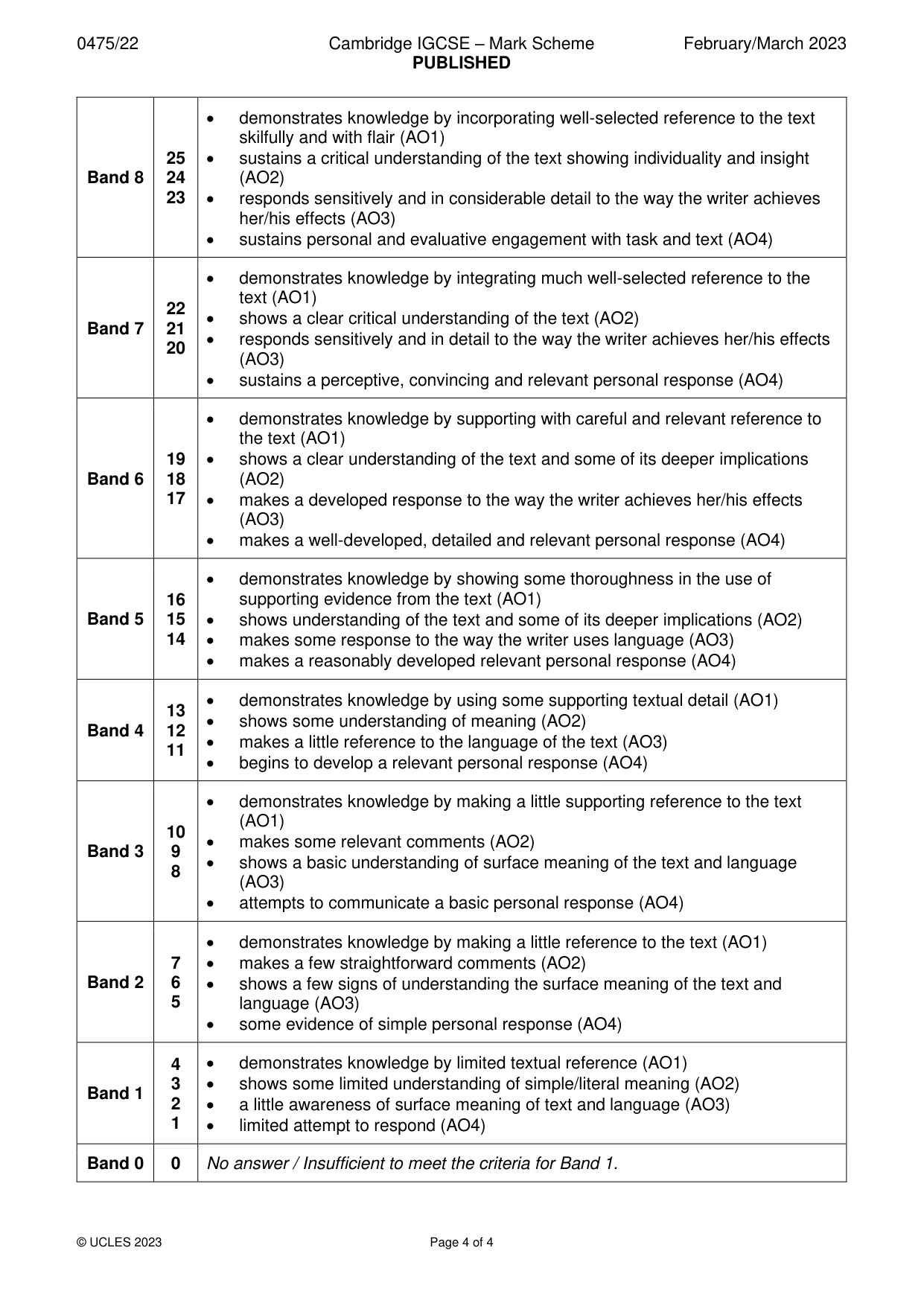
0475/22 Cambridge IGCSE – Mark Scheme PUBLISHED February/March 2023 © UCLES 2023 Page 4 of 4 Band 8 25 24 23 • demonstrates knowledge by incorporating well-selected reference to the text skilfully and with flair (AO1) • sustains a critical understanding of the text showing individuality and insight (AO2) • responds sensitively and in considerable detail to the way the writer achieves her/his effects (AO3) • sustains personal and evaluative engagement with task and text (AO4) Band 7 22 21 20 • demonstrates knowledge by integrating much well-selected reference to the text (AO1) • shows a clear critical understanding of the text (AO2) • responds sensitively and in detail to the way the writer achieves her/his effects (AO3) • sustains a perceptive, convincing and relevant personal response (AO4) Band 6 19 18 17 • demonstrates knowledge by supporting with careful and relevant reference to the text (AO1) • shows a clear understanding of the text and some of its deeper implications (AO2) • makes a developed response to the way the writer achieves her/his effects (AO3) • makes a well-developed, detailed and relevant personal response (AO4) Band 5 16 15 14 • demonstrates knowledge by showing some thoroughness in the use of supporting evidence from the text (AO1) • shows understanding of the text and some of its deeper implications (AO2) • makes some response to the way the writer uses language (AO3) • makes a reasonably developed relevant personal response (AO4) Band 4 13 12 11 • demonstrates knowledge by using some supporting textual detail (AO1) • shows some understanding of meaning (AO2) • makes a little reference to the language of the text (AO3) • begins to develop a relevant personal response (AO4) Band 3 10 9 8 • demonstrates knowledge by making a little supporting reference to the text (AO1) • makes some relevant comments (AO2) • shows a basic understanding of surface meaning of the text and language (AO3) • attempts to communicate a basic personal response (AO4) Band 2 7 6 5 • demonstrates knowledge by making a little reference to the text (AO1) • makes a few straightforward comments (AO2) • shows a few signs of understanding the surface meaning of the text and language (AO3) • some evidence of simple personal response (AO4) Band 1 4 3 2 1 • demonstrates knowledge by limited textual reference (AO1) • shows some limited understanding of simple/literal meaning (AO2) • a little awareness of surface meaning of text and language (AO3) • limited attempt to respond (AO4) Band 0 0 No answer / Insufficient to meet the criteria for Band 1.
What you needed in this session
Cambridge’s own grade thresholds for 2023 Feb/March, Paper 2 · Variant 2. A higher threshold means an easier paper — the bar moves with how the cohort did.