Cambridge IGCSE English - Literature in English 0475 — 2023 Oct/Nov Paper 2 · Variant 2
0475/22/O/N/23 · 50 marks · ≈56 min
The question paper and its mark scheme, free to read here and free to download. This is Cambridge’s own paper, exactly as it was sat.
Question paper12 pages

Mark scheme4 pages
Answers below. Sit the paper first if you are practising.
Paper as text
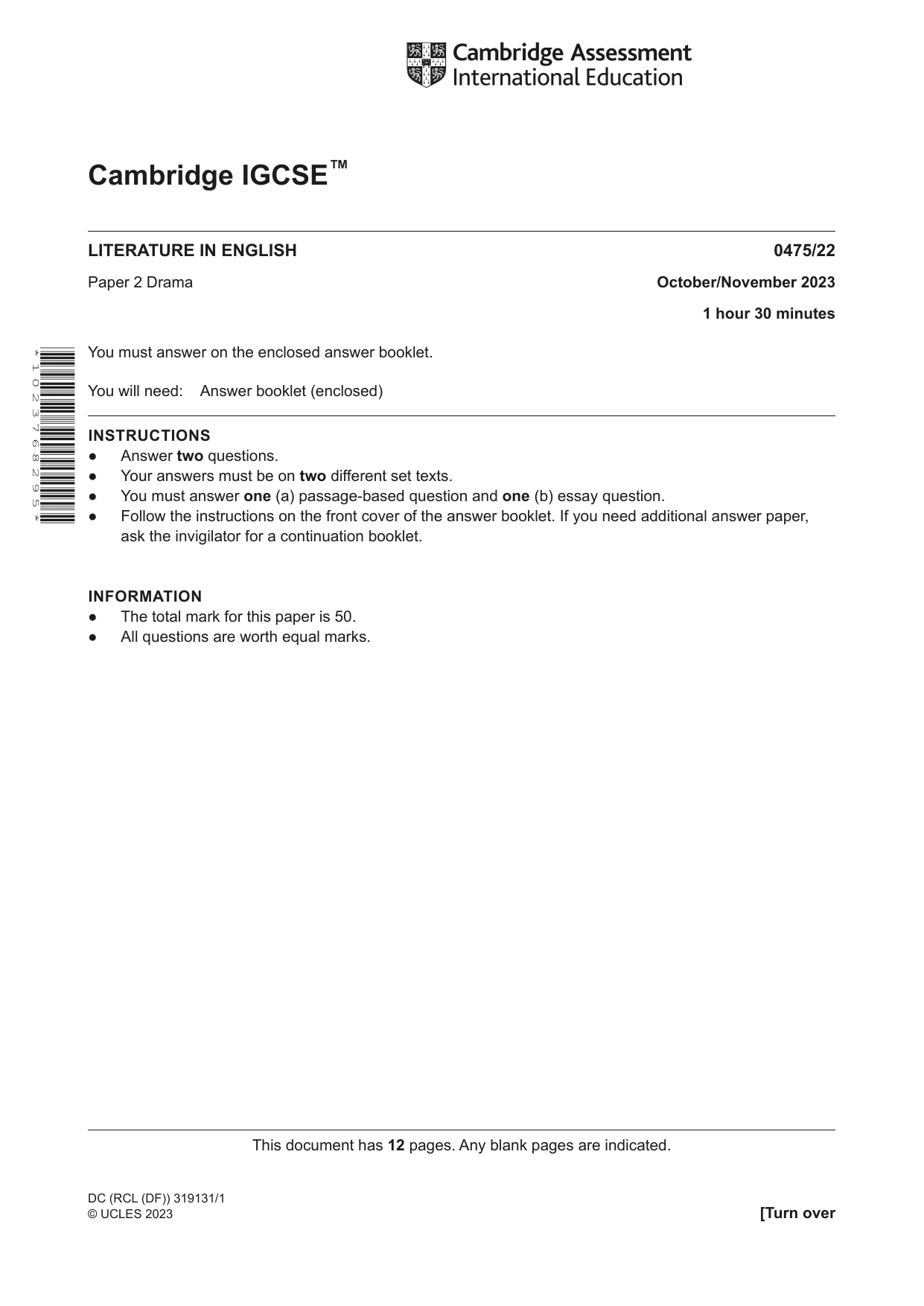
Question paper, page 1
This document has 12 pages. Any blank pages are indicated. [Turn over Cambridge IGCSE™ * 1 0 2 3 7 6 8 2 9 5 * DC (RCL (DF)) 319131/1 © UCLES 2023 LITERATURE IN ENGLISH 0475/22 Paper 2 Drama October/November 2023 1 hour 30 minutes You must answer on the enclosed answer booklet. You will need: Answer booklet (enclosed) INSTRUCTIONS ● Answer two questions. ● Your answers must be on two different set texts. ● You must answer one (a) passage-based question and one (b) essay question. ● Follow the instructions on the front cover of the answer booklet. If you need additional answer paper, ask the invigilator for a continuation booklet. INFORMATION ● The total mark for this paper is 50. ● All questions are worth equal marks.
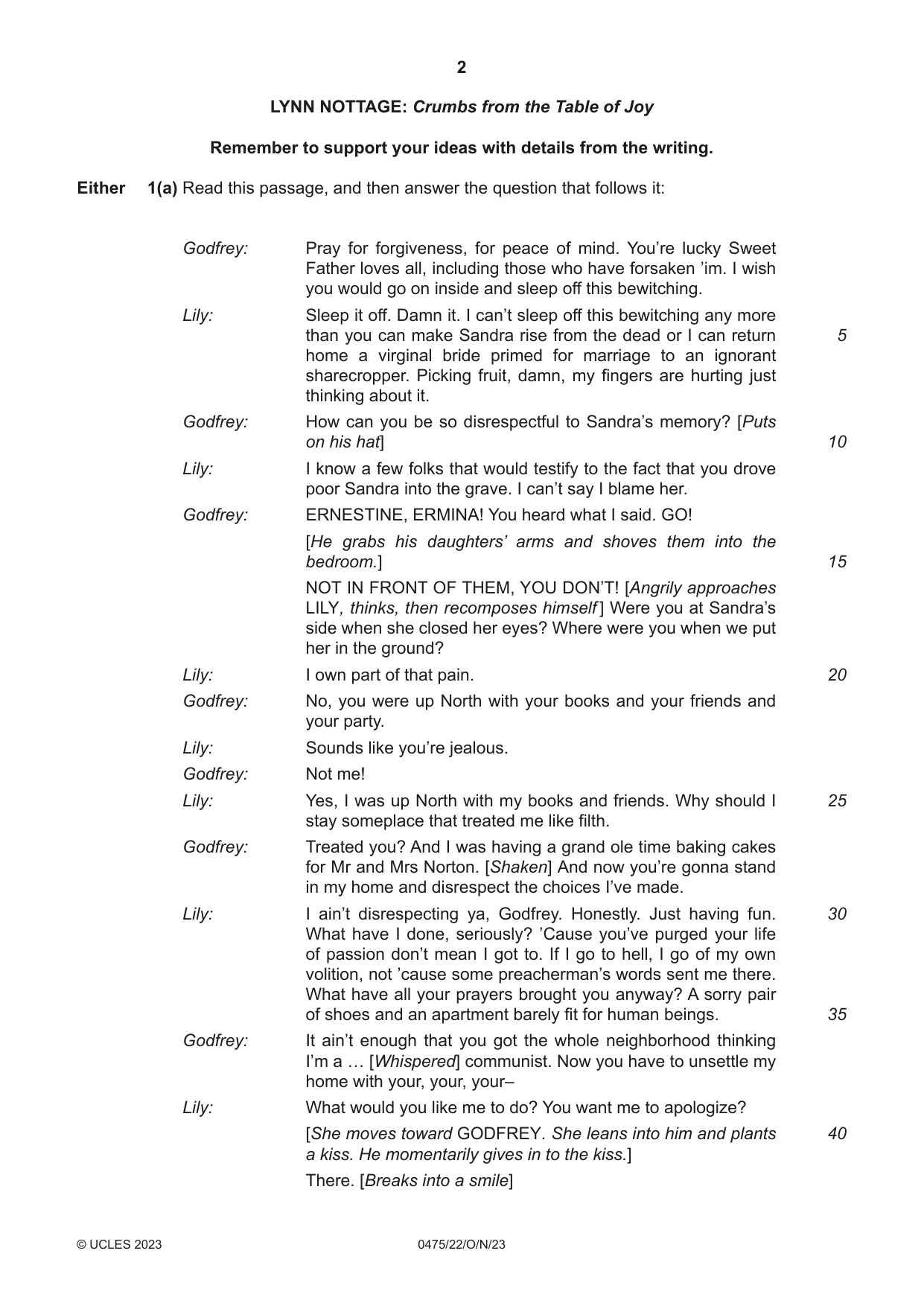
Question paper, page 2
2 0475/22/O/N/23 © UCLES 2023 LYNN NOTTAGE: Crumbs from the Table of Joy Remember to support your ideas with details from the writing. Either 1(a) Read this passage, and then answer the question that follows it: Godfrey: Pray for forgiveness, for peace of mind. You’re lucky Sweet Father loves all, including those who have forsaken ’im. I wish you would go on inside and sleep off this bewitching. Lily: Sleep it off. Damn it. I can’t sleep off this bewitching any more than you can make Sandra rise from the dead or I can return home a virginal bride primed for marriage to an ignorant sharecropper. Picking fruit, damn, my fingers are hurting just thinking about it. Godfrey: How can you be so disrespectful to Sandra’s memory? [Puts on his hat] Lily: I know a few folks that would testify to the fact that you drove poor Sandra into the grave. I can’t say I blame her. Godfrey: ERNESTINE, ERMINA! You heard what I said. GO! [He grabs his daughters’ arms and shoves them into the bedroom.] NOT IN FRONT OF THEM, YOU DON’T! [Angrily approaches LILY, thinks, then recomposes himself ] Were you at Sandra’s side when she closed her eyes? Where were you when we put her in the ground? Lily: I own part of that pain. Godfrey: No, you were up North with your books and your friends and your party. Lily: Sounds like you’re jealous. Godfrey: Not me! Lily: Yes, I was up North with my books and friends. Why should I stay someplace that treated me like filth. Godfrey: Treated you? And I was having a grand ole time baking cakes for Mr and Mrs Norton. [Shaken] And now you’re gonna stand in my home and disrespect the choices I’ve made. Lily: I ain’t disrespecting ya, Godfrey. Honestly. Just having fun. What have I done, seriously? ’Cause you’ve purged your life of passion don’t mean I got to. If I go to hell, I go of my own volition, not ’cause some preacherman’s words sent me there. What have all your prayers brought you anyway? A sorry pair of shoes and an apartment barely fit for human beings. Godfrey: It ain’t enough that you got the whole neighborhood thinking I’m a … [Whispered] communist. Now you have to unsettle my home with your, your, your– Lily: What would you like me to do? You want me to apologize? [She moves toward GODFREY. She leans into him and plants a kiss. He momentarily gives in to the kiss.] There. [Breaks into a smile] 5 10 15 20 25 30 35 40
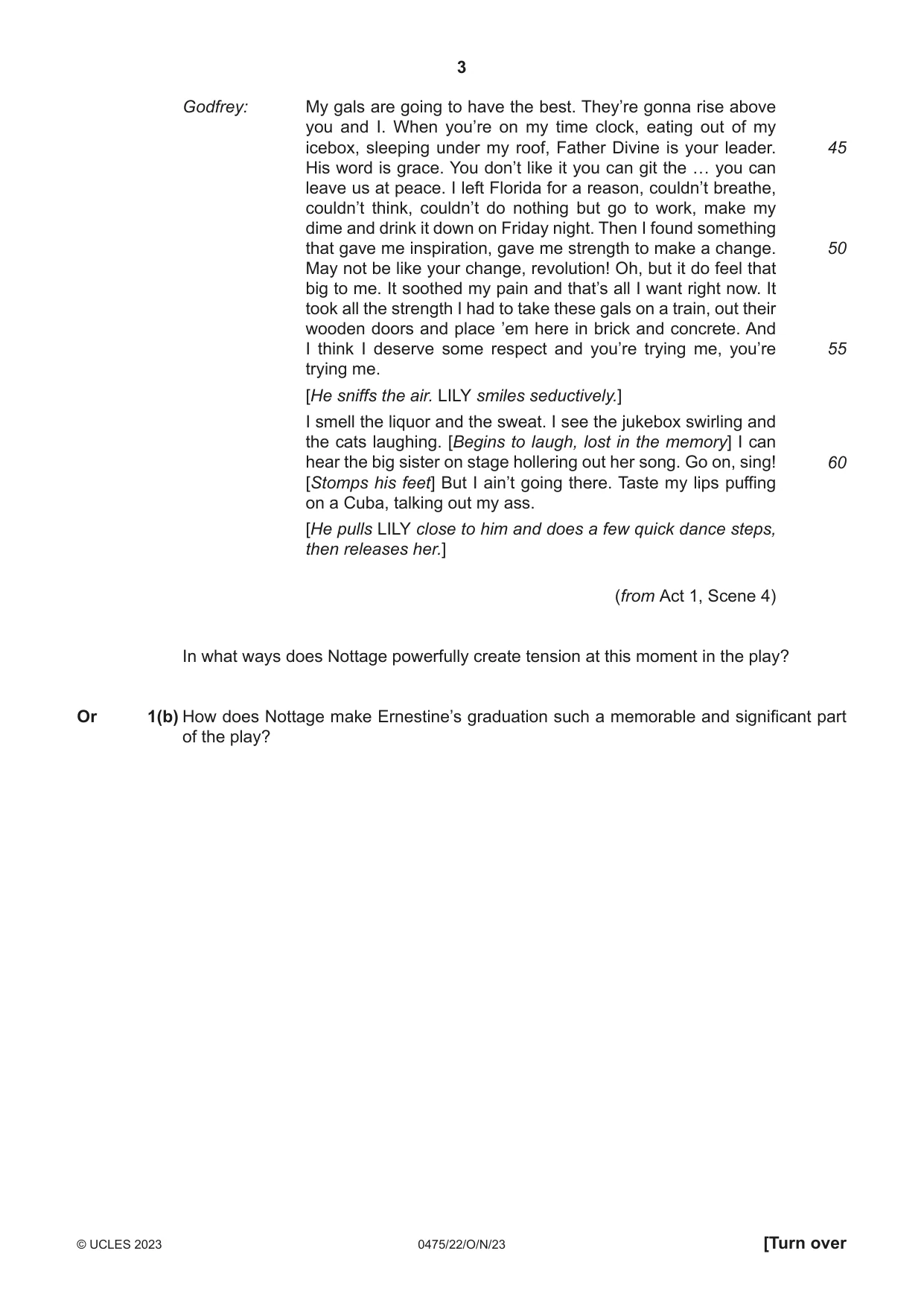
Question paper, page 3
3 0475/22/O/N/23 © UCLES 2023 [Turn over Godfrey: My gals are going to have the best. They’re gonna rise above you and I. When you’re on my time clock, eating out of my icebox, sleeping under my roof, Father Divine is your leader. His word is grace. You don’t like it you can git the … you can leave us at peace. I left Florida for a reason, couldn’t breathe, couldn’t think, couldn’t do nothing but go to work, make my dime and drink it down on Friday night. Then I found something that gave me inspiration, gave me strength to make a change. May not be like your change, revolution! Oh, but it do feel that big to me. It soothed my pain and that’s all I want right now. It took all the strength I had to take these gals on a train, out their wooden doors and place ’em here in brick and concrete. And I think I deserve some respect and you’re trying me, you’re trying me. [He sniffs the air. LILY smiles seductively.] I smell the liquor and the sweat. I see the jukebox swirling and the cats laughing. [Begins to laugh, lost in the memory] I can hear the big sister on stage hollering out her song. Go on, sing! [Stomps his feet] But I ain’t going there. Taste my lips puffing on a Cuba, talking out my ass. [He pulls LILY close to him and does a few quick dance steps, then releases her.] (from Act 1, Scene 4) In what ways does Nottage powerfully create tension at this moment in the play? Or 1(b) How does Nottage make Ernestine’s graduation such a memorable and significant part of the play? 45 50 55 60
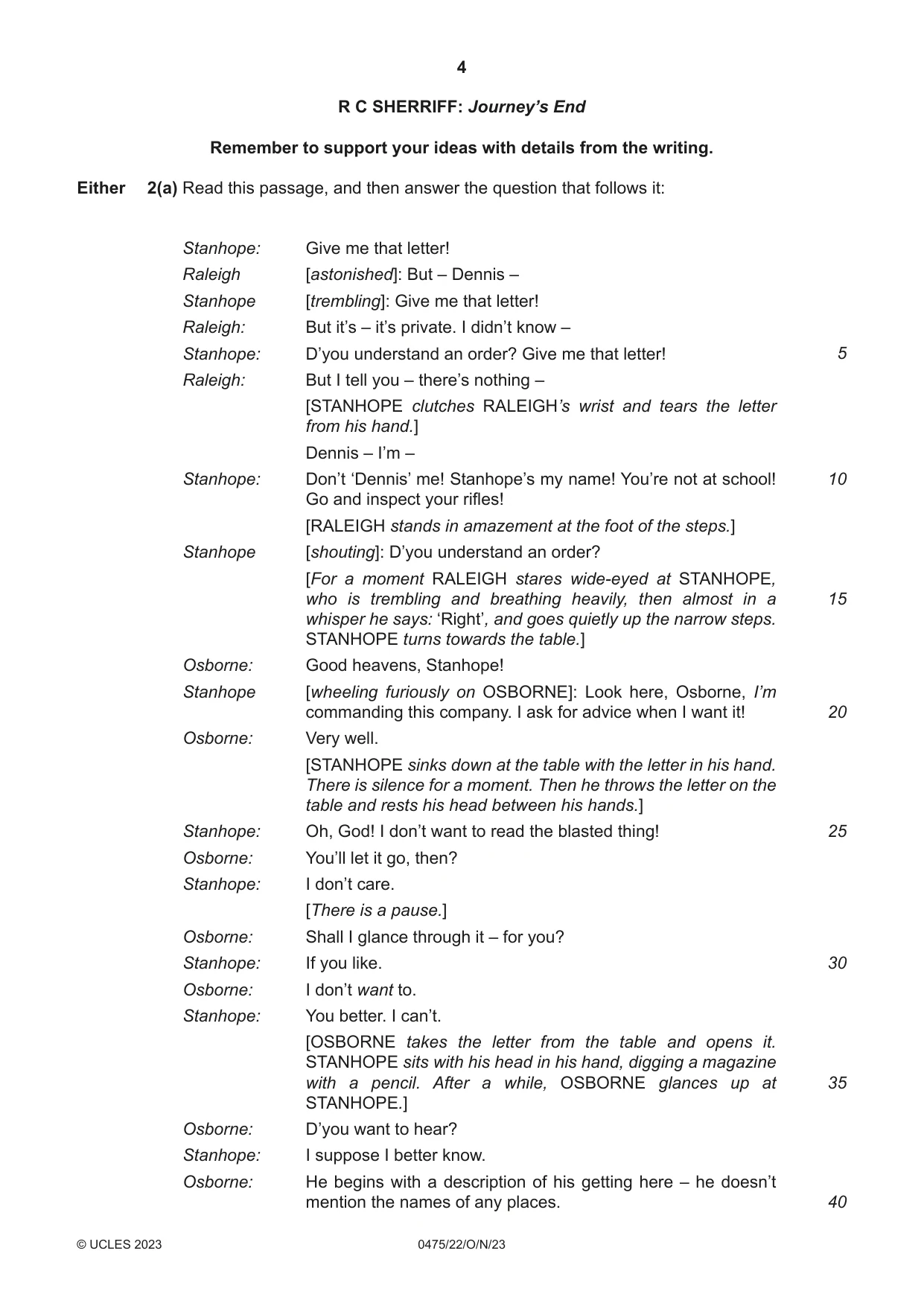
Question paper, page 4
4 0475/22/O/N/23 © UCLES 2023 R C SHERRIFF: Journey’s End Remember to support your ideas with details from the writing. Either 2(a) Read this passage, and then answer the question that follows it: Stanhope: Give me that letter! Raleigh [astonished]: But – Dennis – Stanhope [trembling]: Give me that letter! Raleigh: But it’s – it’s private. I didn’t know – Stanhope: D’you understand an order? Give me that letter! Raleigh: But I tell you – there’s nothing – [STANHOPE clutches RALEIGH’s wrist and tears the letter from his hand.] Dennis – I’m – Stanhope: Don’t ‘Dennis’ me! Stanhope’s my name! You’re not at school! Go and inspect your rifles! [RALEIGH stands in amazement at the foot of the steps.] Stanhope [shouting]: D’you understand an order? [For a moment RALEIGH stares wide-eyed at STANHOPE, who is trembling and breathing heavily, then almost in a whisper he says: ‘Right’, and goes quietly up the narrow steps. STANHOPE turns towards the table.] Osborne: Good heavens, Stanhope! Stanhope [wheeling furiously on OSBORNE]: Look here, Osborne, I’m commanding this company. I ask for advice when I want it! Osborne: Very well. [STANHOPE sinks down at the table with the letter in his hand. There is silence for a moment. Then he throws the letter on the table and rests his head between his hands.] Stanhope: Oh, God! I don’t want to read the blasted thing! Osborne: You’ll let it go, then? Stanhope: I don’t care. [There is a pause.] Osborne: Shall I glance through it – for you? Stanhope: If you like. Osborne: I don’t want to. Stanhope: You better. I can’t. [OSBORNE takes the letter from the table and opens it. STANHOPE sits with his head in his hand, digging a magazine with a pencil. After a while, OSBORNE glances up at STANHOPE.] Osborne: D’you want to hear? Stanhope: I suppose I better know. Osborne: He begins with a description of his getting here – he doesn’t mention the names of any places. 5 10 15 20 25 30 35 40
Question paper, page 5
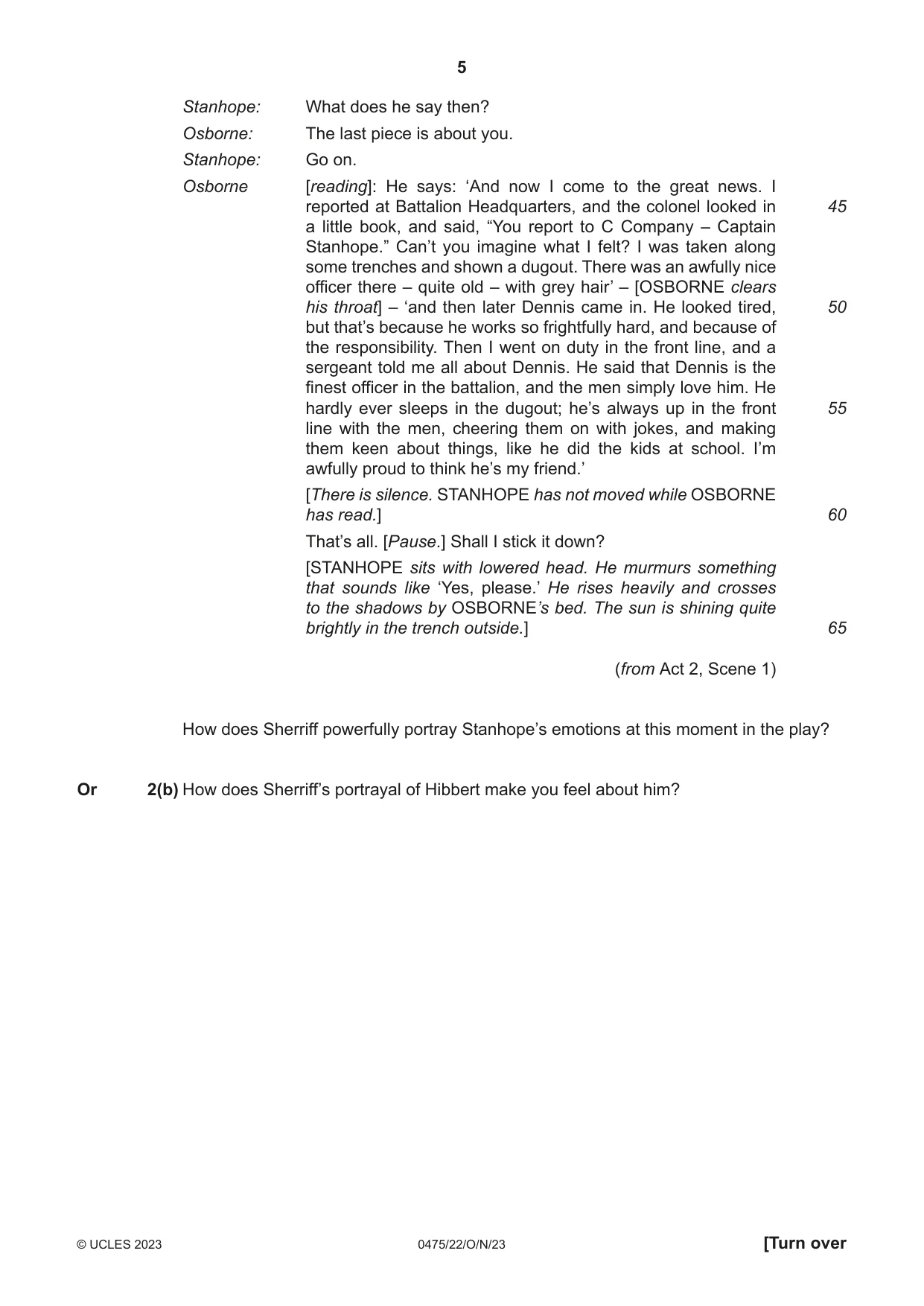
5 0475/22/O/N/23 © UCLES 2023 [Turn over Stanhope: What does he say then? Osborne: The last piece is about you. Stanhope: Go on. Osborne [reading]: He says: ‘And now I come to the great news. I reported at Battalion Headquarters, and the colonel looked in a little book, and said, “You report to C Company – Captain Stanhope.” Can’t you imagine what I felt? I was taken along some trenches and shown a dugout. There was an awfully nice officer there – quite old – with grey hair’ – [OSBORNE clears his throat] – ‘and then later Dennis came in. He looked tired, but that’s because he works so frightfully hard, and because of the responsibility. Then I went on duty in the front line, and a sergeant told me all about Dennis. He said that Dennis is the finest officer in the battalion, and the men simply love him. He hardly ever sleeps in the dugout; he’s always up in the front line with the men, cheering them on with jokes, and making them keen about things, like he did the kids at school. I’m awfully proud to think he’s my friend.’ [There is silence. STANHOPE has not moved while OSBORNE has read.] That’s all. [Pause.] Shall I stick it down? [STANHOPE sits with lowered head. He murmurs something that sounds like ‘Yes, please.’ He rises heavily and crosses to the shadows by OSBORNE’s bed. The sun is shining quite brightly in the trench outside.] (from Act 2, Scene 1) How does Sherriff powerfully portray Stanhope’s emotions at this moment in the play? Or 2(b) How does Sherriff’s portrayal of Hibbert make you feel about him? 45 50 55 60 65
Question paper, page 6
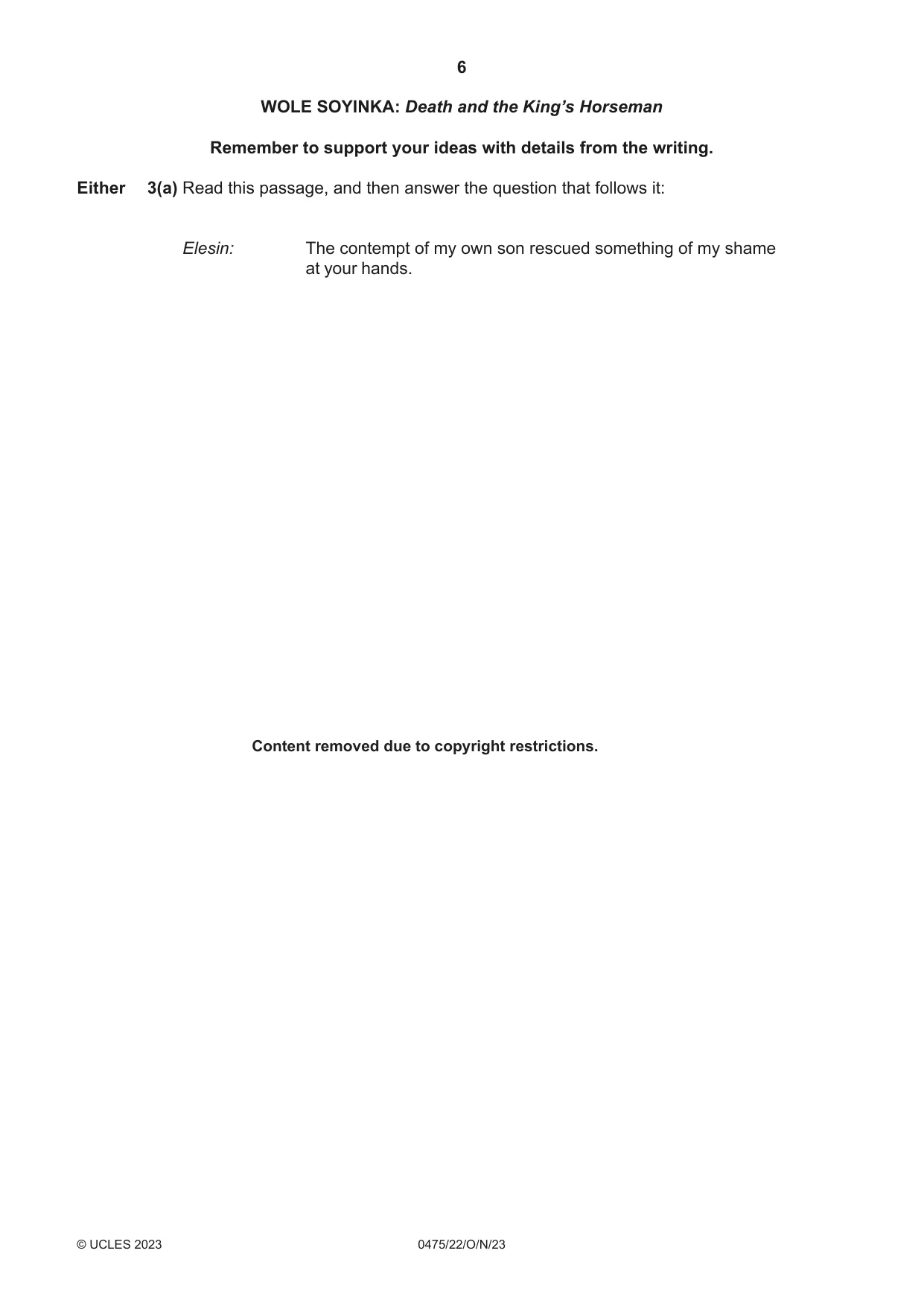
6 0475/22/O/N/23 © UCLES 2023 WOLE SOYINKA: Death and the King’s Horseman Remember to support your ideas with details from the writing. Either 3(a) Read this passage, and then answer the question that follows it: Elesin: The contempt of my own son rescued something of my shame at your hands. Content removed due to copyright restrictions.
Question paper, page 7
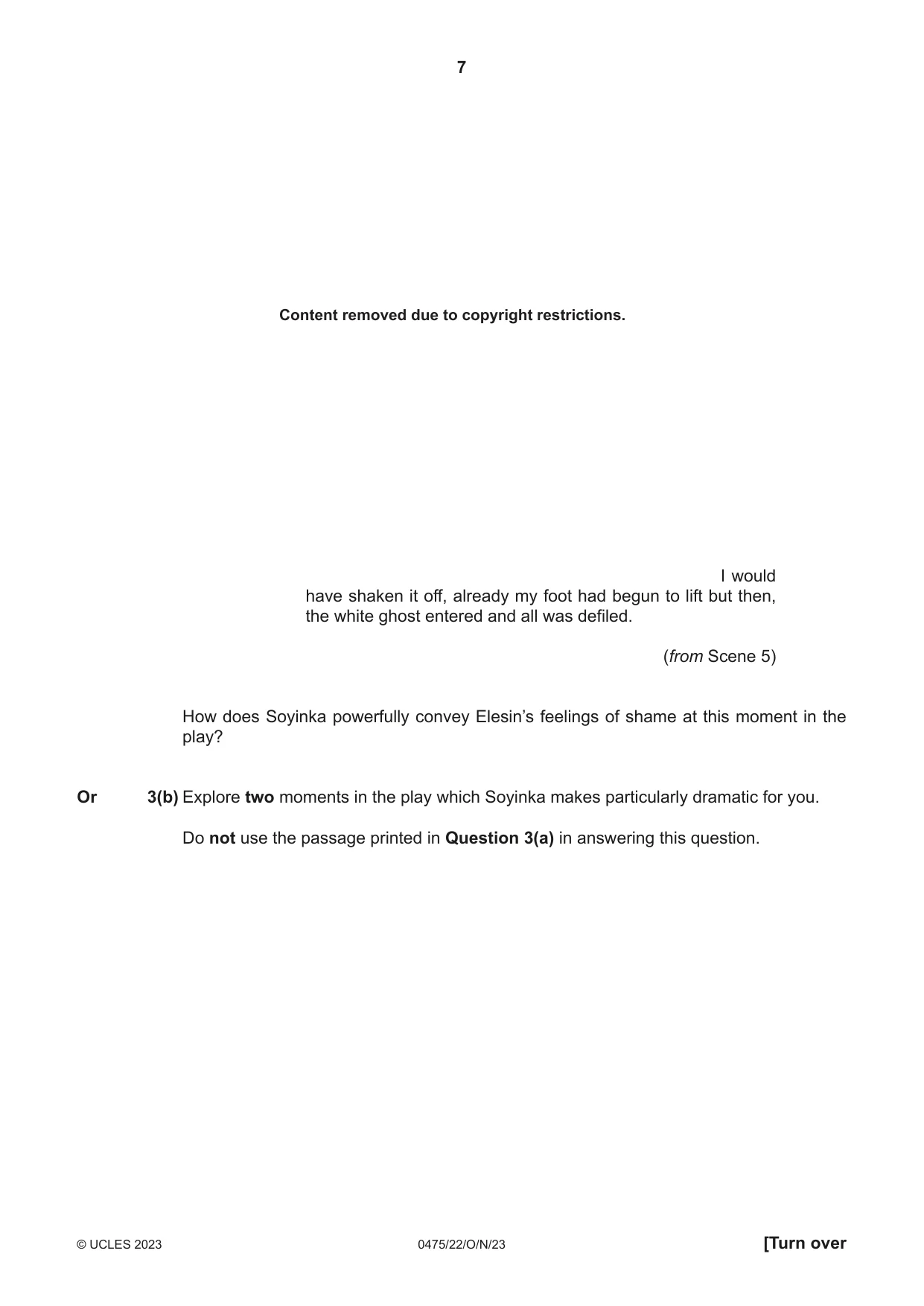
7 0475/22/O/N/23 © UCLES 2023 [Turn over I would have shaken it off, already my foot had begun to lift but then, the white ghost entered and all was defiled. (from Scene 5) How does Soyinka powerfully convey Elesin’s feelings of shame at this moment in the play? Or 3(b) Explore two moments in the play which Soyinka makes particularly dramatic for you. Do not use the passage printed in Question 3(a) in answering this question. Content removed due to copyright restrictions.
Question paper, page 8
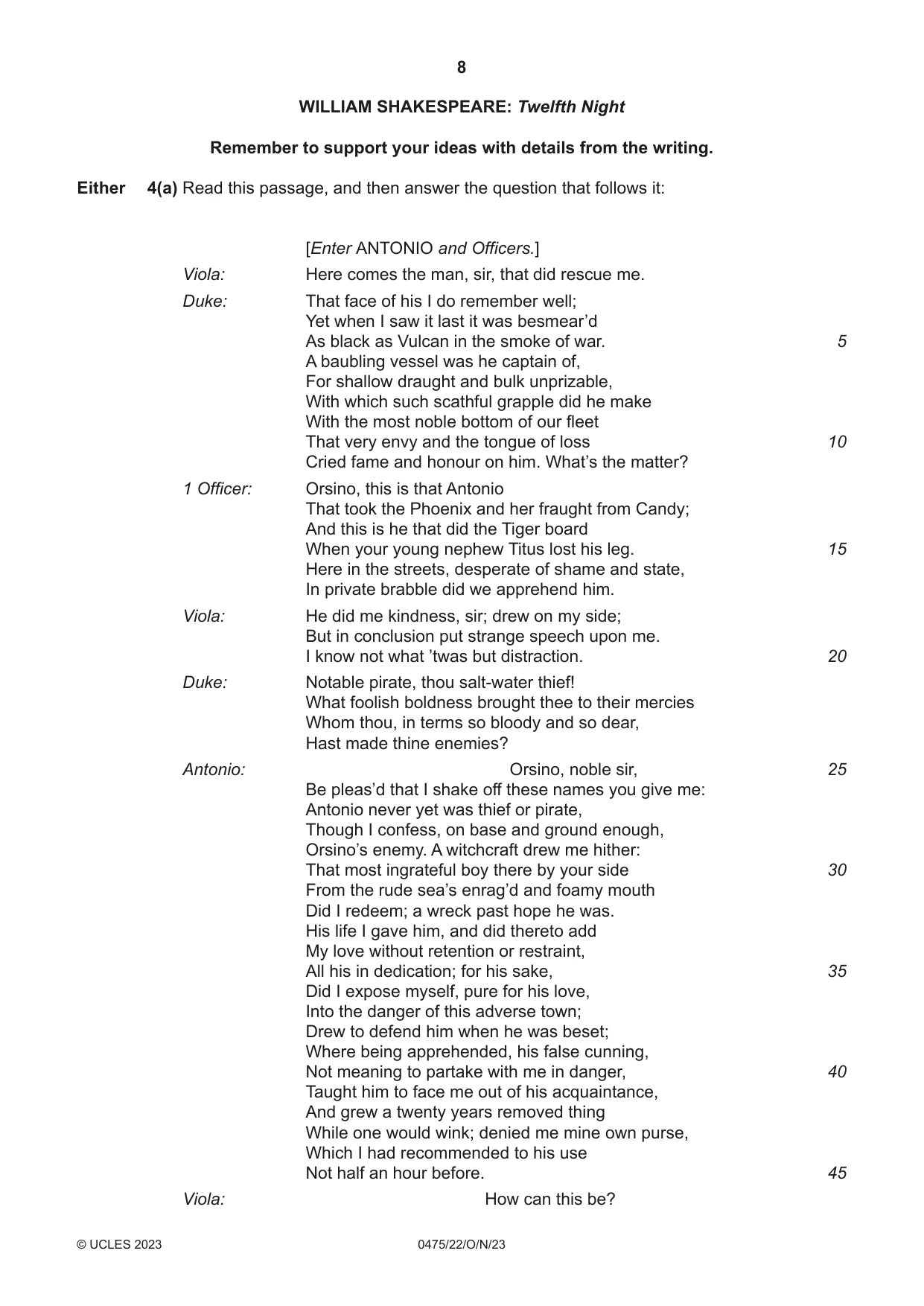
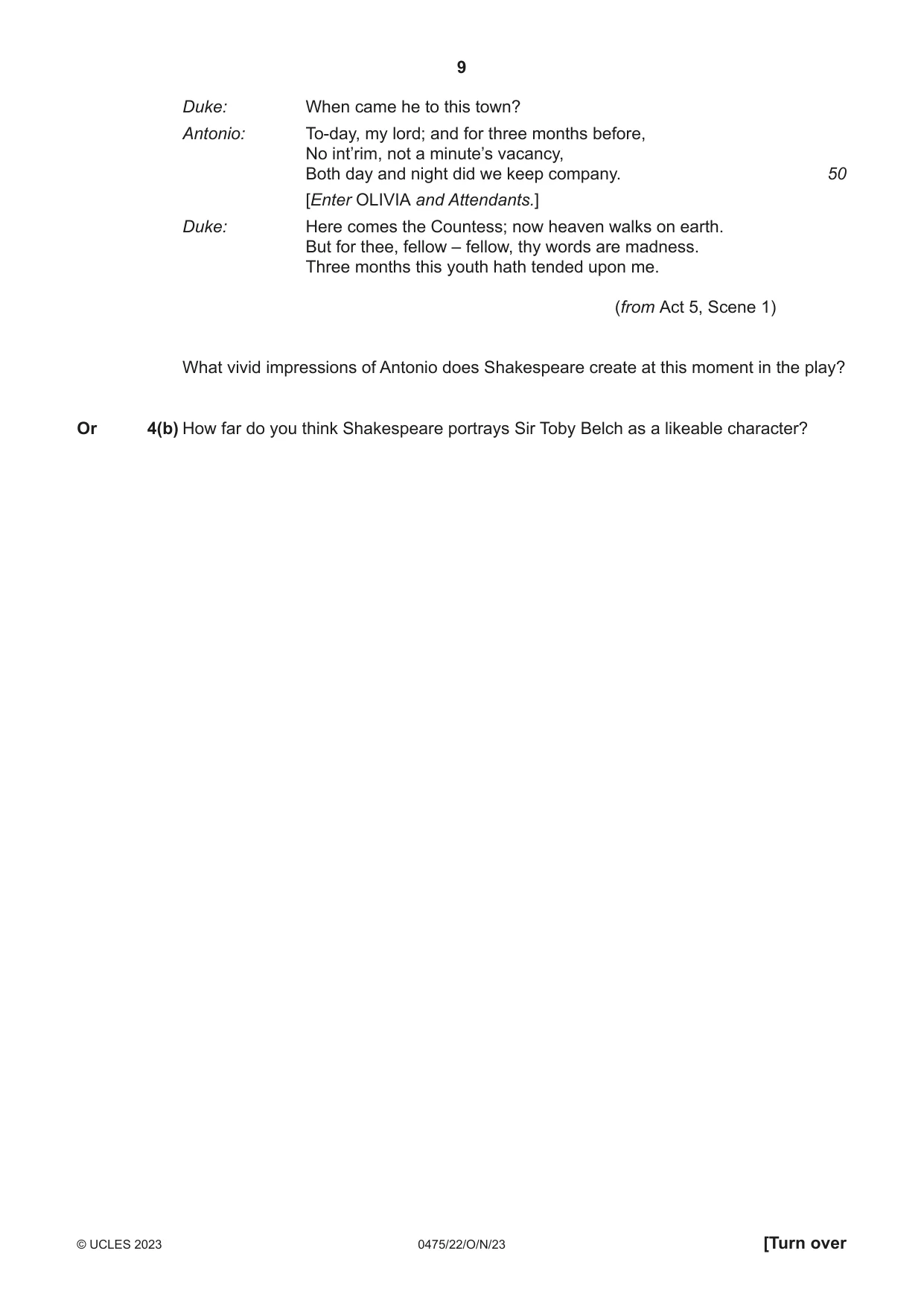
8 0475/22/O/N/23 © UCLES 2023 WILLIAM SHAKESPEARE: Twelfth Night Remember to support your ideas with details from the writing. Either 4(a) Read this passage, and then answer the question that follows it: [Enter ANTONIO and Officers.] Viola: Here comes the man, sir, that did rescue me. Duke: That face of his I do remember well; Yet when I saw it last it was besmear’d As black as Vulcan in the smoke of war. A baubling vessel was he captain of, For shallow draught and bulk unprizable, With which such scathful grapple did he make With the most noble bottom of our fleet That very envy and the tongue of loss Cried fame and honour on him. What’s the matter? 1 Officer: Orsino, this is that Antonio That took the Phoenix and her fraught from Candy; And this is he that did the Tiger board When your young nephew Titus lost his leg. Here in the streets, desperate of shame and state, In private brabble did we apprehend him. Viola: He did me kindness, sir; drew on my side; But in conclusion put strange speech upon me. I know not what ’twas but distraction. Duke: Notable pirate, thou salt-water thief! What foolish boldness brought thee to their mercies Whom thou, in terms so bloody and so dear, Hast made thine enemies? Antonio: Orsino, noble sir, Be pleas’d that I shake off these names you give me: Antonio never yet was thief or pirate, Though I confess, on base and ground enough, Orsino’s enemy. A witchcraft drew me hither: That most ingrateful boy there by your side From the rude sea’s enrag’d and foamy mouth Did I redeem; a wreck past hope he was. His life I gave him, and did thereto add My love without retention or restraint, All his in dedication; for his sake, Did I expose myself, pure for his love, Into the danger of this adverse town; Drew to defend him when he was beset; Where being apprehended, his false cunning, Not meaning to partake with me in danger, Taught him to face me out of his acquaintance, And grew a twenty years removed thing While one would wink; denied me mine own purse, Which I had recommended to his use Not half an hour before. Viola: How can this be? 5 10 15 20 25 30 35 40 45
Question paper, page 9
9 0475/22/O/N/23 © UCLES 2023 [Turn over Duke: When came he to this town? Antonio: To-day, my lord; and for three months before, No int’rim, not a minute’s vacancy, Both day and night did we keep company. [Enter OLIVIA and Attendants.] Duke: Here comes the Countess; now heaven walks on earth. But for thee, fellow – fellow, thy words are madness. Three months this youth hath tended upon me. (from Act 5, Scene 1) What vivid impressions of Antonio does Shakespeare create at this moment in the play? Or 4(b) How far do you think Shakespeare portrays Sir Toby Belch as a likeable character? 50
Question paper, page 10
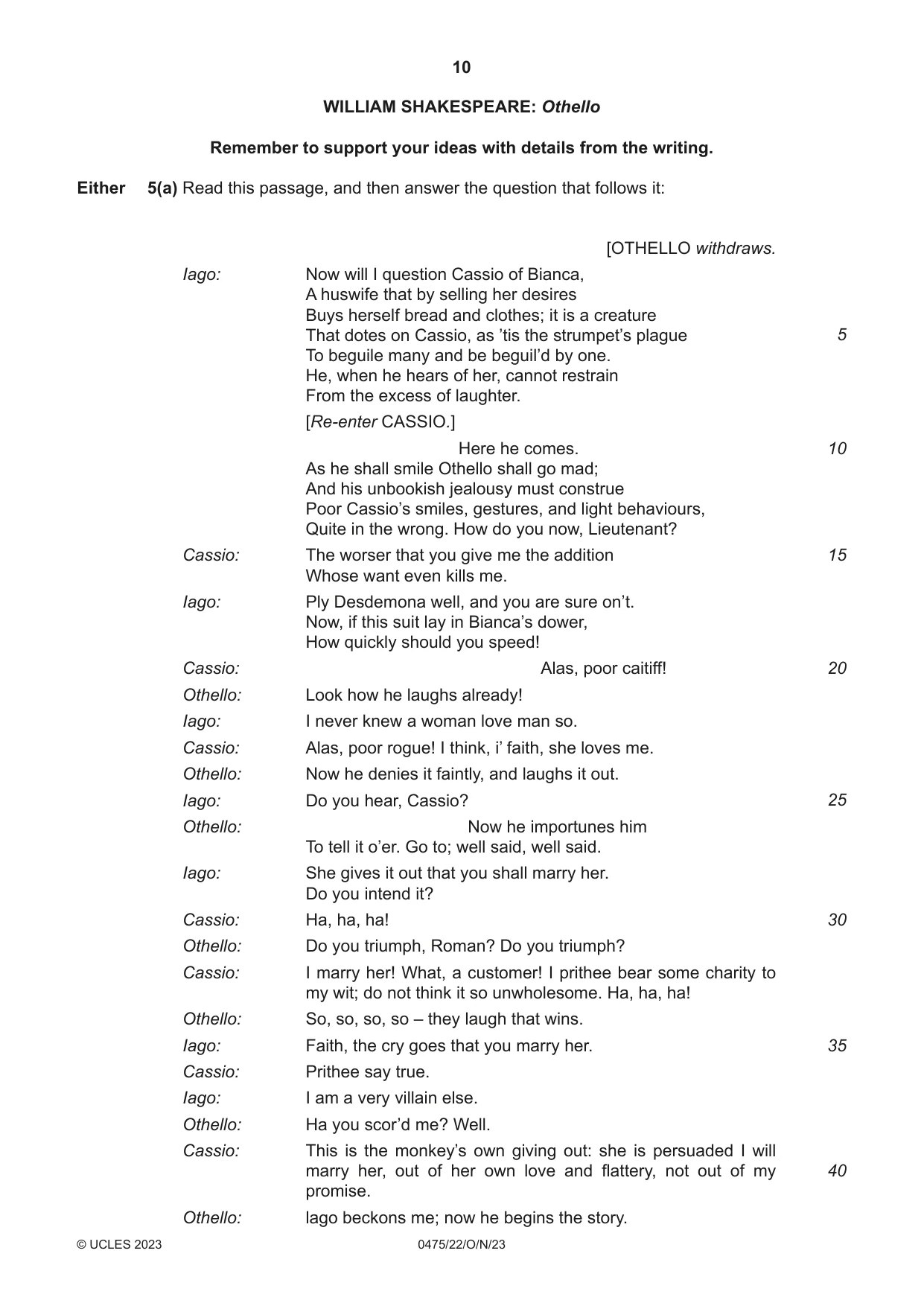
10 0475/22/O/N/23 © UCLES 2023 WILLIAM SHAKESPEARE: Othello Remember to support your ideas with details from the writing. Either 5(a) Read this passage, and then answer the question that follows it: [OTHELLO withdraws. Iago: Now will I question Cassio of Bianca, A huswife that by selling her desires Buys herself bread and clothes; it is a creature That dotes on Cassio, as ’tis the strumpet’s plague To beguile many and be beguil’d by one. He, when he hears of her, cannot restrain From the excess of laughter. [Re-enter CASSIO.] Here he comes. As he shall smile Othello shall go mad; And his unbookish jealousy must construe Poor Cassio’s smiles, gestures, and light behaviours, Quite in the wrong. How do you now, Lieutenant? Cassio: The worser that you give me the addition Whose want even kills me. Iago: Ply Desdemona well, and you are sure on’t. Now, if this suit lay in Bianca’s dower, How quickly should you speed! Cassio: Alas, poor caitiff! Othello: Look how he laughs already! Iago: I never knew a woman love man so. Cassio: Alas, poor rogue! I think, i’ faith, she loves me. Othello: Now he denies it faintly, and laughs it out. Iago: Do you hear, Cassio? Othello: Now he importunes him To tell it o’er. Go to; well said, well said. Iago: She gives it out that you shall marry her. Do you intend it? Cassio: Ha, ha, ha! Othello: Do you triumph, Roman? Do you triumph? Cassio: I marry her! What, a customer! I prithee bear some charity to my wit; do not think it so unwholesome. Ha, ha, ha! Othello: So, so, so, so – they laugh that wins. Iago: Faith, the cry goes that you marry her. Cassio: Prithee say true. Iago: I am a very villain else. Othello: Ha you scor’d me? Well. Cassio: This is the monkey’s own giving out: she is persuaded I will marry her, out of her own love and flattery, not out of my promise. Othello: lago beckons me; now he begins the story. 5 10 15 20 25 30 35 40
Question paper, page 11
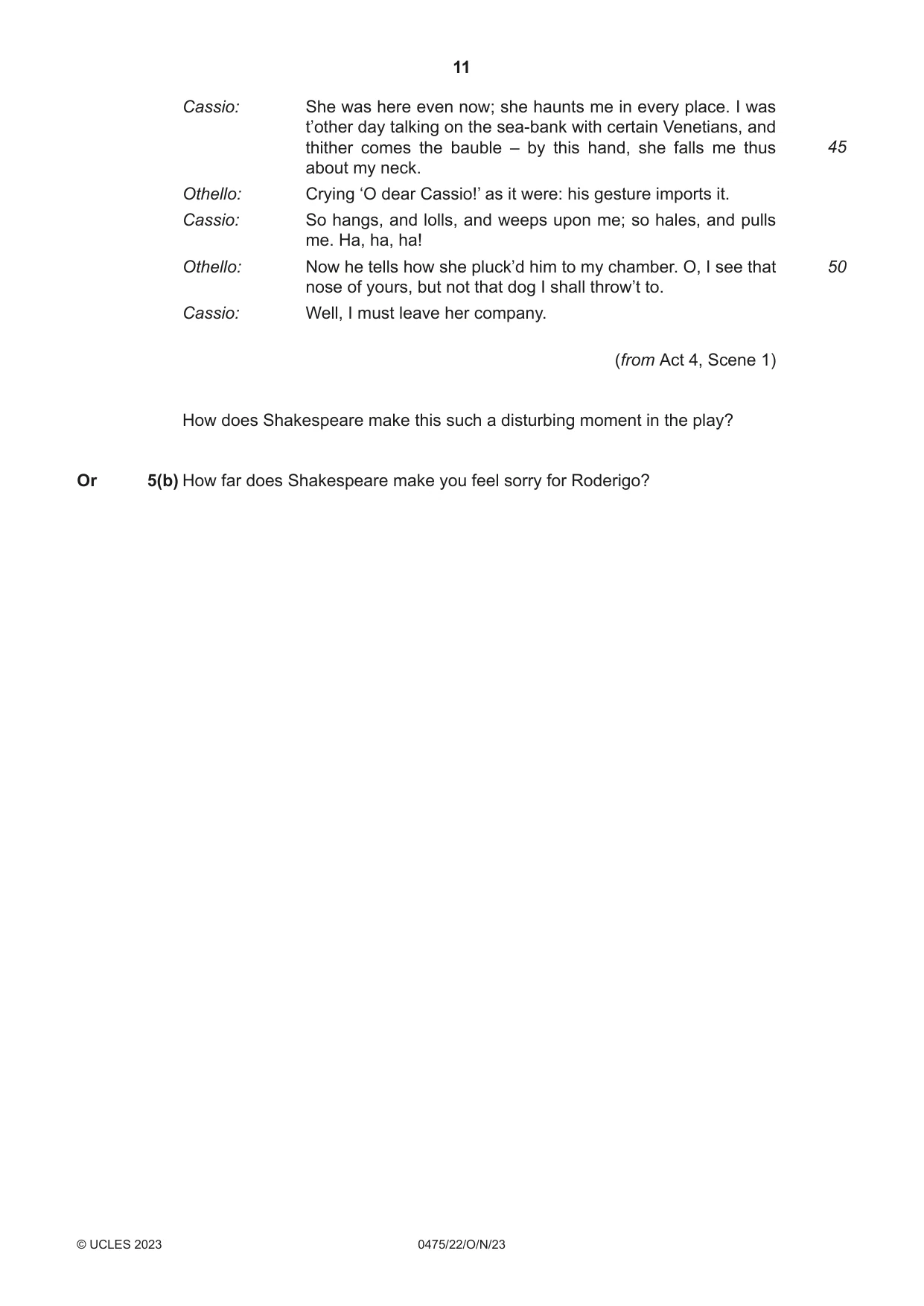
11 0475/22/O/N/23 © UCLES 2023 Cassio: She was here even now; she haunts me in every place. I was t’other day talking on the sea-bank with certain Venetians, and thither comes the bauble – by this hand, she falls me thus about my neck. Othello: Crying ‘O dear Cassio!’ as it were: his gesture imports it. Cassio: So hangs, and lolls, and weeps upon me; so hales, and pulls me. Ha, ha, ha! Othello: Now he tells how she pluck’d him to my chamber. O, I see that nose of yours, but not that dog I shall throw’t to. Cassio: Well, I must leave her company. (from Act 4, Scene 1) How does Shakespeare make this such a disturbing moment in the play? Or 5(b) How far does Shakespeare make you feel sorry for Roderigo? 45 50
Question paper, page 12
12 0475/22/O/N/23 © UCLES 2023 Permission to reproduce items where third-party owned material protected by copyright is included has been sought and cleared where possible. Every reasonable effort has been made by the publisher (UCLES) to trace copyright holders, but if any items requiring clearance have unwittingly been included, the publisher will be pleased to make amends at the earliest possible opportunity. To avoid the issue of disclosure of answer-related information to candidates, all copyright acknowledgements are reproduced online in the Cambridge Assessment International Education Copyright Acknowledgements Booklet. This is produced for each series of examinations and is freely available to download at www.cambridgeinternational.org after the live examination series. Cambridge Assessment International Education is part of Cambridge Assessment. Cambridge Assessment is the brand name of the University of Cambridge Local Examinations Syndicate (UCLES), which is a department of the University of Cambridge. BLANK PAGE
Mark scheme, page 1
This document consists of 4 printed pages. © UCLES 2023 [Turn over Cambridge IGCSE™ LITERATURE IN ENGLISH 0475/22 Paper 2 Drama October/November 2023 MARK SCHEME Maximum Mark: 50 Published This mark scheme is published as an aid to teachers and candidates, to indicate the requirements of the examination. It shows the basis on which Examiners were instructed to award marks. It does not indicate the details of the discussions that took place at an Examiners’ meeting before marking began, which would have considered the acceptability of alternative answers. Mark schemes should be read in conjunction with the question paper and the Principal Examiner Report for Teachers. Cambridge International will not enter into discussions about these mark schemes. Cambridge International is publishing the mark schemes for the October/November 2023 series for most Cambridge IGCSE, Cambridge International A and AS Level components, and some Cambridge O Level components.
Mark scheme, page 2
0475/22 Cambridge IGCSE – Mark Scheme PUBLISHED October/November 2023 © UCLES 2023 Page 2 of 4 Generic Marking Principles These general marking principles must be applied by all examiners when marking candidate answers. They should be applied alongside the specific content of the mark scheme or generic level descriptors for a question. Each question paper and mark scheme will also comply with these marking principles. GENERIC MARKING PRINCIPLE 1: Marks must be awarded in line with: • the specific content of the mark scheme or the generic level descriptors for the question • the specific skills defined in the mark scheme or in the generic level descriptors for the question • the standard of response required by a candidate as exemplified by the standardisation scripts. GENERIC MARKING PRINCIPLE 2: Marks awarded are always whole marks (not half marks, or other fractions). GENERIC MARKING PRINCIPLE 3: Marks must be awarded positively: • marks are awarded for correct/valid answers, as defined in the mark scheme. However, credit is given for valid answers which go beyond the scope of the syllabus and mark scheme, referring to your Team Leader as appropriate • marks are awarded when candidates clearly demonstrate what they know and can do • marks are not deducted for errors • marks are not deducted for omissions • answers should only be judged on the quality of spelling, punctuation and grammar when these features are specifically assessed by the question as indicated by the mark scheme. The meaning, however, should be unambiguous. GENERIC MARKING PRINCIPLE 4: Rules must be applied consistently, e.g. in situations where candidates have not followed instructions or in the application of generic level descriptors. GENERIC MARKING PRINCIPLE 5: Marks should be awarded using the full range of marks defined in the mark scheme for the question (however; the use of the full mark range may be limited according to the quality of the candidate responses seen). GENERIC MARKING PRINCIPLE 6: Marks awarded are based solely on the requirements as defined in the mark scheme. Marks should not be awarded with grade thresholds or grade descriptors in mind.
Mark scheme, page 3
0475/22 Cambridge IGCSE – Mark Scheme PUBLISHED October/November 2023 © UCLES 2023 Page 3 of 4 English & Media subject specific general marking principles (To be read in conjunction with the Generic Marking Principles (and requiring further guidance on how to place marks within levels)) Components using level descriptors: • We use level descriptors as a guide to broad understanding of the qualities normally expected of, or typical of, work in a level. • Level descriptors are a means of general guidance, and should not be interpreted as hurdle statements. • Where indicative content notes are supplied for a question, these are not a prescription of required content, and must not be treated as such. Alternative correct points and unexpected answers in candidates’ scripts must be given marks that fairly reflect the knowledge and skills demonstrated. • While we may have legitimate expectations as to the ground most answers may occupy, we must at all times be prepared to meet candidates on their chosen ground, provided it is relevant ground (e.g. clearly related to and derived from a relevant passage/text and meeting the mark scheme requirements for the question). Components using point-based marking: Point marking is often used to reward knowledge, understanding and application of skills. We give credit where the candidate’s answer shows relevant knowledge, understanding and application of skills in answering the question. We do not give credit where the answer shows confusion. From this it follows that we: a DO credit answers which are worded differently from the mark scheme if they clearly convey the same meaning (unless the mark scheme requires a specific term). b DO credit alternative answers/examples which are not written in the mark scheme if they are correct. c DO credit answers where candidates give more than one correct answer in one prompt/numbered/scaffolded space where extended writing is required rather than list-type answers. For example, questions that require n reasons (e.g. State two reasons…). d DO NOT credit answers simply for using a ‘key term’ unless that is all that is required. (Check for evidence it is understood and not used wrongly.). e DO NOT credit answers which are obviously self-contradicting or trying to cover all possibilities. f DO NOT give further credit for what is effectively repetition of a correct point already credited unless the language itself is being tested. This applies equally to ‘mirror statements’ (i.e. polluted/not polluted). g DO NOT require spellings to be correct, unless this is part of the test. However spellings of syllabus terms must allow for clear and unambiguous separation from other syllabus terms with which they may be confused (e.g. Corrasion/Corrosion).
Mark scheme, page 4
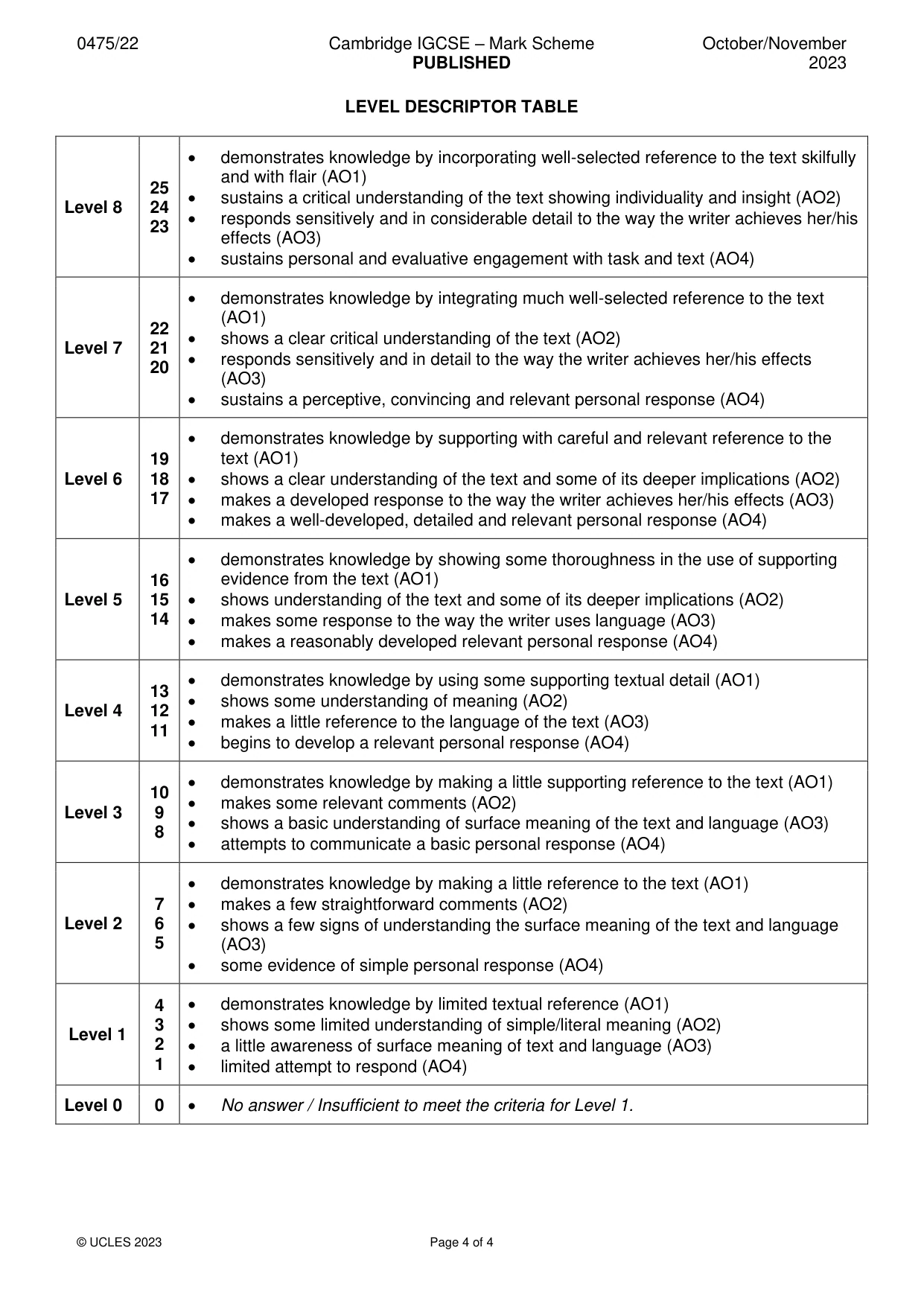
0475/22 Cambridge IGCSE – Mark Scheme PUBLISHED October/November 2023 © UCLES 2023 Page 4 of 4 LEVEL DESCRIPTOR TABLE Level 8 25 24 23 • demonstrates knowledge by incorporating well-selected reference to the text skilfully and with flair (AO1) • sustains a critical understanding of the text showing individuality and insight (AO2) • responds sensitively and in considerable detail to the way the writer achieves her/his effects (AO3) • sustains personal and evaluative engagement with task and text (AO4) Level 7 22 21 20 • demonstrates knowledge by integrating much well-selected reference to the text (AO1) • shows a clear critical understanding of the text (AO2) • responds sensitively and in detail to the way the writer achieves her/his effects (AO3) • sustains a perceptive, convincing and relevant personal response (AO4) Level 6 19 18 17 • demonstrates knowledge by supporting with careful and relevant reference to the text (AO1) • shows a clear understanding of the text and some of its deeper implications (AO2) • makes a developed response to the way the writer achieves her/his effects (AO3) • makes a well-developed, detailed and relevant personal response (AO4) Level 5 16 15 14 • demonstrates knowledge by showing some thoroughness in the use of supporting evidence from the text (AO1) • shows understanding of the text and some of its deeper implications (AO2) • makes some response to the way the writer uses language (AO3) • makes a reasonably developed relevant personal response (AO4) Level 4 13 12 11 • demonstrates knowledge by using some supporting textual detail (AO1) • shows some understanding of meaning (AO2) • makes a little reference to the language of the text (AO3) • begins to develop a relevant personal response (AO4) Level 3 10 9 8 • demonstrates knowledge by making a little supporting reference to the text (AO1) • makes some relevant comments (AO2) • shows a basic understanding of surface meaning of the text and language (AO3) • attempts to communicate a basic personal response (AO4) Level 2 7 6 5 • demonstrates knowledge by making a little reference to the text (AO1) • makes a few straightforward comments (AO2) • shows a few signs of understanding the surface meaning of the text and language (AO3) • some evidence of simple personal response (AO4) Level 1 4 3 2 1 • demonstrates knowledge by limited textual reference (AO1) • shows some limited understanding of simple/literal meaning (AO2) • a little awareness of surface meaning of text and language (AO3) • limited attempt to respond (AO4) Level 0 0 • No answer / Insufficient to meet the criteria for Level 1.
What you needed in this session
Cambridge’s own grade thresholds for 2023 Oct/Nov, Paper 2 · Variant 2. A higher threshold means an easier paper — the bar moves with how the cohort did.