Cambridge IGCSE English - Literature in English 0475 — 2022 Feb/March Paper 4 · Variant 2
0475/42/F/M/22 · 25 marks · ≈28 min
The question paper and its mark scheme, free to read here and free to download. This is Cambridge’s own paper, exactly as it was sat.
Question paper8 pages


Mark scheme5 pages
Answers below. Sit the paper first if you are practising.
Paper as text
Question paper, page 1
Cambridge IGCSE™ 0475/42 LITERATURE IN ENGLISH February/March 2022 Paper 4 Unseen 1 hour 15 minutes You must answer on the enclosed answer booklet. You will need: Answer booklet (enclosed) INSTRUCTIONS • Answer one question: either Question 1 or Question 2. • Follow the instructions on the front cover of the answer booklet. If you need additional answer paper, ask the invigilator for a continuation booklet. INFORMATION • The total mark for this paper is 25. • All questions are worth equal marks. This document has 8 pages. Any blank pages are indicated. [Turn over 03_0475_42_2022_1.6 © UCLES 2022 *4126054299*
Question paper, page 2
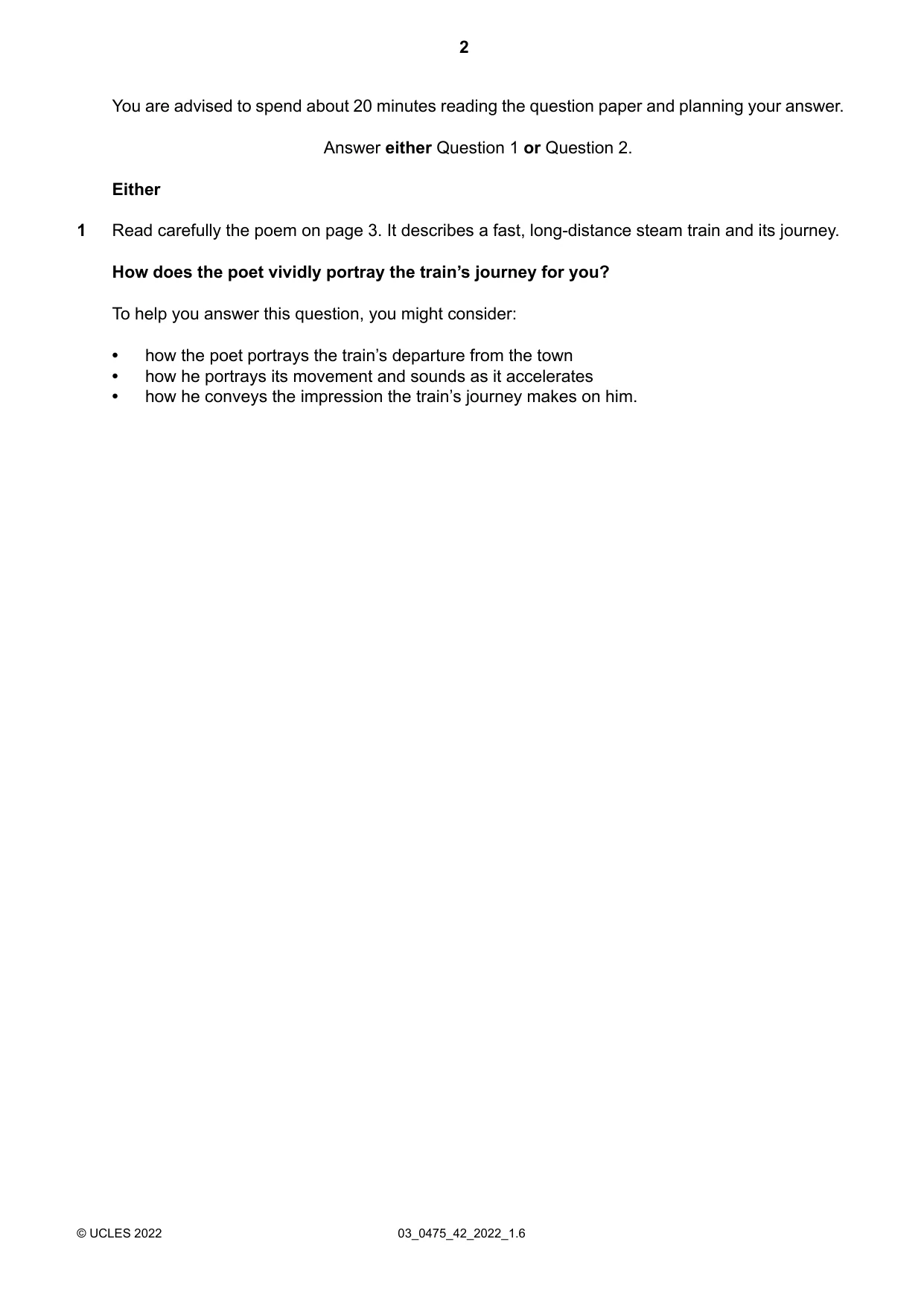
You are advised to spend about 20 minutes reading the question paper and planning your answer. Answer either Question 1 or Question 2. Either Read carefully the poem on page 3. It describes a fast, long-distance steam train and its journey. 1 How does the poet vividly portray the train’s journey for you? To help you answer this question, you might consider: • how the poet portrays the train’s departure from the town • how he portrays its movement and sounds as it accelerates • how he conveys the impression the train’s journey makes on him. 03_0475_42_2022_1.6 © UCLES 2022 2
Question paper, page 3
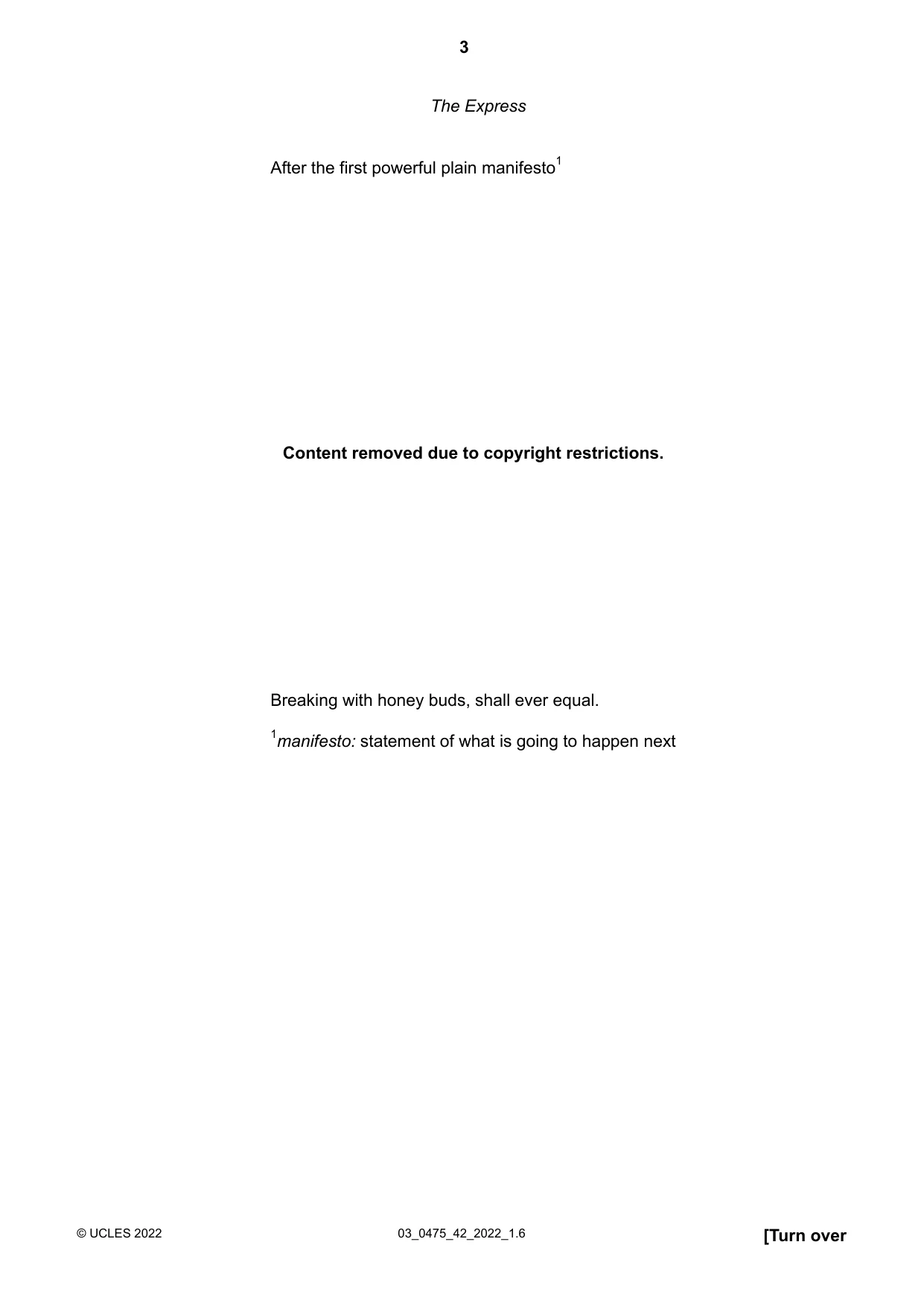
The Express After the first powerful plain manifesto1 Breaking with honey buds, shall ever equal. 1manifesto: statement of what is going to happen next [Turn over 03_0475_42_2022_1.6 © UCLES 2022 3 Content removed due to copyright restrictions.
Question paper, page 4
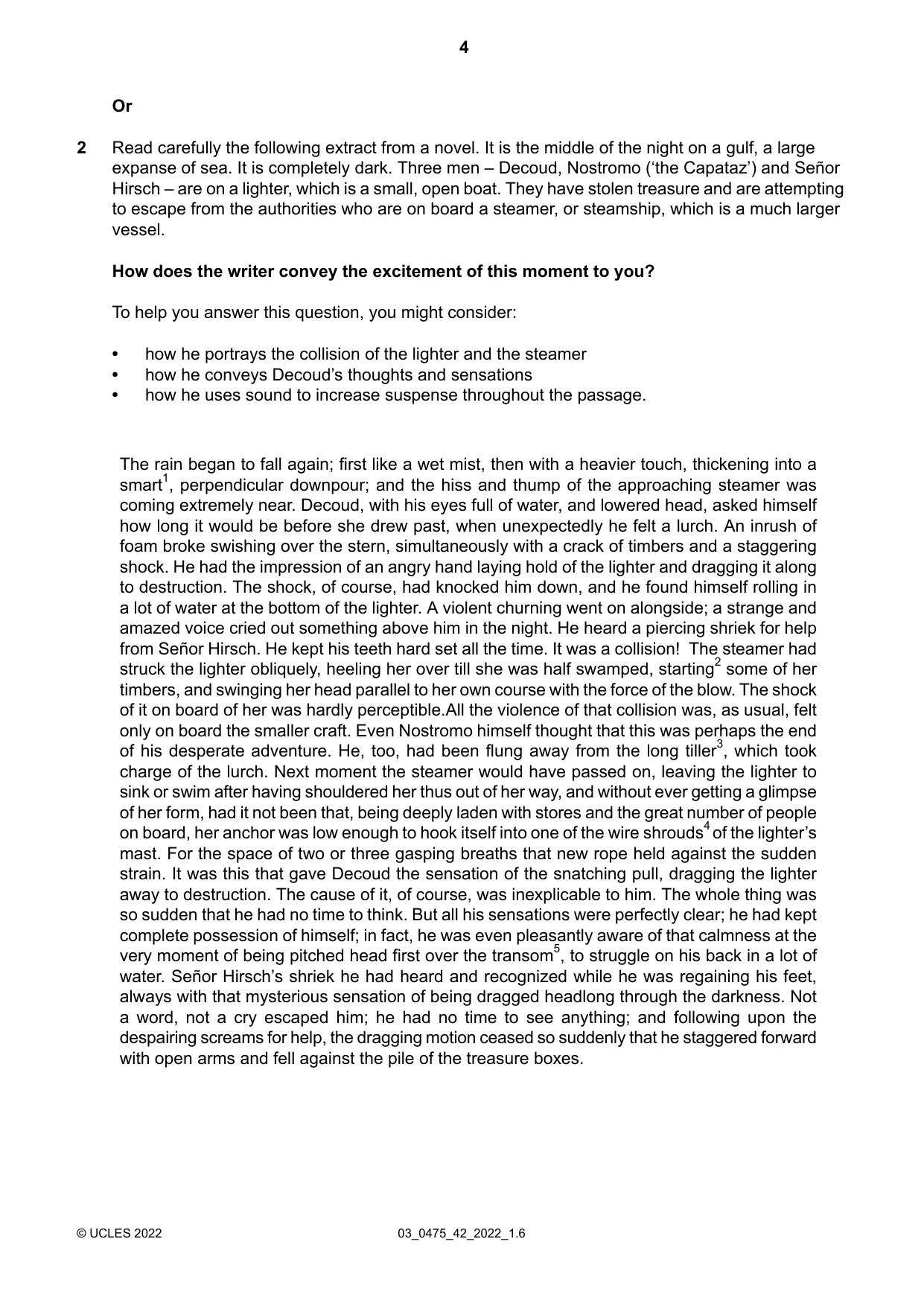
Or Read carefully the following extract from a novel. It is the middle of the night on a gulf, a large expanse of sea. It is completely dark. Three men – Decoud, Nostromo (‘the Capataz’) and Señor 2 Hirsch – are on a lighter, which is a small, open boat. They have stolen treasure and are attempting to escape from the authorities who are on board a steamer, or steamship, which is a much larger vessel. How does the writer convey the excitement of this moment to you? To help you answer this question, you might consider: • how he portrays the collision of the lighter and the steamer • how he conveys Decoud’s thoughts and sensations • how he uses sound to increase suspense throughout the passage. The rain began to fall again; first like a wet mist, then with a heavier touch, thickening into a smart1, perpendicular downpour; and the hiss and thump of the approaching steamer was coming extremely near. Decoud, with his eyes full of water, and lowered head, asked himself how long it would be before she drew past, when unexpectedly he felt a lurch. An inrush of foam broke swishing over the stern, simultaneously with a crack of timbers and a staggering shock. He had the impression of an angry hand laying hold of the lighter and dragging it along to destruction. The shock, of course, had knocked him down, and he found himself rolling in a lot of water at the bottom of the lighter. A violent churning went on alongside; a strange and amazed voice cried out something above him in the night. He heard a piercing shriek for help from Señor Hirsch. He kept his teeth hard set all the time. It was a collision! The steamer had struck the lighter obliquely, heeling her over till she was half swamped, starting2 some of her timbers, and swinging her head parallel to her own course with the force of the blow. The shock of it on board of her was hardly perceptible.All the violence of that collision was, as usual, felt only on board the smaller craft. Even Nostromo himself thought that this was perhaps the end of his desperate adventure. He, too, had been flung away from the long tiller3, which took charge of the lurch. Next moment the steamer would have passed on, leaving the lighter to sink or swim after having shouldered her thus out of her way, and without ever getting a glimpse of her form, had it not been that, being deeply laden with stores and the great number of people on board, her anchor was low enough to hook itself into one of the wire shrouds4of the lighter’s mast. For the space of two or three gasping breaths that new rope held against the sudden strain. It was this that gave Decoud the sensation of the snatching pull, dragging the lighter away to destruction. The cause of it, of course, was inexplicable to him. The whole thing was so sudden that he had no time to think. But all his sensations were perfectly clear; he had kept complete possession of himself; in fact, he was even pleasantly aware of that calmness at the very moment of being pitched head first over the transom5, to struggle on his back in a lot of water. Señor Hirsch’s shriek he had heard and recognized while he was regaining his feet, always with that mysterious sensation of being dragged headlong through the darkness. Not a word, not a cry escaped him; he had no time to see anything; and following upon the despairing screams for help, the dragging motion ceased so suddenly that he staggered forward with open arms and fell against the pile of the treasure boxes. 03_0475_42_2022_1.6 © UCLES 2022 4
Question paper, page 5
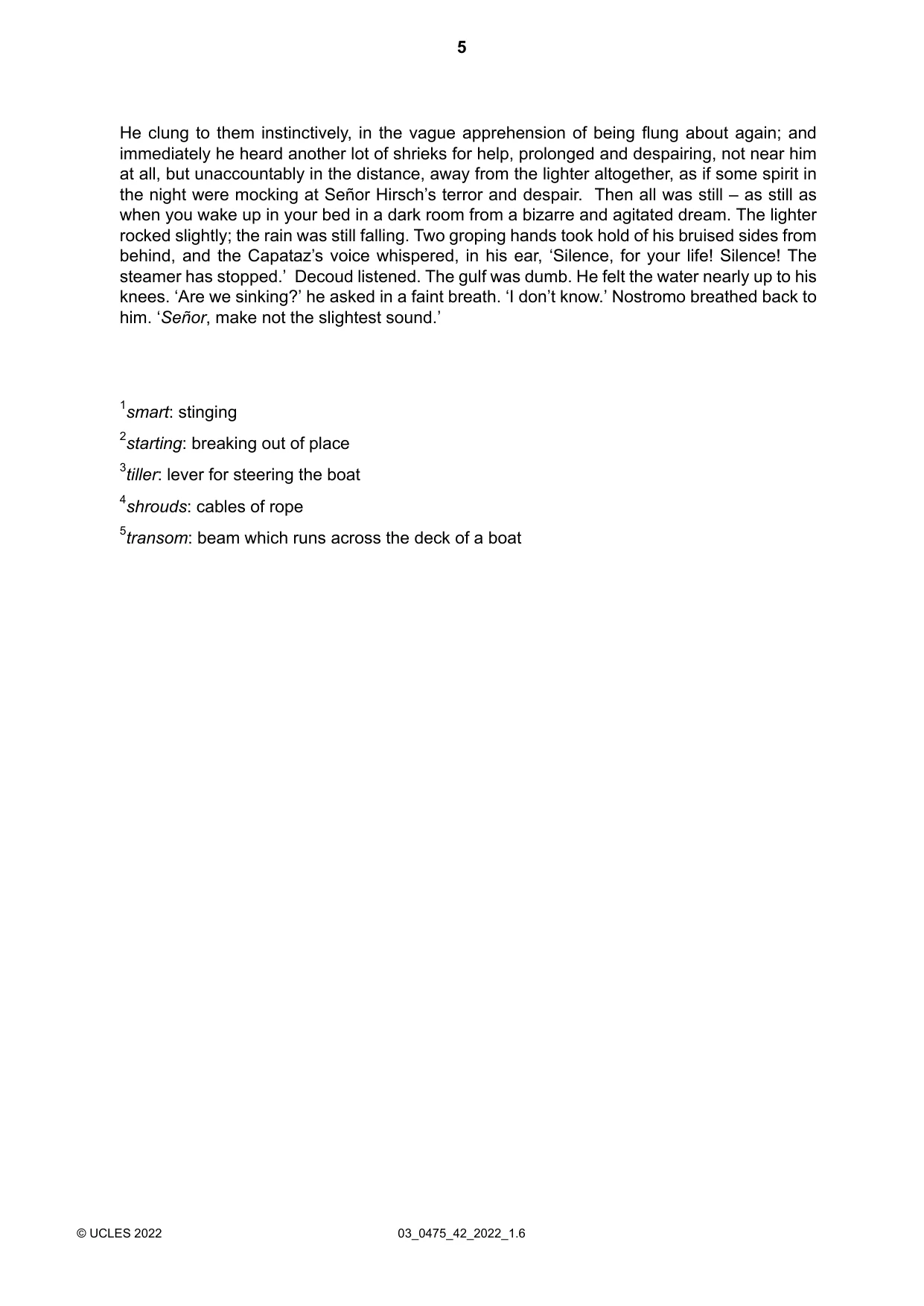
He clung to them instinctively, in the vague apprehension of being flung about again; and immediately he heard another lot of shrieks for help, prolonged and despairing, not near him at all, but unaccountably in the distance, away from the lighter altogether, as if some spirit in the night were mocking at Señor Hirsch’s terror and despair. Then all was still – as still as when you wake up in your bed in a dark room from a bizarre and agitated dream. The lighter rocked slightly; the rain was still falling. Two groping hands took hold of his bruised sides from behind, and the Capataz’s voice whispered, in his ear, ‘Silence, for your life! Silence! The steamer has stopped.’ Decoud listened. The gulf was dumb. He felt the water nearly up to his knees. ‘Are we sinking?’ he asked in a faint breath. ‘I don’t know.’ Nostromo breathed back to him. ‘Señor, make not the slightest sound.’ 1smart: stinging 2starting: breaking out of place 3tiller: lever for steering the boat 4shrouds: cables of rope 5transom: beam which runs across the deck of a boat 03_0475_42_2022_1.6 © UCLES 2022 5
Question paper, page 6
BLANK PAGE 03_0475_42_2022_1.6 © UCLES 2022 6
Question paper, page 7
BLANK PAGE 03_0475_42_2022_1.6 © UCLES 2022 7
Question paper, page 8
BLANK PAGE Permission to reproduce items where third-party owned material protected by copyright is included has been sought and cleared where possible. Every reasonable effort has been made by the publisher (UCLES) to trace copyright holders, but if any items requiring clearance have unwittingly been included, the publisher will be pleased to make amends at the earliest possible opportunity. To avoid the issue of disclosure of answer-related information to candidates, all copyright acknowledgements are reproduced online in the Cambridge Assessment International Education Copyright Acknowledgements Booklet. This is produced for each series of examinations and is freely available to download at www.cambridgeinternational.org after the live examination series. Cambridge Assessment International Education is part of Cambridge Assessment. Cambridge Assessment is the brand name of the University of Cambridge Local Examinations Syndicate (UCLES), which is a department of the University of Cambridge. 03_0475_42_2022_1.6 © UCLES 2022 8
Mark scheme, page 1
This document consists of 5 printed pages. © UCLES 2022 [Turn over Cambridge IGCSE™ LITERATURE IN ENGLISH 0475/42 Paper 4 Unseen February/March 2022 MARK SCHEME Maximum Mark: 25 Published This mark scheme is published as an aid to teachers and candidates, to indicate the requirements of the examination. It shows the basis on which Examiners were instructed to award marks. It does not indicate the details of the discussions that took place at an Examiners’ meeting before marking began, which would have considered the acceptability of alternative answers. Mark schemes should be read in conjunction with the question paper and the Principal Examiner Report for Teachers. Cambridge International will not enter into discussions about these mark schemes. Cambridge International is publishing the mark schemes for the February/March 2022 series for most Cambridge IGCSE™, Cambridge International A and AS Level components and some Cambridge O Level components.
Mark scheme, page 2
0475/42 Cambridge IGCSE – Mark Scheme PUBLISHED February/March 2022 © UCLES 2022 Page 2 of 5 Generic Marking Principles These general marking principles must be applied by all examiners when marking candidate answers. They should be applied alongside the specific content of the mark scheme or generic level descriptors for a question. Each question paper and mark scheme will also comply with these marking principles. GENERIC MARKING PRINCIPLE 1: Marks must be awarded in line with: • the specific content of the mark scheme or the generic level descriptors for the question • the specific skills defined in the mark scheme or in the generic level descriptors for the question • the standard of response required by a candidate as exemplified by the standardisation scripts. GENERIC MARKING PRINCIPLE 2: Marks awarded are always whole marks (not half marks, or other fractions). GENERIC MARKING PRINCIPLE 3: Marks must be awarded positively: • marks are awarded for correct/valid answers, as defined in the mark scheme. However, credit is given for valid answers which go beyond the scope of the syllabus and mark scheme, referring to your Team Leader as appropriate • marks are awarded when candidates clearly demonstrate what they know and can do • marks are not deducted for errors • marks are not deducted for omissions • answers should only be judged on the quality of spelling, punctuation and grammar when these features are specifically assessed by the question as indicated by the mark scheme. The meaning, however, should be unambiguous. GENERIC MARKING PRINCIPLE 4: Rules must be applied consistently, e.g. in situations where candidates have not followed instructions or in the application of generic level descriptors. GENERIC MARKING PRINCIPLE 5: Marks should be awarded using the full range of marks defined in the mark scheme for the question (however; the use of the full mark range may be limited according to the quality of the candidate responses seen). GENERIC MARKING PRINCIPLE 6: Marks awarded are based solely on the requirements as defined in the mark scheme. Marks should not be awarded with grade thresholds or grade descriptors in mind.
Mark scheme, page 3
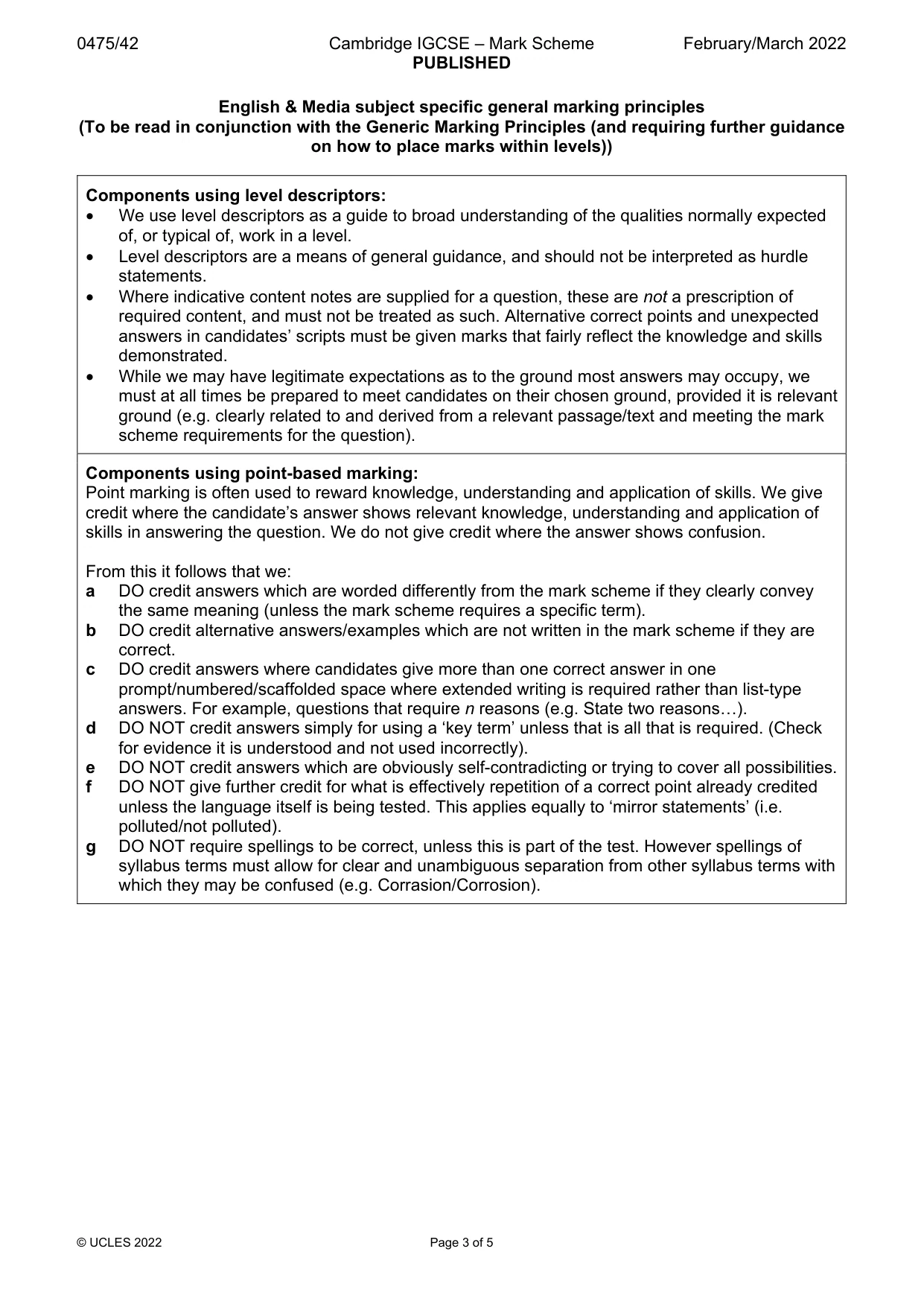
0475/42 Cambridge IGCSE – Mark Scheme PUBLISHED February/March 2022 © UCLES 2022 Page 3 of 5 English & Media subject specific general marking principles (To be read in conjunction with the Generic Marking Principles (and requiring further guidance on how to place marks within levels)) Components using level descriptors: • We use level descriptors as a guide to broad understanding of the qualities normally expected of, or typical of, work in a level. • Level descriptors are a means of general guidance, and should not be interpreted as hurdle statements. • Where indicative content notes are supplied for a question, these are not a prescription of required content, and must not be treated as such. Alternative correct points and unexpected answers in candidates’ scripts must be given marks that fairly reflect the knowledge and skills demonstrated. • While we may have legitimate expectations as to the ground most answers may occupy, we must at all times be prepared to meet candidates on their chosen ground, provided it is relevant ground (e.g. clearly related to and derived from a relevant passage/text and meeting the mark scheme requirements for the question). Components using point-based marking: Point marking is often used to reward knowledge, understanding and application of skills. We give credit where the candidate’s answer shows relevant knowledge, understanding and application of skills in answering the question. We do not give credit where the answer shows confusion. From this it follows that we: a DO credit answers which are worded differently from the mark scheme if they clearly convey the same meaning (unless the mark scheme requires a specific term). b DO credit alternative answers/examples which are not written in the mark scheme if they are correct. c DO credit answers where candidates give more than one correct answer in one prompt/numbered/scaffolded space where extended writing is required rather than list-type answers. For example, questions that require n reasons (e.g. State two reasons…). d DO NOT credit answers simply for using a ‘key term’ unless that is all that is required. (Check for evidence it is understood and not used incorrectly). e DO NOT credit answers which are obviously self-contradicting or trying to cover all possibilities. f DO NOT give further credit for what is effectively repetition of a correct point already credited unless the language itself is being tested. This applies equally to ‘mirror statements’ (i.e. polluted/not polluted). g DO NOT require spellings to be correct, unless this is part of the test. However spellings of syllabus terms must allow for clear and unambiguous separation from other syllabus terms with which they may be confused (e.g. Corrasion/Corrosion).
Mark scheme, page 4
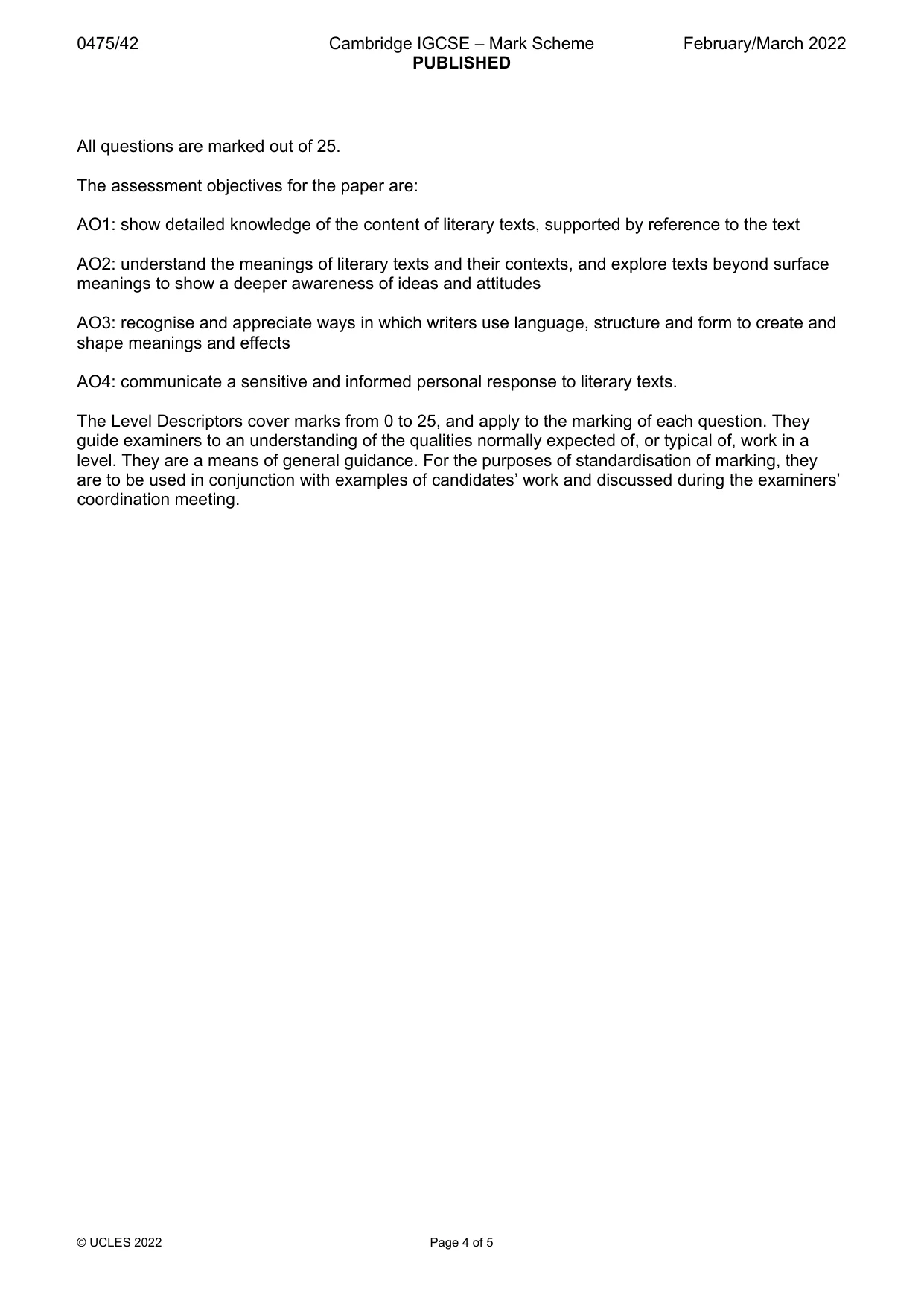
0475/42 Cambridge IGCSE – Mark Scheme PUBLISHED February/March 2022 © UCLES 2022 Page 4 of 5 All questions are marked out of 25. The assessment objectives for the paper are: AO1: show detailed knowledge of the content of literary texts, supported by reference to the text AO2: understand the meanings of literary texts and their contexts, and explore texts beyond surface meanings to show a deeper awareness of ideas and attitudes AO3: recognise and appreciate ways in which writers use language, structure and form to create and shape meanings and effects AO4: communicate a sensitive and informed personal response to literary texts. The Level Descriptors cover marks from 0 to 25, and apply to the marking of each question. They guide examiners to an understanding of the qualities normally expected of, or typical of, work in a level. They are a means of general guidance. For the purposes of standardisation of marking, they are to be used in conjunction with examples of candidates’ work and discussed during the examiners’ coordination meeting.
Mark scheme, page 5
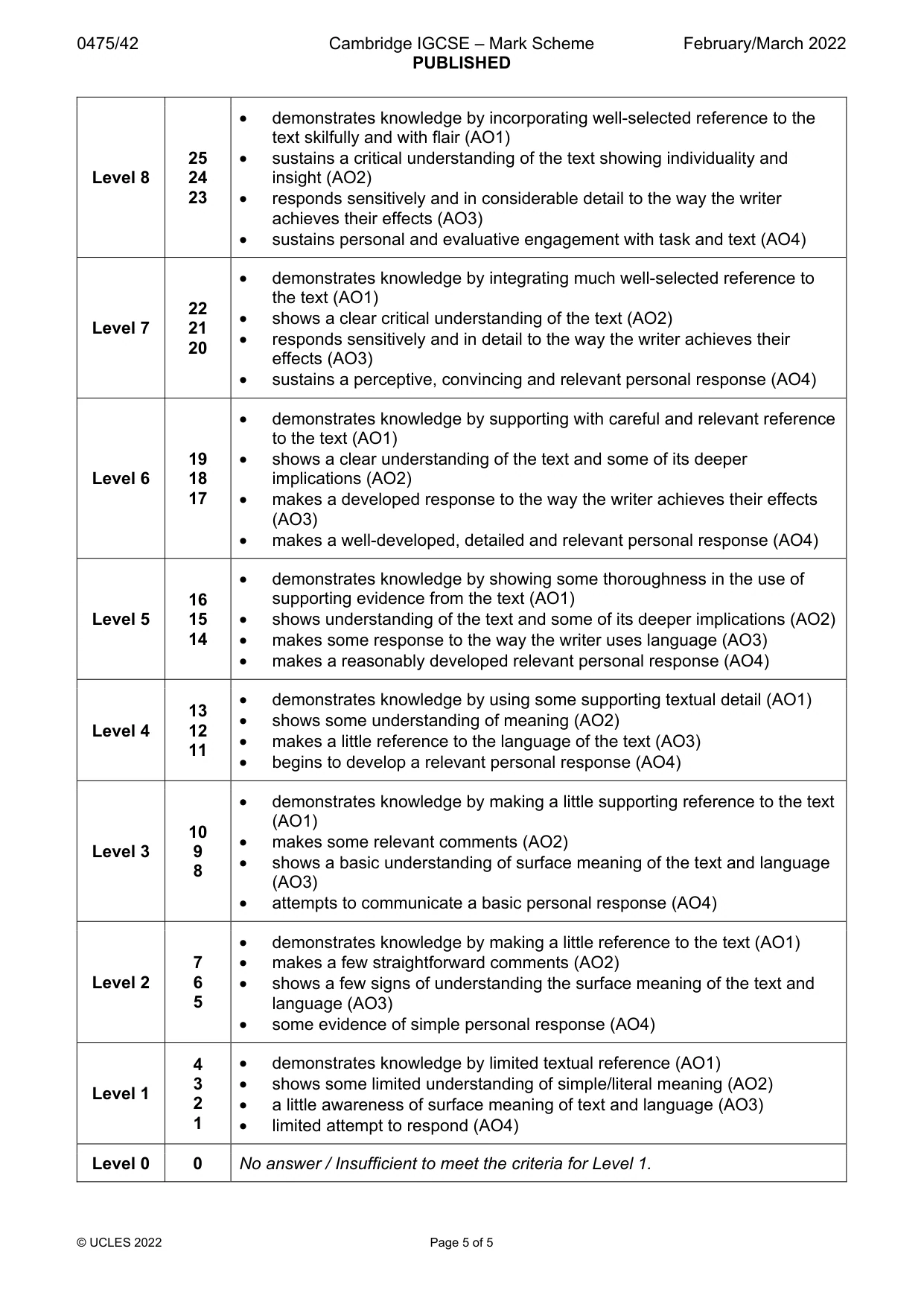
0475/42 Cambridge IGCSE – Mark Scheme PUBLISHED February/March 2022 © UCLES 2022 Page 5 of 5 Level 8 25 24 23 • demonstrates knowledge by incorporating well-selected reference to the text skilfully and with flair (AO1) • sustains a critical understanding of the text showing individuality and insight (AO2) • responds sensitively and in considerable detail to the way the writer achieves their effects (AO3) • sustains personal and evaluative engagement with task and text (AO4) Level 7 22 21 20 • demonstrates knowledge by integrating much well-selected reference to the text (AO1) • shows a clear critical understanding of the text (AO2) • responds sensitively and in detail to the way the writer achieves their effects (AO3) • sustains a perceptive, convincing and relevant personal response (AO4) Level 6 19 18 17 • demonstrates knowledge by supporting with careful and relevant reference to the text (AO1) • shows a clear understanding of the text and some of its deeper implications (AO2) • makes a developed response to the way the writer achieves their effects (AO3) • makes a well-developed, detailed and relevant personal response (AO4) Level 5 16 15 14 • demonstrates knowledge by showing some thoroughness in the use of supporting evidence from the text (AO1) • shows understanding of the text and some of its deeper implications (AO2) • makes some response to the way the writer uses language (AO3) • makes a reasonably developed relevant personal response (AO4) Level 4 13 12 11 • demonstrates knowledge by using some supporting textual detail (AO1) • shows some understanding of meaning (AO2) • makes a little reference to the language of the text (AO3) • begins to develop a relevant personal response (AO4) Level 3 10 9 8 • demonstrates knowledge by making a little supporting reference to the text (AO1) • makes some relevant comments (AO2) • shows a basic understanding of surface meaning of the text and language (AO3) • attempts to communicate a basic personal response (AO4) Level 2 7 6 5 • demonstrates knowledge by making a little reference to the text (AO1) • makes a few straightforward comments (AO2) • shows a few signs of understanding the surface meaning of the text and language (AO3) • some evidence of simple personal response (AO4) Level 1 4 3 2 1 • demonstrates knowledge by limited textual reference (AO1) • shows some limited understanding of simple/literal meaning (AO2) • a little awareness of surface meaning of text and language (AO3) • limited attempt to respond (AO4) Level 0 0 No answer / Insufficient to meet the criteria for Level 1.
What you needed in this session
Cambridge’s own grade thresholds for 2022 Feb/March, Paper 4 · Variant 2. A higher threshold means an easier paper — the bar moves with how the cohort did.