Cambridge IGCSE English - Literature in English 0475 — 2022 Feb/March Paper 2 · Variant 2
0475/22/F/M/22 · 50 marks · ≈56 min
The question paper and its mark scheme, free to read here and free to download. This is Cambridge’s own paper, exactly as it was sat.
Question paper12 pages
Mark scheme5 pages
Answers below. Sit the paper first if you are practising.
Paper as text
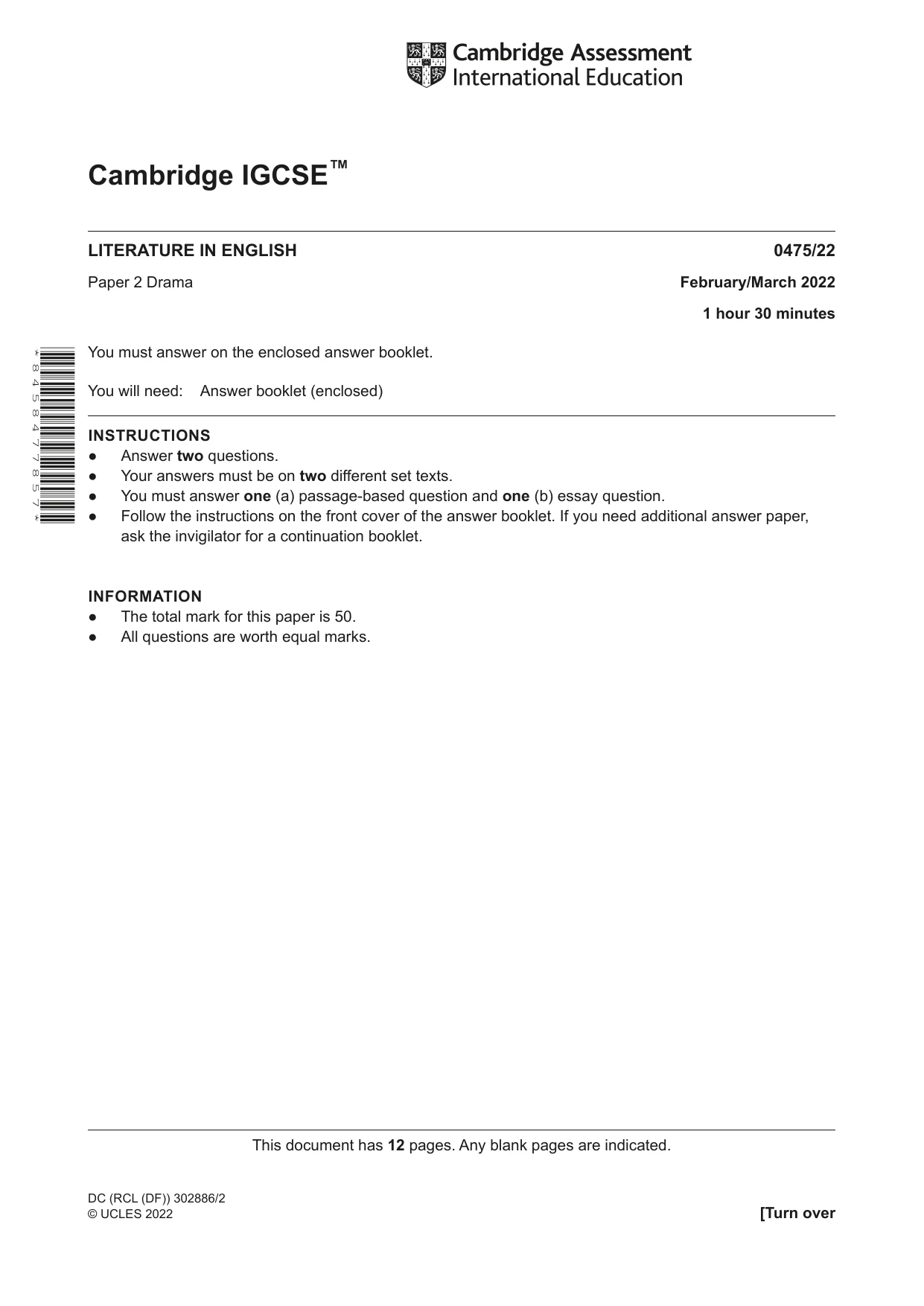
Question paper, page 1
This document has 12 pages. Any blank pages are indicated. * 8 4 5 8 4 7 7 8 5 7 * Cambridge IGCSE™ LITERATURE IN ENGLISH 0475/22 Paper 2 Drama February/March 2022 1 hour 30 minutes You must answer on the enclosed answer booklet. You will need: Answer booklet (enclosed) INSTRUCTIONS ● Answer two questions. ● Your answers must be on two different set texts. ● You must answer one (a) passage-based question and one (b) essay question. ● Follow the instructions on the front cover of the answer booklet. If you need additional answer paper, ask the invigilator for a continuation booklet. INFORMATION ● The total mark for this paper is 50. ● All questions are worth equal marks. DC (RCL (DF)) 302886/2 © UCLES 2022 [Turn over
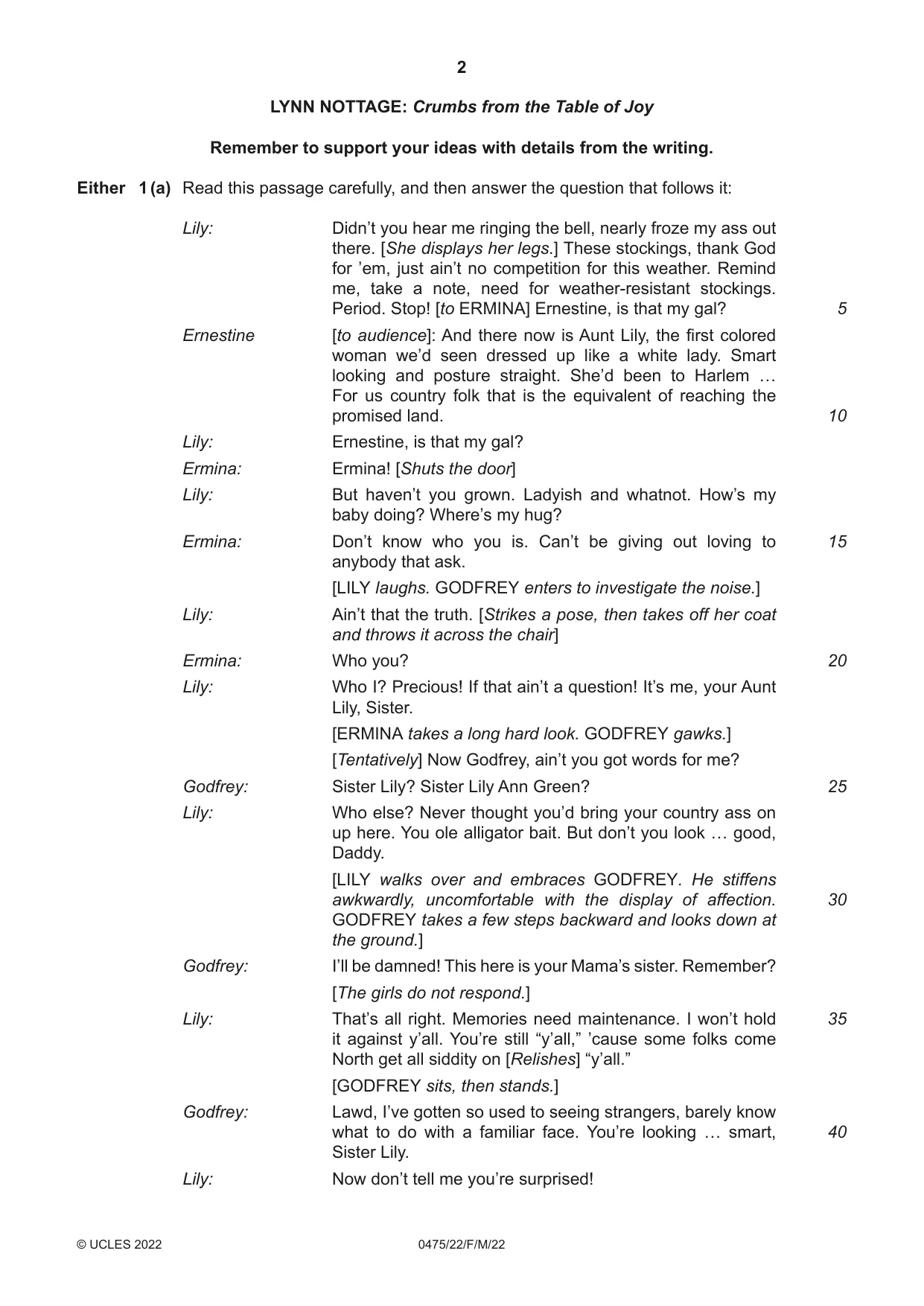
Question paper, page 2
2 0475/22/F/M/22 © UCLES 2022 LYNN NOTTAGE: Crumbs from the Table of Joy Remember to support your ideas with details from the writing. Either 1 (a) Read this passage carefully, and then answer the question that follows it: Lily: Didn’t you hear me ringing the bell, nearly froze my ass out there. [She displays her legs.] These stockings, thank God for ’em, just ain’t no competition for this weather. Remind me, take a note, need for weather-resistant stockings. Period. Stop! [to ERMINA] Ernestine, is that my gal? Ernestine [to audience]: And there now is Aunt Lily, the first colored woman we’d seen dressed up like a white lady. Smart looking and posture straight. She’d been to Harlem … For us country folk that is the equivalent of reaching the promised land. Lily: Ernestine, is that my gal? Ermina: Ermina! [Shuts the door] Lily: But haven’t you grown. Ladyish and whatnot. How’s my baby doing? Where’s my hug? Ermina: Don’t know who you is. Can’t be giving out loving to anybody that ask. [LILY laughs. GODFREY enters to investigate the noise.] Lily: Ain’t that the truth. [Strikes a pose, then takes off her coat and throws it across the chair] Ermina: Who you? Lily: Who I? Precious! If that ain’t a question! It’s me, your Aunt Lily, Sister. [ERMINA takes a long hard look. GODFREY gawks.] [Tentatively] Now Godfrey, ain’t you got words for me? Godfrey: Sister Lily? Sister Lily Ann Green? Lily: Who else? Never thought you’d bring your country ass on up here. You ole alligator bait. But don’t you look … good, Daddy. [LILY walks over and embraces GODFREY. He stiffens awkwardly, uncomfortable with the display of affection. GODFREY takes a few steps backward and looks down at the ground.] Godfrey: I’ll be damned! This here is your Mama’s sister. Remember? [The girls do not respond.] Lily: That’s all right. Memories need maintenance. I won’t hold it against y’all. You’re still “y’all,” ’cause some folks come North get all siddity on [Relishes] “y’all.” [GODFREY sits, then stands.] Godfrey: Lawd, I’ve gotten so used to seeing strangers, barely know what to do with a familiar face. You’re looking … smart, Sister Lily. Lily: Now don’t tell me you’re surprised! 5 10 15 20 25 30 35 40
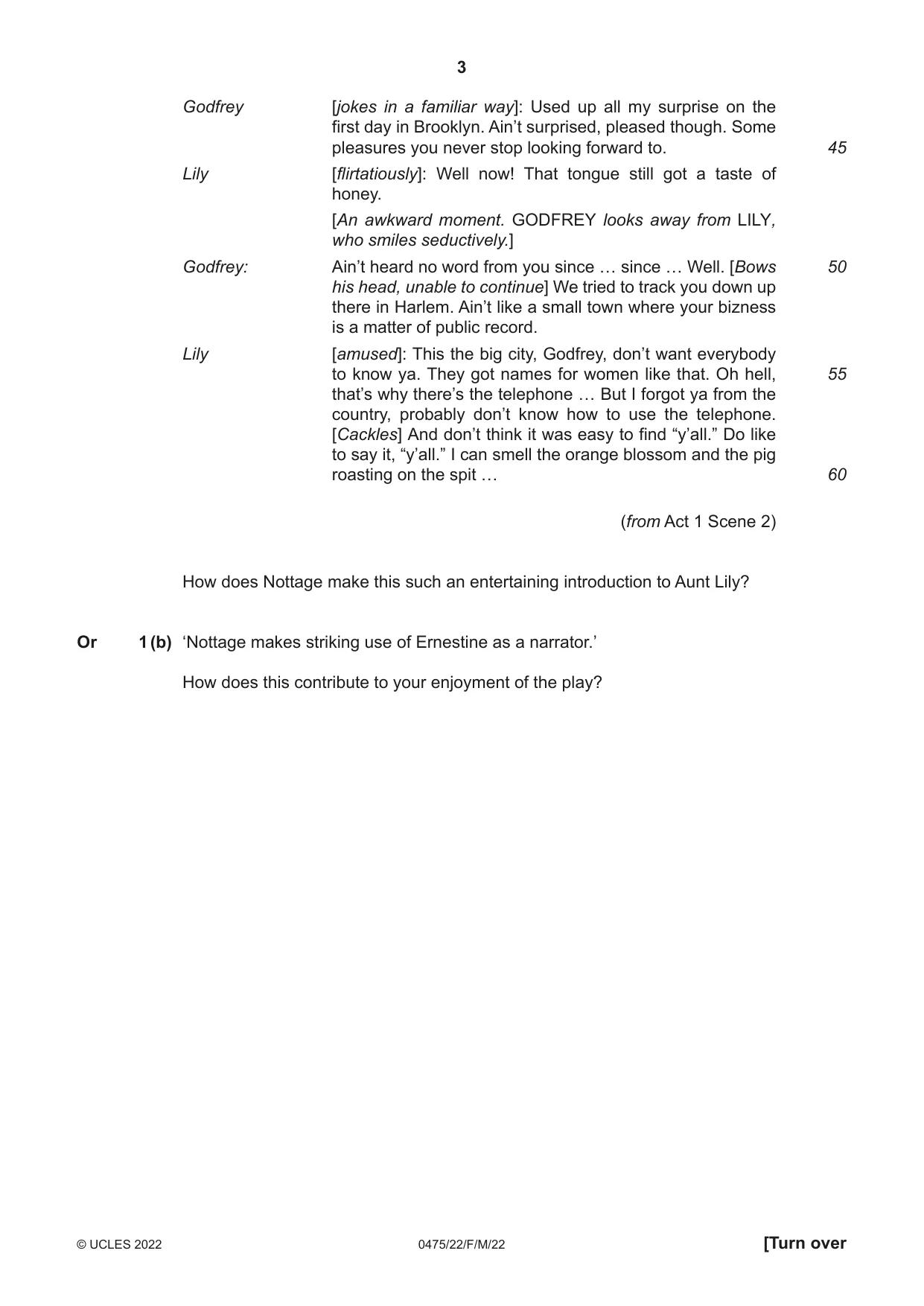
Question paper, page 3
3 0475/22/F/M/22 © UCLES 2022 [Turn over Godfrey [jokes in a familiar way]: Used up all my surprise on the first day in Brooklyn. Ain’t surprised, pleased though. Some pleasures you never stop looking forward to. Lily [flirtatiously]: Well now! That tongue still got a taste of honey. [An awkward moment. GODFREY looks away from LILY, who smiles seductively.] Godfrey: Ain’t heard no word from you since … since … Well. [Bows his head, unable to continue] We tried to track you down up there in Harlem. Ain’t like a small town where your bizness is a matter of public record. Lily [amused]: This the big city, Godfrey, don’t want everybody to know ya. They got names for women like that. Oh hell, that’s why there’s the telephone … But I forgot ya from the country, probably don’t know how to use the telephone. [Cackles] And don’t think it was easy to find “y’all.” Do like to say it, “y’all.” I can smell the orange blossom and the pig roasting on the spit … (from Act 1 Scene 2) How does Nottage make this such an entertaining introduction to Aunt Lily? Or 1 (b) ‘Nottage makes striking use of Ernestine as a narrator.’ How does this contribute to your enjoyment of the play? 45 50 55 60
Question paper, page 4
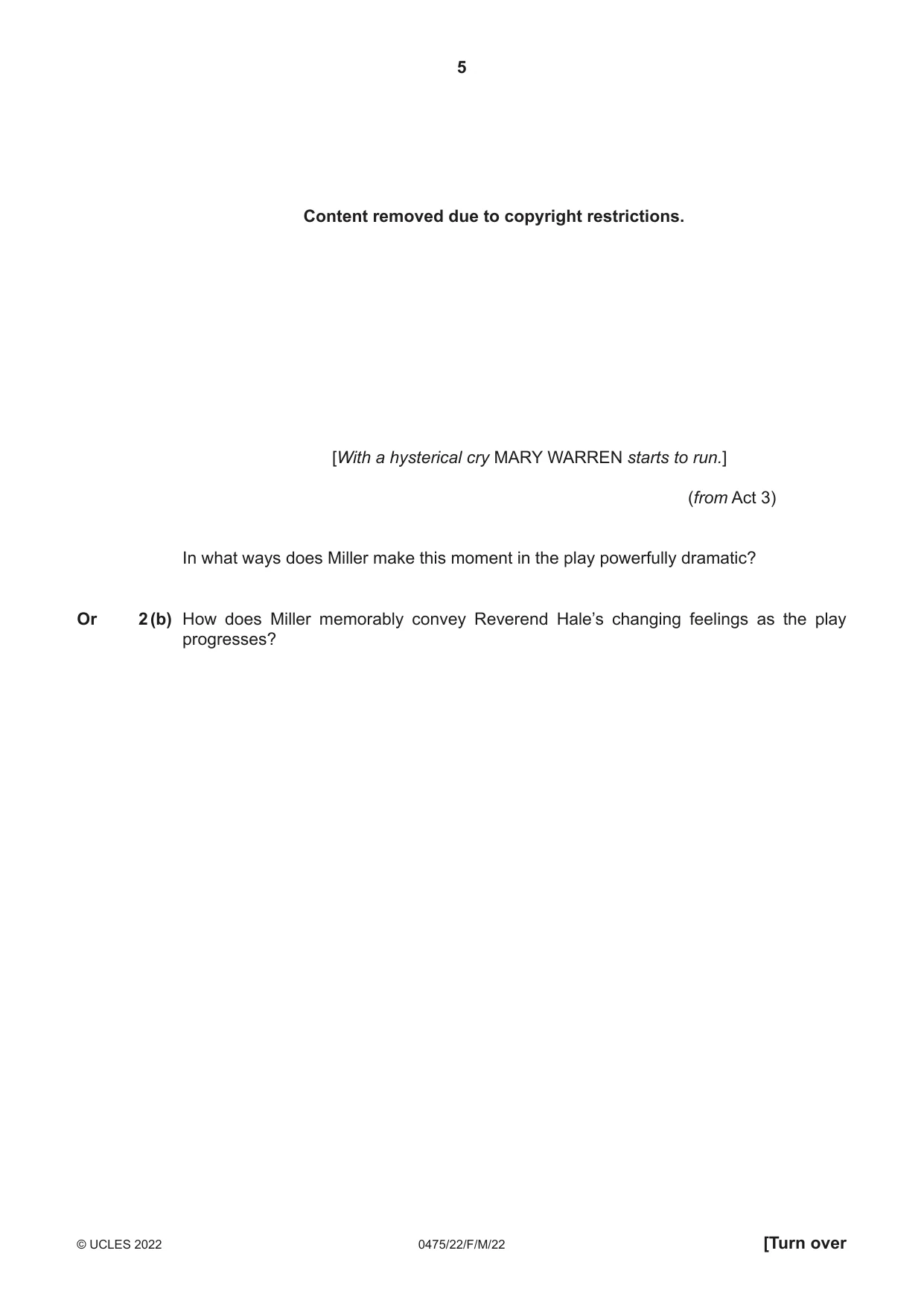
4 0475/22/F/M/22 © UCLES 2022 ARTHUR MILLER: The Crucible Remember to support your ideas with details from the writing. Either 2 (a) Read this passage carefully, and then answer the question that follows it: Parris: Prove to us that you can faint by your own will, as you claim. Content removed due to copyright restrictions.
Question paper, page 5
5 0475/22/F/M/22 © UCLES 2022 [Turn over [With a hysterical cry MARY WARREN starts to run.] (from Act 3) In what ways does Miller make this moment in the play powerfully dramatic? Or 2 (b) How does Miller memorably convey Reverend Hale’s changing feelings as the play progresses? Content removed due to copyright restrictions.
Question paper, page 6
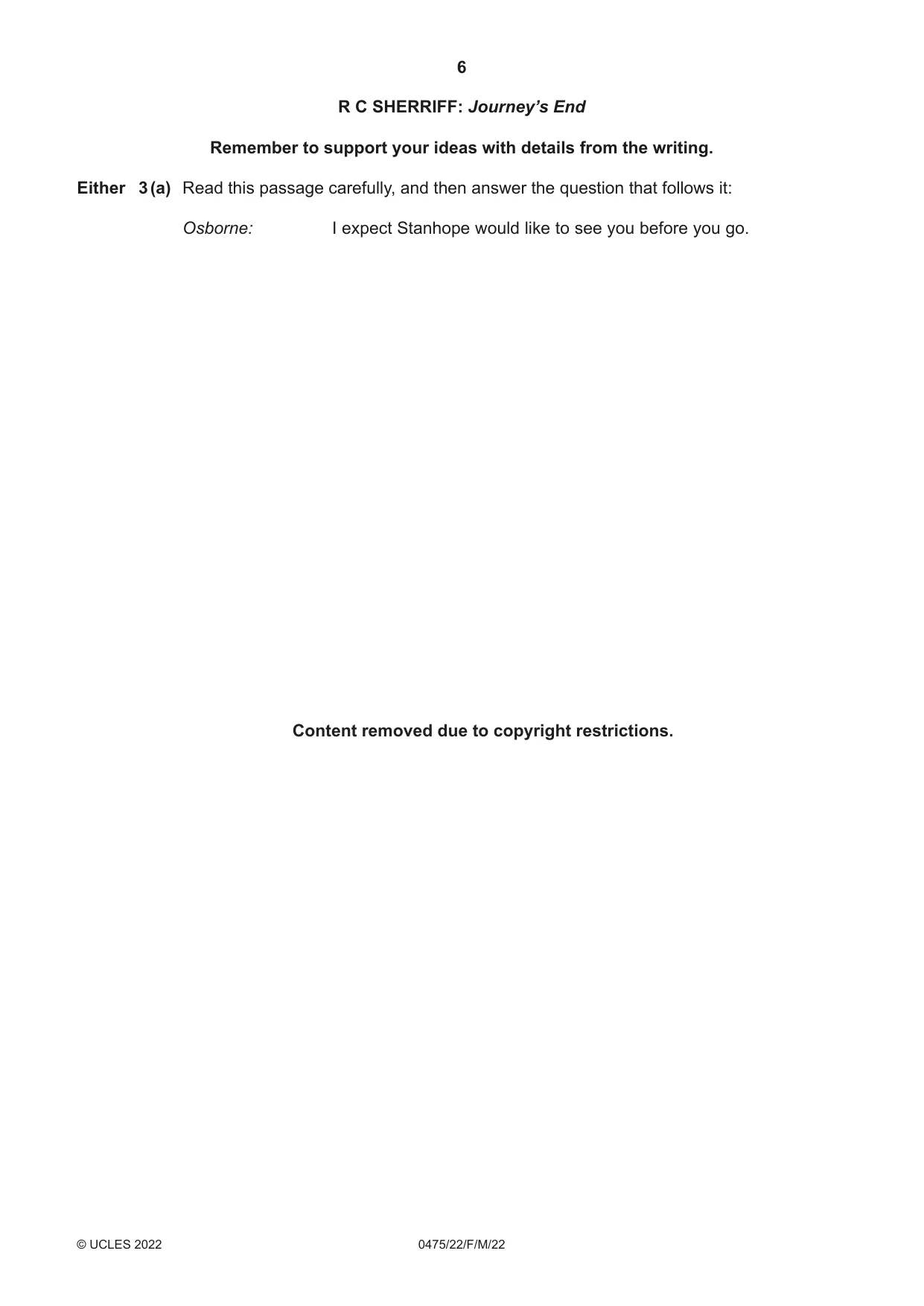
6 0475/22/F/M/22 © UCLES 2022 R C SHERRIFF: Journey’s End Remember to support your ideas with details from the writing. Either 3 (a) Read this passage carefully, and then answer the question that follows it: Osborne: I expect Stanhope would like to see you before you go. Content removed due to copyright restrictions.
Question paper, page 7
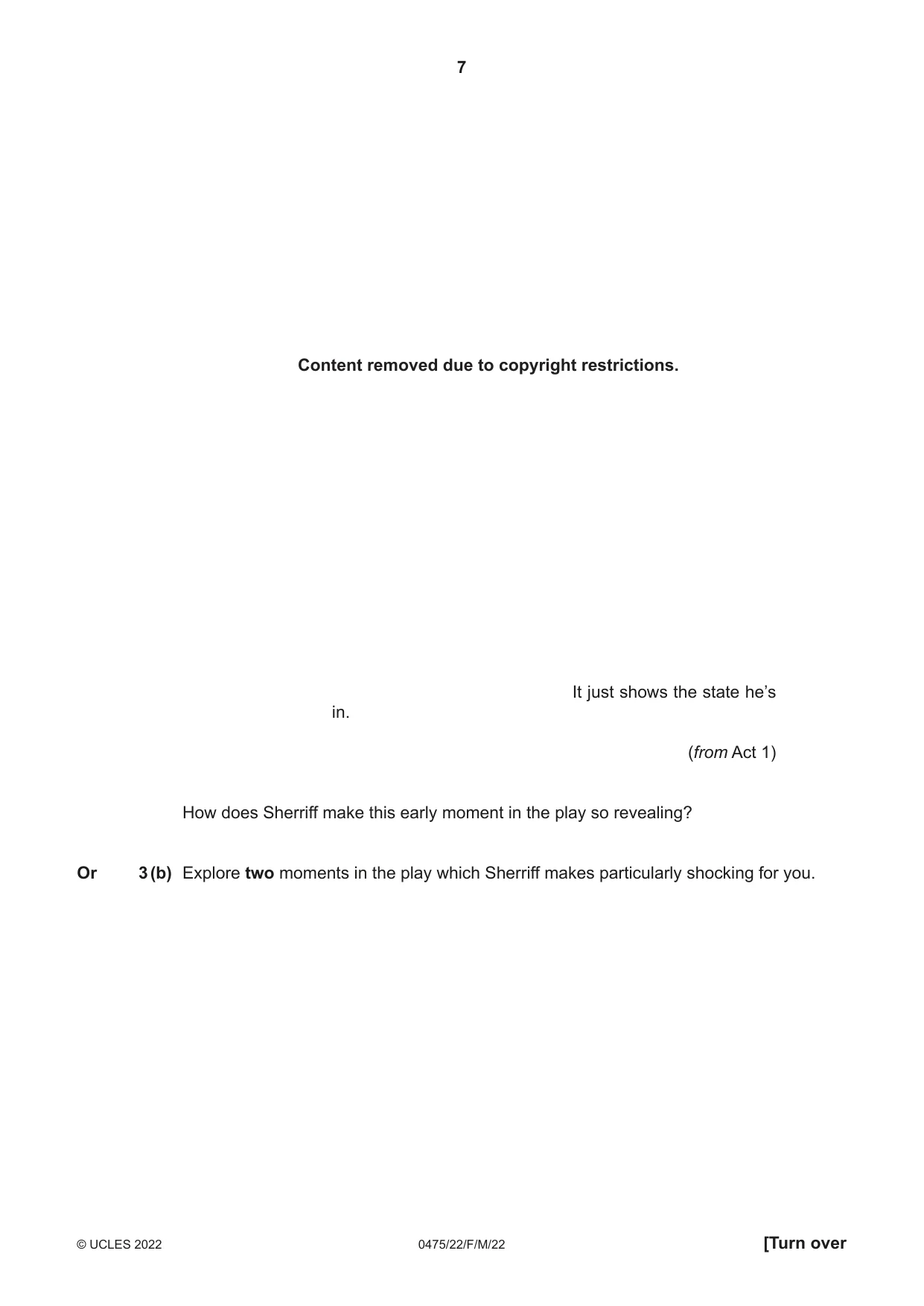
7 0475/22/F/M/22 © UCLES 2022 [Turn over It just shows the state he’s in. (from Act 1) How does Sherriff make this early moment in the play so revealing? Or 3 (b) Explore two moments in the play which Sherriff makes particularly shocking for you. Content removed due to copyright restrictions.
Question paper, page 8
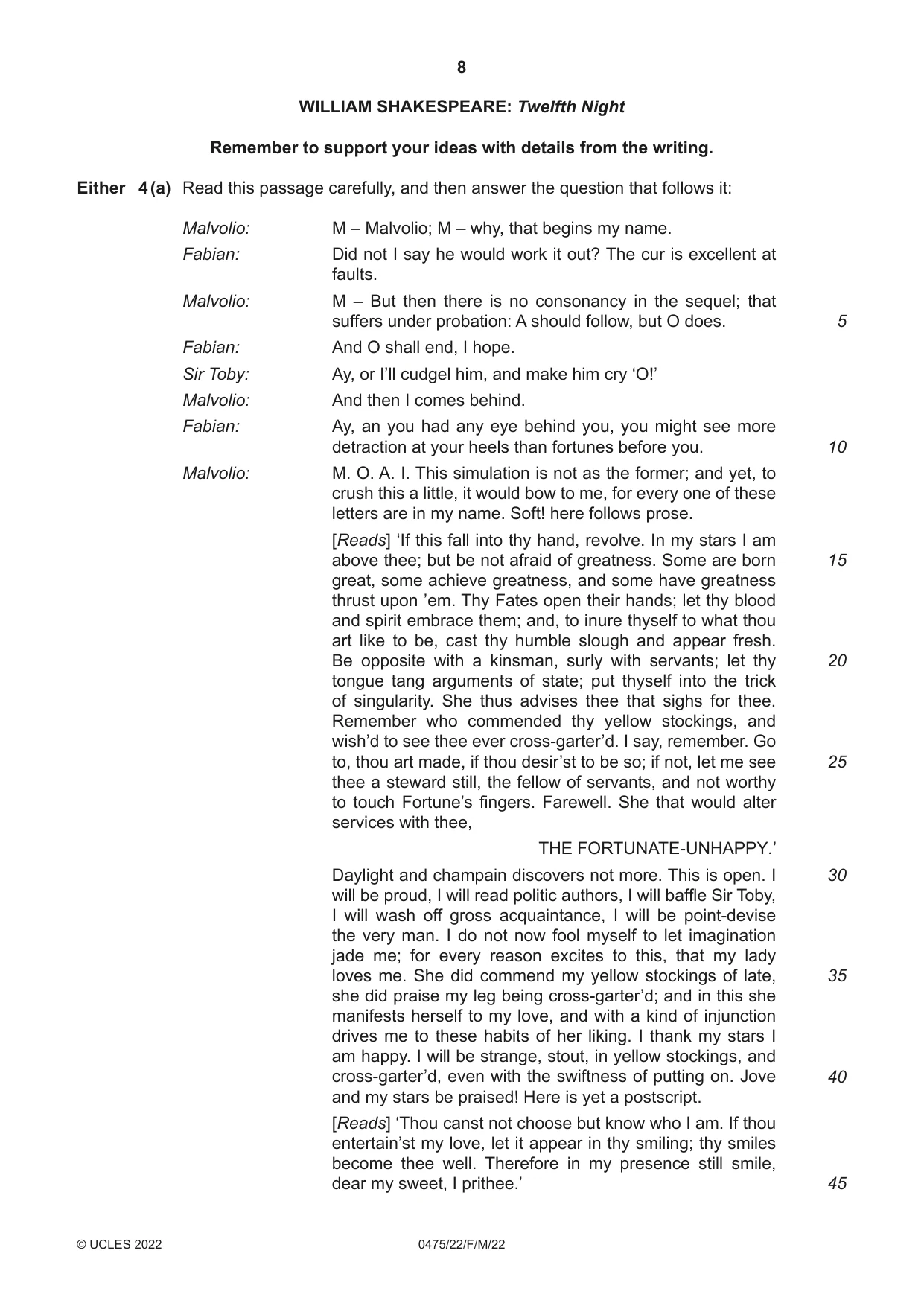
8 0475/22/F/M/22 © UCLES 2022 WILLIAM SHAKESPEARE: Twelfth Night Remember to support your ideas with details from the writing. Either 4 (a) Read this passage carefully, and then answer the question that follows it: Malvolio: M – Malvolio; M – why, that begins my name. Fabian: Did not I say he would work it out? The cur is excellent at faults. Malvolio: M – But then there is no consonancy in the sequel; that suffers under probation: A should follow, but O does. Fabian: And O shall end, I hope. Sir Toby: Ay, or I’ll cudgel him, and make him cry ‘O!’ Malvolio: And then I comes behind. Fabian: Ay, an you had any eye behind you, you might see more detraction at your heels than fortunes before you. Malvolio: M. O. Α. I. This simulation is not as the former; and yet, to crush this a little, it would bow to me, for every one of these letters are in my name. Soft! here follows prose. [Reads] ‘If this fall into thy hand, revolve. In my stars I am above thee; but be not afraid of greatness. Some are born great, some achieve greatness, and some have greatness thrust upon ’em. Thy Fates open their hands; let thy blood and spirit embrace them; and, to inure thyself to what thou art like to be, cast thy humble slough and appear fresh. Be opposite with a kinsman, surly with servants; let thy tongue tang arguments of state; put thyself into the trick of singularity. She thus advises thee that sighs for thee. Remember who commended thy yellow stockings, and wish’d to see thee ever cross-garter’d. I say, remember. Go to, thou art made, if thou desir’st to be so; if not, let me see thee a steward still, the fellow of servants, and not worthy to touch Fortune’s fingers. Farewell. She that would alter services with thee, THE FORTUNATE-UNHAPPY.’ Daylight and champain discovers not more. This is open. I will be proud, I will read politic authors, I will baffle Sir Toby, I will wash off gross acquaintance, I will be point-devise the very man. I do not now fool myself to let imagination jade me; for every reason excites to this, that my lady loves me. She did commend my yellow stockings of late, she did praise my leg being cross-garter’d; and in this she manifests herself to my love, and with a kind of injunction drives me to these habits of her liking. I thank my stars I am happy. I will be strange, stout, in yellow stockings, and cross-garter’d, even with the swiftness of putting on. Jove and my stars be praised! Here is yet a postscript. [Reads] ‘Thou canst not choose but know who I am. If thou entertain’st my love, let it appear in thy smiling; thy smiles become thee well. Therefore in my presence still smile, dear my sweet, I prithee.’ 5 10 15 20 25 30 35 40 45
Question paper, page 9
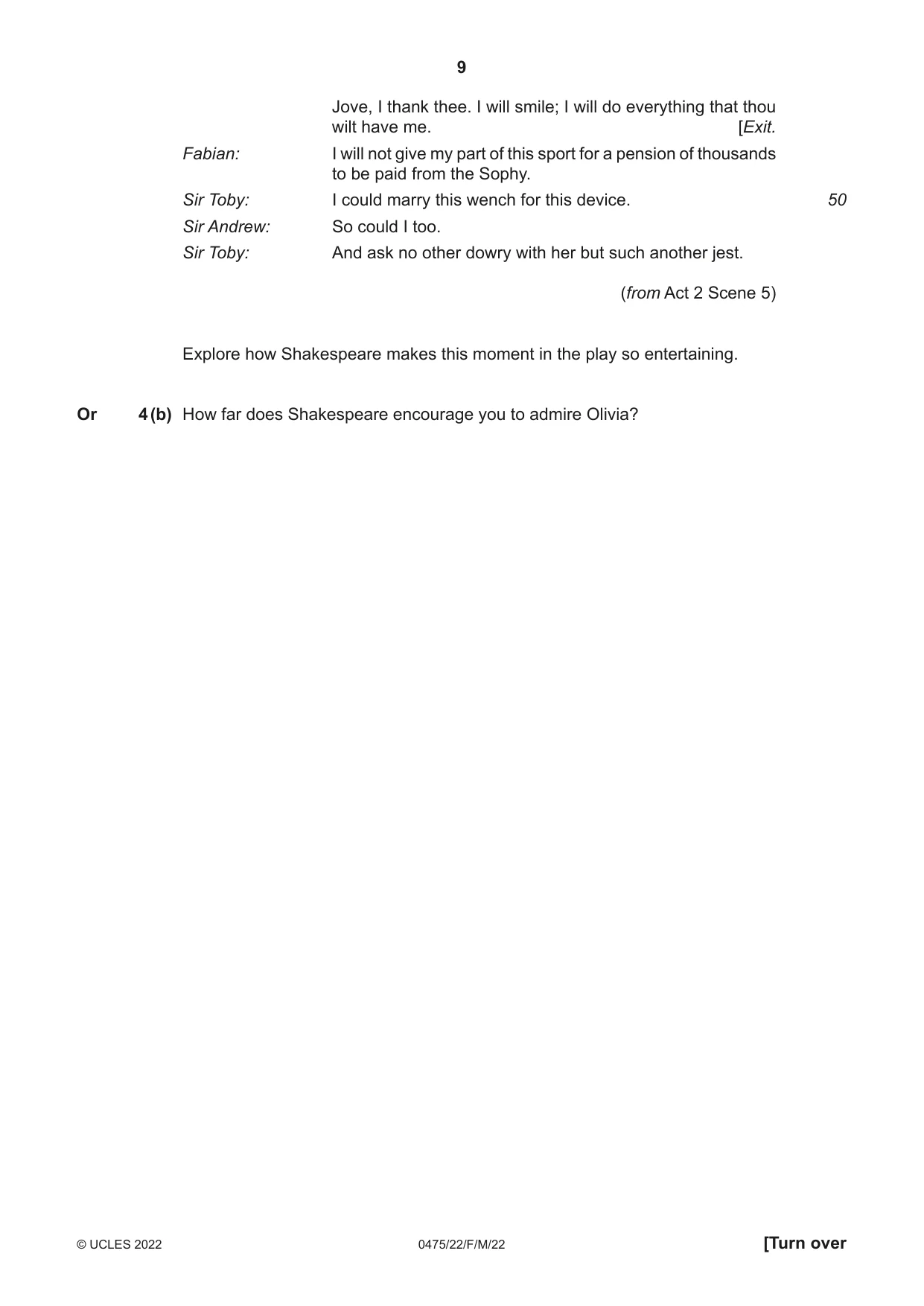
9 0475/22/F/M/22 © UCLES 2022 [Turn over Jove, I thank thee. I will smile; I will do everything that thou wilt have me. [Exit. Fabian: I will not give my part of this sport for a pension of thousands to be paid from the Sophy. Sir Toby: I could marry this wench for this device. Sir Andrew: So could I too. Sir Toby: And ask no other dowry with her but such another jest. (from Act 2 Scene 5) Explore how Shakespeare makes this moment in the play so entertaining. Or 4 (b) How far does Shakespeare encourage you to admire Olivia? 50
Question paper, page 10
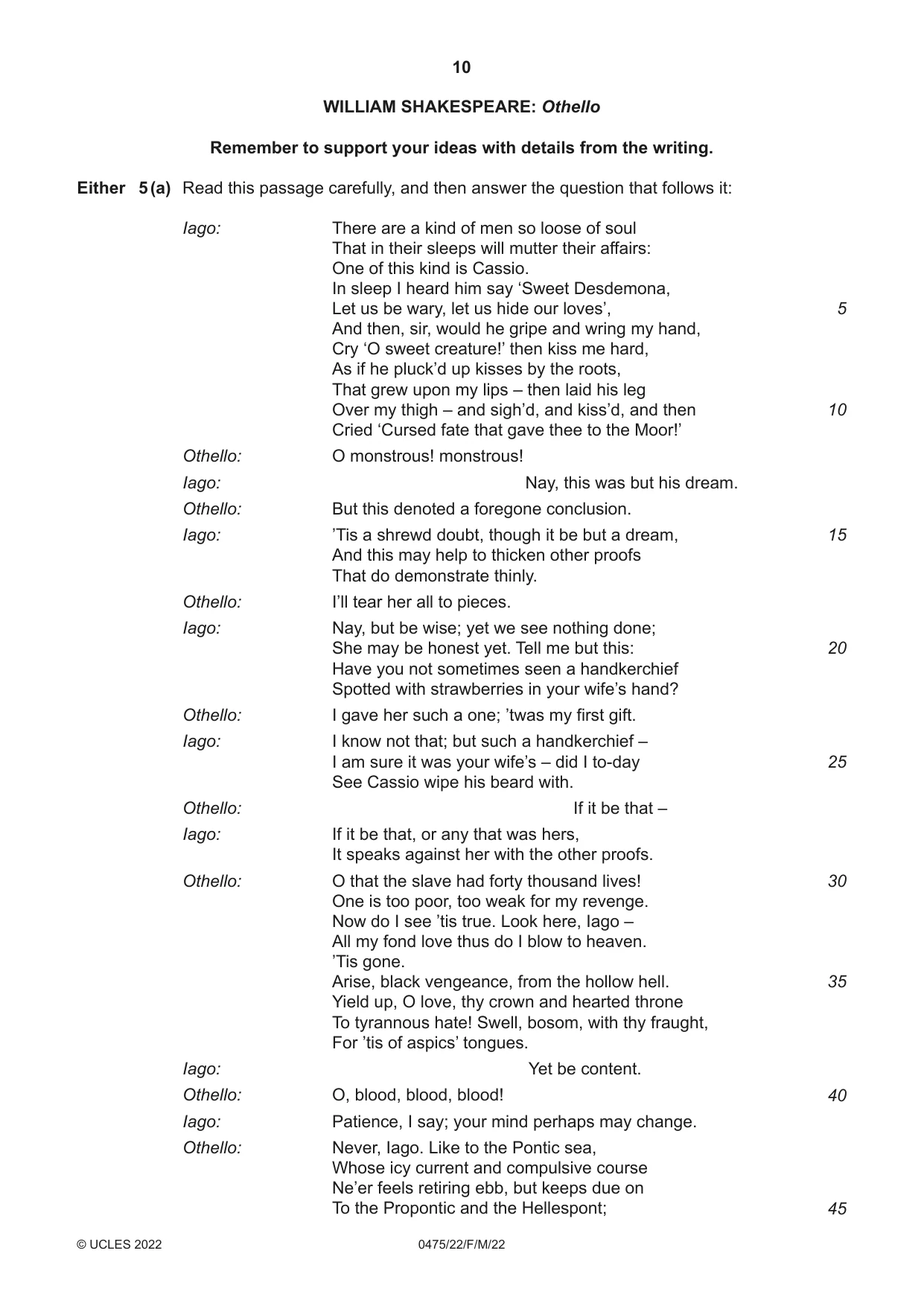
10 0475/22/F/M/22 © UCLES 2022 WILLIAM SHAKESPEARE: Othello Remember to support your ideas with details from the writing. Either 5 (a) Read this passage carefully, and then answer the question that follows it: Iago: There are a kind of men so loose of soul That in their sleeps will mutter their affairs: One of this kind is Cassio. In sleep I heard him say ‘Sweet Desdemona, Let us be wary, let us hide our loves’, And then, sir, would he gripe and wring my hand, Cry ‘O sweet creature!’ then kiss me hard, As if he pluck’d up kisses by the roots, That grew upon my lips – then laid his leg Over my thigh – and sigh’d, and kiss’d, and then Cried ‘Cursed fate that gave thee to the Moor!’ Othello: O monstrous! monstrous! Iago: Nay, this was but his dream. Othello: But this denoted a foregone conclusion. Iago: ’Tis a shrewd doubt, though it be but a dream, And this may help to thicken other proofs That do demonstrate thinly. Othello: I’ll tear her all to pieces. Iago: Nay, but be wise; yet we see nothing done; She may be honest yet. Tell me but this: Have you not sometimes seen a handkerchief Spotted with strawberries in your wife’s hand? Othello: I gave her such a one; ’twas my first gift. Iago: I know not that; but such a handkerchief – I am sure it was your wife’s – did I to-day See Cassio wipe his beard with. Othello: If it be that – Iago: If it be that, or any that was hers, It speaks against her with the other proofs. Othello: O that the slave had forty thousand lives! One is too poor, too weak for my revenge. Now do I see ’tis true. Look here, Iago – All my fond love thus do I blow to heaven. ’Tis gone. Arise, black vengeance, from the hollow hell. Yield up, O love, thy crown and hearted throne To tyrannous hate! Swell, bosom, with thy fraught, For ’tis of aspics’ tongues. Iago: Yet be content. Othello: O, blood, blood, blood! Iago: Patience, I say; your mind perhaps may change. Othello: Never, Iago. Like to the Pontic sea, Whose icy current and compulsive course Ne’er feels retiring ebb, but keeps due on To the Propontic and the Hellespont; 5 10 15 20 25 30 35 40 45
Question paper, page 11
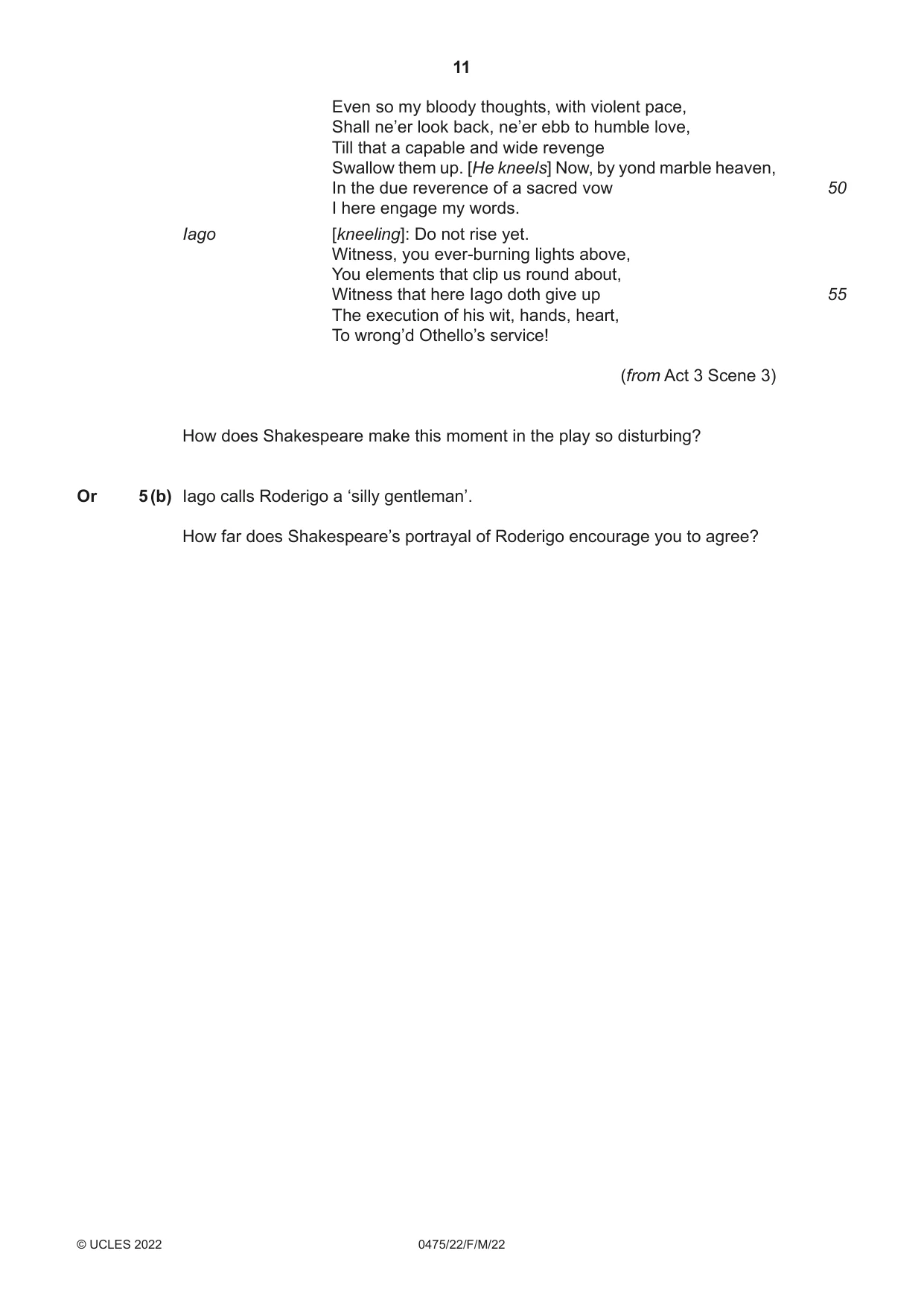
11 0475/22/F/M/22 © UCLES 2022 Even so my bloody thoughts, with violent pace, Shall ne’er look back, ne’er ebb to humble love, Till that a capable and wide revenge Swallow them up. [He kneels] Now, by yond marble heaven, In the due reverence of a sacred vow I here engage my words. Iago [kneeling]: Do not rise yet. Witness, you ever-burning lights above, You elements that clip us round about, Witness that here Iago doth give up The execution of his wit, hands, heart, To wrong’d Othello’s service! (from Act 3 Scene 3) How does Shakespeare make this moment in the play so disturbing? Or 5 (b) Iago calls Roderigo a ‘silly gentleman’. How far does Shakespeare’s portrayal of Roderigo encourage you to agree? 50 55
Question paper, page 12
12 0475/22/F/M/22 © UCLES 2022 Permission to reproduce items where third-party owned material protected by copyright is included has been sought and cleared where possible. Every reasonable effort has been made by the publisher (UCLES) to trace copyright holders, but if any items requiring clearance have unwittingly been included, the publisher will be pleased to make amends at the earliest possible opportunity. To avoid the issue of disclosure of answer-related information to candidates, all copyright acknowledgements are reproduced online in the Cambridge Assessment International Education Copyright Acknowledgements Booklet. This is produced for each series of examinations and is freely available to download at www.cambridgeinternational.org after the live examination series. Cambridge Assessment International Education is part of Cambridge Assessment. Cambridge Assessment is the brand name of the University of Cambridge Local Examinations Syndicate (UCLES), which is a department of the University of Cambridge. BLANK PAGE
Mark scheme, page 1
This document consists of 5 printed pages. © UCLES 2022 [Turn over Cambridge IGCSE™ LITERATURE IN ENGLISH 0475/22 Paper 2 Drama February/March 2022 MARK SCHEME Maximum Mark: 50 Published This mark scheme is published as an aid to teachers and candidates, to indicate the requirements of the examination. It shows the basis on which Examiners were instructed to award marks. It does not indicate the details of the discussions that took place at an Examiners’ meeting before marking began, which would have considered the acceptability of alternative answers. Mark schemes should be read in conjunction with the question paper and the Principal Examiner Report for Teachers. Cambridge International will not enter into discussions about these mark schemes. Cambridge International is publishing the mark schemes for the February/March 2022 series for most Cambridge IGCSE™, Cambridge International A and AS Level components and some Cambridge O Level components.
Mark scheme, page 2
0475/22 Cambridge IGCSE – Mark Scheme PUBLISHED February/March 2022 © UCLES 2022 Page 2 of 5 Generic Marking Principles These general marking principles must be applied by all examiners when marking candidate answers. They should be applied alongside the specific content of the mark scheme or generic level descriptors for a question. Each question paper and mark scheme will also comply with these marking principles. GENERIC MARKING PRINCIPLE 1: Marks must be awarded in line with: • the specific content of the mark scheme or the generic level descriptors for the question • the specific skills defined in the mark scheme or in the generic level descriptors for the question • the standard of response required by a candidate as exemplified by the standardisation scripts. GENERIC MARKING PRINCIPLE 2: Marks awarded are always whole marks (not half marks, or other fractions). GENERIC MARKING PRINCIPLE 3: Marks must be awarded positively: • marks are awarded for correct/valid answers, as defined in the mark scheme. However, credit is given for valid answers which go beyond the scope of the syllabus and mark scheme, referring to your Team Leader as appropriate • marks are awarded when candidates clearly demonstrate what they know and can do • marks are not deducted for errors • marks are not deducted for omissions • answers should only be judged on the quality of spelling, punctuation and grammar when these features are specifically assessed by the question as indicated by the mark scheme. The meaning, however, should be unambiguous. GENERIC MARKING PRINCIPLE 4: Rules must be applied consistently, e.g. in situations where candidates have not followed instructions or in the application of generic level descriptors. GENERIC MARKING PRINCIPLE 5: Marks should be awarded using the full range of marks defined in the mark scheme for the question (however; the use of the full mark range may be limited according to the quality of the candidate responses seen). GENERIC MARKING PRINCIPLE 6: Marks awarded are based solely on the requirements as defined in the mark scheme. Marks should not be awarded with grade thresholds or grade descriptors in mind.
Mark scheme, page 3
0475/22 Cambridge IGCSE – Mark Scheme PUBLISHED February/March 2022 © UCLES 2022 Page 3 of 5 English & Media subject specific general marking principles (To be read in conjunction with the Generic Marking Principles (and requiring further guidance on how to place marks within levels)) Components using level descriptors: • We use level descriptors as a guide to broad understanding of the qualities normally expected of, or typical of, work in a level. • Level descriptors are a means of general guidance, and should not be interpreted as hurdle statements. • Where indicative content notes are supplied for a question, these are not a prescription of required content, and must not be treated as such. Alternative correct points and unexpected answers in candidates’ scripts must be given marks that fairly reflect the knowledge and skills demonstrated. • While we may have legitimate expectations as to the ground most answers may occupy, we must at all times be prepared to meet candidates on their chosen ground, provided it is relevant ground (e.g. clearly related to and derived from a relevant passage/text and meeting the mark scheme requirements for the question). Components using point-based marking: Point marking is often used to reward knowledge, understanding and application of skills. We give credit where the candidate’s answer shows relevant knowledge, understanding and application of skills in answering the question. We do not give credit where the answer shows confusion. From this it follows that we: a DO credit answers which are worded differently from the mark scheme if they clearly convey the same meaning (unless the mark scheme requires a specific term). b DO credit alternative answers/examples which are not written in the mark scheme if they are correct. c DO credit answers where candidates give more than one correct answer in one prompt/numbered/scaffolded space where extended writing is required rather than list-type answers. For example, questions that require n reasons (e.g. State two reasons…). d DO NOT credit answers simply for using a ‘key term’ unless that is all that is required. (Check for evidence it is understood and not used wrongly.). e DO NOT credit answers which are obviously self-contradicting or trying to cover all possibilities. f DO NOT give further credit for what is effectively repetition of a correct point already credited unless the language itself is being tested. This applies equally to ‘mirror statements’ (i.e. polluted/not polluted). g DO NOT require spellings to be correct, unless this is part of the test. However spellings of syllabus terms must allow for clear and unambiguous separation from other syllabus terms with which they may be confused (e.g. Corrasion/Corrosion).
Mark scheme, page 4
0475/22 Cambridge IGCSE – Mark Scheme PUBLISHED February/March 2022 © UCLES 2022 Page 4 of 5 Introduction For general administrative guidance, see Notes for Examiners Handbook. All questions are marked out of 25. Assessment Objectives The Assessment Objectives are evenly weighted across each question. The assessment objectives for the paper are: AO1 show detailed knowledge of the content of literary texts, supported by reference to the text AO2 understand the meanings of literary texts and their context, and explore texts beyond surface meaning to show deeper awareness of ideas and attitudes AO3 recognise and appreciate ways in which writers use language, structure, and form to create and shape meanings and effects AO4 communicate a sensitive and informed personal response The Band Descriptors cover marks from 0 to 25 and apply to the marking of each question. They guide examiners to an understanding of the qualities normally expected of, or typical of, work in a band. They are a means of general guidance and must not be interpreted as hurdle statements. For the purposes of standardisation of marking, they are to be used in conjunction with the Practice and Standardisation scripts discussed during the coordination meeting and with Team Leaders, as well as the question-specific notes.
Mark scheme, page 5
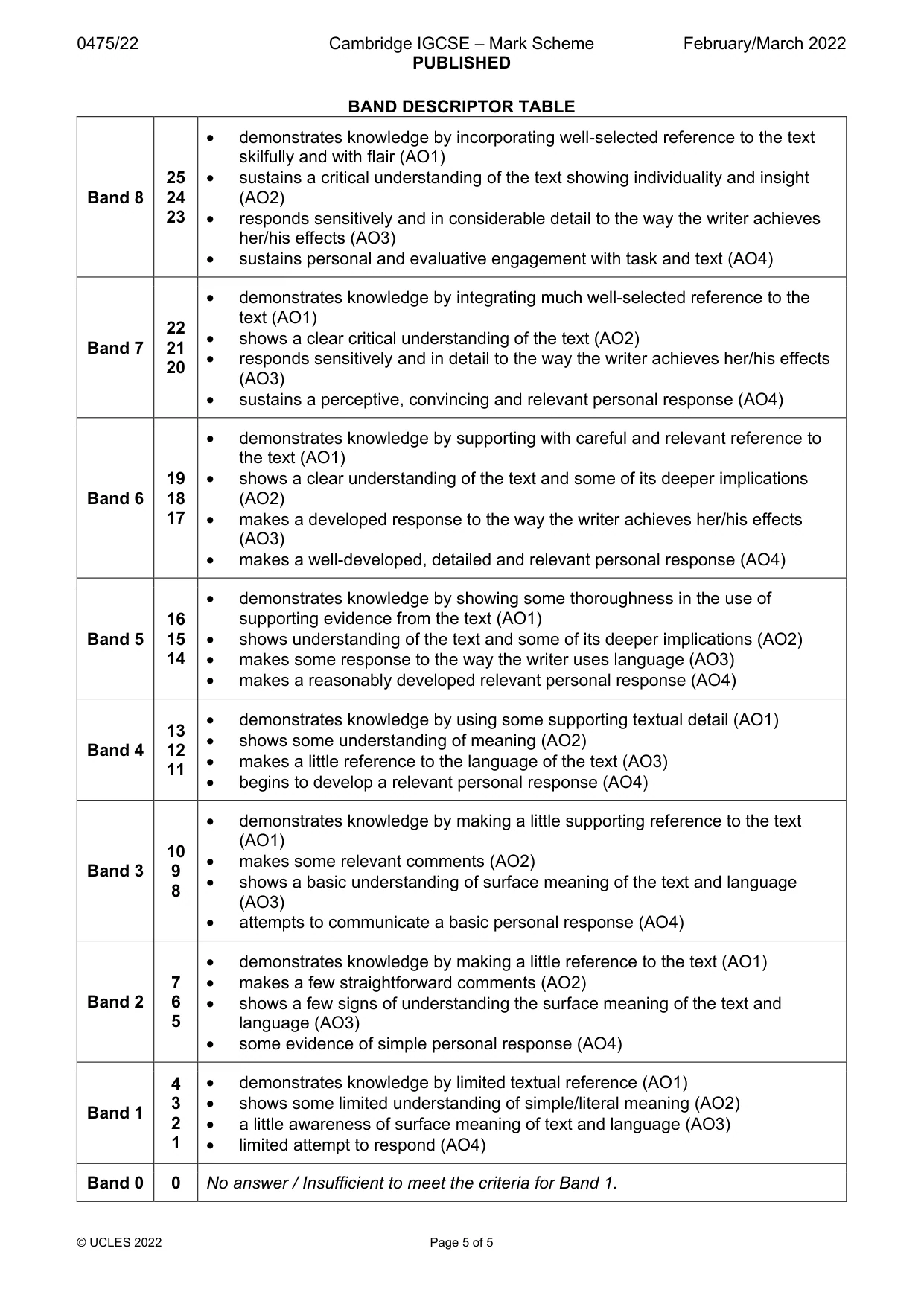
0475/22 Cambridge IGCSE – Mark Scheme PUBLISHED February/March 2022 © UCLES 2022 Page 5 of 5 BAND DESCRIPTOR TABLE Band 8 25 24 23 • demonstrates knowledge by incorporating well-selected reference to the text skilfully and with flair (AO1) • sustains a critical understanding of the text showing individuality and insight (AO2) • responds sensitively and in considerable detail to the way the writer achieves her/his effects (AO3) • sustains personal and evaluative engagement with task and text (AO4) Band 7 22 21 20 • demonstrates knowledge by integrating much well-selected reference to the text (AO1) • shows a clear critical understanding of the text (AO2) • responds sensitively and in detail to the way the writer achieves her/his effects (AO3) • sustains a perceptive, convincing and relevant personal response (AO4) Band 6 19 18 17 • demonstrates knowledge by supporting with careful and relevant reference to the text (AO1) • shows a clear understanding of the text and some of its deeper implications (AO2) • makes a developed response to the way the writer achieves her/his effects (AO3) • makes a well-developed, detailed and relevant personal response (AO4) Band 5 16 15 14 • demonstrates knowledge by showing some thoroughness in the use of supporting evidence from the text (AO1) • shows understanding of the text and some of its deeper implications (AO2) • makes some response to the way the writer uses language (AO3) • makes a reasonably developed relevant personal response (AO4) Band 4 13 12 11 • demonstrates knowledge by using some supporting textual detail (AO1) • shows some understanding of meaning (AO2) • makes a little reference to the language of the text (AO3) • begins to develop a relevant personal response (AO4) Band 3 10 9 8 • demonstrates knowledge by making a little supporting reference to the text (AO1) • makes some relevant comments (AO2) • shows a basic understanding of surface meaning of the text and language (AO3) • attempts to communicate a basic personal response (AO4) Band 2 7 6 5 • demonstrates knowledge by making a little reference to the text (AO1) • makes a few straightforward comments (AO2) • shows a few signs of understanding the surface meaning of the text and language (AO3) • some evidence of simple personal response (AO4) Band 1 4 3 2 1 • demonstrates knowledge by limited textual reference (AO1) • shows some limited understanding of simple/literal meaning (AO2) • a little awareness of surface meaning of text and language (AO3) • limited attempt to respond (AO4) Band 0 0 No answer / Insufficient to meet the criteria for Band 1.
What you needed in this session
Cambridge’s own grade thresholds for 2022 Feb/March, Paper 2 · Variant 2. A higher threshold means an easier paper — the bar moves with how the cohort did.