Cambridge IGCSE English - Literature in English 0475 — 2021 Oct/Nov Paper 4 · Variant 1
0475/41/O/N/21 · 25 marks · ≈28 min
The question paper and its mark scheme, free to read here and free to download. This is Cambridge’s own paper, exactly as it was sat.
Question paper8 pages


Mark scheme5 pages
Answers below. Sit the paper first if you are practising.
Paper as text
Question paper, page 1
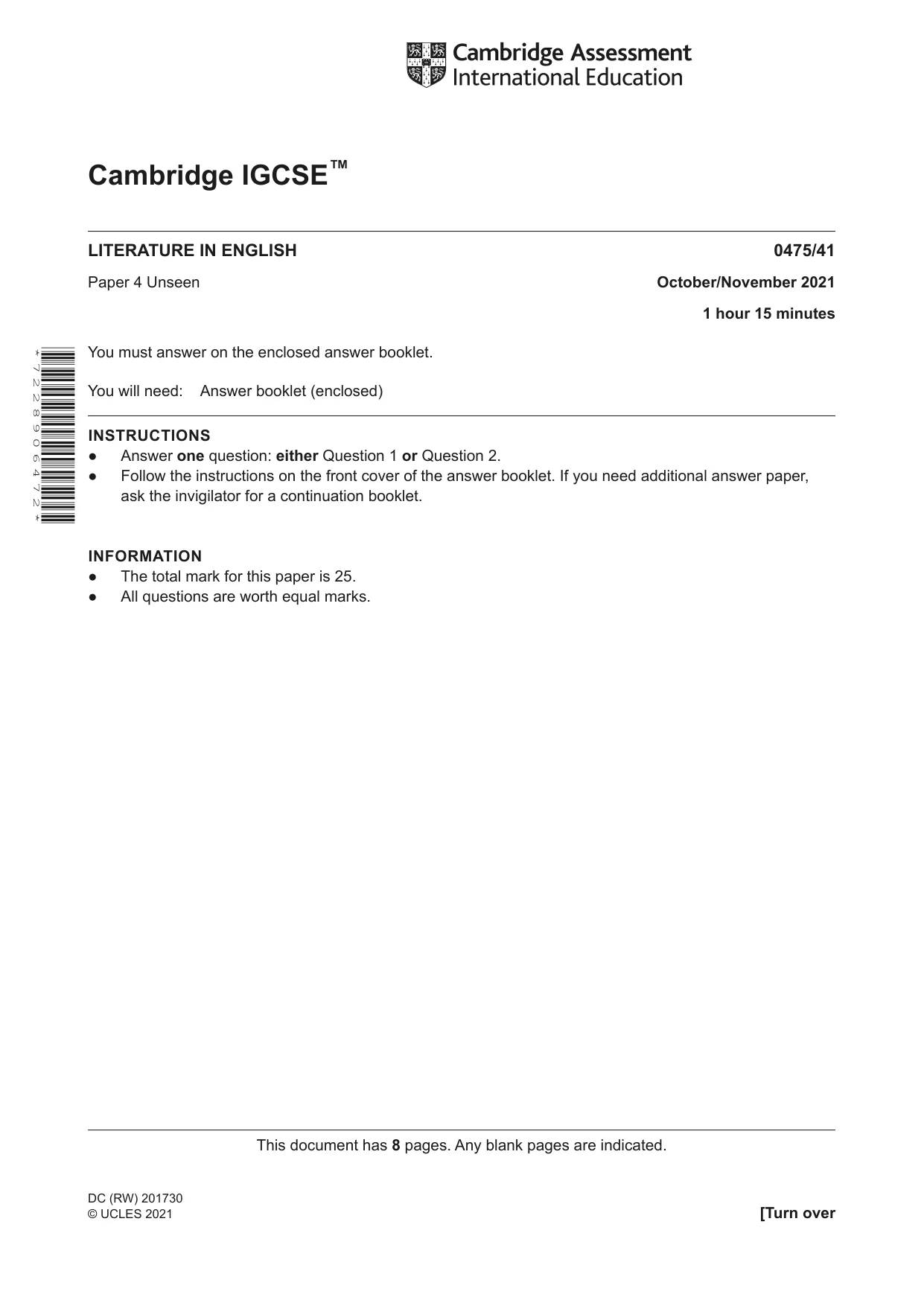
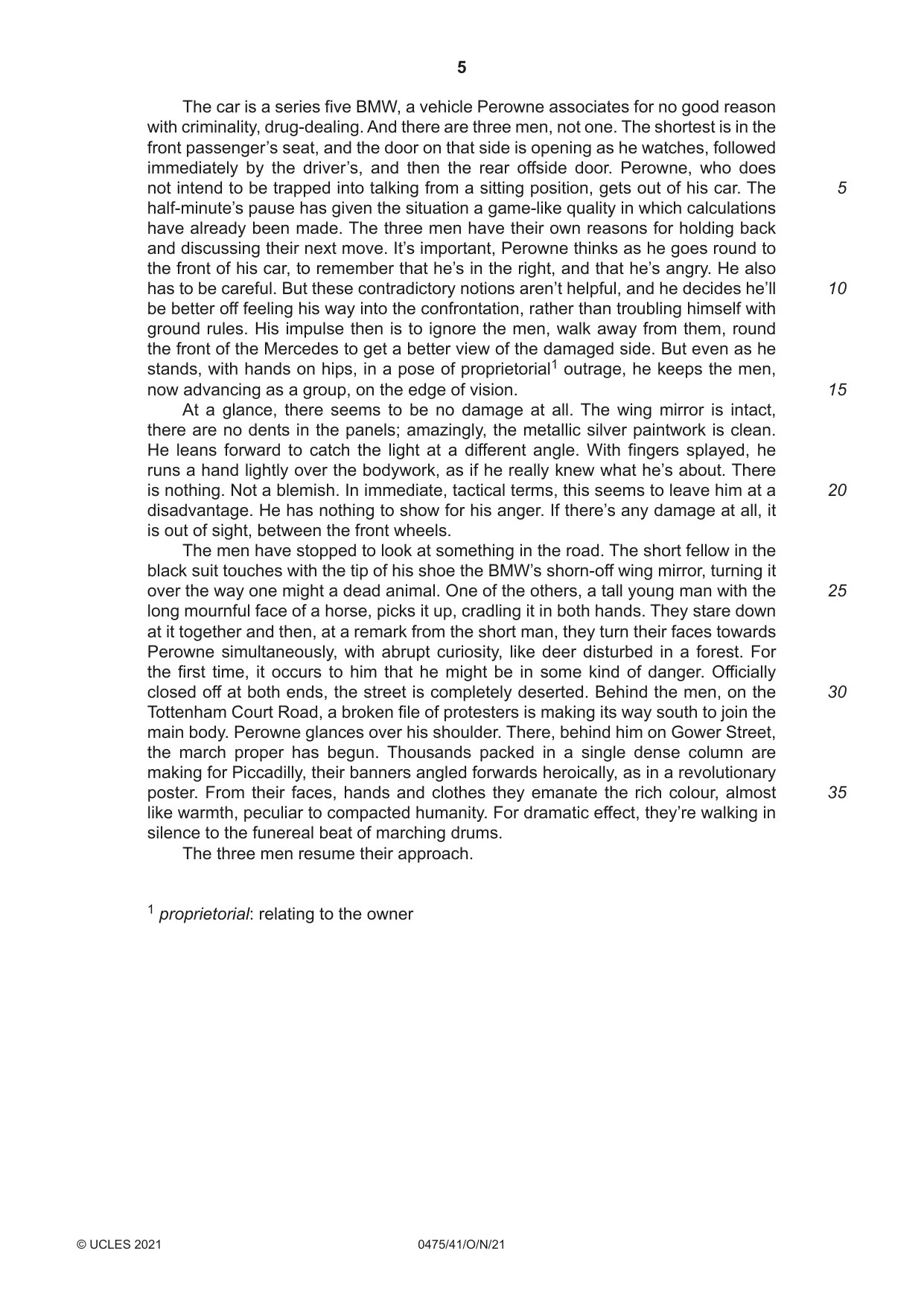
This document has 8 pages. Any blank pages are indicated. DC (RW) 201730 © UCLES 2021 [Turn over * 7 2 2 8 9 0 6 4 7 2 * Cambridge IGCSE™ LITERATURE IN ENGLISH 0475/41 Paper 4 Unseen October/November 2021 1 hour 15 minutes You must answer on the enclosed answer booklet. You will need: Answer booklet (enclosed) INSTRUCTIONS ● Answer one question: either Question 1 or Question 2. ● Follow the instructions on the front cover of the answer booklet. If you need additional answer paper, ask the invigilator for a continuation booklet. INFORMATION ● The total mark for this paper is 25. ● All questions are worth equal marks.
Question paper, page 2
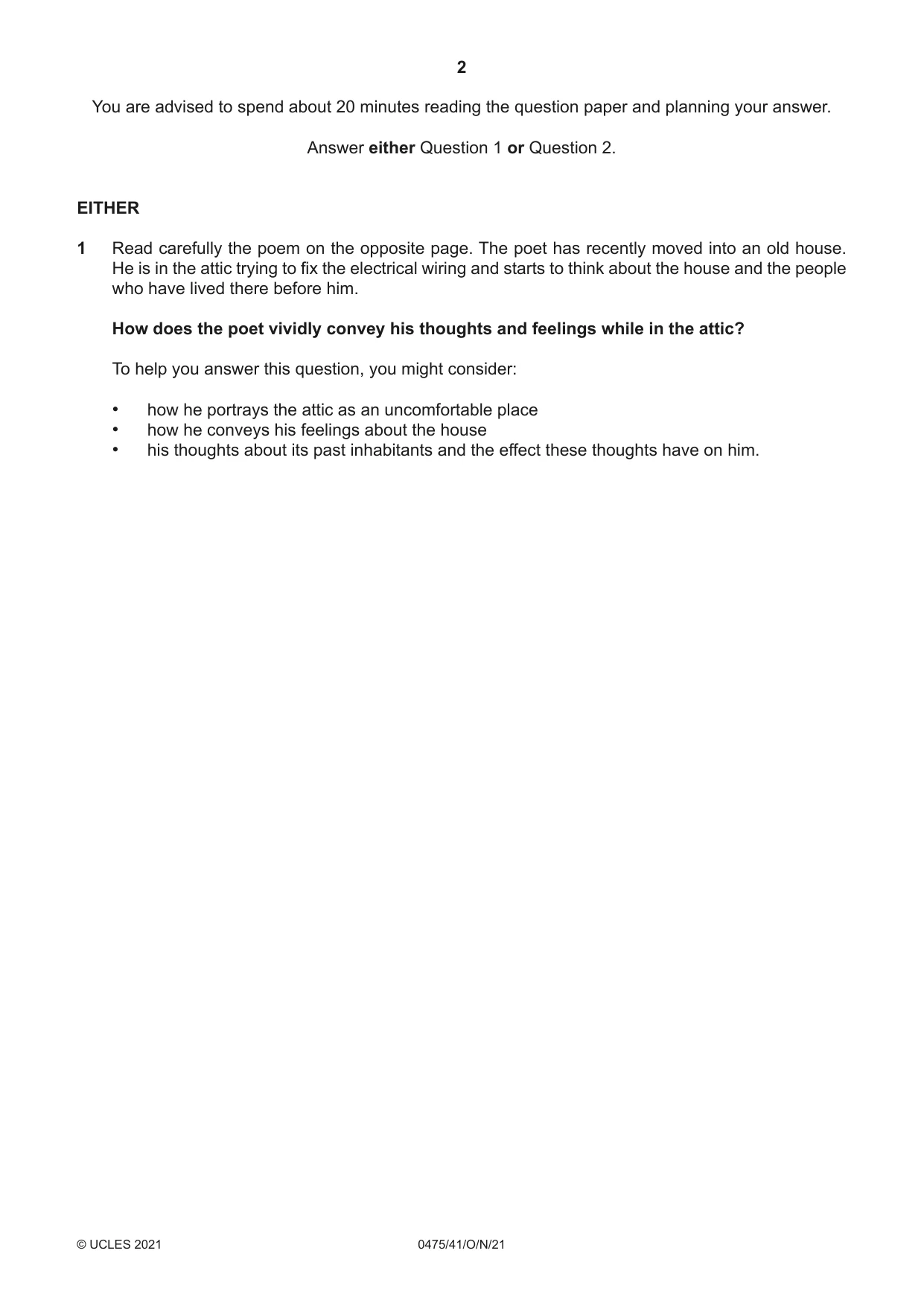
2 0475/41/O/N/21 © UCLES 2021 You are advised to spend about 20 minutes reading the question paper and planning your answer. Answer either Question 1 or Question 2. EITHER 1 Read carefully the poem on the opposite page. The poet has recently moved into an old house. He is in the attic trying to fix the electrical wiring and starts to think about the house and the people who have lived there before him. How does the poet vividly convey his thoughts and feelings while in the attic? To help you answer this question, you might consider: • how he portrays the attic as an uncomfortable place • how he conveys his feelings about the house • his thoughts about its past inhabitants and the effect these thoughts have on him.
Question paper, page 3
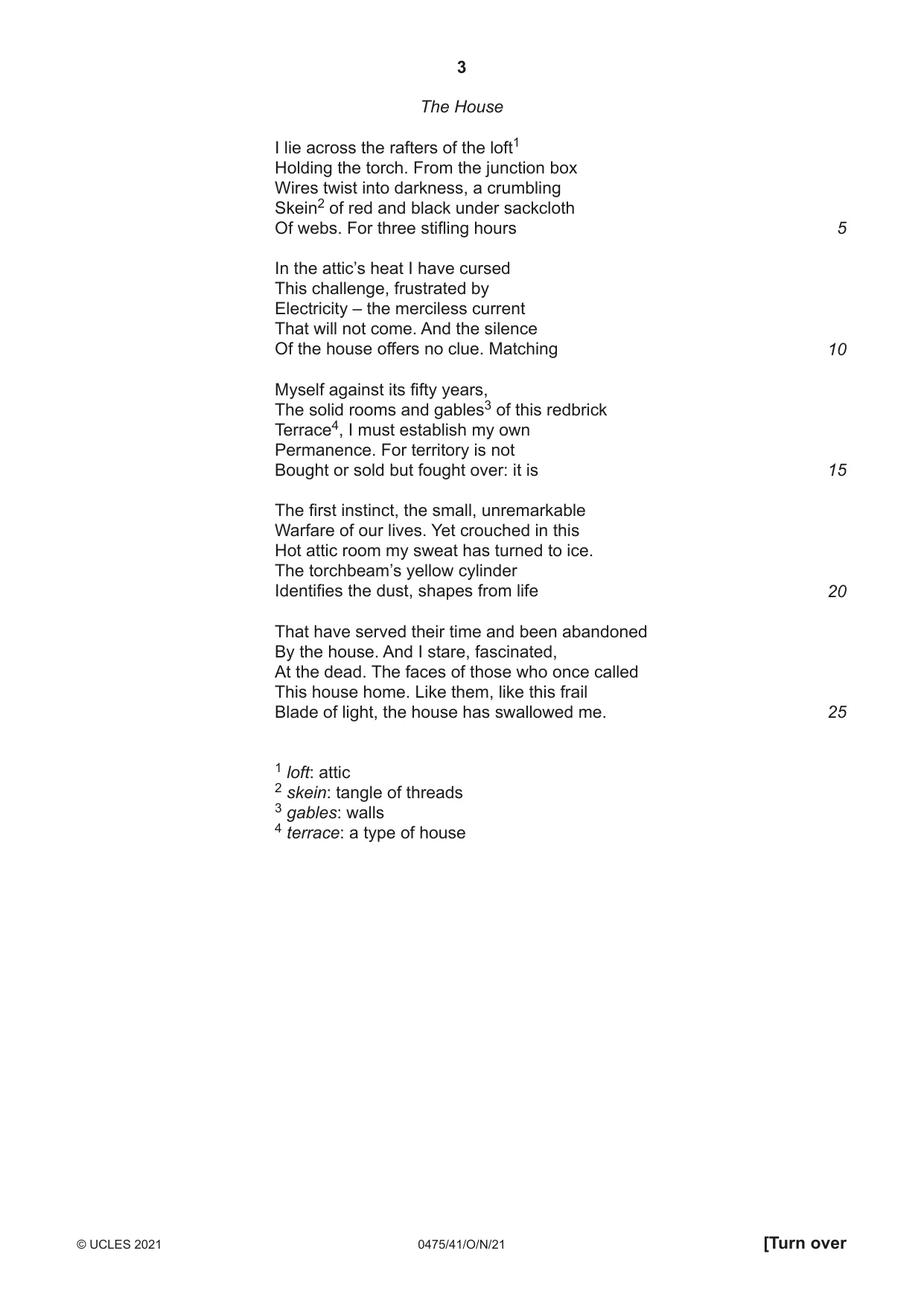
3 0475/41/O/N/21 © UCLES 2021 [Turn over The House I lie across the rafters of the loft1 Holding the torch. From the junction box Wires twist into darkness, a crumbling Skein2 of red and black under sackcloth Of webs. For three stifling hours In the attic’s heat I have cursed This challenge, frustrated by Electricity – the merciless current That will not come. And the silence Of the house offers no clue. Matching Myself against its fifty years, The solid rooms and gables3 of this redbrick Terrace4, I must establish my own Permanence. For territory is not Bought or sold but fought over: it is The first instinct, the small, unremarkable Warfare of our lives. Yet crouched in this Hot attic room my sweat has turned to ice. The torchbeam’s yellow cylinder Identifies the dust, shapes from life That have served their time and been abandoned By the house. And I stare, fascinated, At the dead. The faces of those who once called This house home. Like them, like this frail Blade of light, the house has swallowed me. 1 loft: attic 2 skein: tangle of threads 3 gables: walls 4 terrace: a type of house 5 10 15 20 25
Question paper, page 4
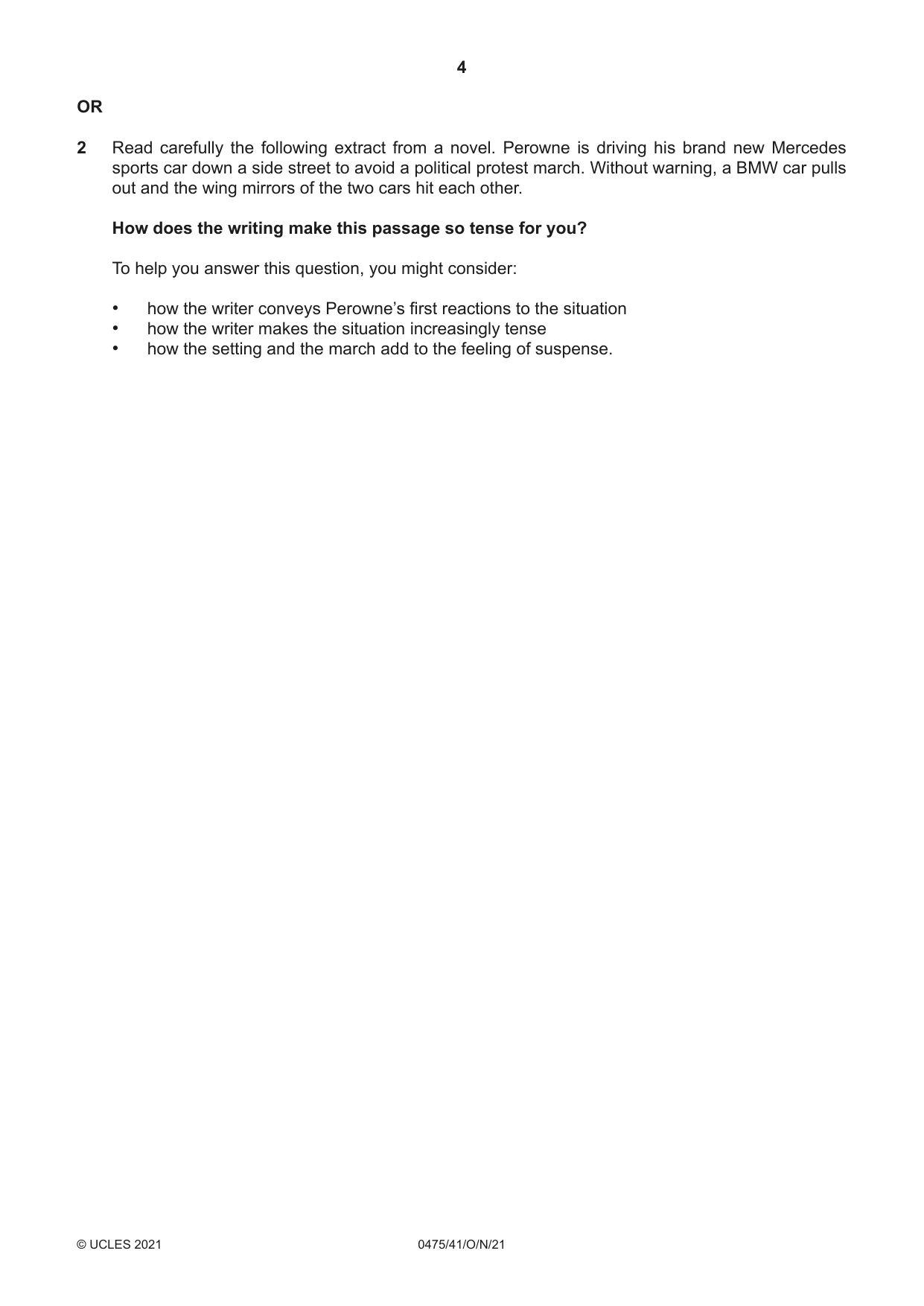
4 0475/41/O/N/21 © UCLES 2021 OR 2 Read carefully the following extract from a novel. Perowne is driving his brand new Mercedes sports car down a side street to avoid a political protest march. Without warning, a BMW car pulls out and the wing mirrors of the two cars hit each other. How does the writing make this passage so tense for you? To help you answer this question, you might consider: • how the writer conveys Perowne’s first reactions to the situation • how the writer makes the situation increasingly tense • how the setting and the march add to the feeling of suspense.
Question paper, page 5
5 0475/41/O/N/21 © UCLES 2021 The car is a series five BMW, a vehicle Perowne associates for no good reason with criminality, drug‑dealing. And there are three men, not one. The shortest is in the front passenger’s seat, and the door on that side is opening as he watches, followed immediately by the driver’s, and then the rear offside door. Perowne, who does not intend to be trapped into talking from a sitting position, gets out of his car. The half‑minute’s pause has given the situation a game‑like quality in which calculations have already been made. The three men have their own reasons for holding back and discussing their next move. It’s important, Perowne thinks as he goes round to the front of his car, to remember that he’s in the right, and that he’s angry. He also has to be careful. But these contradictory notions aren’t helpful, and he decides he’ll be better off feeling his way into the confrontation, rather than troubling himself with ground rules. His impulse then is to ignore the men, walk away from them, round the front of the Mercedes to get a better view of the damaged side. But even as he stands, with hands on hips, in a pose of proprietorial1 outrage, he keeps the men, now advancing as a group, on the edge of vision. At a glance, there seems to be no damage at all. The wing mirror is intact, there are no dents in the panels; amazingly, the metallic silver paintwork is clean. He leans forward to catch the light at a different angle. With fingers splayed, he runs a hand lightly over the bodywork, as if he really knew what he’s about. There is nothing. Not a blemish. In immediate, tactical terms, this seems to leave him at a disadvantage. He has nothing to show for his anger. If there’s any damage at all, it is out of sight, between the front wheels. The men have stopped to look at something in the road. The short fellow in the black suit touches with the tip of his shoe the BMW’s shorn‑off wing mirror, turning it over the way one might a dead animal. One of the others, a tall young man with the long mournful face of a horse, picks it up, cradling it in both hands. They stare down at it together and then, at a remark from the short man, they turn their faces towards Perowne simultaneously, with abrupt curiosity, like deer disturbed in a forest. For the first time, it occurs to him that he might be in some kind of danger. Officially closed off at both ends, the street is completely deserted. Behind the men, on the Tottenham Court Road, a broken file of protesters is making its way south to join the main body. Perowne glances over his shoulder. There, behind him on Gower Street, the march proper has begun. Thousands packed in a single dense column are making for Piccadilly, their banners angled forwards heroically, as in a revolutionary poster. From their faces, hands and clothes they emanate the rich colour, almost like warmth, peculiar to compacted humanity. For dramatic effect, they’re walking in silence to the funereal beat of marching drums. The three men resume their approach. 1 proprietorial: relating to the owner 5 10 15 20 25 30 35
Question paper, page 6
6 0475/41/O/N/21 © UCLES 2021 BLANK PAGE
Question paper, page 7
7 0475/41/O/N/21 © UCLES 2021 BLANK PAGE
Question paper, page 8
8 0475/41/O/N/21 © UCLES 2021 Permission to reproduce items where third‑party owned material protected by copyright is included has been sought and cleared where possible. Every reasonable effort has been made by the publisher (UCLES) to trace copyright holders, but if any items requiring clearance have unwittingly been included, the publisher will be pleased to make amends at the earliest possible opportunity. To avoid the issue of disclosure of answer‑related information to candidates, all copyright acknowledgements are reproduced online in the Cambridge Assessment International Education Copyright Acknowledgements Booklet. This is produced for each series of examinations and is freely available to download at www.cambridgeinternational.org after the live examination series. Cambridge Assessment International Education is part of the Cambridge Assessment Group. Cambridge Assessment is the brand name of the University of Cambridge Local Examinations Syndicate (UCLES), which itself is a department of the University of Cambridge. BLANK PAGE
Mark scheme, page 1
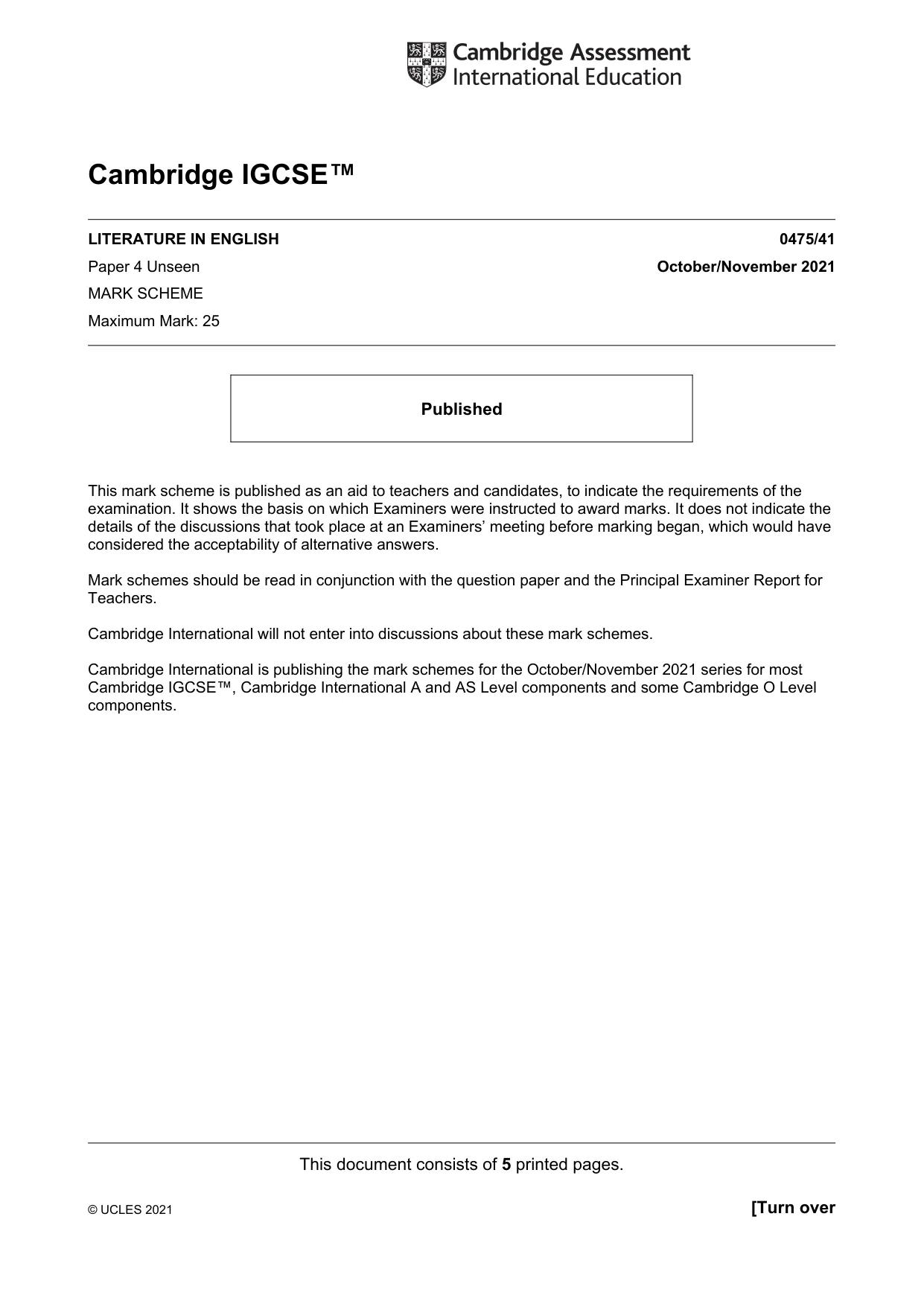
This document consists of 5 printed pages. © UCLES 2021 [Turn over Cambridge IGCSE™ LITERATURE IN ENGLISH 0475/41 Paper 4 Unseen October/November 2021 MARK SCHEME Maximum Mark: 25 Published This mark scheme is published as an aid to teachers and candidates, to indicate the requirements of the examination. It shows the basis on which Examiners were instructed to award marks. It does not indicate the details of the discussions that took place at an Examiners’ meeting before marking began, which would have considered the acceptability of alternative answers. Mark schemes should be read in conjunction with the question paper and the Principal Examiner Report for Teachers. Cambridge International will not enter into discussions about these mark schemes. Cambridge International is publishing the mark schemes for the October/November 2021 series for most Cambridge IGCSE™, Cambridge International A and AS Level components and some Cambridge O Level components.
Mark scheme, page 2
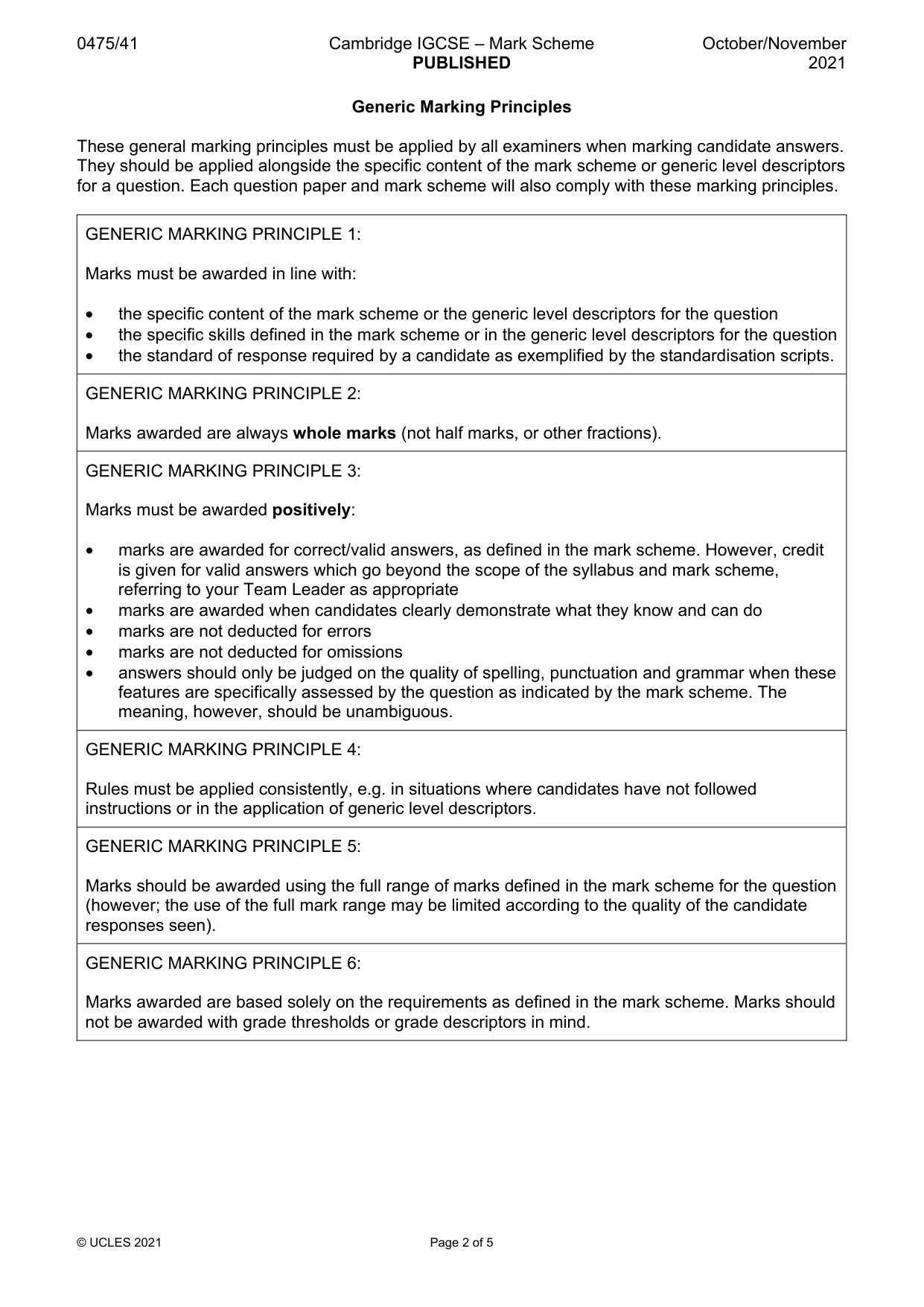
0475/41 Cambridge IGCSE – Mark Scheme PUBLISHED October/November 2021 © UCLES 2021 Page 2 of 5 Generic Marking Principles These general marking principles must be applied by all examiners when marking candidate answers. They should be applied alongside the specific content of the mark scheme or generic level descriptors for a question. Each question paper and mark scheme will also comply with these marking principles. GENERIC MARKING PRINCIPLE 1: Marks must be awarded in line with: • the specific content of the mark scheme or the generic level descriptors for the question • the specific skills defined in the mark scheme or in the generic level descriptors for the question • the standard of response required by a candidate as exemplified by the standardisation scripts. GENERIC MARKING PRINCIPLE 2: Marks awarded are always whole marks (not half marks, or other fractions). GENERIC MARKING PRINCIPLE 3: Marks must be awarded positively: • marks are awarded for correct/valid answers, as defined in the mark scheme. However, credit is given for valid answers which go beyond the scope of the syllabus and mark scheme, referring to your Team Leader as appropriate • marks are awarded when candidates clearly demonstrate what they know and can do • marks are not deducted for errors • marks are not deducted for omissions • answers should only be judged on the quality of spelling, punctuation and grammar when these features are specifically assessed by the question as indicated by the mark scheme. The meaning, however, should be unambiguous. GENERIC MARKING PRINCIPLE 4: Rules must be applied consistently, e.g. in situations where candidates have not followed instructions or in the application of generic level descriptors. GENERIC MARKING PRINCIPLE 5: Marks should be awarded using the full range of marks defined in the mark scheme for the question (however; the use of the full mark range may be limited according to the quality of the candidate responses seen). GENERIC MARKING PRINCIPLE 6: Marks awarded are based solely on the requirements as defined in the mark scheme. Marks should not be awarded with grade thresholds or grade descriptors in mind.
Mark scheme, page 3
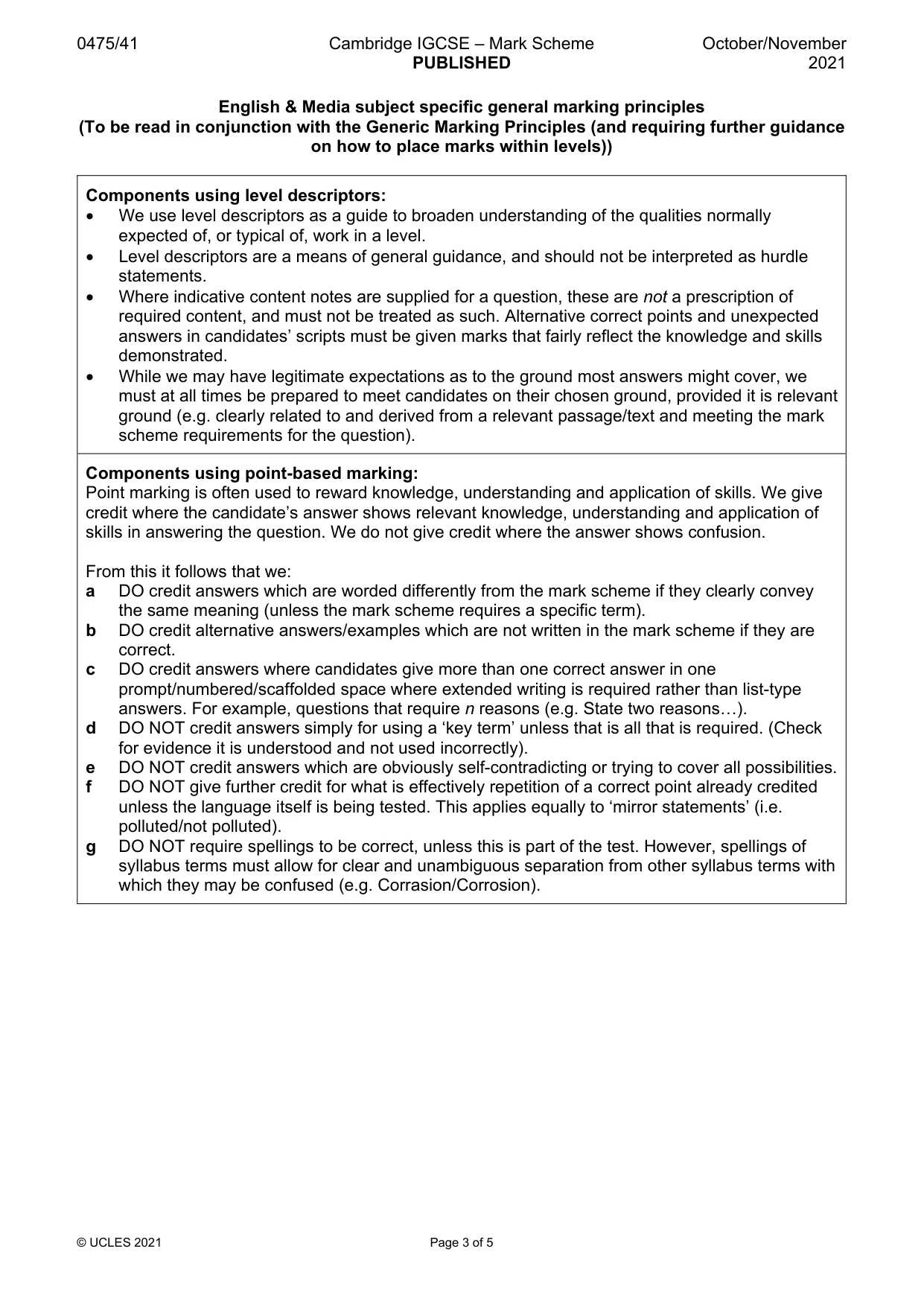
0475/41 Cambridge IGCSE – Mark Scheme PUBLISHED October/November 2021 © UCLES 2021 Page 3 of 5 English & Media subject specific general marking principles (To be read in conjunction with the Generic Marking Principles (and requiring further guidance on how to place marks within levels)) Components using level descriptors: • We use level descriptors as a guide to broaden understanding of the qualities normally expected of, or typical of, work in a level. • Level descriptors are a means of general guidance, and should not be interpreted as hurdle statements. • Where indicative content notes are supplied for a question, these are not a prescription of required content, and must not be treated as such. Alternative correct points and unexpected answers in candidates’ scripts must be given marks that fairly reflect the knowledge and skills demonstrated. • While we may have legitimate expectations as to the ground most answers might cover, we must at all times be prepared to meet candidates on their chosen ground, provided it is relevant ground (e.g. clearly related to and derived from a relevant passage/text and meeting the mark scheme requirements for the question). Components using point-based marking: Point marking is often used to reward knowledge, understanding and application of skills. We give credit where the candidate’s answer shows relevant knowledge, understanding and application of skills in answering the question. We do not give credit where the answer shows confusion. From this it follows that we: a DO credit answers which are worded differently from the mark scheme if they clearly convey the same meaning (unless the mark scheme requires a specific term). b DO credit alternative answers/examples which are not written in the mark scheme if they are correct. c DO credit answers where candidates give more than one correct answer in one prompt/numbered/scaffolded space where extended writing is required rather than list-type answers. For example, questions that require n reasons (e.g. State two reasons…). d DO NOT credit answers simply for using a ‘key term’ unless that is all that is required. (Check for evidence it is understood and not used incorrectly). e DO NOT credit answers which are obviously self-contradicting or trying to cover all possibilities. f DO NOT give further credit for what is effectively repetition of a correct point already credited unless the language itself is being tested. This applies equally to ‘mirror statements’ (i.e. polluted/not polluted). g DO NOT require spellings to be correct, unless this is part of the test. However, spellings of syllabus terms must allow for clear and unambiguous separation from other syllabus terms with which they may be confused (e.g. Corrasion/Corrosion).
Mark scheme, page 4
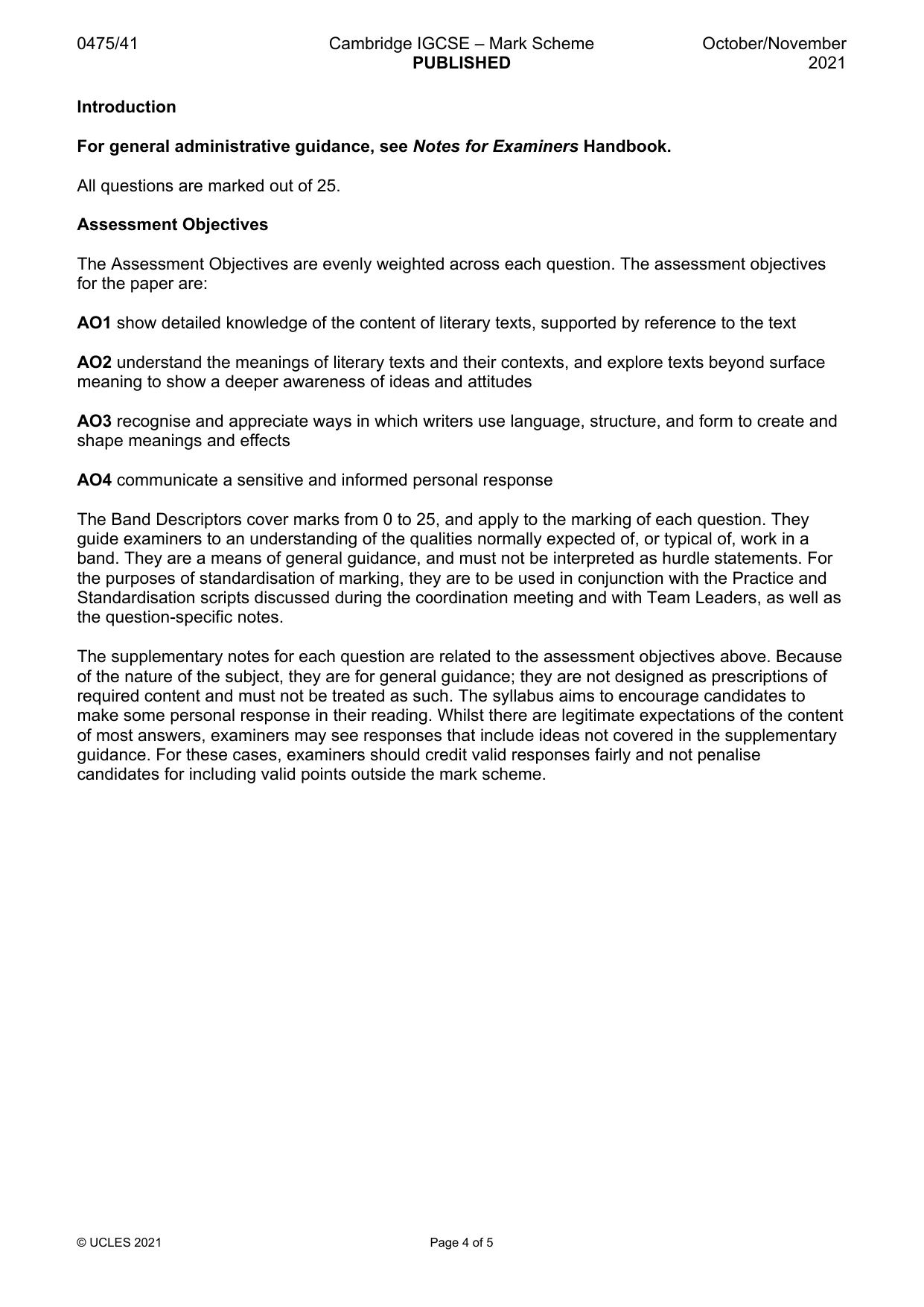
0475/41 Cambridge IGCSE – Mark Scheme PUBLISHED October/November 2021 © UCLES 2021 Page 4 of 5 Introduction For general administrative guidance, see Notes for Examiners Handbook. All questions are marked out of 25. Assessment Objectives The Assessment Objectives are evenly weighted across each question. The assessment objectives for the paper are: AO1 show detailed knowledge of the content of literary texts, supported by reference to the text AO2 understand the meanings of literary texts and their contexts, and explore texts beyond surface meaning to show a deeper awareness of ideas and attitudes AO3 recognise and appreciate ways in which writers use language, structure, and form to create and shape meanings and effects AO4 communicate a sensitive and informed personal response The Band Descriptors cover marks from 0 to 25, and apply to the marking of each question. They guide examiners to an understanding of the qualities normally expected of, or typical of, work in a band. They are a means of general guidance, and must not be interpreted as hurdle statements. For the purposes of standardisation of marking, they are to be used in conjunction with the Practice and Standardisation scripts discussed during the coordination meeting and with Team Leaders, as well as the question-specific notes. The supplementary notes for each question are related to the assessment objectives above. Because of the nature of the subject, they are for general guidance; they are not designed as prescriptions of required content and must not be treated as such. The syllabus aims to encourage candidates to make some personal response in their reading. Whilst there are legitimate expectations of the content of most answers, examiners may see responses that include ideas not covered in the supplementary guidance. For these cases, examiners should credit valid responses fairly and not penalise candidates for including valid points outside the mark scheme.
Mark scheme, page 5
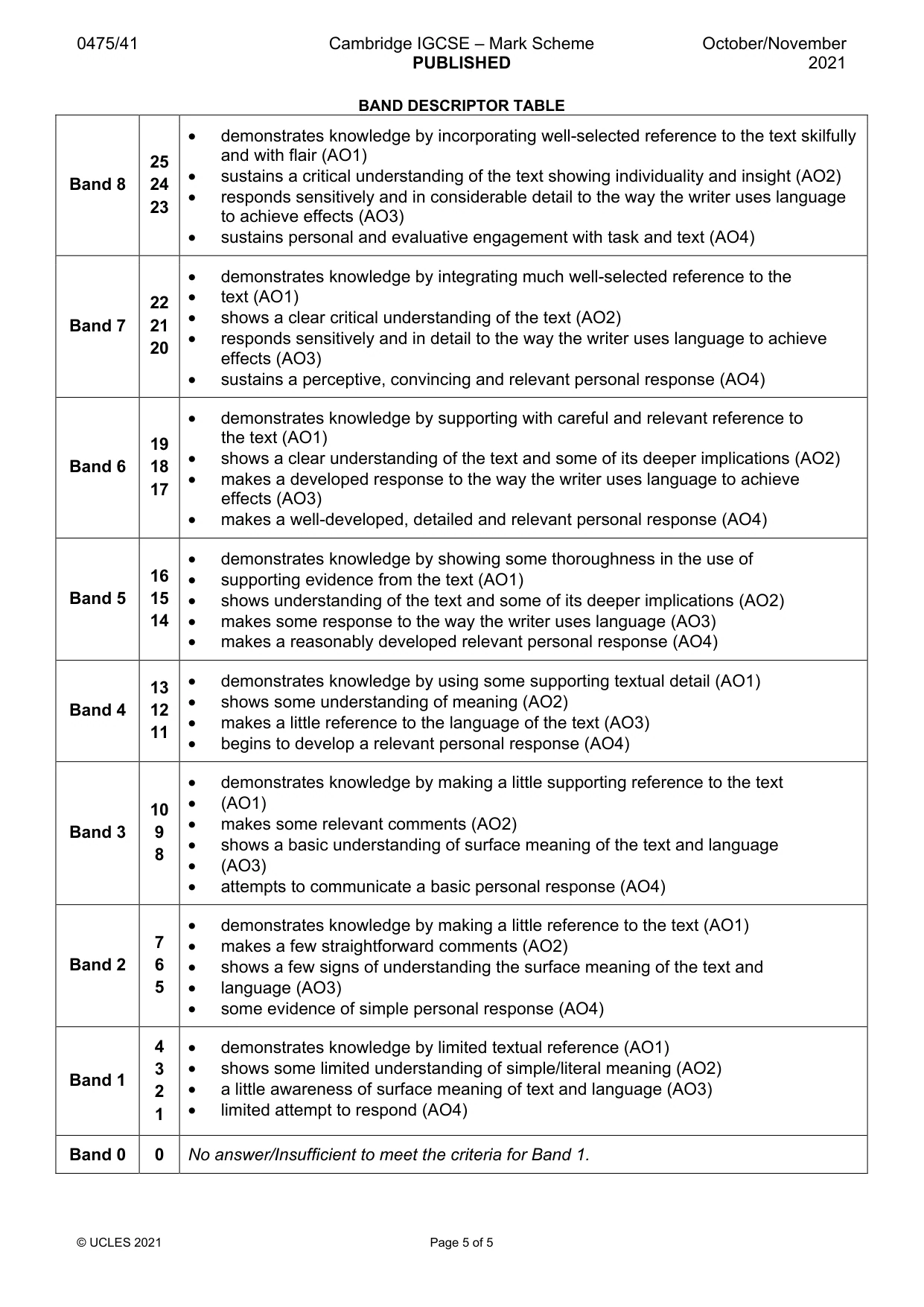
0475/41 Cambridge IGCSE – Mark Scheme PUBLISHED October/November 2021 © UCLES 2021 Page 5 of 5 BAND DESCRIPTOR TABLE Band 8 25 24 23 • demonstrates knowledge by incorporating well-selected reference to the text skilfully and with flair (AO1) • sustains a critical understanding of the text showing individuality and insight (AO2) • responds sensitively and in considerable detail to the way the writer uses language to achieve effects (AO3) • sustains personal and evaluative engagement with task and text (AO4) Band 7 22 21 20 • demonstrates knowledge by integrating much well-selected reference to the • text (AO1) • shows a clear critical understanding of the text (AO2) • responds sensitively and in detail to the way the writer uses language to achieve effects (AO3) • sustains a perceptive, convincing and relevant personal response (AO4) Band 6 19 18 17 • demonstrates knowledge by supporting with careful and relevant reference to the text (AO1) • shows a clear understanding of the text and some of its deeper implications (AO2) • makes a developed response to the way the writer uses language to achieve effects (AO3) • makes a well-developed, detailed and relevant personal response (AO4) Band 5 16 15 14 • demonstrates knowledge by showing some thoroughness in the use of • supporting evidence from the text (AO1) • shows understanding of the text and some of its deeper implications (AO2) • makes some response to the way the writer uses language (AO3) • makes a reasonably developed relevant personal response (AO4) Band 4 13 12 11 • demonstrates knowledge by using some supporting textual detail (AO1) • shows some understanding of meaning (AO2) • makes a little reference to the language of the text (AO3) • begins to develop a relevant personal response (AO4) Band 3 10 9 8 • demonstrates knowledge by making a little supporting reference to the text • (AO1) • makes some relevant comments (AO2) • shows a basic understanding of surface meaning of the text and language • (AO3) • attempts to communicate a basic personal response (AO4) Band 2 7 6 5 • demonstrates knowledge by making a little reference to the text (AO1) • makes a few straightforward comments (AO2) • shows a few signs of understanding the surface meaning of the text and • language (AO3) • some evidence of simple personal response (AO4) Band 1 4 3 2 1 • demonstrates knowledge by limited textual reference (AO1) • shows some limited understanding of simple/literal meaning (AO2) • a little awareness of surface meaning of text and language (AO3) • limited attempt to respond (AO4) Band 0 0 No answer/Insufficient to meet the criteria for Band 1.
What you needed in this session
Cambridge’s own grade thresholds for 2021 Oct/Nov, Paper 4 · Variant 1. A higher threshold means an easier paper — the bar moves with how the cohort did.