Cambridge IGCSE English - Literature in English 0475 — 2021 May/June Paper 4 · Variant 2
0475/42/M/J/21 · 25 marks · ≈28 min
The question paper and its mark scheme, free to read here and free to download. This is Cambridge’s own paper, exactly as it was sat.
Question paper8 pages


Mark scheme5 pages
Answers below. Sit the paper first if you are practising.
Paper as text
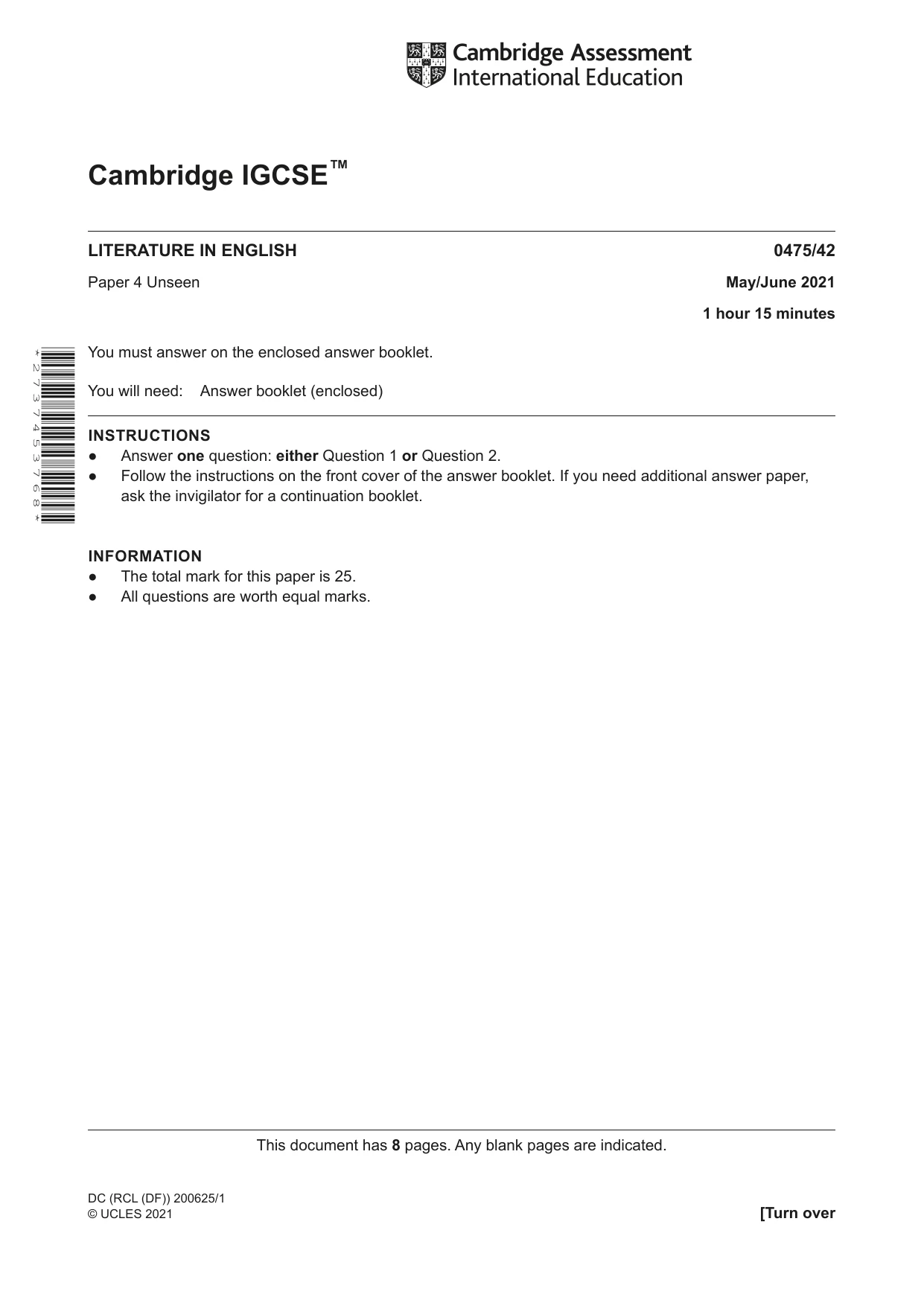
Question paper, page 1
This document has 8 pages. Any blank pages are indicated. Cambridge IGCSE™ LITERATURE IN ENGLISH 0475/42 Paper 4 Unseen May/June 2021 1 hour 15 minutes You must answer on the enclosed answer booklet. You will need: Answer booklet (enclosed) INSTRUCTIONS ● Answer one question: either Question 1 or Question 2. ● Follow the instructions on the front cover of the answer booklet. If you need additional answer paper, ask the invigilator for a continuation booklet. INFORMATION ● The total mark for this paper is 25. ● All questions are worth equal marks. * 2 7 3 7 4 5 3 7 6 8 * DC (RCL (DF)) 200625/1 © UCLES 2021 [Turn over
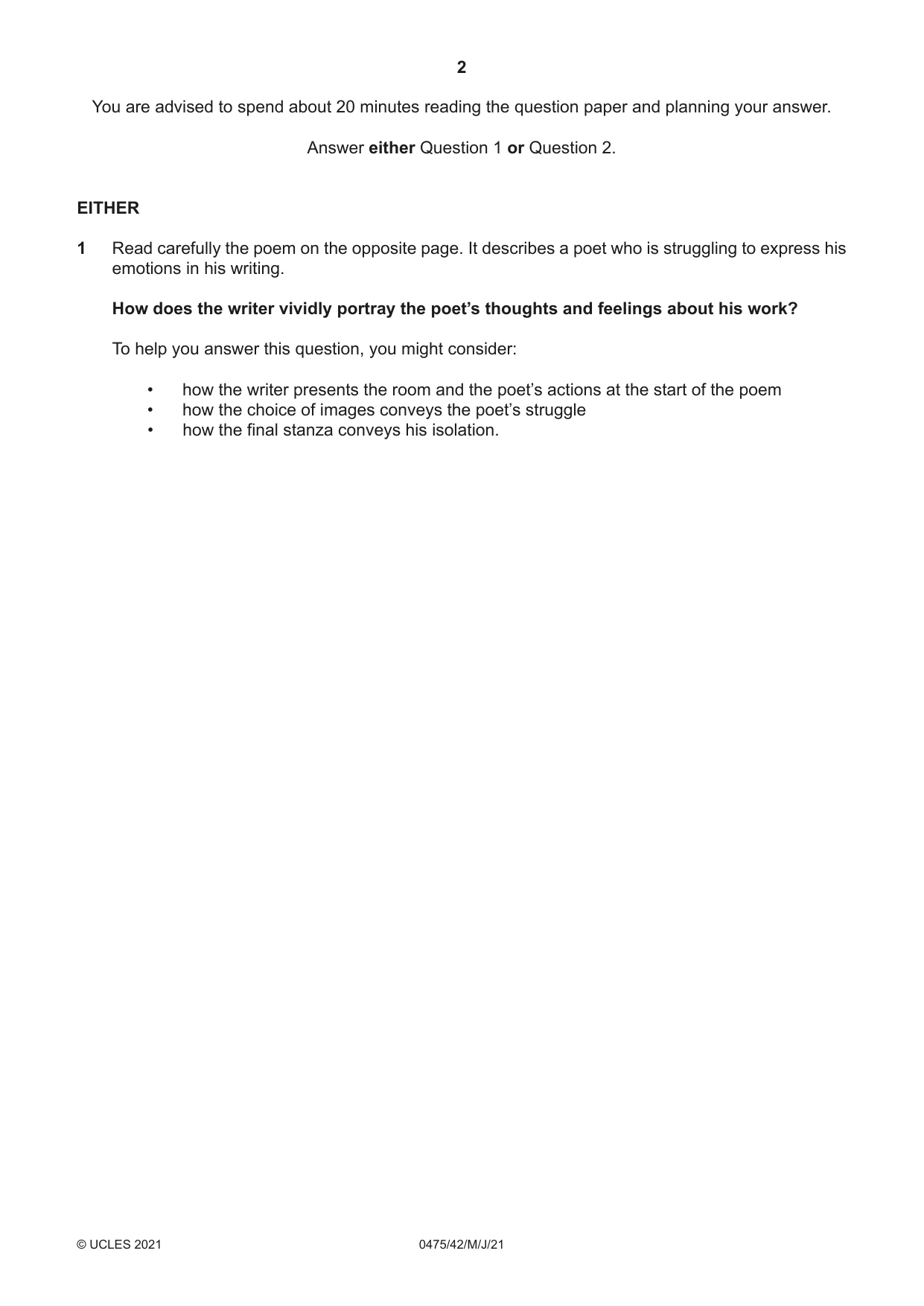
Question paper, page 2
2 0475/42/M/J/21 © UCLES 2021 You are advised to spend about 20 minutes reading the question paper and planning your answer. Answer either Question 1 or Question 2. EITHER 1 Read carefully the poem on the opposite page. It describes a poet who is struggling to express his emotions in his writing. How does the writer vividly portray the poet’s thoughts and feelings about his work? To help you answer this question, you might consider: • how the writer presents the room and the poet’s actions at the start of the poem • how the choice of images conveys the poet’s struggle • how the final stanza conveys his isolation.
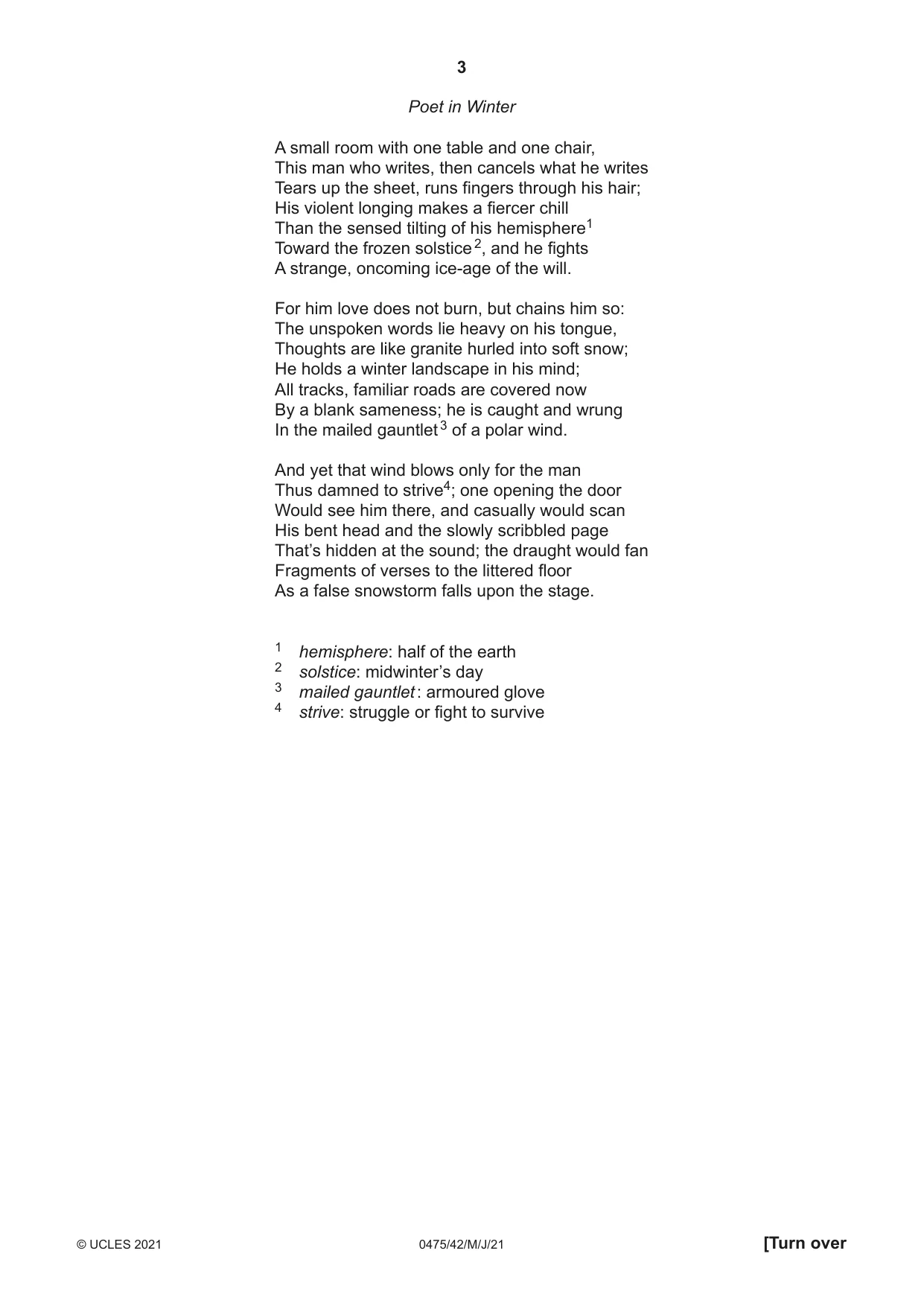
Question paper, page 3
3 0475/42/M/J/21 © UCLES 2021 [Turn over Poet in Winter A small room with one table and one chair, This man who writes, then cancels what he writes Tears up the sheet, runs fingers through his hair; His violent longing makes a fiercer chill Than the sensed tilting of his hemisphere1 Toward the frozen solstice 2, and he fights A strange, oncoming ice-age of the will. For him love does not burn, but chains him so: The unspoken words lie heavy on his tongue, Thoughts are like granite hurled into soft snow; He holds a winter landscape in his mind; All tracks, familiar roads are covered now By a blank sameness; he is caught and wrung In the mailed gauntlet 3 of a polar wind. And yet that wind blows only for the man Thus damned to strive4; one opening the door Would see him there, and casually would scan His bent head and the slowly scribbled page That’s hidden at the sound; the draught would fan Fragments of verses to the littered floor As a false snowstorm falls upon the stage. 1 hemisphere: half of the earth 2 solstice: midwinter’s day 3 mailed gauntlet : armoured glove 4 strive: struggle or fight to survive
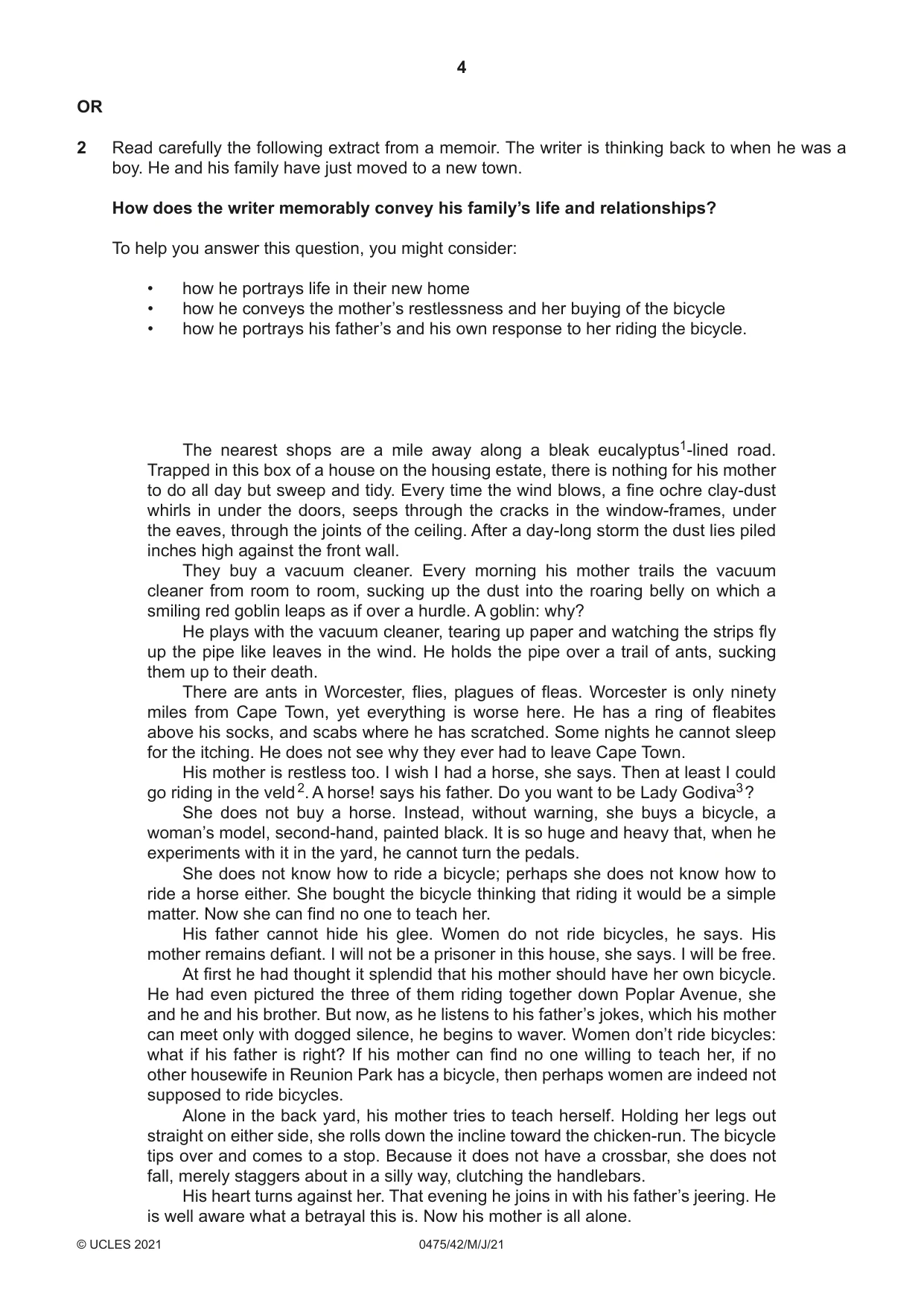
Question paper, page 4
4 0475/42/M/J/21 © UCLES 2021 OR 2 Read carefully the following extract from a memoir. The writer is thinking back to when he was a boy. He and his family have just moved to a new town. How does the writer memorably convey his family’s life and relationships? To help you answer this question, you might consider: • how he portrays life in their new home • how he conveys the mother’s restlessness and her buying of the bicycle • how he portrays his father’s and his own response to her riding the bicycle. The nearest shops are a mile away along a bleak eucalyptus1-lined road. Trapped in this box of a house on the housing estate, there is nothing for his mother to do all day but sweep and tidy. Every time the wind blows, a fine ochre clay-dust whirls in under the doors, seeps through the cracks in the window-frames, under the eaves, through the joints of the ceiling. After a day-long storm the dust lies piled inches high against the front wall. They buy a vacuum cleaner. Every morning his mother trails the vacuum cleaner from room to room, sucking up the dust into the roaring belly on which a smiling red goblin leaps as if over a hurdle. A goblin: why? He plays with the vacuum cleaner, tearing up paper and watching the strips fly up the pipe like leaves in the wind. He holds the pipe over a trail of ants, sucking them up to their death. There are ants in Worcester, flies, plagues of fleas. Worcester is only ninety miles from Cape Town, yet everything is worse here. He has a ring of fleabites above his socks, and scabs where he has scratched. Some nights he cannot sleep for the itching. He does not see why they ever had to leave Cape Town. His mother is restless too. I wish I had a horse, she says. Then at least I could go riding in the veld 2. A horse! says his father. Do you want to be Lady Godiva3 ? She does not buy a horse. Instead, without warning, she buys a bicycle, a woman’s model, second-hand, painted black. It is so huge and heavy that, when he experiments with it in the yard, he cannot turn the pedals. She does not know how to ride a bicycle; perhaps she does not know how to ride a horse either. She bought the bicycle thinking that riding it would be a simple matter. Now she can find no one to teach her. His father cannot hide his glee. Women do not ride bicycles, he says. His mother remains defiant. I will not be a prisoner in this house, she says. I will be free. At first he had thought it splendid that his mother should have her own bicycle. He had even pictured the three of them riding together down Poplar Avenue, she and he and his brother. But now, as he listens to his father’s jokes, which his mother can meet only with dogged silence, he begins to waver. Women don’t ride bicycles: what if his father is right? If his mother can find no one willing to teach her, if no other housewife in Reunion Park has a bicycle, then perhaps women are indeed not supposed to ride bicycles. Alone in the back yard, his mother tries to teach herself. Holding her legs out straight on either side, she rolls down the incline toward the chicken-run. The bicycle tips over and comes to a stop. Because it does not have a crossbar, she does not fall, merely staggers about in a silly way, clutching the handlebars. His heart turns against her. That evening he joins in with his father’s jeering. He is well aware what a betrayal this is. Now his mother is all alone.
Question paper, page 5
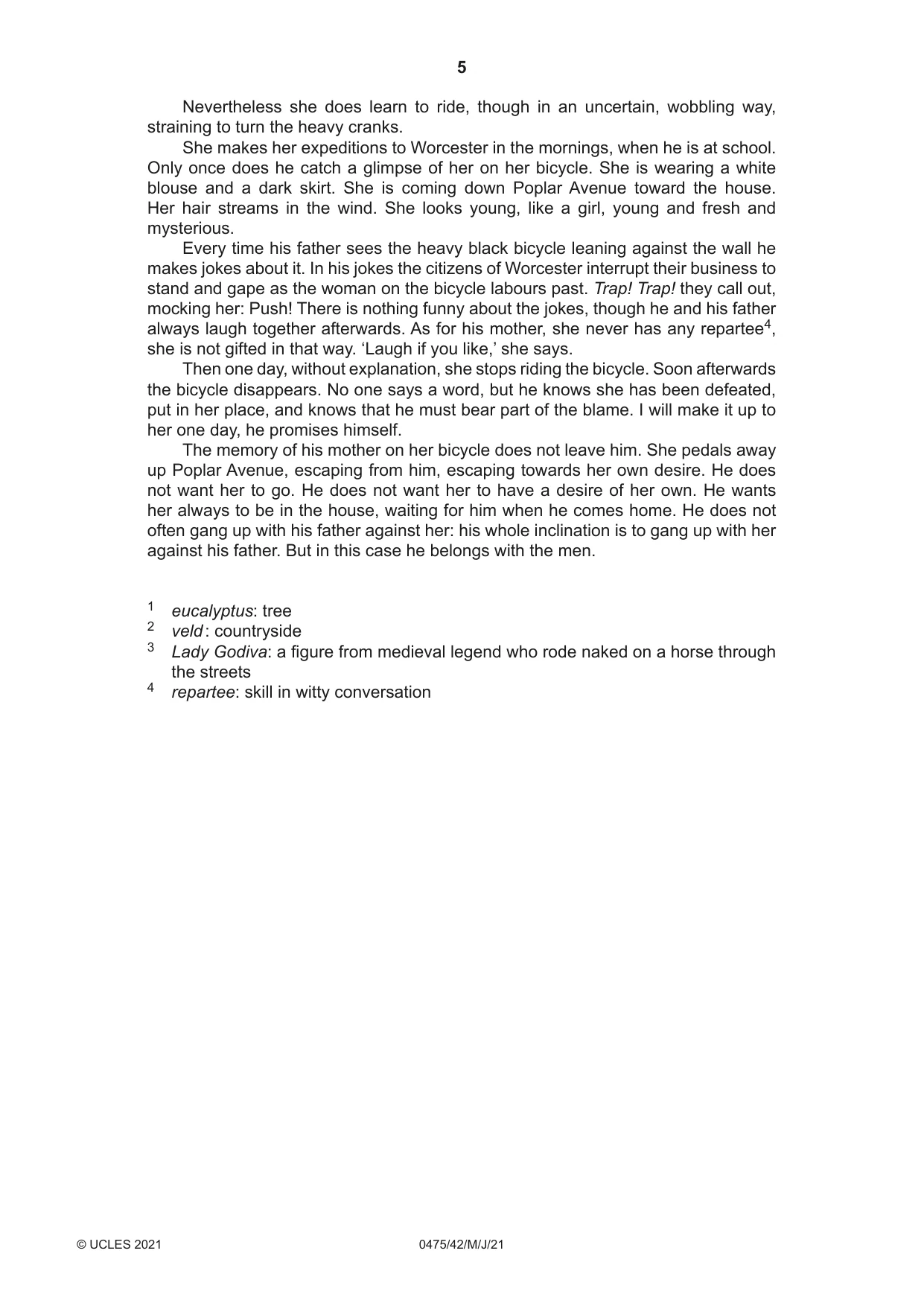
5 0475/42/M/J/21 © UCLES 2021 Nevertheless she does learn to ride, though in an uncertain, wobbling way, straining to turn the heavy cranks. She makes her expeditions to Worcester in the mornings, when he is at school. Only once does he catch a glimpse of her on her bicycle. She is wearing a white blouse and a dark skirt. She is coming down Poplar Avenue toward the house. Her hair streams in the wind. She looks young, like a girl, young and fresh and mysterious. Every time his father sees the heavy black bicycle leaning against the wall he makes jokes about it. In his jokes the citizens of Worcester interrupt their business to stand and gape as the woman on the bicycle labours past. Trap! Trap! they call out, mocking her: Push! There is nothing funny about the jokes, though he and his father always laugh together afterwards. As for his mother, she never has any repartee4, she is not gifted in that way. ‘Laugh if you like,’ she says. Then one day, without explanation, she stops riding the bicycle. Soon afterwards the bicycle disappears. No one says a word, but he knows she has been defeated, put in her place, and knows that he must bear part of the blame. I will make it up to her one day, he promises himself. The memory of his mother on her bicycle does not leave him. She pedals away up Poplar Avenue, escaping from him, escaping towards her own desire. He does not want her to go. He does not want her to have a desire of her own. He wants her always to be in the house, waiting for him when he comes home. He does not often gang up with his father against her: his whole inclination is to gang up with her against his father. But in this case he belongs with the men. 1 eucalyptus: tree 2 veld : countryside 3 Lady Godiva: a figure from medieval legend who rode naked on a horse through the streets 4 repartee: skill in witty conversation
Question paper, page 6
6 0475/42/M/J/21 © UCLES 2021 BLANK PAGE
Question paper, page 7
7 0475/42/M/J/21 © UCLES 2021 BLANK PAGE
Question paper, page 8
8 0475/42/M/J/21 © UCLES 2021 Permission to reproduce items where third-party owned material protected by copyright is included has been sought and cleared where possible. Every reasonable effort has been made by the publisher (UCLES) to trace copyright holders, but if any items requiring clearance have unwittingly been included, the publisher will be pleased to make amends at the earliest possible opportunity. To avoid the issue of disclosure of answer-related information to candidates, all copyright acknowledgements are reproduced online in the Cambridge Assessment International Education Copyright Acknowledgements Booklet. This is produced for each series of examinations and is freely available to download at www.cambridgeinternational.org after the live examination series. Cambridge Assessment International Education is part of the Cambridge Assessment Group. Cambridge Assessment is the brand name of the University of Cambridge Local Examinations Syndicate (UCLES), which itself is a department of the University of Cambridge. BLANK PAGE
Mark scheme, page 1
This document consists of 5 printed pages. © UCLES 2021 [Turn over Cambridge IGCSE™ LITERATURE IN ENGLISH 0475/42 Paper 4 Unseen 42 May/June 2021 MARK SCHEME Maximum Mark: 25 Published This mark scheme is published as an aid to teachers and candidates, to indicate the requirements of the examination. It shows the basis on which Examiners were instructed to award marks. It does not indicate the details of the discussions that took place at an Examiners’ meeting before marking began, which would have considered the acceptability of alternative answers. Mark schemes should be read in conjunction with the question paper and the Principal Examiner Report for Teachers. Cambridge International will not enter into discussions about these mark schemes. Cambridge International is publishing the mark schemes for the May/June 2021 series for most Cambridge IGCSE™, Cambridge International A and AS Level components and some Cambridge O Level components.
Mark scheme, page 2
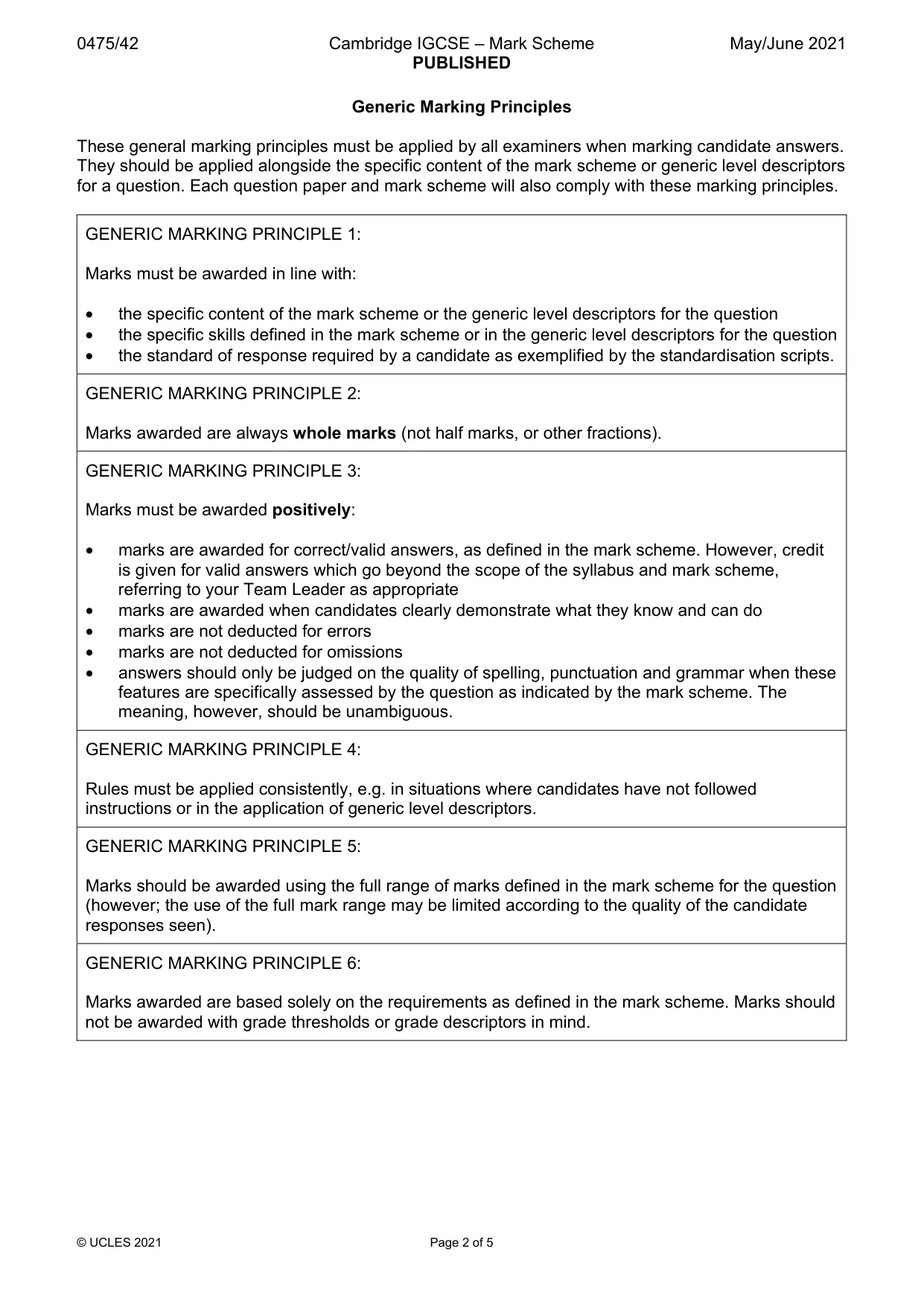
0475/42 Cambridge IGCSE – Mark Scheme PUBLISHED May/June 2021 © UCLES 2021 Page 2 of 5 Generic Marking Principles These general marking principles must be applied by all examiners when marking candidate answers. They should be applied alongside the specific content of the mark scheme or generic level descriptors for a question. Each question paper and mark scheme will also comply with these marking principles. GENERIC MARKING PRINCIPLE 1: Marks must be awarded in line with: • the specific content of the mark scheme or the generic level descriptors for the question • the specific skills defined in the mark scheme or in the generic level descriptors for the question • the standard of response required by a candidate as exemplified by the standardisation scripts. GENERIC MARKING PRINCIPLE 2: Marks awarded are always whole marks (not half marks, or other fractions). GENERIC MARKING PRINCIPLE 3: Marks must be awarded positively: • marks are awarded for correct/valid answers, as defined in the mark scheme. However, credit is given for valid answers which go beyond the scope of the syllabus and mark scheme, referring to your Team Leader as appropriate • marks are awarded when candidates clearly demonstrate what they know and can do • marks are not deducted for errors • marks are not deducted for omissions • answers should only be judged on the quality of spelling, punctuation and grammar when these features are specifically assessed by the question as indicated by the mark scheme. The meaning, however, should be unambiguous. GENERIC MARKING PRINCIPLE 4: Rules must be applied consistently, e.g. in situations where candidates have not followed instructions or in the application of generic level descriptors. GENERIC MARKING PRINCIPLE 5: Marks should be awarded using the full range of marks defined in the mark scheme for the question (however; the use of the full mark range may be limited according to the quality of the candidate responses seen). GENERIC MARKING PRINCIPLE 6: Marks awarded are based solely on the requirements as defined in the mark scheme. Marks should not be awarded with grade thresholds or grade descriptors in mind.
Mark scheme, page 3
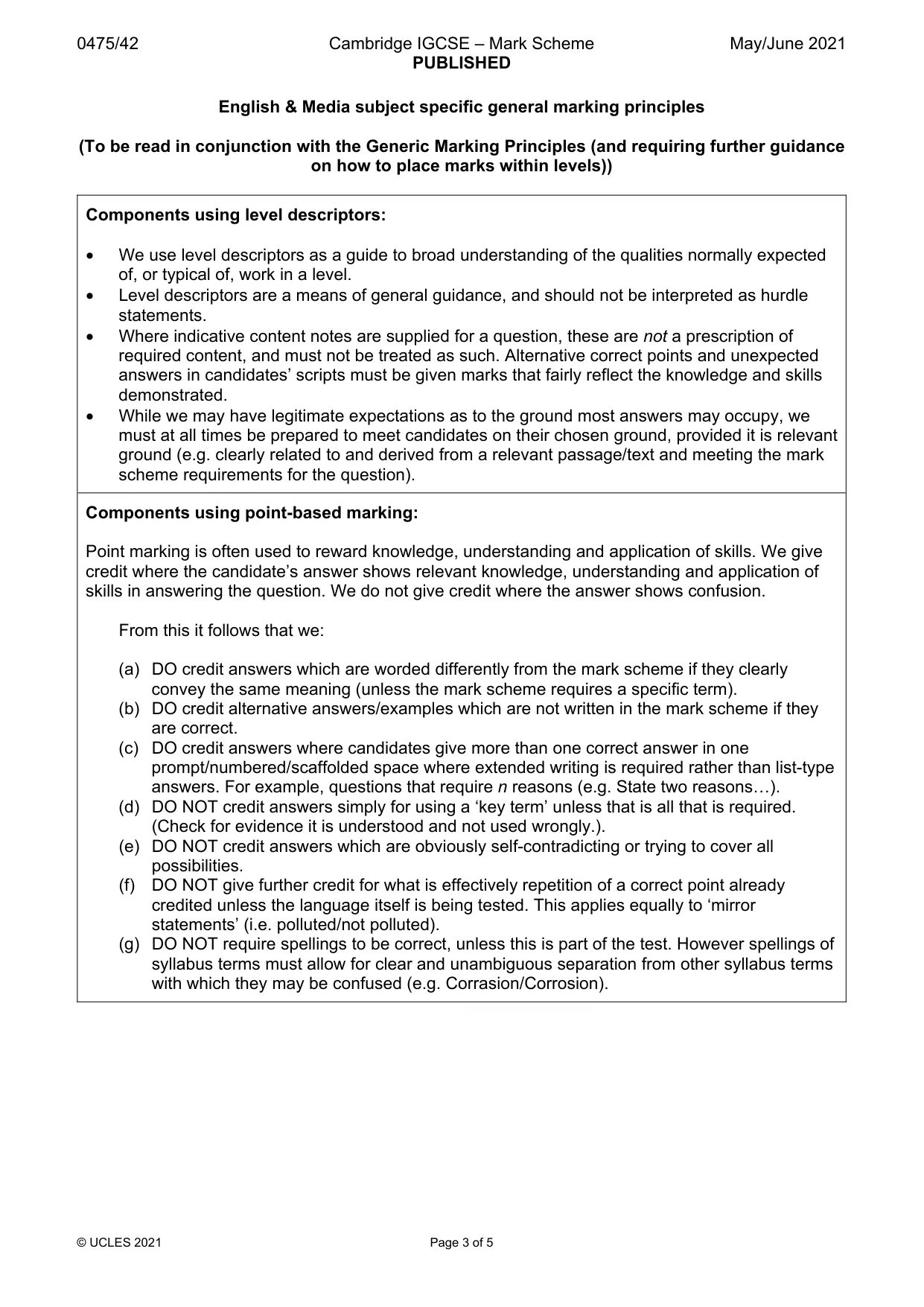
0475/42 Cambridge IGCSE – Mark Scheme PUBLISHED May/June 2021 © UCLES 2021 Page 3 of 5 English & Media subject specific general marking principles (To be read in conjunction with the Generic Marking Principles (and requiring further guidance on how to place marks within levels)) Components using level descriptors: • We use level descriptors as a guide to broad understanding of the qualities normally expected of, or typical of, work in a level. • Level descriptors are a means of general guidance, and should not be interpreted as hurdle statements. • Where indicative content notes are supplied for a question, these are not a prescription of required content, and must not be treated as such. Alternative correct points and unexpected answers in candidates’ scripts must be given marks that fairly reflect the knowledge and skills demonstrated. • While we may have legitimate expectations as to the ground most answers may occupy, we must at all times be prepared to meet candidates on their chosen ground, provided it is relevant ground (e.g. clearly related to and derived from a relevant passage/text and meeting the mark scheme requirements for the question). Components using point-based marking: Point marking is often used to reward knowledge, understanding and application of skills. We give credit where the candidate’s answer shows relevant knowledge, understanding and application of skills in answering the question. We do not give credit where the answer shows confusion. From this it follows that we: (a) DO credit answers which are worded differently from the mark scheme if they clearly convey the same meaning (unless the mark scheme requires a specific term). (b) DO credit alternative answers/examples which are not written in the mark scheme if they are correct. (c) DO credit answers where candidates give more than one correct answer in one prompt/numbered/scaffolded space where extended writing is required rather than list-type answers. For example, questions that require n reasons (e.g. State two reasons…). (d) DO NOT credit answers simply for using a ‘key term’ unless that is all that is required. (Check for evidence it is understood and not used wrongly.). (e) DO NOT credit answers which are obviously self-contradicting or trying to cover all possibilities. (f) DO NOT give further credit for what is effectively repetition of a correct point already credited unless the language itself is being tested. This applies equally to ‘mirror statements’ (i.e. polluted/not polluted). (g) DO NOT require spellings to be correct, unless this is part of the test. However spellings of syllabus terms must allow for clear and unambiguous separation from other syllabus terms with which they may be confused (e.g. Corrasion/Corrosion).
Mark scheme, page 4
0475/42 Cambridge IGCSE – Mark Scheme PUBLISHED May/June 2021 © UCLES 2021 Page 4 of 5 Introduction For general administrative guidance, see Notes for Examiners Handbook. All questions are marked out of 25. Assessment Objectives The Assessment Objectives are evenly weighted across each question. The assessment objectives for the paper are: AO1 show detailed knowledge of the content of literary texts, supported by reference to the text AO2 understand the meanings of literary texts and their contexts, and explore texts beyond surface meaning to show deeper awareness of ideas and attitudes AO3 recognise and appreciate ways in which writers use language, structure, and form to create and shape meanings and effects AO4 communicate a sensitive and informed personal response The Band Descriptors cover marks from 0 to 25, and apply to the marking of each question. They guide examiners to an understanding of the qualities normally expected of, or typical of, work in a band. They are a means of general guidance, and must not be interpreted as hurdle statements. For the purposes of standardisation of marking, they are to be used in conjunction with the Practice and Standardisation scripts discussed during the coordination meeting and with Team Leaders, as well as the question-specific notes. The supplementary notes for each question are related to the assessment objectives above. Because of the nature of the subject, they are for general guidance; they are not designed as prescriptions of required content and must not be treated as such. The syllabus aims at encouraging candidates to make some personal response to their reading. Whilst there are legitimate expectations of the content of most answers, examiners may see responses that include ideas not covered in the supplementary guidance. For these cases, examiners should credit valid responses fairly and not penalise candidates for including valid points outside the mark scheme.
Mark scheme, page 5
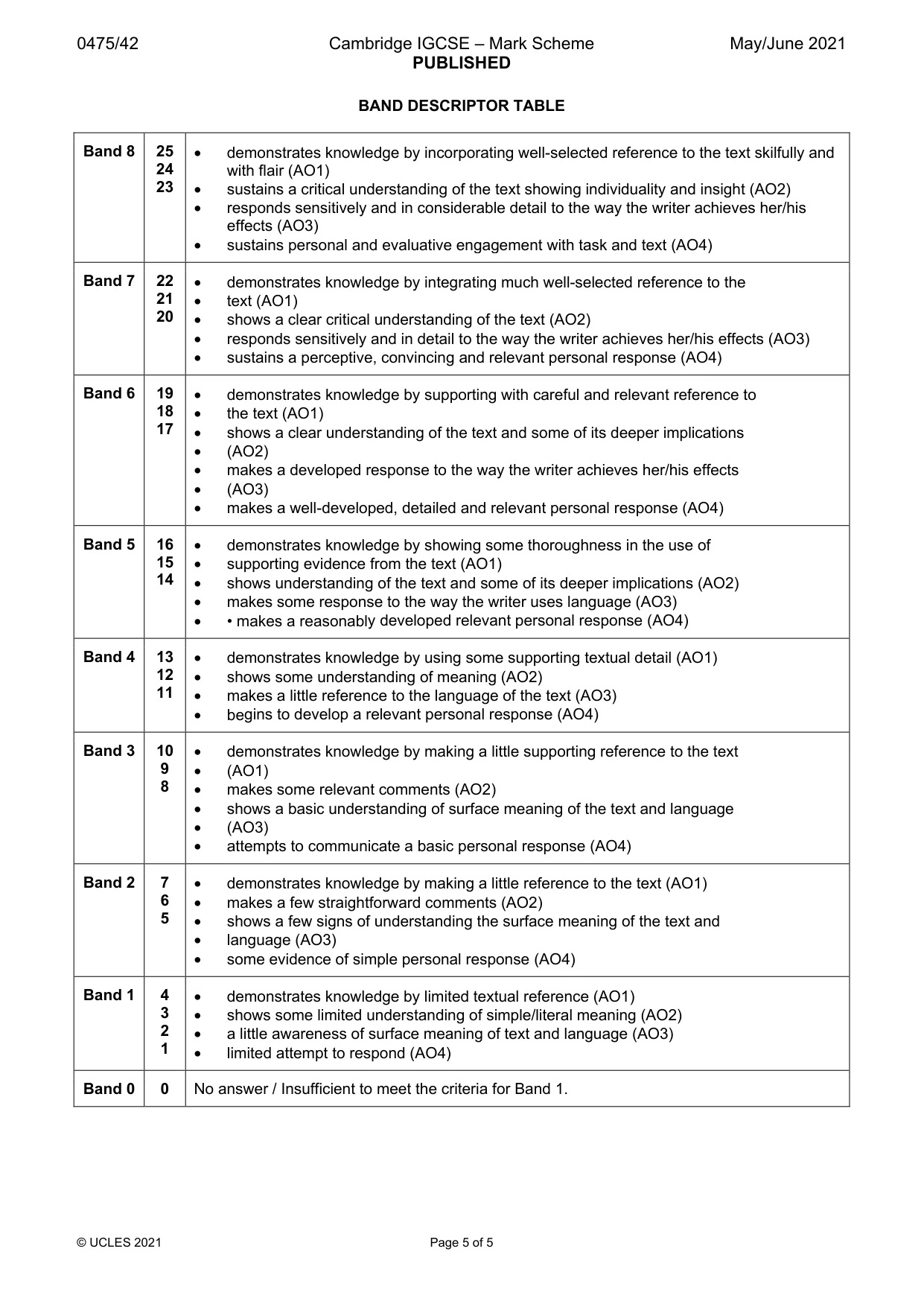
0475/42 Cambridge IGCSE – Mark Scheme PUBLISHED May/June 2021 © UCLES 2021 Page 5 of 5 BAND DESCRIPTOR TABLE Band 8 25 24 23 • demonstrates knowledge by incorporating well-selected reference to the text skilfully and with flair (AO1) • sustains a critical understanding of the text showing individuality and insight (AO2) • responds sensitively and in considerable detail to the way the writer achieves her/his effects (AO3) • sustains personal and evaluative engagement with task and text (AO4) Band 7 22 21 20 • demonstrates knowledge by integrating much well-selected reference to the • text (AO1) • shows a clear critical understanding of the text (AO2) • responds sensitively and in detail to the way the writer achieves her/his effects (AO3) • sustains a perceptive, convincing and relevant personal response (AO4) Band 6 19 18 17 • demonstrates knowledge by supporting with careful and relevant reference to • the text (AO1) • shows a clear understanding of the text and some of its deeper implications • (AO2) • makes a developed response to the way the writer achieves her/his effects • (AO3) • makes a well-developed, detailed and relevant personal response (AO4) Band 5 16 15 14 • demonstrates knowledge by showing some thoroughness in the use of • supporting evidence from the text (AO1) • shows understanding of the text and some of its deeper implications (AO2) • makes some response to the way the writer uses language (AO3) • • makes a reasonably developed relevant personal response (AO4) Band 4 13 12 11 • demonstrates knowledge by using some supporting textual detail (AO1) • shows some understanding of meaning (AO2) • makes a little reference to the language of the text (AO3) • begins to develop a relevant personal response (AO4) Band 3 10 9 8 • demonstrates knowledge by making a little supporting reference to the text • (AO1) • makes some relevant comments (AO2) • shows a basic understanding of surface meaning of the text and language • (AO3) • attempts to communicate a basic personal response (AO4) Band 2 7 6 5 • demonstrates knowledge by making a little reference to the text (AO1) • makes a few straightforward comments (AO2) • shows a few signs of understanding the surface meaning of the text and • language (AO3) • some evidence of simple personal response (AO4) Band 1 4 3 2 1 • demonstrates knowledge by limited textual reference (AO1) • shows some limited understanding of simple/literal meaning (AO2) • a little awareness of surface meaning of text and language (AO3) • limited attempt to respond (AO4) Band 0 0 No answer / Insufficient to meet the criteria for Band 1.
What you needed in this session
Cambridge’s own grade thresholds for 2021 May/June, Paper 4 · Variant 2. A higher threshold means an easier paper — the bar moves with how the cohort did.