Cambridge IGCSE English - Literature in English 0475 — 2020 Feb/March Paper 4 · Variant 2
0475/42/F/M/20 · 25 marks · ≈28 min
The question paper and its mark scheme, free to read here and free to download. This is Cambridge’s own paper, exactly as it was sat.
Question paper8 pages


Mark scheme4 pages
Answers below. Sit the paper first if you are practising.
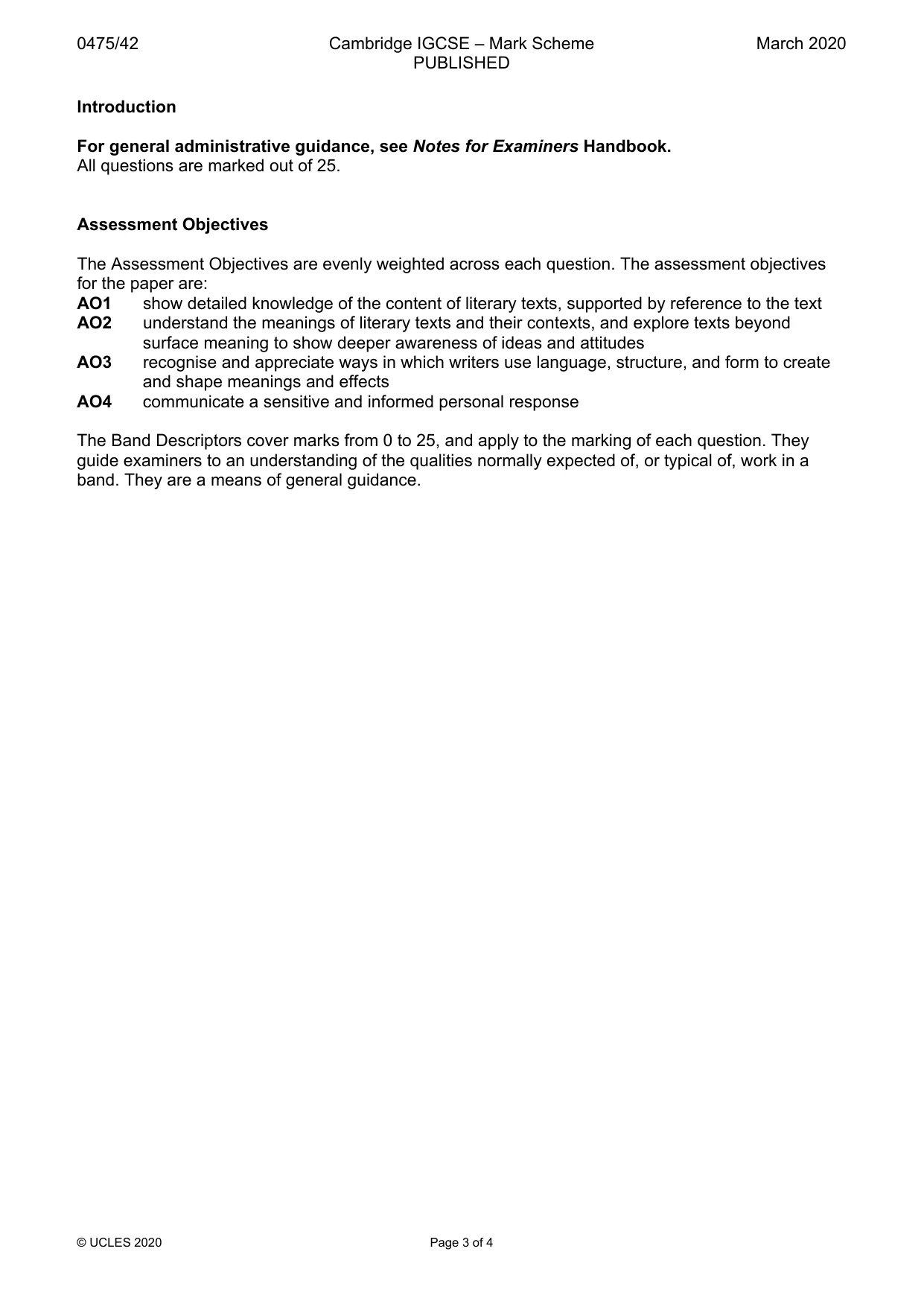
Paper as text
Question paper, page 1
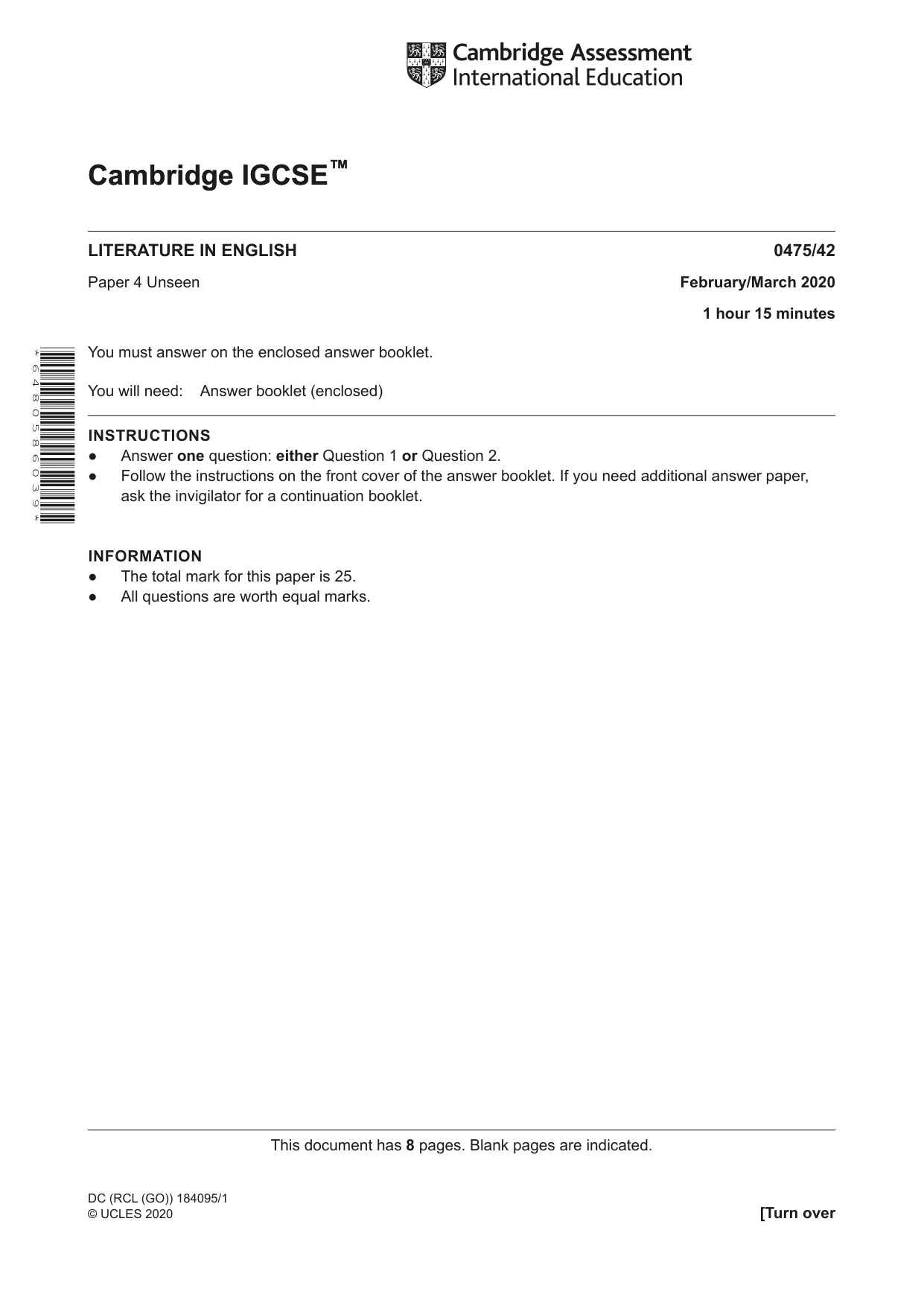
Cambridge IGCSE™ * 6 4 8 0 5 8 6 0 3 9 * This document has 8 pages. Blank pages are indicated. LITERATURE IN ENGLISH 0475/42 Paper 4 Unseen February/March 2020 1 hour 15 minutes You must answer on the enclosed answer booklet. You will need: Answer booklet (enclosed) INSTRUCTIONS ● Answer one question: either Question 1 or Question 2. ● Follow the instructions on the front cover of the answer booklet. If you need additional answer paper, ask the invigilator for a continuation booklet. INFORMATION ● The total mark for this paper is 25. ● All questions are worth equal marks. DC (RCL (GO)) 184095/1 © UCLES 2020 [Turn over Cambridge IGCSE™
Question paper, page 2
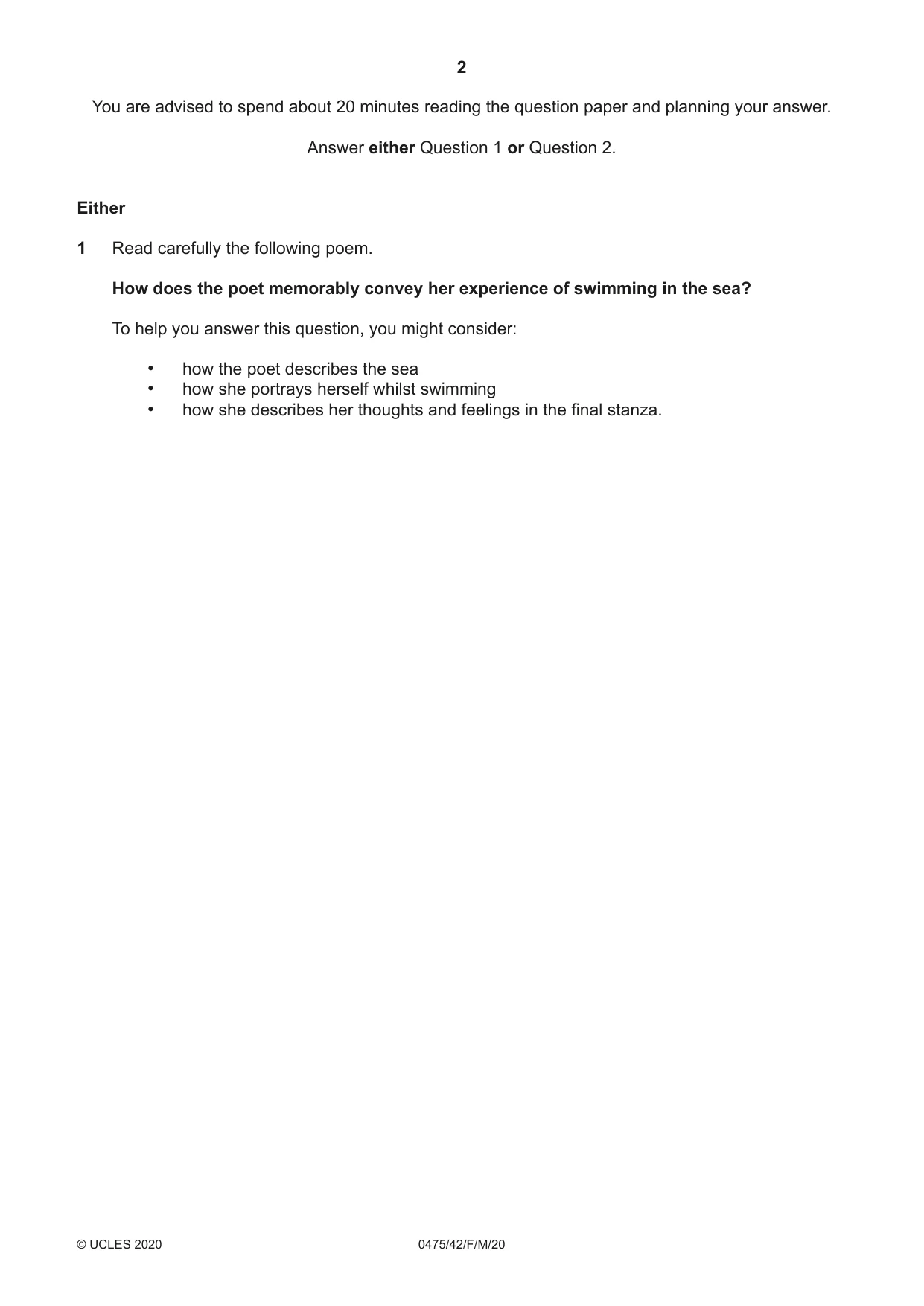
2 0475/42/F/M/20 © UCLES 2020 You are advised to spend about 20 minutes reading the question paper and planning your answer. Answer either Question 1 or Question 2. Either 1 Read carefully the following poem. How does the poet memorably convey her experience of swimming in the sea? To help you answer this question, you might consider: • how the poet describes the sea • how she portrays herself whilst swimming • how she describes her thoughts and feelings in the final stanza.
Question paper, page 3
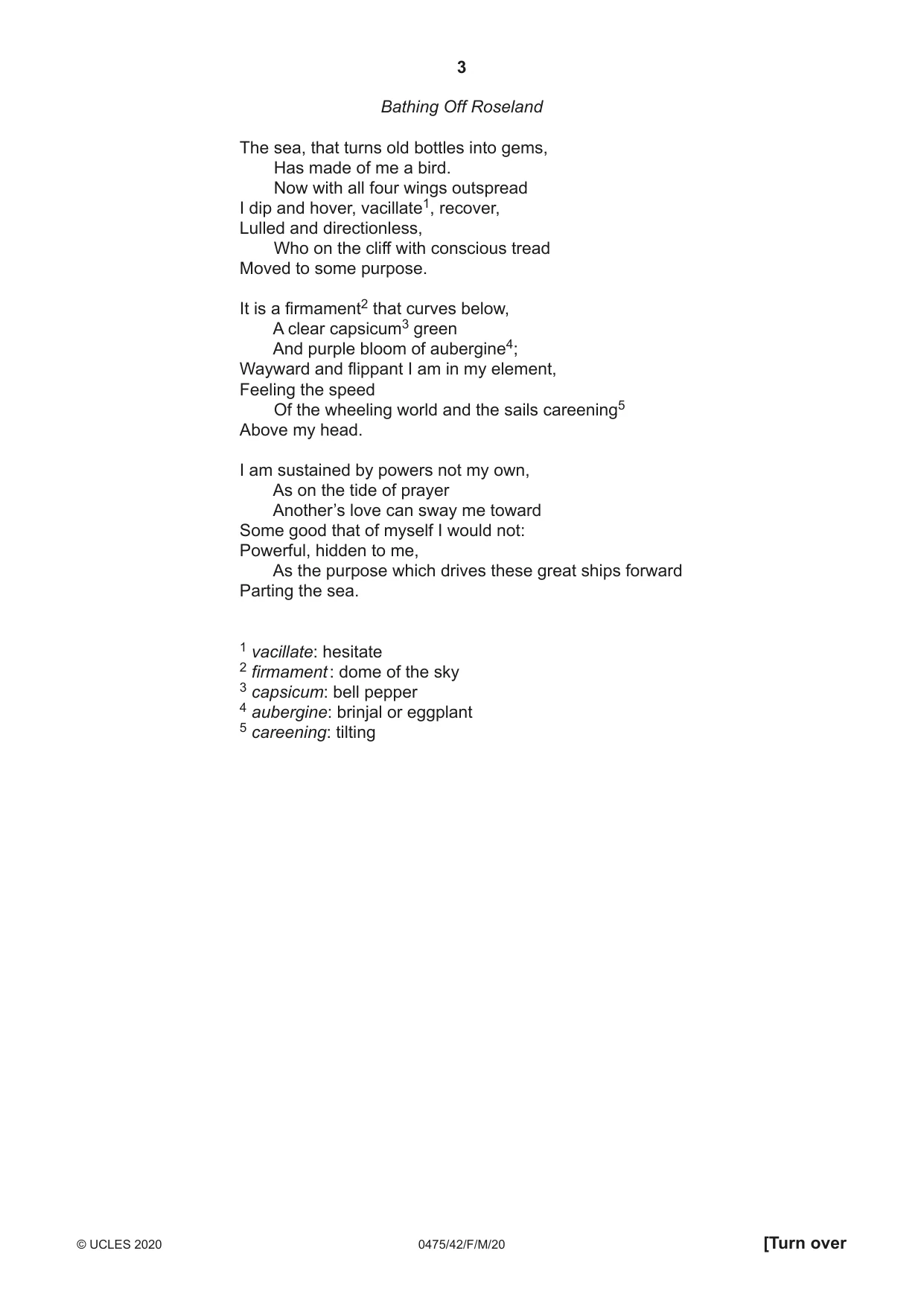
3 0475/42/F/M/20 © UCLES 2020 [Turn over Bathing Off Roseland The sea, that turns old bottles into gems, Has made of me a bird. Now with all four wings outspread I dip and hover, vacillate1, recover, Lulled and directionless, Who on the cliff with conscious tread Moved to some purpose. It is a firmament2 that curves below, A clear capsicum3 green And purple bloom of aubergine4; Wayward and flippant I am in my element, Feeling the speed Of the wheeling world and the sails careening5 Above my head. I am sustained by powers not my own, As on the tide of prayer Another’s love can sway me toward Some good that of myself I would not: Powerful, hidden to me, As the purpose which drives these great ships forward Parting the sea. 1 vacillate: hesitate 2 firmament : dome of the sky 3 capsicum: bell pepper 4 aubergine: brinjal or eggplant 5 careening: tilting
Question paper, page 4
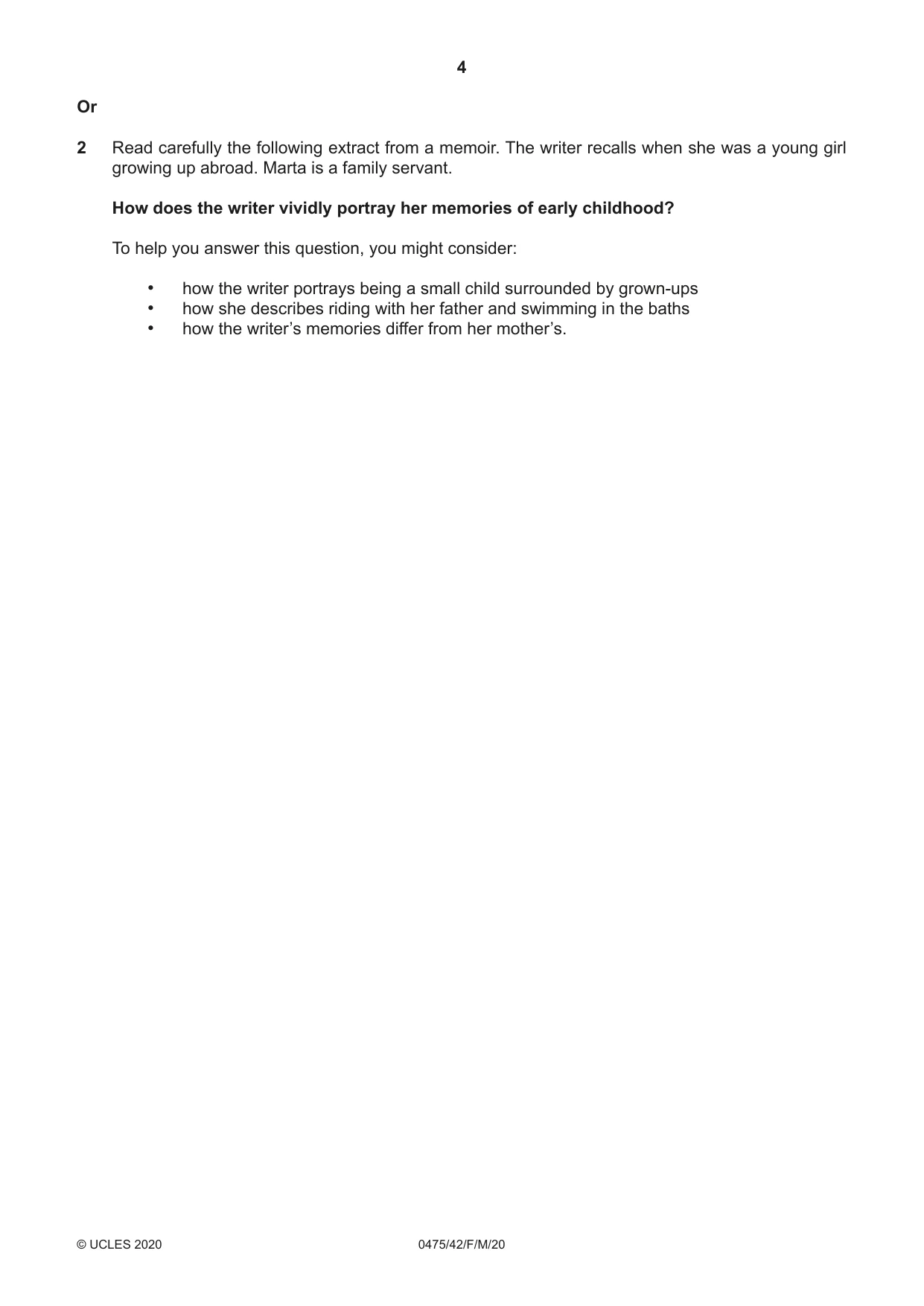
4 0475/42/F/M/20 © UCLES 2020 Or 2 Read carefully the following extract from a memoir. The writer recalls when she was a young girl growing up abroad. Marta is a family servant. How does the writer vividly portray her memories of early childhood? To help you answer this question, you might consider: • how the writer portrays being a small child surrounded by grown-ups • how she describes riding with her father and swimming in the baths • how the writer’s memories differ from her mother’s.
Question paper, page 5
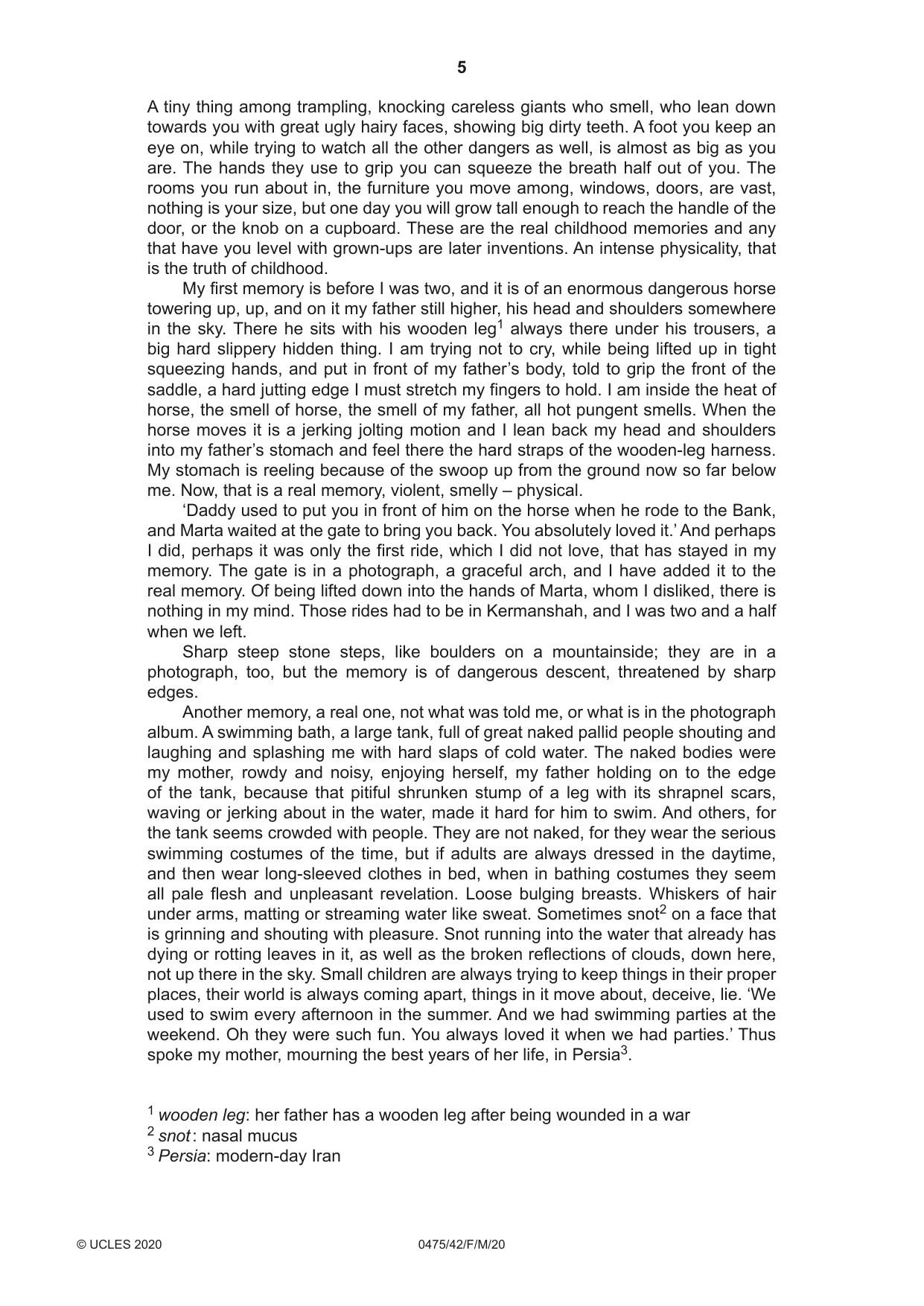
5 0475/42/F/M/20 © UCLES 2020 A tiny thing among trampling, knocking careless giants who smell, who lean down towards you with great ugly hairy faces, showing big dirty teeth. A foot you keep an eye on, while trying to watch all the other dangers as well, is almost as big as you are. The hands they use to grip you can squeeze the breath half out of you. The rooms you run about in, the furniture you move among, windows, doors, are vast, nothing is your size, but one day you will grow tall enough to reach the handle of the door, or the knob on a cupboard. These are the real childhood memories and any that have you level with grown-ups are later inventions. An intense physicality, that is the truth of childhood. My first memory is before I was two, and it is of an enormous dangerous horse towering up, up, and on it my father still higher, his head and shoulders somewhere in the sky. There he sits with his wooden leg1 always there under his trousers, a big hard slippery hidden thing. I am trying not to cry, while being lifted up in tight squeezing hands, and put in front of my father’s body, told to grip the front of the saddle, a hard jutting edge I must stretch my fingers to hold. I am inside the heat of horse, the smell of horse, the smell of my father, all hot pungent smells. When the horse moves it is a jerking jolting motion and I lean back my head and shoulders into my father’s stomach and feel there the hard straps of the wooden-leg harness. My stomach is reeling because of the swoop up from the ground now so far below me. Now, that is a real memory, violent, smelly – physical. ‘Daddy used to put you in front of him on the horse when he rode to the Bank, and Marta waited at the gate to bring you back. You absolutely loved it.’ And perhaps I did, perhaps it was only the first ride, which I did not love, that has stayed in my memory. The gate is in a photograph, a graceful arch, and I have added it to the real memory. Of being lifted down into the hands of Marta, whom I disliked, there is nothing in my mind. Those rides had to be in Kermanshah, and I was two and a half when we left. Sharp steep stone steps, like boulders on a mountainside; they are in a photograph, too, but the memory is of dangerous descent, threatened by sharp edges. Another memory, a real one, not what was told me, or what is in the photograph album. A swimming bath, a large tank, full of great naked pallid people shouting and laughing and splashing me with hard slaps of cold water. The naked bodies were my mother, rowdy and noisy, enjoying herself, my father holding on to the edge of the tank, because that pitiful shrunken stump of a leg with its shrapnel scars, waving or jerking about in the water, made it hard for him to swim. And others, for the tank seems crowded with people. They are not naked, for they wear the serious swimming costumes of the time, but if adults are always dressed in the daytime, and then wear long-sleeved clothes in bed, when in bathing costumes they seem all pale flesh and unpleasant revelation. Loose bulging breasts. Whiskers of hair under arms, matting or streaming water like sweat. Sometimes snot2 on a face that is grinning and shouting with pleasure. Snot running into the water that already has dying or rotting leaves in it, as well as the broken reflections of clouds, down here, not up there in the sky. Small children are always trying to keep things in their proper places, their world is always coming apart, things in it move about, deceive, lie. ‘We used to swim every afternoon in the summer. And we had swimming parties at the weekend. Oh they were such fun. You always loved it when we had parties.’ Thus spoke my mother, mourning the best years of her life, in Persia3. 1 wooden leg: her father has a wooden leg after being wounded in a war 2 snot : nasal mucus 3 Persia: modern-day Iran
Question paper, page 6
6 0475/42/F/M/20 © UCLES 2020 BLANK PAGE
Question paper, page 7
7 0475/42/F/M/20 © UCLES 2020 BLANK PAGE
Question paper, page 8
8 0475/42/F/M/20 © UCLES 2020 Permission to reproduce items where third-party owned material protected by copyright is included has been sought and cleared where possible. Every reasonable effort has been made by the publisher (UCLES) to trace copyright holders, but if any items requiring clearance have unwittingly been included, the publisher will be pleased to make amends at the earliest possible opportunity. To avoid the issue of disclosure of answer-related information to candidates, all copyright acknowledgements are reproduced online in the Cambridge Assessment International Education Copyright Acknowledgements Booklet. This is produced for each series of examinations and is freely available to download at www.cambridgeinternational.org after the live examination series. Cambridge Assessment International Education is part of the Cambridge Assessment Group. Cambridge Assessment is the brand name of the University of Cambridge Local Examinations Syndicate (UCLES), which itself is a department of the University of Cambridge. BLANK PAGE
Mark scheme, page 1
This document consists of 4 printed pages. © UCLES 2020 [Turn over Cambridge IGCSE™ LITERATURE IN ENGLISH 0475/42 Paper 4 Unseen March 2020 MARK SCHEME Maximum Mark: 25 Published This mark scheme is published as an aid to teachers and candidates, to indicate the requirements of the examination. It shows the basis on which Examiners were instructed to award marks. It does not indicate the details of the discussions that took place at an Examiners’ meeting before marking began, which would have considered the acceptability of alternative answers. Mark schemes should be read in conjunction with the question paper and the Principal Examiner Report for Teachers. Cambridge International will not enter into discussions about these mark schemes. Cambridge International is publishing the mark schemes for the March 2020 series for most Cambridge IGCSE™, Cambridge International A and AS Level components and some Cambridge O Level components.
Mark scheme, page 2
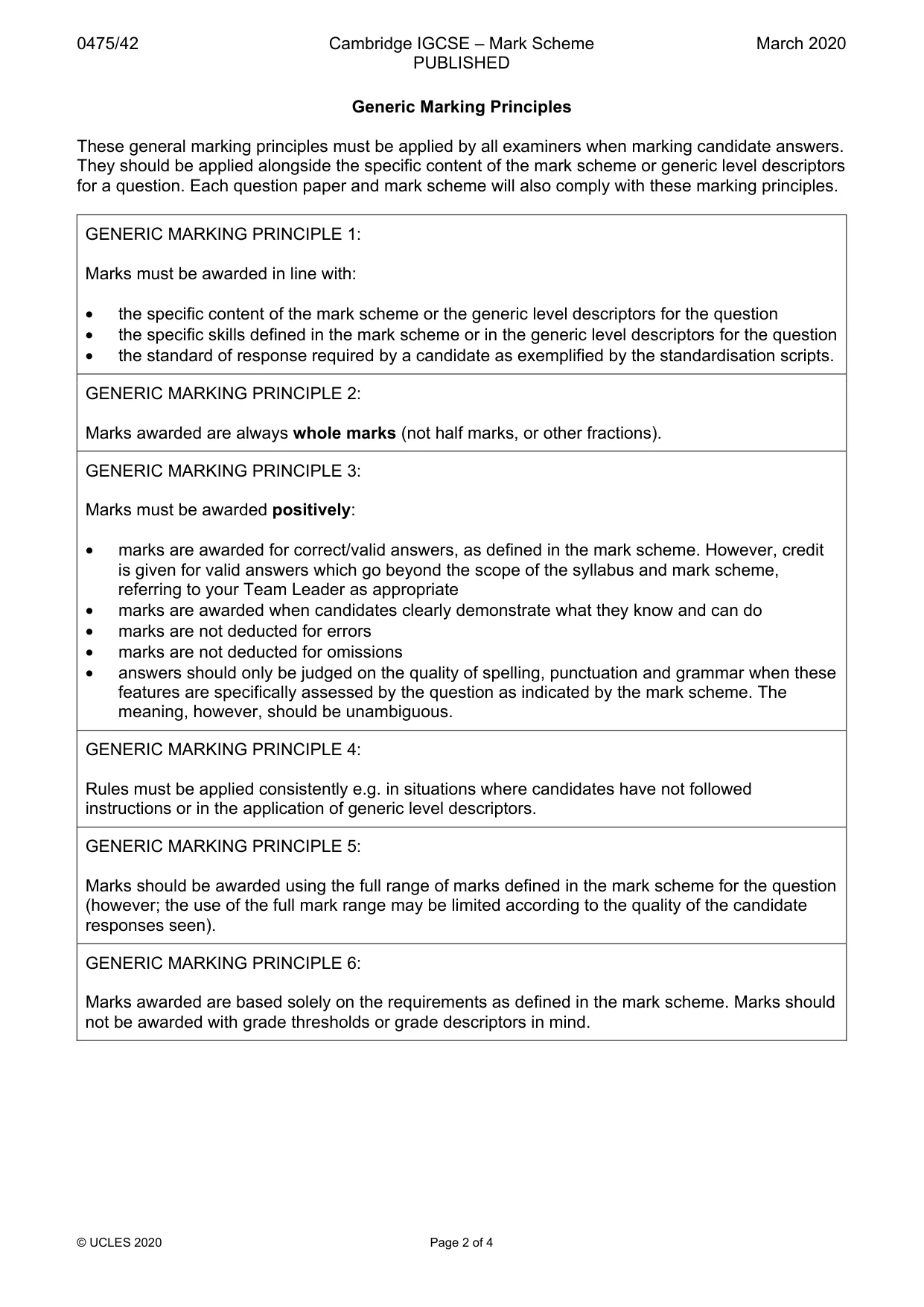
0475/42 Cambridge IGCSE – Mark Scheme PUBLISHED March 2020 © UCLES 2020 Page 2 of 4 Generic Marking Principles These general marking principles must be applied by all examiners when marking candidate answers. They should be applied alongside the specific content of the mark scheme or generic level descriptors for a question. Each question paper and mark scheme will also comply with these marking principles. GENERIC MARKING PRINCIPLE 1: Marks must be awarded in line with: • the specific content of the mark scheme or the generic level descriptors for the question • the specific skills defined in the mark scheme or in the generic level descriptors for the question • the standard of response required by a candidate as exemplified by the standardisation scripts. GENERIC MARKING PRINCIPLE 2: Marks awarded are always whole marks (not half marks, or other fractions). GENERIC MARKING PRINCIPLE 3: Marks must be awarded positively: • marks are awarded for correct/valid answers, as defined in the mark scheme. However, credit is given for valid answers which go beyond the scope of the syllabus and mark scheme, referring to your Team Leader as appropriate • marks are awarded when candidates clearly demonstrate what they know and can do • marks are not deducted for errors • marks are not deducted for omissions • answers should only be judged on the quality of spelling, punctuation and grammar when these features are specifically assessed by the question as indicated by the mark scheme. The meaning, however, should be unambiguous. GENERIC MARKING PRINCIPLE 4: Rules must be applied consistently e.g. in situations where candidates have not followed instructions or in the application of generic level descriptors. GENERIC MARKING PRINCIPLE 5: Marks should be awarded using the full range of marks defined in the mark scheme for the question (however; the use of the full mark range may be limited according to the quality of the candidate responses seen). GENERIC MARKING PRINCIPLE 6: Marks awarded are based solely on the requirements as defined in the mark scheme. Marks should not be awarded with grade thresholds or grade descriptors in mind.
Mark scheme, page 3
0475/42 Cambridge IGCSE – Mark Scheme PUBLISHED March 2020 © UCLES 2020 Page 3 of 4 Introduction For general administrative guidance, see Notes for Examiners Handbook. All questions are marked out of 25. Assessment Objectives The Assessment Objectives are evenly weighted across each question. The assessment objectives for the paper are: AO1 show detailed knowledge of the content of literary texts, supported by reference to the text AO2 understand the meanings of literary texts and their contexts, and explore texts beyond surface meaning to show deeper awareness of ideas and attitudes AO3 recognise and appreciate ways in which writers use language, structure, and form to create and shape meanings and effects AO4 communicate a sensitive and informed personal response The Band Descriptors cover marks from 0 to 25, and apply to the marking of each question. They guide examiners to an understanding of the qualities normally expected of, or typical of, work in a band. They are a means of general guidance.
Mark scheme, page 4
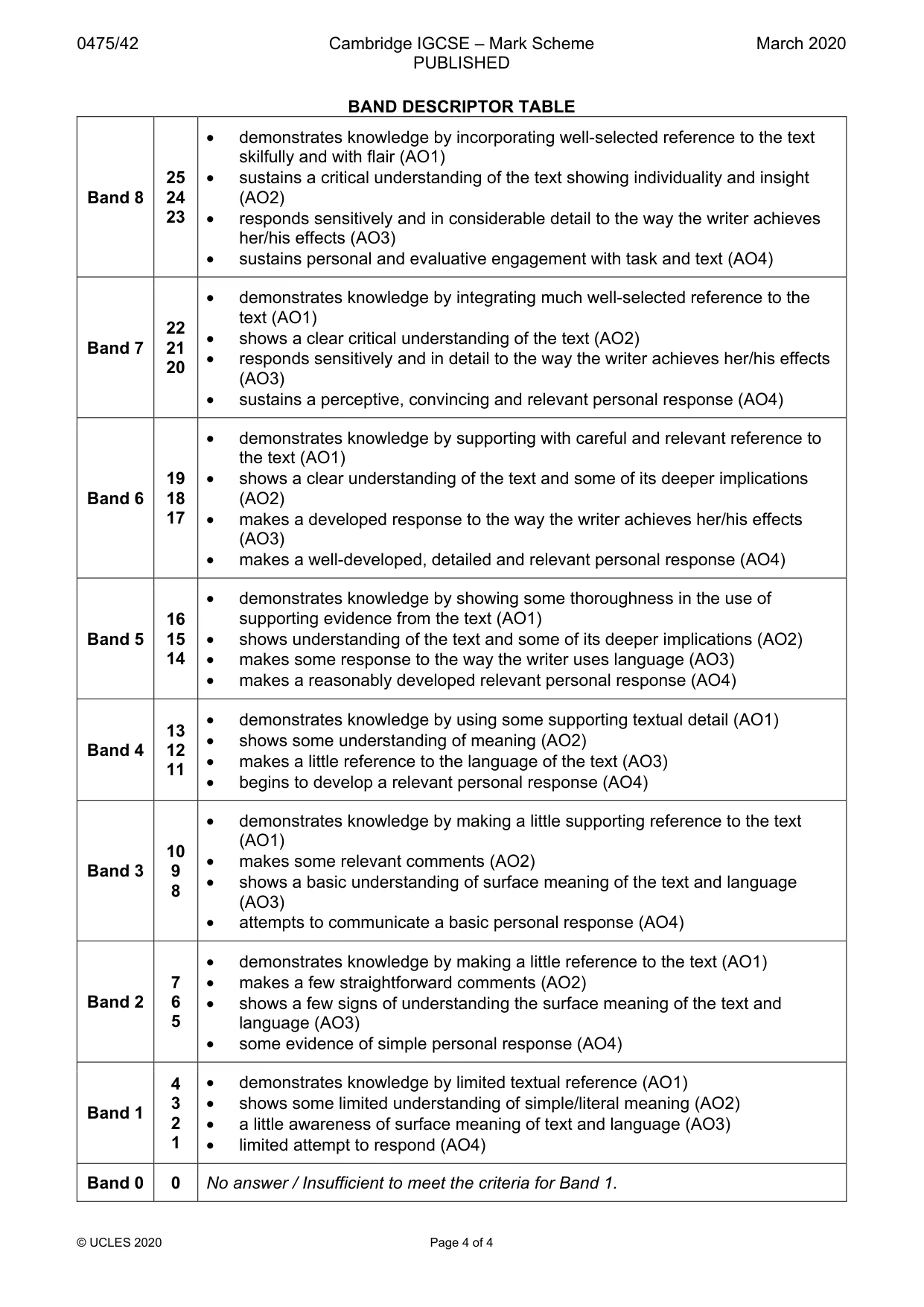
0475/42 Cambridge IGCSE – Mark Scheme PUBLISHED March 2020 © UCLES 2020 Page 4 of 4 BAND DESCRIPTOR TABLE Band 8 25 24 23 • demonstrates knowledge by incorporating well-selected reference to the text skilfully and with flair (AO1) • sustains a critical understanding of the text showing individuality and insight (AO2) • responds sensitively and in considerable detail to the way the writer achieves her/his effects (AO3) • sustains personal and evaluative engagement with task and text (AO4) Band 7 22 21 20 • demonstrates knowledge by integrating much well-selected reference to the text (AO1) • shows a clear critical understanding of the text (AO2) • responds sensitively and in detail to the way the writer achieves her/his effects (AO3) • sustains a perceptive, convincing and relevant personal response (AO4) Band 6 19 18 17 • demonstrates knowledge by supporting with careful and relevant reference to the text (AO1) • shows a clear understanding of the text and some of its deeper implications (AO2) • makes a developed response to the way the writer achieves her/his effects (AO3) • makes a well-developed, detailed and relevant personal response (AO4) Band 5 16 15 14 • demonstrates knowledge by showing some thoroughness in the use of supporting evidence from the text (AO1) • shows understanding of the text and some of its deeper implications (AO2) • makes some response to the way the writer uses language (AO3) • makes a reasonably developed relevant personal response (AO4) Band 4 13 12 11 • demonstrates knowledge by using some supporting textual detail (AO1) • shows some understanding of meaning (AO2) • makes a little reference to the language of the text (AO3) • begins to develop a relevant personal response (AO4) Band 3 10 9 8 • demonstrates knowledge by making a little supporting reference to the text (AO1) • makes some relevant comments (AO2) • shows a basic understanding of surface meaning of the text and language (AO3) • attempts to communicate a basic personal response (AO4) Band 2 7 6 5 • demonstrates knowledge by making a little reference to the text (AO1) • makes a few straightforward comments (AO2) • shows a few signs of understanding the surface meaning of the text and language (AO3) • some evidence of simple personal response (AO4) Band 1 4 3 2 1 • demonstrates knowledge by limited textual reference (AO1) • shows some limited understanding of simple/literal meaning (AO2) • a little awareness of surface meaning of text and language (AO3) • limited attempt to respond (AO4) Band 0 0 No answer / Insufficient to meet the criteria for Band 1.
What you needed in this session
Cambridge’s own grade thresholds for 2020 Feb/March, Paper 4 · Variant 2. A higher threshold means an easier paper — the bar moves with how the cohort did.