Cambridge IGCSE English - Literature in English 0475 — 2020 Feb/March Paper 2 · Variant 2
0475/22/F/M/20 · 50 marks · ≈56 min
The question paper and its mark scheme, free to read here and free to download. This is Cambridge’s own paper, exactly as it was sat.
Question paper12 pages
Mark scheme4 pages
Answers below. Sit the paper first if you are practising.
Paper as text
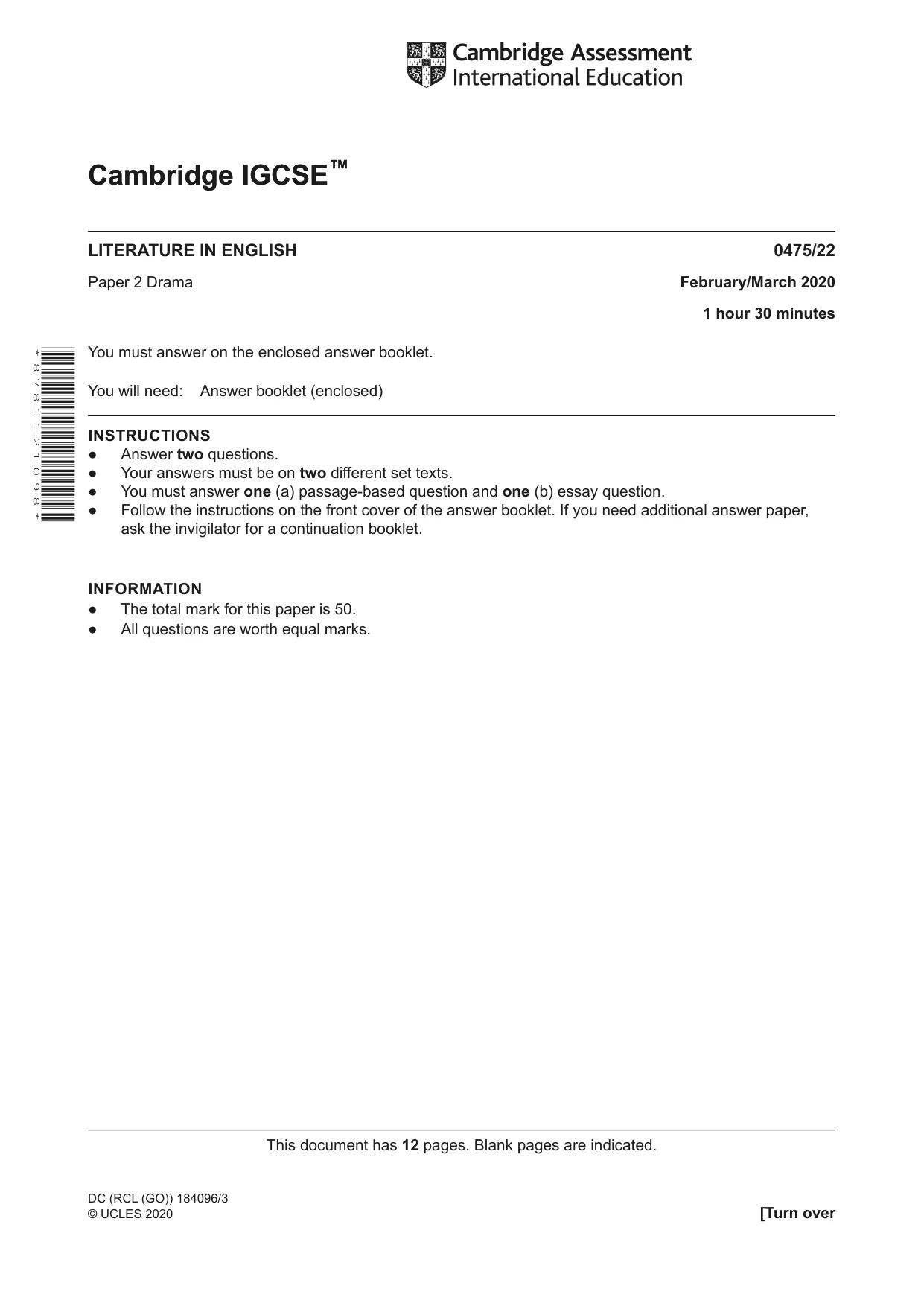
Question paper, page 1
Cambridge IGCSE™ This document has 12 pages. Blank pages are indicated. * 8 7 8 1 1 2 1 0 9 8 * LITERATURE IN ENGLISH 0475/22 Paper 2 Drama February/March 2020 1 hour 30 minutes You must answer on the enclosed answer booklet. You will need: Answer booklet (enclosed) INSTRUCTIONS ● Answer two questions. ● Your answers must be on two different set texts. ● You must answer one (a) passage-based question and one (b) essay question. ● Follow the instructions on the front cover of the answer booklet. If you need additional answer paper, ask the invigilator for a continuation booklet. INFORMATION ● The total mark for this paper is 50. ● All questions are worth equal marks. DC (RCL (GO)) 184096/3 © UCLES 2020 [Turn over Cambridge IGCSE™
Question paper, page 2
2 0475/22/F/M/20 © UCLES 2020 LORRAINE HANSBERRY: A Raisin in the Sun Remember to support your ideas with details from the writing. Either 1(a) Read this passage, and then answer the question that follows it: Lindner [folding up his materials ]: Well – if you are that final about it … Content removed due to copyright restrictions.
Question paper, page 3
3 0475/22/F/M/20 © UCLES 2020 [Turn over The door opens and she comes back in, grabs her plant, and goes out for the last time.] [Curtain.] [from Act 3 ] How satisfying do you think Hansberry’s writing makes this ending to the play? Or 1(b) In what ways does Hansberry dramatically portray the poverty of the Younger family? Content removed due to copyright restrictions.
Question paper, page 4
4 0475/22/F/M/20 © UCLES 2020 ARTHUR MILLER: The Crucible Remember to support your ideas with details from the writing. Either 2(a) Read this passage, and then answer the question that follows it: Danforth: Now, sir – which of these in your opinion may be brought to God? Content removed due to copyright restrictions.
Question paper, page 5
5 0475/22/F/M/20 © UCLES 2020 [Turn over There is blood on my head! Can you not see the blood on my head!! [from Act 4 ] Explore the ways in which Miller builds tension at this moment in the play. Or 2(b) How far does Miller encourage you to sympathise with Elizabeth Proctor? Content removed due to copyright restrictions.
Question paper, page 6
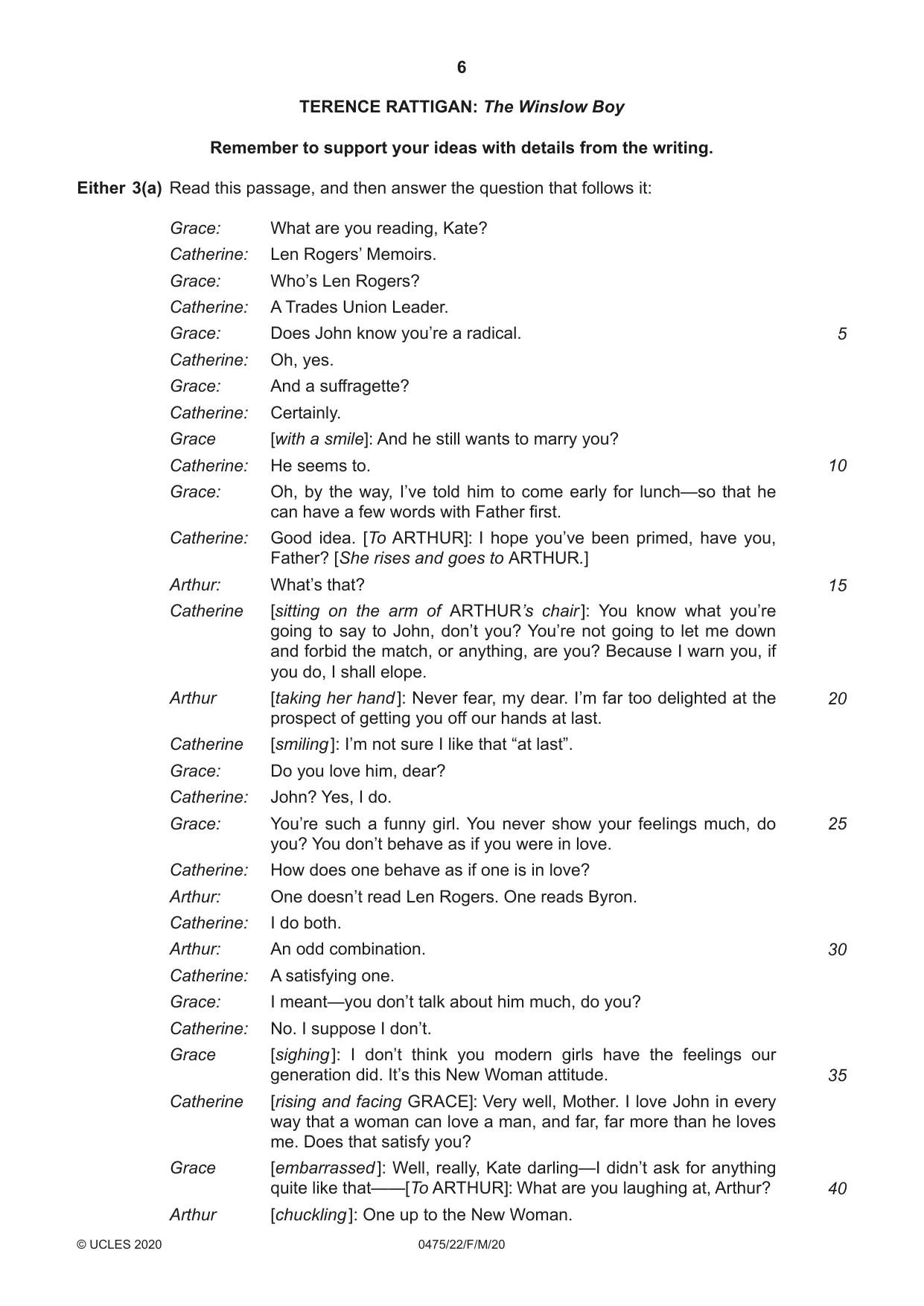
6 0475/22/F/M/20 © UCLES 2020 TERENCE RATTIGAN: The Winslow Boy Remember to support your ideas with details from the writing. Either 3(a) Read this passage, and then answer the question that follows it: Grace: What are you reading, Kate? Catherine: Len Rogers’ Memoirs. Grace: Who’s Len Rogers? Catherine: A Trades Union Leader. Grace: Does John know you’re a radical. Catherine: Oh, yes. Grace: And a suffragette? Catherine: Certainly. Grace [with a smile]: And he still wants to marry you? Catherine: He seems to. Grace: Oh, by the way, I’ve told him to come early for lunch—so that he can have a few words with Father first. Catherine: Good idea. [To ARTHUR]: I hope you’ve been primed, have you, Father? [She rises and goes to ARTHUR.] Arthur: What’s that? Catherine [sitting on the arm of ARTHUR’s chair ]: You know what you’re going to say to John, don’t you? You’re not going to let me down and forbid the match, or anything, are you? Because I warn you, if you do, I shall elope. Arthur [taking her hand ]: Never fear, my dear. I’m far too delighted at the prospect of getting you off our hands at last. Catherine [smiling ]: I’m not sure I like that “at last”. Grace: Do you love him, dear? Catherine: John? Yes, I do. Grace: You’re such a funny girl. You never show your feelings much, do you? You don’t behave as if you were in love. Catherine: How does one behave as if one is in love? Arthur: One doesn’t read Len Rogers. One reads Byron. Catherine: I do both. Arthur: An odd combination. Catherine: A satisfying one. Grace: I meant—you don’t talk about him much, do you? Catherine: No. I suppose I don’t. Grace [sighing ]: I don’t think you modern girls have the feelings our generation did. It’s this New Woman attitude. Catherine [rising and facing GRACE]: Very well, Mother. I love John in every way that a woman can love a man, and far, far more than he loves me. Does that satisfy you? Grace [embarrassed ]: Well, really, Kate darling—I didn’t ask for anything quite like that——[To ARTHUR]: What are you laughing at, Arthur? Arthur [chuckling ]: One up to the New Woman. 5 10 15 20 25 30 35 40
Question paper, page 7
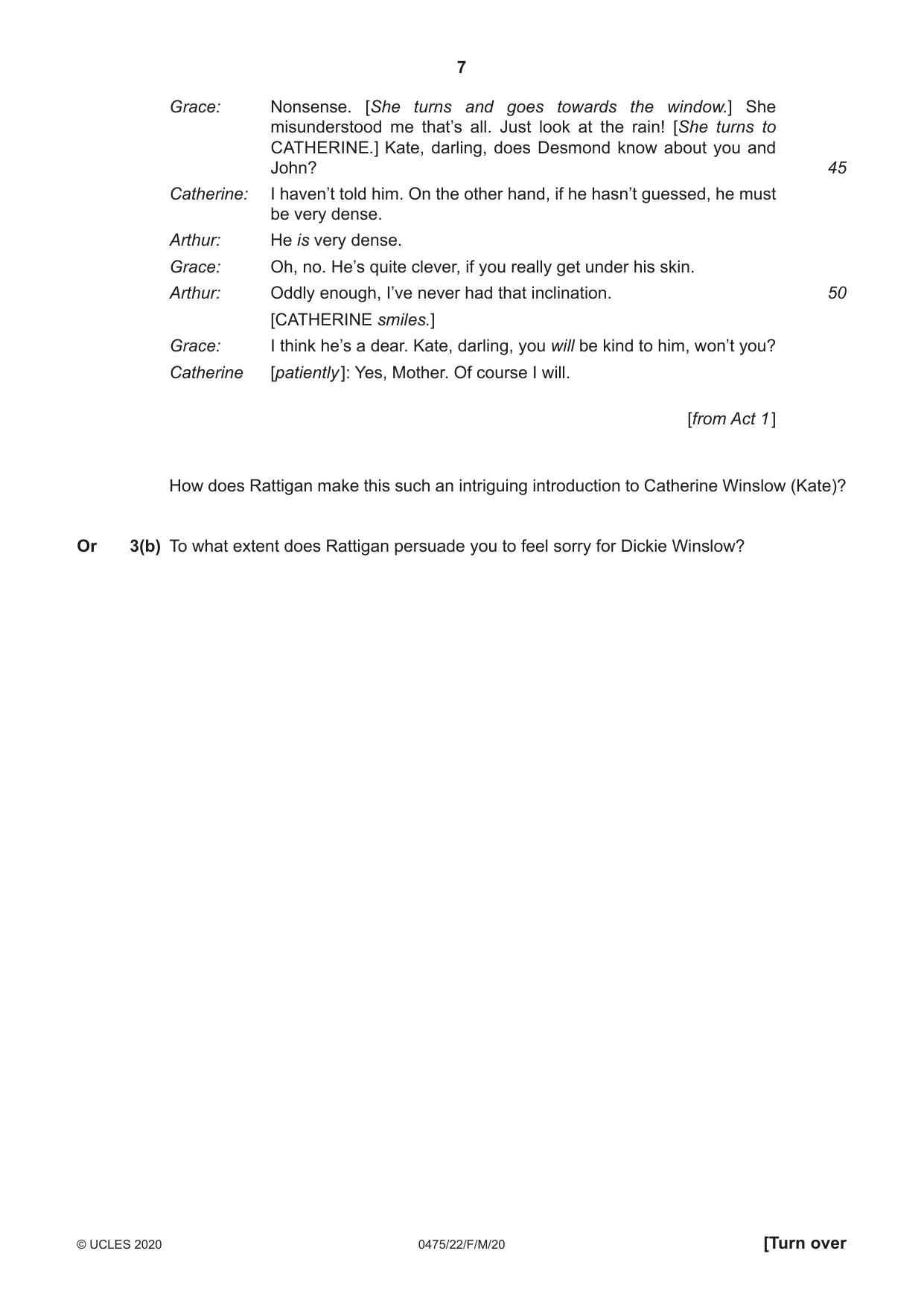
7 0475/22/F/M/20 © UCLES 2020 [Turn over Grace: Nonsense. [She turns and goes towards the window.] She misunderstood me that’s all. Just look at the rain! [She turns to CATHERINE.] Kate, darling, does Desmond know about you and John? Catherine: I haven’t told him. On the other hand, if he hasn’t guessed, he must be very dense. Arthur: He is very dense. Grace: Oh, no. He’s quite clever, if you really get under his skin. Arthur: Oddly enough, I’ve never had that inclination. [CATHERINE smiles.] Grace: I think he’s a dear. Kate, darling, you will be kind to him, won’t you? Catherine [patiently ]: Yes, Mother. Of course I will. [from Act 1 ] How does Rattigan make this such an intriguing introduction to Catherine Winslow (Kate)? Or 3(b) To what extent does Rattigan persuade you to feel sorry for Dickie Winslow? 45 50
Question paper, page 8
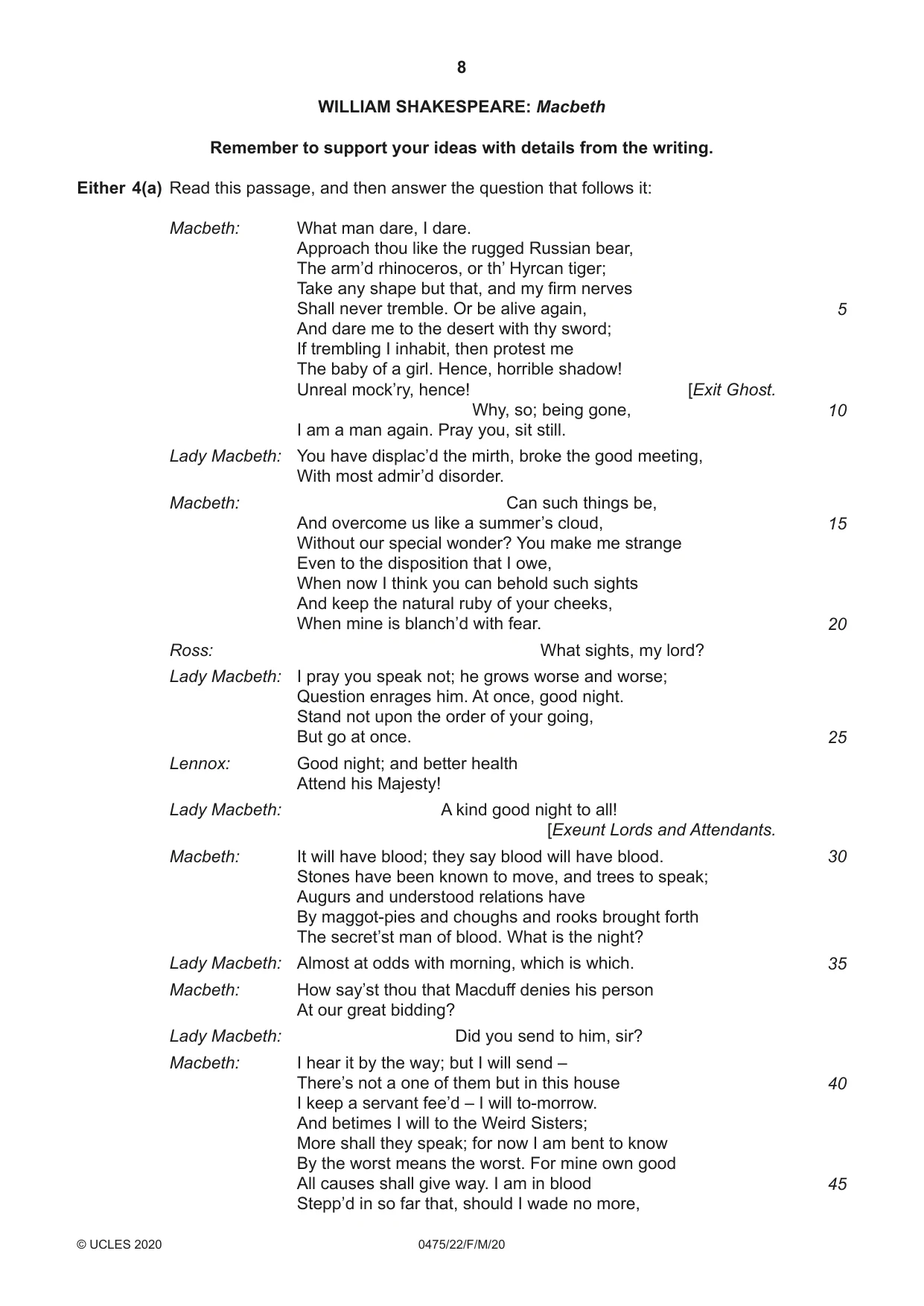
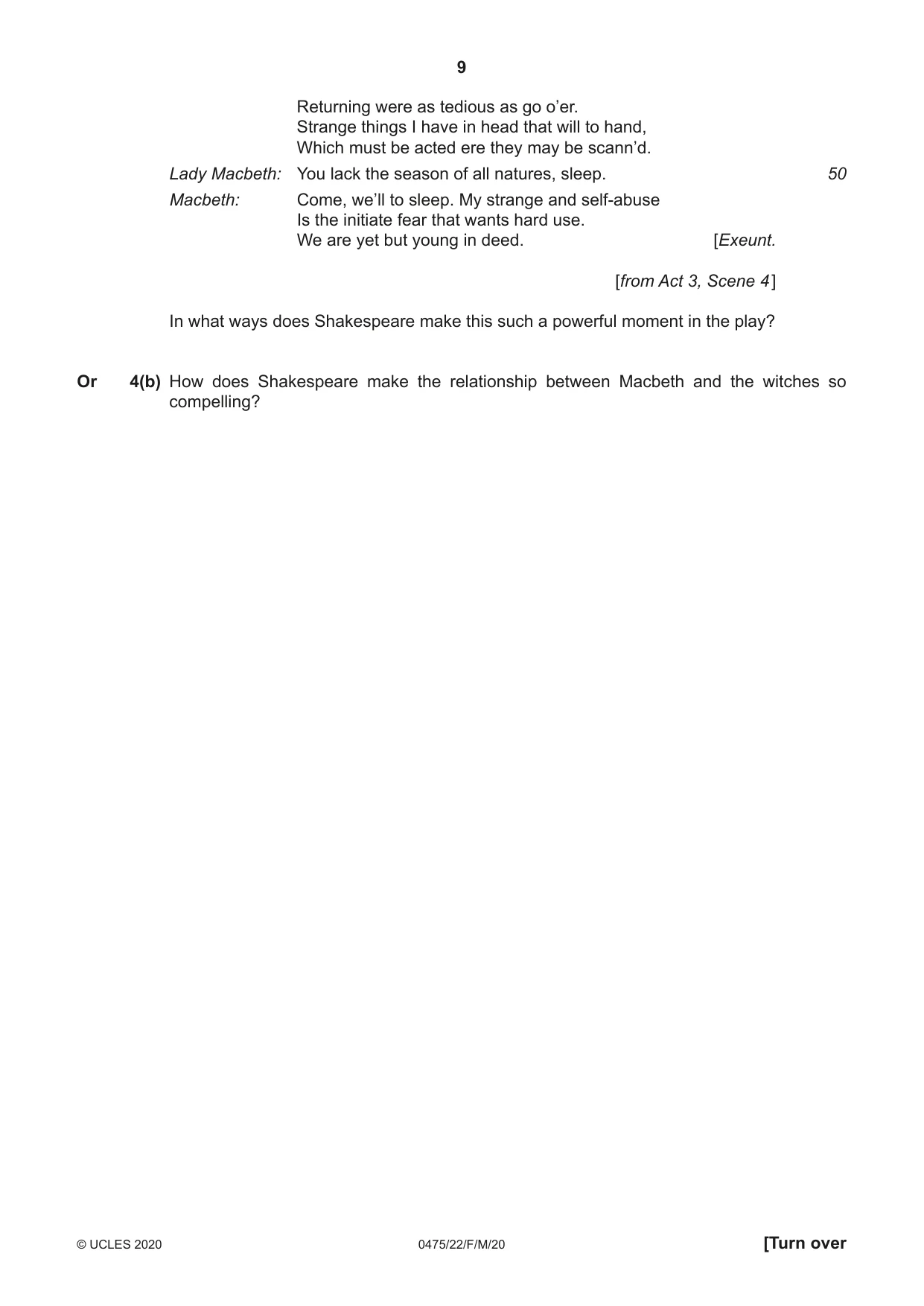
8 0475/22/F/M/20 © UCLES 2020 WILLIAM SHAKESPEARE: Macbeth Remember to support your ideas with details from the writing. Either 4(a) Read this passage, and then answer the question that follows it: Macbeth: What man dare, I dare. Approach thou like the rugged Russian bear, The arm’d rhinoceros, or th’ Hyrcan tiger; Take any shape but that, and my firm nerves Shall never tremble. Or be alive again, And dare me to the desert with thy sword; If trembling I inhabit, then protest me The baby of a girl. Hence, horrible shadow! Unreal mock’ry, hence! [Exit Ghost. Why, so; being gone, I am a man again. Pray you, sit still. Lady Macbeth: You have displac’d the mirth, broke the good meeting, With most admir’d disorder. Macbeth: Can such things be, And overcome us like a summer’s cloud, Without our special wonder? You make me strange Even to the disposition that I owe, When now I think you can behold such sights And keep the natural ruby of your cheeks, When mine is blanch’d with fear. Ross: What sights, my lord? Lady Macbeth: I pray you speak not; he grows worse and worse; Question enrages him. At once, good night. Stand not upon the order of your going, But go at once. Lennox: Good night; and better health Attend his Majesty! Lady Macbeth: A kind good night to all! [Exeunt Lords and Attendants. Macbeth: It will have blood; they say blood will have blood. Stones have been known to move, and trees to speak; Augurs and understood relations have By maggot-pies and choughs and rooks brought forth The secret’st man of blood. What is the night? Lady Macbeth: Almost at odds with morning, which is which. Macbeth: How say’st thou that Macduff denies his person At our great bidding? Lady Macbeth: Did you send to him, sir? Macbeth: I hear it by the way; but I will send – There’s not a one of them but in this house I keep a servant fee’d – I will to-morrow. And betimes I will to the Weird Sisters; More shall they speak; for now I am bent to know By the worst means the worst. For mine own good All causes shall give way. I am in blood Stepp’d in so far that, should I wade no more, 5 10 15 20 25 30 35 40 45
Question paper, page 9
9 0475/22/F/M/20 © UCLES 2020 [Turn over Returning were as tedious as go o’er. Strange things I have in head that will to hand, Which must be acted ere they may be scann’d. Lady Macbeth: You lack the season of all natures, sleep. Macbeth: Come, we’ll to sleep. My strange and self-abuse Is the initiate fear that wants hard use. We are yet but young in deed. [Exeunt. [from Act 3, Scene 4 ] In what ways does Shakespeare make this such a powerful moment in the play? Or 4(b) How does Shakespeare make the relationship between Macbeth and the witches so compelling? 50
Question paper, page 10
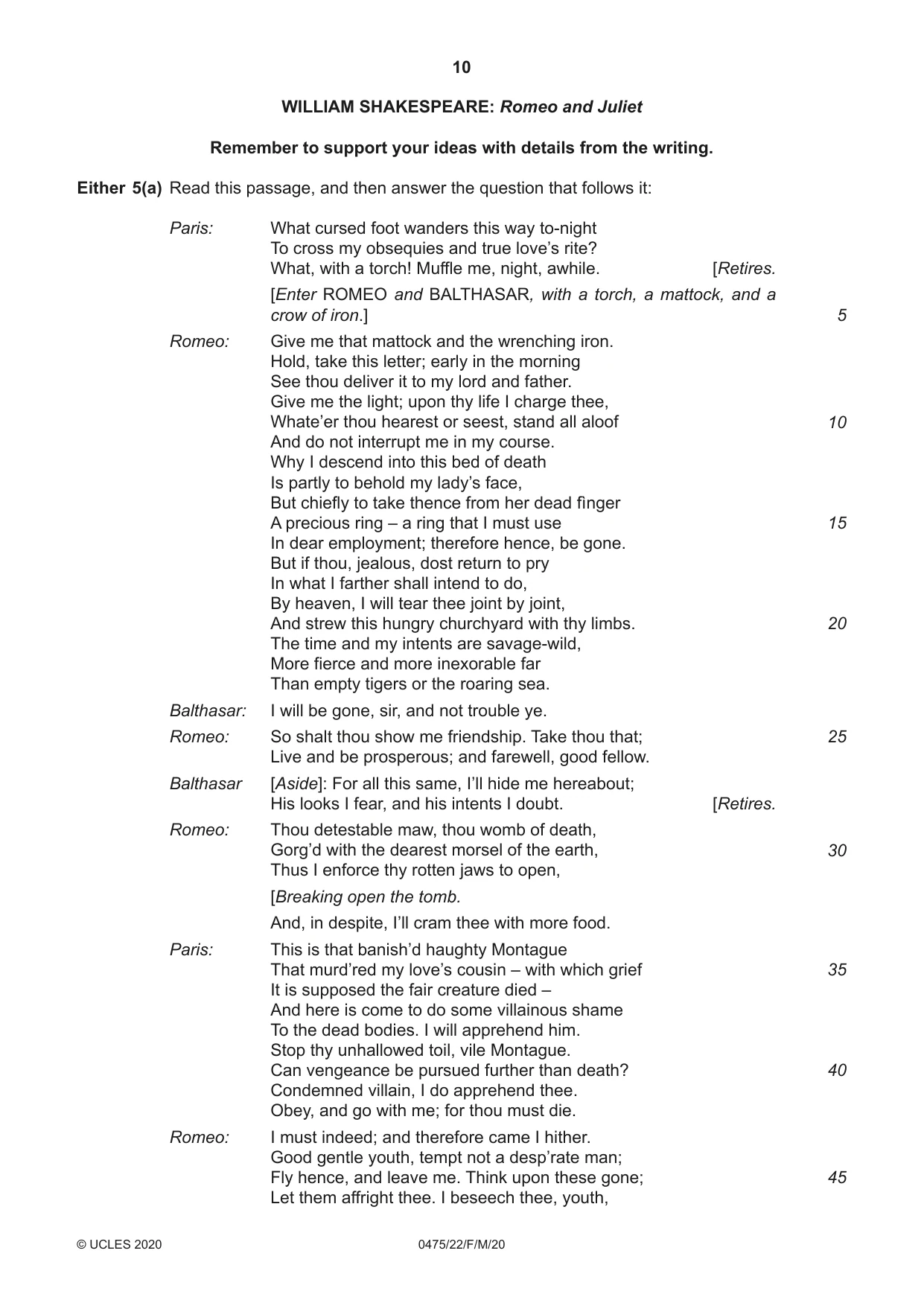
10 0475/22/F/M/20 © UCLES 2020 WILLIAM SHAKESPEARE: Romeo and Juliet Remember to support your ideas with details from the writing. Either 5(a) Read this passage, and then answer the question that follows it: Paris: What cursed foot wanders this way to-night To cross my obsequies and true love’s rite? What, with a torch! Muffle me, night, awhile. [Retires. [Enter ROMEO and BALTHASAR, with a torch, a mattock, and a crow of iron.] Romeo: Give me that mattock and the wrenching iron. Hold, take this letter; early in the morning See thou deliver it to my lord and father. Give me the light; upon thy life I charge thee, Whate’er thou hearest or seest, stand all aloof And do not interrupt me in my course. Why I descend into this bed of death Is partly to behold my lady’s face, But chiefly to take thence from her dead fìnger A precious ring – a ring that I must use In dear employment; therefore hence, be gone. But if thou, jealous, dost return to pry In what I farther shall intend to do, By heaven, I will tear thee joint by joint, And strew this hungry churchyard with thy limbs. The time and my intents are savage-wild, More fierce and more inexorable far Than empty tigers or the roaring sea. Balthasar: I will be gone, sir, and not trouble ye. Romeo: So shalt thou show me friendship. Take thou that; Live and be prosperous; and farewell, good fellow. Balthasar [Aside]: For all this same, I’ll hide me hereabout; His looks I fear, and his intents I doubt. [Retires. Romeo: Thou detestable maw, thou womb of death, Gorg’d with the dearest morsel of the earth, Thus I enforce thy rotten jaws to open, [Breaking open the tomb. And, in despite, I’ll cram thee with more food. Paris: This is that banish’d haughty Montague That murd’red my love’s cousin – with which grief It is supposed the fair creature died – And here is come to do some villainous shame To the dead bodies. I will apprehend him. Stop thy unhallowed toil, vile Montague. Can vengeance be pursued further than death? Condemned villain, I do apprehend thee. Obey, and go with me; for thou must die. Romeo: I must indeed; and therefore came I hither. Good gentle youth, tempt not a desp’rate man; Fly hence, and leave me. Think upon these gone; Let them affright thee. I beseech thee, youth, 5 10 15 20 25 30 35 40 45
Question paper, page 11
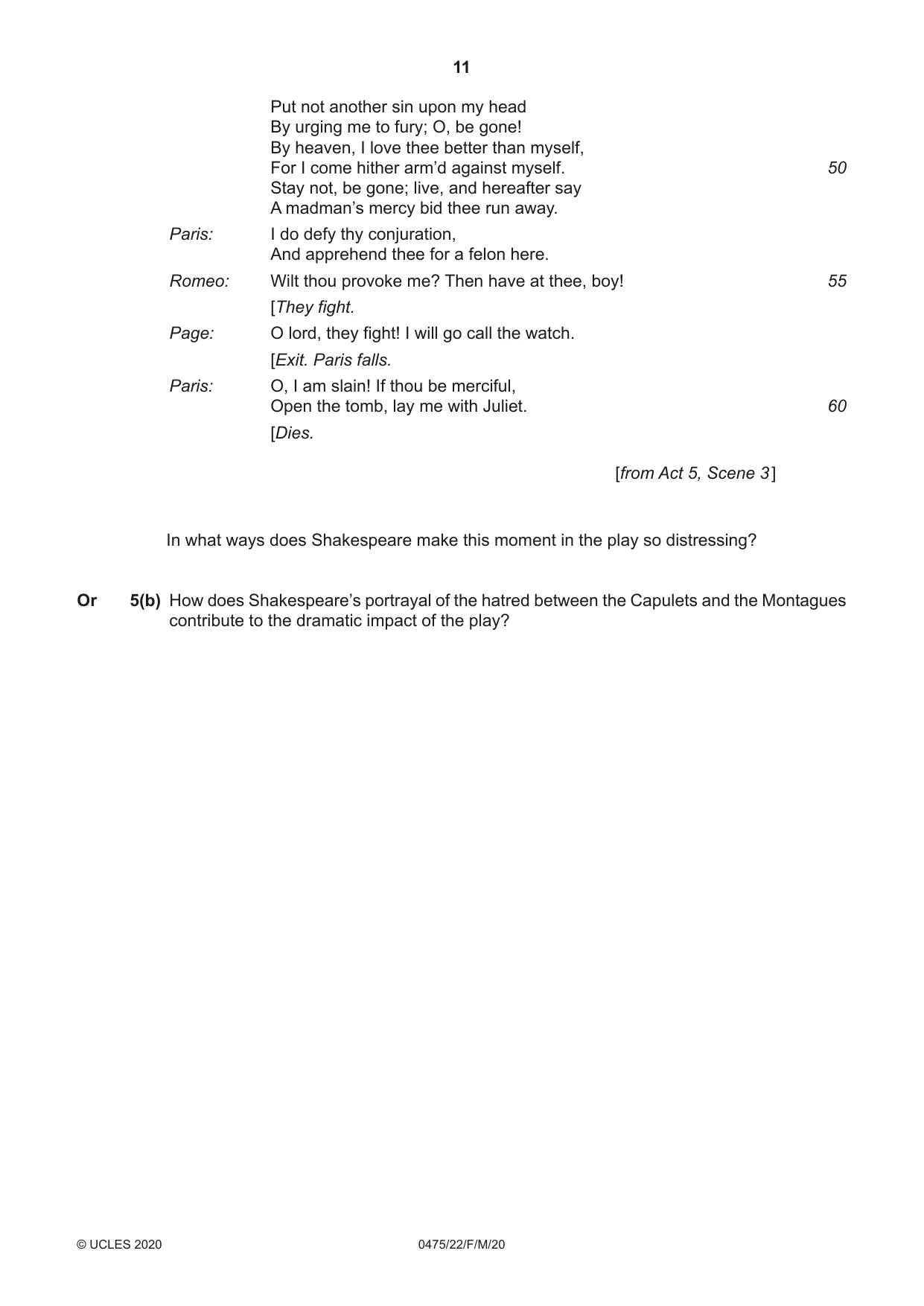
11 0475/22/F/M/20 © UCLES 2020 Put not another sin upon my head By urging me to fury; O, be gone! By heaven, I love thee better than myself, For I come hither arm’d against myself. Stay not, be gone; live, and hereafter say A madman’s mercy bid thee run away. Paris: I do defy thy conjuration, And apprehend thee for a felon here. Romeo: Wilt thou provoke me? Then have at thee, boy! [They fight. Page: O lord, they fight! I will go call the watch. [Exit. Paris falls. Paris: O, I am slain! If thou be merciful, Open the tomb, lay me with Juliet. [Dies. [from Act 5, Scene 3 ] In what ways does Shakespeare make this moment in the play so distressing? Or 5(b) How does Shakespeare’s portrayal of the hatred between the Capulets and the Montagues contribute to the dramatic impact of the play? 50 55 60
Question paper, page 12
12 0475/22/F/M/20 © UCLES 2020 Permission to reproduce items where third-party owned material protected by copyright is included has been sought and cleared where possible. Every reasonable effort has been made by the publisher (UCLES) to trace copyright holders, but if any items requiring clearance have unwittingly been included, the publisher will be pleased to make amends at the earliest possible opportunity. To avoid the issue of disclosure of answer-related information to candidates, all copyright acknowledgements are reproduced online in the Cambridge Assessment International Education Copyright Acknowledgements Booklet. This is produced for each series of examinations and is freely available to download at www.cambridgeinternational.org after the live examination series. Cambridge Assessment International Education is part of the Cambridge Assessment Group. Cambridge Assessment is the brand name of the University of Cambridge Local Examinations Syndicate (UCLES), which itself is a department of the University of Cambridge. BLANK PAGE
Mark scheme, page 1
This document consists of 4 printed pages. © UCLES 2020 [Turn over Cambridge IGCSE™ LITERATURE IN ENGLISH 0475/22 Paper 2 Drama March 2020 MARK SCHEME Maximum Mark: 50 Published This mark scheme is published as an aid to teachers and candidates, to indicate the requirements of the examination. It shows the basis on which Examiners were instructed to award marks. It does not indicate the details of the discussions that took place at an Examiners’ meeting before marking began, which would have considered the acceptability of alternative answers. Mark schemes should be read in conjunction with the question paper and the Principal Examiner Report for Teachers. Cambridge International will not enter into discussions about these mark schemes. Cambridge International is publishing the mark schemes for the March 2020 series for most Cambridge IGCSE™, Cambridge International A and AS Level components and some Cambridge O Level components.
Mark scheme, page 2
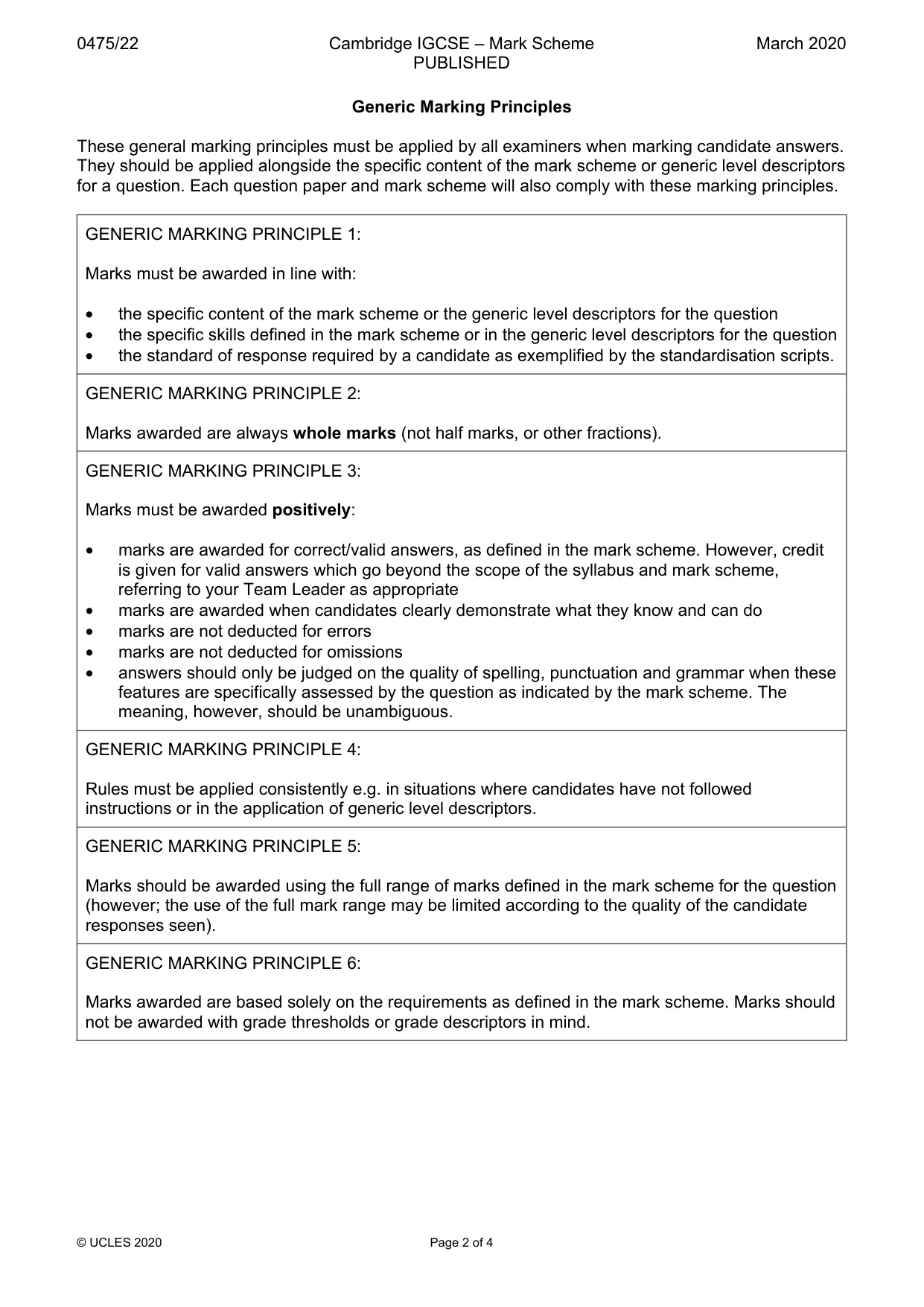
0475/22 Cambridge IGCSE – Mark Scheme PUBLISHED March 2020 © UCLES 2020 Page 2 of 4 Generic Marking Principles These general marking principles must be applied by all examiners when marking candidate answers. They should be applied alongside the specific content of the mark scheme or generic level descriptors for a question. Each question paper and mark scheme will also comply with these marking principles. GENERIC MARKING PRINCIPLE 1: Marks must be awarded in line with: • the specific content of the mark scheme or the generic level descriptors for the question • the specific skills defined in the mark scheme or in the generic level descriptors for the question • the standard of response required by a candidate as exemplified by the standardisation scripts. GENERIC MARKING PRINCIPLE 2: Marks awarded are always whole marks (not half marks, or other fractions). GENERIC MARKING PRINCIPLE 3: Marks must be awarded positively: • marks are awarded for correct/valid answers, as defined in the mark scheme. However, credit is given for valid answers which go beyond the scope of the syllabus and mark scheme, referring to your Team Leader as appropriate • marks are awarded when candidates clearly demonstrate what they know and can do • marks are not deducted for errors • marks are not deducted for omissions • answers should only be judged on the quality of spelling, punctuation and grammar when these features are specifically assessed by the question as indicated by the mark scheme. The meaning, however, should be unambiguous. GENERIC MARKING PRINCIPLE 4: Rules must be applied consistently e.g. in situations where candidates have not followed instructions or in the application of generic level descriptors. GENERIC MARKING PRINCIPLE 5: Marks should be awarded using the full range of marks defined in the mark scheme for the question (however; the use of the full mark range may be limited according to the quality of the candidate responses seen). GENERIC MARKING PRINCIPLE 6: Marks awarded are based solely on the requirements as defined in the mark scheme. Marks should not be awarded with grade thresholds or grade descriptors in mind.
Mark scheme, page 3
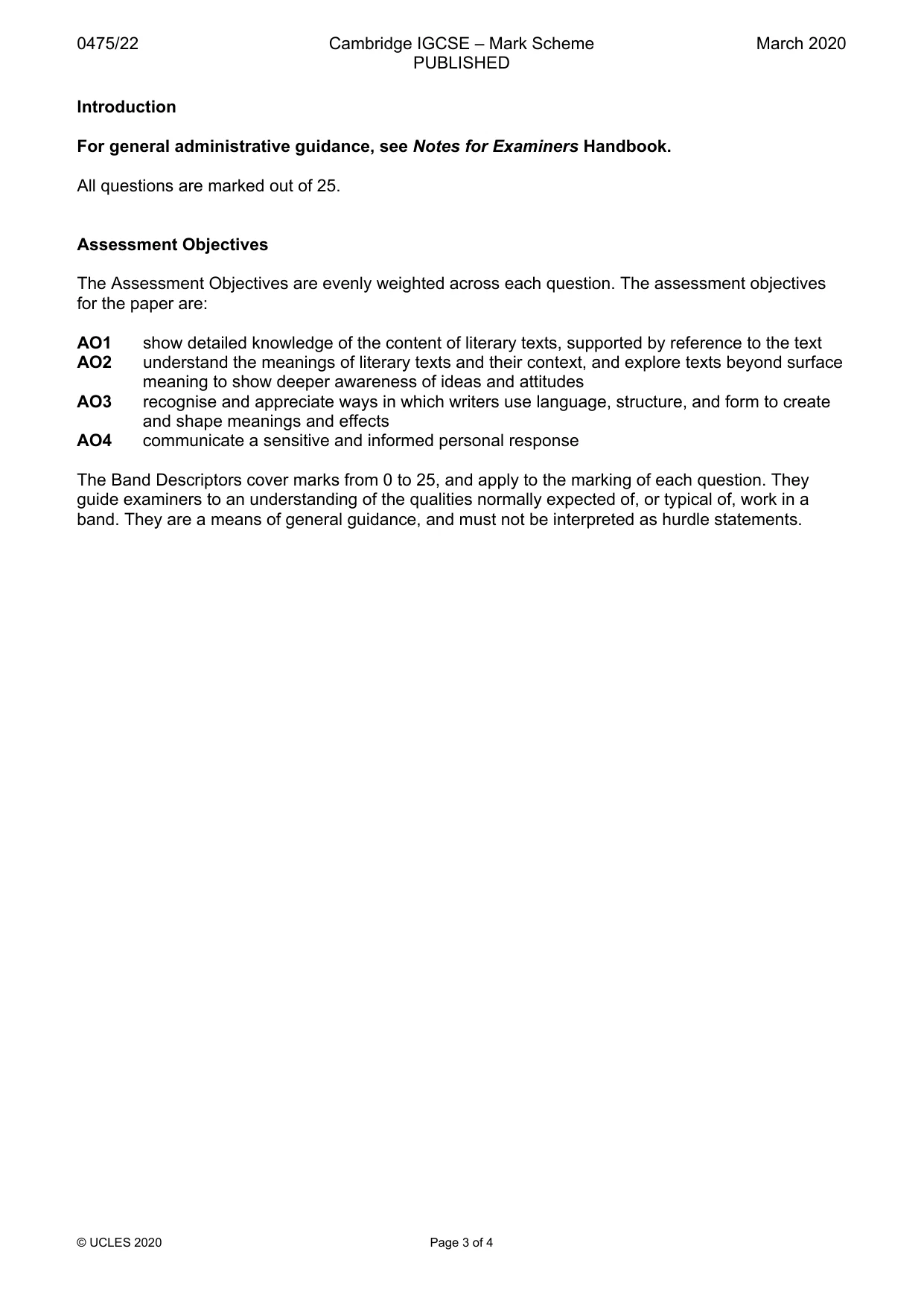
0475/22 Cambridge IGCSE – Mark Scheme PUBLISHED March 2020 © UCLES 2020 Page 3 of 4 Introduction For general administrative guidance, see Notes for Examiners Handbook. All questions are marked out of 25. Assessment Objectives The Assessment Objectives are evenly weighted across each question. The assessment objectives for the paper are: AO1 show detailed knowledge of the content of literary texts, supported by reference to the text AO2 understand the meanings of literary texts and their context, and explore texts beyond surface meaning to show deeper awareness of ideas and attitudes AO3 recognise and appreciate ways in which writers use language, structure, and form to create and shape meanings and effects AO4 communicate a sensitive and informed personal response The Band Descriptors cover marks from 0 to 25, and apply to the marking of each question. They guide examiners to an understanding of the qualities normally expected of, or typical of, work in a band. They are a means of general guidance, and must not be interpreted as hurdle statements.
Mark scheme, page 4
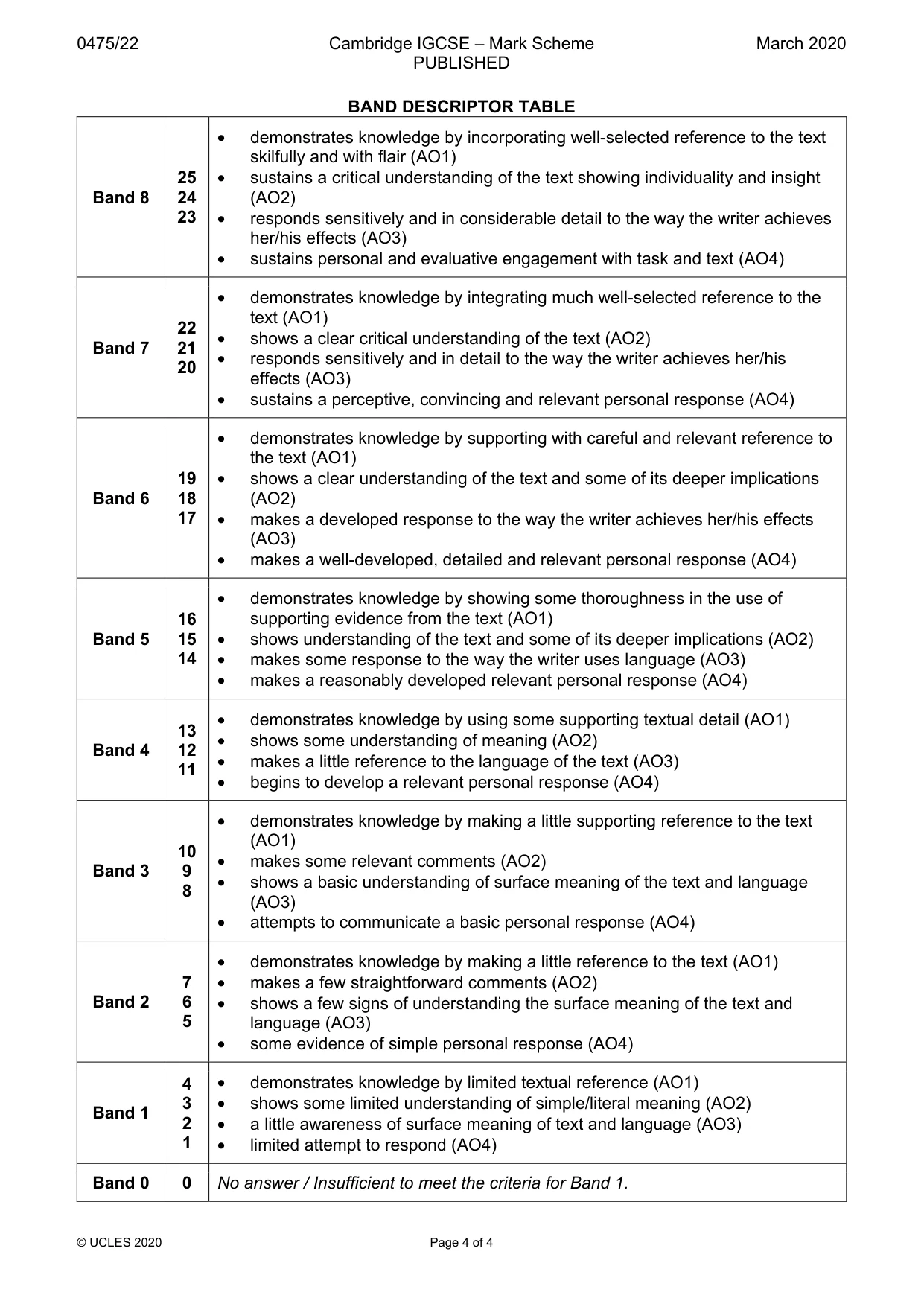
0475/22 Cambridge IGCSE – Mark Scheme PUBLISHED March 2020 © UCLES 2020 Page 4 of 4 BAND DESCRIPTOR TABLE Band 8 25 24 23 • demonstrates knowledge by incorporating well-selected reference to the text skilfully and with flair (AO1) • sustains a critical understanding of the text showing individuality and insight (AO2) • responds sensitively and in considerable detail to the way the writer achieves her/his effects (AO3) • sustains personal and evaluative engagement with task and text (AO4) Band 7 22 21 20 • demonstrates knowledge by integrating much well-selected reference to the text (AO1) • shows a clear critical understanding of the text (AO2) • responds sensitively and in detail to the way the writer achieves her/his effects (AO3) • sustains a perceptive, convincing and relevant personal response (AO4) Band 6 19 18 17 • demonstrates knowledge by supporting with careful and relevant reference to the text (AO1) • shows a clear understanding of the text and some of its deeper implications (AO2) • makes a developed response to the way the writer achieves her/his effects (AO3) • makes a well-developed, detailed and relevant personal response (AO4) Band 5 16 15 14 • demonstrates knowledge by showing some thoroughness in the use of supporting evidence from the text (AO1) • shows understanding of the text and some of its deeper implications (AO2) • makes some response to the way the writer uses language (AO3) • makes a reasonably developed relevant personal response (AO4) Band 4 13 12 11 • demonstrates knowledge by using some supporting textual detail (AO1) • shows some understanding of meaning (AO2) • makes a little reference to the language of the text (AO3) • begins to develop a relevant personal response (AO4) Band 3 10 9 8 • demonstrates knowledge by making a little supporting reference to the text (AO1) • makes some relevant comments (AO2) • shows a basic understanding of surface meaning of the text and language (AO3) • attempts to communicate a basic personal response (AO4) Band 2 7 6 5 • demonstrates knowledge by making a little reference to the text (AO1) • makes a few straightforward comments (AO2) • shows a few signs of understanding the surface meaning of the text and language (AO3) • some evidence of simple personal response (AO4) Band 1 4 3 2 1 • demonstrates knowledge by limited textual reference (AO1) • shows some limited understanding of simple/literal meaning (AO2) • a little awareness of surface meaning of text and language (AO3) • limited attempt to respond (AO4) Band 0 0 No answer / Insufficient to meet the criteria for Band 1.
What you needed in this session
Cambridge’s own grade thresholds for 2020 Feb/March, Paper 2 · Variant 2. A higher threshold means an easier paper — the bar moves with how the cohort did.