Cambridge IGCSE English - Literature (9-1) (UK only) 0477 — 2019 Oct/Nov Paper 1 · Variant 0
0477/10/O/N/19
The question paper and its mark scheme, free to read here and free to download. This is Cambridge’s own paper, exactly as it was sat.
Question paper24 pages





Mark scheme
No mark scheme is in the library for this paper.
Paper as text
Question paper, page 1
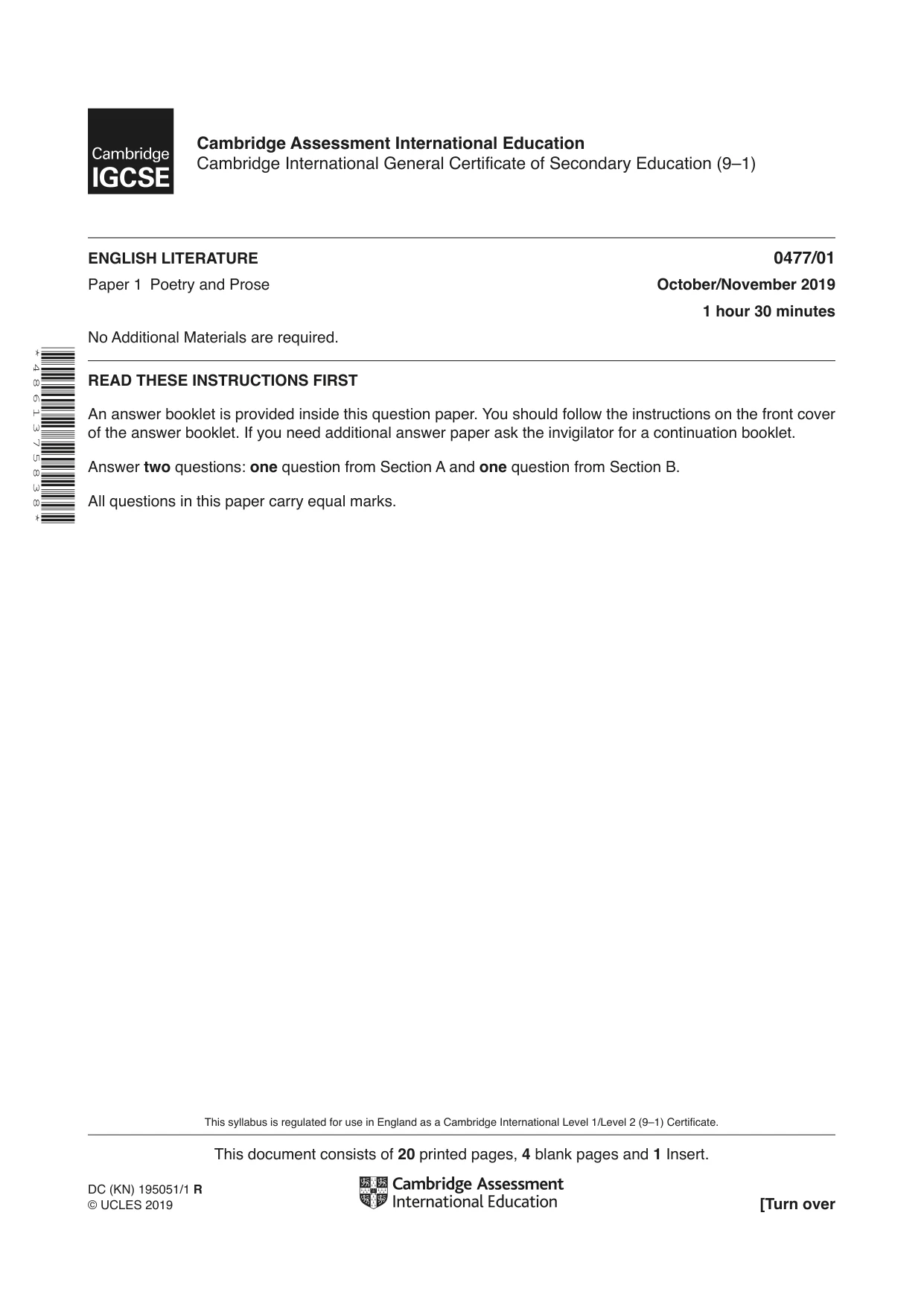
This document consists of 20 printed pages, 4 blank pages and 1 Insert. DC (KN) 195051/1 R © UCLES 2019 [Turn over Cambridge Assessment International Education Cambridge International General Certificate of Secondary Education (9–1) * 4 8 6 1 3 7 5 8 3 8 * ENGLISH LITERATURE 0477/01 Paper 1 Poetry and Prose October/November 2019 1 hour 30 minutes No Additional Materials are required. READ THESE INSTRUCTIONS FIRST An answer booklet is provided inside this question paper. You should follow the instructions on the front cover of the answer booklet. If you need additional answer paper ask the invigilator for a continuation booklet. Answer two questions: one question from Section A and one question from Section B. All questions in this paper carry equal marks. This syllabus is regulated for use in England as a Cambridge International Level 1/Level 2 (9–1) Certificate.
Question paper, page 2
2 0477/01/O/N/19 © UCLES 2019 BLANK PAGE
Question paper, page 3
3 0477/01/O/N/19 © UCLES 2019 [Turn over CONTENTS SECTION A: POETRY Text Question Numbers Page[s] Songs of Ourselves Volume 1: from Part 5 1, 2 pages 4–5 Songs of Ourselves Volume 2: from Part 2 3, 4 pages 6–7 SECTION B: PROSE Text Question Numbers Page[s] Jane Austen: Mansfield Park 5, 6 pages 8–9 Willa Cather: My Ántonia 7, 8 pages 10–11 Anita Desai: In Custody 9, 10 pages 12–13 Charles Dickens: Hard Times 11, 12 pages 14–15 Kate Grenville: The Secret River 13, 14 pages 16–17 John Knowles: A Separate Peace 15, 16 pages 18–19 Alan Paton: Cry, the Beloved Country 17, 18 pages 20–21
Question paper, page 4
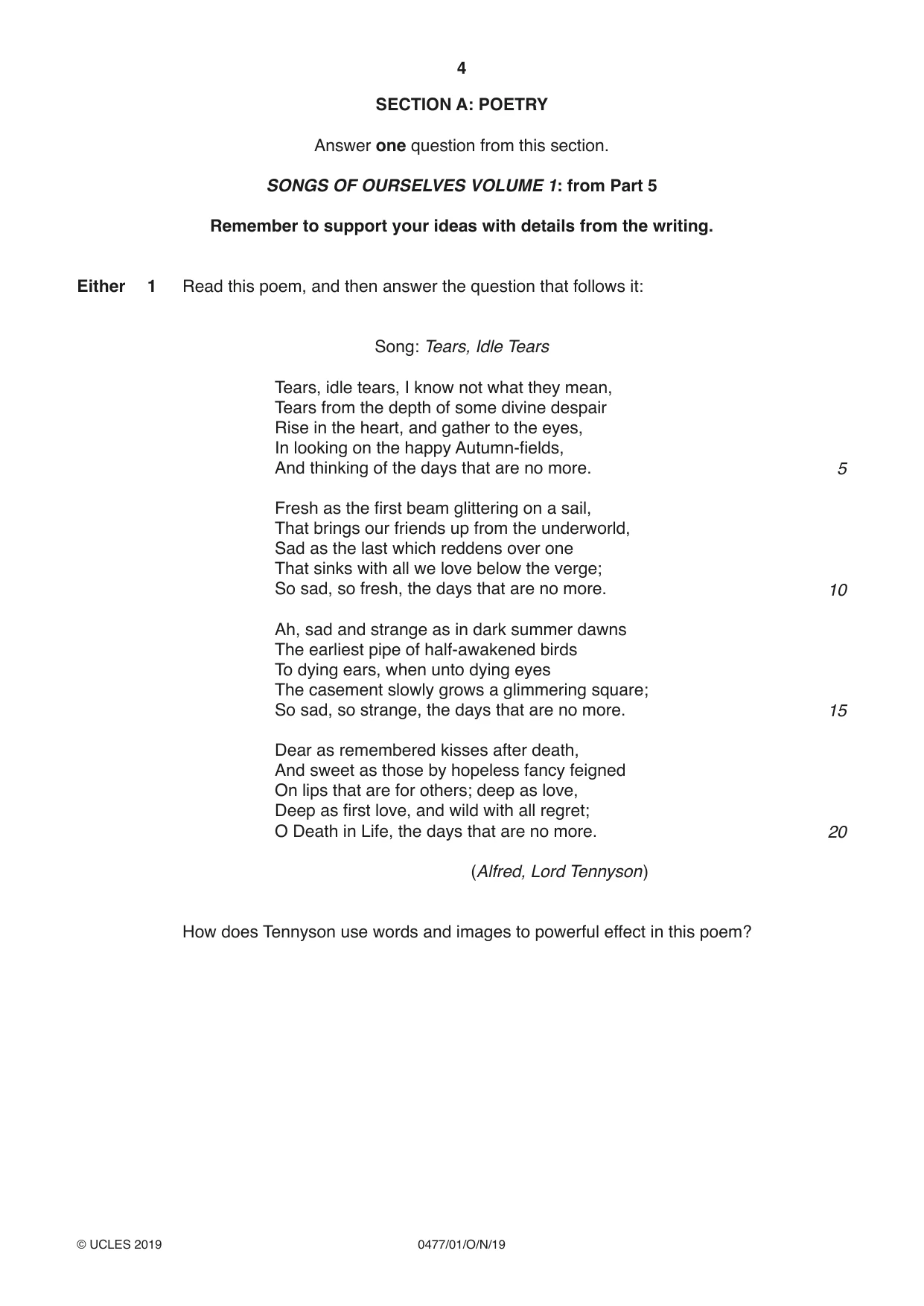
4 0477/01/O/N/19 © UCLES 2019 SECTION A: POETRY Answer one question from this section. SONGS OF OURSELVES VOLUME 1: from Part 5 Remember to support your ideas with details from the writing. Either 1 Read this poem, and then answer the question that follows it: Song: Tears, Idle Tears Tears, idle tears, I know not what they mean, Tears from the depth of some divine despair Rise in the heart, and gather to the eyes, In looking on the happy Autumn-fields, And thinking of the days that are no more. Fresh as the first beam glittering on a sail, That brings our friends up from the underworld, Sad as the last which reddens over one That sinks with all we love below the verge; So sad, so fresh, the days that are no more. Ah, sad and strange as in dark summer dawns The earliest pipe of half-awakened birds To dying ears, when unto dying eyes The casement slowly grows a glimmering square; So sad, so strange, the days that are no more. Dear as remembered kisses after death, And sweet as those by hopeless fancy feigned On lips that are for others; deep as love, Deep as first love, and wild with all regret; O Death in Life, the days that are no more. (Alfred, Lord Tennyson) How does Tennyson use words and images to powerful effect in this poem? 5 10 15 20
Question paper, page 5
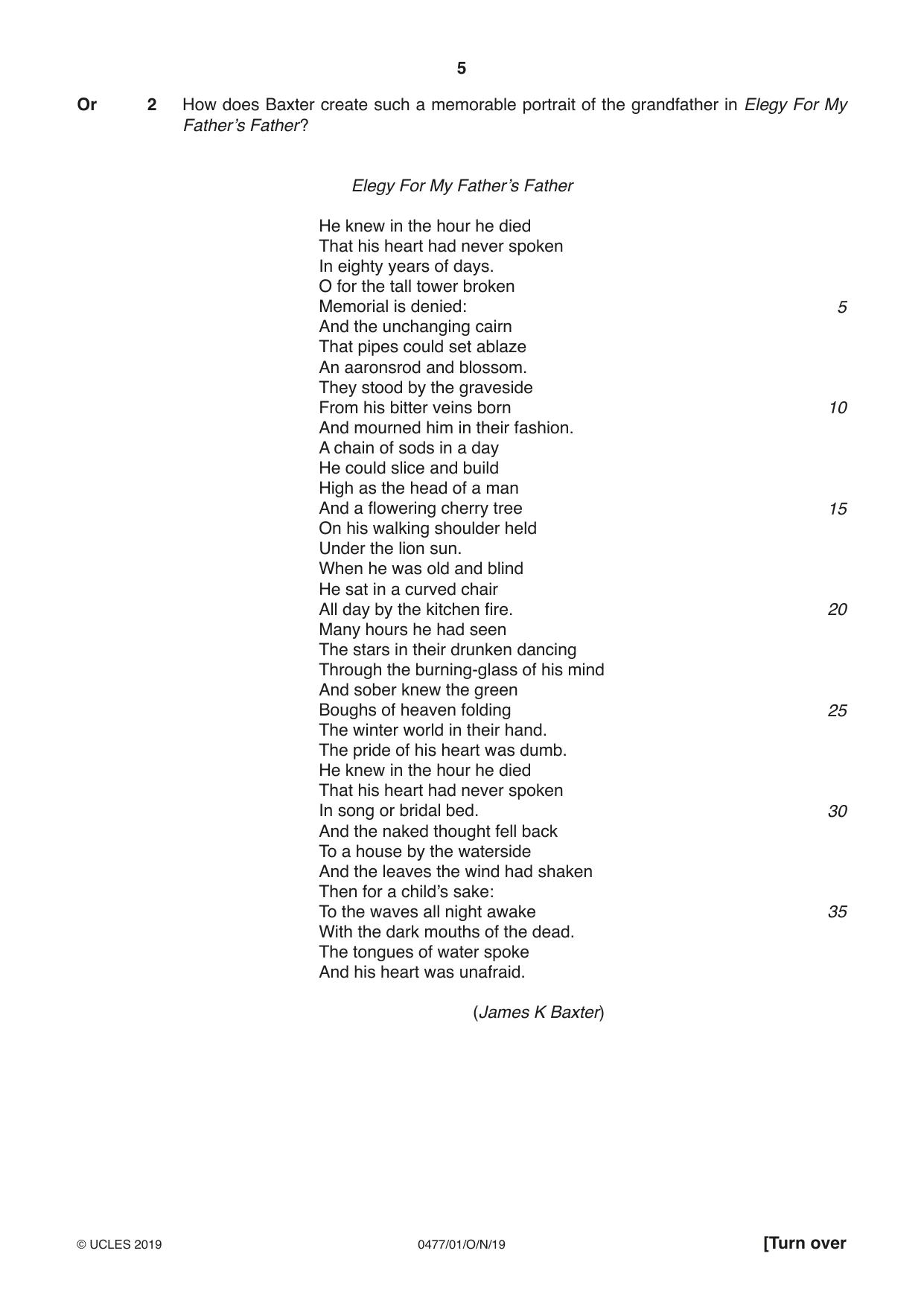
5 0477/01/O/N/19 © UCLES 2019 [Turn over Or 2 How does Baxter create such a memorable portrait of the grandfather in Elegy For My Father’s Father? Elegy For My Father’s Father He knew in the hour he died That his heart had never spoken In eighty years of days. O for the tall tower broken Memorial is denied: And the unchanging cairn That pipes could set ablaze An aaronsrod and blossom. They stood by the graveside From his bitter veins born And mourned him in their fashion. A chain of sods in a day He could slice and build High as the head of a man And a flowering cherry tree On his walking shoulder held Under the lion sun. When he was old and blind He sat in a curved chair All day by the kitchen fire. Many hours he had seen The stars in their drunken dancing Through the burning-glass of his mind And sober knew the green Boughs of heaven folding The winter world in their hand. The pride of his heart was dumb. He knew in the hour he died That his heart had never spoken In song or bridal bed. And the naked thought fell back To a house by the waterside And the leaves the wind had shaken Then for a child’s sake: To the waves all night awake With the dark mouths of the dead. The tongues of water spoke And his heart was unafraid. (James K Baxter) 5 10 15 20 25 30 35
Question paper, page 6
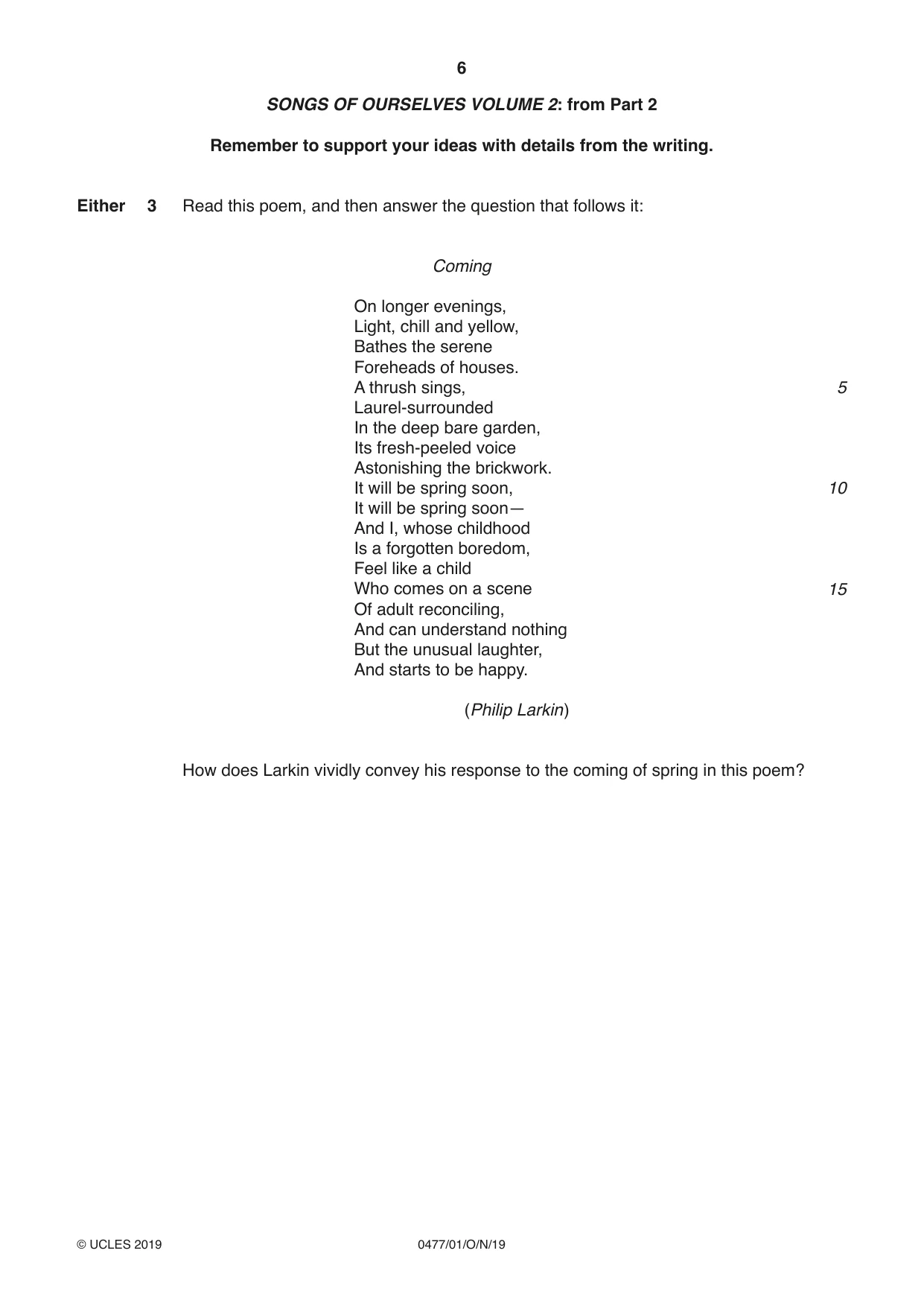
6 0477/01/O/N/19 © UCLES 2019 SONGS OF OURSELVES VOLUME 2: from Part 2 Remember to support your ideas with details from the writing. Either 3 Read this poem, and then answer the question that follows it: Coming On longer evenings, Light, chill and yellow, Bathes the serene Foreheads of houses. A thrush sings, Laurel-surrounded In the deep bare garden, Its fresh-peeled voice Astonishing the brickwork. It will be spring soon, It will be spring soon— And I, whose childhood Is a forgotten boredom, Feel like a child Who comes on a scene Of adult reconciling, And can understand nothing But the unusual laughter, And starts to be happy. (Philip Larkin) How does Larkin vividly convey his response to the coming of spring in this poem? 5 10 15
Question paper, page 7
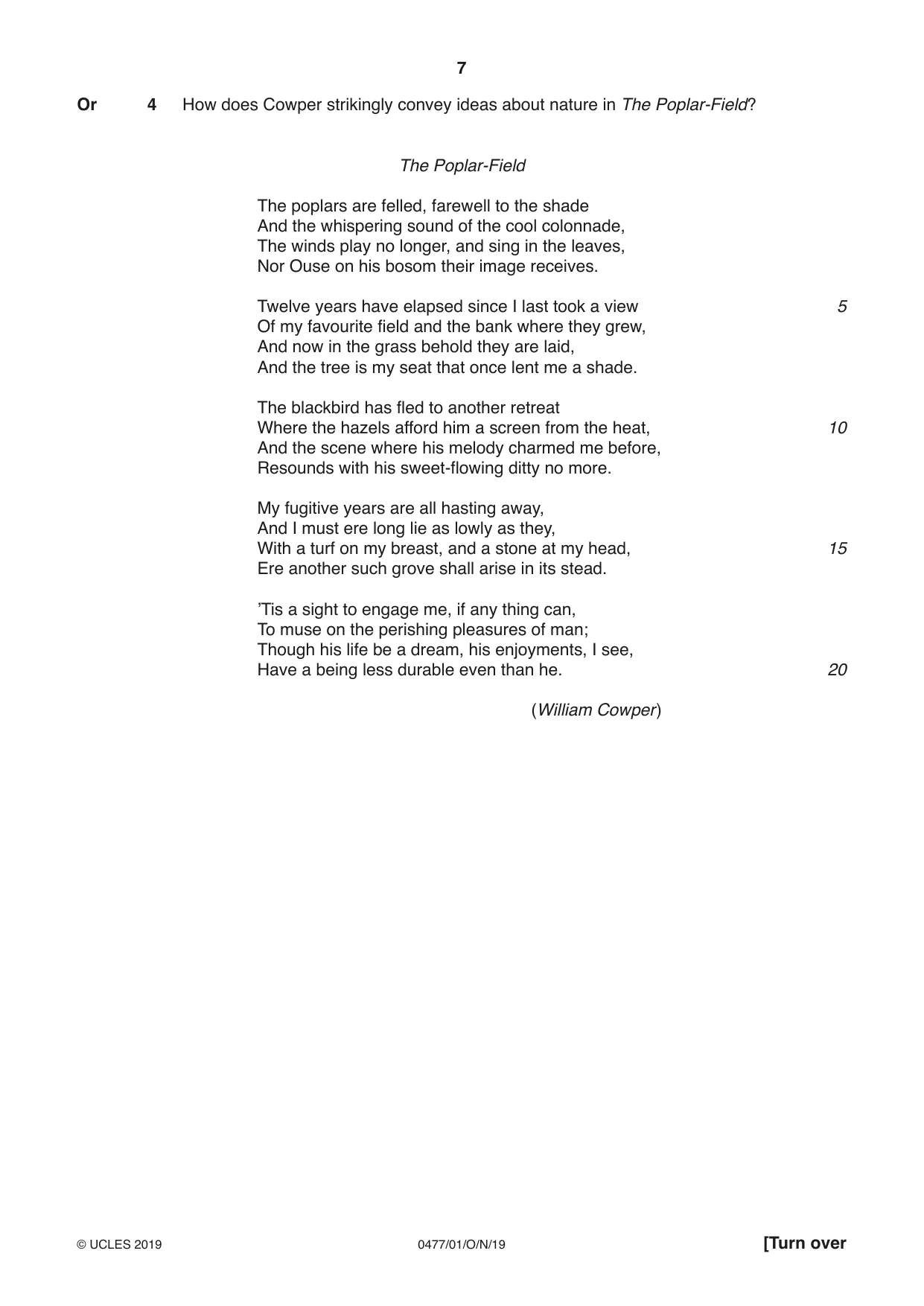
7 0477/01/O/N/19 © UCLES 2019 [Turn over Or 4 How does Cowper strikingly convey ideas about nature in The Poplar-Field? The Poplar-Field The poplars are felled, farewell to the shade And the whispering sound of the cool colonnade, The winds play no longer, and sing in the leaves, Nor Ouse on his bosom their image receives. Twelve years have elapsed since I last took a view Of my favourite field and the bank where they grew, And now in the grass behold they are laid, And the tree is my seat that once lent me a shade. The blackbird has fled to another retreat Where the hazels afford him a screen from the heat, And the scene where his melody charmed me before, Resounds with his sweet-flowing ditty no more. My fugitive years are all hasting away, And I must ere long lie as lowly as they, With a turf on my breast, and a stone at my head, Ere another such grove shall arise in its stead. ’Tis a sight to engage me, if any thing can, To muse on the perishing pleasures of man; Though his life be a dream, his enjoyments, I see, Have a being less durable even than he. (William Cowper) 5 10 15 20
Question paper, page 8
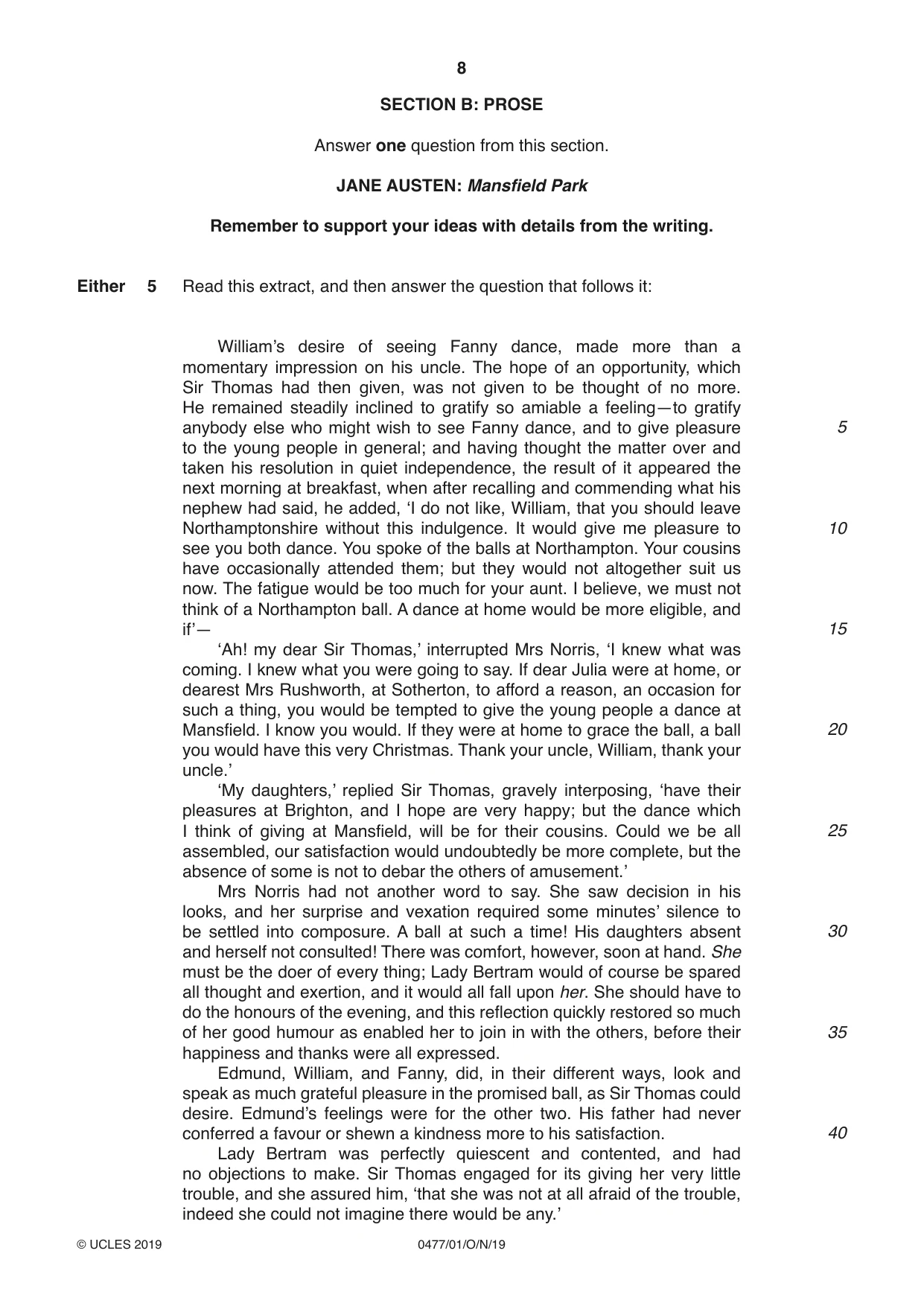
8 0477/01/O/N/19 © UCLES 2019 SECTION B: PROSE Answer one question from this section. JANE AUSTEN: Mansfield Park Remember to support your ideas with details from the writing. Either 5 Read this extract, and then answer the question that follows it: William’s desire of seeing Fanny dance, made more than a momentary impression on his uncle. The hope of an opportunity, which Sir Thomas had then given, was not given to be thought of no more. He remained steadily inclined to gratify so amiable a feeling—to gratify anybody else who might wish to see Fanny dance, and to give pleasure to the young people in general; and having thought the matter over and taken his resolution in quiet independence, the result of it appeared the next morning at breakfast, when after recalling and commending what his nephew had said, he added, ‘I do not like, William, that you should leave Northamptonshire without this indulgence. It would give me pleasure to see you both dance. You spoke of the balls at Northampton. Your cousins have occasionally attended them; but they would not altogether suit us now. The fatigue would be too much for your aunt. I believe, we must not think of a Northampton ball. A dance at home would be more eligible, and if’— ‘Ah! my dear Sir Thomas,’ interrupted Mrs Norris, ‘I knew what was coming. I knew what you were going to say. If dear Julia were at home, or dearest Mrs Rushworth, at Sotherton, to afford a reason, an occasion for such a thing, you would be tempted to give the young people a dance at Mansfield. I know you would. If they were at home to grace the ball, a ball you would have this very Christmas. Thank your uncle, William, thank your uncle.’ ‘My daughters,’ replied Sir Thomas, gravely interposing, ‘have their pleasures at Brighton, and I hope are very happy; but the dance which I think of giving at Mansfield, will be for their cousins. Could we be all assembled, our satisfaction would undoubtedly be more complete, but the absence of some is not to debar the others of amusement.’ Mrs Norris had not another word to say. She saw decision in his looks, and her surprise and vexation required some minutes’ silence to be settled into composure. A ball at such a time! His daughters absent and herself not consulted! There was comfort, however, soon at hand. She must be the doer of every thing; Lady Bertram would of course be spared all thought and exertion, and it would all fall upon her. She should have to do the honours of the evening, and this reflection quickly restored so much of her good humour as enabled her to join in with the others, before their happiness and thanks were all expressed. Edmund, William, and Fanny, did, in their different ways, look and speak as much grateful pleasure in the promised ball, as Sir Thomas could desire. Edmund’s feelings were for the other two. His father had never conferred a favour or shewn a kindness more to his satisfaction. Lady Bertram was perfectly quiescent and contented, and had no objections to make. Sir Thomas engaged for its giving her very little trouble, and she assured him, ‘that she was not at all afraid of the trouble, indeed she could not imagine there would be any.’ 5 10 15 20 25 30 35 40
Question paper, page 9
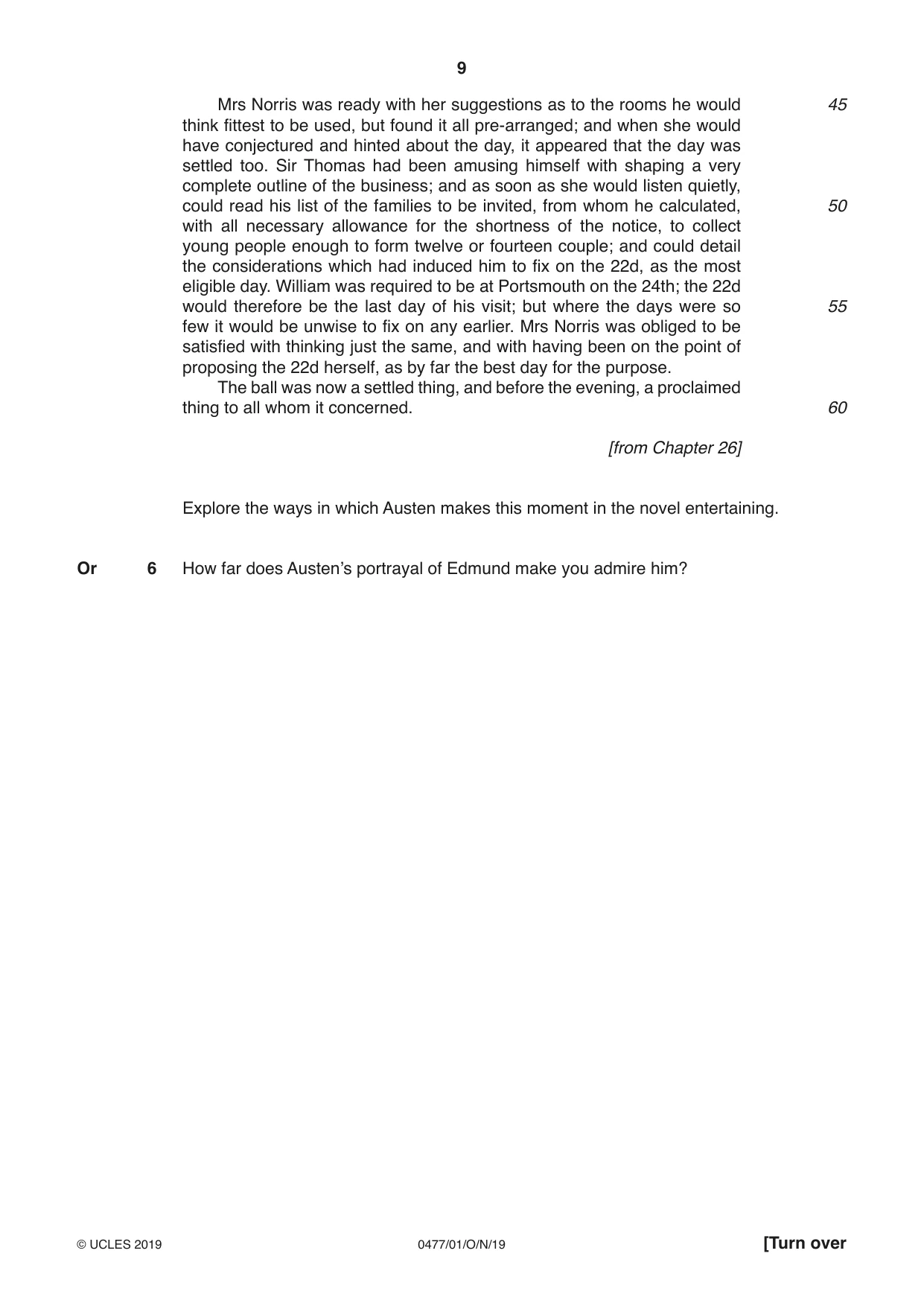
9 0477/01/O/N/19 © UCLES 2019 [Turn over Mrs Norris was ready with her suggestions as to the rooms he would think fittest to be used, but found it all pre-arranged; and when she would have conjectured and hinted about the day, it appeared that the day was settled too. Sir Thomas had been amusing himself with shaping a very complete outline of the business; and as soon as she would listen quietly, could read his list of the families to be invited, from whom he calculated, with all necessary allowance for the shortness of the notice, to collect young people enough to form twelve or fourteen couple; and could detail the considerations which had induced him to fix on the 22d, as the most eligible day. William was required to be at Portsmouth on the 24th; the 22d would therefore be the last day of his visit; but where the days were so few it would be unwise to fix on any earlier. Mrs Norris was obliged to be satisfied with thinking just the same, and with having been on the point of proposing the 22d herself, as by far the best day for the purpose. The ball was now a settled thing, and before the evening, a proclaimed thing to all whom it concerned. [from Chapter 26] Explore the ways in which Austen makes this moment in the novel entertaining. Or 6 How far does Austen’s portrayal of Edmund make you admire him? 45 50 55 60
Question paper, page 10
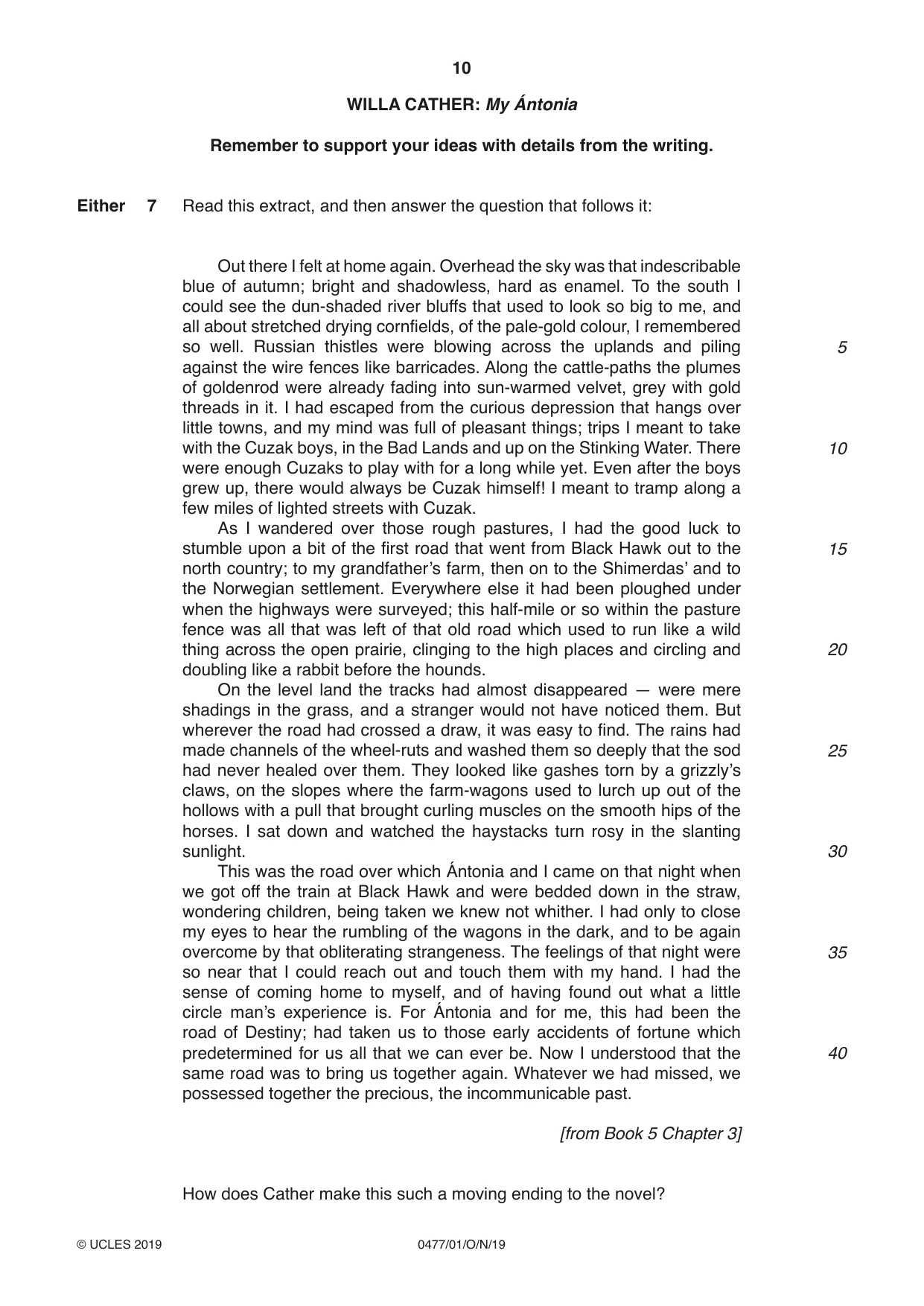
10 0477/01/O/N/19 © UCLES 2019 WILLA CATHER: My Ántonia Remember to support your ideas with details from the writing. Either 7 Read this extract, and then answer the question that follows it: Out there I felt at home again. Overhead the sky was that indescribable blue of autumn; bright and shadowless, hard as enamel. To the south I could see the dun-shaded river bluffs that used to look so big to me, and all about stretched drying cornfields, of the pale-gold colour, I remembered so well. Russian thistles were blowing across the uplands and piling against the wire fences like barricades. Along the cattle-paths the plumes of goldenrod were already fading into sun-warmed velvet, grey with gold threads in it. I had escaped from the curious depression that hangs over little towns, and my mind was full of pleasant things; trips I meant to take with the Cuzak boys, in the Bad Lands and up on the Stinking Water. There were enough Cuzaks to play with for a long while yet. Even after the boys grew up, there would always be Cuzak himself! I meant to tramp along a few miles of lighted streets with Cuzak. As I wandered over those rough pastures, I had the good luck to stumble upon a bit of the first road that went from Black Hawk out to the north country; to my grandfather’s farm, then on to the Shimerdas’ and to the Norwegian settlement. Everywhere else it had been ploughed under when the highways were surveyed; this half-mile or so within the pasture fence was all that was left of that old road which used to run like a wild thing across the open prairie, clinging to the high places and circling and doubling like a rabbit before the hounds. On the level land the tracks had almost disappeared — were mere shadings in the grass, and a stranger would not have noticed them. But wherever the road had crossed a draw, it was easy to find. The rains had made channels of the wheel-ruts and washed them so deeply that the sod had never healed over them. They looked like gashes torn by a grizzly’s claws, on the slopes where the farm-wagons used to lurch up out of the hollows with a pull that brought curling muscles on the smooth hips of the horses. I sat down and watched the haystacks turn rosy in the slanting sunlight. This was the road over which Ántonia and I came on that night when we got off the train at Black Hawk and were bedded down in the straw, wondering children, being taken we knew not whither. I had only to close my eyes to hear the rumbling of the wagons in the dark, and to be again overcome by that obliterating strangeness. The feelings of that night were so near that I could reach out and touch them with my hand. I had the sense of coming home to myself, and of having found out what a little circle man’s experience is. For Ántonia and for me, this had been the road of Destiny; had taken us to those early accidents of fortune which predetermined for us all that we can ever be. Now I understood that the same road was to bring us together again. Whatever we had missed, we possessed together the precious, the incommunicable past. [from Book 5 Chapter 3] How does Cather make this such a moving ending to the novel? 5 10 15 20 25 30 35 40
Question paper, page 11
11 0477/01/O/N/19 © UCLES 2019 [Turn over Or 8 Explore the ways in which Cather makes Lena Lingard and Tiny Soderball such strong and independent characters.
Question paper, page 12
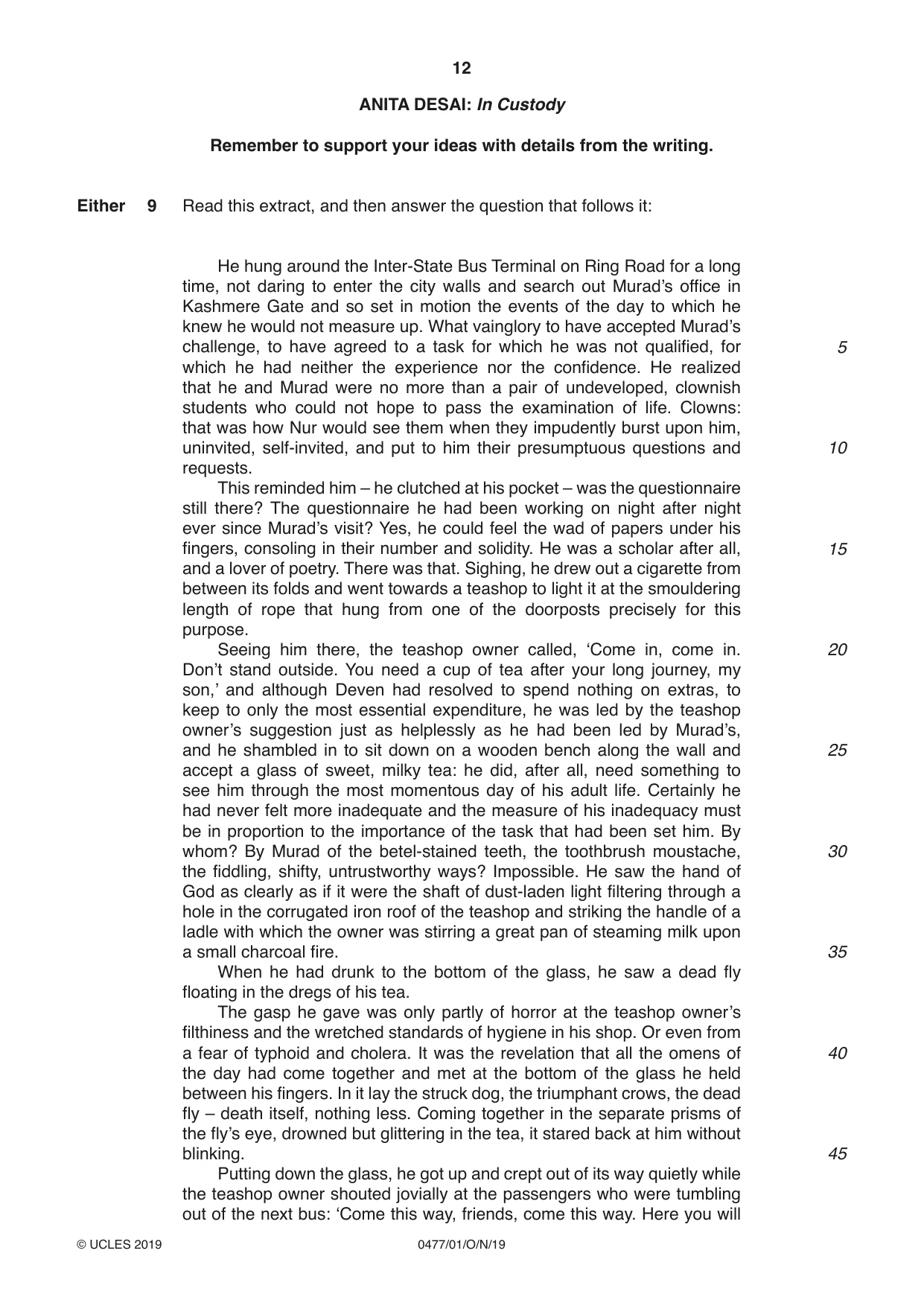
12 0477/01/O/N/19 © UCLES 2019 ANITA DESAI: In Custody Remember to support your ideas with details from the writing. Either 9 Read this extract, and then answer the question that follows it: He hung around the Inter-State Bus Terminal on Ring Road for a long time, not daring to enter the city walls and search out Murad’s office in Kashmere Gate and so set in motion the events of the day to which he knew he would not measure up. What vainglory to have accepted Murad’s challenge, to have agreed to a task for which he was not qualified, for which he had neither the experience nor the confidence. He realized that he and Murad were no more than a pair of undeveloped, clownish students who could not hope to pass the examination of life. Clowns: that was how Nur would see them when they impudently burst upon him, uninvited, self-invited, and put to him their presumptuous questions and requests. This reminded him – he clutched at his pocket – was the questionnaire still there? The questionnaire he had been working on night after night ever since Murad’s visit? Yes, he could feel the wad of papers under his fingers, consoling in their number and solidity. He was a scholar after all, and a lover of poetry. There was that. Sighing, he drew out a cigarette from between its folds and went towards a teashop to light it at the smouldering length of rope that hung from one of the doorposts precisely for this purpose. Seeing him there, the teashop owner called, ‘Come in, come in. Don’t stand outside. You need a cup of tea after your long journey, my son,’ and although Deven had resolved to spend nothing on extras, to keep to only the most essential expenditure, he was led by the teashop owner’s suggestion just as helplessly as he had been led by Murad’s, and he shambled in to sit down on a wooden bench along the wall and accept a glass of sweet, milky tea: he did, after all, need something to see him through the most momentous day of his adult life. Certainly he had never felt more inadequate and the measure of his inadequacy must be in proportion to the importance of the task that had been set him. By whom? By Murad of the betel-stained teeth, the toothbrush moustache, the fiddling, shifty, untrustworthy ways? Impossible. He saw the hand of God as clearly as if it were the shaft of dust-laden light filtering through a hole in the corrugated iron roof of the teashop and striking the handle of a ladle with which the owner was stirring a great pan of steaming milk upon a small charcoal fire. When he had drunk to the bottom of the glass, he saw a dead fly floating in the dregs of his tea. The gasp he gave was only partly of horror at the teashop owner’s filthiness and the wretched standards of hygiene in his shop. Or even from a fear of typhoid and cholera. It was the revelation that all the omens of the day had come together and met at the bottom of the glass he held between his fingers. In it lay the struck dog, the triumphant crows, the dead fly – death itself, nothing less. Coming together in the separate prisms of the fly’s eye, drowned but glittering in the tea, it stared back at him without blinking. Putting down the glass, he got up and crept out of its way quietly while the teashop owner shouted jovially at the passengers who were tumbling out of the next bus: ‘Come this way, friends, come this way. Here you will 5 10 15 20 25 30 35 40 45
Question paper, page 13
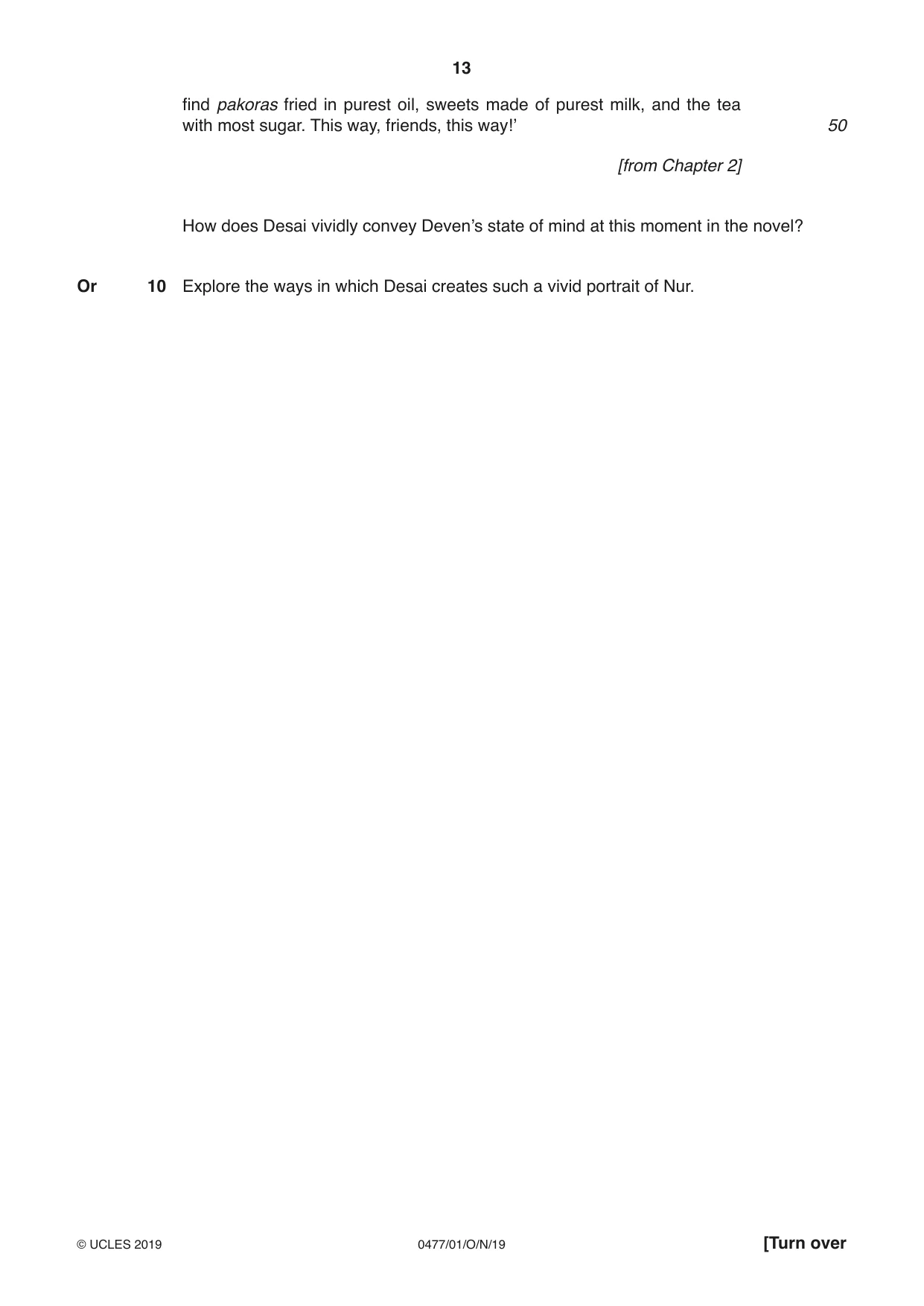
13 0477/01/O/N/19 © UCLES 2019 [Turn over find pakoras fried in purest oil, sweets made of purest milk, and the tea with most sugar. This way, friends, this way!’ [from Chapter 2] How does Desai vividly convey Deven’s state of mind at this moment in the novel? Or 10 Explore the ways in which Desai creates such a vivid portrait of Nur. 50
Question paper, page 14
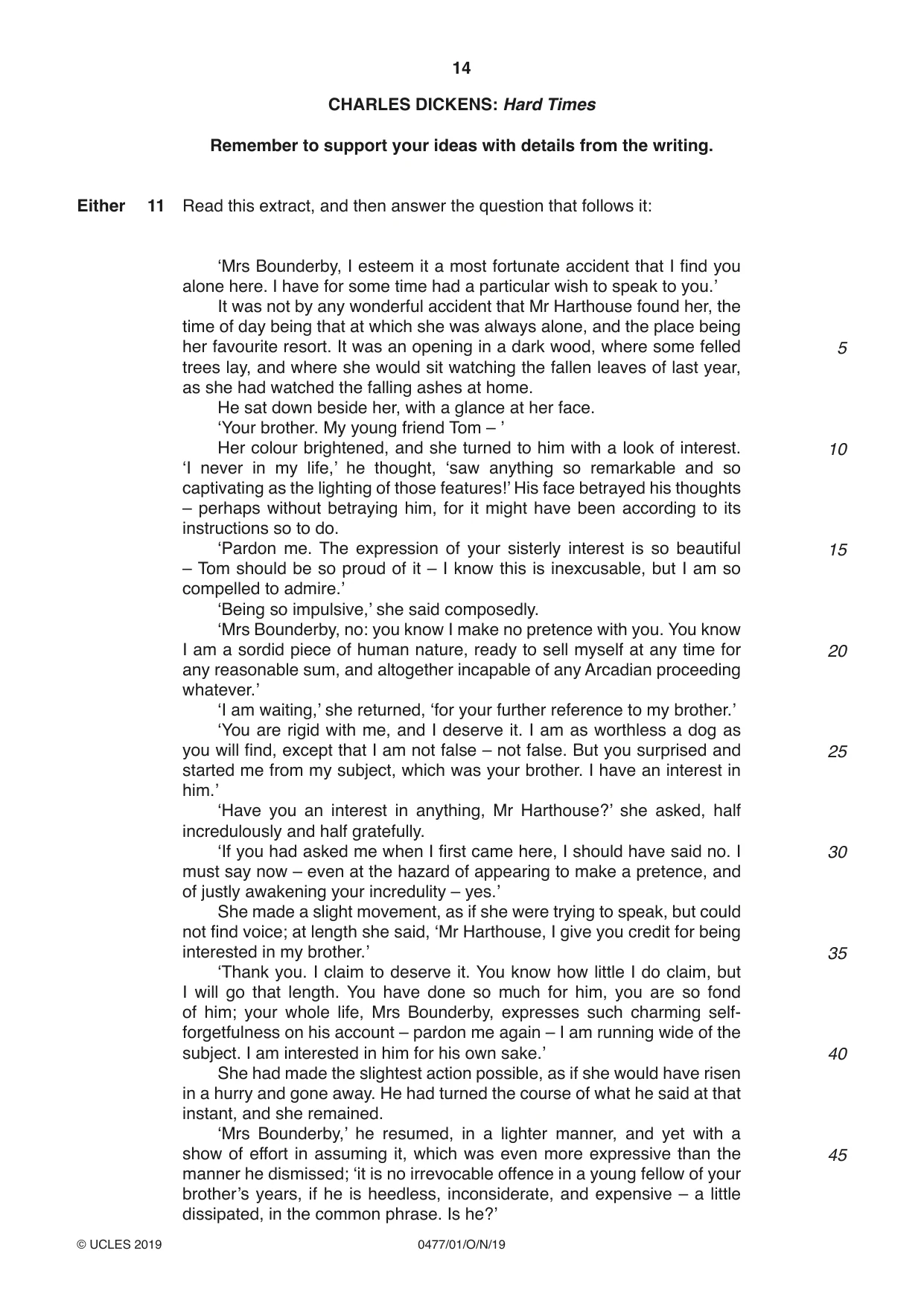
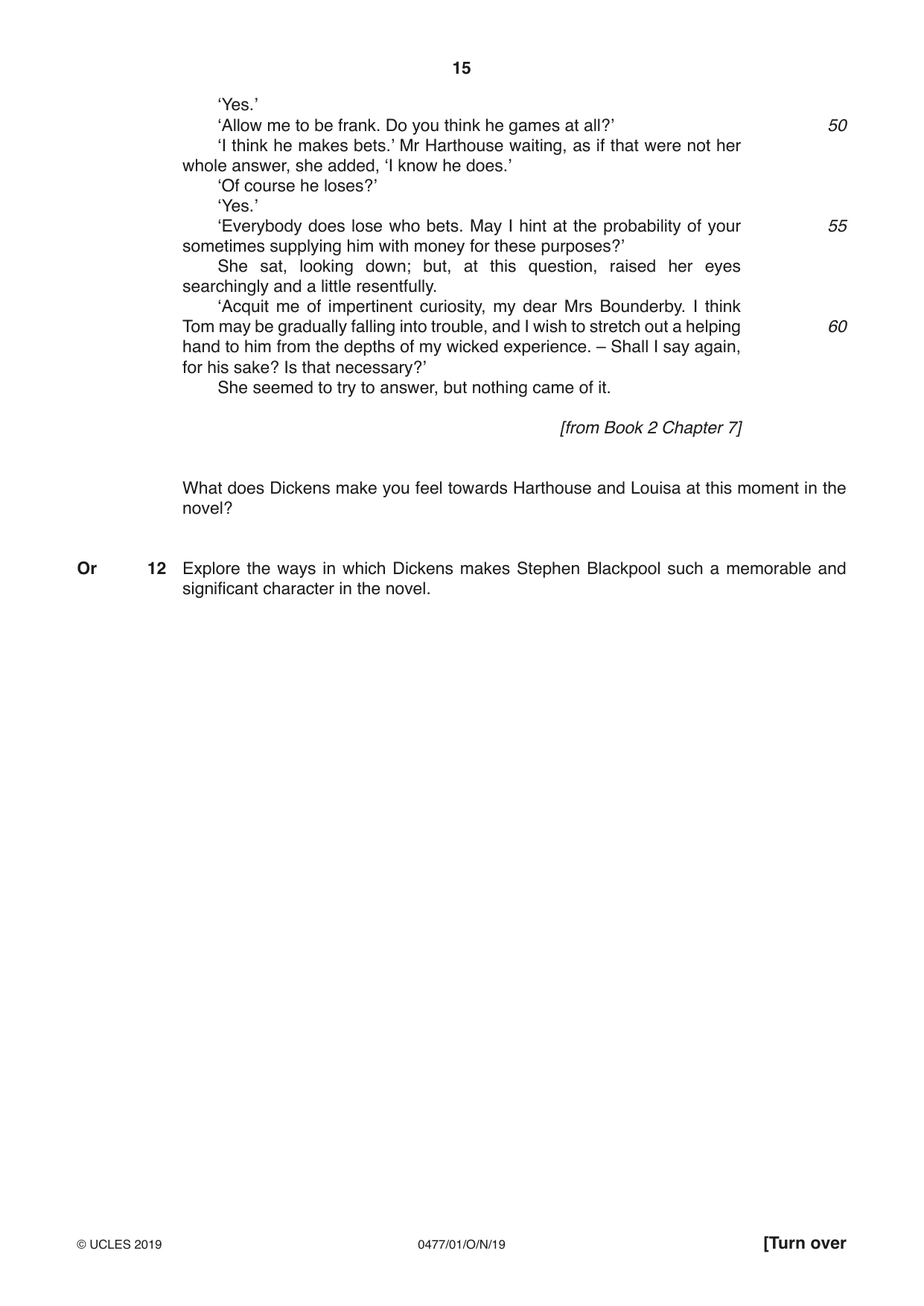
14 0477/01/O/N/19 © UCLES 2019 CHARLES DICKENS: Hard Times Remember to support your ideas with details from the writing. Either 11 Read this extract, and then answer the question that follows it: ‘Mrs Bounderby, I esteem it a most fortunate accident that I find you alone here. I have for some time had a particular wish to speak to you.’ It was not by any wonderful accident that Mr Harthouse found her, the time of day being that at which she was always alone, and the place being her favourite resort. It was an opening in a dark wood, where some felled trees lay, and where she would sit watching the fallen leaves of last year, as she had watched the falling ashes at home. He sat down beside her, with a glance at her face. ‘Your brother. My young friend Tom – ’ Her colour brightened, and she turned to him with a look of interest. ‘I never in my life,’ he thought, ‘saw anything so remarkable and so captivating as the lighting of those features!’ His face betrayed his thoughts – perhaps without betraying him, for it might have been according to its instructions so to do. ‘Pardon me. The expression of your sisterly interest is so beautiful – Tom should be so proud of it – I know this is inexcusable, but I am so compelled to admire.’ ‘Being so impulsive,’ she said composedly. ‘Mrs Bounderby, no: you know I make no pretence with you. You know I am a sordid piece of human nature, ready to sell myself at any time for any reasonable sum, and altogether incapable of any Arcadian proceeding whatever.’ ‘I am waiting,’ she returned, ‘for your further reference to my brother.’ ‘You are rigid with me, and I deserve it. I am as worthless a dog as you will find, except that I am not false – not false. But you surprised and started me from my subject, which was your brother. I have an interest in him.’ ‘Have you an interest in anything, Mr Harthouse?’ she asked, half incredulously and half gratefully. ‘If you had asked me when I first came here, I should have said no. I must say now – even at the hazard of appearing to make a pretence, and of justly awakening your incredulity – yes.’ She made a slight movement, as if she were trying to speak, but could not find voice; at length she said, ‘Mr Harthouse, I give you credit for being interested in my brother.’ ‘Thank you. I claim to deserve it. You know how little I do claim, but I will go that length. You have done so much for him, you are so fond of him; your whole life, Mrs Bounderby, expresses such charming self- forgetfulness on his account – pardon me again – I am running wide of the subject. I am interested in him for his own sake.’ She had made the slightest action possible, as if she would have risen in a hurry and gone away. He had turned the course of what he said at that instant, and she remained. ‘Mrs Bounderby,’ he resumed, in a lighter manner, and yet with a show of effort in assuming it, which was even more expressive than the manner he dismissed; ‘it is no irrevocable offence in a young fellow of your brother’s years, if he is heedless, inconsiderate, and expensive – a little dissipated, in the common phrase. Is he?’ 5 10 15 20 25 30 35 40 45
Question paper, page 15
15 0477/01/O/N/19 © UCLES 2019 [Turn over ‘Yes.’ ‘Allow me to be frank. Do you think he games at all?’ ‘I think he makes bets.’ Mr Harthouse waiting, as if that were not her whole answer, she added, ‘I know he does.’ ‘Of course he loses?’ ‘Yes.’ ‘Everybody does lose who bets. May I hint at the probability of your sometimes supplying him with money for these purposes?’ She sat, looking down; but, at this question, raised her eyes searchingly and a little resentfully. ‘Acquit me of impertinent curiosity, my dear Mrs Bounderby. I think Tom may be gradually falling into trouble, and I wish to stretch out a helping hand to him from the depths of my wicked experience. – Shall I say again, for his sake? Is that necessary?’ She seemed to try to answer, but nothing came of it. [from Book 2 Chapter 7] What does Dickens make you feel towards Harthouse and Louisa at this moment in the novel? Or 12 Explore the ways in which Dickens makes Stephen Blackpool such a memorable and significant character in the novel. 50 55 60
Question paper, page 16
16 0477/01/O/N/19 © UCLES 2019 KATE GRENVILLE: The Secret River Remember to support your ideas with details from the writing. Either 13 Read this extract, and then answer the question that follows it: It took him a moment to see two old women by the fire, as still and dark as the ground they seemed to grow out of. Content removed due to copyright restrictions.
Question paper, page 17
17 0477/01/O/N/19 © UCLES 2019 [Turn over He wished he had the gun. [from Part 4] Explore the ways in which Grenville powerfully conveys Thornhill’s thoughts and feelings at this moment in the novel. Or 14 How does Grenville movingly convey Sal’s growing unhappiness in the course of the novel? Content removed due to copyright restrictions.
Question paper, page 18
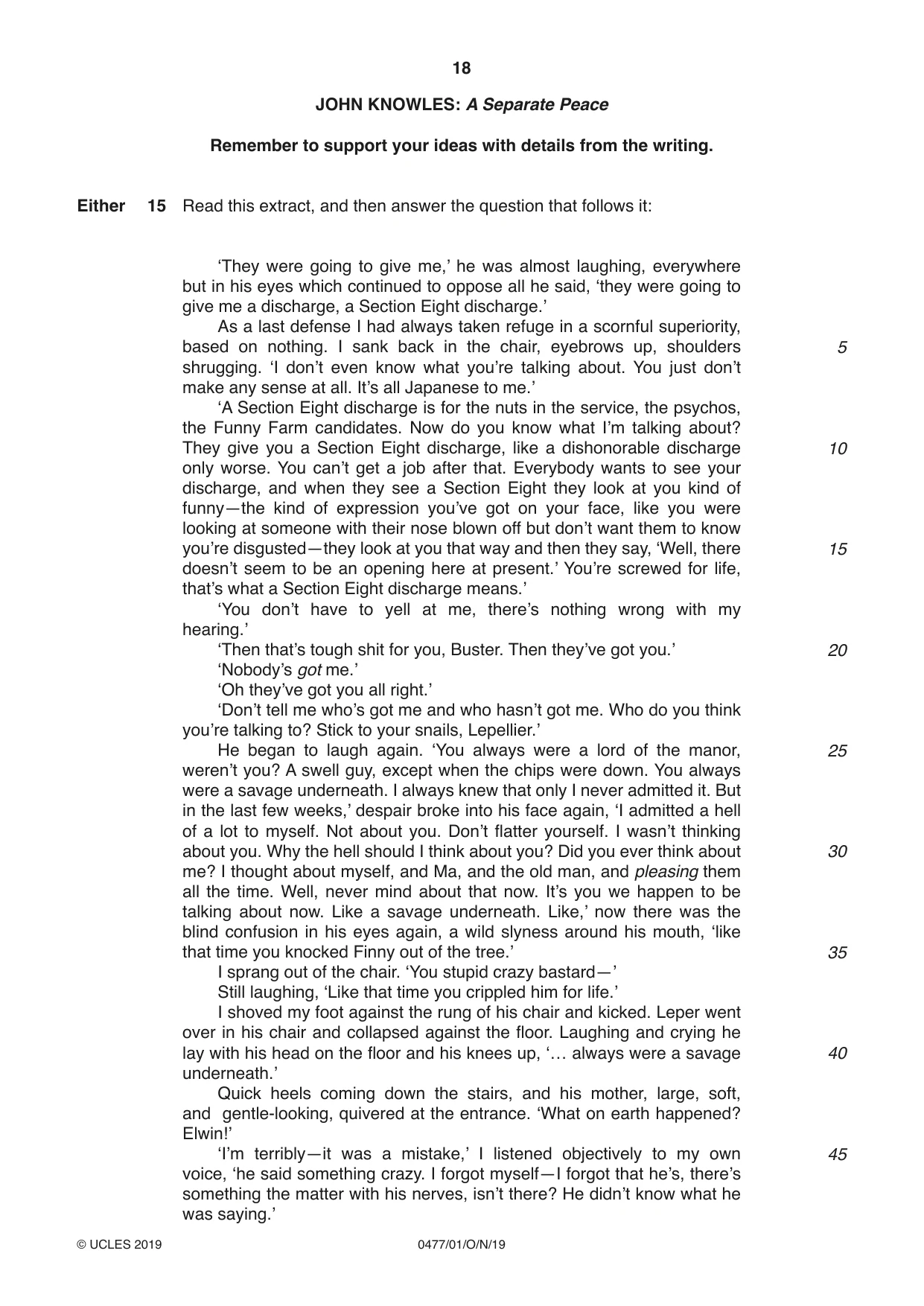
18 0477/01/O/N/19 © UCLES 2019 JOHN KNOWLES: A Separate Peace Remember to support your ideas with details from the writing. Either 15 Read this extract, and then answer the question that follows it: ‘They were going to give me,’ he was almost laughing, everywhere but in his eyes which continued to oppose all he said, ‘they were going to give me a discharge, a Section Eight discharge.’ As a last defense I had always taken refuge in a scornful superiority, based on nothing. I sank back in the chair, eyebrows up, shoulders shrugging. ‘I don’t even know what you’re talking about. You just don’t make any sense at all. It’s all Japanese to me.’ ‘A Section Eight discharge is for the nuts in the service, the psychos, the Funny Farm candidates. Now do you know what I’m talking about? They give you a Section Eight discharge, like a dishonorable discharge only worse. You can’t get a job after that. Everybody wants to see your discharge, and when they see a Section Eight they look at you kind of funny—the kind of expression you’ve got on your face, like you were looking at someone with their nose blown off but don’t want them to know you’re disgusted—they look at you that way and then they say, ‘Well, there doesn’t seem to be an opening here at present.’ You’re screwed for life, that’s what a Section Eight discharge means.’ ‘You don’t have to yell at me, there’s nothing wrong with my hearing.’ ‘Then that’s tough shit for you, Buster. Then they’ve got you.’ ‘Nobody’s got me.’ ‘Oh they’ve got you all right.’ ‘Don’t tell me who’s got me and who hasn’t got me. Who do you think you’re talking to? Stick to your snails, Lepellier.’ He began to laugh again. ‘You always were a lord of the manor, weren’t you? A swell guy, except when the chips were down. You always were a savage underneath. I always knew that only I never admitted it. But in the last few weeks,’ despair broke into his face again, ‘I admitted a hell of a lot to myself. Not about you. Don’t flatter yourself. I wasn’t thinking about you. Why the hell should I think about you? Did you ever think about me? I thought about myself, and Ma, and the old man, and pleasing them all the time. Well, never mind about that now. It’s you we happen to be talking about now. Like a savage underneath. Like,’ now there was the blind confusion in his eyes again, a wild slyness around his mouth, ‘like that time you knocked Finny out of the tree.’ I sprang out of the chair. ‘You stupid crazy bastard—’ Still laughing, ‘Like that time you crippled him for life.’ I shoved my foot against the rung of his chair and kicked. Leper went over in his chair and collapsed against the floor. Laughing and crying he lay with his head on the floor and his knees up, ‘… always were a savage underneath.’ Quick heels coming down the stairs, and his mother, large, soft, and gentle-looking, quivered at the entrance. ‘What on earth happened? Elwin!’ ‘I’m terribly—it was a mistake,’ I listened objectively to my own voice, ‘he said something crazy. I forgot myself—I forgot that he’s, there’s something the matter with his nerves, isn’t there? He didn’t know what he was saying.’ 5 10 15 20 25 30 35 40 45
Question paper, page 19
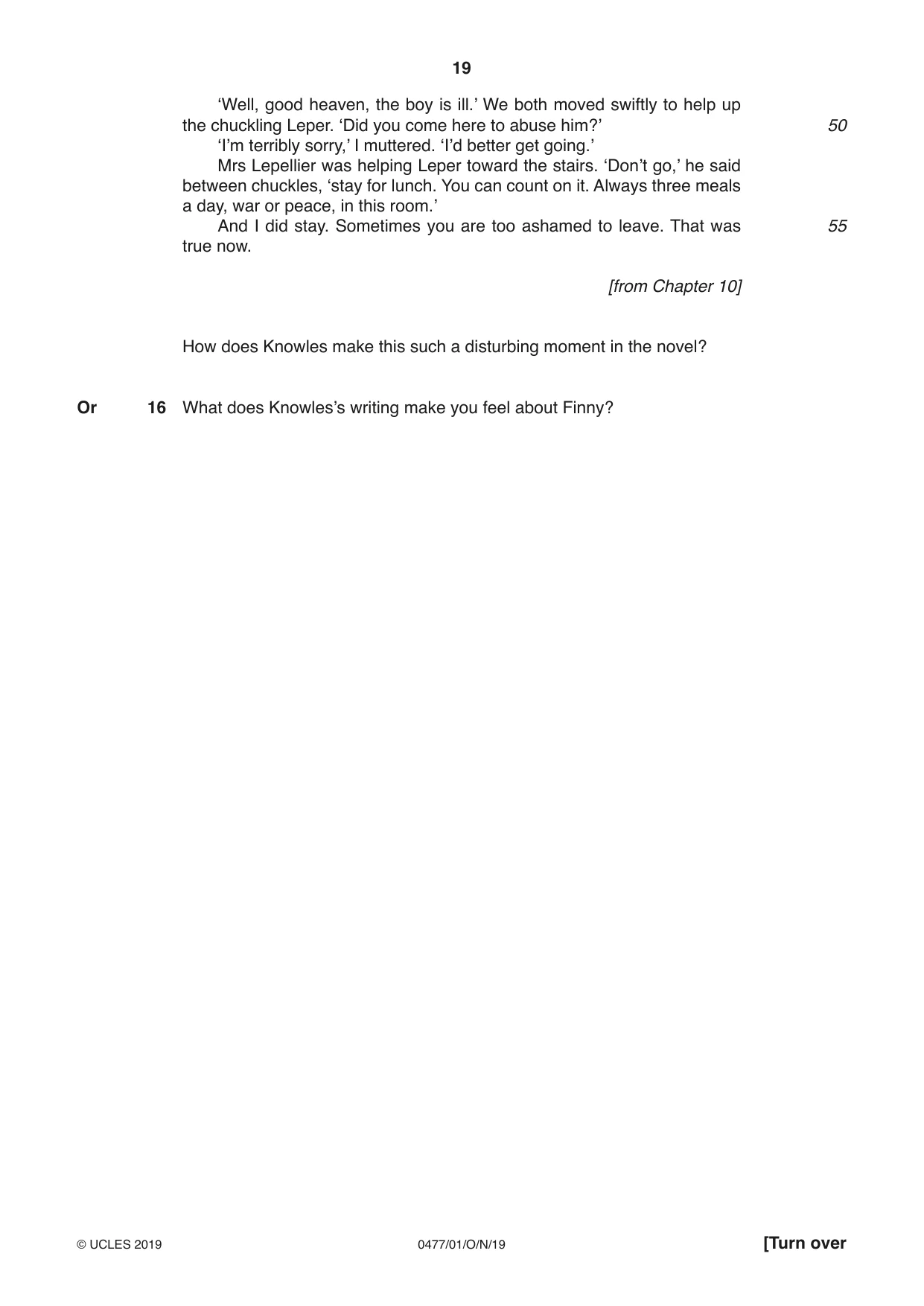
19 0477/01/O/N/19 © UCLES 2019 [Turn over ‘Well, good heaven, the boy is ill.’ We both moved swiftly to help up the chuckling Leper. ‘Did you come here to abuse him?’ ‘I’m terribly sorry,’ I muttered. ‘I’d better get going.’ Mrs Lepellier was helping Leper toward the stairs. ‘Don’t go,’ he said between chuckles, ‘stay for lunch. You can count on it. Always three meals a day, war or peace, in this room.’ And I did stay. Sometimes you are too ashamed to leave. That was true now. [from Chapter 10] How does Knowles make this such a disturbing moment in the novel? Or 16 What does Knowles’s writing make you feel about Finny? 50 55
Question paper, page 20
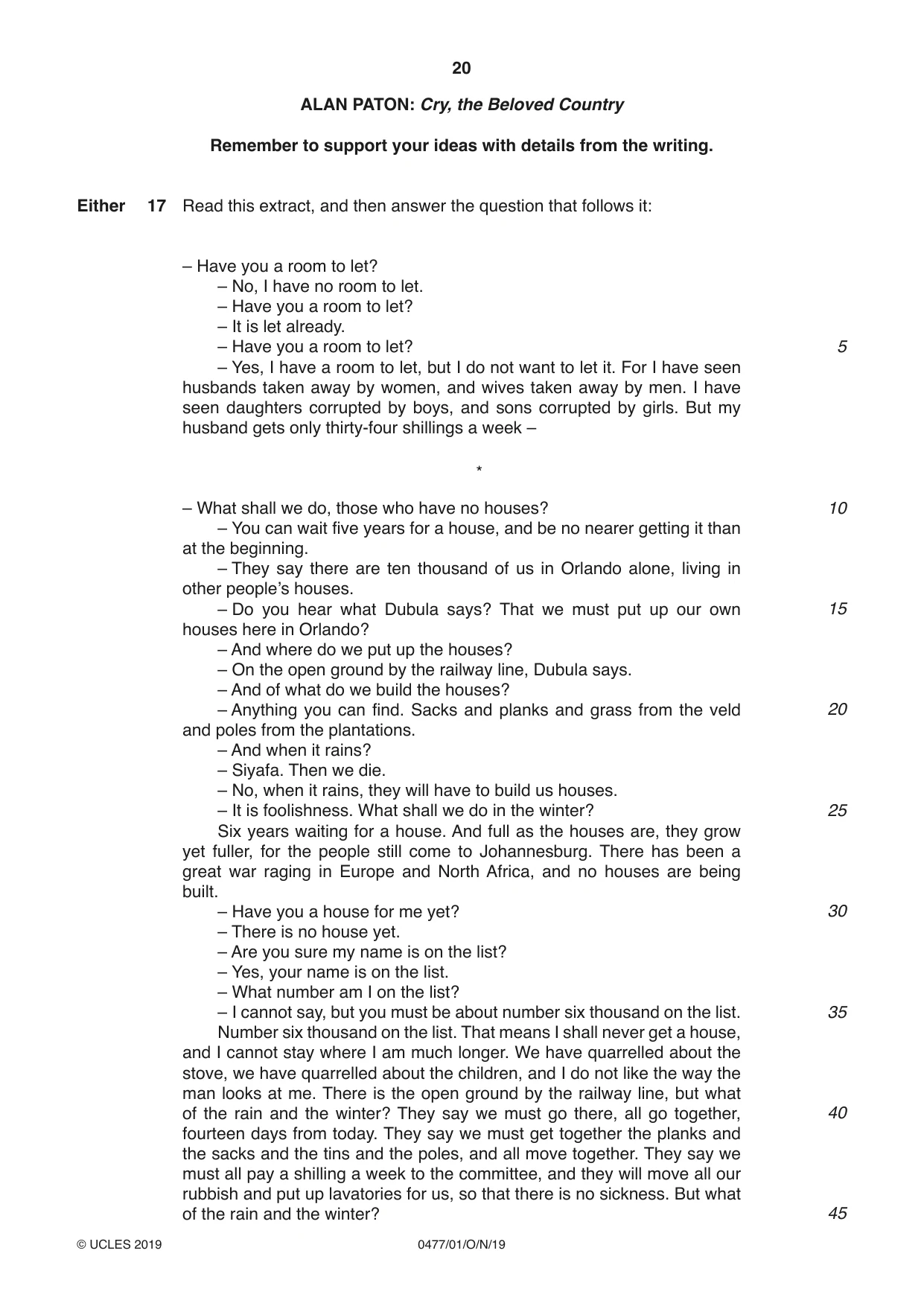
20 0477/01/O/N/19 © UCLES 2019 ALAN PATON: Cry, the Beloved Country Remember to support your ideas with details from the writing. Either 17 Read this extract, and then answer the question that follows it: – Have you a room to let? – No, I have no room to let. – Have you a room to let? – It is let already. – Have you a room to let? – Yes, I have a room to let, but I do not want to let it. For I have seen husbands taken away by women, and wives taken away by men. I have seen daughters corrupted by boys, and sons corrupted by girls. But my husband gets only thirty-four shillings a week – * – What shall we do, those who have no houses? – You can wait five years for a house, and be no nearer getting it than at the beginning. – They say there are ten thousand of us in Orlando alone, living in other people’s houses. – Do you hear what Dubula says? That we must put up our own houses here in Orlando? – And where do we put up the houses? – On the open ground by the railway line, Dubula says. – And of what do we build the houses? – Anything you can find. Sacks and planks and grass from the veld and poles from the plantations. – And when it rains? – Siyafa. Then we die. – No, when it rains, they will have to build us houses. – It is foolishness. What shall we do in the winter? Six years waiting for a house. And full as the houses are, they grow yet fuller, for the people still come to Johannesburg. There has been a great war raging in Europe and North Africa, and no houses are being built. – Have you a house for me yet? – There is no house yet. – Are you sure my name is on the list? – Yes, your name is on the list. – What number am I on the list? – I cannot say, but you must be about number six thousand on the list. Number six thousand on the list. That means I shall never get a house, and I cannot stay where I am much longer. We have quarrelled about the stove, we have quarrelled about the children, and I do not like the way the man looks at me. There is the open ground by the railway line, but what of the rain and the winter? They say we must go there, all go together, fourteen days from today. They say we must get together the planks and the sacks and the tins and the poles, and all move together. They say we must all pay a shilling a week to the committee, and they will move all our rubbish and put up lavatories for us, so that there is no sickness. But what of the rain and the winter? 5 10 15 20 25 30 35 40 45
Question paper, page 21
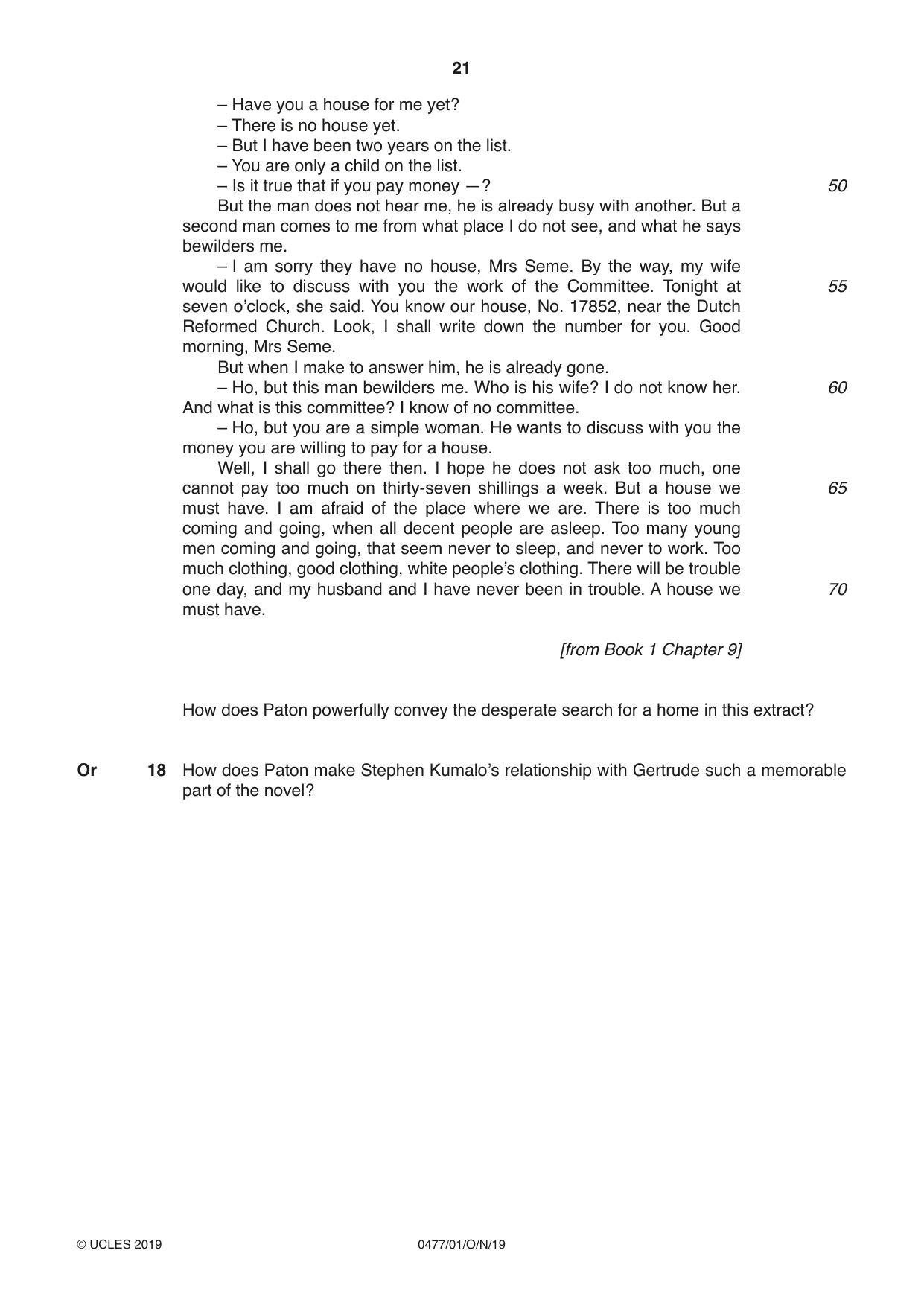
21 0477/01/O/N/19 © UCLES 2019 – Have you a house for me yet? – There is no house yet. – But I have been two years on the list. – You are only a child on the list. – Is it true that if you pay money —? But the man does not hear me, he is already busy with another. But a second man comes to me from what place I do not see, and what he says bewilders me. – I am sorry they have no house, Mrs Seme. By the way, my wife would like to discuss with you the work of the Committee. Tonight at seven o’clock, she said. You know our house, No. 17852, near the Dutch Reformed Church. Look, I shall write down the number for you. Good morning, Mrs Seme. But when I make to answer him, he is already gone. – Ho, but this man bewilders me. Who is his wife? I do not know her. And what is this committee? I know of no committee. – Ho, but you are a simple woman. He wants to discuss with you the money you are willing to pay for a house. Well, I shall go there then. I hope he does not ask too much, one cannot pay too much on thirty-seven shillings a week. But a house we must have. I am afraid of the place where we are. There is too much coming and going, when all decent people are asleep. Too many young men coming and going, that seem never to sleep, and never to work. Too much clothing, good clothing, white people’s clothing. There will be trouble one day, and my husband and I have never been in trouble. A house we must have. [from Book 1 Chapter 9] How does Paton powerfully convey the desperate search for a home in this extract? Or 18 How does Paton make Stephen Kumalo’s relationship with Gertrude such a memorable part of the novel? 50 55 60 65 70
Question paper, page 22
22 0477/01/O/N/19 © UCLES 2019 BLANK PAGE
Question paper, page 23
23 0477/01/O/N/19 © UCLES 2019 BLANK PAGE
Question paper, page 24
24 0477/01/O/N/19 © UCLES 2019 BLANK PAGE Permission to reproduce items where third-party owned material protected by copyright is included has been sought and cleared where possible. Every reasonable effort has been made by the publisher (UCLES) to trace copyright holders, but if any items requiring clearance have unwittingly been included, the publisher will be pleased to make amends at the earliest possible opportunity. To avoid the issue of disclosure of answer-related information to candidates, all copyright acknowledgements are reproduced online in the Cambridge Assessment International Education Copyright Acknowledgements Booklet. This is produced for each series of examinations and is freely available to download at www.cambridgeinternational.org after the live examination series. Cambridge Assessment International Education is part of the Cambridge Assessment Group. Cambridge Assessment is the brand name of the University of Cambridge Local Examinations Syndicate (UCLES), which itself is a department of the University of Cambridge.