Cambridge IGCSE English - Literature (9-1) (UK only) 0477 — 2018 Oct/Nov Paper 1 · Variant 0
0477/10/O/N/18
The question paper and its mark scheme, free to read here and free to download. This is Cambridge’s own paper, exactly as it was sat.
Question paper24 pages





Mark scheme
No mark scheme is in the library for this paper.
Paper as text
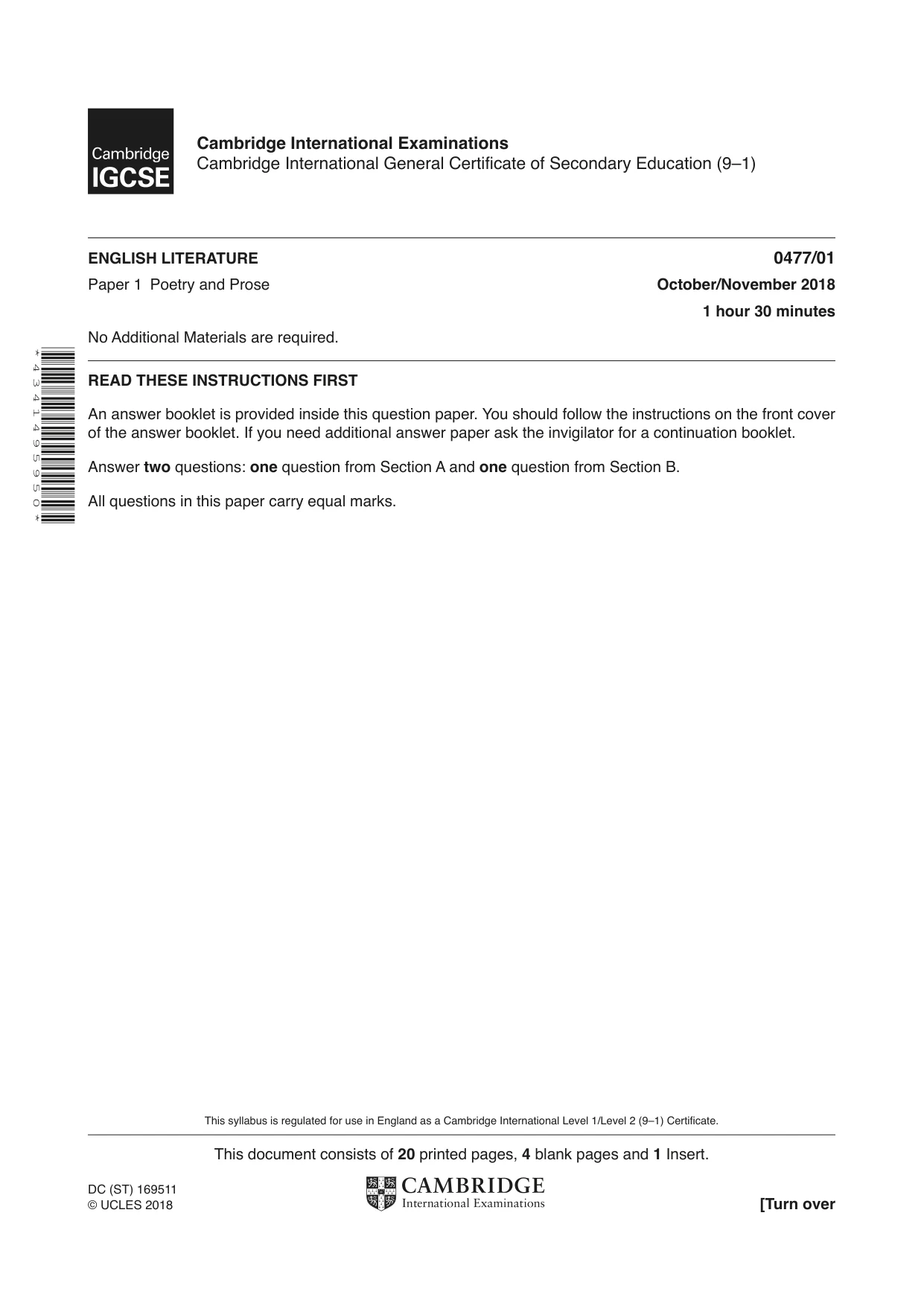
Question paper, page 1
This document consists of 20 printed pages, 4 blank pages and 1 Insert. DC (ST) 169511 © UCLES 2018 [Turn over Cambridge International Examinations Cambridge International General Certificate of Secondary Education (9–1) * 4 3 4 1 4 9 5 9 5 0 * ENGLISH LITERATURE 0477/01 Paper 1 Poetry and Prose October/November 2018 1 hour 30 minutes No Additional Materials are required. READ THESE INSTRUCTIONS FIRST An answer booklet is provided inside this question paper. You should follow the instructions on the front cover of the answer booklet. If you need additional answer paper ask the invigilator for a continuation booklet. Answer two questions: one question from Section A and one question from Section B. All questions in this paper carry equal marks. This syllabus is regulated for use in England as a Cambridge International Level 1/Level 2 (9–1) Certificate.
Question paper, page 2
2 0477/01/O/N/18 © UCLES 2018 BLANK PAGE
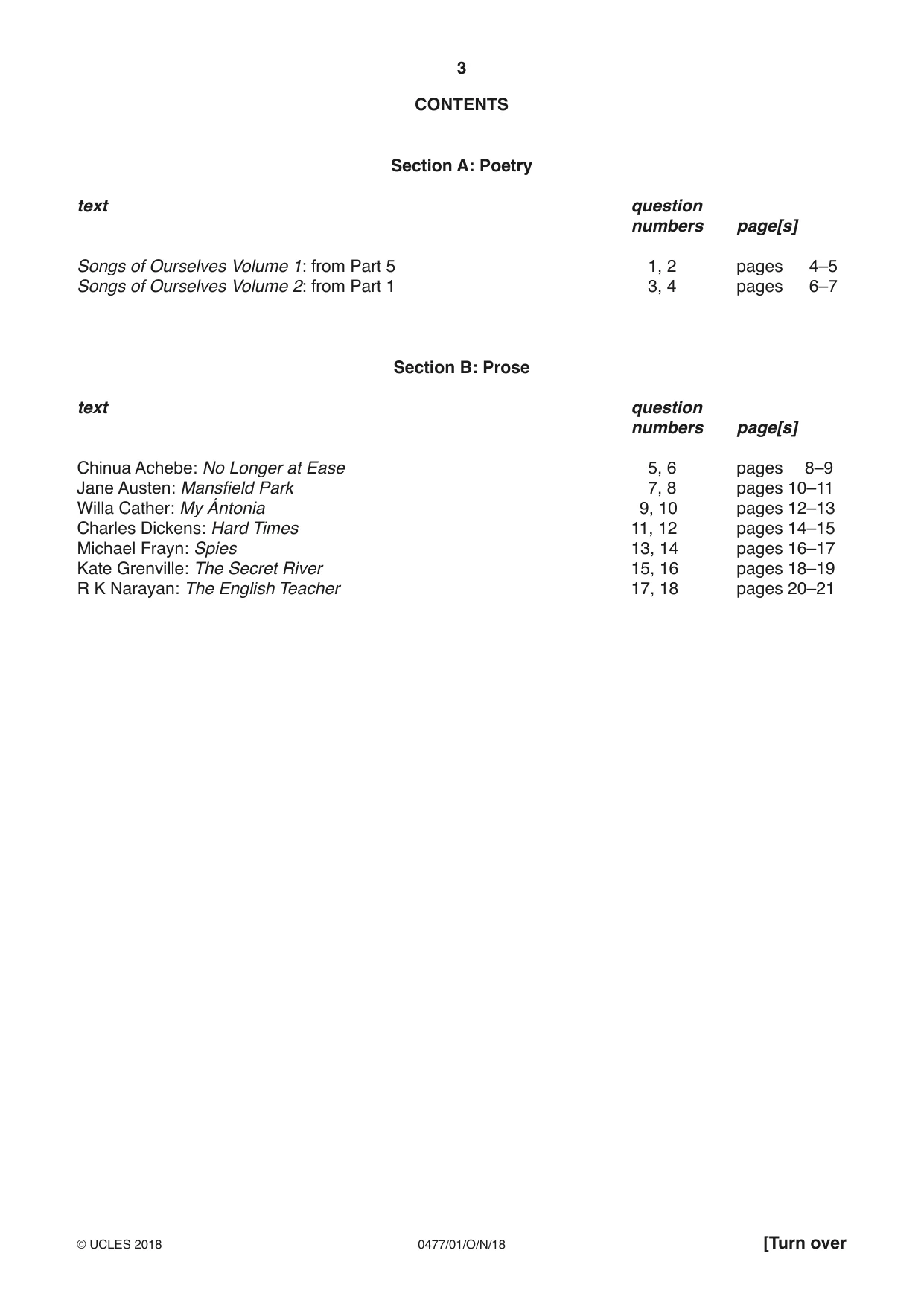
Question paper, page 3
3 0477/01/O/N/18 © UCLES 2018 [Turn over CONTENTS Section A: Poetry text question numbers page[s] Songs of Ourselves Volume 1: from Part 5 1, 2 pages 4–5 Songs of Ourselves Volume 2: from Part 1 3, 4 pages 6–7 Section B: Prose text question numbers page[s] Chinua Achebe: No Longer at Ease 5, 6 pages 8–9 Jane Austen: Mansfield Park 7, 8 pages 10–11 Willa Cather: My Ántonia 9, 10 pages 12–13 Charles Dickens: Hard Times 11, 12 pages 14–15 Michael Frayn: Spies 13, 14 pages 16–17 Kate Grenville: The Secret River 15, 16 pages 18–19 R K Narayan: The English Teacher 17, 18 pages 20–21
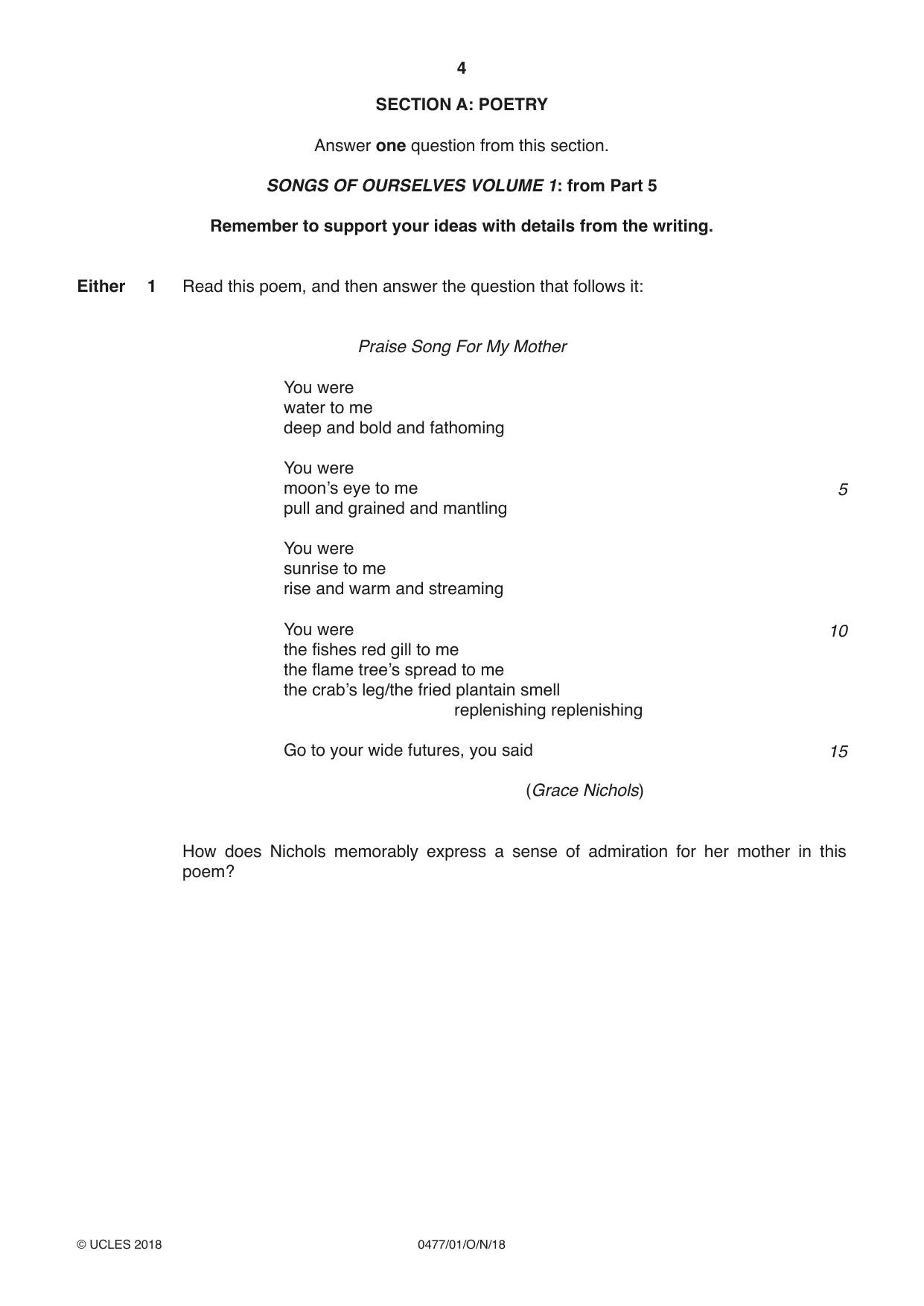
Question paper, page 4
4 0477/01/O/N/18 © UCLES 2018 SECTION A: POETRY Answer one question from this section. SONGS OF OURSELVES VOLUME 1: from Part 5 Remember to support your ideas with details from the writing. Either 1 Read this poem, and then answer the question that follows it: Praise Song For My Mother You were water to me deep and bold and fathoming You were moon’s eye to me pull and grained and mantling You were sunrise to me rise and warm and streaming You were the fishes red gill to me the flame tree’s spread to me the crab’s leg/the fried plantain smell replenishing replenishing Go to your wide futures, you said (Grace Nichols) How does Nichols memorably express a sense of admiration for her mother in this poem? 5 10 15
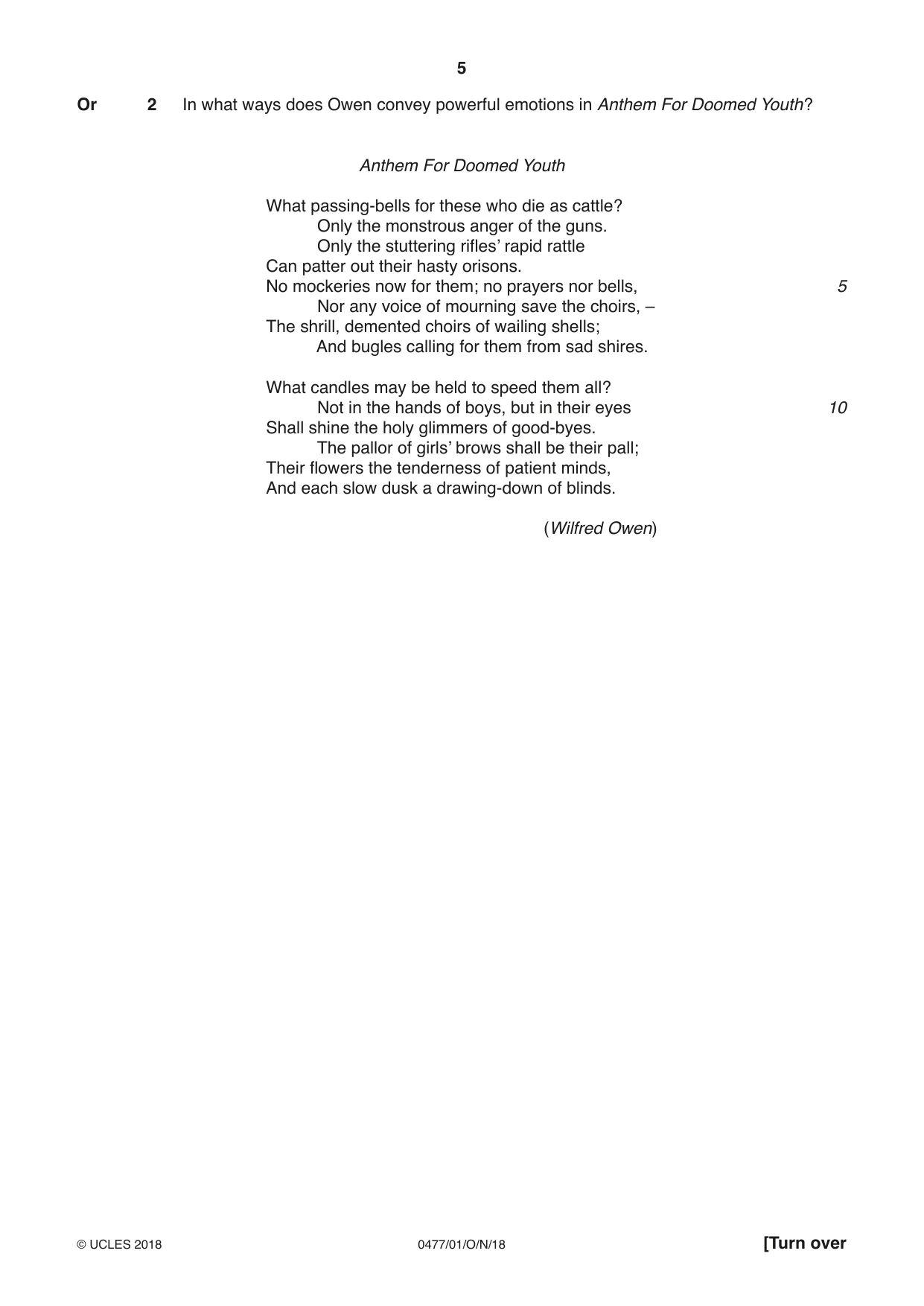
Question paper, page 5
5 0477/01/O/N/18 © UCLES 2018 [Turn over Or 2 In what ways does Owen convey powerful emotions in Anthem For Doomed Youth? Anthem For Doomed Youth What passing-bells for these who die as cattle? Only the monstrous anger of the guns. Only the stuttering rifles’ rapid rattle Can patter out their hasty orisons. No mockeries now for them; no prayers nor bells, Nor any voice of mourning save the choirs, – The shrill, demented choirs of wailing shells; And bugles calling for them from sad shires. What candles may be held to speed them all? Not in the hands of boys, but in their eyes Shall shine the holy glimmers of good-byes. The pallor of girls’ brows shall be their pall; Their flowers the tenderness of patient minds, And each slow dusk a drawing-down of blinds. (Wilfred Owen) 5 10
Question paper, page 6
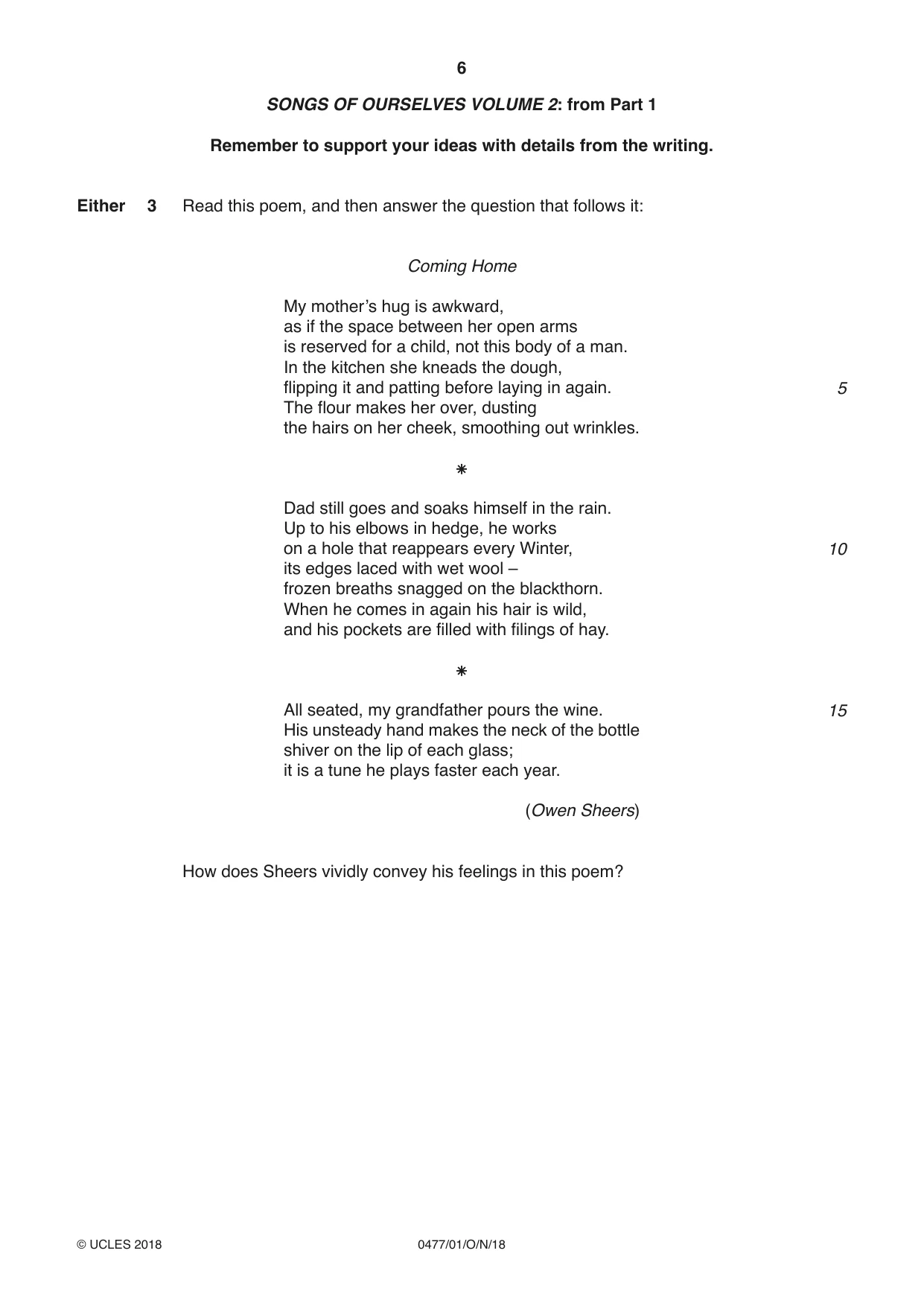
6 0477/01/O/N/18 © UCLES 2018 SONGS OF OURSELVES VOLUME 2: from Part 1 Remember to support your ideas with details from the writing. Either 3 Read this poem, and then answer the question that follows it: Coming Home My mother’s hug is awkward, as if the space between her open arms is reserved for a child, not this body of a man. In the kitchen she kneads the dough, flipping it and patting before laying in again. The flour makes her over, dusting the hairs on her cheek, smoothing out wrinkles. ⁕ Dad still goes and soaks himself in the rain. Up to his elbows in hedge, he works on a hole that reappears every Winter, its edges laced with wet wool – frozen breaths snagged on the blackthorn. When he comes in again his hair is wild, and his pockets are filled with filings of hay. ⁕ All seated, my grandfather pours the wine. His unsteady hand makes the neck of the bottle shiver on the lip of each glass; it is a tune he plays faster each year. (Owen Sheers) How does Sheers vividly convey his feelings in this poem? 5 10 15
Question paper, page 7
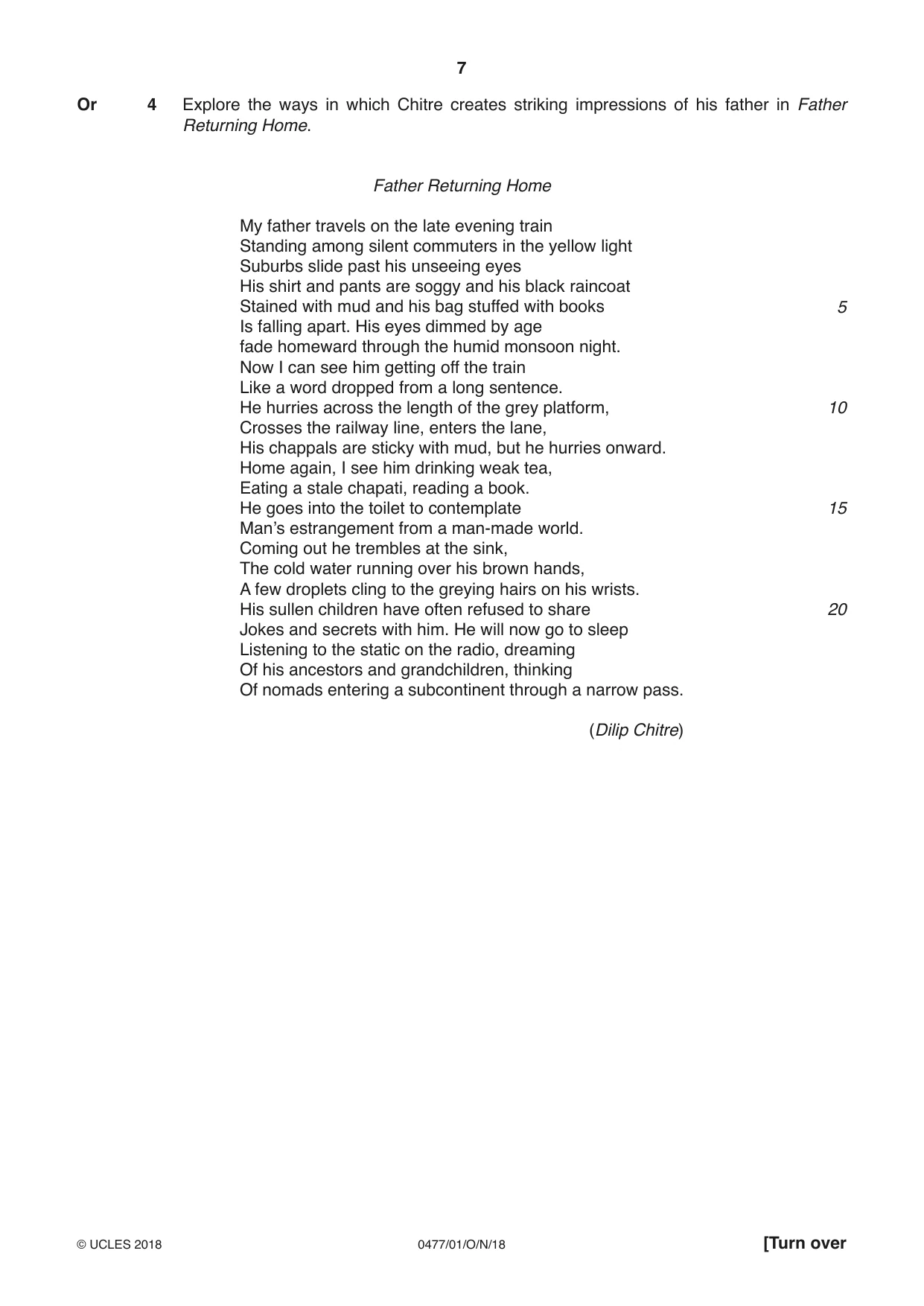
7 0477/01/O/N/18 © UCLES 2018 [Turn over Or 4 Explore the ways in which Chitre creates striking impressions of his father in Father Returning Home. Father Returning Home My father travels on the late evening train Standing among silent commuters in the yellow light Suburbs slide past his unseeing eyes His shirt and pants are soggy and his black raincoat Stained with mud and his bag stuffed with books Is falling apart. His eyes dimmed by age fade homeward through the humid monsoon night. Now I can see him getting off the train Like a word dropped from a long sentence. He hurries across the length of the grey platform, Crosses the railway line, enters the lane, His chappals are sticky with mud, but he hurries onward. Home again, I see him drinking weak tea, Eating a stale chapati, reading a book. He goes into the toilet to contemplate Man’s estrangement from a man-made world. Coming out he trembles at the sink, The cold water running over his brown hands, A few droplets cling to the greying hairs on his wrists. His sullen children have often refused to share Jokes and secrets with him. He will now go to sleep Listening to the static on the radio, dreaming Of his ancestors and grandchildren, thinking Of nomads entering a subcontinent through a narrow pass. (Dilip Chitre) 5 10 15 20
Question paper, page 8
8 0477/01/O/N/18 © UCLES 2018 SECTION B: PROSE Answer one question from this section. CHINUA ACHEBE: No Longer at Ease Remember to support your ideas with details from the writing. Either 5 Read this extract, and then answer the question that follows it: Obi rang Christopher and they arranged to go and play tennis that afternoon with two newly arrived teachers at a Roman Catholic convent in Apapa. Content removed due to copyright restrictions
Question paper, page 9
9 0477/01/O/N/18 © UCLES 2018 [Turn over Obi found himself in the unusual role of defending Roman Catholics. [from Chapter 12] What does Achebe’s writing make you feel at this moment in the novel? Or 6 Explore the ways in which Achebe powerfully depicts the conflict between Obi’s love for Clara and his loyalties to his family. Content removed due to copyright restrictions
Question paper, page 10
10 0477/01/O/N/18 © UCLES 2018 JANE AUSTEN: Mansfield Park Remember to support your ideas with details from the writing. Either 7 Read this extract, and then answer the question that follows it: They entered. Fanny’s imagination had prepared her for something grander than a mere, spacious, oblong room, fitted up for the purpose of devotion—with nothing more striking or more solemn than the profusion of mahogany, and the crimson velvet cushions appearing over the ledge of the family gallery above. ‘I am disappointed, cousin,’ said she, in a low voice to Edmund. ‘This is not my idea of a chapel. There is nothing awful here, nothing melancholy, nothing grand. Here are no aisles, no arches, no inscriptions, no banners. No banners, cousin, to be ‘blown by the night wind of Heaven.’ No signs that a ‘Scottish monarch sleeps below.’’ ‘You forget, Fanny, how lately all this has been built, and for how confined a purpose, compared with the old chapels of castles and monasteries. It was only for the private use of the family. They have been buried, I suppose, in the parish church. There you must look for the banners and the achievements.’ ‘It was foolish of me not to think of all that, but I am disappointed.’ Mrs Rushworth began her relation. ‘This chapel was fitted up as you see it, in James the Second’s time. Before that period, as I understand, the pews were only wainscoat; and there is some reason to think that the linings and cushions of the pulpit and family seat were only purple cloth; but this is not quite certain. It is a handsome chapel, and was formerly in constant use both morning and evening. Prayers were always read in it by the domestic chaplain, within the memory of many. But the late Mr Rushworth left it off.’ ‘Every generation has its improvements,’ said Miss Crawford, with a smile, to Edmund. Mrs Rushworth was gone to repeat her lesson to Mr Crawford; and Edmund, Fanny, and Miss Crawford remained in a cluster together. ‘It is a pity,’ cried Fanny, ‘that the custom should have been discontinued. It was a valuable part of former times. There is something in a chapel and chaplain so much in character with a great house, with one’s ideas of what such a household should be! A whole family assembling regularly for the purpose of prayer, is fine!’ ‘Very fine indeed!’ said Miss Crawford, laughing. ‘It must do the heads of the family a great deal of good to force all the poor housemaids and footmen to leave business and pleasure, and say their prayers here twice a day, while they are inventing excuses themselves for staying away.’ ‘That is hardly Fanny’s idea of a family assembling,’ said Edmund. ‘If the master and mistress do not attend themselves, there must be more harm than good in the custom.’ ‘At any rate, it is safer to leave people to their own devices on such subjects. Every body likes to go their own way—to chuse their own time and manner of devotion. The obligation of attendance, the formality, the restraint, the length of time—altogether it is a formidable thing and what nobody likes; and if the good people who used to kneel and gape in that gallery could have foreseen that the time would ever come when men and women might lie another ten minutes in bed, when they woke with a head-ache, without danger of reprobation, because chapel was missed, they would have jumped with joy and envy. Cannot you imagine with what 5 10 15 20 25 30 35 40 45
Question paper, page 11
11 0477/01/O/N/18 © UCLES 2018 [Turn over unwilling feelings the former belles of the house of Rushworth did many a time repair to this chapel? The young Mrs Eleanors and Mrs Bridgets— starched up into seeming piety, but with heads full of something very different—especially if the poor chaplain were not worth looking at—and, in those days, I fancy parsons were very inferior even to what they are now.’ For a few moments she was unanswered. Fanny coloured and looked at Edmund, but felt too angry for speech; and he needed a little recollection before he could say, ‘Your lively mind can hardly be serious even on serious subjects. You have given us an amusing sketch, and human nature cannot say it was not so. We must all feel at times the difficulty of fixing our thoughts as we could wish; but if you are supposing it a frequent thing, that is to say, a weakness grown into a habit from neglect, what could be expected from the private devotions of such persons? Do you think the minds which are suffered, which are indulged in wanderings in a chapel, would be more collected in a closet?’ [from Chapter 9] Explore the ways in which Austen makes this such a revealing moment in the novel. Or 8 How does Austen make the attempted staging of the play Lovers Vows such a significant part of the novel? 50 55 60
Question paper, page 12
12 0477/01/O/N/18 © UCLES 2018 WILLA CATHER: My Ántonia Remember to support your ideas with details from the writing. Either 9 Read this extract, and then answer the question that follows it: Grandmother was apprehensive at once. ‘I don’t think it’s right for you to stay there, feeling that way. I suppose it wouldn’t be right for you to leave the place alone, either, after giving your word. Maybe Jim would be willing to go over there and sleep, and you could come here nights. I’d feel safer, knowing you were under my own roof. I guess Jim could take care of their silver and old usury notes as well as you could.’ Ántonia turned to me eagerly. ‘Oh, would you, Jim? I’d make up my bed nice and fresh for you. It’s a real cool room, and the bed’s right next the window. I was afraid to leave the window open last night.’ I liked my own room, and I didn’t like the Cutters’ house under any circumstances; but Tony looked so troubled that I consented to try this arrangement. I found that I slept there as well as anywhere, and when I got home in the morning, Tony had a good breakfast waiting for me. After prayers she sat down at the table with us, and it was like old times in the country. The third night I spent at the Cutters’, I awoke suddenly with the impression that I had heard a door open and shut. Everything was still, however, and I must have gone to sleep again immediately. The next thing I knew, I felt someone sit down on the edge of the bed. I was only half awake, but I decided that he might take the Cutters’ silver, whoever he was. Perhaps if I did not move, he would find it and get out without troubling me. I held my breath and lay absolutely still. A hand closed softly on my shoulder, and at the same moment I felt something hairy and cologne-scented brushing my face. If the room had suddenly been flooded with electric light, I couldn’t have seen more clearly the detestable bearded countenance that I knew was bending over me. I caught a handful of whiskers and pulled, shouting something. The hand that held my shoulder was instantly at my throat. The man became insane; he stood over me, choking me with one fist and beating me in the face with the other, hissing and chuckling and letting out a flood of abuse. ‘So this is what she’s up to when I’m away, is it? Where is she, you nasty whelp, where is she? Under the bed, are you, hussy? I know your tricks! Wait till I get at you! I’ll fix this rat you’ve got in here. He’s caught, all right!’ So long as Cutter had me by the throat, there was no chance for me at all. I got hold of his thumb and bent it back, until he let go with a yell. In a bound, I was on my feet, and easily sent him sprawling to the floor. Then I made a dive for the open window, struck the wire screen, knocked it out, and tumbled after it into the yard. Suddenly I found myself running across the north end of Black Hawk in my night-shirt, just as one sometimes finds one’s self behaving in bad dreams. When I got home, I climbed in at the kitchen window. I was covered with blood from my nose and lip, but I was too sick to do anything about it. I found a shawl and an overcoat on the hat-rack, lay down on the parlour sofa, and in spite of my hurts, went to sleep. Grandmother found me there in the morning. Her cry of fright awakened me. Truly, I was a battered object. As she helped me to my room, I caught a glimpse of myself in the mirror. My lip was cut and stood 5 10 15 20 25 30 35 40 45
Question paper, page 13
13 0477/01/O/N/18 © UCLES 2018 [Turn over out like a snout. My nose looked like a big blue plum, and one eye was swollen shut and hideously discoloured. Grandmother said we must have the doctor at once, but I implored her, as I had never begged for anything before, not to send for him. I could stand anything, I told her, so long as nobody saw me or knew what had happened to me. I entreated her not to let grandfather, even, come into my room. She seemed to understand, though I was too faint and miserable to go into explanations. When she took off my night-shirt, she found such bruises on my chest and shoulders that she began to cry. She spent the whole morning bathing and poulticing me, and rubbing me with arnica. I heard Ántonia sobbing outside my door, but I asked grandmother to send her away. I felt that I never wanted to see her again. I hated her almost as much as I hated Cutter. She had let me in for all this disgustingness. Grandmother kept saying how thankful we ought to be that I had been there instead of Ántonia. But I lay with my disfigured face to the wall and felt no particular gratitude. My one concern was that grandmother should keep everyone away from me. If the story once got abroad, I would never hear the last of it. I could well imagine what the old men down at the drugstore would do with such a theme. [from Book 2 Chapter 15] How does Cather make this such a dramatic moment in the novel? Or 10 What does Cather’s portrayal of the adult Ántonia’s relationships with men make you feel towards her? 50 55 60 65
Question paper, page 14
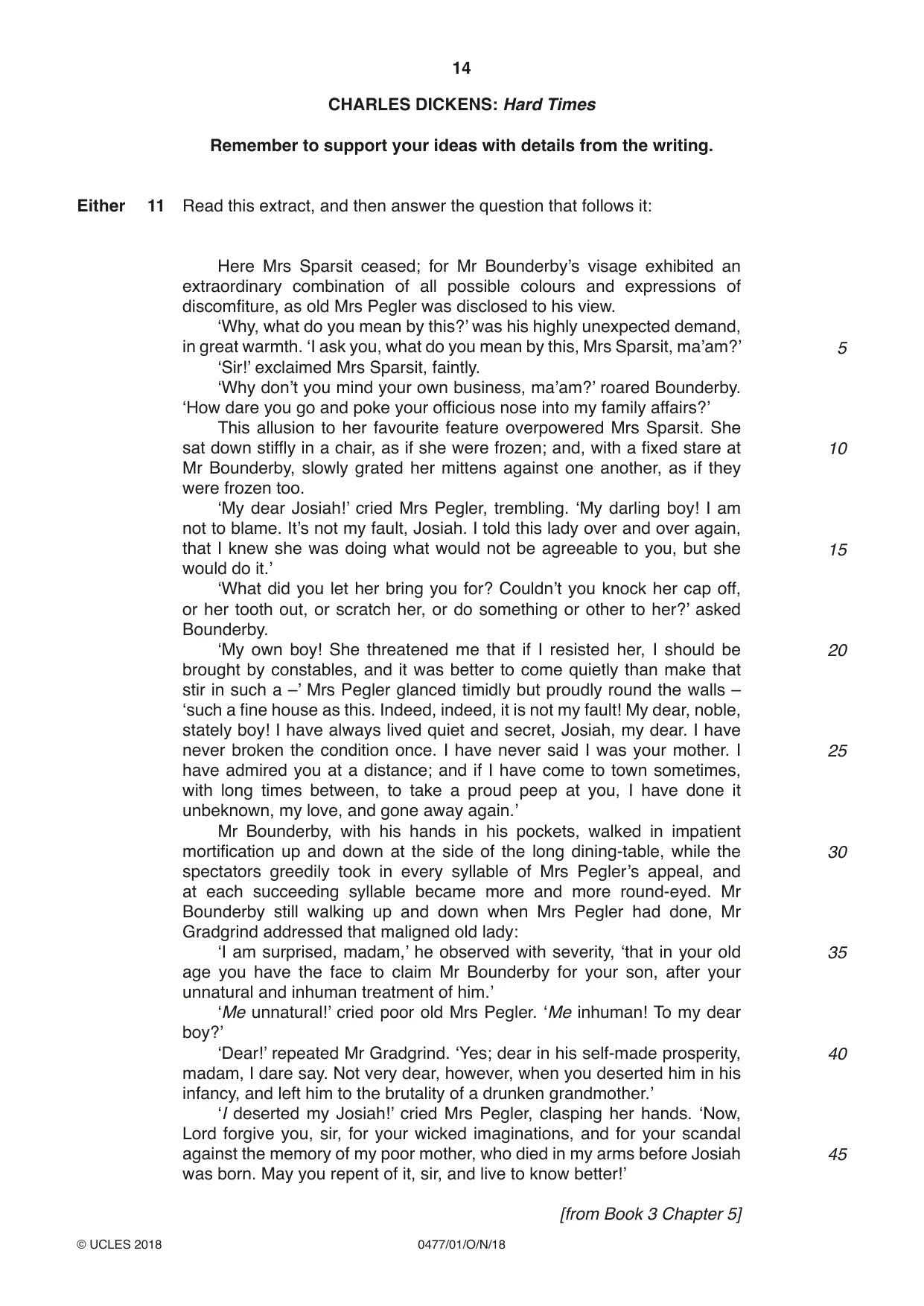
14 0477/01/O/N/18 © UCLES 2018 CHARLES DICKENS: Hard Times Remember to support your ideas with details from the writing. Either 11 Read this extract, and then answer the question that follows it: Here Mrs Sparsit ceased; for Mr Bounderby’s visage exhibited an extraordinary combination of all possible colours and expressions of discomfiture, as old Mrs Pegler was disclosed to his view. ‘Why, what do you mean by this?’ was his highly unexpected demand, in great warmth. ‘I ask you, what do you mean by this, Mrs Sparsit, ma’am?’ ‘Sir!’ exclaimed Mrs Sparsit, faintly. ‘Why don’t you mind your own business, ma’am?’ roared Bounderby. ‘How dare you go and poke your officious nose into my family affairs?’ This allusion to her favourite feature overpowered Mrs Sparsit. She sat down stiffly in a chair, as if she were frozen; and, with a fixed stare at Mr Bounderby, slowly grated her mittens against one another, as if they were frozen too. ‘My dear Josiah!’ cried Mrs Pegler, trembling. ‘My darling boy! I am not to blame. It’s not my fault, Josiah. I told this lady over and over again, that I knew she was doing what would not be agreeable to you, but she would do it.’ ‘What did you let her bring you for? Couldn’t you knock her cap off, or her tooth out, or scratch her, or do something or other to her?’ asked Bounderby. ‘My own boy! She threatened me that if I resisted her, I should be brought by constables, and it was better to come quietly than make that stir in such a –’ Mrs Pegler glanced timidly but proudly round the walls – ‘such a fine house as this. Indeed, indeed, it is not my fault! My dear, noble, stately boy! I have always lived quiet and secret, Josiah, my dear. I have never broken the condition once. I have never said I was your mother. I have admired you at a distance; and if I have come to town sometimes, with long times between, to take a proud peep at you, I have done it unbeknown, my love, and gone away again.’ Mr Bounderby, with his hands in his pockets, walked in impatient mortification up and down at the side of the long dining-table, while the spectators greedily took in every syllable of Mrs Pegler’s appeal, and at each succeeding syllable became more and more round-eyed. Mr Bounderby still walking up and down when Mrs Pegler had done, Mr Gradgrind addressed that maligned old lady: ‘I am surprised, madam,’ he observed with severity, ‘that in your old age you have the face to claim Mr Bounderby for your son, after your unnatural and inhuman treatment of him.’ ‘Me unnatural!’ cried poor old Mrs Pegler. ‘Me inhuman! To my dear boy?’ ‘Dear!’ repeated Mr Gradgrind. ‘Yes; dear in his self-made prosperity, madam, I dare say. Not very dear, however, when you deserted him in his infancy, and left him to the brutality of a drunken grandmother.’ ‘I deserted my Josiah!’ cried Mrs Pegler, clasping her hands. ‘Now, Lord forgive you, sir, for your wicked imaginations, and for your scandal against the memory of my poor mother, who died in my arms before Josiah was born. May you repent of it, sir, and live to know better!’ [from Book 3 Chapter 5] 5 10 15 20 25 30 35 40 45
Question paper, page 15
15 0477/01/O/N/18 © UCLES 2018 [Turn over How does Dickens make Bounderby both unpleasant and ridiculous at this moment in the novel? Or 12 What makes Dickens’s portrayal of the circus and its people so attractive?
Question paper, page 16
16 0477/01/O/N/18 © UCLES 2018 MICHAEL FRAYN: Spies Remember to support your ideas with details from the writing. Either 13 Read this extract, and then answer the question that follows it: The barking of the dogs has long ceased. Content removed due to copyright restrictions
Question paper, page 17
17 0477/01/O/N/18 © UCLES 2018 [Turn over The game’s finally over. [from Chapter 10] How does Frayn make this such a dramatic climax to the novel? Or 14 Explore the ways in which Frayn makes Keith’s father so frightening. Content removed due to copyright restrictions
Question paper, page 18
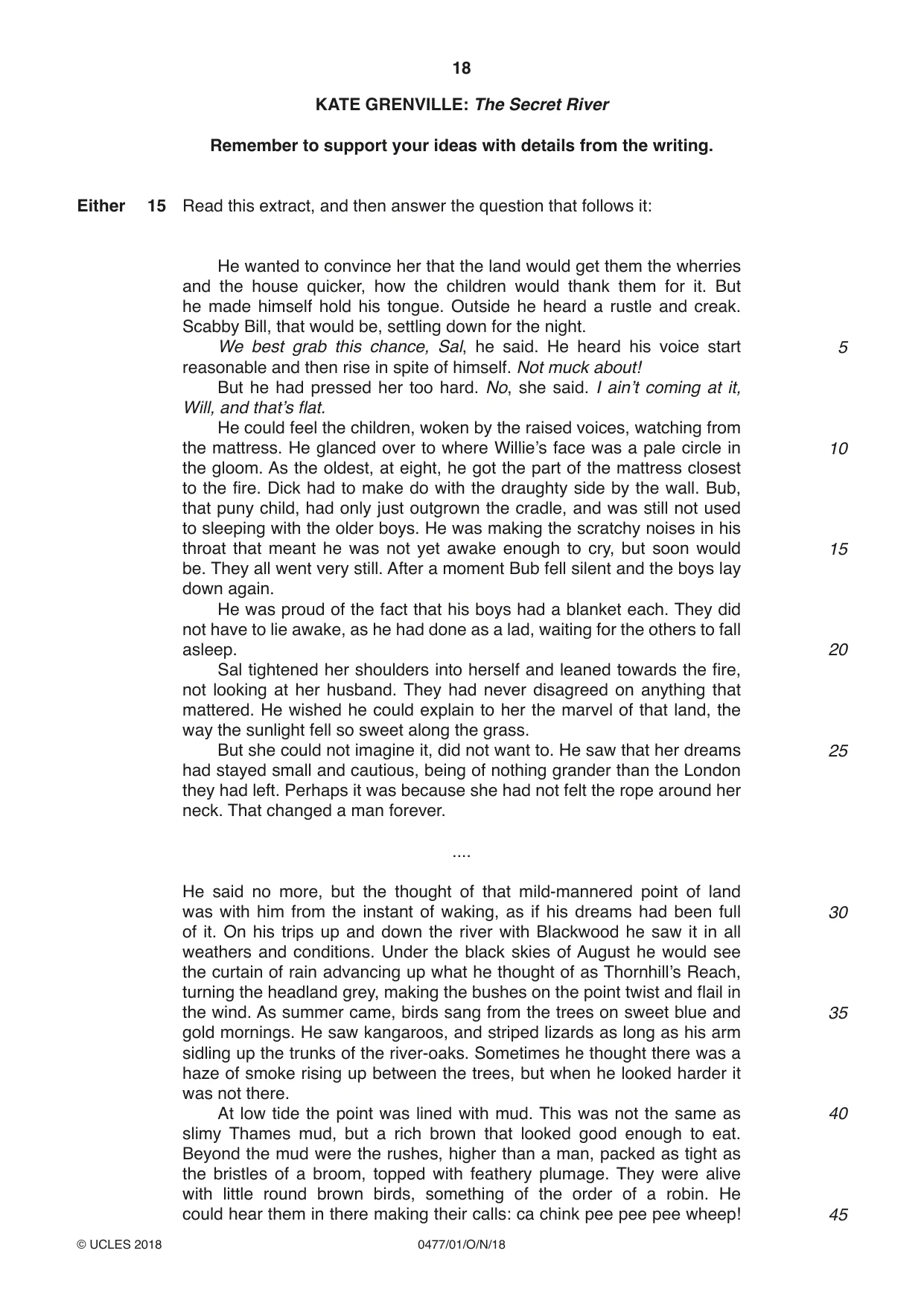
18 0477/01/O/N/18 © UCLES 2018 KATE GRENVILLE: The Secret River Remember to support your ideas with details from the writing. Either 15 Read this extract, and then answer the question that follows it: He wanted to convince her that the land would get them the wherries and the house quicker, how the children would thank them for it. But he made himself hold his tongue. Outside he heard a rustle and creak. Scabby Bill, that would be, settling down for the night. We best grab this chance, Sal, he said. He heard his voice start reasonable and then rise in spite of himself. Not muck about! But he had pressed her too hard. No, she said. I ain’t coming at it, Will, and that’s flat. He could feel the children, woken by the raised voices, watching from the mattress. He glanced over to where Willie’s face was a pale circle in the gloom. As the oldest, at eight, he got the part of the mattress closest to the fire. Dick had to make do with the draughty side by the wall. Bub, that puny child, had only just outgrown the cradle, and was still not used to sleeping with the older boys. He was making the scratchy noises in his throat that meant he was not yet awake enough to cry, but soon would be. They all went very still. After a moment Bub fell silent and the boys lay down again. He was proud of the fact that his boys had a blanket each. They did not have to lie awake, as he had done as a lad, waiting for the others to fall asleep. Sal tightened her shoulders into herself and leaned towards the fire, not looking at her husband. They had never disagreed on anything that mattered. He wished he could explain to her the marvel of that land, the way the sunlight fell so sweet along the grass. But she could not imagine it, did not want to. He saw that her dreams had stayed small and cautious, being of nothing grander than the London they had left. Perhaps it was because she had not felt the rope around her neck. That changed a man forever. … He said no more, but the thought of that mild-mannered point of land was with him from the instant of waking, as if his dreams had been full of it. On his trips up and down the river with Blackwood he saw it in all weathers and conditions. Under the black skies of August he would see the curtain of rain advancing up what he thought of as Thornhill’s Reach, turning the headland grey, making the bushes on the point twist and flail in the wind. As summer came, birds sang from the trees on sweet blue and gold mornings. He saw kangaroos, and striped lizards as long as his arm sidling up the trunks of the river-oaks. Sometimes he thought there was a haze of smoke rising up between the trees, but when he looked harder it was not there. At low tide the point was lined with mud. This was not the same as slimy Thames mud, but a rich brown that looked good enough to eat. Beyond the mud were the rushes, higher than a man, packed as tight as the bristles of a broom, topped with feathery plumage. They were alive with little round brown birds, something of the order of a robin. He could hear them in there making their calls: ca chink pee pee pee wheep! 5 10 15 20 25 30 35 40 45
Question paper, page 19
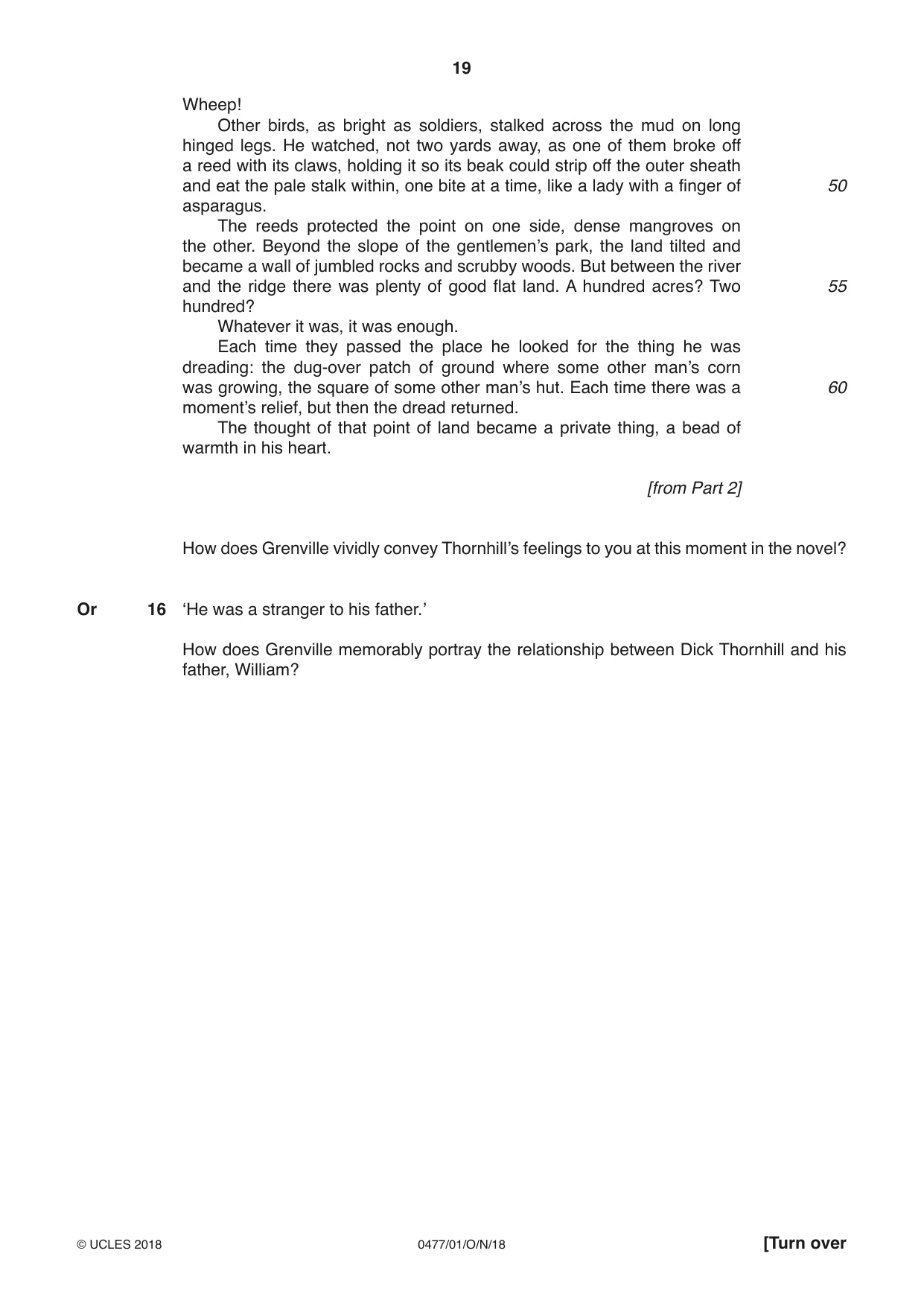
19 0477/01/O/N/18 © UCLES 2018 [Turn over Wheep! Other birds, as bright as soldiers, stalked across the mud on long hinged legs. He watched, not two yards away, as one of them broke off a reed with its claws, holding it so its beak could strip off the outer sheath and eat the pale stalk within, one bite at a time, like a lady with a finger of asparagus. The reeds protected the point on one side, dense mangroves on the other. Beyond the slope of the gentlemen’s park, the land tilted and became a wall of jumbled rocks and scrubby woods. But between the river and the ridge there was plenty of good flat land. A hundred acres? Two hundred? Whatever it was, it was enough. Each time they passed the place he looked for the thing he was dreading: the dug-over patch of ground where some other man’s corn was growing, the square of some other man’s hut. Each time there was a moment’s relief, but then the dread returned. The thought of that point of land became a private thing, a bead of warmth in his heart. [from Part 2] How does Grenville vividly convey Thornhill’s feelings to you at this moment in the novel? Or 16 ‘He was a stranger to his father.’ How does Grenville memorably portray the relationship between Dick Thornhill and his father, William? 50 55 60
Question paper, page 20
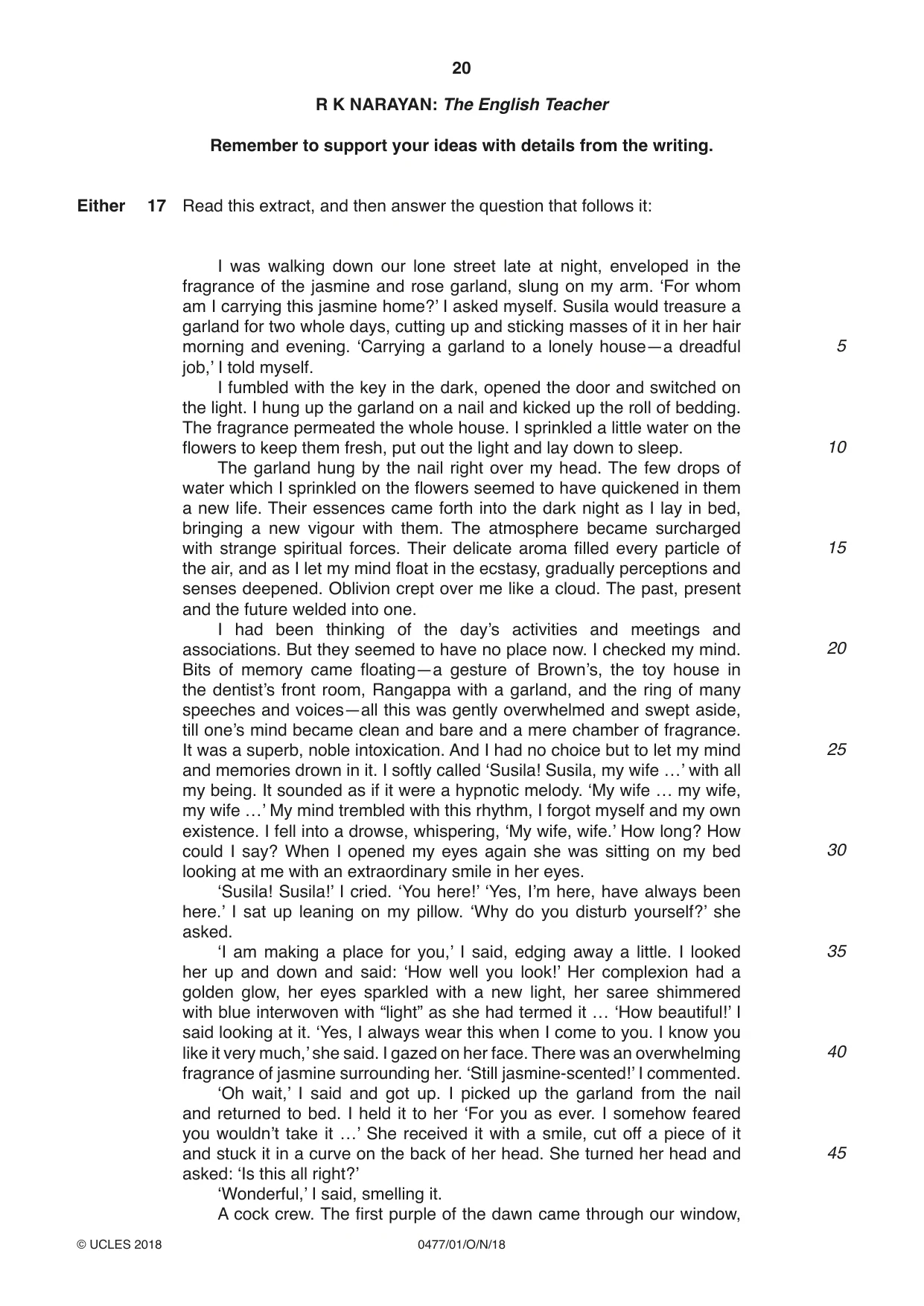
20 0477/01/O/N/18 © UCLES 2018 R K NARAYAN: The English Teacher Remember to support your ideas with details from the writing. Either 17 Read this extract, and then answer the question that follows it: I was walking down our lone street late at night, enveloped in the fragrance of the jasmine and rose garland, slung on my arm. ‘For whom am I carrying this jasmine home?’ I asked myself. Susila would treasure a garland for two whole days, cutting up and sticking masses of it in her hair morning and evening. ‘Carrying a garland to a lonely house—a dreadful job,’ I told myself. I fumbled with the key in the dark, opened the door and switched on the light. I hung up the garland on a nail and kicked up the roll of bedding. The fragrance permeated the whole house. I sprinkled a little water on the flowers to keep them fresh, put out the light and lay down to sleep. The garland hung by the nail right over my head. The few drops of water which I sprinkled on the flowers seemed to have quickened in them a new life. Their essences came forth into the dark night as I lay in bed, bringing a new vigour with them. The atmosphere became surcharged with strange spiritual forces. Their delicate aroma filled every particle of the air, and as I let my mind float in the ecstasy, gradually perceptions and senses deepened. Oblivion crept over me like a cloud. The past, present and the future welded into one. I had been thinking of the day’s activities and meetings and associations. But they seemed to have no place now. I checked my mind. Bits of memory came floating—a gesture of Brown’s, the toy house in the dentist’s front room, Rangappa with a garland, and the ring of many speeches and voices—all this was gently overwhelmed and swept aside, till one’s mind became clean and bare and a mere chamber of fragrance. It was a superb, noble intoxication. And I had no choice but to let my mind and memories drown in it. I softly called ‘Susila! Susila, my wife …’ with all my being. It sounded as if it were a hypnotic melody. ‘My wife … my wife, my wife …’ My mind trembled with this rhythm, I forgot myself and my own existence. I fell into a drowse, whispering, ‘My wife, wife.’ How long? How could I say? When I opened my eyes again she was sitting on my bed looking at me with an extraordinary smile in her eyes. ‘Susila! Susila!’ I cried. ‘You here!’ ‘Yes, I’m here, have always been here.’ I sat up leaning on my pillow. ‘Why do you disturb yourself?’ she asked. ‘I am making a place for you,’ I said, edging away a little. I looked her up and down and said: ‘How well you look!’ Her complexion had a golden glow, her eyes sparkled with a new light, her saree shimmered with blue interwoven with “light” as she had termed it … ‘How beautiful!’ I said looking at it. ‘Yes, I always wear this when I come to you. I know you like it very much,’ she said. I gazed on her face. There was an overwhelming fragrance of jasmine surrounding her. ‘Still jasmine-scented!’ I commented. ‘Oh wait,’ I said and got up. I picked up the garland from the nail and returned to bed. I held it to her ‘For you as ever. I somehow feared you wouldn’t take it …’ She received it with a smile, cut off a piece of it and stuck it in a curve on the back of her head. She turned her head and asked: ‘Is this all right?’ ‘Wonderful,’ I said, smelling it. A cock crew. The first purple of the dawn came through our window, 5 10 15 20 25 30 35 40 45
Question paper, page 21
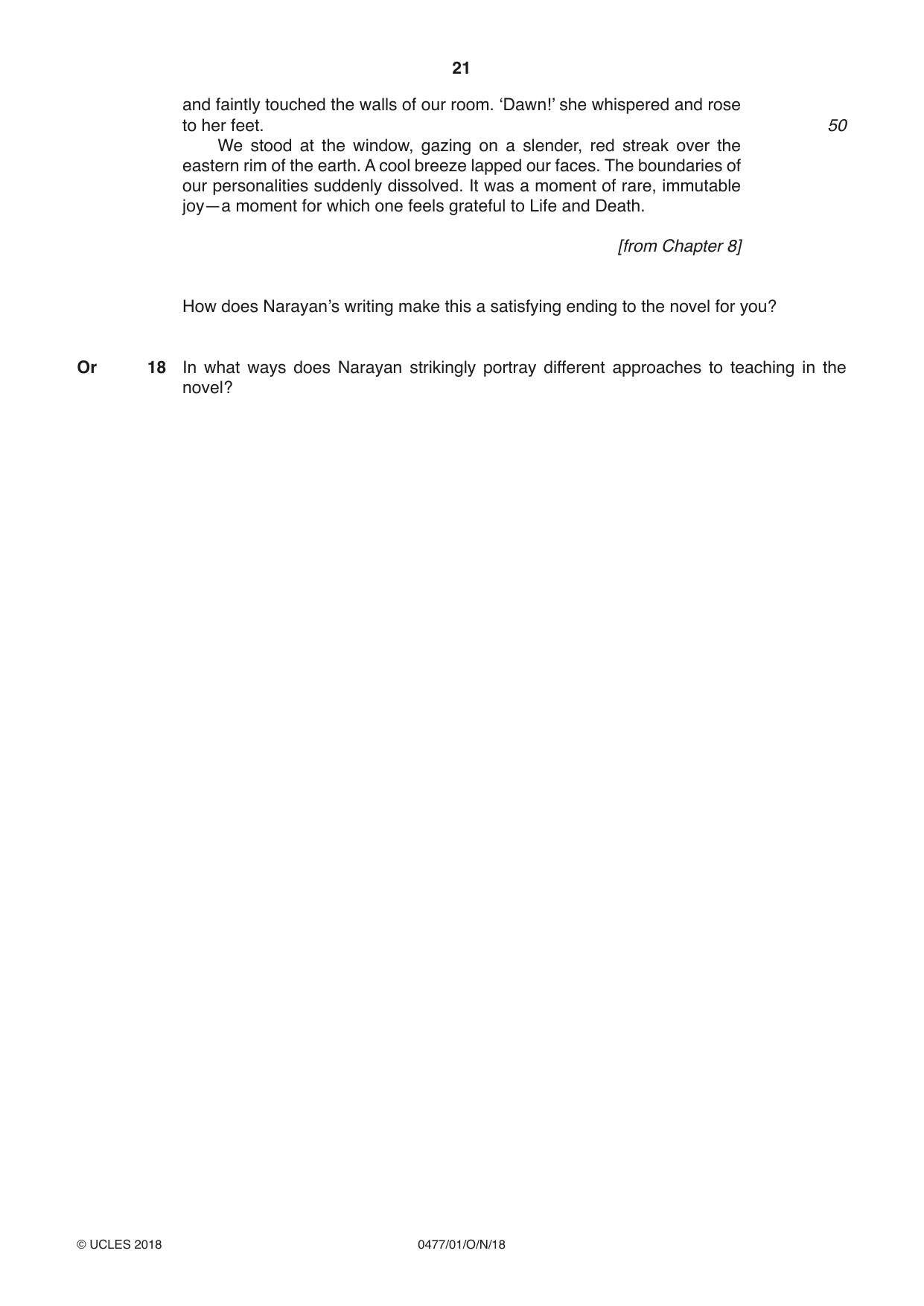
21 0477/01/O/N/18 © UCLES 2018 and faintly touched the walls of our room. ‘Dawn!’ she whispered and rose to her feet. We stood at the window, gazing on a slender, red streak over the eastern rim of the earth. A cool breeze lapped our faces. The boundaries of our personalities suddenly dissolved. It was a moment of rare, immutable joy—a moment for which one feels grateful to Life and Death. [from Chapter 8] How does Narayan’s writing make this a satisfying ending to the novel for you? Or 18 In what ways does Narayan strikingly portray different approaches to teaching in the novel? 50
Question paper, page 22
22 0477/01/O/N/18 © UCLES 2018 BLANK PAGE
Question paper, page 23
23 0477/01/O/N/18 © UCLES 2018 BLANK PAGE
Question paper, page 24
24 0477/01/O/N/18 © UCLES 2018 Permission to reproduce items where third-party owned material protected by copyright is included has been sought and cleared where possible. Every reasonable effort has been made by the publisher (UCLES) to trace copyright holders, but if any items requiring clearance have unwittingly been included, the publisher will be pleased to make amends at the earliest possible opportunity. To avoid the issue of disclosure of answer-related information to candidates, all copyright acknowledgements are reproduced online in the Cambridge International Examinations Copyright Acknowledgements Booklet. This is produced for each series of examinations and is freely available to download at www.cie.org.uk after the live examination series. Cambridge International Examinations is part of the Cambridge Assessment Group. Cambridge Assessment is the brand name of University of Cambridge Local Examinations Syndicate (UCLES), which is itself a department of the University of Cambridge. BLANK PAGE