Cambridge IGCSE English - Literature (9-1) (UK only) 0477 — 2019 May/June Paper 3 · Variant 1
0477/31/M/J/19 · 40 marks · ≈45 min
The question paper and its mark scheme, free to read here and free to download. This is Cambridge’s own paper, exactly as it was sat.
Question paper8 pages
Mark scheme6 pages
Answers below. Sit the paper first if you are practising.
Paper as text
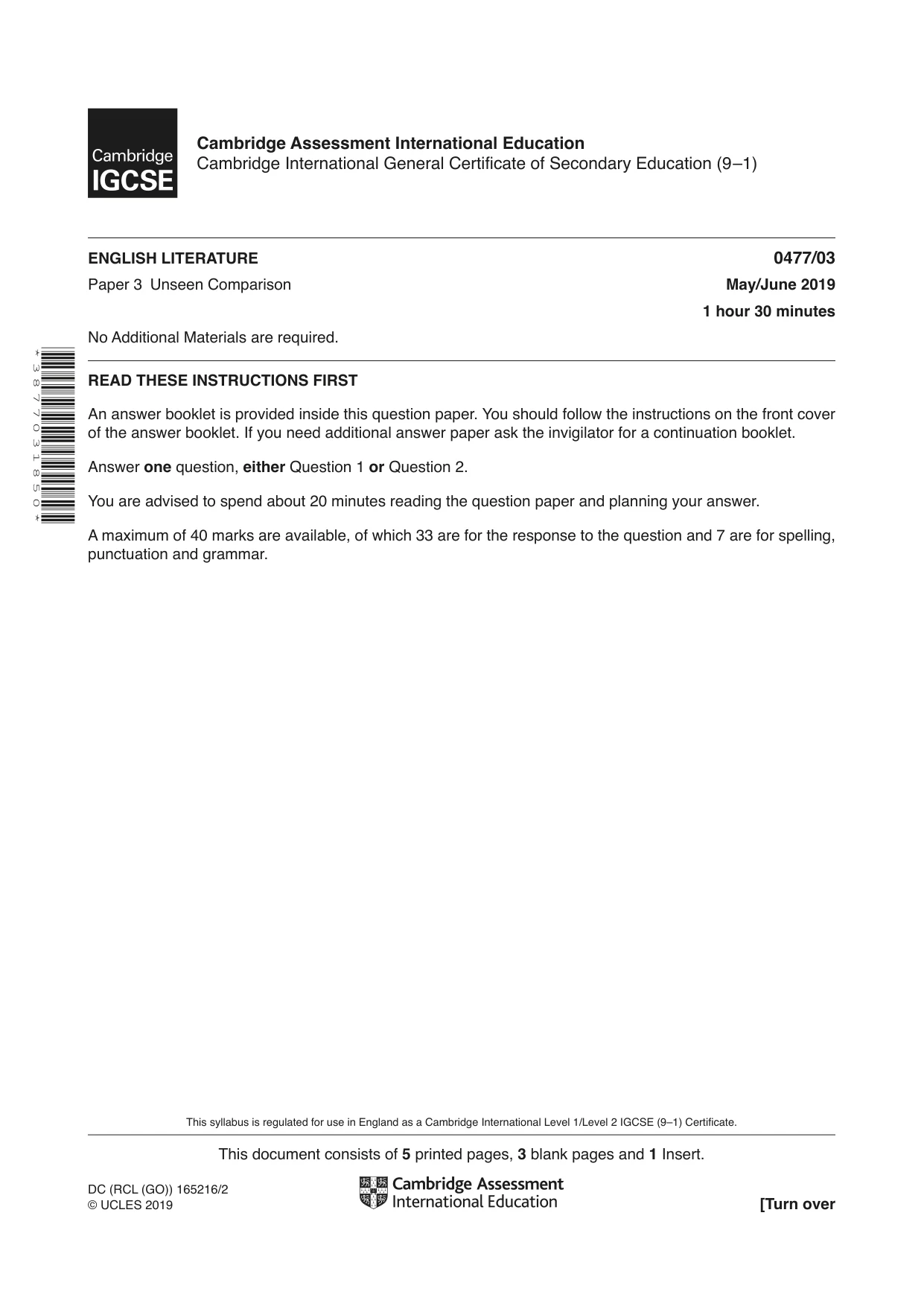
Question paper, page 1
This document consists of 5 printed pages, 3 blank pages and 1 Insert. DC (RCL (GO)) 165216/2 © UCLES 2019 [Turn over Cambridge Assessment International Education Cambridge International General Certificate of Secondary Education (9 –1) * 3 8 7 7 0 3 1 8 5 0 * ENGLISH LITERATURE 0477/03 Paper 3 Unseen Comparison May/June 2019 1 hour 30 minutes No Additional Materials are required. READ THESE INSTRUCTIONS FIRST An answer booklet is provided inside this question paper. You should follow the instructions on the front cover of the answer booklet. If you need additional answer paper ask the invigilator for a continuation booklet. Answer one question, either Question 1 or Question 2. You are advised to spend about 20 minutes reading the question paper and planning your answer. A maximum of 40 marks are available, of which 33 are for the response to the question and 7 are for spelling, punctuation and grammar. This syllabus is regulated for use in England as a Cambridge International Level 1/Level 2 IGCSE (9–1) Certificate.
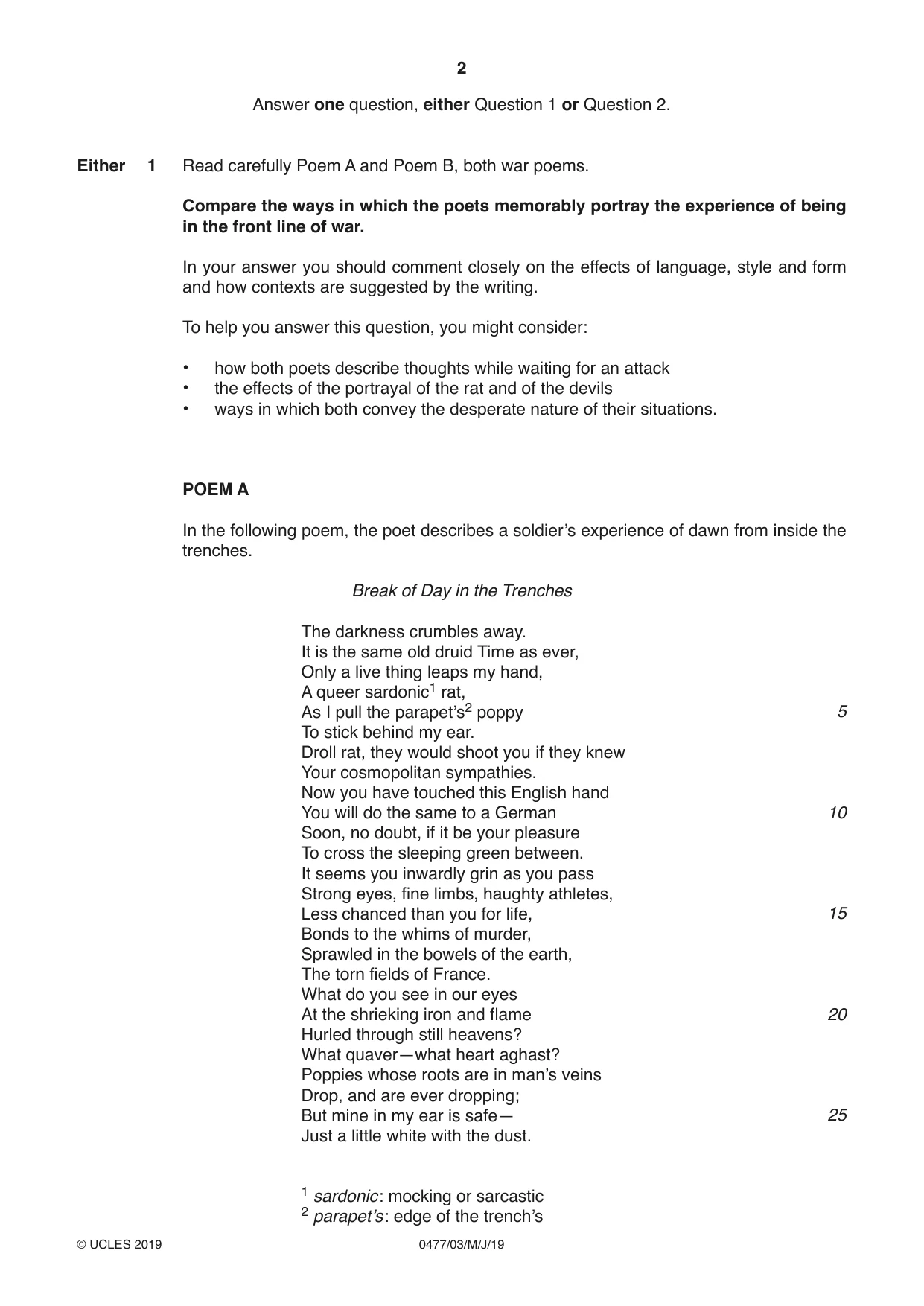
Question paper, page 2
2 0477/03/M/J/19 © UCLES 2019 Answer one question, either Question 1 or Question 2. Either 1 Read carefully Poem A and Poem B, both war poems. Compare the ways in which the poets memorably portray the experience of being in the front line of war. In your answer you should comment closely on the effects of language, style and form and how contexts are suggested by the writing. To help you answer this question, you might consider: • how both poets describe thoughts while waiting for an attack • the effects of the portrayal of the rat and of the devils • ways in which both convey the desperate nature of their situations. POEM A In the following poem, the poet describes a soldier’s experience of dawn from inside the trenches. Break of Day in the Trenches The darkness crumbles away. It is the same old druid Time as ever, Only a live thing leaps my hand, A queer sardonic1 rat, As I pull the parapet’s2 poppy To stick behind my ear. Droll rat, they would shoot you if they knew Your cosmopolitan sympathies. Now you have touched this English hand You will do the same to a German Soon, no doubt, if it be your pleasure To cross the sleeping green between. It seems you inwardly grin as you pass Strong eyes, fine limbs, haughty athletes, Less chanced than you for life, Bonds to the whims of murder, Sprawled in the bowels of the earth, The torn fields of France. What do you see in our eyes At the shrieking iron and flame Hurled through still heavens? What quaver—what heart aghast? Poppies whose roots are in man’s veins Drop, and are ever dropping; But mine in my ear is safe— Just a little white with the dust. 1 sardonic : mocking or sarcastic 2 parapet’s : edge of the trench’s 5 10 15 20 25
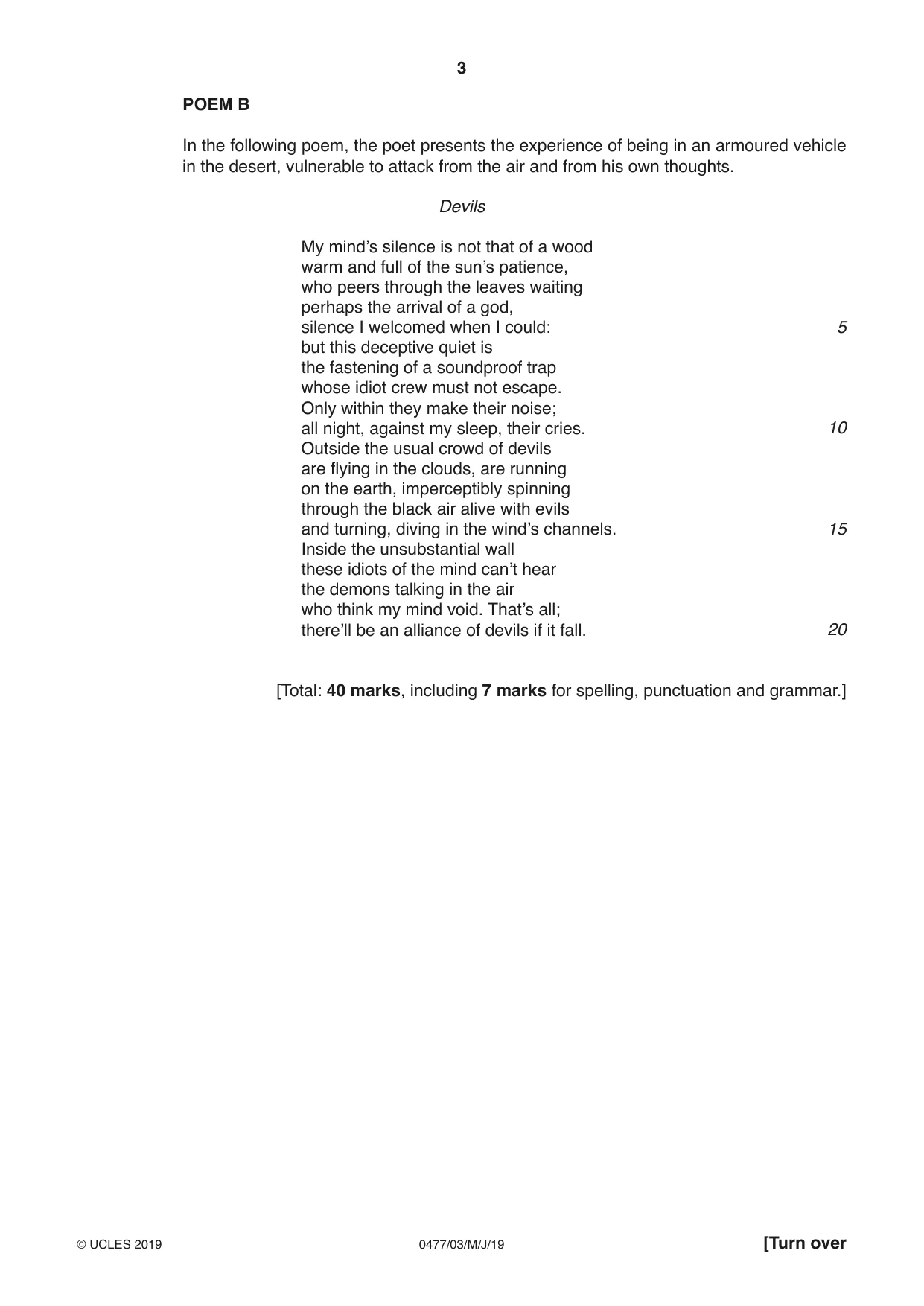
Question paper, page 3
3 0477/03/M/J/19 © UCLES 2019 [Turn over POEM B In the following poem, the poet presents the experience of being in an armoured vehicle in the desert, vulnerable to attack from the air and from his own thoughts. Devils My mind’s silence is not that of a wood warm and full of the sun’s patience, who peers through the leaves waiting perhaps the arrival of a god, silence I welcomed when I could: but this deceptive quiet is the fastening of a soundproof trap whose idiot crew must not escape. Only within they make their noise; all night, against my sleep, their cries. Outside the usual crowd of devils are flying in the clouds, are running on the earth, imperceptibly spinning through the black air alive with evils and turning, diving in the wind’s channels. Inside the unsubstantial wall these idiots of the mind can’t hear the demons talking in the air who think my mind void. That’s all; there’ll be an alliance of devils if it fall. [Total: 40 marks, including 7 marks for spelling, punctuation and grammar.] 5 10 15 20
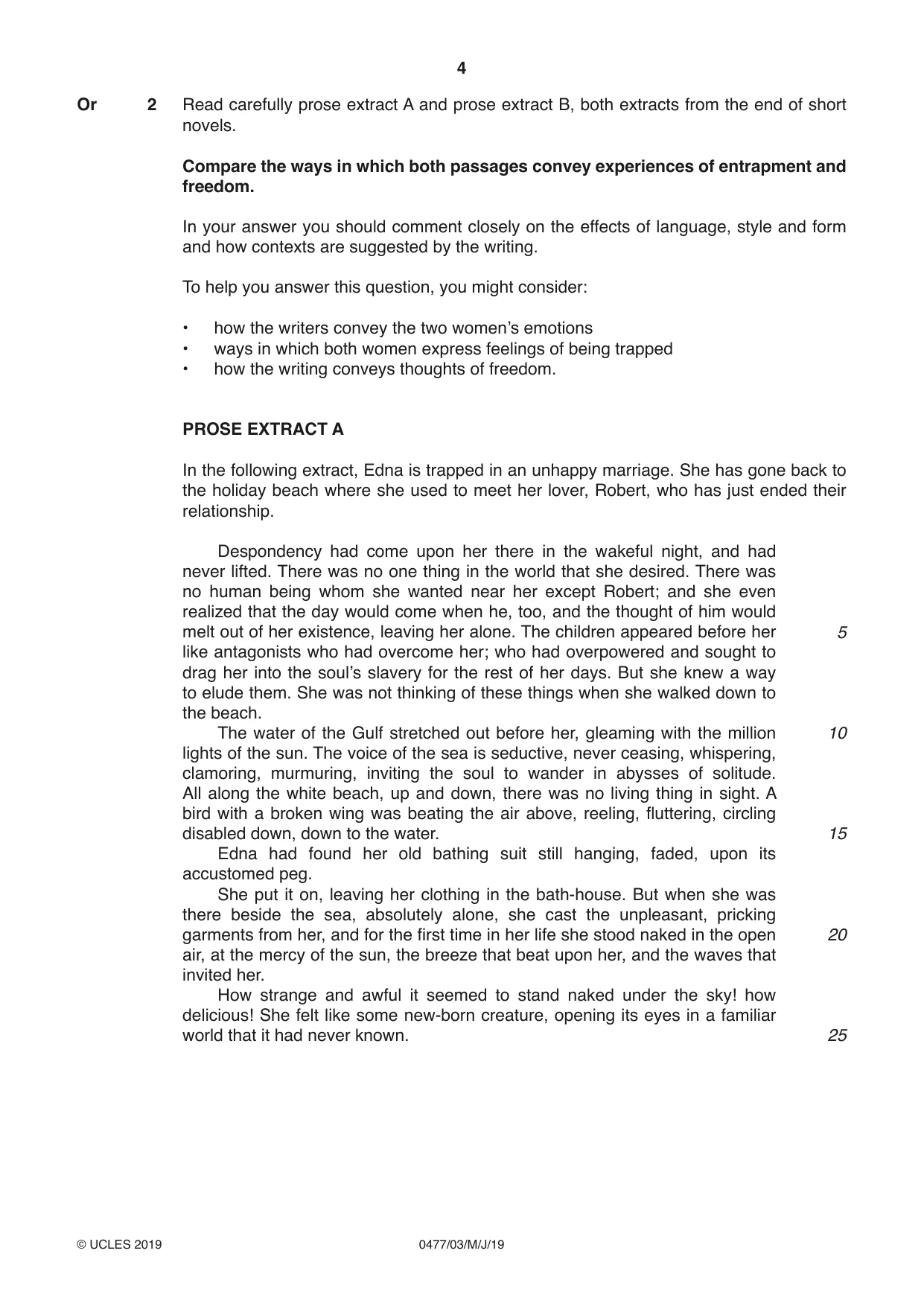
Question paper, page 4
4 0477/03/M/J/19 © UCLES 2019 Or 2 Read carefully prose extract A and prose extract B, both extracts from the end of short novels. Compare the ways in which both passages convey experiences of entrapment and freedom. In your answer you should comment closely on the effects of language, style and form and how contexts are suggested by the writing. To help you answer this question, you might consider: • how the writers convey the two women’s emotions • ways in which both women express feelings of being trapped • how the writing conveys thoughts of freedom. PROSE EXTRACT A In the following extract, Edna is trapped in an unhappy marriage. She has gone back to the holiday beach where she used to meet her lover, Robert, who has just ended their relationship. Despondency had come upon her there in the wakeful night, and had never lifted. There was no one thing in the world that she desired. There was no human being whom she wanted near her except Robert; and she even realized that the day would come when he, too, and the thought of him would melt out of her existence, leaving her alone. The children appeared before her like antagonists who had overcome her; who had overpowered and sought to drag her into the soul’s slavery for the rest of her days. But she knew a way to elude them. She was not thinking of these things when she walked down to the beach. The water of the Gulf stretched out before her, gleaming with the million lights of the sun. The voice of the sea is seductive, never ceasing, whispering, clamoring, murmuring, inviting the soul to wander in abysses of solitude. All along the white beach, up and down, there was no living thing in sight. A bird with a broken wing was beating the air above, reeling, fluttering, circling disabled down, down to the water. Edna had found her old bathing suit still hanging, faded, upon its accustomed peg. She put it on, leaving her clothing in the bath-house. But when she was there beside the sea, absolutely alone, she cast the unpleasant, pricking garments from her, and for the first time in her life she stood naked in the open air, at the mercy of the sun, the breeze that beat upon her, and the waves that invited her. How strange and awful it seemed to stand naked under the sky! how delicious! She felt like some new-born creature, opening its eyes in a familiar world that it had never known. 5 10 15 20 25
Question paper, page 5
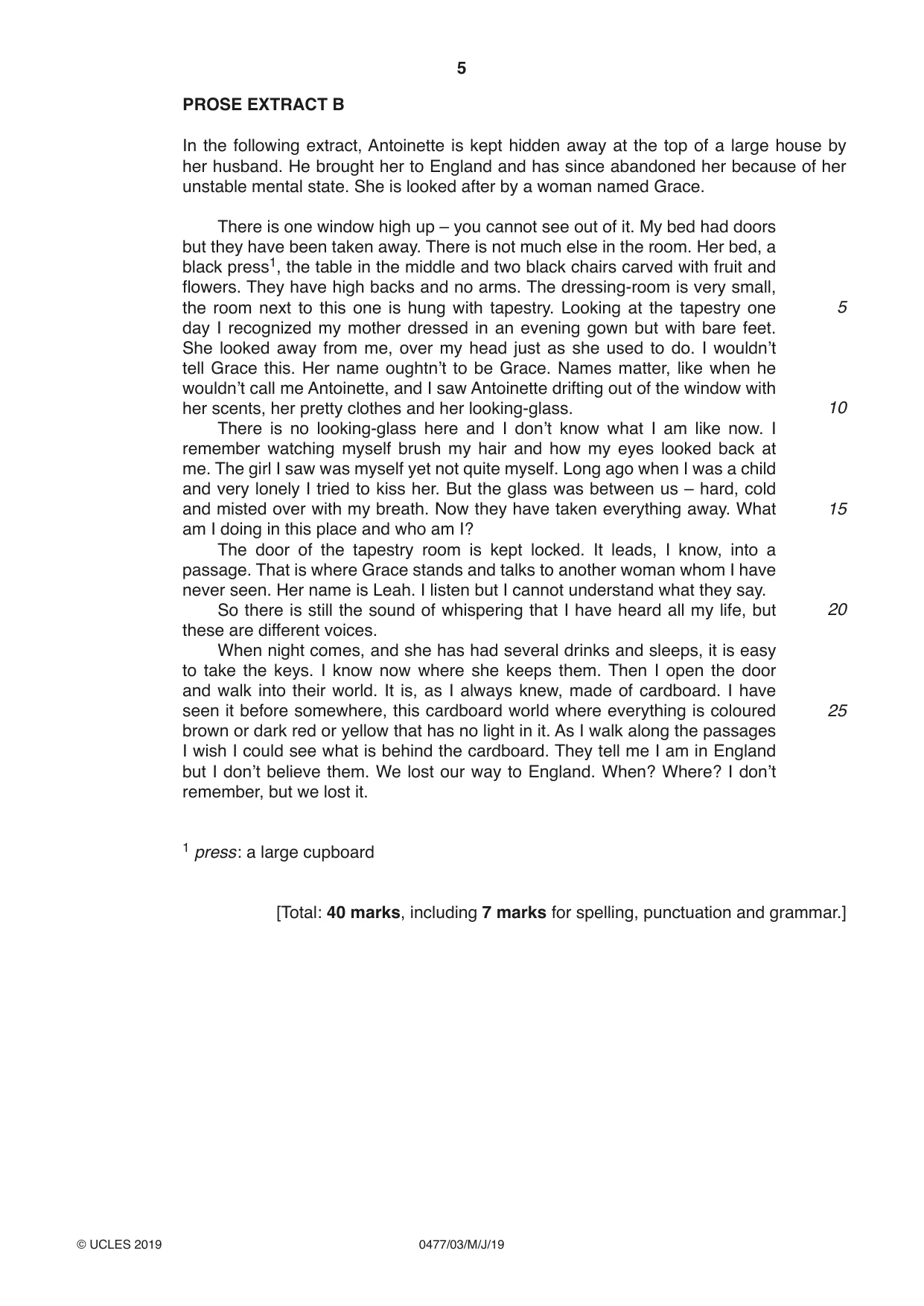
5 0477/03/M/J/19 © UCLES 2019 PROSE EXTRACT B In the following extract, Antoinette is kept hidden away at the top of a large house by her husband. He brought her to England and has since abandoned her because of her unstable mental state. She is looked after by a woman named Grace. There is one window high up – you cannot see out of it. My bed had doors but they have been taken away. There is not much else in the room. Her bed, a black press1, the table in the middle and two black chairs carved with fruit and flowers. They have high backs and no arms. The dressing-room is very small, the room next to this one is hung with tapestry. Looking at the tapestry one day I recognized my mother dressed in an evening gown but with bare feet. She looked away from me, over my head just as she used to do. I wouldn’t tell Grace this. Her name oughtn’t to be Grace. Names matter, like when he wouldn’t call me Antoinette, and I saw Antoinette drifting out of the window with her scents, her pretty clothes and her looking-glass. There is no looking-glass here and I don’t know what I am like now. I remember watching myself brush my hair and how my eyes looked back at me. The girl I saw was myself yet not quite myself. Long ago when I was a child and very lonely I tried to kiss her. But the glass was between us – hard, cold and misted over with my breath. Now they have taken everything away. What am I doing in this place and who am I? The door of the tapestry room is kept locked. It leads, I know, into a passage. That is where Grace stands and talks to another woman whom I have never seen. Her name is Leah. I listen but I cannot understand what they say. So there is still the sound of whispering that I have heard all my life, but these are different voices. When night comes, and she has had several drinks and sleeps, it is easy to take the keys. I know now where she keeps them. Then I open the door and walk into their world. It is, as I always knew, made of cardboard. I have seen it before somewhere, this cardboard world where everything is coloured brown or dark red or yellow that has no light in it. As I walk along the passages I wish I could see what is behind the cardboard. They tell me I am in England but I don’t believe them. We lost our way to England. When? Where? I don’t remember, but we lost it. 1 press: a large cupboard [Total: 40 marks, including 7 marks for spelling, punctuation and grammar.] 5 10 15 20 25
Question paper, page 6
6 0477/03/M/J/19 © UCLES 2019 BLANK PAGE
Question paper, page 7
7 0477/03/M/J/19 © UCLES 2019 BLANK PAGE
Question paper, page 8
8 0477/03/M/J/19 © UCLES 2019 Permission to reproduce items where third-party owned material protected by copyright is included has been sought and cleared where possible. Every reasonable effort has been made by the publisher (UCLES) to trace copyright holders, but if any items requiring clearance have unwittingly been included, the publisher will be pleased to make amends at the earliest possible opportunity. To avoid the issue of disclosure of answer-related information to candidates, all copyright acknowledgements are reproduced online in the Cambridge Assessment International Education Copyright Acknowledgements Booklet. This is produced for each series of examinations and is freely available to download at www.cambridgeinternational.org after the live examination series. Cambridge Assessment International Education is part of the Cambridge Assessment Group. Cambridge Assessment is the brand name of the University of Cambridge Local Examinations Syndicate (UCLES), which itself is a department of the University of Cambridge. BLANK PAGE
Mark scheme, page 1
This syllabus is regulated for use in England as a Cambridge International Level 1/Level 2 (9–1) Certificate. This document consists of 6 printed pages. © UCLES 2019 [Turn over Cambridge Assessment International Education Cambridge International General Certificate of Secondary Education (9–1) ENGLISH LITERATURE 0477/03 Paper 3 Comparative Unseen May/June 2019 MARK SCHEME Maximum Mark: 40 Published This mark scheme is published as an aid to teachers and candidates, to indicate the requirements of the examination. It shows the basis on which Examiners were instructed to award marks. It does not indicate the details of the discussions that took place at an Examiners’ meeting before marking began, which would have considered the acceptability of alternative answers. Mark schemes should be read in conjunction with the question paper and the Principal Examiner Report for Teachers. Cambridge International will not enter into discussions about these mark schemes. Cambridge International is publishing the mark schemes for the May/June 2019 series for most Cambridge IGCSE™, Cambridge International A and AS Level and Cambridge Pre-U components, and some Cambridge O Level components.
Mark scheme, page 2
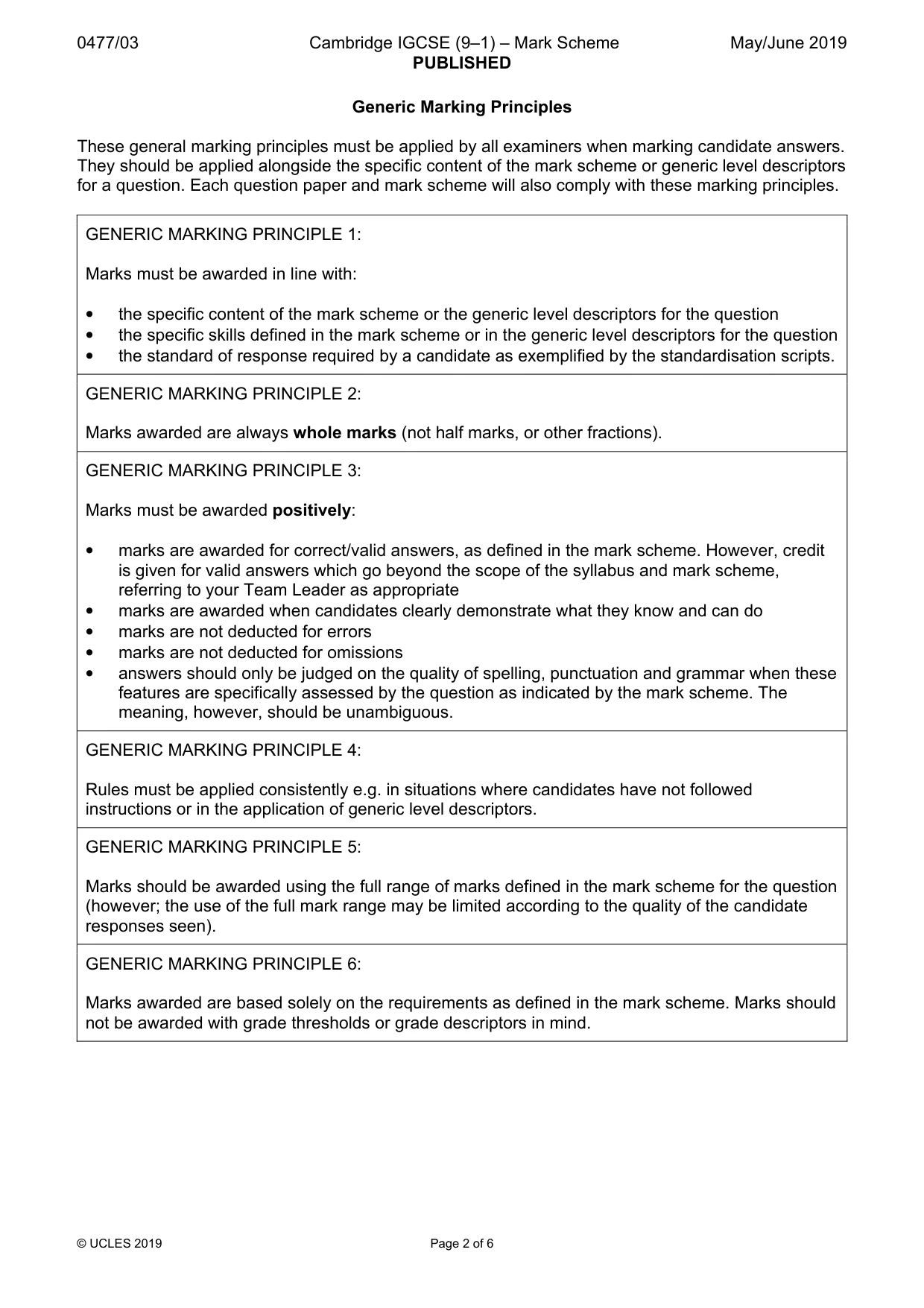
0477/03 Cambridge IGCSE (9–1) – Mark Scheme PUBLISHED May/June 2019 © UCLES 2019 Page 2 of 6 Generic Marking Principles These general marking principles must be applied by all examiners when marking candidate answers. They should be applied alongside the specific content of the mark scheme or generic level descriptors for a question. Each question paper and mark scheme will also comply with these marking principles. GENERIC MARKING PRINCIPLE 1: Marks must be awarded in line with: • the specific content of the mark scheme or the generic level descriptors for the question • the specific skills defined in the mark scheme or in the generic level descriptors for the question • the standard of response required by a candidate as exemplified by the standardisation scripts. GENERIC MARKING PRINCIPLE 2: Marks awarded are always whole marks (not half marks, or other fractions). GENERIC MARKING PRINCIPLE 3: Marks must be awarded positively: • marks are awarded for correct/valid answers, as defined in the mark scheme. However, credit is given for valid answers which go beyond the scope of the syllabus and mark scheme, referring to your Team Leader as appropriate • marks are awarded when candidates clearly demonstrate what they know and can do • marks are not deducted for errors • marks are not deducted for omissions • answers should only be judged on the quality of spelling, punctuation and grammar when these features are specifically assessed by the question as indicated by the mark scheme. The meaning, however, should be unambiguous. GENERIC MARKING PRINCIPLE 4: Rules must be applied consistently e.g. in situations where candidates have not followed instructions or in the application of generic level descriptors. GENERIC MARKING PRINCIPLE 5: Marks should be awarded using the full range of marks defined in the mark scheme for the question (however; the use of the full mark range may be limited according to the quality of the candidate responses seen). GENERIC MARKING PRINCIPLE 6: Marks awarded are based solely on the requirements as defined in the mark scheme. Marks should not be awarded with grade thresholds or grade descriptors in mind.
Mark scheme, page 3
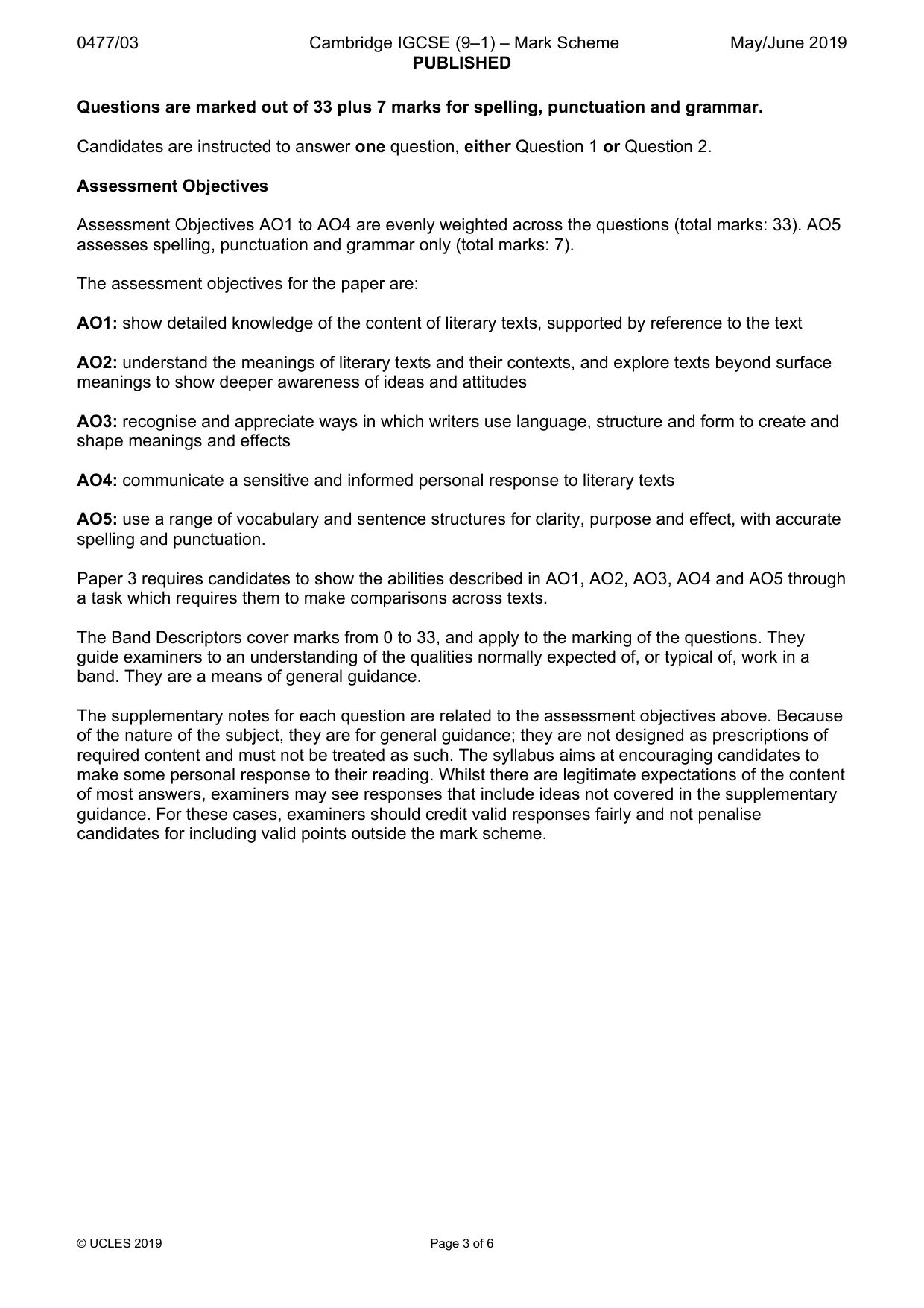
0477/03 Cambridge IGCSE (9–1) – Mark Scheme PUBLISHED May/June 2019 © UCLES 2019 Page 3 of 6 Questions are marked out of 33 plus 7 marks for spelling, punctuation and grammar. Candidates are instructed to answer one question, either Question 1 or Question 2. Assessment Objectives Assessment Objectives AO1 to AO4 are evenly weighted across the questions (total marks: 33). AO5 assesses spelling, punctuation and grammar only (total marks: 7). The assessment objectives for the paper are: AO1: show detailed knowledge of the content of literary texts, supported by reference to the text AO2: understand the meanings of literary texts and their contexts, and explore texts beyond surface meanings to show deeper awareness of ideas and attitudes AO3: recognise and appreciate ways in which writers use language, structure and form to create and shape meanings and effects AO4: communicate a sensitive and informed personal response to literary texts AO5: use a range of vocabulary and sentence structures for clarity, purpose and effect, with accurate spelling and punctuation. Paper 3 requires candidates to show the abilities described in AO1, AO2, AO3, AO4 and AO5 through a task which requires them to make comparisons across texts. The Band Descriptors cover marks from 0 to 33, and apply to the marking of the questions. They guide examiners to an understanding of the qualities normally expected of, or typical of, work in a band. They are a means of general guidance. The supplementary notes for each question are related to the assessment objectives above. Because of the nature of the subject, they are for general guidance; they are not designed as prescriptions of required content and must not be treated as such. The syllabus aims at encouraging candidates to make some personal response to their reading. Whilst there are legitimate expectations of the content of most answers, examiners may see responses that include ideas not covered in the supplementary guidance. For these cases, examiners should credit valid responses fairly and not penalise candidates for including valid points outside the mark scheme.
Mark scheme, page 4
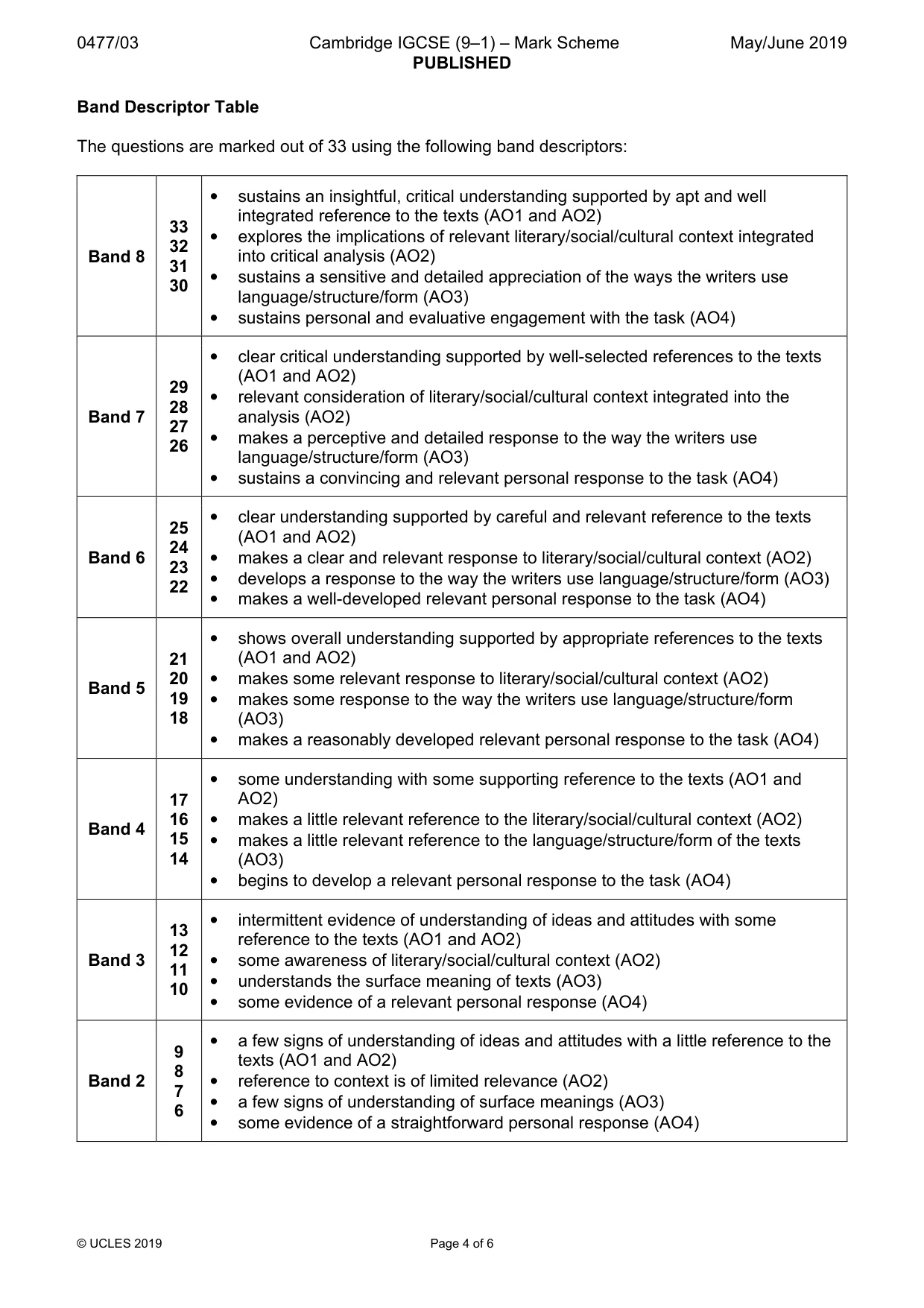
0477/03 Cambridge IGCSE (9–1) – Mark Scheme PUBLISHED May/June 2019 © UCLES 2019 Page 4 of 6 Band Descriptor Table The questions are marked out of 33 using the following band descriptors: Band 8 33 32 31 30 • sustains an insightful, critical understanding supported by apt and well integrated reference to the texts (AO1 and AO2) • explores the implications of relevant literary/social/cultural context integrated into critical analysis (AO2) • sustains a sensitive and detailed appreciation of the ways the writers use language/structure/form (AO3) • sustains personal and evaluative engagement with the task (AO4) Band 7 29 28 27 26 • clear critical understanding supported by well-selected references to the texts (AO1 and AO2) • relevant consideration of literary/social/cultural context integrated into the analysis (AO2) • makes a perceptive and detailed response to the way the writers use language/structure/form (AO3) • sustains a convincing and relevant personal response to the task (AO4) Band 6 25 24 23 22 • clear understanding supported by careful and relevant reference to the texts (AO1 and AO2) • makes a clear and relevant response to literary/social/cultural context (AO2) • develops a response to the way the writers use language/structure/form (AO3) • makes a well-developed relevant personal response to the task (AO4) Band 5 21 20 19 18 • shows overall understanding supported by appropriate references to the texts (AO1 and AO2) • makes some relevant response to literary/social/cultural context (AO2) • makes some response to the way the writers use language/structure/form (AO3) • makes a reasonably developed relevant personal response to the task (AO4) Band 4 17 16 15 14 • some understanding with some supporting reference to the texts (AO1 and AO2) • makes a little relevant reference to the literary/social/cultural context (AO2) • makes a little relevant reference to the language/structure/form of the texts (AO3) • begins to develop a relevant personal response to the task (AO4) Band 3 13 12 11 10 • intermittent evidence of understanding of ideas and attitudes with some reference to the texts (AO1 and AO2) • some awareness of literary/social/cultural context (AO2) • understands the surface meaning of texts (AO3) • some evidence of a relevant personal response (AO4) Band 2 9 8 7 6 • a few signs of understanding of ideas and attitudes with a little reference to the texts (AO1 and AO2) • reference to context is of limited relevance (AO2) • a few signs of understanding of surface meanings (AO3) • some evidence of a straightforward personal response (AO4)
Mark scheme, page 5
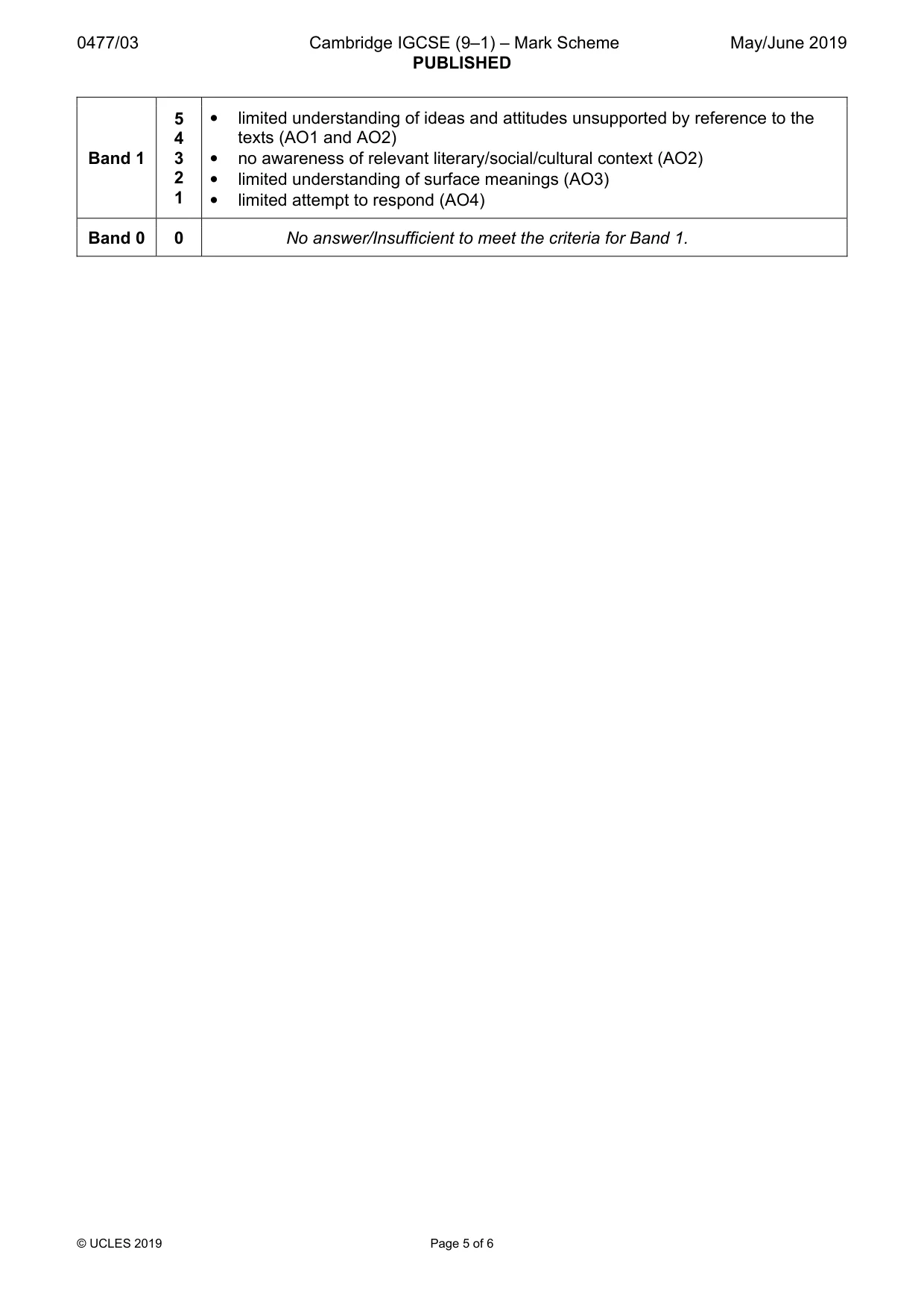
0477/03 Cambridge IGCSE (9–1) – Mark Scheme PUBLISHED May/June 2019 © UCLES 2019 Page 5 of 6 Band 1 5 4 3 2 1 • limited understanding of ideas and attitudes unsupported by reference to the texts (AO1 and AO2) • no awareness of relevant literary/social/cultural context (AO2) • limited understanding of surface meanings (AO3) • limited attempt to respond (AO4) Band 0 0 No answer/Insufficient to meet the criteria for Band 1.
Mark scheme, page 6
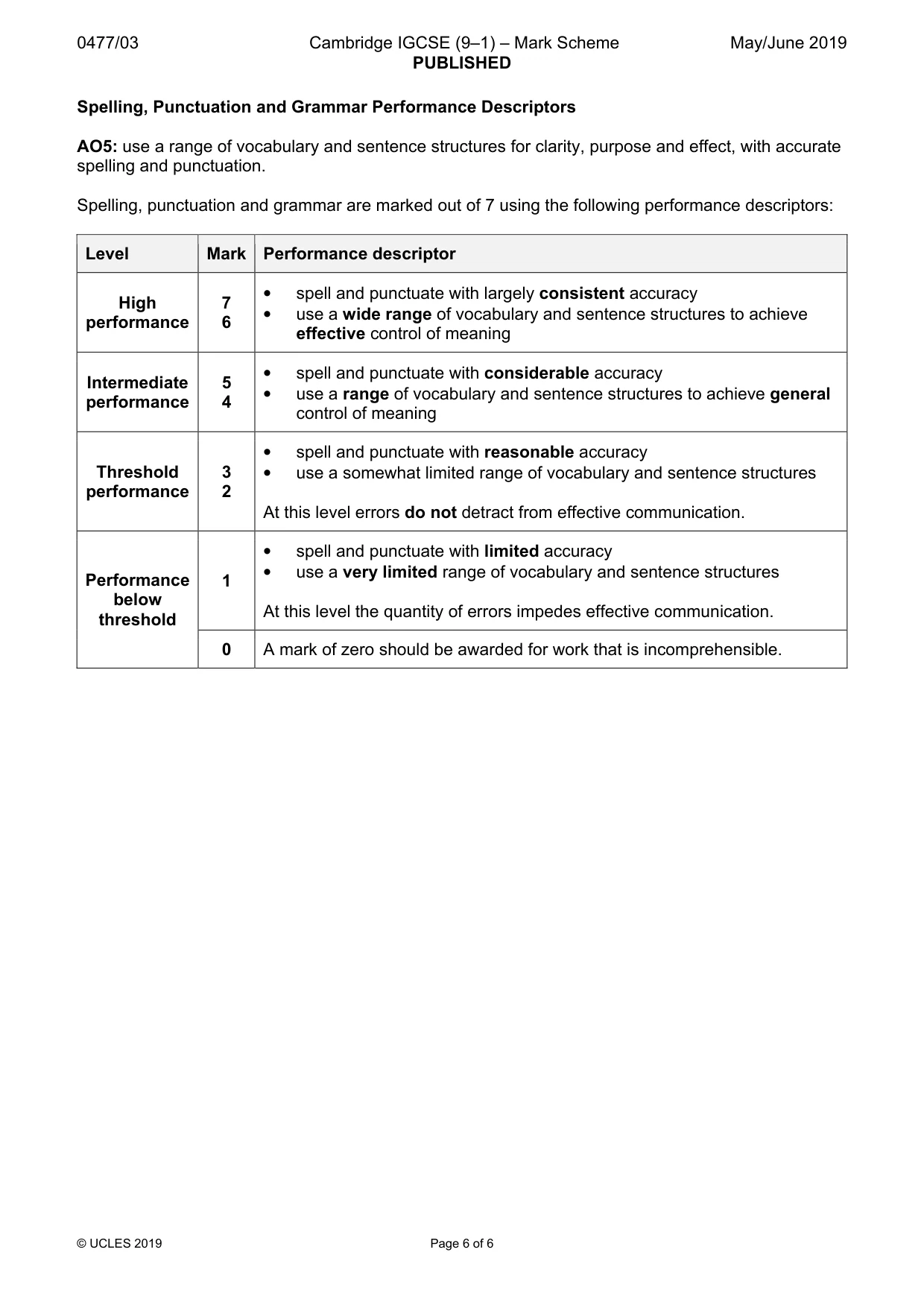
0477/03 Cambridge IGCSE (9–1) – Mark Scheme PUBLISHED May/June 2019 © UCLES 2019 Page 6 of 6 Spelling, Punctuation and Grammar Performance Descriptors AO5: use a range of vocabulary and sentence structures for clarity, purpose and effect, with accurate spelling and punctuation. Spelling, punctuation and grammar are marked out of 7 using the following performance descriptors: Level Mark Performance descriptor High performance 7 6 • spell and punctuate with largely consistent accuracy • use a wide range of vocabulary and sentence structures to achieve effective control of meaning Intermediate performance 5 4 • spell and punctuate with considerable accuracy • use a range of vocabulary and sentence structures to achieve general control of meaning Threshold performance 3 2 • spell and punctuate with reasonable accuracy • use a somewhat limited range of vocabulary and sentence structures At this level errors do not detract from effective communication. Performance below threshold 1 • spell and punctuate with limited accuracy • use a very limited range of vocabulary and sentence structures At this level the quantity of errors impedes effective communication. 0 A mark of zero should be awarded for work that is incomprehensible.
What you needed in this session
Cambridge’s own grade thresholds for 2019 May/June, Paper 3 · Variant 1. A higher threshold means an easier paper — the bar moves with how the cohort did.