Cambridge IGCSE English - Literature (9-1) (UK only) 0477 — 2017 Oct/Nov Paper 3 · Variant 1
0477/31/O/N/17 · 40 marks · ≈45 min
The question paper and its mark scheme, free to read here and free to download. This is Cambridge’s own paper, exactly as it was sat.
Question paper8 pages
Mark scheme4 pages
Answers below. Sit the paper first if you are practising.
Paper as text
Question paper, page 1
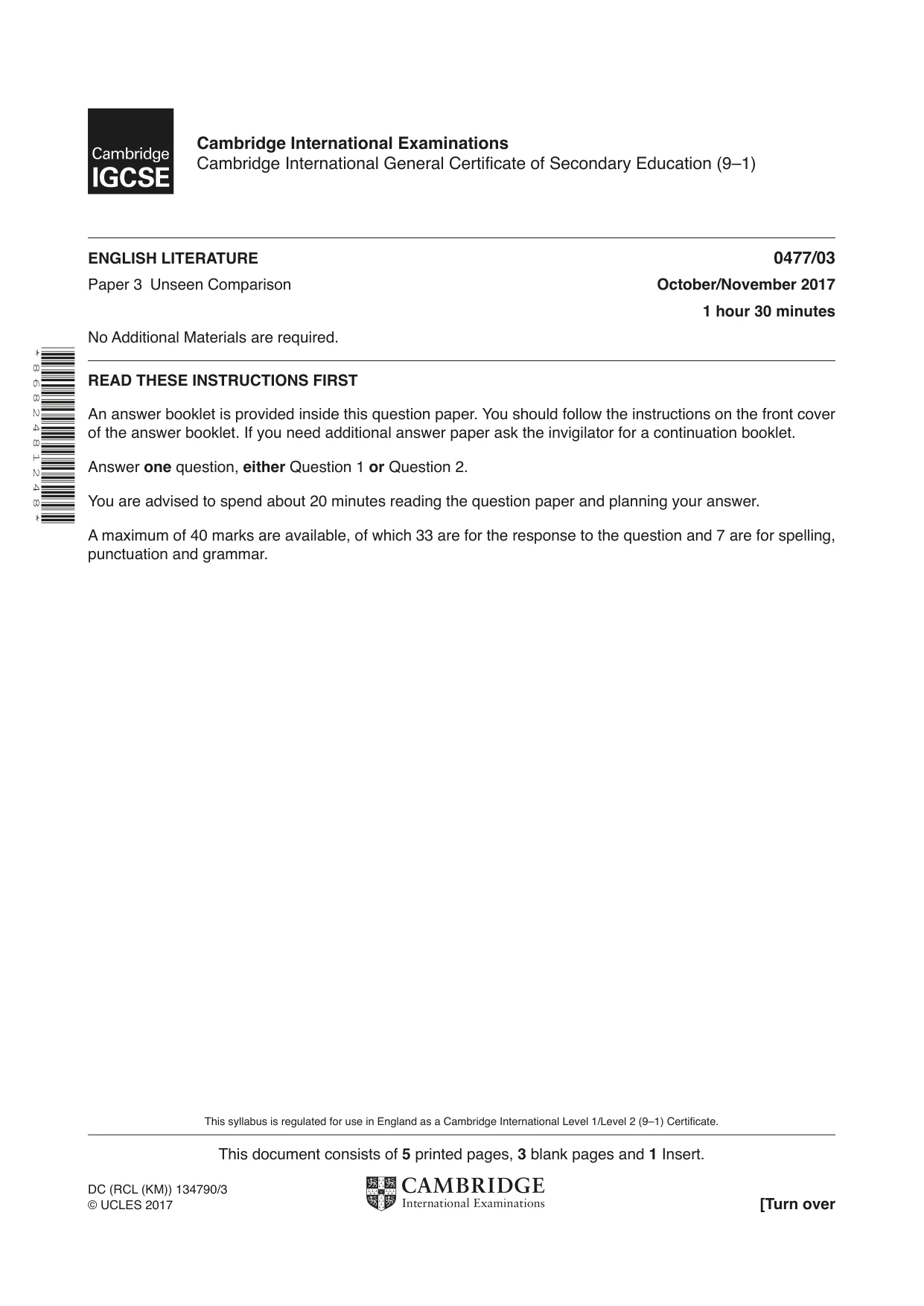
This document consists of 5 printed pages, 3 blank pages and 1 Insert. DC (RCL (KM)) 134790/3 © UCLES 2017 [Turn over Cambridge International Examinations Cambridge International General Certificate of Secondary Education (9–1) * 8 6 8 2 4 8 1 2 4 8 * ENGLISH LITERATURE 0477/03 Paper 3 Unseen Comparison October/November 2017 1 hour 30 minutes No Additional Materials are required. READ THESE INSTRUCTIONS FIRST An answer booklet is provided inside this question paper. You should follow the instructions on the front cover of the answer booklet. If you need additional answer paper ask the invigilator for a continuation booklet. Answer one question, either Question 1 or Question 2. You are advised to spend about 20 minutes reading the question paper and planning your answer. A maximum of 40 marks are available, of which 33 are for the response to the question and 7 are for spelling, punctuation and grammar. This syllabus is regulated for use in England as a Cambridge International Level 1/Level 2 (9–1) Certificate.
Question paper, page 2
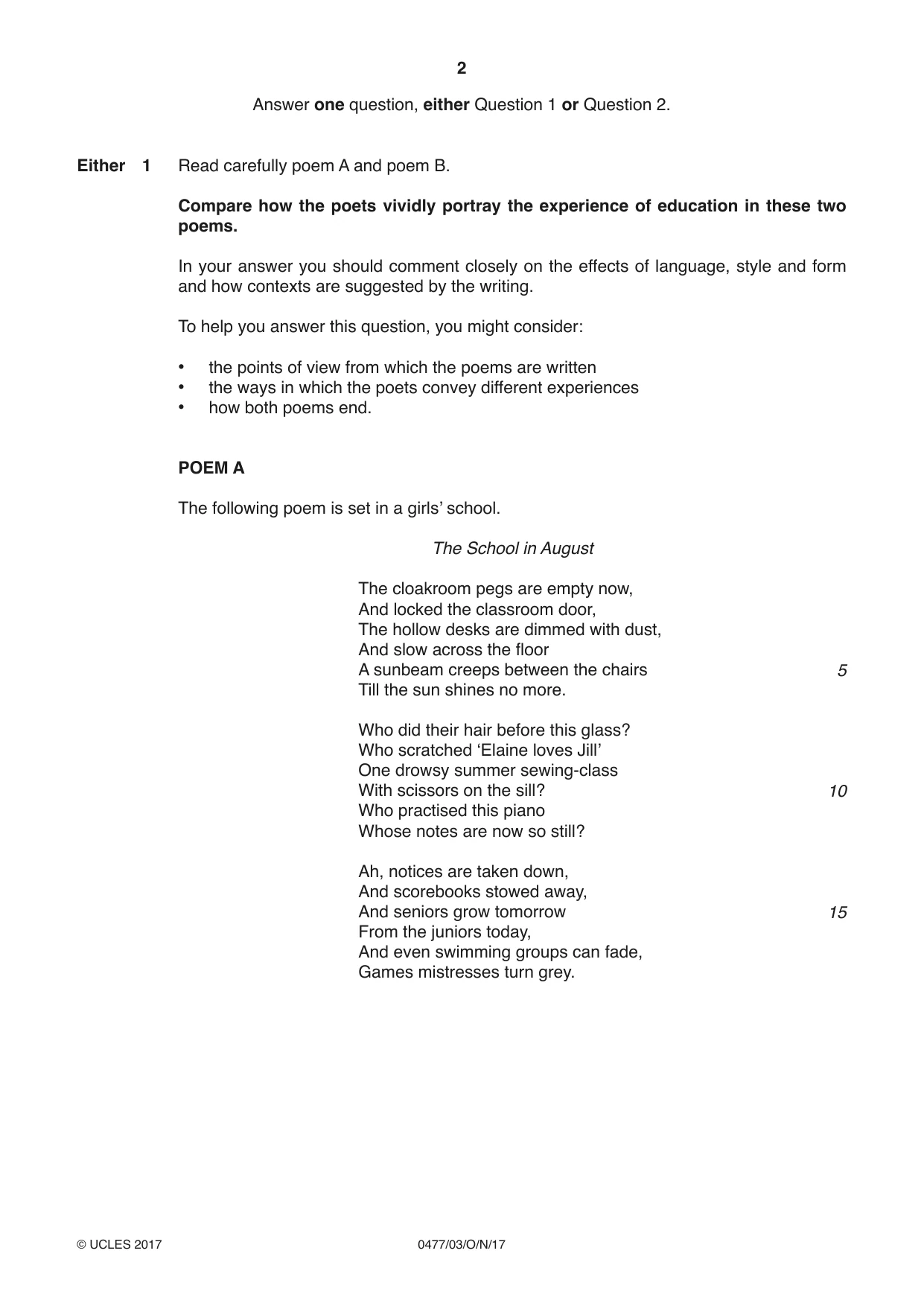
2 0477/03/O/N/17 © UCLES 2017 Answer one question, either Question 1 or Question 2. Either 1 Read carefully poem A and poem B. Compare how the poets vividly portray the experience of education in these two poems. In your answer you should comment closely on the effects of language, style and form and how contexts are suggested by the writing. To help you answer this question, you might consider: • the points of view from which the poems are written • the ways in which the poets convey different experiences • how both poems end. POEM A The following poem is set in a girls’ school. The School in August The cloakroom pegs are empty now, And locked the classroom door, The hollow desks are dimmed with dust, And slow across the floor A sunbeam creeps between the chairs Till the sun shines no more. Who did their hair before this glass? Who scratched ‘Elaine loves Jill’ One drowsy summer sewing-class With scissors on the sill? Who practised this piano Whose notes are now so still? Ah, notices are taken down, And scorebooks stowed away, And seniors grow tomorrow From the juniors today, And even swimming groups can fade, Games mistresses turn grey. 5 10 15
Question paper, page 3
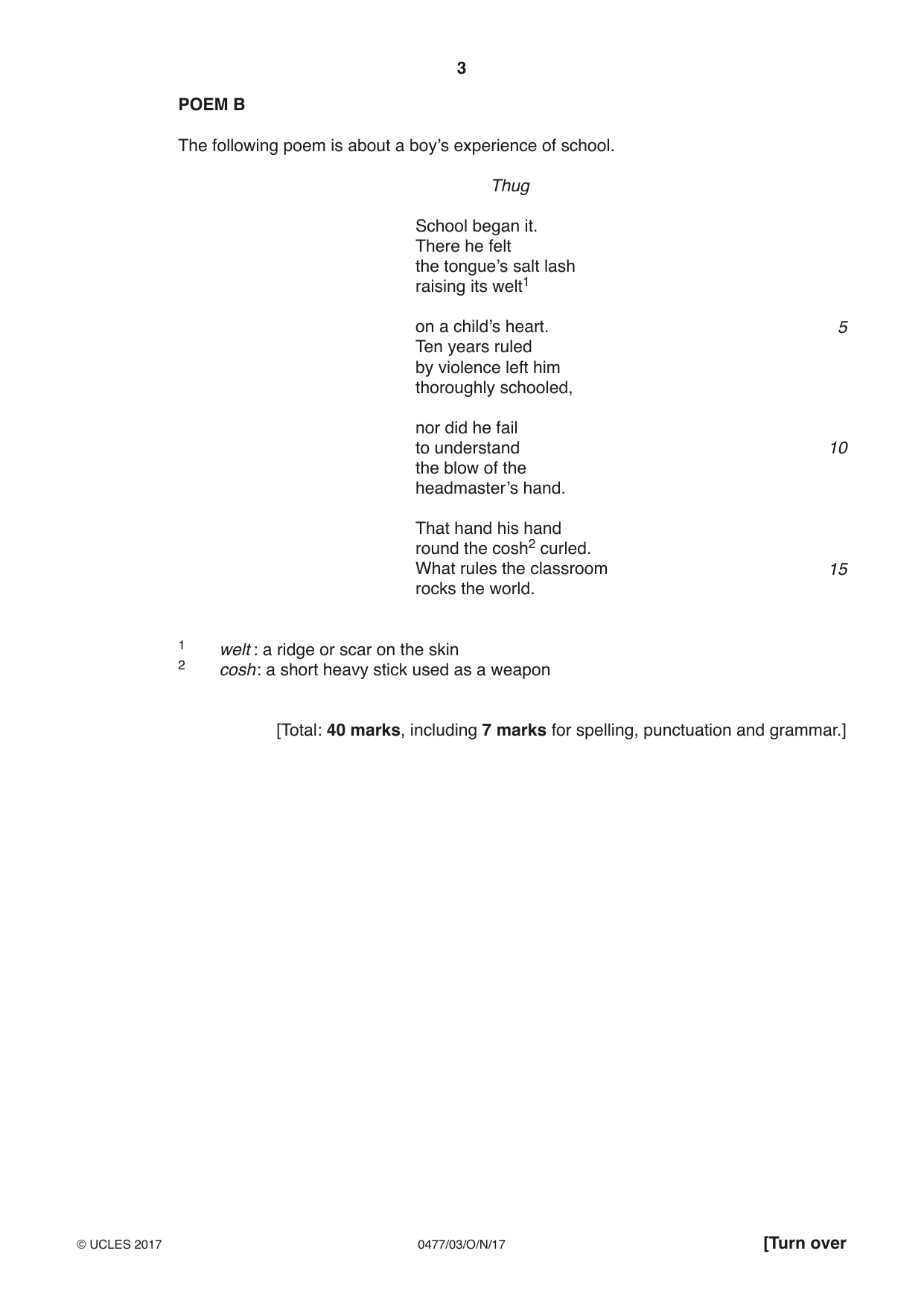
3 0477/03/O/N/17 © UCLES 2017 [Turn over POEM B The following poem is about a boy’s experience of school. Thug School began it. There he felt the tongue’s salt lash raising its welt1 on a child’s heart. Ten years ruled by violence left him thoroughly schooled, nor did he fail to understand the blow of the headmaster’s hand. That hand his hand round the cosh2 curled. What rules the classroom rocks the world. 1 welt : a ridge or scar on the skin 2 cosh : a short heavy stick used as a weapon [Total: 40 marks, including 7 marks for spelling, punctuation and grammar.] 5 10 15
Question paper, page 4
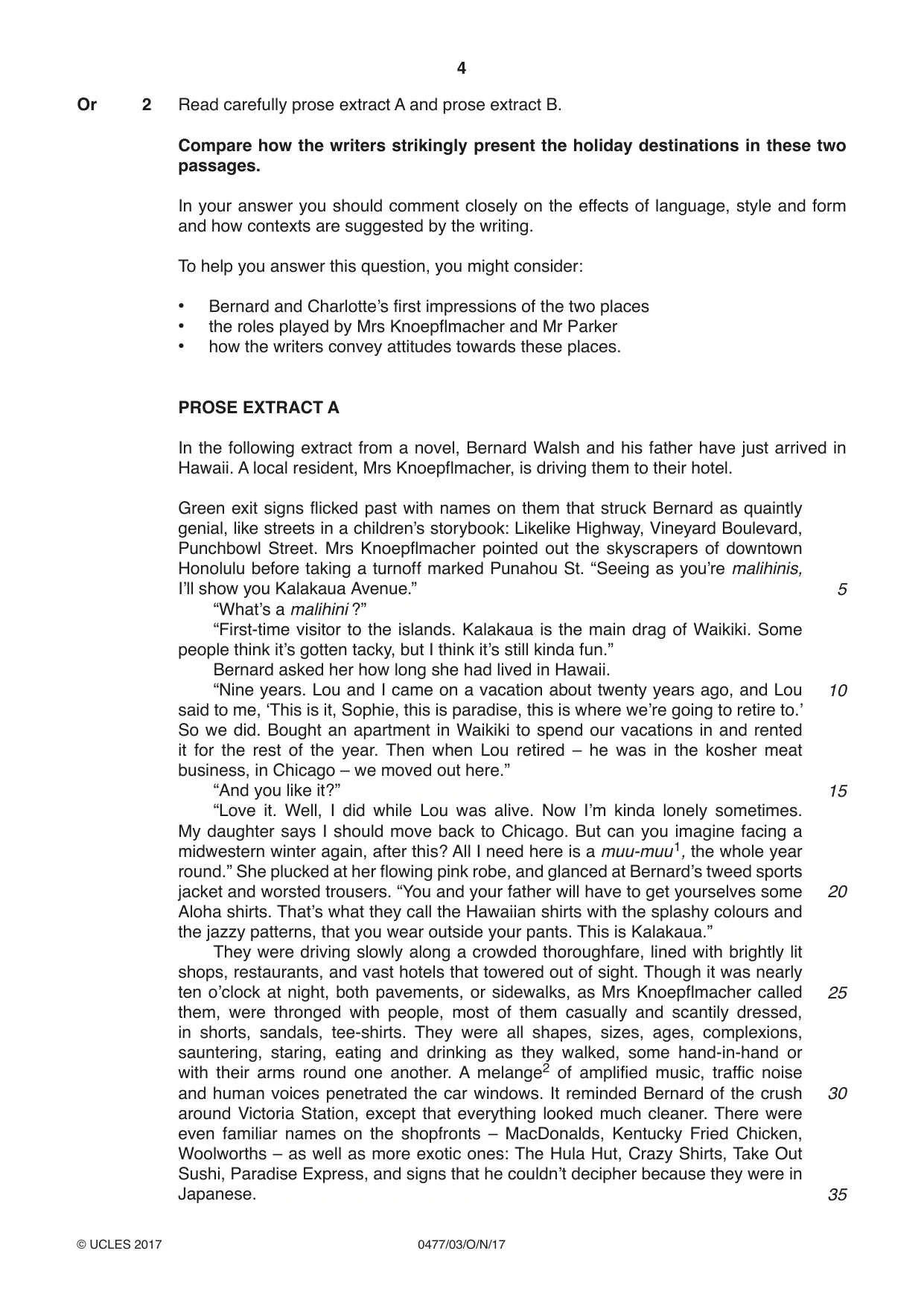
4 0477/03/O/N/17 © UCLES 2017 Or 2 Read carefully prose extract A and prose extract B. Compare how the writers strikingly present the holiday destinations in these two passages. In your answer you should comment closely on the effects of language, style and form and how contexts are suggested by the writing. To help you answer this question, you might consider: • Bernard and Charlotte’s first impressions of the two places • the roles played by Mrs Knoepflmacher and Mr Parker • how the writers convey attitudes towards these places. PROSE EXTRACT A In the following extract from a novel, Bernard Walsh and his father have just arrived in Hawaii. A local resident, Mrs Knoepflmacher, is driving them to their hotel. Green exit signs flicked past with names on them that struck Bernard as quaintly genial, like streets in a children’s storybook: Likelike Highway, Vineyard Boulevard, Punchbowl Street. Mrs Knoepflmacher pointed out the skyscrapers of downtown Honolulu before taking a turnoff marked Punahou St. “Seeing as you’re malihinis, I’ll show you Kalakaua Avenue.” “What’s a malihini ?” “First-time visitor to the islands. Kalakaua is the main drag of Waikiki. Some people think it’s gotten tacky, but I think it’s still kinda fun.” Bernard asked her how long she had lived in Hawaii. “Nine years. Lou and I came on a vacation about twenty years ago, and Lou said to me, ‘This is it, Sophie, this is paradise, this is where we’re going to retire to.’ So we did. Bought an apartment in Waikiki to spend our vacations in and rented it for the rest of the year. Then when Lou retired – he was in the kosher meat business, in Chicago – we moved out here.” “And you like it?” “Love it. Well, I did while Lou was alive. Now I’m kinda lonely sometimes. My daughter says I should move back to Chicago. But can you imagine facing a midwestern winter again, after this? All I need here is a muu-muu 1, the whole year round.” She plucked at her flowing pink robe, and glanced at Bernard’s tweed sports jacket and worsted trousers. “You and your father will have to get yourselves some Aloha shirts. That’s what they call the Hawaiian shirts with the splashy colours and the jazzy patterns, that you wear outside your pants. This is Kalakaua.” They were driving slowly along a crowded thoroughfare, lined with brightly lit shops, restaurants, and vast hotels that towered out of sight. Though it was nearly ten o’clock at night, both pavements, or sidewalks, as Mrs Knoepflmacher called them, were thronged with people, most of them casually and scantily dressed, in shorts, sandals, tee-shirts. They were all shapes, sizes, ages, complexions, sauntering, staring, eating and drinking as they walked, some hand-in-hand or with their arms round one another. A melange2 of amplified music, traffic noise and human voices penetrated the car windows. It reminded Bernard of the crush around Victoria Station, except that everything looked much cleaner. There were even familiar names on the shopfronts – MacDonalds, Kentucky Fried Chicken, Woolworths – as well as more exotic ones: The Hula Hut, Crazy Shirts, Take Out Sushi, Paradise Express, and signs that he couldn’t decipher because they were in Japanese. 5 10 15 20 25 30 35
Question paper, page 5
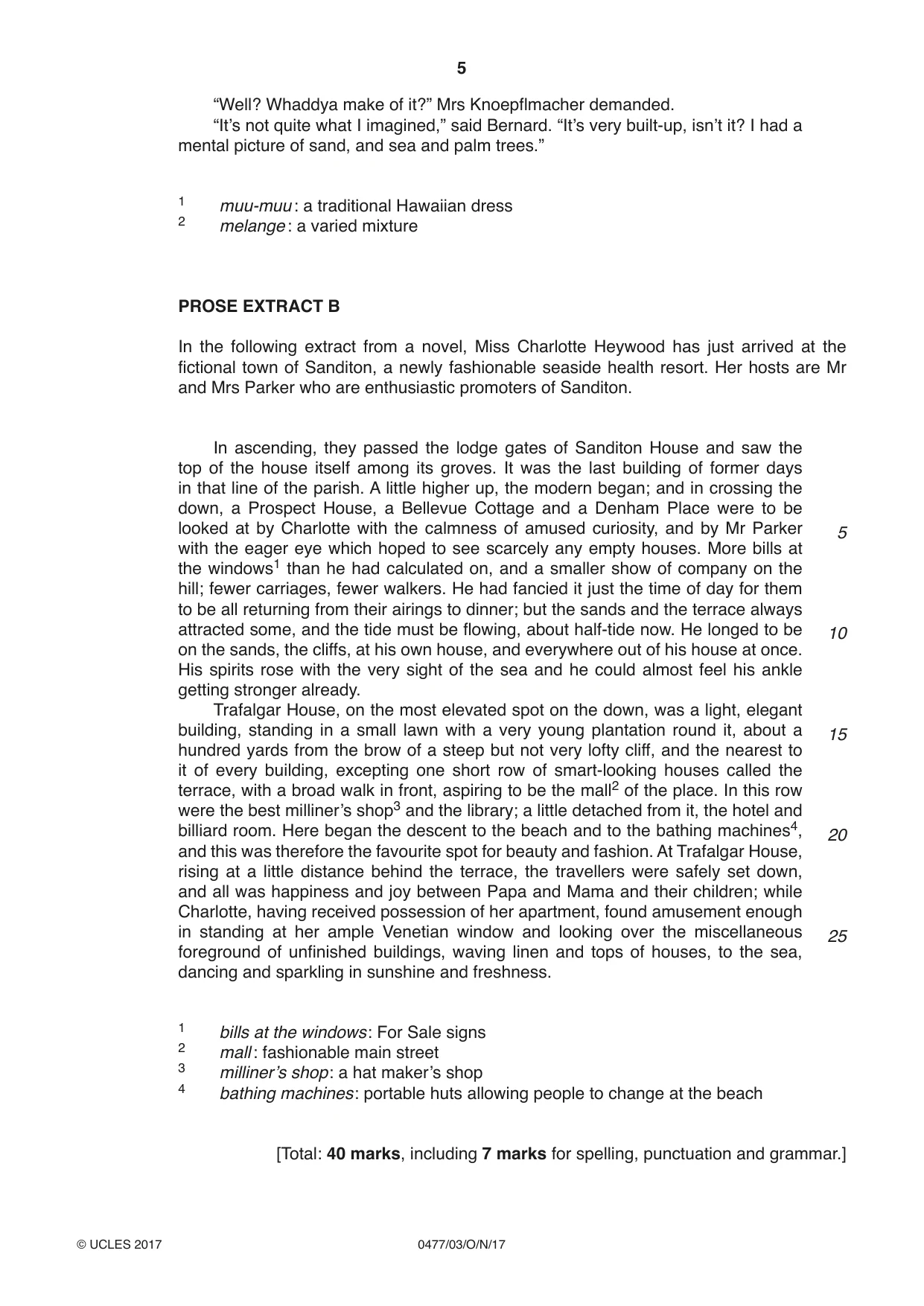
5 0477/03/O/N/17 © UCLES 2017 “Well? Whaddya make of it?” Mrs Knoepflmacher demanded. “It’s not quite what I imagined,” said Bernard. “It’s very built-up, isn’t it? I had a mental picture of sand, and sea and palm trees.” 1 muu-muu : a traditional Hawaiian dress 2 melange : a varied mixture PROSE EXTRACT B In the following extract from a novel, Miss Charlotte Heywood has just arrived at the fictional town of Sanditon, a newly fashionable seaside health resort. Her hosts are Mr and Mrs Parker who are enthusiastic promoters of Sanditon. In ascending, they passed the lodge gates of Sanditon House and saw the top of the house itself among its groves. It was the last building of former days in that line of the parish. A little higher up, the modern began; and in crossing the down, a Prospect House, a Bellevue Cottage and a Denham Place were to be looked at by Charlotte with the calmness of amused curiosity, and by Mr Parker with the eager eye which hoped to see scarcely any empty houses. More bills at the windows1 than he had calculated on, and a smaller show of company on the hill; fewer carriages, fewer walkers. He had fancied it just the time of day for them to be all returning from their airings to dinner; but the sands and the terrace always attracted some, and the tide must be flowing, about half-tide now. He longed to be on the sands, the cliffs, at his own house, and everywhere out of his house at once. His spirits rose with the very sight of the sea and he could almost feel his ankle getting stronger already. Trafalgar House, on the most elevated spot on the down, was a light, elegant building, standing in a small lawn with a very young plantation round it, about a hundred yards from the brow of a steep but not very lofty cliff, and the nearest to it of every building, excepting one short row of smart-looking houses called the terrace, with a broad walk in front, aspiring to be the mall2 of the place. In this row were the best milliner’s shop3 and the library; a little detached from it, the hotel and billiard room. Here began the descent to the beach and to the bathing machines4, and this was therefore the favourite spot for beauty and fashion. At Trafalgar House, rising at a little distance behind the terrace, the travellers were safely set down, and all was happiness and joy between Papa and Mama and their children; while Charlotte, having received possession of her apartment, found amusement enough in standing at her ample Venetian window and looking over the miscellaneous foreground of unfinished buildings, waving linen and tops of houses, to the sea, dancing and sparkling in sunshine and freshness. 1 bills at the windows : For Sale signs 2 mall : fashionable main street 3 milliner’s shop : a hat maker’s shop 4 bathing machines : portable huts allowing people to change at the beach [Total: 40 marks, including 7 marks for spelling, punctuation and grammar.] 5 10 15 20 25
Question paper, page 6
6 0477/03/O/N/17 © UCLES 2017 BLANK PAGE
Question paper, page 7
7 0477/03/O/N/17 © UCLES 2017 BLANK PAGE
Question paper, page 8
8 0477/03/O/N/17 © UCLES 2017 BLANK PAGE Permission to reproduce items where third-party owned material protected by copyright is included has been sought and cleared where possible. Every reasonable effort has been made by the publisher (UCLES) to trace copyright holders, but if any items requiring clearance have unwittingly been included, the publisher will be pleased to make amends at the earliest possible opportunity. To avoid the issue of disclosure of answer-related information to candidates, all copyright acknowledgements are reproduced online in the Cambridge International Examinations Copyright Acknowledgements Booklet. This is produced for each series of examinations and is freely available to download at www.cie.org.uk after the live examination series. Cambridge International Examinations is part of the Cambridge Assessment Group. Cambridge Assessment is the brand name of University of Cambridge Local Examinations Syndicate (UCLES), which is itself a department of the University of Cambridge.
Mark scheme, page 1
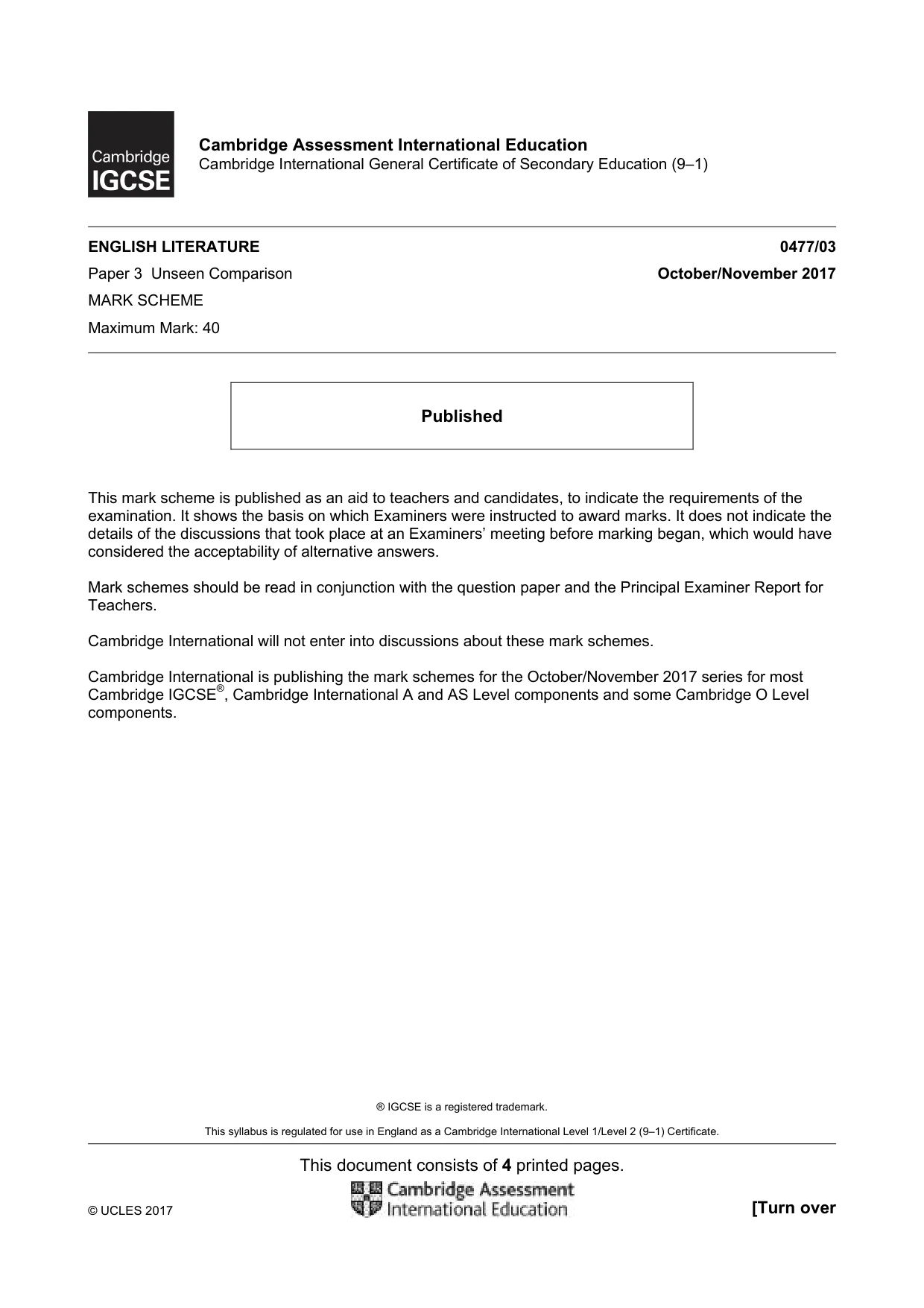
® IGCSE is a registered trademark. This syllabus is regulated for use in England as a Cambridge International Level 1/Level 2 (9–1) Certificate. This document consists of 4 printed pages. © UCLES 2017 [Turn over Cambridge Assessment International Education Cambridge International General Certificate of Secondary Education (9–1) ENGLISH LITERATURE 0477/03 Paper 3 Unseen Comparison October/November 2017 MARK SCHEME Maximum Mark: 40 Published This mark scheme is published as an aid to teachers and candidates, to indicate the requirements of the examination. It shows the basis on which Examiners were instructed to award marks. It does not indicate the details of the discussions that took place at an Examiners’ meeting before marking began, which would have considered the acceptability of alternative answers. Mark schemes should be read in conjunction with the question paper and the Principal Examiner Report for Teachers. Cambridge International will not enter into discussions about these mark schemes. Cambridge International is publishing the mark schemes for the October/November 2017 series for most Cambridge IGCSE®, Cambridge International A and AS Level components and some Cambridge O Level components.
Mark scheme, page 2
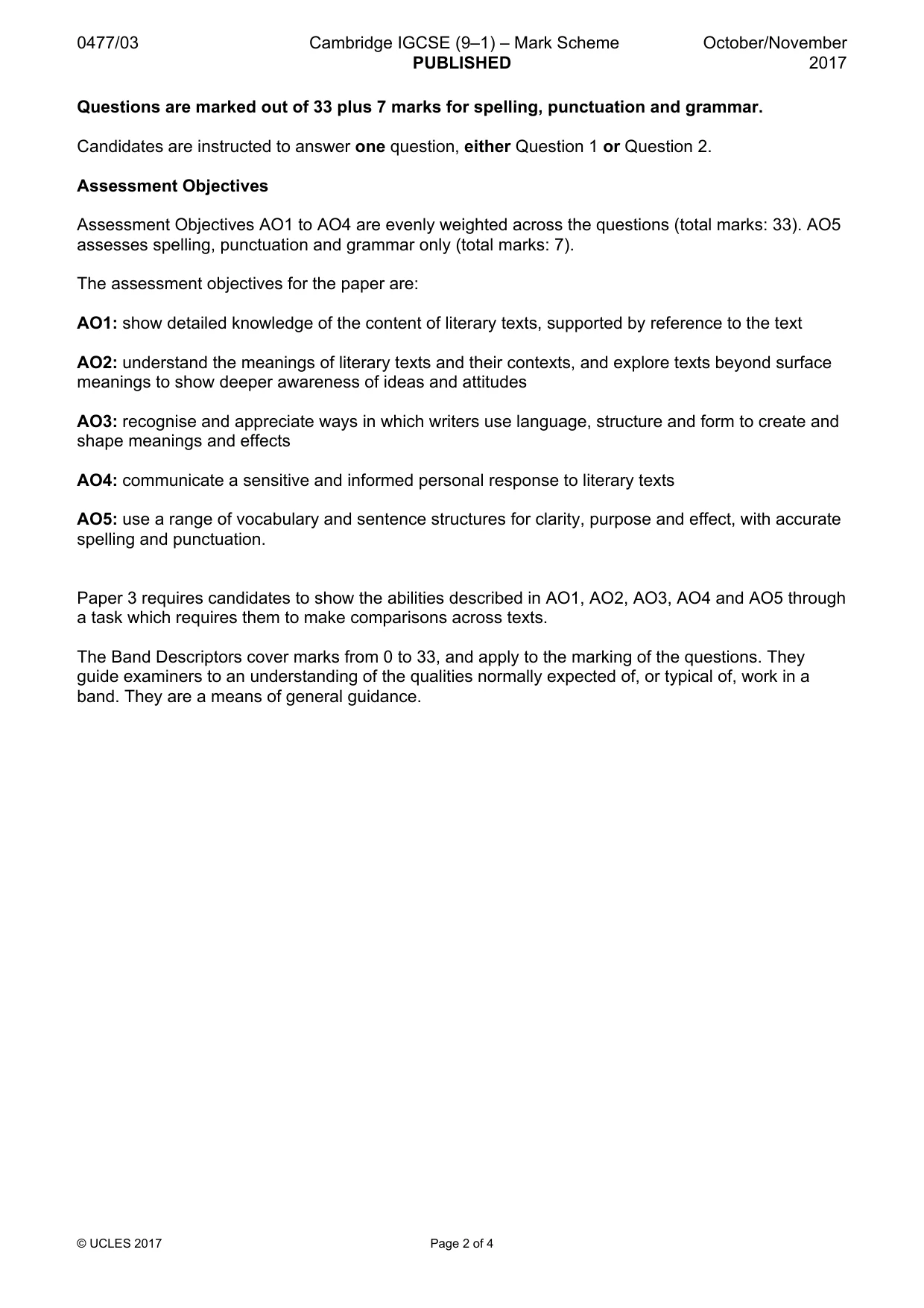
0477/03 Cambridge IGCSE (9–1) – Mark Scheme PUBLISHED October/November 2017 © UCLES 2017 Page 2 of 4 Questions are marked out of 33 plus 7 marks for spelling, punctuation and grammar. Candidates are instructed to answer one question, either Question 1 or Question 2. Assessment Objectives Assessment Objectives AO1 to AO4 are evenly weighted across the questions (total marks: 33). AO5 assesses spelling, punctuation and grammar only (total marks: 7). The assessment objectives for the paper are: AO1: show detailed knowledge of the content of literary texts, supported by reference to the text AO2: understand the meanings of literary texts and their contexts, and explore texts beyond surface meanings to show deeper awareness of ideas and attitudes AO3: recognise and appreciate ways in which writers use language, structure and form to create and shape meanings and effects AO4: communicate a sensitive and informed personal response to literary texts AO5: use a range of vocabulary and sentence structures for clarity, purpose and effect, with accurate spelling and punctuation. Paper 3 requires candidates to show the abilities described in AO1, AO2, AO3, AO4 and AO5 through a task which requires them to make comparisons across texts. The Band Descriptors cover marks from 0 to 33, and apply to the marking of the questions. They guide examiners to an understanding of the qualities normally expected of, or typical of, work in a band. They are a means of general guidance.
Mark scheme, page 3
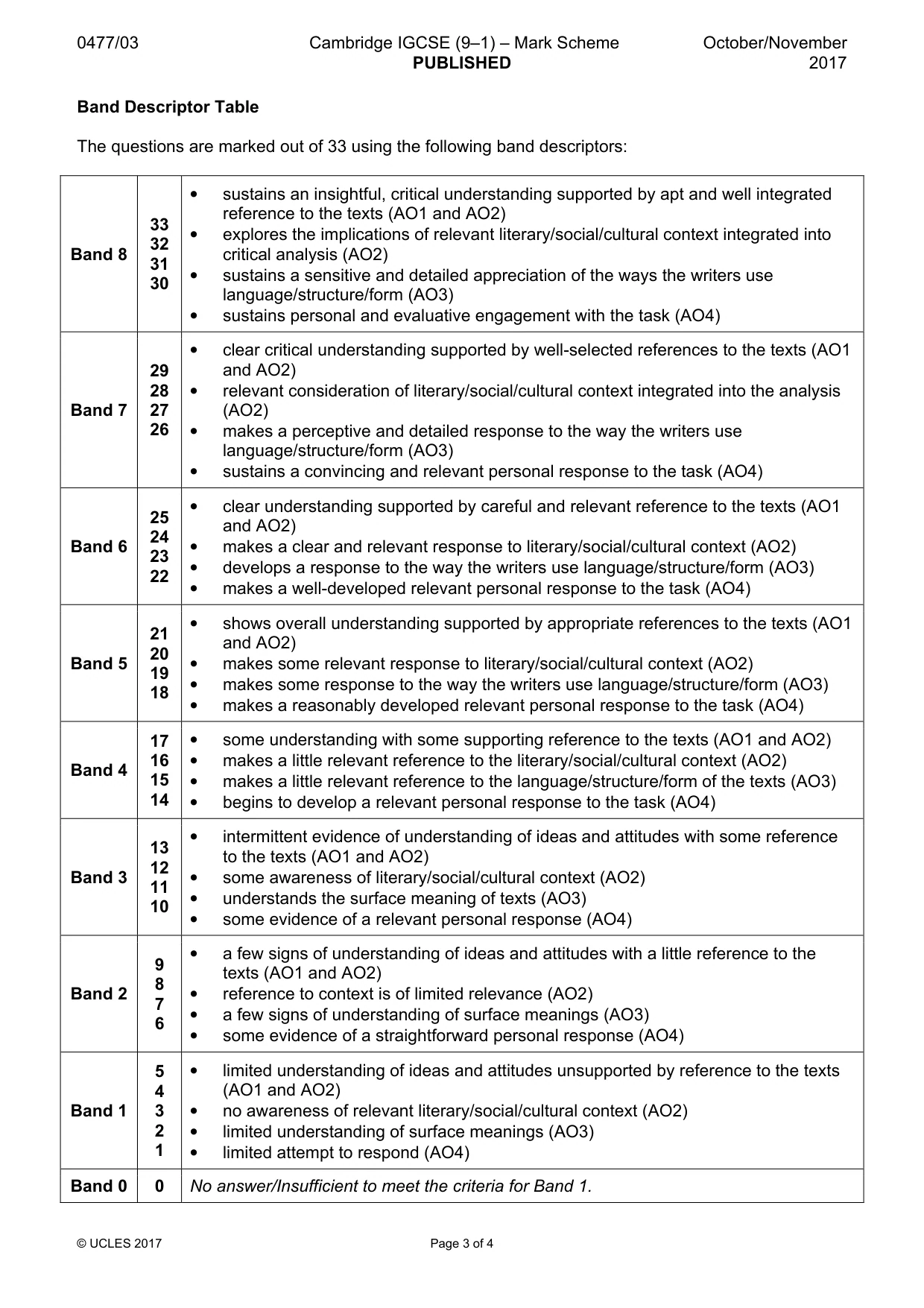
0477/03 Cambridge IGCSE (9–1) – Mark Scheme PUBLISHED October/November 2017 © UCLES 2017 Page 3 of 4 Band Descriptor Table The questions are marked out of 33 using the following band descriptors: Band 8 33 32 31 30 • sustains an insightful, critical understanding supported by apt and well integrated reference to the texts (AO1 and AO2) • explores the implications of relevant literary/social/cultural context integrated into critical analysis (AO2) • sustains a sensitive and detailed appreciation of the ways the writers use language/structure/form (AO3) • sustains personal and evaluative engagement with the task (AO4) Band 7 29 28 27 26 • clear critical understanding supported by well-selected references to the texts (AO1 and AO2) • relevant consideration of literary/social/cultural context integrated into the analysis (AO2) • makes a perceptive and detailed response to the way the writers use language/structure/form (AO3) • sustains a convincing and relevant personal response to the task (AO4) Band 6 25 24 23 22 • clear understanding supported by careful and relevant reference to the texts (AO1 and AO2) • makes a clear and relevant response to literary/social/cultural context (AO2) • develops a response to the way the writers use language/structure/form (AO3) • makes a well-developed relevant personal response to the task (AO4) Band 5 21 20 19 18 • shows overall understanding supported by appropriate references to the texts (AO1 and AO2) • makes some relevant response to literary/social/cultural context (AO2) • makes some response to the way the writers use language/structure/form (AO3) • makes a reasonably developed relevant personal response to the task (AO4) Band 4 17 16 15 14 • some understanding with some supporting reference to the texts (AO1 and AO2) • makes a little relevant reference to the literary/social/cultural context (AO2) • makes a little relevant reference to the language/structure/form of the texts (AO3) • begins to develop a relevant personal response to the task (AO4) Band 3 13 12 11 10 • intermittent evidence of understanding of ideas and attitudes with some reference to the texts (AO1 and AO2) • some awareness of literary/social/cultural context (AO2) • understands the surface meaning of texts (AO3) • some evidence of a relevant personal response (AO4) Band 2 9 8 7 6 • a few signs of understanding of ideas and attitudes with a little reference to the texts (AO1 and AO2) • reference to context is of limited relevance (AO2) • a few signs of understanding of surface meanings (AO3) • some evidence of a straightforward personal response (AO4) Band 1 5 4 3 2 1 • limited understanding of ideas and attitudes unsupported by reference to the texts (AO1 and AO2) • no awareness of relevant literary/social/cultural context (AO2) • limited understanding of surface meanings (AO3) • limited attempt to respond (AO4) Band 0 0 No answer/Insufficient to meet the criteria for Band 1.
Mark scheme, page 4
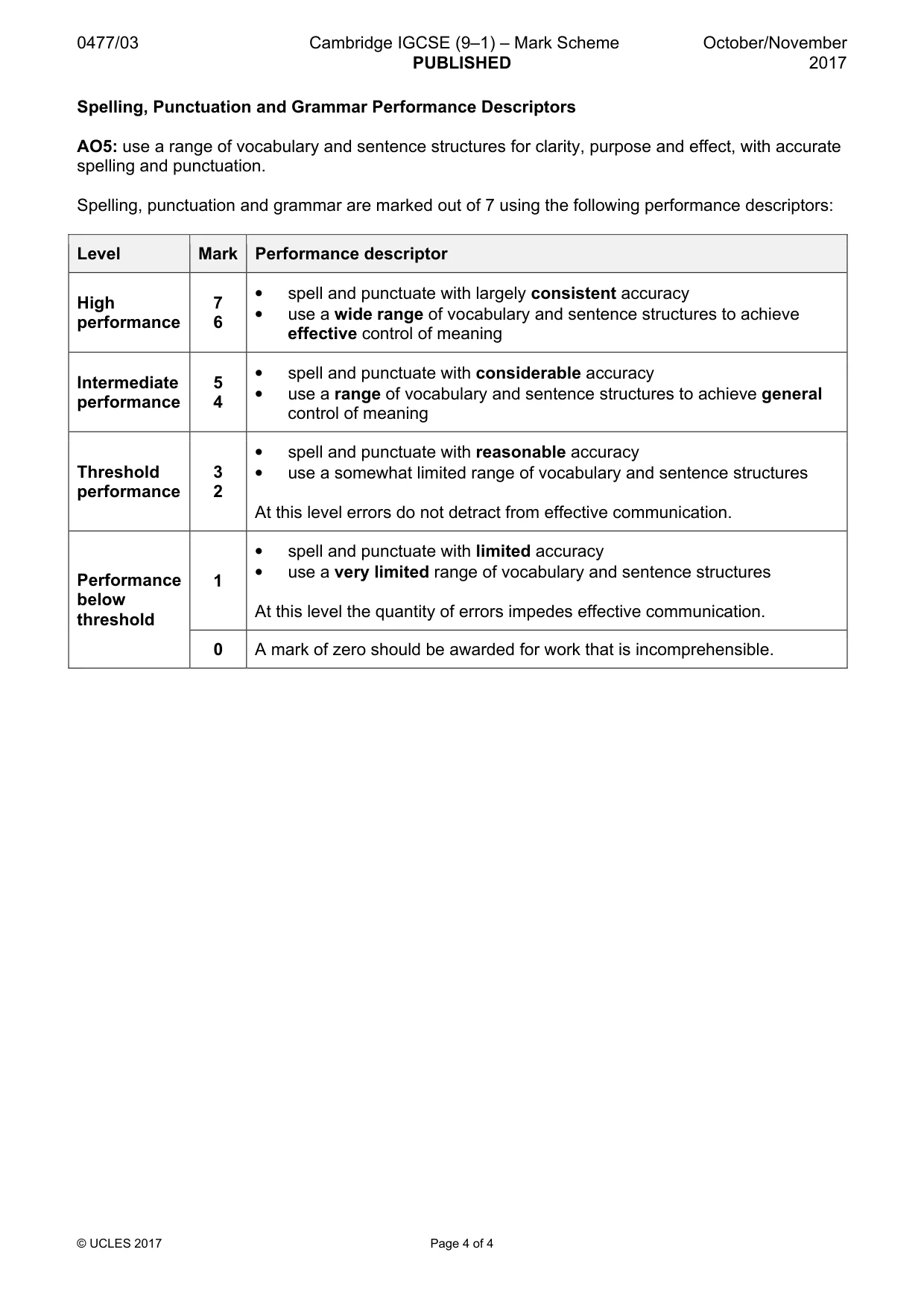
0477/03 Cambridge IGCSE (9–1) – Mark Scheme PUBLISHED October/November 2017 © UCLES 2017 Page 4 of 4 Spelling, Punctuation and Grammar Performance Descriptors AO5: use a range of vocabulary and sentence structures for clarity, purpose and effect, with accurate spelling and punctuation. Spelling, punctuation and grammar are marked out of 7 using the following performance descriptors: Level Mark Performance descriptor High performance 7 6 • spell and punctuate with largely consistent accuracy • use a wide range of vocabulary and sentence structures to achieve effective control of meaning Intermediate performance 5 4 • spell and punctuate with considerable accuracy • use a range of vocabulary and sentence structures to achieve general control of meaning Threshold performance 3 2 • spell and punctuate with reasonable accuracy • use a somewhat limited range of vocabulary and sentence structures At this level errors do not detract from effective communication. Performance below threshold 1 • spell and punctuate with limited accuracy • use a very limited range of vocabulary and sentence structures At this level the quantity of errors impedes effective communication. 0 A mark of zero should be awarded for work that is incomprehensible.
What you needed in this session
Cambridge’s own grade thresholds for 2017 Oct/Nov, Paper 3 · Variant 1. A higher threshold means an easier paper — the bar moves with how the cohort did.