Cambridge IGCSE English - Literature (9-1) (UK only) 0477 — 2018 Oct/Nov Paper 3 · Variant 0
0477/30/O/N/18
The question paper and its mark scheme, free to read here and free to download. This is Cambridge’s own paper, exactly as it was sat.
Question paper8 pages
Mark scheme
No mark scheme is in the library for this paper.
Paper as text
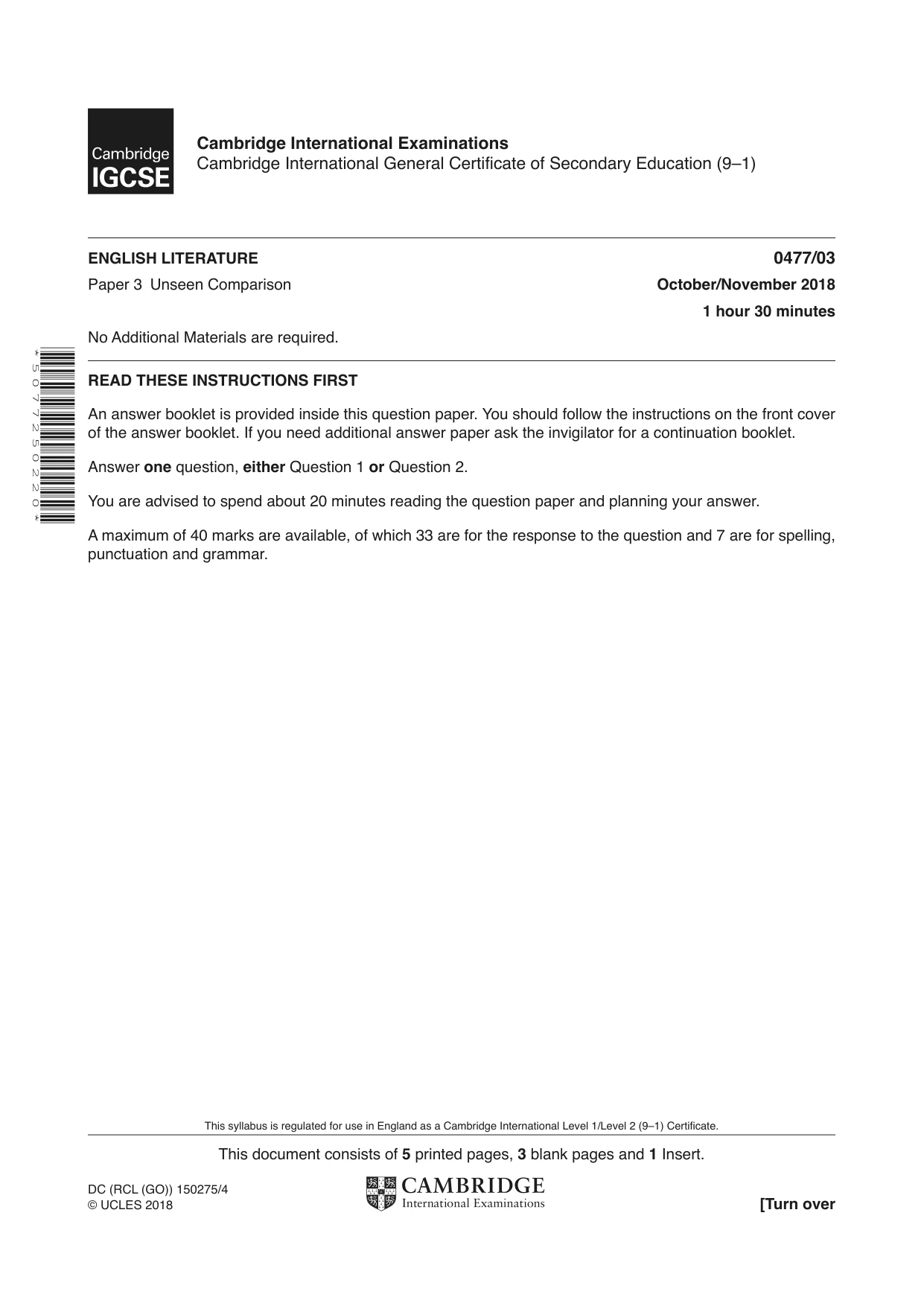
Question paper, page 1
This document consists of 5 printed pages, 3 blank pages and 1 Insert. DC (RCL (GO)) 150275/4 © UCLES 2018 [Turn over Cambridge International Examinations Cambridge International General Certificate of Secondary Education (9–1) * 5 0 7 7 2 5 0 2 2 0 * ENGLISH LITERATURE 0477/03 Paper 3 Unseen Comparison October/November 2018 1 hour 30 minutes No Additional Materials are required. READ THESE INSTRUCTIONS FIRST An answer booklet is provided inside this question paper. You should follow the instructions on the front cover of the answer booklet. If you need additional answer paper ask the invigilator for a continuation booklet. Answer one question, either Question 1 or Question 2. You are advised to spend about 20 minutes reading the question paper and planning your answer. A maximum of 40 marks are available, of which 33 are for the response to the question and 7 are for spelling, punctuation and grammar. This syllabus is regulated for use in England as a Cambridge International Level 1/Level 2 (9–1) Certificate.
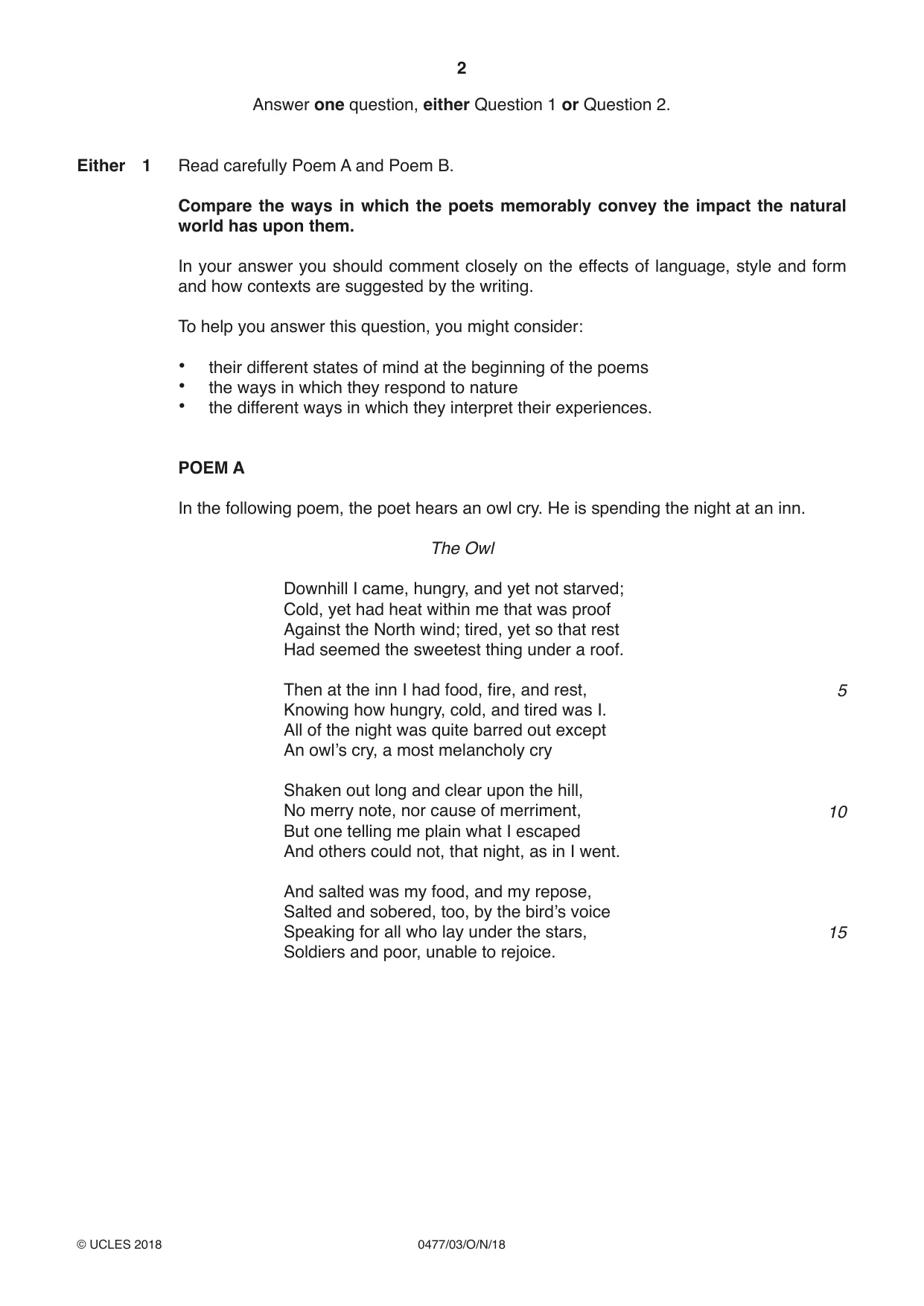
Question paper, page 2
2 0477/03/O/N/18 © UCLES 2018 Answer one question, either Question 1 or Question 2. Either 1 Read carefully Poem A and Poem B. Compare the ways in which the poets memorably convey the impact the natural world has upon them. In your answer you should comment closely on the effects of language, style and form and how contexts are suggested by the writing. To help you answer this question, you might consider: • their different states of mind at the beginning of the poems • the ways in which they respond to nature • the different ways in which they interpret their experiences. POEM A In the following poem, the poet hears an owl cry. He is spending the night at an inn. The Owl Downhill I came, hungry, and yet not starved; Cold, yet had heat within me that was proof Against the North wind; tired, yet so that rest Had seemed the sweetest thing under a roof. Then at the inn I had food, fire, and rest, Knowing how hungry, cold, and tired was I. All of the night was quite barred out except An owl’s cry, a most melancholy cry Shaken out long and clear upon the hill, No merry note, nor cause of merriment, But one telling me plain what I escaped And others could not, that night, as in I went. And salted was my food, and my repose, Salted and sobered, too, by the bird’s voice Speaking for all who lay under the stars, Soldiers and poor, unable to rejoice. 5 10 15
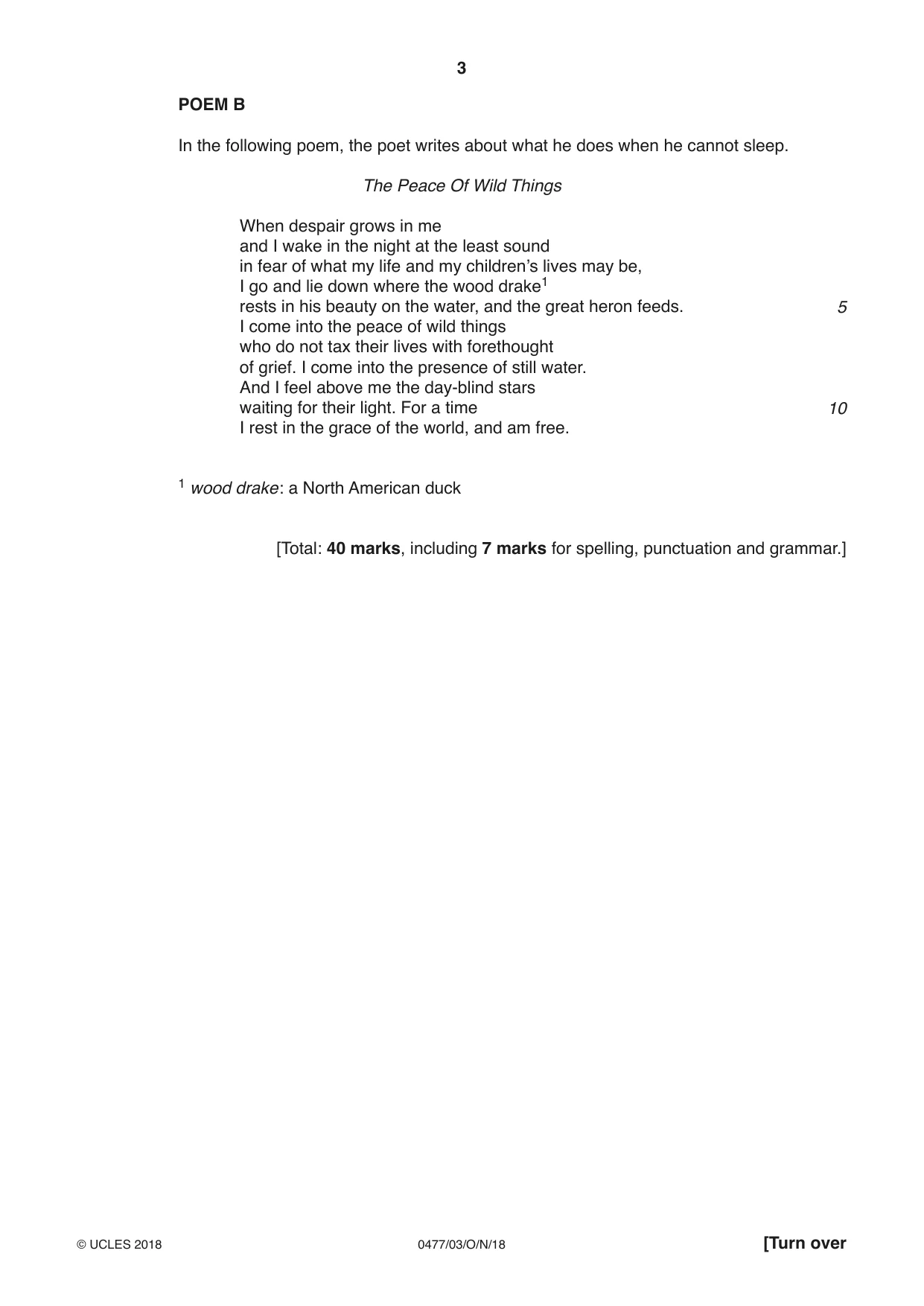
Question paper, page 3
3 0477/03/O/N/18 © UCLES 2018 [Turn over POEM B In the following poem, the poet writes about what he does when he cannot sleep. The Peace Of Wild Things When despair grows in me and I wake in the night at the least sound in fear of what my life and my children’s lives may be, I go and lie down where the wood drake1 rests in his beauty on the water, and the great heron feeds. I come into the peace of wild things who do not tax their lives with forethought of grief. I come into the presence of still water. And I feel above me the day-blind stars waiting for their light. For a time I rest in the grace of the world, and am free. 1 wood drake: a North American duck [Total: 40 marks, including 7 marks for spelling, punctuation and grammar.] 5 10
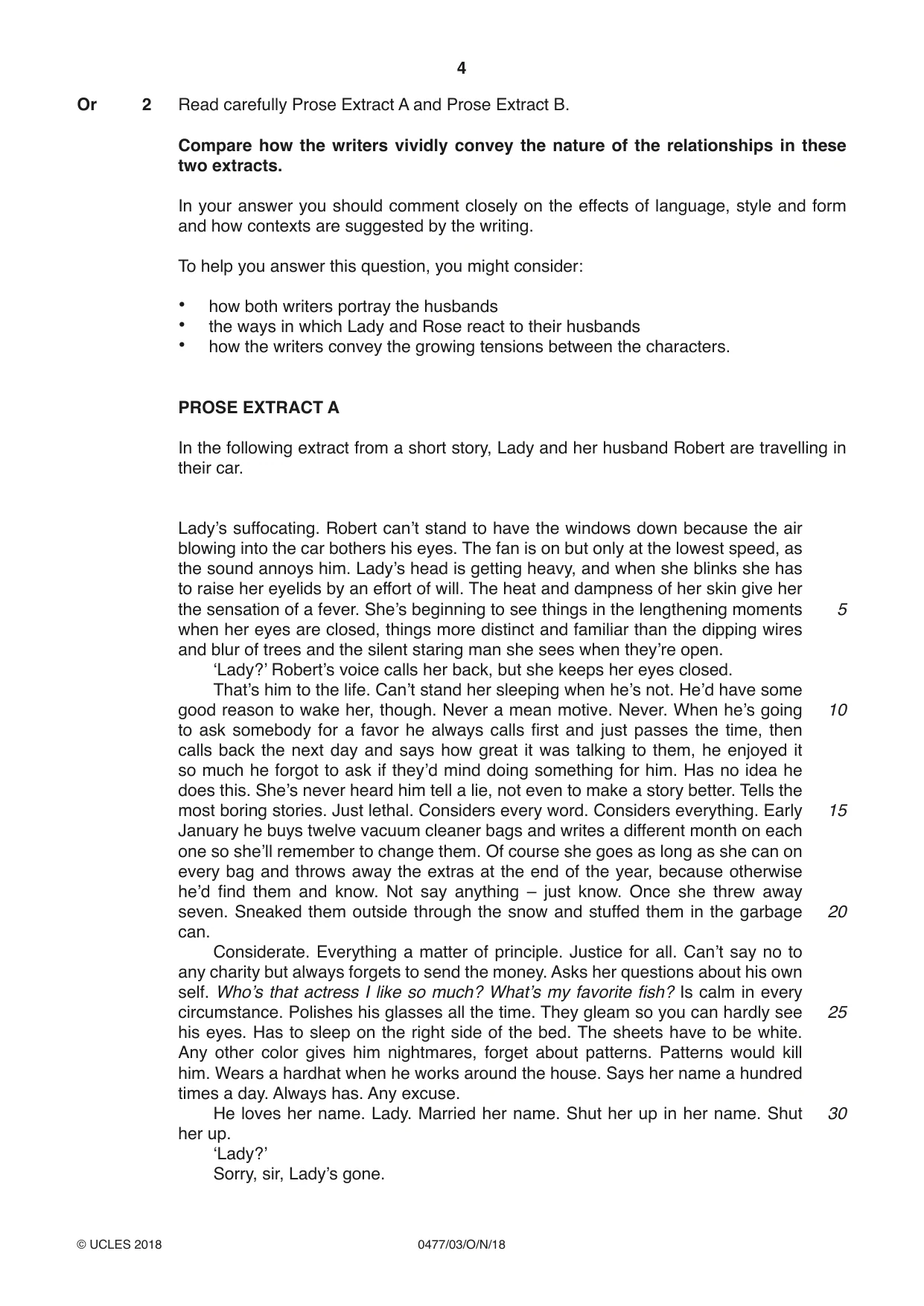
Question paper, page 4
4 0477/03/O/N/18 © UCLES 2018 Or 2 Read carefully Prose Extract A and Prose Extract B. Compare how the writers vividly convey the nature of the relationships in these two extracts. In your answer you should comment closely on the effects of language, style and form and how contexts are suggested by the writing. To help you answer this question, you might consider: • how both writers portray the husbands • the ways in which Lady and Rose react to their husbands • how the writers convey the growing tensions between the characters. PROSE EXTRACT A In the following extract from a short story, Lady and her husband Robert are travelling in their car. Lady’s suffocating. Robert can’t stand to have the windows down because the air blowing into the car bothers his eyes. The fan is on but only at the lowest speed, as the sound annoys him. Lady’s head is getting heavy, and when she blinks she has to raise her eyelids by an effort of will. The heat and dampness of her skin give her the sensation of a fever. She’s beginning to see things in the lengthening moments when her eyes are closed, things more distinct and familiar than the dipping wires and blur of trees and the silent staring man she sees when they’re open. ‘Lady?’ Robert’s voice calls her back, but she keeps her eyes closed. That’s him to the life. Can’t stand her sleeping when he’s not. He’d have some good reason to wake her, though. Never a mean motive. Never. When he’s going to ask somebody for a favor he always calls first and just passes the time, then calls back the next day and says how great it was talking to them, he enjoyed it so much he forgot to ask if they’d mind doing something for him. Has no idea he does this. She’s never heard him tell a lie, not even to make a story better. Tells the most boring stories. Just lethal. Considers every word. Considers everything. Early January he buys twelve vacuum cleaner bags and writes a different month on each one so she’ll remember to change them. Of course she goes as long as she can on every bag and throws away the extras at the end of the year, because otherwise he’d find them and know. Not say anything – just know. Once she threw away seven. Sneaked them outside through the snow and stuffed them in the garbage can. Considerate. Everything a matter of principle. Justice for all. Can’t say no to any charity but always forgets to send the money. Asks her questions about his own self. Who’s that actress I like so much? What’s my favorite fish? Is calm in every circumstance. Polishes his glasses all the time. They gleam so you can hardly see his eyes. Has to sleep on the right side of the bed. The sheets have to be white. Any other color gives him nightmares, forget about patterns. Patterns would kill him. Wears a hardhat when he works around the house. Says her name a hundred times a day. Always has. Any excuse. He loves her name. Lady. Married her name. Shut her up in her name. Shut her up. ‘Lady?’ Sorry, sir, Lady’s gone. 5 10 15 20 25 30
Question paper, page 5
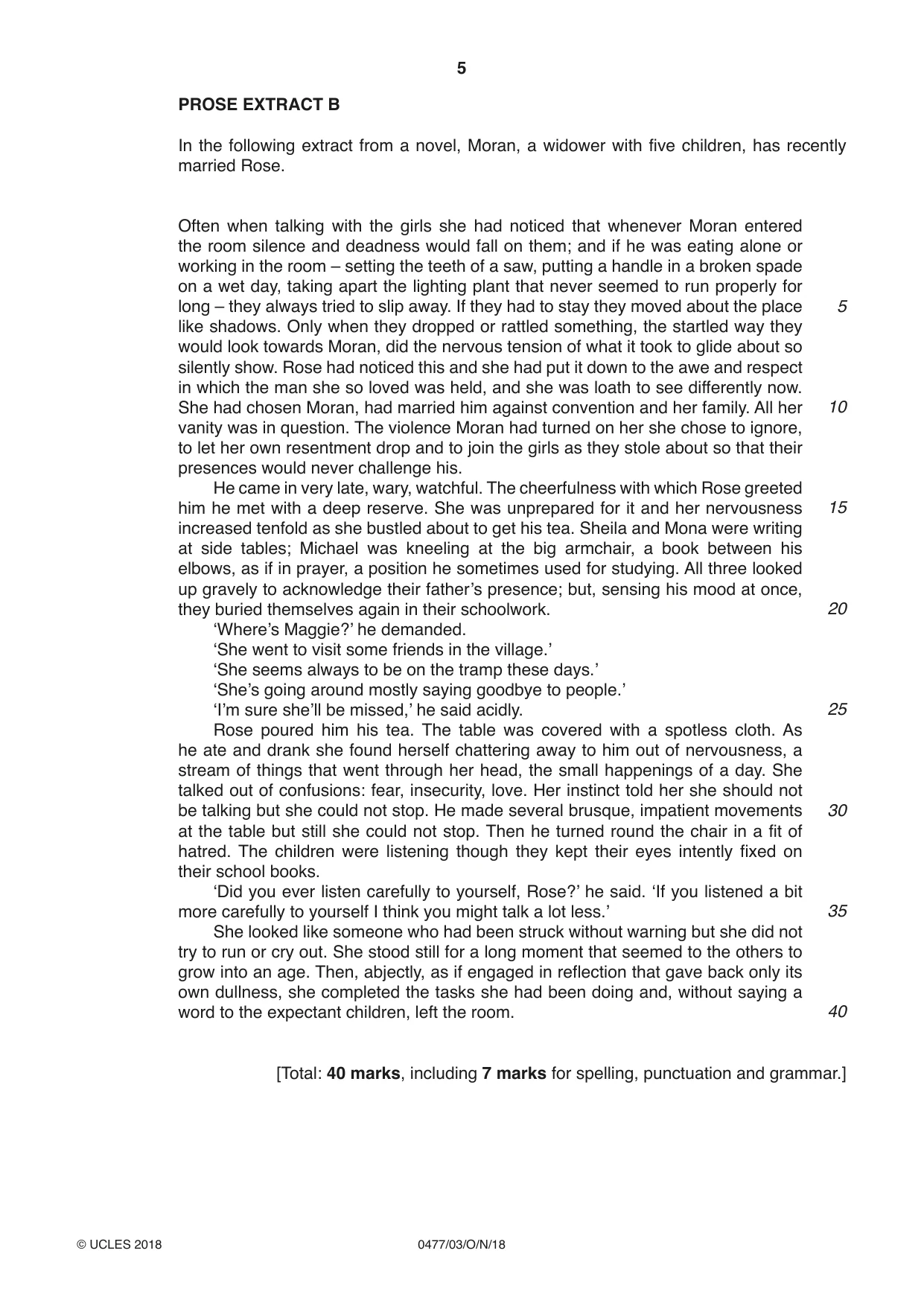
5 0477/03/O/N/18 © UCLES 2018 PROSE EXTRACT B In the following extract from a novel, Moran, a widower with five children, has recently married Rose. Often when talking with the girls she had noticed that whenever Moran entered the room silence and deadness would fall on them; and if he was eating alone or working in the room – setting the teeth of a saw, putting a handle in a broken spade on a wet day, taking apart the lighting plant that never seemed to run properly for long – they always tried to slip away. If they had to stay they moved about the place like shadows. Only when they dropped or rattled something, the startled way they would look towards Moran, did the nervous tension of what it took to glide about so silently show. Rose had noticed this and she had put it down to the awe and respect in which the man she so loved was held, and she was loath to see differently now. She had chosen Moran, had married him against convention and her family. All her vanity was in question. The violence Moran had turned on her she chose to ignore, to let her own resentment drop and to join the girls as they stole about so that their presences would never challenge his. He came in very late, wary, watchful. The cheerfulness with which Rose greeted him he met with a deep reserve. She was unprepared for it and her nervousness increased tenfold as she bustled about to get his tea. Sheila and Mona were writing at side tables; Michael was kneeling at the big armchair, a book between his elbows, as if in prayer, a position he sometimes used for studying. All three looked up gravely to acknowledge their father’s presence; but, sensing his mood at once, they buried themselves again in their schoolwork. ‘Where’s Maggie?’ he demanded. ‘She went to visit some friends in the village.’ ‘She seems always to be on the tramp these days.’ ‘She’s going around mostly saying goodbye to people.’ ‘I’m sure she’ll be missed,’ he said acidly. Rose poured him his tea. The table was covered with a spotless cloth. As he ate and drank she found herself chattering away to him out of nervousness, a stream of things that went through her head, the small happenings of a day. She talked out of confusions: fear, insecurity, love. Her instinct told her she should not be talking but she could not stop. He made several brusque, impatient movements at the table but still she could not stop. Then he turned round the chair in a fit of hatred. The children were listening though they kept their eyes intently fixed on their school books. ‘Did you ever listen carefully to yourself, Rose?’ he said. ‘If you listened a bit more carefully to yourself I think you might talk a lot less.’ She looked like someone who had been struck without warning but she did not try to run or cry out. She stood still for a long moment that seemed to the others to grow into an age. Then, abjectly, as if engaged in reflection that gave back only its own dullness, she completed the tasks she had been doing and, without saying a word to the expectant children, left the room. [Total: 40 marks, including 7 marks for spelling, punctuation and grammar.] 5 10 15 20 25 30 35 40
Question paper, page 6
6 0477/03/O/N/18 © UCLES 2018 BLANK PAGE
Question paper, page 7
7 0477/03/O/N/18 © UCLES 2018 BLANK PAGE
Question paper, page 8
8 0477/03/O/N/18 © UCLES 2018 Permission to reproduce items where third-party owned material protected by copyright is included has been sought and cleared where possible. Every reasonable effort has been made by the publisher (UCLES) to trace copyright holders, but if any items requiring clearance have unwittingly been included, the publisher will be pleased to make amends at the earliest possible opportunity. To avoid the issue of disclosure of answer-related information to candidates, all copyright acknowledgements are reproduced online in the Cambridge International Examinations Copyright Acknowledgements Booklet. This is produced for each series of examinations and is freely available to download at www.cie.org.uk after the live examination series. Cambridge International Examinations is part of the Cambridge Assessment Group. Cambridge Assessment is the brand name of University of Cambridge Local Examinations Syndicate (UCLES), which is itself a department of the University of Cambridge. BLANK PAGE