Cambridge IGCSE English - Literature (9-1) (UK only) 0477 — 2018 May/June Paper 3 · Variant 0
0477/30/M/J/18
The question paper and its mark scheme, free to read here and free to download. This is Cambridge’s own paper, exactly as it was sat.
Question paper8 pages
Mark scheme
No mark scheme is in the library for this paper.
Paper as text
Question paper, page 1
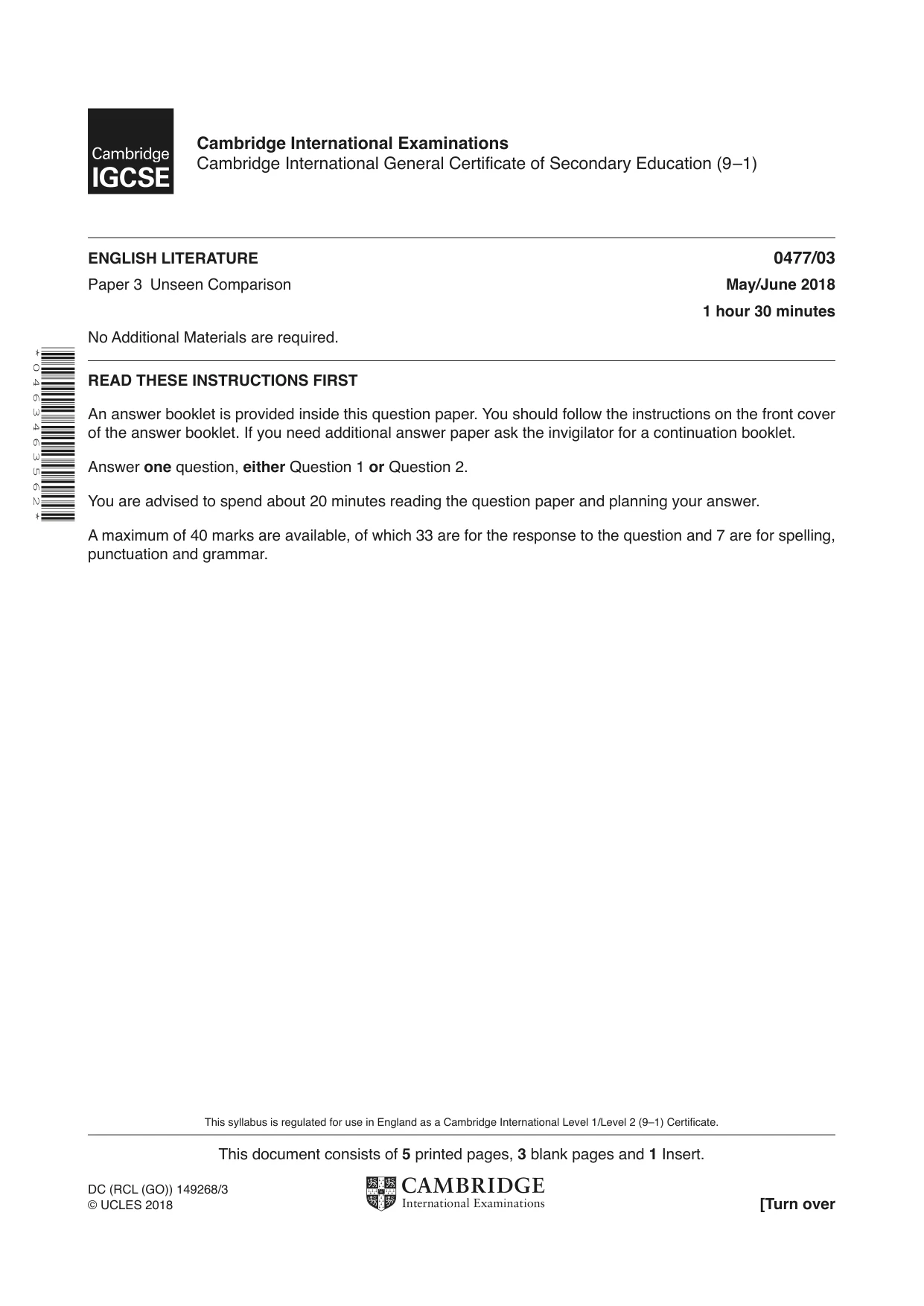
This document consists of 5 printed pages, 3 blank pages and 1 Insert. DC (RCL (GO)) 149268/3 © UCLES 2018 [Turn over Cambridge International Examinations Cambridge International General Certificate of Secondary Education (9 –1) * 0 4 6 3 4 6 3 5 6 2 * ENGLISH LITERATURE 0477/03 Paper 3 Unseen Comparison May/June 2018 1 hour 30 minutes No Additional Materials are required. READ THESE INSTRUCTIONS FIRST An answer booklet is provided inside this question paper. You should follow the instructions on the front cover of the answer booklet. If you need additional answer paper ask the invigilator for a continuation booklet. Answer one question, either Question 1 or Question 2. You are advised to spend about 20 minutes reading the question paper and planning your answer. A maximum of 40 marks are available, of which 33 are for the response to the question and 7 are for spelling, punctuation and grammar. This syllabus is regulated for use in England as a Cambridge International Level 1/Level 2 (9–1) Certificate.
Question paper, page 2
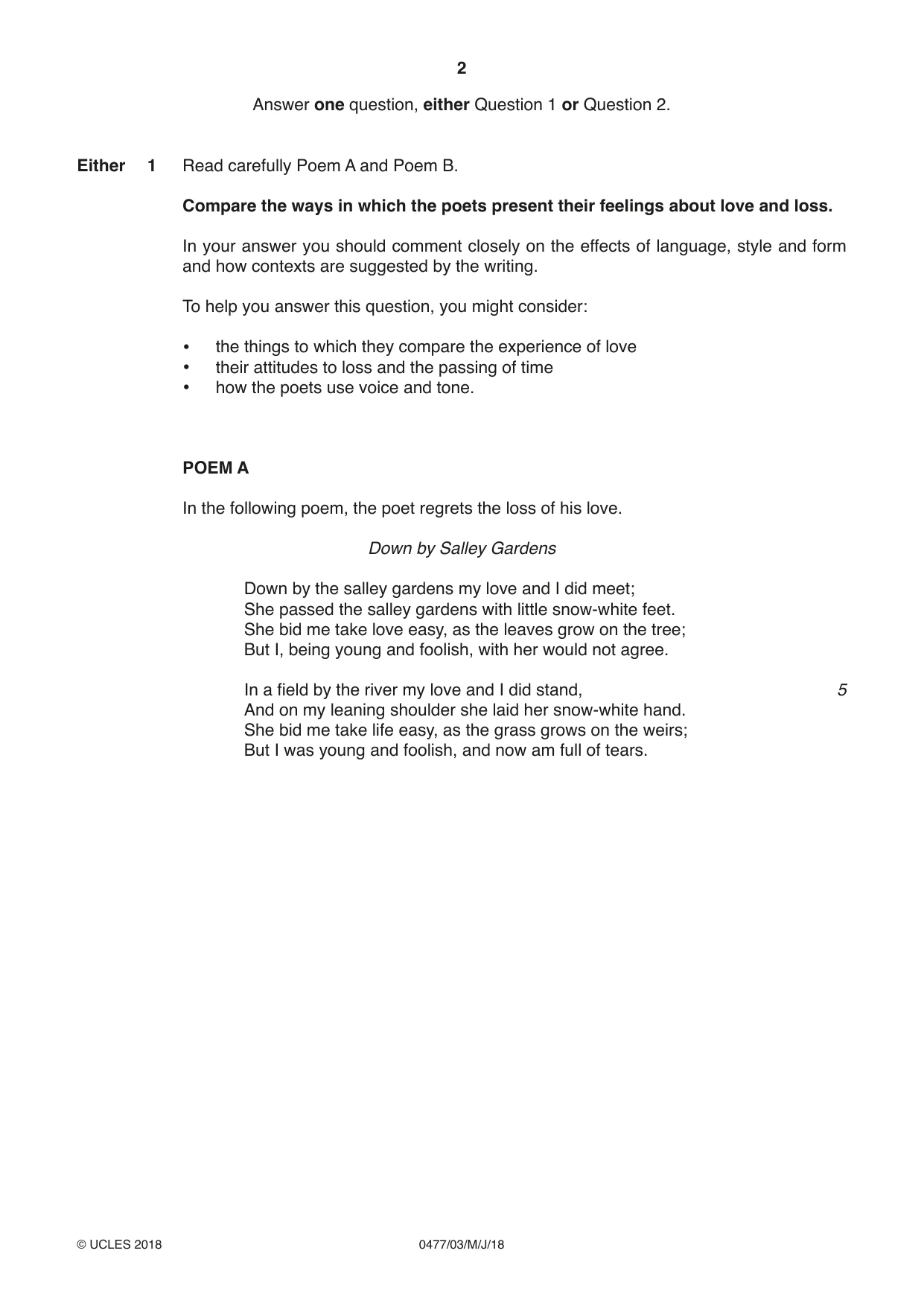
2 0477/03/M/J/18 © UCLES 2018 Answer one question, either Question 1 or Question 2. Either 1 Read carefully Poem A and Poem B. Compare the ways in which the poets present their feelings about love and loss. In your answer you should comment closely on the effects of language, style and form and how contexts are suggested by the writing. To help you answer this question, you might consider: • the things to which they compare the experience of love • their attitudes to loss and the passing of time • how the poets use voice and tone. POEM A In the following poem, the poet regrets the loss of his love. Down by Salley Gardens Down by the salley gardens my love and I did meet; She passed the salley gardens with little snow-white feet. She bid me take love easy, as the leaves grow on the tree; But I, being young and foolish, with her would not agree. In a field by the river my love and I did stand, And on my leaning shoulder she laid her snow-white hand. She bid me take life easy, as the grass grows on the weirs; But I was young and foolish, and now am full of tears. 5
Question paper, page 3
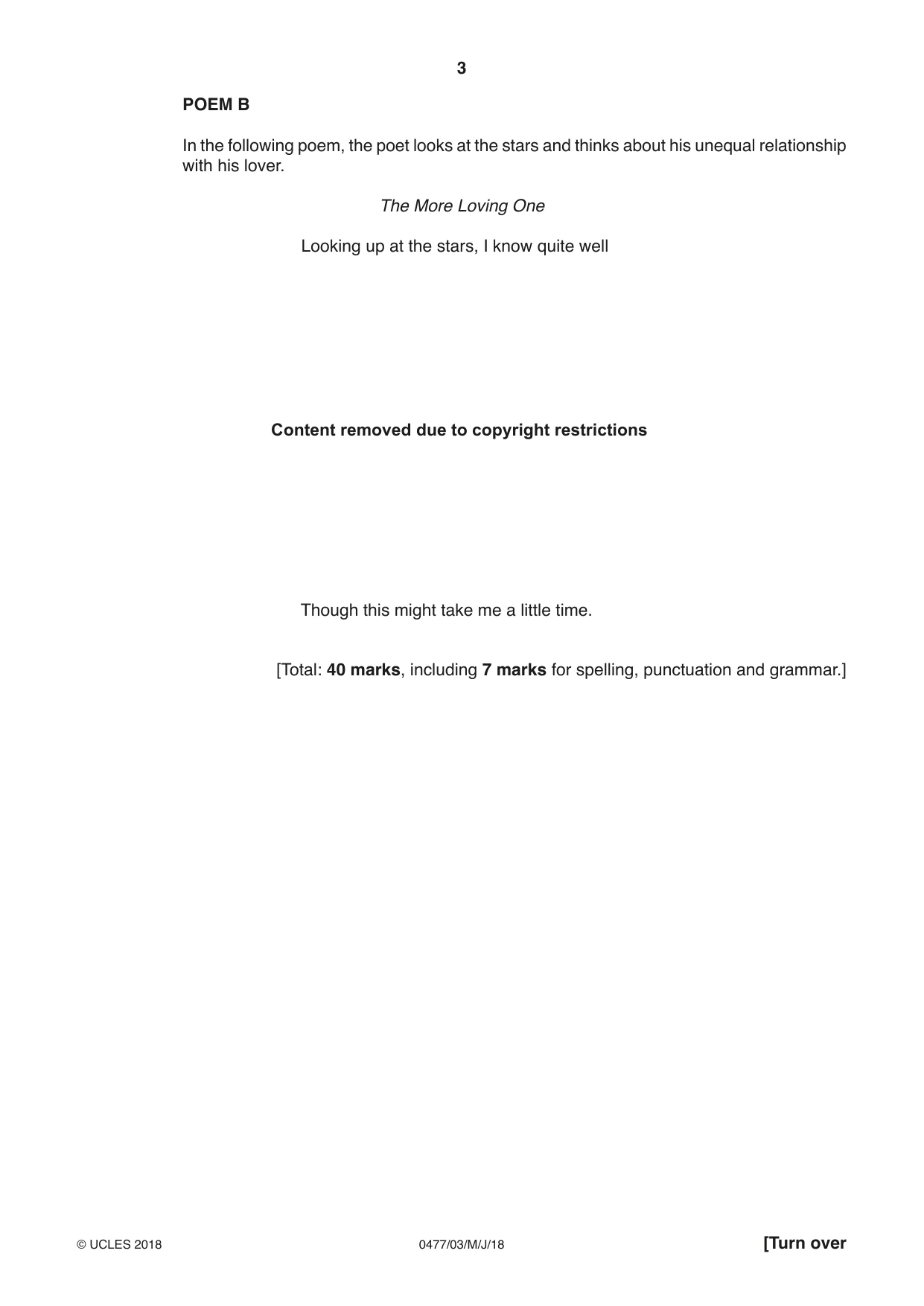
3 0477/03/M/J/18 © UCLES 2018 [Turn over POEM B In the following poem, the poet looks at the stars and thinks about his unequal relationship with his lover. The More Loving One Looking up at the stars, I know quite well Content removed due to copyright restrictions [Total: 40 marks, including 7 marks for spelling, punctuation and grammar.] Though this might take me a little time.
Question paper, page 4
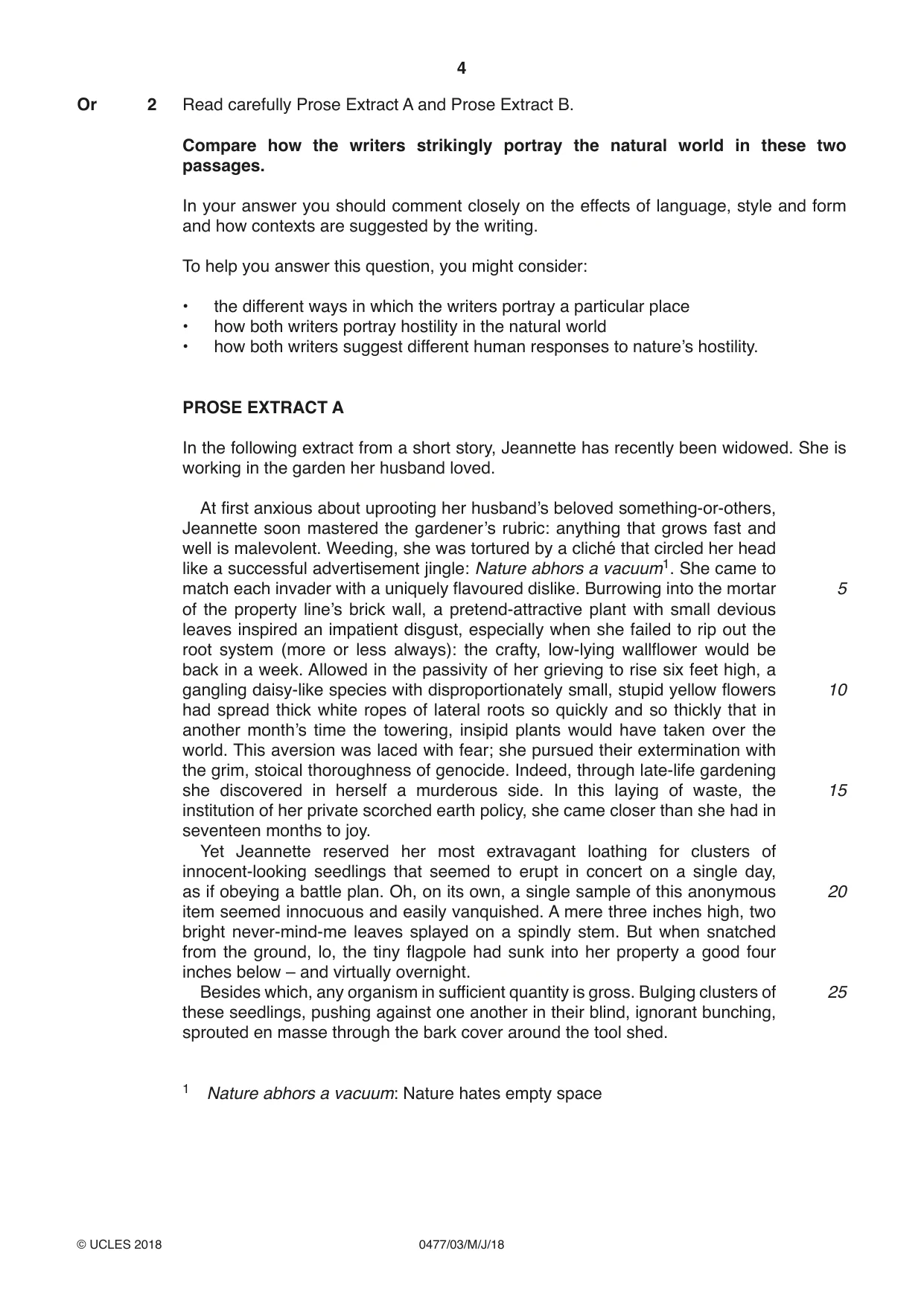
4 0477/03/M/J/18 © UCLES 2018 Or 2 Read carefully Prose Extract A and Prose Extract B. Compare how the writers strikingly portray the natural world in these two passages. In your answer you should comment closely on the effects of language, style and form and how contexts are suggested by the writing. To help you answer this question, you might consider: • the different ways in which the writers portray a particular place • how both writers portray hostility in the natural world • how both writers suggest different human responses to nature’s hostility. PROSE EXTRACT A In the following extract from a short story, Jeannette has recently been widowed. She is working in the garden her husband loved. At first anxious about uprooting her husband’s beloved something-or-others, Jeannette soon mastered the gardener’s rubric: anything that grows fast and well is malevolent. Weeding, she was tortured by a cliché that circled her head like a successful advertisement jingle: Nature abhors a vacuum1. She came to match each invader with a uniquely flavoured dislike. Burrowing into the mortar of the property line’s brick wall, a pretend-attractive plant with small devious leaves inspired an impatient disgust, especially when she failed to rip out the root system (more or less always): the crafty, low-lying wallflower would be back in a week. Allowed in the passivity of her grieving to rise six feet high, a gangling daisy-like species with disproportionately small, stupid yellow flowers had spread thick white ropes of lateral roots so quickly and so thickly that in another month’s time the towering, insipid plants would have taken over the world. This aversion was laced with fear; she pursued their extermination with the grim, stoical thoroughness of genocide. Indeed, through late-life gardening she discovered in herself a murderous side. In this laying of waste, the institution of her private scorched earth policy, she came closer than she had in seventeen months to joy. Yet Jeannette reserved her most extravagant loathing for clusters of innocent-looking seedlings that seemed to erupt in concert on a single day, as if obeying a battle plan. Oh, on its own, a single sample of this anonymous item seemed innocuous and easily vanquished. A mere three inches high, two bright never-mind-me leaves splayed on a spindly stem. But when snatched from the ground, lo, the tiny flagpole had sunk into her property a good four inches below – and virtually overnight. Besides which, any organism in sufficient quantity is gross. Bulging clusters of these seedlings, pushing against one another in their blind, ignorant bunching, sprouted en masse through the bark cover around the tool shed. 1 Nature abhors a vacuum: Nature hates empty space 5 10 15 20 25
Question paper, page 5
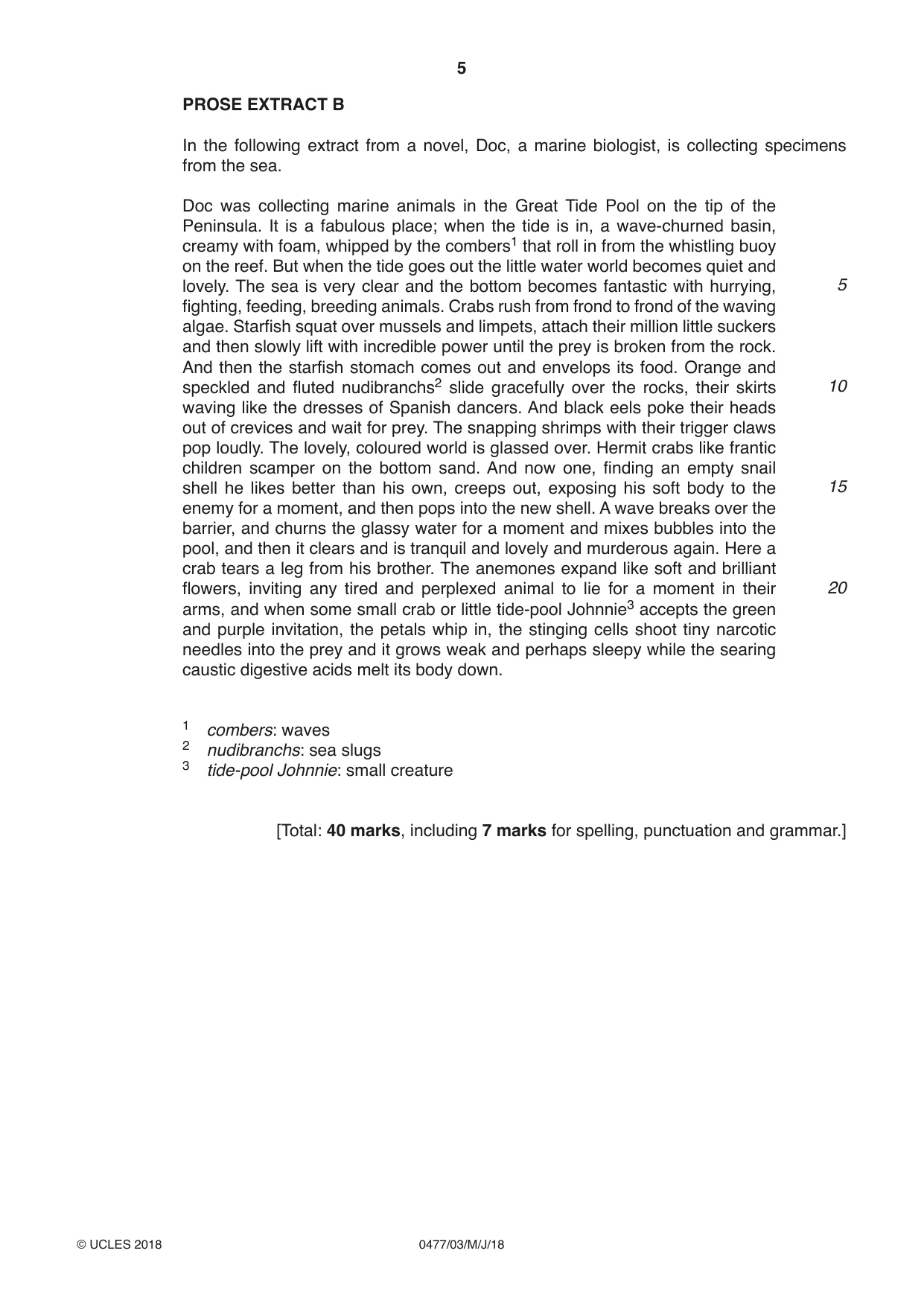
5 0477/03/M/J/18 © UCLES 2018 PROSE EXTRACT B In the following extract from a novel, Doc, a marine biologist, is collecting specimens from the sea. Doc was collecting marine animals in the Great Tide Pool on the tip of the Peninsula. It is a fabulous place; when the tide is in, a wave-churned basin, creamy with foam, whipped by the combers1 that roll in from the whistling buoy on the reef. But when the tide goes out the little water world becomes quiet and lovely. The sea is very clear and the bottom becomes fantastic with hurrying, fighting, feeding, breeding animals. Crabs rush from frond to frond of the waving algae. Starfish squat over mussels and limpets, attach their million little suckers and then slowly lift with incredible power until the prey is broken from the rock. And then the starfish stomach comes out and envelops its food. Orange and speckled and fluted nudibranchs2 slide gracefully over the rocks, their skirts waving like the dresses of Spanish dancers. And black eels poke their heads out of crevices and wait for prey. The snapping shrimps with their trigger claws pop loudly. The lovely, coloured world is glassed over. Hermit crabs like frantic children scamper on the bottom sand. And now one, finding an empty snail shell he likes better than his own, creeps out, exposing his soft body to the enemy for a moment, and then pops into the new shell. A wave breaks over the barrier, and churns the glassy water for a moment and mixes bubbles into the pool, and then it clears and is tranquil and lovely and murderous again. Here a crab tears a leg from his brother. The anemones expand like soft and brilliant flowers, inviting any tired and perplexed animal to lie for a moment in their arms, and when some small crab or little tide-pool Johnnie3 accepts the green and purple invitation, the petals whip in, the stinging cells shoot tiny narcotic needles into the prey and it grows weak and perhaps sleepy while the searing caustic digestive acids melt its body down. 1 combers: waves 2 nudibranchs: sea slugs 3 tide-pool Johnnie: small creature [Total: 40 marks, including 7 marks for spelling, punctuation and grammar.] 5 10 15 20
Question paper, page 6
6 0477/03/M/J/18 © UCLES 2018 BLANK PAGE
Question paper, page 7
7 0477/03/M/J/18 © UCLES 2018 BLANK PAGE
Question paper, page 8
8 0477/03/M/J/18 © UCLES 2018 Permission to reproduce items where third-party owned material protected by copyright is included has been sought and cleared where possible. Every reasonable effort has been made by the publisher (UCLES) to trace copyright holders, but if any items requiring clearance have unwittingly been included, the publisher will be pleased to make amends at the earliest possible opportunity. To avoid the issue of disclosure of answer-related information to candidates, all copyright acknowledgements are reproduced online in the Cambridge International Examinations Copyright Acknowledgements Booklet. This is produced for each series of examinations and is freely available to download at www.cie.org.uk after the live examination series. Cambridge International Examinations is part of the Cambridge Assessment Group. Cambridge Assessment is the brand name of University of Cambridge Local Examinations Syndicate (UCLES), which is itself a department of the University of Cambridge. BLANK PAGE