Cambridge IGCSE English - Literature 0486 — 2019 Oct/Nov Paper 2 · Variant 3
0486/23/O/N/19 · 50 marks · ≈56 min
The question paper and its mark scheme, free to read here and free to download. This is Cambridge’s own paper, exactly as it was sat.
Question paper12 pages

Mark scheme4 pages
Answers below. Sit the paper first if you are practising.
Paper as text
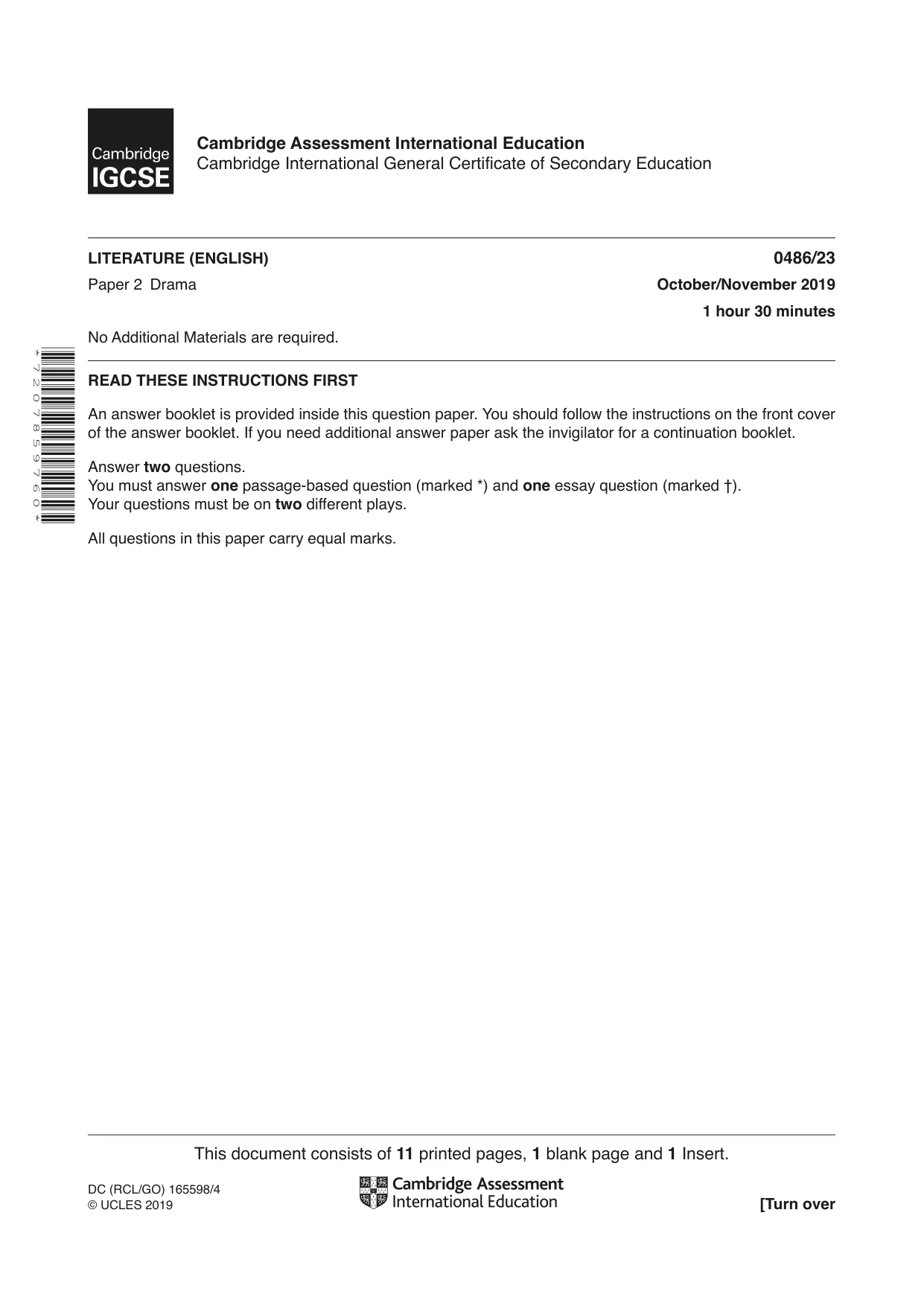
Question paper, page 1
This document consists of 11 printed pages, 1 blank page and 1 Insert. DC (RCL/GO) 165598/4 © UCLES 2019 [Turn over Cambridge Assessment International Education Cambridge International General Certificate of Secondary Education LITERATURE (ENGLISH) 0486/23 Paper 2 Drama October/November 2019 1 hour 30 minutes No Additional Materials are required. READ THESE INSTRUCTIONS FIRST An answer booklet is provided inside this question paper. You should follow the instructions on the front cover of the answer booklet. If you need additional answer paper ask the invigilator for a continuation booklet. Answer two questions. You must answer one passage-based question (marked *) and one essay question (marked †). Your questions must be on two different plays. All questions in this paper carry equal marks. * 7 2 0 7 8 5 9 7 6 0 *
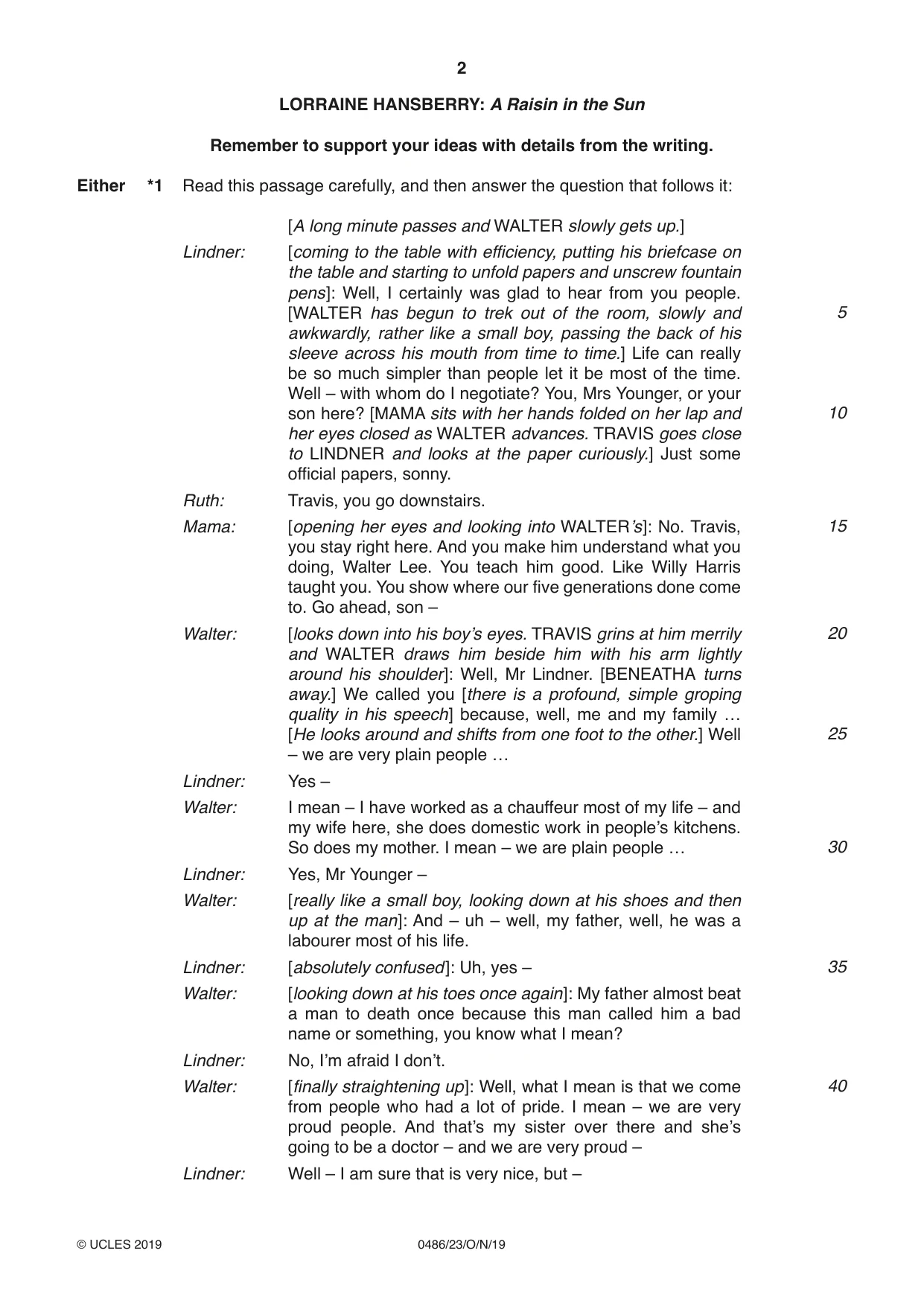
Question paper, page 2
2 0486/23/O/N/19 © UCLES 2019 LORRAINE HANSBERRY: A Raisin in the Sun Remember to support your ideas with details from the writing. Either *1 Read this passage carefully, and then answer the question that follows it: [Α long minute passes and WALTER slowly gets up.] Lindner: [coming to the table with efficiency, putting his briefcase on the table and starting to unfold papers and unscrew fountain pens]: Well, I certainly was glad to hear from you people. [WALTER has begun to trek out of the room, slowly and awkwardly, rather like a small boy, passing the back of his sleeve across his mouth from time to time.] Life can really be so much simpler than people let it be most of the time. Well – with whom do I negotiate? You, Mrs Younger, or your son here? [MAMA sits with her hands folded on her lap and her eyes closed as WALTER advances. TRAVIS goes close to LINDNER and looks at the paper curiously.] Just some official papers, sonny. Ruth: Travis, you go downstairs. Mama: [opening her eyes and looking into WALTER’s]: No. Travis, you stay right here. And you make him understand what you doing, Walter Lee. You teach him good. Like Willy Harris taught you. You show where our five generations done come to. Go ahead, son – Walter: [looks down into his boy’s eyes. TRAVIS grins at him merrily and WALTER draws him beside him with his arm lightly around his shoulder]: Well, Mr Lindner. [BENEATHA turns away.] We called you [there is a profound, simple groping quality in his speech] because, well, me and my family … [He looks around and shifts from one foot to the other.] Well – we are very plain people … Lindner: Yes – Walter: I mean – I have worked as a chauffeur most of my life – and my wife here, she does domestic work in people’s kitchens. So does my mother. I mean – we are plain people … Lindner: Yes, Mr Younger – Walter: [really like a small boy, looking down at his shoes and then up at the man]: And – uh – well, my father, well, he was a labourer most of his life. Lindner: [absolutely confused]: Uh, yes – Walter: [looking down at his toes once again]: My father almost beat a man to death once because this man called him a bad name or something, you know what I mean? Lindner: No, I’m afraid I don’t. Walter: [finally straightening up]: Well, what I mean is that we come from people who had a lot of pride. I mean – we are very proud people. And that’s my sister over there and she’s going to be a doctor – and we are very proud – Lindner: Well – I am sure that is very nice, but – 5 10 15 20 25 30 35 40
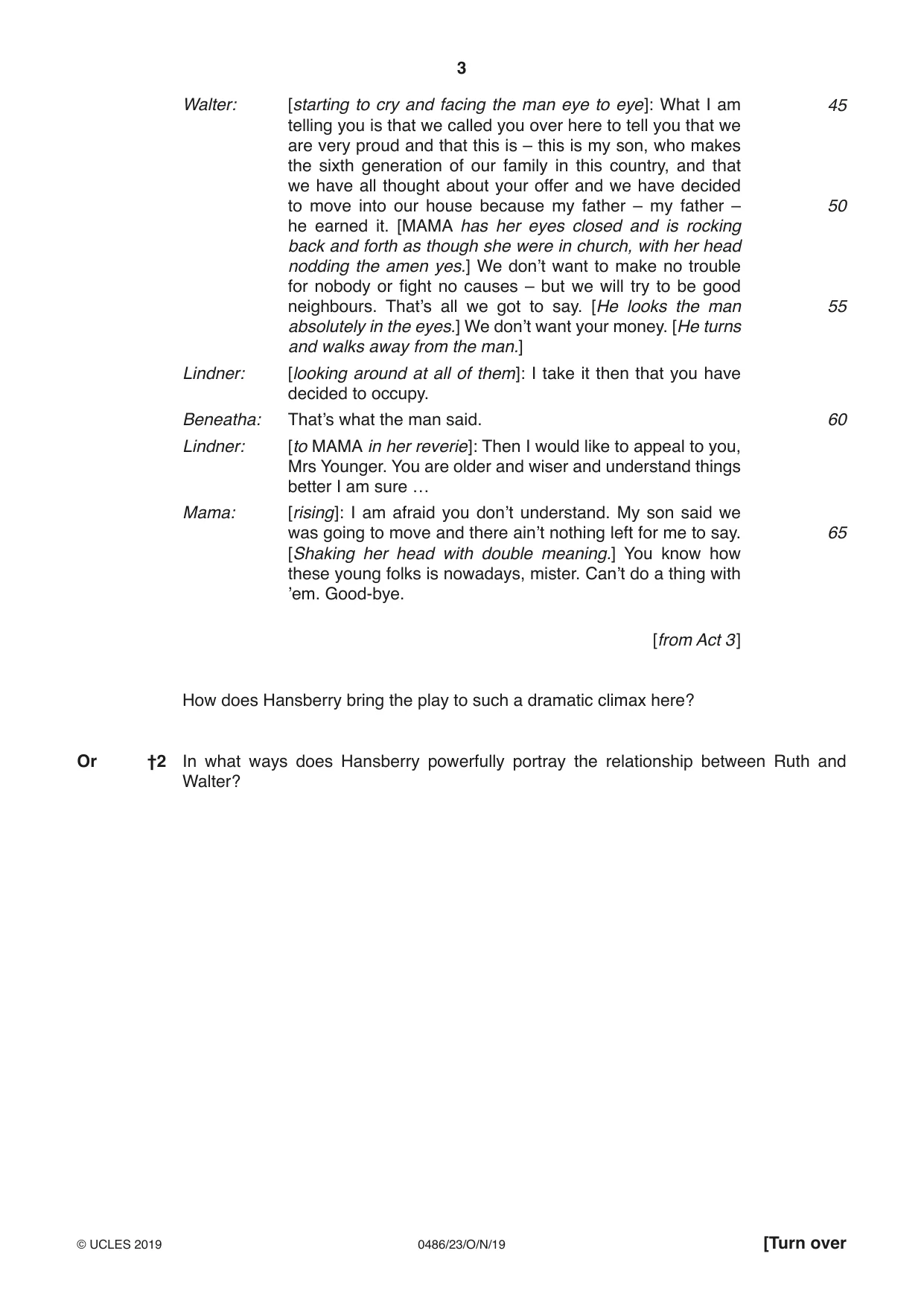
Question paper, page 3
3 0486/23/O/N/19 © UCLES 2019 [Turn over Walter: [starting to cry and facing the man eye to eye]: What I am telling you is that we called you over here to tell you that we are very proud and that this is – this is my son, who makes the sixth generation of our family in this country, and that we have all thought about your offer and we have decided to move into our house because my father – my father – he earned it. [MAMA has her eyes closed and is rocking back and forth as though she were in church, with her head nodding the amen yes.] We don’t want to make no trouble for nobody or fight no causes – but we will try to be good neighbours. That’s all we got to say. [He looks the man absolutely in the eyes.] We don’t want your money. [He turns and walks away from the man.] Lindner: [looking around at all of them]: I take it then that you have decided to occupy. Beneatha: That’s what the man said. Lindner: [to MAMA in her reverie]: Then I would like to appeal to you, Mrs Younger. You are older and wiser and understand things better I am sure … Mama: [rising]: I am afraid you don’t understand. My son said we was going to move and there ain’t nothing left for me to say. [Shaking her head with double meaning.] You know how these young folks is nowadays, mister. Can’t do a thing with ’em. Good-bye. [from Act 3] How does Hansberry bring the play to such a dramatic climax here? Or †2 In what ways does Hansberry powerfully portray the relationship between Ruth and Walter? 45 50 55 60 65
Question paper, page 4
4 0486/23/O/N/19 © UCLES 2019 ARTHUR MILLER: A View from the Bridge Remember to support your ideas with details from the writing. Either *3 Read this passage carefully, and then answer the question that follows it: Beatrice: They ain’t goin’ to come any quicker if you stand in the street. Content removed due to copyright restrictions.
Question paper, page 5
5 0486/23/O/N/19 © UCLES 2019 [Turn over CATHERINE stops him at the door.] [from Act 1] How does Miller make this moment in the play so revealing? Or †4 How does Miller use Eddie’s visits to Alfieri to contribute to the dramatic impact of the play? Content removed due to copyright restrictions.
Question paper, page 6
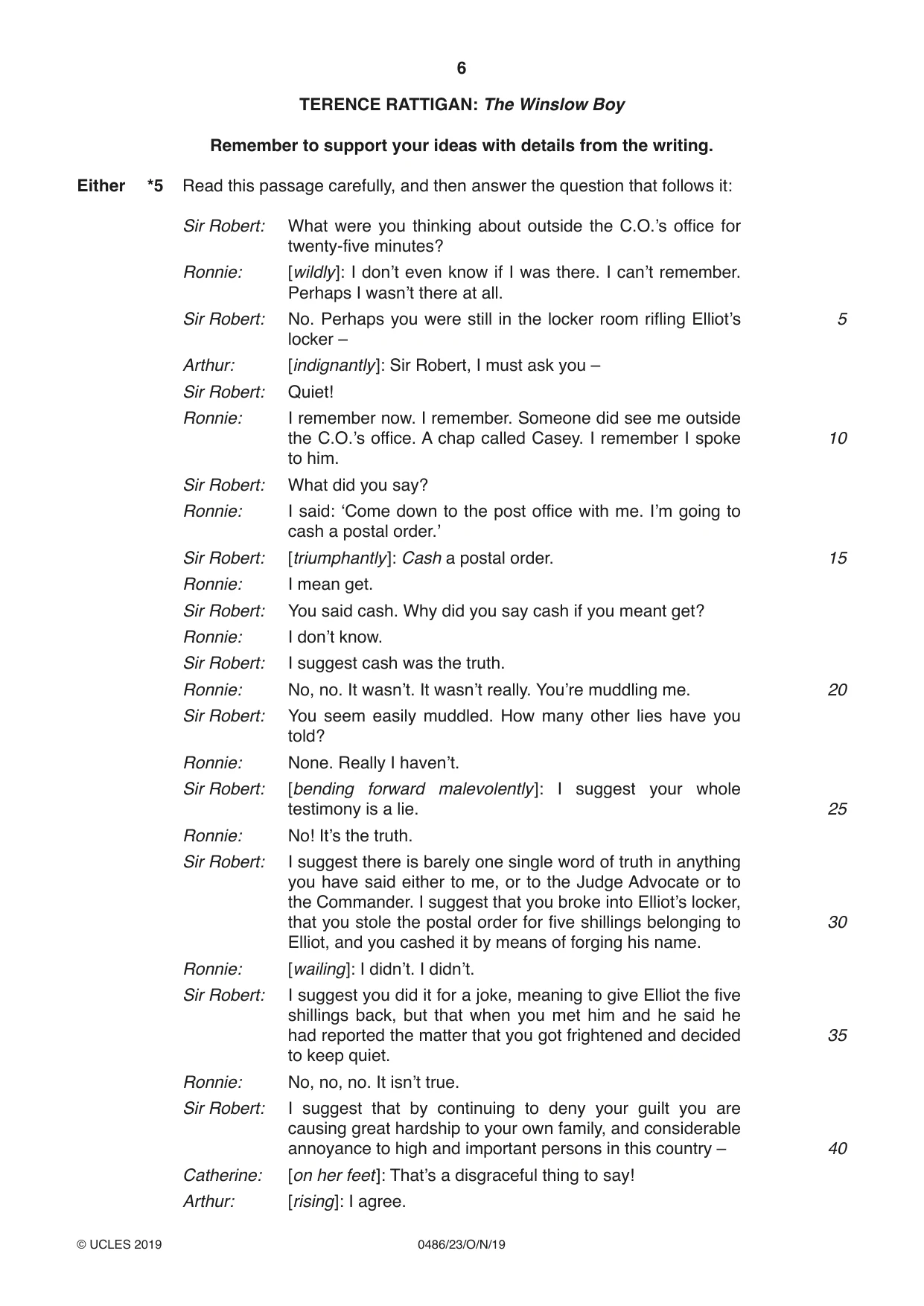
6 0486/23/O/N/19 © UCLES 2019 TERENCE RATTIGAN: The Winslow Boy Remember to support your ideas with details from the writing. Either *5 Read this passage carefully, and then answer the question that follows it: Sir Robert: What were you thinking about outside the C.O.’s office for twenty-five minutes? Ronnie: [wildly]: I don’t even know if I was there. I can’t remember. Perhaps I wasn’t there at all. Sir Robert: No. Perhaps you were still in the locker room rifling Elliot’s locker – Arthur: [indignantly]: Sir Robert, I must ask you – Sir Robert: Quiet! Ronnie: I remember now. I remember. Someone did see me outside the C.O.’s office. A chap called Casey. I remember I spoke to him. Sir Robert: What did you say? Ronnie: I said: ‘Come down to the post office with me. I’m going to cash a postal order.’ Sir Robert: [triumphantly]: Cash a postal order. Ronnie: I mean get. Sir Robert: You said cash. Why did you say cash if you meant get? Ronnie: I don’t know. Sir Robert: I suggest cash was the truth. Ronnie: No, no. It wasn’t. It wasn’t really. You’re muddling me. Sir Robert: You seem easily muddled. How many other lies have you told? Ronnie: None. Really I haven’t. Sir Robert: [bending forward malevolently]: I suggest your whole testimony is a lie. Ronnie: No! It’s the truth. Sir Robert: I suggest there is barely one single word of truth in anything you have said either to me, or to the Judge Advocate or to the Commander. I suggest that you broke into Elliot’s locker, that you stole the postal order for five shillings belonging to Elliot, and you cashed it by means of forging his name. Ronnie: [wailing]: I didn’t. I didn’t. Sir Robert: I suggest you did it for a joke, meaning to give Elliot the five shillings back, but that when you met him and he said he had reported the matter that you got frightened and decided to keep quiet. Ronnie: No, no, no. It isn’t true. Sir Robert: I suggest that by continuing to deny your guilt you are causing great hardship to your own family, and considerable annoyance to high and important persons in this country – Catherine: [on her feet]: That’s a disgraceful thing to say! Arthur: [rising]: I agree. 5 10 15 20 25 30 35 40
Question paper, page 7
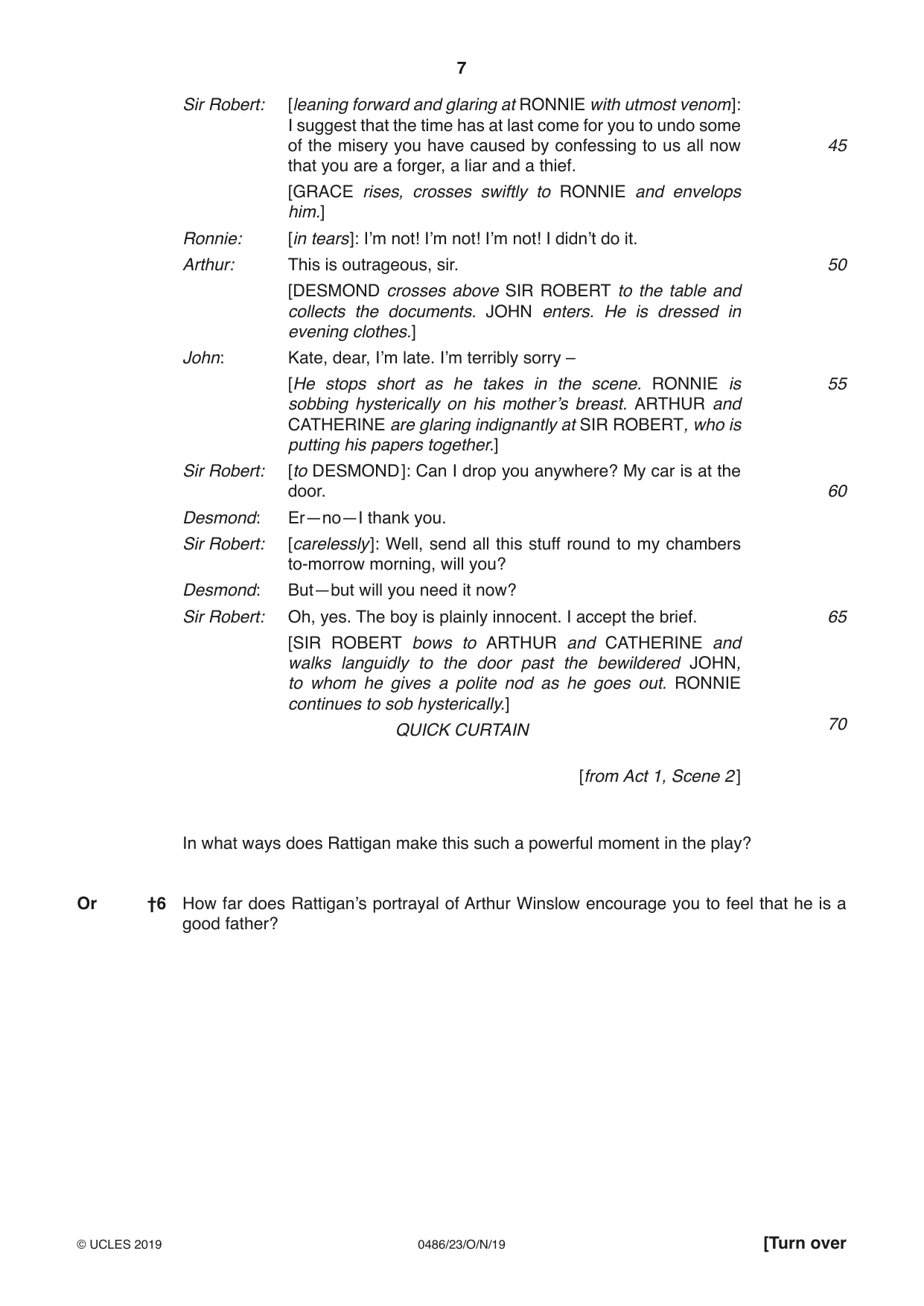
7 0486/23/O/N/19 © UCLES 2019 [Turn over Sir Robert: [leaning forward and glaring at RONNIE with utmost venom]: I suggest that the time has at last come for you to undo some of the misery you have caused by confessing to us all now that you are a forger, a liar and a thief. [GRACE rises, crosses swiftly to RONNIE and envelops him.] Ronnie: [in tears]: I’m not! I’m not! I’m not! I didn’t do it. Arthur: This is outrageous, sir. [DESMOND crosses above SIR ROBERT to the table and collects the documents. JOHN enters. He is dressed in evening clothes.] John: Kate, dear, I’m late. I’m terribly sorry – [He stops short as he takes in the scene. RONNIE is sobbing hysterically on his mother’s breast. ARTHUR and CATHERINE are glaring indignantly at SIR ROBERT, who is putting his papers together.] Sir Robert: [to DESMOND]: Can I drop you anywhere? My car is at the door. Desmond: Er—no—I thank you. Sir Robert: [carelessly]: Well, send all this stuff round to my chambers to-morrow morning, will you? Desmond: But—but will you need it now? Sir Robert: Oh, yes. The boy is plainly innocent. I accept the brief. [SIR ROBERT bows to ARTHUR and CATHERINE and walks languidly to the door past the bewildered JOHN, to whom he gives a polite nod as he goes out. RONNIE continues to sob hysterically.] QUICK CURTAIN [from Act 1, Scene 2 ] In what ways does Rattigan make this such a powerful moment in the play? Or †6 How far does Rattigan’s portrayal of Arthur Winslow encourage you to feel that he is a good father? 45 50 55 60 65 70
Question paper, page 8
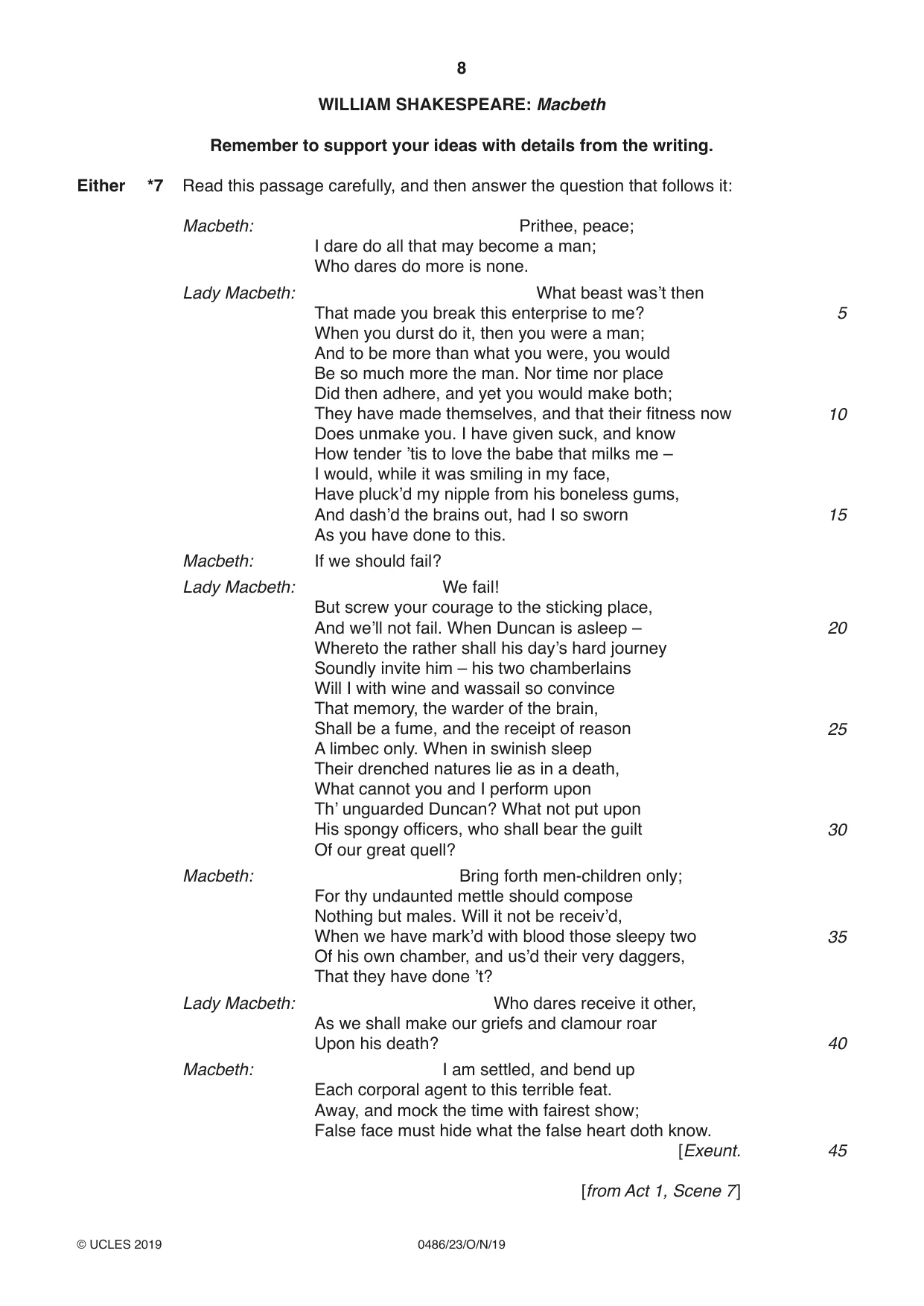
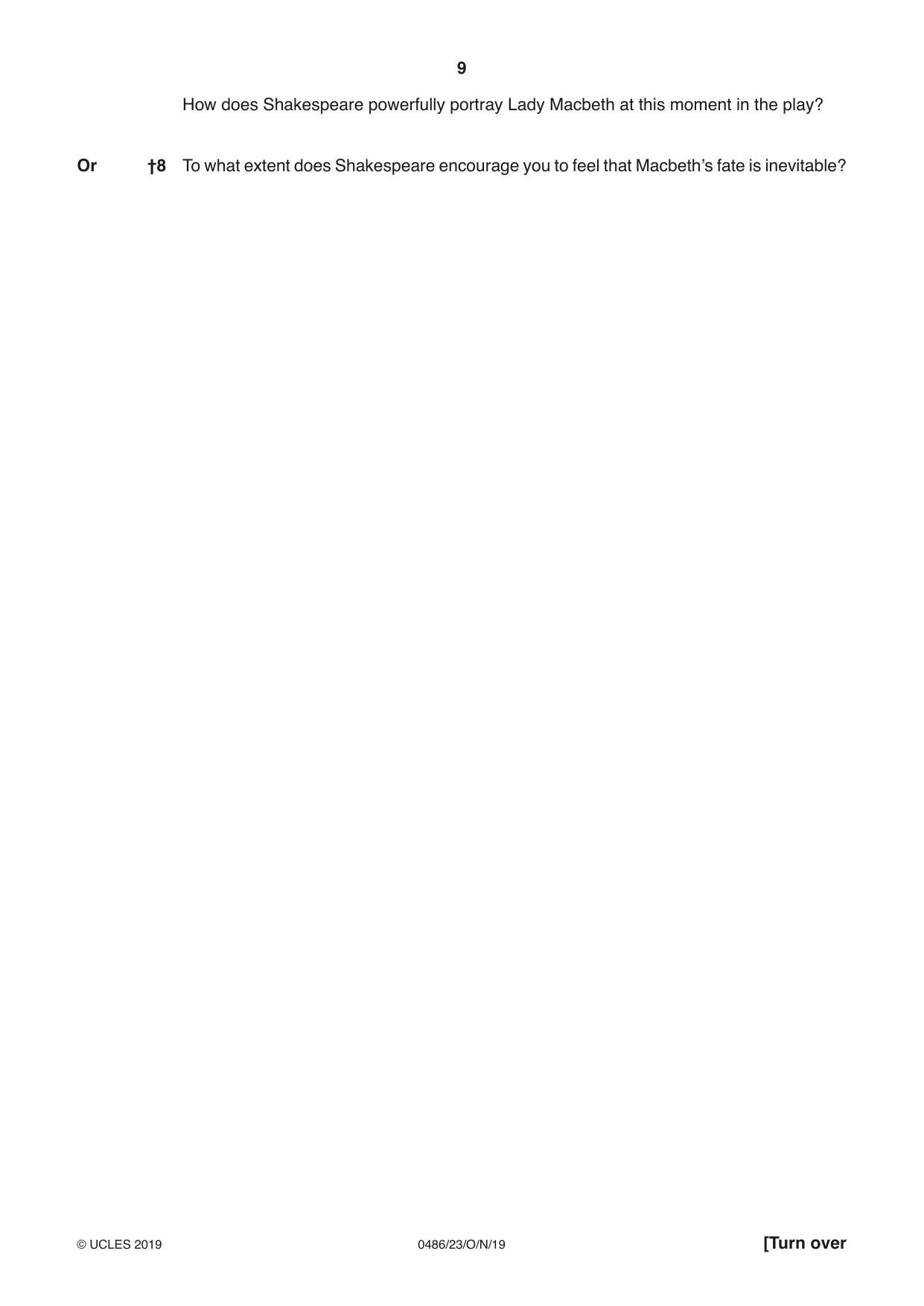
8 0486/23/O/N/19 © UCLES 2019 WILLIAM SHAKESPEARE: Macbeth Remember to support your ideas with details from the writing. Either *7 Read this passage carefully, and then answer the question that follows it: Macbeth: Prithee, peace; I dare do all that may become a man; Who dares do more is none. Lady Macbeth: What beast was’t then That made you break this enterprise to me? When you durst do it, then you were a man; And to be more than what you were, you would Be so much more the man. Nor time nor place Did then adhere, and yet you would make both; They have made themselves, and that their fitness now Does unmake you. I have given suck, and know How tender ’tis to love the babe that milks me – I would, while it was smiling in my face, Have pluck’d my nipple from his boneless gums, And dash’d the brains out, had I so sworn As you have done to this. Macbeth: If we should fail? Lady Macbeth: We fail! But screw your courage to the sticking place, And we’ll not fail. When Duncan is asleep – Whereto the rather shall his day’s hard journey Soundly invite him – his two chamberlains Will I with wine and wassail so convince That memory, the warder of the brain, Shall be a fume, and the receipt of reason A limbec only. When in swinish sleep Their drenched natures lie as in a death, What cannot you and I perform upon Th’ unguarded Duncan? What not put upon His spongy officers, who shall bear the guilt Of our great quell? Macbeth: Bring forth men-children only; For thy undaunted mettle should compose Nothing but males. Will it not be receiv’d, When we have mark’d with blood those sleepy two Of his own chamber, and us’d their very daggers, That they have done ’t? Lady Macbeth: Who dares receive it other, As we shall make our griefs and clamour roar Upon his death? Macbeth: I am settled, and bend up Each corporal agent to this terrible feat. Away, and mock the time with fairest show; False face must hide what the false heart doth know. [Exeunt. [from Act 1, Scene 7] 5 10 15 20 25 30 35 40 45
Question paper, page 9
9 0486/23/O/N/19 © UCLES 2019 [Turn over How does Shakespeare powerfully portray Lady Macbeth at this moment in the play? Or †8 To what extent does Shakespeare encourage you to feel that Macbeth’s fate is inevitable?
Question paper, page 10
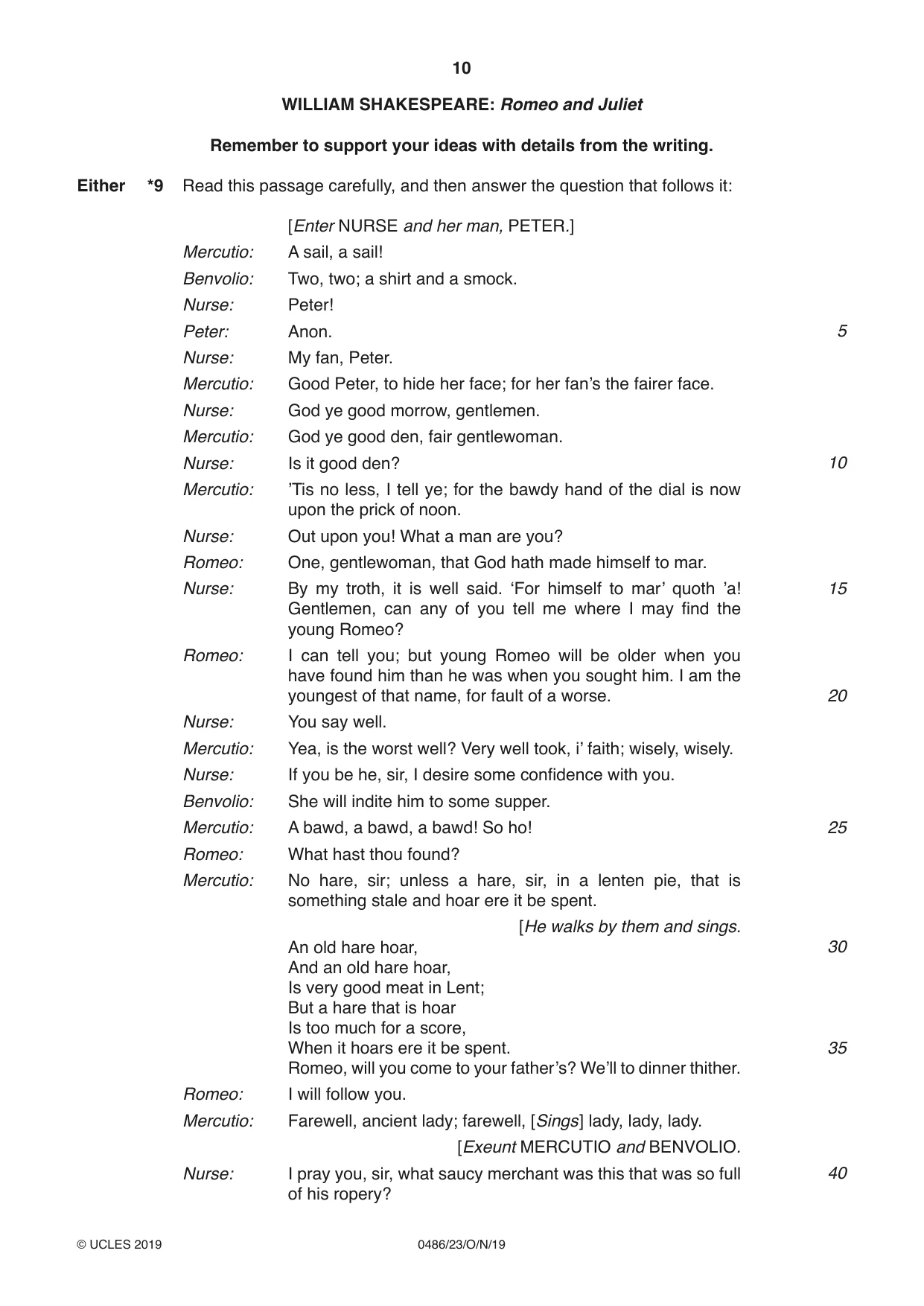
10 0486/23/O/N/19 © UCLES 2019 WILLIAM SHAKESPEARE: Romeo and Juliet Remember to support your ideas with details from the writing. Either *9 Read this passage carefully, and then answer the question that follows it: [Enter NURSE and her man, PETER.] Mercutio: A sail, a sail! Benvolio: Two, two; a shirt and a smock. Nurse: Peter! Peter: Anon. Nurse: My fan, Peter. Mercutio: Good Peter, to hide her face; for her fan’s the fairer face. Nurse: God ye good morrow, gentlemen. Mercutio: God ye good den, fair gentlewoman. Nurse: Is it good den? Mercutio: ’Tis no less, I tell ye; for the bawdy hand of the dial is now upon the prick of noon. Nurse: Out upon you! What a man are you? Romeo: One, gentlewoman, that God hath made himself to mar. Nurse: By my troth, it is well said. ‘For himself to mar’ quoth ’a! Gentlemen, can any of you tell me where I may find the young Romeo? Romeo: I can tell you; but young Romeo will be older when you have found him than he was when you sought him. I am the youngest of that name, for fault of a worse. Nurse: You say well. Mercutio: Yea, is the worst well? Very well took, i’ faith; wisely, wisely. Nurse: If you be he, sir, I desire some confidence with you. Benvolio: She will indite him to some supper. Mercutio: A bawd, a bawd, a bawd! So ho! Romeo: What hast thou found? Mercutio: No hare, sir; unless a hare, sir, in a lenten pie, that is something stale and hoar ere it be spent. [He walks by them and sings. An old hare hoar, And an old hare hoar, Is very good meat in Lent; But a hare that is hoar Is too much for a score, When it hoars ere it be spent. Romeo, will you come to your father’s? We’ll to dinner thither. Romeo: I will follow you. Mercutio: Farewell, ancient lady; farewell, [Sings] lady, lady, lady. [Exeunt MERCUTIO and BENVOLIO. Nurse: I pray you, sir, what saucy merchant was this that was so full of his ropery? 5 10 15 20 25 30 35 40
Question paper, page 11
11 0486/23/O/N/19 © UCLES 2019 Romeo: A gentleman, nurse, that loves to hear himself talk, and will speak more in a minute than he will stand to in a month. Nurse: An ’a speak anything against me, I’ll take him down, an ’a were lustier than he is, and twenty such Jacks; and if I cannot, I’ll find those that shall. Scurvy knave! I am none of his flirt-gills; I am none of his skains-mates. And thou must stand by too, and suffer every knave to use me at his pleasure? Peter: I saw no man use you at his pleasure; if I had, my weapon should quickly have been out, I warrant you. I dare draw as soon as another man, if I see occasion in a good quarrel, and the law on my side. Nurse: Now, afore God, I am so vex’d that every part about me quivers. Scurvy knave! – Pray you, sir, a word; and as I told you, my young lady bid me enquire you out; what she bid me say I will keep to myself. But first let me tell ye, if ye should lead her in a fool’s paradise, as they say, it were a very gross kind of behaviour, as they say; for the gentlewoman is young; and, therefore, if you should deal double with her, truly it were an ill thing to be off’red to any gentlewoman, and very weak dealing. [from Act 2, Scene 4] How does Shakespeare make this such an entertaining moment in the play? Or †10 Does Shakespeare’s writing encourage you to feel more sympathy for Juliet than for Romeo? 45 50 55 60
Question paper, page 12
12 0486/23/O/N/19 © UCLES 2019 Permission to reproduce items where third-party owned material protected by copyright is included has been sought and cleared where possible. Every reasonable effort has been made by the publisher (UCLES) to trace copyright holders, but if any items requiring clearance have unwittingly been included, the publisher will be pleased to make amends at the earliest possible opportunity. To avoid the issue of disclosure of answer-related information to candidates, all copyright acknowledgements are reproduced online in the Cambridge Assessment International Education Copyright Acknowledgements Booklet. This is produced for each series of examinations and is freely available to download at www.cambridgeinternational.org after the live examination series. Cambridge Assessment International Education is part of the Cambridge Assessment Group. Cambridge Assessment is the brand name of the University of Cambridge Local Examinations Syndicate (UCLES), which itself is a department of the University of Cambridge. BLANK PAGE
Mark scheme, page 1
This document consists of 4 printed pages. © UCLES 2019 [Turn over Cambridge Assessment International Education Cambridge International General Certificate of Secondary Education LITERATURE (ENGLISH) 0486/23 Paper 2 Drama October/November 2019 MARK SCHEME Maximum Mark: 50 Published This mark scheme is published as an aid to teachers and candidates, to indicate the requirements of the examination. It shows the basis on which Examiners were instructed to award marks. It does not indicate the details of the discussions that took place at an Examiners’ meeting before marking began, which would have considered the acceptability of alternative answers. Mark schemes should be read in conjunction with the question paper and the Principal Examiner Report for Teachers. Cambridge International will not enter into discussions about these mark schemes. Cambridge International is publishing the mark schemes for the October/November 2019 series for most Cambridge IGCSE™, Cambridge International A and AS Level components and some Cambridge O Level components.
Mark scheme, page 2
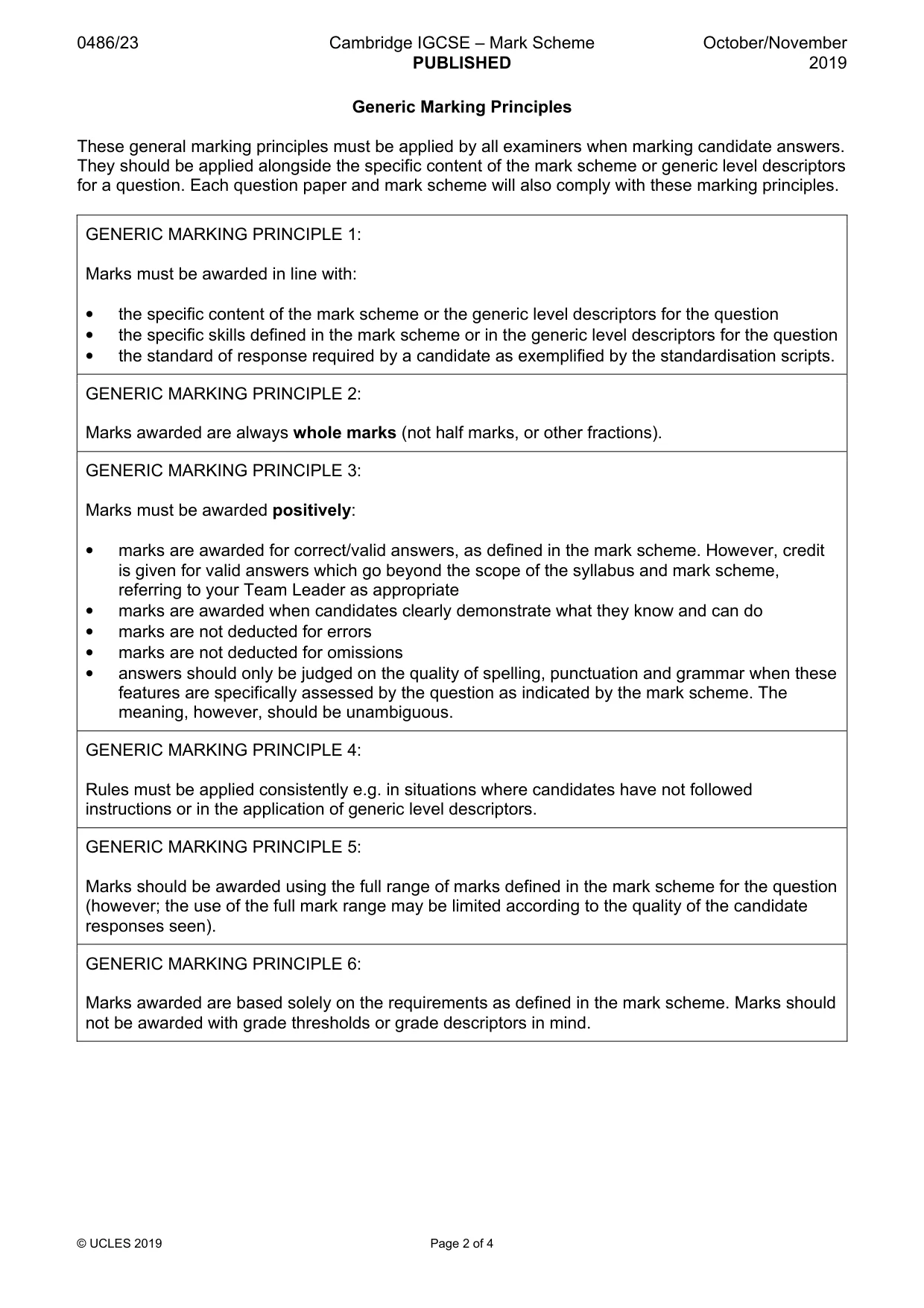
0486/23 Cambridge IGCSE – Mark Scheme PUBLISHED October/November 2019 © UCLES 2019 Page 2 of 4 Generic Marking Principles These general marking principles must be applied by all examiners when marking candidate answers. They should be applied alongside the specific content of the mark scheme or generic level descriptors for a question. Each question paper and mark scheme will also comply with these marking principles. GENERIC MARKING PRINCIPLE 1: Marks must be awarded in line with: • the specific content of the mark scheme or the generic level descriptors for the question • the specific skills defined in the mark scheme or in the generic level descriptors for the question • the standard of response required by a candidate as exemplified by the standardisation scripts. GENERIC MARKING PRINCIPLE 2: Marks awarded are always whole marks (not half marks, or other fractions). GENERIC MARKING PRINCIPLE 3: Marks must be awarded positively: • marks are awarded for correct/valid answers, as defined in the mark scheme. However, credit is given for valid answers which go beyond the scope of the syllabus and mark scheme, referring to your Team Leader as appropriate • marks are awarded when candidates clearly demonstrate what they know and can do • marks are not deducted for errors • marks are not deducted for omissions • answers should only be judged on the quality of spelling, punctuation and grammar when these features are specifically assessed by the question as indicated by the mark scheme. The meaning, however, should be unambiguous. GENERIC MARKING PRINCIPLE 4: Rules must be applied consistently e.g. in situations where candidates have not followed instructions or in the application of generic level descriptors. GENERIC MARKING PRINCIPLE 5: Marks should be awarded using the full range of marks defined in the mark scheme for the question (however; the use of the full mark range may be limited according to the quality of the candidate responses seen). GENERIC MARKING PRINCIPLE 6: Marks awarded are based solely on the requirements as defined in the mark scheme. Marks should not be awarded with grade thresholds or grade descriptors in mind.
Mark scheme, page 3
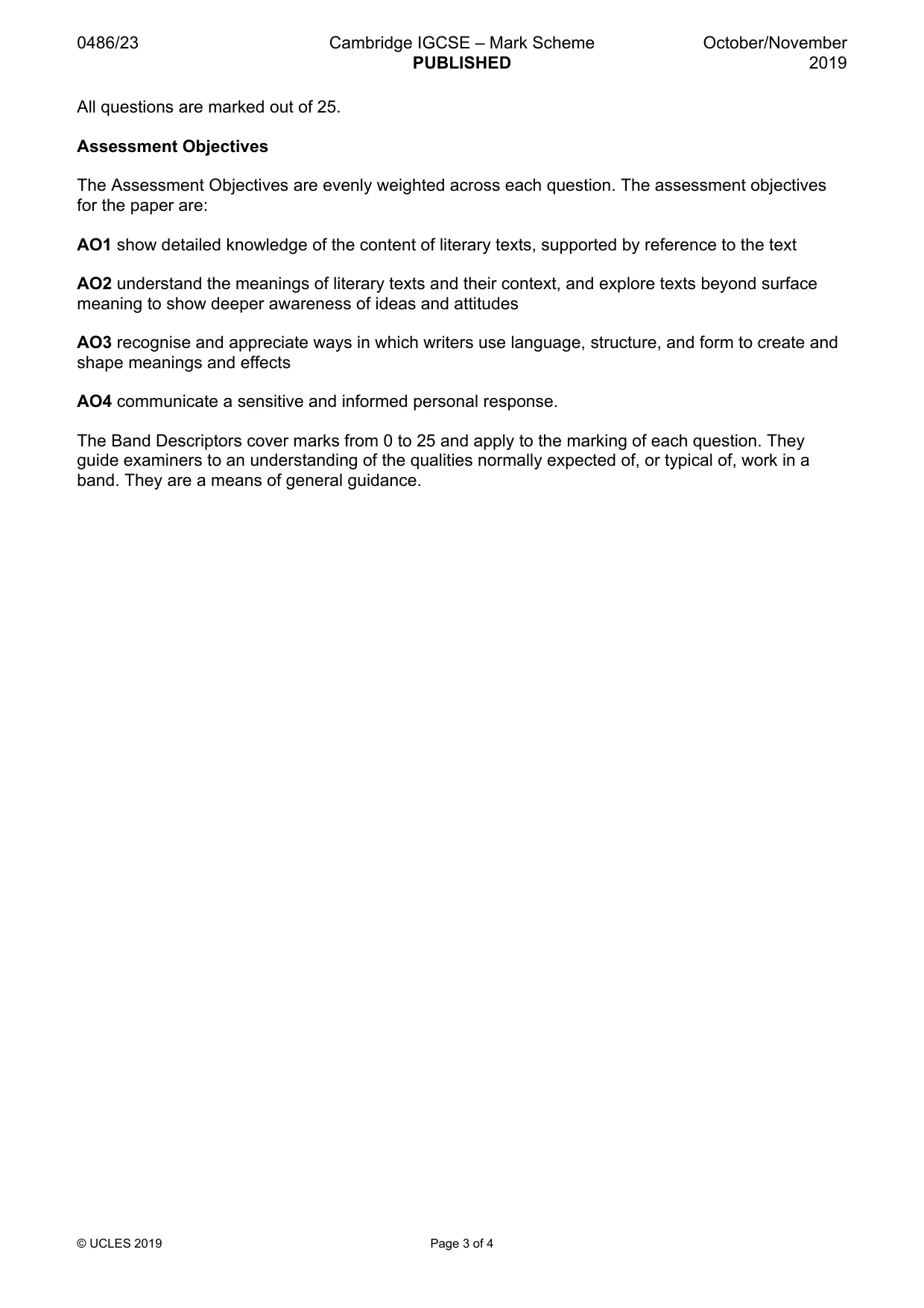
0486/23 Cambridge IGCSE – Mark Scheme PUBLISHED October/November 2019 © UCLES 2019 Page 3 of 4 All questions are marked out of 25. Assessment Objectives The Assessment Objectives are evenly weighted across each question. The assessment objectives for the paper are: AO1 show detailed knowledge of the content of literary texts, supported by reference to the text AO2 understand the meanings of literary texts and their context, and explore texts beyond surface meaning to show deeper awareness of ideas and attitudes AO3 recognise and appreciate ways in which writers use language, structure, and form to create and shape meanings and effects AO4 communicate a sensitive and informed personal response. The Band Descriptors cover marks from 0 to 25 and apply to the marking of each question. They guide examiners to an understanding of the qualities normally expected of, or typical of, work in a band. They are a means of general guidance.
Mark scheme, page 4
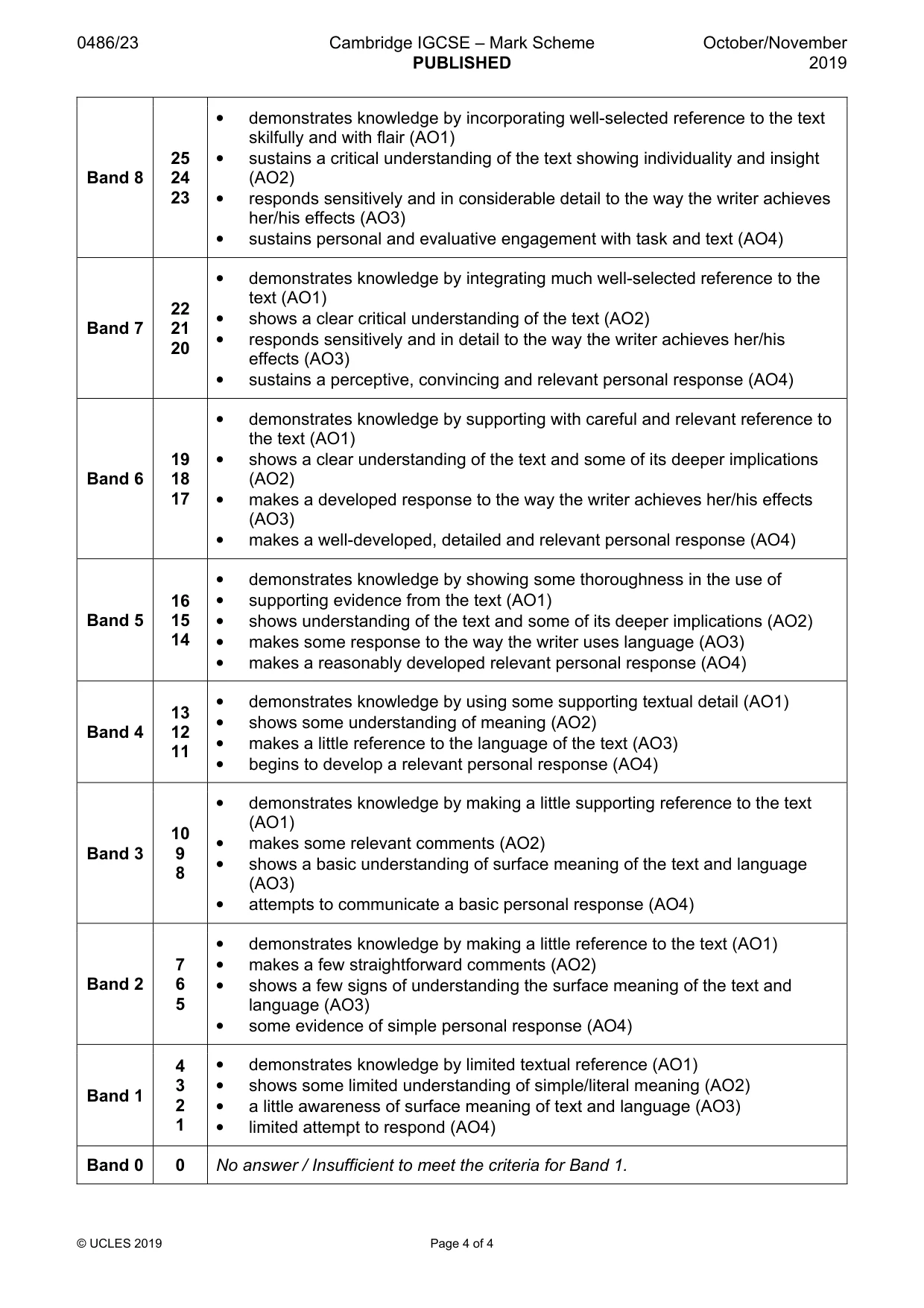
0486/23 Cambridge IGCSE – Mark Scheme PUBLISHED October/November 2019 © UCLES 2019 Page 4 of 4 Band 8 25 24 23 • demonstrates knowledge by incorporating well-selected reference to the text skilfully and with flair (AO1) • sustains a critical understanding of the text showing individuality and insight (AO2) • responds sensitively and in considerable detail to the way the writer achieves her/his effects (AO3) • sustains personal and evaluative engagement with task and text (AO4) Band 7 22 21 20 • demonstrates knowledge by integrating much well-selected reference to the text (AO1) • shows a clear critical understanding of the text (AO2) • responds sensitively and in detail to the way the writer achieves her/his effects (AO3) • sustains a perceptive, convincing and relevant personal response (AO4) Band 6 19 18 17 • demonstrates knowledge by supporting with careful and relevant reference to the text (AO1) • shows a clear understanding of the text and some of its deeper implications (AO2) • makes a developed response to the way the writer achieves her/his effects (AO3) • makes a well-developed, detailed and relevant personal response (AO4) Band 5 16 15 14 • demonstrates knowledge by showing some thoroughness in the use of • supporting evidence from the text (AO1) • shows understanding of the text and some of its deeper implications (AO2) • makes some response to the way the writer uses language (AO3) • makes a reasonably developed relevant personal response (AO4) Band 4 13 12 11 • demonstrates knowledge by using some supporting textual detail (AO1) • shows some understanding of meaning (AO2) • makes a little reference to the language of the text (AO3) • begins to develop a relevant personal response (AO4) Band 3 10 9 8 • demonstrates knowledge by making a little supporting reference to the text (AO1) • makes some relevant comments (AO2) • shows a basic understanding of surface meaning of the text and language (AO3) • attempts to communicate a basic personal response (AO4) Band 2 7 6 5 • demonstrates knowledge by making a little reference to the text (AO1) • makes a few straightforward comments (AO2) • shows a few signs of understanding the surface meaning of the text and language (AO3) • some evidence of simple personal response (AO4) Band 1 4 3 2 1 • demonstrates knowledge by limited textual reference (AO1) • shows some limited understanding of simple/literal meaning (AO2) • a little awareness of surface meaning of text and language (AO3) • limited attempt to respond (AO4) Band 0 0 No answer / Insufficient to meet the criteria for Band 1.
What you needed in this session
Cambridge’s own grade thresholds for 2019 Oct/Nov, Paper 2 · Variant 3. A higher threshold means an easier paper — the bar moves with how the cohort did.