Cambridge IGCSE English - Literature 0486 — 2018 Oct/Nov Paper 2 · Variant 3
0486/23/O/N/18 · 50 marks · ≈56 min
The question paper and its mark scheme, free to read here and free to download. This is Cambridge’s own paper, exactly as it was sat.
Question paper12 pages

Mark scheme4 pages
Answers below. Sit the paper first if you are practising.
Paper as text
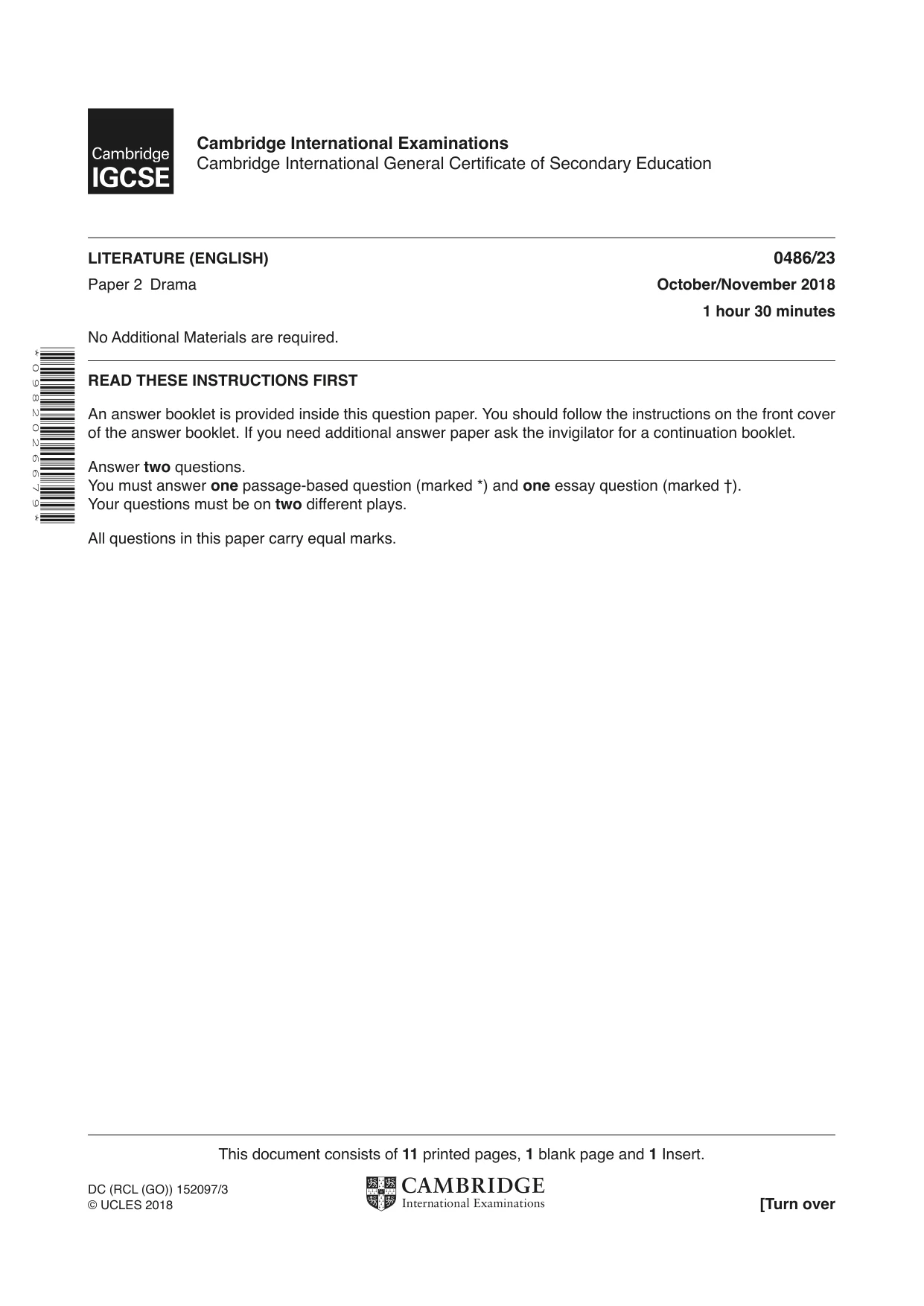
Question paper, page 1
This document consists of 11 printed pages, 1 blank page and 1 Insert. DC (RCL (GO)) 152097/3 © UCLES 2018 [Turn over Cambridge International Examinations Cambridge International General Certificate of Secondary Education * 0 9 8 2 0 2 6 6 7 9 * LITERATURE (ENGLISH) 0486/23 Paper 2 Drama October/November 2018 1 hour 30 minutes No Additional Materials are required. READ THESE INSTRUCTIONS FIRST An answer booklet is provided inside this question paper. You should follow the instructions on the front cover of the answer booklet. If you need additional answer paper ask the invigilator for a continuation booklet. Answer two questions. You must answer one passage-based question (marked *) and one essay question (marked †). Your questions must be on two different plays. All questions in this paper carry equal marks.
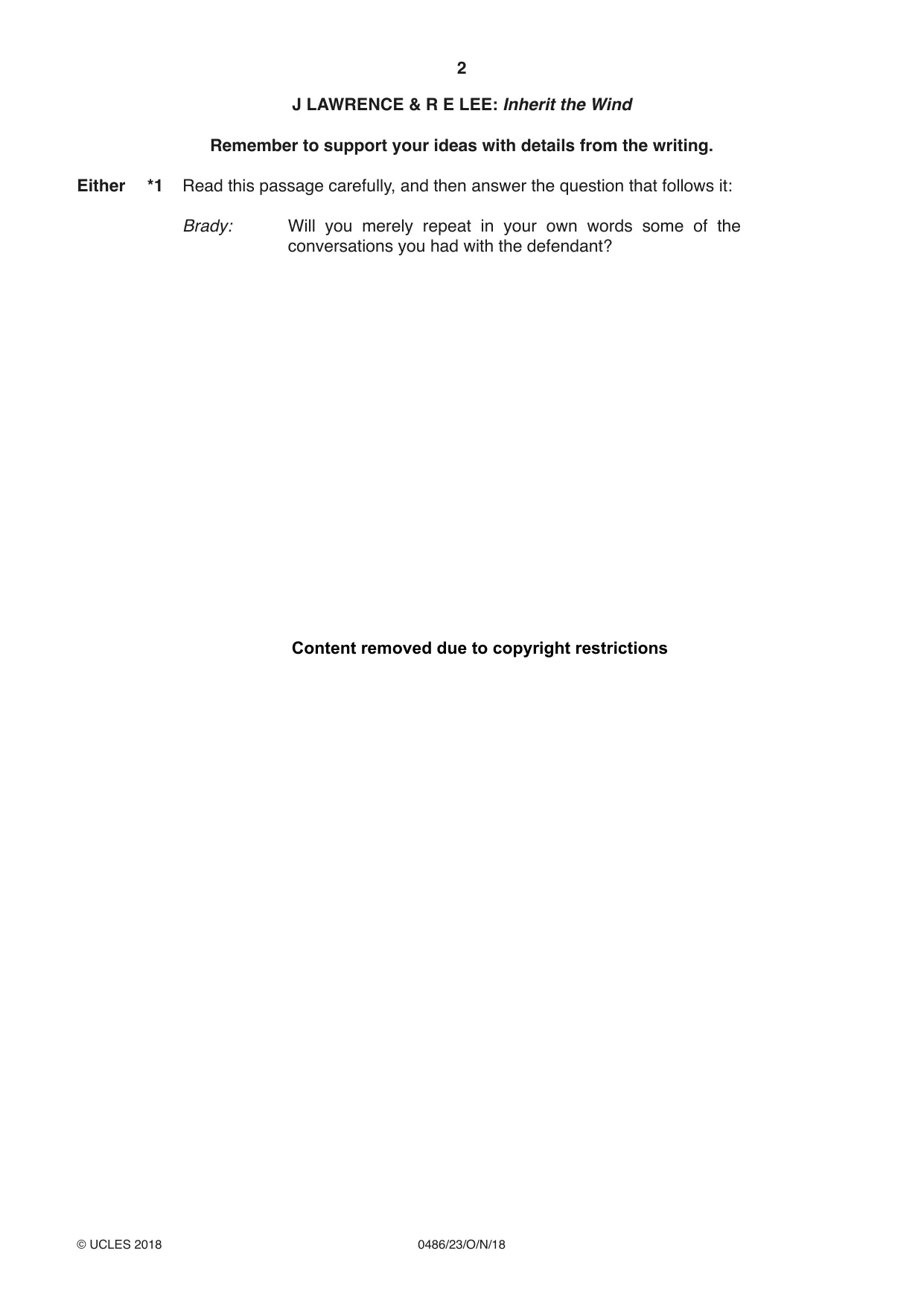
Question paper, page 2
2 0486/23/O/N/18 © UCLES 2018 J LAWRENCE & R E LEE: Inherit the Wind Remember to support your ideas with details from the writing. Either *1 Read this passage carefully, and then answer the question that follows it: Brady: Will you merely repeat in your own words some of the conversations you had with the defendant? Content removed due to copyright restrictions
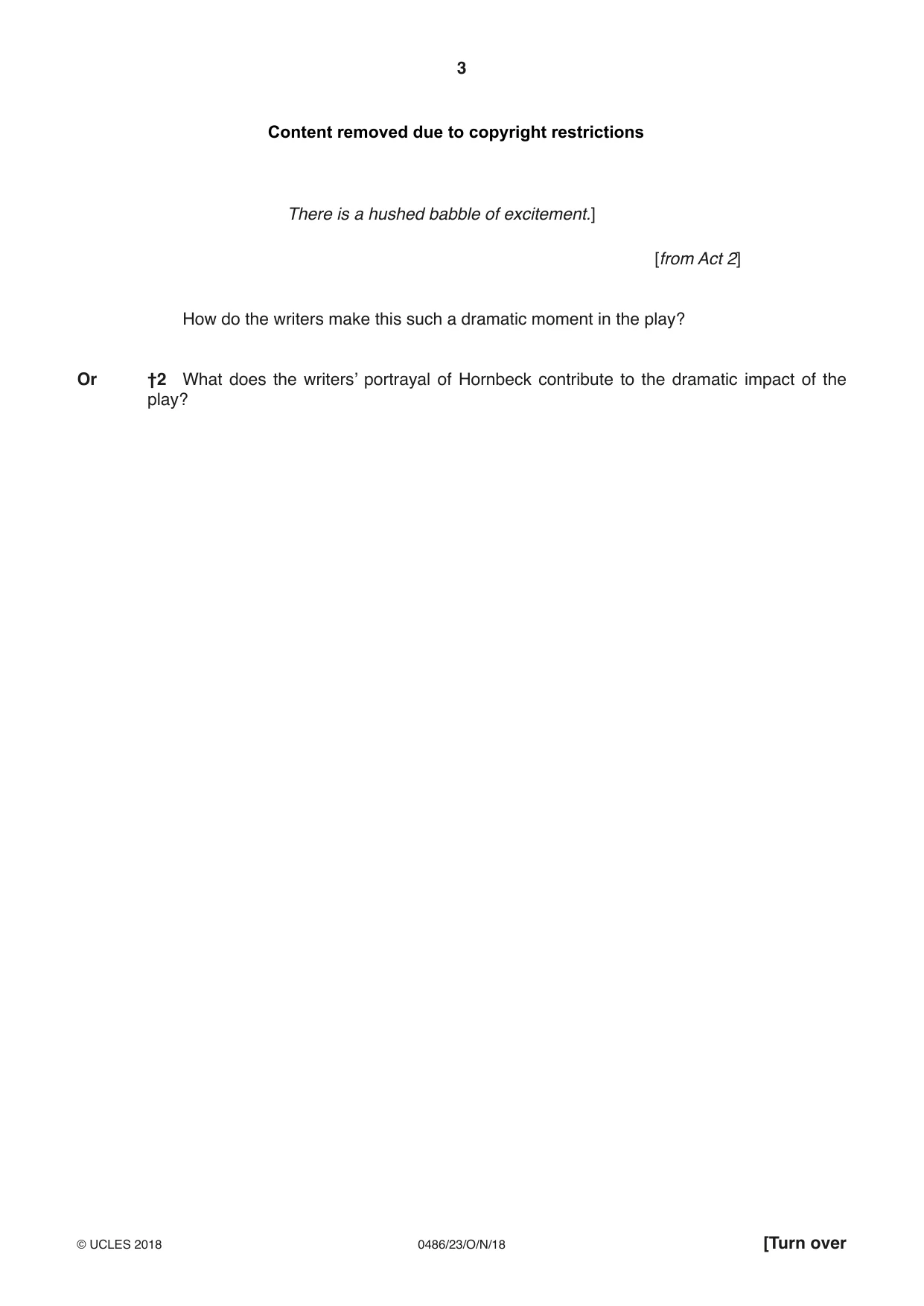
Question paper, page 3
3 0486/23/O/N/18 © UCLES 2018 [Turn over There is a hushed babble of excitement.] [from Act 2] How do the writers make this such a dramatic moment in the play? Or †2 What does the writers’ portrayal of Hornbeck contribute to the dramatic impact of the play? Content removed due to copyright restrictions
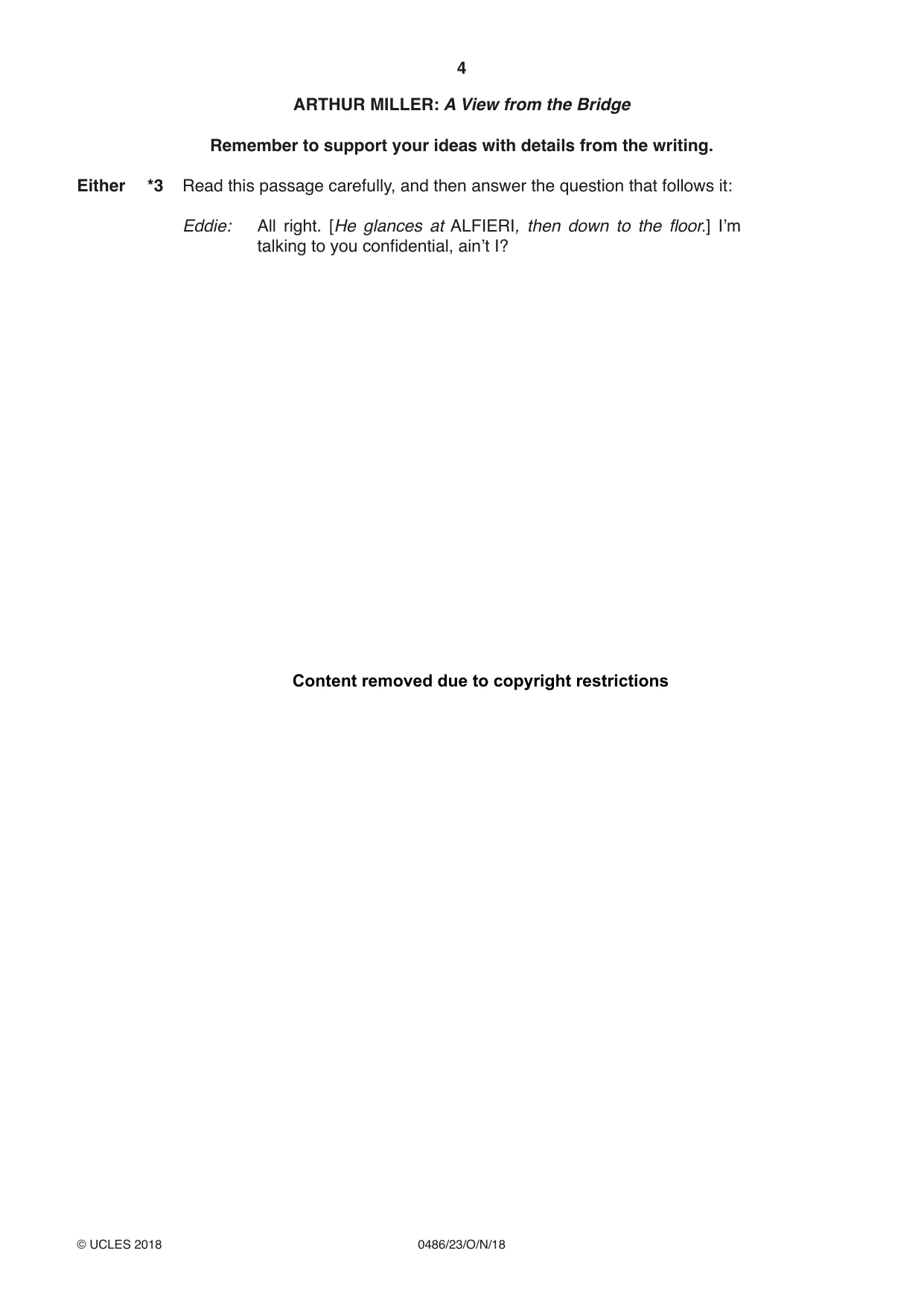
Question paper, page 4
4 0486/23/O/N/18 © UCLES 2018 ARTHUR MILLER: A View from the Bridge Remember to support your ideas with details from the writing. Either *3 Read this passage carefully, and then answer the question that follows it: Eddie: All right. [He glances at ALFIERI, then down to the floor.] I’m talking to you confidential, ain’t I? Content removed due to copyright restrictions
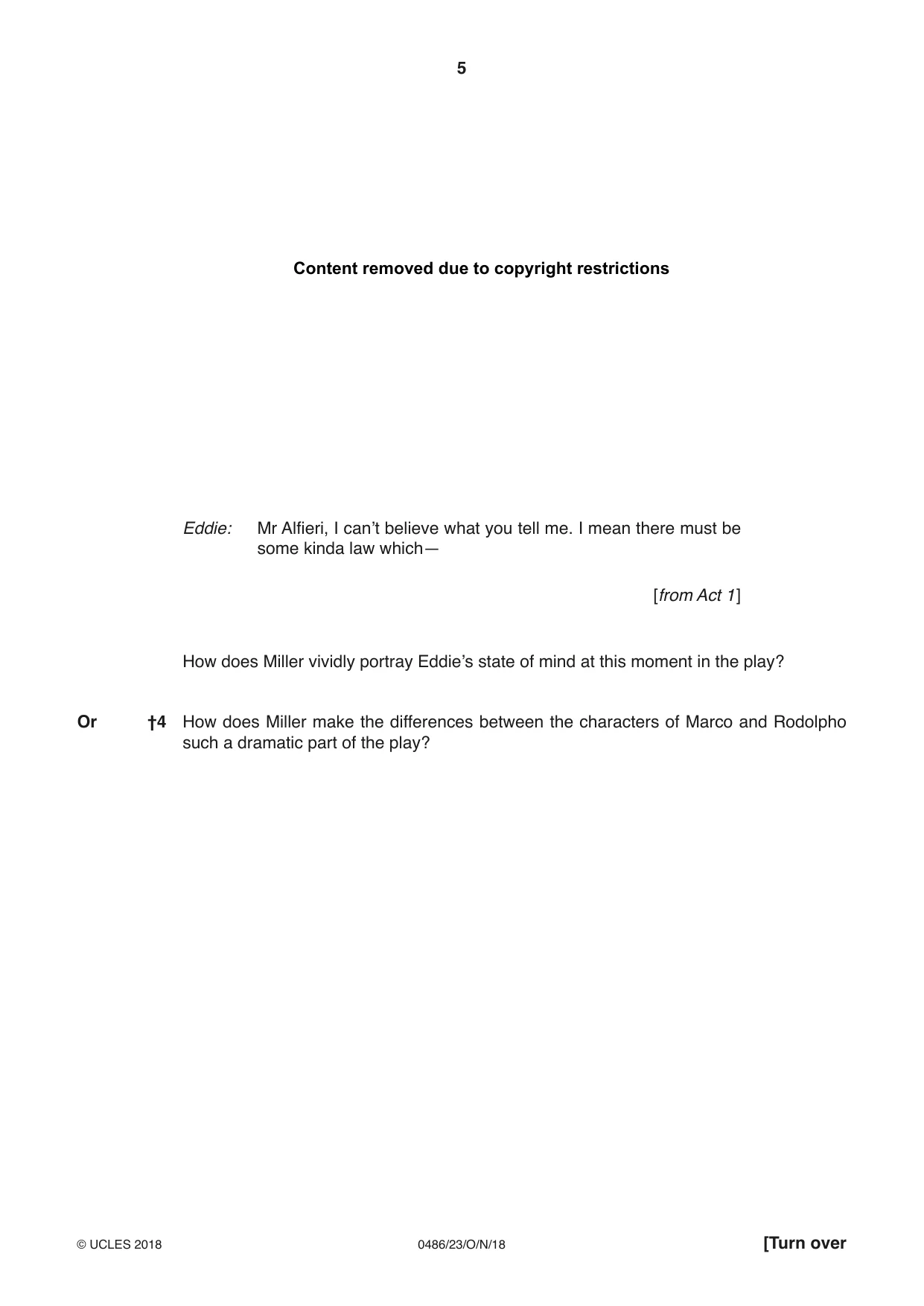
Question paper, page 5
5 0486/23/O/N/18 © UCLES 2018 [Turn over Eddie: Mr Alfieri, I can’t believe what you tell me. I mean there must be some kinda law which— [from Act 1] How does Miller vividly portray Eddie’s state of mind at this moment in the play? Or †4 How does Miller make the differences between the characters of Marco and Rodolpho such a dramatic part of the play? Content removed due to copyright restrictions
Question paper, page 6
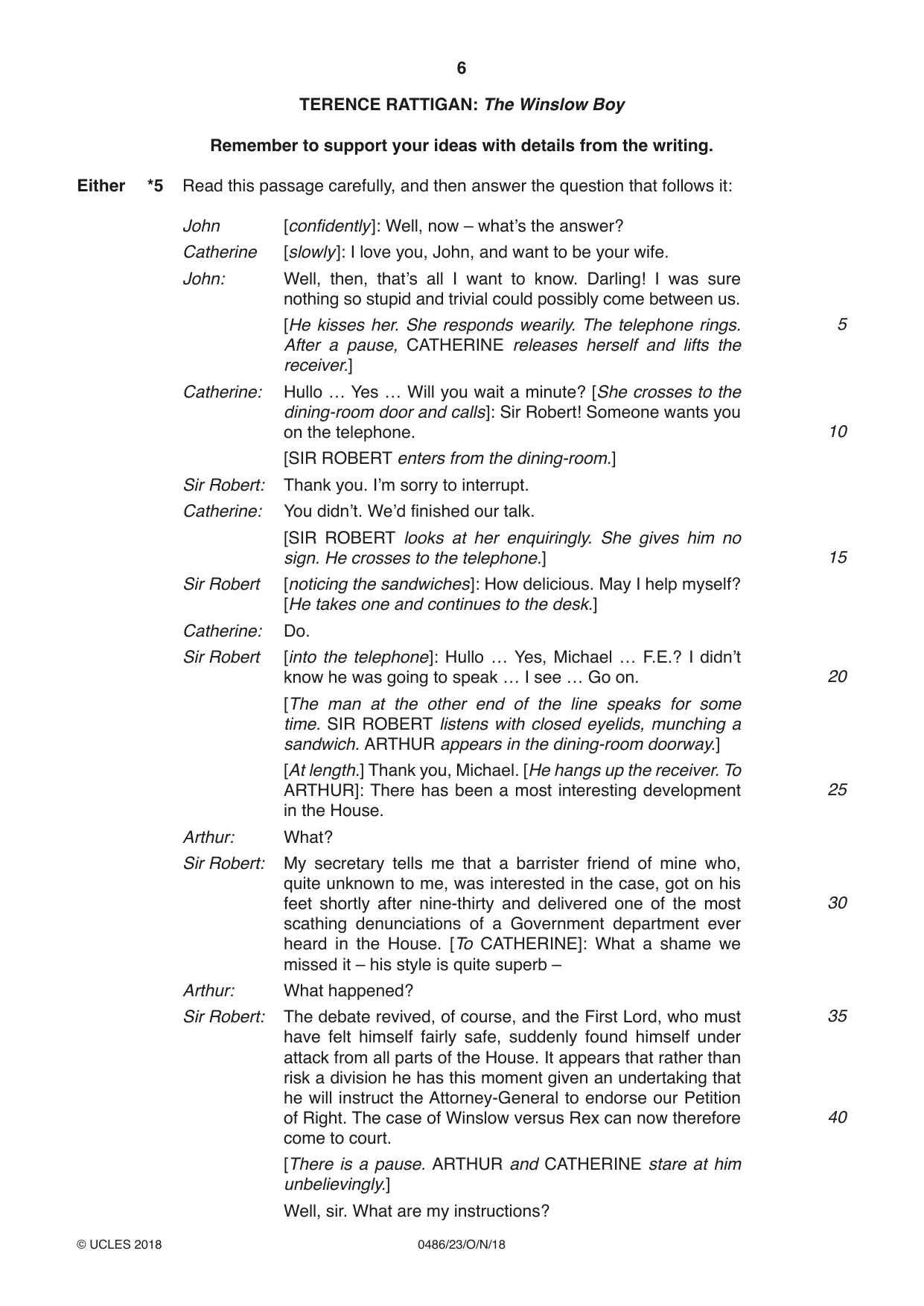
6 0486/23/O/N/18 © UCLES 2018 TERENCE RATTIGAN: The Winslow Boy Remember to support your ideas with details from the writing. Either *5 Read this passage carefully, and then answer the question that follows it: John [confidently]: Well, now – what’s the answer? Catherine [slowly]: I love you, John, and want to be your wife. John: Well, then, that’s all I want to know. Darling! I was sure nothing so stupid and trivial could possibly come between us. [He kisses her. She responds wearily. The telephone rings. After a pause, CATHERINE releases herself and lifts the receiver.] Catherine: Hullo … Yes … Will you wait a minute? [She crosses to the dining-room door and calls]: Sir Robert! Someone wants you on the telephone. [SIR ROBERT enters from the dining-room.] Sir Robert: Thank you. I’m sorry to interrupt. Catherine: You didn’t. We’d finished our talk. [SIR ROBERT looks at her enquiringly. She gives him no sign. He crosses to the telephone.] Sir Robert [noticing the sandwiches]: How delicious. May I help myself? [He takes one and continues to the desk.] Catherine: Do. Sir Robert [into the telephone]: Hullo … Yes, Michael … F.E.? I didn’t know he was going to speak … I see … Go on. [The man at the other end of the line speaks for some time. SIR ROBERT listens with closed eyelids, munching a sandwich. ARTHUR appears in the dining-room doorway.] [At length.] Thank you, Michael. [He hangs up the receiver. To ARTHUR]: There has been a most interesting development in the House. Arthur: What? Sir Robert: My secretary tells me that a barrister friend of mine who, quite unknown to me, was interested in the case, got on his feet shortly after nine-thirty and delivered one of the most scathing denunciations of a Government department ever heard in the House. [To CATHERINE]: What a shame we missed it – his style is quite superb – Arthur: What happened? Sir Robert: The debate revived, of course, and the First Lord, who must have felt himself fairly safe, suddenly found himself under attack from all parts of the House. It appears that rather than risk a division he has this moment given an undertaking that he will instruct the Attorney-General to endorse our Petition of Right. The case of Winslow versus Rex can now therefore come to court. [There is a pause. ARTHUR and CATHERINE stare at him unbelievingly.] Well, sir. What are my instructions? 5 10 15 20 25 30 35 40
Question paper, page 7
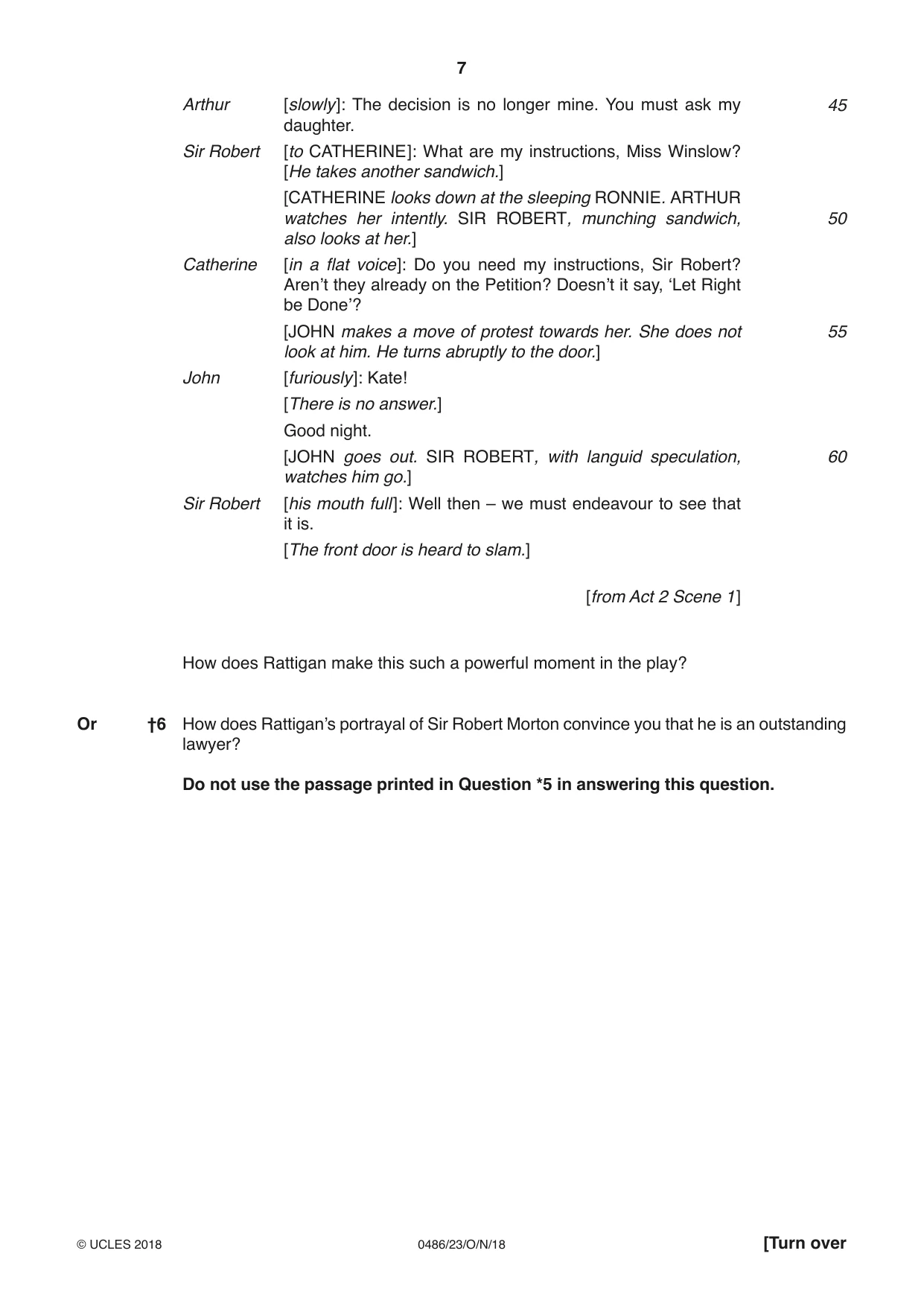
7 0486/23/O/N/18 © UCLES 2018 [Turn over Arthur [slowly]: The decision is no longer mine. You must ask my daughter. Sir Robert [to CATHERINE]: What are my instructions, Miss Winslow? [He takes another sandwich.] [CATHERINE looks down at the sleeping RONNIE. ARTHUR watches her intently. SIR ROBERT, munching sandwich, also looks at her.] Catherine [in a flat voice]: Do you need my instructions, Sir Robert? Aren’t they already on the Petition? Doesn’t it say, ‘Let Right be Done’? [JOHN makes a move of protest towards her. She does not look at him. He turns abruptly to the door.] John [furiously]: Kate! [There is no answer.] Good night. [JOHN goes out. SIR ROBERT, with languid speculation, watches him go.] Sir Robert [his mouth full]: Well then – we must endeavour to see that it is. [The front door is heard to slam.] [from Act 2 Scene 1] How does Rattigan make this such a powerful moment in the play? Or †6 How does Rattigan’s portrayal of Sir Robert Morton convince you that he is an outstanding lawyer? Do not use the passage printed in Question *5 in answering this question. 45 50 55 60
Question paper, page 8
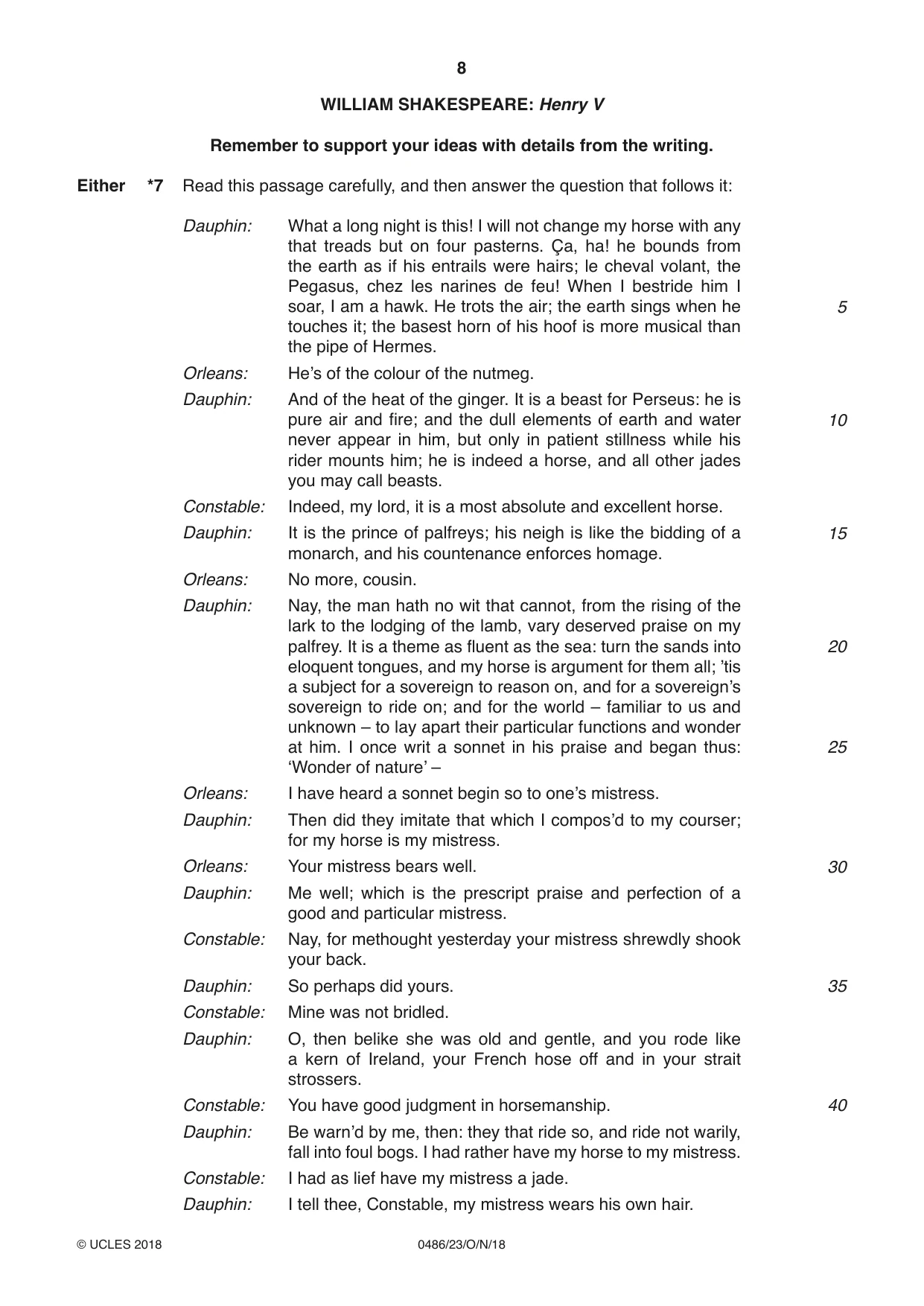
8 0486/23/O/N/18 © UCLES 2018 WILLIAM SHAKESPEARE: Henry V Remember to support your ideas with details from the writing. Either *7 Read this passage carefully, and then answer the question that follows it: Dauphin: What a long night is this! I will not change my horse with any that treads but on four pasterns. Ça, ha! he bounds from the earth as if his entrails were hairs; le cheval volant, the Pegasus, chez les narines de feu! When I bestride him I soar, I am a hawk. He trots the air; the earth sings when he touches it; the basest horn of his hoof is more musical than the pipe of Hermes. Orleans: He’s of the colour of the nutmeg. Dauphin: And of the heat of the ginger. It is a beast for Perseus: he is pure air and fire; and the dull elements of earth and water never appear in him, but only in patient stillness while his rider mounts him; he is indeed a horse, and all other jades you may call beasts. Constable: Indeed, my lord, it is a most absolute and excellent horse. Dauphin: It is the prince of palfreys; his neigh is like the bidding of a monarch, and his countenance enforces homage. Orleans: No more, cousin. Dauphin: Nay, the man hath no wit that cannot, from the rising of the lark to the lodging of the lamb, vary deserved praise on my palfrey. It is a theme as fluent as the sea: turn the sands into eloquent tongues, and my horse is argument for them all; ’tis a subject for a sovereign to reason on, and for a sovereign’s sovereign to ride on; and for the world – familiar to us and unknown – to lay apart their particular functions and wonder at him. I once writ a sonnet in his praise and began thus: ‘Wonder of nature’ – Orleans: I have heard a sonnet begin so to one’s mistress. Dauphin: Then did they imitate that which I compos’d to my courser; for my horse is my mistress. Orleans: Your mistress bears well. Dauphin: Me well; which is the prescript praise and perfection of a good and particular mistress. Constable: Nay, for methought yesterday your mistress shrewdly shook your back. Dauphin: So perhaps did yours. Constable: Mine was not bridled. Dauphin: O, then belike she was old and gentle, and you rode like a kern of Ireland, your French hose off and in your strait strossers. Constable: You have good judgment in horsemanship. Dauphin: Be warn’d by me, then: they that ride so, and ride not warily, fall into foul bogs. I had rather have my horse to my mistress. Constable: I had as lief have my mistress a jade. Dauphin: I tell thee, Constable, my mistress wears his own hair. 5 10 15 20 25 30 35 40
Question paper, page 9
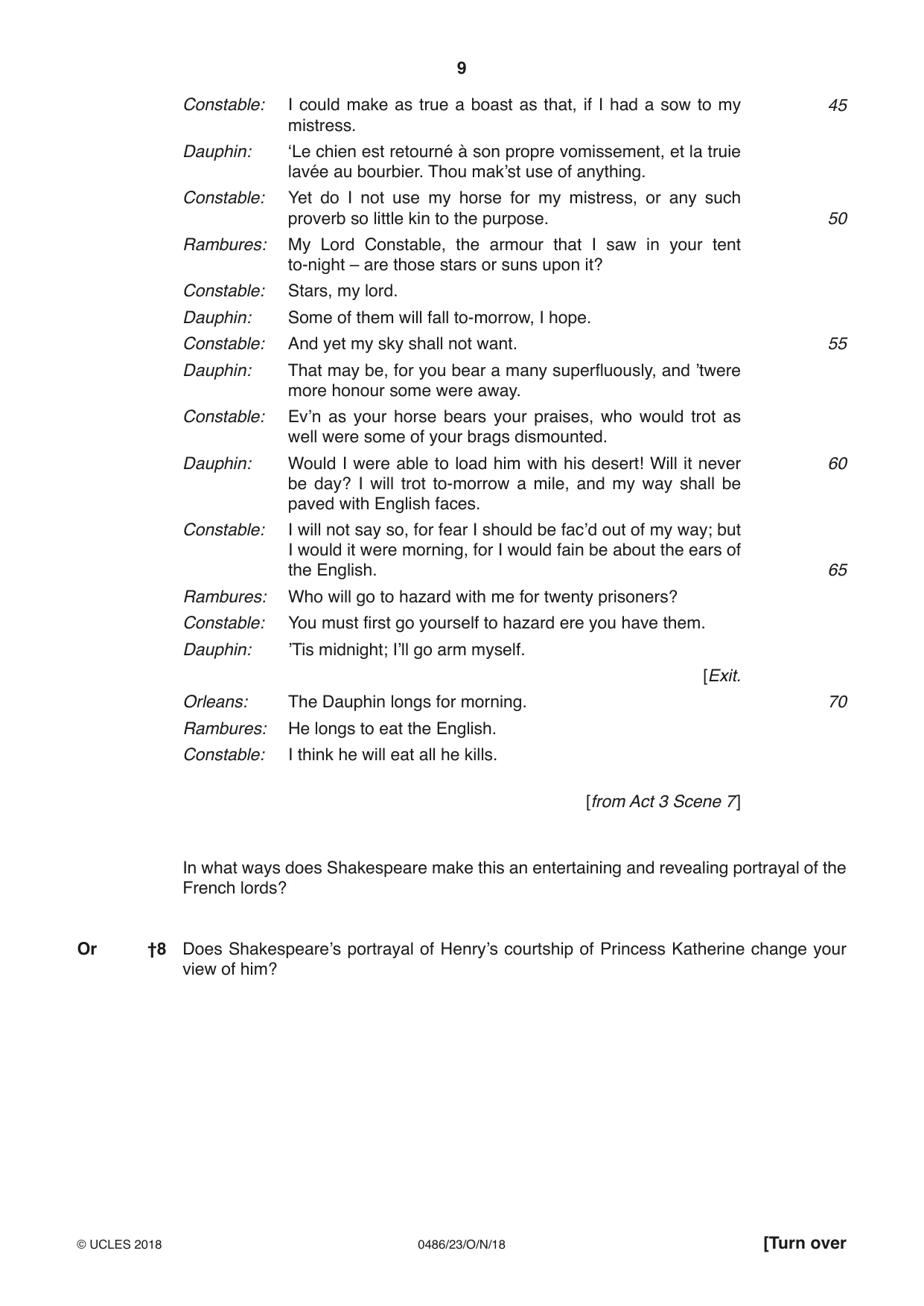
9 0486/23/O/N/18 © UCLES 2018 [Turn over Constable: I could make as true a boast as that, if I had a sow to my mistress. Dauphin: ‘Le chien est retourné à son propre vomissement, et la truie lavée au bourbier. Thou mak’st use of anything. Constable: Yet do I not use my horse for my mistress, or any such proverb so little kin to the purpose. Rambures: My Lord Constable, the armour that I saw in your tent to-night – are those stars or suns upon it? Constable: Stars, my lord. Dauphin: Some of them will fall to-morrow, I hope. Constable: And yet my sky shall not want. Dauphin: That may be, for you bear a many superfluously, and ’twere more honour some were away. Constable: Ev’n as your horse bears your praises, who would trot as well were some of your brags dismounted. Dauphin: Would I were able to load him with his desert! Will it never be day? I will trot to-morrow a mile, and my way shall be paved with English faces. Constable: I will not say so, for fear I should be fac’d out of my way; but I would it were morning, for I would fain be about the ears of the English. Rambures: Who will go to hazard with me for twenty prisoners? Constable: You must first go yourself to hazard ere you have them. Dauphin: ’Tis midnight; I’ll go arm myself. [Exit. Orleans: The Dauphin longs for morning. Rambures: He longs to eat the English. Constable: I think he will eat all he kills. [from Act 3 Scene 7] In what ways does Shakespeare make this an entertaining and revealing portrayal of the French lords? Or †8 Does Shakespeare’s portrayal of Henry’s courtship of Princess Katherine change your view of him? 45 50 55 60 65 70
Question paper, page 10
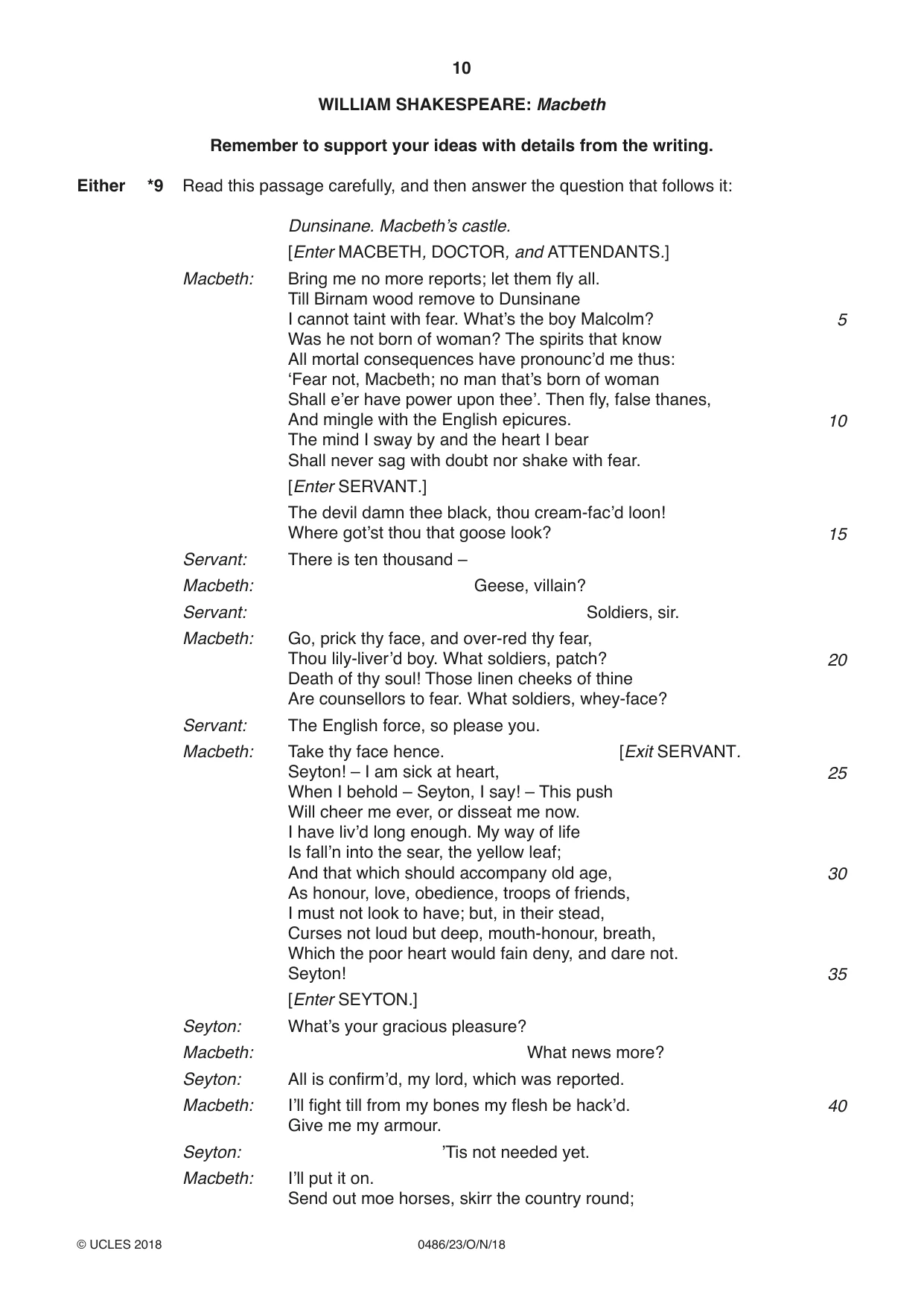
10 0486/23/O/N/18 © UCLES 2018 WILLIAM SHAKESPEARE: Macbeth Remember to support your ideas with details from the writing. Either *9 Read this passage carefully, and then answer the question that follows it: Dunsinane. Macbeth’s castle. [Enter MACBETH, DOCTOR, and ATTENDANTS.] Macbeth: Bring me no more reports; let them fly all. Till Birnam wood remove to Dunsinane I cannot taint with fear. What’s the boy Malcolm? Was he not born of woman? The spirits that know All mortal consequences have pronounc’d me thus: ‘Fear not, Macbeth; no man that’s born of woman Shall e’er have power upon thee’. Then fly, false thanes, And mingle with the English epicures. The mind I sway by and the heart I bear Shall never sag with doubt nor shake with fear. [Enter SERVANT.] The devil damn thee black, thou cream-fac’d loon! Where got’st thou that goose look? Servant: There is ten thousand – Macbeth: Geese, villain? Servant: Soldiers, sir. Macbeth: Go, prick thy face, and over-red thy fear, Thou lily-liver’d boy. What soldiers, patch? Death of thy soul! Those linen cheeks of thine Are counsellors to fear. What soldiers, whey-face? Servant: The English force, so please you. Macbeth: Take thy face hence. [Exit SERVANT. Seyton! – I am sick at heart, When I behold – Seyton, I say! – This push Will cheer me ever, or disseat me now. I have liv’d long enough. My way of life Is fall’n into the sear, the yellow leaf; And that which should accompany old age, As honour, love, obedience, troops of friends, I must not look to have; but, in their stead, Curses not loud but deep, mouth-honour, breath, Which the poor heart would fain deny, and dare not. Seyton! [Enter SEYTON.] Seyton: What’s your gracious pleasure? Macbeth: What news more? Seyton: All is confirm’d, my lord, which was reported. Macbeth: I’ll fight till from my bones my flesh be hack’d. Give me my armour. Seyton: ’Tis not needed yet. Macbeth: I’ll put it on. Send out moe horses, skirr the country round; 5 10 15 20 25 30 35 40
Question paper, page 11
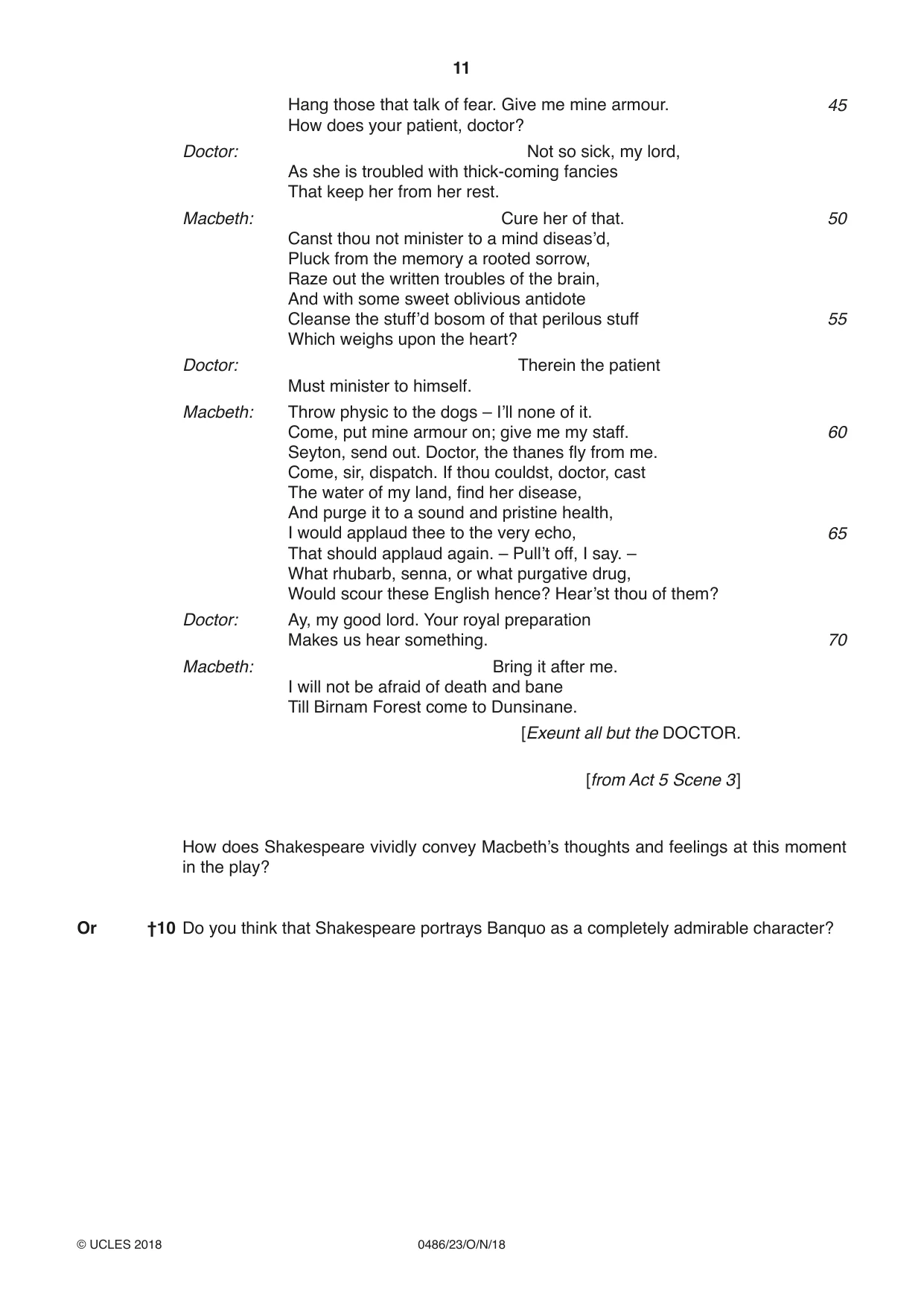
11 0486/23/O/N/18 © UCLES 2018 Hang those that talk of fear. Give me mine armour. How does your patient, doctor? Doctor: Not so sick, my lord, As she is troubled with thick-coming fancies That keep her from her rest. Macbeth: Cure her of that. Canst thou not minister to a mind diseas’d, Pluck from the memory a rooted sorrow, Raze out the written troubles of the brain, And with some sweet oblivious antidote Cleanse the stuff’d bosom of that perilous stuff Which weighs upon the heart? Doctor: Therein the patient Must minister to himself. Macbeth: Throw physic to the dogs – I’ll none of it. Come, put mine armour on; give me my staff. Seyton, send out. Doctor, the thanes fly from me. Come, sir, dispatch. If thou couldst, doctor, cast The water of my land, find her disease, And purge it to a sound and pristine health, I would applaud thee to the very echo, That should applaud again. – Pull’t off, I say. – What rhubarb, senna, or what purgative drug, Would scour these English hence? Hear’st thou of them? Doctor: Ay, my good lord. Your royal preparation Makes us hear something. Macbeth: Bring it after me. I will not be afraid of death and bane Till Birnam Forest come to Dunsinane. [Exeunt all but the DOCTOR. [from Act 5 Scene 3] How does Shakespeare vividly convey Macbeth’s thoughts and feelings at this moment in the play? Or †10 Do you think that Shakespeare portrays Banquo as a completely admirable character? 45 50 55 60 65 70
Question paper, page 12
12 0486/23/O/N/18 © UCLES 2018 Permission to reproduce items where third-party owned material protected by copyright is included has been sought and cleared where possible. Every reasonable effort has been made by the publisher (UCLES) to trace copyright holders, but if any items requiring clearance have unwittingly been included, the publisher will be pleased to make amends at the earliest possible opportunity. To avoid the issue of disclosure of answer-related information to candidates, all copyright acknowledgements are reproduced online in the Cambridge International Examinations Copyright Acknowledgements Booklet. This is produced for each series of examinations and is freely available to download at www.cie.org.uk after the live examination series. Cambridge International Examinations is part of the Cambridge Assessment Group. Cambridge Assessment is the brand name of University of Cambridge Local Examinations Syndicate (UCLES), which is itself a department of the University of Cambridge. BLANK PAGE
Mark scheme, page 1
This document consists of 4 printed pages. © UCLES 2018 [Turn over Cambridge Assessment International Education Cambridge International General Certificate of Secondary Education LITERATURE (ENGLISH) 0486/23 Paper 2 Drama October/November 2018 MARK SCHEME Maximum Mark: 50 Published This mark scheme is published as an aid to teachers and candidates, to indicate the requirements of the examination. It shows the basis on which Examiners were instructed to award marks. It does not indicate the details of the discussions that took place at an Examiners’ meeting before marking began, which would have considered the acceptability of alternative answers. Mark schemes should be read in conjunction with the question paper and the Principal Examiner Report for Teachers. Cambridge International will not enter into discussions about these mark schemes. Cambridge International is publishing the mark schemes for the October/November 2018 series for most Cambridge IGCSE™, Cambridge International A and AS Level components and some Cambridge O Level components.
Mark scheme, page 2
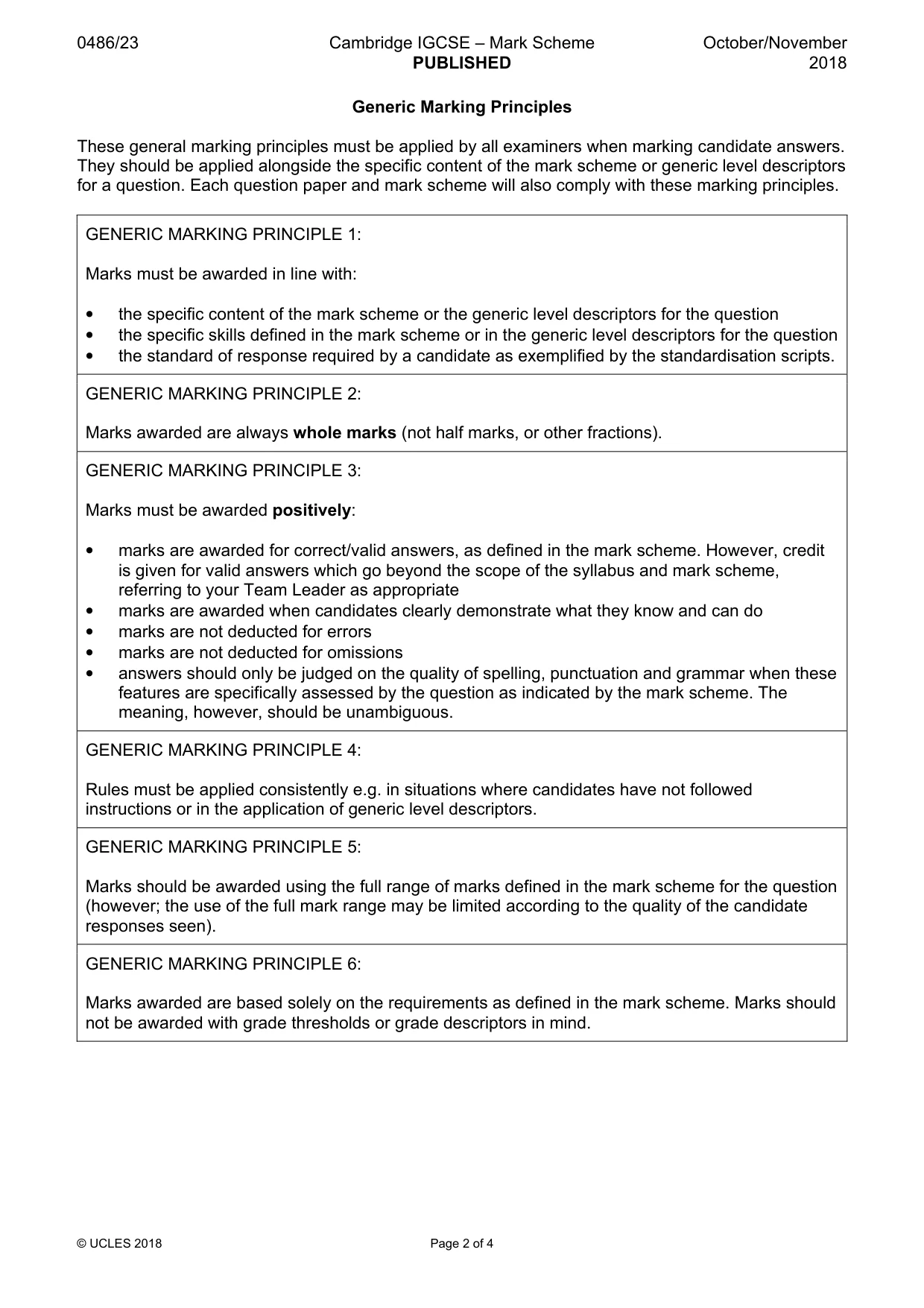
0486/23 Cambridge IGCSE – Mark Scheme PUBLISHED October/November 2018 © UCLES 2018 Page 2 of 4 Generic Marking Principles These general marking principles must be applied by all examiners when marking candidate answers. They should be applied alongside the specific content of the mark scheme or generic level descriptors for a question. Each question paper and mark scheme will also comply with these marking principles. GENERIC MARKING PRINCIPLE 1: Marks must be awarded in line with: • the specific content of the mark scheme or the generic level descriptors for the question • the specific skills defined in the mark scheme or in the generic level descriptors for the question • the standard of response required by a candidate as exemplified by the standardisation scripts. GENERIC MARKING PRINCIPLE 2: Marks awarded are always whole marks (not half marks, or other fractions). GENERIC MARKING PRINCIPLE 3: Marks must be awarded positively: • marks are awarded for correct/valid answers, as defined in the mark scheme. However, credit is given for valid answers which go beyond the scope of the syllabus and mark scheme, referring to your Team Leader as appropriate • marks are awarded when candidates clearly demonstrate what they know and can do • marks are not deducted for errors • marks are not deducted for omissions • answers should only be judged on the quality of spelling, punctuation and grammar when these features are specifically assessed by the question as indicated by the mark scheme. The meaning, however, should be unambiguous. GENERIC MARKING PRINCIPLE 4: Rules must be applied consistently e.g. in situations where candidates have not followed instructions or in the application of generic level descriptors. GENERIC MARKING PRINCIPLE 5: Marks should be awarded using the full range of marks defined in the mark scheme for the question (however; the use of the full mark range may be limited according to the quality of the candidate responses seen). GENERIC MARKING PRINCIPLE 6: Marks awarded are based solely on the requirements as defined in the mark scheme. Marks should not be awarded with grade thresholds or grade descriptors in mind.
Mark scheme, page 3
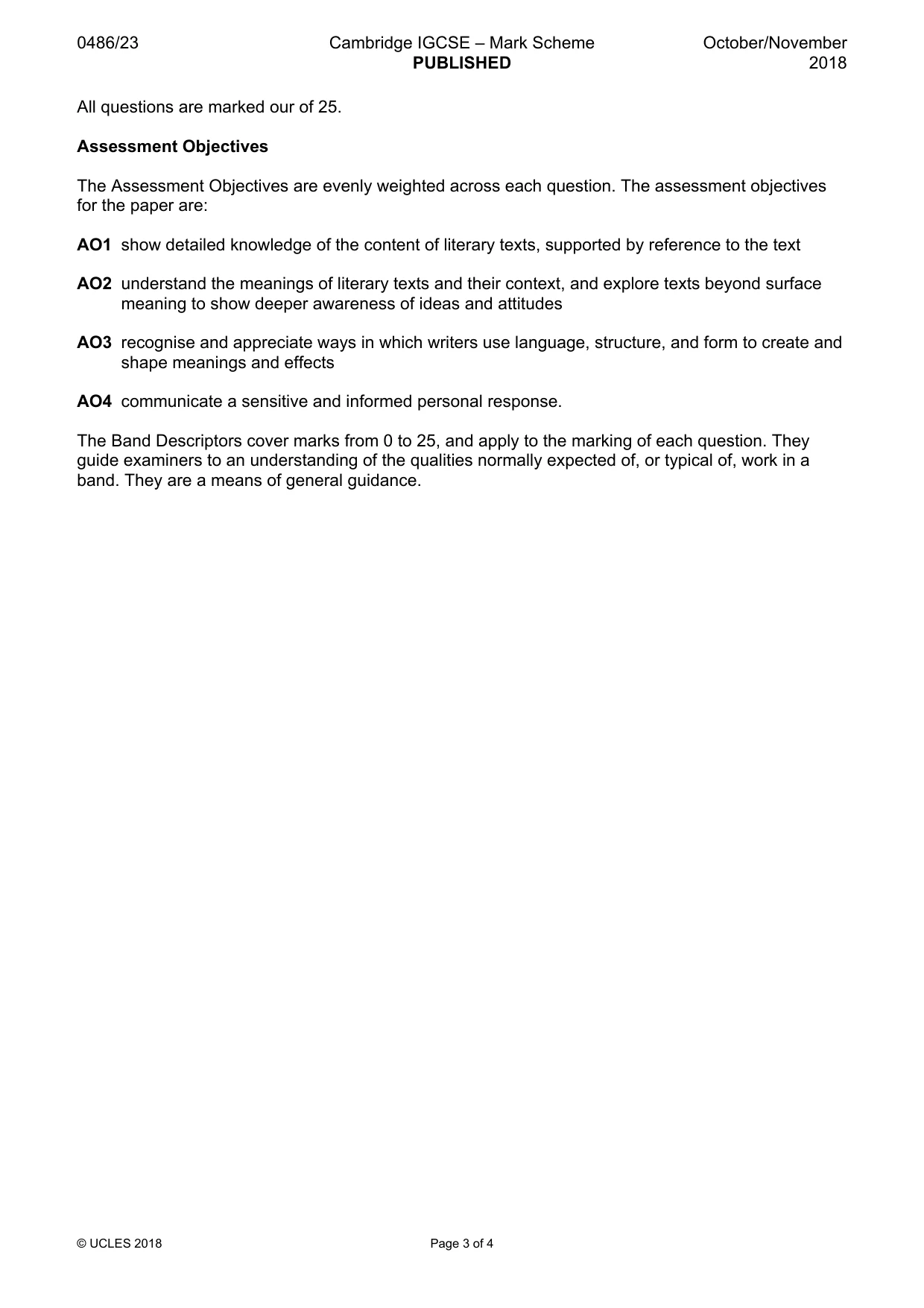
0486/23 Cambridge IGCSE – Mark Scheme PUBLISHED October/November 2018 © UCLES 2018 Page 3 of 4 All questions are marked our of 25. Assessment Objectives The Assessment Objectives are evenly weighted across each question. The assessment objectives for the paper are: AO1 show detailed knowledge of the content of literary texts, supported by reference to the text AO2 understand the meanings of literary texts and their context, and explore texts beyond surface meaning to show deeper awareness of ideas and attitudes AO3 recognise and appreciate ways in which writers use language, structure, and form to create and shape meanings and effects AO4 communicate a sensitive and informed personal response. The Band Descriptors cover marks from 0 to 25, and apply to the marking of each question. They guide examiners to an understanding of the qualities normally expected of, or typical of, work in a band. They are a means of general guidance.
Mark scheme, page 4
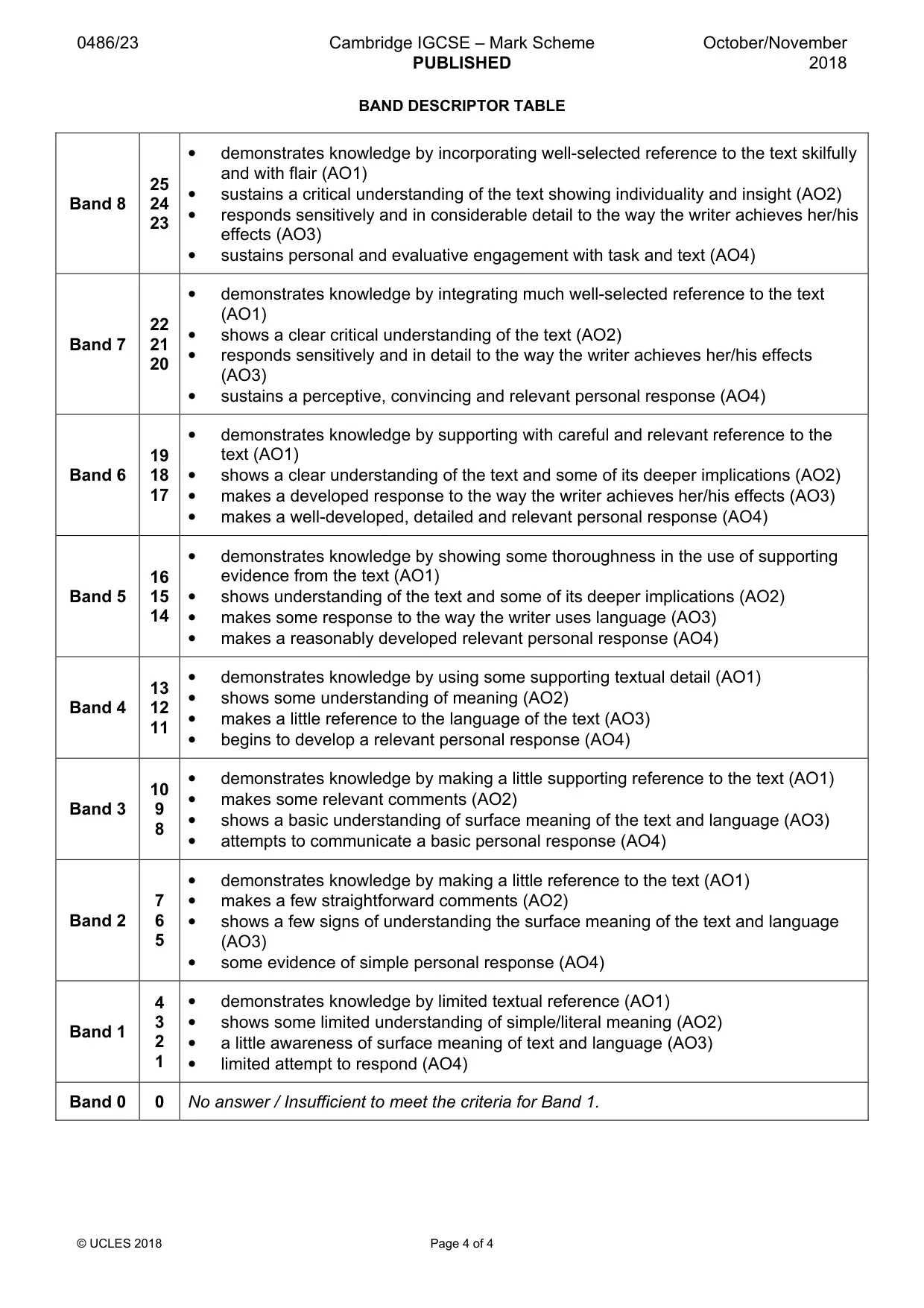
0486/23 Cambridge IGCSE – Mark Scheme PUBLISHED October/November 2018 © UCLES 2018 Page 4 of 4 BAND DESCRIPTOR TABLE Band 8 25 24 23 • demonstrates knowledge by incorporating well-selected reference to the text skilfully and with flair (AO1) • sustains a critical understanding of the text showing individuality and insight (AO2) • responds sensitively and in considerable detail to the way the writer achieves her/his effects (AO3) • sustains personal and evaluative engagement with task and text (AO4) Band 7 22 21 20 • demonstrates knowledge by integrating much well-selected reference to the text (AO1) • shows a clear critical understanding of the text (AO2) • responds sensitively and in detail to the way the writer achieves her/his effects (AO3) • sustains a perceptive, convincing and relevant personal response (AO4) Band 6 19 18 17 • demonstrates knowledge by supporting with careful and relevant reference to the text (AO1) • shows a clear understanding of the text and some of its deeper implications (AO2) • makes a developed response to the way the writer achieves her/his effects (AO3) • makes a well-developed, detailed and relevant personal response (AO4) Band 5 16 15 14 • demonstrates knowledge by showing some thoroughness in the use of supporting evidence from the text (AO1) • shows understanding of the text and some of its deeper implications (AO2) • makes some response to the way the writer uses language (AO3) • makes a reasonably developed relevant personal response (AO4) Band 4 13 12 11 • demonstrates knowledge by using some supporting textual detail (AO1) • shows some understanding of meaning (AO2) • makes a little reference to the language of the text (AO3) • begins to develop a relevant personal response (AO4) Band 3 10 9 8 • demonstrates knowledge by making a little supporting reference to the text (AO1) • makes some relevant comments (AO2) • shows a basic understanding of surface meaning of the text and language (AO3) • attempts to communicate a basic personal response (AO4) Band 2 7 6 5 • demonstrates knowledge by making a little reference to the text (AO1) • makes a few straightforward comments (AO2) • shows a few signs of understanding the surface meaning of the text and language (AO3) • some evidence of simple personal response (AO4) Band 1 4 3 2 1 • demonstrates knowledge by limited textual reference (AO1) • shows some limited understanding of simple/literal meaning (AO2) • a little awareness of surface meaning of text and language (AO3) • limited attempt to respond (AO4) Band 0 0 No answer / Insufficient to meet the criteria for Band 1.
What you needed in this session
Cambridge’s own grade thresholds for 2018 Oct/Nov, Paper 2 · Variant 3. A higher threshold means an easier paper — the bar moves with how the cohort did.