Cambridge IGCSE English - First Language (UK) 0522 — 2012 May/June Paper 2 · Variant 1
0522/21/M/J/12 · 50 marks · ≈56 min
The question paper and its mark scheme, free to read here and free to download. This is Cambridge’s own paper, exactly as it was sat.
Question paper8 pages
Mark scheme10 pages
Answers below. Sit the paper first if you are practising.
Paper as text
Question paper, page 1
This document consists of 5 printed pages and 3 blank pages. DC (CW) 56540/1 © UCLES 2012 [Turn over UNIVERSITY OF CAMBRIDGE INTERNATIONAL EXAMINATIONS International General Certificate of Secondary Education * 8 2 9 1 4 8 0 3 5 9 * FIRST LANGUAGE ENGLISH 0522/02 Paper 2 Reading Passages (Extended) May/June 2012 2 hours Additional Materials: Answer Booklet/Paper READ THESE INSTRUCTIONS FIRST If you have been given an Answer Booklet, follow the instructions on the front cover of the Booklet. Write your Centre number, candidate number and name on all the work you hand in. Write in dark blue or black pen. Do not use staples, paper clips, highlighters, glue or correction fluid. Answer all questions. Dictionaries are not permitted. At the end of the examination, fasten all your work securely together. The number of marks is given in brackets [ ] at the end of each question or part question. www.XtremePapers.com
Question paper, page 2
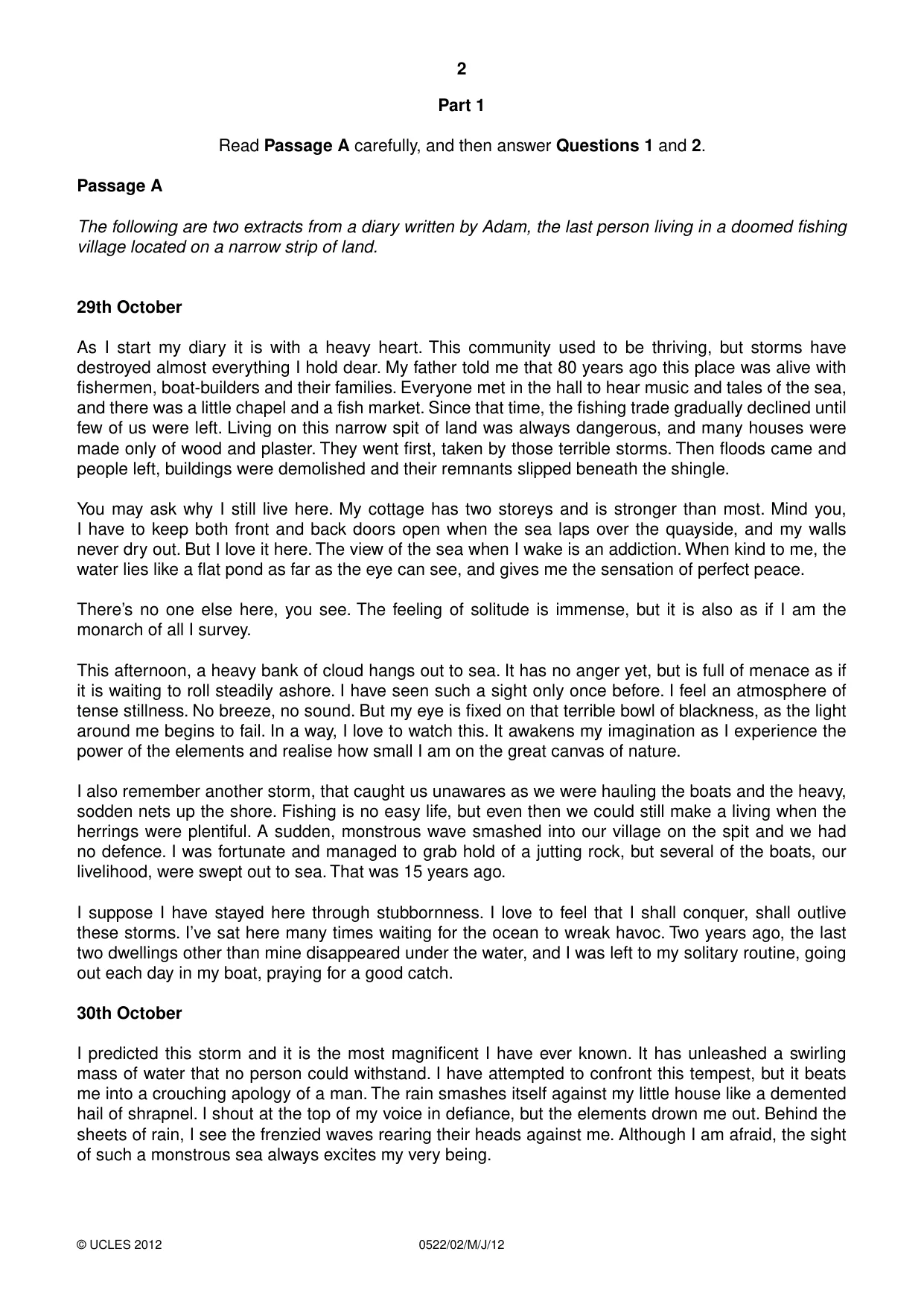
2 0522/02/M/J/12 © UCLES 2012 Part 1 Read Passage A carefully, and then answer Questions 1 and 2. Passage A The following are two extracts from a diary written by Adam, the last person living in a doomed fishing village located on a narrow strip of land. 29th October As I start my diary it is with a heavy heart. This community used to be thriving, but storms have destroyed almost everything I hold dear. My father told me that 80 years ago this place was alive with fishermen, boat-builders and their families. Everyone met in the hall to hear music and tales of the sea, and there was a little chapel and a fish market. Since that time, the fishing trade gradually declined until few of us were left. Living on this narrow spit of land was always dangerous, and many houses were made only of wood and plaster. They went first, taken by those terrible storms. Then floods came and people left, buildings were demolished and their remnants slipped beneath the shingle. You may ask why I still live here. My cottage has two storeys and is stronger than most. Mind you, I have to keep both front and back doors open when the sea laps over the quayside, and my walls never dry out. But I love it here. The view of the sea when I wake is an addiction. When kind to me, the water lies like a flat pond as far as the eye can see, and gives me the sensation of perfect peace. There’s no one else here, you see. The feeling of solitude is immense, but it is also as if I am the monarch of all I survey. This afternoon, a heavy bank of cloud hangs out to sea. It has no anger yet, but is full of menace as if it is waiting to roll steadily ashore. I have seen such a sight only once before. I feel an atmosphere of tense stillness. No breeze, no sound. But my eye is fixed on that terrible bowl of blackness, as the light around me begins to fail. In a way, I love to watch this. It awakens my imagination as I experience the power of the elements and realise how small I am on the great canvas of nature. I also remember another storm, that caught us unawares as we were hauling the boats and the heavy, sodden nets up the shore. Fishing is no easy life, but even then we could still make a living when the herrings were plentiful. A sudden, monstrous wave smashed into our village on the spit and we had no defence. I was fortunate and managed to grab hold of a jutting rock, but several of the boats, our livelihood, were swept out to sea. That was 15 years ago. I suppose I have stayed here through stubbornness. I love to feel that I shall conquer, shall outlive these storms. I’ve sat here many times waiting for the ocean to wreak havoc. Two years ago, the last two dwellings other than mine disappeared under the water, and I was left to my solitary routine, going out each day in my boat, praying for a good catch. 30th October I predicted this storm and it is the most magnificent I have ever known. It has unleashed a swirling mass of water that no person could withstand. I have attempted to confront this tempest, but it beats me into a crouching apology of a man. The rain smashes itself against my little house like a demented hail of shrapnel. I shout at the top of my voice in defiance, but the elements drown me out. Behind the sheets of rain, I see the frenzied waves rearing their heads against me. Although I am afraid, the sight of such a monstrous sea always excites my very being.
Question paper, page 3
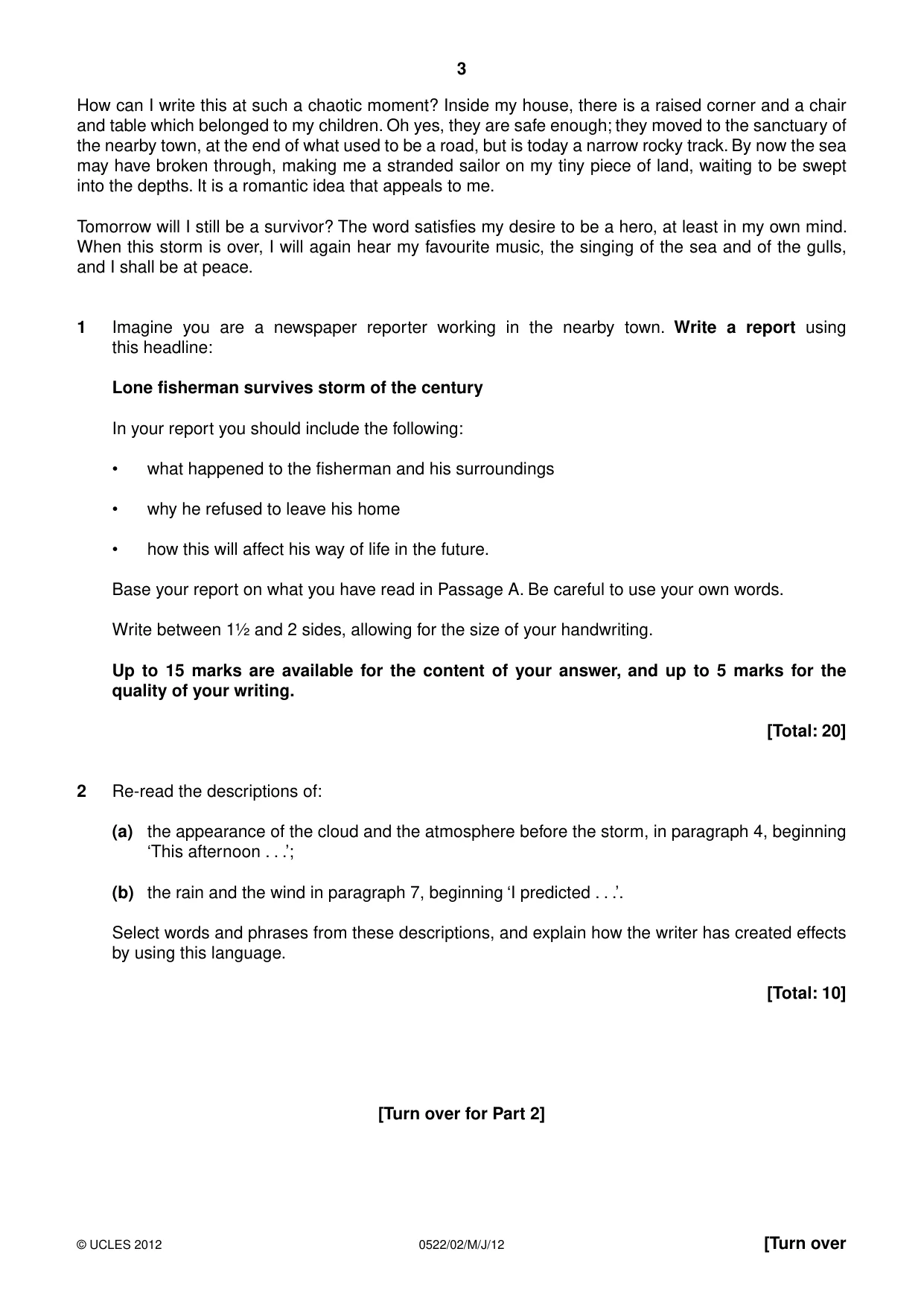
3 0522/02/M/J/12 © UCLES 2012 [Turn over How can I write this at such a chaotic moment? Inside my house, there is a raised corner and a chair and table which belonged to my children. Oh yes, they are safe enough; they moved to the sanctuary of the nearby town, at the end of what used to be a road, but is today a narrow rocky track. By now the sea may have broken through, making me a stranded sailor on my tiny piece of land, waiting to be swept into the depths. It is a romantic idea that appeals to me. Tomorrow will I still be a survivor? The word satisfies my desire to be a hero, at least in my own mind. When this storm is over, I will again hear my favourite music, the singing of the sea and of the gulls, and I shall be at peace. 1 Imagine you are a newspaper reporter working in the nearby town. Write a report using this headline: Lone fisherman survives storm of the century In your report you should include the following: • what happened to the fisherman and his surroundings • why he refused to leave his home • how this will affect his way of life in the future. Base your report on what you have read in Passage A. Be careful to use your own words. Write between 1½ and 2 sides, allowing for the size of your handwriting. Up to 15 marks are available for the content of your answer, and up to 5 marks for the quality of your writing. [Total: 20] 2 Re-read the descriptions of: (a) the appearance of the cloud and the atmosphere before the storm, in paragraph 4, beginning ‘This afternoon . . .’; (b) the rain and the wind in paragraph 7, beginning ‘I predicted . . .’. Select words and phrases from these descriptions, and explain how the writer has created effects by using this language. [Total: 10] [Turn over for Part 2]
Question paper, page 4
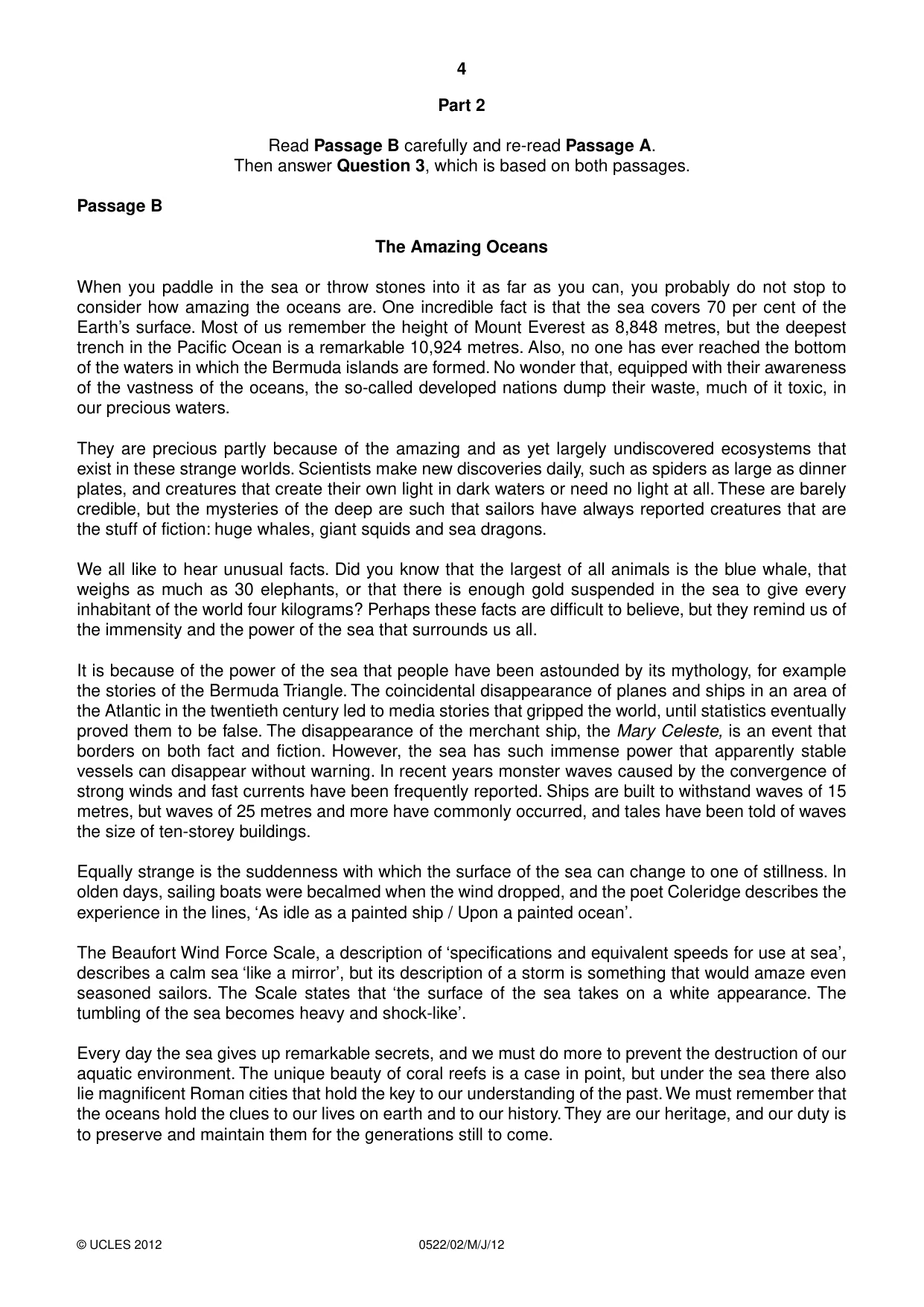
4 0522/02/M/J/12 © UCLES 2012 Part 2 Read Passage B carefully and re-read Passage A. Then answer Question 3, which is based on both passages. Passage B The Amazing Oceans When you paddle in the sea or throw stones into it as far as you can, you probably do not stop to consider how amazing the oceans are. One incredible fact is that the sea covers 70 per cent of the Earth’s surface. Most of us remember the height of Mount Everest as 8,848 metres, but the deepest trench in the Pacific Ocean is a remarkable 10,924 metres. Also, no one has ever reached the bottom of the waters in which the Bermuda islands are formed. No wonder that, equipped with their awareness of the vastness of the oceans, the so-called developed nations dump their waste, much of it toxic, in our precious waters. They are precious partly because of the amazing and as yet largely undiscovered ecosystems that exist in these strange worlds. Scientists make new discoveries daily, such as spiders as large as dinner plates, and creatures that create their own light in dark waters or need no light at all. These are barely credible, but the mysteries of the deep are such that sailors have always reported creatures that are the stuff of fiction: huge whales, giant squids and sea dragons. We all like to hear unusual facts. Did you know that the largest of all animals is the blue whale, that weighs as much as 30 elephants, or that there is enough gold suspended in the sea to give every inhabitant of the world four kilograms? Perhaps these facts are difficult to believe, but they remind us of the immensity and the power of the sea that surrounds us all. It is because of the power of the sea that people have been astounded by its mythology, for example the stories of the Bermuda Triangle. The coincidental disappearance of planes and ships in an area of the Atlantic in the twentieth century led to media stories that gripped the world, until statistics eventually proved them to be false. The disappearance of the merchant ship, the Mary Celeste, is an event that borders on both fact and fiction. However, the sea has such immense power that apparently stable vessels can disappear without warning. In recent years monster waves caused by the convergence of strong winds and fast currents have been frequently reported. Ships are built to withstand waves of 15 metres, but waves of 25 metres and more have commonly occurred, and tales have been told of waves the size of ten-storey buildings. Equally strange is the suddenness with which the surface of the sea can change to one of stillness. In olden days, sailing boats were becalmed when the wind dropped, and the poet Coleridge describes the experience in the lines, ‘As idle as a painted ship / Upon a painted ocean’. The Beaufort Wind Force Scale, a description of ‘specifications and equivalent speeds for use at sea’, describes a calm sea ‘like a mirror’, but its description of a storm is something that would amaze even seasoned sailors. The Scale states that ‘the surface of the sea takes on a white appearance. The tumbling of the sea becomes heavy and shock-like’. Every day the sea gives up remarkable secrets, and we must do more to prevent the destruction of our aquatic environment. The unique beauty of coral reefs is a case in point, but under the sea there also lie magnificent Roman cities that hold the key to our understanding of the past. We must remember that the oceans hold the clues to our lives on earth and to our history. They are our heritage, and our duty is to preserve and maintain them for the generations still to come.
Question paper, page 5
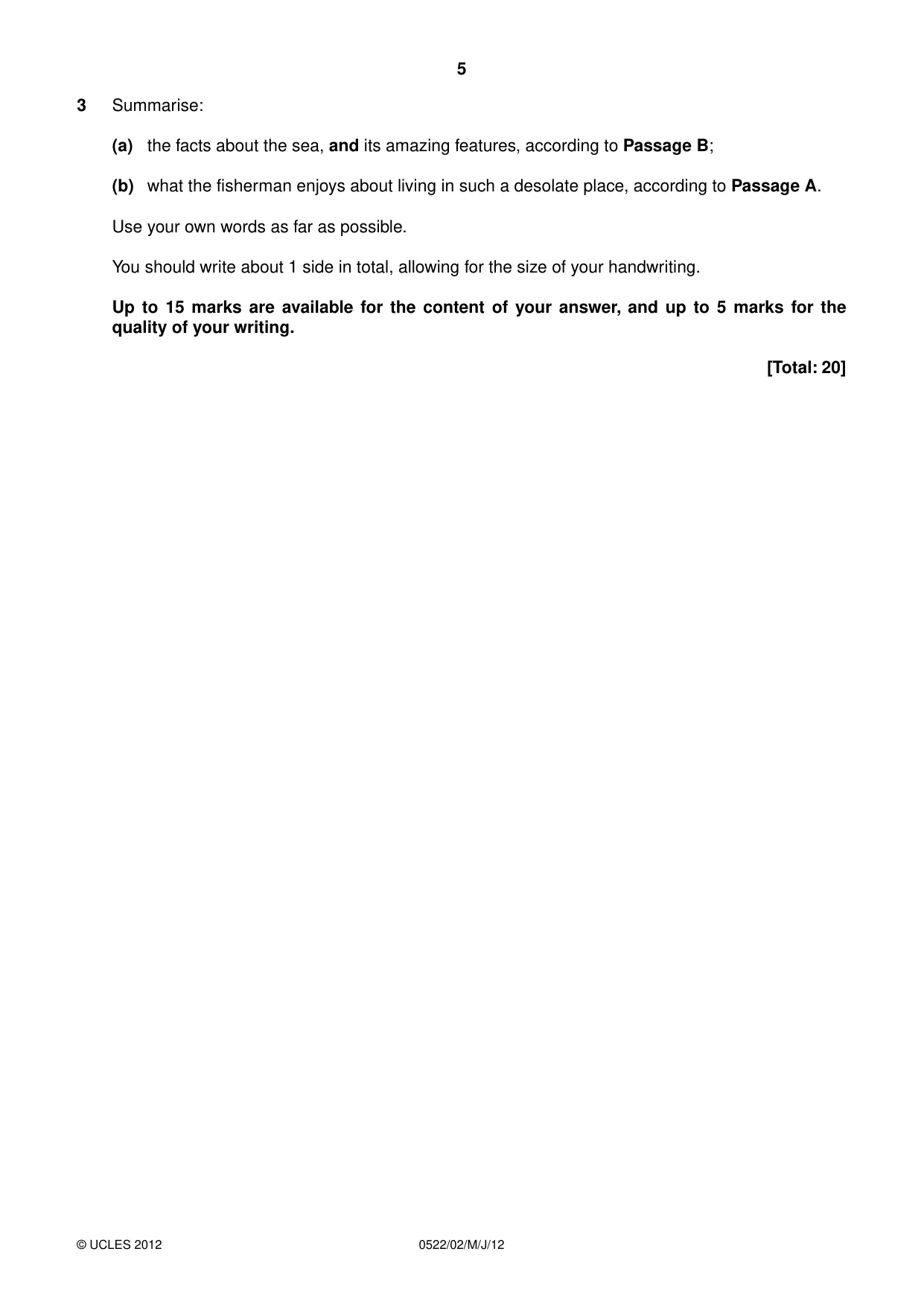
5 0522/02/M/J/12 © UCLES 2012 3 Summarise: (a) the facts about the sea, and its amazing features, according to Passage B; (b) what the fisherman enjoys about living in such a desolate place, according to Passage A. Use your own words as far as possible. You should write about 1 side in total, allowing for the size of your handwriting. Up to 15 marks are available for the content of your answer, and up to 5 marks for the quality of your writing. [Total: 20]
Question paper, page 6
6 0522/02/M/J/12 © UCLES 2012 BLANK PAGE
Question paper, page 7
7 0522/02/M/J/12 © UCLES 2012 BLANK PAGE
Question paper, page 8
8 0522/02/M/J/12 © UCLES 2012 Permission to reproduce items where third-party owned material protected by copyright is included has been sought and cleared where possible. Every reasonable effort has been made by the publisher (UCLES) to trace copyright holders, but if any items requiring clearance have unwittingly been included, the publisher will be pleased to make amends at the earliest possible opportunity. University of Cambridge International Examinations is part of the Cambridge Assessment Group. Cambridge Assessment is the brand name of University of Cambridge Local Examinations Syndicate (UCLES), which is itself a department of the University of Cambridge. BLANK PAGE
Mark scheme, page 1
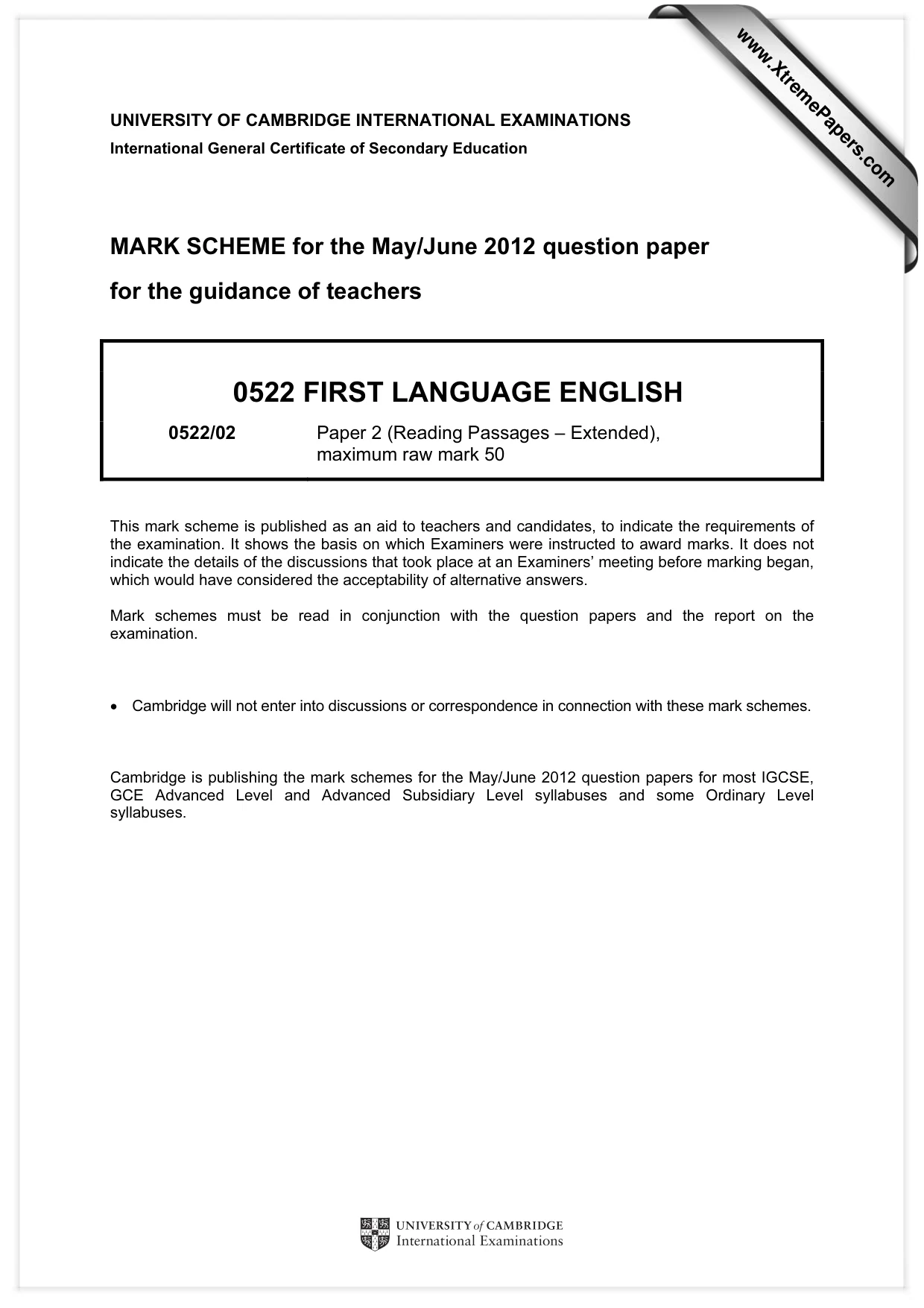
UNIVERSITY OF CAMBRIDGE INTERNATIONAL EXAMINATIONS International General Certificate of Secondary Education MARK SCHEME for the May/June 2012 question paper for the guidance of teachers 0522 FIRST LANGUAGE ENGLISH 0522/02 Paper 2 (Reading Passages – Extended), maximum raw mark 50 This mark scheme is published as an aid to teachers and candidates, to indicate the requirements of the examination. It shows the basis on which Examiners were instructed to award marks. It does not indicate the details of the discussions that took place at an Examiners’ meeting before marking began, which would have considered the acceptability of alternative answers. Mark schemes must be read in conjunction with the question papers and the report on the examination. • Cambridge will not enter into discussions or correspondence in connection with these mark schemes. Cambridge is publishing the mark schemes for the May/June 2012 question papers for most IGCSE, GCE Advanced Level and Advanced Subsidiary Level syllabuses and some Ordinary Level syllabuses. www.XtremePapers.com
Mark scheme, page 2
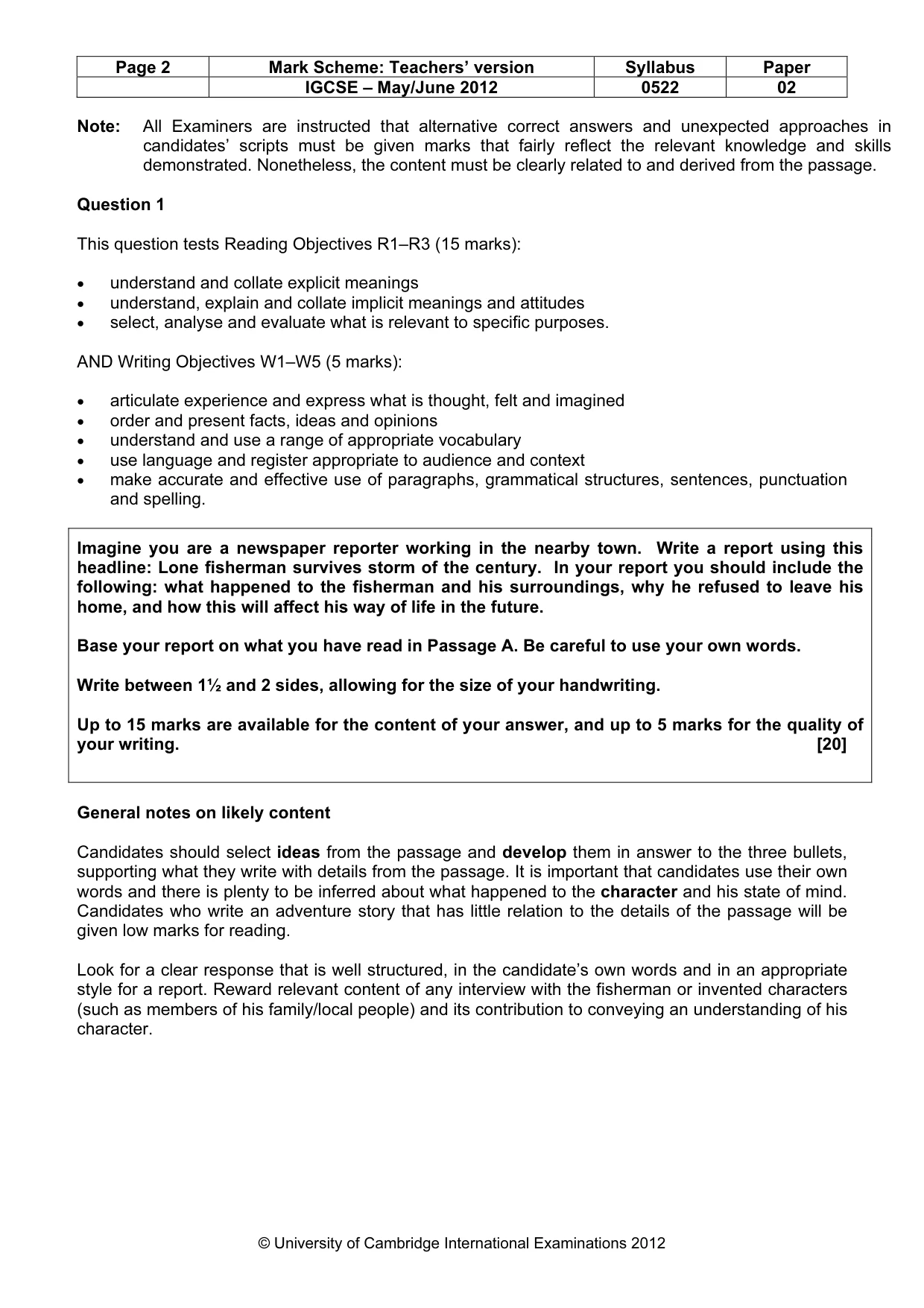
Page 2 Mark Scheme: Teachers’ version Syllabus Paper IGCSE – May/June 2012 0522 02 © University of Cambridge International Examinations 2012 Note: All Examiners are instructed that alternative correct answers and unexpected approaches in candidates’ scripts must be given marks that fairly reflect the relevant knowledge and skills demonstrated. Nonetheless, the content must be clearly related to and derived from the passage. Question 1 This question tests Reading Objectives R1–R3 (15 marks): • understand and collate explicit meanings • understand, explain and collate implicit meanings and attitudes • select, analyse and evaluate what is relevant to specific purposes. AND Writing Objectives W1–W5 (5 marks): • articulate experience and express what is thought, felt and imagined • order and present facts, ideas and opinions • understand and use a range of appropriate vocabulary • use language and register appropriate to audience and context • make accurate and effective use of paragraphs, grammatical structures, sentences, punctuation and spelling. Imagine you are a newspaper reporter working in the nearby town. Write a report using this headline: Lone fisherman survives storm of the century. In your report you should include the following: what happened to the fisherman and his surroundings, why he refused to leave his home, and how this will affect his way of life in the future. Base your report on what you have read in Passage A. Be careful to use your own words. Write between 1½ and 2 sides, allowing for the size of your handwriting. Up to 15 marks are available for the content of your answer, and up to 5 marks for the quality of your writing. [20] General notes on likely content Candidates should select ideas from the passage and develop them in answer to the three bullets, supporting what they write with details from the passage. It is important that candidates use their own words and there is plenty to be inferred about what happened to the character and his state of mind. Candidates who write an adventure story that has little relation to the details of the passage will be given low marks for reading. Look for a clear response that is well structured, in the candidate’s own words and in an appropriate style for a report. Reward relevant content of any interview with the fisherman or invented characters (such as members of his family/local people) and its contribution to conveying an understanding of his character.
Mark scheme, page 3
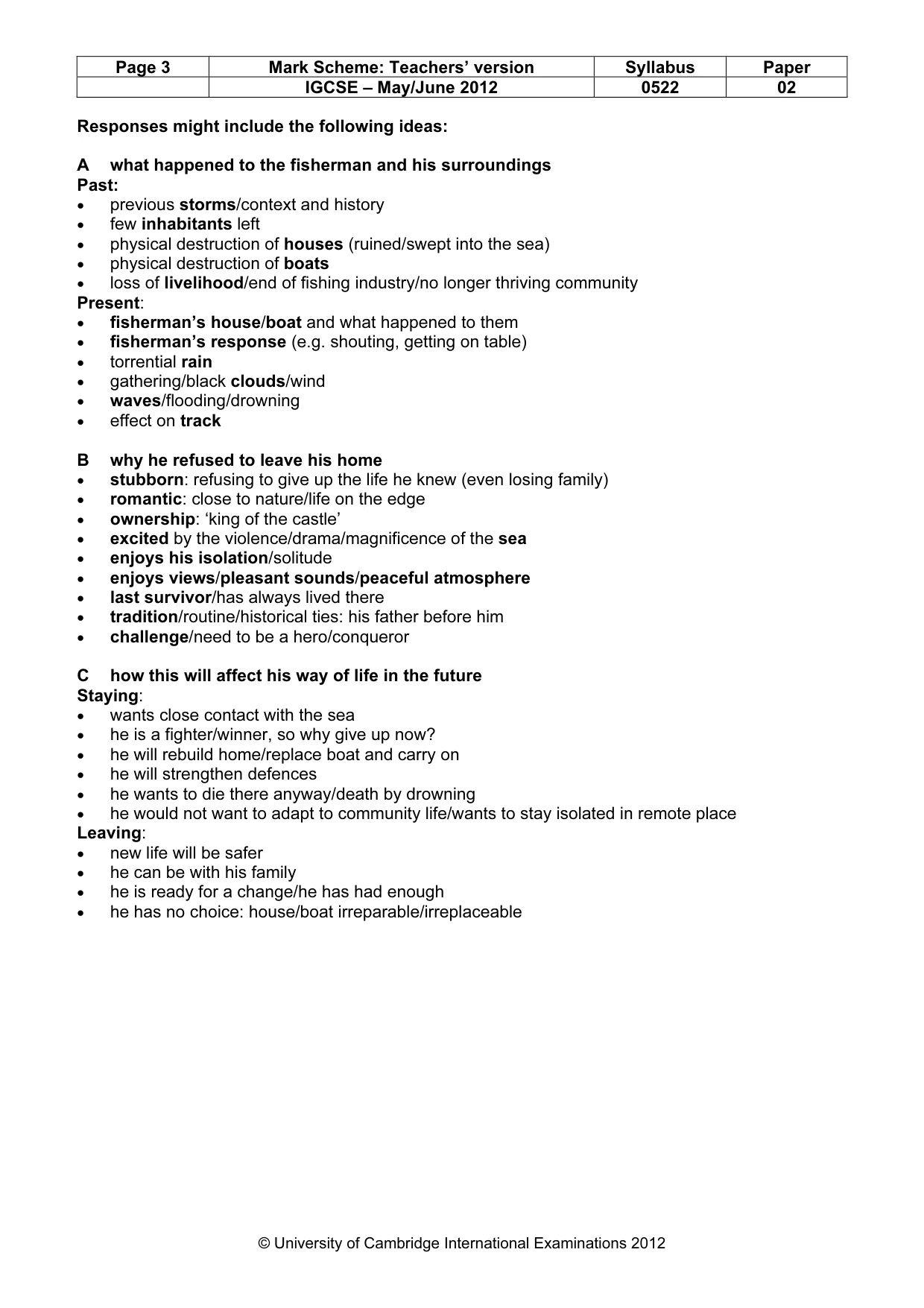
Page 3 Mark Scheme: Teachers’ version Syllabus Paper IGCSE – May/June 2012 0522 02 © University of Cambridge International Examinations 2012 Responses might include the following ideas: A what happened to the fisherman and his surroundings Past: • previous storms/context and history • few inhabitants left • physical destruction of houses (ruined/swept into the sea) • physical destruction of boats • loss of livelihood/end of fishing industry/no longer thriving community Present: • fisherman’s house/boat and what happened to them • fisherman’s response (e.g. shouting, getting on table) • torrential rain • gathering/black clouds/wind • waves/flooding/drowning • effect on track B why he refused to leave his home • stubborn: refusing to give up the life he knew (even losing family) • romantic: close to nature/life on the edge • ownership: ‘king of the castle’ • excited by the violence/drama/magnificence of the sea • enjoys his isolation/solitude • enjoys views/pleasant sounds/peaceful atmosphere • last survivor/has always lived there • tradition/routine/historical ties: his father before him • challenge/need to be a hero/conqueror C how this will affect his way of life in the future Staying: • wants close contact with the sea • he is a fighter/winner, so why give up now? • he will rebuild home/replace boat and carry on • he will strengthen defences • he wants to die there anyway/death by drowning • he would not want to adapt to community life/wants to stay isolated in remote place Leaving: • new life will be safer • he can be with his family • he is ready for a change/he has had enough • he has no choice: house/boat irreparable/irreplaceable
Mark scheme, page 4
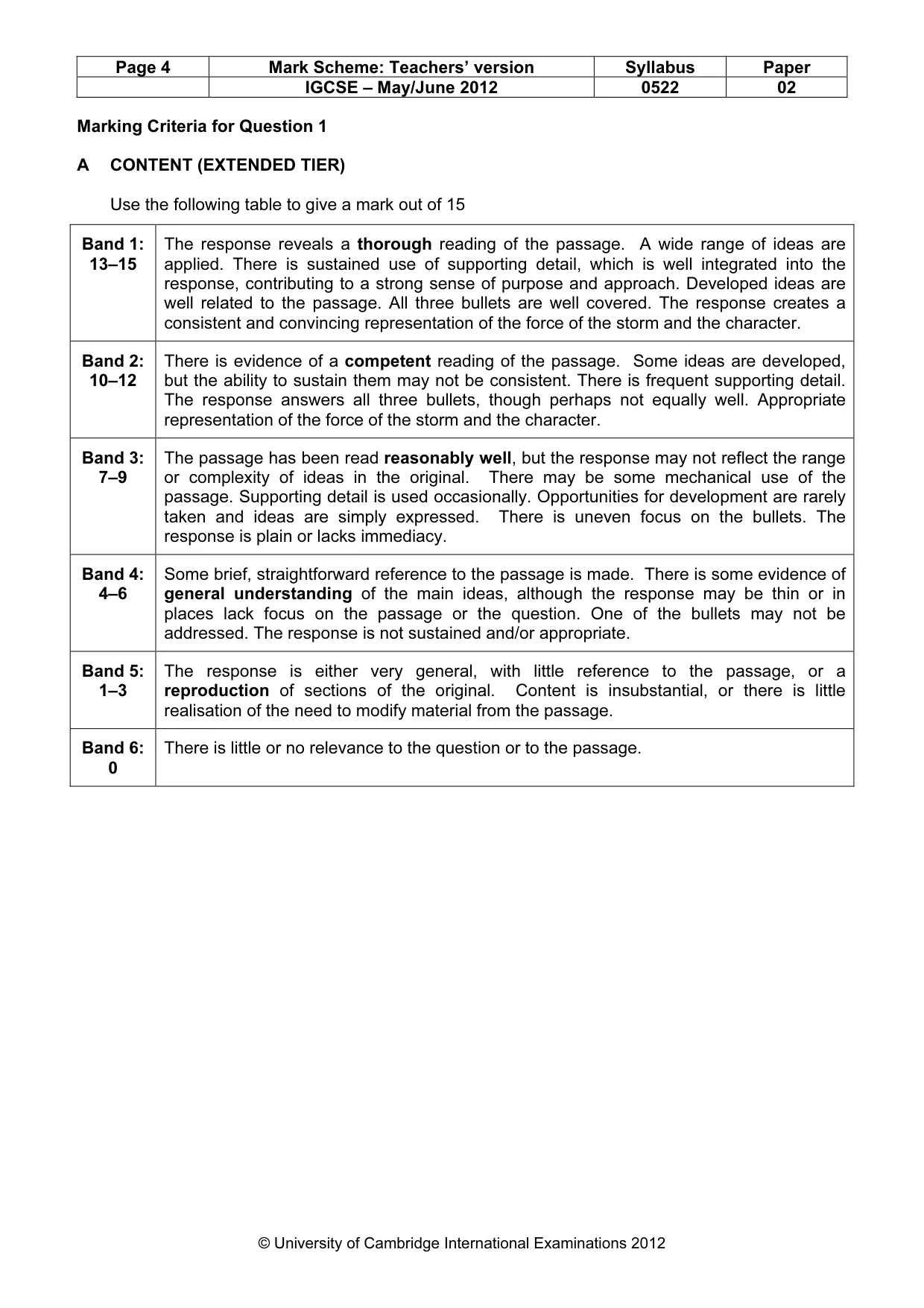
Page 4 Mark Scheme: Teachers’ version Syllabus Paper IGCSE – May/June 2012 0522 02 © University of Cambridge International Examinations 2012 Marking Criteria for Question 1 A CONTENT (EXTENDED TIER) Use the following table to give a mark out of 15 Band 1: 13–15 The response reveals a thorough reading of the passage. A wide range of ideas are applied. There is sustained use of supporting detail, which is well integrated into the response, contributing to a strong sense of purpose and approach. Developed ideas are well related to the passage. All three bullets are well covered. The response creates a consistent and convincing representation of the force of the storm and the character. Band 2: 10–12 There is evidence of a competent reading of the passage. Some ideas are developed, but the ability to sustain them may not be consistent. There is frequent supporting detail. The response answers all three bullets, though perhaps not equally well. Appropriate representation of the force of the storm and the character. Band 3: 7–9 The passage has been read reasonably well, but the response may not reflect the range or complexity of ideas in the original. There may be some mechanical use of the passage. Supporting detail is used occasionally. Opportunities for development are rarely taken and ideas are simply expressed. There is uneven focus on the bullets. The response is plain or lacks immediacy. Band 4: 4–6 Some brief, straightforward reference to the passage is made. There is some evidence of general understanding of the main ideas, although the response may be thin or in places lack focus on the passage or the question. One of the bullets may not be addressed. The response is not sustained and/or appropriate. Band 5: 1–3 The response is either very general, with little reference to the passage, or a reproduction of sections of the original. Content is insubstantial, or there is little realisation of the need to modify material from the passage. Band 6: 0 There is little or no relevance to the question or to the passage.
Mark scheme, page 5
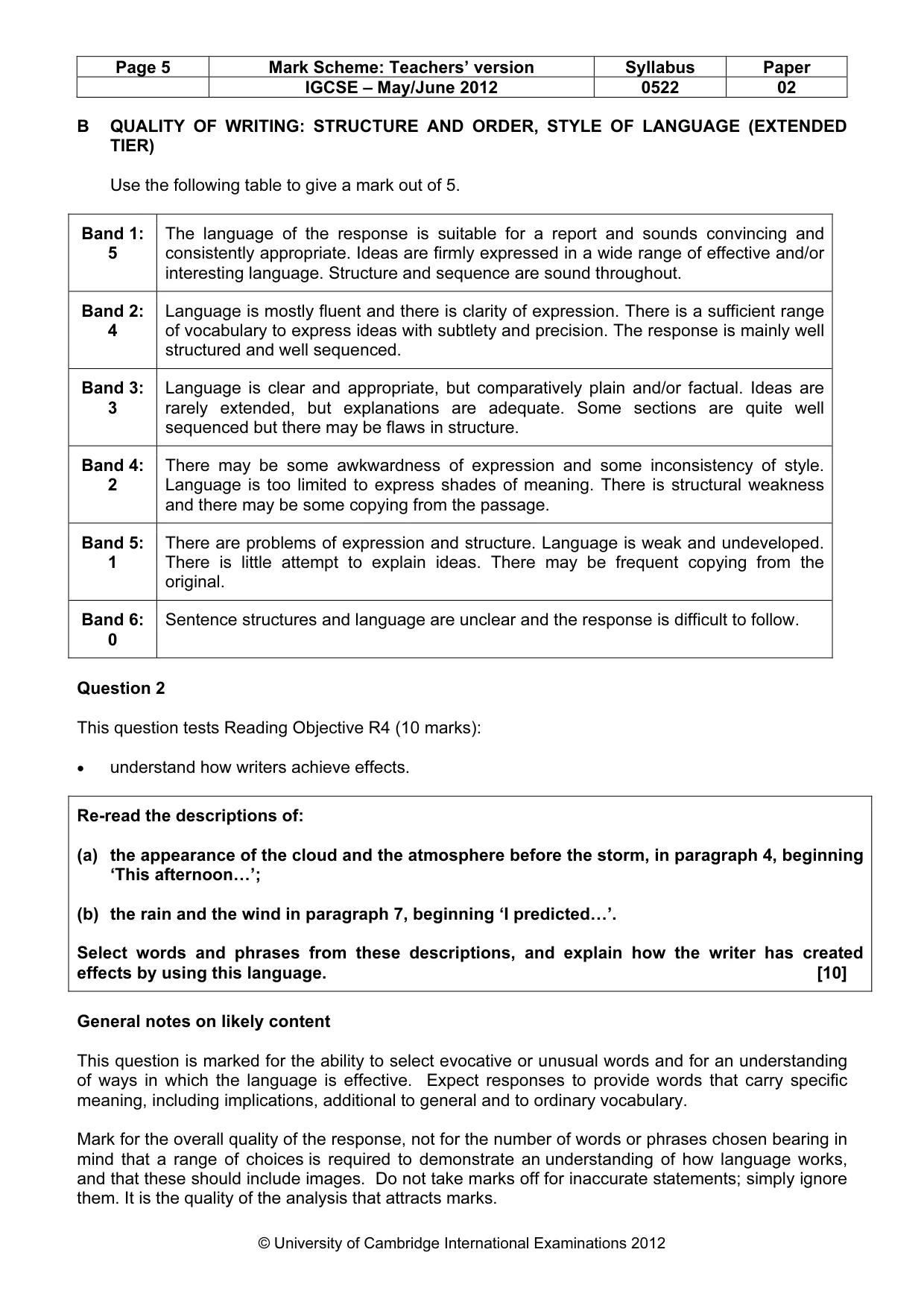
Page 5 Mark Scheme: Teachers’ version Syllabus Paper IGCSE – May/June 2012 0522 02 © University of Cambridge International Examinations 2012 B QUALITY OF WRITING: STRUCTURE AND ORDER, STYLE OF LANGUAGE (EXTENDED TIER) Use the following table to give a mark out of 5. Band 1: 5 The language of the response is suitable for a report and sounds convincing and consistently appropriate. Ideas are firmly expressed in a wide range of effective and/or interesting language. Structure and sequence are sound throughout. Band 2: 4 Language is mostly fluent and there is clarity of expression. There is a sufficient range of vocabulary to express ideas with subtlety and precision. The response is mainly well structured and well sequenced. Band 3: 3 Language is clear and appropriate, but comparatively plain and/or factual. Ideas are rarely extended, but explanations are adequate. Some sections are quite well sequenced but there may be flaws in structure. Band 4: 2 There may be some awkwardness of expression and some inconsistency of style. Language is too limited to express shades of meaning. There is structural weakness and there may be some copying from the passage. Band 5: 1 There are problems of expression and structure. Language is weak and undeveloped. There is little attempt to explain ideas. There may be frequent copying from the original. Band 6: 0 Sentence structures and language are unclear and the response is difficult to follow. Question 2 This question tests Reading Objective R4 (10 marks): • understand how writers achieve effects. Re-read the descriptions of: (a) the appearance of the cloud and the atmosphere before the storm, in paragraph 4, beginning ‘This afternoon…’; (b) the rain and the wind in paragraph 7, beginning ‘I predicted…’. Select words and phrases from these descriptions, and explain how the writer has created effects by using this language. [10] General notes on likely content This question is marked for the ability to select evocative or unusual words and for an understanding of ways in which the language is effective. Expect responses to provide words that carry specific meaning, including implications, additional to general and to ordinary vocabulary. Mark for the overall quality of the response, not for the number of words or phrases chosen bearing in mind that a range of choices is required to demonstrate an understanding of how language works, and that these should include images. Do not take marks off for inaccurate statements; simply ignore them. It is the quality of the analysis that attracts marks.
Mark scheme, page 6
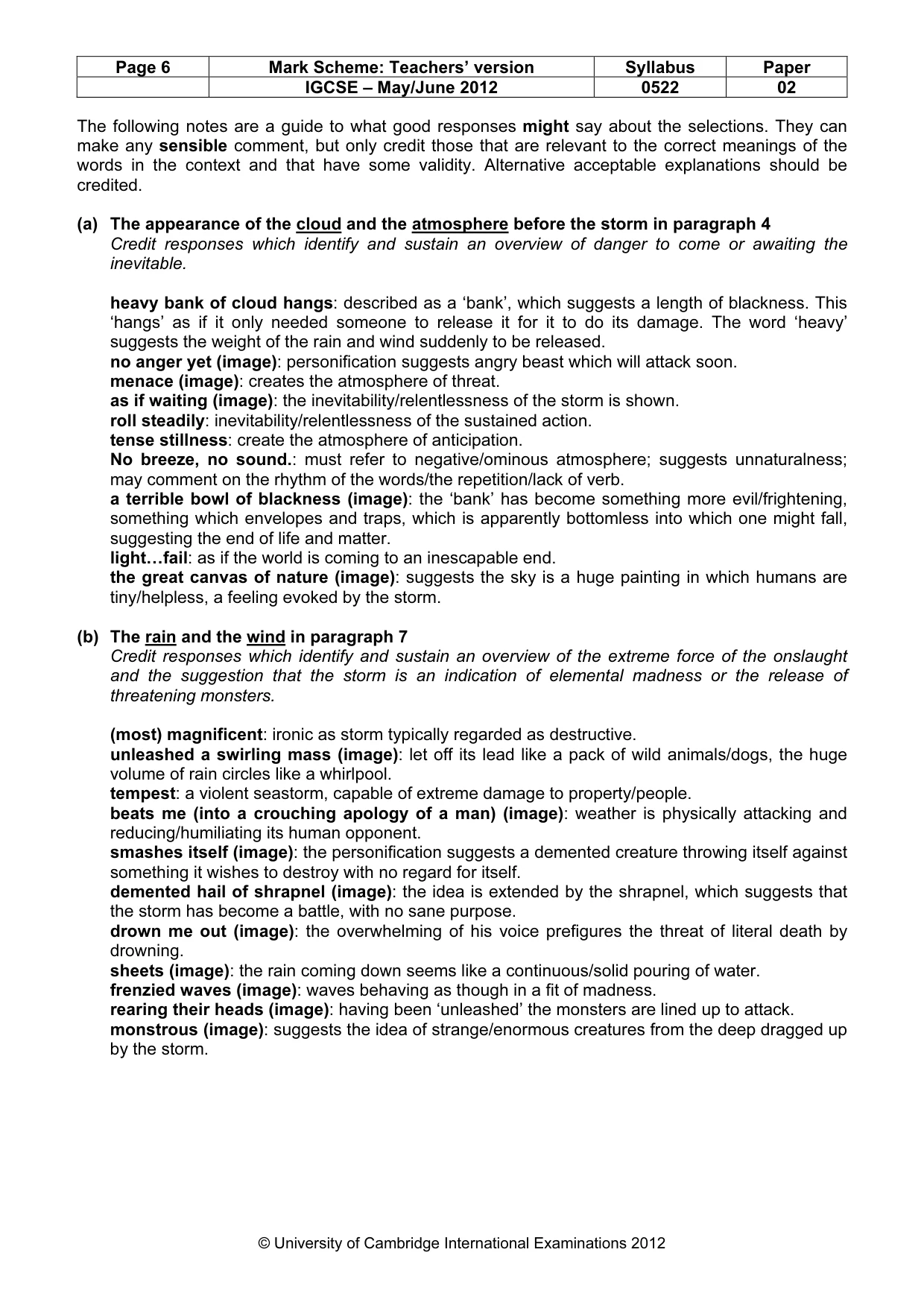
Page 6 Mark Scheme: Teachers’ version Syllabus Paper IGCSE – May/June 2012 0522 02 © University of Cambridge International Examinations 2012 The following notes are a guide to what good responses might say about the selections. They can make any sensible comment, but only credit those that are relevant to the correct meanings of the words in the context and that have some validity. Alternative acceptable explanations should be credited. (a) The appearance of the cloud and the atmosphere before the storm in paragraph 4 Credit responses which identify and sustain an overview of danger to come or awaiting the inevitable. heavy bank of cloud hangs: described as a ‘bank’, which suggests a length of blackness. This ‘hangs’ as if it only needed someone to release it for it to do its damage. The word ‘heavy’ suggests the weight of the rain and wind suddenly to be released. no anger yet (image): personification suggests angry beast which will attack soon. menace (image): creates the atmosphere of threat. as if waiting (image): the inevitability/relentlessness of the storm is shown. roll steadily: inevitability/relentlessness of the sustained action. tense stillness: create the atmosphere of anticipation. No breeze, no sound.: must refer to negative/ominous atmosphere; suggests unnaturalness; may comment on the rhythm of the words/the repetition/lack of verb. a terrible bowl of blackness (image): the ‘bank’ has become something more evil/frightening, something which envelopes and traps, which is apparently bottomless into which one might fall, suggesting the end of life and matter. light…fail: as if the world is coming to an inescapable end. the great canvas of nature (image): suggests the sky is a huge painting in which humans are tiny/helpless, a feeling evoked by the storm. (b) The rain and the wind in paragraph 7 Credit responses which identify and sustain an overview of the extreme force of the onslaught and the suggestion that the storm is an indication of elemental madness or the release of threatening monsters. (most) magnificent: ironic as storm typically regarded as destructive. unleashed a swirling mass (image): let off its lead like a pack of wild animals/dogs, the huge volume of rain circles like a whirlpool. tempest: a violent seastorm, capable of extreme damage to property/people. beats me (into a crouching apology of a man) (image): weather is physically attacking and reducing/humiliating its human opponent. smashes itself (image): the personification suggests a demented creature throwing itself against something it wishes to destroy with no regard for itself. demented hail of shrapnel (image): the idea is extended by the shrapnel, which suggests that the storm has become a battle, with no sane purpose. drown me out (image): the overwhelming of his voice prefigures the threat of literal death by drowning. sheets (image): the rain coming down seems like a continuous/solid pouring of water. frenzied waves (image): waves behaving as though in a fit of madness. rearing their heads (image): having been ‘unleashed’ the monsters are lined up to attack. monstrous (image): suggests the idea of strange/enormous creatures from the deep dragged up by the storm.
Mark scheme, page 7
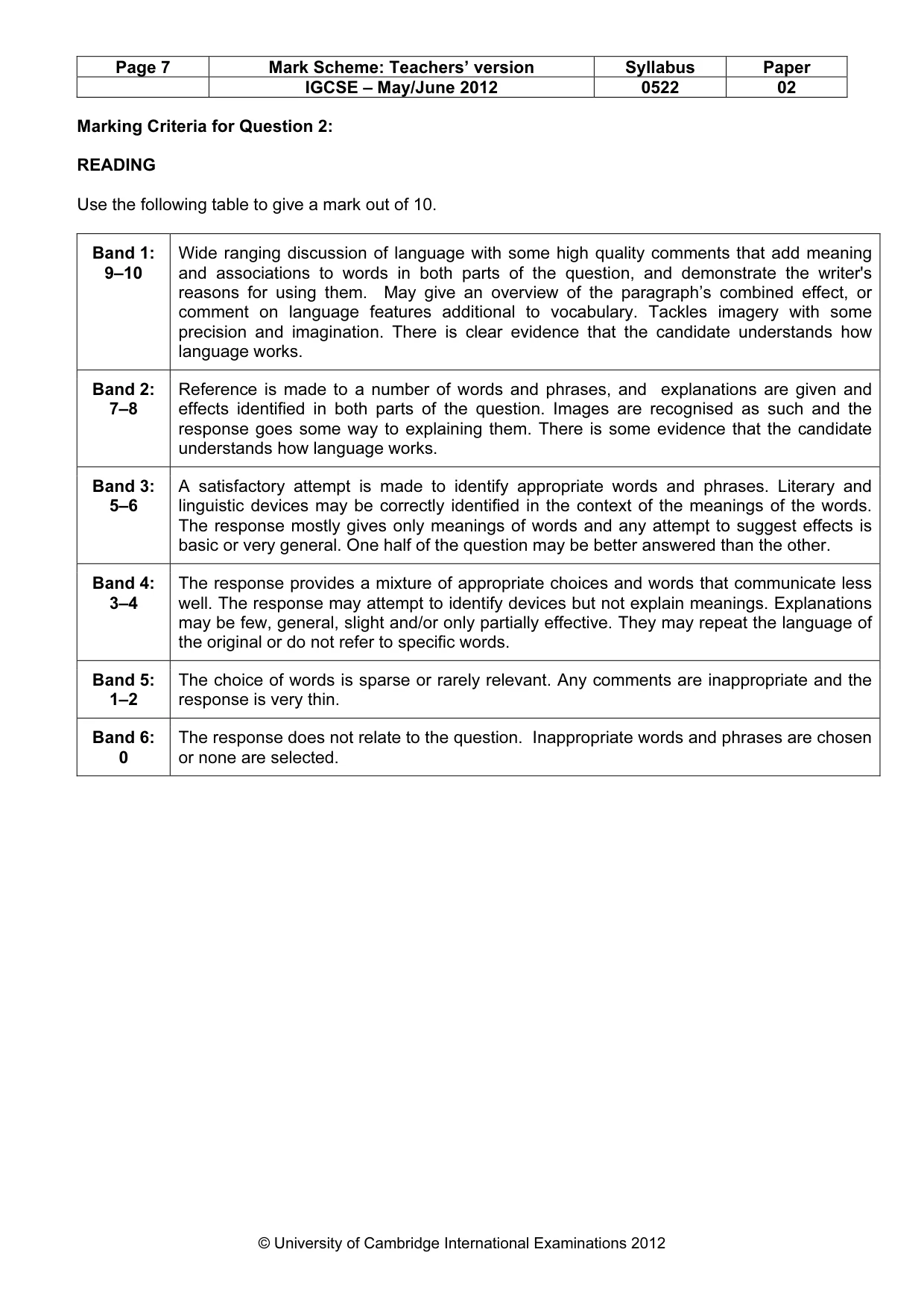
Page 7 Mark Scheme: Teachers’ version Syllabus Paper IGCSE – May/June 2012 0522 02 © University of Cambridge International Examinations 2012 Marking Criteria for Question 2: READING Use the following table to give a mark out of 10. Band 1: 9–10 Wide ranging discussion of language with some high quality comments that add meaning and associations to words in both parts of the question, and demonstrate the writer's reasons for using them. May give an overview of the paragraph’s combined effect, or comment on language features additional to vocabulary. Tackles imagery with some precision and imagination. There is clear evidence that the candidate understands how language works. Band 2: 7–8 Reference is made to a number of words and phrases, and explanations are given and effects identified in both parts of the question. Images are recognised as such and the response goes some way to explaining them. There is some evidence that the candidate understands how language works. Band 3: 5–6 A satisfactory attempt is made to identify appropriate words and phrases. Literary and linguistic devices may be correctly identified in the context of the meanings of the words. The response mostly gives only meanings of words and any attempt to suggest effects is basic or very general. One half of the question may be better answered than the other. Band 4: 3–4 The response provides a mixture of appropriate choices and words that communicate less well. The response may attempt to identify devices but not explain meanings. Explanations may be few, general, slight and/or only partially effective. They may repeat the language of the original or do not refer to specific words. Band 5: 1–2 The choice of words is sparse or rarely relevant. Any comments are inappropriate and the response is very thin. Band 6: 0 The response does not relate to the question. Inappropriate words and phrases are chosen or none are selected.
Mark scheme, page 8
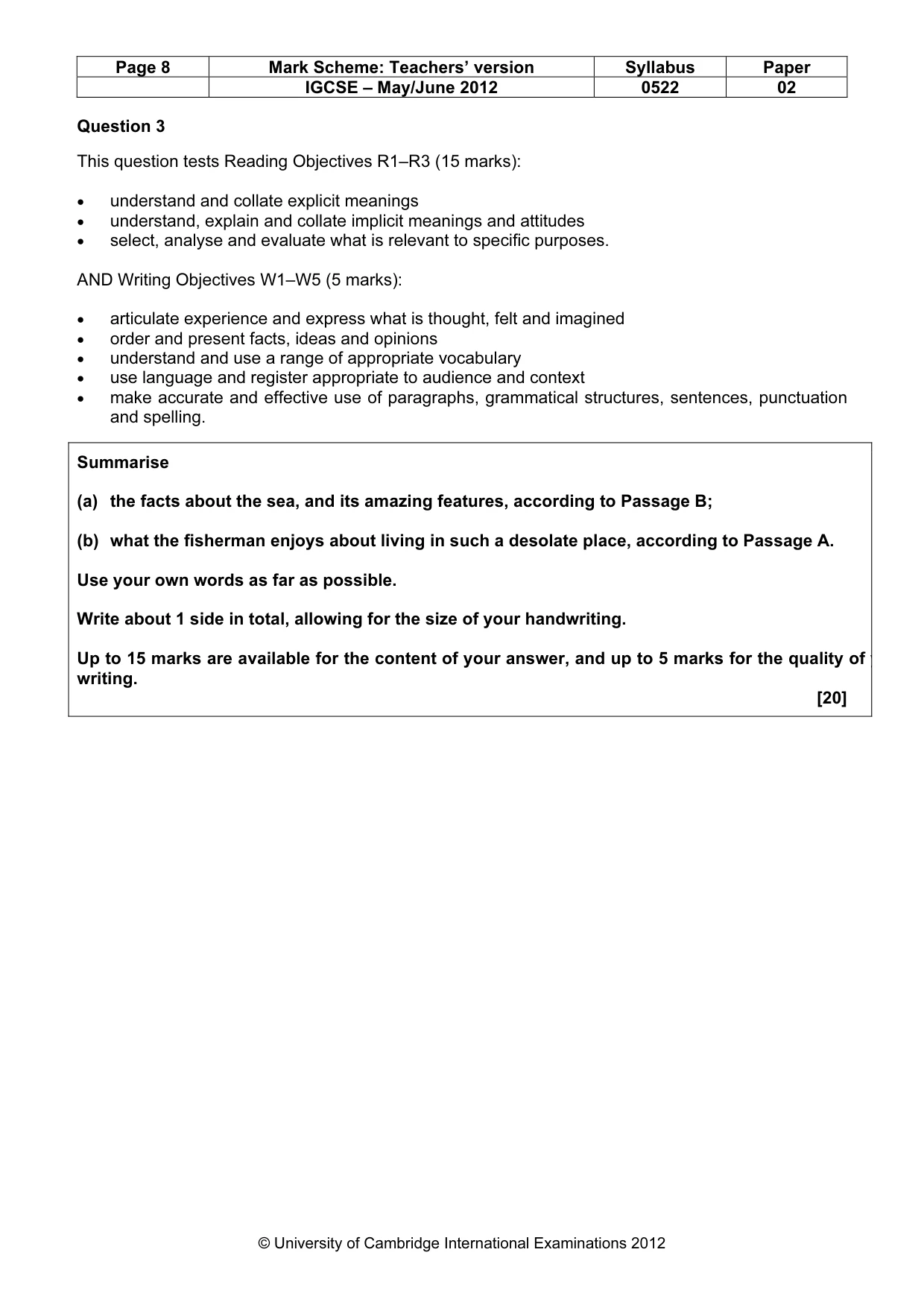
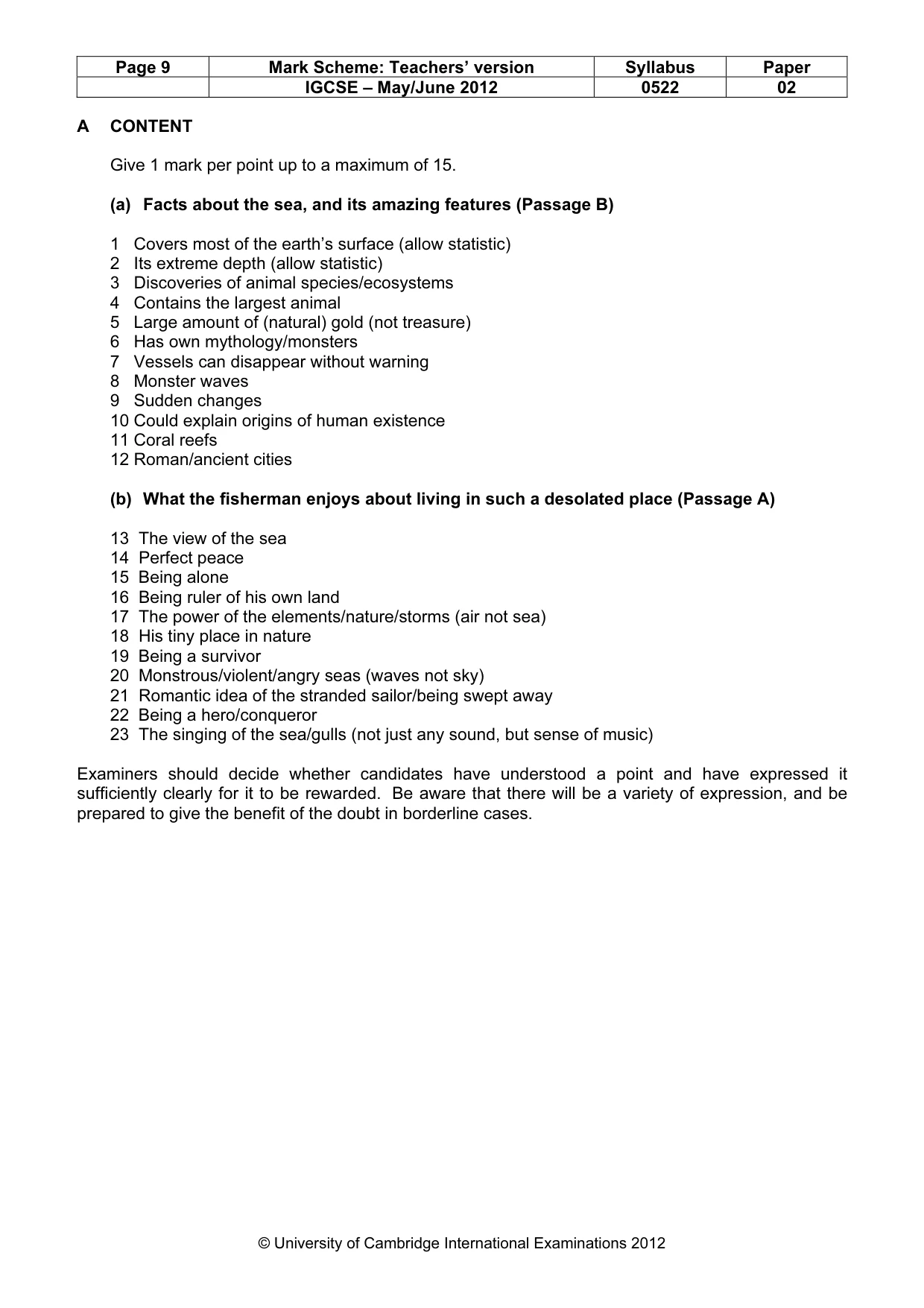
Page 8 Mark Scheme: Teachers’ version Syllabus Paper IGCSE – May/June 2012 0522 02 © University of Cambridge International Examinations 2012 Question 3 This question tests Reading Objectives R1–R3 (15 marks): • understand and collate explicit meanings • understand, explain and collate implicit meanings and attitudes • select, analyse and evaluate what is relevant to specific purposes. AND Writing Objectives W1–W5 (5 marks): • articulate experience and express what is thought, felt and imagined • order and present facts, ideas and opinions • understand and use a range of appropriate vocabulary • use language and register appropriate to audience and context • make accurate and effective use of paragraphs, grammatical structures, sentences, punctuation and spelling. Summarise (a) the facts about the sea, and its amazing features, according to Passage B; (b) what the fisherman enjoys about living in such a desolate place, according to Passage A. Use your own words as far as possible. Write about 1 side in total, allowing for the size of your handwriting. Up to 15 marks are available for the content of your answer, and up to 5 marks for the quality of y writing. [20]
Mark scheme, page 9
Page 9 Mark Scheme: Teachers’ version Syllabus Paper IGCSE – May/June 2012 0522 02 © University of Cambridge International Examinations 2012 A CONTENT Give 1 mark per point up to a maximum of 15. (a) Facts about the sea, and its amazing features (Passage B) 1 Covers most of the earth’s surface (allow statistic) 2 Its extreme depth (allow statistic) 3 Discoveries of animal species/ecosystems 4 Contains the largest animal 5 Large amount of (natural) gold (not treasure) 6 Has own mythology/monsters 7 Vessels can disappear without warning 8 Monster waves 9 Sudden changes 10 Could explain origins of human existence 11 Coral reefs 12 Roman/ancient cities (b) What the fisherman enjoys about living in such a desolated place (Passage A) 13 The view of the sea 14 Perfect peace 15 Being alone 16 Being ruler of his own land 17 The power of the elements/nature/storms (air not sea) 18 His tiny place in nature 19 Being a survivor 20 Monstrous/violent/angry seas (waves not sky) 21 Romantic idea of the stranded sailor/being swept away 22 Being a hero/conqueror 23 The singing of the sea/gulls (not just any sound, but sense of music) Examiners should decide whether candidates have understood a point and have expressed it sufficiently clearly for it to be rewarded. Be aware that there will be a variety of expression, and be prepared to give the benefit of the doubt in borderline cases.
Mark scheme, page 10
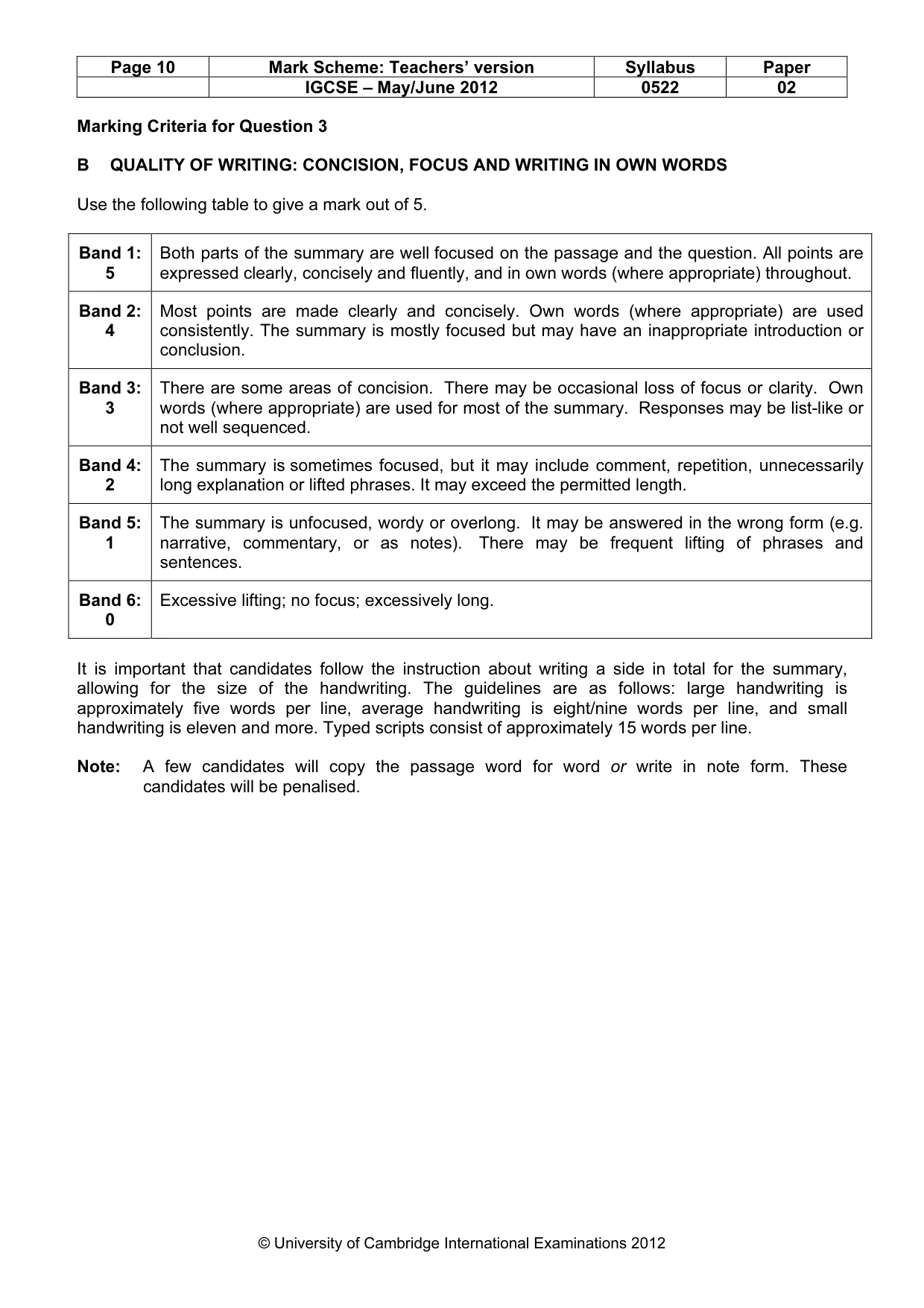
Page 10 Mark Scheme: Teachers’ version Syllabus Paper IGCSE – May/June 2012 0522 02 © University of Cambridge International Examinations 2012 Marking Criteria for Question 3 B QUALITY OF WRITING: CONCISION, FOCUS AND WRITING IN OWN WORDS Use the following table to give a mark out of 5. Band 1: 5 Both parts of the summary are well focused on the passage and the question. All points are expressed clearly, concisely and fluently, and in own words (where appropriate) throughout. Band 2: 4 Most points are made clearly and concisely. Own words (where appropriate) are used consistently. The summary is mostly focused but may have an inappropriate introduction or conclusion. Band 3: 3 There are some areas of concision. There may be occasional loss of focus or clarity. Own words (where appropriate) are used for most of the summary. Responses may be list-like or not well sequenced. Band 4: 2 The summary is sometimes focused, but it may include comment, repetition, unnecessarily long explanation or lifted phrases. It may exceed the permitted length. Band 5: 1 The summary is unfocused, wordy or overlong. It may be answered in the wrong form (e.g. narrative, commentary, or as notes). There may be frequent lifting of phrases and sentences. Band 6: 0 Excessive lifting; no focus; excessively long. It is important that candidates follow the instruction about writing a side in total for the summary, allowing for the size of the handwriting. The guidelines are as follows: large handwriting is approximately five words per line, average handwriting is eight/nine words per line, and small handwriting is eleven and more. Typed scripts consist of approximately 15 words per line. Note: A few candidates will copy the passage word for word or write in note form. These candidates will be penalised.
What you needed in this session
Cambridge’s own grade thresholds for 2012 May/June, Paper 2 · Variant 1. A higher threshold means an easier paper — the bar moves with how the cohort did.