Cambridge IGCSE English - First Language (UK) 0522 — 2017 May/June Paper 2 · Variant 1
0522/21/M/J/17 · 50 marks · ≈56 min
The question paper and its mark scheme, free to read here and free to download. This is Cambridge’s own paper, exactly as it was sat.
Question paper12 pages
Mark scheme12 pages
Answers below. Sit the paper first if you are practising.
Paper as text
Question paper, page 1
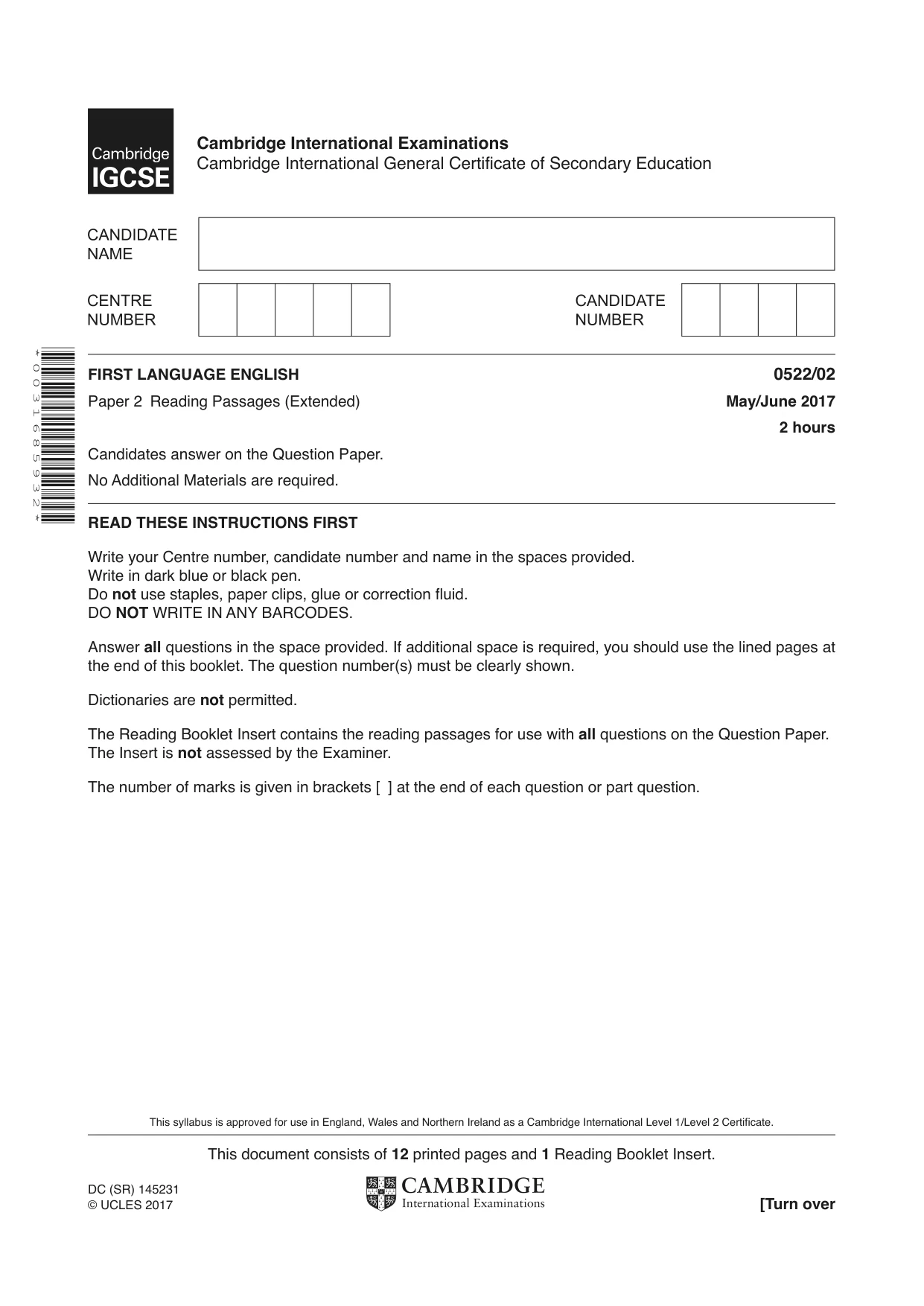
This document consists of 12 printed pages and 1 Reading Booklet Insert. DC (SR) 145231 © UCLES 2017 [Turn over Cambridge International Examinations Cambridge International General Certificate of Secondary Education * 0 0 3 1 6 8 5 9 3 2 * FIRST LANGUAGE ENGLISH 0522/02 Paper 2 Reading Passages (Extended) May/June 2017 2 hours Candidates answer on the Question Paper. No Additional Materials are required. READ THESE INSTRUCTIONS FIRST Write your Centre number, candidate number and name in the spaces provided. Write in dark blue or black pen. Do not use staples, paper clips, glue or correction fluid. DO NOT WRITE IN ANY BARCODES. Answer all questions in the space provided. If additional space is required, you should use the lined pages at the end of this booklet. The question number(s) must be clearly shown. Dictionaries are not permitted. The Reading Booklet Insert contains the reading passages for use with all questions on the Question Paper. The Insert is not assessed by the Examiner. The number of marks is given in brackets [ ] at the end of each question or part question. This syllabus is approved for use in England, Wales and Northern Ireland as a Cambridge International Level 1/Level 2 Certificate.
Question paper, page 2
2 0522/02/M/J/17 © UCLES 2017 Read carefully Passage A, Harrold Sparrow, in the Reading Booklet Insert and then answer Questions 1 and 2 on this Question Paper. Question 1 Following his successful presentation, Harrold is offered a specialist sales and managerial position as ‘Birdbrain’ in the Birdland section of the company’s brand new megastore. The megastore will replace all three existing local stores which will close next month. Staff not leaving the company will remain on full pay until the new store opens in six months’ time. Unsure if he should accept, Harrold writes a letter to a friend. Write Harrold’s letter to his friend. In your letter you should: • describe your feelings about the various events at home over the past few months • explain recent changes at work and the factors you are weighing up regarding the proposed position • discuss the options you are now considering. Base your letter on what you have read in Passage A, but be careful to use your own words. Address each of the three bullet points. Begin your letter, ‘Dear friend, I have had quite a bit to think about recently…’. Write about 250 to 350 words. Up to 15 marks are available for the content of your answer, and up to 5 marks for the quality of your writing. … … … … … … … … … … … …
Question paper, page 3
3 0522/02/M/J/17 © UCLES 2017 [Turn over … … … … … … … … … … … … … … … … … … … … … … … … … … … …
Question paper, page 4
4 0522/02/M/J/17 © UCLES 2017 … … … … … … … … … … … … … … … … … … … … … … … … … … … [Total: 20]
Question paper, page 5
5 0522/02/M/J/17 © UCLES 2017 [Turn over [Turn over for Question 2]
Question paper, page 6
6 0522/02/M/J/17 © UCLES 2017 Question 2 Re-read the descriptions of: (a) the pet shop and Harrold in paragraph 2, beginning ‘Pet shops had changed…’ (b) people and presentations in paragraph 8, beginning ‘Increasingly animated presentations…’. Select four powerful words or phrases from each paragraph. Your choices should include imagery. Explain how each word or phrase is used effectively in the context. Write about 200 to 300 words. Up to 10 marks are available for the content of your answer. … … … … … … … … … … … … … … … … … … … … …
Question paper, page 7
7 0522/02/M/J/17 © UCLES 2017 [Turn over … … … … … … … … … … … … … … … … … … … … … … … … … … … [Total: 10]
Question paper, page 8
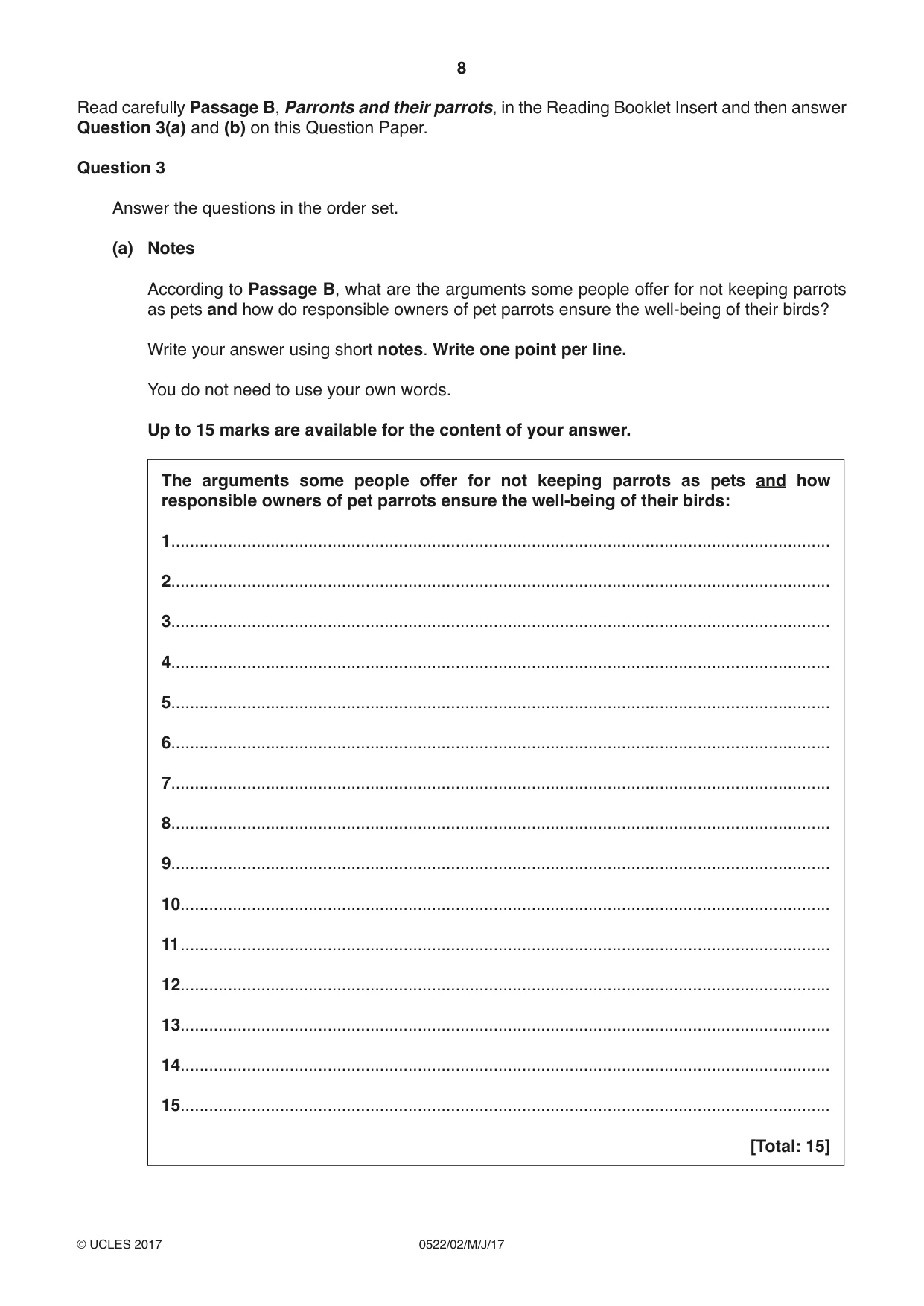
8 0522/02/M/J/17 © UCLES 2017 Read carefully Passage B, Parronts and their parrots, in the Reading Booklet Insert and then answer Question 3(a) and (b) on this Question Paper. Question 3 Answer the questions in the order set. (a) Notes According to Passage B, what are the arguments some people offer for not keeping parrots as pets and how do responsible owners of pet parrots ensure the well-being of their birds? Write your answer using short notes. Write one point per line. You do not need to use your own words. Up to 15 marks are available for the content of your answer. The arguments some people offer for not keeping parrots as pets and how responsible owners of pet parrots ensure the well-being of their birds: 1… 2… 3… 4… 5… 6… 7… 8… 9… 10… 11 … 12… 13… 14… 15… [Total: 15]
Question paper, page 9
9 0522/02/M/J/17 © UCLES 2017 [Turn over (b) Summary Now use your notes to write a summary of the arguments some people offer for not keeping parrots as pets and how responsible owners of pet parrots ensure the well-being of their birds, according to Passage B. You must use continuous writing (not note form) and use your own words as far as possible. Your summary should include all 15 of your points in Question 3(a) and must be 200 to 250 words. Up to 5 marks are available for the quality of your writing. … … … … … … … … … … … … … … … … … … … … …
Question paper, page 10
10 0522/02/M/J/17 © UCLES 2017 … … … … … … … … … … … [Total: 5]
Question paper, page 11
11 0522/02/M/J/17 © UCLES 2017 ADDITIONAL PAGE If you use the following lined page to complete the answer(s) to any question(s), the question number(s) must be clearly shown. … … … … … … … … … … … … … … … … … … … … … … … … … …
Question paper, page 12
12 0522/02/M/J/17 © UCLES 2017 Permission to reproduce items where third-party owned material protected by copyright is included has been sought and cleared where possible. Every reasonable effort has been made by the publisher (UCLES) to trace copyright holders, but if any items requiring clearance have unwittingly been included, the publisher will be pleased to make amends at the earliest possible opportunity. To avoid the issue of disclosure of answer-related information to candidates, all copyright acknowledgements are reproduced online in the Cambridge International Examinations Copyright Acknowledgements Booklet. This is produced for each series of examinations and is freely available to download at www.cie.org.uk after the live examination series. Cambridge International Examinations is part of the Cambridge Assessment Group. Cambridge Assessment is the brand name of University of Cambridge Local Examinations Syndicate (UCLES), which is itself a department of the University of Cambridge. ADDITIONAL PAGE If you use the following lined page to complete the answer(s) to any question(s), the question number(s) must be clearly shown. … … … … … … … … … … … … … … … … … … … … …
Mark scheme, page 1
® IGCSE is a registered trademark. This syllabus is approved for use in England, Wales and Northern Ireland as a Cambridge International Level 1/Level 2 Certificate. This document consists of 12 printed pages. © UCLES 2017 [Turn over Cambridge International Examinations Cambridge International General Certificate of Secondary Education FIRST LANGUAGE ENGLISH 0522/02 Paper 2 Reading Passages (Extended) May/June 2017 MARK SCHEME Maximum Mark: 50 Published This mark scheme is published as an aid to teachers and candidates, to indicate the requirements of the examination. It shows the basis on which Examiners were instructed to award marks. It does not indicate the details of the discussions that took place at an Examiners’ meeting before marking began, which would have considered the acceptability of alternative answers. Mark schemes should be read in conjunction with the question paper and the Principal Examiner Report for Teachers. Cambridge will not enter into discussions about these mark schemes. Cambridge is publishing the mark schemes for the May/June 2017 series for most Cambridge IGCSE®, Cambridge International A and AS Level and Cambridge Pre-U components, and some Cambridge O Level components.
Mark scheme, page 2
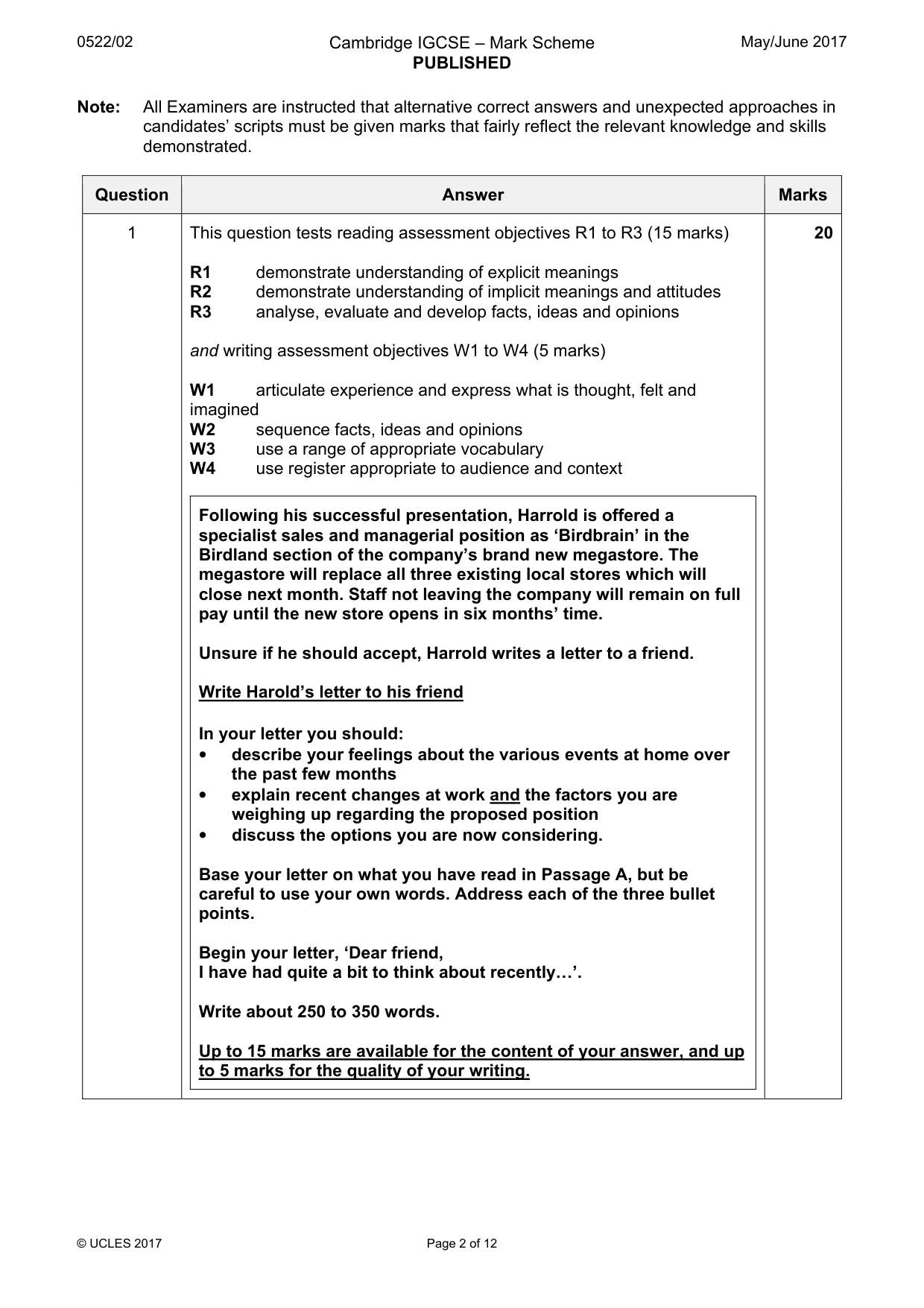
0522/02 Cambridge IGCSE – Mark Scheme PUBLISHED May/June 2017 © UCLES 2017 Page 2 of 12 Note: All Examiners are instructed that alternative correct answers and unexpected approaches in candidates’ scripts must be given marks that fairly reflect the relevant knowledge and skills demonstrated. Question Answer Marks 1 This question tests reading assessment objectives R1 to R3 (15 marks) R1 demonstrate understanding of explicit meanings R2 demonstrate understanding of implicit meanings and attitudes R3 analyse, evaluate and develop facts, ideas and opinions and writing assessment objectives W1 to W4 (5 marks) W1 articulate experience and express what is thought, felt and imagined W2 sequence facts, ideas and opinions W3 use a range of appropriate vocabulary W4 use register appropriate to audience and context 20 Following his successful presentation, Harrold is offered a specialist sales and managerial position as ‘Birdbrain’ in the Birdland section of the company’s brand new megastore. The megastore will replace all three existing local stores which will close next month. Staff not leaving the company will remain on full pay until the new store opens in six months’ time. Unsure if he should accept, Harrold writes a letter to a friend. Write Harold’s letter to his friend In your letter you should: • describe your feelings about the various events at home over the past few months • explain recent changes at work and the factors you are weighing up regarding the proposed position • discuss the options you are now considering. Base your letter on what you have read in Passage A, but be careful to use your own words. Address each of the three bullet points. Begin your letter, ‘Dear friend, I have had quite a bit to think about recently«’. Write about 250 to 350 words. Up to 15 marks are available for the content of your answer, and up to 5 marks for the quality of your writing.
Mark scheme, page 3
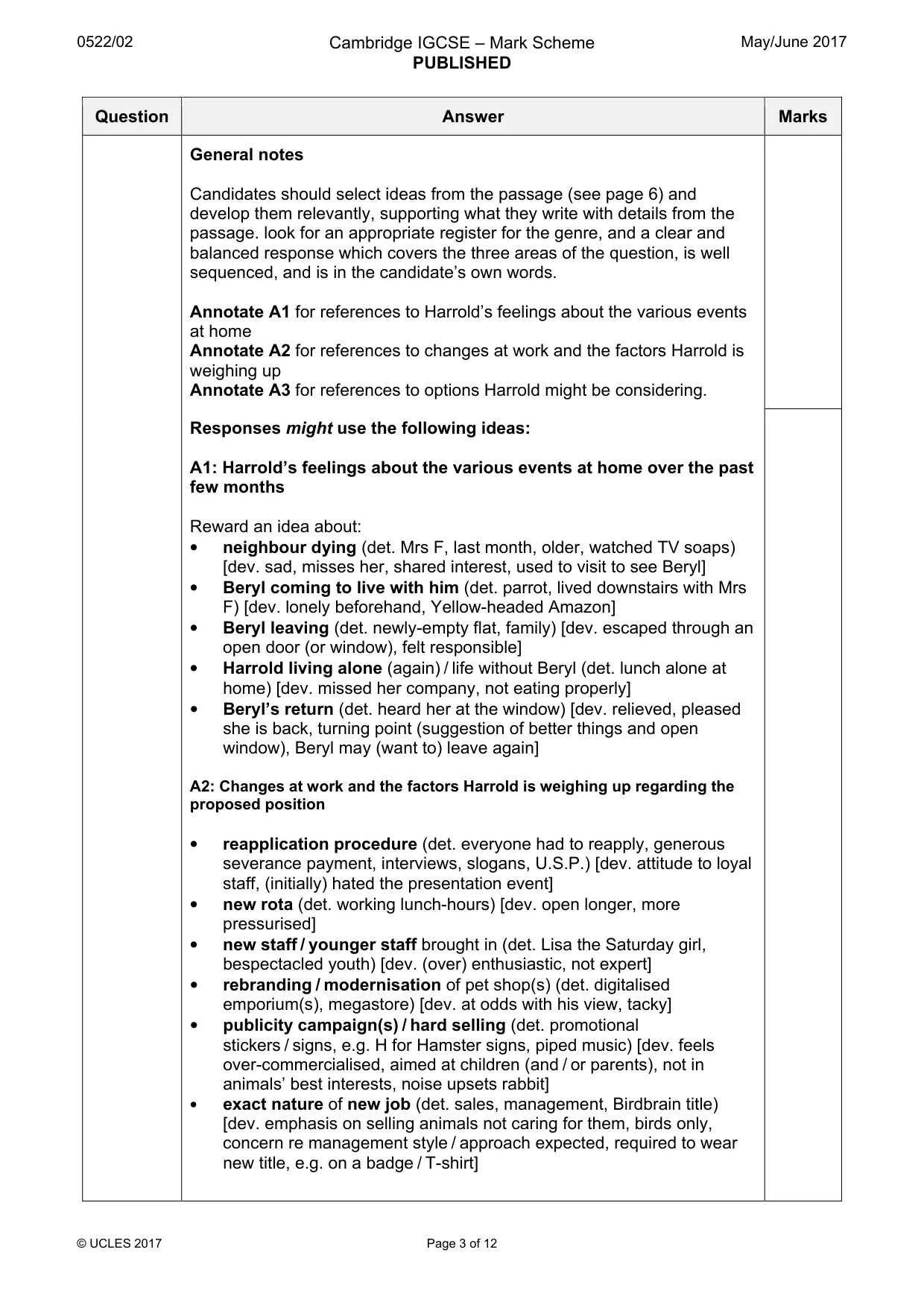
0522/02 Cambridge IGCSE – Mark Scheme PUBLISHED May/June 2017 © UCLES 2017 Page 3 of 12 Question Answer Marks General notes Candidates should select ideas from the passage (see page 6) and develop them relevantly, supporting what they write with details from the passage. look for an appropriate register for the genre, and a clear and balanced response which covers the three areas of the question, is well sequenced, and is in the candidate’s own words. Annotate A1 for references to Harrold’s feelings about the various events at home Annotate A2 for references to changes at work and the factors Harrold is weighing up Annotate A3 for references to options Harrold might be considering. Responses might use the following ideas: A1: Harrold’s feelings about the various events at home over the past few months Reward an idea about: • neighbour dying (det. Mrs F, last month, older, watched TV soaps) [dev. sad, misses her, shared interest, used to visit to see Beryl] • Beryl coming to live with him (det. parrot, lived downstairs with Mrs F) [dev. lonely beforehand, Yellow-headed Amazon] • Beryl leaving (det. newly-empty flat, family) [dev. escaped through an open door (or window), felt responsible] • Harrold living alone (again) / life without Beryl (det. lunch alone at home) [dev. missed her company, not eating properly] • Beryl’s return (det. heard her at the window) [dev. relieved, pleased she is back, turning point (suggestion of better things and open window), Beryl may (want to) leave again] A2: Changes at work and the factors Harrold is weighing up regarding the proposed position • reapplication procedure (det. everyone had to reapply, generous severance payment, interviews, slogans, U.S.P.) [dev. attitude to loyal staff, (initially) hated the presentation event] • new rota (det. working lunch-hours) [dev. open longer, more pressurised] • new staff / younger staff brought in (det. Lisa the Saturday girl, bespectacled youth) [dev. (over) enthusiastic, not expert] • rebranding / modernisation of pet shop(s) (det. digitalised emporium(s), megastore) [dev. at odds with his view, tacky] • publicity campaign(s) / hard selling (det. promotional stickers / signs, e.g. H for Hamster signs, piped music) [dev. feels over-commercialised, aimed at children (and / or parents), not in animals’ best interests, noise upsets rabbit] • exact nature of new job (det. sales, management, Birdbrain title) [dev. emphasis on selling animals not caring for them, birds only, concern re management style / approach expected, required to wear new title, e.g. on a badge / T-shirt]
Mark scheme, page 4
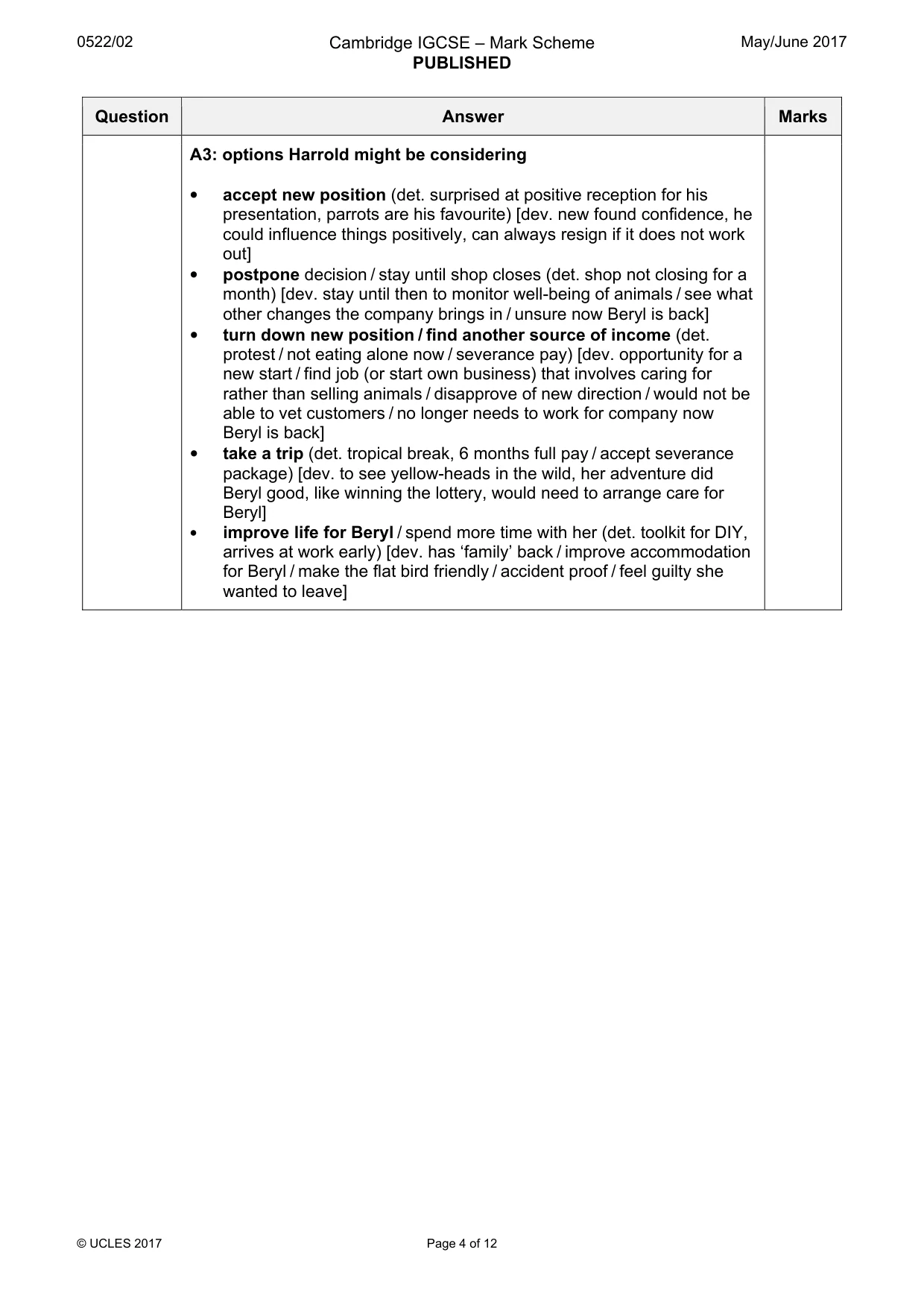
0522/02 Cambridge IGCSE – Mark Scheme PUBLISHED May/June 2017 © UCLES 2017 Page 4 of 12 Question Answer Marks A3: options Harrold might be considering • accept new position (det. surprised at positive reception for his presentation, parrots are his favourite) [dev. new found confidence, he could influence things positively, can always resign if it does not work out] • postpone decision / stay until shop closes (det. shop not closing for a month) [dev. stay until then to monitor well-being of animals / see what other changes the company brings in / unsure now Beryl is back] • turn down new position / find another source of income (det. protest / not eating alone now / severance pay) [dev. opportunity for a new start / find job (or start own business) that involves caring for rather than selling animals / disapprove of new direction / would not be able to vet customers / no longer needs to work for company now Beryl is back] • take a trip (det. tropical break, 6 months full pay / accept severance package) [dev. to see yellow-heads in the wild, her adventure did Beryl good, like winning the lottery, would need to arrange care for Beryl] • improve life for Beryl / spend more time with her (det. toolkit for DIY, arrives at work early) [dev. has ‘family’ back / improve accommodation for Beryl / make the flat bird friendly / accident proof / feel guilty she wanted to leave]
Mark scheme, page 5
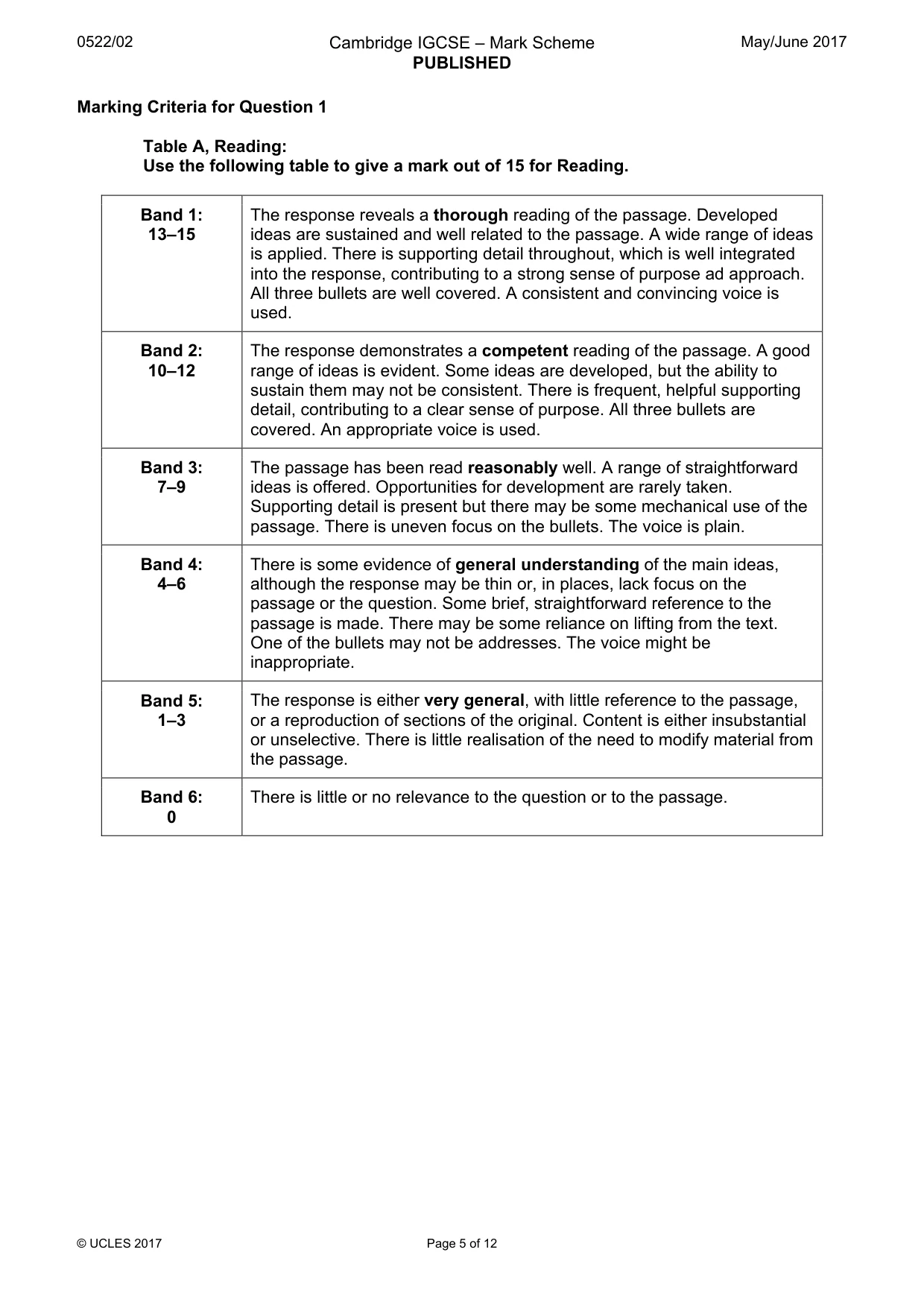
0522/02 Cambridge IGCSE – Mark Scheme PUBLISHED May/June 2017 © UCLES 2017 Page 5 of 12 Marking Criteria for Question 1 Table A, Reading: Use the following table to give a mark out of 15 for Reading. Band 1: 13–15 The response reveals a thorough reading of the passage. Developed ideas are sustained and well related to the passage. A wide range of ideas is applied. There is supporting detail throughout, which is well integrated into the response, contributing to a strong sense of purpose ad approach. All three bullets are well covered. A consistent and convincing voice is used. Band 2: 10–12 The response demonstrates a competent reading of the passage. A good range of ideas is evident. Some ideas are developed, but the ability to sustain them may not be consistent. There is frequent, helpful supporting detail, contributing to a clear sense of purpose. All three bullets are covered. An appropriate voice is used. Band 3: 7–9 The passage has been read reasonably well. A range of straightforward ideas is offered. Opportunities for development are rarely taken. Supporting detail is present but there may be some mechanical use of the passage. There is uneven focus on the bullets. The voice is plain. Band 4: 4–6 There is some evidence of general understanding of the main ideas, although the response may be thin or, in places, lack focus on the passage or the question. Some brief, straightforward reference to the passage is made. There may be some reliance on lifting from the text. One of the bullets may not be addresses. The voice might be inappropriate. Band 5: 1–3 The response is either very general, with little reference to the passage, or a reproduction of sections of the original. Content is either insubstantial or unselective. There is little realisation of the need to modify material from the passage. Band 6: 0 There is little or no relevance to the question or to the passage.
Mark scheme, page 6
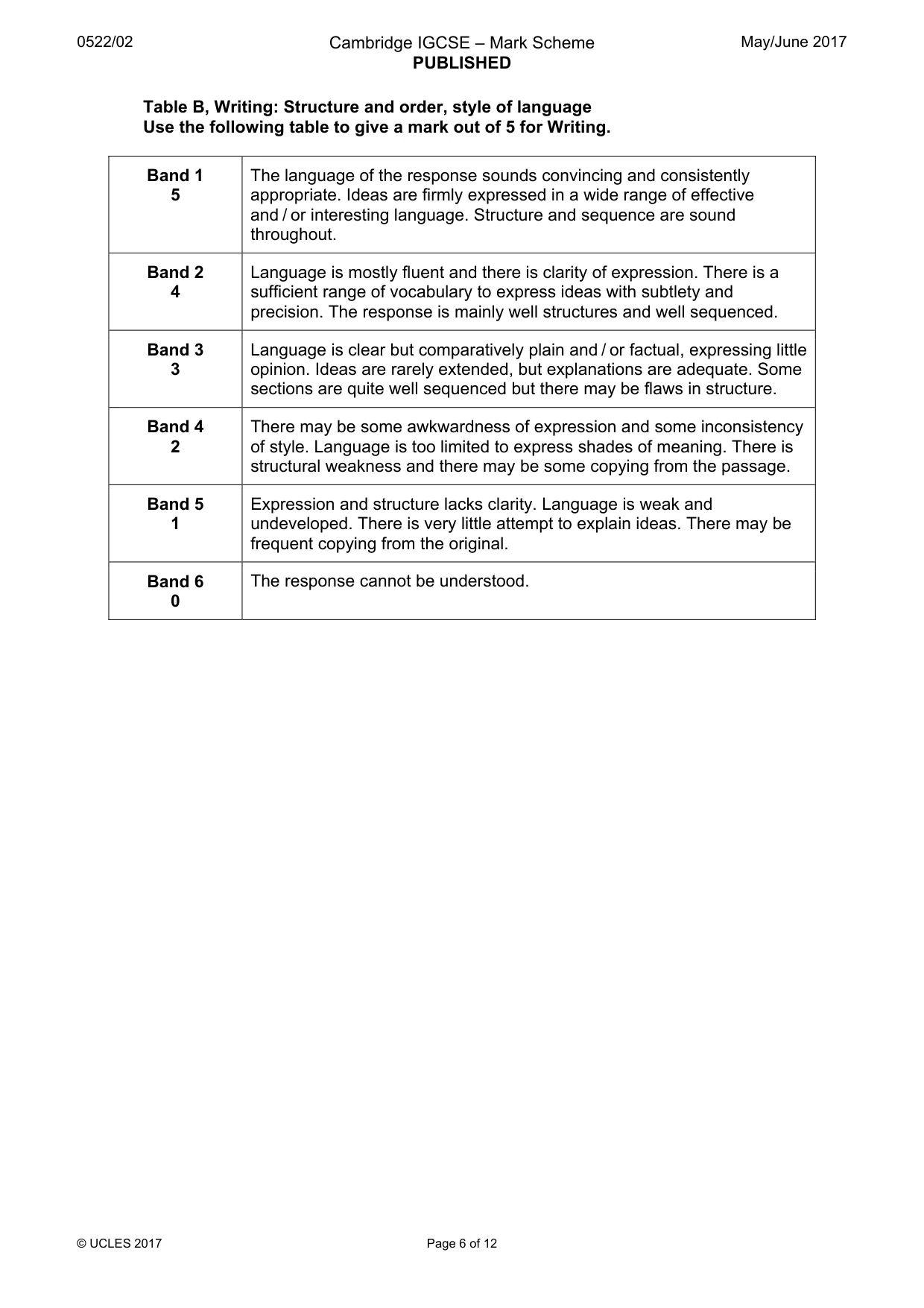
0522/02 Cambridge IGCSE – Mark Scheme PUBLISHED May/June 2017 © UCLES 2017 Page 6 of 12 Table B, Writing: Structure and order, style of language Use the following table to give a mark out of 5 for Writing. Band 1 5 The language of the response sounds convincing and consistently appropriate. Ideas are firmly expressed in a wide range of effective and / or interesting language. Structure and sequence are sound throughout. Band 2 4 Language is mostly fluent and there is clarity of expression. There is a sufficient range of vocabulary to express ideas with subtlety and precision. The response is mainly well structures and well sequenced. Band 3 3 Language is clear but comparatively plain and / or factual, expressing little opinion. Ideas are rarely extended, but explanations are adequate. Some sections are quite well sequenced but there may be flaws in structure. Band 4 2 There may be some awkwardness of expression and some inconsistency of style. Language is too limited to express shades of meaning. There is structural weakness and there may be some copying from the passage. Band 5 1 Expression and structure lacks clarity. Language is weak and undeveloped. There is very little attempt to explain ideas. There may be frequent copying from the original. Band 6 0 The response cannot be understood.
Mark scheme, page 7
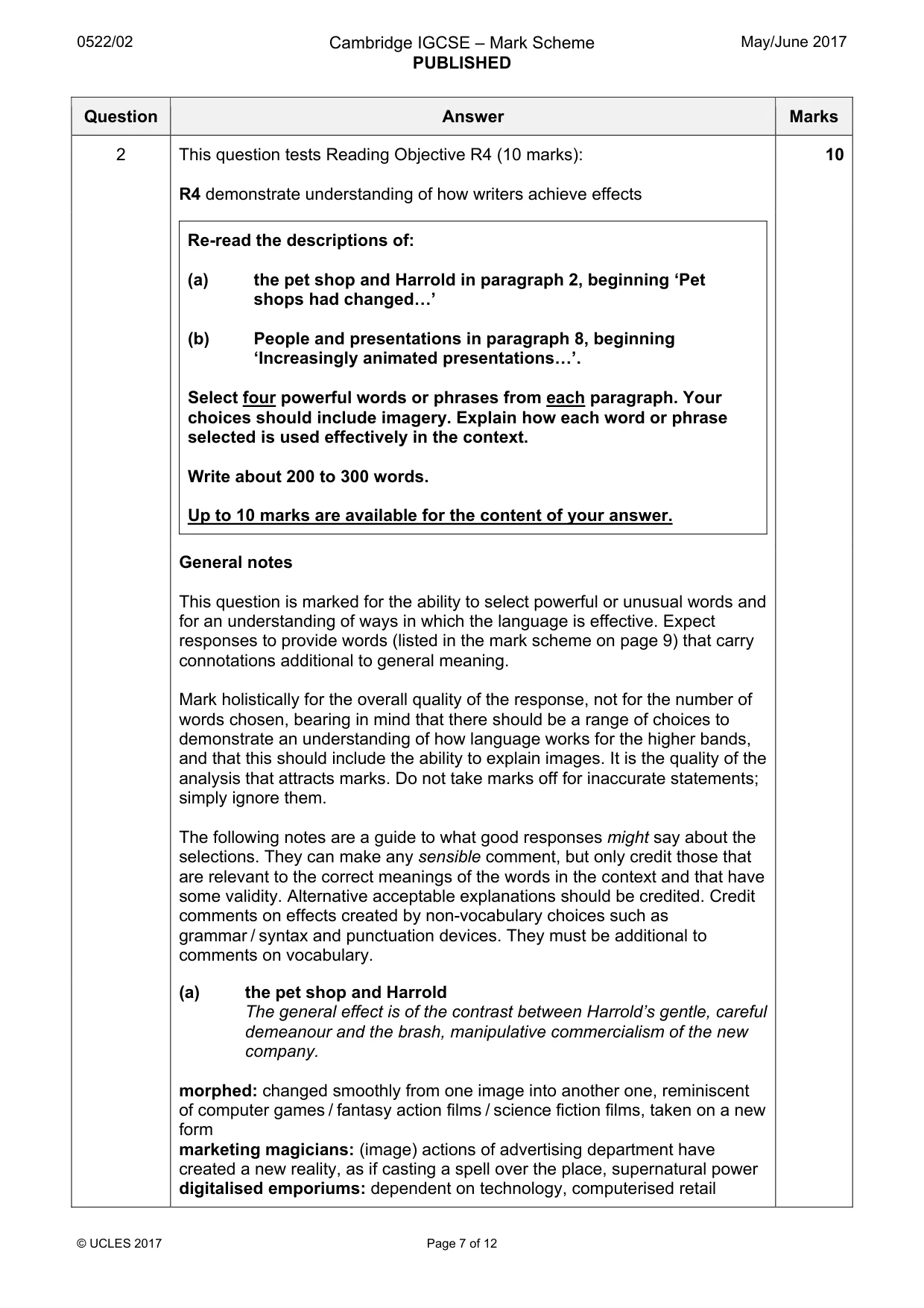
0522/02 Cambridge IGCSE – Mark Scheme PUBLISHED May/June 2017 © UCLES 2017 Page 7 of 12 Question Answer Marks 2 This question tests Reading Objective R4 (10 marks): R4 demonstrate understanding of how writers achieve effects 10 Re-read the descriptions of: (a) the pet shop and Harrold in paragraph 2, beginning ‘Pet shops had changed«’ (b) People and presentations in paragraph 8, beginning ‘Increasingly animated presentations«’. Select four powerful words or phrases from each paragraph. Your choices should include imagery. Explain how each word or phrase selected is used effectively in the context. Write about 200 to 300 words. Up to 10 marks are available for the content of your answer. General notes This question is marked for the ability to select powerful or unusual words and for an understanding of ways in which the language is effective. Expect responses to provide words (listed in the mark scheme on page 9) that carry connotations additional to general meaning. Mark holistically for the overall quality of the response, not for the number of words chosen, bearing in mind that there should be a range of choices to demonstrate an understanding of how language works for the higher bands, and that this should include the ability to explain images. It is the quality of the analysis that attracts marks. Do not take marks off for inaccurate statements; simply ignore them. The following notes are a guide to what good responses might say about the selections. They can make any sensible comment, but only credit those that are relevant to the correct meanings of the words in the context and that have some validity. Alternative acceptable explanations should be credited. Credit comments on effects created by non-vocabulary choices such as grammar / syntax and punctuation devices. They must be additional to comments on vocabulary. (a) the pet shop and Harrold The general effect is of the contrast between Harrold’s gentle, careful demeanour and the brash, manipulative commercialism of the new company. morphed: changed smoothly from one image into another one, reminiscent of computer games / fantasy action films / science fiction films, taken on a new form marketing magicians: (image) actions of advertising department have created a new reality, as if casting a spell over the place, supernatural power digitalised emporiums: dependent on technology, computerised retail
Mark scheme, page 8
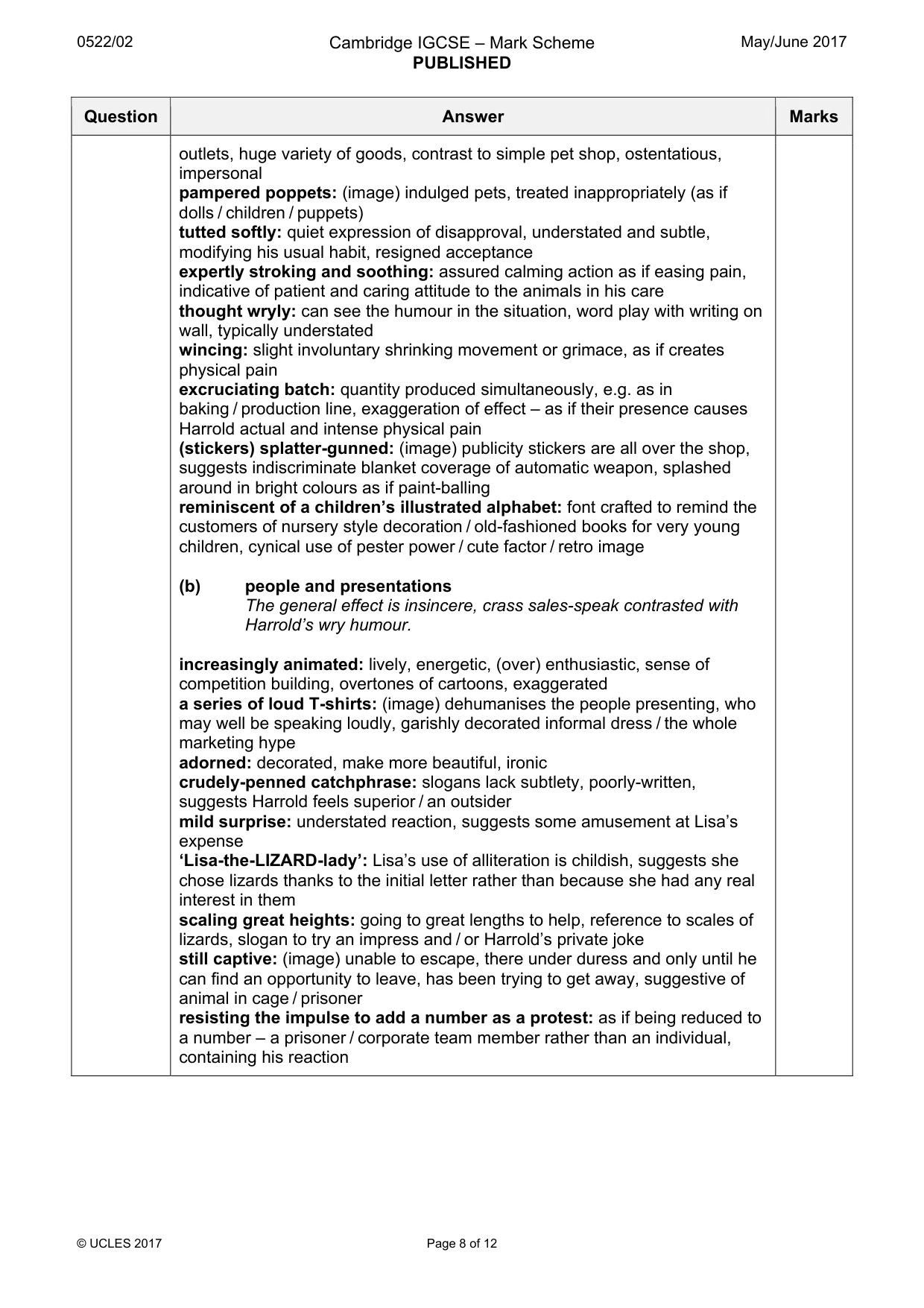
0522/02 Cambridge IGCSE – Mark Scheme PUBLISHED May/June 2017 © UCLES 2017 Page 8 of 12 Question Answer Marks outlets, huge variety of goods, contrast to simple pet shop, ostentatious, impersonal pampered poppets: (image) indulged pets, treated inappropriately (as if dolls / children / puppets) tutted softly: quiet expression of disapproval, understated and subtle, modifying his usual habit, resigned acceptance expertly stroking and soothing: assured calming action as if easing pain, indicative of patient and caring attitude to the animals in his care thought wryly: can see the humour in the situation, word play with writing on wall, typically understated wincing: slight involuntary shrinking movement or grimace, as if creates physical pain excruciating batch: quantity produced simultaneously, e.g. as in baking / production line, exaggeration of effect – as if their presence causes Harrold actual and intense physical pain (stickers) splatter-gunned: (image) publicity stickers are all over the shop, suggests indiscriminate blanket coverage of automatic weapon, splashed around in bright colours as if paint-balling reminiscent of a children’s illustrated alphabet: font crafted to remind the customers of nursery style decoration / old-fashioned books for very young children, cynical use of pester power / cute factor / retro image (b) people and presentations The general effect is insincere, crass sales-speak contrasted with Harrold’s wry humour. increasingly animated: lively, energetic, (over) enthusiastic, sense of competition building, overtones of cartoons, exaggerated a series of loud T-shirts: (image) dehumanises the people presenting, who may well be speaking loudly, garishly decorated informal dress / the whole marketing hype adorned: decorated, make more beautiful, ironic crudely-penned catchphrase: slogans lack subtlety, poorly-written, suggests Harrold feels superior / an outsider mild surprise: understated reaction, suggests some amusement at Lisa’s expense ‘Lisa-the-LIZARD-lady’: Lisa’s use of alliteration is childish, suggests she chose lizards thanks to the initial letter rather than because she had any real interest in them scaling great heights: going to great lengths to help, reference to scales of lizards, slogan to try an impress and / or Harrold’s private joke still captive: (image) unable to escape, there under duress and only until he can find an opportunity to leave, has been trying to get away, suggestive of animal in cage / prisoner resisting the impulse to add a number as a protest: as if being reduced to a number – a prisoner / corporate team member rather than an individual, containing his reaction
Mark scheme, page 9
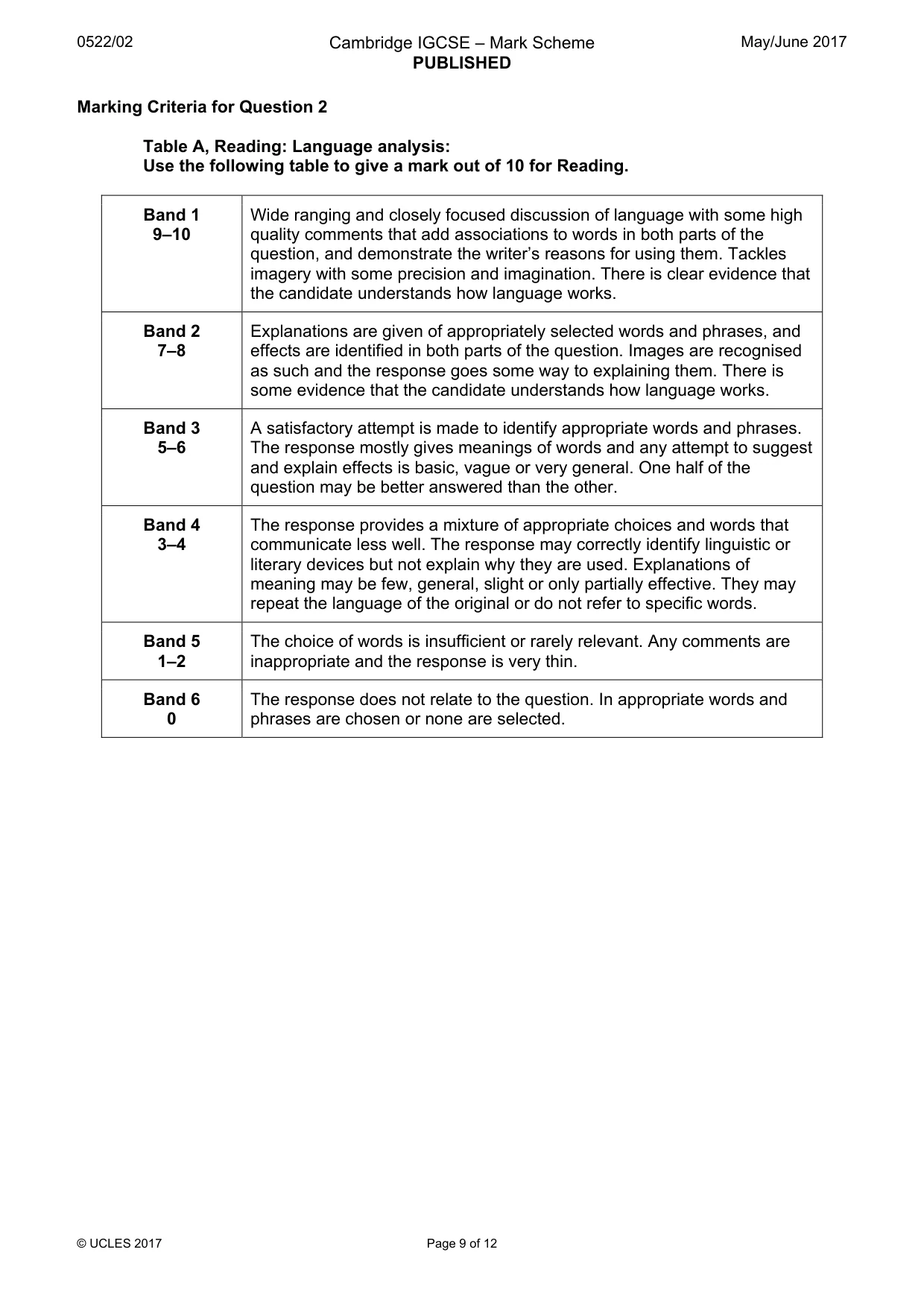
0522/02 Cambridge IGCSE – Mark Scheme PUBLISHED May/June 2017 © UCLES 2017 Page 9 of 12 Marking Criteria for Question 2 Table A, Reading: Language analysis: Use the following table to give a mark out of 10 for Reading. Band 1 9–10 Wide ranging and closely focused discussion of language with some high quality comments that add associations to words in both parts of the question, and demonstrate the writer’s reasons for using them. Tackles imagery with some precision and imagination. There is clear evidence that the candidate understands how language works. Band 2 7–8 Explanations are given of appropriately selected words and phrases, and effects are identified in both parts of the question. Images are recognised as such and the response goes some way to explaining them. There is some evidence that the candidate understands how language works. Band 3 5–6 A satisfactory attempt is made to identify appropriate words and phrases. The response mostly gives meanings of words and any attempt to suggest and explain effects is basic, vague or very general. One half of the question may be better answered than the other. Band 4 3–4 The response provides a mixture of appropriate choices and words that communicate less well. The response may correctly identify linguistic or literary devices but not explain why they are used. Explanations of meaning may be few, general, slight or only partially effective. They may repeat the language of the original or do not refer to specific words. Band 5 1–2 The choice of words is insufficient or rarely relevant. Any comments are inappropriate and the response is very thin. Band 6 0 The response does not relate to the question. In appropriate words and phrases are chosen or none are selected.
Mark scheme, page 10
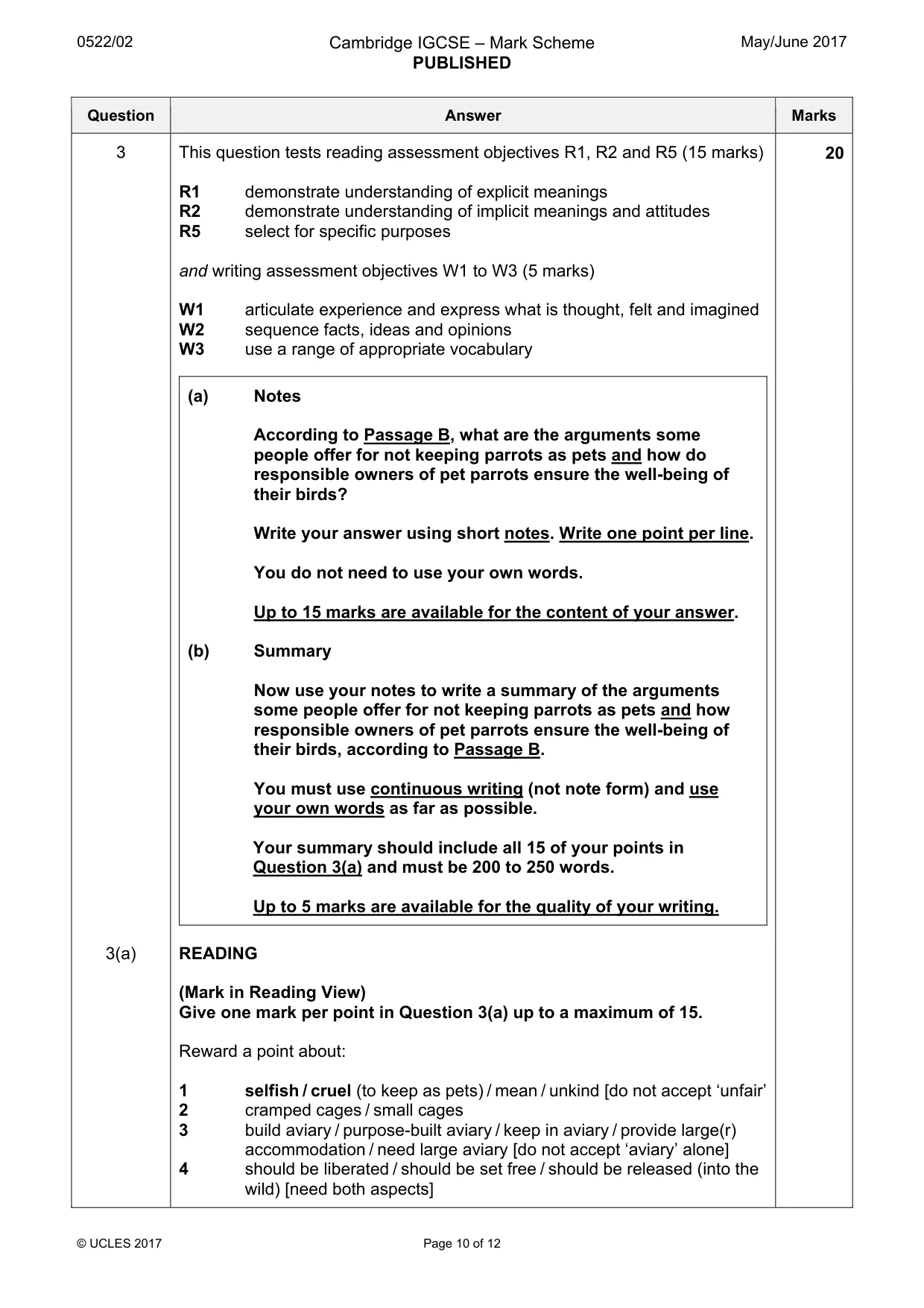
0522/02 Cambridge IGCSE – Mark Scheme PUBLISHED May/June 2017 © UCLES 2017 Page 10 of 12 Question Answer Marks 3 This question tests reading assessment objectives R1, R2 and R5 (15 marks) R1 demonstrate understanding of explicit meanings R2 demonstrate understanding of implicit meanings and attitudes R5 select for specific purposes and writing assessment objectives W1 to W3 (5 marks) W1 articulate experience and express what is thought, felt and imagined W2 sequence facts, ideas and opinions W3 use a range of appropriate vocabulary 20 (a) Notes According to Passage B, what are the arguments some people offer for not keeping parrots as pets and how do responsible owners of pet parrots ensure the well-being of their birds? Write your answer using short notes. Write one point per line. You do not need to use your own words. Up to 15 marks are available for the content of your answer. (b) Summary Now use your notes to write a summary of the arguments some people offer for not keeping parrots as pets and how responsible owners of pet parrots ensure the well-being of their birds, according to Passage B. You must use continuous writing (not note form) and use your own words as far as possible. Your summary should include all 15 of your points in Question 3(a) and must be 200 to 250 words. Up to 5 marks are available for the quality of your writing. 3(a) READING (Mark in Reading View) Give one mark per point in Question 3(a) up to a maximum of 15. Reward a point about: 1 selfish / cruel (to keep as pets) / mean / unkind [do not accept ‘unfair’ 2 cramped cages / small cages 3 build aviary / purpose-built aviary / keep in aviary / provide large(r) accommodation / need large aviary [do not accept ‘aviary’ alone] 4 should be liberated / should be set free / should be released (into the wild) [need both aspects]
Mark scheme, page 11
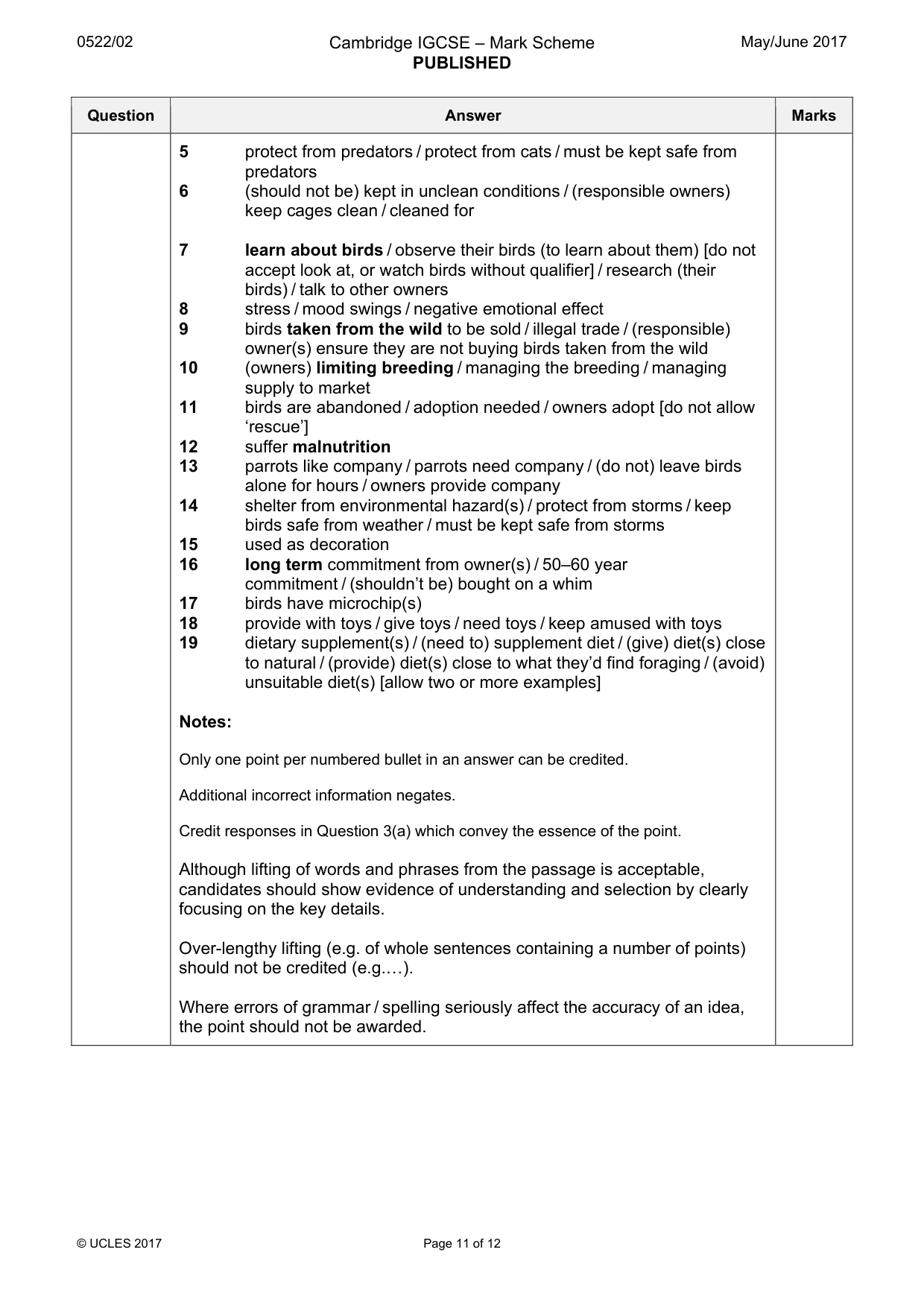
0522/02 Cambridge IGCSE – Mark Scheme PUBLISHED May/June 2017 © UCLES 2017 Page 11 of 12 Question Answer Marks 5 protect from predators / protect from cats / must be kept safe from predators 6 (should not be) kept in unclean conditions / (responsible owners) keep cages clean / cleaned for 7 learn about birds / observe their birds (to learn about them) [do not accept look at, or watch birds without qualifier] / research (their birds) / talk to other owners 8 stress / mood swings / negative emotional effect 9 birds taken from the wild to be sold / illegal trade / (responsible) owner(s) ensure they are not buying birds taken from the wild 10 (owners) limiting breeding / managing the breeding / managing supply to market 11 birds are abandoned / adoption needed / owners adopt [do not allow ‘rescue’] 12 suffer malnutrition 13 parrots like company / parrots need company / (do not) leave birds alone for hours / owners provide company 14 shelter from environmental hazard(s) / protect from storms / keep birds safe from weather / must be kept safe from storms 15 used as decoration 16 long term commitment from owner(s) / 50–60 year commitment / (shouldn’t be) bought on a whim 17 birds have microchip(s) 18 provide with toys / give toys / need toys / keep amused with toys 19 dietary supplement(s) / (need to) supplement diet / (give) diet(s) close to natural / (provide) diet(s) close to what they’d find foraging / (avoid) unsuitable diet(s) [allow two or more examples] Notes: Only one point per numbered bullet in an answer can be credited. Additional incorrect information negates. Credit responses in Question 3(a) which convey the essence of the point. Although lifting of words and phrases from the passage is acceptable, candidates should show evidence of understanding and selection by clearly focusing on the key details. Over-lengthy lifting (e.g. of whole sentences containing a number of points) should not be credited (e.g.«). Where errors of grammar / spelling seriously affect the accuracy of an idea, the point should not be awarded.
Mark scheme, page 12
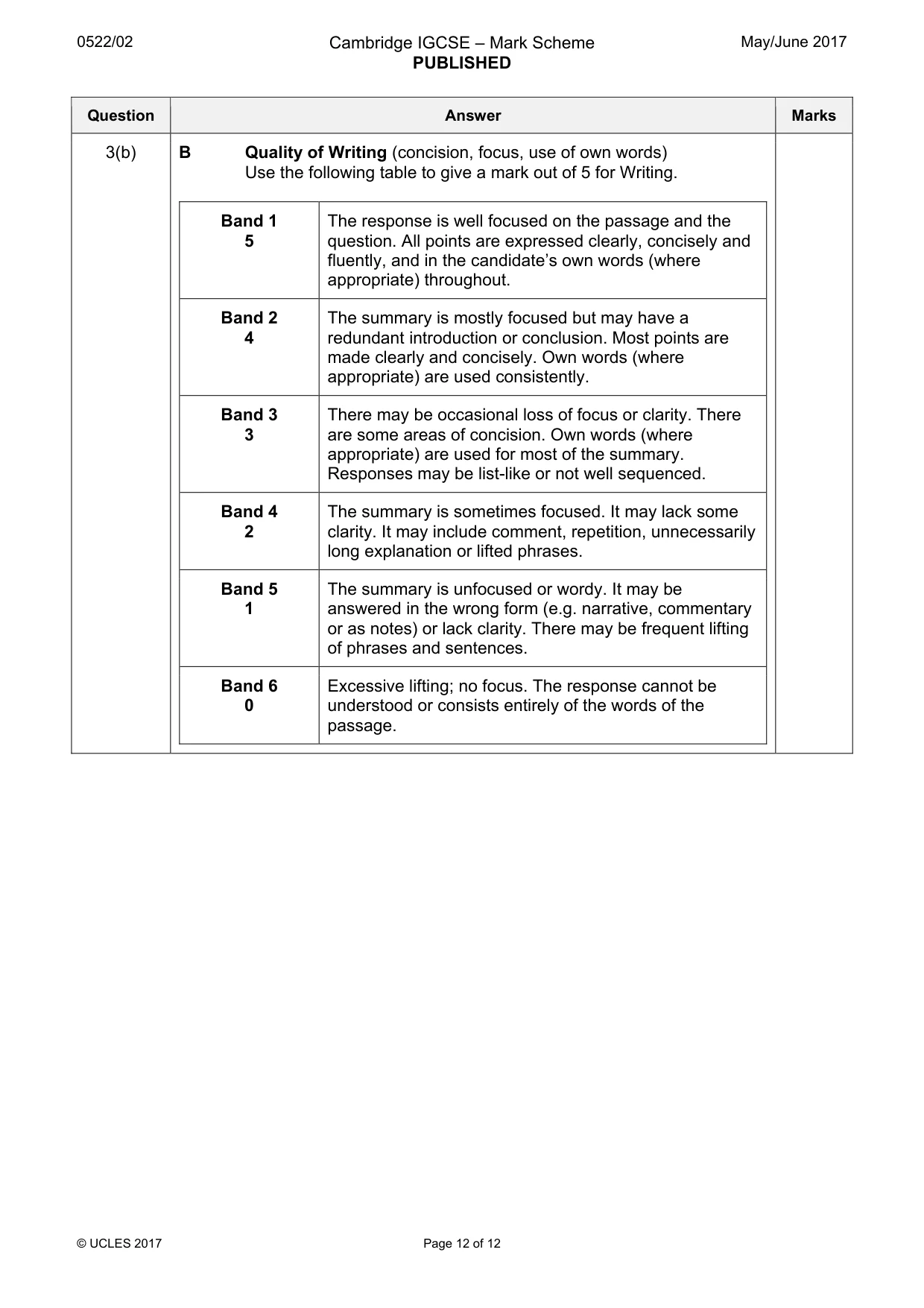
0522/02 Cambridge IGCSE – Mark Scheme PUBLISHED May/June 2017 © UCLES 2017 Page 12 of 12 Question Answer Marks 3(b) B Quality of Writing (concision, focus, use of own words) Use the following table to give a mark out of 5 for Writing. Band 1 5 The response is well focused on the passage and the question. All points are expressed clearly, concisely and fluently, and in the candidate’s own words (where appropriate) throughout. Band 2 4 The summary is mostly focused but may have a redundant introduction or conclusion. Most points are made clearly and concisely. Own words (where appropriate) are used consistently. Band 3 3 There may be occasional loss of focus or clarity. There are some areas of concision. Own words (where appropriate) are used for most of the summary. Responses may be list-like or not well sequenced. Band 4 2 The summary is sometimes focused. It may lack some clarity. It may include comment, repetition, unnecessarily long explanation or lifted phrases. Band 5 1 The summary is unfocused or wordy. It may be answered in the wrong form (e.g. narrative, commentary or as notes) or lack clarity. There may be frequent lifting of phrases and sentences. Band 6 0 Excessive lifting; no focus. The response cannot be understood or consists entirely of the words of the passage.
What you needed in this session
Cambridge’s own grade thresholds for 2017 May/June, Paper 2 · Variant 1. A higher threshold means an easier paper — the bar moves with how the cohort did.