Cambridge IGCSE English - First Language 0500 — 2019 May/June Paper 2 · Variant 2
0500/22/M/J/19 · 50 marks · ≈56 min
The question paper and its mark scheme, free to read here and free to download. This is Cambridge’s own paper, exactly as it was sat.
Question paper12 pages
Mark scheme15 pages
Answers below. Sit the paper first if you are practising.
Paper as text
Question paper, page 1
Cambridge Assessment International Education Cambridge International General Certificate of Secondary Education * 2 5 2 4 8 7 1 4 8 9 * This document consists of 11 printed pages, 1 blank page and 1 Reading Booklet Insert. DC (NF) 163852/3 © UCLES 2019 [Turn over FIRST LANGUAGE ENGLISH 0500/22 Paper 2 Reading Passages (Extended) May/June 2019 2 hours Candidates answer on the Question Paper. Additional Materials: Reading Booklet Insert READ THESE INSTRUCTIONS FIRST Write your centre number, candidate number and name in the spaces provided. Write in dark blue or black pen. Do not use staples, paper clips, glue or correction fluid. DO NOT WRITE IN ANY BARCODES. Answer all questions in the space provided. If additional space is required, you should use the lined pages at the end of the booklet. The question number(s) must be clearly shown. Dictionaries are not permitted. The Reading Booklet Insert contains the reading passages for use with all questions on this Question Paper. The Reading Booklet Insert is not assessed by the Examiner. The number of marks is given in brackets [ ] at the end of each question or part question.
Question paper, page 2
2 0500/22/M/J/19 © UCLES 2019 Read carefully Passage A, The last zookeeper, in the Reading Booklet Insert and then answer Questions 1 and 2 on this Question Paper. Question 1 Imagine you are the zookeeper. Later that day you write in your journal reflecting on your feelings about life now and how things have changed. Write your journal. In your journal, you should: • describe what you have to do each day, why you do it and how that makes you feel • explain what you have noticed about the boy and his father and your feelings about each of them • consider how things have changed for you and the world around you since you first started working at the zoo and suggest what you think the future may hold for you. Base your journal on what you have read in Passage A, but be careful to use your own words. Address each of the three bullet points. Begin your journal, ‘Today was …’ Write about 250 to 350 words. Up to 15 marks are available for the content of your answer, and up to 5 marks for the quality of your writing. … … … … … … … … … … … … … … …
Question paper, page 3
3 0500/22/M/J/19 © UCLES 2019 [Turn over … … … … … … … … … … … … … … … … … … … … … … … … … … … …
Question paper, page 4
4 0500/22/M/J/19 © UCLES 2019 … … … … … … … … … … … … … … … … … … … … … … … … … … … [Total: 20]
Question paper, page 5
5 0500/22/M/J/19 © UCLES 2019 [Turn over [Turn to page 6 for Question 2]
Question paper, page 6
6 0500/22/M/J/19 © UCLES 2019 Question 2 Re-read the descriptions of: (a) the zookeeper in paragraph 1, beginning ‘The boy stared …’ (b) the animal in paragraph 14, beginning ‘The ancient …’ Select four powerful words or phrases from each paragraph. Your choices should include imagery. Explain how each word or phrase is used effectively in the context. Write about 200 to 300 words. Up to 10 marks are available for the content of your answer. … … … … … … … … … … … … … … … … … … … … …
Question paper, page 7
7 0500/22/M/J/19 © UCLES 2019 [Turn over … … … … … … … … … … … … … … … … … … … … … … … … … … … [Total: 10]
Question paper, page 8
8 0500/22/M/J/19 © UCLES 2019 Read carefully Passage B, We bought a zoo!, in the Reading Booklet Insert and then answer Question 3 on this Question Paper. Question 3 What were the challenges for Benjamin Mee in buying, saving and running the zoo, according to Passage B? You must use continuous writing (not note form) and use your own words as far as possible. Your summary should not be more than 250 words. Up to 15 marks are available for the content of your answer, and up to 5 marks for the quality of your writing. … … … … … … … … … … … … … … … … … … … … …
Question paper, page 9
9 0500/22/M/J/19 © UCLES 2019 … … … … … … … … … … … … … [Total: 20]
Question paper, page 10
10 0500/22/M/J/19 © UCLES 2019 Additional Page If you use the following lined page to complete the answer(s) to any question(s), the question number(s) must be clearly shown. … … … … … … … … … … … … … … … … … … … … … … … … … …
Question paper, page 11
11 0500/22/M/J/19 © UCLES 2019 Additional Page If you use the following lined page to complete the answer(s) to any question(s), the question number(s) must be clearly shown. … … … … … … … … … … … … … … … … … … … … … … … … … …
Question paper, page 12
12 0500/22/M/J/19 © UCLES 2019 Permission to reproduce items where third-party owned material protected by copyright is included has been sought and cleared where possible. Every reasonable effort has been made by the publisher (UCLES) to trace copyright holders, but if any items requiring clearance have unwittingly been included, the publisher will be pleased to make amends at the earliest possible opportunity. To avoid the issue of disclosure of answer-related information to candidates, all copyright acknowledgements are reproduced online in the Cambridge Assessment International Education Copyright Acknowledgements Booklet. This is produced for each series of examinations and is freely available to download at www.cambridgeinternational.org after the live examination series. Cambridge Assessment International Education is part of the Cambridge Assessment Group. Cambridge Assessment is the brand name of the University of Cambridge Local Examinations Syndicate (UCLES), which itself is a department of the University of Cambridge. BLANK PAGE
Mark scheme, page 1
This document consists of 15 printed pages. © UCLES 2019 [Turn over Cambridge Assessment International Education Cambridge International General Certificate of Secondary Education FIRST LANGUAGE ENGLISH 0500/22 Paper 2 Reading Passages (Extended) May/June 2019 MARK SCHEME Maximum Mark: 50 Published This mark scheme is published as an aid to teachers and candidates, to indicate the requirements of the examination. It shows the basis on which Examiners were instructed to award marks. It does not indicate the details of the discussions that took place at an Examiners’ meeting before marking began, which would have considered the acceptability of alternative answers. Mark schemes should be read in conjunction with the question paper and the Principal Examiner Report for Teachers. Cambridge International will not enter into discussions about these mark schemes. Cambridge International is publishing the mark schemes for the May/June 2019 series for most Cambridge IGCSE™, Cambridge International A and AS Level and Cambridge Pre-U components, and some Cambridge O Level components.
Mark scheme, page 2
0500/22 Cambridge IGCSE – Mark Scheme PUBLISHED May/June 2019 © UCLES 2019 Page 2 of 15 Generic Marking Principles These general marking principles must be applied by all examiners when marking candidate answers. They should be applied alongside the specific content of the mark scheme or generic level descriptors for a question. Each question paper and mark scheme will also comply with these marking principles. GENERIC MARKING PRINCIPLE 1: Marks must be awarded in line with: • the specific content of the mark scheme or the generic level descriptors for the question • the specific skills defined in the mark scheme or in the generic level descriptors for the question • the standard of response required by a candidate as exemplified by the standardisation scripts. GENERIC MARKING PRINCIPLE 2: Marks awarded are always whole marks (not half marks, or other fractions). GENERIC MARKING PRINCIPLE 3: Marks must be awarded positively: • marks are awarded for correct/valid answers, as defined in the mark scheme. However, credit is given for valid answers which go beyond the scope of the syllabus and mark scheme, referring to your Team Leader as appropriate • marks are awarded when candidates clearly demonstrate what they know and can do • marks are not deducted for errors • marks are not deducted for omissions • answers should only be judged on the quality of spelling, punctuation and grammar when these features are specifically assessed by the question as indicated by the mark scheme. The meaning, however, should be unambiguous. GENERIC MARKING PRINCIPLE 4: Rules must be applied consistently e.g. in situations where candidates have not followed instructions or in the application of generic level descriptors. GENERIC MARKING PRINCIPLE 5: Marks should be awarded using the full range of marks defined in the mark scheme for the question (however; the use of the full mark range may be limited according to the quality of the candidate responses seen). GENERIC MARKING PRINCIPLE 6: Marks awarded are based solely on the requirements as defined in the mark scheme. Marks should not be awarded with grade thresholds or grade descriptors in mind.
Mark scheme, page 3
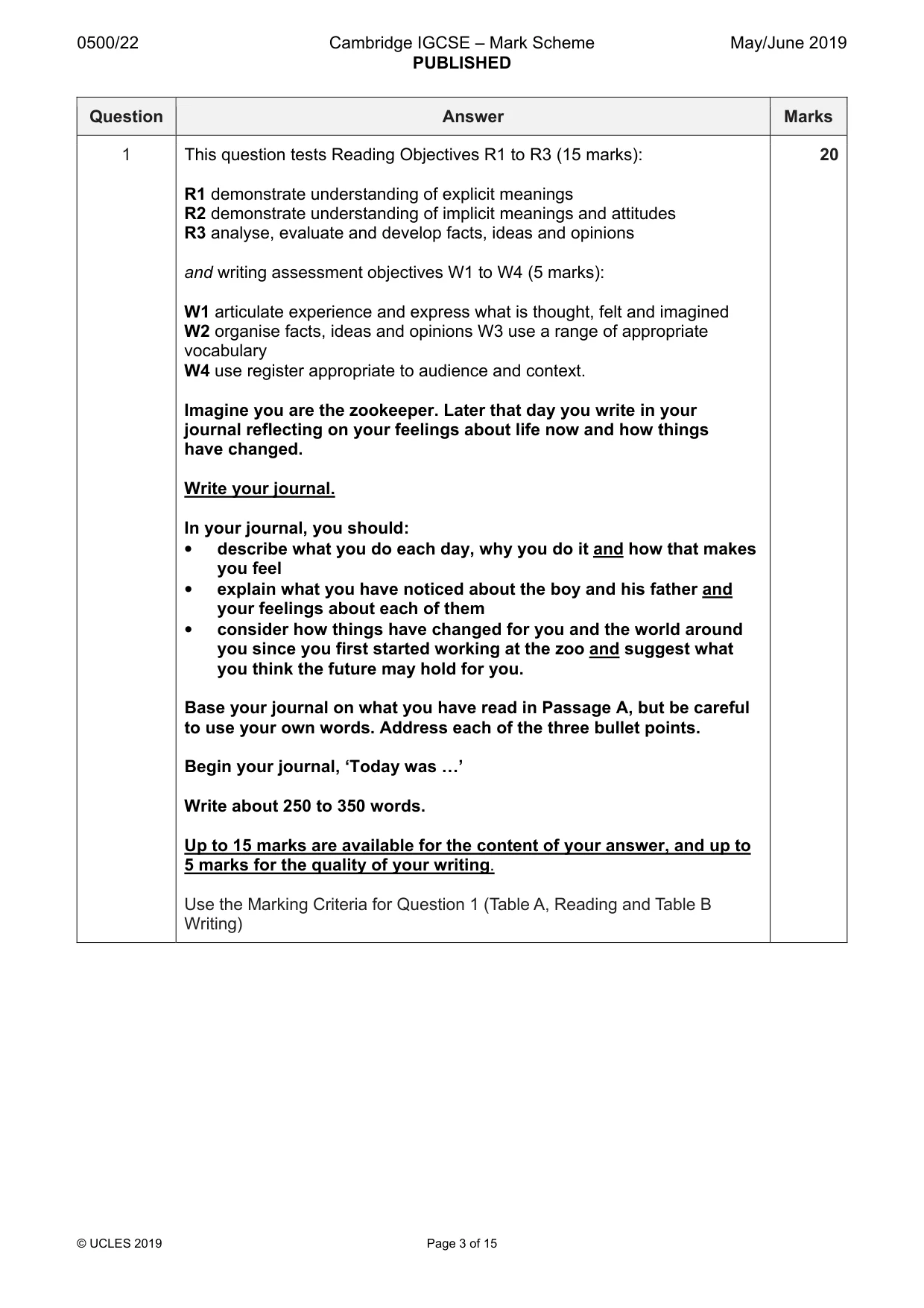
0500/22 Cambridge IGCSE – Mark Scheme PUBLISHED May/June 2019 © UCLES 2019 Page 3 of 15 Question Answer Marks 1 This question tests Reading Objectives R1 to R3 (15 marks): R1 demonstrate understanding of explicit meanings R2 demonstrate understanding of implicit meanings and attitudes R3 analyse, evaluate and develop facts, ideas and opinions and writing assessment objectives W1 to W4 (5 marks): W1 articulate experience and express what is thought, felt and imagined W2 organise facts, ideas and opinions W3 use a range of appropriate vocabulary W4 use register appropriate to audience and context. Imagine you are the zookeeper. Later that day you write in your journal reflecting on your feelings about life now and how things have changed. Write your journal. In your journal, you should: • describe what you do each day, why you do it and how that makes you feel • explain what you have noticed about the boy and his father and your feelings about each of them • consider how things have changed for you and the world around you since you first started working at the zoo and suggest what you think the future may hold for you. Base your journal on what you have read in Passage A, but be careful to use your own words. Address each of the three bullet points. Begin your journal, ‘Today was «’ Write about 250 to 350 words. Up to 15 marks are available for the content of your answer, and up to 5 marks for the quality of your writing. Use the Marking Criteria for Question 1 (Table A, Reading and Table B Writing) 20
Mark scheme, page 4
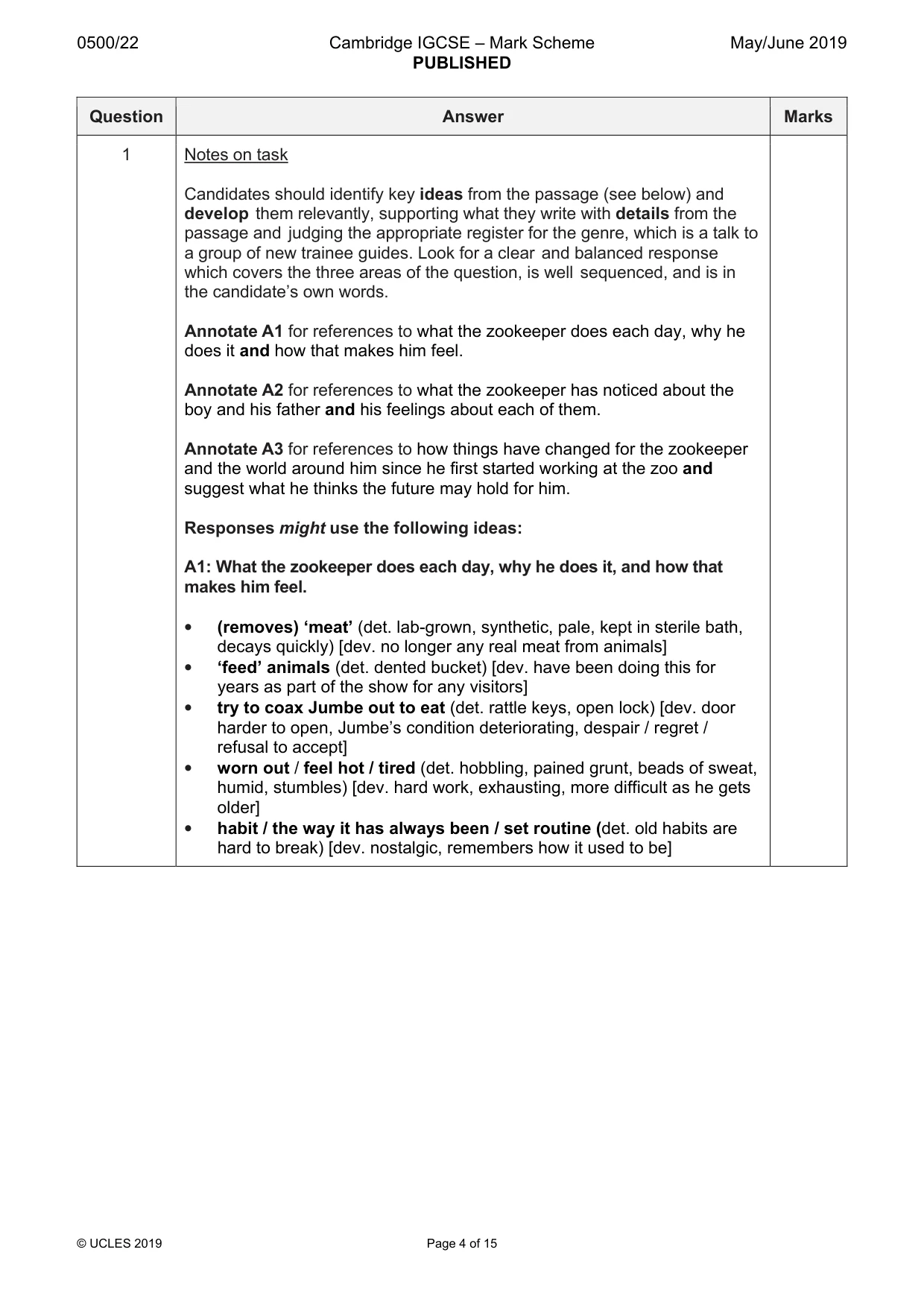
0500/22 Cambridge IGCSE – Mark Scheme PUBLISHED May/June 2019 © UCLES 2019 Page 4 of 15 Question Answer Marks 1 Notes on task Candidates should identify key ideas from the passage (see below) and develop them relevantly, supporting what they write with details from the passage and judging the appropriate register for the genre, which is a talk to a group of new trainee guides. Look for a clear and balanced response which covers the three areas of the question, is well sequenced, and is in the candidate’s own words. Annotate A1 for references to what the zookeeper does each day, why he does it and how that makes him feel. Annotate A2 for references to what the zookeeper has noticed about the boy and his father and his feelings about each of them. Annotate A3 for references to how things have changed for the zookeeper and the world around him since he first started working at the zoo and suggest what he thinks the future may hold for him. Responses might use the following ideas: A1: What the zookeeper does each day, why he does it, and how that makes him feel. • (removes) ‘meat’ (det. lab-grown, synthetic, pale, kept in sterile bath, decays quickly) [dev. no longer any real meat from animals] • ‘feed’ animals (det. dented bucket) [dev. have been doing this for years as part of the show for any visitors] • try to coax Jumbe out to eat (det. rattle keys, open lock) [dev. door harder to open, Jumbe’s condition deteriorating, despair / regret / refusal to accept] • worn out / feel hot / tired (det. hobbling, pained grunt, beads of sweat, humid, stumbles) [dev. hard work, exhausting, more difficult as he gets older] • habit / the way it has always been / set routine (det. old habits are hard to break) [dev. nostalgic, remembers how it used to be]
Mark scheme, page 5
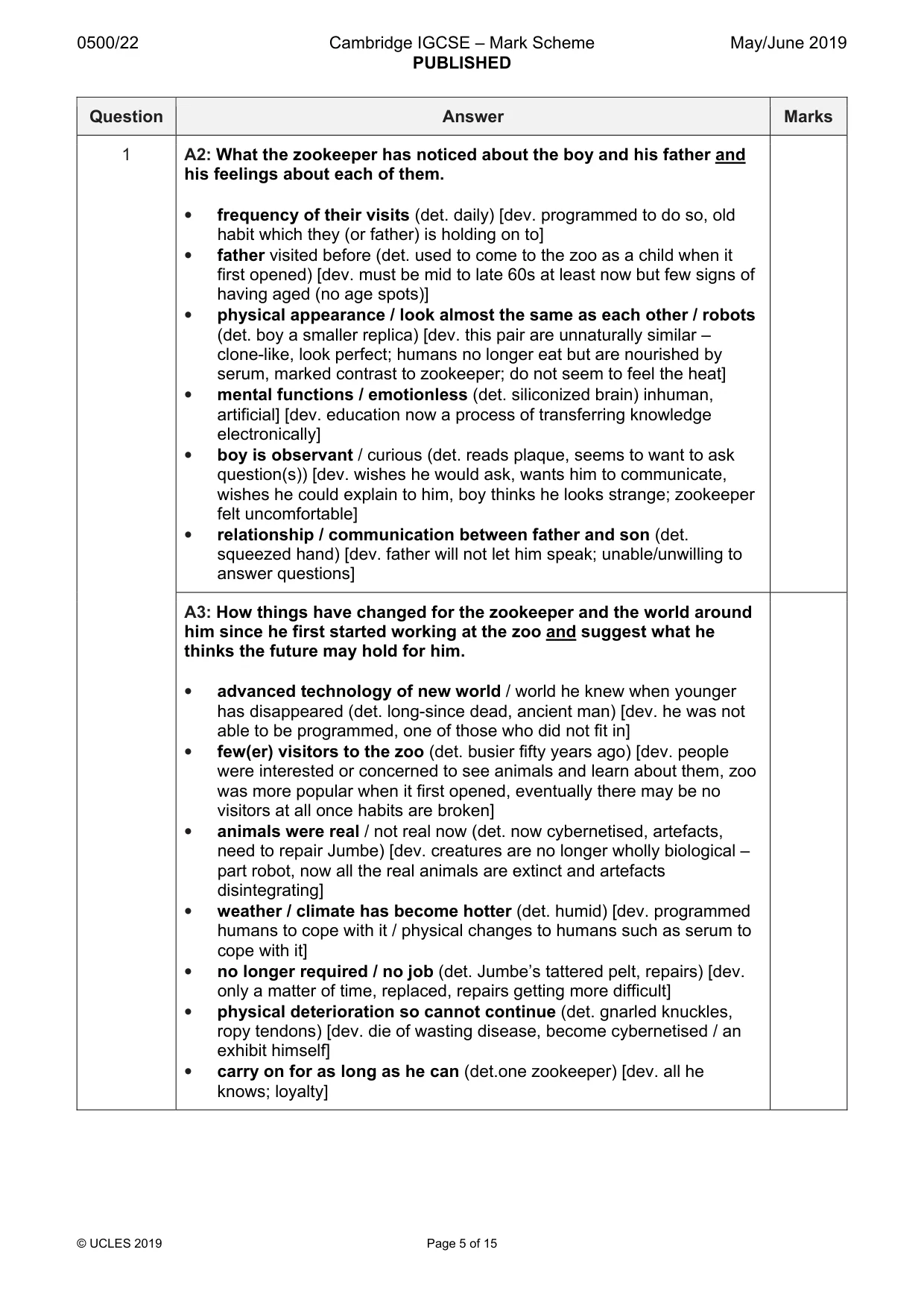
0500/22 Cambridge IGCSE – Mark Scheme PUBLISHED May/June 2019 © UCLES 2019 Page 5 of 15 Question Answer Marks 1 A2: What the zookeeper has noticed about the boy and his father and his feelings about each of them. • frequency of their visits (det. daily) [dev. programmed to do so, old habit which they (or father) is holding on to] • father visited before (det. used to come to the zoo as a child when it first opened) [dev. must be mid to late 60s at least now but few signs of having aged (no age spots)] • physical appearance / look almost the same as each other / robots (det. boy a smaller replica) [dev. this pair are unnaturally similar – clone-like, look perfect; humans no longer eat but are nourished by serum, marked contrast to zookeeper; do not seem to feel the heat] • mental functions / emotionless (det. siliconized brain) inhuman, artificial] [dev. education now a process of transferring knowledge electronically] • boy is observant / curious (det. reads plaque, seems to want to ask question(s)) [dev. wishes he would ask, wants him to communicate, wishes he could explain to him, boy thinks he looks strange; zookeeper felt uncomfortable] • relationship / communication between father and son (det. squeezed hand) [dev. father will not let him speak; unable/unwilling to answer questions] A3: How things have changed for the zookeeper and the world around him since he first started working at the zoo and suggest what he thinks the future may hold for him. • advanced technology of new world / world he knew when younger has disappeared (det. long-since dead, ancient man) [dev. he was not able to be programmed, one of those who did not fit in] • few(er) visitors to the zoo (det. busier fifty years ago) [dev. people were interested or concerned to see animals and learn about them, zoo was more popular when it first opened, eventually there may be no visitors at all once habits are broken] • animals were real / not real now (det. now cybernetised, artefacts, need to repair Jumbe) [dev. creatures are no longer wholly biological – part robot, now all the real animals are extinct and artefacts disintegrating] • weather / climate has become hotter (det. humid) [dev. programmed humans to cope with it / physical changes to humans such as serum to cope with it] • no longer required / no job (det. Jumbe’s tattered pelt, repairs) [dev. only a matter of time, replaced, repairs getting more difficult] • physical deterioration so cannot continue (det. gnarled knuckles, ropy tendons) [dev. die of wasting disease, become cybernetised / an exhibit himself] • carry on for as long as he can (det.one zookeeper) [dev. all he knows; loyalty]
Mark scheme, page 6
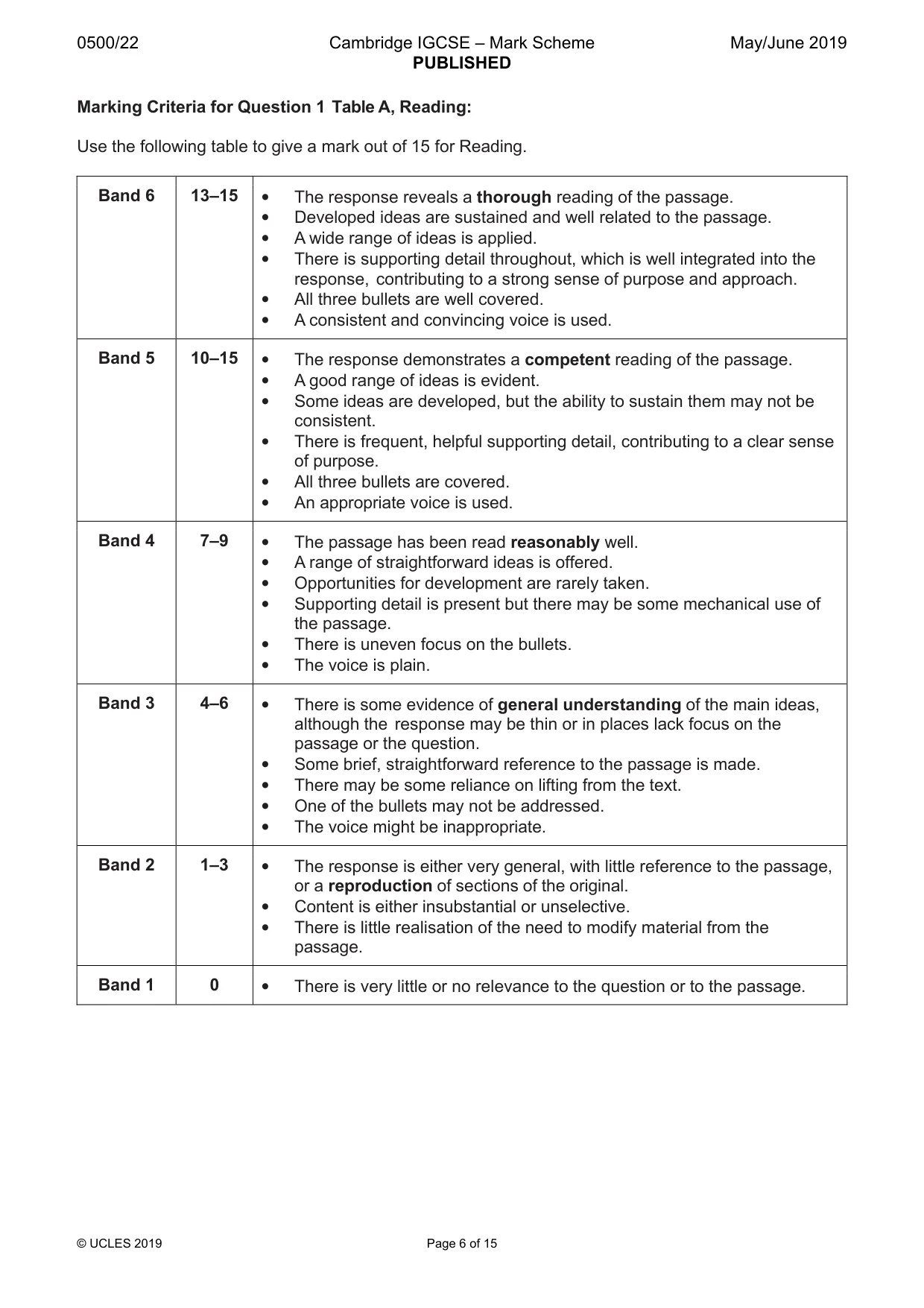
0500/22 Cambridge IGCSE – Mark Scheme PUBLISHED May/June 2019 © UCLES 2019 Page 6 of 15 Marking Criteria for Question 1 Table A, Reading: Use the following table to give a mark out of 15 for Reading. Band 6 13–15 • The response reveals a thorough reading of the passage. • Developed ideas are sustained and well related to the passage. • A wide range of ideas is applied. • There is supporting detail throughout, which is well integrated into the response, contributing to a strong sense of purpose and approach. • All three bullets are well covered. • A consistent and convincing voice is used. Band 5 10–15 • The response demonstrates a competent reading of the passage. • A good range of ideas is evident. • Some ideas are developed, but the ability to sustain them may not be consistent. • There is frequent, helpful supporting detail, contributing to a clear sense of purpose. • All three bullets are covered. • An appropriate voice is used. Band 4 7–9 • The passage has been read reasonably well. • A range of straightforward ideas is offered. • Opportunities for development are rarely taken. • Supporting detail is present but there may be some mechanical use of the passage. • There is uneven focus on the bullets. • The voice is plain. Band 3 4–6 • There is some evidence of general understanding of the main ideas, although the response may be thin or in places lack focus on the passage or the question. • Some brief, straightforward reference to the passage is made. • There may be some reliance on lifting from the text. • One of the bullets may not be addressed. • The voice might be inappropriate. Band 2 1–3 • The response is either very general, with little reference to the passage, or a reproduction of sections of the original. • Content is either insubstantial or unselective. • There is little realisation of the need to modify material from the passage. Band 1 0 • There is very little or no relevance to the question or to the passage.
Mark scheme, page 7
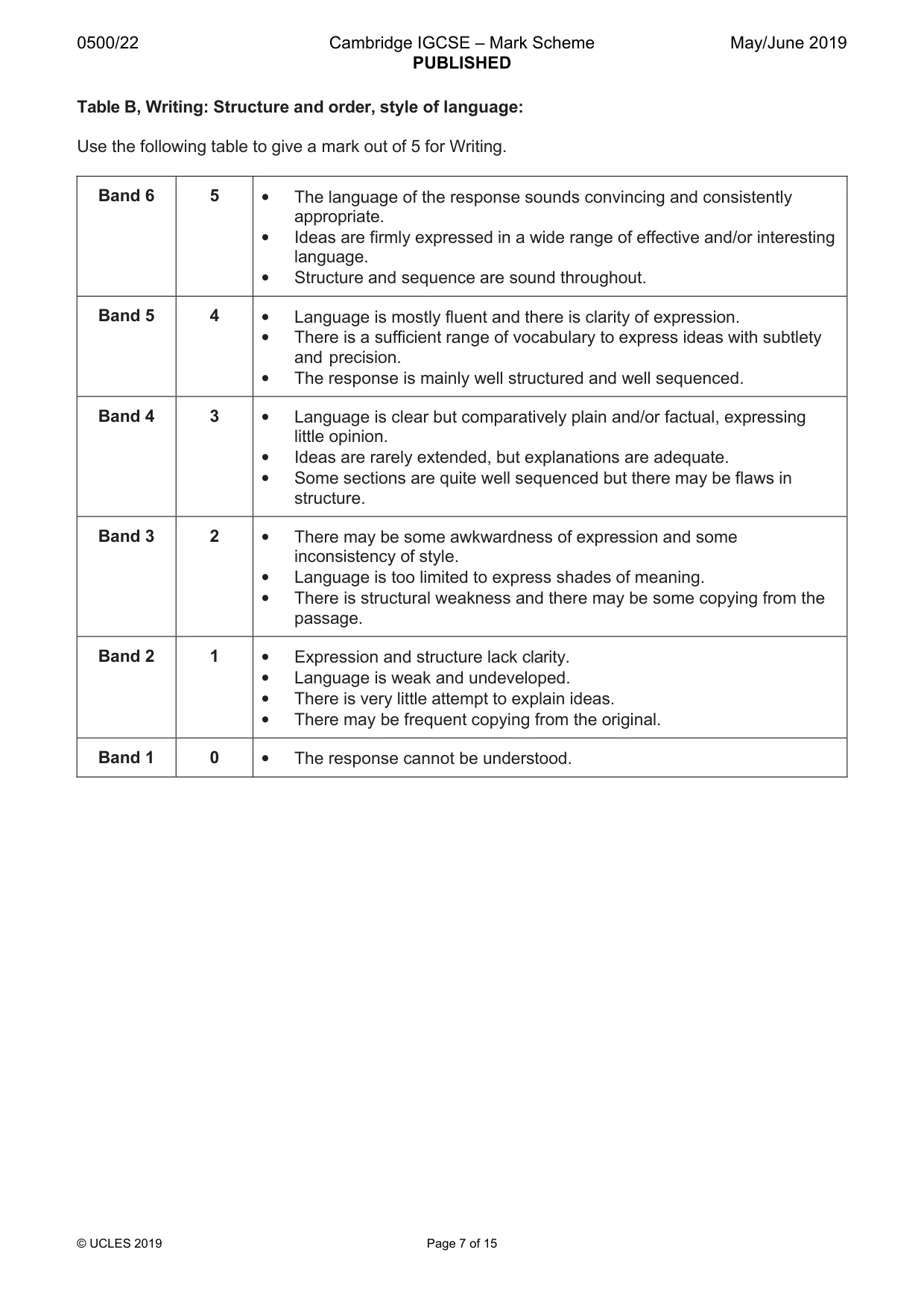
0500/22 Cambridge IGCSE – Mark Scheme PUBLISHED May/June 2019 © UCLES 2019 Page 7 of 15 Table B, Writing: Structure and order, style of language: Use the following table to give a mark out of 5 for Writing. Band 6 5 • The language of the response sounds convincing and consistently appropriate. • Ideas are firmly expressed in a wide range of effective and/or interesting language. • Structure and sequence are sound throughout. Band 5 4 • Language is mostly fluent and there is clarity of expression. • There is a sufficient range of vocabulary to express ideas with subtlety and precision. • The response is mainly well structured and well sequenced. Band 4 3 • Language is clear but comparatively plain and/or factual, expressing little opinion. • Ideas are rarely extended, but explanations are adequate. • Some sections are quite well sequenced but there may be flaws in structure. Band 3 2 • There may be some awkwardness of expression and some inconsistency of style. • Language is too limited to express shades of meaning. • There is structural weakness and there may be some copying from the passage. Band 2 1 • Expression and structure lack clarity. • Language is weak and undeveloped. • There is very little attempt to explain ideas. • There may be frequent copying from the original. Band 1 0 • The response cannot be understood.
Mark scheme, page 8
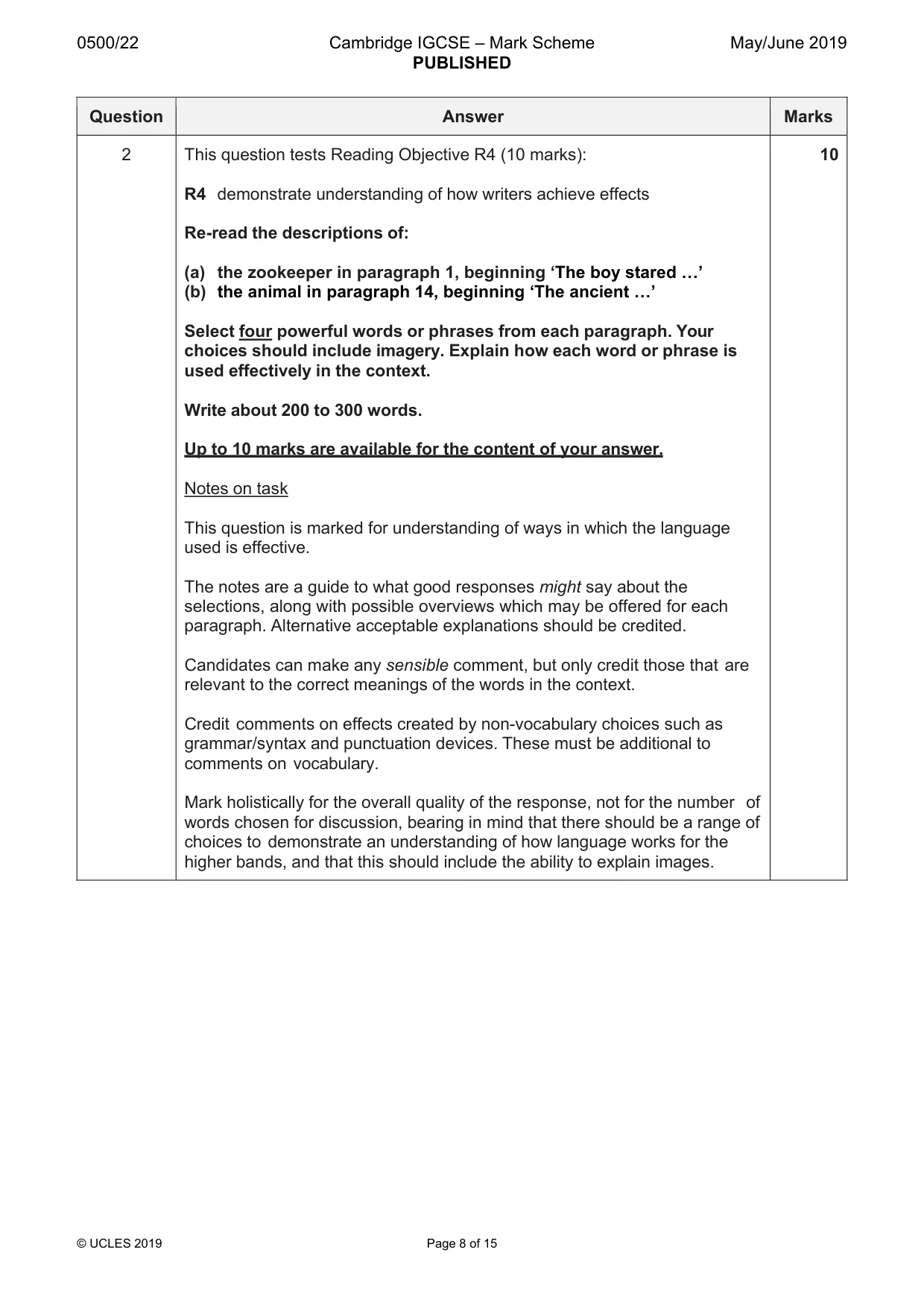
0500/22 Cambridge IGCSE – Mark Scheme PUBLISHED May/June 2019 © UCLES 2019 Page 8 of 15 Question Answer Marks 2 This question tests Reading Objective R4 (10 marks): R4 demonstrate understanding of how writers achieve effects Re-read the descriptions of: (a) the zookeeper in paragraph 1, beginning ‘The boy stared «’ (b) the animal in paragraph 14, beginning ‘The ancient «’ Select four powerful words or phrases from each paragraph. Your choices should include imagery. Explain how each word or phrase is used effectively in the context. Write about 200 to 300 words. Up to 10 marks are available for the content of your answer. Notes on task This question is marked for understanding of ways in which the language used is effective. The notes are a guide to what good responses might say about the selections, along with possible overviews which may be offered for each paragraph. Alternative acceptable explanations should be credited. Candidates can make any sensible comment, but only credit those that are relevant to the correct meanings of the words in the context. Credit comments on effects created by non-vocabulary choices such as grammar/syntax and punctuation devices. These must be additional to comments on vocabulary. Mark holistically for the overall quality of the response, not for the number of words chosen for discussion, bearing in mind that there should be a range of choices to demonstrate an understanding of how language works for the higher bands, and that this should include the ability to explain images. 10
Mark scheme, page 9
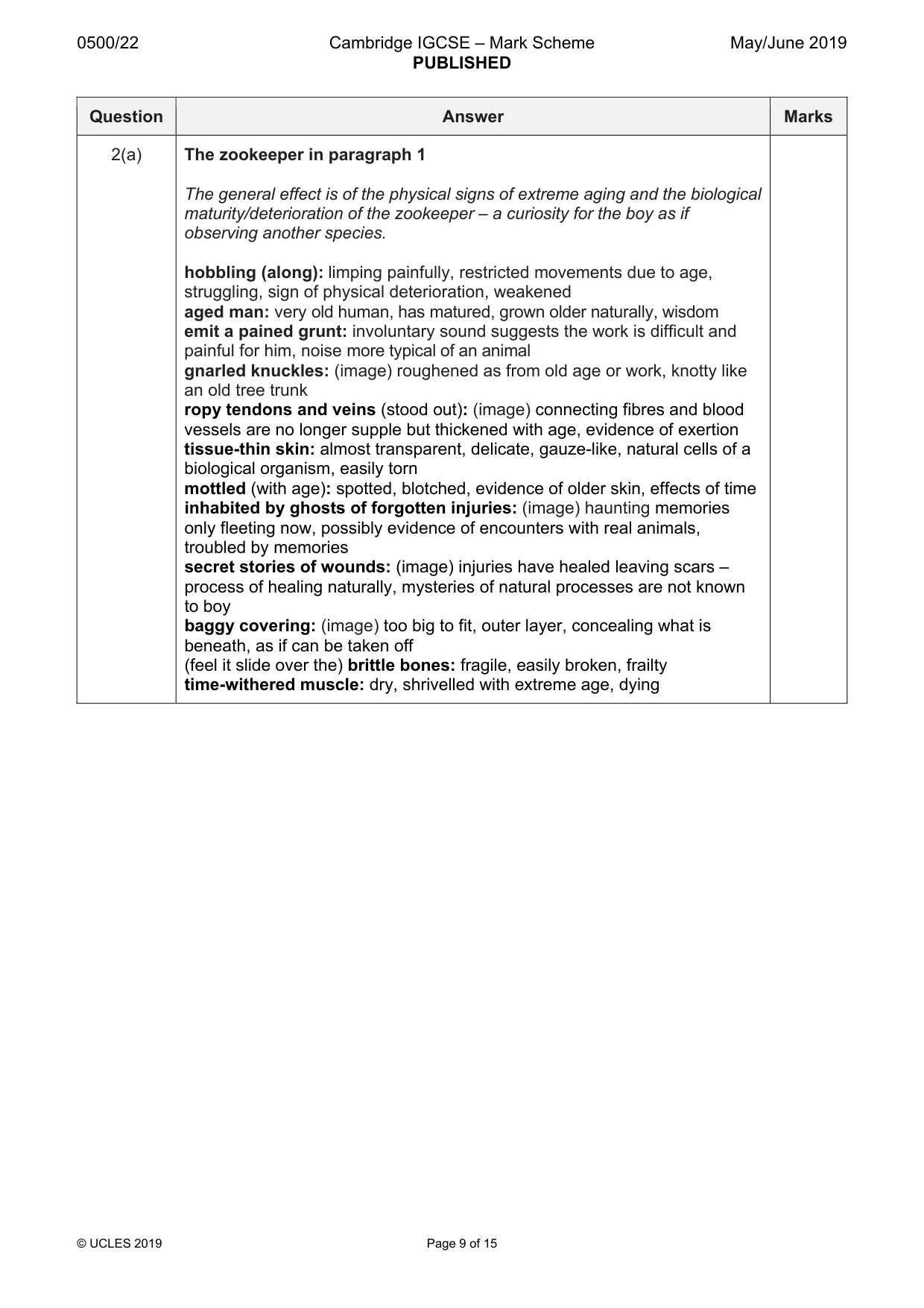
0500/22 Cambridge IGCSE – Mark Scheme PUBLISHED May/June 2019 © UCLES 2019 Page 9 of 15 Question Answer Marks 2(a) The zookeeper in paragraph 1 The general effect is of the physical signs of extreme aging and the biological maturity/deterioration of the zookeeper – a curiosity for the boy as if observing another species. hobbling (along): limping painfully, restricted movements due to age, struggling, sign of physical deterioration, weakened aged man: very old human, has matured, grown older naturally, wisdom emit a pained grunt: involuntary sound suggests the work is difficult and painful for him, noise more typical of an animal gnarled knuckles: (image) roughened as from old age or work, knotty like an old tree trunk ropy tendons and veins (stood out): (image) connecting fibres and blood vessels are no longer supple but thickened with age, evidence of exertion tissue-thin skin: almost transparent, delicate, gauze-like, natural cells of a biological organism, easily torn mottled (with age): spotted, blotched, evidence of older skin, effects of time inhabited by ghosts of forgotten injuries: (image) haunting memories only fleeting now, possibly evidence of encounters with real animals, troubled by memories secret stories of wounds: (image) injuries have healed leaving scars – process of healing naturally, mysteries of natural processes are not known to boy baggy covering: (image) too big to fit, outer layer, concealing what is beneath, as if can be taken off (feel it slide over the) brittle bones: fragile, easily broken, frailty time-withered muscle: dry, shrivelled with extreme age, dying
Mark scheme, page 10
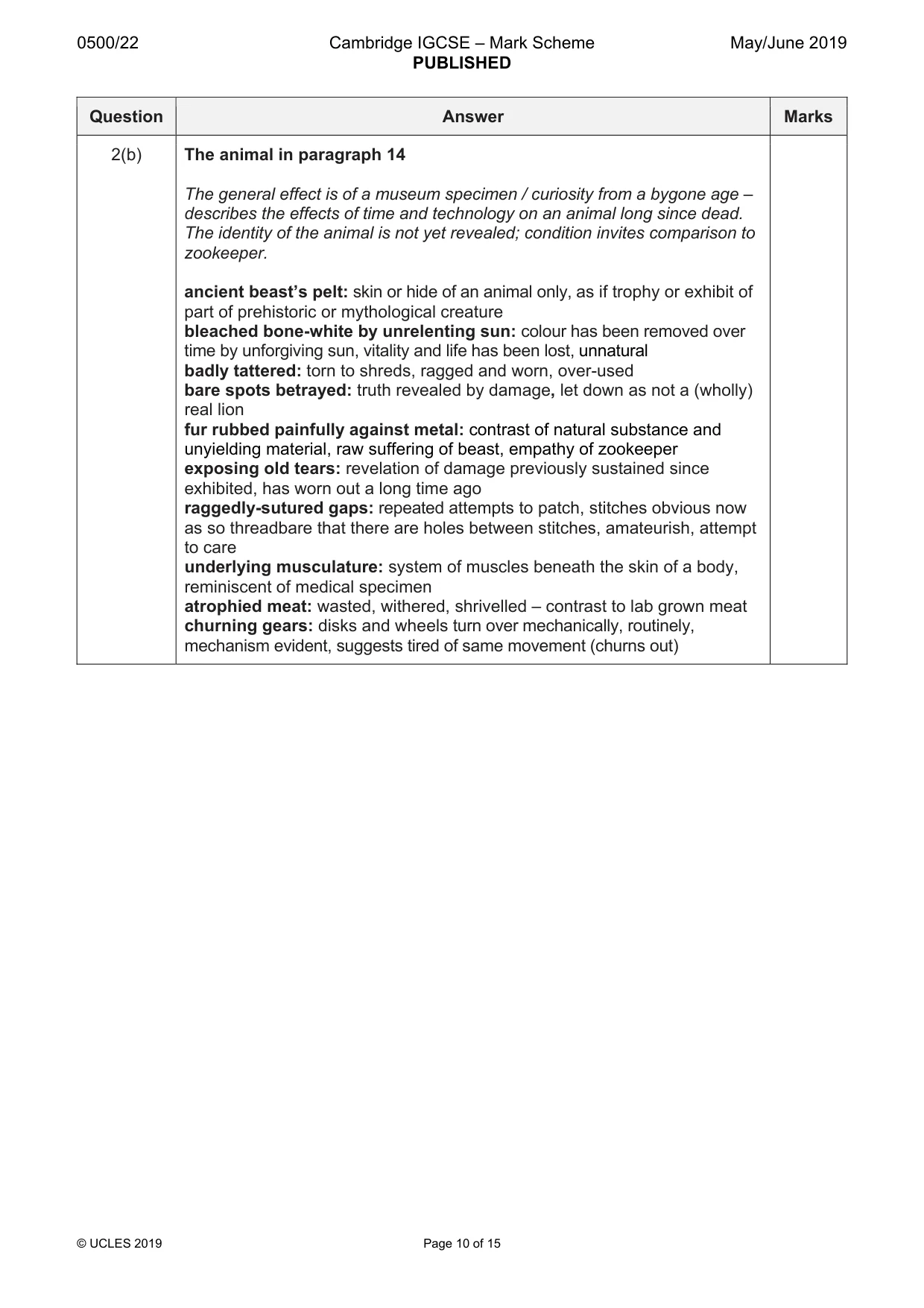
0500/22 Cambridge IGCSE – Mark Scheme PUBLISHED May/June 2019 © UCLES 2019 Page 10 of 15 Question Answer Marks 2(b) The animal in paragraph 14 The general effect is of a museum specimen / curiosity from a bygone age – describes the effects of time and technology on an animal long since dead. The identity of the animal is not yet revealed; condition invites comparison to zookeeper. ancient beast’s pelt: skin or hide of an animal only, as if trophy or exhibit of part of prehistoric or mythological creature bleached bone-white by unrelenting sun: colour has been removed over time by unforgiving sun, vitality and life has been lost, unnatural badly tattered: torn to shreds, ragged and worn, over-used bare spots betrayed: truth revealed by damage, let down as not a (wholly) real lion fur rubbed painfully against metal: contrast of natural substance and unyielding material, raw suffering of beast, empathy of zookeeper exposing old tears: revelation of damage previously sustained since exhibited, has worn out a long time ago raggedly-sutured gaps: repeated attempts to patch, stitches obvious now as so threadbare that there are holes between stitches, amateurish, attempt to care underlying musculature: system of muscles beneath the skin of a body, reminiscent of medical specimen atrophied meat: wasted, withered, shrivelled – contrast to lab grown meat churning gears: disks and wheels turn over mechanically, routinely, mechanism evident, suggests tired of same movement (churns out)
Mark scheme, page 11
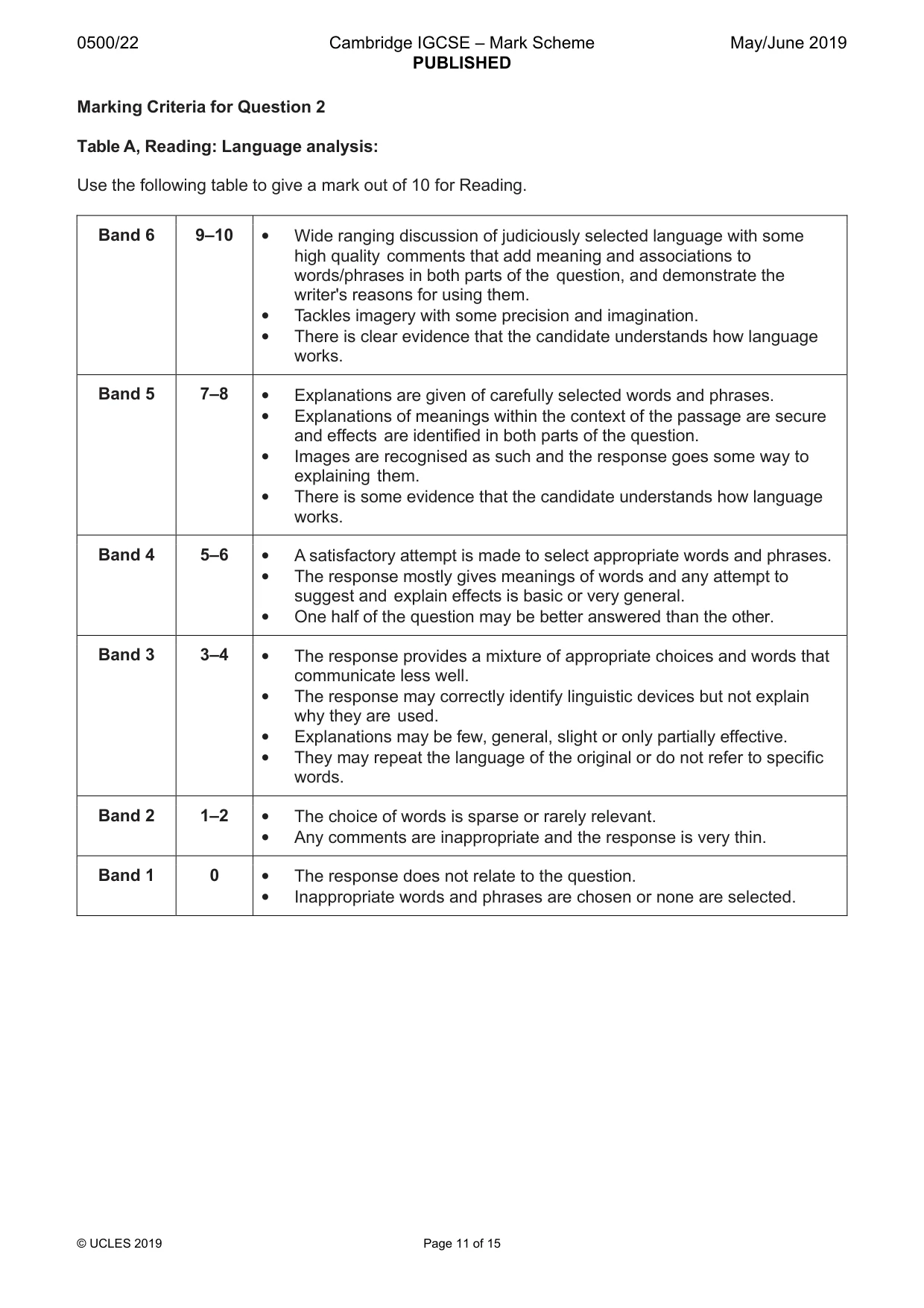
0500/22 Cambridge IGCSE – Mark Scheme PUBLISHED May/June 2019 © UCLES 2019 Page 11 of 15 Marking Criteria for Question 2 Table A, Reading: Language analysis: Use the following table to give a mark out of 10 for Reading. Band 6 9–10 • Wide ranging discussion of judiciously selected language with some high quality comments that add meaning and associations to words/phrases in both parts of the question, and demonstrate the writer's reasons for using them. • Tackles imagery with some precision and imagination. • There is clear evidence that the candidate understands how language works. Band 5 7–8 • Explanations are given of carefully selected words and phrases. • Explanations of meanings within the context of the passage are secure and effects are identified in both parts of the question. • Images are recognised as such and the response goes some way to explaining them. • There is some evidence that the candidate understands how language works. Band 4 5–6 • A satisfactory attempt is made to select appropriate words and phrases. • The response mostly gives meanings of words and any attempt to suggest and explain effects is basic or very general. • One half of the question may be better answered than the other. Band 3 3–4 • The response provides a mixture of appropriate choices and words that communicate less well. • The response may correctly identify linguistic devices but not explain why they are used. • Explanations may be few, general, slight or only partially effective. • They may repeat the language of the original or do not refer to specific words. Band 2 1–2 • The choice of words is sparse or rarely relevant. • Any comments are inappropriate and the response is very thin. Band 1 0 • The response does not relate to the question. • Inappropriate words and phrases are chosen or none are selected.
Mark scheme, page 12
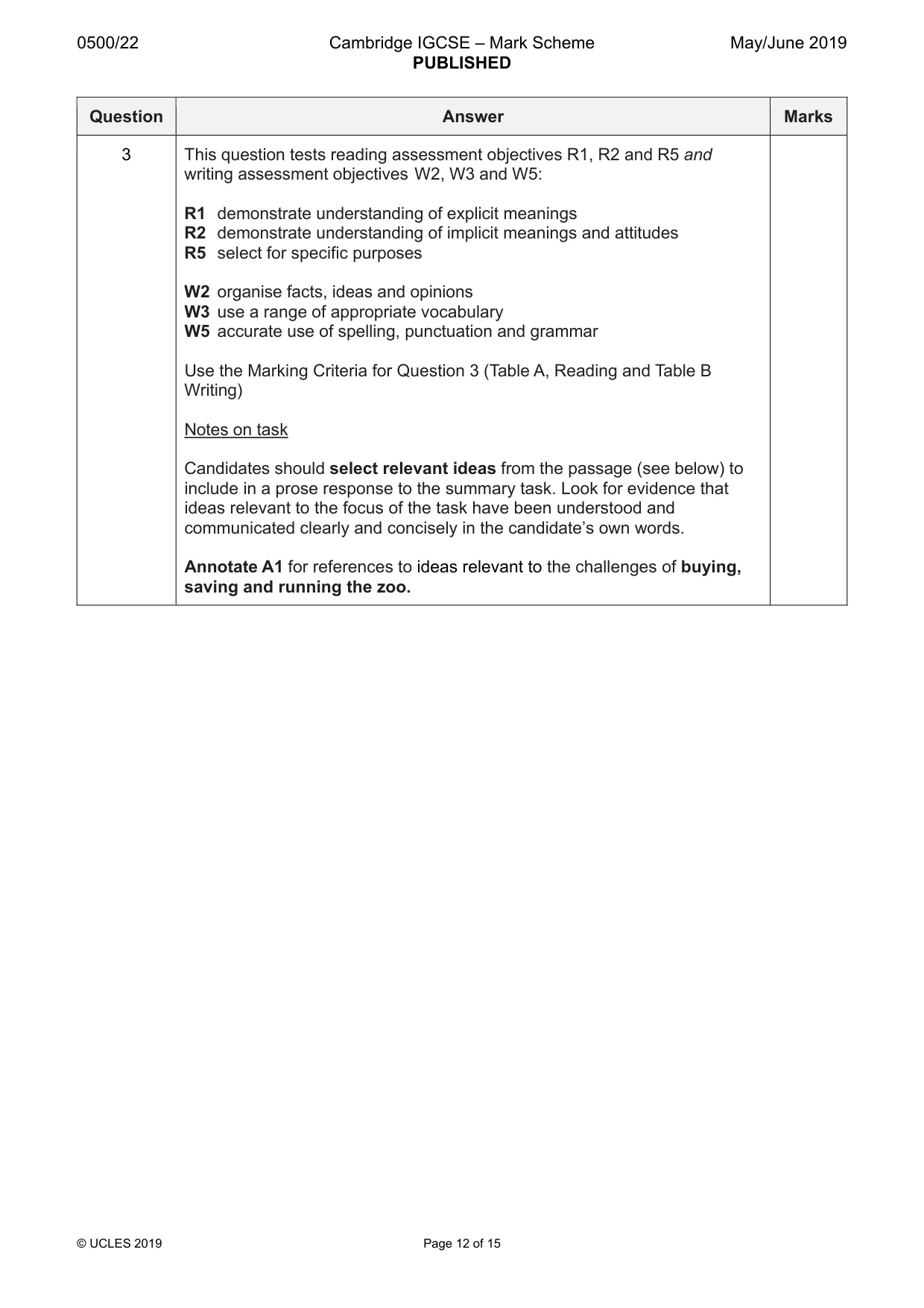
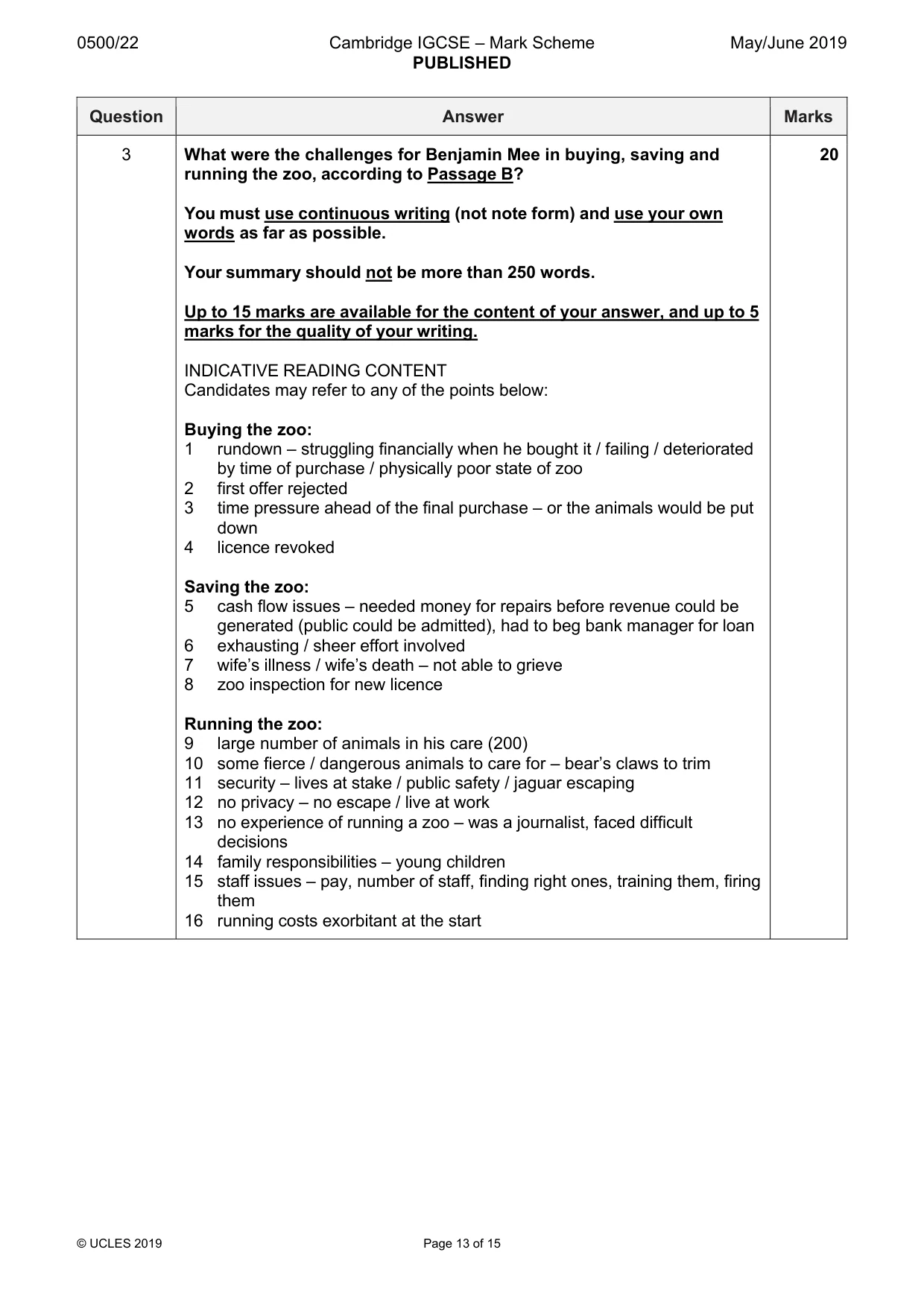
0500/22 Cambridge IGCSE – Mark Scheme PUBLISHED May/June 2019 © UCLES 2019 Page 12 of 15 Question Answer Marks 3 This question tests reading assessment objectives R1, R2 and R5 and writing assessment objectives W2, W3 and W5: R1 demonstrate understanding of explicit meanings R2 demonstrate understanding of implicit meanings and attitudes R5 select for specific purposes W2 organise facts, ideas and opinions W3 use a range of appropriate vocabulary W5 accurate use of spelling, punctuation and grammar Use the Marking Criteria for Question 3 (Table A, Reading and Table B Writing) Notes on task Candidates should select relevant ideas from the passage (see below) to include in a prose response to the summary task. Look for evidence that ideas relevant to the focus of the task have been understood and communicated clearly and concisely in the candidate’s own words. Annotate A1 for references to ideas relevant to the challenges of buying, saving and running the zoo.
Mark scheme, page 13
0500/22 Cambridge IGCSE – Mark Scheme PUBLISHED May/June 2019 © UCLES 2019 Page 13 of 15 Question Answer Marks 3 What were the challenges for Benjamin Mee in buying, saving and running the zoo, according to Passage B? You must use continuous writing (not note form) and use your own words as far as possible. Your summary should not be more than 250 words. Up to 15 marks are available for the content of your answer, and up to 5 marks for the quality of your writing. INDICATIVE READING CONTENT Candidates may refer to any of the points below: Buying the zoo: 1 rundown – struggling financially when he bought it / failing / deteriorated by time of purchase / physically poor state of zoo 2 first offer rejected 3 time pressure ahead of the final purchase – or the animals would be put down 4 licence revoked Saving the zoo: 5 cash flow issues – needed money for repairs before revenue could be generated (public could be admitted), had to beg bank manager for loan 6 exhausting / sheer effort involved 7 wife’s illness / wife’s death – not able to grieve 8 zoo inspection for new licence Running the zoo: 9 large number of animals in his care (200) 10 some fierce / dangerous animals to care for – bear’s claws to trim 11 security – lives at stake / public safety / jaguar escaping 12 no privacy – no escape / live at work 13 no experience of running a zoo – was a journalist, faced difficult decisions 14 family responsibilities – young children 15 staff issues – pay, number of staff, finding right ones, training them, firing them 16 running costs exorbitant at the start 20
Mark scheme, page 14
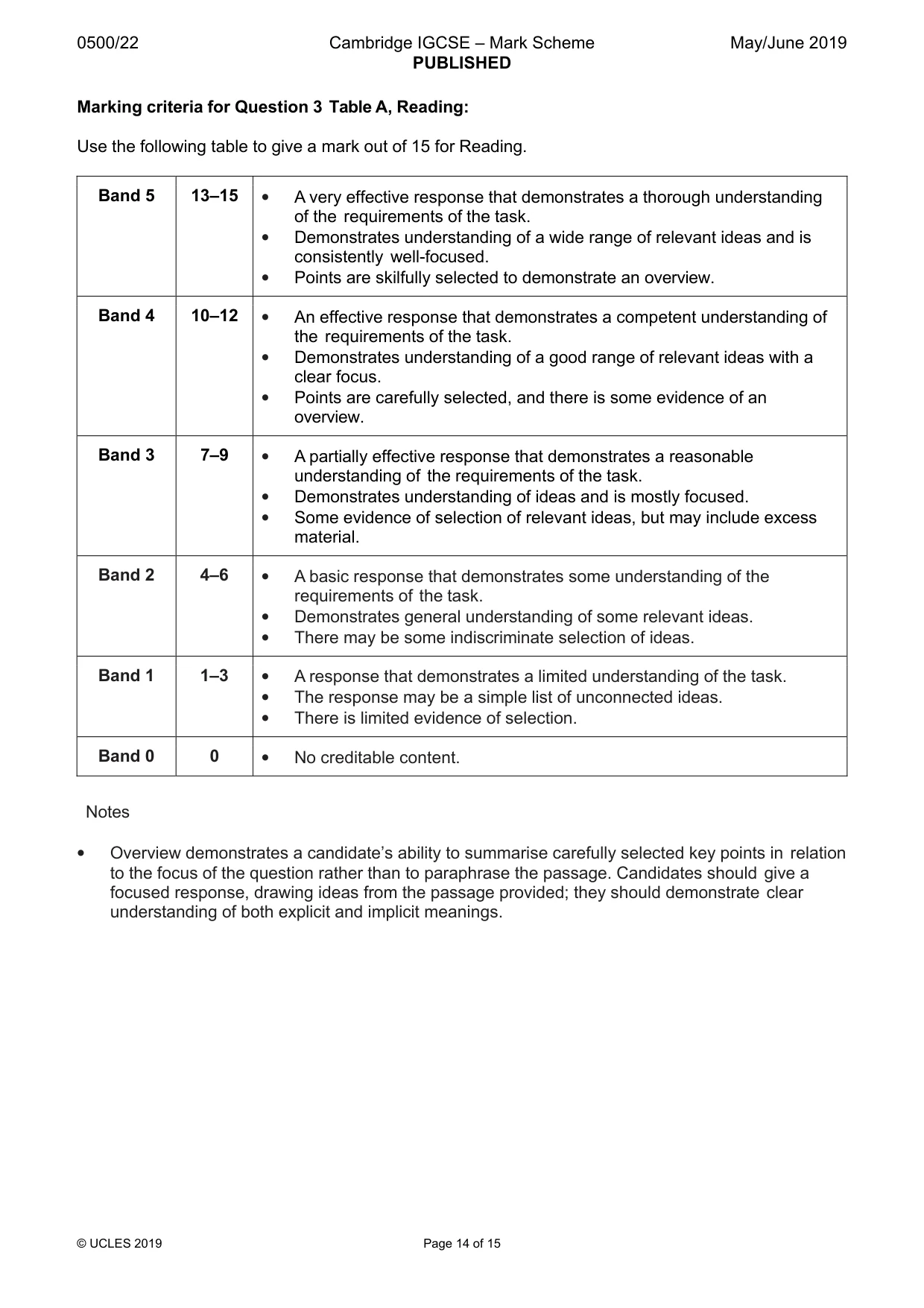
0500/22 Cambridge IGCSE – Mark Scheme PUBLISHED May/June 2019 © UCLES 2019 Page 14 of 15 Marking criteria for Question 3 Table A, Reading: Use the following table to give a mark out of 15 for Reading. Band 5 13–15 • A very effective response that demonstrates a thorough understanding of the requirements of the task. • Demonstrates understanding of a wide range of relevant ideas and is consistently well-focused. • Points are skilfully selected to demonstrate an overview. Band 4 10–12 • An effective response that demonstrates a competent understanding of the requirements of the task. • Demonstrates understanding of a good range of relevant ideas with a clear focus. • Points are carefully selected, and there is some evidence of an overview. Band 3 7–9 • A partially effective response that demonstrates a reasonable understanding of the requirements of the task. • Demonstrates understanding of ideas and is mostly focused. • Some evidence of selection of relevant ideas, but may include excess material. Band 2 4–6 • A basic response that demonstrates some understanding of the requirements of the task. • Demonstrates general understanding of some relevant ideas. • There may be some indiscriminate selection of ideas. Band 1 1–3 • A response that demonstrates a limited understanding of the task. • The response may be a simple list of unconnected ideas. • There is limited evidence of selection. Band 0 0 • No creditable content. Notes • Overview demonstrates a candidate’s ability to summarise carefully selected key points in relation to the focus of the question rather than to paraphrase the passage. Candidates should give a focused response, drawing ideas from the passage provided; they should demonstrate clear understanding of both explicit and implicit meanings.
Mark scheme, page 15
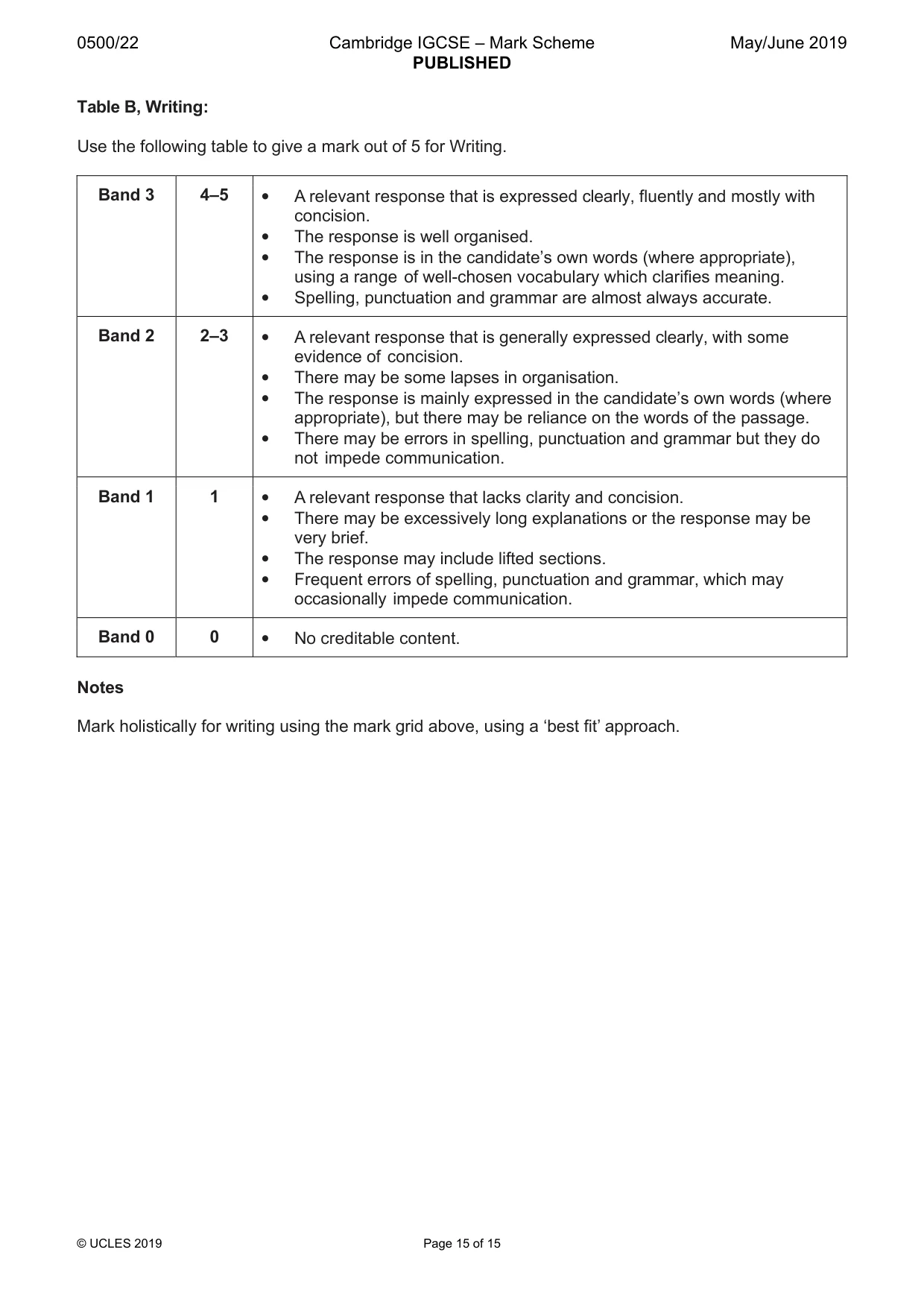
0500/22 Cambridge IGCSE – Mark Scheme PUBLISHED May/June 2019 © UCLES 2019 Page 15 of 15 Table B, Writing: Use the following table to give a mark out of 5 for Writing. Band 3 4–5 • A relevant response that is expressed clearly, fluently and mostly with concision. • The response is well organised. • The response is in the candidate’s own words (where appropriate), using a range of well-chosen vocabulary which clarifies meaning. • Spelling, punctuation and grammar are almost always accurate. Band 2 2–3 • A relevant response that is generally expressed clearly, with some evidence of concision. • There may be some lapses in organisation. • The response is mainly expressed in the candidate’s own words (where appropriate), but there may be reliance on the words of the passage. • There may be errors in spelling, punctuation and grammar but they do not impede communication. Band 1 1 • A relevant response that lacks clarity and concision. • There may be excessively long explanations or the response may be very brief. • The response may include lifted sections. • Frequent errors of spelling, punctuation and grammar, which may occasionally impede communication. Band 0 0 • No creditable content. Notes Mark holistically for writing using the mark grid above, using a ‘best fit’ approach.
What you needed in this session
Cambridge’s own grade thresholds for 2019 May/June, Paper 2 · Variant 2. A higher threshold means an easier paper — the bar moves with how the cohort did.