Cambridge IGCSE English - First Language 0500 — 2019 May/June Paper 2 · Variant 1
0500/21/M/J/19 · 50 marks · ≈56 min
The question paper and its mark scheme, free to read here and free to download. This is Cambridge’s own paper, exactly as it was sat.
Question paper12 pages
Mark scheme14 pages
Answers below. Sit the paper first if you are practising.
Paper as text
Question paper, page 1
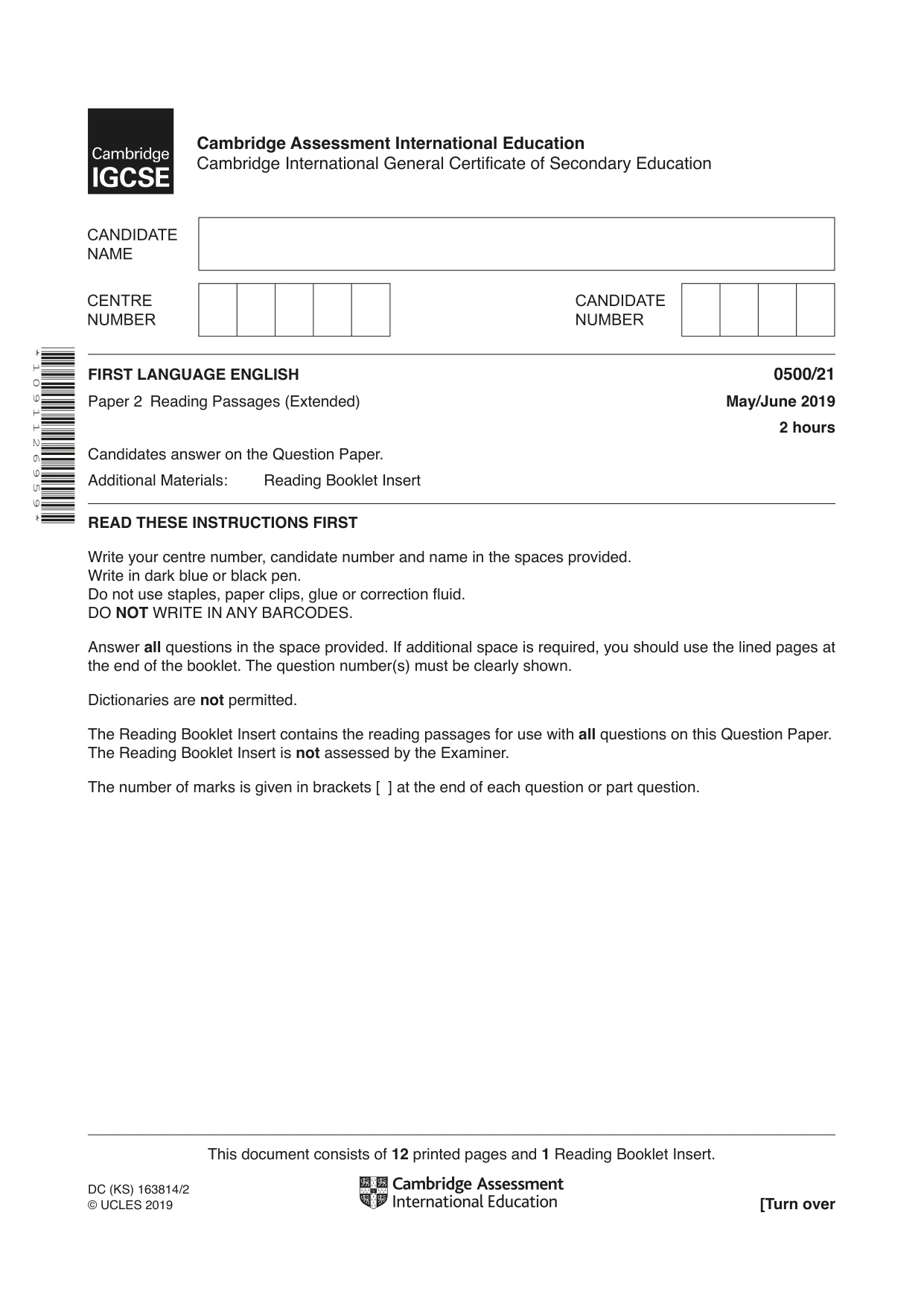
This document consists of 12 printed pages and 1 Reading Booklet Insert. DC (KS) 163814/2 © UCLES 2019 [Turn over Cambridge Assessment International Education Cambridge International General Certificate of Secondary Education * 1 0 9 1 1 2 6 9 5 9 * FIRST LANGUAGE ENGLISH 0500/21 Paper 2 Reading Passages (Extended) May/June 2019 2 hours Candidates answer on the Question Paper. Additional Materials: Reading Booklet Insert READ THESE INSTRUCTIONS FIRST Write your centre number, candidate number and name in the spaces provided. Write in dark blue or black pen. Do not use staples, paper clips, glue or correction fluid. DO NOT WRITE IN ANY BARCODES. Answer all questions in the space provided. If additional space is required, you should use the lined pages at the end of the booklet. The question number(s) must be clearly shown. Dictionaries are not permitted. The Reading Booklet Insert contains the reading passages for use with all questions on this Question Paper. The Reading Booklet Insert is not assessed by the Examiner. The number of marks is given in brackets [ ] at the end of each question or part question.
Question paper, page 2
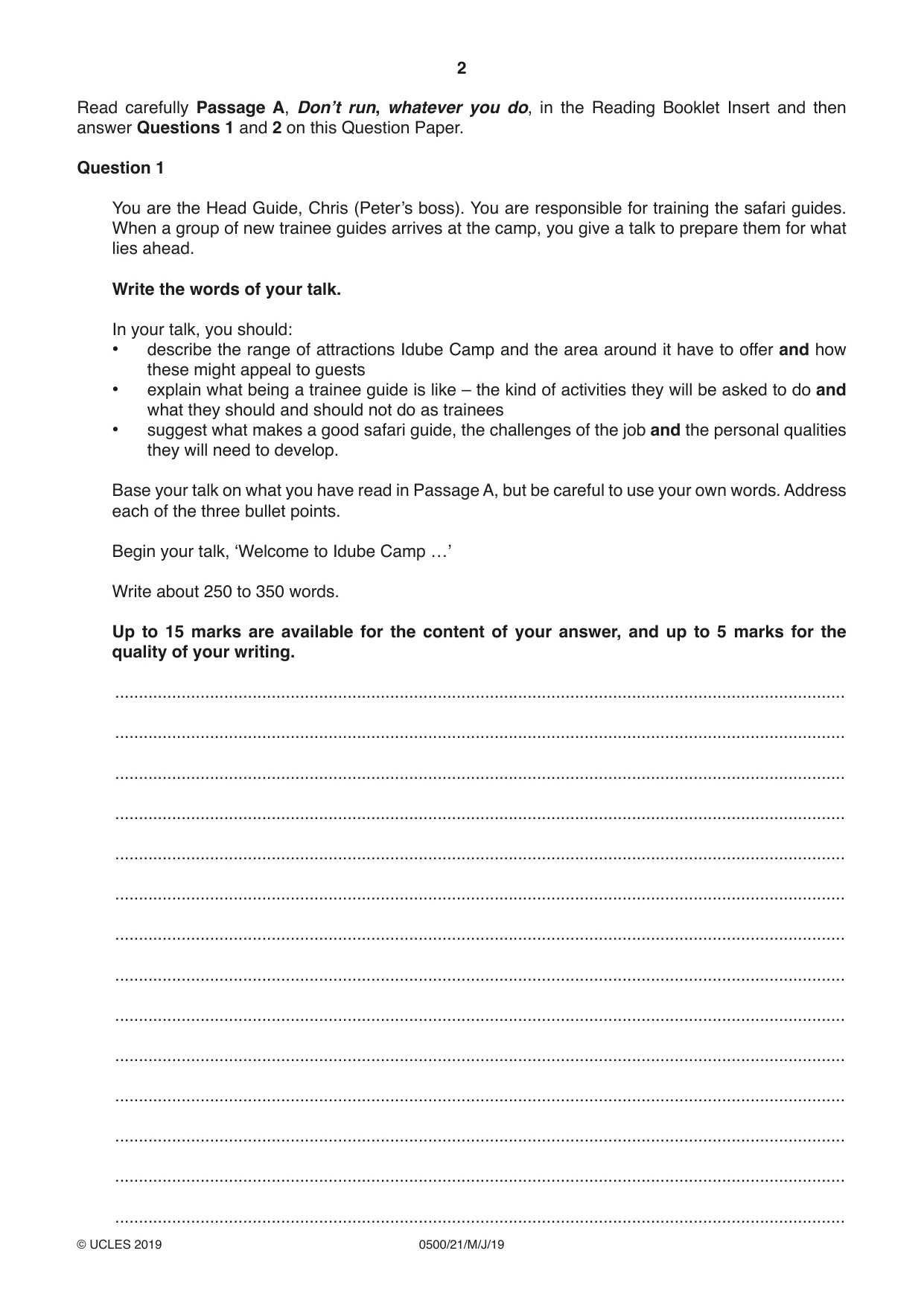
2 0500/21/M/J/19 © UCLES 2019 Read carefully Passage A, Don’t run, whatever you do, in the Reading Booklet Insert and then answer Questions 1 and 2 on this Question Paper. Question 1 You are the Head Guide, Chris (Peter’s boss). You are responsible for training the safari guides. When a group of new trainee guides arrives at the camp, you give a talk to prepare them for what lies ahead. Write the words of your talk. In your talk, you should: • describe the range of attractions Idube Camp and the area around it have to offer and how these might appeal to guests • explain what being a trainee guide is like – the kind of activities they will be asked to do and what they should and should not do as trainees • suggest what makes a good safari guide, the challenges of the job and the personal qualities they will need to develop. Base your talk on what you have read in Passage A, but be careful to use your own words. Address each of the three bullet points. Begin your talk, ‘Welcome to Idube Camp …’ Write about 250 to 350 words. Up to 15 marks are available for the content of your answer, and up to 5 marks for the quality of your writing. … … … … … … … … … … … … … …
Question paper, page 3
3 0500/21/M/J/19 © UCLES 2019 [Turn over … … … … … … … … … … … … … … … … … … … … … … … … … … … …
Question paper, page 4
4 0500/21/M/J/19 © UCLES 2019 … … … … … … … … … … … … … … … … … … … … … … … … … … [Total: 20]
Question paper, page 5
5 0500/21/M/J/19 © UCLES 2019 [Turn over [Turn to page 6 for Question 2]
Question paper, page 6
6 0500/21/M/J/19 © UCLES 2019 Question 2 Re-read the descriptions of: (a) Wusani and her experience at Bush Camp in paragraph 2, beginning ‘Setting up meant …’ (b) Peter’s journey to the Bush Camp in paragraph 9, beginning ‘After struggling …’ Select four powerful words or phrases from each paragraph. Your choices should include imagery. Explain how each word or phrase is used effectively in the context. Write about 200 to 300 words. Up to 10 marks are available for the content of your answer. … … … … … … … … … … … … … … … … … … … … …
Question paper, page 7
7 0500/21/M/J/19 © UCLES 2019 [Turn over … … … … … … … … … … … … … … … … … … … … … … … … … … … [Total: 10]
Question paper, page 8
8 0500/21/M/J/19 © UCLES 2019 Read carefully Passage B, Safari: Are too many tourists killing Africa’s wildlife?, in the Reading Booklet Insert and then answer Question 3 on this Question Paper. Question 3 What were the problems for wildlife reserves and their surrounding communities in 2010 and what was being done to help tackle these problems, according to Passage B? You must use continuous writing (not note form) and use your own words as far as possible. Your summary should not be more than 250 words. Up to 15 marks are available for the content of your answer, and up to 5 marks for the quality of your writing. … … … … … … … … … … … … … … … … … … … … …
Question paper, page 9
9 0500/21/M/J/19 © UCLES 2019 … … … … … … … … … … … … … [Total: 20]
Question paper, page 10
10 0500/21/M/J/19 © UCLES 2019 Additional Page If you use the following lined page to complete the answer(s) to any question(s), the question number(s) must be clearly shown. … … … … … … … … … … … … … … … … … … … … … … … … … …
Question paper, page 11
11 0500/21/M/J/19 © UCLES 2019 Additional Page If you use the following lined page to complete the answer(s) to any question(s), the question number(s) must be clearly shown. … … … … … … … … … … … … … … … … … … … … … … … … … …
Question paper, page 12
12 0500/21/M/J/19 © UCLES 2019 Permission to reproduce items where third-party owned material protected by copyright is included has been sought and cleared where possible. Every reasonable effort has been made by the publisher (UCLES) to trace copyright holders, but if any items requiring clearance have unwittingly been included, the publisher will be pleased to make amends at the earliest possible opportunity. To avoid the issue of disclosure of answer-related information to candidates, all copyright acknowledgements are reproduced online in the Cambridge Assessment International Education Copyright Acknowledgements Booklet. This is produced for each series of examinations and is freely available to download at www.cambridgeinternational.org after the live examination series. Cambridge Assessment International Education is part of the Cambridge Assessment Group. Cambridge Assessment is the brand name of the University of Cambridge Local Examinations Syndicate (UCLES), which itself is a department of the University of Cambridge. Additional Page If you use the following lined page to complete the answer(s) to any question(s), the question number(s) must be clearly shown. … … … … … … … … … … … … … … … … … … … … …
Mark scheme, page 1
This document consists of 14 printed pages. © UCLES 2019 [Turn over Cambridge Assessment International Education Cambridge International General Certificate of Secondary Education FIRST LANGUAGE ENGLISH 0500/21 Paper 2 Reading Passages (Extended) May/June 2019 MARK SCHEME Maximum Mark: 50 Published This mark scheme is published as an aid to teachers and candidates, to indicate the requirements of the examination. It shows the basis on which Examiners were instructed to award marks. It does not indicate the details of the discussions that took place at an Examiners’ meeting before marking began, which would have considered the acceptability of alternative answers. Mark schemes should be read in conjunction with the question paper and the Principal Examiner Report for Teachers. Cambridge International will not enter into discussions about these mark schemes. Cambridge International is publishing the mark schemes for the May/June 2019 series for most Cambridge IGCSE™, Cambridge International A and AS Level and Cambridge Pre-U components, and some Cambridge O Level components.
Mark scheme, page 2
0500/21 Cambridge IGCSE – Mark Scheme PUBLISHED May/June 2019 © UCLES 2019 Page 2 of 14 Generic Marking Principles These general marking principles must be applied by all examiners when marking candidate answers. They should be applied alongside the specific content of the mark scheme or generic level descriptors for a question. Each question paper and mark scheme will also comply with these marking principles. GENERIC MARKING PRINCIPLE 1: Marks must be awarded in line with: • the specific content of the mark scheme or the generic level descriptors for the question • the specific skills defined in the mark scheme or in the generic level descriptors for the question • the standard of response required by a candidate as exemplified by the standardisation scripts. GENERIC MARKING PRINCIPLE 2: Marks awarded are always whole marks (not half marks, or other fractions). GENERIC MARKING PRINCIPLE 3: Marks must be awarded positively: • marks are awarded for correct/valid answers, as defined in the mark scheme. However, credit is given for valid answers which go beyond the scope of the syllabus and mark scheme, referring to your Team Leader as appropriate • marks are awarded when candidates clearly demonstrate what they know and can do • marks are not deducted for errors • marks are not deducted for omissions • answers should only be judged on the quality of spelling, punctuation and grammar when these features are specifically assessed by the question as indicated by the mark scheme. The meaning, however, should be unambiguous. GENERIC MARKING PRINCIPLE 4: Rules must be applied consistently e.g. in situations where candidates have not followed instructions or in the application of generic level descriptors. GENERIC MARKING PRINCIPLE 5: Marks should be awarded using the full range of marks defined in the mark scheme for the question (however; the use of the full mark range may be limited according to the quality of the candidate responses seen). GENERIC MARKING PRINCIPLE 6: Marks awarded are based solely on the requirements as defined in the mark scheme. Marks should not be awarded with grade thresholds or grade descriptors in mind.
Mark scheme, page 3
0500/21 Cambridge IGCSE – Mark Scheme PUBLISHED May/June 2019 © UCLES 2019 Page 3 of 14 Note: All Examiners are instructed that alternative correct answers and unexpected approaches in candidates’ scripts must be given marks that fairly reflect the relevant knowledge and skills demonstrated. Nonetheless, the content must be clearly related to and derived from the passage. Question 1 This question tests Reading Objectives R1 to R3 (15 marks): R1 demonstrate understanding of explicit meanings R2 demonstrate understanding of implicit meanings and attitudes R3 analyse, evaluate and develop facts, ideas and opinions and writing assessment objectives W1 to W4 (5 marks): W1 articulate experience and express what is thought, felt and imagined W2 organise facts, ideas and opinions W3 use a range of appropriate vocabulary W4 use register appropriate to audience and context.
Mark scheme, page 4
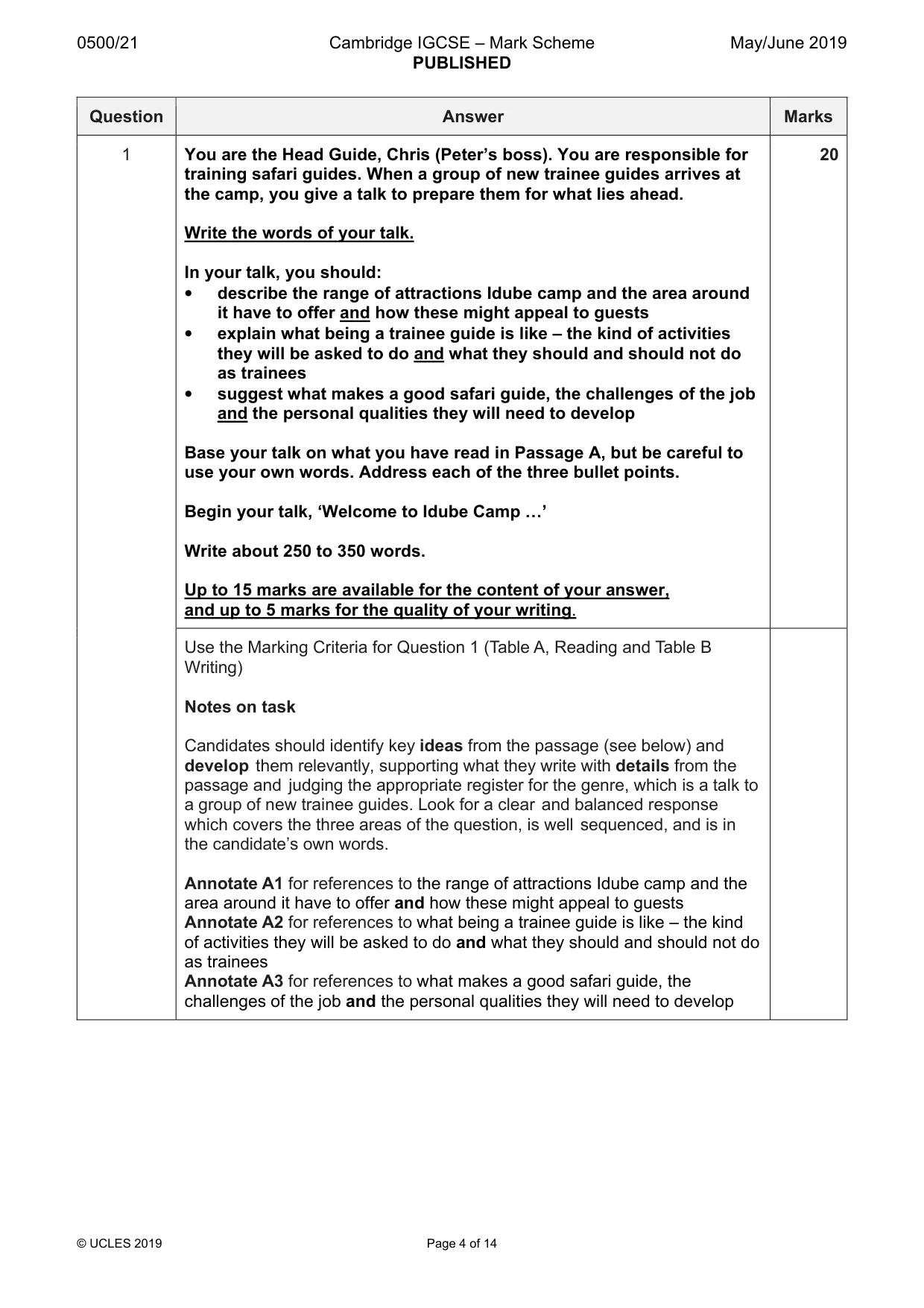
0500/21 Cambridge IGCSE – Mark Scheme PUBLISHED May/June 2019 © UCLES 2019 Page 4 of 14 Question Answer Marks 1 You are the Head Guide, Chris (Peter’s boss). You are responsible for training safari guides. When a group of new trainee guides arrives at the camp, you give a talk to prepare them for what lies ahead. Write the words of your talk. In your talk, you should: • describe the range of attractions Idube camp and the area around it have to offer and how these might appeal to guests • explain what being a trainee guide is like – the kind of activities they will be asked to do and what they should and should not do as trainees • suggest what makes a good safari guide, the challenges of the job and the personal qualities they will need to develop Base your talk on what you have read in Passage A, but be careful to use your own words. Address each of the three bullet points. Begin your talk, ‘Welcome to Idube Camp «’ Write about 250 to 350 words. Up to 15 marks are available for the content of your answer, and up to 5 marks for the quality of your writing. 20 Use the Marking Criteria for Question 1 (Table A, Reading and Table B Writing) Notes on task Candidates should identify key ideas from the passage (see below) and develop them relevantly, supporting what they write with details from the passage and judging the appropriate register for the genre, which is a talk to a group of new trainee guides. Look for a clear and balanced response which covers the three areas of the question, is well sequenced, and is in the candidate’s own words. Annotate A1 for references to the range of attractions Idube camp and the area around it have to offer and how these might appeal to guests Annotate A2 for references to what being a trainee guide is like – the kind of activities they will be asked to do and what they should and should not do as trainees Annotate A3 for references to what makes a good safari guide, the challenges of the job and the personal qualities they will need to develop
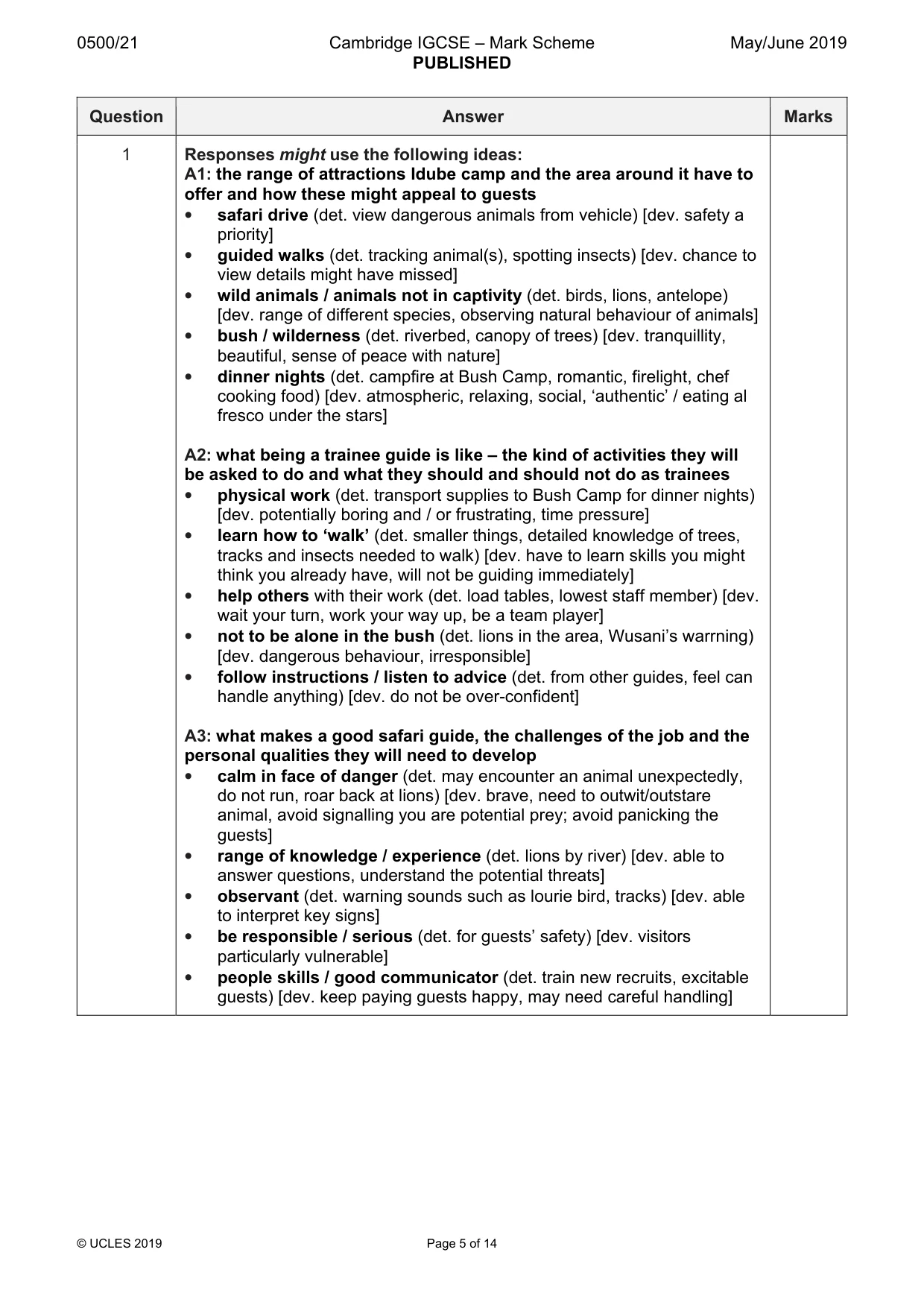
Mark scheme, page 5
0500/21 Cambridge IGCSE – Mark Scheme PUBLISHED May/June 2019 © UCLES 2019 Page 5 of 14 Question Answer Marks 1 Responses might use the following ideas: A1: the range of attractions Idube camp and the area around it have to offer and how these might appeal to guests • safari drive (det. view dangerous animals from vehicle) [dev. safety a priority] • guided walks (det. tracking animal(s), spotting insects) [dev. chance to view details might have missed] • wild animals / animals not in captivity (det. birds, lions, antelope) [dev. range of different species, observing natural behaviour of animals] • bush / wilderness (det. riverbed, canopy of trees) [dev. tranquillity, beautiful, sense of peace with nature] • dinner nights (det. campfire at Bush Camp, romantic, firelight, chef cooking food) [dev. atmospheric, relaxing, social, ‘authentic’ / eating al fresco under the stars] A2: what being a trainee guide is like – the kind of activities they will be asked to do and what they should and should not do as trainees • physical work (det. transport supplies to Bush Camp for dinner nights) [dev. potentially boring and / or frustrating, time pressure] • learn how to ‘walk’ (det. smaller things, detailed knowledge of trees, tracks and insects needed to walk) [dev. have to learn skills you might think you already have, will not be guiding immediately] • help others with their work (det. load tables, lowest staff member) [dev. wait your turn, work your way up, be a team player] • not to be alone in the bush (det. lions in the area, Wusani’s warrning) [dev. dangerous behaviour, irresponsible] • follow instructions / listen to advice (det. from other guides, feel can handle anything) [dev. do not be over-confident] A3: what makes a good safari guide, the challenges of the job and the personal qualities they will need to develop • calm in face of danger (det. may encounter an animal unexpectedly, do not run, roar back at lions) [dev. brave, need to outwit/outstare animal, avoid signalling you are potential prey; avoid panicking the guests] • range of knowledge / experience (det. lions by river) [dev. able to answer questions, understand the potential threats] • observant (det. warning sounds such as lourie bird, tracks) [dev. able to interpret key signs] • be responsible / serious (det. for guests’ safety) [dev. visitors particularly vulnerable] • people skills / good communicator (det. train new recruits, excitable guests) [dev. keep paying guests happy, may need careful handling]
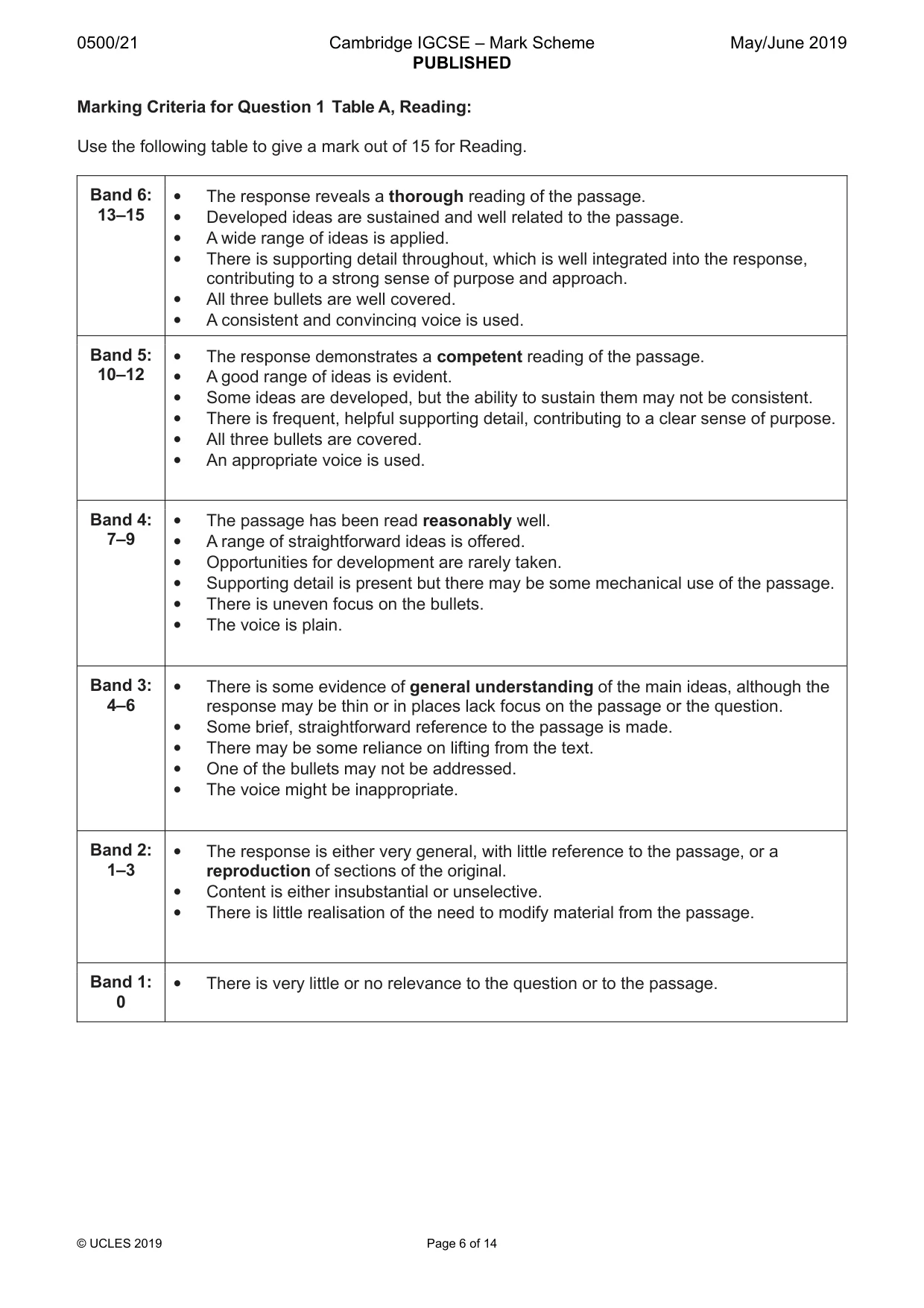
Mark scheme, page 6
0500/21 Cambridge IGCSE – Mark Scheme PUBLISHED May/June 2019 © UCLES 2019 Page 6 of 14 Marking Criteria for Question 1 Table A, Reading: Use the following table to give a mark out of 15 for Reading. Band 6: 13–15 • The response reveals a thorough reading of the passage. • Developed ideas are sustained and well related to the passage. • A wide range of ideas is applied. • There is supporting detail throughout, which is well integrated into the response, contributing to a strong sense of purpose and approach. • All three bullets are well covered. • A consistent and convincing voice is used. Band 5: 10–12 • The response demonstrates a competent reading of the passage. • A good range of ideas is evident. • Some ideas are developed, but the ability to sustain them may not be consistent. • There is frequent, helpful supporting detail, contributing to a clear sense of purpose. • All three bullets are covered. • An appropriate voice is used. Band 4: 7–9 • The passage has been read reasonably well. • A range of straightforward ideas is offered. • Opportunities for development are rarely taken. • Supporting detail is present but there may be some mechanical use of the passage. • There is uneven focus on the bullets. • The voice is plain. Band 3: 4–6 • There is some evidence of general understanding of the main ideas, although the response may be thin or in places lack focus on the passage or the question. • Some brief, straightforward reference to the passage is made. • There may be some reliance on lifting from the text. • One of the bullets may not be addressed. • The voice might be inappropriate. Band 2: 1–3 • The response is either very general, with little reference to the passage, or a reproduction of sections of the original. • Content is either insubstantial or unselective. • There is little realisation of the need to modify material from the passage. Band 1: 0 • There is very little or no relevance to the question or to the passage.
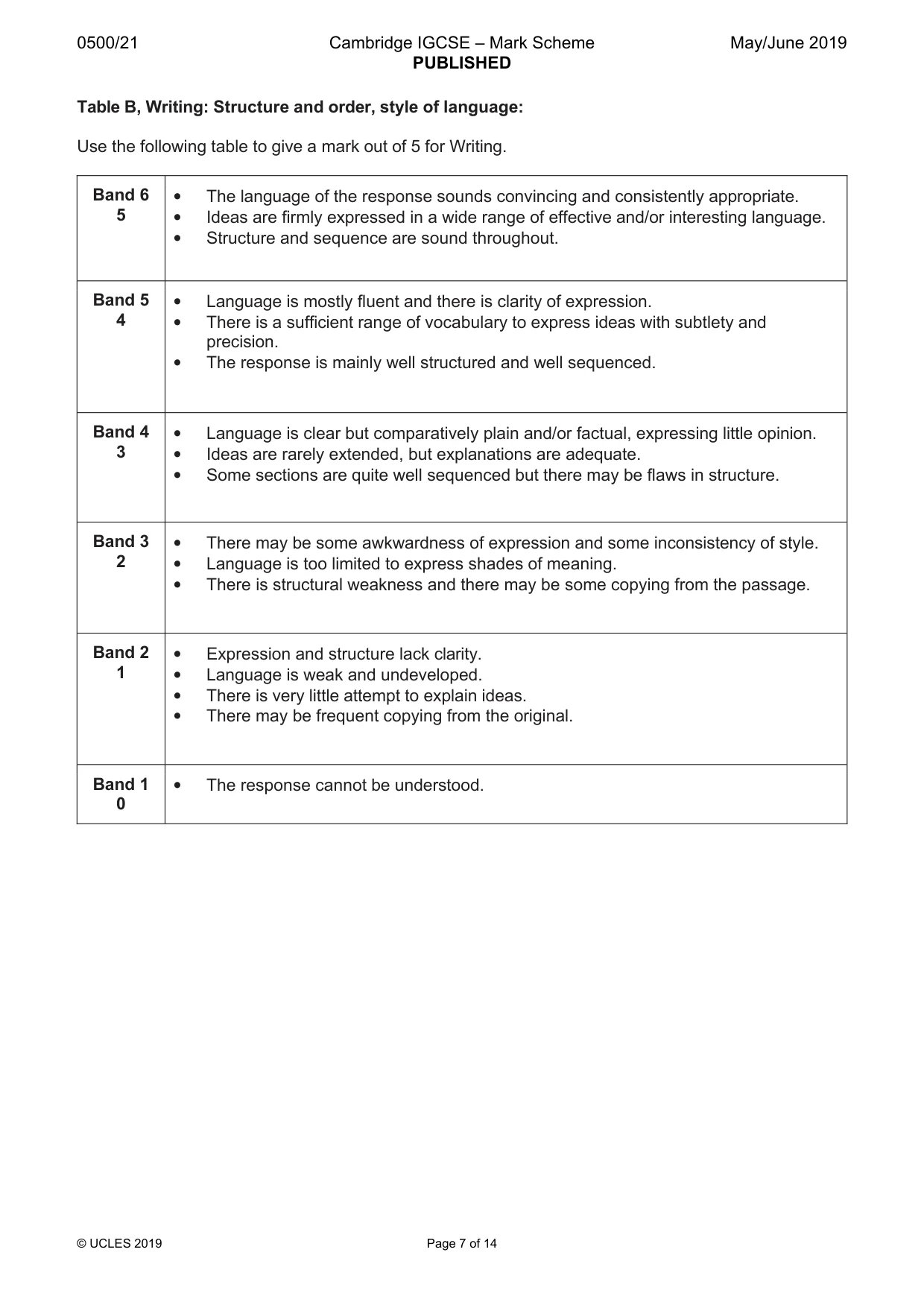
Mark scheme, page 7
0500/21 Cambridge IGCSE – Mark Scheme PUBLISHED May/June 2019 © UCLES 2019 Page 7 of 14 Table B, Writing: Structure and order, style of language: Use the following table to give a mark out of 5 for Writing. Band 6 5 • The language of the response sounds convincing and consistently appropriate. • Ideas are firmly expressed in a wide range of effective and/or interesting language. • Structure and sequence are sound throughout. Band 5 4 • Language is mostly fluent and there is clarity of expression. • There is a sufficient range of vocabulary to express ideas with subtlety and precision. • The response is mainly well structured and well sequenced. Band 4 3 • Language is clear but comparatively plain and/or factual, expressing little opinion. • Ideas are rarely extended, but explanations are adequate. • Some sections are quite well sequenced but there may be flaws in structure. Band 3 2 • There may be some awkwardness of expression and some inconsistency of style. • Language is too limited to express shades of meaning. • There is structural weakness and there may be some copying from the passage. Band 2 1 • Expression and structure lack clarity. • Language is weak and undeveloped. • There is very little attempt to explain ideas. • There may be frequent copying from the original. Band 1 0 • The response cannot be understood.
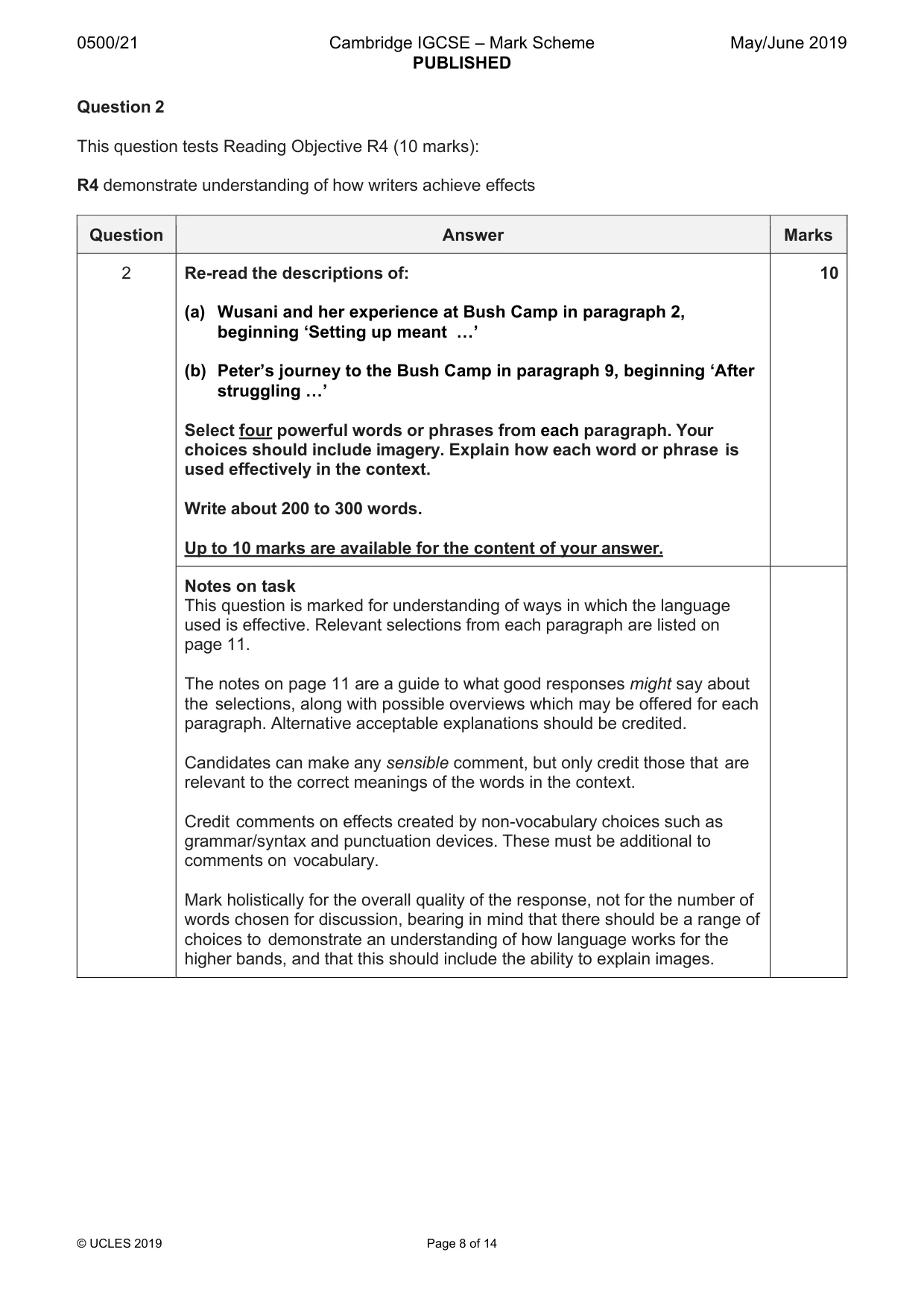
Mark scheme, page 8
0500/21 Cambridge IGCSE – Mark Scheme PUBLISHED May/June 2019 © UCLES 2019 Page 8 of 14 Question 2 This question tests Reading Objective R4 (10 marks): R4 demonstrate understanding of how writers achieve effects Question Answer Marks 2 Re-read the descriptions of: (a) Wusani and her experience at Bush Camp in paragraph 2, beginning ‘Setting up meant «’ (b) Peter’s journey to the Bush Camp in paragraph 9, beginning ‘After struggling «’ Select four powerful words or phrases from each paragraph. Your choices should include imagery. Explain how each word or phrase is used effectively in the context. Write about 200 to 300 words. Up to 10 marks are available for the content of your answer. 10 Notes on task This question is marked for understanding of ways in which the language used is effective. Relevant selections from each paragraph are listed on page 11. The notes on page 11 are a guide to what good responses might say about the selections, along with possible overviews which may be offered for each paragraph. Alternative acceptable explanations should be credited. Candidates can make any sensible comment, but only credit those that are relevant to the correct meanings of the words in the context. Credit comments on effects created by non-vocabulary choices such as grammar/syntax and punctuation devices. These must be additional to comments on vocabulary. Mark holistically for the overall quality of the response, not for the number of words chosen for discussion, bearing in mind that there should be a range of choices to demonstrate an understanding of how language works for the higher bands, and that this should include the ability to explain images.
Mark scheme, page 9
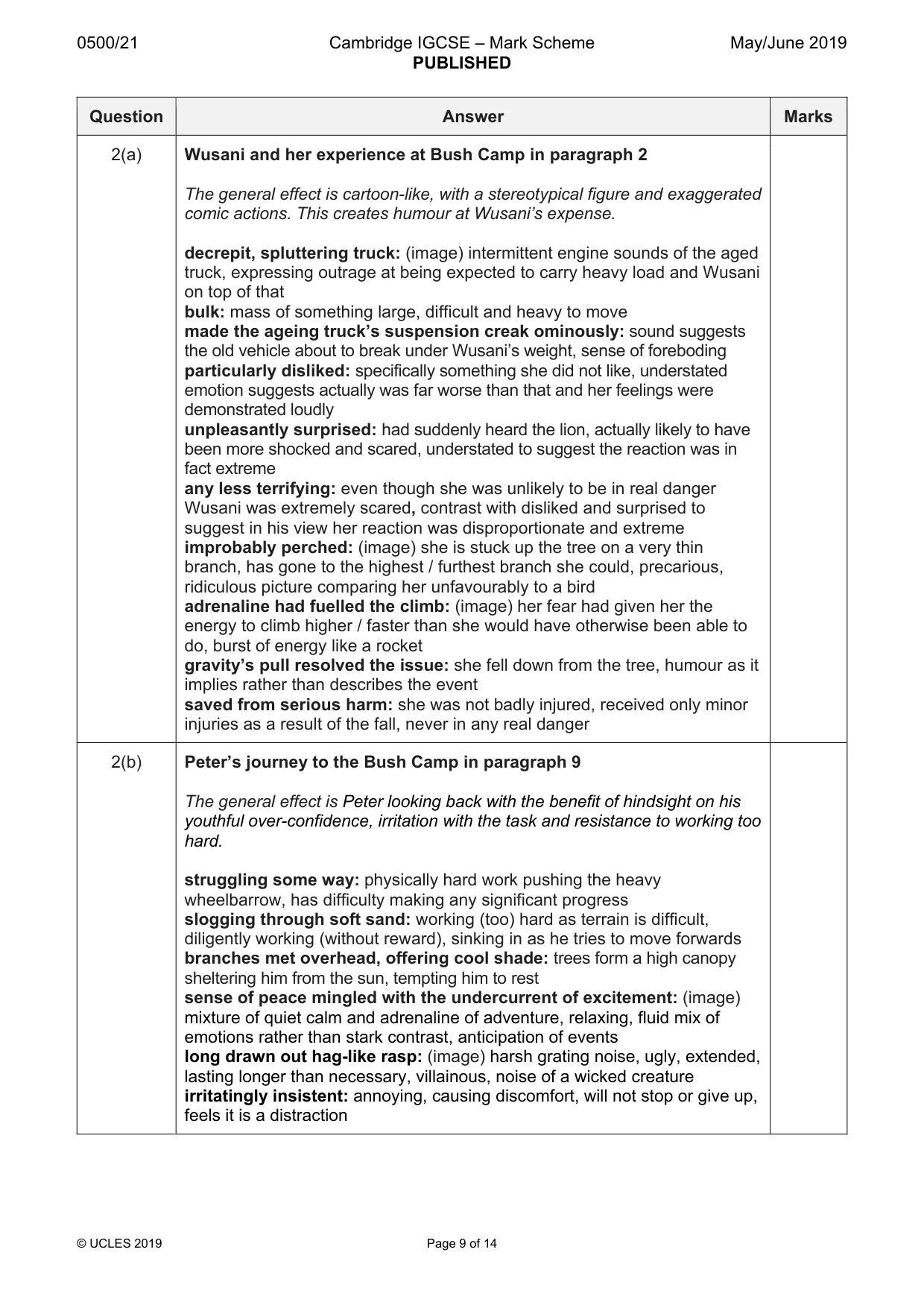
0500/21 Cambridge IGCSE – Mark Scheme PUBLISHED May/June 2019 © UCLES 2019 Page 9 of 14 Question Answer Marks 2(a) Wusani and her experience at Bush Camp in paragraph 2 The general effect is cartoon-like, with a stereotypical figure and exaggerated comic actions. This creates humour at Wusani’s expense. decrepit, spluttering truck: (image) intermittent engine sounds of the aged truck, expressing outrage at being expected to carry heavy load and Wusani on top of that bulk: mass of something large, difficult and heavy to move made the ageing truck’s suspension creak ominously: sound suggests the old vehicle about to break under Wusani’s weight, sense of foreboding particularly disliked: specifically something she did not like, understated emotion suggests actually was far worse than that and her feelings were demonstrated loudly unpleasantly surprised: had suddenly heard the lion, actually likely to have been more shocked and scared, understated to suggest the reaction was in fact extreme any less terrifying: even though she was unlikely to be in real danger Wusani was extremely scared, contrast with disliked and surprised to suggest in his view her reaction was disproportionate and extreme improbably perched: (image) she is stuck up the tree on a very thin branch, has gone to the highest / furthest branch she could, precarious, ridiculous picture comparing her unfavourably to a bird adrenaline had fuelled the climb: (image) her fear had given her the energy to climb higher / faster than she would have otherwise been able to do, burst of energy like a rocket gravity’s pull resolved the issue: she fell down from the tree, humour as it implies rather than describes the event saved from serious harm: she was not badly injured, received only minor injuries as a result of the fall, never in any real danger 2(b) Peter’s journey to the Bush Camp in paragraph 9 The general effect is Peter looking back with the benefit of hindsight on his youthful over-confidence, irritation with the task and resistance to working too hard. struggling some way: physically hard work pushing the heavy wheelbarrow, has difficulty making any significant progress slogging through soft sand: working (too) hard as terrain is difficult, diligently working (without reward), sinking in as he tries to move forwards branches met overhead, offering cool shade: trees form a high canopy sheltering him from the sun, tempting him to rest sense of peace mingled with the undercurrent of excitement: (image) mixture of quiet calm and adrenaline of adventure, relaxing, fluid mix of emotions rather than stark contrast, anticipation of events long drawn out hag-like rasp: (image) harsh grating noise, ugly, extended, lasting longer than necessary, villainous, noise of a wicked creature irritatingly insistent: annoying, causing discomfort, will not stop or give up, feels it is a distraction
Mark scheme, page 10
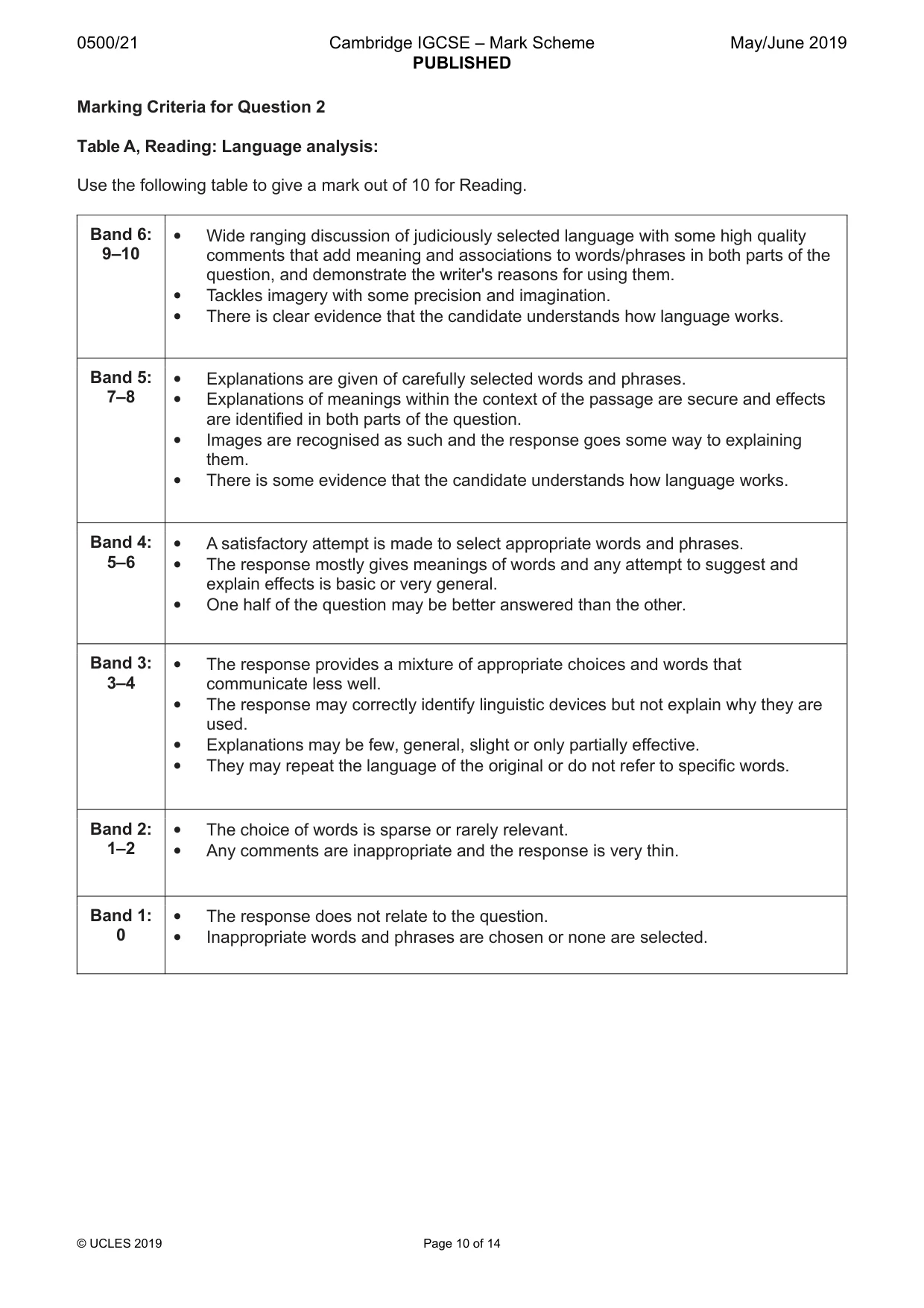
0500/21 Cambridge IGCSE – Mark Scheme PUBLISHED May/June 2019 © UCLES 2019 Page 10 of 14 Marking Criteria for Question 2 Table A, Reading: Language analysis: Use the following table to give a mark out of 10 for Reading. Band 6: 9–10 • Wide ranging discussion of judiciously selected language with some high quality comments that add meaning and associations to words/phrases in both parts of the question, and demonstrate the writer's reasons for using them. • Tackles imagery with some precision and imagination. • There is clear evidence that the candidate understands how language works. Band 5: 7–8 • Explanations are given of carefully selected words and phrases. • Explanations of meanings within the context of the passage are secure and effects are identified in both parts of the question. • Images are recognised as such and the response goes some way to explaining them. • There is some evidence that the candidate understands how language works. Band 4: 5–6 • A satisfactory attempt is made to select appropriate words and phrases. • The response mostly gives meanings of words and any attempt to suggest and explain effects is basic or very general. • One half of the question may be better answered than the other. Band 3: 3–4 • The response provides a mixture of appropriate choices and words that communicate less well. • The response may correctly identify linguistic devices but not explain why they are used. • Explanations may be few, general, slight or only partially effective. • They may repeat the language of the original or do not refer to specific words. Band 2: 1–2 • The choice of words is sparse or rarely relevant. • Any comments are inappropriate and the response is very thin. Band 1: 0 • The response does not relate to the question. • Inappropriate words and phrases are chosen or none are selected.
Mark scheme, page 11
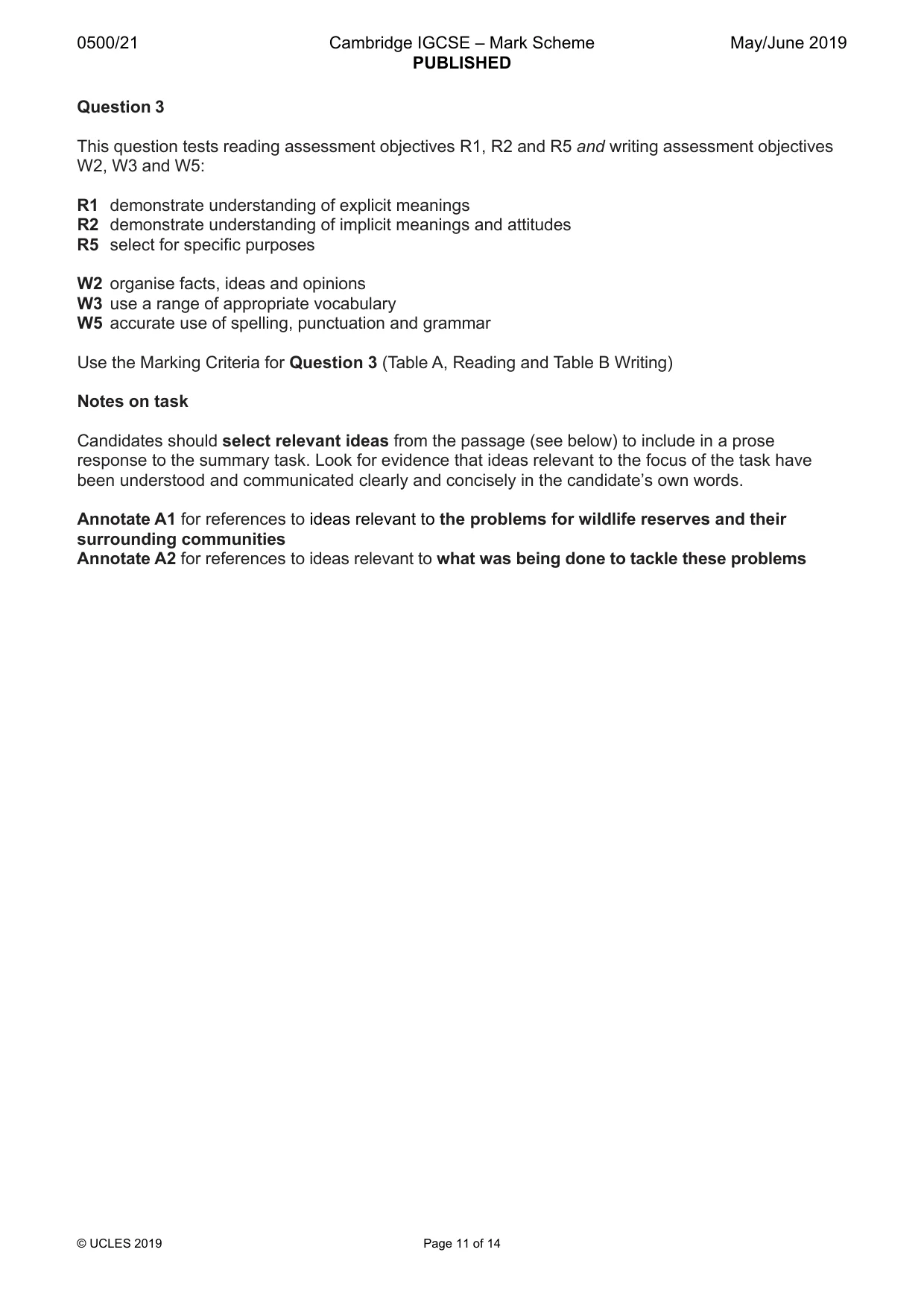
0500/21 Cambridge IGCSE – Mark Scheme PUBLISHED May/June 2019 © UCLES 2019 Page 11 of 14 Question 3 This question tests reading assessment objectives R1, R2 and R5 and writing assessment objectives W2, W3 and W5: R1 demonstrate understanding of explicit meanings R2 demonstrate understanding of implicit meanings and attitudes R5 select for specific purposes W2 organise facts, ideas and opinions W3 use a range of appropriate vocabulary W5 accurate use of spelling, punctuation and grammar Use the Marking Criteria for Question 3 (Table A, Reading and Table B Writing) Notes on task Candidates should select relevant ideas from the passage (see below) to include in a prose response to the summary task. Look for evidence that ideas relevant to the focus of the task have been understood and communicated clearly and concisely in the candidate’s own words. Annotate A1 for references to ideas relevant to the problems for wildlife reserves and their surrounding communities Annotate A2 for references to ideas relevant to what was being done to tackle these problems
Mark scheme, page 12
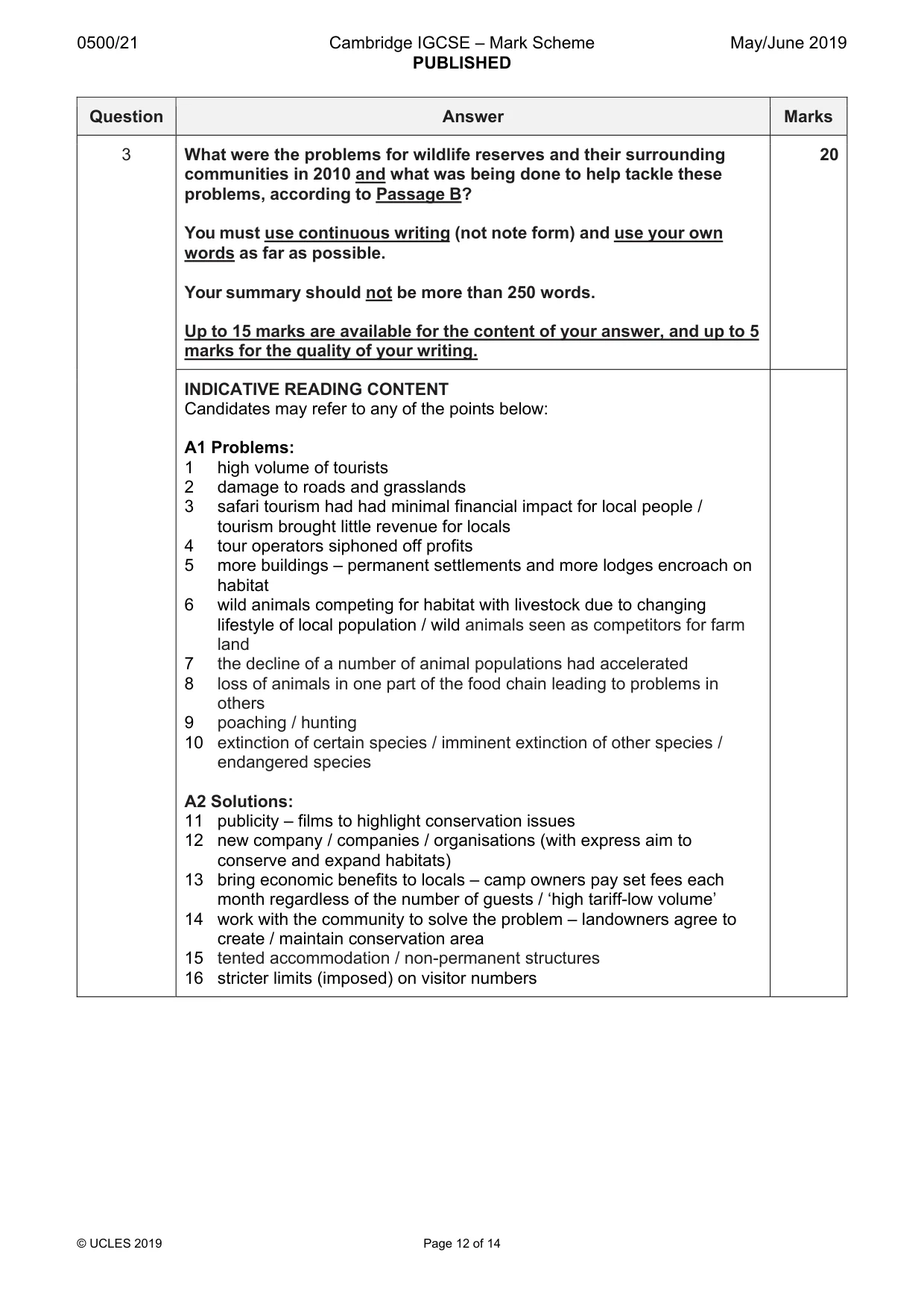
0500/21 Cambridge IGCSE – Mark Scheme PUBLISHED May/June 2019 © UCLES 2019 Page 12 of 14 Question Answer Marks 3 What were the problems for wildlife reserves and their surrounding communities in 2010 and what was being done to help tackle these problems, according to Passage B? You must use continuous writing (not note form) and use your own words as far as possible. Your summary should not be more than 250 words. Up to 15 marks are available for the content of your answer, and up to 5 marks for the quality of your writing. 20 INDICATIVE READING CONTENT Candidates may refer to any of the points below: A1 Problems: 1 high volume of tourists 2 damage to roads and grasslands 3 safari tourism had had minimal financial impact for local people / tourism brought little revenue for locals 4 tour operators siphoned off profits 5 more buildings – permanent settlements and more lodges encroach on habitat 6 wild animals competing for habitat with livestock due to changing lifestyle of local population / wild animals seen as competitors for farm land 7 the decline of a number of animal populations had accelerated 8 loss of animals in one part of the food chain leading to problems in others 9 poaching / hunting 10 extinction of certain species / imminent extinction of other species / endangered species A2 Solutions: 11 publicity – films to highlight conservation issues 12 new company / companies / organisations (with express aim to conserve and expand habitats) 13 bring economic benefits to locals – camp owners pay set fees each month regardless of the number of guests / ‘high tariff-low volume’ 14 work with the community to solve the problem – landowners agree to create / maintain conservation area 15 tented accommodation / non-permanent structures 16 stricter limits (imposed) on visitor numbers
Mark scheme, page 13
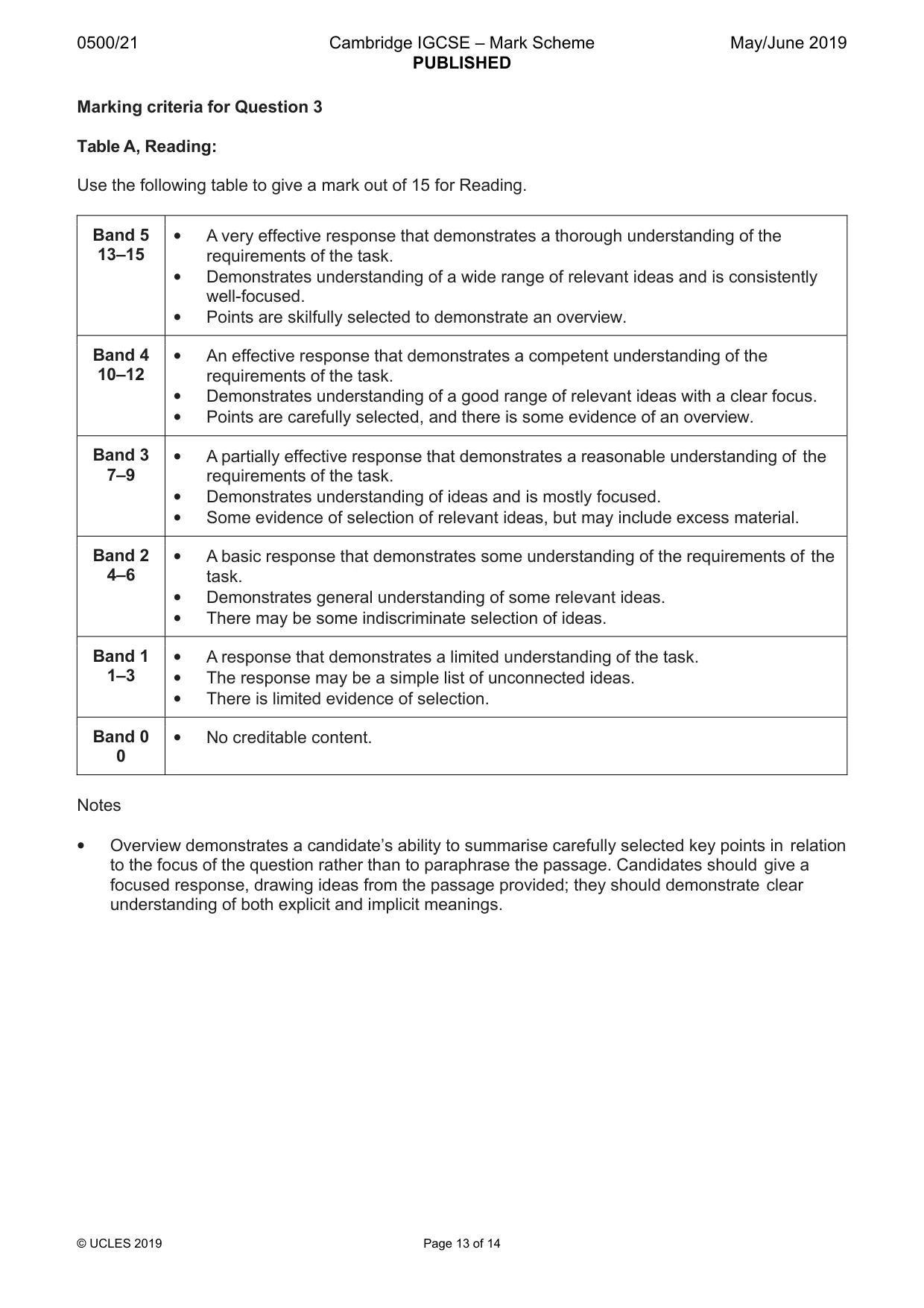
0500/21 Cambridge IGCSE – Mark Scheme PUBLISHED May/June 2019 © UCLES 2019 Page 13 of 14 Marking criteria for Question 3 Table A, Reading: Use the following table to give a mark out of 15 for Reading. Band 5 13–15 • A very effective response that demonstrates a thorough understanding of the requirements of the task. • Demonstrates understanding of a wide range of relevant ideas and is consistently well-focused. • Points are skilfully selected to demonstrate an overview. Band 4 10–12 • An effective response that demonstrates a competent understanding of the requirements of the task. • Demonstrates understanding of a good range of relevant ideas with a clear focus. • Points are carefully selected, and there is some evidence of an overview. Band 3 7–9 • A partially effective response that demonstrates a reasonable understanding of the requirements of the task. • Demonstrates understanding of ideas and is mostly focused. • Some evidence of selection of relevant ideas, but may include excess material. Band 2 4–6 • A basic response that demonstrates some understanding of the requirements of the task. • Demonstrates general understanding of some relevant ideas. • There may be some indiscriminate selection of ideas. Band 1 1–3 • A response that demonstrates a limited understanding of the task. • The response may be a simple list of unconnected ideas. • There is limited evidence of selection. Band 0 0 • No creditable content. Notes • Overview demonstrates a candidate’s ability to summarise carefully selected key points in relation to the focus of the question rather than to paraphrase the passage. Candidates should give a focused response, drawing ideas from the passage provided; they should demonstrate clear understanding of both explicit and implicit meanings.
Mark scheme, page 14
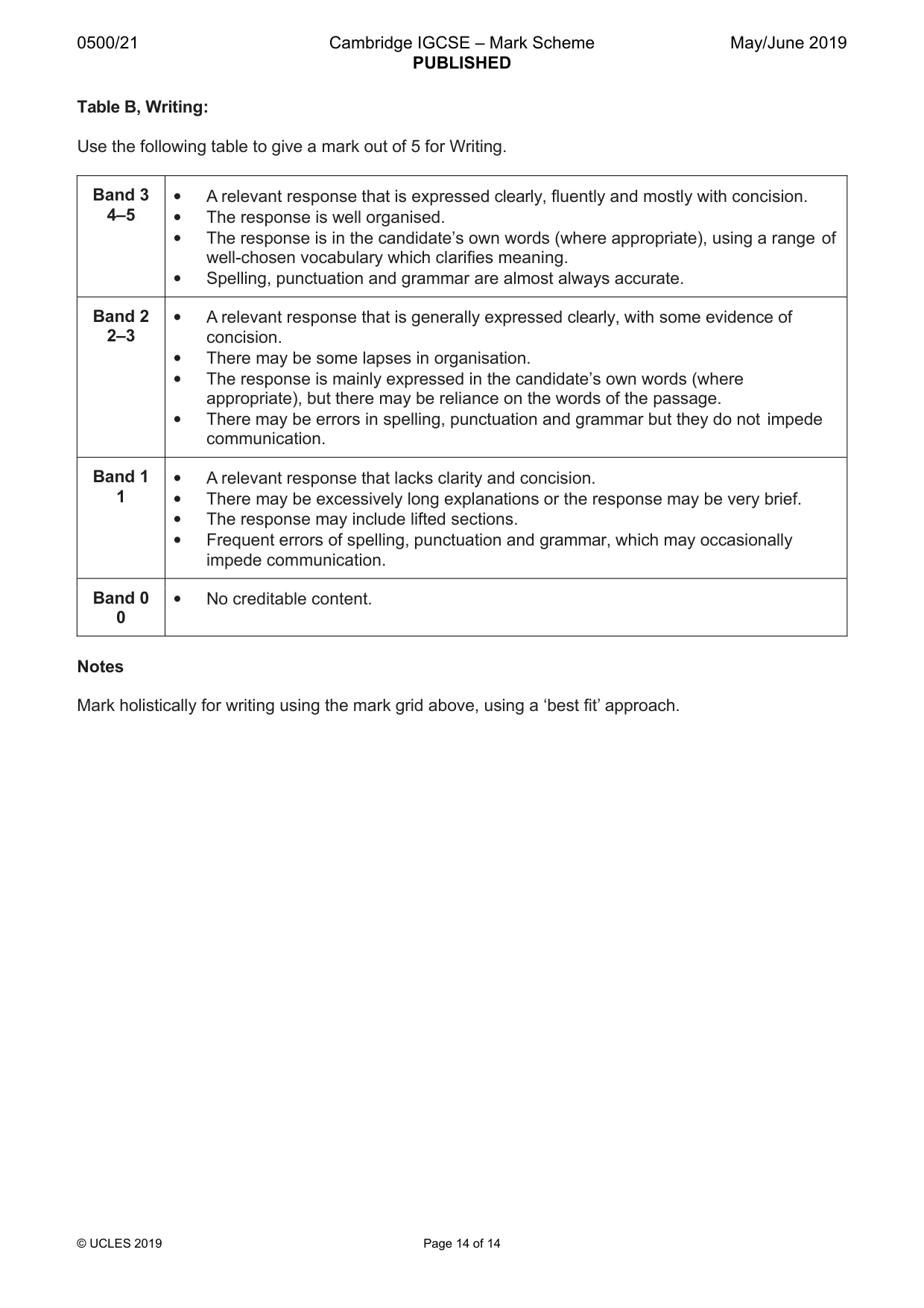
0500/21 Cambridge IGCSE – Mark Scheme PUBLISHED May/June 2019 © UCLES 2019 Page 14 of 14 Table B, Writing: Use the following table to give a mark out of 5 for Writing. Band 3 4–5 • A relevant response that is expressed clearly, fluently and mostly with concision. • The response is well organised. • The response is in the candidate’s own words (where appropriate), using a range of well-chosen vocabulary which clarifies meaning. • Spelling, punctuation and grammar are almost always accurate. Band 2 2–3 • A relevant response that is generally expressed clearly, with some evidence of concision. • There may be some lapses in organisation. • The response is mainly expressed in the candidate’s own words (where appropriate), but there may be reliance on the words of the passage. • There may be errors in spelling, punctuation and grammar but they do not impede communication. Band 1 1 • A relevant response that lacks clarity and concision. • There may be excessively long explanations or the response may be very brief. • The response may include lifted sections. • Frequent errors of spelling, punctuation and grammar, which may occasionally impede communication. Band 0 0 • No creditable content. Notes Mark holistically for writing using the mark grid above, using a ‘best fit’ approach.
What you needed in this session
Cambridge’s own grade thresholds for 2019 May/June, Paper 2 · Variant 1. A higher threshold means an easier paper — the bar moves with how the cohort did.