Cambridge IGCSE English - First Language 0500 — 2018 May/June Paper 2 · Variant 2
0500/22/M/J/18 · 50 marks · ≈56 min
The question paper and its mark scheme, free to read here and free to download. This is Cambridge’s own paper, exactly as it was sat.
Question paper12 pages
Mark scheme12 pages
Answers below. Sit the paper first if you are practising.
Paper as text
Question paper, page 1
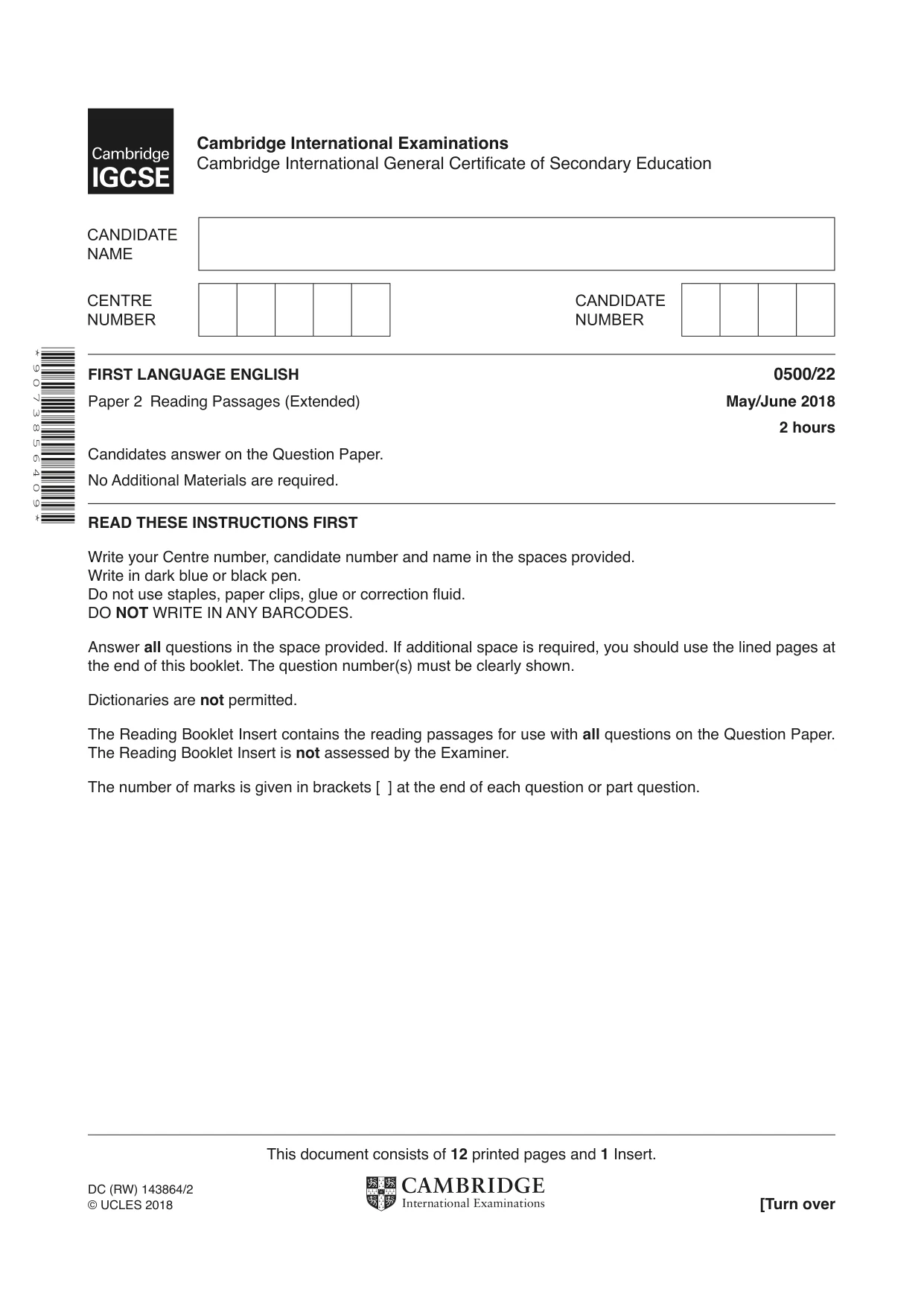
* 9 0 7 3 8 5 6 4 0 9 * This document consists of 12 printed pages and 1 Insert. DC (RW) 143864/2 © UCLES 2018 [Turn over Cambridge International Examinations Cambridge International General Certificate of Secondary Education FIRST LANGUAGE ENGLISH 0500/22 Paper 2 Reading Passages (Extended) May/June 2018 2 hours Candidates answer on the Question Paper. No Additional Materials are required. READ THESE INSTRUCTIONS FIRST Write your Centre number, candidate number and name in the spaces provided. Write in dark blue or black pen. Do not use staples, paper clips, glue or correction fluid. DO NOT WRITE IN ANY BARCODES. Answer all questions in the space provided. If additional space is required, you should use the lined pages at the end of this booklet. The question number(s) must be clearly shown. Dictionaries are not permitted. The Reading Booklet Insert contains the reading passages for use with all questions on the Question Paper. The Reading Booklet Insert is not assessed by the Examiner. The number of marks is given in brackets [ ] at the end of each question or part question.
Question paper, page 2
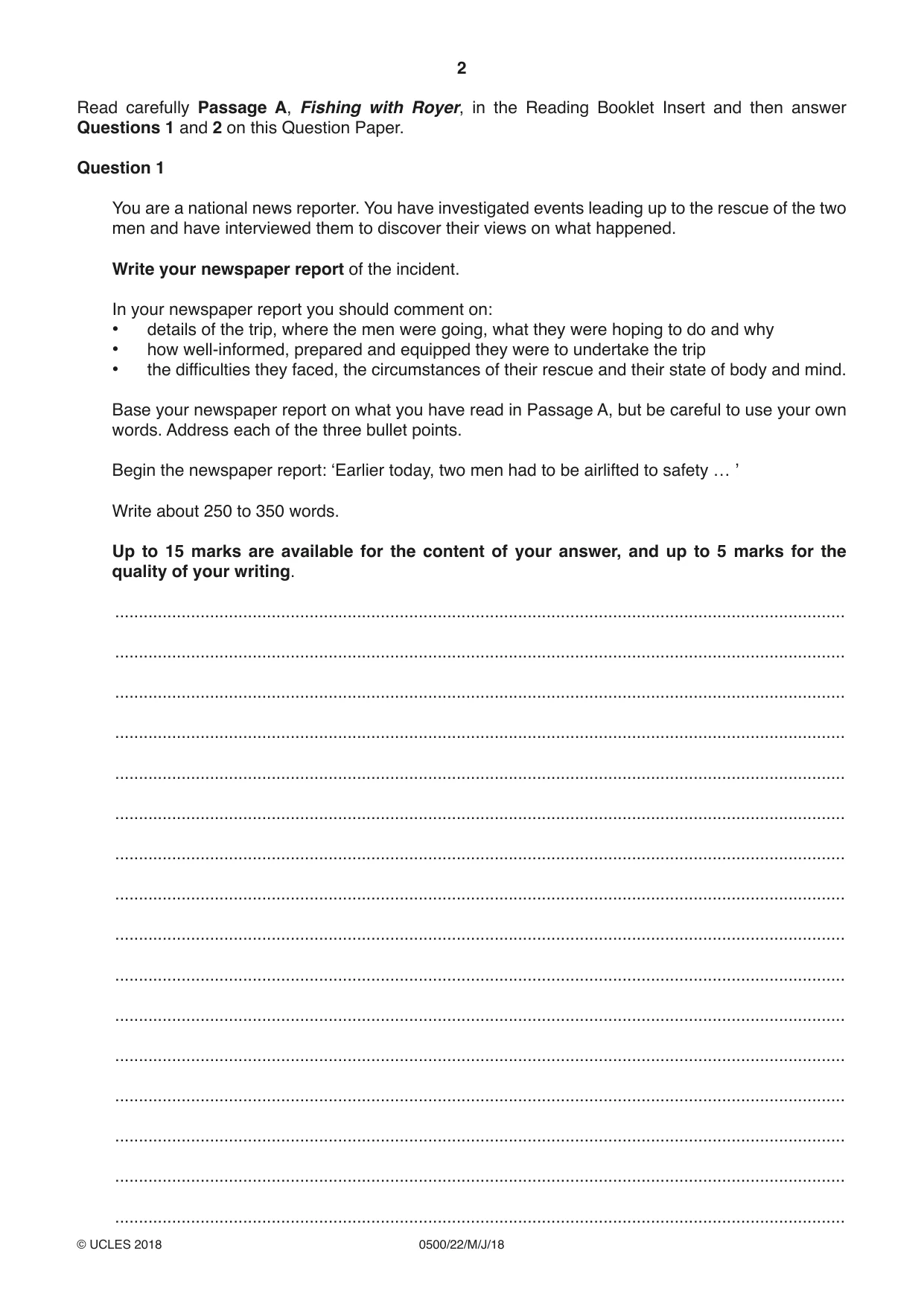
2 0500/22/M/J/18 © UCLES 2018 Read carefully Passage A, Fishing with Royer, in the Reading Booklet Insert and then answer Questions 1 and 2 on this Question Paper. Question 1 You are a national news reporter. You have investigated events leading up to the rescue of the two men and have interviewed them to discover their views on what happened. Write your newspaper report of the incident. In your newspaper report you should comment on: • details of the trip, where the men were going, what they were hoping to do and why • how well‑informed, prepared and equipped they were to undertake the trip • the difficulties they faced, the circumstances of their rescue and their state of body and mind. Base your newspaper report on what you have read in Passage A, but be careful to use your own words. Address each of the three bullet points. Begin the newspaper report: ‘Earlier today, two men had to be airlifted to safety … ’ Write about 250 to 350 words. Up to 15 marks are available for the content of your answer, and up to 5 marks for the quality of your writing. … … … … … … … … … … … … … … … …
Question paper, page 3
3 0500/22/M/J/18 © UCLES 2018 [Turn over … … … … … … … … … … … … … … … … … … … … … … … … … … … …
Question paper, page 4
4 0500/22/M/J/18 © UCLES 2018 … … … … … … … … … … … … … … … … … … … … … … … … … … … [Total: 20]
Question paper, page 5
5 0500/22/M/J/18 © UCLES 2018 [Turn over [Turn to page 6 for Question 2]
Question paper, page 6
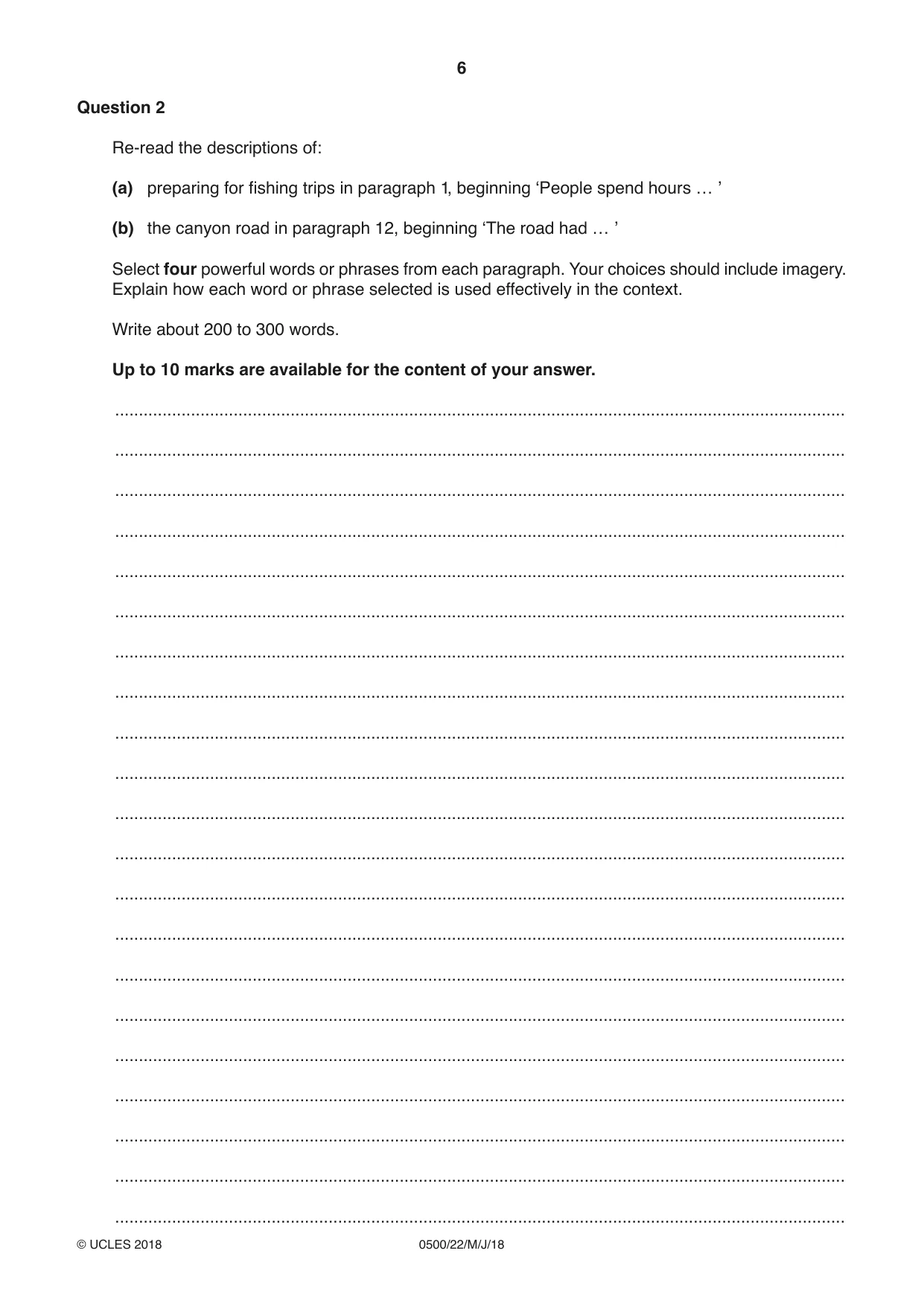
6 0500/22/M/J/18 © UCLES 2018 Question 2 Re‑read the descriptions of: (a) preparing for fishing trips in paragraph 1, beginning ‘People spend hours … ’ (b) the canyon road in paragraph 12, beginning ‘The road had … ’ Select four powerful words or phrases from each paragraph. Your choices should include imagery. Explain how each word or phrase selected is used effectively in the context. Write about 200 to 300 words. Up to 10 marks are available for the content of your answer. … … … … … … … … … … … … … … … … … … … … …
Question paper, page 7
7 0500/22/M/J/18 © UCLES 2018 [Turn over … … … … … … … … … … … … … … … … … … … … … … … … … … … [Total: 10]
Question paper, page 8
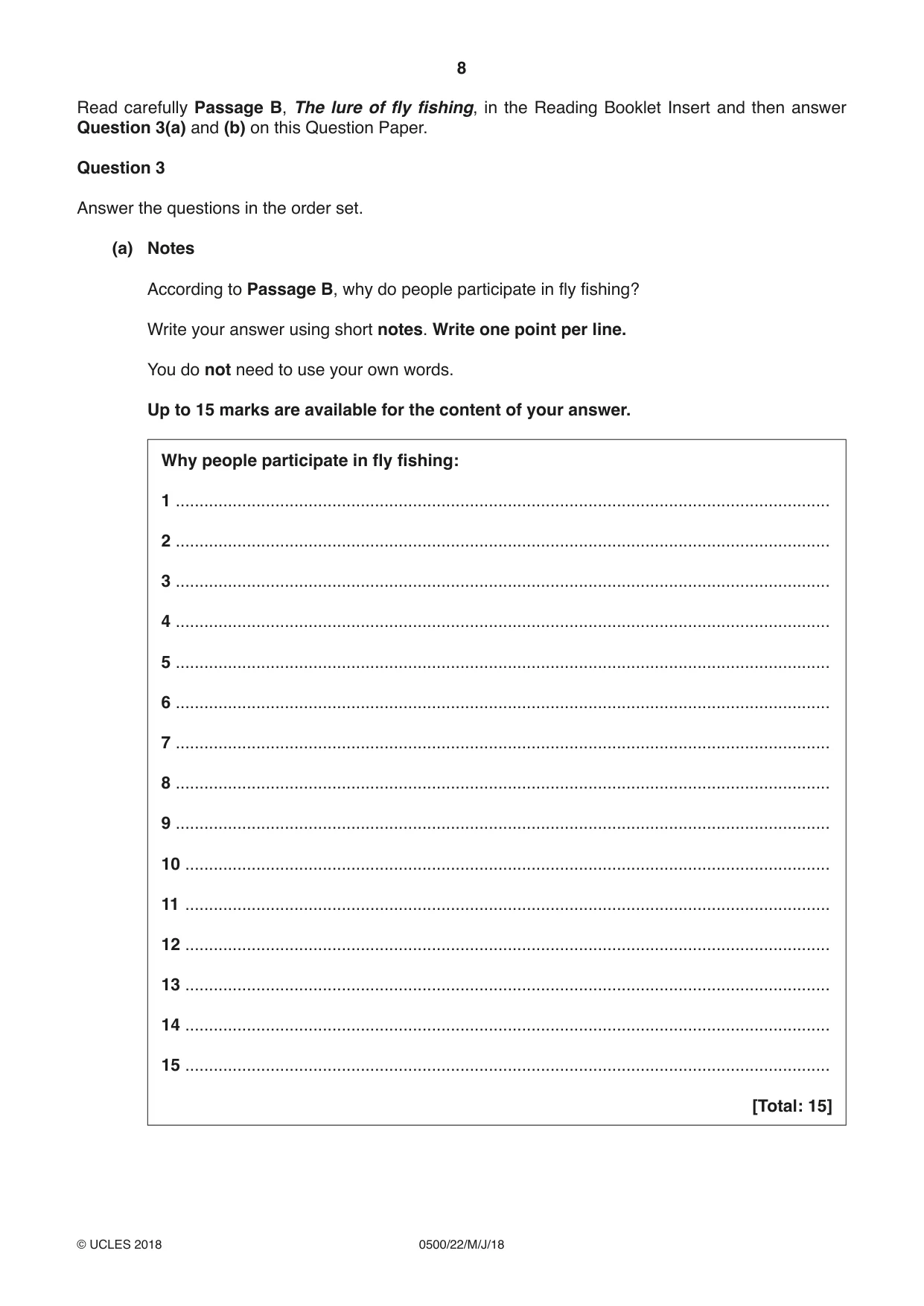
8 0500/22/M/J/18 © UCLES 2018 Read carefully Passage B, The lure of fly fishing, in the Reading Booklet Insert and then answer Question 3(a) and (b) on this Question Paper. Question 3 Answer the questions in the order set. (a) Notes According to Passage B, why do people participate in fly fishing? Write your answer using short notes. Write one point per line. You do not need to use your own words. Up to 15 marks are available for the content of your answer. Why people participate in fly fishing: 1 … 2 … 3 … 4 … 5 … 6 … 7 … 8 … 9 … 10 … 11 … 12 … 13 … 14 … 15 … [Total: 15]
Question paper, page 9
9 0500/22/M/J/18 © UCLES 2018 [Turn over (b) Summary Now use your notes to write a summary of why people participate in fly fishing, according to Passage B. You must use continuous writing (not note form) and use your own words as far as possible. Your summary should include all 15 of your points in Question 3(a) and must be 200 to 250 words. Up to 5 marks are available for the quality of your writing. … … … … … … … … … … … … … … … … … … … … … …
Question paper, page 10
10 0500/22/M/J/18 © UCLES 2018 … … … … … … … … … … … [Total: 5]
Question paper, page 11
11 0500/22/M/J/18 © UCLES 2018 Additional Page If you use the following lined page to complete the answer(s) to any question(s), the question number(s) must be clearly shown. … … … … … … … … … … … … … … … … … … … … … … … … … …
Question paper, page 12
12 0500/22/M/J/18 © UCLES 2018 Permission to reproduce items where third‑party owned material protected by copyright is included has been sought and cleared where possible. Every reasonable effort has been made by the publisher (UCLES) to trace copyright holders, but if any items requiring clearance have unwittingly been included, the publisher will be pleased to make amends at the earliest possible opportunity. To avoid the issue of disclosure of answer‑related information to candidates, all copyright acknowledgements are reproduced online in the Cambridge International Examinations Copyright Acknowledgements Booklet. This is produced for each series of examinations and is freely available to download at www.cie.org.uk after the live examination series. Cambridge International Examinations is part of the Cambridge Assessment Group. Cambridge Assessment is the brand name of University of Cambridge Local Examinations Syndicate (UCLES), which is itself a department of the University of Cambridge. Additional Page If you use the following lined page to complete the answer(s) to any question(s), the question number(s) must be clearly shown. … … … … … … … … … … … … … … … … … … … … … …
Mark scheme, page 1
IGCSE™ is a registered trademark. This document consists of 12 printed pages. © UCLES 2018 [Turn over Cambridge Assessment International Education Cambridge International General Certificate of Secondary Education FIRST LANGUAGE ENGLISH 0500/22 Paper 2 Reading Passages (Extended) May/June 2018 MARK SCHEME Maximum Mark: 50 Published This mark scheme is published as an aid to teachers and candidates, to indicate the requirements of the examination. It shows the basis on which Examiners were instructed to award marks. It does not indicate the details of the discussions that took place at an Examiners’ meeting before marking began, which would have considered the acceptability of alternative answers. Mark schemes should be read in conjunction with the question paper and the Principal Examiner Report for Teachers. Cambridge International will not enter into discussions about these mark schemes. Cambridge International is publishing the mark schemes for the May/June 2018 series for most Cambridge IGCSE™, Cambridge International A and AS Level and Cambridge Pre-U components, and some Cambridge O Level components.
Mark scheme, page 2
0500/22 Cambridge IGCSE – Mark Scheme PUBLISHED May/June 2018 © UCLES 2018 Page 2 of 12 Generic Marking Principles These general marking principles must be applied by all examiners when marking candidate answers. They should be applied alongside the specific content of the mark scheme or generic level descriptors for a question. Each question paper and mark scheme will also comply with these marking principles. GENERIC MARKING PRINCIPLE 1: Marks must be awarded in line with: • the specific content of the mark scheme or the generic level descriptors for the question • the specific skills defined in the mark scheme or in the generic level descriptors for the question • the standard of response required by a candidate as exemplified by the standardisation scripts. GENERIC MARKING PRINCIPLE 2: Marks awarded are always whole marks (not half marks, or other fractions). GENERIC MARKING PRINCIPLE 3: Marks must be awarded positively: • marks are awarded for correct/valid answers, as defined in the mark scheme. However, credit is given for valid answers which go beyond the scope of the syllabus and mark scheme, referring to your Team Leader as appropriate • marks are awarded when candidates clearly demonstrate what they know and can do • marks are not deducted for errors • marks are not deducted for omissions • answers should only be judged on the quality of spelling, punctuation and grammar when these features are specifically assessed by the question as indicated by the mark scheme. The meaning, however, should be unambiguous. GENERIC MARKING PRINCIPLE 4: Rules must be applied consistently e.g. in situations where candidates have not followed instructions or in the application of generic level descriptors. GENERIC MARKING PRINCIPLE 5: Marks should be awarded using the full range of marks defined in the mark scheme for the question (however; the use of the full mark range may be limited according to the quality of the candidate responses seen). GENERIC MARKING PRINCIPLE 6: Marks awarded are based solely on the requirements as defined in the mark scheme. Marks should not be awarded with grade thresholds or grade descriptors in mind.
Mark scheme, page 3
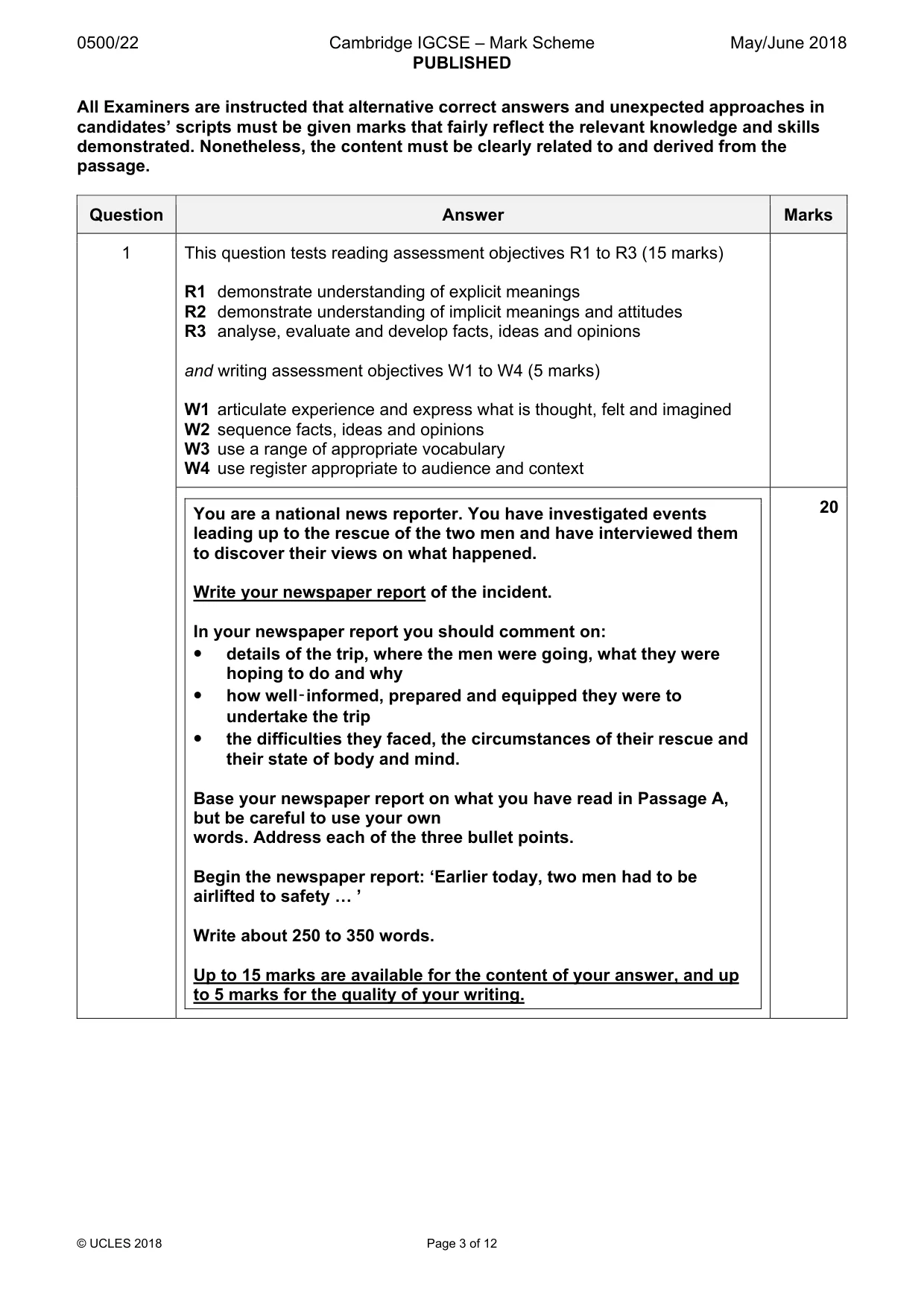
0500/22 Cambridge IGCSE – Mark Scheme PUBLISHED May/June 2018 © UCLES 2018 Page 3 of 12 All Examiners are instructed that alternative correct answers and unexpected approaches in candidates’ scripts must be given marks that fairly reflect the relevant knowledge and skills demonstrated. Nonetheless, the content must be clearly related to and derived from the passage. Question Answer Marks 1 This question tests reading assessment objectives R1 to R3 (15 marks) R1 demonstrate understanding of explicit meanings R2 demonstrate understanding of implicit meanings and attitudes R3 analyse, evaluate and develop facts, ideas and opinions and writing assessment objectives W1 to W4 (5 marks) W1 articulate experience and express what is thought, felt and imagined W2 sequence facts, ideas and opinions W3 use a range of appropriate vocabulary W4 use register appropriate to audience and context You are a national news reporter. You have investigated events leading up to the rescue of the two men and have interviewed them to discover their views on what happened. Write your newspaper report of the incident. In your newspaper report you should comment on: • details of the trip, where the men were going, what they were hoping to do and why • how well‑informed, prepared and equipped they were to undertake the trip • the difficulties they faced, the circumstances of their rescue and their state of body and mind. Base your newspaper report on what you have read in Passage A, but be careful to use your own words. Address each of the three bullet points. Begin the newspaper report: ‘Earlier today, two men had to be airlifted to safety « ’ Write about 250 to 350 words. Up to 15 marks are available for the content of your answer, and up to 5 marks for the quality of your writing. 20
Mark scheme, page 4
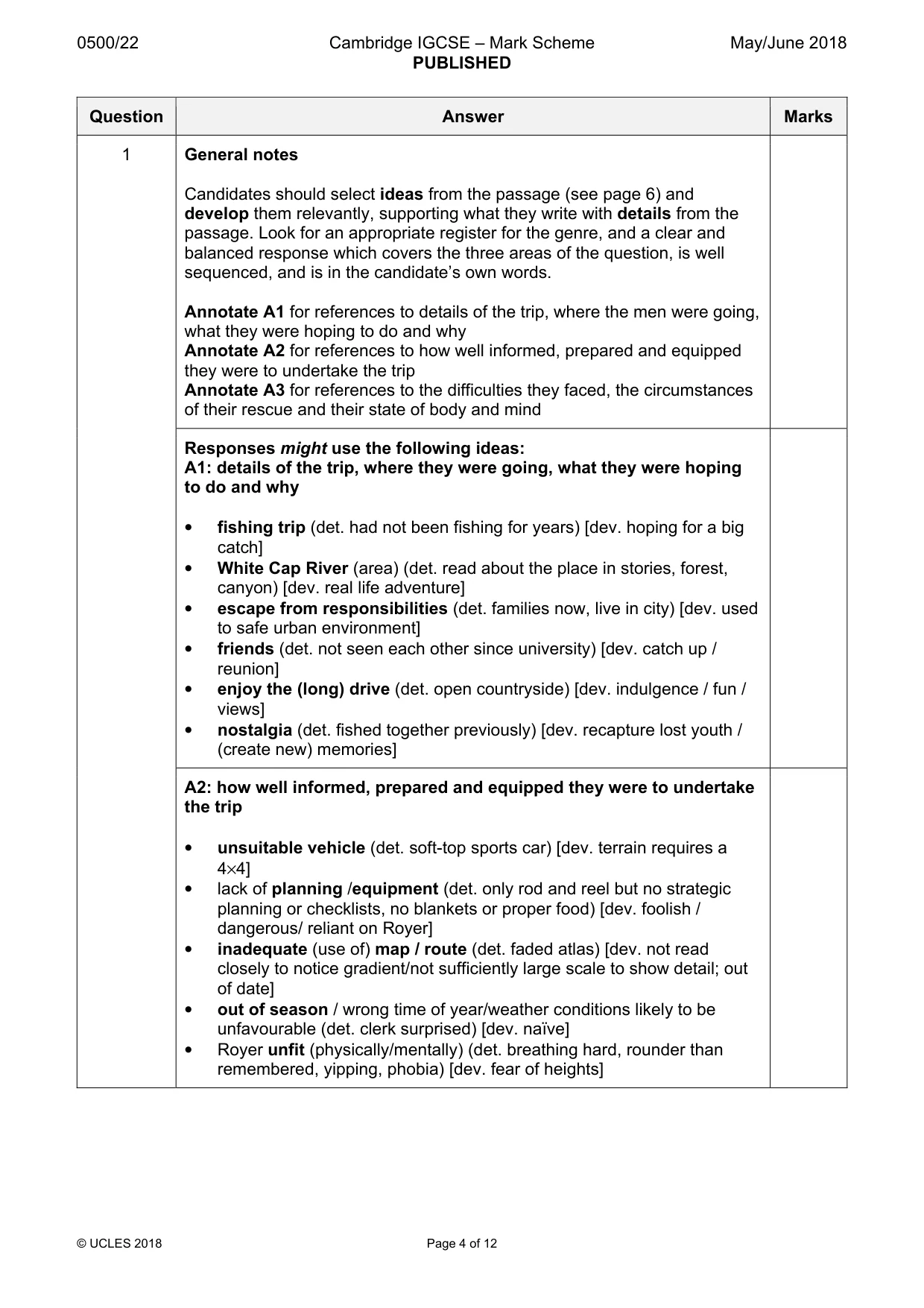
0500/22 Cambridge IGCSE – Mark Scheme PUBLISHED May/June 2018 © UCLES 2018 Page 4 of 12 Question Answer Marks 1 General notes Candidates should select ideas from the passage (see page 6) and develop them relevantly, supporting what they write with details from the passage. Look for an appropriate register for the genre, and a clear and balanced response which covers the three areas of the question, is well sequenced, and is in the candidate’s own words. Annotate A1 for references to details of the trip, where the men were going, what they were hoping to do and why Annotate A2 for references to how well informed, prepared and equipped they were to undertake the trip Annotate A3 for references to the difficulties they faced, the circumstances of their rescue and their state of body and mind Responses might use the following ideas: A1: details of the trip, where they were going, what they were hoping to do and why • fishing trip (det. had not been fishing for years) [dev. hoping for a big catch] • White Cap River (area) (det. read about the place in stories, forest, canyon) [dev. real life adventure] • escape from responsibilities (det. families now, live in city) [dev. used to safe urban environment] • friends (det. not seen each other since university) [dev. catch up / reunion] • enjoy the (long) drive (det. open countryside) [dev. indulgence / fun / views] • nostalgia (det. fished together previously) [dev. recapture lost youth / (create new) memories] A2: how well informed, prepared and equipped they were to undertake the trip • unsuitable vehicle (det. soft-top sports car) [dev. terrain requires a 4×4] • lack of planning /equipment (det. only rod and reel but no strategic planning or checklists, no blankets or proper food) [dev. foolish / dangerous/ reliant on Royer] • inadequate (use of) map / route (det. faded atlas) [dev. not read closely to notice gradient/not sufficiently large scale to show detail; out of date] • out of season / wrong time of year/weather conditions likely to be unfavourable (det. clerk surprised) [dev. naïve] • Royer unfit (physically/mentally) (det. breathing hard, rounder than remembered, yipping, phobia) [dev. fear of heights]
Mark scheme, page 5
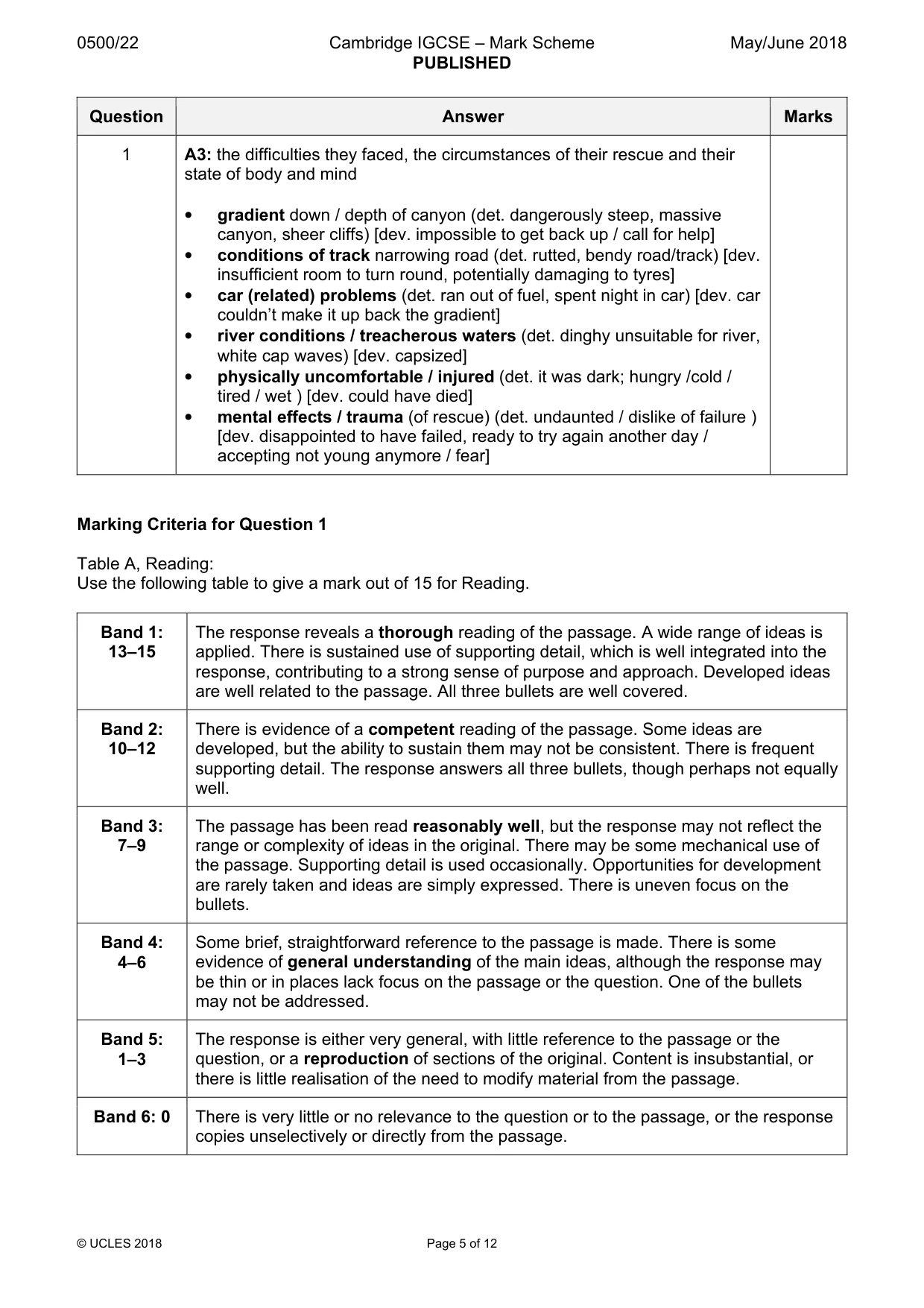
0500/22 Cambridge IGCSE – Mark Scheme PUBLISHED May/June 2018 © UCLES 2018 Page 5 of 12 Question Answer Marks 1 A3: the difficulties they faced, the circumstances of their rescue and their state of body and mind • gradient down / depth of canyon (det. dangerously steep, massive canyon, sheer cliffs) [dev. impossible to get back up / call for help] • conditions of track narrowing road (det. rutted, bendy road/track) [dev. insufficient room to turn round, potentially damaging to tyres] • car (related) problems (det. ran out of fuel, spent night in car) [dev. car couldn’t make it up back the gradient] • river conditions / treacherous waters (det. dinghy unsuitable for river, white cap waves) [dev. capsized] • physically uncomfortable / injured (det. it was dark; hungry /cold / tired / wet ) [dev. could have died] • mental effects / trauma (of rescue) (det. undaunted / dislike of failure ) [dev. disappointed to have failed, ready to try again another day / accepting not young anymore / fear] Marking Criteria for Question 1 Table A, Reading: Use the following table to give a mark out of 15 for Reading. Band 1: 13–15 The response reveals a thorough reading of the passage. A wide range of ideas is applied. There is sustained use of supporting detail, which is well integrated into the response, contributing to a strong sense of purpose and approach. Developed ideas are well related to the passage. All three bullets are well covered. Band 2: 10–12 There is evidence of a competent reading of the passage. Some ideas are developed, but the ability to sustain them may not be consistent. There is frequent supporting detail. The response answers all three bullets, though perhaps not equally well. Band 3: 7–9 The passage has been read reasonably well, but the response may not reflect the range or complexity of ideas in the original. There may be some mechanical use of the passage. Supporting detail is used occasionally. Opportunities for development are rarely taken and ideas are simply expressed. There is uneven focus on the bullets. Band 4: 4–6 Some brief, straightforward reference to the passage is made. There is some evidence of general understanding of the main ideas, although the response may be thin or in places lack focus on the passage or the question. One of the bullets may not be addressed. Band 5: 1–3 The response is either very general, with little reference to the passage or the question, or a reproduction of sections of the original. Content is insubstantial, or there is little realisation of the need to modify material from the passage. Band 6: 0 There is very little or no relevance to the question or to the passage, or the response copies unselectively or directly from the passage.
Mark scheme, page 6
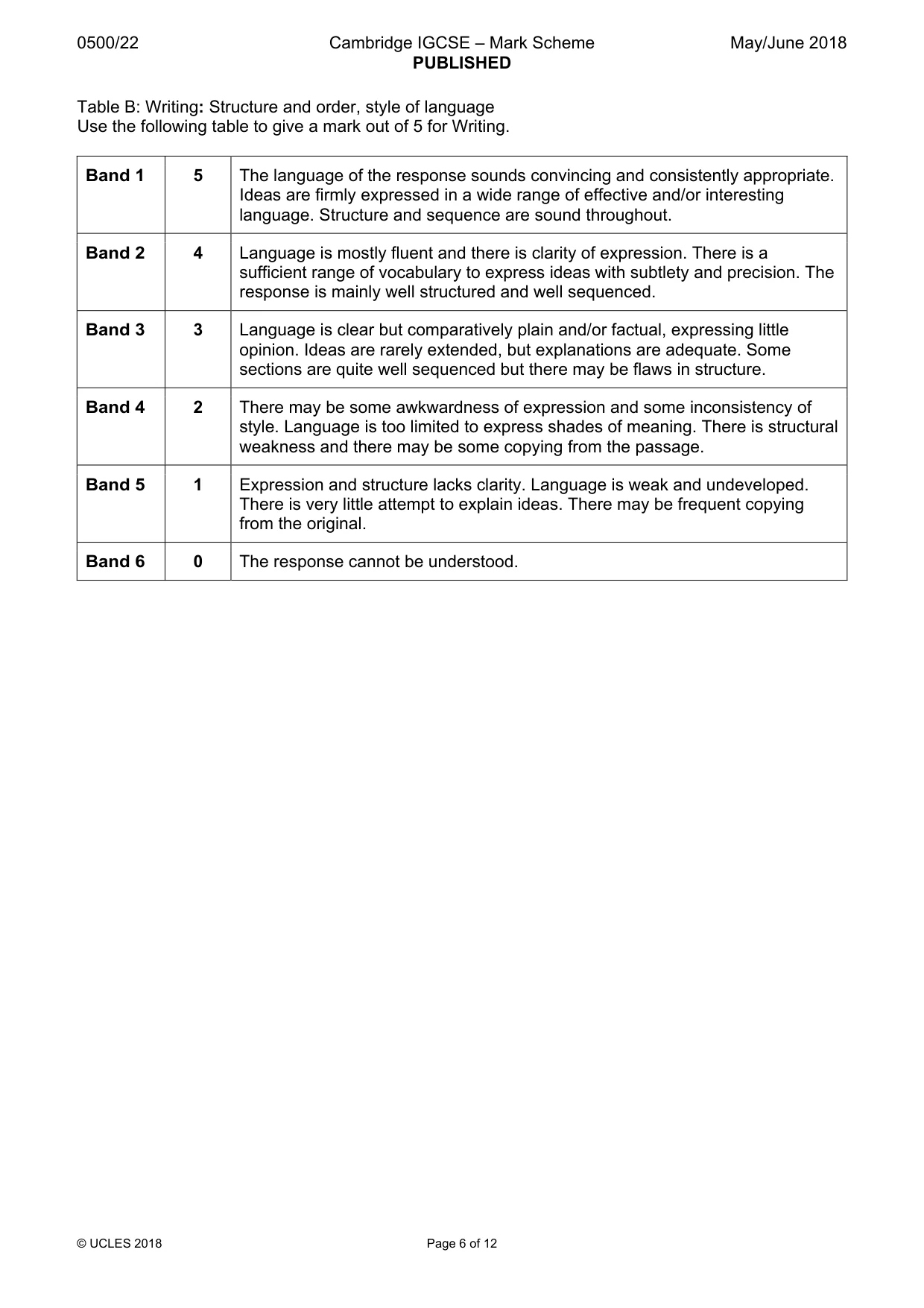
0500/22 Cambridge IGCSE – Mark Scheme PUBLISHED May/June 2018 © UCLES 2018 Page 6 of 12 Table B: Writing: Structure and order, style of language Use the following table to give a mark out of 5 for Writing. Band 1 5 The language of the response sounds convincing and consistently appropriate. Ideas are firmly expressed in a wide range of effective and/or interesting language. Structure and sequence are sound throughout. Band 2 4 Language is mostly fluent and there is clarity of expression. There is a sufficient range of vocabulary to express ideas with subtlety and precision. The response is mainly well structured and well sequenced. Band 3 3 Language is clear but comparatively plain and/or factual, expressing little opinion. Ideas are rarely extended, but explanations are adequate. Some sections are quite well sequenced but there may be flaws in structure. Band 4 2 There may be some awkwardness of expression and some inconsistency of style. Language is too limited to express shades of meaning. There is structural weakness and there may be some copying from the passage. Band 5 1 Expression and structure lacks clarity. Language is weak and undeveloped. There is very little attempt to explain ideas. There may be frequent copying from the original. Band 6 0 The response cannot be understood.
Mark scheme, page 7
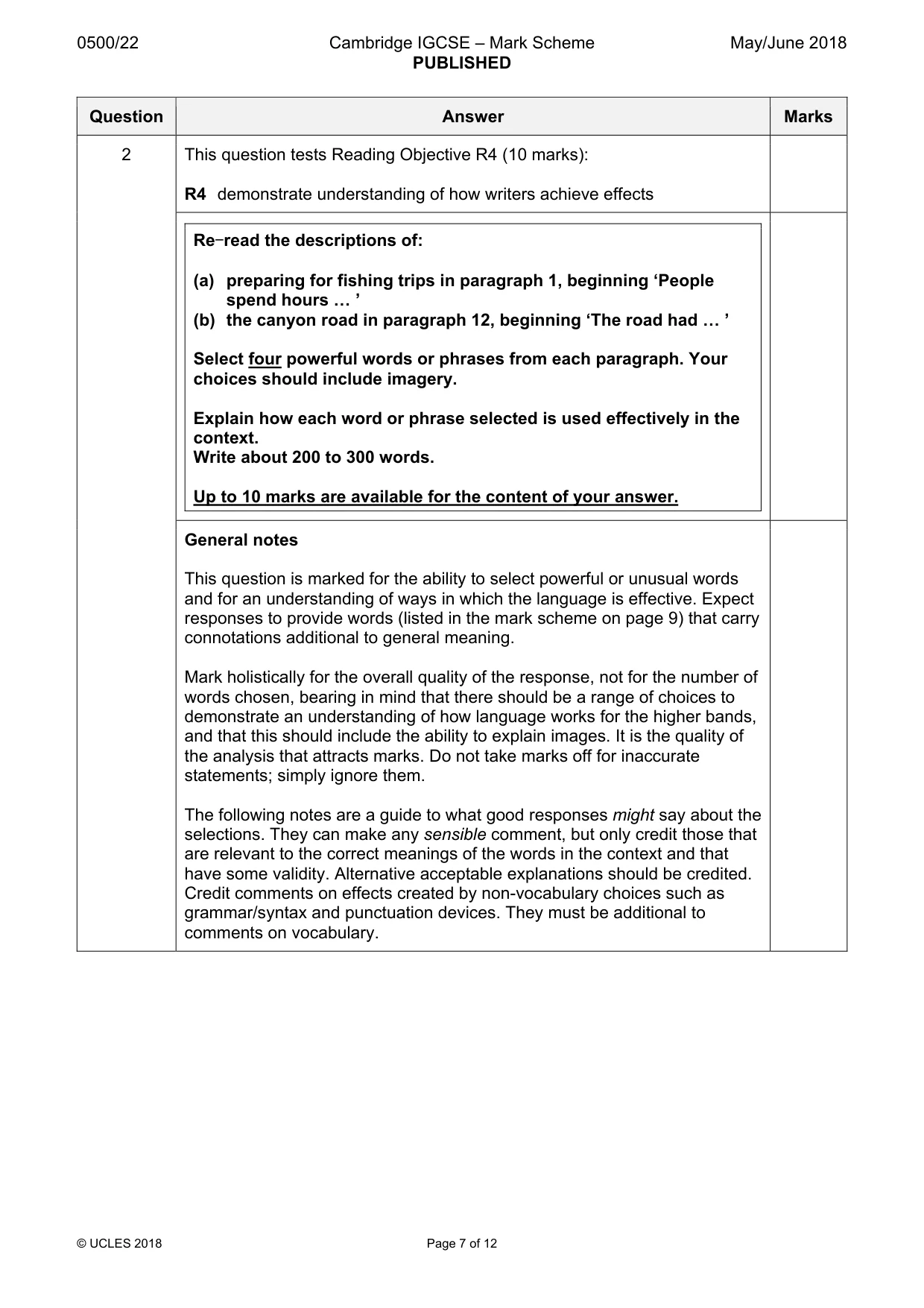
0500/22 Cambridge IGCSE – Mark Scheme PUBLISHED May/June 2018 © UCLES 2018 Page 7 of 12 Question Answer Marks 2 This question tests Reading Objective R4 (10 marks): R4 demonstrate understanding of how writers achieve effects Re-read the descriptions of: (a) preparing for fishing trips in paragraph 1, beginning ‘People spend hours « ’ (b) the canyon road in paragraph 12, beginning ‘The road had « ’ Select four powerful words or phrases from each paragraph. Your choices should include imagery. Explain how each word or phrase selected is used effectively in the context. Write about 200 to 300 words. Up to 10 marks are available for the content of your answer. General notes This question is marked for the ability to select powerful or unusual words and for an understanding of ways in which the language is effective. Expect responses to provide words (listed in the mark scheme on page 9) that carry connotations additional to general meaning. Mark holistically for the overall quality of the response, not for the number of words chosen, bearing in mind that there should be a range of choices to demonstrate an understanding of how language works for the higher bands, and that this should include the ability to explain images. It is the quality of the analysis that attracts marks. Do not take marks off for inaccurate statements; simply ignore them. The following notes are a guide to what good responses might say about the selections. They can make any sensible comment, but only credit those that are relevant to the correct meanings of the words in the context and that have some validity. Alternative acceptable explanations should be credited. Credit comments on effects created by non-vocabulary choices such as grammar/syntax and punctuation devices. They must be additional to comments on vocabulary.
Mark scheme, page 8
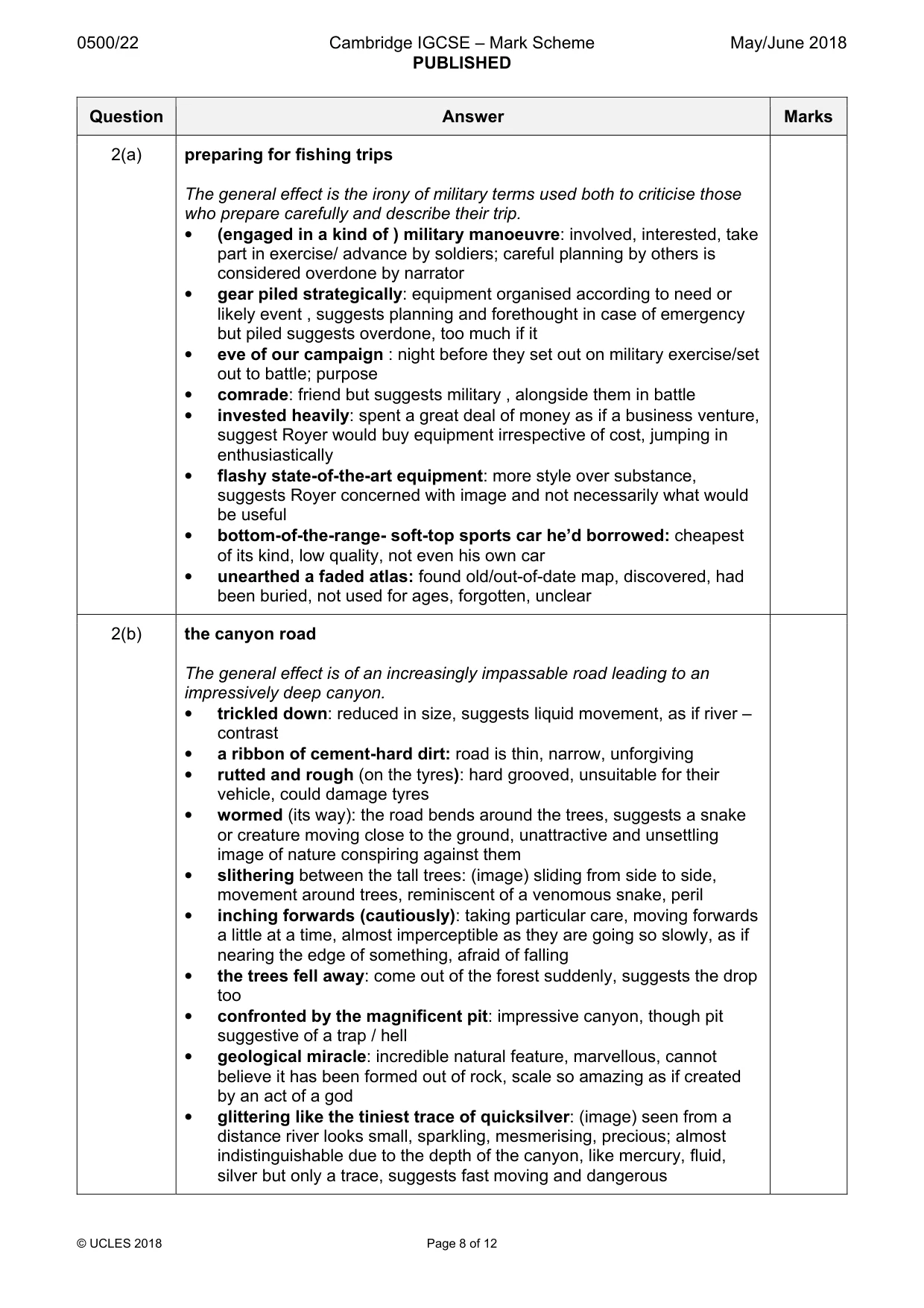
0500/22 Cambridge IGCSE – Mark Scheme PUBLISHED May/June 2018 © UCLES 2018 Page 8 of 12 Question Answer Marks 2(a) preparing for fishing trips The general effect is the irony of military terms used both to criticise those who prepare carefully and describe their trip. • (engaged in a kind of ) military manoeuvre: involved, interested, take part in exercise/ advance by soldiers; careful planning by others is considered overdone by narrator • gear piled strategically: equipment organised according to need or likely event , suggests planning and forethought in case of emergency but piled suggests overdone, too much if it • eve of our campaign : night before they set out on military exercise/set out to battle; purpose • comrade: friend but suggests military , alongside them in battle • invested heavily: spent a great deal of money as if a business venture, suggest Royer would buy equipment irrespective of cost, jumping in enthusiastically • flashy state-of-the-art equipment: more style over substance, suggests Royer concerned with image and not necessarily what would be useful • bottom-of-the-range- soft-top sports car he’d borrowed: cheapest of its kind, low quality, not even his own car • unearthed a faded atlas: found old/out-of-date map, discovered, had been buried, not used for ages, forgotten, unclear 2(b) the canyon road The general effect is of an increasingly impassable road leading to an impressively deep canyon. • trickled down: reduced in size, suggests liquid movement, as if river – contrast • a ribbon of cement-hard dirt: road is thin, narrow, unforgiving • rutted and rough (on the tyres): hard grooved, unsuitable for their vehicle, could damage tyres • wormed (its way): the road bends around the trees, suggests a snake or creature moving close to the ground, unattractive and unsettling image of nature conspiring against them • slithering between the tall trees: (image) sliding from side to side, movement around trees, reminiscent of a venomous snake, peril • inching forwards (cautiously): taking particular care, moving forwards a little at a time, almost imperceptible as they are going so slowly, as if nearing the edge of something, afraid of falling • the trees fell away: come out of the forest suddenly, suggests the drop too • confronted by the magnificent pit: impressive canyon, though pit suggestive of a trap / hell • geological miracle: incredible natural feature, marvellous, cannot believe it has been formed out of rock, scale so amazing as if created by an act of a god • glittering like the tiniest trace of quicksilver: (image) seen from a distance river looks small, sparkling, mesmerising, precious; almost indistinguishable due to the depth of the canyon, like mercury, fluid, silver but only a trace, suggests fast moving and dangerous
Mark scheme, page 9
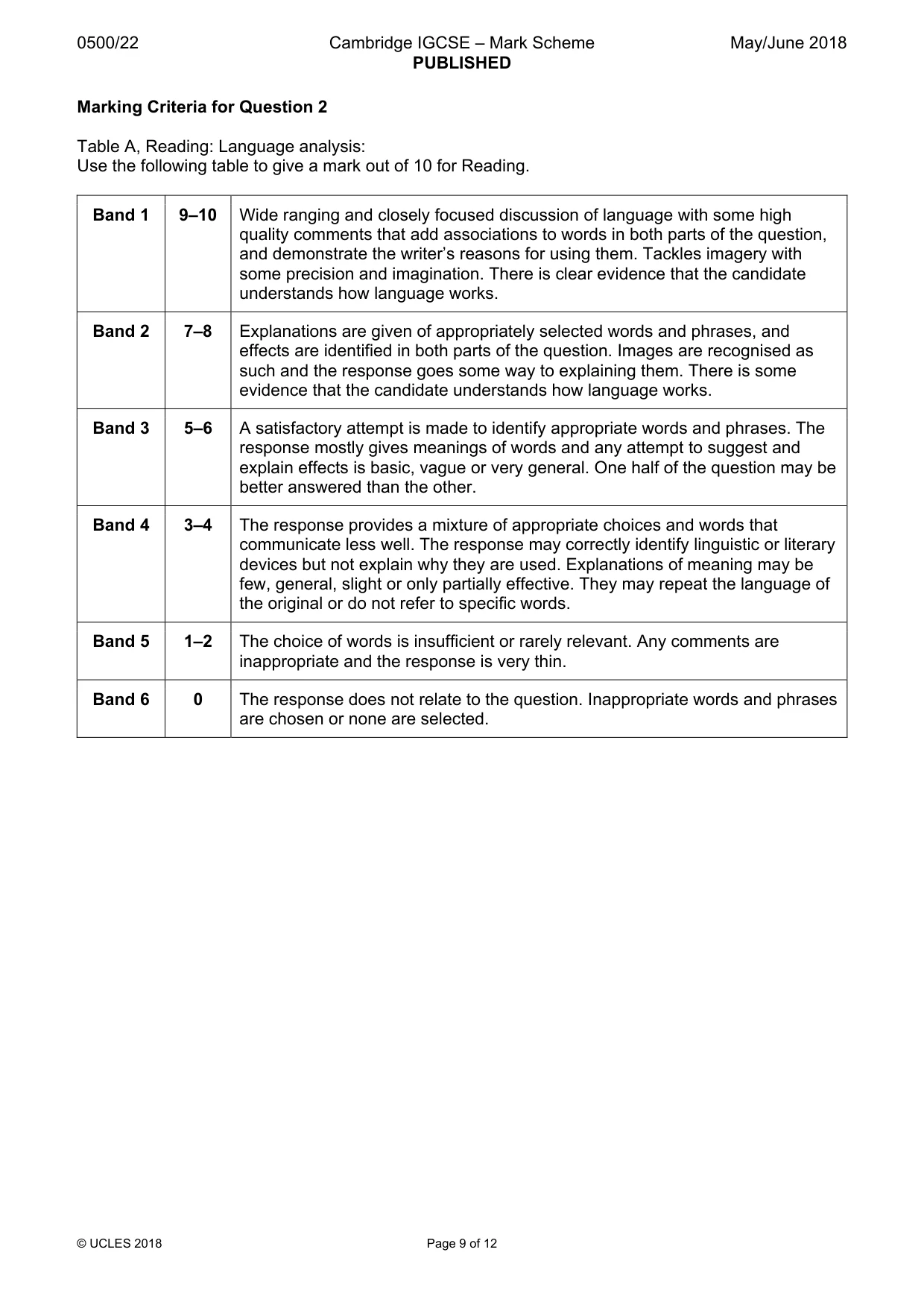
0500/22 Cambridge IGCSE – Mark Scheme PUBLISHED May/June 2018 © UCLES 2018 Page 9 of 12 Marking Criteria for Question 2 Table A, Reading: Language analysis: Use the following table to give a mark out of 10 for Reading. Band 1 9–10 Wide ranging and closely focused discussion of language with some high quality comments that add associations to words in both parts of the question, and demonstrate the writer’s reasons for using them. Tackles imagery with some precision and imagination. There is clear evidence that the candidate understands how language works. Band 2 7–8 Explanations are given of appropriately selected words and phrases, and effects are identified in both parts of the question. Images are recognised as such and the response goes some way to explaining them. There is some evidence that the candidate understands how language works. Band 3 5–6 A satisfactory attempt is made to identify appropriate words and phrases. The response mostly gives meanings of words and any attempt to suggest and explain effects is basic, vague or very general. One half of the question may be better answered than the other. Band 4 3–4 The response provides a mixture of appropriate choices and words that communicate less well. The response may correctly identify linguistic or literary devices but not explain why they are used. Explanations of meaning may be few, general, slight or only partially effective. They may repeat the language of the original or do not refer to specific words. Band 5 1–2 The choice of words is insufficient or rarely relevant. Any comments are inappropriate and the response is very thin. Band 6 0 The response does not relate to the question. Inappropriate words and phrases are chosen or none are selected.
Mark scheme, page 10
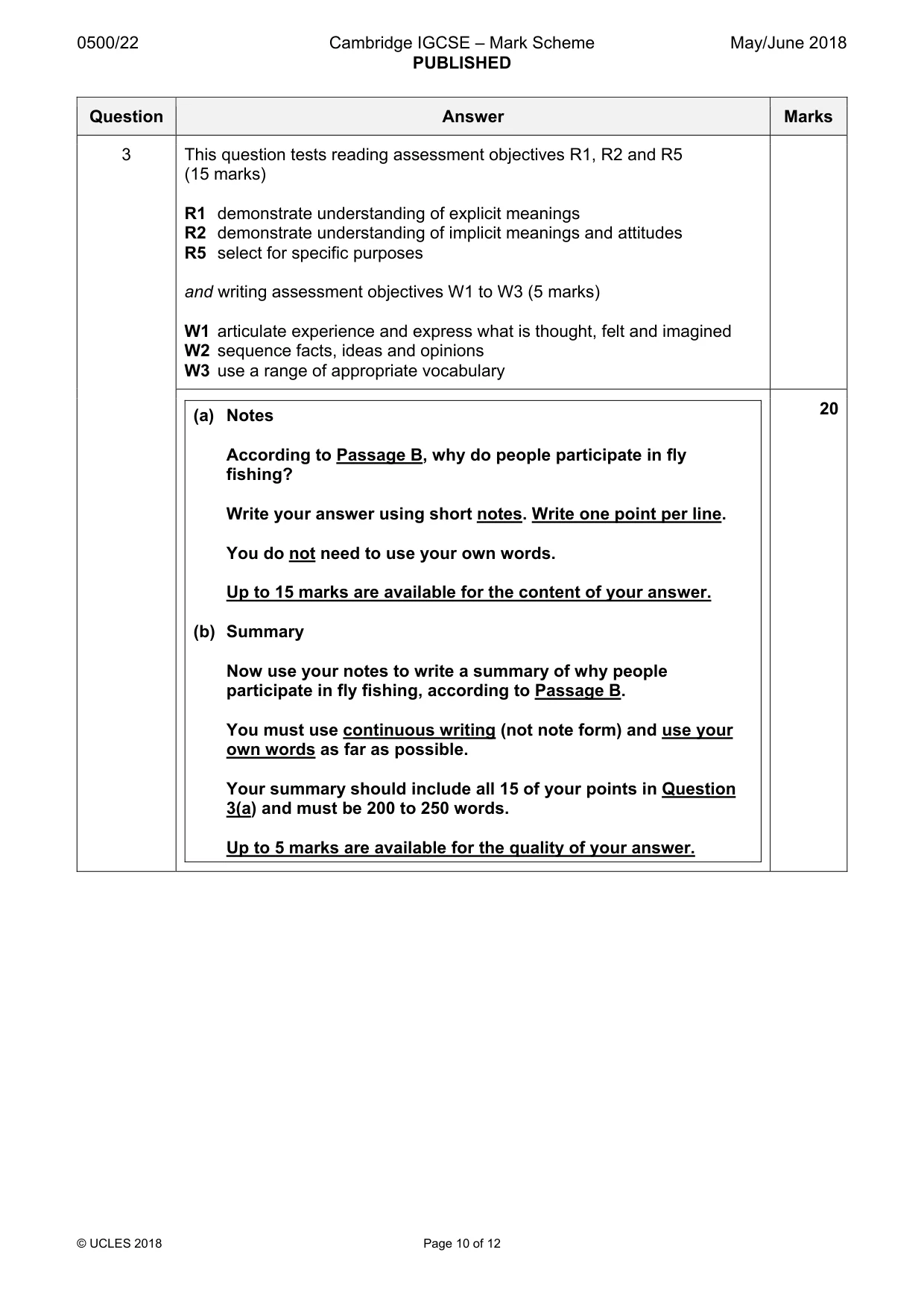
0500/22 Cambridge IGCSE – Mark Scheme PUBLISHED May/June 2018 © UCLES 2018 Page 10 of 12 Question Answer Marks 3 This question tests reading assessment objectives R1, R2 and R5 (15 marks) R1 demonstrate understanding of explicit meanings R2 demonstrate understanding of implicit meanings and attitudes R5 select for specific purposes and writing assessment objectives W1 to W3 (5 marks) W1 articulate experience and express what is thought, felt and imagined W2 sequence facts, ideas and opinions W3 use a range of appropriate vocabulary (a) Notes According to Passage B, why do people participate in fly fishing? Write your answer using short notes. Write one point per line. You do not need to use your own words. Up to 15 marks are available for the content of your answer. (b) Summary Now use your notes to write a summary of why people participate in fly fishing, according to Passage B. You must use continuous writing (not note form) and use your own words as far as possible. Your summary should include all 15 of your points in Question 3(a) and must be 200 to 250 words. Up to 5 marks are available for the quality of your answer. 20
Mark scheme, page 11
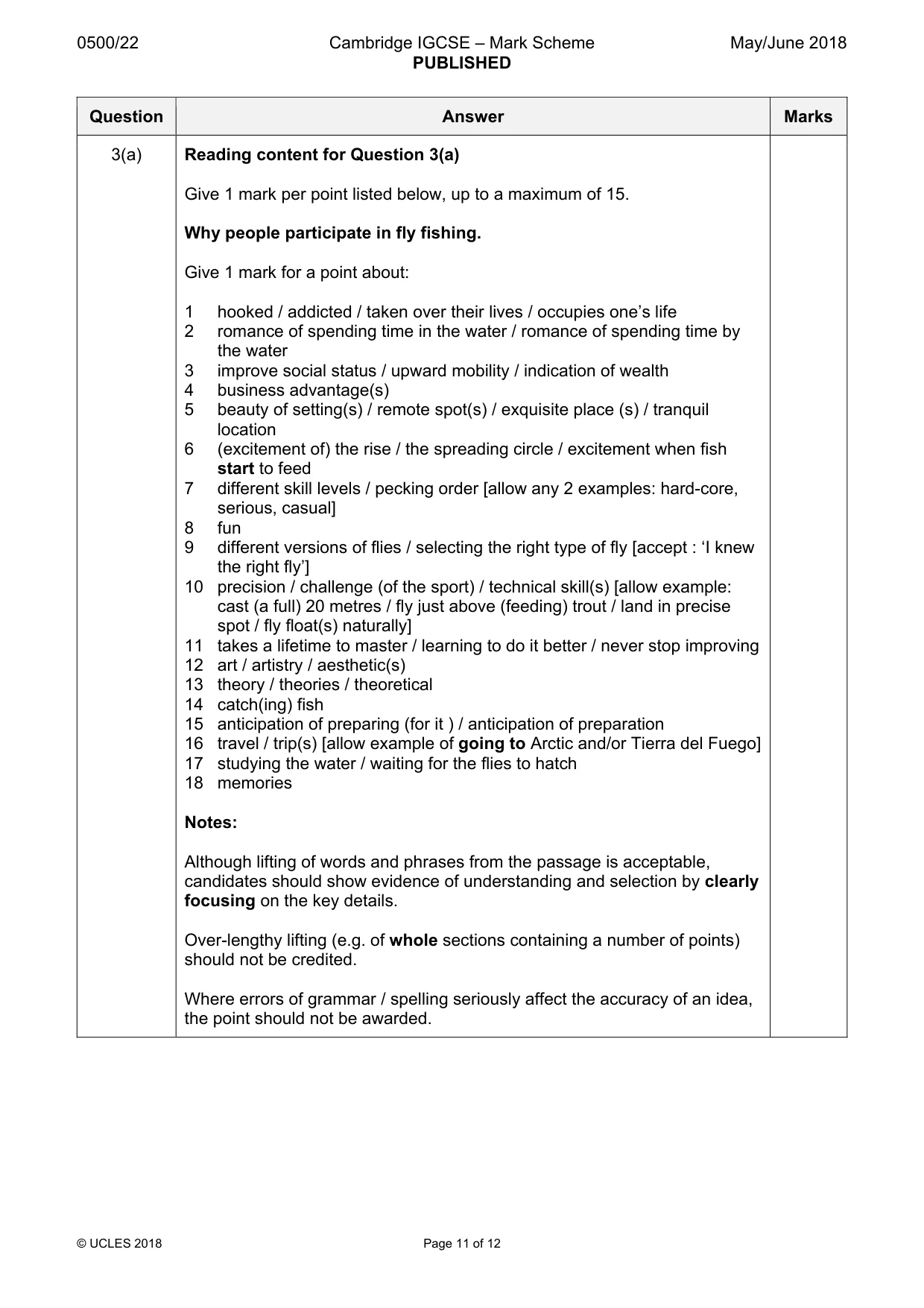
0500/22 Cambridge IGCSE – Mark Scheme PUBLISHED May/June 2018 © UCLES 2018 Page 11 of 12 Question Answer Marks 3(a) Reading content for Question 3(a) Give 1 mark per point listed below, up to a maximum of 15. Why people participate in fly fishing. Give 1 mark for a point about: 1 hooked / addicted / taken over their lives / occupies one’s life 2 romance of spending time in the water / romance of spending time by the water 3 improve social status / upward mobility / indication of wealth 4 business advantage(s) 5 beauty of setting(s) / remote spot(s) / exquisite place (s) / tranquil location 6 (excitement of) the rise / the spreading circle / excitement when fish start to feed 7 different skill levels / pecking order [allow any 2 examples: hard-core, serious, casual] 8 fun 9 different versions of flies / selecting the right type of fly [accept : ‘I knew the right fly’] 10 precision / challenge (of the sport) / technical skill(s) [allow example: cast (a full) 20 metres / fly just above (feeding) trout / land in precise spot / fly float(s) naturally] 11 takes a lifetime to master / learning to do it better / never stop improving 12 art / artistry / aesthetic(s) 13 theory / theories / theoretical 14 catch(ing) fish 15 anticipation of preparing (for it ) / anticipation of preparation 16 travel / trip(s) [allow example of going to Arctic and/or Tierra del Fuego] 17 studying the water / waiting for the flies to hatch 18 memories Notes: Although lifting of words and phrases from the passage is acceptable, candidates should show evidence of understanding and selection by clearly focusing on the key details. Over-lengthy lifting (e.g. of whole sections containing a number of points) should not be credited. Where errors of grammar / spelling seriously affect the accuracy of an idea, the point should not be awarded.
Mark scheme, page 12
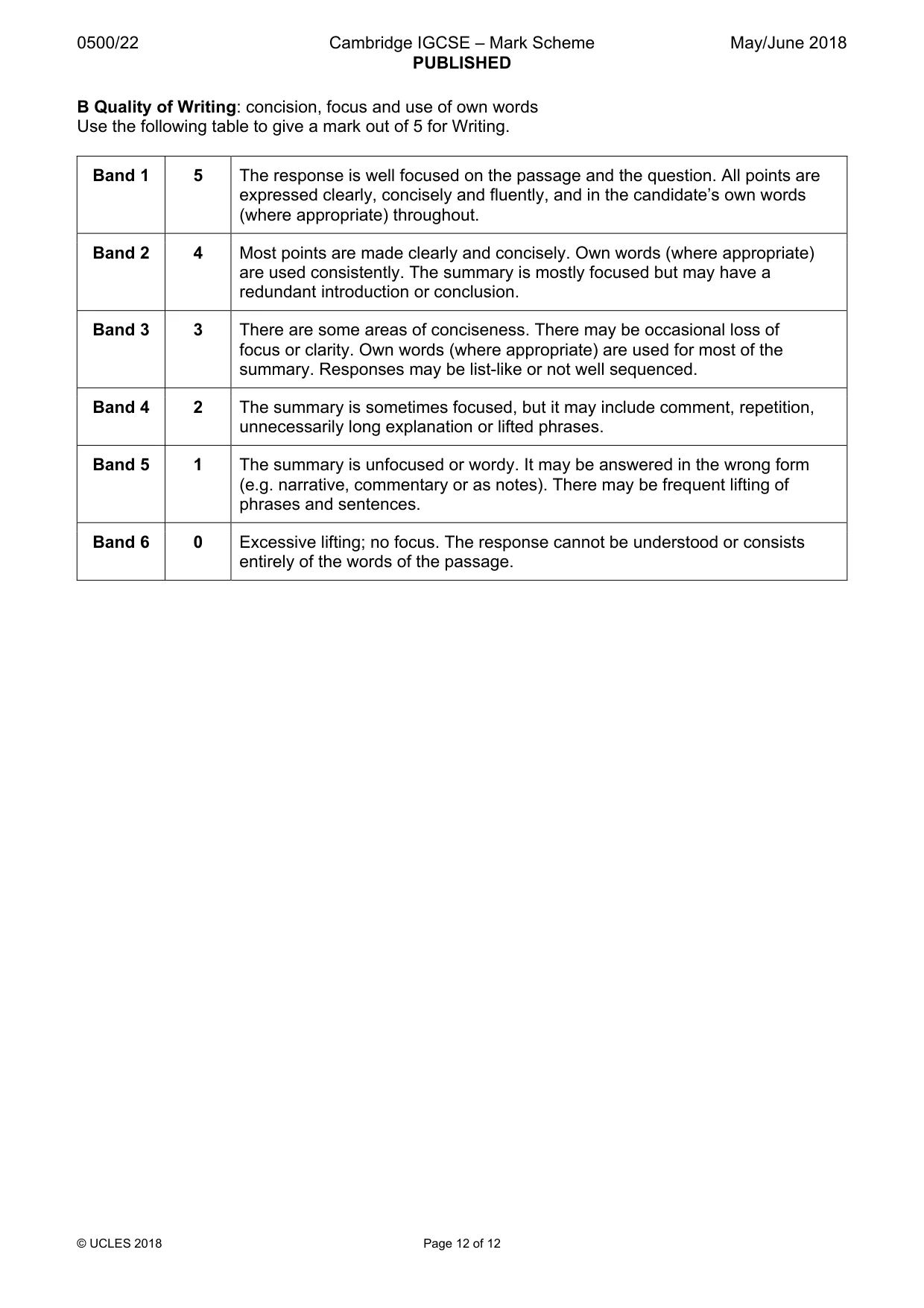
0500/22 Cambridge IGCSE – Mark Scheme PUBLISHED May/June 2018 © UCLES 2018 Page 12 of 12 B Quality of Writing: concision, focus and use of own words Use the following table to give a mark out of 5 for Writing. Band 1 5 The response is well focused on the passage and the question. All points are expressed clearly, concisely and fluently, and in the candidate’s own words (where appropriate) throughout. Band 2 4 Most points are made clearly and concisely. Own words (where appropriate) are used consistently. The summary is mostly focused but may have a redundant introduction or conclusion. Band 3 3 There are some areas of conciseness. There may be occasional loss of focus or clarity. Own words (where appropriate) are used for most of the summary. Responses may be list-like or not well sequenced. Band 4 2 The summary is sometimes focused, but it may include comment, repetition, unnecessarily long explanation or lifted phrases. Band 5 1 The summary is unfocused or wordy. It may be answered in the wrong form (e.g. narrative, commentary or as notes). There may be frequent lifting of phrases and sentences. Band 6 0 Excessive lifting; no focus. The response cannot be understood or consists entirely of the words of the passage.
What you needed in this session
Cambridge’s own grade thresholds for 2018 May/June, Paper 2 · Variant 2. A higher threshold means an easier paper — the bar moves with how the cohort did.