Cambridge IGCSE English - First Language 0500 — 2018 May/June Paper 2 · Variant 1
0500/21/M/J/18 · 50 marks · ≈56 min
The question paper and its mark scheme, free to read here and free to download. This is Cambridge’s own paper, exactly as it was sat.
Question paper12 pages
Mark scheme13 pages
Answers below. Sit the paper first if you are practising.
Paper as text
Question paper, page 1
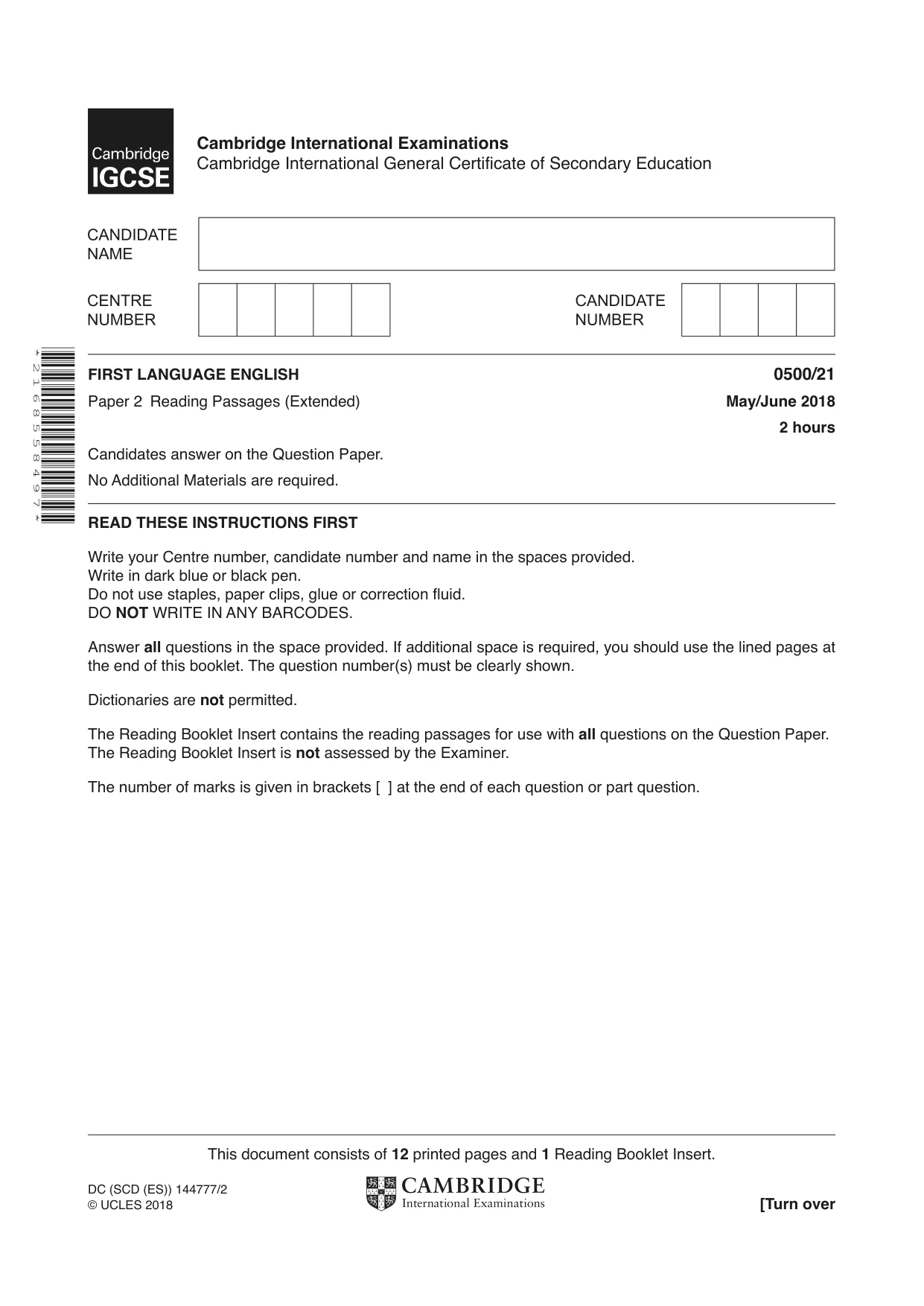
This document consists of 12 printed pages and 1 Reading Booklet Insert. DC (SCD (ES)) 144777/2 © UCLES 2018 [Turn over Cambridge International Examinations Cambridge International General Certificate of Secondary Education * 2 1 6 8 5 5 8 4 9 7 * FIRST LANGUAGE ENGLISH 0500/21 Paper 2 Reading Passages (Extended) May/June 2018 2 hours Candidates answer on the Question Paper. No Additional Materials are required. READ THESE INSTRUCTIONS FIRST Write your Centre number, candidate number and name in the spaces provided. Write in dark blue or black pen. Do not use staples, paper clips, glue or correction fluid. DO NOT WRITE IN ANY BARCODES. Answer all questions in the space provided. If additional space is required, you should use the lined pages at the end of this booklet. The question number(s) must be clearly shown. Dictionaries are not permitted. The Reading Booklet Insert contains the reading passages for use with all questions on the Question Paper. The Reading Booklet Insert is not assessed by the Examiner. The number of marks is given in brackets [ ] at the end of each question or part question.
Question paper, page 2
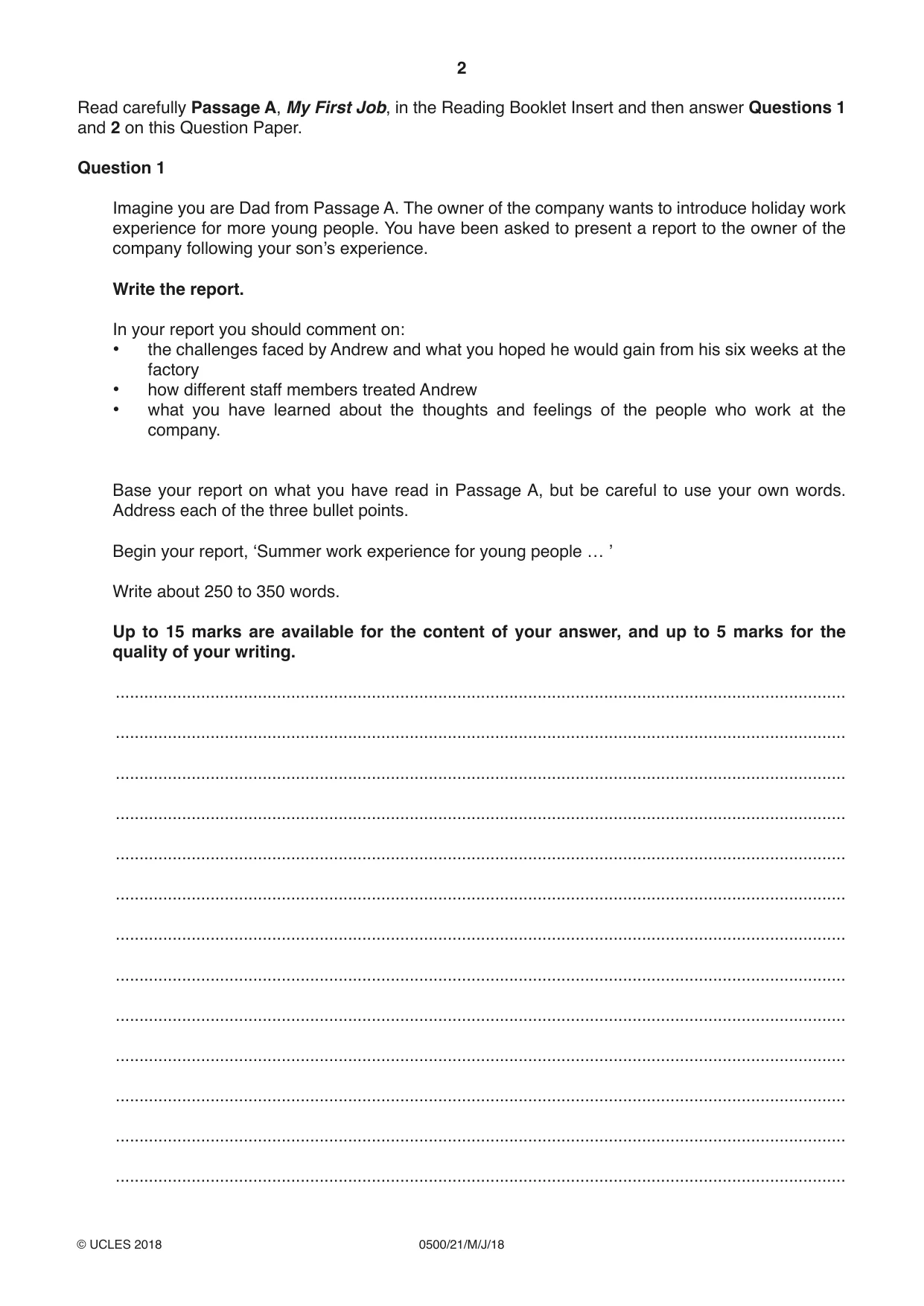
2 0500/21/M/J/18 © UCLES 2018 Read carefully Passage A, My First Job, in the Reading Booklet Insert and then answer Questions 1 and 2 on this Question Paper. Question 1 Imagine you are Dad from Passage A. The owner of the company wants to introduce holiday work experience for more young people. You have been asked to present a report to the owner of the company following your son’s experience. Write the report. In your report you should comment on: • the challenges faced by Andrew and what you hoped he would gain from his six weeks at the factory • how different staff members treated Andrew • what you have learned about the thoughts and feelings of the people who work at the company. Base your report on what you have read in Passage A, but be careful to use your own words. Address each of the three bullet points. Begin your report, ‘Summer work experience for young people … ’ Write about 250 to 350 words. Up to 15 marks are available for the content of your answer, and up to 5 marks for the quality of your writing. … … … … … … … … … … … … …
Question paper, page 3
3 0500/21/M/J/18 © UCLES 2018 [Turn over … … … … … … … … … … … … … … … … … … … … … … … … … … … …
Question paper, page 4
4 0500/21/M/J/18 © UCLES 2018 … … … … … … … … … … … … … … … … … … … … … … … … … … … [Total: 20]
Question paper, page 5
5 0500/21/M/J/18 © UCLES 2018 [Turn over [Turn to page 6 for Question 2]
Question paper, page 6
6 0500/21/M/J/18 © UCLES 2018 Question 2 Re-read the descriptions of: (a) Andrew’s first experience of the canteen in paragraph 5, beginning ‘At the canteen … ’ (b) the visit to the Accounts Department in paragraph 7, beginning ‘After only 20 minutes … ’ Select four powerful words or phrases from each paragraph. Your choices should include imagery. Explain how each word or phrase is used effectively in the context. Write about 200 to 300 words. Up to 10 marks are available for the content of your answer. … … … … … … … … … … … … … … … … … … … … …
Question paper, page 7
7 0500/21/M/J/18 © UCLES 2018 [Turn over … … … … … … … … … … … … … … … … … … … … … … … … … … … [Total: 10]
Question paper, page 8
8 0500/21/M/J/18 © UCLES 2018 Read carefully Passage B, Working Underground, in the Reading Booklet Insert and then answer Question 3(a) and (b) on this Question Paper. Question 3 Answer the questions in the order set. (a) Notes According to Passage B, what did the miners find frightening or distressing about working conditions in the mine? Write your answer using short notes. Write one point per line. You do not need to use your own words. Up to 15 marks are available for the content of your answer. What the miners found frightening or distressing about working conditions in the mine: • … • … • … • … • … • … • … • … • … • … • … • … • … • … • … [Total: 15]
Question paper, page 9
9 0500/21/M/J/18 © UCLES 2018 [Turn over (b) Summary Now use your notes to write a summary of what the miners found frightening or distressing about working conditions in the mine, according to Passage B. You must use continuous writing (not note form) and use your own words as far as possible. Your summary should include all 15 of your points in Question 3(a) and must be 200 to 250 words. Up to 5 marks are available for the quality of your writing. … … … … … … … … … … … … … … … … … … … … … …
Question paper, page 10
10 0500/21/M/J/18 © UCLES 2018 … … … … … … … … … … … [Total: 5]
Question paper, page 11
11 0500/21/M/J/18 © UCLES 2018 [Turn over Additional Page If you use the following lined page to complete the answer(s) to any question(s), the question number(s) must be clearly shown. … … … … … … … … … … … … … … … … … … … … … … … … … …
Question paper, page 12
12 0500/21/M/J/18 © UCLES 2018 Permission to reproduce items where third-party owned material protected by copyright is included has been sought and cleared where possible. Every reasonable effort has been made by the publisher (UCLES) to trace copyright holders, but if any items requiring clearance have unwittingly been included, the publisher will be pleased to make amends at the earliest possible opportunity. To avoid the issue of disclosure of answer-related information to candidates, all copyright acknowledgements are reproduced online in the Cambridge International Examinations Copyright Acknowledgements Booklet. This is produced for each series of examinations and is freely available to download at www.cie.org.uk after the live examination series. Cambridge International Examinations is part of the Cambridge Assessment Group. Cambridge Assessment is the brand name of University of Cambridge Local Examinations Syndicate (UCLES), which is itself a department of the University of Cambridge. Additional Page If you use the following lined page to complete the answer(s) to any question(s), the question number(s) must be clearly shown. … … … … … … … … … … … … … … … … … … … … …
Mark scheme, page 1
IGCSE™ is a registered trademark. This document consists of 13 printed pages. © UCLES 2018 [Turn over Cambridge Assessment International Education Cambridge International General Certificate of Secondary Education FIRST LANGUAGE ENGLISH 0500/21 Paper 2 Reading Passages (Extended) May/June 2018 MARK SCHEME Maximum Mark: 50 Published This mark scheme is published as an aid to teachers and candidates, to indicate the requirements of the examination. It shows the basis on which Examiners were instructed to award marks. It does not indicate the details of the discussions that took place at an Examiners’ meeting before marking began, which would have considered the acceptability of alternative answers. Mark schemes should be read in conjunction with the question paper and the Principal Examiner Report for Teachers. Cambridge International will not enter into discussions about these mark schemes. Cambridge International is publishing the mark schemes for the May/June 2018 series for most Cambridge IGCSE™, Cambridge International A and AS Level and Cambridge Pre-U components, and some Cambridge O Level components.
Mark scheme, page 2
0500/21 Cambridge IGCSE – Mark Scheme PUBLISHED May/June 2018 © UCLES 2018 Page 2 of 13 Generic Marking Principles These general marking principles must be applied by all examiners when marking candidate answers. They should be applied alongside the specific content of the mark scheme or generic level descriptors for a question. Each question paper and mark scheme will also comply with these marking principles. GENERIC MARKING PRINCIPLE 1: Marks must be awarded in line with: • the specific content of the mark scheme or the generic level descriptors for the question • the specific skills defined in the mark scheme or in the generic level descriptors for the question • the standard of response required by a candidate as exemplified by the standardisation scripts. GENERIC MARKING PRINCIPLE 2: Marks awarded are always whole marks (not half marks, or other fractions). GENERIC MARKING PRINCIPLE 3: Marks must be awarded positively: • marks are awarded for correct/valid answers, as defined in the mark scheme. However, credit is given for valid answers which go beyond the scope of the syllabus and mark scheme, referring to your Team Leader as appropriate • marks are awarded when candidates clearly demonstrate what they know and can do • marks are not deducted for errors • marks are not deducted for omissions • answers should only be judged on the quality of spelling, punctuation and grammar when these features are specifically assessed by the question as indicated by the mark scheme. The meaning, however, should be unambiguous. GENERIC MARKING PRINCIPLE 4: Rules must be applied consistently e.g. in situations where candidates have not followed instructions or in the application of generic level descriptors. GENERIC MARKING PRINCIPLE 5: Marks should be awarded using the full range of marks defined in the mark scheme for the question (however; the use of the full mark range may be limited according to the quality of the candidate responses seen). GENERIC MARKING PRINCIPLE 6: Marks awarded are based solely on the requirements as defined in the mark scheme. Marks should not be awarded with grade thresholds or grade descriptors in mind.
Mark scheme, page 3
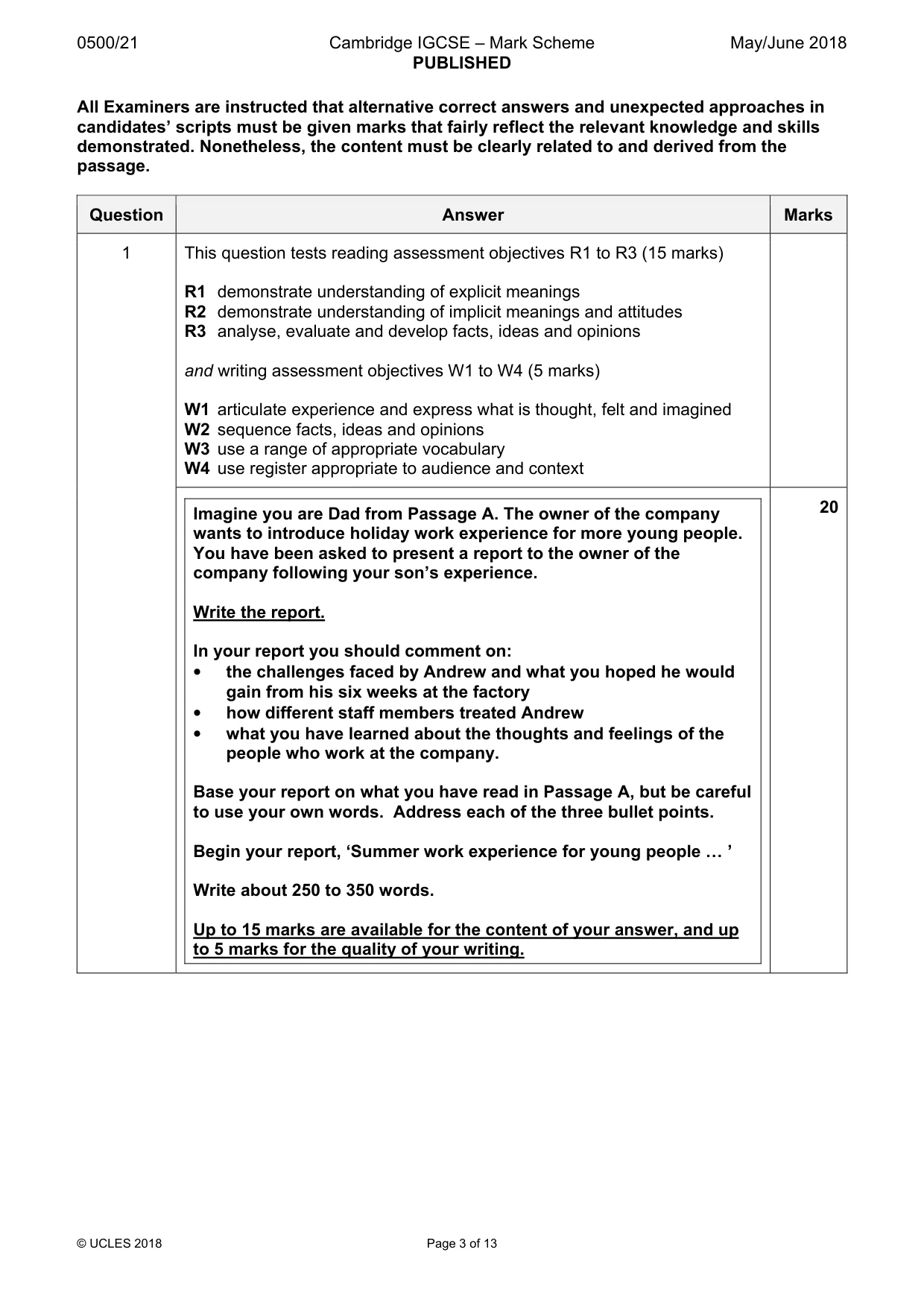
0500/21 Cambridge IGCSE – Mark Scheme PUBLISHED May/June 2018 © UCLES 2018 Page 3 of 13 All Examiners are instructed that alternative correct answers and unexpected approaches in candidates’ scripts must be given marks that fairly reflect the relevant knowledge and skills demonstrated. Nonetheless, the content must be clearly related to and derived from the passage. Question Answer Marks 1 This question tests reading assessment objectives R1 to R3 (15 marks) R1 demonstrate understanding of explicit meanings R2 demonstrate understanding of implicit meanings and attitudes R3 analyse, evaluate and develop facts, ideas and opinions and writing assessment objectives W1 to W4 (5 marks) W1 articulate experience and express what is thought, felt and imagined W2 sequence facts, ideas and opinions W3 use a range of appropriate vocabulary W4 use register appropriate to audience and context Imagine you are Dad from Passage A. The owner of the company wants to introduce holiday work experience for more young people. You have been asked to present a report to the owner of the company following your son’s experience. Write the report. In your report you should comment on: • the challenges faced by Andrew and what you hoped he would gain from his six weeks at the factory • how different staff members treated Andrew • what you have learned about the thoughts and feelings of the people who work at the company. Base your report on what you have read in Passage A, but be careful to use your own words. Address each of the three bullet points. Begin your report, ‘Summer work experience for young people « ’ Write about 250 to 350 words. Up to 15 marks are available for the content of your answer, and up to 5 marks for the quality of your writing. 20
Mark scheme, page 4
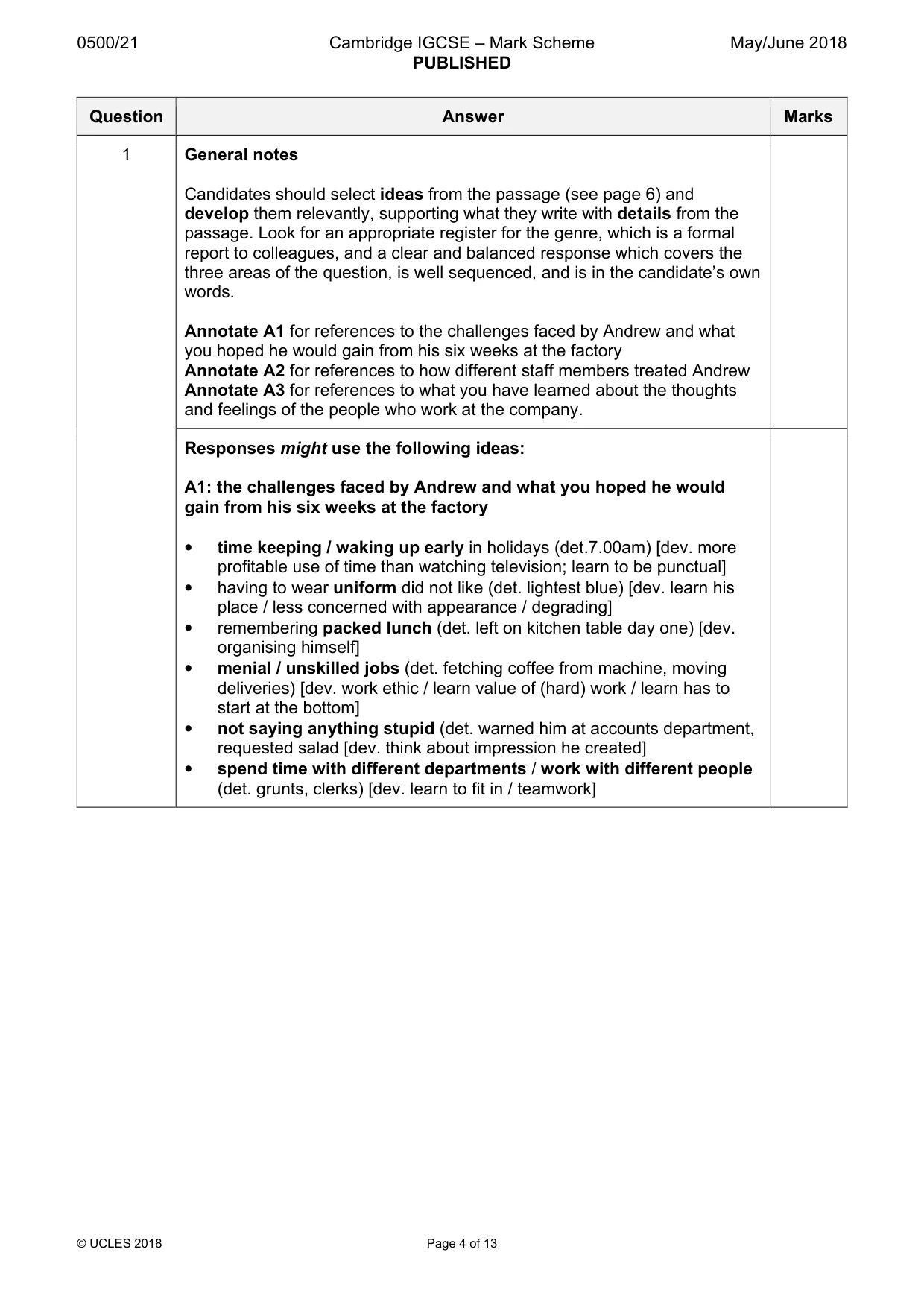
0500/21 Cambridge IGCSE – Mark Scheme PUBLISHED May/June 2018 © UCLES 2018 Page 4 of 13 Question Answer Marks 1 General notes Candidates should select ideas from the passage (see page 6) and develop them relevantly, supporting what they write with details from the passage. Look for an appropriate register for the genre, which is a formal report to colleagues, and a clear and balanced response which covers the three areas of the question, is well sequenced, and is in the candidate’s own words. Annotate A1 for references to the challenges faced by Andrew and what you hoped he would gain from his six weeks at the factory Annotate A2 for references to how different staff members treated Andrew Annotate A3 for references to what you have learned about the thoughts and feelings of the people who work at the company. Responses might use the following ideas: A1: the challenges faced by Andrew and what you hoped he would gain from his six weeks at the factory • time keeping / waking up early in holidays (det.7.00am) [dev. more profitable use of time than watching television; learn to be punctual] • having to wear uniform did not like (det. lightest blue) [dev. learn his place / less concerned with appearance / degrading] • remembering packed lunch (det. left on kitchen table day one) [dev. organising himself] • menial / unskilled jobs (det. fetching coffee from machine, moving deliveries) [dev. work ethic / learn value of (hard) work / learn has to start at the bottom] • not saying anything stupid (det. warned him at accounts department, requested salad [dev. think about impression he created] • spend time with different departments / work with different people (det. grunts, clerks) [dev. learn to fit in / teamwork]
Mark scheme, page 5
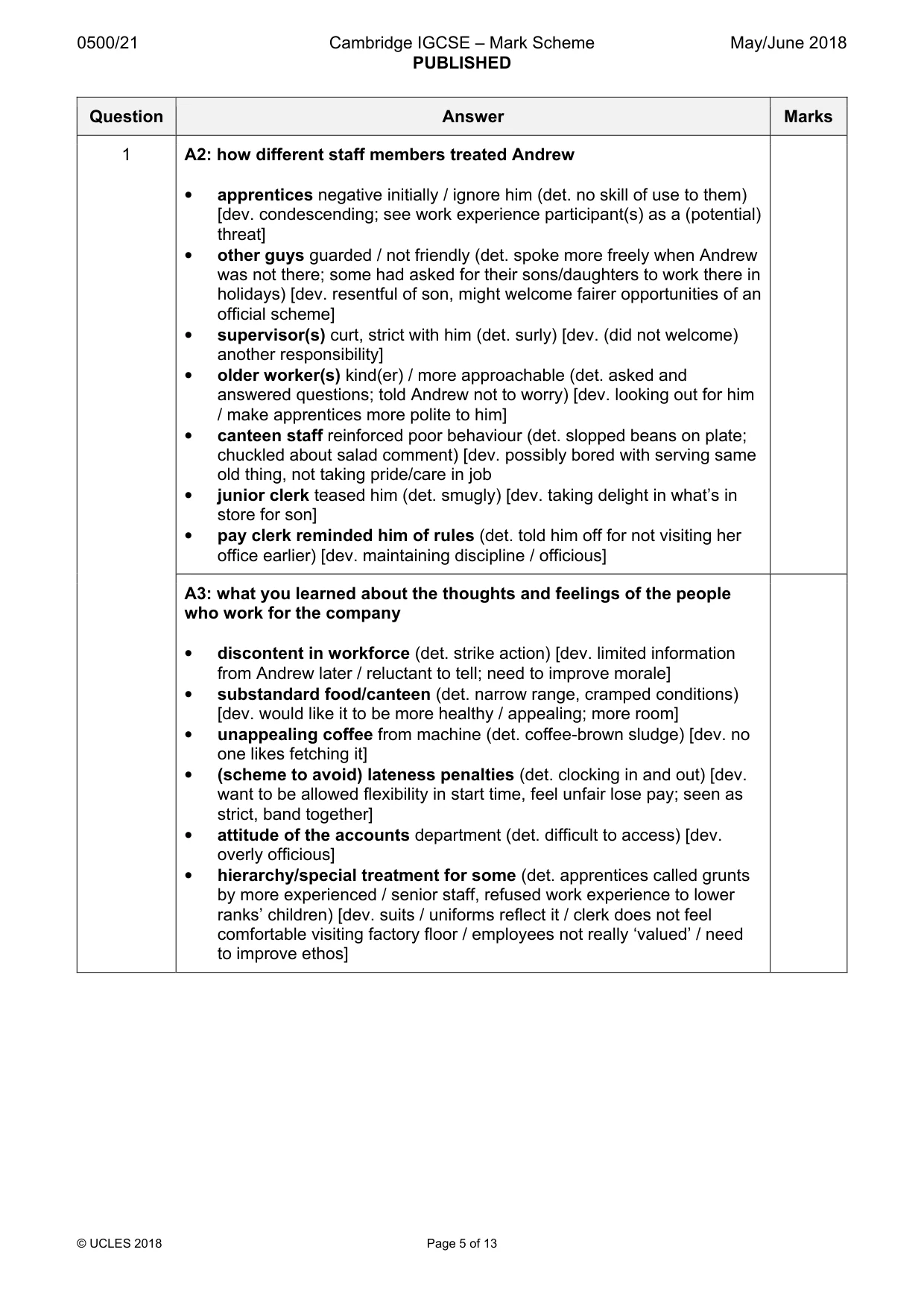
0500/21 Cambridge IGCSE – Mark Scheme PUBLISHED May/June 2018 © UCLES 2018 Page 5 of 13 Question Answer Marks 1 A2: how different staff members treated Andrew • apprentices negative initially / ignore him (det. no skill of use to them) [dev. condescending; see work experience participant(s) as a (potential) threat] • other guys guarded / not friendly (det. spoke more freely when Andrew was not there; some had asked for their sons/daughters to work there in holidays) [dev. resentful of son, might welcome fairer opportunities of an official scheme] • supervisor(s) curt, strict with him (det. surly) [dev. (did not welcome) another responsibility] • older worker(s) kind(er) / more approachable (det. asked and answered questions; told Andrew not to worry) [dev. looking out for him / make apprentices more polite to him] • canteen staff reinforced poor behaviour (det. slopped beans on plate; chuckled about salad comment) [dev. possibly bored with serving same old thing, not taking pride/care in job • junior clerk teased him (det. smugly) [dev. taking delight in what’s in store for son] • pay clerk reminded him of rules (det. told him off for not visiting her office earlier) [dev. maintaining discipline / officious] A3: what you learned about the thoughts and feelings of the people who work for the company • discontent in workforce (det. strike action) [dev. limited information from Andrew later / reluctant to tell; need to improve morale] • substandard food/canteen (det. narrow range, cramped conditions) [dev. would like it to be more healthy / appealing; more room] • unappealing coffee from machine (det. coffee-brown sludge) [dev. no one likes fetching it] • (scheme to avoid) lateness penalties (det. clocking in and out) [dev. want to be allowed flexibility in start time, feel unfair lose pay; seen as strict, band together] • attitude of the accounts department (det. difficult to access) [dev. overly officious] • hierarchy/special treatment for some (det. apprentices called grunts by more experienced / senior staff, refused work experience to lower ranks’ children) [dev. suits / uniforms reflect it / clerk does not feel comfortable visiting factory floor / employees not really ‘valued’ / need to improve ethos]
Mark scheme, page 6
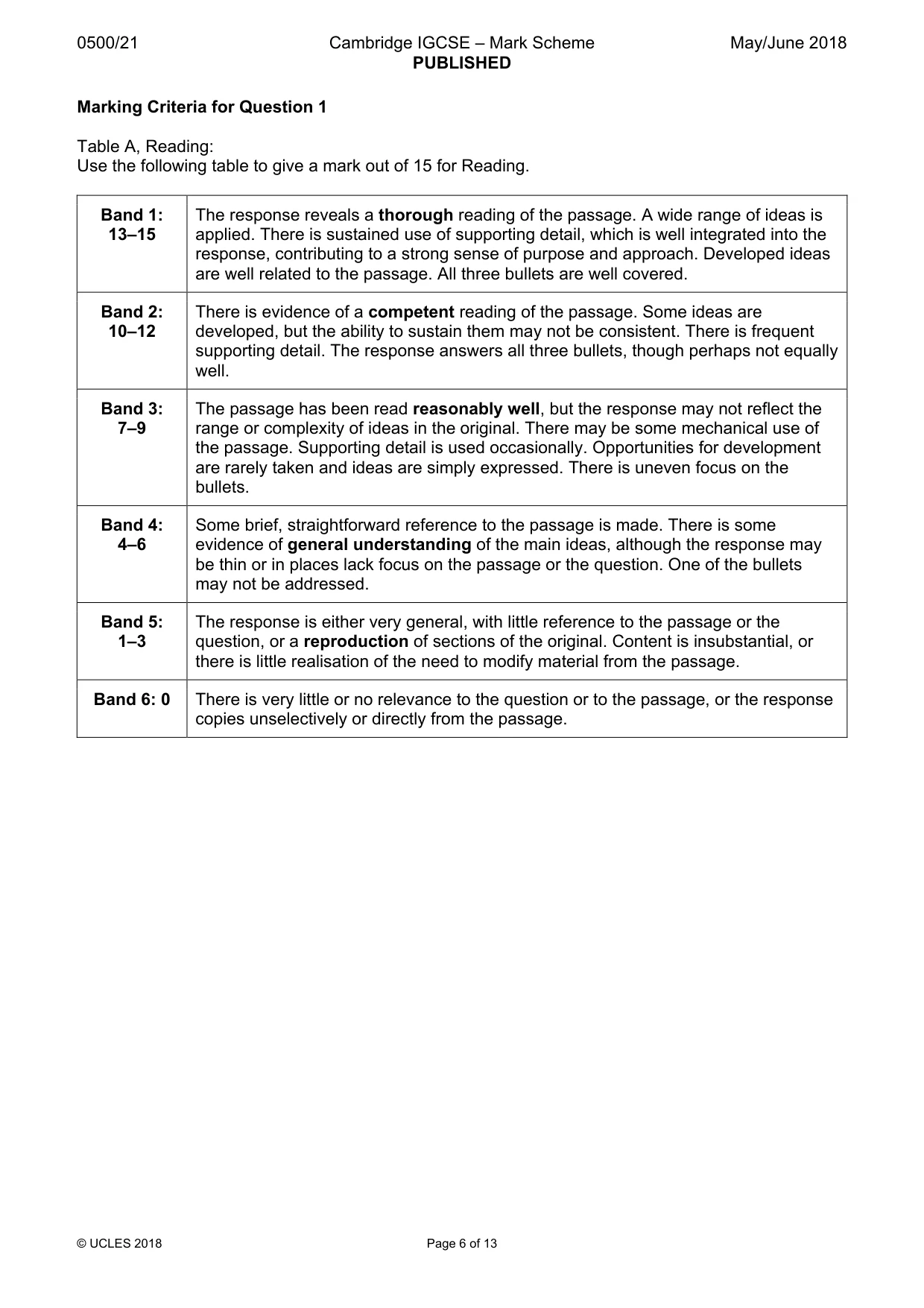
0500/21 Cambridge IGCSE – Mark Scheme PUBLISHED May/June 2018 © UCLES 2018 Page 6 of 13 Marking Criteria for Question 1 Table A, Reading: Use the following table to give a mark out of 15 for Reading. Band 1: 13–15 The response reveals a thorough reading of the passage. A wide range of ideas is applied. There is sustained use of supporting detail, which is well integrated into the response, contributing to a strong sense of purpose and approach. Developed ideas are well related to the passage. All three bullets are well covered. Band 2: 10–12 There is evidence of a competent reading of the passage. Some ideas are developed, but the ability to sustain them may not be consistent. There is frequent supporting detail. The response answers all three bullets, though perhaps not equally well. Band 3: 7–9 The passage has been read reasonably well, but the response may not reflect the range or complexity of ideas in the original. There may be some mechanical use of the passage. Supporting detail is used occasionally. Opportunities for development are rarely taken and ideas are simply expressed. There is uneven focus on the bullets. Band 4: 4–6 Some brief, straightforward reference to the passage is made. There is some evidence of general understanding of the main ideas, although the response may be thin or in places lack focus on the passage or the question. One of the bullets may not be addressed. Band 5: 1–3 The response is either very general, with little reference to the passage or the question, or a reproduction of sections of the original. Content is insubstantial, or there is little realisation of the need to modify material from the passage. Band 6: 0 There is very little or no relevance to the question or to the passage, or the response copies unselectively or directly from the passage.
Mark scheme, page 7
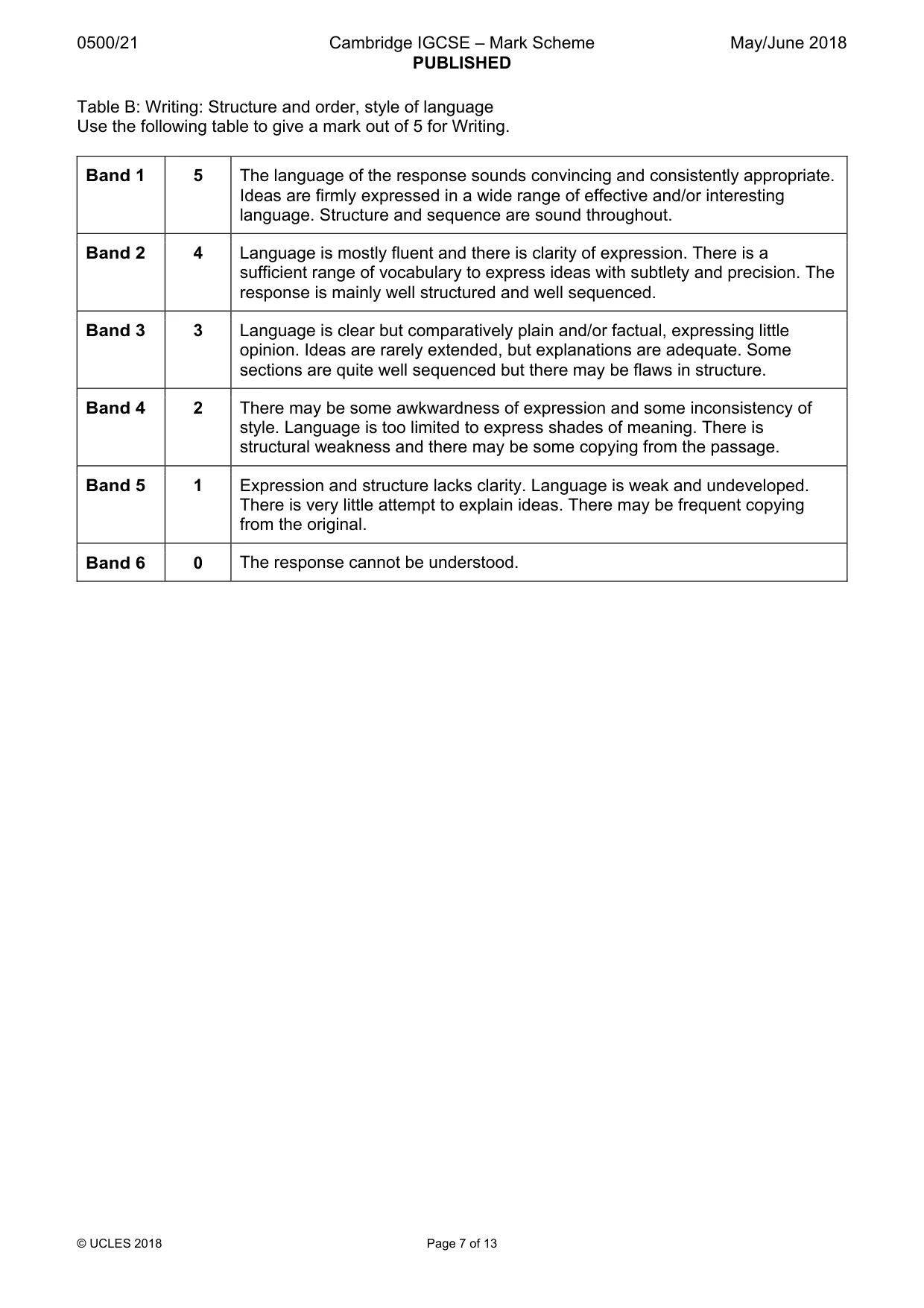
0500/21 Cambridge IGCSE – Mark Scheme PUBLISHED May/June 2018 © UCLES 2018 Page 7 of 13 Table B: Writing: Structure and order, style of language Use the following table to give a mark out of 5 for Writing. Band 1 5 The language of the response sounds convincing and consistently appropriate. Ideas are firmly expressed in a wide range of effective and/or interesting language. Structure and sequence are sound throughout. Band 2 4 Language is mostly fluent and there is clarity of expression. There is a sufficient range of vocabulary to express ideas with subtlety and precision. The response is mainly well structured and well sequenced. Band 3 3 Language is clear but comparatively plain and/or factual, expressing little opinion. Ideas are rarely extended, but explanations are adequate. Some sections are quite well sequenced but there may be flaws in structure. Band 4 2 There may be some awkwardness of expression and some inconsistency of style. Language is too limited to express shades of meaning. There is structural weakness and there may be some copying from the passage. Band 5 1 Expression and structure lacks clarity. Language is weak and undeveloped. There is very little attempt to explain ideas. There may be frequent copying from the original. Band 6 0 The response cannot be understood.
Mark scheme, page 8
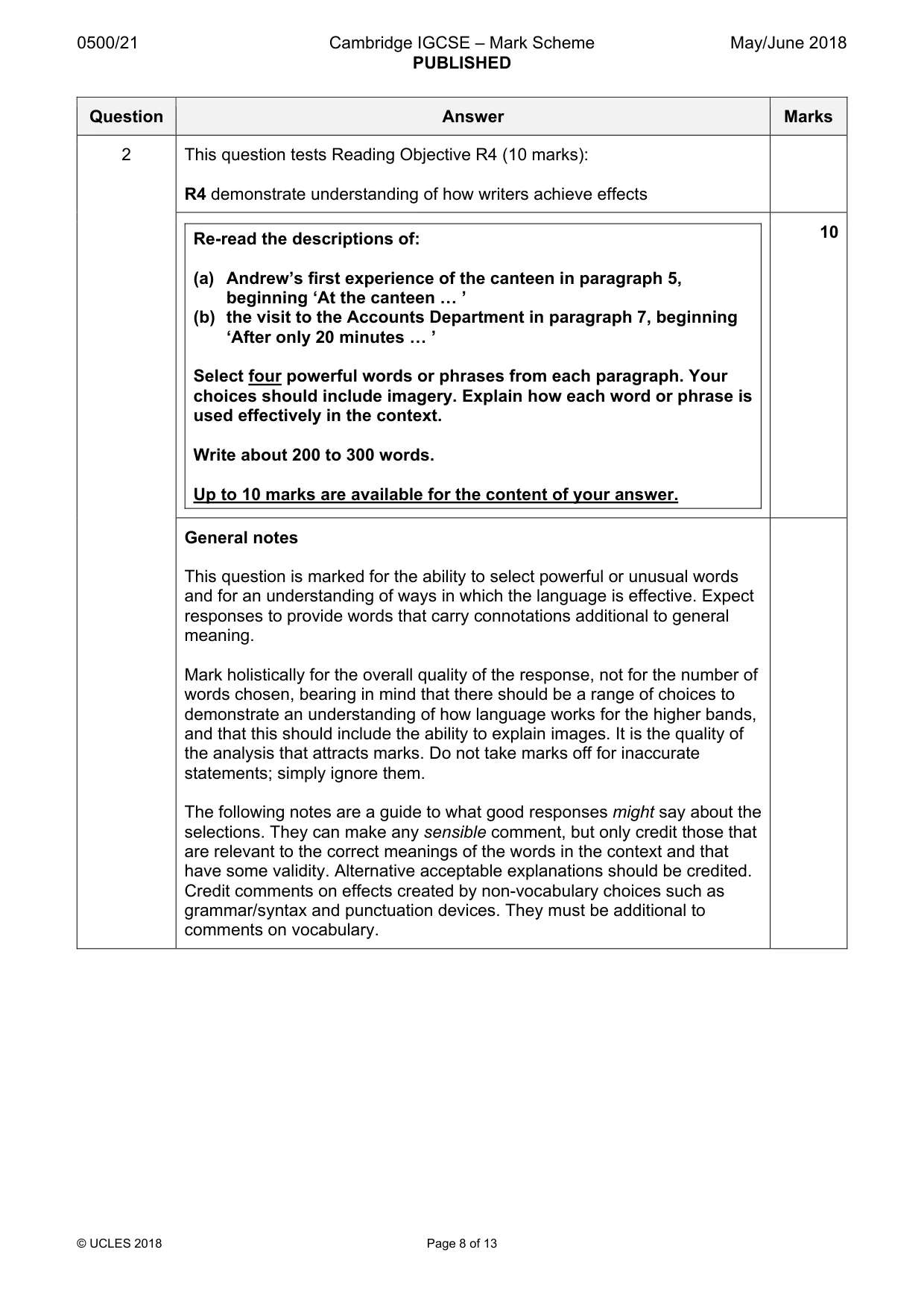
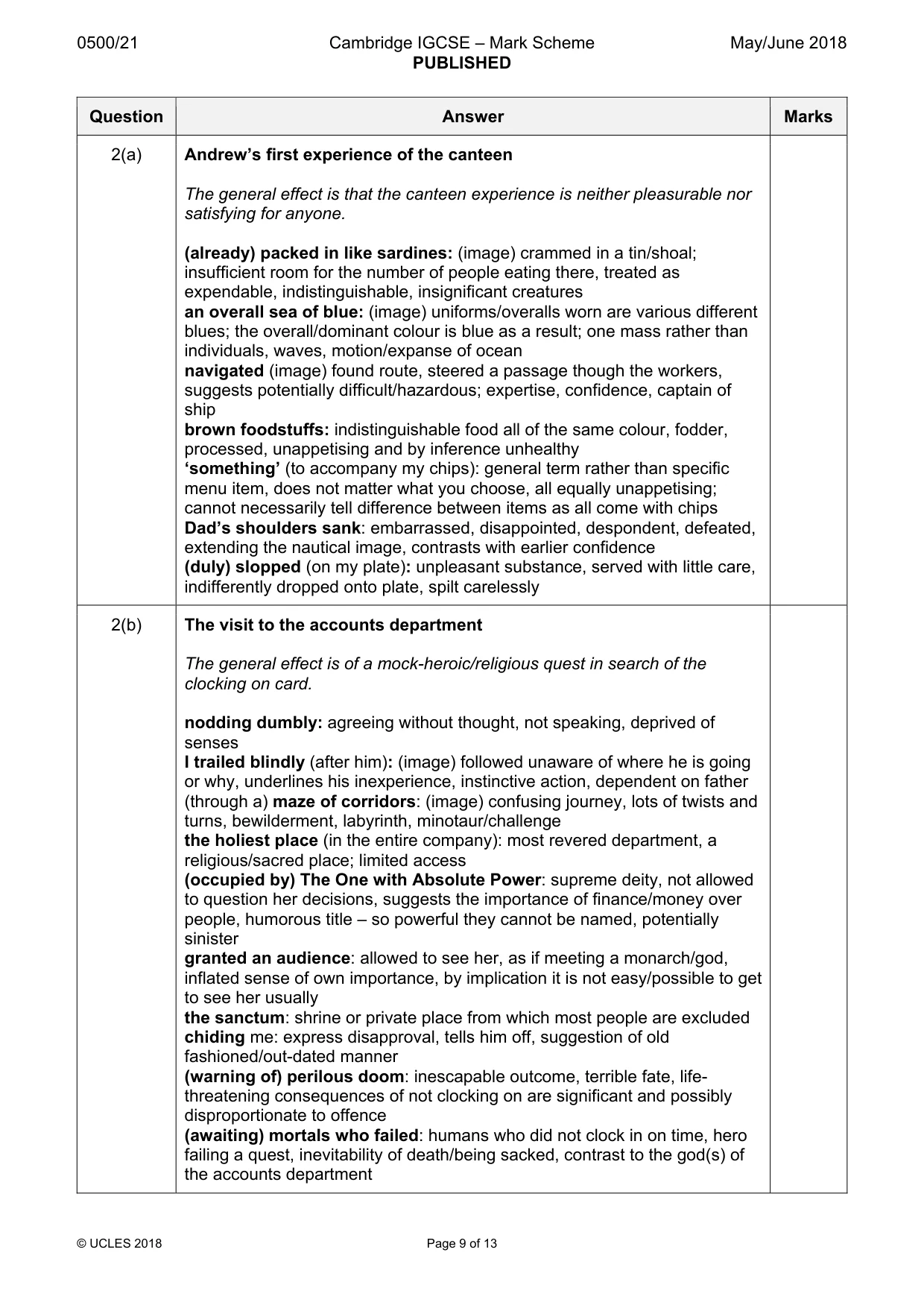
0500/21 Cambridge IGCSE – Mark Scheme PUBLISHED May/June 2018 © UCLES 2018 Page 8 of 13 Question Answer Marks 2 This question tests Reading Objective R4 (10 marks): R4 demonstrate understanding of how writers achieve effects Re-read the descriptions of: (a) Andrew’s first experience of the canteen in paragraph 5, beginning ‘At the canteen « ’ (b) the visit to the Accounts Department in paragraph 7, beginning ‘After only 20 minutes « ’ Select four powerful words or phrases from each paragraph. Your choices should include imagery. Explain how each word or phrase is used effectively in the context. Write about 200 to 300 words. Up to 10 marks are available for the content of your answer. 10 General notes This question is marked for the ability to select powerful or unusual words and for an understanding of ways in which the language is effective. Expect responses to provide words that carry connotations additional to general meaning. Mark holistically for the overall quality of the response, not for the number of words chosen, bearing in mind that there should be a range of choices to demonstrate an understanding of how language works for the higher bands, and that this should include the ability to explain images. It is the quality of the analysis that attracts marks. Do not take marks off for inaccurate statements; simply ignore them. The following notes are a guide to what good responses might say about the selections. They can make any sensible comment, but only credit those that are relevant to the correct meanings of the words in the context and that have some validity. Alternative acceptable explanations should be credited. Credit comments on effects created by non-vocabulary choices such as grammar/syntax and punctuation devices. They must be additional to comments on vocabulary.
Mark scheme, page 9
0500/21 Cambridge IGCSE – Mark Scheme PUBLISHED May/June 2018 © UCLES 2018 Page 9 of 13 Question Answer Marks 2(a) Andrew’s first experience of the canteen The general effect is that the canteen experience is neither pleasurable nor satisfying for anyone. (already) packed in like sardines: (image) crammed in a tin/shoal; insufficient room for the number of people eating there, treated as expendable, indistinguishable, insignificant creatures an overall sea of blue: (image) uniforms/overalls worn are various different blues; the overall/dominant colour is blue as a result; one mass rather than individuals, waves, motion/expanse of ocean navigated (image) found route, steered a passage though the workers, suggests potentially difficult/hazardous; expertise, confidence, captain of ship brown foodstuffs: indistinguishable food all of the same colour, fodder, processed, unappetising and by inference unhealthy ‘something’ (to accompany my chips): general term rather than specific menu item, does not matter what you choose, all equally unappetising; cannot necessarily tell difference between items as all come with chips Dad’s shoulders sank: embarrassed, disappointed, despondent, defeated, extending the nautical image, contrasts with earlier confidence (duly) slopped (on my plate): unpleasant substance, served with little care, indifferently dropped onto plate, spilt carelessly 2(b) The visit to the accounts department The general effect is of a mock-heroic/religious quest in search of the clocking on card. nodding dumbly: agreeing without thought, not speaking, deprived of senses I trailed blindly (after him): (image) followed unaware of where he is going or why, underlines his inexperience, instinctive action, dependent on father (through a) maze of corridors: (image) confusing journey, lots of twists and turns, bewilderment, labyrinth, minotaur/challenge the holiest place (in the entire company): most revered department, a religious/sacred place; limited access (occupied by) The One with Absolute Power: supreme deity, not allowed to question her decisions, suggests the importance of finance/money over people, humorous title – so powerful they cannot be named, potentially sinister granted an audience: allowed to see her, as if meeting a monarch/god, inflated sense of own importance, by implication it is not easy/possible to get to see her usually the sanctum: shrine or private place from which most people are excluded chiding me: express disapproval, tells him off, suggestion of old fashioned/out-dated manner (warning of) perilous doom: inescapable outcome, terrible fate, life- threatening consequences of not clocking on are significant and possibly disproportionate to offence (awaiting) mortals who failed: humans who did not clock in on time, hero failing a quest, inevitability of death/being sacked, contrast to the god(s) of the accounts department
Mark scheme, page 10
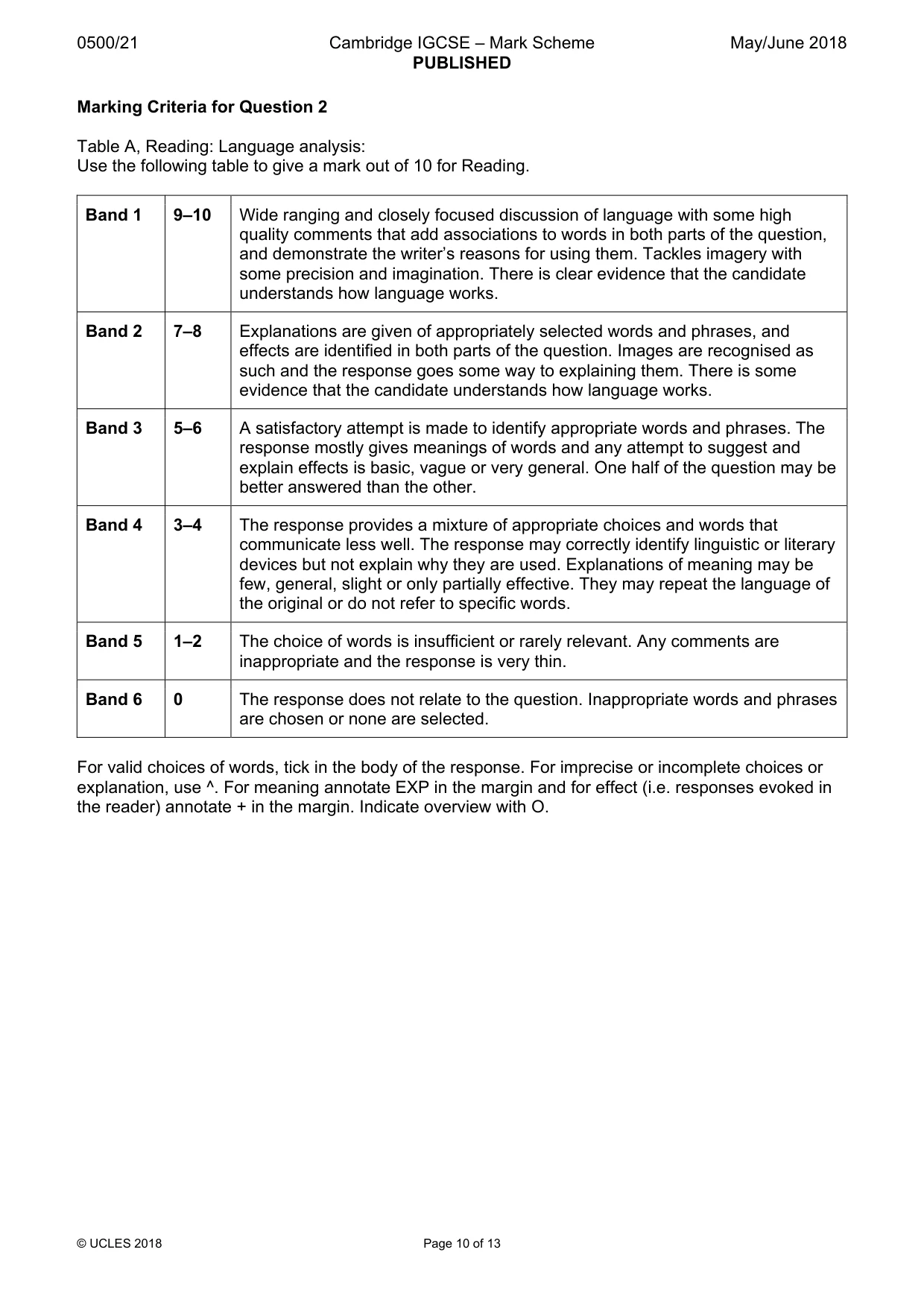
0500/21 Cambridge IGCSE – Mark Scheme PUBLISHED May/June 2018 © UCLES 2018 Page 10 of 13 Marking Criteria for Question 2 Table A, Reading: Language analysis: Use the following table to give a mark out of 10 for Reading. Band 1 9–10 Wide ranging and closely focused discussion of language with some high quality comments that add associations to words in both parts of the question, and demonstrate the writer’s reasons for using them. Tackles imagery with some precision and imagination. There is clear evidence that the candidate understands how language works. Band 2 7–8 Explanations are given of appropriately selected words and phrases, and effects are identified in both parts of the question. Images are recognised as such and the response goes some way to explaining them. There is some evidence that the candidate understands how language works. Band 3 5–6 A satisfactory attempt is made to identify appropriate words and phrases. The response mostly gives meanings of words and any attempt to suggest and explain effects is basic, vague or very general. One half of the question may be better answered than the other. Band 4 3–4 The response provides a mixture of appropriate choices and words that communicate less well. The response may correctly identify linguistic or literary devices but not explain why they are used. Explanations of meaning may be few, general, slight or only partially effective. They may repeat the language of the original or do not refer to specific words. Band 5 1–2 The choice of words is insufficient or rarely relevant. Any comments are inappropriate and the response is very thin. Band 6 0 The response does not relate to the question. Inappropriate words and phrases are chosen or none are selected. For valid choices of words, tick in the body of the response. For imprecise or incomplete choices or explanation, use ^. For meaning annotate EXP in the margin and for effect (i.e. responses evoked in the reader) annotate + in the margin. Indicate overview with O.
Mark scheme, page 11
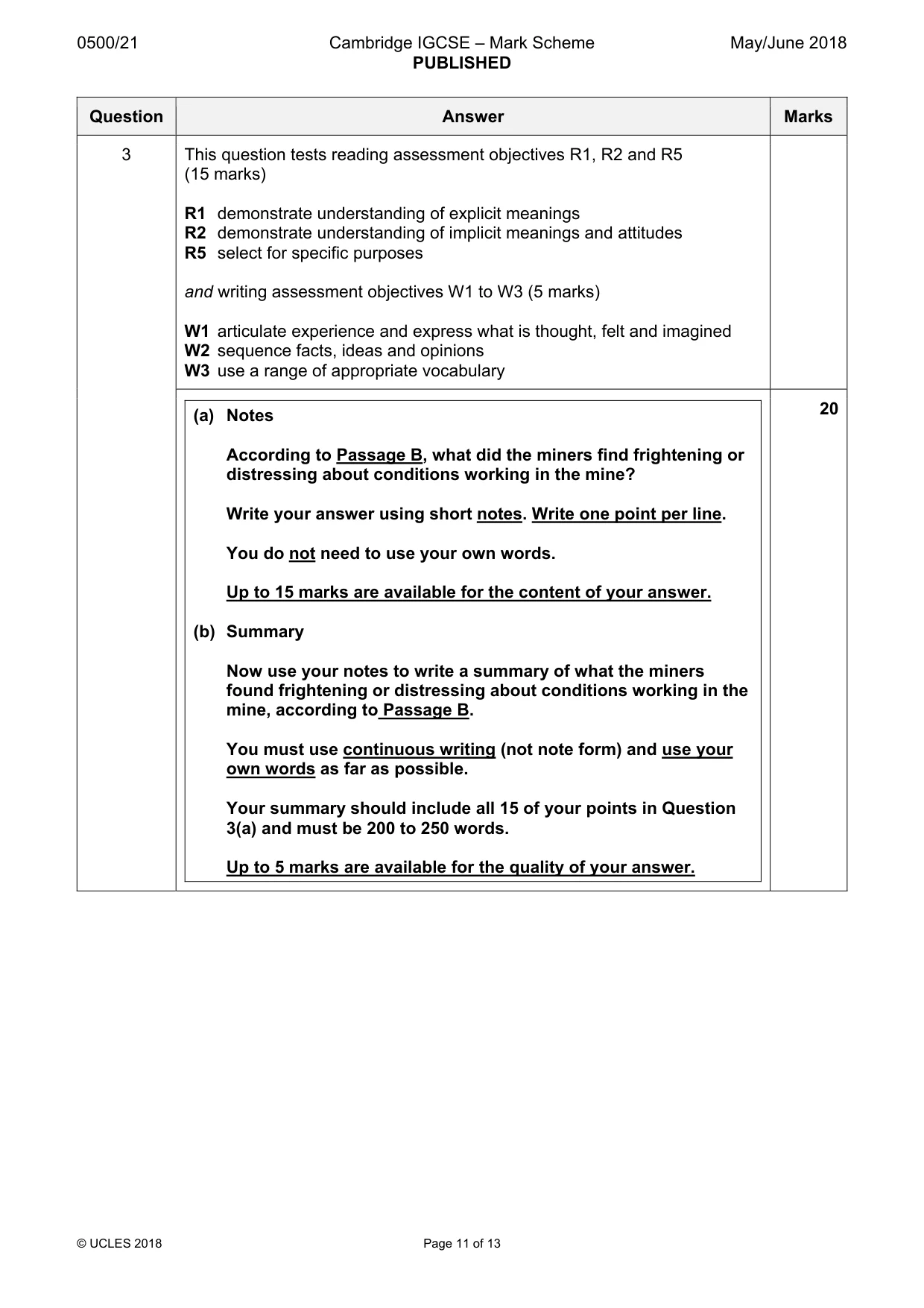
0500/21 Cambridge IGCSE – Mark Scheme PUBLISHED May/June 2018 © UCLES 2018 Page 11 of 13 Question Answer Marks 3 This question tests reading assessment objectives R1, R2 and R5 (15 marks) R1 demonstrate understanding of explicit meanings R2 demonstrate understanding of implicit meanings and attitudes R5 select for specific purposes and writing assessment objectives W1 to W3 (5 marks) W1 articulate experience and express what is thought, felt and imagined W2 sequence facts, ideas and opinions W3 use a range of appropriate vocabulary (a) Notes According to Passage B, what did the miners find frightening or distressing about conditions working in the mine? Write your answer using short notes. Write one point per line. You do not need to use your own words. Up to 15 marks are available for the content of your answer. (b) Summary Now use your notes to write a summary of what the miners found frightening or distressing about conditions working in the mine, according to Passage B. You must use continuous writing (not note form) and use your own words as far as possible. Your summary should include all 15 of your points in Question 3(a) and must be 200 to 250 words. Up to 5 marks are available for the quality of your answer. 20
Mark scheme, page 12
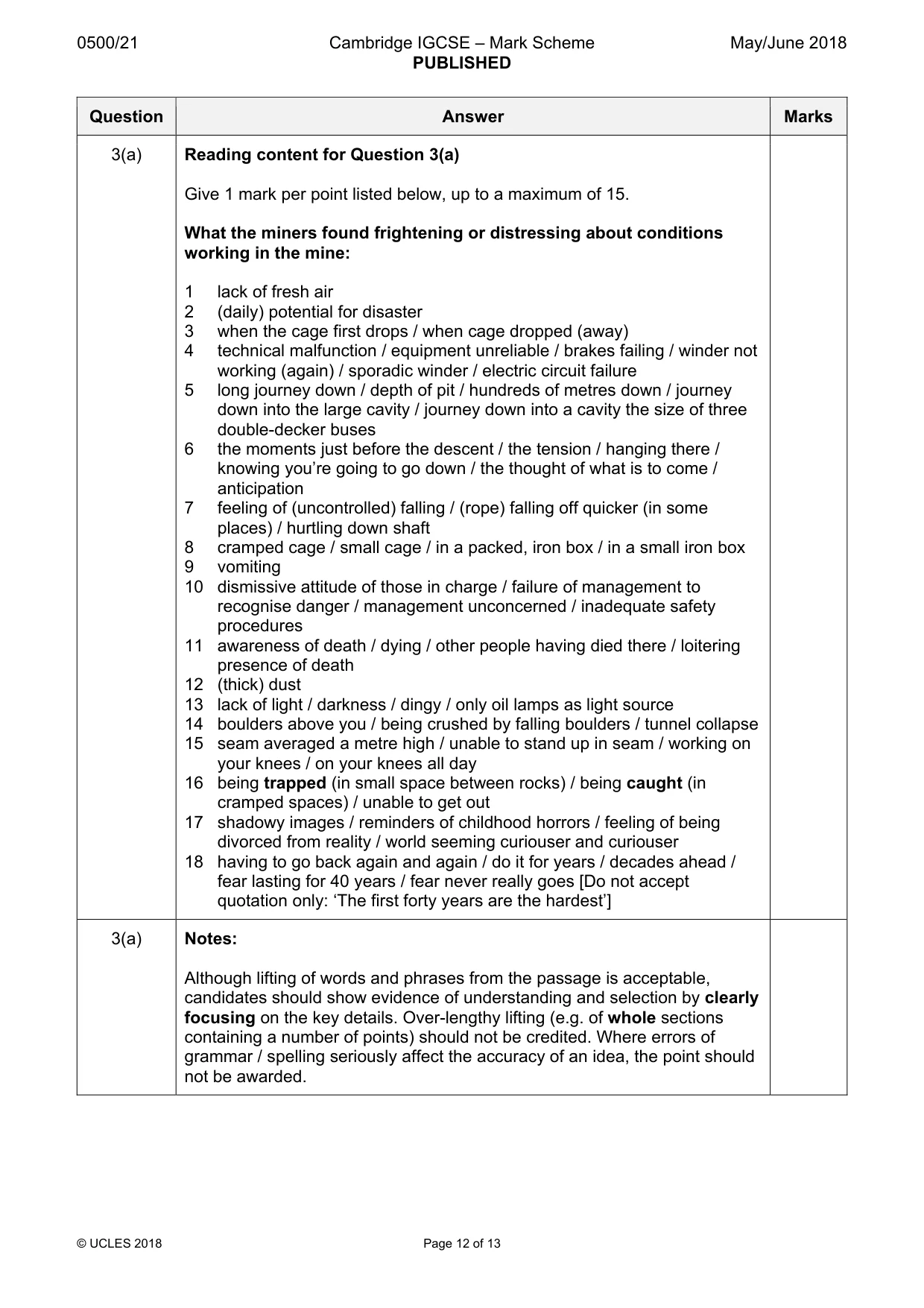
0500/21 Cambridge IGCSE – Mark Scheme PUBLISHED May/June 2018 © UCLES 2018 Page 12 of 13 Question Answer Marks 3(a) Reading content for Question 3(a) Give 1 mark per point listed below, up to a maximum of 15. What the miners found frightening or distressing about conditions working in the mine: 1 lack of fresh air 2 (daily) potential for disaster 3 when the cage first drops / when cage dropped (away) 4 technical malfunction / equipment unreliable / brakes failing / winder not working (again) / sporadic winder / electric circuit failure 5 long journey down / depth of pit / hundreds of metres down / journey down into the large cavity / journey down into a cavity the size of three double-decker buses 6 the moments just before the descent / the tension / hanging there / knowing you’re going to go down / the thought of what is to come / anticipation 7 feeling of (uncontrolled) falling / (rope) falling off quicker (in some places) / hurtling down shaft 8 cramped cage / small cage / in a packed, iron box / in a small iron box 9 vomiting 10 dismissive attitude of those in charge / failure of management to recognise danger / management unconcerned / inadequate safety procedures 11 awareness of death / dying / other people having died there / loitering presence of death 12 (thick) dust 13 lack of light / darkness / dingy / only oil lamps as light source 14 boulders above you / being crushed by falling boulders / tunnel collapse 15 seam averaged a metre high / unable to stand up in seam / working on your knees / on your knees all day 16 being trapped (in small space between rocks) / being caught (in cramped spaces) / unable to get out 17 shadowy images / reminders of childhood horrors / feeling of being divorced from reality / world seeming curiouser and curiouser 18 having to go back again and again / do it for years / decades ahead / fear lasting for 40 years / fear never really goes [Do not accept quotation only: ‘The first forty years are the hardest’] 3(a) Notes: Although lifting of words and phrases from the passage is acceptable, candidates should show evidence of understanding and selection by clearly focusing on the key details. Over-lengthy lifting (e.g. of whole sections containing a number of points) should not be credited. Where errors of grammar / spelling seriously affect the accuracy of an idea, the point should not be awarded.
Mark scheme, page 13
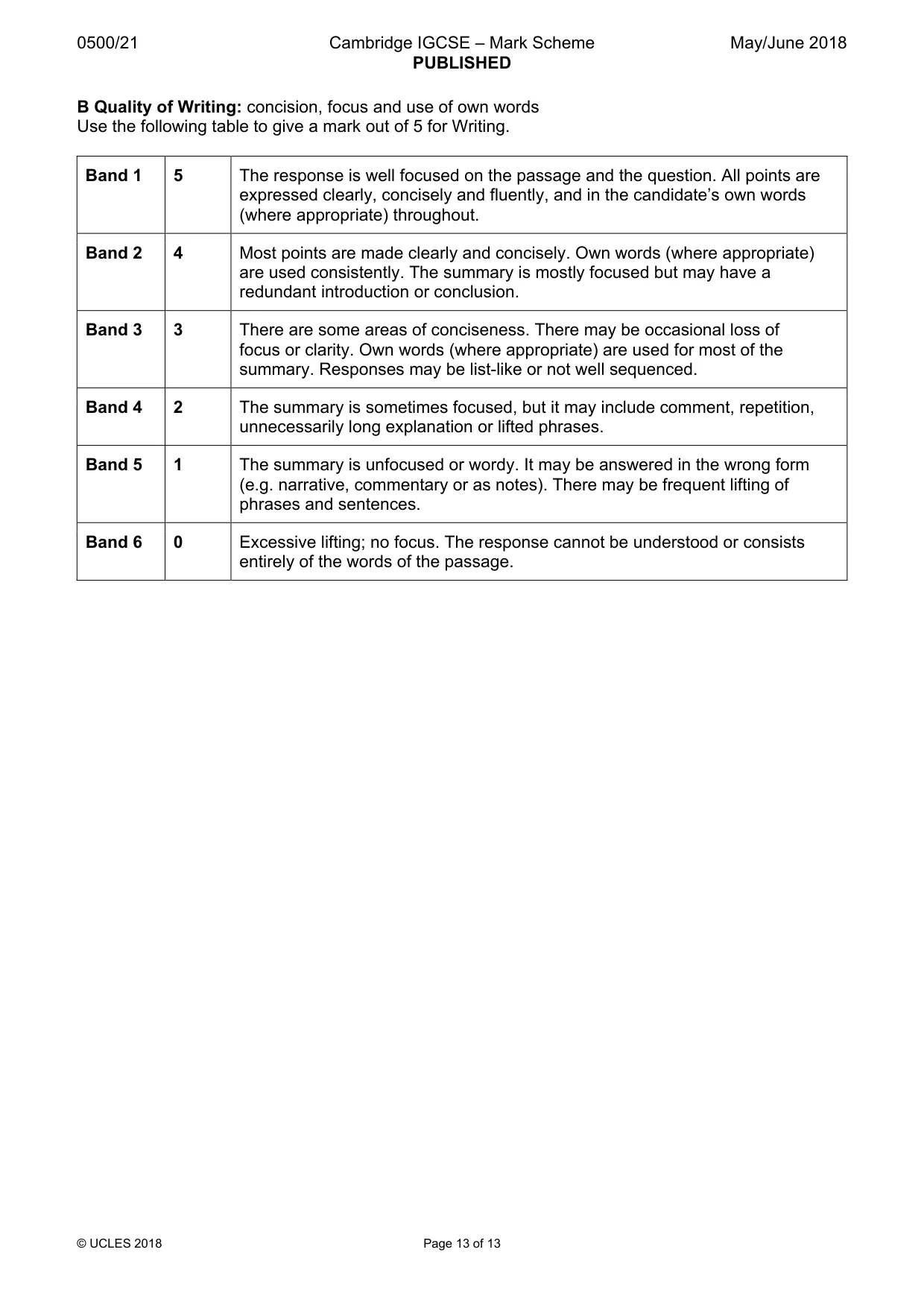
0500/21 Cambridge IGCSE – Mark Scheme PUBLISHED May/June 2018 © UCLES 2018 Page 13 of 13 B Quality of Writing: concision, focus and use of own words Use the following table to give a mark out of 5 for Writing. Band 1 5 The response is well focused on the passage and the question. All points are expressed clearly, concisely and fluently, and in the candidate’s own words (where appropriate) throughout. Band 2 4 Most points are made clearly and concisely. Own words (where appropriate) are used consistently. The summary is mostly focused but may have a redundant introduction or conclusion. Band 3 3 There are some areas of conciseness. There may be occasional loss of focus or clarity. Own words (where appropriate) are used for most of the summary. Responses may be list-like or not well sequenced. Band 4 2 The summary is sometimes focused, but it may include comment, repetition, unnecessarily long explanation or lifted phrases. Band 5 1 The summary is unfocused or wordy. It may be answered in the wrong form (e.g. narrative, commentary or as notes). There may be frequent lifting of phrases and sentences. Band 6 0 Excessive lifting; no focus. The response cannot be understood or consists entirely of the words of the passage.
What you needed in this session
Cambridge’s own grade thresholds for 2018 May/June, Paper 2 · Variant 1. A higher threshold means an easier paper — the bar moves with how the cohort did.