Cambridge IGCSE English - First Language 0500 — 2015 Oct/Nov Paper 2 · Variant 3
0500/23/O/N/15 · 50 marks · ≈56 min
The question paper and its mark scheme, free to read here and free to download. This is Cambridge’s own paper, exactly as it was sat.
Question paper12 pages
Mark scheme10 pages
Answers below. Sit the paper first if you are practising.
Paper as text
Question paper, page 1
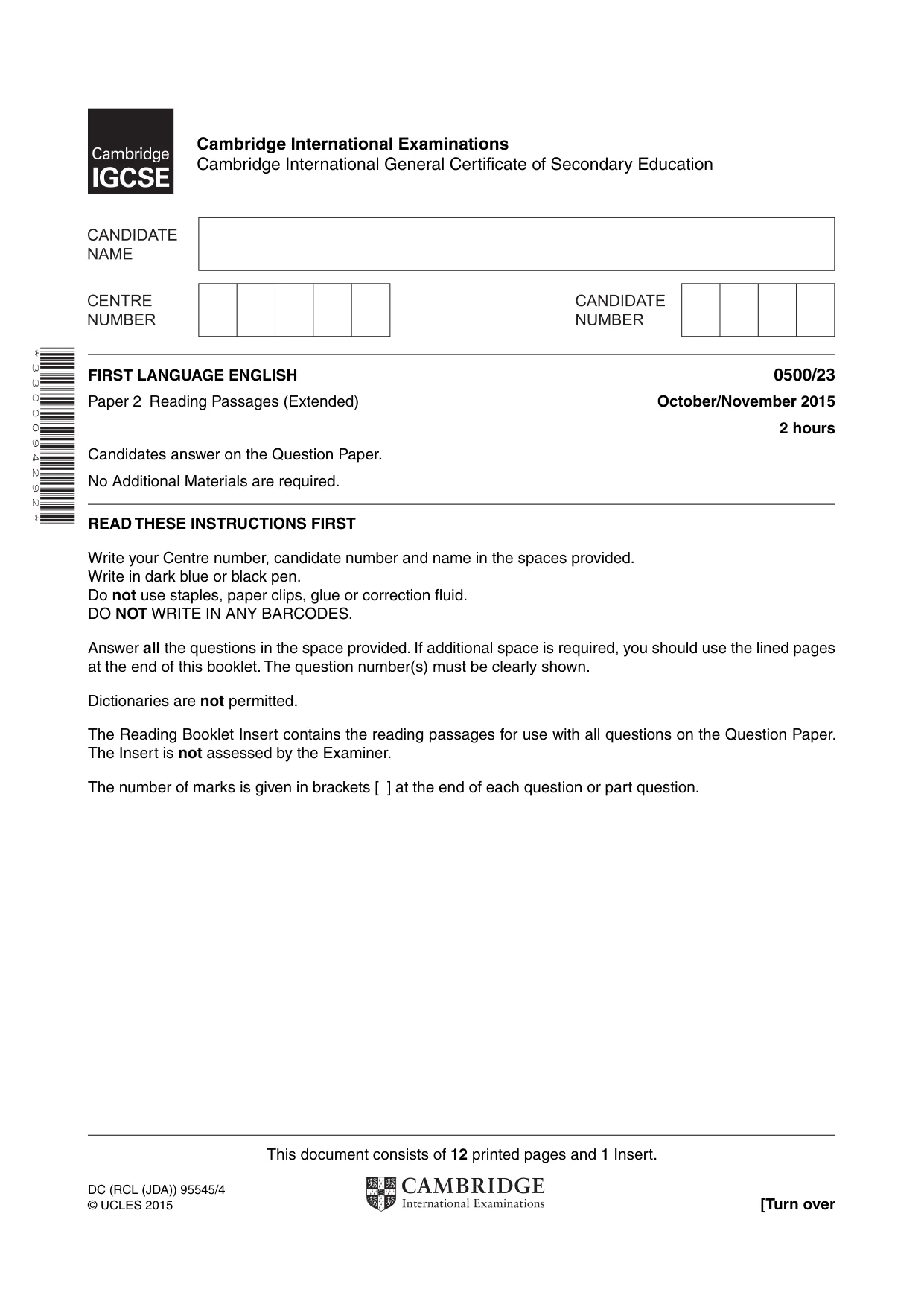
This document consists of 12 printed pages and 1 Insert. DC (RCL (JDA)) 95545/4 © UCLES 2015 [Turn over Cambridge International Examinations Cambridge International General Certificate of Secondary Education * 3 3 0 0 0 9 4 2 9 2 * FIRST LANGUAGE ENGLISH 0500/23 Paper 2 Reading Passages (Extended) October/November 2015 2 hours Candidates answer on the Question Paper. No Additional Materials are required. READ THESE INSTRUCTIONS FIRST Write your Centre number, candidate number and name in the spaces provided. Write in dark blue or black pen. Do not use staples, paper clips, glue or correction fluid. DO NOT WRITE IN ANY BARCODES. Answer all the questions in the space provided. If additional space is required, you should use the lined pages at the end of this booklet. The question number(s) must be clearly shown. Dictionaries are not permitted. The Reading Booklet Insert contains the reading passages for use with all questions on the Question Paper. The Insert is not assessed by the Examiner. The number of marks is given in brackets [ ] at the end of each question or part question.
Question paper, page 2
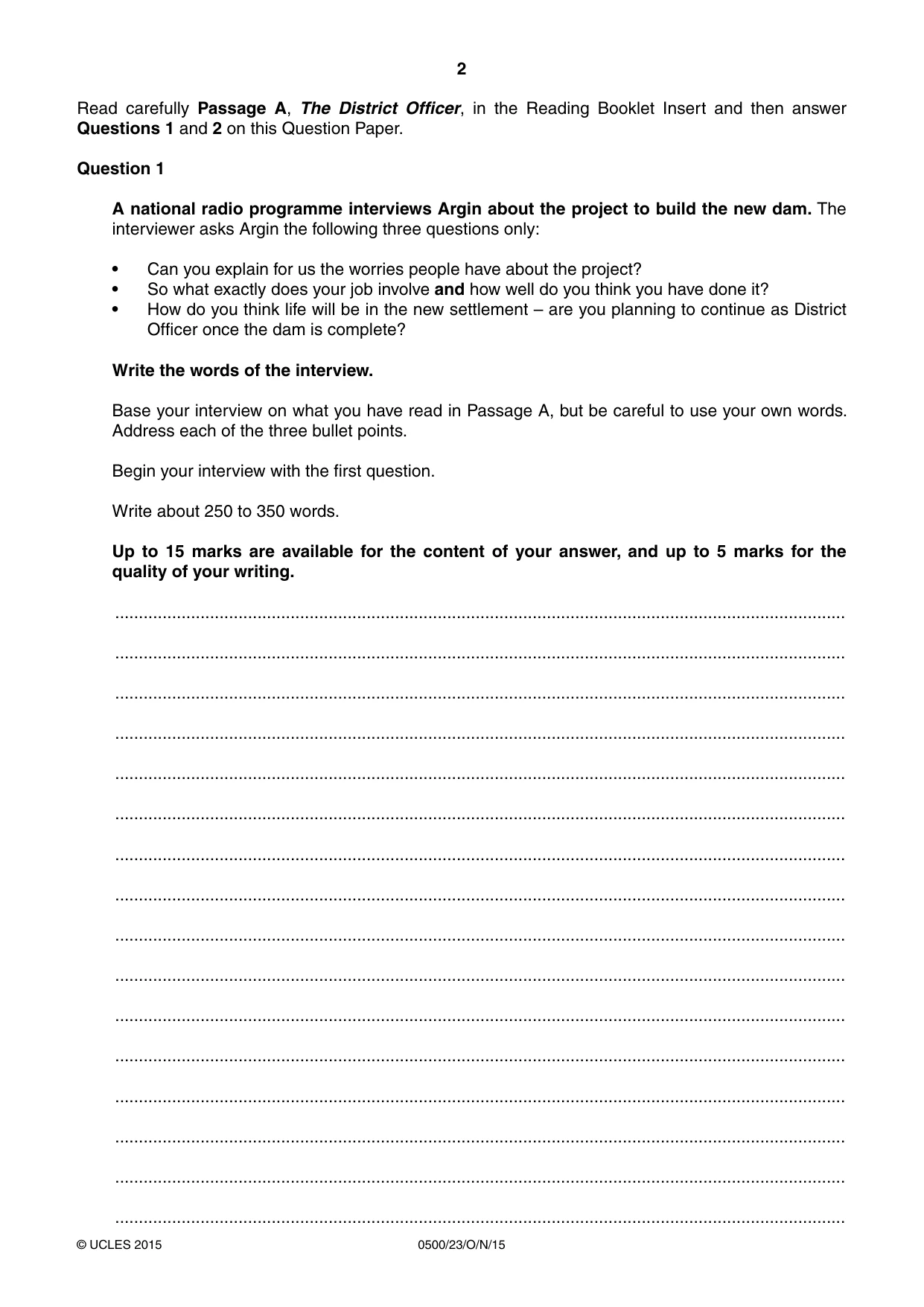
2 0500/23/O/N/15 © UCLES 2015 Read carefully Passage A, The District Officer, in the Reading Booklet Insert and then answer Questions 1 and 2 on this Question Paper. Question 1 A national radio programme interviews Argin about the project to build the new dam. The interviewer asks Argin the following three questions only: • Can you explain for us the worries people have about the project? • So what exactly does your job involve and how well do you think you have done it? • How do you think life will be in the new settlement – are you planning to continue as District Officer once the dam is complete? Write the words of the interview. Base your interview on what you have read in Passage A, but be careful to use your own words. Address each of the three bullet points. Begin your interview with the first question. Write about 250 to 350 words. Up to 15 marks are available for the content of your answer, and up to 5 marks for the quality of your writing. … … … … … … … … … … … … … … … …
Question paper, page 3
3 0500/23/O/N/15 © UCLES 2015 [Turn over … … … … … … … … … … … … … … … … … … … … … … … … … … … …
Question paper, page 4
4 0500/23/O/N/15 © UCLES 2015 … … … … … … … … … … … … … … … … … … … … … … … … … … … [Total: 20]
Question paper, page 5
5 0500/23/O/N/15 © UCLES 2015 [Turn over [Turn over for Question 2]
Question paper, page 6
6 0500/23/O/N/15 © UCLES 2015 Question 2 Re-read the descriptions of: (a) the Governor in paragraph 2, beginning ‘A tricky job…’; (b) the relics and their treatment in paragraph 8, beginning ‘Argin wondered if perhaps…’. Select four powerful words or phrases from each paragraph. Your choices should include imagery. Explain how each word or phrase selected is used effectively in the context. Write about 200 to 300 words. Up to 10 marks are available for the content of your answer. … … … … … … … … … … … … … … … … … … … … …
Question paper, page 7
7 0500/23/O/N/15 © UCLES 2015 [Turn over … … … … … … … … … … … … … … … … … … … … … … … … … … … [Total: 10]
Question paper, page 8
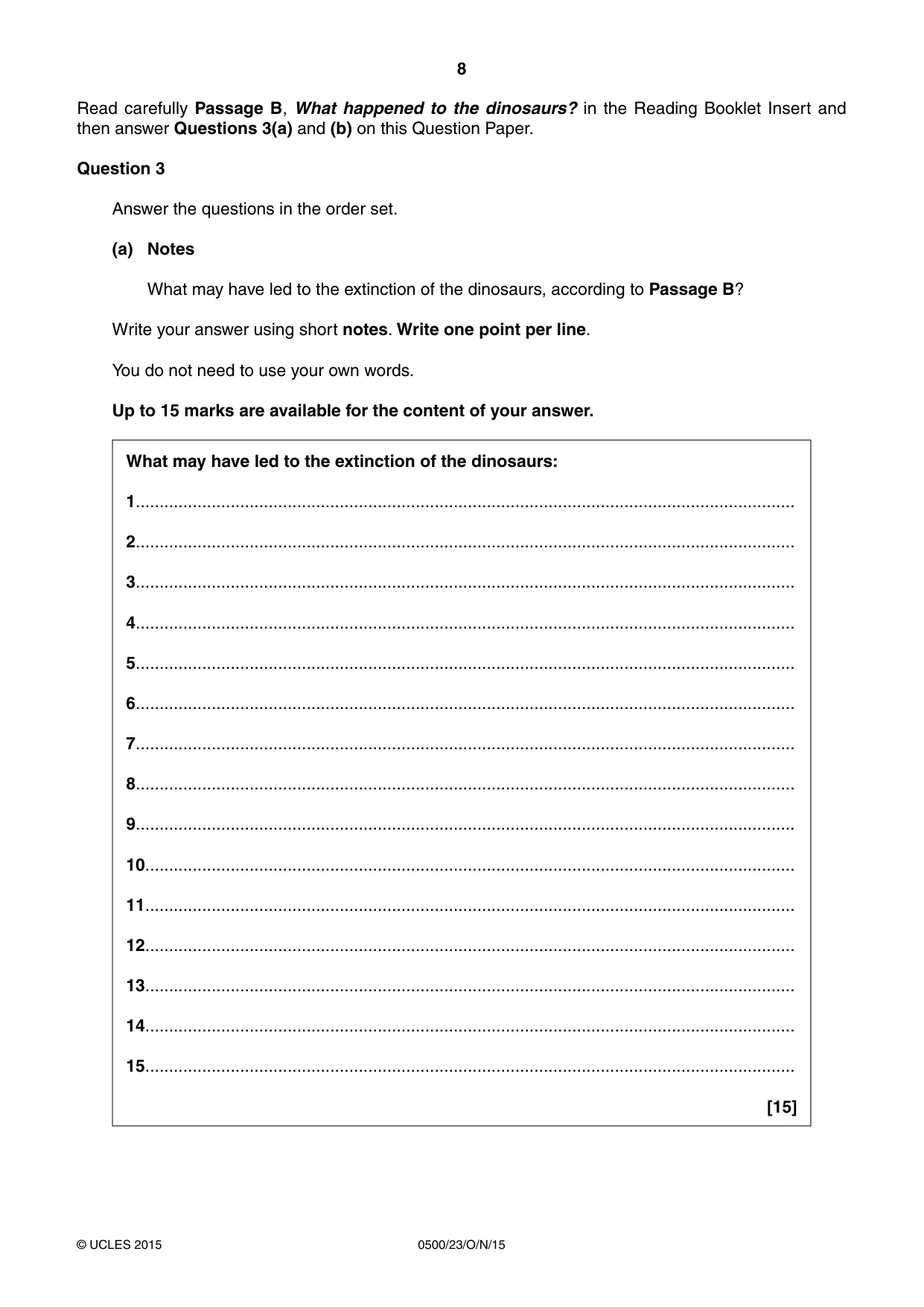
8 0500/23/O/N/15 © UCLES 2015 Read carefully Passage B, What happened to the dinosaurs? in the Reading Booklet Insert and then answer Questions 3(a) and (b) on this Question Paper. Question 3 Answer the questions in the order set. (a) Notes What may have led to the extinction of the dinosaurs, according to Passage B? Write your answer using short notes. Write one point per line. You do not need to use your own words. Up to 15 marks are available for the content of your answer. What may have led to the extinction of the dinosaurs: 1… 2… 3… 4… 5… 6… 7… 8… 9… 10… 11… 12… 13… 14… 15… [15]
Question paper, page 9
9 0500/23/O/N/15 © UCLES 2015 [Turn over (b) Summary Now use your notes from Question 3(a) to write a summary of what may have led to the extinction of the dinosaurs, according to Passage B. You must use continuous writing (not note form) and use your own words as far as possible. Your summary should include all 15 of your points in Question 3(a) and must be 200 to 250 words. Up to 5 marks are available for the quality of your writing. … … … … … … … … … … … … … … … … … … … … … … …
Question paper, page 10
10 0500/23/O/N/15 © UCLES 2015 … … … … … … … … … … … … [5] [Total: 20]
Question paper, page 11
11 0500/23/O/N/15 © UCLES 2015 Additional Page If you use the following lined page to complete the answer(s) to any question(s), the question number(s) must be clearly shown. … … … … … … … … … … … … … … … … … … … … … … … … … …
Question paper, page 12
12 0500/23/O/N/15 © UCLES 2015 Permission to reproduce items where third-party owned material protected by copyright is included has been sought and cleared where possible. Every reasonable effort has been made by the publisher (UCLES) to trace copyright holders, but if any items requiring clearance have unwittingly been included, the publisher will be pleased to make amends at the earliest possible opportunity. To avoid the issue of disclosure of answer-related information to candidates, all copyright acknowledgements are reproduced online in the Cambridge International Examinations Copyright Acknowledgements Booklet. This is produced for each series of examinations and is freely available to download at www.cie.org.uk after the live examination series. Cambridge International Examinations is part of the Cambridge Assessment Group. Cambridge Assessment is the brand name of University of Cambridge Local Examinations Syndicate (UCLES), which is itself a department of the University of Cambridge. Additional Page If you use the following lined page to complete the answer(s) to any question(s), the question number(s) must be clearly shown. … … … … … … … … … … … … … … … … … … … … …
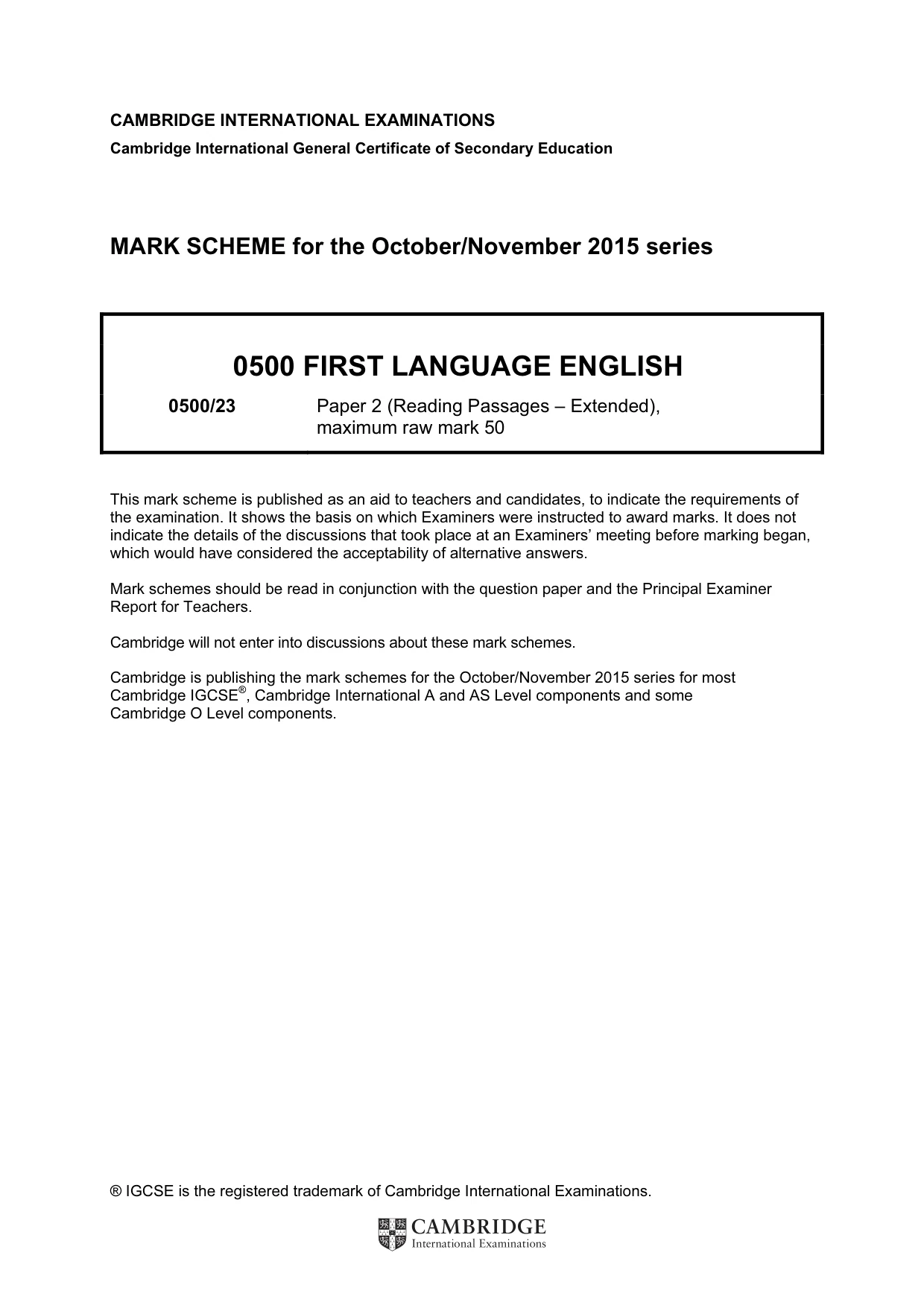
Mark scheme, page 1
® IGCSE is the registered trademark of Cambridge International Examinations. CAMBRIDGE INTERNATIONAL EXAMINATIONS Cambridge International General Certificate of Secondary Education MARK SCHEME for the October/November 2015 series 0500 FIRST LANGUAGE ENGLISH 0500/23 Paper 2 (Reading Passages – Extended), maximum raw mark 50 This mark scheme is published as an aid to teachers and candidates, to indicate the requirements of the examination. It shows the basis on which Examiners were instructed to award marks. It does not indicate the details of the discussions that took place at an Examiners’ meeting before marking began, which would have considered the acceptability of alternative answers. Mark schemes should be read in conjunction with the question paper and the Principal Examiner Report for Teachers. Cambridge will not enter into discussions about these mark schemes. Cambridge is publishing the mark schemes for the October/November 2015 series for most Cambridge IGCSE®, Cambridge International A and AS Level components and some Cambridge O Level components.
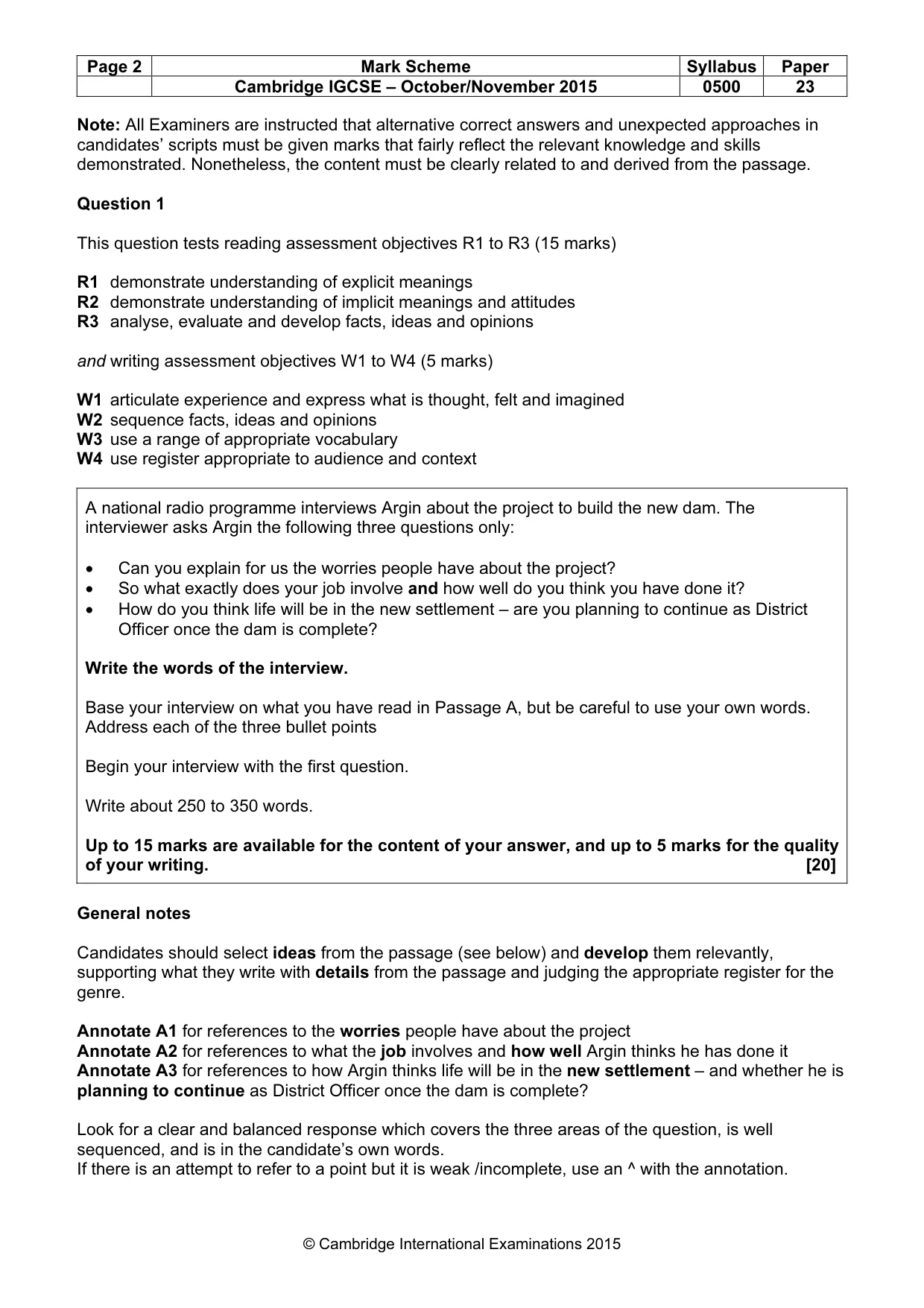
Mark scheme, page 2
Page 2 Mark Scheme Syllabus Paper Cambridge IGCSE – October/November 2015 0500 23 © Cambridge International Examinations 2015 Note: All Examiners are instructed that alternative correct answers and unexpected approaches in candidates’ scripts must be given marks that fairly reflect the relevant knowledge and skills demonstrated. Nonetheless, the content must be clearly related to and derived from the passage. Question 1 This question tests reading assessment objectives R1 to R3 (15 marks) R1 demonstrate understanding of explicit meanings R2 demonstrate understanding of implicit meanings and attitudes R3 analyse, evaluate and develop facts, ideas and opinions and writing assessment objectives W1 to W4 (5 marks) W1 articulate experience and express what is thought, felt and imagined W2 sequence facts, ideas and opinions W3 use a range of appropriate vocabulary W4 use register appropriate to audience and context A national radio programme interviews Argin about the project to build the new dam. The interviewer asks Argin the following three questions only: • Can you explain for us the worries people have about the project? • So what exactly does your job involve and how well do you think you have done it? • How do you think life will be in the new settlement – are you planning to continue as District Officer once the dam is complete? Write the words of the interview. Base your interview on what you have read in Passage A, but be careful to use your own words. Address each of the three bullet points Begin your interview with the first question. Write about 250 to 350 words. Up to 15 marks are available for the content of your answer, and up to 5 marks for the quality of your writing. [20] General notes Candidates should select ideas from the passage (see below) and develop them relevantly, supporting what they write with details from the passage and judging the appropriate register for the genre. Annotate A1 for references to the worries people have about the project Annotate A2 for references to what the job involves and how well Argin thinks he has done it Annotate A3 for references to how Argin thinks life will be in the new settlement – and whether he is planning to continue as District Officer once the dam is complete? Look for a clear and balanced response which covers the three areas of the question, is well sequenced, and is in the candidate’s own words. If there is an attempt to refer to a point but it is weak /incomplete, use an ^ with the annotation.
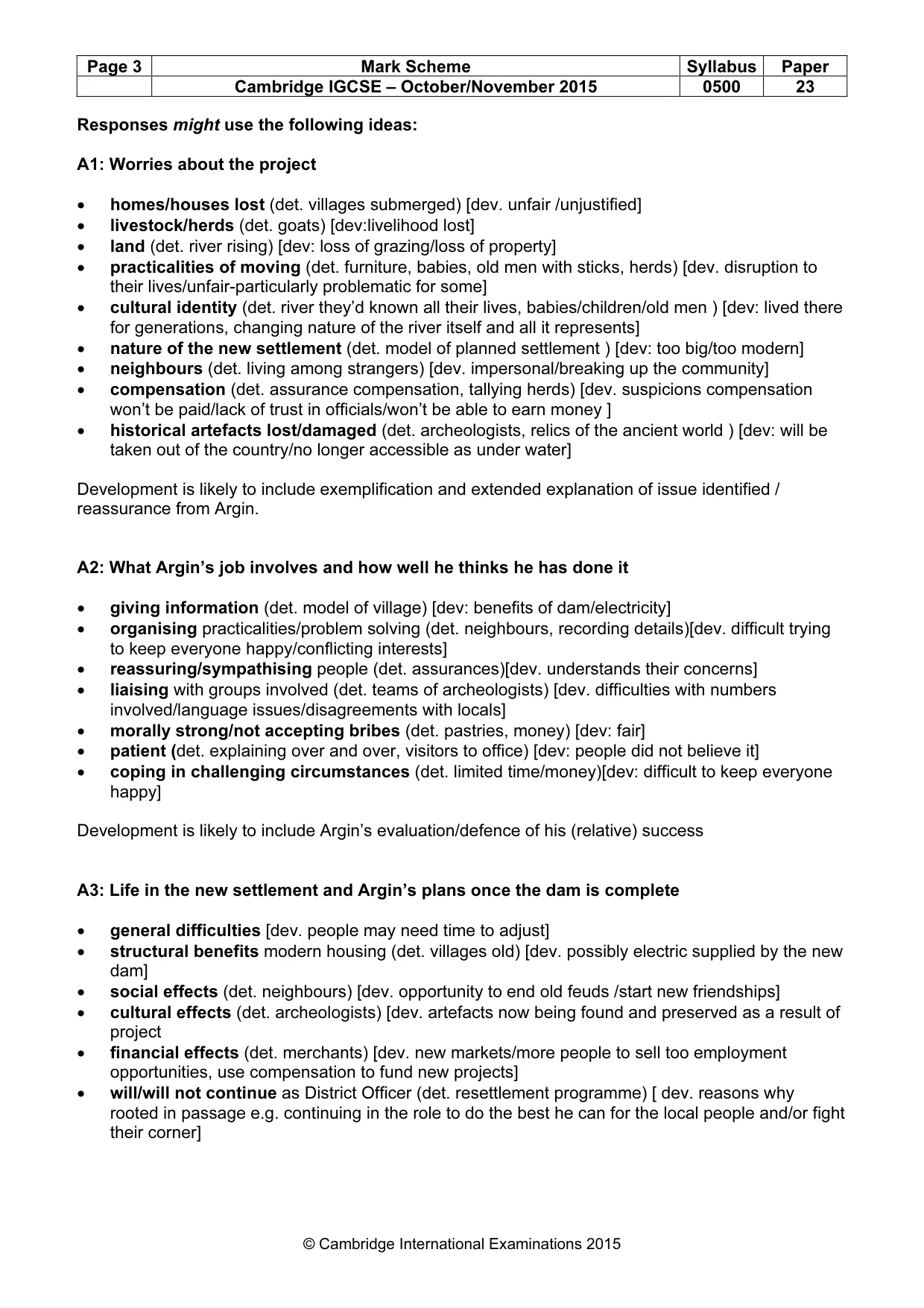
Mark scheme, page 3
Page 3 Mark Scheme Syllabus Paper Cambridge IGCSE – October/November 2015 0500 23 © Cambridge International Examinations 2015 Responses might use the following ideas: A1: Worries about the project • homes/houses lost (det. villages submerged) [dev. unfair /unjustified] • livestock/herds (det. goats) [dev:livelihood lost] • land (det. river rising) [dev: loss of grazing/loss of property] • practicalities of moving (det. furniture, babies, old men with sticks, herds) [dev. disruption to their lives/unfair-particularly problematic for some] • cultural identity (det. river they’d known all their lives, babies/children/old men ) [dev: lived there for generations, changing nature of the river itself and all it represents] • nature of the new settlement (det. model of planned settlement ) [dev: too big/too modern] • neighbours (det. living among strangers) [dev. impersonal/breaking up the community] • compensation (det. assurance compensation, tallying herds) [dev. suspicions compensation won’t be paid/lack of trust in officials/won’t be able to earn money ] • historical artefacts lost/damaged (det. archeologists, relics of the ancient world ) [dev: will be taken out of the country/no longer accessible as under water] Development is likely to include exemplification and extended explanation of issue identified / reassurance from Argin. A2: What Argin’s job involves and how well he thinks he has done it • giving information (det. model of village) [dev: benefits of dam/electricity] • organising practicalities/problem solving (det. neighbours, recording details)[dev. difficult trying to keep everyone happy/conflicting interests] • reassuring/sympathising people (det. assurances)[dev. understands their concerns] • liaising with groups involved (det. teams of archeologists) [dev. difficulties with numbers involved/language issues/disagreements with locals] • morally strong/not accepting bribes (det. pastries, money) [dev: fair] • patient (det. explaining over and over, visitors to office) [dev: people did not believe it] • coping in challenging circumstances (det. limited time/money)[dev: difficult to keep everyone happy] Development is likely to include Argin’s evaluation/defence of his (relative) success A3: Life in the new settlement and Argin’s plans once the dam is complete • general difficulties [dev. people may need time to adjust] • structural benefits modern housing (det. villages old) [dev. possibly electric supplied by the new dam] • social effects (det. neighbours) [dev. opportunity to end old feuds /start new friendships] • cultural effects (det. archeologists) [dev. artefacts now being found and preserved as a result of project • financial effects (det. merchants) [dev. new markets/more people to sell too employment opportunities, use compensation to fund new projects] • will/will not continue as District Officer (det. resettlement programme) [ dev. reasons why rooted in passage e.g. continuing in the role to do the best he can for the local people and/or fight their corner]
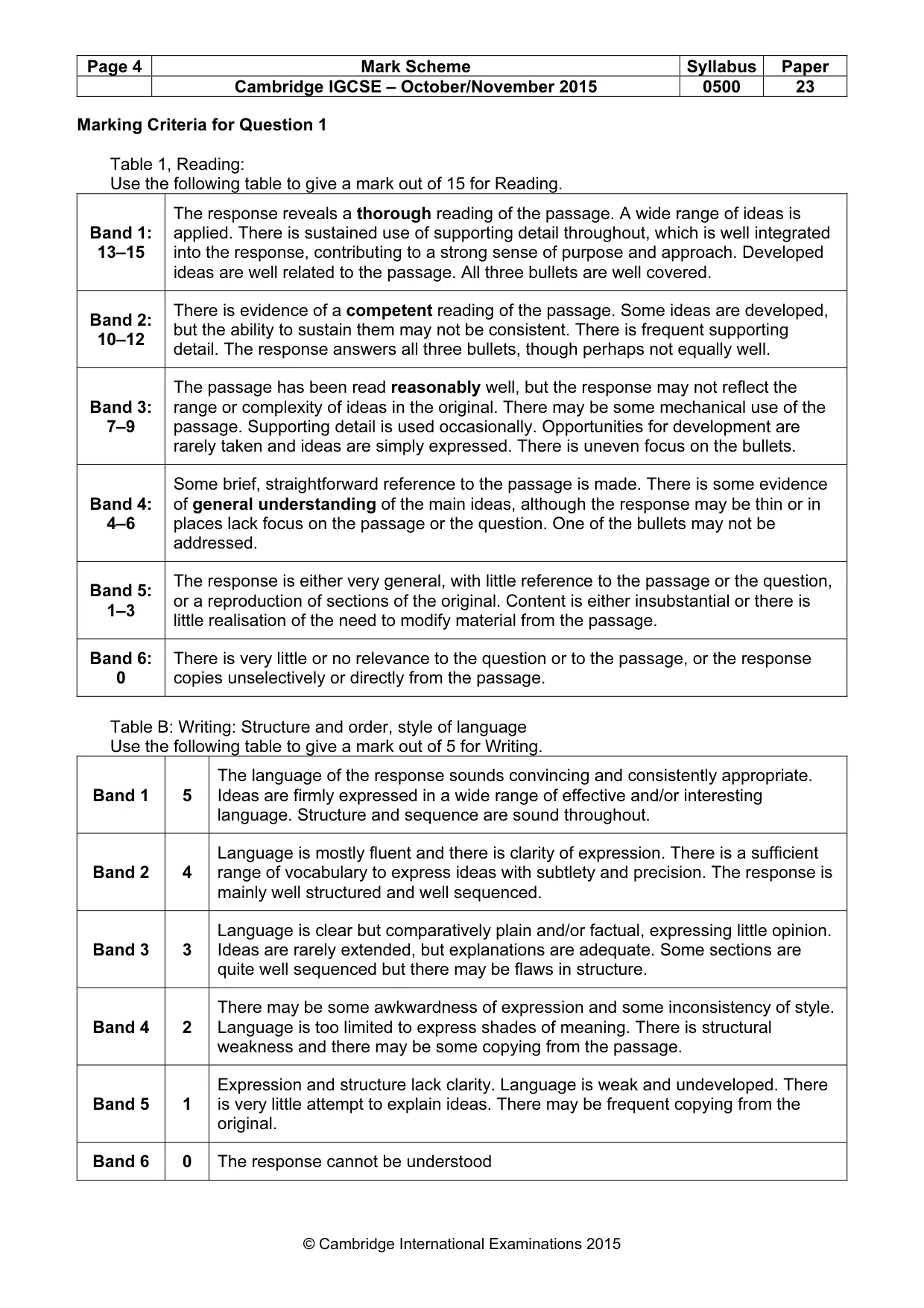
Mark scheme, page 4
Page 4 Mark Scheme Syllabus Paper Cambridge IGCSE – October/November 2015 0500 23 © Cambridge International Examinations 2015 Marking Criteria for Question 1 Table 1, Reading: Use the following table to give a mark out of 15 for Reading. Band 1: 13–15 The response reveals a thorough reading of the passage. A wide range of ideas is applied. There is sustained use of supporting detail throughout, which is well integrated into the response, contributing to a strong sense of purpose and approach. Developed ideas are well related to the passage. All three bullets are well covered. Band 2: 10–12 There is evidence of a competent reading of the passage. Some ideas are developed, but the ability to sustain them may not be consistent. There is frequent supporting detail. The response answers all three bullets, though perhaps not equally well. Band 3: 7–9 The passage has been read reasonably well, but the response may not reflect the range or complexity of ideas in the original. There may be some mechanical use of the passage. Supporting detail is used occasionally. Opportunities for development are rarely taken and ideas are simply expressed. There is uneven focus on the bullets. Band 4: 4–6 Some brief, straightforward reference to the passage is made. There is some evidence of general understanding of the main ideas, although the response may be thin or in places lack focus on the passage or the question. One of the bullets may not be addressed. Band 5: 1–3 The response is either very general, with little reference to the passage or the question, or a reproduction of sections of the original. Content is either insubstantial or there is little realisation of the need to modify material from the passage. Band 6: 0 There is very little or no relevance to the question or to the passage, or the response copies unselectively or directly from the passage. Table B: Writing: Structure and order, style of language Use the following table to give a mark out of 5 for Writing. Band 1 5 The language of the response sounds convincing and consistently appropriate. Ideas are firmly expressed in a wide range of effective and/or interesting language. Structure and sequence are sound throughout. Band 2 4 Language is mostly fluent and there is clarity of expression. There is a sufficient range of vocabulary to express ideas with subtlety and precision. The response is mainly well structured and well sequenced. Band 3 3 Language is clear but comparatively plain and/or factual, expressing little opinion. Ideas are rarely extended, but explanations are adequate. Some sections are quite well sequenced but there may be flaws in structure. Band 4 2 There may be some awkwardness of expression and some inconsistency of style. Language is too limited to express shades of meaning. There is structural weakness and there may be some copying from the passage. Band 5 1 Expression and structure lack clarity. Language is weak and undeveloped. There is very little attempt to explain ideas. There may be frequent copying from the original. Band 6 0 The response cannot be understood
Mark scheme, page 5
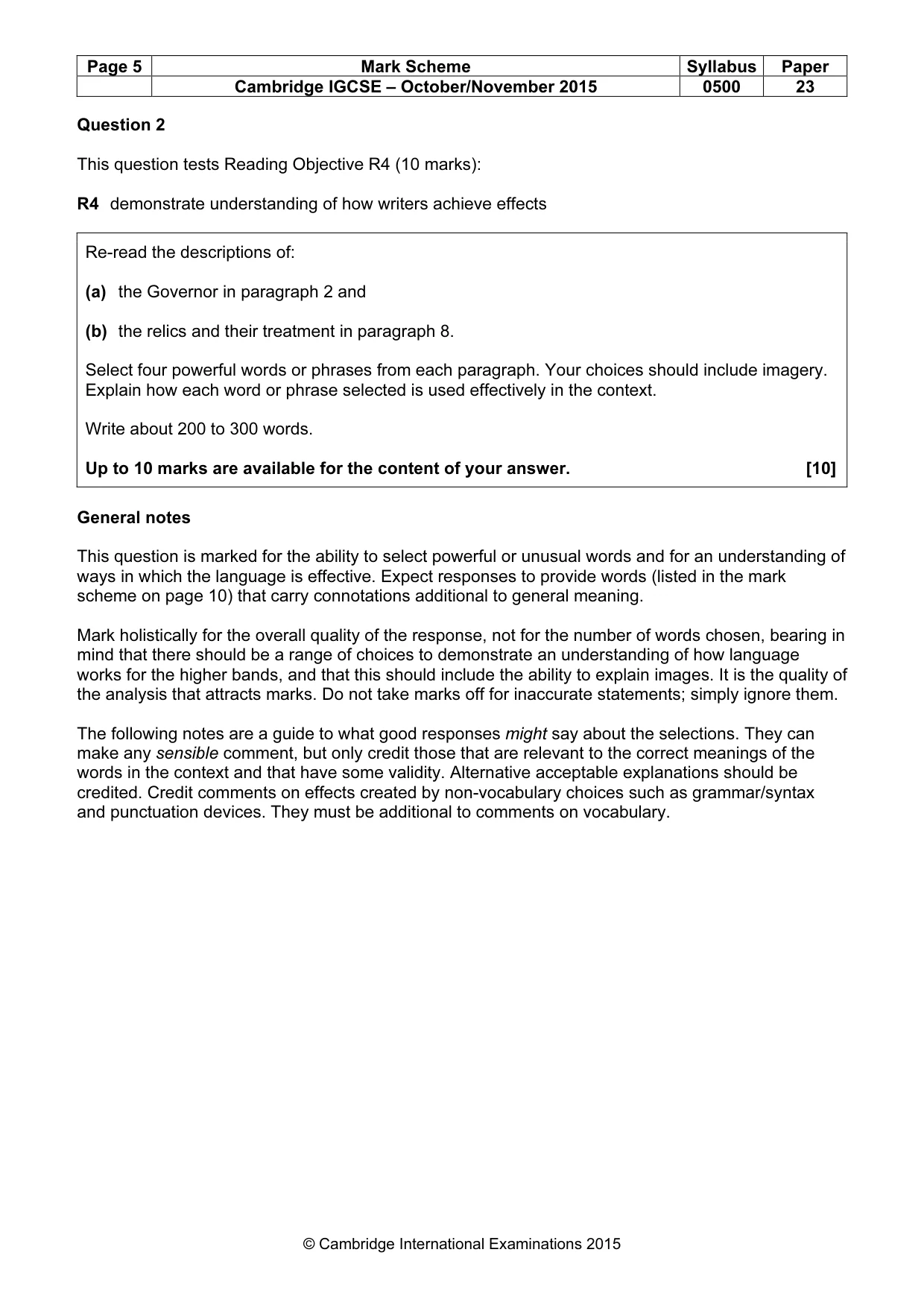
Page 5 Mark Scheme Syllabus Paper Cambridge IGCSE – October/November 2015 0500 23 © Cambridge International Examinations 2015 Question 2 This question tests Reading Objective R4 (10 marks): R4 demonstrate understanding of how writers achieve effects Re-read the descriptions of: (a) the Governor in paragraph 2 and (b) the relics and their treatment in paragraph 8. Select four powerful words or phrases from each paragraph. Your choices should include imagery. Explain how each word or phrase selected is used effectively in the context. Write about 200 to 300 words. Up to 10 marks are available for the content of your answer. [10] General notes This question is marked for the ability to select powerful or unusual words and for an understanding of ways in which the language is effective. Expect responses to provide words (listed in the mark scheme on page 10) that carry connotations additional to general meaning. Mark holistically for the overall quality of the response, not for the number of words chosen, bearing in mind that there should be a range of choices to demonstrate an understanding of how language works for the higher bands, and that this should include the ability to explain images. It is the quality of the analysis that attracts marks. Do not take marks off for inaccurate statements; simply ignore them. The following notes are a guide to what good responses might say about the selections. They can make any sensible comment, but only credit those that are relevant to the correct meanings of the words in the context and that have some validity. Alternative acceptable explanations should be credited. Credit comments on effects created by non-vocabulary choices such as grammar/syntax and punctuation devices. They must be additional to comments on vocabulary.
Mark scheme, page 6
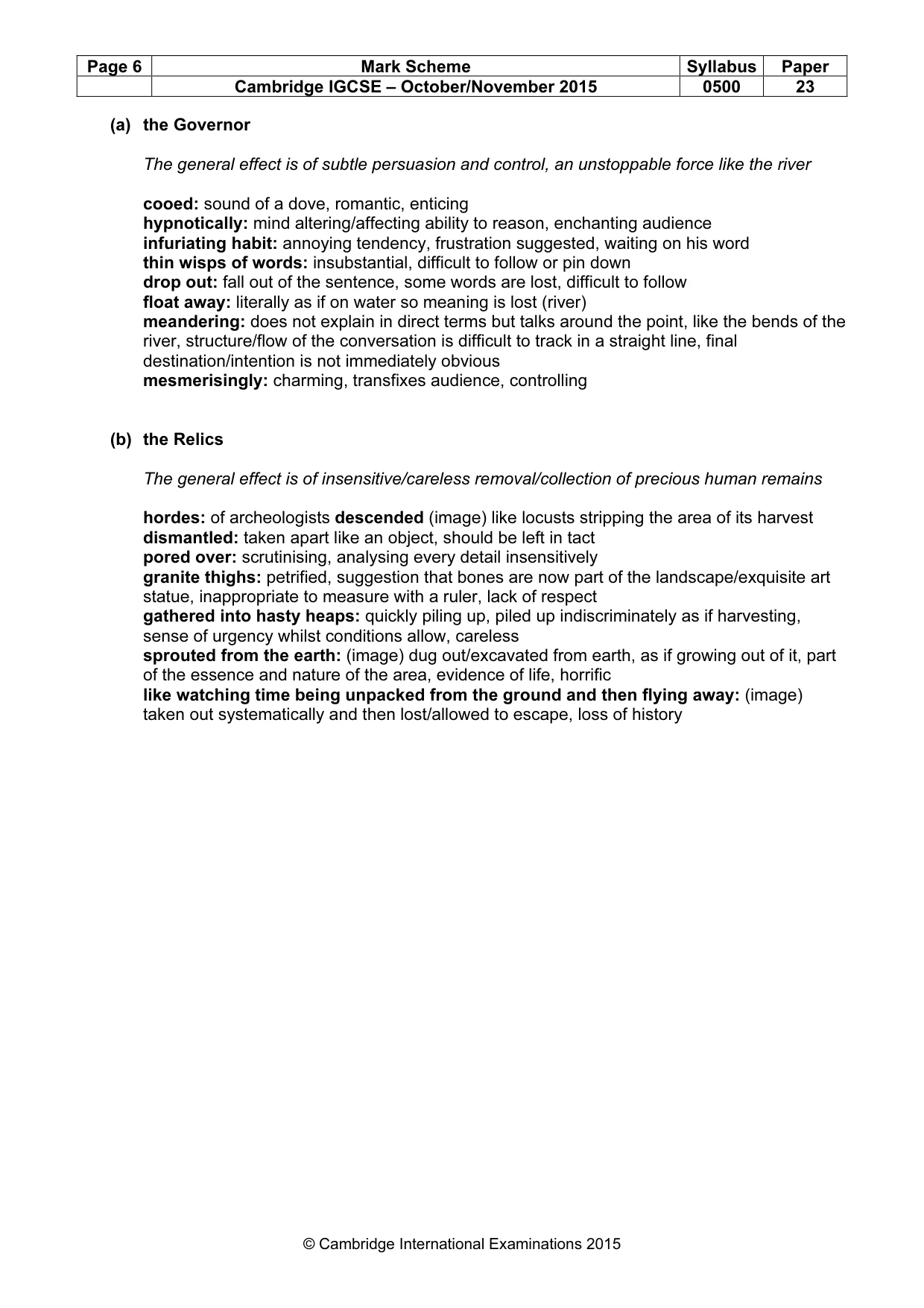
Page 6 Mark Scheme Syllabus Paper Cambridge IGCSE – October/November 2015 0500 23 © Cambridge International Examinations 2015 (a) the Governor The general effect is of subtle persuasion and control, an unstoppable force like the river cooed: sound of a dove, romantic, enticing hypnotically: mind altering/affecting ability to reason, enchanting audience infuriating habit: annoying tendency, frustration suggested, waiting on his word thin wisps of words: insubstantial, difficult to follow or pin down drop out: fall out of the sentence, some words are lost, difficult to follow float away: literally as if on water so meaning is lost (river) meandering: does not explain in direct terms but talks around the point, like the bends of the river, structure/flow of the conversation is difficult to track in a straight line, final destination/intention is not immediately obvious mesmerisingly: charming, transfixes audience, controlling (b) the Relics The general effect is of insensitive/careless removal/collection of precious human remains hordes: of archeologists descended (image) like locusts stripping the area of its harvest dismantled: taken apart like an object, should be left in tact pored over: scrutinising, analysing every detail insensitively granite thighs: petrified, suggestion that bones are now part of the landscape/exquisite art statue, inappropriate to measure with a ruler, lack of respect gathered into hasty heaps: quickly piling up, piled up indiscriminately as if harvesting, sense of urgency whilst conditions allow, careless sprouted from the earth: (image) dug out/excavated from earth, as if growing out of it, part of the essence and nature of the area, evidence of life, horrific like watching time being unpacked from the ground and then flying away: (image) taken out systematically and then lost/allowed to escape, loss of history
Mark scheme, page 7
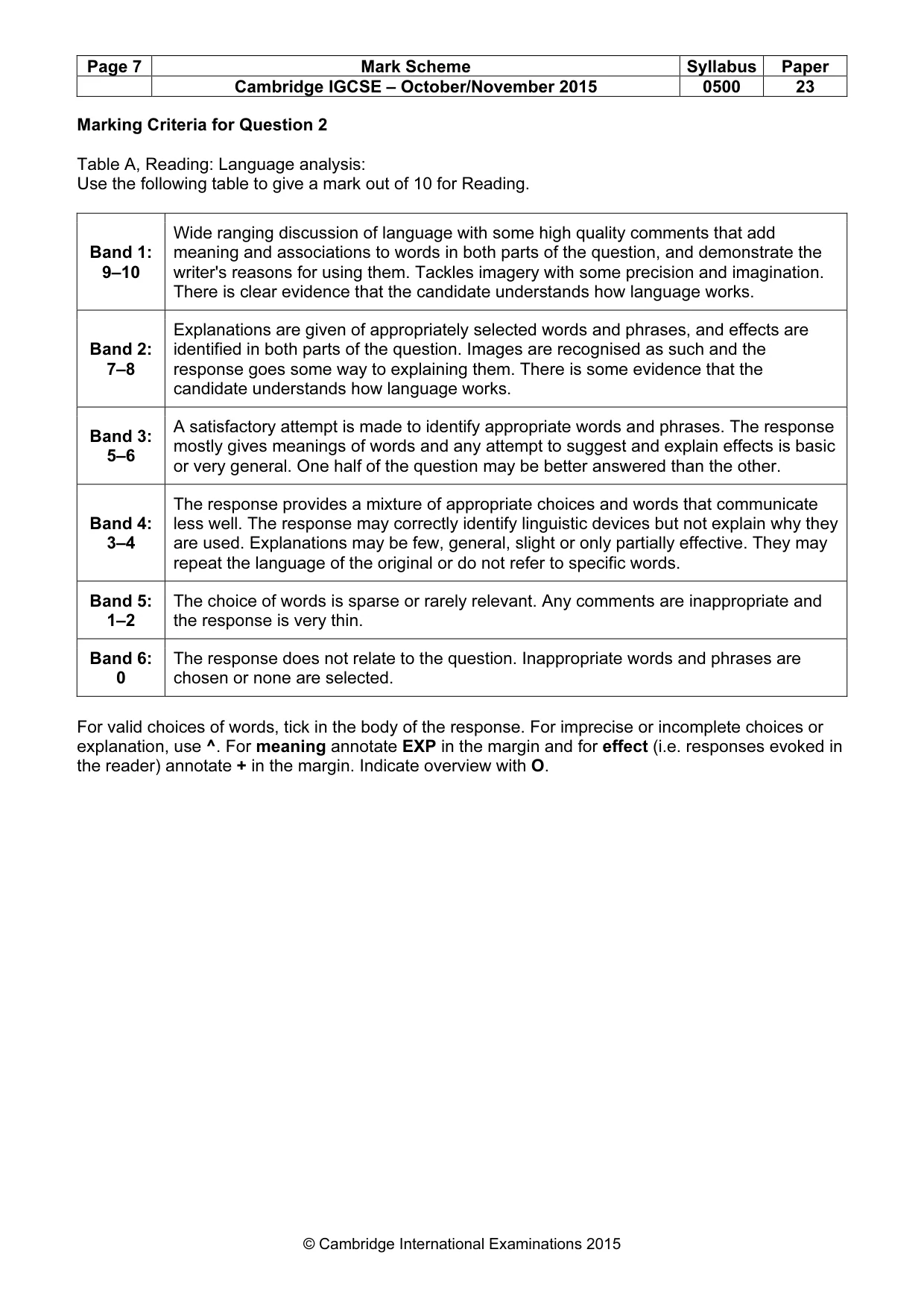
Page 7 Mark Scheme Syllabus Paper Cambridge IGCSE – October/November 2015 0500 23 © Cambridge International Examinations 2015 Marking Criteria for Question 2 Table A, Reading: Language analysis: Use the following table to give a mark out of 10 for Reading. Band 1: 9–10 Wide ranging discussion of language with some high quality comments that add meaning and associations to words in both parts of the question, and demonstrate the writer's reasons for using them. Tackles imagery with some precision and imagination. There is clear evidence that the candidate understands how language works. Band 2: 7–8 Explanations are given of appropriately selected words and phrases, and effects are identified in both parts of the question. Images are recognised as such and the response goes some way to explaining them. There is some evidence that the candidate understands how language works. Band 3: 5–6 A satisfactory attempt is made to identify appropriate words and phrases. The response mostly gives meanings of words and any attempt to suggest and explain effects is basic or very general. One half of the question may be better answered than the other. Band 4: 3–4 The response provides a mixture of appropriate choices and words that communicate less well. The response may correctly identify linguistic devices but not explain why they are used. Explanations may be few, general, slight or only partially effective. They may repeat the language of the original or do not refer to specific words. Band 5: 1–2 The choice of words is sparse or rarely relevant. Any comments are inappropriate and the response is very thin. Band 6: 0 The response does not relate to the question. Inappropriate words and phrases are chosen or none are selected. For valid choices of words, tick in the body of the response. For imprecise or incomplete choices or explanation, use ^. For meaning annotate EXP in the margin and for effect (i.e. responses evoked in the reader) annotate + in the margin. Indicate overview with O.
Mark scheme, page 8
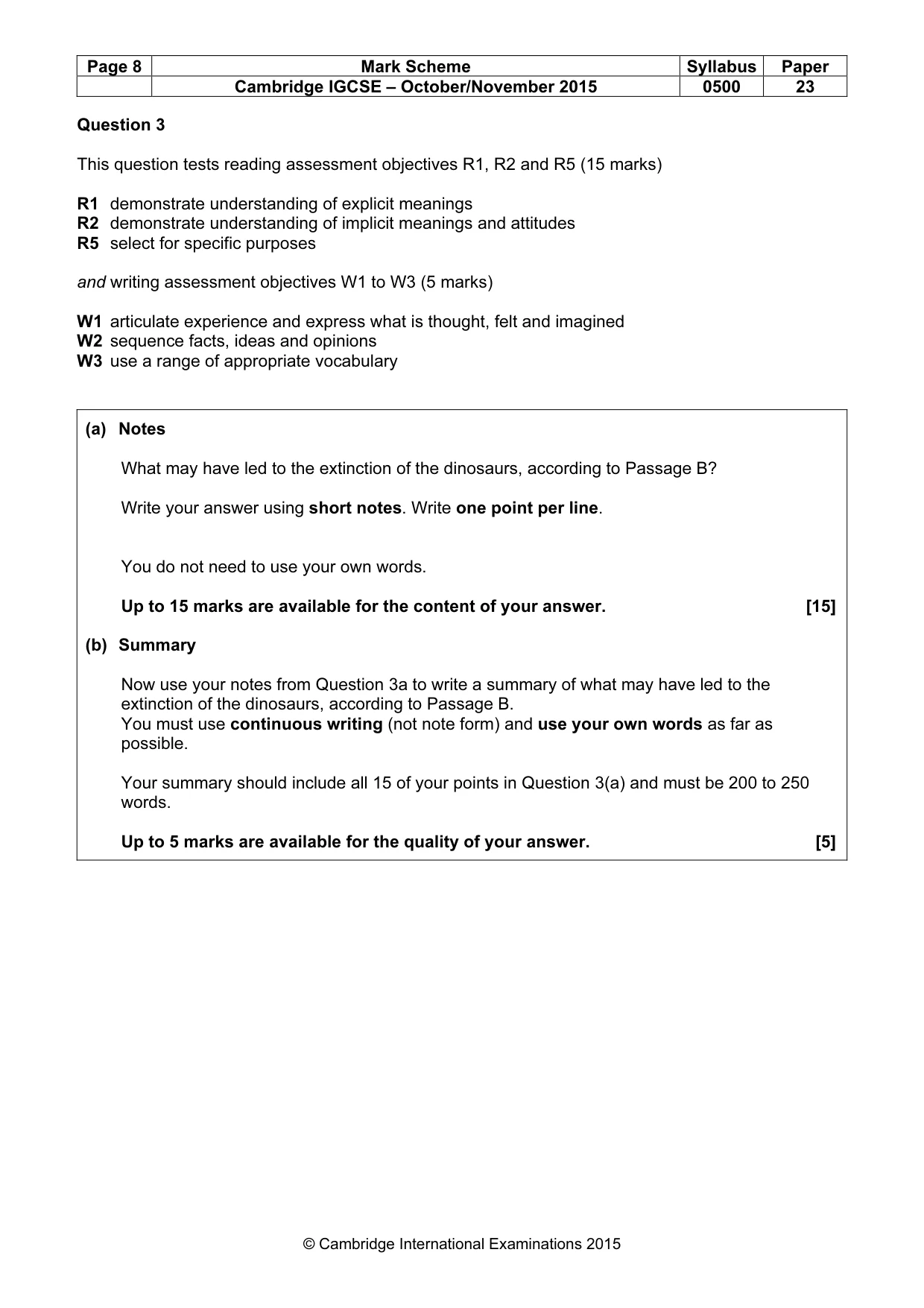
Page 8 Mark Scheme Syllabus Paper Cambridge IGCSE – October/November 2015 0500 23 © Cambridge International Examinations 2015 Question 3 This question tests reading assessment objectives R1, R2 and R5 (15 marks) R1 demonstrate understanding of explicit meanings R2 demonstrate understanding of implicit meanings and attitudes R5 select for specific purposes and writing assessment objectives W1 to W3 (5 marks) W1 articulate experience and express what is thought, felt and imagined W2 sequence facts, ideas and opinions W3 use a range of appropriate vocabulary (a) Notes What may have led to the extinction of the dinosaurs, according to Passage B? Write your answer using short notes. Write one point per line. You do not need to use your own words. Up to 15 marks are available for the content of your answer. [15] (b) Summary Now use your notes from Question 3a to write a summary of what may have led to the extinction of the dinosaurs, according to Passage B. You must use continuous writing (not note form) and use your own words as far as possible. Your summary should include all 15 of your points in Question 3(a) and must be 200 to 250 words. Up to 5 marks are available for the quality of your answer. [5]
Mark scheme, page 9
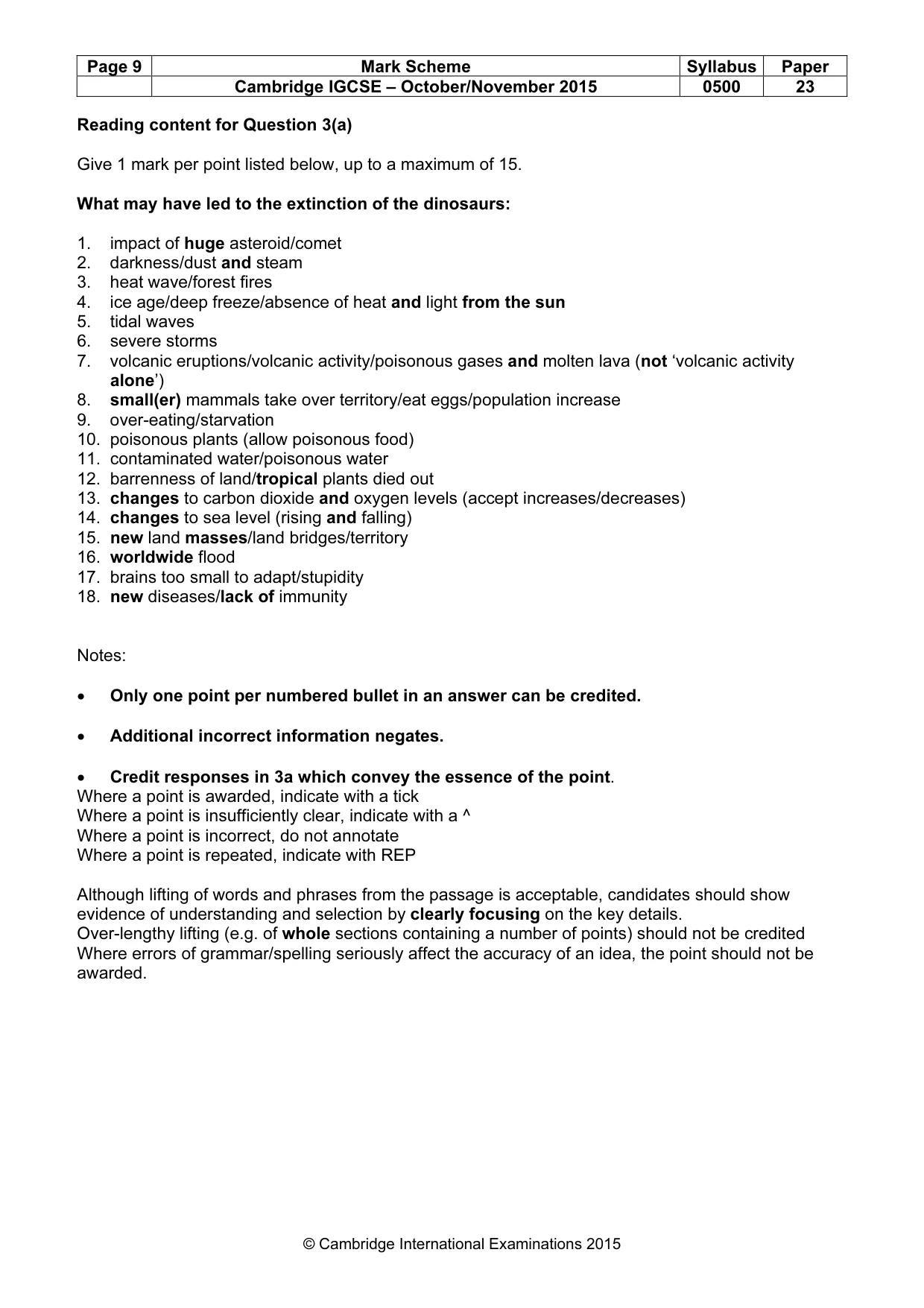
Page 9 Mark Scheme Syllabus Paper Cambridge IGCSE – October/November 2015 0500 23 © Cambridge International Examinations 2015 Reading content for Question 3(a) Give 1 mark per point listed below, up to a maximum of 15. What may have led to the extinction of the dinosaurs: 1. impact of huge asteroid/comet 2. darkness/dust and steam 3. heat wave/forest fires 4. ice age/deep freeze/absence of heat and light from the sun 5. tidal waves 6. severe storms 7. volcanic eruptions/volcanic activity/poisonous gases and molten lava (not ‘volcanic activity alone’) 8. small(er) mammals take over territory/eat eggs/population increase 9. over-eating/starvation 10. poisonous plants (allow poisonous food) 11. contaminated water/poisonous water 12. barrenness of land/tropical plants died out 13. changes to carbon dioxide and oxygen levels (accept increases/decreases) 14. changes to sea level (rising and falling) 15. new land masses/land bridges/territory 16. worldwide flood 17. brains too small to adapt/stupidity 18. new diseases/lack of immunity Notes: • Only one point per numbered bullet in an answer can be credited. • Additional incorrect information negates. • Credit responses in 3a which convey the essence of the point. Where a point is awarded, indicate with a tick Where a point is insufficiently clear, indicate with a ^ Where a point is incorrect, do not annotate Where a point is repeated, indicate with REP Although lifting of words and phrases from the passage is acceptable, candidates should show evidence of understanding and selection by clearly focusing on the key details. Over-lengthy lifting (e.g. of whole sections containing a number of points) should not be credited Where errors of grammar/spelling seriously affect the accuracy of an idea, the point should not be awarded.
Mark scheme, page 10
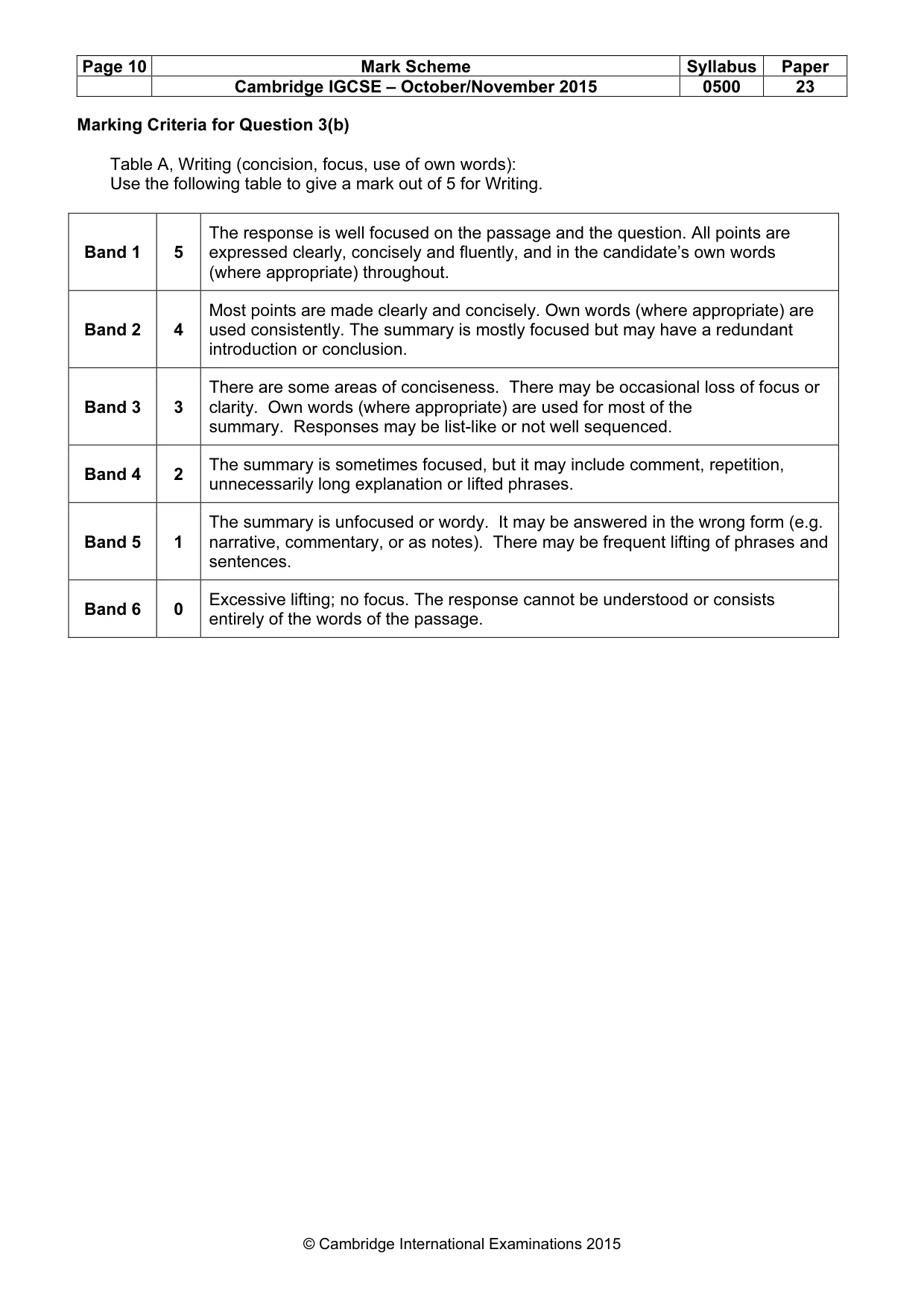
Page 10 Mark Scheme Syllabus Paper Cambridge IGCSE – October/November 2015 0500 23 © Cambridge International Examinations 2015 Marking Criteria for Question 3(b) Table A, Writing (concision, focus, use of own words): Use the following table to give a mark out of 5 for Writing. Band 1 5 The response is well focused on the passage and the question. All points are expressed clearly, concisely and fluently, and in the candidate’s own words (where appropriate) throughout. Band 2 4 Most points are made clearly and concisely. Own words (where appropriate) are used consistently. The summary is mostly focused but may have a redundant introduction or conclusion. Band 3 3 There are some areas of conciseness. There may be occasional loss of focus or clarity. Own words (where appropriate) are used for most of the summary. Responses may be list-like or not well sequenced. Band 4 2 The summary is sometimes focused, but it may include comment, repetition, unnecessarily long explanation or lifted phrases. Band 5 1 The summary is unfocused or wordy. It may be answered in the wrong form (e.g. narrative, commentary, or as notes). There may be frequent lifting of phrases and sentences. Band 6 0 Excessive lifting; no focus. The response cannot be understood or consists entirely of the words of the passage.
What you needed in this session
Cambridge’s own grade thresholds for 2015 Oct/Nov, Paper 2 · Variant 3. A higher threshold means an easier paper — the bar moves with how the cohort did.