Cambridge IGCSE English - First Language 0500 — 2015 Oct/Nov Paper 2 · Variant 1
0500/21/O/N/15 · 50 marks · ≈56 min
The question paper and its mark scheme, free to read here and free to download. This is Cambridge’s own paper, exactly as it was sat.
Question paper12 pages
Mark scheme12 pages
Answers below. Sit the paper first if you are practising.
Paper as text
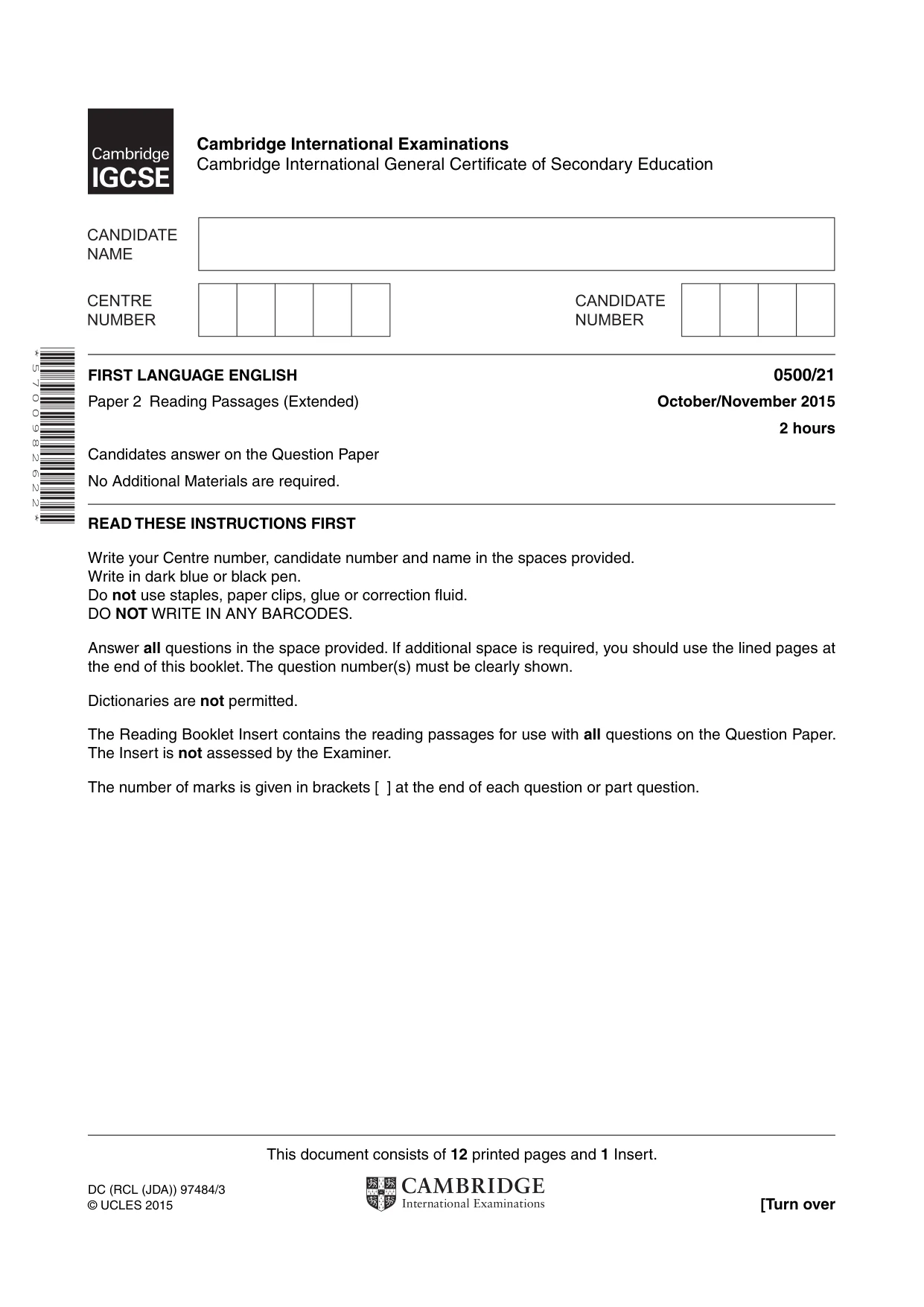
Question paper, page 1
This document consists of 12 printed pages and 1 Insert. DC (RCL (JDA)) 97484/3 © UCLES 2015 [Turn over Cambridge International Examinations Cambridge International General Certificate of Secondary Education * 5 7 0 0 9 8 2 6 2 2 * FIRST LANGUAGE ENGLISH 0500/21 Paper 2 Reading Passages (Extended) October/November 2015 2 hours Candidates answer on the Question Paper No Additional Materials are required. READ THESE INSTRUCTIONS FIRST Write your Centre number, candidate number and name in the spaces provided. Write in dark blue or black pen. Do not use staples, paper clips, glue or correction fluid. DO NOT WRITE IN ANY BARCODES. Answer all questions in the space provided. If additional space is required, you should use the lined pages at the end of this booklet. The question number(s) must be clearly shown. Dictionaries are not permitted. The Reading Booklet Insert contains the reading passages for use with all questions on the Question Paper. The Insert is not assessed by the Examiner. The number of marks is given in brackets [ ] at the end of each question or part question.
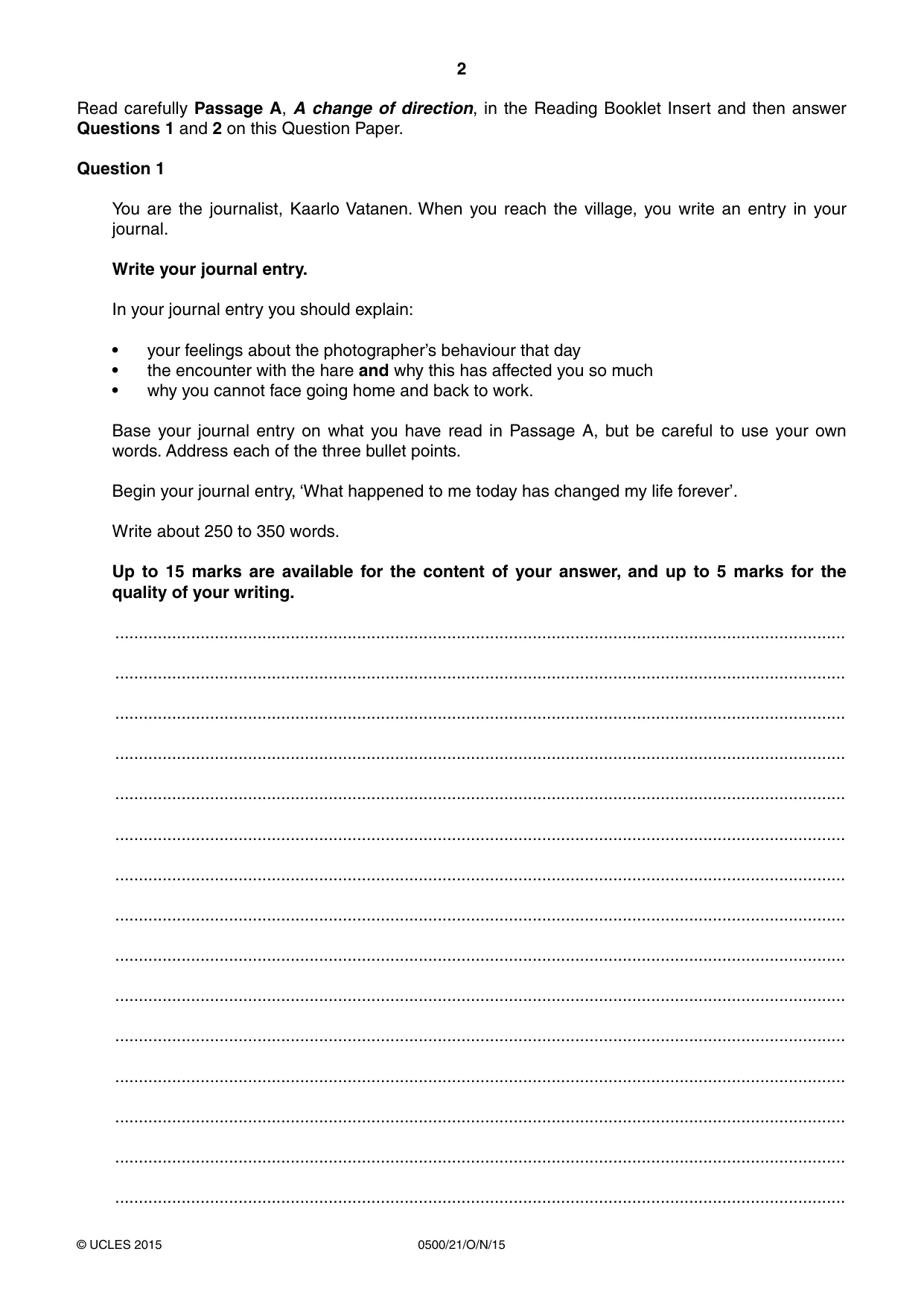
Question paper, page 2
2 0500/21/O/N/15 © UCLES 2015 Read carefully Passage A, A change of direction, in the Reading Booklet Insert and then answer Questions 1 and 2 on this Question Paper. Question 1 You are the journalist, Kaarlo Vatanen. When you reach the village, you write an entry in your journal. Write your journal entry. In your journal entry you should explain: • your feelings about the photographer’s behaviour that day • the encounter with the hare and why this has affected you so much • why you cannot face going home and back to work. Base your journal entry on what you have read in Passage A, but be careful to use your own words. Address each of the three bullet points. Begin your journal entry, ‘What happened to me today has changed my life forever’. Write about 250 to 350 words. Up to 15 marks are available for the content of your answer, and up to 5 marks for the quality of your writing. … … … … … … … … … … … … … … …
Question paper, page 3
3 0500/21/O/N/15 © UCLES 2015 [Turn over … … … … … … … … … … … … … … … … … … … … … … … … … … … …
Question paper, page 4
4 0500/21/O/N/15 © UCLES 2015 … … … … … … … … … … … … … … … … … … … … … … … … … … … [Total: 20]
Question paper, page 5
5 0500/21/O/N/15 © UCLES 2015 [Turn over [Turn over for Question 2]
Question paper, page 6
6 0500/21/O/N/15 © UCLES 2015 Question 2 Re-read the descriptions of: (a) the atmosphere in the car in paragraph 2, beginning ‘They’d just been …’; (b) the movement of the hare in paragraph 3, beginning ‘On the crest of …’. Select four powerful words or phrases from each paragraph. Your choices should include imagery. Explain how each word or phrase selected is used effectively in the context. Write about 200 to 300 words. Up to 10 marks are available for the content of your answer. … … … … … … … … … … … … … … … … … … … … …
Question paper, page 7
7 0500/21/O/N/15 © UCLES 2015 [Turn over … … … … … … … … … … … … … … … … … … … … … … … … … … … [Total: 10]
Question paper, page 8
8 0500/21/O/N/15 © UCLES 2015 Read carefully Passage B, Rabbits and hares, in the Reading Booklet Insert and then answer Question 3(a) and (b) on this Question Paper. Question 3 Answer the questions in the order set. (a) Notes What are the differences between rabbits and hares according to Passage B? Write your answer using short notes. Write one point per line. You do not need to use your own words. Up to 15 marks are available for the content of your answer. The differences between rabbits and hares are: 1… 2… 3… 4… 5… 6… 7… 8… 9… 10… 11… 12… 13… 14… 15… [15]
Question paper, page 9
9 0500/21/O/N/15 © UCLES 2015 [Turn over (b) Summary Now use your notes from Question 3(a) to write a summary of the differences between rabbits and hares, according to Passage B. You must use continuous writing (not note form) and use your own words as far as possible. Your summary should include all 15 of your points in Question 3(a) and must be 200 to 250 words. Up to 5 marks are available for the quality of your writing. … … … … … … … … … … … … … … … … … … … … … …
Question paper, page 10
10 0500/21/O/N/15 © UCLES 2015 … … … … … … … … … … … [5]
Question paper, page 11
11 0500/21/O/N/15 © UCLES 2015 ADDITIONAL PAGE If you use the following lined page to complete the answer(s) to any question(s), the question number(s) must be clearly shown. … … … … … … … … … … … … … … … … … … … … … … … … … …
Question paper, page 12
12 0500/21/O/N/15 © UCLES 2015 Permission to reproduce items where third-party owned material protected by copyright is included has been sought and cleared where possible. Every reasonable effort has been made by the publisher (UCLES) to trace copyright holders, but if any items requiring clearance have unwittingly been included, the publisher will be pleased to make amends at the earliest possible opportunity. To avoid the issue of disclosure of answer-related information to candidates, all copyright acknowledgements are reproduced online in the Cambridge International Examinations Copyright Acknowledgements Booklet. This is produced for each series of examinations and is freely available to download at www.cie.org.uk after the live examination series. Cambridge International Examinations is part of the Cambridge Assessment Group. Cambridge Assessment is the brand name of University of Cambridge Local Examinations Syndicate (UCLES), which is itself a department of the University of Cambridge. ADDITIONAL PAGE If you use the following lined page to complete the answer(s) to any question(s), the question number(s) must be clearly shown. … … … … … … … … … … … … … … … … … … … … …
Mark scheme, page 1
® IGCSE is the registered trademark of Cambridge International Examinations. CAMBRIDGE INTERNATIONAL EXAMINATIONS Cambridge International General Certificate of Secondary Education MARK SCHEME for the October/November 2015 series 0500 FIRST LANGUAGE ENGLISH 0500/21 Paper 2 (Reading Passages – Extended), maximum raw mark 50 This mark scheme is published as an aid to teachers and candidates, to indicate the requirements of the examination. It shows the basis on which Examiners were instructed to award marks. It does not indicate the details of the discussions that took place at an Examiners’ meeting before marking began, which would have considered the acceptability of alternative answers. Mark schemes should be read in conjunction with the question paper and the Principal Examiner Report for Teachers. Cambridge will not enter into discussions about these mark schemes. Cambridge is publishing the mark schemes for the October/November 2015 series for most Cambridge IGCSE®, Cambridge International A and AS Level components and some Cambridge O Level components.
Mark scheme, page 2
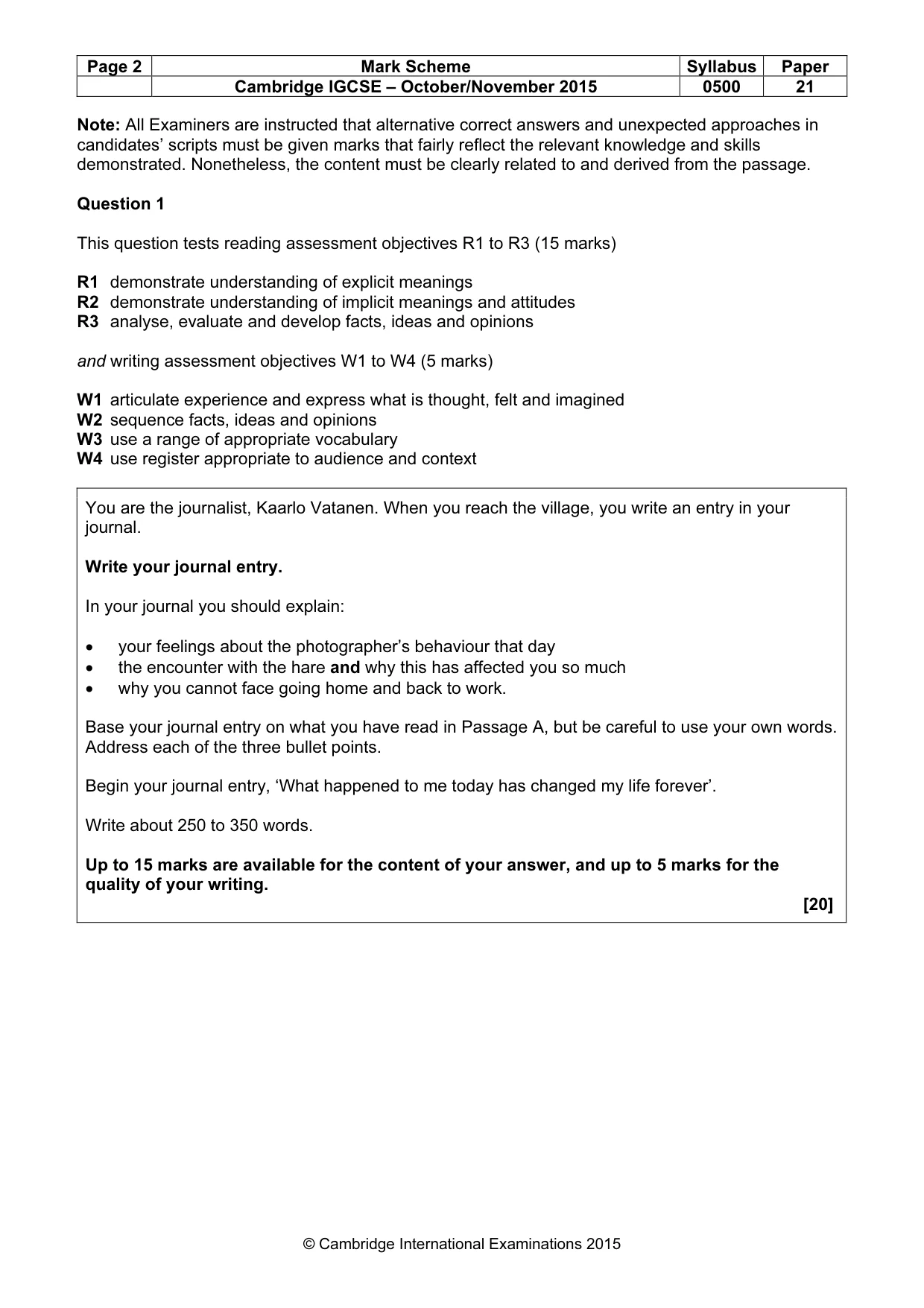
Page 2 Mark Scheme Syllabus Paper Cambridge IGCSE – October/November 2015 0500 21 © Cambridge International Examinations 2015 Note: All Examiners are instructed that alternative correct answers and unexpected approaches in candidates’ scripts must be given marks that fairly reflect the relevant knowledge and skills demonstrated. Nonetheless, the content must be clearly related to and derived from the passage. Question 1 This question tests reading assessment objectives R1 to R3 (15 marks) R1 demonstrate understanding of explicit meanings R2 demonstrate understanding of implicit meanings and attitudes R3 analyse, evaluate and develop facts, ideas and opinions and writing assessment objectives W1 to W4 (5 marks) W1 articulate experience and express what is thought, felt and imagined W2 sequence facts, ideas and opinions W3 use a range of appropriate vocabulary W4 use register appropriate to audience and context You are the journalist, Kaarlo Vatanen. When you reach the village, you write an entry in your journal. Write your journal entry. In your journal you should explain: • your feelings about the photographer’s behaviour that day • the encounter with the hare and why this has affected you so much • why you cannot face going home and back to work. Base your journal entry on what you have read in Passage A, but be careful to use your own words. Address each of the three bullet points. Begin your journal entry, ‘What happened to me today has changed my life forever’. Write about 250 to 350 words. Up to 15 marks are available for the content of your answer, and up to 5 marks for the quality of your writing. [20]
Mark scheme, page 3
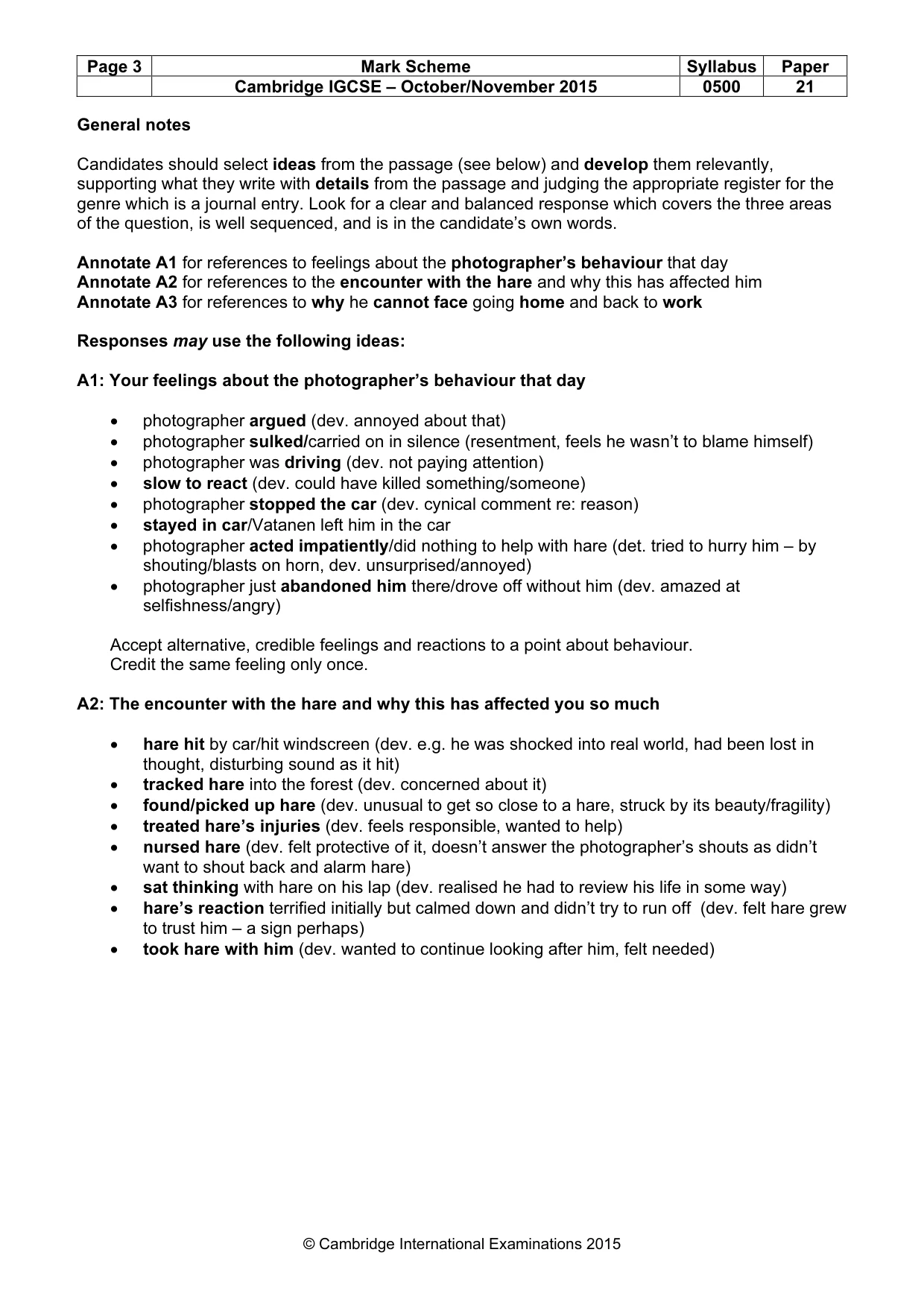
Page 3 Mark Scheme Syllabus Paper Cambridge IGCSE – October/November 2015 0500 21 © Cambridge International Examinations 2015 General notes Candidates should select ideas from the passage (see below) and develop them relevantly, supporting what they write with details from the passage and judging the appropriate register for the genre which is a journal entry. Look for a clear and balanced response which covers the three areas of the question, is well sequenced, and is in the candidate’s own words. Annotate A1 for references to feelings about the photographer’s behaviour that day Annotate A2 for references to the encounter with the hare and why this has affected him Annotate A3 for references to why he cannot face going home and back to work Responses may use the following ideas: A1: Your feelings about the photographer’s behaviour that day • photographer argued (dev. annoyed about that) • photographer sulked/carried on in silence (resentment, feels he wasn’t to blame himself) • photographer was driving (dev. not paying attention) • slow to react (dev. could have killed something/someone) • photographer stopped the car (dev. cynical comment re: reason) • stayed in car/Vatanen left him in the car • photographer acted impatiently/did nothing to help with hare (det. tried to hurry him – by shouting/blasts on horn, dev. unsurprised/annoyed) • photographer just abandoned him there/drove off without him (dev. amazed at selfishness/angry) Accept alternative, credible feelings and reactions to a point about behaviour. Credit the same feeling only once. A2: The encounter with the hare and why this has affected you so much • hare hit by car/hit windscreen (dev. e.g. he was shocked into real world, had been lost in thought, disturbing sound as it hit) • tracked hare into the forest (dev. concerned about it) • found/picked up hare (dev. unusual to get so close to a hare, struck by its beauty/fragility) • treated hare’s injuries (dev. feels responsible, wanted to help) • nursed hare (dev. felt protective of it, doesn’t answer the photographer’s shouts as didn’t want to shout back and alarm hare) • sat thinking with hare on his lap (dev. realised he had to review his life in some way) • hare’s reaction terrified initially but calmed down and didn’t try to run off (dev. felt hare grew to trust him – a sign perhaps) • took hare with him (dev. wanted to continue looking after him, felt needed)
Mark scheme, page 4
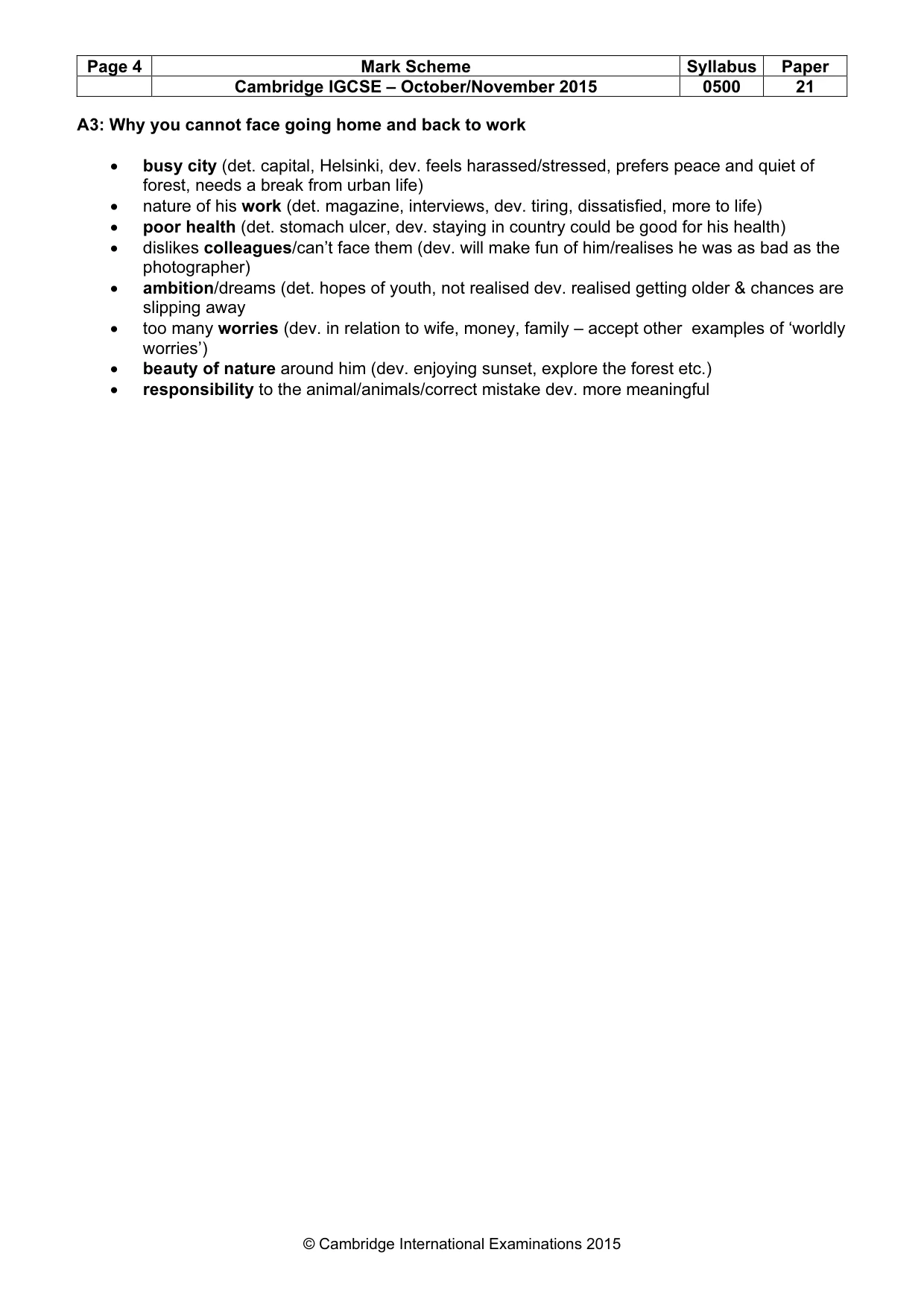
Page 4 Mark Scheme Syllabus Paper Cambridge IGCSE – October/November 2015 0500 21 © Cambridge International Examinations 2015 A3: Why you cannot face going home and back to work • busy city (det. capital, Helsinki, dev. feels harassed/stressed, prefers peace and quiet of forest, needs a break from urban life) • nature of his work (det. magazine, interviews, dev. tiring, dissatisfied, more to life) • poor health (det. stomach ulcer, dev. staying in country could be good for his health) • dislikes colleagues/can’t face them (dev. will make fun of him/realises he was as bad as the photographer) • ambition/dreams (det. hopes of youth, not realised dev. realised getting older & chances are slipping away • too many worries (dev. in relation to wife, money, family – accept other examples of ‘worldly worries’) • beauty of nature around him (dev. enjoying sunset, explore the forest etc.) • responsibility to the animal/animals/correct mistake dev. more meaningful
Mark scheme, page 5
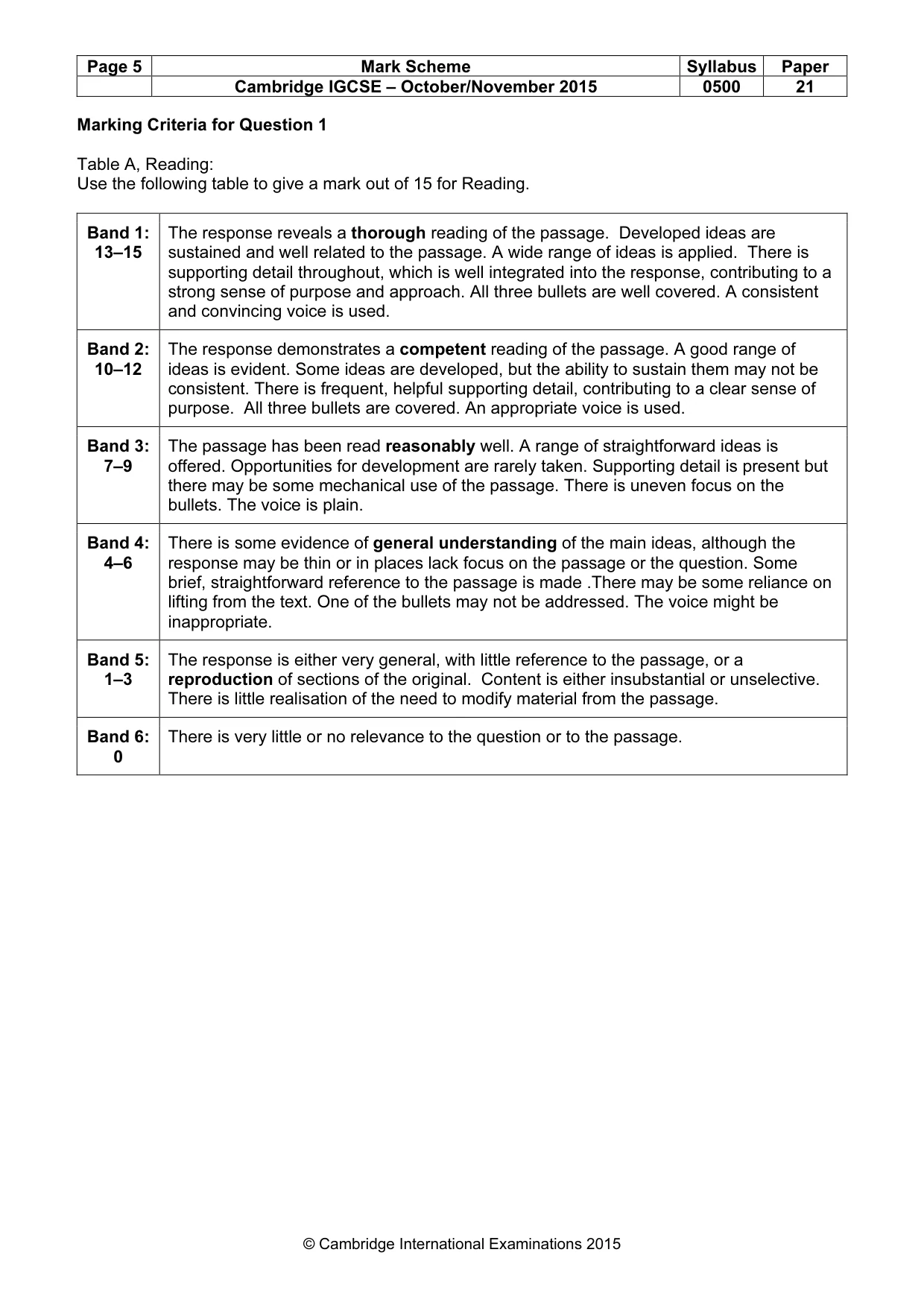
Page 5 Mark Scheme Syllabus Paper Cambridge IGCSE – October/November 2015 0500 21 © Cambridge International Examinations 2015 Marking Criteria for Question 1 Table A, Reading: Use the following table to give a mark out of 15 for Reading. Band 1: 13–15 The response reveals a thorough reading of the passage. Developed ideas are sustained and well related to the passage. A wide range of ideas is applied. There is supporting detail throughout, which is well integrated into the response, contributing to a strong sense of purpose and approach. All three bullets are well covered. A consistent and convincing voice is used. Band 2: 10–12 The response demonstrates a competent reading of the passage. A good range of ideas is evident. Some ideas are developed, but the ability to sustain them may not be consistent. There is frequent, helpful supporting detail, contributing to a clear sense of purpose. All three bullets are covered. An appropriate voice is used. Band 3: 7–9 The passage has been read reasonably well. A range of straightforward ideas is offered. Opportunities for development are rarely taken. Supporting detail is present but there may be some mechanical use of the passage. There is uneven focus on the bullets. The voice is plain. Band 4: 4–6 There is some evidence of general understanding of the main ideas, although the response may be thin or in places lack focus on the passage or the question. Some brief, straightforward reference to the passage is made .There may be some reliance on lifting from the text. One of the bullets may not be addressed. The voice might be inappropriate. Band 5: 1–3 The response is either very general, with little reference to the passage, or a reproduction of sections of the original. Content is either insubstantial or unselective. There is little realisation of the need to modify material from the passage. Band 6: 0 There is very little or no relevance to the question or to the passage.
Mark scheme, page 6
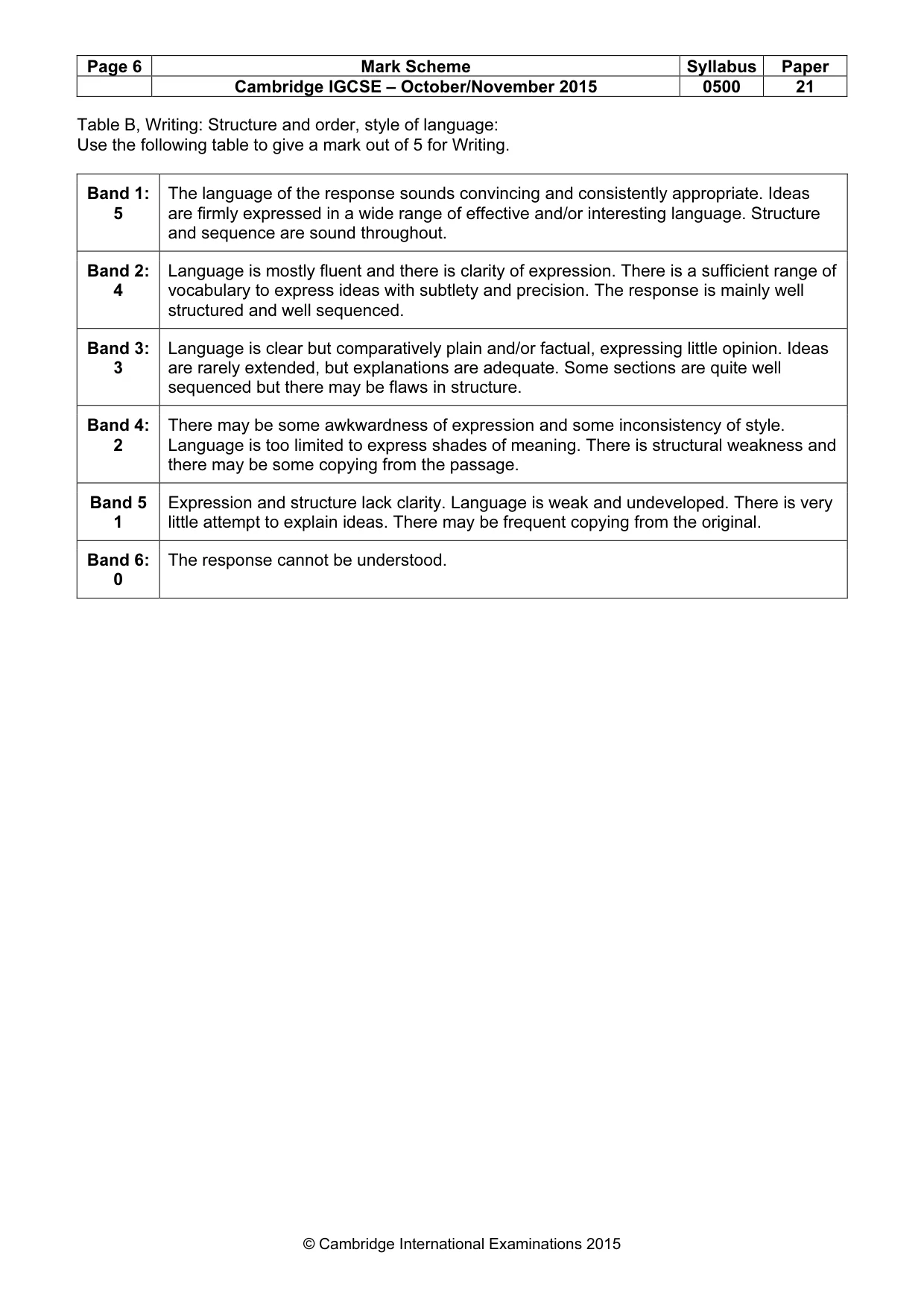
Page 6 Mark Scheme Syllabus Paper Cambridge IGCSE – October/November 2015 0500 21 © Cambridge International Examinations 2015 Table B, Writing: Structure and order, style of language: Use the following table to give a mark out of 5 for Writing. Band 1: 5 The language of the response sounds convincing and consistently appropriate. Ideas are firmly expressed in a wide range of effective and/or interesting language. Structure and sequence are sound throughout. Band 2: 4 Language is mostly fluent and there is clarity of expression. There is a sufficient range of vocabulary to express ideas with subtlety and precision. The response is mainly well structured and well sequenced. Band 3: 3 Language is clear but comparatively plain and/or factual, expressing little opinion. Ideas are rarely extended, but explanations are adequate. Some sections are quite well sequenced but there may be flaws in structure. Band 4: 2 There may be some awkwardness of expression and some inconsistency of style. Language is too limited to express shades of meaning. There is structural weakness and there may be some copying from the passage. Band 5 1 Expression and structure lack clarity. Language is weak and undeveloped. There is very little attempt to explain ideas. There may be frequent copying from the original. Band 6: 0 The response cannot be understood.
Mark scheme, page 7
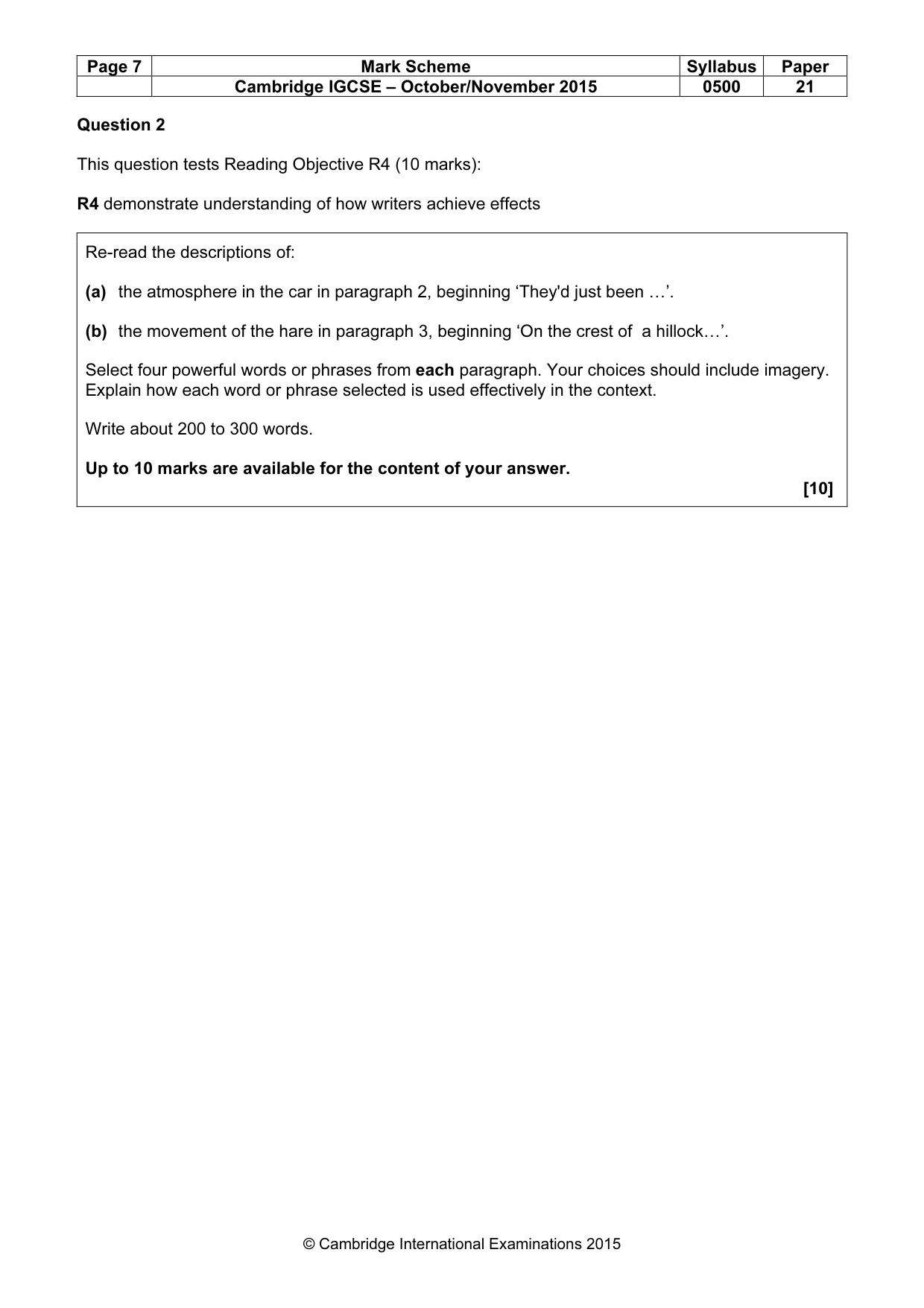
Page 7 Mark Scheme Syllabus Paper Cambridge IGCSE – October/November 2015 0500 21 © Cambridge International Examinations 2015 Question 2 This question tests Reading Objective R4 (10 marks): R4 demonstrate understanding of how writers achieve effects Re-read the descriptions of: (a) the atmosphere in the car in paragraph 2, beginning ‘They'd just been …’. (b) the movement of the hare in paragraph 3, beginning ‘On the crest of a hillock…’. Select four powerful words or phrases from each paragraph. Your choices should include imagery. Explain how each word or phrase selected is used effectively in the context. Write about 200 to 300 words. Up to 10 marks are available for the content of your answer. [10]
Mark scheme, page 8
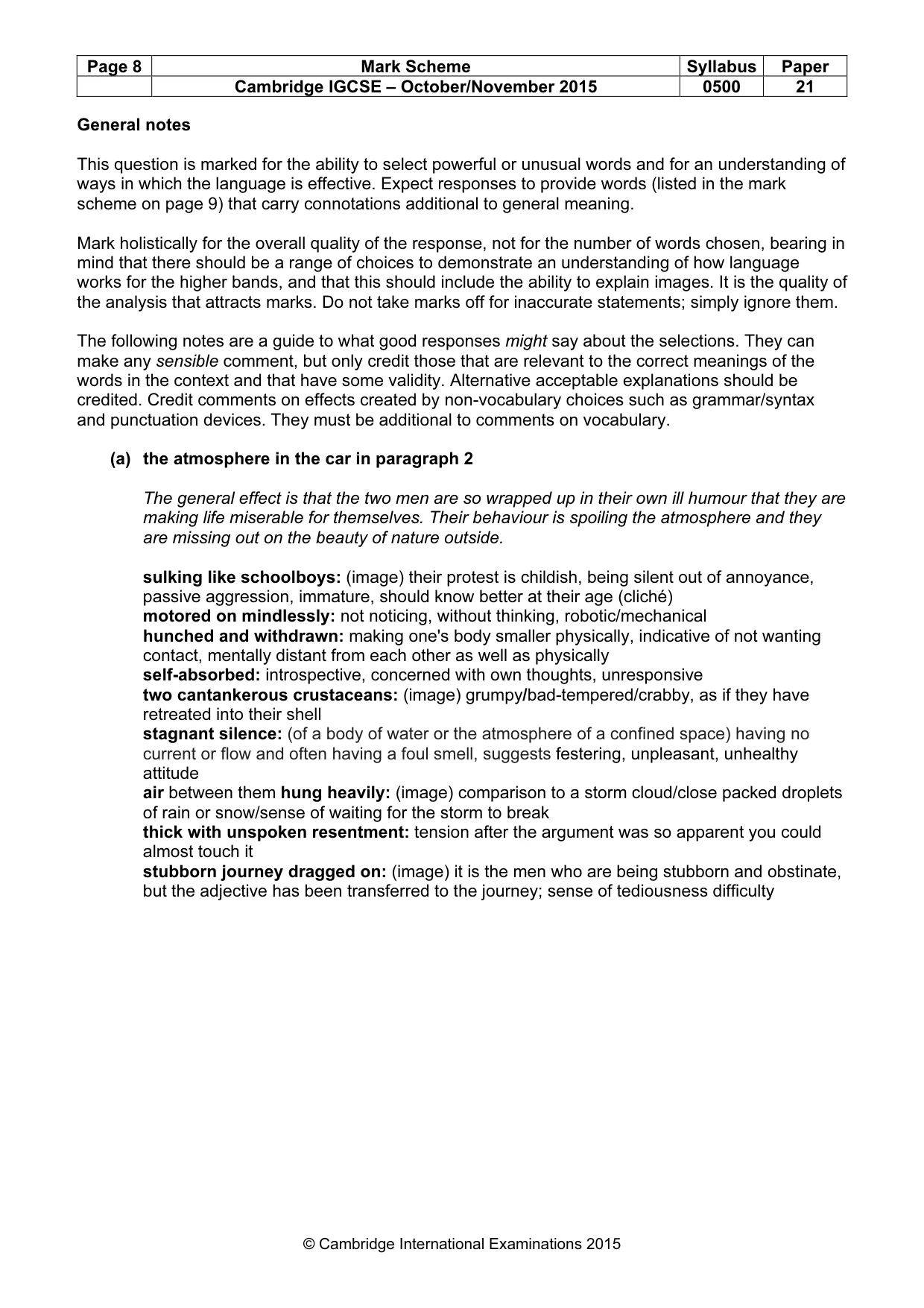
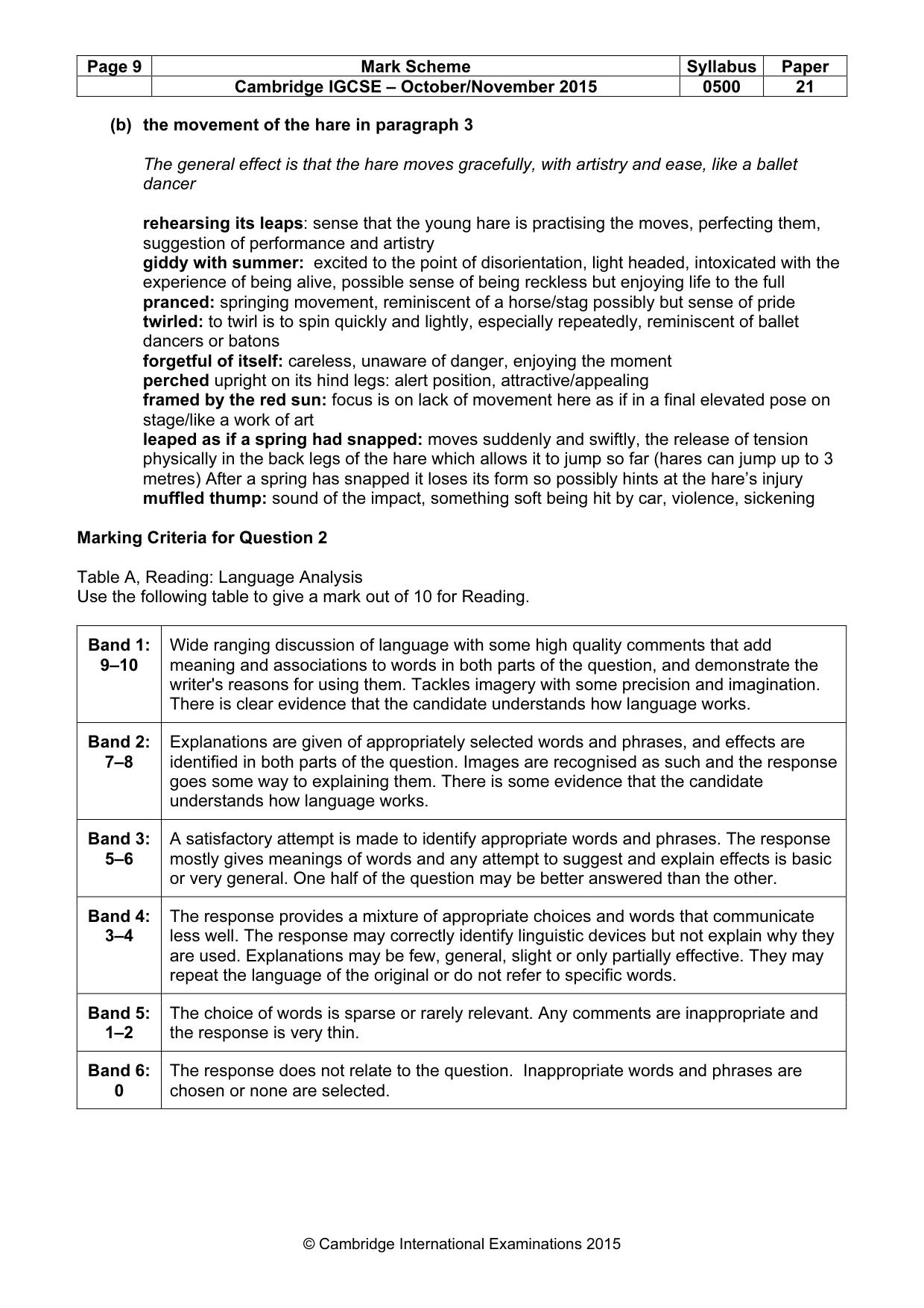
Page 8 Mark Scheme Syllabus Paper Cambridge IGCSE – October/November 2015 0500 21 © Cambridge International Examinations 2015 General notes This question is marked for the ability to select powerful or unusual words and for an understanding of ways in which the language is effective. Expect responses to provide words (listed in the mark scheme on page 9) that carry connotations additional to general meaning. Mark holistically for the overall quality of the response, not for the number of words chosen, bearing in mind that there should be a range of choices to demonstrate an understanding of how language works for the higher bands, and that this should include the ability to explain images. It is the quality of the analysis that attracts marks. Do not take marks off for inaccurate statements; simply ignore them. The following notes are a guide to what good responses might say about the selections. They can make any sensible comment, but only credit those that are relevant to the correct meanings of the words in the context and that have some validity. Alternative acceptable explanations should be credited. Credit comments on effects created by non-vocabulary choices such as grammar/syntax and punctuation devices. They must be additional to comments on vocabulary. (a) the atmosphere in the car in paragraph 2 The general effect is that the two men are so wrapped up in their own ill humour that they are making life miserable for themselves. Their behaviour is spoiling the atmosphere and they are missing out on the beauty of nature outside. sulking like schoolboys: (image) their protest is childish, being silent out of annoyance, passive aggression, immature, should know better at their age (cliché) motored on mindlessly: not noticing, without thinking, robotic/mechanical hunched and withdrawn: making one's body smaller physically, indicative of not wanting contact, mentally distant from each other as well as physically self-absorbed: introspective, concerned with own thoughts, unresponsive two cantankerous crustaceans: (image) grumpy/bad-tempered/crabby, as if they have retreated into their shell stagnant silence: (of a body of water or the atmosphere of a confined space) having no current or flow and often having a foul smell, suggests festering, unpleasant, unhealthy attitude air between them hung heavily: (image) comparison to a storm cloud/close packed droplets of rain or snow/sense of waiting for the storm to break thick with unspoken resentment: tension after the argument was so apparent you could almost touch it stubborn journey dragged on: (image) it is the men who are being stubborn and obstinate, but the adjective has been transferred to the journey; sense of tediousness difficulty
Mark scheme, page 9
Page 9 Mark Scheme Syllabus Paper Cambridge IGCSE – October/November 2015 0500 21 © Cambridge International Examinations 2015 (b) the movement of the hare in paragraph 3 The general effect is that the hare moves gracefully, with artistry and ease, like a ballet dancer rehearsing its leaps: sense that the young hare is practising the moves, perfecting them, suggestion of performance and artistry giddy with summer: excited to the point of disorientation, light headed, intoxicated with the experience of being alive, possible sense of being reckless but enjoying life to the full pranced: springing movement, reminiscent of a horse/stag possibly but sense of pride twirled: to twirl is to spin quickly and lightly, especially repeatedly, reminiscent of ballet dancers or batons forgetful of itself: careless, unaware of danger, enjoying the moment perched upright on its hind legs: alert position, attractive/appealing framed by the red sun: focus is on lack of movement here as if in a final elevated pose on stage/like a work of art leaped as if a spring had snapped: moves suddenly and swiftly, the release of tension physically in the back legs of the hare which allows it to jump so far (hares can jump up to 3 metres) After a spring has snapped it loses its form so possibly hints at the hare’s injury muffled thump: sound of the impact, something soft being hit by car, violence, sickening Marking Criteria for Question 2 Table A, Reading: Language Analysis Use the following table to give a mark out of 10 for Reading. Band 1: 9–10 Wide ranging discussion of language with some high quality comments that add meaning and associations to words in both parts of the question, and demonstrate the writer's reasons for using them. Tackles imagery with some precision and imagination. There is clear evidence that the candidate understands how language works. Band 2: 7–8 Explanations are given of appropriately selected words and phrases, and effects are identified in both parts of the question. Images are recognised as such and the response goes some way to explaining them. There is some evidence that the candidate understands how language works. Band 3: 5–6 A satisfactory attempt is made to identify appropriate words and phrases. The response mostly gives meanings of words and any attempt to suggest and explain effects is basic or very general. One half of the question may be better answered than the other. Band 4: 3–4 The response provides a mixture of appropriate choices and words that communicate less well. The response may correctly identify linguistic devices but not explain why they are used. Explanations may be few, general, slight or only partially effective. They may repeat the language of the original or do not refer to specific words. Band 5: 1–2 The choice of words is sparse or rarely relevant. Any comments are inappropriate and the response is very thin. Band 6: 0 The response does not relate to the question. Inappropriate words and phrases are chosen or none are selected.
Mark scheme, page 10
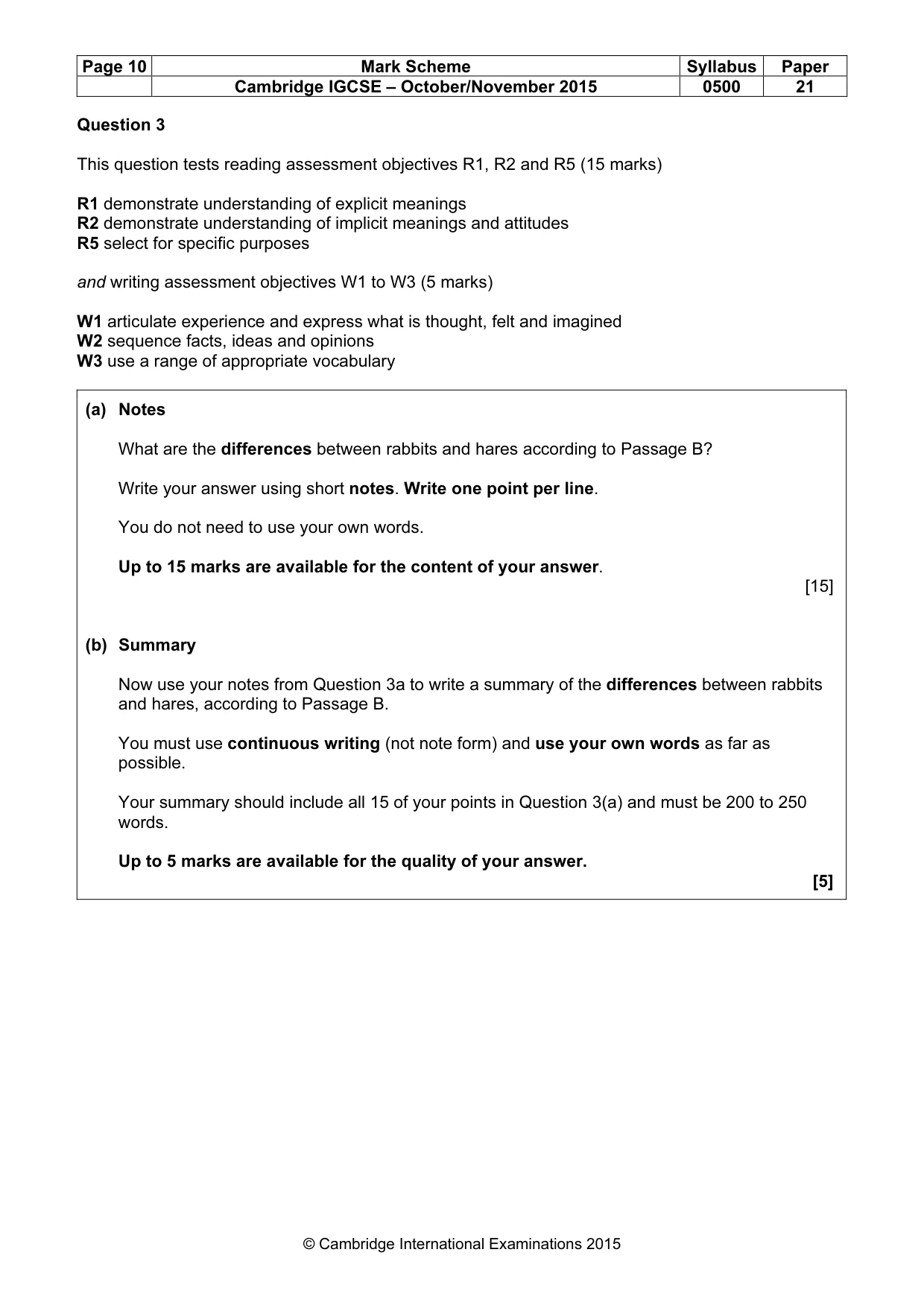
Page 10 Mark Scheme Syllabus Paper Cambridge IGCSE – October/November 2015 0500 21 © Cambridge International Examinations 2015 Question 3 This question tests reading assessment objectives R1, R2 and R5 (15 marks) R1 demonstrate understanding of explicit meanings R2 demonstrate understanding of implicit meanings and attitudes R5 select for specific purposes and writing assessment objectives W1 to W3 (5 marks) W1 articulate experience and express what is thought, felt and imagined W2 sequence facts, ideas and opinions W3 use a range of appropriate vocabulary (a) Notes What are the differences between rabbits and hares according to Passage B? Write your answer using short notes. Write one point per line. You do not need to use your own words. Up to 15 marks are available for the content of your answer. [15] (b) Summary Now use your notes from Question 3a to write a summary of the differences between rabbits and hares, according to Passage B. You must use continuous writing (not note form) and use your own words as far as possible. Your summary should include all 15 of your points in Question 3(a) and must be 200 to 250 words. Up to 5 marks are available for the quality of your answer. [5]
Mark scheme, page 11
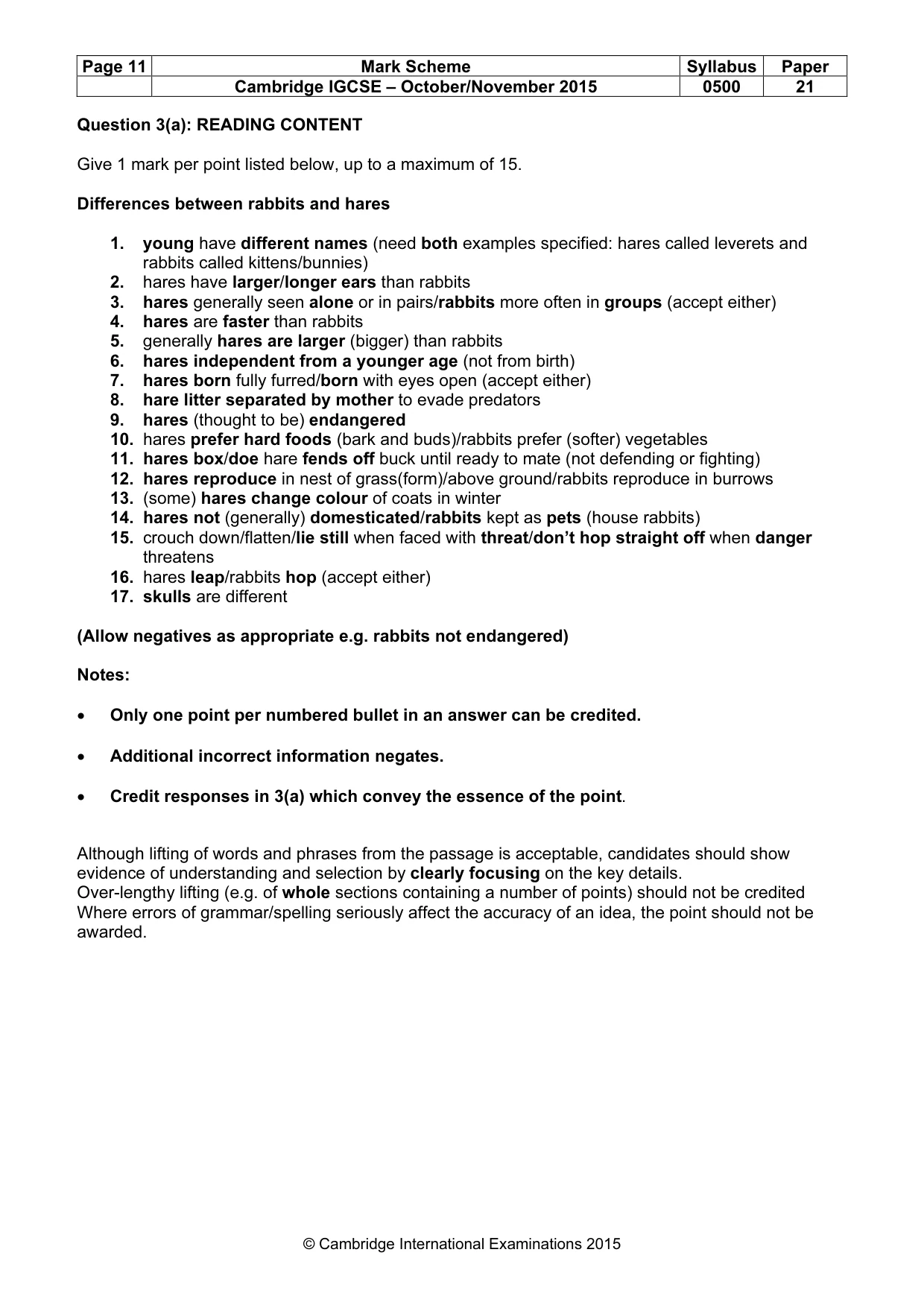
Page 11 Mark Scheme Syllabus Paper Cambridge IGCSE – October/November 2015 0500 21 © Cambridge International Examinations 2015 Question 3(a): READING CONTENT Give 1 mark per point listed below, up to a maximum of 15. Differences between rabbits and hares 1. young have different names (need both examples specified: hares called leverets and rabbits called kittens/bunnies) 2. hares have larger/longer ears than rabbits 3. hares generally seen alone or in pairs/rabbits more often in groups (accept either) 4. hares are faster than rabbits 5. generally hares are larger (bigger) than rabbits 6. hares independent from a younger age (not from birth) 7. hares born fully furred/born with eyes open (accept either) 8. hare litter separated by mother to evade predators 9. hares (thought to be) endangered 10. hares prefer hard foods (bark and buds)/rabbits prefer (softer) vegetables 11. hares box/doe hare fends off buck until ready to mate (not defending or fighting) 12. hares reproduce in nest of grass(form)/above ground/rabbits reproduce in burrows 13. (some) hares change colour of coats in winter 14. hares not (generally) domesticated/rabbits kept as pets (house rabbits) 15. crouch down/flatten/lie still when faced with threat/don’t hop straight off when danger threatens 16. hares leap/rabbits hop (accept either) 17. skulls are different (Allow negatives as appropriate e.g. rabbits not endangered) Notes: • Only one point per numbered bullet in an answer can be credited. • Additional incorrect information negates. • Credit responses in 3(a) which convey the essence of the point. Although lifting of words and phrases from the passage is acceptable, candidates should show evidence of understanding and selection by clearly focusing on the key details. Over-lengthy lifting (e.g. of whole sections containing a number of points) should not be credited Where errors of grammar/spelling seriously affect the accuracy of an idea, the point should not be awarded.
Mark scheme, page 12
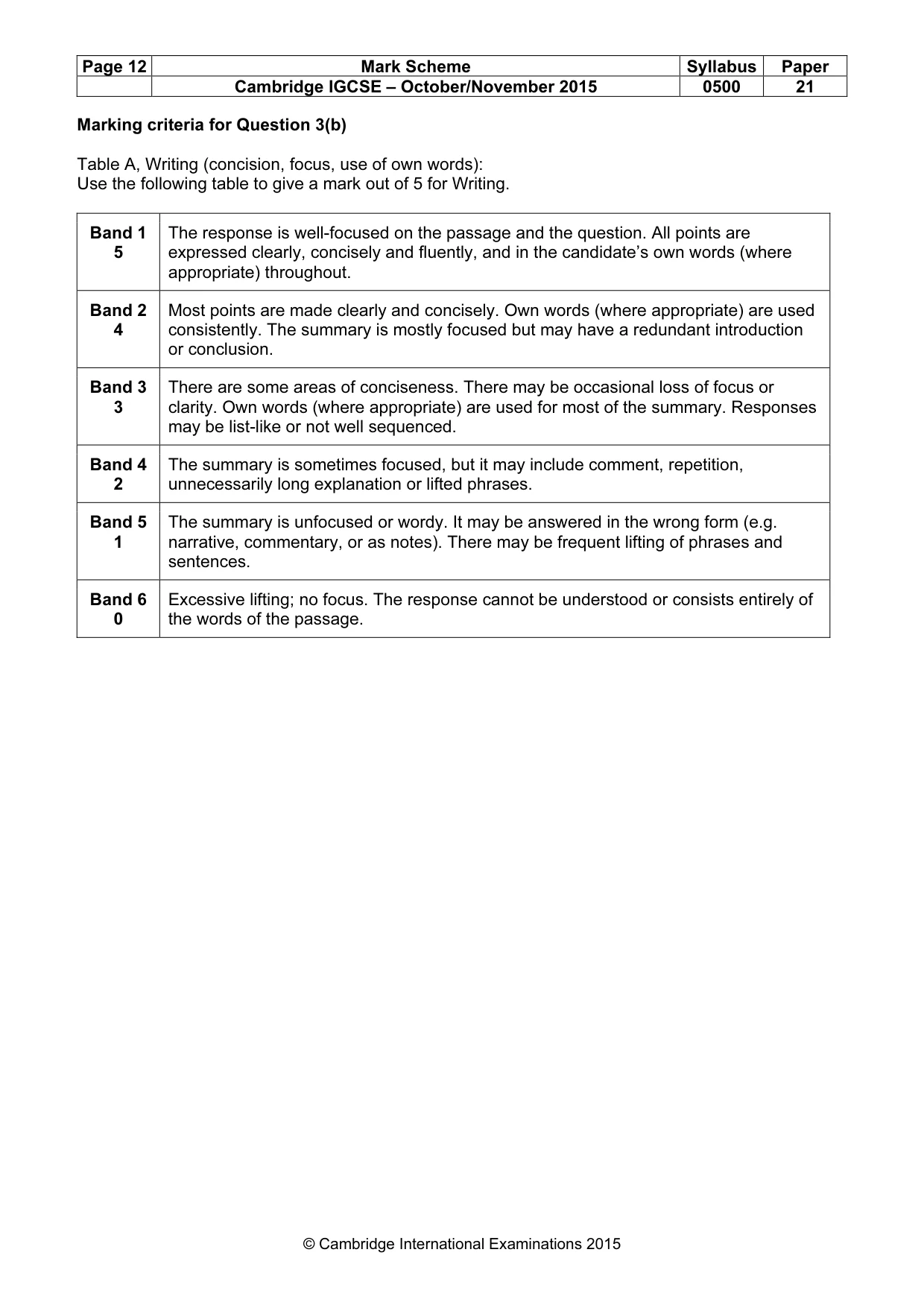
Page 12 Mark Scheme Syllabus Paper Cambridge IGCSE – October/November 2015 0500 21 © Cambridge International Examinations 2015 Marking criteria for Question 3(b) Table A, Writing (concision, focus, use of own words): Use the following table to give a mark out of 5 for Writing. Band 1 5 The response is well-focused on the passage and the question. All points are expressed clearly, concisely and fluently, and in the candidate’s own words (where appropriate) throughout. Band 2 4 Most points are made clearly and concisely. Own words (where appropriate) are used consistently. The summary is mostly focused but may have a redundant introduction or conclusion. Band 3 3 There are some areas of conciseness. There may be occasional loss of focus or clarity. Own words (where appropriate) are used for most of the summary. Responses may be list-like or not well sequenced. Band 4 2 The summary is sometimes focused, but it may include comment, repetition, unnecessarily long explanation or lifted phrases. Band 5 1 The summary is unfocused or wordy. It may be answered in the wrong form (e.g. narrative, commentary, or as notes). There may be frequent lifting of phrases and sentences. Band 6 0 Excessive lifting; no focus. The response cannot be understood or consists entirely of the words of the passage.
What you needed in this session
Cambridge’s own grade thresholds for 2015 Oct/Nov, Paper 2 · Variant 1. A higher threshold means an easier paper — the bar moves with how the cohort did.