Cambridge IGCSE English - First Language 0500 — 2012 May/June Paper 2 · Variant 3
0500/23/M/J/12 · 50 marks · ≈56 min
The question paper and its mark scheme, free to read here and free to download. This is Cambridge’s own paper, exactly as it was sat.
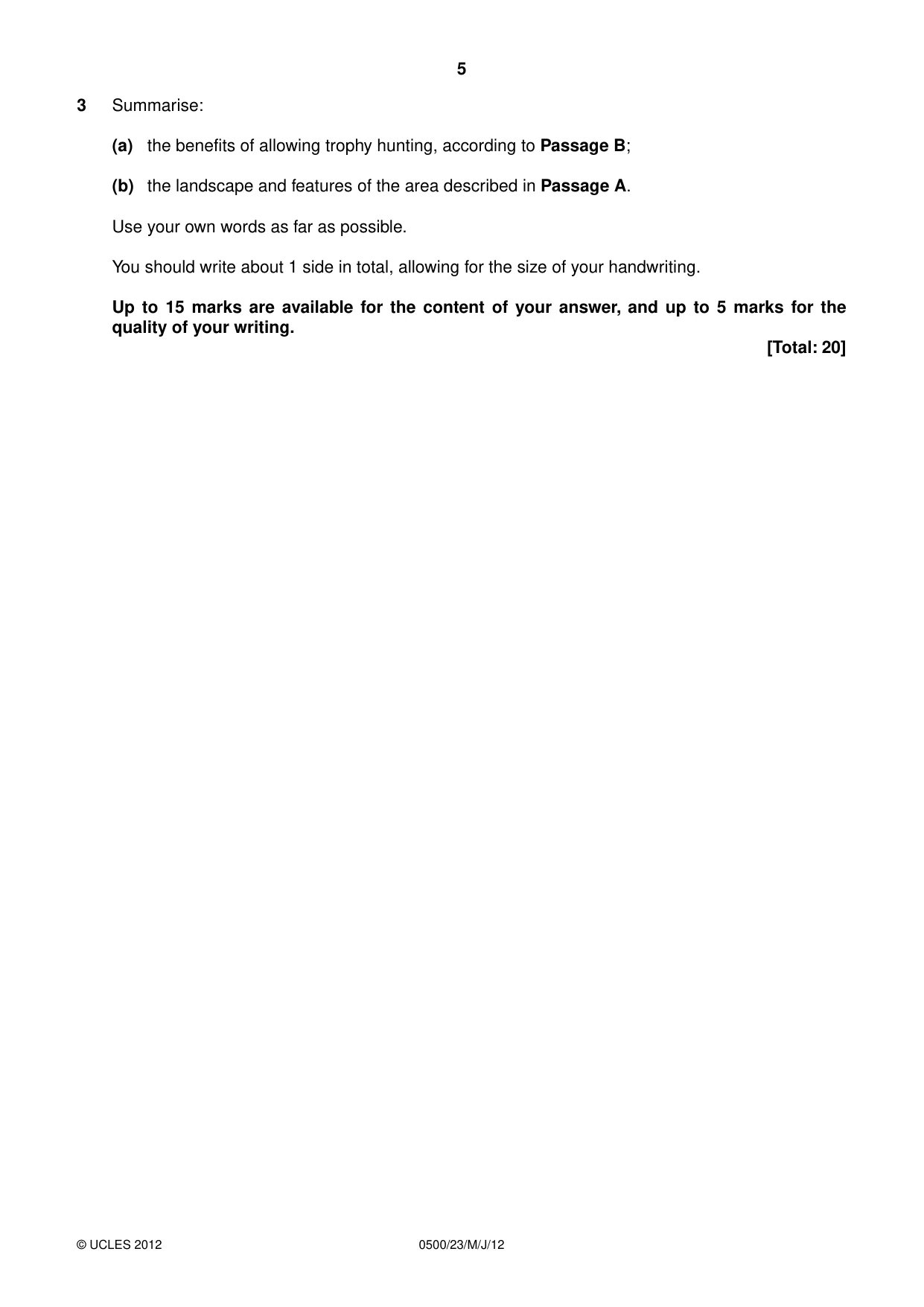
Question paper8 pages


Mark scheme10 pages
Answers below. Sit the paper first if you are practising.
Paper as text
Question paper, page 1
This document consists of 5 printed pages and 3 blank pages. DC (NH) 50318/5 © UCLES 2012 [Turn over UNIVERSITY OF CAMBRIDGE INTERNATIONAL EXAMINATIONS International General Certificate of Secondary Education * 5 3 1 5 4 6 0 8 7 0 * FIRST LANGUAGE ENGLISH 0500/23 Paper 2 Reading Passages (Extended) May/June 2012 2 hours Additional Materials: Answer Booklet/Paper READ THESE INSTRUCTIONS FIRST If you have been given an Answer Booklet, follow the instructions on the front cover of the Booklet. Write your Centre number, candidate number and name on all the work you hand in. Write in dark blue or black pen. Do not use staples, paper clips, highlighters, glue or correction fluid. Answer all questions. Dictionaries are not permitted. At the end of the examination, fasten all your work securely together. The number of marks is given in brackets [ ] at the end of each question or part question. www.XtremePapers.com
Question paper, page 2
2 0500/23/M/J/12 © UCLES 2012 Part 1 Read Passage A carefully, and then answer Questions 1 and 2. Passage A Gabriella Le Breton describes hunters harvesting the world’s highest beehives. The much prized honey is harvested only twice a year to ensure the bees’ welfare. Nepal’s Honey Hunters After three days’ walking, the seriousness of the simple fight for survival in Nepal’s remote and unforgiving mountain communities becomes apparent. Kanhaiya, who is my guide, begins chiding us for our slow pace; he has just sprinted up the unrelentingly steep path to the village of Ludhi – a three-hour walk he takes twice each day. After several days of uncertain weather, it appears the hunt will take place. There’s a triumphant shout from Kanhaiya, ‘We’re going!’ After a 20-minute walk, we come across a handful of local men waiting for the Nai Chi honey hunters. As they chat, they deftly slice bamboo into long, thin strands, using the curved blade of their khukuri knives, before braiding them to create slender yet strong ropes. Eventually, we spot the hunters labouring up steep, terraced fields towards us, laden with heavy bamboo ropes and sticks. We leave the fields, climbing steeply through tall, waxy-leaved black cardamom plants until we reach a straw-covered shack with views towards towering lichen- and moss-covered cliffs. The men drop their loads and start to unravel the thick, twisted ropes, arranging them in parallel on the ground to a length of some 50 metres. Then they make a ladder, placing sturdy sticks at regular intervals and securing these rungs with the bamboo ropes made earlier. Once complete, the ladder is loaded onto the back of two hunters, one of whom has been carrying an unfortunate chicken. He waves the bird over our heads in a blessing before killing it quickly and putting it on a small sacrificial fire, adding honeysuckle flowers from nearby, as well as fruit and rice, to ensure a safe and successful hunt. We, the spectators, will watch the hunt from a hill opposite the cliffs, and we beat our way through a dense forest of red-stemmed cardamom and gnarled rhododendrons. As we stop for breath in a small clearing, our guide points to the cliffs opposite. I follow his gaze and see what looks like three darkened discs on the cliff face, each about a metre wide. Every few seconds they shimmer and pulsate eerily, like ripples across water. These are the hives of the world’s largest bee, the Himalayan honeybee, and the pulses are the bees, layered thick and brown and numbering up to two million per hive, moving as one. It’s a mesmerising and frightening sight. When we eventually reach the top of the hill, we move slowly so as not to attract the bees’ attention, and settle down to watch as some hunters gather leaves and wood for the fire and the others continue to the top of the cliffs. As if on cue, Mount Manaslu and its range suddenly emerge from behind their cloud veil for the first time in days. The snow-dusted peaks gleam in the late afternoon sunshine, providing a spectacular backdrop for the hunt. Within minutes of a fire being lit, smoke billows upwards and the bees start to leave their hives. The edges of the discs turn from brown to a burning orange and after 10 minutes the honeycomb is almost entirely exposed – three giant golden orbs. The hunters at the top of the cliff lower the ladder and a basket in which to deposit the honey. Communicating by whistles to reduce the chances of the bees attacking them, they realise the ladder is not long enough, so start to add extra rope sections. It’s a time-consuming process and dusk starts to fall … . By now I can barely make out the hunter descending the ladder in the failing light. Peering desperately across the vast gorge below us to the cliffs, I see the hunter reach the first of the hives and start to prise off chunks with a long pole, before I’m pulled away. We must leave now. As we slip and slide through the dark forest of banyan trees, excited shouts echo behind us. By the time we return to the shack, it’s pitch dark. The moon hasn’t risen but the stars are a million pinpricks of light in the black velvet sky.
Question paper, page 3
3 0500/23/M/J/12 © UCLES 2012 [Turn over When we arrive in Ludhi, steaming cups of chai await us in the dark, smoky kitchen. Bursting into the gloom, the men proudly show off their gooey haul and red, swollen bee stings. Thrusting a hand into a battered steel jug, one of them brings out a large slab of thick honeycomb, dotted with dazed bees. Flicking them off casually, he offers me a piece of the dark orange, brown-speckled treasure. The rich flavours explode in a potent floral blend – mango and lychee blossom – and it has a tangy rather than sugary sweetness. As I tuck in eagerly, the grinning hunters seem to approve as they wolf down vast chunks. 1 Imagine that you are Gabriella Le Breton. You have been invited to speak to a group of young travellers planning to trek in the same area of Nepal and hoping to witness the next honey hunt. Write the words of the talk to the travellers. In your talk you should: • explain the challenges of going to see the honey hunt • outline what these young travellers may find interesting about the hunt • discuss your own feelings about the honey hunters and what they do. Base your talk on what you have read in Passage A. Be careful to use your own words. Write between 1½ and 2 sides, allowing for the size of your handwriting. Up to 15 marks are available for the content of your answer, and up to 5 marks for the quality of your writing. [Total: 20] 2 Re-read the descriptions of: (a) the forest and the bee hives in paragraph 4, beginning ‘We, the spectators …’; (b) the honey and the eating of it in paragraph 7, beginning ‘When we arrive …’. Select words and phrases from these descriptions, and explain how the writer has created effects by using this language. [Total: 10] [Turn over for Part 2]
Question paper, page 4
4 0500/23/M/J/12 © UCLES 2012 Part 2 Read Passage B carefully and re-read Passage A. Then answer Question 3, which is based on both passages. Passage B Trophy hunting, a sport in which the aim is to shoot rare animals to show off to others, is still big business in many parts of the world. Trophy Hunting The slaughter of thousands of animals around the world by big game hunters is supported by conservationists who maintain that the sport protects wildlife. Lions, leopards, elephants and crocodiles are among the species being shot by hunters from the Western world. Even the critically endangered black rhino finds itself in the telescopic sight of a hunter’s rifle. A recent study concludes that the overall toll on big game is more than matched by the benefits. Hunters are prepared to pay thousands of pounds for the chance to shoot trophy species. The money they bring in to the 23 African nations that permit trophy hunting provides jobs and encourages people to preserve the landscape rather than turn it into farmland. According to a report in the New Scientist magazine, a proportion of the money reaches conservation organisations, which use it to promote wildlife and protect the natural habitat. The study, published in the journal Biological Conservation, concludes that where game areas are well managed, the negative effects of hunting are outweighed by increases in animal populations made possible by conservation initiatives. Money gained from hunting was directly responsible for the recovery of at least three rare species in South Africa – the bontebok, black wildebeest and Cape mountain zebra – and assisted the recovery of southern white rhino numbers. ‘Trophy hunting can also play an important role in the rehabilitation of wildlife areas. Income generated from wildlife does not jeopardise the population growth of trophy species,’ the study adds. The money generated by trophy hunting is seen as particularly important in areas that are unable to attract tourists. At the same time, the presence of trophy hunters encourages local people to put in place anti-poaching measures. Another study estimates that about 1,400,000 square kilometres of land in Africa are protected because of hunting – which is more than double the area of national parks in sub-Saharan Africa. The study calculates that trophy hunting is worth more than £100 million to Africa. Mark Wright, of the World Wildlife Fund, says that while the wildlife organisation regards hunting as ‘an option of last resort’, it could have a positive effect on wildlife. In particular, he says, in many areas where there is no eco-tourism, it provides a source of income far less damaging than the alternative of illegal and uncontrolled poaching. Rather than take the high moral ground, ‘conservationists need to be practical and accept that hunting could be the lesser of two evils.’ There are, however, a range of problems to overcome, researchers say: in some parts of Africa the hunting is adequately managed, while in others its overall effect remains detrimental to conservation. Will Travers, of the Born Free Foundation, says: ‘I’m totally opposed. For me an animal is a treasure alive and a carcass dead. I think hunting and killing an animal for so-called sport, for fun, is a tragedy of the human psyche and something we should have grown out of.’
Question paper, page 5
5 0500/23/M/J/12 © UCLES 2012 3 Summarise: (a) the benefits of allowing trophy hunting, according to Passage B; (b) the landscape and features of the area described in Passage A. Use your own words as far as possible. You should write about 1 side in total, allowing for the size of your handwriting. Up to 15 marks are available for the content of your answer, and up to 5 marks for the quality of your writing. [Total: 20]
Question paper, page 6
6 0500/23/M/J/12 © UCLES 2012 BLANK PAGE
Question paper, page 7
7 0500/23/M/J/12 © UCLES 2012 BLANK PAGE
Question paper, page 8
8 0500/23/M/J/12 © UCLES 2012 BLANK PAGE Copyright Acknowledgements: Questions 1, 2 and 3 © ADAPTED: Gabriella Le Breton; Nepal’s Honey Hunters; The Telegraph; 6 June 2010. Question 3 © ADAPTED: Lewis Smith; Big game trophy hunters ‘help to save rare species’ ; The Times; 4 January 2007. Question 3 © ADAPTED: Anna Shepard;Trophy Hunting; Eco-Worrier Blog ;The Times; 4 January 2007. Permission to reproduce items where third-party owned material protected by copyright is included has been sought and cleared where possible. Every reasonable effort has been made by the publisher (UCLES) to trace copyright holders, but if any items requiring clearance have unwittingly been included, the publisher will be pleased to make amends at the earliest possible opportunity. University of Cambridge International Examinations is part of the Cambridge Assessment Group. Cambridge Assessment is the brand name of University of Cambridge Local Examinations Syndicate (UCLES), which is itself a department of the University of Cambridge.
Mark scheme, page 1
UNIVERSITY OF CAMBRIDGE INTERNATIONAL EXAMINATIONS International General Certificate of Secondary Education MARK SCHEME for the May/June 2012 question paper for the guidance of teachers 0500 FIRST LANGUAGE ENGLISH 0500/23 Paper 2 (Reading Passages – Extended), maximum raw mark 50 This mark scheme is published as an aid to teachers and candidates, to indicate the requirements of the examination. It shows the basis on which Examiners were instructed to award marks. It does not indicate the details of the discussions that took place at an Examiners’ meeting before marking began, which would have considered the acceptability of alternative answers. Mark schemes must be read in conjunction with the question papers and the report on the examination. • Cambridge will not enter into discussions or correspondence in connection with these mark schemes. Cambridge is publishing the mark schemes for the May/June 2012 question papers for most IGCSE, GCE Advanced Level and Advanced Subsidiary Level syllabuses and some Ordinary Level syllabuses. www.XtremePapers.com
Mark scheme, page 2
Page 2 Mark Scheme: Teachers’ version Syllabus Paper IGCSE – May/June 2012 0500 23 © University of Cambridge International Examinations 2012 Note: All Examiners are instructed that alternative correct answers and unexpected approaches in candidates’ scripts must be given marks that fairly reflect the relevant knowledge and skills demonstrated. Nonetheless, the content must be clearly related to and derived from the passage. Question 1 This question tests Reading Objectives R1–R3 (15 marks): • understand and collate explicit meanings • understand, explain and collate implicit meanings and attitudes • select, analyse and evaluate what is relevant to specific purposes. AND Writing Objectives W1–W5 (5 marks): • articulate experience and express what is thought, felt and imagined • order and present facts, ideas and opinions • understand and use a range of appropriate vocabulary • use language and register appropriate to audience and context • make accurate and effective use of paragraphs, grammatical structures, sentences, punctuation and spelling. Imagine that you are Gabriella Le Breton. You have been invited to speak to a group of young travellers planning to trek in the same area of Nepal and hoping to witness the next honey hunt. Write the words of your talk to the travellers. In your talk you should explain the challenges of going to see the honey hunt, outline what these young travellers may find interesting about the hunt, and discuss your own feelings about the honey hunters and what they do. Base your talk on what you have read in Passage A. Be careful to use your own words. Write between 1½ and 2 sides, allowing for the size of your handwriting. Up to 15 marks are available for the content of your answer, and up to 5 marks for the quality of your writing. [20] General notes on likely content Candidates should select ideas from the passage and develop their own, supporting what they write with details from the passage. Good responses demonstrate careful selection, picking out the most significant details/ideas. In A (challenges of seeing the honey hunters) and in B (interest about the hunt), responses should try and create the sense of fear about the height and danger of the bees stinging in the hunt itself, and will develop their own ideas about the hunters in C. Look for a clear talk that has some engagement with young people as its audience and that is well sequenced and in the candidate’s own words. Reward responses which promote the trekking trip to the young travellers.
Mark scheme, page 3
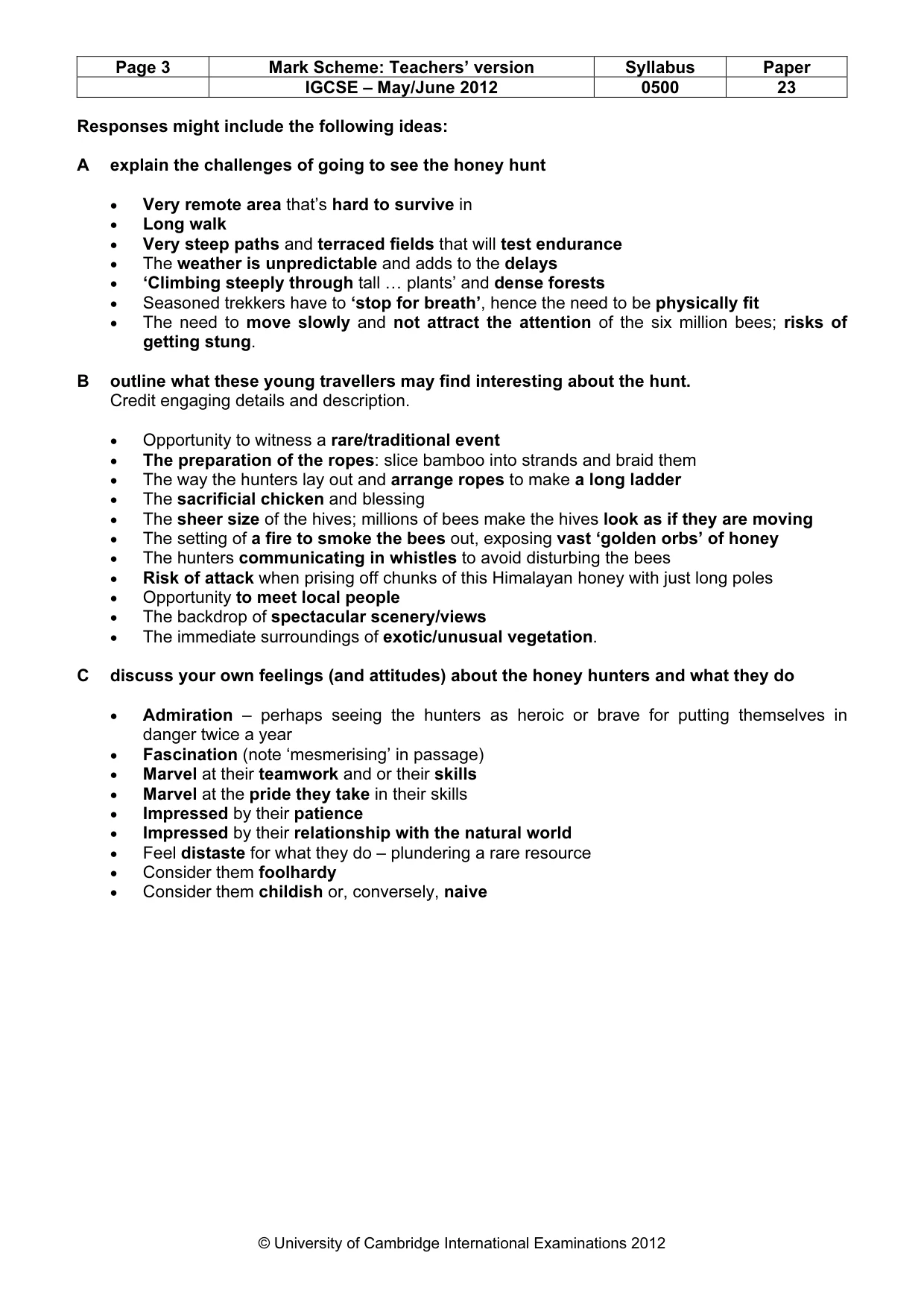
Page 3 Mark Scheme: Teachers’ version Syllabus Paper IGCSE – May/June 2012 0500 23 © University of Cambridge International Examinations 2012 Responses might include the following ideas: A explain the challenges of going to see the honey hunt • Very remote area that’s hard to survive in • Long walk • Very steep paths and terraced fields that will test endurance • The weather is unpredictable and adds to the delays • ‘Climbing steeply through tall … plants’ and dense forests • Seasoned trekkers have to ‘stop for breath’, hence the need to be physically fit • The need to move slowly and not attract the attention of the six million bees; risks of getting stung. B outline what these young travellers may find interesting about the hunt. Credit engaging details and description. • Opportunity to witness a rare/traditional event • The preparation of the ropes: slice bamboo into strands and braid them • The way the hunters lay out and arrange ropes to make a long ladder • The sacrificial chicken and blessing • The sheer size of the hives; millions of bees make the hives look as if they are moving • The setting of a fire to smoke the bees out, exposing vast ‘golden orbs’ of honey • The hunters communicating in whistles to avoid disturbing the bees • Risk of attack when prising off chunks of this Himalayan honey with just long poles • Opportunity to meet local people • The backdrop of spectacular scenery/views • The immediate surroundings of exotic/unusual vegetation. C discuss your own feelings (and attitudes) about the honey hunters and what they do • Admiration – perhaps seeing the hunters as heroic or brave for putting themselves in danger twice a year • Fascination (note ‘mesmerising’ in passage) • Marvel at their teamwork and or their skills • Marvel at the pride they take in their skills • Impressed by their patience • Impressed by their relationship with the natural world • Feel distaste for what they do – plundering a rare resource • Consider them foolhardy • Consider them childish or, conversely, naive
Mark scheme, page 4
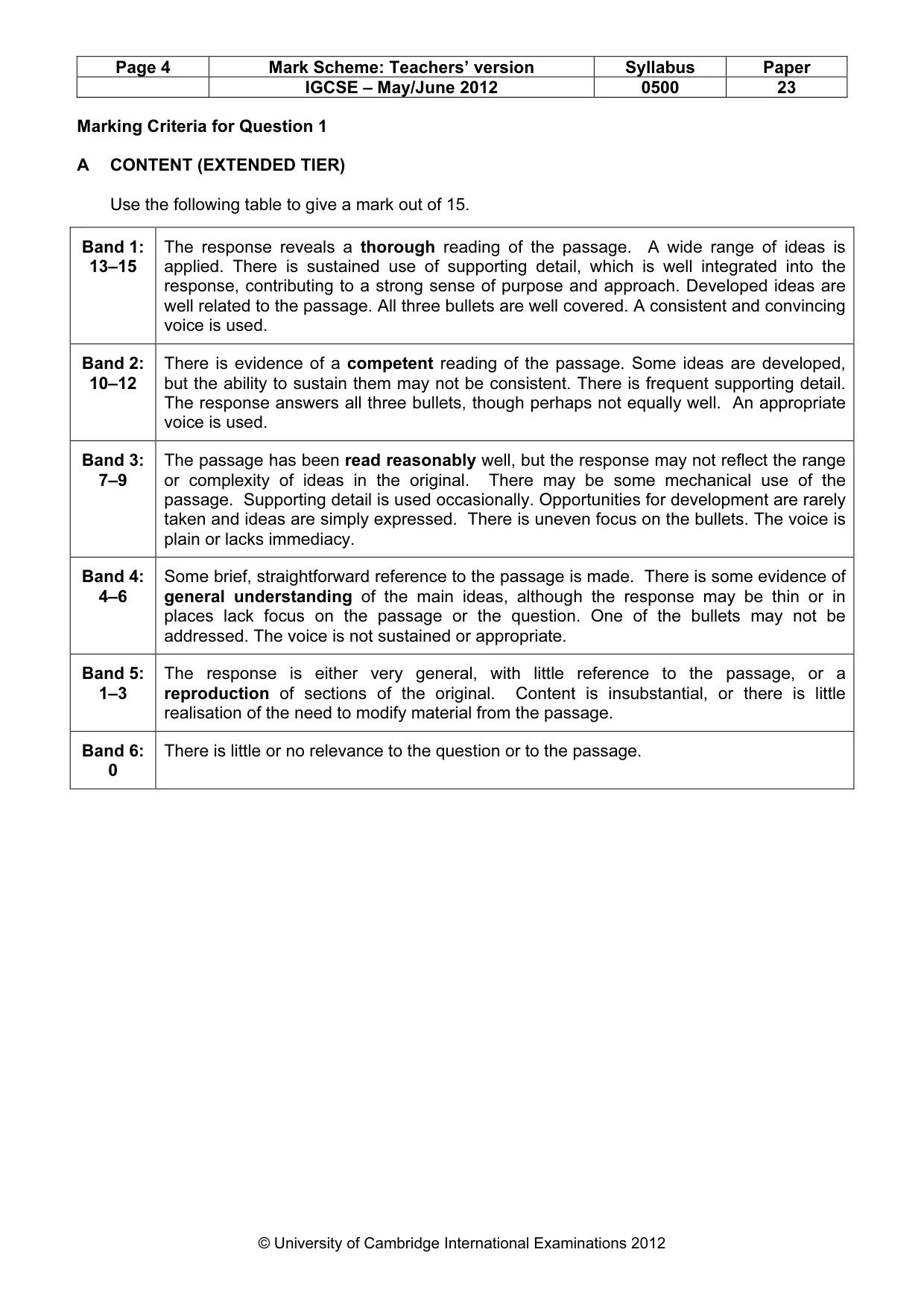
Page 4 Mark Scheme: Teachers’ version Syllabus Paper IGCSE – May/June 2012 0500 23 © University of Cambridge International Examinations 2012 Marking Criteria for Question 1 A CONTENT (EXTENDED TIER) Use the following table to give a mark out of 15. Band 1: 13–15 The response reveals a thorough reading of the passage. A wide range of ideas is applied. There is sustained use of supporting detail, which is well integrated into the response, contributing to a strong sense of purpose and approach. Developed ideas are well related to the passage. All three bullets are well covered. A consistent and convincing voice is used. Band 2: 10–12 There is evidence of a competent reading of the passage. Some ideas are developed, but the ability to sustain them may not be consistent. There is frequent supporting detail. The response answers all three bullets, though perhaps not equally well. An appropriate voice is used. Band 3: 7–9 The passage has been read reasonably well, but the response may not reflect the range or complexity of ideas in the original. There may be some mechanical use of the passage. Supporting detail is used occasionally. Opportunities for development are rarely taken and ideas are simply expressed. There is uneven focus on the bullets. The voice is plain or lacks immediacy. Band 4: 4–6 Some brief, straightforward reference to the passage is made. There is some evidence of general understanding of the main ideas, although the response may be thin or in places lack focus on the passage or the question. One of the bullets may not be addressed. The voice is not sustained or appropriate. Band 5: 1–3 The response is either very general, with little reference to the passage, or a reproduction of sections of the original. Content is insubstantial, or there is little realisation of the need to modify material from the passage. Band 6: 0 There is little or no relevance to the question or to the passage.
Mark scheme, page 5
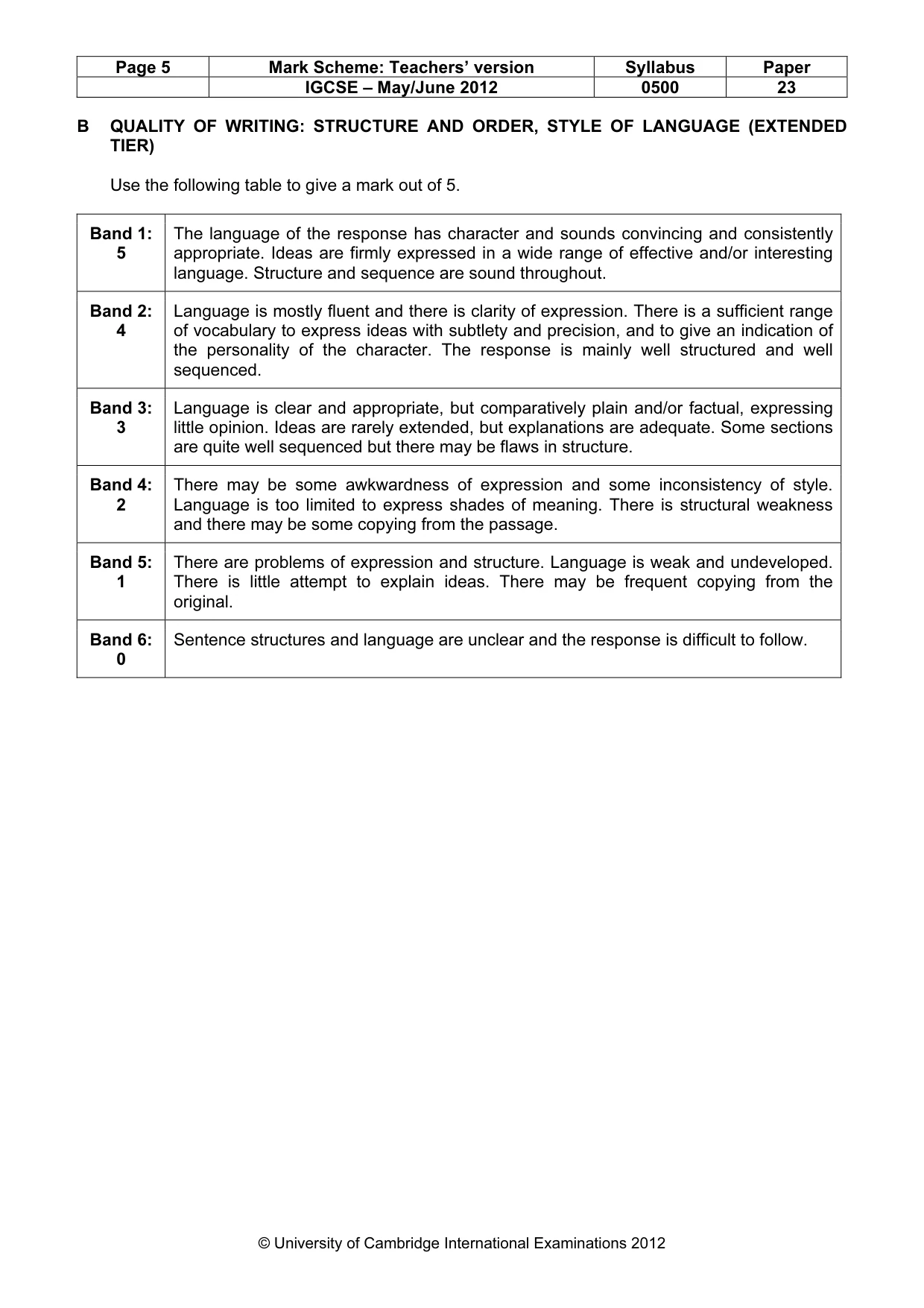
Page 5 Mark Scheme: Teachers’ version Syllabus Paper IGCSE – May/June 2012 0500 23 © University of Cambridge International Examinations 2012 B QUALITY OF WRITING: STRUCTURE AND ORDER, STYLE OF LANGUAGE (EXTENDED TIER) Use the following table to give a mark out of 5. Band 1: 5 The language of the response has character and sounds convincing and consistently appropriate. Ideas are firmly expressed in a wide range of effective and/or interesting language. Structure and sequence are sound throughout. Band 2: 4 Language is mostly fluent and there is clarity of expression. There is a sufficient range of vocabulary to express ideas with subtlety and precision, and to give an indication of the personality of the character. The response is mainly well structured and well sequenced. Band 3: 3 Language is clear and appropriate, but comparatively plain and/or factual, expressing little opinion. Ideas are rarely extended, but explanations are adequate. Some sections are quite well sequenced but there may be flaws in structure. Band 4: 2 There may be some awkwardness of expression and some inconsistency of style. Language is too limited to express shades of meaning. There is structural weakness and there may be some copying from the passage. Band 5: 1 There are problems of expression and structure. Language is weak and undeveloped. There is little attempt to explain ideas. There may be frequent copying from the original. Band 6: 0 Sentence structures and language are unclear and the response is difficult to follow.
Mark scheme, page 6
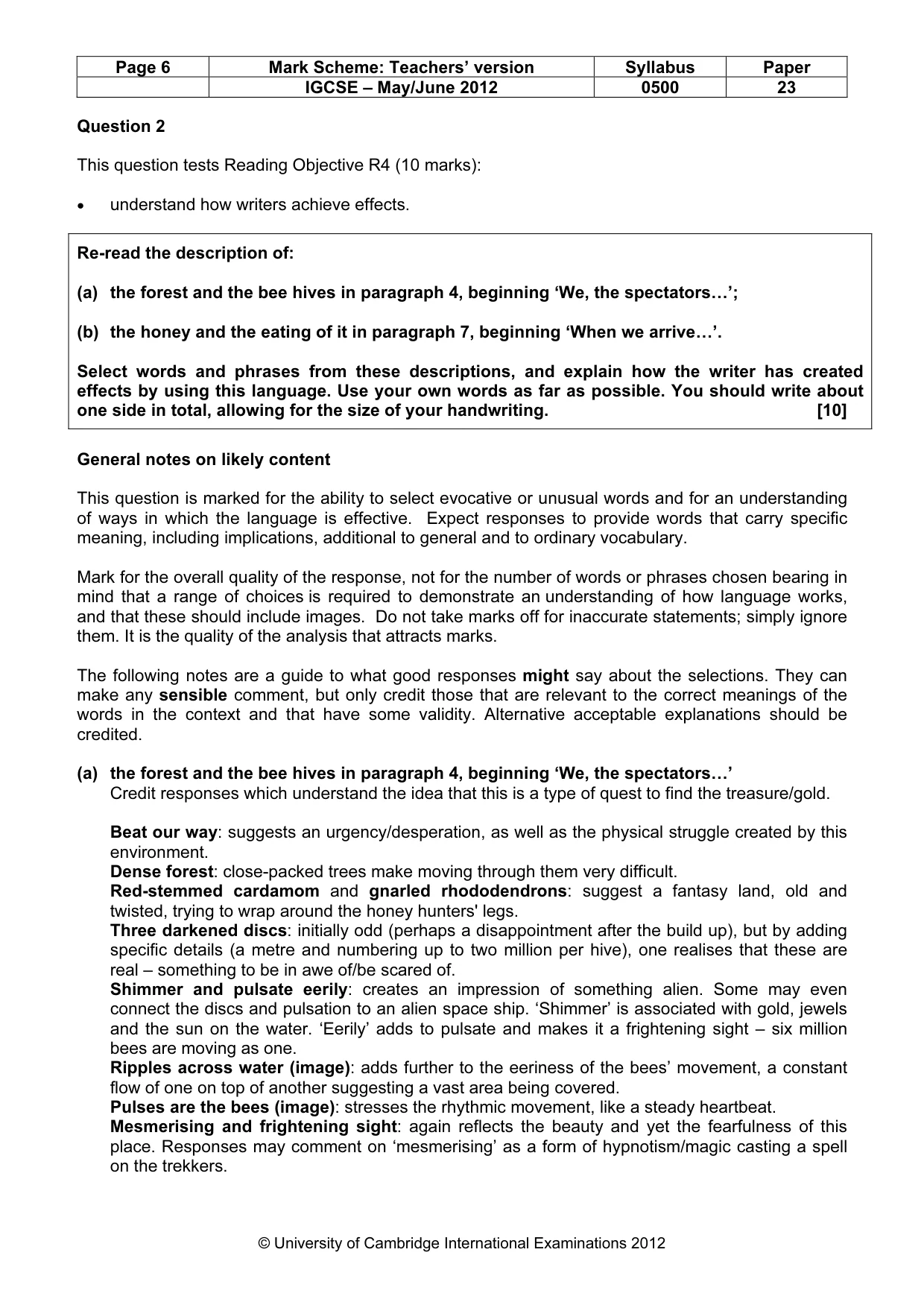
Page 6 Mark Scheme: Teachers’ version Syllabus Paper IGCSE – May/June 2012 0500 23 © University of Cambridge International Examinations 2012 Question 2 This question tests Reading Objective R4 (10 marks): • understand how writers achieve effects. Re-read the description of: (a) the forest and the bee hives in paragraph 4, beginning ‘We, the spectators…’; (b) the honey and the eating of it in paragraph 7, beginning ‘When we arrive…’. Select words and phrases from these descriptions, and explain how the writer has created effects by using this language. Use your own words as far as possible. You should write about one side in total, allowing for the size of your handwriting. [10] General notes on likely content This question is marked for the ability to select evocative or unusual words and for an understanding of ways in which the language is effective. Expect responses to provide words that carry specific meaning, including implications, additional to general and to ordinary vocabulary. Mark for the overall quality of the response, not for the number of words or phrases chosen bearing in mind that a range of choices is required to demonstrate an understanding of how language works, and that these should include images. Do not take marks off for inaccurate statements; simply ignore them. It is the quality of the analysis that attracts marks. The following notes are a guide to what good responses might say about the selections. They can make any sensible comment, but only credit those that are relevant to the correct meanings of the words in the context and that have some validity. Alternative acceptable explanations should be credited. (a) the forest and the bee hives in paragraph 4, beginning ‘We, the spectators…’ Credit responses which understand the idea that this is a type of quest to find the treasure/gold. Beat our way: suggests an urgency/desperation, as well as the physical struggle created by this environment. Dense forest: close-packed trees make moving through them very difficult. Red-stemmed cardamom and gnarled rhododendrons: suggest a fantasy land, old and twisted, trying to wrap around the honey hunters' legs. Three darkened discs: initially odd (perhaps a disappointment after the build up), but by adding specific details (a metre and numbering up to two million per hive), one realises that these are real – something to be in awe of/be scared of. Shimmer and pulsate eerily: creates an impression of something alien. Some may even connect the discs and pulsation to an alien space ship. ‘Shimmer’ is associated with gold, jewels and the sun on the water. ‘Eerily’ adds to pulsate and makes it a frightening sight – six million bees are moving as one. Ripples across water (image): adds further to the eeriness of the bees’ movement, a constant flow of one on top of another suggesting a vast area being covered. Pulses are the bees (image): stresses the rhythmic movement, like a steady heartbeat. Mesmerising and frightening sight: again reflects the beauty and yet the fearfulness of this place. Responses may comment on ‘mesmerising’ as a form of hypnotism/magic casting a spell on the trekkers.
Mark scheme, page 7
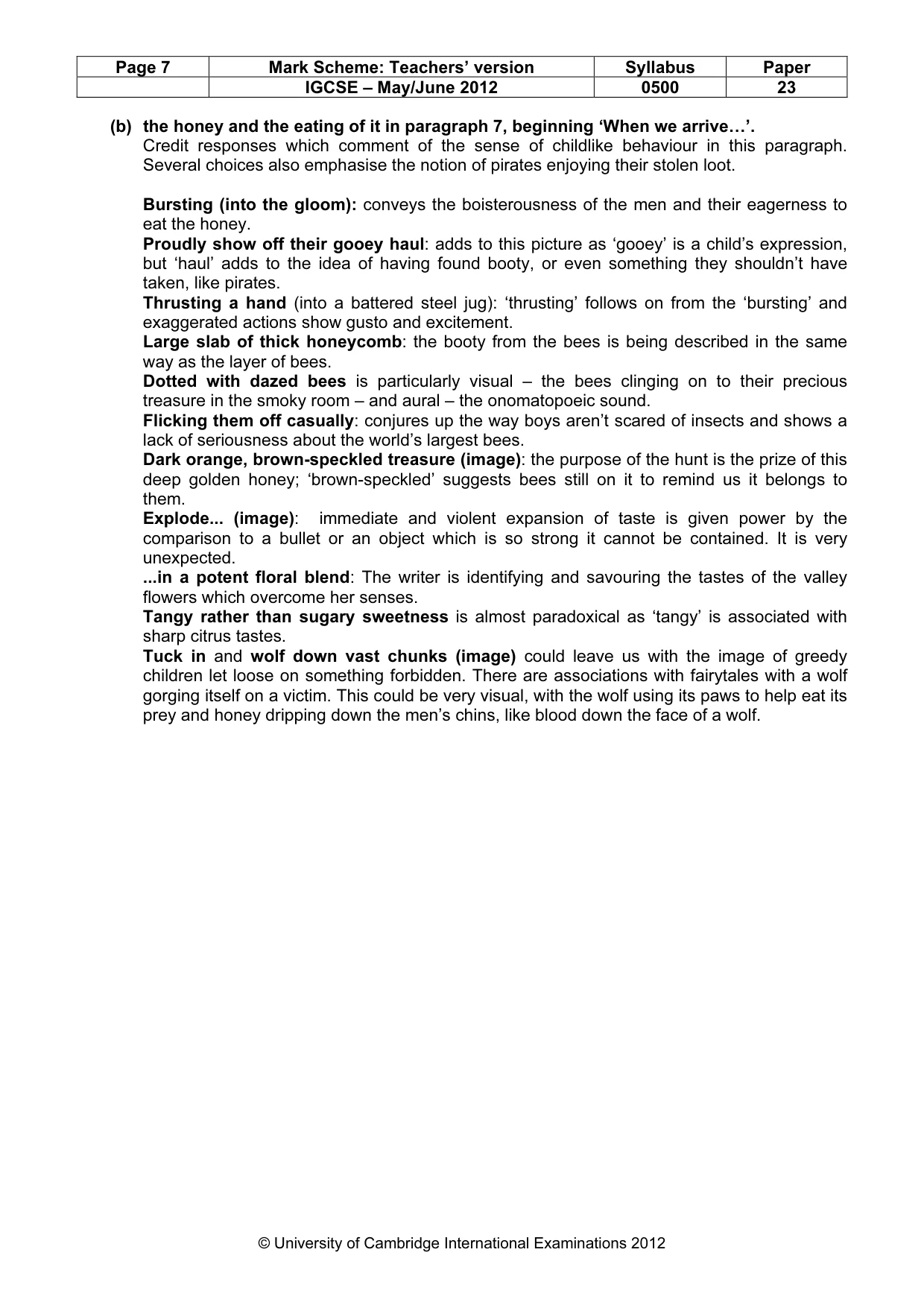
Page 7 Mark Scheme: Teachers’ version Syllabus Paper IGCSE – May/June 2012 0500 23 © University of Cambridge International Examinations 2012 (b) the honey and the eating of it in paragraph 7, beginning ‘When we arrive…’. Credit responses which comment of the sense of childlike behaviour in this paragraph. Several choices also emphasise the notion of pirates enjoying their stolen loot. Bursting (into the gloom): conveys the boisterousness of the men and their eagerness to eat the honey. Proudly show off their gooey haul: adds to this picture as ‘gooey’ is a child’s expression, but ‘haul’ adds to the idea of having found booty, or even something they shouldn’t have taken, like pirates. Thrusting a hand (into a battered steel jug): ‘thrusting’ follows on from the ‘bursting’ and exaggerated actions show gusto and excitement. Large slab of thick honeycomb: the booty from the bees is being described in the same way as the layer of bees. Dotted with dazed bees is particularly visual – the bees clinging on to their precious treasure in the smoky room – and aural – the onomatopoeic sound. Flicking them off casually: conjures up the way boys aren’t scared of insects and shows a lack of seriousness about the world’s largest bees. Dark orange, brown-speckled treasure (image): the purpose of the hunt is the prize of this deep golden honey; ‘brown-speckled’ suggests bees still on it to remind us it belongs to them. Explode... (image): immediate and violent expansion of taste is given power by the comparison to a bullet or an object which is so strong it cannot be contained. It is very unexpected. ...in a potent floral blend: The writer is identifying and savouring the tastes of the valley flowers which overcome her senses. Tangy rather than sugary sweetness is almost paradoxical as ‘tangy’ is associated with sharp citrus tastes. Tuck in and wolf down vast chunks (image) could leave us with the image of greedy children let loose on something forbidden. There are associations with fairytales with a wolf gorging itself on a victim. This could be very visual, with the wolf using its paws to help eat its prey and honey dripping down the men’s chins, like blood down the face of a wolf.
Mark scheme, page 8
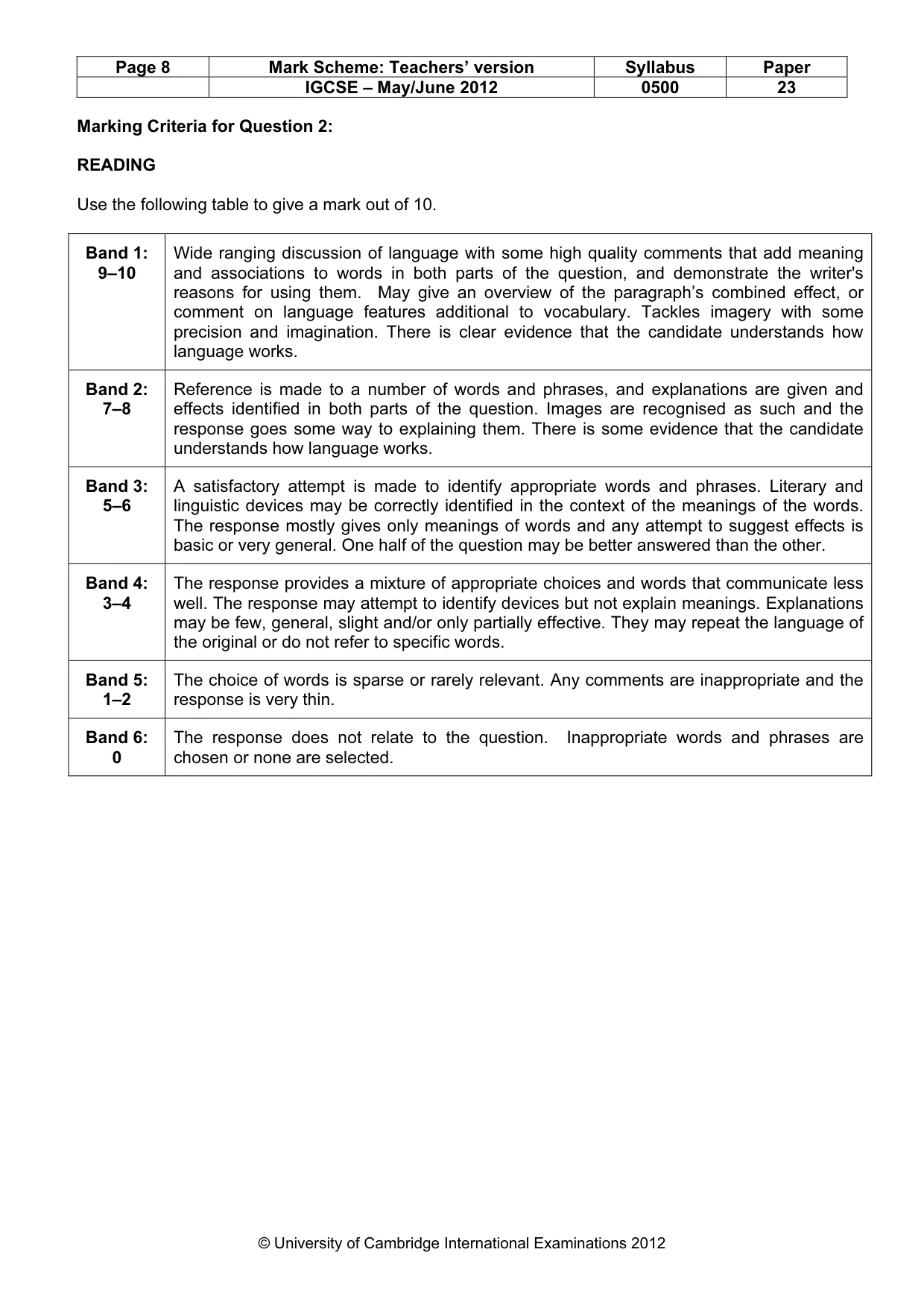
Page 8 Mark Scheme: Teachers’ version Syllabus Paper IGCSE – May/June 2012 0500 23 © University of Cambridge International Examinations 2012 Marking Criteria for Question 2: READING Use the following table to give a mark out of 10. Band 1: 9–10 Wide ranging discussion of language with some high quality comments that add meaning and associations to words in both parts of the question, and demonstrate the writer's reasons for using them. May give an overview of the paragraph’s combined effect, or comment on language features additional to vocabulary. Tackles imagery with some precision and imagination. There is clear evidence that the candidate understands how language works. Band 2: 7–8 Reference is made to a number of words and phrases, and explanations are given and effects identified in both parts of the question. Images are recognised as such and the response goes some way to explaining them. There is some evidence that the candidate understands how language works. Band 3: 5–6 A satisfactory attempt is made to identify appropriate words and phrases. Literary and linguistic devices may be correctly identified in the context of the meanings of the words. The response mostly gives only meanings of words and any attempt to suggest effects is basic or very general. One half of the question may be better answered than the other. Band 4: 3–4 The response provides a mixture of appropriate choices and words that communicate less well. The response may attempt to identify devices but not explain meanings. Explanations may be few, general, slight and/or only partially effective. They may repeat the language of the original or do not refer to specific words. Band 5: 1–2 The choice of words is sparse or rarely relevant. Any comments are inappropriate and the response is very thin. Band 6: 0 The response does not relate to the question. Inappropriate words and phrases are chosen or none are selected.
Mark scheme, page 9
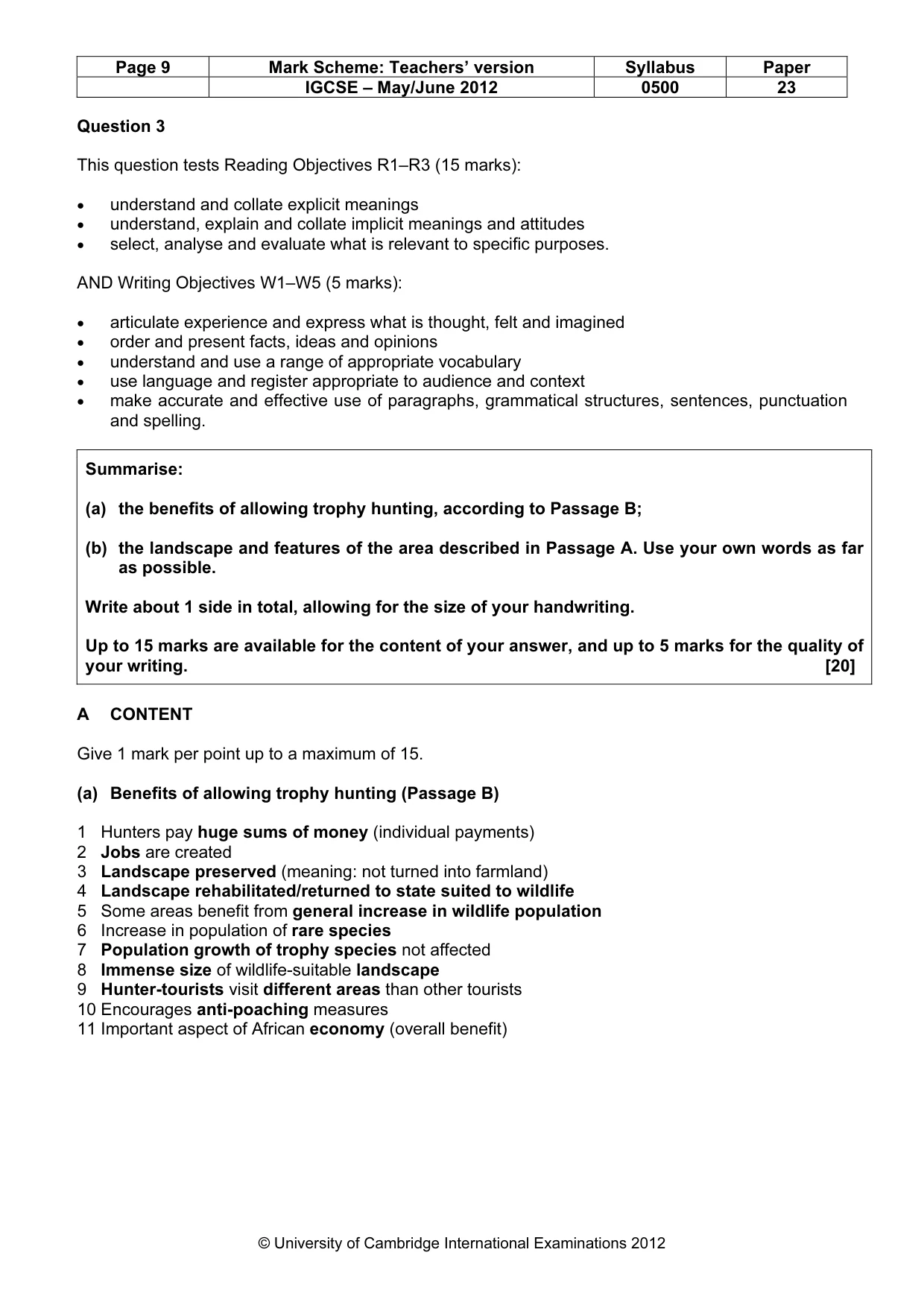
Page 9 Mark Scheme: Teachers’ version Syllabus Paper IGCSE – May/June 2012 0500 23 © University of Cambridge International Examinations 2012 Question 3 This question tests Reading Objectives R1–R3 (15 marks): • understand and collate explicit meanings • understand, explain and collate implicit meanings and attitudes • select, analyse and evaluate what is relevant to specific purposes. AND Writing Objectives W1–W5 (5 marks): • articulate experience and express what is thought, felt and imagined • order and present facts, ideas and opinions • understand and use a range of appropriate vocabulary • use language and register appropriate to audience and context • make accurate and effective use of paragraphs, grammatical structures, sentences, punctuation and spelling. Summarise: (a) the benefits of allowing trophy hunting, according to Passage B; (b) the landscape and features of the area described in Passage A. Use your own words as far as possible. Write about 1 side in total, allowing for the size of your handwriting. Up to 15 marks are available for the content of your answer, and up to 5 marks for the quality of your writing. [20] A CONTENT Give 1 mark per point up to a maximum of 15. (a) Benefits of allowing trophy hunting (Passage B) 1 Hunters pay huge sums of money (individual payments) 2 Jobs are created 3 Landscape preserved (meaning: not turned into farmland) 4 Landscape rehabilitated/returned to state suited to wildlife 5 Some areas benefit from general increase in wildlife population 6 Increase in population of rare species 7 Population growth of trophy species not affected 8 Immense size of wildlife-suitable landscape 9 Hunter-tourists visit different areas than other tourists 10 Encourages anti-poaching measures 11 Important aspect of African economy (overall benefit)
Mark scheme, page 10
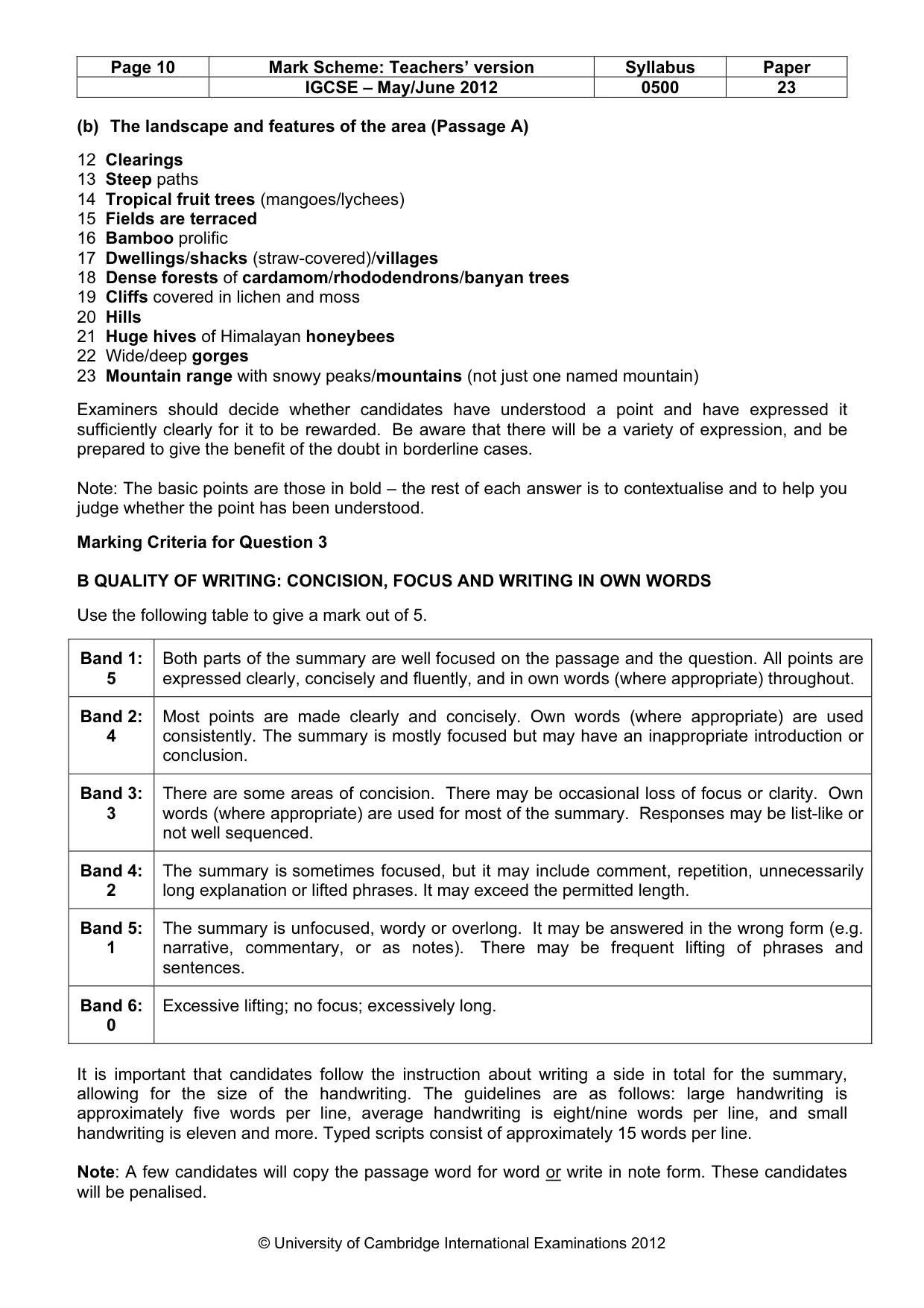
Page 10 Mark Scheme: Teachers’ version Syllabus Paper IGCSE – May/June 2012 0500 23 © University of Cambridge International Examinations 2012 (b) The landscape and features of the area (Passage A) 12 Clearings 13 Steep paths 14 Tropical fruit trees (mangoes/lychees) 15 Fields are terraced 16 Bamboo prolific 17 Dwellings/shacks (straw-covered)/villages 18 Dense forests of cardamom/rhododendrons/banyan trees 19 Cliffs covered in lichen and moss 20 Hills 21 Huge hives of Himalayan honeybees 22 Wide/deep gorges 23 Mountain range with snowy peaks/mountains (not just one named mountain) Examiners should decide whether candidates have understood a point and have expressed it sufficiently clearly for it to be rewarded. Be aware that there will be a variety of expression, and be prepared to give the benefit of the doubt in borderline cases. Note: The basic points are those in bold – the rest of each answer is to contextualise and to help you judge whether the point has been understood. Marking Criteria for Question 3 B QUALITY OF WRITING: CONCISION, FOCUS AND WRITING IN OWN WORDS Use the following table to give a mark out of 5. Band 1: 5 Both parts of the summary are well focused on the passage and the question. All points are expressed clearly, concisely and fluently, and in own words (where appropriate) throughout. Band 2: 4 Most points are made clearly and concisely. Own words (where appropriate) are used consistently. The summary is mostly focused but may have an inappropriate introduction or conclusion. Band 3: 3 There are some areas of concision. There may be occasional loss of focus or clarity. Own words (where appropriate) are used for most of the summary. Responses may be list-like or not well sequenced. Band 4: 2 The summary is sometimes focused, but it may include comment, repetition, unnecessarily long explanation or lifted phrases. It may exceed the permitted length. Band 5: 1 The summary is unfocused, wordy or overlong. It may be answered in the wrong form (e.g. narrative, commentary, or as notes). There may be frequent lifting of phrases and sentences. Band 6: 0 Excessive lifting; no focus; excessively long. It is important that candidates follow the instruction about writing a side in total for the summary, allowing for the size of the handwriting. The guidelines are as follows: large handwriting is approximately five words per line, average handwriting is eight/nine words per line, and small handwriting is eleven and more. Typed scripts consist of approximately 15 words per line. Note: A few candidates will copy the passage word for word or write in note form. These candidates will be penalised.
What you needed in this session
Cambridge’s own grade thresholds for 2012 May/June, Paper 2 · Variant 3. A higher threshold means an easier paper — the bar moves with how the cohort did.