Cambridge IGCSE English - First Language 0500 — 2012 May/June Paper 2 · Variant 2
0500/22/M/J/12 · 50 marks · ≈56 min
The question paper and its mark scheme, free to read here and free to download. This is Cambridge’s own paper, exactly as it was sat.
Question paper8 pages


Mark scheme10 pages
Answers below. Sit the paper first if you are practising.
Paper as text
Question paper, page 1
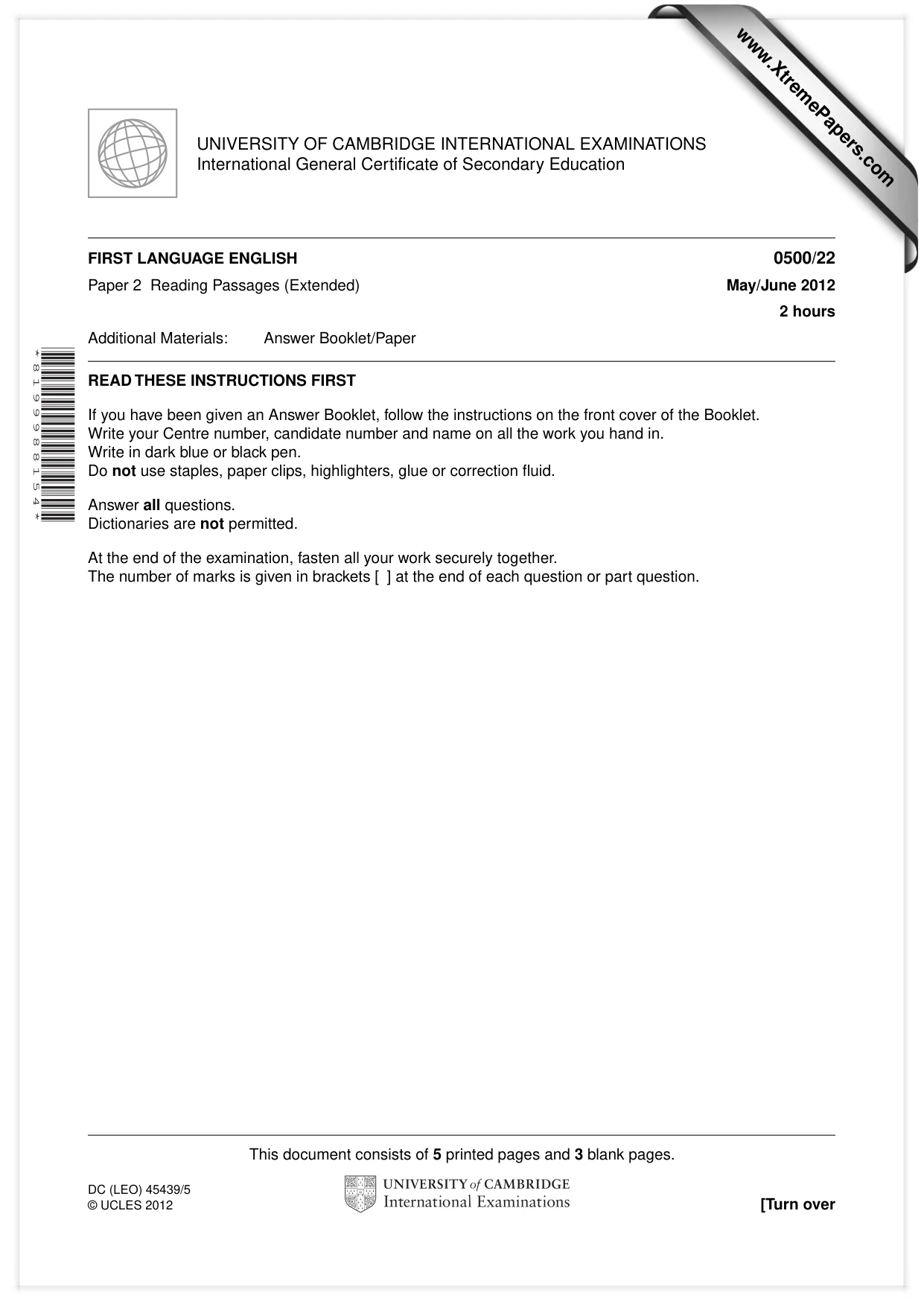
This document consists of 5 printed pages and 3 blank pages. DC (LEO) 45439/5 © UCLES 2012 [Turn over UNIVERSITY OF CAMBRIDGE INTERNATIONAL EXAMINATIONS International General Certificate of Secondary Education * 8 1 9 9 9 8 8 1 5 4 * FIRST LANGUAGE ENGLISH 0500/22 Paper 2 Reading Passages (Extended) May/June 2012 2 hours Additional Materials: Answer Booklet/Paper READ THESE INSTRUCTIONS FIRST If you have been given an Answer Booklet, follow the instructions on the front cover of the Booklet. Write your Centre number, candidate number and name on all the work you hand in. Write in dark blue or black pen. Do not use staples, paper clips, highlighters, glue or correction fluid. Answer all questions. Dictionaries are not permitted. At the end of the examination, fasten all your work securely together. The number of marks is given in brackets [ ] at the end of each question or part question. www.XtremePapers.com
Question paper, page 2
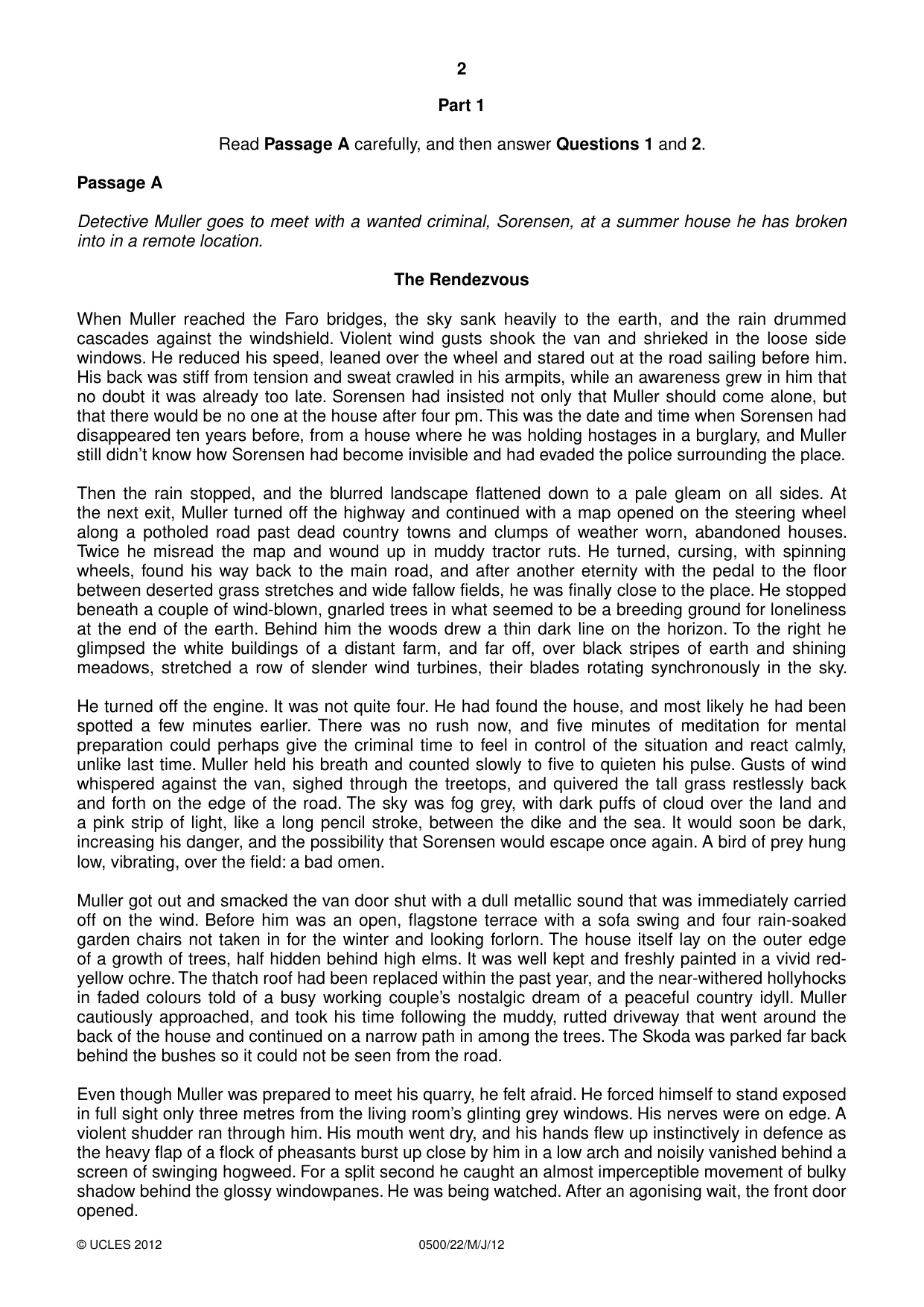
2 0500/22/M/J/12 © UCLES 2012 Part 1 Read Passage A carefully, and then answer Questions 1 and 2. Passage A Detective Muller goes to meet with a wanted criminal, Sorensen, at a summer house he has broken into in a remote location. The Rendezvous When Muller reached the Faro bridges, the sky sank heavily to the earth, and the rain drummed cascades against the windshield. Violent wind gusts shook the van and shrieked in the loose side windows. He reduced his speed, leaned over the wheel and stared out at the road sailing before him. His back was stiff from tension and sweat crawled in his armpits, while an awareness grew in him that no doubt it was already too late. Sorensen had insisted not only that Muller should come alone, but that there would be no one at the house after four pm. This was the date and time when Sorensen had disappeared ten years before, from a house where he was holding hostages in a burglary, and Muller still didn’t know how Sorensen had become invisible and had evaded the police surrounding the place. Then the rain stopped, and the blurred landscape flattened down to a pale gleam on all sides. At the next exit, Muller turned off the highway and continued with a map opened on the steering wheel along a potholed road past dead country towns and clumps of weather worn, abandoned houses. Twice he misread the map and wound up in muddy tractor ruts. He turned, cursing, with spinning wheels, found his way back to the main road, and after another eternity with the pedal to the floor between deserted grass stretches and wide fallow fields, he was finally close to the place. He stopped beneath a couple of wind-blown, gnarled trees in what seemed to be a breeding ground for loneliness at the end of the earth. Behind him the woods drew a thin dark line on the horizon. To the right he glimpsed the white buildings of a distant farm, and far off, over black stripes of earth and shining meadows, stretched a row of slender wind turbines, their blades rotating synchronously in the sky. He turned off the engine. It was not quite four. He had found the house, and most likely he had been spotted a few minutes earlier. There was no rush now, and five minutes of meditation for mental preparation could perhaps give the criminal time to feel in control of the situation and react calmly, unlike last time. Muller held his breath and counted slowly to five to quieten his pulse. Gusts of wind whispered against the van, sighed through the treetops, and quivered the tall grass restlessly back and forth on the edge of the road. The sky was fog grey, with dark puffs of cloud over the land and a pink strip of light, like a long pencil stroke, between the dike and the sea. It would soon be dark, increasing his danger, and the possibility that Sorensen would escape once again. A bird of prey hung low, vibrating, over the field: a bad omen. Muller got out and smacked the van door shut with a dull metallic sound that was immediately carried off on the wind. Before him was an open, flagstone terrace with a sofa swing and four rain-soaked garden chairs not taken in for the winter and looking forlorn. The house itself lay on the outer edge of a growth of trees, half hidden behind high elms. It was well kept and freshly painted in a vivid red- yellow ochre. The thatch roof had been replaced within the past year, and the near-withered hollyhocks in faded colours told of a busy working couple’s nostalgic dream of a peaceful country idyll. Muller cautiously approached, and took his time following the muddy, rutted driveway that went around the back of the house and continued on a narrow path in among the trees. The Skoda was parked far back behind the bushes so it could not be seen from the road. Even though Muller was prepared to meet his quarry, he felt afraid. He forced himself to stand exposed in full sight only three metres from the living room’s glinting grey windows. His nerves were on edge. A violent shudder ran through him. His mouth went dry, and his hands flew up instinctively in defence as the heavy flap of a flock of pheasants burst up close by him in a low arch and noisily vanished behind a screen of swinging hogweed. For a split second he caught an almost imperceptible movement of bulky shadow behind the glossy windowpanes. He was being watched. After an agonising wait, the front door opened.
Question paper, page 3
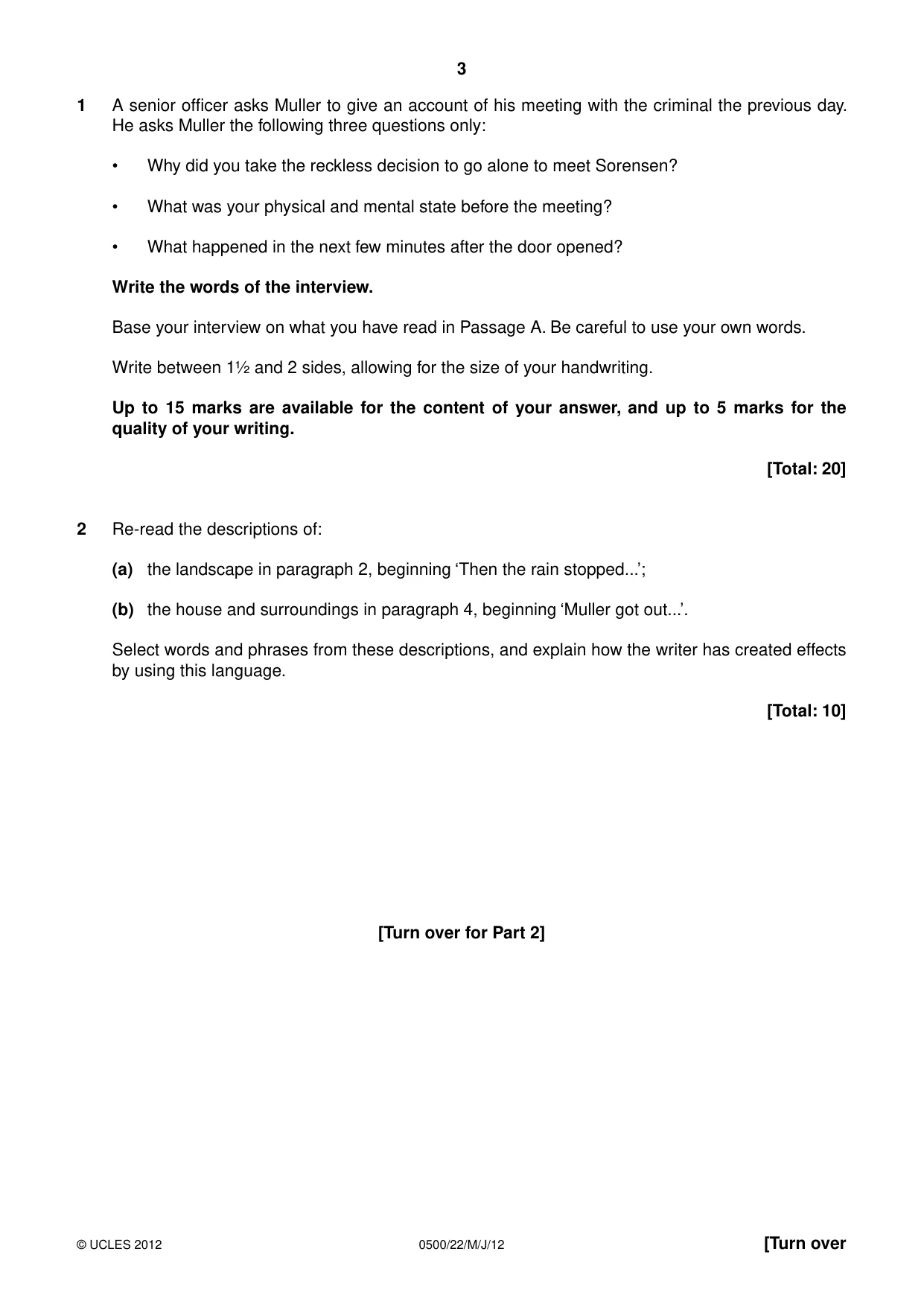
3 0500/22/M/J/12 © UCLES 2012 [Turn over 1 A senior officer asks Muller to give an account of his meeting with the criminal the previous day. He asks Muller the following three questions only: • Why did you take the reckless decision to go alone to meet Sorensen? • What was your physical and mental state before the meeting? • What happened in the next few minutes after the door opened? Write the words of the interview. Base your interview on what you have read in Passage A. Be careful to use your own words. Write between 1½ and 2 sides, allowing for the size of your handwriting. Up to 15 marks are available for the content of your answer, and up to 5 marks for the quality of your writing. [Total: 20] 2 Re-read the descriptions of: (a) the landscape in paragraph 2, beginning ‘Then the rain stopped...’; (b) the house and surroundings in paragraph 4, beginning ‘Muller got out...’. Select words and phrases from these descriptions, and explain how the writer has created effects by using this language. [Total: 10] [Turn over for Part 2]
Question paper, page 4
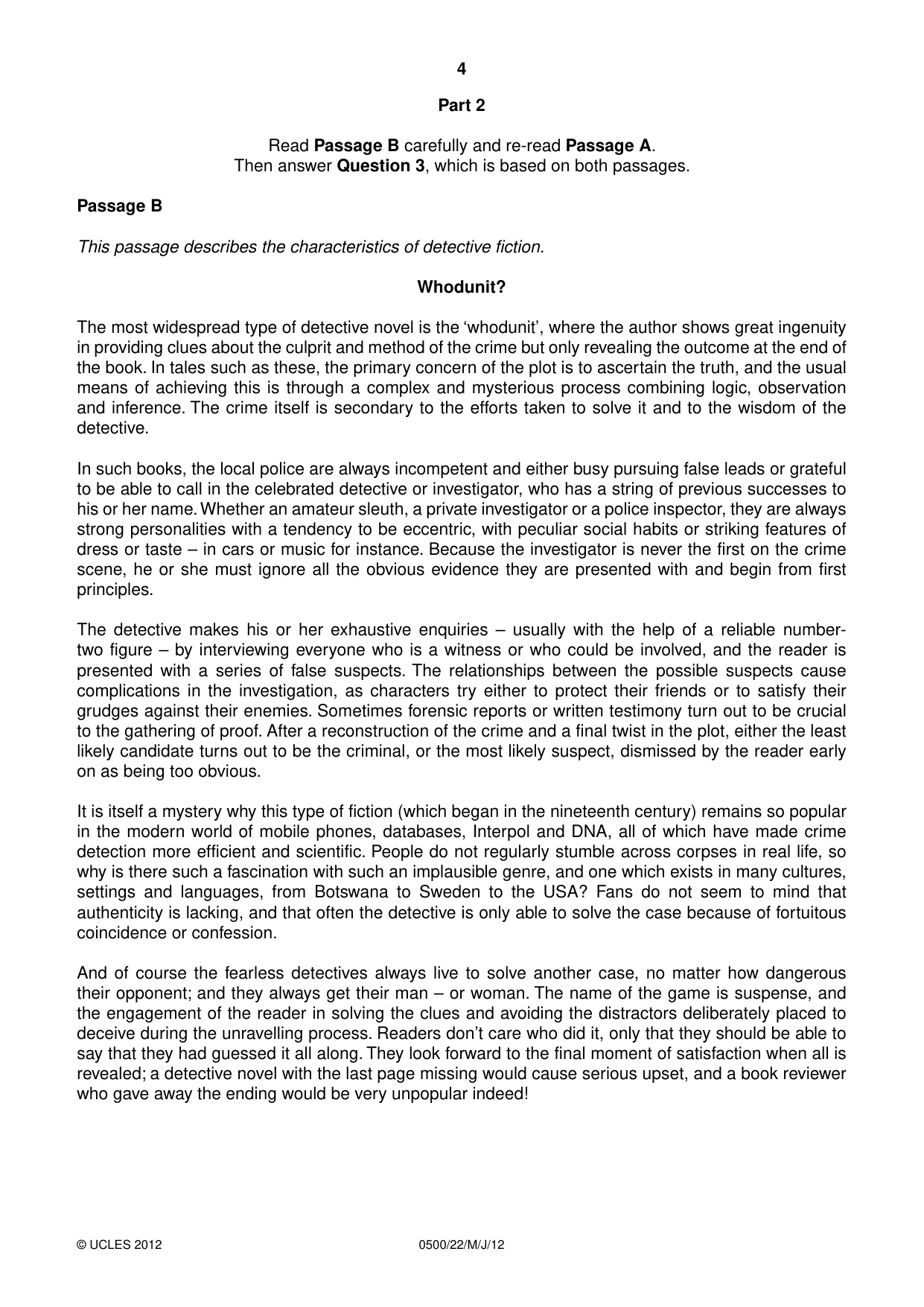
4 0500/22/M/J/12 © UCLES 2012 Part 2 Read Passage B carefully and re-read Passage A. Then answer Question 3, which is based on both passages. Passage B This passage describes the characteristics of detective fiction. Whodunit? The most widespread type of detective novel is the ‘whodunit’, where the author shows great ingenuity in providing clues about the culprit and method of the crime but only revealing the outcome at the end of the book. In tales such as these, the primary concern of the plot is to ascertain the truth, and the usual means of achieving this is through a complex and mysterious process combining logic, observation and inference. The crime itself is secondary to the efforts taken to solve it and to the wisdom of the detective. In such books, the local police are always incompetent and either busy pursuing false leads or grateful to be able to call in the celebrated detective or investigator, who has a string of previous successes to his or her name. Whether an amateur sleuth, a private investigator or a police inspector, they are always strong personalities with a tendency to be eccentric, with peculiar social habits or striking features of dress or taste – in cars or music for instance. Because the investigator is never the first on the crime scene, he or she must ignore all the obvious evidence they are presented with and begin from first principles. The detective makes his or her exhaustive enquiries – usually with the help of a reliable number- two figure – by interviewing everyone who is a witness or who could be involved, and the reader is presented with a series of false suspects. The relationships between the possible suspects cause complications in the investigation, as characters try either to protect their friends or to satisfy their grudges against their enemies. Sometimes forensic reports or written testimony turn out to be crucial to the gathering of proof. After a reconstruction of the crime and a final twist in the plot, either the least likely candidate turns out to be the criminal, or the most likely suspect, dismissed by the reader early on as being too obvious. It is itself a mystery why this type of fiction (which began in the nineteenth century) remains so popular in the modern world of mobile phones, databases, Interpol and DNA, all of which have made crime detection more efficient and scientific. People do not regularly stumble across corpses in real life, so why is there such a fascination with such an implausible genre, and one which exists in many cultures, settings and languages, from Botswana to Sweden to the USA? Fans do not seem to mind that authenticity is lacking, and that often the detective is only able to solve the case because of fortuitous coincidence or confession. And of course the fearless detectives always live to solve another case, no matter how dangerous their opponent; and they always get their man – or woman. The name of the game is suspense, and the engagement of the reader in solving the clues and avoiding the distractors deliberately placed to deceive during the unravelling process. Readers don’t care who did it, only that they should be able to say that they had guessed it all along. They look forward to the final moment of satisfaction when all is revealed; a detective novel with the last page missing would cause serious upset, and a book reviewer who gave away the ending would be very unpopular indeed!
Question paper, page 5
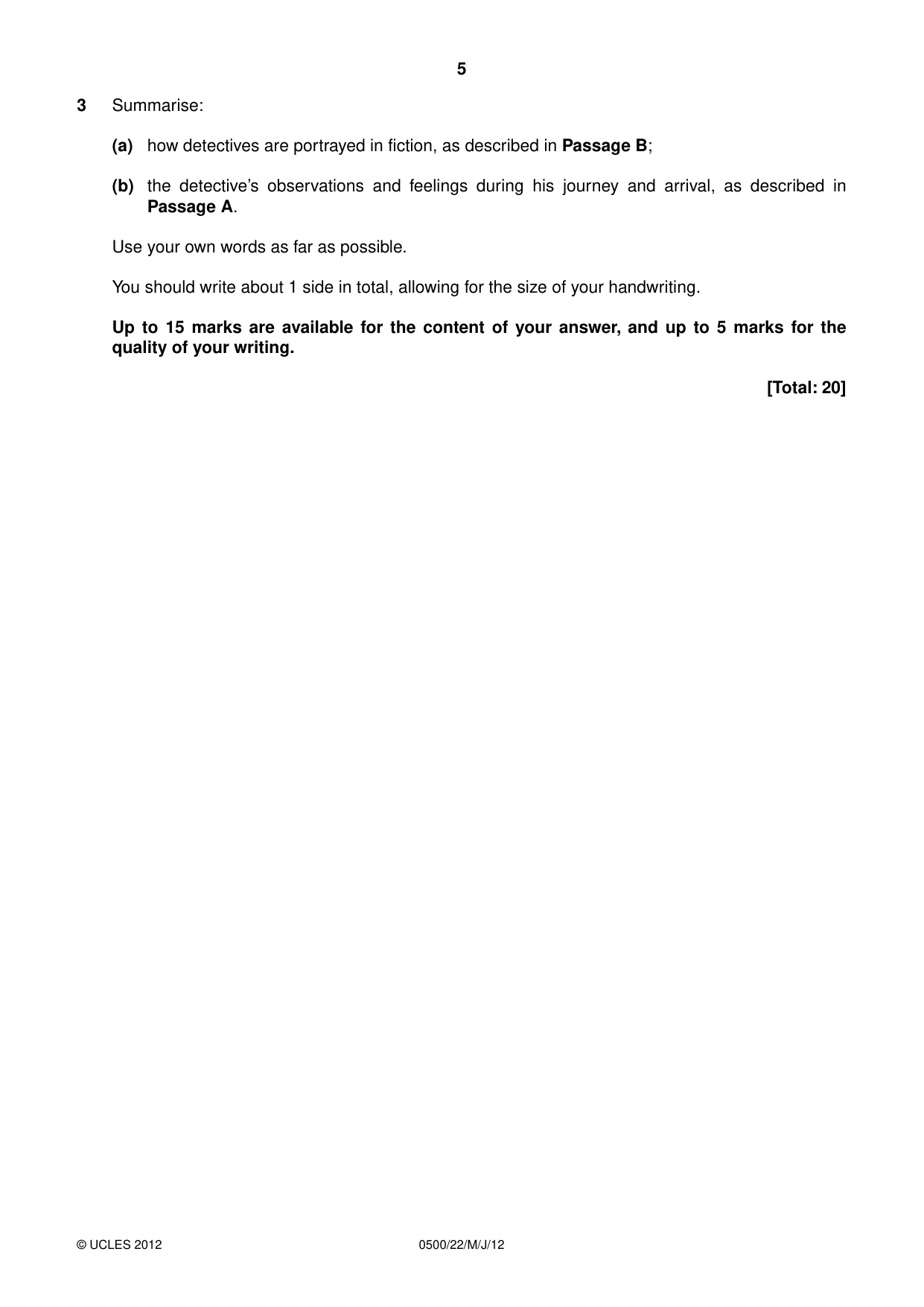
5 0500/22/M/J/12 © UCLES 2012 3 Summarise: (a) how detectives are portrayed in fiction, as described in Passage B; (b) the detective’s observations and feelings during his journey and arrival, as described in Passage A. Use your own words as far as possible. You should write about 1 side in total, allowing for the size of your handwriting. Up to 15 marks are available for the content of your answer, and up to 5 marks for the quality of your writing. [Total: 20]
Question paper, page 6
6 0500/22/M/J/12 © UCLES 2012 BLANK PAGE
Question paper, page 7
7 0500/22/M/J/12 © UCLES 2012 BLANK PAGE
Question paper, page 8
8 0500/22/M/J/12 © UCLES 2012 BLANK PAGE Copyright Acknowledgements: Passage A © ADAPTED: Flemming Jarlskov; The Judge ; Gyldendal; 2008 Permission to reproduce items where third-party owned material protected by copyright is included has been sought and cleared where possible. Every reasonable effort has been made by the publisher (UCLES) to trace copyright holders, but if any items requiring clearance have unwittingly been included, the publisher will be pleased to make amends at the earliest possible opportunity. University of Cambridge International Examinations is part of the Cambridge Assessment Group. Cambridge Assessment is the brand name of University of Cambridge Local Examinations Syndicate (UCLES), which is itself a department of the University of Cambridge.
Mark scheme, page 1
UNIVERSITY OF CAMBRIDGE INTERNATIONAL EXAMINATIONS International General Certificate of Secondary Education MARK SCHEME for the May/June 2012 question paper for the guidance of teachers 0500 FIRST LANGUAGE ENGLISH 0500/22 Paper 2 (Reading Passages – Extended), maximum raw mark 50 This mark scheme is published as an aid to teachers and candidates, to indicate the requirements of the examination. It shows the basis on which Examiners were instructed to award marks. It does not indicate the details of the discussions that took place at an Examiners’ meeting before marking began, which would have considered the acceptability of alternative answers. Mark schemes must be read in conjunction with the question papers and the report on the examination. • Cambridge will not enter into discussions or correspondence in connection with these mark schemes. Cambridge is publishing the mark schemes for the May/June 2012 question papers for most IGCSE, GCE Advanced Level and Advanced Subsidiary Level syllabuses and some Ordinary Level syllabuses. www.XtremePapers.com
Mark scheme, page 2
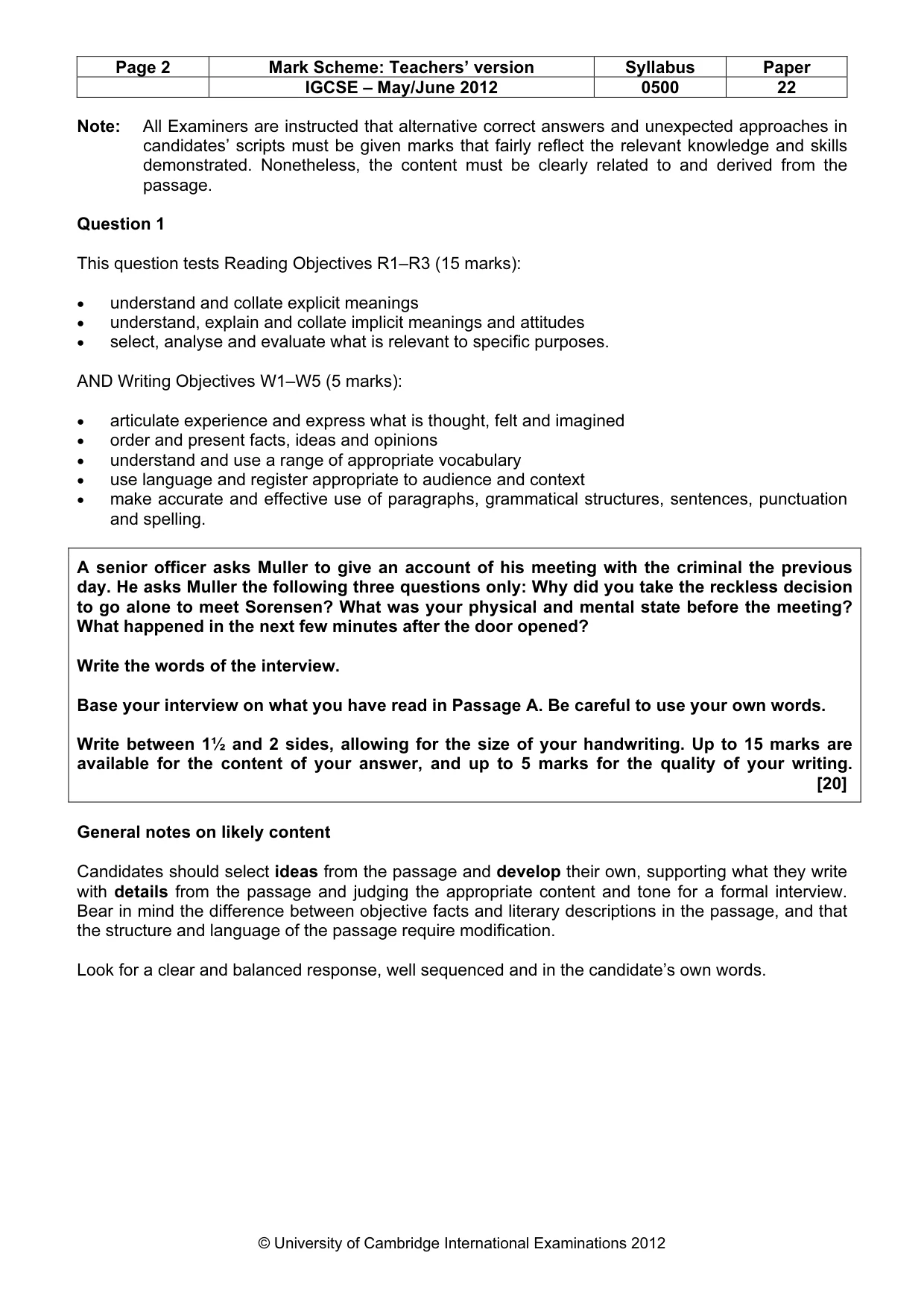
Page 2 Mark Scheme: Teachers’ version Syllabus Paper IGCSE – May/June 2012 0500 22 © University of Cambridge International Examinations 2012 Note: All Examiners are instructed that alternative correct answers and unexpected approaches in candidates’ scripts must be given marks that fairly reflect the relevant knowledge and skills demonstrated. Nonetheless, the content must be clearly related to and derived from the passage. Question 1 This question tests Reading Objectives R1–R3 (15 marks): • understand and collate explicit meanings • understand, explain and collate implicit meanings and attitudes • select, analyse and evaluate what is relevant to specific purposes. AND Writing Objectives W1–W5 (5 marks): • articulate experience and express what is thought, felt and imagined • order and present facts, ideas and opinions • understand and use a range of appropriate vocabulary • use language and register appropriate to audience and context • make accurate and effective use of paragraphs, grammatical structures, sentences, punctuation and spelling. A senior officer asks Muller to give an account of his meeting with the criminal the previous day. He asks Muller the following three questions only: Why did you take the reckless decision to go alone to meet Sorensen? What was your physical and mental state before the meeting? What happened in the next few minutes after the door opened? Write the words of the interview. Base your interview on what you have read in Passage A. Be careful to use your own words. Write between 1½ and 2 sides, allowing for the size of your handwriting. Up to 15 marks are available for the content of your answer, and up to 5 marks for the quality of your writing. [20] General notes on likely content Candidates should select ideas from the passage and develop their own, supporting what they write with details from the passage and judging the appropriate content and tone for a formal interview. Bear in mind the difference between objective facts and literary descriptions in the passage, and that the structure and language of the passage require modification. Look for a clear and balanced response, well sequenced and in the candidate’s own words.
Mark scheme, page 3
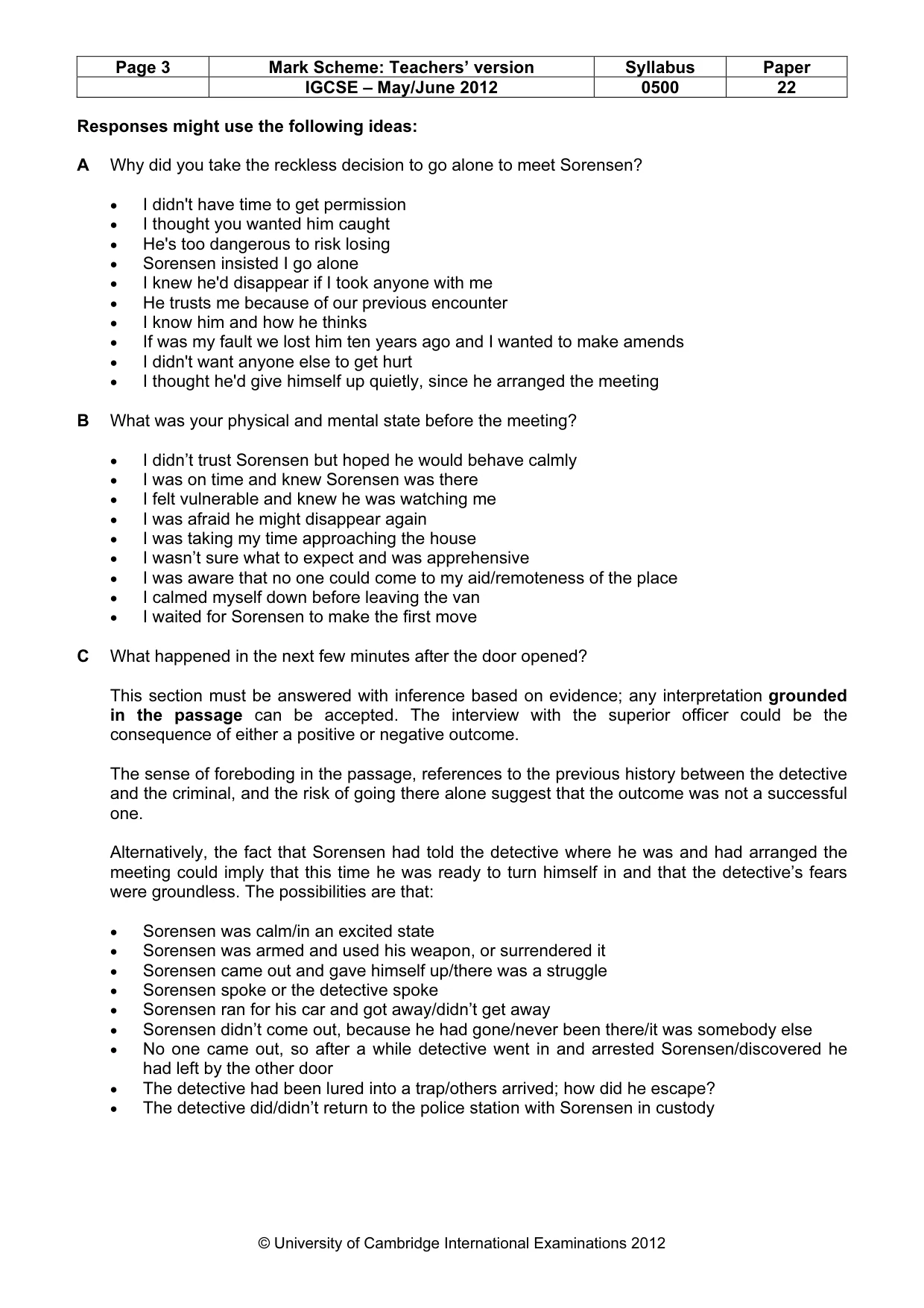
Page 3 Mark Scheme: Teachers’ version Syllabus Paper IGCSE – May/June 2012 0500 22 © University of Cambridge International Examinations 2012 Responses might use the following ideas: A Why did you take the reckless decision to go alone to meet Sorensen? • I didn't have time to get permission • I thought you wanted him caught • He's too dangerous to risk losing • Sorensen insisted I go alone • I knew he'd disappear if I took anyone with me • He trusts me because of our previous encounter • I know him and how he thinks • If was my fault we lost him ten years ago and I wanted to make amends • I didn't want anyone else to get hurt • I thought he'd give himself up quietly, since he arranged the meeting B What was your physical and mental state before the meeting? • I didn’t trust Sorensen but hoped he would behave calmly • I was on time and knew Sorensen was there • I felt vulnerable and knew he was watching me • I was afraid he might disappear again • I was taking my time approaching the house • I wasn’t sure what to expect and was apprehensive • I was aware that no one could come to my aid/remoteness of the place • I calmed myself down before leaving the van • I waited for Sorensen to make the first move C What happened in the next few minutes after the door opened? This section must be answered with inference based on evidence; any interpretation grounded in the passage can be accepted. The interview with the superior officer could be the consequence of either a positive or negative outcome. The sense of foreboding in the passage, references to the previous history between the detective and the criminal, and the risk of going there alone suggest that the outcome was not a successful one. Alternatively, the fact that Sorensen had told the detective where he was and had arranged the meeting could imply that this time he was ready to turn himself in and that the detective’s fears were groundless. The possibilities are that: • Sorensen was calm/in an excited state • Sorensen was armed and used his weapon, or surrendered it • Sorensen came out and gave himself up/there was a struggle • Sorensen spoke or the detective spoke • Sorensen ran for his car and got away/didn’t get away • Sorensen didn’t come out, because he had gone/never been there/it was somebody else • No one came out, so after a while detective went in and arrested Sorensen/discovered he had left by the other door • The detective had been lured into a trap/others arrived; how did he escape? • The detective did/didn’t return to the police station with Sorensen in custody
Mark scheme, page 4
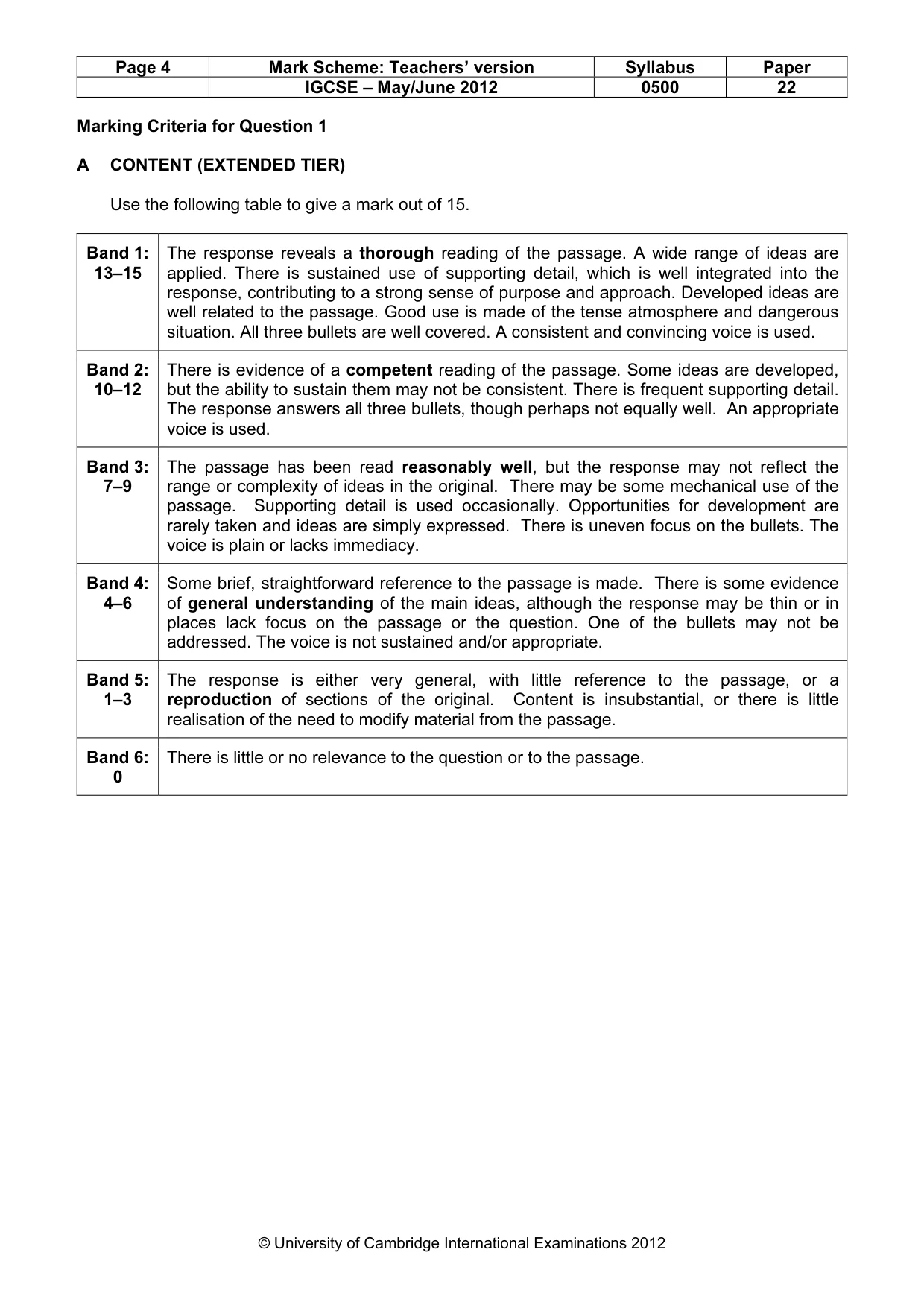
Page 4 Mark Scheme: Teachers’ version Syllabus Paper IGCSE – May/June 2012 0500 22 © University of Cambridge International Examinations 2012 Marking Criteria for Question 1 A CONTENT (EXTENDED TIER) Use the following table to give a mark out of 15. Band 1: 13–15 The response reveals a thorough reading of the passage. A wide range of ideas are applied. There is sustained use of supporting detail, which is well integrated into the response, contributing to a strong sense of purpose and approach. Developed ideas are well related to the passage. Good use is made of the tense atmosphere and dangerous situation. All three bullets are well covered. A consistent and convincing voice is used. Band 2: 10–12 There is evidence of a competent reading of the passage. Some ideas are developed, but the ability to sustain them may not be consistent. There is frequent supporting detail. The response answers all three bullets, though perhaps not equally well. An appropriate voice is used. Band 3: 7–9 The passage has been read reasonably well, but the response may not reflect the range or complexity of ideas in the original. There may be some mechanical use of the passage. Supporting detail is used occasionally. Opportunities for development are rarely taken and ideas are simply expressed. There is uneven focus on the bullets. The voice is plain or lacks immediacy. Band 4: 4–6 Some brief, straightforward reference to the passage is made. There is some evidence of general understanding of the main ideas, although the response may be thin or in places lack focus on the passage or the question. One of the bullets may not be addressed. The voice is not sustained and/or appropriate. Band 5: 1–3 The response is either very general, with little reference to the passage, or a reproduction of sections of the original. Content is insubstantial, or there is little realisation of the need to modify material from the passage. Band 6: 0 There is little or no relevance to the question or to the passage.
Mark scheme, page 5
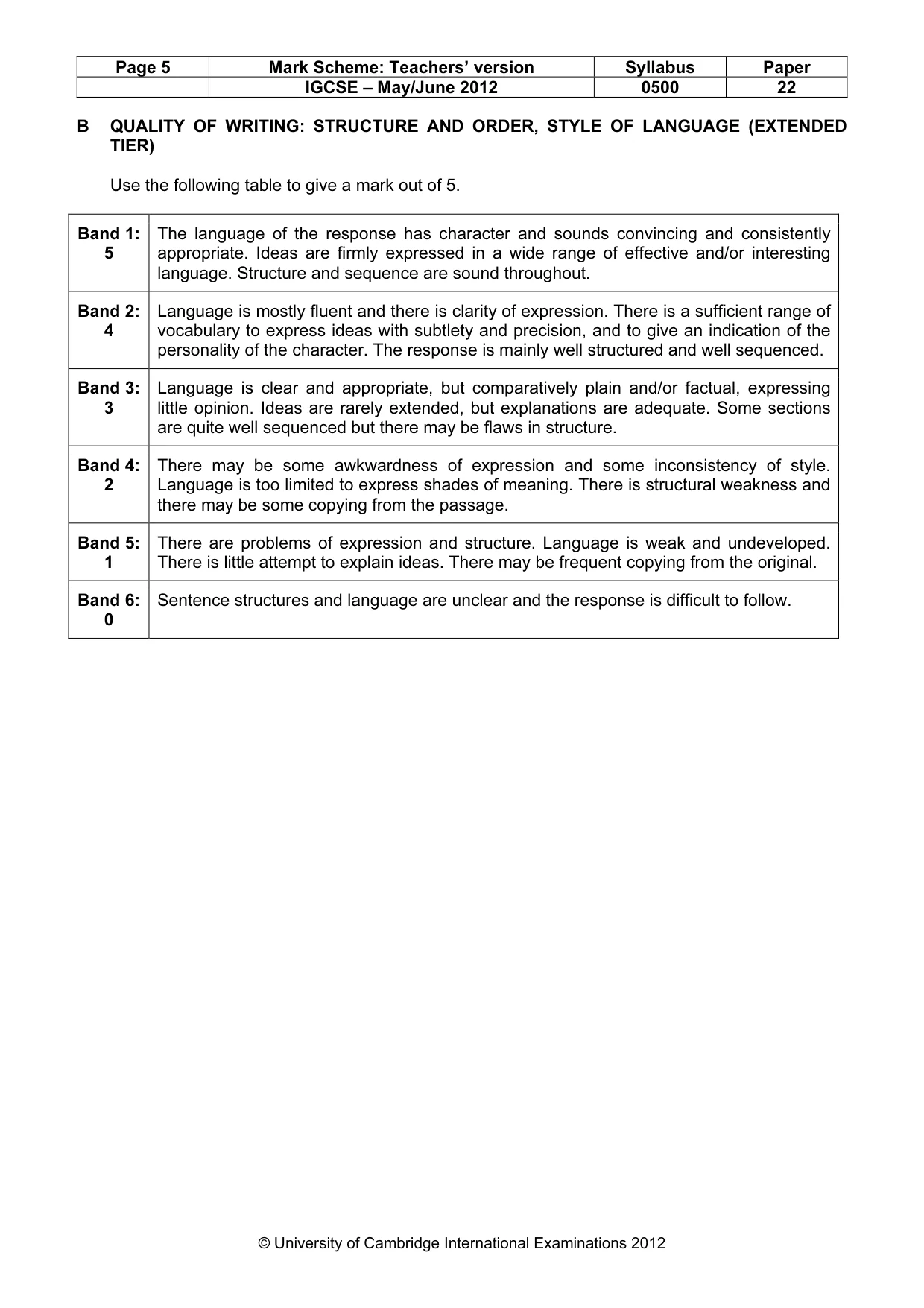
Page 5 Mark Scheme: Teachers’ version Syllabus Paper IGCSE – May/June 2012 0500 22 © University of Cambridge International Examinations 2012 B QUALITY OF WRITING: STRUCTURE AND ORDER, STYLE OF LANGUAGE (EXTENDED TIER) Use the following table to give a mark out of 5. Band 1: 5 The language of the response has character and sounds convincing and consistently appropriate. Ideas are firmly expressed in a wide range of effective and/or interesting language. Structure and sequence are sound throughout. Band 2: 4 Language is mostly fluent and there is clarity of expression. There is a sufficient range of vocabulary to express ideas with subtlety and precision, and to give an indication of the personality of the character. The response is mainly well structured and well sequenced. Band 3: 3 Language is clear and appropriate, but comparatively plain and/or factual, expressing little opinion. Ideas are rarely extended, but explanations are adequate. Some sections are quite well sequenced but there may be flaws in structure. Band 4: 2 There may be some awkwardness of expression and some inconsistency of style. Language is too limited to express shades of meaning. There is structural weakness and there may be some copying from the passage. Band 5: 1 There are problems of expression and structure. Language is weak and undeveloped. There is little attempt to explain ideas. There may be frequent copying from the original. Band 6: 0 Sentence structures and language are unclear and the response is difficult to follow.
Mark scheme, page 6
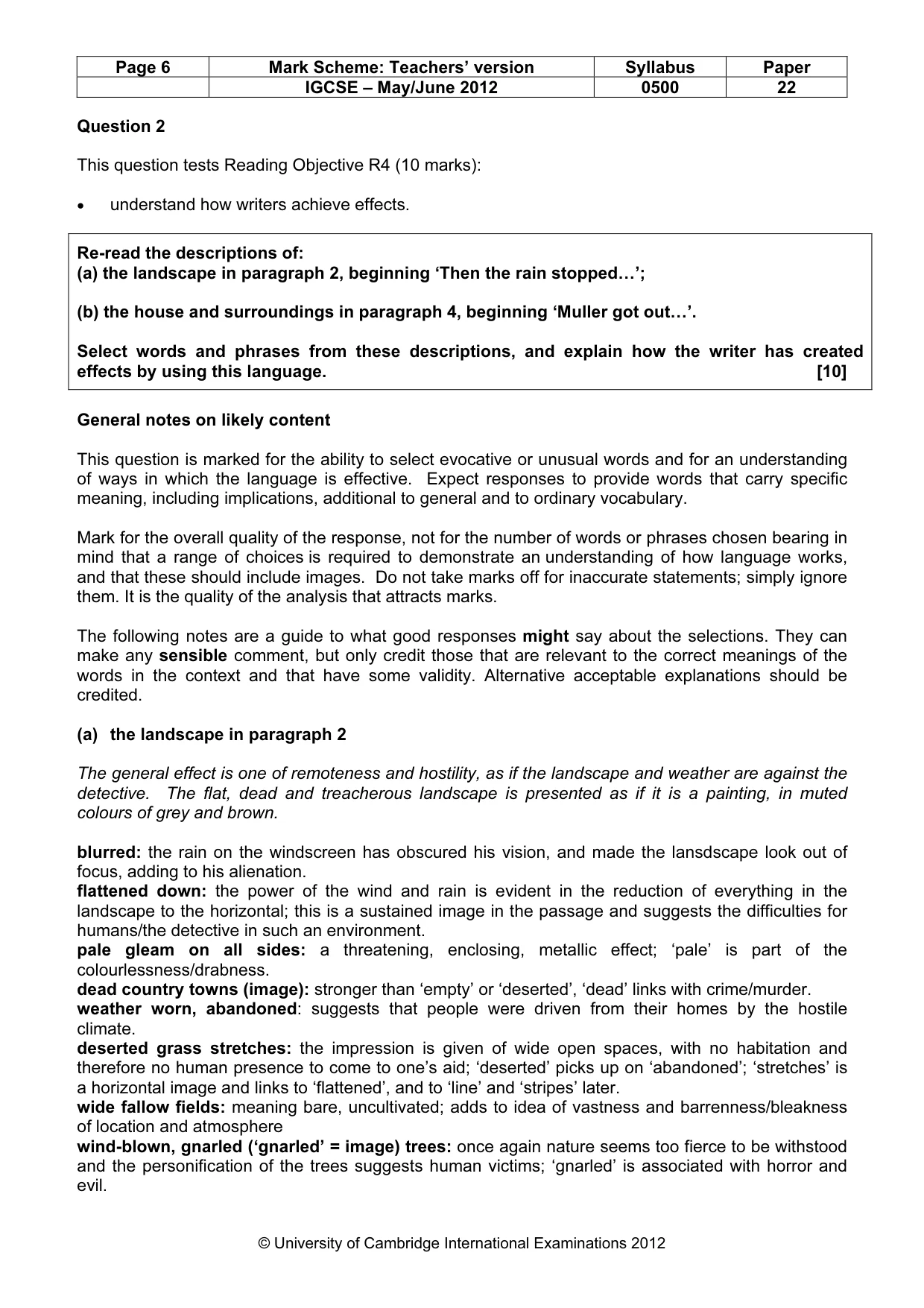
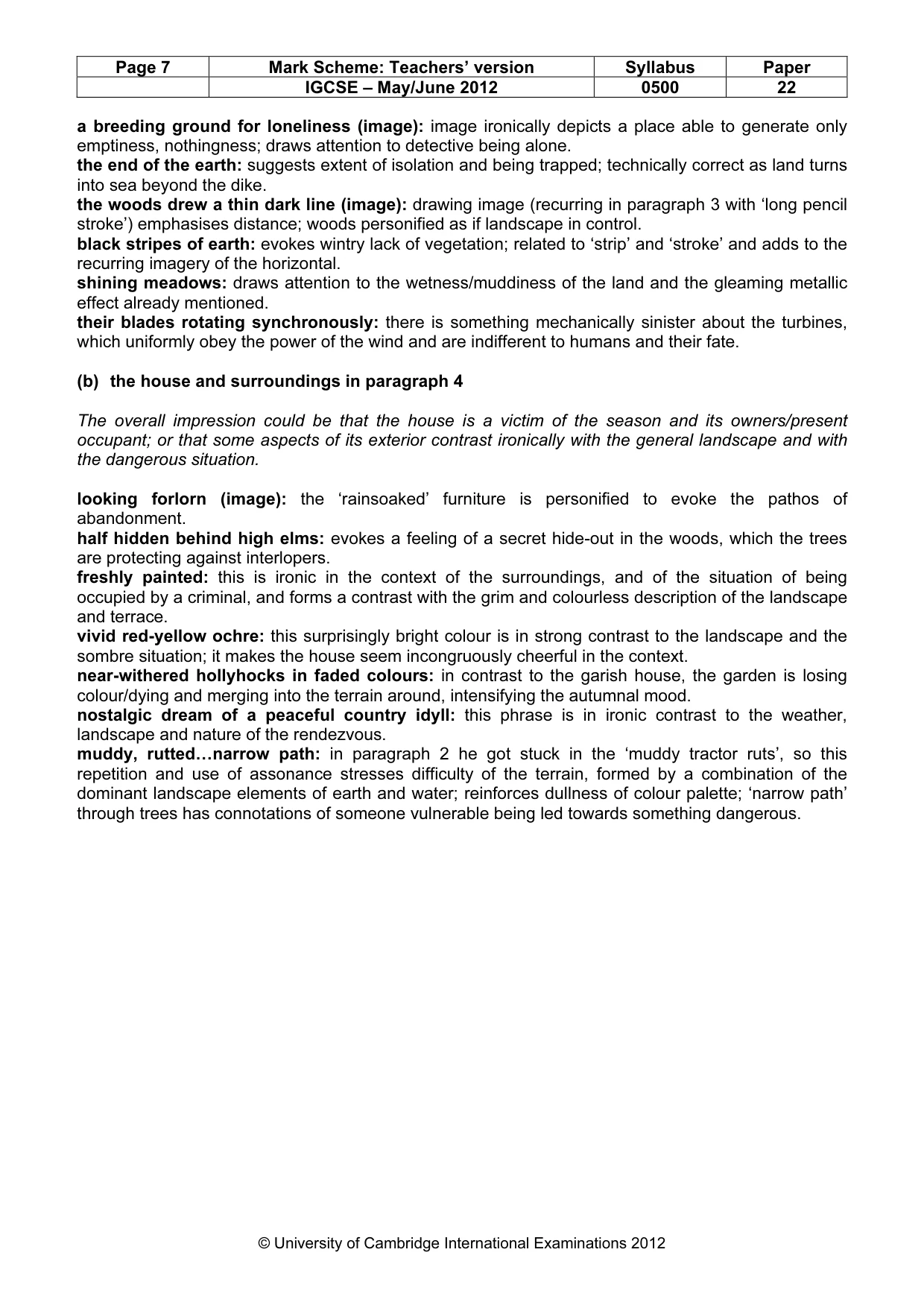
Page 6 Mark Scheme: Teachers’ version Syllabus Paper IGCSE – May/June 2012 0500 22 © University of Cambridge International Examinations 2012 Question 2 This question tests Reading Objective R4 (10 marks): • understand how writers achieve effects. Re-read the descriptions of: (a) the landscape in paragraph 2, beginning ‘Then the rain stopped…’; (b) the house and surroundings in paragraph 4, beginning ‘Muller got out…’. Select words and phrases from these descriptions, and explain how the writer has created effects by using this language. [10] General notes on likely content This question is marked for the ability to select evocative or unusual words and for an understanding of ways in which the language is effective. Expect responses to provide words that carry specific meaning, including implications, additional to general and to ordinary vocabulary. Mark for the overall quality of the response, not for the number of words or phrases chosen bearing in mind that a range of choices is required to demonstrate an understanding of how language works, and that these should include images. Do not take marks off for inaccurate statements; simply ignore them. It is the quality of the analysis that attracts marks. The following notes are a guide to what good responses might say about the selections. They can make any sensible comment, but only credit those that are relevant to the correct meanings of the words in the context and that have some validity. Alternative acceptable explanations should be credited. (a) the landscape in paragraph 2 The general effect is one of remoteness and hostility, as if the landscape and weather are against the detective. The flat, dead and treacherous landscape is presented as if it is a painting, in muted colours of grey and brown. blurred: the rain on the windscreen has obscured his vision, and made the lansdscape look out of focus, adding to his alienation. flattened down: the power of the wind and rain is evident in the reduction of everything in the landscape to the horizontal; this is a sustained image in the passage and suggests the difficulties for humans/the detective in such an environment. pale gleam on all sides: a threatening, enclosing, metallic effect; ‘pale’ is part of the colourlessness/drabness. dead country towns (image): stronger than ‘empty’ or ‘deserted’, ‘dead’ links with crime/murder. weather worn, abandoned: suggests that people were driven from their homes by the hostile climate. deserted grass stretches: the impression is given of wide open spaces, with no habitation and therefore no human presence to come to one’s aid; ‘deserted’ picks up on ‘abandoned’; ‘stretches’ is a horizontal image and links to ‘flattened’, and to ‘line’ and ‘stripes’ later. wide fallow fields: meaning bare, uncultivated; adds to idea of vastness and barrenness/bleakness of location and atmosphere wind-blown, gnarled (‘gnarled’ = image) trees: once again nature seems too fierce to be withstood and the personification of the trees suggests human victims; ‘gnarled’ is associated with horror and evil.
Mark scheme, page 7
Page 7 Mark Scheme: Teachers’ version Syllabus Paper IGCSE – May/June 2012 0500 22 © University of Cambridge International Examinations 2012 a breeding ground for loneliness (image): image ironically depicts a place able to generate only emptiness, nothingness; draws attention to detective being alone. the end of the earth: suggests extent of isolation and being trapped; technically correct as land turns into sea beyond the dike. the woods drew a thin dark line (image): drawing image (recurring in paragraph 3 with ‘long pencil stroke’) emphasises distance; woods personified as if landscape in control. black stripes of earth: evokes wintry lack of vegetation; related to ‘strip’ and ‘stroke’ and adds to the recurring imagery of the horizontal. shining meadows: draws attention to the wetness/muddiness of the land and the gleaming metallic effect already mentioned. their blades rotating synchronously: there is something mechanically sinister about the turbines, which uniformly obey the power of the wind and are indifferent to humans and their fate. (b) the house and surroundings in paragraph 4 The overall impression could be that the house is a victim of the season and its owners/present occupant; or that some aspects of its exterior contrast ironically with the general landscape and with the dangerous situation. looking forlorn (image): the ‘rainsoaked’ furniture is personified to evoke the pathos of abandonment. half hidden behind high elms: evokes a feeling of a secret hide-out in the woods, which the trees are protecting against interlopers. freshly painted: this is ironic in the context of the surroundings, and of the situation of being occupied by a criminal, and forms a contrast with the grim and colourless description of the landscape and terrace. vivid red-yellow ochre: this surprisingly bright colour is in strong contrast to the landscape and the sombre situation; it makes the house seem incongruously cheerful in the context. near-withered hollyhocks in faded colours: in contrast to the garish house, the garden is losing colour/dying and merging into the terrain around, intensifying the autumnal mood. nostalgic dream of a peaceful country idyll: this phrase is in ironic contrast to the weather, landscape and nature of the rendezvous. muddy, rutted…narrow path: in paragraph 2 he got stuck in the ‘muddy tractor ruts’, so this repetition and use of assonance stresses difficulty of the terrain, formed by a combination of the dominant landscape elements of earth and water; reinforces dullness of colour palette; ‘narrow path’ through trees has connotations of someone vulnerable being led towards something dangerous.
Mark scheme, page 8
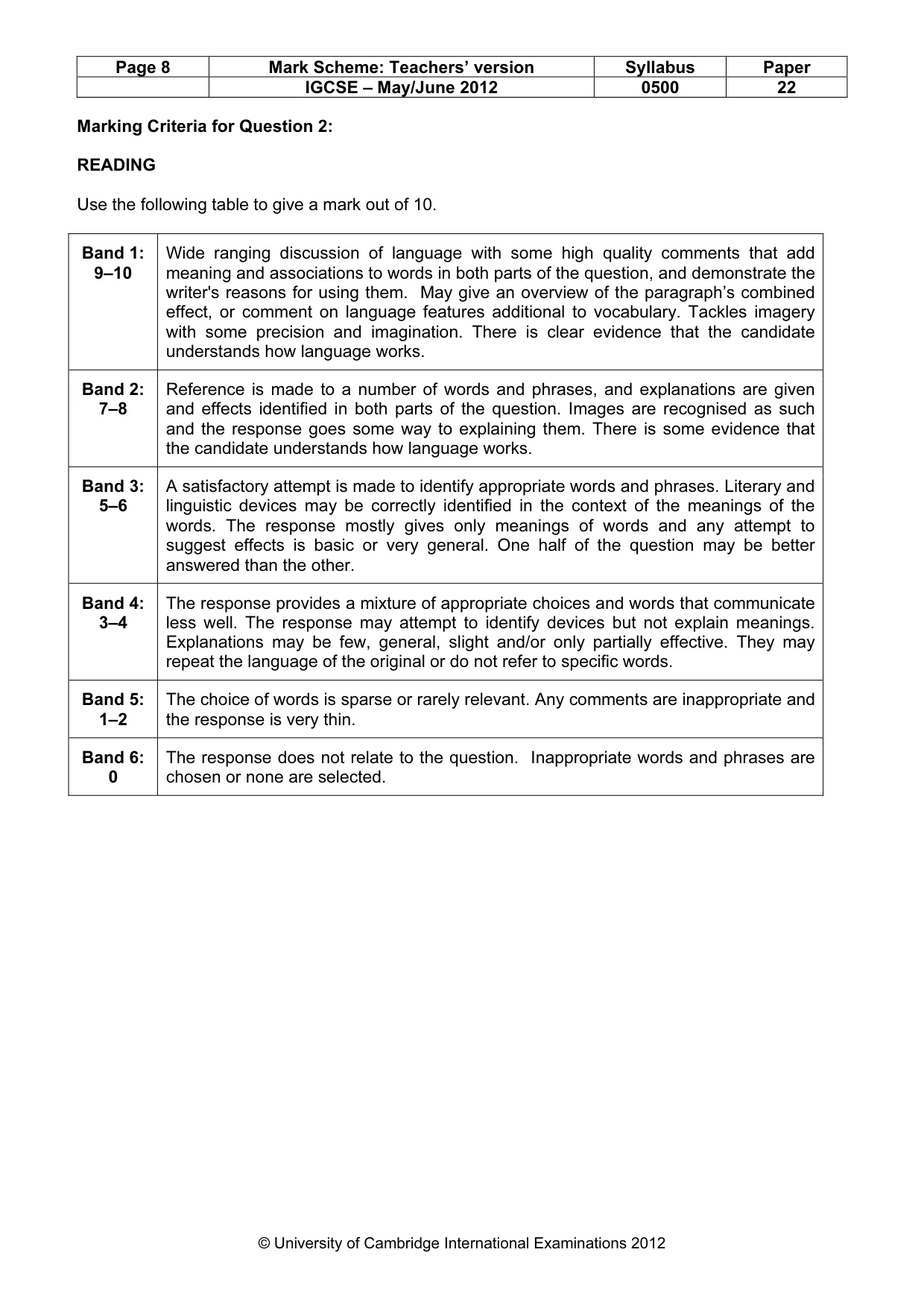
Page 8 Mark Scheme: Teachers’ version Syllabus Paper IGCSE – May/June 2012 0500 22 © University of Cambridge International Examinations 2012 Marking Criteria for Question 2: READING Use the following table to give a mark out of 10. Band 1: 9–10 Wide ranging discussion of language with some high quality comments that add meaning and associations to words in both parts of the question, and demonstrate the writer's reasons for using them. May give an overview of the paragraph’s combined effect, or comment on language features additional to vocabulary. Tackles imagery with some precision and imagination. There is clear evidence that the candidate understands how language works. Band 2: 7–8 Reference is made to a number of words and phrases, and explanations are given and effects identified in both parts of the question. Images are recognised as such and the response goes some way to explaining them. There is some evidence that the candidate understands how language works. Band 3: 5–6 A satisfactory attempt is made to identify appropriate words and phrases. Literary and linguistic devices may be correctly identified in the context of the meanings of the words. The response mostly gives only meanings of words and any attempt to suggest effects is basic or very general. One half of the question may be better answered than the other. Band 4: 3–4 The response provides a mixture of appropriate choices and words that communicate less well. The response may attempt to identify devices but not explain meanings. Explanations may be few, general, slight and/or only partially effective. They may repeat the language of the original or do not refer to specific words. Band 5: 1–2 The choice of words is sparse or rarely relevant. Any comments are inappropriate and the response is very thin. Band 6: 0 The response does not relate to the question. Inappropriate words and phrases are chosen or none are selected.
Mark scheme, page 9
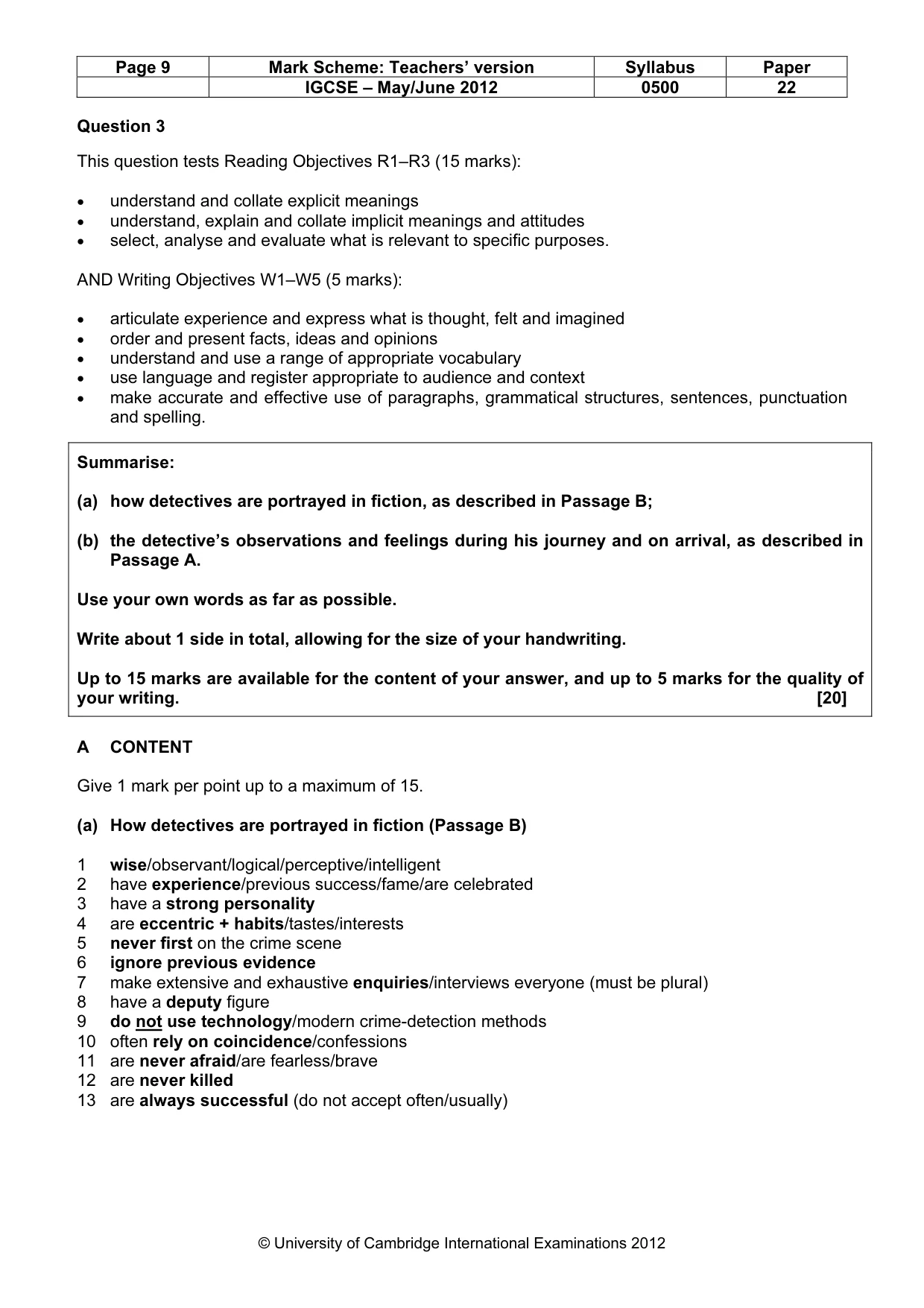
Page 9 Mark Scheme: Teachers’ version Syllabus Paper IGCSE – May/June 2012 0500 22 © University of Cambridge International Examinations 2012 Question 3 This question tests Reading Objectives R1–R3 (15 marks): • understand and collate explicit meanings • understand, explain and collate implicit meanings and attitudes • select, analyse and evaluate what is relevant to specific purposes. AND Writing Objectives W1–W5 (5 marks): • articulate experience and express what is thought, felt and imagined • order and present facts, ideas and opinions • understand and use a range of appropriate vocabulary • use language and register appropriate to audience and context • make accurate and effective use of paragraphs, grammatical structures, sentences, punctuation and spelling. Summarise: (a) how detectives are portrayed in fiction, as described in Passage B; (b) the detective’s observations and feelings during his journey and on arrival, as described in Passage A. Use your own words as far as possible. Write about 1 side in total, allowing for the size of your handwriting. Up to 15 marks are available for the content of your answer, and up to 5 marks for the quality of your writing. [20] A CONTENT Give 1 mark per point up to a maximum of 15. (a) How detectives are portrayed in fiction (Passage B) 1 wise/observant/logical/perceptive/intelligent 2 have experience/previous success/fame/are celebrated 3 have a strong personality 4 are eccentric + habits/tastes/interests 5 never first on the crime scene 6 ignore previous evidence 7 make extensive and exhaustive enquiries/interviews everyone (must be plural) 8 have a deputy figure 9 do not use technology/modern crime-detection methods 10 often rely on coincidence/confessions 11 are never afraid/are fearless/brave 12 are never killed 13 are always successful (do not accept often/usually)
Mark scheme, page 10
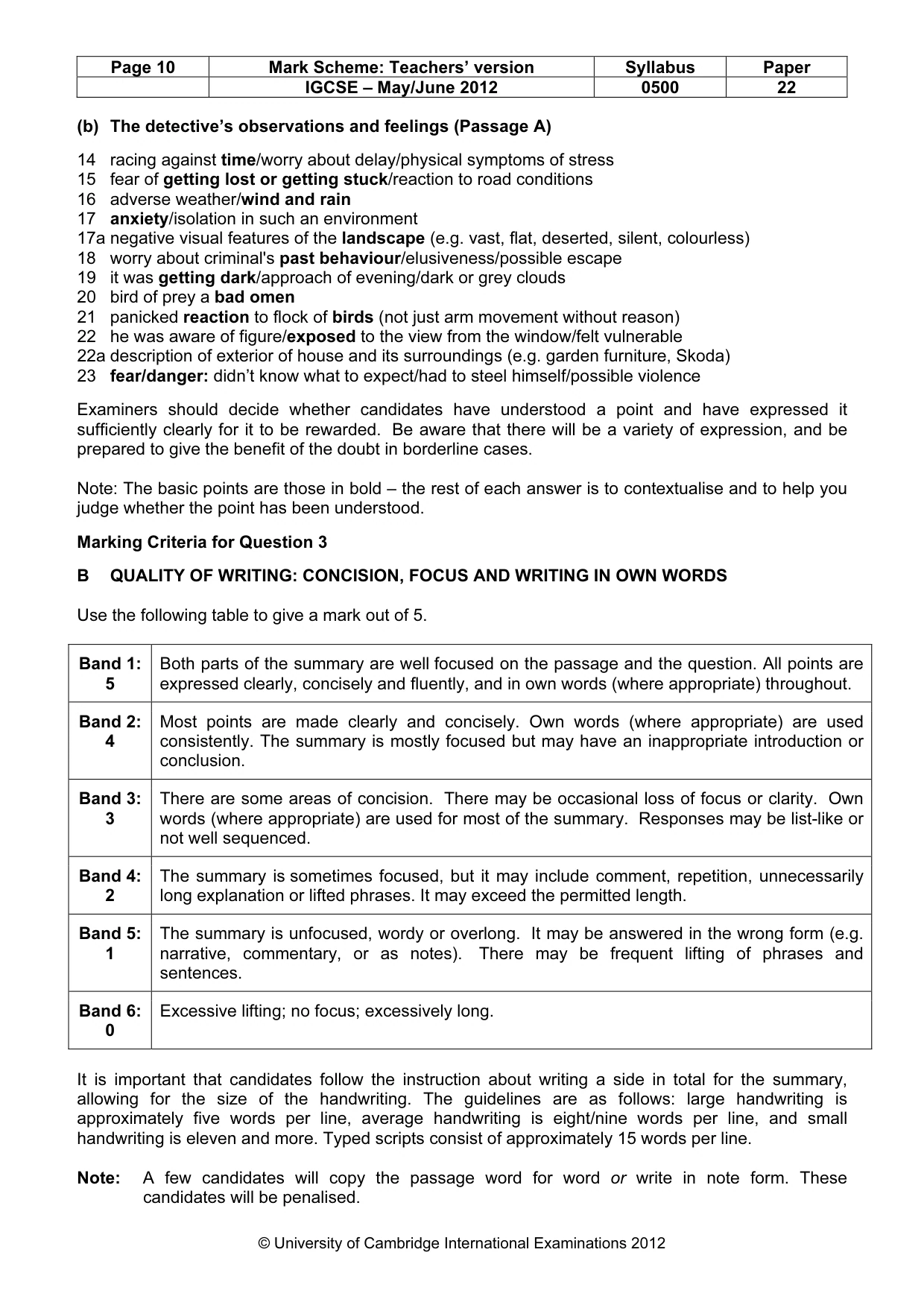
Page 10 Mark Scheme: Teachers’ version Syllabus Paper IGCSE – May/June 2012 0500 22 © University of Cambridge International Examinations 2012 (b) The detective’s observations and feelings (Passage A) 14 racing against time/worry about delay/physical symptoms of stress 15 fear of getting lost or getting stuck/reaction to road conditions 16 adverse weather/wind and rain 17 anxiety/isolation in such an environment 17a negative visual features of the landscape (e.g. vast, flat, deserted, silent, colourless) 18 worry about criminal's past behaviour/elusiveness/possible escape 19 it was getting dark/approach of evening/dark or grey clouds 20 bird of prey a bad omen 21 panicked reaction to flock of birds (not just arm movement without reason) 22 he was aware of figure/exposed to the view from the window/felt vulnerable 22a description of exterior of house and its surroundings (e.g. garden furniture, Skoda) 23 fear/danger: didn’t know what to expect/had to steel himself/possible violence Examiners should decide whether candidates have understood a point and have expressed it sufficiently clearly for it to be rewarded. Be aware that there will be a variety of expression, and be prepared to give the benefit of the doubt in borderline cases. Note: The basic points are those in bold – the rest of each answer is to contextualise and to help you judge whether the point has been understood. Marking Criteria for Question 3 B QUALITY OF WRITING: CONCISION, FOCUS AND WRITING IN OWN WORDS Use the following table to give a mark out of 5. Band 1: 5 Both parts of the summary are well focused on the passage and the question. All points are expressed clearly, concisely and fluently, and in own words (where appropriate) throughout. Band 2: 4 Most points are made clearly and concisely. Own words (where appropriate) are used consistently. The summary is mostly focused but may have an inappropriate introduction or conclusion. Band 3: 3 There are some areas of concision. There may be occasional loss of focus or clarity. Own words (where appropriate) are used for most of the summary. Responses may be list-like or not well sequenced. Band 4: 2 The summary is sometimes focused, but it may include comment, repetition, unnecessarily long explanation or lifted phrases. It may exceed the permitted length. Band 5: 1 The summary is unfocused, wordy or overlong. It may be answered in the wrong form (e.g. narrative, commentary, or as notes). There may be frequent lifting of phrases and sentences. Band 6: 0 Excessive lifting; no focus; excessively long. It is important that candidates follow the instruction about writing a side in total for the summary, allowing for the size of the handwriting. The guidelines are as follows: large handwriting is approximately five words per line, average handwriting is eight/nine words per line, and small handwriting is eleven and more. Typed scripts consist of approximately 15 words per line. Note: A few candidates will copy the passage word for word or write in note form. These candidates will be penalised.
What you needed in this session
Cambridge’s own grade thresholds for 2012 May/June, Paper 2 · Variant 2. A higher threshold means an easier paper — the bar moves with how the cohort did.