Cambridge IGCSE English - First Language 0500 — 2010 Oct/Nov Paper 1 · Variant 3
0500/13/O/N/10 · 50 marks · ≈56 min
The question paper and its mark scheme, free to read here and free to download. This is Cambridge’s own paper, exactly as it was sat.
Question paper4 pages
Mark scheme6 pages
Answers below. Sit the paper first if you are practising.
Paper as text
Question paper, page 1
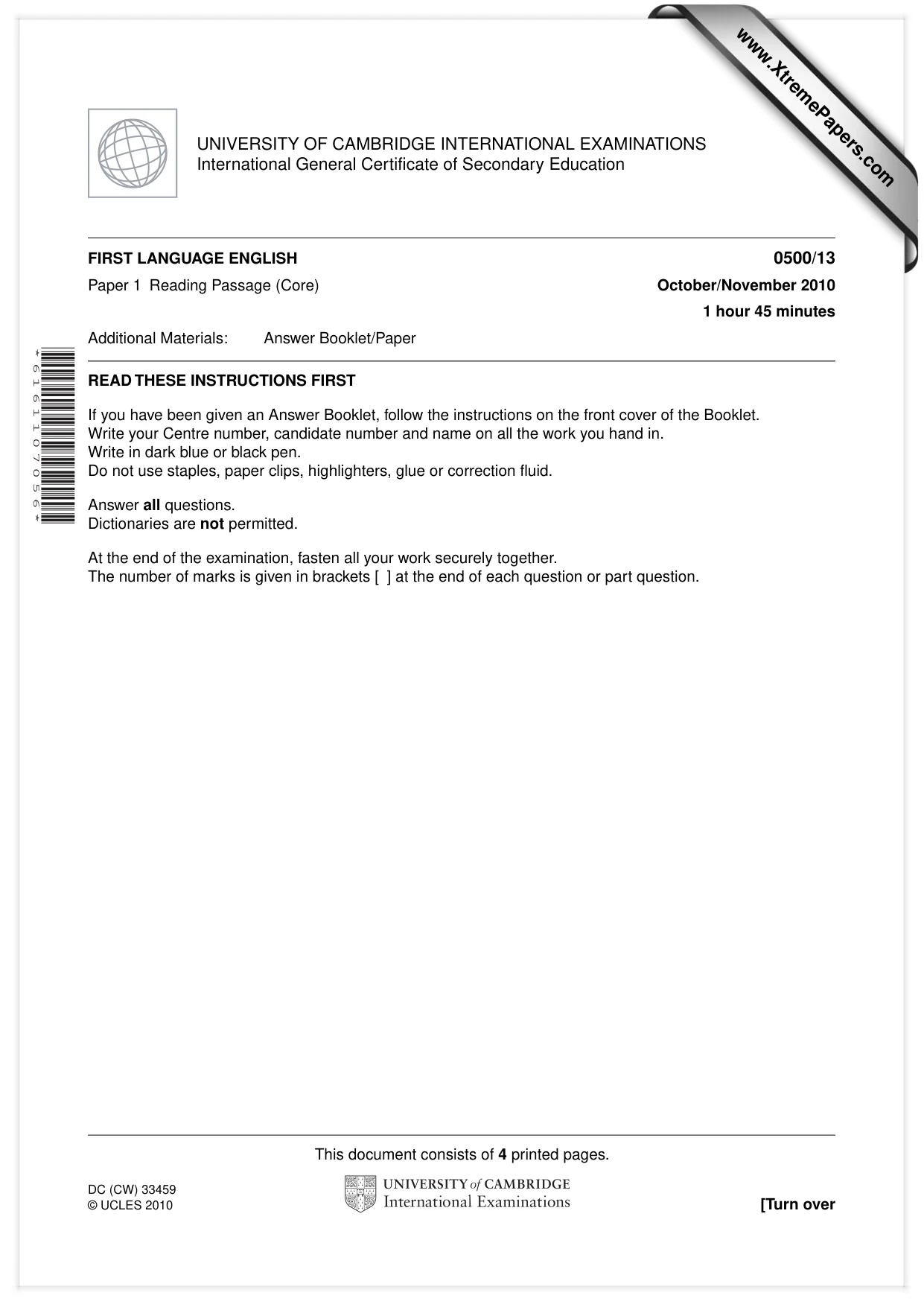
This document consists of 4 printed pages. DC (CW) 33459 © UCLES 2010 [Turn over UNIVERSITY OF CAMBRIDGE INTERNATIONAL EXAMINATIONS International General Certificate of Secondary Education READ THESE INSTRUCTIONS FIRST If you have been given an Answer Booklet, follow the instructions on the front cover of the Booklet. Write your Centre number, candidate number and name on all the work you hand in. Write in dark blue or black pen. Do not use staples, paper clips, highlighters, glue or correction fluid. Answer all questions. Dictionaries are not permitted. At the end of the examination, fasten all your work securely together. The number of marks is given in brackets [ ] at the end of each question or part question. * 6 1 6 1 1 0 7 0 5 6 * FIRST LANGUAGE ENGLISH 0500/13 Paper 1 Reading Passage (Core) October/November 2010 1 hour 45 minutes Additional Materials: Answer Booklet/Paper www.XtremePapers.com
Question paper, page 2
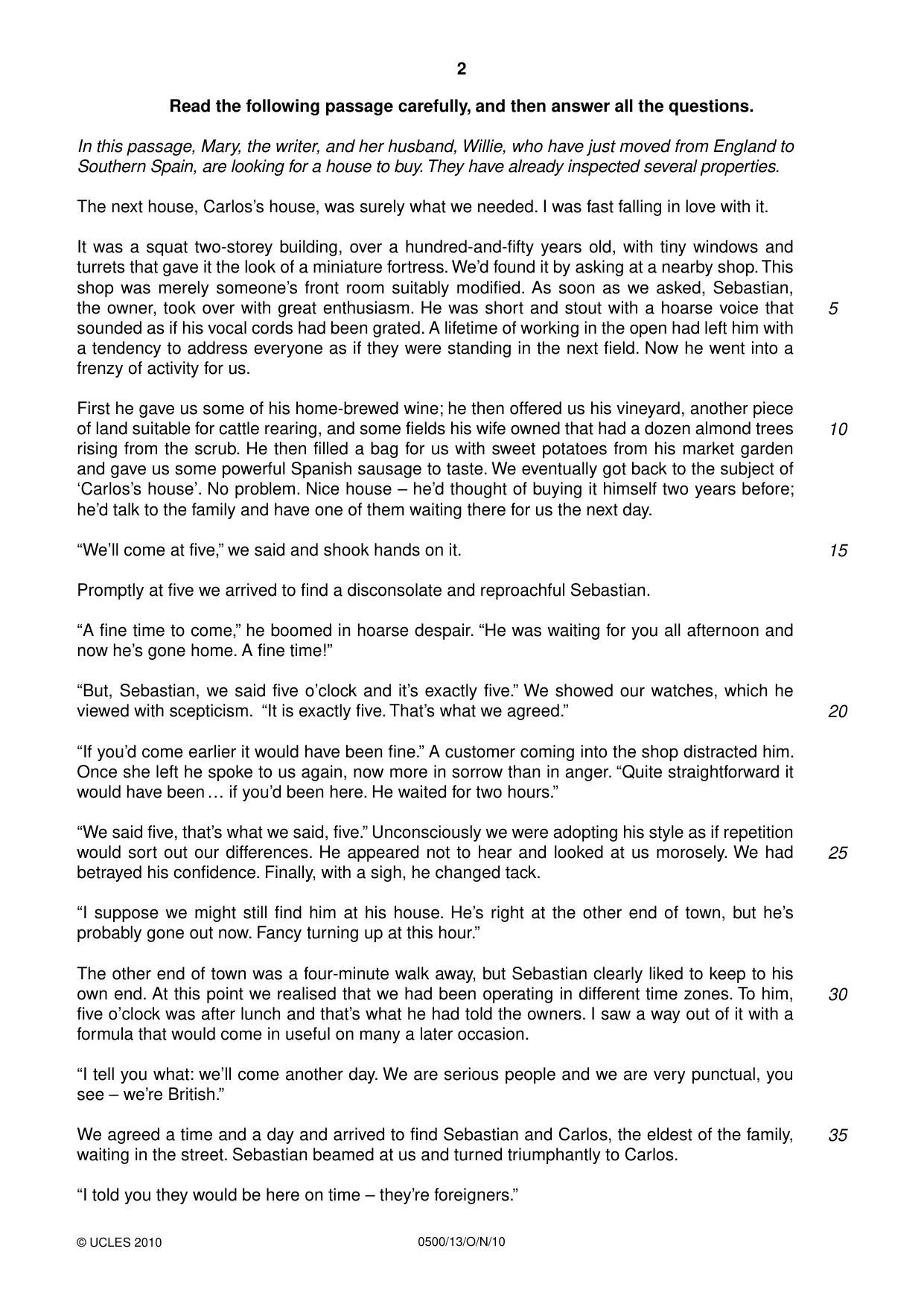
2 0500/13/O/N/10 © UCLES 2010 Read the following passage carefully, and then answer all the questions. In this passage, Mary, the writer, and her husband, Willie, who have just moved from England to Southern Spain, are looking for a house to buy. They have already inspected several properties. The next house, Carlos’s house, was surely what we needed. I was fast falling in love with it. It was a squat two-storey building, over a hundred-and-fifty years old, with tiny windows and turrets that gave it the look of a miniature fortress. We’d found it by asking at a nearby shop. This shop was merely someone’s front room suitably modified. As soon as we asked, Sebastian, the owner, took over with great enthusiasm. He was short and stout with a hoarse voice that sounded as if his vocal cords had been grated. A lifetime of working in the open had left him with a tendency to address everyone as if they were standing in the next field. Now he went into a frenzy of activity for us. First he gave us some of his home-brewed wine; he then offered us his vineyard, another piece of land suitable for cattle rearing, and some fields his wife owned that had a dozen almond trees rising from the scrub. He then filled a bag for us with sweet potatoes from his market garden and gave us some powerful Spanish sausage to taste. We eventually got back to the subject of ‘Carlos’s house’. No problem. Nice house – he’d thought of buying it himself two years before; he’d talk to the family and have one of them waiting there for us the next day. “We’ll come at five,” we said and shook hands on it. Promptly at five we arrived to find a disconsolate and reproachful Sebastian. “A fine time to come,” he boomed in hoarse despair. “He was waiting for you all afternoon and now he’s gone home. A fine time!” “But, Sebastian, we said five o’clock and it’s exactly five.” We showed our watches, which he viewed with scepticism. “It is exactly five. That’s what we agreed.” “If you’d come earlier it would have been fine.” A customer coming into the shop distracted him. Once she left he spoke to us again, now more in sorrow than in anger. “Quite straightforward it would have been … if you’d been here. He waited for two hours.” “We said five, that’s what we said, five.” Unconsciously we were adopting his style as if repetition would sort out our differences. He appeared not to hear and looked at us morosely. We had betrayed his confidence. Finally, with a sigh, he changed tack. “I suppose we might still find him at his house. He’s right at the other end of town, but he’s probably gone out now. Fancy turning up at this hour.” The other end of town was a four-minute walk away, but Sebastian clearly liked to keep to his own end. At this point we realised that we had been operating in different time zones. To him, five o’clock was after lunch and that’s what he had told the owners. I saw a way out of it with a formula that would come in useful on many a later occasion. “I tell you what: we’ll come another day. We are serious people and we are very punctual, you see – we’re British.” We agreed a time and a day and arrived to find Sebastian and Carlos, the eldest of the family, waiting in the street. Sebastian beamed at us and turned triumphantly to Carlos. “I told you they would be here on time – they’re foreigners.” 5 10 15 20 25 30 35
Question paper, page 3
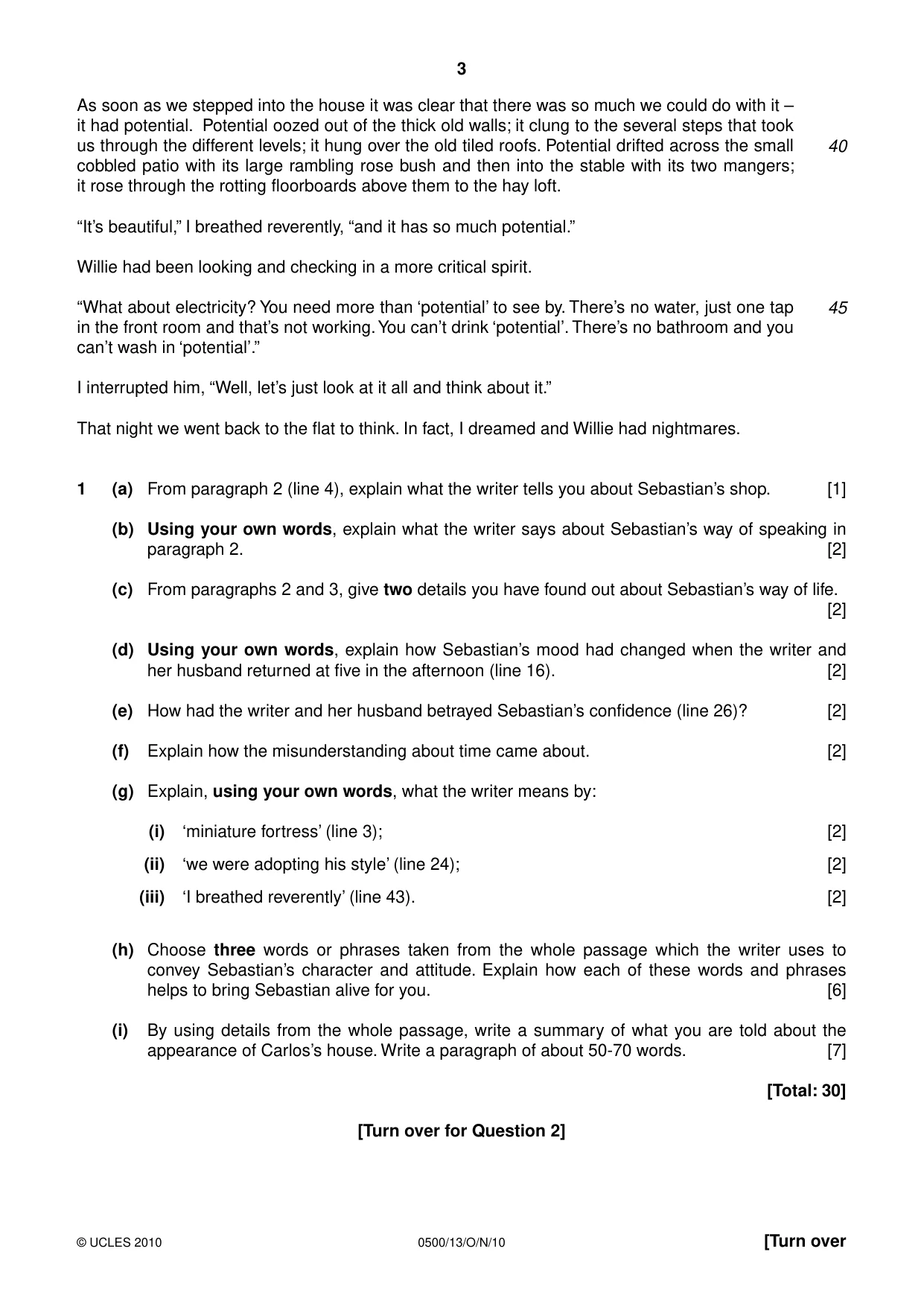
3 0500/13/O/N/10 © UCLES 2010 [Turn over As soon as we stepped into the house it was clear that there was so much we could do with it – it had potential. Potential oozed out of the thick old walls; it clung to the several steps that took us through the different levels; it hung over the old tiled roofs. Potential drifted across the small cobbled patio with its large rambling rose bush and then into the stable with its two mangers; it rose through the rotting floorboards above them to the hay loft. “It’s beautiful,” I breathed reverently, “and it has so much potential.” Willie had been looking and checking in a more critical spirit. “What about electricity? You need more than ‘potential’ to see by. There’s no water, just one tap in the front room and that’s not working. You can’t drink ‘potential’. There’s no bathroom and you can’t wash in ‘potential’.” I interrupted him, “Well, let’s just look at it all and think about it.” That night we went back to the flat to think. In fact, I dreamed and Willie had nightmares. 1 (a) From paragraph 2 (line 4), explain what the writer tells you about Sebastian’s shop. [1] (b) Using your own words, explain what the writer says about Sebastian’s way of speaking in paragraph 2. [2] (c) From paragraphs 2 and 3, give two details you have found out about Sebastian’s way of life. [2] (d) Using your own words, explain how Sebastian’s mood had changed when the writer and her husband returned at five in the afternoon (line 16). [2] (e) How had the writer and her husband betrayed Sebastian’s confidence (line 26)? [2] (f) Explain how the misunderstanding about time came about. [2] (g) Explain, using your own words, what the writer means by: (i) ‘miniature fortress’ (line 3); [2] (ii) ‘we were adopting his style’ (line 24); [2] (iii) ‘I breathed reverently’ (line 43). [2] (h) Choose three words or phrases taken from the whole passage which the writer uses to convey Sebastian’s character and attitude. Explain how each of these words and phrases helps to bring Sebastian alive for you. [6] (i) By using details from the whole passage, write a summary of what you are told about the appearance of Carlos’s house. Write a paragraph of about 50-70 words. [7] [Total: 30] [Turn over for Question 2] 40 45
Question paper, page 4
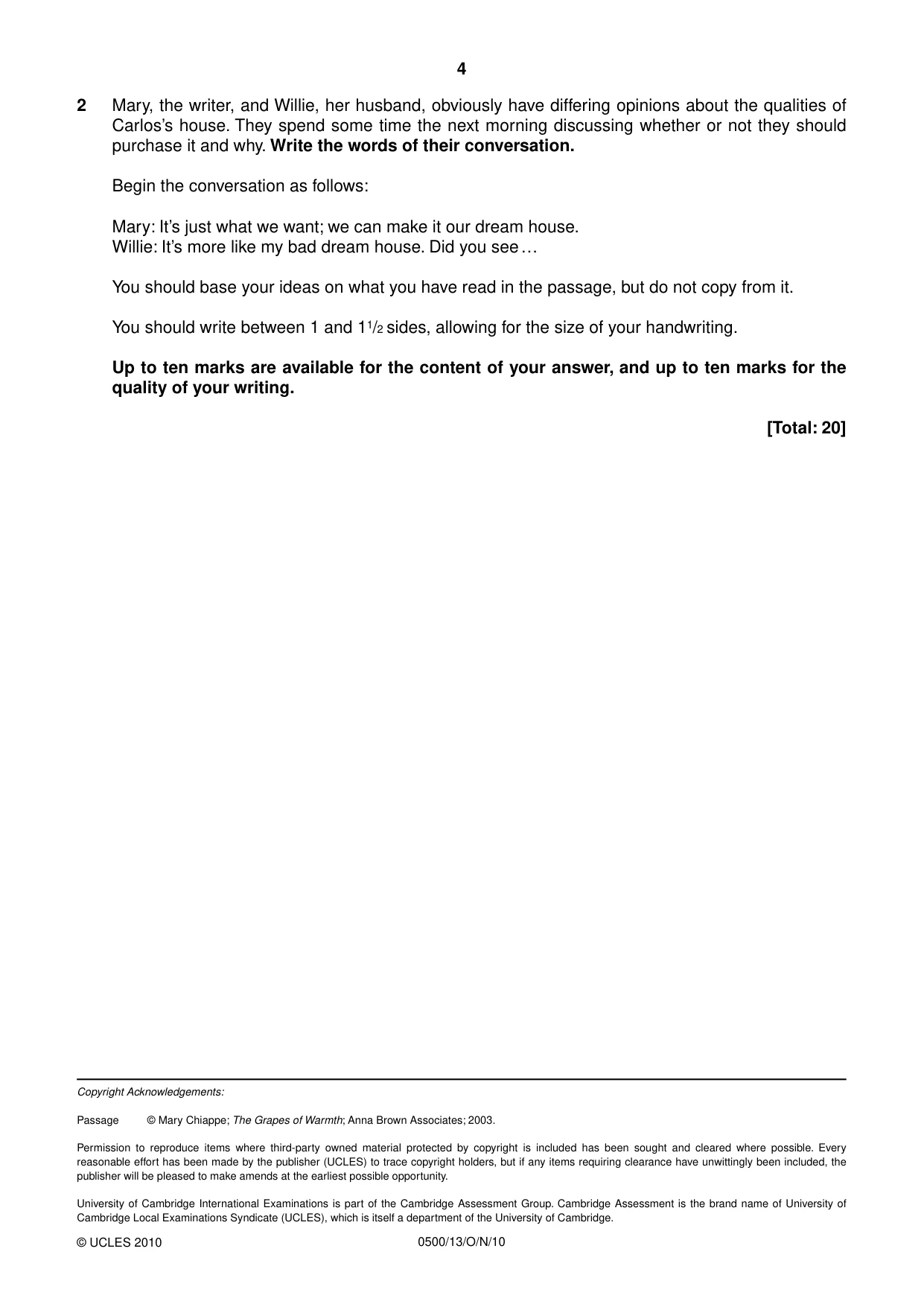
4 0500/13/O/N/10 2 Mary, the writer, and Willie, her husband, obviously have differing opinions about the qualities of Carlos’s house. They spend some time the next morning discussing whether or not they should purchase it and why. Write the words of their conversation. Begin the conversation as follows: Mary: It’s just what we want; we can make it our dream house. Willie: It’s more like my bad dream house. Did you see … You should base your ideas on what you have read in the passage, but do not copy from it. You should write between 1 and 11/2 sides, allowing for the size of your handwriting. Up to ten marks are available for the content of your answer, and up to ten marks for the quality of your writing. [Total: 20] © UCLES 2010 Copyright Acknowledgements: Passage © Mary Chiappe; The Grapes of Warmth; Anna Brown Associates; 2003. Permission to reproduce items where third-party owned material protected by copyright is included has been sought and cleared where possible. Every reasonable effort has been made by the publisher (UCLES) to trace copyright holders, but if any items requiring clearance have unwittingly been included, the publisher will be pleased to make amends at the earliest possible opportunity. University of Cambridge International Examinations is part of the Cambridge Assessment Group. Cambridge Assessment is the brand name of University of Cambridge Local Examinations Syndicate (UCLES), which is itself a department of the University of Cambridge.
Mark scheme, page 1
UNIVERSITY OF CAMBRIDGE INTERNATIONAL EXAMINATIONS International General Certificate of Secondary Education MARK SCHEME for the October/November 2010 question paper for the guidance of teachers 0500 FIRST LANGUAGE ENGLISH 0500/13 Paper 1 (Reading Passage – Core), maximum raw mark 50 This mark scheme is published as an aid to teachers and candidates, to indicate the requirements of the examination. It shows the basis on which Examiners were instructed to award marks. It does not indicate the details of the discussions that took place at an Examiners’ meeting before marking began, which would have considered the acceptability of alternative answers. Mark schemes must be read in conjunction with the question papers and the report on the examination. • CIE will not enter into discussions or correspondence in connection with these mark schemes. CIE is publishing the mark schemes for the October/November 2010 question papers for most IGCSE, GCE Advanced Level and Advanced Subsidiary Level syllabuses and some Ordinary Level syllabuses. www.XtremePapers.com
Mark scheme, page 2
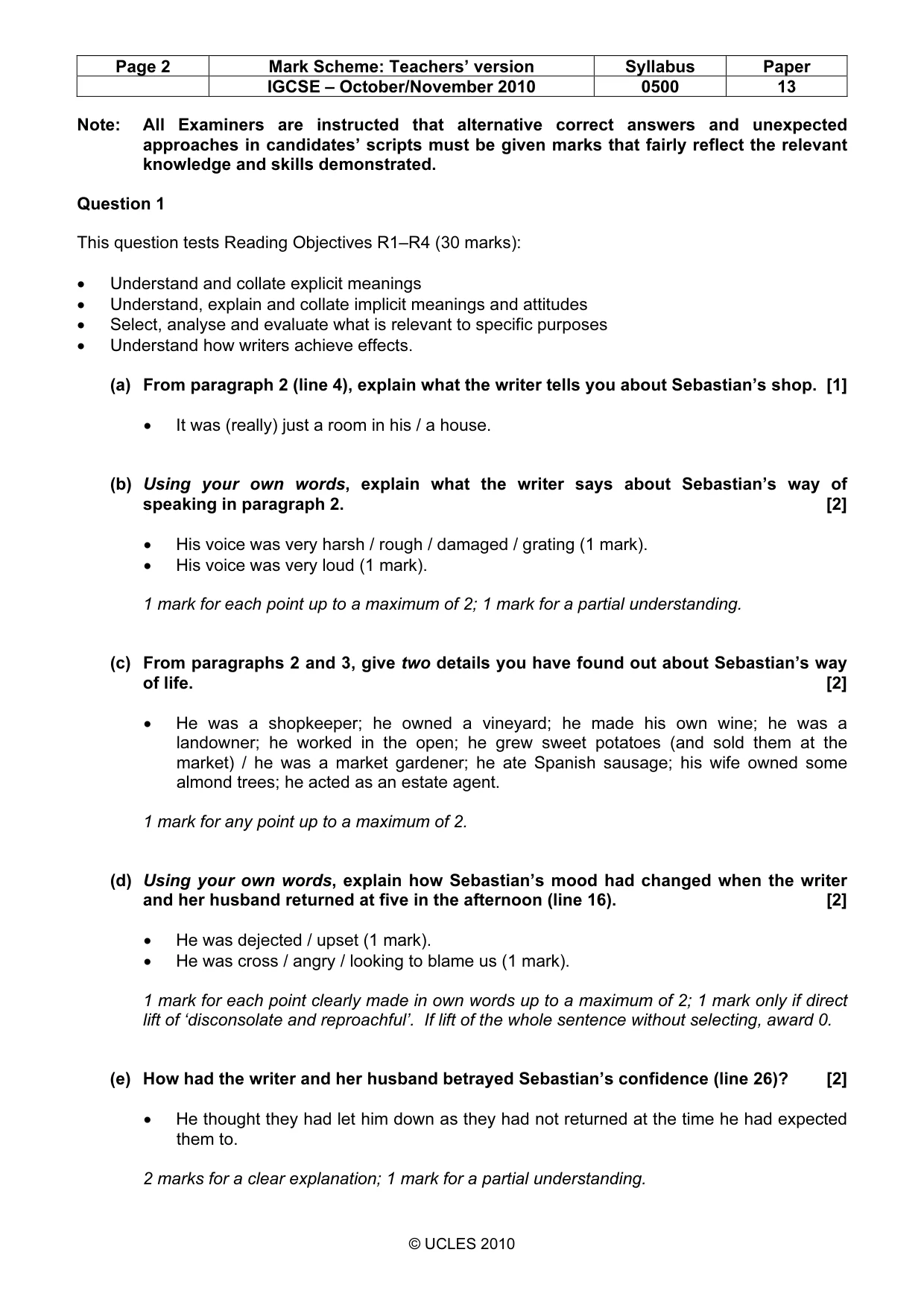
Page 2 Mark Scheme: Teachers’ version Syllabus Paper IGCSE – October/November 2010 0500 13 © UCLES 2010 Note: All Examiners are instructed that alternative correct answers and unexpected approaches in candidates’ scripts must be given marks that fairly reflect the relevant knowledge and skills demonstrated. Question 1 This question tests Reading Objectives R1–R4 (30 marks): • Understand and collate explicit meanings • Understand, explain and collate implicit meanings and attitudes • Select, analyse and evaluate what is relevant to specific purposes • Understand how writers achieve effects. (a) From paragraph 2 (line 4), explain what the writer tells you about Sebastian’s shop. [1] • It was (really) just a room in his / a house. (b) Using your own words, explain what the writer says about Sebastian’s way of speaking in paragraph 2. [2] • His voice was very harsh / rough / damaged / grating (1 mark). • His voice was very loud (1 mark). 1 mark for each point up to a maximum of 2; 1 mark for a partial understanding. (c) From paragraphs 2 and 3, give two details you have found out about Sebastian’s way of life. [2] • He was a shopkeeper; he owned a vineyard; he made his own wine; he was a landowner; he worked in the open; he grew sweet potatoes (and sold them at the market) / he was a market gardener; he ate Spanish sausage; his wife owned some almond trees; he acted as an estate agent. 1 mark for any point up to a maximum of 2. (d) Using your own words, explain how Sebastian’s mood had changed when the writer and her husband returned at five in the afternoon (line 16). [2] • He was dejected / upset (1 mark). • He was cross / angry / looking to blame us (1 mark). 1 mark for each point clearly made in own words up to a maximum of 2; 1 mark only if direct lift of ‘disconsolate and reproachful’. If lift of the whole sentence without selecting, award 0. (e) How had the writer and her husband betrayed Sebastian’s confidence (line 26)? [2] • He thought they had let him down as they had not returned at the time he had expected them to. 2 marks for a clear explanation; 1 mark for a partial understanding.
Mark scheme, page 3
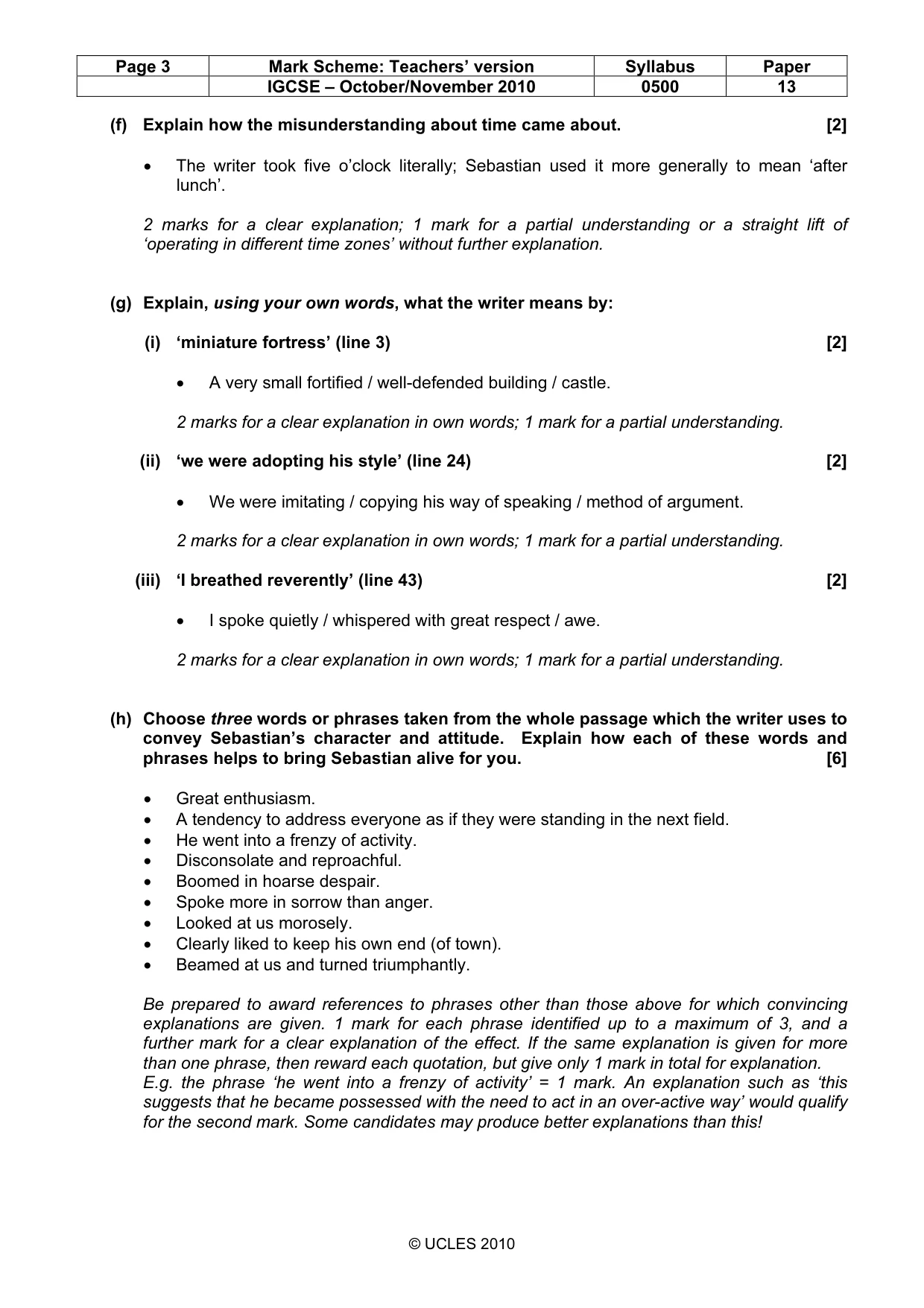
Page 3 Mark Scheme: Teachers’ version Syllabus Paper IGCSE – October/November 2010 0500 13 © UCLES 2010 (f) Explain how the misunderstanding about time came about. [2] • The writer took five o’clock literally; Sebastian used it more generally to mean ‘after lunch’. 2 marks for a clear explanation; 1 mark for a partial understanding or a straight lift of ‘operating in different time zones’ without further explanation. (g) Explain, using your own words, what the writer means by: (i) ‘miniature fortress’ (line 3) [2] • A very small fortified / well-defended building / castle. 2 marks for a clear explanation in own words; 1 mark for a partial understanding. (ii) ‘we were adopting his style’ (line 24) [2] • We were imitating / copying his way of speaking / method of argument. 2 marks for a clear explanation in own words; 1 mark for a partial understanding. (iii) ‘I breathed reverently’ (line 43) [2] • I spoke quietly / whispered with great respect / awe. 2 marks for a clear explanation in own words; 1 mark for a partial understanding. (h) Choose three words or phrases taken from the whole passage which the writer uses to convey Sebastian’s character and attitude. Explain how each of these words and phrases helps to bring Sebastian alive for you. [6] • Great enthusiasm. • A tendency to address everyone as if they were standing in the next field. • He went into a frenzy of activity. • Disconsolate and reproachful. • Boomed in hoarse despair. • Spoke more in sorrow than anger. • Looked at us morosely. • Clearly liked to keep his own end (of town). • Beamed at us and turned triumphantly. Be prepared to award references to phrases other than those above for which convincing explanations are given. 1 mark for each phrase identified up to a maximum of 3, and a further mark for a clear explanation of the effect. If the same explanation is given for more than one phrase, then reward each quotation, but give only 1 mark in total for explanation. E.g. the phrase ‘he went into a frenzy of activity’ = 1 mark. An explanation such as ‘this suggests that he became possessed with the need to act in an over-active way’ would qualify for the second mark. Some candidates may produce better explanations than this!
Mark scheme, page 4
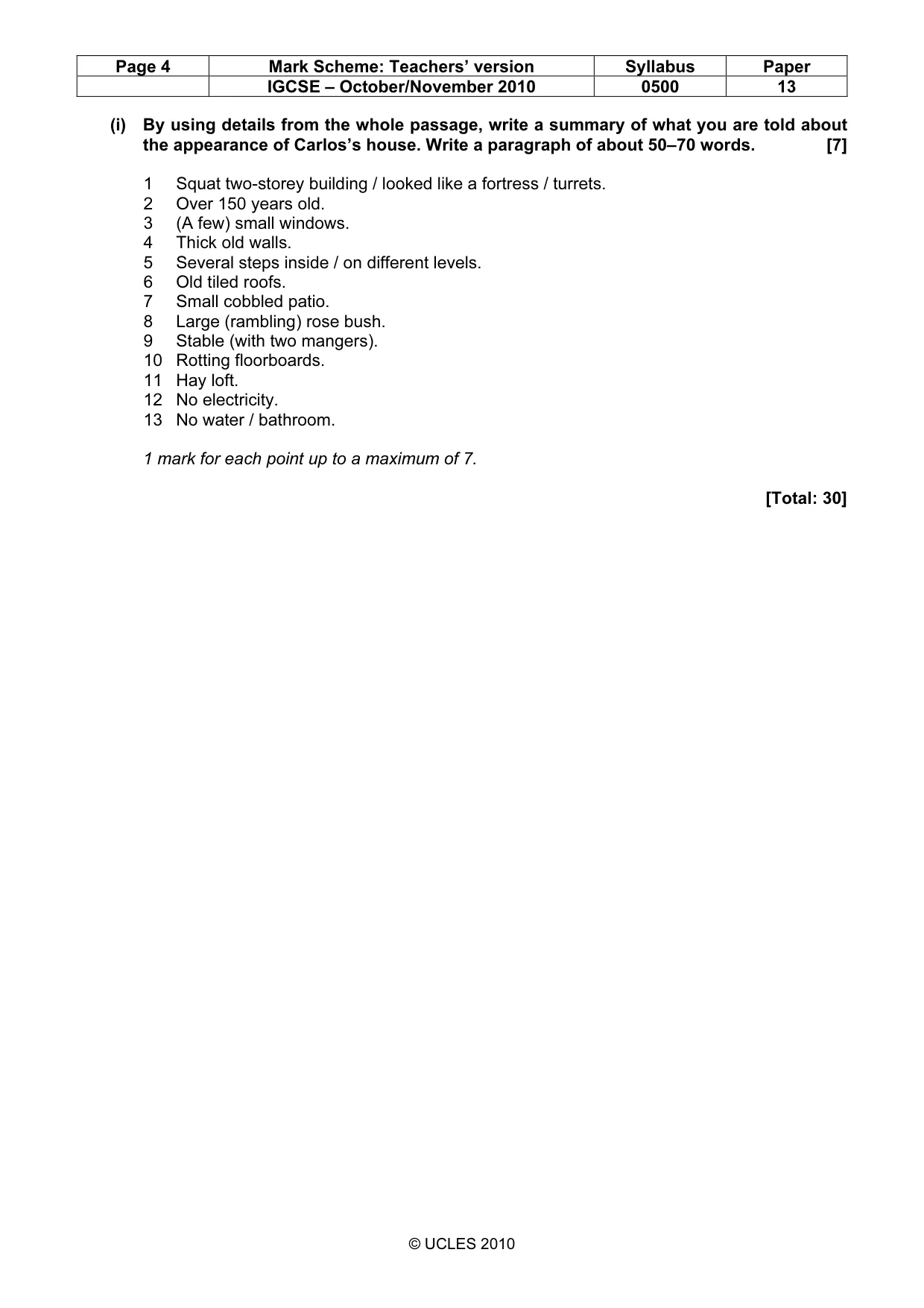
Page 4 Mark Scheme: Teachers’ version Syllabus Paper IGCSE – October/November 2010 0500 13 © UCLES 2010 (i) By using details from the whole passage, write a summary of what you are told about the appearance of Carlos’s house. Write a paragraph of about 50–70 words. [7] 1 Squat two-storey building / looked like a fortress / turrets. 2 Over 150 years old. 3 (A few) small windows. 4 Thick old walls. 5 Several steps inside / on different levels. 6 Old tiled roofs. 7 Small cobbled patio. 8 Large (rambling) rose bush. 9 Stable (with two mangers). 10 Rotting floorboards. 11 Hay loft. 12 No electricity. 13 No water / bathroom. 1 mark for each point up to a maximum of 7. [Total: 30]
Mark scheme, page 5
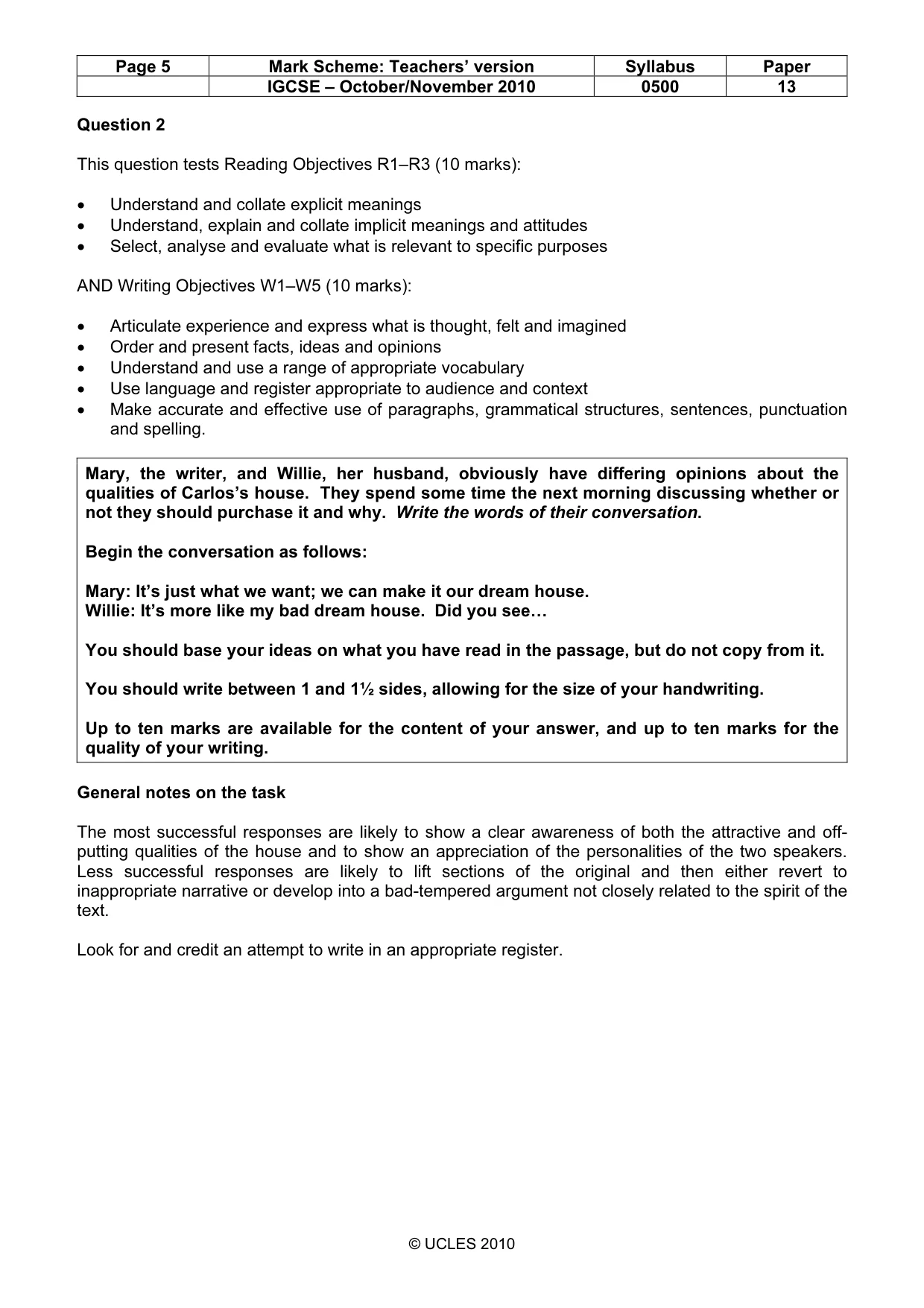
Page 5 Mark Scheme: Teachers’ version Syllabus Paper IGCSE – October/November 2010 0500 13 © UCLES 2010 Question 2 This question tests Reading Objectives R1–R3 (10 marks): • Understand and collate explicit meanings • Understand, explain and collate implicit meanings and attitudes • Select, analyse and evaluate what is relevant to specific purposes AND Writing Objectives W1–W5 (10 marks): • Articulate experience and express what is thought, felt and imagined • Order and present facts, ideas and opinions • Understand and use a range of appropriate vocabulary • Use language and register appropriate to audience and context • Make accurate and effective use of paragraphs, grammatical structures, sentences, punctuation and spelling. Mary, the writer, and Willie, her husband, obviously have differing opinions about the qualities of Carlos’s house. They spend some time the next morning discussing whether or not they should purchase it and why. Write the words of their conversation. Begin the conversation as follows: Mary: It’s just what we want; we can make it our dream house. Willie: It’s more like my bad dream house. Did you see… You should base your ideas on what you have read in the passage, but do not copy from it. You should write between 1 and 1½ sides, allowing for the size of your handwriting. Up to ten marks are available for the content of your answer, and up to ten marks for the quality of your writing. General notes on the task The most successful responses are likely to show a clear awareness of both the attractive and off- putting qualities of the house and to show an appreciation of the personalities of the two speakers. Less successful responses are likely to lift sections of the original and then either revert to inappropriate narrative or develop into a bad-tempered argument not closely related to the spirit of the text. Look for and credit an attempt to write in an appropriate register.
Mark scheme, page 6
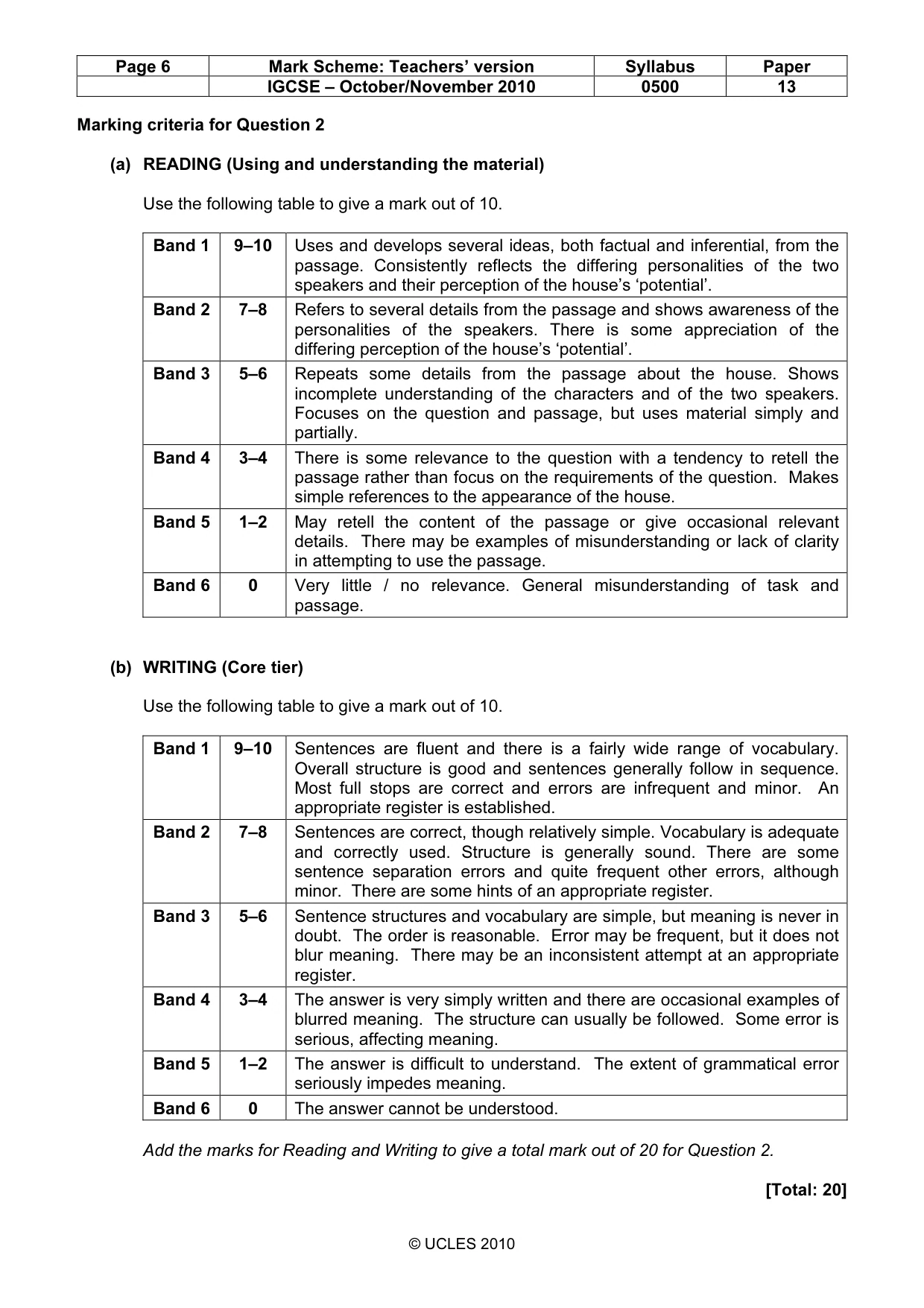
Page 6 Mark Scheme: Teachers’ version Syllabus Paper IGCSE – October/November 2010 0500 13 © UCLES 2010 Marking criteria for Question 2 (a) READING (Using and understanding the material) Use the following table to give a mark out of 10. Band 1 9–10 Uses and develops several ideas, both factual and inferential, from the passage. Consistently reflects the differing personalities of the two speakers and their perception of the house’s ‘potential’. Band 2 7–8 Refers to several details from the passage and shows awareness of the personalities of the speakers. There is some appreciation of the differing perception of the house’s ‘potential’. Band 3 5–6 Repeats some details from the passage about the house. Shows incomplete understanding of the characters and of the two speakers. Focuses on the question and passage, but uses material simply and partially. Band 4 3–4 There is some relevance to the question with a tendency to retell the passage rather than focus on the requirements of the question. Makes simple references to the appearance of the house. Band 5 1–2 May retell the content of the passage or give occasional relevant details. There may be examples of misunderstanding or lack of clarity in attempting to use the passage. Band 6 0 Very little / no relevance. General misunderstanding of task and passage. (b) WRITING (Core tier) Use the following table to give a mark out of 10. Band 1 9–10 Sentences are fluent and there is a fairly wide range of vocabulary. Overall structure is good and sentences generally follow in sequence. Most full stops are correct and errors are infrequent and minor. An appropriate register is established. Band 2 7–8 Sentences are correct, though relatively simple. Vocabulary is adequate and correctly used. Structure is generally sound. There are some sentence separation errors and quite frequent other errors, although minor. There are some hints of an appropriate register. Band 3 5–6 Sentence structures and vocabulary are simple, but meaning is never in doubt. The order is reasonable. Error may be frequent, but it does not blur meaning. There may be an inconsistent attempt at an appropriate register. Band 4 3–4 The answer is very simply written and there are occasional examples of blurred meaning. The structure can usually be followed. Some error is serious, affecting meaning. Band 5 1–2 The answer is difficult to understand. The extent of grammatical error seriously impedes meaning. Band 6 0 The answer cannot be understood. Add the marks for Reading and Writing to give a total mark out of 20 for Question 2. [Total: 20]
What you needed in this session
Cambridge’s own grade thresholds for 2010 Oct/Nov, Paper 1 · Variant 3. A higher threshold means an easier paper — the bar moves with how the cohort did.