Cambridge IGCSE English - First Language 0500 — 2010 Oct/Nov Paper 1 · Variant 1
0500/11/O/N/10 · 50 marks · ≈56 min
The question paper and its mark scheme, free to read here and free to download. This is Cambridge’s own paper, exactly as it was sat.
Question paper4 pages
Mark scheme6 pages
Answers below. Sit the paper first if you are practising.
Paper as text
Question paper, page 1
This document consists of 4 printed pages. DC (LEO) 23815/5 © UCLES 2010 [Turn over UNIVERSITY OF CAMBRIDGE INTERNATIONAL EXAMINATIONS International General Certificate of Secondary Education * 3 1 2 8 8 0 0 1 7 3 * FIRST LANGUAGE ENGLISH 0500/11 Paper 1 Reading Passage (Core) October/November 2010 1 hour 45 minutes Additional Materials: Answer Booklet/Paper READ THESE INSTRUCTIONS FIRST If you have been given an Answer Booklet, follow the instructions on the front cover of the Booklet. Write your Centre number, candidate number and name on all the work you hand in. Write in dark blue or black pen. Do not use staples, paper clips, highlighters, glue or correction fluid. Answer all questions. Dictionaries are not permitted. At the end of the examination, fasten all your work securely together. The number of marks is given in brackets [ ] at the end of each question or part question. www.XtremePapers.com
Question paper, page 2
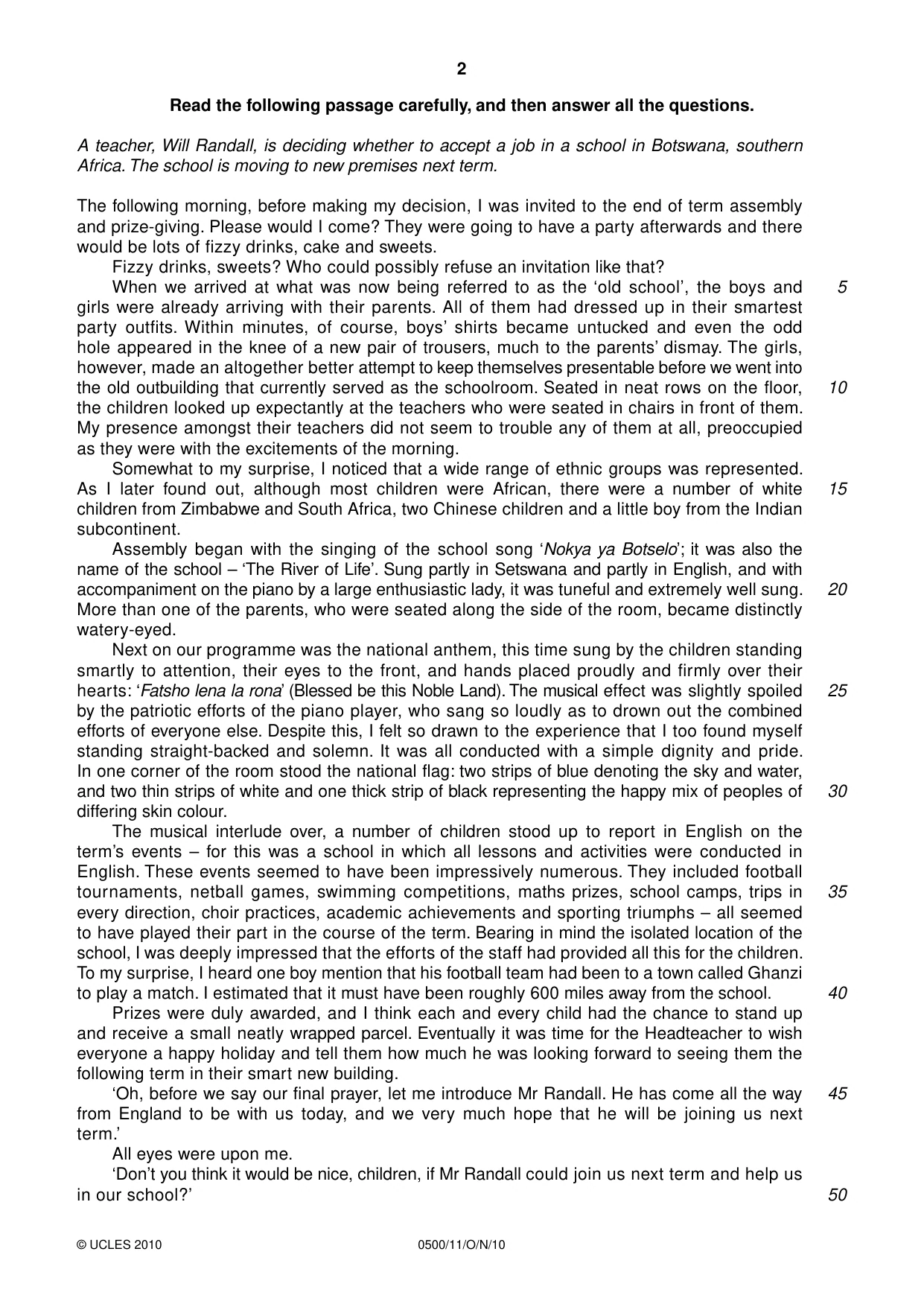
2 0500/11/O/N/10 © UCLES 2010 Read the following passage carefully, and then answer all the questions. A teacher, Will Randall, is deciding whether to accept a job in a school in Botswana, southern Africa. The school is moving to new premises next term. The following morning, before making my decision, I was invited to the end of term assembly and prize-giving. Please would I come? They were going to have a party afterwards and there would be lots of fizzy drinks, cake and sweets. Fizzy drinks, sweets? Who could possibly refuse an invitation like that? When we arrived at what was now being referred to as the ‘old school’, the boys and girls were already arriving with their parents. All of them had dressed up in their smartest party outfits. Within minutes, of course, boys’ shirts became untucked and even the odd hole appeared in the knee of a new pair of trousers, much to the parents’ dismay. The girls, however, made an altogether better attempt to keep themselves presentable before we went into the old outbuilding that currently served as the schoolroom. Seated in neat rows on the floor, the children looked up expec tantly at the teachers who were seated in chairs in front of them. My presence amongst their teachers did not seem to trouble any of them at all, preoccupied as they were with the excitements of the morning. Somewhat to my surprise, I noticed that a wide range of ethnic groups was represented. As I later found out, although most children were African, there were a number of white children from Zimbabwe and South Africa, two Chinese children and a little boy from the Indian subcontinent. Assembly began with the singing of the school song ‘Nokya ya Botselo’; it was also the name of the school – ‘The River of Life’. Sung partly in Setswana and partly in English, and with accompaniment on the piano by a large enthu siastic lady, it was tuneful and extremely well sung. More than one of the parents, who were seated along the side of the room, became distinctly watery-eyed. Next on our pro gramme was the national anthem, this time sung by the children standing smartly to attention, their eyes to the front, and hands placed proudly and firmly over their hearts: ‘Fatsho lena la rona’ (Blessed be this Noble Land). The musical effect was slightly spoiled by the patriotic efforts of the piano player, who sang so loudly as to drown out the combined efforts of everyone else. Despite this, I felt so drawn to the experience that I too found myself standing straight-backed and solemn. It was all conducted with a simple dignity and pride. In one corner of the room stood the national flag: two strips of blue denoting the sky and water, and two thin strips of white and one thick strip of black representing the happy mix of peoples of differing skin colour. The musical interlude over, a number of children stood up to report in English on the term’s events – for this was a school in which all lessons and activities were conducted in English. These events seemed to have been impressively numerous. They included football tournaments, netball games, swimming competitions, maths prizes, school camps, trips in every direction, choir practices, academic achievements and sporting triumphs – all seemed to have played their part in the course of the term. Bearing in mind the isolated location of the school, I was deeply impressed that the efforts of the staff had provided all this for the children. To my surprise, I heard one boy mention that his football team had been to a town called Ghanzi to play a match. I estimated that it must have been roughly 600 miles away from the school. Prizes were duly awarded, and I think each and every child had the chance to stand up and receive a small neatly wrapped parcel. Eventually it was time for the Headteacher to wish everyone a happy holiday and tell them how much he was looking forward to seeing them the following term in their smart new building. ‘Oh, before we say our final prayer, let me introduce Mr Randall. He has come all the way from England to be with us today, and we very much hope that he will be joining us next term.’ All eyes were upon me. ‘Don’t you think it would be nice, children, if Mr Randall could join us next term and help us in our school?’ 5 10 15 20 25 30 35 40 45 50
Question paper, page 3
3 0500/11/O/N/10 © UCLES 2010 [Turn over Loudly the children burst into a blackmailing round of applause as Graham, the Headteacher, turned to me, smiled and shrugged. Closing the lid of her piano, the music teacher turned and gave me an encouraging thump on the shoulder. Behind her, the parents were engaged in much animated discussion and enthusiastic nodding of heads. 1 (a) Why did the writer agree to go to the prize-giving? [1] (b) Using your own words, explain what the writer says about the similarities and differences between the appearance of the boys and the girls (lines 6-10, ‘All of them ... schoolroom’). [2] (c) (i) Why might the children have been surprised to see the writer seated with the teachers (lines 10-13, ‘Seated in neat rows ... of the morning’)? [1] (ii) Using your own words as far as possible, explain why the children were not troubled to see the writer there. [2] (d) State the two languages in which the school song was sung (paragraph 5, ‘Assembly began ... watery-eyed’). [1] (e) How did the piano player ‘slightly spoil’ the musical effect of the national anthem (paragraph 6, ‘Next on our programme ... skin colour’)? [1] (f) Using your own words, explain the effect the singing of the national anthem had on the writer. [2] (g) Why was the writer surprised that the football team had played in Ghanzi (paragraph 7, ‘The musical interlude ... from the school’)? [1] (h) Using your own words, explain what the writer means by: (i) ‘a wide range of ethnic groups’ (line 14) [2] (ii) ‘impressively numerous’ (line 34) [2] (iii) ‘isolated location’ (line 37) [2] (i) Re-read line 48 (‘All eyes …’) to the end of the passage (‘... nodding of heads’). Choose three words or phrases which the writer uses to suggest that everybody in the room, both adults and children, was keen that he should join the school. Explain how each of these words and phrases helps to suggest their attitudes towards the writer. [6] (j) By using details from the whole passage, write a summary of what the writer thought and felt about his experience at the prize-giving. Write a paragraph of about 50-70 words. [7] [Total: 30] [Turn over for Question 2]
Question paper, page 4
4 0500/11/O/N/10 © UCLES 2010 2 Imagine that you are Will Randall, the writer. After the end of term assembly, you decide that you will definitely stay on and work as a teacher in the school. Write a letter to a friend in which you: • give your impressions of the children and their parents • explain your reasons for wanting to work at the school • express any concerns you may have about next term. Begin your letter: ‘Dear…’. You should base your ideas on what you have read in the passage, but do not copy from it. You should write between 1 and 1½ sides, allowing for the size of your handwriting. Up to ten marks are available for the content of your answer, and up to ten marks for the quality of your writing. [Total: 20] Copyright Acknowledgements: Question 1 © Will Randall; Botswana Time ; (adapted); Abacus; 2005/6. Permission to reproduce items where third-party owned material protected by copyright is included has been sought and cleared where possible. Every reasonable effort has been made by the publisher (UCLES) to trace copyright holders, but if any items requiring clearance have unwittingly been included, the publisher will be pleased to make amends at the earliest possible opportunity. University of Cambridge International Examinations is part of the Cambridge Assessment Group. Cambridge Assessment is the brand name of University of Cambridge Local Examinations Syndicate (UCLES), which is itself a department of the University of Cambridge.
Mark scheme, page 1
UNIVERSITY OF CAMBRIDGE INTERNATIONAL EXAMINATIONS International General Certificate of Secondary Education MARK SCHEME for the October/November 2010 question paper for the guidance of teachers 0500 FIRST LANGUAGE ENGLISH 0500/11 Paper 1 (Reading Passage – Core), maximum raw mark 50 This mark scheme is published as an aid to teachers and candidates, to indicate the requirements of the examination. It shows the basis on which Examiners were instructed to award marks. It does not indicate the details of the discussions that took place at an Examiners’ meeting before marking began, which would have considered the acceptability of alternative answers. Mark schemes must be read in conjunction with the question papers and the report on the examination. • CIE will not enter into discussions or correspondence in connection with these mark schemes. CIE is publishing the mark schemes for the October/November 2010 question papers for most IGCSE, GCE Advanced Level and Advanced Subsidiary Level syllabuses and some Ordinary Level syllabuses. www.XtremePapers.com
Mark scheme, page 2
Page 2 Mark Scheme: Teachers’ version Syllabus Paper IGCSE – October/November 2010 0500 11 © UCLES 2010 Note: All Examiners are instructed that alternative correct answers and unexpected approaches in candidates’ scripts must be given marks that fairly reflect the relevant knowledge and skills demonstrated. Question 1 This question tests Reading Objectives R1–R4 (30 marks): • Understand and collate explicit meanings • Understand, explain and collate implicit meanings and attitudes • Select, analyse and evaluate what is relevant to specific purposes • Understand how writers achieve effects. (a) Why did the writer agree to go to the prize-giving? [1] • He was offered fizzy drinks / sweets / there would be a party. • To see the school. • He wanted a job. 1 mark for any point. Maximum 1 mark. (b) Using your own words, explain what the writer says about the similarities and differences between the appearance of the boys and the girls (lines 6–10, ‘All of them…schoolroom’). [2] • They were both in their best party clothes / presentable. • The boys soon become scruffy; the girls did not. 1 mark for each point up to a maximum of 2. (c) (i) Why might the children have been surprised to see the writer seated with the teachers (lines 10–13, ‘Seated in neat rows…of the morning’)? [1] • They had not seen him before. (ii) Using your own words as far as possible, explain why the children were not troubled to see the writer there. [2] • They were too taken up / preoccupied (1 mark) with the thoughts of the end of term celebrations (1 mark). 2 marks for a clear explanation; 1 mark for a partial understanding. Complete lift of ‘preoccupied…morning’ = 1 mark. (d) State the two languages in which the school song was sung (paragraph 5, ‘Assembly began…watery-eyed’). [1] • Setswana and English (both required).
Mark scheme, page 3
Page 3 Mark Scheme: Teachers’ version Syllabus Paper IGCSE – October/November 2010 0500 11 © UCLES 2010 (e) How did the piano player ‘slightly spoil’ the musical effect of the national anthem (paragraph 6, ‘Next on our programme…skin colour’)? [1] • By singing very loudly / drowning out the singing of the others. (f) Using your own words, explain the effect the singing of the national anthem had on the writer. [2] • He was moved by the seriousness with which it was sung. • He was involved in the experience. • He found himself standing to attention. • He found it a serious / moving occasion (despite the piano player’s singing). 2 marks for a clear explanation in own words; 1 mark for a partial understanding or straight lift of ‘found myself standing straight-backed and solemn’ without further explanation. (g) Why was the writer surprised that the football team had played in Ghanzi (paragraph 7, ‘The musical interlude…from the school’)? [1] • It was a very long way to travel. (h) Using your own words, explain what the writer means by: (i) ‘a wide range of ethnic groups’ (line 14) [2] • From a number of different countries and cultures. 2 marks for a clear explanation in own words; 1 mark for a partial understanding. (ii) ‘impressively numerous’ (line 34) [2] • Noticeably very many. 2 marks for a clear explanation in own words; 1 mark for a partial understanding. (iii) ‘isolated location’ (line 37) [2] • A place very far from other places. 2 marks for a clear explanation in own words; 1 mark for a partial understanding.
Mark scheme, page 4
Page 4 Mark Scheme: Teachers’ version Syllabus Paper IGCSE – October/November 2010 0500 11 © UCLES 2010 (i) Re-read line 48 (‘All eyes…’) to the end of the passage (‘…nodding of heads’). Choose three words or phrases which the writer uses to suggest that everybody in the room, both adults and children, was keen that he should join the school. Explain how each of these words and phrases helps to suggest their attitudes towards the writer. [6] • All eyes were upon me. • Loudly…burst into a blackmailing round of applause. • Smiled and shrugged. • Gave me an encouraging thump on the shoulder. • Much animated discussion. • Enthusiastic nodding of heads. 1 mark for each phrase identified up to a maximum of 3, and a further mark for a clear explanation of the effect. If the same explanation is given for more than one phrase, then reward each quotation, but give only 1 mark in total for explanation. E.g. The phrase ‘blackmailing round of applause’ = 1 mark. An explanation such as ‘this suggests that they were trying to make him feel guilty if he didn’t join the school’ would qualify for the second mark. Some candidates may produce better explanations than this! (j) By using details from the whole passage, write a summary of what the writer thought and felt about his experience at the prize-giving. Write a paragraph of about 50–70 words. [7] The writer was: 1 Thinking about his decision. 2 Touched by the offer of sweets and drinks. 3 Impressed by the smartness of the children. 4 Surprised that they were not troubled by his presence. 5 Surprised by the range of ethnic groups. 6 Impressed by the singing (of the national anthem) / surprised by its tunefulness. 7 Moved by the solemnity the national anthem produced / by the pupils’ concentration. 8 Impressed by the efforts of the staff / range of activities. 9 Surprised by how far the teams travelled. 10 Feeling that he was being blackmailed into staying / positively accepted. 1 mark for each point up to a maximum of 7. [Total: 30]
Mark scheme, page 5
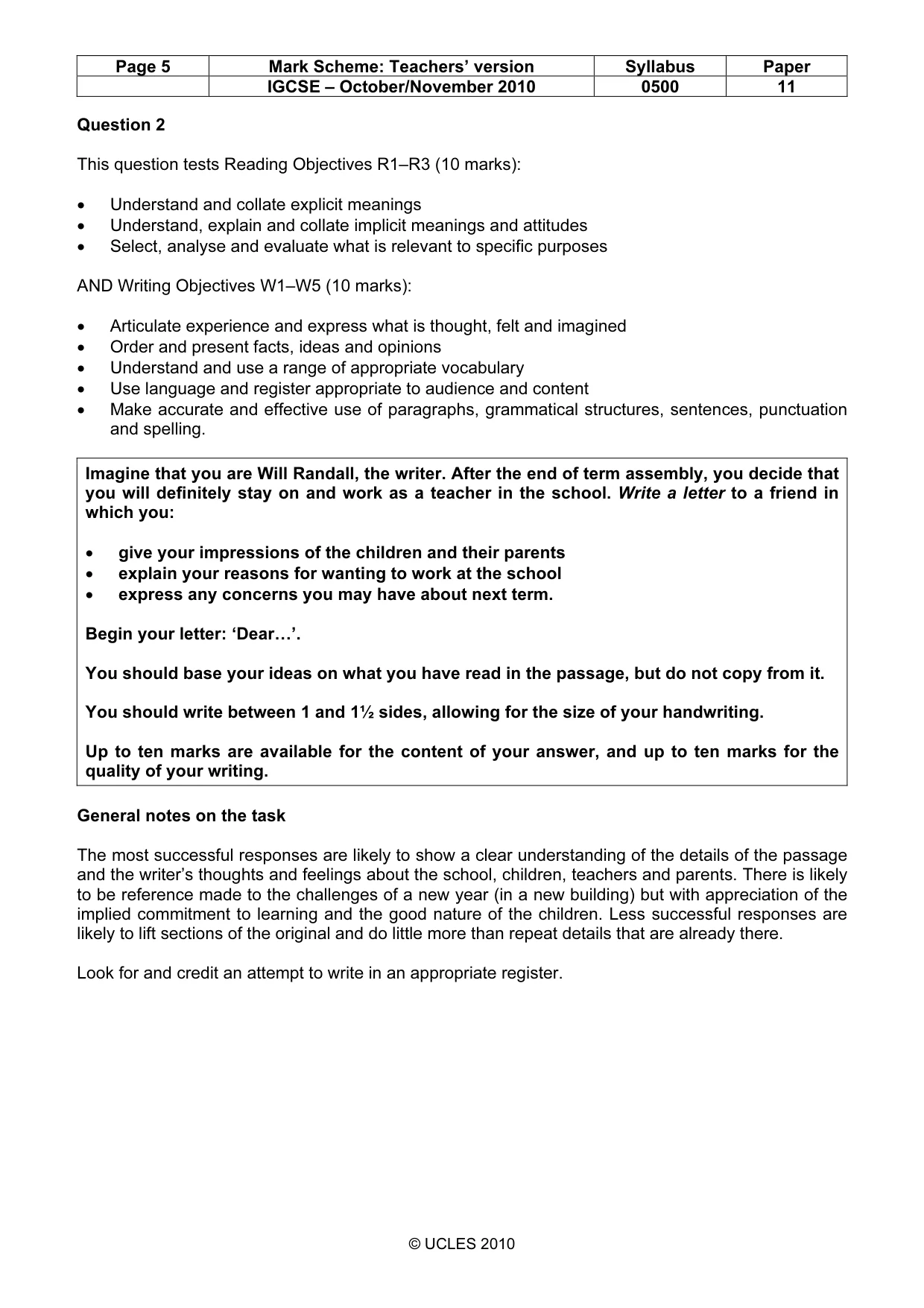
Page 5 Mark Scheme: Teachers’ version Syllabus Paper IGCSE – October/November 2010 0500 11 © UCLES 2010 Question 2 This question tests Reading Objectives R1–R3 (10 marks): • Understand and collate explicit meanings • Understand, explain and collate implicit meanings and attitudes • Select, analyse and evaluate what is relevant to specific purposes AND Writing Objectives W1–W5 (10 marks): • Articulate experience and express what is thought, felt and imagined • Order and present facts, ideas and opinions • Understand and use a range of appropriate vocabulary • Use language and register appropriate to audience and content • Make accurate and effective use of paragraphs, grammatical structures, sentences, punctuation and spelling. Imagine that you are Will Randall, the writer. After the end of term assembly, you decide that you will definitely stay on and work as a teacher in the school. Write a letter to a friend in which you: • give your impressions of the children and their parents • explain your reasons for wanting to work at the school • express any concerns you may have about next term. Begin your letter: ‘Dear…’. You should base your ideas on what you have read in the passage, but do not copy from it. You should write between 1 and 1½ sides, allowing for the size of your handwriting. Up to ten marks are available for the content of your answer, and up to ten marks for the quality of your writing. General notes on the task The most successful responses are likely to show a clear understanding of the details of the passage and the writer’s thoughts and feelings about the school, children, teachers and parents. There is likely to be reference made to the challenges of a new year (in a new building) but with appreciation of the implied commitment to learning and the good nature of the children. Less successful responses are likely to lift sections of the original and do little more than repeat details that are already there. Look for and credit an attempt to write in an appropriate register.
Mark scheme, page 6
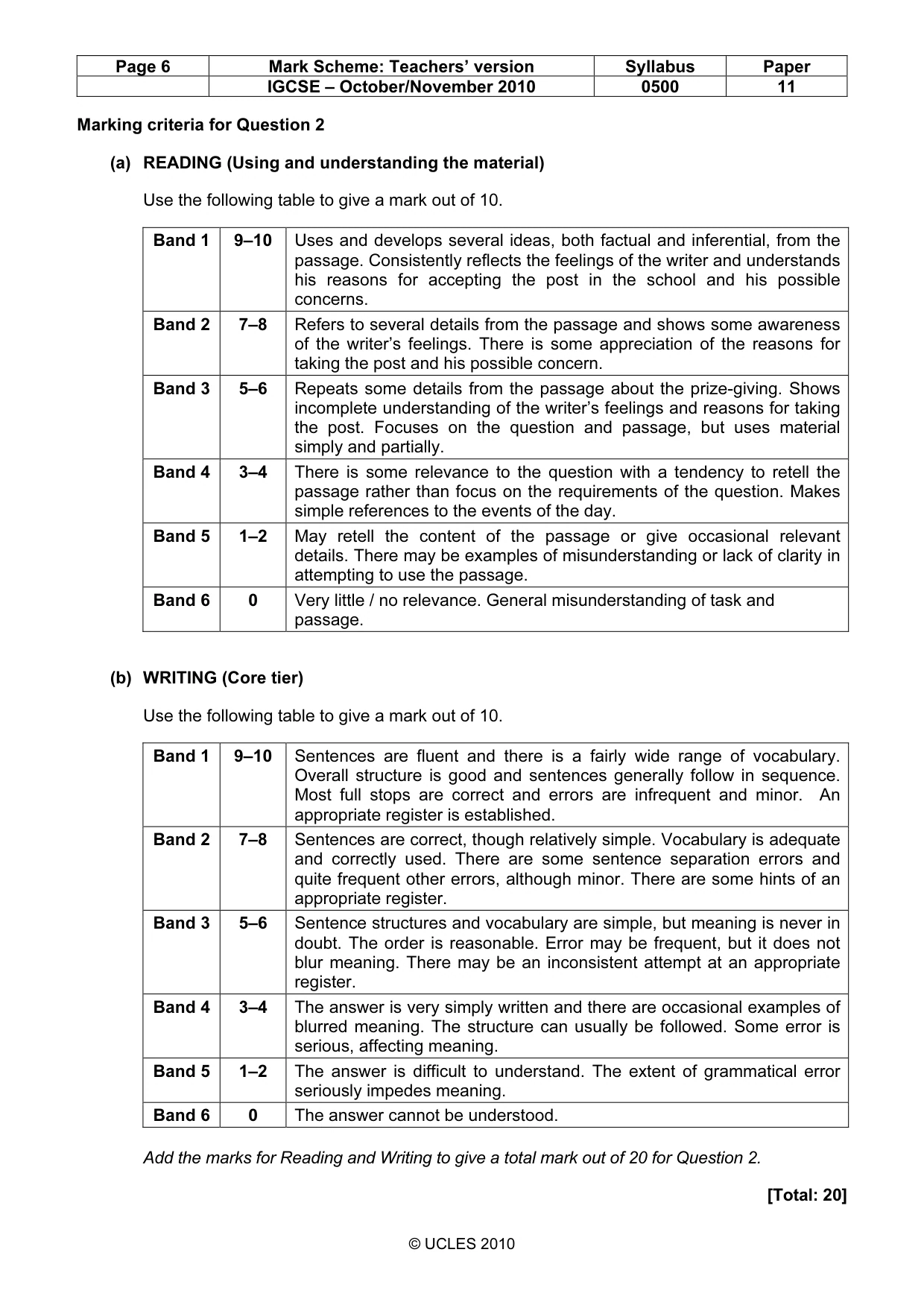
Page 6 Mark Scheme: Teachers’ version Syllabus Paper IGCSE – October/November 2010 0500 11 © UCLES 2010 Marking criteria for Question 2 (a) READING (Using and understanding the material) Use the following table to give a mark out of 10. Band 1 9–10 Uses and develops several ideas, both factual and inferential, from the passage. Consistently reflects the feelings of the writer and understands his reasons for accepting the post in the school and his possible concerns. Band 2 7–8 Refers to several details from the passage and shows some awareness of the writer’s feelings. There is some appreciation of the reasons for taking the post and his possible concern. Band 3 5–6 Repeats some details from the passage about the prize-giving. Shows incomplete understanding of the writer’s feelings and reasons for taking the post. Focuses on the question and passage, but uses material simply and partially. Band 4 3–4 There is some relevance to the question with a tendency to retell the passage rather than focus on the requirements of the question. Makes simple references to the events of the day. Band 5 1–2 May retell the content of the passage or give occasional relevant details. There may be examples of misunderstanding or lack of clarity in attempting to use the passage. Band 6 0 Very little / no relevance. General misunderstanding of task and passage. (b) WRITING (Core tier) Use the following table to give a mark out of 10. Band 1 9–10 Sentences are fluent and there is a fairly wide range of vocabulary. Overall structure is good and sentences generally follow in sequence. Most full stops are correct and errors are infrequent and minor. An appropriate register is established. Band 2 7–8 Sentences are correct, though relatively simple. Vocabulary is adequate and correctly used. There are some sentence separation errors and quite frequent other errors, although minor. There are some hints of an appropriate register. Band 3 5–6 Sentence structures and vocabulary are simple, but meaning is never in doubt. The order is reasonable. Error may be frequent, but it does not blur meaning. There may be an inconsistent attempt at an appropriate register. Band 4 3–4 The answer is very simply written and there are occasional examples of blurred meaning. The structure can usually be followed. Some error is serious, affecting meaning. Band 5 1–2 The answer is difficult to understand. The extent of grammatical error seriously impedes meaning. Band 6 0 The answer cannot be understood. Add the marks for Reading and Writing to give a total mark out of 20 for Question 2. [Total: 20]
What you needed in this session
Cambridge’s own grade thresholds for 2010 Oct/Nov, Paper 1 · Variant 1. A higher threshold means an easier paper — the bar moves with how the cohort did.