Cambridge IGCSE English - First Language 0500 — 2010 May/June Paper 1 · Variant 2
0500/12/M/J/10 · 50 marks · ≈56 min
The question paper and its mark scheme, free to read here and free to download. This is Cambridge’s own paper, exactly as it was sat.
Question paper4 pages
Mark scheme7 pages
Answers below. Sit the paper first if you are practising.
Paper as text
Question paper, page 1
This document consists of 4 printed pages. DC (AC) 22612/2 © UCLES 2010 [Turn over UNIVERSITY OF CAMBRIDGE INTERNATIONAL EXAMINATIONS International General Certificate of Secondary Education * 3 8 7 0 6 4 5 6 2 0 * FIRST LANGUAGE ENGLISH 0500/12 Paper 1 Reading Passage (Core) May/June 2010 1 hour 45 minutes Additional Materials: Answer Booklet/Paper READ THESE INSTRUCTIONS FIRST If you have been given an Answer Booklet, follow the instructions on the front cover of the Booklet. Write your Centre number, candidate number and name on all the work you hand in. Write in dark blue or black pen. Do not use staples, paper clips, highlighters, glue or correction fluid. Answer all questions. Dictionaries are not permitted. At the end of the examination, fasten all your work securely together. The number of marks is given in brackets [ ] at the end of each question or part question. www.XtremePapers.com
Question paper, page 2
2 0500/12/M/J/10 © UCLES 2010 Read the following passage carefully, and then answer all the questions. Sharon Sweeney visits an unusual and eco-friendly theme park, located in the east of England, that appeals to both children and parents. In the reedy banks of the Norfolk Broads lurks Mildred, a beastly four metre long creature that looks like a crocodile, with a mouthful of sharp teeth and a spiky green back. It’s not a freak of nature brought on by global warming but a children’s character brought to life at Bewilderwood, the UK’s first environmentally-friendly adventure park, which opened this week. Spread over a large area of woodland and marshland, Bewilderwood is a magical playground of treehouses, aerial ropewalks and zipwires, reached by boat or boardwalk – all built from sustainable wood. The whole site is pesticide-free so there’s no danger of chemicals filtering into the surrounding low-lying wetlands. Some 14,000 broadleaf trees, including oak, sweet chestnut and birch have been planted. There is a snack shack on the jetty and a cafe selling reasonably priced, locally sourced and mainly organic food – ostrich burgers and unfussy sandwiches, pure fruit smoothies and elderflower cordial – but you could just as easily bring a picnic. So far, so green. But it’s the magical forest folk who inhabit the site that will fire children’s imaginations – Mildred, the vegetarian Crocklebog who lives in the Scary Lake; Swampy, a Marsh Boggle; a giant spider called Thornyclod; and Twiggles, goblin-like creatures that hate litter and mess. It’s just not Disneyland. Though Bewilderwood’s creator and owner Tom Blofeld said he was partly inspired by the 90’s computer game Myst, there’s nothing modern about the concept of the adventure park. The principles on which Bewilderwood is based belong to a pre-computer game, pre-media-player, pre-cell-phone era. It provides exactly the sort of healthy, good old-fashioned fun that appeals to most parents and young children. Sure enough the prospect of meeting Mildred in the lake had my five year old wide-eyed with wonder; however, I was at first concerned how my older children (one aged 11 and the other 13) would react to it. I was afraid that, at their sophisticated state of development, they might see it as too childish. As it happened, my fears were unfounded. Once the pink and purple boats eased up to the jetty, they were almost as excited to get in as the smaller children. The trip takes under five minutes, travelling at a snail’s pace in reclaimed lifeboats that run on electricity and cause minimum disturbance to the ducks and other types of water birds that glide around the watery glade. When the boats reach the Scary Lake, laser technology helps green and spiky Mildred, who lurks in the undergrowth, to blast out a trumpet of water when you’re least expecting it. Some parts of the park are a little too scary for younger children – my five year old wouldn’t go near the fireman’s pole or the 40 metre long zipwires his older siblings adored. And one of the slides had far too sheer a drop for me to contemplate, yet the kids whizzed down it shrieking in delight. However, there are tamer attractions as well – a sturdy rope swing for three to share, toddlers’ swings, a maze where once you reach the centre you are led up and out rather than back the way you came, a climbing wall, scrambling nets, knotted ropes to climb up, and balancing logs, as well as a small quiet area called Peaceful Paths. Tom Blofeld says a desire to do something different on his family’s land was the initial prompt for planning Bewilderwood. He took control of the estate when his father, a High Court judge, retired. Tom had no wish to use the land for farming as it was not a way of life that appealed to him. Instead he let himself be inspired by his love of children’s literature and this was the real driving force behind the park’s creation. “What I’d really like to be is a children’s publisher,” he admits. He’s partly achieved that ambition. His book, A Boggle at Bewilderwood, is available to buy, an extra that many parents will end up paying out for on top of the £45 family ticket. 5 10 15 20 25 30 35 40
Question paper, page 3
3 0500/12/M/J/10 © UCLES 2010 [Turn over It’s not cheap, but neither are traditional theme parks, and at least here we felt it was worth it. There was none of the after-shock slump you get from a typical theme park, no tasteless canteen food, no blaring music, no hard sell ... just shrieks, birdsong and dappled sunshine. And if you want to make a truly eco day of it, the Broadland Cycle Hire Company can be found next door. 1 (a) What is the name of the four metre long creature mentioned in the first line, and what type of imaginary creature is it? [2] (b) Give three facts from the second paragraph (‘Spread over ... bring a picnic’) which tell you that the designers of the park are concerned about protecting the environment. [3] (c) What effects do you think the writer achieves by starting paragraph 3 with the words, ‘So far, so green.’? [2] (d) Give two details about the boats on the Scary Lake (paragraph 5, ‘Sure enough… least expecting it.’) [2] (e) Explain: (i) the writer’s thoughts about the way her two older children would react to the trip on the lake; [1] (ii) how the two older children actually reacted. [1] (f) Explain, using your own words, what surprises visitors have at the Scary Lake. [2] (g) Choose three words or phrases the writer uses which suggest that Bewilderwood provides ‘good old-fashioned fun’ (paragraphs 1 to 7, ‘In the reedy banks … called Peaceful Paths’). [6] (h) Explain, using your own words, what the writer means by: (i) “real driving force” (line 41); [2] (ii) “dappled sunshine” (line 47); [2] (i) From paragraphs 2 to 7 (‘Spread over … called Peaceful Paths’), write a summary of what parents would particularly like about Bewilderwood. Write a paragraph of about 50-70 words. [7] [Total: 30] [Turn over for Question 2] 45
Question paper, page 4
4 0500/12/M/J/10 © UCLES 2010 2 Last summer, you visited Bewilderwood. Your two cousins, aged 8 and 15, are going there this year. Write a letter to your older cousin. You should include: • what you can see and do in the park • what your cousins might or might not enjoy and why • what makes Bewilderwood unique. Start your letter, ‘Dear …’. You should base your ideas on what you have read in the passage, but do not copy from it. You should write between 1 and 1 ½ sides, allowing for the size of your handwriting. Up to ten marks are available for the content of your answer, and up to ten marks for the quality of your writing. [Total: 20] Copyright Acknowledgements: Reading Passage © Sharon Sweeney; If you go down to the woods today…; www.guardian.co.uk; 26/05/07 Permission to reproduce items where third-party owned material protected by copyright is included has been sought and cleared where possible. Every reasonable effort has been made by the publisher (UCLES) to trace copyright holders, but if any items requiring clearance have unwittingly been included, the publisher will be pleased to make amends at the earliest possible opportunity. University of Cambridge International Examinations is part of the Cambridge Assessment Group. Cambridge Assessment is the brand name of University of Cambridge Local Examinations Syndicate (UCLES), which is itself a department of the University of Cambridge.
Mark scheme, page 1
UNIVERSITY OF CAMBRIDGE INTERNATIONAL EXAMINATIONS International General Certificate of Secondary Education MARK SCHEME for the May/June 2010 question paper for the guidance of teachers 0500 FIRST LANGUAGE ENGLISH 0500/12 Paper 12 (Reading Passage – Core), maximum raw mark 50 This mark scheme is published as an aid to teachers and candidates, to indicate the requirements of the examination. It shows the basis on which Examiners were instructed to award marks. It does not indicate the details of the discussions that took place at an Examiners’ meeting before marking began, which would have considered the acceptability of alternative answers. Mark schemes must be read in conjunction with the question papers and the report on the examination. • CIE will not enter into discussions or correspondence in connection with these mark schemes. CIE is publishing the mark schemes for the May/June 2010 question papers for most IGCSE, GCE Advanced Level and Advanced Subsidiary Level syllabuses and some Ordinary Level syllabuses. www.XtremePapers.com
Mark scheme, page 2
Page 2 Mark Scheme: Teachers’ version Syllabus Paper IGCSE – May/June 2010 0500 12 © UCLES 2010 Note: All Examiners are instructed that alternative correct answers and unexpected approaches in candidates’ scripts must be given marks that fairly reflect the relevant knowledge and skills demonstrated. Question 1 This question tests Reading Objectives R1–R4 (30 marks): • understand and collate explicit meanings • understand, explain and collate implicit meanings and attitudes • select, analyse and evaluate what is relevant to specific purposes • understand how writers achieve effects. (a) What is the name of the four metre long creature mentioned in the first line, and what type of imaginary creature is it? [2] Mildred (1 mark); Crocklebog (1 mark) (b) Give three facts from the second paragraph (‘Spread over ... bring a picnic’) which tell you that the designers of the park are concerned about protecting the environment. [3] Buildings made from sustainable wood; no pesticides used to protect wetlands; 14,000/many (broad-leaf) trees planted; organic/locally-sourced food 1 mark for each point up to a maximum of 3. (c) What effects do you think the writer achieves by starting paragraph 3 with the words, ‘So far, so green.’ [2] The words sum up what has gone before; they emphasise that the park is eco-friendly; they emphasise that there’s more to it than just environmental concerns. 2 marks for a clear explanation; 1 for some understanding. (d) Give two details about the boats on the Scary Lake (paragraph 5, ‘Sure enough ... least expecting it.’). [2] Pink/purple in colour; they run on electricity; they are reclaimed lifeboats; they move very slowly. 1 mark for each point up to a maximum of 2. (e) Explain: (i) the writer’s thoughts about the way her two older children would react to the trip on the lake; [1] She was afraid they would consider themselves too old for it. (ii) how the two older children actually reacted. [1] Excited. 2 marks for a clear explanation; 1 for some understanding.
Mark scheme, page 3
Page 3 Mark Scheme: Teachers’ version Syllabus Paper IGCSE – May/June 2010 0500 12 © UCLES 2010 (f) Explain, using your own words, what surprises visitors have at the Scary Lake. [2] Mildred the Crocklebog is in hiding so they don’t see her (1 mark). She gives out a sudden noise/surprising jet of water (1 mark). (g) Choose three words or phrases the writer uses that suggest that Bewilderwood provides ‘good old-fashioned fun’ (paragraphs 1 to 7, ‘In the reedy banks ... called Peaceful Paths’). [6] Any from: • magical playground of tree-houses/aerial ropewalks/zip wires • magical forest folk • it’s just not Disneyland • there’s nothing modern/pre-computer/pre-media-player/pre-cell phone • fireman’s pole/zip wires*/slides • any/all of the activities listed in paragraph 7 • small quiet area called Peaceful Paths N.B. Reference to ‘zip wires’ should be credited only once (either as bullet point 1 or 5). Award 2 marks each for any of the words or phrases given above, to a maximum of 6 for the question as a whole, regardless of whether there has been any attempt made by the candidate to justify the selection. If a word/phrase not mentioned in the mark scheme has been chosen and is supported by an explanation, then award 2 marks for a convincing justification or 1 mark for some understanding, again to a maximum of 6 for the question as a whole. If words/phrases not mentioned in the mark scheme are chosen but are not supported by an explanation then 0 marks should be awarded for such attempts. (h) Explain, using your own words, what the writer means by: (i) ‘real driving force’ (line 41); [2] The detail which most motivated him to open the park. 2 marks for a clear explanation in own words; 1 for some understanding. (ii) ‘dappled sunshine’ (line 47); [2] Sunshine which casts a speckled pattern on the ground because of the shadows of the leaves. 2 marks for a clear explanation in own words; 1 for some understanding.
Mark scheme, page 4
Page 4 Mark Scheme: Teachers’ version Syllabus Paper IGCSE – May/June 2010 0500 12 © UCLES 2010 (i) From paragraphs 2 to 7 (‘Spread over … called Peaceful Paths’), write a summary of what parents would particularly like about Bewilderwood. Write a paragraph of about 50–70 words. [7] 1 features in the park (crocklebogs etc.) are aimed specifically at young children 2 it is concerned with protecting the environment 3 the food is suitable for children/unfussy/organic 4 it is possible to bring a picnic 5 features in the park encourage children not to leave litter 6 it isn’t a conventional theme park/pre-computer etc. 7 there are traditional/adventurous/healthy activities/zip wires etc. 8 it appeals to older as well as young children/all people 9 there are quiet places 10 the maze is thoughtfully designed 11 it’s good value for money N.B. Some of the above points are inferential. 1 mark for each point up to a maximum of 7. [Total: 30]
Mark scheme, page 5
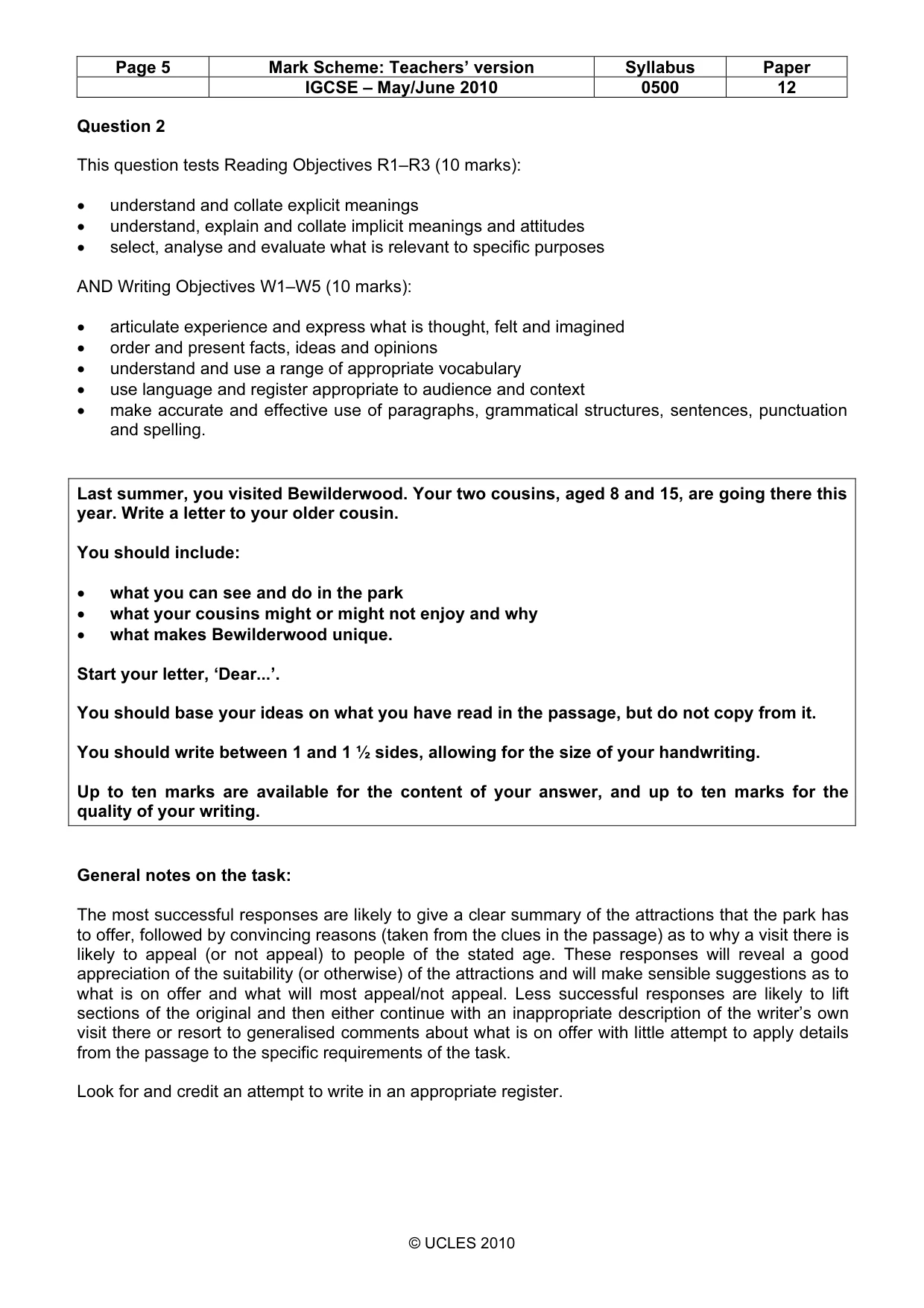
Page 5 Mark Scheme: Teachers’ version Syllabus Paper IGCSE – May/June 2010 0500 12 © UCLES 2010 Question 2 This question tests Reading Objectives R1–R3 (10 marks): • understand and collate explicit meanings • understand, explain and collate implicit meanings and attitudes • select, analyse and evaluate what is relevant to specific purposes AND Writing Objectives W1–W5 (10 marks): • articulate experience and express what is thought, felt and imagined • order and present facts, ideas and opinions • understand and use a range of appropriate vocabulary • use language and register appropriate to audience and context • make accurate and effective use of paragraphs, grammatical structures, sentences, punctuation and spelling. Last summer, you visited Bewilderwood. Your two cousins, aged 8 and 15, are going there this year. Write a letter to your older cousin. You should include: • what you can see and do in the park • what your cousins might or might not enjoy and why • what makes Bewilderwood unique. Start your letter, ‘Dear...’. You should base your ideas on what you have read in the passage, but do not copy from it. You should write between 1 and 1 ½ sides, allowing for the size of your handwriting. Up to ten marks are available for the content of your answer, and up to ten marks for the quality of your writing. General notes on the task: The most successful responses are likely to give a clear summary of the attractions that the park has to offer, followed by convincing reasons (taken from the clues in the passage) as to why a visit there is likely to appeal (or not appeal) to people of the stated age. These responses will reveal a good appreciation of the suitability (or otherwise) of the attractions and will make sensible suggestions as to what is on offer and what will most appeal/not appeal. Less successful responses are likely to lift sections of the original and then either continue with an inappropriate description of the writer’s own visit there or resort to generalised comments about what is on offer with little attempt to apply details from the passage to the specific requirements of the task. Look for and credit an attempt to write in an appropriate register.
Mark scheme, page 6
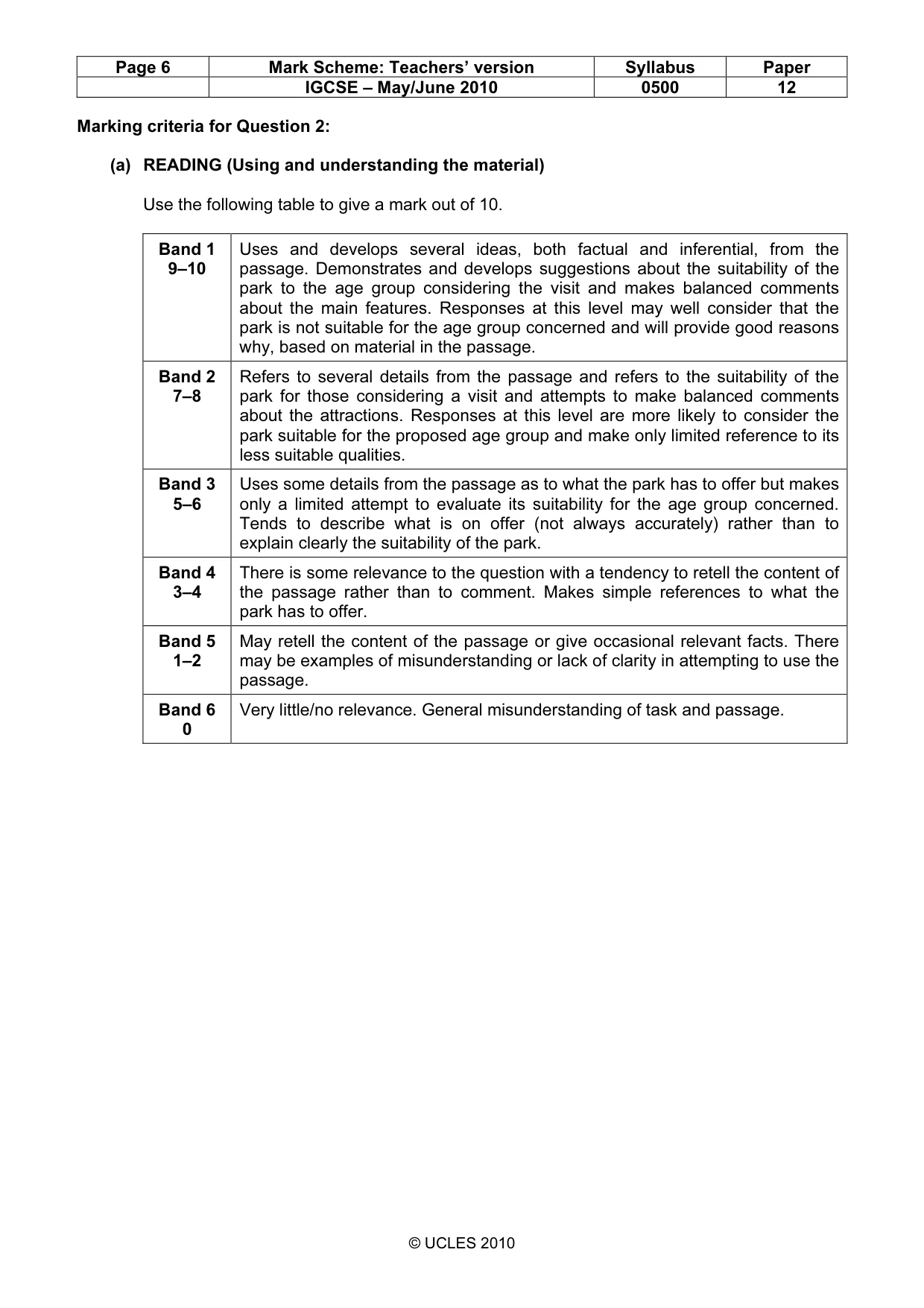
Page 6 Mark Scheme: Teachers’ version Syllabus Paper IGCSE – May/June 2010 0500 12 © UCLES 2010 Marking criteria for Question 2: (a) READING (Using and understanding the material) Use the following table to give a mark out of 10. Band 1 9–10 Uses and develops several ideas, both factual and inferential, from the passage. Demonstrates and develops suggestions about the suitability of the park to the age group considering the visit and makes balanced comments about the main features. Responses at this level may well consider that the park is not suitable for the age group concerned and will provide good reasons why, based on material in the passage. Band 2 7–8 Refers to several details from the passage and refers to the suitability of the park for those considering a visit and attempts to make balanced comments about the attractions. Responses at this level are more likely to consider the park suitable for the proposed age group and make only limited reference to its less suitable qualities. Band 3 5–6 Uses some details from the passage as to what the park has to offer but makes only a limited attempt to evaluate its suitability for the age group concerned. Tends to describe what is on offer (not always accurately) rather than to explain clearly the suitability of the park. Band 4 3–4 There is some relevance to the question with a tendency to retell the content of the passage rather than to comment. Makes simple references to what the park has to offer. Band 5 1–2 May retell the content of the passage or give occasional relevant facts. There may be examples of misunderstanding or lack of clarity in attempting to use the passage. Band 6 0 Very little/no relevance. General misunderstanding of task and passage.
Mark scheme, page 7
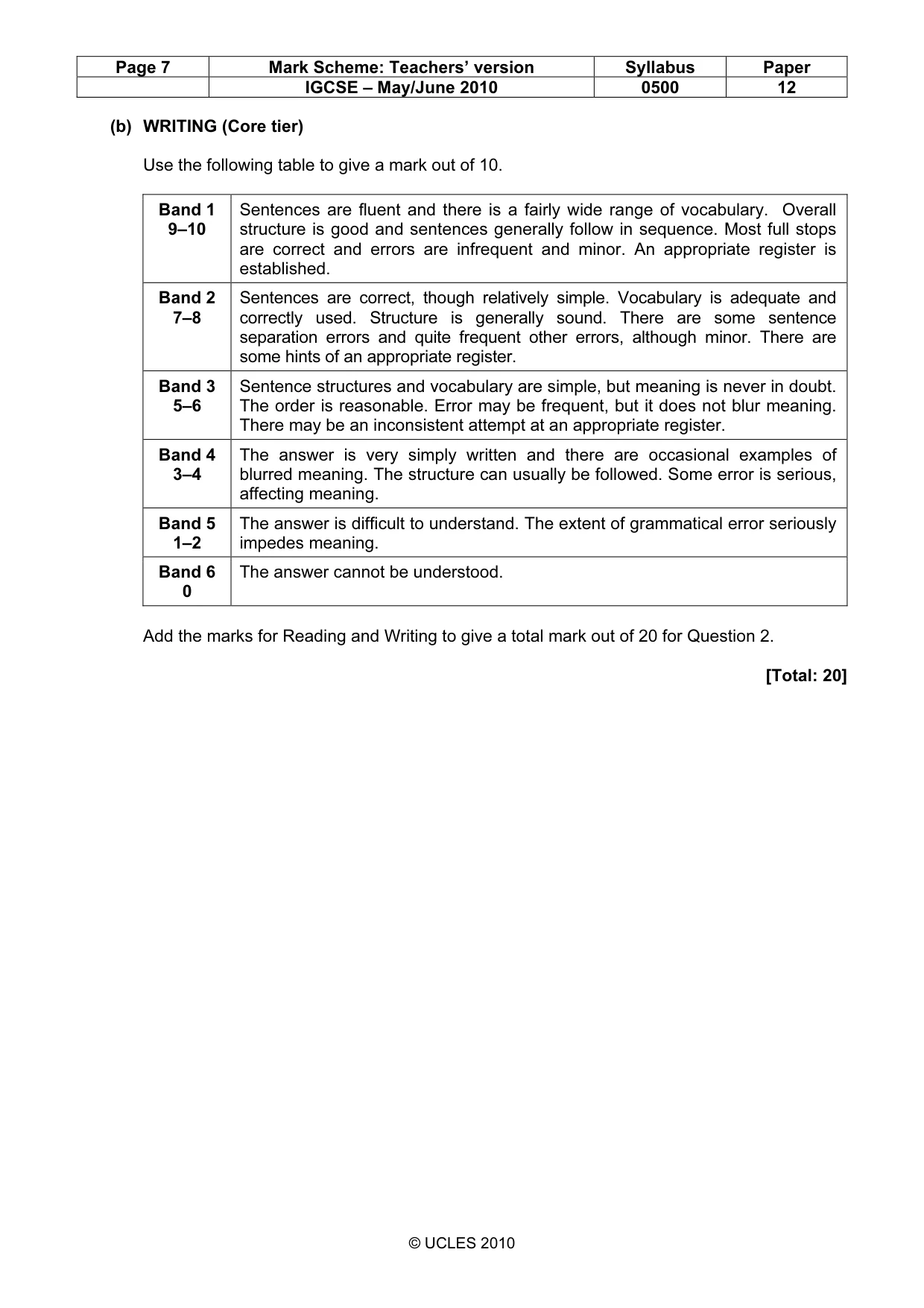
Page 7 Mark Scheme: Teachers’ version Syllabus Paper IGCSE – May/June 2010 0500 12 © UCLES 2010 (b) WRITING (Core tier) Use the following table to give a mark out of 10. Band 1 9–10 Sentences are fluent and there is a fairly wide range of vocabulary. Overall structure is good and sentences generally follow in sequence. Most full stops are correct and errors are infrequent and minor. An appropriate register is established. Band 2 7–8 Sentences are correct, though relatively simple. Vocabulary is adequate and correctly used. Structure is generally sound. There are some sentence separation errors and quite frequent other errors, although minor. There are some hints of an appropriate register. Band 3 5–6 Sentence structures and vocabulary are simple, but meaning is never in doubt. The order is reasonable. Error may be frequent, but it does not blur meaning. There may be an inconsistent attempt at an appropriate register. Band 4 3–4 The answer is very simply written and there are occasional examples of blurred meaning. The structure can usually be followed. Some error is serious, affecting meaning. Band 5 1–2 The answer is difficult to understand. The extent of grammatical error seriously impedes meaning. Band 6 0 The answer cannot be understood. Add the marks for Reading and Writing to give a total mark out of 20 for Question 2. [Total: 20]
What you needed in this session
Cambridge’s own grade thresholds for 2010 May/June, Paper 1 · Variant 2. A higher threshold means an easier paper — the bar moves with how the cohort did.