Cambridge IGCSE English - First Language 0500 — 2010 May/June Paper 1 · Variant 1
0500/11/M/J/10 · 50 marks · ≈56 min
The question paper and its mark scheme, free to read here and free to download. This is Cambridge’s own paper, exactly as it was sat.
Question paper4 pages
Mark scheme6 pages
Answers below. Sit the paper first if you are practising.
Paper as text
Question paper, page 1
This document consists of 4 printed pages. DC (AC) 22609/2 © UCLES 2010 [Turn over UNIVERSITY OF CAMBRIDGE INTERNATIONAL EXAMINATIONS International General Certificate of Secondary Education * 1 7 9 2 9 9 7 3 6 7 * FIRST LANGUAGE ENGLISH 0500/11 Paper 1 Reading Passage (Core) May/June 2010 1 hour 45 minutes Additional Materials: Answer Booklet/Paper READ THESE INSTRUCTIONS FIRST If you have been given an Answer Booklet, follow the instructions on the front cover of the Booklet. Write your Centre number, candidate number and name on all the work you hand in. Write in dark blue or black pen. Do not use staples, paper clips, highlighters, glue or correction fluid. Answer all questions. Dictionaries are not permitted. At the end of the examination, fasten all your work securely together. The number of marks is given in brackets [ ] at the end of each question or part question. www.XtremePapers.com
Question paper, page 2
2 0500/11/M/J/10 © UCLES 2010 Read the following passage carefully, and then answer all the questions. Sheryl Garratt, her husband and five-year-old son Liam visit an eccentric Dutch theme park. Soon after arriving at the Dutch theme park, Efteling, we were in a boat on a man-made waterway which is pretty much as you’d expect of a trip to Holland. Apart from the camels and the crocodiles... Floating through the bazaar of the fictional Arabian town of Fata Morgana, we passed hordes of shoppers and beggars crowding the bazaar while a man screamed in agony as a robotic dentist administered to him in an open-air surgery. Women in exotic dresses danced in the courtyards and prisoners groaned in the dungeons. A tiger was shot and snakes were charmed. We even got to drift between the legs of a giant. An hour or so later, we were floating again, this time in the air in open-fronted cable cars. The fairytale scenes before us on the Dream Flight were cheesy but charming, and beautifully done: the smells and temperature changed as we moved from one set to another; fairies perched in trees in a rainy wood full of goblins and trolls. These state-of-the-art rides are recent additions to a fairytale-themed park that is almost 50 years old, set in the Brabant region near the Belgian border. Efteling’s mature woods make it less artificial than most theme parks, with clever details like talking litter bins to keep little minds occupied and little legs walking. Wholesome and quietly appealing, it’s a great place to blow away the winter cobwebs. My five-year-old son’s favourite spot was the Fairytale Forest, featuring low-tech tableaux from various fairy stories. A fakir [magician] who was charming tulips from the ground before flying from one side of his home to another on a creaky magic carpet had Liam transfixed. He also liked Laafland, an imaginative playground that is home to a ‘lost tribe’, with statues of grotesque- looking little folk called Laafs. We stayed in the Golden Tulip Efteling Hotel, well suited for children. It has a generous play area with actors dressed as fairies and trolls. The family rooms were large and comfortable and the hotel has its own entrance to the park, allowing guests to get to some of the more popular rides before queues build up. The next morning, my husband played with our son in a nearby maze, whilst I rode on the stomach-churning Bird Rok, an indoor rollercoaster which lurches around for much of the time in total darkness, leaving you disorientated. ‘Mum, you look funny,’ observed Liam cheerfully as I got off; ignoring my pale smile he dragged me on to the nearby Carnival Festival ride. He loved it and wanted to go on again immediately. This is only the second year the park has opened during the winter months, as ‘Winter’ Efteling. The response during the school holiday exceeded all expectations: there were 25,000 people inside; the car parks had to be closed and the resulting traffic jams made the national news bulletins. Although the majority of the rollercoasters and white-knuckle rides are closed, and can be seen only from the carriages of a steam train which chugs around the park, there is plenty added on to compensate. There’s a huge indoor skating rink, where small children glide along holding on to chairs and parents can have hot drinks in the ‘après-ski’ bar. An indoor winter wonderland playground provides huge inflatables, snowball-throwing stalls and a snow slide that children can hurtle down on tyres. 5 10 15 20 25 30 35 40
Question paper, page 3
3 0500/11/M/J/10 © UCLES 2010 [Turn over As darkness falls, lights come on in the trees and along the pathways, and bonfires are tended in the big open squares. Then the musicians and entertainers who have performed around the park all day really come into their own, entrancing children with fire-eating and juggling. The beautifully lit Flying Pagoda ride glides high in the sky, hovering over the park like a UFO, and everything stays open till 8pm, offering a long, good value day out. On the crisp, clear winter days we were there, we were warmed up by frequent visits to reasonably priced stalls selling hot chocolate and delicious hot snacks (from doughnuts to French fries with mayonnaise). However, there is plenty to do under cover, so even rain wouldn’t have dampened our spirits. We spent more than an hour, for instance, in a building housing a glorious 150-year- old steam carousel, an ornate miniature railway, a theatre where fountains danced to music and several refreshment bars. This was a winter day out with parents and children happy, and not a TV or computer screen in sight. Now that’s magic! 1 (a) In what country would you find Efteling? [1] (b) Give two words from the second paragraph (‘Floating through … legs of a giant’) which tell you that what you can see from the boat is not real. [2] (c) Using your own words, explain fully the purpose of the talking litter bins (paragraph 4, ‘These state-of-the-art … winter cobwebs’). [2] (d) Give two effects that the Bird Rok roller coaster ride had on the writer (paragraph 7, ‘The next morning … again immediately’). [2] (e) Apart from the Bird Rok roller coaster, state four things on which visitors can ride within Efteling. [4] (f) In the introduction, the writer describes Efteling as ‘eccentric’. Choose three words or phrases used by the writer and explain how each conveys the unusual and unexpected nature of the park. [6] (g) Explain, using your own words, what the writer means by: (i) “blow away the winter cobwebs” (lines 16-17) (ii) “grotesque-looking little folk” (lines 21-22) [4] (h) From the whole passage, write a summary of what parents would particularly like about Efteling. Write a paragraph of about 50-70 words. [7] (i) What effects does the writer achieve by ending her article with the statement, ‘Now that’s magic!’? [2] [Total: 30] 45 50
Question paper, page 4
4 0500/11/M/J/10 © UCLES 2010 Copyright Acknowledgements: Reading Passage © Sheryl Garratt; Cheesy… but Charming; The Observer; www.guardian.co.uk; 25/11/09. Permission to reproduce items where third-party owned material protected by copyright is included has been sought and cleared where possible. Every reasonable effort has been made by the publisher (UCLES) to trace copyright holders, but if any items requiring clearance have unwittingly been included, the publisher will be pleased to make amends at the earliest possible opportunity. University of Cambridge International Examinations is part of the Cambridge Assessment Group. Cambridge Assessment is the brand name of University of Cambridge Local Examinations Syndicate (UCLES), which is itself a department of the University of Cambridge. 2 Your class is planning a trip to Europe and will be staying near Efteling. You have written to your cousin who lives in the area asking for details about the park and if it would be a suitable place for your class to visit. Write the letter your cousin sends in reply. You should include: • details of what Efteling contains • what would appeal to people of your age group • when it is best to visit and why. Start your letter, ‘Dear …’. You should base your ideas on what you have read in the passage, but do not copy from it. You should write between 1 and 1 ½ sides, allowing for the size of your handwriting. Up to ten marks are available for the content of your answer, and up to ten marks for the quality of your writing. [Total: 20]
Mark scheme, page 1
UNIVERSITY OF CAMBRIDGE INTERNATIONAL EXAMINATIONS International General Certificate of Secondary Education MARK SCHEME for the May/June 2010 question paper for the guidance of teachers 0500 FIRST LANGUAGE ENGLISH 0500/11 Paper 11 (Reading Passage – Core), maximum raw mark 50 This mark scheme is published as an aid to teachers and candidates, to indicate the requirements of the examination. It shows the basis on which Examiners were instructed to award marks. It does not indicate the details of the discussions that took place at an Examiners’ meeting before marking began, which would have considered the acceptability of alternative answers. Mark schemes must be read in conjunction with the question papers and the report on the examination. • CIE will not enter into discussions or correspondence in connection with these mark schemes. CIE is publishing the mark schemes for the May/June 2010 question papers for most IGCSE, GCE Advanced Level and Advanced Subsidiary Level syllabuses and some Ordinary Level syllabuses. www.XtremePapers.com
Mark scheme, page 2
Page 2 Mark Scheme: Teachers’ version Syllabus Paper IGCSE – May/June 2010 0500 11 © UCLES 2010 Note: All Examiners are instructed that alternative correct answers and unexpected approaches in candidates’ scripts must be given marks that fairly reflect the relevant knowledge and skills demonstrated. Question 1 This question tests Reading Objectives R1–R4 (30 marks): • understand and collate explicit meanings • understand, explain and collate implicit meanings and attitudes • select, analyse and evaluate what is relevant to specific purposes • understand how writers achieve effects. (a) In what country would you find Efteling? [1] Holland/The Netherlands. (b) Give two words from the second paragraph (‘Floating through ... legs of a giant’) which tell you that what you can see from the boat is not real. [2] Fictional; robotic. 1 mark for each word up to a maximum of 2. (c) Using your own words, explain fully the purpose of the talking litter bins, (paragraph 4, ‘These state-of-the-art ... winter cobwebs’). [2] They are there to keep children interested (while walking from one attraction to another) (1 mark). They are there to encourage children to put their litter in them (1 mark). (d) Give two effects that the Bird Rok roller coaster ride had on the writer (paragraph 7, ‘The next morning ... again immediately’). [2] It made her feel sick; she lost her sense of direction (disorientated); her face went pale/she looked funny. 1 mark for any point up to a maximum of 2. (e) Apart from the Bird Rok roller coaster, state four things on which visitors can ride within Efteling. [4] A boat; cable cars/Dream Flight/state of the art rides; Flying Pagoda; Carnival Festival Ride/roller coasters; white knuckle rides; steam train; (steam) carousel; miniature railway; snow slide. 1 mark for each point up to a maximum of 4.
Mark scheme, page 3
Page 3 Mark Scheme: Teachers’ version Syllabus Paper IGCSE – May/June 2010 0500 11 © UCLES 2010 (f) In the introduction, the writer describes Efteling as ‘eccentric’. Choose three words or phrases used by the writer and explain how each conveys the unusual and unexpected nature of the park. [6] • floating through the bazaar of the fictional Arabian town Fata Morgana • apart from the camels and crocodiles • fairy tale scenes were cheesy but charming • talking litter bins • creaky magic carpet • grotesque-looking little folk called Laafs • the Flying Pagoda ... like a UFO • a glorious 150-year-old steam carousel • not a TV or computer screen in sight • the smells and temperature changed (as we moved) Be prepared to award references to phrases other than those above for which convincing explanations are given. Award 1 mark for each phrase identified up to a maximum of 3, and a further mark for a clear explanation of the effect. If the same explanation is given for more than one phrase, then reward each quotation, but give only 1 mark in total for explanation. e.g. the phrase ‘creaky magic carpet’ = 1 mark. An explanation such as ‘you usually imagine magic carpets to be exciting and impressive; calling this one “creaky” makes it sound a little odd as the word suggests that it isn’t very safe’ would qualify for the second mark. Some candidates may produce better explanations than this! (g) Explain, using your own words, what the writer means by: (i) ‘blow away the winter cobwebs’ (lines 16–17) [2] Freshen you up in mind and body during the gloom of winter. 2 marks for a clear explanation in own words, 1 mark for some understanding. (ii) ‘grotesque-looking little folk’ (lines 21–22) [2] Fantastically formed little people, ugly/scary in appearance. 2 marks for a clear explanation in own words, 1 mark for some understanding. (h) From the whole passage, write a summary of what parents would particularly like about Efteling. Write a paragraph of about 50–70 words. [7] 1 it is less artificial than other theme parks 2 litter bins are aimed at keeping children occupied 3 the hotel (is geared to children) 4 it has a large play area 5 Efteling is somewhere to take children in winter (when other parks are closed) 6 the skating rink is focused on allowing children to skate safely 7 parents can relax with a drink (while children are skating) 8 it provides good value for money 9 there is much to keep children occupied undercover if it rains 10 the whole park is child-oriented/there is not the commercial cynicism of other parks 11 no TV/computer games 1 mark for each point up to a maximum of 7.
Mark scheme, page 4
Page 4 Mark Scheme: Teachers’ version Syllabus Paper IGCSE – May/June 2010 0500 11 © UCLES 2010 (i) What effects does the writer achieve by ending her article with the statement, ‘Now that’s magic!’? [2] The phrase is an effective conclusion leaving the reader with something to think about; she is being ironic/satirical/sarcastic by claiming that the park undermines the assumption that children must have technological devices to keep them happy. 1 mark for a comment referring to the intention to emphasise/make effective conclusion/ use short sentence for effect. Award a further mark for identification of/valid comment about the writer’s tone e.g. ironic/approving. [Total: 30] Question 2 This question tests Reading Objectives R1–R3 (10 marks): • understand and collate explicit meanings • understand, explain and collate implicit meanings and attitudes • select, analyse and evaluate what is relevant to specific purposes AND Writing Objectives W1–W5 (10 marks): • articulate experience and express what is thought, felt and imagined • order and present facts, ideas and opinions • understand and use a range of appropriate vocabulary • use language and register appropriate to audience and context • make accurate and effective use of paragraphs, grammatical structures, sentences, punctuation and spelling. Your class is planning a trip to Europe and will be staying near Efteling. You have written to your cousin who lives in the area asking for details about the park and if it would be a suitable place for your class to visit. Write the letter your cousin sends in reply. You should include: • details of what Efteling contains • what would appeal to people of your age group • when it is best to visit and why. Start your letter, ‘Dear...’. You should base your ideas on what you have read in the passage, but do not copy from it. You should write between 1 and 1 ½ sides, allowing for the size of your handwriting. Up to ten marks are available for the content of your answer, and up to ten marks for the quality of your writing.
Mark scheme, page 5
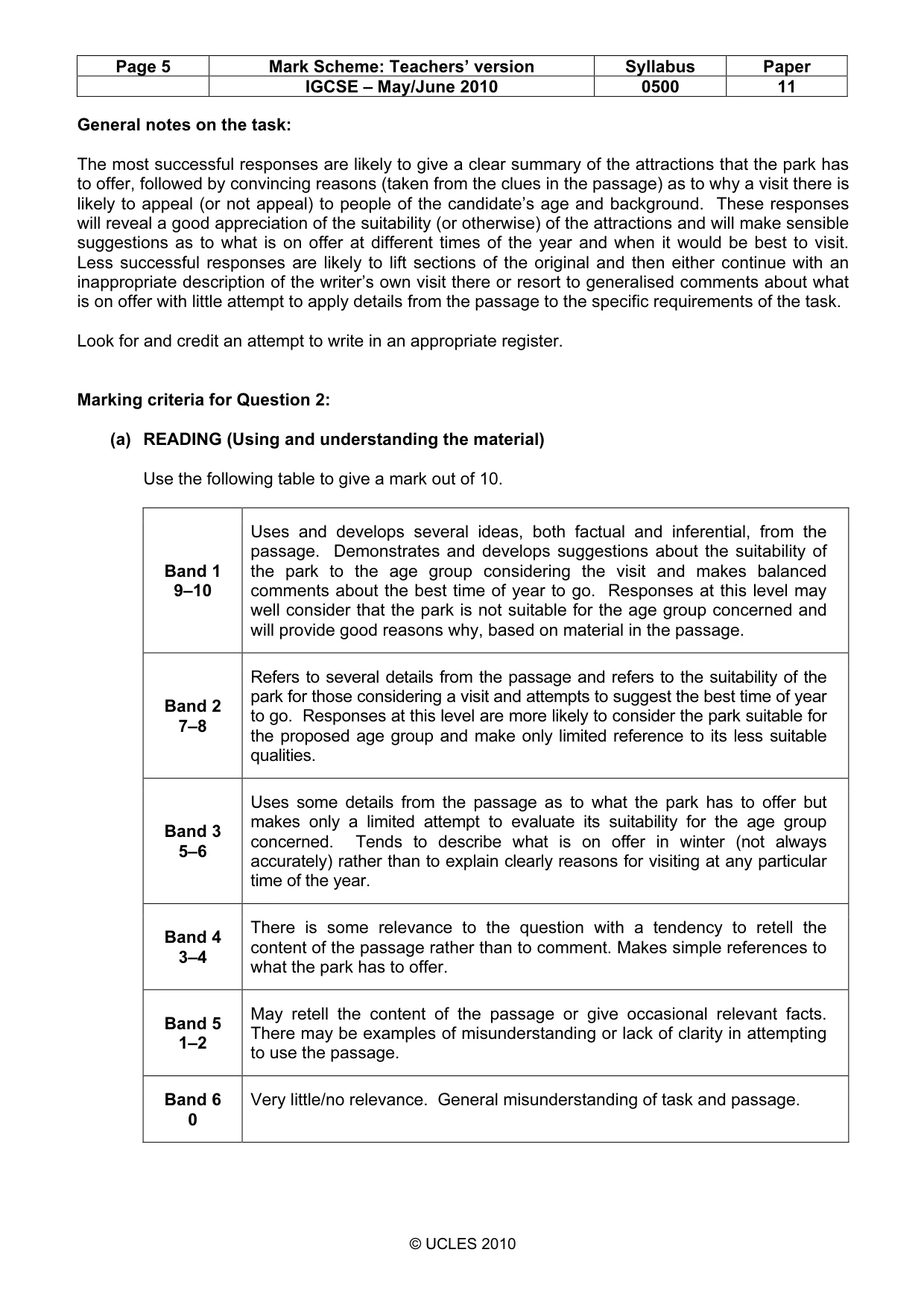
Page 5 Mark Scheme: Teachers’ version Syllabus Paper IGCSE – May/June 2010 0500 11 © UCLES 2010 General notes on the task: The most successful responses are likely to give a clear summary of the attractions that the park has to offer, followed by convincing reasons (taken from the clues in the passage) as to why a visit there is likely to appeal (or not appeal) to people of the candidate’s age and background. These responses will reveal a good appreciation of the suitability (or otherwise) of the attractions and will make sensible suggestions as to what is on offer at different times of the year and when it would be best to visit. Less successful responses are likely to lift sections of the original and then either continue with an inappropriate description of the writer’s own visit there or resort to generalised comments about what is on offer with little attempt to apply details from the passage to the specific requirements of the task. Look for and credit an attempt to write in an appropriate register. Marking criteria for Question 2: (a) READING (Using and understanding the material) Use the following table to give a mark out of 10. Band 1 9–10 Uses and develops several ideas, both factual and inferential, from the passage. Demonstrates and develops suggestions about the suitability of the park to the age group considering the visit and makes balanced comments about the best time of year to go. Responses at this level may well consider that the park is not suitable for the age group concerned and will provide good reasons why, based on material in the passage. Band 2 7–8 Refers to several details from the passage and refers to the suitability of the park for those considering a visit and attempts to suggest the best time of year to go. Responses at this level are more likely to consider the park suitable for the proposed age group and make only limited reference to its less suitable qualities. Band 3 5–6 Uses some details from the passage as to what the park has to offer but makes only a limited attempt to evaluate its suitability for the age group concerned. Tends to describe what is on offer in winter (not always accurately) rather than to explain clearly reasons for visiting at any particular time of the year. Band 4 3–4 There is some relevance to the question with a tendency to retell the content of the passage rather than to comment. Makes simple references to what the park has to offer. Band 5 1–2 May retell the content of the passage or give occasional relevant facts. There may be examples of misunderstanding or lack of clarity in attempting to use the passage. Band 6 0 Very little/no relevance. General misunderstanding of task and passage.
Mark scheme, page 6
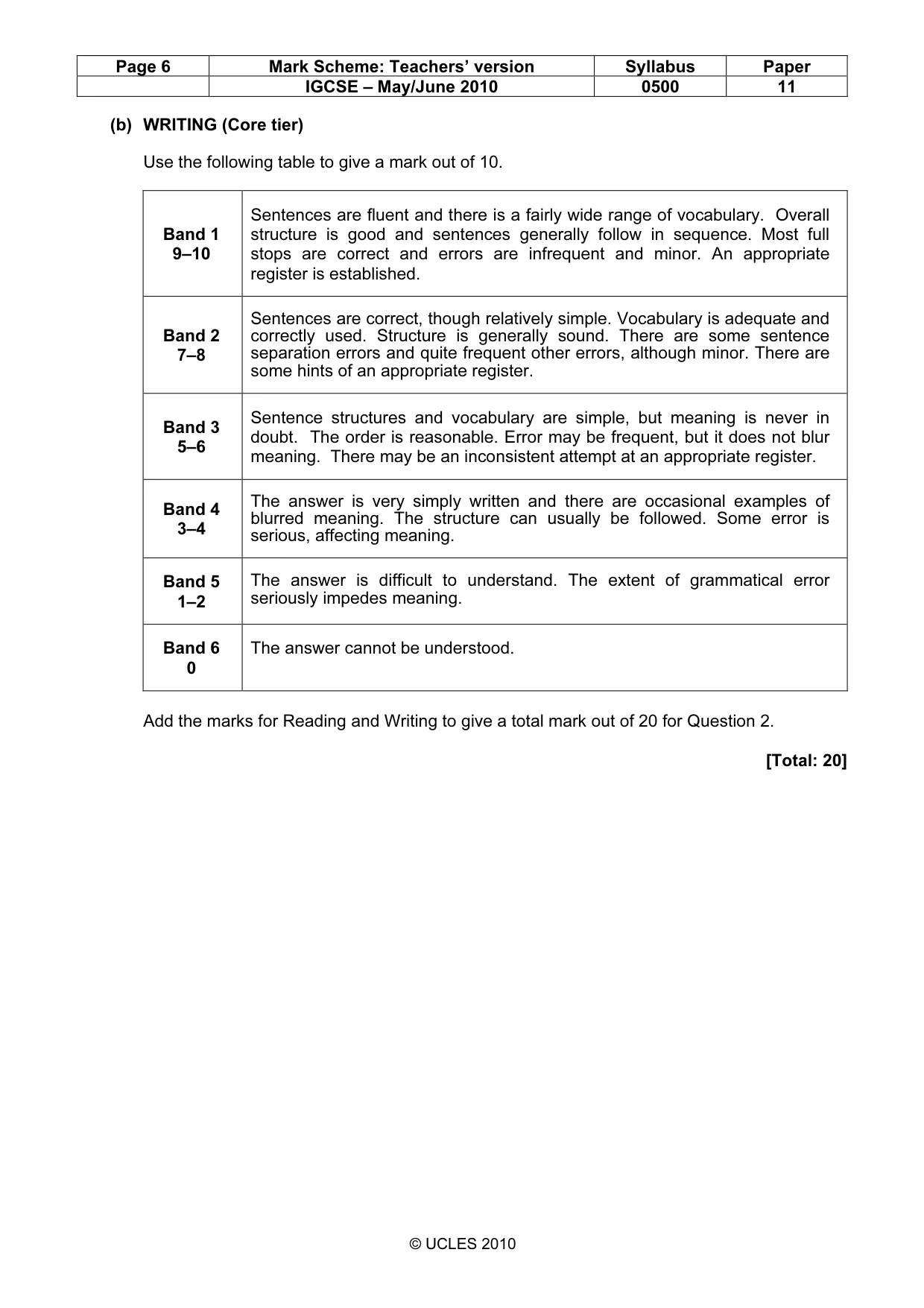
Page 6 Mark Scheme: Teachers’ version Syllabus Paper IGCSE – May/June 2010 0500 11 © UCLES 2010 (b) WRITING (Core tier) Use the following table to give a mark out of 10. Band 1 9–10 Sentences are fluent and there is a fairly wide range of vocabulary. Overall structure is good and sentences generally follow in sequence. Most full stops are correct and errors are infrequent and minor. An appropriate register is established. Band 2 7–8 Sentences are correct, though relatively simple. Vocabulary is adequate and correctly used. Structure is generally sound. There are some sentence separation errors and quite frequent other errors, although minor. There are some hints of an appropriate register. Band 3 5–6 Sentence structures and vocabulary are simple, but meaning is never in doubt. The order is reasonable. Error may be frequent, but it does not blur meaning. There may be an inconsistent attempt at an appropriate register. Band 4 3–4 The answer is very simply written and there are occasional examples of blurred meaning. The structure can usually be followed. Some error is serious, affecting meaning. Band 5 1–2 The answer is difficult to understand. The extent of grammatical error seriously impedes meaning. Band 6 0 The answer cannot be understood. Add the marks for Reading and Writing to give a total mark out of 20 for Question 2. [Total: 20]
What you needed in this session
Cambridge’s own grade thresholds for 2010 May/June, Paper 1 · Variant 1. A higher threshold means an easier paper — the bar moves with how the cohort did.