Cambridge IGCSE Drama 0411 — 2018 May/June Paper 1 · Variant 3
0411/13/M/J/18 · 80 marks · ≈90 min
The question paper and its mark scheme, free to read here and free to download. This is Cambridge’s own paper, exactly as it was sat.
Question paper4 pages

Mark scheme18 pages
Answers below. Sit the paper first if you are practising.




Paper as text
Question paper, page 1
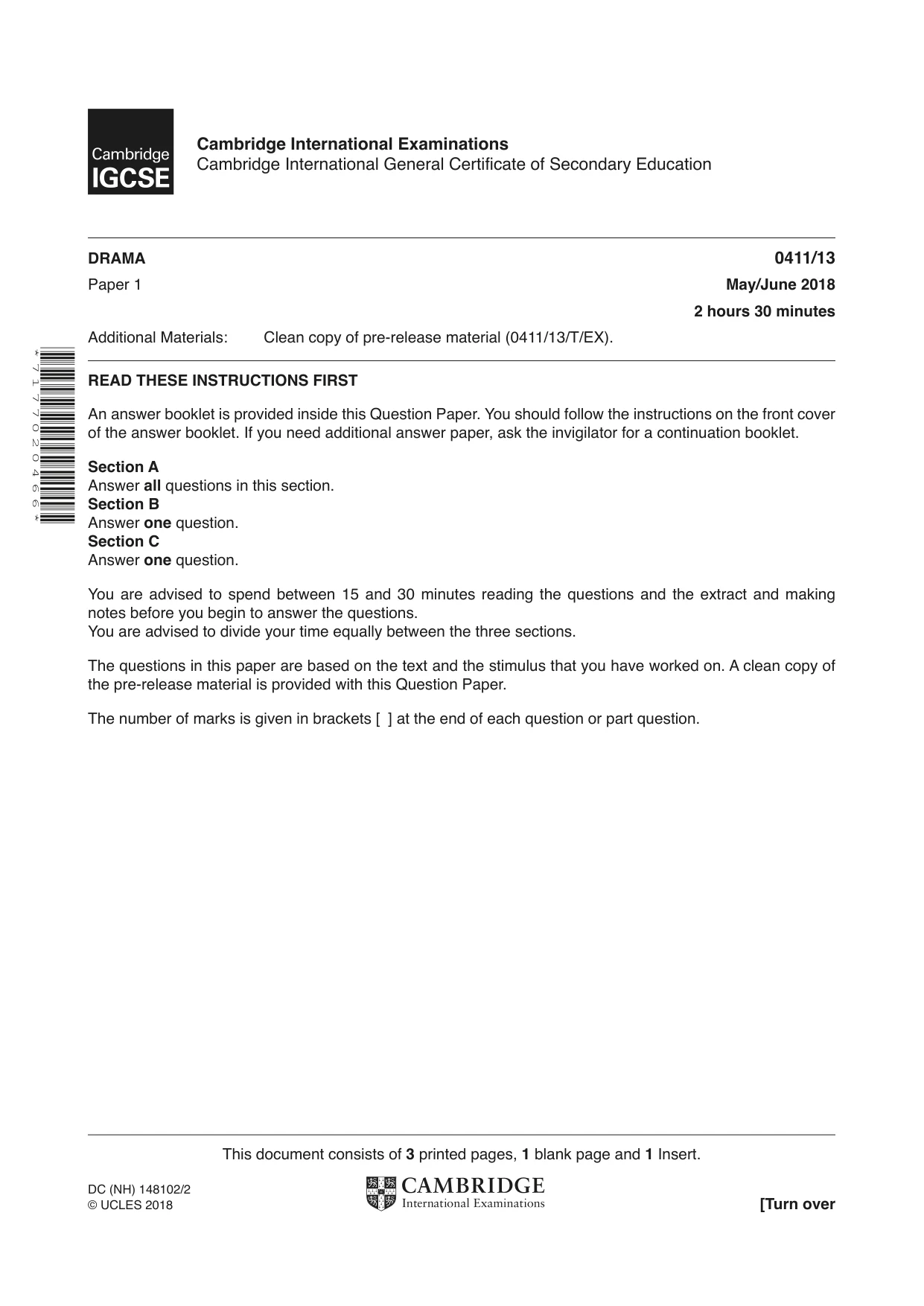
This document consists of 3 printed pages, 1 blank page and 1 Insert. DC (NH) 148102/2 © UCLES 2018 [Turn over * 7 1 7 7 0 2 0 4 6 6 * DRAMA 0411/13 Paper 1 May/June 2018 2 hours 30 minutes Additional Materials: Clean copy of pre-release material (0411/13/T/EX). READ THESE INSTRUCTIONS FIRST An answer booklet is provided inside this Question Paper. You should follow the instructions on the front cover of the answer booklet. If you need additional answer paper, ask the invigilator for a continuation booklet. Section A Answer all questions in this section. Section B Answer one question. Section C Answer one question. You are advised to spend between 15 and 30 minutes reading the questions and the extract and making notes before you begin to answer the questions. You are advised to divide your time equally between the three sections. The questions in this paper are based on the text and the stimulus that you have worked on. A clean copy of the pre-release material is provided with this Question Paper. The number of marks is given in brackets [ ] at the end of each question or part question. Cambridge International Examinations Cambridge International General Certificate of Secondary Education
Question paper, page 2
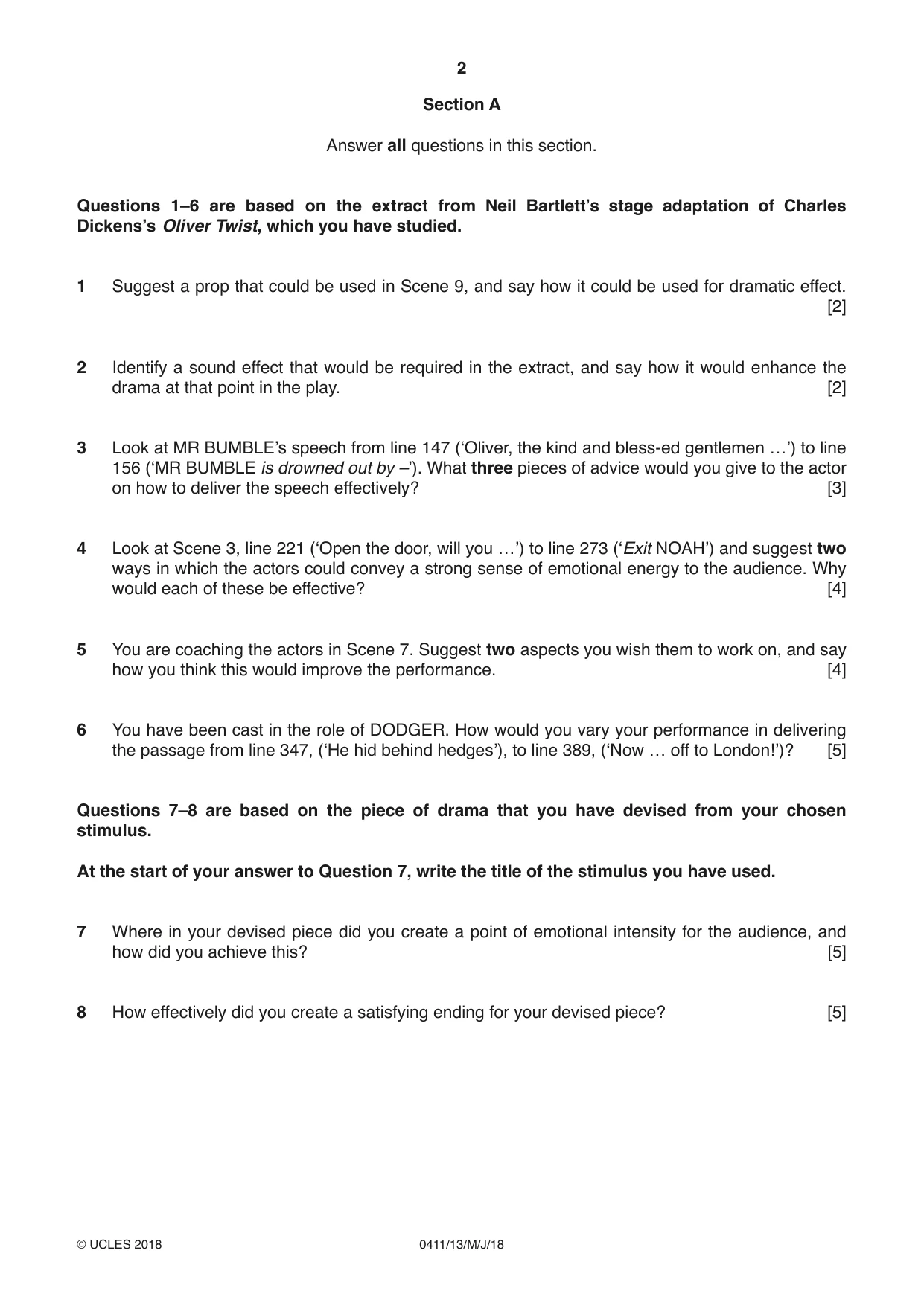
2 0411/13/M/J/18 © UCLES 2018 Section A Answer all questions in this section. Questions 1–6 are based on the extract from Neil Bartlett’s stage adaptation of Charles Dickens’s Oliver Twist, which you have studied. 1 Suggest a prop that could be used in Scene 9, and say how it could be used for dramatic effect. [2] 2 Identify a sound effect that would be required in the extract, and say how it would enhance the drama at that point in the play. [2] 3 Look at MR BUMBLE’s speech from line 147 (‘Oliver, the kind and bless-ed gentlemen …’) to line 156 (‘MR BUMBLE is drowned out by –’). What three pieces of advice would you give to the actor on how to deliver the speech effectively? [3] 4 Look at Scene 3, line 221 (‘Open the door, will you …’) to line 273 (‘Exit NOAH’) and suggest two ways in which the actors could convey a strong sense of emotional energy to the audience. Why would each of these be effective? [4] 5 You are coaching the actors in Scene 7. Suggest two aspects you wish them to work on, and say how you think this would improve the performance. [4] 6 You have been cast in the role of DODGER. How would you vary your performance in delivering the passage from line 347, (‘He hid behind hedges’), to line 389, (‘Now … off to London!’)? [5] Questions 7–8 are based on the piece of drama that you have devised from your chosen stimulus. At the start of your answer to Question 7, write the title of the stimulus you have used. 7 Where in your devised piece did you create a point of emotional intensity for the audience, and how did you achieve this? [5] 8 How effectively did you create a satisfying ending for your devised piece? [5]
Question paper, page 3
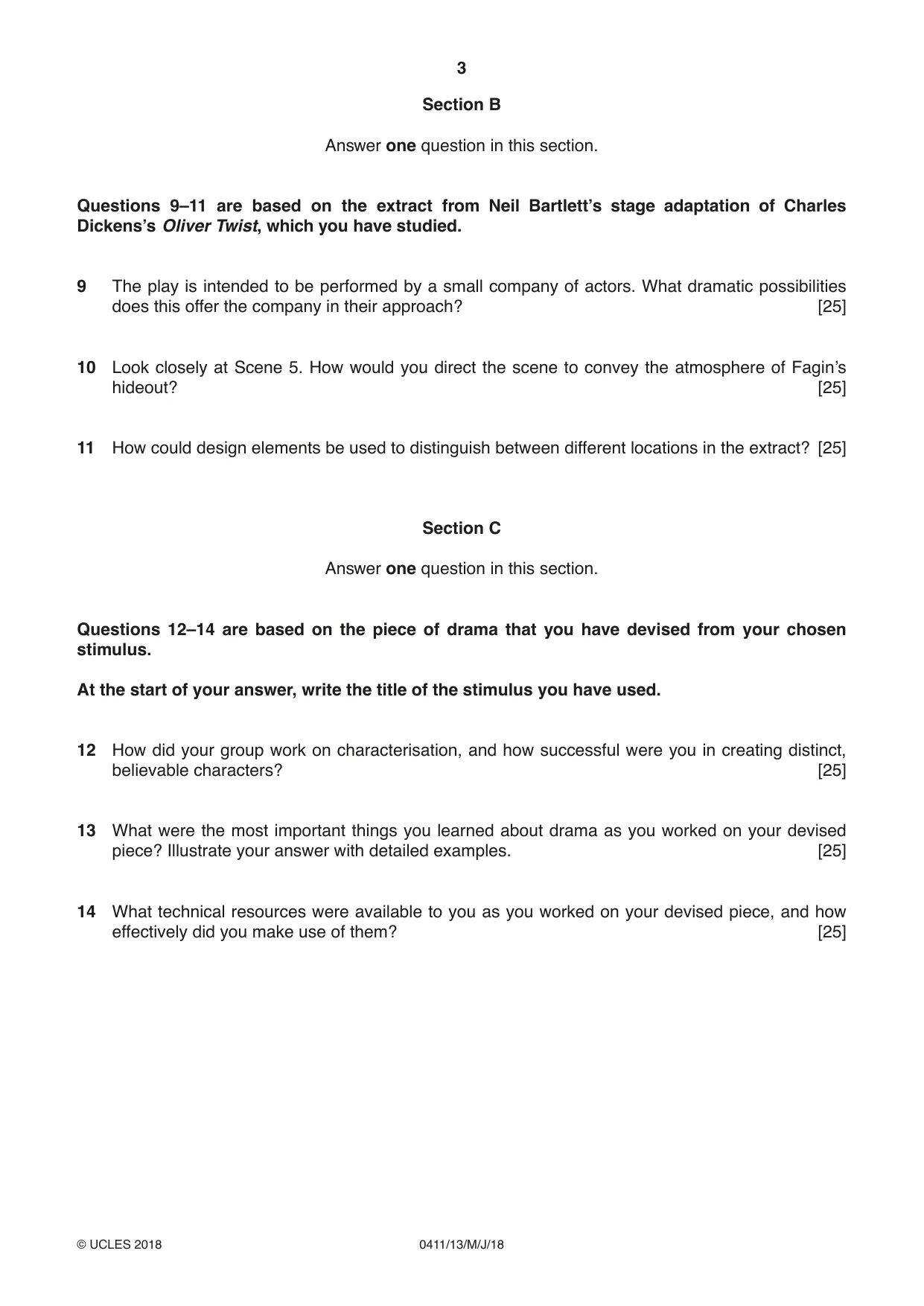
3 0411/13/M/J/18 © UCLES 2018 Section B Answer one question in this section. Questions 9–11 are based on the extract from Neil Bartlett’s stage adaptation of Charles Dickens’s Oliver Twist, which you have studied. 9 The play is intended to be performed by a small company of actors. What dramatic possibilities does this offer the company in their approach? [25] 10 Look closely at Scene 5. How would you direct the scene to convey the atmosphere of Fagin’s hideout? [25] 11 How could design elements be used to distinguish between different locations in the extract? [25] Section C Answer one question in this section. Questions 12–14 are based on the piece of drama that you have devised from your chosen stimulus. At the start of your answer, write the title of the stimulus you have used. 12 How did your group work on characterisation, and how successful were you in creating distinct, believable characters? [25] 13 What were the most important things you learned about drama as you worked on your devised piece? Illustrate your answer with detailed examples. [25] 14 What technical resources were available to you as you worked on your devised piece, and how effectively did you make use of them? [25]
Question paper, page 4
4 0411/13/M/J/18 © UCLES 2018 Permission to reproduce items where third-party owned material protected by copyright is included has been sought and cleared where possible. Every reasonable effort has been made by the publisher (UCLES) to trace copyright holders, but if any items requiring clearance have unwittingly been included, the publisher will be pleased to make amends at the earliest possible opportunity. To avoid the issue of disclosure of answer-related information to candidates, all copyright acknowledgements are reproduced online in the Cambridge International Examinations Copyright Acknowledgements Booklet. This is produced for each series of examinations and is freely available to download at www.cie.org.uk after the live examination series. Cambridge International Examinations is part of the Cambridge Assessment Group. Cambridge Assessment is the brand name of University of Cambridge Local Examinations Syndicate (UCLES), which is itself a department of the University of Cambridge. BLANK PAGE
Mark scheme, page 1
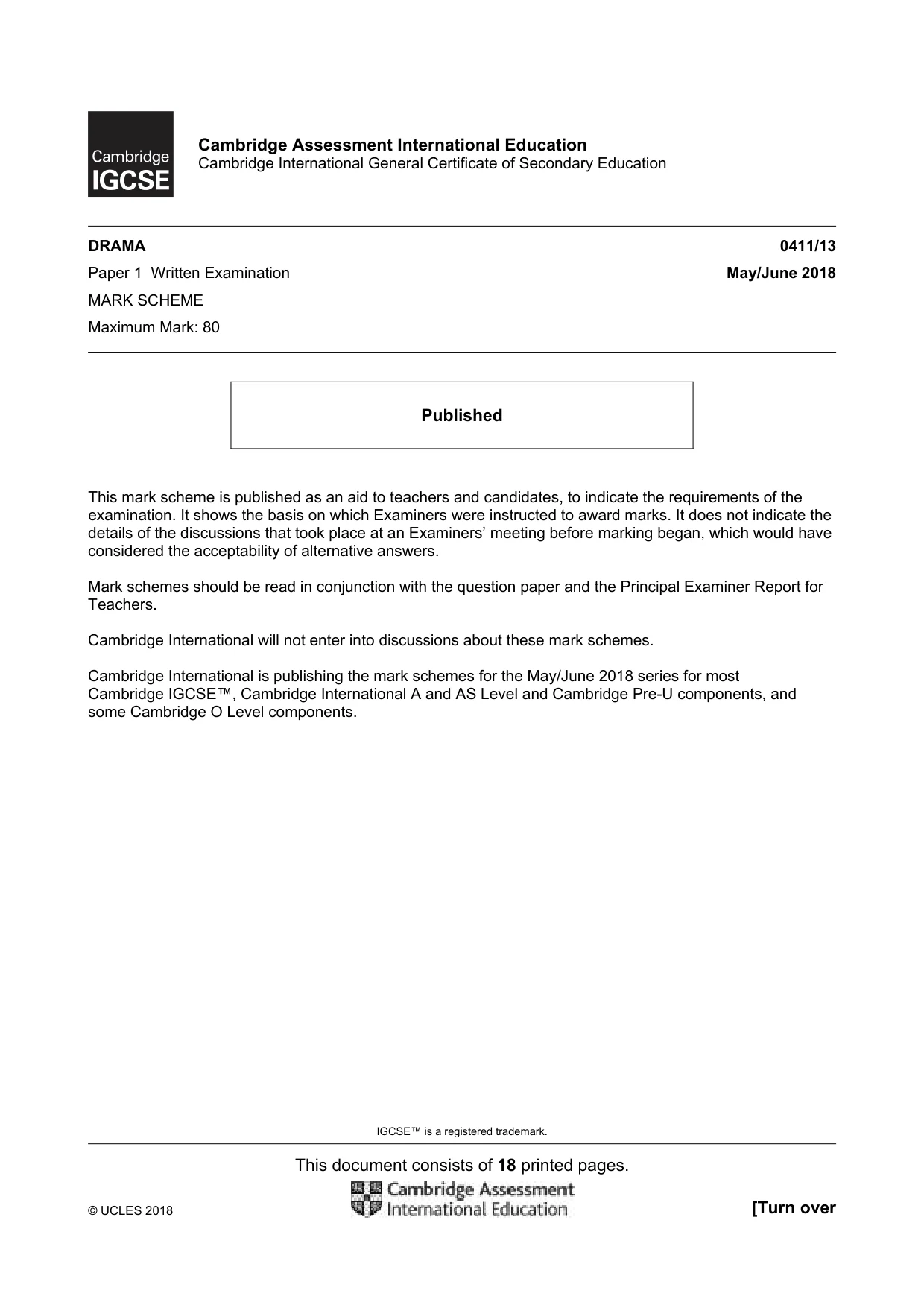
IGCSE™ is a registered trademark. This document consists of 18 printed pages. © UCLES 2018 [Turn over Cambridge Assessment International Education Cambridge International General Certificate of Secondary Education DRAMA 0411/13 Paper 1 Written Examination May/June 2018 MARK SCHEME Maximum Mark: 80 Published This mark scheme is published as an aid to teachers and candidates, to indicate the requirements of the examination. It shows the basis on which Examiners were instructed to award marks. It does not indicate the details of the discussions that took place at an Examiners’ meeting before marking began, which would have considered the acceptability of alternative answers. Mark schemes should be read in conjunction with the question paper and the Principal Examiner Report for Teachers. Cambridge International will not enter into discussions about these mark schemes. Cambridge International is publishing the mark schemes for the May/June 2018 series for most Cambridge IGCSE™, Cambridge International A and AS Level and Cambridge Pre-U components, and some Cambridge O Level components.
Mark scheme, page 2
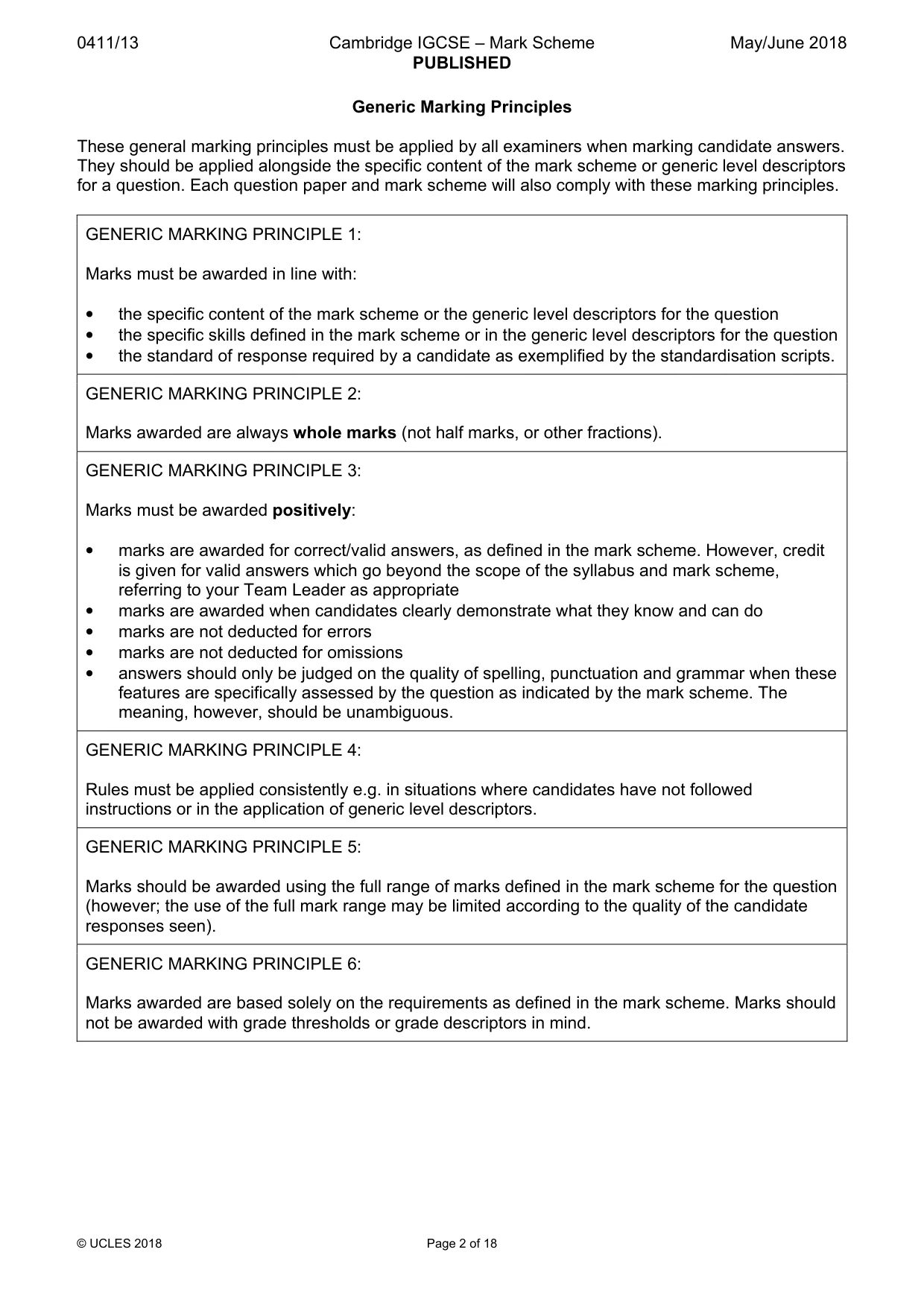
0411/13 Cambridge IGCSE – Mark Scheme PUBLISHED May/June 2018 © UCLES 2018 Page 2 of 18 Generic Marking Principles These general marking principles must be applied by all examiners when marking candidate answers. They should be applied alongside the specific content of the mark scheme or generic level descriptors for a question. Each question paper and mark scheme will also comply with these marking principles. GENERIC MARKING PRINCIPLE 1: Marks must be awarded in line with: • the specific content of the mark scheme or the generic level descriptors for the question • the specific skills defined in the mark scheme or in the generic level descriptors for the question • the standard of response required by a candidate as exemplified by the standardisation scripts. GENERIC MARKING PRINCIPLE 2: Marks awarded are always whole marks (not half marks, or other fractions). GENERIC MARKING PRINCIPLE 3: Marks must be awarded positively: • marks are awarded for correct/valid answers, as defined in the mark scheme. However, credit is given for valid answers which go beyond the scope of the syllabus and mark scheme, referring to your Team Leader as appropriate • marks are awarded when candidates clearly demonstrate what they know and can do • marks are not deducted for errors • marks are not deducted for omissions • answers should only be judged on the quality of spelling, punctuation and grammar when these features are specifically assessed by the question as indicated by the mark scheme. The meaning, however, should be unambiguous. GENERIC MARKING PRINCIPLE 4: Rules must be applied consistently e.g. in situations where candidates have not followed instructions or in the application of generic level descriptors. GENERIC MARKING PRINCIPLE 5: Marks should be awarded using the full range of marks defined in the mark scheme for the question (however; the use of the full mark range may be limited according to the quality of the candidate responses seen). GENERIC MARKING PRINCIPLE 6: Marks awarded are based solely on the requirements as defined in the mark scheme. Marks should not be awarded with grade thresholds or grade descriptors in mind.
Mark scheme, page 3
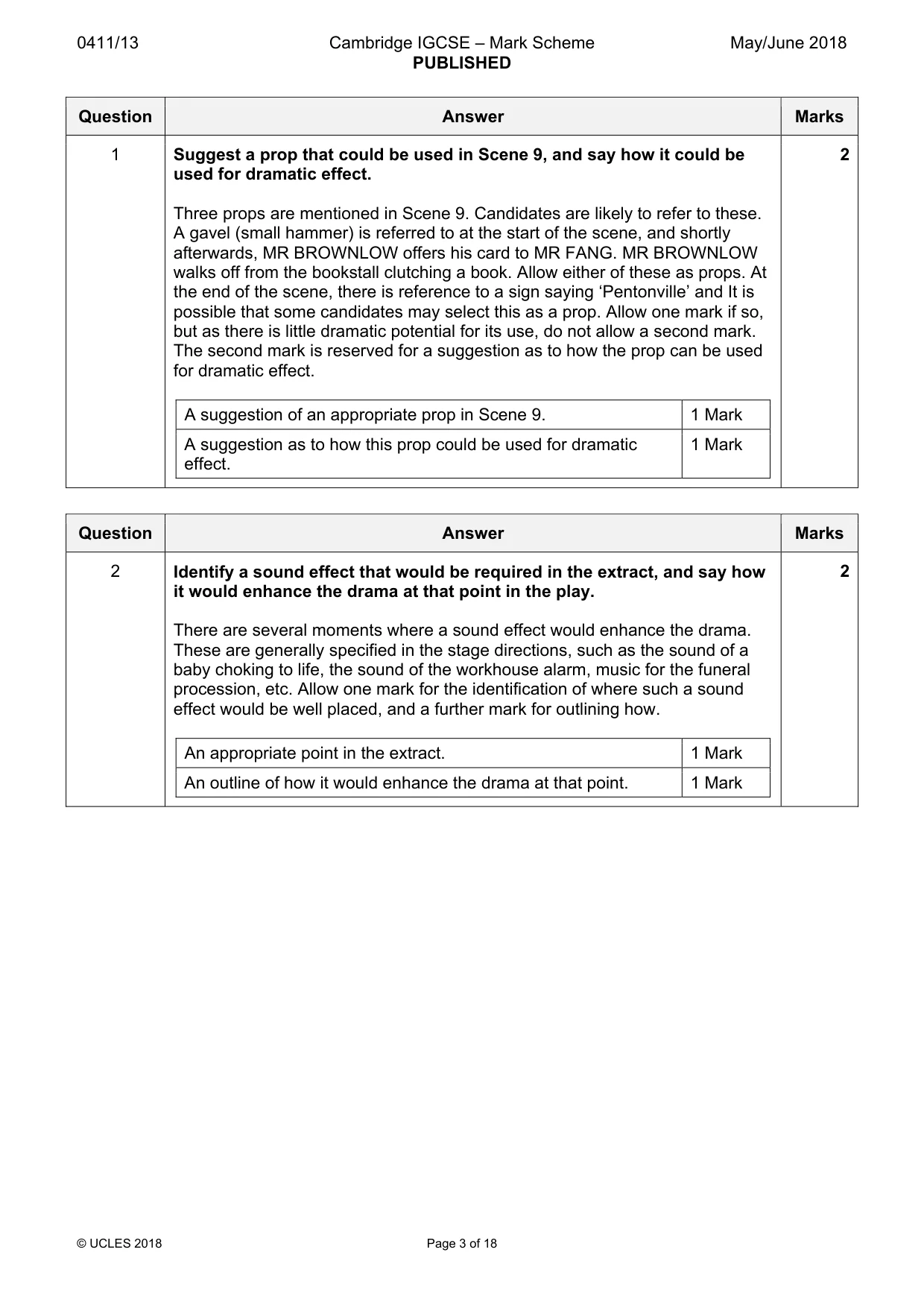
0411/13 Cambridge IGCSE – Mark Scheme PUBLISHED May/June 2018 © UCLES 2018 Page 3 of 18 Question Answer Marks 1 Suggest a prop that could be used in Scene 9, and say how it could be used for dramatic effect. Three props are mentioned in Scene 9. Candidates are likely to refer to these. A gavel (small hammer) is referred to at the start of the scene, and shortly afterwards, MR BROWNLOW offers his card to MR FANG. MR BROWNLOW walks off from the bookstall clutching a book. Allow either of these as props. At the end of the scene, there is reference to a sign saying ‘Pentonville’ and It is possible that some candidates may select this as a prop. Allow one mark if so, but as there is little dramatic potential for its use, do not allow a second mark. The second mark is reserved for a suggestion as to how the prop can be used for dramatic effect. A suggestion of an appropriate prop in Scene 9. 1 Mark A suggestion as to how this prop could be used for dramatic effect. 1 Mark 2 Question Answer Marks 2 Identify a sound effect that would be required in the extract, and say how it would enhance the drama at that point in the play. There are several moments where a sound effect would enhance the drama. These are generally specified in the stage directions, such as the sound of a baby choking to life, the sound of the workhouse alarm, music for the funeral procession, etc. Allow one mark for the identification of where such a sound effect would be well placed, and a further mark for outlining how. An appropriate point in the extract. 1 Mark An outline of how it would enhance the drama at that point. 1 Mark 2
Mark scheme, page 4
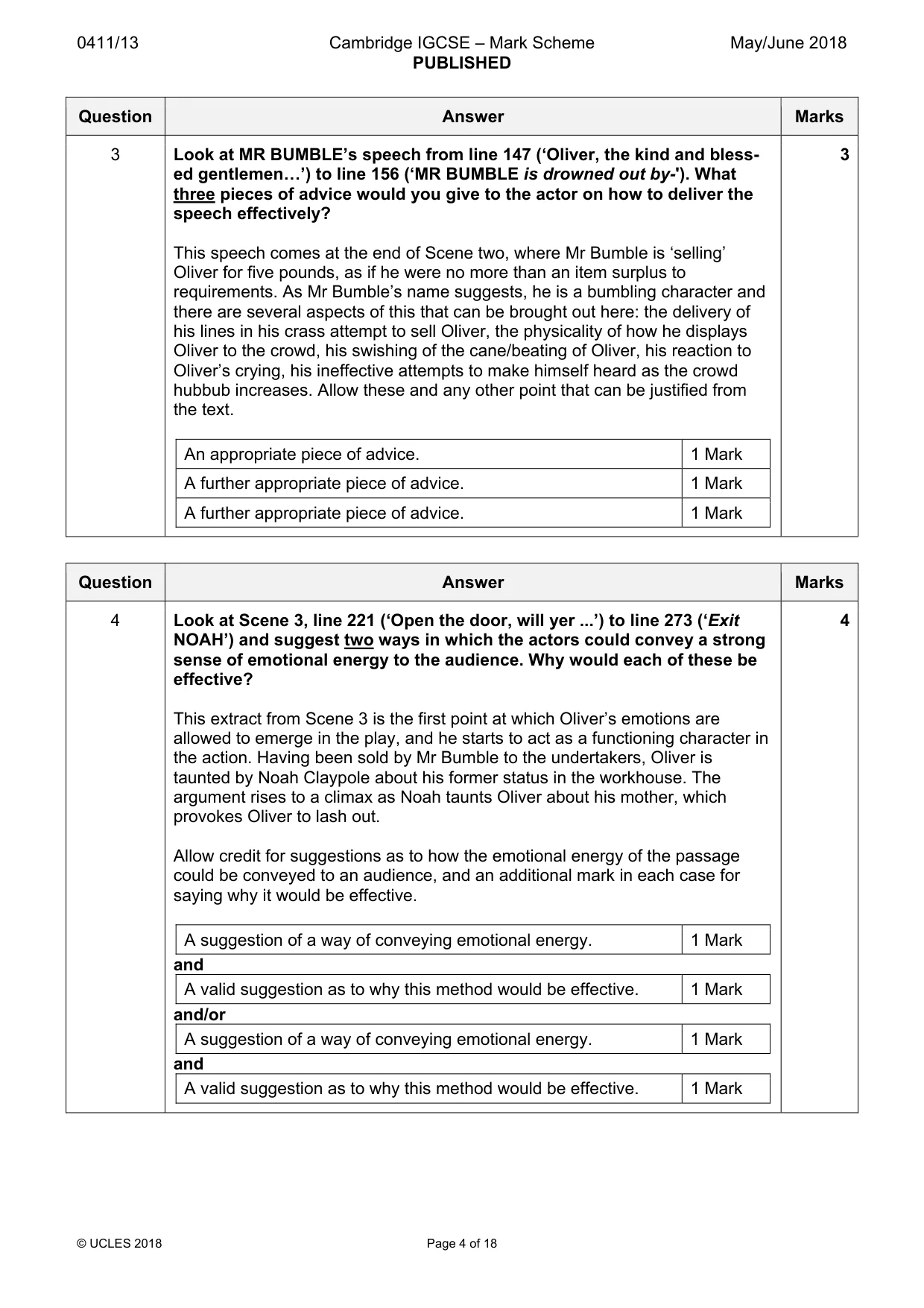
0411/13 Cambridge IGCSE – Mark Scheme PUBLISHED May/June 2018 © UCLES 2018 Page 4 of 18 Question Answer Marks 3 Look at MR BUMBLE’s speech from line 147 (‘Oliver, the kind and bless- ed gentlemen«’) to line 156 (‘MR BUMBLE is drowned out by-'). What three pieces of advice would you give to the actor on how to deliver the speech effectively? This speech comes at the end of Scene two, where Mr Bumble is ‘selling’ Oliver for five pounds, as if he were no more than an item surplus to requirements. As Mr Bumble’s name suggests, he is a bumbling character and there are several aspects of this that can be brought out here: the delivery of his lines in his crass attempt to sell Oliver, the physicality of how he displays Oliver to the crowd, his swishing of the cane/beating of Oliver, his reaction to Oliver’s crying, his ineffective attempts to make himself heard as the crowd hubbub increases. Allow these and any other point that can be justified from the text. An appropriate piece of advice. 1 Mark A further appropriate piece of advice. 1 Mark A further appropriate piece of advice. 1 Mark 3 Question Answer Marks 4 Look at Scene 3, line 221 (‘Open the door, will yer ...’) to line 273 (‘Exit NOAH’) and suggest two ways in which the actors could convey a strong sense of emotional energy to the audience. Why would each of these be effective? This extract from Scene 3 is the first point at which Oliver’s emotions are allowed to emerge in the play, and he starts to act as a functioning character in the action. Having been sold by Mr Bumble to the undertakers, Oliver is taunted by Noah Claypole about his former status in the workhouse. The argument rises to a climax as Noah taunts Oliver about his mother, which provokes Oliver to lash out. Allow credit for suggestions as to how the emotional energy of the passage could be conveyed to an audience, and an additional mark in each case for saying why it would be effective. A suggestion of a way of conveying emotional energy. 1 Mark and A valid suggestion as to why this method would be effective. 1 Mark and/or A suggestion of a way of conveying emotional energy. 1 Mark and A valid suggestion as to why this method would be effective. 1 Mark 4
Mark scheme, page 5
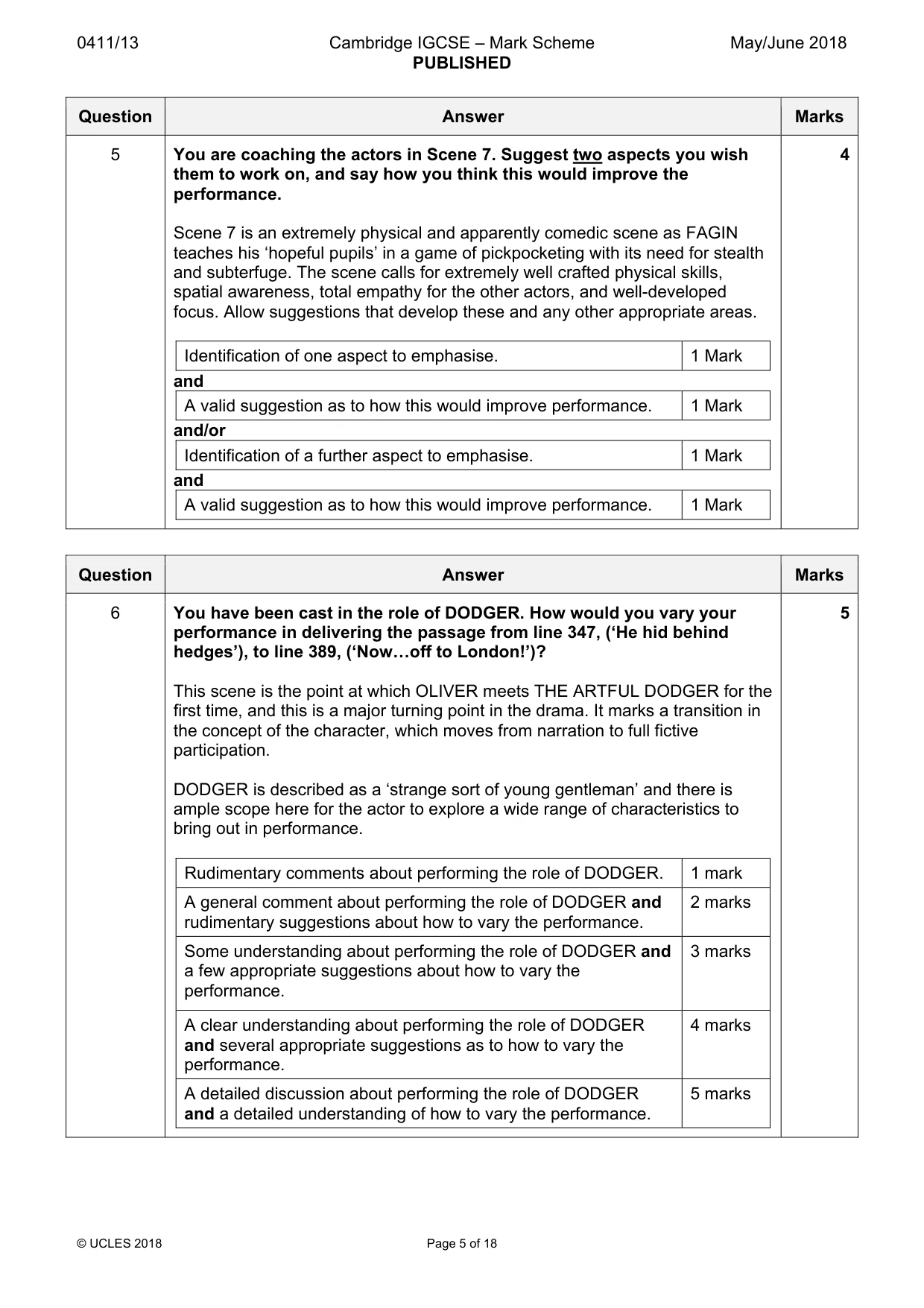
0411/13 Cambridge IGCSE – Mark Scheme PUBLISHED May/June 2018 © UCLES 2018 Page 5 of 18 Question Answer Marks 5 You are coaching the actors in Scene 7. Suggest two aspects you wish them to work on, and say how you think this would improve the performance. Scene 7 is an extremely physical and apparently comedic scene as FAGIN teaches his ‘hopeful pupils’ in a game of pickpocketing with its need for stealth and subterfuge. The scene calls for extremely well crafted physical skills, spatial awareness, total empathy for the other actors, and well-developed focus. Allow suggestions that develop these and any other appropriate areas. Identification of one aspect to emphasise. 1 Mark and A valid suggestion as to how this would improve performance. 1 Mark and/or Identification of a further aspect to emphasise. 1 Mark and A valid suggestion as to how this would improve performance. 1 Mark 4 Question Answer Marks 6 You have been cast in the role of DODGER. How would you vary your performance in delivering the passage from line 347, (‘He hid behind hedges’), to line 389, (‘Now«off to London!’)? This scene is the point at which OLIVER meets THE ARTFUL DODGER for the first time, and this is a major turning point in the drama. It marks a transition in the concept of the character, which moves from narration to full fictive participation. DODGER is described as a ‘strange sort of young gentleman’ and there is ample scope here for the actor to explore a wide range of characteristics to bring out in performance. Rudimentary comments about performing the role of DODGER. 1 mark A general comment about performing the role of DODGER and rudimentary suggestions about how to vary the performance. 2 marks Some understanding about performing the role of DODGER and a few appropriate suggestions about how to vary the performance. 3 marks A clear understanding about performing the role of DODGER and several appropriate suggestions as to how to vary the performance. 4 marks A detailed discussion about performing the role of DODGER and a detailed understanding of how to vary the performance. 5 marks 5
Mark scheme, page 6
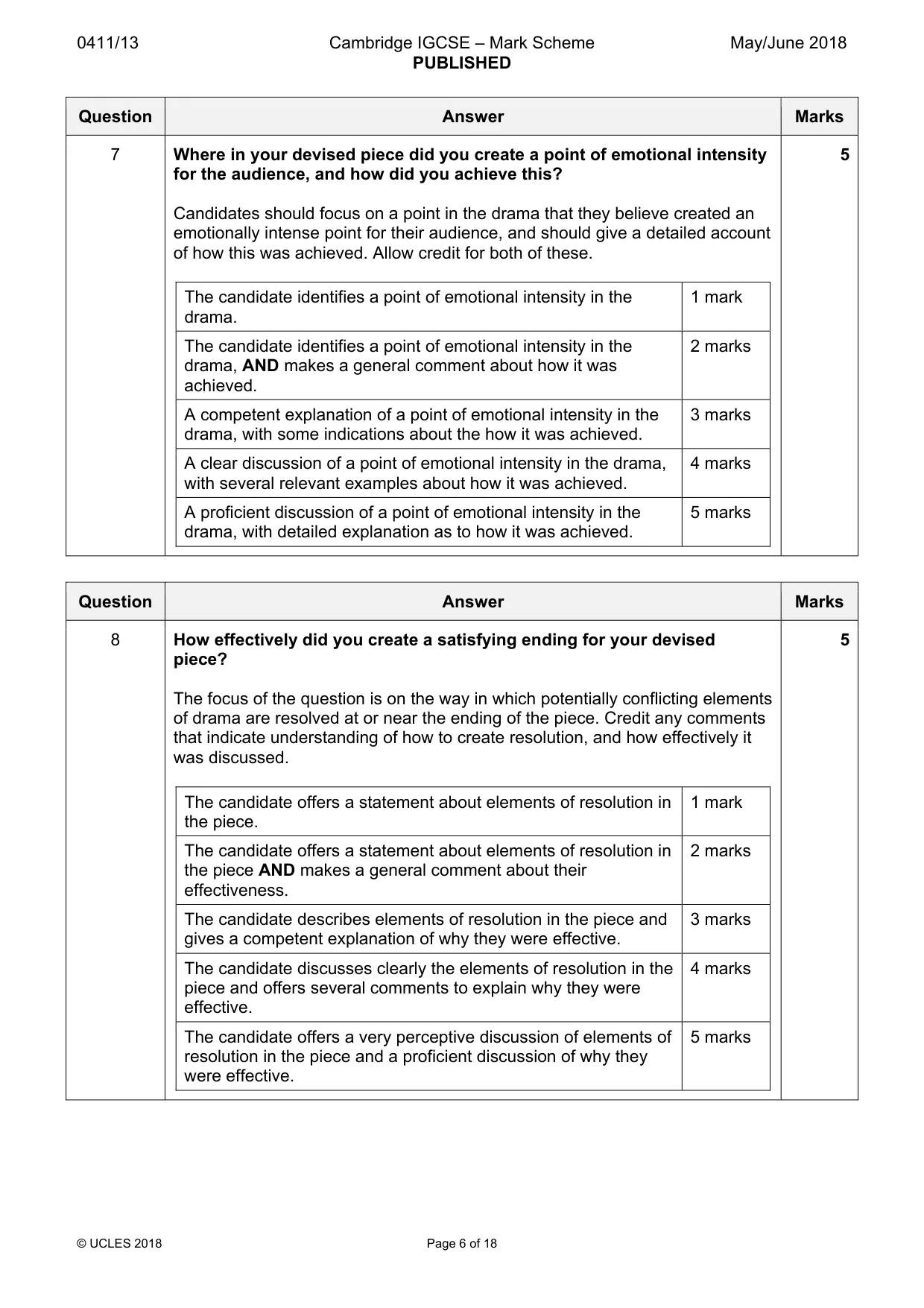
0411/13 Cambridge IGCSE – Mark Scheme PUBLISHED May/June 2018 © UCLES 2018 Page 6 of 18 Question Answer Marks 7 Where in your devised piece did you create a point of emotional intensity for the audience, and how did you achieve this? Candidates should focus on a point in the drama that they believe created an emotionally intense point for their audience, and should give a detailed account of how this was achieved. Allow credit for both of these. The candidate identifies a point of emotional intensity in the drama. 1 mark The candidate identifies a point of emotional intensity in the drama, AND makes a general comment about how it was achieved. 2 marks A competent explanation of a point of emotional intensity in the drama, with some indications about the how it was achieved. 3 marks A clear discussion of a point of emotional intensity in the drama, with several relevant examples about how it was achieved. 4 marks A proficient discussion of a point of emotional intensity in the drama, with detailed explanation as to how it was achieved. 5 marks 5 Question Answer Marks 8 How effectively did you create a satisfying ending for your devised piece? The focus of the question is on the way in which potentially conflicting elements of drama are resolved at or near the ending of the piece. Credit any comments that indicate understanding of how to create resolution, and how effectively it was discussed. The candidate offers a statement about elements of resolution in the piece. 1 mark The candidate offers a statement about elements of resolution in the piece AND makes a general comment about their effectiveness. 2 marks The candidate describes elements of resolution in the piece and gives a competent explanation of why they were effective. 3 marks The candidate discusses clearly the elements of resolution in the piece and offers several comments to explain why they were effective. 4 marks The candidate offers a very perceptive discussion of elements of resolution in the piece and a proficient discussion of why they were effective. 5 marks 5
Mark scheme, page 7
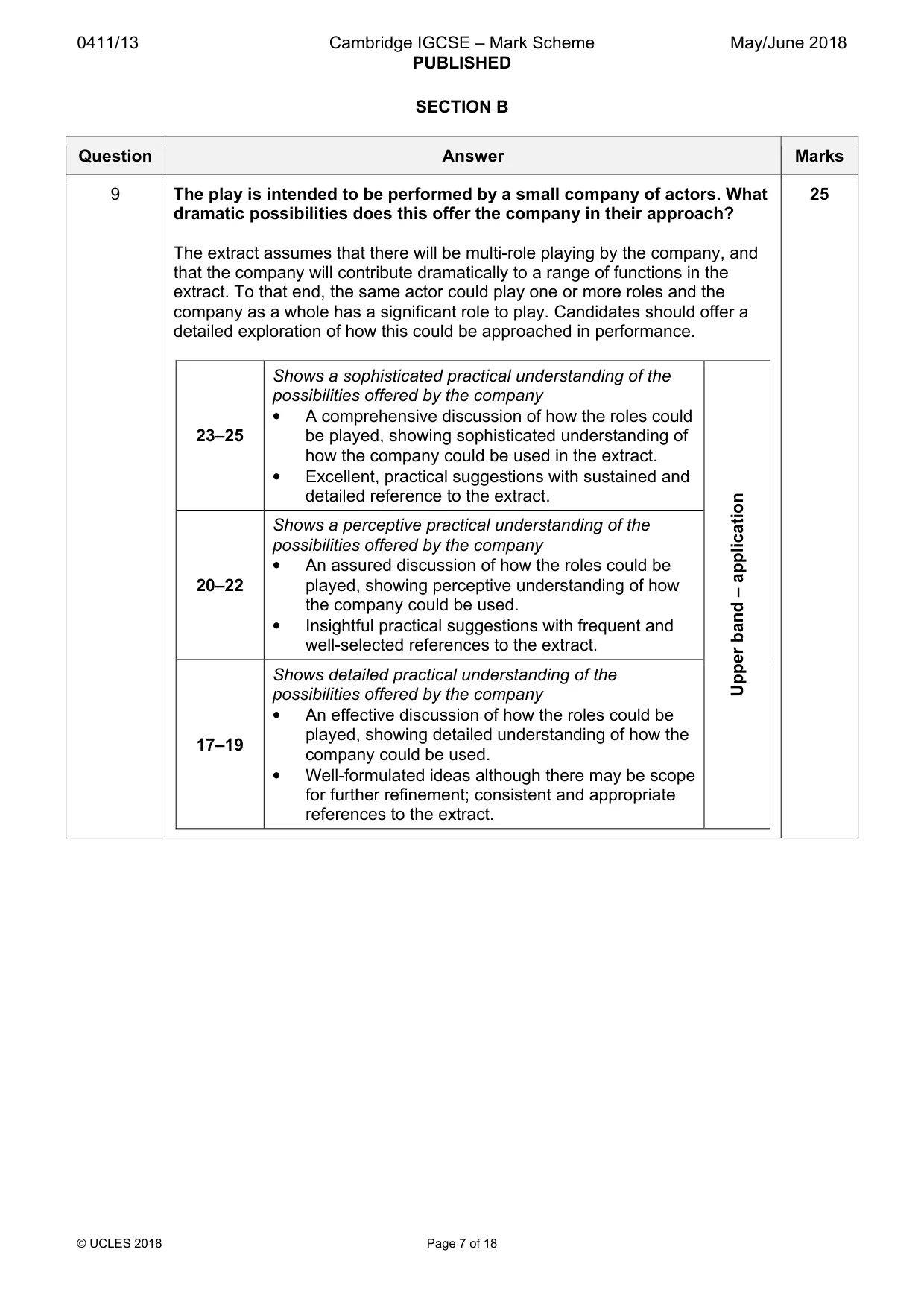
0411/13 Cambridge IGCSE – Mark Scheme PUBLISHED May/June 2018 © UCLES 2018 Page 7 of 18 SECTION B Question Answer Marks 9 The play is intended to be performed by a small company of actors. What dramatic possibilities does this offer the company in their approach? The extract assumes that there will be multi-role playing by the company, and that the company will contribute dramatically to a range of functions in the extract. To that end, the same actor could play one or more roles and the company as a whole has a significant role to play. Candidates should offer a detailed exploration of how this could be approached in performance. 23–25 Shows a sophisticated practical understanding of the possibilities offered by the company • A comprehensive discussion of how the roles could be played, showing sophisticated understanding of how the company could be used in the extract. • Excellent, practical suggestions with sustained and detailed reference to the extract. Upper band – application 20–22 Shows a perceptive practical understanding of the possibilities offered by the company • An assured discussion of how the roles could be played, showing perceptive understanding of how the company could be used. • Insightful practical suggestions with frequent and well-selected references to the extract. 17–19 Shows detailed practical understanding of the possibilities offered by the company • An effective discussion of how the roles could be played, showing detailed understanding of how the company could be used. • Well-formulated ideas although there may be scope for further refinement; consistent and appropriate references to the extract. 25
Mark scheme, page 8
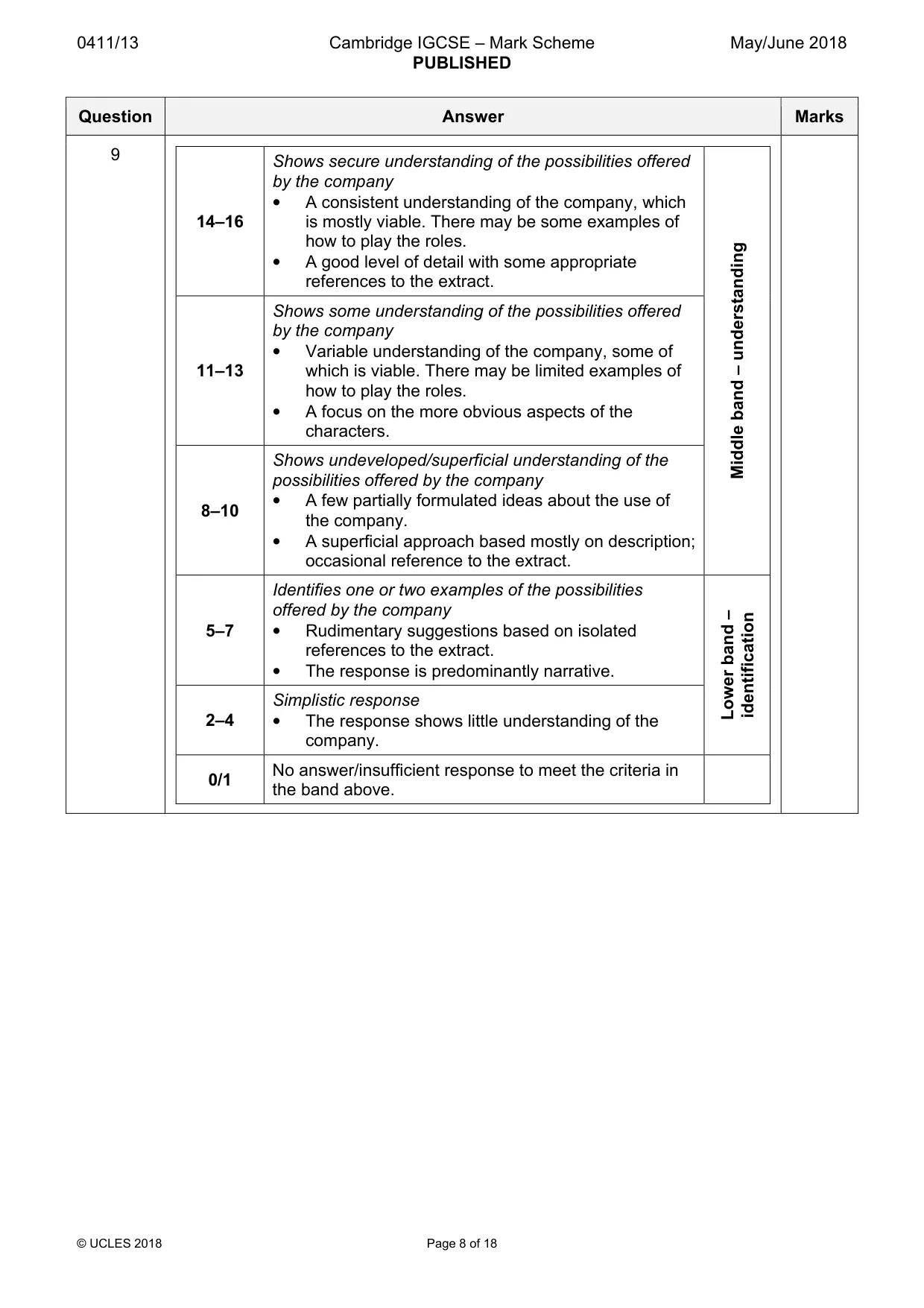
0411/13 Cambridge IGCSE – Mark Scheme PUBLISHED May/June 2018 © UCLES 2018 Page 8 of 18 Question Answer Marks 9 14–16 Shows secure understanding of the possibilities offered by the company • A consistent understanding of the company, which is mostly viable. There may be some examples of how to play the roles. • A good level of detail with some appropriate references to the extract. Middle band – understanding 11–13 Shows some understanding of the possibilities offered by the company • Variable understanding of the company, some of which is viable. There may be limited examples of how to play the roles. • A focus on the more obvious aspects of the characters. 8–10 Shows undeveloped/superficial understanding of the possibilities offered by the company • A few partially formulated ideas about the use of the company. • A superficial approach based mostly on description; occasional reference to the extract. 5–7 Identifies one or two examples of the possibilities offered by the company • Rudimentary suggestions based on isolated references to the extract. • The response is predominantly narrative. Lower band – identification 2–4 Simplistic response • The response shows little understanding of the company. 0/1 No answer/insufficient response to meet the criteria in the band above.
Mark scheme, page 9
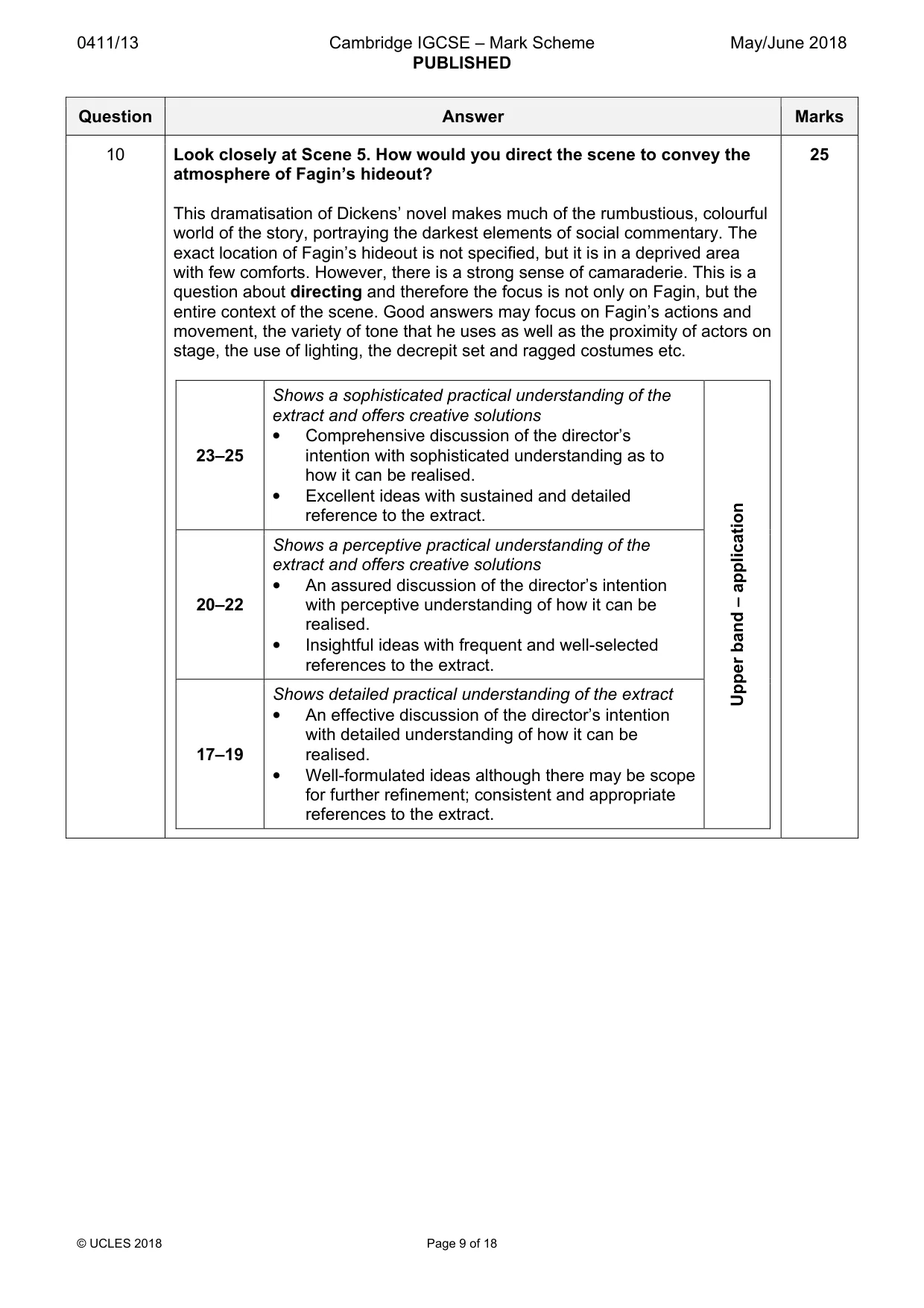
0411/13 Cambridge IGCSE – Mark Scheme PUBLISHED May/June 2018 © UCLES 2018 Page 9 of 18 Question Answer Marks 10 Look closely at Scene 5. How would you direct the scene to convey the atmosphere of Fagin’s hideout? This dramatisation of Dickens’ novel makes much of the rumbustious, colourful world of the story, portraying the darkest elements of social commentary. The exact location of Fagin’s hideout is not specified, but it is in a deprived area with few comforts. However, there is a strong sense of camaraderie. This is a question about directing and therefore the focus is not only on Fagin, but the entire context of the scene. Good answers may focus on Fagin’s actions and movement, the variety of tone that he uses as well as the proximity of actors on stage, the use of lighting, the decrepit set and ragged costumes etc. 23–25 Shows a sophisticated practical understanding of the extract and offers creative solutions • Comprehensive discussion of the director’s intention with sophisticated understanding as to how it can be realised. • Excellent ideas with sustained and detailed reference to the extract. Upper band – application 20–22 Shows a perceptive practical understanding of the extract and offers creative solutions • An assured discussion of the director’s intention with perceptive understanding of how it can be realised. • Insightful ideas with frequent and well-selected references to the extract. 17–19 Shows detailed practical understanding of the extract • An effective discussion of the director’s intention with detailed understanding of how it can be realised. • Well-formulated ideas although there may be scope for further refinement; consistent and appropriate references to the extract. 25
Mark scheme, page 10
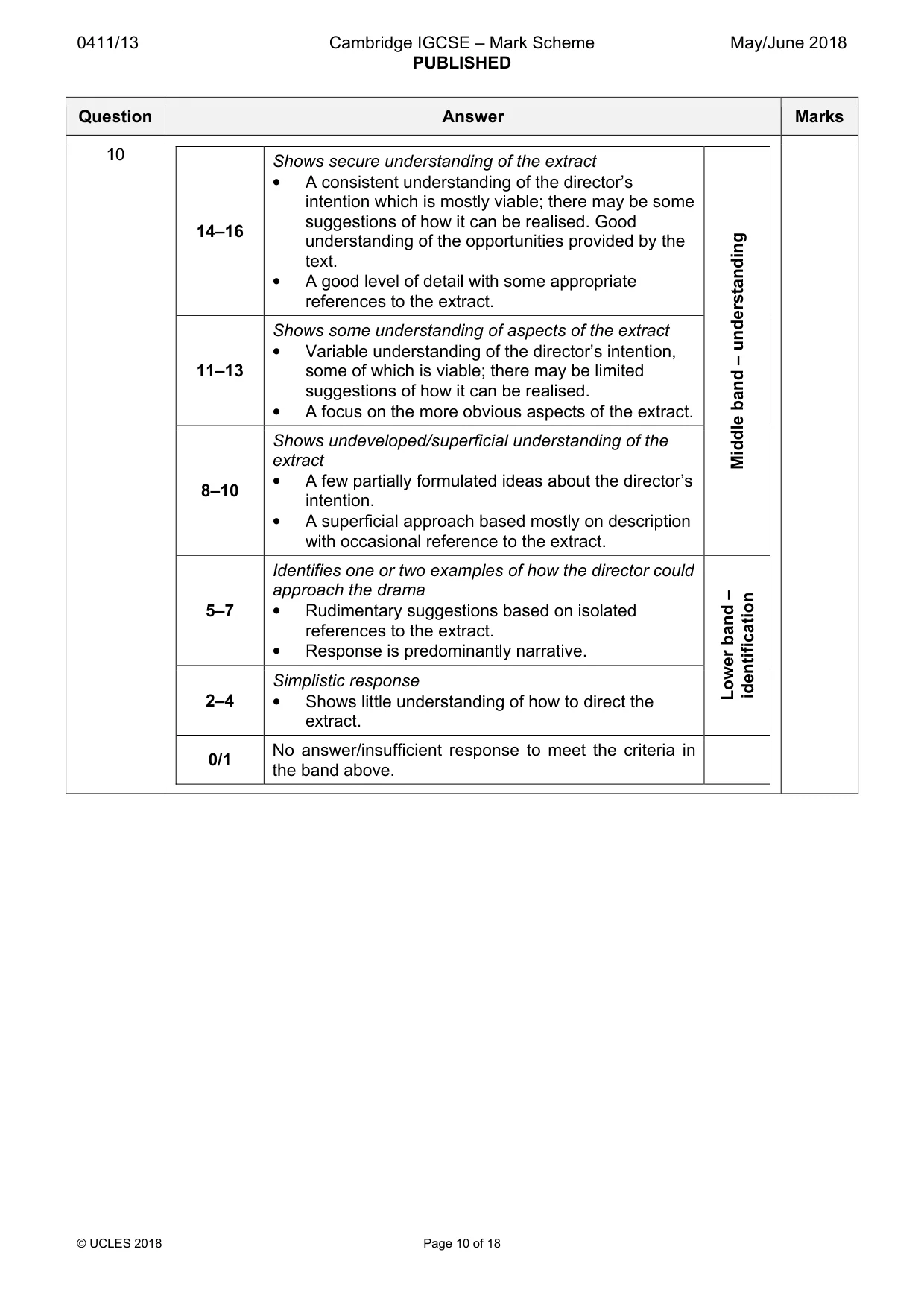
0411/13 Cambridge IGCSE – Mark Scheme PUBLISHED May/June 2018 © UCLES 2018 Page 10 of 18 Question Answer Marks 10 14–16 Shows secure understanding of the extract • A consistent understanding of the director’s intention which is mostly viable; there may be some suggestions of how it can be realised. Good understanding of the opportunities provided by the text. • A good level of detail with some appropriate references to the extract. Middle band – understanding 11–13 Shows some understanding of aspects of the extract • Variable understanding of the director’s intention, some of which is viable; there may be limited suggestions of how it can be realised. • A focus on the more obvious aspects of the extract. 8–10 Shows undeveloped/superficial understanding of the extract • A few partially formulated ideas about the director’s intention. • A superficial approach based mostly on description with occasional reference to the extract. 5–7 Identifies one or two examples of how the director could approach the drama • Rudimentary suggestions based on isolated references to the extract. • Response is predominantly narrative. Lower band – identification 2–4 Simplistic response • Shows little understanding of how to direct the extract. 0/1 No answer/insufficient response to meet the criteria in the band above.
Mark scheme, page 11
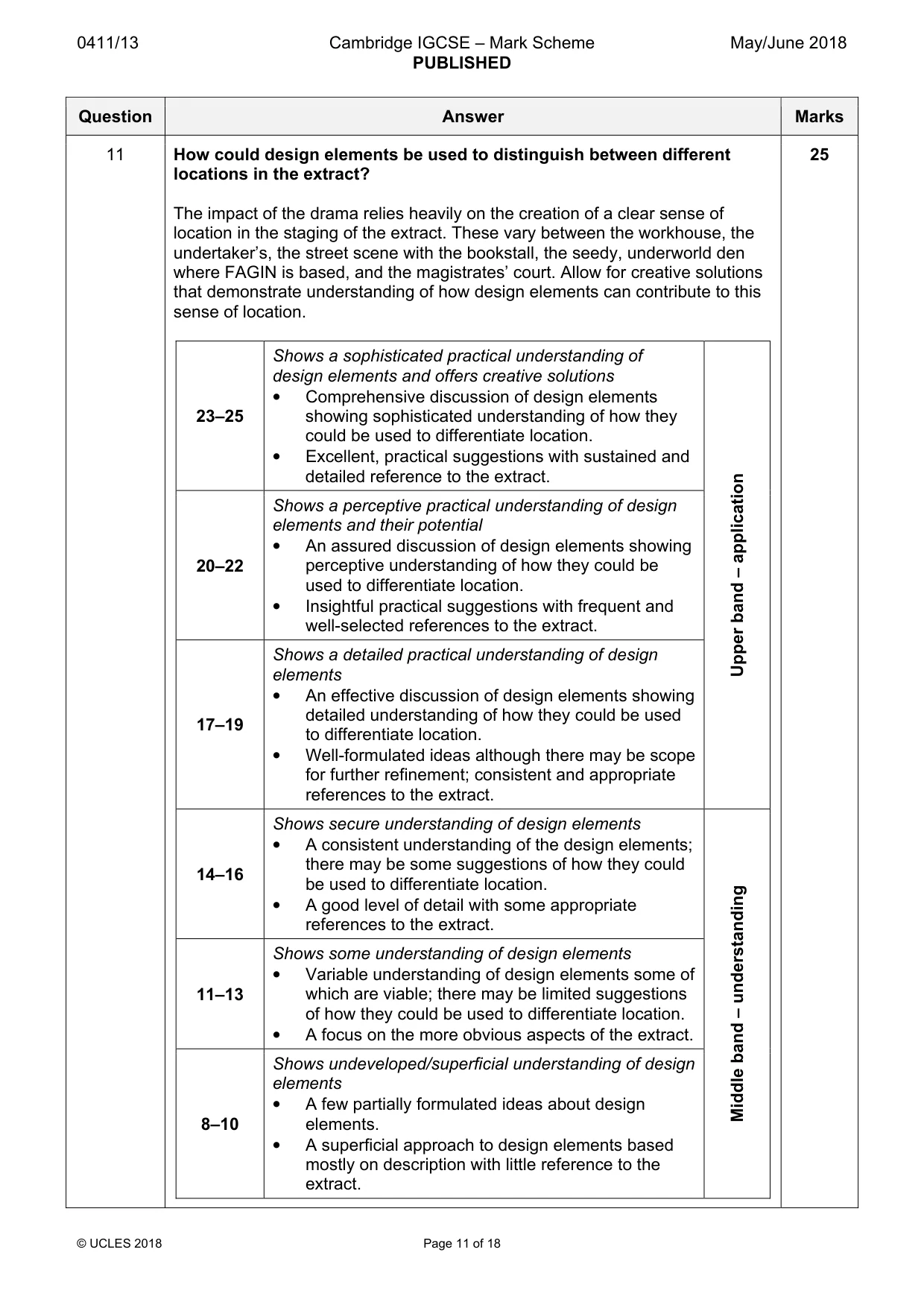
0411/13 Cambridge IGCSE – Mark Scheme PUBLISHED May/June 2018 © UCLES 2018 Page 11 of 18 Question Answer Marks 11 How could design elements be used to distinguish between different locations in the extract? The impact of the drama relies heavily on the creation of a clear sense of location in the staging of the extract. These vary between the workhouse, the undertaker’s, the street scene with the bookstall, the seedy, underworld den where FAGIN is based, and the magistrates’ court. Allow for creative solutions that demonstrate understanding of how design elements can contribute to this sense of location. 23–25 Shows a sophisticated practical understanding of design elements and offers creative solutions • Comprehensive discussion of design elements showing sophisticated understanding of how they could be used to differentiate location. • Excellent, practical suggestions with sustained and detailed reference to the extract. Upper band – application 20–22 Shows a perceptive practical understanding of design elements and their potential • An assured discussion of design elements showing perceptive understanding of how they could be used to differentiate location. • Insightful practical suggestions with frequent and well-selected references to the extract. 17–19 Shows a detailed practical understanding of design elements • An effective discussion of design elements showing detailed understanding of how they could be used to differentiate location. • Well-formulated ideas although there may be scope for further refinement; consistent and appropriate references to the extract. 14–16 Shows secure understanding of design elements • A consistent understanding of the design elements; there may be some suggestions of how they could be used to differentiate location. • A good level of detail with some appropriate references to the extract. Middle band – understanding 11–13 Shows some understanding of design elements • Variable understanding of design elements some of which are viable; there may be limited suggestions of how they could be used to differentiate location. • A focus on the more obvious aspects of the extract. 8–10 Shows undeveloped/superficial understanding of design elements • A few partially formulated ideas about design elements. • A superficial approach to design elements based mostly on description with little reference to the extract. 25
Mark scheme, page 12
0411/13 Cambridge IGCSE – Mark Scheme PUBLISHED May/June 2018 © UCLES 2018 Page 12 of 18 Question Answer Marks 11 5–7 Identifies one or two examples of design elements • Rudimentary suggestions based on isolated references to the extract. • Response is predominantly narrative. Lower band – identification 2–4 Simplistic response • Shows little understanding of design elements. • Response may be typified by a sketch only with no supporting detail. 0/1 No answer/insufficient response to meet the criteria in the band above.
Mark scheme, page 13
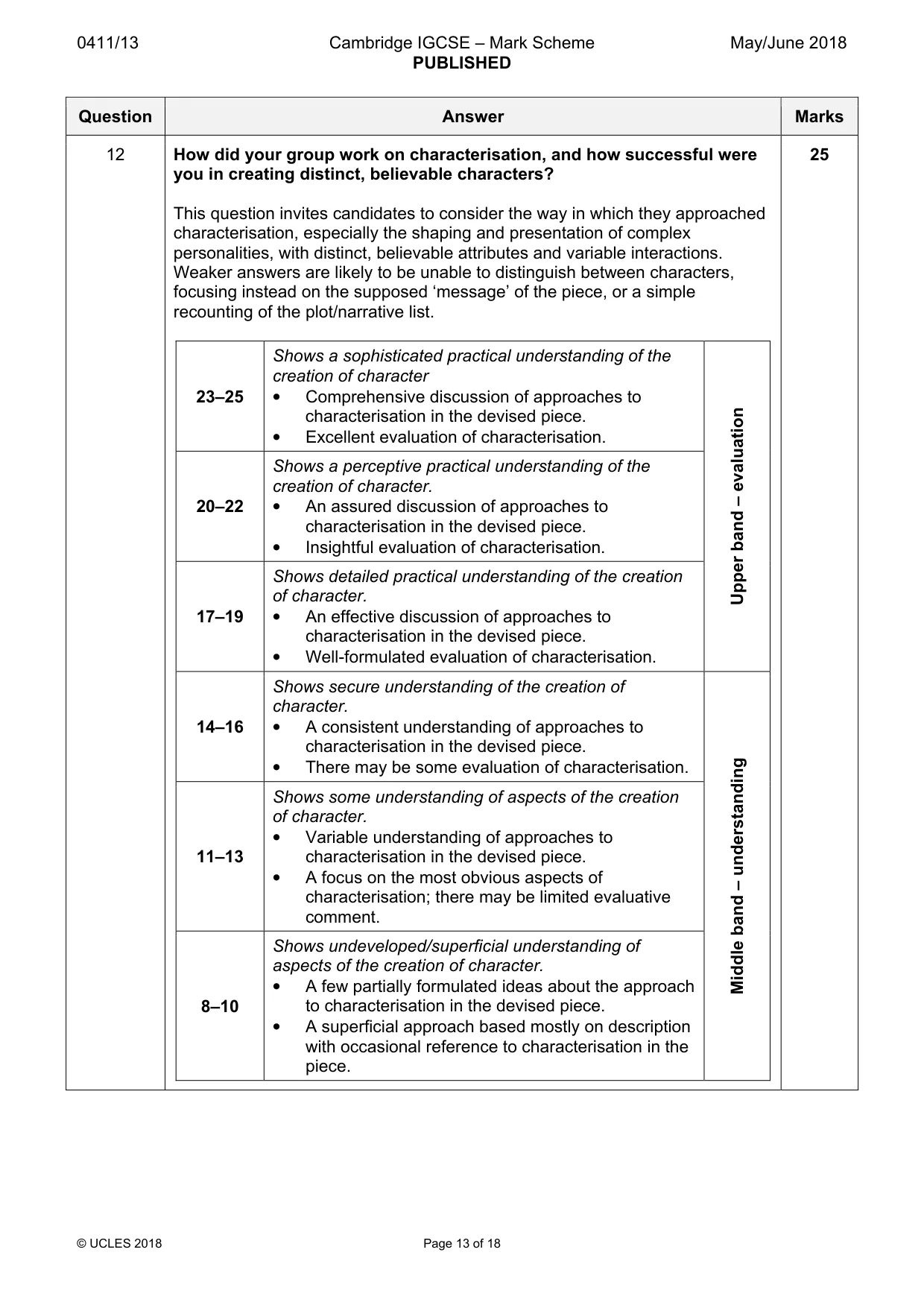
0411/13 Cambridge IGCSE – Mark Scheme PUBLISHED May/June 2018 © UCLES 2018 Page 13 of 18 Question Answer Marks 12 How did your group work on characterisation, and how successful were you in creating distinct, believable characters? This question invites candidates to consider the way in which they approached characterisation, especially the shaping and presentation of complex personalities, with distinct, believable attributes and variable interactions. Weaker answers are likely to be unable to distinguish between characters, focusing instead on the supposed ‘message’ of the piece, or a simple recounting of the plot/narrative list. 23–25 Shows a sophisticated practical understanding of the creation of character • Comprehensive discussion of approaches to characterisation in the devised piece. • Excellent evaluation of characterisation. Upper band – evaluation 20–22 Shows a perceptive practical understanding of the creation of character. • An assured discussion of approaches to characterisation in the devised piece. • Insightful evaluation of characterisation. 17–19 Shows detailed practical understanding of the creation of character. • An effective discussion of approaches to characterisation in the devised piece. • Well-formulated evaluation of characterisation. 14–16 Shows secure understanding of the creation of character. • A consistent understanding of approaches to characterisation in the devised piece. • There may be some evaluation of characterisation. Middle band – understanding 11–13 Shows some understanding of aspects of the creation of character. • Variable understanding of approaches to characterisation in the devised piece. • A focus on the most obvious aspects of characterisation; there may be limited evaluative comment. 8–10 Shows undeveloped/superficial understanding of aspects of the creation of character. • A few partially formulated ideas about the approach to characterisation in the devised piece. • A superficial approach based mostly on description with occasional reference to characterisation in the piece. 25
Mark scheme, page 14
0411/13 Cambridge IGCSE – Mark Scheme PUBLISHED May/June 2018 © UCLES 2018 Page 14 of 18 Question Answer Marks 12 5–7 Identifies one or two examples from the devised piece • Rudimentary suggestions based on isolated references to the piece. • Response is predominantly narrative. Lower band – identification 2–4 Simplistic response • Shows little understanding of characterisation. 0/1 No answer/insufficient response to meet the criteria in the band above.
Mark scheme, page 15
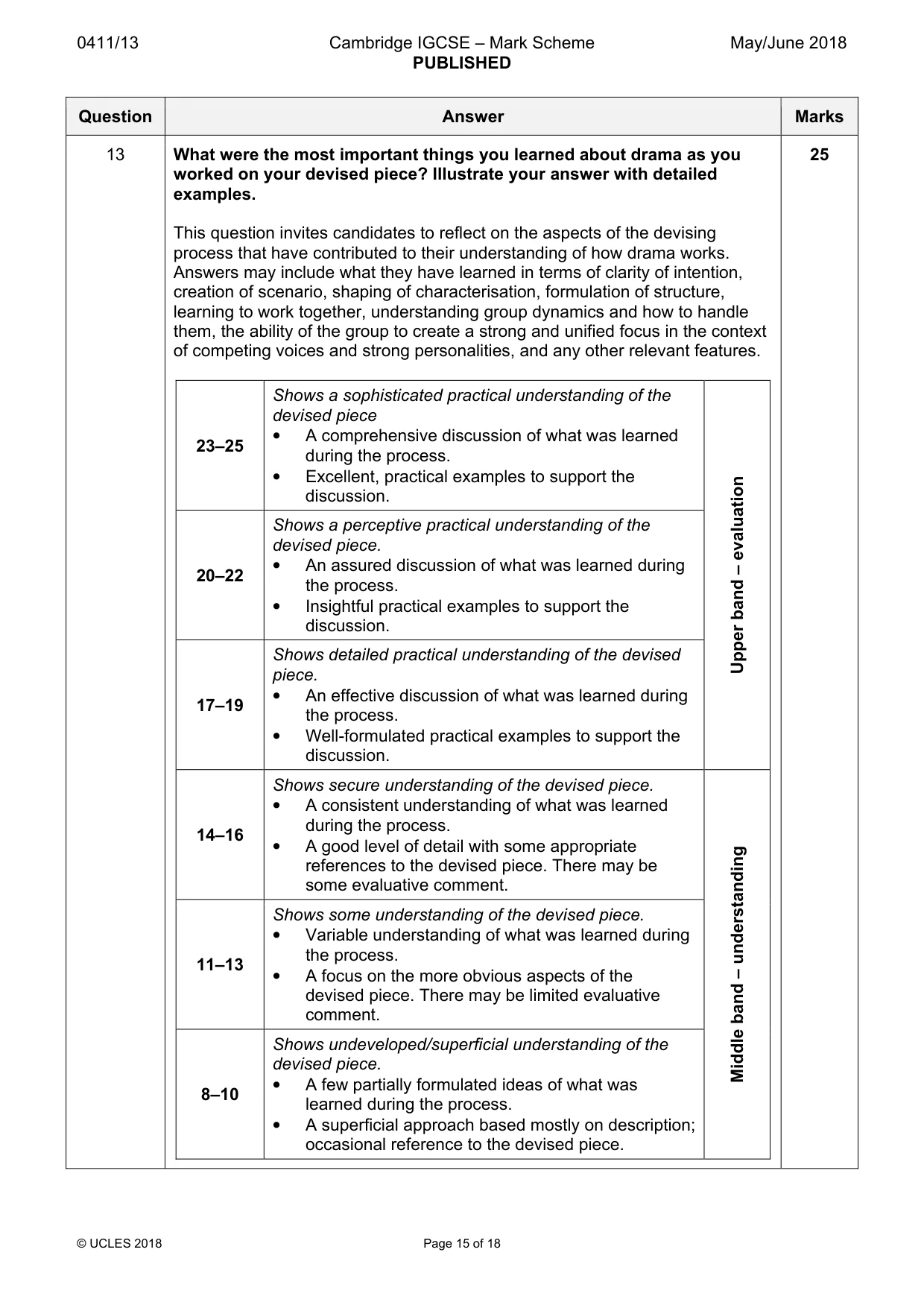
0411/13 Cambridge IGCSE – Mark Scheme PUBLISHED May/June 2018 © UCLES 2018 Page 15 of 18 Question Answer Marks 13 What were the most important things you learned about drama as you worked on your devised piece? Illustrate your answer with detailed examples. This question invites candidates to reflect on the aspects of the devising process that have contributed to their understanding of how drama works. Answers may include what they have learned in terms of clarity of intention, creation of scenario, shaping of characterisation, formulation of structure, learning to work together, understanding group dynamics and how to handle them, the ability of the group to create a strong and unified focus in the context of competing voices and strong personalities, and any other relevant features. 23–25 Shows a sophisticated practical understanding of the devised piece • A comprehensive discussion of what was learned during the process. • Excellent, practical examples to support the discussion. Upper band – evaluation 20–22 Shows a perceptive practical understanding of the devised piece. • An assured discussion of what was learned during the process. • Insightful practical examples to support the discussion. 17–19 Shows detailed practical understanding of the devised piece. • An effective discussion of what was learned during the process. • Well-formulated practical examples to support the discussion. 14–16 Shows secure understanding of the devised piece. • A consistent understanding of what was learned during the process. • A good level of detail with some appropriate references to the devised piece. There may be some evaluative comment. Middle band – understanding 11–13 Shows some understanding of the devised piece. • Variable understanding of what was learned during the process. • A focus on the more obvious aspects of the devised piece. There may be limited evaluative comment. 8–10 Shows undeveloped/superficial understanding of the devised piece. • A few partially formulated ideas of what was learned during the process. • A superficial approach based mostly on description; occasional reference to the devised piece. 25
Mark scheme, page 16
0411/13 Cambridge IGCSE – Mark Scheme PUBLISHED May/June 2018 © UCLES 2018 Page 16 of 18 Question Answer Marks 13 5–7 Identifies one or two examples of the devised piece • Rudimentary suggestions based on isolated references to the devised piece. • Response is predominantly narrative. Lower band – identification 2–4 Simplistic response • Shows little understanding of the devising process. 0/1 No answer/insufficient response to meet the criteria in the band above.
Mark scheme, page 17
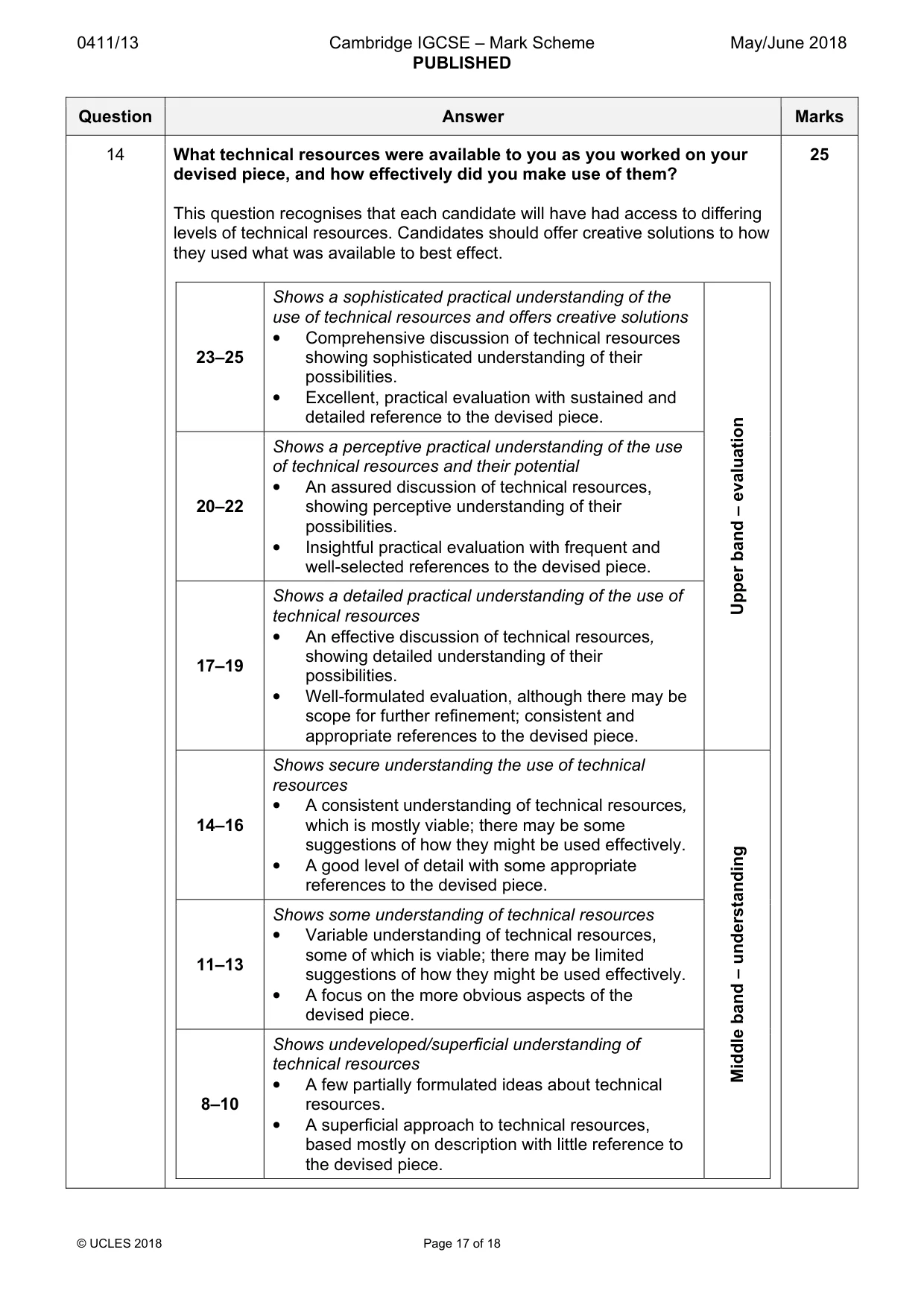
0411/13 Cambridge IGCSE – Mark Scheme PUBLISHED May/June 2018 © UCLES 2018 Page 17 of 18 Question Answer Marks 14 What technical resources were available to you as you worked on your devised piece, and how effectively did you make use of them? This question recognises that each candidate will have had access to differing levels of technical resources. Candidates should offer creative solutions to how they used what was available to best effect. 23–25 Shows a sophisticated practical understanding of the use of technical resources and offers creative solutions • Comprehensive discussion of technical resources showing sophisticated understanding of their possibilities. • Excellent, practical evaluation with sustained and detailed reference to the devised piece. Upper band – evaluation 20–22 Shows a perceptive practical understanding of the use of technical resources and their potential • An assured discussion of technical resources, showing perceptive understanding of their possibilities. • Insightful practical evaluation with frequent and well-selected references to the devised piece. 17–19 Shows a detailed practical understanding of the use of technical resources • An effective discussion of technical resources, showing detailed understanding of their possibilities. • Well-formulated evaluation, although there may be scope for further refinement; consistent and appropriate references to the devised piece. 14–16 Shows secure understanding the use of technical resources • A consistent understanding of technical resources, which is mostly viable; there may be some suggestions of how they might be used effectively. • A good level of detail with some appropriate references to the devised piece. Middle band – understanding 11–13 Shows some understanding of technical resources • Variable understanding of technical resources, some of which is viable; there may be limited suggestions of how they might be used effectively. • A focus on the more obvious aspects of the devised piece. 8–10 Shows undeveloped/superficial understanding of technical resources • A few partially formulated ideas about technical resources. • A superficial approach to technical resources, based mostly on description with little reference to the devised piece. 25
Mark scheme, page 18
0411/13 Cambridge IGCSE – Mark Scheme PUBLISHED May/June 2018 © UCLES 2018 Page 18 of 18 Question Answer Marks 14 5–7 Identifies one or two examples of technical resources • Rudimentary suggestions based on isolated references to the devised piece. • Response is predominantly narrative. Lower band – identification 2–4 Simplistic response • Shows little understanding of technical resources. • Response may be typified by a sketch only with no supporting detail. 0/1 No answer/insufficient response to meet the criteria in the band above.
What you needed in this session
Cambridge’s own grade thresholds for 2018 May/June, Paper 1 · Variant 3. A higher threshold means an easier paper — the bar moves with how the cohort did.