Cambridge IGCSE Drama 0411 — 2018 May/June Paper 1 · Variant 1
0411/11/M/J/18 · 80 marks · ≈90 min
The question paper and its mark scheme, free to read here and free to download. This is Cambridge’s own paper, exactly as it was sat.
Question paper4 pages

Mark scheme15 pages
Answers below. Sit the paper first if you are practising.
Paper as text
Question paper, page 1
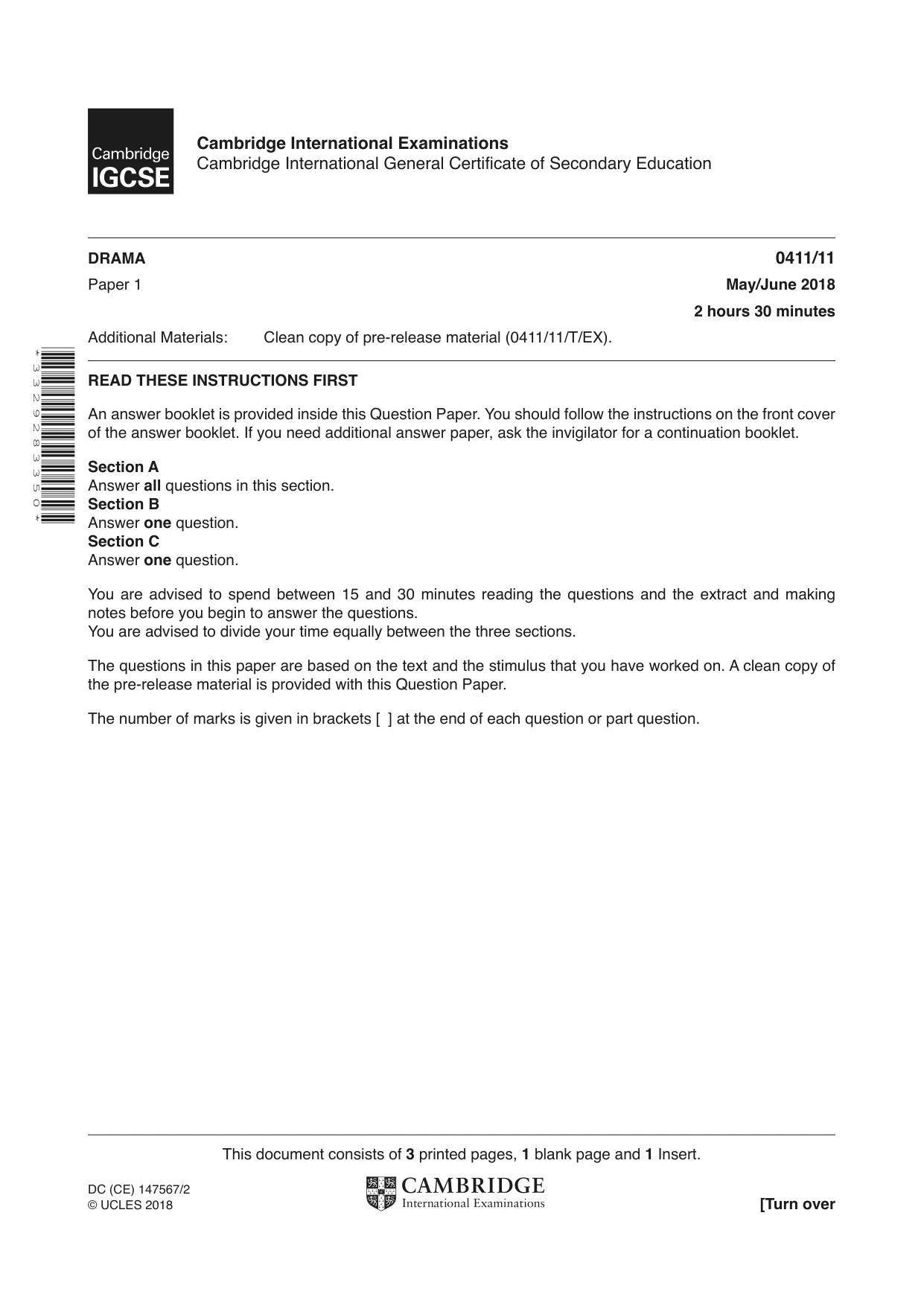
* 3 3 2 9 2 8 3 3 5 0 * This document consists of 3 printed pages, 1 blank page and 1 Insert. DC (CE) 147567/2 © UCLES 2018 [Turn over Cambridge International Examinations Cambridge International General Certificate of Secondary Education DRAMA 0411/11 Paper 1 May/June 2018 2 hours 30 minutes Additional Materials: Clean copy of pre-release material (0411/11/T/EX). READ THESE INSTRUCTIONS FIRST An answer booklet is provided inside this Question Paper. You should follow the instructions on the front cover of the answer booklet. If you need additional answer paper, ask the invigilator for a continuation booklet. Section A Answer all questions in this section. Section B Answer one question. Section C Answer one question. You are advised to spend between 15 and 30 minutes reading the questions and the extract and making notes before you begin to answer the questions. You are advised to divide your time equally between the three sections. The questions in this paper are based on the text and the stimulus that you have worked on. A clean copy of the pre-release material is provided with this Question Paper. The number of marks is given in brackets [ ] at the end of each question or part question.
Question paper, page 2
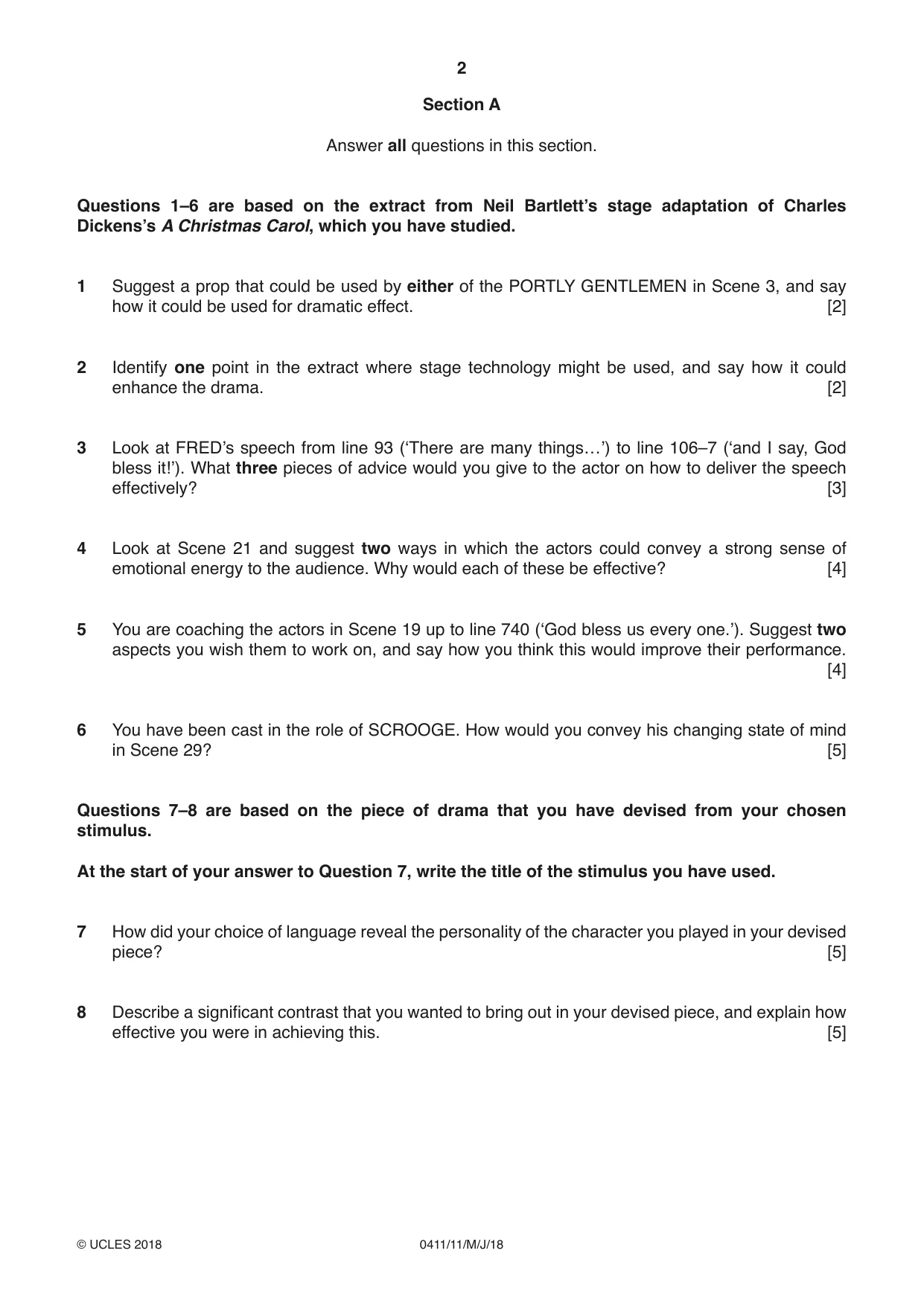
2 0411/11/M/J/18 © UCLES 2018 Section A Answer all questions in this section. Questions 1–6 are based on the extract from Neil Bartlett’s stage adaptation of Charles Dickens’s A Christmas Carol, which you have studied. 1 Suggest a prop that could be used by either of the PORTLY GENTLEMEN in Scene 3, and say how it could be used for dramatic effect. [2] 2 Identify one point in the extract where stage technology might be used, and say how it could enhance the drama. [2] 3 Look at FRED’s speech from line 93 (‘There are many things…’) to line 106–7 (‘and I say, God bless it!’). What three pieces of advice would you give to the actor on how to deliver the speech effectively? [3] 4 Look at Scene 21 and suggest two ways in which the actors could convey a strong sense of emotional energy to the audience. Why would each of these be effective? [4] 5 You are coaching the actors in Scene 19 up to line 740 (‘God bless us every one.’). Suggest two aspects you wish them to work on, and say how you think this would improve their performance. [4] 6 You have been cast in the role of SCROOGE. How would you convey his changing state of mind in Scene 29? [5] Questions 7–8 are based on the piece of drama that you have devised from your chosen stimulus. At the start of your answer to Question 7, write the title of the stimulus you have used. 7 How did your choice of language reveal the personality of the character you played in your devised piece? [5] 8 Describe a significant contrast that you wanted to bring out in your devised piece, and explain how effective you were in achieving this. [5]
Question paper, page 3
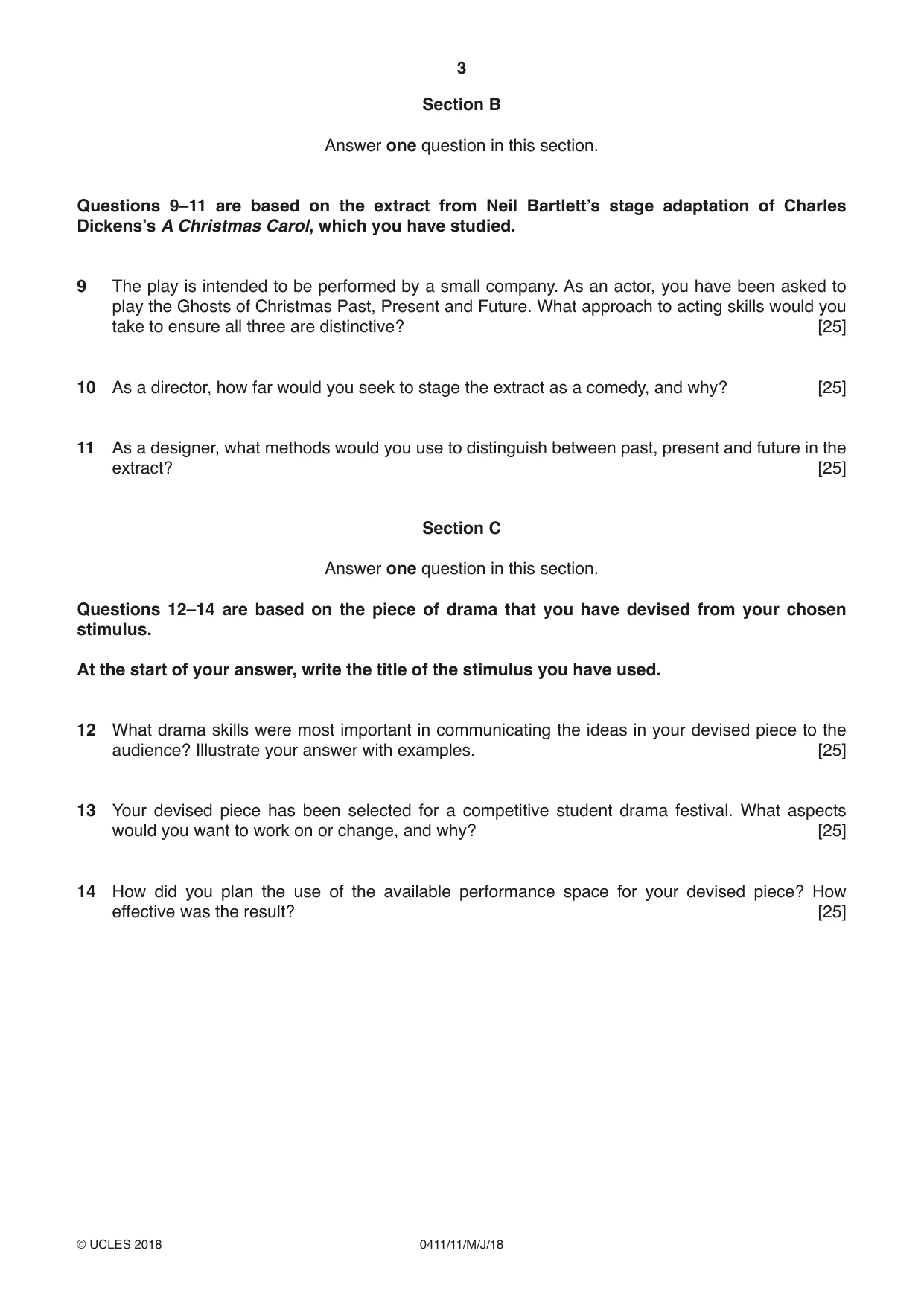
3 0411/11/M/J/18 © UCLES 2018 Section B Answer one question in this section. Questions 9–11 are based on the extract from Neil Bartlett’s stage adaptation of Charles Dickens’s A Christmas Carol, which you have studied. 9 The play is intended to be performed by a small company. As an actor, you have been asked to play the Ghosts of Christmas Past, Present and Future. What approach to acting skills would you take to ensure all three are distinctive? [25] 10 As a director, how far would you seek to stage the extract as a comedy, and why? [25] 11 As a designer, what methods would you use to distinguish between past, present and future in the extract? [25] Section C Answer one question in this section. Questions 12–14 are based on the piece of drama that you have devised from your chosen stimulus. At the start of your answer, write the title of the stimulus you have used. 12 What drama skills were most important in communicating the ideas in your devised piece to the audience? Illustrate your answer with examples. [25] 13 Your devised piece has been selected for a competitive student drama festival. What aspects would you want to work on or change, and why? [25] 14 How did you plan the use of the available performance space for your devised piece? How effective was the result? [25]
Question paper, page 4
4 0411/11/M/J/18 © UCLES 2018 Permission to reproduce items where third-party owned material protected by copyright is included has been sought and cleared where possible. Every reasonable effort has been made by the publisher (UCLES) to trace copyright holders, but if any items requiring clearance have unwittingly been included, the publisher will be pleased to make amends at the earliest possible opportunity. To avoid the issue of disclosure of answer-related information to candidates, all copyright acknowledgements are reproduced online in the Cambridge International Examinations Copyright Acknowledgements Booklet. This is produced for each series of examinations and is freely available to download at www.cie.org.uk after the live examination series. Cambridge International Examinations is part of the Cambridge Assessment Group. Cambridge Assessment is the brand name of University of Cambridge Local Examinations Syndicate (UCLES), which is itself a department of the University of Cambridge. BLANK PAGE
Mark scheme, page 1
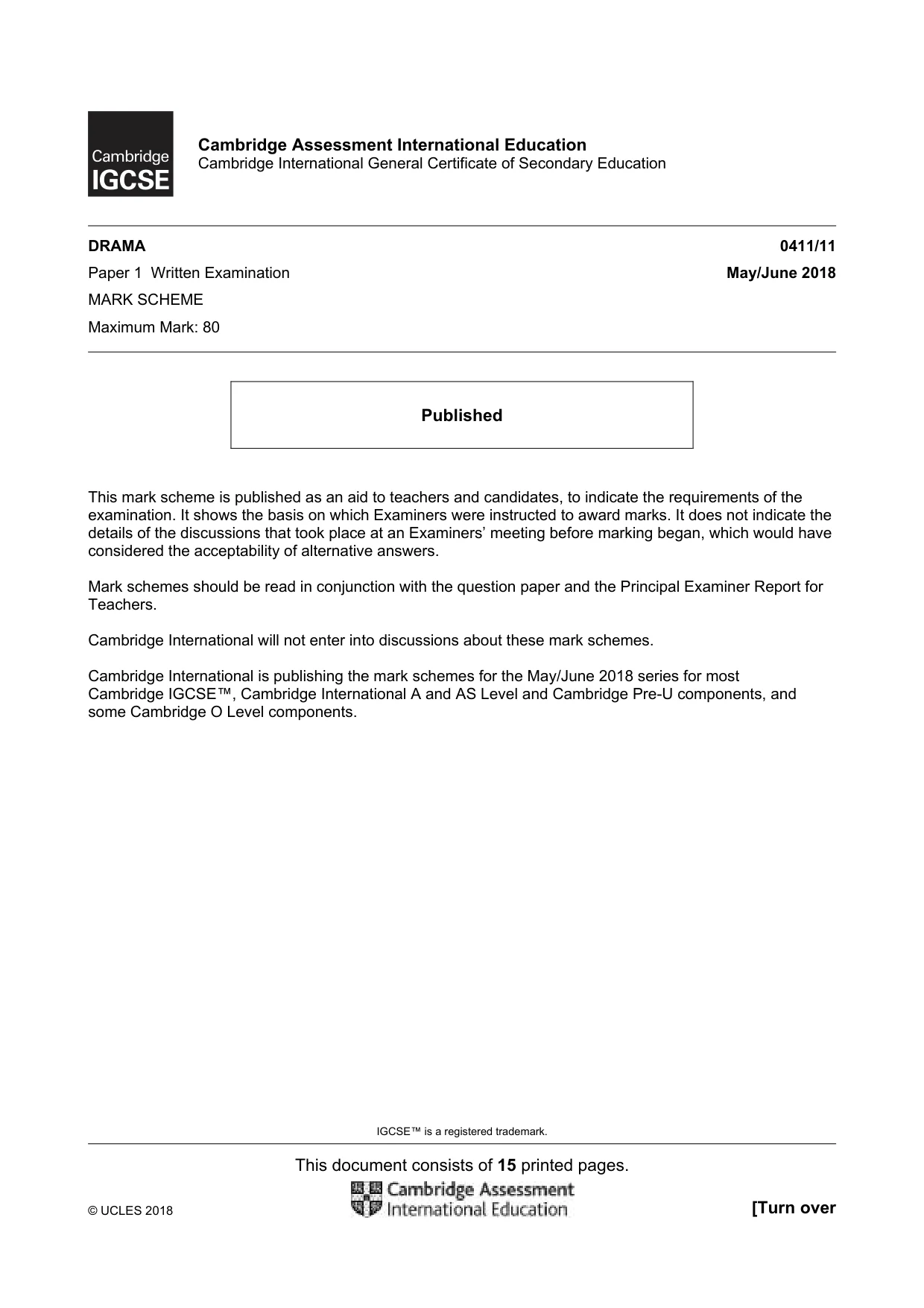
IGCSE™ is a registered trademark. This document consists of 15 printed pages. © UCLES 2018 [Turn over Cambridge Assessment International Education Cambridge International General Certificate of Secondary Education DRAMA 0411/11 Paper 1 Written Examination May/June 2018 MARK SCHEME Maximum Mark: 80 Published This mark scheme is published as an aid to teachers and candidates, to indicate the requirements of the examination. It shows the basis on which Examiners were instructed to award marks. It does not indicate the details of the discussions that took place at an Examiners’ meeting before marking began, which would have considered the acceptability of alternative answers. Mark schemes should be read in conjunction with the question paper and the Principal Examiner Report for Teachers. Cambridge International will not enter into discussions about these mark schemes. Cambridge International is publishing the mark schemes for the May/June 2018 series for most Cambridge IGCSE™, Cambridge International A and AS Level and Cambridge Pre-U components, and some Cambridge O Level components.
Mark scheme, page 2
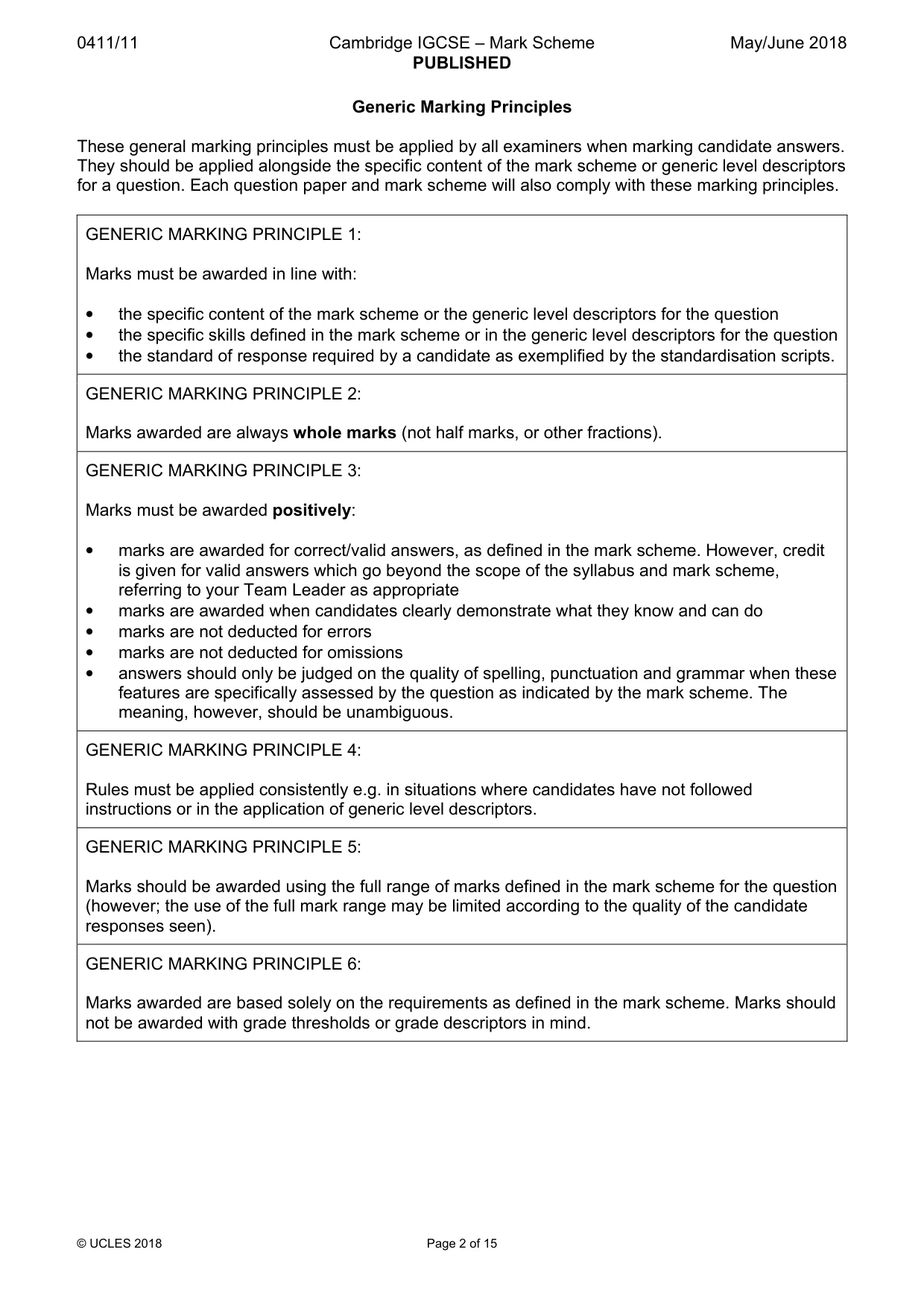
0411/11 Cambridge IGCSE – Mark Scheme PUBLISHED May/June 2018 © UCLES 2018 Page 2 of 15 Generic Marking Principles These general marking principles must be applied by all examiners when marking candidate answers. They should be applied alongside the specific content of the mark scheme or generic level descriptors for a question. Each question paper and mark scheme will also comply with these marking principles. GENERIC MARKING PRINCIPLE 1: Marks must be awarded in line with: • the specific content of the mark scheme or the generic level descriptors for the question • the specific skills defined in the mark scheme or in the generic level descriptors for the question • the standard of response required by a candidate as exemplified by the standardisation scripts. GENERIC MARKING PRINCIPLE 2: Marks awarded are always whole marks (not half marks, or other fractions). GENERIC MARKING PRINCIPLE 3: Marks must be awarded positively: • marks are awarded for correct/valid answers, as defined in the mark scheme. However, credit is given for valid answers which go beyond the scope of the syllabus and mark scheme, referring to your Team Leader as appropriate • marks are awarded when candidates clearly demonstrate what they know and can do • marks are not deducted for errors • marks are not deducted for omissions • answers should only be judged on the quality of spelling, punctuation and grammar when these features are specifically assessed by the question as indicated by the mark scheme. The meaning, however, should be unambiguous. GENERIC MARKING PRINCIPLE 4: Rules must be applied consistently e.g. in situations where candidates have not followed instructions or in the application of generic level descriptors. GENERIC MARKING PRINCIPLE 5: Marks should be awarded using the full range of marks defined in the mark scheme for the question (however; the use of the full mark range may be limited according to the quality of the candidate responses seen). GENERIC MARKING PRINCIPLE 6: Marks awarded are based solely on the requirements as defined in the mark scheme. Marks should not be awarded with grade thresholds or grade descriptors in mind.
Mark scheme, page 3
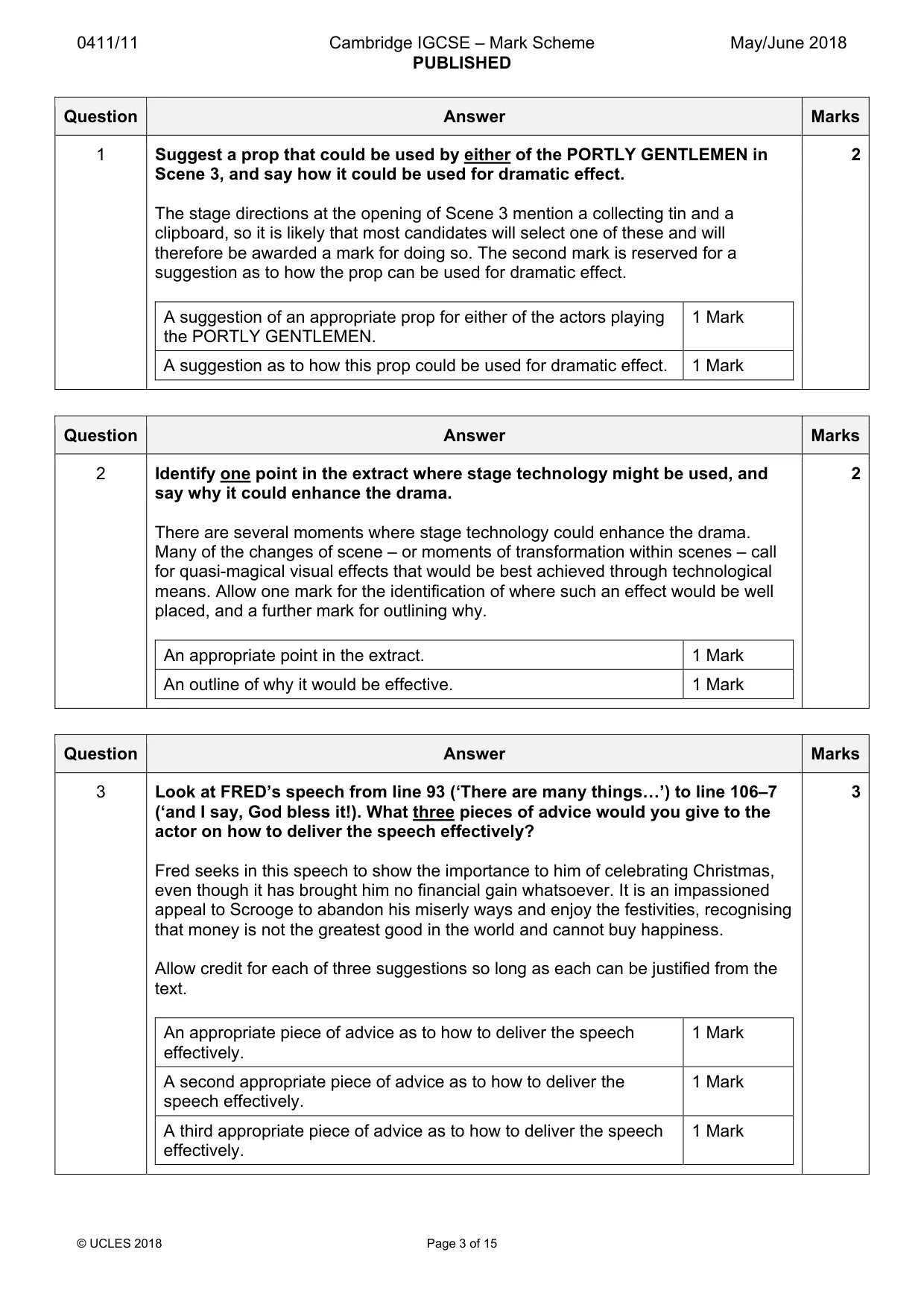
0411/11 Cambridge IGCSE – Mark Scheme PUBLISHED May/June 2018 © UCLES 2018 Page 3 of 15 Question Answer Marks 1 Suggest a prop that could be used by either of the PORTLY GENTLEMEN in Scene 3, and say how it could be used for dramatic effect. The stage directions at the opening of Scene 3 mention a collecting tin and a clipboard, so it is likely that most candidates will select one of these and will therefore be awarded a mark for doing so. The second mark is reserved for a suggestion as to how the prop can be used for dramatic effect. A suggestion of an appropriate prop for either of the actors playing the PORTLY GENTLEMEN. 1 Mark A suggestion as to how this prop could be used for dramatic effect. 1 Mark 2 Question Answer Marks 2 Identify one point in the extract where stage technology might be used, and say why it could enhance the drama. There are several moments where stage technology could enhance the drama. Many of the changes of scene – or moments of transformation within scenes – call for quasi-magical visual effects that would be best achieved through technological means. Allow one mark for the identification of where such an effect would be well placed, and a further mark for outlining why. An appropriate point in the extract. 1 Mark An outline of why it would be effective. 1 Mark 2 Question Answer Marks 3 Look at FRED’s speech from line 93 (‘There are many things«’) to line 106–7 (‘and I say, God bless it!). What three pieces of advice would you give to the actor on how to deliver the speech effectively? Fred seeks in this speech to show the importance to him of celebrating Christmas, even though it has brought him no financial gain whatsoever. It is an impassioned appeal to Scrooge to abandon his miserly ways and enjoy the festivities, recognising that money is not the greatest good in the world and cannot buy happiness. Allow credit for each of three suggestions so long as each can be justified from the text. An appropriate piece of advice as to how to deliver the speech effectively. 1 Mark A second appropriate piece of advice as to how to deliver the speech effectively. 1 Mark A third appropriate piece of advice as to how to deliver the speech effectively. 1 Mark 3
Mark scheme, page 4
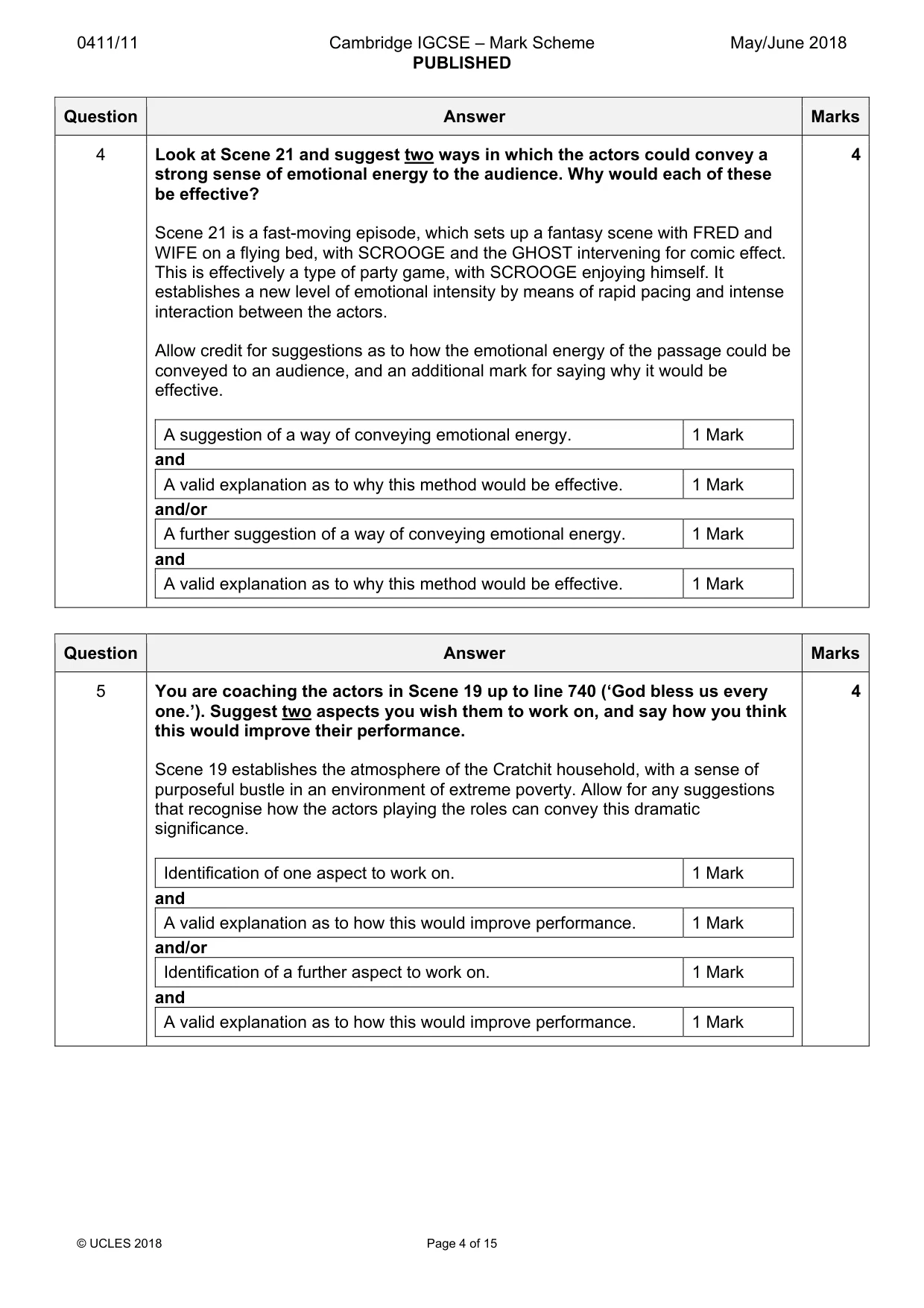
0411/11 Cambridge IGCSE – Mark Scheme PUBLISHED May/June 2018 © UCLES 2018 Page 4 of 15 Question Answer Marks 4 Look at Scene 21 and suggest two ways in which the actors could convey a strong sense of emotional energy to the audience. Why would each of these be effective? Scene 21 is a fast-moving episode, which sets up a fantasy scene with FRED and WIFE on a flying bed, with SCROOGE and the GHOST intervening for comic effect. This is effectively a type of party game, with SCROOGE enjoying himself. It establishes a new level of emotional intensity by means of rapid pacing and intense interaction between the actors. Allow credit for suggestions as to how the emotional energy of the passage could be conveyed to an audience, and an additional mark for saying why it would be effective. A suggestion of a way of conveying emotional energy. 1 Mark and A valid explanation as to why this method would be effective. 1 Mark and/or A further suggestion of a way of conveying emotional energy. 1 Mark and A valid explanation as to why this method would be effective. 1 Mark 4 Question Answer Marks 5 You are coaching the actors in Scene 19 up to line 740 (‘God bless us every one.’). Suggest two aspects you wish them to work on, and say how you think this would improve their performance. Scene 19 establishes the atmosphere of the Cratchit household, with a sense of purposeful bustle in an environment of extreme poverty. Allow for any suggestions that recognise how the actors playing the roles can convey this dramatic significance. Identification of one aspect to work on. 1 Mark and A valid explanation as to how this would improve performance. 1 Mark and/or Identification of a further aspect to work on. 1 Mark and A valid explanation as to how this would improve performance. 1 Mark 4
Mark scheme, page 5
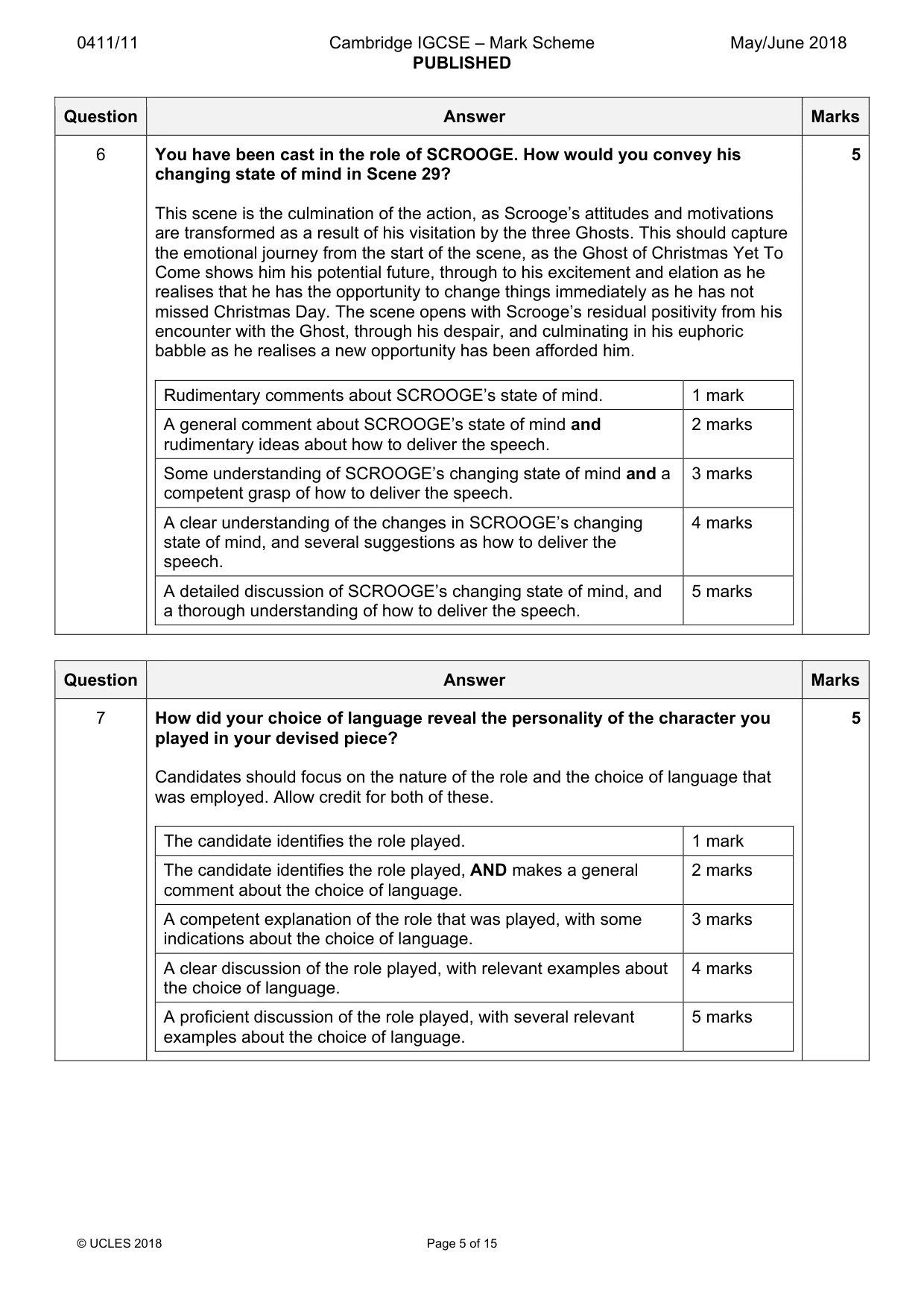
0411/11 Cambridge IGCSE – Mark Scheme PUBLISHED May/June 2018 © UCLES 2018 Page 5 of 15 Question Answer Marks 6 You have been cast in the role of SCROOGE. How would you convey his changing state of mind in Scene 29? This scene is the culmination of the action, as Scrooge’s attitudes and motivations are transformed as a result of his visitation by the three Ghosts. This should capture the emotional journey from the start of the scene, as the Ghost of Christmas Yet To Come shows him his potential future, through to his excitement and elation as he realises that he has the opportunity to change things immediately as he has not missed Christmas Day. The scene opens with Scrooge’s residual positivity from his encounter with the Ghost, through his despair, and culminating in his euphoric babble as he realises a new opportunity has been afforded him. Rudimentary comments about SCROOGE’s state of mind. 1 mark A general comment about SCROOGE’s state of mind and rudimentary ideas about how to deliver the speech. 2 marks Some understanding of SCROOGE’s changing state of mind and a competent grasp of how to deliver the speech. 3 marks A clear understanding of the changes in SCROOGE’s changing state of mind, and several suggestions as how to deliver the speech. 4 marks A detailed discussion of SCROOGE’s changing state of mind, and a thorough understanding of how to deliver the speech. 5 marks 5 Question Answer Marks 7 How did your choice of language reveal the personality of the character you played in your devised piece? Candidates should focus on the nature of the role and the choice of language that was employed. Allow credit for both of these. The candidate identifies the role played. 1 mark The candidate identifies the role played, AND makes a general comment about the choice of language. 2 marks A competent explanation of the role that was played, with some indications about the choice of language. 3 marks A clear discussion of the role played, with relevant examples about the choice of language. 4 marks A proficient discussion of the role played, with several relevant examples about the choice of language. 5 marks 5
Mark scheme, page 6
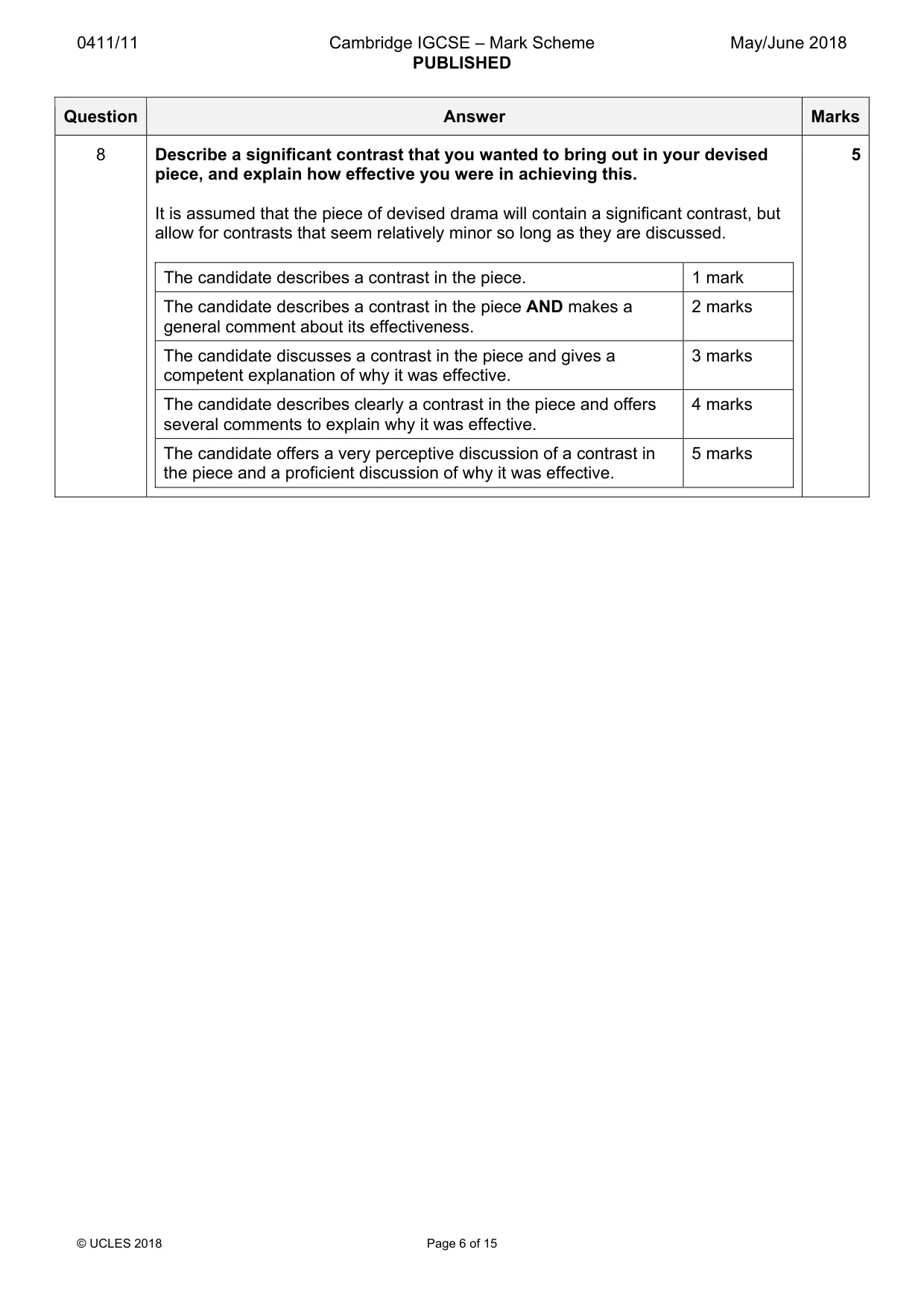
0411/11 Cambridge IGCSE – Mark Scheme PUBLISHED May/June 2018 © UCLES 2018 Page 6 of 15 Question Answer Marks 8 Describe a significant contrast that you wanted to bring out in your devised piece, and explain how effective you were in achieving this. It is assumed that the piece of devised drama will contain a significant contrast, but allow for contrasts that seem relatively minor so long as they are discussed. The candidate describes a contrast in the piece. 1 mark The candidate describes a contrast in the piece AND makes a general comment about its effectiveness. 2 marks The candidate discusses a contrast in the piece and gives a competent explanation of why it was effective. 3 marks The candidate describes clearly a contrast in the piece and offers several comments to explain why it was effective. 4 marks The candidate offers a very perceptive discussion of a contrast in the piece and a proficient discussion of why it was effective. 5 marks 5
Mark scheme, page 7
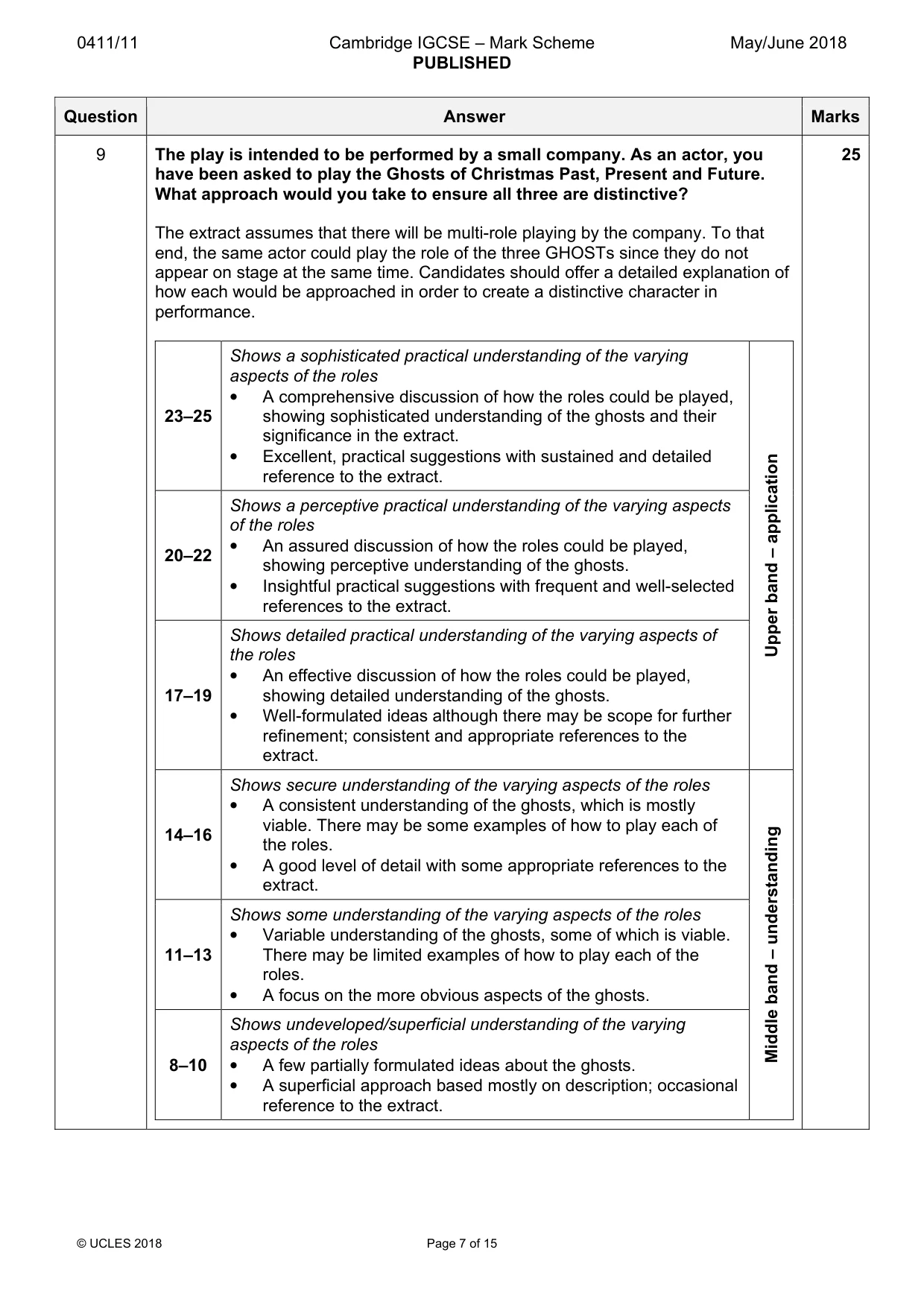
0411/11 Cambridge IGCSE – Mark Scheme PUBLISHED May/June 2018 © UCLES 2018 Page 7 of 15 Question Answer Marks 9 The play is intended to be performed by a small company. As an actor, you have been asked to play the Ghosts of Christmas Past, Present and Future. What approach would you take to ensure all three are distinctive? The extract assumes that there will be multi-role playing by the company. To that end, the same actor could play the role of the three GHOSTs since they do not appear on stage at the same time. Candidates should offer a detailed explanation of how each would be approached in order to create a distinctive character in performance. 23–25 Shows a sophisticated practical understanding of the varying aspects of the roles • A comprehensive discussion of how the roles could be played, showing sophisticated understanding of the ghosts and their significance in the extract. • Excellent, practical suggestions with sustained and detailed reference to the extract. Upper band – application 20–22 Shows a perceptive practical understanding of the varying aspects of the roles • An assured discussion of how the roles could be played, showing perceptive understanding of the ghosts. • Insightful practical suggestions with frequent and well-selected references to the extract. 17–19 Shows detailed practical understanding of the varying aspects of the roles • An effective discussion of how the roles could be played, showing detailed understanding of the ghosts. • Well-formulated ideas although there may be scope for further refinement; consistent and appropriate references to the extract. 14–16 Shows secure understanding of the varying aspects of the roles • A consistent understanding of the ghosts, which is mostly viable. There may be some examples of how to play each of the roles. • A good level of detail with some appropriate references to the extract. Middle band – understanding 11–13 Shows some understanding of the varying aspects of the roles • Variable understanding of the ghosts, some of which is viable. There may be limited examples of how to play each of the roles. • A focus on the more obvious aspects of the ghosts. 8–10 Shows undeveloped/superficial understanding of the varying aspects of the roles • A few partially formulated ideas about the ghosts. • A superficial approach based mostly on description; occasional reference to the extract. 25
Mark scheme, page 8
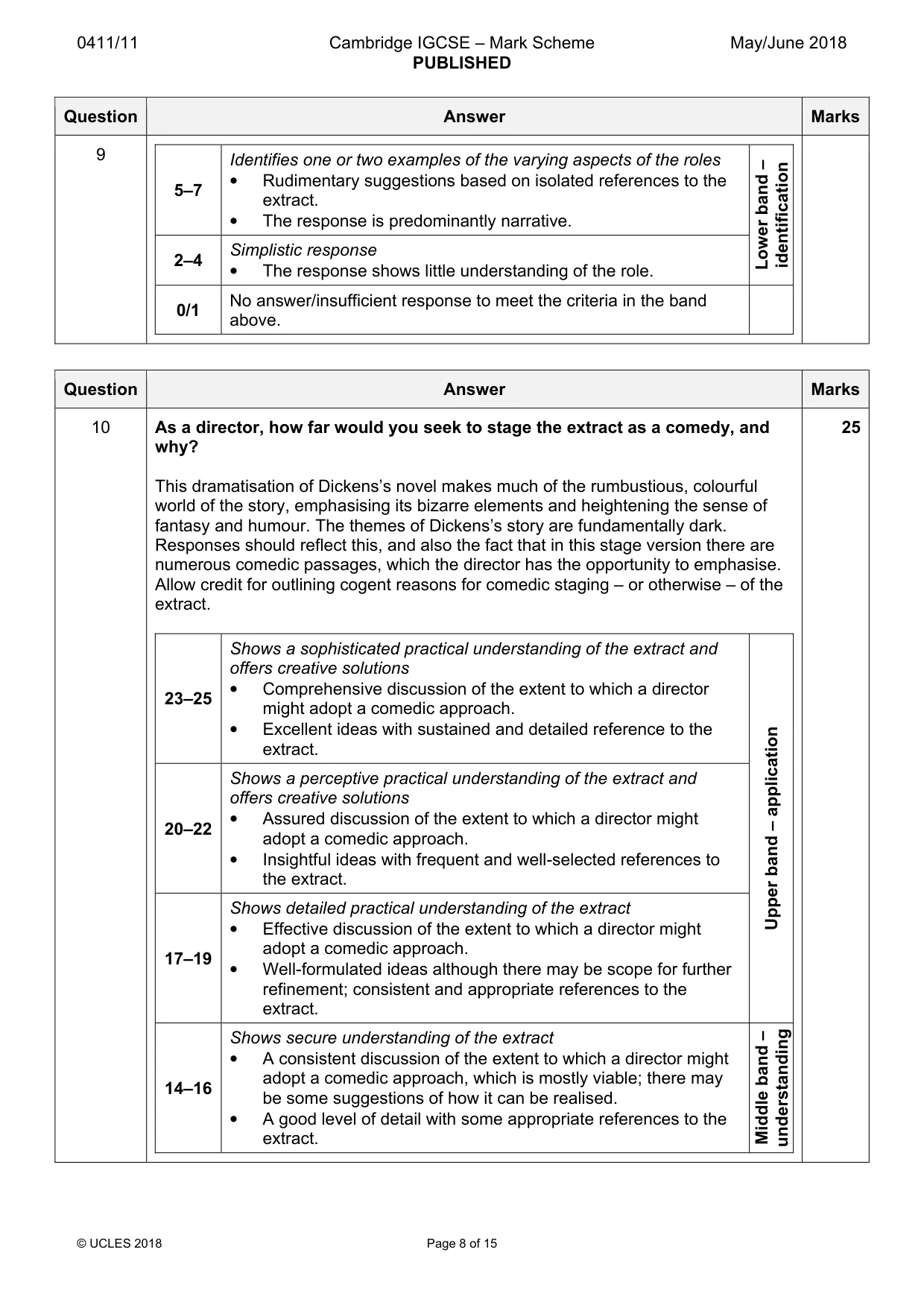
0411/11 Cambridge IGCSE – Mark Scheme PUBLISHED May/June 2018 © UCLES 2018 Page 8 of 15 Question Answer Marks 9 5–7 Identifies one or two examples of the varying aspects of the roles • Rudimentary suggestions based on isolated references to the extract. • The response is predominantly narrative. Lower band – identification 2–4 Simplistic response • The response shows little understanding of the role. 0/1 No answer/insufficient response to meet the criteria in the band above. Question Answer Marks 10 As a director, how far would you seek to stage the extract as a comedy, and why? This dramatisation of Dickens’s novel makes much of the rumbustious, colourful world of the story, emphasising its bizarre elements and heightening the sense of fantasy and humour. The themes of Dickens’s story are fundamentally dark. Responses should reflect this, and also the fact that in this stage version there are numerous comedic passages, which the director has the opportunity to emphasise. Allow credit for outlining cogent reasons for comedic staging – or otherwise – of the extract. 23–25 Shows a sophisticated practical understanding of the extract and offers creative solutions • Comprehensive discussion of the extent to which a director might adopt a comedic approach. • Excellent ideas with sustained and detailed reference to the extract. Upper band – application 20–22 Shows a perceptive practical understanding of the extract and offers creative solutions • Assured discussion of the extent to which a director might adopt a comedic approach. • Insightful ideas with frequent and well-selected references to the extract. 17–19 Shows detailed practical understanding of the extract • Effective discussion of the extent to which a director might adopt a comedic approach. • Well-formulated ideas although there may be scope for further refinement; consistent and appropriate references to the extract. 14–16 Shows secure understanding of the extract • A consistent discussion of the extent to which a director might adopt a comedic approach, which is mostly viable; there may be some suggestions of how it can be realised. • A good level of detail with some appropriate references to the extract. Middle band – understanding 25
Mark scheme, page 9
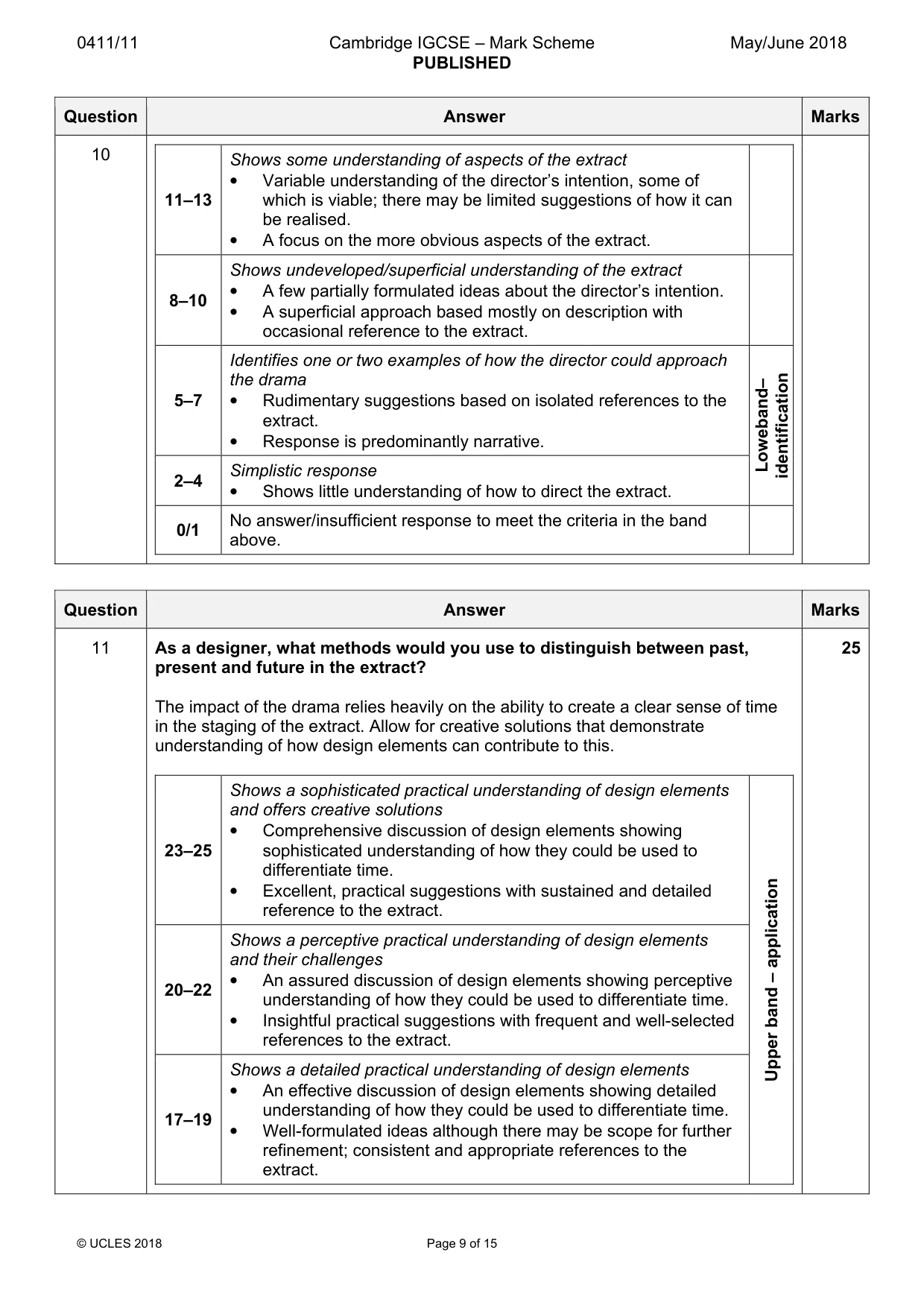
0411/11 Cambridge IGCSE – Mark Scheme PUBLISHED May/June 2018 © UCLES 2018 Page 9 of 15 Question Answer Marks 10 11–13 Shows some understanding of aspects of the extract • Variable understanding of the director’s intention, some of which is viable; there may be limited suggestions of how it can be realised. • A focus on the more obvious aspects of the extract. 8–10 Shows undeveloped/superficial understanding of the extract • A few partially formulated ideas about the director’s intention. • A superficial approach based mostly on description with occasional reference to the extract. 5–7 Identifies one or two examples of how the director could approach the drama • Rudimentary suggestions based on isolated references to the extract. • Response is predominantly narrative. Loweband– identification 2–4 Simplistic response • Shows little understanding of how to direct the extract. 0/1 No answer/insufficient response to meet the criteria in the band above. Question Answer Marks 11 As a designer, what methods would you use to distinguish between past, present and future in the extract? The impact of the drama relies heavily on the ability to create a clear sense of time in the staging of the extract. Allow for creative solutions that demonstrate understanding of how design elements can contribute to this. 23–25 Shows a sophisticated practical understanding of design elements and offers creative solutions • Comprehensive discussion of design elements showing sophisticated understanding of how they could be used to differentiate time. • Excellent, practical suggestions with sustained and detailed reference to the extract. Upper band – application 20–22 Shows a perceptive practical understanding of design elements and their challenges • An assured discussion of design elements showing perceptive understanding of how they could be used to differentiate time. • Insightful practical suggestions with frequent and well-selected references to the extract. 17–19 Shows a detailed practical understanding of design elements • An effective discussion of design elements showing detailed understanding of how they could be used to differentiate time. • Well-formulated ideas although there may be scope for further refinement; consistent and appropriate references to the extract. 25
Mark scheme, page 10
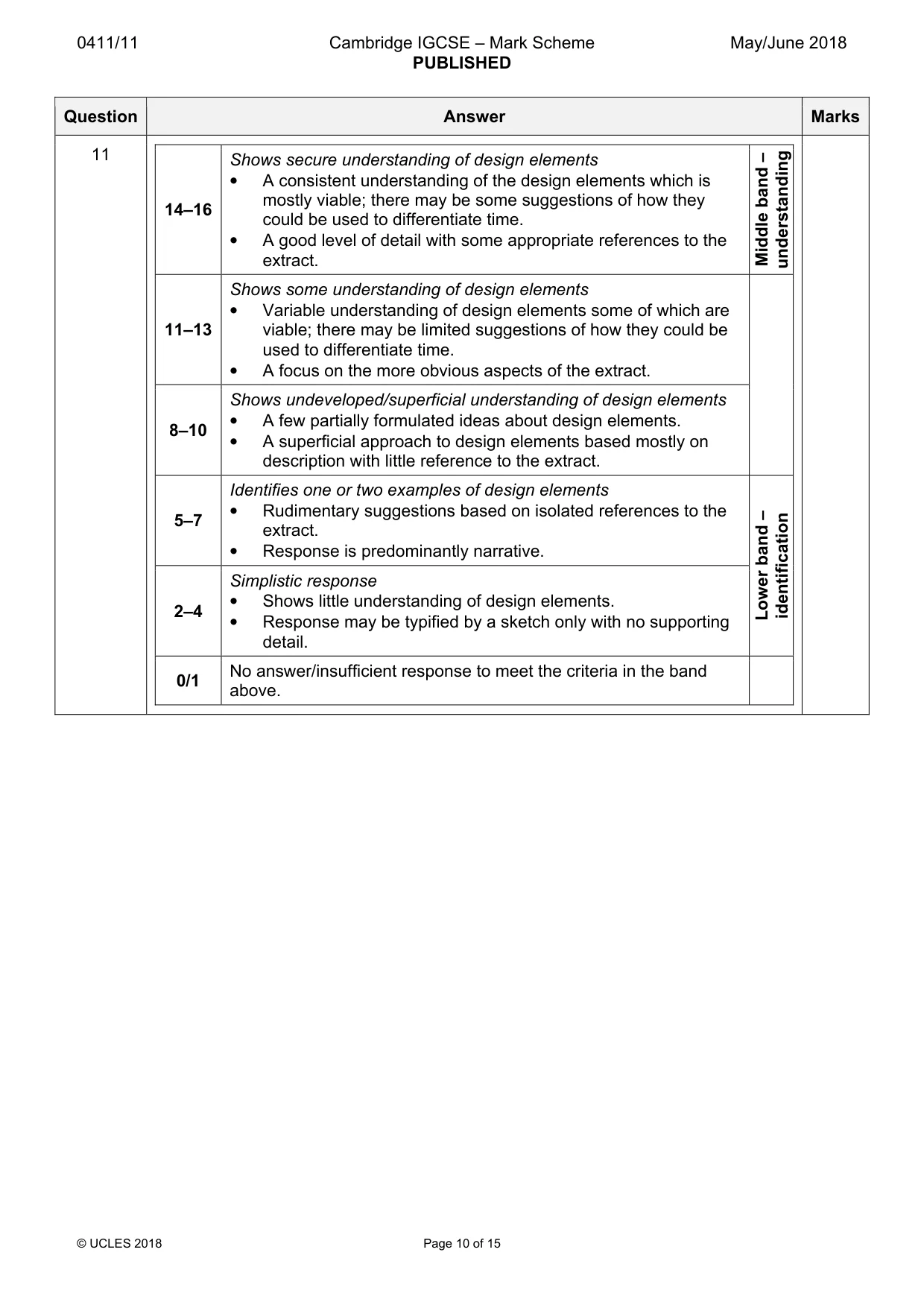
0411/11 Cambridge IGCSE – Mark Scheme PUBLISHED May/June 2018 © UCLES 2018 Page 10 of 15 Question Answer Marks 11 14–16 Shows secure understanding of design elements • A consistent understanding of the design elements which is mostly viable; there may be some suggestions of how they could be used to differentiate time. • A good level of detail with some appropriate references to the extract. Middle band – understanding 11–13 Shows some understanding of design elements • Variable understanding of design elements some of which are viable; there may be limited suggestions of how they could be used to differentiate time. • A focus on the more obvious aspects of the extract. 8–10 Shows undeveloped/superficial understanding of design elements • A few partially formulated ideas about design elements. • A superficial approach to design elements based mostly on description with little reference to the extract. 5–7 Identifies one or two examples of design elements • Rudimentary suggestions based on isolated references to the extract. • Response is predominantly narrative. Lower band – identification 2–4 Simplistic response • Shows little understanding of design elements. • Response may be typified by a sketch only with no supporting detail. 0/1 No answer/insufficient response to meet the criteria in the band above.
Mark scheme, page 11
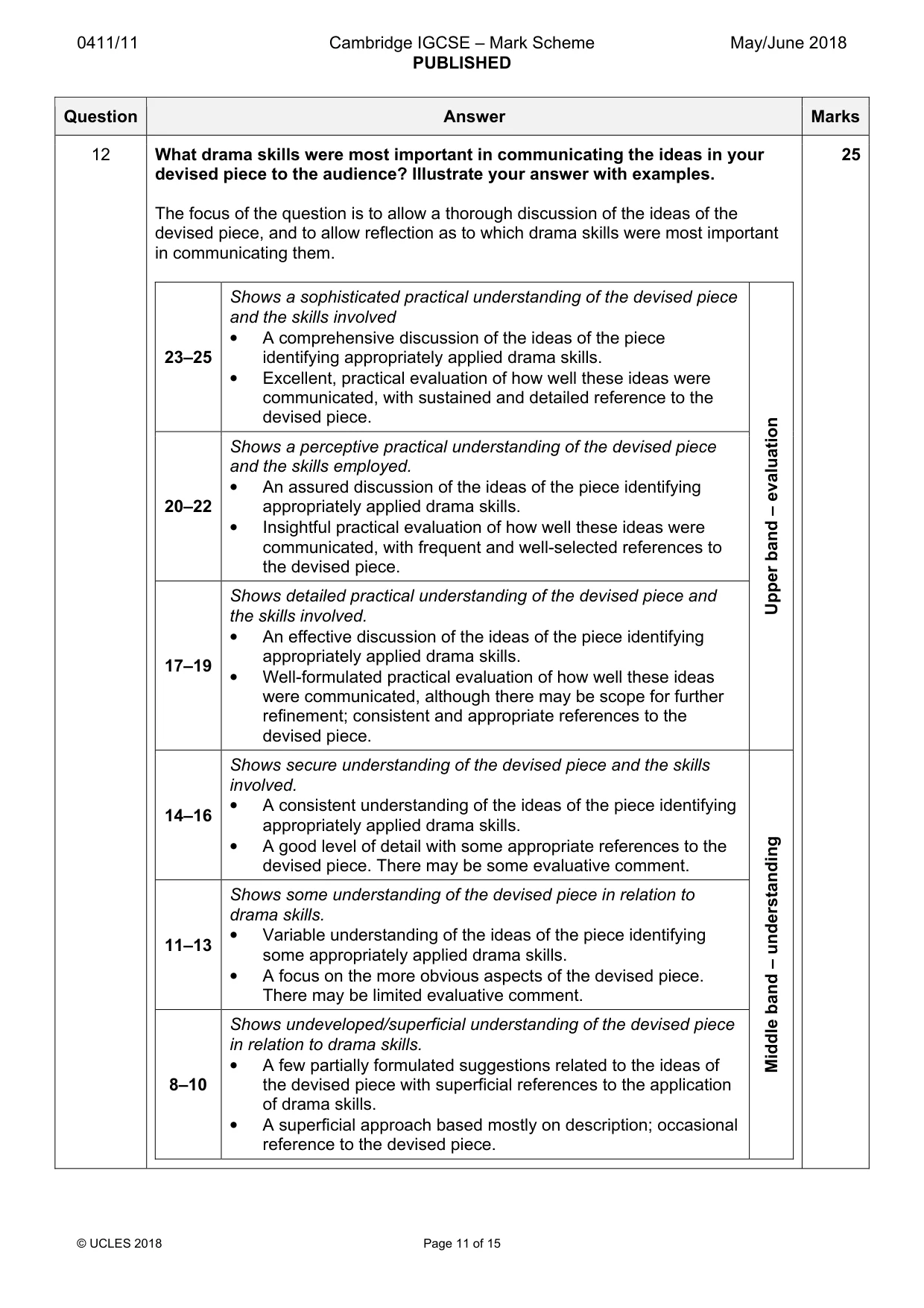
0411/11 Cambridge IGCSE – Mark Scheme PUBLISHED May/June 2018 © UCLES 2018 Page 11 of 15 Question Answer Marks 12 What drama skills were most important in communicating the ideas in your devised piece to the audience? Illustrate your answer with examples. The focus of the question is to allow a thorough discussion of the ideas of the devised piece, and to allow reflection as to which drama skills were most important in communicating them. 23–25 Shows a sophisticated practical understanding of the devised piece and the skills involved • A comprehensive discussion of the ideas of the piece identifying appropriately applied drama skills. • Excellent, practical evaluation of how well these ideas were communicated, with sustained and detailed reference to the devised piece. Upper band – evaluation 20–22 Shows a perceptive practical understanding of the devised piece and the skills employed. • An assured discussion of the ideas of the piece identifying appropriately applied drama skills. • Insightful practical evaluation of how well these ideas were communicated, with frequent and well-selected references to the devised piece. 17–19 Shows detailed practical understanding of the devised piece and the skills involved. • An effective discussion of the ideas of the piece identifying appropriately applied drama skills. • Well-formulated practical evaluation of how well these ideas were communicated, although there may be scope for further refinement; consistent and appropriate references to the devised piece. 14–16 Shows secure understanding of the devised piece and the skills involved. • A consistent understanding of the ideas of the piece identifying appropriately applied drama skills. • A good level of detail with some appropriate references to the devised piece. There may be some evaluative comment. Middle band – understanding 11–13 Shows some understanding of the devised piece in relation to drama skills. • Variable understanding of the ideas of the piece identifying some appropriately applied drama skills. • A focus on the more obvious aspects of the devised piece. There may be limited evaluative comment. 8–10 Shows undeveloped/superficial understanding of the devised piece in relation to drama skills. • A few partially formulated suggestions related to the ideas of the devised piece with superficial references to the application of drama skills. • A superficial approach based mostly on description; occasional reference to the devised piece. 25
Mark scheme, page 12
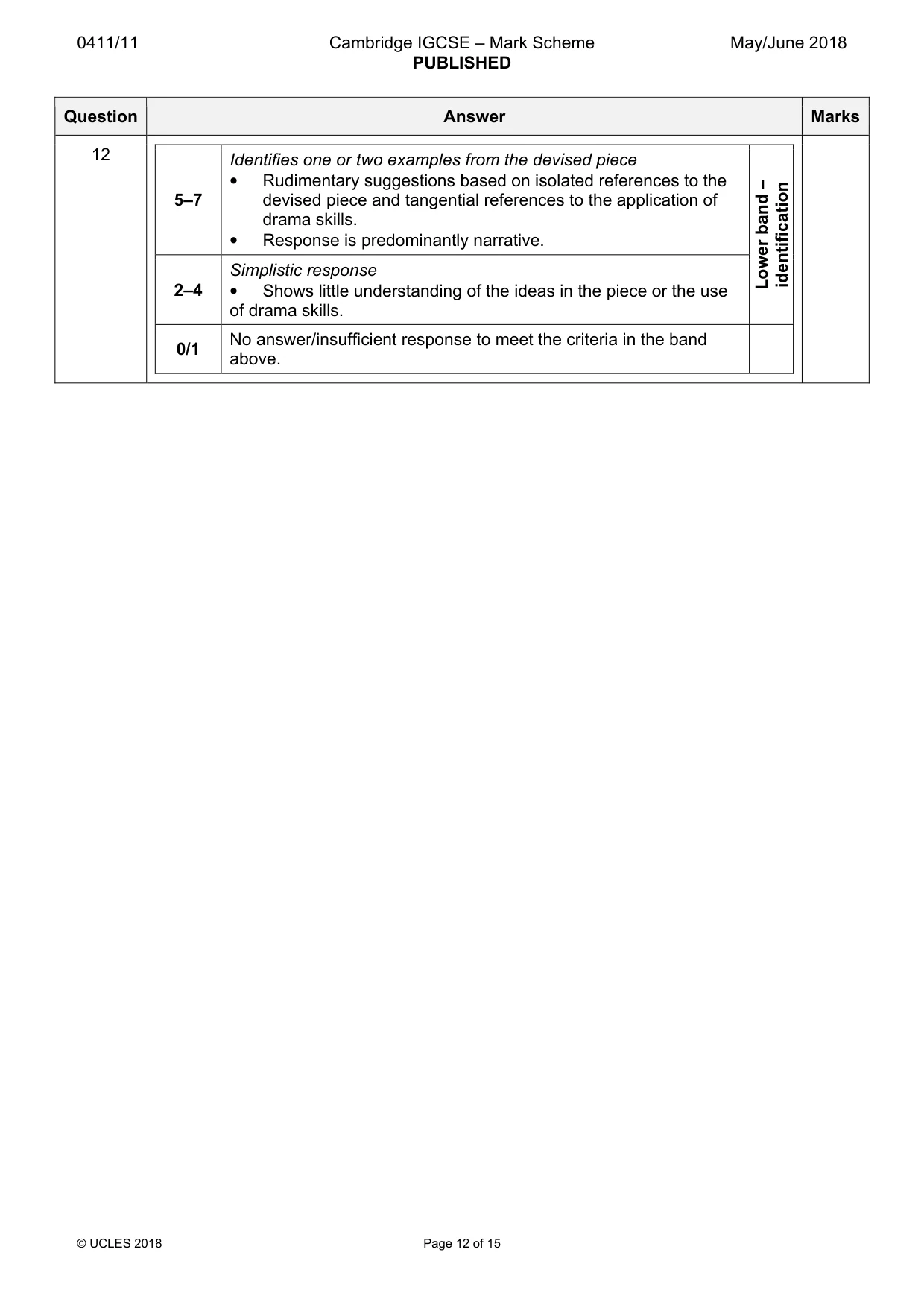
0411/11 Cambridge IGCSE – Mark Scheme PUBLISHED May/June 2018 © UCLES 2018 Page 12 of 15 Question Answer Marks 12 5–7 Identifies one or two examples from the devised piece • Rudimentary suggestions based on isolated references to the devised piece and tangential references to the application of drama skills. • Response is predominantly narrative. Lower band – identification 2–4 Simplistic response • Shows little understanding of the ideas in the piece or the use of drama skills. 0/1 No answer/insufficient response to meet the criteria in the band above.
Mark scheme, page 13
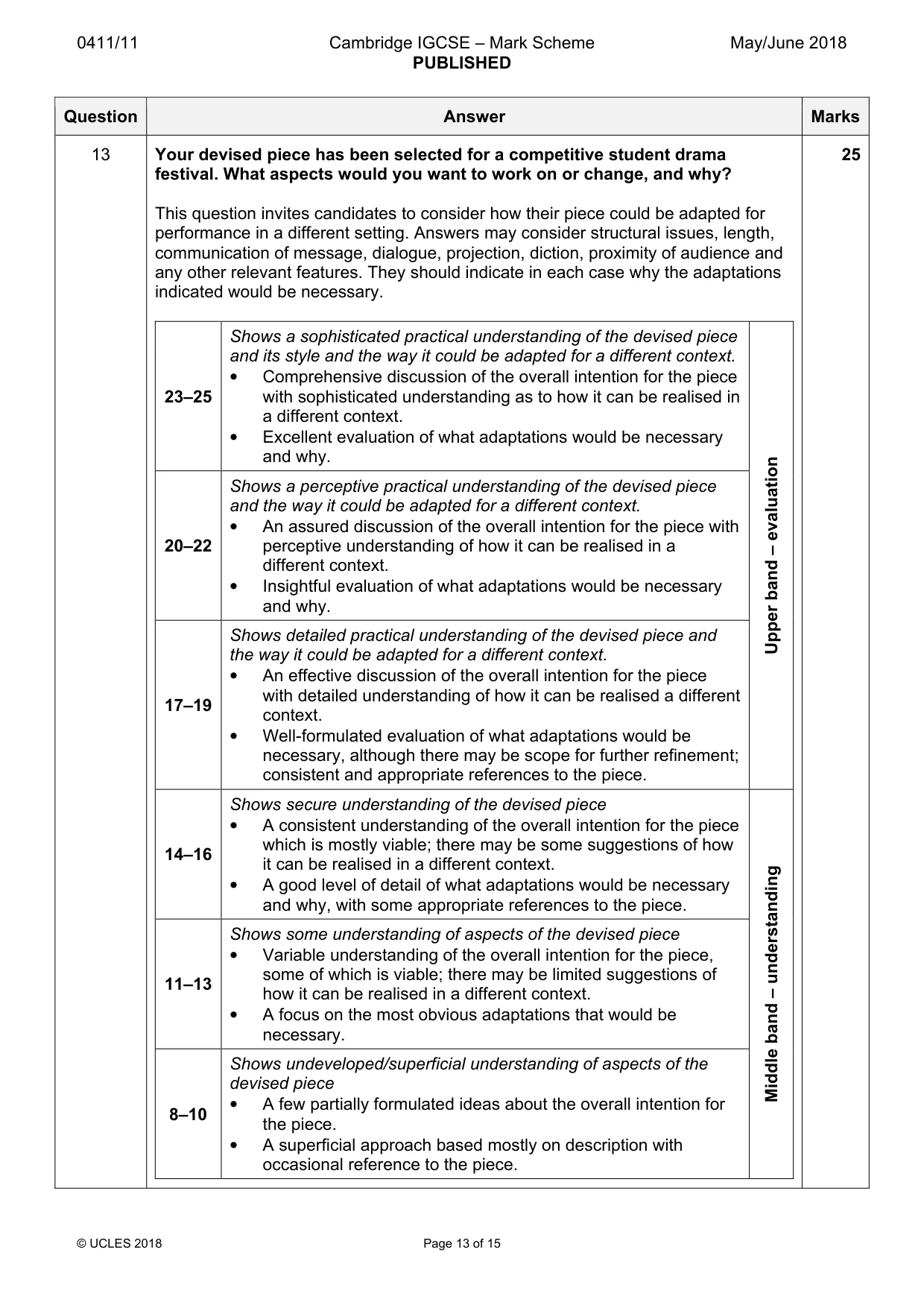
0411/11 Cambridge IGCSE – Mark Scheme PUBLISHED May/June 2018 © UCLES 2018 Page 13 of 15 Question Answer Marks 13 Your devised piece has been selected for a competitive student drama festival. What aspects would you want to work on or change, and why? This question invites candidates to consider how their piece could be adapted for performance in a different setting. Answers may consider structural issues, length, communication of message, dialogue, projection, diction, proximity of audience and any other relevant features. They should indicate in each case why the adaptations indicated would be necessary. 23–25 Shows a sophisticated practical understanding of the devised piece and its style and the way it could be adapted for a different context. • Comprehensive discussion of the overall intention for the piece with sophisticated understanding as to how it can be realised in a different context. • Excellent evaluation of what adaptations would be necessary and why. Upper band – evaluation 20–22 Shows a perceptive practical understanding of the devised piece and the way it could be adapted for a different context. • An assured discussion of the overall intention for the piece with perceptive understanding of how it can be realised in a different context. • Insightful evaluation of what adaptations would be necessary and why. 17–19 Shows detailed practical understanding of the devised piece and the way it could be adapted for a different context. • An effective discussion of the overall intention for the piece with detailed understanding of how it can be realised a different context. • Well-formulated evaluation of what adaptations would be necessary, although there may be scope for further refinement; consistent and appropriate references to the piece. 14–16 Shows secure understanding of the devised piece • A consistent understanding of the overall intention for the piece which is mostly viable; there may be some suggestions of how it can be realised in a different context. • A good level of detail of what adaptations would be necessary and why, with some appropriate references to the piece. Middle band – understanding 11–13 Shows some understanding of aspects of the devised piece • Variable understanding of the overall intention for the piece, some of which is viable; there may be limited suggestions of how it can be realised in a different context. • A focus on the most obvious adaptations that would be necessary. 8–10 Shows undeveloped/superficial understanding of aspects of the devised piece • A few partially formulated ideas about the overall intention for the piece. • A superficial approach based mostly on description with occasional reference to the piece. 25
Mark scheme, page 14
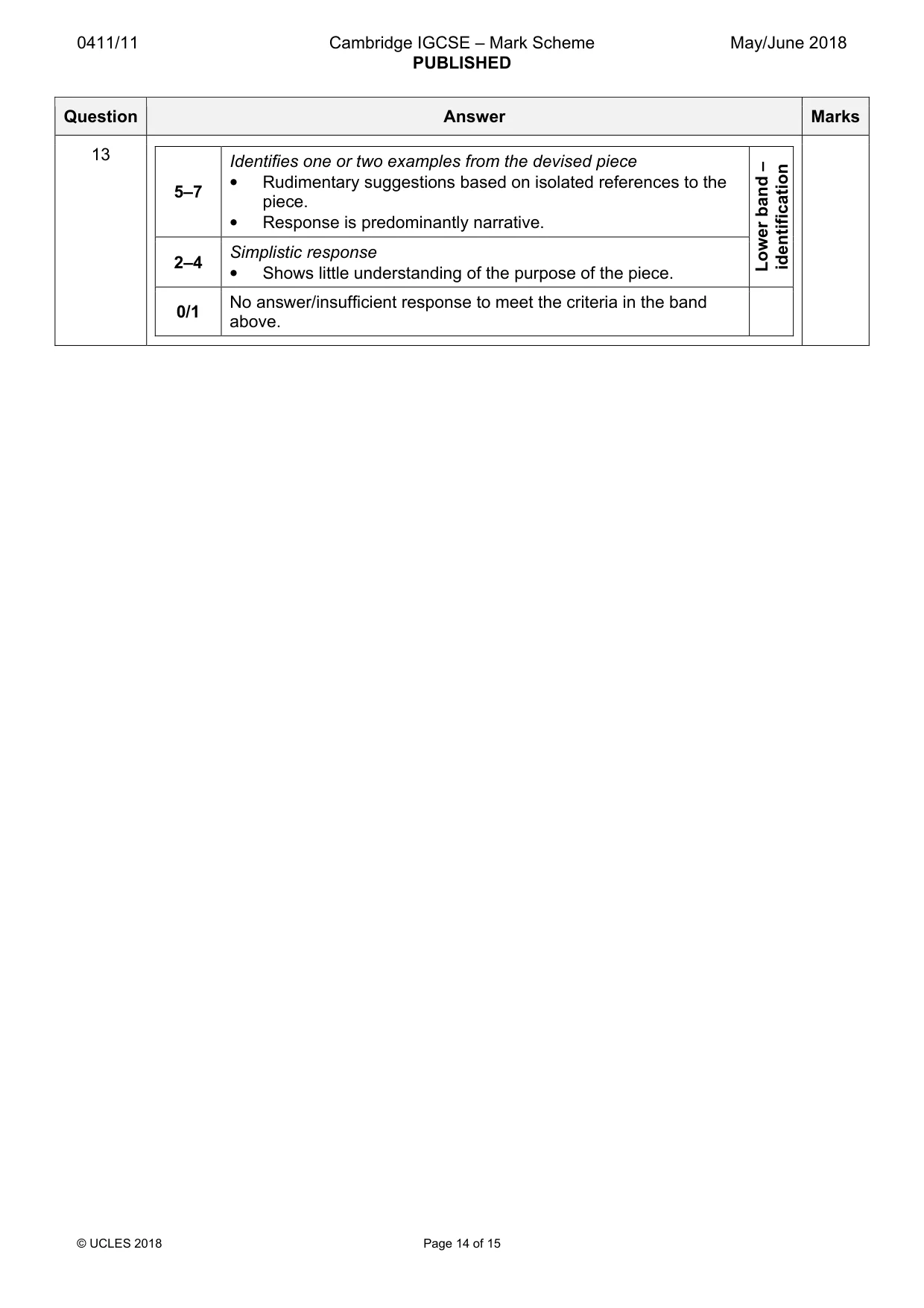
0411/11 Cambridge IGCSE – Mark Scheme PUBLISHED May/June 2018 © UCLES 2018 Page 14 of 15 Question Answer Marks 13 5–7 Identifies one or two examples from the devised piece • Rudimentary suggestions based on isolated references to the piece. • Response is predominantly narrative. Lower band – identification 2–4 Simplistic response • Shows little understanding of the purpose of the piece. 0/1 No answer/insufficient response to meet the criteria in the band above.
Mark scheme, page 15
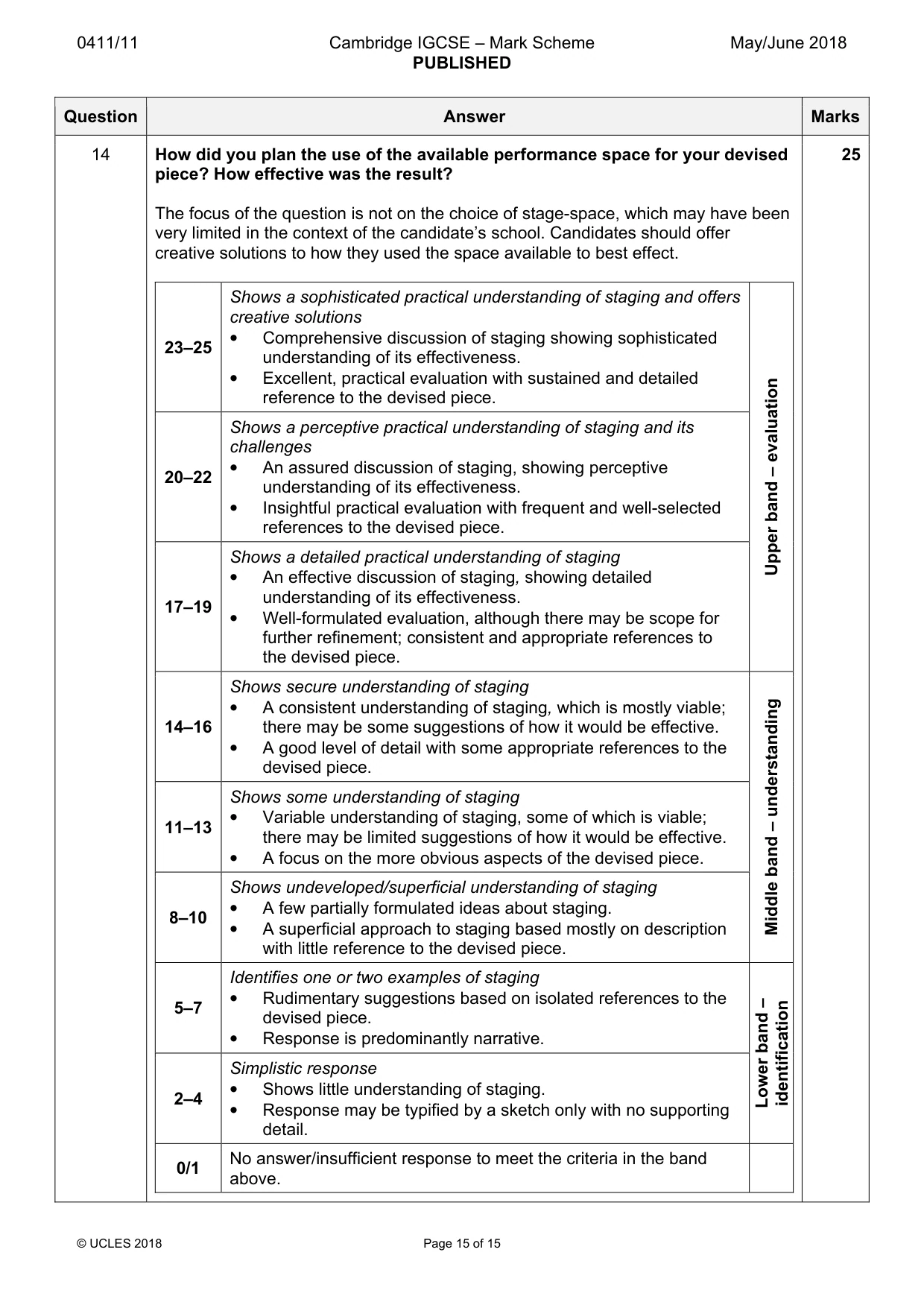
0411/11 Cambridge IGCSE – Mark Scheme PUBLISHED May/June 2018 © UCLES 2018 Page 15 of 15 Question Answer Marks 14 How did you plan the use of the available performance space for your devised piece? How effective was the result? The focus of the question is not on the choice of stage-space, which may have been very limited in the context of the candidate’s school. Candidates should offer creative solutions to how they used the space available to best effect. 23–25 Shows a sophisticated practical understanding of staging and offers creative solutions • Comprehensive discussion of staging showing sophisticated understanding of its effectiveness. • Excellent, practical evaluation with sustained and detailed reference to the devised piece. Upper band – evaluation 20–22 Shows a perceptive practical understanding of staging and its challenges • An assured discussion of staging, showing perceptive understanding of its effectiveness. • Insightful practical evaluation with frequent and well-selected references to the devised piece. 17–19 Shows a detailed practical understanding of staging • An effective discussion of staging, showing detailed understanding of its effectiveness. • Well-formulated evaluation, although there may be scope for further refinement; consistent and appropriate references to the devised piece. 14–16 Shows secure understanding of staging • A consistent understanding of staging, which is mostly viable; there may be some suggestions of how it would be effective. • A good level of detail with some appropriate references to the devised piece. Middle band – understanding 11–13 Shows some understanding of staging • Variable understanding of staging, some of which is viable; there may be limited suggestions of how it would be effective. • A focus on the more obvious aspects of the devised piece. 8–10 Shows undeveloped/superficial understanding of staging • A few partially formulated ideas about staging. • A superficial approach to staging based mostly on description with little reference to the devised piece. 5–7 Identifies one or two examples of staging • Rudimentary suggestions based on isolated references to the devised piece. • Response is predominantly narrative. Lower band – identification 2–4 Simplistic response • Shows little understanding of staging. • Response may be typified by a sketch only with no supporting detail. 0/1 No answer/insufficient response to meet the criteria in the band above. 25
What you needed in this session
Cambridge’s own grade thresholds for 2018 May/June, Paper 1 · Variant 1. A higher threshold means an easier paper — the bar moves with how the cohort did.