Cambridge IGCSE Design and Technology 0445 — 2024 Oct/Nov Paper 5 · Variant 3
0445/53/O/N/24 · 50 marks · 60 min
The question paper and its mark scheme, free to read here and free to download. This is Cambridge’s own paper, exactly as it was sat.
Question paper4 pages


Mark scheme8 pages
Answers below. Sit the paper first if you are practising.
Paper as text
Question paper, page 1
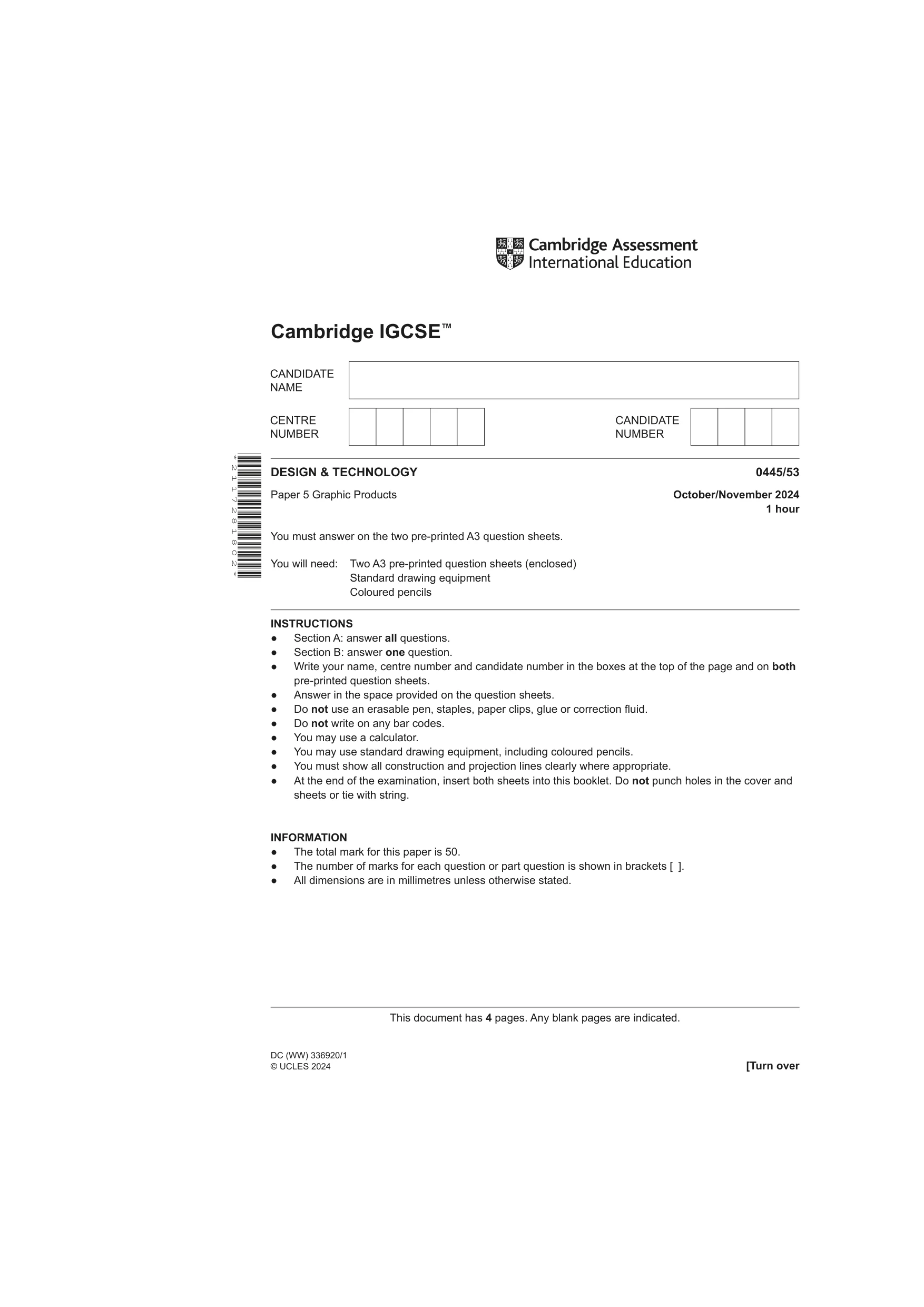
Cambridge IGCSE™ DESIGN & TECHNOLOGY 0445/53 Paper 5 Graphic Products October/November 2024 1 hour You must answer on the two pre-printed A3 question sheets. You will need: Two A3 pre-printed question sheets (enclosed) Standard drawing equipment Coloured pencils INSTRUCTIONS ● Section A: answer all questions. ● Section B: answer one question. ● Write your name, centre number and candidate number in the boxes at the top of the page and on both pre-printed question sheets. ● Answer in the space provided on the question sheets. ● Do not use an erasable pen, staples, paper clips, glue or correction fluid. ● Do not write on any bar codes. ● You may use a calculator. ● You may use standard drawing equipment, including coloured pencils. ● You must show all construction and projection lines clearly where appropriate. ● At the end of the examination, insert both sheets into this booklet. Do not punch holes in the cover and sheets or tie with string. INFORMATION ● The total mark for this paper is 50. ● The number of marks for each question or part question is shown in brackets [ ]. ● All dimensions are in millimetres unless otherwise stated. * 2 1 1 7 2 8 1 8 0 2 * DC (WW) 336920/1 © UCLES 2024 [Turn over This document has 4 pages. Any blank pages are indicated.
Question paper, page 4
Permission to reproduce items where third-party owned material protected by copyright is included has been sought and cleared where possible. Every reasonable effort has been made by the publisher (UCLES) to trace copyright holders, but if any items requiring clearance have unwittingly been included, the publisher will be pleased to make amends at the earliest possible opportunity. To avoid the issue of disclosure of answer-related information to candidates, all copyright acknowledgements are reproduced online in the Cambridge Assessment International Education Copyright Acknowledgements Booklet. This is produced for each series of examinations and is freely available to download at www.cambridgeinternational.org after the live examination series. Cambridge Assessment International Education is part of Cambridge Assessment. Cambridge Assessment is the brand name of the University of Cambridge Local Examinations Syndicate (UCLES), which is a department of the University of Cambridge. BLANK PAGE
Mark scheme, page 1
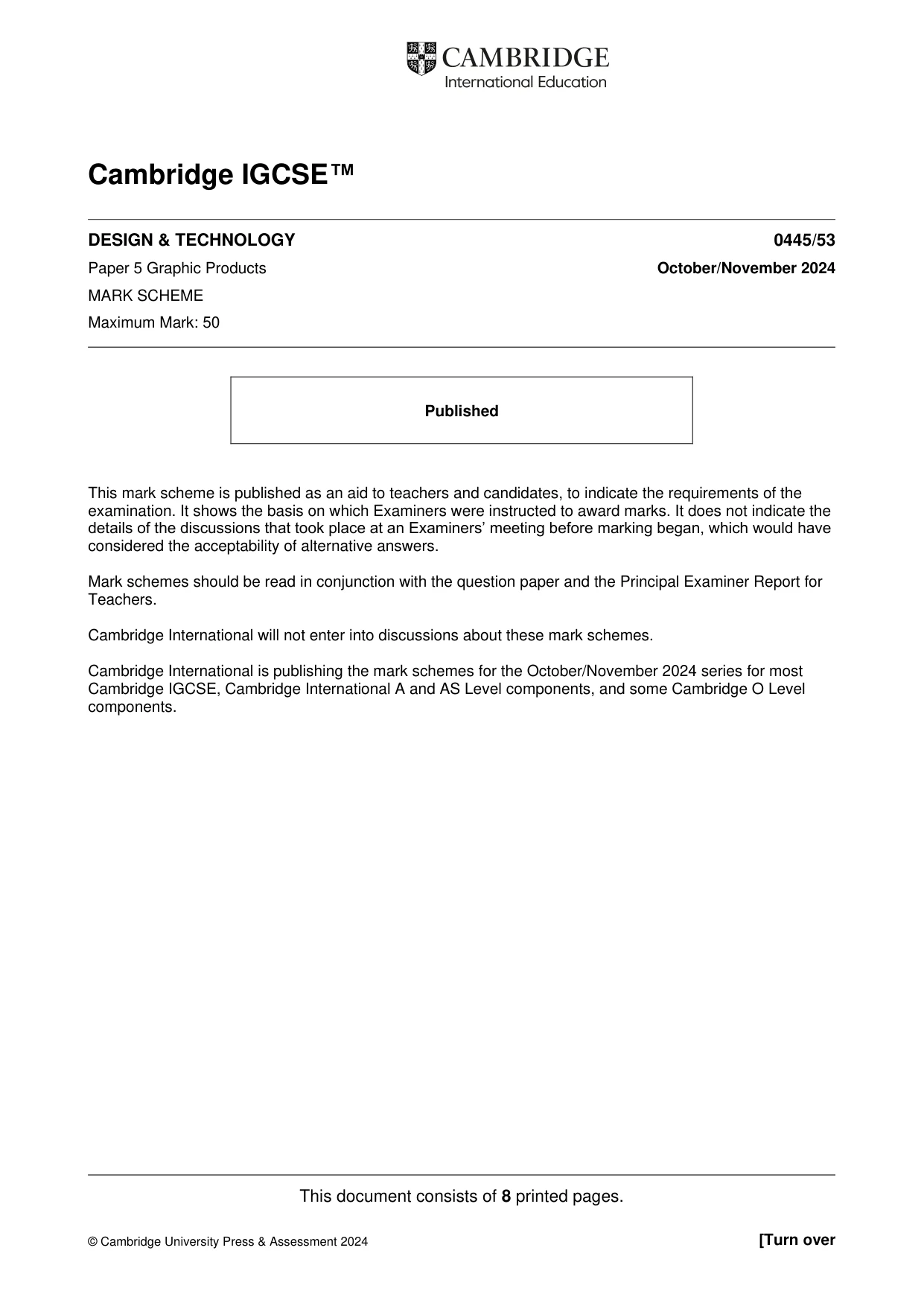
This document consists of 8 printed pages. © Cambridge University Press & Assessment 2024 [Turn over Cambridge IGCSE™ DESIGN & TECHNOLOGY 0445/53 Paper 5 Graphic Products October/November 2024 MARK SCHEME Maximum Mark: 50 Published This mark scheme is published as an aid to teachers and candidates, to indicate the requirements of the examination. It shows the basis on which Examiners were instructed to award marks. It does not indicate the details of the discussions that took place at an Examiners’ meeting before marking began, which would have considered the acceptability of alternative answers. Mark schemes should be read in conjunction with the question paper and the Principal Examiner Report for Teachers. Cambridge International will not enter into discussions about these mark schemes. Cambridge International is publishing the mark schemes for the October/November 2024 series for most Cambridge IGCSE, Cambridge International A and AS Level components, and some Cambridge O Level components.
Mark scheme, page 2
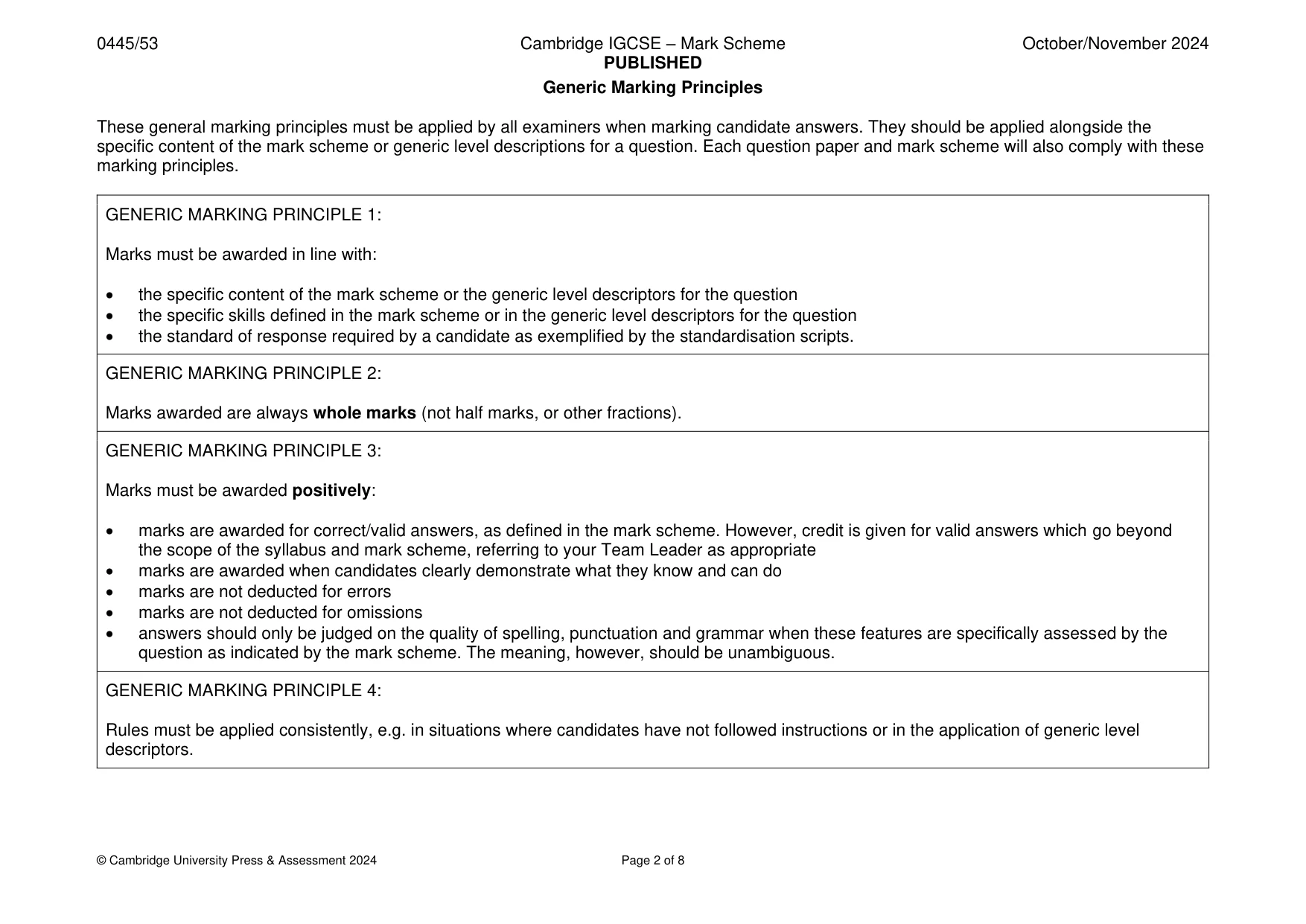
0445/53 Cambridge IGCSE – Mark Scheme PUBLISHED October/November 2024 © Cambridge University Press & Assessment 2024 Page 2 of 8 Generic Marking Principles These general marking principles must be applied by all examiners when marking candidate answers. They should be applied alongside the specific content of the mark scheme or generic level descriptions for a question. Each question paper and mark scheme will also comply with these marking principles. GENERIC MARKING PRINCIPLE 1: Marks must be awarded in line with: • the specific content of the mark scheme or the generic level descriptors for the question • the specific skills defined in the mark scheme or in the generic level descriptors for the question • the standard of response required by a candidate as exemplified by the standardisation scripts. GENERIC MARKING PRINCIPLE 2: Marks awarded are always whole marks (not half marks, or other fractions). GENERIC MARKING PRINCIPLE 3: Marks must be awarded positively: • marks are awarded for correct/valid answers, as defined in the mark scheme. However, credit is given for valid answers which go beyond the scope of the syllabus and mark scheme, referring to your Team Leader as appropriate • marks are awarded when candidates clearly demonstrate what they know and can do • marks are not deducted for errors • marks are not deducted for omissions • answers should only be judged on the quality of spelling, punctuation and grammar when these features are specifically assessed by the question as indicated by the mark scheme. The meaning, however, should be unambiguous. GENERIC MARKING PRINCIPLE 4: Rules must be applied consistently, e.g. in situations where candidates have not followed instructions or in the application of generic level descriptors.
Mark scheme, page 3
0445/53 Cambridge IGCSE – Mark Scheme PUBLISHED October/November 2024 © Cambridge University Press & Assessment 2024 Page 3 of 8 GENERIC MARKING PRINCIPLE 5: Marks should be awarded using the full range of marks defined in the mark scheme for the question (however; the use of the full mark range may be limited according to the quality of the candidate responses seen). GENERIC MARKING PRINCIPLE 6: Marks awarded are based solely on the requirements as defined in the mark scheme. Marks should not be awarded with grade thresholds or grade descriptors in mind.
Mark scheme, page 4
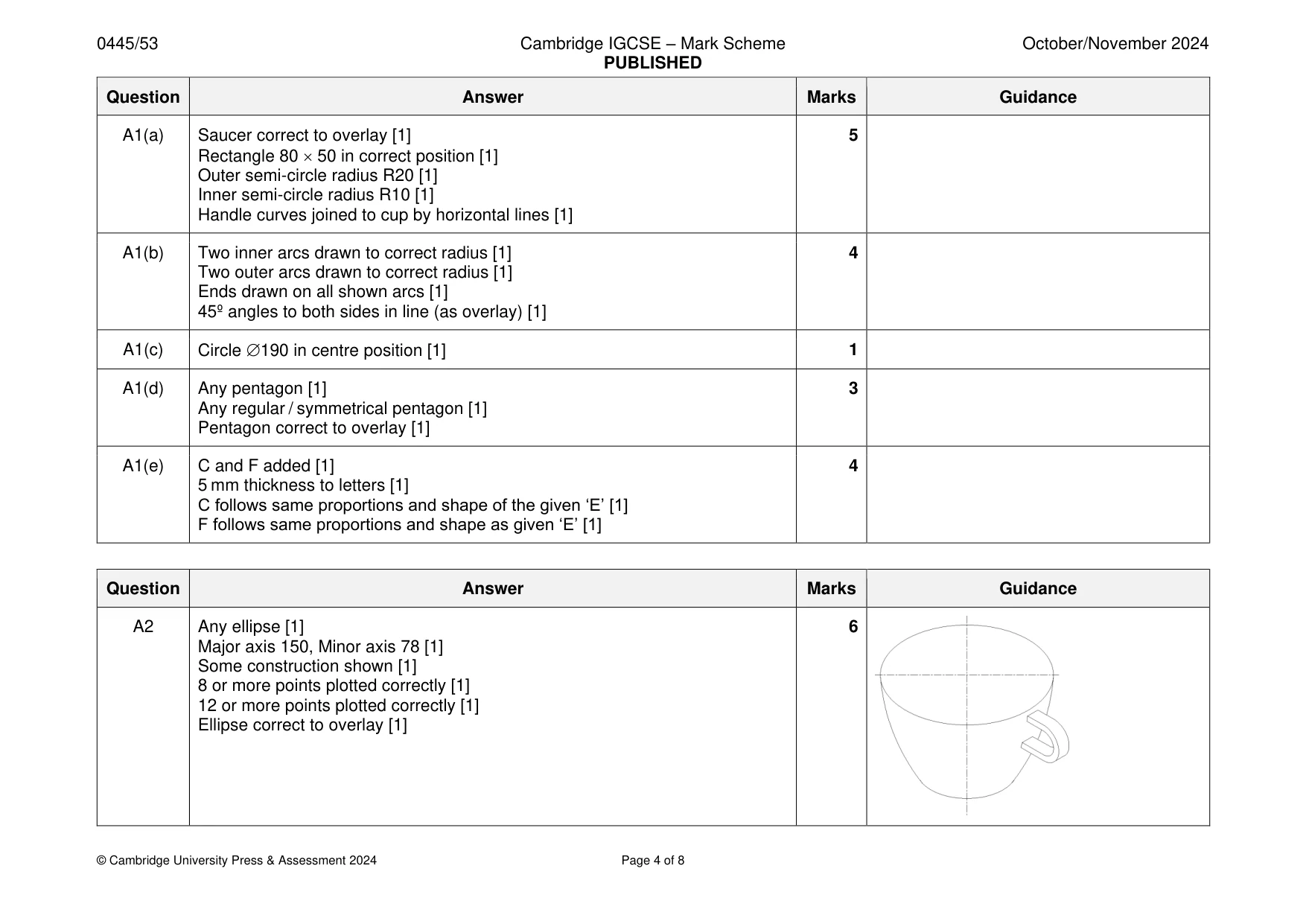
0445/53 Cambridge IGCSE – Mark Scheme PUBLISHED October/November 2024 © Cambridge University Press & Assessment 2024 Page 4 of 8 Question Answer Marks Guidance A1(a) Saucer correct to overlay [1] Rectangle 80 50 in correct position [1] Outer semi-circle radius R20 [1] Inner semi-circle radius R10 [1] Handle curves joined to cup by horizontal lines [1] 5 A1(b) Two inner arcs drawn to correct radius [1] Two outer arcs drawn to correct radius [1] Ends drawn on all shown arcs [1] 45º angles to both sides in line (as overlay) [1] 4 A1(c) Circle 190 in centre position [1] 1 A1(d) Any pentagon [1] Any regular / symmetrical pentagon [1] Pentagon correct to overlay [1] 3 A1(e) C and F added [1] 5 mm thickness to letters [1] C follows same proportions and shape of the given ‘E’ [1] F follows same proportions and shape as given ‘E’ [1] 4 Question Answer Marks Guidance A2 Any ellipse [1] Major axis 150, Minor axis 78 [1] Some construction shown [1] 8 or more points plotted correctly [1] 12 or more points plotted correctly [1] Ellipse correct to overlay [1] 6
Mark scheme, page 5
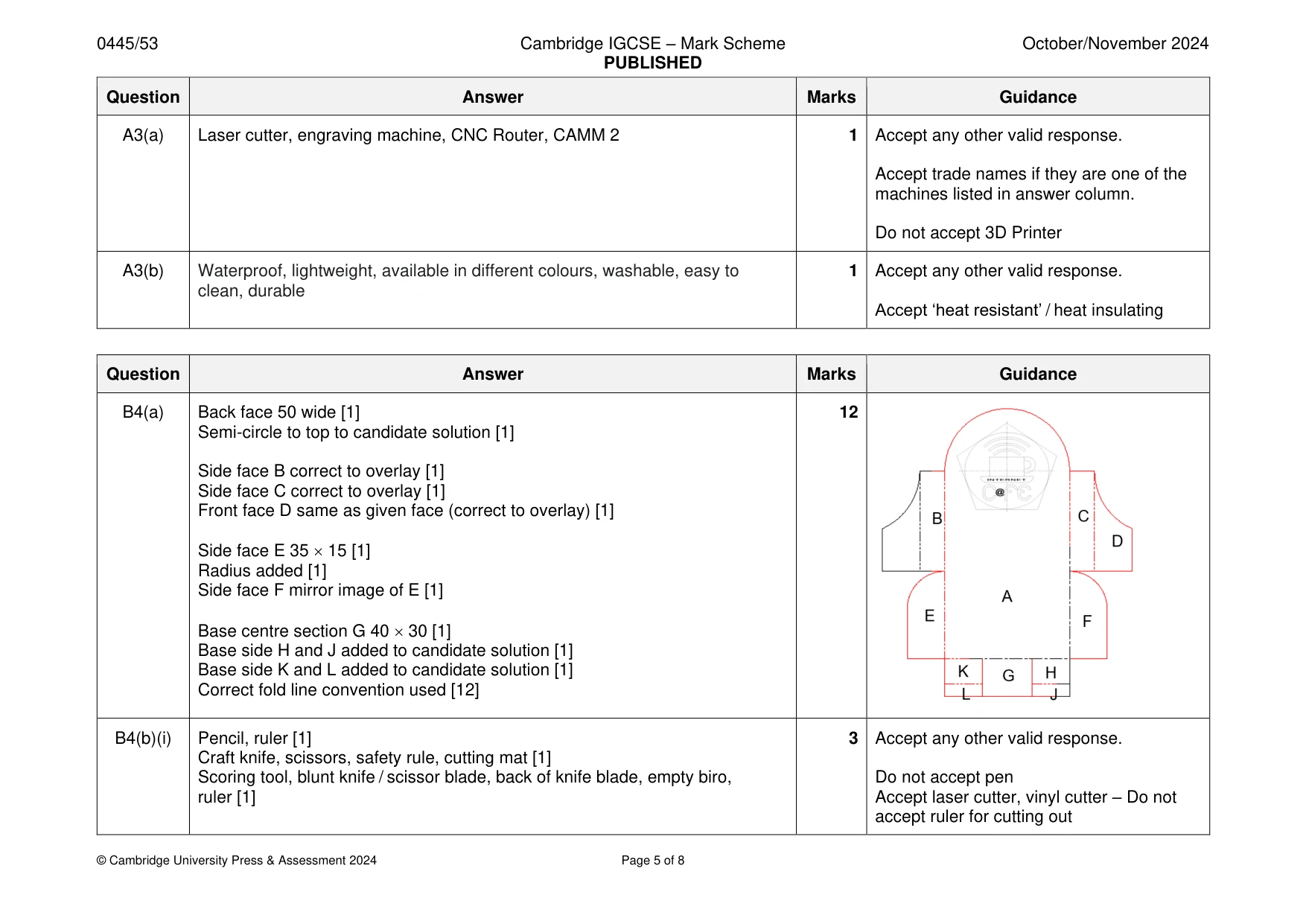
0445/53 Cambridge IGCSE – Mark Scheme PUBLISHED October/November 2024 © Cambridge University Press & Assessment 2024 Page 5 of 8 Question Answer Marks Guidance A3(a) Laser cutter, engraving machine, CNC Router, CAMM 2 1 Accept any other valid response. Accept trade names if they are one of the machines listed in answer column. Do not accept 3D Printer A3(b) Waterproof, lightweight, available in different colours, washable, easy to clean, durable 1 Accept any other valid response. Accept ‘heat resistant’ / heat insulating Question Answer Marks Guidance B4(a) Back face 50 wide [1] Semi-circle to top to candidate solution [1] Side face B correct to overlay [1] Side face C correct to overlay [1] Front face D same as given face (correct to overlay) [1] Side face E 35 15 [1] Radius added [1] Side face F mirror image of E [1] Base centre section G 40 30 [1] Base side H and J added to candidate solution [1] Base side K and L added to candidate solution [1] Correct fold line convention used [12] 12 B4(b)(i) Pencil, ruler [1] Craft knife, scissors, safety rule, cutting mat [1] Scoring tool, blunt knife / scissor blade, back of knife blade, empty biro, ruler [1] 3 Accept any other valid response. Do not accept pen Accept laser cutter, vinyl cutter – Do not accept ruler for cutting out
Mark scheme, page 6
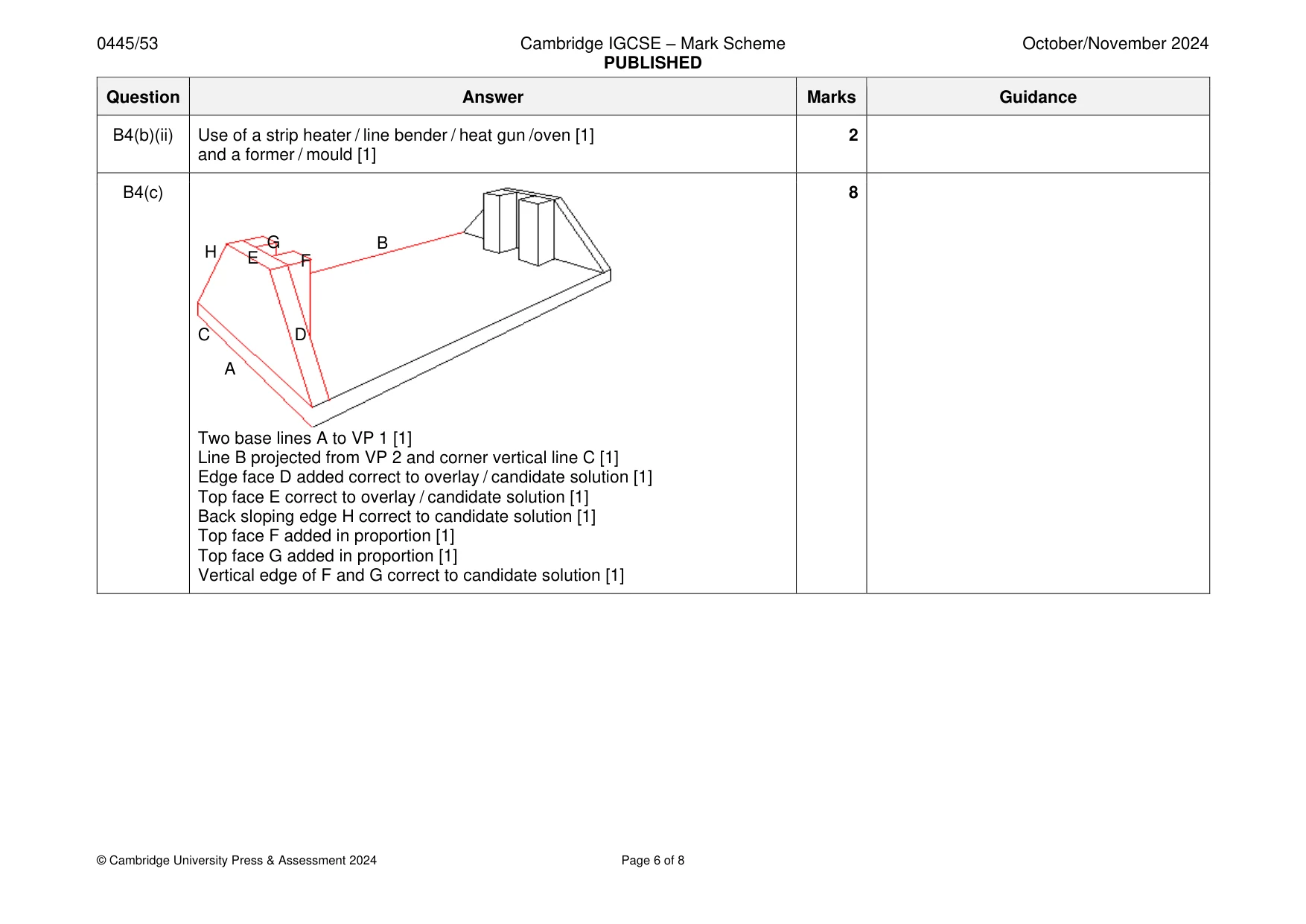
0445/53 Cambridge IGCSE – Mark Scheme PUBLISHED October/November 2024 © Cambridge University Press & Assessment 2024 Page 6 of 8 Question Answer Marks Guidance B4(b)(ii) Use of a strip heater / line bender / heat gun /oven [1] and a former / mould [1] 2 B4(c) Two base lines A to VP 1 [1] Line B projected from VP 2 and corner vertical line C [1] Edge face D added correct to overlay / candidate solution [1] Top face E correct to overlay / candidate solution [1] Back sloping edge H correct to candidate solution [1] Top face F added in proportion [1] Top face G added in proportion [1] Vertical edge of F and G correct to candidate solution [1] 8 A B C D E G F H
Mark scheme, page 7
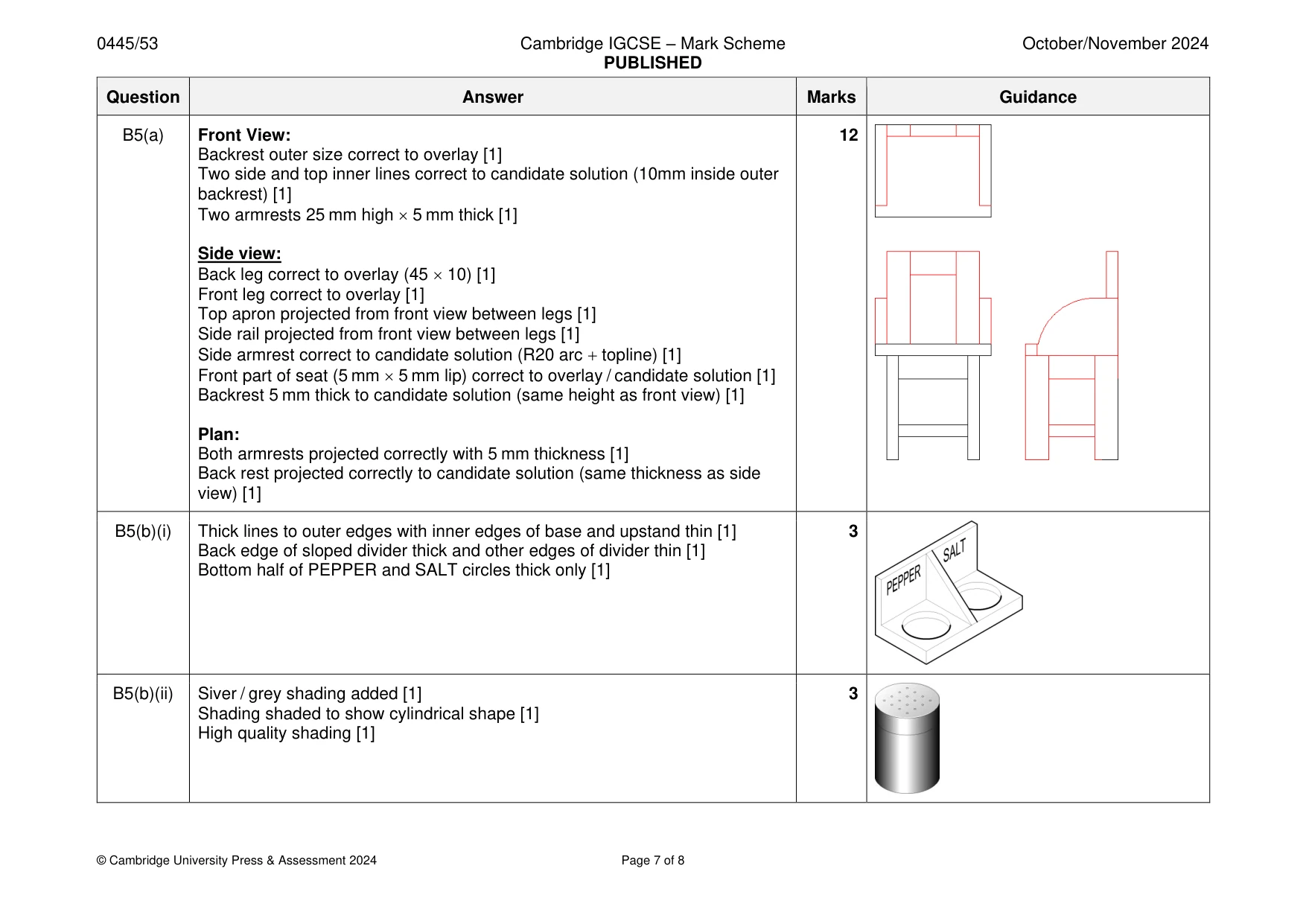
0445/53 Cambridge IGCSE – Mark Scheme PUBLISHED October/November 2024 © Cambridge University Press & Assessment 2024 Page 7 of 8 Question Answer Marks Guidance B5(a) Front View: Backrest outer size correct to overlay [1] Two side and top inner lines correct to candidate solution (10mm inside outer backrest) [1] Two armrests 25 mm high 5 mm thick [1] Side view: Back leg correct to overlay (45 10) [1] Front leg correct to overlay [1] Top apron projected from front view between legs [1] Side rail projected from front view between legs [1] Side armrest correct to candidate solution (R20 arc + topline) [1] Front part of seat (5 mm 5 mm lip) correct to overlay / candidate solution [1] Backrest 5 mm thick to candidate solution (same height as front view) [1] Plan: Both armrests projected correctly with 5 mm thickness [1] Back rest projected correctly to candidate solution (same thickness as side view) [1] 12 B5(b)(i) Thick lines to outer edges with inner edges of base and upstand thin [1] Back edge of sloped divider thick and other edges of divider thin [1] Bottom half of PEPPER and SALT circles thick only [1] 3 B5(b)(ii) Siver / grey shading added [1] Shading shaded to show cylindrical shape [1] High quality shading [1] 3
Mark scheme, page 8
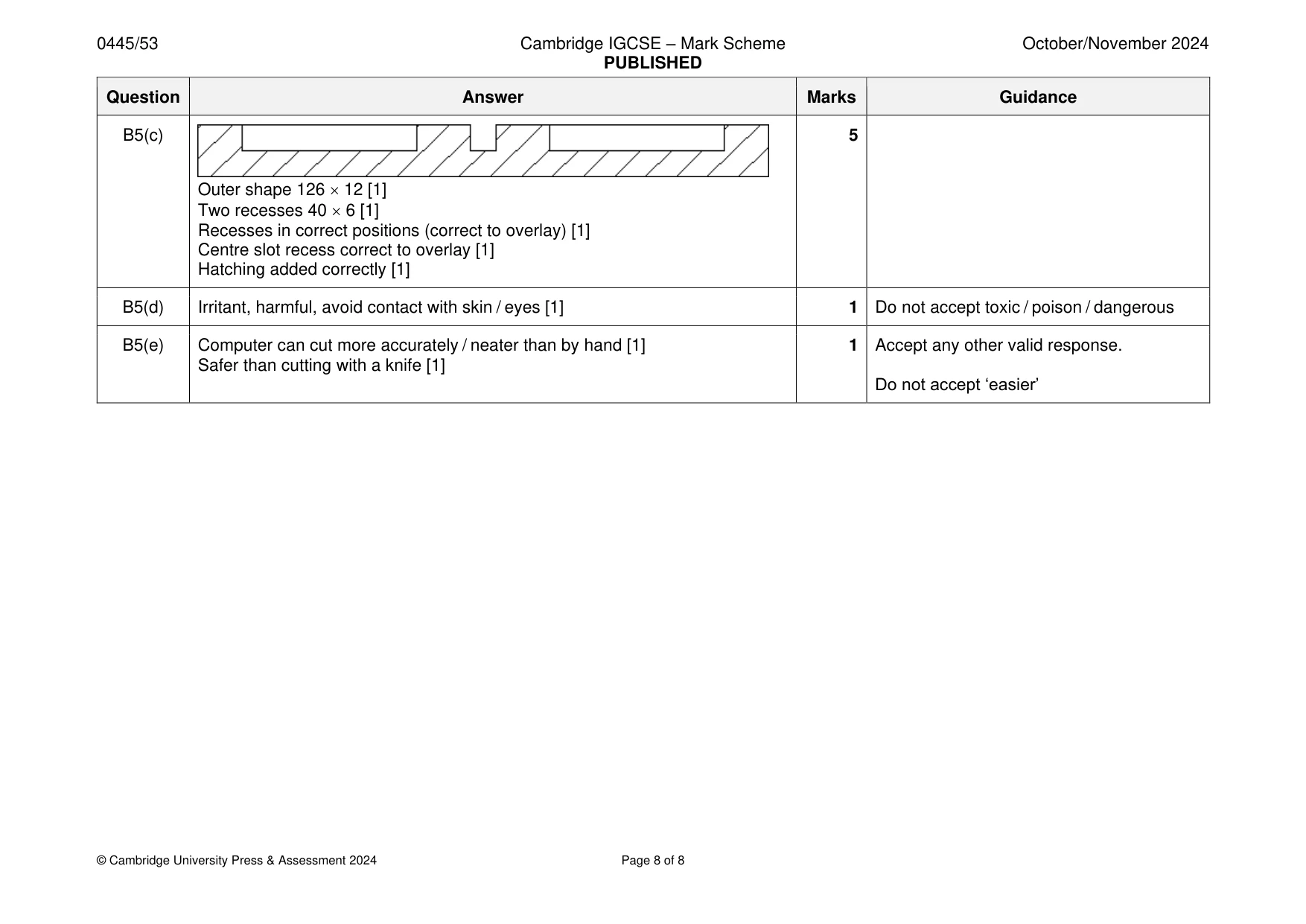
0445/53 Cambridge IGCSE – Mark Scheme PUBLISHED October/November 2024 © Cambridge University Press & Assessment 2024 Page 8 of 8 Question Answer Marks Guidance B5(c) Outer shape 126 12 [1] Two recesses 40 6 [1] Recesses in correct positions (correct to overlay) [1] Centre slot recess correct to overlay [1] Hatching added correctly [1] 5 B5(d) Irritant, harmful, avoid contact with skin / eyes [1] 1 Do not accept toxic / poison / dangerous B5(e) Computer can cut more accurately / neater than by hand [1] Safer than cutting with a knife [1] 1 Accept any other valid response. Do not accept ‘easier’
What you needed in this session
Cambridge’s own grade thresholds for 2024 Oct/Nov, Paper 5 · Variant 3. A higher threshold means an easier paper — the bar moves with how the cohort did.