Cambridge IGCSE Design and Technology 0445 — 2010 Oct/Nov Paper 2 · Variant 1
0445/21/O/N/10 · 50 marks · ≈56 min
The question paper and its mark scheme, free to read here and free to download. This is Cambridge’s own paper, exactly as it was sat.
Question paper4 pages
Mark scheme3 pages
Answers below. Sit the paper first if you are practising.
Paper as text
Question paper, page 1
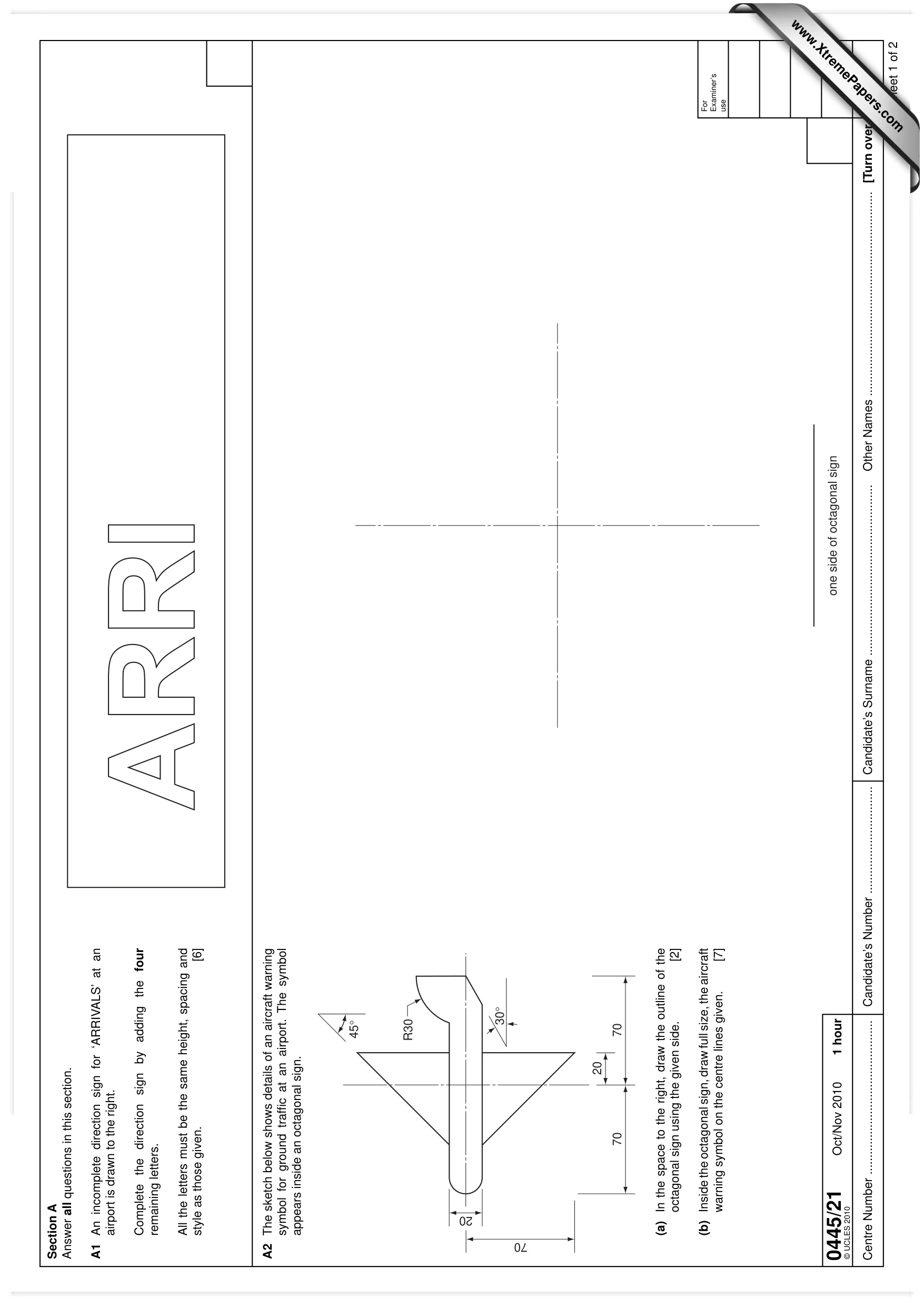
0445/21 Oct/Nov 2010 1 hour For Examiner’s use Centre Number … © UCLES 2010 Candidate’s Number … Candidate’s Surname … Other Names … [Turn over Sheet 1 of 2 Section A Answer all questions in this section. A1 An incomplete direction sign for ‘ARRIVALS’ at an airport is drawn to the right. Complete the direction sign by adding the four remaining letters. All the letters must be the same height, spacing and style as those given. [6] A2 The sketch below shows details of an aircraft warning symbol for ground traffi c at an airport. The symbol appears inside an octagonal sign. 30° 45° 20 20 70 70 70 R30 (a) In the space to the right, draw the outline of the octagonal sign using the given side. [2] (b) Inside the octagonal sign, draw full size, the aircraft warning symbol on the centre lines given. [7] one side of octagonal sign www.XtremePapers.com
Question paper, page 2
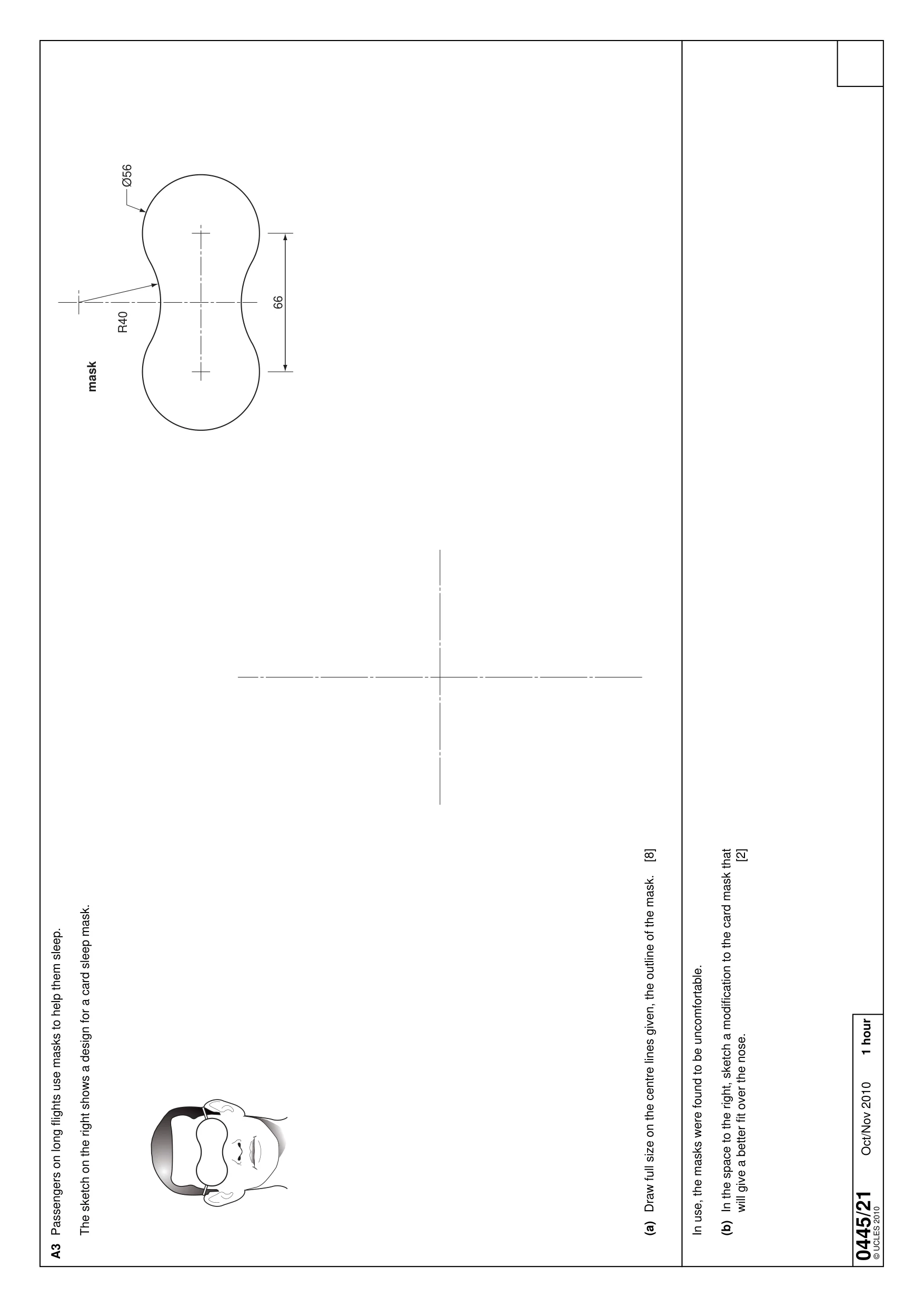
0445/21 Oct/Nov 2010 1 hour © UCLES 2010 A3 Passengers on long fl ights use masks to help them sleep. The sketch on the right shows a design for a card sleep mask. (a) Draw full size on the centre lines given, the outline of the mask. [8] R40 Ø56 66 mask In use, the masks were found to be uncomfortable. (b) In the space to the right, sketch a modifi cation to the card mask that will give a better fi t over the nose. [2]
Question paper, page 3
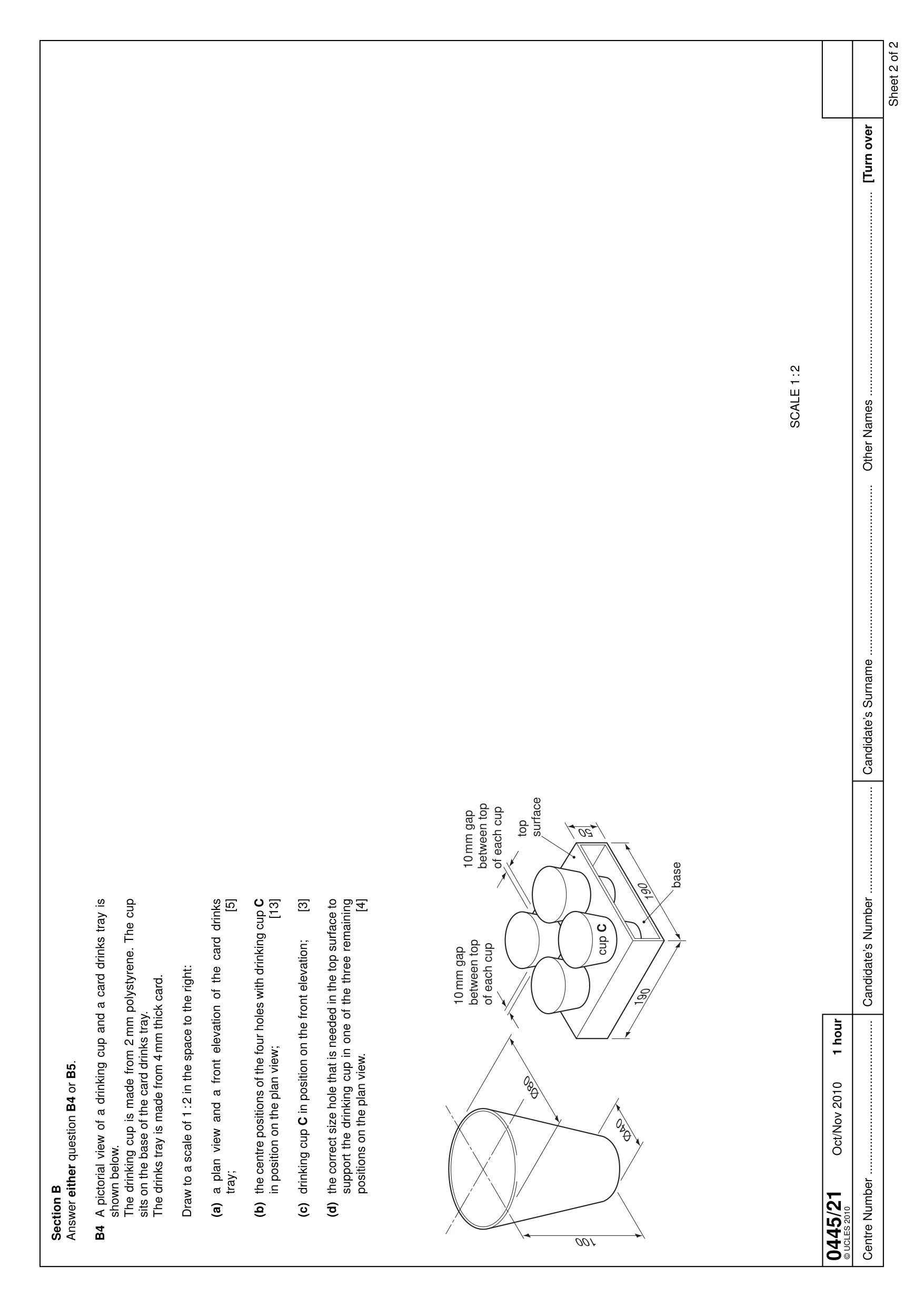
0445/21 Oct/Nov 2010 1 hour Centre Number … © UCLES 2010 Candidate’s Number … Candidate’s Surname … Other Names … [Turn over Sheet 2 of 2 Section B Answer either question B4 or B5. B4 A pictorial view of a drinking cup and a card drinks tray is shown below. The drinking cup is made from 2 mm polystyrene. The cup sits on the base of the card drinks tray. The drinks tray is made from 4 mm thick card. Draw to a scale of 1 : 2 in the space to the right: (a) a plan view and a front elevation of the card drinks tray; [5] (b) the centre positions of the four holes with drinking cup C in position on the plan view; [13] (c) drinking cup C in position on the front elevation; [3] (d) the correct size hole that is needed in the top surface to support the drinking cup in one of the three remaining positions on the plan view. [4] 10 mm gap between top of each cup 10 mm gap between top of each cup top surface base cup C 100 Ø40 Ø80 190 190 50 SCALE 1 : 2
Question paper, page 4
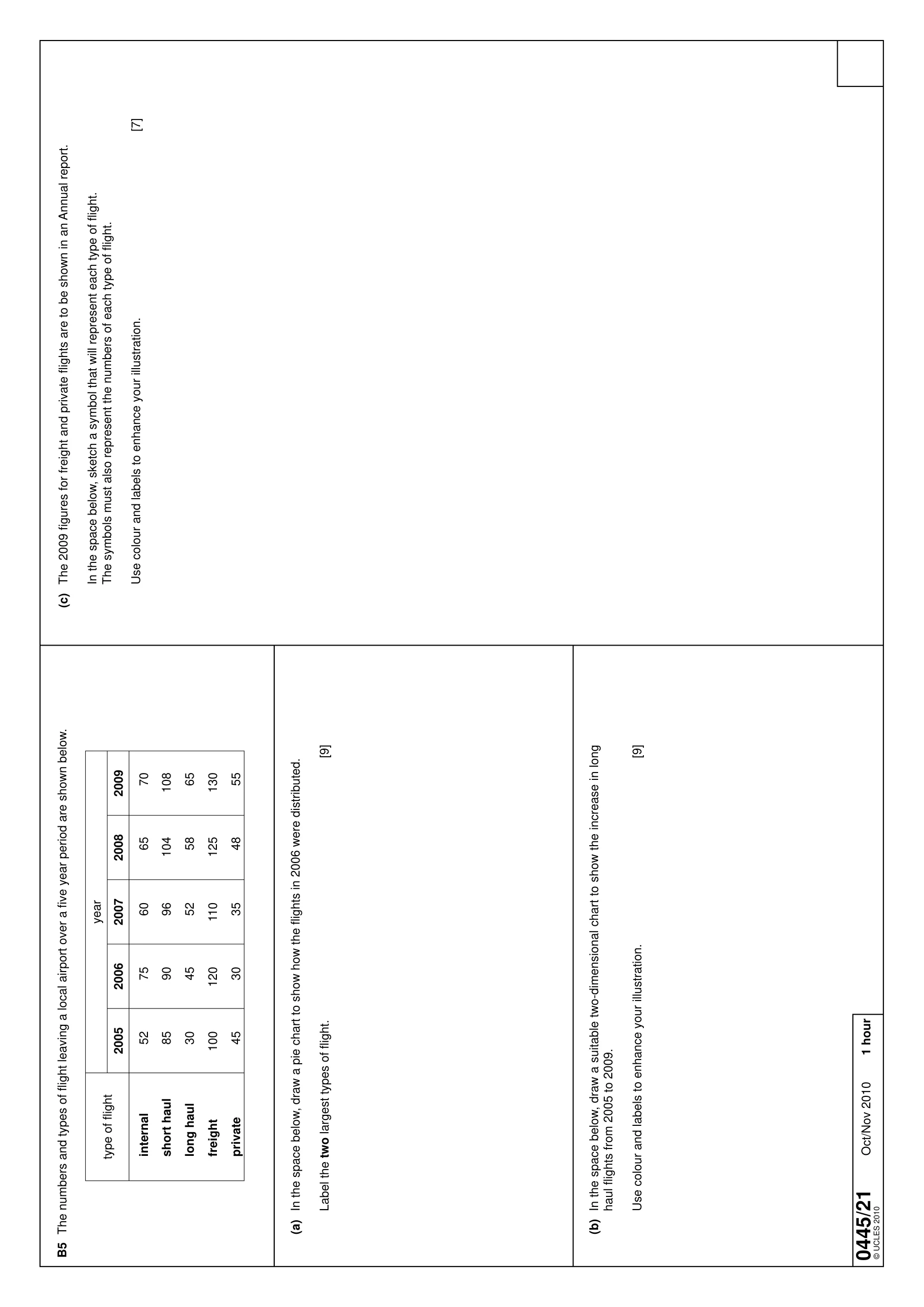
0445/21 Oct/Nov 2010 1 hour © UCLES 2010 B5 The numbers and types of fl ight leaving a local airport over a fi ve year period are shown below. type of fl ight year 2005 2006 2007 2008 2009 internal 52 75 60 65 70 short haul 85 90 96 104 108 long haul 30 45 52 58 65 freight 100 120 110 125 130 private 45 30 35 48 55 (a) In the space below, draw a pie chart to show how the fl ights in 2006 were distributed. Label the two largest types of fl ight. [9] (b) In the space below, draw a suitable two-dimensional chart to show the increase in long haul fl ights from 2005 to 2009. Use colour and labels to enhance your illustration. [9] (c) The 2009 fi gures for freight and private fl ights are to be shown in an Annual report. In the space below, sketch a symbol that will represent each type of fl ight. The symbols must also represent the numbers of each type of fl ight. Use colour and labels to enhance your illustration. [7]
Mark scheme, page 1
UNIVERSITY OF CAMBRIDGE INTERNATIONAL EXAMINATIONS International General Certificate of Secondary Education MARK SCHEME for the October/November 2010 question paper for the guidance of teachers 0445 DESIGN AND TECHNOLOGY 0445/21 Paper 2 (Graphic Products), maximum raw mark 50 This mark scheme is published as an aid to teachers and candidates, to indicate the requirements of the examination. It shows the basis on which Examiners were instructed to award marks. It does not indicate the details of the discussions that took place at an Examiners’ meeting before marking began, which would have considered the acceptability of alternative answers. Mark schemes must be read in conjunction with the question papers and the report on the examination. • CIE will not enter into discussions or correspondence in connection with these mark schemes. CIE is publishing the mark schemes for the October/November 2010 question papers for most IGCSE, GCE Advanced Level and Advanced Subsidiary Level syllabuses and some Ordinary Level syllabuses. www.XtremePapers.com
Mark scheme, page 2
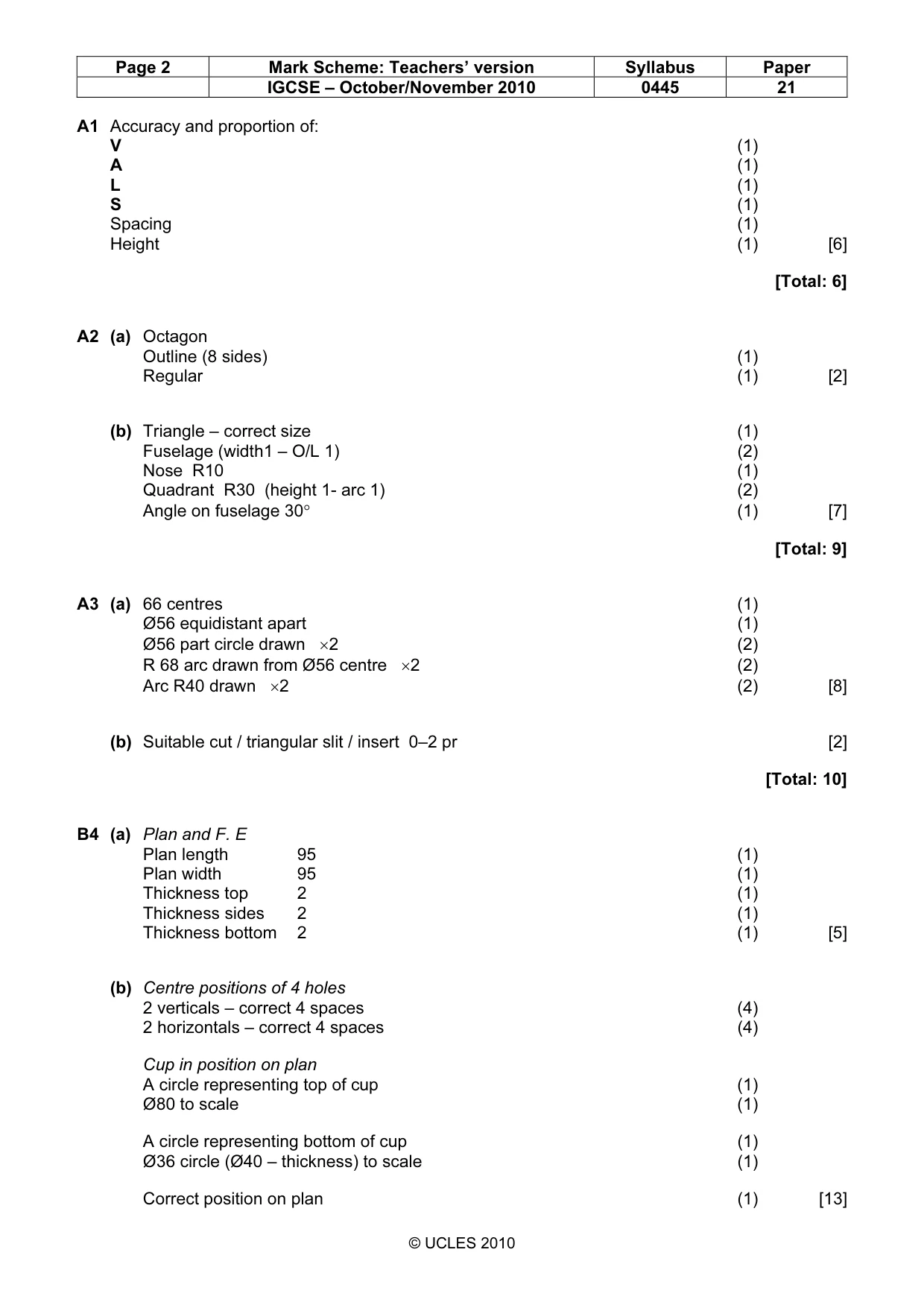
Page 2 Mark Scheme: Teachers’ version Syllabus Paper IGCSE – October/November 2010 0445 21 © UCLES 2010 A1 Accuracy and proportion of: V (1) A (1) L (1) S (1) Spacing (1) Height (1) [6] [Total: 6] A2 (a) Octagon Outline (8 sides) (1) Regular (1) [2] (b) Triangle – correct size (1) Fuselage (width1 – O/L 1) (2) Nose R10 (1) Quadrant R30 (height 1- arc 1) (2) Angle on fuselage 30° (1) [7] [Total: 9] A3 (a) 66 centres (1) Ø56 equidistant apart (1) Ø56 part circle drawn ×2 (2) R 68 arc drawn from Ø56 centre ×2 (2) Arc R40 drawn ×2 (2) [8] (b) Suitable cut / triangular slit / insert 0–2 pr [2] [Total: 10] B4 (a) Plan and F. E Plan length 95 (1) Plan width 95 (1) Thickness top 2 (1) Thickness sides 2 (1) Thickness bottom 2 (1) [5] (b) Centre positions of 4 holes 2 verticals – correct 4 spaces (4) 2 horizontals – correct 4 spaces (4) Cup in position on plan A circle representing top of cup (1) Ø80 to scale (1) A circle representing bottom of cup (1) Ø36 circle (Ø40 – thickness) to scale (1) Correct position on plan (1) [13]
Mark scheme, page 3
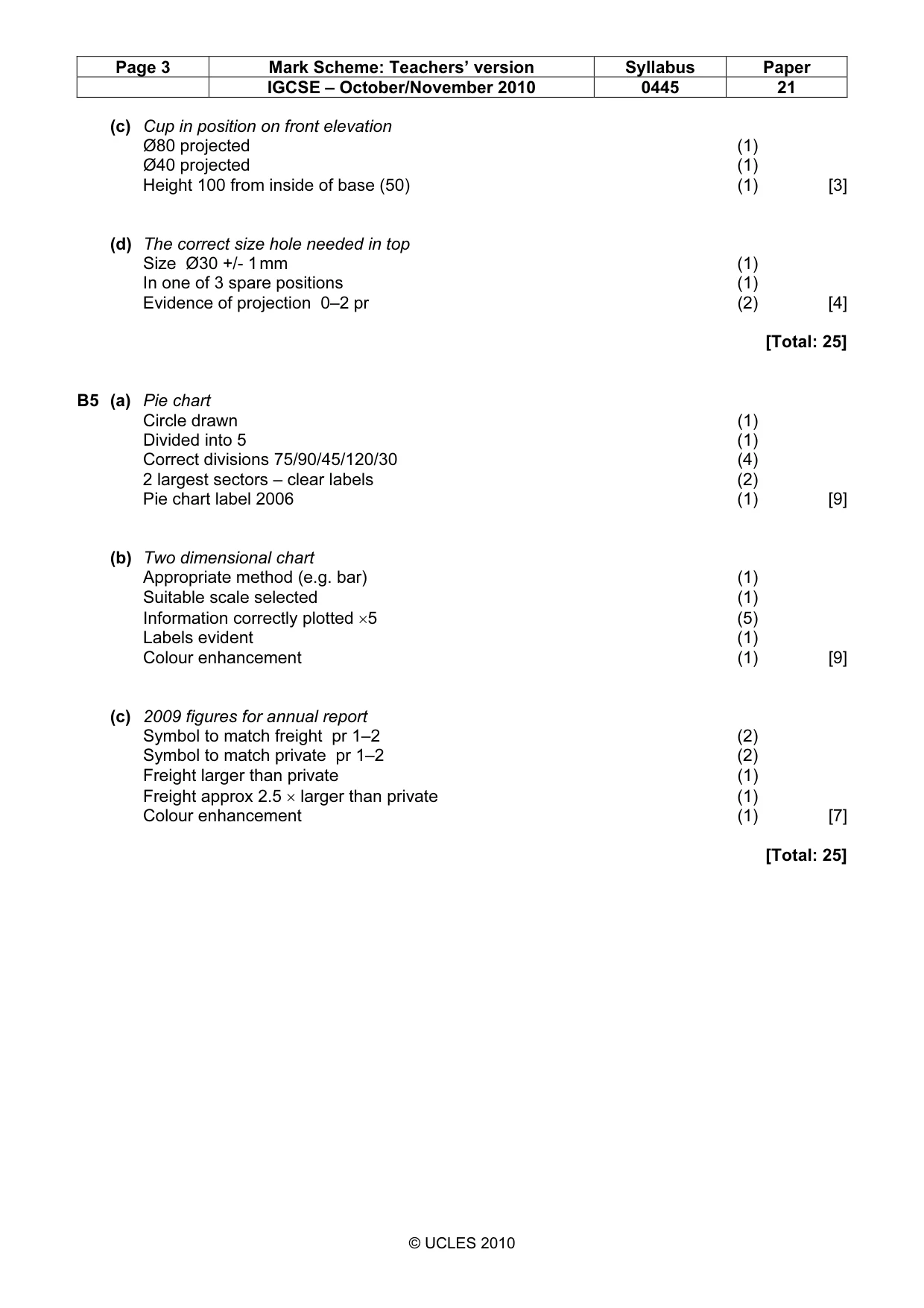
Page 3 Mark Scheme: Teachers’ version Syllabus Paper IGCSE – October/November 2010 0445 21 © UCLES 2010 (c) Cup in position on front elevation Ø80 projected (1) Ø40 projected (1) Height 100 from inside of base (50) (1) [3] (d) The correct size hole needed in top Size Ø30 +/- 1 mm (1) In one of 3 spare positions (1) Evidence of projection 0–2 pr (2) [4] [Total: 25] B5 (a) Pie chart Circle drawn (1) Divided into 5 (1) Correct divisions 75/90/45/120/30 (4) 2 largest sectors – clear labels (2) Pie chart label 2006 (1) [9] (b) Two dimensional chart Appropriate method (e.g. bar) (1) Suitable scale selected (1) Information correctly plotted ×5 (5) Labels evident (1) Colour enhancement (1) [9] (c) 2009 figures for annual report Symbol to match freight pr 1–2 (2) Symbol to match private pr 1–2 (2) Freight larger than private (1) Freight approx 2.5 × larger than private (1) Colour enhancement (1) [7] [Total: 25]
What you needed in this session
Cambridge’s own grade thresholds for 2010 Oct/Nov, Paper 2 · Variant 1. A higher threshold means an easier paper — the bar moves with how the cohort did.