Cambridge IGCSE Design and Technology 0445 — 2010 May/June Paper 2 · Variant 1
0445/21/M/J/10 · 50 marks · ≈56 min
The question paper and its mark scheme, free to read here and free to download. This is Cambridge’s own paper, exactly as it was sat.
Question paper4 pages
Mark scheme3 pages
Answers below. Sit the paper first if you are practising.
Paper as text
Question paper, page 1
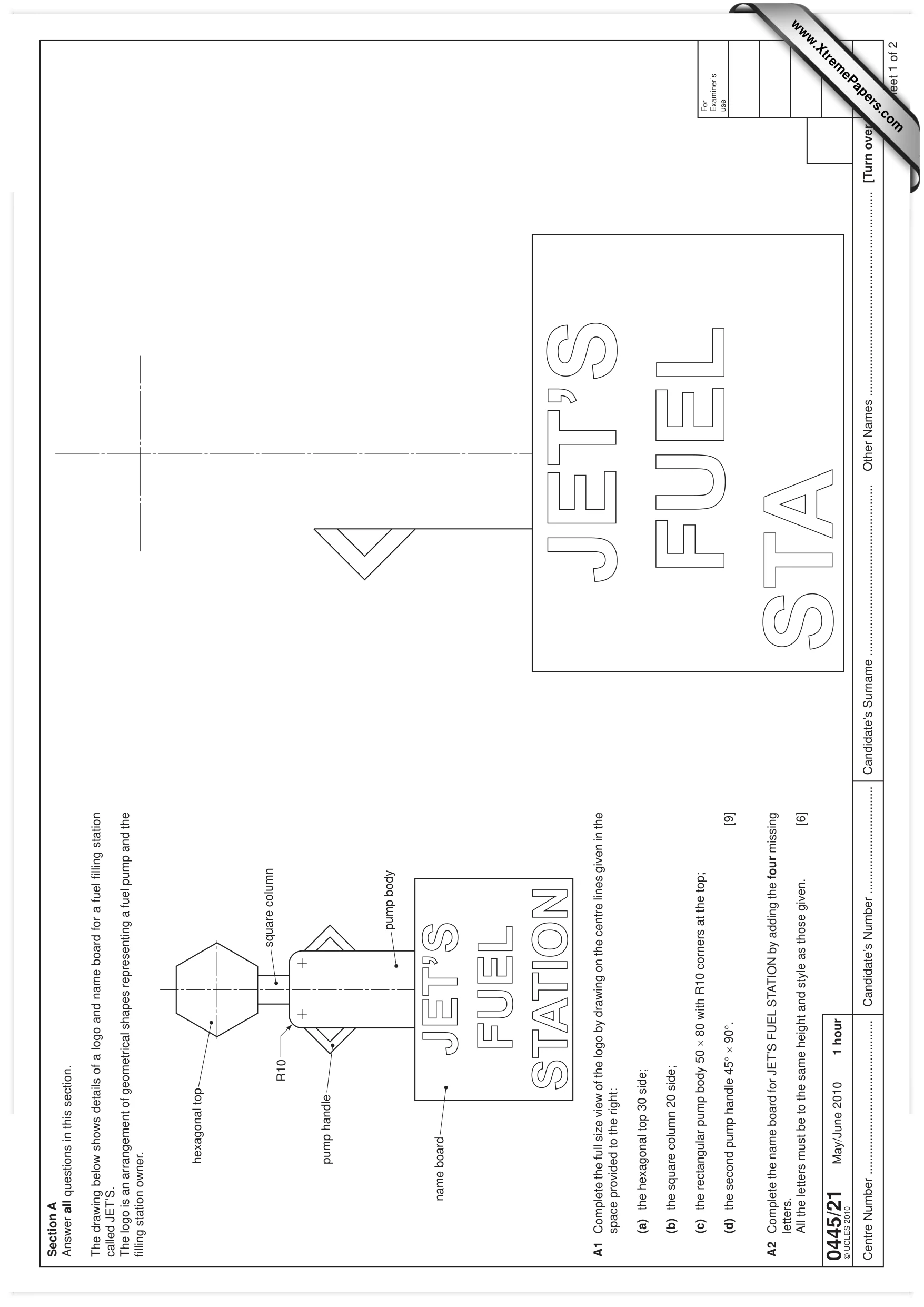
0445/21 May/June 2010 1 hour For Examiner’s use Centre Number … © UCLES 2010 Candidate’s Number … Candidate’s Surname … Other Names … [Turn over Sheet 1 of 2 Section A Answer all questions in this section. The drawing below shows details of a logo and name board for a fuel fi lling station called JET’S. The logo is an arrangement of geometrical shapes representing a fuel pump and the fi lling station owner. square column pump body R10 pump handle hexagonal top name board A1 Complete the full size view of the logo by drawing on the centre lines given in the space provided to the right: (a) the hexagonal top 30 side; (b) the square column 20 side; (c) the rectangular pump body 50 × 80 with R10 corners at the top; (d) the second pump handle 45° × 90°. [9] A2 Complete the name board for JET’S FUEL STATION by adding the four missing letters. All the letters must be to the same height and style as those given. [6] www.XtremePapers.com
Question paper, page 2
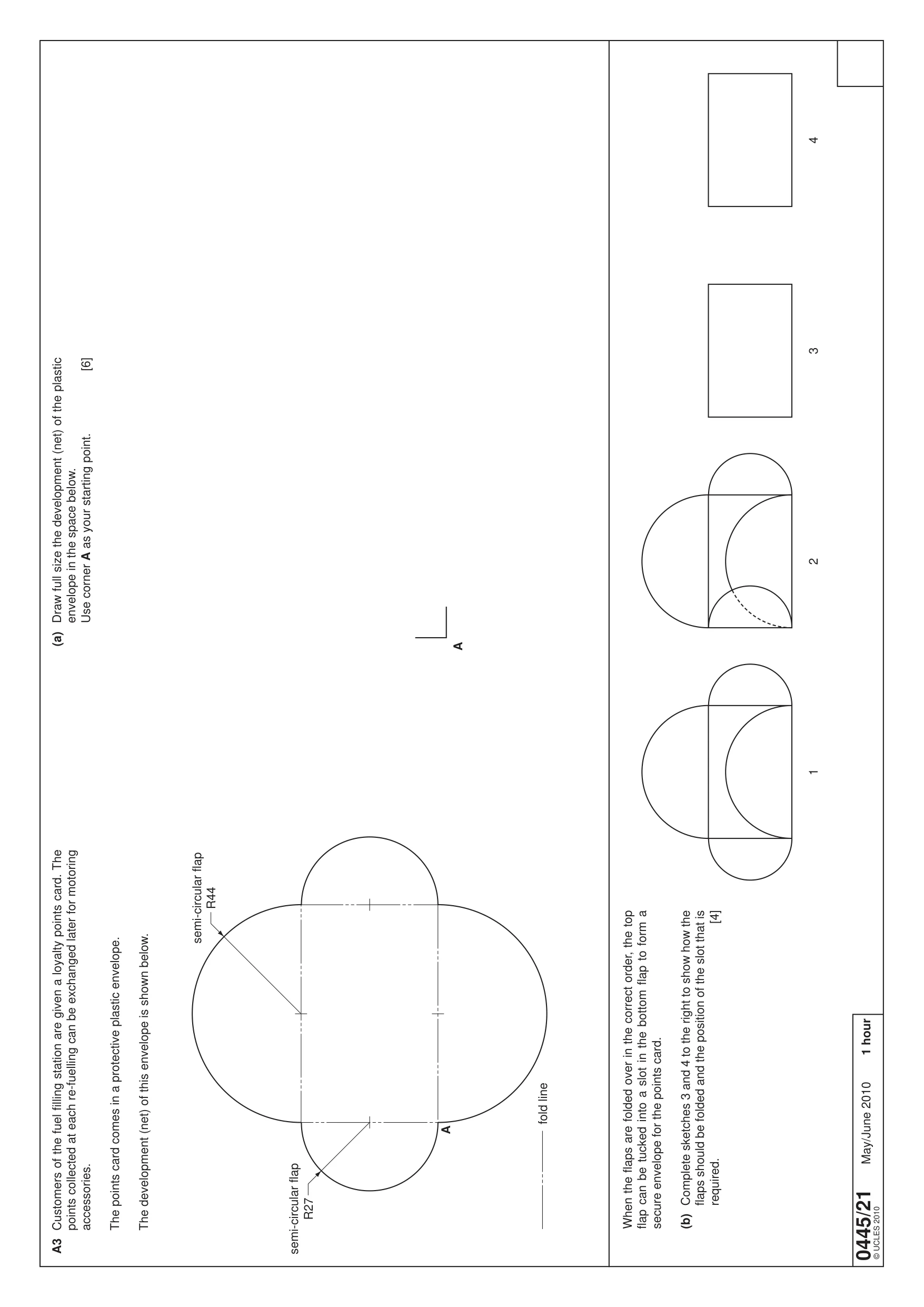
0445/21 May/June 2010 1 hour © UCLES 2010 A3 Customers of the fuel fi lling station are given a loyalty points card. The points collected at each re-fuelling can be exchanged later for motoring accessories. The points card comes in a protective plastic envelope. The development (net) of this envelope is shown below. (a) Draw full size the development (net) of the plastic envelope in the space below. Use corner A as your starting point. [6] fold line semi-circular flap R44 semi-circular flap R27 A A When the fl aps are folded over in the correct order, the top fl ap can be tucked into a slot in the bottom fl ap to form a secure envelope for the points card. (b) Complete sketches 3 and 4 to the right to show how the fl aps should be folded and the position of the slot that is required. [4] 1 2 3 4
Question paper, page 3
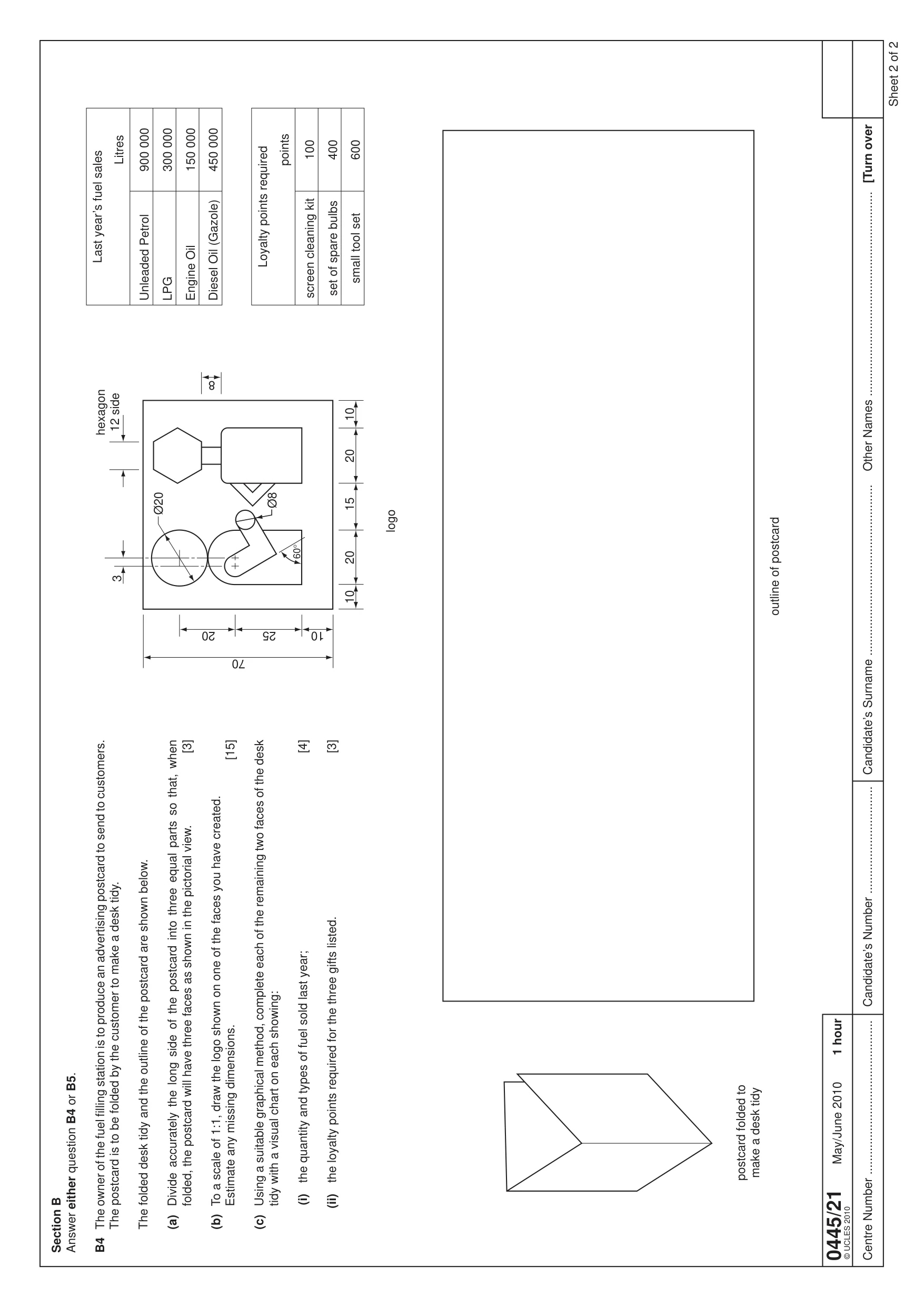
0445/21 May/June 2010 1 hour Centre Number … © UCLES 2010 Candidate’s Number … Candidate’s Surname … Other Names … [Turn over Sheet 2 of 2 Section B Answer either question B4 or B5. B4 The owner of the fuel fi lling station is to produce an advertising postcard to send to customers. The postcard is to be folded by the customer to make a desk tidy. The folded desk tidy and the outline of the postcard are shown below. (a) Divide accurately the long side of the postcard into three equal parts so that, when folded, the postcard will have three faces as shown in the pictorial view. [3] (b) To a scale of 1:1, draw the logo shown on one of the faces you have created. Estimate any missing dimensions. [15] (c) Using a suitable graphical method, complete each of the remaining two faces of the desk tidy with a visual chart on each showing: (i) the quantity and types of fuel sold last year; [4] (ii) the loyalty points required for the three gifts listed. [3] outline of postcard postcard folded to make a desk tidy Last year’s fuel sales Litres Unleaded Petrol 900 000 LPG 300 000 Engine Oil 150 000 Diesel Oil (Gazole) 450 000 Loyalty points required points screen cleaning kit 100 set of spare bulbs 400 small tool set 600 70 20 25 10 10 10 20 20 15 logo 3 Ø20 Ø8 60° 8 hexagon 12 side
Question paper, page 4
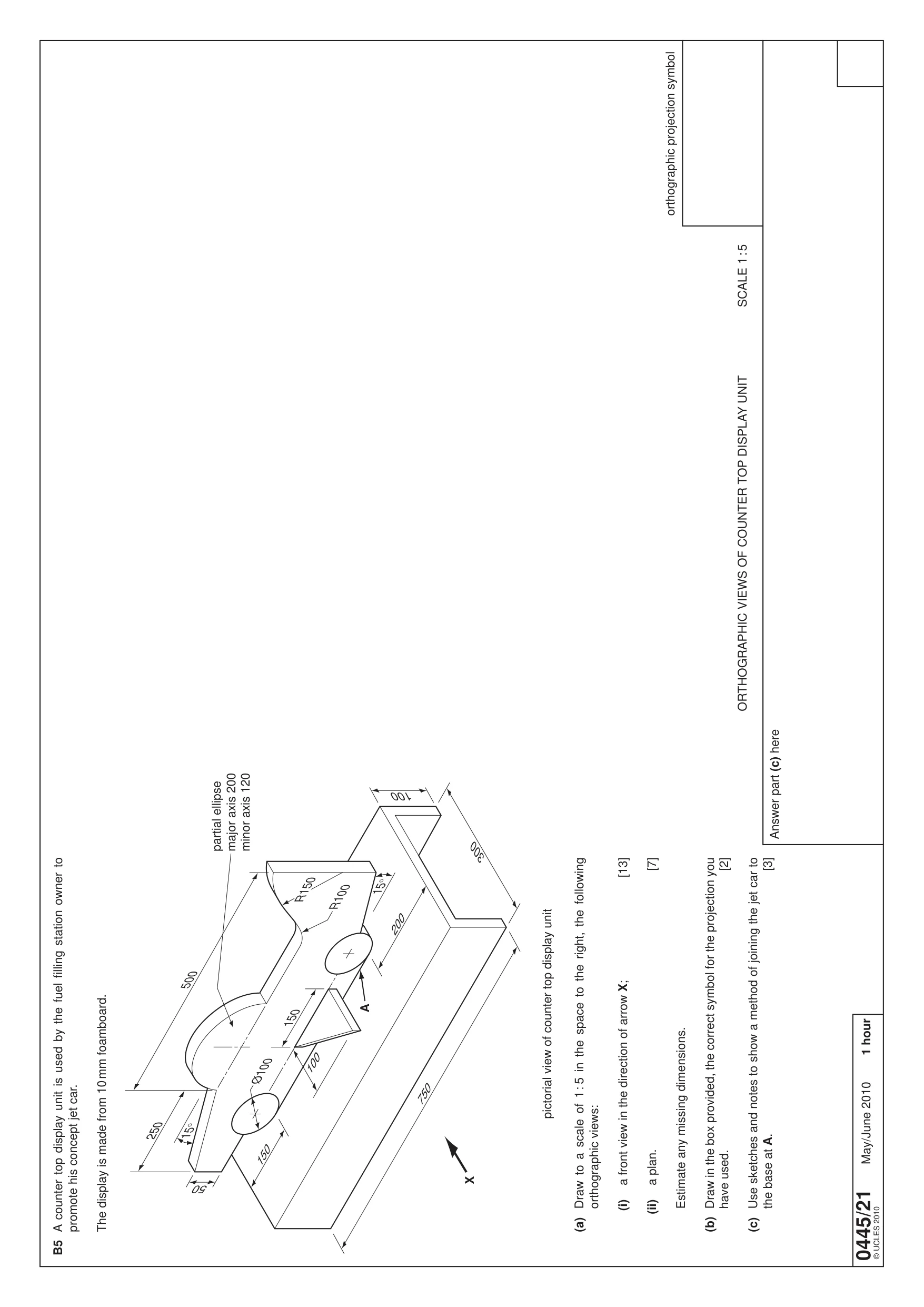
0445/21 May/June 2010 1 hour © UCLES 2010 B5 A counter top display unit is used by the fuel fi lling station owner to promote his concept jet car. The display is made from 10 mm foamboard. (a) Draw to a scale of 1 : 5 in the space to the right, the following orthographic views: (i) a front view in the direction of arrow X; [13] (ii) a plan. [7] Estimate any missing dimensions. (b) Draw in the box provided, the correct symbol for the projection you have used. [2] (c) Use sketches and notes to show a method of joining the jet car to the base at A. [3] Answer part (c) here orthographic projection symbol ORTHOGRAPHIC VIEWS OF COUNTER TOP DISPLAY UNIT SCALE 1 : 5 750 100 150 200 50 300 100 150 250 Ø100 500 15° 15° X R150 R100 A pictorial view of counter top display unit partial ellipse major axis 200 minor axis 120
Mark scheme, page 1
UNIVERSITY OF CAMBRIDGE INTERNATIONAL EXAMINATIONS International General Certificate of Secondary Education MARK SCHEME for the May/June 2010 question paper for the guidance of teachers 0445 DESIGN AND TECHNOLOGY 0445/21 Paper 21 (Graphic Products), maximum raw mark 50 This mark scheme is published as an aid to teachers and candidates, to indicate the requirements of the examination. It shows the basis on which Examiners were instructed to award marks. It does not indicate the details of the discussions that took place at an Examiners’ meeting before marking began, which would have considered the acceptability of alternative answers. Mark schemes must be read in conjunction with the question papers and the report on the examination. • CIE will not enter into discussions or correspondence in connection with these mark schemes. CIE is publishing the mark schemes for the May/June 2010 question papers for most IGCSE, GCE Advanced Level and Advanced Subsidiary Level syllabuses and some Ordinary Level syllabuses. www.XtremePapers.com
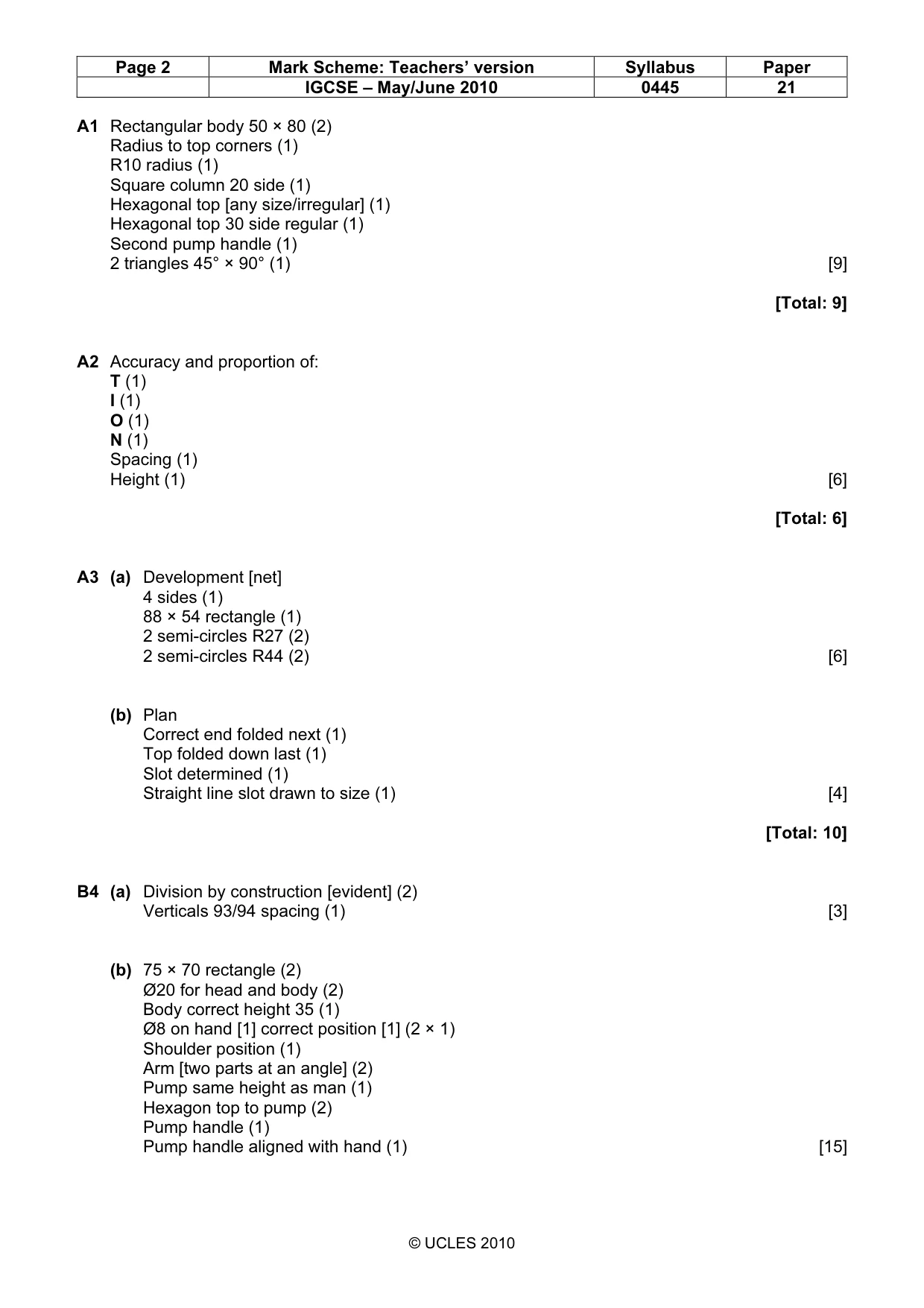
Mark scheme, page 2
Page 2 Mark Scheme: Teachers’ version Syllabus Paper IGCSE – May/June 2010 0445 21 © UCLES 2010 A1 Rectangular body 50 × 80 (2) Radius to top corners (1) R10 radius (1) Square column 20 side (1) Hexagonal top [any size/irregular] (1) Hexagonal top 30 side regular (1) Second pump handle (1) 2 triangles 45° × 90° (1) [9] [Total: 9] A2 Accuracy and proportion of: T (1) I (1) O (1) N (1) Spacing (1) Height (1) [6] [Total: 6] A3 (a) Development [net] 4 sides (1) 88 × 54 rectangle (1) 2 semi-circles R27 (2) 2 semi-circles R44 (2) [6] (b) Plan Correct end folded next (1) Top folded down last (1) Slot determined (1) Straight line slot drawn to size (1) [4] [Total: 10] B4 (a) Division by construction [evident] (2) Verticals 93/94 spacing (1) [3] (b) 75 × 70 rectangle (2) Ø20 for head and body (2) Body correct height 35 (1) Ø8 on hand [1] correct position [1] (2 × 1) Shoulder position (1) Arm [two parts at an angle] (2) Pump same height as man (1) Hexagon top to pump (2) Pump handle (1) Pump handle aligned with hand (1) [15]
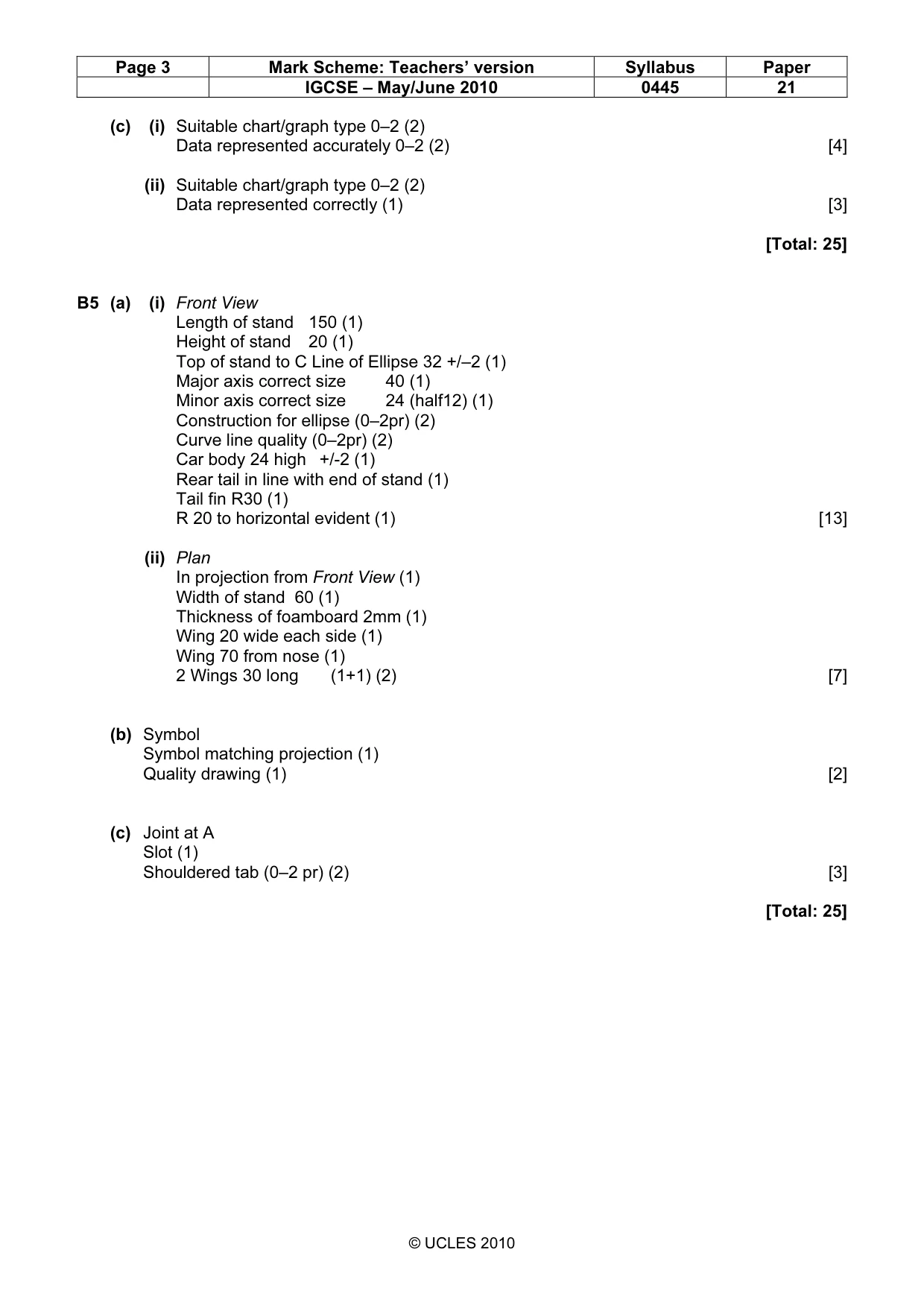
Mark scheme, page 3
Page 3 Mark Scheme: Teachers’ version Syllabus Paper IGCSE – May/June 2010 0445 21 © UCLES 2010 (c) (i) Suitable chart/graph type 0–2 (2) Data represented accurately 0–2 (2) [4] (ii) Suitable chart/graph type 0–2 (2) Data represented correctly (1) [3] [Total: 25] B5 (a) (i) Front View Length of stand 150 (1) Height of stand 20 (1) Top of stand to C Line of Ellipse 32 +/–2 (1) Major axis correct size 40 (1) Minor axis correct size 24 (half12) (1) Construction for ellipse (0–2pr) (2) Curve line quality (0–2pr) (2) Car body 24 high +/-2 (1) Rear tail in line with end of stand (1) Tail fin R30 (1) R 20 to horizontal evident (1) [13] (ii) Plan In projection from Front View (1) Width of stand 60 (1) Thickness of foamboard 2mm (1) Wing 20 wide each side (1) Wing 70 from nose (1) 2 Wings 30 long (1+1) (2) [7] (b) Symbol Symbol matching projection (1) Quality drawing (1) [2] (c) Joint at A Slot (1) Shouldered tab (0–2 pr) (2) [3] [Total: 25]
What you needed in this session
Cambridge’s own grade thresholds for 2010 May/June, Paper 2 · Variant 1. A higher threshold means an easier paper — the bar moves with how the cohort did.