Cambridge IGCSE Computer Science (9-1) 0984 — 2020 Oct/Nov Paper 1 · Variant 2
0984/12/O/N/20 · 75 marks · ≈84 min
The question paper and its mark scheme, free to read here and free to download. This is Cambridge’s own paper, exactly as it was sat.
Question paper12 pages


Mark scheme13 pages
Answers below. Sit the paper first if you are practising.
Paper as text
Question paper, page 1
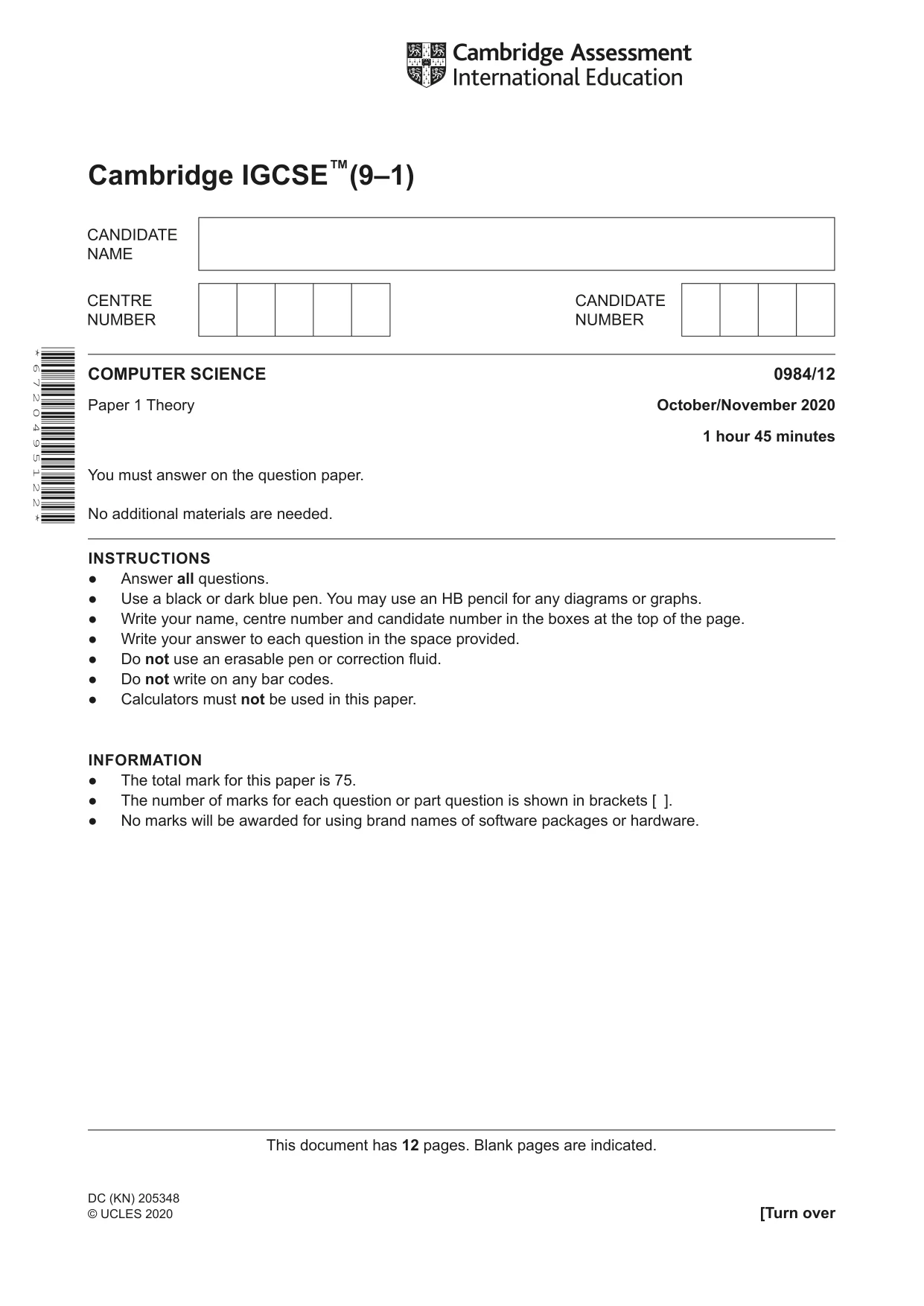
Cambridge IGCSE™(9–1) This document has 12 pages. Blank pages are indicated. DC (KN) 205348 © UCLES 2020 [Turn over COMPUTER SCIENCE 0984/12 Paper 1 Theory October/November 2020 1 hour 45 minutes You must answer on the question paper. No additional materials are needed. INSTRUCTIONS ● Answer all questions. ● Use a black or dark blue pen. You may use an HB pencil for any diagrams or graphs. ● Write your name, centre number and candidate number in the boxes at the top of the page. ● Write your answer to each question in the space provided. ● Do not use an erasable pen or correction fluid. ● Do not write on any bar codes. ● Calculators must not be used in this paper. INFORMATION ● The total mark for this paper is 75. ● The number of marks for each question or part question is shown in brackets [ ]. ● No marks will be awarded for using brand names of software packages or hardware. * 6 7 2 0 4 9 5 1 2 2 *
Question paper, page 2
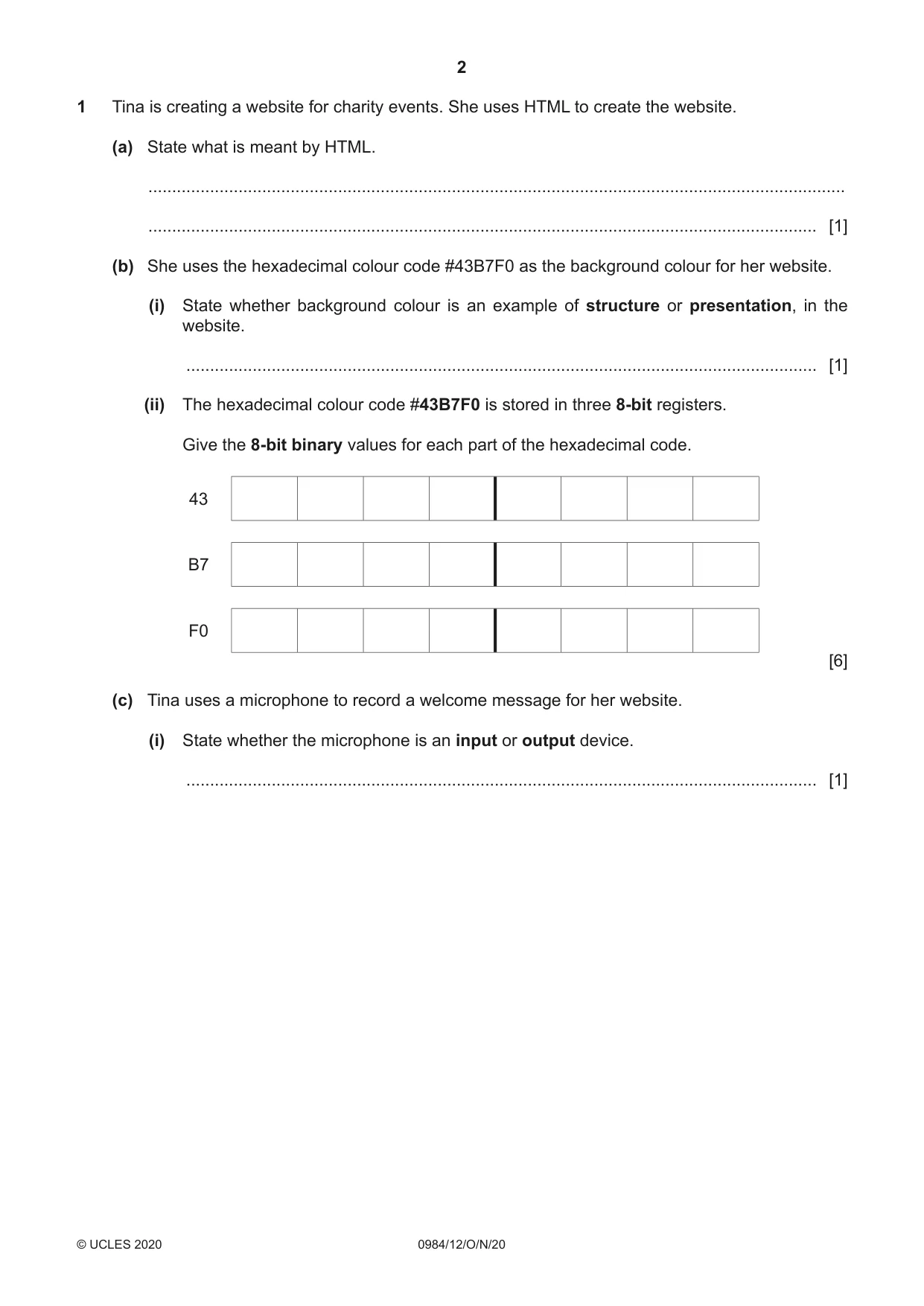
2 0984/12/O/N/20 © UCLES 2020 1 Tina is creating a website for charity events. She uses HTML to create the website. (a) State what is meant by HTML. … … [1] (b) She uses the hexadecimal colour code #43B7F0 as the background colour for her website. (i) State whether background colour is an example of structure or presentation, in the website. … [1] (ii) The hexadecimal colour code #43B7F0 is stored in three 8-bit registers. Give the 8-bit binary values for each part of the hexadecimal code. 43 B7 F0 [6] (c) Tina uses a microphone to record a welcome message for her website. (i) State whether the microphone is an input or output device. … [1]
Question paper, page 3
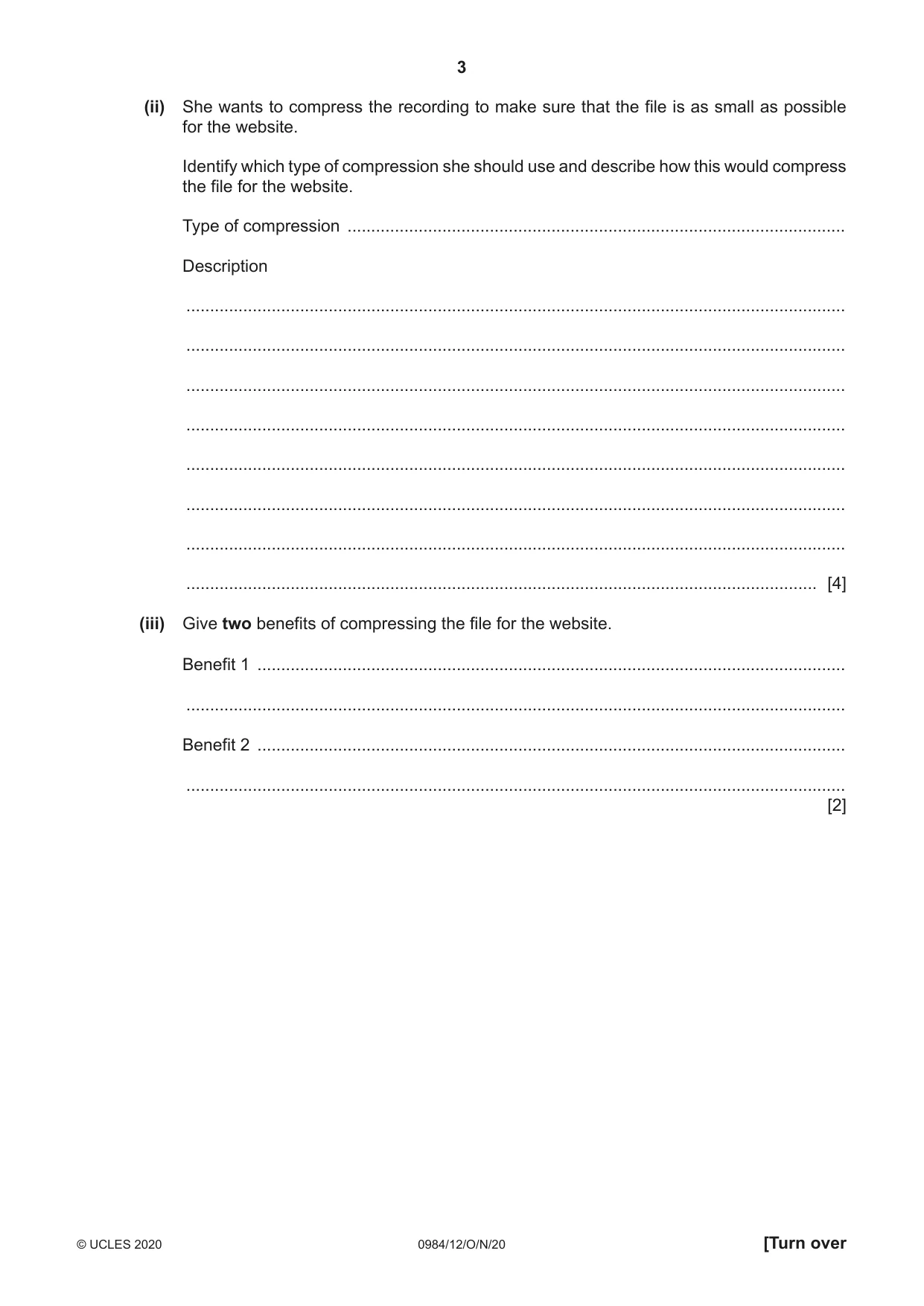
3 0984/12/O/N/20 © UCLES 2020 [Turn over (ii) She wants to compress the recording to make sure that the file is as small as possible for the website. Identify which type of compression she should use and describe how this would compress the file for the website. Type of compression … Description … … … … … … … … [4] (iii) Give two benefits of compressing the file for the website. Benefit 1 … … Benefit 2 … … [2]
Question paper, page 4
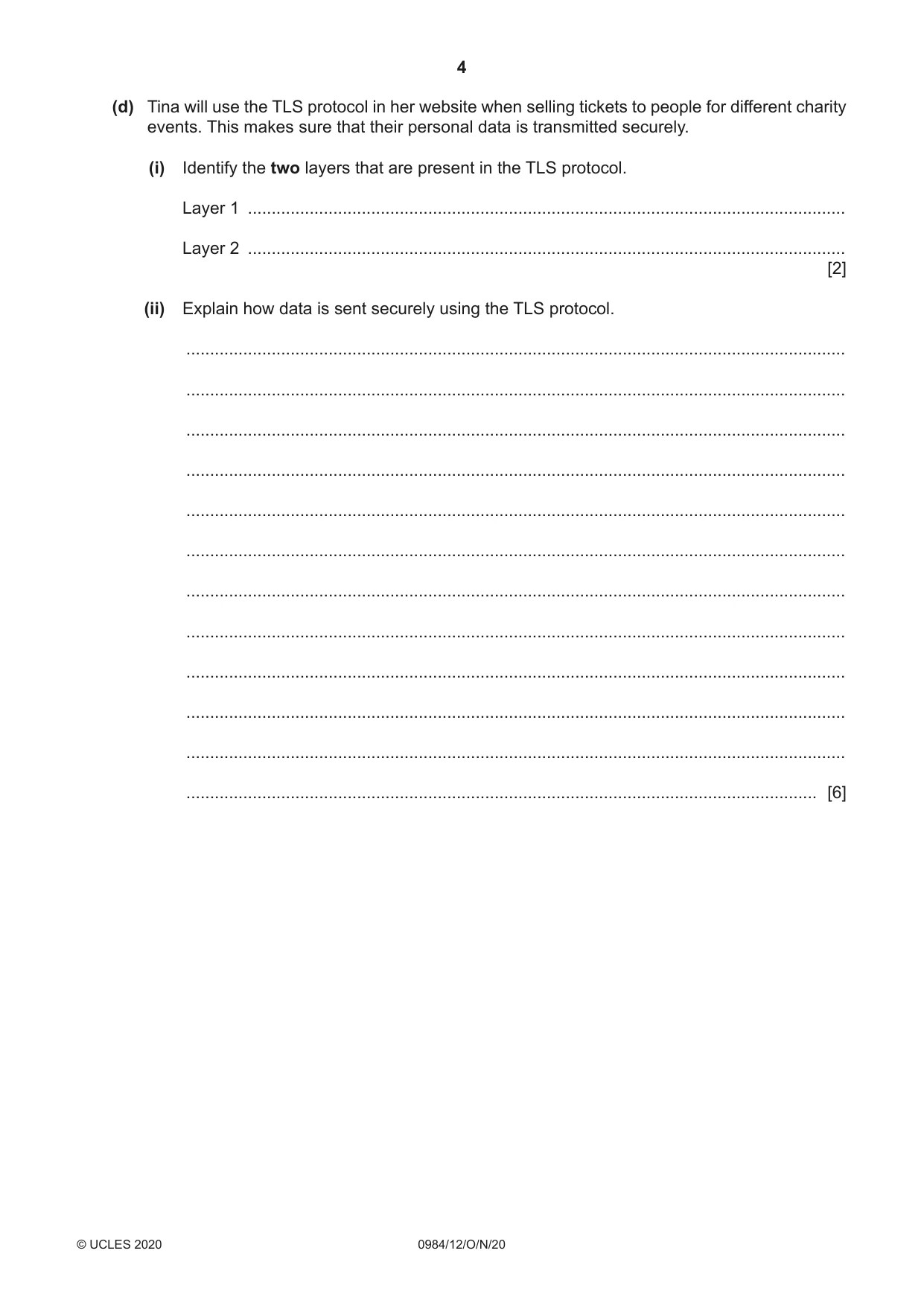
4 0984/12/O/N/20 © UCLES 2020 (d) Tina will use the TLS protocol in her website when selling tickets to people for different charity events. This makes sure that their personal data is transmitted securely. (i) Identify the two layers that are present in the TLS protocol. Layer 1 … Layer 2 … [2] (ii) Explain how data is sent securely using the TLS protocol. … … … … … … … … … … … … [6]
Question paper, page 5
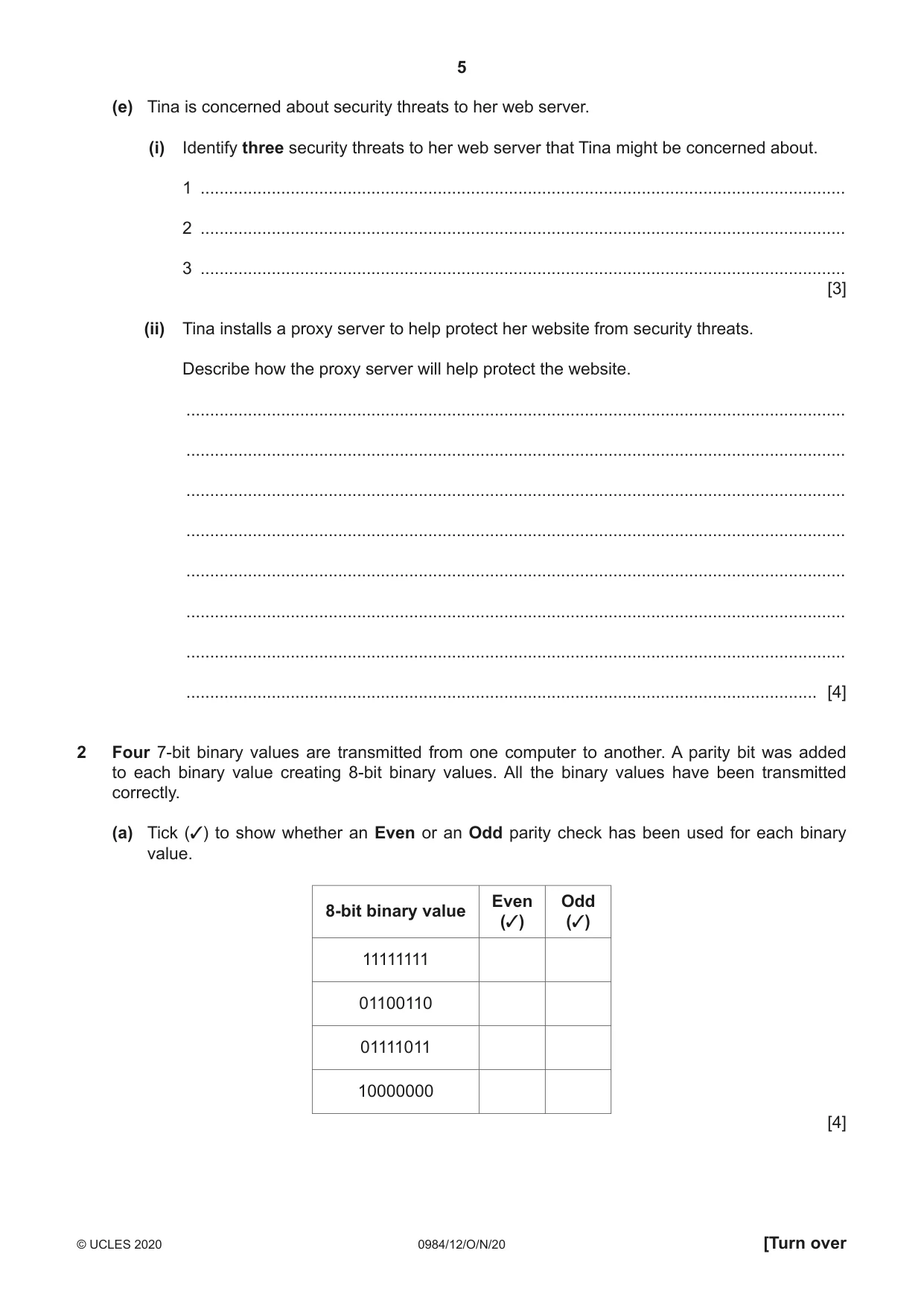
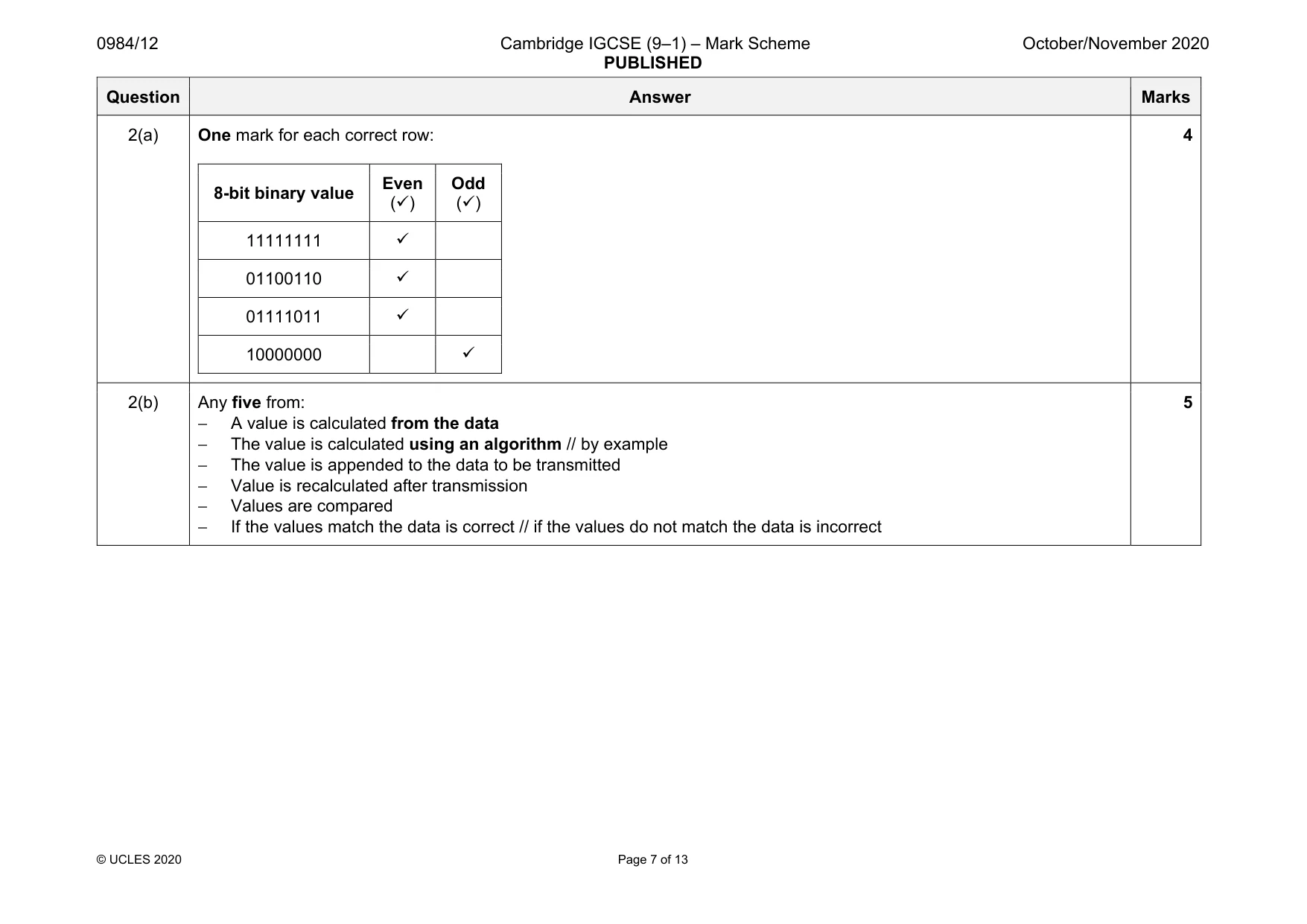
5 0984/12/O/N/20 © UCLES 2020 [Turn over (e) Tina is concerned about security threats to her web server. (i) Identify three security threats to her web server that Tina might be concerned about. 1 … 2 … 3 … [3] (ii) Tina installs a proxy server to help protect her website from security threats. Describe how the proxy server will help protect the website. … … … … … … … … [4] 2 Four 7-bit binary values are transmitted from one computer to another. A parity bit was added to each binary value creating 8-bit binary values. All the binary values have been transmitted correctly. (a) Tick (✓) to show whether an Even or an Odd parity check has been used for each binary value. 8-bit binary value Even (✓) Odd (✓) 11111111 01100110 01111011 10000000 [4]
Question paper, page 6
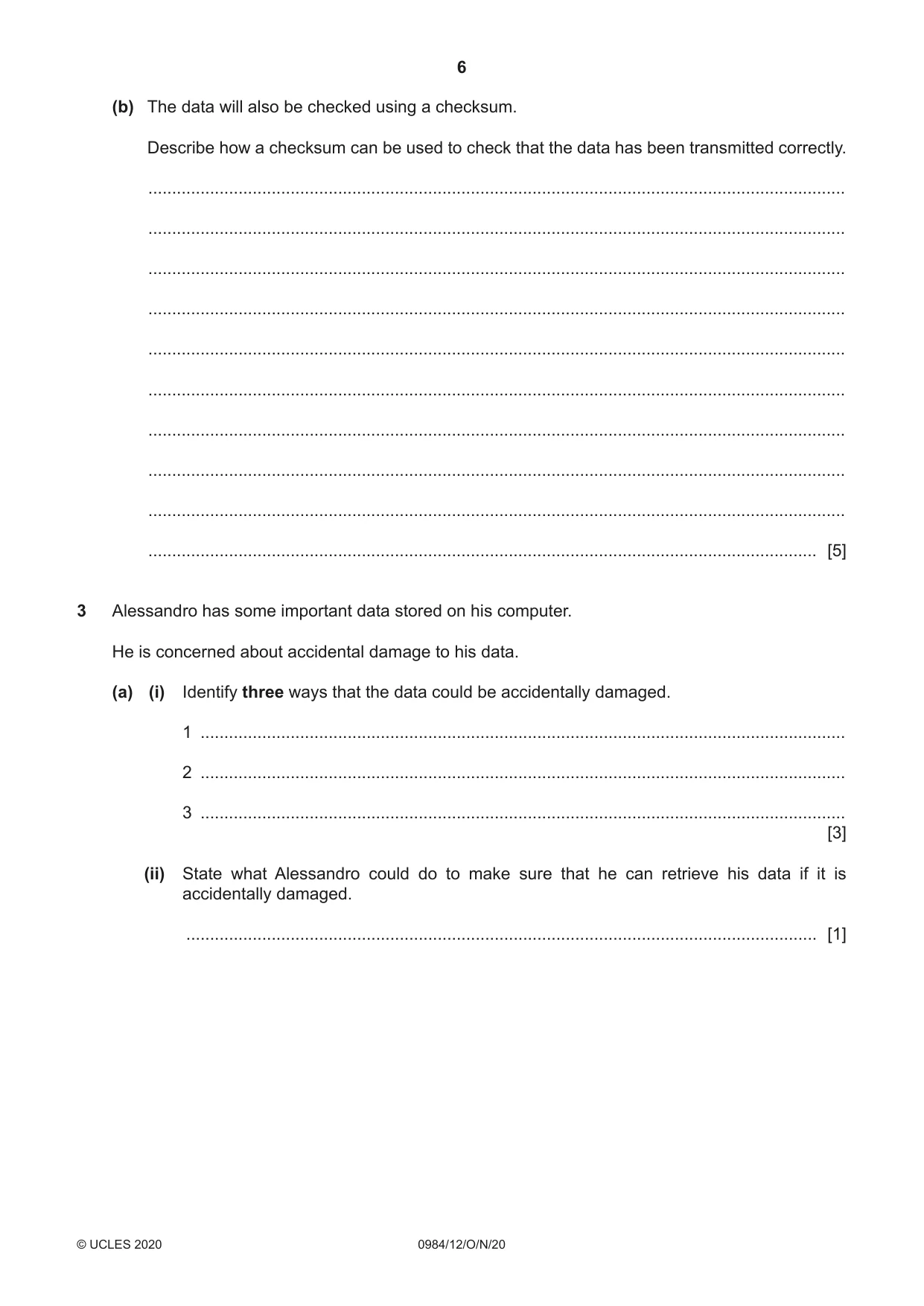
6 0984/12/O/N/20 © UCLES 2020 (b) The data will also be checked using a checksum. Describe how a checksum can be used to check that the data has been transmitted correctly. … … … … … … … … … … [5] 3 Alessandro has some important data stored on his computer. He is concerned about accidental damage to his data. (a) (i) Identify three ways that the data could be accidentally damaged. 1 … 2 … 3 … [3] (ii) State what Alessandro could do to make sure that he can retrieve his data if it is accidentally damaged. … [1]
Question paper, page 7
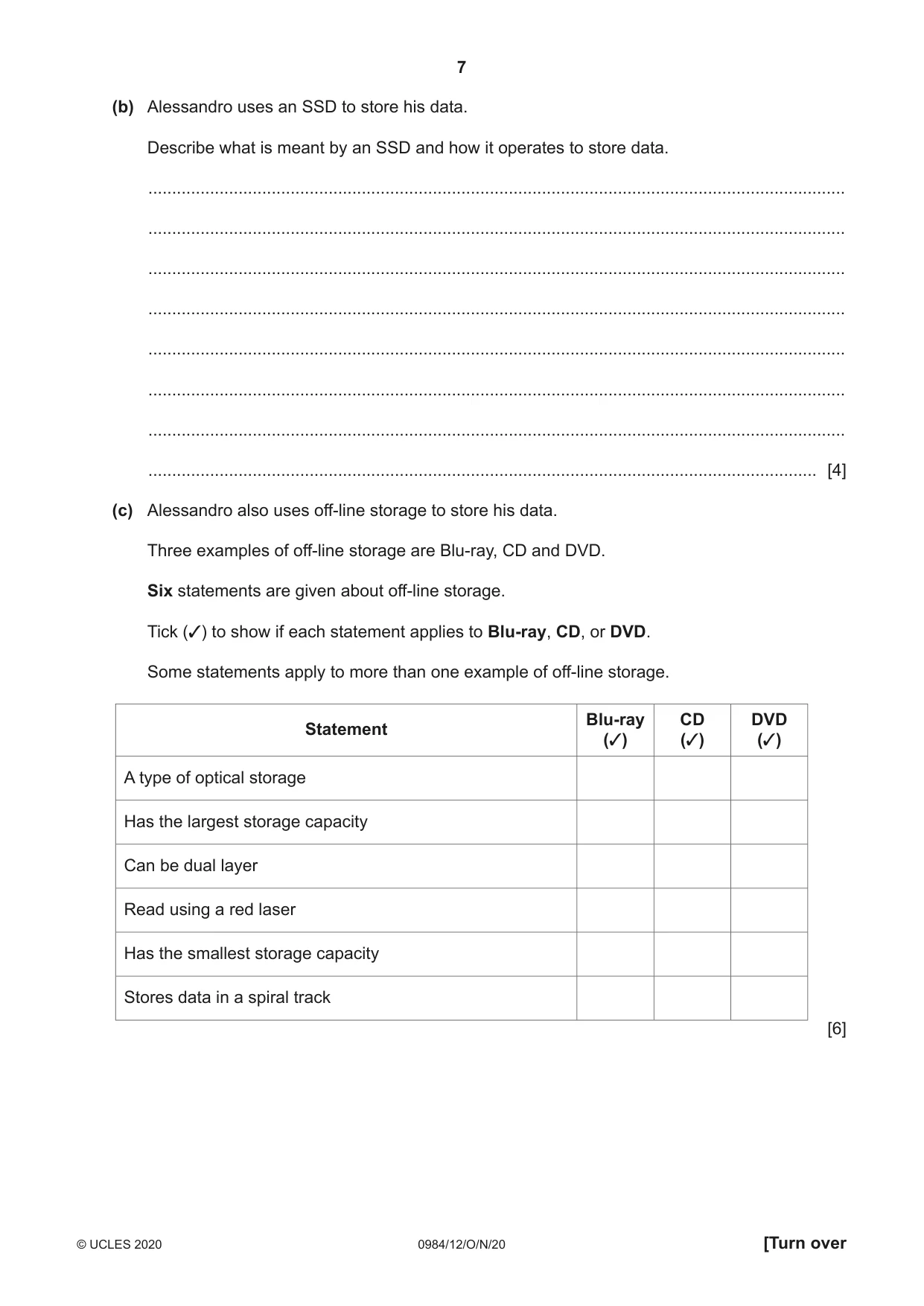
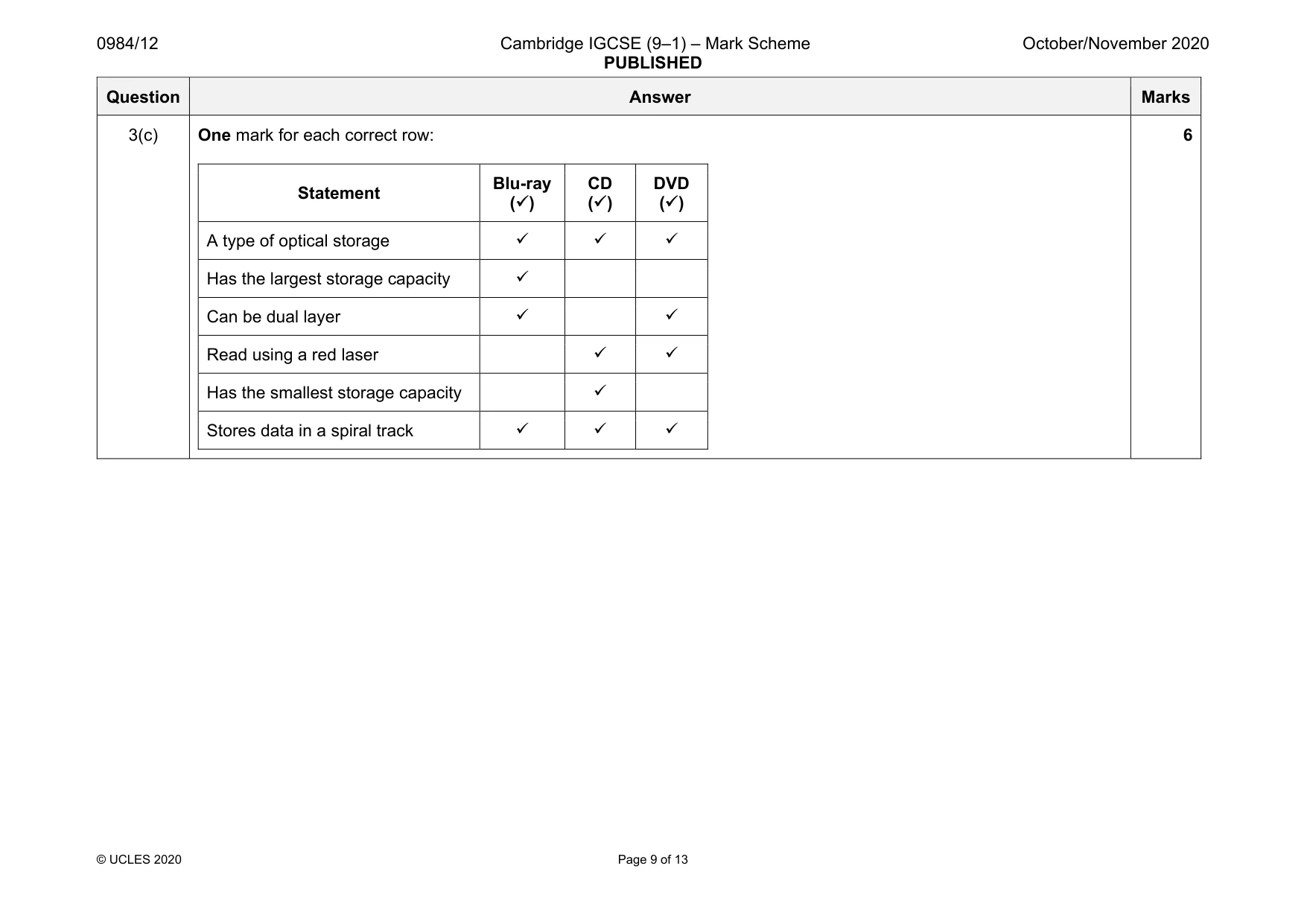
7 0984/12/O/N/20 © UCLES 2020 [Turn over (b) Alessandro uses an SSD to store his data. Describe what is meant by an SSD and how it operates to store data. … … … … … … … … [4] (c) Alessandro also uses off-line storage to store his data. Three examples of off-line storage are Blu-ray, CD and DVD. Six statements are given about off-line storage. Tick (✓) to show if each statement applies to Blu-ray, CD, or DVD. Some statements apply to more than one example of off-line storage. Statement Blu-ray (✓) CD (✓) DVD (✓) A type of optical storage Has the largest storage capacity Can be dual layer Read using a red laser Has the smallest storage capacity Stores data in a spiral track [6]
Question paper, page 8
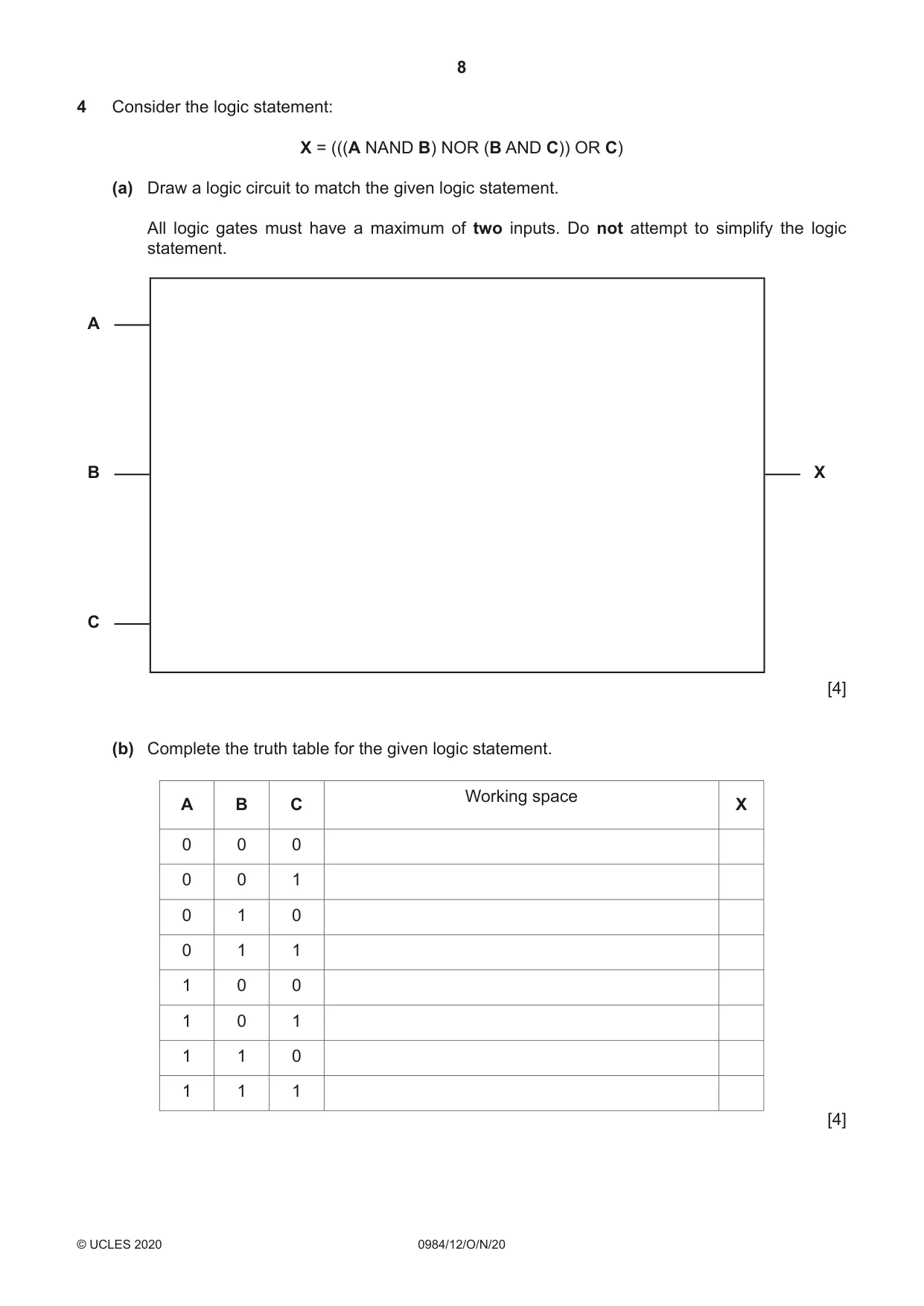
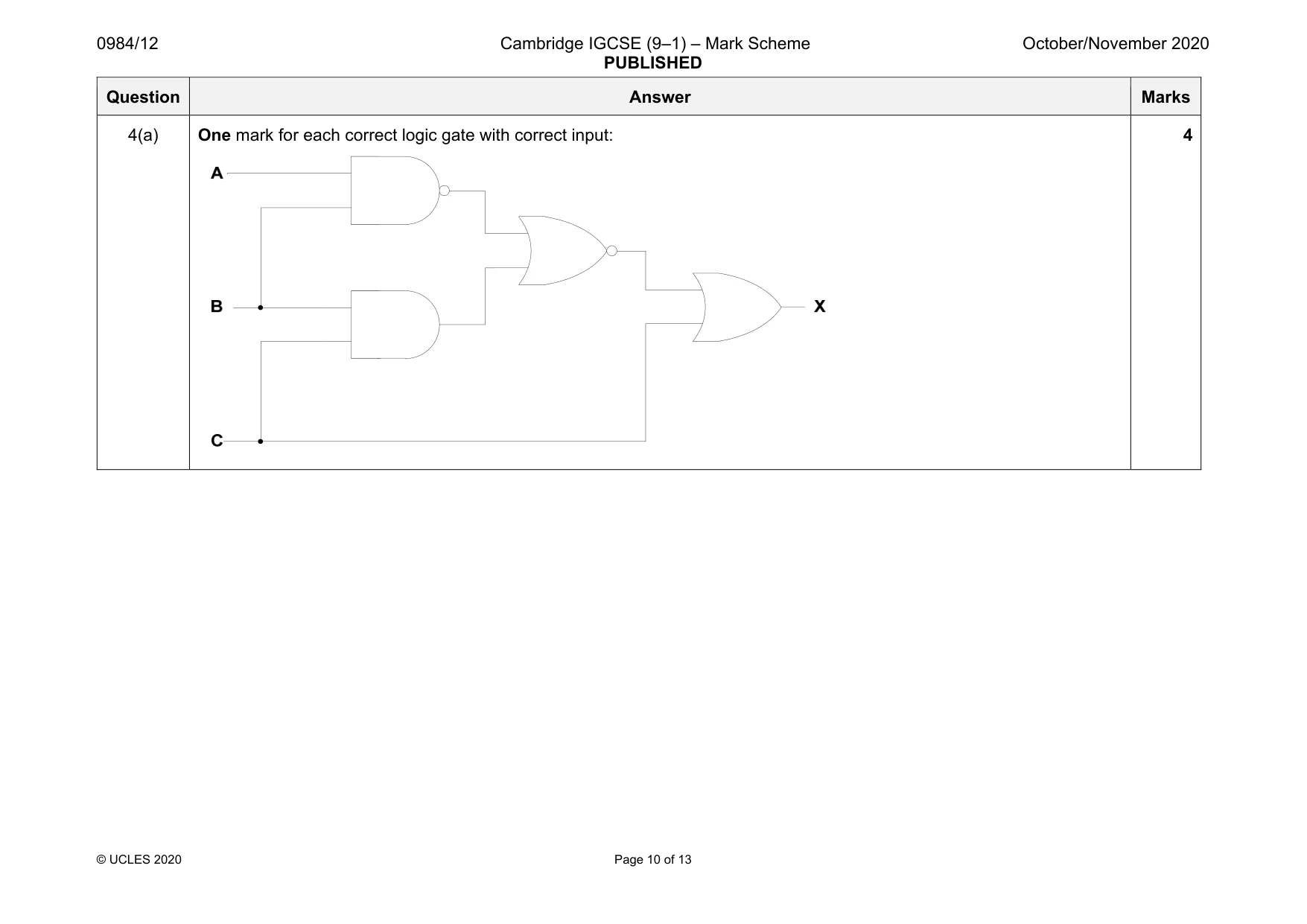
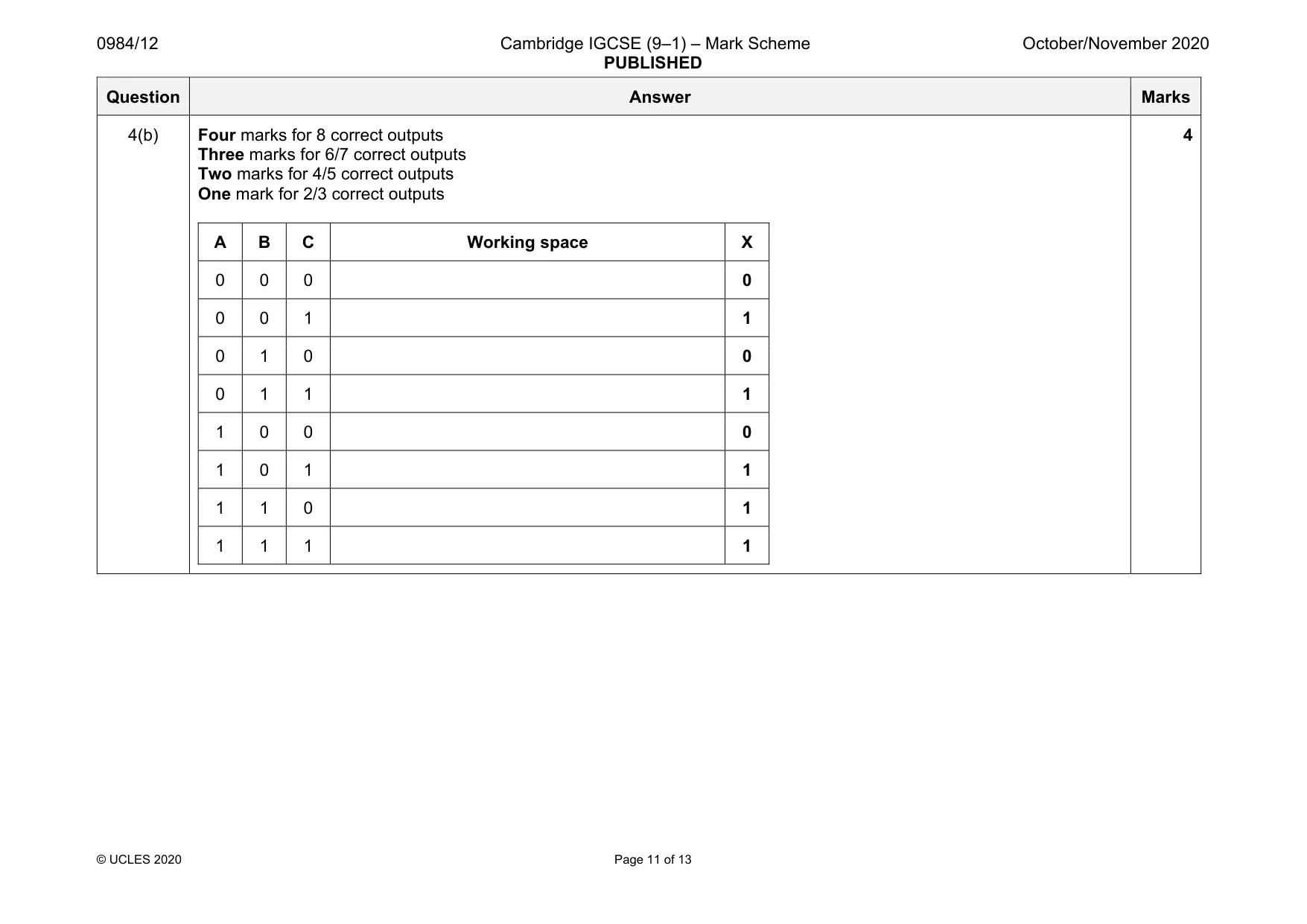
8 0984/12/O/N/20 © UCLES 2020 4 Consider the logic statement: X = (((A NAND B) NOR (B AND C)) OR C) (a) Draw a logic circuit to match the given logic statement. All logic gates must have a maximum of two inputs. Do not attempt to simplify the logic statement. A B X C [4] (b) Complete the truth table for the given logic statement. A B C Working space X 0 0 0 0 0 1 0 1 0 0 1 1 1 0 0 1 0 1 1 1 0 1 1 1 [4]
Question paper, page 9
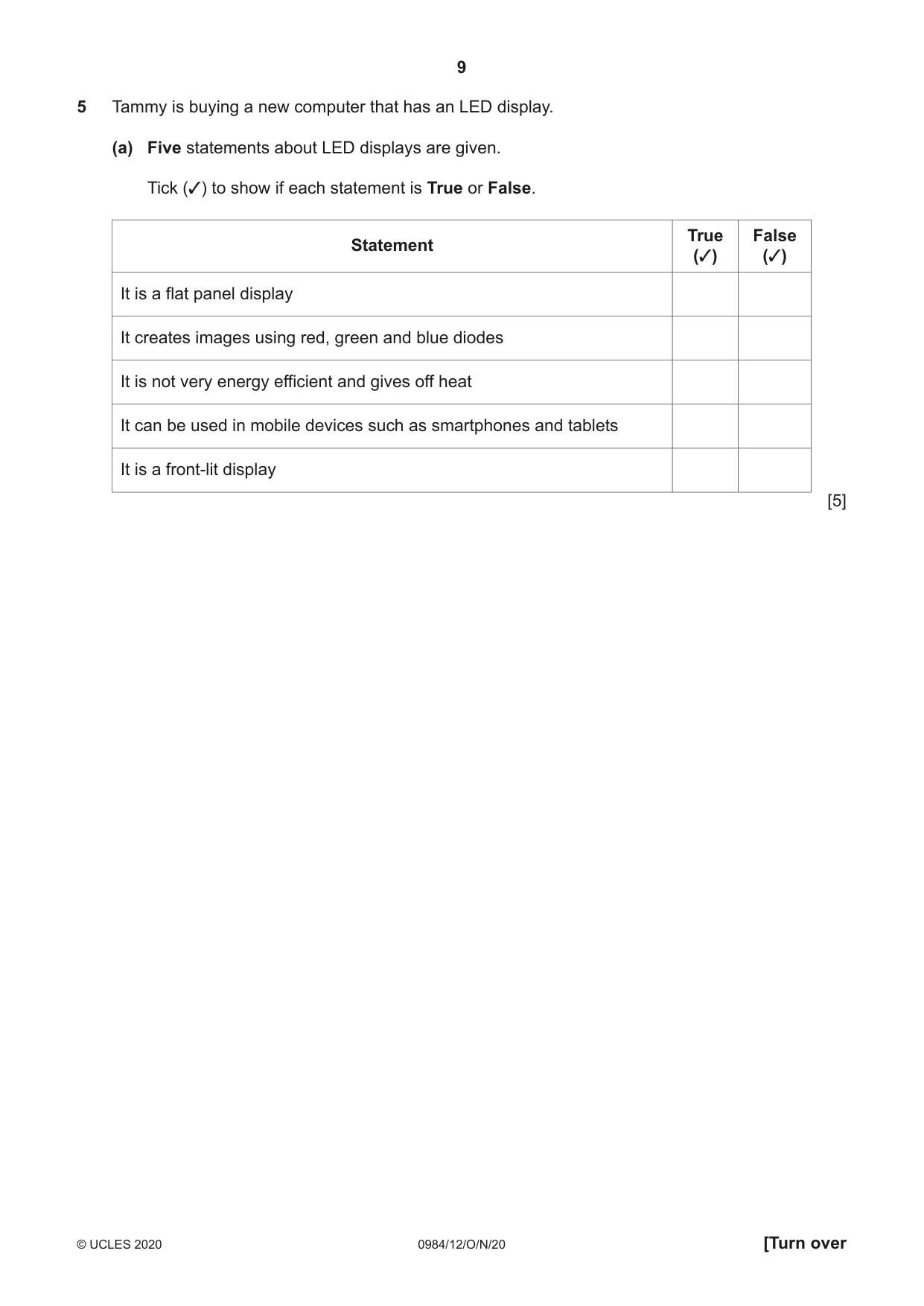
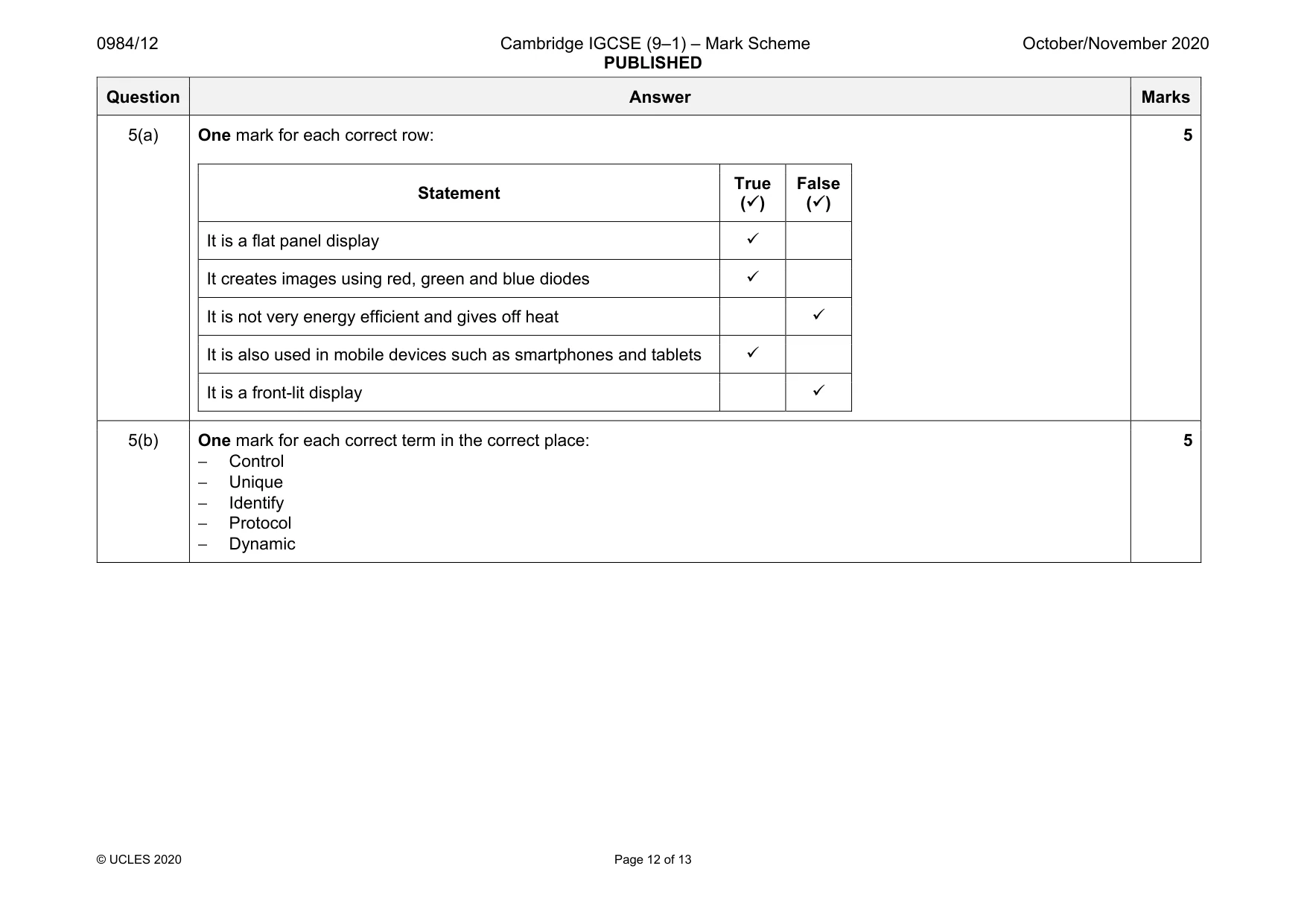
9 0984/12/O/N/20 © UCLES 2020 [Turn over 5 Tammy is buying a new computer that has an LED display. (a) Five statements about LED displays are given. Tick (✓) to show if each statement is True or False. Statement True (✓) False (✓) It is a flat panel display It creates images using red, green and blue diodes It is not very energy efficient and gives off heat It can be used in mobile devices such as smartphones and tablets It is a front-lit display [5]
Question paper, page 10
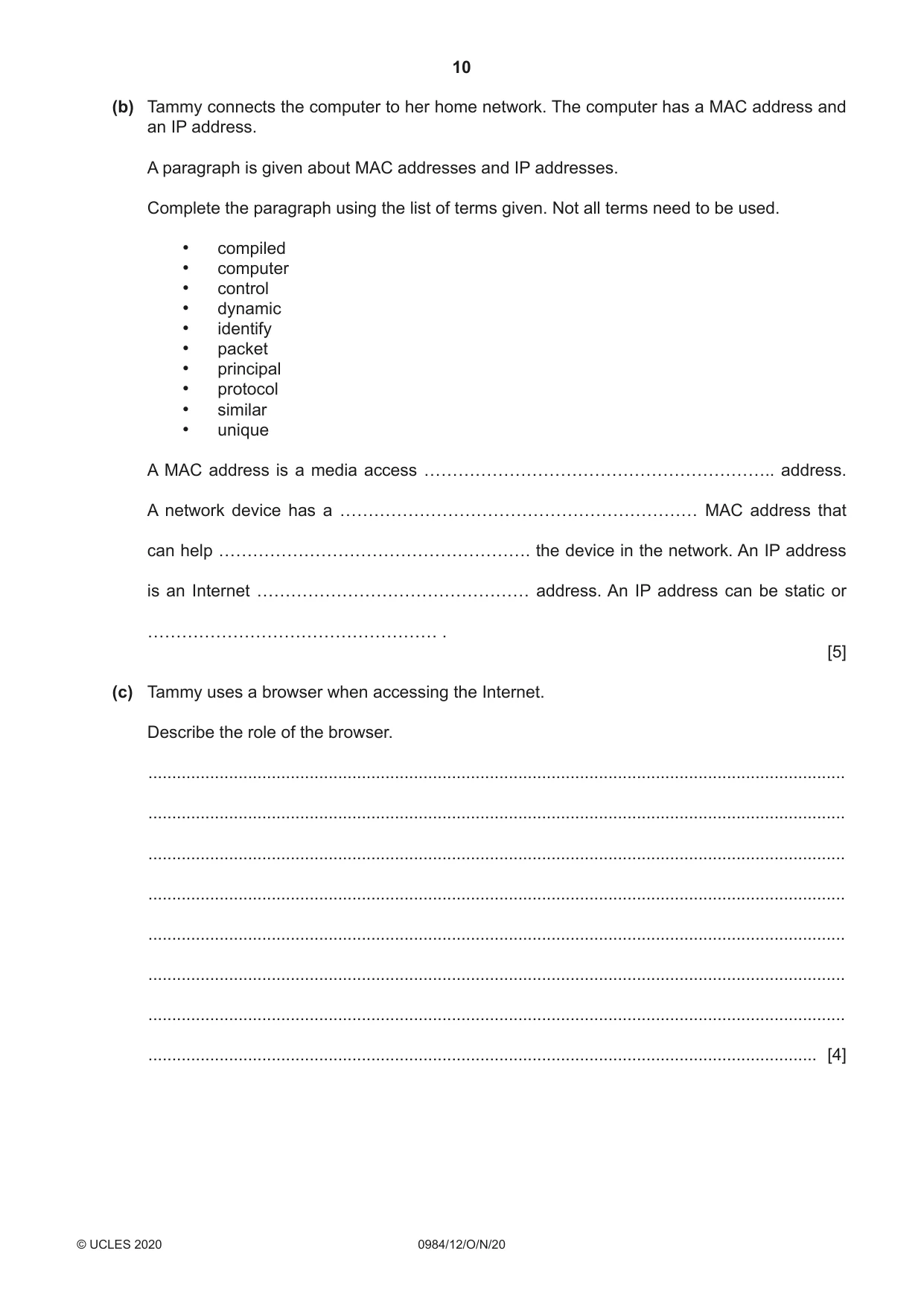
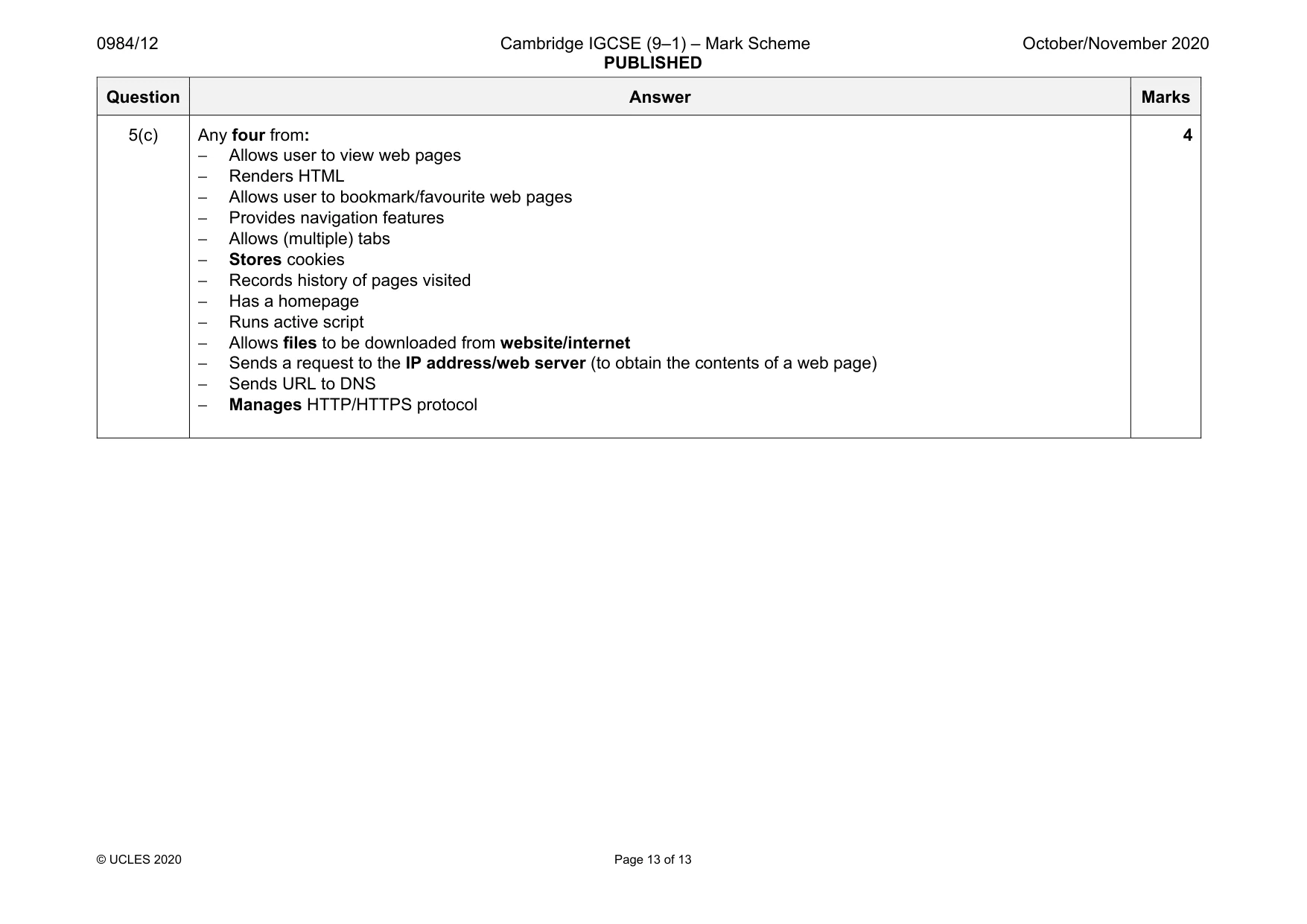
10 0984/12/O/N/20 © UCLES 2020 (b) Tammy connects the computer to her home network. The computer has a MAC address and an IP address. A paragraph is given about MAC addresses and IP addresses. Complete the paragraph using the list of terms given. Not all terms need to be used. • compiled • computer • control • dynamic • identify • packet • principal • protocol • similar • unique A MAC address is a media access …………………………………………………….. address. A network device has a ……………………………………………………… MAC address that can help ………………………………………………. the device in the network. An IP address is an Internet ………………………………………… address. An IP address can be static or …………………………………………… . [5] (c) Tammy uses a browser when accessing the Internet. Describe the role of the browser. … … … … … … … … [4]
Question paper, page 11
11 0984/12/O/N/20 © UCLES 2020 BLANK PAGE
Question paper, page 12
12 0984/12/O/N/20 © UCLES 2020 Permission to reproduce items where third-party owned material protected by copyright is included has been sought and cleared where possible. Every reasonable effort has been made by the publisher (UCLES) to trace copyright holders, but if any items requiring clearance have unwittingly been included, the publisher will be pleased to make amends at the earliest possible opportunity. To avoid the issue of disclosure of answer-related information to candidates, all copyright acknowledgements are reproduced online in the Cambridge Assessment International Education Copyright Acknowledgements Booklet. This is produced for each series of examinations and is freely available to download at www.cambridgeinternational.org after the live examination series. Cambridge Assessment International Education is part of the Cambridge Assessment Group. Cambridge Assessment is the brand name of the University of Cambridge Local Examinations Syndicate (UCLES), which itself is a department of the University of Cambridge. BLANK PAGE
Mark scheme, page 1
This document consists of 13 printed pages. © UCLES 2020 [Turn over Cambridge IGCSE™ (9–1) COMPUTER SCIENCE 0984/12 Paper 1 October/November 2020 MARK SCHEME Maximum Mark: 75 Published This mark scheme is published as an aid to teachers and candidates, to indicate the requirements of the examination. It shows the basis on which Examiners were instructed to award marks. It does not indicate the details of the discussions that took place at an Examiners’ meeting before marking began, which would have considered the acceptability of alternative answers. Mark schemes should be read in conjunction with the question paper and the Principal Examiner Report for Teachers. Cambridge International will not enter into discussions about these mark schemes. Cambridge International is publishing the mark schemes for the October/November 2020 series for most Cambridge IGCSE™, Cambridge International A and AS Level and Cambridge Pre-U components, and some Cambridge O Level components.
Mark scheme, page 2
0984/12 Cambridge IGCSE (9–1) – Mark Scheme PUBLISHED October/November 2020 © UCLES 2020 Page 2 of 13 Generic Marking Principles These general marking principles must be applied by all examiners when marking candidate answers. They should be applied alongside the specific content of the mark scheme or generic level descriptors for a question. Each question paper and mark scheme will also comply with these marking principles. GENERIC MARKING PRINCIPLE 1: Marks must be awarded in line with: • the specific content of the mark scheme or the generic level descriptors for the question • the specific skills defined in the mark scheme or in the generic level descriptors for the question • the standard of response required by a candidate as exemplified by the standardisation scripts. GENERIC MARKING PRINCIPLE 2: Marks awarded are always whole marks (not half marks, or other fractions). GENERIC MARKING PRINCIPLE 3: Marks must be awarded positively: • marks are awarded for correct/valid answers, as defined in the mark scheme. However, credit is given for valid answers which go beyond the scope of the syllabus and mark scheme, referring to your Team Leader as appropriate • marks are awarded when candidates clearly demonstrate what they know and can do • marks are not deducted for errors • marks are not deducted for omissions • answers should only be judged on the quality of spelling, punctuation and grammar when these features are specifically assessed by the question as indicated by the mark scheme. The meaning, however, should be unambiguous. GENERIC MARKING PRINCIPLE 4: Rules must be applied consistently, e.g. in situations where candidates have not followed instructions or in the application of generic level descriptors.
Mark scheme, page 3
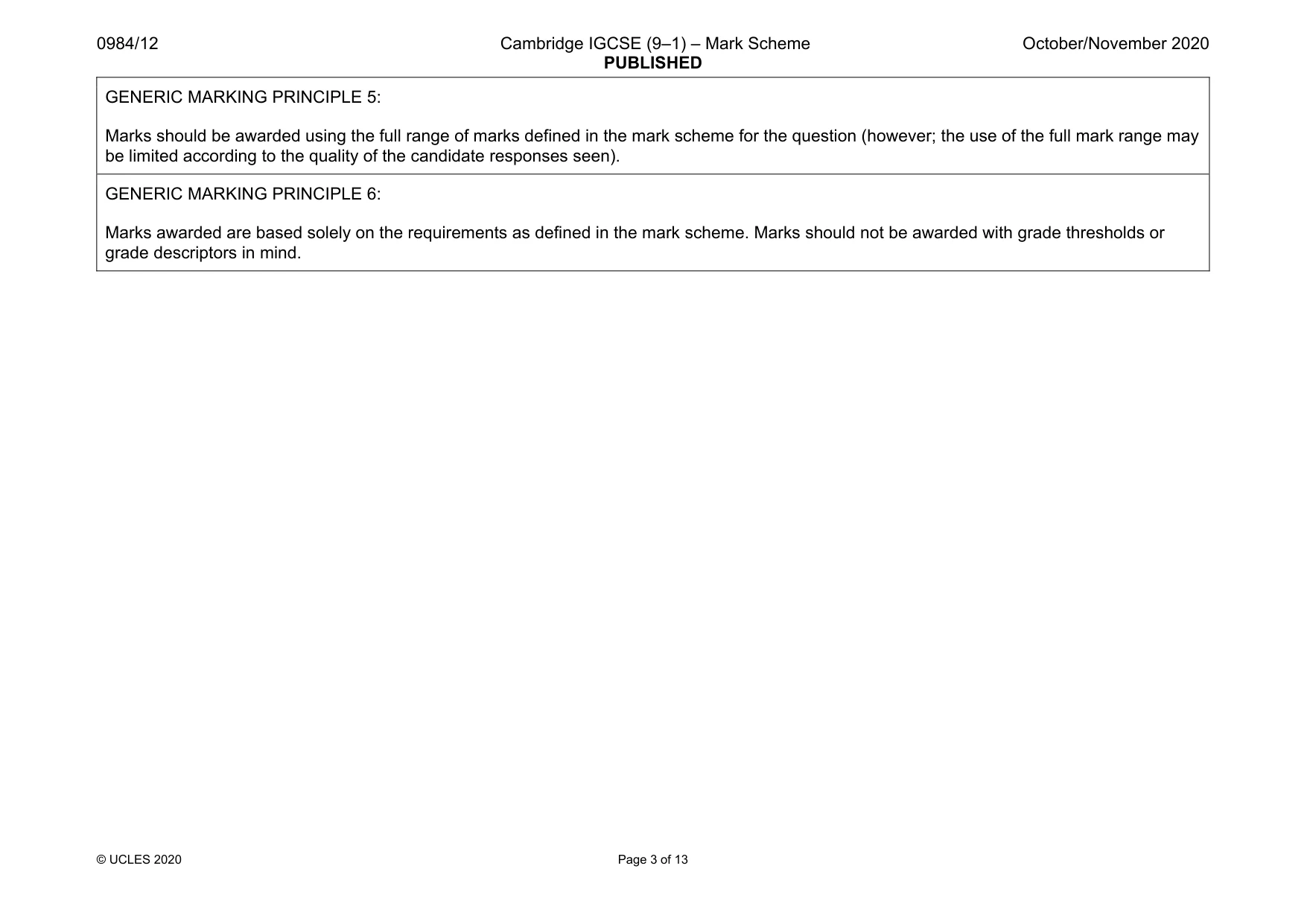
0984/12 Cambridge IGCSE (9–1) – Mark Scheme PUBLISHED October/November 2020 © UCLES 2020 Page 3 of 13 GENERIC MARKING PRINCIPLE 5: Marks should be awarded using the full range of marks defined in the mark scheme for the question (however; the use of the full mark range may be limited according to the quality of the candidate responses seen). GENERIC MARKING PRINCIPLE 6: Marks awarded are based solely on the requirements as defined in the mark scheme. Marks should not be awarded with grade thresholds or grade descriptors in mind.
Mark scheme, page 4
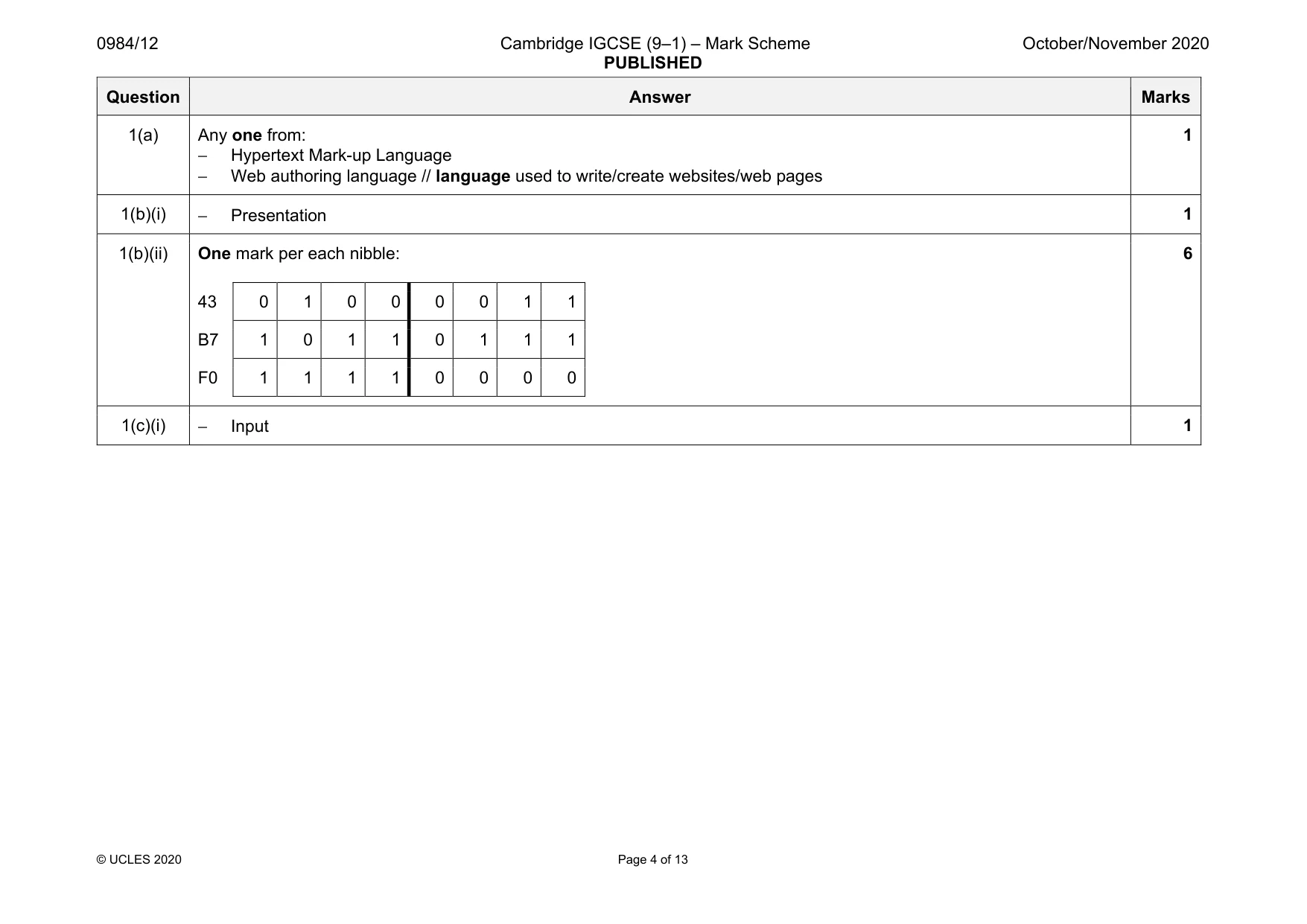
0984/12 Cambridge IGCSE (9–1) – Mark Scheme PUBLISHED October/November 2020 © UCLES 2020 Page 4 of 13 Question Answer Marks 1(a) Any one from: − Hypertext Mark-up Language − Web authoring language // language used to write/create websites/web pages 1 1(b)(i) − Presentation 1 1(b)(ii) One mark per each nibble: 43 0 1 0 0 0 0 1 1 B7 1 0 1 1 0 1 1 1 F0 1 1 1 1 0 0 0 0 6 1(c)(i) − Input 1
Mark scheme, page 5
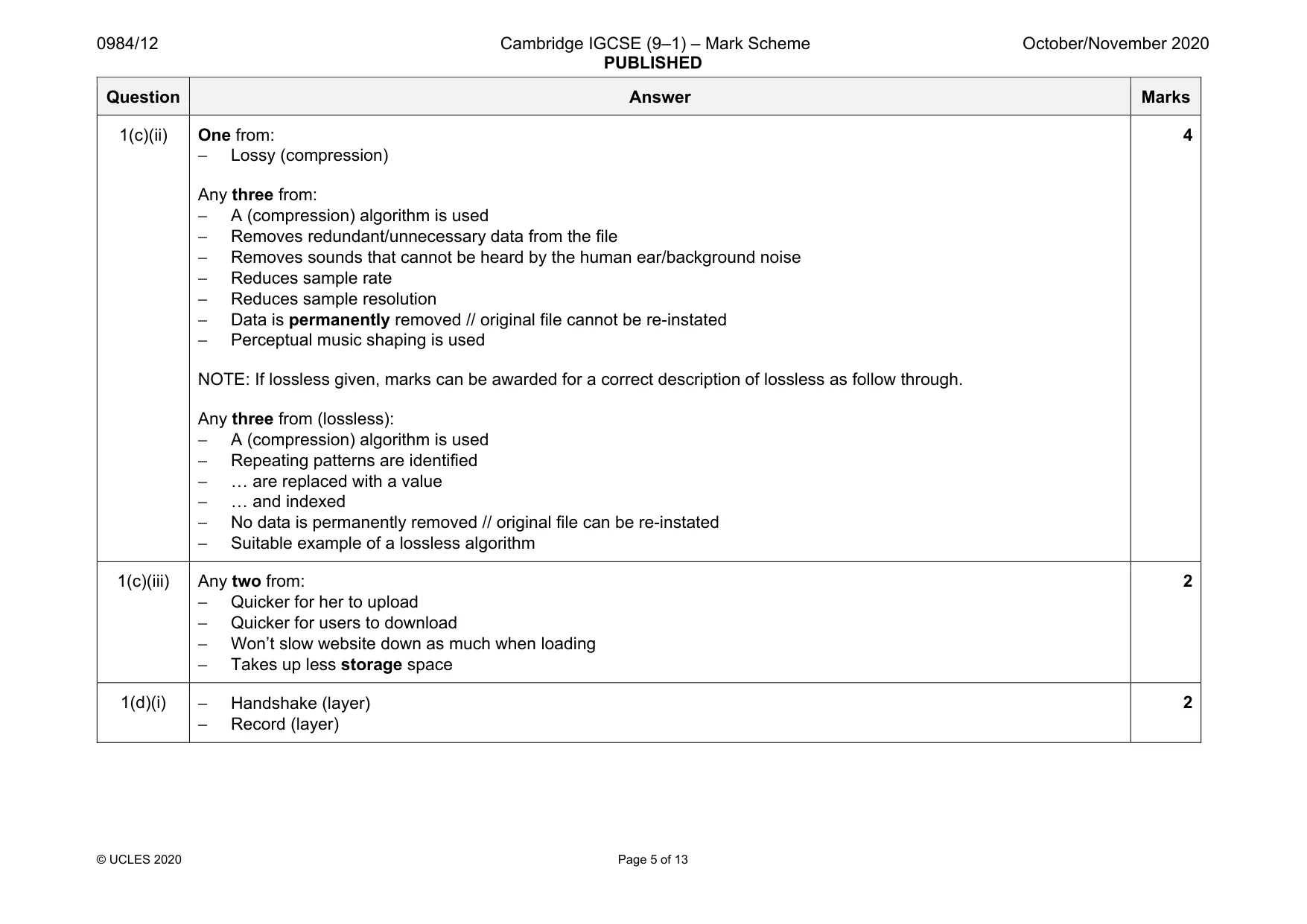
0984/12 Cambridge IGCSE (9–1) – Mark Scheme PUBLISHED October/November 2020 © UCLES 2020 Page 5 of 13 Question Answer Marks 1(c)(ii) One from: − Lossy (compression) Any three from: − A (compression) algorithm is used − Removes redundant/unnecessary data from the file − Removes sounds that cannot be heard by the human ear/background noise − Reduces sample rate − Reduces sample resolution − Data is permanently removed // original file cannot be re-instated − Perceptual music shaping is used NOTE: If lossless given, marks can be awarded for a correct description of lossless as follow through. Any three from (lossless): − A (compression) algorithm is used − Repeating patterns are identified − … are replaced with a value − … and indexed − No data is permanently removed // original file can be re-instated − Suitable example of a lossless algorithm 4 1(c)(iii) Any two from: − Quicker for her to upload − Quicker for users to download − Won’t slow website down as much when loading − Takes up less storage space 2 1(d)(i) − Handshake (layer) − Record (layer) 2
Mark scheme, page 6
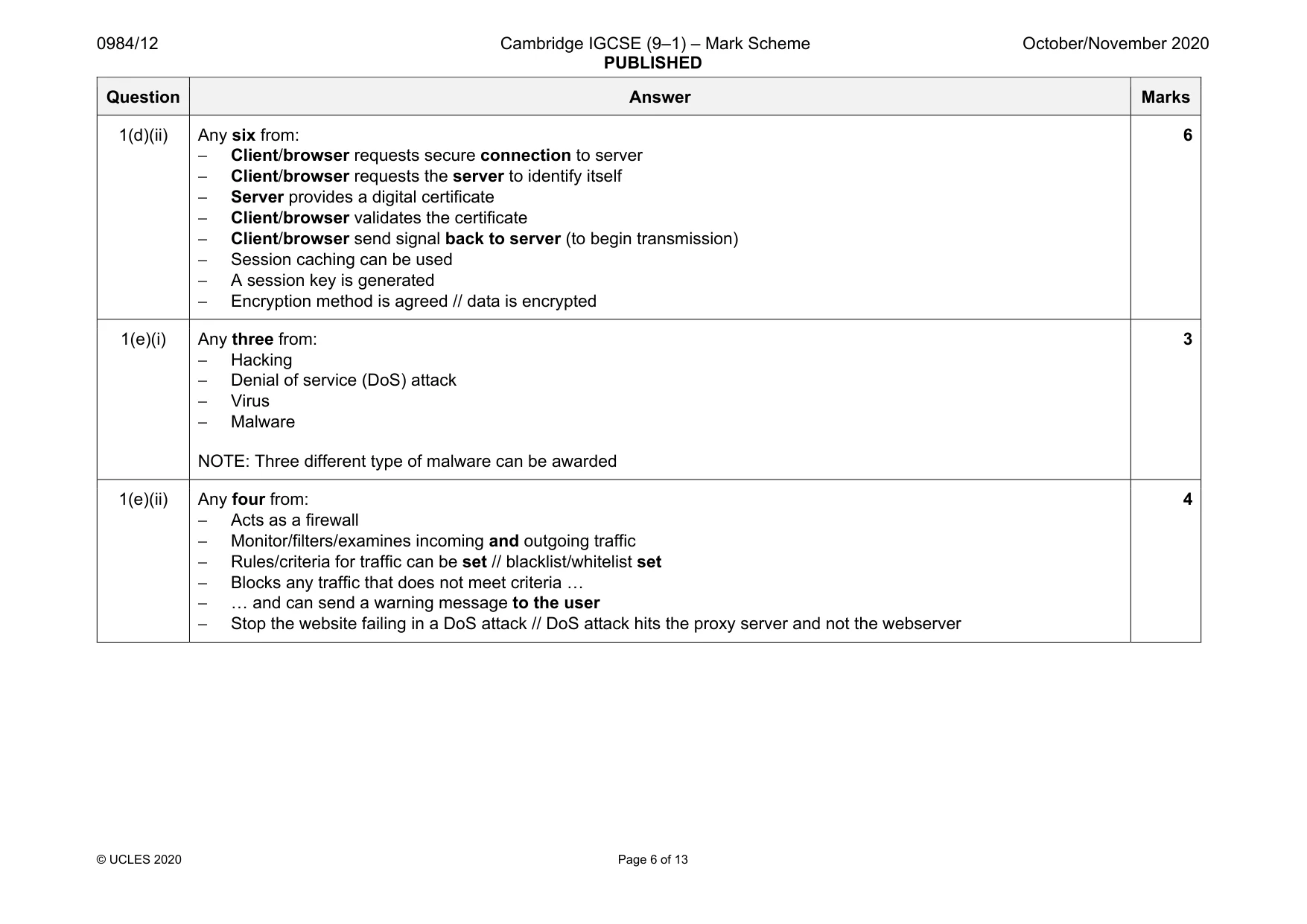
0984/12 Cambridge IGCSE (9–1) – Mark Scheme PUBLISHED October/November 2020 © UCLES 2020 Page 6 of 13 Question Answer Marks 1(d)(ii) Any six from: − Client/browser requests secure connection to server − Client/browser requests the server to identify itself − Server provides a digital certificate − Client/browser validates the certificate − Client/browser send signal back to server (to begin transmission) − Session caching can be used − A session key is generated − Encryption method is agreed // data is encrypted 6 1(e)(i) Any three from: − Hacking − Denial of service (DoS) attack − Virus − Malware NOTE: Three different type of malware can be awarded 3 1(e)(ii) Any four from: − Acts as a firewall − Monitor/filters/examines incoming and outgoing traffic − Rules/criteria for traffic can be set // blacklist/whitelist set − Blocks any traffic that does not meet criteria … − … and can send a warning message to the user − Stop the website failing in a DoS attack // DoS attack hits the proxy server and not the webserver 4
Mark scheme, page 7
0984/12 Cambridge IGCSE (9–1) – Mark Scheme PUBLISHED October/November 2020 © UCLES 2020 Page 7 of 13 Question Answer Marks 2(a) One mark for each correct row: 8-bit binary value Even () Odd () 11111111 01100110 01111011 10000000 4 2(b) Any five from: − A value is calculated from the data − The value is calculated using an algorithm // by example − The value is appended to the data to be transmitted − Value is recalculated after transmission − Values are compared − If the values match the data is correct // if the values do not match the data is incorrect 5
Mark scheme, page 8
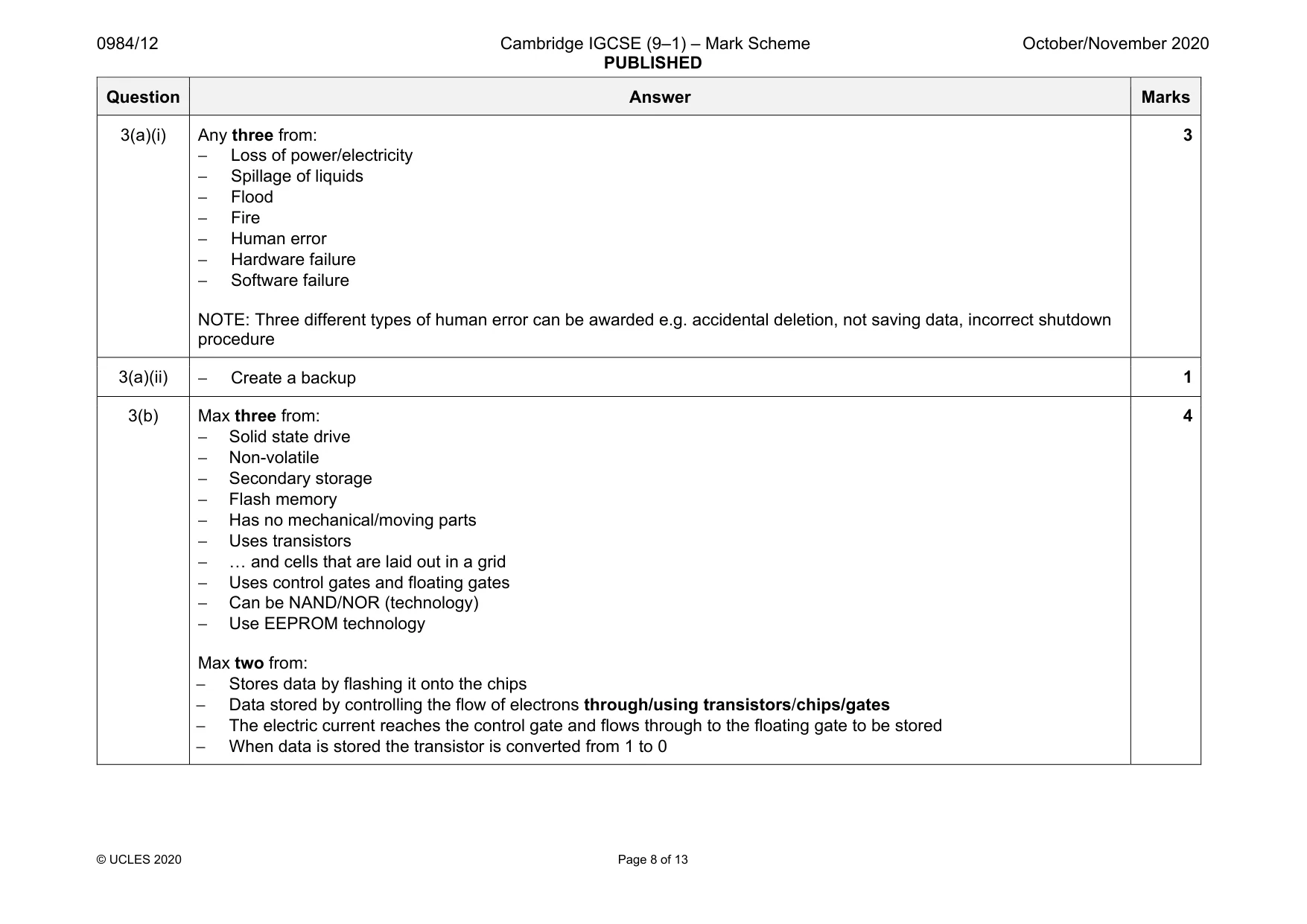
0984/12 Cambridge IGCSE (9–1) – Mark Scheme PUBLISHED October/November 2020 © UCLES 2020 Page 8 of 13 Question Answer Marks 3(a)(i) Any three from: − Loss of power/electricity − Spillage of liquids − Flood − Fire − Human error − Hardware failure − Software failure NOTE: Three different types of human error can be awarded e.g. accidental deletion, not saving data, incorrect shutdown procedure 3 3(a)(ii) − Create a backup 1 3(b) Max three from: − Solid state drive − Non-volatile − Secondary storage − Flash memory − Has no mechanical/moving parts − Uses transistors − … and cells that are laid out in a grid − Uses control gates and floating gates − Can be NAND/NOR (technology) − Use EEPROM technology Max two from: − Stores data by flashing it onto the chips − Data stored by controlling the flow of electrons through/using transistors/chips/gates − The electric current reaches the control gate and flows through to the floating gate to be stored − When data is stored the transistor is converted from 1 to 0 4
Mark scheme, page 9
0984/12 Cambridge IGCSE (9–1) – Mark Scheme PUBLISHED October/November 2020 © UCLES 2020 Page 9 of 13 Question Answer Marks 3(c) One mark for each correct row: Statement Blu-ray () CD () DVD () A type of optical storage Has the largest storage capacity Can be dual layer Read using a red laser Has the smallest storage capacity Stores data in a spiral track 6
Mark scheme, page 10
0984/12 Cambridge IGCSE (9–1) – Mark Scheme PUBLISHED October/November 2020 © UCLES 2020 Page 10 of 13 Question Answer Marks 4(a) One mark for each correct logic gate with correct input: 4
Mark scheme, page 11
0984/12 Cambridge IGCSE (9–1) – Mark Scheme PUBLISHED October/November 2020 © UCLES 2020 Page 11 of 13 Question Answer Marks 4(b) Four marks for 8 correct outputs Three marks for 6/7 correct outputs Two marks for 4/5 correct outputs One mark for 2/3 correct outputs A B C Working space X 0 0 0 0 0 0 1 1 0 1 0 0 0 1 1 1 1 0 0 0 1 0 1 1 1 1 0 1 1 1 1 1 4
Mark scheme, page 12
0984/12 Cambridge IGCSE (9–1) – Mark Scheme PUBLISHED October/November 2020 © UCLES 2020 Page 12 of 13 Question Answer Marks 5(a) One mark for each correct row: Statement True () False () It is a flat panel display It creates images using red, green and blue diodes It is not very energy efficient and gives off heat It is also used in mobile devices such as smartphones and tablets It is a front-lit display 5 5(b) One mark for each correct term in the correct place: − Control − Unique − Identify − Protocol − Dynamic 5
Mark scheme, page 13
0984/12 Cambridge IGCSE (9–1) – Mark Scheme PUBLISHED October/November 2020 © UCLES 2020 Page 13 of 13 Question Answer Marks 5(c) Any four from: − Allows user to view web pages − Renders HTML − Allows user to bookmark/favourite web pages − Provides navigation features − Allows (multiple) tabs − Stores cookies − Records history of pages visited − Has a homepage − Runs active script − Allows files to be downloaded from website/internet − Sends a request to the IP address/web server (to obtain the contents of a web page) − Sends URL to DNS − Manages HTTP/HTTPS protocol 4
What you needed in this session
Cambridge’s own grade thresholds for 2020 Oct/Nov, Paper 1 · Variant 2. A higher threshold means an easier paper — the bar moves with how the cohort did.