Cambridge IGCSE Computer Science (9-1) 0984 — 2020 May/June Paper 1 · Variant 2
0984/12/M/J/20
The question paper and its mark scheme, free to read here and free to download. This is Cambridge’s own paper, exactly as it was sat.
Question paper12 pages

Mark scheme10 pages
Answers below. Sit the paper first if you are practising.
Paper as text
Question paper, page 1
Cambridge IGCSE™(9–1) This document has 12 pages. Blank pages are indicated. DC (CJ) 198768 © UCLES 2020 [Turn over COMPUTER SCIENCE 0984/12 Paper 1 Theory May/June 2020 1 hour 45 minutes You must answer on the question paper. No additional materials are needed. INSTRUCTIONS ● Answer all questions. ● Use a black or dark blue pen. You may use an HB pencil for any diagrams or graphs. ● Write your name, centre number and candidate number in the boxes at the top of the page. ● Write your answer to each question in the space provided. ● Do not use an erasable pen or correction fluid. ● Do not write on any bar codes. ● Calculators must not be used in this paper. INFORMATION ● The total mark for this paper is 75. ● The number of marks for each question or part question is shown in brackets [ ]. ● No marks will be awarded for using brand names of software packages or hardware. * 4 5 0 7 5 7 5 0 1 2 *
Question paper, page 2
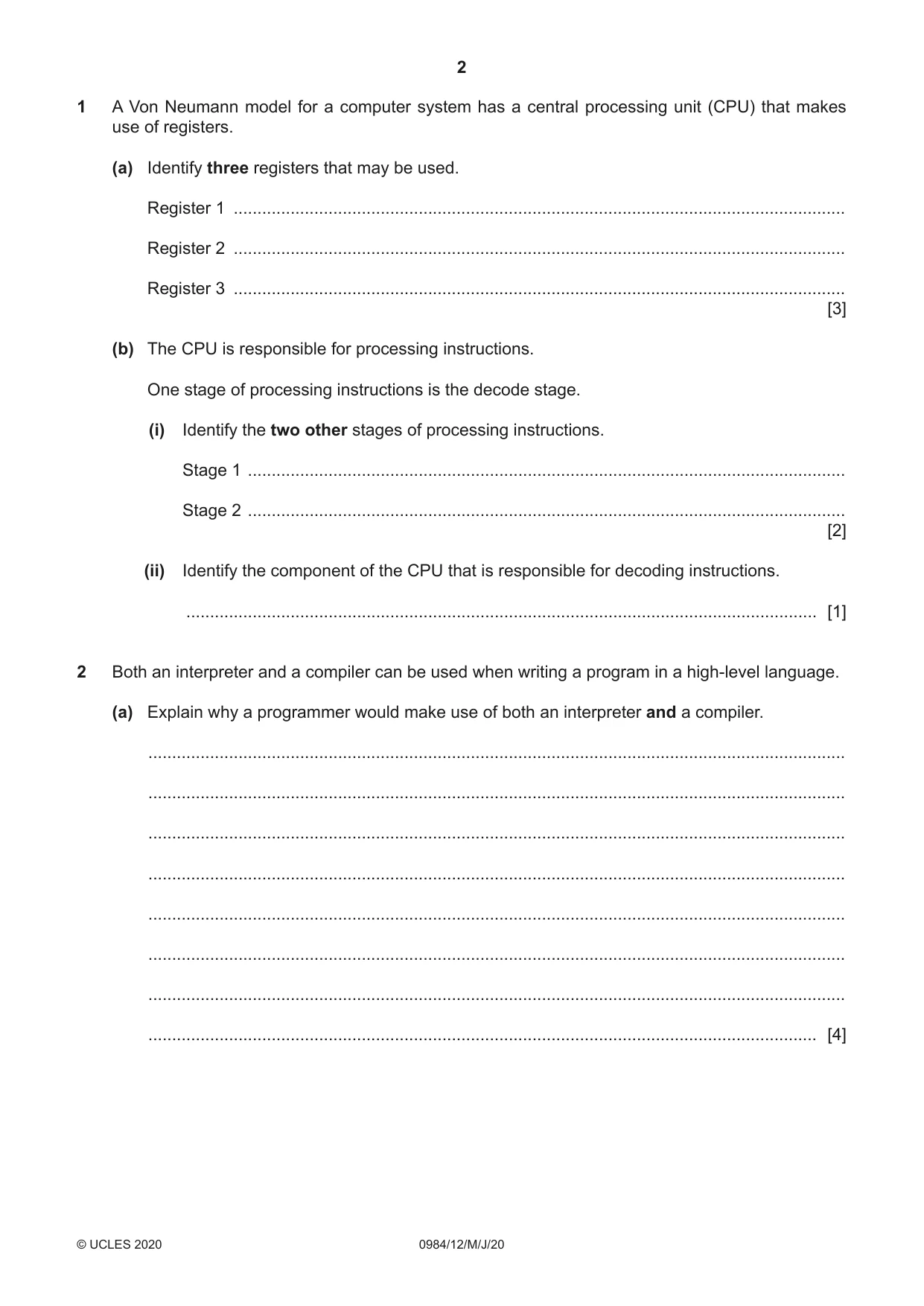
2 0984/12/M/J/20 © UCLES 2020 1 A Von Neumann model for a computer system has a central processing unit (CPU) that makes use of registers. (a) Identify three registers that may be used. Register 1 … Register 2 … Register 3 … [3] (b) The CPU is responsible for processing instructions. One stage of processing instructions is the decode stage. (i) Identify the two other stages of processing instructions. Stage 1 … Stage 2 … [2] (ii) Identify the component of the CPU that is responsible for decoding instructions. … [1] 2 Both an interpreter and a compiler can be used when writing a program in a high-level language. (a) Explain why a programmer would make use of both an interpreter and a compiler. … … … … … … … … [4]
Question paper, page 3
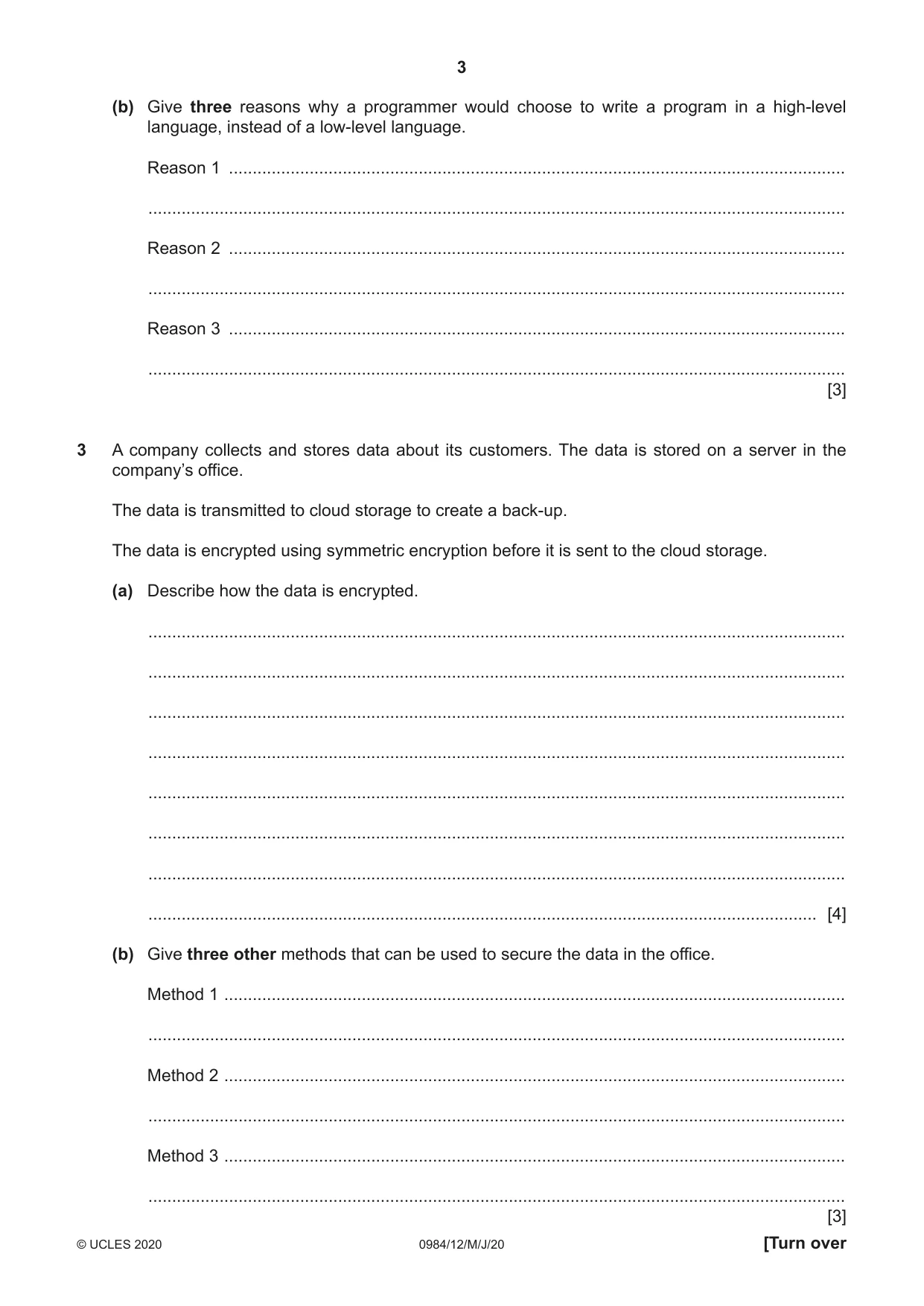
3 0984/12/M/J/20 © UCLES 2020 [Turn over (b) Give three reasons why a programmer would choose to write a program in a high-level language, instead of a low-level language. Reason 1 … … Reason 2 … … Reason 3 … … [3] 3 A company collects and stores data about its customers. The data is stored on a server in the company’s office. The data is transmitted to cloud storage to create a back-up. The data is encrypted using symmetric encryption before it is sent to the cloud storage. (a) Describe how the data is encrypted. … … … … … … … … [4] (b) Give three other methods that can be used to secure the data in the office. Method 1 … … Method 2 … … Method 3 … … [3]
Question paper, page 4
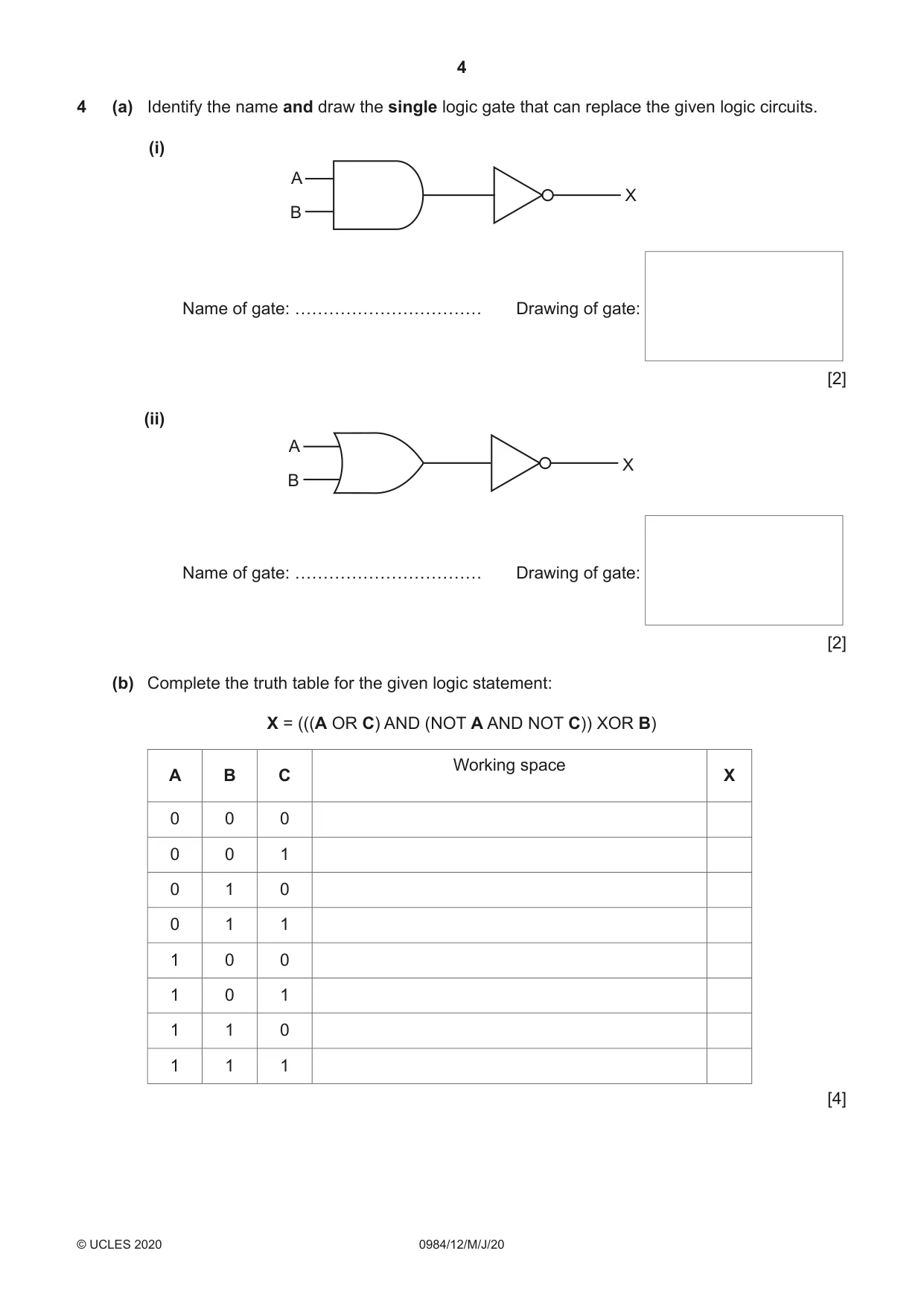
4 0984/12/M/J/20 © UCLES 2020 4 (a) Identify the name and draw the single logic gate that can replace the given logic circuits. (i) A B X Name of gate: …………………………… Drawing of gate: [2] (ii) A B X Name of gate: …………………………… Drawing of gate: [2] (b) Complete the truth table for the given logic statement: X = (((A OR C) AND (NOT A AND NOT C)) XOR B) A B C Working space X 0 0 0 0 0 1 0 1 0 0 1 1 1 0 0 1 0 1 1 1 0 1 1 1 [4]
Question paper, page 5
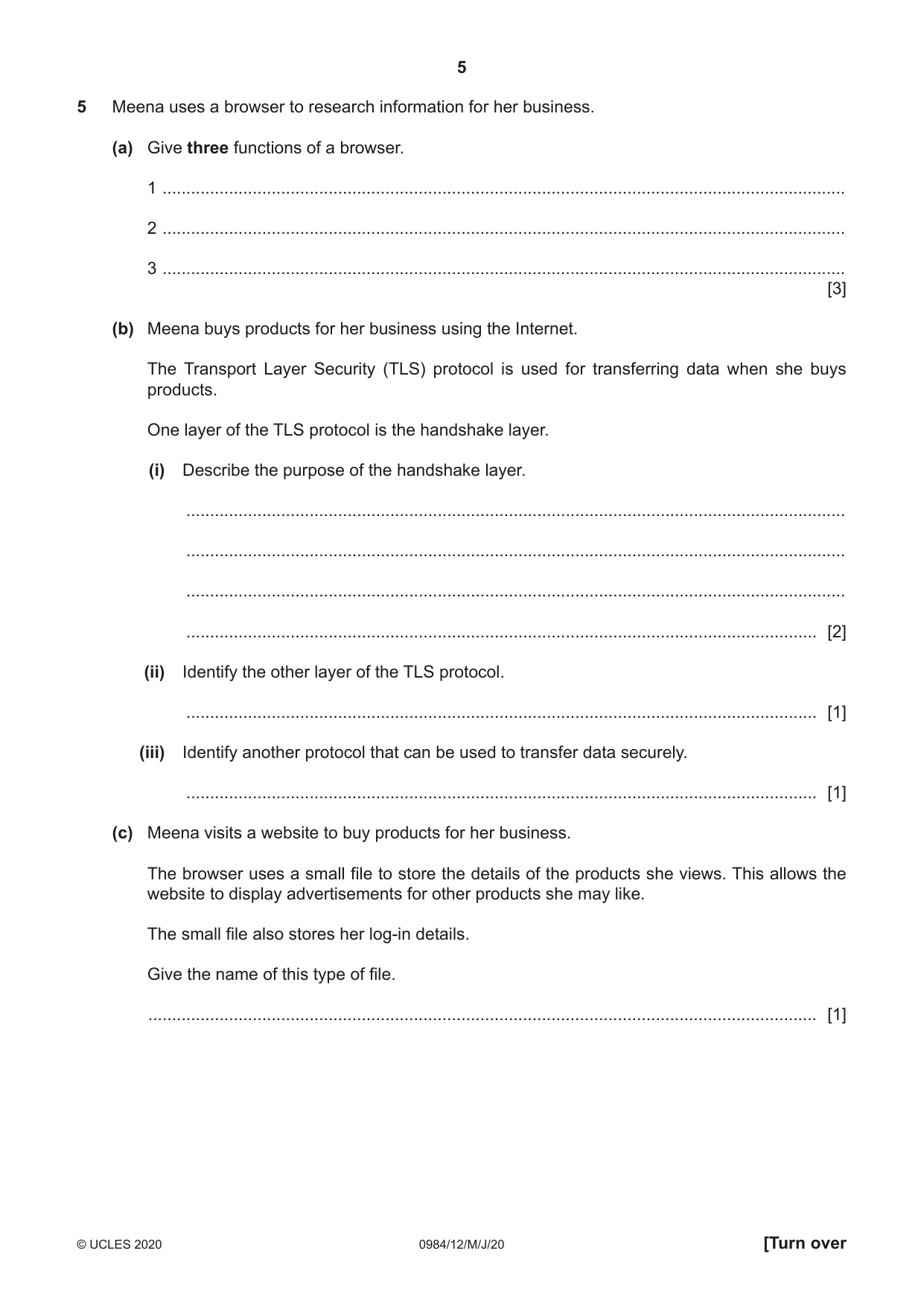
5 0984/12/M/J/20 © UCLES 2020 [Turn over 5 Meena uses a browser to research information for her business. (a) Give three functions of a browser. 1 … 2 … 3 … [3] (b) Meena buys products for her business using the Internet. The Transport Layer Security (TLS) protocol is used for transferring data when she buys products. One layer of the TLS protocol is the handshake layer. (i) Describe the purpose of the handshake layer. … … … … [2] (ii) Identify the other layer of the TLS protocol. … [1] (iii) Identify another protocol that can be used to transfer data securely. … [1] (c) Meena visits a website to buy products for her business. The browser uses a small file to store the details of the products she views. This allows the website to display advertisements for other products she may like. The small file also stores her log-in details. Give the name of this type of file. … [1]
Question paper, page 6
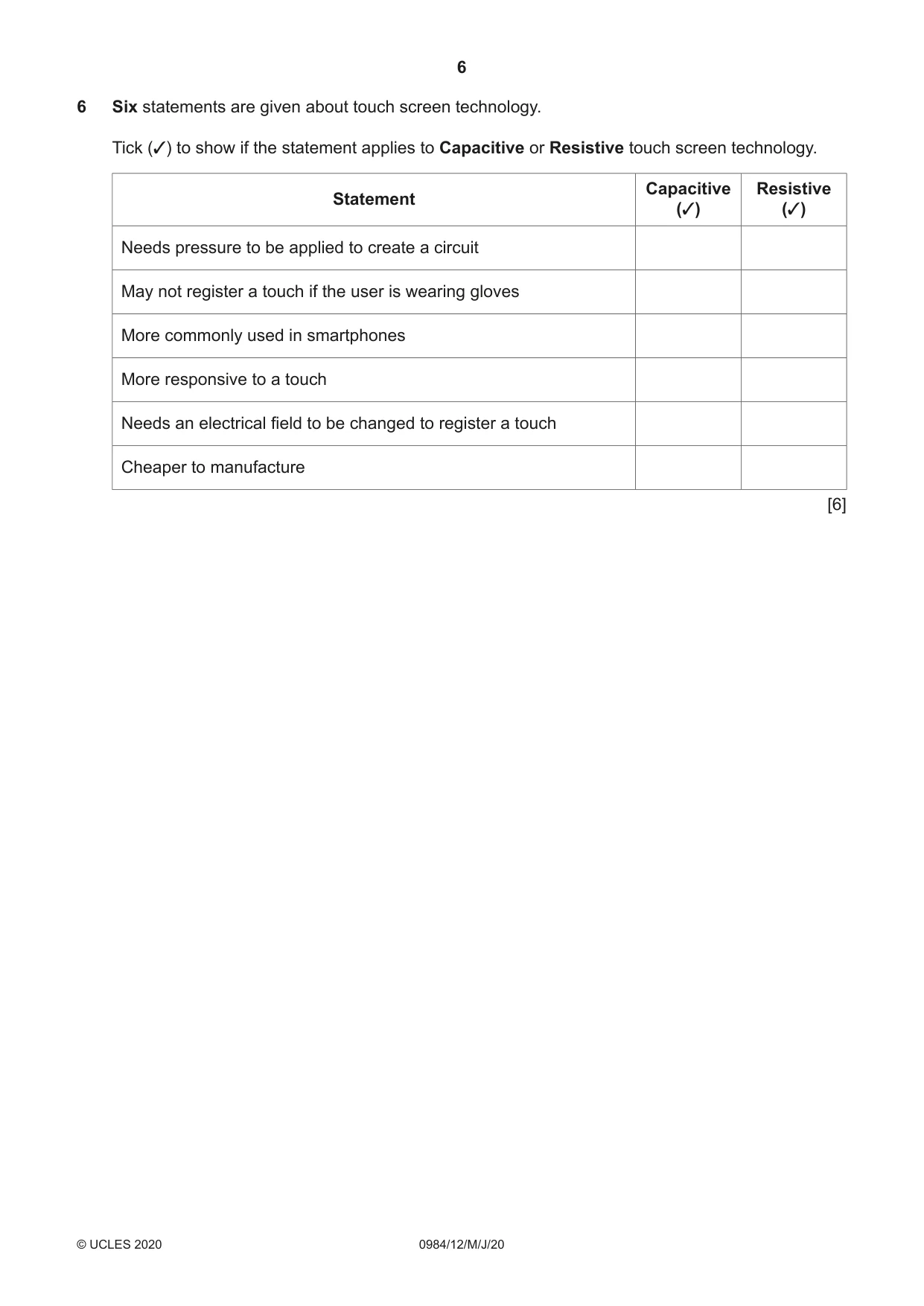
6 0984/12/M/J/20 © UCLES 2020 6 Six statements are given about touch screen technology. Tick (3) to show if the statement applies to Capacitive or Resistive touch screen technology. Statement Capacitive (3) Resistive (3) Needs pressure to be applied to create a circuit May not register a touch if the user is wearing gloves More commonly used in smartphones More responsive to a touch Needs an electrical field to be changed to register a touch Cheaper to manufacture [6]
Question paper, page 7
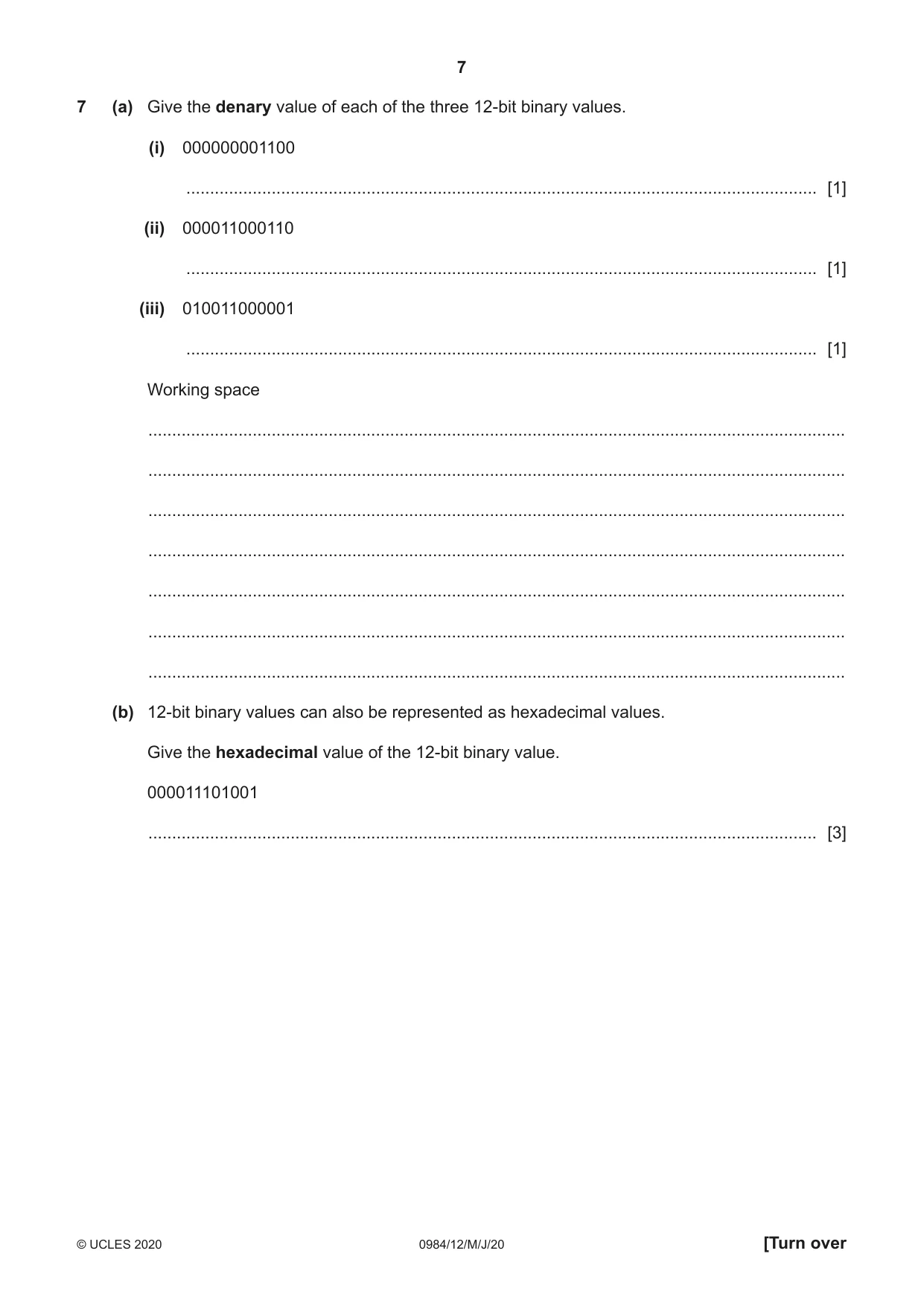
7 0984/12/M/J/20 © UCLES 2020 [Turn over 7 (a) Give the denary value of each of the three 12-bit binary values. (i) 000000001100 … [1] (ii) 000011000110 … [1] (iii) 010011000001 … [1] Working space … … … … … … … (b) 12-bit binary values can also be represented as hexadecimal values. Give the hexadecimal value of the 12-bit binary value. 000011101001 … [3]
Question paper, page 8
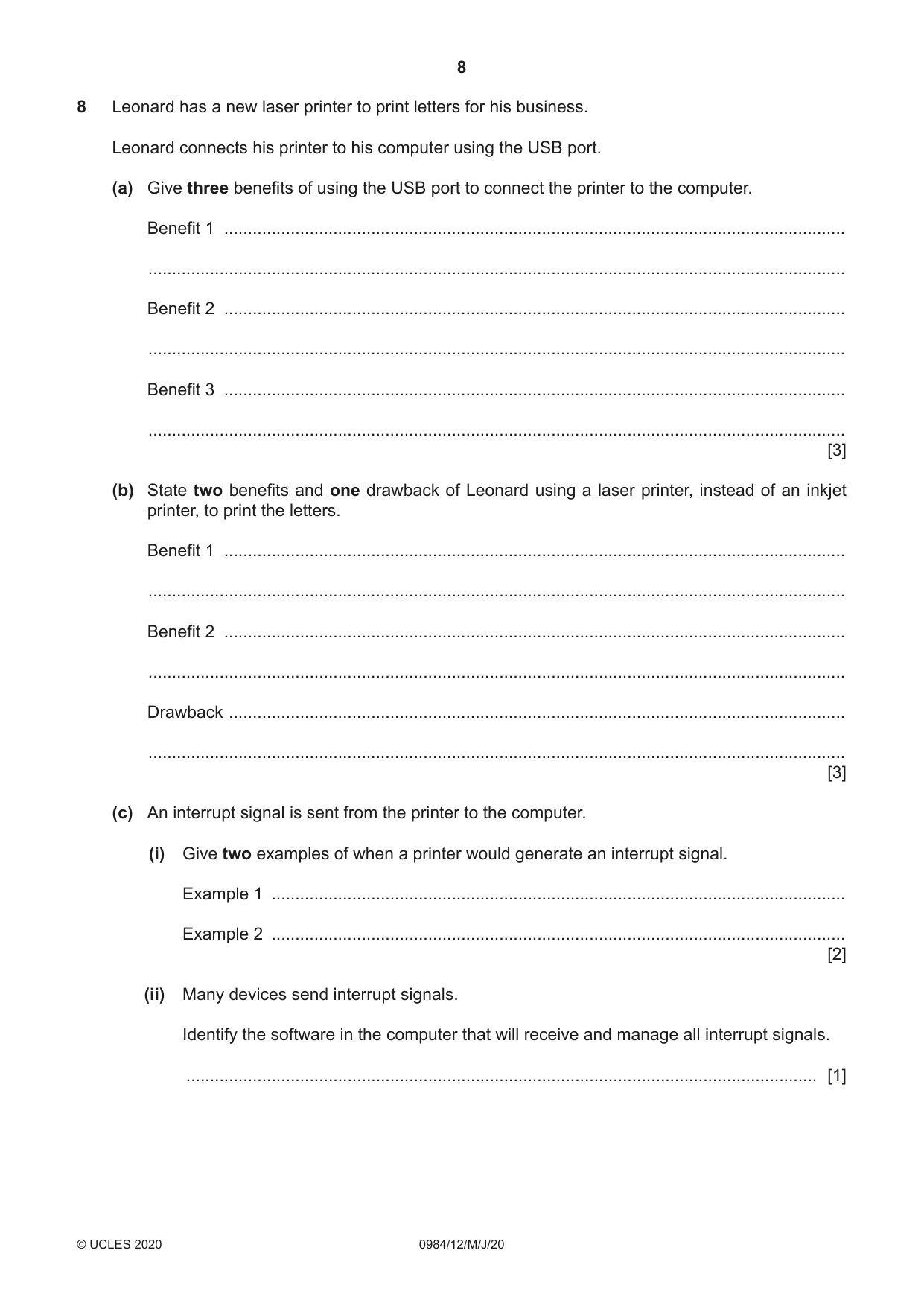
8 0984/12/M/J/20 © UCLES 2020 8 Leonard has a new laser printer to print letters for his business. Leonard connects his printer to his computer using the USB port. (a) Give three benefits of using the USB port to connect the printer to the computer. Benefit 1 … … Benefit 2 … … Benefit 3 … … [3] (b) State two benefits and one drawback of Leonard using a laser printer, instead of an inkjet printer, to print the letters. Benefit 1 … … Benefit 2 … … Drawback … … [3] (c) An interrupt signal is sent from the printer to the computer. (i) Give two examples of when a printer would generate an interrupt signal. Example 1 … Example 2 … [2] (ii) Many devices send interrupt signals. Identify the software in the computer that will receive and manage all interrupt signals. … [1]
Question paper, page 9
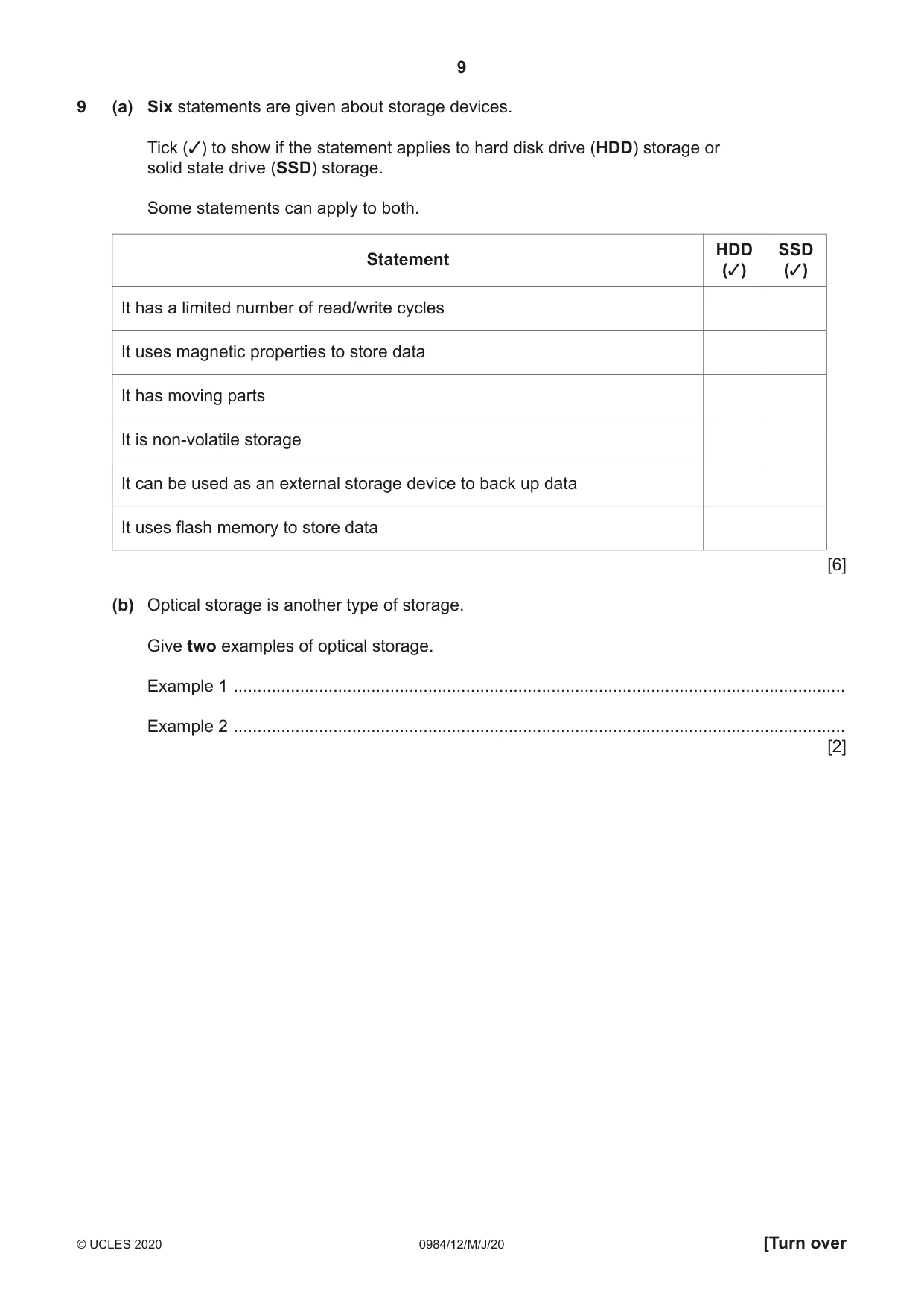
9 0984/12/M/J/20 © UCLES 2020 [Turn over 9 (a) Six statements are given about storage devices. Tick (3) to show if the statement applies to hard disk drive (HDD) storage or solid state drive (SSD) storage. Some statements can apply to both. Statement HDD (3) SSD (3) It has a limited number of read/write cycles It uses magnetic properties to store data It has moving parts It is non-volatile storage It can be used as an external storage device to back up data It uses flash memory to store data [6] (b) Optical storage is another type of storage. Give two examples of optical storage. Example 1 … Example 2 … [2]
Question paper, page 10
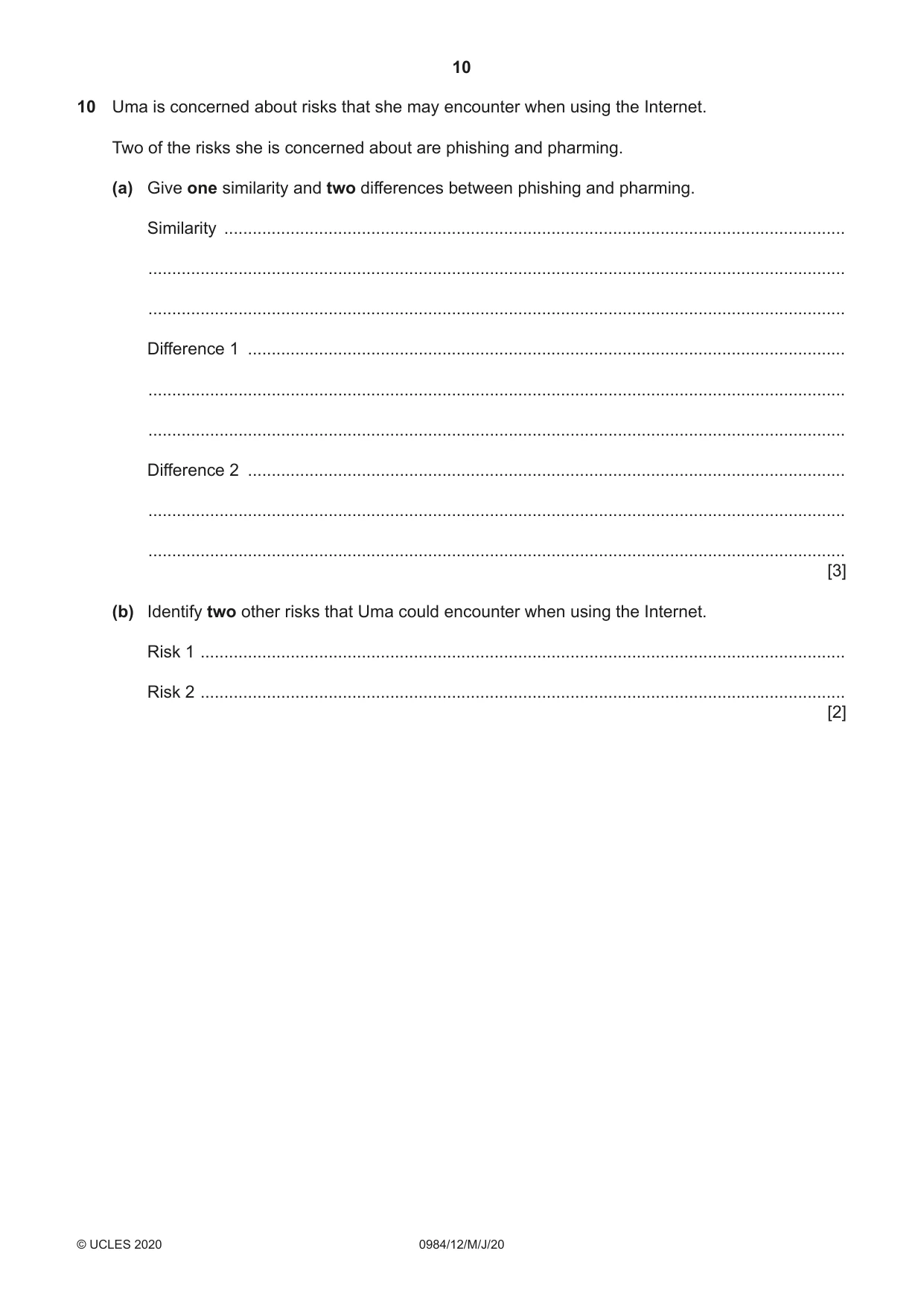
10 0984/12/M/J/20 © UCLES 2020 10 Uma is concerned about risks that she may encounter when using the Internet. Two of the risks she is concerned about are phishing and pharming. (a) Give one similarity and two differences between phishing and pharming. Similarity … … … Difference 1 … … … Difference 2 … … … [3] (b) Identify two other risks that Uma could encounter when using the Internet. Risk 1 … Risk 2 … [2]
Question paper, page 11
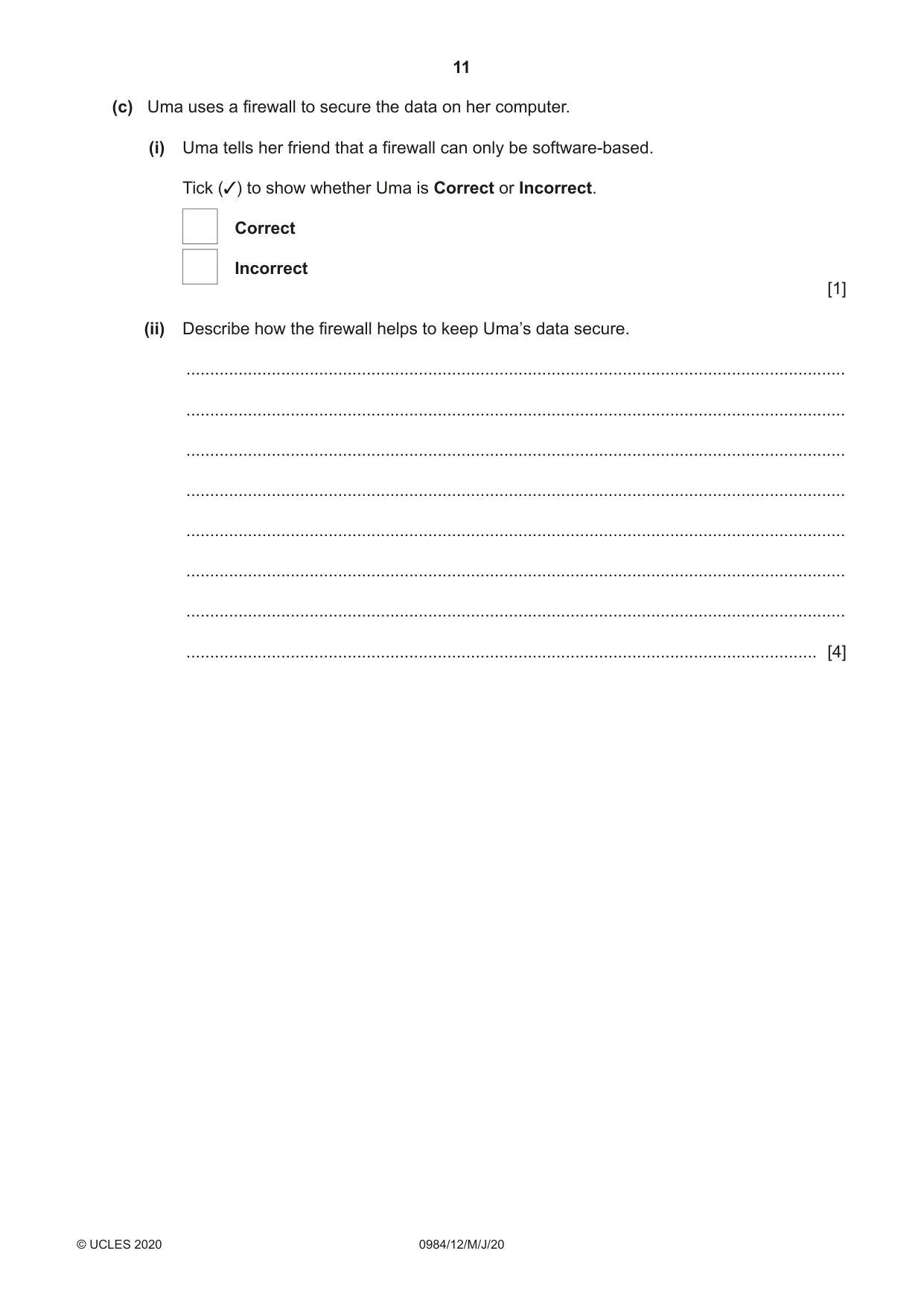
11 0984/12/M/J/20 © UCLES 2020 (c) Uma uses a firewall to secure the data on her computer. (i) Uma tells her friend that a firewall can only be software-based. Tick (3) to show whether Uma is Correct or Incorrect. Correct Incorrect [1] (ii) Describe how the firewall helps to keep Uma’s data secure. … … … … … … … … [4]
Question paper, page 12
12 0984/12/M/J/20 © UCLES 2020 BLANK PAGE Permission to reproduce items where third-party owned material protected by copyright is included has been sought and cleared where possible. Every reasonable effort has been made by the publisher (UCLES) to trace copyright holders, but if any items requiring clearance have unwittingly been included, the publisher will be pleased to make amends at the earliest possible opportunity. To avoid the issue of disclosure of answer-related information to candidates, all copyright acknowledgements are reproduced online in the Cambridge Assessment International Education Copyright Acknowledgements Booklet. This is produced for each series of examinations and is freely available to download at www.cambridgeinternational.org after the live examination series. Cambridge Assessment International Education is part of the Cambridge Assessment Group. Cambridge Assessment is the brand name of the University of Cambridge Local Examinations Syndicate (UCLES), which itself is a department of the University of Cambridge.
Mark scheme, page 1
This document consists of 10 printed pages. © UCLES 2020 [Turn over Cambridge IGCSE™ (9–1) COMPUTER SCIENCE 0984/12 Paper 1 May/June 2020 MARK SCHEME Maximum Mark: 75 Published Students did not sit exam papers in the June 2020 series due to the Covid-19 global pandemic. This mark scheme is published to support teachers and students and should be read together with the question paper. It shows the requirements of the exam. The answer column of the mark scheme shows the proposed basis on which Examiners would award marks for this exam. Where appropriate, this column also provides the most likely acceptable alternative responses expected from students. Examiners usually review the mark scheme after they have seen student responses and update the mark scheme if appropriate. In the June series, Examiners were unable to consider the acceptability of alternative responses, as there were no student responses to consider. Mark schemes should usually be read together with the Principal Examiner Report for Teachers. However, because students did not sit exam papers, there is no Principal Examiner Report for Teachers for the June 2020 series. Cambridge International will not enter into discussions about these mark schemes. Cambridge International is publishing the mark schemes for the June 2020 series for most Cambridge IGCSE™ and Cambridge International A & AS Level components, and some Cambridge O Level components.
Mark scheme, page 2
0984/12 Cambridge IGCSE (9–1) – Mark Scheme PUBLISHED May/June 2020 © UCLES 2020 Page 2 of 10 Generic Marking Principles These general marking principles must be applied by all examiners when marking candidate answers. They should be applied alongside the specific content of the mark scheme or generic level descriptors for a question. Each question paper and mark scheme will also comply with these marking principles. GENERIC MARKING PRINCIPLE 1: Marks must be awarded in line with: • the specific content of the mark scheme or the generic level descriptors for the question • the specific skills defined in the mark scheme or in the generic level descriptors for the question • the standard of response required by a candidate as exemplified by the standardisation scripts. GENERIC MARKING PRINCIPLE 2: Marks awarded are always whole marks (not half marks, or other fractions). GENERIC MARKING PRINCIPLE 3: Marks must be awarded positively: • marks are awarded for correct/valid answers, as defined in the mark scheme. However, credit is given for valid answers which go beyond the scope of the syllabus and mark scheme, referring to your Team Leader as appropriate • marks are awarded when candidates clearly demonstrate what they know and can do • marks are not deducted for errors • marks are not deducted for omissions • answers should only be judged on the quality of spelling, punctuation and grammar when these features are specifically assessed by the question as indicated by the mark scheme. The meaning, however, should be unambiguous. GENERIC MARKING PRINCIPLE 4: Rules must be applied consistently e.g. in situations where candidates have not followed instructions or in the application of generic level descriptors.
Mark scheme, page 3
0984/12 Cambridge IGCSE (9–1) – Mark Scheme PUBLISHED May/June 2020 © UCLES 2020 Page 3 of 10 GENERIC MARKING PRINCIPLE 5: Marks should be awarded using the full range of marks defined in the mark scheme for the question (however; the use of the full mark range may be limited according to the quality of the candidate responses seen). GENERIC MARKING PRINCIPLE 6: Marks awarded are based solely on the requirements as defined in the mark scheme. Marks should not be awarded with grade thresholds or grade descriptors in mind.
Mark scheme, page 4
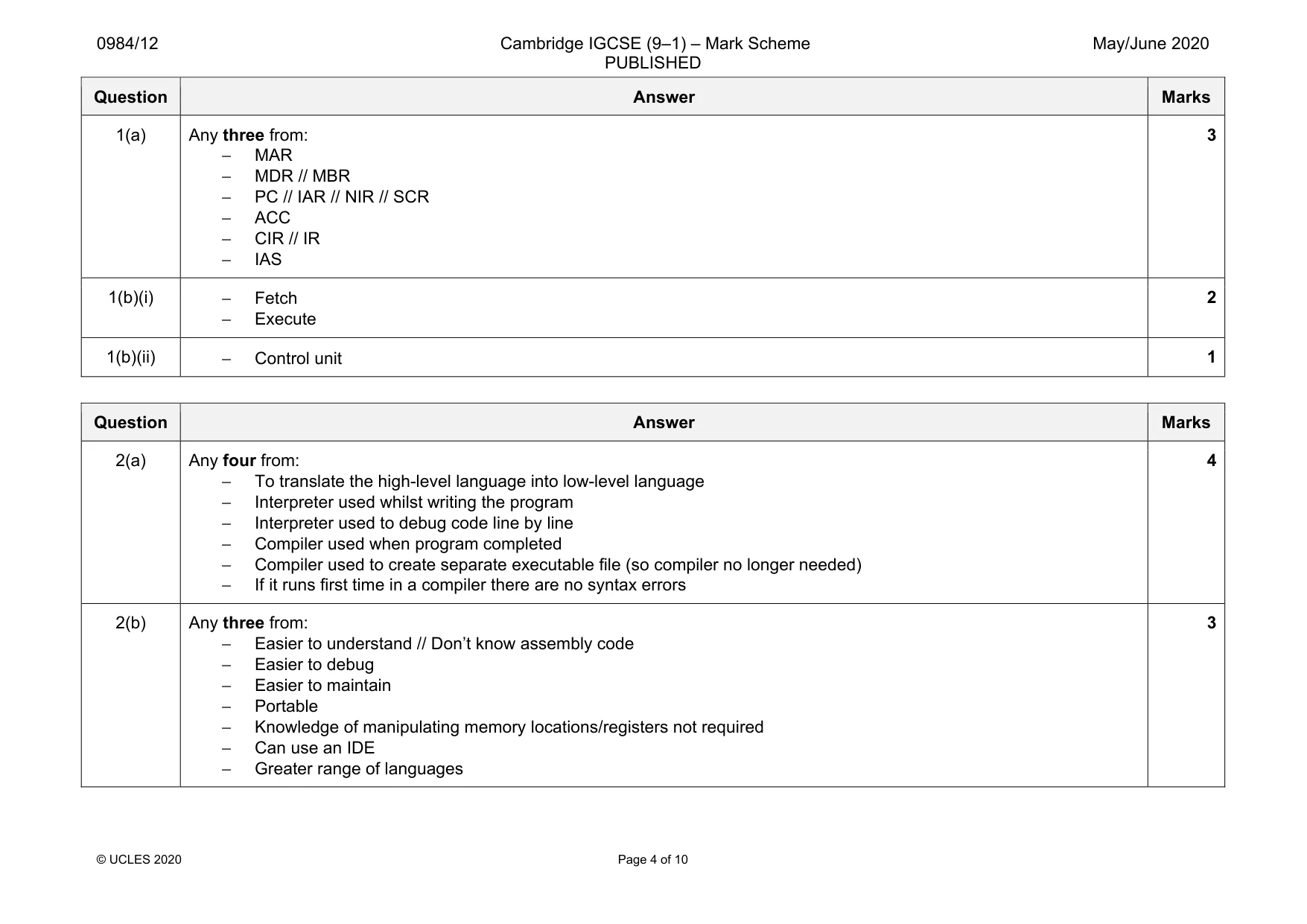
0984/12 Cambridge IGCSE (9–1) – Mark Scheme PUBLISHED May/June 2020 © UCLES 2020 Page 4 of 10 Question Answer Marks 1(a) Any three from: − MAR − MDR // MBR − PC // IAR // NIR // SCR − ACC − CIR // IR − IAS 3 1(b)(i) − Fetch − Execute 2 1(b)(ii) − Control unit 1 Question Answer Marks 2(a) Any four from: − To translate the high-level language into low-level language − Interpreter used whilst writing the program − Interpreter used to debug code line by line − Compiler used when program completed − Compiler used to create separate executable file (so compiler no longer needed) − If it runs first time in a compiler there are no syntax errors 4 2(b) Any three from: − Easier to understand // Don’t know assembly code − Easier to debug − Easier to maintain − Portable − Knowledge of manipulating memory locations/registers not required − Can use an IDE − Greater range of languages 3
Mark scheme, page 5
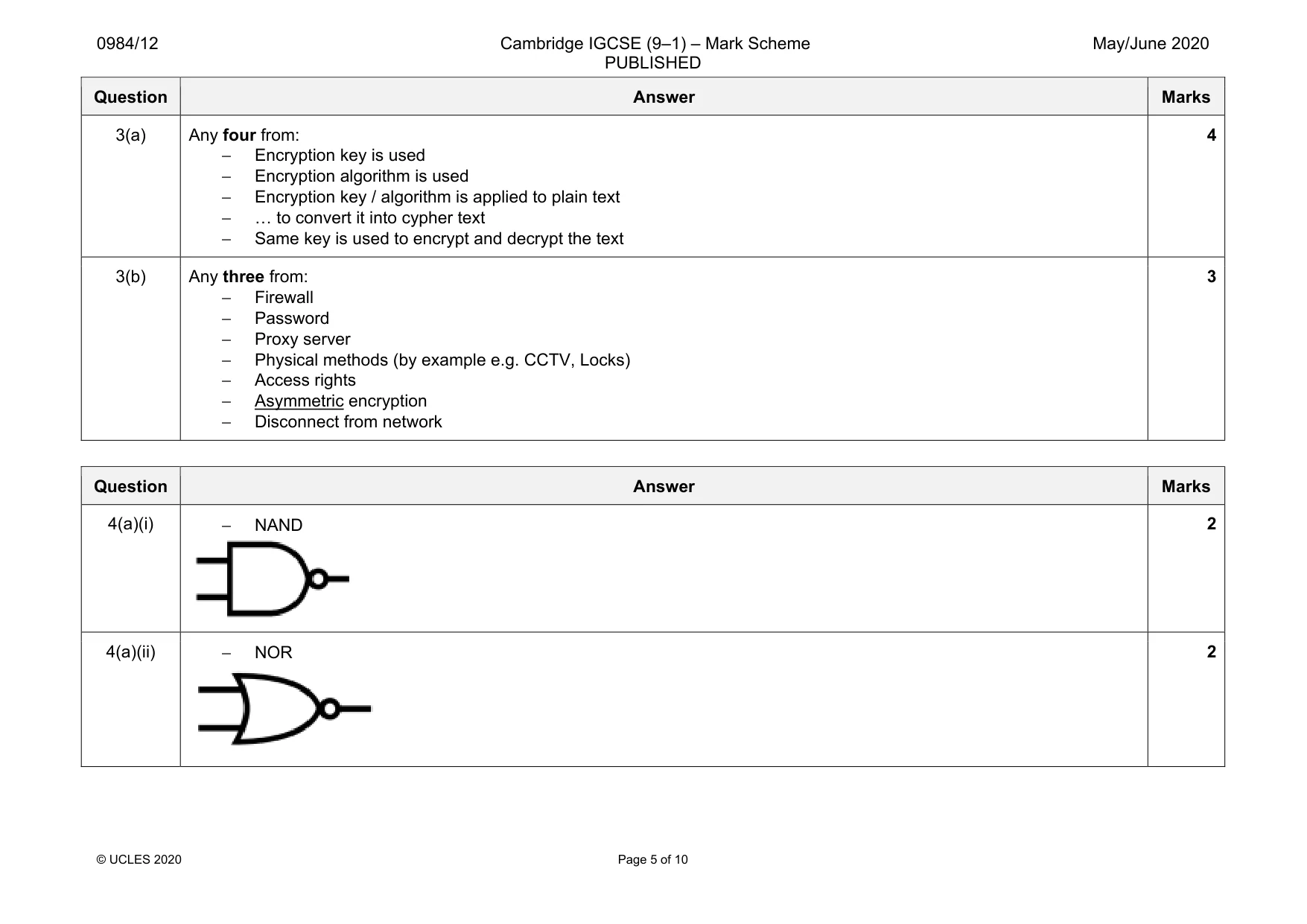
0984/12 Cambridge IGCSE (9–1) – Mark Scheme PUBLISHED May/June 2020 © UCLES 2020 Page 5 of 10 Question Answer Marks 3(a) Any four from: − Encryption key is used − Encryption algorithm is used − Encryption key / algorithm is applied to plain text − … to convert it into cypher text − Same key is used to encrypt and decrypt the text 4 3(b) Any three from: − Firewall − Password − Proxy server − Physical methods (by example e.g. CCTV, Locks) − Access rights − Asymmetric encryption − Disconnect from network 3 Question Answer Marks 4(a)(i) − NAND 2 4(a)(ii) − NOR 2
Mark scheme, page 6
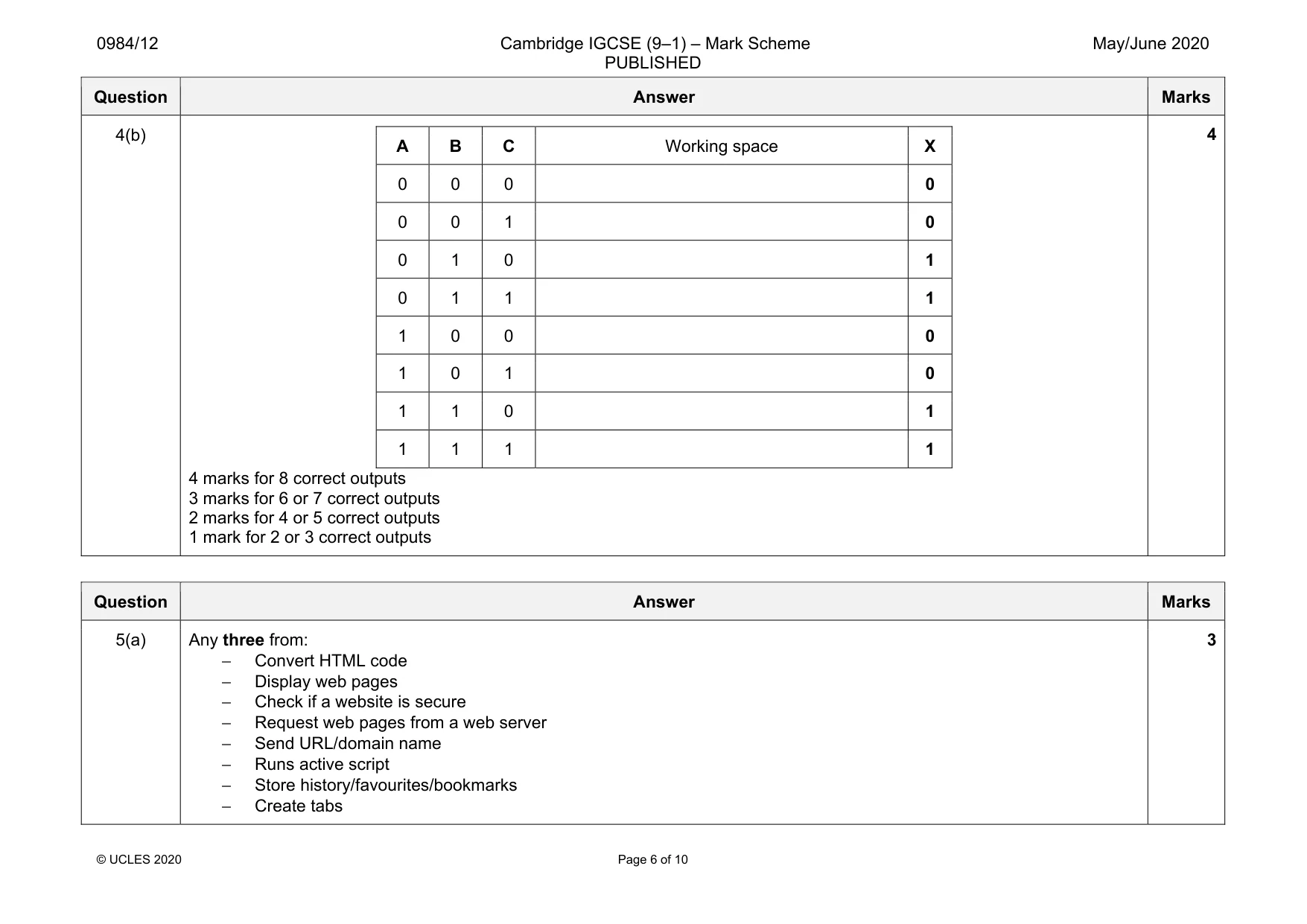
0984/12 Cambridge IGCSE (9–1) – Mark Scheme PUBLISHED May/June 2020 © UCLES 2020 Page 6 of 10 Question Answer Marks 4(b) A B C Working space X 0 0 0 0 0 0 1 0 0 1 0 1 0 1 1 1 1 0 0 0 1 0 1 0 1 1 0 1 1 1 1 1 4 marks for 8 correct outputs 3 marks for 6 or 7 correct outputs 2 marks for 4 or 5 correct outputs 1 mark for 2 or 3 correct outputs 4 Question Answer Marks 5(a) Any three from: − Convert HTML code − Display web pages − Check if a website is secure − Request web pages from a web server − Send URL/domain name − Runs active script − Store history/favourites/bookmarks − Create tabs 3
Mark scheme, page 7
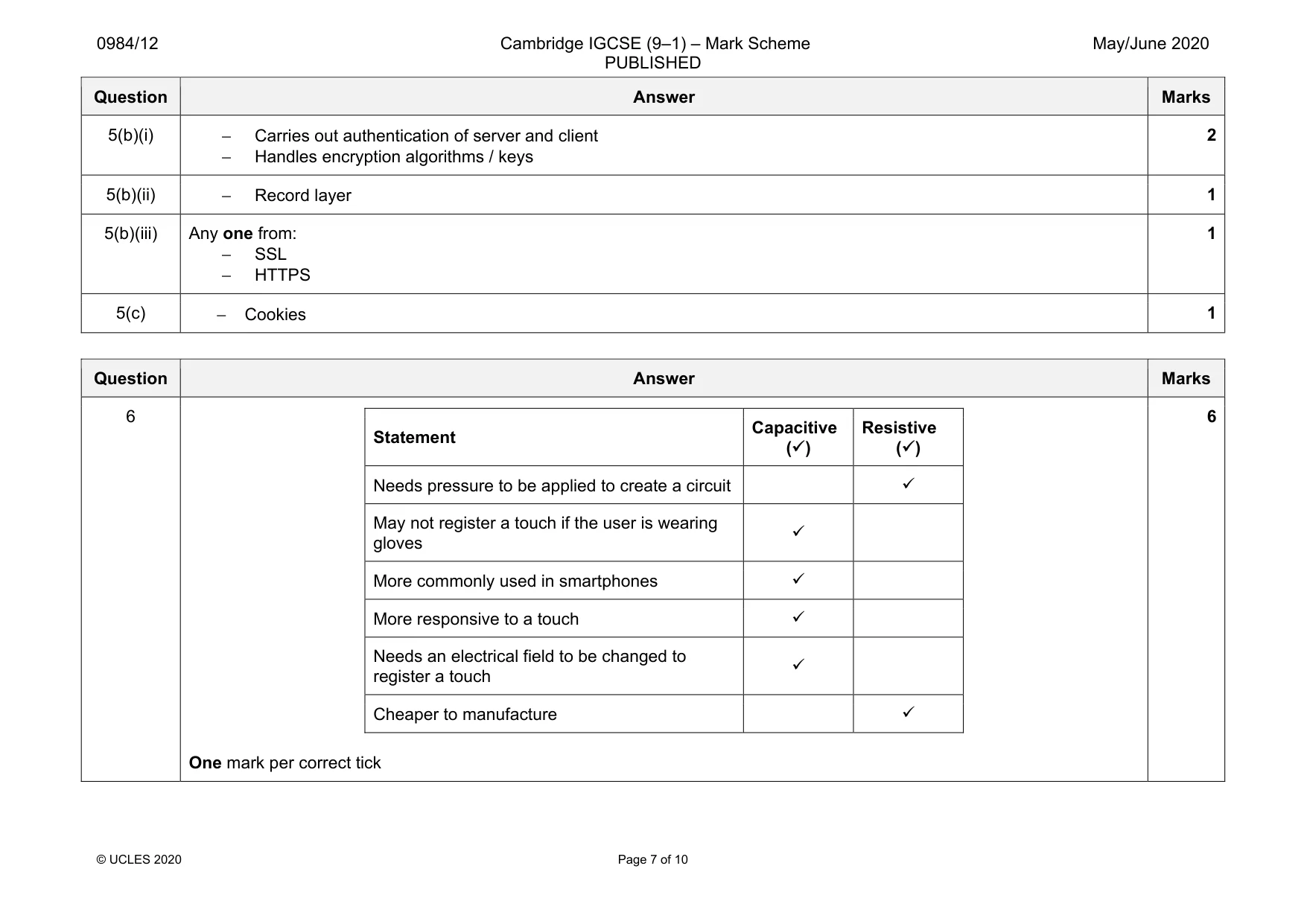
0984/12 Cambridge IGCSE (9–1) – Mark Scheme PUBLISHED May/June 2020 © UCLES 2020 Page 7 of 10 Question Answer Marks 5(b)(i) − Carries out authentication of server and client − Handles encryption algorithms / keys 2 5(b)(ii) − Record layer 1 5(b)(iii) Any one from: − SSL − HTTPS 1 5(c) − Cookies 1 Question Answer Marks 6 Statement Capacitive () Resistive () Needs pressure to be applied to create a circuit May not register a touch if the user is wearing gloves More commonly used in smartphones More responsive to a touch Needs an electrical field to be changed to register a touch Cheaper to manufacture One mark per correct tick 6
Mark scheme, page 8
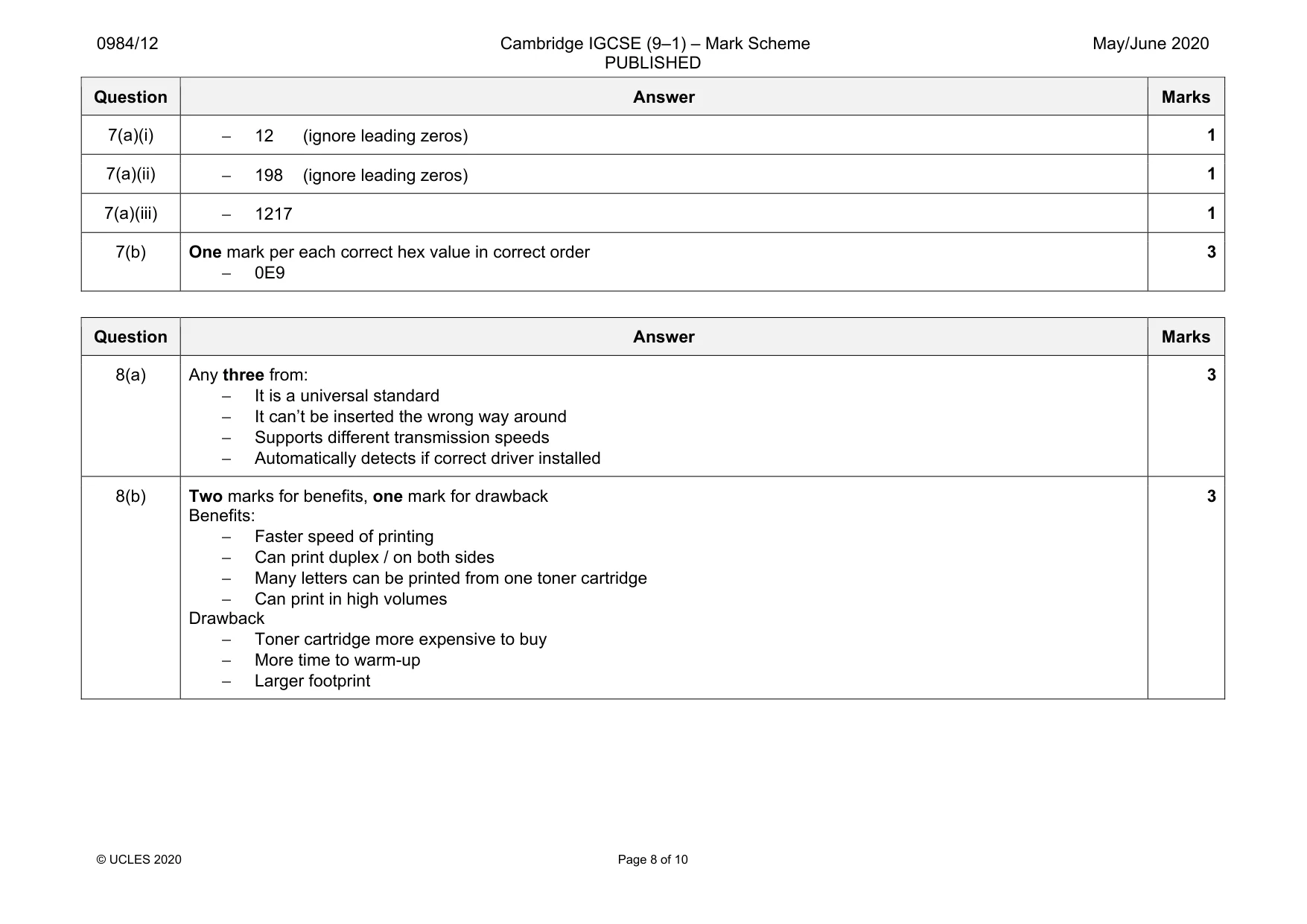
0984/12 Cambridge IGCSE (9–1) – Mark Scheme PUBLISHED May/June 2020 © UCLES 2020 Page 8 of 10 Question Answer Marks 7(a)(i) − 12 (ignore leading zeros) 1 7(a)(ii) − 198 (ignore leading zeros) 1 7(a)(iii) − 1217 1 7(b) One mark per each correct hex value in correct order − 0E9 3 Question Answer Marks 8(a) Any three from: − It is a universal standard − It can’t be inserted the wrong way around − Supports different transmission speeds − Automatically detects if correct driver installed 3 8(b) Two marks for benefits, one mark for drawback Benefits: − Faster speed of printing − Can print duplex / on both sides − Many letters can be printed from one toner cartridge − Can print in high volumes Drawback − Toner cartridge more expensive to buy − More time to warm-up − Larger footprint 3
Mark scheme, page 9
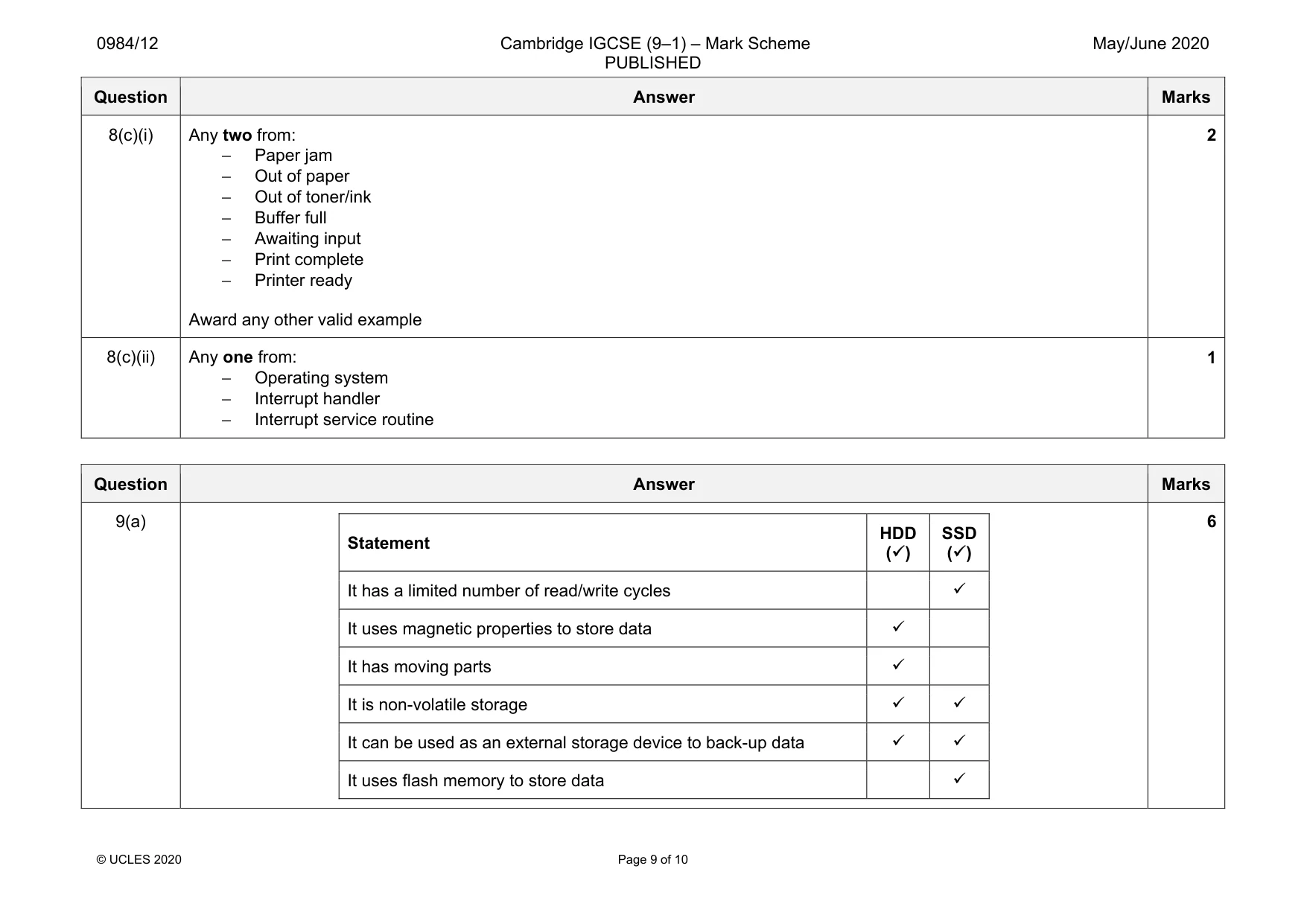
0984/12 Cambridge IGCSE (9–1) – Mark Scheme PUBLISHED May/June 2020 © UCLES 2020 Page 9 of 10 Question Answer Marks 8(c)(i) Any two from: − Paper jam − Out of paper − Out of toner/ink − Buffer full − Awaiting input − Print complete − Printer ready Award any other valid example 2 8(c)(ii) Any one from: − Operating system − Interrupt handler − Interrupt service routine 1 Question Answer Marks 9(a) Statement HDD () SSD () It has a limited number of read/write cycles It uses magnetic properties to store data It has moving parts It is non-volatile storage It can be used as an external storage device to back-up data It uses flash memory to store data 6
Mark scheme, page 10
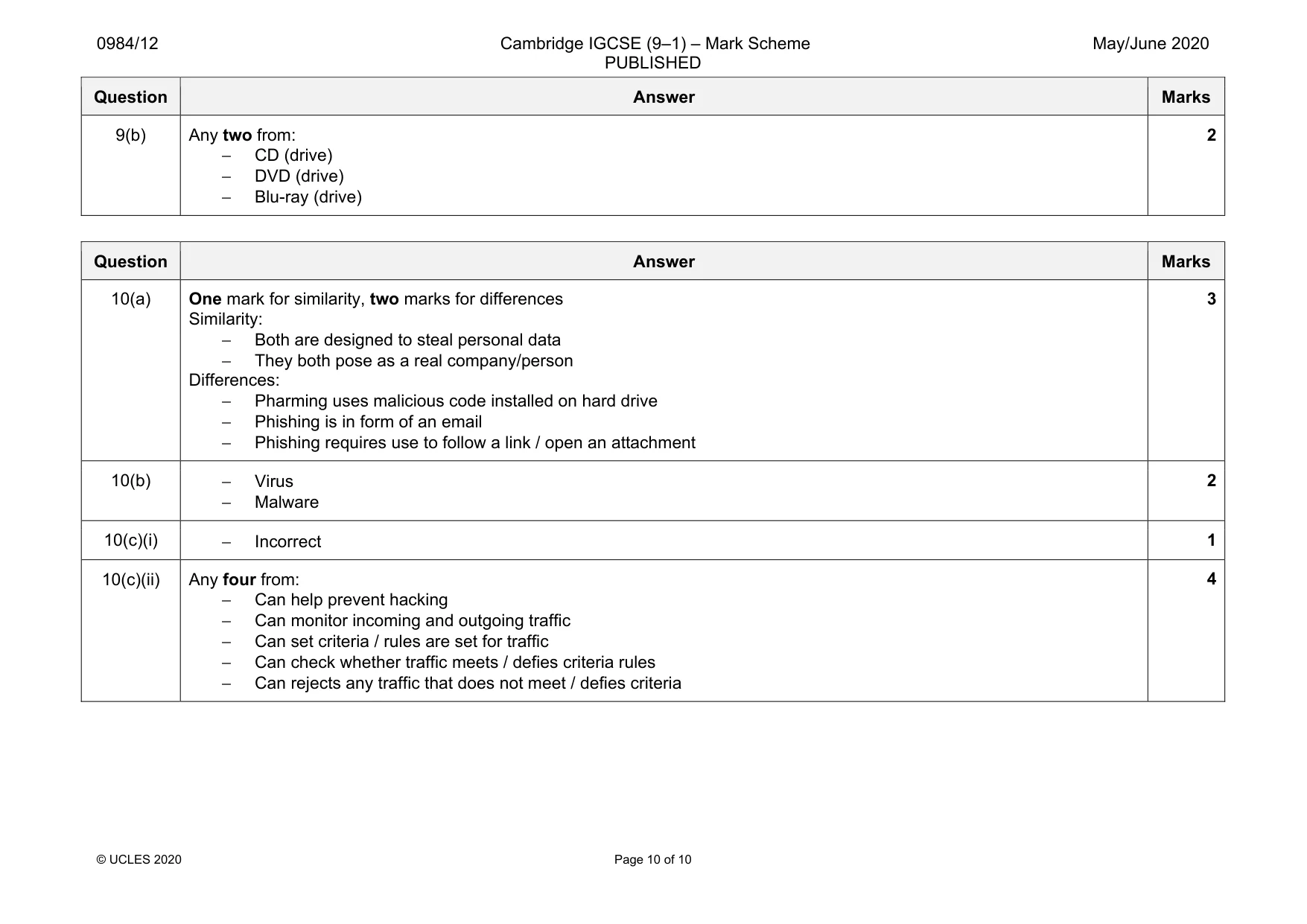
0984/12 Cambridge IGCSE (9–1) – Mark Scheme PUBLISHED May/June 2020 © UCLES 2020 Page 10 of 10 Question Answer Marks 9(b) Any two from: − CD (drive) − DVD (drive) − Blu-ray (drive) 2 Question Answer Marks 10(a) One mark for similarity, two marks for differences Similarity: − Both are designed to steal personal data − They both pose as a real company/person Differences: − Pharming uses malicious code installed on hard drive − Phishing is in form of an email − Phishing requires use to follow a link / open an attachment 3 10(b) − Virus − Malware 2 10(c)(i) − Incorrect 1 10(c)(ii) Any four from: − Can help prevent hacking − Can monitor incoming and outgoing traffic − Can set criteria / rules are set for traffic − Can check whether traffic meets / defies criteria rules − Can rejects any traffic that does not meet / defies criteria 4