Cambridge IGCSE Chinese - Second Language 0523 — 2019 May/June Paper 1 · Variant 1
0523/11/M/J/19 · 70 marks · ≈79 min
The question paper and its mark scheme, free to read here and free to download. This is Cambridge’s own paper, exactly as it was sat.
Question paper20 pages
Mark scheme15 pages
Answers below. Sit the paper first if you are practising.
Paper as text
Question paper, page 1
CHINESE AS A SECOND LANGUAGE 0523/01 Paper 1 Reading and Writing May/June 2019 2 hours Candidates answer on the Question Paper. No Additional Materials are required. READ THESE INSTRUCTIONS FIRST Write your centre number, candidate number and name on all the work you hand in. Write in dark blue or black pen. Do not use staples, paper clips, glue or correction fluid. DO NOT WRITE IN ANY BARCODES. Answer all questions. The passages and questions on this question paper are printed twice, once in traditional and once in simplified characters. If you wish to read them in traditional characters, turn to page 2; if you wish to read them in simplified characters, turn to page 12. You may write your answers in either traditional or simplified characters. Dictionaries are not allowed. The number of marks is given in brackets [ ] at the end of each question or part question. Please indicate here whether you have used the traditional or simplified section of the question paper. Traditional Simplified This document consists of 20 printed pages. NL (CGW) 164040/2 © UCLES 2019 [Turn over Cambridge Assessment International Education Cambridge International General Certificate of Secondary Education * 0 5 2 4 6 2 9 2 3 6 *
Question paper, page 2
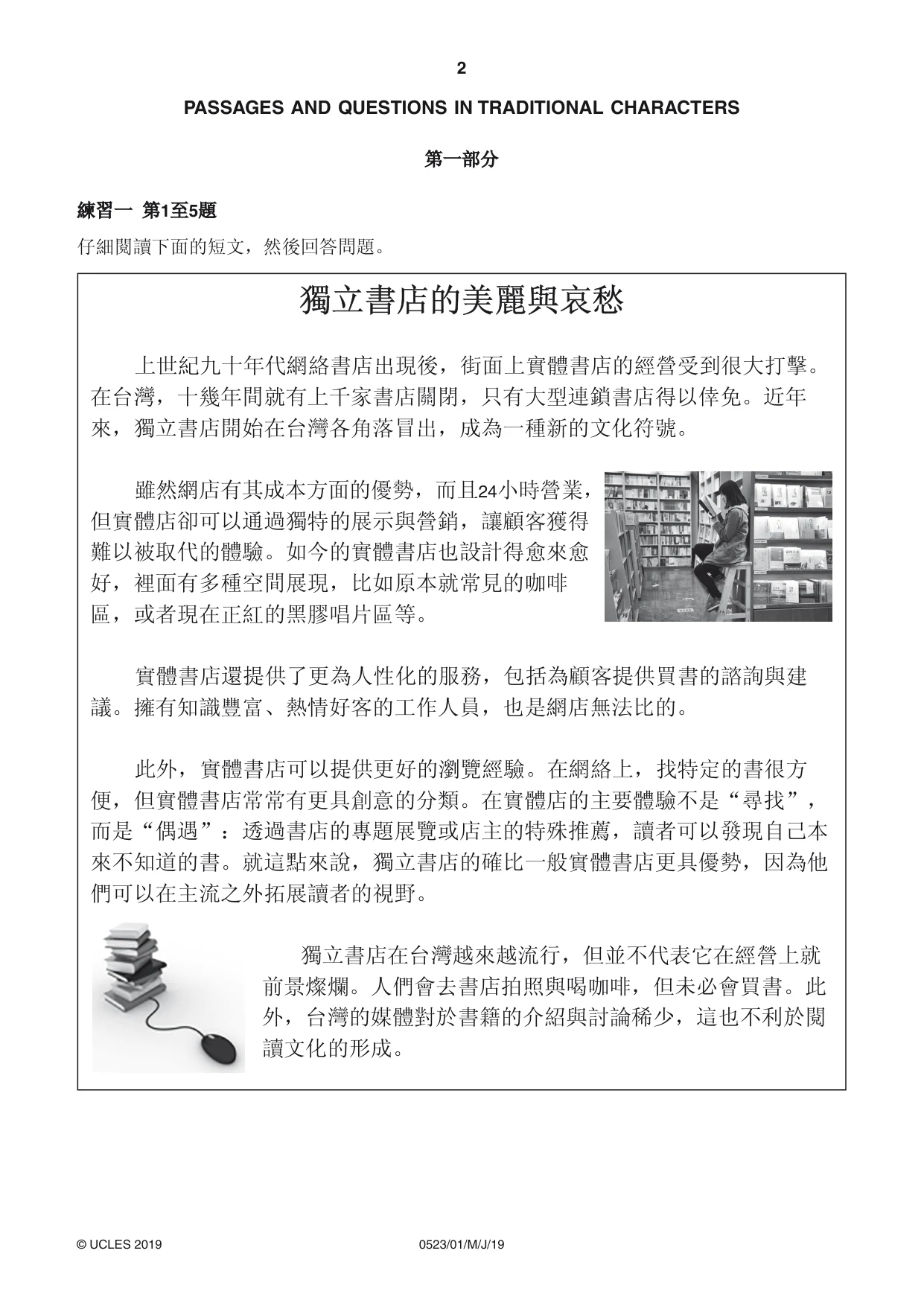
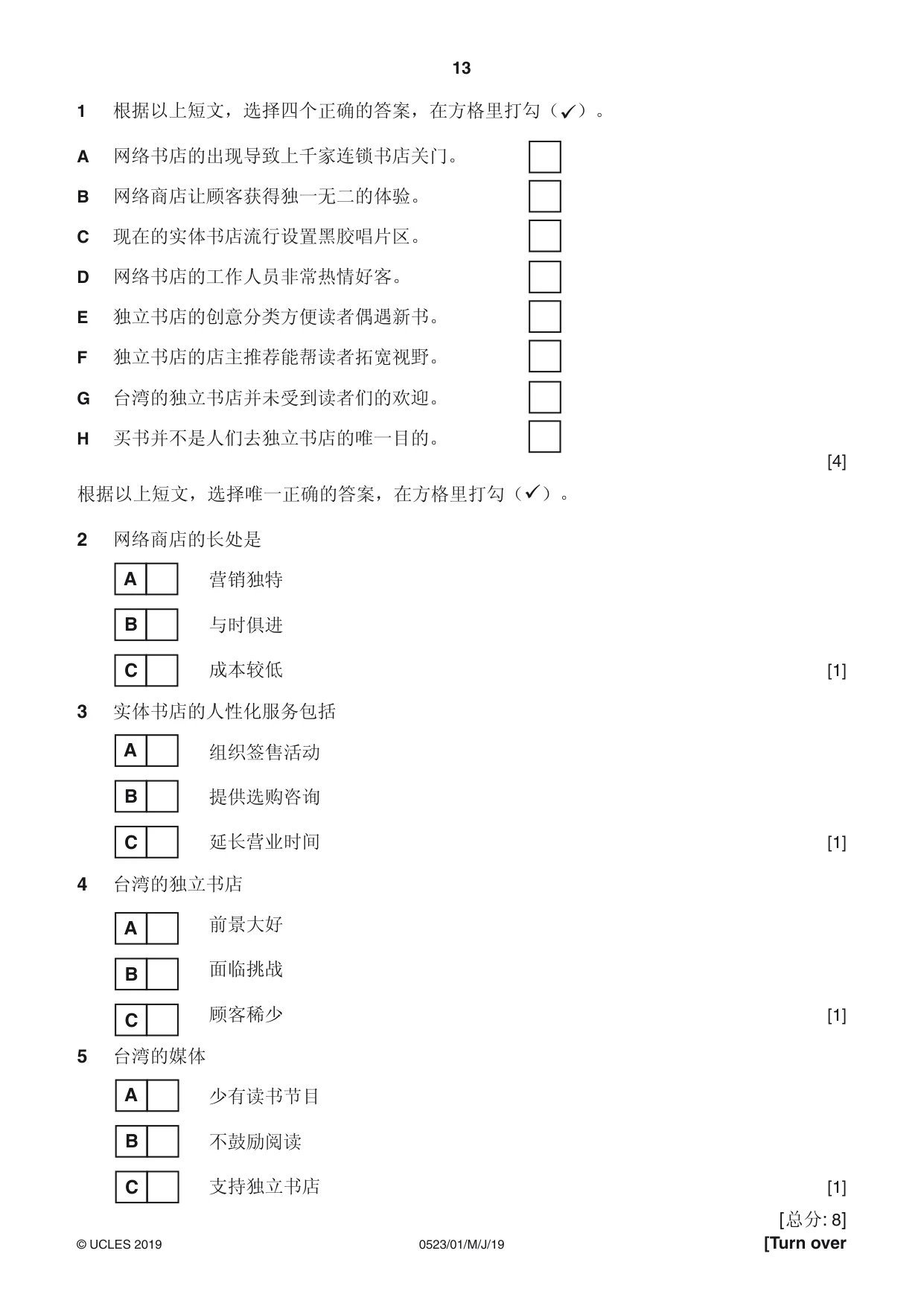
2 © UCLES 2019 0523/01/M/J/19 PASSAGES AND QUESTIONS IN TRADITIONAL CHARACTERS 第一部分 練習一 第1至5題 仔細閱讀下面的短文,然後回答問題。 獨立書店的美麗與哀愁 上世紀九十年代網絡書店出現後,街面上實體書店的經營受到很大打擊。 在台灣,十幾年間就有上千家書店關閉,只有大型連鎖書店得以倖免。近年 來,獨立書店開始在台灣各角落冒出,成為一種新的文化符號。 雖然網店有其成本方面的優勢,而且24小時營業, 但實體店卻可以通過獨特的展示與營銷,讓顧客獲得 難以被取代的體驗。如今的實體書店也設計得愈來愈 好,裡面有多種空間展現,比如原本就常見的咖啡 區,或者現在正紅的黑膠唱片區等。 實體書店還提供了更為人性化的服務,包括為顧客提供買書的諮詢與建 議。擁有知識豐富、熱情好客的工作人員,也是網店無法比的。 此外,實體書店可以提供更好的瀏覽經驗。在網絡上,找特定的書很方 便,但實體書店常常有更具創意的分類。在實體店的主要體驗不是“尋找”, 而是“偶遇”:透過書店的專題展覽或店主的特殊推薦,讀者可以發現自己本 來不知道的書。就這點來說,獨立書店的確比一般實體書店更具優勢,因為他 們可以在主流之外拓展讀者的視野。 獨立書店在台灣越來越流行,但並不代表它在經營上就 前景燦爛。人們會去書店拍照與喝咖啡,但未必會買書。此 外,台灣的媒體對於書籍的介紹與討論稀少,這也不利於閱 讀文化的形成。
Question paper, page 3
3 [Turn over 0523/01/M/J/19 © UCLES 2019 1 根據以上短文,選擇四個正確的答案,在方格裡打勾()。 A 網絡書店的出現導致上千家連鎖書店關門。 B 現在的實體書店流行設置黑膠唱片區。 C 網絡書店的工作人員非常熱情好客。 D 獨立書店的創意分類方便讀者偶遇新書。 E 台灣的獨立書店並未受到讀者們的歡迎。 F 買書並不是人們去獨立書店的唯一目的。 G 台灣的獨立書店並未受到讀者們的歡迎。 H 買書並不是人們去獨立書店的唯一目的。 [4] 根據以上短文,選擇唯一正確的答案,在方格裡打勾()。 2 網絡商店的長處是 營銷獨特 與時俱進 成本較低 [1] 3 實體書店的人性化服務包括 組織簽售活動 提供選購諮詢 延長營業時間 [1] 4 台灣的獨立書店 前景大好 面臨挑戰 顧客稀少 [1] 5 台灣的媒體 少有讀書節目 不鼓勵閱讀 支持獨立書店 [1] [總分: 8] A B C A B C A B C A B C
Question paper, page 4
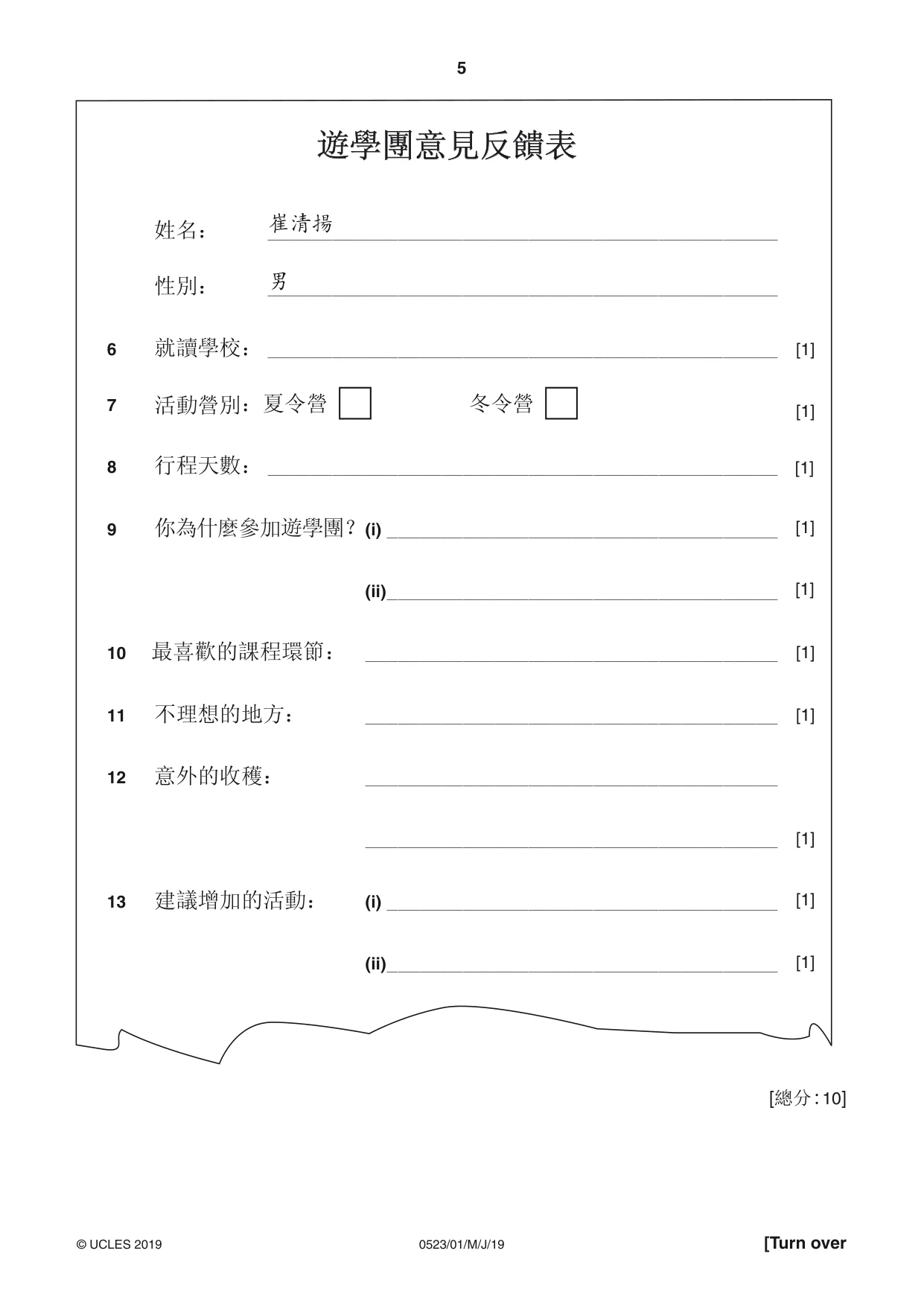
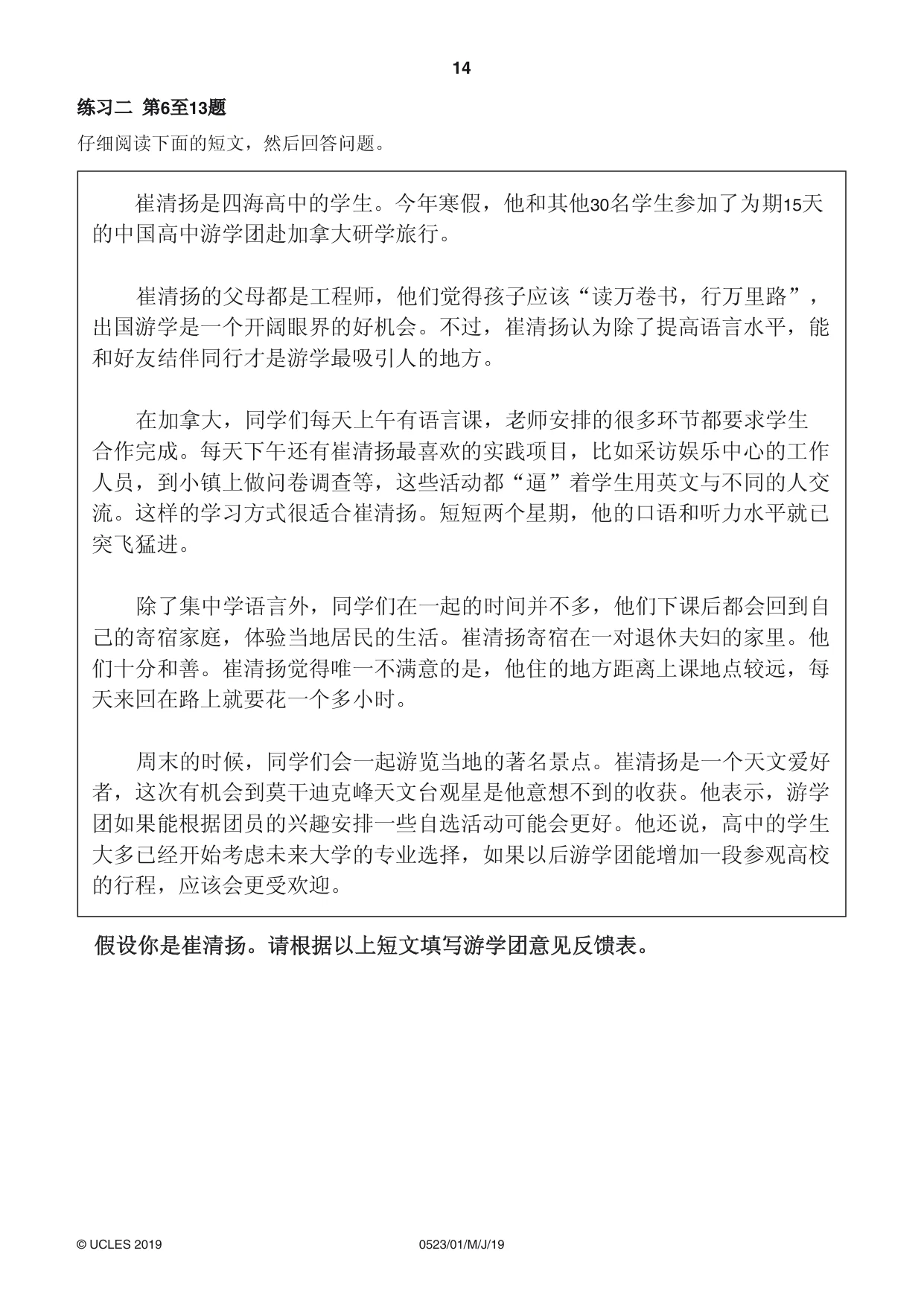
4 © UCLES 2019 0523/01/M/J/19 練習二 第6至13題 仔細閱讀下面的短文,然後回答問題。 假設你是崔清揚。請根據以上短文填寫遊學團意見反饋表。 崔清揚是四海高中的學生。今年寒假,他和其他30名學生參加了為期15天 的中國高中遊學團赴加拿大研學旅行。 崔清揚的父母都是工程師,他們覺得孩子應該“讀萬卷書,行萬里路”, 出國遊學是一個開闊眼界的好機會。不過,崔清揚認為除了提高語言水平,能 和好友結伴同行才是遊學最吸引人的地方。 在加拿大,同學們每天上午有語言課,老師安排的很多環節都要求學生 合作完成。每天下午還有崔清揚最喜歡的實踐項目,比如採訪娛樂中心的工作 人員,到小鎮上做問卷調查等,這些活動都“逼”著學生用英文與不同的人交 流。這樣的學習方式很適合崔清揚。短短兩個星期,他的口語和聽力水平就已 突飛猛進。 除了集中學語言外,同學們在一起的時間並不多,他們下課後都會回到自 己的寄宿家庭,體驗當地居民的生活。崔清揚寄宿在一對退休夫婦的家裡。他 們十分和善。崔清揚覺得唯一不滿意的是,他住的地方距離上課地點較遠,每 天來回在路上就要花一個多小時。 週末的時候,同學們會一起遊覽當地的著名景點。崔清揚是一個天文愛好 者,這次有機會到莫干迪克峰天文台觀星是他意想不到的收穫。他表示,遊學 團如果能根據團員的興趣安排一些自選活動可能會更好。他還說,高中的學生 大多已經開始考慮未來大學的專業選擇,如果以後遊學團能增加一段參觀高校 的行程,應該會更受歡迎。
Question paper, page 5
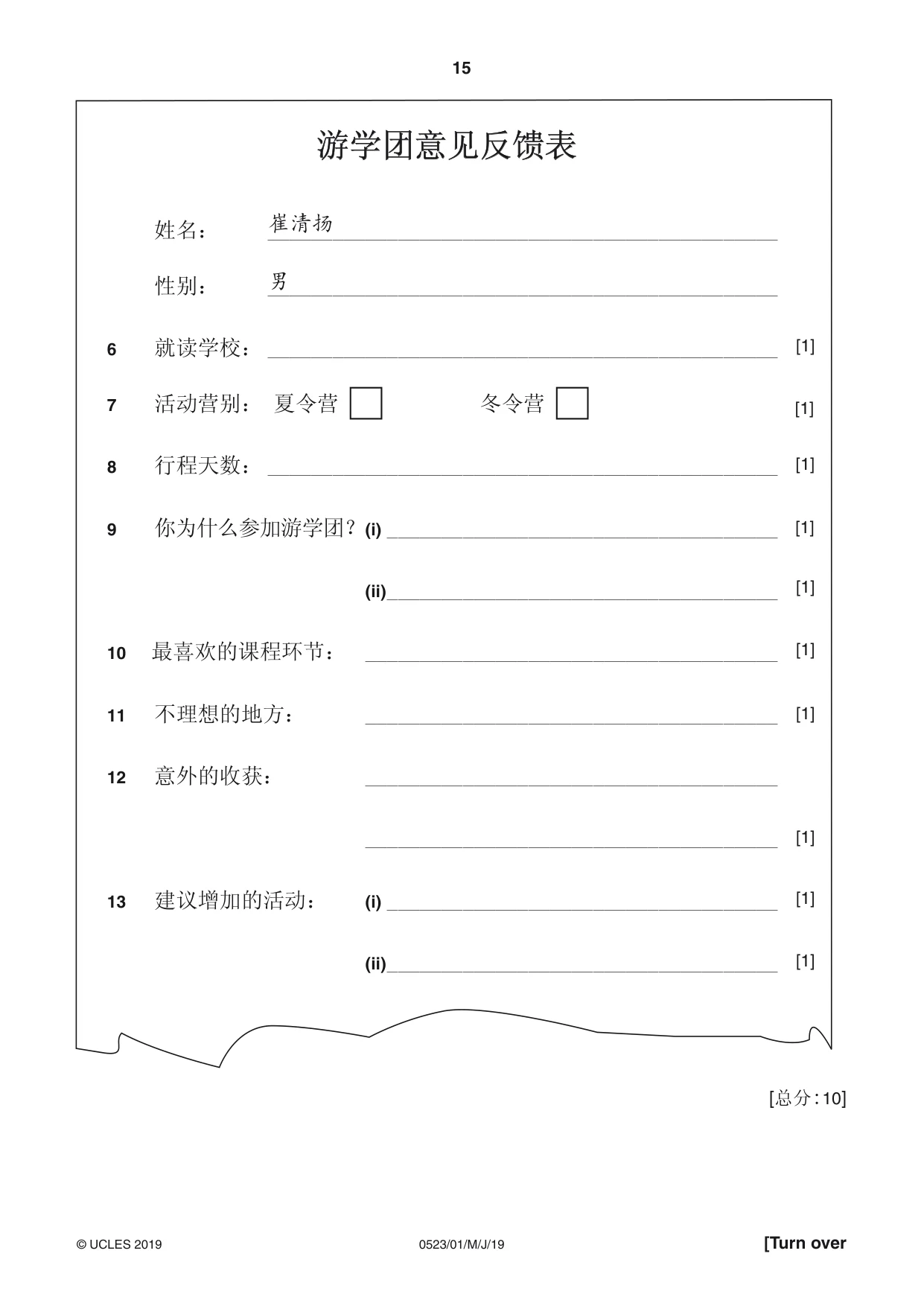
5 [Turn over 0523/01/M/J/19 © UCLES 2019 [總分:10] 遊學團意見反饋表 姓名: _______________________________________________ 性別: _______________________________________________ 6 就讀學校: _______________________________________________ 7 活動營別:夏令營 冬令營 8 行程天數: _______________________________________________ 9 你為什麼參加遊學團? (i) ____________________________________ (ii) ____________________________________ 10 最喜歡的課程環節: ______________________________________ 11 不理想的地方: ______________________________________ 12 意外的收穫: ______________________________________ ______________________________________ 13 建議增加的活動: (i) ____________________________________ (ii) ____________________________________ 崔清揚 [1] 男 [1] [1] [1] [1] [1] [1] [1] [1] [1]
Question paper, page 6
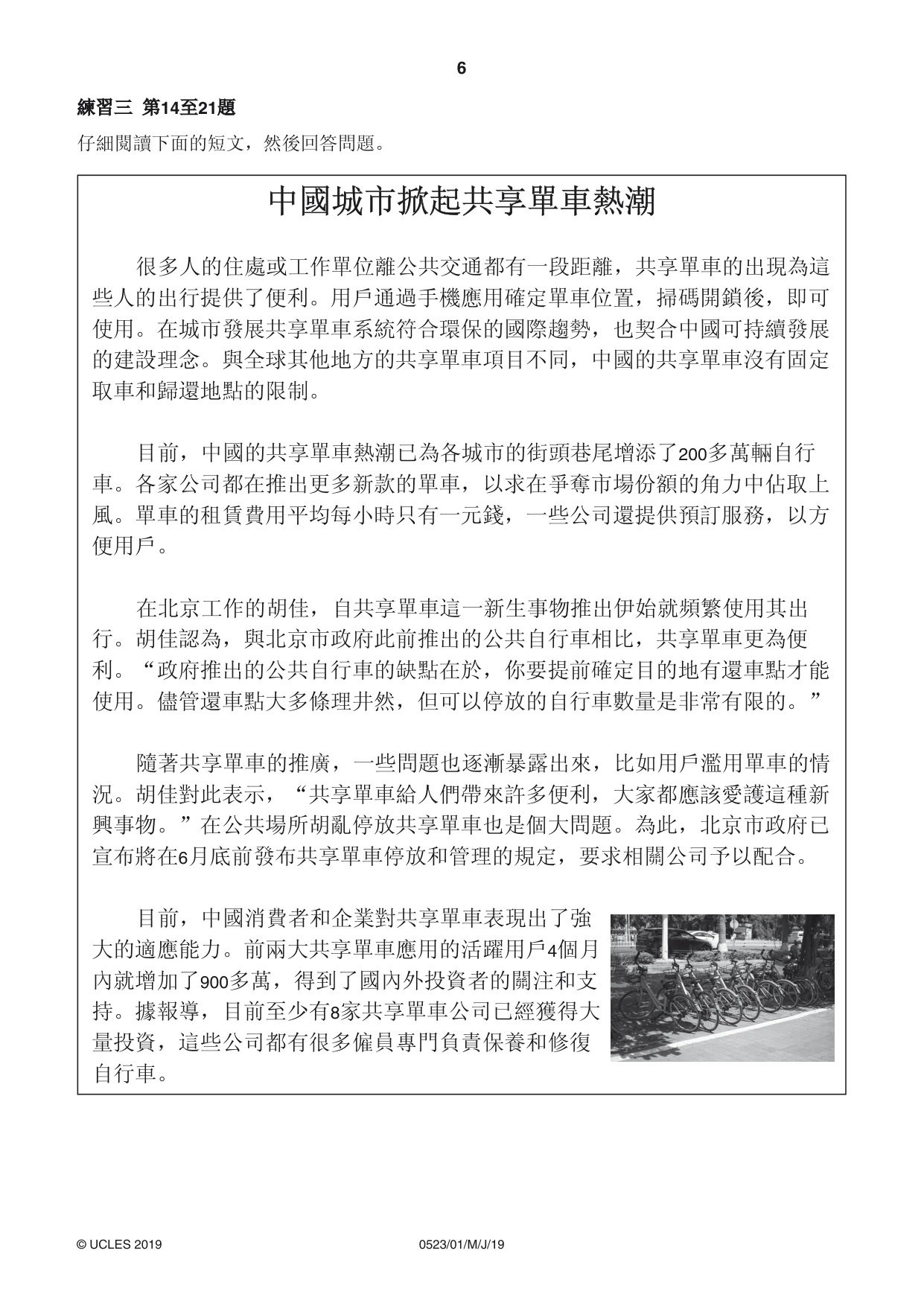
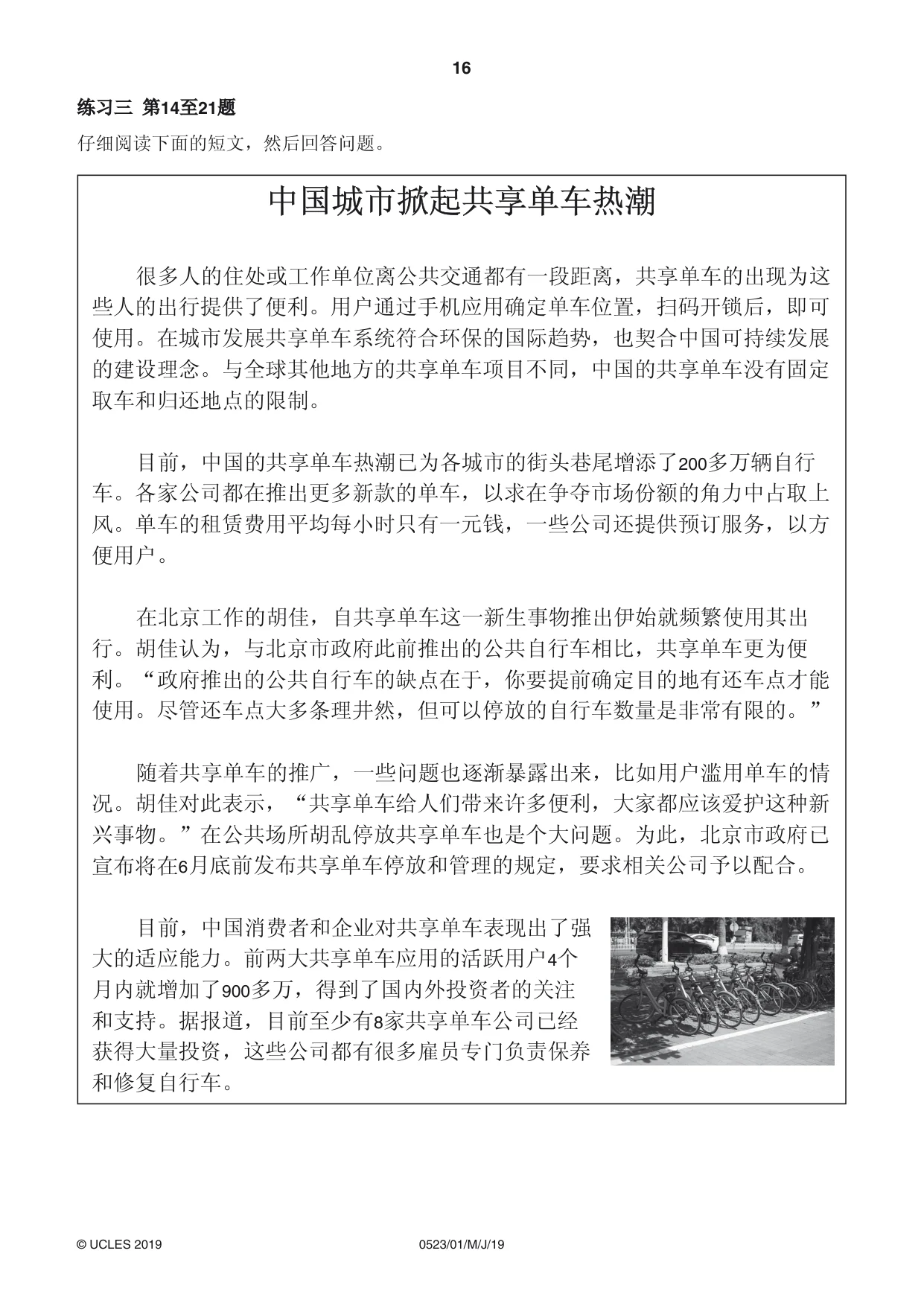
6 © UCLES 2019 0523/01/M/J/19 練習三 第14至21題 仔細閱讀下面的短文,然後回答問題。 中國城市掀起共享單車熱潮 很多人的住處或工作單位離公共交通都有一段距離,共享單車的出現為這 些人的出行提供了便利。用戶通過手機應用確定單車位置,掃碼開鎖後,即可 使用。在城市發展共享單車系統符合環保的國際趨勢,也契合中國可持續發展 的建設理念。與全球其他地方的共享單車項目不同,中國的共享單車沒有固定 取車和歸還地點的限制。 目前,中國的共享單車熱潮已為各城市的街頭巷尾增添了200多萬輛自行 車。各家公司都在推出更多新款的單車,以求在爭奪市場份額的角力中佔取上 風。單車的租賃費用平均每小時只有一元錢,一些公司還提供預訂服務,以方 便用戶。 在北京工作的胡佳,自共享單車這一新生事物推出伊始就頻繁使用其出 行。胡佳認為,與北京市政府此前推出的公共自行車相比,共享單車更為便 利。“政府推出的公共自行車的缺點在於,你要提前確定目的地有還車點才能 使用。儘管還車點大多條理井然,但可以停放的自行車數量是非常有限的。” 隨著共享單車的推廣,一些問題也逐漸暴露出來,比如用戶濫用單車的情 況。胡佳對此表示,“共享單車給人們帶來許多便利,大家都應該愛護這種新 興事物。”在公共場所胡亂停放共享單車也是個大問題。為此,北京市政府已 宣布將在6月底前發布共享單車停放和管理的規定,要求相關公司予以配合。 目前,中國消費者和企業對共享單車表現出了強 大的適應能力。前兩大共享單車應用的活躍用戶4個月 內就增加了900多萬,得到了國內外投資者的關注和支 持。據報導,目前至少有8家共享單車公司已經獲得大 量投資,這些公司都有很多僱員專門負責保養和修復 自行車。
Question paper, page 7
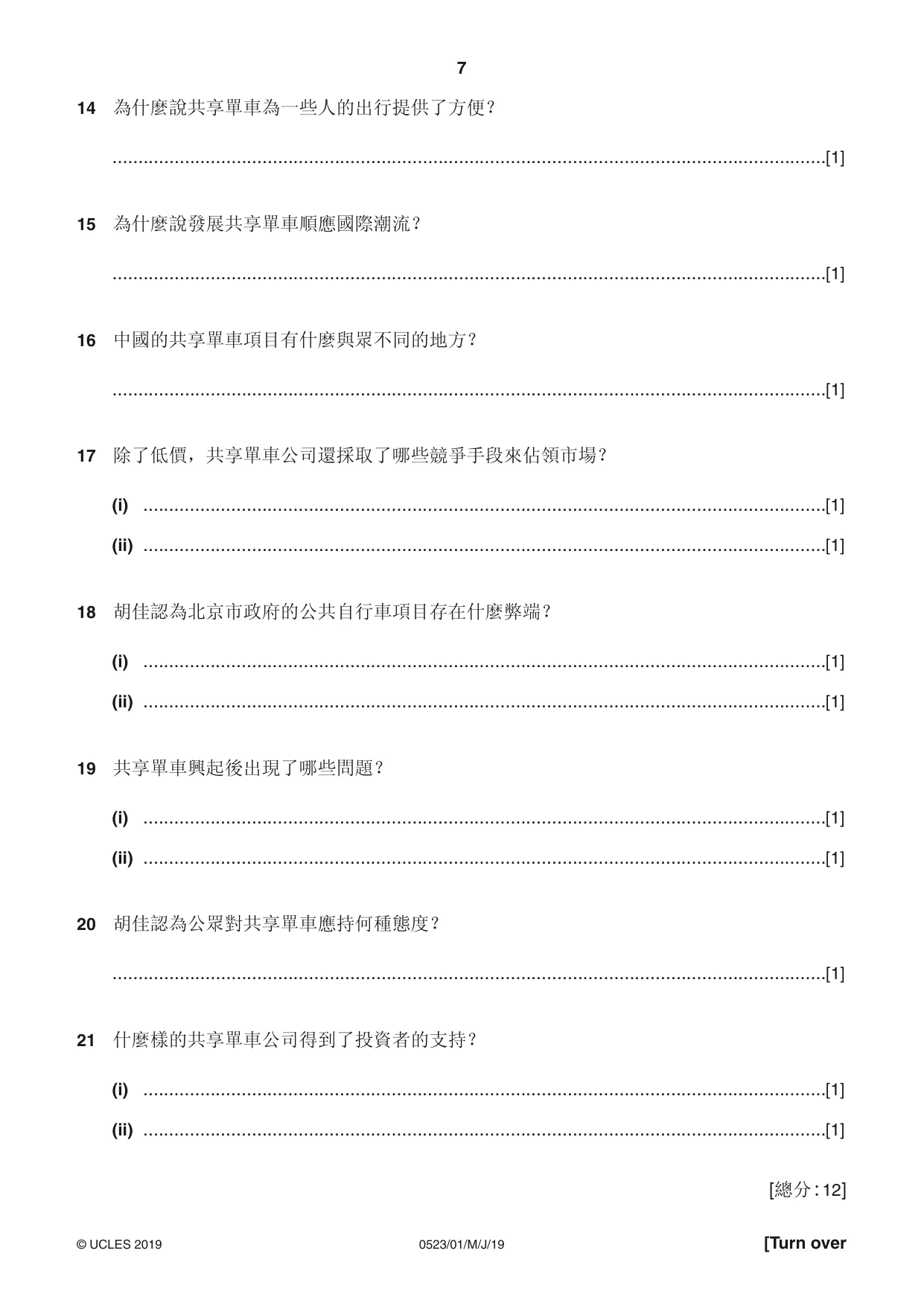
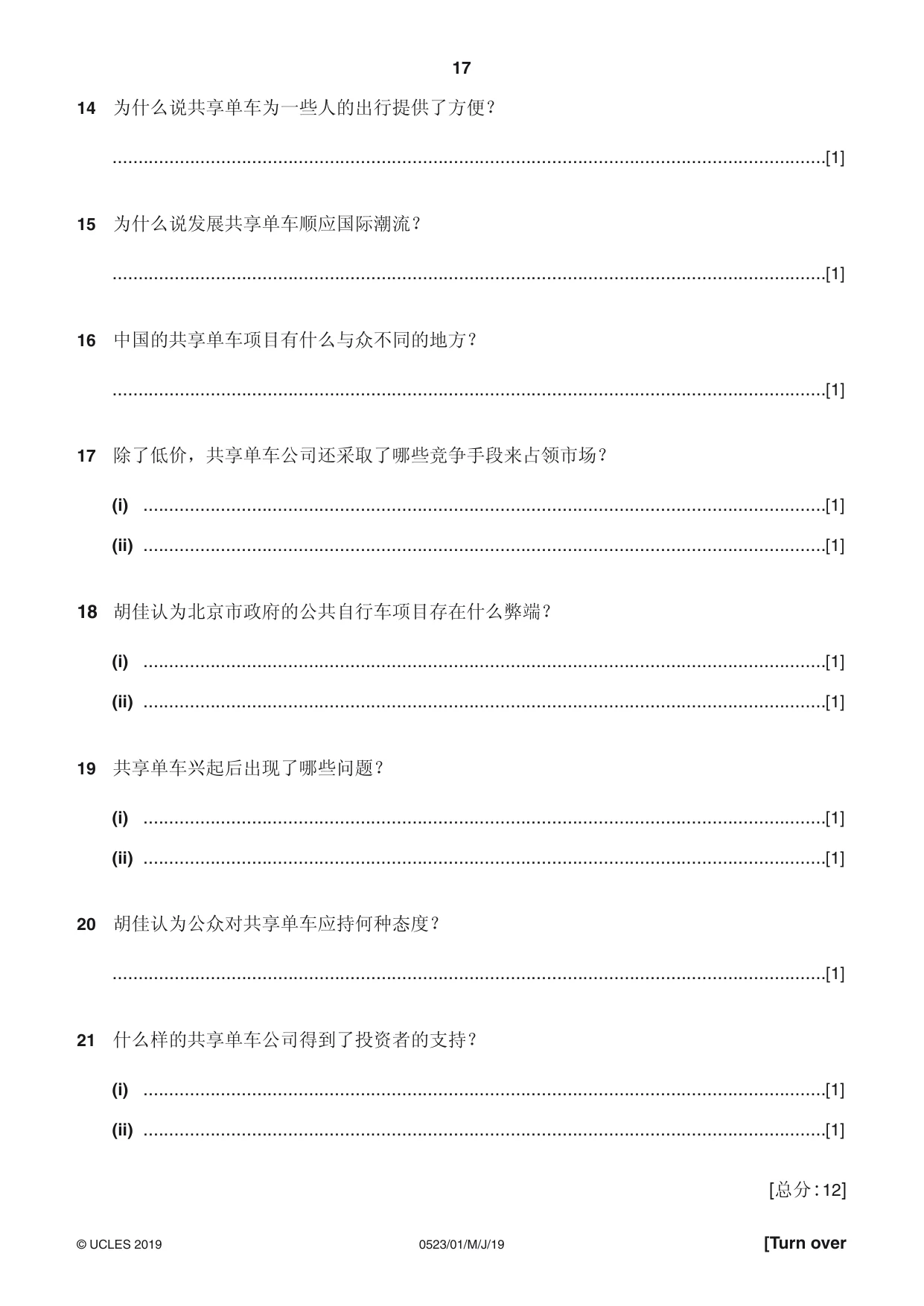
7 [Turn over 0523/01/M/J/19 © UCLES 2019 14 為什麼說共享單車為一些人的出行提供了方便? …[1] 15 為什麼說發展共享單車順應國際潮流? …[1] 16 中國的共享單車項目有什麼與眾不同的地方? …[1] 17 除了低價,共享單車公司還採取了哪些競爭手段來佔領市場? (i) …[1] (ii) …[1] 18 胡佳認為北京市政府的公共自行車項目存在什麼弊端? (i) …[1] (ii) …[1] 19 共享單車興起後出現了哪些問題? (i) …[1] (ii) …[1] 20 胡佳認為公眾對共享單車應持何種態度? …[1] 21 什麼樣的共享單車公司得到了投資者的支持? (i) …[1] (ii) …[1] [總分:12]
Question paper, page 8
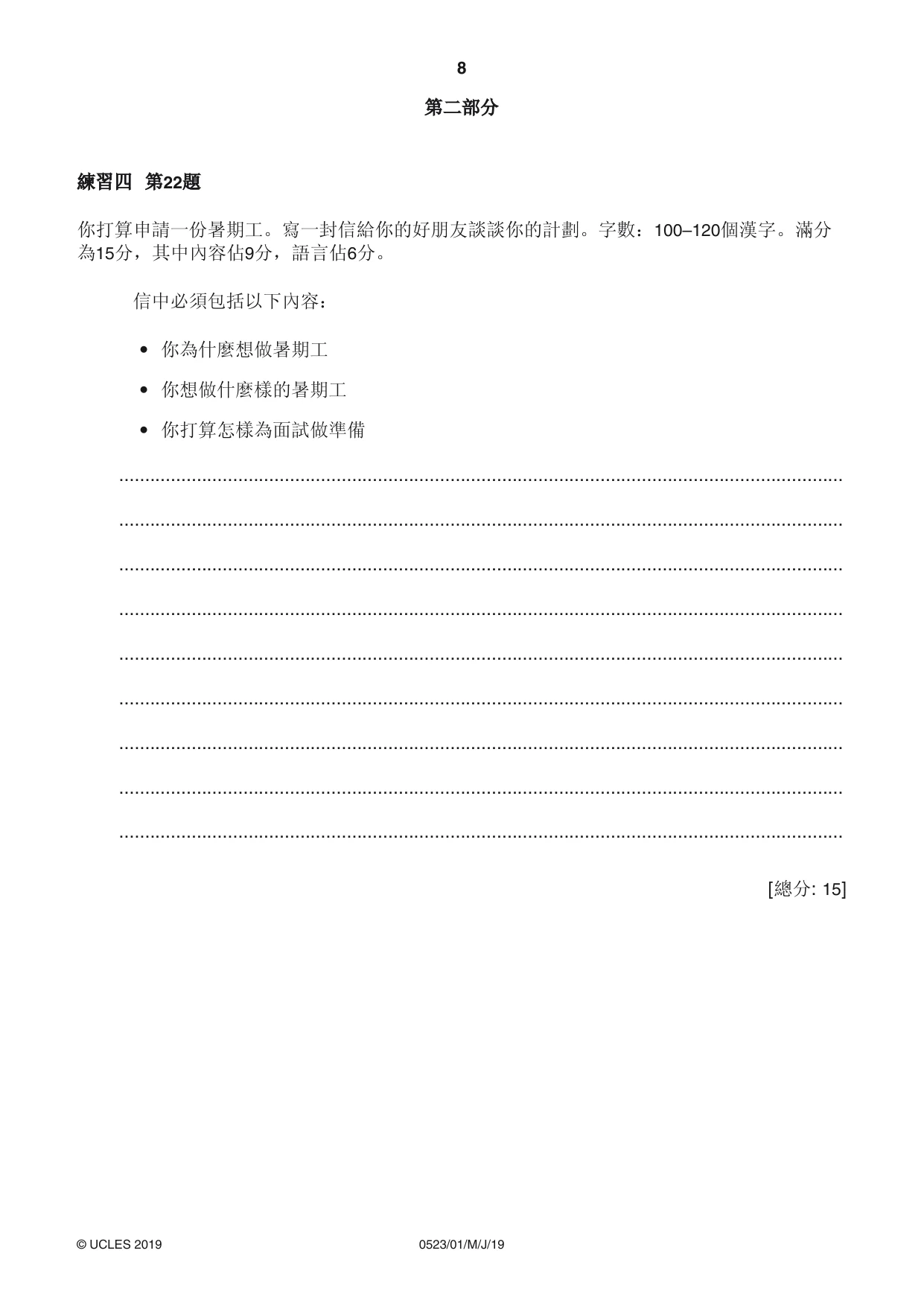
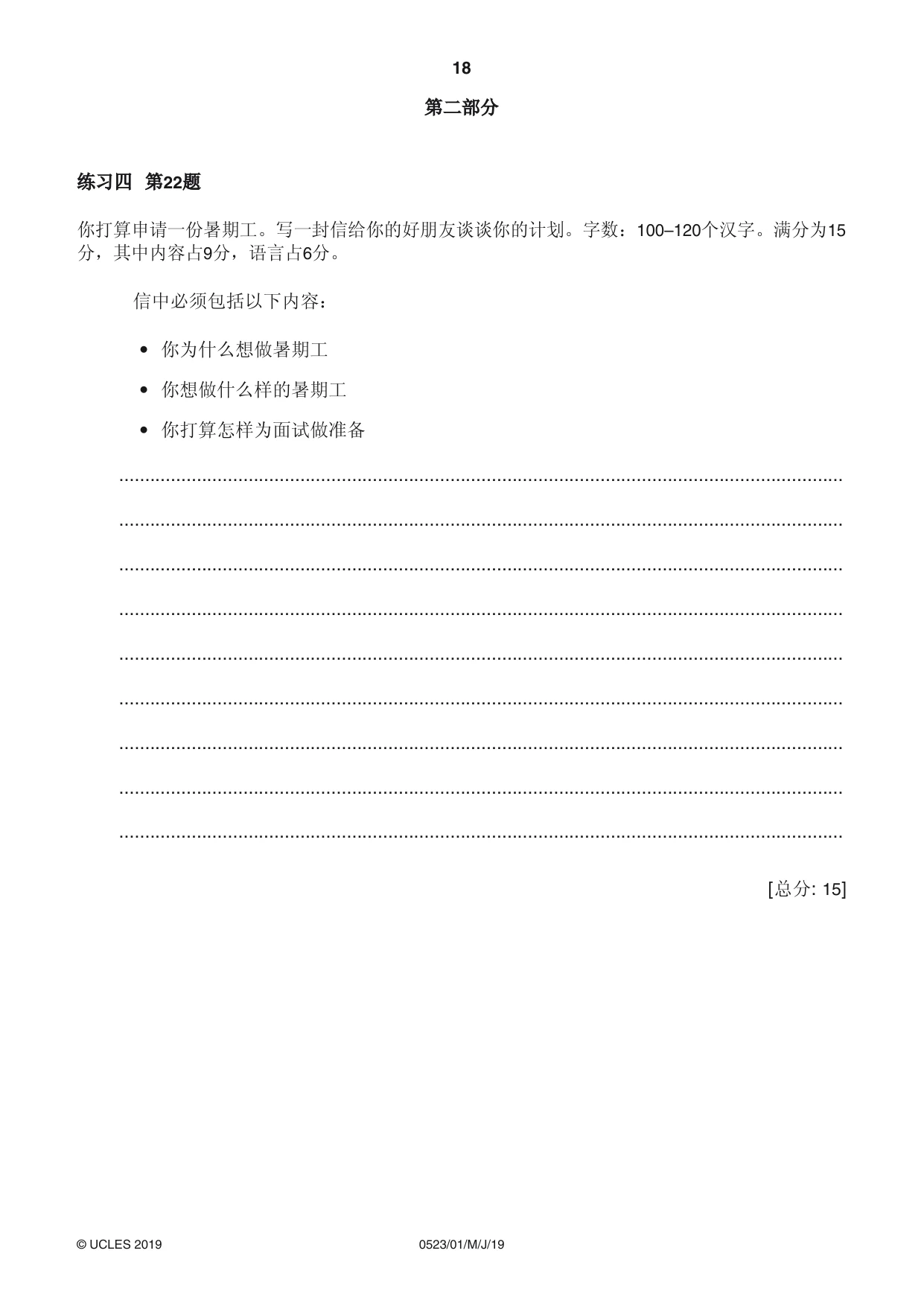
8 © UCLES 2019 0523/01/M/J/19 第二部分 練習四 第22題 你打算申請一份暑期工。寫一封信給你的好朋友談談你的計劃。字數:100–120個漢字。滿分 為15分,其中內容佔9分,語言佔6分。 信中必須包括以下內容: ˙ 你為什麼想做暑期工 ˙ 你想做什麼樣的暑期工 ˙ 你打算怎樣為面試做準備 … … … … … … … … … [總分: 15]
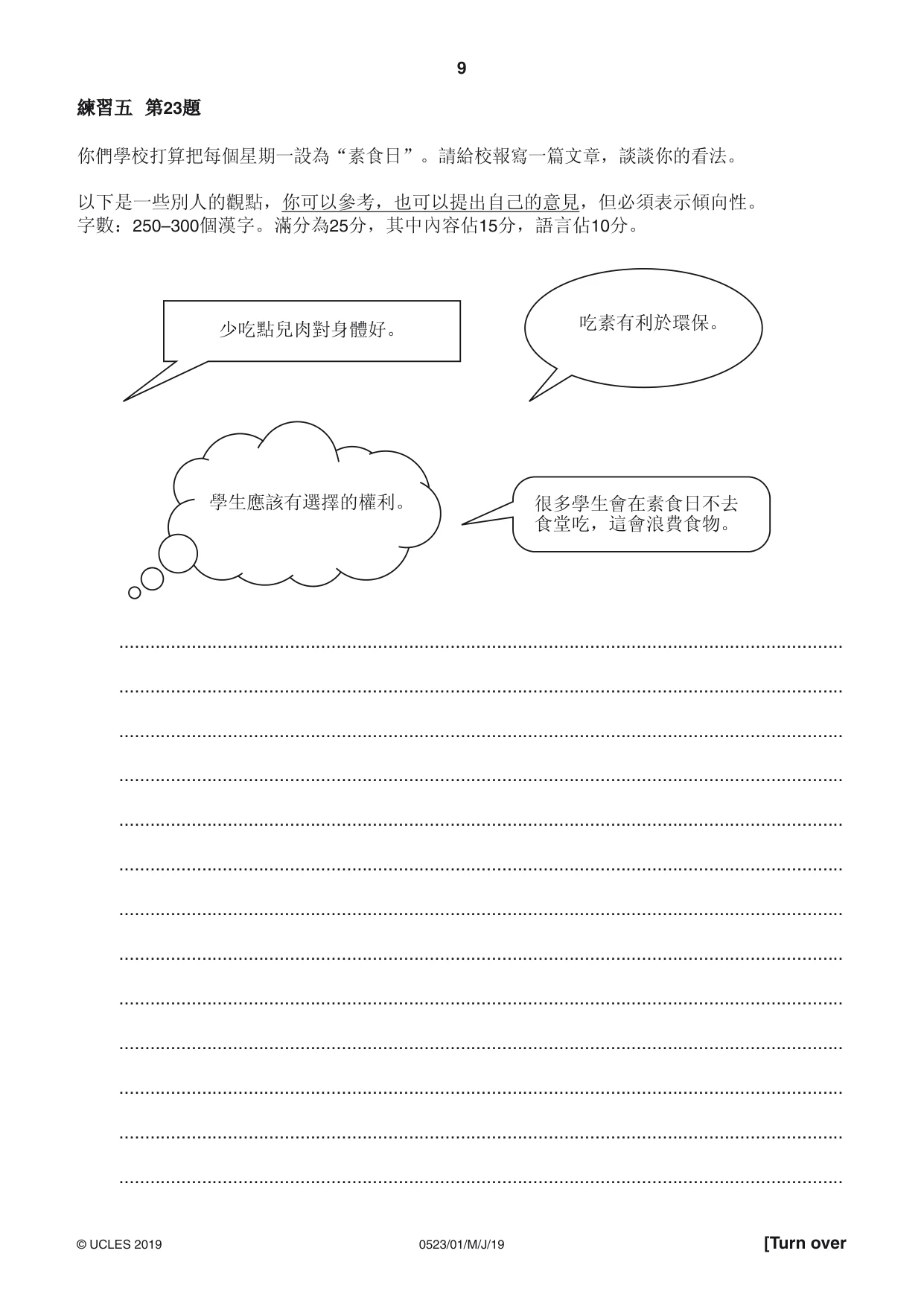
Question paper, page 9
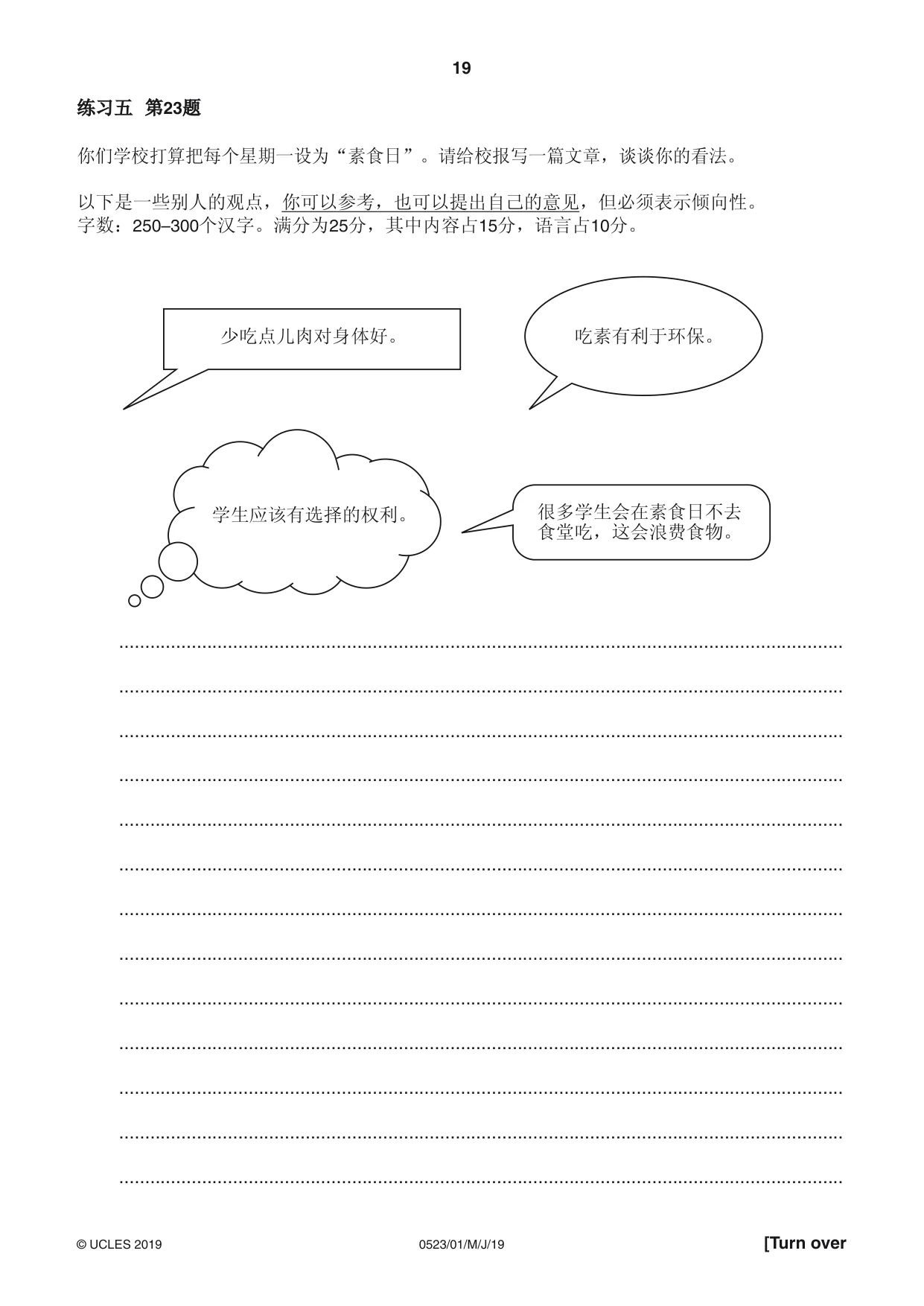
9 [Turn over 0523/01/M/J/19 © UCLES 2019 練習五 第23題 你們學校打算把每個星期一設為“素食日”。請給校報寫一篇文章,談談你的看法。 以下是一些別人的觀點,你可以參考,也可以提出自己的意見,但必須表示傾向性。 字數:250–300個漢字。滿分為25分,其中內容佔15分,語言佔10分。 … … … … … … … … … … … … … 少吃點兒肉對身體好。 吃素有利於環保。 學生應該有選擇的權利。 很多學生會在素食日不去 食堂吃,這會浪費食物。
Question paper, page 10
10 © UCLES 2019 0523/01/M/J/19 … … … … … … … … … … … … [總分: 25]
Question paper, page 11
11 [Turn over 0523/01/M/J/19 © UCLES 2019 [PLEASE TURN OVER TO FIND PASSAGES AND QUESTIONS IN SIMPLIFIED CHARACTERS]
Question paper, page 12
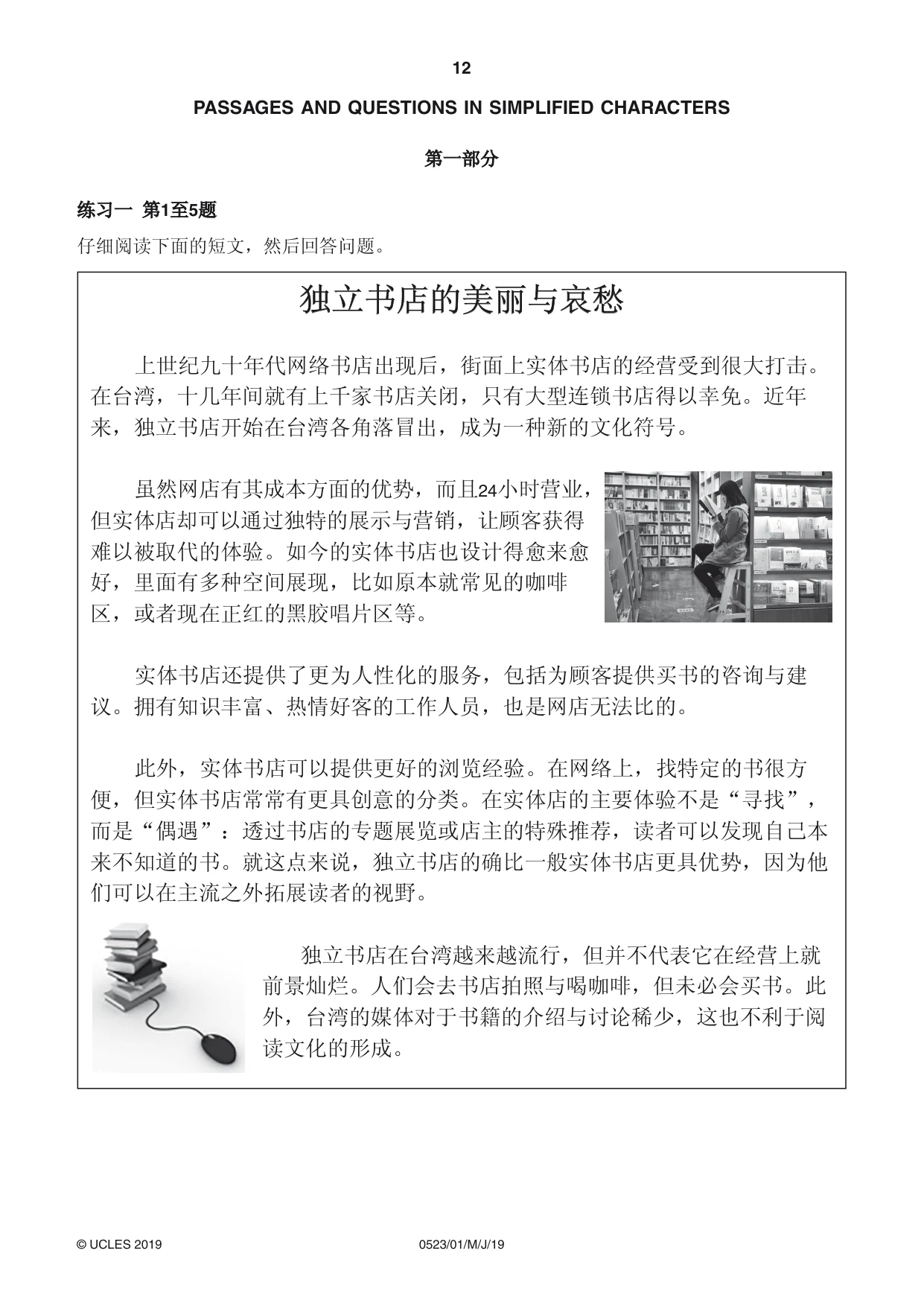
12 © UCLES 2019 0523/01/M/J/19 PASSAGES AND QUESTIONS IN SIMPLIFIED CHARACTERS 第一部分 练习一 第1至5题 仔细阅读下面的短文,然后回答问题。 独立书店的美丽与哀愁 上世纪九十年代网络书店出现后,街面上实体书店的经营受到很大打击。 在台湾,十几年间就有上千家书店关闭,只有大型连锁书店得以幸免。近年 来,独立书店开始在台湾各角落冒出,成为一种新的文化符号。 虽然网店有其成本方面的优势,而且24小时营业, 但实体店却可以通过独特的展示与营销,让顾客获得 难以被取代的体验。如今的实体书店也设计得愈来愈 好,里面有多种空间展现,比如原本就常见的咖啡 区,或者现在正红的黑胶唱片区等。 实体书店还提供了更为人性化的服务,包括为顾客提供买书的咨询与建 议。拥有知识丰富、热情好客的工作人员,也是网店无法比的。 此外,实体书店可以提供更好的浏览经验。在网络上,找特定的书很方 便,但实体书店常常有更具创意的分类。在实体店的主要体验不是“寻找”, 而是“偶遇”:透过书店的专题展览或店主的特殊推荐,读者可以发现自己本 来不知道的书。就这点来说,独立书店的确比一般实体书店更具优势,因为他 们可以在主流之外拓展读者的视野。 独立书店在台湾越来越流行,但并不代表它在经营上就 前景灿烂。人们会去书店拍照与喝咖啡,但未必会买书。此 外,台湾的媒体对于书籍的介绍与讨论稀少,这也不利于阅 读文化的形成。
Question paper, page 13
13 © UCLES 2019 [Turn over 0523/01/M/J/19 1 根据以上短文,选择四个正确的答案,在方格里打勾()。 A 网络书店的出现导致上千家连锁书店关门。 B 网络商店让顾客获得独一无二的体验。 C 现在的实体书店流行设置黑胶唱片区。 D 网络书店的工作人员非常热情好客。 E 独立书店的创意分类方便读者偶遇新书。 F 独立书店的店主推荐能帮读者拓宽视野。 G 台湾的独立书店并未受到读者们的欢迎。 H 买书并不是人们去独立书店的唯一目的。 [4] 根据以上短文,选择唯一正确的答案,在方格里打勾()。 2 网络商店的长处是 营销独特 与时俱进 成本较低 [1] 3 实体书店的人性化服务包括 组织签售活动 提供选购咨询 延长营业时间 [1] 4 台湾的独立书店 前景大好 面临挑战 顾客稀少 [1] 5 台湾的媒体 少有读书节目 不鼓励阅读 支持独立书店 [1] [总分: 8] A B C A B C A B C A B C
Question paper, page 14
14 © UCLES 2019 0523/01/M/J/19 练习二 第6至13题 仔细阅读下面的短文,然后回答问题。 假设你是崔清扬。请根据以上短文填写游学团意见反馈表。 崔清扬是四海高中的学生。今年寒假,他和其他30名学生参加了为期15天 的中国高中游学团赴加拿大研学旅行。 崔清扬的父母都是工程师,他们觉得孩子应该“读万卷书,行万里路”, 出国游学是一个开阔眼界的好机会。不过,崔清扬认为除了提高语言水平,能 和好友结伴同行才是游学最吸引人的地方。 在加拿大,同学们每天上午有语言课,老师安排的很多环节都要求学生 合作完成。每天下午还有崔清扬最喜欢的实践项目,比如采访娱乐中心的工作 人员,到小镇上做问卷调查等,这些活动都“逼”着学生用英文与不同的人交 流。这样的学习方式很适合崔清扬。短短两个星期,他的口语和听力水平就已 突飞猛进。 除了集中学语言外,同学们在一起的时间并不多,他们下课后都会回到自 己的寄宿家庭,体验当地居民的生活。崔清扬寄宿在一对退休夫妇的家里。他 们十分和善。崔清扬觉得唯一不满意的是,他住的地方距离上课地点较远,每 天来回在路上就要花一个多小时。 周末的时候,同学们会一起游览当地的著名景点。崔清扬是一个天文爱好 者,这次有机会到莫干迪克峰天文台观星是他意想不到的收获。他表示,游学 团如果能根据团员的兴趣安排一些自选活动可能会更好。他还说,高中的学生 大多已经开始考虑未来大学的专业选择,如果以后游学团能增加一段参观高校 的行程,应该会更受欢迎。
Question paper, page 15
15 [Turn over 0523/01/M/J/19 © UCLES 2019 [总分:10] 游学团意见反馈表 姓名: _______________________________________________ 性别: _______________________________________________ 6 就读学校: _______________________________________________ 7 活动营别: 夏令营 冬令营 8 行程天数: _______________________________________________ 9 你为什么参加游学团? (i) ____________________________________ (ii) ____________________________________ 10 最喜欢的课程环节: ______________________________________ 11 不理想的地方: ______________________________________ 12 意外的收获: ______________________________________ ______________________________________ 13 建议增加的活动: (i) ____________________________________ (ii) ____________________________________ 崔清扬 男 [1] [1] [1] [1] [1] [1] [1] [1] [1] [1]
Question paper, page 16
16 © UCLES 2019 0523/01/M/J/19 练习三 第14至21题 仔细阅读下面的短文,然后回答问题。 中国城市掀起共享单车热潮 很多人的住处或工作单位离公共交通都有一段距离,共享单车的出现为这 些人的出行提供了便利。用户通过手机应用确定单车位置,扫码开锁后,即可 使用。在城市发展共享单车系统符合环保的国际趋势,也契合中国可持续发展 的建设理念。与全球其他地方的共享单车项目不同,中国的共享单车没有固定 取车和归还地点的限制。 目前,中国的共享单车热潮已为各城市的街头巷尾增添了200多万辆自行 车。各家公司都在推出更多新款的单车,以求在争夺市场份额的角力中占取上 风。单车的租赁费用平均每小时只有一元钱,一些公司还提供预订服务,以方 便用户。 在北京工作的胡佳,自共享单车这一新生事物推出伊始就频繁使用其出 行。胡佳认为,与北京市政府此前推出的公共自行车相比,共享单车更为便 利。“政府推出的公共自行车的缺点在于,你要提前确定目的地有还车点才能 使用。尽管还车点大多条理井然,但可以停放的自行车数量是非常有限的。” 随着共享单车的推广,一些问题也逐渐暴露出来,比如用户滥用单车的情 况。胡佳对此表示,“共享单车给人们带来许多便利,大家都应该爱护这种新 兴事物。”在公共场所胡乱停放共享单车也是个大问题。为此,北京市政府已 宣布将在6月底前发布共享单车停放和管理的规定,要求相关公司予以配合。 目前,中国消费者和企业对共享单车表现出了强 大的适应能力。前两大共享单车应用的活跃用户4个 月内就增加了900多万,得到了国内外投资者的关注 和支持。据报道,目前至少有8家共享单车公司已经 获得大量投资,这些公司都有很多雇员专门负责保养 和修复自行车。
Question paper, page 17
17 [Turn over 0523/01/M/J/19 © UCLES 2019 14 为什么说共享单车为一些人的出行提供了方便? …[1] 15 为什么说发展共享单车顺应国际潮流? …[1] 16 中国的共享单车项目有什么与众不同的地方? …[1] 17 除了低价,共享单车公司还采取了哪些竞争手段来占领市场? (i) …[1] (ii) …[1] 18 胡佳认为北京市政府的公共自行车项目存在什么弊端? (i) …[1] (ii) …[1] 19 共享单车兴起后出现了哪些问题? (i) …[1] (ii) …[1] 20 胡佳认为公众对共享单车应持何种态度? …[1] 21 什么样的共享单车公司得到了投资者的支持? (i) …[1] (ii) …[1] [总分:12]
Question paper, page 18
18 © UCLES 2019 0523/01/M/J/19 第二部分 练习四 第22题 你打算申请一份暑期工。写一封信给你的好朋友谈谈你的计划。字数:100–120个汉字。满分为15 分,其中内容占9分,语言占6分。 信中必须包括以下内容: ˙ 你为什么想做暑期工 ˙ 你想做什么样的暑期工 ˙ 你打算怎样为面试做准备 … … … … … … … … … [总分: 15]
Question paper, page 19
19 0523/01/M/J/19 © UCLES 2019 [Turn over 练习五 第23题 你们学校打算把每个星期一设为“素食日”。请给校报写一篇文章,谈谈你的看法。 以下是一些别人的观点,你可以参考,也可以提出自己的意见,但必须表示倾向性。 字数:250–300个汉字。满分为25分,其中内容占15分,语言占10分。 … … … … … … … … … … … … … 少吃点儿肉对身体好。 吃素有利于环保。 学生应该有选择的权利。 很多学生会在素食日不去 食堂吃,这会浪费食物。
Question paper, page 20
20 © UCLES 2019 0523/01/M/J/19 … … … … … … … … … … … … [总分: 25] Permission to reproduce items where third-party owned material protected by copyright is included has been sought and cleared where possible. Every reasonable effort has been made by the publisher (UCLES) to trace copyright holders, but if any items requiring clearance have unwittingly been included, the publisher will be pleased to make amends at the earliest possible opportunity. To avoid the issue of disclosure of answer-related information to candidates, all copyright acknowledgements are reproduced online in the Cambridge Assessment International Education Copyright Acknowledgements Booklet. This is produced for each series of examinations and is freely available to download at www.cambridgeinternational.org after the live examination series. Cambridge Assessment International Education is part of the Cambridge Assessment Group. Cambridge Assessment is the brand name of the University of Cambridge Local Examinations Syndicate (UCLES), which itself is a department of the University of Cambridge.
Mark scheme, page 1
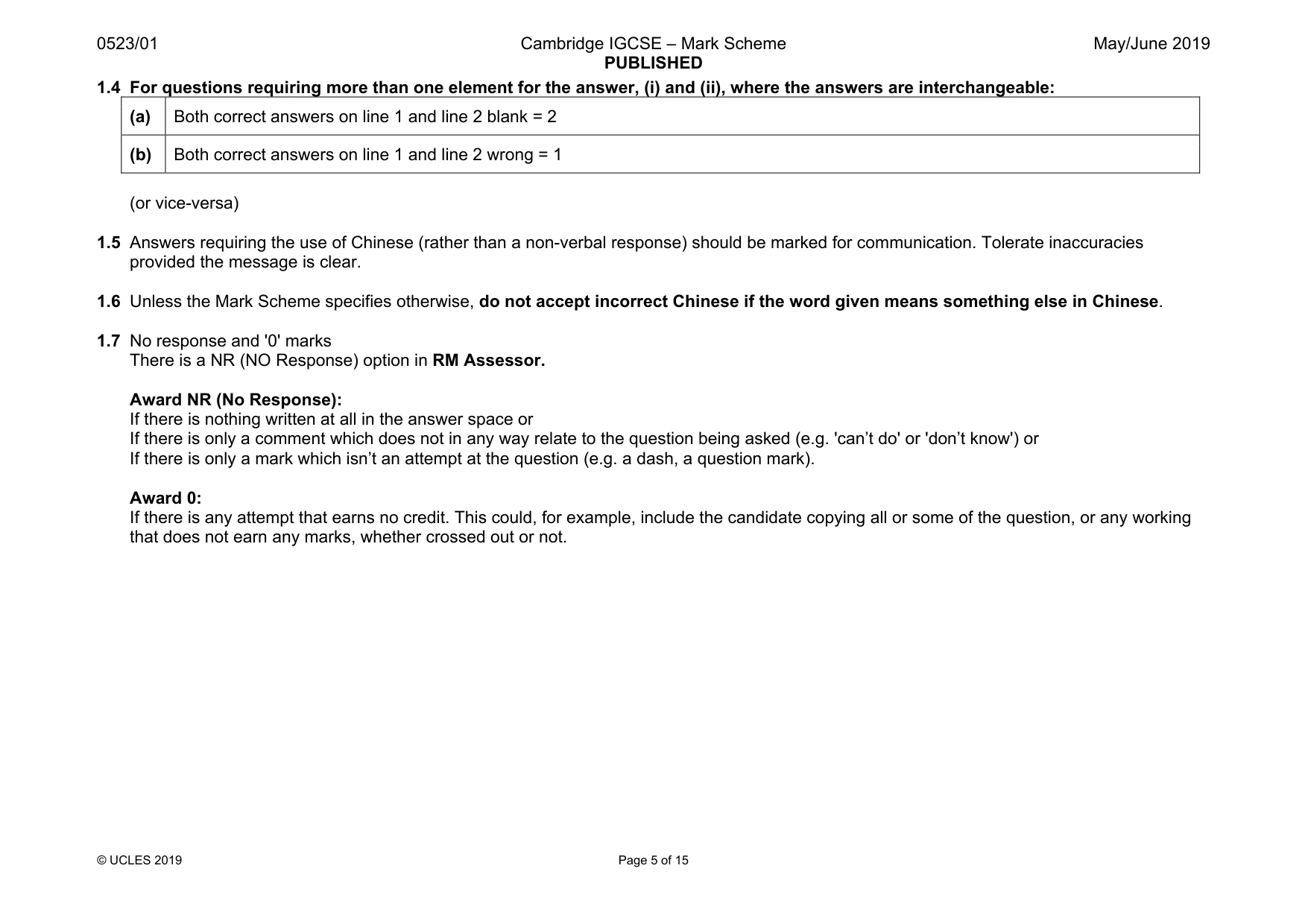
This document consists of 15 printed pages. © UCLES 2019 [Turn over Cambridge Assessment International Education Cambridge International General Certificate of Secondary Education CHINESE AS A SECOND LANGUAGE 0523/01 Paper 1 Reading and Writing May/June 2019 MARK SCHEME Maximum Mark: 70 Published This mark scheme is published as an aid to teachers and candidates, to indicate the requirements of the examination. It shows the basis on which Examiners were instructed to award marks. It does not indicate the details of the discussions that took place at an Examiners’ meeting before marking began, which would have considered the acceptability of alternative answers. Mark schemes should be read in conjunction with the question paper and the Principal Examiner Report for Teachers. Cambridge International will not enter into discussions about these mark schemes. Cambridge International is publishing the mark schemes for the May/June 2019 series for most Cambridge IGCSE™, Cambridge International A and AS Level and Cambridge Pre-U components, and some Cambridge O Level components.
Mark scheme, page 2
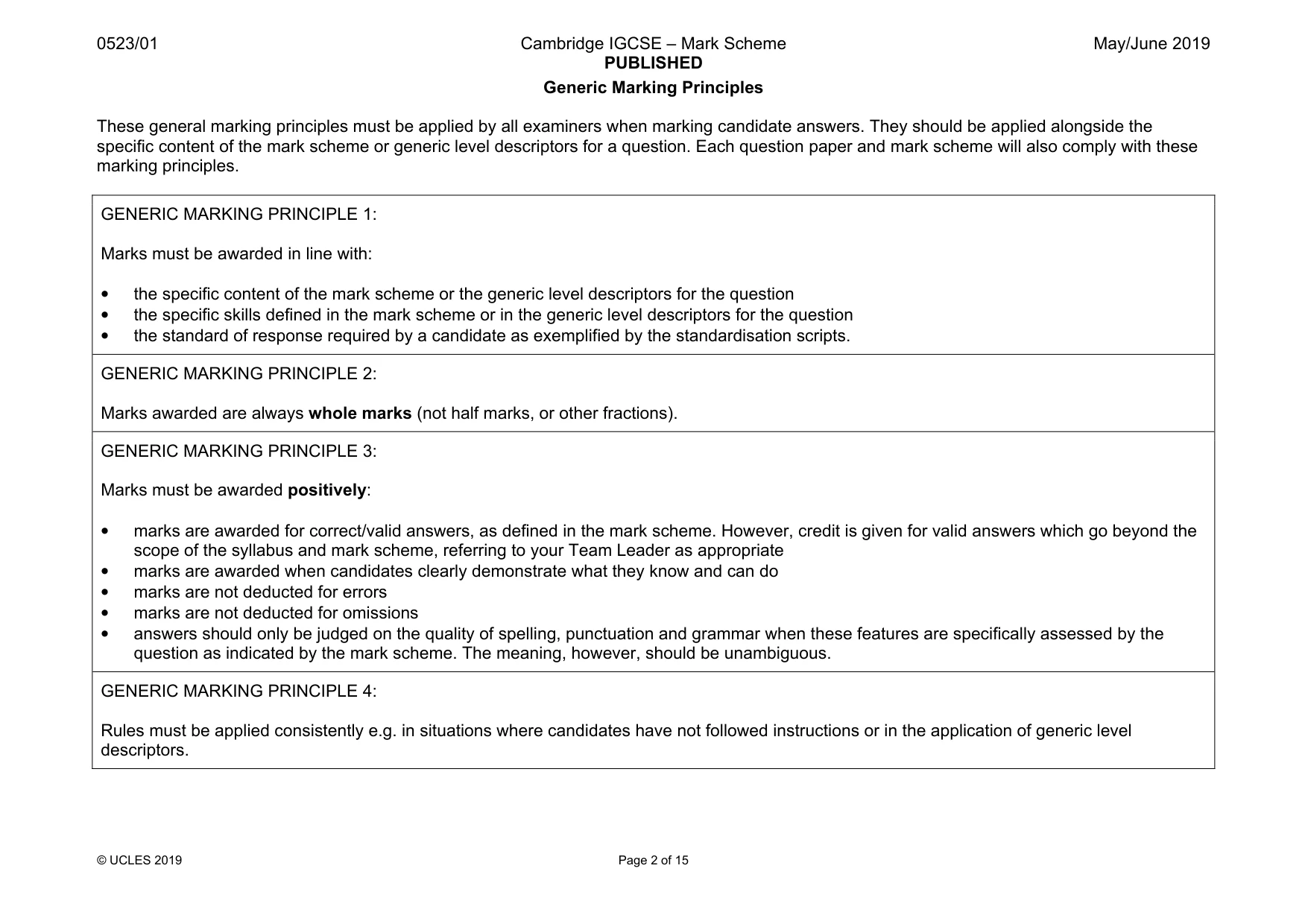
0523/01 Cambridge IGCSE – Mark Scheme PUBLISHED May/June 2019 © UCLES 2019 Page 2 of 15 Generic Marking Principles These general marking principles must be applied by all examiners when marking candidate answers. They should be applied alongside the specific content of the mark scheme or generic level descriptors for a question. Each question paper and mark scheme will also comply with these marking principles. GENERIC MARKING PRINCIPLE 1: Marks must be awarded in line with: • the specific content of the mark scheme or the generic level descriptors for the question • the specific skills defined in the mark scheme or in the generic level descriptors for the question • the standard of response required by a candidate as exemplified by the standardisation scripts. GENERIC MARKING PRINCIPLE 2: Marks awarded are always whole marks (not half marks, or other fractions). GENERIC MARKING PRINCIPLE 3: Marks must be awarded positively: • marks are awarded for correct/valid answers, as defined in the mark scheme. However, credit is given for valid answers which go beyond the scope of the syllabus and mark scheme, referring to your Team Leader as appropriate • marks are awarded when candidates clearly demonstrate what they know and can do • marks are not deducted for errors • marks are not deducted for omissions • answers should only be judged on the quality of spelling, punctuation and grammar when these features are specifically assessed by the question as indicated by the mark scheme. The meaning, however, should be unambiguous. GENERIC MARKING PRINCIPLE 4: Rules must be applied consistently e.g. in situations where candidates have not followed instructions or in the application of generic level descriptors.
Mark scheme, page 3
0523/01 Cambridge IGCSE – Mark Scheme PUBLISHED May/June 2019 © UCLES 2019 Page 3 of 15 GENERIC MARKING PRINCIPLE 5: Marks should be awarded using the full range of marks defined in the mark scheme for the question (however; the use of the full mark range may be limited according to the quality of the candidate responses seen). GENERIC MARKING PRINCIPLE 6: Marks awarded are based solely on the requirements as defined in the mark scheme. Marks should not be awarded with grade thresholds or grade descriptors in mind.
Mark scheme, page 4
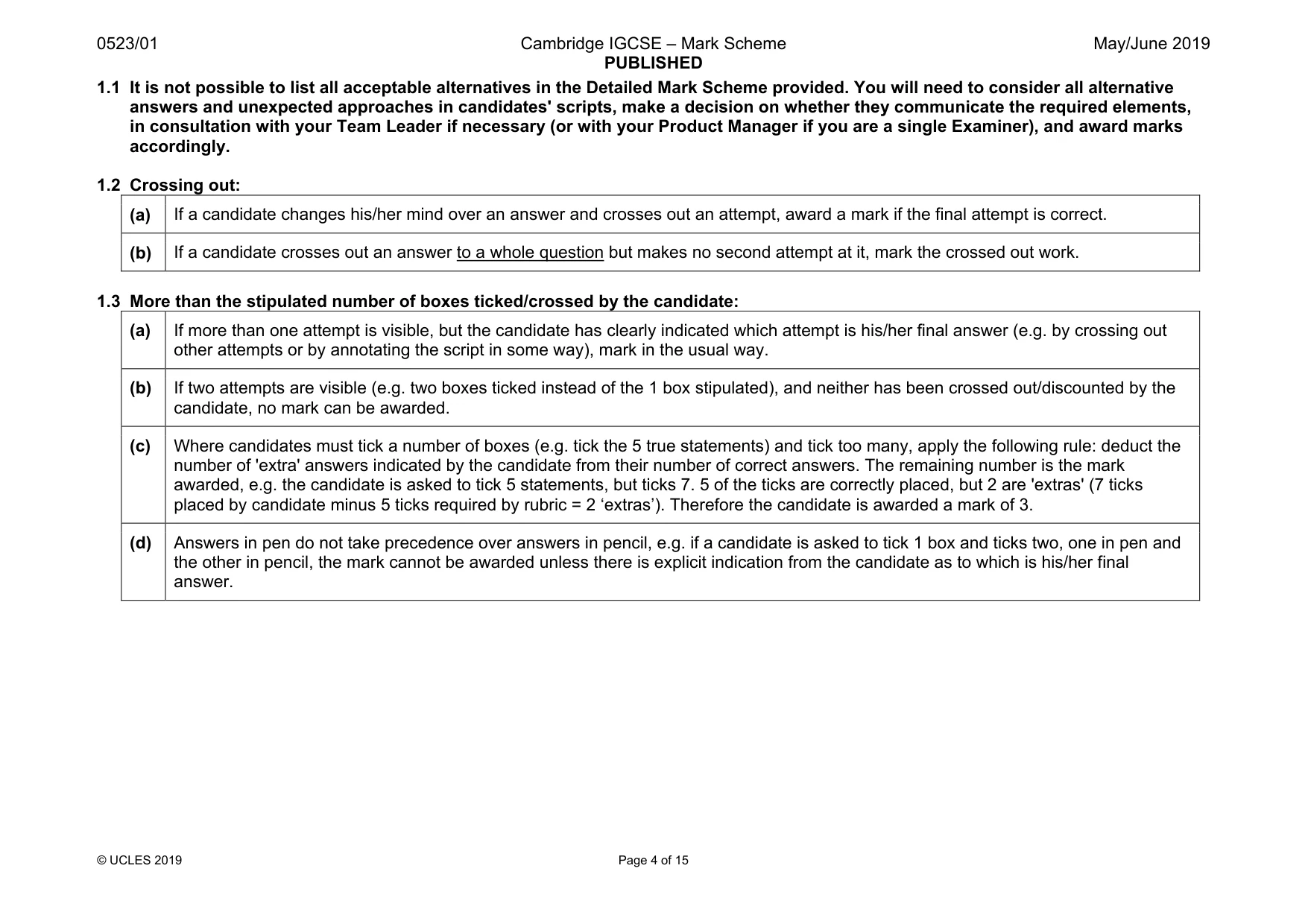
0523/01 Cambridge IGCSE – Mark Scheme PUBLISHED May/June 2019 © UCLES 2019 Page 4 of 15 1.1 It is not possible to list all acceptable alternatives in the Detailed Mark Scheme provided. You will need to consider all alternative answers and unexpected approaches in candidates' scripts, make a decision on whether they communicate the required elements, in consultation with your Team Leader if necessary (or with your Product Manager if you are a single Examiner), and award marks accordingly. 1.2 Crossing out: (a) If a candidate changes his/her mind over an answer and crosses out an attempt, award a mark if the final attempt is correct. (b) If a candidate crosses out an answer to a whole question but makes no second attempt at it, mark the crossed out work. 1.3 More than the stipulated number of boxes ticked/crossed by the candidate: (a) If more than one attempt is visible, but the candidate has clearly indicated which attempt is his/her final answer (e.g. by crossing out other attempts or by annotating the script in some way), mark in the usual way. (b) If two attempts are visible (e.g. two boxes ticked instead of the 1 box stipulated), and neither has been crossed out/discounted by the candidate, no mark can be awarded. (c) Where candidates must tick a number of boxes (e.g. tick the 5 true statements) and tick too many, apply the following rule: deduct the number of 'extra' answers indicated by the candidate from their number of correct answers. The remaining number is the mark awarded, e.g. the candidate is asked to tick 5 statements, but ticks 7. 5 of the ticks are correctly placed, but 2 are 'extras' (7 ticks placed by candidate minus 5 ticks required by rubric = 2 ‘extras’). Therefore the candidate is awarded a mark of 3. (d) Answers in pen do not take precedence over answers in pencil, e.g. if a candidate is asked to tick 1 box and ticks two, one in pen and the other in pencil, the mark cannot be awarded unless there is explicit indication from the candidate as to which is his/her final answer.
Mark scheme, page 5
0523/01 Cambridge IGCSE – Mark Scheme PUBLISHED May/June 2019 © UCLES 2019 Page 5 of 15 1.4 For questions requiring more than one element for the answer, (i) and (ii), where the answers are interchangeable: (a) Both correct answers on line 1 and line 2 blank = 2 (b) Both correct answers on line 1 and line 2 wrong = 1 (or vice-versa) 1.5 Answers requiring the use of Chinese (rather than a non-verbal response) should be marked for communication. Tolerate inaccuracies provided the message is clear. 1.6 Unless the Mark Scheme specifies otherwise, do not accept incorrect Chinese if the word given means something else in Chinese. 1.7 No response and '0' marks There is a NR (NO Response) option in RM Assessor. Award NR (No Response): If there is nothing written at all in the answer space or If there is only a comment which does not in any way relate to the question being asked (e.g. 'can’t do' or 'don’t know') or If there is only a mark which isn’t an attempt at the question (e.g. a dash, a question mark). Award 0: If there is any attempt that earns no credit. This could, for example, include the candidate copying all or some of the question, or any working that does not earn any marks, whether crossed out or not.
Mark scheme, page 6
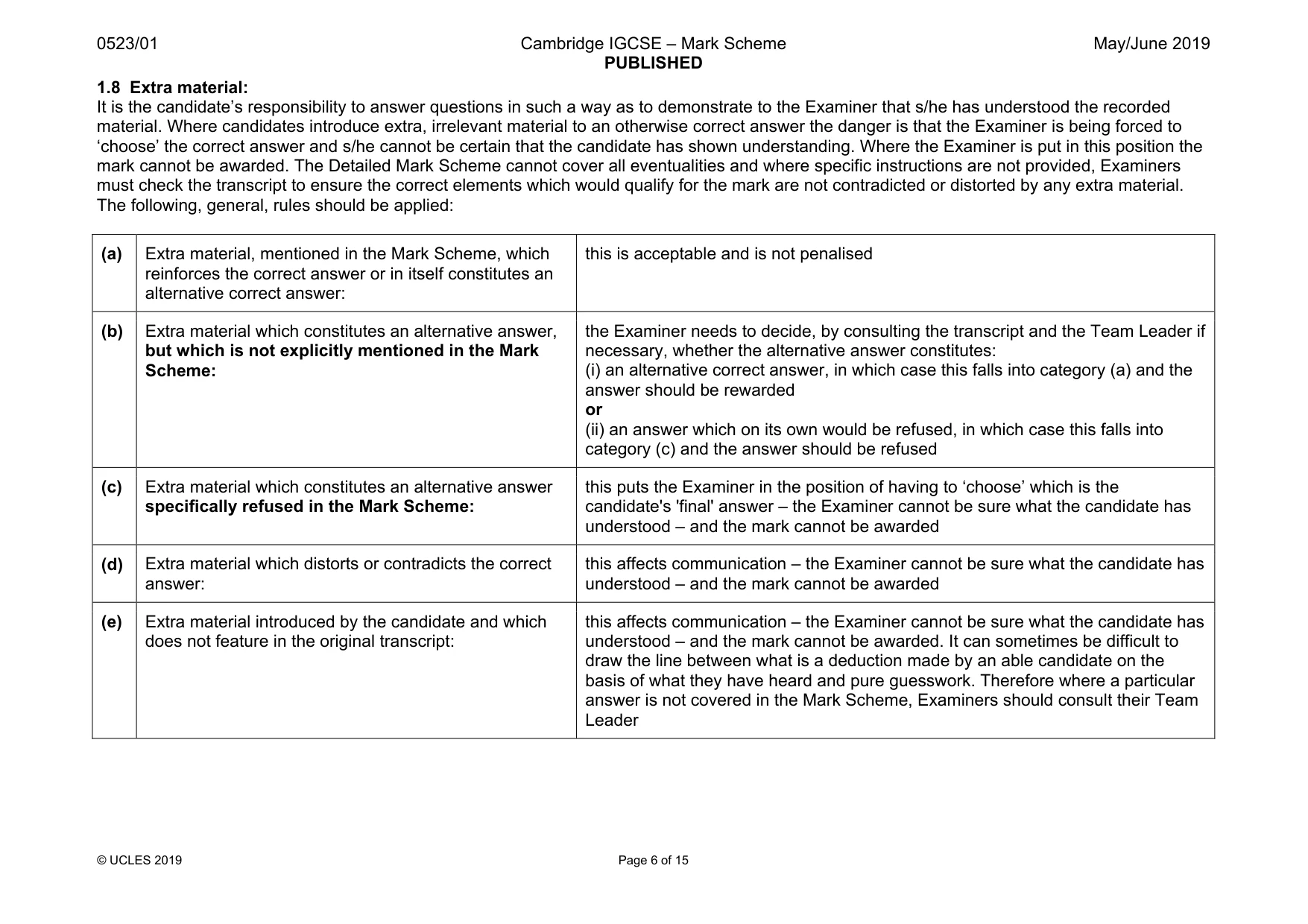
0523/01 Cambridge IGCSE – Mark Scheme PUBLISHED May/June 2019 © UCLES 2019 Page 6 of 15 1.8 Extra material: It is the candidate’s responsibility to answer questions in such a way as to demonstrate to the Examiner that s/he has understood the recorded material. Where candidates introduce extra, irrelevant material to an otherwise correct answer the danger is that the Examiner is being forced to ‘choose’ the correct answer and s/he cannot be certain that the candidate has shown understanding. Where the Examiner is put in this position the mark cannot be awarded. The Detailed Mark Scheme cannot cover all eventualities and where specific instructions are not provided, Examiners must check the transcript to ensure the correct elements which would qualify for the mark are not contradicted or distorted by any extra material. The following, general, rules should be applied: (a) Extra material, mentioned in the Mark Scheme, which reinforces the correct answer or in itself constitutes an alternative correct answer: this is acceptable and is not penalised (b) Extra material which constitutes an alternative answer, but which is not explicitly mentioned in the Mark Scheme: the Examiner needs to decide, by consulting the transcript and the Team Leader if necessary, whether the alternative answer constitutes: (i) an alternative correct answer, in which case this falls into category (a) and the answer should be rewarded or (ii) an answer which on its own would be refused, in which case this falls into category (c) and the answer should be refused (c) Extra material which constitutes an alternative answer specifically refused in the Mark Scheme: this puts the Examiner in the position of having to ‘choose’ which is the candidate's 'final' answer – the Examiner cannot be sure what the candidate has understood – and the mark cannot be awarded (d) Extra material which distorts or contradicts the correct answer: this affects communication – the Examiner cannot be sure what the candidate has understood – and the mark cannot be awarded (e) Extra material introduced by the candidate and which does not feature in the original transcript: this affects communication – the Examiner cannot be sure what the candidate has understood – and the mark cannot be awarded. It can sometimes be difficult to draw the line between what is a deduction made by an able candidate on the basis of what they have heard and pure guesswork. Therefore where a particular answer is not covered in the Mark Scheme, Examiners should consult their Team Leader
Mark scheme, page 7
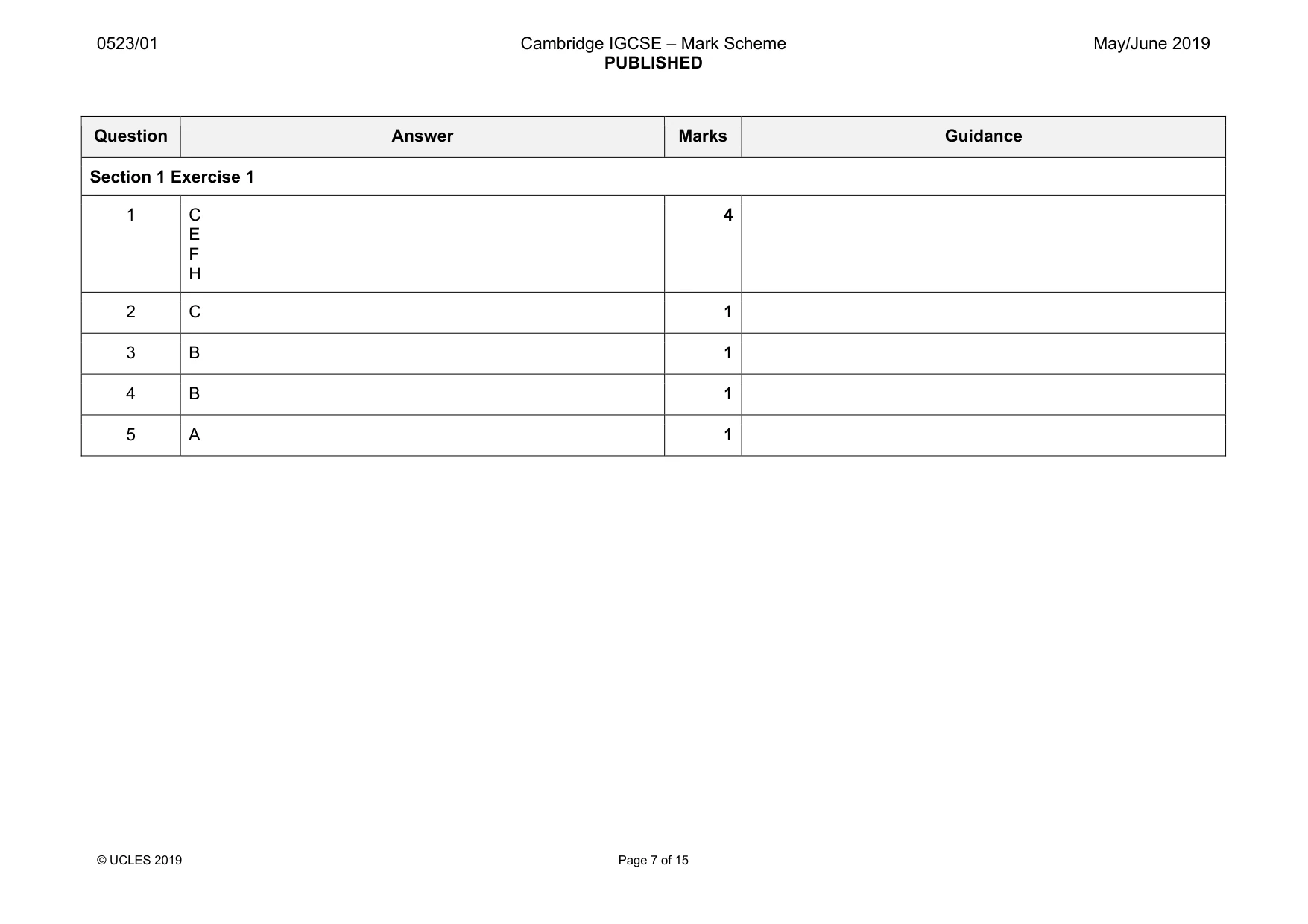
0523/01 Cambridge IGCSE – Mark Scheme PUBLISHED May/June 2019 © UCLES 2019 Page 7 of 15 Question Answer Marks Guidance Section 1 Exercise 1 1 C E F H 4 2 C 1 3 B 1 4 B 1 5 A 1
Mark scheme, page 8
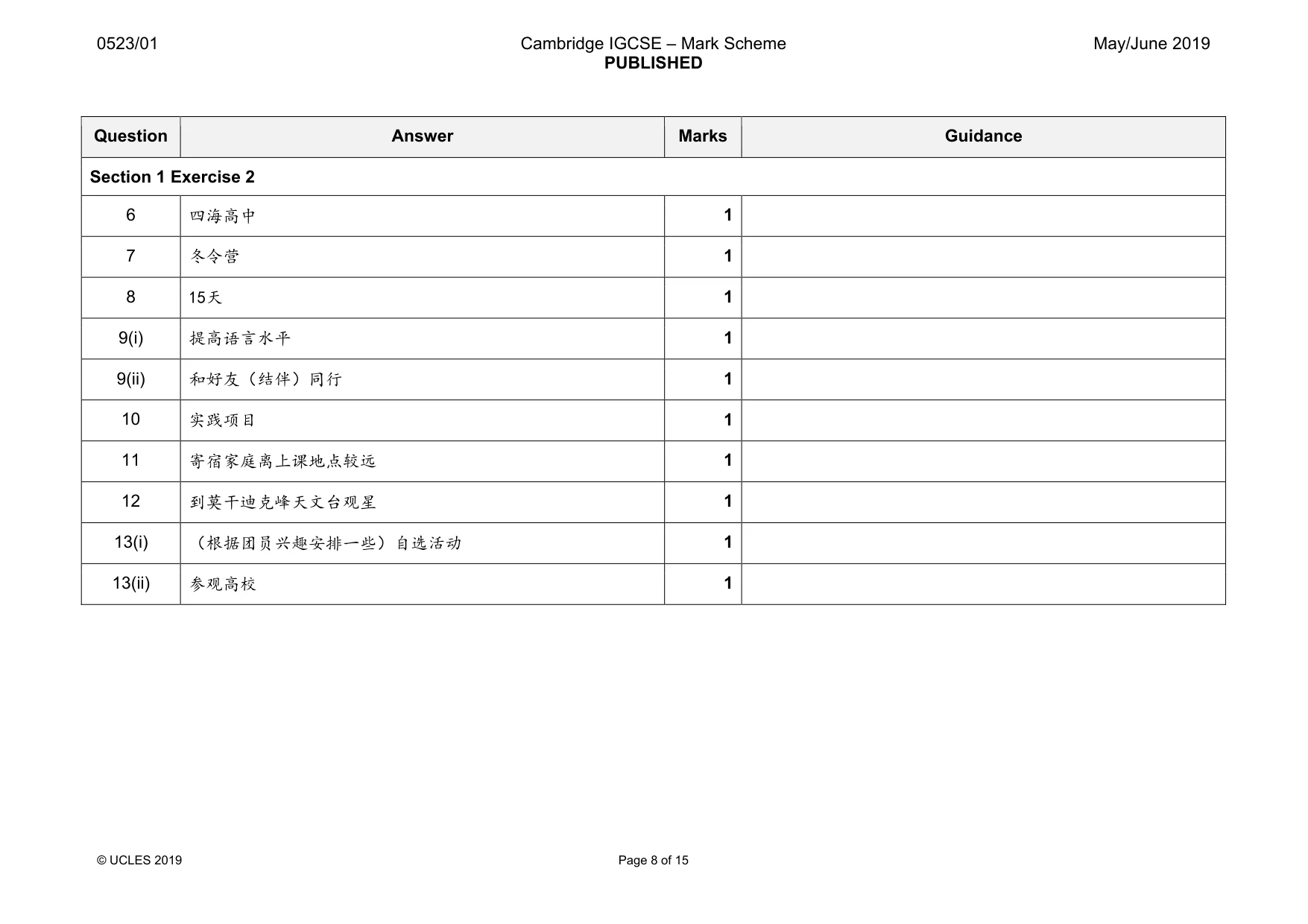
0523/01 Cambridge IGCSE – Mark Scheme PUBLISHED May/June 2019 © UCLES 2019 Page 8 of 15 Question Answer Marks Guidance Section 1 Exercise 2 6 四海高中 1 7 冬令营 1 8 15天 1 9(i) 提高语言水平 1 9(ii) 和好友(结伴)同行 1 10 实践项目 1 11 寄宿家庭离上课地点较远 1 12 到莫干迪克峰天文台观星 1 13(i) (根据团员兴趣安排一些)自选活动 1 13(ii) 参观高校 1
Mark scheme, page 9
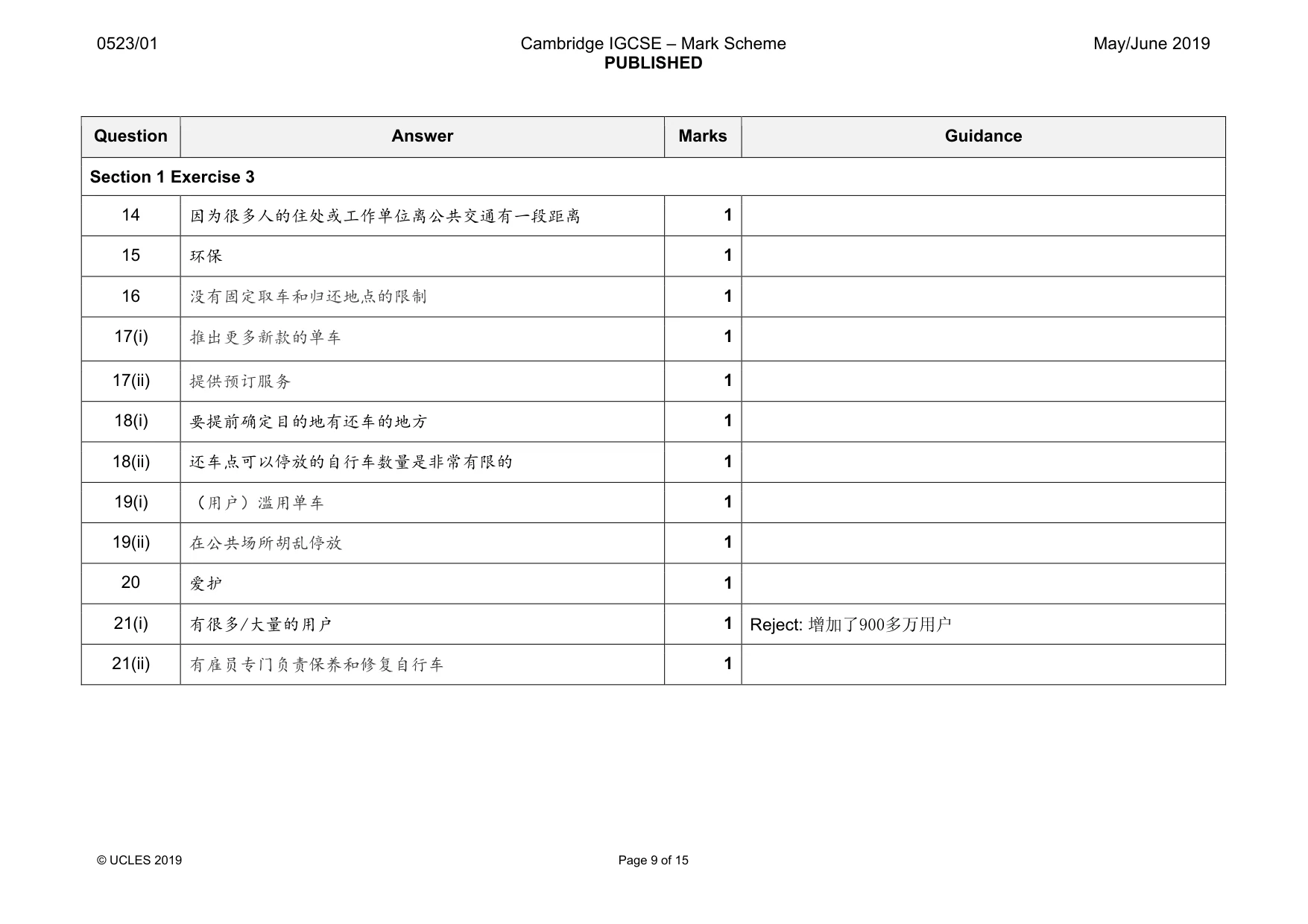
0523/01 Cambridge IGCSE – Mark Scheme PUBLISHED May/June 2019 © UCLES 2019 Page 9 of 15 Question Answer Marks Guidance Section 1 Exercise 3 14 因为很多人的住处或工作单位离公共交通有一段距离 1 15 环保 1 16 没有固定取车和归还地点的限制 1 17(i) 推出更多新款的单车 1 17(ii) 提供预订服务 1 18(i) 要提前确定目的地有还车的地方 1 18(ii) 还车点可以停放的自行车数量是非常有限的 1 19(i) (用户)滥用单车 1 19(ii) 在公共场所胡乱停放 1 20 爱护 1 21(i) 有很多/大量的用户 1 Reject: 增加了900多万用户 21(ii) 有雇员专门负责保养和修复自行车 1
Mark scheme, page 10
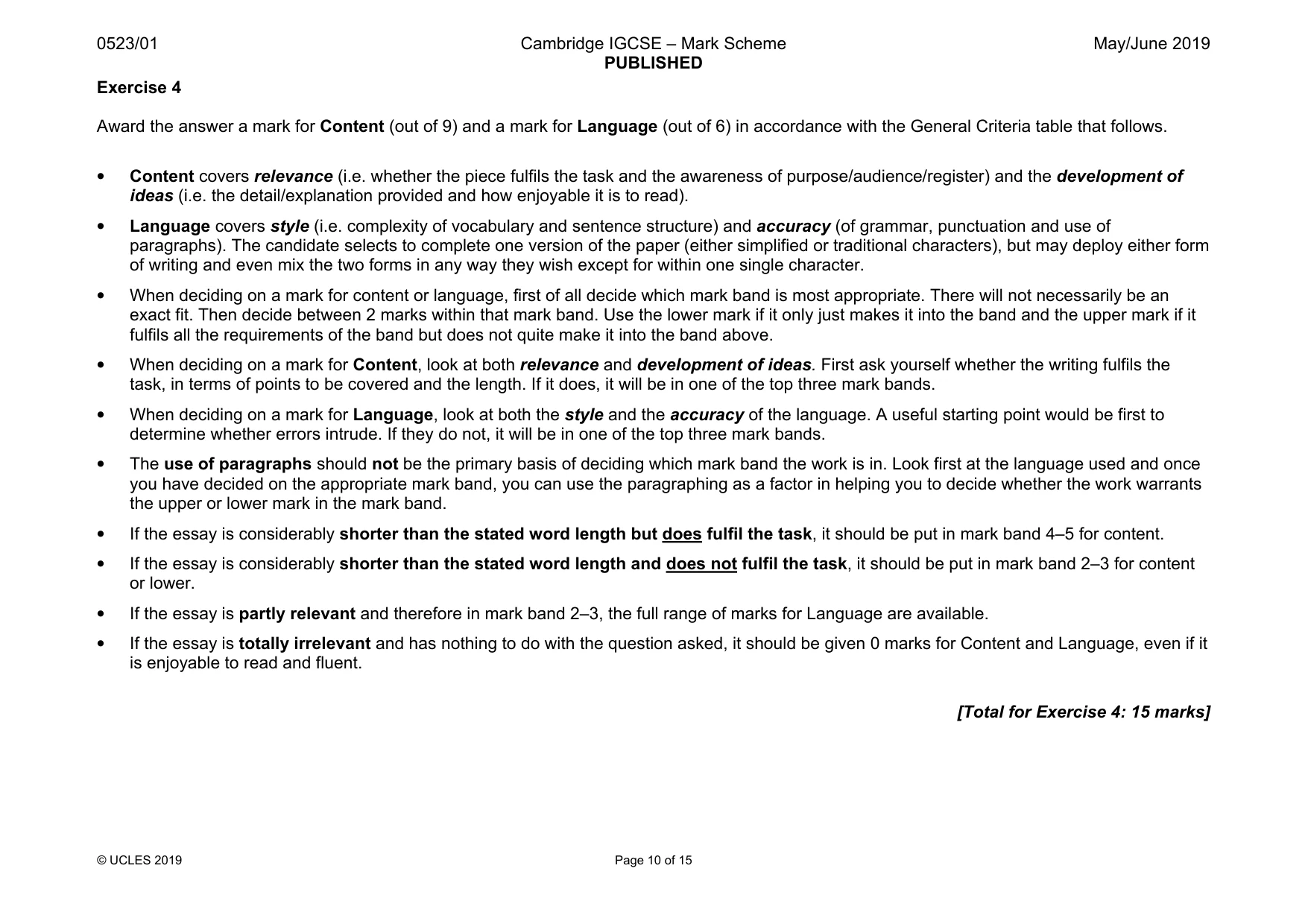
0523/01 Cambridge IGCSE – Mark Scheme PUBLISHED May/June 2019 © UCLES 2019 Page 10 of 15 Exercise 4 Award the answer a mark for Content (out of 9) and a mark for Language (out of 6) in accordance with the General Criteria table that follows. • Content covers relevance (i.e. whether the piece fulfils the task and the awareness of purpose/audience/register) and the development of ideas (i.e. the detail/explanation provided and how enjoyable it is to read). • Language covers style (i.e. complexity of vocabulary and sentence structure) and accuracy (of grammar, punctuation and use of paragraphs). The candidate selects to complete one version of the paper (either simplified or traditional characters), but may deploy either form of writing and even mix the two forms in any way they wish except for within one single character. • When deciding on a mark for content or language, first of all decide which mark band is most appropriate. There will not necessarily be an exact fit. Then decide between 2 marks within that mark band. Use the lower mark if it only just makes it into the band and the upper mark if it fulfils all the requirements of the band but does not quite make it into the band above. • When deciding on a mark for Content, look at both relevance and development of ideas. First ask yourself whether the writing fulfils the task, in terms of points to be covered and the length. If it does, it will be in one of the top three mark bands. • When deciding on a mark for Language, look at both the style and the accuracy of the language. A useful starting point would be first to determine whether errors intrude. If they do not, it will be in one of the top three mark bands. • The use of paragraphs should not be the primary basis of deciding which mark band the work is in. Look first at the language used and once you have decided on the appropriate mark band, you can use the paragraphing as a factor in helping you to decide whether the work warrants the upper or lower mark in the mark band. • If the essay is considerably shorter than the stated word length but does fulfil the task, it should be put in mark band 4–5 for content. • If the essay is considerably shorter than the stated word length and does not fulfil the task, it should be put in mark band 2–3 for content or lower. • If the essay is partly relevant and therefore in mark band 2–3, the full range of marks for Language are available. • If the essay is totally irrelevant and has nothing to do with the question asked, it should be given 0 marks for Content and Language, even if it is enjoyable to read and fluent. [Total for Exercise 4: 15 marks]
Mark scheme, page 11
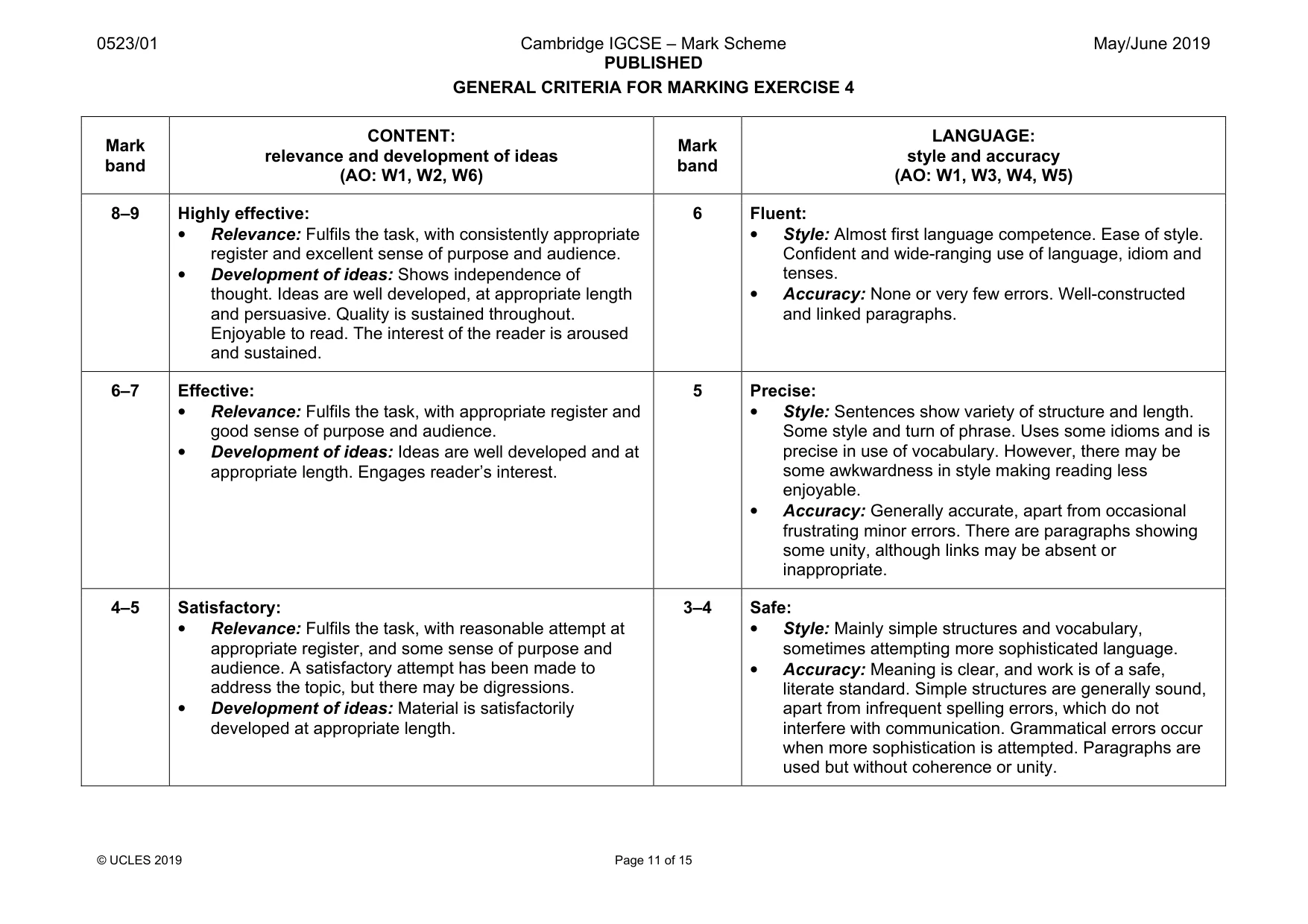
0523/01 Cambridge IGCSE – Mark Scheme PUBLISHED May/June 2019 © UCLES 2019 Page 11 of 15 GENERAL CRITERIA FOR MARKING EXERCISE 4 Mark band CONTENT: relevance and development of ideas (AO: W1, W2, W6) Mark band LANGUAGE: style and accuracy (AO: W1, W3, W4, W5) 8–9 Highly effective: • Relevance: Fulfils the task, with consistently appropriate register and excellent sense of purpose and audience. • Development of ideas: Shows independence of thought. Ideas are well developed, at appropriate length and persuasive. Quality is sustained throughout. Enjoyable to read. The interest of the reader is aroused and sustained. 6 Fluent: • Style: Almost first language competence. Ease of style. Confident and wide-ranging use of language, idiom and tenses. • Accuracy: None or very few errors. Well-constructed and linked paragraphs. 6–7 Effective: • Relevance: Fulfils the task, with appropriate register and good sense of purpose and audience. • Development of ideas: Ideas are well developed and at appropriate length. Engages reader’s interest. 5 Precise: • Style: Sentences show variety of structure and length. Some style and turn of phrase. Uses some idioms and is precise in use of vocabulary. However, there may be some awkwardness in style making reading less enjoyable. • Accuracy: Generally accurate, apart from occasional frustrating minor errors. There are paragraphs showing some unity, although links may be absent or inappropriate. 4–5 Satisfactory: • Relevance: Fulfils the task, with reasonable attempt at appropriate register, and some sense of purpose and audience. A satisfactory attempt has been made to address the topic, but there may be digressions. • Development of ideas: Material is satisfactorily developed at appropriate length. 3–4 Safe: • Style: Mainly simple structures and vocabulary, sometimes attempting more sophisticated language. • Accuracy: Meaning is clear, and work is of a safe, literate standard. Simple structures are generally sound, apart from infrequent spelling errors, which do not interfere with communication. Grammatical errors occur when more sophistication is attempted. Paragraphs are used but without coherence or unity.
Mark scheme, page 12
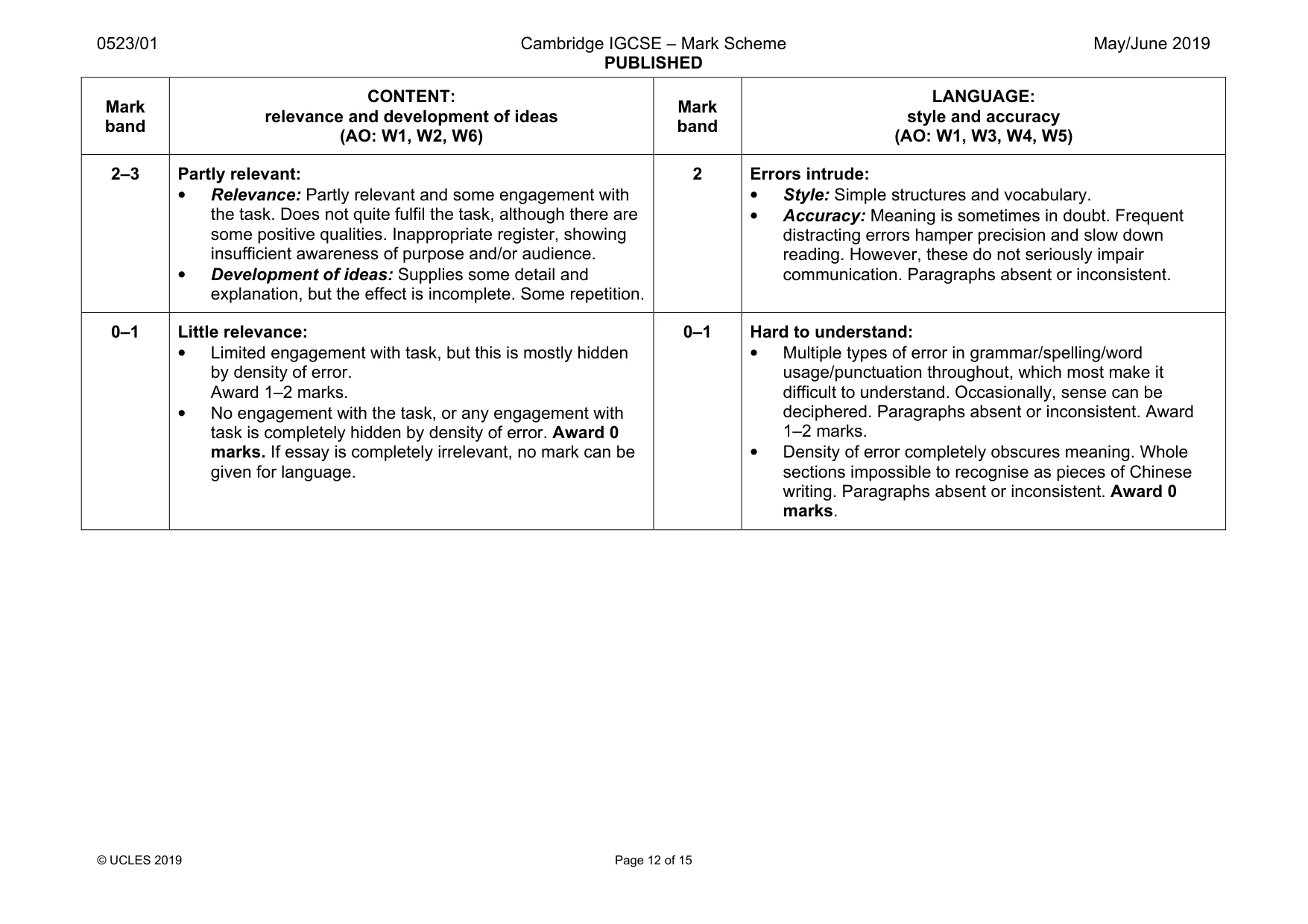
0523/01 Cambridge IGCSE – Mark Scheme PUBLISHED May/June 2019 © UCLES 2019 Page 12 of 15 Mark band CONTENT: relevance and development of ideas (AO: W1, W2, W6) Mark band LANGUAGE: style and accuracy (AO: W1, W3, W4, W5) 2–3 Partly relevant: • Relevance: Partly relevant and some engagement with the task. Does not quite fulfil the task, although there are some positive qualities. Inappropriate register, showing insufficient awareness of purpose and/or audience. • Development of ideas: Supplies some detail and explanation, but the effect is incomplete. Some repetition. 2 Errors intrude: • Style: Simple structures and vocabulary. • Accuracy: Meaning is sometimes in doubt. Frequent distracting errors hamper precision and slow down reading. However, these do not seriously impair communication. Paragraphs absent or inconsistent. 0–1 Little relevance: • Limited engagement with task, but this is mostly hidden by density of error. Award 1–2 marks. • No engagement with the task, or any engagement with task is completely hidden by density of error. Award 0 marks. If essay is completely irrelevant, no mark can be given for language. 0–1 Hard to understand: • Multiple types of error in grammar/spelling/word usage/punctuation throughout, which most make it difficult to understand. Occasionally, sense can be deciphered. Paragraphs absent or inconsistent. Award 1–2 marks. • Density of error completely obscures meaning. Whole sections impossible to recognise as pieces of Chinese writing. Paragraphs absent or inconsistent. Award 0 marks.
Mark scheme, page 13
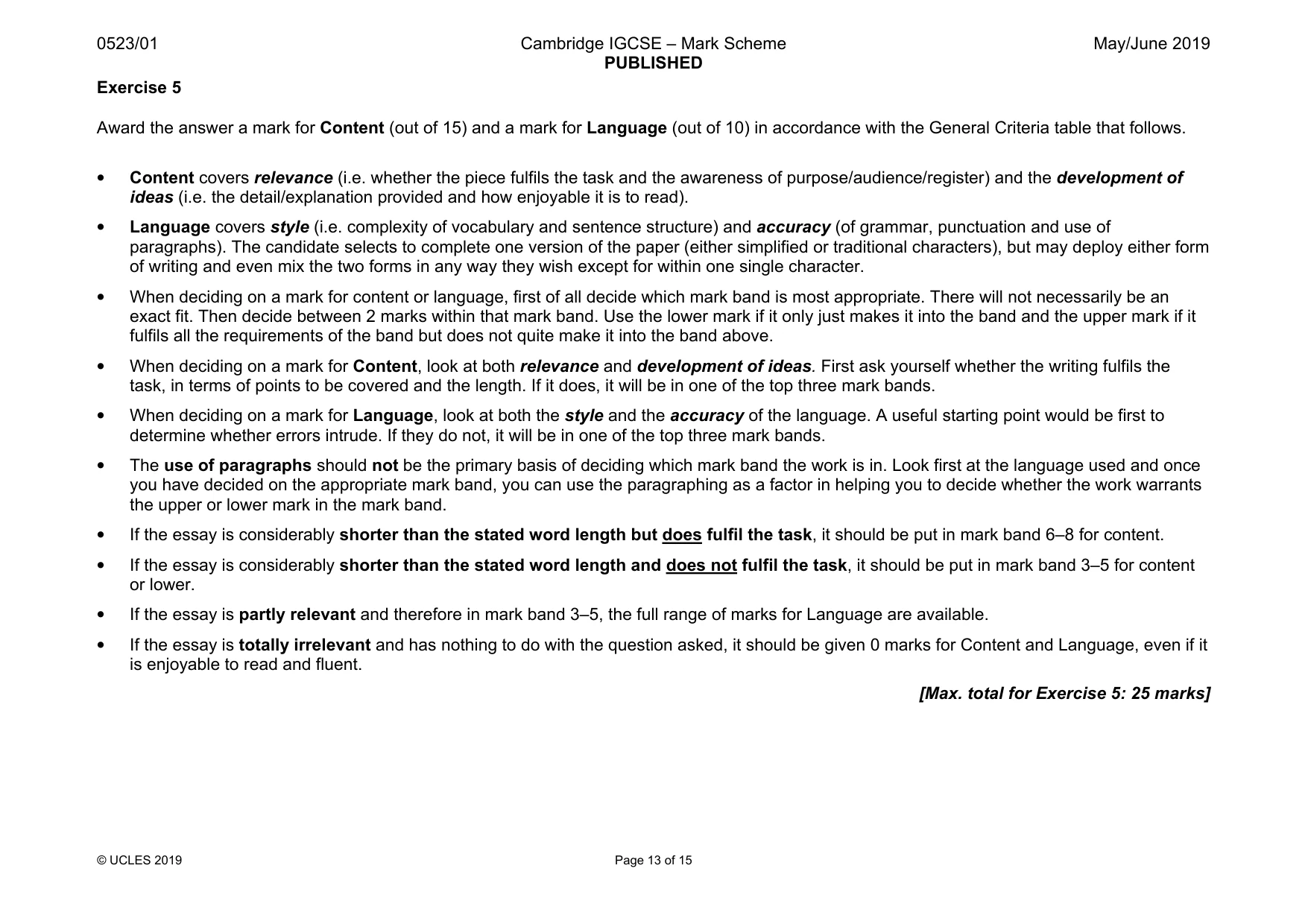
0523/01 Cambridge IGCSE – Mark Scheme PUBLISHED May/June 2019 © UCLES 2019 Page 13 of 15 Exercise 5 Award the answer a mark for Content (out of 15) and a mark for Language (out of 10) in accordance with the General Criteria table that follows. • Content covers relevance (i.e. whether the piece fulfils the task and the awareness of purpose/audience/register) and the development of ideas (i.e. the detail/explanation provided and how enjoyable it is to read). • Language covers style (i.e. complexity of vocabulary and sentence structure) and accuracy (of grammar, punctuation and use of paragraphs). The candidate selects to complete one version of the paper (either simplified or traditional characters), but may deploy either form of writing and even mix the two forms in any way they wish except for within one single character. • When deciding on a mark for content or language, first of all decide which mark band is most appropriate. There will not necessarily be an exact fit. Then decide between 2 marks within that mark band. Use the lower mark if it only just makes it into the band and the upper mark if it fulfils all the requirements of the band but does not quite make it into the band above. • When deciding on a mark for Content, look at both relevance and development of ideas. First ask yourself whether the writing fulfils the task, in terms of points to be covered and the length. If it does, it will be in one of the top three mark bands. • When deciding on a mark for Language, look at both the style and the accuracy of the language. A useful starting point would be first to determine whether errors intrude. If they do not, it will be in one of the top three mark bands. • The use of paragraphs should not be the primary basis of deciding which mark band the work is in. Look first at the language used and once you have decided on the appropriate mark band, you can use the paragraphing as a factor in helping you to decide whether the work warrants the upper or lower mark in the mark band. • If the essay is considerably shorter than the stated word length but does fulfil the task, it should be put in mark band 6–8 for content. • If the essay is considerably shorter than the stated word length and does not fulfil the task, it should be put in mark band 3–5 for content or lower. • If the essay is partly relevant and therefore in mark band 3–5, the full range of marks for Language are available. • If the essay is totally irrelevant and has nothing to do with the question asked, it should be given 0 marks for Content and Language, even if it is enjoyable to read and fluent. [Max. total for Exercise 5: 25 marks]
Mark scheme, page 14
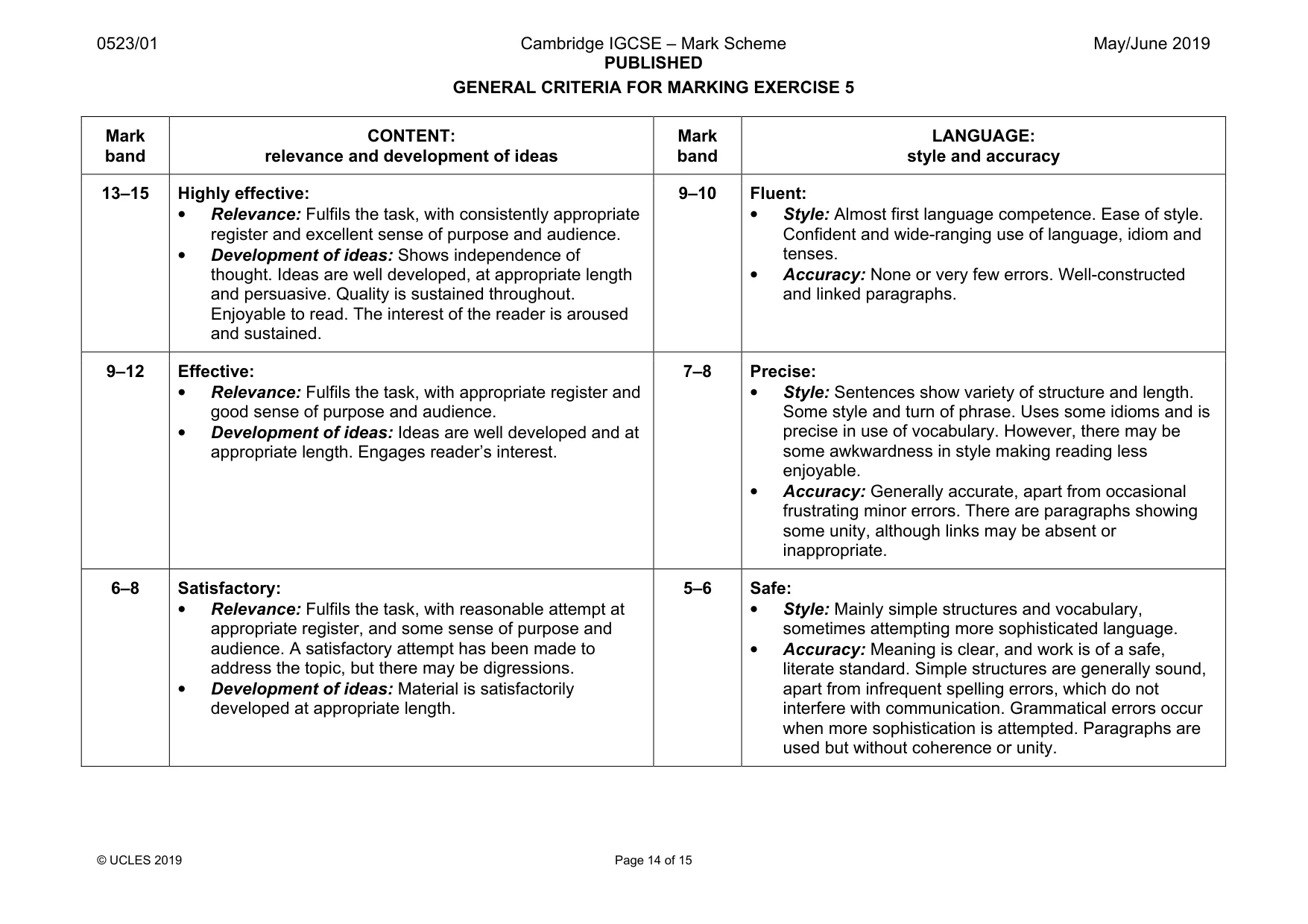
0523/01 Cambridge IGCSE – Mark Scheme PUBLISHED May/June 2019 © UCLES 2019 Page 14 of 15 GENERAL CRITERIA FOR MARKING EXERCISE 5 Mark band CONTENT: relevance and development of ideas Mark band LANGUAGE: style and accuracy 13–15 Highly effective: • Relevance: Fulfils the task, with consistently appropriate register and excellent sense of purpose and audience. • Development of ideas: Shows independence of thought. Ideas are well developed, at appropriate length and persuasive. Quality is sustained throughout. Enjoyable to read. The interest of the reader is aroused and sustained. 9–10 Fluent: • Style: Almost first language competence. Ease of style. Confident and wide-ranging use of language, idiom and tenses. • Accuracy: None or very few errors. Well-constructed and linked paragraphs. 9–12 Effective: • Relevance: Fulfils the task, with appropriate register and good sense of purpose and audience. • Development of ideas: Ideas are well developed and at appropriate length. Engages reader’s interest. 7–8 Precise: • Style: Sentences show variety of structure and length. Some style and turn of phrase. Uses some idioms and is precise in use of vocabulary. However, there may be some awkwardness in style making reading less enjoyable. • Accuracy: Generally accurate, apart from occasional frustrating minor errors. There are paragraphs showing some unity, although links may be absent or inappropriate. 6–8 Satisfactory: • Relevance: Fulfils the task, with reasonable attempt at appropriate register, and some sense of purpose and audience. A satisfactory attempt has been made to address the topic, but there may be digressions. • Development of ideas: Material is satisfactorily developed at appropriate length. 5–6 Safe: • Style: Mainly simple structures and vocabulary, sometimes attempting more sophisticated language. • Accuracy: Meaning is clear, and work is of a safe, literate standard. Simple structures are generally sound, apart from infrequent spelling errors, which do not interfere with communication. Grammatical errors occur when more sophistication is attempted. Paragraphs are used but without coherence or unity.
Mark scheme, page 15
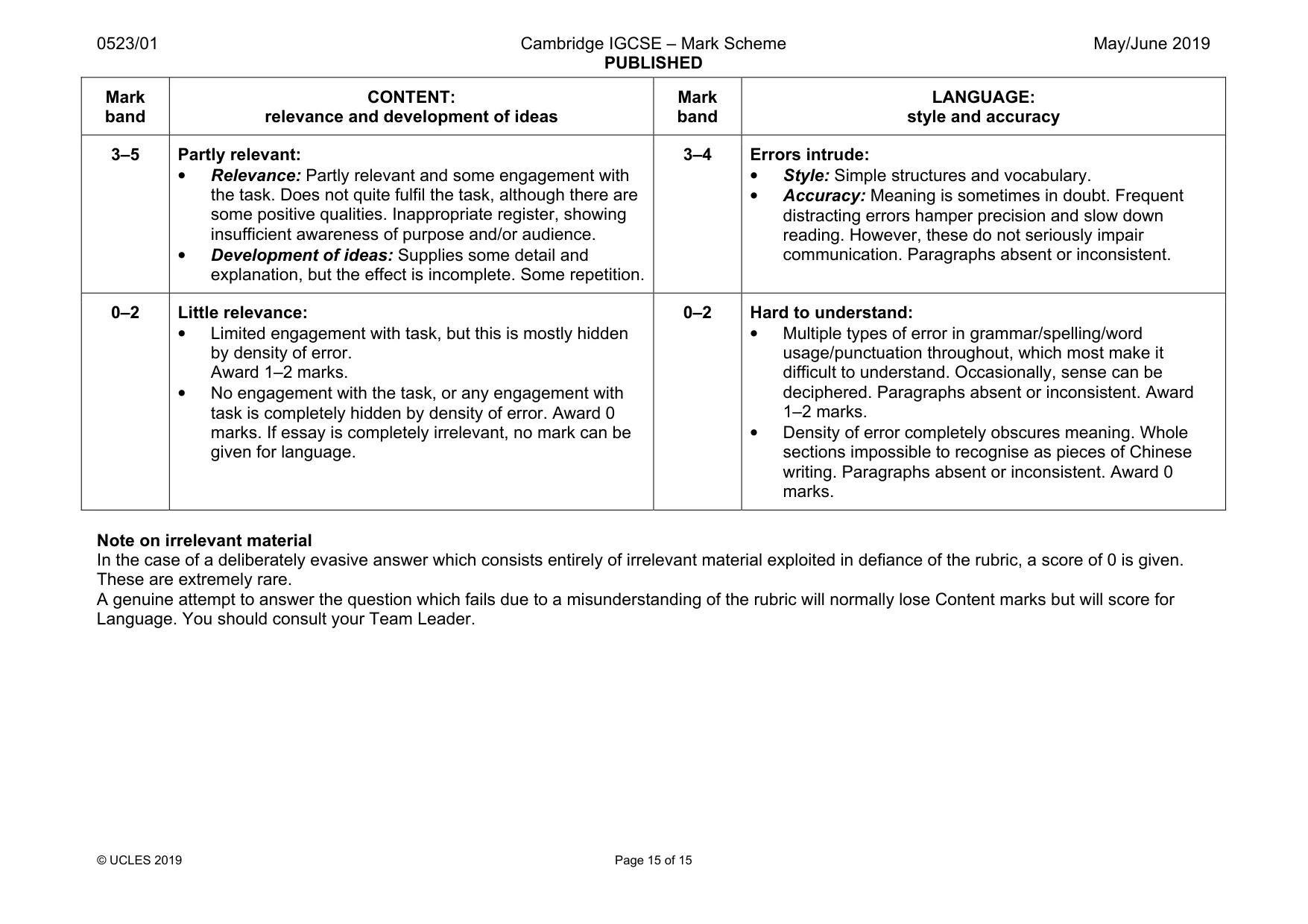
0523/01 Cambridge IGCSE – Mark Scheme PUBLISHED May/June 2019 © UCLES 2019 Page 15 of 15 Mark band CONTENT: relevance and development of ideas Mark band LANGUAGE: style and accuracy 3–5 Partly relevant: • Relevance: Partly relevant and some engagement with the task. Does not quite fulfil the task, although there are some positive qualities. Inappropriate register, showing insufficient awareness of purpose and/or audience. • Development of ideas: Supplies some detail and explanation, but the effect is incomplete. Some repetition. 3–4 Errors intrude: • Style: Simple structures and vocabulary. • Accuracy: Meaning is sometimes in doubt. Frequent distracting errors hamper precision and slow down reading. However, these do not seriously impair communication. Paragraphs absent or inconsistent. 0–2 Little relevance: • Limited engagement with task, but this is mostly hidden by density of error. Award 1–2 marks. • No engagement with the task, or any engagement with task is completely hidden by density of error. Award 0 marks. If essay is completely irrelevant, no mark can be given for language. 0–2 Hard to understand: • Multiple types of error in grammar/spelling/word usage/punctuation throughout, which most make it difficult to understand. Occasionally, sense can be deciphered. Paragraphs absent or inconsistent. Award 1–2 marks. • Density of error completely obscures meaning. Whole sections impossible to recognise as pieces of Chinese writing. Paragraphs absent or inconsistent. Award 0 marks. Note on irrelevant material In the case of a deliberately evasive answer which consists entirely of irrelevant material exploited in defiance of the rubric, a score of 0 is given. These are extremely rare. A genuine attempt to answer the question which fails due to a misunderstanding of the rubric will normally lose Content marks but will score for Language. You should consult your Team Leader.
What you needed in this session
Cambridge’s own grade thresholds for 2019 May/June, Paper 1 · Variant 1. A higher threshold means an easier paper — the bar moves with how the cohort did.