Cambridge IGCSE Chinese - Second Language 0523 — 2015 May/June Paper 1 · Variant 1
0523/11/M/J/15
The question paper and its mark scheme, free to read here and free to download. This is Cambridge’s own paper, exactly as it was sat.
Question paper24 pages
Mark scheme12 pages
Answers below. Sit the paper first if you are practising.
Paper as text
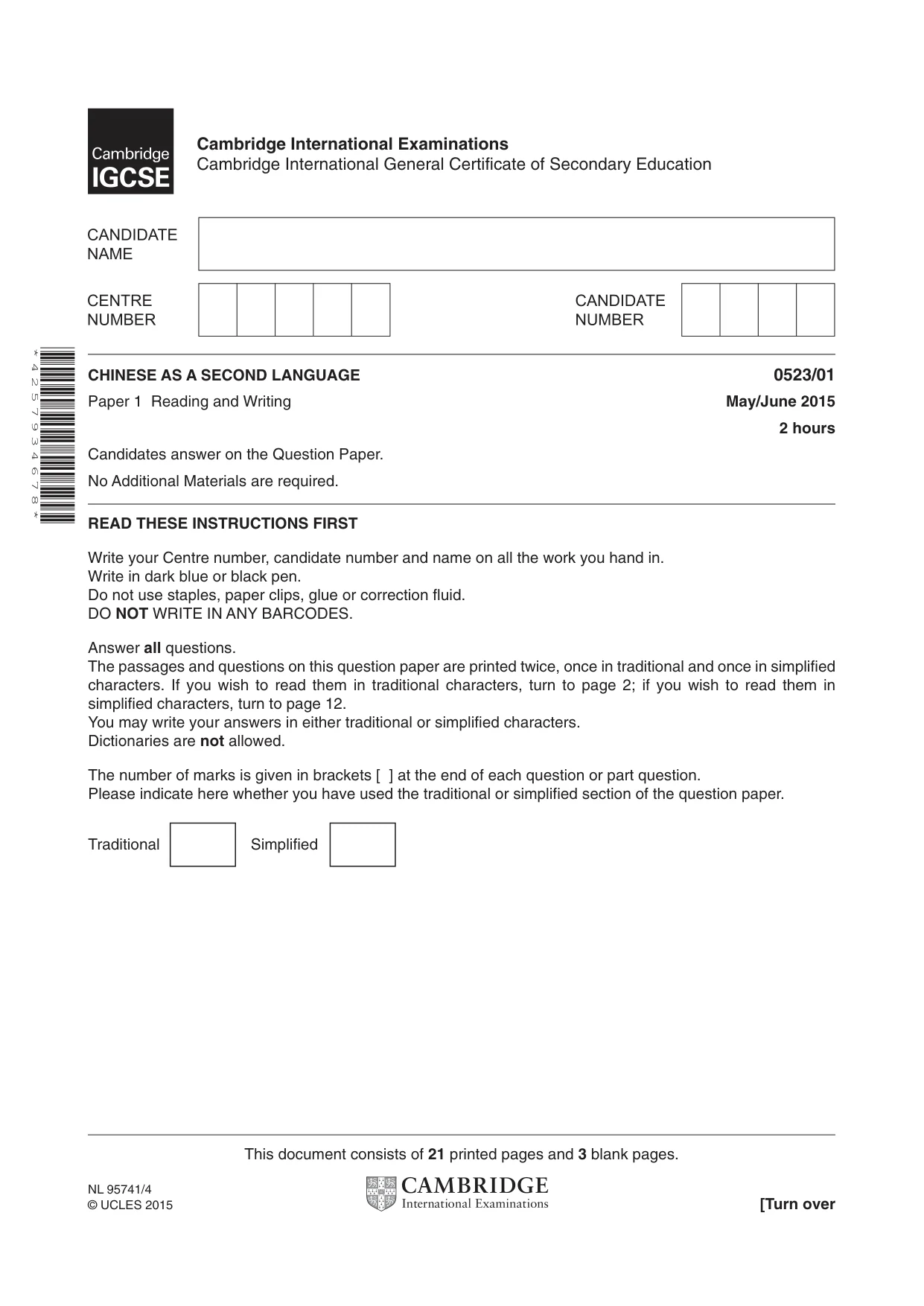
Question paper, page 1
CHINESE AS A SECOND LANGUAGE 0523/01 Paper 1 Reading and Writing May/June 2015 2 hours Candidates answer on the Question Paper. No Additional Materials are required. READ THESE INSTRUCTIONS FIRST Write your Centre number, candidate number and name on all the work you hand in. Write in dark blue or black pen. Do not use staples, paper clips, glue or correction fluid. DO NOT WRITE IN ANY BARCODES. Answer all questions. The passages and questions on this question paper are printed twice, once in traditional and once in simplified characters. If you wish to read them in traditional characters, turn to page 2; if you wish to read them in simplified characters, turn to page 12. You may write your answers in either traditional or simplified characters. Dictionaries are not allowed. The number of marks is given in brackets [ ] at the end of each question or part question. Please indicate here whether you have used the traditional or simplified section of the question paper. Traditional Simplified This document consists of 21 printed pages and 3 blank pages. NL 95741/4 © UCLES 2015 [Turn over Cambridge International Examinations Cambridge International General Certificate of Secondary Education * 4 2 5 7 9 3 4 6 7 8 *
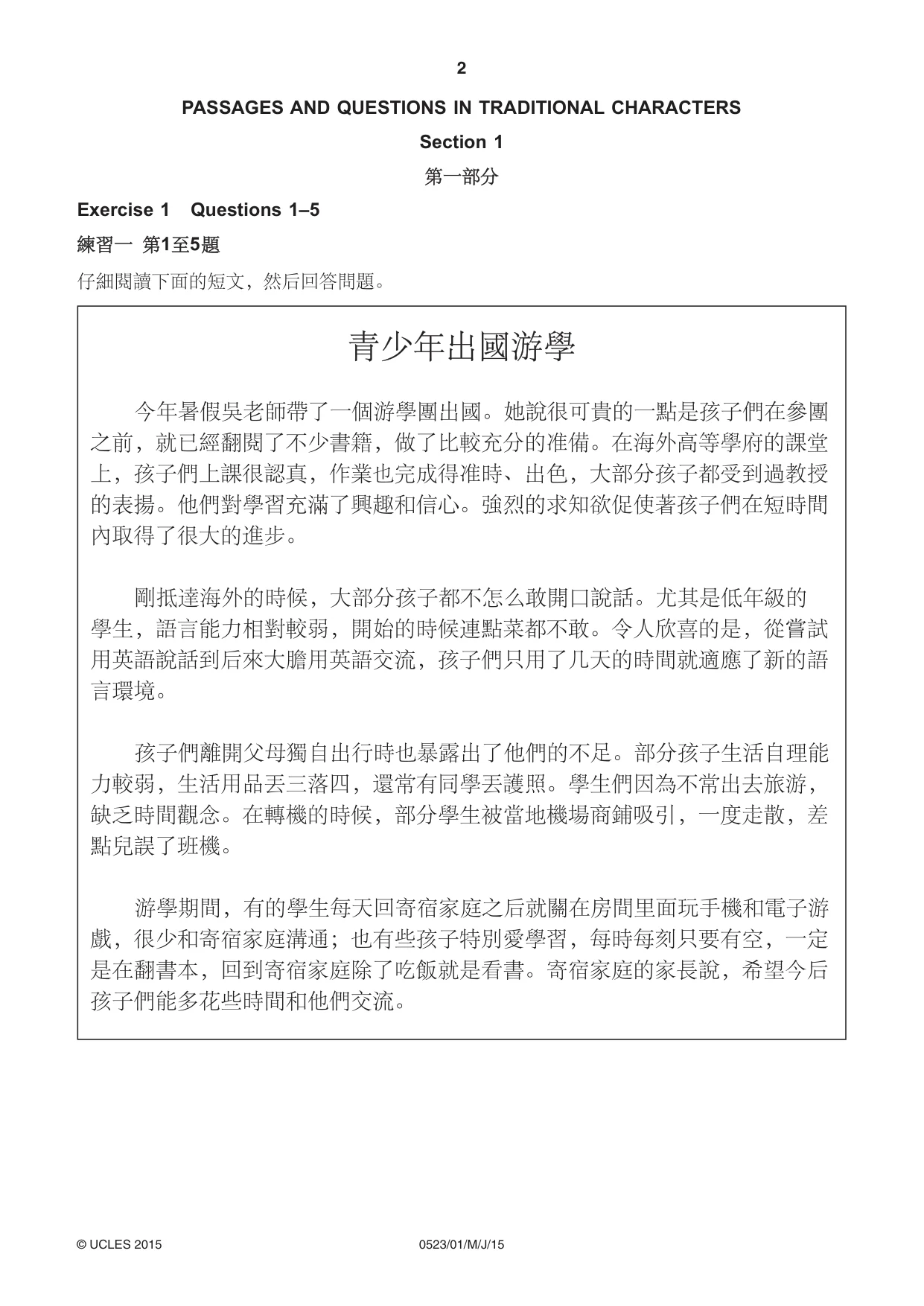
Question paper, page 2
2 © UCLES 2015 0523/01/M/J/15 PASSAGES AND QUESTIONS IN TRADITIONAL CHARACTERS Section 1 Exercise 1 Questions 1–5
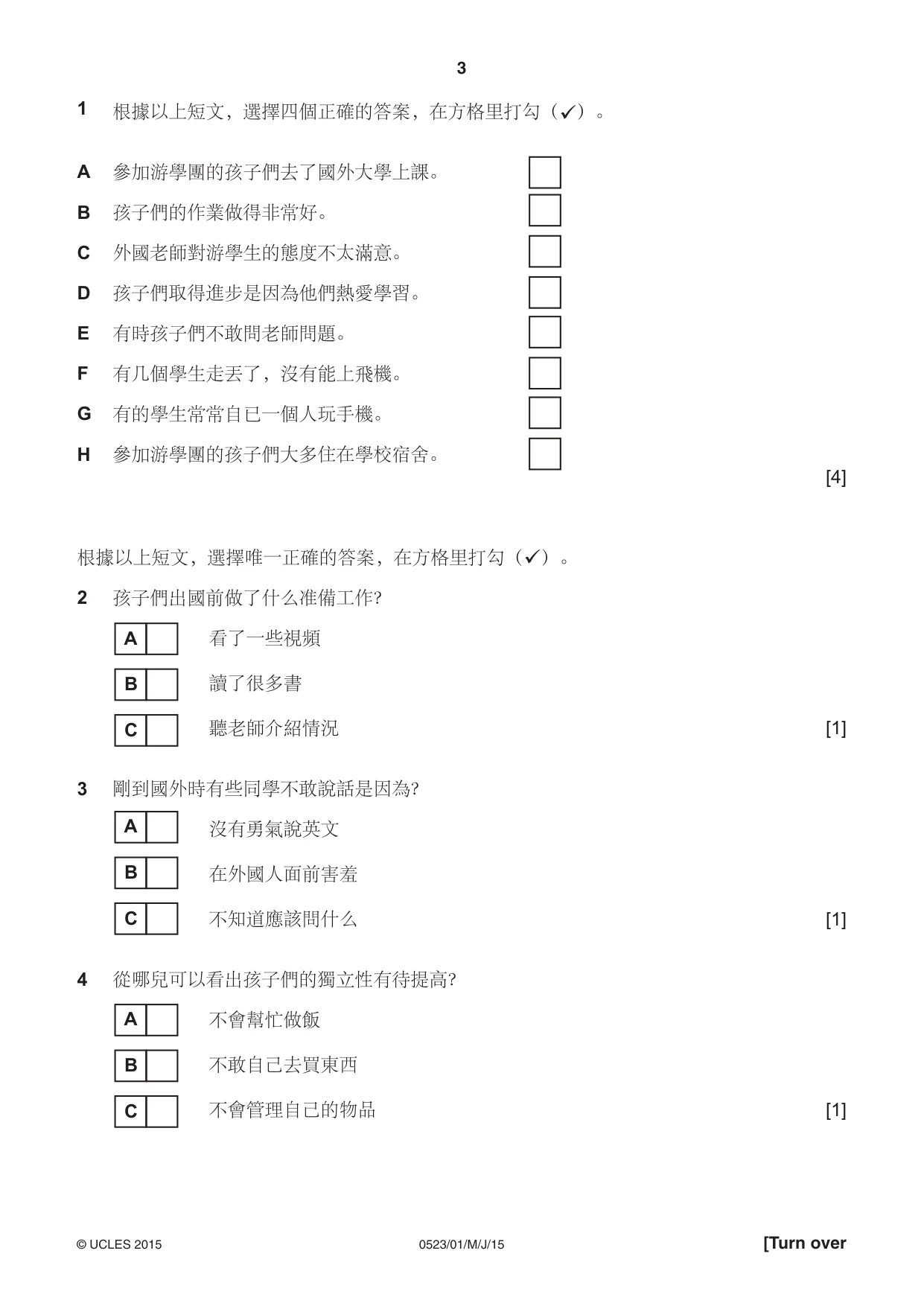
Question paper, page 3
3 [Turn over 0523/01/M/J/15 © UCLES 2015 1 A B C D E F G H [4] 2 [1] 3 [1] 4 [1] A A B B C C A B C
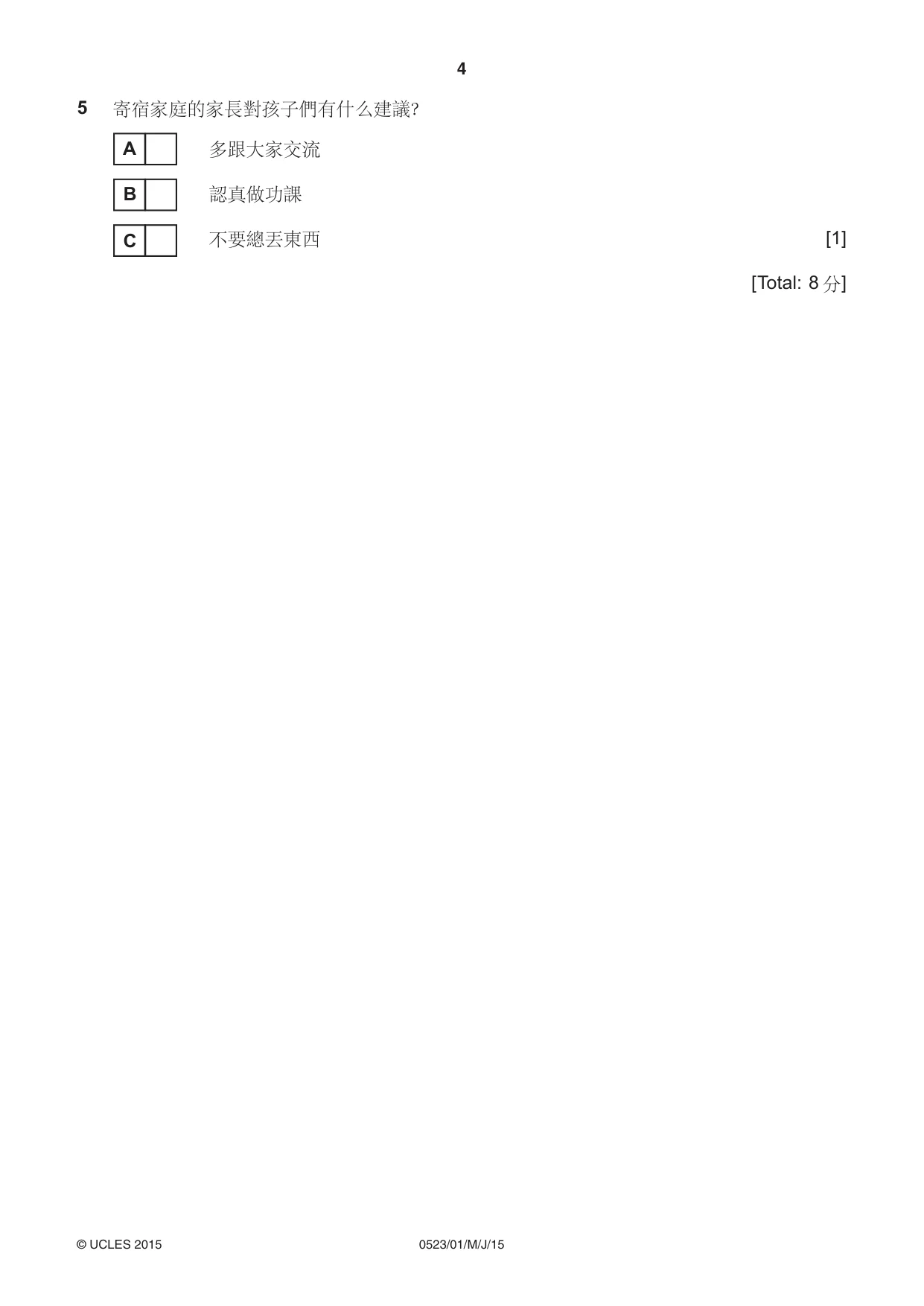
Question paper, page 4
4 © UCLES 2015 0523/01/M/J/15 5 [1] [Total: 8 ] A B C
Question paper, page 5
5 [Turn over 0523/01/M/J/15 © UCLES 2015 [Please turn over for Exercise 2]
Question paper, page 6
6 © UCLES 2015 0523/01/M/J/15 Exercise 2 Questions 6–13
Question paper, page 7
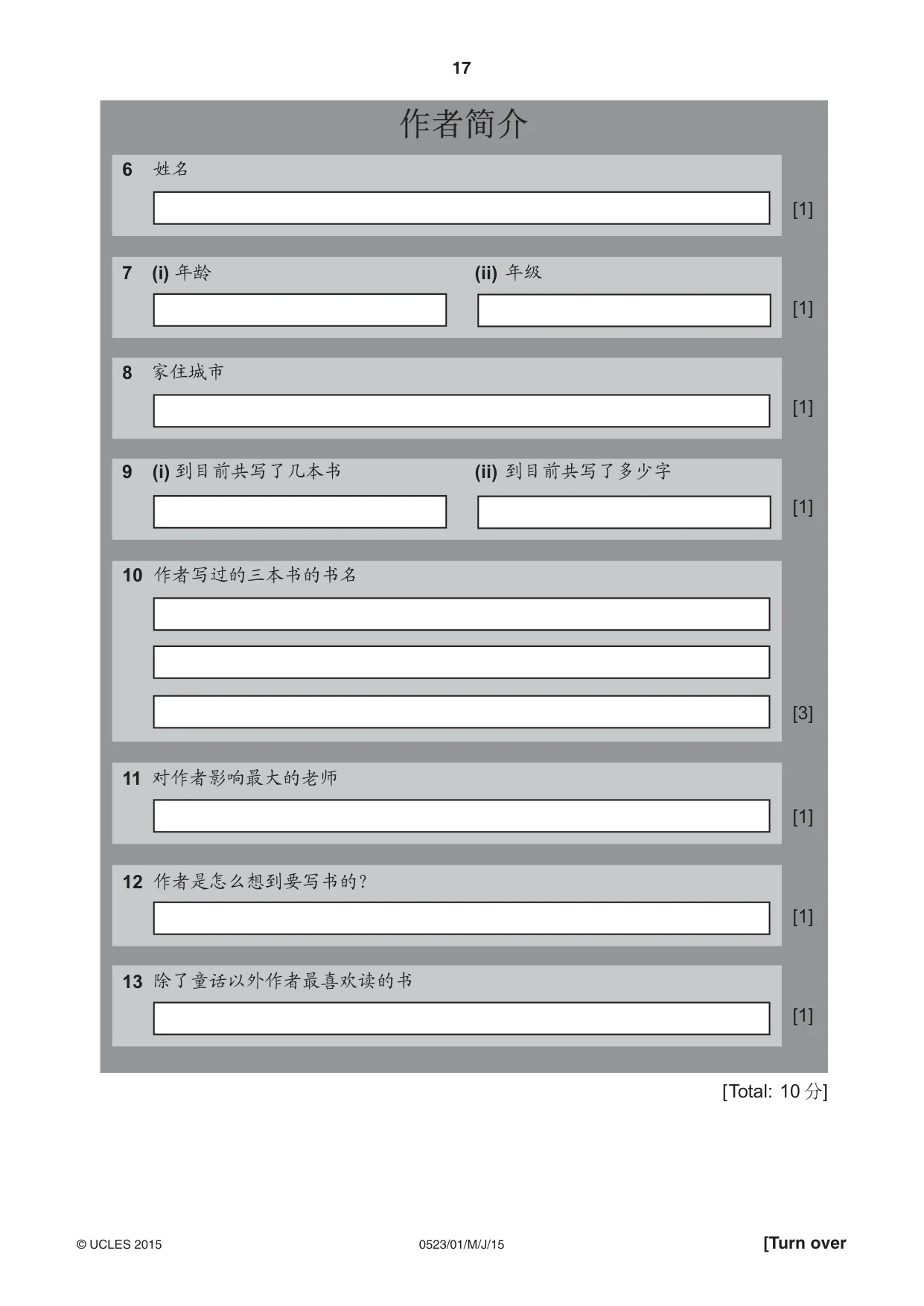
7 [Turn over 0523/01/M/J/15 © UCLES 2015 6 7 (i) (ii) 8 9 (i) (ii) 10 11 12 13 [Total: 10 ] [1] [1] [1] [1] [3] [1] [1] [1]
Question paper, page 8
8 © UCLES 2015 0523/01/M/J/15 Exercise 3 Questions 14–18
Question paper, page 9
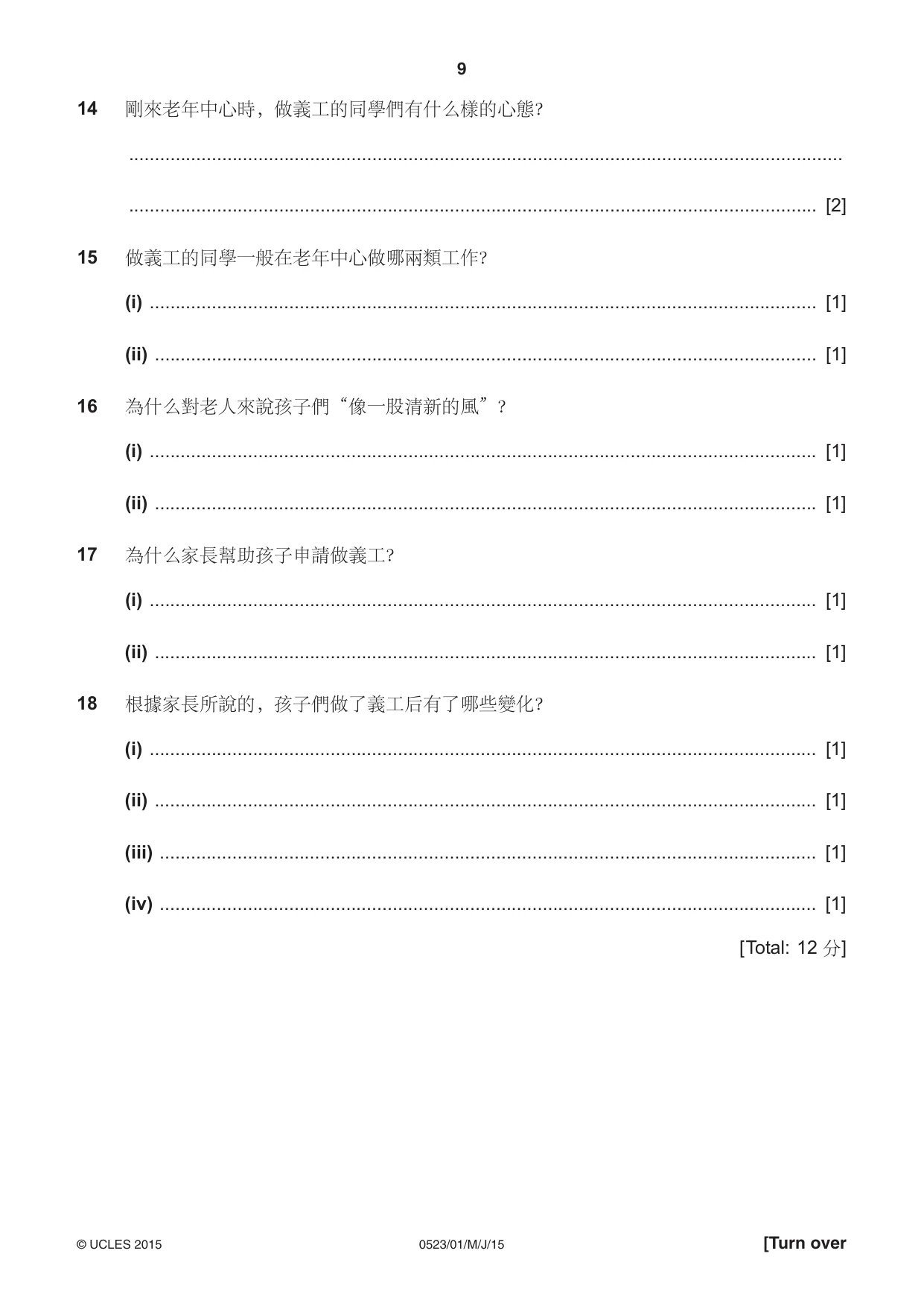
9 [Turn over 0523/01/M/J/15 © UCLES 2015 14 … … [2] 15 (i) … [1] (ii) … [1] 16 (i) … [1] (ii) … [1] 17 (i) … [1] (ii) … [1] 18 (i) … [1] (ii) … [1] (iii) … [1] (iv) … [1] [Total: 12 ]
Question paper, page 10
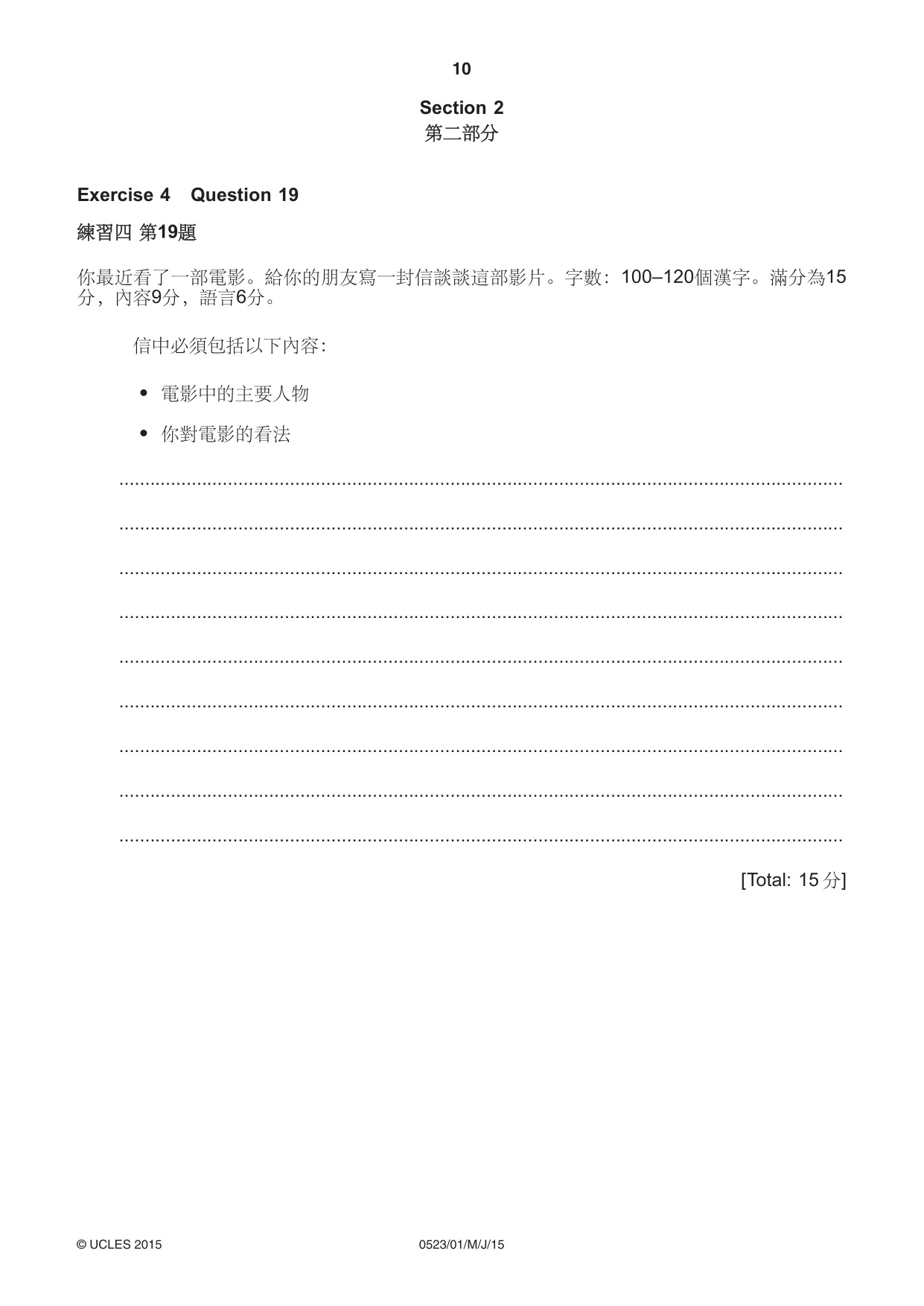
10 © UCLES 2015 0523/01/M/J/15 Section 2 Exercise 4 Question 19 … … … … … … … … … [Total: 15 ]
Question paper, page 11
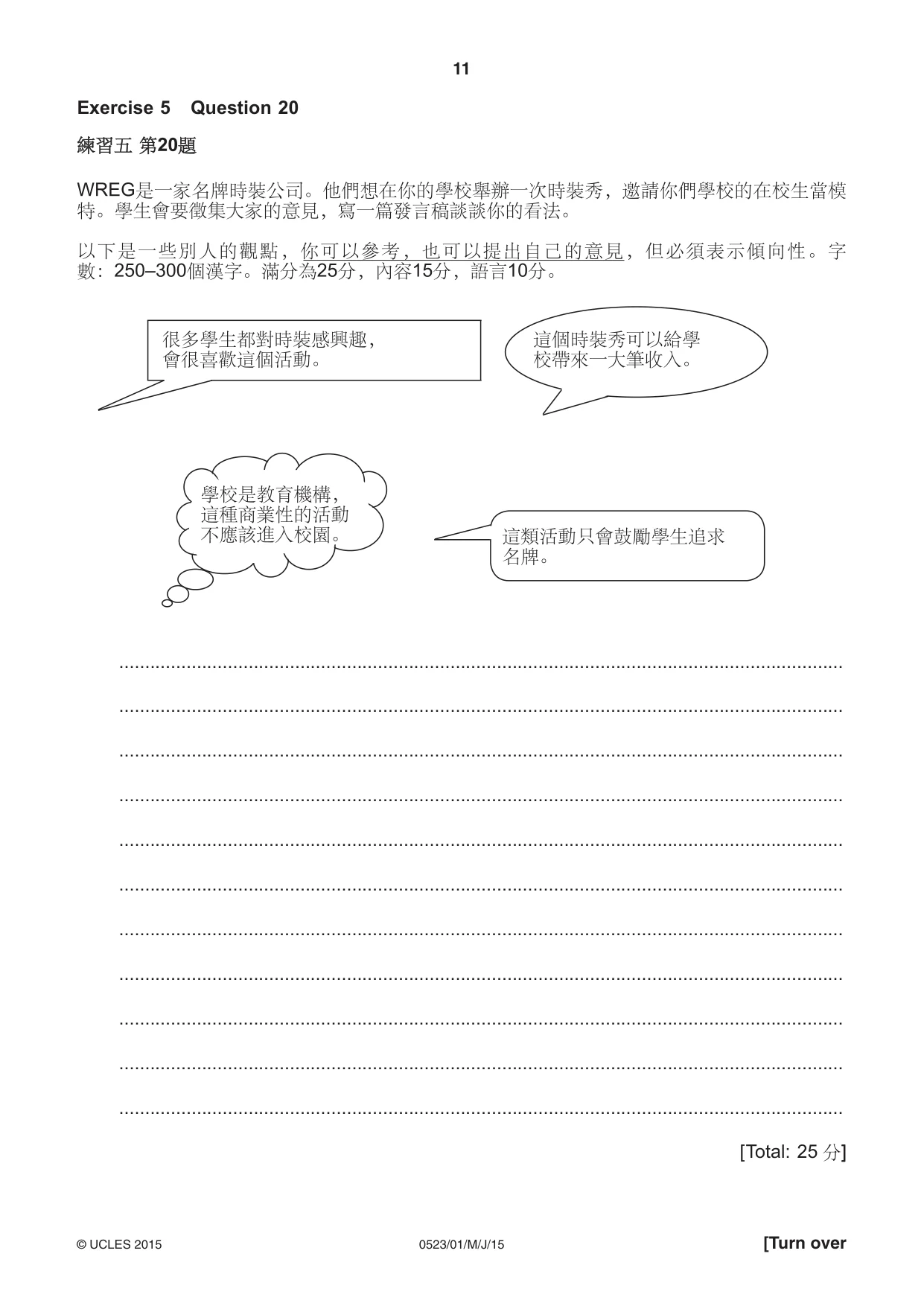
11 [Turn over 0523/01/M/J/15 © UCLES 2015 Exercise 5 Question 20 … … … … … … … … … … … [Total: 25 ]
Question paper, page 12
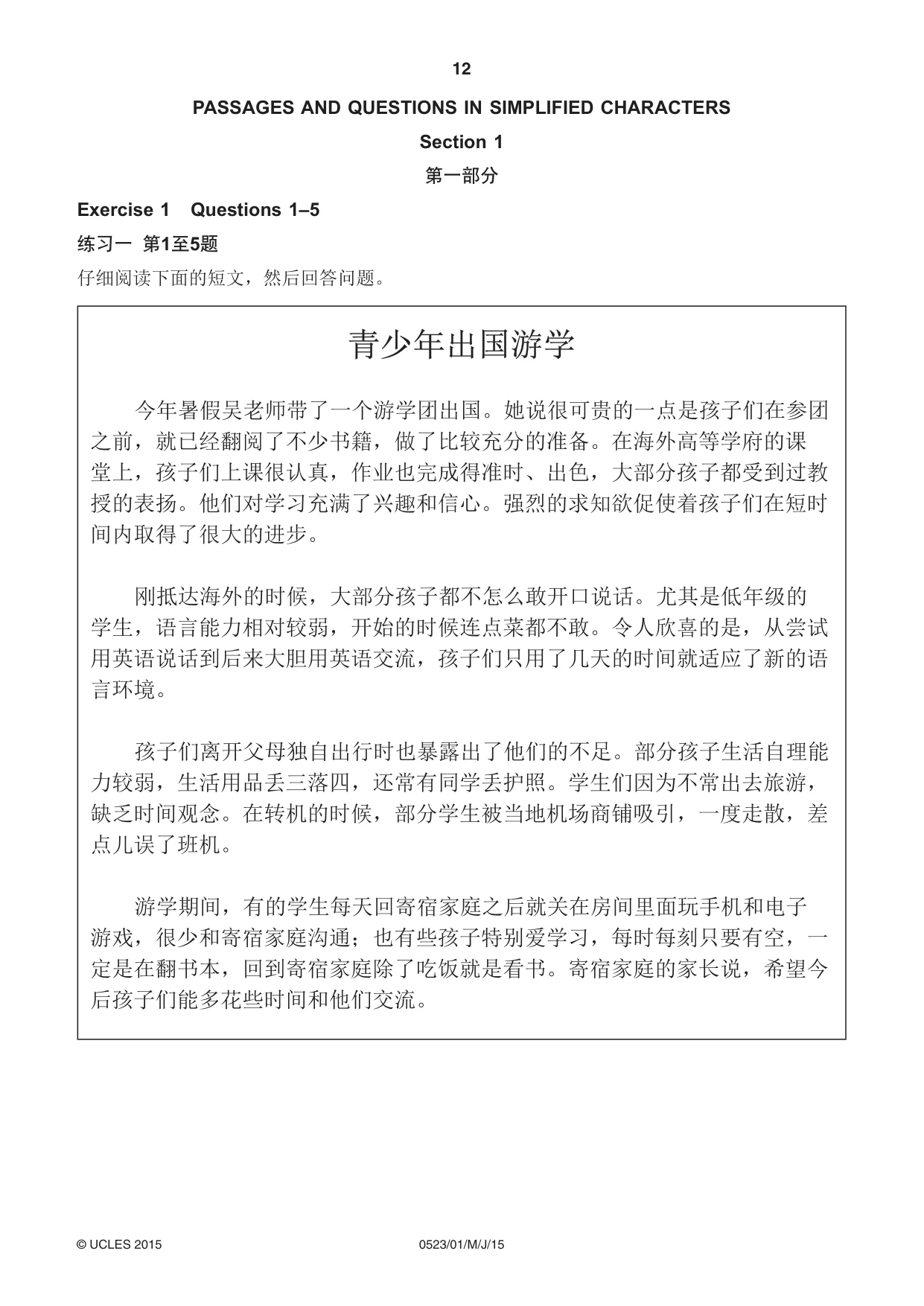
12 © UCLES 2015 0523/01/M/J/15 PASSAGES AND QUESTIONS IN SIMPLIFIED CHARACTERS Section 1 Exercise 1 Questions 1–5
Question paper, page 13
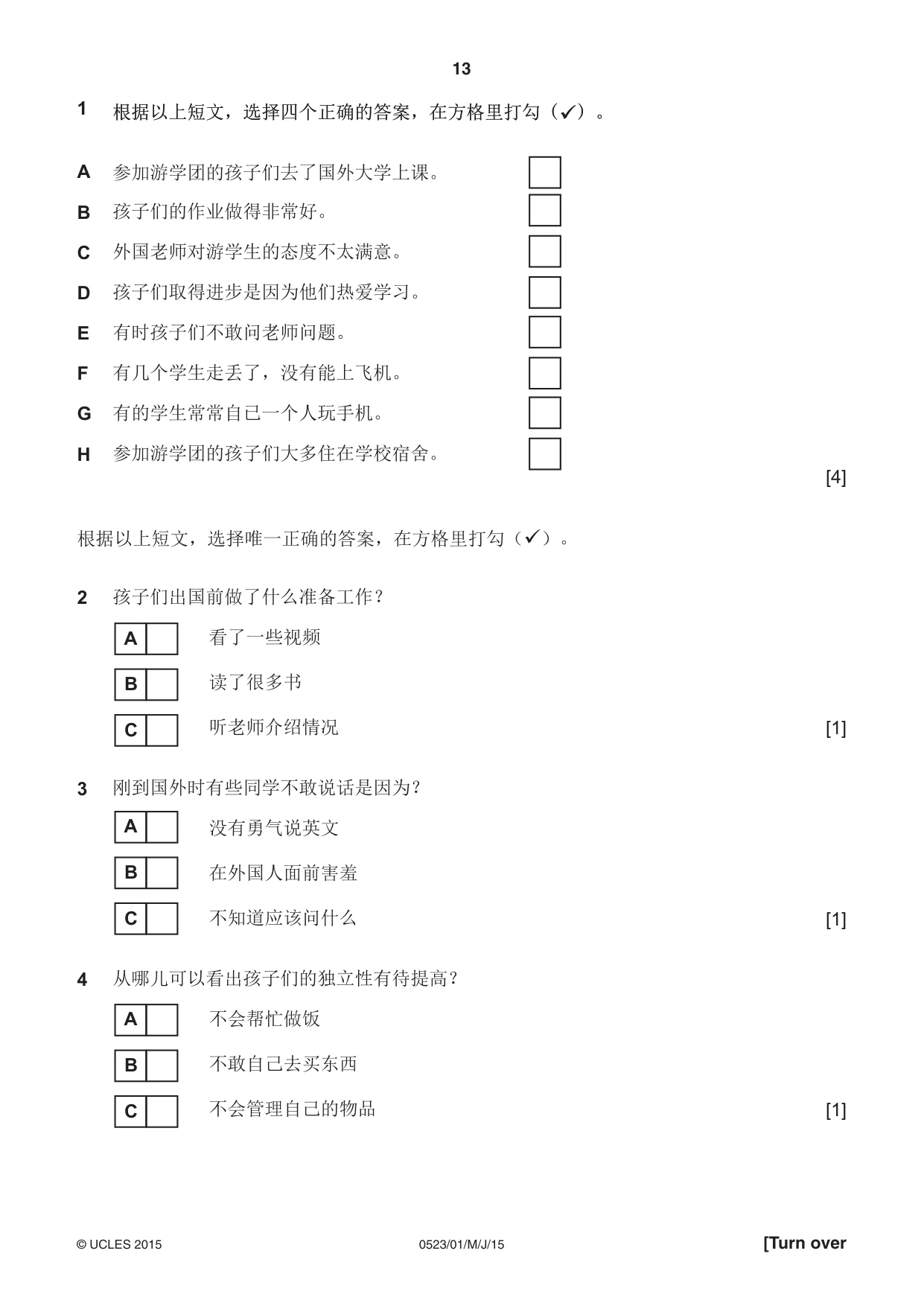
13 [Turn over 0523/01/M/J/15 © UCLES 2015 1 A B C D E F G H [4] 2 [1] 3 [1] 4 [1] A A B B C C A B C
Question paper, page 14
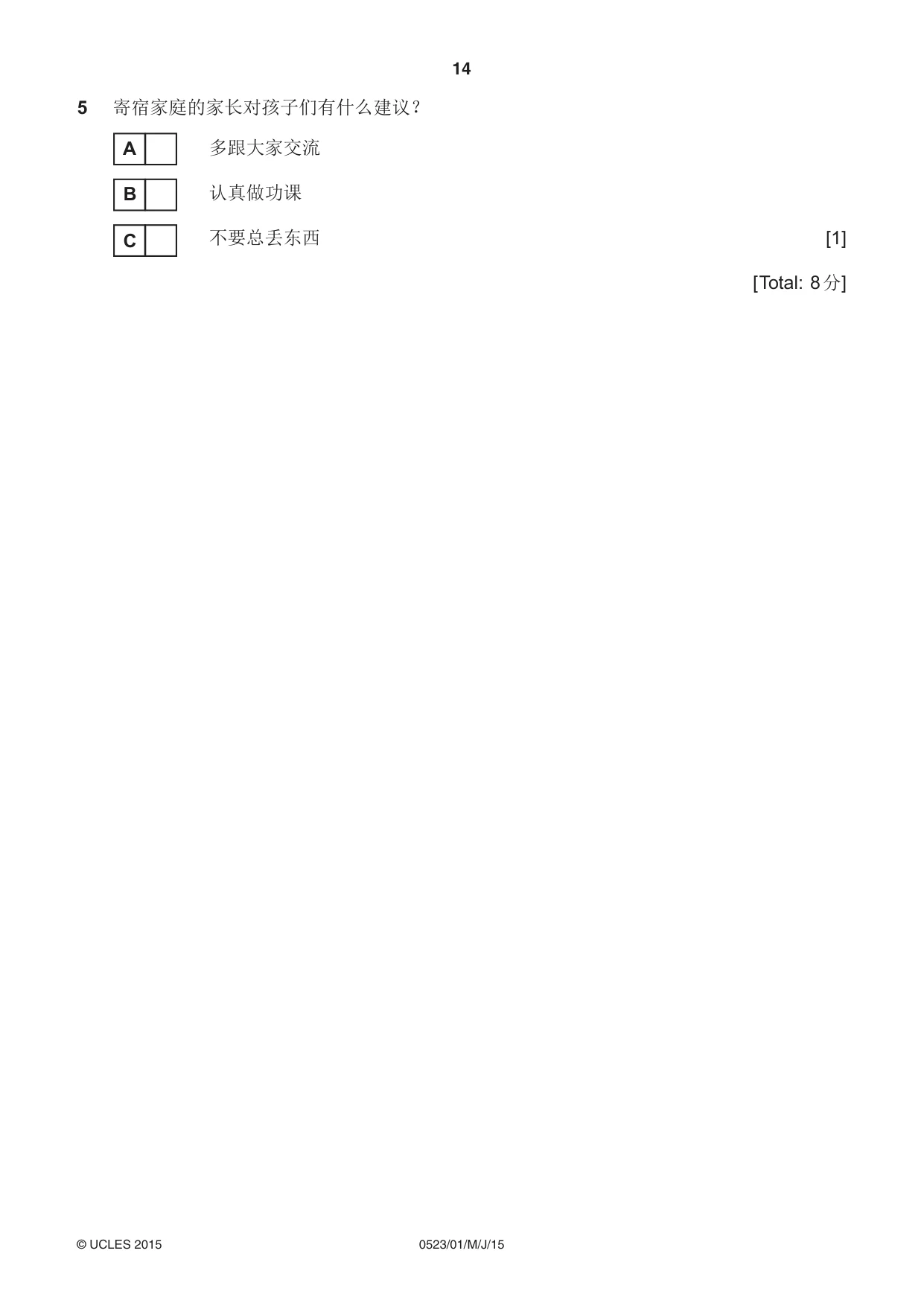
14 © UCLES 2015 0523/01/M/J/15 5 [1] [Total: 8 ] A B C
Question paper, page 15
15 [Turn over 0523/01/M/J/15 © UCLES 2015 [Please turn over for Exercise 2]
Question paper, page 16
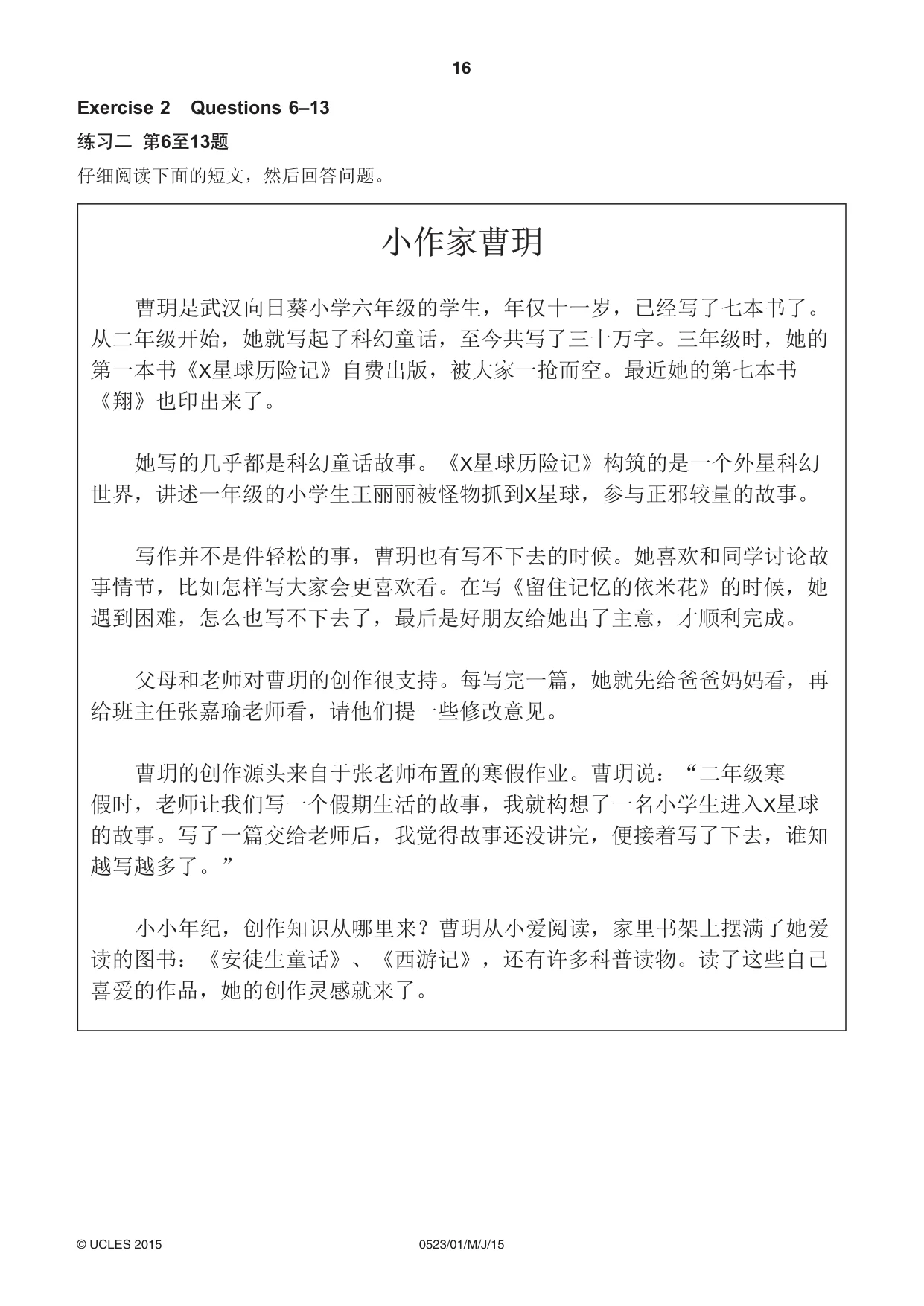
16 © UCLES 2015 0523/01/M/J/15 Exercise 2 Questions 6–13
Question paper, page 17
17 0523/01/M/J/15 © UCLES 2015 [1] [1] [1] [1] [3] [1] [1] [1] [Turn over 6 7 (i) (ii) 8 9 (i) (ii) 10 11 12 13 [Total: 10 ]
Question paper, page 18
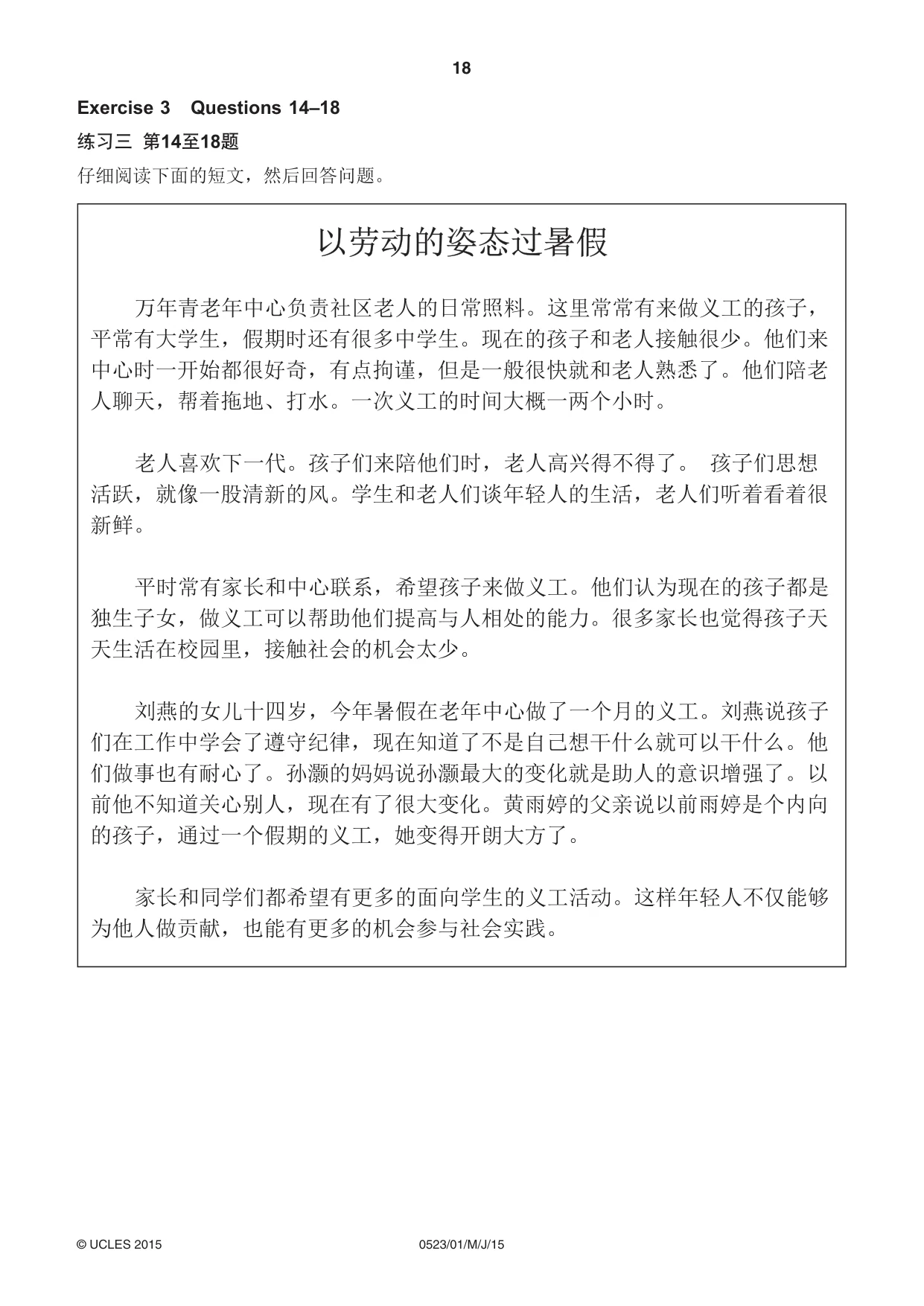
18 © UCLES 2015 0523/01/M/J/15 Exercise 3 Questions 14–18
Question paper, page 19
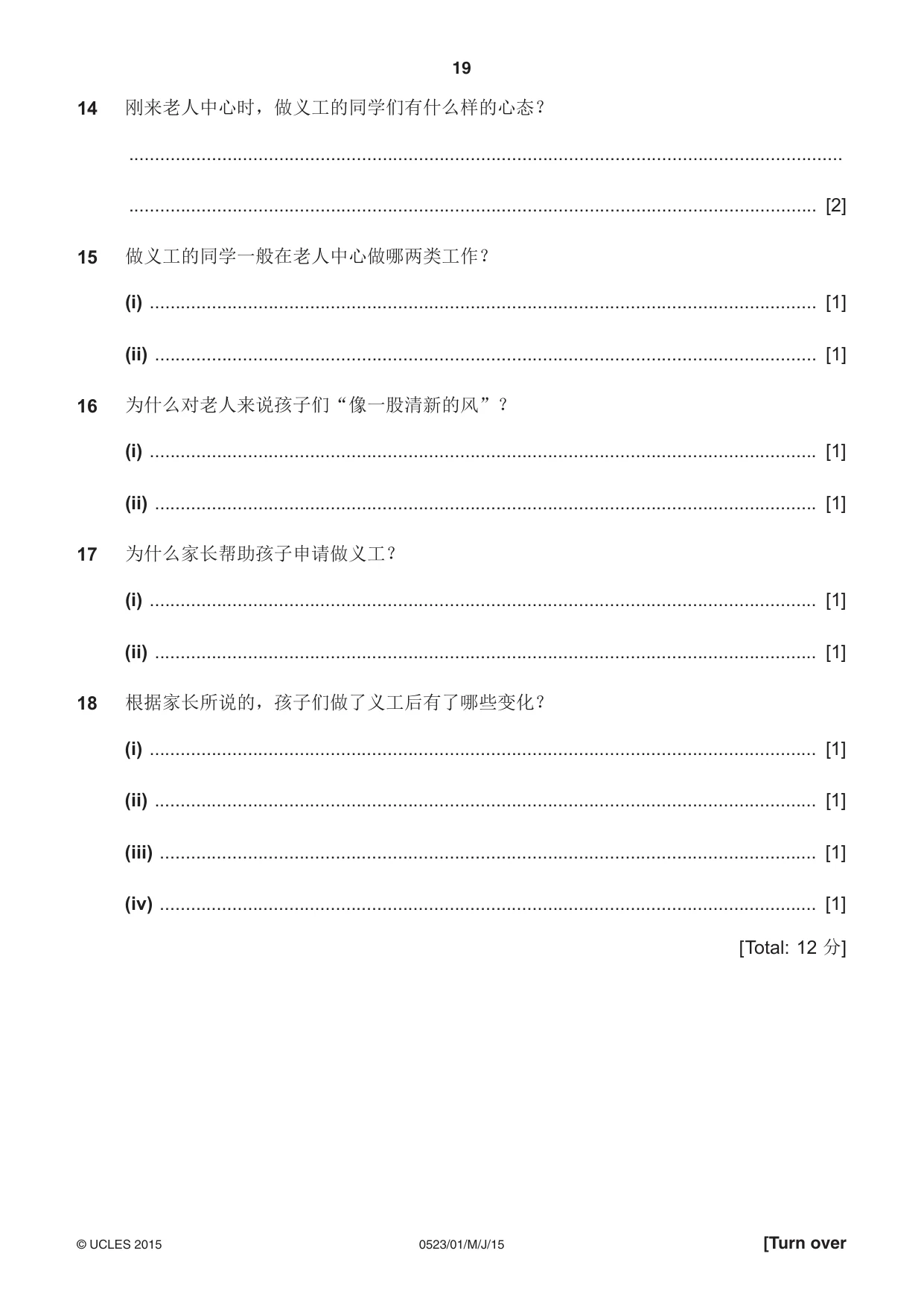
19 [Turn over 0523/01/M/J/15 © UCLES 2015 14 … … [2] 15 (i) … [1] (ii) … [1] 16 (i) … [1] (ii) … [1] 17 (i) … [1] (ii) … [1] 18 (i) … [1] (ii) … [1] (iii) … [1] (iv) … [1] [Total: 12 ]
Question paper, page 20
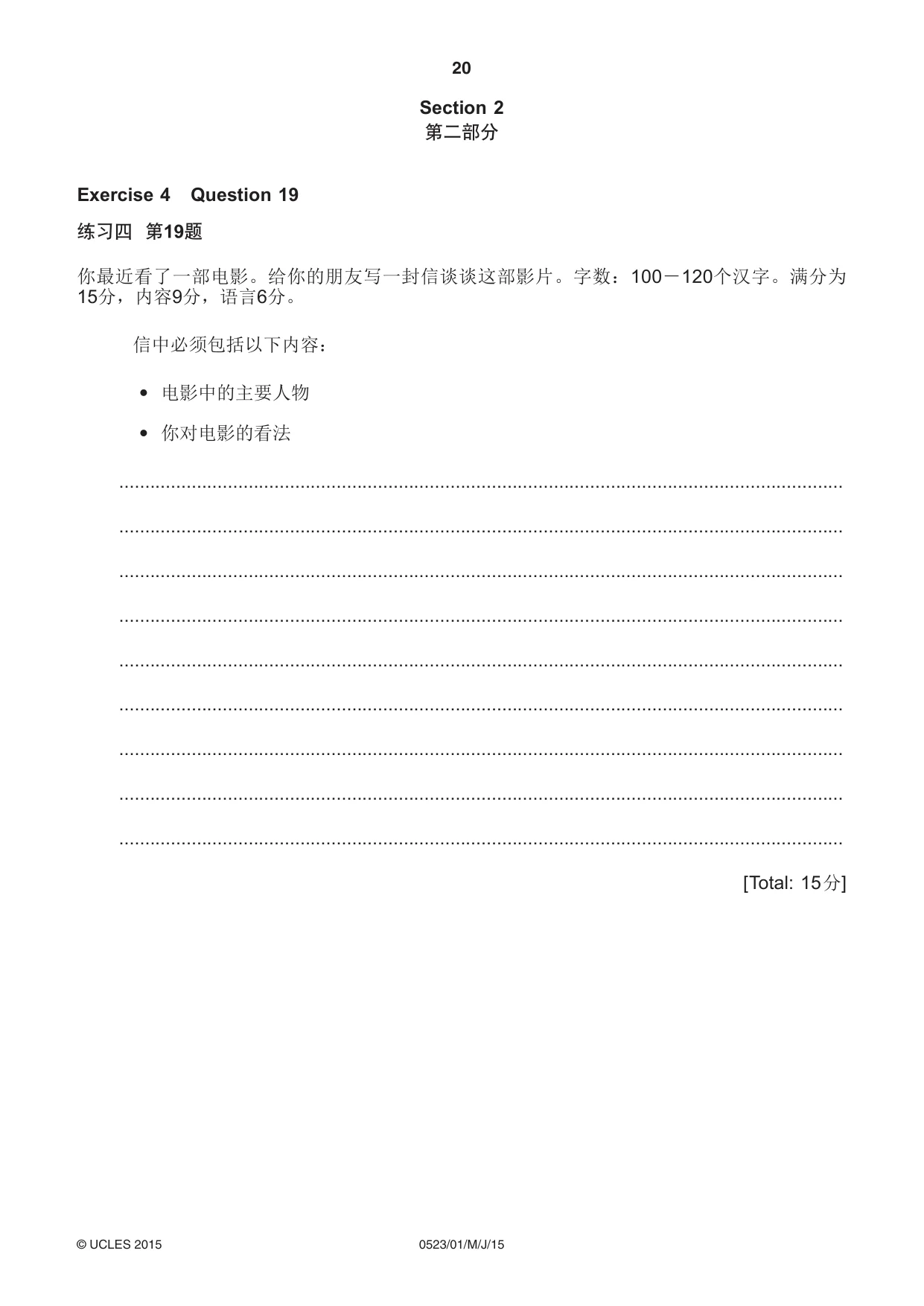
20 © UCLES 2015 0523/01/M/J/15 Section 2 Exercise 4 Question 19 … … … … … … … … … [Total: 15 ]
Question paper, page 21
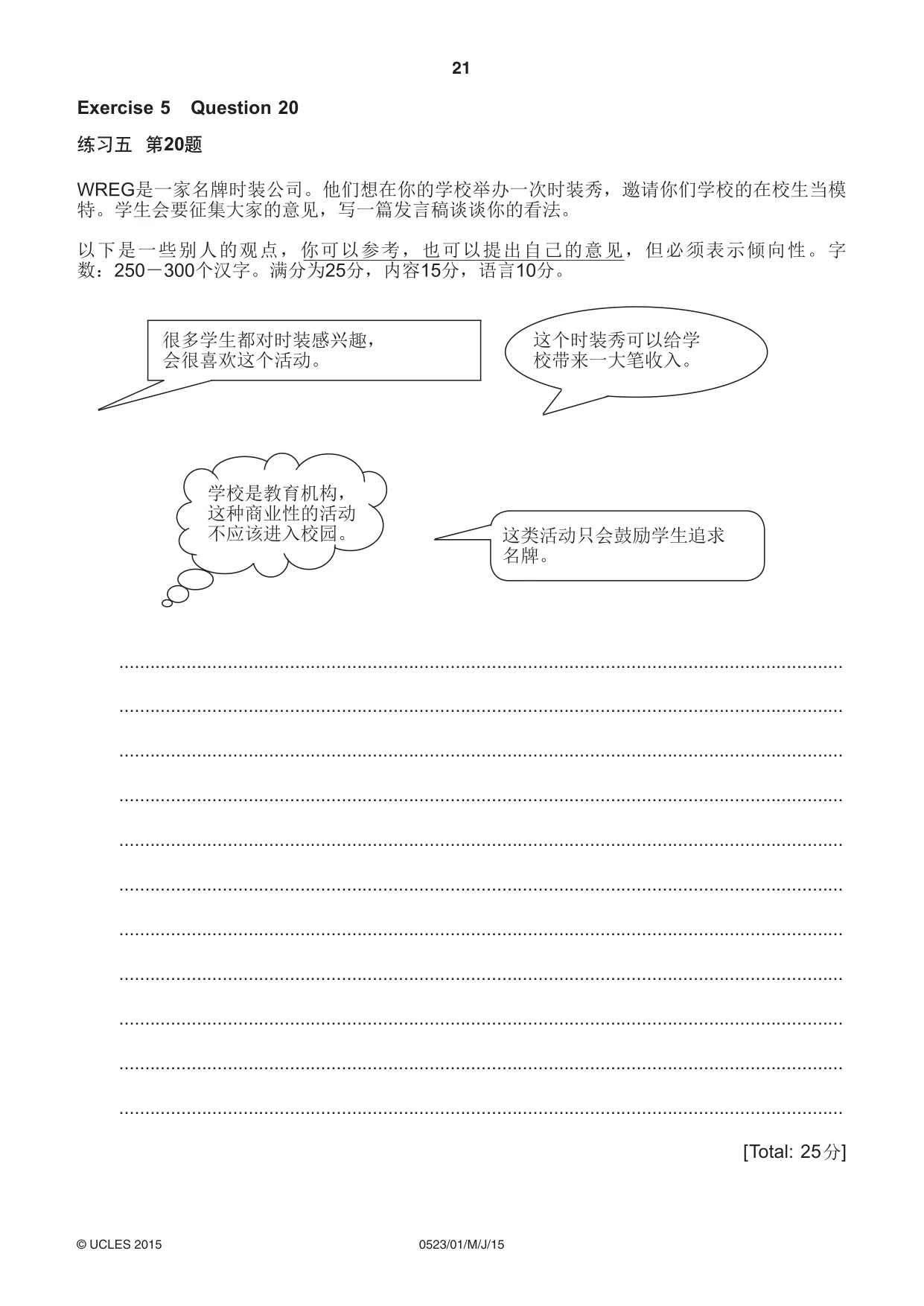
21 0523/01/M/J/15 © UCLES 2015 Exercise 5 Question 20 … … … … … … … … … … … [Total: 25 ] 20
Question paper, page 22
22 © UCLES 2015 0523/01/M/J/15 BLANK PAGE
Question paper, page 23
23 0523/01/M/J/15 © UCLES 2015 BLANK PAGE
Question paper, page 24
24 © UCLES 2015 0523/01/M/J/15 BLANK PAGE Permission to reproduce items where third-party owned material protected by copyright is included has been sought and cleared where possible. Every reasonable effort has been made by the publisher (UCLES) to trace copyright holders, but if any items requiring clearance have unwittingly been included, the publisher will be pleased to make amends at the earliest possible opportunity. To avoid the issue of disclosure of answer-related information to candidates, all copyright acknowledgements are reproduced online in the Cambridge International Examinations Copyright Acknowledgements Booklet. This is produced for each series of examinations and is freely available to download at www.cie.org.uk after the live examination series. Cambridge International Examinations is part of the Cambridge Assessment Group. Cambridge Assessment is the brand name of University of Cambridge Local Examinations Syndicate (UCLES), which is itself a department of the University of Cambridge.
Mark scheme, page 1
® IGCSE is the registered trademark of Cambridge International Examinations. CAMBRIDGE INTERNATIONAL EXAMINATIONS Cambridge International General Certificate of Secondary Education MARK SCHEME for the May/June 2015 series 0523 CHINESE AS A SECOND LANGUAGE 0523/01 Paper 1 (Reading and Writing), maximum raw mark 70 This mark scheme is published as an aid to teachers and candidates, to indicate the requirements of the examination. It shows the basis on which Examiners were instructed to award marks. It does not indicate the details of the discussions that took place at an Examiners’ meeting before marking began, which would have considered the acceptability of alternative answers. Mark schemes should be read in conjunction with the question paper and the Principal Examiner Report for Teachers. Cambridge will not enter into discussions about these mark schemes. Cambridge is publishing the mark schemes for the May/June 2015 series for most Cambridge IGCSE®, Cambridge International A and AS Level components and some Cambridge O Level components.
Mark scheme, page 2
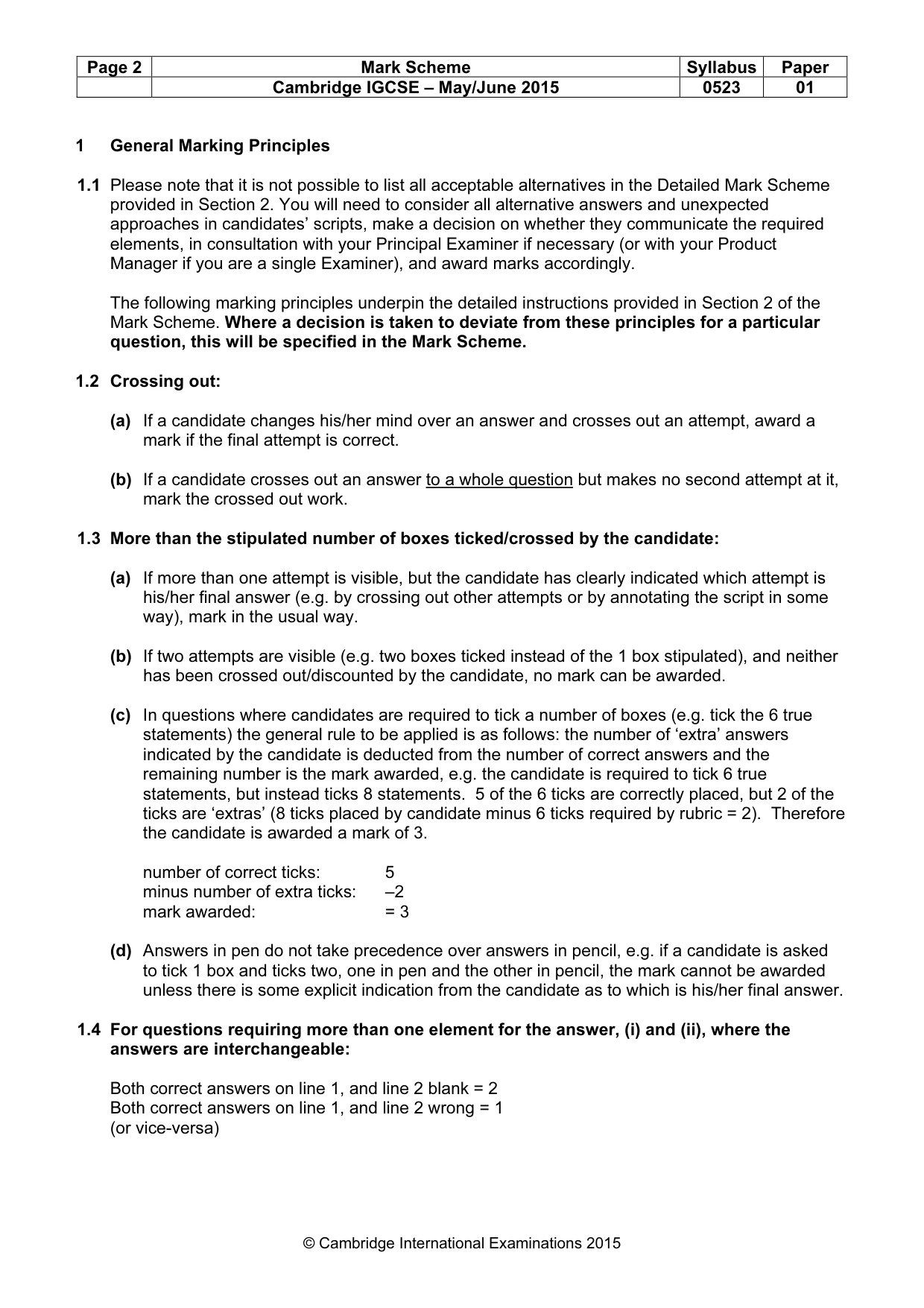
Page 2 Mark Scheme Syllabus Paper Cambridge IGCSE – May/June 2015 0523 01 © Cambridge International Examinations 2015 1 General Marking Principles 1.1 Please note that it is not possible to list all acceptable alternatives in the Detailed Mark Scheme provided in Section 2. You will need to consider all alternative answers and unexpected approaches in candidates’ scripts, make a decision on whether they communicate the required elements, in consultation with your Principal Examiner if necessary (or with your Product Manager if you are a single Examiner), and award marks accordingly. The following marking principles underpin the detailed instructions provided in Section 2 of the Mark Scheme. Where a decision is taken to deviate from these principles for a particular question, this will be specified in the Mark Scheme. 1.2 Crossing out: (a) If a candidate changes his/her mind over an answer and crosses out an attempt, award a mark if the final attempt is correct. (b) If a candidate crosses out an answer to a whole question but makes no second attempt at it, mark the crossed out work. 1.3 More than the stipulated number of boxes ticked/crossed by the candidate: (a) If more than one attempt is visible, but the candidate has clearly indicated which attempt is his/her final answer (e.g. by crossing out other attempts or by annotating the script in some way), mark in the usual way. (b) If two attempts are visible (e.g. two boxes ticked instead of the 1 box stipulated), and neither has been crossed out/discounted by the candidate, no mark can be awarded. (c) In questions where candidates are required to tick a number of boxes (e.g. tick the 6 true statements) the general rule to be applied is as follows: the number of ‘extra’ answers indicated by the candidate is deducted from the number of correct answers and the remaining number is the mark awarded, e.g. the candidate is required to tick 6 true statements, but instead ticks 8 statements. 5 of the 6 ticks are correctly placed, but 2 of the ticks are ‘extras’ (8 ticks placed by candidate minus 6 ticks required by rubric = 2). Therefore the candidate is awarded a mark of 3. number of correct ticks: 5 minus number of extra ticks: –2 mark awarded: = 3 (d) Answers in pen do not take precedence over answers in pencil, e.g. if a candidate is asked to tick 1 box and ticks two, one in pen and the other in pencil, the mark cannot be awarded unless there is some explicit indication from the candidate as to which is his/her final answer. 1.4 For questions requiring more than one element for the answer, (i) and (ii), where the answers are interchangeable: Both correct answers on line 1, and line 2 blank = 2 Both correct answers on line 1, and line 2 wrong = 1 (or vice-versa)
Mark scheme, page 3
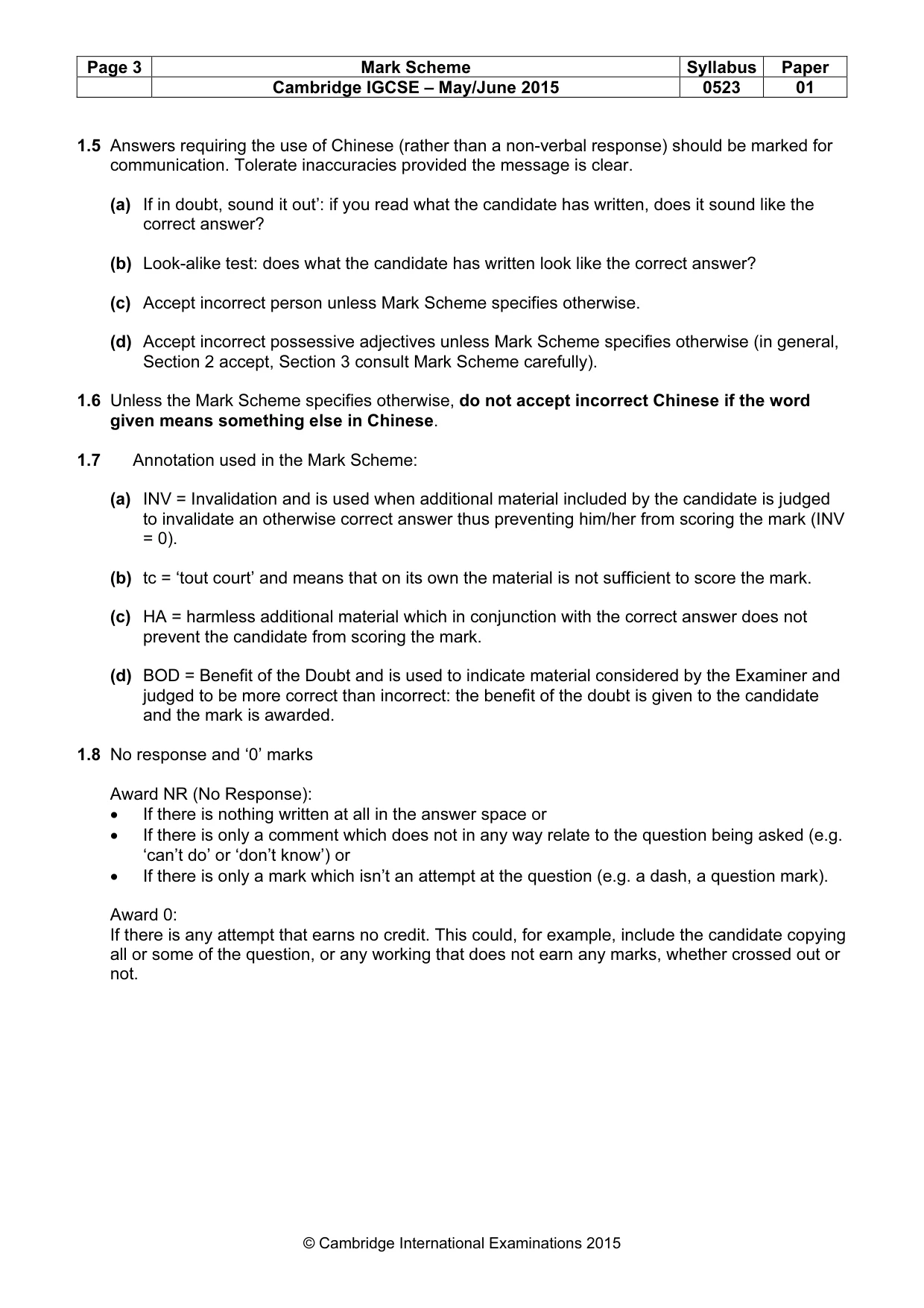
Page 3 Mark Scheme Syllabus Paper Cambridge IGCSE – May/June 2015 0523 01 © Cambridge International Examinations 2015 1.5 Answers requiring the use of Chinese (rather than a non-verbal response) should be marked for communication. Tolerate inaccuracies provided the message is clear. (a) If in doubt, sound it out’: if you read what the candidate has written, does it sound like the correct answer? (b) Look-alike test: does what the candidate has written look like the correct answer? (c) Accept incorrect person unless Mark Scheme specifies otherwise. (d) Accept incorrect possessive adjectives unless Mark Scheme specifies otherwise (in general, Section 2 accept, Section 3 consult Mark Scheme carefully). 1.6 Unless the Mark Scheme specifies otherwise, do not accept incorrect Chinese if the word given means something else in Chinese. 1.7 Annotation used in the Mark Scheme: (a) INV = Invalidation and is used when additional material included by the candidate is judged to invalidate an otherwise correct answer thus preventing him/her from scoring the mark (INV = 0). (b) tc = ‘tout court’ and means that on its own the material is not sufficient to score the mark. (c) HA = harmless additional material which in conjunction with the correct answer does not prevent the candidate from scoring the mark. (d) BOD = Benefit of the Doubt and is used to indicate material considered by the Examiner and judged to be more correct than incorrect: the benefit of the doubt is given to the candidate and the mark is awarded. 1.8 No response and ‘0’ marks Award NR (No Response): • If there is nothing written at all in the answer space or • If there is only a comment which does not in any way relate to the question being asked (e.g. ‘can’t do’ or ‘don’t know’) or • If there is only a mark which isn’t an attempt at the question (e.g. a dash, a question mark). Award 0: If there is any attempt that earns no credit. This could, for example, include the candidate copying all or some of the question, or any working that does not earn any marks, whether crossed out or not.
Mark scheme, page 4
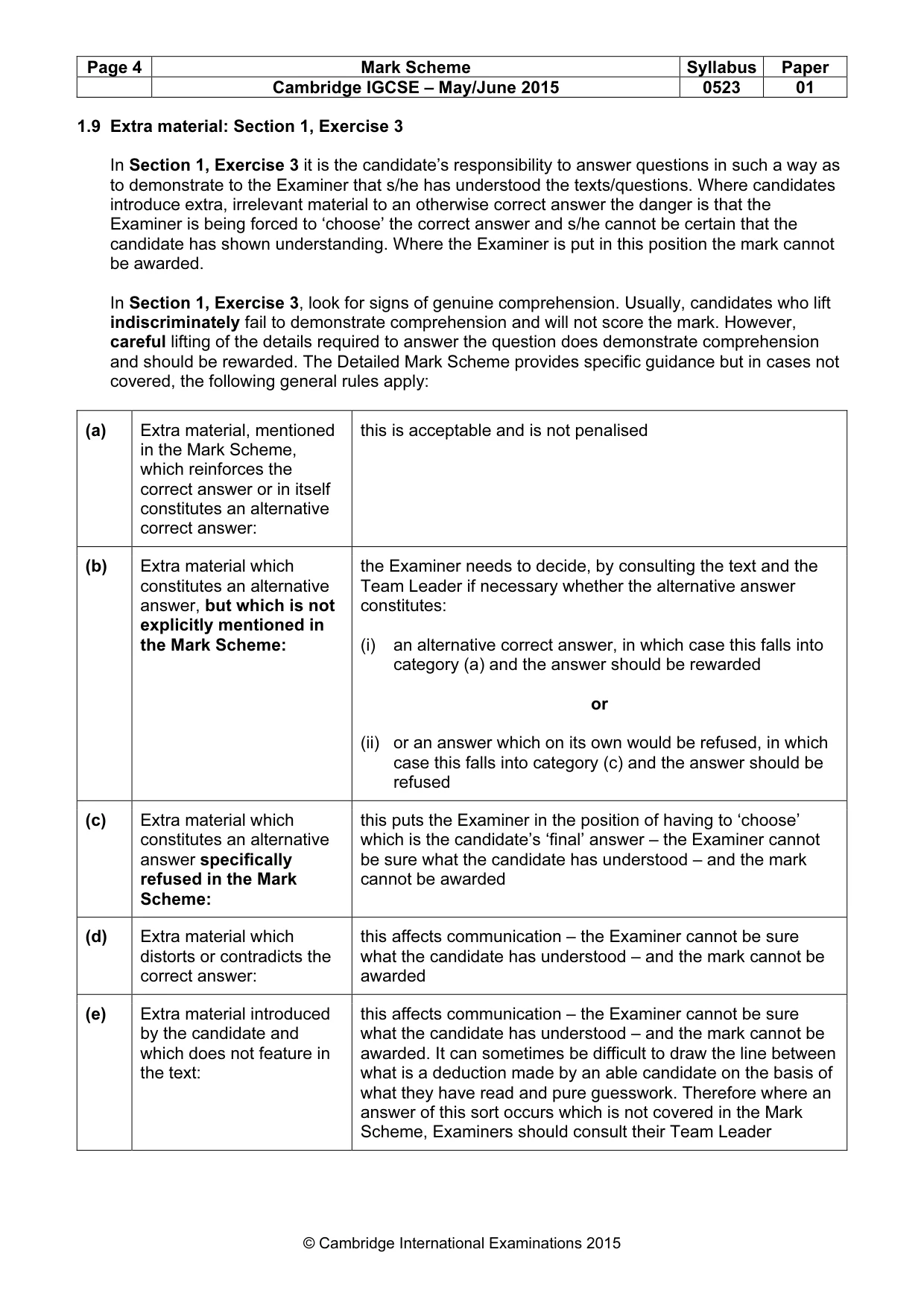
Page 4 Mark Scheme Syllabus Paper Cambridge IGCSE – May/June 2015 0523 01 © Cambridge International Examinations 2015 1.9 Extra material: Section 1, Exercise 3 In Section 1, Exercise 3 it is the candidate’s responsibility to answer questions in such a way as to demonstrate to the Examiner that s/he has understood the texts/questions. Where candidates introduce extra, irrelevant material to an otherwise correct answer the danger is that the Examiner is being forced to ‘choose’ the correct answer and s/he cannot be certain that the candidate has shown understanding. Where the Examiner is put in this position the mark cannot be awarded. In Section 1, Exercise 3, look for signs of genuine comprehension. Usually, candidates who lift indiscriminately fail to demonstrate comprehension and will not score the mark. However, careful lifting of the details required to answer the question does demonstrate comprehension and should be rewarded. The Detailed Mark Scheme provides specific guidance but in cases not covered, the following general rules apply: (a) Extra material, mentioned in the Mark Scheme, which reinforces the correct answer or in itself constitutes an alternative correct answer: this is acceptable and is not penalised (b) Extra material which constitutes an alternative answer, but which is not explicitly mentioned in the Mark Scheme: the Examiner needs to decide, by consulting the text and the Team Leader if necessary whether the alternative answer constitutes: (i) an alternative correct answer, in which case this falls into category (a) and the answer should be rewarded or (ii) or an answer which on its own would be refused, in which case this falls into category (c) and the answer should be refused (c) Extra material which constitutes an alternative answer specifically refused in the Mark Scheme: this puts the Examiner in the position of having to ‘choose’ which is the candidate’s ‘final’ answer – the Examiner cannot be sure what the candidate has understood – and the mark cannot be awarded (d) Extra material which distorts or contradicts the correct answer: this affects communication – the Examiner cannot be sure what the candidate has understood – and the mark cannot be awarded (e) Extra material introduced by the candidate and which does not feature in the text: this affects communication – the Examiner cannot be sure what the candidate has understood – and the mark cannot be awarded. It can sometimes be difficult to draw the line between what is a deduction made by an able candidate on the basis of what they have read and pure guesswork. Therefore where an answer of this sort occurs which is not covered in the Mark Scheme, Examiners should consult their Team Leader
Mark scheme, page 5
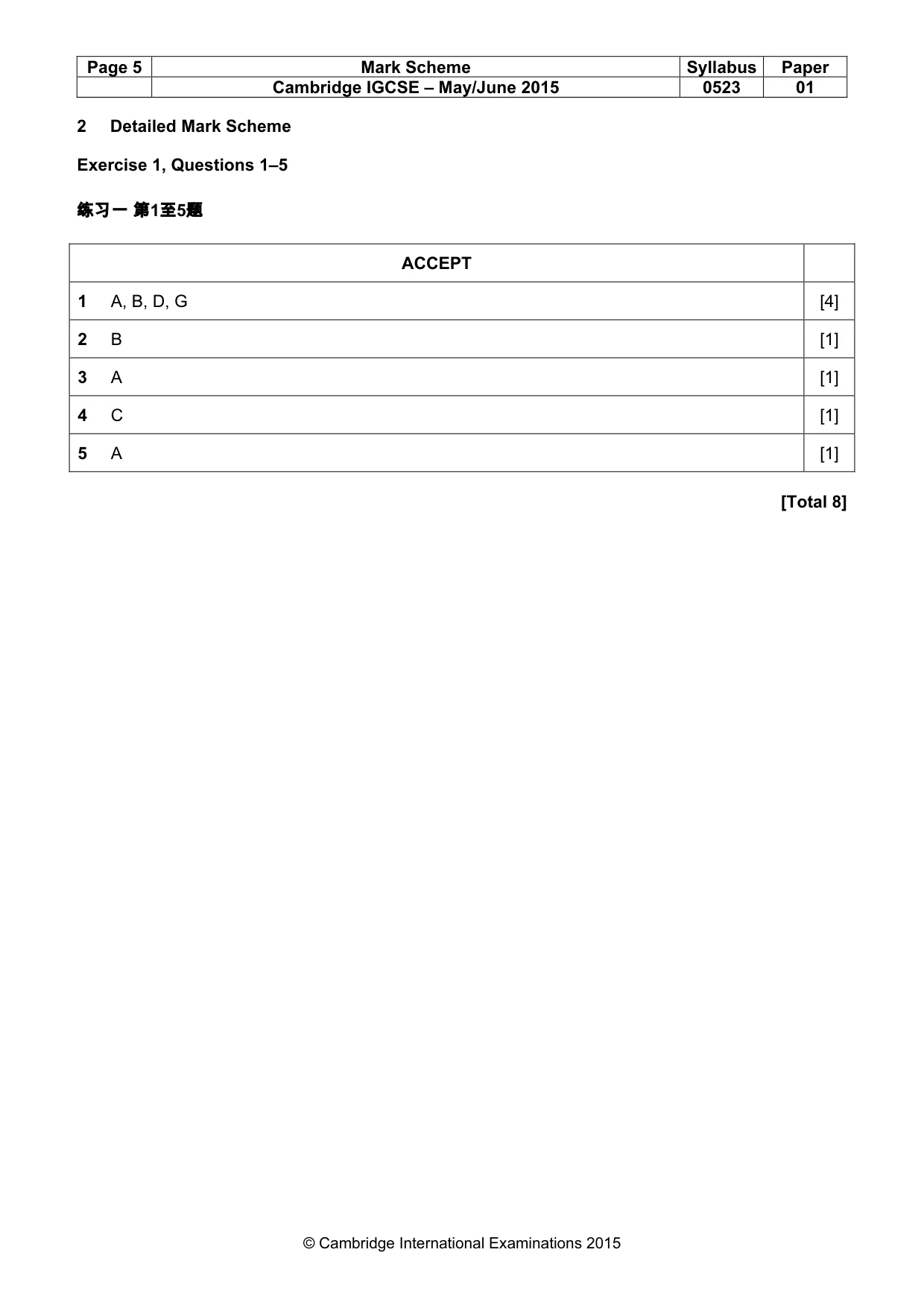
Page 5 Mark Scheme Syllabus Paper Cambridge IGCSE – May/June 2015 0523 01 © Cambridge International Examinations 2015 2 Detailed Mark Scheme Exercise 1, Questions 1–5 练习一 第1至5题 ACCEPT 1 A, B, D, G [4] 2 B [1] 3 A [1] 4 C [1] 5 A [1] [Total 8]
Mark scheme, page 6
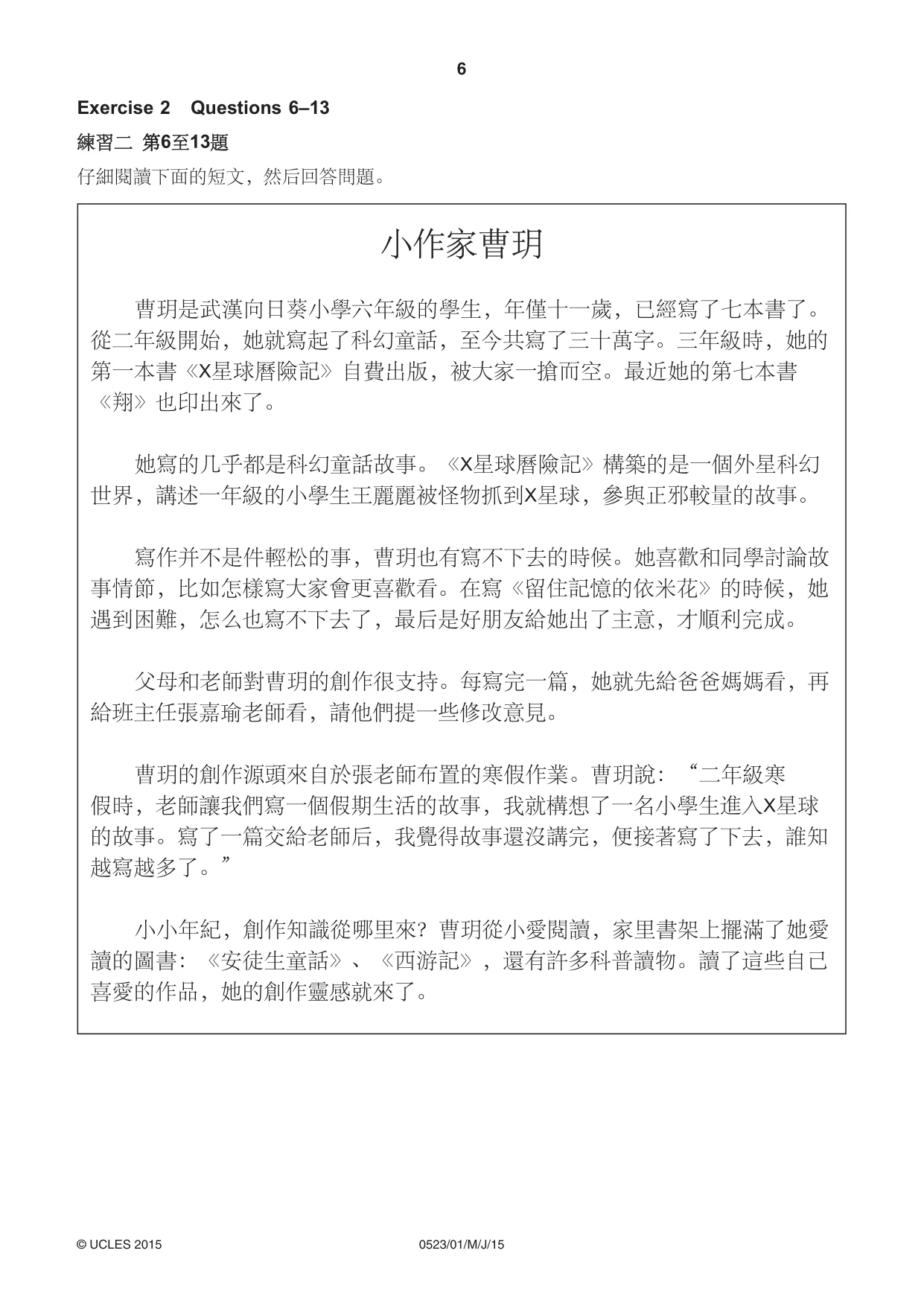
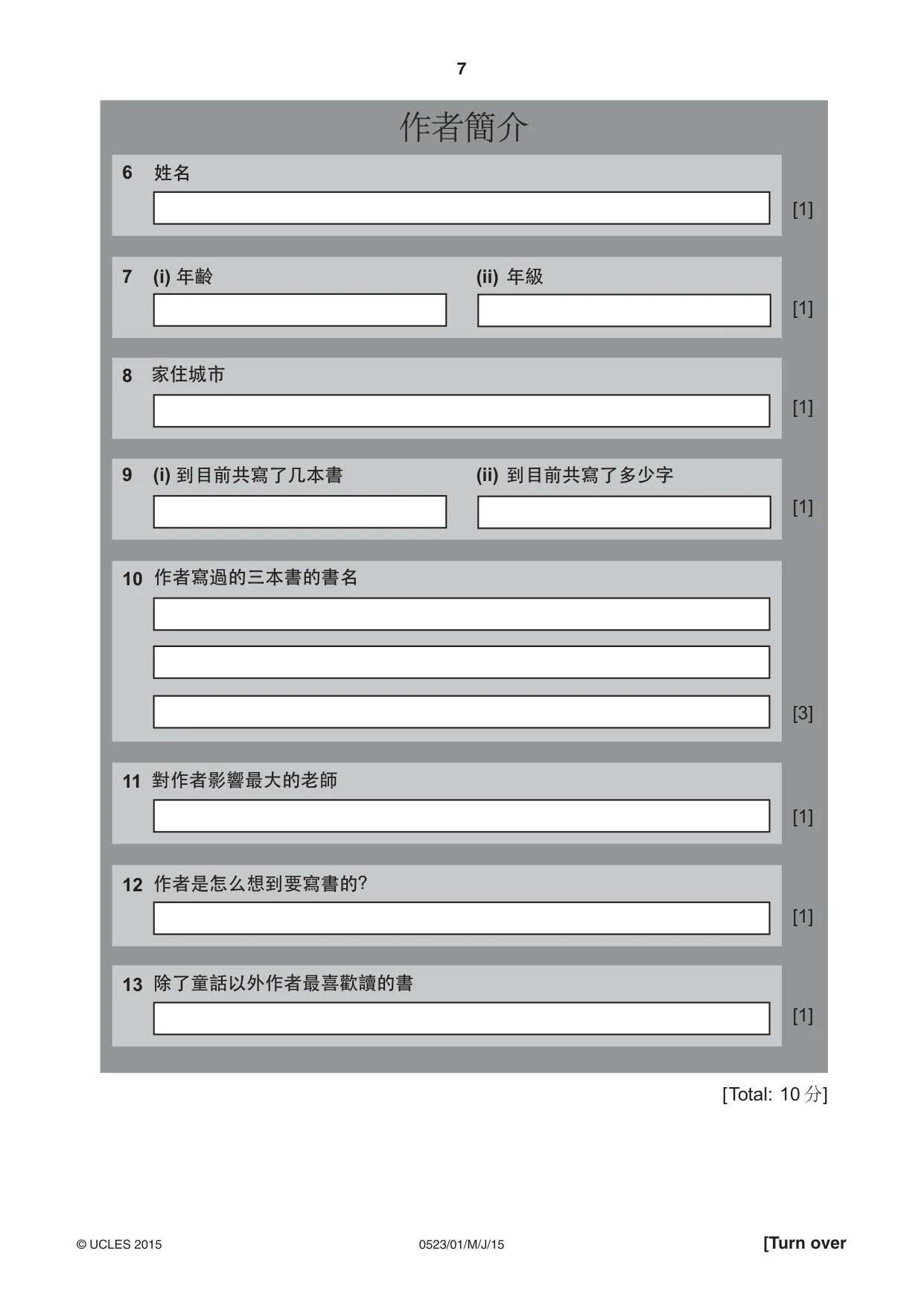
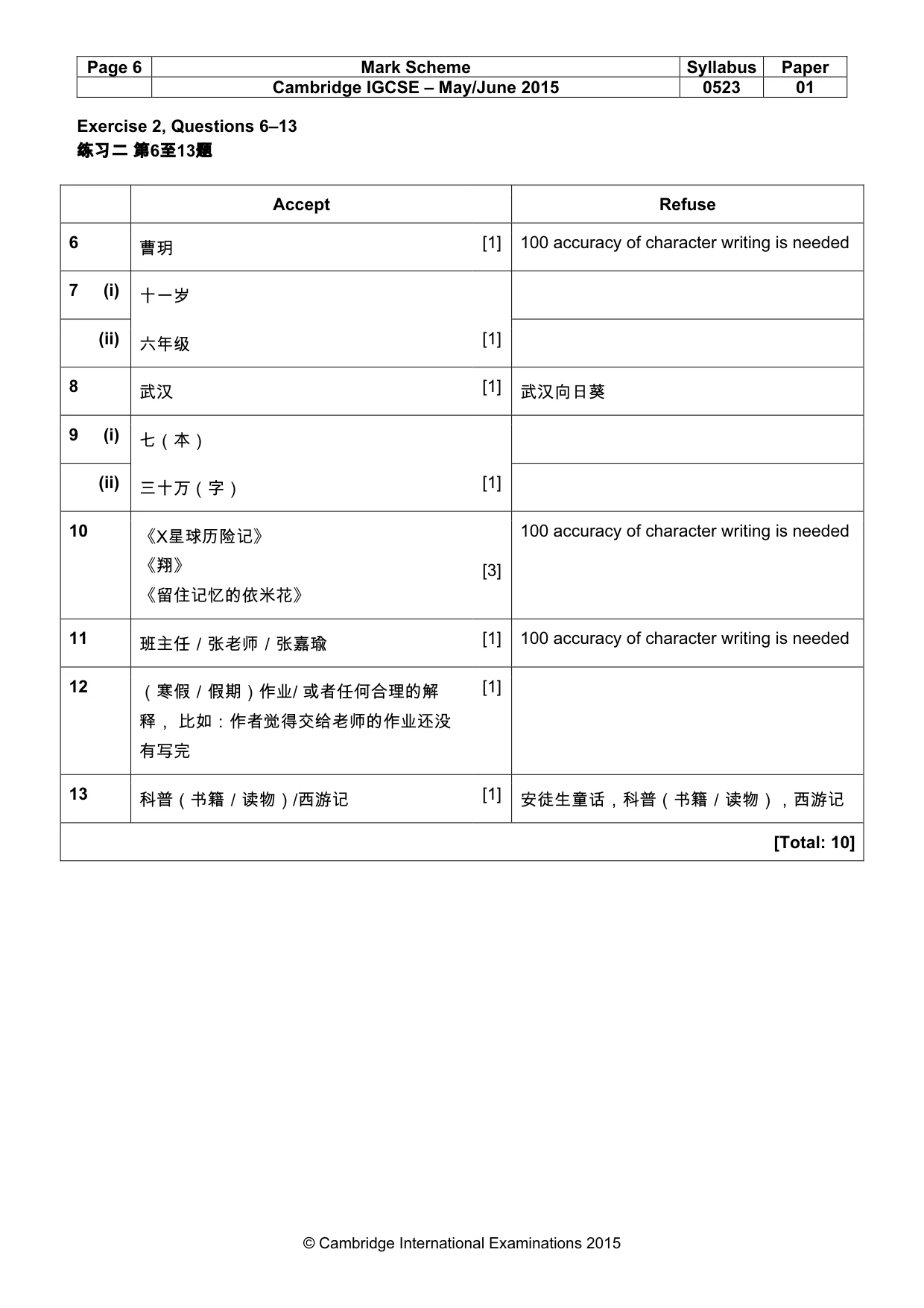
Page 6 Mark Scheme Syllabus Paper Cambridge IGCSE – May/June 2015 0523 01 © Cambridge International Examinations 2015 Exercise 2, Questions 6–13 练习二 第6至13题 Accept Refuse 6 曹玥 [1] 100 accuracy of character writing is needed 7 (i) 十一岁 (ii) 六年级 [1] 8 武汉 [1] 武汉向日葵 9 (i) 七(本) (ii) 三十万(字) [1] 10 《X星球历险记》 《翔》 《留住记忆的依米花》 [3] 100 accuracy of character writing is needed 11 班主任/张老师/张嘉瑜 [1] 100 accuracy of character writing is needed 12 (寒假/假期)作业/ 或者任何合理的解 释, 比如:作者觉得交给老师的作业还没 有写完 [1] 13 科普(书籍/读物)/西游记 [1] 安徒生童话,科普(书籍/读物),西游记 [Total: 10]
Mark scheme, page 7
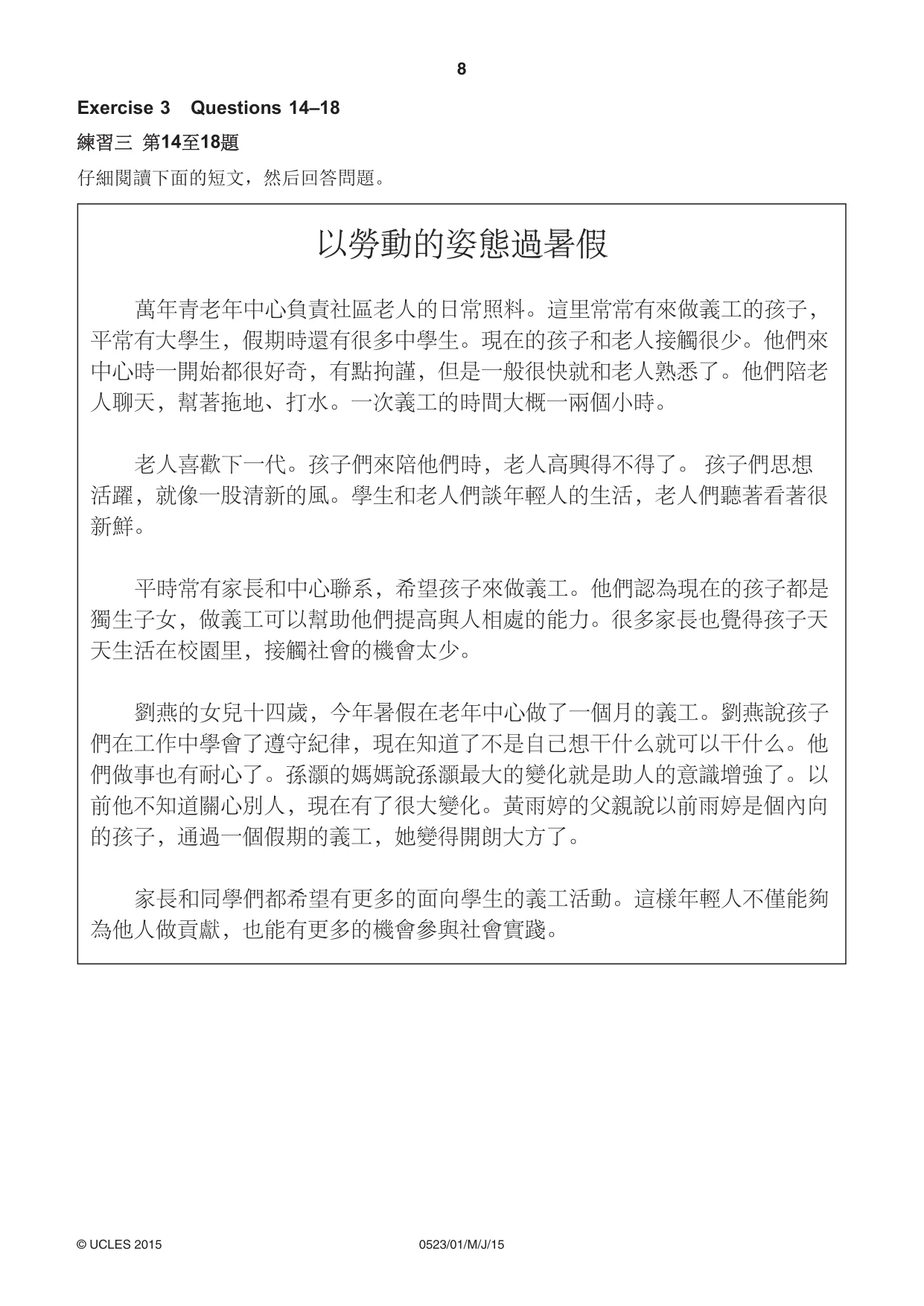
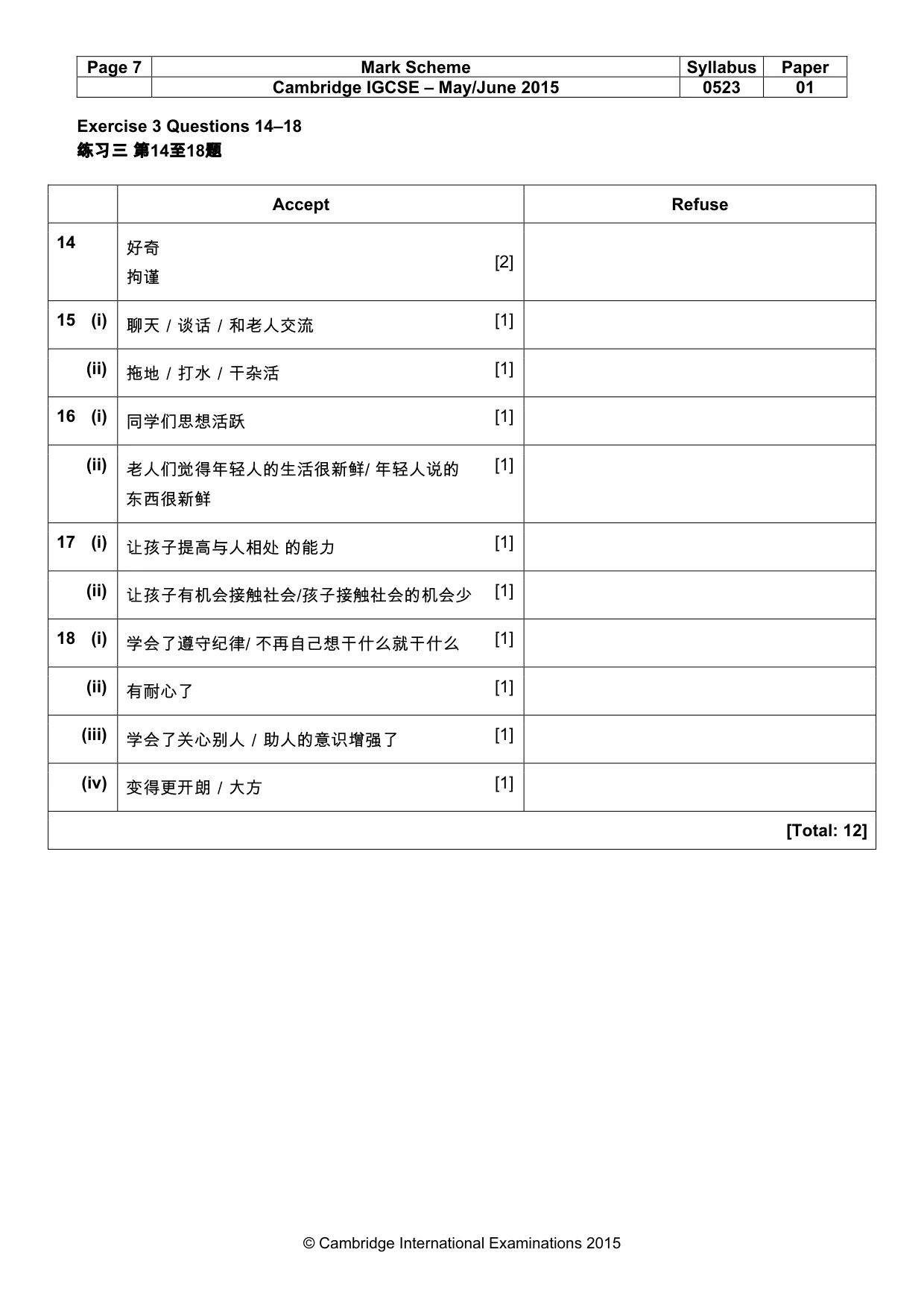
Page 7 Mark Scheme Syllabus Paper Cambridge IGCSE – May/June 2015 0523 01 © Cambridge International Examinations 2015 Exercise 3 Questions 14–18 练习三 第14至18题 Accept Refuse 14 好奇 拘谨 [2] 15 (i) 聊天/谈话/和老人交流 [1] (ii) 拖地/打水/干杂活 [1] 16 (i) 同学们思想活跃 [1] (ii) 老人们觉得年轻人的生活很新鲜/ 年轻人说的 东西很新鲜 [1] 17 (i) 让孩子提高与人相处 的能力 [1] (ii) 让孩子有机会接触社会/孩子接触社会的机会少 [1] 18 (i) 学会了遵守纪律/ 不再自己想干什么就干什么 [1] (ii) 有耐心了 [1] (iii) 学会了关心别人/助人的意识增强了 [1] (iv) 变得更开朗/大方 [1] [Total: 12]
Mark scheme, page 8
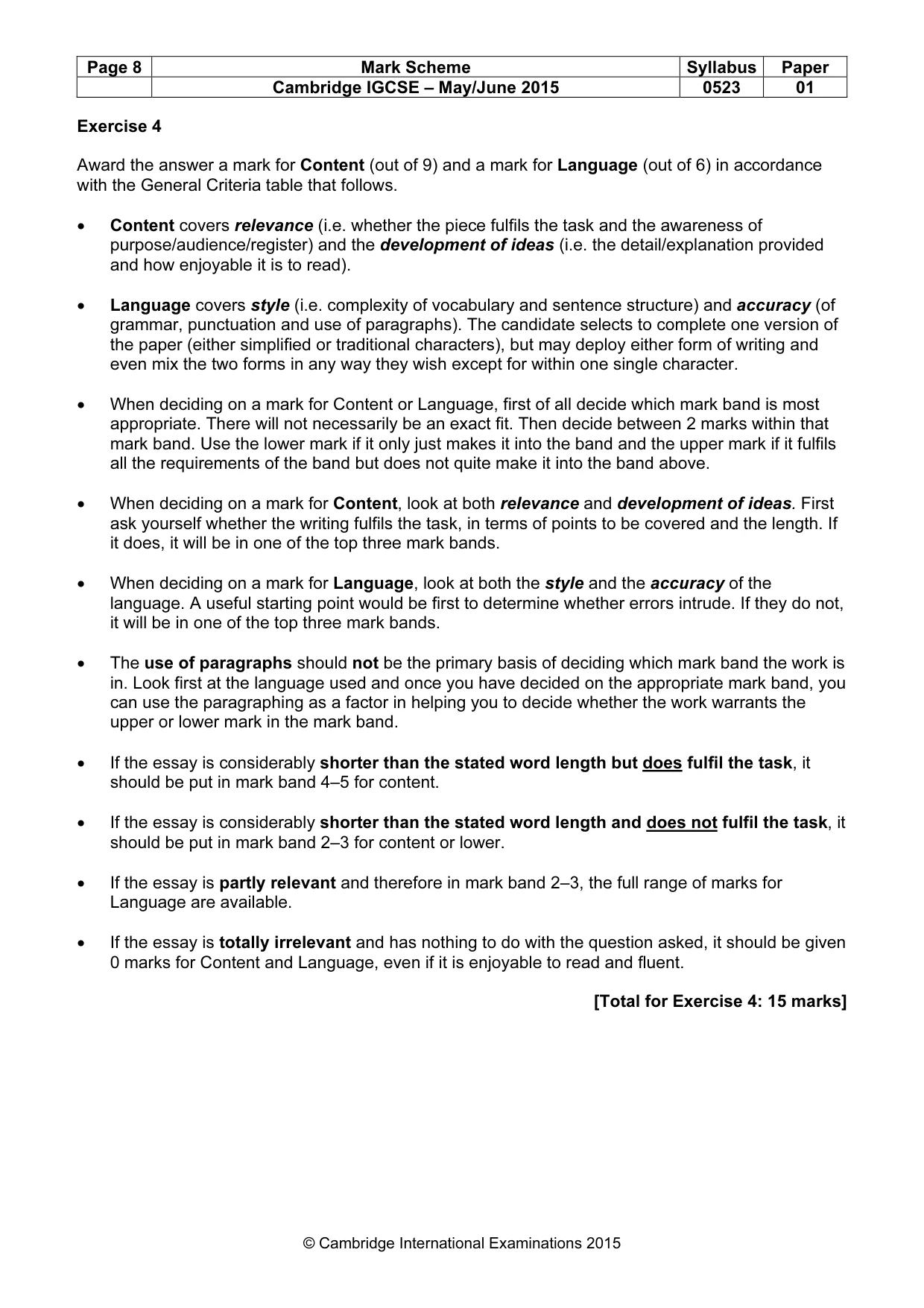
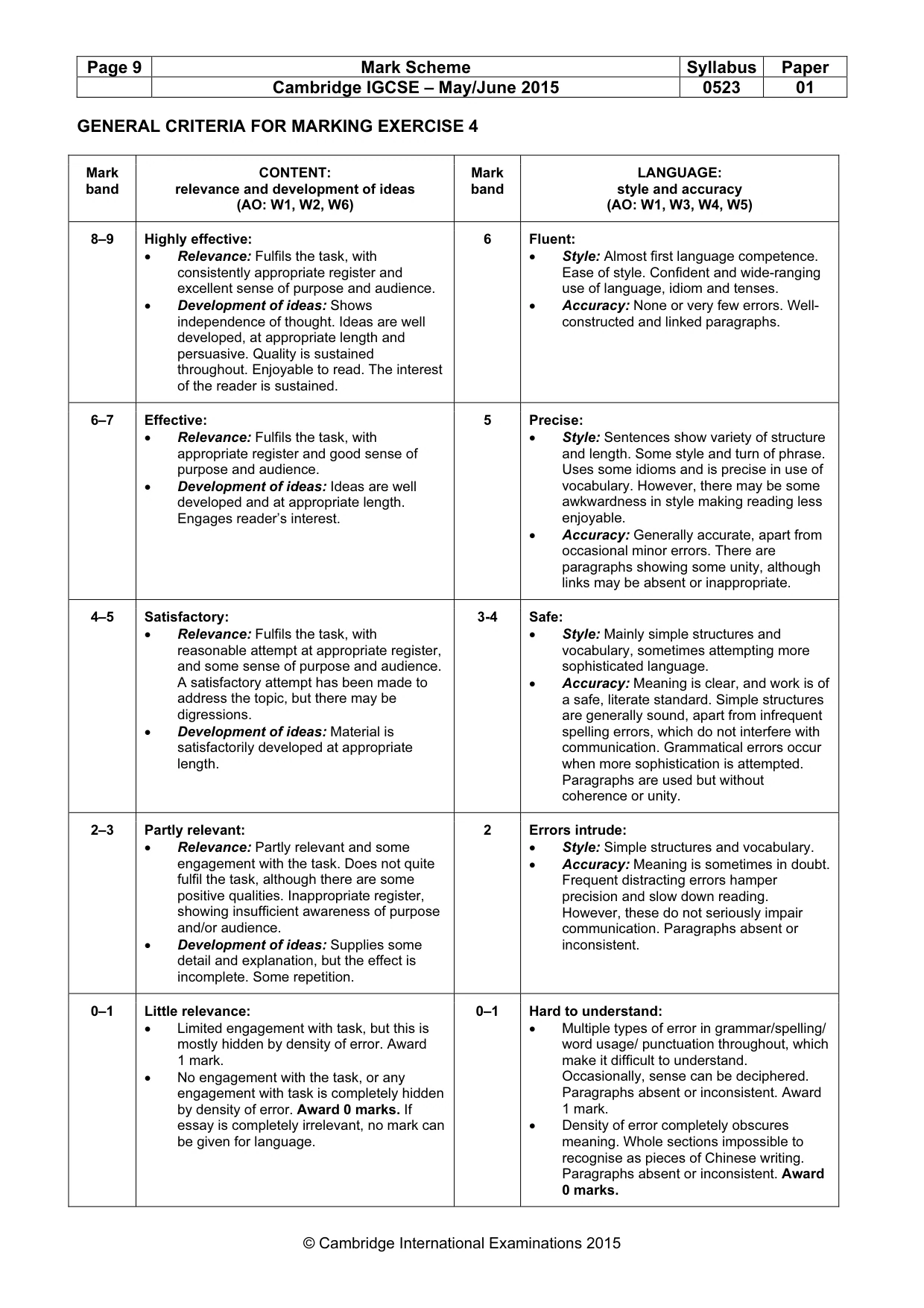
Page 8 Mark Scheme Syllabus Paper Cambridge IGCSE – May/June 2015 0523 01 © Cambridge International Examinations 2015 Exercise 4 Award the answer a mark for Content (out of 9) and a mark for Language (out of 6) in accordance with the General Criteria table that follows. • Content covers relevance (i.e. whether the piece fulfils the task and the awareness of purpose/audience/register) and the development of ideas (i.e. the detail/explanation provided and how enjoyable it is to read). • Language covers style (i.e. complexity of vocabulary and sentence structure) and accuracy (of grammar, punctuation and use of paragraphs). The candidate selects to complete one version of the paper (either simplified or traditional characters), but may deploy either form of writing and even mix the two forms in any way they wish except for within one single character. • When deciding on a mark for Content or Language, first of all decide which mark band is most appropriate. There will not necessarily be an exact fit. Then decide between 2 marks within that mark band. Use the lower mark if it only just makes it into the band and the upper mark if it fulfils all the requirements of the band but does not quite make it into the band above. • When deciding on a mark for Content, look at both relevance and development of ideas. First ask yourself whether the writing fulfils the task, in terms of points to be covered and the length. If it does, it will be in one of the top three mark bands. • When deciding on a mark for Language, look at both the style and the accuracy of the language. A useful starting point would be first to determine whether errors intrude. If they do not, it will be in one of the top three mark bands. • The use of paragraphs should not be the primary basis of deciding which mark band the work is in. Look first at the language used and once you have decided on the appropriate mark band, you can use the paragraphing as a factor in helping you to decide whether the work warrants the upper or lower mark in the mark band. • If the essay is considerably shorter than the stated word length but does fulfil the task, it should be put in mark band 4–5 for content. • If the essay is considerably shorter than the stated word length and does not fulfil the task, it should be put in mark band 2–3 for content or lower. • If the essay is partly relevant and therefore in mark band 2–3, the full range of marks for Language are available. • If the essay is totally irrelevant and has nothing to do with the question asked, it should be given 0 marks for Content and Language, even if it is enjoyable to read and fluent. [Total for Exercise 4: 15 marks]
Mark scheme, page 9
Page 9 Mark Scheme Syllabus Paper Cambridge IGCSE – May/June 2015 0523 01 © Cambridge International Examinations 2015 GENERAL CRITERIA FOR MARKING EXERCISE 4 Mark band CONTENT: relevance and development of ideas (AO: W1, W2, W6) Mark band LANGUAGE: style and accuracy (AO: W1, W3, W4, W5) 8–9 Highly effective: • Relevance: Fulfils the task, with consistently appropriate register and excellent sense of purpose and audience. • Development of ideas: Shows independence of thought. Ideas are well developed, at appropriate length and persuasive. Quality is sustained throughout. Enjoyable to read. The interest of the reader is sustained. 6 Fluent: • Style: Almost first language competence. Ease of style. Confident and wide-ranging use of language, idiom and tenses. • Accuracy: None or very few errors. Well- constructed and linked paragraphs. 6–7 Effective: • Relevance: Fulfils the task, with appropriate register and good sense of purpose and audience. • Development of ideas: Ideas are well developed and at appropriate length. Engages reader’s interest. 5 Precise: • Style: Sentences show variety of structure and length. Some style and turn of phrase. Uses some idioms and is precise in use of vocabulary. However, there may be some awkwardness in style making reading less enjoyable. • Accuracy: Generally accurate, apart from occasional minor errors. There are paragraphs showing some unity, although links may be absent or inappropriate. 4–5 Satisfactory: • Relevance: Fulfils the task, with reasonable attempt at appropriate register, and some sense of purpose and audience. A satisfactory attempt has been made to address the topic, but there may be digressions. • Development of ideas: Material is satisfactorily developed at appropriate length. 3-4 Safe: • Style: Mainly simple structures and vocabulary, sometimes attempting more sophisticated language. • Accuracy: Meaning is clear, and work is of a safe, literate standard. Simple structures are generally sound, apart from infrequent spelling errors, which do not interfere with communication. Grammatical errors occur when more sophistication is attempted. Paragraphs are used but without coherence or unity. 2–3 Partly relevant: • Relevance: Partly relevant and some engagement with the task. Does not quite fulfil the task, although there are some positive qualities. Inappropriate register, showing insufficient awareness of purpose and/or audience. • Development of ideas: Supplies some detail and explanation, but the effect is incomplete. Some repetition. 2 Errors intrude: • Style: Simple structures and vocabulary. • Accuracy: Meaning is sometimes in doubt. Frequent distracting errors hamper precision and slow down reading. However, these do not seriously impair communication. Paragraphs absent or inconsistent. 0–1 Little relevance: • Limited engagement with task, but this is mostly hidden by density of error. Award 1 mark. • No engagement with the task, or any engagement with task is completely hidden by density of error. Award 0 marks. If essay is completely irrelevant, no mark can be given for language. 0–1 Hard to understand: • Multiple types of error in grammar/spelling/ word usage/ punctuation throughout, which make it difficult to understand. Occasionally, sense can be deciphered. Paragraphs absent or inconsistent. Award 1 mark. • Density of error completely obscures meaning. Whole sections impossible to recognise as pieces of Chinese writing. Paragraphs absent or inconsistent. Award 0 marks.
Mark scheme, page 10
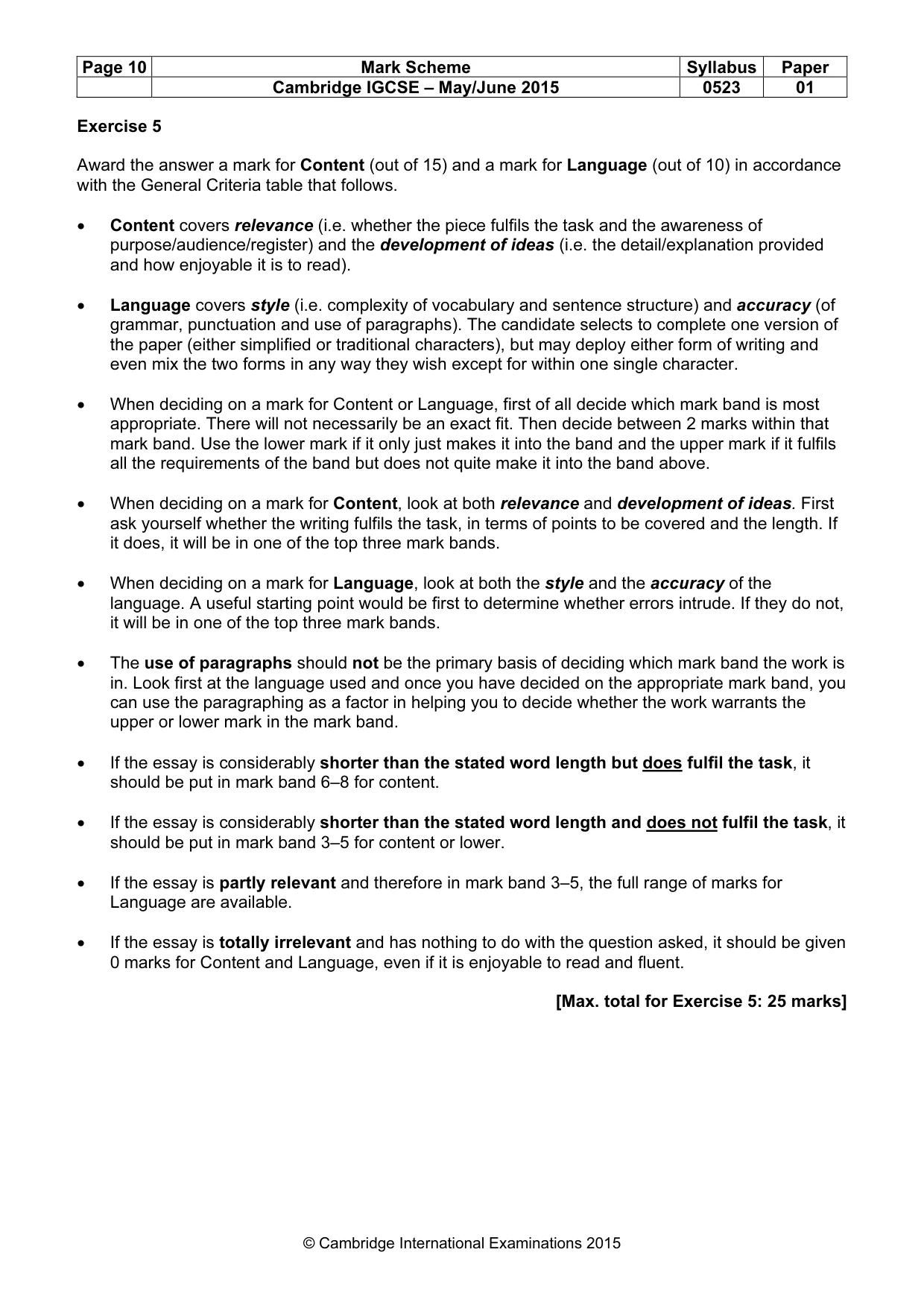
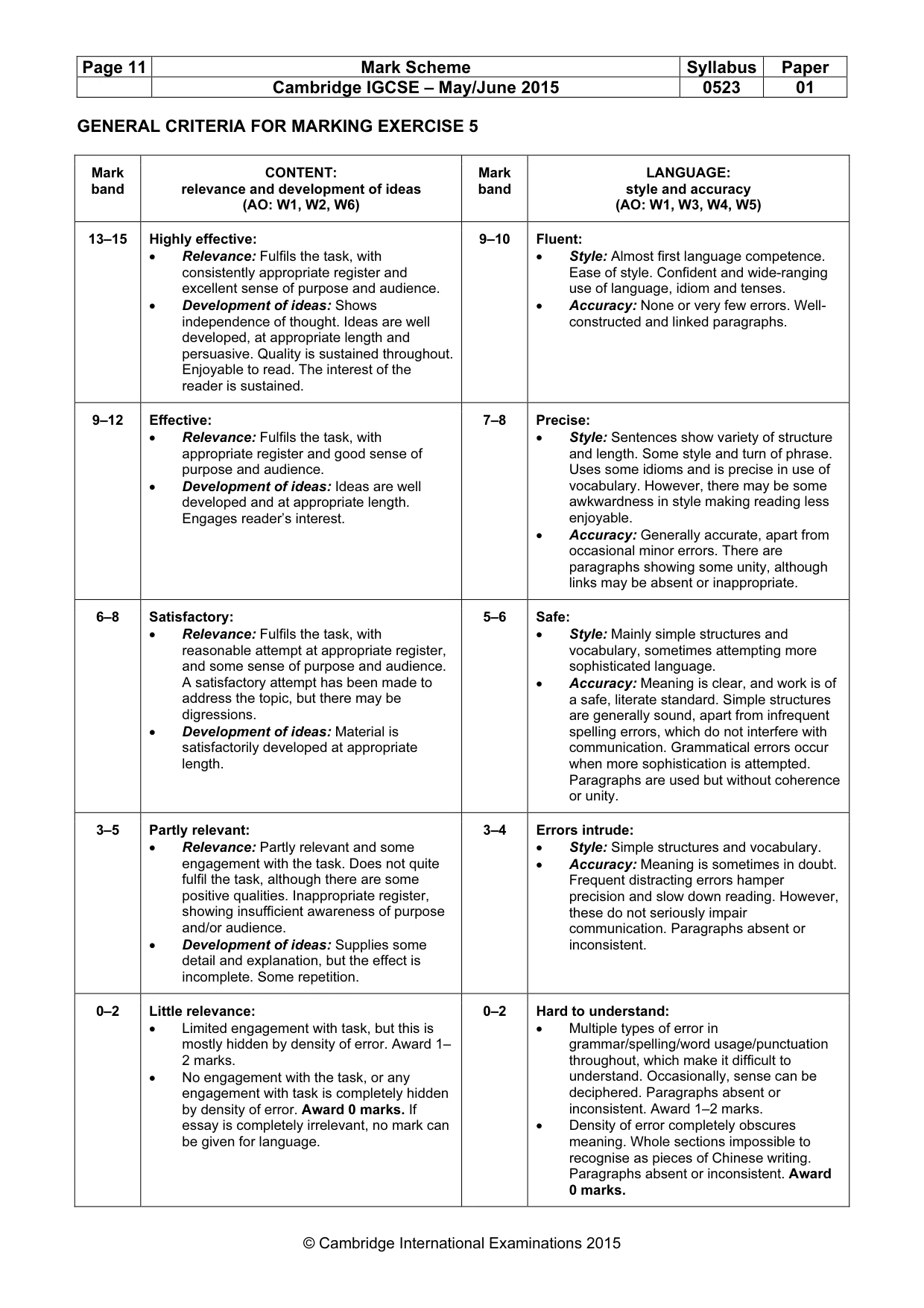
Page 10 Mark Scheme Syllabus Paper Cambridge IGCSE – May/June 2015 0523 01 © Cambridge International Examinations 2015 Exercise 5 Award the answer a mark for Content (out of 15) and a mark for Language (out of 10) in accordance with the General Criteria table that follows. • Content covers relevance (i.e. whether the piece fulfils the task and the awareness of purpose/audience/register) and the development of ideas (i.e. the detail/explanation provided and how enjoyable it is to read). • Language covers style (i.e. complexity of vocabulary and sentence structure) and accuracy (of grammar, punctuation and use of paragraphs). The candidate selects to complete one version of the paper (either simplified or traditional characters), but may deploy either form of writing and even mix the two forms in any way they wish except for within one single character. • When deciding on a mark for Content or Language, first of all decide which mark band is most appropriate. There will not necessarily be an exact fit. Then decide between 2 marks within that mark band. Use the lower mark if it only just makes it into the band and the upper mark if it fulfils all the requirements of the band but does not quite make it into the band above. • When deciding on a mark for Content, look at both relevance and development of ideas. First ask yourself whether the writing fulfils the task, in terms of points to be covered and the length. If it does, it will be in one of the top three mark bands. • When deciding on a mark for Language, look at both the style and the accuracy of the language. A useful starting point would be first to determine whether errors intrude. If they do not, it will be in one of the top three mark bands. • The use of paragraphs should not be the primary basis of deciding which mark band the work is in. Look first at the language used and once you have decided on the appropriate mark band, you can use the paragraphing as a factor in helping you to decide whether the work warrants the upper or lower mark in the mark band. • If the essay is considerably shorter than the stated word length but does fulfil the task, it should be put in mark band 6–8 for content. • If the essay is considerably shorter than the stated word length and does not fulfil the task, it should be put in mark band 3–5 for content or lower. • If the essay is partly relevant and therefore in mark band 3–5, the full range of marks for Language are available. • If the essay is totally irrelevant and has nothing to do with the question asked, it should be given 0 marks for Content and Language, even if it is enjoyable to read and fluent. [Max. total for Exercise 5: 25 marks]
Mark scheme, page 11
Page 11 Mark Scheme Syllabus Paper Cambridge IGCSE – May/June 2015 0523 01 © Cambridge International Examinations 2015 GENERAL CRITERIA FOR MARKING EXERCISE 5 Mark band CONTENT: relevance and development of ideas (AO: W1, W2, W6) Mark band LANGUAGE: style and accuracy (AO: W1, W3, W4, W5) 13–15 Highly effective: • Relevance: Fulfils the task, with consistently appropriate register and excellent sense of purpose and audience. • Development of ideas: Shows independence of thought. Ideas are well developed, at appropriate length and persuasive. Quality is sustained throughout. Enjoyable to read. The interest of the reader is sustained. 9–10 Fluent: • Style: Almost first language competence. Ease of style. Confident and wide-ranging use of language, idiom and tenses. • Accuracy: None or very few errors. Well- constructed and linked paragraphs. 9–12 Effective: • Relevance: Fulfils the task, with appropriate register and good sense of purpose and audience. • Development of ideas: Ideas are well developed and at appropriate length. Engages reader’s interest. 7–8 Precise: • Style: Sentences show variety of structure and length. Some style and turn of phrase. Uses some idioms and is precise in use of vocabulary. However, there may be some awkwardness in style making reading less enjoyable. • Accuracy: Generally accurate, apart from occasional minor errors. There are paragraphs showing some unity, although links may be absent or inappropriate. 6–8 Satisfactory: • Relevance: Fulfils the task, with reasonable attempt at appropriate register, and some sense of purpose and audience. A satisfactory attempt has been made to address the topic, but there may be digressions. • Development of ideas: Material is satisfactorily developed at appropriate length. 5–6 Safe: • Style: Mainly simple structures and vocabulary, sometimes attempting more sophisticated language. • Accuracy: Meaning is clear, and work is of a safe, literate standard. Simple structures are generally sound, apart from infrequent spelling errors, which do not interfere with communication. Grammatical errors occur when more sophistication is attempted. Paragraphs are used but without coherence or unity. 3–5 Partly relevant: • Relevance: Partly relevant and some engagement with the task. Does not quite fulfil the task, although there are some positive qualities. Inappropriate register, showing insufficient awareness of purpose and/or audience. • Development of ideas: Supplies some detail and explanation, but the effect is incomplete. Some repetition. 3–4 Errors intrude: • Style: Simple structures and vocabulary. • Accuracy: Meaning is sometimes in doubt. Frequent distracting errors hamper precision and slow down reading. However, these do not seriously impair communication. Paragraphs absent or inconsistent. 0–2 Little relevance: • Limited engagement with task, but this is mostly hidden by density of error. Award 1– 2 marks. • No engagement with the task, or any engagement with task is completely hidden by density of error. Award 0 marks. If essay is completely irrelevant, no mark can be given for language. 0–2 Hard to understand: • Multiple types of error in grammar/spelling/word usage/punctuation throughout, which make it difficult to understand. Occasionally, sense can be deciphered. Paragraphs absent or inconsistent. Award 1–2 marks. • Density of error completely obscures meaning. Whole sections impossible to recognise as pieces of Chinese writing. Paragraphs absent or inconsistent. Award 0 marks.
Mark scheme, page 12
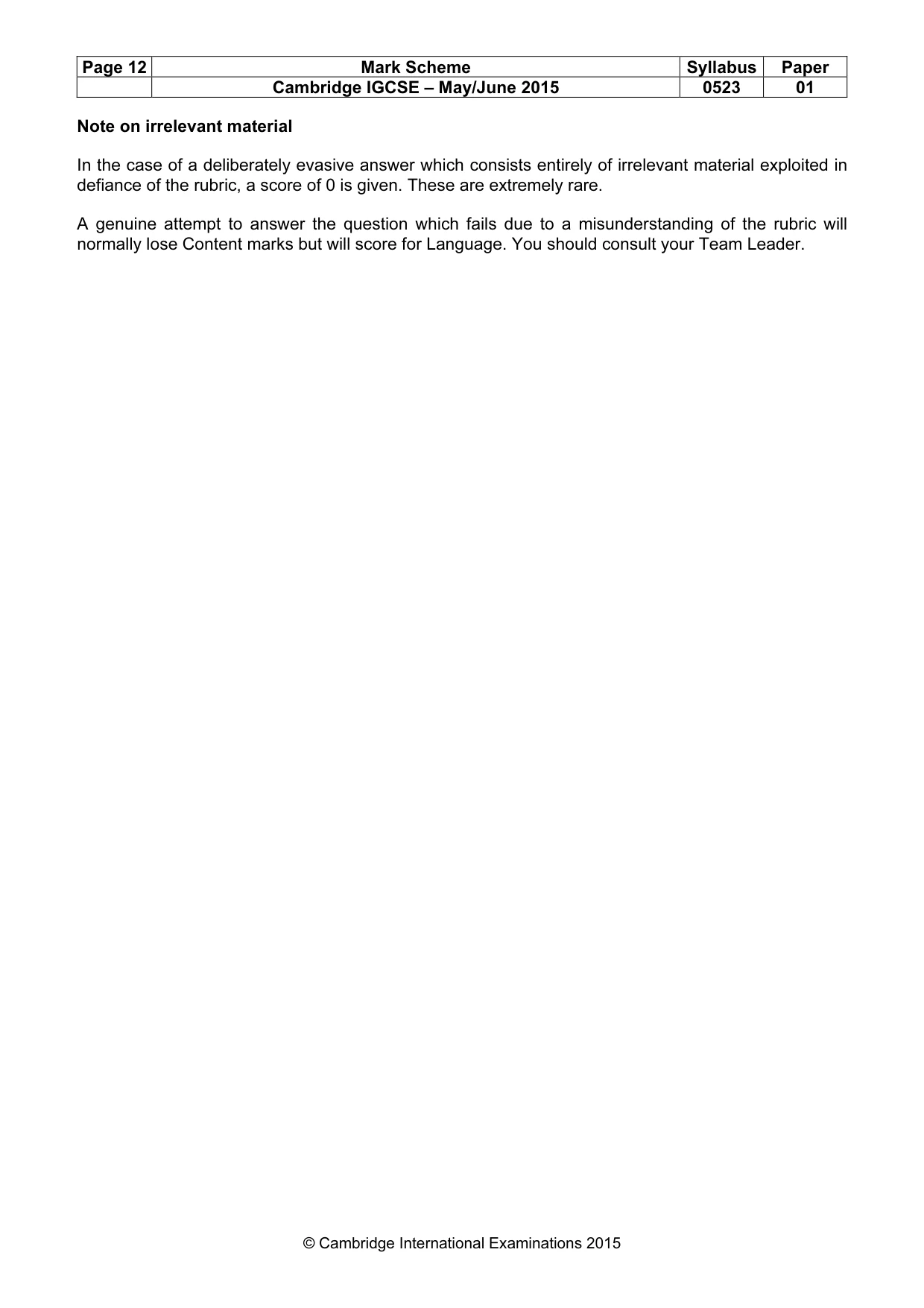
Page 12 Mark Scheme Syllabus Paper Cambridge IGCSE – May/June 2015 0523 01 © Cambridge International Examinations 2015 Note on irrelevant material In the case of a deliberately evasive answer which consists entirely of irrelevant material exploited in defiance of the rubric, a score of 0 is given. These are extremely rare. A genuine attempt to answer the question which fails due to a misunderstanding of the rubric will normally lose Content marks but will score for Language. You should consult your Team Leader.