Cambridge IGCSE Chemistry (BES) 0439 — 2017 Oct/Nov Paper 2 · Variant 1
0439/21/O/N/17 · 40 marks · ≈45 min
The question paper and its mark scheme, free to read here and free to download. This is Cambridge’s own paper, exactly as it was sat.
Question paper16 pages
Mark scheme3 pages
Answers below. Sit the paper first if you are practising.
Paper as text
Question paper, page 1
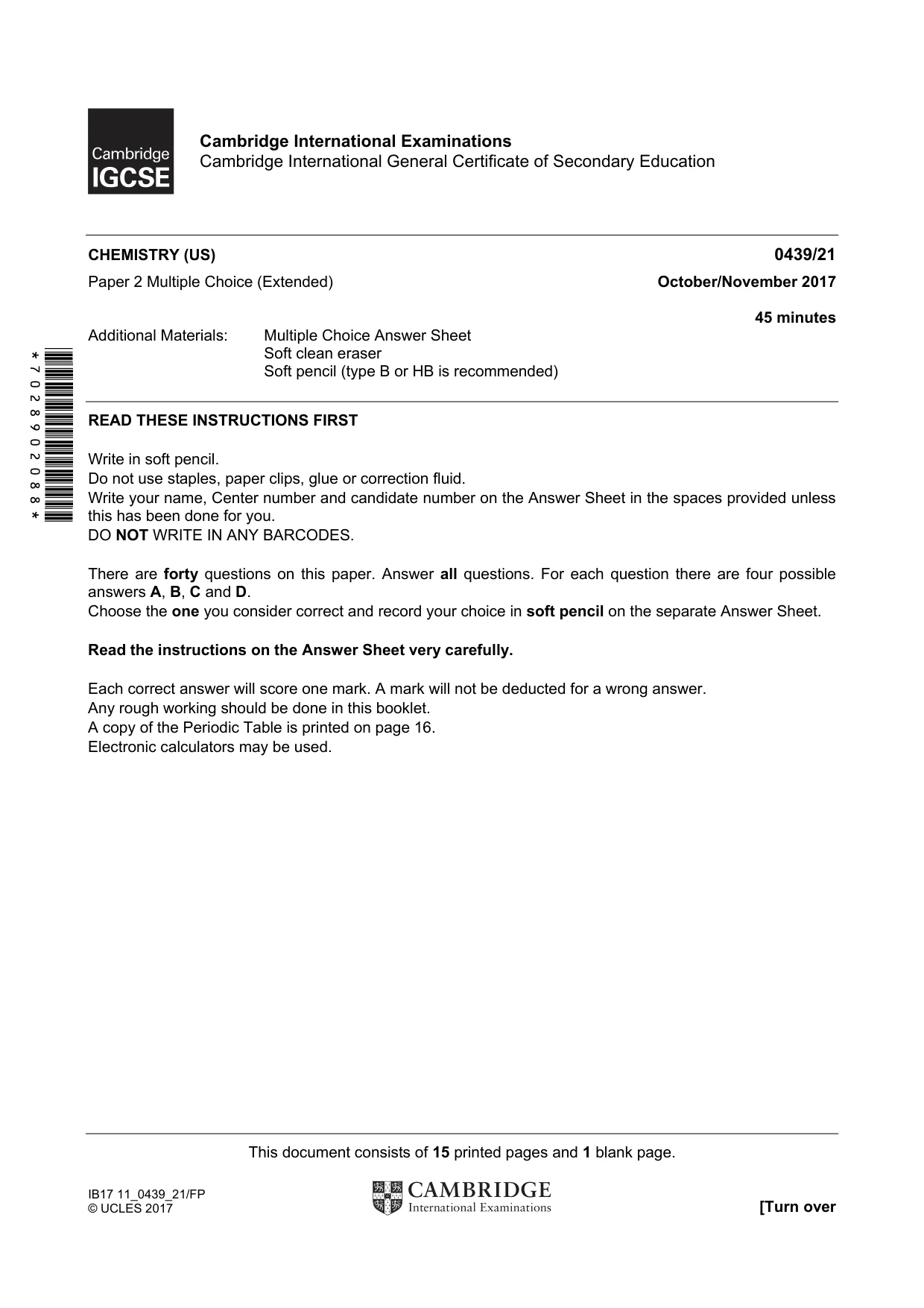
This document consists of 15 printed pages and 1 blank page. IB17 11_0439_21/FP © UCLES 2017 [Turn over *7028902088* Cambridge International Examinations Cambridge International General Certificate of Secondary Education CHEMISTRY (US) 0439/21 Paper 2 Multiple Choice (Extended) October/November 2017 45 minutes Additional Materials: Multiple Choice Answer Sheet Soft clean eraser Soft pencil (type B or HB is recommended) READ THESE INSTRUCTIONS FIRST Write in soft pencil. Do not use staples, paper clips, glue or correction fluid. Write your name, Center number and candidate number on the Answer Sheet in the spaces provided unless this has been done for you. DO NOT WRITE IN ANY BARCODES. There are forty questions on this paper. Answer all questions. For each question there are four possible answers A, B, C and D. Choose the one you consider correct and record your choice in soft pencil on the separate Answer Sheet. Read the instructions on the Answer Sheet very carefully. Each correct answer will score one mark. A mark will not be deducted for a wrong answer. Any rough working should be done in this booklet. A copy of the Periodic Table is printed on page 16. Electronic calculators may be used.
Question paper, page 2
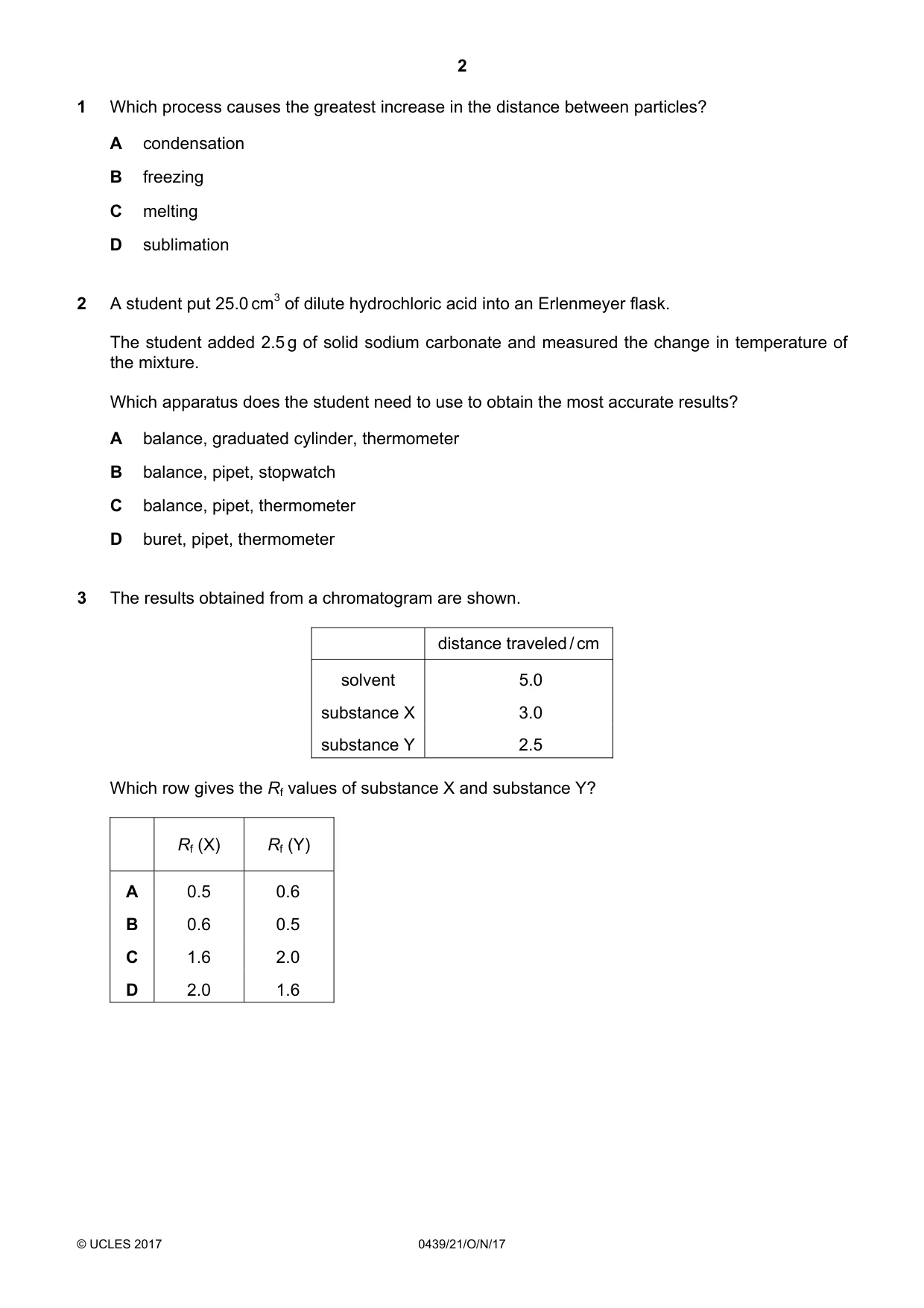
2 © UCLES 2017 0439/21/O/N/17 1 Which process causes the greatest increase in the distance between particles? A condensation B freezing C melting D sublimation 2 A student put 25.0 cm3 of dilute hydrochloric acid into an Erlenmeyer flask. The student added 2.5 g of solid sodium carbonate and measured the change in temperature of the mixture. Which apparatus does the student need to use to obtain the most accurate results? A balance, graduated cylinder, thermometer B balance, pipet, stopwatch C balance, pipet, thermometer D buret, pipet, thermometer 3 The results obtained from a chromatogram are shown. distance traveled / cm solvent 5.0 substance X 3.0 substance Y 2.5 Which row gives the Rf values of substance X and substance Y? Rf (X) Rf (Y) A 0.5 0.6 B 0.6 0.5 C 1.6 2.0 D 2.0 1.6
Question paper, page 3
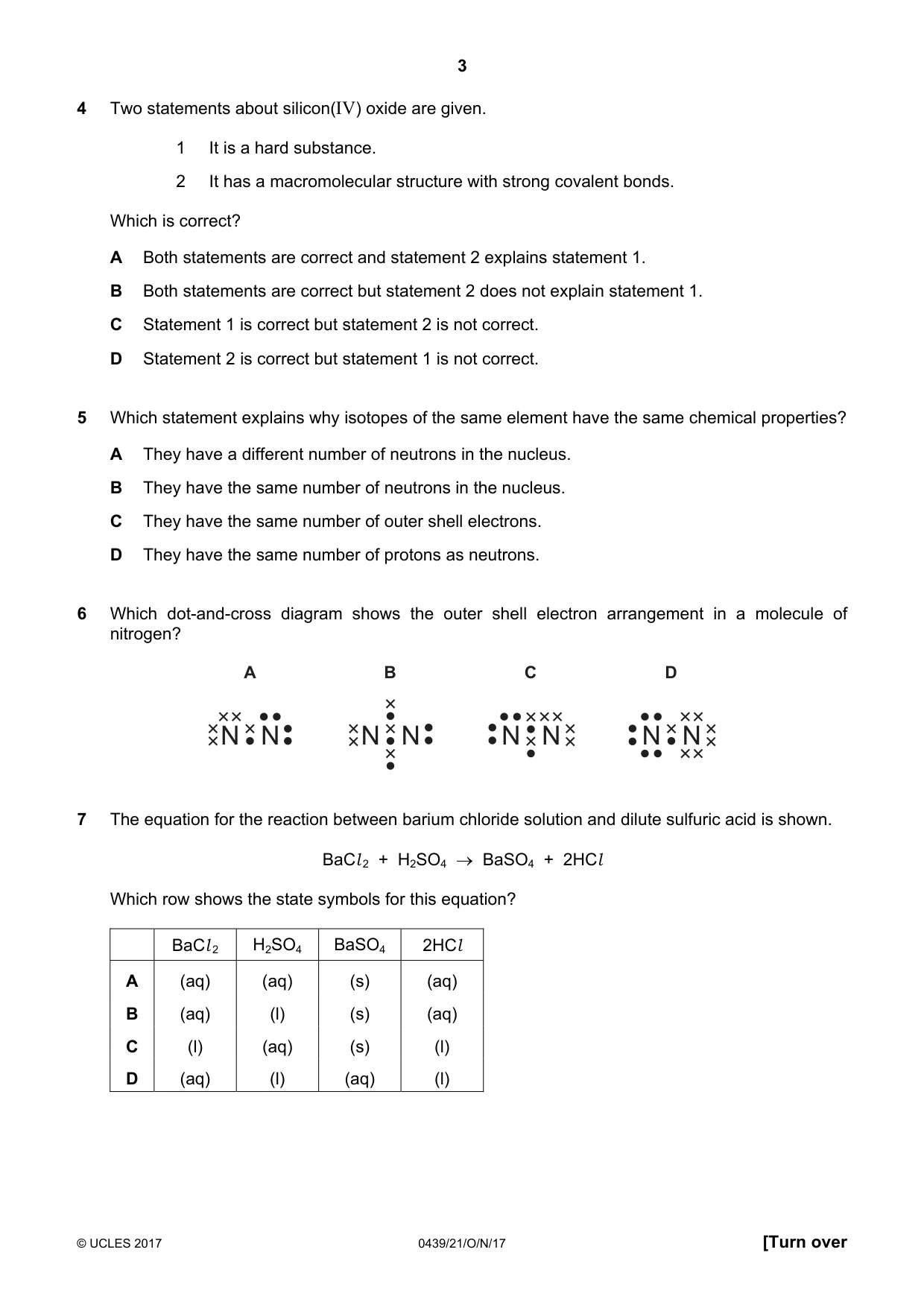
3 © UCLES 2017 0439/21/O/N/17 [Turn over 4 Two statements about silicon(IV) oxide are given. 1 It is a hard substance. 2 It has a macromolecular structure with strong covalent bonds. Which is correct? A Both statements are correct and statement 2 explains statement 1. B Both statements are correct but statement 2 does not explain statement 1. C Statement 1 is correct but statement 2 is not correct. D Statement 2 is correct but statement 1 is not correct. 5 Which statement explains why isotopes of the same element have the same chemical properties? A They have a different number of neutrons in the nucleus. B They have the same number of neutrons in the nucleus. C They have the same number of outer shell electrons. D They have the same number of protons as neutrons. 6 Which dot-and-cross diagram shows the outer shell electron arrangement in a molecule of nitrogen? N A N N B N N C N N D N 7 The equation for the reaction between barium chloride solution and dilute sulfuric acid is shown. BaCl 2 + H2SO4 → BaSO4 + 2HCl Which row shows the state symbols for this equation? BaCl 2 H2SO4 BaSO4 2HCl A (aq) (aq) (s) (aq) B (aq) (l) (s) (aq) C (l) (aq) (s) (l) D (aq) (l) (aq) (l)
Question paper, page 4
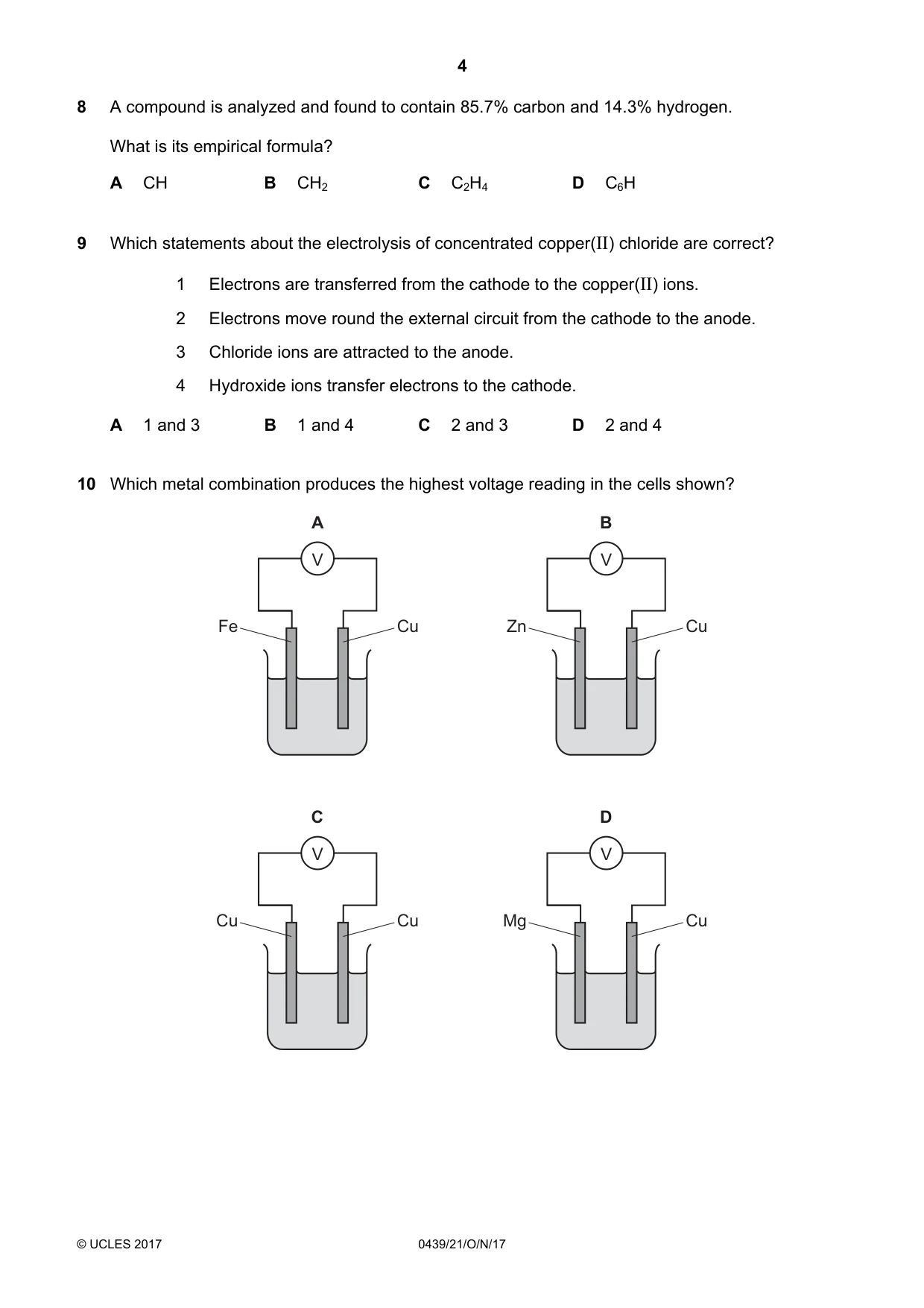
4 © UCLES 2017 0439/21/O/N/17 8 A compound is analyzed and found to contain 85.7% carbon and 14.3% hydrogen. What is its empirical formula? A CH B CH2 C C2H4 D C6H 9 Which statements about the electrolysis of concentrated copper(II) chloride are correct? 1 Electrons are transferred from the cathode to the copper(II) ions. 2 Electrons move round the external circuit from the cathode to the anode. 3 Chloride ions are attracted to the anode. 4 Hydroxide ions transfer electrons to the cathode. A 1 and 3 B 1 and 4 C 2 and 3 D 2 and 4 10 Which metal combination produces the highest voltage reading in the cells shown? V A Fe Cu V B Zn Cu V C Cu Cu V D Mg Cu
Question paper, page 5
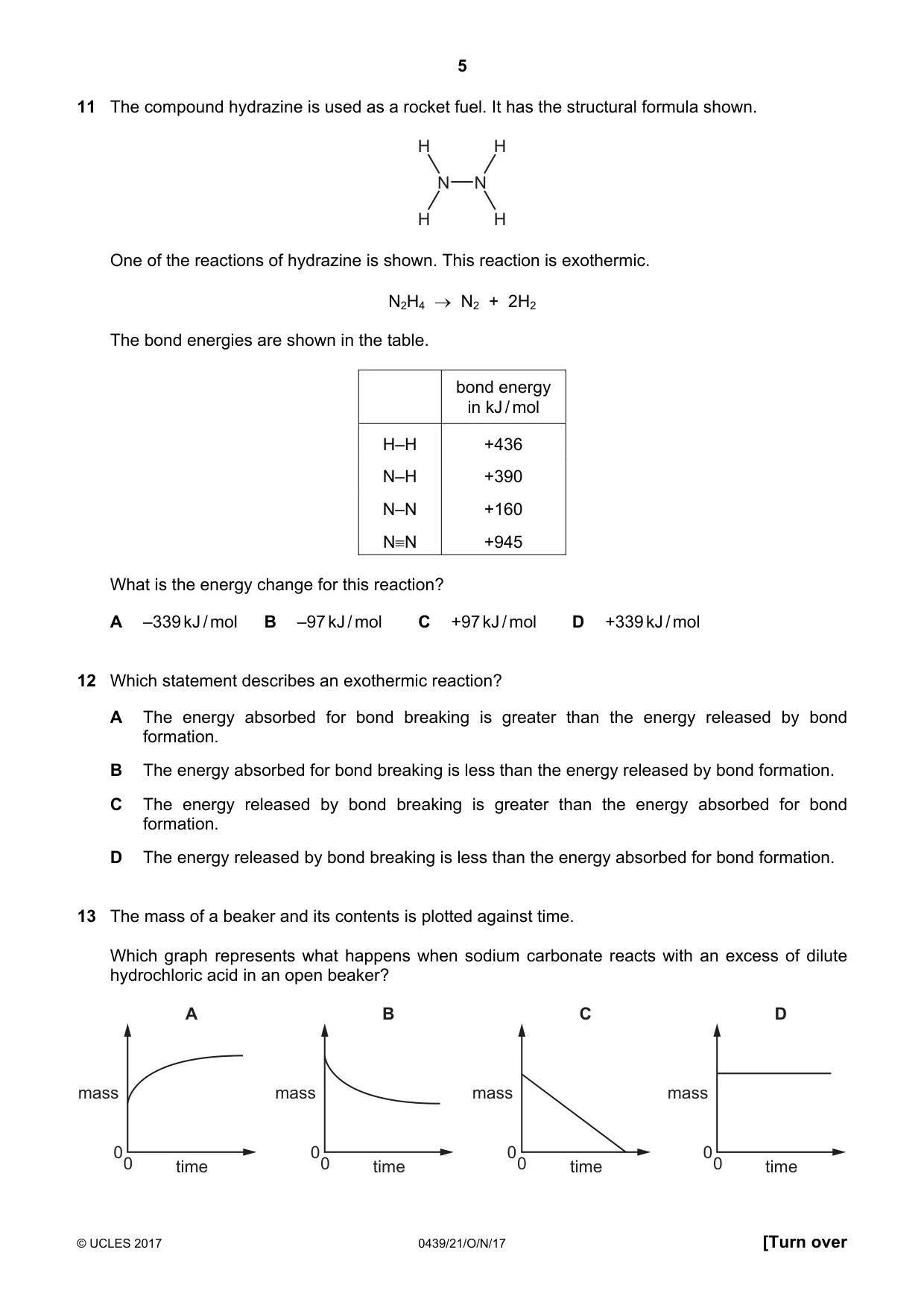
5 © UCLES 2017 0439/21/O/N/17 [Turn over 11 The compound hydrazine is used as a rocket fuel. It has the structural formula shown. N H H H H N One of the reactions of hydrazine is shown. This reaction is exothermic. N2H4 → N2 + 2H2 The bond energies are shown in the table. bond energy in kJ / mol H–H +436 N–H +390 N–N +160 N≡N +945 What is the energy change for this reaction? A –339 kJ / mol B –97 kJ / mol C +97 kJ / mol D +339 kJ / mol 12 Which statement describes an exothermic reaction? A The energy absorbed for bond breaking is greater than the energy released by bond formation. B The energy absorbed for bond breaking is less than the energy released by bond formation. C The energy released by bond breaking is greater than the energy absorbed for bond formation. D The energy released by bond breaking is less than the energy absorbed for bond formation. 13 The mass of a beaker and its contents is plotted against time. Which graph represents what happens when sodium carbonate reacts with an excess of dilute hydrochloric acid in an open beaker? mass time A mass time B mass time C mass time D 0 0 0 0 0 0 0 0
Question paper, page 6
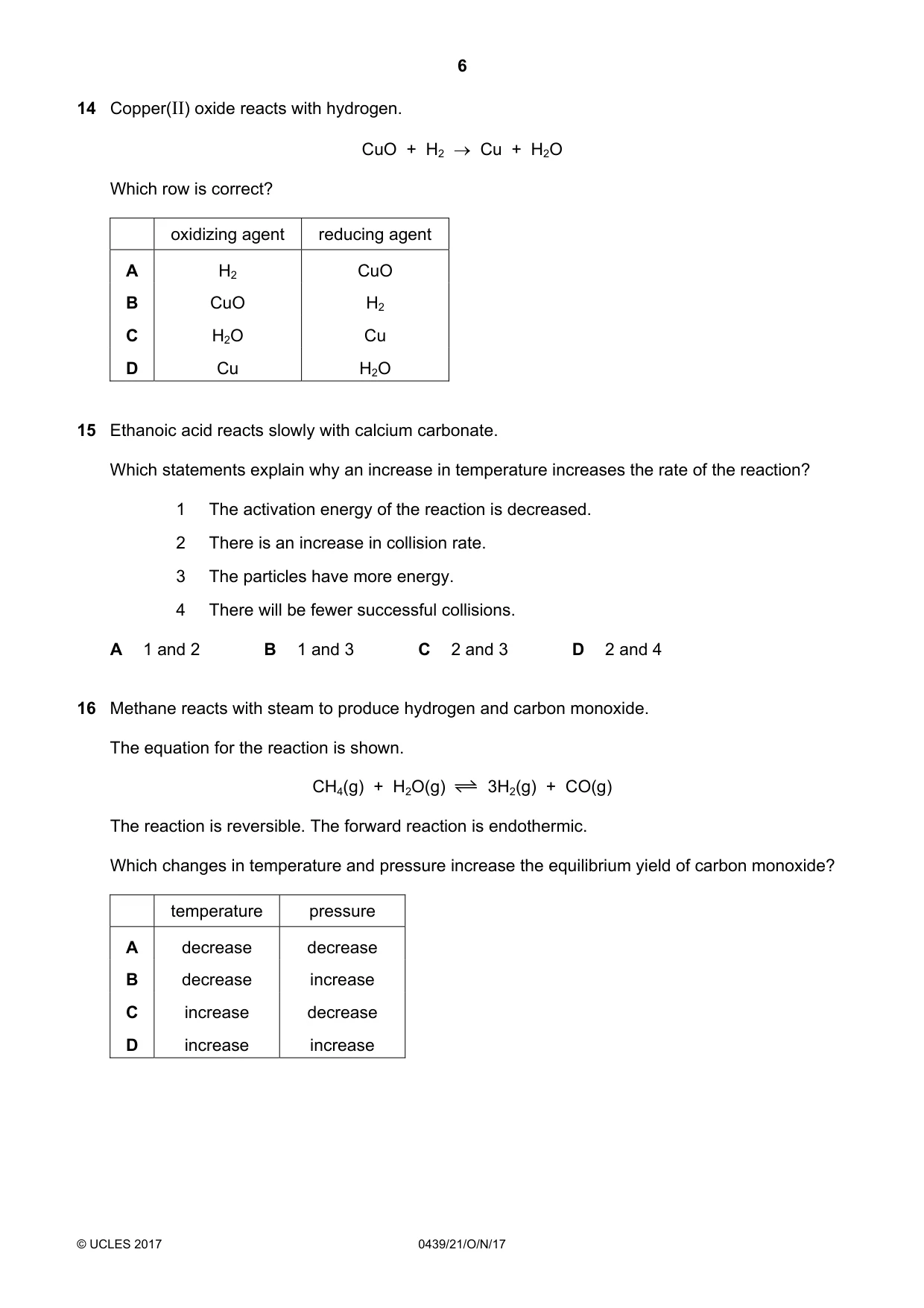
6 © UCLES 2017 0439/21/O/N/17 14 Copper(II) oxide reacts with hydrogen. CuO + H2 → Cu + H2O Which row is correct? oxidizing agent reducing agent A H2 CuO B CuO H2 C H2O Cu D Cu H2O 15 Ethanoic acid reacts slowly with calcium carbonate. Which statements explain why an increase in temperature increases the rate of the reaction? 1 The activation energy of the reaction is decreased. 2 There is an increase in collision rate. 3 The particles have more energy. 4 There will be fewer successful collisions. A 1 and 2 B 1 and 3 C 2 and 3 D 2 and 4 16 Methane reacts with steam to produce hydrogen and carbon monoxide. The equation for the reaction is shown. CH4(g) + H2O(g) 3H2(g) + CO(g) The reaction is reversible. The forward reaction is endothermic. Which changes in temperature and pressure increase the equilibrium yield of carbon monoxide? temperature pressure A decrease decrease B decrease increase C increase decrease D increase increase
Question paper, page 7
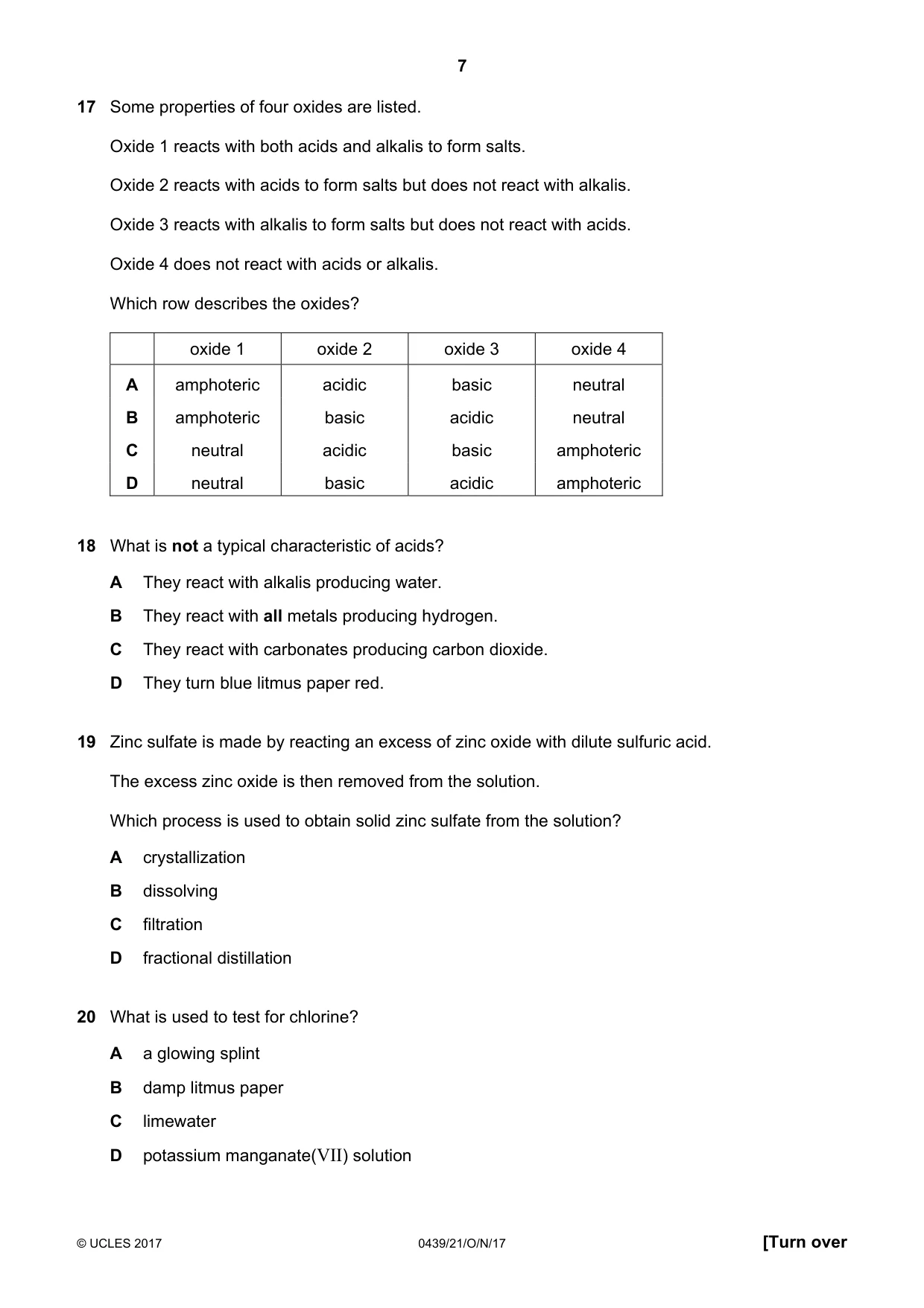
7 © UCLES 2017 0439/21/O/N/17 [Turn over 17 Some properties of four oxides are listed. Oxide 1 reacts with both acids and alkalis to form salts. Oxide 2 reacts with acids to form salts but does not react with alkalis. Oxide 3 reacts with alkalis to form salts but does not react with acids. Oxide 4 does not react with acids or alkalis. Which row describes the oxides? oxide 1 oxide 2 oxide 3 oxide 4 A amphoteric acidic basic neutral B amphoteric basic acidic neutral C neutral acidic basic amphoteric D neutral basic acidic amphoteric 18 What is not a typical characteristic of acids? A They react with alkalis producing water. B They react with all metals producing hydrogen. C They react with carbonates producing carbon dioxide. D They turn blue litmus paper red. 19 Zinc sulfate is made by reacting an excess of zinc oxide with dilute sulfuric acid. The excess zinc oxide is then removed from the solution. Which process is used to obtain solid zinc sulfate from the solution? A crystallization B dissolving C filtration D fractional distillation 20 What is used to test for chlorine? A a glowing splint B damp litmus paper C limewater D potassium manganate(VII) solution
Question paper, page 8
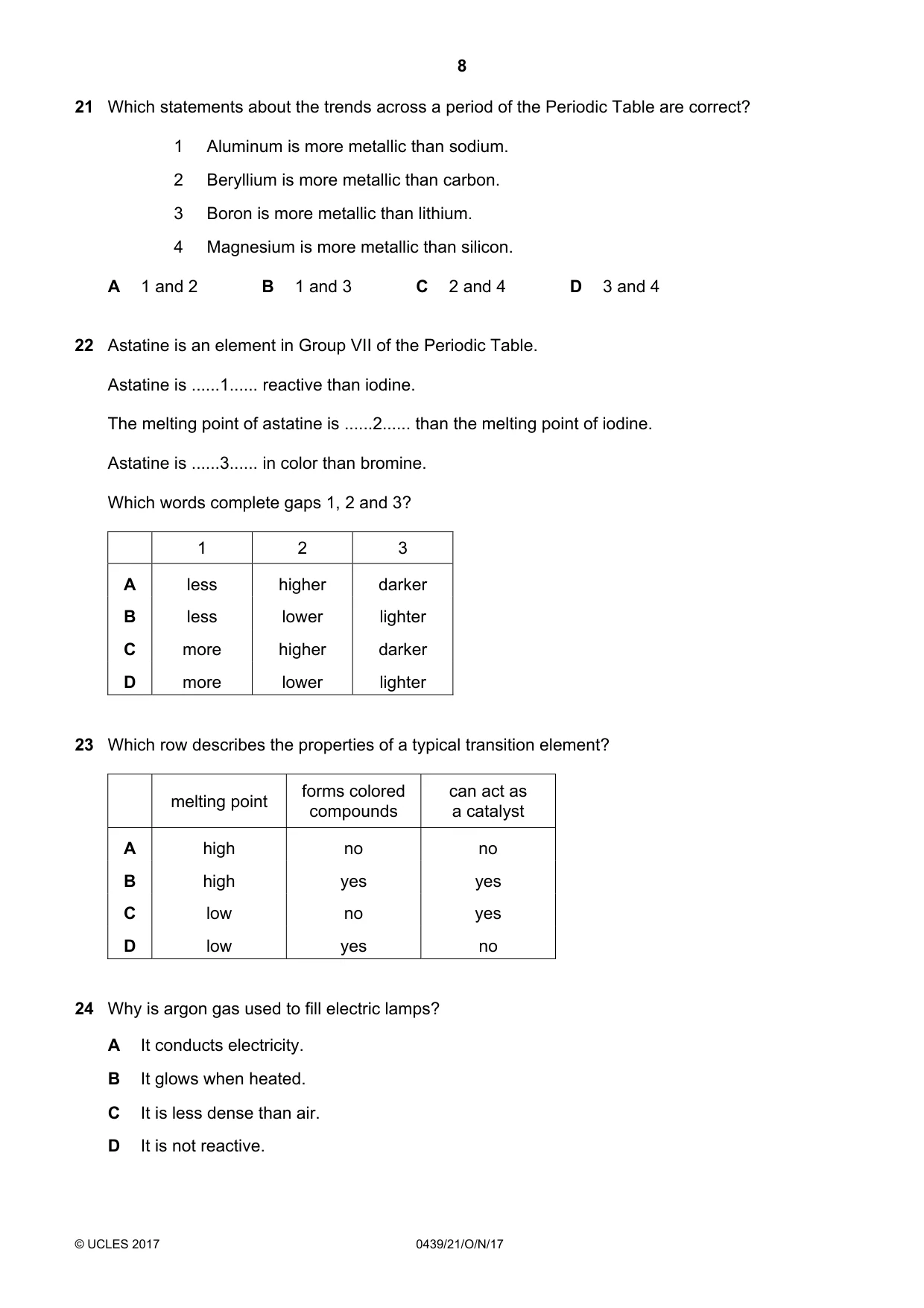
8 © UCLES 2017 0439/21/O/N/17 21 Which statements about the trends across a period of the Periodic Table are correct? 1 Aluminum is more metallic than sodium. 2 Beryllium is more metallic than carbon. 3 Boron is more metallic than lithium. 4 Magnesium is more metallic than silicon. A 1 and 2 B 1 and 3 C 2 and 4 D 3 and 4 22 Astatine is an element in Group VII of the Periodic Table. Astatine is …1… reactive than iodine. The melting point of astatine is …2… than the melting point of iodine. Astatine is …3… in color than bromine. Which words complete gaps 1, 2 and 3? 1 2 3 A less higher darker B less lower lighter C more higher darker D more lower lighter 23 Which row describes the properties of a typical transition element? melting point forms colored compounds can act as a catalyst A high no no B high yes yes C low no yes D low yes no 24 Why is argon gas used to fill electric lamps? A It conducts electricity. B It glows when heated. C It is less dense than air. D It is not reactive.
Question paper, page 9
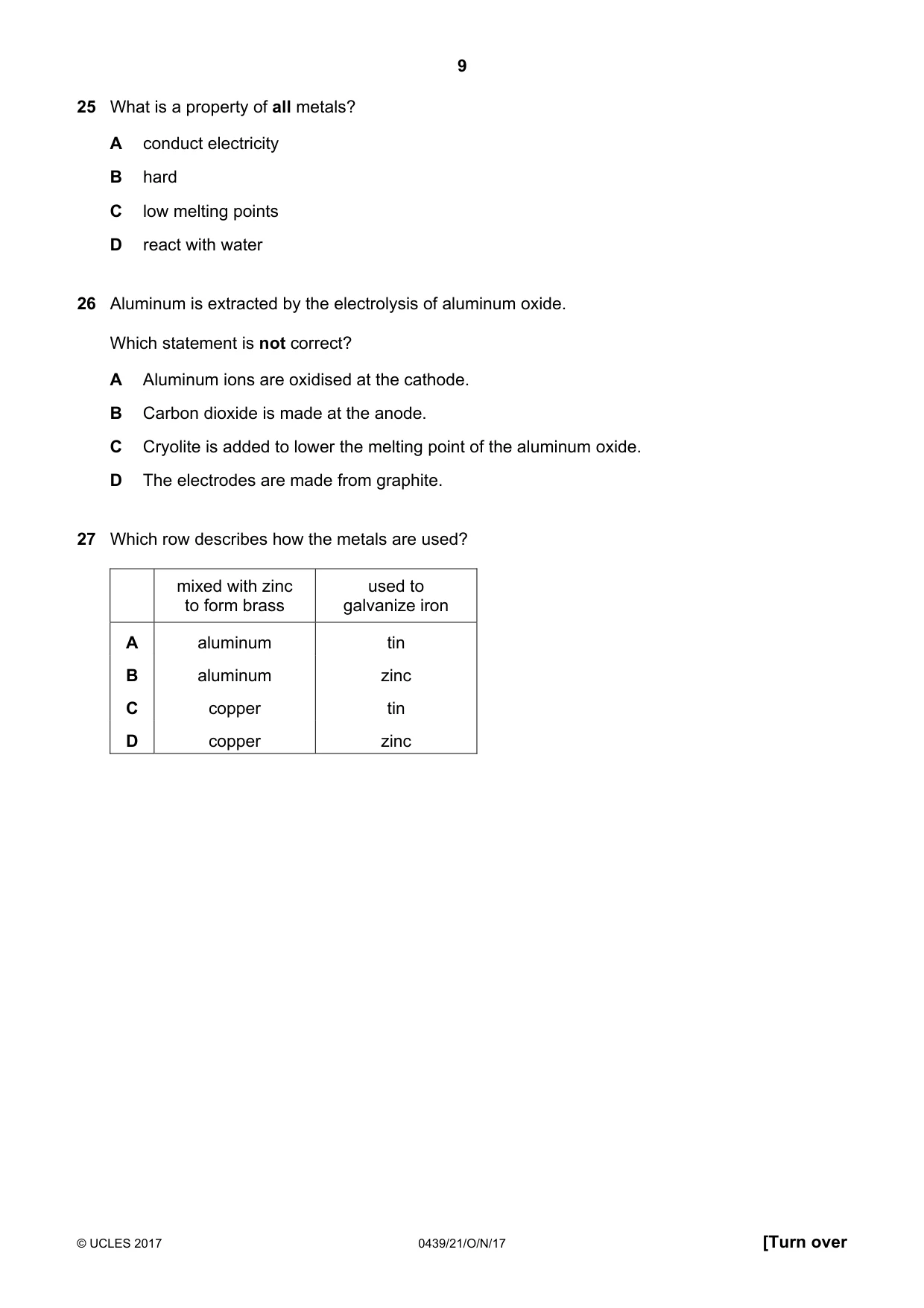
9 © UCLES 2017 0439/21/O/N/17 [Turn over 25 What is a property of all metals? A conduct electricity B hard C low melting points D react with water 26 Aluminum is extracted by the electrolysis of aluminum oxide. Which statement is not correct? A Aluminum ions are oxidised at the cathode. B Carbon dioxide is made at the anode. C Cryolite is added to lower the melting point of the aluminum oxide. D The electrodes are made from graphite. 27 Which row describes how the metals are used? mixed with zinc to form brass used to galvanize iron A aluminum tin B aluminum zinc C copper tin D copper zinc
Question paper, page 10
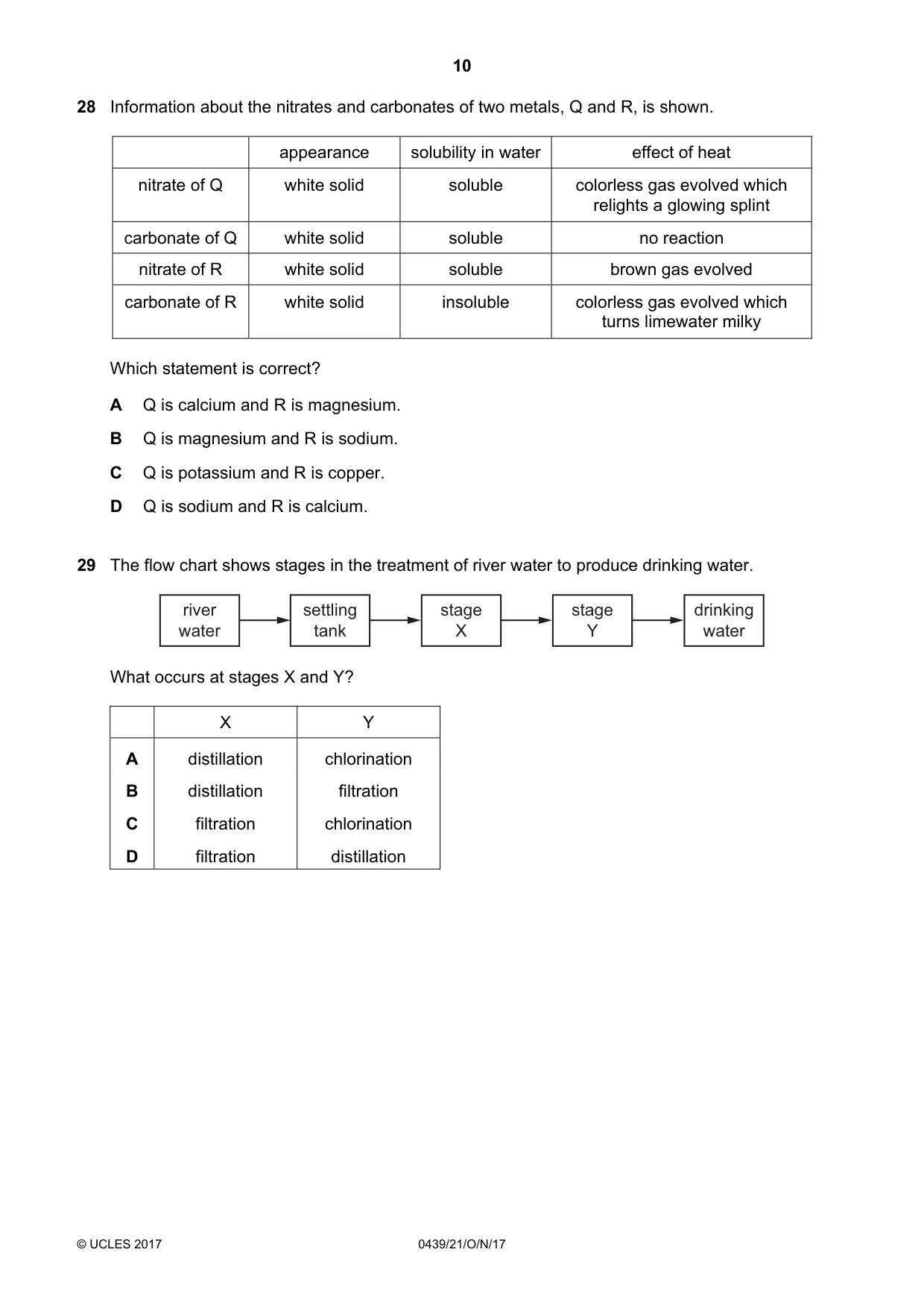
10 © UCLES 2017 0439/21/O/N/17 28 Information about the nitrates and carbonates of two metals, Q and R, is shown. appearance solubility in water effect of heat nitrate of Q white solid soluble colorless gas evolved which relights a glowing splint carbonate of Q white solid soluble no reaction nitrate of R white solid soluble brown gas evolved carbonate of R white solid insoluble colorless gas evolved which turns limewater milky Which statement is correct? A Q is calcium and R is magnesium. B Q is magnesium and R is sodium. C Q is potassium and R is copper. D Q is sodium and R is calcium. 29 The flow chart shows stages in the treatment of river water to produce drinking water. drinking water stage Y stage X settling tank river water What occurs at stages X and Y? X Y A distillation chlorination B distillation filtration C filtration chlorination D filtration distillation
Question paper, page 11
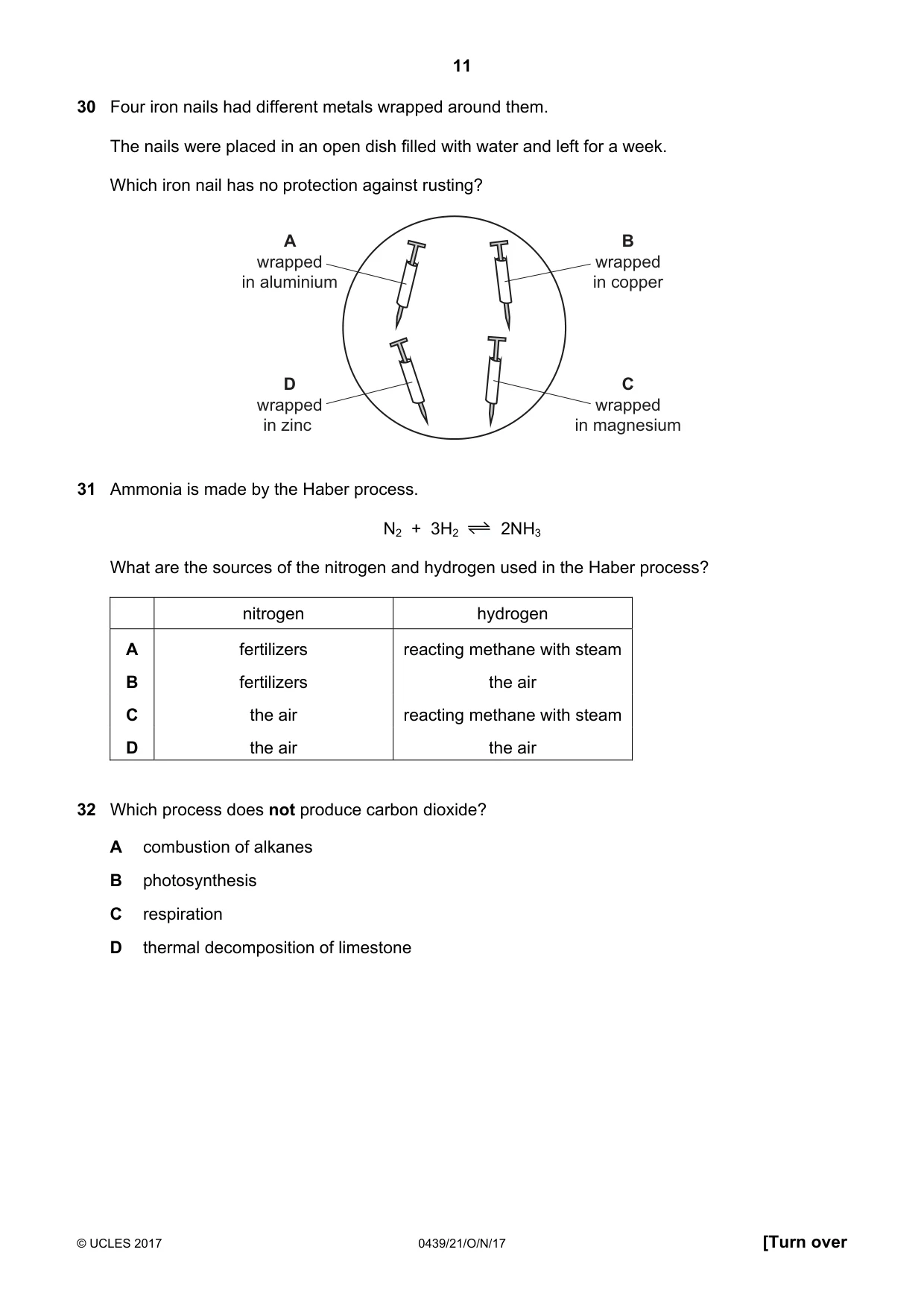
11 © UCLES 2017 0439/21/O/N/17 [Turn over 30 Four iron nails had different metals wrapped around them. The nails were placed in an open dish filled with water and left for a week. Which iron nail has no protection against rusting? A wrapped in aluminium B wrapped in copper D wrapped in zinc C wrapped in magnesium 31 Ammonia is made by the Haber process. N2 + 3H2 2NH3 What are the sources of the nitrogen and hydrogen used in the Haber process? nitrogen hydrogen A fertilizers reacting methane with steam B fertilizers the air C the air reacting methane with steam D the air the air 32 Which process does not produce carbon dioxide? A combustion of alkanes B photosynthesis C respiration D thermal decomposition of limestone
Question paper, page 12
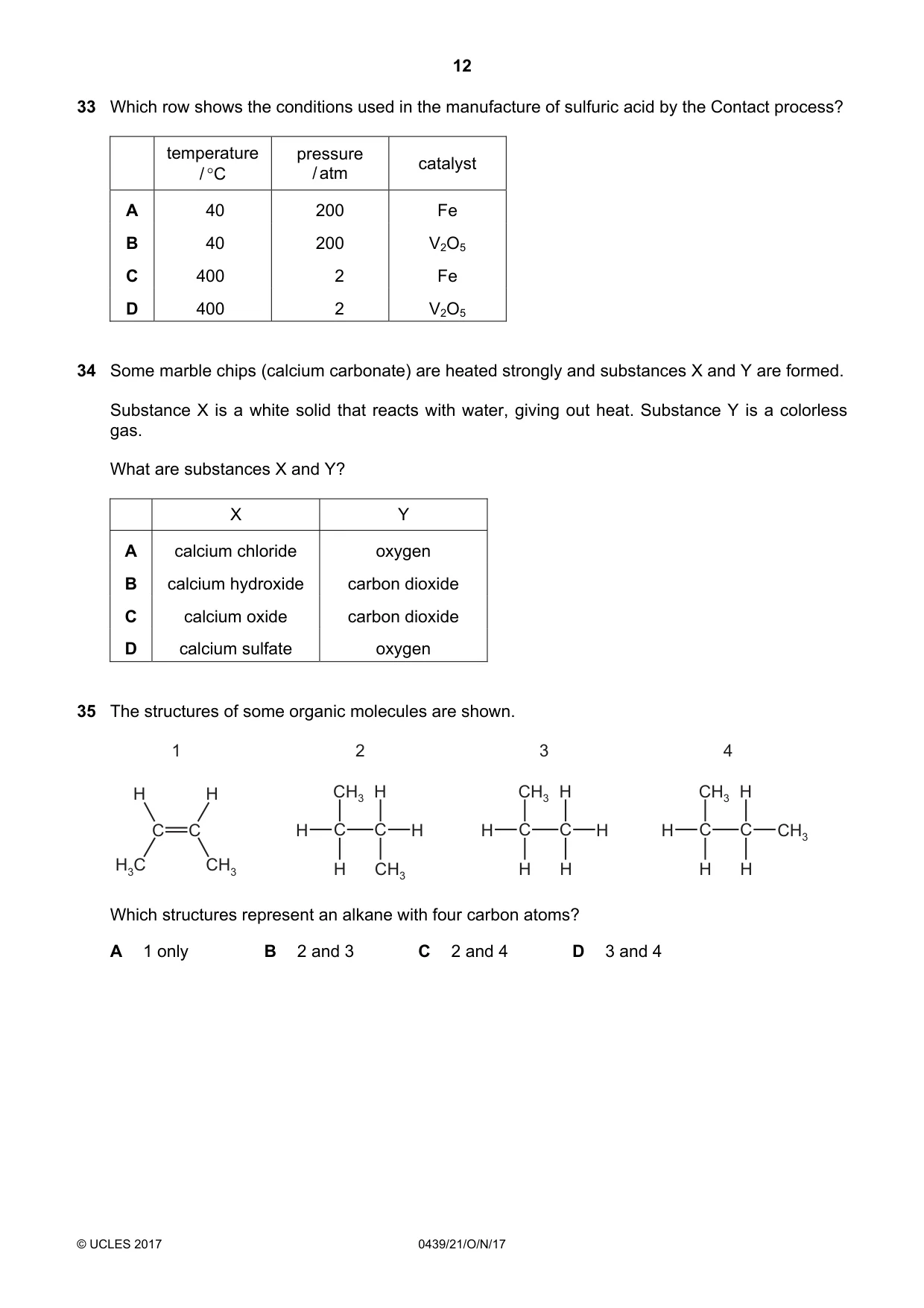
12 © UCLES 2017 0439/21/O/N/17 33 Which row shows the conditions used in the manufacture of sulfuric acid by the Contact process? temperature / °C pressure / atm catalyst A 40 200 Fe B 40 200 V2O5 C 400 2 Fe D 400 2 V2O5 34 Some marble chips (calcium carbonate) are heated strongly and substances X and Y are formed. Substance X is a white solid that reacts with water, giving out heat. Substance Y is a colorless gas. What are substances X and Y? X Y A calcium chloride oxygen B calcium hydroxide carbon dioxide C calcium oxide carbon dioxide D calcium sulfate oxygen 35 The structures of some organic molecules are shown. C C CH3 H H3C H C CH3 H H H C CH3 H C CH3 H H H C H H C CH3 H CH3 H C H H 2 1 3 4 Which structures represent an alkane with four carbon atoms? A 1 only B 2 and 3 C 2 and 4 D 3 and 4
Question paper, page 13
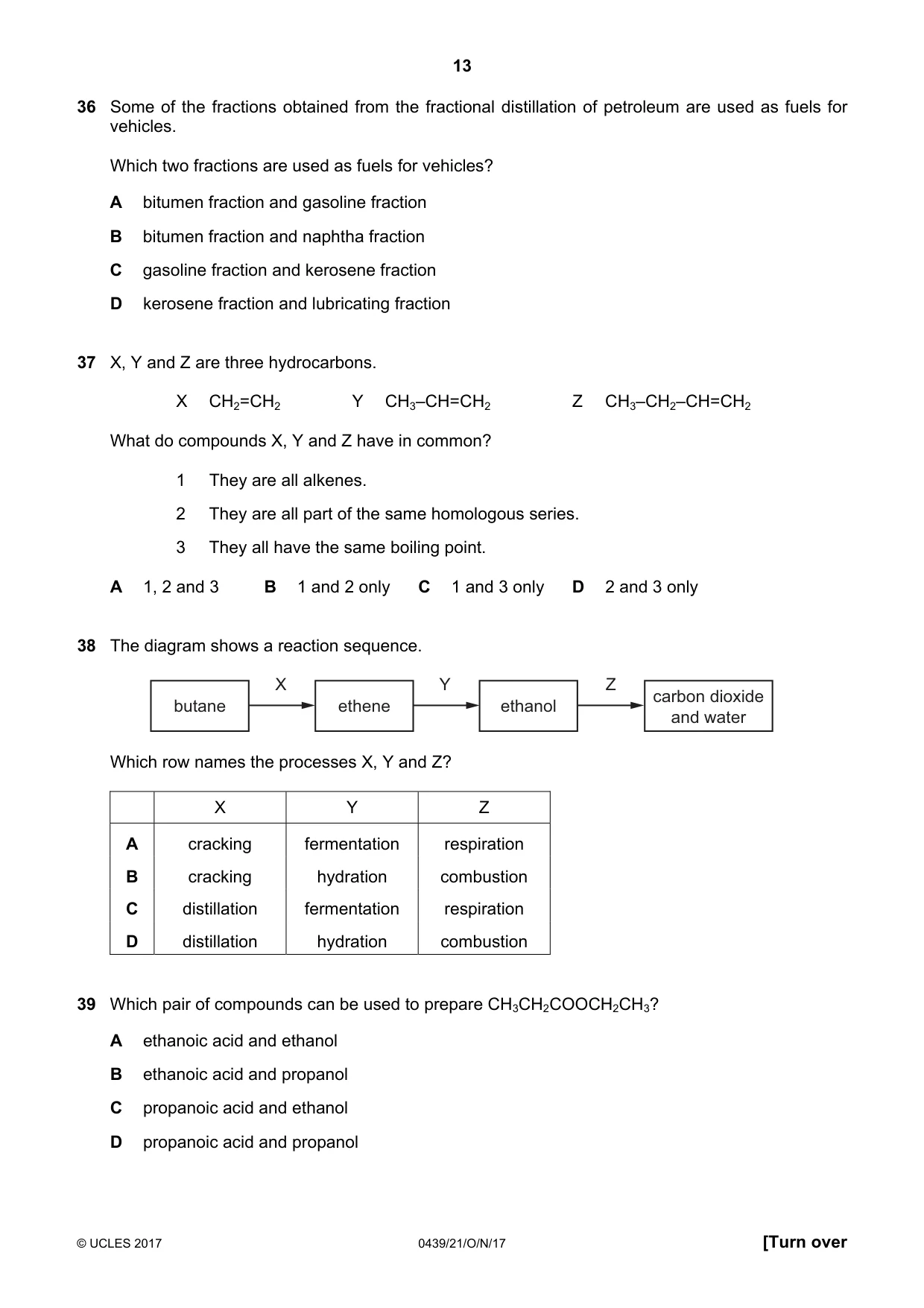
13 © UCLES 2017 0439/21/O/N/17 [Turn over 36 Some of the fractions obtained from the fractional distillation of petroleum are used as fuels for vehicles. Which two fractions are used as fuels for vehicles? A bitumen fraction and gasoline fraction B bitumen fraction and naphtha fraction C gasoline fraction and kerosene fraction D kerosene fraction and lubricating fraction 37 X, Y and Z are three hydrocarbons. X CH2=CH2 Y CH3–CH=CH2 Z CH3–CH2–CH=CH2 What do compounds X, Y and Z have in common? 1 They are all alkenes. 2 They are all part of the same homologous series. 3 They all have the same boiling point. A 1, 2 and 3 B 1 and 2 only C 1 and 3 only D 2 and 3 only 38 The diagram shows a reaction sequence. butane ethene ethanol carbon dioxide and water X Y Z Which row names the processes X, Y and Z? X Y Z A cracking fermentation respiration B cracking hydration combustion C distillation fermentation respiration D distillation hydration combustion 39 Which pair of compounds can be used to prepare CH3CH2COOCH2CH3? A ethanoic acid and ethanol B ethanoic acid and propanol C propanoic acid and ethanol D propanoic acid and propanol
Question paper, page 14
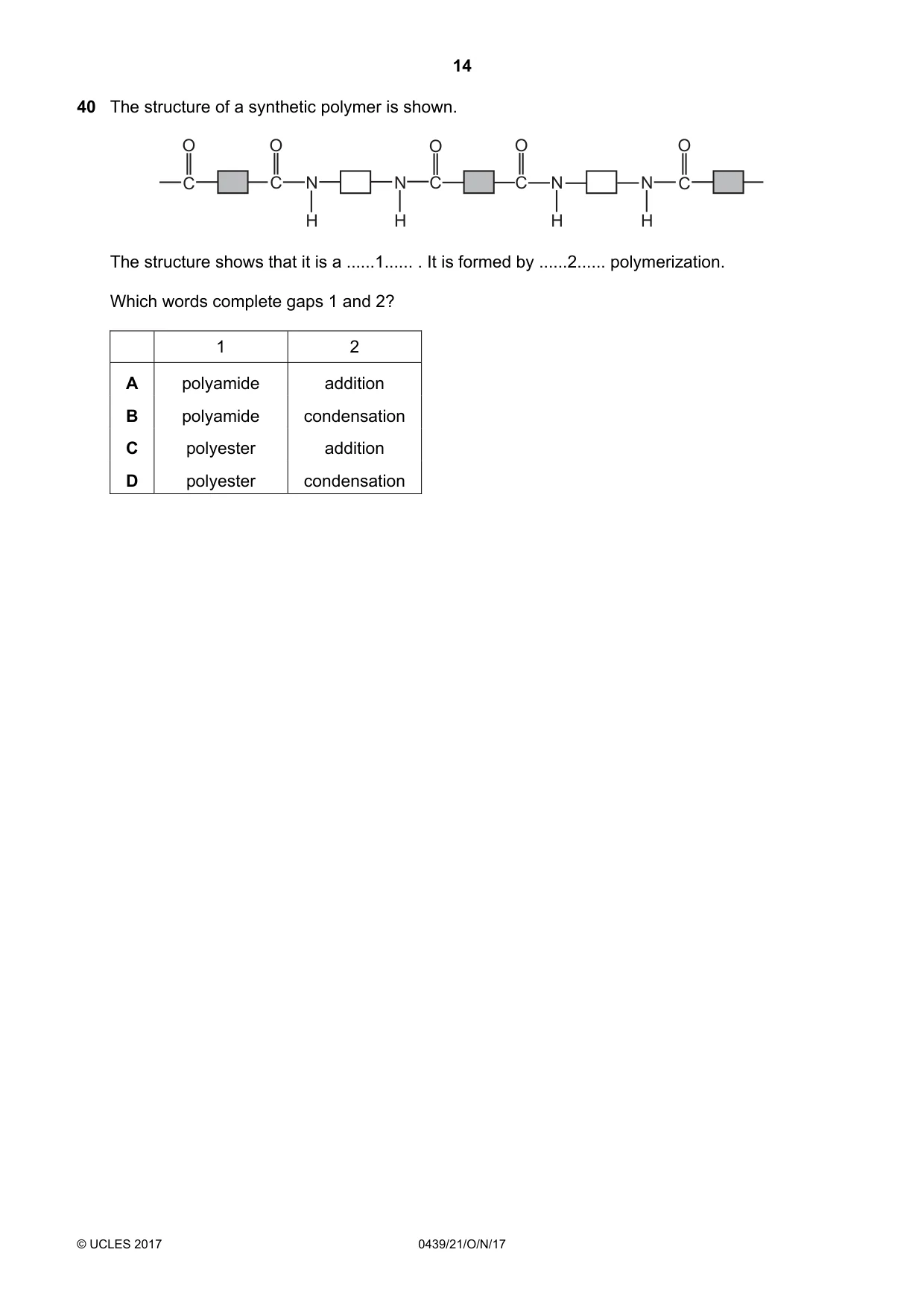
14 © UCLES 2017 0439/21/O/N/17 40 The structure of a synthetic polymer is shown. C O C O C C O O N H N H N H N H C O The structure shows that it is a …1… . It is formed by …2… polymerization. Which words complete gaps 1 and 2? 1 2 A polyamide addition B polyamide condensation C polyester addition D polyester condensation
Question paper, page 15
15 Permission to reproduce items where third-party owned material protected by copyright is included has been sought and cleared where possible. Every reasonable effort has been made by the publisher (UCLES) to trace copyright holders, but if any items requiring clearance have unwittingly been included, the publisher will be pleased to make amends at the earliest possible opportunity. To avoid the issue of disclosure of answer-related information to candidates, all copyright acknowledgements are reproduced online in the Cambridge International Examinations Copyright Acknowledgements Booklet. This is produced for each series of examinations and is freely available to download at www.cie.org.uk after the live examination series. Cambridge International Examinations is part of the Cambridge Assessment Group. Cambridge Assessment is the brand name of University of Cambridge Local Examinations Syndicate (UCLES), which is itself a department of the University of Cambridge. © UCLES 2017 0439/21/O/N/17 BLANK PAGE
Question paper, page 16
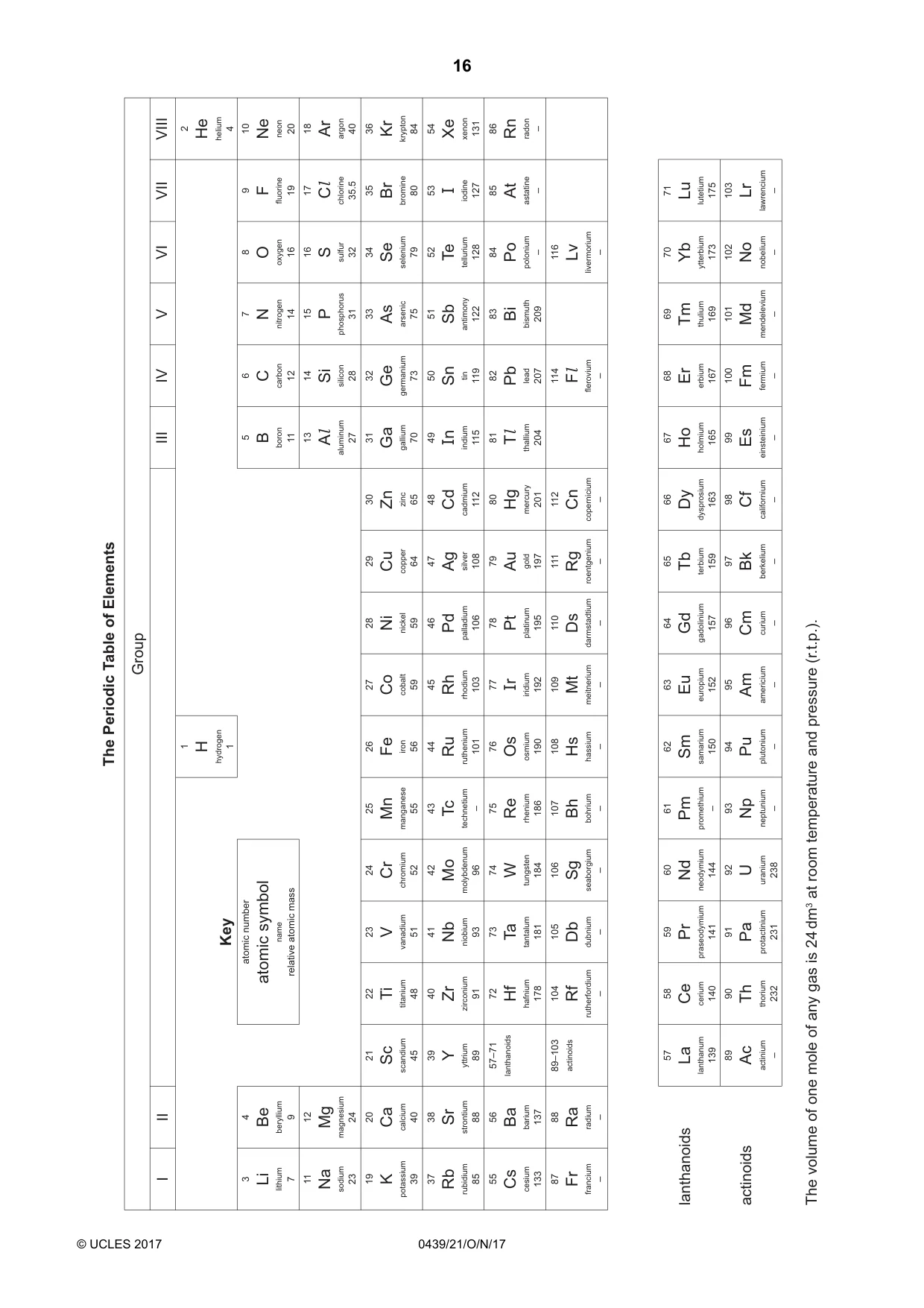
16 © UCLES 2017 0439/21/O/N/17 Group The Periodic Table of Elements 1 H hydrogen 1 2 He helium 4 I II III IV V VI VII VIII 3 Li lithium 7 4 Be beryllium 9 atomic number atomic symbol Key name relative atomic mass 11 Na sodium 23 12 Mg magnesium 24 19 K potassium 39 20 Ca calcium 40 37 Rb rubidium 85 38 Sr strontium 88 55 Cs cesium 133 56 Ba barium 137 87 Fr francium – 88 Ra radium – 5 B boron 11 13 Al aluminum 27 31 Ga gallium 70 49 In indium 115 81 Tl thallium 204 6 C carbon 12 14 Si silicon 28 32 Ge germanium 73 50 Sn tin 119 82 Pb lead 207 22 Ti titanium 48 40 Zr zirconium 91 72 Hf hafnium 178 104 Rf rutherfordium – 23 V vanadium 51 41 Nb niobium 93 73 Ta tantalum 181 105 Db dubnium – 24 Cr chromium 52 42 Mo molybdenum 96 74 W tungsten 184 106 Sg seaborgium – 25 Mn manganese 55 43 Tc technetium – 75 Re rhenium 186 107 Bh bohrium – 26 Fe iron 56 44 Ru ruthenium 101 76 Os osmium 190 108 Hs hassium – 27 Co cobalt 59 45 Rh rhodium 103 77 Ir iridium 192 109 Mt meitnerium – 28 Ni nickel 59 46 Pd palladium 106 78 Pt platinum 195 110 Ds darmstadtium – 29 Cu copper 64 47 Ag silver 108 79 Au gold 197 111 Rg roentgenium – 30 Zn zinc 65 48 Cd cadmium 112 80 Hg mercury 201 112 Cn copernicium – 114 Fl flerovium – 116 Lv livermorium – 7 N nitrogen 14 15 P phosphorus 31 33 As arsenic 75 51 Sb antimony 122 83 Bi bismuth 209 8 O oxygen 16 16 S sulfur 32 34 Se selenium 79 52 Te tellurium 128 84 Po polonium – 9 F fluorine 19 17 Cl chlorine 35.5 35 Br bromine 80 53 I iodine 127 85 At astatine – 10 Ne neon 20 18 Ar argon 40 36 Kr krypton 84 54 Xe xenon 131 86 Rn radon – 21 Sc scandium 45 39 Y yttrium 89 57–71 lanthanoids 89–103 actinoids 57 La lanthanum 139 89 Ac lanthanoids actinoids The volume of one mole of any gas is 24 dm3 at room temperature and pressure (r.t.p.). actinium – 58 Ce cerium 140 90 Th thorium 232 59 Pr praseodymium 141 91 Pa protactinium 231 60 Nd neodymium 144 92 U uranium 238 61 Pm promethium – 93 Np neptunium – 62 Sm samarium 150 94 Pu plutonium – 63 Eu europium 152 95 Am americium – 64 Gd gadolinium 157 96 Cm curium – 65 Tb terbium 159 97 Bk berkelium – 66 Dy dysprosium 163 98 Cf californium – 67 Ho holmium 165 99 Es einsteinium – 68 Er erbium 167 100 Fm fermium – 69 Tm thulium 169 101 Md mendelevium – 70 Yb ytterbium 173 102 No nobelium – 71 Lu lutetium 175 103 Lr lawrencium –
Mark scheme, page 1
® IGCSE is a registered trademark. This document consists of 3 printed pages. © UCLES 2017 [Turn over Cambridge Assessment International Education Cambridge International General Certificate of Secondary Education CHEMISTRY (US) 0439/21 Paper 2 Multiple Choice (Extended) October/November 2017 MARK SCHEME Maximum Mark: 40 Published This mark scheme is published as an aid to teachers and candidates, to indicate the requirements of the examination. Mark schemes should be read in conjunction with the question paper and the Principal Examiner Report for Teachers. Cambridge International will not enter into discussions about these mark schemes. Cambridge International is publishing the mark schemes for the October/November 2017 series for most Cambridge IGCSE®, Cambridge International A and AS Level components and some Cambridge O Level components.
Mark scheme, page 2
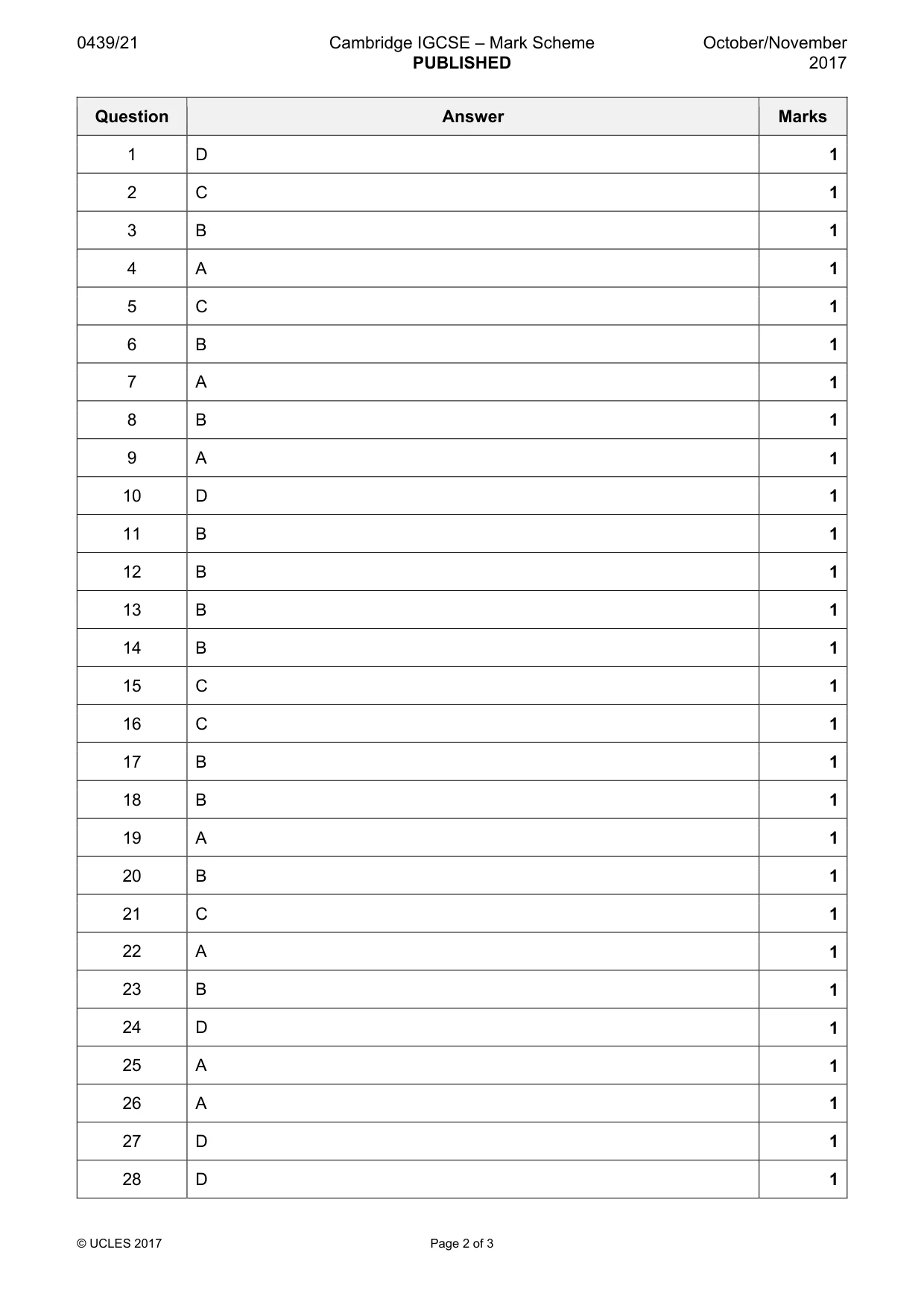
0439/21 Cambridge IGCSE – Mark Scheme PUBLISHED October/November 2017 © UCLES 2017 Page 2 of 3 Question Answer Marks 1 D 1 2 C 1 3 B 1 4 A 1 5 C 1 6 B 1 7 A 1 8 B 1 9 A 1 10 D 1 11 B 1 12 B 1 13 B 1 14 B 1 15 C 1 16 C 1 17 B 1 18 B 1 19 A 1 20 B 1 21 C 1 22 A 1 23 B 1 24 D 1 25 A 1 26 A 1 27 D 1 28 D 1
Mark scheme, page 3
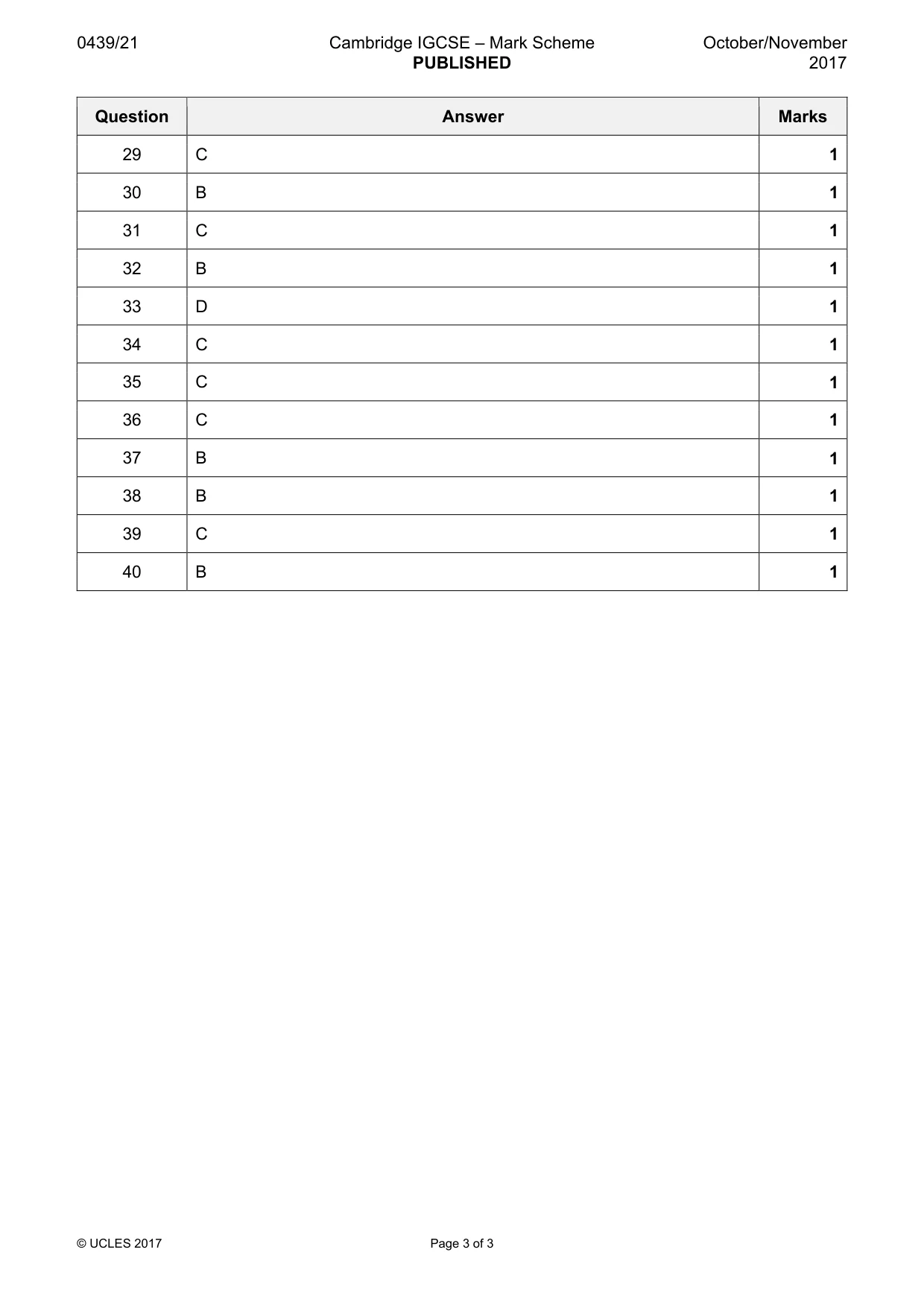
0439/21 Cambridge IGCSE – Mark Scheme PUBLISHED October/November 2017 © UCLES 2017 Page 3 of 3 Question Answer Marks 29 C 1 30 B 1 31 C 1 32 B 1 33 D 1 34 C 1 35 C 1 36 C 1 37 B 1 38 B 1 39 C 1 40 B 1
What you needed in this session
Cambridge’s own grade thresholds for 2017 Oct/Nov, Paper 2 · Variant 1. A higher threshold means an easier paper — the bar moves with how the cohort did.