Cambridge IGCSE Business Studies (9-1) 0986 — 2019 Oct/Nov Paper 1 · Variant 1
0986/11/O/N/19 · 80 marks · ≈90 min
The question paper and its mark scheme, free to read here and free to download. This is Cambridge’s own paper, exactly as it was sat.
Question paper12 pages



Mark scheme20 pages
Answers below. Sit the paper first if you are practising.
Paper as text
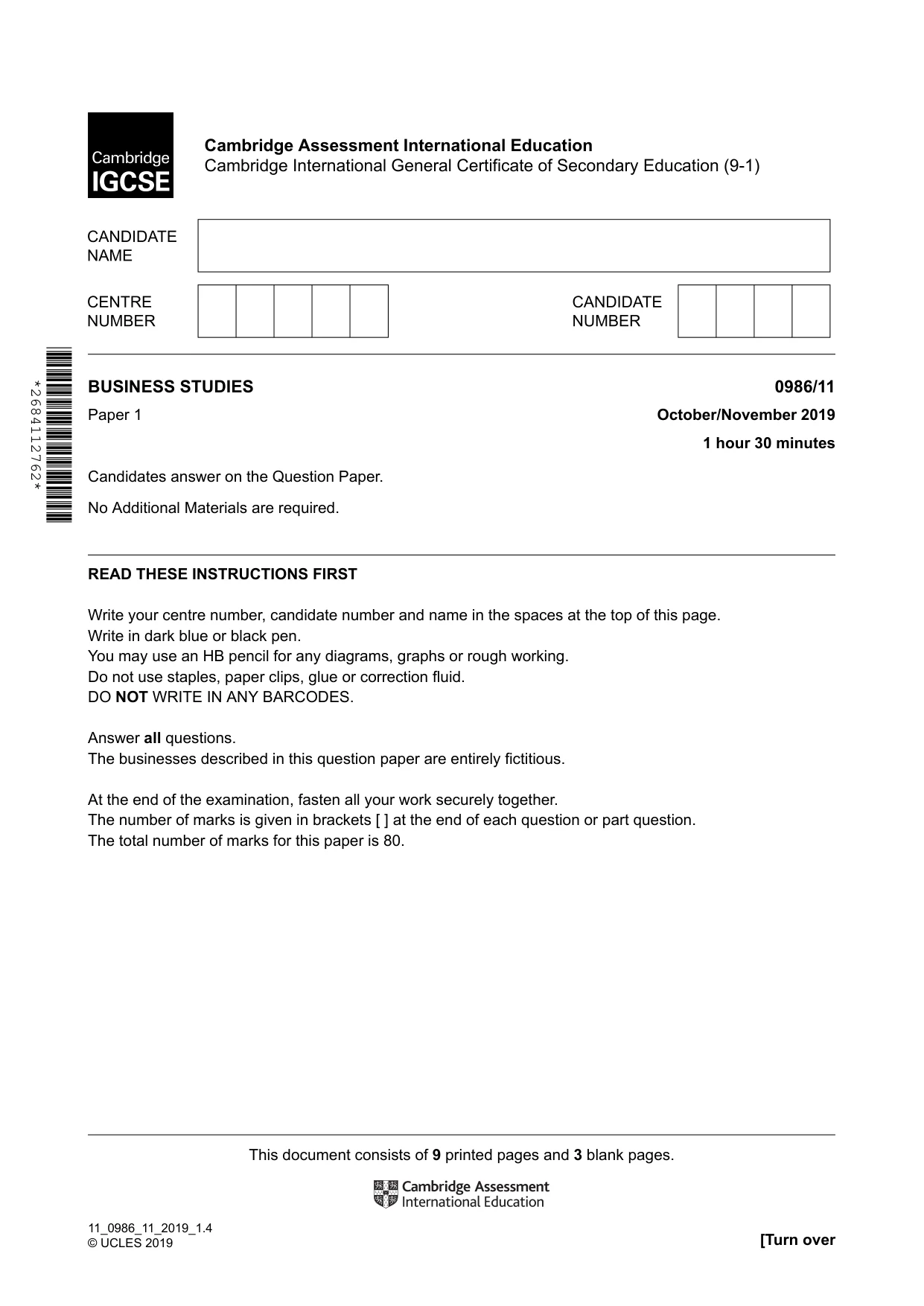
Question paper, page 1
Cambridge Assessment International Education Cambridge International General Certificate of Secondary Education (9-1) 0986/11 October/November 2019 1 hour 30 minutes BUSINESS STUDIES Paper 1 Candidates answer on the Question Paper. No Additional Materials are required. READ THESE INSTRUCTIONS FIRST Write your centre number, candidate number and name in the spaces at the top of this page. Write in dark blue or black pen. You may use an HB pencil for any diagrams, graphs or rough working. Do not use staples, paper clips, glue or correction fluid. DO NOT WRITE IN ANY BARCODES. Answer all questions. The businesses described in this question paper are entirely fictitious. At the end of the examination, fasten all your work securely together. The number of marks is given in brackets [ ] at the end of each question or part question. The total number of marks for this paper is 80. This document consists of 9 printed pages and 3 blank pages. [Turn over 11_0986_11_2019_1.4 © UCLES 2019 *2684112762*
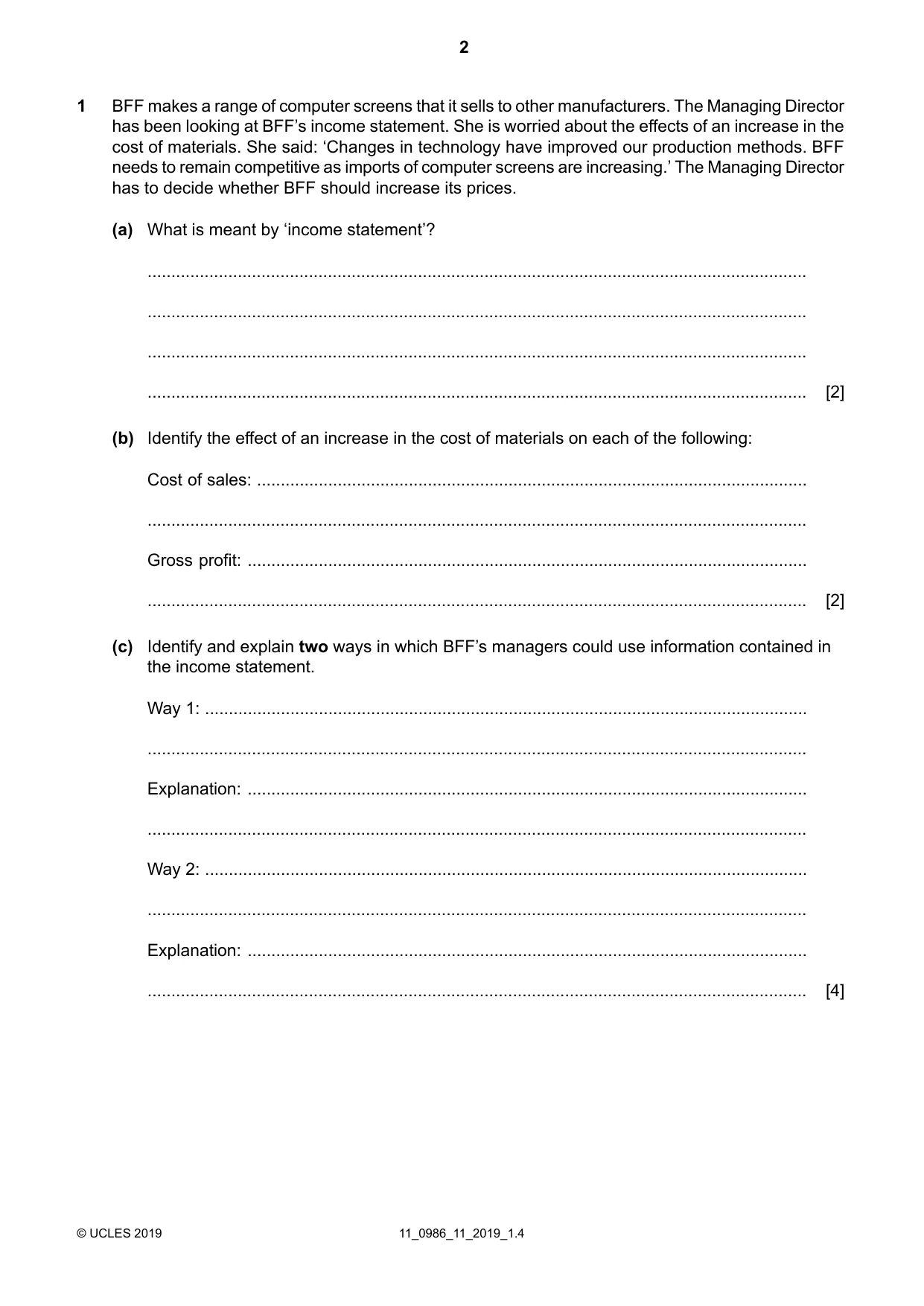
Question paper, page 2
BFF makes a range of computer screens that it sells to other manufacturers. The Managing Director has been looking at BFF’s income statement. She is worried about the effects of an increase in the 1 cost of materials. She said: ‘Changes in technology have improved our production methods. BFF needs to remain competitive as imports of computer screens are increasing.’ The Managing Director has to decide whether BFF should increase its prices. What is meant by ‘income statement’? (a) … … … … [2] Identify the effect of an increase in the cost of materials on each of the following: (b) Cost of sales: … … Gross profit: … … [2] Identify and explain two ways in which BFF’s managers could use information contained in the income statement. (c) Way 1: … … Explanation: … … Way 2: … … Explanation: … … [4] 11_0986_11_2019_1.4 © UCLES 2019 2
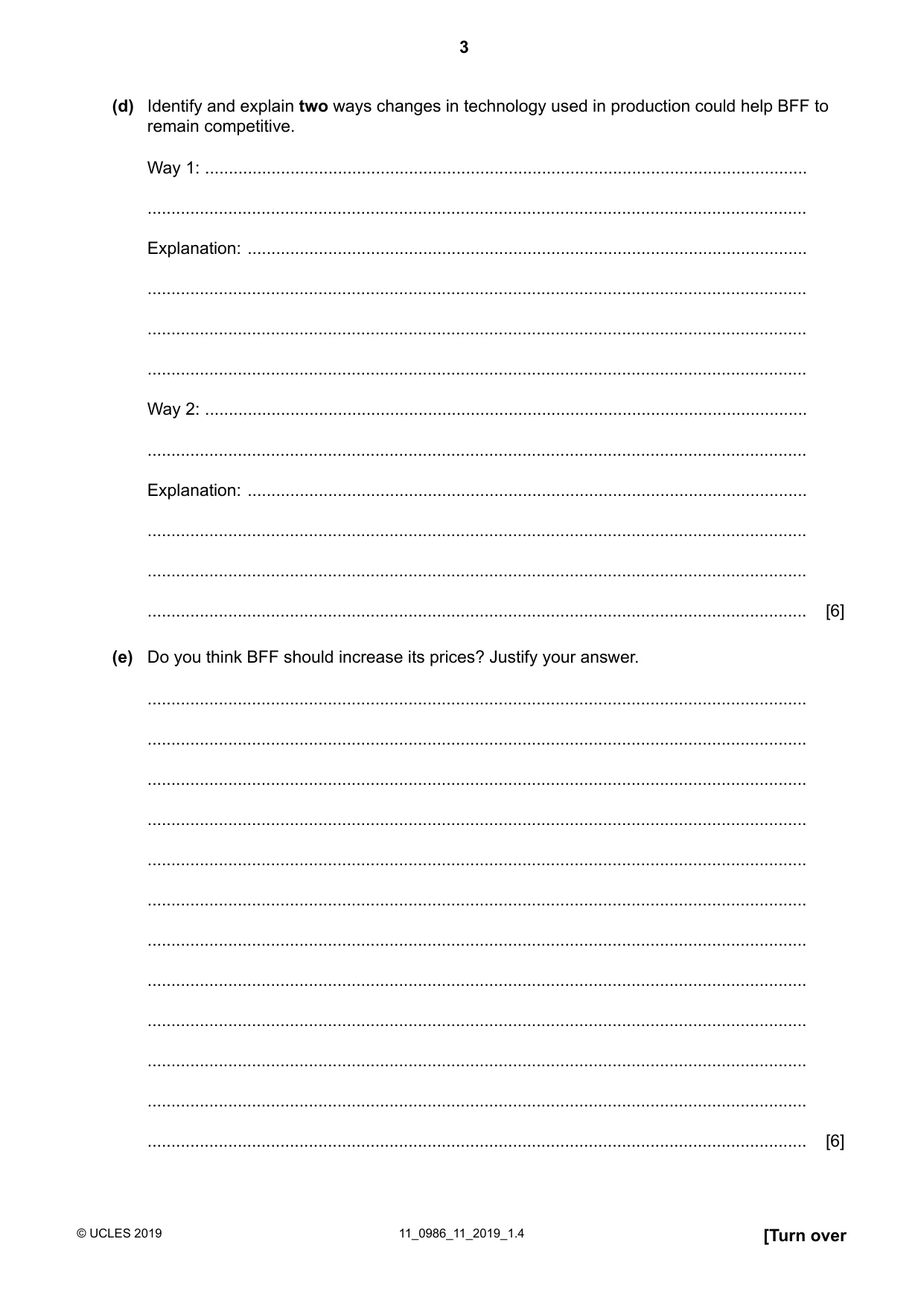
Question paper, page 3
Identify and explain two ways changes in technology used in production could help BFF to remain competitive. (d) Way 1: … … Explanation: … … … … Way 2: … … Explanation: … … … … [6] Do you think BFF should increase its prices? Justify your answer. (e) … … … … … … … … … … … … [6] [Turn over 11_0986_11_2019_1.4 © UCLES 2019 3
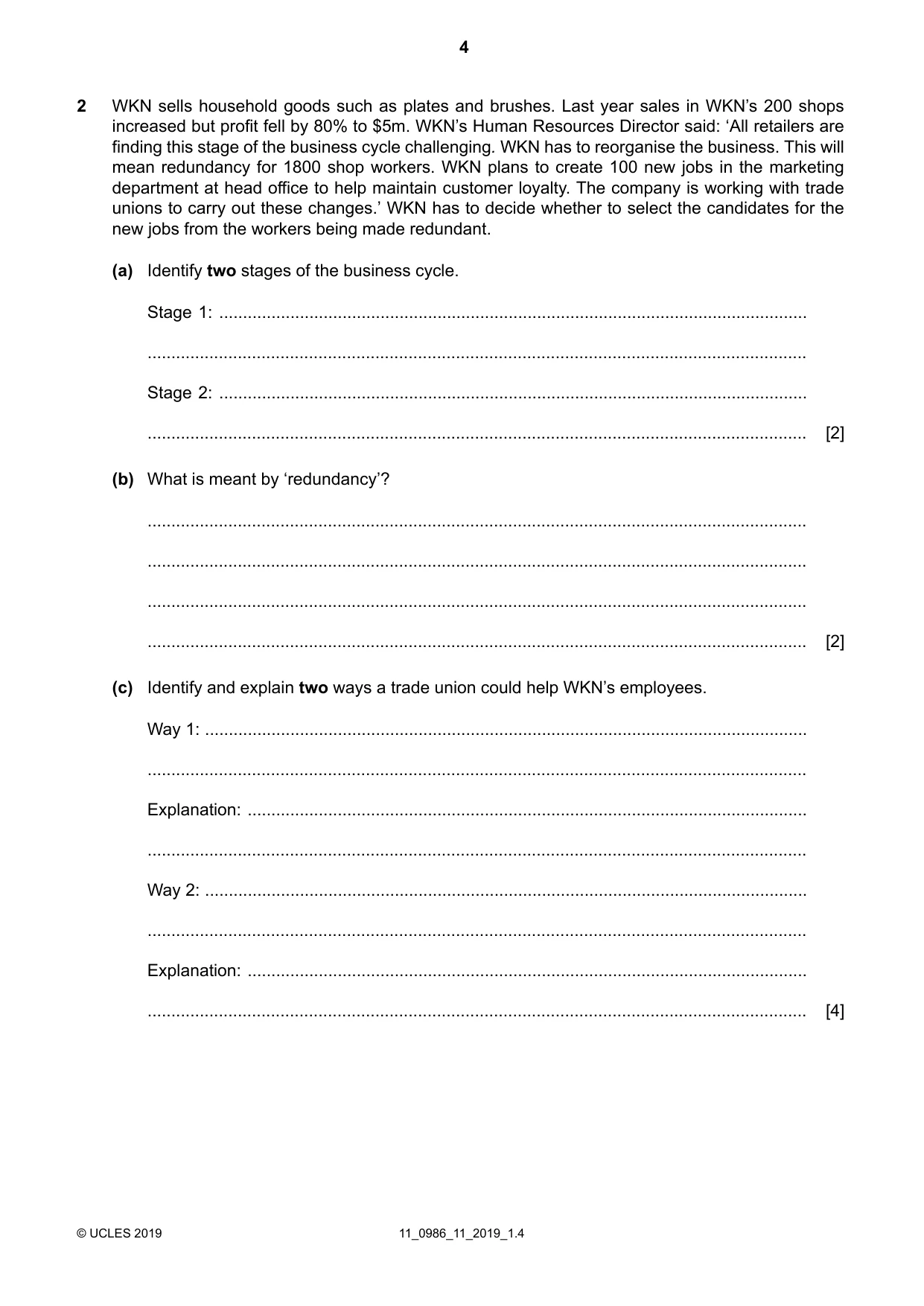
Question paper, page 4
WKN sells household goods such as plates and brushes. Last year sales in WKN’s 200 shops increased but profit fell by 80% to $5m. WKN’s Human Resources Director said: ‘All retailers are 2 finding this stage of the business cycle challenging. WKN has to reorganise the business. This will mean redundancy for 1800 shop workers. WKN plans to create 100 new jobs in the marketing department at head office to help maintain customer loyalty. The company is working with trade unions to carry out these changes.’ WKN has to decide whether to select the candidates for the new jobs from the workers being made redundant. Identify two stages of the business cycle. (a) Stage 1: … … Stage 2: … … [2] What is meant by ‘redundancy’? (b) … … … … [2] Identify and explain two ways a trade union could help WKN’s employees. (c) Way 1: … … Explanation: … … Way 2: … … Explanation: … … [4] 11_0986_11_2019_1.4 © UCLES 2019 4
Question paper, page 5
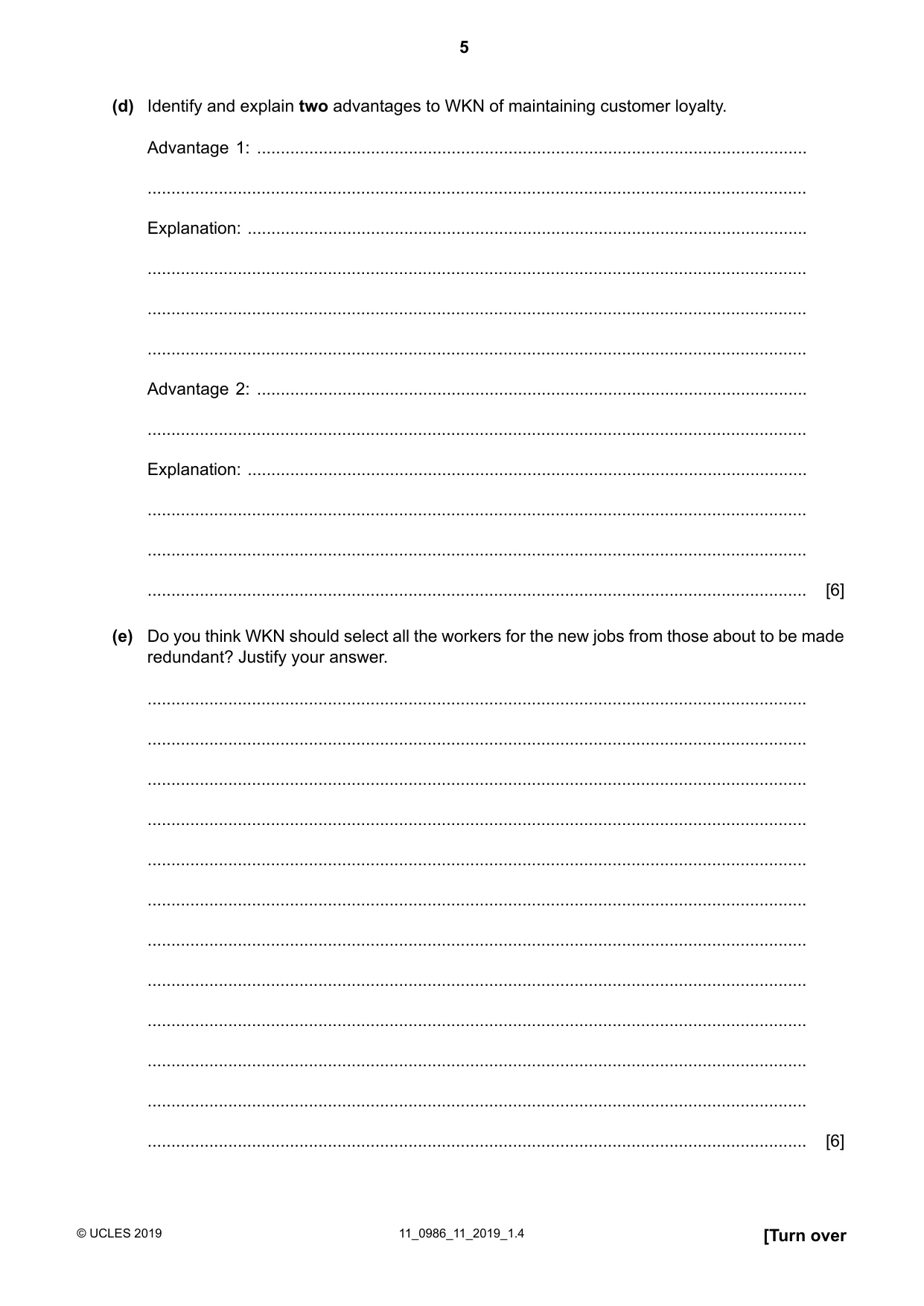
Identify and explain two advantages to WKN of maintaining customer loyalty. (d) Advantage 1: … … Explanation: … … … … Advantage 2: … … Explanation: … … … … [6] Do you think WKN should select all the workers for the new jobs from those about to be made redundant? Justify your answer. (e) … … … … … … … … … … … … [6] [Turn over 11_0986_11_2019_1.4 © UCLES 2019 5
Question paper, page 6
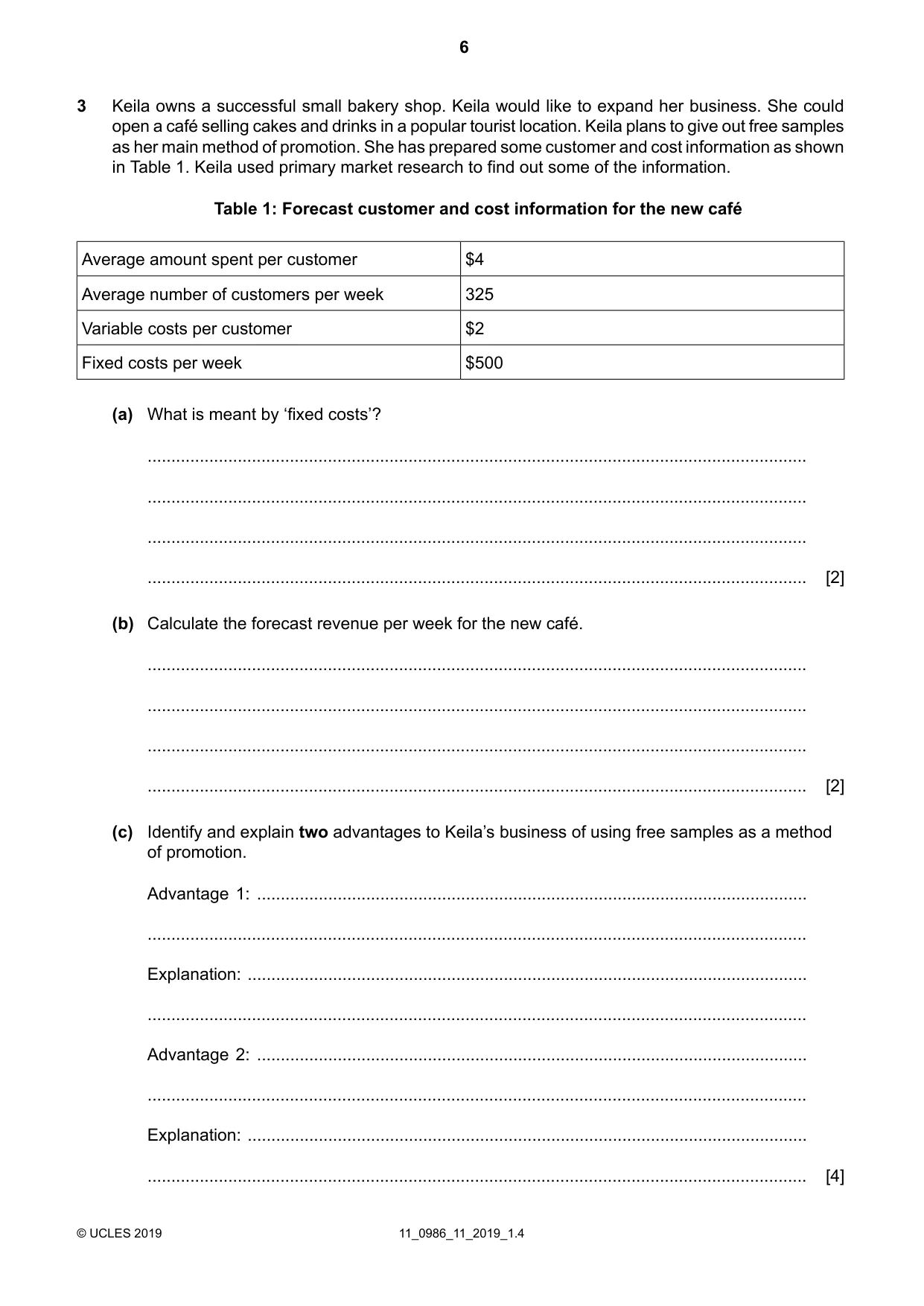
Keila owns a successful small bakery shop. Keila would like to expand her business. She could open a café selling cakes and drinks in a popular tourist location. Keila plans to give out free samples 3 as her main method of promotion. She has prepared some customer and cost information as shown in Table 1. Keila used primary market research to find out some of the information. Table 1: Forecast customer and cost information for the new café $4 Average amount spent per customer 325 Average number of customers per week $2 Variable costs per customer $500 Fixed costs per week What is meant by ‘fixed costs’? (a) … … … … [2] Calculate the forecast revenue per week for the new café. (b) … … … … [2] Identify and explain two advantages to Keila’s business of using free samples as a method of promotion. (c) Advantage 1: … … Explanation: … … Advantage 2: … … Explanation: … … [4] 11_0986_11_2019_1.4 © UCLES 2019 6
Question paper, page 7
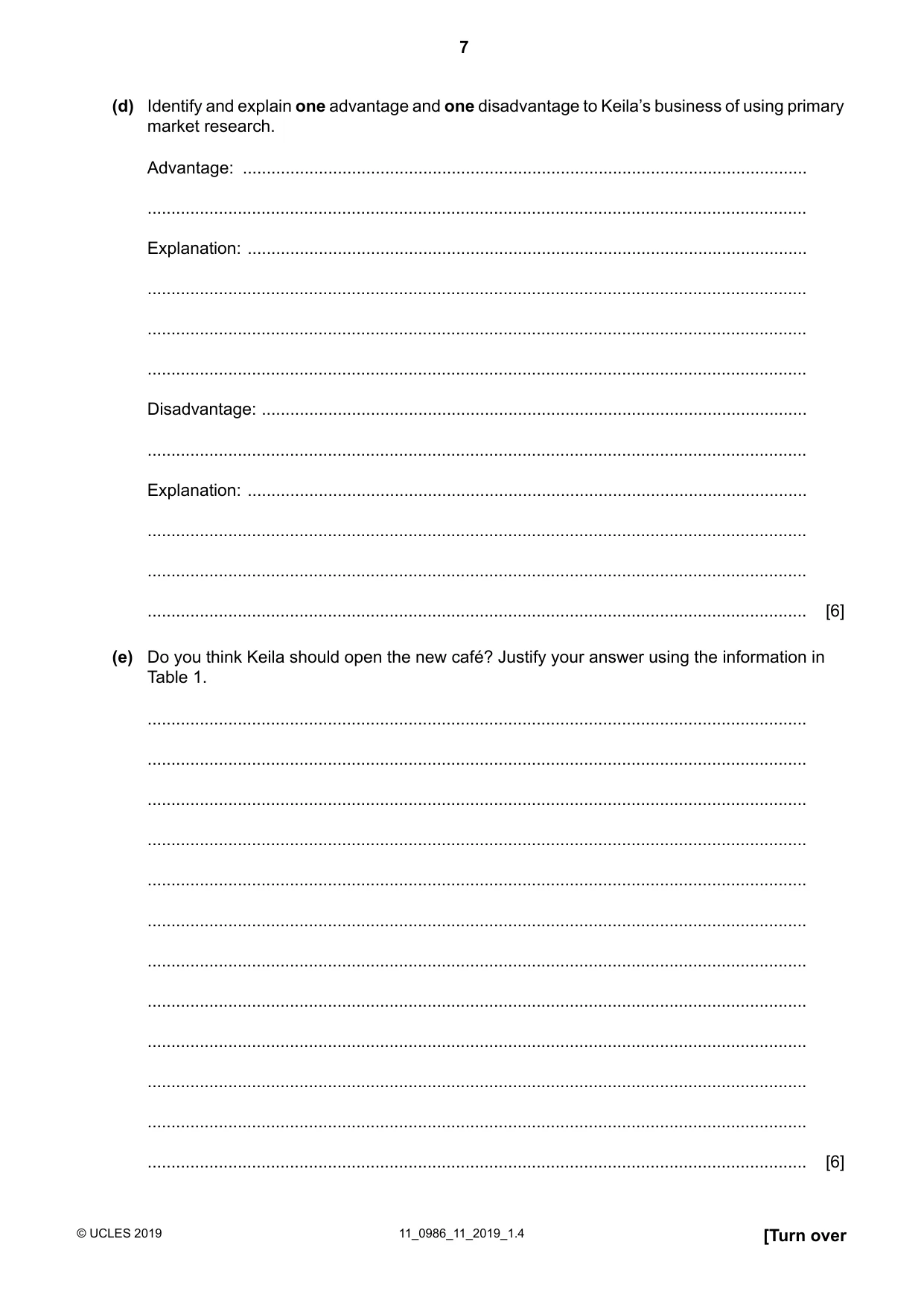
Identify and explain one advantage and one disadvantage to Keila’s business of using primary market research. (d) Advantage: … … Explanation: … … … … Disadvantage: … … Explanation: … … … … [6] Do you think Keila should open the new café? Justify your answer using the information in Table 1. (e) … … … … … … … … … … … … [6] [Turn over 11_0986_11_2019_1.4 © UCLES 2019 7
Question paper, page 8
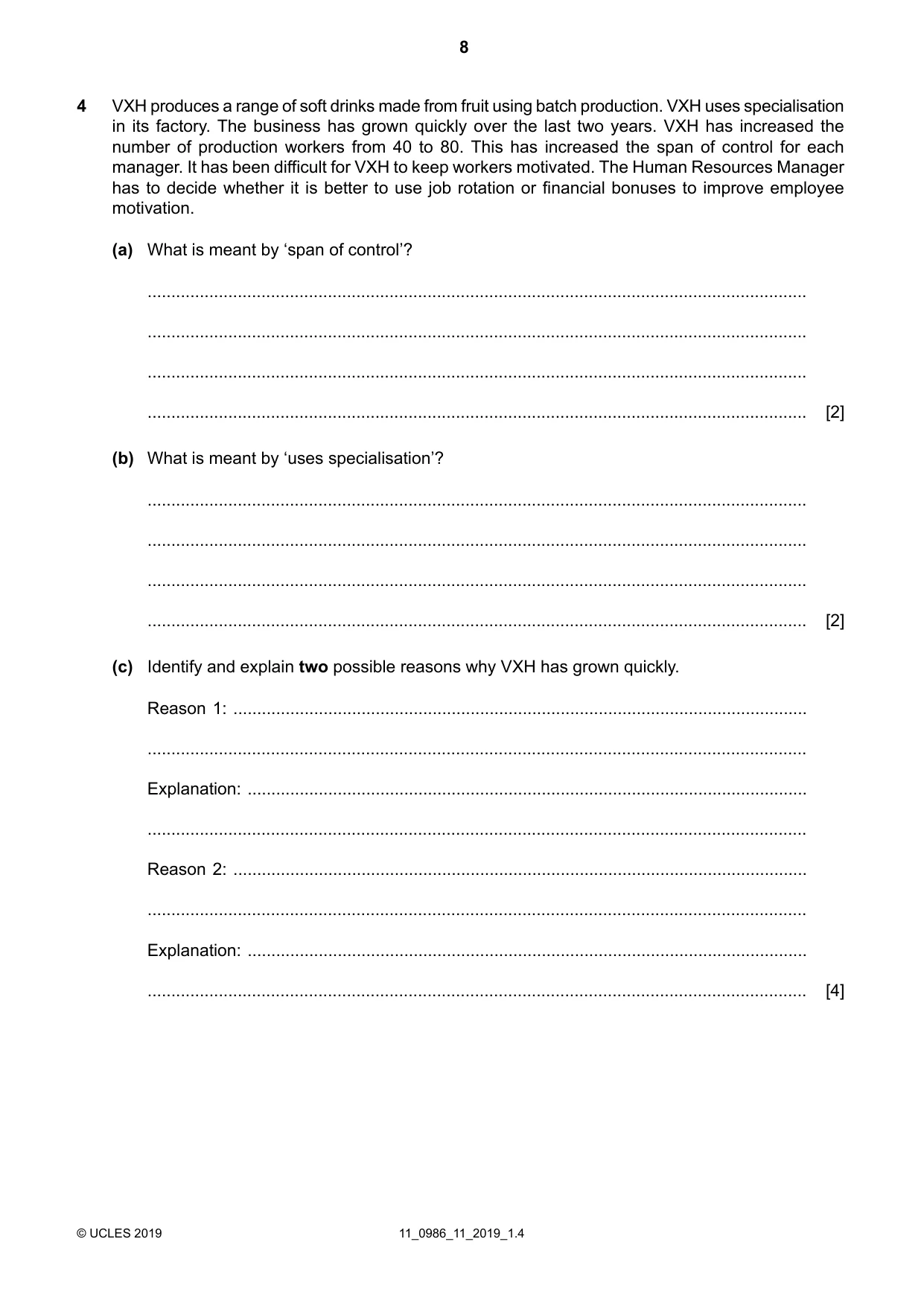
VXH produces a range of soft drinks made from fruit using batch production. VXH uses specialisation in its factory. The business has grown quickly over the last two years. VXH has increased the 4 number of production workers from 40 to 80. This has increased the span of control for each manager. It has been difficult for VXH to keep workers motivated. The Human Resources Manager has to decide whether it is better to use job rotation or financial bonuses to improve employee motivation. What is meant by ‘span of control’? (a) … … … … [2] What is meant by ‘uses specialisation’? (b) … … … … [2] Identify and explain two possible reasons why VXH has grown quickly. (c) Reason 1: … … Explanation: … … Reason 2: … … Explanation: … … [4] 11_0986_11_2019_1.4 © UCLES 2019 8
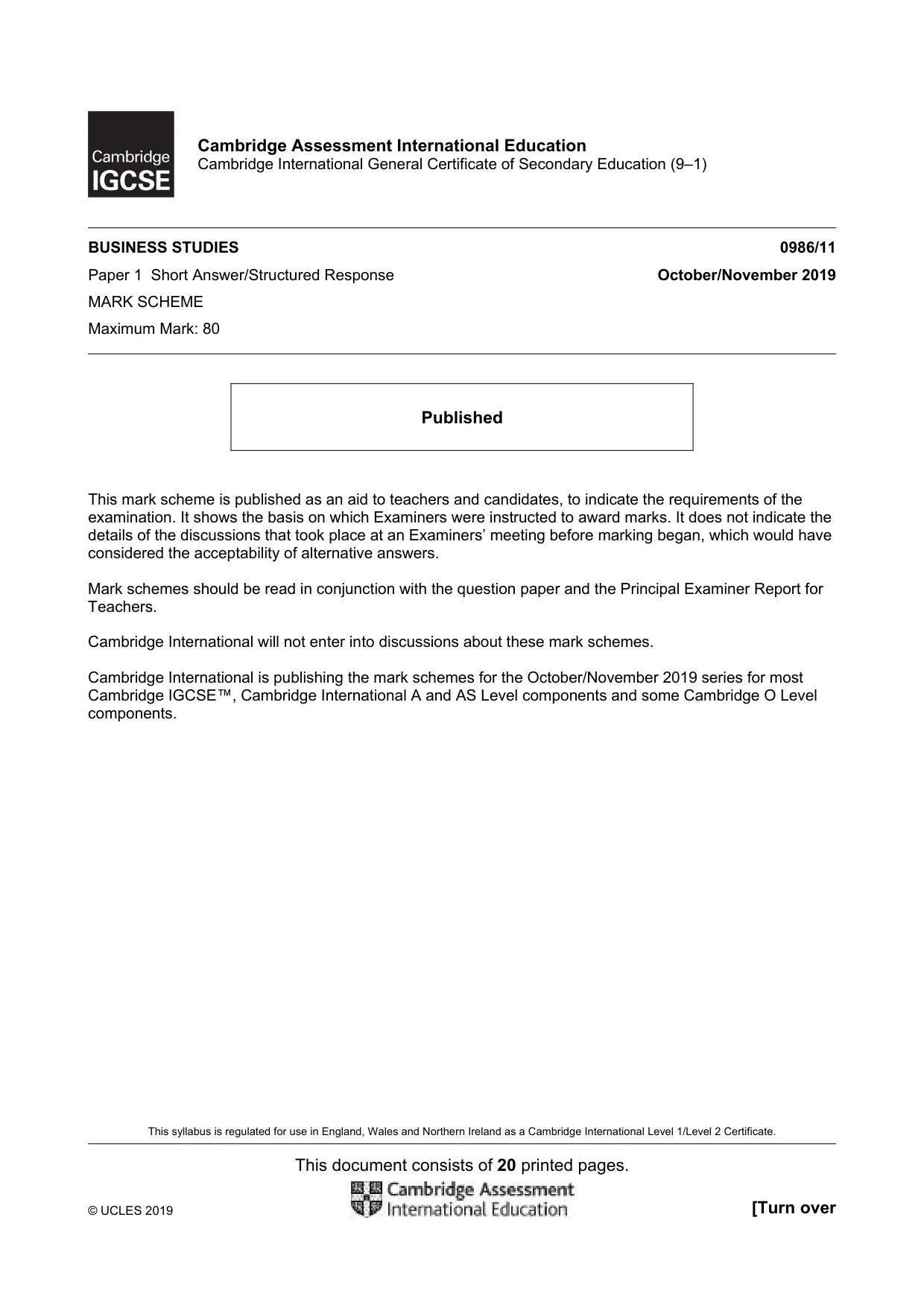
Question paper, page 9
Identify and explain two possible reasons why VXH uses batch production. (d) Reason 1: … … Explanation: … … … … Reason 2: … … Explanation: … … … … [6] Do you think VXH should use job rotation or financial bonuses to increase employee motivation? Justify your answer. (e) … … … … … … … … … … … … [6] 11_0986_11_2019_1.4 © UCLES 2019 9
Question paper, page 10
BLANK PAGE 11_0986_11_2019_1.4 © UCLES 2019 10
Question paper, page 11
BLANK PAGE 11_0986_11_2019_1.4 © UCLES 2019 11
Question paper, page 12
BLANK PAGE Permission to reproduce items where third-party owned material protected by copyright is included has been sought and cleared where possible. Every reasonable effort has been made by the publisher (UCLES) to trace copyright holders, but if any items requiring clearance have unwittingly been included, the publisher will be pleased to make amends at the earliest possible opportunity. To avoid the issue of disclosure of answer-related information to candidates, all copyright acknowledgements are reproduced online in the Cambridge Assessment International Education Copyright Acknowledgements Booklet. This is produced for each series of examinations and is freely available to download at www.cambridgeinternational.org after the live examination series. Cambridge Assessment International Education is part of the Cambridge Assessment Group. Cambridge Assessment is the brand name of the University of Cambridge Local Examinations Syndicate (UCLES), which itself is a department of the University of Cambridge. 11_0986_11_2019_1.4 © UCLES 2019 12
Mark scheme, page 1
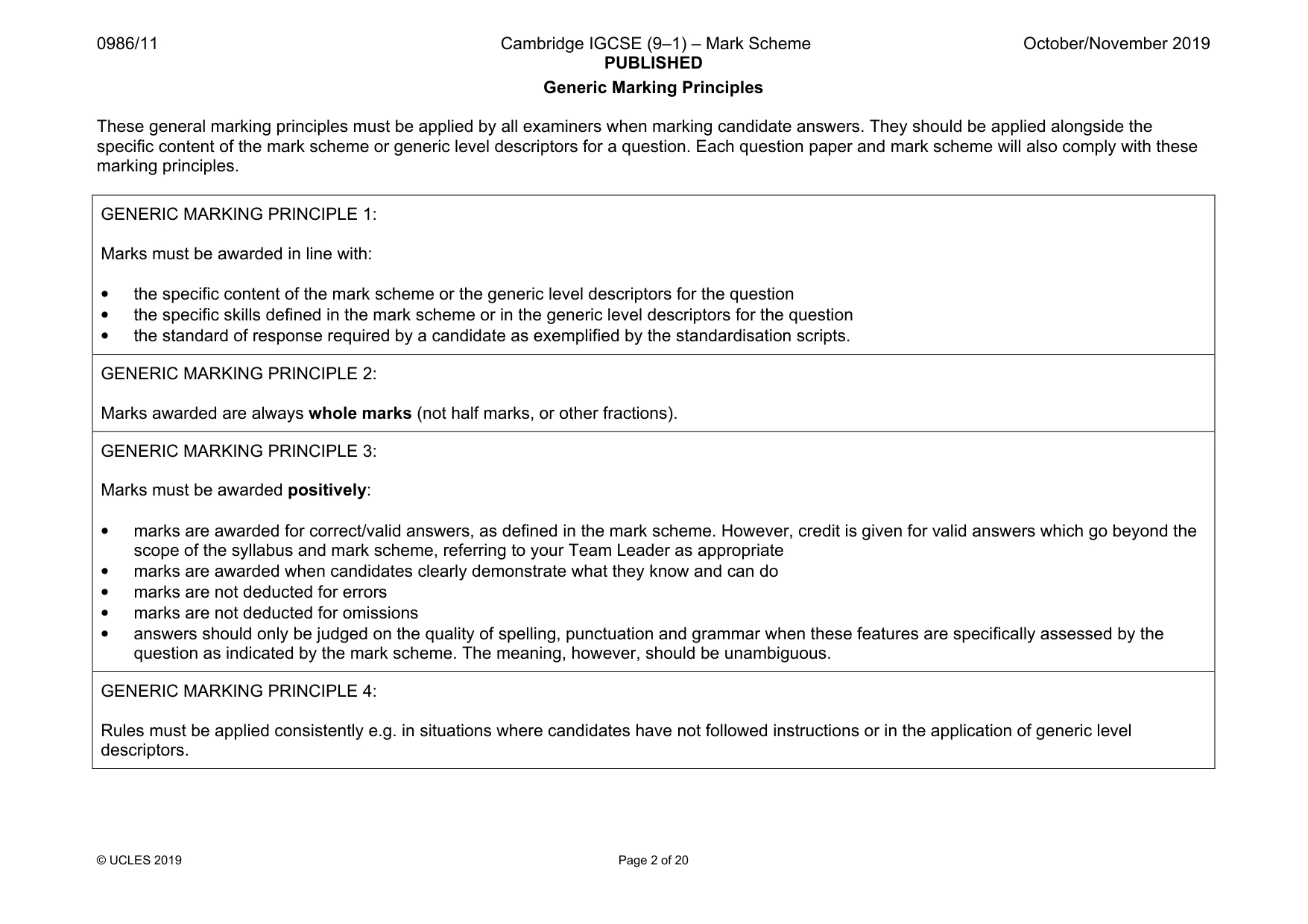
This syllabus is regulated for use in England, Wales and Northern Ireland as a Cambridge International Level 1/Level 2 Certificate. This document consists of 20 printed pages. © UCLES 2019 [Turn over Cambridge Assessment International Education Cambridge International General Certificate of Secondary Education (9–1) BUSINESS STUDIES 0986/11 Paper 1 Short Answer/Structured Response October/November 2019 MARK SCHEME Maximum Mark: 80 Published This mark scheme is published as an aid to teachers and candidates, to indicate the requirements of the examination. It shows the basis on which Examiners were instructed to award marks. It does not indicate the details of the discussions that took place at an Examiners’ meeting before marking began, which would have considered the acceptability of alternative answers. Mark schemes should be read in conjunction with the question paper and the Principal Examiner Report for Teachers. Cambridge International will not enter into discussions about these mark schemes. Cambridge International is publishing the mark schemes for the October/November 2019 series for most Cambridge IGCSE™, Cambridge International A and AS Level components and some Cambridge O Level components.
Mark scheme, page 2
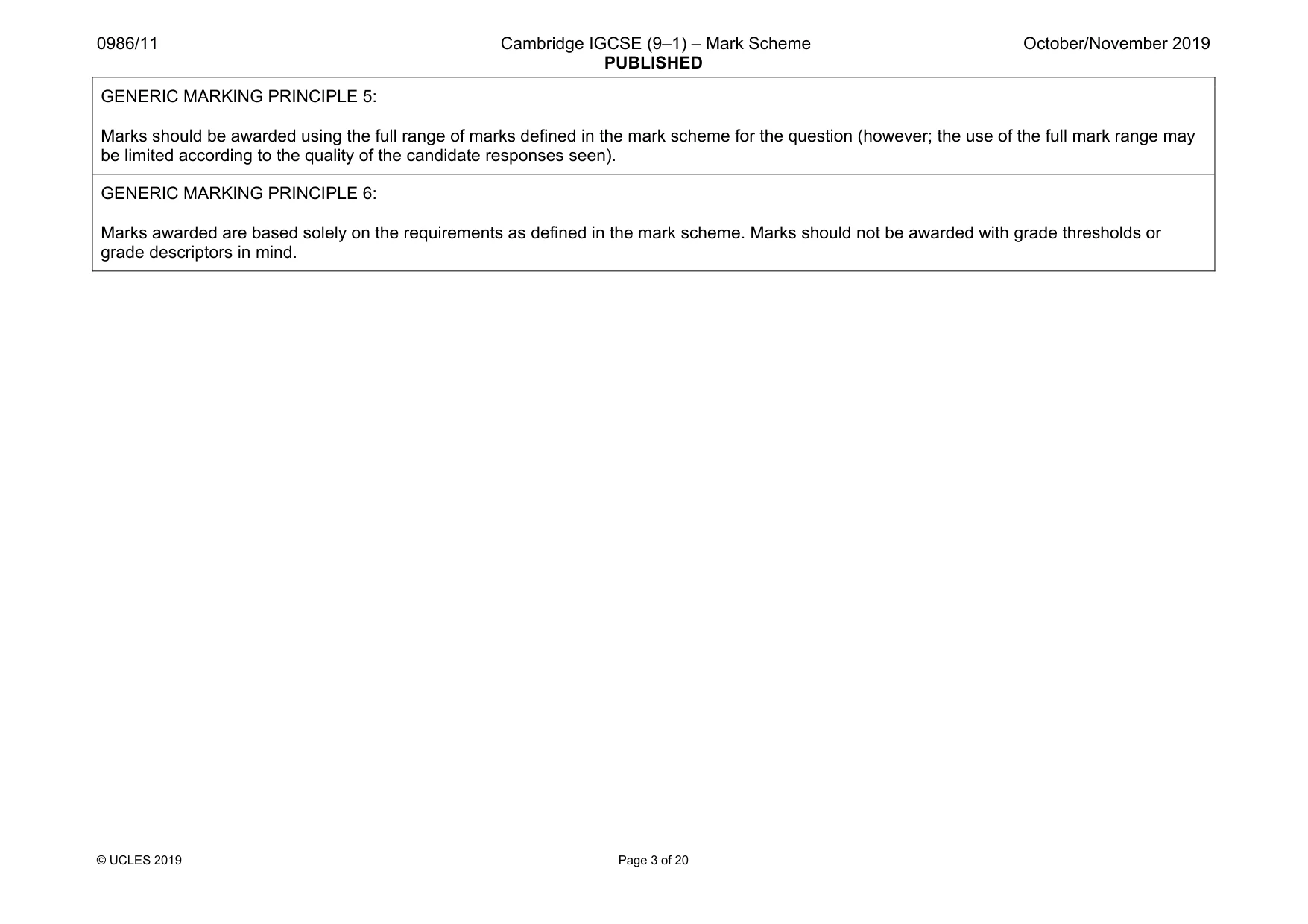
0986/11 Cambridge IGCSE (9–1) – Mark Scheme PUBLISHED October/November 2019 © UCLES 2019 Page 2 of 20 Generic Marking Principles These general marking principles must be applied by all examiners when marking candidate answers. They should be applied alongside the specific content of the mark scheme or generic level descriptors for a question. Each question paper and mark scheme will also comply with these marking principles. GENERIC MARKING PRINCIPLE 1: Marks must be awarded in line with: • the specific content of the mark scheme or the generic level descriptors for the question • the specific skills defined in the mark scheme or in the generic level descriptors for the question • the standard of response required by a candidate as exemplified by the standardisation scripts. GENERIC MARKING PRINCIPLE 2: Marks awarded are always whole marks (not half marks, or other fractions). GENERIC MARKING PRINCIPLE 3: Marks must be awarded positively: • marks are awarded for correct/valid answers, as defined in the mark scheme. However, credit is given for valid answers which go beyond the scope of the syllabus and mark scheme, referring to your Team Leader as appropriate • marks are awarded when candidates clearly demonstrate what they know and can do • marks are not deducted for errors • marks are not deducted for omissions • answers should only be judged on the quality of spelling, punctuation and grammar when these features are specifically assessed by the question as indicated by the mark scheme. The meaning, however, should be unambiguous. GENERIC MARKING PRINCIPLE 4: Rules must be applied consistently e.g. in situations where candidates have not followed instructions or in the application of generic level descriptors.
Mark scheme, page 3
0986/11 Cambridge IGCSE (9–1) – Mark Scheme PUBLISHED October/November 2019 © UCLES 2019 Page 3 of 20 GENERIC MARKING PRINCIPLE 5: Marks should be awarded using the full range of marks defined in the mark scheme for the question (however; the use of the full mark range may be limited according to the quality of the candidate responses seen). GENERIC MARKING PRINCIPLE 6: Marks awarded are based solely on the requirements as defined in the mark scheme. Marks should not be awarded with grade thresholds or grade descriptors in mind.
Mark scheme, page 4
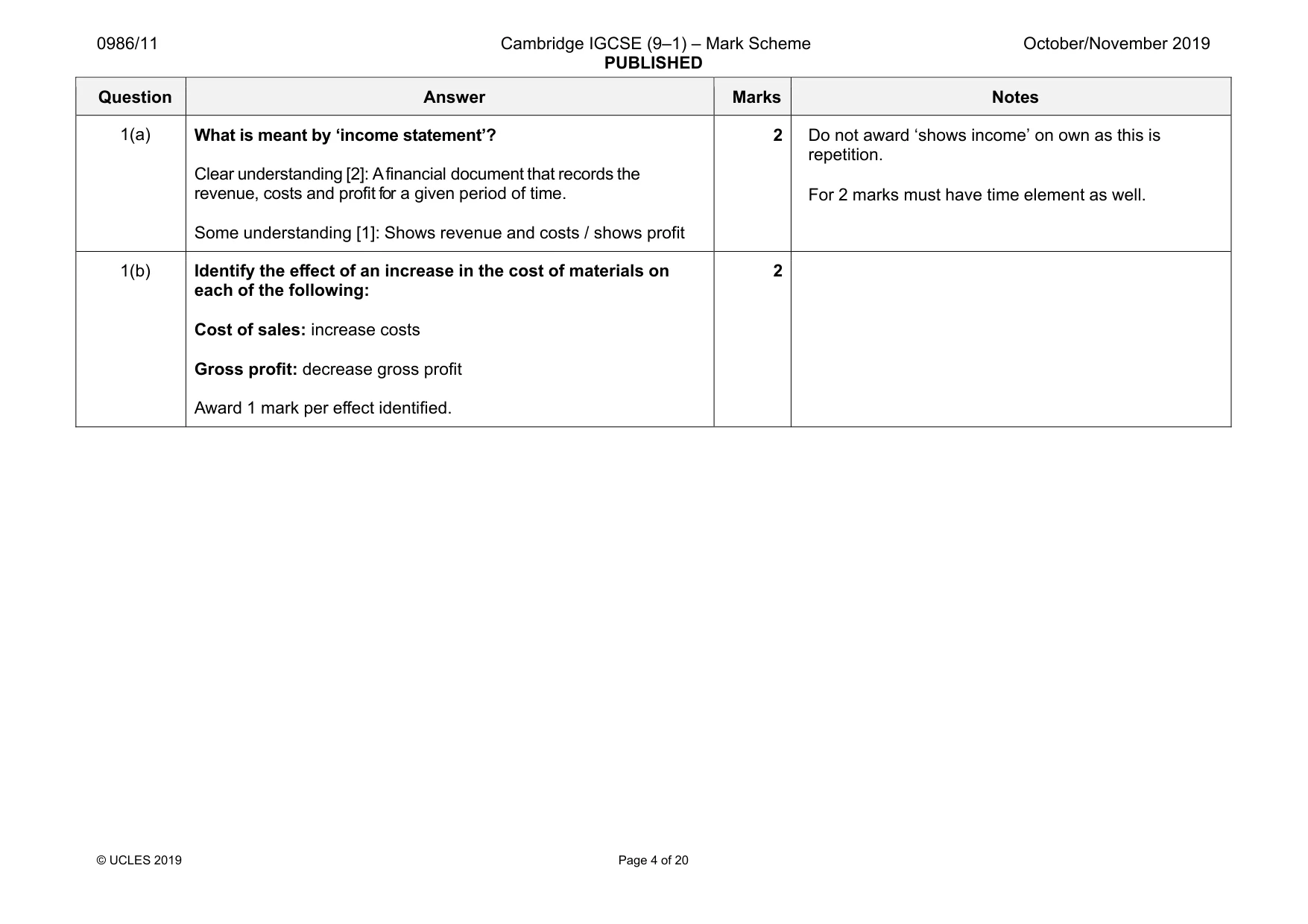
0986/11 Cambridge IGCSE (9–1) – Mark Scheme PUBLISHED October/November 2019 © UCLES 2019 Page 4 of 20 Question Answer Marks Notes 1(a) What is meant by ‘income statement’? Clear understanding [2]: A financial document that records the revenue, costs and profit for a given period of time. Some understanding [1]: Shows revenue and costs / shows profit 2 Do not award ‘shows income’ on own as this is repetition. For 2 marks must have time element as well. 1(b) Identify the effect of an increase in the cost of materials on each of the following: Cost of sales: increase costs Gross profit: decrease gross profit Award 1 mark per effect identified. 2
Mark scheme, page 5
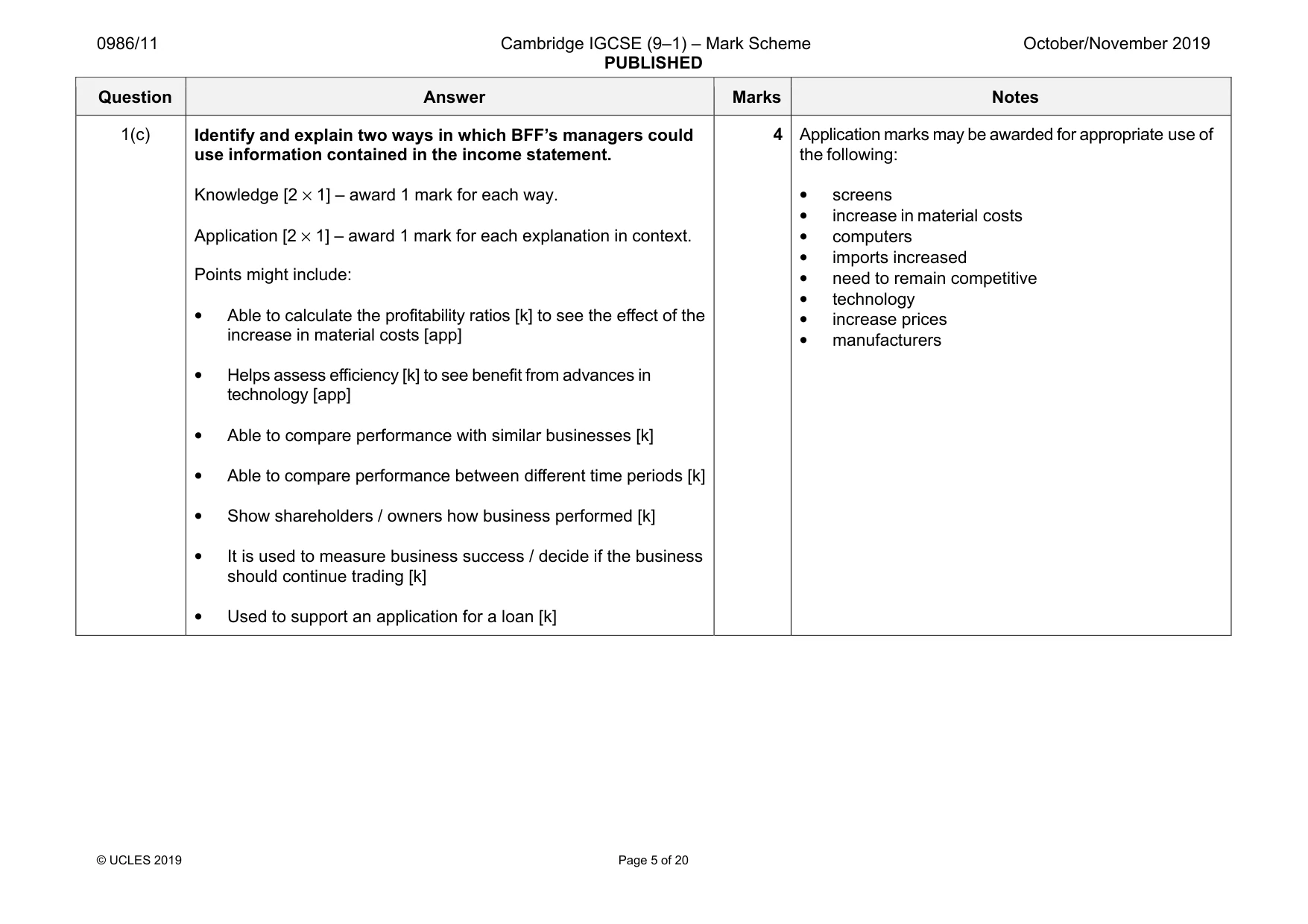
0986/11 Cambridge IGCSE (9–1) – Mark Scheme PUBLISHED October/November 2019 © UCLES 2019 Page 5 of 20 Question Answer Marks Notes 1(c) Identify and explain two ways in which BFF’s managers could use information contained in the income statement. Knowledge [2 × 1] – award 1 mark for each way. Application [2 × 1] – award 1 mark for each explanation in context. Points might include: • Able to calculate the profitability ratios [k] to see the effect of the increase in material costs [app] • Helps assess efficiency [k] to see benefit from advances in technology [app] • Able to compare performance with similar businesses [k] • Able to compare performance between different time periods [k] • Show shareholders / owners how business performed [k] • It is used to measure business success / decide if the business should continue trading [k] • Used to support an application for a loan [k] 4 Application marks may be awarded for appropriate use of the following: • screens • increase in material costs • computers • imports increased • need to remain competitive • technology • increase prices • manufacturers
Mark scheme, page 6
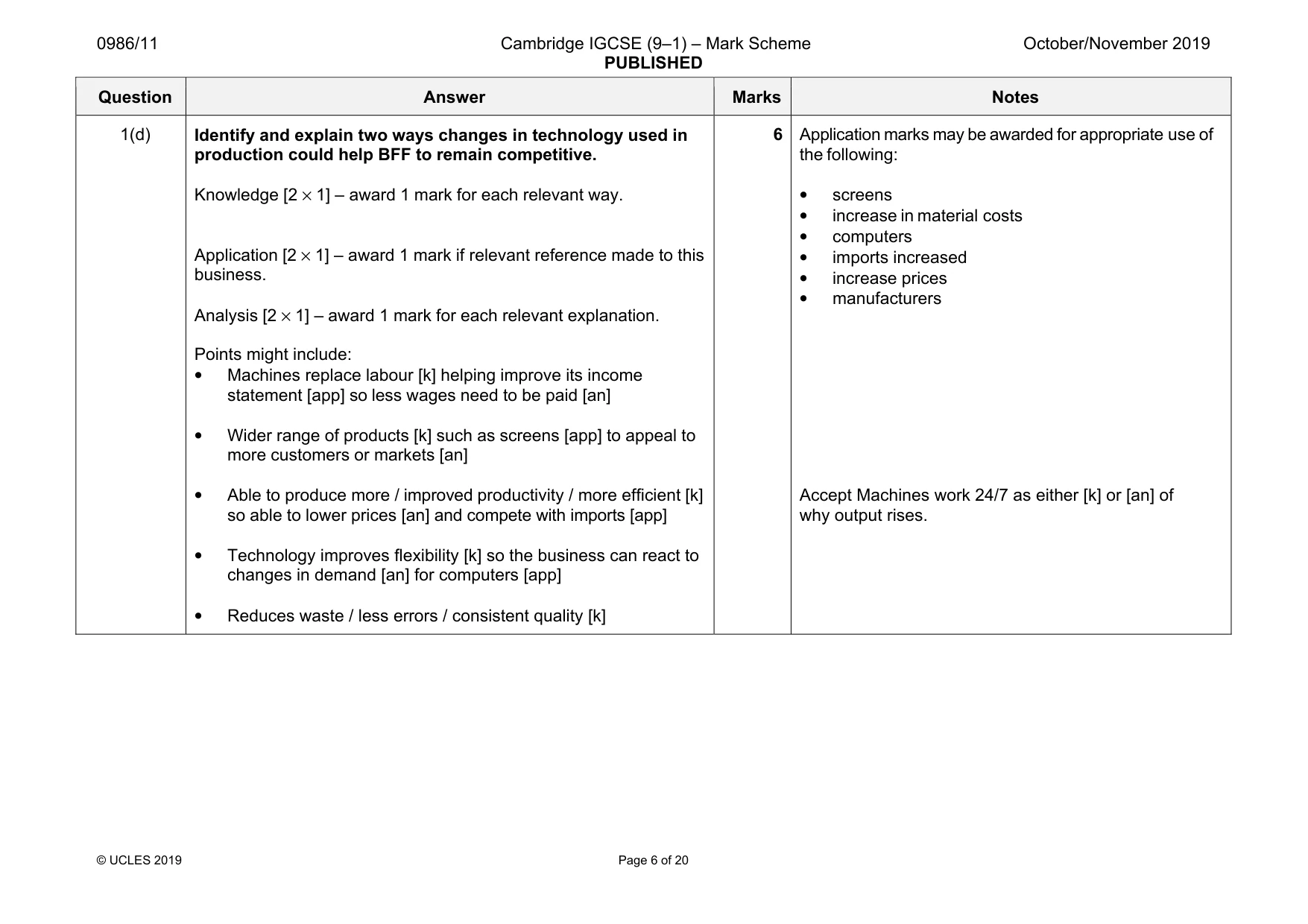
0986/11 Cambridge IGCSE (9–1) – Mark Scheme PUBLISHED October/November 2019 © UCLES 2019 Page 6 of 20 Question Answer Marks Notes 1(d) Identify and explain two ways changes in technology used in production could help BFF to remain competitive. Knowledge [2 × 1] – award 1 mark for each relevant way. Application [2 × 1] – award 1 mark if relevant reference made to this business. Analysis [2 × 1] – award 1 mark for each relevant explanation. Points might include: • Machines replace labour [k] helping improve its income statement [app] so less wages need to be paid [an] • Wider range of products [k] such as screens [app] to appeal to more customers or markets [an] • Able to produce more / improved productivity / more efficient [k] so able to lower prices [an] and compete with imports [app] • Technology improves flexibility [k] so the business can react to changes in demand [an] for computers [app] • Reduces waste / less errors / consistent quality [k] 6 Application marks may be awarded for appropriate use of the following: • screens • increase in material costs • computers • imports increased • increase prices • manufacturers Accept Machines work 24/7 as either [k] or [an] of why output rises.
Mark scheme, page 7
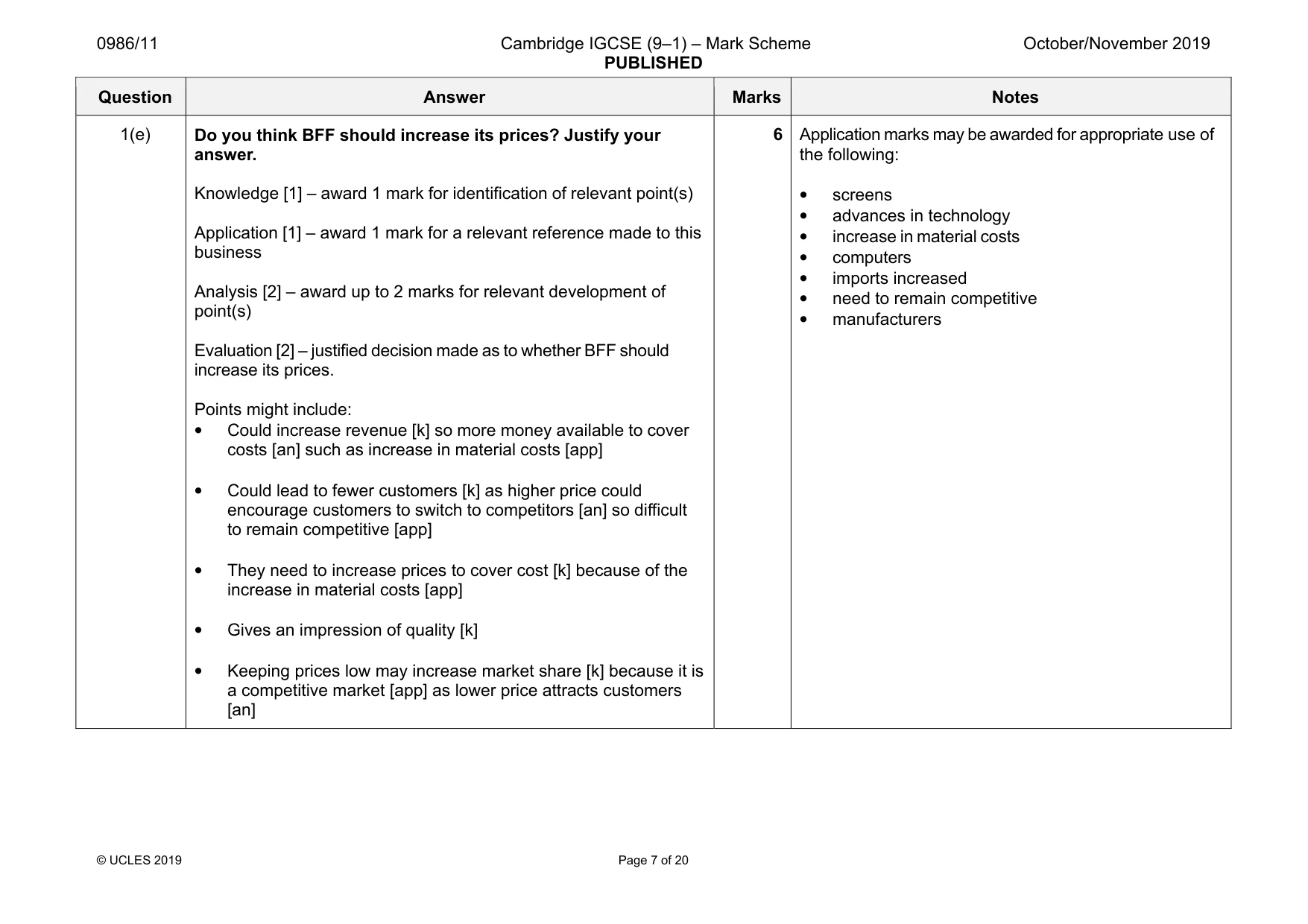
0986/11 Cambridge IGCSE (9–1) – Mark Scheme PUBLISHED October/November 2019 © UCLES 2019 Page 7 of 20 Question Answer Marks Notes 1(e) Do you think BFF should increase its prices? Justify your answer. Knowledge [1] – award 1 mark for identification of relevant point(s) Application [1] – award 1 mark for a relevant reference made to this business Analysis [2] – award up to 2 marks for relevant development of point(s) Evaluation [2] – justified decision made as to whether BFF should increase its prices. Points might include: • Could increase revenue [k] so more money available to cover costs [an] such as increase in material costs [app] • Could lead to fewer customers [k] as higher price could encourage customers to switch to competitors [an] so difficult to remain competitive [app] • They need to increase prices to cover cost [k] because of the increase in material costs [app] • Gives an impression of quality [k] • Keeping prices low may increase market share [k] because it is a competitive market [app] as lower price attracts customers [an] 6 Application marks may be awarded for appropriate use of the following: • screens • advances in technology • increase in material costs • computers • imports increased • need to remain competitive • manufacturers
Mark scheme, page 8
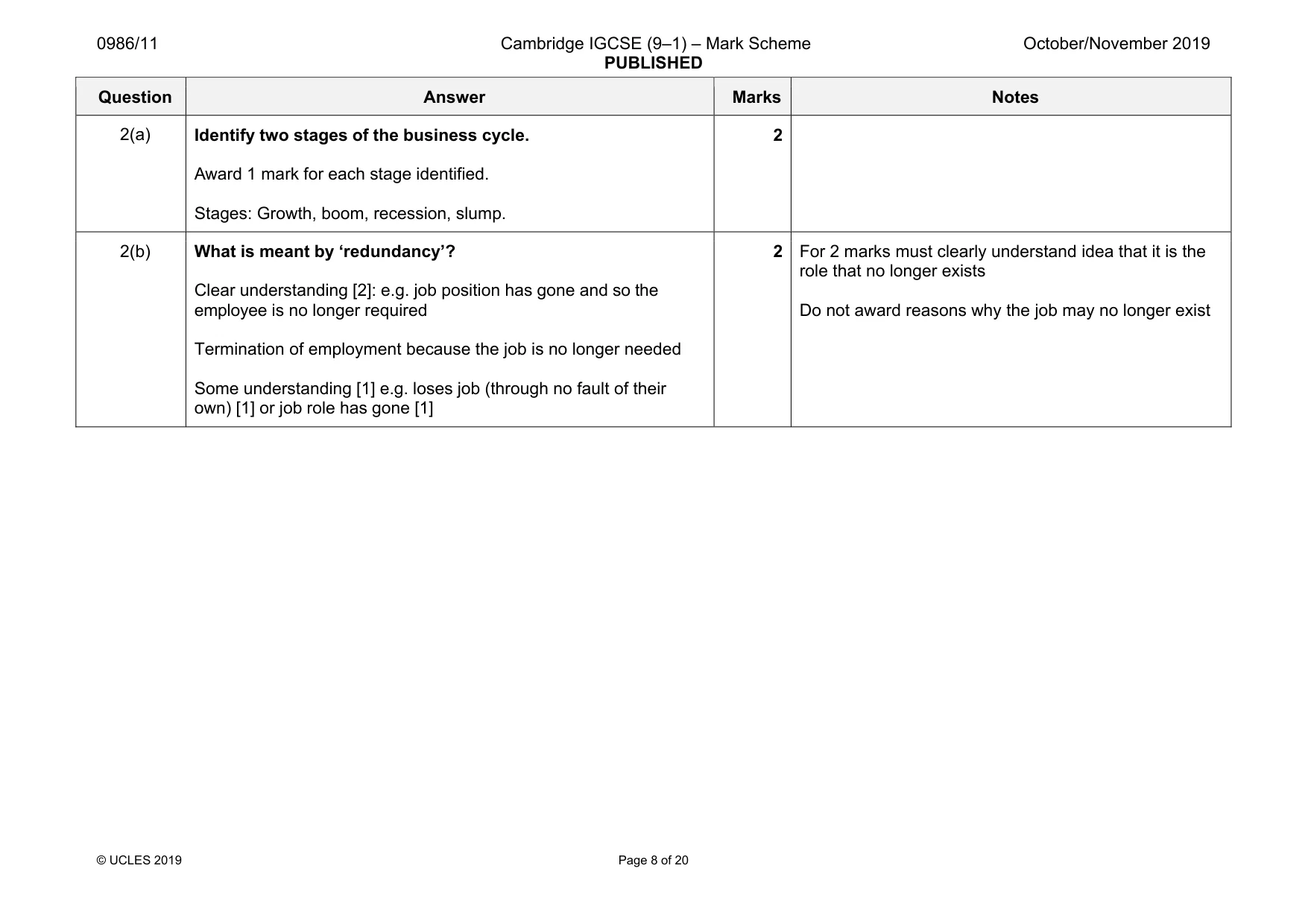
0986/11 Cambridge IGCSE (9–1) – Mark Scheme PUBLISHED October/November 2019 © UCLES 2019 Page 8 of 20 Question Answer Marks Notes 2(a) Identify two stages of the business cycle. Award 1 mark for each stage identified. Stages: Growth, boom, recession, slump. 2 2(b) What is meant by ‘redundancy’? Clear understanding [2]: e.g. job position has gone and so the employee is no longer required Termination of employment because the job is no longer needed Some understanding [1] e.g. loses job (through no fault of their own) [1] or job role has gone [1] 2 For 2 marks must clearly understand idea that it is the role that no longer exists Do not award reasons why the job may no longer exist
Mark scheme, page 9
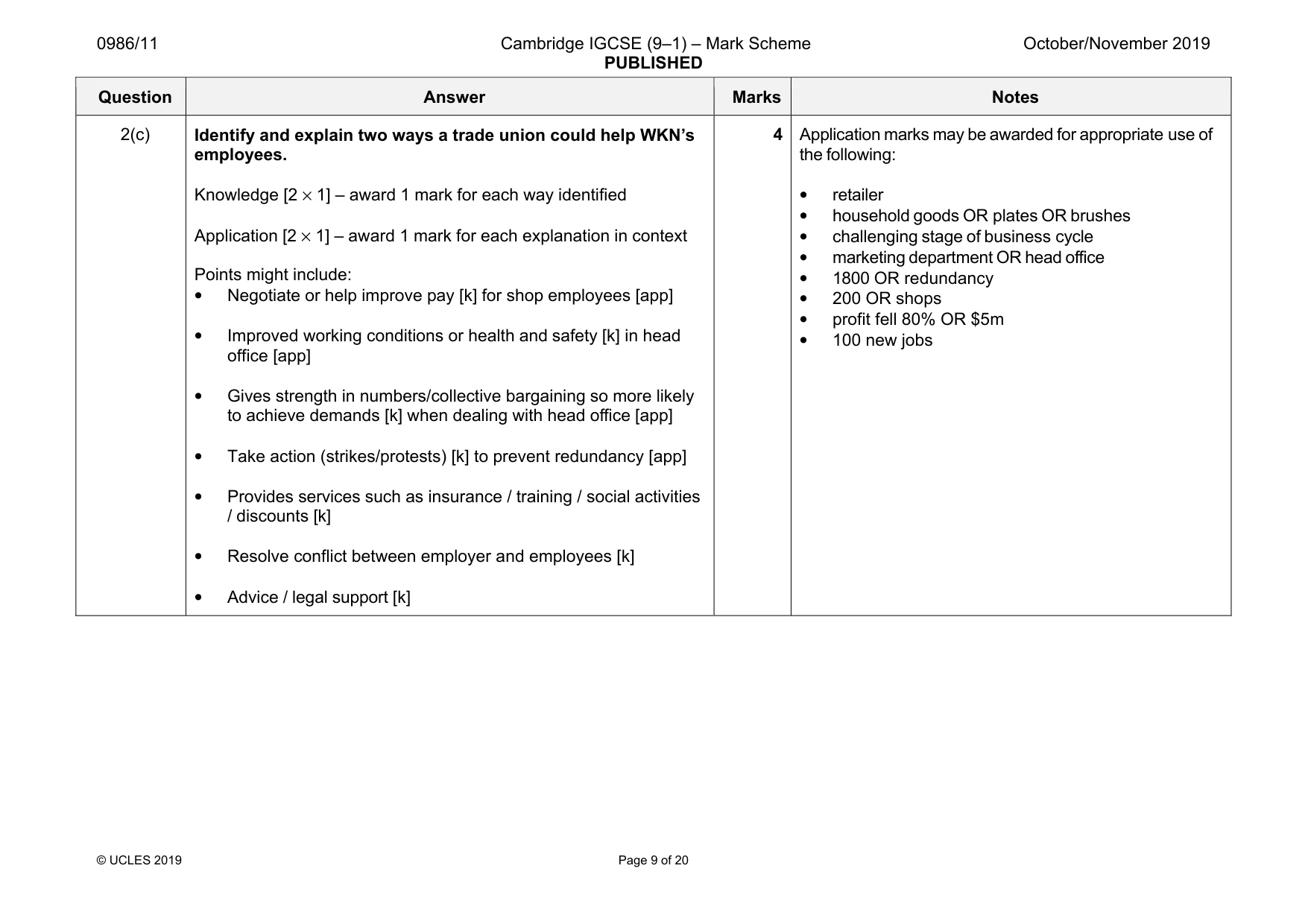
0986/11 Cambridge IGCSE (9–1) – Mark Scheme PUBLISHED October/November 2019 © UCLES 2019 Page 9 of 20 Question Answer Marks Notes 2(c) Identify and explain two ways a trade union could help WKN’s employees. Knowledge [2 × 1] – award 1 mark for each way identified Application [2 × 1] – award 1 mark for each explanation in context Points might include: • Negotiate or help improve pay [k] for shop employees [app] • Improved working conditions or health and safety [k] in head office [app] • Gives strength in numbers/collective bargaining so more likely to achieve demands [k] when dealing with head office [app] • Take action (strikes/protests) [k] to prevent redundancy [app] • Provides services such as insurance / training / social activities / discounts [k] • Resolve conflict between employer and employees [k] • Advice / legal support [k] 4 Application marks may be awarded for appropriate use of the following: • retailer • household goods OR plates OR brushes • challenging stage of business cycle • marketing department OR head office • 1800 OR redundancy • 200 OR shops • profit fell 80% OR $5m • 100 new jobs
Mark scheme, page 10
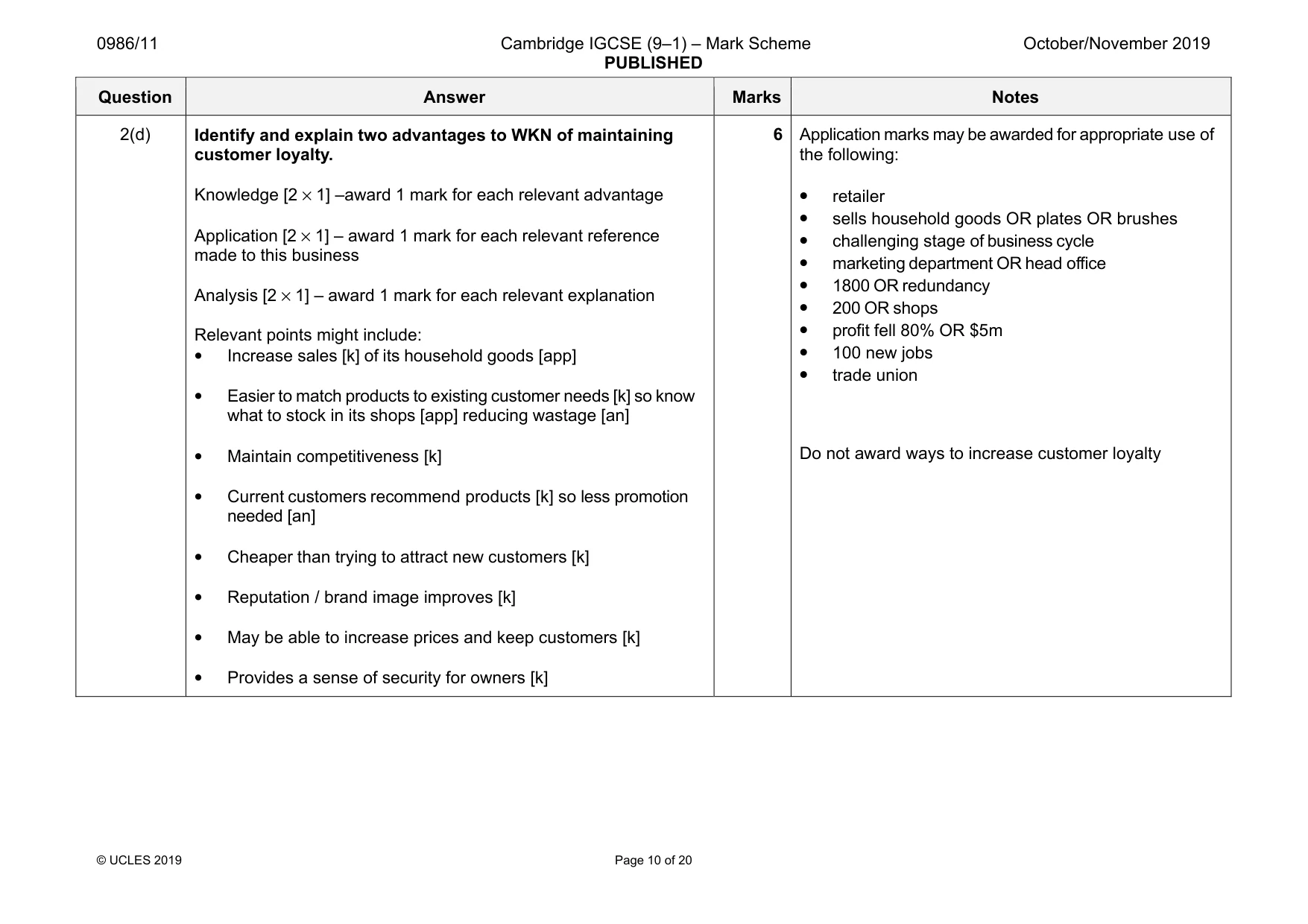
0986/11 Cambridge IGCSE (9–1) – Mark Scheme PUBLISHED October/November 2019 © UCLES 2019 Page 10 of 20 Question Answer Marks Notes 2(d) Identify and explain two advantages to WKN of maintaining customer loyalty. Knowledge [2 × 1] –award 1 mark for each relevant advantage Application [2 × 1] – award 1 mark for each relevant reference made to this business Analysis [2 × 1] – award 1 mark for each relevant explanation Relevant points might include: • Increase sales [k] of its household goods [app] • Easier to match products to existing customer needs [k] so know what to stock in its shops [app] reducing wastage [an] • Maintain competitiveness [k] • Current customers recommend products [k] so less promotion needed [an] • Cheaper than trying to attract new customers [k] • Reputation / brand image improves [k] • May be able to increase prices and keep customers [k] • Provides a sense of security for owners [k] 6 Application marks may be awarded for appropriate use of the following: • retailer • sells household goods OR plates OR brushes • challenging stage of business cycle • marketing department OR head office • 1800 OR redundancy • 200 OR shops • profit fell 80% OR $5m • 100 new jobs • trade union Do not award ways to increase customer loyalty
Mark scheme, page 11
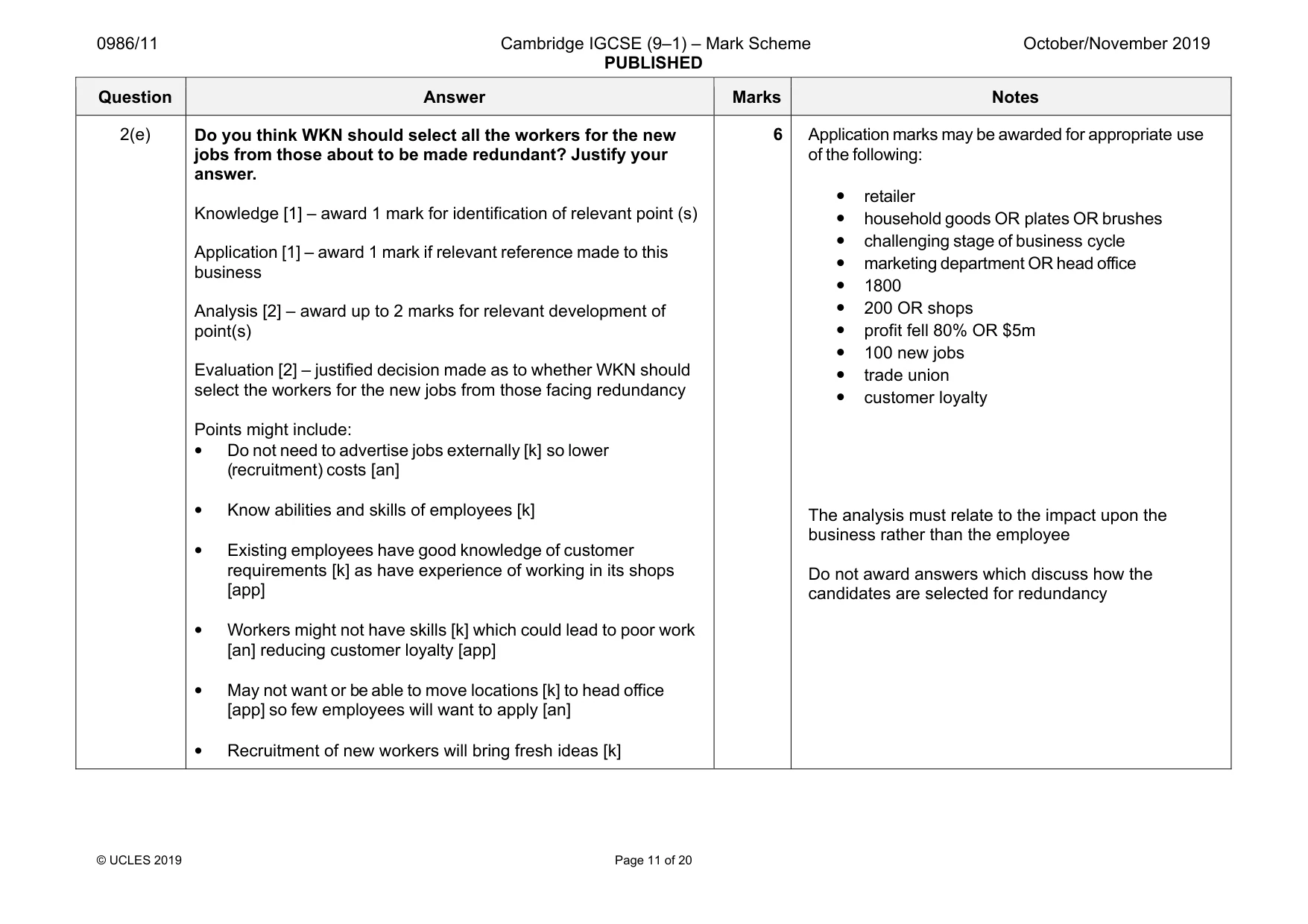
0986/11 Cambridge IGCSE (9–1) – Mark Scheme PUBLISHED October/November 2019 © UCLES 2019 Page 11 of 20 Question Answer Marks Notes 2(e) Do you think WKN should select all the workers for the new jobs from those about to be made redundant? Justify your answer. Knowledge [1] – award 1 mark for identification of relevant point (s) Application [1] – award 1 mark if relevant reference made to this business Analysis [2] – award up to 2 marks for relevant development of point(s) Evaluation [2] – justified decision made as to whether WKN should select the workers for the new jobs from those facing redundancy Points might include: • Do not need to advertise jobs externally [k] so lower (recruitment) costs [an] • Know abilities and skills of employees [k] • Existing employees have good knowledge of customer requirements [k] as have experience of working in its shops [app] • Workers might not have skills [k] which could lead to poor work [an] reducing customer loyalty [app] • May not want or be able to move locations [k] to head office [app] so few employees will want to apply [an] • Recruitment of new workers will bring fresh ideas [k] 6 Application marks may be awarded for appropriate use of the following: • retailer • household goods OR plates OR brushes • challenging stage of business cycle • marketing department OR head office • 1800 • 200 OR shops • profit fell 80% OR $5m • 100 new jobs • trade union • customer loyalty The analysis must relate to the impact upon the business rather than the employee Do not award answers which discuss how the candidates are selected for redundancy
Mark scheme, page 12
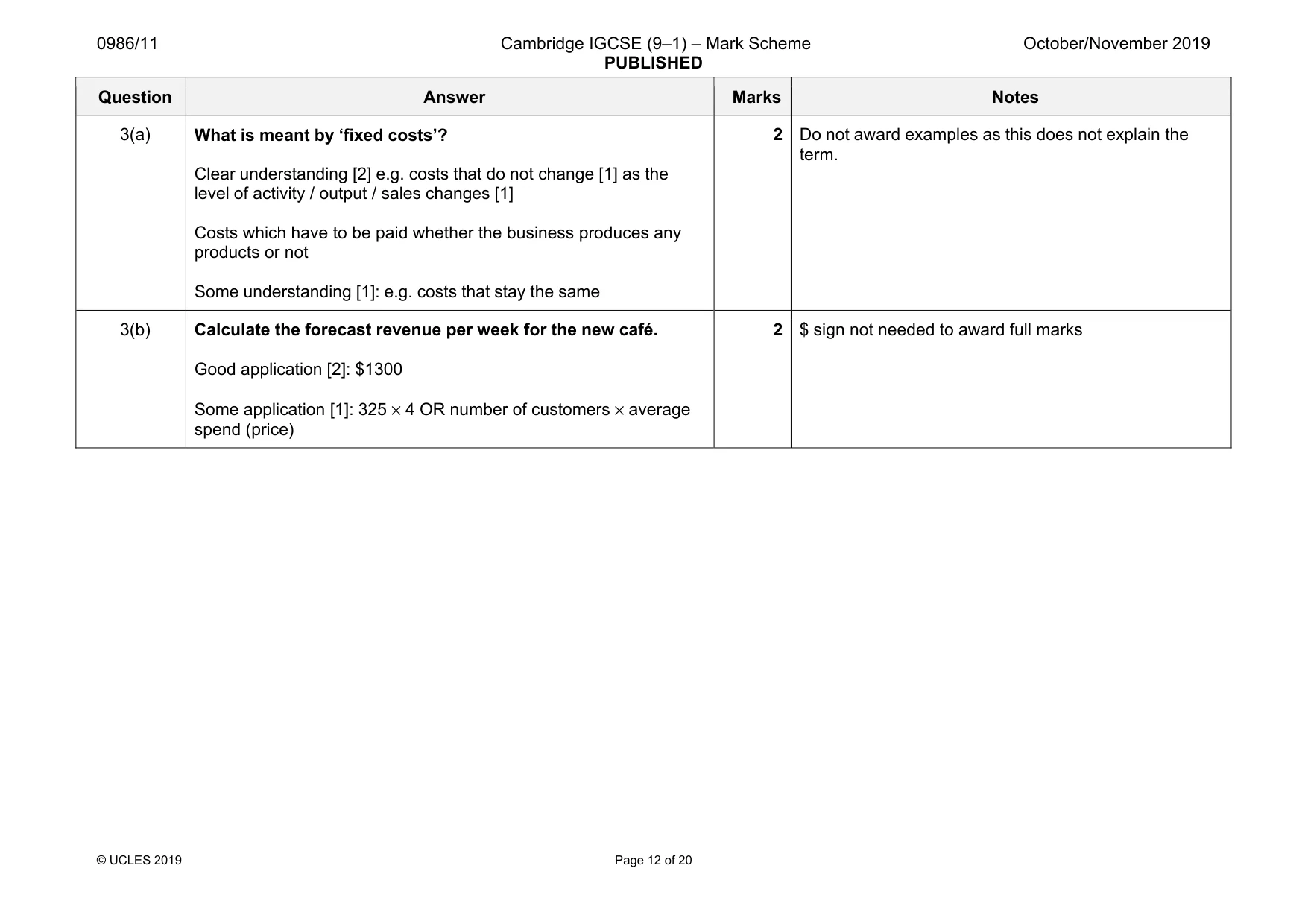
0986/11 Cambridge IGCSE (9–1) – Mark Scheme PUBLISHED October/November 2019 © UCLES 2019 Page 12 of 20 Question Answer Marks Notes 3(a) What is meant by ‘fixed costs’? Clear understanding [2] e.g. costs that do not change [1] as the level of activity / output / sales changes [1] Costs which have to be paid whether the business produces any products or not Some understanding [1]: e.g. costs that stay the same 2 Do not award examples as this does not explain the term. 3(b) Calculate the forecast revenue per week for the new café. Good application [2]: $1300 Some application [1]: 325 × 4 OR number of customers × average spend (price) 2 $ sign not needed to award full marks
Mark scheme, page 13
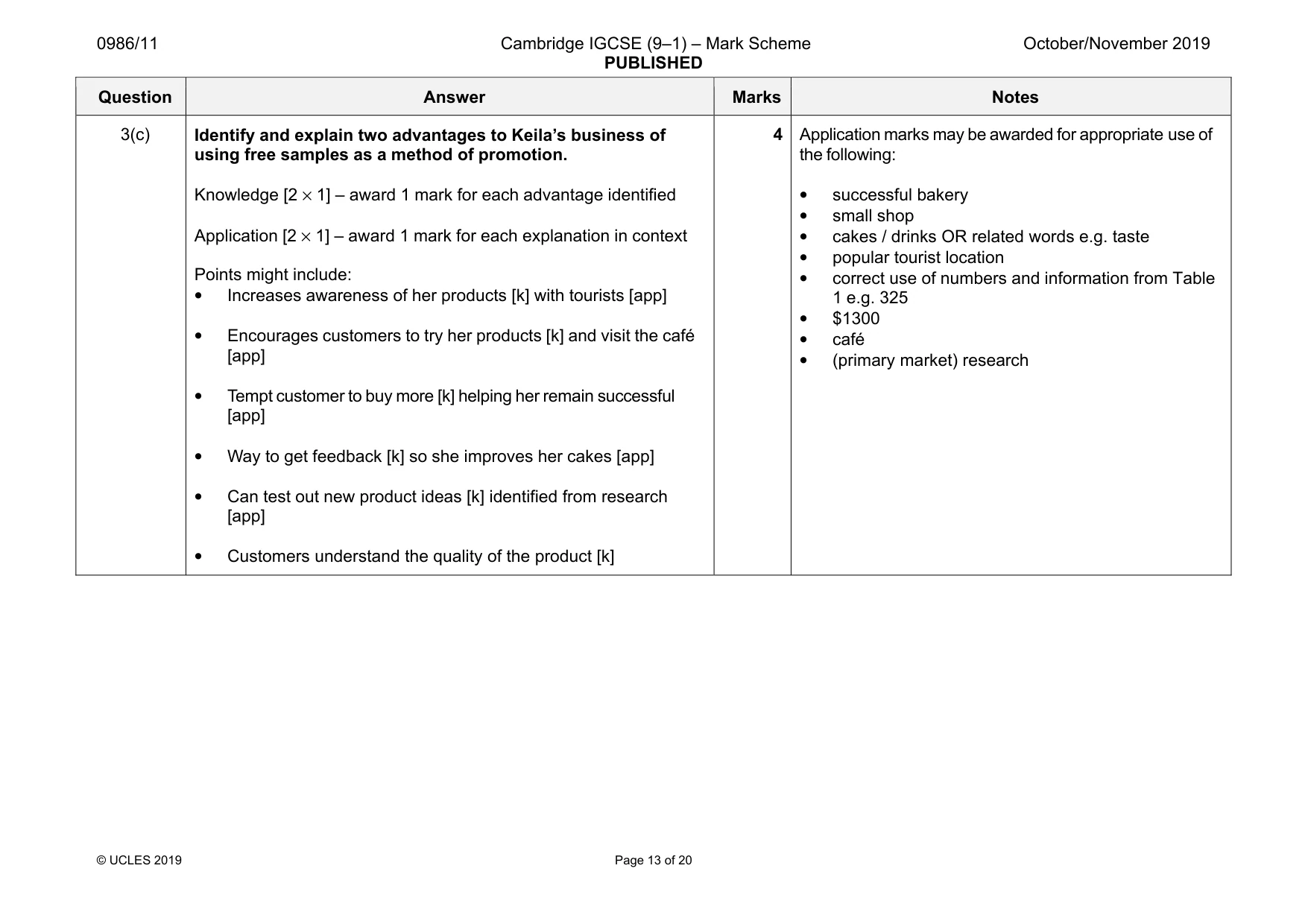
0986/11 Cambridge IGCSE (9–1) – Mark Scheme PUBLISHED October/November 2019 © UCLES 2019 Page 13 of 20 Question Answer Marks Notes 3(c) Identify and explain two advantages to Keila’s business of using free samples as a method of promotion. Knowledge [2 × 1] – award 1 mark for each advantage identified Application [2 × 1] – award 1 mark for each explanation in context Points might include: • Increases awareness of her products [k] with tourists [app] • Encourages customers to try her products [k] and visit the café [app] • Tempt customer to buy more [k] helping her remain successful [app] • Way to get feedback [k] so she improves her cakes [app] • Can test out new product ideas [k] identified from research [app] • Customers understand the quality of the product [k] 4 Application marks may be awarded for appropriate use of the following: • successful bakery • small shop • cakes / drinks OR related words e.g. taste • popular tourist location • correct use of numbers and information from Table 1 e.g. 325 • $1300 • café • (primary market) research
Mark scheme, page 14
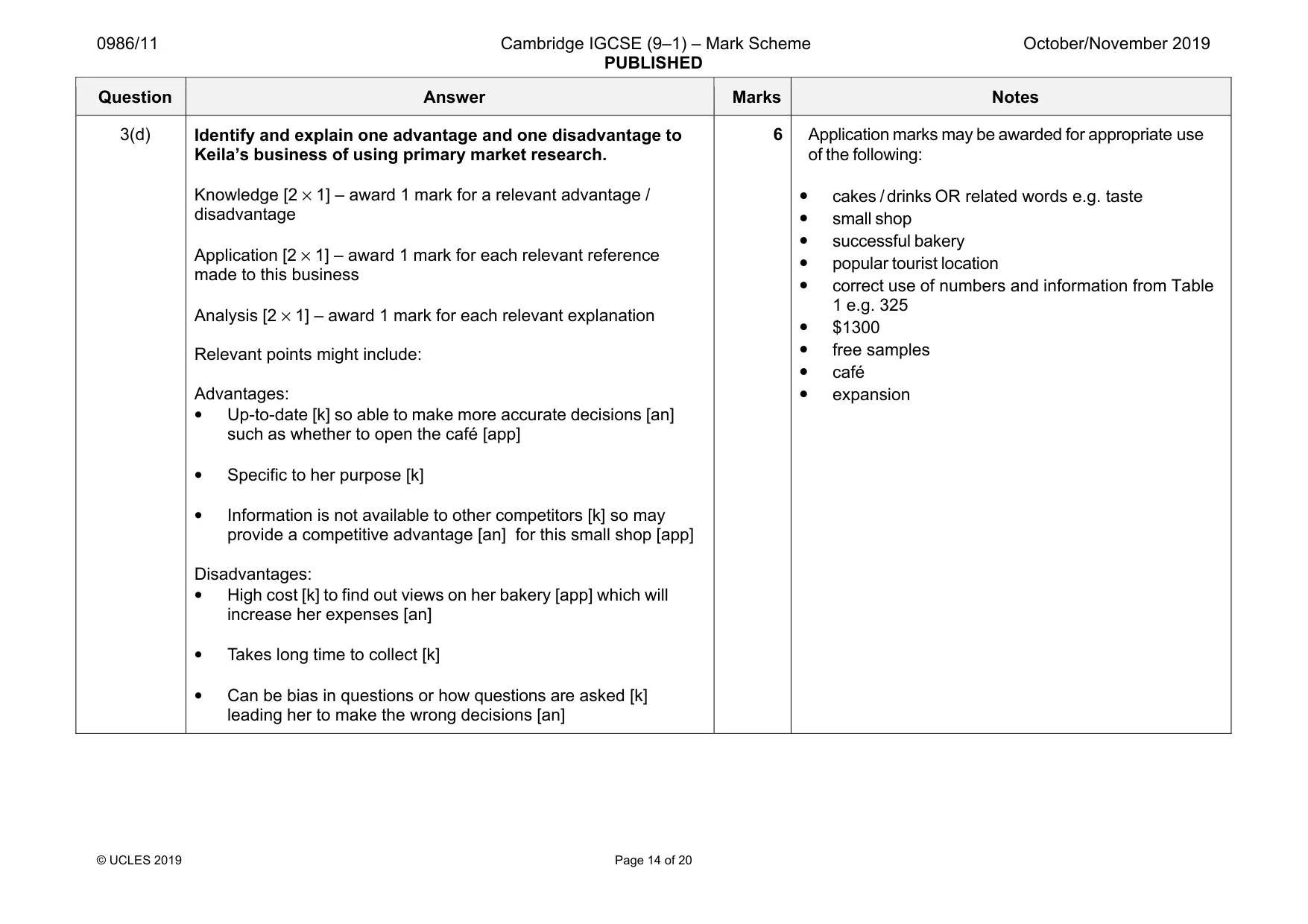
0986/11 Cambridge IGCSE (9–1) – Mark Scheme PUBLISHED October/November 2019 © UCLES 2019 Page 14 of 20 Question Answer Marks Notes 3(d) Identify and explain one advantage and one disadvantage to Keila’s business of using primary market research. Knowledge [2 × 1] – award 1 mark for a relevant advantage / disadvantage Application [2 × 1] – award 1 mark for each relevant reference made to this business Analysis [2 × 1] – award 1 mark for each relevant explanation Relevant points might include: Advantages: • Up-to-date [k] so able to make more accurate decisions [an] such as whether to open the café [app] • Specific to her purpose [k] • Information is not available to other competitors [k] so may provide a competitive advantage [an] for this small shop [app] Disadvantages: • High cost [k] to find out views on her bakery [app] which will increase her expenses [an] • Takes long time to collect [k] • Can be bias in questions or how questions are asked [k] leading her to make the wrong decisions [an] 6 Application marks may be awarded for appropriate use of the following: • cakes / drinks OR related words e.g. taste • small shop • successful bakery • popular tourist location • correct use of numbers and information from Table 1 e.g. 325 • $1300 • free samples • café • expansion
Mark scheme, page 15
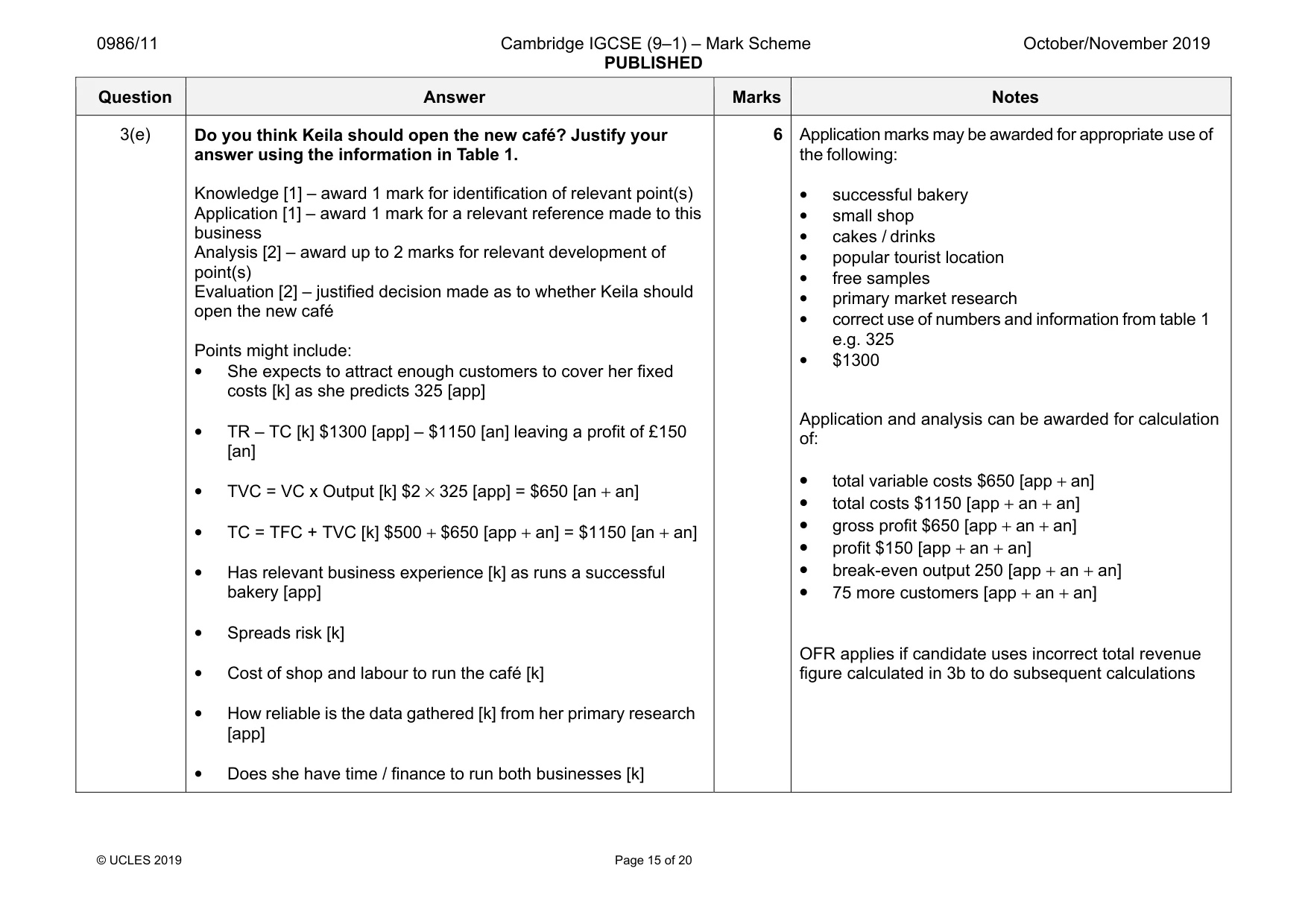
0986/11 Cambridge IGCSE (9–1) – Mark Scheme PUBLISHED October/November 2019 © UCLES 2019 Page 15 of 20 Question Answer Marks Notes 3(e) Do you think Keila should open the new café? Justify your answer using the information in Table 1. Knowledge [1] – award 1 mark for identification of relevant point(s) Application [1] – award 1 mark for a relevant reference made to this business Analysis [2] – award up to 2 marks for relevant development of point(s) Evaluation [2] – justified decision made as to whether Keila should open the new café Points might include: • She expects to attract enough customers to cover her fixed costs [k] as she predicts 325 [app] • TR – TC [k] $1300 [app] – $1150 [an] leaving a profit of £150 [an] • TVC = VC x Output [k] $2 × 325 [app] = $650 [an + an] • TC = TFC + TVC [k] $500 + $650 [app + an] = $1150 [an + an] • Has relevant business experience [k] as runs a successful bakery [app] • Spreads risk [k] • Cost of shop and labour to run the café [k] • How reliable is the data gathered [k] from her primary research [app] • Does she have time / finance to run both businesses [k] 6 Application marks may be awarded for appropriate use of the following: • successful bakery • small shop • cakes / drinks • popular tourist location • free samples • primary market research • correct use of numbers and information from table 1 e.g. 325 • $1300 Application and analysis can be awarded for calculation of: • total variable costs $650 [app + an] • total costs $1150 [app + an + an] • gross profit $650 [app + an + an] • profit $150 [app + an + an] • break-even output 250 [app + an + an] • 75 more customers [app + an + an] OFR applies if candidate uses incorrect total revenue figure calculated in 3b to do subsequent calculations
Mark scheme, page 16
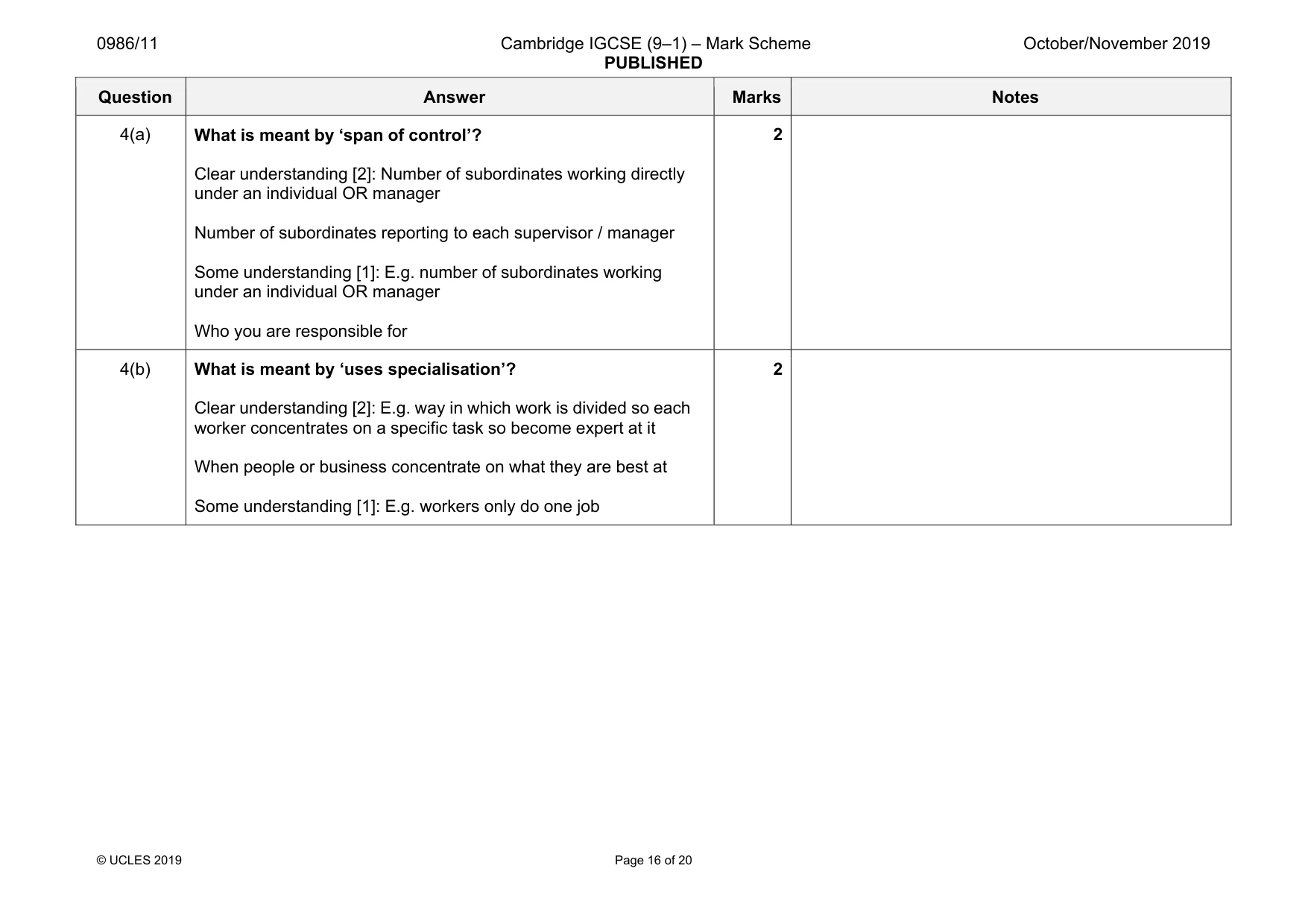
0986/11 Cambridge IGCSE (9–1) – Mark Scheme PUBLISHED October/November 2019 © UCLES 2019 Page 16 of 20 Question Answer Marks Notes 4(a) What is meant by ‘span of control’? Clear understanding [2]: Number of subordinates working directly under an individual OR manager Number of subordinates reporting to each supervisor / manager Some understanding [1]: E.g. number of subordinates working under an individual OR manager Who you are responsible for 2 4(b) What is meant by ‘uses specialisation’? Clear understanding [2]: E.g. way in which work is divided so each worker concentrates on a specific task so become expert at it When people or business concentrate on what they are best at Some understanding [1]: E.g. workers only do one job 2
Mark scheme, page 17
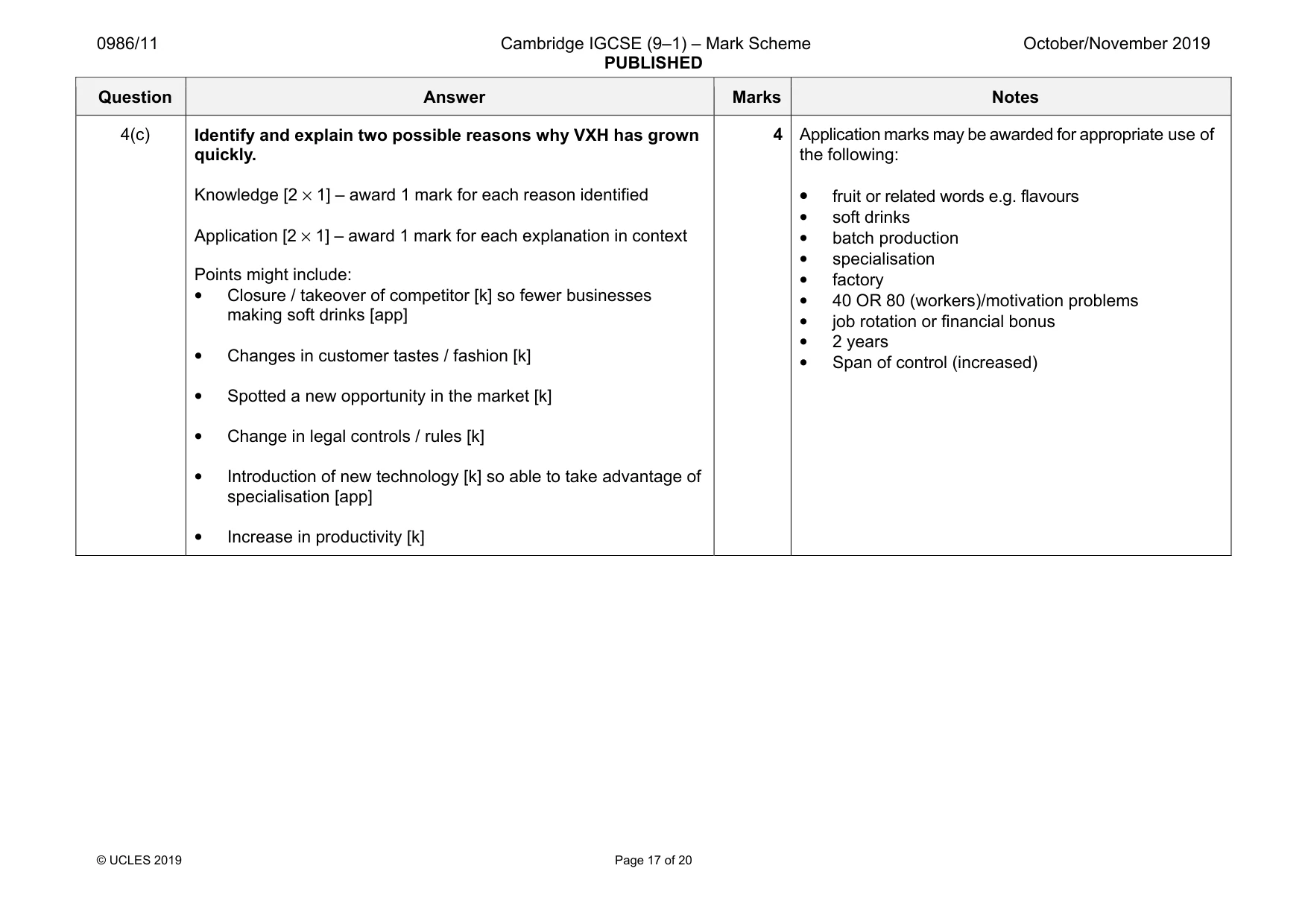
0986/11 Cambridge IGCSE (9–1) – Mark Scheme PUBLISHED October/November 2019 © UCLES 2019 Page 17 of 20 Question Answer Marks Notes 4(c) Identify and explain two possible reasons why VXH has grown quickly. Knowledge [2 × 1] – award 1 mark for each reason identified Application [2 × 1] – award 1 mark for each explanation in context Points might include: • Closure / takeover of competitor [k] so fewer businesses making soft drinks [app] • Changes in customer tastes / fashion [k] • Spotted a new opportunity in the market [k] • Change in legal controls / rules [k] • Introduction of new technology [k] so able to take advantage of specialisation [app] • Increase in productivity [k] 4 Application marks may be awarded for appropriate use of the following: • fruit or related words e.g. flavours • soft drinks • batch production • specialisation • factory • 40 OR 80 (workers)/motivation problems • job rotation or financial bonus • 2 years • Span of control (increased)
Mark scheme, page 18
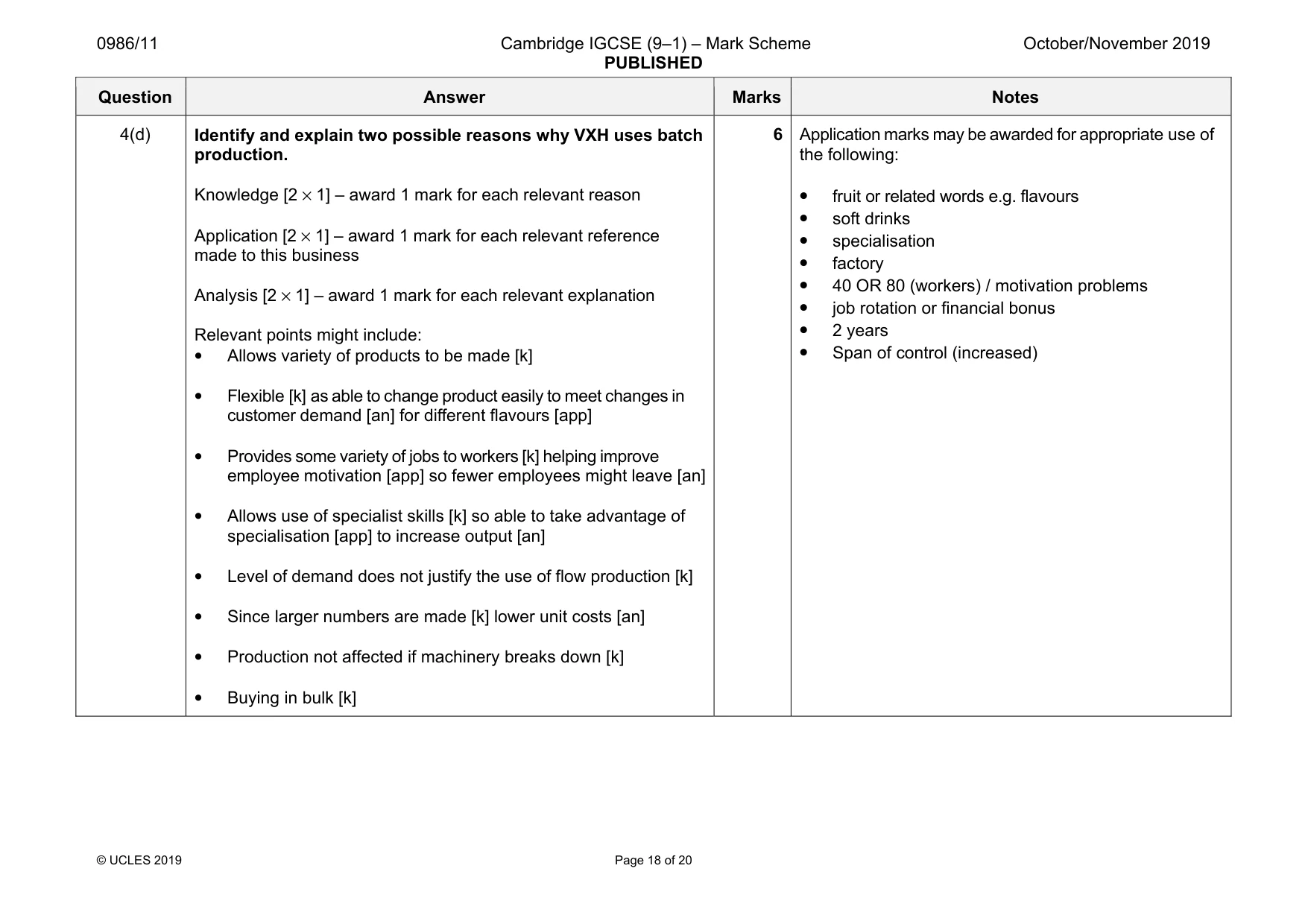
0986/11 Cambridge IGCSE (9–1) – Mark Scheme PUBLISHED October/November 2019 © UCLES 2019 Page 18 of 20 Question Answer Marks Notes 4(d) Identify and explain two possible reasons why VXH uses batch production. Knowledge [2 × 1] – award 1 mark for each relevant reason Application [2 × 1] – award 1 mark for each relevant reference made to this business Analysis [2 × 1] – award 1 mark for each relevant explanation Relevant points might include: • Allows variety of products to be made [k] • Flexible [k] as able to change product easily to meet changes in customer demand [an] for different flavours [app] • Provides some variety of jobs to workers [k] helping improve employee motivation [app] so fewer employees might leave [an] • Allows use of specialist skills [k] so able to take advantage of specialisation [app] to increase output [an] • Level of demand does not justify the use of flow production [k] • Since larger numbers are made [k] lower unit costs [an] • Production not affected if machinery breaks down [k] • Buying in bulk [k] 6 Application marks may be awarded for appropriate use of the following: • fruit or related words e.g. flavours • soft drinks • specialisation • factory • 40 OR 80 (workers) / motivation problems • job rotation or financial bonus • 2 years • Span of control (increased)
Mark scheme, page 19
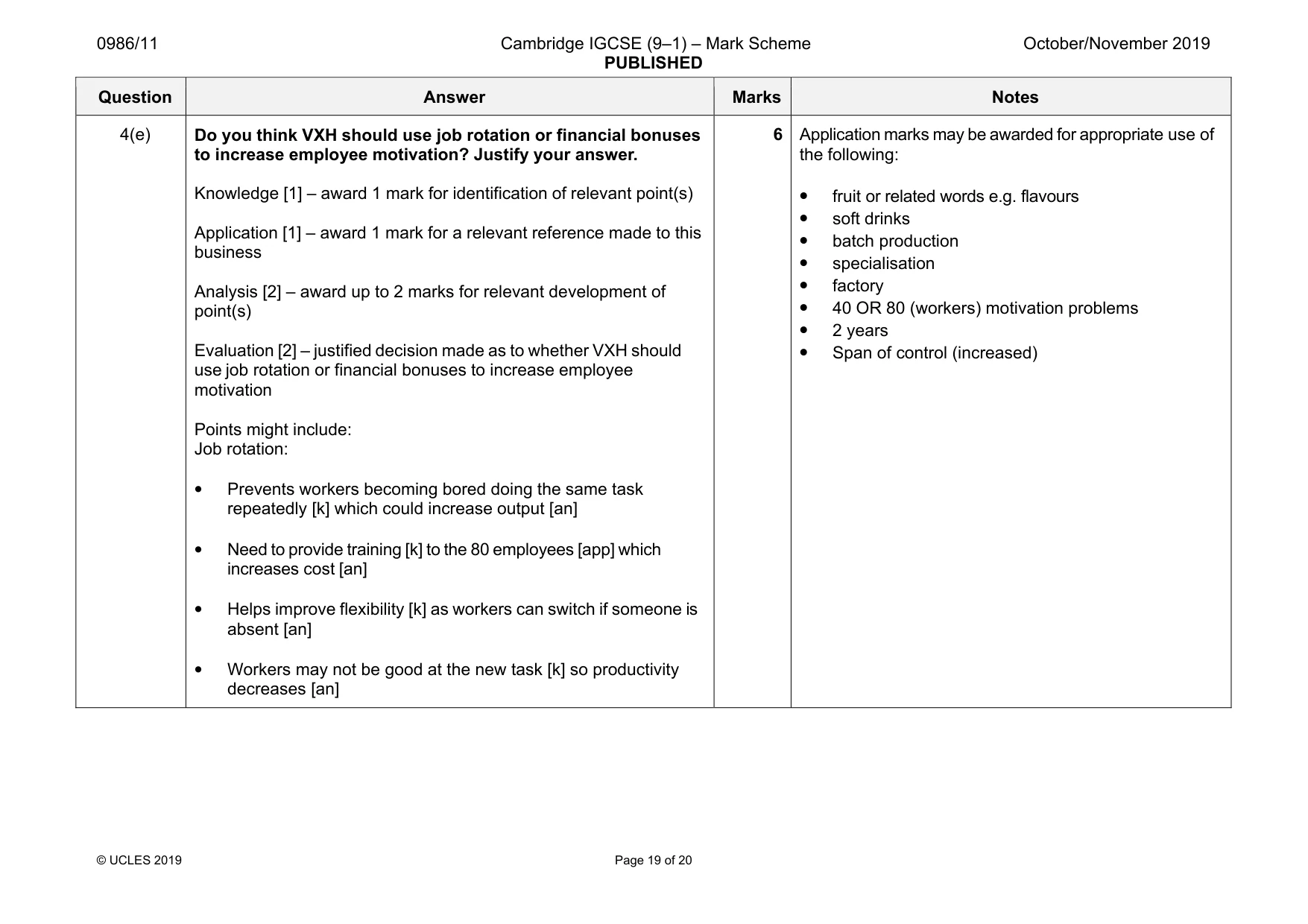
0986/11 Cambridge IGCSE (9–1) – Mark Scheme PUBLISHED October/November 2019 © UCLES 2019 Page 19 of 20 Question Answer Marks Notes 4(e) Do you think VXH should use job rotation or financial bonuses to increase employee motivation? Justify your answer. Knowledge [1] – award 1 mark for identification of relevant point(s) Application [1] – award 1 mark for a relevant reference made to this business Analysis [2] – award up to 2 marks for relevant development of point(s) Evaluation [2] – justified decision made as to whether VXH should use job rotation or financial bonuses to increase employee motivation Points might include: Job rotation: • Prevents workers becoming bored doing the same task repeatedly [k] which could increase output [an] • Need to provide training [k] to the 80 employees [app] which increases cost [an] • Helps improve flexibility [k] as workers can switch if someone is absent [an] • Workers may not be good at the new task [k] so productivity decreases [an] 6 Application marks may be awarded for appropriate use of the following: • fruit or related words e.g. flavours • soft drinks • batch production • specialisation • factory • 40 OR 80 (workers) motivation problems • 2 years • Span of control (increased)
Mark scheme, page 20
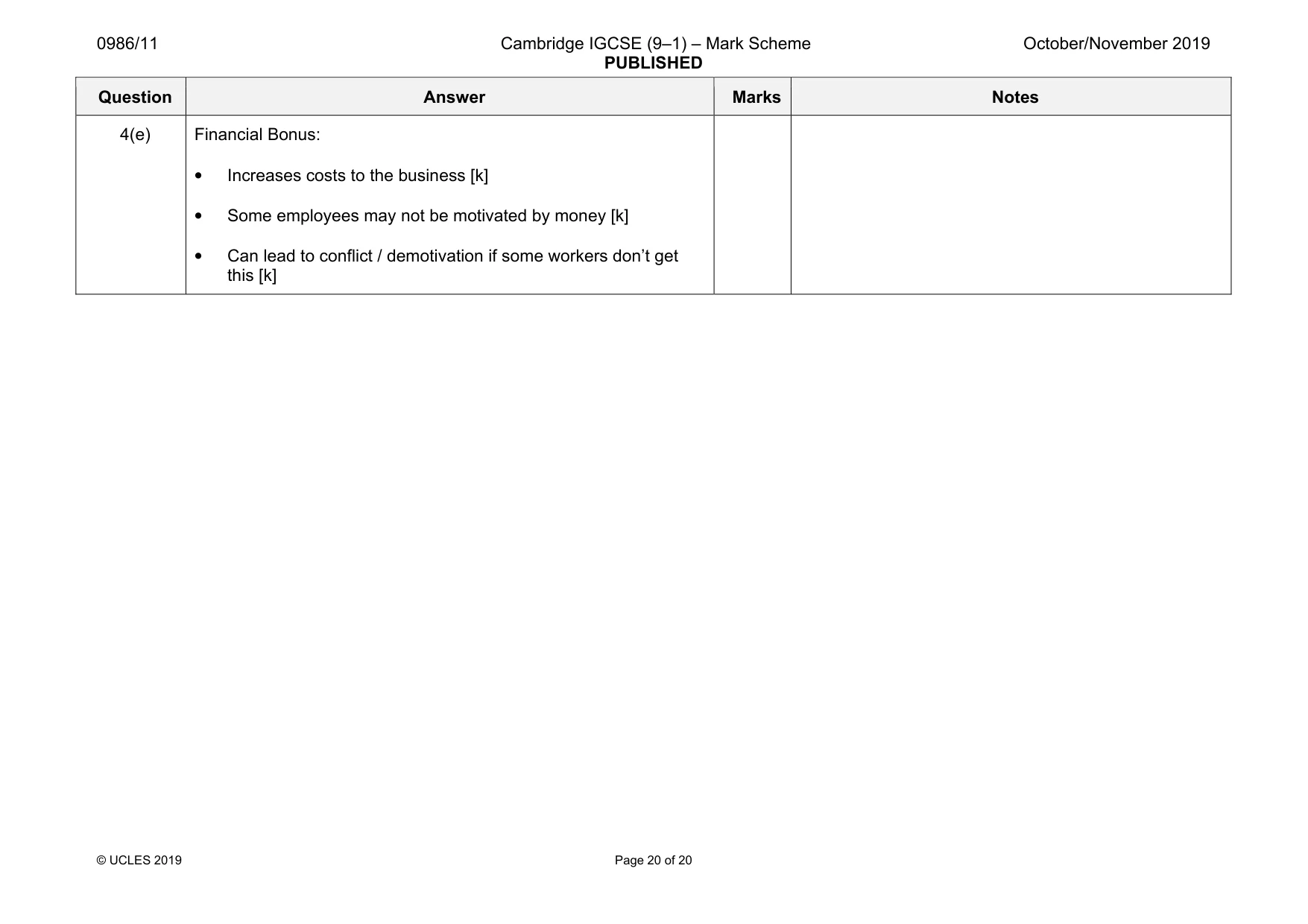
0986/11 Cambridge IGCSE (9–1) – Mark Scheme PUBLISHED October/November 2019 © UCLES 2019 Page 20 of 20 Question Answer Marks Notes 4(e) Financial Bonus: • Increases costs to the business [k] • Some employees may not be motivated by money [k] • Can lead to conflict / demotivation if some workers don’t get this [k]
What you needed in this session
Cambridge’s own grade thresholds for 2019 Oct/Nov, Paper 1 · Variant 1. A higher threshold means an easier paper — the bar moves with how the cohort did.