Cambridge IGCSE Business Studies 0450 — 2022 Feb/March Paper 1 · Variant 2
0450/12/F/M/22 · 80 marks · ≈90 min
The question paper and its mark scheme, free to read here and free to download. This is Cambridge’s own paper, exactly as it was sat.
Question paper12 pages


Mark scheme22 pages
Answers below. Sit the paper first if you are practising.
Paper as text
Question paper, page 1
Cambridge IGCSE™ 0450/12 February/March 2022 1 hour 30 minutes BUSINESS STUDIES Paper 1 Short Answer and Data Response You must answer on the question paper. No additional materials are needed. INSTRUCTIONS • Answer all questions. • Use a black or dark blue pen. You may use an HB pencil for any diagrams or graphs. • Write your name, centre number and candidate number in the boxes at the top of the page. • Write your answer to each question in the space provided. • Do not use an erasable pen or correction fluid. • Do not write on any bar codes. • You may use a calculator. INFORMATION • The total mark for this paper is 80. • The number of marks for each question or part question is shown in brackets [ ]. This document has 12 pages. Any blank pages are indicated. [Turn over 03_0450_12_2022_1.19 © UCLES 2022 *7067409899*
Question paper, page 2
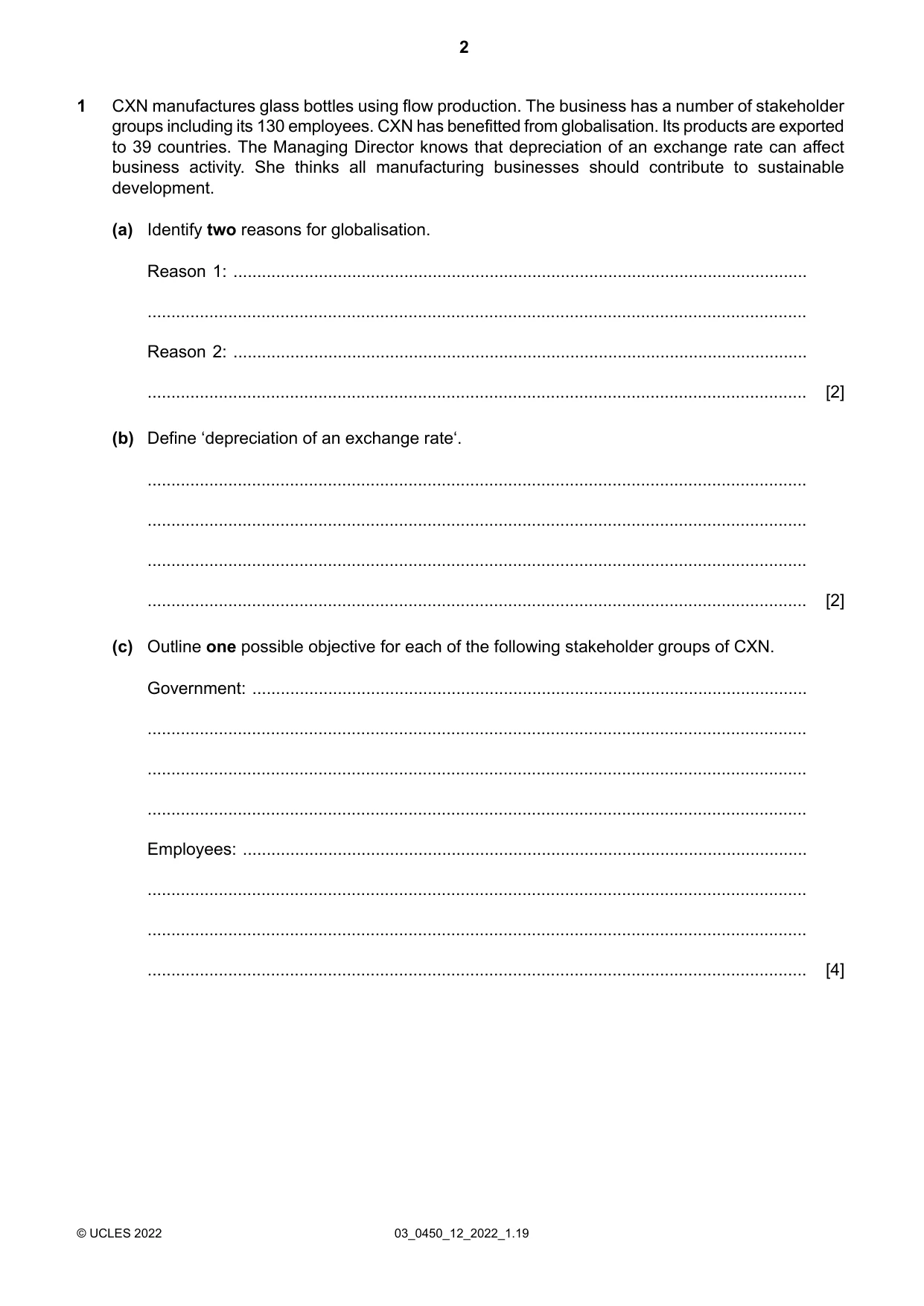
CXN manufactures glass bottles using flow production. The business has a number of stakeholder groups including its 130 employees. CXN has benefitted from globalisation. Its products are exported 1 to 39 countries. The Managing Director knows that depreciation of an exchange rate can affect business activity. She thinks all manufacturing businesses should contribute to sustainable development. Identify two reasons for globalisation. (a) Reason 1: … … Reason 2: … … [2] Define ‘depreciation of an exchange rate‘. (b) … … … … [2] Outline one possible objective for each of the following stakeholder groups of CXN. (c) Government: … … … … Employees: … … … … [4] 03_0450_12_2022_1.19 © UCLES 2022 2
Question paper, page 3
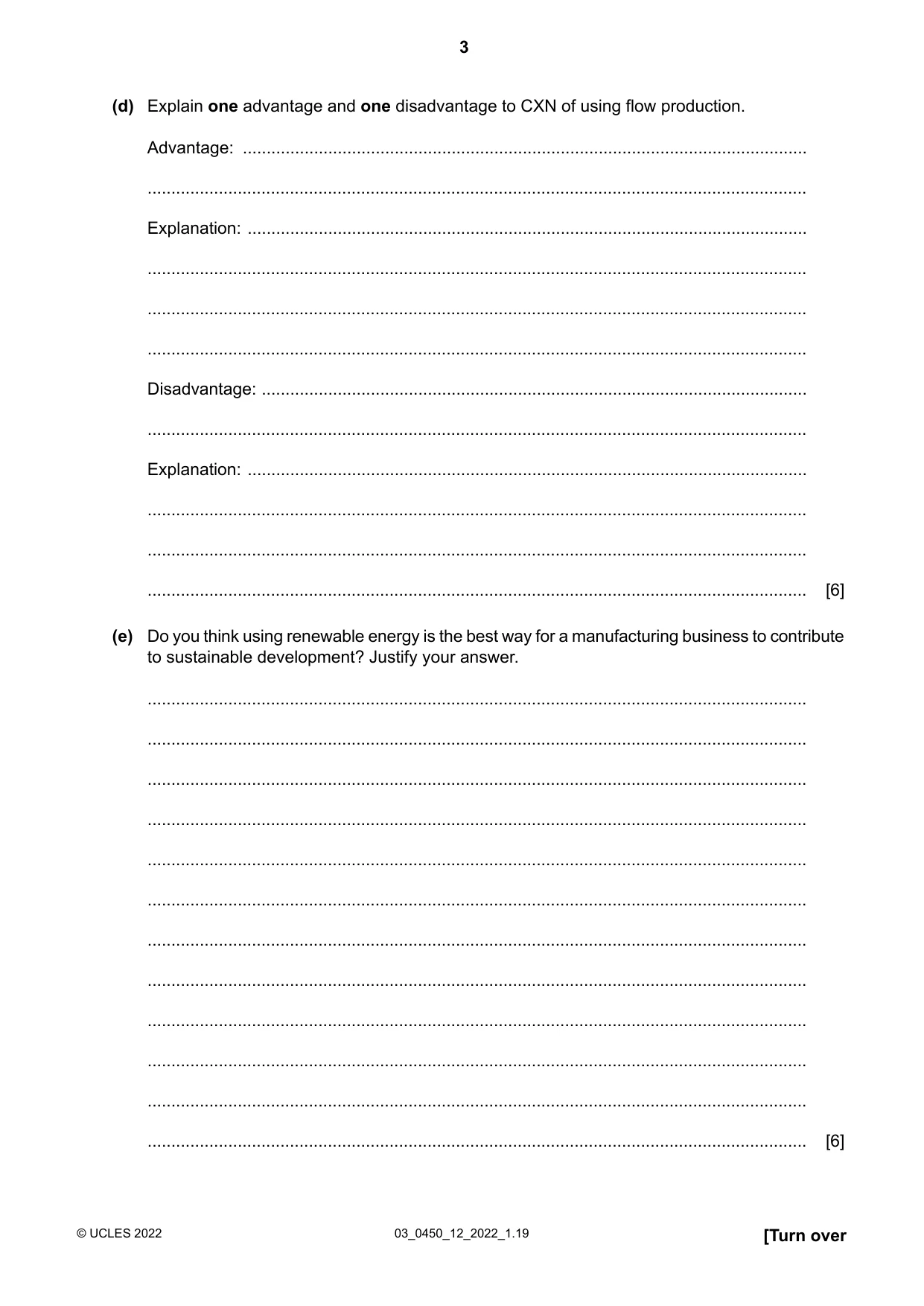
Explain one advantage and one disadvantage to CXN of using flow production. (d) Advantage: … … Explanation: … … … … Disadvantage: … … Explanation: … … … … [6] Do you think using renewable energy is the best way for a manufacturing business to contribute to sustainable development? Justify your answer. (e) … … … … … … … … … … … … [6] [Turn over 03_0450_12_2022_1.19 © UCLES 2022 3
Question paper, page 4
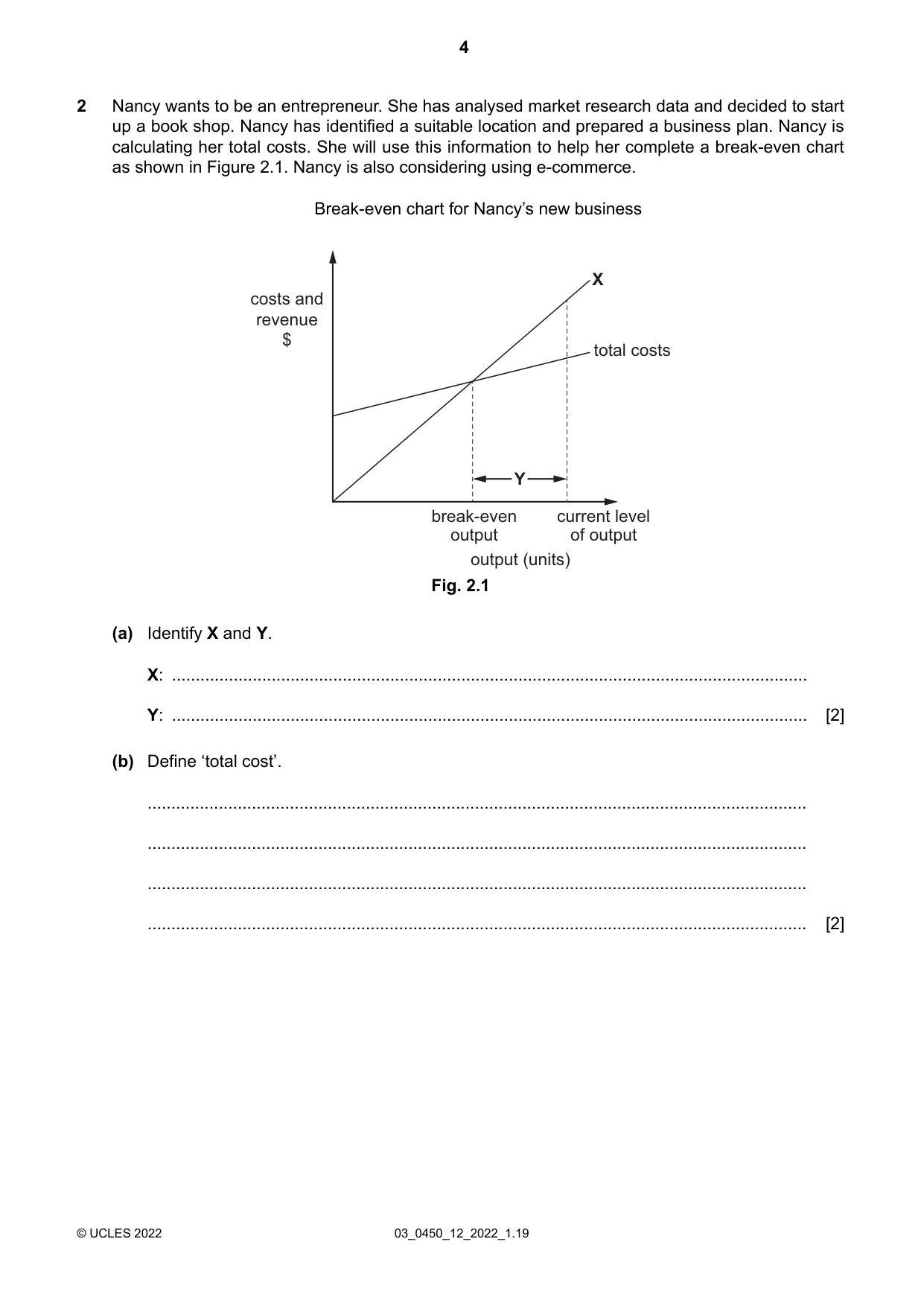
Nancy wants to be an entrepreneur. She has analysed market research data and decided to start up a book shop. Nancy has identified a suitable location and prepared a business plan. Nancy is 2 calculating her total costs. She will use this information to help her complete a break-even chart as shown in Figure 2.1. Nancy is also considering using e-commerce. Break-even chart for Nancy’s new business costs and revenue $ total costs current level of output break-even output output (units) X Y Fig. 2.1 Identify X and Y. (a) X: … Y: … [2] Define ‘total cost’. (b) … … … … [2] 03_0450_12_2022_1.19 © UCLES 2022 4
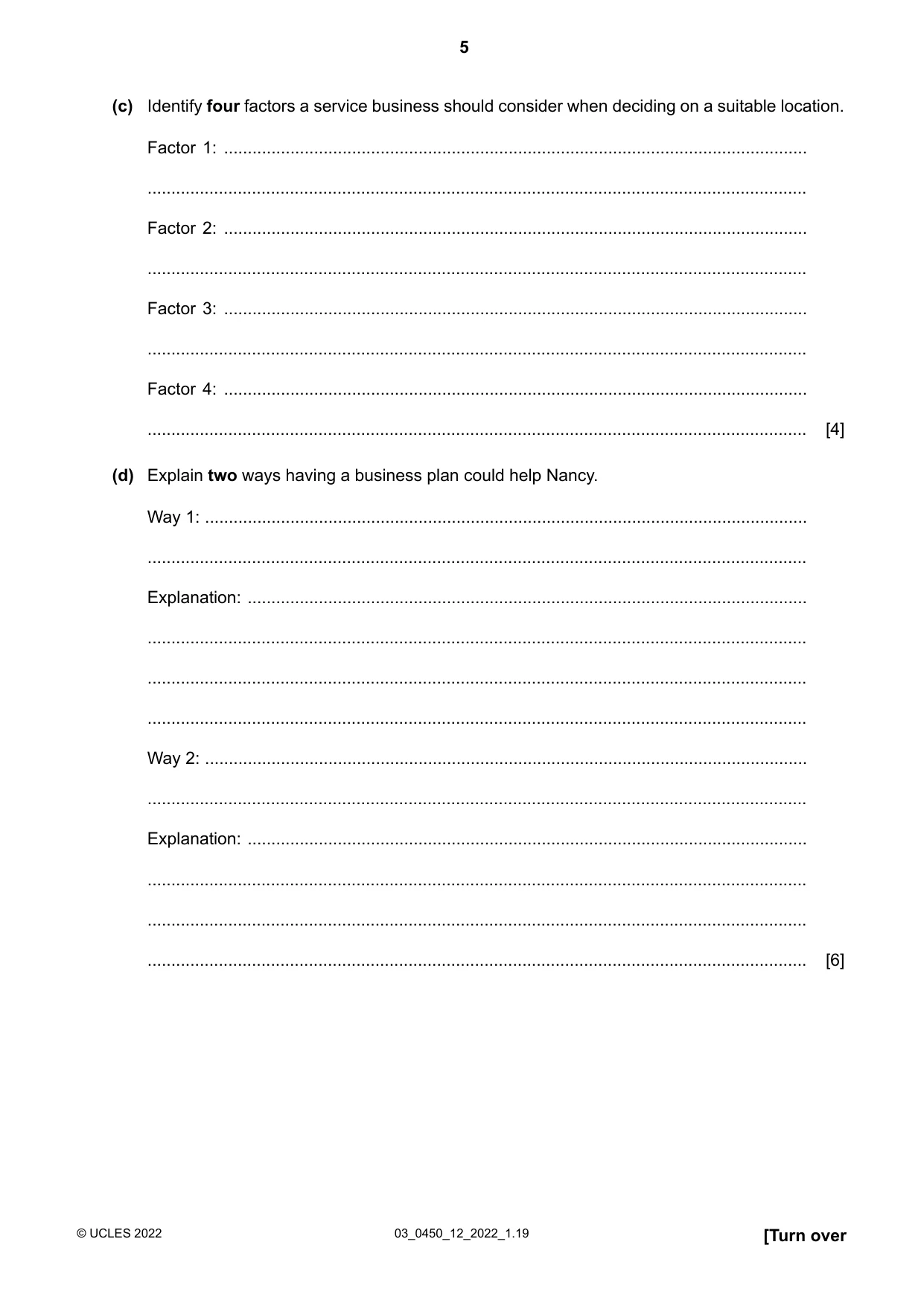
Question paper, page 5
Identify four factors a service business should consider when deciding on a suitable location. (c) Factor 1: … … Factor 2: … … Factor 3: … … Factor 4: … … [4] Explain two ways having a business plan could help Nancy. (d) Way 1: … … Explanation: … … … … Way 2: … … Explanation: … … … … [6] [Turn over 03_0450_12_2022_1.19 © UCLES 2022 5
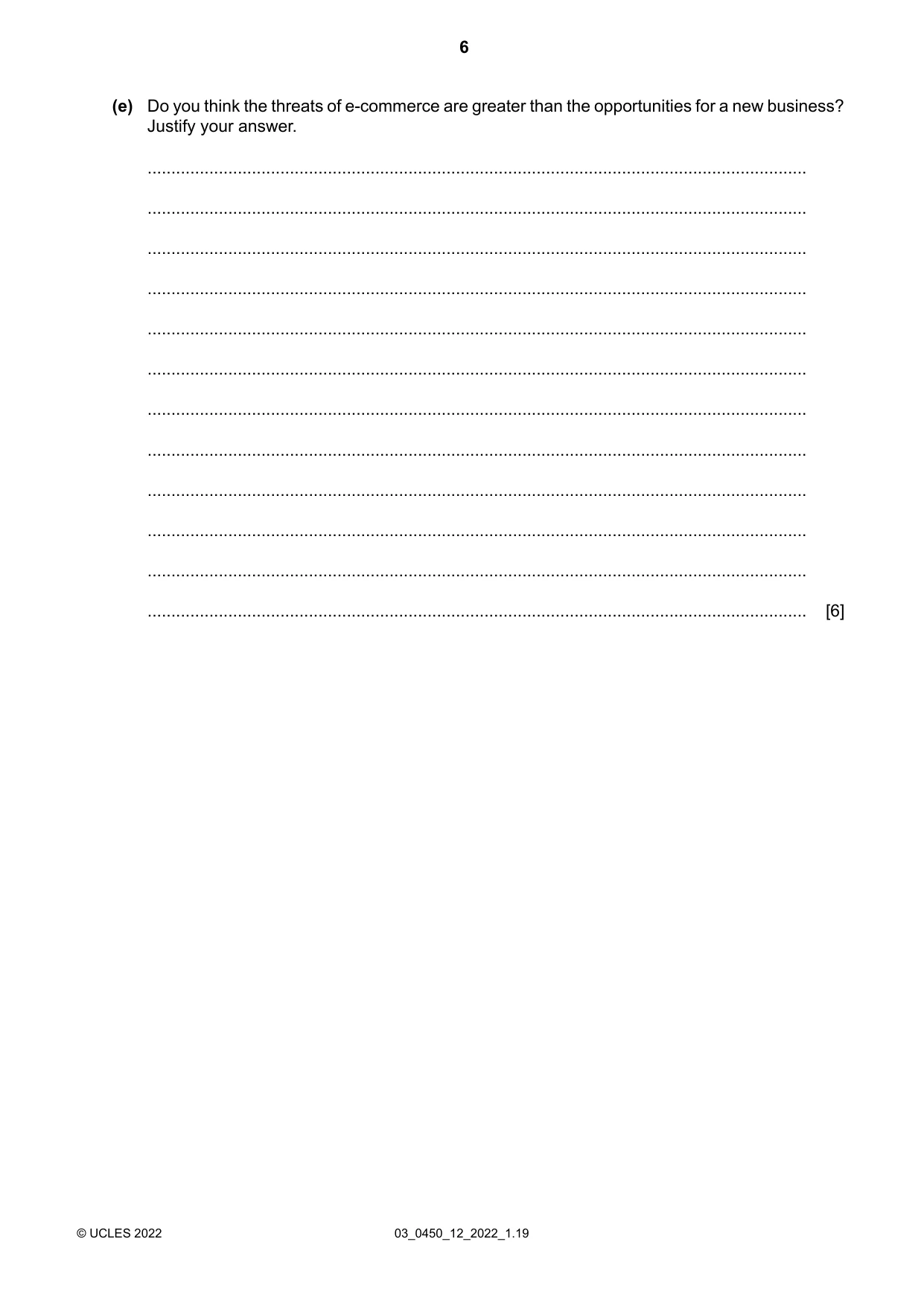
Question paper, page 6
Do you think the threats of e-commerce are greater than the opportunities for a new business? Justify your answer. (e) … … … … … … … … … … … … [6] 03_0450_12_2022_1.19 © UCLES 2022 6
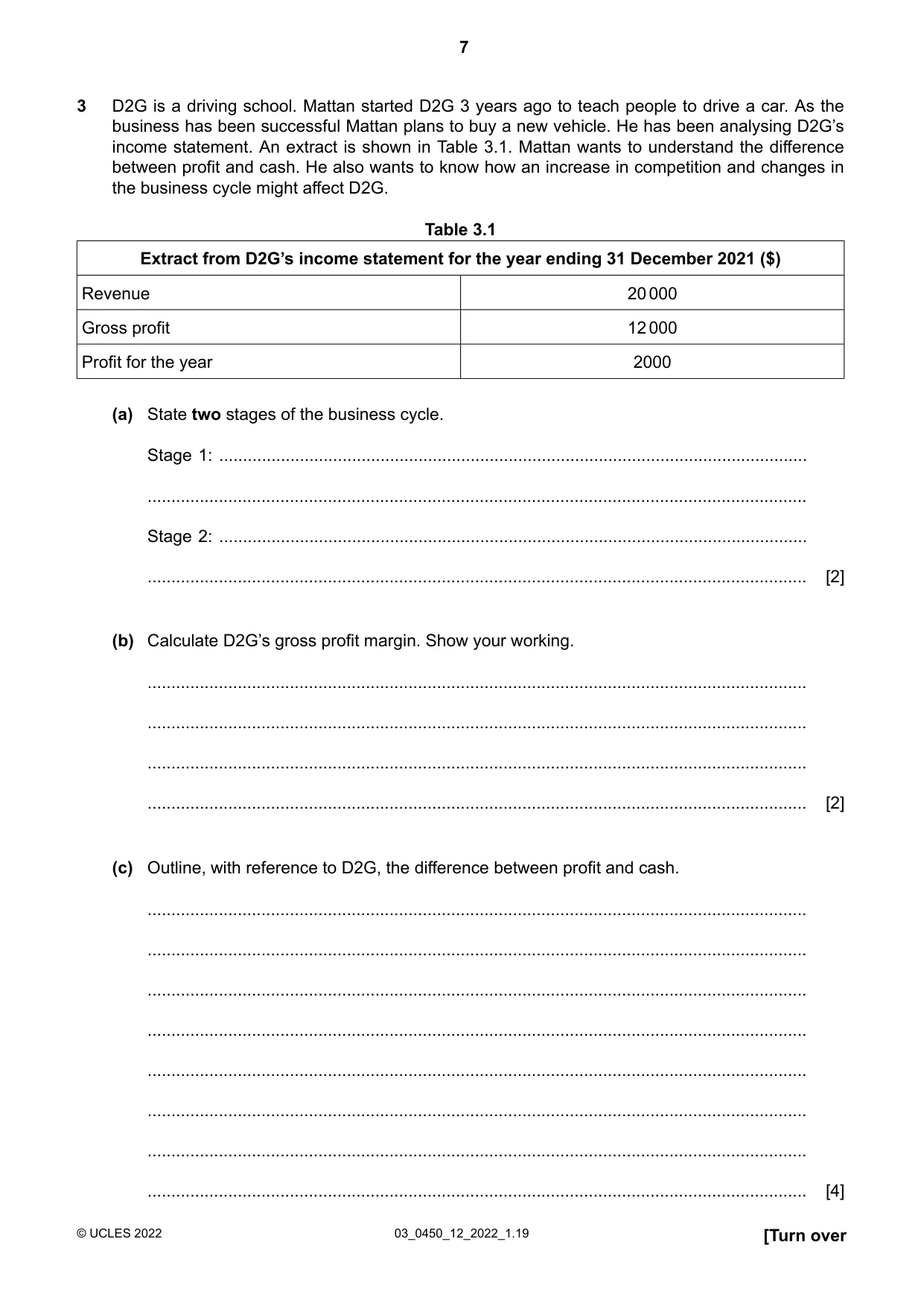
Question paper, page 7
D2G is a driving school. Mattan started D2G 3 years ago to teach people to drive a car. As the business has been successful Mattan plans to buy a new vehicle. He has been analysing D2G’s 3 income statement. An extract is shown in Table 3.1. Mattan wants to understand the difference between profit and cash. He also wants to know how an increase in competition and changes in the business cycle might affect D2G. Table 3.1 Extract from D2G’s income statement for the year ending 31 December 2021 ($) 20000 Revenue 12000 Gross profit 2000 Profit for the year State two stages of the business cycle. (a) Stage 1: … … Stage 2: … … [2] Calculate D2G’s gross profit margin. Show your working. (b) … … … … [2] Outline, with reference to D2G, the difference between profit and cash. (c) … … … … … … … … [4] [Turn over 03_0450_12_2022_1.19 © UCLES 2022 7
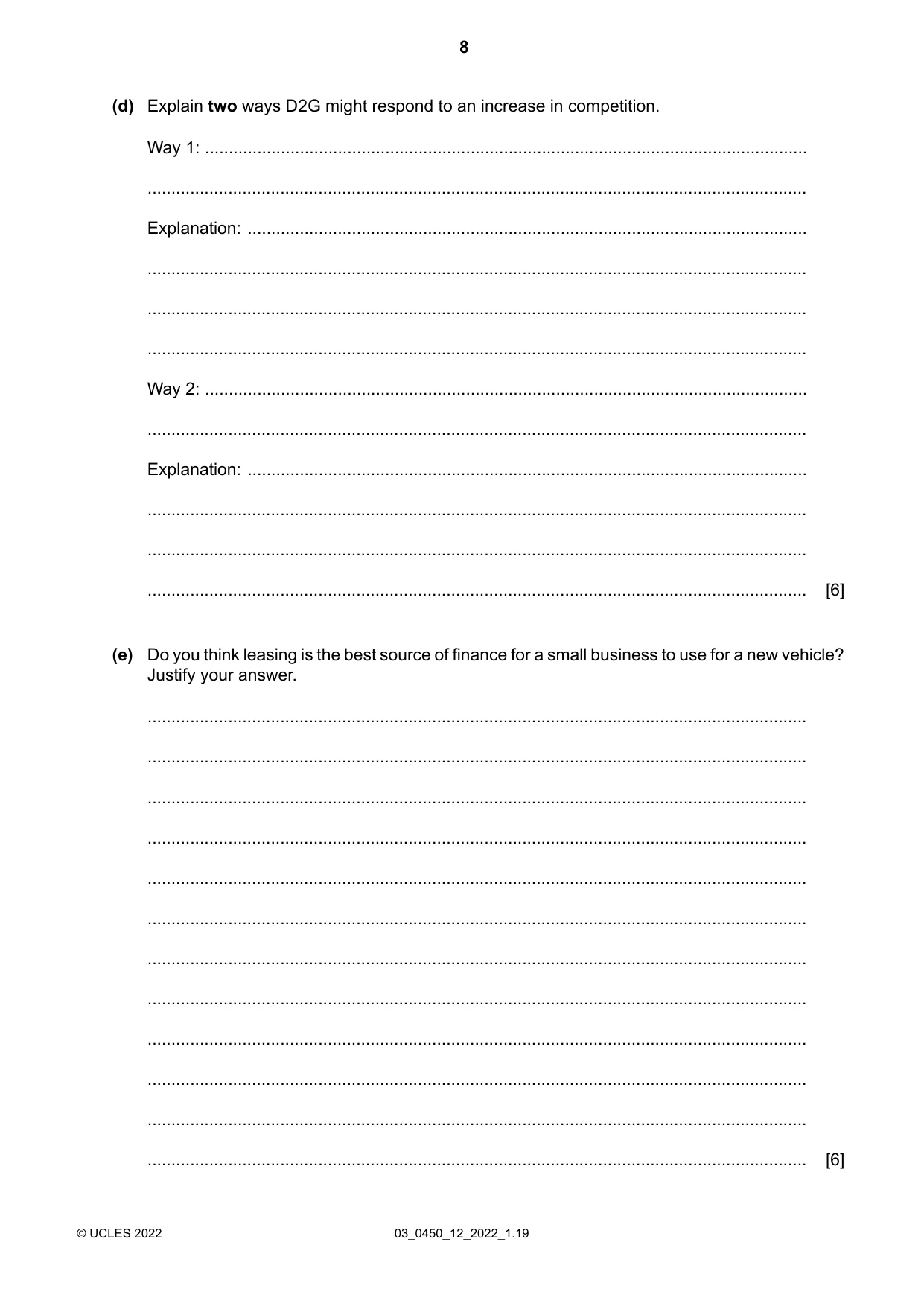
Question paper, page 8
Explain two ways D2G might respond to an increase in competition. (d) Way 1: … … Explanation: … … … … Way 2: … … Explanation: … … … … [6] Do you think leasing is the best source of finance for a small business to use for a new vehicle? Justify your answer. (e) … … … … … … … … … … … … [6] 03_0450_12_2022_1.19 © UCLES 2022 8
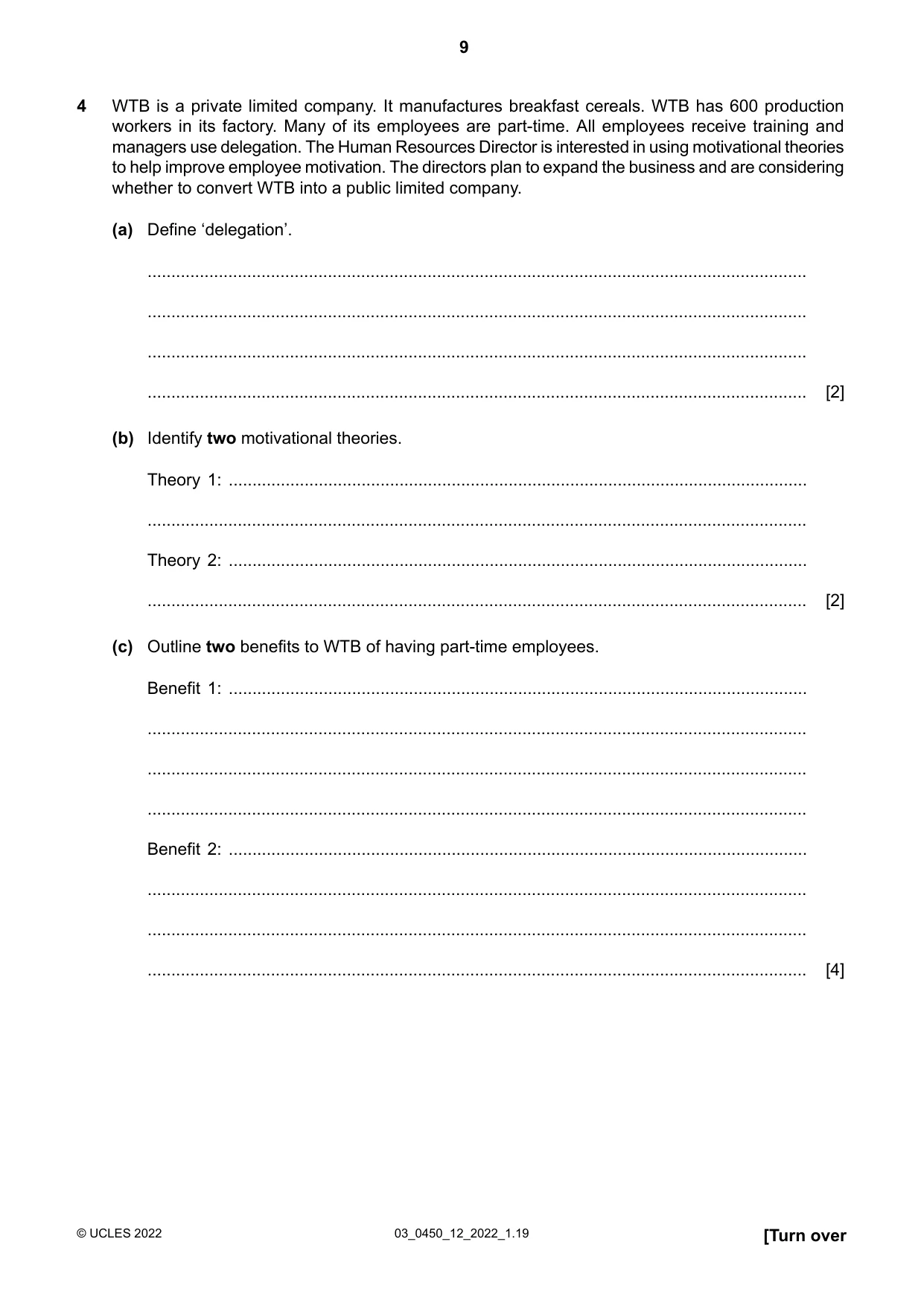
Question paper, page 9
WTB is a private limited company. It manufactures breakfast cereals. WTB has 600 production workers in its factory. Many of its employees are part-time. All employees receive training and 4 managers use delegation. The Human Resources Director is interested in using motivational theories to help improve employee motivation. The directors plan to expand the business and are considering whether to convert WTB into a public limited company. Define ‘delegation’. (a) … … … … [2] Identify two motivational theories. (b) Theory 1: … … Theory 2: … … [2] Outline two benefits to WTB of having part-time employees. (c) Benefit 1: … … … … Benefit 2: … … … … [4] [Turn over 03_0450_12_2022_1.19 © UCLES 2022 9
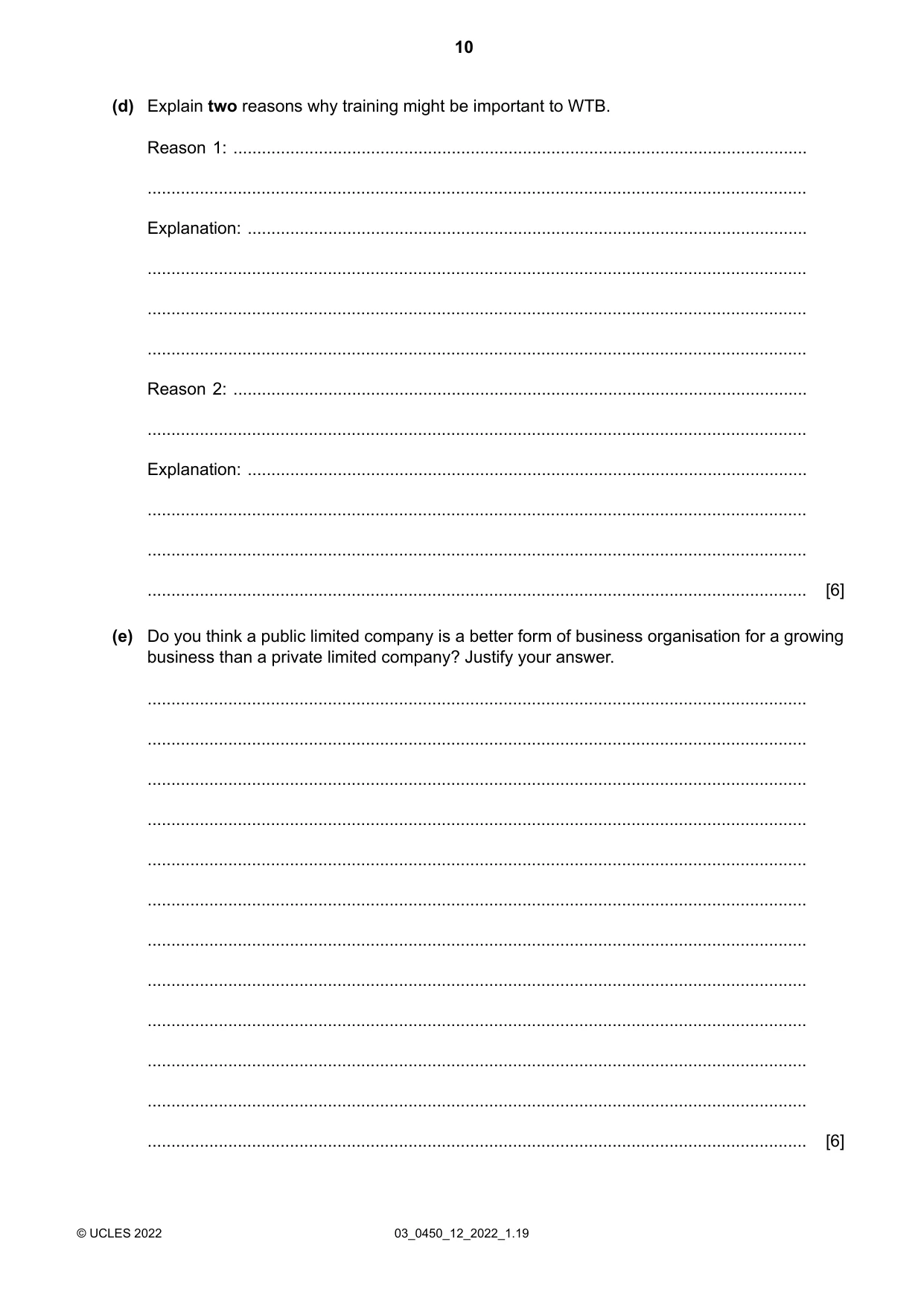
Question paper, page 10
Explain two reasons why training might be important to WTB. (d) Reason 1: … … Explanation: … … … … Reason 2: … … Explanation: … … … … [6] Do you think a public limited company is a better form of business organisation for a growing business than a private limited company? Justify your answer. (e) … … … … … … … … … … … … [6] 03_0450_12_2022_1.19 © UCLES 2022 10
Question paper, page 11
BLANK PAGE 03_0450_12_2022_1.19 © UCLES 2022 11
Question paper, page 12
BLANK PAGE Permission to reproduce items where third-party owned material protected by copyright is included has been sought and cleared where possible. Every reasonable effort has been made by the publisher (UCLES) to trace copyright holders, but if any items requiring clearance have unwittingly been included, the publisher will be pleased to make amends at the earliest possible opportunity. To avoid the issue of disclosure of answer-related information to candidates, all copyright acknowledgements are reproduced online in the Cambridge Assessment International Education Copyright Acknowledgements Booklet. This is produced for each series of examinations and is freely available to download at www.cambridgeinternational.org after the live examination series. Cambridge Assessment International Education is part of Cambridge Assessment. Cambridge Assessment is the brand name of the University of Cambridge Local Examinations Syndicate (UCLES), which is a department of the University of Cambridge. 03_0450_12_2022_1.19 © UCLES 2022 12
Mark scheme, page 1
This document consists of 22 printed pages. © UCLES 2022 [Turn over Cambridge IGCSE™ BUSINESS STUDIES 0450/12 Paper 1 Short Answer/Data Response February/March 2022 MARK SCHEME Maximum Mark: 80 Published This mark scheme is published as an aid to teachers and candidates, to indicate the requirements of the examination. It shows the basis on which Examiners were instructed to award marks. It does not indicate the details of the discussions that took place at an Examiners’ meeting before marking began, which would have considered the acceptability of alternative answers. Mark schemes should be read in conjunction with the question paper and the principal examiner report for teachers. Cambridge International will not enter into discussions about these mark schemes. Cambridge International is publishing the mark schemes for the February/March 2022 series for most Cambridge IGCSE™, Cambridge International A and AS Level components and some Cambridge O Level components.
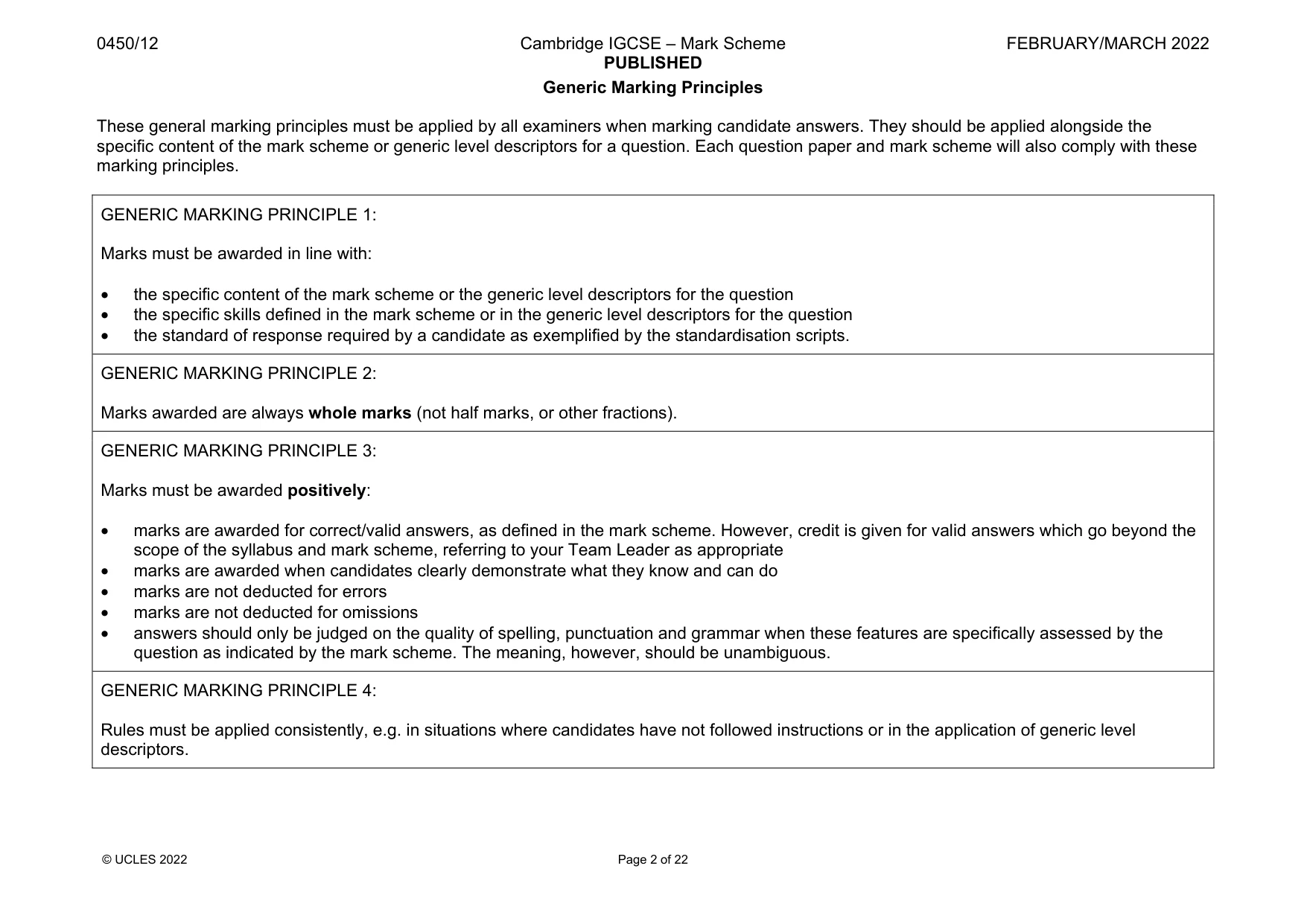
Mark scheme, page 2
0450/12 Cambridge IGCSE – Mark Scheme PUBLISHED FEBRUARY/MARCH 2022 © UCLES 2022 Page 2 of 22 Generic Marking Principles These general marking principles must be applied by all examiners when marking candidate answers. They should be applied alongside the specific content of the mark scheme or generic level descriptors for a question. Each question paper and mark scheme will also comply with these marking principles. GENERIC MARKING PRINCIPLE 1: Marks must be awarded in line with: • the specific content of the mark scheme or the generic level descriptors for the question • the specific skills defined in the mark scheme or in the generic level descriptors for the question • the standard of response required by a candidate as exemplified by the standardisation scripts. GENERIC MARKING PRINCIPLE 2: Marks awarded are always whole marks (not half marks, or other fractions). GENERIC MARKING PRINCIPLE 3: Marks must be awarded positively: • marks are awarded for correct/valid answers, as defined in the mark scheme. However, credit is given for valid answers which go beyond the scope of the syllabus and mark scheme, referring to your Team Leader as appropriate • marks are awarded when candidates clearly demonstrate what they know and can do • marks are not deducted for errors • marks are not deducted for omissions • answers should only be judged on the quality of spelling, punctuation and grammar when these features are specifically assessed by the question as indicated by the mark scheme. The meaning, however, should be unambiguous. GENERIC MARKING PRINCIPLE 4: Rules must be applied consistently, e.g. in situations where candidates have not followed instructions or in the application of generic level descriptors.
Mark scheme, page 3
0450/12 Cambridge IGCSE – Mark Scheme PUBLISHED FEBRUARY/MARCH 2022 © UCLES 2022 Page 3 of 22 GENERIC MARKING PRINCIPLE 5: Marks should be awarded using the full range of marks defined in the mark scheme for the question (however; the use of the full mark range may be limited according to the quality of the candidate responses seen). GENERIC MARKING PRINCIPLE 6: Marks awarded are based solely on the requirements as defined in the mark scheme. Marks should not be awarded with grade thresholds or grade descriptors in mind.
Mark scheme, page 4
0450/12 Cambridge IGCSE – Mark Scheme PUBLISHED FEBRUARY/MARCH 2022 © UCLES 2022 Page 4 of 22 Social Science-Specific Marking Principles (for point-based marking) 1 Components using point-based marking: • Point marking is often used to reward knowledge, understanding and application of skills. We give credit where the candidate’s answer shows relevant knowledge, understanding and application of skills in answering the question. We do not give credit where the answer shows confusion. From this it follows that we: a DO credit answers which are worded differently from the mark scheme if they clearly convey the same meaning (unless the mark scheme requires a specific term) b DO credit alternative answers/examples which are not written in the mark scheme if they are correct c DO credit answers where candidates give more than one correct answer in one prompt/numbered/scaffolded space where extended writing is required rather than list-type answers. For example, questions that require n reasons (e.g. State two reasons …). d DO NOT credit answers simply for using a ‘key term’ unless that is all that is required. (Check for evidence it is understood and not used wrongly.) e DO NOT credit answers which are obviously self-contradicting or trying to cover all possibilities f DO NOT give further credit for what is effectively repetition of a correct point already credited unless the language itself is being tested. This applies equally to ‘mirror statements’ (i.e. polluted/not polluted). g DO NOT require spellings to be correct, unless this is part of the test. However spellings of syllabus terms must allow for clear and unambiguous separation from other syllabus terms with which they may be confused (e.g. Corrasion/Corrosion) 2 Presentation of mark scheme: • Slashes (/) or the word ‘or’ separate alternative ways of making the same point. • Semi colons (;) bullet points (•) or figures in brackets (1) separate different points. • Content in the answer column in brackets is for examiner information/context to clarify the marking but is not required to earn the mark (except Accounting syllabuses where they indicate negative numbers).
Mark scheme, page 5
0450/12 Cambridge IGCSE – Mark Scheme PUBLISHED FEBRUARY/MARCH 2022 © UCLES 2022 Page 5 of 22 3 Calculation questions: • The mark scheme will show the steps in the most likely correct method(s), the mark for each step, the correct answer(s) and the mark for each answer • If working/explanation is considered essential for full credit, this will be indicated in the question paper and in the mark scheme. In all other instances, the correct answer to a calculation should be given full credit, even if no supporting working is shown. • Where the candidate uses a valid method which is not covered by the mark scheme, award equivalent marks for reaching equivalent stages. • Where an answer makes use of a candidate’s own incorrect figure from previous working, the ‘own figure rule’ applies: full marks will be given if a correct and complete method is used. Further guidance will be included in the mark scheme where necessary and any exceptions to this general principle will be noted. 4 Annotation: • For point marking, ticks can be used to indicate correct answers and crosses can be used to indicate wrong answers. There is no direct relationship between ticks and marks. Ticks have no defined meaning for levels of response marking. • For levels of response marking, the level awarded should be annotated on the script. • Other annotations will be used by examiners as agreed during standardisation, and the meaning will be understood by all examiners who marked that paper.
Mark scheme, page 6
0450/12 Cambridge IGCSE – Mark Scheme PUBLISHED FEBRUARY/MARCH 2022 © UCLES 2022 Page 6 of 22 Question Answer Marks Notes 1(a) Identify two reasons for globalisation. Award 1 mark per reason (max 2). Points might include: • Free trade agreements / economic trading blocs / reduction in trade barriers • Improved/cheaper transport/travel links • Improved communication networks/technology • Emerging markets are quickly expanding / rapid economic growth in developing countries • Change in government economic policy / allowing foreign company to set up operations in own country • Increased labour migration Other appropriate responses should also be credited. 2 Only award the first two responses given. 1(b) Define ‘depreciation of an exchange rate’. Award 2 marks for a full definition. Award 1 mark for a partial definition. A currency’s value falls against another currency [2] OR The value of the currency goes down with respect to another (currency) [2] OR When the value of a currency falls – it buys less of another currency than before [2] Partial definition e.g. currency is weaker/falling [1] OR can buy less with currency [1] 2
Mark scheme, page 7
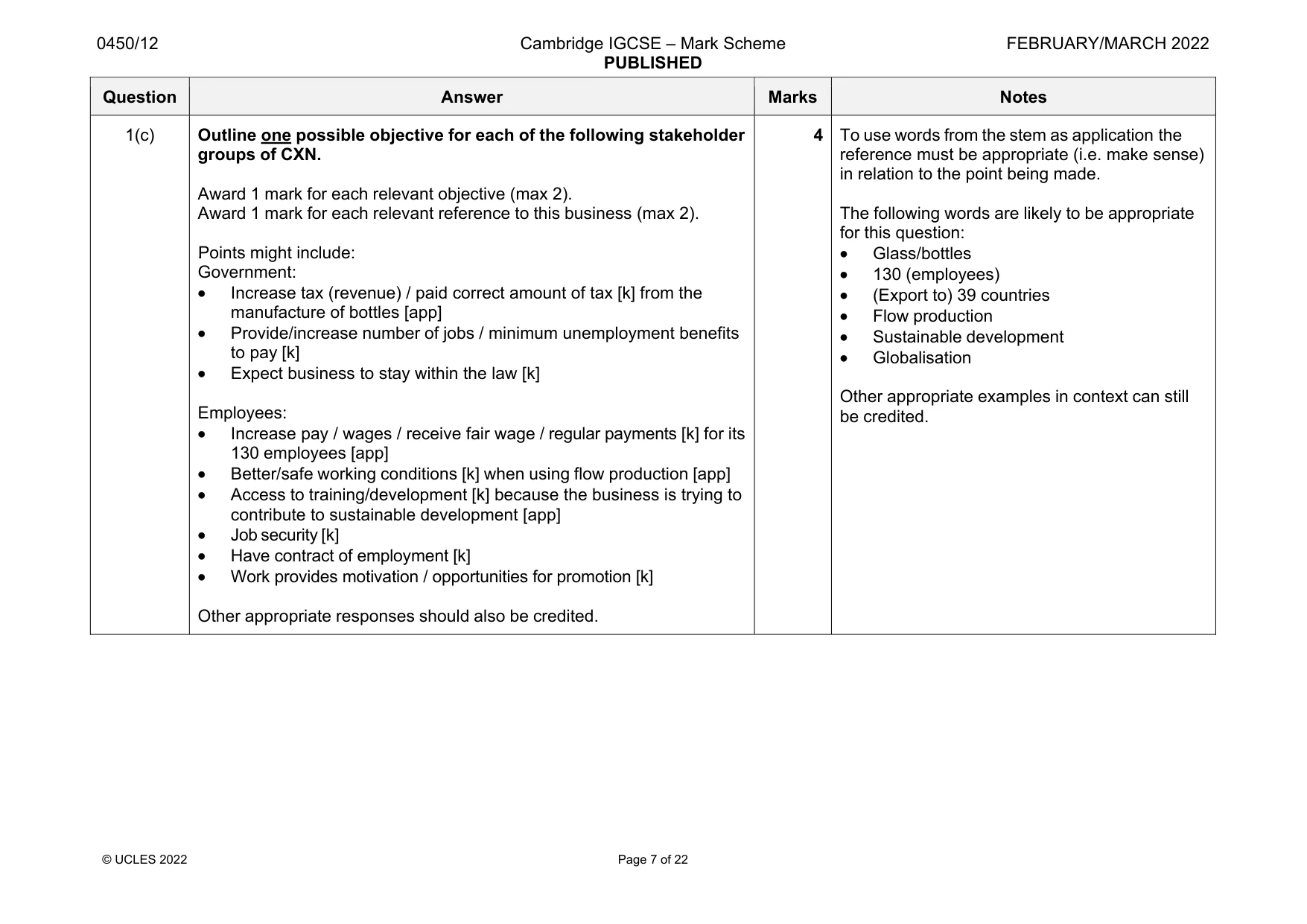
0450/12 Cambridge IGCSE – Mark Scheme PUBLISHED FEBRUARY/MARCH 2022 © UCLES 2022 Page 7 of 22 Question Answer Marks Notes 1(c) Outline one possible objective for each of the following stakeholder groups of CXN. Award 1 mark for each relevant objective (max 2). Award 1 mark for each relevant reference to this business (max 2). .Points might include: Government: • Increase tax (revenue) / paid correct amount of tax [k] from the manufacture of bottles [app] • Provide/increase number of jobs / minimum unemployment benefits to pay [k] • Expect business to stay within the law [k] Employees: • Increase pay / wages / receive fair wage / regular payments [k] for its 130 employees [app] • Better/safe working conditions [k] when using flow production [app] • Access to training/development [k] because the business is trying to contribute to sustainable development [app] • Job security [k] • Have contract of employment [k] • Work provides motivation / opportunities for promotion [k] Other appropriate responses should also be credited. 4 To use words from the stem as application the reference must be appropriate (i.e. make sense) in relation to the point being made. The following words are likely to be appropriate for this question: • Glass/bottles • 130 (employees) • (Export to) 39 countries • Flow production • Sustainable development • Globalisation Other appropriate examples in context can still be credited.
Mark scheme, page 8
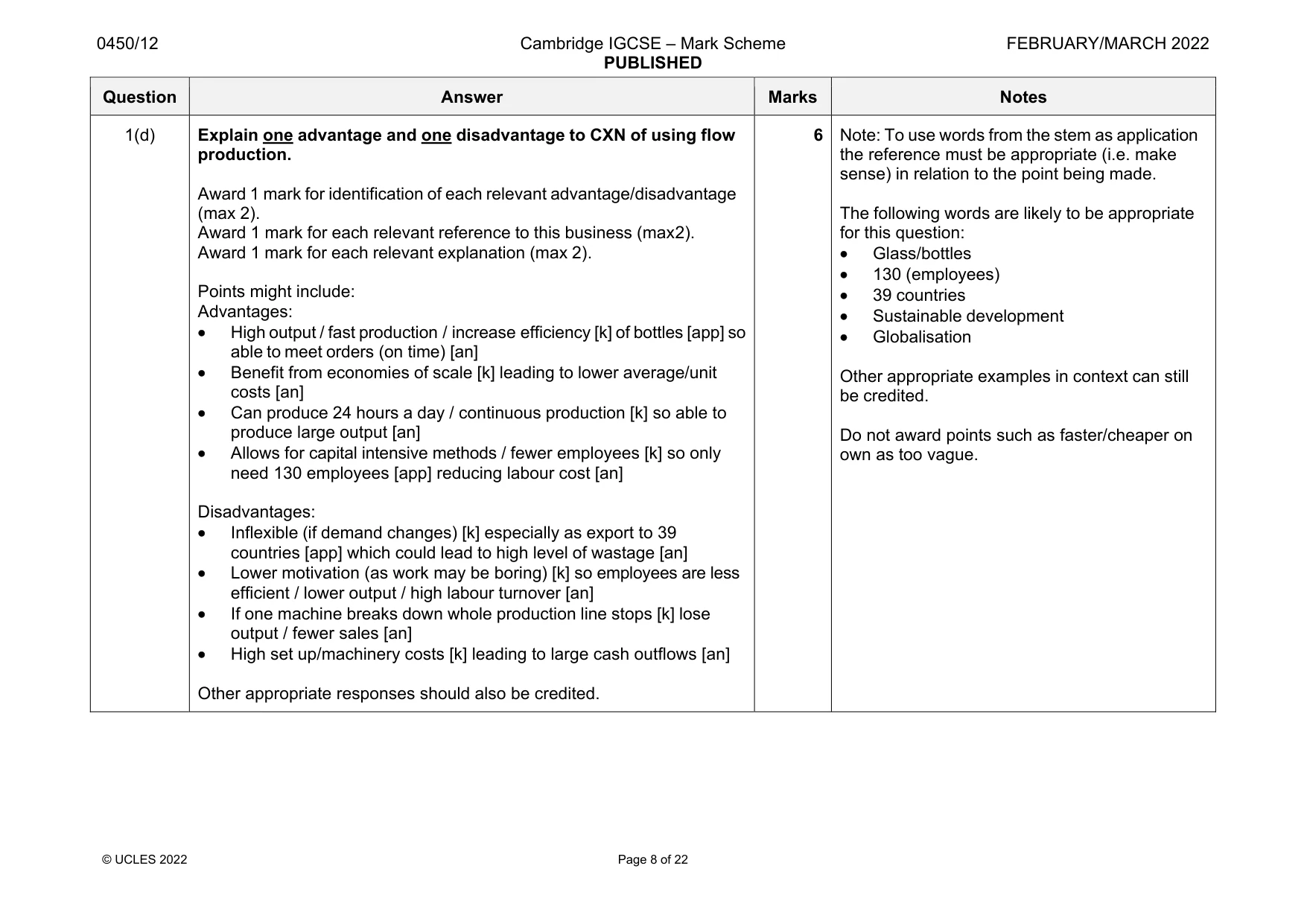
0450/12 Cambridge IGCSE – Mark Scheme PUBLISHED FEBRUARY/MARCH 2022 © UCLES 2022 Page 8 of 22 Question Answer Marks Notes 1(d) Explain one advantage and one disadvantage to CXN of using flow production. Award 1 mark for identification of each relevant advantage/disadvantage (max 2). Award 1 mark for each relevant reference to this business (max 2). Award 1 mark for each relevant explanation (max 2) . Points might include: Advantages: • High output / fast production / increase efficiency [k] of bottles [app] so able to meet orders (on time) [an] • Benefit from economies of scale [k] leading to lower average/unit costs [an] • Can produce 24 hours a day / continuous production [k] so able to produce large output [an] • Allows for capital intensive methods / fewer employees [k] so only need 130 employees [app] reducing labour cost [an] Disadvantages: • Inflexible (if demand changes) [k] especially as export to 39 countries [app] which could lead to high level of wastage [an] • Lower motivation (as work may be boring) [k] so employees are less efficient / lower output / high labour turnover [an] • If one machine breaks down whole production line stops [k] lose output / fewer sales [an] • High set up/machinery costs [k] leading to large cash outflows [an] Other appropriate responses should also be credited. 6 Note: To use words from the stem as application the reference must be appropriate (i.e. make sense) in relation to the point being made. The following words are likely to be appropriate for this question: • Glass/bottles • 130 (employees) • 39 countries • Sustainable development • Globalisation Other appropriate examples in context can still be credited. Do not award points such as faster/cheaper on own as too vague.
Mark scheme, page 9
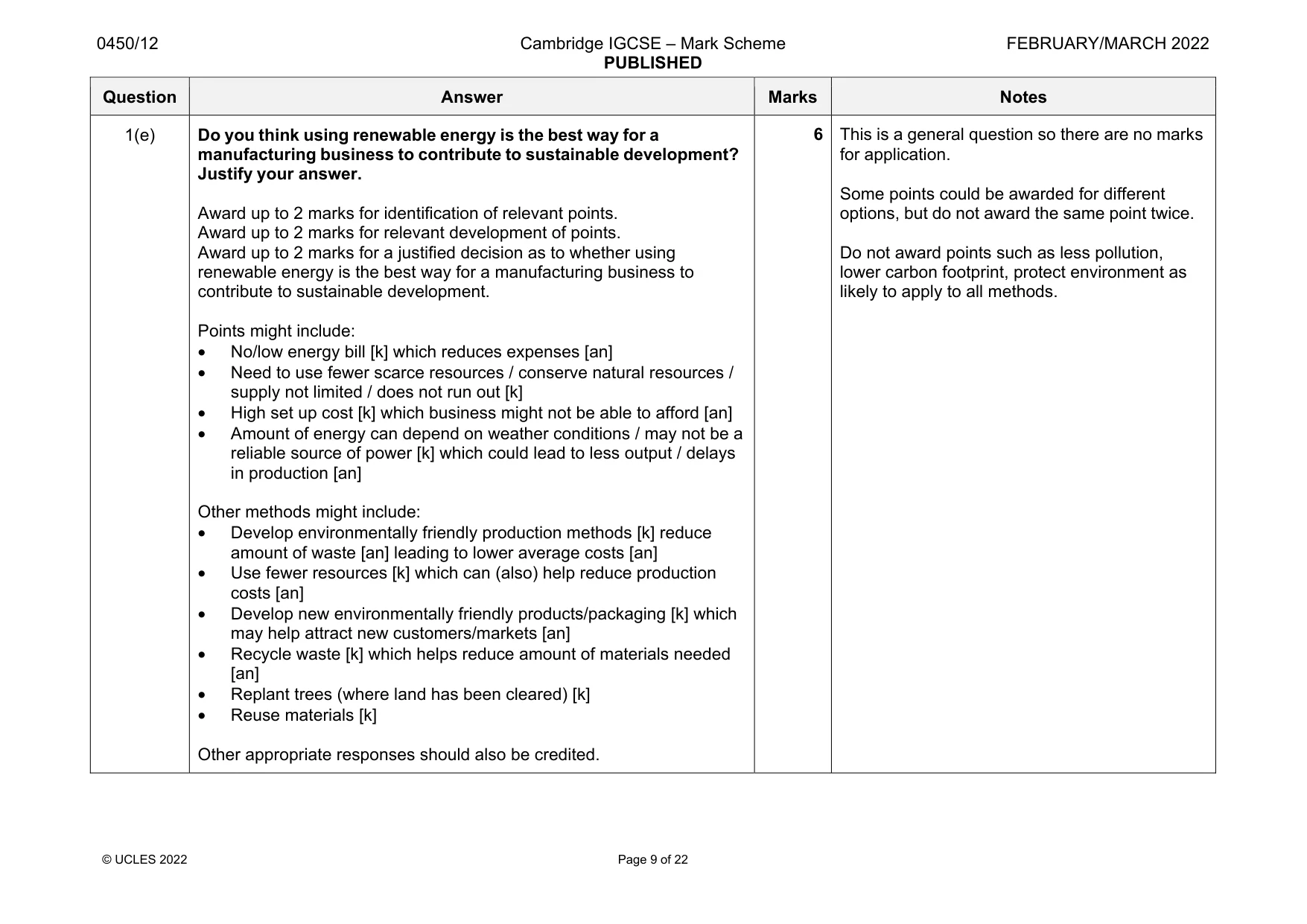
0450/12 Cambridge IGCSE – Mark Scheme PUBLISHED FEBRUARY/MARCH 2022 © UCLES 2022 Page 9 of 22 Question Answer Marks Notes 1(e) Do you think using renewable energy is the best way for a manufacturing business to contribute to sustainable development? Justify your answer. Award up to 2 marks for identification of relevant points. Award up to 2 marks for relevant development of points. Award up to 2 marks for a justified decision as to whether using renewable energy is the best way for a manufacturing business to contribute to sustainable development. Points might include: • No/low energy bill [k] which reduces expenses [an] • Need to use fewer scarce resources / conserve natural resources / supply not limited / does not run out [k] • High set up cost [k] which business might not be able to afford [an] • Amount of energy can depend on weather conditions / may not be a reliable source of power [k] which could lead to less output / delays in production [an] Other methods might include: • Develop environmentally friendly production methods [k] reduce amount of waste [an] leading to lower average costs [an] • Use fewer resources [k] which can (also) help reduce production costs [an] • Develop new environmentally friendly products/packaging [k] which may help attract new customers/markets [an] • Recycle waste [k] which helps reduce amount of materials needed [an] • Replant trees (where land has been cleared) [k] • Reuse materials [k] Other appropriate responses should also be credited. 6 This is a general question so there are no marks for application. Some points could be awarded for different options, but do not award the same point twice. Do not award points such as less pollution, lower carbon footprint, protect environment as likely to apply to all methods.
Mark scheme, page 10
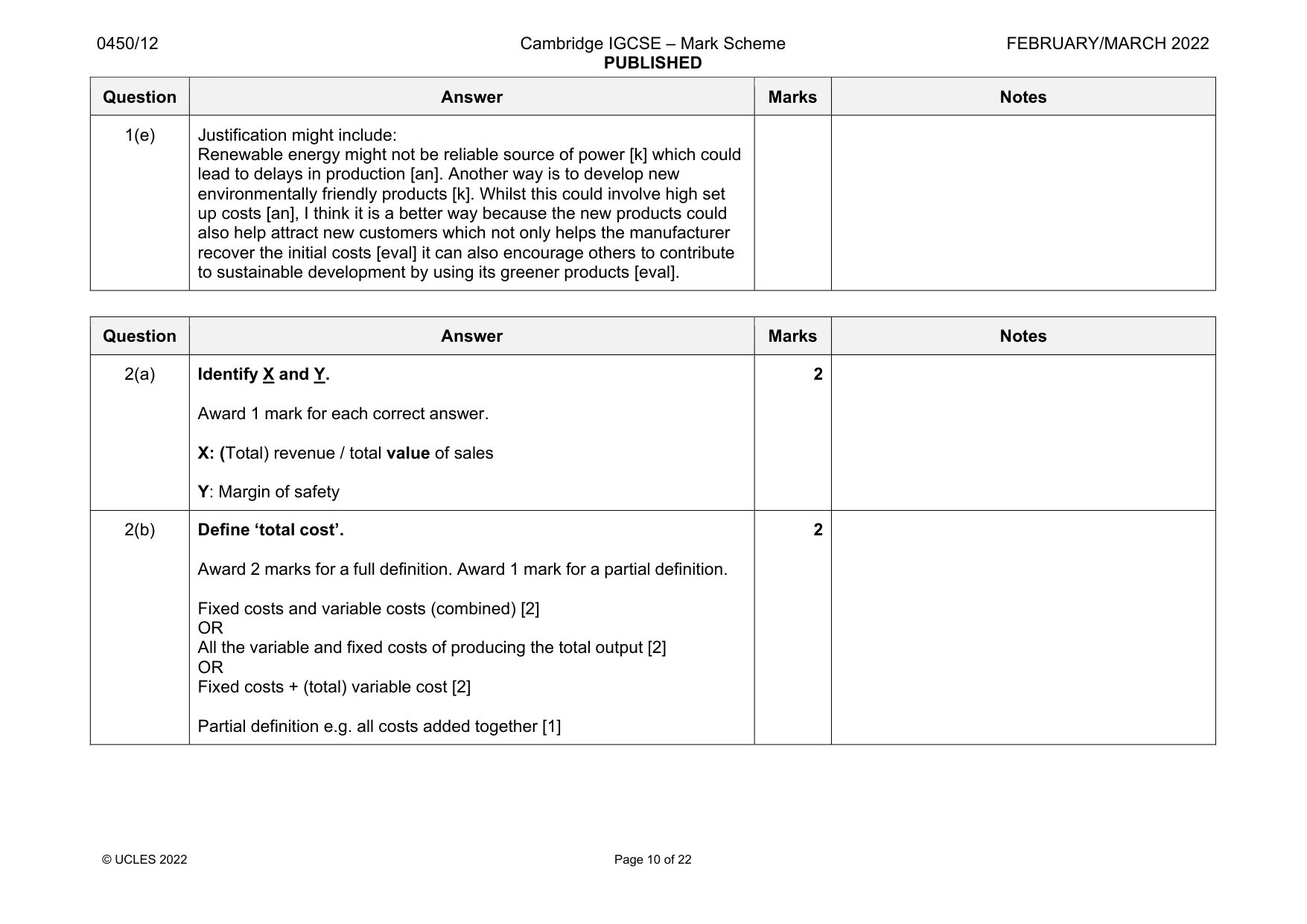
0450/12 Cambridge IGCSE – Mark Scheme PUBLISHED FEBRUARY/MARCH 2022 © UCLES 2022 Page 10 of 22 Question Answer Marks Notes 1(e) Justification might include: Renewable energy might not be reliable source of power [k] which could lead to delays in production [an]. Another way is to develop new environmentally friendly products [k]. Whilst this could involve high set up costs [an], I think it is a better way because the new products could also help attract new customers which not only helps the manufacturer recover the initial costs [eval] it can also encourage others to contribute to sustainable development by using its greener products [eval]. Question Answer Marks Notes 2(a) Identify X and Y. Award 1 mark for each correct answer . X: (Total) revenue / total value of sales Y: Margin of safety 2 2(b) Define ‘total cost’. Award 2 marks for a full definition. Award 1 mark for a partial definition. Fixed costs and variable costs (combined) [2] OR All the variable and fixed costs of producing the total output [2] OR Fixed costs + (total) variable cost [2] Partial definition e.g. all costs added together [1] 2
Mark scheme, page 11
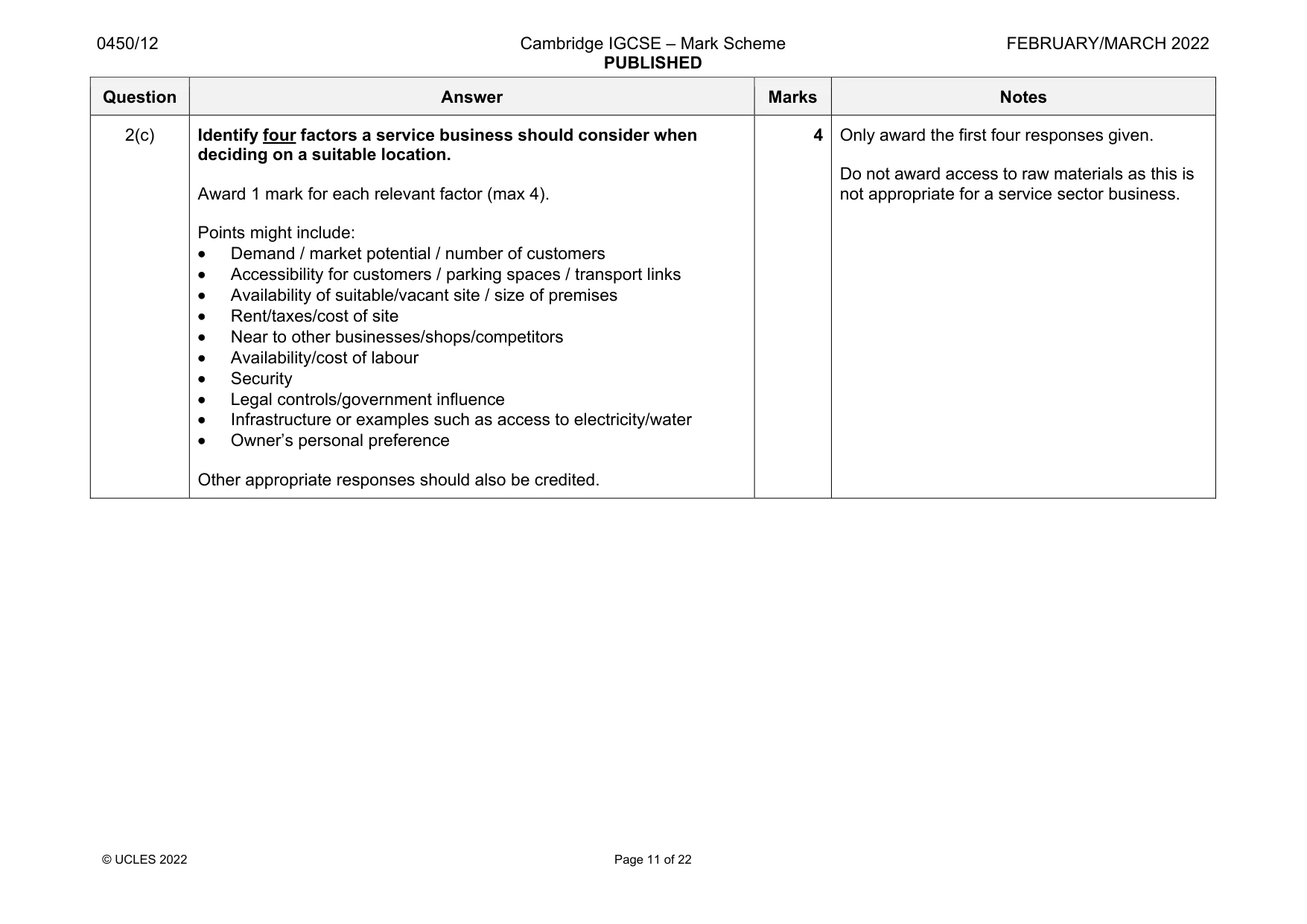
0450/12 Cambridge IGCSE – Mark Scheme PUBLISHED FEBRUARY/MARCH 2022 © UCLES 2022 Page 11 of 22 Question Answer Marks Notes 2(c) Identify four factors a service business should consider when deciding on a suitable location. Award 1 mark for each relevant factor (max 4). Points might include: • Demand / market potential / number of customers • Accessibility for customers / parking spaces / transport links • Availability of suitable/vacant site / size of premises • Rent/taxes/cost of site • Near to other businesses/shops/competitors • Availability/cost of labour • Security • Legal controls/government influence • Infrastructure or examples such as access to electricity/water • Owner’s personal preference Other appropriate responses should also be credited. 4 Only award the first four responses given. Do not award access to raw materials as this is not appropriate for a service sector business.
Mark scheme, page 12
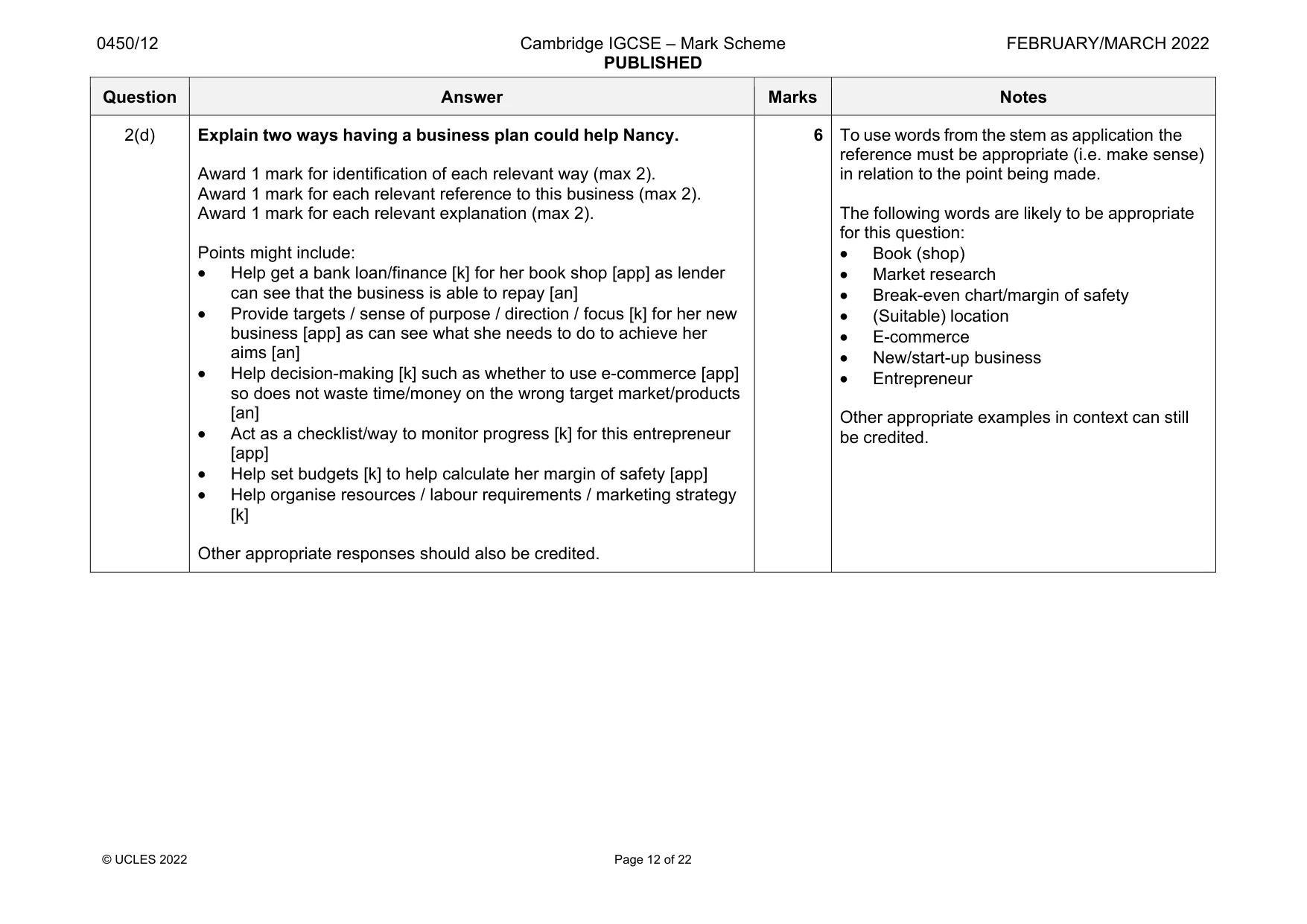
0450/12 Cambridge IGCSE – Mark Scheme PUBLISHED FEBRUARY/MARCH 2022 © UCLES 2022 Page 12 of 22 Question Answer Marks Notes 2(d) Explain two ways having a business plan could help Nancy. Award 1 mark for identification of each relevant way (max 2). Award 1 mark for each relevant reference to this business (max 2). Award 1 mark for each relevant explanation (max 2). Points might include: • Help get a bank loan/finance [k] for her book shop [app] as lender can see that the business is able to repay [an] • Provide targets / sense of purpose / direction / focus [k] for her new business [app] as can see what she needs to do to achieve her aims [an] • Help decision-making [k] such as whether to use e-commerce [app] so does not waste time/money on the wrong target market/products [an] • Act as a checklist/way to monitor progress [k] for this entrepreneur [app] • Help set budgets [k] to help calculate her margin of safety [app] • Help organise resources / labour requirements / marketing strategy [k] Other appropriate responses should also be credited. 6 To use words from the stem as application the reference must be appropriate (i.e. make sense) in relation to the point being made. The following words are likely to be appropriate for this question: • Book (shop) • Market research • Break-even chart/margin of safety • (Suitable) location • E-commerce • New/start-up business • Entrepreneur Other appropriate examples in context can still be credited.
Mark scheme, page 13
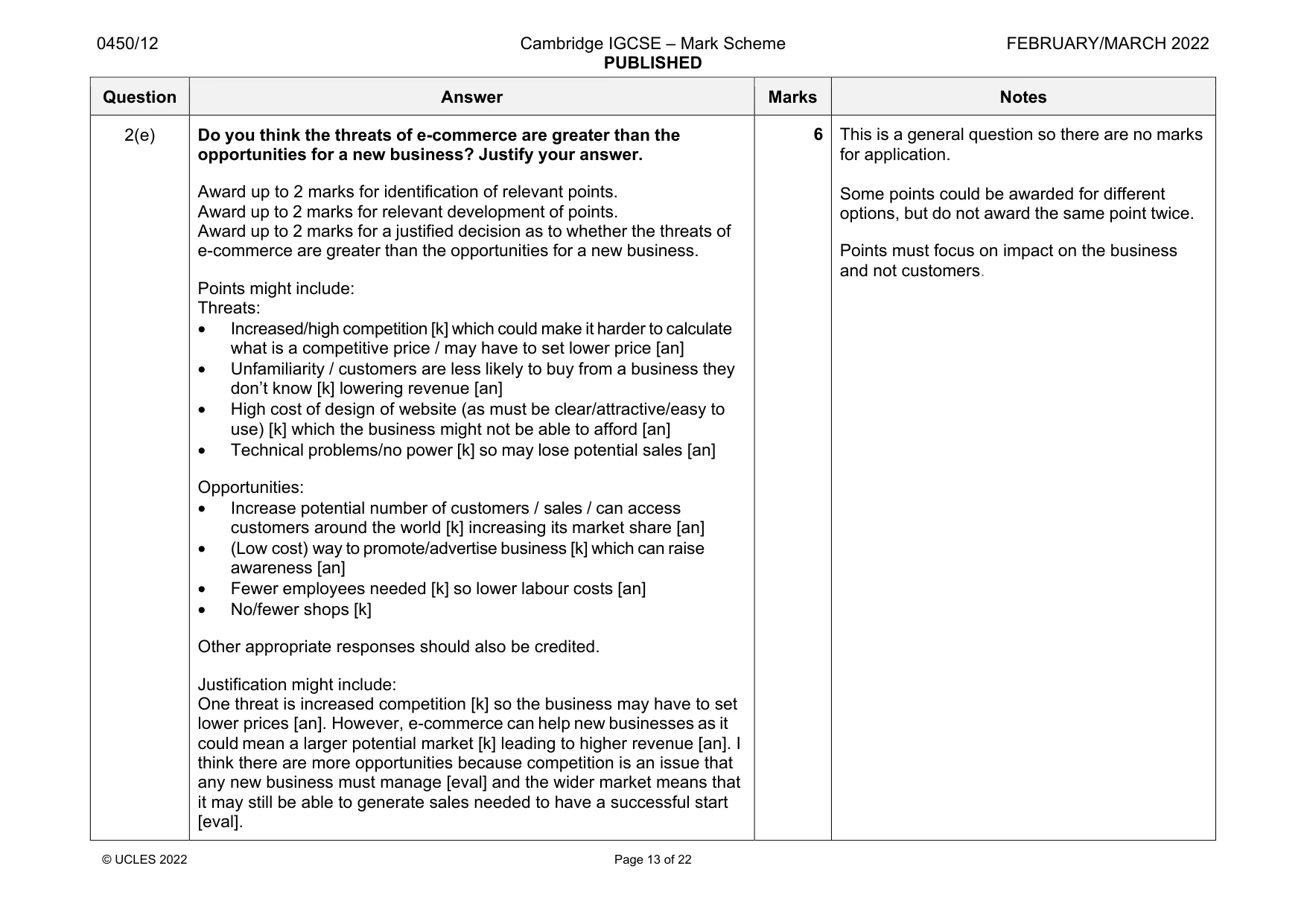
0450/12 Cambridge IGCSE – Mark Scheme PUBLISHED FEBRUARY/MARCH 2022 © UCLES 2022 Page 13 of 22 Question Answer Marks Notes 2(e) Do you think the threats of e-commerce are greater than the opportunities for a new business? Justify your answer. Award up to 2 marks for identification of relevant points. Award up to 2 marks for relevant development of points. Award up to 2 marks for a justified decision as to whether the threats of e-commerce are greater than the opportunities for a new business. Points might include: Threats: • Increased/high competition [k] which could make it harder to calculate what is a competitive price / may have to set lower price [an] • Unfamiliarity / customers are less likely to buy from a business they don’t know [k] lowering revenue [an] • High cost of design of website (as must be clear/attractive/easy to use) [k] which the business might not be able to afford [an] • Technical problems/no power [k] so may lose potential sales [an] Opportunities: • Increase potential number of customers / sales / can access customers around the world [k] increasing its market share [an] • (Low cost) way to promote/advertise business [k] which can raise awareness [an] • Fewer employees needed [k] so lower labour costs [an] • No/fewer shops [k] Other appropriate responses should also be credited. Justification might include: One threat is increased competition [k] so the business may have to set lower prices [an]. However, e-commerce can help new businesses as it could mean a larger potential market [k] leading to higher revenue [an]. I think there are more opportunities because competition is an issue that any new business must manage [eval] and the wider market means that it may still be able to generate sales needed to have a successful start [eval]. 6 This is a general question so there are no marks for application. Some points could be awarded for different options, but do not award the same point twice. Points must focus on impact on the business and not customers.
Mark scheme, page 14
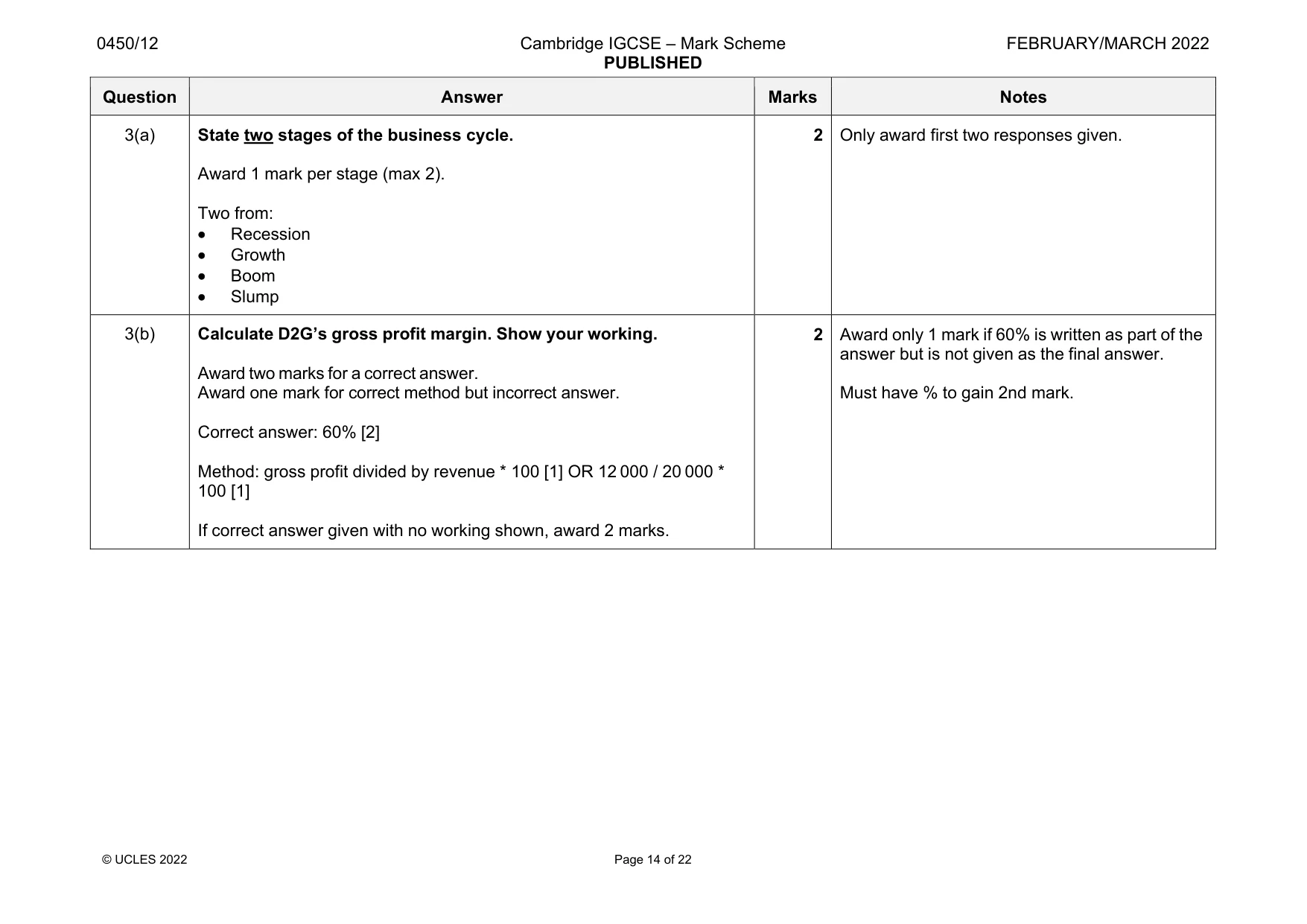
0450/12 Cambridge IGCSE – Mark Scheme PUBLISHED FEBRUARY/MARCH 2022 © UCLES 2022 Page 14 of 22 Question Answer Marks Notes 3(a) State two stages of the business cycle. Award 1 mark per stage (max 2). Two from: • Recession • Growth • Boom • Slump 2 Only award first two responses given. 3(b) Calculate D2G’s gross profit margin. Show your working. Award two marks for a correct answer. Award one mark for correct method but incorrect answer. Correct answer: 60% [2] Method: gross profit divided by revenue * 100 [1] OR 12 000 / 20 000 * 100 [1] If correct answer given with no working shown, award 2 marks. 2 Award only 1 mark if 60% is written as part of the answer but is not given as the final answer. Must have % to gain 2nd mark.
Mark scheme, page 15
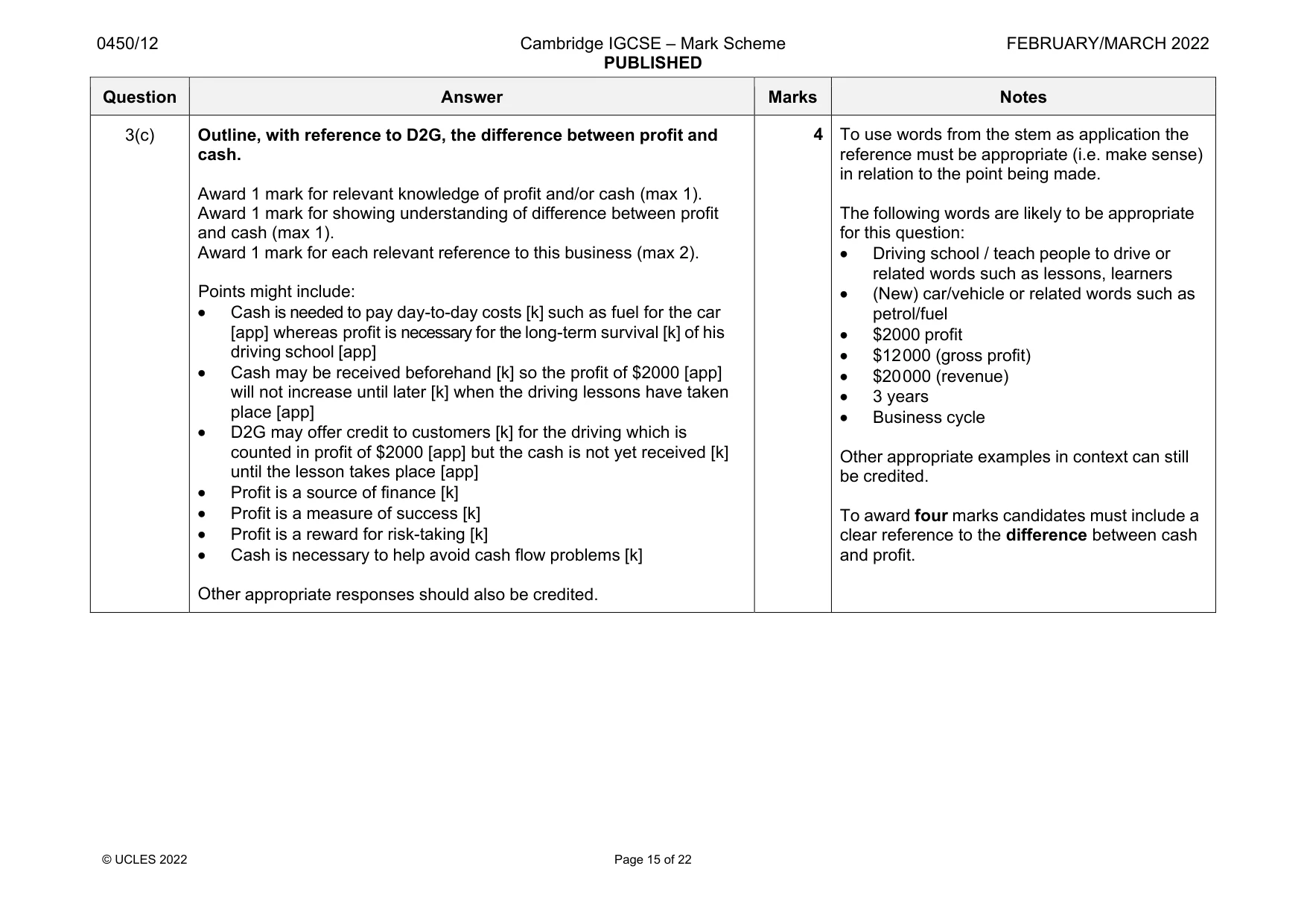
0450/12 Cambridge IGCSE – Mark Scheme PUBLISHED FEBRUARY/MARCH 2022 © UCLES 2022 Page 15 of 22 Question Answer Marks Notes 3(c) Outline, with reference to D2G, the difference between profit and cash. Award 1 mark for relevant knowledge of profit and/or cash (max 1). Award 1 mark for showing understanding of difference between profit and cash (max 1). Award 1 mark for each relevant reference to this business (max 2). Points might include: • Cash is needed to pay day-to-day costs [k] such as fuel for the car [app] whereas profit is necessary for the long-term survival [k] of his driving school [app] • Cash may be received beforehand [k] so the profit of $2000 [app] will not increase until later [k] when the driving lessons have taken place [app] • D2G may offer credit to customers [k] for the driving which is counted in profit of $2000 [app] but the cash is not yet received [k] until the lesson takes place [app] • Profit is a source of finance [k] • Profit is a measure of success [k] • Profit is a reward for risk-taking [k] • Cash is necessary to help avoid cash flow problems [k] Other appropriate responses should also be credited. 4 To use words from the stem as application the reference must be appropriate (i.e. make sense) in relation to the point being made. The following words are likely to be appropriate for this question: • Driving school / teach people to drive or related words such as lessons, learners • (New) car/vehicle or related words such as petrol/fuel • $2000 profit • $12 000 (gross profit) • $20 000 (revenue) • 3 years • Business cycle Other appropriate examples in context can still be credited. To award four marks candidates must include a clear reference to the difference between cash and profit.
Mark scheme, page 16
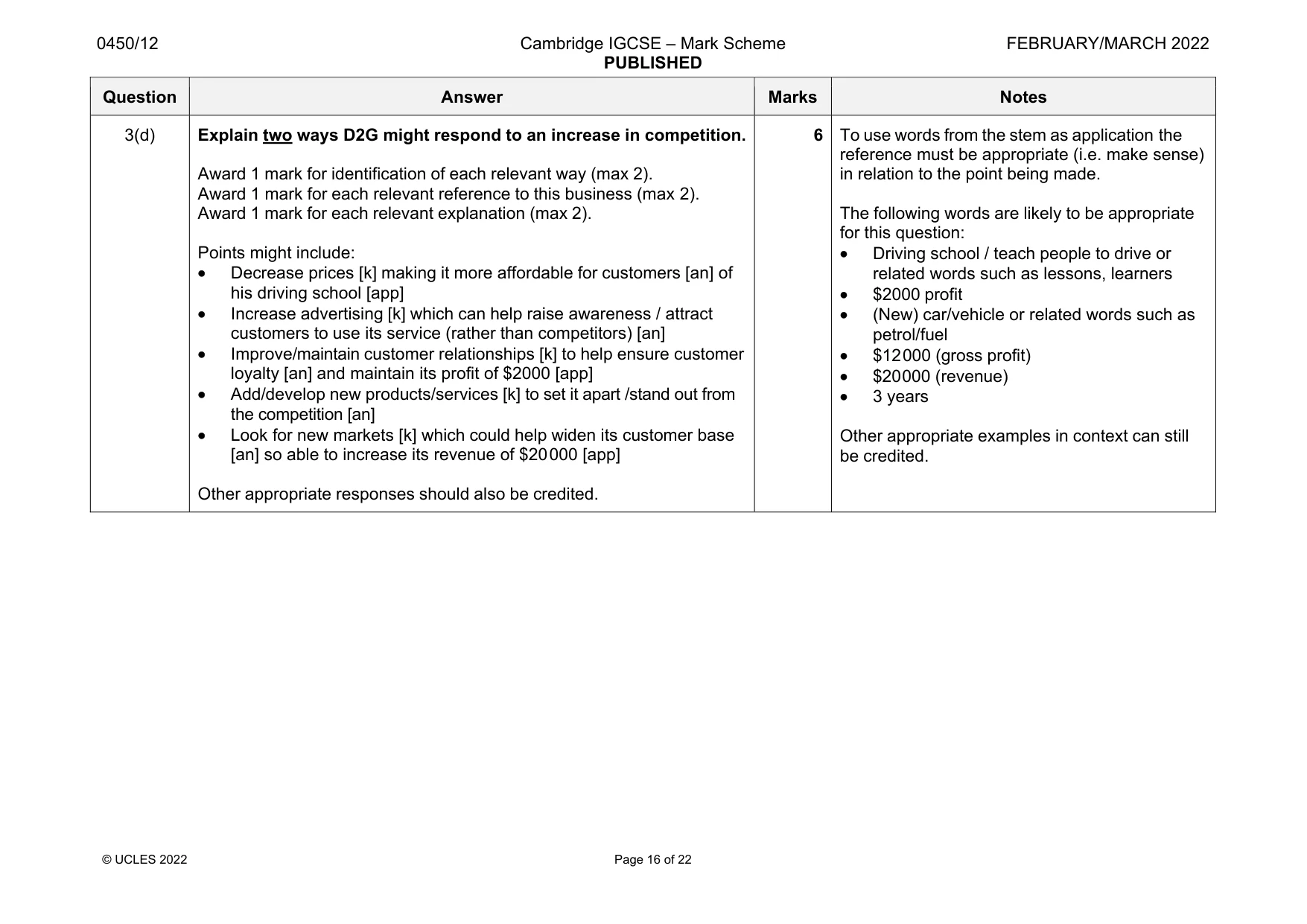
0450/12 Cambridge IGCSE – Mark Scheme PUBLISHED FEBRUARY/MARCH 2022 © UCLES 2022 Page 16 of 22 Question Answer Marks Notes 3(d) Explain two ways D2G might respond to an increase in competition. Award 1 mark for identification of each relevant way (max 2). Award 1 mark for each relevant reference to this business (max 2). Award 1 mark for each relevant explanation (max 2). Points might include: • Decrease prices [k] making it more affordable for customers [an] of his driving school [app] • Increase advertising [k] which can help raise awareness / attract customers to use its service (rather than competitors) [an] • Improve/maintain customer relationships [k] to help ensure customer loyalty [an] and maintain its profit of $2000 [app] • Add/develop new products/services [k] to set it apart /stand out from the competition [an] • Look for new markets [k] which could help widen its customer base [an] so able to increase its revenue of $20 000 [app] Other appropriate responses should also be credited. 6 To use words from the stem as application the reference must be appropriate (i.e. make sense) in relation to the point being made. The following words are likely to be appropriate for this question: • Driving school / teach people to drive or related words such as lessons, learners • $2000 profit • (New) car/vehicle or related words such as petrol/fuel • $12 000 (gross profit) • $20 000 (revenue) • 3 years Other appropriate examples in context can still be credited.
Mark scheme, page 17
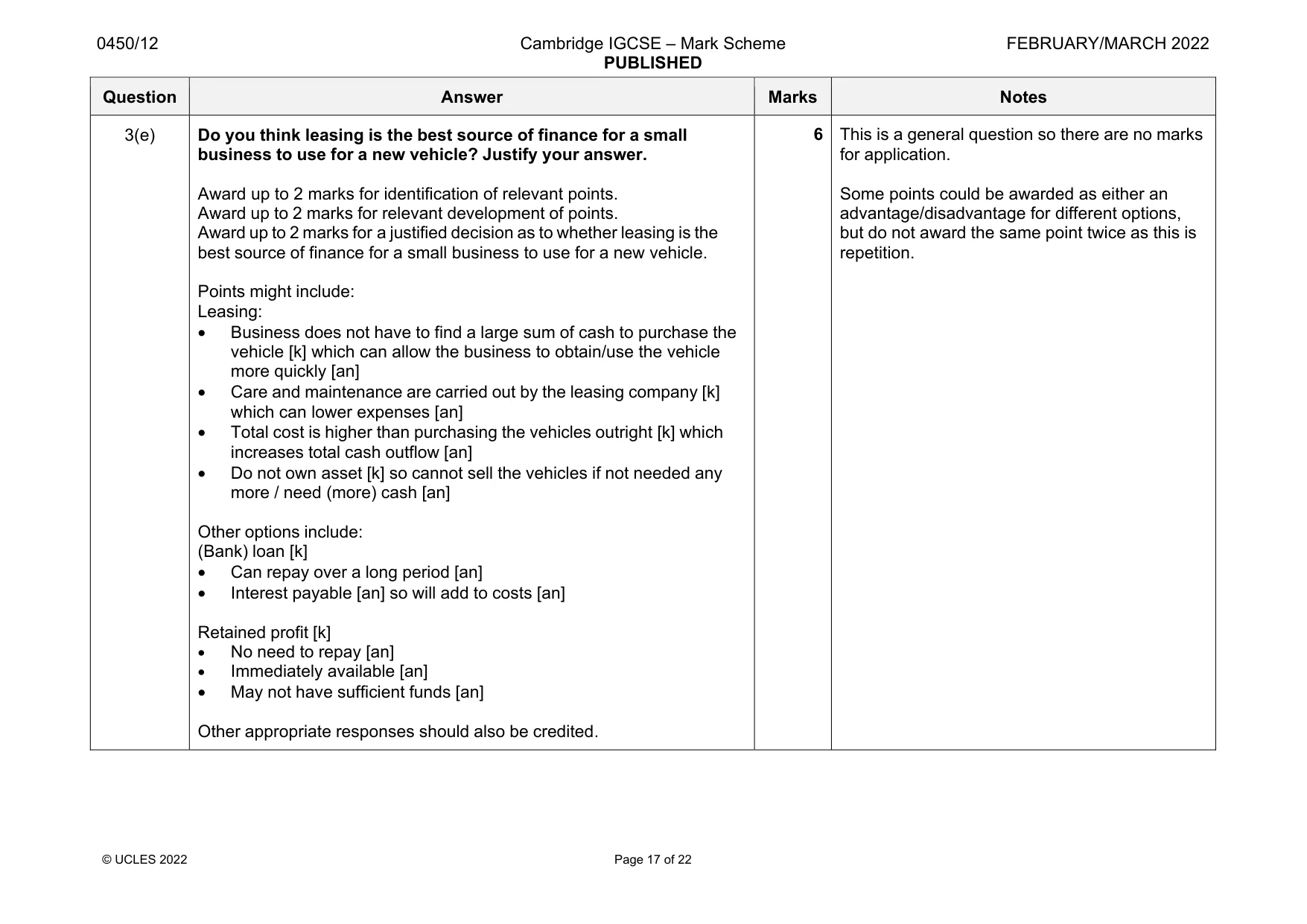
0450/12 Cambridge IGCSE – Mark Scheme PUBLISHED FEBRUARY/MARCH 2022 © UCLES 2022 Page 17 of 22 Question Answer Marks Notes 3(e) Do you think leasing is the best source of finance for a small business to use for a new vehicle? Justify your answer. Award up to 2 marks for identification of relevant points . Award up to 2 marks for relevant development of points. Award up to 2 marks for a justified decision as to whether leasing is the best source of finance for a small business to use for a new vehicle. Points might include: Leasing: • Business does not have to find a large sum of cash to purchase the vehicle [k] which can allow the business to obtain/use the vehicle more quickly [an] • Care and maintenance are carried out by the leasing company [k] which can lower expenses [an] • Total cost is higher than purchasing the vehicles outright [k] which increases total cash outflow [an] • Do not own asset [k] so cannot sell the vehicles if not needed any more / need (more) cash [an] Other options include: (Bank) loan [k] • Can repay over a long period [an] • Interest payable [an] so will add to costs [an] Retained profit [k] • No need to repay [an] • Immediately available [an] • May not have sufficient funds [an] Other appropriate responses should also be credited . 6 This is a general question so there are no marks for application. Some points could be awarded as either an advantage/disadvantage for different options, but do not award the same point twice as this is repetition.
Mark scheme, page 18
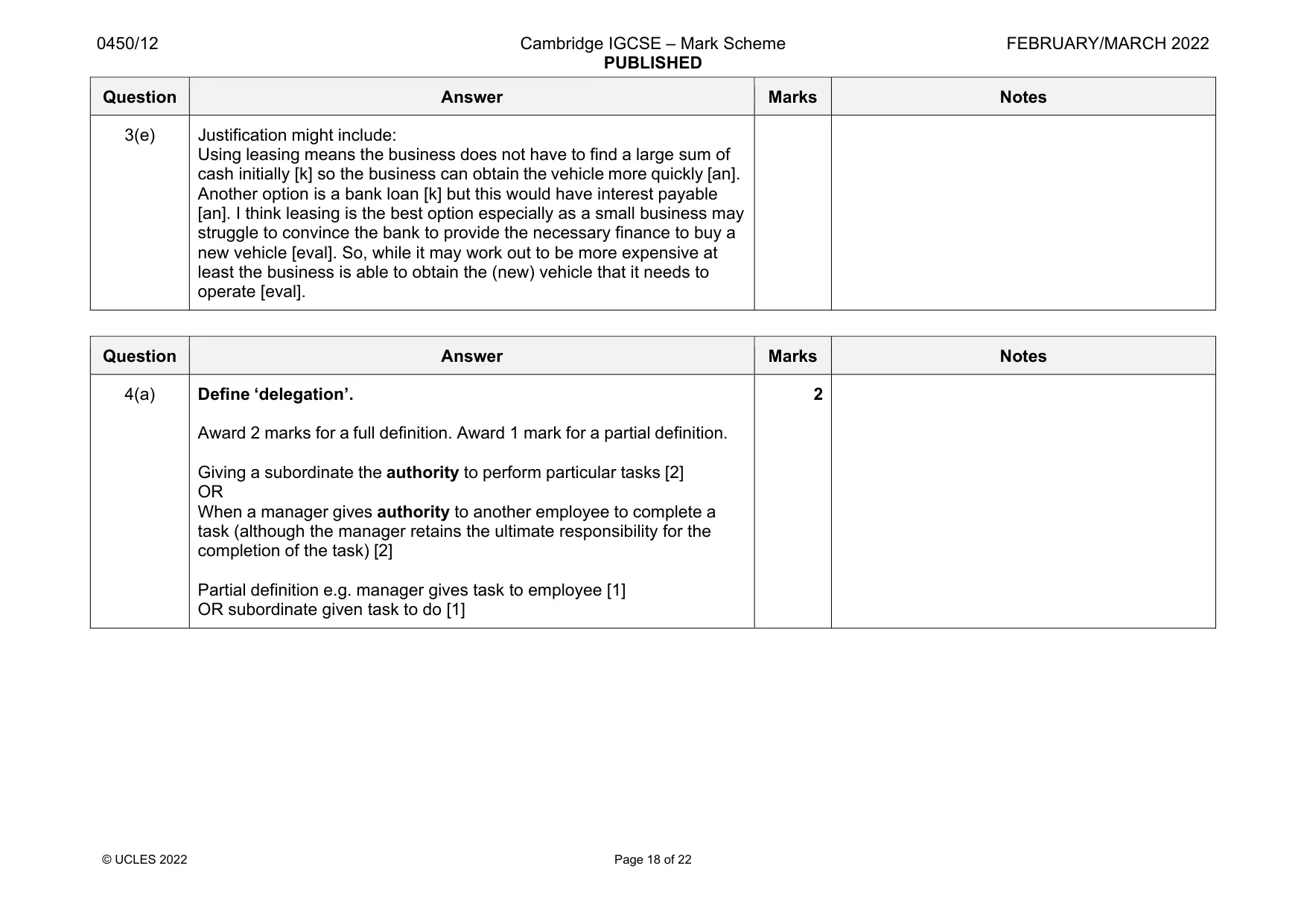
0450/12 Cambridge IGCSE – Mark Scheme PUBLISHED FEBRUARY/MARCH 2022 © UCLES 2022 Page 18 of 22 Question Answer Marks Notes 3(e) Justification might include: Using leasing means the business does not have to find a large sum of cash initially [k] so the business can obtain the vehicle more quickly [an]. Another option is a bank loan [k] but this would have interest payable [an]. I think leasing is the best option especially as a small business may struggle to convince the bank to provide the necessary finance to buy a new vehicle [eval]. So, while it may work out to be more expensive at least the business is able to obtain the (new) vehicle that it needs to operate [eval]. Question Answer Marks Notes 4(a) Define ‘delegation’. Award 2 marks for a full definition. Award 1 mark for a partial definition. Giving a subordinate the authority to perform particular tasks [2] OR When a manager gives authority to another employee to complete a task (although the manager retains the ultimate responsibility for the completion of the task) [2] Partial definition e.g. manager gives task to employee [1] OR subordinate given task to do [1] 2
Mark scheme, page 19
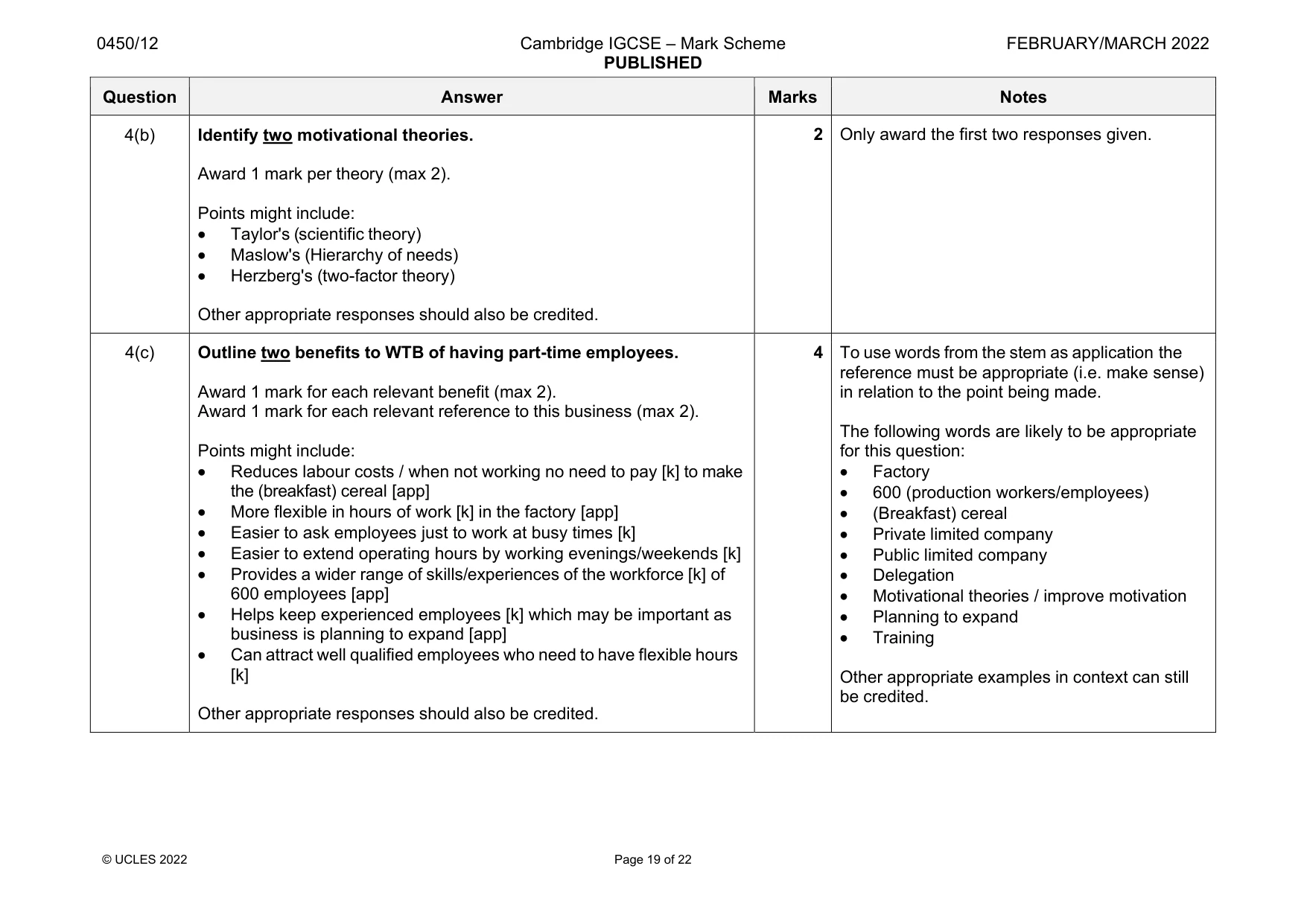
0450/12 Cambridge IGCSE – Mark Scheme PUBLISHED FEBRUARY/MARCH 2022 © UCLES 2022 Page 19 of 22 Question Answer Marks Notes 4(b) Identify two motivational theories. Award 1 mark per theory (max 2). Points might include: • Taylor's (scientific theory) • Maslow's (Hierarchy of needs) • Herzberg's (two-factor theory) Other appropriate responses should also be credited. 2 Only award the first two responses given. 4(c) Outline two benefits to WTB of having part-time employees. Award 1 mark for each relevant benefit (max 2). Award 1 mark for each relevant reference to this business (max 2). Points might include: • Reduces labour costs / when not working no need to pay [k] to make the (breakfast) cereal [app] • More flexible in hours of work [k] in the factory [app] • Easier to ask employees just to work at busy times [k] • Easier to extend operating hours by working evenings/weekends [k] • Provides a wider range of skills/experiences of the workforce [k] of 600 employees [app] • Helps keep experienced employees [k] which may be important as business is planning to expand [app] • Can attract well qualified employees who need to have flexible hours [k] Other appropriate responses should also be credited. 4 To use words from the stem as application the reference must be appropriate (i.e. make sense) in relation to the point being made. The following words are likely to be appropriate for this question: • Factory • 600 (production workers/employees) • (Breakfast) cereal • Private limited company • Public limited company • Delegation • Motivational theories / improve motivation • Planning to expand • Training Other appropriate examples in context can still be credited.
Mark scheme, page 20
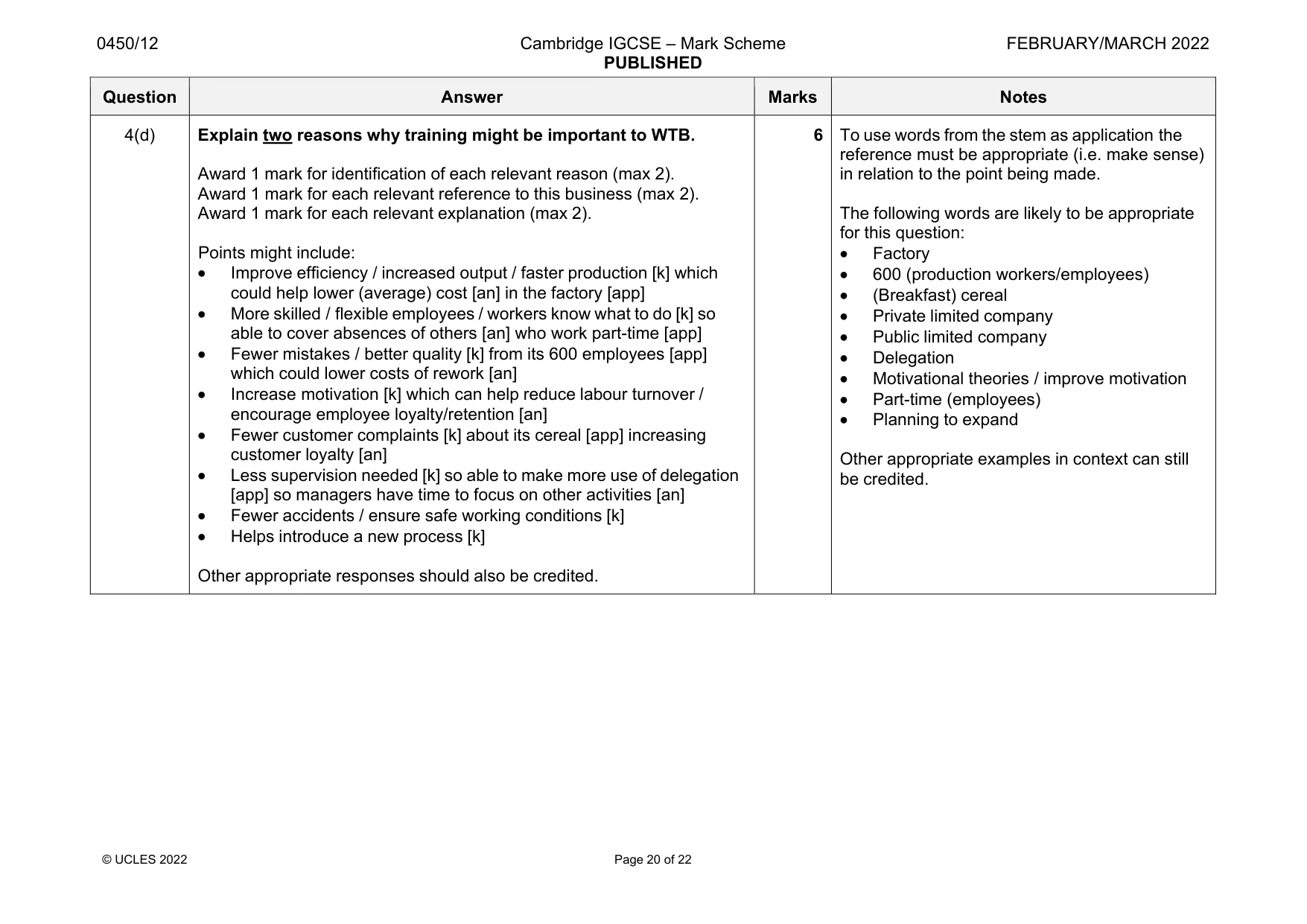
0450/12 Cambridge IGCSE – Mark Scheme PUBLISHED FEBRUARY/MARCH 2022 © UCLES 2022 Page 20 of 22 Question Answer Marks Notes 4(d) Explain two reasons why training might be important to WTB. Award 1 mark for identification of each relevant reason (max 2). Award 1 mark for each relevant reference to this business (max 2). Award 1 mark for each relevant explanation (max 2). Points might include: • Improve efficiency / increased output / faster production [k] which could help lower (average) cost [an] in the factory [app] • More skilled / flexible employees / workers know what to do [k] so able to cover absences of others [an] who work part-time [app] • Fewer mistakes / better quality [k] from its 600 employees [app] which could lower costs of rework [an] • Increase motivation [k] which can help reduce labour turnover / encourage employee loyalty/retention [an] • Fewer customer complaints [k] about its cereal [app] increasing customer loyalty [an] • Less supervision needed [k] so able to make more use of delegation [app] so managers have time to focus on other activities [an] • Fewer accidents / ensure safe working conditions [k] • Helps introduce a new process [k] Other appropriate responses should also be credited. 6 To use words from the stem as application the reference must be appropriate (i.e. make sense) in relation to the point being made. The following words are likely to be appropriate for this question: • Factory • 600 (production workers/employees) • (Breakfast) cereal • Private limited company • Public limited company • Delegation • Motivational theories / improve motivation • Part-time (employees) • Planning to expand Other appropriate examples in context can still be credited.
Mark scheme, page 21
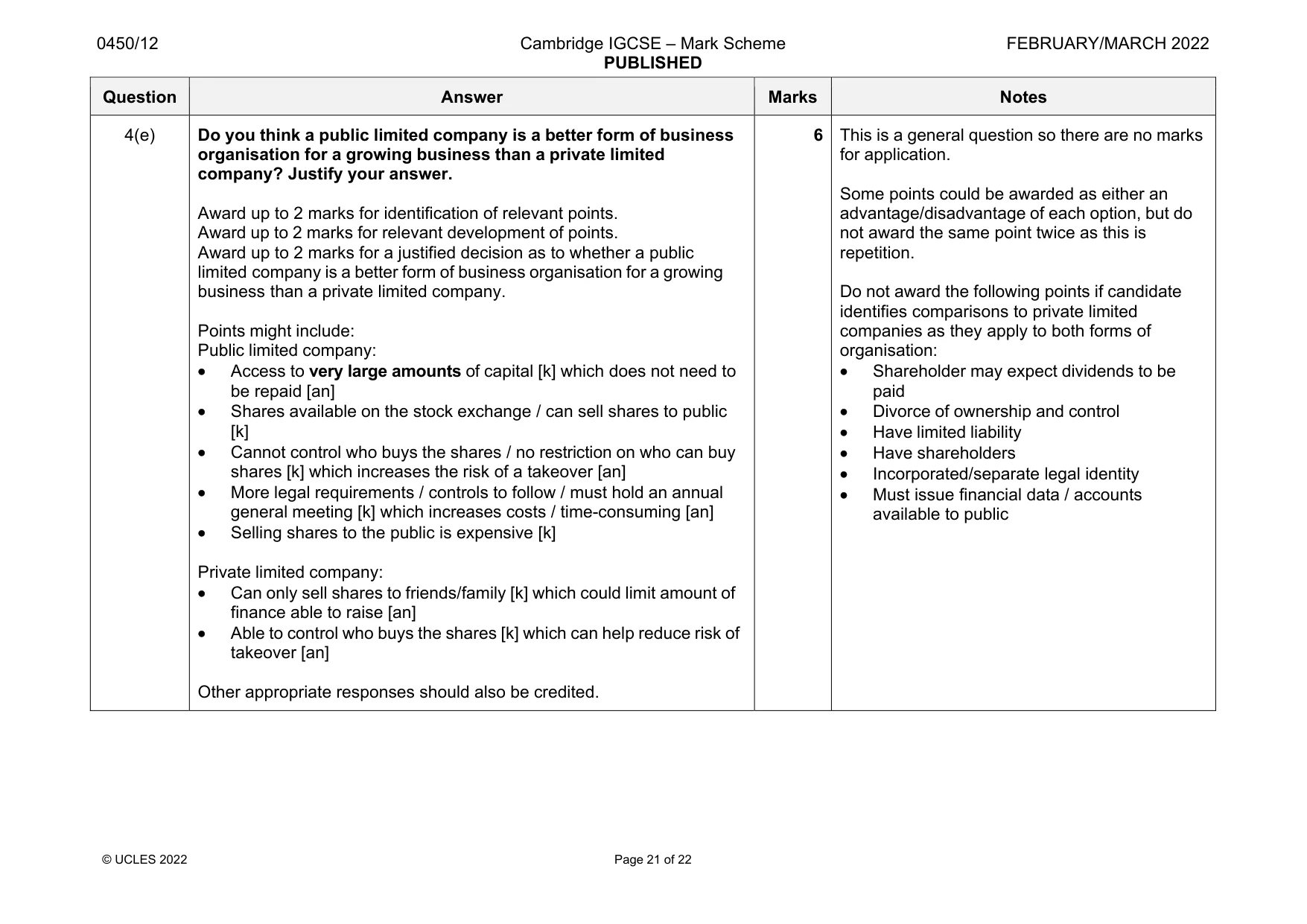
0450/12 Cambridge IGCSE – Mark Scheme PUBLISHED FEBRUARY/MARCH 2022 © UCLES 2022 Page 21 of 22 Question Answer Marks Notes 4(e) Do you think a public limited company is a better form of business organisation for a growing business than a private limited company? Justify your answer. Award up to 2 marks for identification of relevant points . Award up to 2 marks for relevant development of points. Award up to 2 marks for a justified decision as to whether a public limited company is a better form of business organisation for a growing business than a private limited company. Points might include: Public limited company: • Access to very large amounts of capital [k] which does not need to be repaid [an] • Shares available on the stock exchange / can sell shares to public [k] • Cannot control who buys the shares / no restriction on who can buy shares [k] which increases the risk of a takeover [an] • More legal requirements / controls to follow / must hold an annual general meeting [k] which increases costs / time-consuming [an] • Selling shares to the public is expensive [k] Private limited company: • Can only sell shares to friends/family [k] which could limit amount of finance able to raise [an] • Able to control who buys the shares [k] which can help reduce risk of takeover [an] Other appropriate responses should also be credited. 6 This is a general question so there are no marks for application. Some points could be awarded as either an advantage/disadvantage of each option, but do not award the same point twice as this is repetition. Do not award the following points if candidate identifies comparisons to private limited companies as they apply to both forms of organisation: • Shareholder may expect dividends to be paid • Divorce of ownership and control • Have limited liability • Have shareholders • Incorporated/separate legal identity • Must issue financial data / accounts available to public
Mark scheme, page 22
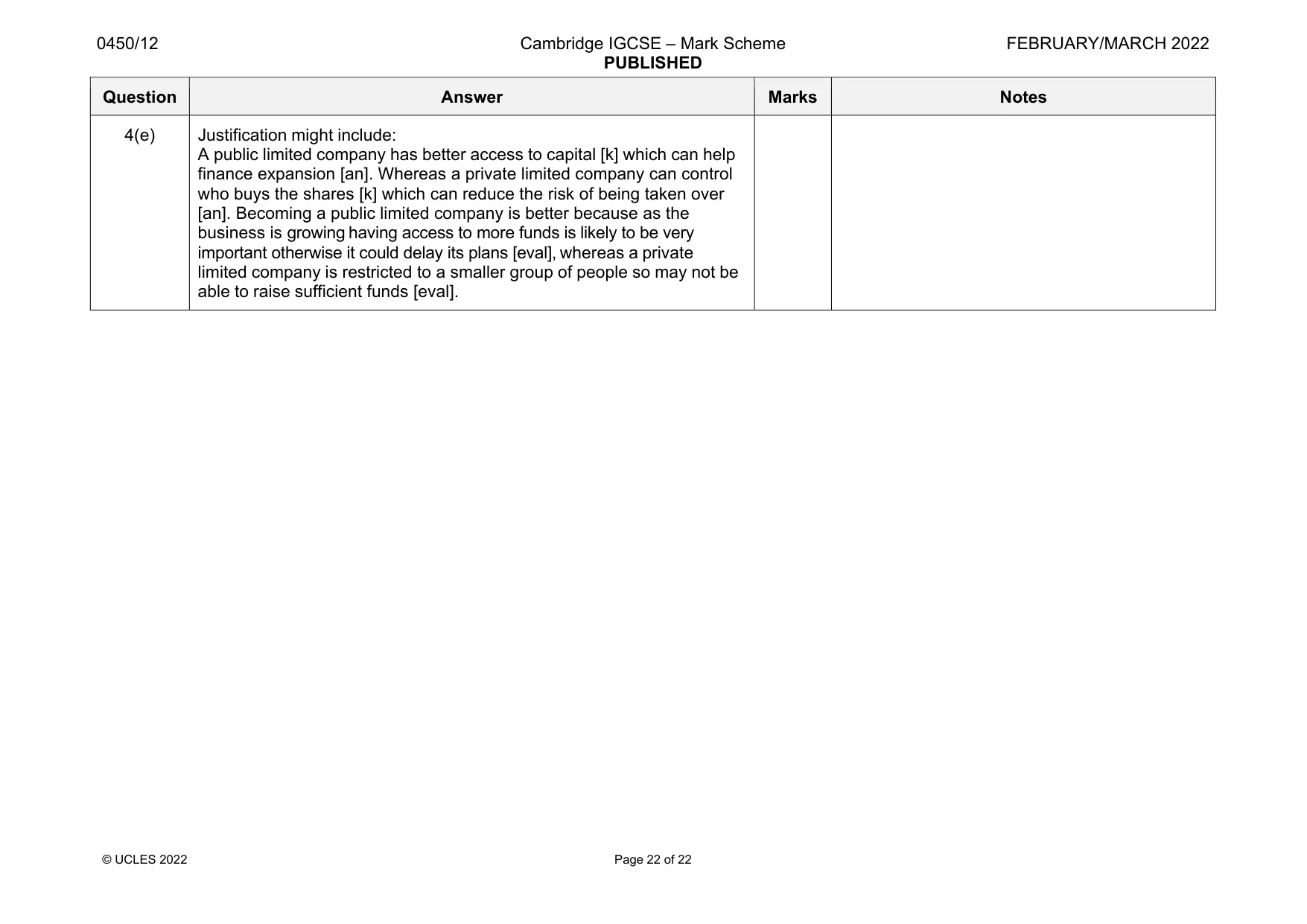
0450/12 Cambridge IGCSE – Mark Scheme PUBLISHED FEBRUARY/MARCH 2022 © UCLES 2022 Page 22 of 22 Question Answer Marks Notes 4(e) Justification might include: A public limited company has better access to capital [k] which can help finance expansion [an]. Whereas a private limited company can control who buys the shares [k] which can reduce the risk of being taken over [an]. Becoming a public limited company is better because as the business is growing having access to more funds is likely to be very important otherwise it could delay its plans [eval], whereas a private limited company is restricted to a smaller group of people so may not be able to raise sufficient funds [eval].
What you needed in this session
Cambridge’s own grade thresholds for 2022 Feb/March, Paper 1 · Variant 2. A higher threshold means an easier paper — the bar moves with how the cohort did.