Cambridge IGCSE Business Studies 0450 — 2020 Feb/March Paper 1 · Variant 2
0450/12/F/M/20 · 80 marks · ≈90 min
The question paper and its mark scheme, free to read here and free to download. This is Cambridge’s own paper, exactly as it was sat.
Question paper12 pages


Mark scheme23 pages
Answers below. Sit the paper first if you are practising.
Paper as text
Question paper, page 1
Cambridge IGCSE™ 0450/12 February/March 2020 1 hour 30 minutes BUSINESS STUDIES Paper 1 Short Answer and Data Response You must answer on the question paper. No additional materials are needed. INSTRUCTIONS • Answer all questions. • Use a black or dark blue pen. You may use an HB pencil for any diagrams or graphs. • Write your name, centre number and candidate number in the boxes at the top of the page. • Write your answer to each question in the space provided. • Do not use an erasable pen or correction fluid. • Do not write on any bar codes. • You may use a calculator. INFORMATION • The total mark for this paper is 80. • The number of marks for each question or part question is shown in brackets [ ]. This document has 12 pages. Blank pages are indicated. [Turn over 03_0450_12_2020_1.24 © UCLES 2020 *6148412007*
Question paper, page 2
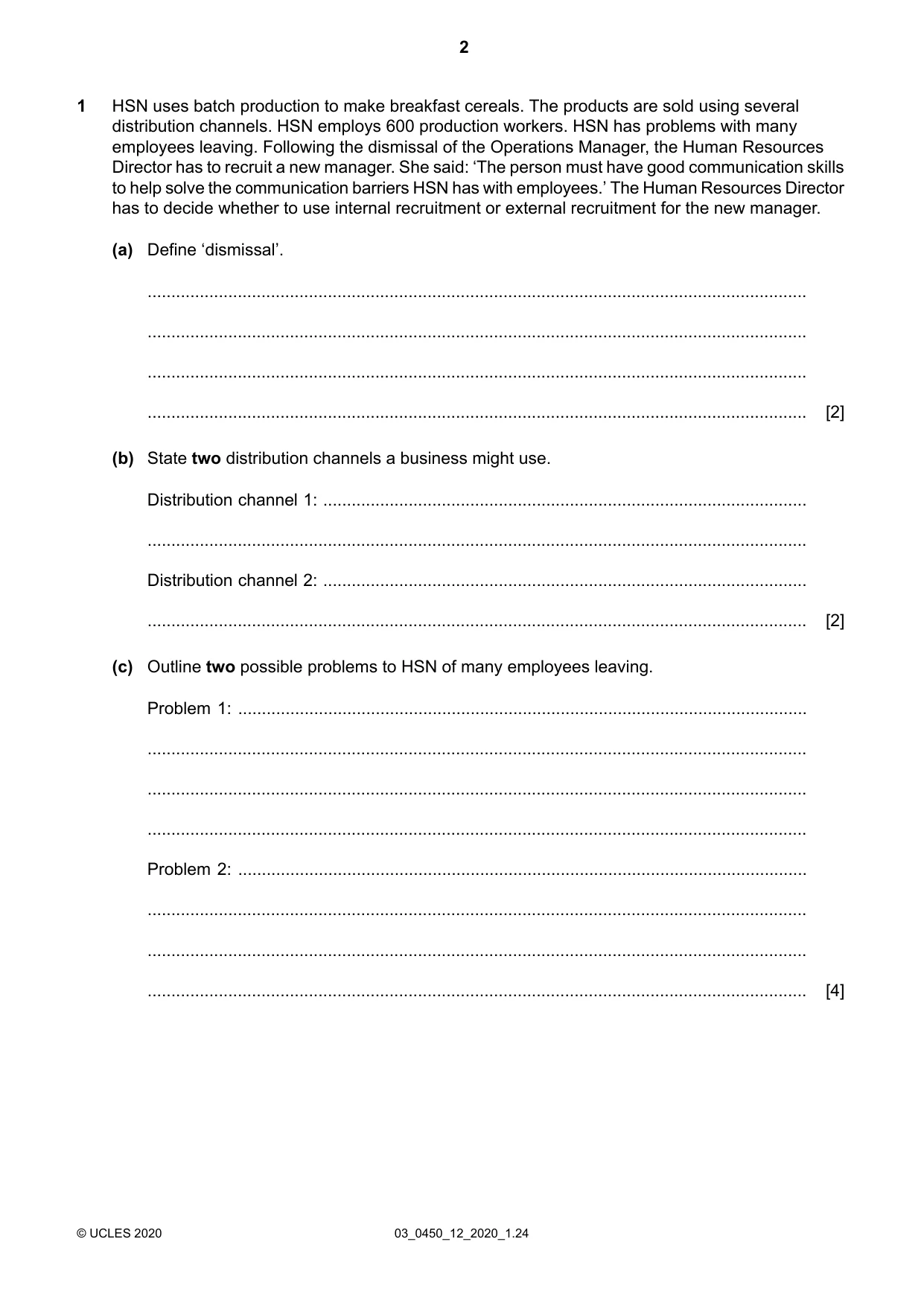
HSN uses batch production to make breakfast cereals. The products are sold using several distribution channels. HSN employs 600 production workers. HSN has problems with many 1 employees leaving. Following the dismissal of the Operations Manager, the Human Resources Director has to recruit a new manager. She said: ‘The person must have good communication skills to help solve the communication barriers HSN has with employees.’ The Human Resources Director has to decide whether to use internal recruitment or external recruitment for the new manager. Define ‘dismissal’. (a) … … … … [2] State two distribution channels a business might use. (b) Distribution channel 1: … … Distribution channel 2: … … [2] Outline two possible problems to HSN of many employees leaving. (c) Problem 1: … … … … Problem 2: … … … … [4] 03_0450_12_2020_1.24 © UCLES 2020 2
Question paper, page 3
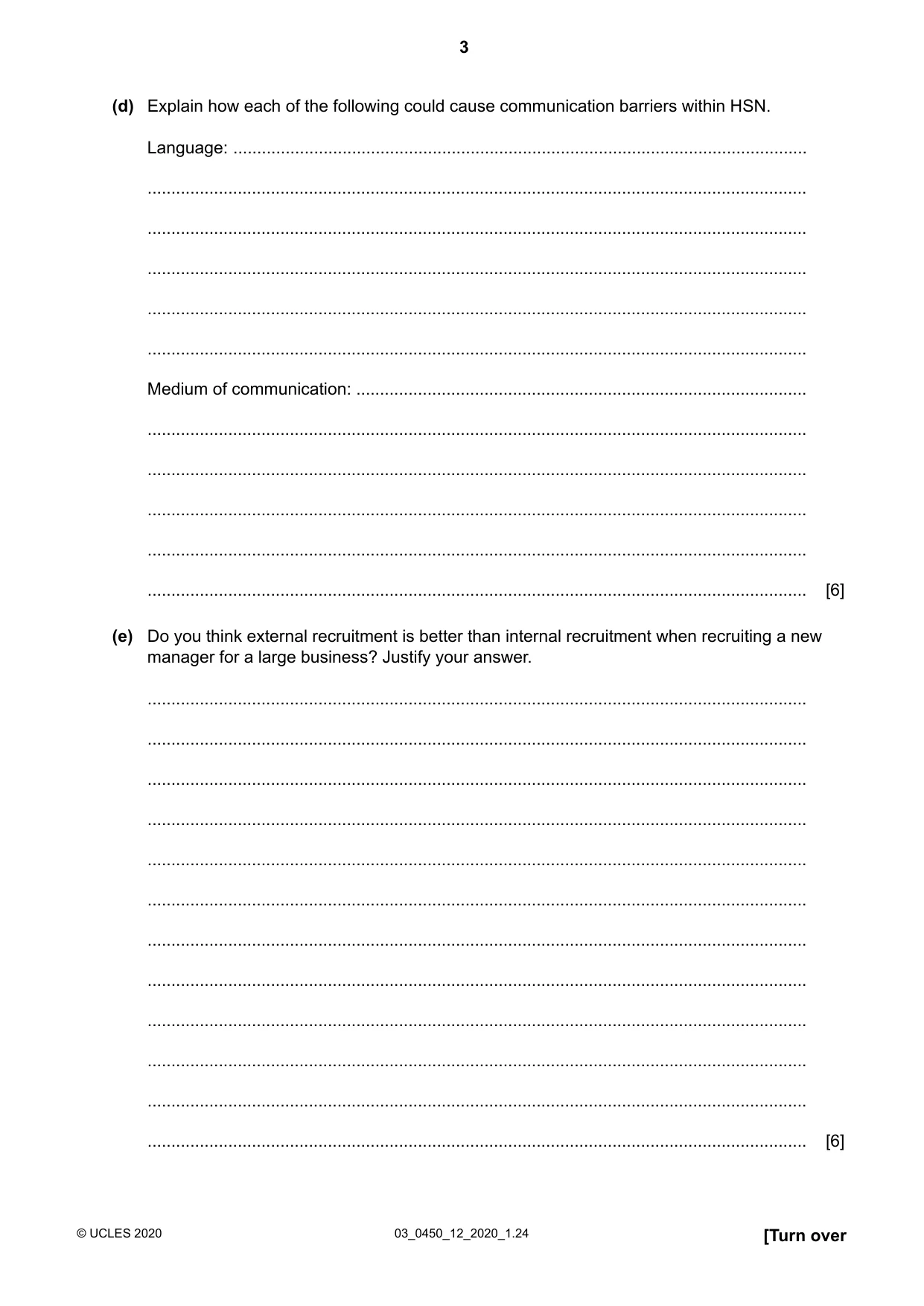
Explain how each of the following could cause communication barriers within HSN. (d) Language: … … … … … … Medium of communication: … … … … … … [6] Do you think external recruitment is better than internal recruitment when recruiting a new manager for a large business? Justify your answer. (e) … … … … … … … … … … … … [6] [Turn over 03_0450_12_2020_1.24 © UCLES 2020 3
Question paper, page 4
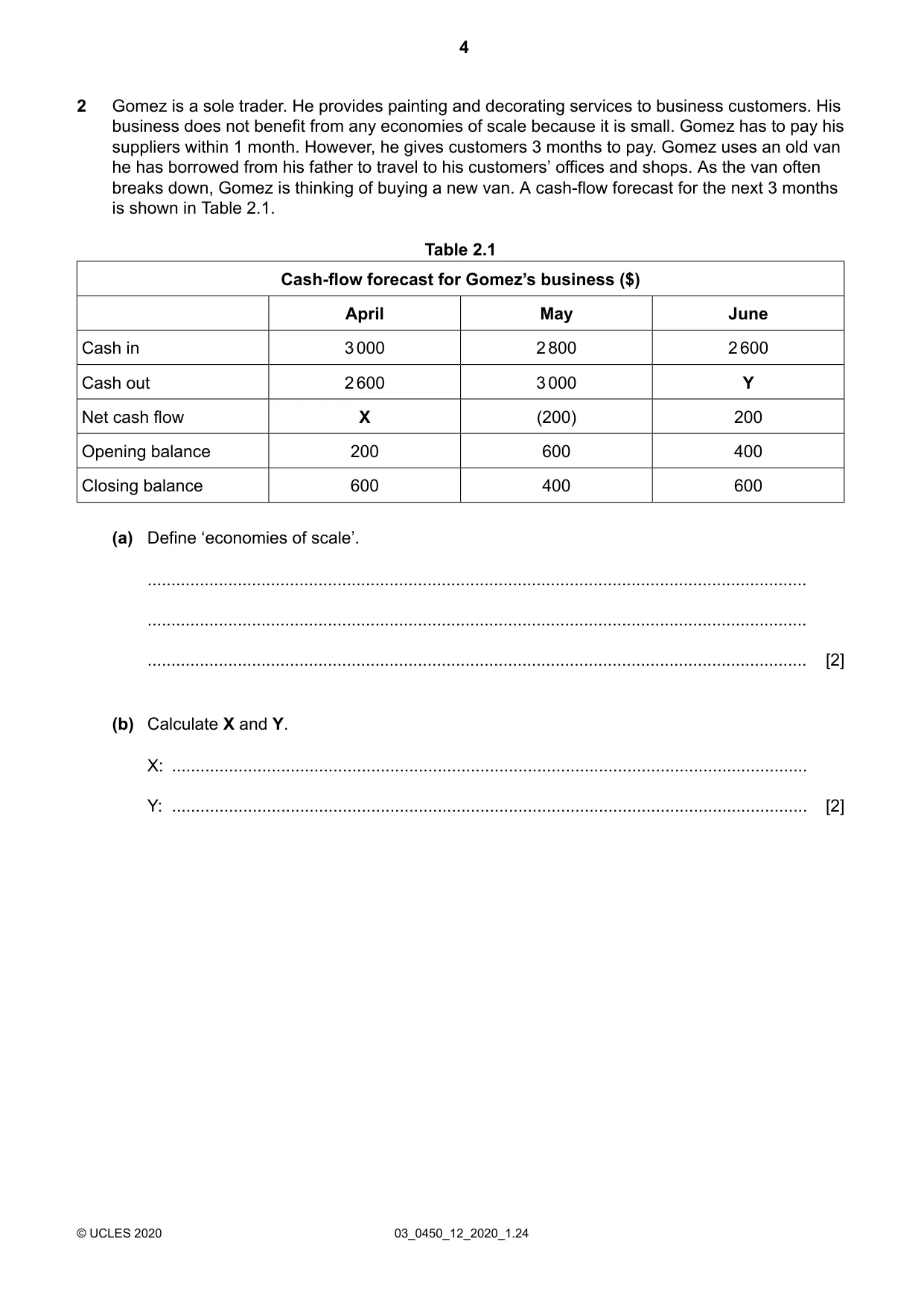
Gomez is a sole trader. He provides painting and decorating services to business customers. His business does not benefit from any economies of scale because it is small. Gomez has to pay his 2 suppliers within 1 month. However, he gives customers 3 months to pay. Gomez uses an old van he has borrowed from his father to travel to his customers’ offices and shops. As the van often breaks down, Gomez is thinking of buying a new van. A cash-flow forecast for the next 3 months is shown in Table 2.1. Table 2.1 Cash-flow forecast for Gomez’s business ($) June May April 2600 2800 3000 Cash in Y 3000 2600 Cash out 200 (200) X Net cash flow 400 600 200 Opening balance 600 400 600 Closing balance Define ‘economies of scale’. (a) … … … [2] Calculate X and Y. (b) X: … Y: … [2] 03_0450_12_2020_1.24 © UCLES 2020 4
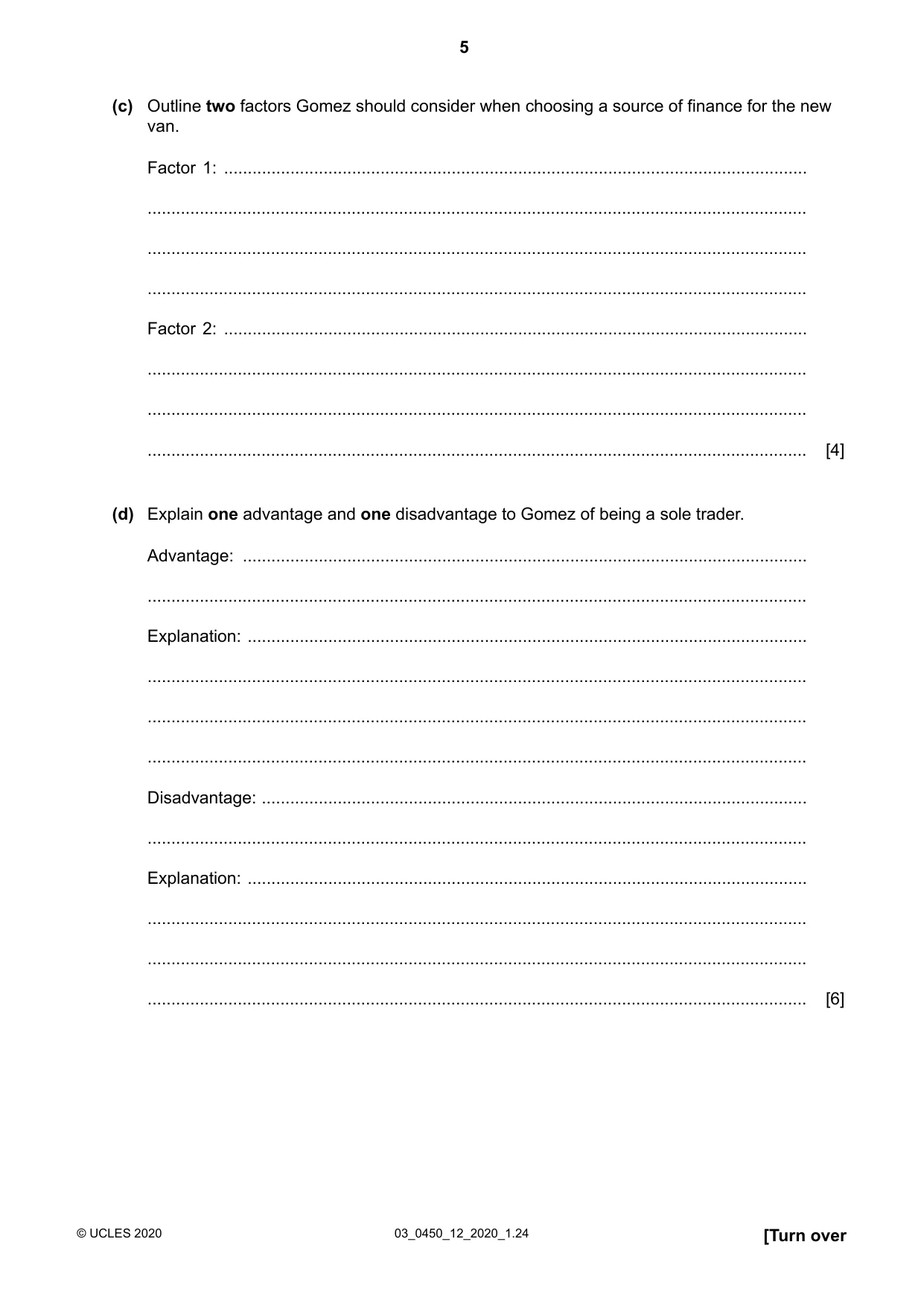
Question paper, page 5
Outline two factors Gomez should consider when choosing a source of finance for the new van. (c) Factor 1: … … … … Factor 2: … … … … [4] Explain one advantage and one disadvantage to Gomez of being a sole trader. (d) Advantage: … … Explanation: … … … … Disadvantage: … … Explanation: … … … … [6] [Turn over 03_0450_12_2020_1.24 © UCLES 2020 5
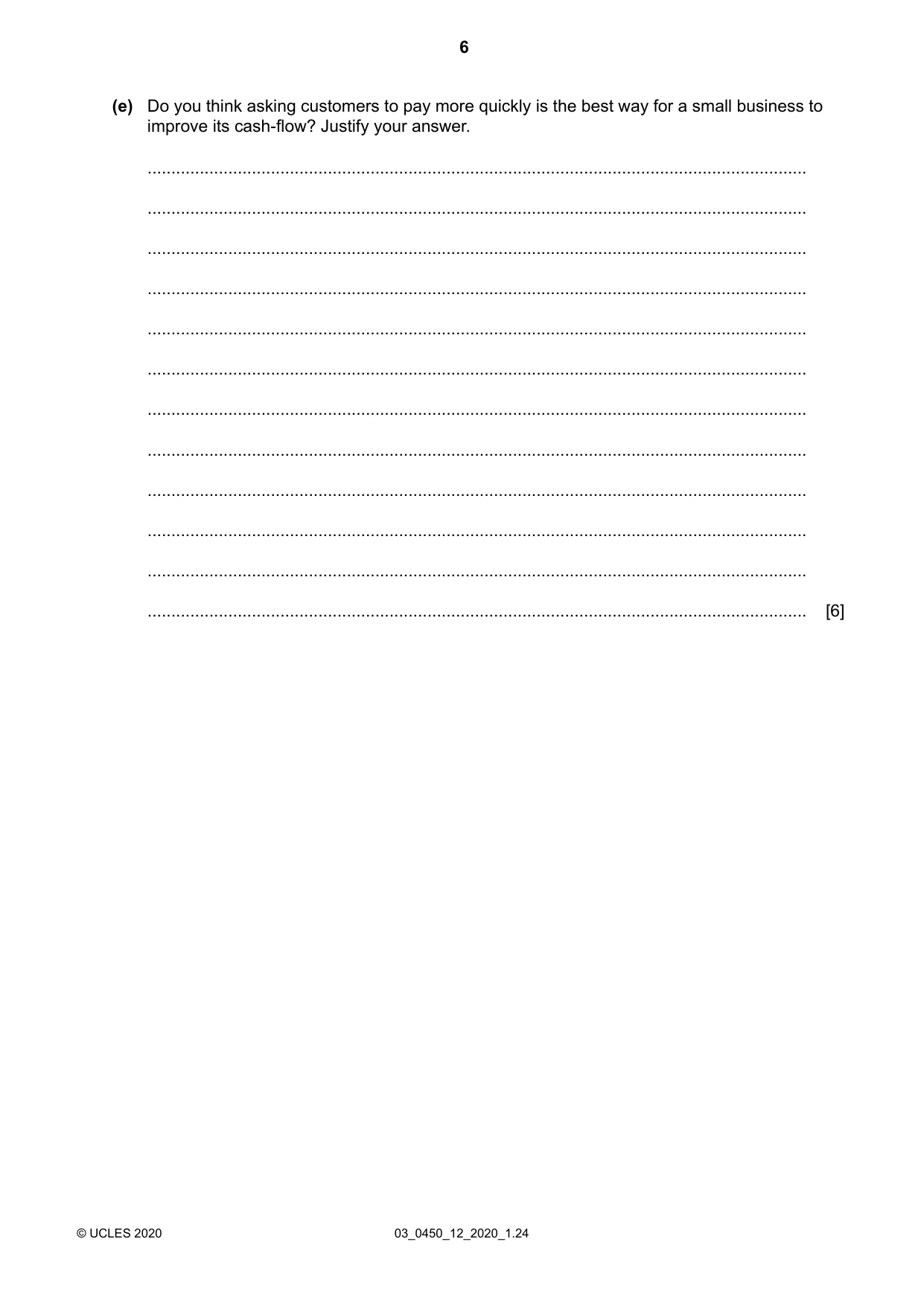
Question paper, page 6
Do you think asking customers to pay more quickly is the best way for a small business to improve its cash-flow? Justify your answer. (e) … … … … … … … … … … … … [6] 03_0450_12_2020_1.24 © UCLES 2020 6
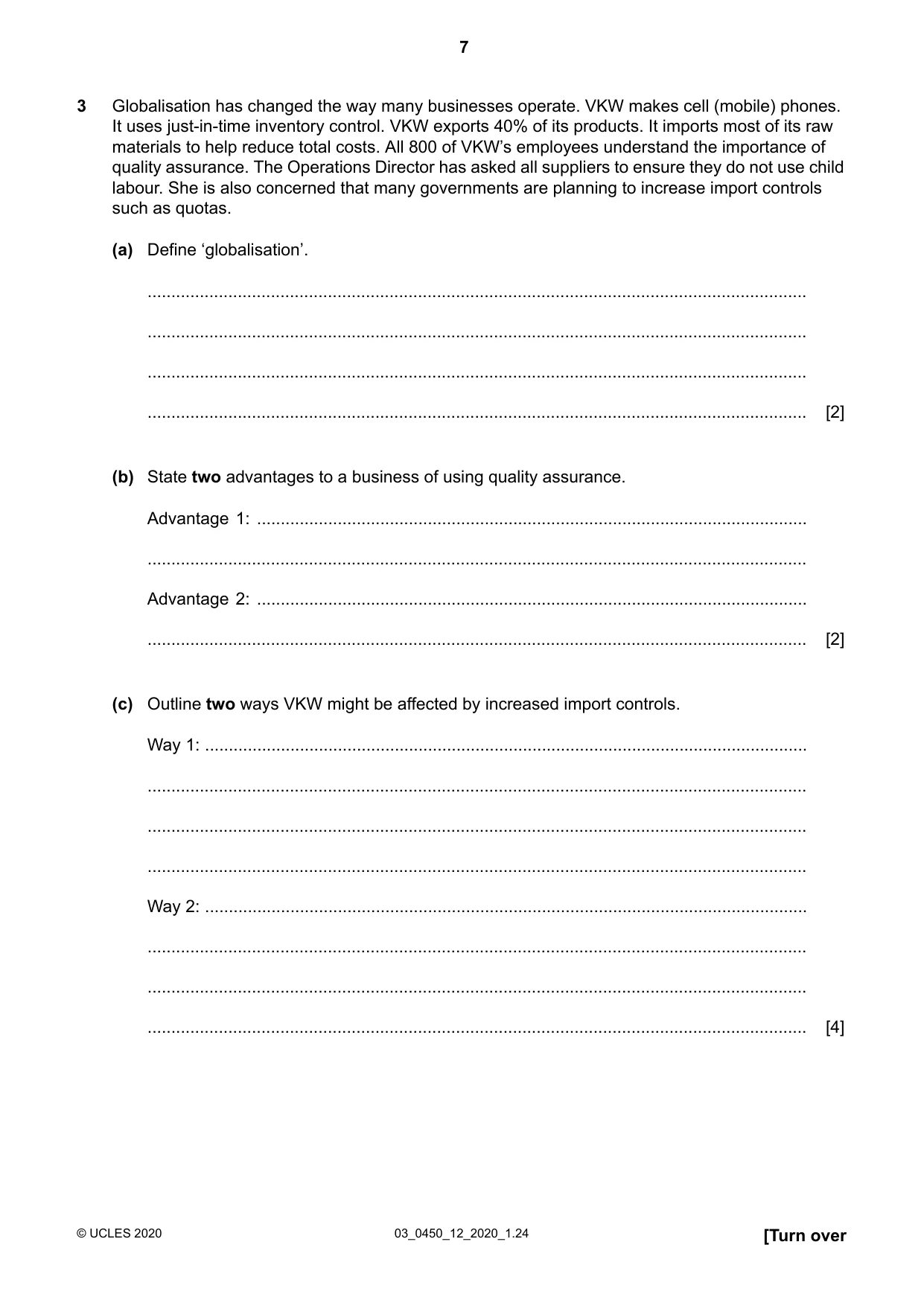
Question paper, page 7
Globalisation has changed the way many businesses operate. VKW makes cell (mobile) phones. It uses just-in-time inventory control. VKW exports 40% of its products. It imports most of its raw 3 materials to help reduce total costs. All 800 of VKW’s employees understand the importance of quality assurance. The Operations Director has asked all suppliers to ensure they do not use child labour. She is also concerned that many governments are planning to increase import controls such as quotas. Define ‘globalisation’. (a) … … … … [2] State two advantages to a business of using quality assurance. (b) Advantage 1: … … Advantage 2: … … [2] Outline two ways VKW might be affected by increased import controls. (c) Way 1: … … … … Way 2: … … … … [4] [Turn over 03_0450_12_2020_1.24 © UCLES 2020 7
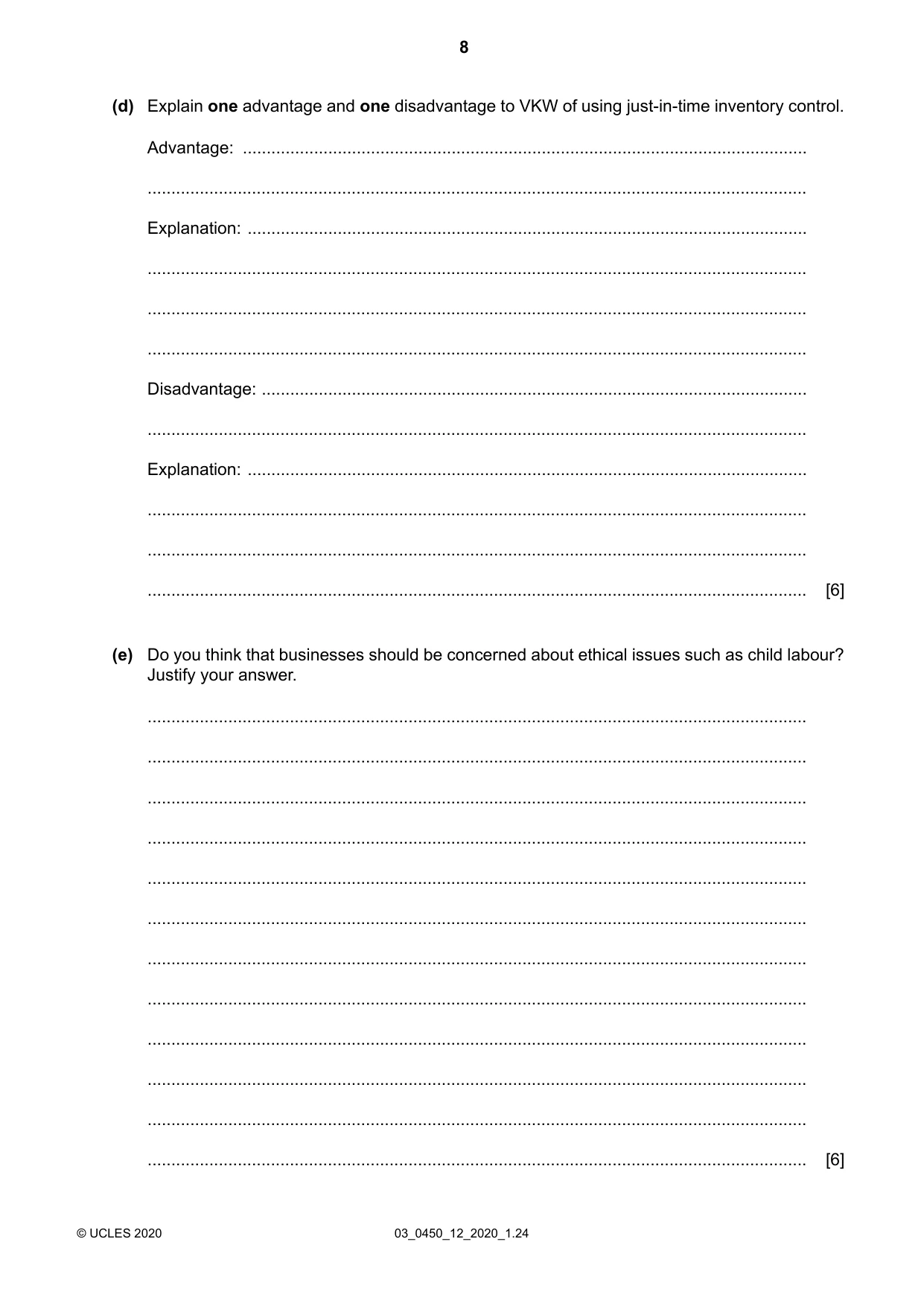
Question paper, page 8
Explain one advantage and one disadvantage to VKW of using just-in-time inventory control. (d) Advantage: … … Explanation: … … … … Disadvantage: … … Explanation: … … … … [6] Do you think that businesses should be concerned about ethical issues such as child labour? Justify your answer. (e) … … … … … … … … … … … … [6] 03_0450_12_2020_1.24 © UCLES 2020 8
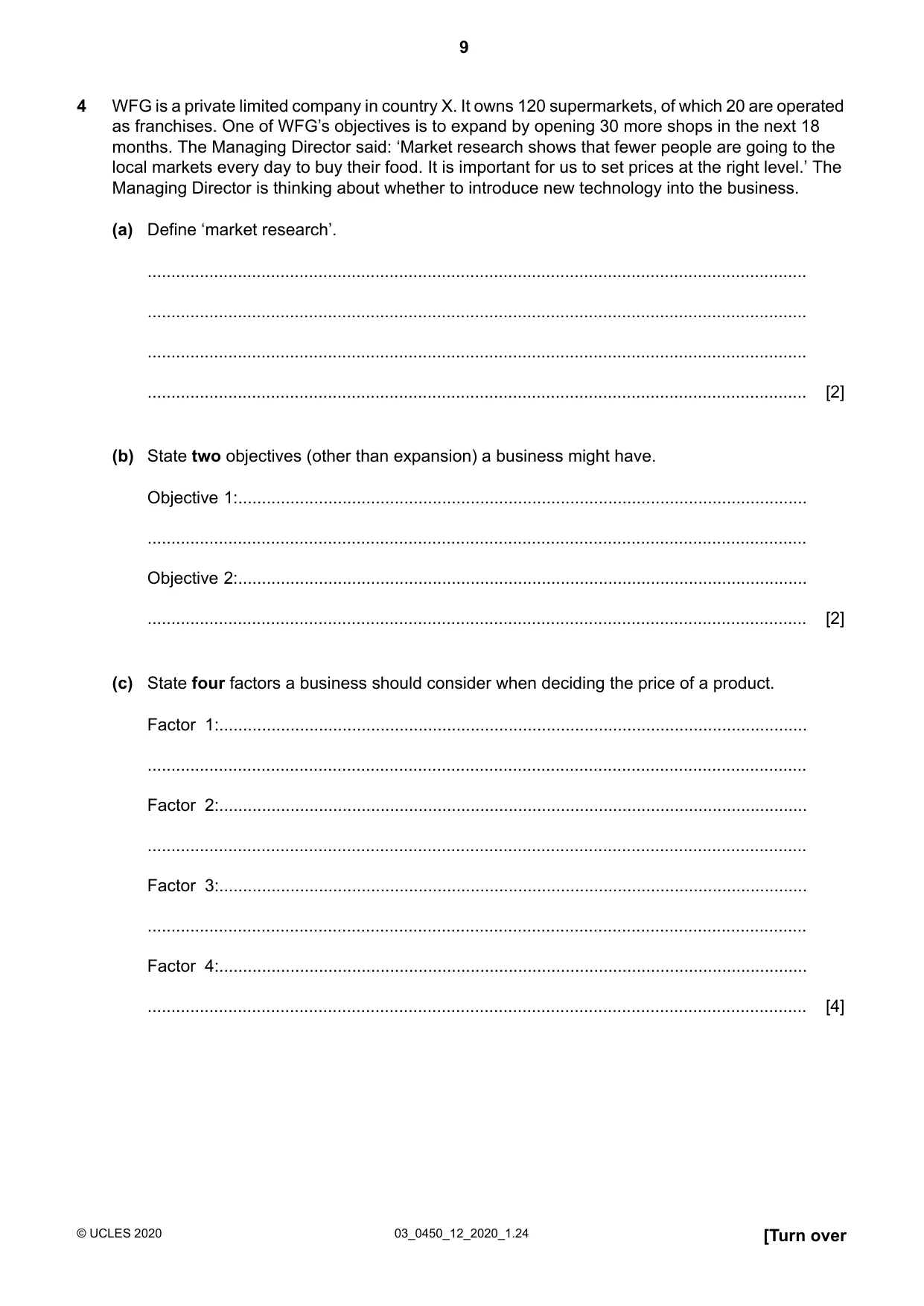
Question paper, page 9
WFG is a private limited company in country X. It owns 120 supermarkets, of which 20 are operated as franchises. One of WFG’s objectives is to expand by opening 30 more shops in the next 18 4 months. The Managing Director said: ‘Market research shows that fewer people are going to the local markets every day to buy their food. It is important for us to set prices at the right level.’ The Managing Director is thinking about whether to introduce new technology into the business. Define ‘market research’. (a) … … … … [2] State two objectives (other than expansion) a business might have. (b) Objective 1:… … Objective 2:… … [2] State four factors a business should consider when deciding the price of a product. (c) Factor 1:… … Factor 2:… … Factor 3:… … Factor 4:… … [4] [Turn over 03_0450_12_2020_1.24 © UCLES 2020 9
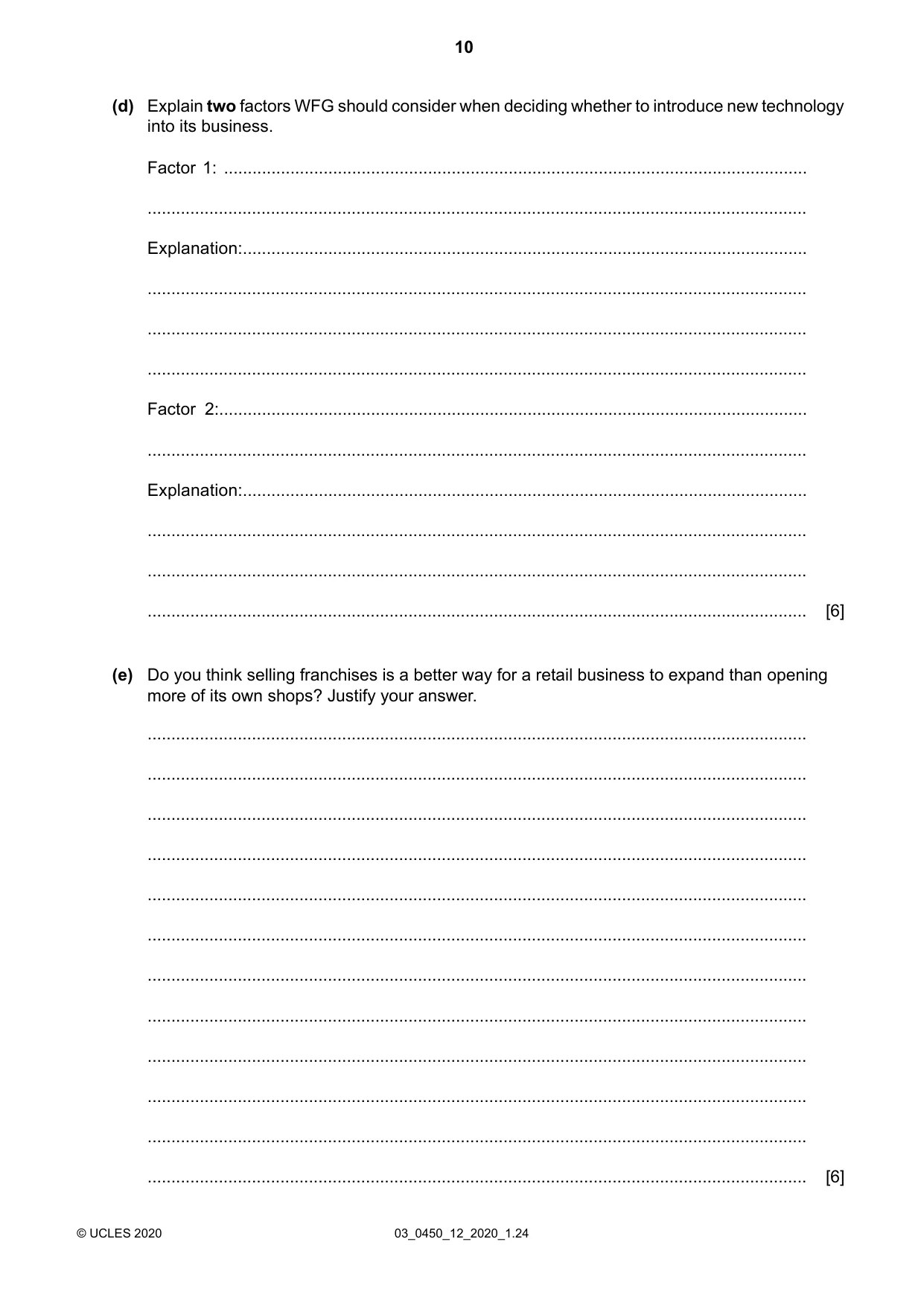
Question paper, page 10
Explain two factors WFG should consider when deciding whether to introduce new technology into its business. (d) Factor 1: … … Explanation:… … … … Factor 2:… … Explanation:… … … … [6] Do you think selling franchises is a better way for a retail business to expand than opening more of its own shops? Justify your answer. (e) … … … … … … … … … … … … [6] 03_0450_12_2020_1.24 © UCLES 2020 10
Question paper, page 11
BLANK PAGE 03_0450_12_2020_1.24 © UCLES 2020 11
Question paper, page 12
BLANK PAGE Permission to reproduce items where third-party owned material protected by copyright is included has been sought and cleared where possible. Every reasonable effort has been made by the publisher (UCLES) to trace copyright holders, but if any items requiring clearance have unwittingly been included, the publisher will be pleased to make amends at the earliest possible opportunity. To avoid the issue of disclosure of answer-related information to candidates, all copyright acknowledgements are reproduced online in the Cambridge Assessment International Education Copyright Acknowledgements Booklet. This is produced for each series of examinations and is freely available to download at www.cambridgeinternational.org after the live examination series. Cambridge Assessment International Education is part of the Cambridge Assessment Group. Cambridge Assessment is the brand name of the University of Cambridge Local Examinations Syndicate (UCLES), which itself is a department of the University of Cambridge. 03_0450_12_2020_1.24 © UCLES 2020 12
Mark scheme, page 1
This document consists of 23 printed pages. © UCLES 2020 [Turn over Cambridge IGCSE™ BUSINESS STUDIES 0450/12 Paper 1 Short Answer/Structured Response March 2020 MARK SCHEME Maximum Mark: 80 Published This mark scheme is published as an aid to teachers and candidates, to indicate the requirements of the examination. It shows the basis on which Examiners were instructed to award marks. It does not indicate the details of the discussions that took place at an Examiners’ meeting before marking began, which would have considered the acceptability of alternative answers. Mark schemes should be read in conjunction with the question paper and the Principal Examiner Report for Teachers. Cambridge International will not enter into discussions about these mark schemes. Cambridge International is publishing the mark schemes for the March 2020 series for most Cambridge IGCSE™, Cambridge International A and AS Level components and some Cambridge O Level components.
Mark scheme, page 2
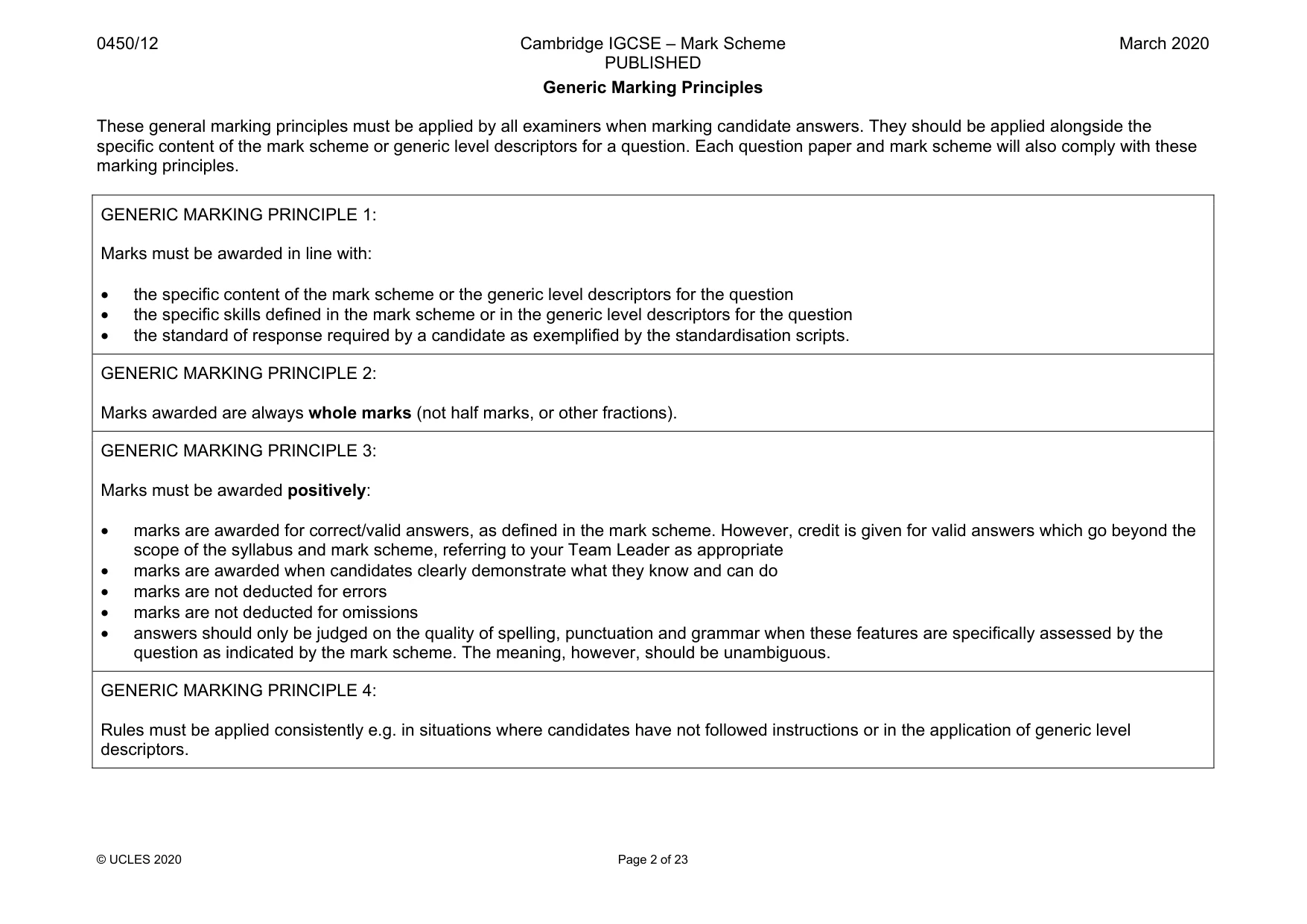
0450/12 Cambridge IGCSE – Mark Scheme PUBLISHED March 2020 © UCLES 2020 Page 2 of 23 Generic Marking Principles These general marking principles must be applied by all examiners when marking candidate answers. They should be applied alongside the specific content of the mark scheme or generic level descriptors for a question. Each question paper and mark scheme will also comply with these marking principles. GENERIC MARKING PRINCIPLE 1: Marks must be awarded in line with: • the specific content of the mark scheme or the generic level descriptors for the question • the specific skills defined in the mark scheme or in the generic level descriptors for the question • the standard of response required by a candidate as exemplified by the standardisation scripts. GENERIC MARKING PRINCIPLE 2: Marks awarded are always whole marks (not half marks, or other fractions). GENERIC MARKING PRINCIPLE 3: Marks must be awarded positively: • marks are awarded for correct/valid answers, as defined in the mark scheme. However, credit is given for valid answers which go beyond the scope of the syllabus and mark scheme, referring to your Team Leader as appropriate • marks are awarded when candidates clearly demonstrate what they know and can do • marks are not deducted for errors • marks are not deducted for omissions • answers should only be judged on the quality of spelling, punctuation and grammar when these features are specifically assessed by the question as indicated by the mark scheme. The meaning, however, should be unambiguous. GENERIC MARKING PRINCIPLE 4: Rules must be applied consistently e.g. in situations where candidates have not followed instructions or in the application of generic level descriptors.
Mark scheme, page 3
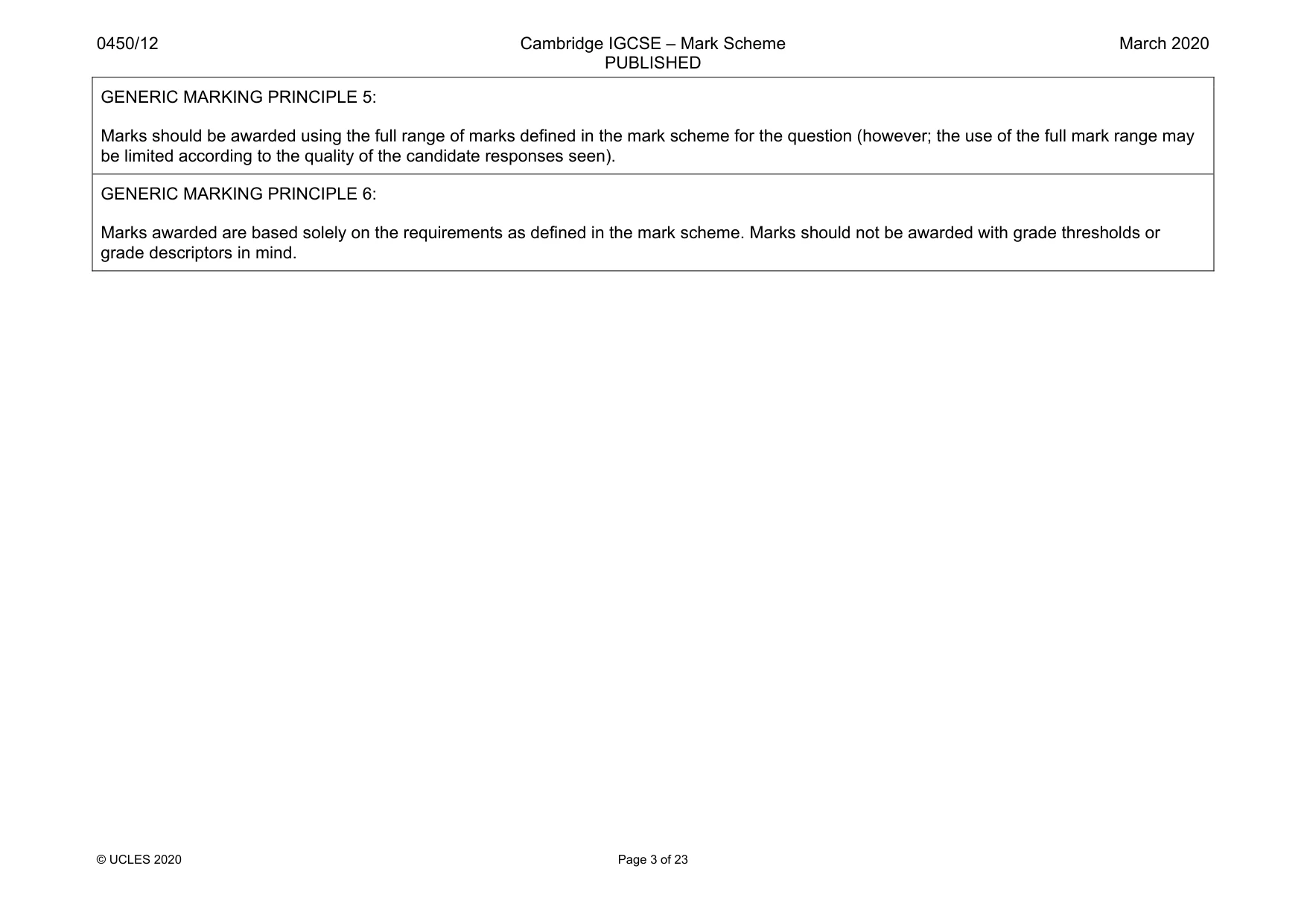
0450/12 Cambridge IGCSE – Mark Scheme PUBLISHED March 2020 © UCLES 2020 Page 3 of 23 GENERIC MARKING PRINCIPLE 5: Marks should be awarded using the full range of marks defined in the mark scheme for the question (however; the use of the full mark range may be limited according to the quality of the candidate responses seen). GENERIC MARKING PRINCIPLE 6: Marks awarded are based solely on the requirements as defined in the mark scheme. Marks should not be awarded with grade thresholds or grade descriptors in mind.
Mark scheme, page 4
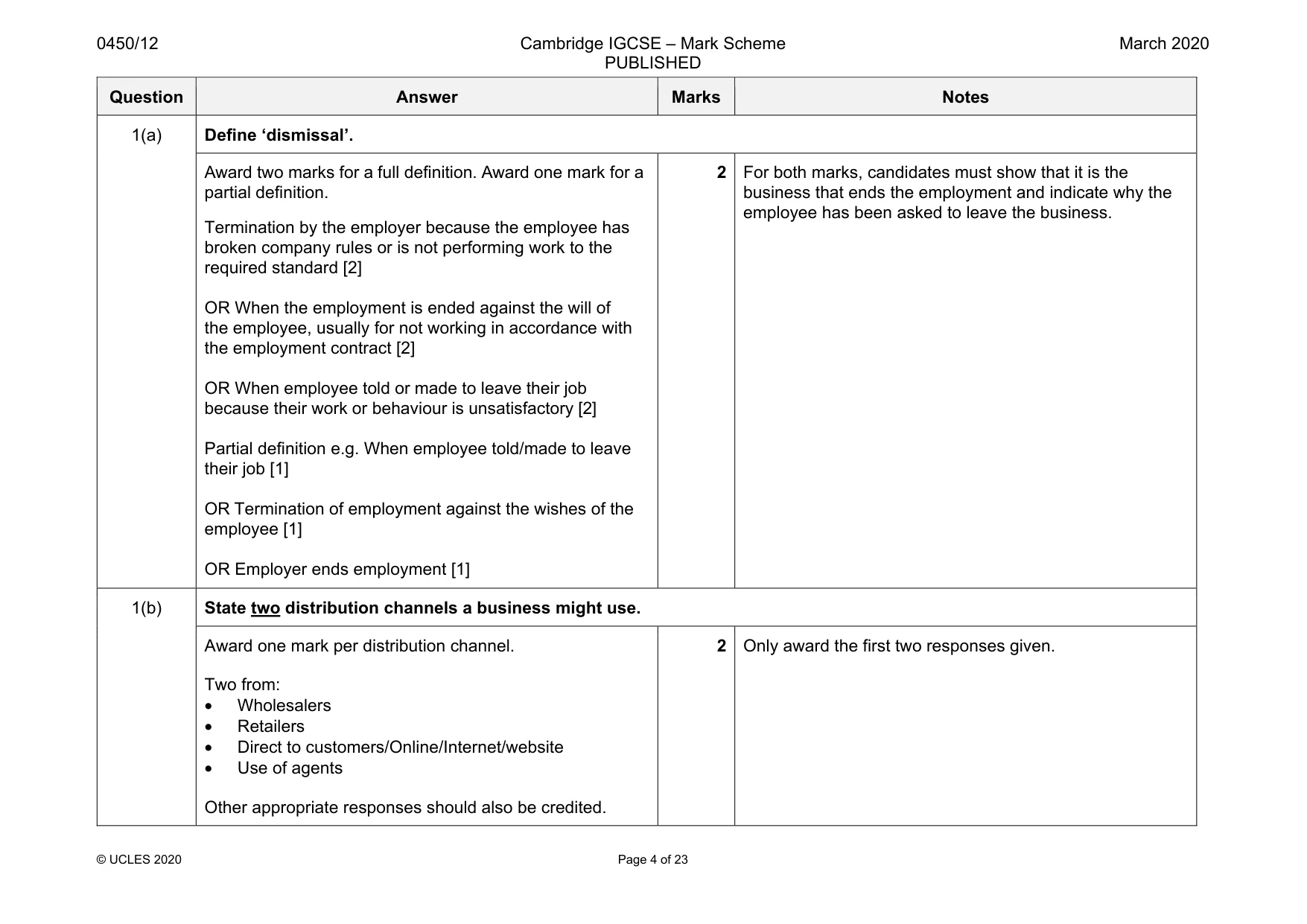
0450/12 Cambridge IGCSE – Mark Scheme PUBLISHED March 2020 © UCLES 2020 Page 4 of 23 Question Answer Marks Notes 1(a) Define ‘dismissal’. Award two marks for a full definition. Award one mark for a partial definition. Termination by the employer because the employee has broken company rules or is not performing work to the required standard [2] OR When the employment is ended against the will of the employee, usually for not working in accordance with the employment contract [2] OR When employee told or made to leave their job because their work or behaviour is unsatisfactory [2] Partial definition e.g. When employee told/made to leave their job [1] OR Termination of employment against the wishes of the employee [1] OR Employer ends employment [1] 2 For both marks, candidates must show that it is the business that ends the employment and indicate why the employee has been asked to leave the business. 1(b) State two distribution channels a business might use. Award one mark per distribution channel. Two from: • Wholesalers • Retailers • Direct to customers/Online/Internet/website • Use of agents Other appropriate responses should also be credited. 2 Only award the first two responses given.
Mark scheme, page 5
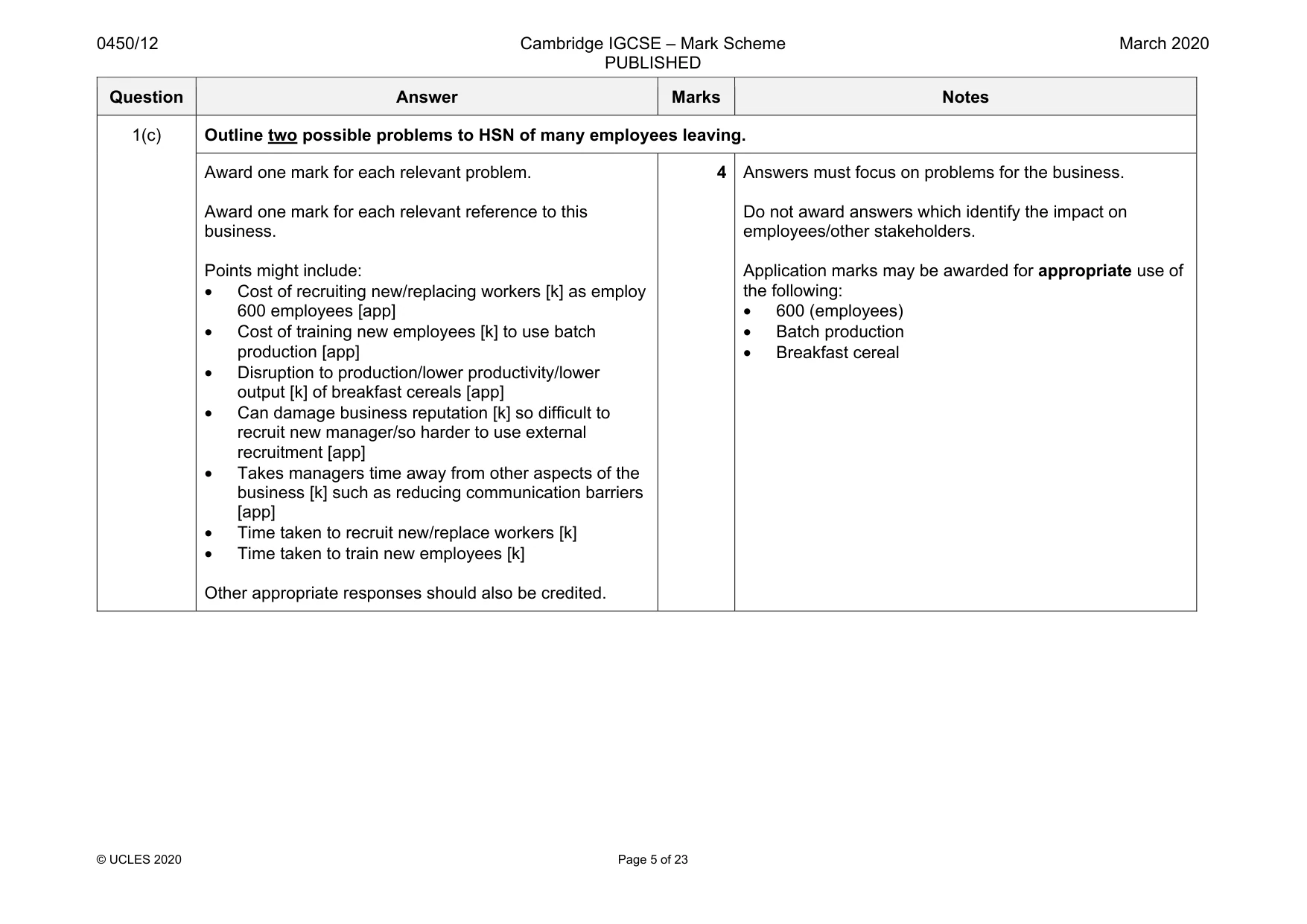
0450/12 Cambridge IGCSE – Mark Scheme PUBLISHED March 2020 © UCLES 2020 Page 5 of 23 Question Answer Marks Notes 1(c) Outline two possible problems to HSN of many employees leaving. Award one mark for each relevant problem. Award one mark for each relevant reference to this business. Points might include: • Cost of recruiting new/replacing workers [k] as employ 600 employees [app] • Cost of training new employees [k] to use batch production [app] • Disruption to production/lower productivity/lower output [k] of breakfast cereals [app] • Can damage business reputation [k] so difficult to recruit new manager/so harder to use external recruitment [app] • Takes managers time away from other aspects of the business [k] such as reducing communication barriers [app] • Time taken to recruit new/replace workers [k] • Time taken to train new employees [k] Other appropriate responses should also be credited. 4 Answers must focus on problems for the business. Do not award answers which identify the impact on employees/other stakeholders. Application marks may be awarded for appropriate use of the following: • 600 (employees) • Batch production • Breakfast cereal
Mark scheme, page 6
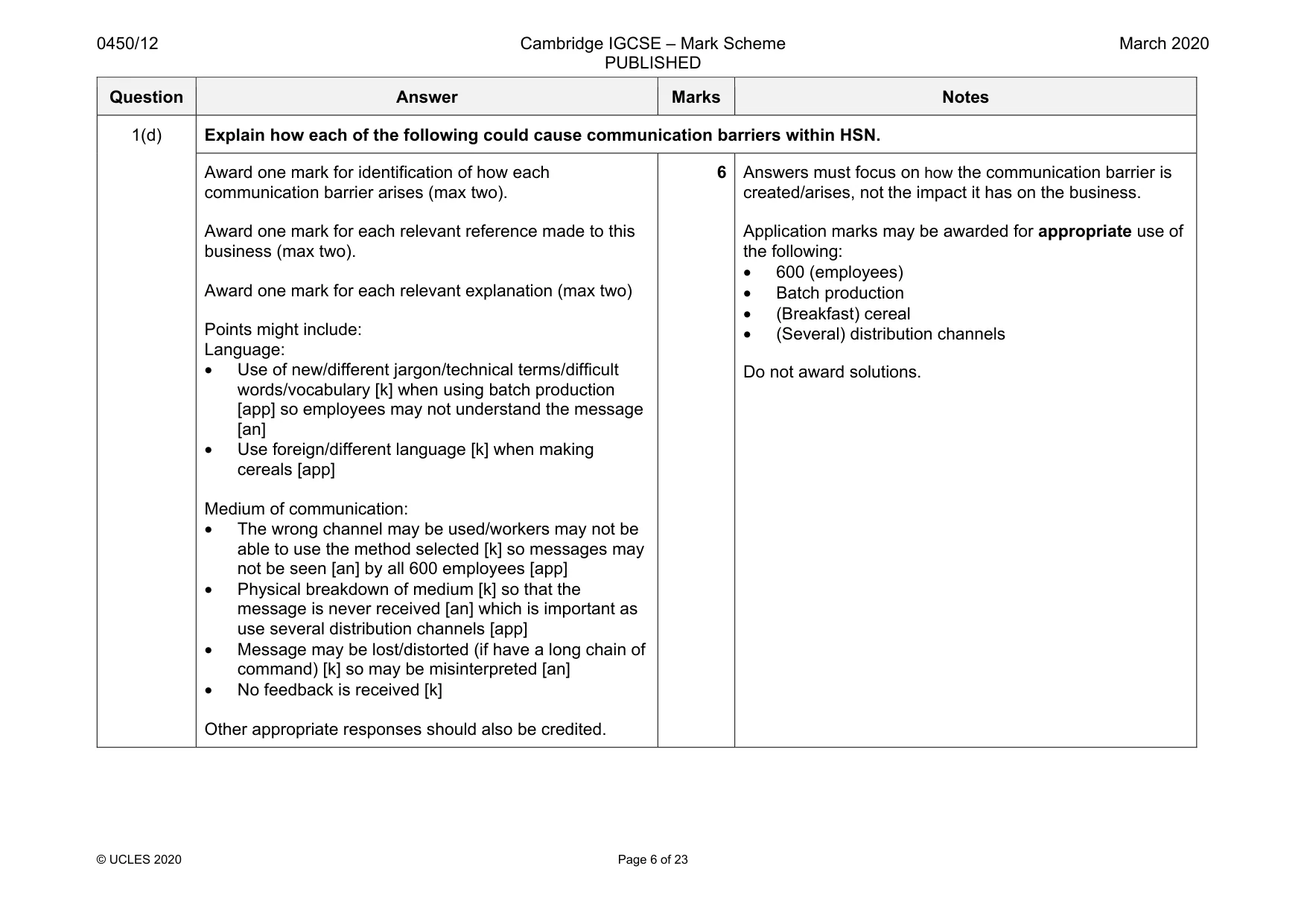
0450/12 Cambridge IGCSE – Mark Scheme PUBLISHED March 2020 © UCLES 2020 Page 6 of 23 Question Answer Marks Notes 1(d) Explain how each of the following could cause communication barriers within HSN. Award one mark for identification of how each communication barrier arises (max two). Award one mark for each relevant reference made to this business (max two). Award one mark for each relevant explanation (max two) Points might include: Language: • Use of new/different jargon/technical terms/difficult words/vocabulary [k] when using batch production [app] so employees may not understand the message [an] • Use foreign/different language [k] when making cereals [app] Medium of communication: • The wrong channel may be used/workers may not be able to use the method selected [k] so messages may not be seen [an] by all 600 employees [app] • Physical breakdown of medium [k] so that the message is never received [an] which is important as use several distribution channels [app] • Message may be lost/distorted (if have a long chain of command) [k] so may be misinterpreted [an] • No feedback is received [k] Other appropriate responses should also be credited. 6 Answers must focus on how the communication barrier is created/arises, not the impact it has on the business. Application marks may be awarded for appropriate use of the following: • 600 (employees) • Batch production • (Breakfast) cereal • (Several) distribution channels Do not award solutions.
Mark scheme, page 7
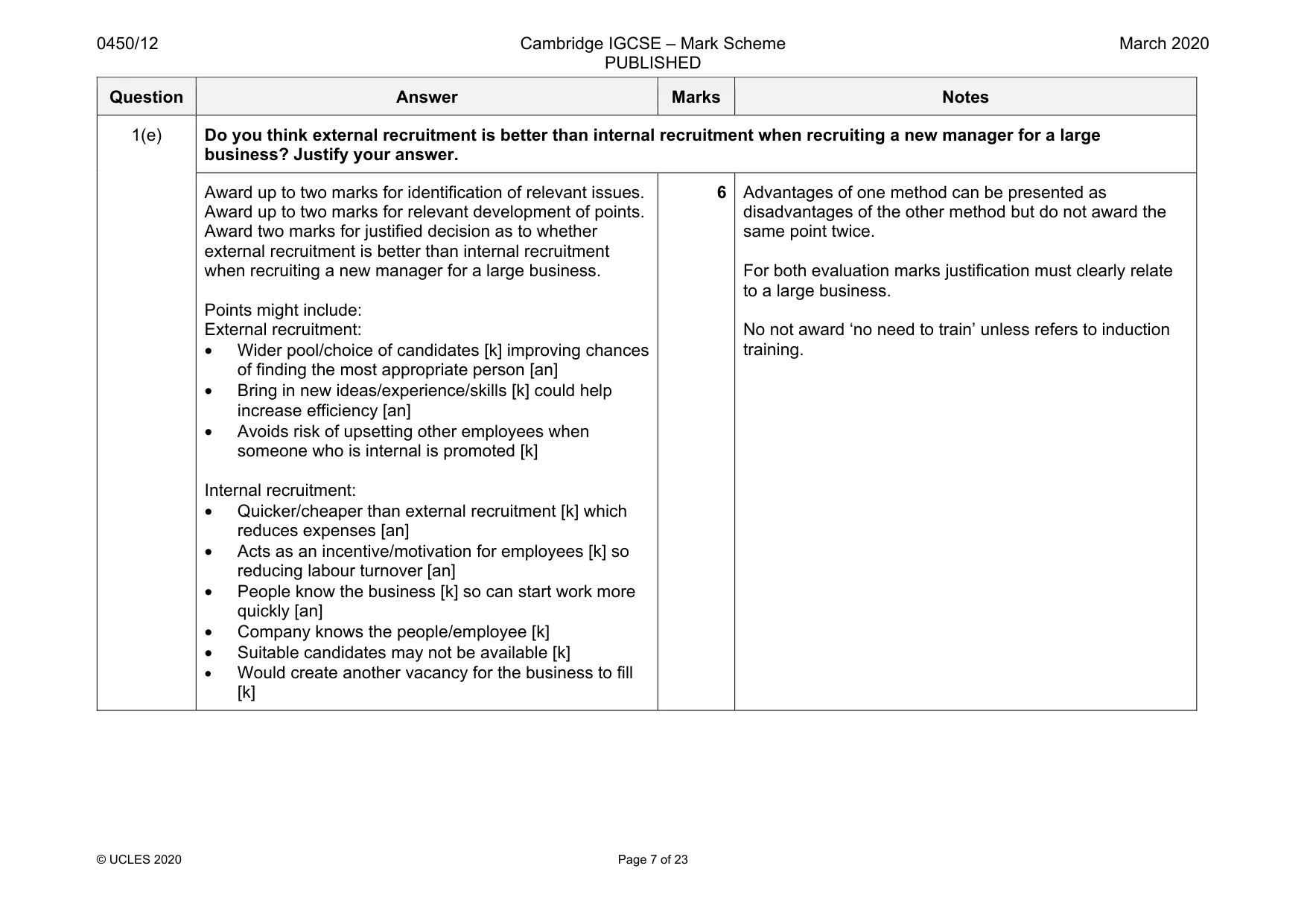
0450/12 Cambridge IGCSE – Mark Scheme PUBLISHED March 2020 © UCLES 2020 Page 7 of 23 Question Answer Marks Notes 1(e) Do you think external recruitment is better than internal recruitment when recruiting a new manager for a large business? Justify your answer. Award up to two marks for identification of relevant issues. Award up to two marks for relevant development of points. Award two marks for justified decision as to whether external recruitment is better than internal recruitment when recruiting a new manager for a large business. Points might include: External recruitment: • Wider pool/choice of candidates [k] improving chances of finding the most appropriate person [an] • Bring in new ideas/experience/skills [k] could help increase efficiency [an] • Avoids risk of upsetting other employees when someone who is internal is promoted [k] Internal recruitment: • Quicker/cheaper than external recruitment [k] which reduces expenses [an] • Acts as an incentive/motivation for employees [k] so reducing labour turnover [an] • People know the business [k] so can start work more quickly [an] • Company knows the people/employee [k] • Suitable candidates may not be available [k] • Would create another vacancy for the business to fill [k] 6 Advantages of one method can be presented as disadvantages of the other method but do not award the same point twice. For both evaluation marks justification must clearly relate to a large business. No not award ‘no need to train’ unless refers to induction training.
Mark scheme, page 8
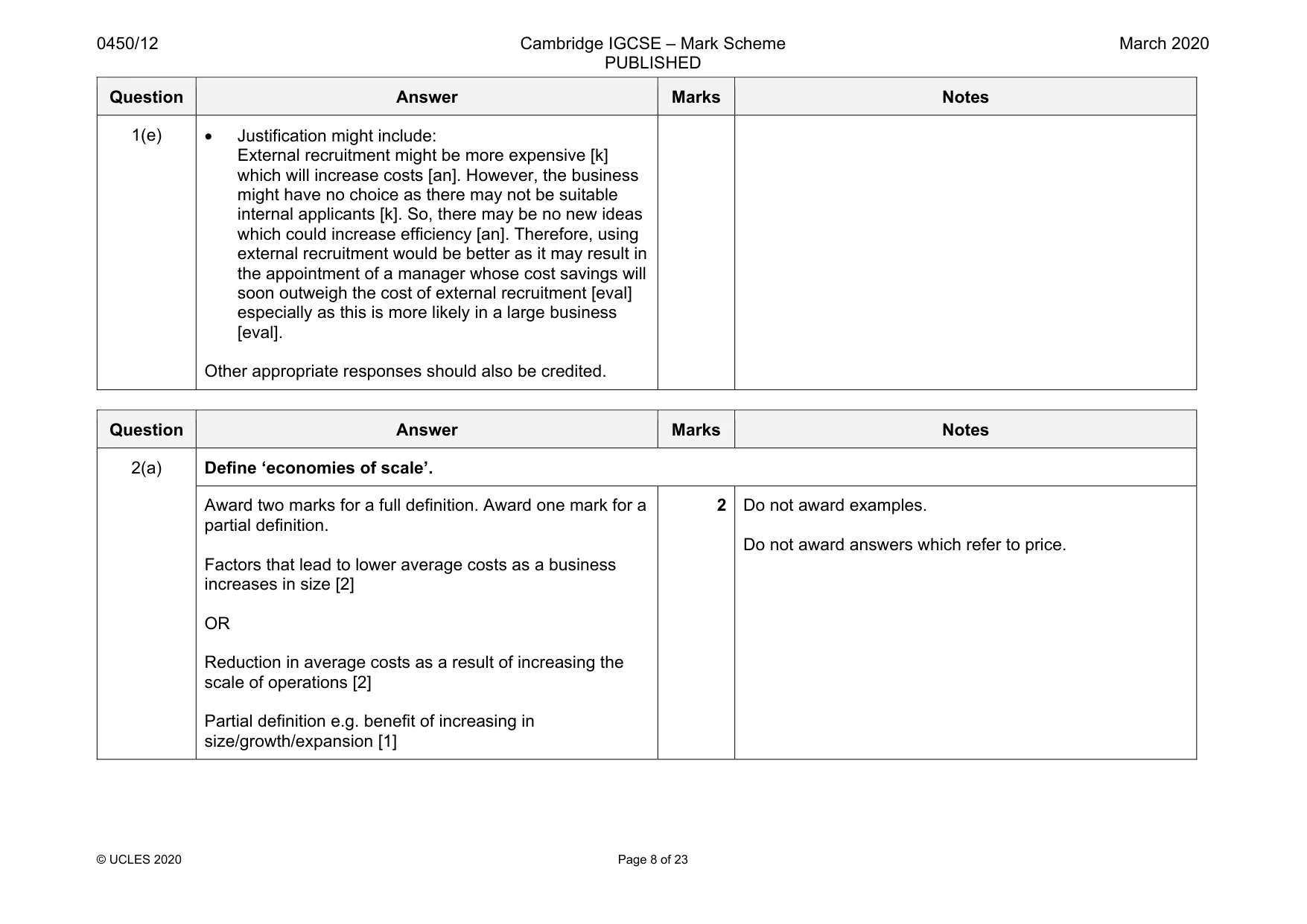
0450/12 Cambridge IGCSE – Mark Scheme PUBLISHED March 2020 © UCLES 2020 Page 8 of 23 Question Answer Marks Notes 1(e) • Justification might include: External recruitment might be more expensive [k] which will increase costs [an]. However, the business might have no choice as there may not be suitable internal applicants [k]. So, there may be no new ideas which could increase efficiency [an]. Therefore, using external recruitment would be better as it may result in the appointment of a manager whose cost savings will soon outweigh the cost of external recruitment [eval] especially as this is more likely in a large business [eval]. Other appropriate responses should also be credited. Question Answer Marks Notes 2(a) Define ‘economies of scale’. Award two marks for a full definition. Award one mark for a partial definition. Factors that lead to lower average costs as a business increases in size [2] OR Reduction in average costs as a result of increasing the scale of operations [2] Partial definition e.g. benefit of increasing in size/growth/expansion [1] 2 Do not award examples. Do not award answers which refer to price.
Mark scheme, page 9
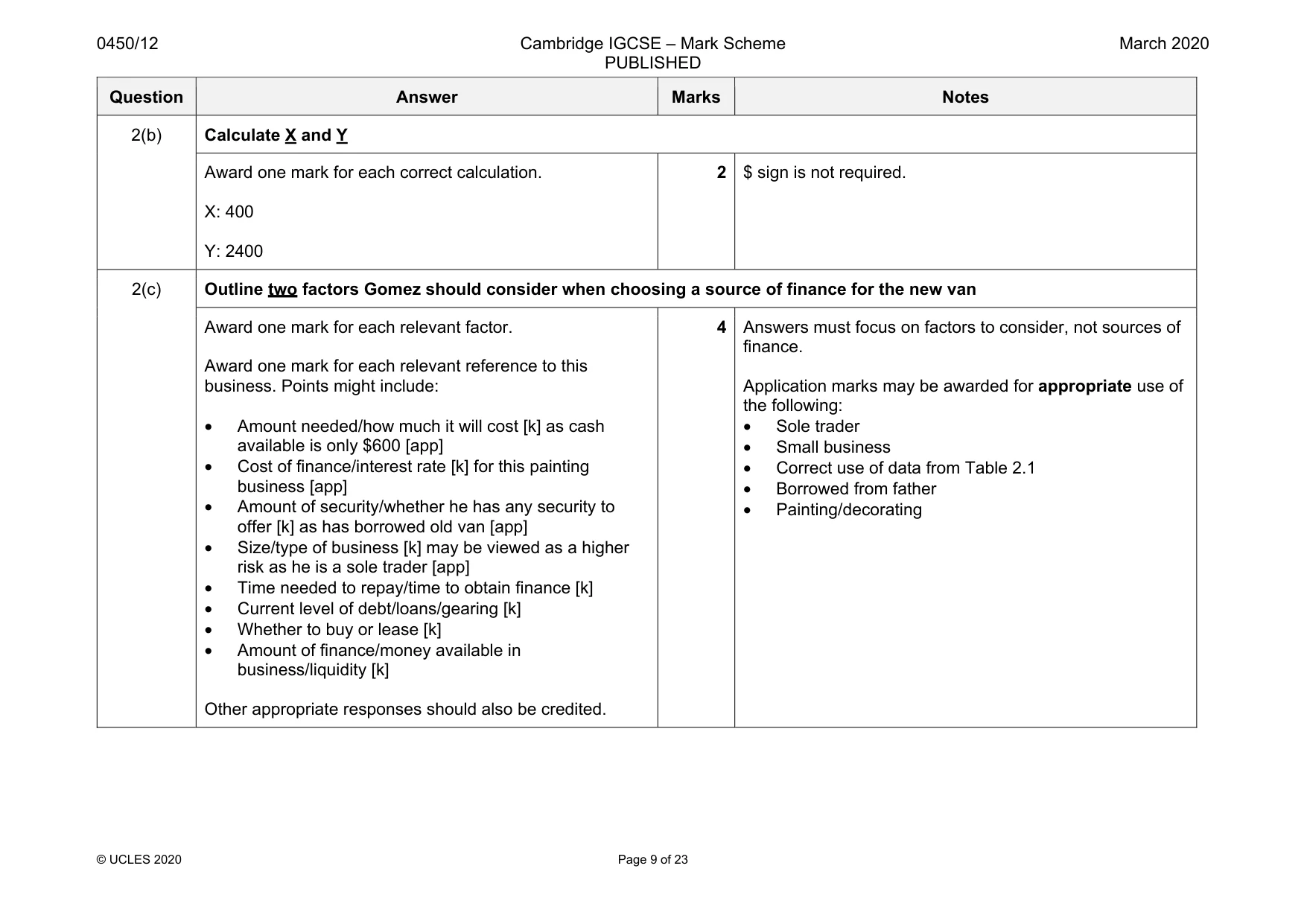
0450/12 Cambridge IGCSE – Mark Scheme PUBLISHED March 2020 © UCLES 2020 Page 9 of 23 Question Answer Marks Notes 2(b) Calculate X and Y Award one mark for each correct calculation. X: 400 Y: 2400 2 $ sign is not required. 2(c) Outline two factors Gomez should consider when choosing a source of finance for the new van Award one mark for each relevant factor. Award one mark for each relevant reference to this business. Points might include: • Amount needed/how much it will cost [k] as cash available is only $600 [app] • Cost of finance/interest rate [k] for this painting business [app] • Amount of security/whether he has any security to offer [k] as has borrowed old van [app] • Size/type of business [k] may be viewed as a higher risk as he is a sole trader [app] • Time needed to repay/time to obtain finance [k] • Current level of debt/loans/gearing [k] • Whether to buy or lease [k] • Amount of finance/money available in business/liquidity [k] Other appropriate responses should also be credited. 4 Answers must focus on factors to consider, not sources of finance. Application marks may be awarded for appropriate use of the following: • Sole trader • Small business • Correct use of data from Table 2.1 • Borrowed from father • Painting/decorating
Mark scheme, page 10
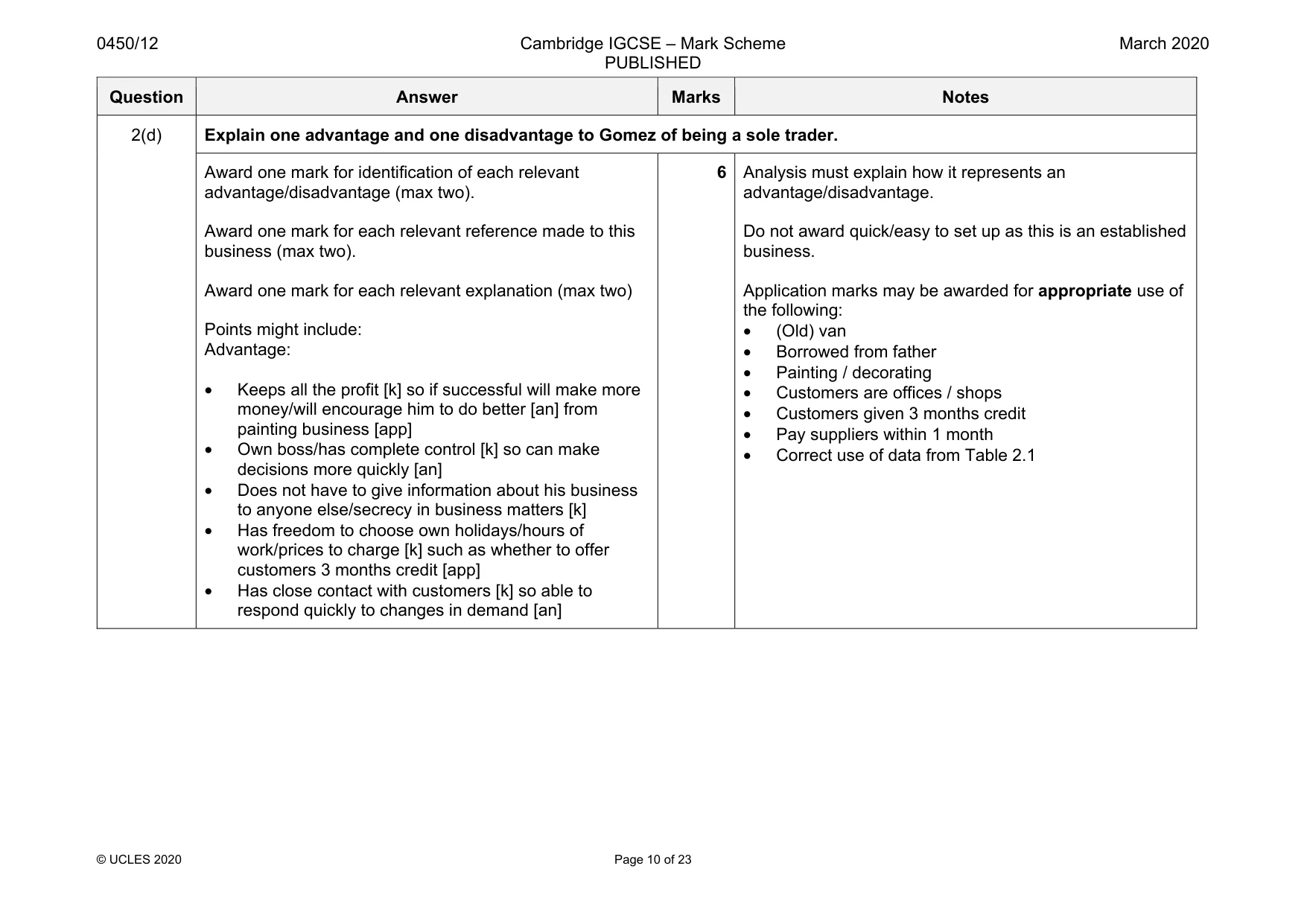
0450/12 Cambridge IGCSE – Mark Scheme PUBLISHED March 2020 © UCLES 2020 Page 10 of 23 Question Answer Marks Notes 2(d) Explain one advantage and one disadvantage to Gomez of being a sole trader. Award one mark for identification of each relevant advantage/disadvantage (max two). Award one mark for each relevant reference made to this business (max two). Award one mark for each relevant explanation (max two) Points might include: Advantage: • Keeps all the profit [k] so if successful will make more money/will encourage him to do better [an] from painting business [app] • Own boss/has complete control [k] so can make decisions more quickly [an] • Does not have to give information about his business to anyone else/secrecy in business matters [k] • Has freedom to choose own holidays/hours of work/prices to charge [k] such as whether to offer customers 3 months credit [app] • Has close contact with customers [k] so able to respond quickly to changes in demand [an] 6 Analysis must explain how it represents an advantage/disadvantage. Do not award quick/easy to set up as this is an established business. Application marks may be awarded for appropriate use of the following: • (Old) van • Borrowed from father • Painting / decorating • Customers are offices / shops • Customers given 3 months credit • Pay suppliers within 1 month • Correct use of data from Table 2.1
Mark scheme, page 11
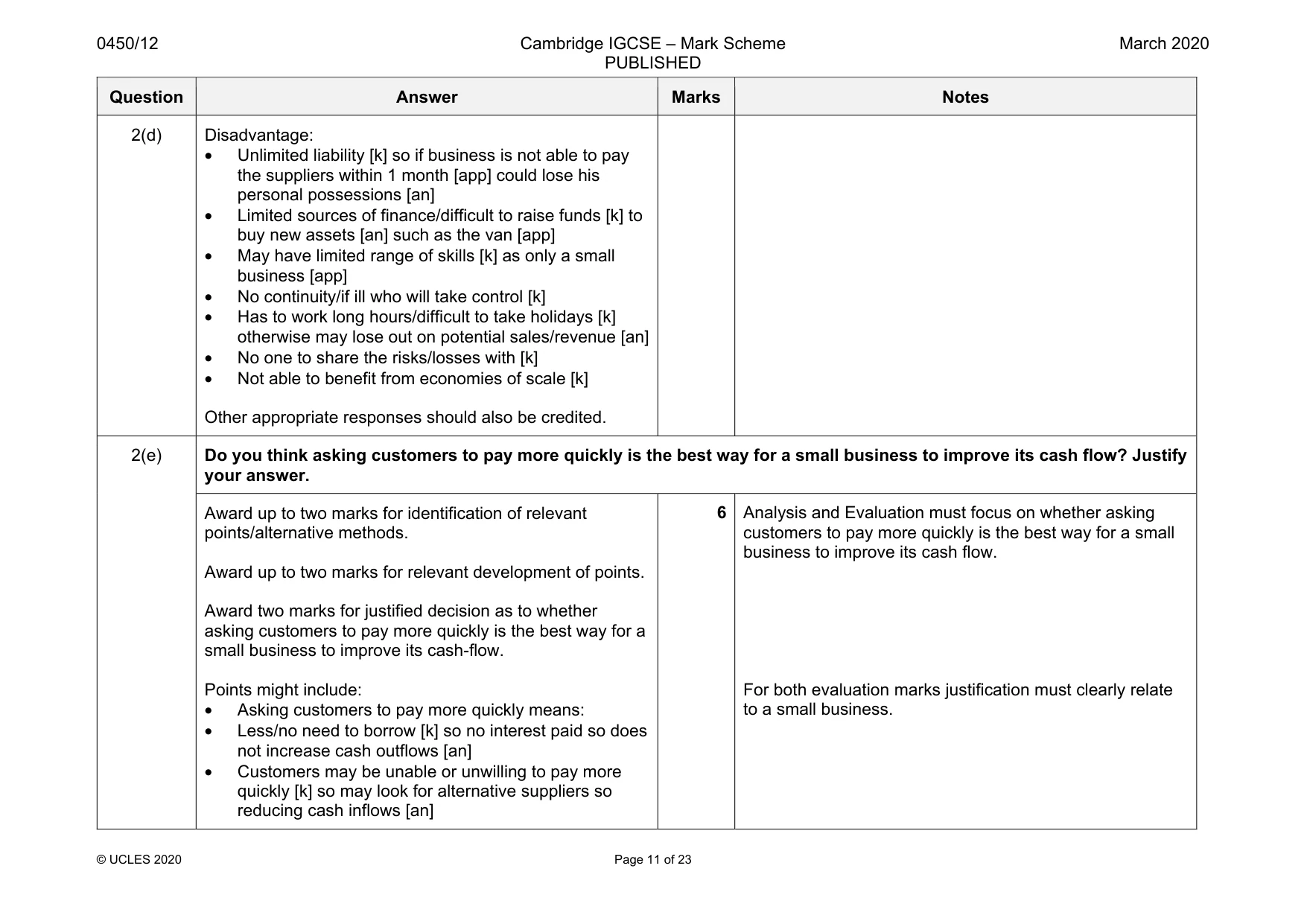
0450/12 Cambridge IGCSE – Mark Scheme PUBLISHED March 2020 © UCLES 2020 Page 11 of 23 Question Answer Marks Notes 2(d) Disadvantage: • Unlimited liability [k] so if business is not able to pay the suppliers within 1 month [app] could lose his personal possessions [an] • Limited sources of finance/difficult to raise funds [k] to buy new assets [an] such as the van [app] • May have limited range of skills [k] as only a small business [app] • No continuity/if ill who will take control [k] • Has to work long hours/difficult to take holidays [k] otherwise may lose out on potential sales/revenue [an] • No one to share the risks/losses with [k] • Not able to benefit from economies of scale [k] Other appropriate responses should also be credited. 2(e) Do you think asking customers to pay more quickly is the best way for a small business to improve its cash flow? Justify your answer. Award up to two marks for identification of relevant points/alternative methods. Award up to two marks for relevant development of points. Award two marks for justified decision as to whether asking customers to pay more quickly is the best way for a small business to improve its cash-flow. Points might include: • Asking customers to pay more quickly means: • Less/no need to borrow [k] so no interest paid so does not increase cash outflows [an] • Customers may be unable or unwilling to pay more quickly [k] so may look for alternative suppliers so reducing cash inflows [an] 6 Analysis and Evaluation must focus on whether asking customers to pay more quickly is the best way for a small business to improve its cash flow. For both evaluation marks justification must clearly relate to a small business.
Mark scheme, page 12
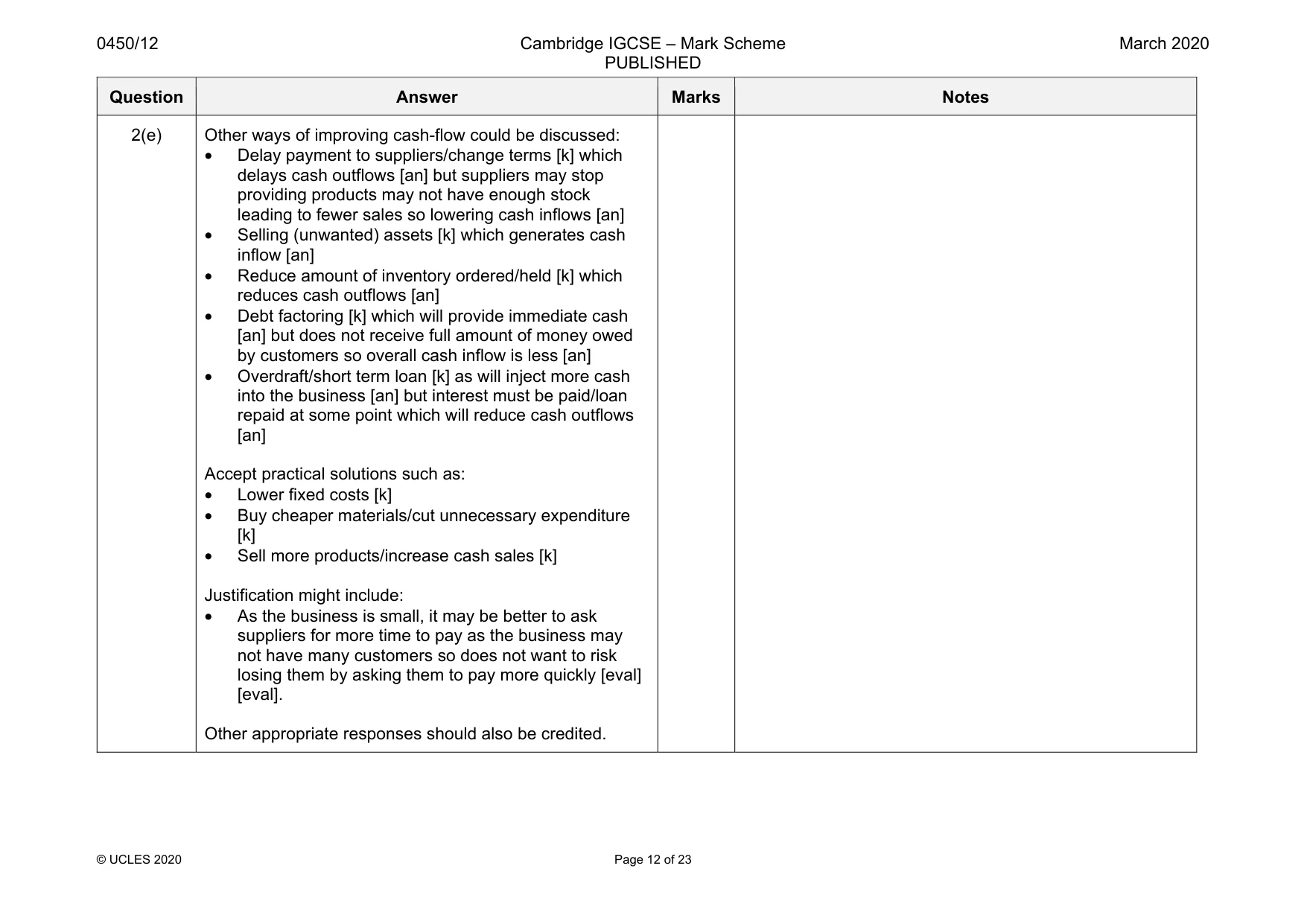
0450/12 Cambridge IGCSE – Mark Scheme PUBLISHED March 2020 © UCLES 2020 Page 12 of 23 Question Answer Marks Notes 2(e) Other ways of improving cash-flow could be discussed: • Delay payment to suppliers/change terms [k] which delays cash outflows [an] but suppliers may stop providing products may not have enough stock leading to fewer sales so lowering cash inflows [an] • Selling (unwanted) assets [k] which generates cash inflow [an] • Reduce amount of inventory ordered/held [k] which reduces cash outflows [an] • Debt factoring [k] which will provide immediate cash [an] but does not receive full amount of money owed by customers so overall cash inflow is less [an] • Overdraft/short term loan [k] as will inject more cash into the business [an] but interest must be paid/loan repaid at some point which will reduce cash outflows [an] Accept practical solutions such as: • Lower fixed costs [k] • Buy cheaper materials/cut unnecessary expenditure [k] • Sell more products/increase cash sales [k] Justification might include: • As the business is small, it may be better to ask suppliers for more time to pay as the business may not have many customers so does not want to risk losing them by asking them to pay more quickly [eval] [eval]. Other appropriate responses should also be credited.
Mark scheme, page 13
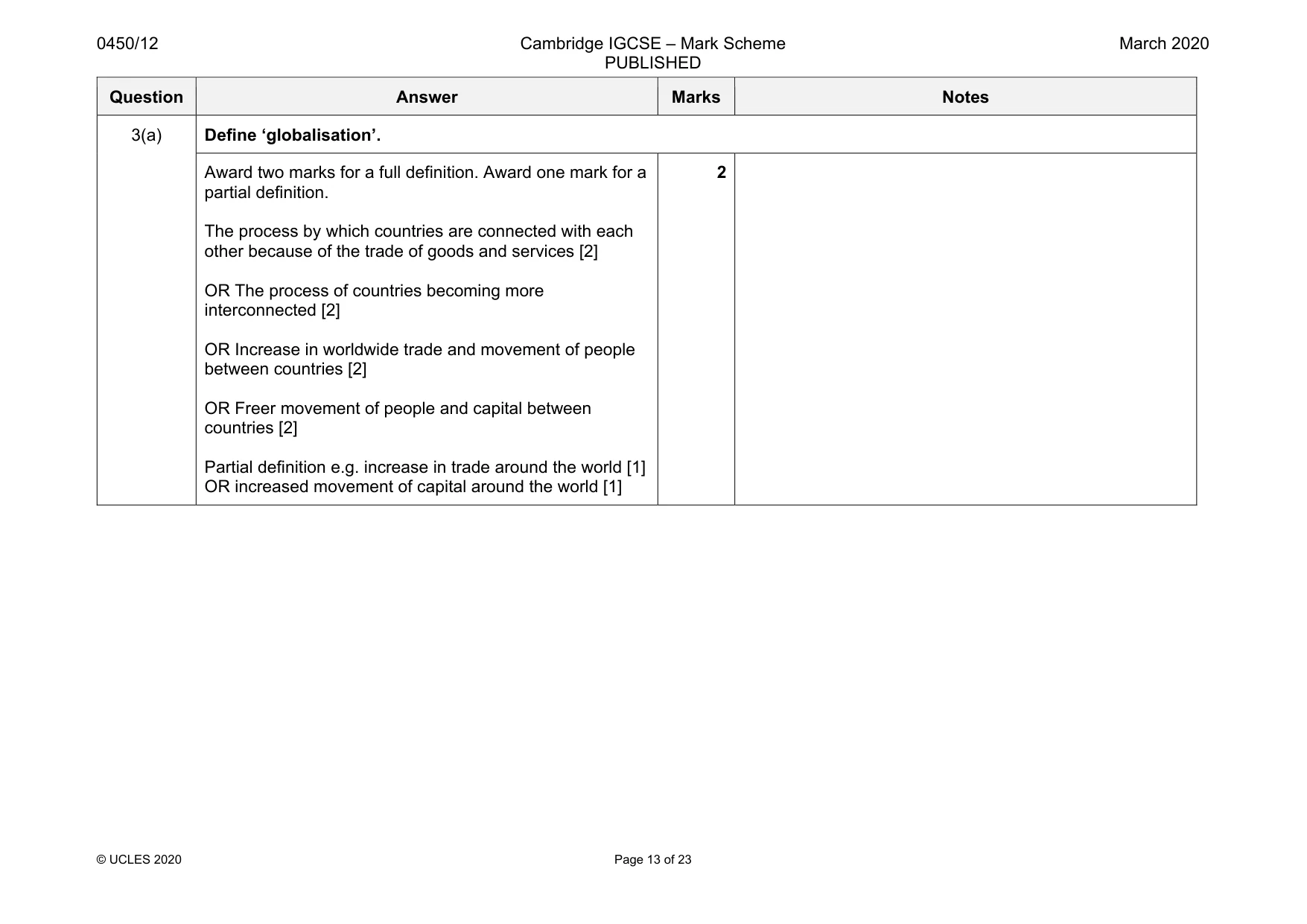
0450/12 Cambridge IGCSE – Mark Scheme PUBLISHED March 2020 © UCLES 2020 Page 13 of 23 Question Answer Marks Notes 3(a) Define ‘globalisation’. Award two marks for a full definition. Award one mark for a partial definition. The process by which countries are connected with each other because of the trade of goods and services [2] OR The process of countries becoming more interconnected [2] OR Increase in worldwide trade and movement of people between countries [2] OR Freer movement of people and capital between countries [2] Partial definition e.g. increase in trade around the world [1] OR increased movement of capital around the world [1] 2
Mark scheme, page 14
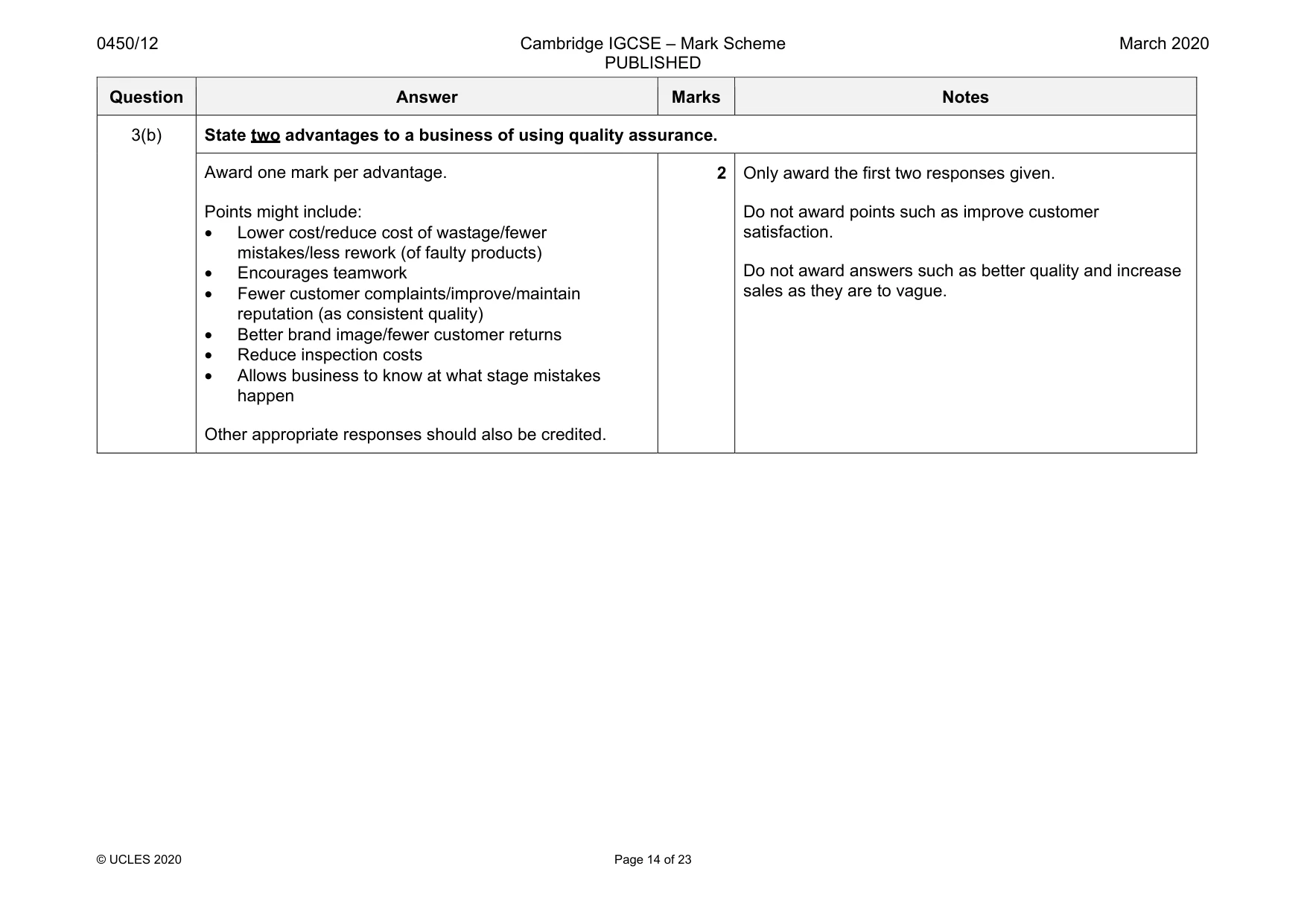
0450/12 Cambridge IGCSE – Mark Scheme PUBLISHED March 2020 © UCLES 2020 Page 14 of 23 Question Answer Marks Notes 3(b) State two advantages to a business of using quality assurance. Award one mark per advantage. Points might include: • Lower cost/reduce cost of wastage/fewer mistakes/less rework (of faulty products) • Encourages teamwork • Fewer customer complaints/improve/maintain reputation (as consistent quality) • Better brand image/fewer customer returns • Reduce inspection costs • Allows business to know at what stage mistakes happen Other appropriate responses should also be credited. 2 Only award the first two responses given. Do not award points such as improve customer satisfaction. Do not award answers such as better quality and increase sales as they are to vague.
Mark scheme, page 15
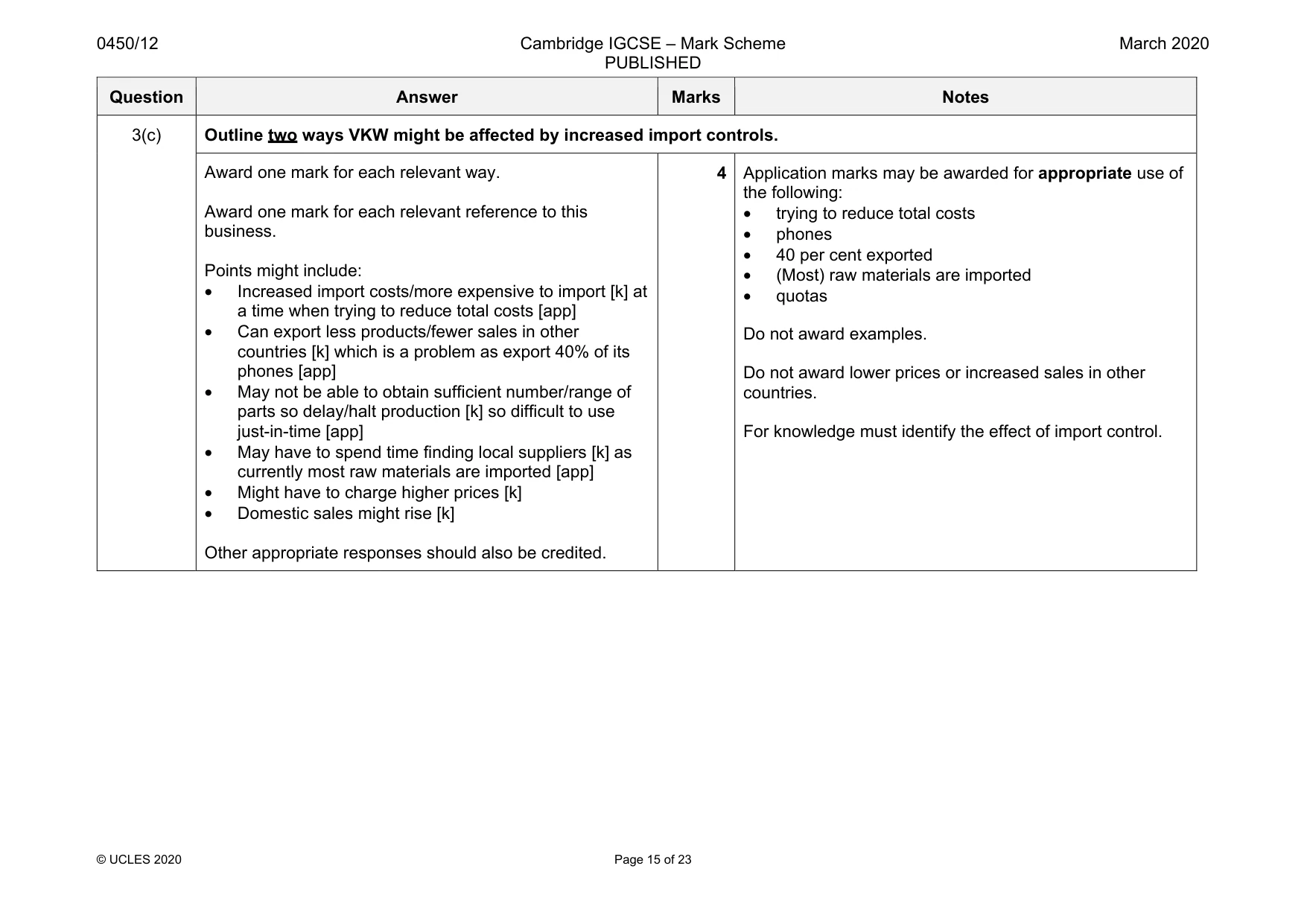
0450/12 Cambridge IGCSE – Mark Scheme PUBLISHED March 2020 © UCLES 2020 Page 15 of 23 Question Answer Marks Notes 3(c) Outline two ways VKW might be affected by increased import controls. Award one mark for each relevant way. Award one mark for each relevant reference to this business. Points might include: • Increased import costs/more expensive to import [k] at a time when trying to reduce total costs [app] • Can export less products/fewer sales in other countries [k] which is a problem as export 40% of its phones [app] • May not be able to obtain sufficient number/range of parts so delay/halt production [k] so difficult to use just-in-time [app] • May have to spend time finding local suppliers [k] as currently most raw materials are imported [app] • Might have to charge higher prices [k] • Domestic sales might rise [k] Other appropriate responses should also be credited. 4 Application marks may be awarded for appropriate use of the following: • trying to reduce total costs • phones • 40 per cent exported • (Most) raw materials are imported • quotas Do not award examples. Do not award lower prices or increased sales in other countries. For knowledge must identify the effect of import control.
Mark scheme, page 16
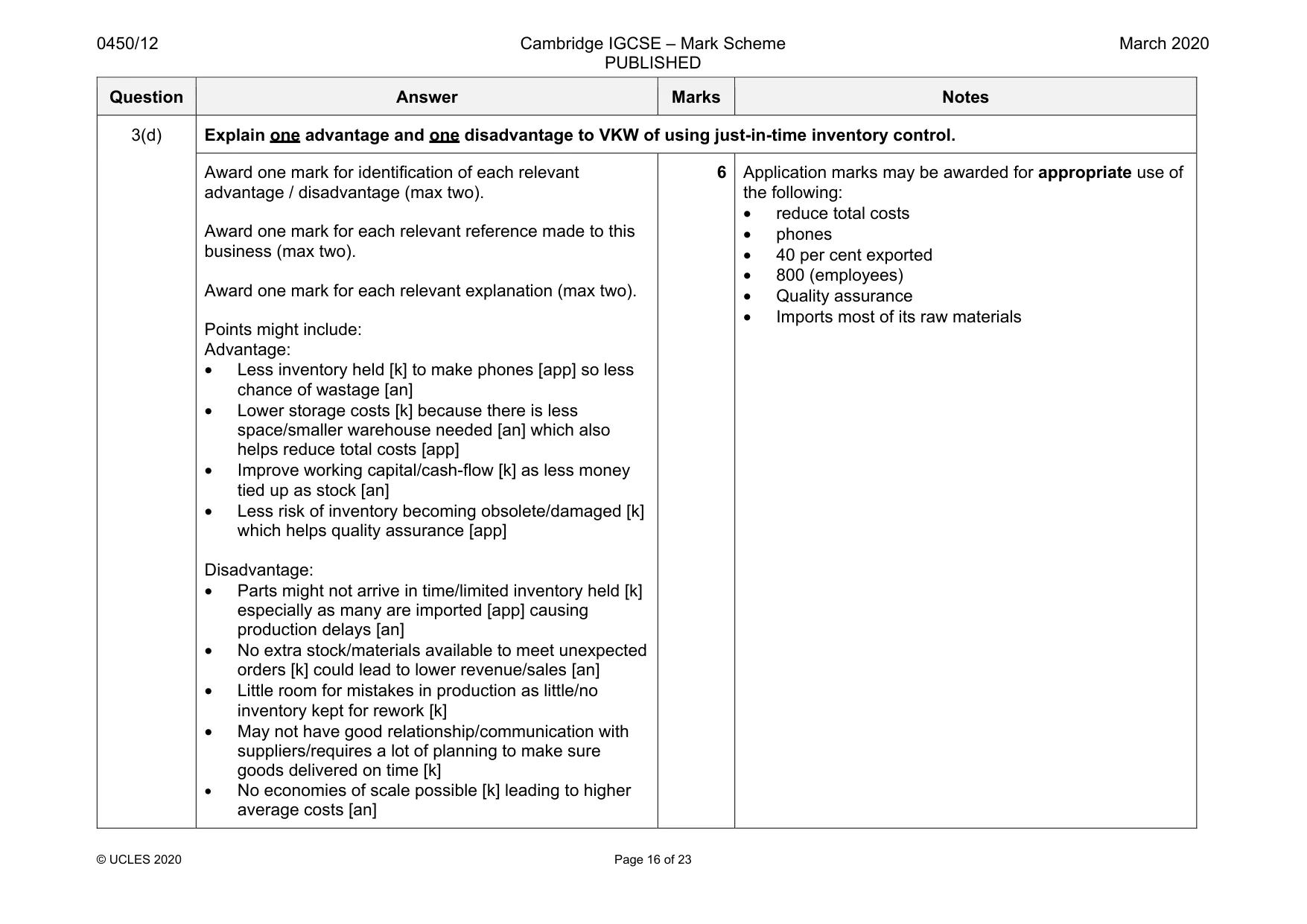
0450/12 Cambridge IGCSE – Mark Scheme PUBLISHED March 2020 © UCLES 2020 Page 16 of 23 Question Answer Marks Notes 3(d) Explain one advantage and one disadvantage to VKW of using just-in-time inventory control. Award one mark for identification of each relevant advantage / disadvantage (max two). Award one mark for each relevant reference made to this business (max two). Award one mark for each relevant explanation (max two). Points might include: Advantage: • Less inventory held [k] to make phones [app] so less chance of wastage [an] • Lower storage costs [k] because there is less space/smaller warehouse needed [an] which also helps reduce total costs [app] • Improve working capital/cash-flow [k] as less money tied up as stock [an] • Less risk of inventory becoming obsolete/damaged [k] which helps quality assurance [app] Disadvantage: • Parts might not arrive in time/limited inventory held [k] especially as many are imported [app] causing production delays [an] • No extra stock/materials available to meet unexpected orders [k] could lead to lower revenue/sales [an] • Little room for mistakes in production as little/no inventory kept for rework [k] • May not have good relationship/communication with suppliers/requires a lot of planning to make sure goods delivered on time [k] • No economies of scale possible [k] leading to higher average costs [an] 6 Application marks may be awarded for appropriate use of the following: • reduce total costs • phones • 40 per cent exported • 800 (employees) • Quality assurance • Imports most of its raw materials
Mark scheme, page 17
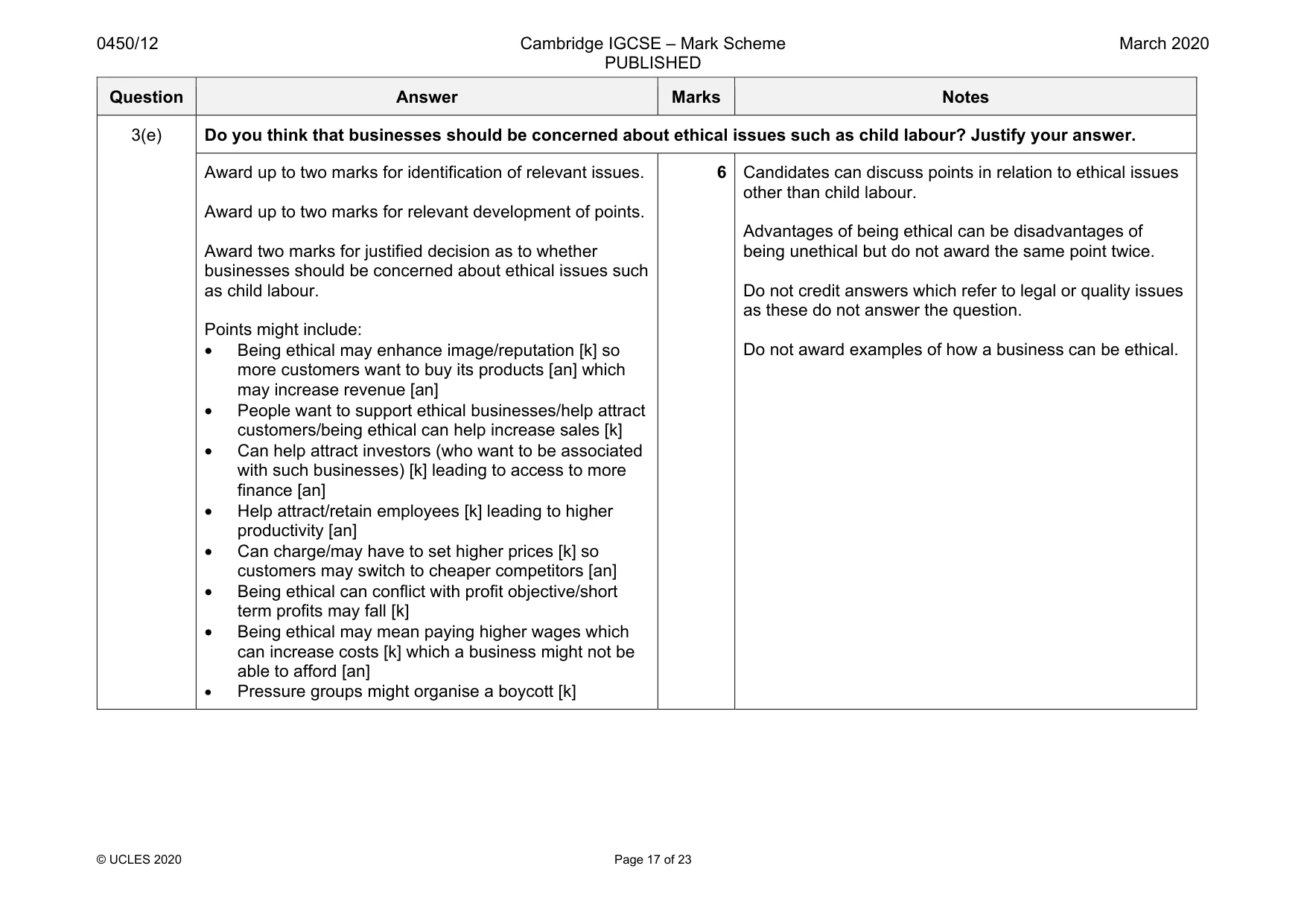
0450/12 Cambridge IGCSE – Mark Scheme PUBLISHED March 2020 © UCLES 2020 Page 17 of 23 Question Answer Marks Notes 3(e) Do you think that businesses should be concerned about ethical issues such as child labour? Justify your answer. Award up to two marks for identification of relevant issues. Award up to two marks for relevant development of points. Award two marks for justified decision as to whether businesses should be concerned about ethical issues such as child labour. Points might include: • Being ethical may enhance image/reputation [k] so more customers want to buy its products [an] which may increase revenue [an] • People want to support ethical businesses/help attract customers/being ethical can help increase sales [k] • Can help attract investors (who want to be associated with such businesses) [k] leading to access to more finance [an] • Help attract/retain employees [k] leading to higher productivity [an] • Can charge/may have to set higher prices [k] so customers may switch to cheaper competitors [an] • Being ethical can conflict with profit objective/short term profits may fall [k] • Being ethical may mean paying higher wages which can increase costs [k] which a business might not be able to afford [an] • Pressure groups might organise a boycott [k] 6 Candidates can discuss points in relation to ethical issues other than child labour. Advantages of being ethical can be disadvantages of being unethical but do not award the same point twice. Do not credit answers which refer to legal or quality issues as these do not answer the question. Do not award examples of how a business can be ethical.
Mark scheme, page 18
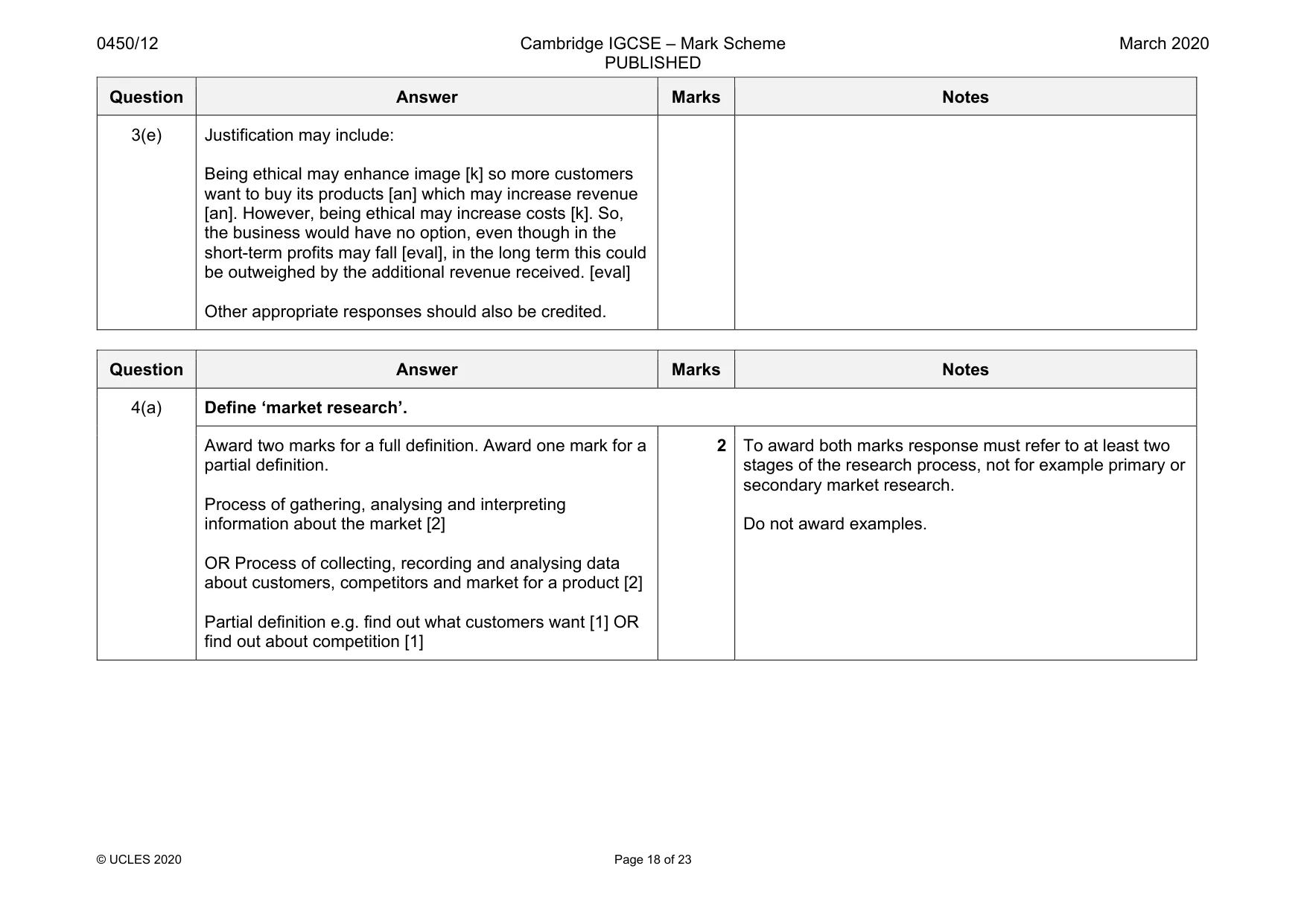
0450/12 Cambridge IGCSE – Mark Scheme PUBLISHED March 2020 © UCLES 2020 Page 18 of 23 Question Answer Marks Notes 3(e) Justification may include: Being ethical may enhance image [k] so more customers want to buy its products [an] which may increase revenue [an]. However, being ethical may increase costs [k]. So, the business would have no option, even though in the short-term profits may fall [eval], in the long term this could be outweighed by the additional revenue received. [eval] Other appropriate responses should also be credited. Question Answer Marks Notes 4(a) Define ‘market research’. Award two marks for a full definition. Award one mark for a partial definition. Process of gathering, analysing and interpreting information about the market [2] OR Process of collecting, recording and analysing data about customers, competitors and market for a product [2] Partial definition e.g. find out what customers want [1] OR find out about competition [1] 2 To award both marks response must refer to at least two stages of the research process, not for example primary or secondary market research. Do not award examples.
Mark scheme, page 19
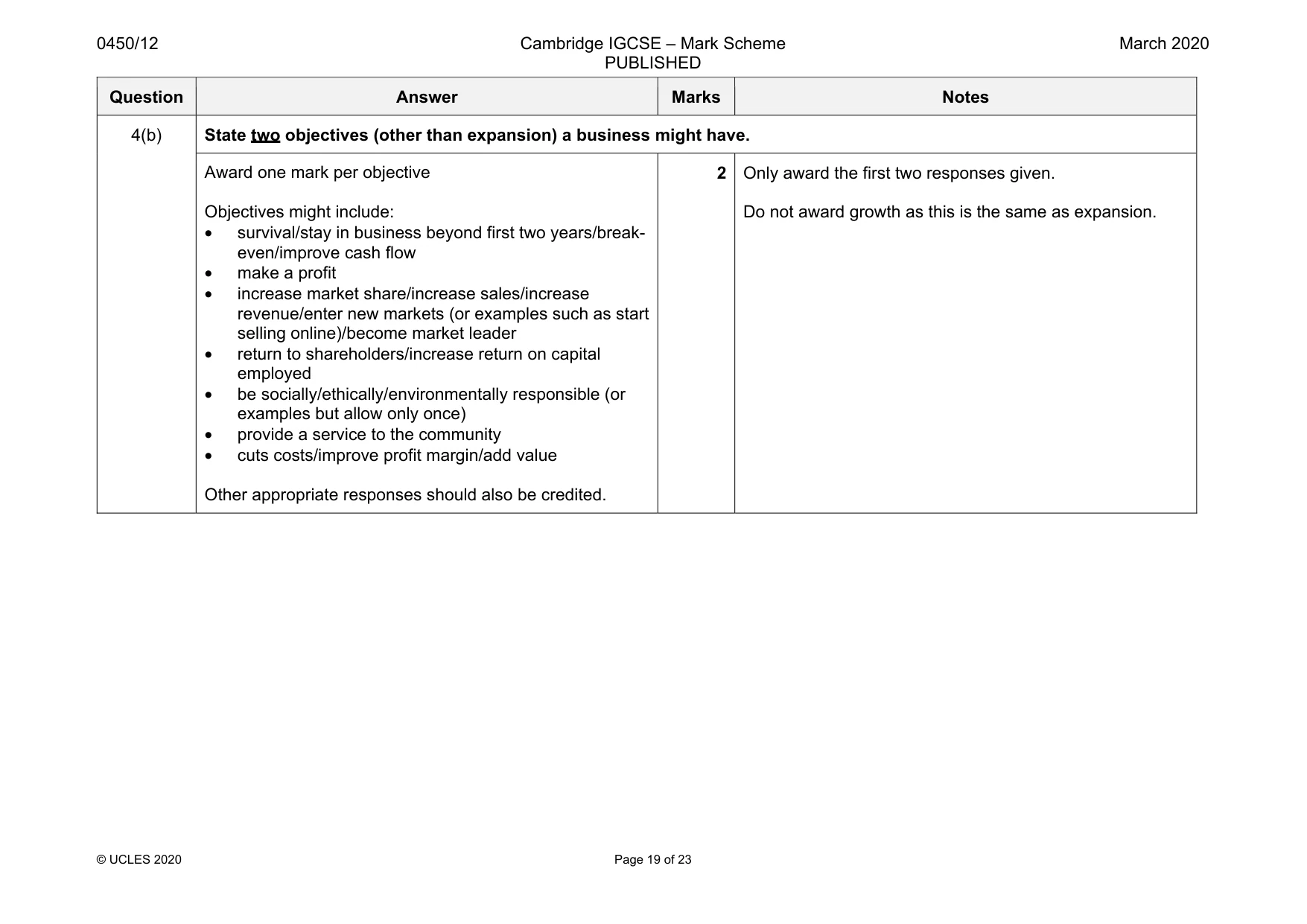
0450/12 Cambridge IGCSE – Mark Scheme PUBLISHED March 2020 © UCLES 2020 Page 19 of 23 Question Answer Marks Notes 4(b) State two objectives (other than expansion) a business might have. Award one mark per objective Objectives might include: • survival/stay in business beyond first two years/break- even/improve cash flow • make a profit • increase market share/increase sales/increase revenue/enter new markets (or examples such as start selling online)/become market leader • return to shareholders/increase return on capital employed • be socially/ethically/environmentally responsible (or examples but allow only once) • provide a service to the community • cuts costs/improve profit margin/add value Other appropriate responses should also be credited. 2 Only award the first two responses given. Do not award growth as this is the same as expansion.
Mark scheme, page 20
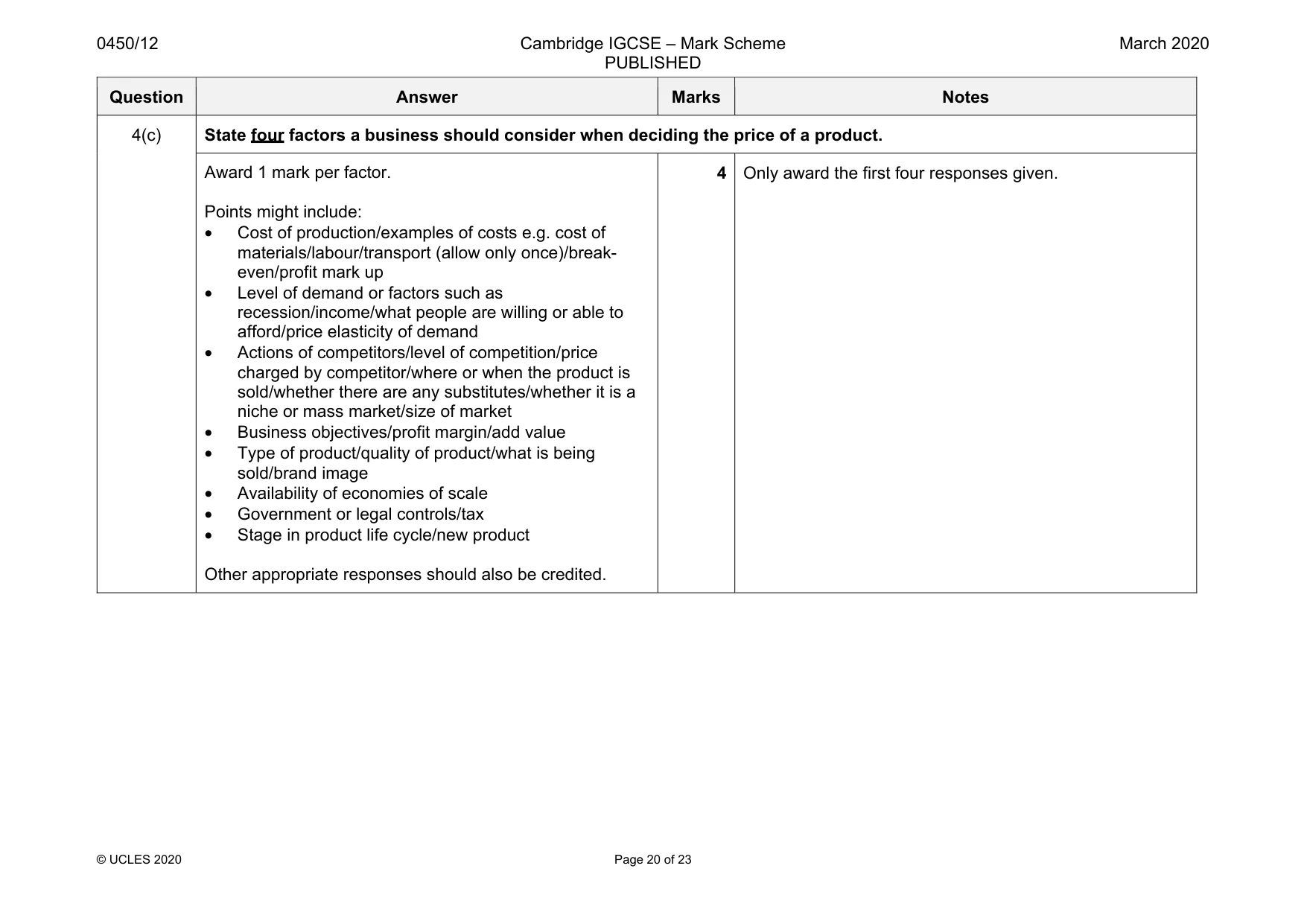
0450/12 Cambridge IGCSE – Mark Scheme PUBLISHED March 2020 © UCLES 2020 Page 20 of 23 Question Answer Marks Notes 4(c) State four factors a business should consider when deciding the price of a product. Award 1 mark per factor. Points might include: • Cost of production/examples of costs e.g. cost of materials/labour/transport (allow only once)/break- even/profit mark up • Level of demand or factors such as recession/income/what people are willing or able to afford/price elasticity of demand • Actions of competitors/level of competition/price charged by competitor/where or when the product is sold/whether there are any substitutes/whether it is a niche or mass market/size of market • Business objectives/profit margin/add value • Type of product/quality of product/what is being sold/brand image • Availability of economies of scale • Government or legal controls/tax • Stage in product life cycle/new product Other appropriate responses should also be credited. 4 Only award the first four responses given.
Mark scheme, page 21
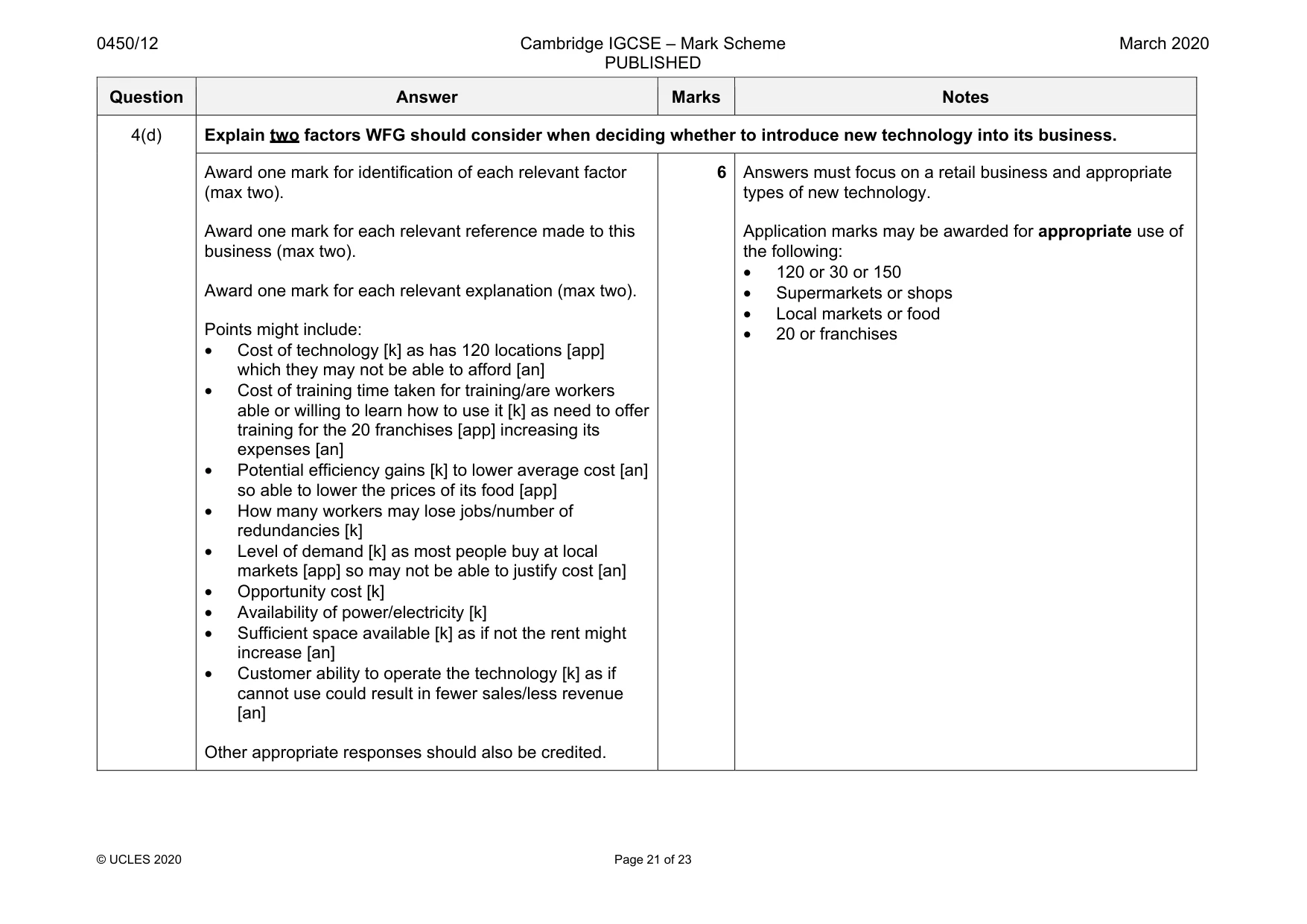
0450/12 Cambridge IGCSE – Mark Scheme PUBLISHED March 2020 © UCLES 2020 Page 21 of 23 Question Answer Marks Notes 4(d) Explain two factors WFG should consider when deciding whether to introduce new technology into its business. Award one mark for identification of each relevant factor (max two). Award one mark for each relevant reference made to this business (max two). Award one mark for each relevant explanation (max two). Points might include: • Cost of technology [k] as has 120 locations [app] which they may not be able to afford [an] • Cost of training time taken for training/are workers able or willing to learn how to use it [k] as need to offer training for the 20 franchises [app] increasing its expenses [an] • Potential efficiency gains [k] to lower average cost [an] so able to lower the prices of its food [app] • How many workers may lose jobs/number of redundancies [k] • Level of demand [k] as most people buy at local markets [app] so may not be able to justify cost [an] • Opportunity cost [k] • Availability of power/electricity [k] • Sufficient space available [k] as if not the rent might increase [an] • Customer ability to operate the technology [k] as if cannot use could result in fewer sales/less revenue [an] Other appropriate responses should also be credited. 6 Answers must focus on a retail business and appropriate types of new technology. Application marks may be awarded for appropriate use of the following: • 120 or 30 or 150 • Supermarkets or shops • Local markets or food • 20 or franchises
Mark scheme, page 22
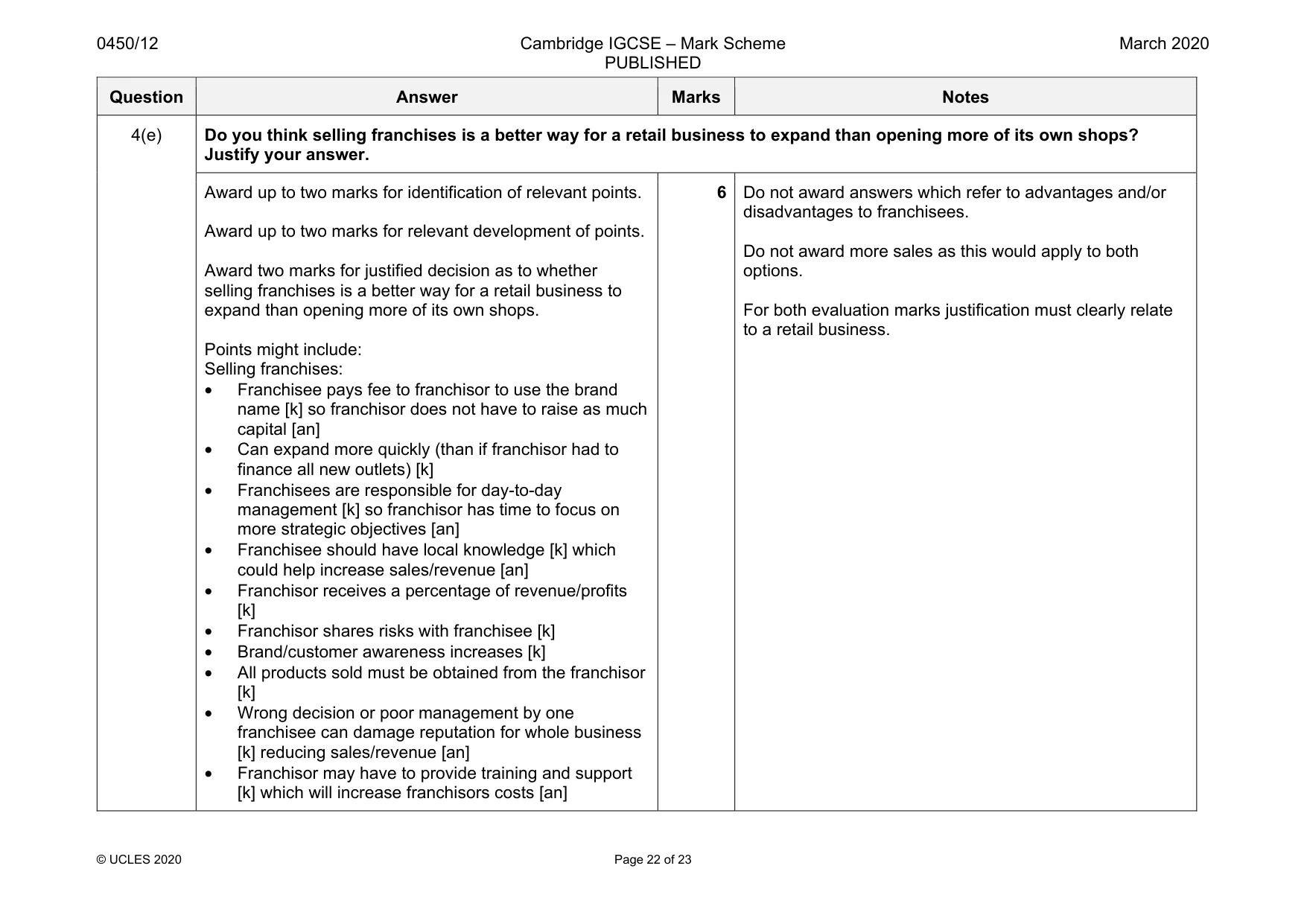
0450/12 Cambridge IGCSE – Mark Scheme PUBLISHED March 2020 © UCLES 2020 Page 22 of 23 Question Answer Marks Notes 4(e) Do you think selling franchises is a better way for a retail business to expand than opening more of its own shops? Justify your answer. Award up to two marks for identification of relevant points. Award up to two marks for relevant development of points. Award two marks for justified decision as to whether selling franchises is a better way for a retail business to expand than opening more of its own shops. Points might include: Selling franchises: • Franchisee pays fee to franchisor to use the brand name [k] so franchisor does not have to raise as much capital [an] • Can expand more quickly (than if franchisor had to finance all new outlets) [k] • Franchisees are responsible for day-to-day management [k] so franchisor has time to focus on more strategic objectives [an] • Franchisee should have local knowledge [k] which could help increase sales/revenue [an] • Franchisor receives a percentage of revenue/profits [k] • Franchisor shares risks with franchisee [k] • Brand/customer awareness increases [k] • All products sold must be obtained from the franchisor [k] • Wrong decision or poor management by one franchisee can damage reputation for whole business [k] reducing sales/revenue [an] • Franchisor may have to provide training and support [k] which will increase franchisors costs [an] 6 Do not award answers which refer to advantages and/or disadvantages to franchisees. Do not award more sales as this would apply to both options. For both evaluation marks justification must clearly relate to a retail business.
Mark scheme, page 23
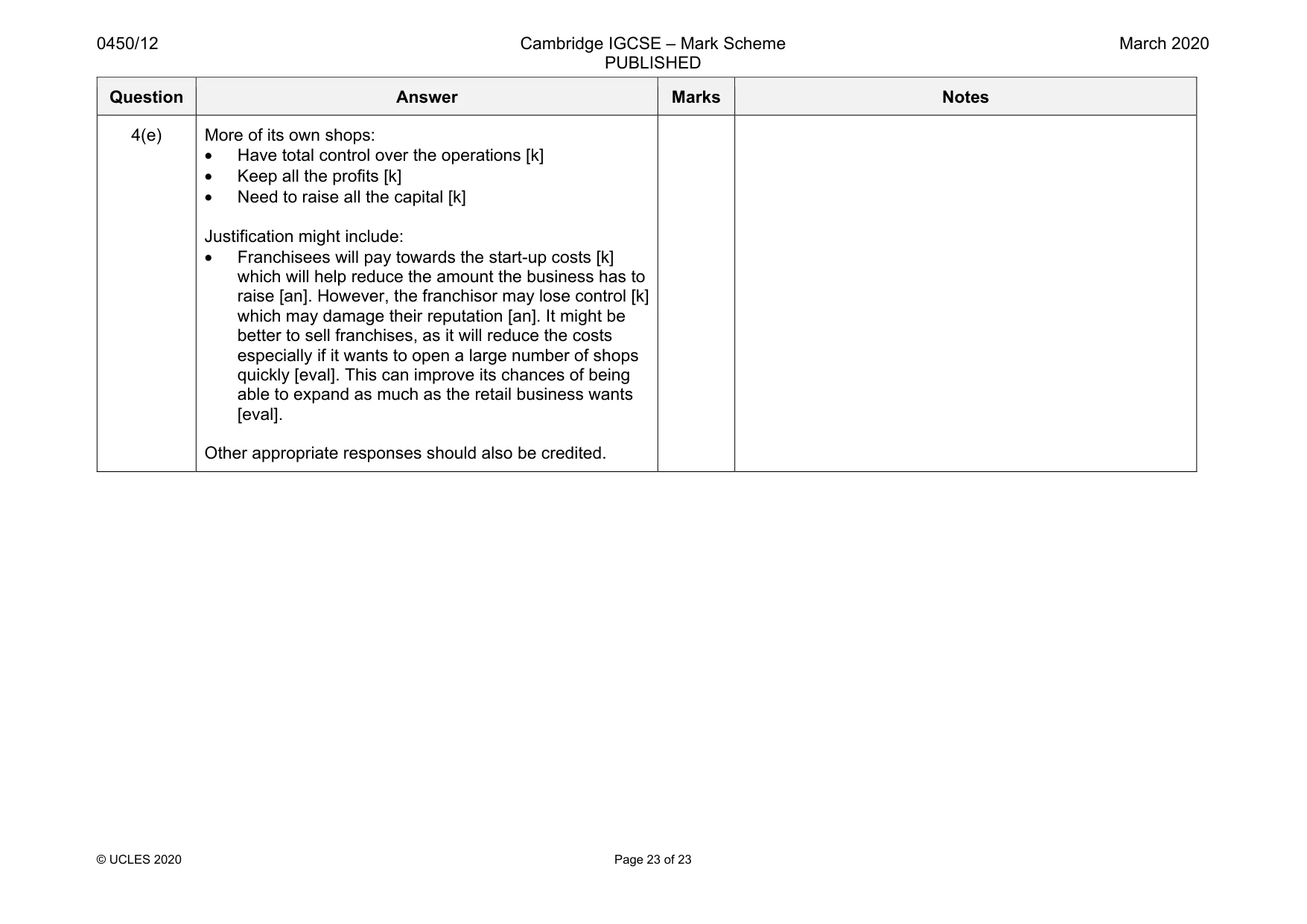
0450/12 Cambridge IGCSE – Mark Scheme PUBLISHED March 2020 © UCLES 2020 Page 23 of 23 Question Answer Marks Notes 4(e) More of its own shops: • Have total control over the operations [k] • Keep all the profits [k] • Need to raise all the capital [k] Justification might include: • Franchisees will pay towards the start-up costs [k] which will help reduce the amount the business has to raise [an]. However, the franchisor may lose control [k] which may damage their reputation [an]. It might be better to sell franchises, as it will reduce the costs especially if it wants to open a large number of shops quickly [eval]. This can improve its chances of being able to expand as much as the retail business wants [eval]. Other appropriate responses should also be credited.
What you needed in this session
Cambridge’s own grade thresholds for 2020 Feb/March, Paper 1 · Variant 2. A higher threshold means an easier paper — the bar moves with how the cohort did.