Cambridge IGCSE Business Studies 0450 — 2019 May/June Paper 2 · Variant 3
0450/23/M/J/19 · 80 marks · ≈90 min
The question paper and its mark scheme, free to read here and free to download. This is Cambridge’s own paper, exactly as it was sat.
Question paper12 pages




Mark scheme14 pages
Answers below. Sit the paper first if you are practising.
Paper as text
Question paper, page 1
Cambridge Assessment International Education Cambridge International General Certificate of Secondary Education 0450/23 May/June 2019 1 hour 30 minutes BUSINESS STUDIES Paper 2 Candidates answer on the Question Paper. No Additional Materials are required. READ THESE INSTRUCTIONS FIRST Write your centre number, candidate number and name in the spaces at the top of this page. Write in dark blue or black pen. You may use an HB pencil for any diagrams, graphs or rough working. Do not use staples, paper clips, glue or correction fluid. DO NOT WRITE IN ANY BARCODES. Answer all questions. The Insert contains the case study. The businesses described in this question paper are entirely fictitious. At the end of the examination, fasten all your work securely together. The number of marks is given in brackets [ ] at the end of each question or part question. The total number of marks for this paper is 80. This syllabus is regulated for use in England, Wales and Northern Ireland as a Cambridge International Level 1/Level 2 Certificate. This document consists of 9 printed pages and 3 blank pages. [Turn over 06_0450_23_2019_1.8 © UCLES 2019 *8234550766*
Question paper, page 2
Identify and explain two reasons why the Government helped Peter start up his new business. (a) 1 Reason 1: … … Explanation: … … … … … … Reason 2: … … Explanation: … … … … … … [8] 06_0450_23_2019_1.8 © UCLES 2019 2
Question paper, page 3
Consider the following three pricing methods VC could use for its new products. Which method should Peter choose? Justify your answer. (b) Penetration pricing: … … … … … … Price skimming: … … … … … … Cost plus pricing: … … … … … … Recommendation: … … … … … … … … [12] [Turn over 06_0450_23_2019_1.8 © UCLES 2019 3
Question paper, page 4
Identify and explain two possible reasons for the failure of the business that Peter used to work for. (a) 2 Reason 1: … … Explanation: … … … … … … Reason 2: … … Explanation: … … … … … … [8] 06_0450_23_2019_1.8 © UCLES 2019 4
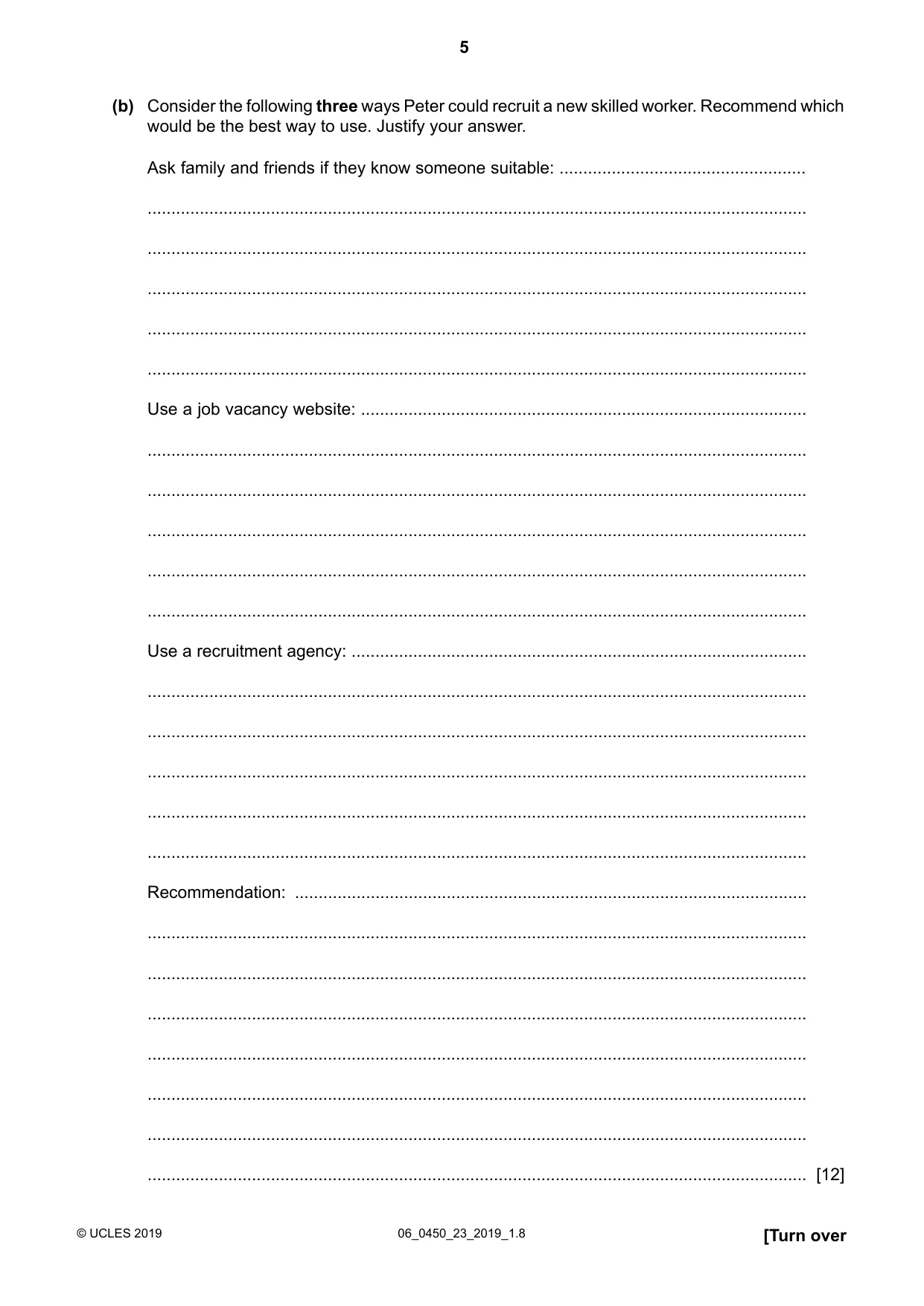
Question paper, page 5
Consider the following three ways Peter could recruit a new skilled worker. Recommend which would be the best way to use. Justify your answer. (b) Ask family and friends if they know someone suitable: … … … … … … Use a job vacancy website: … … … … … … Use a recruitment agency: … … … … … … Recommendation: … … … … … … … … [12] [Turn over 06_0450_23_2019_1.8 © UCLES 2019 5
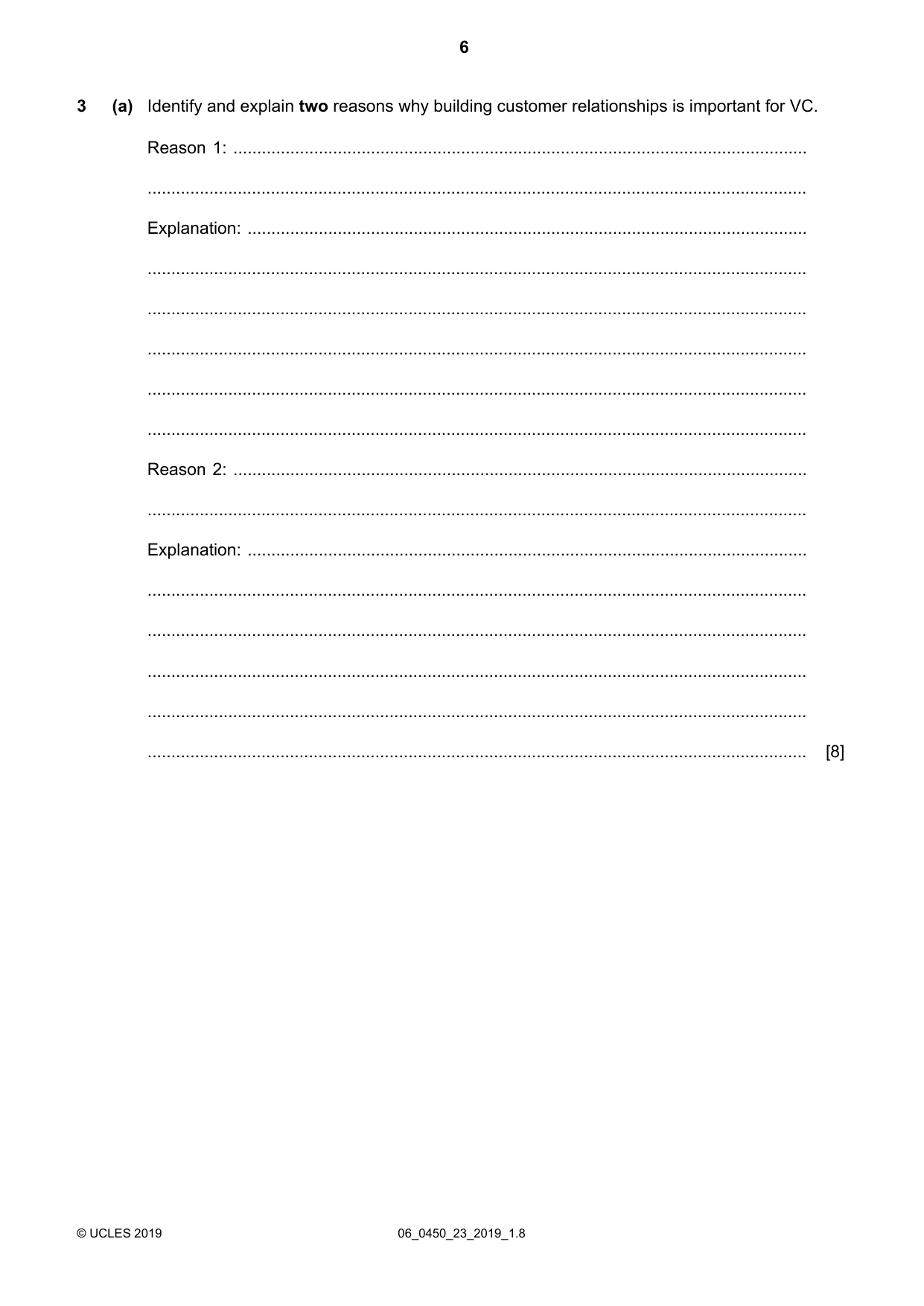
Question paper, page 6
Identify and explain two reasons why building customer relationships is important for VC. (a) 3 Reason 1: … … Explanation: … … … … … … Reason 2: … … Explanation: … … … … … … [8] 06_0450_23_2019_1.8 © UCLES 2019 6
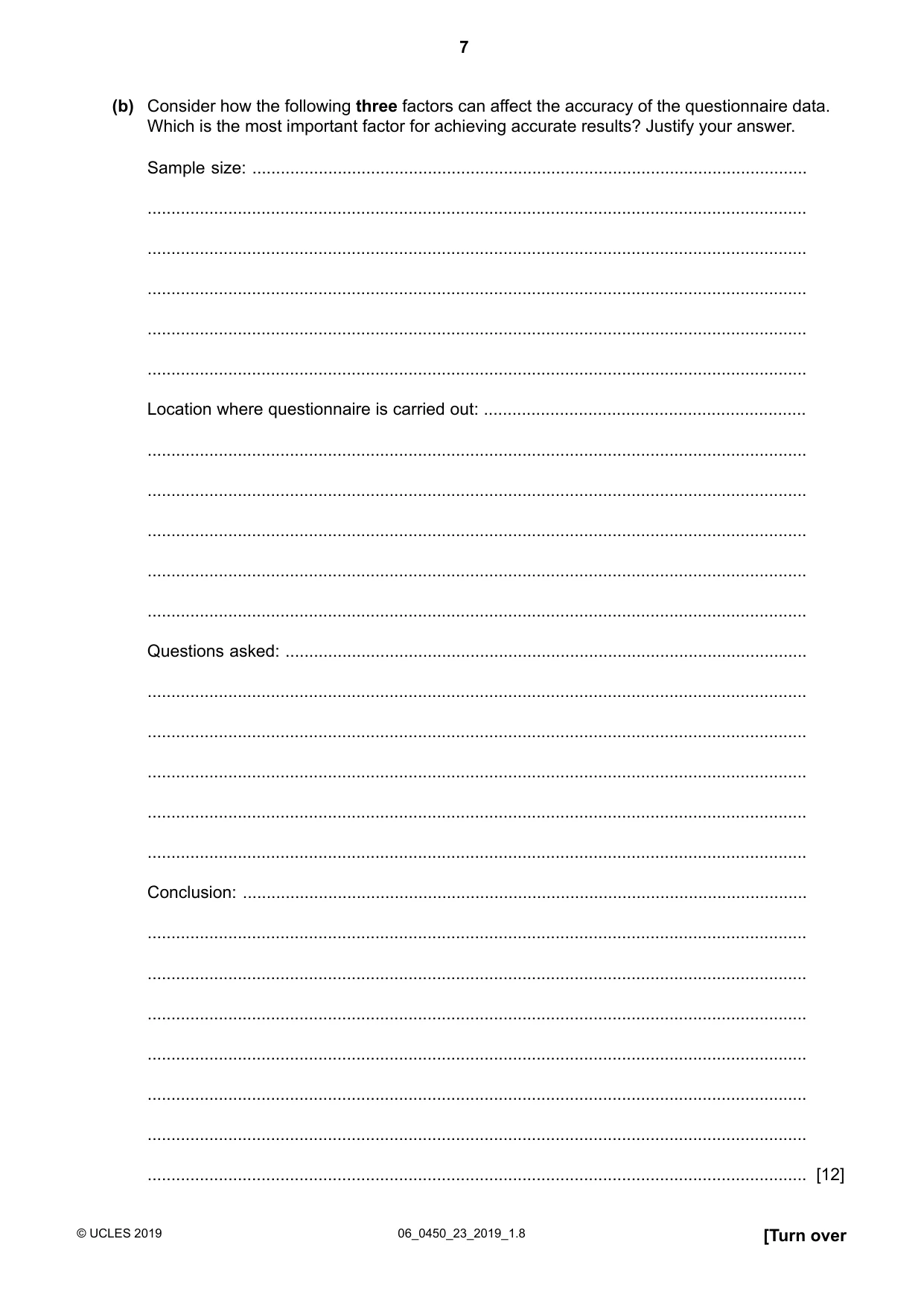
Question paper, page 7
Consider how the following three factors can affect the accuracy of the questionnaire data. Which is the most important factor for achieving accurate results? Justify your answer. (b) Sample size: … … … … … … Location where questionnaire is carried out: … … … … … … Questions asked: … … … … … … Conclusion: … … … … … … … … [12] [Turn over 06_0450_23_2019_1.8 © UCLES 2019 7
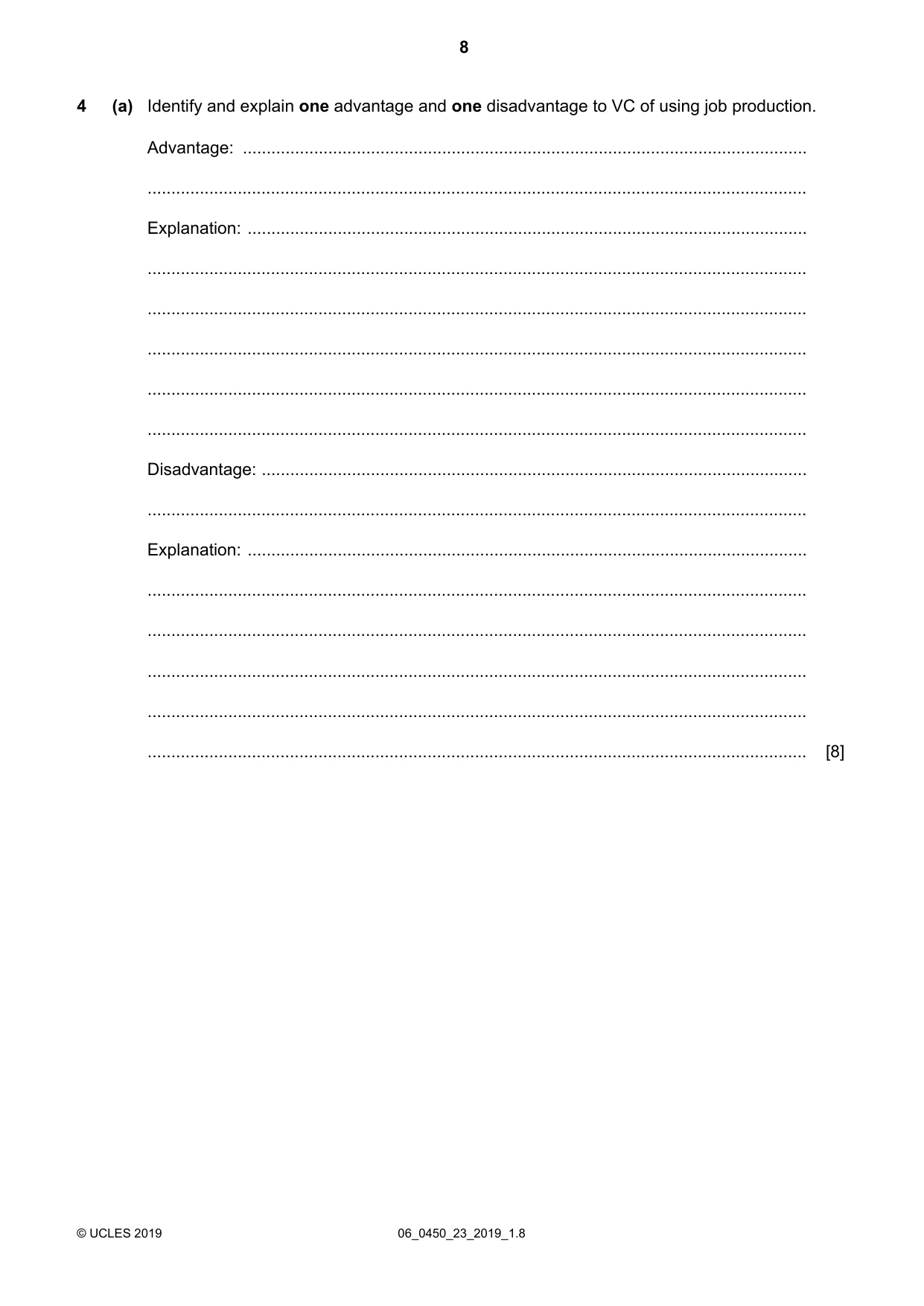
Question paper, page 8
Identify and explain one advantage and one disadvantage to VC of using job production. (a) 4 Advantage: … … Explanation: … … … … … … Disadvantage: … … Explanation: … … … … … … [8] 06_0450_23_2019_1.8 © UCLES 2019 8
Question paper, page 9
Using Appendix 3 and other information, consider whether Peter should be worried about VC’s profitability. Justify your answer using profitability ratios. (b) … … … … … … … … … … … … … … … … … … … … … … … … … … [12] 06_0450_23_2019_1.8 © UCLES 2019 9
Question paper, page 10
BLANK PAGE 06_0450_23_2019_1.8 © UCLES 2019 10
Question paper, page 11
BLANK PAGE 06_0450_23_2019_1.8 © UCLES 2019 11
Question paper, page 12
BLANK PAGE Permission to reproduce items where third-party owned material protected by copyright is included has been sought and cleared where possible. Every reasonable effort has been made by the publisher (UCLES) to trace copyright holders, but if any items requiring clearance have unwittingly been included, the publisher will be pleased to make amends at the earliest possible opportunity. To avoid the issue of disclosure of answer-related information to candidates, all copyright acknowledgements are reproduced online in the Cambridge Assessment International Education Copyright Acknowledgements Booklet. This is produced for each series of examinations and is freely available to download at www.cambridgeinternational.org after the live examination series. Cambridge Assessment International Education is part of the Cambridge Assessment Group. Cambridge Assessment is the brand name of the University of Cambridge Local Examinations Syndicate (UCLES), which itself is a department of the University of Cambridge. 06_0450_23_2019_1.8 © UCLES 2019 12
Mark scheme, page 1
This syllabus is regulated for use in England, Wales and Northern Ireland as a Cambridge International Level 1/Level 2 Certificate. This document consists of 14 printed pages. © UCLES 2019 [Turn over Cambridge Assessment International Education Cambridge International General Certificate of Secondary Education BUSINESS STUDIES 0450/23 Paper 2 Case Study May/June 2019 MARK SCHEME Maximum Mark: 80 Published This mark scheme is published as an aid to teachers and candidates, to indicate the requirements of the examination. It shows the basis on which Examiners were instructed to award marks. It does not indicate the details of the discussions that took place at an Examiners’ meeting before marking began, which would have considered the acceptability of alternative answers. Mark schemes should be read in conjunction with the question paper and the Principal Examiner Report for Teachers. Cambridge International will not enter into discussions about these mark schemes. Cambridge International is publishing the mark schemes for the May/June 2019 series for most Cambridge IGCSE™, Cambridge International A and AS Level and Cambridge Pre-U components, and some Cambridge O Level components.
Mark scheme, page 2
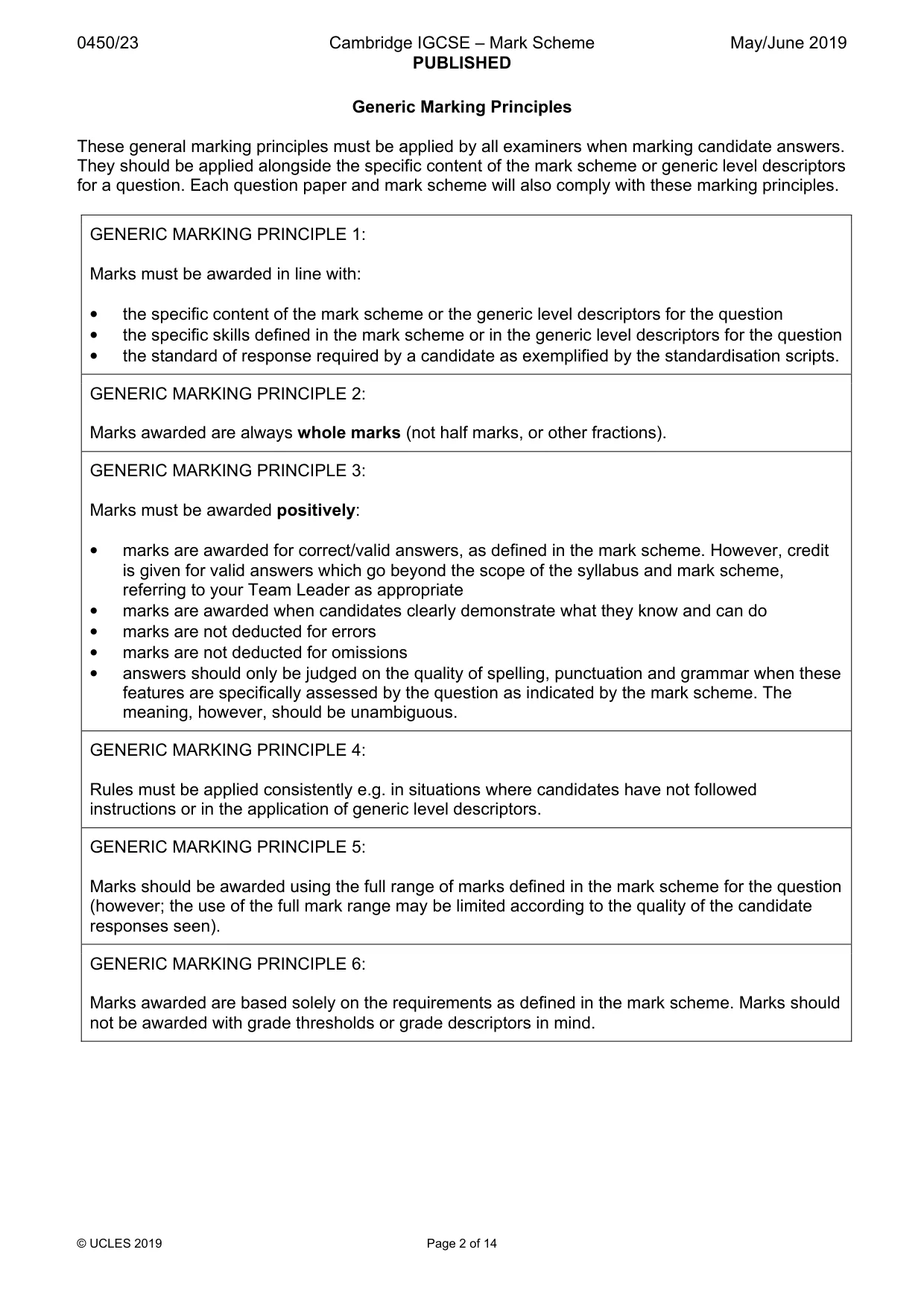
0450/23 Cambridge IGCSE – Mark Scheme PUBLISHED May/June 2019 © UCLES 2019 Page 2 of 14 Generic Marking Principles These general marking principles must be applied by all examiners when marking candidate answers. They should be applied alongside the specific content of the mark scheme or generic level descriptors for a question. Each question paper and mark scheme will also comply with these marking principles. GENERIC MARKING PRINCIPLE 1: Marks must be awarded in line with: • the specific content of the mark scheme or the generic level descriptors for the question • the specific skills defined in the mark scheme or in the generic level descriptors for the question • the standard of response required by a candidate as exemplified by the standardisation scripts. GENERIC MARKING PRINCIPLE 2: Marks awarded are always whole marks (not half marks, or other fractions). GENERIC MARKING PRINCIPLE 3: Marks must be awarded positively: • marks are awarded for correct/valid answers, as defined in the mark scheme. However, credit is given for valid answers which go beyond the scope of the syllabus and mark scheme, referring to your Team Leader as appropriate • marks are awarded when candidates clearly demonstrate what they know and can do • marks are not deducted for errors • marks are not deducted for omissions • answers should only be judged on the quality of spelling, punctuation and grammar when these features are specifically assessed by the question as indicated by the mark scheme. The meaning, however, should be unambiguous. GENERIC MARKING PRINCIPLE 4: Rules must be applied consistently e.g. in situations where candidates have not followed instructions or in the application of generic level descriptors. GENERIC MARKING PRINCIPLE 5: Marks should be awarded using the full range of marks defined in the mark scheme for the question (however; the use of the full mark range may be limited according to the quality of the candidate responses seen). GENERIC MARKING PRINCIPLE 6: Marks awarded are based solely on the requirements as defined in the mark scheme. Marks should not be awarded with grade thresholds or grade descriptors in mind.
Mark scheme, page 3
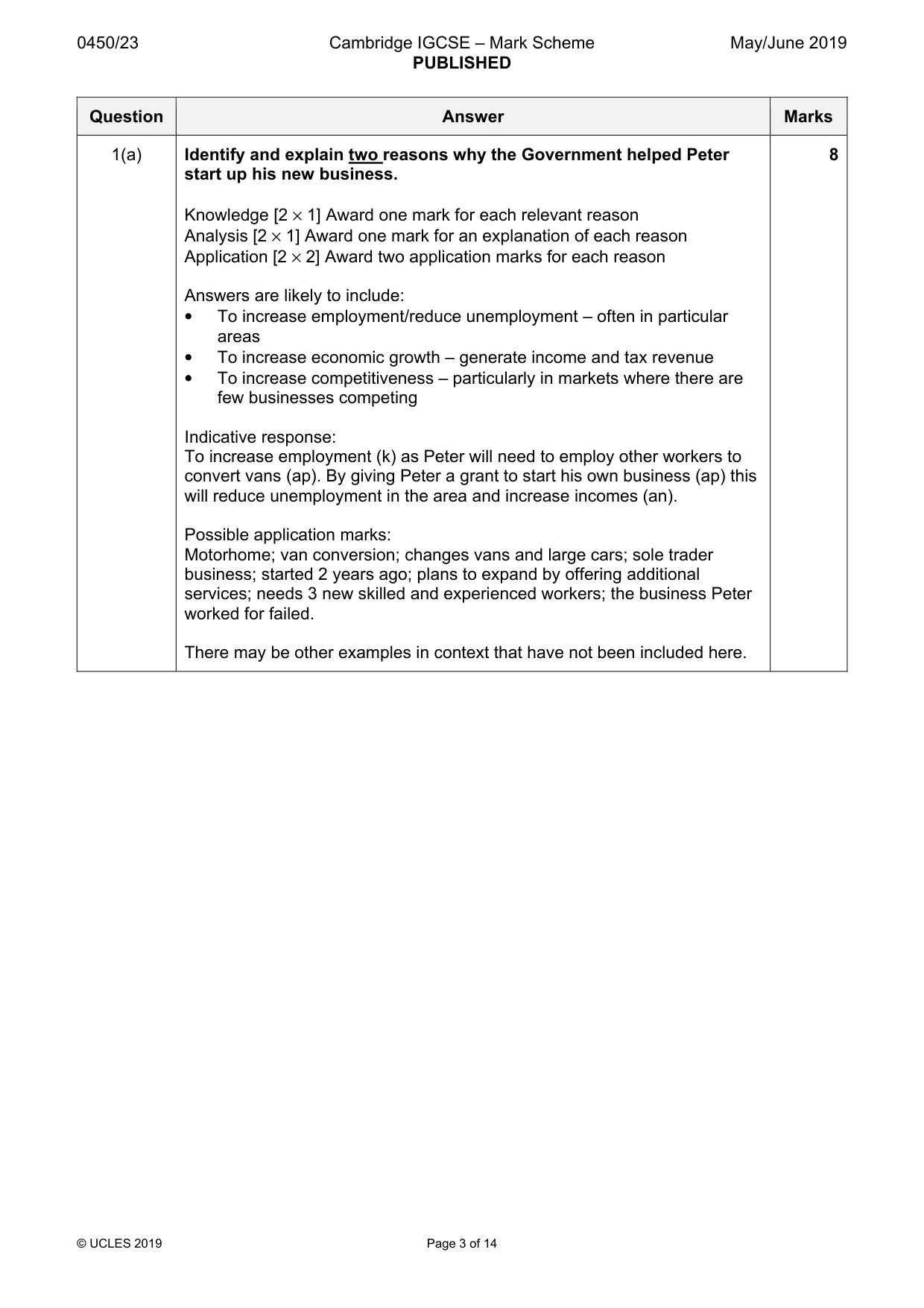
0450/23 Cambridge IGCSE – Mark Scheme PUBLISHED May/June 2019 © UCLES 2019 Page 3 of 14 Question Answer Marks 1(a) Identify and explain two reasons why the Government helped Peter start up his new business. Knowledge [2 × 1] Award one mark for each relevant reason Analysis [2 × 1] Award one mark for an explanation of each reason Application [2 × 2] Award two application marks for each reason Answers are likely to include: • To increase employment/reduce unemployment – often in particular areas • To increase economic growth – generate income and tax revenue • To increase competitiveness – particularly in markets where there are few businesses competing Indicative response: To increase employment (k) as Peter will need to employ other workers to convert vans (ap). By giving Peter a grant to start his own business (ap) this will reduce unemployment in the area and increase incomes (an). Possible application marks: Motorhome; van conversion; changes vans and large cars; sole trader business; started 2 years ago; plans to expand by offering additional services; needs 3 new skilled and experienced workers; the business Peter worked for failed. There may be other examples in context that have not been included here. 8
Mark scheme, page 4
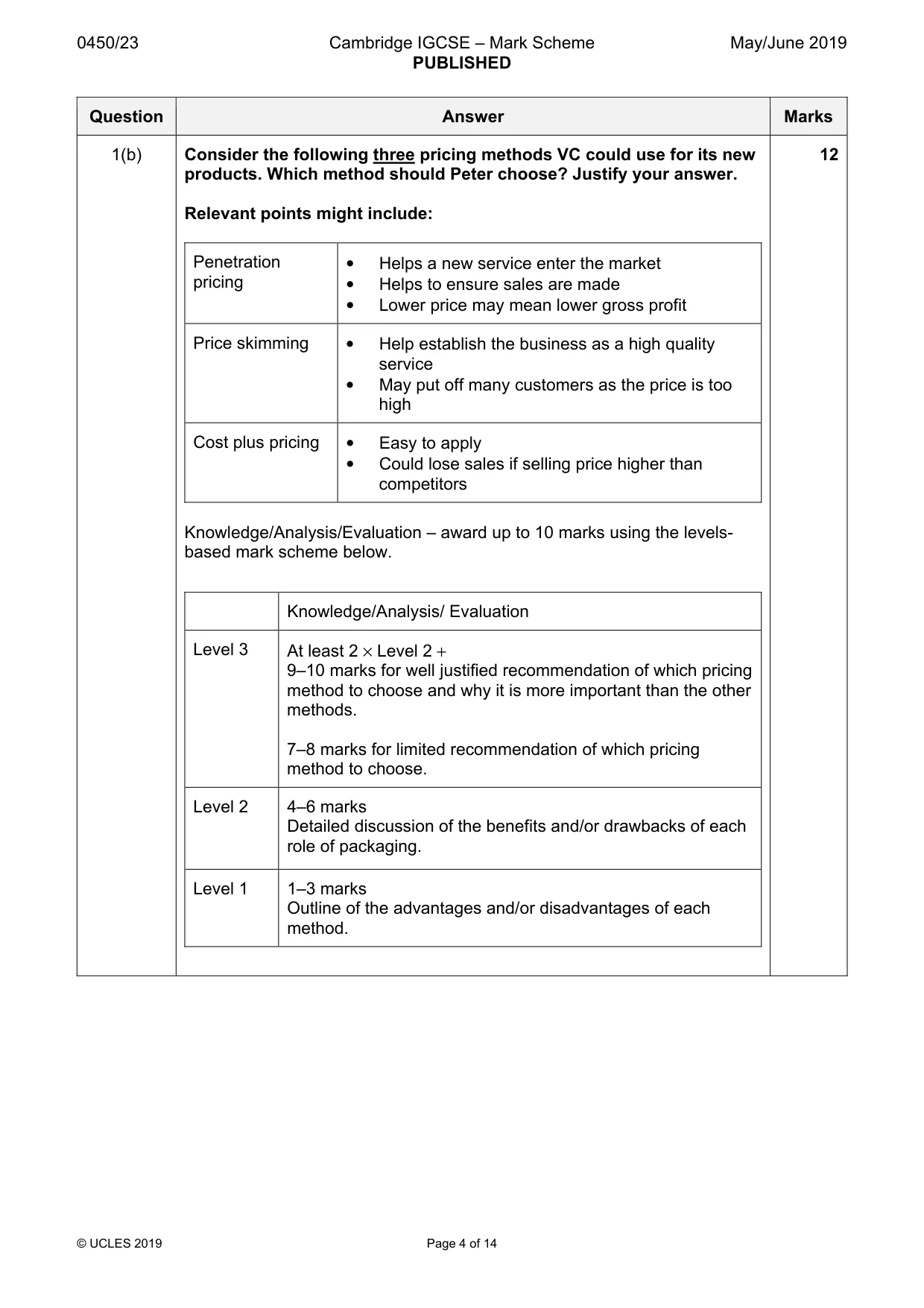
0450/23 Cambridge IGCSE – Mark Scheme PUBLISHED May/June 2019 © UCLES 2019 Page 4 of 14 Question Answer Marks 1(b) Consider the following three pricing methods VC could use for its new products. Which method should Peter choose? Justify your answer. Relevant points might include: Penetration pricing • Helps a new service enter the market • Helps to ensure sales are made • Lower price may mean lower gross profit Price skimming • Help establish the business as a high quality service • May put off many customers as the price is too high Cost plus pricing • Easy to apply • Could lose sales if selling price higher than competitors Knowledge/Analysis/Evaluation – award up to 10 marks using the levels- based mark scheme below. Knowledge/Analysis/ Evaluation Level 3 At least 2 × Level 2 + 9–10 marks for well justified recommendation of which pricing method to choose and why it is more important than the other methods. 7–8 marks for limited recommendation of which pricing method to choose. Level 2 4–6 marks Detailed discussion of the benefits and/or drawbacks of each role of packaging. Level 1 1–3 marks Outline of the advantages and/or disadvantages of each method. 12
Mark scheme, page 5
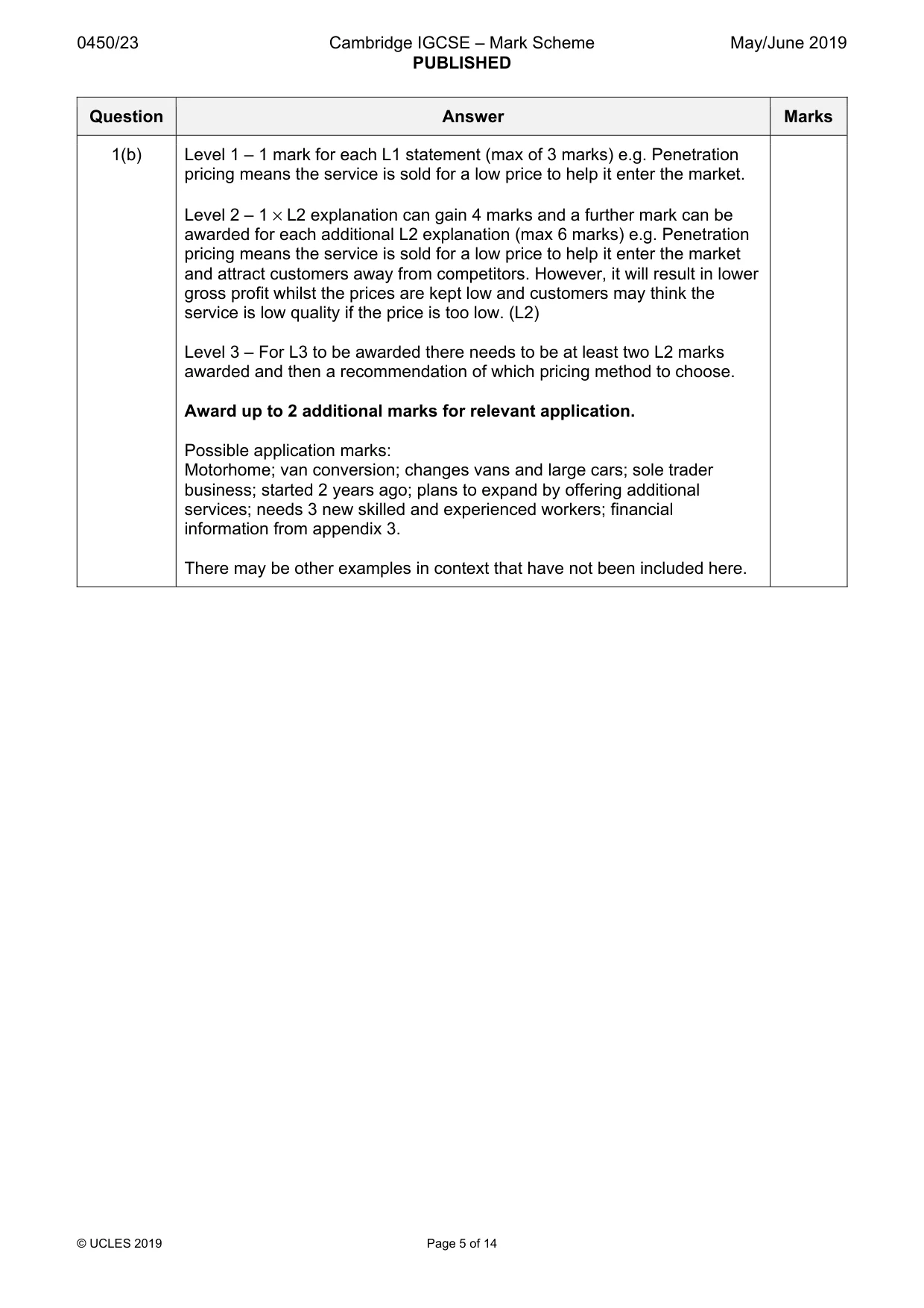
0450/23 Cambridge IGCSE – Mark Scheme PUBLISHED May/June 2019 © UCLES 2019 Page 5 of 14 Question Answer Marks 1(b) Level 1 – 1 mark for each L1 statement (max of 3 marks) e.g. Penetration pricing means the service is sold for a low price to help it enter the market. Level 2 – 1 × L2 explanation can gain 4 marks and a further mark can be awarded for each additional L2 explanation (max 6 marks) e.g. Penetration pricing means the service is sold for a low price to help it enter the market and attract customers away from competitors. However, it will result in lower gross profit whilst the prices are kept low and customers may think the service is low quality if the price is too low. (L2) Level 3 – For L3 to be awarded there needs to be at least two L2 marks awarded and then a recommendation of which pricing method to choose. Award up to 2 additional marks for relevant application. Possible application marks: Motorhome; van conversion; changes vans and large cars; sole trader business; started 2 years ago; plans to expand by offering additional services; needs 3 new skilled and experienced workers; financial information from appendix 3. There may be other examples in context that have not been included here.
Mark scheme, page 6
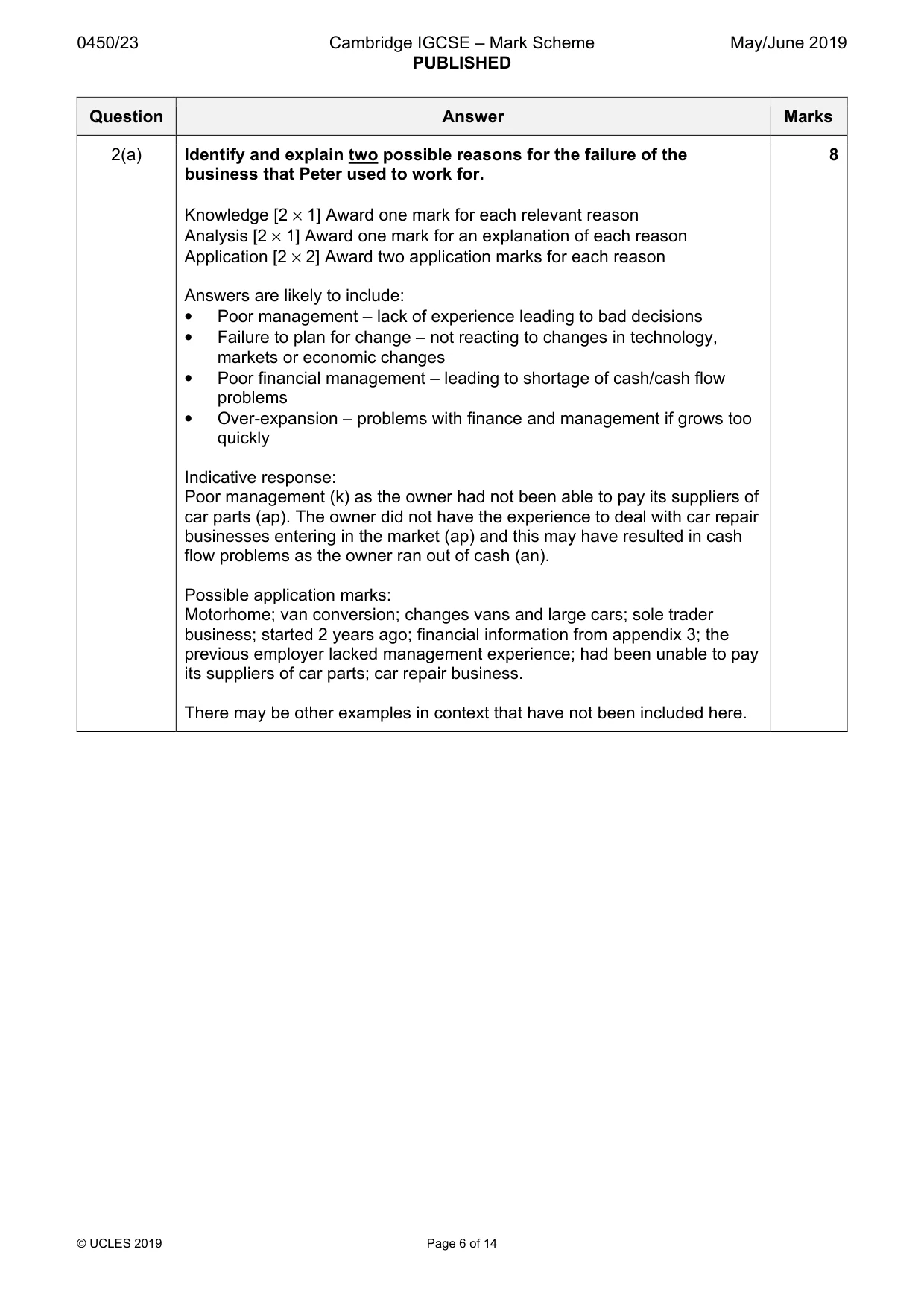
0450/23 Cambridge IGCSE – Mark Scheme PUBLISHED May/June 2019 © UCLES 2019 Page 6 of 14 Question Answer Marks 2(a) Identify and explain two possible reasons for the failure of the business that Peter used to work for. Knowledge [2 × 1] Award one mark for each relevant reason Analysis [2 × 1] Award one mark for an explanation of each reason Application [2 × 2] Award two application marks for each reason Answers are likely to include: • Poor management – lack of experience leading to bad decisions • Failure to plan for change – not reacting to changes in technology, markets or economic changes • Poor financial management – leading to shortage of cash/cash flow problems • Over-expansion – problems with finance and management if grows too quickly Indicative response: Poor management (k) as the owner had not been able to pay its suppliers of car parts (ap). The owner did not have the experience to deal with car repair businesses entering in the market (ap) and this may have resulted in cash flow problems as the owner ran out of cash (an). Possible application marks: Motorhome; van conversion; changes vans and large cars; sole trader business; started 2 years ago; financial information from appendix 3; the previous employer lacked management experience; had been unable to pay its suppliers of car parts; car repair business. There may be other examples in context that have not been included here. 8
Mark scheme, page 7
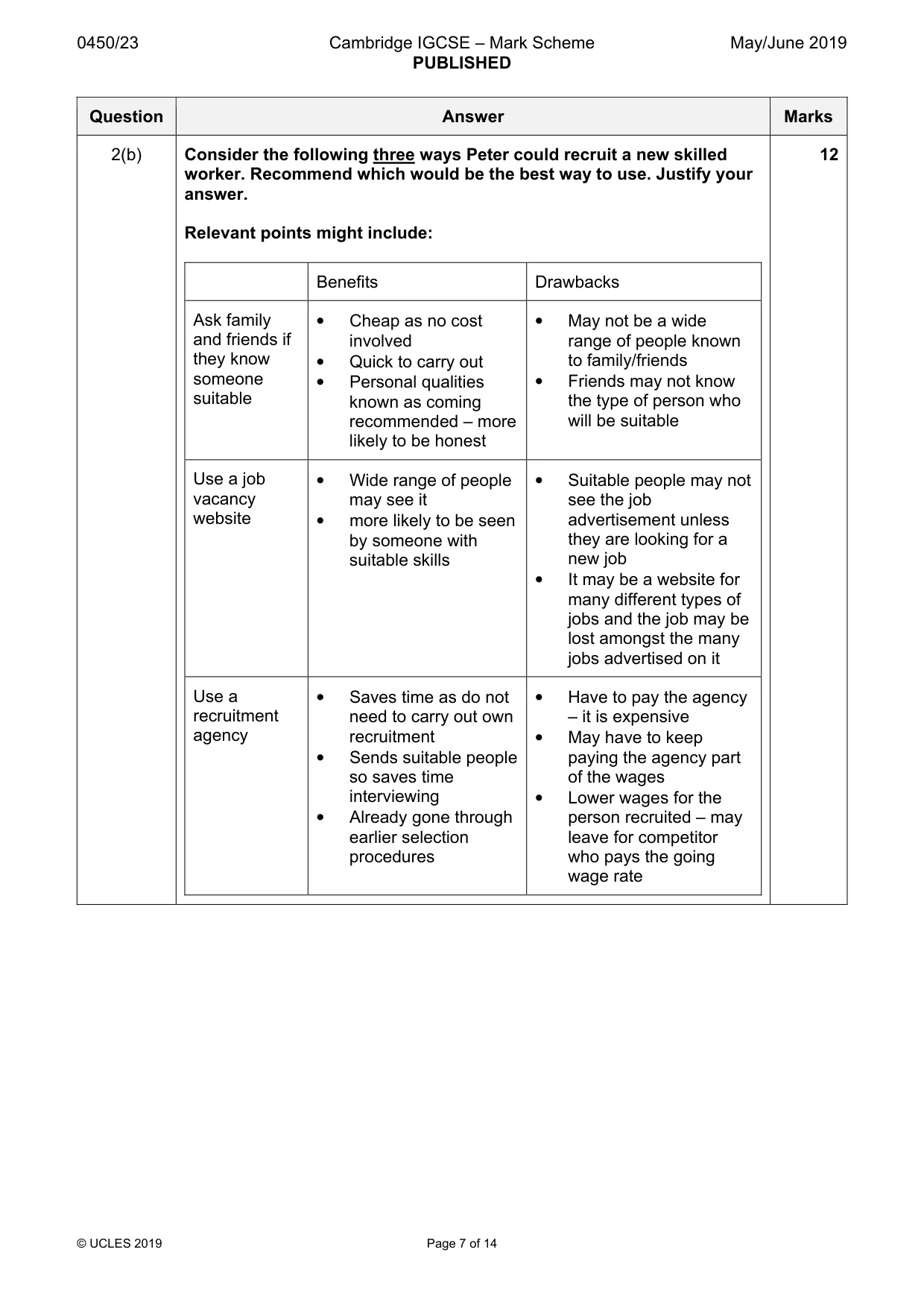
0450/23 Cambridge IGCSE – Mark Scheme PUBLISHED May/June 2019 © UCLES 2019 Page 7 of 14 Question Answer Marks 2(b) Consider the following three ways Peter could recruit a new skilled worker. Recommend which would be the best way to use. Justify your answer. Relevant points might include: Benefits Drawbacks Ask family and friends if they know someone suitable • Cheap as no cost involved • Quick to carry out • Personal qualities known as coming recommended – more likely to be honest • May not be a wide range of people known to family/friends • Friends may not know the type of person who will be suitable Use a job vacancy website • Wide range of people may see it • more likely to be seen by someone with suitable skills • Suitable people may not see the job advertisement unless they are looking for a new job • It may be a website for many different types of jobs and the job may be lost amongst the many jobs advertised on it Use a recruitment agency • Saves time as do not need to carry out own recruitment • Sends suitable people so saves time interviewing • Already gone through earlier selection procedures • Have to pay the agency – it is expensive • May have to keep paying the agency part of the wages • Lower wages for the person recruited – may leave for competitor who pays the going wage rate 12
Mark scheme, page 8
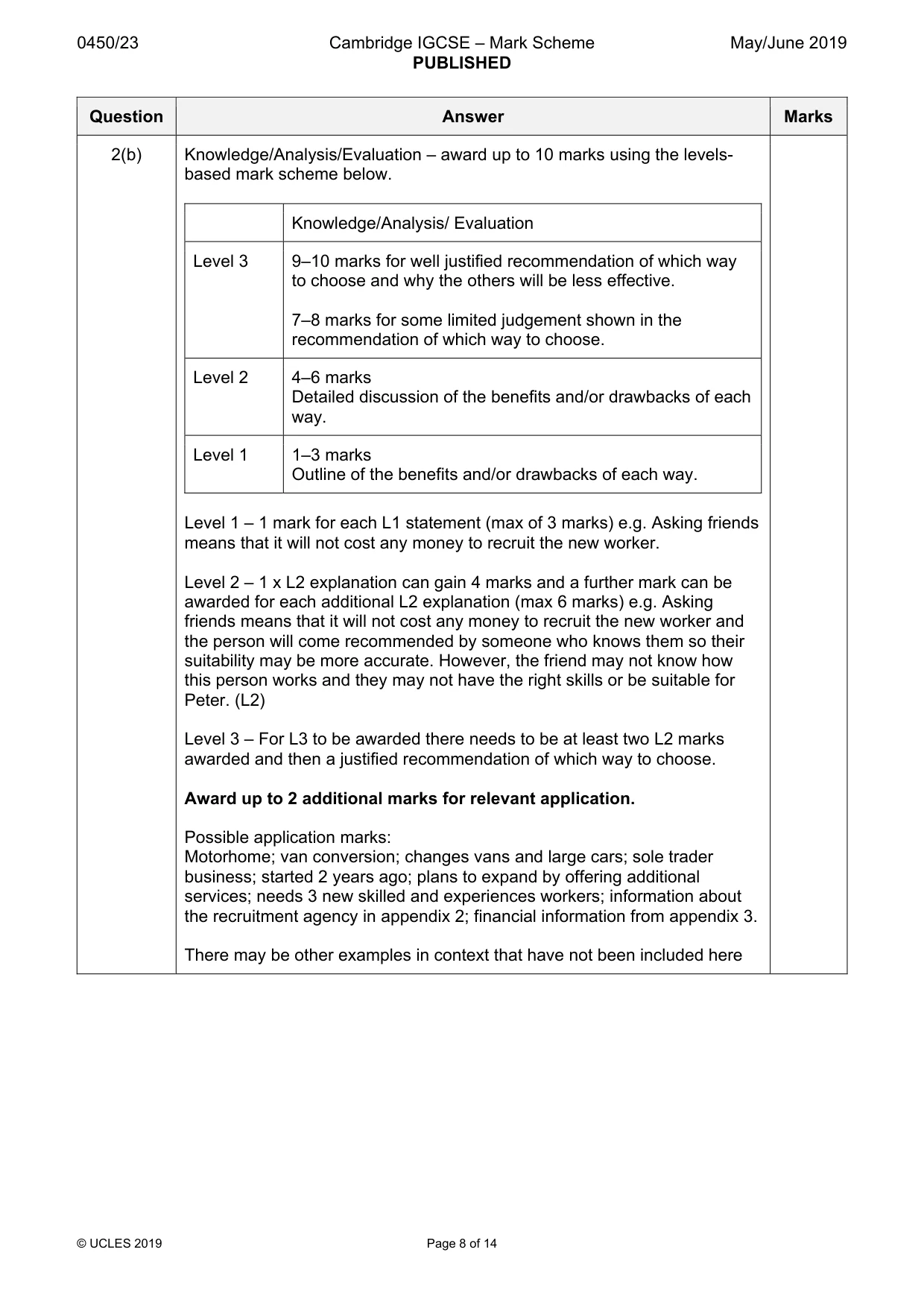
0450/23 Cambridge IGCSE – Mark Scheme PUBLISHED May/June 2019 © UCLES 2019 Page 8 of 14 Question Answer Marks 2(b) Knowledge/Analysis/Evaluation – award up to 10 marks using the levels- based mark scheme below. Knowledge/Analysis/ Evaluation Level 3 9–10 marks for well justified recommendation of which way to choose and why the others will be less effective. 7–8 marks for some limited judgement shown in the recommendation of which way to choose. Level 2 4–6 marks Detailed discussion of the benefits and/or drawbacks of each way. Level 1 1–3 marks Outline of the benefits and/or drawbacks of each way. Level 1 – 1 mark for each L1 statement (max of 3 marks) e.g. Asking friends means that it will not cost any money to recruit the new worker. Level 2 – 1 x L2 explanation can gain 4 marks and a further mark can be awarded for each additional L2 explanation (max 6 marks) e.g. Asking friends means that it will not cost any money to recruit the new worker and the person will come recommended by someone who knows them so their suitability may be more accurate. However, the friend may not know how this person works and they may not have the right skills or be suitable for Peter. (L2) Level 3 – For L3 to be awarded there needs to be at least two L2 marks awarded and then a justified recommendation of which way to choose. Award up to 2 additional marks for relevant application. Possible application marks: Motorhome; van conversion; changes vans and large cars; sole trader business; started 2 years ago; plans to expand by offering additional services; needs 3 new skilled and experiences workers; information about the recruitment agency in appendix 2; financial information from appendix 3. There may be other examples in context that have not been included here
Mark scheme, page 9
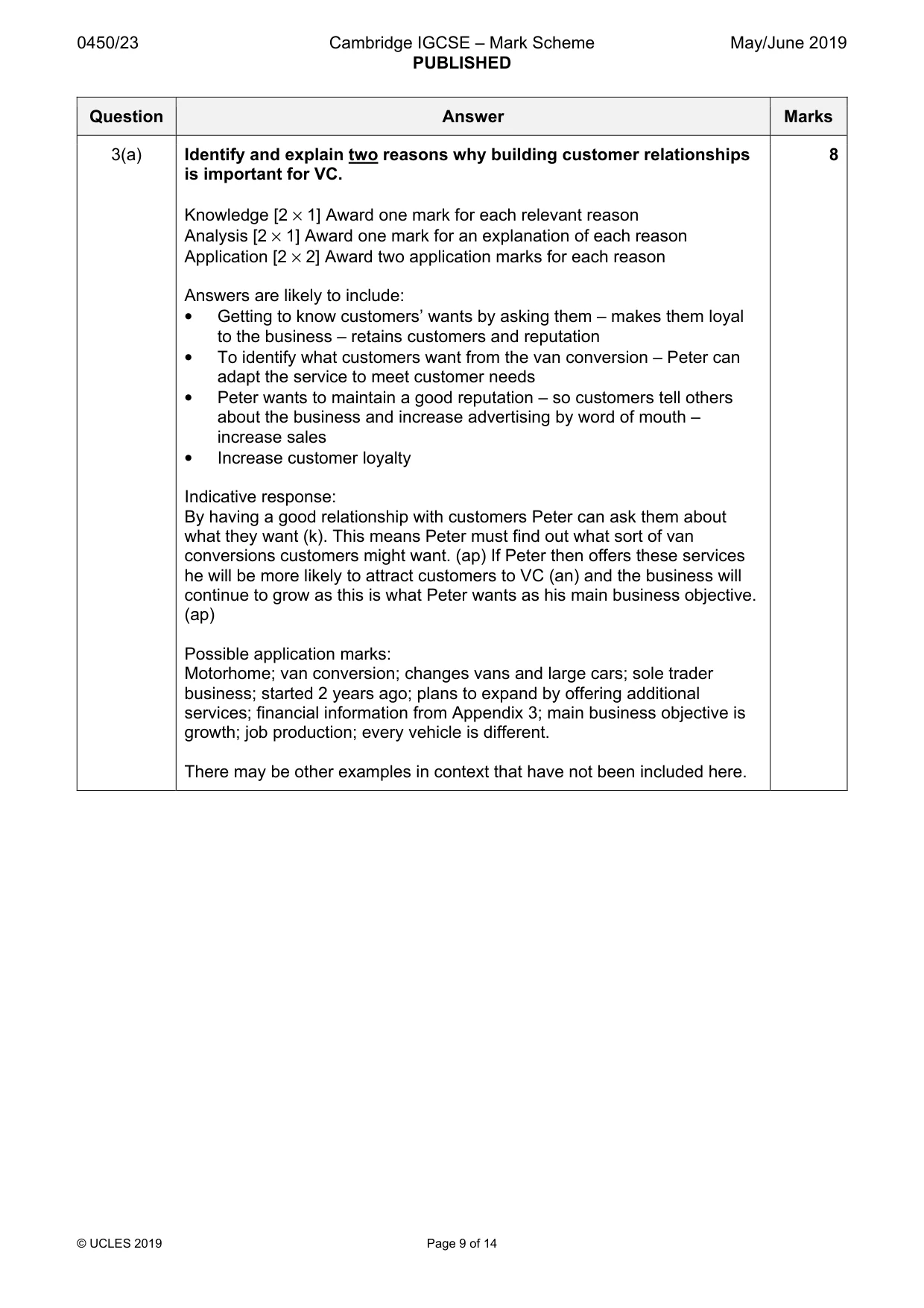
0450/23 Cambridge IGCSE – Mark Scheme PUBLISHED May/June 2019 © UCLES 2019 Page 9 of 14 Question Answer Marks 3(a) Identify and explain two reasons why building customer relationships is important for VC. Knowledge [2 × 1] Award one mark for each relevant reason Analysis [2 × 1] Award one mark for an explanation of each reason Application [2 × 2] Award two application marks for each reason Answers are likely to include: • Getting to know customers’ wants by asking them – makes them loyal to the business – retains customers and reputation • To identify what customers want from the van conversion – Peter can adapt the service to meet customer needs • Peter wants to maintain a good reputation – so customers tell others about the business and increase advertising by word of mouth – increase sales • Increase customer loyalty Indicative response: By having a good relationship with customers Peter can ask them about what they want (k). This means Peter must find out what sort of van conversions customers might want. (ap) If Peter then offers these services he will be more likely to attract customers to VC (an) and the business will continue to grow as this is what Peter wants as his main business objective. (ap) Possible application marks: Motorhome; van conversion; changes vans and large cars; sole trader business; started 2 years ago; plans to expand by offering additional services; financial information from Appendix 3; main business objective is growth; job production; every vehicle is different. There may be other examples in context that have not been included here. 8
Mark scheme, page 10
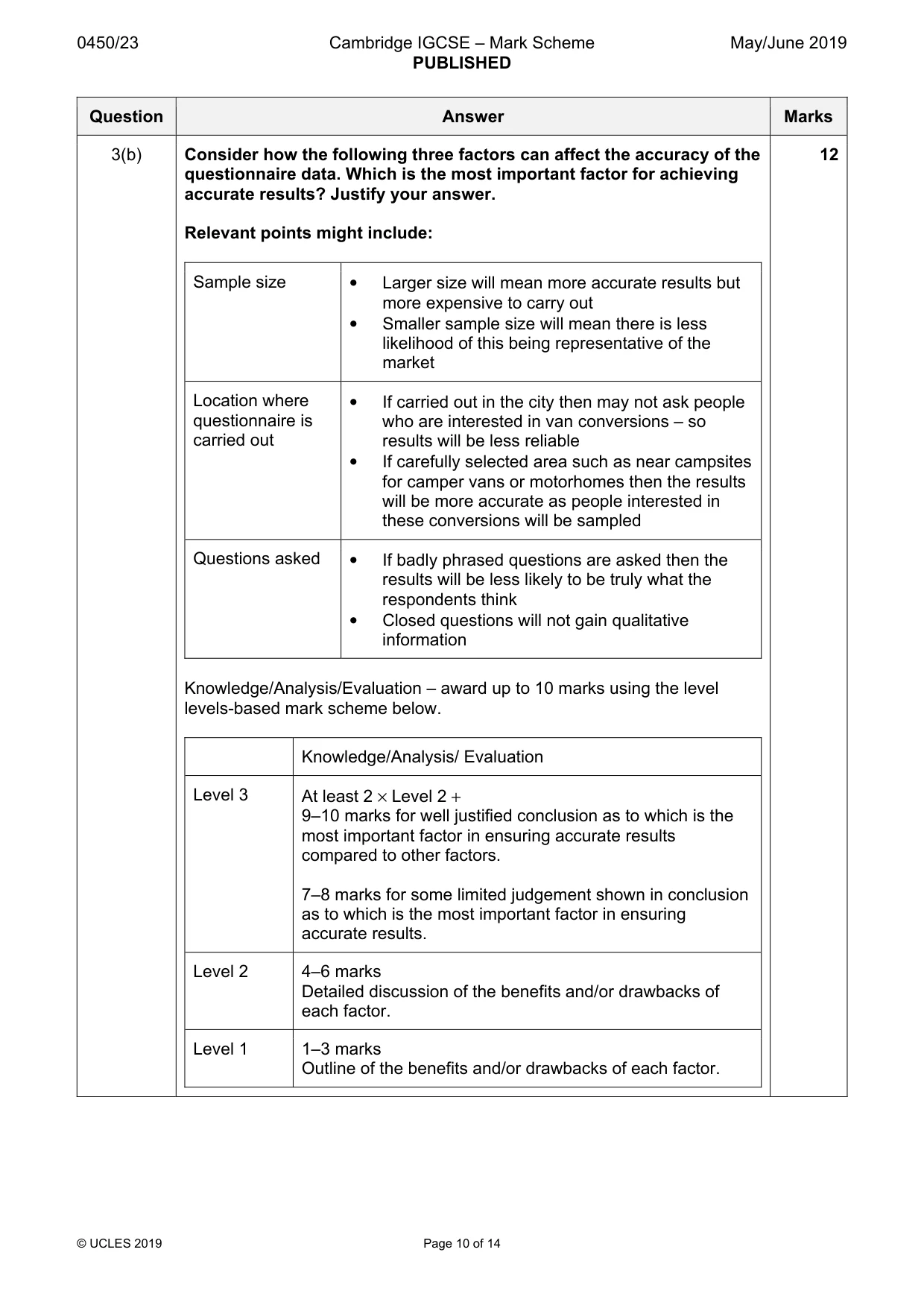
0450/23 Cambridge IGCSE – Mark Scheme PUBLISHED May/June 2019 © UCLES 2019 Page 10 of 14 Question Answer Marks 3(b) Consider how the following three factors can affect the accuracy of the questionnaire data. Which is the most important factor for achieving accurate results? Justify your answer. Relevant points might include: Sample size • Larger size will mean more accurate results but more expensive to carry out • Smaller sample size will mean there is less likelihood of this being representative of the market Location where questionnaire is carried out • If carried out in the city then may not ask people who are interested in van conversions – so results will be less reliable • If carefully selected area such as near campsites for camper vans or motorhomes then the results will be more accurate as people interested in these conversions will be sampled Questions asked • If badly phrased questions are asked then the results will be less likely to be truly what the respondents think • Closed questions will not gain qualitative information Knowledge/Analysis/Evaluation – award up to 10 marks using the level levels-based mark scheme below. Knowledge/Analysis/ Evaluation Level 3 At least 2 × Level 2 + 9–10 marks for well justified conclusion as to which is the most important factor in ensuring accurate results compared to other factors. 7–8 marks for some limited judgement shown in conclusion as to which is the most important factor in ensuring accurate results. Level 2 4–6 marks Detailed discussion of the benefits and/or drawbacks of each factor. Level 1 1–3 marks Outline of the benefits and/or drawbacks of each factor. 12
Mark scheme, page 11
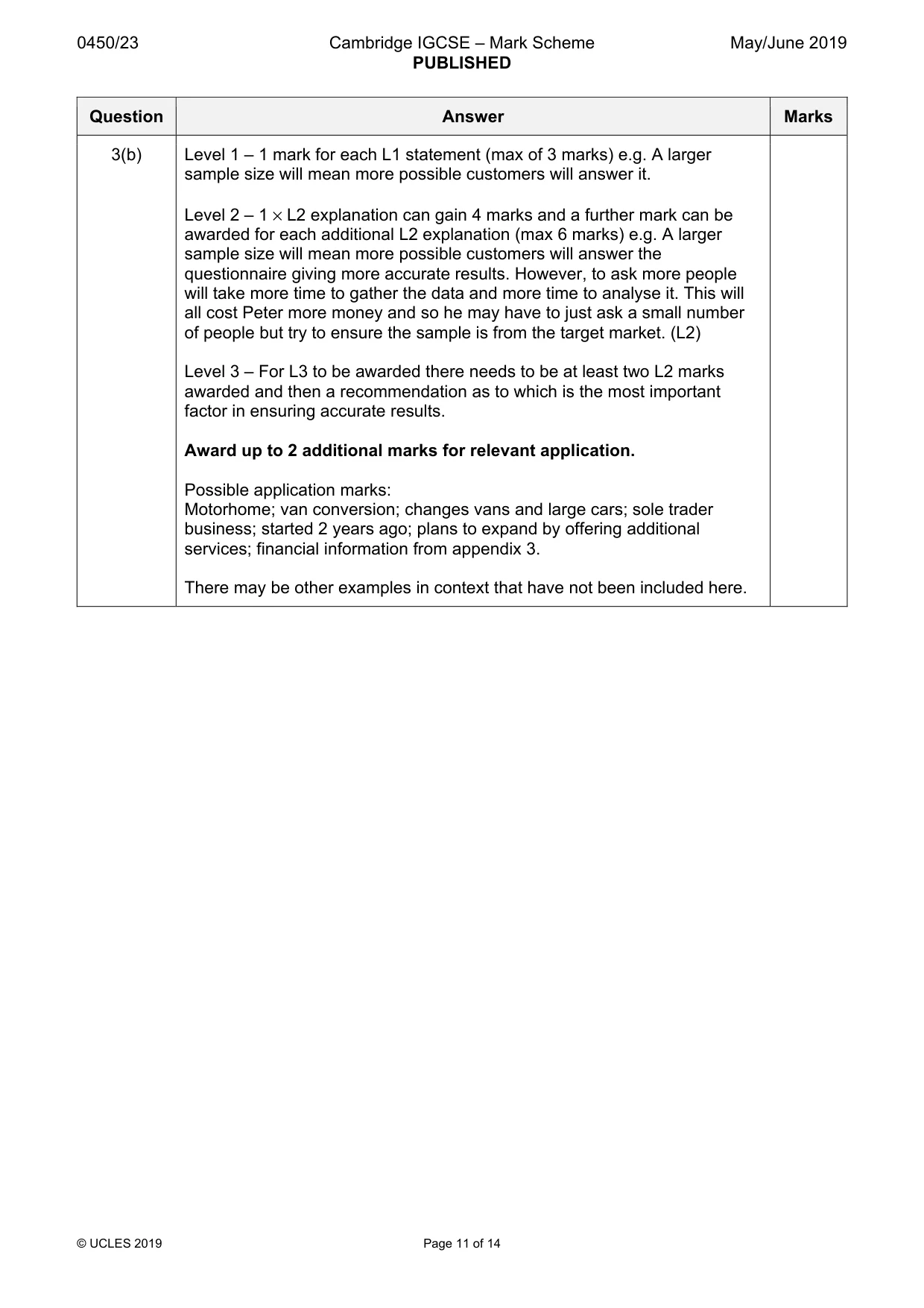
0450/23 Cambridge IGCSE – Mark Scheme PUBLISHED May/June 2019 © UCLES 2019 Page 11 of 14 Question Answer Marks 3(b) Level 1 – 1 mark for each L1 statement (max of 3 marks) e.g. A larger sample size will mean more possible customers will answer it. Level 2 – 1 × L2 explanation can gain 4 marks and a further mark can be awarded for each additional L2 explanation (max 6 marks) e.g. A larger sample size will mean more possible customers will answer the questionnaire giving more accurate results. However, to ask more people will take more time to gather the data and more time to analyse it. This will all cost Peter more money and so he may have to just ask a small number of people but try to ensure the sample is from the target market. (L2) Level 3 – For L3 to be awarded there needs to be at least two L2 marks awarded and then a recommendation as to which is the most important factor in ensuring accurate results. Award up to 2 additional marks for relevant application. Possible application marks: Motorhome; van conversion; changes vans and large cars; sole trader business; started 2 years ago; plans to expand by offering additional services; financial information from appendix 3. There may be other examples in context that have not been included here.
Mark scheme, page 12
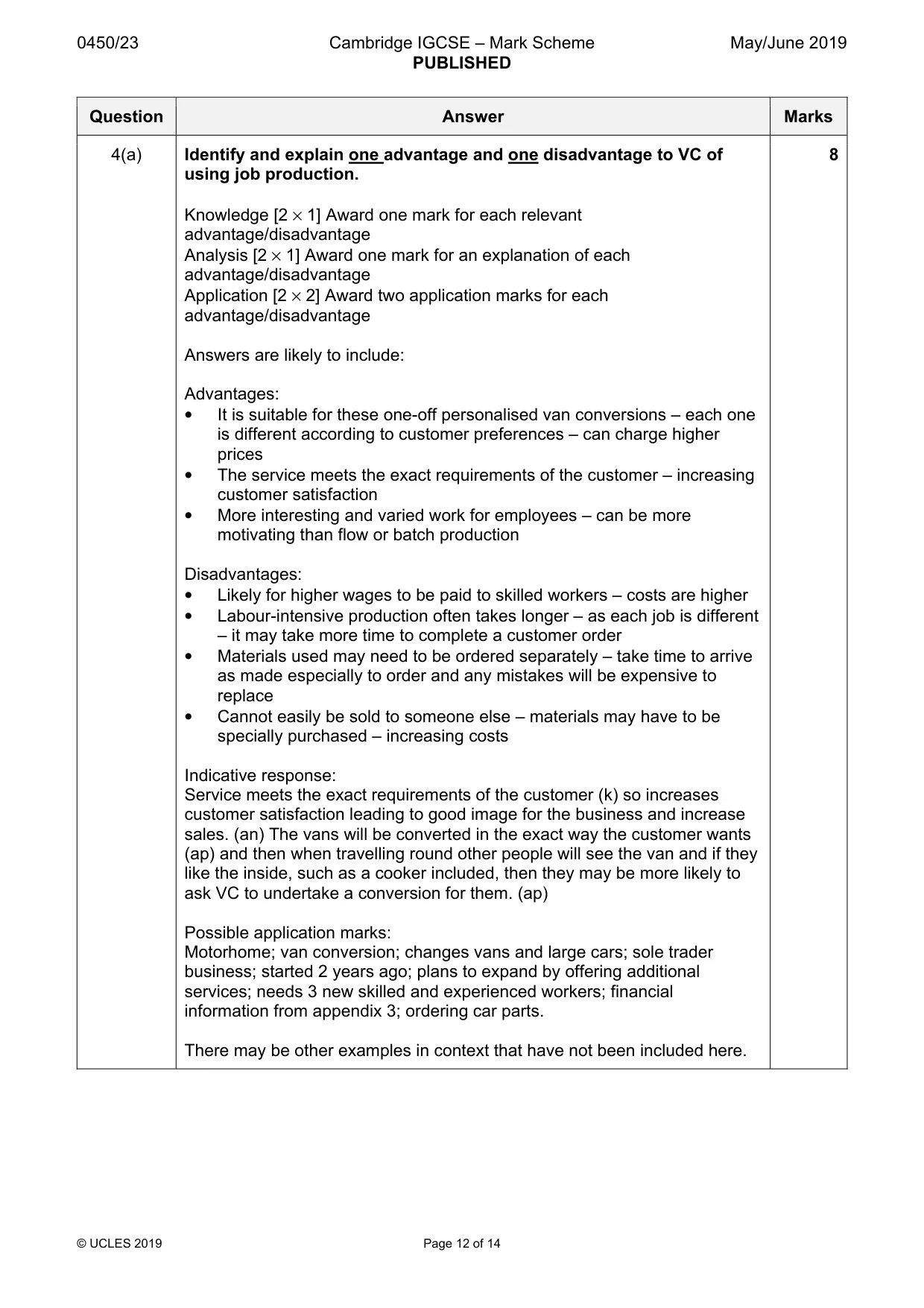
0450/23 Cambridge IGCSE – Mark Scheme PUBLISHED May/June 2019 © UCLES 2019 Page 12 of 14 Question Answer Marks 4(a) Identify and explain one advantage and one disadvantage to VC of using job production. Knowledge [2 × 1] Award one mark for each relevant advantage/disadvantage Analysis [2 × 1] Award one mark for an explanation of each advantage/disadvantage Application [2 × 2] Award two application marks for each advantage/disadvantage Answers are likely to include: Advantages: • It is suitable for these one-off personalised van conversions – each one is different according to customer preferences – can charge higher prices • The service meets the exact requirements of the customer – increasing customer satisfaction • More interesting and varied work for employees – can be more motivating than flow or batch production Disadvantages: • Likely for higher wages to be paid to skilled workers – costs are higher • Labour-intensive production often takes longer – as each job is different – it may take more time to complete a customer order • Materials used may need to be ordered separately – take time to arrive as made especially to order and any mistakes will be expensive to replace • Cannot easily be sold to someone else – materials may have to be specially purchased – increasing costs Indicative response: Service meets the exact requirements of the customer (k) so increases customer satisfaction leading to good image for the business and increase sales. (an) The vans will be converted in the exact way the customer wants (ap) and then when travelling round other people will see the van and if they like the inside, such as a cooker included, then they may be more likely to ask VC to undertake a conversion for them. (ap) Possible application marks: Motorhome; van conversion; changes vans and large cars; sole trader business; started 2 years ago; plans to expand by offering additional services; needs 3 new skilled and experienced workers; financial information from appendix 3; ordering car parts. There may be other examples in context that have not been included here. 8
Mark scheme, page 13
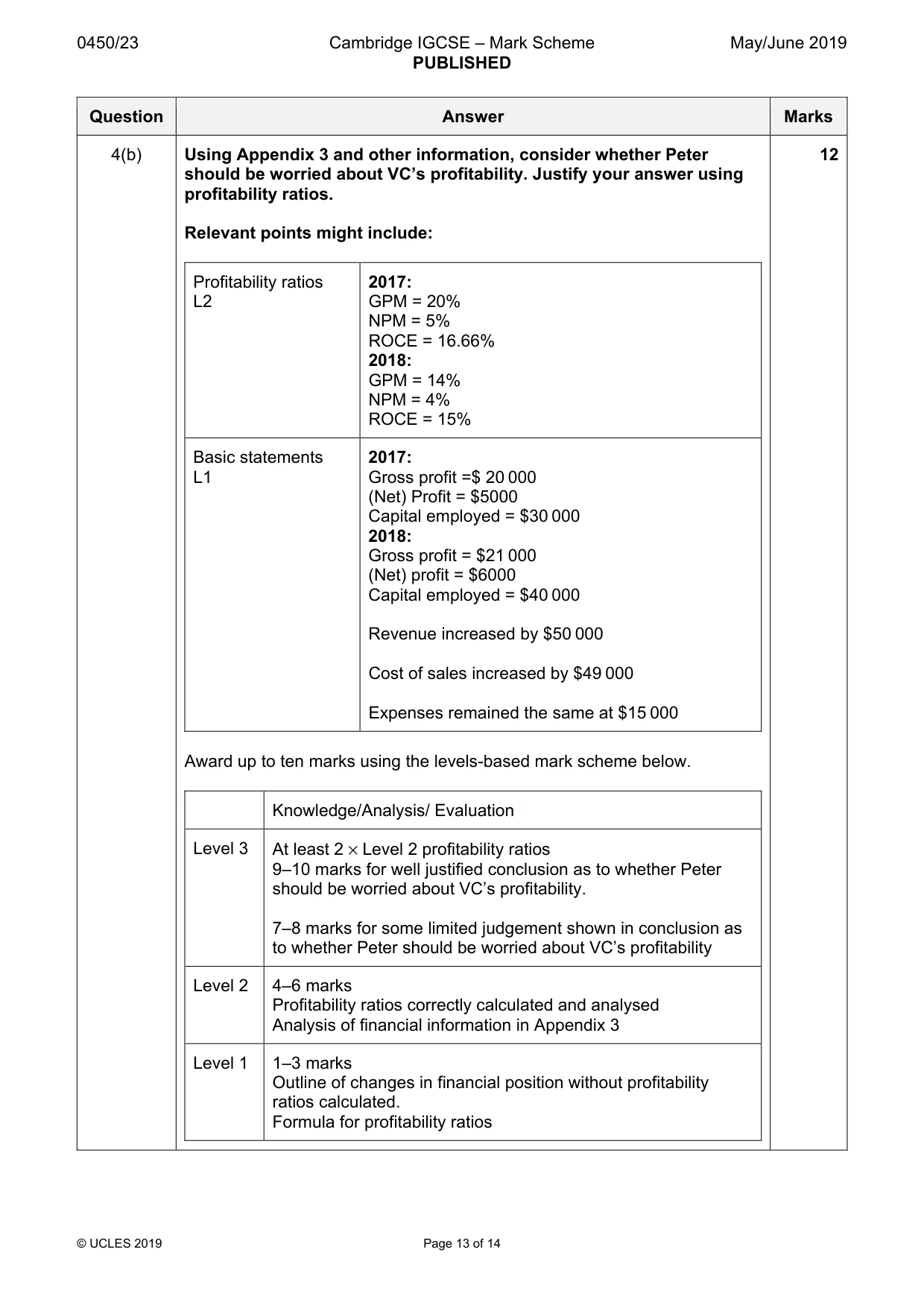
0450/23 Cambridge IGCSE – Mark Scheme PUBLISHED May/June 2019 © UCLES 2019 Page 13 of 14 Question Answer Marks 4(b) Using Appendix 3 and other information, consider whether Peter should be worried about VC’s profitability. Justify your answer using profitability ratios. Relevant points might include: Profitability ratios L2 2017: GPM = 20% NPM = 5% ROCE = 16.66% 2018: GPM = 14% NPM = 4% ROCE = 15% Basic statements L1 2017: Gross profit =$ 20 000 (Net) Profit = $5000 Capital employed = $30 000 2018: Gross profit = $21 000 (Net) profit = $6000 Capital employed = $40 000 Revenue increased by $50 000 Cost of sales increased by $49 000 Expenses remained the same at $15 000 Award up to ten marks using the levels-based mark scheme below. Knowledge/Analysis/ Evaluation Level 3 At least 2 × Level 2 profitability ratios 9–10 marks for well justified conclusion as to whether Peter should be worried about VC’s profitability. 7–8 marks for some limited judgement shown in conclusion as to whether Peter should be worried about VC’s profitability Level 2 4–6 marks Profitability ratios correctly calculated and analysed Analysis of financial information in Appendix 3 Level 1 1–3 marks Outline of changes in financial position without profitability ratios calculated. Formula for profitability ratios 12
Mark scheme, page 14
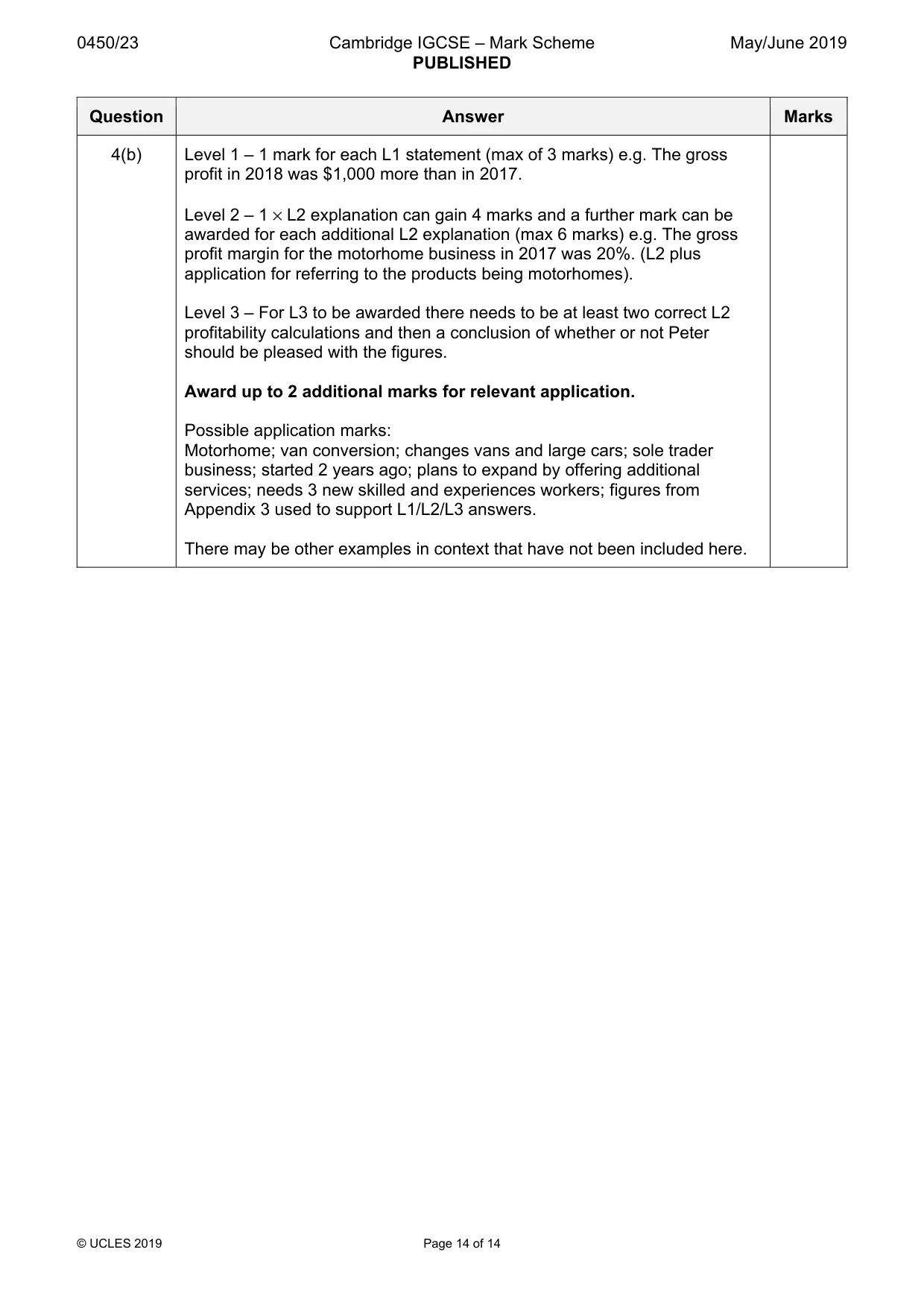
0450/23 Cambridge IGCSE – Mark Scheme PUBLISHED May/June 2019 © UCLES 2019 Page 14 of 14 Question Answer Marks 4(b) Level 1 – 1 mark for each L1 statement (max of 3 marks) e.g. The gross profit in 2018 was $1,000 more than in 2017. Level 2 – 1 × L2 explanation can gain 4 marks and a further mark can be awarded for each additional L2 explanation (max 6 marks) e.g. The gross profit margin for the motorhome business in 2017 was 20%. (L2 plus application for referring to the products being motorhomes). Level 3 – For L3 to be awarded there needs to be at least two correct L2 profitability calculations and then a conclusion of whether or not Peter should be pleased with the figures. Award up to 2 additional marks for relevant application. Possible application marks: Motorhome; van conversion; changes vans and large cars; sole trader business; started 2 years ago; plans to expand by offering additional services; needs 3 new skilled and experiences workers; figures from Appendix 3 used to support L1/L2/L3 answers. There may be other examples in context that have not been included here.
What you needed in this session
Cambridge’s own grade thresholds for 2019 May/June, Paper 2 · Variant 3. A higher threshold means an easier paper — the bar moves with how the cohort did.